WO2011125100A1 - 揮発性有機化合物を抽出する方法、装置及びその方法によって揮発性有機化合物が抽出された樹脂製の成型体。 - Google Patents
揮発性有機化合物を抽出する方法、装置及びその方法によって揮発性有機化合物が抽出された樹脂製の成型体。 Download PDFInfo
- Publication number
- WO2011125100A1 WO2011125100A1 PCT/JP2010/002456 JP2010002456W WO2011125100A1 WO 2011125100 A1 WO2011125100 A1 WO 2011125100A1 JP 2010002456 W JP2010002456 W JP 2010002456W WO 2011125100 A1 WO2011125100 A1 WO 2011125100A1
- Authority
- WO
- WIPO (PCT)
- Prior art keywords
- gas
- voc
- chamber
- molded body
- organic compound
- Prior art date
- Legal status (The legal status is an assumption and is not a legal conclusion. Google has not performed a legal analysis and makes no representation as to the accuracy of the status listed.)
- Ceased
Links
Images



Classifications
-
- B—PERFORMING OPERATIONS; TRANSPORTING
- B29—WORKING OF PLASTICS; WORKING OF SUBSTANCES IN A PLASTIC STATE IN GENERAL
- B29C—SHAPING OR JOINING OF PLASTICS; SHAPING OF MATERIAL IN A PLASTIC STATE, NOT OTHERWISE PROVIDED FOR; AFTER-TREATMENT OF THE SHAPED PRODUCTS, e.g. REPAIRING
- B29C71/00—After-treatment of articles without altering their shape; Apparatus therefor
- B29C71/009—After-treatment of articles without altering their shape; Apparatus therefor using gases without chemical reaction
-
- B—PERFORMING OPERATIONS; TRANSPORTING
- B29—WORKING OF PLASTICS; WORKING OF SUBSTANCES IN A PLASTIC STATE IN GENERAL
- B29C—SHAPING OR JOINING OF PLASTICS; SHAPING OF MATERIAL IN A PLASTIC STATE, NOT OTHERWISE PROVIDED FOR; AFTER-TREATMENT OF THE SHAPED PRODUCTS, e.g. REPAIRING
- B29C71/00—After-treatment of articles without altering their shape; Apparatus therefor
- B29C71/0009—After-treatment of articles without altering their shape; Apparatus therefor using liquids, e.g. solvents, swelling agents
- B29C2071/0036—Extracting, degassing, removing gases from moulded articles
Definitions
- the present invention relates to a method and apparatus for extracting a volatile organic compound, and a resin molded body from which the volatile organic compound is extracted by the method.
- VOCs are likely to be unevenly distributed near the surface of the molded body because a thin film is formed with a steep temperature gradient during molding. That is, the injection-molded body is in a state where VOC is easily diffused into the air.
- the VOC extraction process needs to be performed at a temperature lower than the heat resistance temperature of the molded body.
- Patent Document 1 discloses a method for extracting VOC in a molded body by utilizing a change in humidity. That is, by adding water molecules in the gas phase state to the treatment space containing the VOC impregnated material, the humidity is increased to 60 to 90%, and the water molecules in the gas phase state are infiltrated into the VOC impregnated material so After the sum composite is formed, the humidity of the treatment space is reduced (dehumidification) to dissipate the VOC hydrated composite from the VOC impregnation into the treatment space.
- the object of the present invention is to provide a method and apparatus for extracting a volatile organic compound from a resin molded body in a simple and efficient manner, and a VOC extracted from the resin. It is to provide a molded body.
- the method for extracting a volatile organic compound according to the present invention includes a step of introducing a gas having a relative humidity of 51% or more and less than 95% into a chamber in which a molded body made of a resin containing a volatile organic compound is installed; And a step of exhausting the gas containing the volatile organic compound diffused from the molded body to the outside of the chamber simultaneously with the introduction.
- the volatile organic compound extraction apparatus includes a gas cylinder, a humidity control tank that is supplied with the gas and adjusts the relative humidity of the gas to a value of 51% or more and less than 95%, and a gas A chamber having an inlet and a gas outlet, into which the gas of the humidity control tank is introduced from the gas inlet, and a pump for discharging the gas in the chamber from the gas outlet.
- a gas cylinder a humidity control tank that is supplied with the gas and adjusts the relative humidity of the gas to a value of 51% or more and less than 95%
- a gas A chamber having an inlet and a gas outlet, into which the gas of the humidity control tank is introduced from the gas inlet, and a pump for discharging the gas in the chamber from the gas outlet.
- the molded product according to the present invention is characterized in that the amount of volatile organic compound emitted is reduced by the volatile organic compound extraction method according to claim 1 as compared with that before extraction.
- the figure which shows the volatile organic compound extraction apparatus by one Embodiment of this invention The figure which shows the relationship between the relative humidity of the air introduce
- Volatile organic compound is a general term for organic chemicals that readily volatilize in the atmosphere at normal temperature and pressure.
- the boiling point of VOC is generally in the range of 50 ° C to 260 ° C.
- VOCs are divided into hydrophilic types and hydrophobic types. Examples of the hydrophilic VOC include formaldehyde, alcohol, dimethyl sulfoxide (DIMSO), and pyrrolidone. Examples of the hydrophobic VOC include toluene, ethylbenzene, xylene, tetradecane, pentadecane, hexadecane, heptadecane, and dibutylhydroxytoluene.
- a gas is allowed to flow in a treatment space in which a resinous molded body containing VOC is provided in a range where the relative humidity is 51% or more and less than 95%.
- VOC and hydrophobic VOC can be efficiently extracted.
- VOC can be easily extracted from a molded object, without requiring a complicated process and a complicated apparatus.
- the gas passing through the processing space is air, but other gases such as nitrogen gas and helium gas can be used in addition to air.
- Hydrophobic VOCs as well as hydrophilic VOCs can be extracted because the water vapor contained in the humidified gas flows in the treatment space while the particles are small. It is thought that the chain is expanded and the diffusion from the molded body into the air is promoted.
- the relative humidity refers to the humidity obtained from the ratio of the saturated water vapor amount at the gas temperature and the water vapor amount contained in the gas.
- VOC contained in a resin molded body can be extracted.
- the material of the molded body include acrylonitrile-butadiene-styrene copolymer (ABS) resin, polyurethane resin, and polymethacrylic acid.
- ABS acrylonitrile-butadiene-styrene copolymer
- PMMA methyl
- PVC vinyl chloride
- FIG. 1 is a diagram showing an embodiment of a VOC extraction device according to the present invention.
- This VOC extraction apparatus includes a cylinder 10 containing high-purity air, a gas purification pipe 20 that further removes impurities such as organic substances from the high-purity air of the cylinder 10 to further increase the purity of the air, a thermostat 40, a pump 70, It has.
- a humidity control tank 30 that adjusts the relative humidity of the air purified by the gas purification pipe 20 to be within a set range, a chamber 50, a chamber lid 51, and a VOC are adsorbed.
- VOC adsorption tube 80 is provided.
- the chamber 50 is provided with a gas inlet (gas inlet) and an outlet (gas outlet).
- a sample 60 which is a resin molded body, is installed.
- the constant temperature bath 40 keeps the temperature inside the chamber 50 including a constant.
- the temperature of the thermostatic chamber 40 is set to 65 degrees, for example.
- the humidity control tank 30 adjusts the relative humidity of the air purified by the gas purification pipe 20 to a predetermined value (or range) of 51% or more and less than 95%.
- a humidity meter is provided in the humidity control tank 30, and the relative humidity is kept constant by measuring the relative humidity of the air passing through the humidity control tank 30 and adding or removing water vapor to the air. That is, the humidity control tank adds water vapor to the air when the relative humidity of the air is smaller than a predetermined value (or range) and humidifies the air, and dehumidifies the air when the relative humidity is larger than the predetermined value (or range). To do.
- the humidity control tank 30 and the chamber 50 are provided in the thermostatic bath 40, the temperature of the air in the humidity control tank 30 and the temperature of the air in the chamber 50 are the same. Therefore, the relative humidity of the air adjusted in the humidity control tank 30 is the same as the relative humidity of the air in the chamber 50.
- the gas purification pipe 20 is connected to the cylinder 10 by the first pipe 11, and the humidity control tank 30 is connected to the gas purification pipe 20 by the second pipe 21 that penetrates the wall of the thermostatic bath 40.
- the inlet of the chamber 50 is connected to the humidity control tank 30 by a third pipe 31.
- a VOC adsorption tube 80 is provided at the outlet of the chamber 50.
- the VOC adsorption tube 80 is connected to the pump 70 by a fourth tube 41 that penetrates the wall of the thermostatic chamber 40.
- the method for extracting the VOC of the molded body using the VOC extraction apparatus having such a configuration is as follows.
- a sample 60 a molded body to be extracted from VOC is prepared.
- the chamber 50 having the air inlet and outlet is washed, and the sample 60 is sealed in the chamber 50.
- the chamber 50 is installed in the thermostat 40.
- the air outlet of the high-purity air cylinder 10 is opened, air having a temperature set in the constant temperature bath 40 and humidity set in the humidity control tank 30 is injected, and the air in the chamber 50 is pumped from the outlet side.
- suctioning at 70 high-purity air is circulated in the chamber 50.
- the temperature of the thermostatic chamber 40 be as high as possible. However, in order to prevent deterioration of the molded body due to high temperature, approximately 60 ° C. is desirable. However, when the material of the molded body is known, heating is possible up to the heat-resistant temperature of the material. Since the heat resistant temperature of the resin molded body is generally in the range of 20 ° C. to 300 ° C., the thermostat 40 is also set to a temperature within this range.
- the amount of VOC extracted from the molded body increases by allowing moderately humidified air to flow through the chamber 50.
- the hydrophilic VOC dissolves in the moisture in the air and the extraction efficiency increases due to humidification.
- the hydrophobic VOC also increases the polymer chain constituting the molded body. It is considered that the diffusion from the molded body into the air is promoted.
- the relative humidity is too high, the total amount of VOC extracted will decrease. This is considered to be because when the water molecules in the circulation air gather in the chamber 50 and the size of the water molecules increases, the surface of the molded body is covered with water molecules, and thus the hydrophobic substance is prevented from being diffused. .
- it is desirable that the clean air circulated in the chamber 50 is humidified to a relative humidity of 51% or more and less than 95%.
- the VOC extraction amount is increased by leaving the molded body under reduced pressure. This is presumably because the VOC existing in the molded body in the reduced pressure environment is pulled out to the vicinity of the surface, so that the VOC is easily extracted.
- VOC extraction method will be specifically described with reference to examples.
- present invention is not limited to those shown in the examples.
- Example 1 In order to confirm the influence of the relative humidity of the air in the chamber 50 on the VOC extraction amount, the amount of VOC dissipated from the molded article after the VOC extraction processing at various relative humidities and the VOC extraction are changed. A comparison was made with the amount of VOC released from the untreated molded body.
- the sample 60 used was a thermoplastic elastomer resin.
- the temperature of the thermostatic chamber 40 was all set to 65 ° C., and the relative humidity conditions were set to the three types shown in Table 1.
- Example 60 As a humidification treatment, (Sample 60) was placed in a 2-liter SUS chamber 50 and sealed, and the chamber 50 was placed in a thermostatic chamber 40 set at 65 ° C. VOC was extracted by leaving the air (G1 grade) adjusted to the relative humidity of conditions 1 to 3 shown in Table 1 for 24 hours in a state where it was circulated at 60 mL / min. Thereafter, the chamber 50 was washed and aged (heated) to remove VOCs extracted from the molded body and attached to the chamber 50.
- G1 grade the air adjusted to the relative humidity of conditions 1 to 3 shown in Table 1 for 24 hours in a state where it was circulated at 60 mL / min.
- the chamber 50 was washed and aged (heated) to remove VOCs extracted from the molded body and attached to the chamber 50.
- the (sample 60) after the heat and humidification treatment was again placed in the chamber 50 and sealed, and was placed in a constant temperature bath 40 at 28 ° C., and air (G1 grade) adjusted to a relative humidity of 50% at 60 mL / min.
- the inside of the chamber was sufficiently replaced with high-purity air.
- a VOC adsorption tube 51 (Sigma TA (R) manufactured by Sigma-Aldrich Japan) is attached to the gas outlet of the chamber 50, and VOC released from (sample 60) is collected.
- the amount of VOC extracted by -MS gas chromatography mass spectrometry
- the sample not subjected to the VOC extraction process was similarly installed in the chamber 50, and the amount of VOC diffused from (sample 60) was measured.
- the total VOC diffused between the start of hexane detection and the end of hexadecane detection was determined as the total VOC (Total (VOC; TVOC). That is, in the graph showing the relationship between the time and the extraction amount as a GC-MS measurement result, the peak area from the detection of hexane to the end of the detection of hexadecane is totaled, and the mass converted to the molecular weight of toluene is calculated as TVOC.
- the amount. Hexane is the organic compound with the smallest molecular weight assumed as a component of the VOC to be extracted, and hexadecane is the organic compound with the largest molecular weight assumed.
- the molded body containing VOC has a reduced amount of VOC emission as time passes after being molded, but all of the molded bodies used in Example 1 were molded at the same time.
- the molded body after molding was sealed in a PE bag and stored in a laboratory at a temperature of 23 to 25 ° C. and a relative humidity of about 20 to 40%.
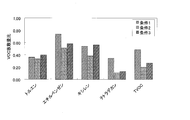
- FIG. 2 shows the TVOC amount dissipated from the molded product after the VOC extraction process, assuming that the TVOC amount of the molded body not subjected to the VOC extraction process is 1.
- the amount of TVOC extracted from (sample 60) is the smallest under condition 2, that is, the VOC extraction effect is the highest at 80% relative humidity, and the VOC extraction effect is at 50% and 95% relative humidity. Declined. Since the same tendency was observed for each substance such as toluene, it became clear that the VOC extraction effect was high under a relative humidity in the range of 51% to less than 95%.
- Example 1 a resin molded body is used as the sample 60, but an electric product having a resin molded body can also be used as the sample 1.
- VOC extraction according to Example 1 when the VOC extraction according to Example 1 is performed under the relative humidity in the range of 51% or more and less than 95%, both the hydrophilic VOC and the hydrophobic VOC can be extracted from the molded body, and the VOC can be efficiently extracted. Can be extracted. Moreover, since a complicated apparatus is not required, VOC extraction can be performed easily.
- the thermostatic chamber 40 is set to 65 degrees, but the VOC extraction effect can be obtained even at room temperature (about 20 to 30 degrees). Since the temperature of the constant temperature bath 40 can be set in consideration of the heat-resistant temperature of the molded body, there is no possibility of deteriorating the molded body.
- Example 2 Next, as Example 2, an example will be described in which the inside of the chamber 50 in which the molded body is installed is decompressed before the molded body in the chamber 50 is placed under air flow.
- the chamber 50 was connected to the third tube at the inlet after decompressing the inside and connected to the fourth tube at the outlet.
- the same components as those in the first embodiment are denoted by the same reference numerals, and the description of the same parts is omitted.
- the temperature of the thermostatic chamber 40 was 65 ° C., and as shown in Table 2, the relative humidity of the air adjusted by the humidity control cylinder 10 was 80%, and the case where the decompression process was performed was set as Condition 4.
- the condition 2 in which the temperature and relative humidity of the thermostatic bath 40 are the same and the pressure reduction treatment was not performed was compared with the condition 4.
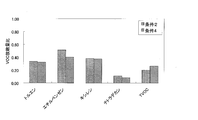
- FIG. 3 shows the amount of VOC diffused from the molded body after the VOC extraction processing in a reduced pressure environment after setting the VOC emission amount from the molded body not subjected to the VOC extraction processing to 1 (condition 4).
- the VOC emission amount from the molded product not subjected to the VOC extraction process was set to 1, and the VOC amount diffused from the molded body subjected to the extraction process without performing the decompression process was also shown (Condition 2 of Example 1). .
- FIG. 4 shows a total ion chromatogram showing the relationship between the time from the start of measurement by GC-MS and the VOC emission amount of the measured molded body.
- FIG. 4A is a total ion chromatogram when the decompression process is not performed (condition 2)
- FIG. 4B is a total ion chromatogram when the decompression process is performed (condition 4).
- VOC can be efficiently extracted from the molded body.
- the second embodiment can desire a higher VOC extraction efficiency than the first embodiment.
- Example 1 a resin molded body is used as the sample 60, but an electric product having a resin molded body can also be used as the sample 1.
- Example 3 Next, as Example 3, an example in which the background in the measurement of the sample 60 is reduced by performing VOC extraction of the AC power cord used for measuring the VOC emission amount by the method of the present embodiment will be described.
- Sample 60 in Example 3 is an AC power cord formed of a molded product of polyurethane resin.
- VOC is extracted from a molded product used for an electrical product
- the temperature inside the electrical product rises when energized.
- the amount of VOC emitted from the molded body increases. Therefore, it is necessary to grasp the amount of VOC diffused during energization.
- the VOC is extracted from the AC power cord.
- the VOC was previously stored.
- the background of the emission gas collection chamber 50 was compared between the case where the extracted AC power cord was used and the case where the AC power cord not subjected to the VOC extraction process was used. Background collection and measurement were performed in the same manner as in Example 1. That is, the AC power cord was installed without installing the sample 60 in the chamber 50, and the amount of VOC emission from the AC power cord was measured with the relative humidity of air set at 80%.
- FIG. 5 (a) shows a VOC dissipated from the AC power cord when the VOC extraction processing of the AC power cord is not performed.
- FIG. 5B shows VOCs that are dissipated from the AC power cord when the VOC extraction processing of the AC power cord is performed.
- the background of the chamber 50 was significantly reduced by performing the VOC extraction process on the AC power cord.
- the VOC extraction process of the third embodiment on the components of the chamber 50, it is possible to measure the released gas with high sensitivity for the molded product from which the VOC is to be extracted.
- VOC can be efficiently extracted from another resin-made molded body used to extract VOC from the resin-shaped molded body, and the background is reduced. be able to.
Landscapes
- Physics & Mathematics (AREA)
- Chemical & Material Sciences (AREA)
- Engineering & Computer Science (AREA)
- Chemical Kinetics & Catalysis (AREA)
- Plasma & Fusion (AREA)
- Sampling And Sample Adjustment (AREA)
Abstract
本発明、樹脂製の成形体中から、VOCを、簡便、かつ、効率良く抽出することを目的とする。 揮発性有機化合物を含む樹脂製の成形体が設置されたチャンバー内に相対湿度が51%以上95%未満のガスを導入する工程と、前記ガスを導入するのと同時に、前記成形体から放散された前記揮発性有機化合物を含むガスを前記チャンバーの外へ排気する工程と、を具備することを特徴とする。
Description
本発明は、揮発性有機化合物を抽出する方法、装置及びその方法によって揮発性有機化合物が抽出された樹脂製の成型体に関する。
近年、室内空気中の有害物質に暴露されることによる健康被害が問題となっており、例えば、揮発性有機化合物(VOC)によりシックハウス症候群を発症する例は多数報告されている。そこで、厚生労働省はシックハウス症候群の発症原因物質の室内空気中の濃度指針値を定める等の対策をとっている。また、各業界で材料や製品から放散するVOCを低減しようとする動きがある。生活用品や電気製品など、身の回りでプラスチック、ゴムなどの樹脂材料が多用されている。樹脂材料は、原料や製造工程、成形後の塗料等にVOCを使用せざるを得ない場合が多い。特に、樹脂材料の一次加工法のうち最も汎用されている射出成形によると、成形時に急峻な温度勾配をつけて薄膜を成形するため、VOCは成形体の表面付近に偏在しやすい。すなわち、射出成形体は、空気中にVOCを放散させやすい状態にある。
そこで、射出成形体を含む樹脂製の成形体に対し、成形体中のVOCを効率的に抽出し、成形体からのVOC放散量を低減化する前処理方法が求められている。
樹脂製の成型体は熱に弱く、熱によって劣化する恐れがあるため、VOC抽出処理には、成型体の耐熱温度以下で行う必要がある。
特許文献1は、湿度の変化を利用して成型体中のVOCを抽出する方法を開示している。すなわち、VOC含浸物を含む処理空間に気相状態の水分子を加えることにより湿度60~90%に加湿し、気相状態の水分子をVOC含浸物の内部に浸透させて内部のVOCと水和複合物を形成させた後、処理空間の湿度を低下させて(除湿)、VOC水和複合物をVOC含浸物から処理空間中に放散させる。除湿することによってVOC水和複合物をVOCと水に解離させ、VOCを処理空間内に設けられたデシカント(除湿剤)に捕集するVOC含浸物からのVOC抽出方法である。
特許文献1の方法によると、成形体中のホルムアルデヒドは減少したものの、VOC総量は増加した。この原因を推察すると、ホルムアルデヒドは水溶性であるため、加湿された空気中の水滴に捕捉されるが、疎水性のVOCは捕捉されなかったために抽出されなかったと考えられる。また、処理空間を加湿・除湿するためには、大型の装置が必要になる場合がある。
本発明の目的とするところは、樹脂製の成形体中から、VOCの総量を、簡便、かつ、効率良く揮発性有機化合物を抽出する方法、装置及びその方法によりVOCを抽出された樹脂製の成型体を提供することにある。
本発明による揮発性有機化合物の抽出方法は、揮発性有機化合物を含む樹脂製の成形体が設置されたチャンバー内に相対湿度が51%以上95%未満のガスを導入する工程と、前記ガスを導入するのと同時に、前記成形体から放散された前記揮発性有機化合物を含むガスを前記チャンバーの外へ排気する工程と、を具備することを特徴とする。
また、本発明による揮発性有機化合物抽出装置は、ガスが収納されたボンベと、前記ガスが供給され、前記ガスの相対湿度を51%以上95%未満の値に調整する調湿タンクと、ガス導入口とガス排出口を有し、前記ガス導入口から前記調湿タンクのガスが導入されるチャンバーと、前記ガス排出口から前記チャンバー内のガスを排出させるポンプと、を具備することを特徴とする。
また、本発明による成型体は、請求項1に記載の揮発性有機化合物の抽出方法により、抽出前よりも揮発性有機化合物の放散量が低減したことを特徴とする。
本発明によれば、樹脂製の成形体中からVOCの総量を、簡便、かつ、効率良く抽出することが可能になる。
揮発性有機化合物(VOC)は、常温常圧で大気中に容易に揮発する有機化学物質の総称のことである。VOCの沸点は、一般的に50℃~260℃の範囲内にある。VOCは、親水性のものと疎水性のものに分けられる。親水性のVOCとしては、例えば、ホルムアルデヒドやアルコール、ジメチルスルホキシド(DIMSO)、ピロリドンなどが挙げられる。疎水性のVOCとしては、例えば、トルエンやエチルベンゼン、キシレン、テトラデカン、ペンタデカン、ヘキサデカン、ヘプタデカン、ジブチルヒドロキシトルエンなどが挙げられる。
本実施の形態によると、VOCを含んだ樹脂性の成形体が設けられた処理空間内に相対湿度が51%以上95%未満の範囲内にガス(気体)が流し続けられることにより、親水性のVOCも疎水性のVOCも効率よく抽出することができる。また、本実施の形態によると、複雑な工程や複雑な装置を要しないで簡便に成形体からVOCを抽出することができる。
なお、本実施の形態では、処理空間を通すガスは空気とするが、空気以外に、窒素ガスやヘリウムガスなど他のガスを使用することも可能である。
親水性のVOCだけでなく疎水性VOCも抽出できるのは、加湿されたガスに含まれる水蒸気は粒子が小さいまま処理空間内を流れるため、この、粒子が小さな水蒸気によって成形体を構成する高分子鎖が広げられ、成形体から空気中への放散が促進されると考えられる。
なお、相対湿度とは、ガスの温度における飽和水蒸気量とガスに含まれる水蒸気量の比から求めた湿度のことを指す。
本実施の形態は、樹脂製の成形体に含まれるVOCを抽出することができるが、成形体の材料としては、例えば、アクリロニトリル-ブタジエン-スチレン共重合(ABS)樹脂、ポリウレタン樹脂、ポリメタクリル酸メチル(PMMA)樹脂、塩化ビニル(PVC)などの高分子鎖をもつ樹脂が挙げられる。本実施の形態は、加湿されたガスに触れやすい成形体の表面付近において、特に効果的にVOCを抽出できると考えられるので、表面付近にVOCが偏在しやすい射出成形によって得た成形体に対しては、効果的にVOCを抽出できる。
図1は、本発明によるVOC抽出装置の一実施形態を示す図である。このVOC抽出装置は、高純度空気が入ったボンベ10と、ボンベ10の高純度空気から有機物などの不純物を取り除いて空気の純度を更に高めるガス精製管20と、恒温槽40と、ポンプ70とを備えている。
恒温槽40内には、ガス精製管20で精製された空気の相対湿度が設定された範囲内になるように調整する調湿タンク30と、チャンバー50と、チャンバーの蓋51と、VOCを吸着するVOC吸着管80とが設けられる。チャンバー50にはガスの入口(ガス導入口)と出口(ガス排出口)が設けられている。チャンバー50内には、樹脂製の成型体である試料60が設置される。恒温槽40は、チャンバー50を含む内部の温度を一定に保つ。恒温槽40の温度は、例えば65度に設定される。
調湿タンク30は、ガス精製管20で精製された空気の相対湿度を51%以上95%未満の予め定めた値(または範囲)に調整する。調湿タンク30内には湿度計が設けられており、調湿タンク30を通る空気の相対湿度を計測して空気に水蒸気を加えたり除いたりすることによって相対湿度を一定に保つ。すなわち、調湿タンクは、空気の相対湿度が予め定められた値(または範囲)より小さいときに空気に水蒸気を加えて加湿し、予め定められた値(または範囲)より大きいときに空気を除湿する。
調湿タンク30とチャンバー50は恒温槽40内に設けられているため、調湿タンク30内の空気の温度とチャンバー50内の空気の温度は同じである。従って、調湿タンク30内で調整された空気の相対湿度は、チャンバー50内の空気の相対湿度と同じである。
ガス精製管20は第1の管11でボンベ10に接続されており、調湿タンク30は恒温槽40の壁を貫通する第2の管21でガス精製管20に接続されている。チャンバー50の入口は、第3の管31で調湿タンク30と接続されている。またチャンバー50の出口 にはVOC吸着管80が設けられている。VOC吸着管80は恒温槽40の壁を貫通する第4の管41でポンプ70と接続されている。
このような構成のVOC抽出装置を使って成形体のVOCを抽出する方法は、以下である。
まず、試料60として、VOCの抽出対象となる成形体を準備する。次に、空気の入口と出口を有するチャンバー50を洗浄し、チャンバー50内に試料60を密閉する。続いて、チャンバー50を恒温槽40に設置する。そして、高純度空気ボンベ10の空気の出口を開いて、恒温槽40で設定された温度で、かつ調湿タンク30で設定された湿度の空気を注入し、出口側からチャンバー50内空気をポンプ70で吸引することにより、チャンバー50内に純度の高い空気を、流通させる。
試料60からの、VOCの揮発を促すために恒温槽40の温度はできるだけ高い方が望ましいが、高温による成形体の変質を防止するため、60℃程度が望ましい。但し、成形体の材料がわかっている場合、その材料の耐熱温度までは加熱が可能である。樹脂製の成形体の耐熱温度は一般的に20℃~300℃の範囲内であるため、恒温槽40もこの範囲内の温度に設定することとする。
適度に加湿した空気をチャンバー50内に流通させることにより、成形体からのVOC抽出量は増大する。この機構について考察すると、加湿により、親水性VOCが空気中の水分に溶解して、抽出効率が上がることは言うまでもないが、疎水性VOCについても、成形体を構成する高分子鎖が広がることにより、成形体から空気中への放散が促進されると考えられる。ただし、相対湿度が高すぎると、抽出されるVOCの総量は低下する。これは、チャンバー50内で流通空気中の水分子が集まって水分子の集合のサイズが大きくなると、成形体表面が水分子で覆われるため、疎水性物質の放散が抑制されるためと考えられる。以上の理由により、チャンバー50内に流通させる清浄空気は相対湿度51%以上、95%未満に加湿されていることが望ましい。
更に、チャンバー50内に空気を流通させる前に、成形体を減圧下で放置することにより、VOC抽出量は増加する。これは、減圧環境下では成形体の内部に存在していたVOCが表面付近にまで引き出されることにより、VOCが抽出されやすくなるためと考えられる。
以下、VOCの抽出方法について、実施例を挙げて具体的に説明する。しかし、本発明は実施例に示したものに限定されるものではない。
〔実施例1〕
VOC抽出量に与えるチャンバー50内の空気の相対湿度の影響を確認するため、空気の相対湿度を変えて、種々の相対湿度におけるVOC抽出処理後の成形体から放散されるVOC量と、VOC抽出処理をしていない成形体から放散されるVOC量とを比較した。使用した試料60は、熱可塑性エラストマー樹脂とした。恒温槽40の温度は全て65℃とし、相対湿度の条件は表1に示した3種類に設定した。
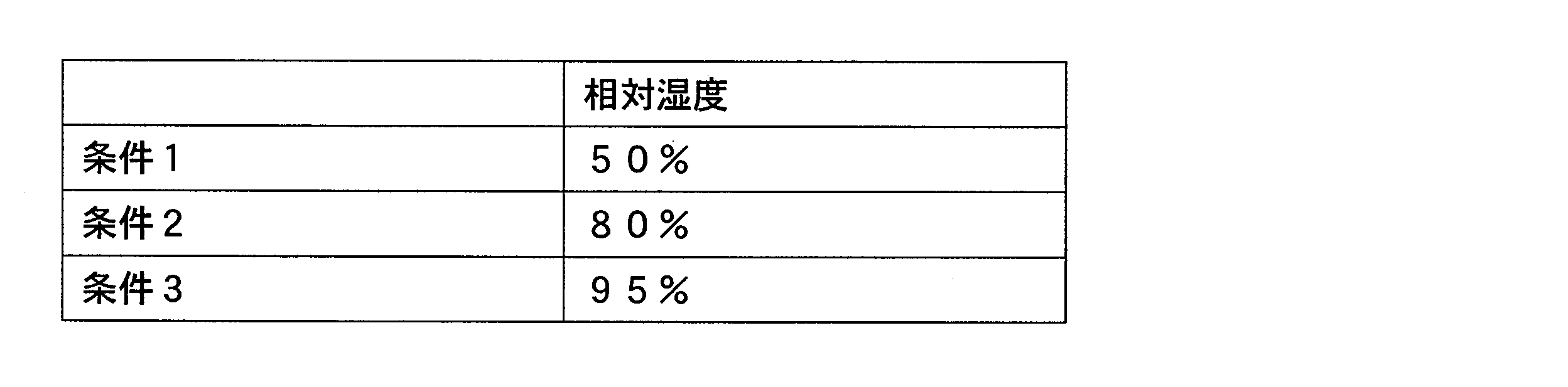
VOC抽出量に与えるチャンバー50内の空気の相対湿度の影響を確認するため、空気の相対湿度を変えて、種々の相対湿度におけるVOC抽出処理後の成形体から放散されるVOC量と、VOC抽出処理をしていない成形体から放散されるVOC量とを比較した。使用した試料60は、熱可塑性エラストマー樹脂とした。恒温槽40の温度は全て65℃とし、相対湿度の条件は表1に示した3種類に設定した。
まず、加湿処理として、(試料60)を2リットルのSUS製チャンバー50内に設置して密閉し、チャンバー50を65℃に設定した恒温槽40内に設置した。表1に示す条件1乃至3の相対湿度に調整した空気(G1グレード)を60mL/minで流通させた状態で24時間放置してVOCを抽出させた。その後、チャンバー50を洗浄、エージング(加熱)して、成形体から抽出されてチャンバー50に付着したVOCを取り除いた。続いて加熱加湿処理後の(試料60)を再度チャンバー50内に設置して密閉し、28℃恒温槽40内に設置し、相対湿度50%に調整した空気(G1グレード)を60mL/minで流通させ、純度の高い空気でチャンバー内を十分に置換した。空気の流通を開始して2時間後、チャンバー50のガス出口にVOC吸着管51(シグマアルドリッチジャパン社製TenaxTA(R))を取り付け、(試料60)から放散されたVOCを捕集し、GC-MS(ガスクロマトグラフィー質量分析)にて抽出されたVOC量を測定した。比較のため、VOC抽出処理をしていない(試料60)も同様にチャンバー50内に設置し、(試料60)から放散されたVOC量を測定した。VOCには複数の有機化合物が含まれるが、VOC総量(Total VOC; TVOC)としてヘキサンが検出され始めてからヘキサデカンが検出され終わるまでの間に放散されたVOCの合計を求めた。すなわち、GC-MSの測定結果として時間と抽出量の関係を示すグラフにおいて、ヘキサンが検出されてからヘキサデカンが検出され終わるまでのピークの面積を合計して、トルエンの分子量で換算した質量をTVOC量とした。ヘキサンは、抽出されるVOCの成分として想定される最も分子量の小さな有機化合物であり、ヘキサデカンは、想定される最も分子量の大きな有機化合物である。
ここでVOCを含む成形体は、成形されてから時間が経過するにつれてVOC放散量が減少するが、実施例1で使用した成形体はいずれも同時に成形されたものである。また、成形された後の成形体は、いずれもPE製の袋にて密閉し、温度23~25℃、相対湿度約20~40%の実験室にて保管されたものである。
図2は、VOC抽出処理をしていない成型体のTVOC量を1として、VOC抽出処理後の成型品から放散されるTVOC量を示している。図2においては、値が小さいほど、本実施例により成形体からVOCが多く抽出されたことを示す。同様に、シックハウス症候群の主な原因物質とされているトルエン、エチルベンゼン、キシレン、テトラデカンについても相対比較を行った。図2より、(試料60)から抽出されたTVOC量は、条件2のときが最も少なく、すなわち相対湿度80%でのVOC抽出効果が最も高く、相対湿度50%、95%ではVOC抽出効果が低下した。トルエン等の各物質についても同様の傾向が見られたことから、51%以上95%未満の範囲の相対湿度下でVOC抽出効果が高いことが明らかになった。
また、表1に示した条件1乃至条件3のうち、空気の相対湿度を80%に設定した条件2のときに、最もVOC抽出が多かったことから、相対湿度50%のとき、及び相対湿度95%のときよりも相対湿度80%のときにVOC抽出効果が高いといえる。調湿タンク30で調整される空気の相対湿度は、80%と高い場合には常に一定に保つことが困難である。したがって、調湿タンク30の調整精度によって相対湿度が安定しない場合を考慮して、相対湿度が70%~90%の範囲内にあるときには、特に高いVOC抽出効率を望むことができる。
なお、実施例1においては樹脂製の成型体を試料60としたが、樹脂製の成型体を有する電気製品を試料1とすることも可能である。
以上により、51%以上95%未満の範囲の相対湿度下で実施例1によるVOC抽出を行うと、親水性のVOCも疎水性のVOCも成型体から多く抽出することができ、効率良くVOCを抽出することができる。また、複雑な装置を必要としないので、簡便にVOC抽出を行うことができる。
なお、本実施の形態においては恒温槽40を65度に設定したが、室温(20度~30度程度)のままでもVOC抽出効果を得ることができる。成形体の耐熱温度を考慮して恒温槽40の温度を設定することができるので、成形体を劣化させる虞がない。
〔実施例2〕
次に、実施例2として、チャンバー50内の成形体を空気流通下に置く前に、成形体を設置したチャンバー50内を減圧処理した例を説明する。チャンバー50は、内部を減圧した後に入り口を第3の管と接続し、出口を第4の管と接続した。実施例1と同じ構成については同一の符号を付し、同じ部分の説明は省略する。恒温槽40の温度は65℃とし、表2に示すように、調湿ボンベ10で調整される空気の相対湿度は80%とし、減圧処理を行った場合を条件4とした。恒温槽40の温度と相対湿度が同じであり、減圧処理を行っていない条件2を条件4と比較した。

次に、実施例2として、チャンバー50内の成形体を空気流通下に置く前に、成形体を設置したチャンバー50内を減圧処理した例を説明する。チャンバー50は、内部を減圧した後に入り口を第3の管と接続し、出口を第4の管と接続した。実施例1と同じ構成については同一の符号を付し、同じ部分の説明は省略する。恒温槽40の温度は65℃とし、表2に示すように、調湿ボンベ10で調整される空気の相対湿度は80%とし、減圧処理を行った場合を条件4とした。恒温槽40の温度と相対湿度が同じであり、減圧処理を行っていない条件2を条件4と比較した。
減圧処理は、チャンバー50内を10-8Paの気圧下にて20時間放置した。減圧処理後は実施例1と同様の方法で、チャンバー50内に加湿した空気を流通させて抽出処理した後、恒温槽40の温度を28℃とし、相対湿度50%の空気を流通させる下にて放散されるTVOC、トルエン、エチルベンゼン、キシレン、テトラデカンの放散量を測定した。VOC抽出処理をしていない成型体からのVOC放散量を1とし、減圧環境下でVOC抽出処理をした後に成形体から放散されたVOC量を図3に示した(条件4)。比較として、VOC抽出処理をしていない成型品からのVOC放散量を1とし減圧処理を行わずに抽出処理をした成型体から放散されたVOC量についても示した(実施例1の条件2)。
また、GC-MSによる測定を開始してからの時間と測定された成形体のVOC放散量の関係を示すトータルイオンクロマトグラムを図4に示した。図4(a)は、減圧処理をしなかった場合(条件2)のトータルイオンクロマトグラムであり、図4(b)は減圧処理をした場合(条件4)のトータルイオンクロマトグラムである。
図4(a)、図4(b)からヘキサンのピークを確認することはできなかった。しかし、ガスクロマトグラフィー質量分析では1分子が持つ炭素数が1つ増えるごとに、ピークが等間隔で現れることから、ヘキサンのピークが検出される時間を見積もった。すなわち、測定を開始してから6分後にヘキサンのピークが検出されることとした。
図3に示すように、いずれの種類のVOCについても値が1より小さかったことから、減圧処理を行った場合(条件4)でも、成形体からVOCが効率よく抽出されており、VOC抽出処理を行わない場合よりも成形体に含まれるVOC放散量が多かった。
また、トルエン、エチルベンゼン、キシレン、テトラデカンについては、減圧処理を行った方(条件4)が行わなかった場合(条件2)よりも放散量は低く、減圧処理によるVOC抽出効果が認められた。TVOCについては、減圧処理を行わなかった方(条件2)が行った場合(条件4)よりも放散量は高く、減圧処理によっては、VOC抽出量は増加しなかった。図4(a)と図4(b)を比較することにより、ジブチルヒドロキシトルエンなど、減圧処理の効果が見られない物質と、ペンタデカンなど、減圧処理の効果が見られる物質があることが分かる。なお、測定を開始して約20分後にピークが見られる化合物Aは、減圧処理を行っても放散量が多かった。この化合物Aを特定することはできなかったが塩素原子を有する化合物であった。
成形体内での存在状態により放散メカニズムが異なるものと考えられるが、主なシックハウス症候群の原因物質であるトルエン等に対しては、減圧処理を行うとVOC抽出量が増えることから、シックハウス対策等のためのVOC抽出操作に対しては、減圧処理による効果はあると言える。
以上のように、実施例2によれば、成形体からVOCを効率的に抽出することができる。またVOCの種類によっては、実施例2は実施例1よりも高いVOC抽出効率を望むことができる。
なお、実施例1においては樹脂製の成型体を試料60としたが、樹脂製の成型体を有する電気製品を試料1とすることも可能である。
〔実施例3〕
次に、実施例3として、本実施の形態の方法により、VOC放散量測定に用いるAC電源コードのVOC抽出を行って試料60の測定の際のバックグラウンドを低減した例を示す。
実施例3における試料60は、ポリウレタン樹脂の成型体で形成されたAC電源コードである
電気製品に使用される成形体からVOCを抽出しようとする場合、通電時に電気製品内部の温度が上がることにより、成形体からVOCが放散される量が増加する可能性がある。従って、通電時の放散VOC量を把握する必要がある。通電時に成形体からの放散ガスを捕集するためには、電気製品をチャンバー50内で通電できるようにAC電源コードをチャンバー50内に導入する必要がある。しかしながら、AC電源コードも樹脂製の成形体である場合には、AC電源コードからもVOCが放散するため、バックグラウンド値が上がってしまう問題があった。
次に、実施例3として、本実施の形態の方法により、VOC放散量測定に用いるAC電源コードのVOC抽出を行って試料60の測定の際のバックグラウンドを低減した例を示す。
実施例3における試料60は、ポリウレタン樹脂の成型体で形成されたAC電源コードである
電気製品に使用される成形体からVOCを抽出しようとする場合、通電時に電気製品内部の温度が上がることにより、成形体からVOCが放散される量が増加する可能性がある。従って、通電時の放散VOC量を把握する必要がある。通電時に成形体からの放散ガスを捕集するためには、電気製品をチャンバー50内で通電できるようにAC電源コードをチャンバー50内に導入する必要がある。しかしながら、AC電源コードも樹脂製の成形体である場合には、AC電源コードからもVOCが放散するため、バックグラウンド値が上がってしまう問題があった。
そこで、実施例3においてはAC電源コードからVOCを抽出する。実施例1にて最もVOC低減効果が高かった条件、すなわち恒温槽40の温度65℃、チャンバー50内の相対湿度80%の空気流通下でAC電源コードを5日間放置することにより、予めVOCを抽出したAC電源コードを用いた場合と、VOC抽出処理を行っていないAC電源コードを用いた場合の放散ガス捕集チャンバー50のバックグラウンドを比較した。バックグラウンドの捕集、測定は実施例1と同様の方法で行った。すなわち、チャンバー50内に試料60を設置せずにAC電源コードを設置して、空気の相対湿度を80%としてAC電源コードのからのVOC放散量を測定した。
GC-MSのトータルイオンクロマトグラムの比較を図5に示した。図5(a)AC電源コードのVOC抽出処理を行っていない場合にAC電源コードから放散されたVOCを表す。図5(b)はAC電源コードのVOC抽出処理を行った場合にAC電源コードから放散されたVOCを表す。
図5に示すように、AC電源コードにVOC抽出処理を行うことで、チャンバー50のバックグラウンドは大幅に減少した。このように、チャンバー50の部品に対し、実施例3のVOC抽出処理を行うことにより、VOCを抽出したい成形品について高感度な放散ガスの測定が可能になる。
以上のように、実施例3によれば、樹脂性の成型体からVOCを抽出するために用いる、他の樹脂製の成形体からVOCを効率的に抽出することができ、バックグラウンドを低減させることができる。
10・・・ボンベ、11・・・第1の管、20・・・ガス精製管、22・・・第2の管、30・・・調湿タンク、31・・・第3の管、40・・・恒温槽、41・・・第4の管、50・・・チャンバー、51・・・蓋、60・・・試料、70・・・ポンプ、80・・・VOC吸着管、
Claims (7)
- 揮発性有機化合物を含む樹脂製の成形体が設置されたチャンバー内に相対湿度が51%以上95%未満のガスを導入する工程と、
前記ガスを導入するのと同時に、前記成形体から放散された前記揮発性有機化合物を含むガスを前記チャンバーの外へ排気する工程と、
を具備することを特徴とする揮発性有機化合物の抽出方法。 - 前記チャンバー内に前記ガスを導入する工程の前に、
前記ガスの相対湿度を測定する工程と、
前記測定した相対湿度が51%未満のときに前記ガスを加湿し、または前記測定した相対湿度が95%以上のときに前記ガスを除湿し、前記チャンバー内に導入されるガスの相対湿度を51%以上95%未満の範囲に維持する工程と、
を具備することを特徴とする請求項1に記載の揮発性有機化合物の抽出方法。 - 前記ガスを前記チャンバー内に導入する工程の前に、前記チャンバー内を前記チャンバー外の気圧よりも低くすることを特徴とする請求項1に記載の揮発性有機化合物の抽出方法。
- 前記ガスの相対湿度が70%以上90%以下であること特徴とする請求項1に記載の揮発性有機化合物の抽出方法。
- ガスが収納されたボンベと、
前記ガスが供給され、前記ガスの相対湿度を51%以上95%未満の値に調整する調湿タンクと、
ガス導入口とガス排出口を有し、前記ガス導入口から前記調湿タンクのガスが導入されるチャンバーと、
前記ガス排出口から前記チャンバー内のガスを排出させるポンプと、
を具備することを特徴とする揮発性有機化合物抽出装置。 - 前記ガスの相対湿度が70%以上90%以下であること特徴とする請求項5に記載の揮発性有機化合物抽出装置。
- 請求項1に記載の揮発性有機化合物の抽出方法により、抽出前よりも揮発性有機化合物の放散量が低減したことを特徴とする樹脂製の成型体。
Priority Applications (1)
| Application Number | Priority Date | Filing Date | Title |
|---|---|---|---|
| PCT/JP2010/002456 WO2011125100A1 (ja) | 2010-04-02 | 2010-04-02 | 揮発性有機化合物を抽出する方法、装置及びその方法によって揮発性有機化合物が抽出された樹脂製の成型体。 |
Applications Claiming Priority (1)
| Application Number | Priority Date | Filing Date | Title |
|---|---|---|---|
| PCT/JP2010/002456 WO2011125100A1 (ja) | 2010-04-02 | 2010-04-02 | 揮発性有機化合物を抽出する方法、装置及びその方法によって揮発性有機化合物が抽出された樹脂製の成型体。 |
Publications (1)
| Publication Number | Publication Date |
|---|---|
| WO2011125100A1 true WO2011125100A1 (ja) | 2011-10-13 |
Family
ID=44762094
Family Applications (1)
| Application Number | Title | Priority Date | Filing Date |
|---|---|---|---|
| PCT/JP2010/002456 Ceased WO2011125100A1 (ja) | 2010-04-02 | 2010-04-02 | 揮発性有機化合物を抽出する方法、装置及びその方法によって揮発性有機化合物が抽出された樹脂製の成型体。 |
Country Status (1)
| Country | Link |
|---|---|
| WO (1) | WO2011125100A1 (ja) |
Cited By (1)
| Publication number | Priority date | Publication date | Assignee | Title |
|---|---|---|---|---|
| CN106903911A (zh) * | 2017-03-14 | 2017-06-30 | 南方英特空调有限公司 | 降低汽车空调箱壳体voc醛酮类的方法 |
Citations (5)
| Publication number | Priority date | Publication date | Assignee | Title |
|---|---|---|---|---|
| JPH0711027A (ja) * | 1993-06-28 | 1995-01-13 | Idemitsu Petrochem Co Ltd | フィルム類の揮発分の除去方法及びこの装置 |
| JP2000127155A (ja) * | 1998-10-28 | 2000-05-09 | Matsui Mfg Co | キャリアガス置換を用いた粉粒体材料の除湿乾燥方法及び装置 |
| JP2001193974A (ja) * | 1999-11-01 | 2001-07-17 | Fujita Corp | 揮発性有機物質の室外排気方法および除去方法 |
| JP2002306919A (ja) * | 2001-04-10 | 2002-10-22 | Nippon Giken Kk | ホルマリン等化学物質の抽出分離除去装置 |
| JP2005125085A (ja) * | 2003-09-30 | 2005-05-19 | Hikoo Miyauchi | 揮発性有機化合物の除去方法及びその装置 |
-
2010
- 2010-04-02 WO PCT/JP2010/002456 patent/WO2011125100A1/ja not_active Ceased
Patent Citations (5)
| Publication number | Priority date | Publication date | Assignee | Title |
|---|---|---|---|---|
| JPH0711027A (ja) * | 1993-06-28 | 1995-01-13 | Idemitsu Petrochem Co Ltd | フィルム類の揮発分の除去方法及びこの装置 |
| JP2000127155A (ja) * | 1998-10-28 | 2000-05-09 | Matsui Mfg Co | キャリアガス置換を用いた粉粒体材料の除湿乾燥方法及び装置 |
| JP2001193974A (ja) * | 1999-11-01 | 2001-07-17 | Fujita Corp | 揮発性有機物質の室外排気方法および除去方法 |
| JP2002306919A (ja) * | 2001-04-10 | 2002-10-22 | Nippon Giken Kk | ホルマリン等化学物質の抽出分離除去装置 |
| JP2005125085A (ja) * | 2003-09-30 | 2005-05-19 | Hikoo Miyauchi | 揮発性有機化合物の除去方法及びその装置 |
Cited By (1)
| Publication number | Priority date | Publication date | Assignee | Title |
|---|---|---|---|---|
| CN106903911A (zh) * | 2017-03-14 | 2017-06-30 | 南方英特空调有限公司 | 降低汽车空调箱壳体voc醛酮类的方法 |
Similar Documents
| Publication | Publication Date | Title |
|---|---|---|
| JP5882350B2 (ja) | 真菌汚染を検出するためのデバイス | |
| Tulliani et al. | Room temperature ammonia sensors based on zinc oxide and functionalized graphite and multi-walled carbon nanotubes | |
| Ekelund et al. | Evaporative loss kinetics of di (2-ethylhexyl) phthalate (DEHP) from pristine DEHP and plasticized PVC | |
| WO1997004851A1 (en) | Air filter, process for preparing air filter, local facilities, clean rooms, treatments, and process for preparing filter medium | |
| TW522041B (en) | Gas separation apparatus | |
| JP2008508055A (ja) | 気体又は液体から水を添加又は除去する薄型膜を含む水の輸送方法及びアセンブリ | |
| CN101044398A (zh) | 用于液相色谱的基于膜的挥发性组分除去设备 | |
| WO2007061630A3 (en) | Parallel-plate diffusion gas dehumidifier and methods for use | |
| KR20070009470A (ko) | 공기 처리 필터 및 관련 방법 | |
| US10293068B2 (en) | Method and device for hydrogen peroxide sterilization | |
| US11788980B2 (en) | Apparatus of countering contamination in gas sensors including corresponding circuit | |
| KR101715826B1 (ko) | 유기 용매의 제거 방법 및 제거 장치 | |
| TW201827342A (zh) | 多晶矽破碎物之表面雜質的分析方法 | |
| JP2015187607A5 (ja) | ||
| JP4542248B2 (ja) | シリコーンガス吸着剤及びガスフィルタ及びガスセンサ | |
| Hosseini et al. | Pervaporation characteristics of a PDMS/PMHS membrane for removal of dimethyl sulfoxide from aqueous solutions | |
| JP7017633B2 (ja) | カラムハードウェア及び分離カラム並びにそれらの製造方法 | |
| KR20140034699A (ko) | 액체로부터 휘발성 유기 화합물을 제거하기 위한 다중 멤브레인 | |
| WO2013080963A1 (ja) | 除湿装置 | |
| CN101044368A (zh) | 热交换元件及装载有该热交换元件的热交换换气装置 | |
| Nigiz et al. | Removal of acetone from wastewater by POSS loaded PDMS membrane | |
| US9157890B2 (en) | Exchange membrane unit and system including exchange membrane unit | |
| CN109701483A (zh) | 一种挥发性苯系物吸附材料及其制备方法 | |
| JP2005125085A (ja) | 揮発性有機化合物の除去方法及びその装置 | |
| JP6297704B2 (ja) | Pco反応を実行するための方法及び装置、並びに該装置を有する空気清浄器 |
Legal Events
| Date | Code | Title | Description |
|---|---|---|---|
| 121 | Ep: the epo has been informed by wipo that ep was designated in this application |
Ref document number: 10849350 Country of ref document: EP Kind code of ref document: A1 |
|
| NENP | Non-entry into the national phase |
Ref country code: DE |
|
| 122 | Ep: pct application non-entry in european phase |
Ref document number: 10849350 Country of ref document: EP Kind code of ref document: A1 |
|
| NENP | Non-entry into the national phase |
Ref country code: JP |