WO2011121849A1 - ノルボルナン骨格を有するポリアミドの製造方法及びそれにより得られるノルボルナン骨格を有するポリアミド - Google Patents
ノルボルナン骨格を有するポリアミドの製造方法及びそれにより得られるノルボルナン骨格を有するポリアミド Download PDFInfo
- Publication number
- WO2011121849A1 WO2011121849A1 PCT/JP2010/071679 JP2010071679W WO2011121849A1 WO 2011121849 A1 WO2011121849 A1 WO 2011121849A1 JP 2010071679 W JP2010071679 W JP 2010071679W WO 2011121849 A1 WO2011121849 A1 WO 2011121849A1
- Authority
- WO
- WIPO (PCT)
- Prior art keywords
- polyamide
- norbornane
- compound
- general formula
- norbornane skeleton
- Prior art date
- Legal status (The legal status is an assumption and is not a legal conclusion. Google has not performed a legal analysis and makes no representation as to the accuracy of the status listed.)
- Ceased
Links
- 0 COC(C1(*)C(C2)C=CC2C1)=O Chemical compound COC(C1(*)C(C2)C=CC2C1)=O 0.000 description 2
Classifications
-
- C—CHEMISTRY; METALLURGY
- C08—ORGANIC MACROMOLECULAR COMPOUNDS; THEIR PREPARATION OR CHEMICAL WORKING-UP; COMPOSITIONS BASED THEREON
- C08G—MACROMOLECULAR COMPOUNDS OBTAINED OTHERWISE THAN BY REACTIONS ONLY INVOLVING UNSATURATED CARBON-TO-CARBON BONDS
- C08G18/00—Polymeric products of isocyanates or isothiocyanates
- C08G18/06—Polymeric products of isocyanates or isothiocyanates with compounds having active hydrogen
- C08G18/28—Polymeric products of isocyanates or isothiocyanates with compounds having active hydrogen characterised by the compounds used containing active hydrogen
- C08G18/30—Low-molecular-weight compounds
- C08G18/34—Carboxylic acids; Esters thereof with monohydroxyl compounds
-
- C—CHEMISTRY; METALLURGY
- C08—ORGANIC MACROMOLECULAR COMPOUNDS; THEIR PREPARATION OR CHEMICAL WORKING-UP; COMPOSITIONS BASED THEREON
- C08G—MACROMOLECULAR COMPOUNDS OBTAINED OTHERWISE THAN BY REACTIONS ONLY INVOLVING UNSATURATED CARBON-TO-CARBON BONDS
- C08G18/00—Polymeric products of isocyanates or isothiocyanates
- C08G18/06—Polymeric products of isocyanates or isothiocyanates with compounds having active hydrogen
- C08G18/70—Polymeric products of isocyanates or isothiocyanates with compounds having active hydrogen characterised by the isocyanates or isothiocyanates used
- C08G18/72—Polyisocyanates or polyisothiocyanates
- C08G18/74—Polyisocyanates or polyisothiocyanates cyclic
- C08G18/76—Polyisocyanates or polyisothiocyanates cyclic aromatic
- C08G18/7657—Polyisocyanates or polyisothiocyanates cyclic aromatic containing two or more aromatic rings
- C08G18/7664—Polyisocyanates or polyisothiocyanates cyclic aromatic containing two or more aromatic rings containing alkylene polyphenyl groups
- C08G18/7671—Polyisocyanates or polyisothiocyanates cyclic aromatic containing two or more aromatic rings containing alkylene polyphenyl groups containing only one alkylene bisphenyl group
-
- B—PERFORMING OPERATIONS; TRANSPORTING
- B01—PHYSICAL OR CHEMICAL PROCESSES OR APPARATUS IN GENERAL
- B01J—CHEMICAL OR PHYSICAL PROCESSES, e.g. CATALYSIS OR COLLOID CHEMISTRY; THEIR RELEVANT APPARATUS
- B01J31/00—Catalysts comprising hydrides, coordination complexes or organic compounds
- B01J31/16—Catalysts comprising hydrides, coordination complexes or organic compounds containing coordination complexes
- B01J31/20—Carbonyls
-
- C—CHEMISTRY; METALLURGY
- C07—ORGANIC CHEMISTRY
- C07C—ACYCLIC OR CARBOCYCLIC COMPOUNDS
- C07C51/00—Preparation of carboxylic acids or their salts, halides or anhydrides
- C07C51/09—Preparation of carboxylic acids or their salts, halides or anhydrides from carboxylic acid esters or lactones
-
- C—CHEMISTRY; METALLURGY
- C07—ORGANIC CHEMISTRY
- C07C—ACYCLIC OR CARBOCYCLIC COMPOUNDS
- C07C67/00—Preparation of carboxylic acid esters
- C07C67/36—Preparation of carboxylic acid esters by reaction with carbon monoxide or formates
- C07C67/38—Preparation of carboxylic acid esters by reaction with carbon monoxide or formates by addition to an unsaturated carbon-to-carbon bond
-
- C—CHEMISTRY; METALLURGY
- C07—ORGANIC CHEMISTRY
- C07C—ACYCLIC OR CARBOCYCLIC COMPOUNDS
- C07C69/00—Esters of carboxylic acids; Esters of carbonic or haloformic acids
- C07C69/74—Esters of carboxylic acids having an esterified carboxyl group bound to a carbon atom of a ring other than a six-membered aromatic ring
- C07C69/753—Esters of carboxylic acids having an esterified carboxyl group bound to a carbon atom of a ring other than a six-membered aromatic ring of polycyclic acids
-
- C—CHEMISTRY; METALLURGY
- C08—ORGANIC MACROMOLECULAR COMPOUNDS; THEIR PREPARATION OR CHEMICAL WORKING-UP; COMPOSITIONS BASED THEREON
- C08G—MACROMOLECULAR COMPOUNDS OBTAINED OTHERWISE THAN BY REACTIONS ONLY INVOLVING UNSATURATED CARBON-TO-CARBON BONDS
- C08G18/00—Polymeric products of isocyanates or isothiocyanates
- C08G18/06—Polymeric products of isocyanates or isothiocyanates with compounds having active hydrogen
- C08G18/28—Polymeric products of isocyanates or isothiocyanates with compounds having active hydrogen characterised by the compounds used containing active hydrogen
- C08G18/30—Low-molecular-weight compounds
- C08G18/34—Carboxylic acids; Esters thereof with monohydroxyl compounds
- C08G18/341—Dicarboxylic acids, esters of polycarboxylic acids containing two carboxylic acid groups
-
- C—CHEMISTRY; METALLURGY
- C08—ORGANIC MACROMOLECULAR COMPOUNDS; THEIR PREPARATION OR CHEMICAL WORKING-UP; COMPOSITIONS BASED THEREON
- C08G—MACROMOLECULAR COMPOUNDS OBTAINED OTHERWISE THAN BY REACTIONS ONLY INVOLVING UNSATURATED CARBON-TO-CARBON BONDS
- C08G18/00—Polymeric products of isocyanates or isothiocyanates
- C08G18/06—Polymeric products of isocyanates or isothiocyanates with compounds having active hydrogen
- C08G18/70—Polymeric products of isocyanates or isothiocyanates with compounds having active hydrogen characterised by the isocyanates or isothiocyanates used
- C08G18/72—Polyisocyanates or polyisothiocyanates
- C08G18/74—Polyisocyanates or polyisothiocyanates cyclic
- C08G18/75—Polyisocyanates or polyisothiocyanates cyclic cycloaliphatic
- C08G18/751—Polyisocyanates or polyisothiocyanates cyclic cycloaliphatic containing only one cycloaliphatic ring
- C08G18/752—Polyisocyanates or polyisothiocyanates cyclic cycloaliphatic containing only one cycloaliphatic ring containing at least one isocyanate or isothiocyanate group linked to the cycloaliphatic ring by means of an aliphatic group
-
- C—CHEMISTRY; METALLURGY
- C08—ORGANIC MACROMOLECULAR COMPOUNDS; THEIR PREPARATION OR CHEMICAL WORKING-UP; COMPOSITIONS BASED THEREON
- C08G—MACROMOLECULAR COMPOUNDS OBTAINED OTHERWISE THAN BY REACTIONS ONLY INVOLVING UNSATURATED CARBON-TO-CARBON BONDS
- C08G18/00—Polymeric products of isocyanates or isothiocyanates
- C08G18/06—Polymeric products of isocyanates or isothiocyanates with compounds having active hydrogen
- C08G18/70—Polymeric products of isocyanates or isothiocyanates with compounds having active hydrogen characterised by the isocyanates or isothiocyanates used
- C08G18/72—Polyisocyanates or polyisothiocyanates
- C08G18/74—Polyisocyanates or polyisothiocyanates cyclic
- C08G18/75—Polyisocyanates or polyisothiocyanates cyclic cycloaliphatic
- C08G18/751—Polyisocyanates or polyisothiocyanates cyclic cycloaliphatic containing only one cycloaliphatic ring
- C08G18/752—Polyisocyanates or polyisothiocyanates cyclic cycloaliphatic containing only one cycloaliphatic ring containing at least one isocyanate or isothiocyanate group linked to the cycloaliphatic ring by means of an aliphatic group
- C08G18/753—Polyisocyanates or polyisothiocyanates cyclic cycloaliphatic containing only one cycloaliphatic ring containing at least one isocyanate or isothiocyanate group linked to the cycloaliphatic ring by means of an aliphatic group containing one isocyanate or isothiocyanate group linked to the cycloaliphatic ring by means of an aliphatic group having a primary carbon atom next to the isocyanate or isothiocyanate group
- C08G18/755—Polyisocyanates or polyisothiocyanates cyclic cycloaliphatic containing only one cycloaliphatic ring containing at least one isocyanate or isothiocyanate group linked to the cycloaliphatic ring by means of an aliphatic group containing one isocyanate or isothiocyanate group linked to the cycloaliphatic ring by means of an aliphatic group having a primary carbon atom next to the isocyanate or isothiocyanate group and at least one isocyanate or isothiocyanate group linked to a secondary carbon atom of the cycloaliphatic ring, e.g. isophorone diisocyanate
-
- C—CHEMISTRY; METALLURGY
- C08—ORGANIC MACROMOLECULAR COMPOUNDS; THEIR PREPARATION OR CHEMICAL WORKING-UP; COMPOSITIONS BASED THEREON
- C08G—MACROMOLECULAR COMPOUNDS OBTAINED OTHERWISE THAN BY REACTIONS ONLY INVOLVING UNSATURATED CARBON-TO-CARBON BONDS
- C08G69/00—Macromolecular compounds obtained by reactions forming a carboxylic amide link in the main chain of the macromolecule
-
- B—PERFORMING OPERATIONS; TRANSPORTING
- B01—PHYSICAL OR CHEMICAL PROCESSES OR APPARATUS IN GENERAL
- B01J—CHEMICAL OR PHYSICAL PROCESSES, e.g. CATALYSIS OR COLLOID CHEMISTRY; THEIR RELEVANT APPARATUS
- B01J2231/00—Catalytic reactions performed with catalysts classified in B01J31/00
- B01J2231/10—Polymerisation reactions involving at least dual use catalysts, e.g. for both oligomerisation and polymerisation
- B01J2231/14—Other (co) polymerisation, e.g. of lactides or epoxides
-
- B—PERFORMING OPERATIONS; TRANSPORTING
- B01—PHYSICAL OR CHEMICAL PROCESSES OR APPARATUS IN GENERAL
- B01J—CHEMICAL OR PHYSICAL PROCESSES, e.g. CATALYSIS OR COLLOID CHEMISTRY; THEIR RELEVANT APPARATUS
- B01J2531/00—Additional information regarding catalytic systems classified in B01J31/00
- B01J2531/80—Complexes comprising metals of Group VIII as the central metal
- B01J2531/82—Metals of the platinum group
- B01J2531/821—Ruthenium
-
- B—PERFORMING OPERATIONS; TRANSPORTING
- B01—PHYSICAL OR CHEMICAL PROCESSES OR APPARATUS IN GENERAL
- B01J—CHEMICAL OR PHYSICAL PROCESSES, e.g. CATALYSIS OR COLLOID CHEMISTRY; THEIR RELEVANT APPARATUS
- B01J2531/00—Additional information regarding catalytic systems classified in B01J31/00
- B01J2531/80—Complexes comprising metals of Group VIII as the central metal
- B01J2531/84—Metals of the iron group
- B01J2531/845—Cobalt
Definitions
- the present invention relates to a method for producing a polyamide having a norbornane skeleton, which is useful as a polymer having high heat resistance and transparency.
- the present invention also relates to a polyamide having a norbornane skeleton obtained thereby.
- epoxy resin has been widely used as a resin for optical members used in optoelectronic devices and the like because of its mounting process on an electronic substrate and the like, heat resistance under high temperature operation, mechanical properties, and versatility.
- high-intensity laser light, blue light, and near-ultraviolet light has expanded in the field of optoelectronic devices, and a resin that is superior in transparency, heat resistance, and light resistance than ever has been demanded.
- epoxy resin has high transparency in visible light, but sufficient transparency cannot be obtained in the ultraviolet to near ultraviolet region.
- a cured product composed of an alicyclic epoxy resin and an acid anhydride has a relatively high transparency in the near-ultraviolet region, but has a problem that it is easily colored by heat or light.
- improvement in heat resistance and UV resistance is required, and various epoxy resins have been studied (for example, see Patent Documents 1 to 4).
- heat-resistant resins such as polyamide are excellent in heat resistance, insulation, light resistance and mechanical properties, and are soluble in various solvents and excellent in workability.
- protective films and interlayer insulation films Widely used as protective films and interlayer insulation films.
- polyamides having an alicyclic structure are excellent in transparency in the ultraviolet region, and thus have been studied as materials for optoelectronic devices and various displays (for example, see Patent Document 5).
- Patent Document 5 is produced by polymerizing a diamine and a carboxylic acid or a derivative thereof, the reaction between the diamine and the dicarboxylic acid requires a high temperature of 240 ° C to 350 ° C. An industrially simple production method is required.
- the present invention has been made to solve the above problems. Specifically, the present invention relates to a method for easily producing a polyamide having a norbornane skeleton, which is excellent in heat resistance and transparency, and a polyamide having a norbornane skeleton obtained thereby.
- the present invention is as follows.
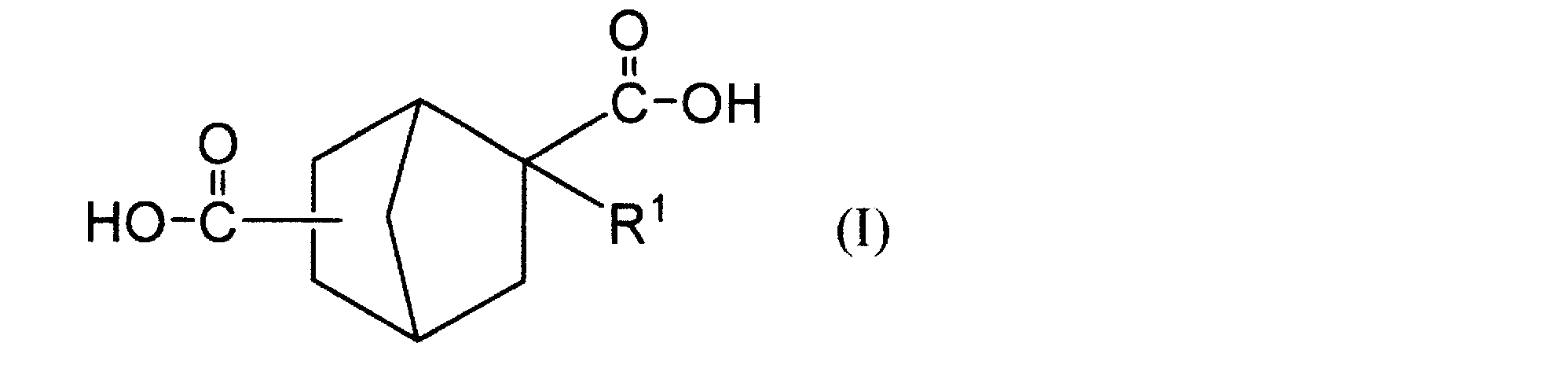
- the present invention relates to a method for producing a polyamide having a norbornane skeleton, characterized by reacting a norbornane dicarboxylic acid compound represented by the following general formula (I) with a diisocyanate compound in a polar solvent.
- the present invention also relates to a method for producing a polyamide having a norbornane skeleton, wherein the diisocyanate compound is an aliphatic and / or alicyclic diisocyanate compound represented by the following general formula (II).
- OCN-X-NCO (II)
- X is a divalent organic group selected from a divalent aliphatic group having 4 to 16 carbon atoms and a divalent alicyclic group having 4 to 16 carbon atoms.
- the present invention relates to a method for producing a polyamide having a norbornane skeleton, wherein the diisocyanate compound is an aromatic diisocyanate compound represented by the following general formula (III).
- the present invention relates to a method for producing a polyamide having a norbornane skeleton, wherein the norbornane dicarboxylic acid compound represented by the general formula (I) is obtained by a method including the following steps (1) to (2).
- the present invention also relates to a method for producing a polyamide having a norbornane skeleton, wherein the ruthenium compound is a ruthenium complex having both a carbonyl ligand and a halogen ligand in the molecule.
- the present invention relates to a method for producing a polyamide having a norbornane skeleton, wherein the halide salt is a quaternary ammonium salt.
- the present invention relates to a method for producing a polyamide having a norbornane skeleton, wherein the catalyst system further contains a basic compound.
- the present invention also relates to a method for producing a polyamide having a norbornane skeleton, wherein the basic compound is a tertiary amine compound.
- the present invention relates to a method for producing a polyamide having a norbornane skeleton, wherein the catalyst system further contains a phenol compound.
- the present invention relates to a method for producing a polyamide having a norbornane skeleton, wherein the catalyst system further contains an organic halogen compound.
- the present invention also relates to a polyamide having a norbornane skeleton obtained by the above production method.
- the production method of the present invention can produce a polyamide having a norbornane skeleton under industrially advantageous conditions. Further, the polyamide having a norbornane skeleton obtained thereby is excellent in heat resistance and transparency, so that it is an optical material typified by electronic components, optical fibers, optical lenses, etc. used in semiconductors and liquid crystals, and display-related materials, It can be used as a medical material.
- a norbornane dicarboxylic acid compound represented by the following general formula (I) is reacted with a diisocyanate compound in a polar solvent. And a process for producing a polyamide having a norbornane skeleton.
- R 1 is hydrogen or a methyl group.
- Diisocyanate compound As the diisocyanate compound to be reacted with the norbornane dicarboxylic acid compound represented by the general formula (I) in the present invention, an aliphatic and / or alicyclic diisocyanate compound represented by the following general formula (II), and the following general formula The aromatic diisocyanate compound represented by (III) is mentioned.
- OCN-X-NCO (II) (In the formula, X is a divalent organic group selected from a divalent aliphatic group having 4 to 16 carbon atoms and a divalent alicyclic group having 4 to 16 carbon atoms.)
- OCN-Y-NCO (III) (In the formula, Y is a divalent aromatic group.)
- the aliphatic isocyanate compound include those in which X in the general formula (II) is a divalent aliphatic group having 4 to 16 carbon atoms. Specific examples include hexamethylene diisocyanate, 2,2,4, and the like. -Trimethylhexamethylene diisocyanate, lysine diisocyanate, etc. can be used, and these can be used alone or in admixture of two or more.
- alicyclic isocyanate compound examples include those in which X in the general formula (II) is a divalent alicyclic group having 4 to 16 carbon atoms, specifically, for example, isophorone diisocyanate, 4,4′- Dicyclohexylmethane diisocyanate, cyclohexylene diisocyanate and the like can be used, and these can be used alone or in admixture of two or more.
- aromatic isocyanate examples include those in which Y in the general formula (III) is a divalent aromatic group. Specific examples include 4,4′-diphenylmethane diisocyanate, tolylene diisocyanate, xylylene diisocyanate, 4,4′-diphenyl ether diisocyanate, 4,4 ′-[2,2-bis (4-phenoxyphenyl) propane] diisocyanate, biphenyl-4,4′-diisocyanate, biphenyl-3,3′-diisocyanate, biphenyl-3 , 4'-diisocyanate, 3,3'-dimethylbiphenyl-4,4'-diisocyanate, 2,2'-dimethylbiphenyl-4,4'-diisocyanate, 3,3'-diethylbiphenyl-4,4'-diisocyanate 2,2'-diethylbiphenyl-4,4'-di Socyanate,
- aliphatic isocyanate compounds aliphatic isocyanate compounds
- alicyclic isocyanate compounds aromatic isocyanate compounds
- the norbornane dicarboxylic acid compound represented by the general formula (I) is preferably obtained by a method including the following steps (1) and (2).
- the formic acid ester (HCOOR 2 ) to be reacted with the norbornene monocarboxylic acid derivative represented by the general formula (IV) There is no limitation, and for example, methyl formate, ethyl formate, propyl formate, isopropyl formate, butyl formate, isobutyl formate, amyl formate, isoamyl formate, allyl formate, vinyl formate, benzyl formate and the like can be used. From the viewpoint of cost and reactivity, linear alkyl formate such as methyl formate and ethyl formate is preferred, and methyl formate is more preferred.
- ester moiety of the formic acid ester (R 2) corresponds to R 2 in the formula (V).
- R 1 in the formula (IV) is the same as R 1 in the formula (I) and the formula (V).
- the catalyst system for the above reaction includes a ruthenium compound, a cobalt compound, and a halide salt.
- the “catalyst system” includes not only the catalyst itself, but also additives, sensitizers, and the like that assist the action of the catalyst.
- the ruthenium compound is not particularly limited as long as it contains ruthenium.
- suitable ruthenium compounds include [Ru (CO) 3 Cl 2 ] 2 , [Ru (CO) 2 Cl 2 ] n , [Ru (CO) 3 Cl 3 ] ⁇ , [Ru 3 (CO) 11 Cl ] -, [Ru 4 (CO ) 13 Cl] - , such as, ruthenium compounds having both a carbonyl ligand and halogen ligands in the molecule. of these, from the viewpoint of the reaction rate increase, [ Ru (CO) 3 Cl 2 ] 2 , [Ru (CO) 2 Cl 2 ] n and the like are more preferable.
- the ruthenium compounds include RuCl 3 , Ru 3 (CO) 12 , RuCl 2 (C 8 H 12 ), Ru (CO) 3 (C 8 H 8 ), Ru (CO) 3 (C 8 H 12 ), and Ru.
- (C 8 H 10 ) (C 8 H 12 ) or the like is used as a precursor compound, and the ruthenium compound is converted into the precursor before or during the reaction to obtain the norbornane dicarboxylic acid derivative represented by the general formula (V). It may be prepared from the body compound and introduced into the reaction system.
- the amount of the ruthenium compound used is preferably 1 / 10,000 to 1 equivalent, more preferably 1/1000 to 1/50 equivalent, relative to the norbornene monocarboxylic acid derivative represented by the general formula (IV) as a raw material. is there. Considering the production cost, it is preferable that the amount of the ruthenium compound used is smaller, but if it is less than 1/10000 equivalent, the reaction tends to become extremely slow.
- the cobalt compound is not particularly limited as long as it contains cobalt.
- suitable cobalt compounds include cobalt compounds having a carbonyl ligand such as Co 2 (CO) 8 , Co (CO) 4 , Co 4 (CO) 12 ; cobalt acetate, cobalt propionate, cobalt benzoate, Examples include cobalt compounds having a carboxylic acid compound such as cobalt oxide as a ligand; cobalt phosphate and the like. Of these, Co 2 (CO) 8 , cobalt acetate, cobalt citrate and the like are more preferable from the viewpoint of improving the reaction rate.
- the amount of the cobalt compound used is 1/100 to 10 equivalents, preferably 1/10 to 5 equivalents, relative to the ruthenium compound. Whether the ratio of the cobalt compound to the ruthenium compound is lower than 1/100 or higher than 10, the norbornane dicarboxylic acid derivative represented by the general formula (V) (hereinafter also referred to as “ester compound”) The amount produced tends to decrease significantly.
- the halide salt is not particularly limited as long as it is a compound composed of a halogen ion such as chloride ion, bromide ion and iodide ion and a cation.
- the cation may be either an inorganic ion or an organic ion.
- the halide salt may contain one or more halogen ions in the molecule.
- the inorganic ions constituting the halide salt may be one metal ion selected from alkali metals and alkaline earth metals. Specific examples include ions of lithium, sodium, potassium, rubidium, cesium, calcium, strontium and the like.
- the organic ion may be a monovalent or higher valent organic group derived from an organic compound.
- examples include ions such as ammonium, phosphonium, pyrrolidinium, pyridium, imidazolium, and iminium, and the hydrogen atom of these ions may be substituted with a hydrocarbon group such as an alkyl group and an aryl group.
- suitable organic ions include tetramethylammonium, tetraethylammonium, tetrapropylammonium, tetrabutylammonium, tetrapentylammonium, tetrahexylammonium, tetraheptylammonium, tetraoctylammonium, and trioctyl.
- ions of quaternary ammonium salts such as butylmethylpyrrolidinium chloride, bis (triphenylphosphine) iminium iodide, riooctylmethylammonium chloride are more preferable.
- the halide salt used in the present invention does not need to be a solid salt, and an ionic liquid containing halide ions that becomes liquid near room temperature or in a temperature range of 100 ° C. or less may be used.
- ionic liquids include 1-ethyl 3-methylimidazolium, 1-propyl-3-methylimidazolium, 1-butyl-3-methylimidazolium, 1-pentyl-3- Methylimidazolium, 1-hexyl-3-methylimidazolium, 1-heptyl-3-methylimidazolium, 1-octyl-3-methylimidazolium, 1-decyl-3-methylimidazolium, 1-dodecyl-3- Methylimidazolium, 1-tetradecyl-3-methylimidazolium, 1-hexadecyl-3-methylimidazolium, 1-octadecyl-3-methylimidazolium,
- the above-described halide salts may be used alone or in combination.
- halide salts are chloride salts, bromide salts, and iodide salts, and the cation is an organic ion.
- specific examples of the halide salt suitable in the present invention include butylmethylpyrrolidinium chloride, bis (triphenylphosphine) iminium iodide, trioctylmethylammonium chloride and the like.
- the added amount of the halide salt is, for example, 1 to 1000 equivalents, preferably 2 to 50 equivalents, relative to the ruthenium compound.
- the addition amount is, for example, 1 to 1000 equivalents, preferably 2 to 50 equivalents, relative to the ruthenium compound.
- the catalyst system containing the ruthenium compound, cobalt compound and halide salt is used. If necessary, by adding any one or more of a basic compound, a phenol compound and an organic halogen compound, the effect of promoting the reaction by the catalyst system can be further enhanced.
- the basic compound used in the present invention may be an inorganic compound or an organic compound.
- Specific examples of the basic inorganic compound include alkali metal and alkaline earth metal carbonates, hydrogen carbonates, hydroxide salts, alkoxides, and the like.
- Specific examples of the basic organic compound include primary amine compounds, secondary amine compounds, tertiary amine compounds, pyridine compounds, imidazole compounds, quinoline compounds, and the like.
- tertiary amine compounds are preferred from the viewpoint of the reaction promoting effect.
- suitable tertiary amine compounds include trialkylamine, N-alkylpyrrolidine, quinuclidine, and triethylenediamine.
- the amount of the basic compound added is not particularly limited, but is, for example, 1 to 1000 equivalents, preferably 2 to 200 equivalents, relative to the ruthenium compound.
- the addition amount 1 equivalent or more By making the addition amount 1 equivalent or more, the expression of the promoting effect tends to become more prominent.
- the addition amount exceeds 1000 equivalents even if the addition amount is further increased, there is a tendency that a further improvement effect of reaction promotion cannot be obtained.
- the phenol compound used in the present invention is not particularly limited. Specific examples of usable phenol compounds include phenol, cresol, alkylphenol, methoxyphenol, phenoxyphenol, chlorophenol, trifluoromethylphenol, hydroquinone and catechol.
- the amount of the phenol compound added is not particularly limited, but is, for example, 1 to 1000 equivalents, preferably 2 to 200 equivalents, relative to the ruthenium compound.
- the addition amount 1 equivalent or more By making the addition amount 1 equivalent or more, the expression of the promoting effect tends to become more prominent.
- the addition amount exceeds 1000 equivalents even if the addition amount is further increased, there is a tendency that a further improvement effect of reaction promotion cannot be obtained.
- the organic halogen compound used in the present invention is not particularly limited. Specific examples of the organic halogen compound that can be used include methyl halide, dihalogen methane, dihalogen ethane, trihalogen methane, tetrahalogen carbon, and halogenated benzene.
- the amount of the organic halogen compound added is not particularly limited, but is, for example, 1 to 1000 equivalents, preferably 2 to 200 equivalents, relative to the ruthenium compound.
- the addition amount 1 equivalent or more By making the addition amount 1 equivalent or more, the expression of the promoting effect tends to become more prominent.
- the addition amount exceeds 1000 equivalents even if the addition amount is further increased, there is a tendency that a further improvement effect of reaction promotion cannot be obtained.
- the reaction can proceed without using any solvent.
- a solvent may be used.
- the usable solvent is not particularly limited as long as it can dissolve the compound used as a raw material, that is, the norbornene monocarboxylic acid derivative dicyclopentadiene represented by the general formula (IV), formic acid ester, and the like.
- solvents that can be suitably used include n-pentane, n-hexane, n-heptane, cyclohexane, benzene, toluene, o-xylene, p-xylene, m-xylene, ethylbenzene, cumene, tetrahydrofuran, and N-methylpyrrolidone.
- Dimethylformamide, dimethylacetamide, dimethylimidazolidinone ethylene glycol dimethyl ether, diethylene glycol dimethyl ether, triethylene glycol dimethyl ether, tetralin and the like.
- the reaction of the norbornene monocarboxylic acid derivative represented by the general formula (IV) and formic acid ester (HCOOR 2 ) in the present invention is preferably carried out in a temperature range of 80 ° C. to 200 ° C.
- the above reaction is more preferably carried out in the temperature range of 100 ° C to 160 ° C.
- the reaction rate is increased and the reaction is facilitated efficiently.
- by controlling the reaction temperature to 200 ° C. or lower decomposition of formic acid ester (HCOOR 2 ) used as a raw material can be suppressed.
- the formic acid ester (HCOOR 2 ) is decomposed, the addition of an ester group to the norbornene monocarboxylic acid derivative represented by the general formula (IV) cannot be achieved, so that a too high reaction temperature is not desirable.
- reaction temperature exceeds the boiling point of either norbornene monocarboxylic acid derivative or formic acid ester (HCOOR 2 ) represented by the general formula (IV) used as a raw material, it is necessary to carry out the reaction in a pressure vessel. .
- the completion of the reaction can be confirmed using a well-known analytical technique such as gas chromatography or NMR.
- the norbornane dicarboxylic acid derivative represented by the general formula (V) obtained as described above can be isolated by distillation or the like, if necessary, and used as a raw material for the hydrolysis step of the following step (2).
- the norbornene monocarboxylic acid derivative represented by the general formula (IV) in the present invention is an ordinary method, that is, a Diels-Alder reaction of dicyclopentadiene or cyclopentadiene with an acrylate ester or a methacrylate ester.
- Direct synthesis method Dicyclopentadiene or cyclopentadiene and acrylic acid or methacrylic acid are subjected to Diels-Alder reaction to obtain a norbornene monocarboxylic acid compound, which is then esterified by heating in alcohol in the presence of a catalyst. Or the like.
- Decomposition of dicyclopentadiene to cyclopentadiene is described in, for example, Org. Syn, 1963, Vol. 4, P238, Org. Syn, 1962, Vol. 42, P50, Organic Synthesis Handbook, 1990, P501 and the like can be used. Specifically, use a method of recovering cyclopentadiene flowing out at 42-46 ° C by charging dicyclopentadiene into a flask equipped with a sneader or Vigreux fractionating tube and heating to 150-170 ° C. Can do.
- the Diels-Alder reaction method of cyclopentadiene and acrylic acid ester or methacrylic acid ester is not particularly limited, but after charging acrylic acid ester or methacrylic acid ester into the flask, cyclopentadiene is added while paying attention to heat generation.
- the method of dripping is preferable.
- the reaction temperature of Diels-Alder reaction between cyclopentadiene and acrylic acid ester or methacrylic acid ester is preferably 20 to 50 ° C, more preferably 20 to 40 ° C, and particularly preferably 30 to 40 ° C.
- the reaction temperature is less than 20 ° C, the reaction time tends to be long. Moreover, when it exceeds 50 degreeC, side reactions, such as dimerization of cyclopentadiene, may occur.
- the reaction time can be appropriately selected depending on the scale of the batch and the reaction conditions employed.
- Step 2 Hydrolysis step of norbornane dicarboxylic acid derivative represented by general formula (V)
- the norbornane dicarboxylic acid derivative represented by general formula (V) is hydrolyzed to produce the following general formula (I)
- the norbornane dicarboxylic acid compound represented by the formula is not particularly limited, and for example, acid hydrolysis, alkali hydrolysis, etc. described in Japanese Patent No. 2591492, Japanese Patent Application Laid-Open No. 2008-31406, etc. may be used. Can do. Alternatively, it can be hydrolyzed by heating at a high temperature of 140 ° C. or higher in the presence of moisture in a heat-resistant container without adding an acid component or an alkali component.
- the norbornane dicarboxylic acid compound represented by the general formula (I) obtained by the above method can be used as it is for the production of polyamide, but is preferably isolated and used by vacuum distillation or the like. .
- the amount of the norbornane dicarboxylic acid compound represented by the general formula (I) and the diisocyanate compound represented by the general formula (II) and / or the general formula (III) in the present invention is the carboxyl amount of the norbornane dicarboxylic acid compound.
- the number of moles of isocyanate groups relative to the total number of moles of groups is preferably 0.7 to 2.0, more preferably 0.8 to 1.7, and 0.9 to 1.5. Is more preferably 0.95 to 1.3.
- a polar solvent is used for the reaction between the norbornane dicarboxylic acid compound represented by the general formula (I) and the diisocyanate compound represented by the general formula (II) and / or the general formula (III).
- the polar solvent that can be used is not particularly limited as long as it can dissolve the compound used as a raw material.
- polar solvents that can be suitably used include N-methylpyrrolidone, N, N′-dimethylacetamide, N, N′-dimethylformamide, 1,3-dimethyl-3,4,5,6-tetrahydro-2 ( 1H) -nitrogenous solvents such as pyrimidinone; Ether solvents such as diethylene glycol dimethyl ether, diethylene glycol diethyl ether, triethylene glycol dimethyl ether, triethylene glycol diethyl ether; Sulfur-containing solvents such as dimethyl sulfoxide, diethyl sulfoxide, dimethyl sulfone, sulfolane; ester solvents such as ⁇ -butyrolactone and cellosolve acetate; Ketone solvents such as cyclohexanone and methyl ethyl ketone; and the like can be used.
- Ether solvents such as diethylene glycol dimethyl ether, diethylene glycol diethyl ether, triethylene glyco
- the amount of the polar solvent used is based on 100 parts by mass of the total amount of the norbornane dicarboxylic acid compound represented by the general formula (I) and the diisocyanate compound represented by the general formula (II) and / or the general formula (III).
- the amount is preferably 20 to 500 parts by mass, more preferably 30 to 300 parts by mass, and particularly preferably 50 to 200 parts by mass.
- the amount used is less than 20 parts by mass, the raw materials are not sufficiently dissolved, and the reaction rate tends to be slow. Even when the amount exceeds 500 parts by mass, the yield of the polyamide per batch is reduced, which is particularly advantageous. There is no.
- the reaction temperature is preferably 80 to 200 ° C, more preferably 90 to 190 ° C, and particularly preferably 100 to 180 ° C.
- the reaction time can be appropriately selected depending on the scale of the batch and the reaction conditions employed.
- Polyamide having a norbornane skeleton obtained by the production method of the present invention preferably has a number average molecular weight of 2,000 to 200,000, preferably 3,000 to 180,000. It is more preferable. When the number average molecular weight is less than 2,000, heat resistance and the like tend to decrease, and when it exceeds 200,000, solubility in a solvent tends to decrease.
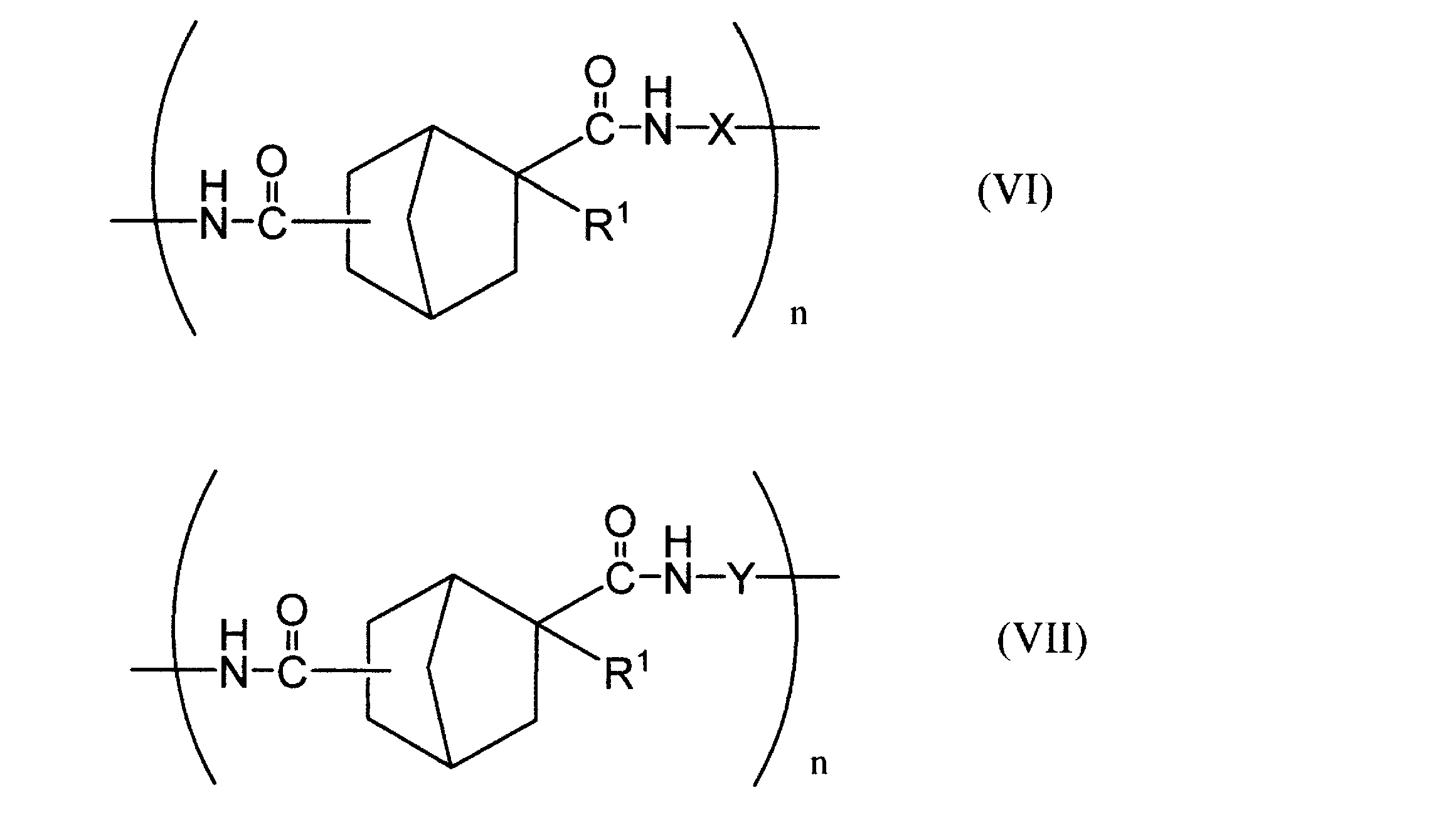
- the polyamide having a norbornane skeleton obtained by the production method of the present invention has a structure represented by the following formula (VI) or (VII).
- R 1 in the formula (VI) and (VII), above-mentioned formula (I), is the same as R 1 in the formula (IV) and the formula (V).
- X in the above formula (VI) is the same as X in the aliphatic and / or alicyclic diisocyanate compound represented by the above general formula (II).
- Y in the above formula (VII) is the same as Y in the aromatic diisocyanate compound represented by the above general formula (III).
- n 1 to 500.
- the polyamide having a norbornane skeleton In order to make the number average molecular weight of the polyamide having a norbornane skeleton within the above range, it may be produced by the production method of the present application.
- the number average molecular weight is measured using gel permeation chromatography (hereinafter abbreviated as “GPC”) under the following conditions, and is calculated using a standard polystyrene calibration curve.
- GPC gel permeation chromatography
- methyl norbornane dicarboxylate produced by the reaction was 94.3 mmol (yield 94.3% based on methyl norbornane dicarboxylate).
- the resulting methyl norbornane dicarboxylate was isolated by vacuum distillation.
- the obtained polyamide (PA-1) having a norbornane skeleton was applied onto a Teflon (registered trademark) substrate, heated at 250 ° C., and the organic solvent was dried to form a coating film having a thickness of 30 ⁇ m.
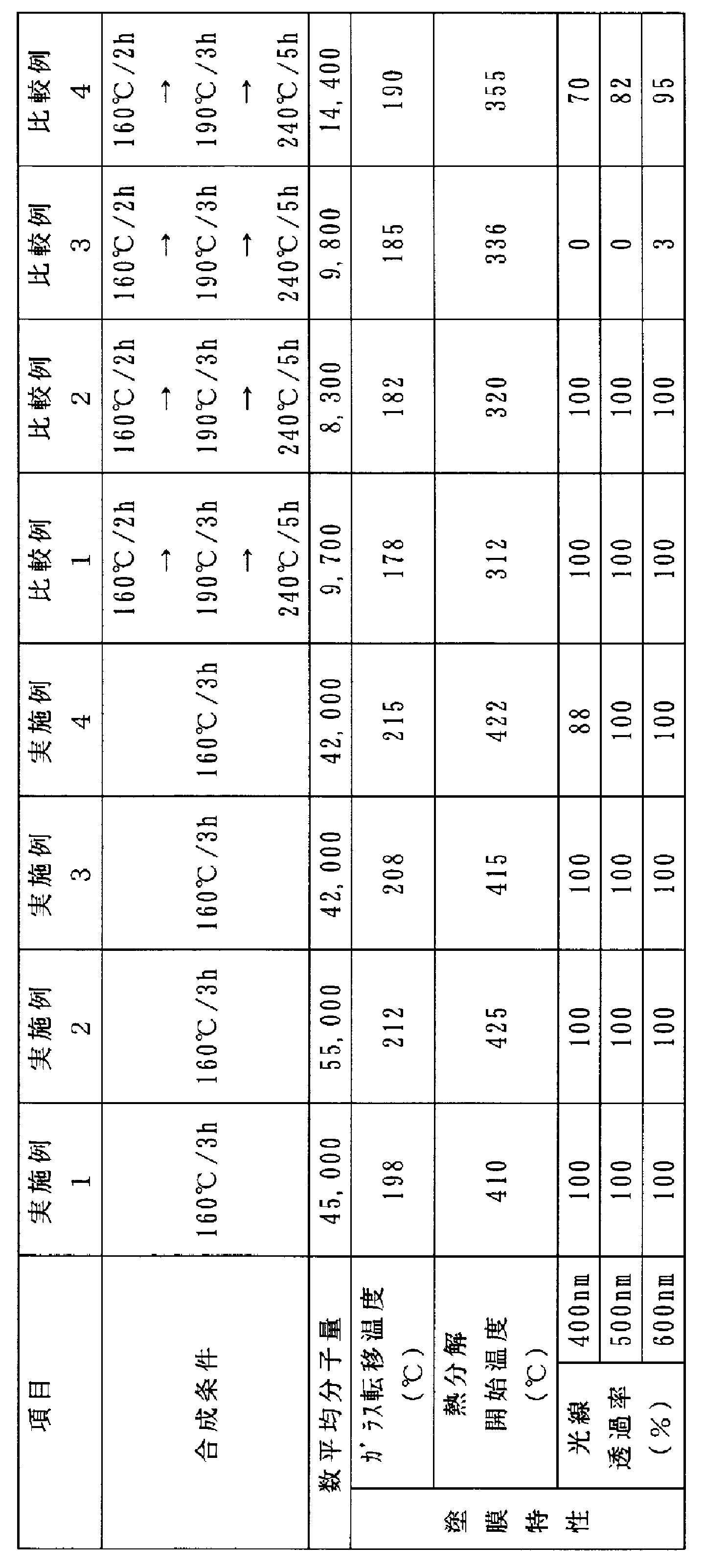
- the glass transition temperature (Tg) and thermal decomposition start temperature (5% mass reduction temperature, Td 5 ) of this coating film were measured under the following conditions. The results are shown in Table 1.
- Tg Glass transition temperature
- Measurement mode Extension measurement span: 10 mm Load: 10g Temperature increase rate: 5 ° C / min Atmosphere: Air (2) Thermal decomposition start temperature (5% mass loss temperature, Td 5 ) It was measured with a differential thermal balance (Seiko Electronics Co., Ltd., Model 5200 TG-DTA).
- Example 2 [Synthesis of polyamide (PA-2) having norbornane skeleton]
- Example 3 [Synthesis of polyamide (PA-3) having norbornane skeleton]
- a polyamide (PA-3) having a norbornane skeleton was obtained.
- the polyamide having an aromatic skeleton obtained in Comparative Examples 3 and 4 was inferior in heat resistance and in light transmittance.
- a polyamide having a norbornane skeleton excellent in heat resistance and transparency can be easily obtained.
- the obtained polyamide having a norbornane skeleton can be used as an electronic material used for semiconductors and liquid crystals, an optical material typified by an optical fiber, an optical lens, etc., a display-related material, and a medical material.
Landscapes
- Chemical & Material Sciences (AREA)
- Organic Chemistry (AREA)
- Chemical Kinetics & Catalysis (AREA)
- Medicinal Chemistry (AREA)
- Polymers & Plastics (AREA)
- Health & Medical Sciences (AREA)
- Engineering & Computer Science (AREA)
- Inorganic Chemistry (AREA)
- Materials Engineering (AREA)
- Oil, Petroleum & Natural Gas (AREA)
- Organic Low-Molecular-Weight Compounds And Preparation Thereof (AREA)
- Low-Molecular Organic Synthesis Reactions Using Catalysts (AREA)
- Polyamides (AREA)
- Polyurethanes Or Polyureas (AREA)
Abstract
Description

また本発明は、上記ジイソシアネート化合物が、下記一般式(II)で表される脂肪族及び/又は脂環族ジイソシアネート化合物であることを特徴とする、ノルボルナン骨格を有するポリアミドの製造方法に関する。
(但し、式中Xは炭素数4~16の2価の脂肪族基及び炭素数4~16の2価の脂環族基から選ばれる2価の有機基である。)
本発明は、上記ジイソシアネート化合物が、下記一般式(III)で表される芳香族ジイソシアネート化合物であることを特徴とする、ノルボルナン骨格を有するポリアミドの製造方法に関する。
(但し、式中Yは2価の芳香族基である。)
本発明は、上記一般式(I)で表されるノルボルナンジカルボン酸化合物が、下記(1)~(2)工程を含む方法で得られることを特徴とするノルボルナン骨格を有するポリアミドの製造方法に関する。

ギ酸エステル(HCOOR2)とを、
ルテニウム化合物と、コバルト化合物と、ハロゲン化物塩と、を含む触媒系の存在下で反応させて、下記一般式(V)で表されるノルボルナンジカルボン酸誘導体とする。
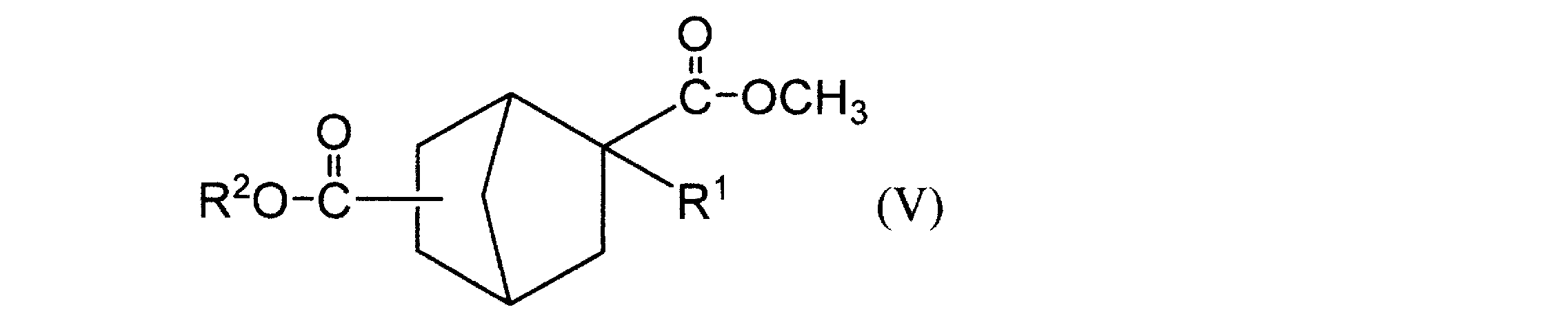
(2)工程:上記一般式(V)で表されるノルボルナンジカルボン酸誘導体のアルコキシカルボニル基を加水分解して上記一般式(I)で表されるノルボルナンジカルボン酸化合物を得る。
本発明の一実施形態は、下記一般式(I)で表されるノルボルナンジカルボン酸化合物と、ジイソシアネート化合物と、を極性溶媒中で反応させることを特徴とする、ノルボルナン骨格を有するポリアミドの製造方法に関する。

(ジイソシアネート化合物)
本発明における一般式(I)で表されるノルボルナンジカルボン酸化合物と反応させるジイソシアネート化合物としては、下記一般式(II)で表される脂肪族及び/又は脂環族ジイソシアネート化合物、及び、下記一般式(III)で表される芳香族ジイソシアネート化合物が挙げられる。
(但し、式中Xは炭素数4~16の2価の脂肪族基及び炭素数4~16の2価の脂環族基から選ばれる2価の有機基である。)
OCN-Y-NCO (III)
(但し、式中Yは2価の芳香族基である。)
脂肪族イソシアネート化合物としては、上記一般式(II)中のXが炭素数4~16の2価の脂肪族基であるものが挙げられ、具体的に例えば、ヘキサメチレンジイソシアネート、2,2,4-トリメチルヘキサメチレンジイソシアネート、リジンジイソシアネート等を使用することができ、これらは、単独又は2種以上を混合して使用することもできる。
上記一般式(I)で表されるノルボルナンジカルボン酸化合物は、下記の(1)工程及び(2)工程を含む方法で得られたものが好ましい。

ギ酸エステル(HCOOR2)とを、
ルテニウム化合物と、コバルト化合物と、ハロゲン化物塩と、を含む触媒系の存在下で反応させて、下記一般式(V)で表されるノルボルナンジカルボン酸誘導体とする。

上記一般式(IV)で表されるノルボルネンモノカルボン酸誘導体と反応させるギ酸エステル(HCOOR2)としては、特に制限は無く、例えば、ギ酸メチル、ギ酸エチル、ギ酸プロピル、ギ酸イソプロピル、ギ酸ブチル、ギ酸イソブチル、ギ酸アミル、ギ酸イソアミル、ギ酸アリル、ギ酸ビニル、ギ酸ベンジル等から適宜選択して使用することができる。コスト及び反応性の観点から、ギ酸メチル、ギ酸エチル等の直鎖状のアルキルギ酸エステルが好ましく、ギ酸メチルがより好適である。
また、上記一般式(V)で表されるノルボルナンジカルボン酸誘導体を加水分解して下記一般式(I)で表されるノルボルナンジカルボン酸化合物とする方法は、特に制限は無く、例えば、特許第2591492号、特開2008-31406号公報等に記載されている酸加水分解、アルカリ加水分解等を使用することができる。あるいは、酸成分又はアルカリ成分を加えること無しに、耐熱容器内で水分存在下、140℃以上の高温で加熱することによっても加水分解することができる。
本発明における一般式(I)で表されるノルボルナンジカルボン酸化合物と、一般式(II)及び/又は一般式(III)で表されるジイソシアネート化合物と、の使用量は、ノルボルナンジカルボン酸化合物のカルボキシル基のモル数の合計に対するイソシアネート基のモル数を0.7~2.0とすることが好ましく、0.8~1.7とすることがより好ましく、0.9~1.5とすることがさらに好ましく、0.95~1.3とすることが特に好ましい。
ジエチレングリコールジメチルエーテル、ジエチレングリコールジエチルエーテル、トリエチレングリコールジメチルエーテル、トリエチレングリコールジエチルエーテル等のエーテル系溶媒;
ジメチルスルホキシド、ジエチルスルホキシド、ジメチルスルホン、スルホラン等の含硫黄系溶媒;
γ-ブチロラクトン、酢酸セロソルブ等のエステル系溶媒;
シクロヘキサノン、メチルエチルケトン等のケトン系溶媒;等を使用することができる。
本発明の製造方法で得られる、ノルボルナン骨格を有するポリアミドは、数平均分子量を2,000~200,000とすることが好ましく、3,000~180,000とすることがより好ましい。数平均分子量が、2,000未満では、耐熱性等が低下する傾向があり、200,000を超えると、溶媒への溶解性が低下する傾向がある。
カラム:昭和電工(株)製、Shodex KD-806M×1本
溶離液:N-メチル-2-ピロリドン 1.0ml/min
検出器:UV(280nm)
(合成例1)〔シクロペンタジエンの生成〕


(合成例3)〔ノルボルナンジカルボン酸メチルの合成〕

(合成例4)〔ノルボルナンジカルボン酸の合成〕
冷却管を取り付けた1リットル成す型フラスコに、合成例3で得られたノルボルナンジカルボン酸メチル 30g及びメタノール 200gを投入して均一溶液とした後、10%水酸化ナトリウム溶液 200gを加え、100℃のオイルバスに入れ、6時間加熱還流した。その後、反応液量が140gになるまでメタノールを留去し、これに36%塩酸 48mlを加え、pHを1としたところ、白色粉末が沈殿した。この白色粉末をろ過、水洗、乾燥し、ノルボルナンジカルボン酸 25gを得た。得られたノルボルナンジカルボン酸を、H1-NMRで分析した結果、ノルボルナン(トリシクロデカン)のメチレン及びメチン基のピークが1.1~3.0ppm付近に、カルボン酸に起因する水酸基のピークが12.4ppm付近に確認でき、その積分強度比が10.00/1.98(理論値:10/2)であった。
(実施例1)〔ノルボルナン骨格を有するポリアミド(PA-1)の合成〕
攪拌機、温度計、窒素導入管及び冷却管を備えた500mlフラスコに、合成例4で得られたノルボルナンジカルボン酸 74.20g(0.350モル)、ヘキサメチレンジイソシアネート 59.98g(0.357モル)(ジカルボン酸/ジイソシアネート(モル比)=1.00/1.02)及びN-メチルピロリドン 202.84gを仕込み、160℃まで昇温した後、3時間反応させて、数平均分子量が45,000のノルボルナン骨格を持つポリアミド(PA-1)を得た。
熱機械分析装置(セイコー電子(株)製、5200型 TMA)で測定した。
測定スパン:10mm
荷重:10g
昇温速度:5℃/min
雰囲気:空気
(2)熱分解開始温度(5%質量減少温度、Td5)
示差熱天秤(セイコー電子(株)製、5200型 TG-DTA)で測定した。
雰囲気:空気
(3)光線透過率
また、得られたノルボルナン骨格を有するポリアミド(PA-1)の各波長における光線透過率を、日本分光(株)製、V-570型UV/VISスペクトロフォトメーターで測定した。評価結果をまとめて表1に示す。
攪拌機、温度計、窒素導入管及び冷却管を備えた500mlフラスコに、合成例4で得られたノルボルナンジカルボン酸 53.00g(0.250モル)、4,4’-シクロヘキシルメタンジイソシアネート 66.81g(0.255モル)(ジカルボン酸/ジイソシアネート(モル比)=1.00/1.02)及びN-メチルピロリドン 179.72gを仕込み、160℃まで昇温した後、3時間反応させて、数平均分子量が55,000のノルボルナン骨格を有するポリアミド(PA-2)を得た。
攪拌機、温度計、窒素導入管及び冷却管を備えた500mlフラスコに、合成例4で得られたノルボルナンジカルボン酸 57.24g(0.270モル)、イソホロンジイソシアネート 61.14(0.275モル)(ジカルボン酸/ジイソシアネート(モル比)=1.00/1.02)及びN-メチルピロリドン 177.57gを仕込み、160℃まで昇温した後、3時間反応させて、数平均分子量が42,000のノルボルナン骨格を持つポリアミド(PA-3)を得た。
攪拌機、温度計、窒素導入管及び冷却管を備えた500mlフラスコに、合成例4で得られたノルボルナンジカルボン酸 55.12g(0.260モル)、4,4’-ジフェニルメタンジイソシアネート 66.30g(0.265モル)(ジカルボン酸/ジイソシアネート(モル比)=1.00/1.02)及びN-メチルピロリドン 182.91gを仕込み、160℃まで昇温した後、3時間反応させて、数平均分子量が42,000のノルボルナン骨格を持つポリアミド(PA-4)を得た。
攪拌機、温度計、窒素導入管及び油水分離器付冷却管を備えた500mlフラスコに、合成例3で得られたノルボルナンジカルボン酸メチル 212.00g(1.00モル)、ヘキサメチレンジアミン 116.00g(1.00モル)(ジカルボン酸メチル/ジアミン(モル比)=1.00/1.00)を仕込み、160℃で2時間、190℃で3時間、240℃で5時間反応させ、数平均分子量が9,700のノルボルナン骨格を持つポリアミド(PA-5)を得た。
攪拌機、温度計、窒素導入管及び油水分離器付冷却管を備えた500mlフラスコに、合成例3で得られたノルボルナンジカルボン酸メチル 159.00g(0.75モル)、4,4’-ジアミノジシクロヘキシルメタン 157.50g(0.75モル)(ジカルボン酸メチル/ジアミン(モル比)=1.00/1.00)を仕込み、160℃で2時間、190℃で3時間、240℃で5時間反応させ、数平均分子量が8,300のノルボルナン骨格を持つポリアミド(PA-6)を得た。
攪拌機、温度計、窒素導入管及び油水分離器付冷却管を備えた500mlフラスコに、イソフタル酸ジメチル 155.20g(0.80モル)、4,4’-ジアミノジフェニルエーテル 160.00g(0.80モル)(ジカルボン酸メチル/ジアミン(モル比)=1.00/1.00)を仕込み、160℃で2時間、190℃で3時間、240℃で5時間反応させ、数平均分子量が9,800の芳香族ポリアミド(PA-7)を得た。
攪拌機、温度計、窒素導入管及び油水分離器付冷却管を備えた500mlフラスコに、イソフタル酸ジメチル 155.20g(0.80モル)、4,4’-ジアミノジシクロヘキシルメタン 168.00g(0.80モル)(ジカルボン酸メチル/ジアミン(モル比)=1.00/1.00)を仕込み、160℃で2時間、190℃で3時間、240℃で5時間反応させ、数平均分子量が14,400の芳香族ポリアミド(PA-8)を得た。
Claims (11)
- 下記一般式(I)で表されるノルボルナンジカルボン酸化合物と、ジイソシアネート化合物と、を極性溶媒中で反応させることを特徴とする、ノルボルナン骨格を有するポリアミドの製造方法。

- 前記ジイソシアネート化合物が、下記一般式(II)で表されるジイソシアネート化合物であることを特徴とする請求項1に記載のノルボルナン骨格を有するポリアミドの製造方法。
OCN-X-NCO (II)
(但し、式中Xは炭素数4~16の2価の脂肪族基及び炭素数4~16の2価の脂環族基から選ばれる2価の有機基である。) - 前記ジイソシアネート化合物が、下記一般式(III)で表されるジイソシアネート化合物であることを特徴とする請求項1に記載のノルボルナン骨格を有するポリアミドの製造方法。
OCN-Y-NCO (III)
(但し、式中Yは2価の芳香族基である) - 前記一般式(I)で表されるノルボルナンジカルボン酸化合物が、下記(1)~(2)工程を含む方法で得られることを特徴とする請求項1~3のいずれか一項に記載のノルボルナン骨格を有するポリアミドの製造方法。
(1)工程:下記一般式(IV)で表されるノルボルネンモノカルボン酸誘導体と、

ギ酸エステル(HCOOR2)とを、
ルテニウム化合物と、コバルト化合物と、ハロゲン化物塩と、を含む触媒系の存在下で反応させて、下記一般式(V)で表されるノルボルナンジカルボン酸誘導体とする。

(2)工程:前記一般式(V)で表されるノルボルナンジカルボン酸誘導体のアルコキシカルボニル基を加水分解して前記一般式(I)で表されるノルボルナンジカルボン酸化合物を得る。 - 前記ルテニウム化合物が、分子内にカルボニル配位子とハロゲン配位子とを合わせ持つルテニウム錯体である請求項4に記載のノルボルナン骨格を有するポリアミドの製造方法。
- 前記ハロゲン化物塩が、四級アンモニウム塩である請求項4又は5に記載のノルボルナン骨格を有するポリアミドの製造方法。
- 前記触媒系がさらに塩基性化合物を含む請求項4~6のいずれか一項に記載のノルボルナン骨格を有するポリアミドの製造方法。
- 前記塩基性化合物が、三級アミン化合物である請求項7記載のノルボルナン骨格を有するポリアミドの製造方法。
- 前記触媒系がさらにフェノール化合物を含む請求項4~8のいずれか一項に記載のノルボルナン骨格を有するポリアミドの製造方法。
- 前記触媒系がさらに有機ハロゲン化合物を含む請求項4~9のいずれか一項に記載のノルボルナン骨格を有するポリアミドの製造方法。
- 請求項1~10のいずれか一項に記載の製造方法によって得られるノルボルナン骨格を有するポリアミド。
Priority Applications (3)
| Application Number | Priority Date | Filing Date | Title |
|---|---|---|---|
| CN2010800656504A CN102812063A (zh) | 2010-03-29 | 2010-12-03 | 具有降冰片烷骨架的聚酰胺的制造方法以及利用该制造方法得到的具有降冰片烷骨架的聚酰胺 |
| KR1020127027546A KR20120138816A (ko) | 2010-03-29 | 2010-12-03 | 노르보르난 골격을 갖는 폴리아미드의 제조 방법 및 이에 의해 얻어지는 노르보르난 골격을 갖는 폴리아미드 |
| JP2012508025A JP5590117B2 (ja) | 2010-03-29 | 2010-12-03 | ノルボルナン骨格を有するポリアミドの製造方法及びそれにより得られるノルボルナン骨格を有するポリアミド |
Applications Claiming Priority (2)
| Application Number | Priority Date | Filing Date | Title |
|---|---|---|---|
| JP2010074517 | 2010-03-29 | ||
| JP2010-074517 | 2010-03-29 |
Publications (1)
| Publication Number | Publication Date |
|---|---|
| WO2011121849A1 true WO2011121849A1 (ja) | 2011-10-06 |
Family
ID=44711622
Family Applications (1)
| Application Number | Title | Priority Date | Filing Date |
|---|---|---|---|
| PCT/JP2010/071679 Ceased WO2011121849A1 (ja) | 2010-03-29 | 2010-12-03 | ノルボルナン骨格を有するポリアミドの製造方法及びそれにより得られるノルボルナン骨格を有するポリアミド |
Country Status (5)
| Country | Link |
|---|---|
| JP (1) | JP5590117B2 (ja) |
| KR (1) | KR20120138816A (ja) |
| CN (1) | CN102812063A (ja) |
| TW (1) | TW201139361A (ja) |
| WO (1) | WO2011121849A1 (ja) |
Families Citing this family (1)
| Publication number | Priority date | Publication date | Assignee | Title |
|---|---|---|---|---|
| JP7320200B2 (ja) * | 2018-06-18 | 2023-08-03 | 三菱瓦斯化学株式会社 | ノルボルナン骨格を有する二官能性化合物の製造方法 |
Citations (2)
| Publication number | Priority date | Publication date | Assignee | Title |
|---|---|---|---|---|
| JPH05170898A (ja) * | 1991-12-24 | 1993-07-09 | Mitsui Toatsu Chem Inc | 新規ポリアミドおよびその製造方法 |
| JP2003138012A (ja) * | 2001-11-08 | 2003-05-14 | Ube Ind Ltd | 延伸性に優れたポリアミド |
Family Cites Families (1)
| Publication number | Priority date | Publication date | Assignee | Title |
|---|---|---|---|---|
| US6060215A (en) * | 1997-03-31 | 2000-05-09 | Hitachi, Ltd. | Photosensitive resin composition and application of its photosensitivity |
-
2010
- 2010-12-03 WO PCT/JP2010/071679 patent/WO2011121849A1/ja not_active Ceased
- 2010-12-03 CN CN2010800656504A patent/CN102812063A/zh active Pending
- 2010-12-03 JP JP2012508025A patent/JP5590117B2/ja not_active Expired - Fee Related
- 2010-12-03 KR KR1020127027546A patent/KR20120138816A/ko not_active Ceased
- 2010-12-14 TW TW099143756A patent/TW201139361A/zh unknown
Patent Citations (2)
| Publication number | Priority date | Publication date | Assignee | Title |
|---|---|---|---|---|
| JPH05170898A (ja) * | 1991-12-24 | 1993-07-09 | Mitsui Toatsu Chem Inc | 新規ポリアミドおよびその製造方法 |
| JP2003138012A (ja) * | 2001-11-08 | 2003-05-14 | Ube Ind Ltd | 延伸性に優れたポリアミド |
Also Published As
| Publication number | Publication date |
|---|---|
| TW201139361A (en) | 2011-11-16 |
| CN102812063A (zh) | 2012-12-05 |
| JPWO2011121849A1 (ja) | 2013-07-04 |
| KR20120138816A (ko) | 2012-12-26 |
| JP5590117B2 (ja) | 2014-09-17 |
Similar Documents
| Publication | Publication Date | Title |
|---|---|---|
| WO2012035874A1 (ja) | ノルボルナン骨格を有するポリエステル及びその製造方法 | |
| WO2007125829A1 (ja) | 含フッ素アダマンタン誘導体、重合性基含有含フッ素アダマンタン誘導体、それを含有する樹脂組成物及び反射防止膜 | |
| KR101375496B1 (ko) | 트리시클로데칸 모노메탄올 모노카르복실산 유도체의 제조 방법 | |
| JP5532123B2 (ja) | ノルボルナン骨格を有するポリアミドイミド及びその製造方法 | |
| JP5590117B2 (ja) | ノルボルナン骨格を有するポリアミドの製造方法及びそれにより得られるノルボルナン骨格を有するポリアミド | |
| US8653301B2 (en) | Tricyclodecane monomethanol monocarboxylic acid and derivatives thereof | |
| JP4275186B2 (ja) | ノルボルネン誘導体の製造方法 | |
| JP5790386B2 (ja) | ノルボルナン骨格含有ポリアミドの製造方法 | |
| JP5811753B2 (ja) | ノルボルナン骨格含有ポリアミドの製造方法 | |
| JP5556301B2 (ja) | ノルボルナン骨格を有するポリアミド及びその製造方法 | |
| WO2012035875A1 (ja) | 脂環式ポリエステル及びその製造方法 | |
| JP2012240981A (ja) | ビスナジイミドのジヒドロジエステル体 | |
| JPWO2011121850A1 (ja) | ナジイミド骨格を有するポリアミドイミド及びその製造方法 | |
| JP5796416B2 (ja) | ノルボルナン骨格を含有するポリアミドイミドの製造方法 | |
| JP2013079350A (ja) | エキソ体比率の高いノルボルナン骨格含有ポリアミド | |
| WO2011121847A1 (ja) | ナジイミド骨格を有するポリアミドイミドの製造方法 | |
| US20140031579A1 (en) | Method of producing norbornanedicarboxylic acid ester | |
| JP2012240980A (ja) | ビスナジイミドのジヒドロジエステル体 | |
| JP2024047688A (ja) | フルオレン化合物ならびにその製造方法および用途 | |
| JP6759682B2 (ja) | 分岐型芳香族ポリケトン、分岐型芳香族ポリケトンの製造方法、分岐型芳香族ポリケトン組成物、分岐型芳香族ポリケトン膜、光学素子、画像表示装置及び分岐型芳香族ポリケトン膜付基材 | |
| JP2024073295A (ja) | フルオレン化合物ならびにその製造方法および用途 |
Legal Events
| Date | Code | Title | Description |
|---|---|---|---|
| WWE | Wipo information: entry into national phase |
Ref document number: 201080065650.4 Country of ref document: CN |
|
| 121 | Ep: the epo has been informed by wipo that ep was designated in this application |
Ref document number: 10849020 Country of ref document: EP Kind code of ref document: A1 |
|
| WWE | Wipo information: entry into national phase |
Ref document number: 2012508025 Country of ref document: JP |
|
| NENP | Non-entry into the national phase |
Ref country code: DE |
|
| ENP | Entry into the national phase |
Ref document number: 20127027546 Country of ref document: KR Kind code of ref document: A |
|
| 122 | Ep: pct application non-entry in european phase |
Ref document number: 10849020 Country of ref document: EP Kind code of ref document: A1 |