WO2011035250A1 - Processes and intermediates for the preparation of 1'-substituted carba-nucleoside analogs - Google Patents
Processes and intermediates for the preparation of 1'-substituted carba-nucleoside analogs Download PDFInfo
- Publication number
- WO2011035250A1 WO2011035250A1 PCT/US2010/049508 US2010049508W WO2011035250A1 WO 2011035250 A1 WO2011035250 A1 WO 2011035250A1 US 2010049508 W US2010049508 W US 2010049508W WO 2011035250 A1 WO2011035250 A1 WO 2011035250A1
- Authority
- WO
- WIPO (PCT)
- Prior art keywords
- compound
- formula
- alkyl
- substituted
- independently
- Prior art date
- Legal status (The legal status is an assumption and is not a legal conclusion. Google has not performed a legal analysis and makes no representation as to the accuracy of the status listed.)
- Ceased
Links
- 0 COC([C@@](*)(C[C@@](CCOCc1ccccc1)OCc1ccccc1)OCc1ccccc1)(C1=C*I=C2N1N=C(*)N=C2*)O Chemical compound COC([C@@](*)(C[C@@](CCOCc1ccccc1)OCc1ccccc1)OCc1ccccc1)(C1=C*I=C2N1N=C(*)N=C2*)O 0.000 description 5
- GFFNZQLCNVVBEE-HQRSTYDCSA-N Nc1ncn[n]2c1ccc2C([C@@H]1OCc2ccccc2)(O)O[C@H](COCc2ccccc2)[C@H]1OCc1ccccc1 Chemical compound Nc1ncn[n]2c1ccc2C([C@@H]1OCc2ccccc2)(O)O[C@H](COCc2ccccc2)[C@H]1OCc1ccccc1 GFFNZQLCNVVBEE-HQRSTYDCSA-N 0.000 description 2
- DYUTUKFYRMICHP-BROWDQIMSA-N CC(C)(C)[Si](C)(C)OCC[C@H]([C@H]1OC(C)(C)O[C@H]11)OC1(c1ccc2[n]1ncnc2N)O Chemical compound CC(C)(C)[Si](C)(C)OCC[C@H]([C@H]1OC(C)(C)O[C@H]11)OC1(c1ccc2[n]1ncnc2N)O DYUTUKFYRMICHP-BROWDQIMSA-N 0.000 description 1
- PNAOKHALMMEOCN-PXXLSESWSA-N CCCCC(C)(C)[Si](C)(C)OCC([C@H]1OC(C)(C)O[C@H]11)O[C@@]1(c1ccc2[n]1ncnc2N)C#N Chemical compound CCCCC(C)(C)[Si](C)(C)OCC([C@H]1OC(C)(C)O[C@H]11)O[C@@]1(c1ccc2[n]1ncnc2N)C#N PNAOKHALMMEOCN-PXXLSESWSA-N 0.000 description 1
- YGCJBESZJIGDMP-UHFFFAOYSA-N Nc1ncn[n]2c(Br)ccc12 Chemical compound Nc1ncn[n]2c(Br)ccc12 YGCJBESZJIGDMP-UHFFFAOYSA-N 0.000 description 1
- XRIVFFFVTWATPJ-TWJOJJKGSA-N O=C([C@@H]1OCc2ccccc2)O[C@H](CCOCc2ccccc2)[C@H]1OCc1ccccc1 Chemical compound O=C([C@@H]1OCc2ccccc2)O[C@H](CCOCc2ccccc2)[C@H]1OCc1ccccc1 XRIVFFFVTWATPJ-TWJOJJKGSA-N 0.000 description 1
Classifications
-
- A—HUMAN NECESSITIES
- A61—MEDICAL OR VETERINARY SCIENCE; HYGIENE
- A61P—SPECIFIC THERAPEUTIC ACTIVITY OF CHEMICAL COMPOUNDS OR MEDICINAL PREPARATIONS
- A61P31/00—Antiinfectives, i.e. antibiotics, antiseptics, chemotherapeutics
- A61P31/12—Antivirals
-
- C—CHEMISTRY; METALLURGY
- C07—ORGANIC CHEMISTRY
- C07H—SUGARS; DERIVATIVES THEREOF; NUCLEOSIDES; NUCLEOTIDES; NUCLEIC ACIDS
- C07H1/00—Processes for the preparation of sugar derivatives
-
- C—CHEMISTRY; METALLURGY
- C07—ORGANIC CHEMISTRY
- C07H—SUGARS; DERIVATIVES THEREOF; NUCLEOSIDES; NUCLEOTIDES; NUCLEIC ACIDS
- C07H19/00—Compounds containing a hetero ring sharing one ring hetero atom with a saccharide radical; Nucleosides; Mononucleotides; Anhydro-derivatives thereof
-
- C—CHEMISTRY; METALLURGY
- C07—ORGANIC CHEMISTRY
- C07H—SUGARS; DERIVATIVES THEREOF; NUCLEOSIDES; NUCLEOTIDES; NUCLEIC ACIDS
- C07H19/00—Compounds containing a hetero ring sharing one ring hetero atom with a saccharide radical; Nucleosides; Mononucleotides; Anhydro-derivatives thereof
- C07H19/02—Compounds containing a hetero ring sharing one ring hetero atom with a saccharide radical; Nucleosides; Mononucleotides; Anhydro-derivatives thereof sharing nitrogen
- C07H19/04—Heterocyclic radicals containing only nitrogen atoms as ring hetero atom
-
- C—CHEMISTRY; METALLURGY
- C07—ORGANIC CHEMISTRY
- C07H—SUGARS; DERIVATIVES THEREOF; NUCLEOSIDES; NUCLEOTIDES; NUCLEIC ACIDS
- C07H19/00—Compounds containing a hetero ring sharing one ring hetero atom with a saccharide radical; Nucleosides; Mononucleotides; Anhydro-derivatives thereof
- C07H19/02—Compounds containing a hetero ring sharing one ring hetero atom with a saccharide radical; Nucleosides; Mononucleotides; Anhydro-derivatives thereof sharing nitrogen
- C07H19/04—Heterocyclic radicals containing only nitrogen atoms as ring hetero atom
- C07H19/23—Heterocyclic radicals containing two or more heterocyclic rings condensed among themselves or condensed with a common carbocyclic ring system, not provided for in groups C07H19/14 - C07H19/22
-
- A—HUMAN NECESSITIES
- A61—MEDICAL OR VETERINARY SCIENCE; HYGIENE
- A61K—PREPARATIONS FOR MEDICAL, DENTAL OR TOILETRY PURPOSES
- A61K31/00—Medicinal preparations containing organic active ingredients
- A61K31/70—Carbohydrates; Sugars; Derivatives thereof
- A61K31/7042—Compounds having saccharide radicals and heterocyclic rings
- A61K31/7052—Compounds having saccharide radicals and heterocyclic rings having nitrogen as a ring hetero atom, e.g. nucleosides, nucleotides
-
- A—HUMAN NECESSITIES
- A61—MEDICAL OR VETERINARY SCIENCE; HYGIENE
- A61K—PREPARATIONS FOR MEDICAL, DENTAL OR TOILETRY PURPOSES
- A61K31/00—Medicinal preparations containing organic active ingredients
- A61K31/70—Carbohydrates; Sugars; Derivatives thereof
- A61K31/7042—Compounds having saccharide radicals and heterocyclic rings
- A61K31/7052—Compounds having saccharide radicals and heterocyclic rings having nitrogen as a ring hetero atom, e.g. nucleosides, nucleotides
- A61K31/7056—Compounds having saccharide radicals and heterocyclic rings having nitrogen as a ring hetero atom, e.g. nucleosides, nucleotides containing five-membered rings with nitrogen as a ring hetero atom
-
- A—HUMAN NECESSITIES
- A61—MEDICAL OR VETERINARY SCIENCE; HYGIENE
- A61K—PREPARATIONS FOR MEDICAL, DENTAL OR TOILETRY PURPOSES
- A61K31/00—Medicinal preparations containing organic active ingredients
- A61K31/70—Carbohydrates; Sugars; Derivatives thereof
- A61K31/7042—Compounds having saccharide radicals and heterocyclic rings
- A61K31/7052—Compounds having saccharide radicals and heterocyclic rings having nitrogen as a ring hetero atom, e.g. nucleosides, nucleotides
- A61K31/706—Compounds having saccharide radicals and heterocyclic rings having nitrogen as a ring hetero atom, e.g. nucleosides, nucleotides containing six-membered rings with nitrogen as a ring hetero atom
Definitions
- the invention relates generally to methods and intermediates for preparing compounds with antiviral activity, more particularly methods and intermediates for preparing nucleosides active against Flaviviridae infections.
- Viruses comprising the Flaviviridae family comprise at least three
- BVDV bovine viral diarrhea virus
- CSFV classical swine fever virus
- BDV border disease of sheep
- Flaviviruses are responsible for important human diseases such as dengue fever and yellow fever while hepaciviruses cause hepatitis C virus infections in humans.
- Flaviviridae family Other important viral infections caused by the Flaviviridae family include West Nile virus (WNV) Japanese encephalitis virus (JEV), tick-bome encephalitis virus, Junjin virus, Murray Valley encephalitis, St Louis enchaplitis, Omsk hemorrhagic fever virus and Zika virus. Combined, infections from the Flaviviridae family include West Nile virus (WNV) Japanese encephalitis virus (JEV), tick-bome encephalitis virus, Junjin virus, Murray Valley encephalitis, St Louis enchaplitis, Omsk hemorrhagic fever virus and Zika virus. Combined, infections from the Flaviviridae family include West Nile virus (WNV) Japanese encephalitis virus (JEV), tick-bome encephalitis virus, Junjin virus, Murray Valley encephalitis, St Louis enchaplitis, Omsk hemorrhagic fever virus and Zika virus. Combined, infections from the Flaviviridae
- Flaviviridae virus family cause significant mortality, morbidity and economic losses throughout the world. Therefore, there is a need to develop effective treatments for Flaviviridae virus infections.
- HCV hepatitis C virus
- RNA-dependent RNA polymerase is one of the best studied targets for the development of novel HCV therapeutic agents.
- the NS5B polymerase is a target for inhibitors in early human clinical trials (Sommadossi, J., WO 01/90121 A2, US 2004/0006002 Al). These enzymes have been extensively characterized at the biochemical and structural level, with screening assays for identifying selective inhibitors (De Clercq, E. (2001) J. Pharmacol. Exp.Ther. 297:1-10; De Clercq, E. (2001) J. Clin. Virol. 22:73-89).
- Biochemical targets such as NS5B are important in developing HCV therapies since HCV does not replicate in the laboratory and there are difficulties in developing cell-based assays and preclinical animal systems.
- ribavirin a nucleoside analog
- IFN interferon-alpha
- Ribavirin alone is not effective in reducing viral RNA levels, has significant toxicity, and is known to induce anemia.
- the combination of IFN and ribavirin has been reported to be effective in the management of chronic hepatitis C (Scott, L. J., et al. Drugs 2002, 62, 507-556) but less than half the patients gi ven this treatment show a persistent benefit.
- Certain ribosides of the nucleobases pyrrolo[1,2-f][1,2,4]triazine, imidazo[1,5- f][1,2,4]triazine, imidazo[1,2-f][1,2,4]triazine, and [1,2,4]triazolo[4,3-f][1,2,4]triazine have been disclosed in Carbohydrate Research 2001, 331 (1), 77-82; Nucleosides & Nucleotides (1996), 15(1-3), 793-807; Tetrahedron Letters (1994), 35(30), 5339-42: Heterocycles (1992), 34(3), 569-74; J. Chem. Soc. Perkin Trans.
- Ribosides of pyrrolo[1,2-f][1,2,4]triazinyl, imidazo[l ,5-f][1,2,4]triazmyl, imidazo[1,2-f][1,2,4]triazinyl, and [1,2,4]triazolo[4,3-f][1,2,4]triazinyl nucleobases with antiviral, anti-HCV, and anti-RdRp activity have been disclosed by Babu, Y. S., WO2008/089105 and WO2008/141079; Cho, et al., WO2009/132123 and Francom, et al. WO2010/002877.
- R 3 is H, (C 1 -C 8 )alkyl, (C 4 -C 8 )carbocyclyl alkyl, (C 1 -C 8 )substituted alkyl, (C 2 -C 8 )alkenyl, (C 2 -C 8 )substituted alkenyl, (C 2 -C 8 )alkynyl, (C 2 -C 3 )substituted alkynyl, or aryl(C 1 -C 8 )aikyl;
- each R 2a or R 2b is independently H, F or OR 4 ;
- each R 3 is independently (C 1 -C 3 ) alkyl, (C 1 -C 8 ) substituted alkyl, C 6 -C 20 aryl, C 6 -C 20 substituted aryl, C 2 -C 20 heterocyclyl, C 2 -C 20 substituted heterocyclyl, C 7 -C 20 arylalkyl, C 7 -C 20 substituted arylalkyl, (C 1 -C 8 ) alkoxy, or (C 1 -C 8 ) substituted alkoxy; each R 4 or R 7 is independently H, optionally substituted allyl,— C(R 5 ) 2 R 6 , Si(R 3 ) 3 , C(O)R 5 , C(O)OR 5 , -(C(R 5 ) 2 ) m -R 15 or
- R 4 or R 7 when taken together are -C(R 19 ) 2 -, -C(O)- or - Si(R 3 ) 2 (X 2 ) m Si(R 3 ) 2 -;
- each R 15 is independently -O-C(R 5 ) 2 R 6 , -Si(R 3 ) 3 , C(O)OR 5 , -OC(O)R 5 or
- each R 5 , R 18 or R 19 is independently H, (C 1 -C 8 ) alkyl, (C 1 -C 8 ) substituted alkyl, (C 2 -C 8 )alkenyl, (C 2 -C 8 ) substituted alkenyl, (C 2 -C 8 ) alkynyl, (C 2 -C 8 ) substituted alkynyl, C 6 — C 20 aryl, C 6 — C 20 substituted aryl, C 2 — C 20 heterocyclyl, C 2 — C 20 substituted heterocyclyl, C 7 -C 20 arylalkyl or C 7 -C 20 substituted arylalkyl;
- each R 6 is independently C 6 — C 20 aryl, C 6 — C 20 substituted aryl, or optionally substituted heteroaryl;
- X 1 is C-R 10 or N
- each X 2 is O or CH 2 ;
- each m is 1 or 2;
- each n is independently 0, 1 or 2;
- each R 9 or R 10 is independently H, halogen, NR 11 R 12 , N(R 11 )OR 11 ,
- each R 20 is independently H, (C 1 -C 8 )alkyl, substituted (C 1 -C 8 )alkyl or halo; wherein each (C 1 -C 8 )alkyl, (C 2 -C 8 )alkenyl, (C 2 -C 8 )alkynyl or aryl(C 1 -C 8 )alkyl of each R 1 , R 3 , R 4 , R 5 , R 6 , R 18 , R 19 , R 20 , R 1 1 or R t2 is, independently, optionally substituted with one or more halo, hydroxy, CN, N 3 , N(R a ) 2 or OR a ; and wherein one or more of the non-terminal carbon atoms of each said (C 1 -C8)alkyl is optionally replaced with -0-, -S(O)terrorism- or -NR a -;
- R 16 is OH, OR 18 , -OC(O)OR 18 or -OC(O)R 18 ;
- X 1 is CH or N, R 1 is CH 3 , R 8 is NH 2 , and R 9 is NH 2 or H or;
- X 1 is CH, R* is CH 3 , R 8 is OH, and R 9 is NH 2 or;
- said cyanide reagent is not (CH3) 3 SiCN or said Lewis acid is not BF 0(CH 2 CH 3 ) 2 .
- R 1 is H, (C 1 -C 8 )alkyl, (C 4 -C 8 )carbocyclylalkyl, (C 1 -C 8 )substituted alkyl, (C 2 -C 8 )alkenyl, (C 2 -C 8 ) substituted alkenyl, (C 2 -C 8 )alkynyl, (C 2 -C 8 )substituted alkynyl, or aryl(C! -C8)alkyl;
- each R 2a or R 2b is independently H, F or OR 4 ;
- each R 3 is independently (Cj-C 8 ) alkyl, (C 1 -Cs) substituted alkyl, C 6 — C 20 aryl,
- each R* or R 7 is independently H, optionally substituted allyl,
- R 4 or R 7 when taken together are -C(R 19 ) 2 -, -C(O)- or
- each R 15 is independently -0-C(R 5 ) 2 R 6 , -Si(R 3 ) 3 , C(O)OR 5 , -OC(O)R 5 or
- each R 5 , R 58 or R 19 is independently H, (C 1 -C 8 ) alkyl, (C 1 -C 8 ) substituted alkyl, (C 2 -C 8 )alkenyl, (C 2 -Q) substituted alkenyl, (C 2 -C 8 ) alkynyl, (C 2 -C 8 ) substituted alkynyl, C 6 — C 20 aryl, C6-C 20 substituted aryl, C 2 -C 20 heterocyclyl, C 2 -C 20 substituted heterocyclyl, C 7 -C 20 arylalkyl, or C7-C 20 substituted arylalkyl;
- each R 6 is independently C 6 — C 20 aryl, C6— C 20 substituted aryl, or optionally substituted heteroaryl;
- X ! is C-R 10 or N;
- each X 2 is O or CH 2 ;
- each m is 1 or 2;
- each n is independently 0, 1 or 2;
- each R 9 or R 10 is independently H, halogen, NR 1 'R 12 , NCR 1 1 )OR 1 1 ,
- R 17 is OH, OR 18 , -OC(O)OR 18 or -OC(O)R 18 ;
- each (C 1 -Cs)alkyl, (C 2 -C 8 )alkenyl, (C -C 8 )alkynyl or aryl(C 1 -C 8 )alkyl of each R 1 , R 3 , R 4 , R 5 , R 6 , R 18 , R 19 , R 1 1 or R 12 is, independently, optionally substituted with one or more halo, hydroxy, CN, N , N(R a ) 2 or OR"; and wherein one or more of the non-terminal carbon atoms of each said (C 1 -C 8 )alkyl is optionally replaced with - 0-, -S(O) n - or -NR a ⁇ ;
- R 17 is OH or OCH 3
- R 1 is H or CH 3 and each R 2a and R 2b is OR 4 , then each R 7 and each R 4 is not H;
- R 17 is OH
- X 1 is CH, R 1 is CH 3 , R 8 is NH 2 and R 9 is NH 2 or H; or
- X 1 is CH, R 1 is CH 3 , R 8 is OH and R 9 is NH 2 ; or
- X 1 is CH, each R 1 and R 9 is H and R 8 is NH 2 ;
- X 5 is N, R 1 is CH 3 , R 8 is NH 2 , and R 9 is H, NH 2 or SCH 3 ;
- X 1 is N, R l is CH 3 , R 8 is SCH 3 or NHCH 3 , and R 9 is SCH 3 ;
- X 1 is N, R 1 is CH 3 , R 8 is OCH 3 , and R 9 is SCH 3 , SO 2 CH 3 or NH 2 or wherein R 17 is OCH 3 , X 1 is CH, each R 1 and R 9 is H and R 8 is NH 2 .
- X 1 is CH or N, R 1 is CH 3 , R 8 is NH 2 , and R 9 is NH 2 or H or;
- X 1 is CH, R 1 is CH 3 , R 8 is OH, and R 9 is NH 2 or;
- said cyanide reagent is not (CH3) 3 SiCN or said Lewis acid is not BF 3 - 0(CH 2 CH 3 ) 2 .
- R 16 of Formula lib is OH or OR 18 .
- R 1 is H.
- R 1 is CH 3 .
- X 1 is C-R 10 .
- X 1 is C-H.
- X 1 is N.
- R s is NR 1 1 R 12 .
- R 8 is OR 1 1 .
- R 8 is SR 1 1 .
- R 9 is H.
- R 9 is NR 1 1 R 12 .
- R 9 is SR 1 1 .
- R 2b is OR 4 .
- R 2b is F.
- Each R 2a and R 2b is independently OR 4 .
- R 2a is OR 4 and R 2 is F.
- R 2a is OR 4 ,
- R 2b is F and R 4 is C(O)R 5 .
- R 2a is OR 4 ,
- R 2b is F and R 4 is C(O)R 5 wherein R 5 is phenyl or substituted phenyl.
- R 2b is OR 4 whei-ein R 4 is C(R S ) 2 R 6 and R 6 is phenyl or substituted phenyl.
- R 2b is OR 4 wherein R 4 is CH 2 R 6 and R 6 is phenyl.
- R 2b is OR 4 wherein R 4 is CH 2 R 6 and R 6 is substituted phenyl. Each R 2a and R 2b is OH. Each R 2a and R 2b is OR 4 wherein each R 4 is independently C(R S ) 2 R 6 and R 6 is phenyl or substituted phenyl. Each R 2a and R 2b is OR 4 wherein each R 4 is CH 2 R 6 and R 6 is phenyl. Each R 2a and R 2b is OR 4 wherein each R 4 is CH 2 R 6 and each R 6 is independently substituted phenyl. Each R 2a and R 2b is OR 4 wherein the two R 4 taken together are -C(R l9 ) 2 -.
- Each R 2a and R 2b is OR 4 wherein the two R 4 taken together are -C(CH 3 ) 2 -. Each R 2a and R 2b is OR 4 wherein the two R 4 taken together are -CH(R 19 )-. Each R 2a and R 2b is OR 4 wherein the two R 4 taken together are - CH(R 19 )- wherein R 19 is phenyl or substituted phenyl.
- R 2a is OR 4 wherein R 4 is C(R 5 ) 2 R 6 , R 6 is phenyl or substituted phenyl and R 2b is F.
- R 2a is H.
- R 7 is C(O)R 5 .
- R 7 is H.
- R 7 is C(R 5 ) 2 R 6 and R 6 is phenyl or substituted phenyl.
- R 7 is CH 2 R 6 and R 6 is phenyl.
- R 7 is CH 2 R 6 and R 6 is substituted phenyl.
- R 7 is C(R 5 ) 2 R 6 and each R 5 and R 6 is independently phenyl or substituted phenyl.
- R 7 is Si(R 3 ) 3 .
- R 7 is Si(R ) 2 (i-butyl) wherein each R 3 is CH 3 .
- R 7 is Si(R 3 ) 2 (f-butyl) wherein each R 3 is independently phenyl or substituted phenyl.
- R 7 is tetrahydro-2H-pyran-2- yl.
- R 7 is C(R 5 ) 2 R 6 wherein each R 5 and R 6 is independently phenyl or substituted phenyl and each R a and R 2b is OR 4 wherein the two R 4 taken together are -C(CH 3 )2-.
- R 7 is Si(R 3 ) 3 and each R 2a and R 2b is OR 4 wherein the two R 4 taken together are - C(CH 3 ) 2 -.
- R 7 is Si(R 3 ) 2 (/-butyl) wherein each R 3 is CH 3 and each R 2a and R 2b is OR 4 wherein the two R 4 taken together are— C(CH 3 ) 2 -.
- R 7 is Si(R 3 ) 2 (t-butyl) wherein each R 3 is independently phenyl or substituted phenyl and each R 2a and R 2 is OR 4 wherein the two R 4 taken together are— C(CH 3 )2-.
- R 7 is tetrahydro-2H-pyran-2-yl and each R 2a and R 2b is OR 4 wherein the two R 4 taken together are -C(CH 3 ) 2 -.
- R 7 is C(O)R 5 and each R 2a and R 2b is OR 4 wherein the two R 4 taken together are— C(CH 3 )2-.
- R 7 is C(R 5 ) 2 R 6 wherein each R 5 and R 6 is independently phenyl or substituted phenyl and each R 2a and R 2b is OR 4 wherein the two R 4 taken together are -CH(R 19 )- wherein R 19 is phenyl or substituted phenyl.
- R 7 is Si ⁇ R 3 ) 3 and each R 2a and R 21> is OR 4 wherein the two R 4 taken togethei" are -CH(R 19 )- wherein R 19 is phenyl or substituted phenyl.
- R 7 is Si(R 3 ) 2 (/-butyl) wherein each R 3 is CH 3 and each R 2a and R 2b is OR 4 wherein the two R 4 taken together are -CH(R 19 )- wherein R 19 is phenyl or substituted phenyl.
- R 7 is Si(R 3 )2(?-butyl) wherein each R 3 is independently phenyl or substituted phenyl and each R 2a and R 2b is OR 4 wherein the two R 4 taken together are -CH(R 19 )- wherein R i9 is phenyl or substituted phenyl.
- R 7 is tetrahydro-2H-pyran-2-yl and each R 2a and R 2b is OR 4 wherein the two R 4 taken together are -CH(R 19 )- wherein R 19 is phenyl or substituted phenyl.
- R 7 is C(O)R 5 and each R 2a and R 2b is OR 4 wherein the two R 4 taken together are -CH(R 19 )- wherein R 13 ⁇ 4 is phenyl or substituted phenyl.
- R 7 is C(O)R 5 wherein R 5 is phenyl or substituted phenyl and R 2b is F.
- R 7 is H, each R 2a and R b is OR 4 , each R 4 is H and R i6 is OR 18 .
- R 7 is H, each R a and R 2b is OR 4 , each R 4 is H and R 16 is OR 18 wherein R 18 is optionally substituted (Cj-C 8 ) alkyl.
- the cyanide reagent is (R 3 ) 3 SiCN.
- the cyanide reagent is (CH 3 ) 3 SiCN.
- the cyanide reagent is R 5 C(O)CN.
- the cyanide reagent is R 5 C(O)CN wherein R 5 is
- the Lewis acid comprises boron.
- the Lewis acid comprises BF 3 or BC1 3 .
- the Lewis acid is BF 3 -0(R 13 ) 2 , BF 3 -S(R I3 ) 2 , BC1 3 - 0(R 13 ) 2 or BC1 3 - S(R 13 ) 2 wherein each R 13 is independently (Q-C 8 ) alkyl, (C 1 -C 8 ) substituted alkyl, (C 2 -C 8 )alkenyl, (C 2 -C 8 ) substituted alkenyl, (C 2 -C 8 ) alkynyl, (C 2 -C 8 ) substituted alkynyl, C 6 -C 20 aryl, C -C?o substituted aryl, C 2 -C 20 heterocyclyl, C 2 -C 20 substituted heterocyclyl, C7-C 20 arylalkyl, or C 7 -C 20 substituted arylalkyl; where
- the Lewis acid is BF 3 -0(R 13 ) 2 and R 13 is (C 1 -Cs) alkyl.
- the Lewis acid is (R 20 ) 3 CS(O) 2 OSi ⁇ R 3 ) 3 wherein at least two R 20 are halo.
- the Lewis acid is (R 20 ) 3 CS(O) 2 OSi(CH 3 ) 3 wherein at least two R 20 are fluorine.
- the Lewis acid is trimethylsilyltriflate.
- the Lewis acid is a transition metal salt of (R 20 ) 3 CS(O) 2 OH wherein at least two R 2() are halo.
- the Lewis acid is a transition metal salt of (R 20 ) 3 CS(O) 2 OH wherein at least two R 20 are fluorine.
- the Lewis acid is a transition metal triflate.
- the Lewis acid is a lanthanide salt of
- the Lewis acid is a lanthanide salt of (R" ) 3 CS(O)20H wherein at least two R are fluorine.
- the Lewis acid is a lanthanide triflate.
- the Lewis acid is an alkaline earth metal salt of (R ⁇ )3CS(O) 2 OH wherein at least two R 20 are halo.
- the Lewis acid is an alkaline earth metal salt of (R 20 ) 3 CS(O) 2 OH wherein at least two R 20 are fluorine.
- the Lewis acid is an alkaline earth metal triflate.
- the Lewis acid is a aluminum, gallium, indium, thallium, tin, lead or bismuth salt of (R 20 ) 3 CS(O) 2 OH wherein at least two R 20 are halo.
- the Lewis acid is a aluminum, gallium, indium, thallium, tin, lead or bismuth salt of
- the Lewis acid is a triflate of aluminum, gallium, indium, thallium, tin, lead or bismuth.
- the Lewis acid comprises a transition metal or salt thereof.
- the Lewis acid comprises titanium or a salt thereof.
- the Lewis acid compiises TiCl 4 .
- the Lewis acid comprises a lanthanide or a salt thereof.
- the Lewis acid comprises scandium or a salt thereof.
- the Lewis acid comprises vanadium or a salt thereof.
- the Lewis acid comprises tin or a salt thereof.
- the Lewis acid comprises SnCL,.
- the Lewis acid comprises zinc or a salt thereof.
- the Lewis acid comprises ZnCl .
- the Lewis acid comprises samarium or a salt thereof.
- the Lewis acid comprises nickel or a salt thereof.
- the Lewis acid comprises copper or a salt thereof.
- the Lewis acid comprises aluminum or a salt thereof.
- the Lewis acid comprises gold or a salt thereof.
- R 16 of Formula lib is -OC(O)R 18 .
- R 1 is H.
- R 1 is CH 3 .
- X 1 is C-R 10 .
- X 1 is C-H.
- X 1 is N.
- R 8 is NR 1 1 R 12 .
- R 8 is OR 1 1 .
- R 8 is SR 1 1 .
- R 9 is H.
- R 9 is NR 1 1 R 12 .
- R 9 is SR 1 1 .
- R 2b is OR 4 .
- R 2 is F.
- Each R 2a and R 2b is independently OR 4 .
- R 23 is OR 4 and R 2b is F.
- R 2a is OR 4 , R 2 is F and R 4 is C(O)R 5 .
- R 2a is OR 4 , R b is F and R 4 is C(O)R 5 wherein R 5 is phenyl or substituted phenyl.
- R 2 is OR 4 wherein R 4 is
- R 2b is OR 4 wherein R 4 is CH 2 R 6 and R 6 is phenyl.
- R b is OR 4 wherein R 4 is CH 2 R 6 and R 6 is substituted phenyl.
- Each R 2a and R 2b is OH.
- Each R 2a and R 2b is OR 4 wherein each R 4 is independently C(R S ) 2 R 6 and R 6 is phenyl or substituted phenyl.
- Each R 2a and R 2b is OR 4 wherein each R 4 is CH 2 R 6 and R 6 is phenyl.
- Each R 2a and R b is OR 4 wherein each R 4 is CH 2 R 6 and each R 6 is independently substituted phenyl.
- Each R 2 * and R 2b is OR 4 wherein the two R 4 taken together are -C(R 19 ) 2 -.
- Each R 2a and R 2b is OR 4 wherein the two R 4 taken together are -C(CH 3 ) 2 -.
- Each R 23 and R 2b is OR 4 wherein the two R 4 taken together are -CH(R l
- Each R 2a and R 2b is OR 4 wherein the two R 4 taken together are— CH(R 19 )- wherein R 19 is phenyl or substituted phenyl.
- R 2a is OR 4 wherein R 4 is C(R 5 ) 2 R 6 , R 6 is phenyl or substituted phenyl and R 2b is F.
- R 2a is H.
- R 7 is C(O)R 5 .
- R 7 is H.
- R 7 is C(R 5 ) 2 R 6 and R 6 is phenyl or substituted phenyl.
- R 7 is CH 2 R 6 and R 6 is phenyl.
- R 7 is CH 2 R 6 and R 6 is substituted phenyl.
- R 7 is C(R 5 ) R 6 and each R 5 and R 6 is independently phenyl or substituted phenyl.
- R 7 is Si(R 3 ) 3 .
- R 7 is Si(R 3 ) 2 (/-butyl) wherein each R 3 is CH 3 .
- R 7 is Si(R 3 ) 2 (i-butyl) wherein each R 3 is independently phenyl or substituted phenyl.
- R 7 is tetrahydro- H-pyran-2- yl.
- R 7 is C(R 5 ) 2 R 6 wherein each R 5 and R 6 is independently phenyl or substituted phenyl and each R 2a and R 2 is OR 4 wherein the two R 4 taken together are— C(CH 3 ) 2 -.
- R 7 is Si(R 3 ) 3 and each R 2a and R b is OR 4 wherein the two R 4 taken together are -
- R 7 is Si(R ) 2 (/-butyl) wherein each R 3 is CH 3 and each R 2a and R 2b is OR 4 wherein the two R 4 taken together are -C(CH 3 ) 2 -.
- R 7 is Si(R 3 ) 2 (i-butyl) wherein each R 3 is independently phenyl or substituted phenyl and each R 23 and R 2 is OR 4 wherein the two R 4 taken together are -C(CH 3 ) 2 -.
- R 7 is tetrahydro-2H-pyran-2-yl and each R 2a and R 2b is OR 4 wherein the two R 4 taken together are -C(CH 3 ) 2 -.
- R 7 is C(O)R 5 and each R 2a and R 2b is OR 4 wherein the two R 4 taken togetlier are -C(CH 3 ) 2 -.
- R 7 is C(R 5 ) 2 R 6 wherein each R 3 and R 6 is independently phenyl or substituted phenyl and each R a and R 2b is OR 4 wherein the two R 4 taken together are -CH(R 19 )- wherein R 19 is phenyl or substituted phenyl.
- R 7 is Si(R 3 ) 3 and each R 2a and R 2b is OR 4 wherein the two R 4 taken together are— CH(R i9 )- wherein R 19 is phenyl or substituted phenyl.
- R 7 is Si(R- ) 2 (f-butyl) wherein each R is CH 3 and each R" and R" is OR wherein the two R 4 taken together are -CH(R 19 )- wherein R 19 is phenyl or substituted phenyl.
- R 7 is Si(R 3 ) 2 (f-butyl) wherein each R 3 is independently phenyl or substituted phenyl and each R a and R 2b is OR 4 wherein the two R 4 taken together are -CH(R 19 )- wherein R 19 is phenyl or substituted phenyl.
- R 7 is tetrahydro-2//-pyran-2-yl and each R 2a and R 2b is OR 4 wherein the two R 4 taken together are -CH(R 19 )- wherein R 19 is phenyl or substituted phenyl.
- R 7 is C(O)R 5 and each R 2a and R 2b is OR 4 wherein the two R 4 taken together are -CH(R ]9 )- wherein R 19 is phenyl or substituted phenyl.
- R 7 is C(O)R 5 wherein R 5 is phenyl or substituted phenyl and R 2b is F.
- the cyanide reagent is (R 3 ) 3 SiCN.
- the cyanide reagent is (CH 3 ) 3 SiCN.
- the cyanide reagent is R 5 C(O)CN.
- the cyanide reagent is R 5 C(O)CN wherein R 5 is (C 1 -C 8 ) alkoxy or (C 1 -C 8 ) substituted alkoxy.
- the Lewis acid comprises boron.
- the Lewis acid comprises BF 3 or BC1 3 .
- the Lewis acid is BF 3 -0(R 1 ) 2 , BF 3 -S(R 13 ) 2 , BC1 3 - 0(R i3 ) 2 or BC1 3 - S(R I3 ) 2 wherein each R 33 is independently (C 1 -C 8 ) alkyl, (C 1 -C 8 ) substituted alkyl, (C 2 -C 8 )alkenyl, (C 2 -C 8 ) substituted alkenyl, (C 2 -C 8 ) alkynyl, (C 2 -C 8 ) substituted alkynyl, C 6 -C 20 aryl, Ci,-C 20 substituted aryl, C 2 -C 20 heterocyclyl, C 2 -C 20 substituted heterocyclyl, C7-C 20 arylalkyl, or C 7 -C 20 substituted arylalky
- the Lewis acid is BF 3 -0(R 1 ) 2 and R ]3 is (C 1 -C 8 ) alkyl.
- the Lewis acid is (R 20 ) 3 CS(O) 2 OSi(R 3 ) wherein at least two R 20 are halo.
- the Lewis acid is (R 20 ) 3 CS(O) 2 OSi(CH 3 )3 wherein at least two R 20 are fluorine.
- the Lewis acid is trimethylsilyltriflate.
- the Lewis acid is a transition metal triflate.
- the Lewis acid is a lanthamde triflate.
- the Lewis acid is an alkaline metal triflate.
- the Lewis acid is a triflate of aluminum, gallium, indium, thallium, tin, lead or bismuth.
- the Lewis acid comprises a transition metal or salt thereof.
- the Lewis acid comprises titanium or a salt thereof.
- the Lewis acid comprises T1CI4.
- the Lewis acid comprises a lanthanide or a salt thereof.
- the Lewis acid comprises scandium or a salt thereof.
- the Lewis acid comprises vanadium or a salt thereof.
- the Lewis acid comprises tin or a salt thereof.
- the Lewis acid comprises SnC -
- the Lewis acid comprises zinc or a salt thereof.
- the Lewis acid comprises ZnCl 2 .
- the Lewis acid comprises samarium or a salt thereof.
- the Lewis acid comprises nickel or a salt thereof.
- the Lewis acid comprises copper or a salt thereof.
- the Lewis acid comprises aluminum or a salt thereof.
- the Lewis acid comprises gold or a salt thereof.
- R 18 is (C 1 -C 8 )alkyl or substituted (Ci-Q)alkyl.
- R 18 is (C 1 -C 8 )alkyl.
- R 18 is methyl.
- R ,6 is OH or OR 18 ;
- R 18 is optionally substituted (C 1 -C 8 ) alkyl
- the Lewis acid is (R 20 ) 3 CS(O) 2 OSi(R 3 ) 3 or a metal salt of (R 20 ) 3 CS(O) 2 OH; at least two R are halogen; and
- said metal is selected from the group consisting aluminum, gallium, indium, thallium, tin, lead, bismuth, an alkaline earth metal, a transition metal and a lantbanide;
- R' is H.
- R 1 is CH 3 .
- X 1 is C-R 10 .
- X 1 is C-H.
- X 1 is N.
- R 8 is NR 11 R 12 .
- R 8 is OR 11 .
- R 8 is SR 11 .
- R 9 is H.
- R 9 is NR 11 R 12 .
- R is SR 11 .
- R 2b is OR 4 .
- R 2b is F.
- R 2b is F and R 4 is C(O)R s .
- R b is F and R 4 is C(O)R 5 wherein R 5 is phenyl or substituted phenyl.
- R 2b is OR 4 wherein R 4 is C(R 5 ) 2 R 6 and R 6 is phenyl or substituted phenyl.
- R 2 is OR 4 wherein R 4 is CH 2 R 6 and R 6 is phenyl.
- R b is OR 4 wherein R 4 is CH 2 R 6 and R 6 is substituted phenyl.
- Each OR 4 and R 2b is OH.
- R 2b is OR 4 wherein each R 4 is independently C(R 5 ) 2 R 6 and R 6 is phenyl or substituted phenyl.
- R b is OR 4 wherein each R 4 is CH 2 R 6 and R 6 is phenyl.
- R 2b is OR 4 wherein each R 4 is CH 2 R 6 and each R 6 is independently substituted phenyl.
- R 2b is OR 4 wherein the two R 4 taken together are -C(R I 9 ) 2 -.
- R b is OR 4 wherein the two R 4 taken together are -C(CH 3 ) 2 -.
- R 2b is OR 4 whei * ein the two R 4 taken together are - CH(R 19 )-.
- R 2b is OR 4 wherein the two R 4 taken together are -CH(R 19 )- wherein R 19 is phenyl or substituted phenyl.
- R 4 is C(R 5 ) 2 R 6 , R 6 is phenyl or substituted phenyl and R 2b is F.
- R 7 is C(O)R 5 .
- R 7 is H.
- R 7 is C(R 5 ) 2 R 6 and R 6 is phenyl or substituted phenyl.
- R 7 is CH 2 R 6 and R 6 is phenyl.
- R 7 is CH 2 R 6 and R 6 is substituted phenyl.
- R 7 is C(R 5 ) 2 R 6 and each R 5 and R 6 is independently phenyl or substituted phenyl.
- R 7 is Si(R 3 ) 3 .
- R 7 is Si(R 3 ) 2 (/-butyl) wherein each R 3 is CH 3 .
- R 7 is Si(R 3 ) 2 (t-butyl) wherein each R" is independently phenyl or substituted phenyl.
- R is tetrahydro-2H-pyran-2- yl.
- R 7 is C(R 5 ) 2 R 6 wherein each R 5 and R 6 is independently phenyl or substituted phenyl and R 2b is OR 4 wherein the two R 4 taken together are -C(CH 3 ) 2 -.
- R 7 is Si(R 3 ) 3 and R 2b is OR 4 wherein the two R 4 taken together are -C(CH 3 ) 2 -.
- R 7 is Si(R 3 ) 2 (i- butyl) wherein each R 3 is CH 3 and R 2b is OR 4 wherein the two R 4 taken together are - C(CH 3 ) 2 -.
- R 7 is Si(R 3 ) 2 (i-butyl) wherein each R 3 is independently phenyl or substituted phenyl and R 2b is OR 4 wherein the two R 4 taken together are -C(CH 3 ) 2 -.
- R 7 is tetrahydro-2H-pyran-2-yl and R 2 is OR 4 wherein the two R 4 taken together are -C(CH 3 ) 2 -.
- R 7 is C(O)R 5 and R 2b is OR 4 wherein the two R 4 taken together are -C(CH 3 ) 2 -.
- R 7 is C(R 5 ) 2 R 6 wherein each R 5 and R 6 is independently phenyl or substituted phenyl and R 2b is OR 4 wherein the two R 4 taken together are - ⁇ CH(R 19 )- wherein R 19 is phenyl or substituted phenyl.
- R 7 is Si(R 3 ) 3 and R 2b is OR 4 wherein the two R 4 taken together are -CH(R 19 )- wherein R 19 is phenyl or substituted phenyl.
- R 7 is Si ⁇ R 3 ) 2 (/-butyl) wherein each R 3 is CH 3 and R 2b is OR 4 wherein the two R 4 taken together are -CH(R 19 )- wherein R 19 is phenyl or substituted phenyl.
- R 7 is Si(R 3 ) 2 ( -butyl) wherein each R 3 is independently phenyl or substituted phenyl and R 2b is OR 4 wherein the two R 4 taken together are -CH(R 19 )- wherein R 19 is phenyl or substituted phenyl.
- R 7 is tetrahydro- H-pyran-2-yt and R 2b is OR 4 wherein the two R 4 taken together are -CH(R 19 )- wherein R 19 is phenyl or substituted phenyl.
- R 7 is C(O)R 5 and R 2b is OR 4 wherein the two R 4 taken together are -CH(R 19 )- wherein R 19 is phenyl or substituted phenyl.
- R 7 is C(O)R 5 wherein R 5 is phenyl or substituted phenyl and R 2b is F.
- R 7 is H, R 2b is OR 4 , each R 4 is H and R 16 is OR 18 .
- R 7 is H, R 2b is OR 4 , each R 4 is H and R 16 is OR 18 wherein R 18 is optionally substituted (C 1 -C 8 ) alkyl.
- the cyanide reagent is (R 3 ) 3 SiCN.
- the cyanide reagent is (CH 3 ) 3 SiCN.
- the cyanide reagent is R 5 C(O)CN.
- the cyanide reagent is R 5 C(O)CN wherein R 5 is
- the Lewis acid is (R 20 ) 3 CS(O) 2 OSi(R 3 )3 wherein at least two R 20 are halo.
- the Lewis acid is (R 2 %CS(O) 2 OSi(CH 3 ) 3 wherein at least two R 20 are fluorine.
- the Lewis acid is u-imethylsilyttriflate.
- the Lewis acid is a transition metal salt of (R 20 ) 3 CS(O) 2 OH wherein at least two R 20 are halo.
- the Lewis acid is a transition metal salt of ⁇ R 0 ) 3 CS(O) 2 OH wherein at least two R 20 are fluorine.
- the Lewis acid is a transition metal triflate.
- the Lewis acid is a lanthanide salt of (R iU ) 3 CS(O) 2 OH wherein at least two R 20 are halo.
- the Lewis acid is a lanthanide salt of
- the Lewis acid is a lanthanide triflate.
- the Lewis acid is an alkaline earth metal salt of (R 20 ) 3 CS(O) 2 OH wherein at least two R 2(l are halo.
- the Lewis acid is a alkaline earth metal salt of
- the Lewis acid is an alkaline earth metal inflate.
- the Lewis acid is a aluminum, gallium, indium, thallium, tin, lead or bismuth salt of (R ) 3 CS(O) 2 OH wherein at least two R 20 are halo.
- the Lewis acid is a aluminum, gallium, indium, thallium, tin, lead or bismuth salt of (R 20 ) 3 CS(O) 2 OH wherein at least two R 20 are fluorine.
- the Lewis acid is a triflate of aluminum, gallium, indium, thallium, tin, lead or bismuth.
- the Lewis acid is a triflate of indium.
- each X 1 is CH and each R s is NR 11 R 12 .
- each R* is NH 2 .
- each R 9 is H.
- each R 8 is NH 2 and each R 9 is H.
- the Lewis acid is (R ) 3 CS(O) 2 0Si(CH 3 )3 wherein at least two R 20 are fluorine.
- the Lewis acid is trimethylsilyl triflate.
- the Lewis acid is a transition metal triflate.
- the Lewis acid is a lanthanide triflate. In another aspect of this embodiment, the Lewis acid is an alkaline earth metal triflate. In another aspect of this embodiment, the Lewis acid is a triflate of aluminum, gallium, indium, thallium, tin, lead or bism uth. In another aspect of this embodiment, the Lewis acid is a triflate of indium. In another aspect of this embodiment, the cyanide reagent is (R ) 3 SiCN. hi another aspect of this embodiment, the cyanide reagent is (CH 3 ) 3 SiCN.
- the Lewis acid is (R 20 ) 3 CS(O)2OSi(CH 3 )3 wherein at least two R 20 are fluorine and the cyanide reagent is (R 3 ) 3 SiCN.
- the Lewis acid is trimethylsilyl triflate and the cyanide reagent is (R 3 ) 3 SiCN.
- the Lewis acid is trimethylsilyl triflate and the cyanide reagent is (CH 3 ) 3 SiCN.
- R 7 is C(O)R 5 .
- R 7 is H.
- R 7 is CH 2 R 6 and R 6 is phenyl or substituted phenyl. In another aspect of this embodiment, R 7 is Si ⁇ R 3 ) 3 . In another aspect of this embodiment, R 7 is tetrahydro-2H-pyran-2-yl. In another aspect of this embodiment, R 7 is Si(R 3 ) 3 and R 2b is OR 4 wherein the two R 4 taken together are -CfCHj)?-. In another aspect of this embodiment, R 7 is tetrahydro- 2H-pyran-2-yl and R 2b is OR 4 wherein the two R 4 taken together are -C(CH 3 ) 2 -.
- R 7 is C(O)R 5 and R 2b is OR 4 wherein the two R 4 taken together are -C(CH 3 ) 2 -- In another aspect of this embodiment, R 7 is C(O)R 5 wherein R 5 is phenyl or substituted phenyl and R 2b is F. In another aspect of this embodiment, R 7 is H, R 2b is OR 4 , each R 4 is H and R 16 is OR 18 . In another aspect of this embodiment, R 7 is H, R 2b is OR 4 , each R 4 is H and R 16 is OR 18 wherein R 1S is optionally substituted (C 1 -C 8 ) alkyl.
- each X 5 is CH
- each R 1 is H or (C 1 -C 8 )alkyl
- the Lewis acid is (R 0 ) 3 CS(O) 2 OSi(CH3) 3 wherein at least two R 20 are fluorine.
- the Lewis acid is trimethylsilyl triflate.
- the Lewis acid is a transition metal triflate.
- the Lewis acid is a lanthanide triflate.
- the Lewis acid is an alkaline earth metal triflate.
- the Lewis acid is a triflate of aluminum, gallium, indium, thallium, tin, lead or bismuth.
- the Lewis acid is a triflate of indium.
- the cyanide reagent is (R 3 ) 3 SiCN.
- the cyanide reagent is (CH 3 )3SiCN.
- the Lewis acid is (R ) 3 CS(O) 2 0Si(CH 3 ) wherein at least two R 20 are fluorine and the cyanide reagent is (R 3 ) 3 SiCN.
- the Lewis acid is trimethylsilyl triflate and the cyanide reagent is
- R 3 (R 3 ) 3 SiCN.
- the Lewis acid is trimethylsilyl triflate and the cyanide reagent is (CFh ⁇ SiCN.
- R 7 is C(O)R 5 .
- R 7 is H.
- R 7 is CH 2 R 6 and R 6 is phenyl or substituted phenyl.
- R is Si(R )3.
- R is tetrahydro-2H-pyran-2-yl.
- R 7 is Si(R 3 ) 3 and R 2b is OR 4 wherein the two R 4 taken together are -C(CH 3 ) 2 -.
- R 7 is tetrahydro-2H-pyran-2-yl and R 2b is OR 4 wherein the two R 4 taken together are— C(CH 3 ) 2 -.
- R 7 is C(O)R 5 and R. 2b is OR 4 wherein the two R 4 taken together are -C(CH 3 ) 2 -.
- R 7 is C(O)R 5 wherein R 5 is phenyl or substituted phenyl and R 2b is F.
- R 7 is H, R 2b is OR 4 , each R 4 is H and R 16 is OR 18 .
- R 7 is H, R 2b is OR 4 , each R 4 is H and R 16 is OR 18 wherein R 18 is optionally substituted (C 1 -C 8 ) alkyl.
- the method of preparing compounds of Formula I, lb or Ic from a compound of Formula II, lib or lie, respectively, are preformed in a suitable aprotic solvent at about -78 to 80 °C for about 10 minutes about 3 days.
- suitable aprotic solvents include CH2CI2, acetonitrile, CH2CICH2CI or other halocarbon solvents. More typically, the method is performed at about -20 to about 65 °C for about 10 minutes to 4 hours.
- the mole ratio of the compound of Formula II, lib or He to cyanide reagent is about 1 :1 to 1 : 10, more typically about 1 :2 to 1:6.
- the mole ratio of the compound of Formula II, lib or lie to Lewis acid is about 1 :0.1 to about 1 : 10, more typically about 1 :0.7 to about 1 :6.
- Lewis acids may promote this conversion including many that are commercially available.
- Non- limiting examples of Lewis acids comprising boron that are suitable for promoting this conversion are boron trifiuoride etherates of methyl, ethyl, propyl, and butyl ethers; boron trifluoride-teri-butyl methyl etherate; boron trifiuoride and boron trifJuoride methyl sulfide complex.
- Non-limiting examples of Lewis acids comprising trialkylsilyl groups that are suitable for promoting this conversion are tri-(C 1 -Ci2 alkyl)silyl -poIyfluoro(C 1 -C 1 2)alkylsulfonates, trimethylsilyl polyfiuoro(C 1 - C ⁇ alkylsulfonates, trimethylsilyl trifiuoromethanesulfonate, iert-butyldimethylsilyl trifluoromethanesulfonate and triethylsilyl trifiuoromethanesulfonate.
- Additional non- limiting examples of Lewis acids suitable for promoting this conversion are transition metal polyfluoro(C
- the Lewis acid is trimethylsilyl trifluoromethanesulfonate. In another preferred embodiment, the Lewis acid is trimethylsilyl trifluoromethanesulfonate and the yield of the compound of Formula I, lb or Ic is about 50% or greater. In another preferred embodiment, the Lewis acid is trimethylsilyl trifluoromethanesulfonate and the yield of the compound of Formula I, lb or Ic is about 70% or greater.
- the Lewis acid is trimethylsilyl trifluoromethanesulfonate and the yield of the compound of Formula I, lb or Ic is about 90% or greater. In another preferred embodiment, the Lewis acid is trimethylsilyl trifluoromethanesulfonate and the ratio of ⁇ to a anomer of the compound of formula I, lb, or Ic is about 3.5 to 1 or greater. In another preferred embodiment, the Lewis acid is trimethylsilyl trifluoromethanesulfonate and the ratio of ⁇ to a anomer of the compound of Formula I, lb, or Ic is about 4 to 1 or greater.
- the Lewis acid is trimethylsilyl trifluoromethanesulfonate and the ratio of ⁇ to a anomer of the compound of formula I. Ib, or lc is about 5 to 1 or greater. In another preferred embodiment, the Lewis acid is trimethylsilyl uifluoromethanesulfonate and the ratio of ⁇ to a anomer of the compound of formula I, lb, or Ic is about 6 to 1 or greater. In another preferred embodiment, the Lewis acid is trimethylsilyl
- the Lewis acid is trimethylsilyl trifluoromethanesulfonate and the ratio of ⁇ to a anomer of the compound of formula I, Ib, or Ic is about 10 to 1 or greater.
- the method of preparing the compound of Formula II or lib wherein R 16 is OC(O)R 18 has the following additional independent aspects.
- R 1 is H.
- R' is CH 3 .
- X 1 is C-R 10 .
- X 1 is C-H.
- X 1 is N.
- R 8 is NR 11 R 12 .
- R 8 is OR 11 .
- R 8 is SR 11 .
- R 9 is H.
- R 9 is NR l l R i2 .
- R 9 is SR 11 .
- R 2b is OR 4 .
- R 2b is F.
- Each R 2a and R 2b is independently OR 4 .
- R 23 is OR 4 and R 2b is F.
- R 2a is OR 4 , R b is F and R 4 is C(O)R 5 .
- R 2a is OR 4 , R 2b is F and R 4 is C(O)R 5 wherein R 5 is phenyl or substituted phenyl.
- R b is OR 4 wherein R 4 is
- R 2b is OR 4 wherein R 4 is CH 2 R 6 and R 6 is phenyl.
- R 2b is OR 4 wherein R 4 is CH 2 R 6 and R 6 is substituted phenyl.
- Each R 2a and R 2b is OR 4 wherein each R 4 is independently C(R 5 )2R 6 and R 6 is phenyl or substituted phenyl.
- Each R 2a and R b is OR 4 wherein each R 4 is CH 2 R 6 and R 6 is phenyl.
- Each R 2a and R 2b is OR 4 wherein each R 4 is CH R 6 and each R 6 is CH R 6 and each R 6 is CH R 6 and each R 6 is CH R 6 and each R 6 is
- Each R a and R 2b is OR 4 wherein the two R 4 taken together are— C(R 19 ) 2 -.
- Each R a and R 2 is OR 4 wherein the two R 4 taken together are— C(CH 3 ) 2 -.
- Each R 2a and R 2 is OR 4 wherein the two R 4 taken together are - CH(R 19 )-.
- Each R a and R 2b is OR 4 wherein the two R 4 taken together are -CH(R , 9 >- wherein R 19 is phenyl or substituted phenyl.
- R 23 is OR 4 wherein R 4 is C(R 5 ) 2 R 6 , R 6 is phenyl or substituted phenyl and R 2b is F.
- R 2a is H.
- R 7 is C(O)R 5 .
- R 7 is C(R 5 ) 2 R 6 and R 6 is phenyl or substituted phenyl.
- R 7 is
- R 7 is CH 2 R 6 and R 6 is phenyl.
- R 7 is CH 2 R 6 and R 6 is substituted phenyl.
- R 7 is C(R 5 ) 2 R 6 and each R 5 and R 6 is independently phenyl or substituted phenyl.
- R 7 is Si(R ⁇ ') 3 .
- R 7 is Si(R 3 ) 2 (r-butyl) wherein each R 3 is CH 3 .
- R 7 is Si(R 3 ) 2 ( -butyl) wherein each R 3 is independently phenyl or substituted phenyl.
- R 7 is tetrahydro-2H-pyran-2-yl.
- R 7 is C(R 5 ) R 6 wherein each R 5 and R 6 is independently phenyl or substituted phenyl and each R 2a and R b is OR 4 wherein the two R 4 taken together are -C(CH 3 ) 2 -.
- R 7 is Si(R 3 ) 3 and each R 2a and R 2b is OR 4 wherein the two R 4 taken together are -C(CH 3 ) 2 -.
- R 7 is Si(R 3 ) 2 (t-butyl) wherein each R 3 is CH 3 and each R 2a and R 2b is OR 4 wherein the two R 4 taken together are -C(CH 3 ) 2 -.
- R 7 is Si(R 3 ) 2 (i-butyl) wherein each R 3 is independently phenyl or substituted phenyl and each R 2a and R 2b is OR 4 wherein the two R 4 taken together are -C(CH 3 ) 2 -.
- R 7 is tetrahydro-2H-pyran-2-y] and each R 2a and R 2 is OR 4 wherein the two R 4 taken together are -C(CH 3 ) 2 -.
- R 7 is C(O)R 5 and each R 2a and R 2b is OR 4 wherein the two R 4 taken together are -C(CH 3 ) 2 -.
- R 7 is C(R 5 ) 2 R 6 wherein each R 5 and R 6 is independently phenyl or substituted phenyl and each R 2a and R 2b is OR 4 wherein the two R 4 taken together are— CH(R 19 )- wherein R 19 is phenyl or substituted phenyl.
- R 7 is Si(R 3 ) 3 and each R 2a and R 2b is OR 4 wherein the two R 4 taken together are -
- R is Si(R ) 2 ( -butyl) wherein each R 3 is CH 3 and each R 2a and R is OR 4 wherein the two R 4 taken together are— CH(R )- wherein R is phenyl or substituted phenyl.
- R is Si(R- ) (i-butyl) wherein each R 3 is independently phenyl or substituted phenyl and each R 2a and R 2 is OR 4 wherein the two R 4 taken together are -CH(R 19 )- wherein R 19 is phenyl or substituted phenyl.
- R 7 is tetrahydro-2H-pyran-2 ⁇ yl and each R 2a and R 2b is OR 4 wherein the two R 4 taken together are— CH(R 19 )- wherein R 19 is phenyl or substituted phenyl.
- R 7 is C(O)R s and each R 2a and R 2b is OR 4 wherein the two R 4 taken together are -CH(R 19 )- wherein R 19 is phenyl or substituted phenyl.
- R 7 is C(O)R 5 wherein R 5 is phenyl or substituted phenyl and R 2b is F.
- R 18 is (C 1 -Ce)alkyl or substituted (C 1 -C 8 )alkyl.
- R 18 is (C 1 -C 8 )alkyl.
- R I S is methyl.
- the mole ratio of the compound of Formula II, lib or lie wherein R 16 is OH to YC ⁇ 0)R 18 is about 1 :1 to about 1 :10, preferably about 1 :1 to about 1 :6.5.
- the compound of Formula II, lib or He wherein R 16 is OH is treated with YC(O)R 18 in an aprotic solvent such as, but not limited to, pyridine, THF or ether at about -30 to about 125 °C for about 30 minutes to about 24 hours.
- Y is halogen.
- Y is CI.
- Y is cyano.
- Y is imidazol-1-yl.
- Y is pyrazol-1-yl. In another embodiment, Y is ⁇ 0-C(O)R . hi another embodiment, Y is -0-C(O)OR 18 . In a particular embodiment, R 18 is C 1 -Ce alkyl. In another particular embodiment, R t8 is CH 3 . In another embodiment, R 18 is C 1 -C 8 alkyl and Y is -O- C(O)R 18 . In another embodiment, R i8 is CH 3 and Y -0-C(O)R 18 .
- reaction of the compound of Formula II, lib or lie wherein R i6 is OH with YC(O)R 18 may be catalyzed or accelerated in the presence of a suitable base.
- suitable bases include triethylamine, di-isopropyl ethyl amine, pyridine, 4-dimetliylaminopyridine, DBU,
- the mole ratio of YC(O)R 18 to base is typically about 1 : 1 to 1 :4.
- M is MgX 3 or Li and X 3 is halogen
- R 17 is OH
- X 1 is CH, R 1 is CH 3 , R 8 is NH 2 and R 9 is ⁇ 2 or H; or
- X 1 is CH, R 1 is CH 3 , R 8 is OH and R 9 is NH 2 ; or
- X 1 is CH, each R 1 and R 9 is H and R 8 is NH 2 ;
- X 1 is N
- R 1 is CH 3
- R 8 is N3 ⁇ 4
- R 9 is H, NH 2 or SCH 3 ;
- X 1 is N, R 1 is CH 3 , R 8 is SCH 3 or NHCH 3 , and R 9 is SCH 3 ;
- R is OH
- X 1 is CH, R 1 is CH 3 , R 8 is NH 2 and R 9 is NH 2 or H; or
- X 1 is CH, R 1 is CH 3 , R 8 is OH and R 9 is NH 2 ; or
- X 1 is CH, each R 1 and R 9 is H and R 8 is NH 2 ;
- X 1 is N, R 1 is CH 3 , R 8 is NH 2 , and R 9 is H, NH 2 or SCH 3 ; or
- X 1 is N, R 1 is CH 3 , R 8 is SCH 3 or NHCH 3 , and R 9 is SCH 3 ;
- X 1 is N
- R' is CH 3
- R 8 is OCH 3
- R 9 is SCH 3 , SO 2 CH 3 or NH 2 .
- R s is H.
- R 1 is CH 3 .
- R 2b is OR 4 .
- R 2b s F.
- Each R 2a and R 2b is independently OR 4 .
- R 2a is OR 4 and R 2b is F.
- R 2a is OR 4 , R 2b is F and R 4 is C ⁇ 0)R 5 .
- R 2a is OR 4 , R 2b is F and R 4 is C(O)R 5 wherein R 5 is phenyl or substituted phenyl.
- R 2b is OR 4 wherein R 4 is
- R 2 is OR 4 wherein R 4 is CH 2 R 6 and R 6 is phenyl.
- R 2b is OR 4 wherein R 4 is CH 2 R 6 and R 6 is substituted phenyl.
- Each R 2a and R 2b is OH.
- Each R a and R 2b is OR 4 wherein each R 4 is independently C(R 5 ) 2 R ⁇ i and R 6 is phenyl or substituted phenyl.
- Each R 2a and R is OR 4 wherein each R 4 is CH 2 R 6 and R 6 is phenyl.
- Each R a and R 2b is OR 4 wherein each R 4 is CH 2 R 6 and each R 6 is independently substituted phenyl.
- Each R a and R 2b is OR 4 wherein the two R 4 taken together are -C(R I9 ) 2 -.
- Each R 2a and R 2b is OR 4 wherein the two R 4 taken together are -C(CH 3 ) 2 -.
- Each R 2a and R 2b is OR 4 wherein the two R 4 taken together are -CH(R 19 )-.
- Each R 2 and R 2b is OR 4 wherein the two R 4 taken together are - CH(R 19 )- wherein R 19 is phenyl or substituted phenyl.
- R 2a is OR 4 wherein R 4 is C(R 5 ) 2 R 6 , R 6 is phenyl or substituted phenyl and R 2 is F.
- R 2a is H.
- R 7 is C(O)R 5 .
- R 7 is H.
- R 7 is C(R 5 ) 2 R 6 and R 6 is phenyl or substituted phenyl.
- R 7 is CH 2 R 6 and R 6 is phenyl.
- R 7 is CH 2 R 6 and R 6 is substituted phenyl.
- R 7 is C(R 5 ) 2 R 6 and each R 5 and R 6 is independently phenyl or substituted phenyl.
- R 7 is Si ⁇ R 3 ) 3 .
- R 7 is Si(R 3 ) 2 (i-butyl) wherein each R 3 is CH 3 .
- R 7 is Si(R 3 ) 2 (jf-butyl) wherein each R- is independently phenyl or substituted phenyl.
- R 7 is tetrahydro- H-pyran-2- yl.
- R 7 is C(R S ) 2 R 6 wherein each R 5 and R 6 is independently phenyl or substituted phenyl and each R 2a and R 2b is OR 4 wherein the two R 4 taken together are— C(CH 3 )2-.
- R 7 is Si(R 3 ) 3 and each R 2a and R 2b is OR 4 wherein the two R 4 taken together are - C(CH 3 ) 2 -.
- R 7 is Si(R 3 ) 2 (i-butyl) wherein each R 3 is CH 3 and each R 2a and R 2b is OR 4 wherein the two R 4 taken together are— C(CH 3 ) 2 -.
- R 7 is Si(R 3 ) 2 (Y-butyl) wherein each R 3 is independently phenyl or substituted phenyl and each R 2h and R 2b is OR 4 wherein the two R 4 taken together are -C(CH 3 ) 2 -.
- R 7 is tetrahydro-2H-pyran-2-yl and each R 2a and R b is OR 4 wherein the two R 4 taken together are -C(CH 3 ) 2 -.
- R 7 is C(O)R 5 and each R 2a and R 2b is OR 4 wherein the two R 4 taken together are -C ⁇ CH 3 ) 2 -.
- R 7 is
- each R s and R 6 is independently phenyl or substituted phenyl and each R 2a and R 2b is OR 4 wherein the two R 4 taken together are -CH(R 19 )- wherein R 19 is phenyl or substituted phenyl.
- R 7 is Si(R 3 ) 3 and each R 23 and R is OR 4 wherein the two R 4 taken together are— CH(R 19 )- wherein R 19 is phenyl or substituted phenyl.
- R 7 is Si(R ) 2 (i-butyl) wherein each R 3 is CH 3 and each R 2a and R b is OR 4 wherein the two R 4 taken together are -CH(R 19 )- wherein R 19 is phenyl or substituted phenyl.
- R 7 is Si(R 3 ) 2 ( -butyl) wherein each R 3 is independently phenyl or substituted phenyl and each R 23 and R 2b is OR 4 wherein the two R 4 taken together are -CH(R 19 )- wherein R 19 is phenyl or substituted phenyl.
- R 7 is tetrahydro- H-pyi-an-2-yl and each R a and R 2b is OR 4 wherein the two R 4 taken together are -CH(R 19 )- wherein R 19 is phenyl or substituted phenyl.
- R 7 is C(O)R 5 and each R 2a and R 2b is OR 4 wherein the two R 4 taken together are -CH(R 19 )- wher ein R 19 is phenyl or substituted phenyl.
- R 7 is C(O)R 5 wherein R 5 is phenyl or substituted phenyl and R b is F.
- X 1 is C-R 10 .
- X 3 ⁇ 4 is C-H.
- X 1 is N.
- R 8 is NR 11 R' 2 .
- R 8 is OR 11 .
- R 8 is SR 11 .
- R 9 is H.
- R 9 is NR 11 R 12 .
- Each R 1 1 or R 12 is
- Each R 1 1 or R 12 is independently Si(R 3 ) 3 .
- Each R 1 1 or R 12 is independently Si(R 3 ) 3 wherein at least two of R 3 are CH 3 or phenyl.
- Each R 1 1 or R !2 is independently Si(CH 3 ) 3 .
- Each R N and R 12 of NR 1 1 R 12 is independently selected from Si(R 3 ) 3 or R 1 1 and R 12 of NR 1 'R 12 taken together are - Si(R 3 ) 2 (X 2 ) m Si(R 3 ) 2 -.
- Each R 1 1 and R 52 of NR 1 1 R 12 is independently selected from Si ⁇ R 3 ) 3 or R 1 ' and R 12 of NR 1 F R 12 taken together are -Si(R 3 ) 2 (X 2 ) m Si(R 3 ) 2 -; and each R is methyl.
- R 17 is OH
- X 1 is CH, R 1 is CH 3 , R s is NH 2 and R 9 is NH 2 or H; or (b) X 1 is CH, R 1 is CH 3 , R 8 is OH and R 9 is NH 2 ; or
- X 1 is CH, each R 1 and R 9 is H and R 8 is NH 2 ;
- X' is N, R 1 is CH 3 , R 8 is SCH 3 or NHCH 3 , and R 9 is SCH 3 ;
- R 1 is H.
- R 1 is CH 3 .
- R 2b is OR 4 .
- R 2b is F.
- R 2b is F and R 4 is C(O)R 5 .
- R 2b is F and R 4 is C(O)R 5 wherein R 5 is phenyl or substituted phenyl.
- R 2b is OR 4 wherein R 4 is C(R 5 ) 2 R 6 and R 6 is phenyl or substituted phenyl.
- R 2b is OR 4 wherein R 4 is CH 2 R 6 and R 6 is phenyl.
- R 2b is OR 4 wherein R 4 is CH 2 R 6 and R 6 is substituted phenyl.
- Each OR 4 and R 2b is OH.
- R 2b is OR 4 wherein each R 4 is independently C(R 5 ) 2 R 6 and R 6 is phenyl or substituted phenyl.
- R 2b is OR 4 wherein each R 4 is CH 2 R 6 and R 6 is phenyl.
- R 2b is OR 4 wherein each R 4 is CH 2 R 6 and each R 6 is independently substituted phenyl.
- R b is OR 4 wherein the two R 4 taken together are -C(R 19 ) 2 -, R 2b is OR 4 wherein the two R 4 taken together are -C(CH 3 ) 2 -.
- R 2 is OR 4 wherein the two R 4 taken together are -CH(R 19 )-.
- R 2b is OR 4 wherein the two R 4 taken together are -CH(R 19 )- wherein R 19 is phenyl or substituted phenyl.
- R 4 is C(R S ) 2 R 6 , R 6 is phenyl or substituted phenyl and R 2b is F.
- R 7 is C(O)R 5 .
- R 7 is H.
- R 7 is C(R 5 ) 2 R 6 and R 6 is phenyl or substituted phenyl.
- R 7 is CH 2 R 6 and R 6 is phenyl.
- R 7 is CH 2 R 6 and R 6 is substituted phenyl.
- R 7 is C(R 5 )2 6 and each R 5 and R 6 is independently phenyl or substituted phenyl.
- R 7 is Si(R 3 ) 3 .
- R 7 is Si(R 3 ) 2 (*-butyl) wherein each R 3 is CH 3 .
- R 7 is Si(R 3 ) 2 (f-butyl) wherein each R 3 is independently phenyl or substituted phenyl.
- R 7 is tetrahydro-2H-pyran-2- yl.
- R 7 is CfR ' ⁇ R 6 wherein each R 5 and R 6 is independently phenyl or substituted phenyl and R 2 is OR 4 wherein the two R 4 taken together are -C(CH 3 ) 2 -.
- R 7 is Si(R 3 ) 3 and R 2b is OR 4 wherein the two R 4 taken together are -C(CH 3 ) 2 -.
- R 7 is Si(R 3 ) 2 (f- butyl) wherein each R 3 is CH 3 and R 2b is OR 4 wherein the two R 4 taken together are - C(CH ) -.
- R 7 is Si(R 3 ) 2 (i-butyl) wherein each R 3 is independently phenyl or substituted phenyl and R 2b is OR 4 wherein the two R 4 taken together are -C(CH 3 ) 2 -.
- R 7 is tetrahydro-2H-pyran-2-yI and R 2b is OR 4 wherein the two R 4 taken together are -C(CH 3 ) 2 -.
- R 7 is C(O)R 5 and R 2b is OR 4 wherein the two R 4 taken together are - C(CH 3 ) 2 -.
- R 7 is C(R 5 ) 2 R 6 wherein each R 5 and R 6 is independently phenyl or substituted phenyl and R 2b is OR 4 wherein the two R 4 taken together are -CH(R 19 )- wherein R 19 is phenyl or substituted phenyl.
- R 7 is Si(R 3 ) 3 and R 2b is OR 4 wherein the two R 4 taken together are -CH(R 39 )- wherein R 19 is phenyl or substituted phenyl.
- R 7 is Si(R 3 ) 2 (r-butyl) wherein each R 3 is CH 3 and R b is OR 4 wherein the two R 4 taken i n "7 1 together are -CH(R )- wherein R is phenyl or substituted phenyl.
- R is Si(R ) 2 (i- butyl) wherein each R 3 is independently phenyl or substituted phenyl and R 2b is OR 4 wherein the two R 4 taken together are— CH(R 19 )- wherein R 19 is phenyl or substituted phenyl.
- R 7 is tetrahydro- H-pyran-2-yl and R 2b is OR 4 wherein the two R 4 taken together are -CH(R 19 )- wherein R 19 is phenyl or substituted phenyl.
- R 7 is C(O)R 5 and R 2b is OR 4 wherein the two R 4 taken together are— CH(R 19 )- wherein R 19 is phenyl or substituted phenyl.
- R 7 is C(O)R 5 wherein R 5 is phenyl or substituted phenyl and R 2b is F.
- X 1 is C-R 10 .
- X 1 is C-H.
- X 1 is N.
- R 8 is NR 11 R 12 .
- R s is OR 11 .
- R 8 is SR 11 .
- R 9 is H.
- R 9 is NR 11 R 12 .
- R 9 is SR 11 .
- Each R 1 1 or R " is independently Si(R- )3. Each R or R " is independently Si(R )3 wherein at least two of R 3 are CH 3 or phenyl. Each R 1 1 or R 12 is independently Si(CH ) 3 . Each R 1 1 and R 12 of NR 1 1 R 1 is independently selected from Si(R 3 ) 3 or R 1 1 and R 12 of NR 1 1 R i2 taken together are -Si(R 3 ) 2 (X ) m St(R 3 ) 2 -.
- Each R 1 1 and R 12 of NR 1 1 R 12 is independently selected from Si(R 3 ) 3 or R 11 and R 12 of NR 1 'R 12 taken together are - Si(R 3 ) 2 (X 2 ) m Si(R 3 ) 2 -; and each R 3 is methyl.
- the method of preparing a compound of Formula I further comprises the method of preparing a compound of Formula II wherein R 16 is OH.
- the method of preparing a compound of Formula lb further comprises a method for preparing the compound of Formula lib wherein R 16 is OH.
- the method of preparing a compound of Formula Ic further comprises the method for preparing a compound of Formula lie wherein R 16 is OH.
- the method of preparing a compound of Formula II, lib or lie wherein R 16 is OH from a compound of Formula III, Illb or IIIc, respectively, is performed in a suitable aprotic solvent at about -100 to about to abut 50 °C for about 5 minutes to 24 hours.
- suitable aprotic solvents include THF, dioxane and ether. More typically, the suitable solvent is THF and the preferred temperature is about -78 to 0 °C.
- the mole ratio of the compound of Formula IV to the compound of Formula III, Illb or IIIc is about 1 :2 to 2:1; preferably about 1: 1.
- X 3 is CI, Br or I and
- the method of preparing a compound of Formula IV from a compound of Formula V comprises the following independent aspects:
- X 1 is C-R 10 .
- X 1 is C-H.
- X 1 is N.
- R 8 is NR 1 1 R 12 .
- R 8 is OR 1 1 .
- R 8 is SR 1 1 .
- R 9 is H.
- R 9 is NR 1 1 R 12 .
- R 9 is SR 1 1 .
- Each R 1 1 or R 12 is independently (C 1 -C 8 )alkyl.
- Each R 11 or R 12 is
- Each R 1 1 or R 12 is independently Si(R 3 ) 3 wherein at least two of R 3 are CH 3 or phenyl.
- Each R 1 1 or R 12 is independently Si(CH 3 )3.
- Each R 1 1 and R 12 of NR 1 1 R 12 is independently selected from Si(R 3 ) 3 or R 1 1 and R S2 of NR M R 12 taken together are -Si(R 3 ) 2 (X 2 ) m Si(R 3 ) 2 -; and each R 3 is methyl.
- X 3 is CI. X 3 is Br. X 3 is I.
- the method of preparing a compound of Formula IV comprises treating a compound of Formula V with a organomagnesium compound.
- the transmetalation reaction is performed in a suitable aprotic solvent at about -78 to about to abut 50 °C for about 5 minutes to 24 hours.
- suitable aprotic solvents include THF, dioxane and ether.
- the mole ratio of the compound of Formula V to organomagnesium compound is about 1 : 1 to about 1 :3, preferably about 1 :2.
- the organomagnesium compound comprises an alkylmagnesium chloride, bromide, or iodide.
- the organomagnesium compound comprises 2- propylmagnesium chloride.
- the organomagnesium compound comprises an alkylmagnesium chloride, bromide, or iodide and lithium chloride.
- the organomagnesium compound comprises 2- propylmagnesium chloride and lithium chloride.
- the organomagnesium compound is 2-propylmagnesium choride and lithium choride in about a 1 : 1 mole ratio.
- the organomagnesium compound comprises 2-propylmagnesium chloride and lithium chloride in a 1 :1 mole ratio and the X of Formula V is Br or L
- the compound of Formula V may be treated with more than one organomagnesium compound.
- This procedure would be preferable when the compound of Formula V comprises a substituent with an acidic hydrogen.
- the substituents with acidic hydrogens are NH , OH, SH, NH(C 1 -C 6 alkyl) and the like.
- the acidic hydrogen group of the substituent of the compound of Formula V will consume one mole equivalent of the organomagnesium compound. The organomagnesium compound consumed may be different from the
- organomagnesium compound that produces the transmetalation reaction.
- treating the compound of Formula V with about one mole equivalent of methylmagnesium chloride would neutralize an acidic hydrogen of NH(C 1 -C 6 alkyl), OH, or SH substituent by forming a magnesium salt and the X 3 group (CI, Br, or I group) of the compound of Formula V may be transmetalated with another organomagnesium compound such as 2- propylmagnesium chloride or 2-propylmagnesium chloride and lithium chloride.
- the transmetalation reactions of this aspect are performed in a suitable aprotic solvent at about -78 to about to abut 50 °C for about 5 minutes to 24 hours.
- suitable aprotic solvents include THF, dioxane and ether.
- the compound of Formula IV is prepared by treating the compound of Formula V with about one mole equivalent of a first organomagnesium compound for each acidic hydrogen in a substitutent followed by treatment with a second organomagnesium compound to transmetallate the X 3 group of Formula V.
- the mole ratio of the first organomagnesium compound for each acidic hydrogen in a substitutent is about one mole equivalent of a first organomagnesium compound for each acidic hydrogen in a substitutent followed by treatment with a second organomagnesium compound to transmetallate the X 3 group of Formula V.
- the mole ratio of the first organomagnesium compound for each acidic hydrogen in a substitutent is prepared by treating the compound of Formula V with about one mole equivalent of a first organomagnesium compound for each acidic hydrogen in a substitutent followed by treatment with a second organomagnesium compound to transmetallate the X 3 group of Formula V.
- organomagnesium compound to each acid hydrogen in a substituent of a molecule of Formula V is about 1 : 1 to about 1 : 1.4 and the mole ratio of the second
- the organomagnesium compound to the compound of Formula V is about 1 :0.8 to about 1:2.
- the first organomagnesium compound comprises an alkylmagnesium chloride, bromide, or iodide.
- the first organomagnesium compound comprises methylmagnesium chloride.
- the second organomagnesium compound comprises an alkylmagnesium chloride, bromide, or iodide.
- the second alkylmagnesium compound comprises 2-propylmagnesium chloride.
- the second organomagnesium compound comprises an alkylmagnesium chloride, bromide, or iodide and lithium chloride.
- the second organomagnesium compound is 2-propylmagnesium chloride and lithium chloride in a 1 : 1 mole ratio.
- the first organomagnesium compound is methylmagnesium chloride and the second organomagnesium compound comprises 2-propylmagnesium chloride.
- the first organomagnesium compound is methylmagnesium chloride and the second organomagnesium compound is 2- propylmagnesium chloride and lithium chloride in a 1 : 1 mole ratio.
- the first organomagnesium compound is methylmagnesium chloride
- the second organomagnesium compound is 2-propylmagnesium chloride and lithium chloride in about 1 :1 mole ratio
- the X 3 of Formula V is Br or I
- the first organomagnesium compound is methylmagnesium chloride
- the second organomagnesium compound is 2-propylmagnesium chloride and lithium chloride in about 1 :1 mole ratio
- the X 3 of Formula V is Br or I.
- R 8 is NH 2 .
- the magnesium salts of the substituents of Formula V discussed above may be converted to a protected form of the substituent such as, but not limited to, a silyl protected substituent.
- the X 3 group (CI, Br, or I group) of the compound of Formula V may be transmetalated with the same or a different organomagnesium compound such as 2-propylmagnesium chloride or 2- propyhnagnesium chloride and lithium chloride.
- organomagnesium compound such as 2-propylmagnesium chloride or 2- propyhnagnesium chloride and lithium chloride.
- organomagnesium compound would be required to neutralize each additional acidic hydrogen, e.g., each additional NH 2 substituent would require about two additional equivalents of organomagnesium compound and the resulting magnesium salts could be converted to protecting groups, such as but not limited to, silyl protecting groups.
- Non-limiting examples of the resulting protected substituents would be OSi(R- ) 3 , SSi(R 3 ) 3 , N[Si(R 3 ) 3 ][C 1 -C 6 alkyl], N[Si(R 3 ) 2 (CH 2 ) 2 Si(R 3 ) 2 ] and N[Si(R ) 3 ] 2 . All such intermediates with protected substituents are within the scope of the instant invention.
- Non-limiting examples of silylating reagents to convert the intermediate magnesium salt of the substituents to protected substituents include X Si(R- ) 3 , X- Si(R )2(CH 2 )2 Si(R 3 ) 2 X 3 and (R 20 ) 3 CS(O) 2 OSi(R 3 ) 3; more specifically ClSi(R 3 ) 3 , ClSi(R 3 ) 2 (CH 2 ) 2 Si(R 3 ) 2 Cl and CF 3 S(O) 2 OSi(R 3 ) 3 ; and most specifically ClSi(CH 3 ) 3 , ClSi(CH 3 )2(CH 2 ) 2 Si(CH 3 ) 2 Cl and CF 3 S(O) 2 OSi(CH 3 )3.
- These silylating reagents may be present before the addition of the initial organometallic agent if the temperature of the reaction is sufficiently controlled or they may be added after conversion of the substituent to the magnesium salt.
- the conversion of substituents of Formula V with acidic hydrogens to protected substituents are performed in a suitable aprotic solvent at about -78 to about to abut 50 °C for about 5 minutes to 24 hours.
- suitable aprotic solvents include THF, dioxane and ether.
- the compound of Formula IV is prepared by treating the compound of Formula V comprising substituents with acidic hydrogens with about one mole equivalent of a first organomagnesium compound for each acidic hydrogen in a substitutent, treatment with about 1-1.4 equivalents of protecting group reagent for each acid hydrogen, and treatment with 1 -2 equivalents of the same or a different organomagnesium compound to transmetallate the X 3 group of Formula V.
- the compound of Formula IV is prepared by treating a mixture of compound of Formula V and about 1-1.4 equivalents of protecting group reagent per acidic hydrogen in Formula V with about 1-1.4 equivalents of a first organomagnesium compound for each acid hydrogen in a substitutent, followed by treatment with 1 -2 equivalents of the same or a different organomagnesium
- the compound of Formula IV is prepared by treating a mixture of compound of Formula V and about 1-1.4 equivalents of protecting reagent per acidic hydrogen in Formula V with about 1-1.4 equivalents of a
- organomagnesium compound for each acid hydrogen in a substitutent and an additional 1-2 equivalents of organomagnesium compound to transmetallate the X 3 group of Formula V.
- the X 3 of Formula V is Br or I and R 8 of Formula V is NH 2 .
- the method of preparing a compound of Formula I or Formula lb further comprises a method of preparing a compound of Formula IV wherein M is Li by treating a compound of Formula V with an organolithium compound.
- the transmetalation reaction is performed in a suitable aprotic solvent at about -100 to about to abut 20 °C for about 5 minutes to 24 hours.
- suitable aprotic solvents include THF and ether.
- the mole ratio of the compound of Formula V to organolithium compound is about 1 : 1 to about 1 :3, preferably about 1 :1.4.
- the organolithium compound comprises an alkyllithium compound.
- the organolithium compound comprises n- butyllithium. In another aspect of this embodiment, the organolithium compound comprises zso -butyllithium. In another aspect of this embodiment, the organolithium compound comprises ieri-butyllithium. In a preferred aspect of this embodiment, the organolithium compound comprises an alkyllithium compound and the X of Formula V is Br or I. In another embodiment wherein the compound of Formula IV is prepared by treating a compound of Formula V with an organolithium compound, the compound of Formula V may be treated with more than one mole equivalent of organolithium compound. This procedure would be preferable when the compound of Fonnula V is comprised of a substituent with an acidic hydrogen.
- Non-limiting examples of the substituents with acidic hydrogens are NH 2 , OH, SH, NH(C 1 -C 6 alkyl) and the like.
- acidic hydrogen group of the substituent of the compound of Formula V will consume one mole equivalent of the
- organolithium compound For example, but not by way of limitation, treating the compound of Formula V with about one mole equivalent of organolithium compound would neutralize an acidic hydrogen of NH(C 1 -C 6 alkyl), OH, or SH substituent by forming a lithium salt and the X 3 group (CI, Br, or I group) of the compound of Formula V maybe transmetalated with another mole equivalent of organolithium compound.
- an additional about equivalent amount of organolithium compound would be required to neutralize each additional acidic hydrogen, e.g., each additional NH 2 substituent would require about two additional equivalents of organolithium compound.
- the compound of Formula V with about one mole equivalent of organolithium compound would neutralize an acidic hydrogen of NH(C 1 -C 6 alkyl), OH, or SH substituent by forming a lithium salt and the X 3 group (CI, Br, or I group) of the compound of Formula V maybe transmetalated with another mole equivalent of organolithium compound.
- transmetalation reactions of this aspect are performed in a suitable aprotic solvent at about -100 to about to abut 20 °C for about 5 minutes to 24 hours.
- suitable aprotic solvents include THF, dioxane and ether.
- the mole ratio of the organolithium compound to the each acid hydrogen in a substituent of a molecule of Formula V is about 1 : 1 to about 1 : 1.4 and the mole ratio of the additional amount of organolithium compound to the compound of Formula V is about 1 :0.8 to about 1 :1.4.
- the organolithium compound comprises an alkyllithium compound.
- the organolithium compound comprises n-butyllithium.
- the organolithium compound comprises iso-butyllithium. In another embodiment, the organolithium compound comprises iert-butyllithium. In a preferred embodiment, the organolithium compound comprises a (Cj-C6)alkyllithium compound and the X 3 of Formula V is Br or I.
- the lithium salts of the substituents of Fonnula V discussed above may be converted to a protected form of the substituent such as, but not limited to, a silyl protected substituent.
- the X 3 group (CI, Br, or I group) of the compound of Formula V may be transmetalated with the same or a different organolithium compound.
- additional acidic hydrogens are present, an additional about one equivalent amount of organolithium compound would be required to neutralize each additional acidic hydrogen, e.g., each additional NH 2 substituent would require about two additional equivalents of organolithium compound and the resulting lithium salts could be converted to protecting groups, such as but not limited to, silyl protecting groups.
- Non-limiting examples of the resulting protected substituents would be OSi(R ' ) 3 , SSi(R ) 3 , N[Si(R 3 ) 3 ][C 1 -C 6 alkyl], N[Si(R 3 ) 2 (CH 2 ) 2 Si(R 3 ) 2 ] and N[Si(R 3 ) 3 ] 2 . All such intermediates with protected substituents are within the scope of the instant invention.
- Non-limiting examples of silylating reagents to convert the intermediate lithium salt of the substituents to protected substituents include X 3 Si(R 3 ) 3 , X 3 Si(R 3 ) 2 (CH 2 ) 2 Si(R 3 ) 2 X 3 and (R 20 ) 3 CS(O) 2 OSi(R 3 ) 3; more specifically ClSi(R 3 ) 3 , ClSi(R 3 ) 2 (CH 2 ) 2 Si(R 3 ) 2 Cl and CF 3 S(O) 2 OSi(R 3 ) 3 , and most specifically CISi(CH 3 ) 3 , ClSi(CH 3 ) 2 (CH 2 ) 2 Si(CH 3 ) 2 Cl and CF 3 S(O) 2 OSi(CH 3 ) 3 .
- These silylating reagents may be present before the addition of the initial organometallic agent if the temperature of the reaction is sufficiently controlled or they may be added after conversion of the substituent to the lithium salt.
- the conversion of substituents of Formula V with acid hydrogens to protected substituents are performed in a suitable aprotic solvent at about -100 to about to abut 20 °C for about 5 minutes to 24 hours.
- suitable aprotic solvents include THF, dioxane and ether.
- the compound of Formula IV is prepared by treating the compound of Formula V comprising substituents with acid hydrogens with about 1- 1.4 mole equivalent of a organolithium compound for each acid hydrogen in a substitutent, treatment with about 1 -1.4 equivalents of protecting group reagent for each acid hydrogen, and treatment with 1 -1 A equivalents of the same or a different organolithium compound to transmetallate the X 3 group of Formula V.
- the compound of Formula IV is prepared by treating a mixture of compound of Formula V and about 1 -1.4 equivalents of protecting group reagent per acidic hydrogen in Formula V with about 1-1.4 equivalents of a first organolithium compound for each acid hydrogen in a substitutent, followed by treatment with 1-1.4 equivalents of the same or a different organolithium compound to transmetallate the X 5 group of Formula V.
- the compound of Formula IV is prepared by treating a mixture of compound of Formula V and about 1-1.4 equivalents of protecting reagent per acidic hydrogen in Formula V with about 1 -1.4 equivalents of a organolithium compound for each acid hydrogen in a substitutent and an additional 1-1.4 equivalents of organolithium compound to transmetallate the X 3 group of Formula V.
- the X of Formula V is Br or I.
- R of Formula V is NH 2 .
- the organolithium compound comprises an alkyllithium compound.
- the organolithium compound comprises n-butyllithium.
- the organolithium compound comprises wo-butyllithium.
- the organolithium compound comprises iert-butyllithium.
- the organolithium compound comprises a (Ct-C6)alkyllithium compound and the X 3 of Formula V is Br or I.
- the protecting group reagent is a silylating reagent.
- the protecting group reagent is X 3 Si(R 3 ) 3 or (R 20 ) 3 CS(O) 2 OSi(R 3 ) 3 .
- the protecting group reagent is ClSi(R ) 3 or CF 3 S(O) 2 OSi(R ) 3 .
- the protecting group reagent is ClSi(CH 3 ) 3 or
- R 17 is OH. In another embodiment, R 17 is -OC(O)R 18 . In another embodiment, R 17 is - OC(O)OR ,s . In another embodiment, R 17 is OR , s .
- R 17 is OH.
- R 1 is H.
- R 1 is CH 3 .
- X 1 is C-R 10 .
- X 1 is C-H.
- X 1 is N.
- R 8 is NR 1 1 R 12 .
- R 8 is OR 11 .
- R 8 is SR ] 1 .
- R' is H.
- R 9 is NR 1 1 R 12 .
- R 9 is SR 1 1 .
- R 2b is OR 4 R 2b is F.
- Each R 2a and R b is independently OR 4 .
- R a is OR 4 and R 2b is F.
- R a is OR 4 ,
- R 2b is F and R 4 is C(O)R 5 .
- R a is OR 4 ,
- R 2b is F and R 4 is C(O)R 5 wherein R s is phenyl or substituted phenyl.
- R 2b is OR 4 wherein R 4 is C(R 5 ) 2 R 6 and R 6 is phenyl or substituted phenyl.
- R 2b is OR 4 wherein R 4 is CH 2 R 6 and R 6 is phenyl.
- R 2b is OR 4 wherein R 4 is CH 2 R 6 and R 6 is substituted phenyl.
- Each R 2a and R 2b is OR 4 wherein each R 4 is independently C(R 5 ) 2 R 6 and R 6 is phenyl or substituted phenyl.
- Each R 2a and R b is OR 4 wherein each R 4 is CH 2 R 6 and R 6 is phenyl.
- Each R 2a and R 2 is OR 4 wherein each R 4 is CH 2 R 6 and each R 6 is independently substituted phenyl.
- Each R 2a and R 2b is OR 4 wherein the two R 4 taken together are -C(R l9 ) 2 -.
- Each R 2a and R 2b is OR 4 wherein the two R 4 taken together are -C(CH3) 2 -. Each R 2a and R 2b is OR 4 wherein the two R 4 taken together are - CH(R 19 )-. Each R 2a and R 2b is OR 4 wherein the two R 4 taken together are -CH(R 19 )- wherein R 19 is phenyl or substituted phenyl.
- R a is OR 4 wherein R 4 is C(R 5 ) 2 R 6 , R 6 is phenyl or substituted phenyl and R 2b is F.
- R 2a is H.
- (f) 7 is C(O)R 5 .
- R 7 is C(R 5 ) 2 R 6 and R 6 is phenyl or substituted phenyl.
- R 7 is CH 2 R 6 and R 6 is phenyl.
- R 7 is CH 2 R 6 and R 6 is substituted phenyl.
- R 7 is C ⁇ R 5 ) 2 R 6 and each R 5 and R 6 is independently phenyl or substituted phenyl.
- R 7 is Si(R 3 ) 3 .
- R 7 is Si(R ) 2 ⁇ /-butyl) wherein each R 3 is CH 3 .
- R 7 is Si(R 3 ) 2 (/-butyl) wherein each R 3 is independently phenyl or substituted phenyl. 7 s tetrahydro 7
- R i -2H-pyran-2-yl.
- R is C(R 5 ) 2 R 6 wherein each R 5 and R 6 is independently phenyl or substituted phenyl and each R 2A and R 2B is OR 4 wherein the two R 4 taken together are -C(CH 3 ) 2 -.
- R 7 is Si(R 3 ) 3 and each R 2A and R 2B is OR 4 wherein the two R 4 taken together are -C(CH 3 ) 2 -.
- R 7 is Si(R 3 ) 2 (i-butyl) wherein each R 3 is CH 3 and each R 2A and R 2B is OR 4 wherein the two R 4 taken together are ⁇ C(CH 3 ) 2 --
- R 7 is Si(R ) 2 (r-butyl) wherein each R 3 is independently phenyl or substituted phenyl and each R 2A and R 2B is OR 4 wherein the two R 4 taken together are— C(CH 3 ) 2 -.
- R 7 is tetrahydro-2H-pyran-2-yl and each R 2A and R 2B is OR 4 wherein the two R 4 taken together are -C(CH 3 ) 2 -.
- R 7 is C(O)R 5 and each R 2A and R 2B is OR 4 wherein the two R 4 taken together are -C(CH 3 ) 2 -.
- R 7 is C(R 5 ) 2 R 6 wherein each R 5 and R 6 is independently phenyl or substituted phenyl and each R 2A and R 2B is OR 4 wherein the two R 4 taken together are -CH(R 19 )- wherein R 19 is phenyl or substituted phenyl.
- R 7 is Si(R 3 ) 3 and each R 2A and R 2B is OR 4 wherein the two R 4 taken together are -CH(R 19 )- wherein R 1 9 is phenyl or substituted phenyl.
- R 7 is Si(R 3 ) 2 (Y-butyl) wherein each R 3 is C3 ⁇ 4 and each R 2A and R 2B is OR 4 wherein the two R 4 taken together are -CH(R 19 )- wherein R 19 is phenyl or substituted phenyl.
- R 7 is Si(R 3 ) 2 (r-butyl) wherein each R 3 is independently phenyl or substituted phenyl and each R 2A and R B is OR 4 wherein the two R 4 taken together are -CH(R 19 )- wherein R 19 is phenyl or substituted phenyl.
- R 7 is tetrahydro-2H-pyran-2-yl and each R lA and R 2 is OR 4 wherein the two R 4 taken together are -CH(R 19 )- wherein R 19 is phenyl or substituted phenyl.
- R 7 is C(O)R S and each R 2A and R 2 is OR 4 wherein the two R 4 taken together are -CH(R 19 )- wherein R 19 is phenyl or substituted phenyl.
- R 7 is C(O)R 5 wherein R 5 is phenyl or substituted phenyl and R 2B is F.
- R 1 is H, X 1 is CH, and R 8 is NR 1 L R 12 .
- R 1 is H, X 1 is CH, and R 8 is NH 2 .
- R S is CH 3 , X 1 is CH, and R 8 is NR 1 1 R I2 .
- R 1 is CH 3 , X 1 is CH, and R 8 is NH 2 .
- R 1 is H, X 1 is N, and R 8 is NR 1 'R 12 .
- R 1 is H, X 1 is N, and R 8 is NH 2 .
- R 1 is CH 3 , X 1 is N, and R 8 is NR 1 1 R 12 .
- R 1 is CH 3 , X 1 is N, and R 8 is NH 2 .
- R 1 is H, X ! is CH, and R 9 is NR I 1 R 12 .
- R 1 is H, X 1 is CH, and R 9 is NR I 1 R 12 .
- R 1 is H,
- R 1 is H, X 1 is CH, and R 9 is SR 11 .
- R 1 is H, X 1 is CH, and R 9 is SH.
- R 1 is H, X 1 is CH, and R 9 is H.
- R 1 is CH 3 , X 1 is CH, and R 9 is NR 1 'R 12 .
- R 1 is CH 3 , X 1 is CH, and R 9 is NH 2 .
- R 1 is CH 3 , X 1 is CH, and R 9 is SR 11 .
- R 1 is CH 3 , X 1 is CH, and R 9 is SH.
- R 1 is CH 3 , X 1 is CH, and R 9 is H.
- R 1 is H, X 1 is CH, and R 8 is OR 1 1 .
- R 1 is H, X 1 is CH, and R 8 is OH.
- R 1 is
- R 1 is CH 3 , X 1 is CH, and R 8 is OR 11 .
- R 1 is CH 3 , X 1 is CH, and R 8 is OH.
- R 1 is H, X' is N, and R 8 is OR 1 1 .
- R 1 is H, X 1 is N, and R 8 is OH.
- R 1 is CH 3 , X 1 is N, and R 8 is OR 11 .
- R 1 is CH 3 , X 1 is N, and R 8 is OH.
- R 1 is H, X 1 is CH, and.
- R 8 is SR 1 1 .
- R 1 is H, X' is CH, and R 8 is SH.
- R 1 is CH 3 , X 1 is CH, and R 8 is SR 11 .
- R 1 is CH 3 , X ! is CH, and R 8 is SH.
- R 1 is H, X 1 is N, and R 8 is SR 11 .
- R 1 is H, X 1 is N, and R 8 is SH.
- R 1 is CH 3 , X 1 is N, and R 8 is SR 11 .
- R 1 is CH 3 , X 1 is N, and R 8 is SH.
- R 1 is H, X 5 is CH, R 9 is H and R 8 is NR 1 *R 12 .
- R j is H, X 1 is CH, R 9 is H and R 8 is NH 2 .
- R 1 is CH 3 , X 1 is CH, R 9 is H and R 8 is NR 11 R 12 .
- R 1 is CH 3 , X 1 is CH, R 9 is H and R 8 is NH 2 .
- R 1 is H, X 1 is N, R 9 is H and R 8 is NR M R 12 .
- R 1 is H, X 1 is N, R 9 is H and R 8 is NH 2 .
- R 1 is CH 3 , X 1 is N, R 9 is H and R 8 is NR 11 R 12 .
- R 1 is CH 3 , X 1 is N, R 9 is H and R 8 is NH 2 .
- R 1 is H, X 1 is CH, R 9 is NR 11 R i2 and R 8 is NR 11 R 12 .
- R 1 is H, X 1 is CH, R 9 is NR 11 R 12 and R 8 is NH 2 .
- R 1 is CH 3 , X 1 is CH, R 9 is NR 11 R 12 and R 8 is NR 11 R' 2 .
- R 1 is CH 3 , X 1 is CH, R 9 is NR 11 R 12 and R 8 is NH 2 .
- R 1 is H, X 1 is N, R 9 is NR 11 R 12 and R s is NR 11 R 12 .
- R 1 is H, X 1 is N, R 9 is NR 11 R 12 and R 8 is NH 2 .
- R 1 is CH 3 , X 1 is N, R 9 is NR 1 'R 12 and R 8 is NR 1 l R 12 .
- R 1 is CH 3 , X 1 is N, R 9 is NR 1 2 and R 8 is NH 2 .
- R 1 is H, X 1 is CH, and R 8 and R 9 are independently SR 1 1 .
- R 1 is CH 3 , X 1 is CH, and R 8 and R 9 are independently SR 1 1 .
- R 1 is H, X 1 is N, and R 8 and R 9 are independently SR 11 .
- R 1 is CH 3 , X 1 is N, and R 8 and R 9 are independently SR 1 1 .
- R 17 is -OR 18 .
- R 17 is -OR 18 .
- R 1 is H.
- R 1 is CH 3 .
- X 1 is C-R 10 .
- X 1 is C-H.
- X 1 is N.
- R 8 is NR 11 R i2 .
- R 8 is OR 11 .
- R 8 is SR 11 .
- R 9 is H.
- R 9 is NR 1 1 R 12 .
- R 9 is SR ]
- R 2b is OR 4 .
- R 2b is F.
- Each R 23 and R 2b is independently OR 4 .
- R 2a is OR 4 and R 2b is F.
- R a is OR 4 ,
- R 2b is F and R 4 is C(O)R 5 .
- R 2a is OR 4
- R 2b is F and R 4 is C(O)R 5 wherein R 5 is phenyl or substituted phenyl.
- R 2b is OR 4 wherein R 4 is
- R 2b is OR 4 wherein R 4 is CH 2 R 6 and R 6 is phenyl.
- R b is OR 4 wherein R 4 is CH 2 R 6 and R 6 is substituted phenyl.
- Each R 2a and R 2 is OR 4 wherein each R 4 is independently C(R 5 ) 2 R 6 and R 6 is phenyl or substituted phenyl.
- Each R a and R b is OR 4 wherein each R 4 is CH 2 R 6 and R 6 is phenyl.
- Each R 2a and R 2b is OR 4 wherein each R 4 is CH 2 R 6 and each R 6 is independently substituted phenyl.
- Each R 2a and R 2b is OR 4 wherein the two R 4 taken together are -C(R 19 ) 2 -.
- Each R 2 * and R 2b is OR 4 wherein the two R 4 taken together are ⁇ (CH ) 2 -.
- Each R 23 and R 2b is OR 4 wherein the two R 4 taken together are - CH(R 19 )-.
- Each R 2a and R 2b is OR 4 wherein the two R 4 taken together are -CH(R 19 )- wherein R 19 is phenyl or substituted phenyl.
- R 2a is OR 4 wherein R 4 is C(R 5 ) 2 R 6 , R 6 is phenyl or substituted phenyl and R 2b is F.
- R 2 * is H.
- R 7 is C(O)R 5 .
- R 7 is C(R 5 ) 2 R 6 and R 6 is phenyl or substituted phenyl.
- R 7 is CH 2 R 6 and R 6 is phenyl.
- R 7 is CH 2 R 6 and R 6 is substituted phenyl.
- R 7 is C(R 5 ) 2 R 6 and each R 5 and R 6 is independently phenyl or substituted phenyl.
- R 7 is Si(R 3 ) 3 .
- R 7 is Si(R 3 ) 2 (r-butyl) wherein each R 3 is CH 3 .
- R 7 is Si(R 3 ) 2 (f-butyl) wherein each R 3 is independently phenyl or substituted phenyl.
- R 7 is tetrahydro-2H-pyran-2-yl.
- R 7 is C(R 5 ) 2 R 6 wherein each R 5 and R 6 is independently phenyl or substituted phenyl and each R 2 and R 2b is OR 4 wherein the two R 4 taken together are -C(CH 3 ) 2 -.
- 7 is Si(R 3 ) 3 and each R 2a and R 2b is OR 4 wherein the two R 4 taken together are -C(CH 3 ) 2 -.
- R 7 is Si(R 3 ) 2 ( -butyl) wherein each R 3 is CH 3 and each R a and R b is OR 4 wherein the two R 4 taken together are -C(CH 3 ) 2 -.
- R 7 is Si(R 3 ) 2 (r-butyl) wherein each R 3 is independently phenyl or substituted phenyl and each R 2a and R 2b is OR 4 wherein the two R 4 taken together are -C(CH 3 ) 2 -.
- R 7 is tetrahydro-2H-pyran-2-yi and each R 2a and R 2b is OR 4 wherein the two R 4 taken togetlier are -C(CH 3 ) 2 -.
- R 7 is C(O)R s and each R a and R b is OR 4 wherein the two R 4 taken together are -C(CH 3 ) 2 -.
- R 7 is C(R 5 ) 2 R 6 wherein each R 5 and R 6 is independently phenyl or substituted phenyl and each R a and R b is OR 4 wherein the two R 4 taken together are -CH(R 19 )- wherein R 19 is phenyl or substituted phenyl.
- R 7 is Si(R ) 3 and each R 2a and R l is OR 4 wherein the two R 4 taken togetlier are -CH(R 19 )- wherein R 19 is phenyl or substituted phenyl.
- R 7 is Si(R 3 ) 2 (i-butyl) wherein each R 3 is CH 3 and each R 2a and R 2b is OR 4 wherein the two R 4 taken together are -CH ⁇ R 19 )- wherein R 19 is phenyl or substituted phenyl.
- R 7 is Si(R 3 ) 2 (Y-butyl) wherein each R 3 is independently phenyl or substituted phenyl and each R 2a and R 2b is OR 4 wherein the two R 4 taken together are -CH(R 19 )- wherein R 19 is phenyl or substituted phenyl.
- R 7 is tetrahydro-2H-pyran-2-yl and each R 2a and R 2b is OR 4 wherein the two R 4 taken together ai-e -CH(R 19 )- whei-ein R 19 is phenyl or substituted phenyl.
- R 7 is C(O)R 5 and each R 2a and R 2B is OR 4 wherein the two R 4 taken together are -CH(R 19 )- wherein R i9 is phenyl or substituted phenyl.
- R 7 is C(O)R 5 wherein R 5 is phenyl or substituted phenyl and R is F.
- R 18 is (C 1 -C 8 )alkyl or substituted (d-Q)alkyl.
- R 1S is (C-Q)alkyl.
- R 18 is methyl.
- R 1 is H, X 1 is CH, and R 8 is NR 1 'R 12 .
- R 1 is H, X 1 is CH, and R 8 is NH 2 .
- R 1 is CH 3 , X 1 is CH, and R 8 is NR 11 R 12 .
- R ] is CH 3 , X 1 is CH, and R 8 is NH 2 .
- R 1 is H,
- X 1 is N, and R 8 is NR 11 R 12 .
- R 1 is H, X 1 is N, and R 8 is NH 2 .
- R 1 is CH 3 , X 1 is N, and R 8 is NR 11 R 12 .
- R 1 is CH 3 , X 1 is N, and R 8 is NH 2 .
- R 1 is H, X 1 is CH, and R 9 is NR 1 'R 12 .
- R 1 is H, X ! is CH, and R 9 is NH 2 .
- R 1 is H, X 1 is CH, and R 9 is SR 1 R 1 is H, X 1 is CH, and R 9 is SH.
- R 1 is H, X 1 is CH, and R 9 is H.
- R 1 is CH 3 , X 1 is CH, and R 9 is NR 11 R 12 .
- R 1 is CH 3 , X 1 is CH, and R 9 is NH 2 .
- R 1 is CH 3 , X 1 is CH, and R 9 is SR 1 1 .
- R l is CH 3 , X 5 is CH, and R 9 is SH.
- R 1 is CH 3 , X 1 is CH, and R 9 is H.
- R 1 is H, X 1 is CH, and R 8 is OR 11 .
- R 1 is H, X 1 is CH, and R* is OH.
- R 1 is CH 3 , X 1 is CH, and R 8 is OR 11 .
- R 1 is CH 3 , X ] is CH, and R 8 is OH.
- R 1 is H, X 1 is N, and R 8 is OR 1 1 .
- R 1 is H, X 1 is N, and R 8 is OR 1 1 .
- R 1 is H, X 1 is N, and R 8 is OH.
- R 1 is CH 3 , X 1 is N, and R 8 is OR 1 1 .
- R 1 is CH 3> X 1 is N, and R 8 is OH.
- R 1 is H, X ! is CH, and R 8 is SR 1 '.
- R 1 is H, X 1 is CH, and R 8 is SH.
- R 1 is
- R 8 is SR 11 .
- R' is CH 3 , X 1 is CH, and R 8 is SH.
- R 1 is H, X ! is N, and R s is SR 11 .
- R 1 is H, X 1 is N, and R 8 is SH.
- R 1 is CH 3 , X 1 is N, and R 8 is SR 11 .
- R 1 is CH 3 , X 1 is N, and R 8 is SH.
- R 1 is H, X 1 is CH, R 9 is H and R 8 is NR 1 r R 12 .
- R 1 is H, X ! is CH, R 9 is H and R 8 is NH 2 .
- R 1 is CH 3 , X 1 is CH, R 9 is H and R 8 is NR 1 'R 12 .
- R 1 is CFI 3 , X 1 is CH,
- R 9 is H and R 8 is NH 2 .
- R 1 is H, X 1 is N,
- R 9 is H and R 8 is NR 1 ] R 12 .
- R 1 is H, X 1 is N, R 9 is H and R 8 is NH 2 .
- R 1 is CH 3 , X ! is N, R 9 is H and R 8 is NR 1 * R I2 .
- R L is CH 3 , X 1 is N, R 9 is H and R 8 is NH 2 , R 1 is H, X 1 is CH, R 9 is NR ] 1 R I2 and R 8 is NR 1 1 R 12 .
- R 1 is H, X 1 is CH, R 9 is NR 1 "R 12 and R 8 is NH 2 .
- R 1 is CH 3 , X 1 is CH, R 9 is NR 1 1 R 12 and R 8 is NR 1 1 R 12 .
- R 1 is CH 3 , X 1 is CH, R 9 is NR 1 1 R 12 and R 8 is NH 2 .
- R 1 is H, X 1 is N, R 9 is NR 1 1 R 12 and R 8 is NR 1 1 R 12 .
- R 1 is H, X 1 is N, R 9 is NR 1 1 R 12 and R 8 is NH 2 .
- R 1 is CH 3 , X 1 is N, R 9 is NR 1 1 R 12 and R 8 is NR 1 'R 12 .
- R' is CH 3 , X 1 is , R 9 is NR 1 1 R 12 and R 8 is NH 2 .
- R 1 is H, X 1 is CH, and R 8 and R 9 are independently SR 1 1 .
- R 1 is CH 3 , X 1 is CH, and R 8 and R 9 are independently SR 1 1 .
- R 1 is H, X 1 is N, and R 8 and R 9 are independently SR 51 .
- R 1 is CH 3S X 1 is N, and R 8 and R 9 are independently SR 11 .
- the compound of Formula VIb is a compound of Formula Vic
- R 2b is OR 4 or F
- each R 4 is independently -CH 2 R 6 or C(O)R 5 wherein R 5 is phenyl or substituted phenyl
- R 7 is Si(R 3 ) 3 , C(O)R 5 or -C(R 5 ) 2 R 6 wherein each R 5 is independently H, phenyl, or substituted phenyl;
- R 6 is phenyl or substituted phenyl
- R 2b is OR 4 .
- R 2b is F.
- R 7 is— CH 2 R 6 .
- R 7 is C(O)R 5 wherein R 5 is phenyl or substituted phenyl.
- R 2b is F and each R 4 and R 7 is C(O)R 5 wherein each R 5 is independently phenyl or substituted phenyl.
- R 17 is OH.
- R 17 is OR 1 *.
- R 17 is -OC(O)R 1 s .
- R 17 is - OC(O)CH3.
- R 17 is ethoxy or methoxy.
- X 1 is C-R 10 .
- X 1 is C-H. In another aspect of this embodiment, X 1 is N. In another aspect of this embodiment, R 1 is H. In another aspect of this embodiment, R 1 is C3 ⁇ 4. In another aspect of this embodim ent, R 17 is OH and 1 is C-R 10 . In another aspect of this embodiment, R 17 is -OC(O)R 18 and X 1 is C-R 10 . In another aspect of this embodiment, R 17 is -OC(O)CH 3 and X 1 is C-R 10 . In another aspect of this
- R 17 is OR 18 and X 1 is C-R 10 . In another aspect of this embodiment, R 17 is OH and X ! is C-H. hi another aspect of this embodiment, R 17 is -OC(O)R 18 and X 1 is C-H. In another aspect of this embodiment, R 17 is -OC(O)CH 3 and X 1 is C-H. In another aspect of this embodiment, R 17 is OR 18 and X 1 is C-H. In another aspect of this embodiment, R 17 is OH and X 1 is N. In another aspect of this embodiment, R 17 is -OC(O)R 18 and X 1 is N. In another aspect of this embodiment, R 17 is -OC(O)CH 3 and X 1 is N.
- R 17 is OR 18 and X 1 is N. In another aspect of this embodiment, R 17 is OH, R 1 is H, and X 1 is C-R 10 . In anodier aspect of this embodiment, R 17 is -OC(O)R 18 , R 1 is H and X 1 is C-R 10 . In another aspect of this embodiment, R 17 is -OC(O)CH 3 R 1 is H and X 1 is C-R 10 . In another aspect of this embodiment, R 17 is OR 18 , R 1 is H and X 1 is C-R 10 . In another aspect of this embodiment, R 17 is OH, R 1 is H and X 1 is C-H.
- R 17 is -OC(O)R 18 , R 1 is H and X 1 is C-H.
- R 17 is -OC(O)CH 3 , R 1 is H and X 1 is C-H.
- R 17 is OR 18 , R 1 is H and X 1 is C-H.
- R 17 is OH, R 1 is H and X 1 is N.
- R 17 is -OC(O)R i 8 , R 1 is H and X* is N.
- R 17 is -OC(O)CH 3 , R 1 is H and X 1 is N.
- R 17 is OR , S , R 1 is H and X 1 is N.
- R 17 is OH, R 1 is CH 3 , and X ! is C-R 10 .
- R 17 is -OC(O)R 18 , R 1 is CH and X 1 is C-R 10 .
- R 17 is -OC(O)CH 3 R 1 is CH 3 and X 1 is C-R 10 .
- R 17 is OR 18 , R 1 is CH 3 and X 1 is C-R 10 .
- R' 7 is OH, R 1 is CH 3 and X 1 is C-H.
- R 1 7 is -OC(O)R 18 , R 1 is CH 3 and X 1 is C- H.
- R 17 is ⁇ OC(O)CH 3 , R ! is CH 3 and X 1 is C-H.
- R 17 is OR 1 8 , R 1 is CH 3 and X 1 is C-H.
- R 57 is OH, R 1 is CH 3 and X 1 is N.
- R 17 is -OC(O)R I8 , R 1 is CH 3 and X 1 is N.
- R 17 is -OC(O)CH 3 , R 1 is CH and X 1 is N.
- R 17 is OR 18 , R 1 is CH 3 and X 1 is N.
- the compound of Formula VIb is a compound of
- each R' 9 is independently H, phenyl, substituted phenyl, or methyl and R 7 is -C(R 5 ) 2 R 6 , Si(R 3 ) 3 , C(O)R 5 , or
- R 7 is CH R 6 wherein R 6 is phenyl or substituted phenyl. In one aspect of this embodiment, R 7 is C(R S ) 2 R 6 wherein each R s or R 6 is independently phenyl or substituted phenyl. In one aspect of this embodiment, R 7 is Si(R J ) 3 . In one aspect of this embodiment, R 7 is Si(R 3 ) 2 (f-butyl) wherein each R 3 is independently phenyl or substituted phenyl. In one aspect of this embodiment, R 7 is Si(R ) 2 (f-butyl) wherein each R 3 is methyl. In one aspect of this embodiment, R 7 is C(O)R 5 .
- R 7 is C(O)CH 3 . In one aspect of this embodiment, R 7 is tetrahydro-2H-pyran-2-yl. In one aspect of this embodiment, each R 19 is CH 3 . In one aspect of this embodiment, one of R 19 is H and the other of R 19 is phenyl or substituted phenyl. In one aspect of this embodiment, R 7 is C3 ⁇ 4R 6 wherein R 6 is phenyl or substituted phenyl each R 19 is CH 3 . In one aspect of this embodiment,
- R 7 is C(R 5 )?R 6 wherein each R 5 or R 6 is independently phenyl or substituted phenyl and each R 9 is CH 3 . In one aspect of this embodiment, R 7 is
- R 7 is Si(R 3 ) 2 (i-butyl) wherein each R 3 is independently phenyl or substituted phenyl and each R 19 is CH 3 .
- R 7 is Si(R 3 ) 2 (Y-butyl) wherein each R 3 is methyl and each R 19 is CH 3 .
- R 7 is C(O)R 5 and each R 19 is CH 3 .
- R 7 is C(O)CH 3 and each R 19 is CH 3 .
- R 7 is Si(R 3 ) 2 (i-butyl) wherein each R 3 is independently phenyl or substituted phenyl and each R 19 is CH 3 .
- R 7 is Si(R 3 ) 2 (Y-butyl) wherein each R 3 is methyl and each R 19 is CH 3 .
- R 7 is C(O)R 5 and each R 19 is CH 3 .
- R 7 is C(O)CH 3 and each R 19 is CH 3 .
- R is tetraliydro- H-pyran-2-yl and each R is CH 3 .
- R is OH. In another embodiment of Formula VId, R 17 is -OC(O)R 18 . In another embodiment of Formula VId, R 17 is - OC(O)CH 3 . In another embodiment of Formula VId, R i7 is OR 18 . In another aspect of this embodiment, X' is C-R 10 . In another embodiment of Formula VId, X 1 is C-H. In another embodiment of Formula VId, X 1 is N. In another embodiment of Formula VId, R 1 is H. In another embodiment of Formula VId, R 1 is CH 3 . In another embodiment of Formula VId, R 17 is OH and X 1 is C-R 10 .
- R 17 is -OC(O)R 18 and X 1 is C-R 50 .
- R 17 is -OC(O)CH 3 and X 1 is C-R 10 .
- R 17 is OR 18 and X ! is C-R i0 .
- R is OH and X is C-H.
- R i T is -0C(O)R ] 8 and X 1 is C-H.
- R 17 is -OC(O)CH 3 and X 1 is C-H.
- R 17 is OR 18 and X 1 is C-H.
- R 17 is OH and X 1 is N. In another embodiment of Formula VId, R 17 is -OC(O)R 18 and X 1 is N. In another embodiment of Formula VId, R 17 is -OC(O)CH 3 and X 1 is N. In another embodiment of Formula VId, R 17 is OR 18 and X 1 is N. In another embodiment of Formula VId, R 17 is OH, R 1 is H, and X ! is C-R 10 . In another embodiment of Formula VId, R 17 is -
- R 17 is -OC(O)CH 3 R 1 is H and X 1 is C-R 10 .
- R 17 is OR 18 , R 1 is H and X 1 is C-R 10 .
- R 17 is OH, R 1 is H and X 1 is C-H.
- R 17 is -OC(O)R 18 , R 1 is H and X 1 is C-H.
- R 17 is -OC(O)CH 3 , R 1 is H and X 1 is C-H.
- R 17 is OR 18 , R 1 is H and X 1 is C-H. In another embodiment of Formula VId, R 1 is H and X 1 is N. In another embodiment of Formula VId, R 17 is -OC(O)R 18 , R 1 is H and X 1 is N. In another embodiment of Formula VId, R 17 is -OC(O)CH 3 , R 1 is H and X 1 is N. In another embodiment of Formula VId, R i7 is OR 18 , R 1 is H and X 1 is N. In another embodiment of Formula VId,
- R 17 is OH, R 1 is CH 3> and X 1 is C-R 10 .
- R 17 is -OC(O)R 18 , R 1 is CH 3 and X 1 is C-R 10 .
- R 17 is -OC(O)CH 3 R 1 is CH 3 and X 1 is C-R 10 .
- R 17 is OR 18 , R 1 is CH 3 and X 1 is C-R 10 .
- R 17 is OH, R 1 is CH 3 and X 1 is C-H.
- R 17 is -OC(O)R 18 , R 1 is CH 3 and X 1 is C-H.
- R 17 is -OC(O)CH 3 , R 1 is CH 3 and X 1 is C-H.
- R 17 is OR 18 , R 1 is CH 3 and X 1 is C-H.
- R 17 is OH, R l is CH 3 and X 1 is N.
- R 17 is -OC(O)R 18 , R 1 is CH 3 and X 1 is N.
- R 17 is -OC(O)CH 3 , R 1 is CH 3 and X 1 is N.
- a compound of the invention or “a compound of Formula I” means a compound of Formula I or an acceptable salt, thereof.
- a compound of Formula (number) means a compound of that formula and an acceptable salts, thereof.
- Alkyl is hydrocarbon containing normal, secondary, tertiary or cyclic carbon atoms.
- an alkyl group can have 1 to 20 carbon atoms (i.e, C1-C 20 alkyl), 1 to 8 carbon atoms (i.e., C 1 -C 8 alkyl), or 1 to 6 carbon atoms (i.e., C 1 -C 6 alkyl).
- alkyl groups include, but are not limited to, methyl (Me, -CH 3 ), ethyl (Et, -CH 2 CH 3 ), 1 -propyl (n-Pr, n-propyl, -CH 2 CH 2 CH 3 ), 2-propyl (i-Pr, i-propyl, -CH(CH 3 ) 2 ), 1 -butyl (n-Bu, n-butyl, -CH 2 CH2CH 2 CH 3 ), 2-methyl-l -propyl (i-Bu, i-butyl, -CH 2 CH(CH 3 ) 2 ), 2-butyl (s-Bu, s-butyl, -CH(CH 3 )CH 2 CH 3 ), 2-methyl- 2-propyl (t-Bu, t-butyl, -C(CH 3 ) 3 ), 1-pentyl (n-pentyl, -CH 2 CH 2 CH 2 CH 2 CH3), 2- pentyl (
- Alkoxy means a group having the formula— O-alkyl, in which an alky! group, as defined above, is attached to the parent molecule via an oxygen atom.
- the alkyl portion of an alkoxy group can have 1 to 20 carbon atoms (i.e., Ci-Qjo alkoxy), 1 to 12 carbon atoms( .e., C I -C I2 alkoxy), or 1 to 6 carbon atoms(3 ⁇ 4.e., Cj-Ce alkoxy).
- alkoxy groups include, but are not limited to, methoxy (-O-CH3 or-OMe), ethoxy (-OCH 2 CH 3 or -OEt), t-butoxy (-0-C(CH 3 ) 3 or -OtBu) and the like.
- Haloalkyl is an alkyl group, as defined above, in which one or more hydrogen atoms of the alkyl group is replaced with a halogen atom.
- the alkyl portion of a haloalkyl group can have 1 to 20 carbon atoms (i.e., C
- Suitable haloalkyl groups include, but are not limited
- the tram '3 ⁇ 4aloalkyl includes
- polyfluoroalkyl is an alkyl group, as defined above, in which two or more hydrogen atoms of the alkyl group is replaced with a fluorine atom.
- Alkenyl is a hydrocarbon containing normal, secondary, tertiary or cyclic carbon atoms with at least one site of unsaturation, i.e. a carbon-carbon, sp 2 double bond.
- an alkenyl group can have 2 to 20 carbon atoms (i.e., C 2 -C 20 alkenyl), 2 to 8 carbon atoms (i.e., C 2 -C 8 alkenyl), or 2 to 6 carbon atoms (i.e., C 2 -C 6 alkenyl).
- Alkynyl is a hydrocarbon containing normal, secondary, tertiary or cyclic carbon atoms with at least one site of unsaturation, i.e. a carbon-carbon, sp triple bond.
- an alkynyl group can have 2 to 20 carbon atoms (i.e., C 2 -C 20 alkynyl), 2 to 8 carbon atoms (i.e., Cs-Cs alkyne,), or 2 to 6 carbon atoms (i.e., C -Q, alkynyl).
- suitable alkynyl groups include, but are not limited to, acetylenic (-OCH), propargyl (-CH 2 C ⁇ CH), and the like.
- Alkylene refers to a saturated, branched or straight chain or cyclic hydrocarbon radical having two monovalent radical centers derived by the removal of two hydrogen atoms from the same or two different carbon atoms of a parent alkane.
- an alkylene group can have 1 to 20 carbon atoms, 1 to 10 carbon atoms, or 1 to 6 carbon atoms.
- Typical alkylene radicals include, but are not limited to, methylene (-CH 2 -), 1,1 -ethyl (-CH(CH 3 )-), 1,2-ethyl (-CH 2 CH 2 -), 1,1 -propyl (-CH(CH 2 CH 3 )-), 1,2-propyl (-CH 2 CH(CH 3 )-), 1 ,3-propyl (-CH 2 CH 2 CH 2 -), 1,4-butyl (-CH 2 CH 2 CH 2 CH 2 -), and the like.
- alkenylene refers to an unsaturated, branched or straight chain or cyclic hydrocarbon radical having two monovalent radical centers derived by the removal of two hydrogen atoms from the same or two different carbon atoms of a parent alkene.
- alkenylene group can have 1 to 20 carbon atoms, 1 to 10 carbon atoms, or 1 to 6 carbon atoms.
- Alkynylene refers to an unsaturated, branched or straight chain or cyclic hydrocarbon radical having two monovalent radical centers derived by the removal of two hydrogen atoms from the same or two different carbon atoms of a parent alkyne.
- an alkynylene group can have 1 to 20 carbon atoms, 1 to 10 carbon atoms, or 1 to 6 carbon atoms.
- Ammonia refers generally to a nitrogen radical which can be considered a derivative of ammonia, having die formula -N(X) , where each "X" is independently H, substituted or unsubstituted alkyl, substituted or unsubstituted carbocyclyl, substituted or unsubstituted heterocyclyl, etc.
- the hybridization of the nitrogen is approximately sp J .
- Nonlimiting types of amino include -NH 2 , -N(alkyl) 2 , -NH(alkyl), -N(carbocyclyl)2, - NH(carbocyclyl), -N(heterocyclyl) 2 , -NH(heterocyclyl), -N(aryl) 2 , -NH(aryl), - N(alkyl)(aryl), -N(alkyI)( eterocyclyl), -N(carbocyclyl)(heterocyclyl), - N(aryl)(heteroaryl), -N(alkyl)(heteroaryl), etc.
- alkylamino refers to an amino group substituted with at least one alkyl group.
- Nonlimiting examples of amino groups include -NH 2 , -NH(CH 3 ), -N(CH 3 ) 2 , -NH(CH 2 CH 3 ), - N(CH 2 CH 3 ) 2 , - NH(phenyI), -N(phenyl) 2 , -NH(benzyl), -N(benzyl) 2 , etc.
- Substituted alkylamino refers generally to alkylamino groups, as defined above, in which at least one substituted alkyl, as defined herein, is attached to the amino nitrogen atom.
- Non-limiting examples of substituted alkylamino includes -NH(alkylene-C(O)-OH), -NH(alkylene-C(O)-0-alkyl), -N(alkylene-C(O)-OH) 2 , -N(alkylene-C(O)-0-alkyl) 2 , etc.
- Aryl means an aromatic hydrocarbon radical derived by the removal of one hydrogen atom from a single carbon atom of a parent aromatic ring system.
- an aryl group can have 6 to 20 carbon atoms, 6 to 14 carbon atoms, or 6 to 10 carbon atoms.
- Typical aryl groups include, but are not limited to, radicals derived from benzene (e.g., phenyl), substituted benzene, naphthalene, anthracene, biphenyl, and the like.
- Arylalkyl refers to an acyclic alkyl radical in which one of the hydrogen atoms bonded to a carbon atom, typically a terminal or sp 3 carbon atom, is replaced with an aryl radical.
- Typical arylalkyl groups include, but are not limited to, benzyl, 2-phenylethan-l -yl, naphthylmethyl, 2-naphthylethan-1-yl, naphthobenzyl,
- the arylalkyl group can comprise 7 to 20 carbon atoms, e.g., the alkyl moiety is 1 to 6 carbon atoms and the aryl moiety is 6 to 14 carbon atoms.
- Arylalkenyi refers to an acyclic alkenyl radical in which one of the hydrogen atoms bonded to a carbon atom, typically a terminal or sp 3 carbon atom, but also an sp 2 carbon atom, is replaced with an aryl radical.
- the aryl portion of the arylalkenyi can include, for example, any of the aryl groups disclosed herein, and the alkenyl portion of the arylalkenyi can include, for example, any of the alkenyl groups disclosed herein.
- the arylalkenyi group can comprise 8 to 20 carbon atoms, e.g., the alkenyl moiety is 2 to 6 carbon atoms and the aryl moiety is 6 to 14 carbon atoms.
- Arylalkynyl refers to an acyclic alkynyl radical in which one of the hydrogen atoms bonded to a carbon atom, typically a terminal or sp 3 carbon atom, but also an sp carbon atom, is replaced with an
- the aryl portion of the arylalkynyl can include, for example, any of the aryl groups disclosed herein, and the alkynyl poition of the arylalkynyl can include, for example, any of the alkynyl groups disclosed herein.
- the arylalkynyl group can comprise 8 to 20 carbon atoms, e.g., the alkynyl moiety is 2 to 6 carbon atoms and the aryl moiety is 6 to 14 carbon atoms.
- substituted in reference to alkyl, alkylene, aryl, arylalkyl, alkoxy, heterocyclyl, heteroaryl, carbocyclyl, etc. , for example, "substituted alkyl"
- substituted alkylene means alkyl, alkylene, aryl, arylalkyl, heterocyclyl, carbocyclyl respectively, in which one or more hydrogen atoms are each independently replaced with a non-hydrogen substituent.
- Alkylene, alkenylene, and alkynylene groups may also be similarly substituted. Unless otherwise indicated, when the term "substituted" is used in conjunction with groups such as arylalkyl, which have two or more moieties capable of substitution, the substituents can be attached to the aryl moiety, the alkyl moiety, or both.
- Heterocycle or “heterocyclyl” as used herein includes by way of example and not limitation those heterocycles described in Paquette, Leo A.; Principles of Modern Heterocyclic Chemistry (W.A. Benjamin, New York, 1968), particularly Chapters 1 , 3, 4, 6, 7, and 9; The Chemistry of Heterocyclic Compounds. A Series of Monographs” (John Wiley & Sons, New York, 1950 to present), in particular
- heterocycle includes a “carbocycle” as defined herein, wherein one or more ⁇ e.g. 1, 2, 3, or 4) carbon atoms have been replaced with a heteroatom ⁇ e.g. O, N, or S).
- heterocycle or “heterocyclyl” includes saturated rings, partially unsaturated rings, and aromatic rings (i.e., heteroaromatic rings).
- Substituted heterocyclyl s include, for example, heterocyclic rings substituted with any of the substituen ts disclosed herein including carbonyl groups.
- a non-limiting example of a carbonyl substituted heterocyclyl is:
- heterocycles include by way of example and not limitation pyridyl, dihydroypyridyl, tetrahydropyridyi (piperidyl), thiazolyl,
- tetrahydrothiophenyl sulfur oxidized tetrahydrothiophenyl, pyrimidinyl, furanyl, thienyl, pyrrolyl, pyrazolyl, imidazolyl, tetrazolyl, benzofuranyl, thianaphthalenyl, indolyl, indolenyl, quinolinyl, isoquinolinyl, benzimidazolyl, piperidinyl, 4- piperidonyl, pyrrolidinyl, 2-pyiTolidonyl, pyrrolinyl, tetrahydrofuranyl,
- octahydroisoquinolinyl azocinyl, triazinyl, 6H-1,2,5-thiadiazinyl, 2H,6H-1,5,2- dithiazinyl, thienyl, thianthrenyl, pyranyl, isobenzo furanyl, chromenyl, xanthenyl, phenoxathinyl, 2H-pyrrolyl, isothiazolyl, isoxazolyl, pyrazinyl, pyridazinyl, indolizinyl, isoindolyl, 3H-indolyl, 1H-indazoly, purinyl, 4H-quinolizinyl, phthalazinyl, naphthyridinyl, quinoxalinyl, quinazolinyl, cinnolinyl, pteridinyl, 4aH- carbazolyl, cai'bazolyl, B-car
- carbon bonded heterocycles are bonded at position 2, 3, 4, 5, or 6 of a pyridine, position 3, 4, 5, or 6 of a pyridazine, position 2, 4, 5, or 6 of a pyrimidine, position 2, 3, 5, or 6 of a pyrazine, position 2, 3, 4, or 5 of a furan, tetrahydrofuran, thiofuran, thiophene, pyrrole or tetrahydropyrrole, position 2, 4, or 5 of an oxazole, imidazole or thiazole, position 3, 4, or 5 of an isoxazole, pyrazole, or isothiazole, position 2 or 3 of an aziridine, position 2, 3, or 4 of an azetidine, position 2, 3, 4, 5, 6, 7, or 8 of a quinoline or position 1, 3, 4, 5, 6, 7, or 8 of an isoquinoline.
- carbon bonded heterocycles include 2-pyridyI, 3-pyridyl, 4-pyridyl, 5-pyridyl, 6- pyridyl, 3-pyridazinyl, 4-pyridazinyl, 5-pyridazinyl, 6-pyridazinyl, 2-pyrimidinyI, 4- pyrimidinyl, 5-pyrimidinyl, 6-pyrimidinyl, 2-pyrazinyl, 3-pyrazinyl, 5-pyrazinyl, 6- pyrazinyl, 2-thiazolyl, 4-thiazolyl, or 5-thiazolyl.
- nitrogen bonded heterocycles are bonded at position 1 of an aziridine, azetidine, pyrrole, pyrrolidine, 2-pyrroline, 3- pyrroline, imidazole, imidazolidine, 2-imidazoline, 3 -imidazoline, pyrazole, pyrazoline, 2-pyrazoline, 3-pyrazoIine, piperidine, piperazine, indole, mdoline, 1H- indazole, position 2 of a isoindole, or isoindoline, position 4 of a morpholine, and position 9 of a carbazole, or ⁇ -carboline.
- nitrogen bonded heterocycles include 1-aziridyl, 1-azetedyl, 1-pyrrolyl, 1 -imidazolyl, l-pyrazolyl, and 1 -piperidinyl.
- Heteroaryl refers to an aromatic heterocyclyl having at least one heteroatom in the ring.
- suitable heteroatoms which can be included in the aromatic ring include oxygen, sulfur, and nitrogen.
- suitable heteroaryl rings include all of those aromatic rings listed in the definition of
- heterocyclyl including pyridinyl, pyrrolyl, oxazolyl, indolyl, isoindolyl, purinyl, furanyl, thienyl, benzofuranyl, benzothiophenyl, carbazolyl, imidazolyl, thiazolyl, isoxazolyl, pyrazolyl, isothiazolyl, quinolyl, isoquinolyl, pyridazyl, pyrimidyl, pyrazyl, etc.
- Carbocycle or “carbocyclyl” refers to a saturated (i.e., cycloalkyl), partially unsaturated (e.g., cycloakenyl, cycloalkadienyl, etc.) or aromatic ring having 3 to 7 carbon atoms as a monocycle, 7 to 12 carbon atoms as a bicycle, and up to about 20 carbon atoms as a polycycle.
- Monocyclic carbocycles have 3 to 7 ring atoms, still more typically 5 or 6 ring atoms.
- Bicyclic carbocycles have 7 to 12 ring atoms, e.g., arranged as a bicyclo [4,5], [5,5], [5,6] or [6,6] system, or 9 or 10 ring atoms arranged as a bicyclo [5,6] or [6,6] system, or spiro- fused rings.
- Non-limiting examples of monocyclic carbocycles include cyclopropyl, cyclobutyl, cyclopentyl, 1-cyclopent-1-enyl, 1 -cyclopent-2-enyl, l -cyclopent-3-enyl, cyclohexyl, 1-cyclohex-1-enyl, 1 -cyclohex-2-enyl, l-cyclohex-3-enyl, and phenyl.
- Non-limiting examples of bicyclo carbocycles includes naphthyl,
- Carbocyclylalkyl refers to to an acyclic akyl radical in which one of the hydrogen atoms bonded to a carbon atom is replaced with a carbocyclyl radical as described herein.
- Typical, but non-limiting, examples of carbocyclylalkyl groups include cyclopropylm ethyl, cyclopropyl ethyl, cyclobutylmethyl, cyclopentylmethyl and cyclohexylmethyl.
- Heteroarylalkyl refers to an aikyl group, as defined herein, in which a hydrogen atom has been replaced with a heteroaryl group as defined herein.
- optionally substituted in reference to a particular moiety of the compound of Formula I, lb, Ic, II, lib, lie, III, Illb, IIIc, IV, V, VI, or Vlb-d (e.g., an optionally substituted aryl group) refers to a moiety wherein all substiutents are hydrogen or wherein one or more of the hydrogens of the moiety may be replaced by substituents such as those listed under the definition of "substituted" or as otherwise indicated.
- non-terminal carbon atom(s) in reference to an alkyl, alkenyi, alkynyl, alkylene, alkenylene, or alkynylene moiety refers to the carbon atoms in the moiety that intervene between the first carbon atom of the moiety and the last carbon atom in the moiety. Therefore, by way of example and not limitation, in the alkyl moiety -CH 2 (C * )H 2 (C * )H 2 CH 3 or alkylene moiety -CH 2 (C * )H 2 (C * )H 2 CH 2 - the C * atoms would be considered to be the non-terminal carbon atoms.
- transition metal or "transition element” is defined following the nomenclature of the Interantional Union of Pure and Applied Chemistry in the Compendium of Chemical Terminology, Internet edition.
- inerhanide means the elements La, Ce, Pr, Nd, Pra, Sm, Eu, Gd, Tb, Dy, Ho, Er, Tm, Yb and Lu.
- alkaline earth or alkaline earth metal means the elements Be, Mg,
- transition metals, lanthanides, alkaline earth metals and other metals such as aluminum, gallium, indium, thallium, tin, lead or bismuth referred to herein may form salts with acidic compounds.
- they may form salts of triflic acid (CF3SO 2 OH).
- CF3SO 2 OH triflic acid
- Many of these metals can exist in multiple oxidation states and thus form more than one salt with acid compounds.
- all such oxidation states are contemplated as being included in this invention so long as they are stable oxidation states of the metal.
- treating in reference to the method claims described herein, means combining the reagents described in the claim under conditions wherein a reaction occurs.
- a non-limiting example is "treating a compound of Formula 1Hb with a compound of Formula IV” would mean combining the compound of Formula Illb with a compound of Formula IV" under conditions wherein the two molecules would react.
- the ordering of the combining step i.e., adding a compound of Formula illb to a compound of Formula IV or adding a compound of Formula IV to a compound of Formual Illb, is dependent upon the substituents and stability of the respective compounds being combined. The choice of the order of combination would be well understood by one skilled in the art based on the knowledge imparted with the instant disclosure. Both orders of combining the reagents are encompassed by the instant invention.
- the carbon atom s of the compounds of Formula I, lb, Ic, II, lib, lie, III, Illb, IIIc, IV, V, VI, or VIb-d are intended to have a valence of four.
- the remaining carbon substitutents needed to provide a valence of four should be assumed to be
- Protecting group refers to a moiety of a compound that masks or alters the properties of a functional group or the properties of the compound as a whole.
- the chemical substructure of a protecting group varies widely.
- One function of a protecting group is to serve as an intermediate in the synthesis of the parental drag substance.
- Chemical protecting groups and strategies for protection/deprotection are well known in the art. See: “Protective Groups in Organic Chemistry", Theodora W. Greene (John Wiley & Sons, Inc., New York, 1991.
- Protecting groups are often utilized to mask the reactivity of certain functional groups, to assist in the efficiency of desired chemical reactions, e.g. making and breaking chemical bonds in an ordered and planned fashion. Protection of functional groups of a compound alters other physical properties besides the reactivity of the protected functional group, such as the polarity, lipophilicity (hydrophobicity), and other properties which can be measured by common analytical tools.
- a compound of Formula I, lb, Ic, II, lib, lie, III, Illb, IIIc, IV, V, VI, or VIb-d and acceptable salts thereof may exist as different polymorphs or pseudopolymorphs.
- crystalline polymorphism means the ability of a crystalline compound to exist in different crystal structures. The crystalline polymorphism may result from differences in crystal packing (packing polymorphism) or differences in packing between different conformers of the same molecule (conformational polymorphism).
- crystalline pseudopolymorphism means the ability of a hydrate or solvate of a compound to exist in different crystal structures.
- the pseudopolymorphs of the instant invention may exist due to differences in crystal packing (packing pseudopolymorphism) or due to differences in packing between different conformers of the same molecule (conformational pseudopolymorphism).
- the instant invention comprises all polymorphs and pseudopolymorphs of the compounds of Formula I, lb, Ic, II, lib, lie, III, Illb, IIIc, IV, V, VI, or VIb-d and their acceptable salts.
- a compound of Formula I, lb, Ic, II, lib, He, III, Illb, IIIc, IV, V, VI. or VIb-d and acceptable salts thereof may also exist as an amorphous solid.
- an amorphous solid is a solid in which there is no long-range order of the positions of the atoms in the solid. This definition applies as well when the crystal size is two nanometers or less.
- Additives, including solvents may be used to create the amorphous forms of the instant invention.
- the instant invention comprises all amorphous forms of the compounds of Formula I, lb, Ic, II, lib, lie, HI, Illb, IIIc, IV, V, VI, or VIb-d and their acceptable salts.
- the compounds of the invention exemplified by Formula I, lb, Ic, II, lib, lie, III, Illb, IIIc, IV, V, VI, or Vlb-d may have chiral centers, e.g. chiral carbon or phosphorus atoms.
- the compounds of the invention thus include racemic mixtures of all stereoisomers, including enantiomers, diastereomers, and atropisomers.
- the compounds of the invention include enriched or resolved optical isomers at any or all asymmetric, chiral atoms. In other words, the chiral centers apparent from the depictions are provided as the chiral isomers or racemic mixtures.
- racemic and diastereomeric mixtures are all within the scope of the invention.
- the racemic mixtures are separated into their individual, substantially optically pure isomers through well-known techniques such as, for example, the separation of diastereomeric salts formed with optically active adjuncts, e.g., acids or bases followed by conversion back to the optically active substances.
- optically active adjuncts e.g., acids or bases followed by conversion back to the optically active substances.
- the desired optical isomer is synthesized by means of stereospecific reactions, beginning with the appropriate stereoisomer of the desired starting material.
- chiral refers to molecules which have the property of non-superimposability of the mirror image partner, while the term “achiral” refers to molecules which are superimposable on their mirror image partner.
- stereoisomers refers to compounds which have identical chemical constitution, but differ with regard to the arrangement of the atoms or groups in space.
- Diastereomer refers to a stereoisomer with two or more centers of chirality and whose molecules are not mirror images of one another. Diastereomers have different physical properties, e.g. melting points, boiling points, spectral properties, and reactivities. Mixtures of diastereomers may separate under high resolution analytical procedures such as electrophoresis and chromatography.
- Enantiomers refer to two stereoisomers of a compound which are non- superimposable mirror images of one another. Stereochemical definitions and conventions used herein generally follow S. P. Parker, Ed., McGraw-Hill Dictionary of Chemical Terms (1984) McGraw-Hill Book Company, New York; and Eliel, E. and Wilen, S., Stereochemistry of Organic Compounds (1 94) John Wiley & Sons, Inc., New York. Many organic compounds exist in optically active forms, i.e., they have the ability to rotate the plane of plane- polarized light. In describing an optically active compound, the prefixes D and L or R and S are used to denote the absolute configuration of the molecule about its chiral center(s).
- d and I, D and L, or (+) and (-) are employed to designate the sign of rotation of plane-polarized light by the compound, with S, (-), or 1 meaning that the compound is levorotatory while a compound prefixed with R, (+), or d is dextrorotatory.
- S, (-), or 1 meaning that the compound is levorotatory while a compound prefixed with R, (+), or d is dextrorotatory.
- R, (+), or d is dextrorotatory.
- these stereoisomers are identical except that they are mirror images of one another.
- a specific stereoisomer may also be referred to as an enantiomer, and a mixture of such isomers is often called an enantiomeric mixture.
- racemic mixture A 50:50 mixture of enantiomers is referred to as a racemic mixture or a racemate, which may occur where there has been no stereoselection or stereospecificity in a chemical reaction or process.
- racemic mixture and “racemate” refer to an equimolar mixture of two enantiomeric species, devoid of optical activity.
- the compounds of Formula I, lb, Ic, II, lib, lie, VI, and VIb-d are nucleosides with an anomeric carbon atom at position 1 of the carbohydrate ring.
- a non-limiting example would be Formula Vlb wherein the R 57 substituent is in the 1 position of the carbohydrate.
- Formula Vlb is actually a representation of at least two compounds of Formula VIbl ( ⁇ riboside) and VIb2 (a riboside) with respect to the anomeric carbon atom. It is intended that Formula I, lb, II, lib, VI, and VIb-d are inclusive of both anomeric carbon isomers.
- the method of preparing a compound of Formula I, lb or Ic from a compound of Formula II, lib, or lie, respectively provides different ratios of the ⁇ riboside to a riboside depending upon the reaction conditions and particularly the Lewis acid used to promote the reaction.
- the amount of ⁇ riboside exceeds the amount of a riboside.
- 66 riboside to tx riboside is at least about 3 : 1 ; in another preferred embodiment, the ratio is at least about 3.5:1 ; in another preferred embodiment, the ratio is at least about 4:1 ; in another preferred embodiment, the ratio is at least about 5: 1 ; in another preferred embodiment, the ratio is at least about 6:1 ; in another preferred embodiment, the ratio is at least about 7: 1 ; in another preferred embodiment, the ratio is at least about 8: 1 ; and in a particular preferred embodiment, the ratio is at least 9:1 or more.
- the compounds of the invention can also exist as tautomeric isomers in certain cases. Although only one delocalized resonance structure may be depicted, all such forms are contemplated within the scope of the invention.
- ene-amine tautomers can exist for purine, pyrimidine, imidazole, guanidine, amidine, and tetrazole systems and all their possible tautomeric forms are within the scope of the invention.
- pyriOlo[1,2-f][1,2,4]tri.azinyl and imidazo[1,2-f][1,2,4]triazinyl heterocycles can exist in tautomeric forms.
- structures (a) and (b) can have equivalent tautomeric forms as shown below:
- this reaction mixture was added to a solution of 2b (13.0 g, 30 mmol) in THF at -78 °C via cannula. After 2 h of stirring at -78 °C, the flask was warmed to 0 °C. Saturated NH 4 C1 (150 mL) was added to quench the reaction. The organics were extracted using EtOAc (3 x 100 mL) and the combined organic layers were dried using MgS >4. The solvent was removed under reduced pressure and the crude material was purified using flash silica gel
- 1,2-bis(chlorodimethyIsilyl)ethane (20.2 g, 1.0 equiv.) was added in a single portion, with exotherm to about 5 °C.
- a second portion of 31 ml MeMgCl (3M in THF, 1.0 equiv.) was added as before.
- 80 ml of iPrMgCl-LiCl solution (1.3 M in THF, 1.1 equiv.) was added.
- TMSC1 7-bromo-pyrrolo[2,l-f][1,2,4]triazin-4-ylamine (2.13 g, 10 mmol) in THF (20 mL) was added TMSC1 (2.66 mL, 21 mmol) and stirred at room temperature for 16 h under argon. After cooling to -78 °C, a solution of BuLi (1.6 M, 21 mL, 33 mmol) in hexanes was added dropwise. The mixture was stirred for 1 h at the same temperature. A solution of 4a (prepared according to WO 200631725, 4.46 g, 12 mmol) in THF (10 mL) was then added.
- the mixture is cooled to 0 C and to the cooled mixture is added the remaining 0.5 mL 1.0 M LiHMDS/THF solution (0.2 equiv.) over a period of 40 min.
- the mixture is warmed to 23 C and aged for 1 h with stirring.
- the mixture is cooled to 0 °C, and to the cooled mixture is added 0.6 mL 4 N sulfuric acid solution, followed by 0.6 mL water, and the resulting layers are separated (aq. pH ⁇ 9).
- Lactone A (4.82 g, 29.7 mmol, 1.0 eq) was dissolved in 50 mL DMF.
- Compound 9 maybe synthesized in the same manner as lc by substituting Compound 8 (Ogura, et al. J. Org. Chem. 1972, 37, 72-75) for lb in the reaction.
- Compound 11 may be synthesized in the same manner as lc by substituting Compound 10 (Ogura, et al. J. Org. Chem. 1972, 37, 72-75) for lb in the reaction.
- Compound 13 may be synthesized in the same manner as 1 c by substituting Compound 12 (Camps, et al.; Tetrahedron 1982, 38, 2395-2402) for lb in the reaction.
- Compound 15 may be synthesized in the same manner as lc by substituting the t-butylsilyl lactone depicted (Alessandrini, et al.; J. Carbohydrate Chem. 2008, 27, 322-344) for lb in the reaction.
- Compound 17 may be synthesized in the same manner as lc by substituting Compound 16 (Alessandrini, et al.; J. Carbohydrate Chem. 2008, 27, 322-344) for lb in the reaction.
- Compound 19
- Compound 19 may be synthesized in the same manner as lc by substituting Compound 18 (Piccirilli, et al.; Helvetica Chimica Acta 1991, 74, 397-406) for lb in the reaction.
- Compound 23 maybe prepared in the same manner as Compound 20 by substituting Compound 9 for lc.
- Compound 24 may be prepared in the same manner as Compound 20 by substituting Compound 11 for lc.
- Compound 25 may be prepared in the same manner as Compound 20 by substituting Compound 13 for lc.
- Compound 26 may be prepared in the same manner as Compound 20 by substituting Compound 15 for lc.
- Compound 27 may be prepared in the same manner as Compound 20 by substituting Compound 15 for lc.
- Compound 27 may be prepared in the same manner as Compound 20 by substituting Compound 17 for lc.
- Compound 28 may be prepared in the same manner as Compound 20 by substituting Compound 19 for lc.
- Compound 29 may be prepared in the same manner as Compound 20 by substituting Compound 3a for lc.
- Compound 30 may be prepared in the same manner as Compound 20 by substituting Compound 3a for lc.
- Compound 30 may be prepared in the same manner as Compound 20 by substituting Compound 3b for lc.
- Compound 31 may be prepared in the same manner as Compound 20 by substituting Compound 5 for lc.
- Compound 31 may also be prepared in the same manner as Compound 20 by substituting Compound 37 for lc.
- Compound 32 may be prepared in the same manner as Compound 20 by substituting Compound 7 for lc.
- Compound 34 may be prepared in the same manner as Compound 20 by substituting Compound 33 for lc.
- TMSOTf ( 1.49 mL, 8.22 mmol) was added to the flask followed by dropwise addition of TMSCN (1.10 mL, 8.22 mmol).
- TMSCN 1.10 mL, 8.22 mmol
- the reaction mixture was allowed to warm to room temperature and the flask was then equipped with a reflux condenser and placed into a vessel preheated at 65 °C.
- the flask was cooled to room temperature and then placed into an ice bath and the reaction was quenched with saturated NaHC0 3 .
- the oil is dissolved in 10.0 mL dichloromethane, and the solution is cooled to -10 °C. To this cooled solution is added dropwise 2.51 mL TMSOTf (13.88 mmol, 4.5 equiv.) over a period of 30 min. Following TMSOTf addition, the mixture is aged at -5.0 C for 5 min. Following aging, 2.31 mL TMSCN (18.50 mmol, 6.0 equiv.) is added over 8 min. following TMSCN addition, the mixture is warmed to 23 °C, and aged with stirring for 2.0 h.
- TMSOTf 13.88 mmol, 4.5 equiv.
Landscapes
- Chemical & Material Sciences (AREA)
- Organic Chemistry (AREA)
- Health & Medical Sciences (AREA)
- Life Sciences & Earth Sciences (AREA)
- General Health & Medical Sciences (AREA)
- Molecular Biology (AREA)
- Genetics & Genomics (AREA)
- Biotechnology (AREA)
- Biochemistry (AREA)
- Engineering & Computer Science (AREA)
- Chemical Kinetics & Catalysis (AREA)
- General Chemical & Material Sciences (AREA)
- Animal Behavior & Ethology (AREA)
- Nuclear Medicine, Radiotherapy & Molecular Imaging (AREA)
- Public Health (AREA)
- Veterinary Medicine (AREA)
- Medicinal Chemistry (AREA)
- Pharmacology & Pharmacy (AREA)
- Oncology (AREA)
- Communicable Diseases (AREA)
- Virology (AREA)
- Pharmaceuticals Containing Other Organic And Inorganic Compounds (AREA)
- Nitrogen Condensed Heterocyclic Rings (AREA)
- Saccharide Compounds (AREA)
- Plural Heterocyclic Compounds (AREA)
Abstract
Description


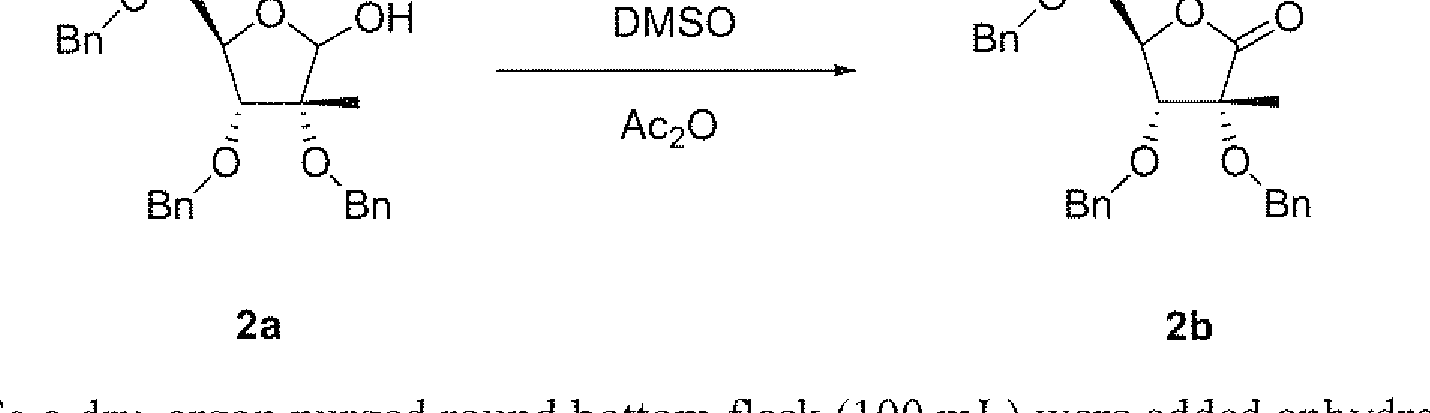


Claims


Priority Applications (19)
| Application Number | Priority Date | Filing Date | Title |
|---|---|---|---|
| JP2012529963A JP5767643B2 (en) | 2009-09-21 | 2010-09-20 | Processes and intermediates for the preparation of 1'-substituted carbnucleoside analogues |
| MX2012003126A MX2012003126A (en) | 2009-09-21 | 2010-09-20 | Processes and intermediates for the preparation of 1'-substituted carba-nucleoside analogs. |
| BR112012006180A BR112012006180A2 (en) | 2009-09-21 | 2010-09-20 | Processes and Intermediates for the Preparation of 1'-substituted Carba-Nucleoside Analogs |
| RS20130422A RS52954B (en) | 2009-09-21 | 2010-09-20 | PROCEDURES AND INTERMEDIATES FOR THE PRODUCTION OF 1'-CYANOCARBANUCLEOSIDE ANALOGS |
| MEP-2013-111A ME01528B (en) | 2009-09-21 | 2010-09-20 | Processes and intermediates for the preparation of 1'-cyano-carbanucleoside analogs |
| KR1020127010074A KR101848099B1 (en) | 2009-09-21 | 2010-09-20 | Processes and intermediates for the preparation of 1'-substituted carba-nucleoside analogs |
| HK13100696.2A HK1173451B (en) | 2009-09-21 | 2010-09-20 | Processes and intermediates for the preparation of 1'-cyano-carbanucleoside analogs |
| SI201030325T SI2480559T1 (en) | 2009-09-21 | 2010-09-20 | Processes and intermediates for the preparation of 1'-cyano-carbanucleoside analogs |
| PL10757699T PL2480559T3 (en) | 2009-09-21 | 2010-09-20 | Processes and intermediates for the preparation of 1'-cyano-carbanucleoside analogs |
| CN201080041946.2A CN102596979B (en) | 2009-09-21 | 2010-09-20 | Processes and intermediates for the preparation of 1'-substituted carba-nucleoside analogs |
| DK10757699.3T DK2480559T3 (en) | 2009-09-21 | 2010-09-20 | METHODS AND INTERMEDIATES FOR THE PREPARATION OF 1'-CYANO-CARBANUCLEOSIDE ANALOGS |
| ES10757699T ES2428725T3 (en) | 2009-09-21 | 2010-09-20 | Procedures and intermediates for the preparation of 1'-substituted carbanucleoside analogs |
| AU2010295392A AU2010295392B2 (en) | 2009-09-21 | 2010-09-20 | Processes and intermediates for the preparation of 1'-substituted carba-nucleoside analogs |
| NZ599404A NZ599404A (en) | 2009-09-21 | 2010-09-20 | Processes and intermediates for the preparation of 1’-substituted carba-nucleoside analogs |
| EP10757699.3A EP2480559B1 (en) | 2009-09-21 | 2010-09-20 | Processes and intermediates for the preparation of 1'-cyano-carbanucleoside analogs |
| HRP20130862AT HRP20130862T1 (en) | 2009-09-21 | 2010-09-20 | Processes and intermediates for the preparation of 1'-substituted carba-nucleoside analogs |
| CA2773773A CA2773773C (en) | 2009-09-21 | 2010-09-20 | Processes and intermediates for the preparation of 1'-substituted carba-nucleoside analogs |
| IL218752A IL218752A (en) | 2009-09-21 | 2012-03-20 | Processes and intermediates for the preparation of 1'-substituted carba-nucleoside analogs |
| SM201300110T SMT201300110B (en) | 2009-09-21 | 2013-10-04 | Intermediate processes for the preparation of analogous 1'-cyanocarbonucleoside |
Applications Claiming Priority (2)
| Application Number | Priority Date | Filing Date | Title |
|---|---|---|---|
| US24429909P | 2009-09-21 | 2009-09-21 | |
| US61/244,299 | 2009-09-21 |
Publications (1)
| Publication Number | Publication Date |
|---|---|
| WO2011035250A1 true WO2011035250A1 (en) | 2011-03-24 |
Family
ID=42988364
Family Applications (1)
| Application Number | Title | Priority Date | Filing Date |
|---|---|---|---|
| PCT/US2010/049508 Ceased WO2011035250A1 (en) | 2009-09-21 | 2010-09-20 | Processes and intermediates for the preparation of 1'-substituted carba-nucleoside analogs |
Country Status (22)
| Country | Link |
|---|---|
| US (3) | US10023600B2 (en) |
| EP (1) | EP2480559B1 (en) |
| JP (3) | JP5767643B2 (en) |
| KR (1) | KR101848099B1 (en) |
| CN (1) | CN102596979B (en) |
| AU (1) | AU2010295392B2 (en) |
| BR (1) | BR112012006180A2 (en) |
| CA (1) | CA2773773C (en) |
| DK (1) | DK2480559T3 (en) |
| ES (1) | ES2428725T3 (en) |
| HR (1) | HRP20130862T1 (en) |
| IL (1) | IL218752A (en) |
| ME (1) | ME01528B (en) |
| MX (1) | MX2012003126A (en) |
| NZ (1) | NZ599404A (en) |
| PL (1) | PL2480559T3 (en) |
| PT (1) | PT2480559E (en) |
| RS (1) | RS52954B (en) |
| SI (1) | SI2480559T1 (en) |
| SM (1) | SMT201300110B (en) |
| TW (1) | TWI483950B (en) |
| WO (1) | WO2011035250A1 (en) |
Cited By (37)
| Publication number | Priority date | Publication date | Assignee | Title |
|---|---|---|---|---|
| WO2011150288A1 (en) * | 2010-05-28 | 2011-12-01 | Gilead Sciences, Inc. | 1'-substituted-carba-nucleoside prodrugs for antiviral treatment |
| WO2012039787A1 (en) * | 2010-09-20 | 2012-03-29 | Gilead Sciences, Inc. | 2' -fluoro substituted carba-nucleoside analogs for antiviral treatment |
| US8455451B2 (en) | 2009-09-21 | 2013-06-04 | Gilead Sciences, Inc. | 2'-fluoro substituted carba-nucleoside analogs for antiviral treatment |
| WO2014035140A3 (en) * | 2012-08-30 | 2014-05-01 | Kainos Medicine, Inc. | Compounds and compositions for modulating histone methyltransferase activity |
| WO2014042433A3 (en) * | 2012-09-14 | 2014-05-08 | Kainos Medicine, Inc. | Compounds and compositions for modulating adenosine a3 receptor activity |
| US8853171B2 (en) | 2008-04-23 | 2014-10-07 | Gilead Sciences, Inc. | 1′-substituted carba-nucleoside analogs for antiviral treatment |
| US9090642B2 (en) | 2010-07-19 | 2015-07-28 | Gilead Sciences, Inc. | Methods for the preparation of diasteromerically pure phosphoramidate prodrugs |
| WO2016018697A1 (en) | 2014-07-28 | 2016-02-04 | Gilead Sciences, Inc. | Thieno [3,2-d] pyrimidine, furo [3,2,d] pyrimidine, and pyrrolo [3,2-d] pyrimidines useful for treating respiratory syncitial virus infections |
| US20160122356A1 (en) * | 2014-10-29 | 2016-05-05 | Gilead Sciences, Inc. | Methods for the preparation of ribosides |
| US9388208B2 (en) | 2013-11-11 | 2016-07-12 | Gilead Sciences, Inc. | Pyrrolo[1,2-f][1,2,4]triazines useful for treating respiratory syncitial virus infections |
| US9457039B2 (en) | 2012-10-17 | 2016-10-04 | Merck Sharp & Dohme Corp. | 2′-disubstituted nucleoside derivatives and methods of use thereof for the treatment of viral diseases |
| WO2016178876A2 (en) | 2015-05-01 | 2016-11-10 | Cocrystal Pharma, Inc. | Nucleoside analogs for treatment of the flaviviridae family of viruses and cancer |
| US9981975B2 (en) | 2016-03-28 | 2018-05-29 | Incyte Corporation | Pyrrolotriazine compounds as tam inhibitors |
| US10065958B2 (en) | 2010-07-22 | 2018-09-04 | Gilead Sciences, Inc. | Methods and compounds for treating Paramyxoviridae virus infections |
| US10251904B2 (en) | 2015-09-16 | 2019-04-09 | Gilead Sciences, Inc. | Methods for treating arenaviridae and coronaviridae virus infections |
| US10675296B2 (en) | 2017-07-11 | 2020-06-09 | Gilead Sciences, Inc. | Compositions comprising an RNA polymerase inhibitor and cyclodextrin for treating viral infections |
| US10682368B2 (en) | 2017-03-14 | 2020-06-16 | Gilead Sciences, Inc. | Methods of treating feline coronavirus infections |
| US10836787B2 (en) | 2017-05-01 | 2020-11-17 | Gilead Sciences, Inc. | Crystalline forms of (S)-2-ethylbutyl 2-(((S)-(((2R,3S,4R,5R)-5- (4-aminopyrrolo[2,1-f] [1,2,4]triazin-7-yl)-5-cyano-3,4-dihydroxytetrahydrofuran-2-yl)methoxy)(phenoxy) phosphoryl)amino)propanoate |
| EP3738969A1 (en) | 2014-08-21 | 2020-11-18 | Gilead Sciences, Inc. | 2'-chloro aminopyrimidinone and pyrimidine dione nucleosides for use in treating pneumovirinae virus infections |
| US10988498B2 (en) | 2009-09-21 | 2021-04-27 | Gilead Sciences, Inc. | Processes and intermediates for the preparation of 1′-substituted carba-nucleoside analogs |
| WO2021168038A1 (en) | 2020-02-18 | 2021-08-26 | Gilead Sciences, Inc. | Antiviral compounds |
| WO2021168004A1 (en) | 2020-02-18 | 2021-08-26 | Gilead Sciences, Inc. | Antiviral compounds |
| WO2021167882A1 (en) | 2020-02-18 | 2021-08-26 | Gilead Sciences, Inc. | Antiviral compounds |
| WO2022012630A1 (en) | 2020-07-17 | 2022-01-20 | 四川大学 | Method for synthesizing c-nucleoside compound |
| US11491169B2 (en) | 2020-05-29 | 2022-11-08 | Gilead Sciences, Inc. | Remdesivir treatment methods |
| US11613553B2 (en) | 2020-03-12 | 2023-03-28 | Gilead Sciences, Inc. | Methods of preparing 1′-cyano nucleosides |
| US11660307B2 (en) | 2020-01-27 | 2023-05-30 | Gilead Sciences, Inc. | Methods for treating SARS CoV-2 infections |
| US11697666B2 (en) | 2021-04-16 | 2023-07-11 | Gilead Sciences, Inc. | Methods of preparing carbanucleosides using amides |
| US11701372B2 (en) | 2020-04-06 | 2023-07-18 | Gilead Sciences, Inc. | Inhalation formulations of 1'-cyano substituted carba-nucleoside analogs |
| US11780844B2 (en) | 2022-03-02 | 2023-10-10 | Gilead Sciences, Inc. | Compounds and methods for treatment of viral infections |
| US11814406B2 (en) | 2020-08-27 | 2023-11-14 | Gilead Sciences, Inc. | Compounds and methods for treatment of viral infections |
| US11939347B2 (en) | 2020-06-24 | 2024-03-26 | Gilead Sciences, Inc. | 1′-cyano nucleoside analogs and uses thereof |
| US12054507B2 (en) | 2020-02-18 | 2024-08-06 | Gilead Sciences, Inc. | Antiviral compounds |
| US12116380B2 (en) | 2021-08-18 | 2024-10-15 | Gilead Sciences, Inc. | Phospholipid compounds and methods of making and using the same |
| US12357577B1 (en) | 2024-02-02 | 2025-07-15 | Gilead Sciences, Inc. | Pharmaceutical formulations and uses thereof |
| US12473314B2 (en) | 2020-08-24 | 2025-11-18 | Gilead Sciences, Inc. | Phospholipid compounds and uses thereof |
| US12558364B2 (en) | 2021-01-20 | 2026-02-24 | Regents Of The University Of Minnesota | Next generation remdesivir antivirals |
Families Citing this family (13)
| Publication number | Priority date | Publication date | Assignee | Title |
|---|---|---|---|---|
| CN102596958A (en) * | 2009-09-21 | 2012-07-18 | 吉里德科学公司 | 2'-fluoro CARBA-nucleoside analogues for antiviral therapy |
| MD4496C1 (en) * | 2012-03-13 | 2018-02-28 | Gilead Sciences, Inc. | 2'-Substituted carba-nucleoside analogs for antiviral treatment |
| EP2909209B1 (en) * | 2012-10-17 | 2022-08-03 | Merck Sharp & Dohme LLC | 2'-cyano substituted nucleoside derivatives and methods of use thereof for treatment of viral diseases |
| EP3137454A1 (en) | 2014-04-28 | 2017-03-08 | Pfizer Inc. | Heteroaromatic compounds and their use as dopamine d1 ligands |
| CN113214262B (en) * | 2020-02-05 | 2023-07-07 | 华创合成制药股份有限公司 | Compound containing guanidine group, and preparation method and application thereof |
| WO2021175296A1 (en) * | 2020-03-04 | 2021-09-10 | 中国科学院上海药物研究所 | Intermediate of remdesivir and preparation method therefor |
| CN113387954B (en) * | 2020-03-11 | 2024-03-19 | 上海特化医药科技有限公司 | Preparation method of adefovir intermediate |
| CN112778310B (en) * | 2020-04-20 | 2025-05-30 | 中国科学院上海药物研究所 | Application of nucleoside analogs or combination preparations containing nucleoside analogs in antiviral treatment |
| CN113527303B (en) * | 2020-04-21 | 2022-06-10 | 浙江工业大学 | Preparation process of Rudexivirin nucleus intermediate |
| CN113861246B (en) * | 2021-11-02 | 2024-01-05 | 中山大学 | Stereoselective synthesis method of beta-D-arabinofuranoside bond |
| CN115894498A (en) * | 2022-10-01 | 2023-04-04 | 海化生命(厦门)科技有限公司 | A kind of potential antiviral drug intermediate BL and its synthetic method |
| CN118852168B (en) * | 2023-04-26 | 2025-09-19 | 深圳科兴药业有限公司 | New method for preparing benzyl carbon nucleoside analogue and application thereof |
| CN118359623B (en) * | 2024-04-16 | 2025-06-27 | 上海陶术生物科技股份有限公司 | A synthesis method, intermediate and application of forodesine |
Citations (16)
| Publication number | Priority date | Publication date | Assignee | Title |
|---|---|---|---|---|
| WO2000056734A1 (en) | 1999-03-20 | 2000-09-28 | Aventis Cropscience Gmbh | Bicyclic heterocycles, method for producing them and their use as herbicides and pharmaceutical agents |
| WO2001032153A2 (en) | 1999-11-04 | 2001-05-10 | Shire Biochem Inc. | Method for the treatment or prevention of flaviviridae viral infection using nucleoside analogues |
| WO2001060315A2 (en) | 2000-02-18 | 2001-08-23 | Shire Biochem Inc. | Method for the treatment or prevention of flavivirus infections using nucleoside analogues |
| WO2001090121A2 (en) | 2000-05-23 | 2001-11-29 | Idenix (Cayman) Limited | Methods and compositions for treating hepatitis c virus |
| WO2002018404A2 (en) | 2000-08-30 | 2002-03-07 | F. Hoffmann-La Roche Ag | Nucleoside derivatives for the treatment of hepatitis c |
| WO2002032920A2 (en) | 2000-10-18 | 2002-04-25 | Pharmasset Limited | Modified nucleosides for treatment of viral infections and abnormal cellular proliferation |
| WO2002057287A2 (en) | 2001-01-22 | 2002-07-25 | Merck & Co., Inc. | Nucleoside derivatives as inhibitors of rna-dependent rna viral polymerase |
| US20040006002A1 (en) | 2001-09-28 | 2004-01-08 | Jean-Pierre Sommadossi | Methods and compositions for treating flaviviruses and pestiviruses using 4'-modified nucleoside |
| WO2004046331A2 (en) | 2002-11-15 | 2004-06-03 | Idenix (Cayman) Limited | 2’-branched nucleosides and flaviviridae mutation |
| WO2006031725A2 (en) | 2004-09-14 | 2006-03-23 | Pharmasset, Inc. | Preparation of 2'fluoro-2'- alkyl- substituted or other optionally substituted ribofuranosyl pyrimidines and purines and their derivatives |
| WO2007056170A2 (en) | 2005-11-02 | 2007-05-18 | Bayer Healthcare Ag | Pyrrolo[2,1-f] [1,2,4] triazin-4-ylamines igf-1r kinase inhibitors for the treatment of cancer and other hyperproliferative diseases |
| WO2008089105A2 (en) | 2007-01-12 | 2008-07-24 | Biocryst Pharmaceuticals, Inc. | Antiviral nucleoside analogs |
| WO2008116064A2 (en) | 2007-03-21 | 2008-09-25 | Bristol-Myers Squibb Company | Fused heterocyclic compounds useful for the treatment of proliferative, allergic, autoimmune or inflammatory diseases |
| WO2008141079A1 (en) | 2007-05-10 | 2008-11-20 | Biocryst Pharmaceuticals, Inc. | Tetrahydrofuro [3 4-d] dioxolane compounds for use in the treatment of viral infections and cancer |
| WO2009132123A1 (en) | 2008-04-23 | 2009-10-29 | Gilead Sciences, Inc. | Carba-nucleoside analogs for antiviral treatment |
| WO2010002877A2 (en) | 2008-07-03 | 2010-01-07 | Biota Scientific Management | Bycyclic nucleosides and nucleotides as therapeutic agents |
Family Cites Families (109)
| Publication number | Priority date | Publication date | Assignee | Title |
|---|---|---|---|---|
| US4816570A (en) | 1982-11-30 | 1989-03-28 | The Board Of Regents Of The University Of Texas System | Biologically reversible phosphate and phosphonate protective groups |
| US4968788A (en) | 1986-04-04 | 1990-11-06 | Board Of Regents, The University Of Texas System | Biologically reversible phosphate and phosphonate protective gruops |
| EP0533833B1 (en) | 1990-06-13 | 1995-12-20 | GLAZIER, Arnold | Phosphorous produgs |
| EP0481214B1 (en) | 1990-09-14 | 1998-06-24 | Institute Of Organic Chemistry And Biochemistry Of The Academy Of Sciences Of The Czech Republic | Prodrugs of phosphonates |
| US6887707B2 (en) | 1996-10-28 | 2005-05-03 | University Of Washington | Induction of viral mutation by incorporation of miscoding ribonucleoside analogs into viral RNA |
| JP2002505340A (en) | 1998-03-03 | 2002-02-19 | ノボ ノルディスク アクティーゼルスカブ | (2E) -5-Amino-5-methylhex-2-enoic acid N-methyl-N-((1R) -1- (N-methyl-N-((1R) -1- (methylcarbamoyl) -2- Novel salt of phenylethyl) carbamoyl) -2- (2-naphthyl) ethyl) amide |
| US6312662B1 (en) | 1998-03-06 | 2001-11-06 | Metabasis Therapeutics, Inc. | Prodrugs phosphorus-containing compounds |
| US6475985B1 (en) | 1998-03-27 | 2002-11-05 | Regents Of The University Of Minnesota | Nucleosides with antiviral and anticancer activity |
| ATE371659T1 (en) | 1998-10-16 | 2007-09-15 | Merck Sharp & Dohme | PYRAZOLOTRIAZINE DERIVATIVES AS GABA RECEPTOR LIGANDS |
| JP2003514766A (en) | 1999-06-03 | 2003-04-22 | アボット・ラボラトリーズ | Oligonucleotide synthesis using Lewis acids as activators |
| WO2001019375A1 (en) | 1999-09-15 | 2001-03-22 | Biocryst Pharmaceuticals, Inc. | Inhibiting t-cell proliferation |
| EP1736478B1 (en) | 2000-05-26 | 2015-07-22 | IDENIX Pharmaceuticals, Inc. | Methods and compositions for treating flaviviruses and pestiviruses |
| JP2004502780A (en) * | 2000-07-12 | 2004-01-29 | 日研化学株式会社 | Adenosine compound and pharmaceutical composition containing the same |
| US20020119443A1 (en) | 2000-07-21 | 2002-08-29 | Gilead Sciences, Inc. | Prodrugs of phosphonate nucleotide analogues and methods for selecting and making same |
| DE10145223A1 (en) | 2001-09-13 | 2003-04-03 | Basf Ag | Process for the preparation of meso-zeaxanthin |
| AT410792B (en) | 2001-12-28 | 2003-07-25 | Dsm Fine Chem Austria Gmbh | PROCESS FOR THE PREPARATION OF PROTECTED, ENANTIOMERIC ENRICHED CYANHYDRINES BY IN SITU DERIVATIZATION |
| JP2005524662A (en) | 2002-02-28 | 2005-08-18 | ビオタ インコーポレーティッド | Nucleoside 5'-monophosphate mimetics and their prodrugs |
| WO2003072757A2 (en) | 2002-02-28 | 2003-09-04 | Biota, Inc. | Nucleotide mimics and their prodrugs |
| US20040138170A1 (en) | 2002-03-06 | 2004-07-15 | Montgomery John A. | Nucleosides, preparation thereof and use as inhibitors of rna viral polymerases |
| GB0210127D0 (en) | 2002-05-02 | 2002-06-12 | Merck Sharp & Dohme | Therapeutic agents |
| GB0210124D0 (en) | 2002-05-02 | 2002-06-12 | Merck Sharp & Dohme | Therapeutic agents |
| US20040063658A1 (en) | 2002-05-06 | 2004-04-01 | Roberts Christopher Don | Nucleoside derivatives for treating hepatitis C virus infection |
| AU2003233667A1 (en) | 2002-05-23 | 2003-12-12 | Biocryst Pharmaceuticals, Inc. | Enhancing the efficacy of reverse transcriptase and dna polymerase inhibitors (nucleoside analogs) using pnp inhibitors and/or 2'-deoxyguanosine and/or prodrug thereof |
| EA014685B1 (en) | 2003-04-25 | 2010-12-30 | Джилид Сайэнс, Инк. | Phosphonate-containing antiviral compounds (variants) and pharmaceutical composition based thereon |
| CA2727748A1 (en) * | 2003-06-16 | 2004-12-23 | Ajinomoto Co., Inc. | Inosine derivatives and production methods therefor |
| US20060291882A1 (en) | 2003-07-09 | 2006-12-28 | Council For The Centeral Laboratory Of The Researc | Imaging machine using a large area electron multiplier |
| GB0317009D0 (en) | 2003-07-21 | 2003-08-27 | Univ Cardiff | Chemical compounds |
| US20050075309A1 (en) | 2003-07-25 | 2005-04-07 | Richard Storer | Purine nucleoside analogues for treating Flaviviridae including hepatitis C |
| NZ546055A (en) | 2003-08-27 | 2010-05-28 | Biota Scient Management | Novel tricyclic nucleosides or nucleotides as therapeutic agents |
| WO2005033121A2 (en) * | 2003-10-03 | 2005-04-14 | King Pharmaceuticals Research & Development, Inc. | Synthesis of 2-aralkyloxyadenosines, 2-alkoxyadenosines, and their analogs |
| CN103030617A (en) | 2004-03-16 | 2013-04-10 | 贝林格尔.英格海姆国际有限公司 | Glucopyranosyl-substituted phenyl derivatives, medicaments containing such compounds, their use and process for their manufacture |
| CA2566541C (en) * | 2004-06-07 | 2012-10-09 | Anadys Pharmaceuticals, Inc. | 3-.beta.-d-ribofuranosylthiazolo[4,5-d]pyrimidine nucleosides and uses thereof |
| CA2568379A1 (en) | 2004-06-15 | 2005-12-29 | Merck & Co., Inc. | C-purine nucleoside analogs as inhibitors of rna-dependent rna viral polymerase |
| US7560434B2 (en) | 2004-06-22 | 2009-07-14 | Biocryst Pharmaceuticals, Inc. | AZA nucleosides, preparation thereof and use as inhibitors of RNA viral polymerases |
| CN101043893A (en) | 2004-10-21 | 2007-09-26 | 默克公司 | Fluorinated pyrrolo[2,3-d]pyrimidine nucleosides for the treatment of rna-dependent rna viral infection |
| EP1804812A4 (en) | 2004-10-21 | 2009-09-02 | Merck & Co Inc | FLUORINATED PYRROLOÝ2,3-D¨PYRIMIDINE NUCLEOSIDES FOR THE TREATMENT OF RNA-DEPENDENT RIBOVIRAL INFECTIONS |
| AU2005302448B2 (en) | 2004-10-29 | 2012-07-19 | Biocryst Pharmaceuticals, Inc. | Therapeutic furopyrimidines and thienopyrimidines |
| CA2600886A1 (en) | 2005-03-08 | 2006-09-14 | Biota Scientific Management Pty Ltd. | Bicyclic nucleosides and nucleotides as therapeutic agents |
| WO2006104945A2 (en) | 2005-03-29 | 2006-10-05 | Biocryst Pharmaceuticals, Inc. | Hepatitis c therapies |
| US7405204B2 (en) | 2005-04-25 | 2008-07-29 | Genelabs Technologies, Inc. | Nucleoside compounds for treating viral infections |
| WO2006121820A1 (en) | 2005-05-05 | 2006-11-16 | Valeant Research & Development | Phosphoramidate prodrugs for treatment of viral infection |
| WO2007027248A2 (en) | 2005-05-16 | 2007-03-08 | Valeant Research & Development | 3', 5' - cyclic nucleoside analogues for treatment of hcv |
| ES2436404T3 (en) | 2005-10-03 | 2013-12-30 | University Health Network | ODCase inhibitors for the treatment of malaria |
| SI1954264T1 (en) | 2005-12-01 | 2010-01-29 | Basilea Pharmaceutica Ag | PROCEDURE FOR PREPARATION OF EPOXYBUTANOL INTERMEDIATES |
| PE20070855A1 (en) | 2005-12-02 | 2007-10-14 | Bayer Pharmaceuticals Corp | DERIVATIVES OF 4-AMINO-PYRROLOTRIAZINE SUBSTITUTE AS KINASE INHIBITORS |
| WO2007064931A2 (en) | 2005-12-02 | 2007-06-07 | Bayer Healthcare Llc | Substituted 4-amino-pyrrolotriazine derivatives useful for treating hyper-proliferative disorders and diseases associated with angiogenesis |
| EP1971331A2 (en) | 2005-12-09 | 2008-09-24 | Basilea Pharmaceutica AG | 4-oxo-(iso)tretinoin for the topical treatment of severe dermatological disorders |
| CA2632626C (en) | 2005-12-09 | 2011-10-11 | F. Hoffmann-La Roche Ag | Ester prodrugs of 2'-fluoro-2'-alkyl-2'-deoxycytidines and their use in the treatment of hcv infection |
| WO2007097991A2 (en) | 2006-02-16 | 2007-08-30 | Pharmasset, Inc. | Methods and kits for dosing of antiviral agents |
| DE102006015378A1 (en) | 2006-04-03 | 2007-10-04 | Ludwig-Maximilians-Universität München | Process for the synthesis of organoelement compounds |
| CL2007001427A1 (en) | 2006-05-22 | 2008-05-16 | Novartis Ag | 5-AMINO-3- MALEATE SALT (2 ', 3'-DI-O-ACETYL-BETA-D-RIBOFURANOSIL) -3H-TIAZOLO [4,5-D] PIRIMIDIN-2-ONA; PREPARATION PROCEDURE; PHARMACEUTICAL COMPOSITION THAT INCLUDES SUCH COMPOUND; AND USE OF THE COMPOUND FOR THE TREATMENT OF A PO INFECTION |
| US7842672B2 (en) | 2006-07-07 | 2010-11-30 | Gilead Sciences, Inc. | Phosphonate inhibitors of HCV |
| WO2008033466A2 (en) | 2006-09-14 | 2008-03-20 | Combinatorx (Singapore) Pre. Ltd. | Compositions and methods for treatment of viral diseases |
| CA2668623A1 (en) | 2006-11-06 | 2008-05-15 | Boehringer Ingelheim International Gmbh | Glucopyranosyl-substituted benzyl-benzonitrile derivatives, medicaments containing such compounds, their use and process for their manufacture |
| AU2007338899A1 (en) | 2006-12-20 | 2008-07-03 | Istituto Di Ricerche Di Biologia Molecolare P. Angeletti S.P.A. | Nucleoside cyclic phosphoramidates for the treatment of RNA-dependent RNA viral infection |
| US20080261913A1 (en) | 2006-12-28 | 2008-10-23 | Idenix Pharmaceuticals, Inc. | Compounds and pharmaceutical compositions for the treatment of liver disorders |
| JP2010515680A (en) | 2007-01-05 | 2010-05-13 | メルク・シャープ・エンド・ドーム・コーポレイション | Nucleoside aryl phosphoramidates for the treatment of RNA-dependent RNA viral infections |
| WO2008097222A2 (en) * | 2007-02-08 | 2008-08-14 | Utc Fire & Security Corporation | System and method for video-processing algorithm improvement |
| US7964580B2 (en) | 2007-03-30 | 2011-06-21 | Pharmasset, Inc. | Nucleoside phosphoramidate prodrugs |
| CN100532388C (en) | 2007-07-16 | 2009-08-26 | 郑州大学 | 2 '-fluoro-4' -substituted-nucleoside analogue, preparation method and application thereof |
| TW200942243A (en) | 2008-03-05 | 2009-10-16 | Biocryst Pharm Inc | Antiviral therapeutic agents |
| US8227431B2 (en) | 2008-03-17 | 2012-07-24 | Hetero Drugs Limited | Nucleoside derivatives |
| US7863291B2 (en) | 2008-04-23 | 2011-01-04 | Bristol-Myers Squibb Company | Quinuclidine compounds as alpha-7 nicotinic acetylcholine receptor ligands |
| WO2010036407A2 (en) | 2008-05-15 | 2010-04-01 | Biocryst Pharmaceuticals, Inc. | Antiviral nucleoside analogs |
| MX2011008409A (en) | 2009-02-10 | 2011-10-21 | Gilead Sciences Inc | Carba-nucleoside analogs for antiviral treatment. |
| AR075584A1 (en) | 2009-02-27 | 2011-04-20 | Intermune Inc | THERAPEUTIC COMPOSITIONS THAT INCLUDE beta-D-2'-DESOXI-2'-FLUORO-2'-C-METHYLYCTIDINE AND A CARDIEX ISOINDOL ACID DERIVATIVE AND ITS USES. COMPOUND. |
| JP2012521359A (en) | 2009-03-20 | 2012-09-13 | アリオス バイオファーマ インク. | Substituted nucleoside and nucleotide analogs |
| NZ595590A (en) | 2009-03-24 | 2013-11-29 | Biocryst Pharm Inc | Useful pharmaceutical salts of 7-[(3r,4r)-3-hydroxy-4-hydroxymethyl-pyrrolidin-1-ylmethyl]-3,5-dihydro-pyrrolo[3,2-d]pyrimidin-4-one |
| TWI583692B (en) | 2009-05-20 | 2017-05-21 | 基利法瑪席特有限責任公司 | Nucleoside phosphoramidates |
| AU2010276441B2 (en) | 2009-07-21 | 2015-07-02 | Gilead Sciences, Inc. | Inhibitors of Flaviviridae viruses |
| US8455451B2 (en) | 2009-09-21 | 2013-06-04 | Gilead Sciences, Inc. | 2'-fluoro substituted carba-nucleoside analogs for antiviral treatment |
| US7973013B2 (en) | 2009-09-21 | 2011-07-05 | Gilead Sciences, Inc. | 2'-fluoro substituted carba-nucleoside analogs for antiviral treatment |
| MX2012003126A (en) | 2009-09-21 | 2012-06-19 | Gilead Sciences Inc | Processes and intermediates for the preparation of 1'-substituted carba-nucleoside analogs. |
| CN102596958A (en) | 2009-09-21 | 2012-07-18 | 吉里德科学公司 | 2'-fluoro CARBA-nucleoside analogues for antiviral therapy |
| BR112012015827A2 (en) | 2009-12-28 | 2016-12-06 | Dcb Usa Llc | new pyrimidine compounds as inhibitors of mtor and p13k |
| UY33310A (en) | 2010-03-31 | 2011-10-31 | Pharmasset Inc | ESTEREOSELECTIVE SYNTHESIS OF ASSETS CONTAINING PHOSPHORUS |
| SG184324A1 (en) | 2010-03-31 | 2012-11-29 | Gilead Pharmasset Llc | Nucleoside phosphoramidates |
| TW201201815A (en) | 2010-05-28 | 2012-01-16 | Gilead Sciences Inc | 1'-substituted-carba-nucleoside prodrugs for antiviral treatment |
| AU2011282241B2 (en) | 2010-07-19 | 2015-07-30 | Gilead Sciences, Inc. | Methods for the preparation of diasteromerically pure phosphoramidate prodrugs |
| ES2524356T3 (en) | 2010-07-22 | 2014-12-05 | Gilead Sciences, Inc. | Methods and compounds to treat infections caused by Paramyxoviridae virus |
| TW201305185A (en) | 2010-09-13 | 2013-02-01 | 吉李德科學股份有限公司 | 2'-fluoro substituted carbon-nucleoside analog for antiviral therapy |
| BR112013008017A2 (en) | 2010-09-20 | 2016-06-14 | Gilead Sciences Inc | substituted 2-fluorine carbosucleoside analogues for antiviral treatment |
| NZ607996A (en) | 2010-09-22 | 2014-07-25 | Alios Biopharma Inc | Substituted nucleotide analogs |
| DK2898885T3 (en) | 2010-10-15 | 2018-02-05 | Biocryst Pharm Inc | PYRROLOPYRIMIDINE DERIVATIVES FOR USE IN TREATMENT OF VIRUS INFECTIONS |
| US8877733B2 (en) | 2011-04-13 | 2014-11-04 | Gilead Sciences, Inc. | 1′-substituted pyrimidine N-nucleoside analogs for antiviral treatment |
| EP2707025B8 (en) | 2011-05-13 | 2017-08-23 | Zoetis Services LLC | Hendra and nipah virus g glycoprotein immunogenic compositions |
| EP2709613B2 (en) | 2011-09-16 | 2020-08-12 | Gilead Pharmasset LLC | Methods for treating hcv |
| US8889159B2 (en) | 2011-11-29 | 2014-11-18 | Gilead Pharmasset Llc | Compositions and methods for treating hepatitis C virus |
| US20130143835A1 (en) | 2011-12-05 | 2013-06-06 | Medivir Ab | HCV Polymerase Inhibitors |
| WO2013084165A1 (en) | 2011-12-05 | 2013-06-13 | Medivir Ab | Hcv polymerase inhibitors |
| CA2860234A1 (en) | 2011-12-22 | 2013-06-27 | Alios Biopharma, Inc. | Substituted phosphorothioate nucleotide analogs |
| JP6165848B2 (en) | 2012-05-22 | 2017-07-19 | イデニク ファーマシューティカルズ エルエルシー | D-amino acid compounds for liver disease |
| ES2671478T3 (en) | 2012-08-31 | 2018-06-06 | Novartis Ag | 2'-ethinyl nucleoside derivatives for the treatment of viral infections |
| WO2014042433A2 (en) | 2012-09-14 | 2014-03-20 | Kainos Medicine, Inc. | Compounds and compositions for modulating adenosine a3 receptor activity |
| JP2016504284A (en) | 2012-11-16 | 2016-02-12 | バイオクリスト ファーマスーティカルズ,インコーポレイテッドBiocryst Pharmaceuticals,Inc. | Nucleosides containing antiviral azasugars |
| JP2016501200A (en) | 2012-11-19 | 2016-01-18 | メルク・シャープ・アンド・ドーム・コーポレーションMerck Sharp & Dohme Corp. | 2-Alkynyl-substituted nucleoside derivatives for treating viral diseases |
| BR112015014457A2 (en) | 2012-12-21 | 2017-11-21 | Alios Biopharma Inc | pharmaceutically acceptable salt or compound thereof and pharmaceutical composition and its uses and processes for improving or treating hcv infection, for inhibiting hepatitis c virus ns5b polymerase activity and hepatitis c virus replication |
| WO2014116755A1 (en) | 2013-01-22 | 2014-07-31 | Massachusetts Institute Of Technology | Uses of dihydro bases |
| US10034893B2 (en) | 2013-02-01 | 2018-07-31 | Enanta Pharmaceuticals, Inc. | 5, 6-D2 uridine nucleoside/tide derivatives |
| US9447132B2 (en) | 2013-04-12 | 2016-09-20 | Achillion Pharmaceuticals, Inc. | Highly active nucleoside derivative for the treatment of HCV |
| US9542154B2 (en) | 2013-06-25 | 2017-01-10 | Intel Corporation | Fused multiply add operations using bit masks |
| UA117375C2 (en) | 2013-09-04 | 2018-07-25 | Медівір Аб | Hcv polymerase inhibitors |
| UA119050C2 (en) | 2013-11-11 | 2019-04-25 | Ґілеад Саєнсиз, Інк. | PYROL [1.2-f] [1.2.4] TRIASINES USED FOR TREATMENT OF RESPIRATORY-SYNCITAL VIRAL INFECTIONS |
| US9616076B2 (en) | 2014-06-02 | 2017-04-11 | The Board Of Regents Of The University Of Texas Systems | Methods for treating viral infections using hydrogen sulfide donors |
| US9504701B2 (en) | 2014-06-02 | 2016-11-29 | The Board Of Regents Of The University Of Texas System | Methods for treating viral infections using hydrogen sulfide donors |
| TWI687432B (en) | 2014-10-29 | 2020-03-11 | 美商基利科學股份有限公司 | Methods for treating filoviridae virus infections |
| DK3785717T3 (en) | 2015-09-16 | 2022-03-21 | Gilead Sciences Inc | PROCEDURES FOR THE TREATMENT OF CORONAVIRIDAE INFECTIONS |
| WO2017184668A1 (en) | 2016-04-20 | 2017-10-26 | Gilead Sciences, Inc. | Methods for treating flaviviridae virus infections |
| CA3059777C (en) | 2017-05-01 | 2023-02-21 | Gilead Sciences, Inc. | Crystalline forms of (s)-2-ethylbutyl 2-(((s)-(((2r,3s,4r,5r)-5-(4-aminopyrrolo[2,1-f] [1,2,4]triazin-7-yl)-5-cyano-3,4-dihydroxytetrahydrofuran-2-yl)methoxy)(phenoxy) phosphoryl)amino)propanoate |
-
2010
- 2010-09-20 MX MX2012003126A patent/MX2012003126A/en active IP Right Grant
- 2010-09-20 SI SI201030325T patent/SI2480559T1/en unknown
- 2010-09-20 ES ES10757699T patent/ES2428725T3/en active Active
- 2010-09-20 WO PCT/US2010/049508 patent/WO2011035250A1/en not_active Ceased
- 2010-09-20 PT PT107576993T patent/PT2480559E/en unknown
- 2010-09-20 BR BR112012006180A patent/BR112012006180A2/en not_active IP Right Cessation
- 2010-09-20 EP EP10757699.3A patent/EP2480559B1/en active Active
- 2010-09-20 JP JP2012529963A patent/JP5767643B2/en active Active
- 2010-09-20 DK DK10757699.3T patent/DK2480559T3/en active
- 2010-09-20 RS RS20130422A patent/RS52954B/en unknown
- 2010-09-20 TW TW099131868A patent/TWI483950B/en active
- 2010-09-20 NZ NZ599404A patent/NZ599404A/en unknown
- 2010-09-20 HR HRP20130862AT patent/HRP20130862T1/en unknown
- 2010-09-20 US US12/886,248 patent/US10023600B2/en active Active
- 2010-09-20 PL PL10757699T patent/PL2480559T3/en unknown
- 2010-09-20 CN CN201080041946.2A patent/CN102596979B/en active Active
- 2010-09-20 AU AU2010295392A patent/AU2010295392B2/en active Active
- 2010-09-20 CA CA2773773A patent/CA2773773C/en active Active
- 2010-09-20 KR KR1020127010074A patent/KR101848099B1/en active Active
- 2010-09-20 ME MEP-2013-111A patent/ME01528B/en unknown
-
2012
- 2012-03-20 IL IL218752A patent/IL218752A/en active IP Right Grant
-
2013
- 2013-10-04 SM SM201300110T patent/SMT201300110B/en unknown
-
2015
- 2015-06-11 JP JP2015118067A patent/JP2015180682A/en not_active Withdrawn
-
2017
- 2017-02-22 JP JP2017030979A patent/JP2017122102A/en not_active Withdrawn
-
2018
- 2018-06-18 US US16/011,055 patent/US10988498B2/en active Active
-
2021
- 2021-03-23 US US17/209,639 patent/US20210403497A1/en not_active Abandoned
Patent Citations (18)
| Publication number | Priority date | Publication date | Assignee | Title |
|---|---|---|---|---|
| WO2000056734A1 (en) | 1999-03-20 | 2000-09-28 | Aventis Cropscience Gmbh | Bicyclic heterocycles, method for producing them and their use as herbicides and pharmaceutical agents |
| WO2001032153A2 (en) | 1999-11-04 | 2001-05-10 | Shire Biochem Inc. | Method for the treatment or prevention of flaviviridae viral infection using nucleoside analogues |
| WO2001060315A2 (en) | 2000-02-18 | 2001-08-23 | Shire Biochem Inc. | Method for the treatment or prevention of flavivirus infections using nucleoside analogues |
| WO2001090121A2 (en) | 2000-05-23 | 2001-11-29 | Idenix (Cayman) Limited | Methods and compositions for treating hepatitis c virus |
| WO2002018404A2 (en) | 2000-08-30 | 2002-03-07 | F. Hoffmann-La Roche Ag | Nucleoside derivatives for the treatment of hepatitis c |
| WO2002032920A2 (en) | 2000-10-18 | 2002-04-25 | Pharmasset Limited | Modified nucleosides for treatment of viral infections and abnormal cellular proliferation |
| WO2002057287A2 (en) | 2001-01-22 | 2002-07-25 | Merck & Co., Inc. | Nucleoside derivatives as inhibitors of rna-dependent rna viral polymerase |
| WO2002057425A2 (en) | 2001-01-22 | 2002-07-25 | Merck & Co., Inc. | Nucleoside derivatives as inhibitors of rna-dependent rna viral polymerase |
| US20040006002A1 (en) | 2001-09-28 | 2004-01-08 | Jean-Pierre Sommadossi | Methods and compositions for treating flaviviruses and pestiviruses using 4'-modified nucleoside |
| WO2004046331A2 (en) | 2002-11-15 | 2004-06-03 | Idenix (Cayman) Limited | 2’-branched nucleosides and flaviviridae mutation |
| WO2006031725A2 (en) | 2004-09-14 | 2006-03-23 | Pharmasset, Inc. | Preparation of 2'fluoro-2'- alkyl- substituted or other optionally substituted ribofuranosyl pyrimidines and purines and their derivatives |
| WO2007056170A2 (en) | 2005-11-02 | 2007-05-18 | Bayer Healthcare Ag | Pyrrolo[2,1-f] [1,2,4] triazin-4-ylamines igf-1r kinase inhibitors for the treatment of cancer and other hyperproliferative diseases |
| WO2008089105A2 (en) | 2007-01-12 | 2008-07-24 | Biocryst Pharmaceuticals, Inc. | Antiviral nucleoside analogs |
| WO2008116064A2 (en) | 2007-03-21 | 2008-09-25 | Bristol-Myers Squibb Company | Fused heterocyclic compounds useful for the treatment of proliferative, allergic, autoimmune or inflammatory diseases |
| WO2008141079A1 (en) | 2007-05-10 | 2008-11-20 | Biocryst Pharmaceuticals, Inc. | Tetrahydrofuro [3 4-d] dioxolane compounds for use in the treatment of viral infections and cancer |
| WO2009132123A1 (en) | 2008-04-23 | 2009-10-29 | Gilead Sciences, Inc. | Carba-nucleoside analogs for antiviral treatment |
| WO2009132135A1 (en) | 2008-04-23 | 2009-10-29 | Gilead Sciences, Inc. | 1' -substituted carba-nucleoside analogs for antiviral treatment |
| WO2010002877A2 (en) | 2008-07-03 | 2010-01-07 | Biota Scientific Management | Bycyclic nucleosides and nucleotides as therapeutic agents |
Non-Patent Citations (36)
| Title |
|---|
| "McGraw-Hill Dictionary of Chemical Terms", 1984, MCGRAW-HILL BOOK COMPANY |
| "The Chemistry of Heterocyclic Compounds, A Series of Monographs", 1950, JOHN WILEY & SONS |
| ALESSANDRINI ET AL., J. CARBOHYCDRATE CHEM., vol. 27, 2008, pages 322 - 344 |
| ALESSANDRINI ET AL., J. CARBOHYDRATE CHEM., vol. 27, 2008, pages 322 - 344 |
| BOYER, N. ET AL., J HEPATOL., vol. 32, 2000, pages 98 - 112 |
| BYMOCK ET AL., ANTIVIRAL CHEMISTRY & CHEMOTHERAPY, vol. 11, no. 2, 2000, pages 79 - 95 |
| CALISHER ET AL., J. GEN. VIROL., vol. 70, 1993, pages 37 - 43 |
| CAMPS ET AL., TETRAHEDRON, vol. 38, 1982, pages 2395 - 2402 |
| CARBOHYDRATE RESEARCH, vol. 331, no. 1, 2001, pages 77 - 82 |
| DE CLERCQ, E., J. CLIN. VIROL., vol. 22, 2001, pages 73 - 89 |
| DE CLERCQ, E., J. PHARMACOL. EXP.THER., vol. 297, 2001, pages 1 - 10 |
| DE FRANCESCO, R. ET AL., ANTIVIRAL RCSCARCH, vol. 58, 2003, pages 1 - 16 |
| DI BESCEGLIE, A.M.; BACON, B. R., SCIENTIFIC AMERICAN, October 1999 (1999-10-01), pages 80 - 85 |
| ELIEL, E; WILEN, S.: "Stereochemistrv of Organic Compounds", 1994, JOHN WILEY & SONS, INC. |
| GORDON, C. P. ET AL., J. MED. CHEM., vol. 48, 2005, pages 1 - 20 |
| HARAGUCHI K ET AL: "Stereoselective synthesis of 1'-C-branched uracil nucleosides from uridine", NUCLEOSIDES & NUCLEOTIDES, MARCEL DEKKER, INC, US, vol. 14, no. 3 - 5, 1 January 1995 (1995-01-01), pages 417 - 420, XP002189369, ISSN: 0732-8311 * |
| HETEROCYCLES, vol. 34, no. 3, 1992, pages 569 - 74 |
| ITOH Y ET AL: "Divergent stereocontrolled approach to the synthesis of uracil nucleosides branched at the anomeric position", JOURNAL OF ORGANIC CHEMISTRY, AMERICAN CHEMICAL SOCIETY, EASTON.; US LNKD- DOI:10.1021/JO00108A031, vol. 60, 1 January 1995 (1995-01-01), pages 656 - 662, XP002189358, ISSN: 0022-3263 * |
| J AM. CHEM. SOC., vol. 82, 1960, pages 5566 |
| J. CHEM. SOC. PERKIN TRANS. 1, vol. 2, 1984, pages 229 - 38 |
| J. CHEM. SOC. PERKIN TRANS. 1, vol. 20, 1999, pages 2929 - 2936 |
| J. CHEM. SOC. PERKIN TRANS. 1, vol. 3, 1985, pages 621 - 30 |
| J. CHEM. SOC., PERKIN TRANS 1, 1991, pages 490 |
| J. MED. CHEM., vol. 29, no. 11, 1986, pages 2231 - 5 |
| J. ORG. CHEM., vol. 26, 1961, pages 4605 |
| MARADPOUR, D. ET AL., NAT. REV. MICRO., vol. 5, no. 6, 2007, pages 453 - 463 |
| MOENNIG, V., ADV. VIR. RES., vol. 48, 1992, pages 53 - 98 |
| NUCLEOSIDES & NUCLEOTIDES, vol. 15, no. 1-3, 1996, pages 793 - 807 |
| OGURA ET AL., J. ORG. CHEM., vol. 37, 1972, pages 72 - 75 |
| ORGANIC LETTERS, vol. 3, no. 6, 2001, pages 839 - 842 |
| PAQUETTE, LEO A: "Principles of Modem Heterocyclic Chemistry", 1968, W.A. BENJAMIN |
| PICCIRILLI ET AL., HELVETICA CHIMICA ACTA, vol. 74, 1991, pages 397 - 406 |
| SCOTT, L. J., DRUGS, vol. 62, 2002, pages 507 - 556 |
| TETRAHEDRON LETTERS, vol. 35, no. 30, 1994, pages 5339 - 42 |
| THEODORA W. GREENE: "Protective Groups in Organic Chemistry", 1991, JOHN WILEY & SONS, INC. |
| YUICHI YOSHIMURA ET AL: "Synthesis and Biological Evaluation of 1'-C-Cyano-Pyrimidine Nucleosides", NUCLEOSIDES & NUCLEOTIDES, MARCEL DEKKER, INC, US, vol. 15, no. 1-3, 1 January 1996 (1996-01-01), pages 305 - 324, XP009140567, ISSN: 0732-8311 * |
Cited By (90)
| Publication number | Priority date | Publication date | Assignee | Title |
|---|---|---|---|---|
| US8853171B2 (en) | 2008-04-23 | 2014-10-07 | Gilead Sciences, Inc. | 1′-substituted carba-nucleoside analogs for antiviral treatment |
| USRE46762E1 (en) | 2008-04-23 | 2018-03-27 | Gilead Sciences, Inc | 1′-substituted carba-nucleoside analogs for antiviral treatment |
| US10988498B2 (en) | 2009-09-21 | 2021-04-27 | Gilead Sciences, Inc. | Processes and intermediates for the preparation of 1′-substituted carba-nucleoside analogs |
| US8455451B2 (en) | 2009-09-21 | 2013-06-04 | Gilead Sciences, Inc. | 2'-fluoro substituted carba-nucleoside analogs for antiviral treatment |
| WO2011150288A1 (en) * | 2010-05-28 | 2011-12-01 | Gilead Sciences, Inc. | 1'-substituted-carba-nucleoside prodrugs for antiviral treatment |
| US8415308B2 (en) | 2010-05-28 | 2013-04-09 | Gilead Sciences, Inc. | 1′-substituted-carba-nucleoside prodrugs for antiviral treatment |
| US9487544B2 (en) | 2010-07-19 | 2016-11-08 | Gilead Sciences, Inc. | Methods for the preparation of diasteromerically pure phosphoramidate prodrugs |
| US9090642B2 (en) | 2010-07-19 | 2015-07-28 | Gilead Sciences, Inc. | Methods for the preparation of diasteromerically pure phosphoramidate prodrugs |
| US12509466B2 (en) | 2010-07-22 | 2025-12-30 | Gilead Sciences, Inc. | Methods and compounds for treating paramyxoviridae virus infections |
| US11492353B2 (en) | 2010-07-22 | 2022-11-08 | Gilead Sciences, Inc. | Methods and compounds for treating Paramyxoviridae virus infections |
| US10696679B2 (en) | 2010-07-22 | 2020-06-30 | Gilead Sciences, Inc. | Methods and compounds for treating paramyxoviridae virus infections |
| US10065958B2 (en) | 2010-07-22 | 2018-09-04 | Gilead Sciences, Inc. | Methods and compounds for treating Paramyxoviridae virus infections |
| WO2012039787A1 (en) * | 2010-09-20 | 2012-03-29 | Gilead Sciences, Inc. | 2' -fluoro substituted carba-nucleoside analogs for antiviral treatment |
| WO2014035140A3 (en) * | 2012-08-30 | 2014-05-01 | Kainos Medicine, Inc. | Compounds and compositions for modulating histone methyltransferase activity |
| WO2014042433A3 (en) * | 2012-09-14 | 2014-05-08 | Kainos Medicine, Inc. | Compounds and compositions for modulating adenosine a3 receptor activity |
| US9457039B2 (en) | 2012-10-17 | 2016-10-04 | Merck Sharp & Dohme Corp. | 2′-disubstituted nucleoside derivatives and methods of use thereof for the treatment of viral diseases |
| US9701682B2 (en) | 2013-11-11 | 2017-07-11 | Gilead Sciences, Inc. | Pyrrolo[1,2-f][1,2,4]triazines useful for treating respiratory syncitial virus infections |
| EP4122932A1 (en) | 2013-11-11 | 2023-01-25 | Gilead Sciences, Inc. | Pyrrolo[1,2-f][1,2,4]triazines useful for treating respiratory syncitial virus infections |
| EP3505173A1 (en) | 2013-11-11 | 2019-07-03 | Gilead Sciences, Inc. | Pyrrolo[1,2-f][1,2,4]triazines useful for treating respiratory syncitial virus infections |
| MD20160063A2 (en) * | 2013-11-11 | 2016-11-30 | Gilead Sciences, Inc. | Pyrrolo[1,2,F][1,2,4]triazines useful for treating respiratory syncytial virus infections |
| US10059716B2 (en) | 2013-11-11 | 2018-08-28 | Gilead Sciences, Inc. | Pyrrolo[1,2-f][1,2,4]triazines useful for treating respiratory syncitial virus infections |
| US9388208B2 (en) | 2013-11-11 | 2016-07-12 | Gilead Sciences, Inc. | Pyrrolo[1,2-f][1,2,4]triazines useful for treating respiratory syncitial virus infections |
| US10377761B2 (en) | 2013-11-11 | 2019-08-13 | Gilead Sciences, Inc. | Pyrrolo[1,2-f][1,2,4]triazines useful for treating respiratory syncitial virus infections |
| WO2016018697A1 (en) | 2014-07-28 | 2016-02-04 | Gilead Sciences, Inc. | Thieno [3,2-d] pyrimidine, furo [3,2,d] pyrimidine, and pyrrolo [3,2-d] pyrimidines useful for treating respiratory syncitial virus infections |
| EP3693367A1 (en) | 2014-07-28 | 2020-08-12 | Gilead Sciences, Inc. | Thieno [3,2-d]pyrimidines, furo [3,2,d]pyrimidines and pyrrolo [3,2-d]pyrimidines useful for treating respiratory syncitial virus infections |
| EP4023650A1 (en) | 2014-07-28 | 2022-07-06 | Gilead Sciences, Inc. | 4'-substituted-furo[3,2-d]pyrimidine and -pyrrolo[3,2- d]pyrimidine derivatives useful for treating respiratory syncitial virus infections |
| EP3738969A1 (en) | 2014-08-21 | 2020-11-18 | Gilead Sciences, Inc. | 2'-chloro aminopyrimidinone and pyrimidine dione nucleosides for use in treating pneumovirinae virus infections |
| TWI740546B (en) * | 2014-10-29 | 2021-09-21 | 美商基利科學股份有限公司 | Methods for the preparation of ribosides |
| AU2015339222B2 (en) * | 2014-10-29 | 2018-11-22 | Gilead Sciences, Inc. | Methods for the preparation of ribosides |
| AU2021201474B2 (en) * | 2014-10-29 | 2023-02-02 | Gilead Sciences, Inc. | Methods for the preparation of ribosides |
| US20160122356A1 (en) * | 2014-10-29 | 2016-05-05 | Gilead Sciences, Inc. | Methods for the preparation of ribosides |
| JP2020097635A (en) * | 2014-10-29 | 2020-06-25 | ギリアード サイエンシーズ, インコーポレイテッド | Methods for preparing ribosides |
| WO2016069827A1 (en) * | 2014-10-29 | 2016-05-06 | Gilead Sciences, Inc. | Methods for treating filoviridae virus infections |
| US10695357B2 (en) | 2014-10-29 | 2020-06-30 | Gilead Sciences, Inc. | Methods for treating filoviridae virus infections |
| JP7158428B2 (en) | 2014-10-29 | 2022-10-21 | ギリアード サイエンシーズ, インコーポレイテッド | Method for preparation of riboside |
| TWI698444B (en) * | 2014-10-29 | 2020-07-11 | 美商基利科學股份有限公司 | Methods for the preparation of ribosides |
| US11266666B2 (en) | 2014-10-29 | 2022-03-08 | Gilead Sciences, Inc. | Methods for treating Filoviridae virus infections |
| EP4036099A1 (en) * | 2014-10-29 | 2022-08-03 | Gilead Sciences, Inc. | Methods for the preparation of ribosides |
| WO2016069825A1 (en) * | 2014-10-29 | 2016-05-06 | Gilead Sciences, Inc. | Methods for the preparation of ribosides |
| AU2019201232B2 (en) * | 2014-10-29 | 2020-12-10 | Gilead Sciences, Inc. | Methods for the preparation of ribosides |
| US9949994B2 (en) | 2014-10-29 | 2018-04-24 | Gilead Sciences, Inc. | Methods for treating Filoviridae virus infections |
| US11344565B2 (en) | 2014-10-29 | 2022-05-31 | Gilead Sciences, Inc. | Methods for the preparation of ribosides |
| EP4591935A3 (en) * | 2014-10-29 | 2026-03-04 | Gilead Sciences, Inc. | Methods for the preparation of ribosides |
| US9724360B2 (en) | 2014-10-29 | 2017-08-08 | Gilead Sciences, Inc. | Methods for treating Filoviridae virus infections |
| US10251898B2 (en) | 2014-10-29 | 2019-04-09 | Gilead Sciences, Inc. | Methods for treating Filoviridae virus infections |
| WO2016178876A2 (en) | 2015-05-01 | 2016-11-10 | Cocrystal Pharma, Inc. | Nucleoside analogs for treatment of the flaviviridae family of viruses and cancer |
| US10251904B2 (en) | 2015-09-16 | 2019-04-09 | Gilead Sciences, Inc. | Methods for treating arenaviridae and coronaviridae virus infections |
| US11007208B2 (en) | 2015-09-16 | 2021-05-18 | Gilead Sciences, Inc. | Methods for treating arenaviridae and coronaviridae virus infections |
| US11382926B2 (en) | 2015-09-16 | 2022-07-12 | Gilead Sciences, Inc. | Methods for treating Arenaviridae and Coronaviridae virus infections |
| US10695361B2 (en) | 2015-09-16 | 2020-06-30 | Gilead Sciences, Inc. | Methods for treating arenaviridae and coronaviridae virus infections |
| US9981975B2 (en) | 2016-03-28 | 2018-05-29 | Incyte Corporation | Pyrrolotriazine compounds as tam inhibitors |
| US11260070B2 (en) | 2017-03-14 | 2022-03-01 | Gilead Sciences, Inc. | Methods of treating feline coronavirus infections |
| US10682368B2 (en) | 2017-03-14 | 2020-06-16 | Gilead Sciences, Inc. | Methods of treating feline coronavirus infections |
| US11597742B2 (en) | 2017-05-01 | 2023-03-07 | Gilead Sciences, Inc. | Crystalline forms of (S)-2-ethylbutyl 2-(((S)-(((2R,3S,4R,5R)-5-(4-aminopyrrolo[2,1-f] [1,2,4]triazin-7-yl)-5-cyano-3,4-dihydroxytetrahydrofuran-2-yl)methoxy) (phenoxy) phosphoryl)amino)propanoate |
| US10836787B2 (en) | 2017-05-01 | 2020-11-17 | Gilead Sciences, Inc. | Crystalline forms of (S)-2-ethylbutyl 2-(((S)-(((2R,3S,4R,5R)-5- (4-aminopyrrolo[2,1-f] [1,2,4]triazin-7-yl)-5-cyano-3,4-dihydroxytetrahydrofuran-2-yl)methoxy)(phenoxy) phosphoryl)amino)propanoate |
| US12030906B2 (en) | 2017-05-01 | 2024-07-09 | Gilead Sciences, Inc. | Crystalline forms of (s)-2-ethylbutyl 2-(((s)-(((2r,3s,4r,5r)-5-(4-aminopyrrolo[2,1-f] [1,2,4]triazin-7-yl)-5-cyano-3,4-dihydroxytetrahydrofuran-2-yl)methoxy) (phenoxy) phosphoryl)amino)propanoate |
| US11975017B2 (en) | 2017-07-11 | 2024-05-07 | Gilead Sciences, Inc. | Compositions comprising an RNA polymerase inhibitor and cyclodextrin for treating viral infections |
| US10675296B2 (en) | 2017-07-11 | 2020-06-09 | Gilead Sciences, Inc. | Compositions comprising an RNA polymerase inhibitor and cyclodextrin for treating viral infections |
| US11266681B2 (en) | 2017-07-11 | 2022-03-08 | Gilead Sciences, Inc. | Compositions comprising an RNA polymerase inhibitor and cyclodextrin for treating viral infections |
| US11660307B2 (en) | 2020-01-27 | 2023-05-30 | Gilead Sciences, Inc. | Methods for treating SARS CoV-2 infections |
| WO2021168004A1 (en) | 2020-02-18 | 2021-08-26 | Gilead Sciences, Inc. | Antiviral compounds |
| WO2021167882A1 (en) | 2020-02-18 | 2021-08-26 | Gilead Sciences, Inc. | Antiviral compounds |
| US12030903B2 (en) | 2020-02-18 | 2024-07-09 | Gilead Sciences, Inc. | Antiviral compounds |
| US12054507B2 (en) | 2020-02-18 | 2024-08-06 | Gilead Sciences, Inc. | Antiviral compounds |
| US11767337B2 (en) | 2020-02-18 | 2023-09-26 | Gilead Sciences, Inc. | Antiviral compounds |
| WO2021168038A1 (en) | 2020-02-18 | 2021-08-26 | Gilead Sciences, Inc. | Antiviral compounds |
| US12264173B2 (en) | 2020-02-18 | 2025-04-01 | Gilead Sciences, Inc. | Antiviral compounds |
| EP4644394A2 (en) | 2020-02-18 | 2025-11-05 | Gilead Sciences, Inc. | Antiviral compounds |
| US11613553B2 (en) | 2020-03-12 | 2023-03-28 | Gilead Sciences, Inc. | Methods of preparing 1′-cyano nucleosides |
| US12012431B2 (en) | 2020-03-12 | 2024-06-18 | Gilead Sciences, Inc. | Methods of preparing 1′-cyano nucleosides |
| US11701372B2 (en) | 2020-04-06 | 2023-07-18 | Gilead Sciences, Inc. | Inhalation formulations of 1'-cyano substituted carba-nucleoside analogs |
| US11903953B2 (en) | 2020-05-29 | 2024-02-20 | Gilead Sciences, Inc. | Remdesivir treatment methods |
| US11491169B2 (en) | 2020-05-29 | 2022-11-08 | Gilead Sciences, Inc. | Remdesivir treatment methods |
| US11975012B2 (en) | 2020-05-29 | 2024-05-07 | Gilead Sciences, Inc. | Remdesivir treatment methods |
| US11939347B2 (en) | 2020-06-24 | 2024-03-26 | Gilead Sciences, Inc. | 1′-cyano nucleoside analogs and uses thereof |
| US12404289B2 (en) | 2020-06-24 | 2025-09-02 | Gilead Sciences, Inc. | 1′-cyano nucleoside analogs and uses thereof |
| WO2022012630A1 (en) | 2020-07-17 | 2022-01-20 | 四川大学 | Method for synthesizing c-nucleoside compound |
| US12473314B2 (en) | 2020-08-24 | 2025-11-18 | Gilead Sciences, Inc. | Phospholipid compounds and uses thereof |
| US11926645B2 (en) | 2020-08-27 | 2024-03-12 | Gilead Sciences, Inc. | Compounds and methods for treatment of viral infections |
| US11814406B2 (en) | 2020-08-27 | 2023-11-14 | Gilead Sciences, Inc. | Compounds and methods for treatment of viral infections |
| US12297226B2 (en) | 2020-08-27 | 2025-05-13 | Gilead Sciences, Inc. | Compounds and methods for treatment of viral infections |
| US12558364B2 (en) | 2021-01-20 | 2026-02-24 | Regents Of The University Of Minnesota | Next generation remdesivir antivirals |
| US11697666B2 (en) | 2021-04-16 | 2023-07-11 | Gilead Sciences, Inc. | Methods of preparing carbanucleosides using amides |
| US12116380B2 (en) | 2021-08-18 | 2024-10-15 | Gilead Sciences, Inc. | Phospholipid compounds and methods of making and using the same |
| US11851438B2 (en) | 2022-03-02 | 2023-12-26 | Gilead Sciences, Inc. | 1′-cyano nucleoside analogs and methods for treatment of viral infections |
| US12448383B2 (en) | 2022-03-02 | 2025-10-21 | Gilead Sciences, Inc. | Compounds and methods for treatment of viral infections |
| US12180217B2 (en) | 2022-03-02 | 2024-12-31 | Gilead Sciences, Inc. | Compounds and methods for treatment of viral infections |
| US11845755B2 (en) | 2022-03-02 | 2023-12-19 | Gilead Sciences, Inc. | Compounds and methods for treatment of viral infections |
| US11780844B2 (en) | 2022-03-02 | 2023-10-10 | Gilead Sciences, Inc. | Compounds and methods for treatment of viral infections |
| US12357577B1 (en) | 2024-02-02 | 2025-07-15 | Gilead Sciences, Inc. | Pharmaceutical formulations and uses thereof |
Also Published As
Similar Documents
| Publication | Publication Date | Title |
|---|---|---|
| US10988498B2 (en) | Processes and intermediates for the preparation of 1′-substituted carba-nucleoside analogs | |
| EP2719701B1 (en) | Method for the preparation of thieno[3,4-d]pyrimidin-7-yl ribosides | |
| AU2021201474B2 (en) | Methods for the preparation of ribosides | |
| KR102108864B1 (en) | Methods for the preparation of diasteromerically pure phosphoramidate prodrugs | |
| CA2488842A1 (en) | Carbocyclic nucleoside analogs as rna-antivirals | |
| Nauš et al. | Sugar-modified derivatives of cytostatic 6-(het) aryl-7-deazapurine nucleosides: 2′-C-methylribonucleosides, arabinonucleosides and 2′-deoxy-2′-fluoroarabinonucleosides | |
| HK1173451B (en) | Processes and intermediates for the preparation of 1'-cyano-carbanucleoside analogs | |
| Hocek et al. | Cytostatic and Antiviral 6-Arylpurine Ribonucleosides VIII. Synthesis and Evaluation of 6-Substituted Purine 3'-Deoxyribonucleosides | |
| HK1196816A (en) | Method for the preparation of thieno[3,4-d]pyrimidin-7-yl ribosides | |
| HK1196816B (en) | Method for the preparation of thieno[3,4-d]pyrimidin-7-yl ribosides | |
| HK1182394B (en) | Methods for the preparation of diasteromerically pure phosphoramidate prodrugs | |
| HK1182394A (en) | Methods for the preparation of diasteromerically pure phosphoramidate prodrugs |
Legal Events
| Date | Code | Title | Description |
|---|---|---|---|
| WWE | Wipo information: entry into national phase |
Ref document number: 201080041946.2 Country of ref document: CN |
|
| 121 | Ep: the epo has been informed by wipo that ep was designated in this application |
Ref document number: 10757699 Country of ref document: EP Kind code of ref document: A1 |
|
| WWE | Wipo information: entry into national phase |
Ref document number: 2773773 Country of ref document: CA |
|
| WWE | Wipo information: entry into national phase |
Ref document number: MX/A/2012/003126 Country of ref document: MX |
|
| WWE | Wipo information: entry into national phase |
Ref document number: 2012529963 Country of ref document: JP |
|
| WWE | Wipo information: entry into national phase |
Ref document number: 218752 Country of ref document: IL |
|
| NENP | Non-entry into the national phase |
Ref country code: DE |
|
| WWE | Wipo information: entry into national phase |
Ref document number: 2010295392 Country of ref document: AU |
|
| WWE | Wipo information: entry into national phase |
Ref document number: 3440/CHENP/2012 Country of ref document: IN Ref document number: 2010757699 Country of ref document: EP |
|
| ENP | Entry into the national phase |
Ref document number: 20127010074 Country of ref document: KR Kind code of ref document: A |
|
| ENP | Entry into the national phase |
Ref document number: 2010295392 Country of ref document: AU Date of ref document: 20100920 Kind code of ref document: A |
|
| REG | Reference to national code |
Ref country code: BR Ref legal event code: B01A Ref document number: 112012006180 Country of ref document: BR |
|
| WWE | Wipo information: entry into national phase |
Ref document number: P-2013/0422 Country of ref document: RS |
|
| ENP | Entry into the national phase |
Ref document number: 112012006180 Country of ref document: BR Kind code of ref document: A2 Effective date: 20120319 |