WO2011021399A1 - 単糖類、二糖類、及び/又はオリゴ糖の製造方法 - Google Patents
単糖類、二糖類、及び/又はオリゴ糖の製造方法 Download PDFInfo
- Publication number
- WO2011021399A1 WO2011021399A1 PCT/JP2010/005141 JP2010005141W WO2011021399A1 WO 2011021399 A1 WO2011021399 A1 WO 2011021399A1 JP 2010005141 W JP2010005141 W JP 2010005141W WO 2011021399 A1 WO2011021399 A1 WO 2011021399A1
- Authority
- WO
- WIPO (PCT)
- Prior art keywords
- water
- fatty acid
- sugar
- acid
- polysaccharide
- Prior art date
- Legal status (The legal status is an assumption and is not a legal conclusion. Google has not performed a legal analysis and makes no representation as to the accuracy of the status listed.)
- Ceased
Links
Images

Classifications
-
- C—CHEMISTRY; METALLURGY
- C13—SUGAR INDUSTRY
- C13K—SACCHARIDES OBTAINED FROM NATURAL SOURCES OR BY HYDROLYSIS OF NATURALLY OCCURRING DISACCHARIDES, OLIGOSACCHARIDES OR POLYSACCHARIDES
- C13K1/00—Glucose; Glucose-containing syrups
- C13K1/02—Glucose; Glucose-containing syrups obtained by saccharification of cellulosic materials
-
- C—CHEMISTRY; METALLURGY
- C12—BIOCHEMISTRY; BEER; SPIRITS; WINE; VINEGAR; MICROBIOLOGY; ENZYMOLOGY; MUTATION OR GENETIC ENGINEERING
- C12P—FERMENTATION OR ENZYME-USING PROCESSES TO SYNTHESISE A DESIRED CHEMICAL COMPOUND OR COMPOSITION OR TO SEPARATE OPTICAL ISOMERS FROM A RACEMIC MIXTURE
- C12P2201/00—Pretreatment of cellulosic or lignocellulosic material for subsequent enzymatic treatment or hydrolysis
Definitions
- the present invention relates to a method for producing polysaccharides, particularly monosaccharides, disaccharides, and / or oligosaccharides (hereinafter collectively referred to as “decomposed sugars”) from biomass.
- Enzymatic saccharification is advantageous in that it can be hydrolyzed under mild conditions compared to acid saccharification and has a high saccharification rate. It is necessary to pre-process.
- a sulfuric acid method, an organic solvent method, a hydrothermal treatment and the like have been studied.
- Non-patent Document 1 a method in which a raw material mixture containing lignocellulosic biomass, a weak acid and water is treated under heating and pressure conditions and decomposed into monosaccharides (Patent Document 1); under high-temperature and high-pressure conditions in which oleic acid is added
- Patent Document 1 a method for treating cellulose with oligosaccharide to obtain oligosaccharides, cellobiose, glucose and fructose
- Patent Document 2 A method of using a mixture of a water-insoluble solvent and water and decomposing the pulverized powder of wood-based waste material in a supercritical state or a subcritical state in which both or one of the water-insoluble solvent and water is in a supercritical state (Patent Document 2) 3) etc. have been reported.
- JP 2009-22239 A Japanese Patent Laid-Open No. 5-31000 JP 2007-31476 A
- the present invention provides a method for producing monosaccharides, disaccharides and / or oligosaccharides, in which a polysaccharide is subjected to a heat treatment at 140 to 300 ° C. in the presence of a fatty acid having 6 to 12 carbon atoms and water.
- FIG. 1 is a diagram illustrating an example of a flow reactor that performs heat treatment.
- the present invention relates to a method capable of efficiently producing a decomposed sugar from a polysaccharide while suppressing excessive decomposition of the sugar.
- the inventors of the present invention have intensively studied in view of the above-mentioned problems.
- the polysaccharide is subjected to heat treatment in the presence of a fatty acid having 6 to 12 carbon atoms and water, thereby efficiently decomposing the sugar while suppressing excessive decomposition of the sugar. It was found that can be manufactured.
- the present invention it is possible to efficiently produce a decomposed sugar while suppressing excessive decomposition of the sugar.
- the method of the present invention can also be applied to biomass containing polysaccharides, and can be expected as a technique for improving the production efficiency of useful substances such as ethanol from biomass.
- polysaccharide used in the present invention examples include cellulose, hemicellulose, xyloglucan, pectin, starch, mannan, glucomannan, galactomannan, chitin, chitosan, inulin, alginic acid, agar, fucoidan, laminarin, ⁇ -glucan, pullulan. Natural polysaccharides such as these or derivatives thereof. These can be used alone or in combination of two or more. Of these, cellulose, hemicellulose, chitin, and chitosan are preferable, and cellulose and hemicellulose are particularly preferable because they are inexpensive and can be converted into useful substances by fermentation production after decomposition.
- the molecular weight of the polysaccharide used in the present invention is not particularly limited, but generally it is preferably 1,000 or more and 5,000,000 or less.
- the raw material containing the said polysaccharide for example, biomass
- Biomass is an organic resource derived from living organisms, excluding fossil resources.
- the biomass include cellulose-based, starch-based, and saccharide-based biomass, and these can be used alone or in combination of two or more.
- Cellulose biomass is mainly composed of cellulose, hemicellulose, and lignin.
- cellulose hemicellulose
- lignin For example, cotton, wood pulp, kenaf, hemp, small-diameter wood, thinned wood, sawdust, wood waste, waste paper, newspaper, wrapping paper, tissue paper Woody materials such as toilet paper and cardboard; plant biomass such as bagasse, switchgrass, elephant grass, rice straw and wheat straw.
- starch-based biomass include rice, wheat, corn, and potato
- examples of the saccharide-based biomass include sugar-based biomass such as sugar cane, sugar beet, seaweed, shrimp shell, and crab shell.
- biomass When using biomass as the polysaccharide, it is preferable from the viewpoint of improving the decomposition rate to perform pretreatment such as drying, pulverization, shredding, etc. prior to heat treatment.
- pretreatment such as drying, pulverization, shredding, etc. prior to heat treatment.
- a ventilation type band dryer, a shelf type hot air dryer, etc. can be used for drying.
- pulverization and chopping for example, a known rotating ball mill, planetary ball mill, disk mill, rod mill or the like can be used.
- the method for heat-treating the polysaccharide is not particularly limited, and a known method can be applied.
- a batch method, a semi-batch method, a flow reaction method and the like can be mentioned.
- the flow-type reaction method is preferable in that the reaction time can be easily controlled.
- the heat treatment of the polysaccharide is performed in the presence of a fatty acid having 6 to 12 carbon atoms and water.
- a fatty acid having 6 to 12 carbon atoms include linear or branched saturated or unsaturated fatty acids.
- a saturated fatty acid having 6 to 12 carbon atoms is preferable, and a saturated fatty acid having 6 to 10 carbon atoms is more preferable from the viewpoint of suppressing the excessive decomposition of sugar and improving the decomposition rate.
- Specific examples of the fatty acid include caproic acid, enanthic acid, caprylic acid, pelargonic acid, capric acid, lauric acid and the like. Of these, caprylic acid is preferable.
- fatty acids having 6 or more carbon atoms are low in water solubility, they can be easily separated from the reaction solution, and on the other hand, the yield of sugar can be improved by using fatty acids having 12 or less carbon atoms. Fatty acids having a number of 12 or less are easy to handle because of their relatively low melting points.
- the amount of the fatty acid having 6 to 12 carbon atoms used for the heat treatment is preferably 0.01 to 0.5 as a mass ratio with respect to water from the viewpoint of suppressing the excessive decomposition of sugar and improving the decomposition rate. 0.02-0.4, particularly 0.05-0.3 is preferred.
- the water used in the case of heat processing will not be restrict
- a water a tap water, distilled water, ion-exchange water, and purified water are illustrated.
- the polysaccharide is preferably used after being dispersed in water to form a slurry.
- the content of the polysaccharide in the water slurry is preferably 1 to 200 g / L, more preferably 5 to 150 g / L, and particularly preferably 8 to 100 g / L from the viewpoint of fluidity.
- the polysaccharide content in the water slurry is preferably 1 to 400 g / L, more preferably 5 to 300 g / L, and particularly preferably 8 to 200 g / L.
- the temperature of the heat treatment is 140 to 300 ° C., preferably 160 to 250 ° C., particularly preferably 180 to 230 ° C. from the viewpoint of suppressing the excessive decomposition of sugar and improving the decomposition rate.
- the heating means include water vapor and electricity.
- the pressure during the heat treatment is preferably set to be equal to or higher than the saturated vapor pressure of water, and is preferably 0.3 to 10 MPa, more preferably 0.9 to 8 MPa, particularly 1.3 to 6 MPa, and particularly preferably 2 to 6 MPa.
- the gas used for pressurization include inert gas, water vapor, nitrogen gas, and helium gas. You may adjust by a back pressure valve, without using gas.
- the heat treatment time (average residence time) varies depending on the reaction method and the type of polysaccharide, but from the viewpoint of the decomposition rate and production efficiency, for example, in the case of the flow reaction method, it is 0 after the slurry reaches the set temperature. 5 to 30 minutes are preferable, 1 to 15 minutes are more preferable, and 1 to 8 minutes are particularly preferable.
- the heat treatment time (average residence time) is calculated by dividing the volume of the high-temperature and high-pressure part of the reactor by the slurry supply rate.
- the reaction solution may be cooled to 100 ° C. or lower, preferably 60 ° C. or lower, and the solution containing the decomposed sugar and the fatty acid may be separated.
- the method for separating the solution containing the decomposed sugar and the fatty acid is not particularly limited, and can be performed, for example, by centrifugation or decantation.
- the recovered fatty acid may be reused.
- examples of monosaccharides obtained by heat treatment include glucose, fructose, mannose, galactose, xylose, and arabinose.
- examples of the disaccharide include cellobiose, maltose, di-N-acetylchitobiose and the like
- examples of the oligosaccharide include those having 3 to 10 monosaccharide units, such as cellotriose, cellotetraose, Cellopentaose, cellohexaose, maltotriose, maltotetraose, maltopentaose, maltohexaose, tri-N-acetylchitotriose, tetra-N-acetylchitotetraose, penta-N-acetylchitopentaose And hexa-N-acetylchitohexaose.
- the flow reactor includes a water slurry tank (11) containing a polysaccharide, a water slurry supply tank (13), a fatty acid supply tank (21), a reactor (31) provided with a heating furnace (32), and a cooler (41 ), A filter (51), and a reaction liquid recovery tank (61).
- the reactor (31) is equipped with a pressure gauge and a thermometer. For example, the pressure during the heat treatment is adjusted by a back pressure valve.
- water slurry is supplied to the water slurry supply tank (13) from the water slurry tank (11) containing polysaccharides using the supply pump (12). Subsequently, the water slurry is supplied to the reactor (31) pressurized and heated to a predetermined temperature and pressure by the heating furnace (32), and the fatty acid supplied from the fatty acid supply tank (21) using the supply pump (22). In the presence of water, the polysaccharide in the water slurry is hydrolyzed under high temperature and high pressure.
- the flow rate of the water slurry supplied from the water slurry supply tank (13) varies depending on the volume of the reactor.
- the reactor volume is 100 mL, it is preferably 3.3 to 200 mL / min, particularly 6.7 to 100 mL / min is preferred.
- the flow rate of the fatty acid supplied from the fatty acid supply tank (21) is preferably 0.03 to 100 mL / min, particularly preferably 0.15 to 60 mL / min.
- the hot reaction liquid that has exited the reactor (31) is quickly cooled by the cooler (41).
- the flow rate of the reaction liquid discharged from the reactor outlet is the sum of the slurry supply flow rate and the fatty acid supply flow rate.
- the reaction solution is passed through the filter (51), unreacted polysaccharide is separated, and decomposed sugar is obtained in the reaction solution recovery tank (61).
- the degradation sugar obtained by the production method of the present invention is preferably rich in monosaccharides typified by glucose.
- concentration of monosaccharides such as glucose in the degraded sugar is preferably 60 to 99% by mass, more preferably 65 to 99% by mass, and still more preferably 70 to 99% by mass.
- the reaction liquid containing the decomposition sugar preferably has a low HMF content and a monosaccharide / HMF mass ratio of 5 or more, more preferably 5 to 1000, more preferably 8 to 200, particularly 10 to 200, and particularly preferably 12 to 200. .
- the decomposed saccharide obtained by the production method of the present invention can be used for usual enzymatic saccharification using cellulase or the like. Furthermore, useful substances such as ethanol, polylactic acid, amino acids, xylitol and erythritol can be produced by microbial fermentation or chemical conversion using these decomposed sugars as a sugar source. Decomposed sugar-containing compositions having a monosaccharide / HMF mass ratio of 5 or more are particularly useful for the production of these useful substances.
- Example 1 Heat treatment was performed using the flow reactor shown in FIG.
- Microcrystalline powdery cellulose (Sigma Aldrich) was dispersed in distilled water at 1.11 wt% and uniformly stirred in a water slurry supply tank.
- a 100 mL stainless steel flow reactor manufactured by Nitto Koatsu Co., Ltd.
- water slurry of cellulose and caprylic acid (Wako Pure Chemical Industries, Ltd., density 0.91 g / mL (20 ° C.)) were flowed at a flow rate of 45 mL / min, respectively. It was fed at 5 mL / min and reacted at 220 ° C. (average residence time 2 minutes).
- the pressure was adjusted to 3 MPa with an outlet valve.
- the reaction solution was extracted from the reactor outlet at a flow rate of 50 mL / min, and the extracted reaction solution was cooled to room temperature (25 ° C.) and collected in a tank.
- the reaction solution was washed three times with the same volume of hexane to remove fatty acids, and then the monosaccharide (glucose) concentration, disaccharide (cellobiose) concentration, oligosaccharide (cellotriose) concentration, and HMF concentration were measured.
- the results are shown in Table 1.
- Example 2 A reaction solution was obtained in the same manner as in Example 1 except that the reaction temperature was 200 ° C., and the flow rates of the cellulose slurry and caprylic acid were 22.5 mL / min and 2.5 mL / min, respectively.
- Example 3 A reaction solution was obtained in the same manner as in Example 1 except that the concentration of the water slurry of cellulose was 1.25 wt%, the flow rate was 40 mL / min, and the caprylic acid flow rate was 10 mL / min.
- Comparative Example 1 A reaction liquid was obtained in the same manner as in Example 1 except that the concentration of the cellulose slurry was 1.00 wt% and the flow rate was 50 mL / min without supplying the fatty acid.
- Comparative Example 2 A reaction solution was obtained in the same manner as in Example 1 except that oleic acid (density 0.90 g / mL (20 ° C.)) was used instead of caprylic acid.
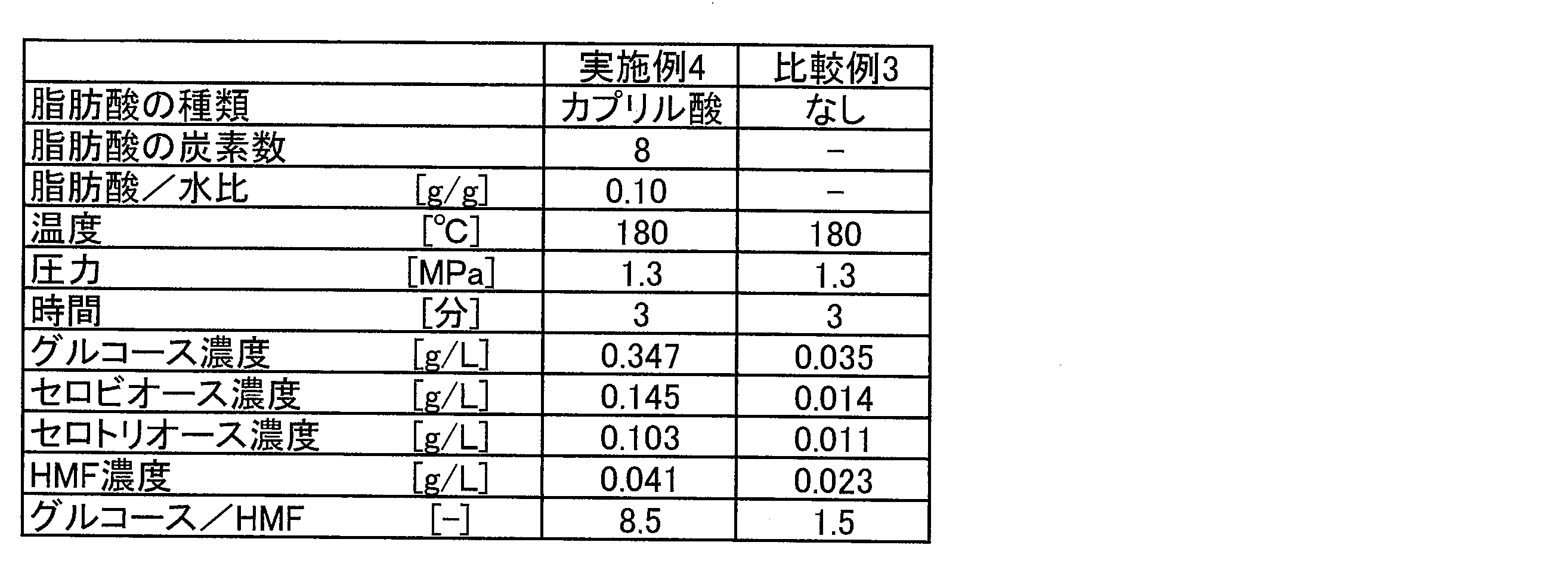
- Example 4 10 g of microcrystalline powder cellulose (Sigma Aldrich) and 90 g of water were mixed. This water slurry and 9 g of caprylic acid (Wako Pure Chemical Industries, density 0.91 g / mL (20 ° C.)) were placed in a batch hydrothermal apparatus (Start 200 New Quick, volume 180 mL manufactured by Nitto Koatsu), and the upper space was purged with nitrogen. Heated with stirring. The heating rate was 3.4 ° C./min. After reaching 180 ° C., it was cooled to room temperature. The time during which the slurry temperature was 180 ° C. was 3 minutes.
- Example 4 in which cellulose was heat-treated in the presence of C8 fatty acid and water, the production amount of glucose, cellobiose and cellotriose was large, while the production amount of HMF relative to the glucose production amount was We were able to keep it low.
- Comparative Example 3 in which no fatty acid was added, the production amounts of glucose, cellobiose and cellotriose were small, and the HMF production amount was large with respect to the glucose production amount.
Landscapes
- Chemical & Material Sciences (AREA)
- Health & Medical Sciences (AREA)
- Emergency Medicine (AREA)
- General Health & Medical Sciences (AREA)
- Life Sciences & Earth Sciences (AREA)
- Biochemistry (AREA)
- Organic Chemistry (AREA)
- Saccharide Compounds (AREA)
- Preparation Of Compounds By Using Micro-Organisms (AREA)
Abstract
Description
バイオマスからのエタノール等の製造は、バイオマスを糖化工程において糖に分解した後、これを発酵工程においてエタノール等に変換することにより行うことができる。糖化は、硫酸等を用いる酸糖化と酵素糖化に大別される。
例えば、リグノセルロース系バイオマス、弱酸及び水を含む原料混合物を加温及び加圧条件下で処理し、単糖類に分解する方法(特許文献1);高温・高圧条件下、オレイン酸を添加した水中でセルロースを処理し、オリゴ糖、セロビオース、グルコース及びフルクトースを得る方法(非特許文献1)等が報告されている。
一方で、酵素糖化の前処理条件が緩やか過ぎると、加水分解が十分に進まないという問題がある。
なかでも、資源の有効活用の点から、セルロースを含有するセルロース系バイオマスを用いることが好ましい。
ここで、炭素数6~12の脂肪酸としては、直鎖又は分岐鎖状の飽和又は不飽和の脂肪酸が挙げられる。特に、糖の過分解を抑制する点、及び分解率向上の点から、炭素数6~12の飽和脂肪酸が好ましく、炭素数6~10の飽和脂肪酸がより好ましい。
脂肪酸は、具体的には、カプロン酸、エナント酸、カプリル酸、ペラルゴン酸、カプリン酸、ラウリン酸等が挙げられる。なかでも、カプリル酸が好ましい。炭素数が6以上の脂肪酸は水溶性が低いため、反応液からの分離が容易であり、他方、炭素数が12以下の脂肪酸を用いることで糖の収率を向上させることができ、また炭素数が12以下の脂肪酸は融点が比較的低いため取り扱いが容易となる。
加熱処理を流通式反応方法で行う場合、多糖類は水に分散してスラリー状にしてから用いるのが好ましい。水スラリー中の多糖類の含有量は、流動性の点から、1~200g/L、更に5~150g/L、特に8~100g/Lとするのが好ましい。
また、加熱処理を回分法で行う場合は、水スラリー中の多糖類の含有量は、1~400g/L、更に5~300g/L、特に8~200g/Lとするのが好ましい。
加熱処理の時間(平均滞留時間)は、反応器の高温高圧部の体積をスラリーの供給速度で割ることにより算出される。
水スラリー供給タンク(13)から供給される水スラリーの流速は、反応器の体積によって異なるが、例えば、反応器体積が100mLの場合、3.3~200mL/分が好ましく、特に6.7~100mL/分が好ましい。
また、脂肪酸供給槽(21)から供給される脂肪酸の流速は、0.03~100mL/分が好ましく、特に0.15~60mL/分が好ましい。
次いで、反応液をフィルター(51)に通し、未反応の多糖類を分離し、分解糖を反応液回収タンク(61)に得る。
また、分解糖を含む反応液は、HMF含有量が少なく、単糖類/HMF質量比が5以上、さらに5~1000、さらに8~200、特に10~200、殊更12~200であるのが好ましい。
日立製作所製高速液体クロマトグラフを用い、昭和電工製カラムAsahipak NH2P-50 4E (4.5mmφ×250m)を装着し、カラム温度20℃でグラジエント法により行った。移動相A液はアセトニトリル、B液は30%メタノール水とし、1.00mL/分で送液した。グラジエント条件は以下のとおりである。
時間(分) A液(%) B液(%)
0 20 80
45 50 50
45.1 20 80
55 20 80
試料注入量は5μL、検出はESA Biosciences社製コロナCAD検出器を用いた。
日立製作所製高速液体クロマトグラフを用い、ジーエルサイエンス社製カラムInertsil ODS-3 (3.0mmφ×150m)を装着し、カラム温度40℃でグラジエント法により行った。移動相A液はアセトニトリル、B液は水とし、0.40mL/分で送液した。グラジエント条件は以下のとおりである。
時間(分) A液(%) B液(%)
0 10 90
10 10 90
30 90 10
40 90 10
40.1 10 90
60 10 10
試料注入量は10μL、検出は波長275nmの吸光度により定量した。
図1に示した流通式反応器を用いて加熱処理を行った。
微結晶粉末セルロース(シグマアルドリッチ)を蒸留水に1.11wt%で分散し、水スラリー供給タンク内で均一攪拌した。内容積100mLのステンレス製流通式反応器(日東高圧社製)に、セルロースの水スラリーとカプリル酸(和光純薬工業、密度0.91g/mL(20℃))をそれぞれ、流速45mL/分と5mL/分で供給し、220℃で反応を行った(平均滞留時間2分)。圧力は出口バルブにより3MPaに調整した。反応器出口から反応液を流速50mL/分で抜き出し、抜き出した反応液を室温(25℃)まで冷却してタンクに回収した。反応液は同体積のヘキサンで3回洗浄して脂肪酸を除去した後、単糖類(グルコース)濃度、二糖類(セロビオース)濃度、オリゴ糖(セロトリオース)濃度及びHMF濃度をそれぞれ測定した。結果を表1に示す。
反応温度を200℃、セルロースの水スラリーとカプリル酸の流速をそれぞれ22.5mL/分と2.5mL/分とした以外は実施例1と同様にして反応液を得た。
セルロースの水スラリーの濃度を1.25wt%、流速を40mL/分、カプリル酸の流速を10mL/分とした以外は実施例1と同様にして反応液を得た。
脂肪酸を供給せずに、セルロースの水スラリーの濃度を1.00wt%、流速を50mL/分とした以外は実施例1と同様にして反応液を得た。
カプリル酸の代わりにオレイン酸(密度0.90g/mL(20℃))を用いた以外は実施例1と同様にして反応液を得た。

微結晶粉末セルロース(シグマアルドリッチ)10gと水90gを混合した。この水スラリーとカプリル酸(和光純薬工業、密度0.91g/mL(20℃))9gをバッチ式水熱処理装置(日東高圧製Start200New Quick、容積180mL)に入れ、上部空間を窒素置換し、攪拌しながら加熱した。昇温速度は3.4℃/分とした。180℃に到達後、室温まで冷却した。スラリー温度が180℃であった時間は3分であった。反応液を同体積のヘキサンで3回洗浄して脂肪酸を除去した後、単糖類(グルコース)濃度、二糖類(セロビオース)濃度、オリゴ糖(セロトリオース)濃度及びHMF濃度をそれぞれ測定した。結果を表2に示す。
カプリル酸を添加しなかった以外は実施例4と同様にして反応液を得た。
供給ポンプ(12)
水スラリー供給タンク(13)
脂肪酸供給槽(21)
供給ポンプ(22)
反応器(31)
加熱炉(32)
冷却器(41)
フィルター(51)
反応液回収タンク(61)
Claims (6)
- 多糖類を、炭素数6~12の脂肪酸及び水の存在下、140~300℃の加熱処理を行う、単糖類、二糖類、及び/又はオリゴ糖の製造方法。
- 水に対する炭素数6~12の脂肪酸の質量比が0.01~0.5である請求項1記載の単糖類、二糖類、及び/又はオリゴ糖の製造方法。
- 加熱処理を水の飽和蒸気圧以上の圧力で行う、請求項1又は2記載の単糖類、二糖類、及び/又はオリゴ糖の製造方法。
- 加熱処理を0.3~10MPaの圧力で行う、請求項1~3のいずれか1項に記載の単糖類、二糖類、及び/又はオリゴ糖の製造方法。
- 多糖類としてセルロース含有バイオマスを用いる、請求項1~4のいずれか1項に記載の単糖類、二糖類、及び/又はオリゴ糖の製造方法。
- 単糖類/HMF質量比が5以上である、単糖類、二糖類、及び/又はオリゴ糖含有組成物。
Applications Claiming Priority (2)
| Application Number | Priority Date | Filing Date | Title |
|---|---|---|---|
| JP2009192299 | 2009-08-21 | ||
| JP2009-192299 | 2009-08-21 |
Publications (1)
| Publication Number | Publication Date |
|---|---|
| WO2011021399A1 true WO2011021399A1 (ja) | 2011-02-24 |
Family
ID=43606857
Family Applications (1)
| Application Number | Title | Priority Date | Filing Date |
|---|---|---|---|
| PCT/JP2010/005141 Ceased WO2011021399A1 (ja) | 2009-08-21 | 2010-08-20 | 単糖類、二糖類、及び/又はオリゴ糖の製造方法 |
Country Status (3)
| Country | Link |
|---|---|
| JP (1) | JP2011062196A (ja) |
| MY (1) | MY169490A (ja) |
| WO (1) | WO2011021399A1 (ja) |
Families Citing this family (2)
| Publication number | Priority date | Publication date | Assignee | Title |
|---|---|---|---|---|
| KR102389709B1 (ko) | 2019-11-29 | 2022-04-22 | 씨제이제일제당 주식회사 | 알룰로스 제조용 조성물 및 이를 이용한 알룰로스의 제조 방법 |
| KR102332373B1 (ko) | 2019-11-29 | 2021-11-29 | 씨제이제일제당 주식회사 | 알룰로스 이당류를 포함하는 hmf 생성 억제용 조성물 |
Citations (3)
| Publication number | Priority date | Publication date | Assignee | Title |
|---|---|---|---|---|
| JPS53113041A (en) * | 1977-03-09 | 1978-10-03 | Ajinomoto Kk | Sugar solution making method |
| JP2005110609A (ja) * | 2003-10-09 | 2005-04-28 | Japan Organo Co Ltd | 糖液の精製方法および装置 |
| JP2005533494A (ja) * | 2002-06-27 | 2005-11-10 | ダニスコ スイートナーズ オイ | 糖の結晶化 |
-
2010
- 2010-08-20 MY MYPI2012000749A patent/MY169490A/en unknown
- 2010-08-20 WO PCT/JP2010/005141 patent/WO2011021399A1/ja not_active Ceased
- 2010-08-20 JP JP2010184677A patent/JP2011062196A/ja not_active Withdrawn
Patent Citations (3)
| Publication number | Priority date | Publication date | Assignee | Title |
|---|---|---|---|---|
| JPS53113041A (en) * | 1977-03-09 | 1978-10-03 | Ajinomoto Kk | Sugar solution making method |
| JP2005533494A (ja) * | 2002-06-27 | 2005-11-10 | ダニスコ スイートナーズ オイ | 糖の結晶化 |
| JP2005110609A (ja) * | 2003-10-09 | 2005-04-28 | Japan Organo Co Ltd | 糖液の精製方法および装置 |
Also Published As
| Publication number | Publication date |
|---|---|
| MY169490A (en) | 2019-04-15 |
| JP2011062196A (ja) | 2011-03-31 |
Similar Documents
| Publication | Publication Date | Title |
|---|---|---|
| Valladares-Diestra et al. | Citric acid assisted hydrothermal pretreatment for the extraction of pectin and xylooligosaccharides production from cocoa pod husks | |
| Han et al. | An integrated biorefinery process for adding values to corncob in co-production of xylooligosaccharides and glucose starting from pretreatment with gluconic acid | |
| Wei et al. | Comparison of acid and alkali catalyzed ethylene glycol organosolv pretreatment for sugar production from bagasse | |
| Fang et al. | Co-production of xylooligosaccharides and glucose from birch sawdust by hot water pretreatment and enzymatic hydrolysis | |
| Ávila et al. | Cello-oligosaccharides production from lignocellulosic biomass and their emerging prebiotic applications | |
| Chen et al. | Co-production of oligosaccharides and fermentable sugar from wheat straw by hydrothermal pretreatment combined with alkaline ethanol extraction | |
| de CM Miranda et al. | Pineapple crown delignification using low-cost ionic liquid based on ethanolamine and organic acids | |
| Álvarez et al. | Production of xylooligosaccharides, bioethanol, and lignin from structural components of barley straw pretreated with a steam explosion | |
| JP5126728B2 (ja) | リグノセルロース系バイオマス処理方法 | |
| Muharja et al. | Biobutanol production from cocoa pod husk through a sequential green method: Depectination, delignification, enzymatic hydrolysis, and extractive fermentation | |
| Valladares-Diestra et al. | A biorefinery approach for pectin extraction and second-generation bioethanol production from cocoa pod husk | |
| Wu et al. | Characterize the physicochemical structure and enzymatic efficiency of agricultural residues exposed to γ-irradiation pretreatment | |
| Sukhbaatar et al. | Optimization of hot-compressed water pretreatment of bagasse and characterization of extracted hemicelluloses | |
| Su et al. | Coproduction of xylooligosaccharides and monosaccharides from hardwood by a combination of acetic acid pretreatment, mechanical refining and enzymatic hydrolysis | |
| Ji et al. | Production of xylose from diluted sulfuric acid hydrolysis of wheat straw | |
| Kodama et al. | Enhancing pressurized water extraction of β-glucan from barley grain by adding CO2 under hydrothermal conditions | |
| Liao et al. | Two-step acetic acid/sodium acetate and xylanase hydrolysis for xylooligosaccharides production from corncob | |
| Sarip et al. | A review of the thermal pretreatment of lignocellulosic biomass towards glucose production: autohydrolysis with DIC technology | |
| JP2012504937A (ja) | リグノセルロース材料の真空下における酵素処理 | |
| JP2012504936A (ja) | ディスクリファイニングおよび酵素加水分解を利用するリグノセルロース材料の処理 | |
| WO2011053965A2 (en) | Process for treating biomass to increase accessibility of polysaccharides contained therein to hydrolysis and subsequent fermentation, and polysaccharides with increased accessibility | |
| Cheng et al. | Production of bacterial cellulose by Acetobacter xylinum through utilizing acetic acid hydrolysate of bagasse as low-cost carbon source | |
| Wen et al. | Production of xylo-oligosaccharides and ethanol from corncob by combined tartaric acid hydrolysis with simultaneous saccharification and fermentation | |
| CA2906917A1 (en) | Carbon purification of concentrated sugar streams derived from pretreated biomass | |
| Nlandu et al. | Flax nanofibrils production via supercritical carbon dioxide pre‐treatment and enzymatic hydrolysis |
Legal Events
| Date | Code | Title | Description |
|---|---|---|---|
| 121 | Ep: the epo has been informed by wipo that ep was designated in this application |
Ref document number: 10809745 Country of ref document: EP Kind code of ref document: A1 |
|
| WWE | Wipo information: entry into national phase |
Ref document number: 12012500185 Country of ref document: PH |
|
| NENP | Non-entry into the national phase |
Ref country code: DE |
|
| WWE | Wipo information: entry into national phase |
Ref document number: 1201000630 Country of ref document: TH |
|
| 122 | Ep: pct application non-entry in european phase |
Ref document number: 10809745 Country of ref document: EP Kind code of ref document: A1 |