WO2011004699A1 - 表示素子 - Google Patents
表示素子 Download PDFInfo
- Publication number
- WO2011004699A1 WO2011004699A1 PCT/JP2010/060512 JP2010060512W WO2011004699A1 WO 2011004699 A1 WO2011004699 A1 WO 2011004699A1 JP 2010060512 W JP2010060512 W JP 2010060512W WO 2011004699 A1 WO2011004699 A1 WO 2011004699A1
- Authority
- WO
- WIPO (PCT)
- Prior art keywords
- group
- general formula
- display element
- compound represented
- compound
- Prior art date
- Legal status (The legal status is an assumption and is not a legal conclusion. Google has not performed a legal analysis and makes no representation as to the accuracy of the status listed.)
- Ceased
Links
Classifications
-
- G—PHYSICS
- G02—OPTICS
- G02F—OPTICAL DEVICES OR ARRANGEMENTS FOR THE CONTROL OF LIGHT BY MODIFICATION OF THE OPTICAL PROPERTIES OF THE MEDIA OF THE ELEMENTS INVOLVED THEREIN; NON-LINEAR OPTICS; FREQUENCY-CHANGING OF LIGHT; OPTICAL LOGIC ELEMENTS; OPTICAL ANALOGUE/DIGITAL CONVERTERS
- G02F1/00—Devices or arrangements for the control of the intensity, colour, phase, polarisation or direction of light arriving from an independent light source, e.g. switching, gating or modulating; Non-linear optics
- G02F1/01—Devices or arrangements for the control of the intensity, colour, phase, polarisation or direction of light arriving from an independent light source, e.g. switching, gating or modulating; Non-linear optics for the control of the intensity, phase, polarisation or colour
- G02F1/15—Devices or arrangements for the control of the intensity, colour, phase, polarisation or direction of light arriving from an independent light source, e.g. switching, gating or modulating; Non-linear optics for the control of the intensity, phase, polarisation or colour based on an electrochromic effect
- G02F1/1506—Devices or arrangements for the control of the intensity, colour, phase, polarisation or direction of light arriving from an independent light source, e.g. switching, gating or modulating; Non-linear optics for the control of the intensity, phase, polarisation or colour based on an electrochromic effect caused by electrodeposition, e.g. electrolytic deposition of an inorganic material on or close to an electrode
Definitions
- the present invention relates to an electrochemical display element using an electrodeposition method.
- the method using a polarizing plate such as a reflective liquid crystal has a low reflectance of about 40%, which makes it difficult to display white, and many of the manufacturing methods used to manufacture the constituent members are not easy.
- the polymer dispersed liquid crystal requires a high voltage and uses a difference in refractive index between organic substances, so that the contrast of an obtained image is not sufficient.
- the polymer network type liquid crystal also has problems such as a high voltage and a need for a complicated TFT circuit to improve memory performance.
- a display element using an electrophoresis method requires a high voltage of 10 V or more, and there is a concern about durability resulting from aggregation of electrophoretic particles.
- An electrodeposition method (hereinafter abbreviated as ED method) using dissolution of metal or metal salt is known as a new display method that eliminates the drawbacks of each method described above.
- the ED system can be driven at a low voltage of 3 V or less, has advantages such as a simple cell configuration, high black and white contrast and excellent black display performance, and various methods have been disclosed (for example, (See Patent Documents 1 and 2.)
- drive stability As a result of a detailed study of the techniques disclosed in the above-mentioned patent documents, the inventor has a problem in the stability of reflectance when it is repeatedly driven (hereinafter referred to as drive stability). It has been found.
- a technique for solving the driving stability a technique of adding a redox buffer such as ferrocene to the electrolytic solution is known (for example, see Patent Document 3).
- this technique is a technique for improving driving stability by redox buffer redoxing at the non-observation side electrode, it is necessary to sufficiently increase the amount of redox buffer such as ferrocene to improve driving stability. In that case, it was found that there was a decrease in memory performance and a decrease in rewriting speed.
- Patent Document 4 studies have been made to improve driving stability by using an electrolytic solution composed of silver iodide, ammonium iodide and an organic solvent having a relative dielectric constant of 90 or more.
- halogen compounds such as the above, it has been found that there is a problem that the reflectance of white and the memory property are lowered due to the oxidized oxide of iodine.
- Patent Document 5 discusses a technique using a mercaptoazole compound as a compound for dissolving a silver salt compound in a solvent of an electrolyte layer.
- This technology eliminates the halogen compound from the electrolyte layer, so there is no problem that the white reflectance caused by the halogen compound is reduced and the memory property is lowered, and the driving stability is improved.
- the number of times of driving is greatly increased. As it turned out, there was a problem that the characteristics of the electrode gradually changed, and it was found that it was necessary to further improve the drive stability for practical use.
- the present invention further includes adding a polythioether compound represented by the general formula (1) to the electrolyte layer containing the silver salt compound and the mercaptoazole compound represented by the general formula (2), thereby adding a mercaptoazole.
- This is a technique that suppresses the disadvantages of adding a compound and improves the driving stability significantly.
- the present invention has been made in view of the above problems, and an object of the present invention is to provide a display element having a simple member structure and excellent in memory performance and reflectance stability in repeated driving.
- the electrolyte layer contains a compound represented by the following general formula (1) and a compound represented by the general formula (2).
- a display element In the display element having an electrolyte layer containing a silver salt compound between the counter electrodes, the electrolyte layer contains a compound represented by the following general formula (1) and a compound represented by the general formula (2).
- a display element In the display element having an electrolyte layer containing a silver salt compound between the counter electrodes, the electrolyte layer contains a compound represented by the following general formula (1) and a compound represented by the general formula (2).
- X represents a sulfur atom or an oxygen atom, and at least one X in the compound is a sulfur atom.
- n and m each represent an integer of 1 to 10, and a represents an integer of 1 to 50.
- R 1 , R 2 , R 3 , R 4 , R 5 , and R 6 each represent a substituent that does not have a dissociable proton, and one of them includes a carbonyl group.
- each may be the same or different, and may be connected to each other to form a cyclic structure.
- M represents a hydrogen atom, a metal atom or quaternary ammonium.
- Z represents an atomic group necessary for constituting a nitrogen-containing heterocyclic ring.
- n represents an integer of 0 to 5
- Rg 21 represents a hydrogen atom, a halogen atom, an alkyl group, an aryl group, an alkylcarbonamide group, an arylcarbonamide group, an alkylsulfonamide group, an arylsulfonamide group, an alkoxy group, an aryl Oxy group, alkylthio group, arylthio group, alkylcarbamoyl group, arylcarbamoyl group, carbamoyl group, alkylsulfamoyl group, arylsulfamoyl group, sulfamoyl group, cyano group, alkylsulfonyl group, arylsulfonyl group, alkoxycarbonyl group, Re
- Content of the compound represented by the general formula (2) when the total content of the compound represented by the general formula (1) and the compound represented by the general formula (2) in the electrolyte layer is 100 mol%
- L represents an oxygen atom or an alkylene group
- Rs 11 to Rs 14 each represents a hydrogen atom, an alkyl group, an alkenyl group, an aryl group, a cycloalkyl group, an alkoxyalkyl group or an alkoxy group.
- Rs 21 and Rs 22 each represents an alkyl group, an alkenyl group, an aryl group, a cycloalkyl group, an alkoxyalkyl group, or an alkoxy group. ] 8). 8. The display element according to any one of 1 to 7, wherein the electrolyte layer contains a lithium salt.
- the electrolyte layer is a compound represented by the general formula (1) and A display element characterized by containing the compound represented by the general formula (2) can be driven with a simple member structure, low voltage, and has excellent memory properties and reflectance stability under repeated driving. It has been found that a display element can be realized and has reached the present invention.
- the display portion is provided with one corresponding counter electrode.
- the electrode 1 which is one of the counter electrodes close to the display unit is provided with a transparent electrode such as an ITO electrode, and the other electrode 2 is provided with a conductive electrode. Between the electrode 1 and the electrode 2, it has an electrolyte layer containing the silver salt compound, the compound represented by the general formula (1) and the compound represented by the general formula (2) according to the present invention, and a counter electrode White display and black display can be reversibly switched by applying positive and negative voltages between them.
- the silver salt compound according to the present invention is silver or a compound containing silver in the chemical structure, such as silver oxide, silver sulfide, metallic silver, silver colloidal particles, silver halide, silver complex compound, silver ion and the like.
- phase state species such as the solid state, the solubilized state in liquid, and the gas state, and the charged state species such as neutral, anionic, and cationic.
- a known silver salt compound such as a silver salt with an acid or a silver complex with iminodiacetic acid can be used.
- the silver salt a compound which does not have a nitrogen atom having a coordination property with halogen, carboxylic acid or silver, and for example, silver p-toluenesulfonate is preferable.
- the metal ion concentration contained in the electrolyte layer according to the present invention is preferably 0.2 mol / kg ⁇ [Metal] ⁇ 2.0 mol / kg. If the metal ion concentration is 0.2 mol / kg or more, a silver solution having a sufficient concentration can be obtained, and a desired driving speed can be obtained. If the metal ion concentration is 2 mol / kg or less, precipitation is prevented, and storage at low temperature is possible. The stability of the electrolyte solution is improved.
- the molar concentration of halogen ions or halogen atoms contained in the electrolyte layer is [X] (mol / kg)
- silver or silver contained in the electrolyte solution is a compound that contains silver in the chemical structure.
- the halogen atom as used in the field of this invention means an iodine atom, a chlorine atom, a bromine atom, and a fluorine atom.
- [X] / [Metal] is larger than 0.01, X ⁇ ⁇ X 2 is generated during the metal redox reaction, and X 2 easily cross-oxidizes with the deposited metal to dissolve the deposited metal. Therefore, the molar concentration of halogen atoms is preferably as low as possible relative to the molar concentration of metallic silver. In the present invention, 0 ⁇ [X] / [Metal] ⁇ 0.001 is more preferable.
- the halogen species preferably have a total molar concentration of [I] ⁇ [Br] ⁇ [Cl] ⁇ [F] from the viewpoint of improving memory properties.
- the compound represented by the general formula (1) according to the present invention is a compound in the same category as the “metal salt solvent” used to promote dissolution and precipitation of metal salts (particularly silver salts) in ED display elements. is there.
- heterocyclic thiol compounds such as mercaptoazole are often used as the silver salt solvent, and the structural features are sulfur, which is said to interact with metal ions in the alkyl chain, compared to these known silver salt solvents.
- the point is that an atom is incorporated, and that at least one carbonyl group, which is also supposed to interact with a metal ion, is present and dissociable protons are excluded.
- the compound represented by the general formula (1) according to the present invention preferably has a thioether chain.
- R 1 , R 2 , R 3 , R 4 , R 5 , R 6 are substituents having no dissociative protons. A substituent is mentioned.
- Halogen atom eg, fluorine atom, chlorine atom, bromine atom, iodine atom
- alkyl group eg, methyl group, ethyl group, propyl group, i-propyl group, butyl group, t-butyl group, pentyl group, cyclopentyl
- alkyl group eg, methyl group, ethyl group, propyl group, i-propyl group, butyl group, t-butyl group, pentyl group, cyclopentyl
- hexyl group cyclohexyl group, octyl group, dodecyl group, hydroxyethyl group, methoxyethyl group, trifluoromethyl group, benzyl group, etc.
- aryl group for example, phenyl group, naphthyl group, etc.
- alkoxy group for example, Methoxy group, ethoxy
- X represents a sulfur atom or an oxygen atom, and at least one X in the compound is a sulfur atom.
- a represents the number of repeating units.
- a is 1 to 50, preferably 1 to 10, more preferably 1 to 6, and particularly preferably 2 or 3.
- n and m each represent an integer of 1 or more and 10 or less, preferably 2 or 3, respectively.
- [] Represents a repeating unit, and when a represents a number of 2 or more, there will be a plurality of X.
- X may be the same or different, and contains a sulfur atom. The larger the amount, the better.
- the integer represented by m may be the same or different.
- R 1 and R 2 are also present, and in that case, they may be the same or different.
- the content of the thioether chain is preferably 30 to 99% by mass of the whole compound. More preferably, it is 33 to 85% by mass.
- the content of the thioether chain means the mass% of the repeating unit containing X with respect to the molecular weight of the whole compound when X of the unit represented by the general formula (1) is a sulfur atom.
- Specific examples of the group having a dissociable proton that the compound represented by the general formula (1) according to the present invention does not have include a hydroxyl group, a sulfo group, a carboxyl group, a sulfato group, and a —CONHSO 2 — group.
- the compound represented by the general formula (1) according to the present invention does not have such a group having a dissociative proton as a whole molecule such as a thioether chain, a terminal group, and a linking group.
- the compound represented by the general formula (1) according to the present invention has at least one carbonyl group.
- the carbonyl group is preferably present as a terminal group of the compound or as a substituent of the thioether chain, or a linking group of the terminal group and the thioether chain. It is preferable that R 5 and R 6 have the carbonyl group.
- the number of carbonyl groups is preferably 1 to 10, preferably 2 to 6 in one molecule.
- the terminal group is preferably a group having no dissociable proton such as an alkyl group, an alkenyl group, and an aryl group.
- the carbonyl group and the thioether chain are preferably bonded directly or via a linking group.
- the linking group is preferably divalent to tetravalent.
- the linking group is a group that does not have a dissociable proton.
- the amount of the compound represented by the general formula (1) according to the present invention is generally 30 mol / L or less, preferably 20 mol / L or less, more preferably as an upper limit in the solvent constituting the electrolyte layer. Is preferably 10 mol / L or less, and the lower limit is usually 0.01 mol / L or more, preferably 0.05 mol / L or more, more preferably 0.1 mol / L or more.
- M represents a hydrogen atom, a metal atom, or quaternary ammonium.
- Z represents an atomic group necessary for constituting a nitrogen-containing heterocyclic ring.
- n represents an integer of 0 to 5
- Rg 21 represents a hydrogen atom, a halogen atom, an alkyl group, an aryl group, an alkylcarbonamide group, an arylcarbonamide group, an alkylsulfonamide group, an arylsulfonamide group, an alkoxy group, an aryl Oxy group, alkylthio group, arylthio group, alkylcarbamoyl group, arylcarbamoyl group, carbamoyl group, alkylsulfamoyl group, arylsulfamoyl group, sulfamoyl group, cyano group, alkylsulfonyl group, arylsulfonyl group, alkoxycarbonyl group,
- examples of the metal atom represented by M include Li, Na, K, Mg, Ca, Zn, Ag, and the like.
- examples of the quaternary ammonium include NH 4 , N ( CH 3 ) 4 , N (C 4 H 9 ) 4 , N (CH 3 ) 3 C 12 H 25 , N (CH 3 ) 3 C 16 H 33 , N (CH 3 ) 3 CH 2 C 6 H 5 etc. Can be mentioned.
- Examples of the nitrogen-containing heterocycle having Z as a constituent in the general formula (2) include, for example, a tetrazole ring, a triazole ring, an imidazole ring, an oxadiazole ring, a thiadiazole ring, an indole ring, an oxazole ring, a benzoxazole ring, and a benzimidazole.
- a ring, a benzothiazole ring, a benzoselenazole ring, a naphthoxazole ring, and the like, and a triazole ring is preferable.
- Rg 21 specific groups represented by Rg 21 include a halogen atom (for example, a fluorine atom, a chlorine atom, a bromine atom, an iodine atom), an alkyl group (for example, a methyl group, an ethyl group, Propyl group, i-propyl group, butyl group, t-butyl group, pentyl group, cyclopentyl group, hexyl group, cyclohexyl group, octyl group, dodecyl group, hydroxyethyl group, methoxyethyl group, trifluoromethyl group, benzyl group, etc.
- a halogen atom for example, a fluorine atom, a chlorine atom, a bromine atom, an iodine atom
- an alkyl group for example, a methyl group, an ethyl group, Propyl group, i-propyl
- An aryl group eg, phenyl group, naphthyl group, etc.
- an alkylcarbonamide group eg, acetylamino group, propionylamino group, butyroylamino group, etc.
- an arylcarbonamide group eg, benzoylamino group, etc.
- Alkylsulfonamido groups eg methanesulfonylamino group, ethanesulfonylamino group) Group
- arylsulfonamide groups eg, benzenesulfonylamino group, toluenesulfonylamino group, etc.
- aryloxy groups eg, phenoxy group, etc.
- alkylthio groups eg, methylthio group, ethylthio group, butylthio group, etc.
- Arylthio groups eg, phenylthio group, tolylthi
- Exemplified Compounds (2) -12, (2) -18, and (2) -20 are particularly preferable from the viewpoint that the objective effects of the present invention can be exhibited.
- the display element of the present invention when the total content of the compound represented by the general formula (1) and the compound represented by the general formula (2) in the electrolyte layer is 100 mol%, the display is represented by the general formula (2).
- the content ratio of the compound to be produced is preferably 1 mol% or more and 5 mol% or less from the viewpoint of further achieving the object effect of the present invention.
- Organic solvent in the electrolyte layer according to the present invention, various additives such as a metal salt compound and a promoter that are generally used in electrochemical cells and batteries and are reversibly dissolved and precipitated by an electrochemical redox reaction can be dissolved.
- a solvent can be used as an organic solvent.
- room temperature molten salt can also be used as a solvent.
- the room temperature molten salt is a salt composed of ion pairs that are melted at room temperature (that is, in a liquid state) consisting only of ion pairs that do not contain a solvent component, and usually has a melting point of 20 ° C. or lower, A salt consisting of an ion pair that is liquid at a temperature above.
- the room temperature molten salt can be used alone or in combination of two or more.
- the electrolyte solvent used in the present invention is preferably an aprotic polar solvent, and in particular, propylene carbonate, ethylene carbonate, dimethyl sulfoxide, dimethoxyethane, acetonitrile, ⁇ -butyrolactone, sulfolane, dioxolane, dimethylformamide, dimethoxyethane, tetrahydrofuran, adiponitrile.
- Methoxyacetonitrile, dimethylacetamide, methylpyrrolidinone, dimethyl sulfoxide, dioxolane, sulfolane, trimethyl phosphate and triethyl phosphate are preferred.
- the solvent may be used alone or in combination of two or more.
- a solvent preferably used is a compound represented by the following general formula (S1) or (S2).
- L represents an oxygen atom or an alkylene group
- Rs 11 to Rs 14 each represents a hydrogen atom, an alkyl group, an alkenyl group, an aryl group, a cycloalkyl group, an alkoxyalkyl group, or an alkoxy group
- a hydrogen atom or an alkyl group is preferable.
- Rs 21 and Rs 22 each represents an alkyl group, an alkenyl group, an aryl group, a cycloalkyl group, an alkoxyalkyl group, or an alkoxy group, preferably an alkyl group.
- L represents an oxygen atom or CH 2
- Rs 11 to Rs 14 each represents a hydrogen atom, an alkyl group, an alkenyl group, an aryl group, a cycloalkyl group, an alkoxyalkyl group, or an alkoxy group, These substituents may be further substituted with an arbitrary substituent.
- alkyl group examples include a methyl group, an ethyl group, a propyl group, an isopropyl group, a tert-butyl group, a pentyl group, a hexyl group, an octyl group, a dodecyl group, a tridecyl group, a tetradecyl group, and a pentadecyl group.
- cycloalkyl group such as phenyl group, naphthyl group, etc.
- cyclopentyl group examples include, for example, cyclopentyl group, cyclohexyl group, etc., alkoxyalkyl groups, such as ⁇ -methoxyethyl group, ⁇ -methoxypropyl group, etc. Examples thereof include a methoxy group, an ethoxy group, a propyloxy group, a pentyloxy group, a hexyloxy group, an octyloxy group, and a dodecyloxy group.
- Rs 21 and Rs 22 each represent a hydrogen atom, an alkyl group, an alkenyl group, an aryl group, a cycloalkyl group, an alkoxyalkyl group, or an alkoxy group.
- alkyl group examples include a methyl group, an ethyl group, a propyl group, an isopropyl group, a tert-butyl group, a pentyl group, a hexyl group, an octyl group, a dodecyl group, a tridecyl group, a tetradecyl group, and a pentadecyl group.
- cycloalkyl group such as phenyl group, naphthyl group, etc.
- cyclopentyl group examples include, for example, cyclopentyl group, cyclohexyl group, etc., alkoxyalkyl groups, such as ⁇ -methoxyethyl group, ⁇ -methoxypropyl group, etc. Examples thereof include a methoxy group, an ethoxy group, a propyloxy group, a pentyloxy group, a hexyloxy group, an octyloxy group, and a dodecyloxy group.
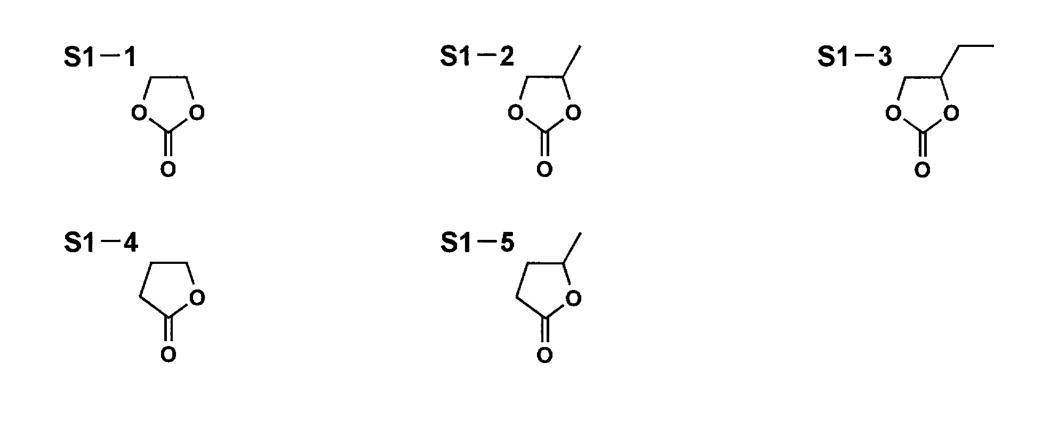
- the exemplary compounds (S1-1), (S1-2), and (S2-3) are particularly preferable.
- the compounds represented by the general formulas (S1) and (S2) according to the present invention are one kind of electrolyte solvents.
- other compounds may be used as long as the object effects of the present invention are not impaired.
- These solvents can be used in combination.
- these solvents it is preferable
- examples of the solvent that can be used in the present invention include J.M. A. Riddick, W.M. B. Bunger, T.A. K. Sakano, “Organic Solvents”, 4th ed. , John Wiley & Sons (1986). Marcus, “Ion Solvation”, John Wiley & Sons (1985), C.I. Reichardt, “Solvents and Solvent Effects in Chemistry”, 2nd ed. VCH (1988), G .; J. et al. Janz, R.A. P. T.A. Tomkins, “Nonequeous Electrolytes Handbook”, Vol. 1, Academic Press (1972).
- the electrolyte solvent may be a single type or a mixture of solvents, but is preferably a mixed solvent containing ethylene carbonate.
- the addition amount of ethylene carbonate is preferably 10% by mass or more and 90% by mass or less of the total electrolyte solvent mass.
- a particularly preferable electrolyte solvent is a mixed solvent having a mass ratio of propylene carbonate / ethylene carbonate of 7/3 to 3/7. When the propylene carbonate ratio is larger than 7/3, the ionic conductivity is inferior and the response speed is lowered. When the propylene carbonate ratio is smaller than 3/7, the electrolyte tends to be deposited at a low temperature.
- the porous white scattering layer applicable to the present invention can be formed by applying and drying a water mixture of a water-based polymer and a white pigment that is substantially insoluble in the electrolyte solvent.
- substantially insoluble in the electrolyte solvent is defined as a state where the dissolved amount per kg of electrolyte solvent is 0 g or more and 10 g or less at a temperature of ⁇ 20 ° C. to 120 ° C.
- the amount of dissolution can be determined by a known method such as a component quantification method using a chromatogram or a gas chromatogram.
- examples of the water-based polymer that is substantially insoluble in the electrolyte solvent include a water-soluble polymer and a polymer dispersed in the water-based solvent.
- water-soluble polymers include proteins such as gelatin and gelatin derivatives or cellulose derivatives, natural compounds such as starch, gum arabic, dextran, pullulan, carrageenan and other polysaccharides, polyvinyl alcohol, polyethylene glycol, polyvinyl pyrrolidone, Examples include synthetic polymer compounds such as acrylamide polymers and derivatives thereof.
- gelatin derivatives include acetylated gelatin, phthalated gelatin, polyvinyl alcohol derivatives include terminal alkyl group-modified polyvinyl alcohol, terminal mercapto group-modified polyvinyl alcohol, and cellulose derivatives include hydroxyethyl cellulose, hydroxypropyl cellulose, carboxymethyl cellulose, and the like. It is done.
- polyvinyl alcohol, polyethylene glycol, and polyvinyl pyrrolidone compounds can be preferably used.
- the electrolyte layer preferably contains a polyethylene glycol compound.
- polyethylene glycol compounds include polyethylene glycols, polypropylene glycols, polyethylene glycol alkyl ethers, polypropylene glycol alkyl ethers, polyethylene glycol aryl ethers, polypropylene glycol aryl ethers, polyethylene glycol alkyl aryl ethers, polypropylene glycol alkyl.
- Aryl ethers polyethylene glycol glycerol esters, polypropylene glycol glycerol esters, polyethylene sorbitol esters, polypropylene glycol sorbitol esters, polyethylene glycol fatty acid esters, polypropylene glycol fatty acid esters, polyethylene glycolated ethylenediamines Polypropylene glycolated ethylenediamines, polyethylene glycolated diethylenetriamine, and polypropylene glycol diethylenetriamines.
- Polymers dispersed in an aqueous solvent include latexes such as natural rubber latex, styrene butadiene rubber, butadiene rubber, nitrile rubber, chloroprene rubber, isoprene rubber, polyisocyanate, epoxy, acrylic, silicon, polyurethane, Examples thereof include a thermosetting resin in which urea, phenol, formaldehyde, epoxy-polyamide, melamine, alkyd resin, vinyl resin and the like are dispersed in an aqueous solvent. Of these polymers, the water-based polyurethane resin described in JP-A-10-76621 is preferably used.
- the average molecular weight of the water-based polymer is preferably in the range of 10,000 to 2,000,000, more preferably in the range of 30,000 to 500,000 in terms of weight average.
- Examples of the white pigment applicable in the present invention include titanium dioxide (anatase type or rutile type), barium sulfate, calcium carbonate, aluminum oxide, zinc oxide, magnesium oxide and zinc hydroxide, magnesium hydroxide, magnesium phosphate, Magnesium hydrogen phosphate, alkaline earth metal salt, talc, kaolin, zeolite, acid clay, glass, organic compounds such as polyethylene, polystyrene, acrylic resin, ionomer, ethylene-vinyl acetate copolymer resin, benzoguanamine resin, urea-formalin resin, A melamine-formalin resin, a polyamide resin, or the like may be used alone or in combination, or in a state having voids that change the refractive index in the particles.
- titanium dioxide anatase type or rutile type
- barium sulfate calcium carbonate
- aluminum oxide zinc oxide
- magnesium oxide and zinc hydroxide magnesium hydroxide
- magnesium phosphate Magnesium hydrogen
- titanium dioxide is preferably used, and in particular, titanium dioxide surface-treated with an inorganic oxide (Al 2 O 3 , AlO (OH), SiO 2, etc.), in addition to these surface treatments.
- titanium dioxide subjected to organic treatment such as trimethylolethane, triethanolamine acetate, trimethylcyclosilane is more preferably used.
- titanium oxide or zinc oxide from the viewpoint of preventing coloring at high temperatures and the reflectance of the display element due to the refractive index.
- the water mixture of the water-based polymer and the white pigment preferably has a form in which the white pigment is dispersed in water according to a known dispersion method.
- the mixing ratio of the water-based polymer / white pigment is preferably 1 to 0.01 by volume, more preferably 0.3 to 0.05.
- the film thickness of the porous white scattering layer is preferably in the range of 5 to 50 ⁇ m, more preferably in the range of 10 to 30 ⁇ m.
- an alcohol solvent having high solubility in water such as methanol, ethanol, isopropanol, etc. is preferably used, and the mixing ratio of water / alcohol solvent is in the range of 0.5 to 20 in terms of mass ratio. Preferably, it is in the range of 2 to 10.
- the medium for applying the water mixture of the water-based polymer and the white pigment may be in any region as long as it is on the component between the counter electrodes of the display element, but at least one electrode surface of the counter electrode It is preferable to apply on top.
- a method for applying to a medium for example, a coating method, a liquid spraying method, a spraying method via a gas phase, a method of flying droplets using vibration of a piezoelectric element, for example, a piezoelectric inkjet head
- a piezoelectric inkjet head examples thereof include a bubble jet (registered trademark) type ink jet head that causes droplets to fly using a thermal head that uses bumping, and a spray type that sprays liquid by air pressure or liquid pressure.
- the coating method can be appropriately selected from known coating methods.
- air doctor coater, blade coater, rod coater, knife coater, squeeze coater, impregnation coater, reverse roller coater, transfer roller coater, curtain coater, double roller coater, slide hopper coater, gravure coater, kiss roll coater, bead coater examples include cast coaters, spray coaters, calendar coaters, and extrusion coaters.
- the drying of the water mixture of the water-based polymer and the white pigment applied on the medium may be performed by any method that can evaporate water. For example, heating from a heat source, a heating method using infrared light, a heating method using electromagnetic induction, and the like can be given. Further, water evaporation may be performed under reduced pressure.
- the porous as used in the present invention means that a water mixture of the water-based polymer and the white pigment is applied on an electrode and dried to form a porous white scattering material, and then silver or silver is formed on the scattering material. After applying an electrolyte solution containing the compound contained in the chemical structure, it can be sandwiched between the counter electrodes, giving a potential difference between the counter electrodes, causing a silver dissolution precipitation reaction, and ionic species can move between the electrodes Says the penetration state.
- the display element of the present invention it is desirable to perform a curing reaction of the water-based polymer with a hardener during or after applying and drying the water mixture described above.
- hardeners used in the present invention include, for example, US Pat. No. 4,678,739, column 41, 4,791,042, JP-A-59-116655, and 62-245261. No. 61-18942, 61-249054, 61-245153, JP-A-4-218044, and the like.
- aldehyde hardeners (formaldehyde, etc.), aziridine hardeners, epoxy hardeners, vinyl sulfone hardeners (N, N'-ethylene-bis (vinylsulfonylacetamide) Ethane, etc.), N-methylol hardeners (dimethylolurea, etc.), boric acid, metaboric acid or polymer hardeners (compounds described in JP-A-62-234157).
- gelatin it is preferable to use a vinyl sulfone type hardener or a chlorotriazine type hardener alone or in combination.
- boron-containing compounds such as boric acid and metaboric acid.
- hardeners are used in an amount of 0.001 to 1 g, preferably 0.005 to 0.5 g, per 1 g of water-based polymer.
- electrolyte layer The “electrolyte” as used in the present invention generally refers to a substance that dissolves in a solvent such as water and exhibits a ionic conductivity in a solution (hereinafter referred to as “narrowly defined electrolyte”).
- a solvent such as water
- electrolyte A mixture containing other metals, compounds, or the like, regardless of whether it is an electrolyte or a non-electrolyte, is called an electrolyte (“broadly defined electrolyte”).
- Supporting electrolyte As the supporting electrolyte that can be used in the display element of the present invention, salts, acids, and alkalis that are usually used in the field of electrochemistry or the field of batteries can be used.
- the salts are not particularly limited, and for example, inorganic ion salts such as alkali metal salts and alkaline earth metal salts; quaternary ammonium salts; cyclic quaternary ammonium salts; quaternary phosphonium salts can be used.
- the salts include halogen ions, SCN ⁇ , ClO 4 ⁇ , BF 4 ⁇ , CF 3 SO 3 ⁇ , (CF 3 SO 2 ) 2 N ⁇ , (C 2 F 5 SO 2 ) 2 N ⁇ , PF Li salt, Na salt having a counter anion selected from 6 ⁇ , AsF 6 ⁇ , CH 3 COO ⁇ , CH 3 (C 6 H 4 ) SO 3 ⁇ , and (C 2 F 5 SO 2 ) 3 C ⁇ K salt is mentioned.
- halogen ions SCN ⁇ , ClO 4 ⁇ , BF 4 ⁇ , CF 3 SO 3 ⁇ , (CF 3 SO 2 ) 2 N ⁇ , (C 2 F 5 SO 2 ) 2 N ⁇ , PF 6 ⁇ , AsF 6 -, CH 3 COO -, CH 3 (C 6 H 4) SO 3 -, and (C 2 F 5 SO 2) 3 C - 4 quaternary ammonium salt having a counter anion selected from, specifically, (CH 3 ) 4 NBF 4 , (C 2 H 5 ) 4 NBF 4 , (n-C 4 H 9 ) 4 NBF 4 , (C 2 H 5 ) 4 NBr, (C 2 H 5 ) 4 NClO 4 , (n- C 4 H 9 ) 4 NClO 4 , CH 3 (C 2 H 5 ) 3 NBF 4 , (CH 3 ) 2 (C 2 H 5 ) 2 NBF 4 , (CH 3 ) 4 NSO 3
- halogen ions SCN ⁇ , ClO 4 ⁇ , BF 4 ⁇ , CF 3 SO 3 ⁇ , (CF 3 SO 2 ) 2 N ⁇ , (C 2 F 5 SO 2 ) 2 N ⁇ , PF 6 ⁇ , AsF 6 -, CH 3 COO -, CH 3 (C 6 H 4) SO 3 -, and (C 2 F 5 SO 2) 3 C - phosphonium salt having a counter anion selected from, specifically, (CH 3) 4 PBF 4 , (C 2 H 5 ) 4 PBF 4 , (C 3 H 7 ) 4 PBF 4 , (C 4 H 9 ) 4 PBF 4 and the like. Moreover, these mixtures can also be used suitably.
- the supporting electrolyte of the present invention is preferably a quaternary ammonium salt, particularly preferably a quaternary spiro ammonium salt.
- a quaternary ammonium salt particularly preferably a quaternary spiro ammonium salt.
- ClO 4 ⁇ , BF 4 ⁇ , CF 3 SO 3 ⁇ , (C 2 F 5 SO 2 ) 2 N ⁇ and PF 6 — are preferable, and BF 4 ⁇ is particularly preferable.
- the electrolyte layer according to the present invention contains a lithium salt as a supporting electrolyte.
- the lithium salt that can be used as the supporting electrolyte in the present invention is not particularly limited.
- lithium hexafluorophosphate, lithium tetrafluoroborate, lithium perchlorate, lithium bis (trifluoromethanesulfonyl) Imide, lithium trifluoromethanesulfonate, lithium bisfluorosulfonylimide and the like can be used.
- the amount of the supporting electrolyte used is arbitrary, but in general, the supporting electrolyte is present in the solvent as an upper limit of 20 mol / L or less, preferably 10 mol / L or less, more preferably 5 mol / L or less.
- the lower limit is usually 0.01 mol / L or more, preferably 0.05 mol / L or more, more preferably 0.1 mol / L or more.
- the following compounds exhibiting electronic conductivity and ionic conductivity can be contained in the electrolyte.
- Fluorine-containing compounds such as chalcogenide, CaF 2 , PbF 2 , SrF 2 , LaF 3 , TlSn 2 F 5 , CeF 3 , Li salts such as Li 2 SO 4 , Li 4 SiO 4 , Li 3 PO 4 , ZrO 2 , CaO , Cd 2 O 3 , HfO 2 , Y 2 O 3 , Nb 2 O 5 , WO 3 , Bi 2 O 3 , AgBr, AgI, CuCl, CuBr, CuBr, CuI, LiI, LiBr, LiCl, LiAlCl 4 , LiAlF 4 , AgSBr, C 5 H 5 NHAg 5 I 6 , Rb 4 Cu 16 I Examples thereof include 7 Cl 13 , Rb 3 Cu 7 Cl 10 , LiN, Li 5 NI 2 , and Li 6 NBr 3 .
- the ionic liquid referred to in the present invention is also referred to as a room temperature molten salt, and is a salt having a melting point of 100 ° C. or lower.
- This salt is composed of the same number of cations and anions, and there are many substances having a melting point below room temperature depending on the molecular structure, and these can maintain a liquid state at room temperature without adding any solvent.
- An ionic liquid has a strong electrostatic interaction and is therefore characterized by almost no vapor pressure. It does not evaporate and does not volatilize even at high temperatures.
- the ionic liquid used in the present invention may be any substance as long as it is a generally researched and reported substance.
- an organic ionic liquid has a molecular structure that exhibits a liquid in a wide temperature range including room temperature.
- the ionic liquid that can be suitably used in the present invention is represented by the general formula Q + A ⁇ and is 20 to 100 ° C., preferably 20 to 80 ° C., more preferably 20 to 60 ° C., and still more preferably 20 to This refers to a salt that exists as a liquid at 40 ° C., particularly 20 ° C., and its viscosity (25 ° C.) is not particularly limited as long as it is a melt at normal temperature, but it is preferably 1 to 200 mPa ⁇ s.
- the cation component represented by Q + in the general formula is preferably an onium cation, and more preferably an ammonium cation, an imidazolium cation, a pyridinium cation, a sulfonium cation, and a phosphonium cation.
- R 1 to R 4 are each independently a hydrogen atom, saturated or unsaturated carbon, An alkyl group having 1 to 12 carbon atoms, a cycloalkyl group having 3 to 8 carbon atoms, an aryl group having 6 to 10 carbon atoms, an aralkyl group having 7 to 11 carbon atoms, or R 5 —X— (R 6 —Y—) n -(Wherein R 5 is an alkyl group having 4 or less carbon atoms, R 6 is an alkylene group having 4 or less carbon atoms, X and Y are oxygen atoms or sulfur atoms, and n is an integer of 0 to 10), These groups may have
- R 1 to R 4 include methyl, ethyl, n-propyl, isopropyl, n-butyl, isobutyl, sec-butyl, tert-butyl, pentyl, hexyl, heptyl, octyl , A linear or branched alkyl group such as nonyl, decyl, a cycloalkyl group such as cyclopropyl, cyclobutyl, cyclopentyl, cyclohexyl, cycloheptyl, cyclooctyl, an unsubstituted or halogen atom (for example, F, Cl, Br, I), hydroxyl group, lower alkoxy group (for example, methoxy, ethoxy, propoxy, butoxy, etc.), carboxyl group, acetyl group, propanoyl group, thiol group, lower alkylthio group (
- R 5 examples include alkyl groups such as methyl, ethyl, n-propyl, isopropyl, n-butyl, isobutyl, sec-butyl, tert-butyl, etc.
- R 6 represents a methylene group.
- alkylene groups such as ethylene group, propylene group and butylene group.
- R 7 examples include alkylene groups such as methylene, ethylene, propylene, and butylene, and phenylene groups such as phenylene.
- a - a counter anion represented by, hexafluorophosphate, hexafluoroantimonate, hexafluoroarsenate, fluorosulfonate salts, tetrafluoroborate, nitrate, alkyl sulfonate Salt, fluorinated alkyl sulfonate or hydrogen sulfate.
- the electrolyte according to the present invention is not only a solution electrolyte composed of a solvent or an ionic liquid, but also a high-viscosity electrolyte or a gel electrolyte (hereinafter, referred to as a solid electrolyte or a polymer compound containing substantially no solvent). Gel electrolyte) can be used.
- Examples of the solid electrolyte and gel electrolyte applicable to the present invention include a solid electrolyte described in JP-A No. 2002-341387, a polymer solid electrolyte described in JP-A No. 2002-341387, and JP-A No. 2004-20928.
- the display element of the present invention can be provided with an electronic insulating layer.
- the electronic insulating layer applicable to the present invention may be a layer having both ionic conductivity and electronic insulating properties.
- a sintering method (fusion method) (using fine pores formed between particles by partially fusing polymer fine particles or inorganic particles by adding a binder, etc.), extraction method (After forming a constituent layer with a solvent-soluble organic substance or inorganic substance and a binder that does not dissolve in the solvent, the organic substance or inorganic substance is dissolved in the solvent to obtain pores), heating or degassing the polymer Well-known formation such as foaming method for foaming, phase change method for phase separation of polymer mixture by operating good solvent and poor solvent, radiation irradiation method for forming pores by radiating various radiation The method can be used.
- the electrical insulating layer include, for example, Japanese Patent Application Laid-Open Nos. 10-30181, 2003-107626, 7-95403, Japanese Patent Nos. 2635715, 2849523, 29987474, and 3066426. No. 3464513, No. 3484644, No. 3535942, No. 30622203, and the like.
- a thickener can be used for the electrolyte.
- gelatin gum arabic, poly (vinyl alcohol), hydroxyethyl cellulose, hydroxypropyl cellulose, cellulose acetate, cellulose acetate butyrate, poly ( Vinylpyrrolidone), poly (alkylene glycol), casein, starch, poly (acrylic acid), poly (methyl methacrylic acid), poly (vinyl chloride), poly (methacrylic acid), copoly (styrene-maleic anhydride), copoly ( Styrene-acrylonitrile), copoly (styrene-butadiene), poly (vinyl acetal) s (eg, poly (vinyl formal) and poly (vinyl butyral)), poly (esters), poly (urethanes), phenoxy resins, poly (PVC Redene), poly (epoxide) s, poly (PVC Redene), poly (epoxide) s, poly (PVC Reden
- thickeners may be used in combination of two or more.
- compounds described on pages 71 to 75 of JP-A No. 64-13546 can be exemplified.
- the compounds preferably used are polyvinyl alcohols, polyvinyl pyrrolidones, hydroxypropyl celluloses, and polyalkylene glycols from the viewpoint of compatibility with various additives and improvement in dispersion stability of white particles.
- auxiliary layers such as a protective layer, a filter layer, an antihalation layer, a crossover light cut layer, a backing layer, and the like can be provided as a constituent layer, if necessary.
- auxiliary layers such as a protective layer, a filter layer, an antihalation layer, a crossover light cut layer, a backing layer, and the like can be provided as a constituent layer, if necessary.
- various chemical sensitizers noble metal sensitizers, photosensitive dyes, supersensitizers, couplers, high boiling point solvents, antifoggants, stabilizers, development inhibitors, bleach accelerators, fixing accelerators, and color mixing prevention.
- Agent formalin scavenger, toning agent, hardener, surfactant, thickener, plasticizer, slip agent, UV absorber, irradiation prevention dye, filter light absorption dye, anti-bacterial agent, polymer latex, heavy metal, electrification
- An inhibitor, a matting agent and the like can be contained as necessary.
- Table 1 below shows the types of compounds and their locations shown in these three research disclosures.
- the substrate that can be used in the present invention is preferably a transparent substrate.
- a transparent substrate include polyester (for example, polyethylene terephthalate), polyimide, polymethyl methacrylate, polystyrene, polypropylene, polyethylene, and polyamide.
- Nylon, polyvinyl chloride, polyvinylidene chloride, polycarbonate, polyether sulfone, silicon resin, polyacetal resin, fluororesin, cellulose derivative, polyolefin and other polymer films, plate substrates, glass substrates, and the like are preferably used.
- the transparent substrate used in the present invention refers to a substrate having a transmittance for visible light of at least 50%.
- an opaque substrate such as an inorganic substrate such as a metal substrate or a ceramic substrate can be used.
- the electrode disposed on the display side is preferably a transparent electrode.
- the transparent electrode is not particularly limited as long as it is transparent and can conduct electricity.
- ITO Indium Tin Oxide
- IZO Indium Zinc Oxide
- FTO Fluorine Doped Tin Oxide
- ITO Indium Tin Oxide
- Zinc Oxide Platinum, Gold, Silver, Rhodium, Copper
- chromium carbon, aluminum, silicon, amorphous silicon, and BSO (Bismuth Silicon Oxide).
- polythiophene, polypyrrole, polyaniline, polyacetylene, polyparaphenylene, polyselenophenylene, etc., and their modifying compounds can be used alone or in combination.
- the surface resistance value is preferably 100 ⁇ / ⁇ or less, and more preferably 10 ⁇ / ⁇ or less.
- the thickness of the transparent electrode is not particularly limited, but is generally 0.1 to 20 ⁇ m.
- a nanoporous electrode having a nanoporous structure can be provided on the transparent electrode.
- This nanoporous electrode is substantially transparent when a display element is formed, and can carry an electroactive substance such as an electrochromic dye.
- the nanoporous structure as used in the present invention refers to a state in which an infinite number of nanometer-sized pores exist in a layer and ionic species contained in the electrolyte can move within the nanoporous structure.
- a dispersion containing fine particles constituting the nanoporous electrode is formed in layers by an ink jet method, a screen printing method, a blade coating method, etc., and then heated at a predetermined temperature.
- a method of making porous by drying, baking, a method of making nanoporous by anodizing or photoelectrochemical etching after forming an electrode layer by sputtering, CVD, atmospheric pressure plasma, etc. Is mentioned.
- the sol-gel method, Adv. Mater It can also be formed by the method described in 2006, 18, 2980-2983.
- the main components of the fine particles constituting the nanoporous electrode are metals such as Cu, Al, Pt, Ag, Pd and Au, metal oxides such as ITO, SnO 2 , TiO 2 and ZnO, carbon nanotubes, glassy carbon, and diamond. It can be selected from carbon electrodes such as like carbon and nitrogen-containing carbon, and is preferably selected from metal oxides such as ITO, SnO 2 , TiO 2 , and ZnO.
- fine particles having an average particle diameter of about 5 nm to 10 ⁇ m.
- shape of the fine particles those having an arbitrary shape such as an indefinite shape, a needle shape, and a spherical shape can be used.
- the film thickness of the nanoporous electrode is preferably in the range of 0.1 to 10 ⁇ m, more preferably in the range of 0.25 to 5 ⁇ m.
- auxiliary electrode can be attached to at least one of the counter electrodes according to the present invention.
- the auxiliary electrode is preferably made of a material having a lower electrical resistance than the main electrode part.
- metals such as platinum, gold, silver, copper, aluminum, zinc, nickel, titanium, and bismuth and alloys thereof can be preferably used.
- the auxiliary electrode can be installed either between the main electrode portion and the substrate, or on the surface of the main electrode portion opposite to the substrate. In any case, it is only necessary that the auxiliary electrode is electrically connected to the main electrode portion.
- the arrangement pattern of the auxiliary electrodes There is no particular limitation on the arrangement pattern of the auxiliary electrodes. It can be appropriately formed according to the required performance, such as linear, mesh, or circular.
- the divided electrode parts may be connected to each other.
- the auxiliary electrode is required to be provided with a shape and frequency that do not impair the visibility of the display element.
- a method for forming the auxiliary electrode a known method can be used. For example, a patterning method by photolithography, a printing method, an ink jet method, electrolytic plating or electroless plating, or a method of forming a pattern by exposure and development using a silver salt photosensitive material may be used.
- the line width and line spacing of the auxiliary electrode pattern may be arbitrary values, but it is necessary to increase the line width in order to increase the conductivity.
- the area coverage of the auxiliary electrode viewed from the display element observation side is preferably 30% or less, and more preferably 10% or less.
- the line width of the auxiliary electrode is preferably 1 ⁇ m or more and 100 ⁇ m or less, and the line interval is preferably 50 ⁇ m to 1000 ⁇ m.
- a known method can be used to form the transparent electrode and the metal auxiliary electrode. For example, a method of depositing a mask on a substrate by sputtering or the like, a method of patterning by photolithography after forming the entire surface, and the like can be given.
- electrodes can be formed by electrolytic plating, electroless plating, printing methods, and ink jet methods.
- an electrode pattern including a catalyst layer having a monomer polymerization ability on a substrate using an inkjet method a monomer component that is polymerized by the catalyst and becomes a conductive polymer layer after polymerization is added, It is also possible to form a metal electrode pattern by polymerizing and further performing metal plating such as silver on the conductive polymer layer, and the process is greatly reduced because no photoresist or mask pattern is used. It can be simplified.
- the electrode material is formed by a coating method
- a known method such as a dipping method, a spinner method, a spray method, a roll coater method, a flexographic printing method, a screen printing method, or the like can be used.
- the following electrostatic ink jet method can continuously print a high-viscosity liquid with high accuracy, and is preferably used for forming a transparent electrode or a metal auxiliary electrode in the present invention.
- the viscosity of the ink is preferably 30 mPa ⁇ s or more, and more preferably 100 mPa ⁇ s or more.
- At least one of the transparent electrode of the composite electrode and the metal auxiliary electrode has a liquid discharge head having a nozzle with an internal diameter of 30 ⁇ m or less for discharging a charged liquid, and supplies a solution into the nozzle.
- the liquid discharge device is provided with a supply unit that performs the discharge and a discharge voltage application unit that applies a discharge voltage to the solution in the nozzle.
- the solution in the nozzle is formed by using a discharge device provided with a convex meniscus forming means for forming a state where the solution rises from the nozzle tip.
- it comprises operation control means for controlling application of drive voltage for driving the convex meniscus forming means and application of discharge voltage by the discharge voltage application means, and this operation control means applies application of the discharge voltage by the discharge voltage application means. It is also preferable to use a liquid ejection apparatus having a first ejection control unit that applies a driving voltage to the convex meniscus forming means when ejecting liquid droplets.
- an operation control unit that controls driving of the convex meniscus forming unit and voltage application by the discharge voltage applying unit, and the operation control unit includes an operation for raising the solution by the convex meniscus forming unit, and application of the discharge voltage.
- a liquid discharge device having a second discharge control unit that synchronizes the liquid, and the operation control means includes a liquid level at the tip of the nozzle after the swell operation of the solution and the application of the discharge voltage. It is also a preferred form to use a liquid ejection apparatus having a liquid level stabilization control unit that performs operation control for drawing in the inside.
- a sealant In the display element of the present invention, a sealant, a columnar structure, and spacer particles can be used as necessary.
- Sealing agent is for sealing so that it does not leak to the outside and is also called sealing agent.
- a curing type such as a polymer resin, such as a thermosetting type, a photocurable type, a moisture curable type, and an anaerobic curable type can be used.
- the columnar structure provides strong self-holding (strength) between the substrates, for example, a columnar body, a quadrangular columnar body, an elliptical columnar body, a trapezoidal array arranged in a predetermined pattern such as a lattice arrangement.
- a columnar structure such as a columnar body can be given. Alternatively, stripes arranged at predetermined intervals may be used.
- This columnar structure is not a random array, but can be properly maintained at intervals of the substrate, such as an evenly spaced array, an array in which the interval gradually changes, and an array in which a predetermined arrangement pattern is repeated at a constant period.
- the arrangement is preferably considered so as not to disturb the display. If the ratio of the area occupied by the columnar structure to the display area of the display element is 1 to 40%, a practically sufficient strength as a display element can be obtained.
- a spacer may be provided between the pair of substrates for uniformly maintaining a gap between the substrates.
- the spacer include a sphere made of resin or inorganic oxide.
- a fixed spacer having a surface coated with a thermoplastic resin is also preferably used.
- the diameter of the spacer is equal to or less than the height of the columnar structure, preferably equal to the height. When the columnar structure is not formed, the spacer diameter corresponds to the cell gap thickness.
- the driving operation of the display element of the present invention may be simple matrix driving or active matrix driving.
- the simple matrix driving in the present invention is a driving method in which a current is sequentially applied to a circuit in which a positive line including a plurality of positive electrodes and a negative electrode line including a plurality of negative electrodes are opposed to each other in a vertical direction.
- the active matrix drive is a system in which scanning lines, data lines, and current supply lines are formed in a grid pattern, and are driven by TFT circuits provided in each grid pattern. Since switching can be performed for each pixel, there are advantages such as gradation and memory function. For example, a circuit described in FIG. 5 of Japanese Patent Application Laid-Open No. 2004-29327 can be used.
- the display element of the present invention can be used in an electronic book field, an ID card field, a public field, a traffic field, a broadcast field, a payment field, a distribution logistics field, and the like.
- keys for doors student ID cards, employee ID cards, various membership cards, convenience store cards, department store cards, vending machine cards, gas station cards, subway and railway cards, bus cards, Cash cards, credit cards, highway cards, driver's licenses, hospital examination cards, electronic medical records, health insurance cards, Basic Resident Registers, passports, electronic books, etc.
- Electrolyte solutions 12 to 14 were obtained in the same manner as in the preparation of the electrolyte solution 8 except that dimethyl sulfoxide (DMSO) was changed to each solvent shown in Table 2.
- DMSO dimethyl sulfoxide
- Electrolytes 15 and 16 were obtained in the same manner except that triethylammonium bromide was changed to each lithium salt shown in Table 2 in the preparation of the electrolyte 12.
- the lithium salt L-1 is bis (trifluoromethylsulfonyl) imide lithium
- the lithium salt L-2 is lithium trifluoromethanesulfonate.
- electrolytic solutions 17 and 18 were obtained in the same manner except that polyethylene glycol described in Table 2 was added.
- Polyethylene glycol P-1 is polyethylene glycol having a weight average molecular weight of 100,000
- polyethylene glycol P-2 is polyethylene glycol having a weight average molecular weight of 1500.
- Electrolyte solutions 21 to 23 were obtained in the same manner as in the preparation of the electrolyte solution 17 except that the exemplified compound (1) -2 was changed to each compound shown in Table 2.
- Electrode 1 An ITO (Indium Tin Oxide) film having a pitch of 145 ⁇ m and an electrode width of 130 ⁇ m is formed on a glass substrate having a thickness of 1.5 mm and a size of 2 cm ⁇ 4 cm according to a vacuum deposition method, and a transparent electrode (electrode 1) is formed. Obtained.
- ITO Indium Tin Oxide
- Electrode 2 A nickel electrode having an electrode thickness of 0.1 ⁇ m, a pitch of 145 ⁇ m, and an electrode interval of 130 ⁇ m is formed on a glass substrate of 1.5 mm thickness and 2 cm ⁇ 4 cm by vacuum deposition, and the obtained electrode is further replaced with a substitution gold plating bath. To obtain a gold-nickel electrode (electrode 2) having a depth of 0.05 ⁇ m replaced with gold from the electrode surface.
- Display elements 2 to 23 were produced in the same manner as in the production of the display element 1 except that the electrolytic solution 1 was changed to the electrolytic solutions 2 to 23, respectively.
- Table 2 shows the configuration and evaluation results of each display element obtained as described above.
- the electrolyte layer contains a compound represented by the general formula (S1) or (S2) as an organic solvent, uses a lithium salt, or contains polyethylene glycol, the above-described effects are further manifested.
- the display element number 20 containing a lithium salt and polyethylene glycol and having a content ratio of the compound represented by the general formula (2) of 5 mol% shows a good effect.
Landscapes
- Physics & Mathematics (AREA)
- Nonlinear Science (AREA)
- Chemical & Material Sciences (AREA)
- Inorganic Chemistry (AREA)
- General Physics & Mathematics (AREA)
- Optics & Photonics (AREA)
- Electrochromic Elements, Electrophoresis, Or Variable Reflection Or Absorption Elements (AREA)
Abstract
本発明は、簡便な部材構成、低電圧で駆動可能で、メモリー性及び繰返し駆動での反射率安定性に優れた表示素子を提供する。この表示素子は、対向電極間に銀塩化合物を含有した電解質層を有する表示素子において、該電解質層が下記一般式(1)で表される化合物及び一般式(2)で表される化合物を含有していることを特徴とする。
Description
本発明は、エレクトロデポジション方式を用いた電気化学的な表示素子に関するものである。
近年、パーソナルコンピューターの動作速度の向上、ネットワークインフラの普及、データストレージの大容量化と低価格化に伴い、従来、紙等への印刷物として提供されたドキュメントや画像等の情報を、より簡便な電子情報として入手、電子情報を閲覧する機会が益々増大している。
この様な電子情報の閲覧手段として、従来の液晶ディスプレイやCRT、また近年では、有機エレクトロルミネッセンスディスプレイ等の発光型が主として用いられているが、特に、電子情報がドキュメント情報の場合、比較的長時間にわたってこの閲覧手段を注視する必要があり、これらの行為は人間に対しては優しい手段とは言い難い。一般に発光型のディスプレイの欠点として、フリッカーで目が疲労する、持ち運びに不便、読む姿勢が制限され、静止画面に視線を合わせる必要が生じる、長時間読むと消費電力が嵩む等が知られている。
これらの欠点を補う表示手段として、外光を利用し、像保持の為に電力を消費しない、いわゆる「メモリー性」を有する反射型ディスプレイが知られているが、下記の理由で十分な性能を有しているとは言い難い。
反射型液晶等の偏光板を用いる方式は、反射率が約40%と低いため白表示に難があり、また構成部材の作製に用いる製法の多くは、簡便とは言い難い。また、ポリマー分散型液晶は、高電圧を必要とし、また有機物同士の屈折率差を利用しているため、得られる画像のコントラストが十分でない。また、ポリマーネットワーク型液晶も、電圧が高いことと、メモリー性を向上させるために複雑なTFT回路が必要である等の課題を抱えている。また、電気泳動法による表示素子は、10V以上の高い電圧が必要となり、電気泳動性粒子凝集に起因する耐久性に懸念がある。
上述の各方式の欠点を解消する新たな表示方式として、金属または金属塩の溶解析出を利用するエレクトロデポジション方式(以下、ED方式と略す)が知られている。ED方式は、3V以下の低電圧での駆動が可能で、簡便なセル構成、黒と白の高いコントラストや黒表示性能に優れる等の利点があり、様々な方法が開示されている(例えば、特許文献1、2参照。)。
本発明者は、上記各特許文献に開示されている技術を詳細に検討した結果、従来技術では、繰返し駆動させたときの反射率の安定性(以下、駆動安定性と称す)に課題があることが判明した。
駆動安定性を解決する技術としては、電解液中にフェロセン等のレドックスバッファーを添加する技術が知られている(例えば、特許文献3参照。)。該技術は、非観察側電極でレドックスバッファーが酸化還元することで駆動安定性を向上させる技術ではあるが、駆動安定性を向上させるにはフェロセン等のレドックスバッファーの添加量を充分に増やす必要があり、その場合、メモリー性の低下や書換速度の低下を伴うことが判明した。
また、特許文献4では、ヨウ化銀、ヨウ化アンモニウムおよび比誘電率が90以上の有機溶媒から成る電解液を使用することで駆動安定性を向上させる検討がなされているが、電解液にヨウ素等のハロゲン化合物が存在しているとヨウ素の酸化体による白の反射率の低下やメモリー性の低下が起こる課題があることが判明した。
また、別の技術として、特許文献5では、銀塩化合物を電解質層の溶媒に溶解するための化合物としてメルカプトアゾール系化合物を使用する技術が検討されている。該技術は電解質層からハロゲン化合物を除くことでハロゲン化合物起因白の反射率の低下やメモリー性の低下が起こる課題がなく、駆動安定性が向上する技術であるが、駆動回数を大幅に増やしていくと徐々に電極の特性が変動していく課題があることが判明し、実用化に向けてはさらに駆動安定性を向上させる必要があることが分かった。
本発明は、銀塩化合物と一般式(2)で表されるメルカプトアゾール系化合物を含んだ電解質層に、さらに一般式(1)で表されるポリチオエーテル系化合物を添加することで、メルカプトアゾール系化合物を添加した場合の欠点が抑制し、駆動安定性が大幅に向上する技術である。
本発明は、上記課題に鑑みなされたものであり、その目的は、簡便な部材構成で、メモリー性及び繰返し駆動での反射率安定性に優れた表示素子を提供することにある。
本発明の上記目的は、以下の構成により達成される。
1.対向電極間に銀塩化合物を含有した電解質層を有する表示素子において、該電解質層が下記一般式(1)で表される化合物及び一般式(2)で表される化合物を含有していることを特徴とする表示素子。
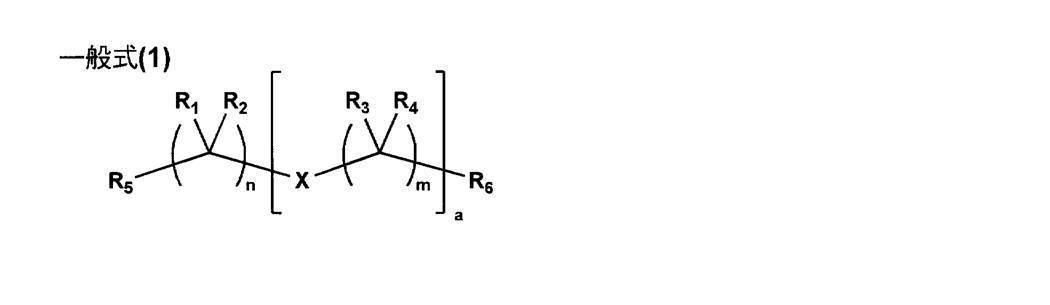
〔式中、Xは硫黄原子または酸素原子を表し、化合物中の少なくとも1つのXは硫黄原子である。n、mは各々1以上、10以下の整数を、aは1以上、50以下の整数を表す。R1、R2、R3、R4、R5、R6は、各々解離性プロトンを有していない置換基を表し、そのうちのひとつはカルボニル基を含む。また、それぞれは、同じであっても異なっていても良く、それぞれで連結して環状構造を形成していてもよい。[ ]内は繰り返し単位を表し、繰り返されている場合、Xが表す原子はそれぞれ異なっていても良い。その場合、同様にR1およびR2もそれぞれ異なっていても良く、mの表す整数も異なっていても良い。〕
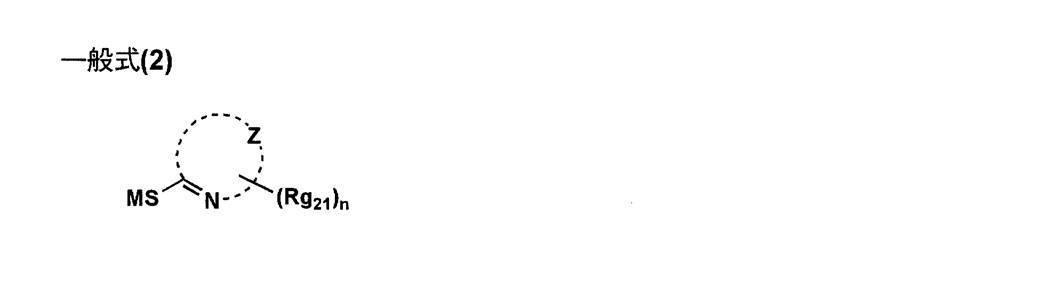
〔式中、Mは水素原子、金属原子または4級アンモニウムを表す。Zは含窒素複素環を構成するのに必要な原子群表す。nは0~5の整数を表し、Rg21は、水素原子、ハロゲン原子、アルキル基、アリール基、アルキルカルボンアミド基、アリールカルボンアミド基、アルキルスルホンアミド基、アリールスルホンアミド基、アルコキシ基、アリールオキシ基、アルキルチオ基、アリールチオ基、アルキルカルバモイル基、アリールカルバモイル基、カルバモイル基、アルキルスルファモイル基、アリールスルファモイル基、スルファモイル基、シアノ基、アルキルスルホニル基、アリールスルホニル基、アルコキシカルボニル基、アリールオキシカルボニル基、アルキルカルボニル基、アリールカルボニル基、アシルオキシ基、カルボキシル基、カルボニル基、スルホニル基、アミノ基、ヒドロキシ基または複素環基を表し、nが2以上の場合、それぞれのRg21は同じであってもよく、異なってもよく、お互いに連結して縮合環を形成してもよい。〕
2.前記一般式(1)で表される化合物におけるR5、R6が、各々カルボニル基を有していることを特徴とする前記1に記載の表示素子。
2.前記一般式(1)で表される化合物におけるR5、R6が、各々カルボニル基を有していることを特徴とする前記1に記載の表示素子。
3.前記一般式(1)で表される化合物におけるn及びmが、各々2または3であることを特徴とする前記1または2に記載の表示素子。
4.前記一般式(1)で表される化合物におけるaが、2または3であることを特徴とする前記1から3のいずれか1項に記載の表示素子。
5.前記一般式(2)で表される化合物におけるZが形成する含窒素複素環が、トリアゾール環であることを特徴とする前記1から4のいずれか1項に記載の表示素子。
6.前記電解質層における前記一般式(1)で表される化合物及び一般式(2)で表される化合物の総含有量を100mol%としたとき、前記一般式(2)で表される化合物の含有比率が1mol%以上、5mol%以下であることを特徴とする前記1から5のいずれか1項に記載の表示素子。
7.前記電解質層を構成する溶媒が、下記一般式(S1)で表される化合物または一般式(S2)で表される化合物であることを特徴とする前記1から6のいずれか1項に記載の表示素子。

〔式中、Lは酸素原子またはアルキレン基を表し、Rs11からRs14は各々水素原子、アルキル基、アルケニル基、アリール基、シクロアルキル基、アルコキシアルキル基またはアルコキシ基を表す。〕

〔式中、Rs21、Rs22は各々アルキル基、アルケニル基、アリール基、シクロアルキル基、アルコキシアルキル基またはアルコキシ基を表す。〕
8.前記電解質層が、リチウム塩を含有していることを特徴とする前記1から7のいずれか1項に記載の表示素子。
8.前記電解質層が、リチウム塩を含有していることを特徴とする前記1から7のいずれか1項に記載の表示素子。
9.前記電解質層が、ポリエチレングリコールを含有していることを特徴とする前記1から8のいずれか1項に記載の表示素子。
本発明により、簡便な部材構成、低電圧で駆動可能で、メモリー性及び繰返し駆動での反射率安定性に優れた表示素子を提供することができた。
以下、本発明を実施するための形態について詳細に説明する。
本発明者は、上記課題に鑑み鋭意検討を行った結果、対向電極間に銀塩化合物を含有した電解質層を有する表示素子において、該電解質層が前記一般式(1)で表される化合物及び一般式(2)で表される化合物を含有していることを特徴とする表示素子により、簡便な部材構成、低電圧で駆動可能で、メモリー性及び繰返し駆動での反射率安定性に優れた表示素子を実現できることを見出し、本発明に至った次第である。
以下、本発明の表示素子の構成要素の詳細について説明する。
〔表示素子の基本構成〕
本発明の表示素子においては、表示部には、対応する1つの対向電極が設けられている。表示部に近い対向電極の1つである電極1にはITO電極等の透明電極、他方の電極2には導電性電極が設けられている。電極1と電極2との間に、銀塩化合物と本発明に係る一般式(1)で表される化合物及び一般式(2)で表される化合物を含有した電解質層を有し、対向電極間に正負両極性の電圧を印加することにより、白表示と黒表示を可逆的に切り替えることができる。
本発明の表示素子においては、表示部には、対応する1つの対向電極が設けられている。表示部に近い対向電極の1つである電極1にはITO電極等の透明電極、他方の電極2には導電性電極が設けられている。電極1と電極2との間に、銀塩化合物と本発明に係る一般式(1)で表される化合物及び一般式(2)で表される化合物を含有した電解質層を有し、対向電極間に正負両極性の電圧を印加することにより、白表示と黒表示を可逆的に切り替えることができる。
〔銀塩化合物〕
本発明に係る銀塩化合物とは、銀または、銀を化学構造中に含む化合物、例えば、酸化銀、硫化銀、金属銀、銀コロイド粒子、ハロゲン化銀、銀錯体化合物、銀イオン等の化合物の総称であり、固体状態や液体への可溶化状態や気体状態等の相の状態種、中性、アニオン性、カチオン性等の荷電状態種は、特に問わない。
本発明に係る銀塩化合物とは、銀または、銀を化学構造中に含む化合物、例えば、酸化銀、硫化銀、金属銀、銀コロイド粒子、ハロゲン化銀、銀錯体化合物、銀イオン等の化合物の総称であり、固体状態や液体への可溶化状態や気体状態等の相の状態種、中性、アニオン性、カチオン性等の荷電状態種は、特に問わない。
本発明の表示素子においては、ヨウ化銀、塩化銀、臭化銀、酸化銀、硫化銀、クエン酸銀、酢酸銀、ベヘン酸銀、p-トルエンスルホン酸銀、トリフルオロメタンスルホン酸銀、メルカプト類との銀塩、イミノジ酢酸類との銀錯体、等の公知の銀塩化合物を用いることができる。これらの中でハロゲンやカルボン酸や銀との配位性を有する窒素原子を有しない化合物を銀塩として用いるのが好ましく、例えば、p-トルエンスルホン酸銀が好ましい。
本発明に係る電解質層に含まれる金属イオン濃度は、0.2モル/kg≦[Metal]≦2.0モル/kgが好ましい。金属イオン濃度が0.2モル/kg以上であれば、十分な濃度の銀溶液となり所望の駆動速度を得ることができ、2モル/kg以下であれば析出を防止し、低温保存時での電解質液の安定性が向上する。
〔ハロゲンイオン、金属イオン濃度比〕
本発明の表示素子においては、電解質層に含まれるハロゲンイオンまたはハロゲン原子のモル濃度を[X](モル/kg)とし、前記電解質液に含まれる銀または銀を化学構造中に含む化合物の銀の総モル濃度を[Metal](モル/kg)としたとき、下式(1)で規定する条件を満たすことが好ましい。
本発明の表示素子においては、電解質層に含まれるハロゲンイオンまたはハロゲン原子のモル濃度を[X](モル/kg)とし、前記電解質液に含まれる銀または銀を化学構造中に含む化合物の銀の総モル濃度を[Metal](モル/kg)としたとき、下式(1)で規定する条件を満たすことが好ましい。
式(1)
0≦[X]/[Metal]≦0.01
本発明でいうハロゲン原子とは、ヨウ素原子、塩素原子、臭素原子、フッ素原子のことをいう。[X]/[Metal]が0.01よりも大きい場合は、金属の酸化還元反応時に、X-→X2が生じ、X2は析出した金属と容易にクロス酸化して析出した金属を溶解させ、メモリー性を低下させる要因の1つになるので、ハロゲン原子のモル濃度は金属銀のモル濃度に対してできるだけ低い方が好ましい。本発明においては、0≦[X]/[Metal]≦0.001がより好ましい。ハロゲンイオンを添加する場合、ハロゲン種については、メモリー性向上の観点から、各ハロゲン種モル濃度総和が[I]<[Br]<[Cl]<[F]であることが好ましい。
0≦[X]/[Metal]≦0.01
本発明でいうハロゲン原子とは、ヨウ素原子、塩素原子、臭素原子、フッ素原子のことをいう。[X]/[Metal]が0.01よりも大きい場合は、金属の酸化還元反応時に、X-→X2が生じ、X2は析出した金属と容易にクロス酸化して析出した金属を溶解させ、メモリー性を低下させる要因の1つになるので、ハロゲン原子のモル濃度は金属銀のモル濃度に対してできるだけ低い方が好ましい。本発明においては、0≦[X]/[Metal]≦0.001がより好ましい。ハロゲンイオンを添加する場合、ハロゲン種については、メモリー性向上の観点から、各ハロゲン種モル濃度総和が[I]<[Br]<[Cl]<[F]であることが好ましい。
〔一般式(1)で表されるチオエーテル化合物〕
本発明に係る一般式(1)で表される化合物は、ED方式の表示素子において金属塩(特に銀塩)の溶解析出を促進するために用いられる「金属塩溶剤」と同一範疇の化合物である。特に銀塩溶剤としてメルカプトアゾール等、複素環チオール化合物は良く用いられており、これら公知の銀塩溶剤と比較して、構造的特徴は、アルキル鎖内に金属イオンと相互作用するとされている硫黄原子を組み込んだ点、同様に金属イオンと相互作用するとされているカルボニル基を少なくとも一つを有しかつ解離性プロトンを排除した点にある。
本発明に係る一般式(1)で表される化合物は、ED方式の表示素子において金属塩(特に銀塩)の溶解析出を促進するために用いられる「金属塩溶剤」と同一範疇の化合物である。特に銀塩溶剤としてメルカプトアゾール等、複素環チオール化合物は良く用いられており、これら公知の銀塩溶剤と比較して、構造的特徴は、アルキル鎖内に金属イオンと相互作用するとされている硫黄原子を組み込んだ点、同様に金属イオンと相互作用するとされているカルボニル基を少なくとも一つを有しかつ解離性プロトンを排除した点にある。
本発明者らの検討の結果、このような特定構造とすることで、該化合物自身の腐食力を抑えることができ、また硫黄原子、カルボニル基を配置して金属イオンとの相互作用力を高めたことで、電極の腐食が大きく抑制され、繰り返し駆動時の安定性に優れ、さらには、低電圧駆動時の書き換え速度の向上が明らかになった。詳細なメカニズムは不明であるが、電極腐食の著しい改善は解離性プロトンを系中から排除したことに由来すると推測している。
本発明に係る一般式(1)で表される化合物は、チオエーテル鎖を有することが好ましい。
一般式(1)において、R1、R2、R3、R4、R5、R6で表される置換基としては、解離性プロトンを有していない置換基であり、例えば、下記の置換基が挙げられる。
ハロゲン原子(例えば、フッ素原子、塩素原子、臭素原子、ヨウ素原子等)、アルキル基(例えば、メチル基、エチル基、プロピル基、i-プロピル基、ブチル基、t-ブチル基、ペンチル基、シクロペンチル基、ヘキシル基、シクロヘキシル基、オクチル基、ドデシル基、ヒドロキシエチル基、メトキシエチル基、トリフルオロメチル基、ベンジル基等)、アリール基(例えば、フェニル基、ナフチル基等)、アルコキシ基(例えば、メトキシ基、エトキシ基、プロポキシ基、2-プロポキシ基、ブトキシ基、t-ブトキシ基、ペンチルオキシ基、2-エチルヘキシルオキシ基、トリフルオロメトキシ基等)、ジアルキルアミノ基(例えば、ジメチルアミノ基、ジエチルアミノ基、ジブチルアミノ基等)、ジアリールアミノ基(例えば、ジフェニルアミノ基、ジトリルアミノ基、ジメシチルアミノ基等)、アリールオキシ基(例えば、フェノキシ基等)、アルキルチオ基(例えば、メチルチオ基、エチルチオ基、ブチルチオ基等)、アリールチオ基(例えば、フェニルチオ基、トリルチオ基等)、ジアルキルカルバモイル基(例えば、ジメチルカルバモイル基、ジエチルカルバモイル基、ジブチルカルバモイル基等)、ジアリールカルバモイル基(例えば、ジフェニルカルバモイル基、メチルフェニルカルバモイル基、エチルフェニルカルバモイル基、ベンジルフェニルカルバモイル基等)、ジアルキルスルファモイル基(例えば、ジメチルスルファモイル基、ジエチルスルファモイル基、ジブチルスルファモイル基等)、ジアリールスルファモイル基(例えば、ジフェニルスルファモイル基、メチルフェニルスルファモイル基、エチルフェニルスルファモイル基、ベンジルフェニルスルファモイル基等)、アルキルスルホニル基(例えば、メタンスルホニル基、エタンスルホニル基等)、アリールスルホニル基(例えば、フェニルスルホニル基、4-クロロフェニルスルホニル基、p-トルエンスルホニル基等)、アルコキシカルボニル基(例えば、メトキシカルボニル基、エトキシカルボニル基、ブトキシカルボニル基等)、アリールオキシカルボニル基(例えばフェノキシカルボニル基等)、アルキルカルボニル基(例えば、アセチル基、プロピオニル基、ブチロイル基等)、アリールカルボニル基(例えば、ベンゾイル基、アルキルベンゾイル基等)、ジアルキルアミノカルボニル基(例えば、ジメチルアミノカルボニル基、ジエチルアミノカルボニル基等)、ジアリールアミノカルボニル基(例えば、ジフェニルアミノカルボニル基、ジトリルアミノカルボニル基等)、アシルオキシ基(例えば、アセチルオキシ基、プロピオニルオキシ基、ブチロイルオキシ基等)、カルボニル基、シアノ基、または複素環基(例えば、オキサゾール環、チアゾール環、トリアゾール環、セレナゾール環、テトラゾール環、オキサジアゾール環、チアジアゾール環、チアジン環、トリアジン環、ベンズオキサゾール環、ベンズチアゾール環、インドレニン環、ベンズセレナゾール環、ナフトチアゾール環、トリアザインドリジン環、ジアザインドリジン環、テトラアザインドリジン環等)を挙げられるが、好ましくは、ハロゲン原子、アルキル基、アルコキシ基、アルキルチオ基、アシル基、シアノ基であり、さらに好ましくは、アルキル基、アルコキシ基、アルキルチオ基、シアノ基である。これらの置換基はさらに置換基を有していても良く、お互いに連結して縮合環を形成していてもよい。
一般式(1)において、Xは硫黄原子もしくは酸素原子を表し、化合物中の少なくとも1つのXは硫黄原子である。
一般式(1)において、aは繰り返し単位の数を表す。適度な溶解性を持つためには、aは1~50、好ましくは1~10であり、さらに好ましくは1~6であり、特に好ましくは2または3である。n、mは各々1以上、10以下の整数を表すが、好ましくは各々2または3である。
[ ]内は繰り返し単位を表し、aが2以上の数を表す場合、Xが複数個存在することになるが、その場合のXはそれぞれ同じであっても異なっていても良く、硫黄原子含有量が多いほど好ましい。また、mが表す整数も同じであっても異なっていても良い。
上記の場合、R1、R2も同様に複数個存在することになるが、その場合はそれぞれ同じであっても異なっていてもよい。
本発明に係る一般式(1)において、チオエーテル鎖の含有量は、化合物全体の30~99質量%であることが好ましい。より好ましくは33~85質量%である。ここでチオエーテル鎖の含有量とは、一般式(1)で表される単位のXが硫黄原子である場合、化合物全体の分子量に対するXを含む繰り返し単位の質量%をいう。
例えば、下記例示化合物(1)-1では、チオエーテル鎖は分子量が120(SC2H4)2であり、分子全体は266であることから120/266×100=45質量%と計算する。
本発明に係る一般式(1)で表される化合物が有することがない解離性プロトンを有する基とは、具体的には、ヒドロキシル基、スルホ基、カルボキシル基、スルファト基、-CONHSO2-基(スルホニルカルバモイル基、カルボニルスルファモイル基)、-CONHCO-基(カルボニルカルバモイル基)、-SO2NHSO2-基(スルフォニルスルファモイル基)、スルファモイル基、ホスファト基、ホスホノ基、ボロン酸基、フェノール性水酸基、など、これらのpKaと周りのpHによっては、プロトンが解離する基が挙げられる。
本発明に係る一般式(1)で表される化合物においては、この解離性プロトンを有する基を、チオエーテル鎖、末端基、連結基等分子全体として有することはない。
本発明に係る一般式(1)で表される化合物は、少なくとも1つのカルボニル基を有する。このカルボニル基は、化合物の末端基として、またはチオエーテル鎖の置換基、末端基とチオエーテル鎖との連結基として存在していることが好ましい。カルボニル基は、R5、R6が有していることが好ましい。
カルボニル基の数は1~10、好ましくは2~6が1分子中に存在することが好ましい。末端基は、アルキル基、アルケニル基、アリール基等の解離性プロトンを有していない基であることが好ましい。
本発明に係る一般式(1)で表される化合物において、カルボニル基とチオエーテル鎖は、直接または連結基で結合していることが好ましい。連結基は、2~4価であることが好ましい。連結基は解離性プロトンを有していない基である。
本発明に係る一般式(1)で表される化合物の使用量は、一般的には電解質層を構成する溶媒中に上限としては30モル/L以下、好ましくは20モル/L以下、さらに好ましくは10モル/L以下存在していることが望ましく、下限としては通常0.01モル/L以上、好ましくは0.05モル/L以上、さらに好ましくは0.1モル/L以上である。
本発明に係る一般式(1)で表される化合物の好ましい具体例を示す。


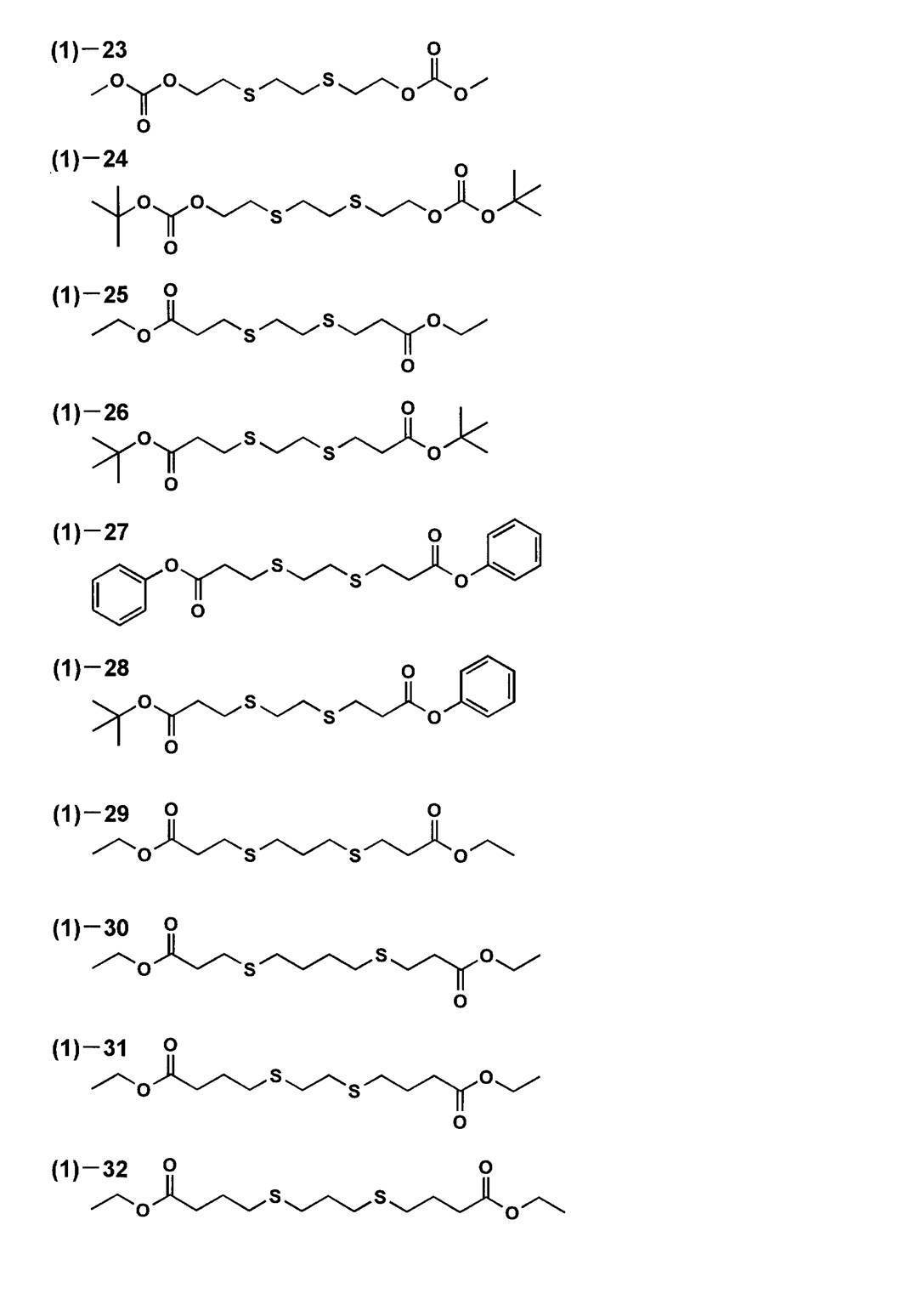

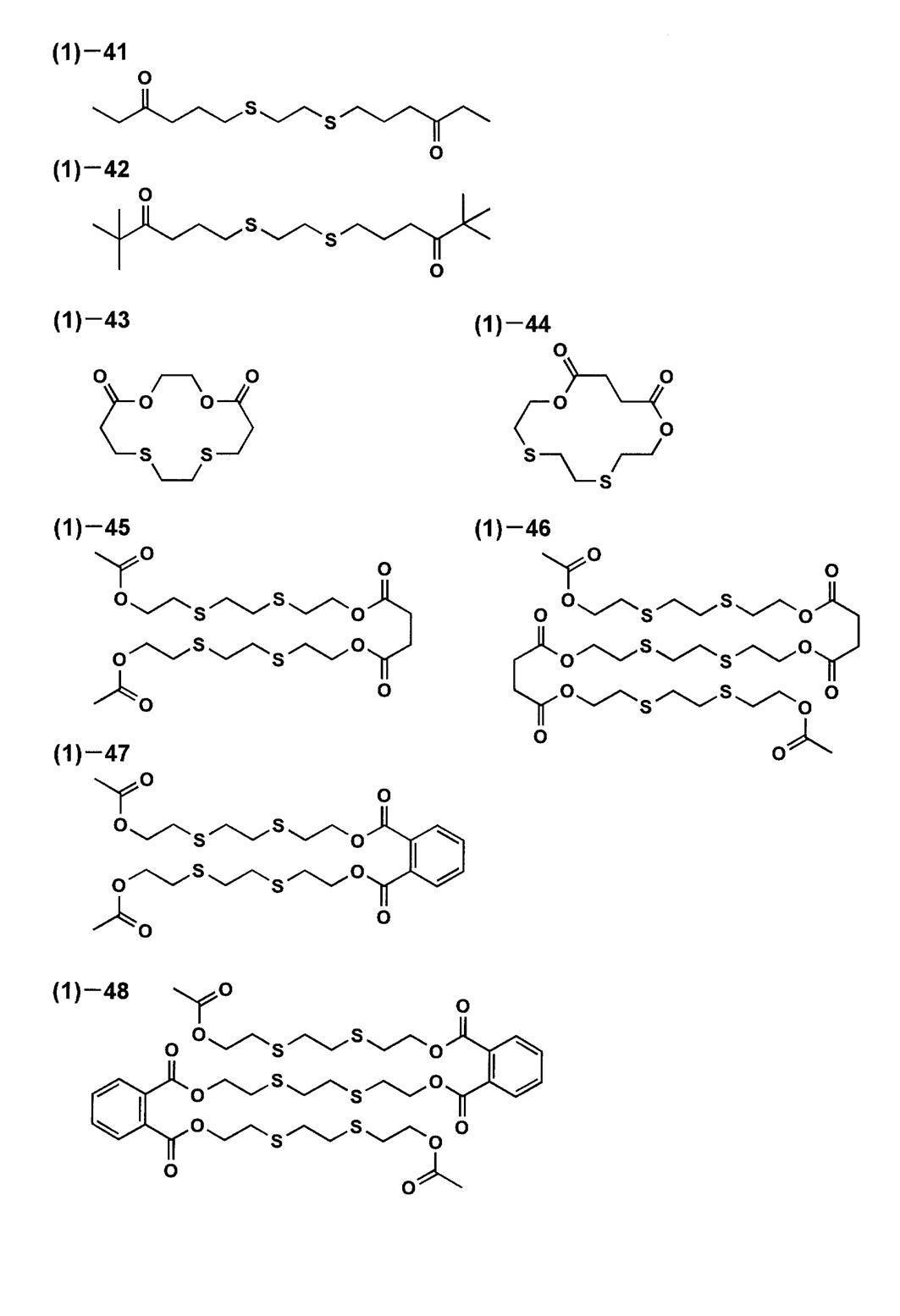

〔一般式(2)で表される化合物〕
本発明の表示素子においては、電解質層が、下記一般式(2)で表される化合物を含有することを特徴の1つとする。
本発明の表示素子においては、電解質層が、下記一般式(2)で表される化合物を含有することを特徴の1つとする。

上記一般式(2)において、Mは水素原子、金属原子または4級アンモニウムを表す。Zは含窒素複素環を構成するのに必要な原子群表す。nは0~5の整数を表し、Rg21は、水素原子、ハロゲン原子、アルキル基、アリール基、アルキルカルボンアミド基、アリールカルボンアミド基、アルキルスルホンアミド基、アリールスルホンアミド基、アルコキシ基、アリールオキシ基、アルキルチオ基、アリールチオ基、アルキルカルバモイル基、アリールカルバモイル基、カルバモイル基、アルキルスルファモイル基、アリールスルファモイル基、スルファモイル基、シアノ基、アルキルスルホニル基、アリールスルホニル基、アルコキシカルボニル基、アリールオキシカルボニル基、アルキルカルボニル基、アリールカルボニル基、アシルオキシ基、カルボキシル基、カルボニル基、スルホニル基、アミノ基、ヒドロキシ基または複素環基を表し、好ましくは水素原子若しくは置換または無置換のアルキル基である。nが2以上の場合、それぞれのRg21は同じであってもよく、異なってもよく、お互いに連結して縮合環を形成してもよい。
一般式(2)において、Mで表される金属原子としては、例えば、Li、Na、K、Mg、Ca、Zn、Ag等が挙げられ、4級アンモニウムとしては、例えば、NH4、N(CH3)4、N(C4H9)4、N(CH3)3C12H25、N(CH3)3C16H33、N(CH3)3CH2C6H5等が挙げられる。
一般式(2)のZを構成成分とする含窒素複素環としては、例えば、テトラゾール環、トリアゾール環、イミダゾール環、オキサジアゾール環、チアジアゾール環、インドール環、オキサゾール環、ベンゾオキサゾール環、ベンズイミダゾール環、ベンゾチアゾール環、ベンゾセレナゾール環、ナフトオキサゾール環等が挙げられ、好ましくはトリアゾール環である。
一般式(2)において、Rg21で表される具体的な基としては、ハロゲン原子(例えば、フッ素原子、塩素原子、臭素原子、ヨウ素原子等)、アルキル基(例えば、メチル基、エチル基、プロピル基、i-プロピル基、ブチル基、t-ブチル基、ペンチル基、シクロペンチル基、ヘキシル基、シクロヘキシル基、オクチル基、ドデシル基、ヒドロキシエチル基、メトキシエチル基、トリフルオロメチル基、ベンジル基等)、アリール基(例えば、フェニル基、ナフチル基等)、アルキルカルボンアミド基(例えば、アセチルアミノ基、プロピオニルアミノ基、ブチロイルアミノ基等)、アリールカルボンアミド基(例えば、ベンゾイルアミノ基等)、アルキルスルホンアミド基(例えば、メタンスルホニルアミノ基、エタンスルホニルアミノ基等)、アリールスルホンアミド基(例えば、ベンゼンスルホニルアミノ基、トルエンスルホニルアミノ基等)、アリールオキシ基(例えば、フェノキシ基等)、アルキルチオ基(例えば、メチルチオ基、エチルチオ基、ブチルチオ基等)、アリールチオ基(例えば、フェニルチオ基、トリルチオ基等)、アルキルカルバモイル基(例えば、メチルカルバモイル基、ジメチルカルバモイル基、エチルカルバモイル基、ジエチルカルバモイル基、ジブチルカルバモイル基、ピペリジルカルバモイル基、モルホリルカルバモイル基等)、アリールカルバモイル基(例えば、フェニルカルバモイル基、メチルフェニルカルバモイル基、エチルフェニルカルバモイル基、ベンジルフェニルカルバモイル基等)、アルキルスルファモイル基(例えば、メチルスルファモイル基、ジメチルスルファモイル基、エチルスルファモイル基、ジエチルスルファモイル基、ジブチルスルファモイル基、ピペリジルスルファモイル基、モルホリルスルファモイル基等)、アリールスルファモイル基(例えば、フェニルスルファモイル基、メチルフェニルスルファモイル基、エチルフェニルスルファモイル基、ベンジルフェニルスルファモイル基等)、アルキルスルホニル基(例えば、メタンスルホニル基、エタンスルホニル基等)、アリールスルホニル基(例えば、フェニルスルホニル基、4-クロロフェニルスルホニル基、p-トルエンスルホニル基等)アルコキシカルボニル基(例えば、メトキシカルボニル基、エトキシカルボニル基、ブトキシカルボニル基等)、アリールオキシカルボニル基(例えば、フェノキシカルボニル基等)、アルキルカルボニル基(例えば、アセチル基、プロピオニル基、ブチロイル基等)、アリールカルボニル基(例えば、ベンゾイル基、アルキルベンゾイル基等)、アシルオキシ基(例えば、アセチルオキシ基、プロピオニルオキシ基、ブチロイルオキシ基等)、複素環基(例えば、オキサゾール環、チアゾール環、トリアゾール環、セレナゾール環、テトラゾール環、オキサジアゾール環、チアジアゾール環、チアジン環、トリアジン環、ベンズオキサゾール環、ベンズチアゾール環、インドレニン環、ベンズセレナゾール環、ナフトチアゾール環、トリアザインドリジン環、ジアザインドリジン環、テトラアザインドリジン環等)が挙げられる。これらの置換基はさらに置換基を有してもよい。
次に、一般式(2)で表される化合物の好ましい具体例を示すが、本発明は、これら例示する化合物にのみ限定されるものではない。


上記例示した各化合物の中でも、本発明の目的効果をいかんなく発揮できる観点から、特に、例示化合物(2)-12、(2)-18、(2)-20が好ましい。
本発明に係る一般式(1)及び一般式(2)で表される化合物の使用により、銀塩の溶解析出を促進することが可能となり、すなわち、低電圧駆動時の書き換え速度の向上が達成される。さらには、ITO電極の電極腐食の抑制が可能となる。
本発明の表示素子においては、電解質層における一般式(1)で表される化合物及び一般式(2)で表される化合物の総含有量を100mol%としたとき、一般式(2)で表される化合物の含有比率を1mol%以上、5mol%以下とすることが、本発明の目的効果をより一層発揮できる観点から好ましい。
一般に、銀の溶解析出を生じさせるためには、電解質中で銀を可溶化することが必要であり、例えば、銀と配位結合を生じさせ、銀と弱い共有結合を生じさせるような、銀と相互作用を示す化学構造種を含む化合物が有用であると考えられる。前記化学構造種として、ハロゲン原子、メルカプト基、カルボキシル基、イミノ基等が銀と相互作用を示す化学構造種であると知られているが、本発明においては、一般式(1)のようなアルキル鎖上に硫黄原子(チオエーテル鎖)、カルボニル基が置換した化合物及び一般式(2)のようなメルカプトアゾール類は、銀溶剤として有用に作用し、共存化合物への影響が少なく溶媒への溶解度が高い特徴がある。
〔有機溶媒〕
本発明に係る電解質層には、有機溶媒としては、一般に電気化学セルや電池に用いられ、電気化学的な酸化還元反応により可逆的に溶解析出する金属塩化合物、プロモーター等各種添加剤を溶解できる溶媒を使用することができる。
本発明に係る電解質層には、有機溶媒としては、一般に電気化学セルや電池に用いられ、電気化学的な酸化還元反応により可逆的に溶解析出する金属塩化合物、プロモーター等各種添加剤を溶解できる溶媒を使用することができる。
具体的には、無水酢酸、メタノール、エタノール、テトラヒドロフラン、エチレンカーボネート、エチルメチルカーボネート、ジエチルカーボネート、ジメチルカーボネート、ブチレンカーボネート、プロピレンカーボネート、ニトロメタン、アセトニトリル、アセチルアセトン、N-メチルホルムアミド、N,N-ジメチルホルムアミド、ジメチルスルホキシド、ヘキサメチルホスホアミド、ジメトキシエタン、ジエトキシフラン、γ-ブチロラクトン、γ-バレロラクトン、スルホラン、プロピオニトリル、ブチロニトリル、グルタロニトリル、アジポニトリル、メトキシアセトニトリル、N-メチルアセトアミド、N,N-ジメチルアセトアミド、N-メチルプロピオンアミド、メチルピロリジノン、2-(N-メチル)-2-ピロリジノン、ジメチルスルホキシド、ジオキソラン、トリメチルホスフェート、トリエチルホスフェート、トリプロピルホスフェート、エチルジメチルホスフェート、トリブチルホスフェート、トリペンチルホスフェート、トリヘキシルホスフェート、トリヘプチルホスフェート、トリオクチルホスフェート、トリノニルホスフェート、トリデシルホスフェート、トリス(トリフフロロメチル)ホスフェート、トリス(ペンタフロロエチル)ホスフェート、トリフェニルホスフェート、トリクレジルホスフェート、2-エチルヘキシルホスフェート、テトラメチル尿素、1,3-ジメチル-2-イミダゾリジノン、ヘキサメチルホスホルトリアミド、4-メチル-2-ペンタノン、ジオクチルフタレート、ジオクチルセバケート、及びエチレングリコール、ジエチレングリコール、トリエチレングリコールモノブチルエーテル等のポリエチレングリコール類などが使用可能である。
さらに、常温溶融塩も溶媒として使用可能である。前記常温溶融塩とは、溶媒成分が含まれないイオン対のみからなる常温において溶融している(即ち液状の)イオン対からなる塩であり、通常、融点が20℃以下であり、20℃を越える温度で液状であるイオン対からなる塩を示す。常温溶融塩はその1種を単独で使用することができ、また2種以上を混合しても使用することもできる。
本発明に用いる電解質溶媒としては、非プロトン性極性溶媒が好ましく、特に、プロピレンカーボネート、エチレンカーボネート、ジメチルスルホキシド、ジメトキシエタン、アセトニトリル、γ-ブチロラクトン、スルホラン、ジオキソラン、ジメチルホルムアミド、ジメトキシエタン、テトラヒドロフラン、アジポニトリル、メトキシアセトニトリル、ジメチルアセトアミド、メチルピロリジノン、ジメチルスルホキシド、ジオキソラン、スルホラン、トリメチルホスフェート、トリエチルホスフェートが好ましい。溶媒はその1種を単独で使用しても良いし、また2種以上を混合して使用しても良い。
本発明において、好ましく用いられる溶媒は、下記一般式(S1)または(S2)で表される化合物である。
〈一般式(S1)、(S2)で表される化合物〉

上記一般式(S1)において、Lは酸素原子またはアルキレン基を表し、Rs11からRs14は各々水素原子、アルキル基、アルケニル基、アリール基、シクロアルキル基、アルコキシアルキル基またはアルコキシ基を表し、好ましくは水素原子またはアルキル基である。
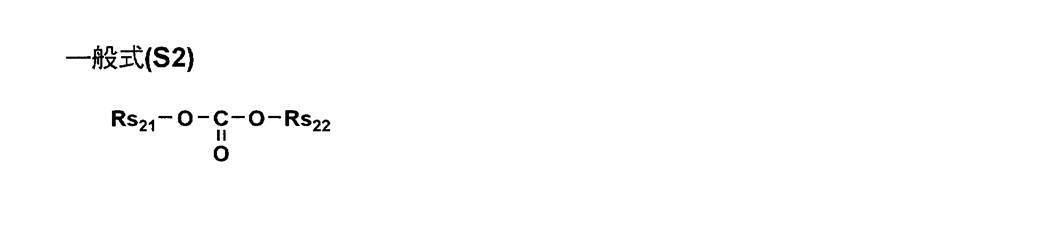
一般式(S2)において、Rs21、Rs22は各々アルキル基、アルケニル基、アリール基、シクロアルキル基、アルコキシアルキル基またはアルコキシ基を表し、好ましくはアルキル基である。
はじめに、一般式(S1)で表される化合物の詳細について説明する。
前記一般式(S1)において、Lは酸素原子またはCH2を表し、Rs11からRs14は各々水素原子、アルキル基、アルケニル基、アリール基、シクロアルキル基、アルコキシアルキル基またはアルコキシ基を表し、これらの置換基は更に任意の置換基で置換されていても良い。
アルキル基としては、例えば、メチル基、エチル基、プロピル基、イソプロピル基、tert-ブチル基、ペンチル基、ヘキシル基、オクチル基、ドデシル基、トリデシル基、テトラデシル基、ペンタデシル基等、アリール基としては、例えば、フェニル基、ナフチル基等、シクロアルキル基としては、例えば、シクロペンチル基、シクロヘキシル基等、アルコキシアルキル基として、例えば、β-メトキシエチル基、γ-メトキシプロピル基等、アルコキシ基としては、例えば、メトキシ基、エトキシ基、プロピルオキシ基、ペンチルオキシ基、ヘキシルオキシ基、オクチルオキシ基、ドデシルオキシ基等を挙げることができる。
以下、一般式(S1)で表される化合物の具体例を示すが、本発明ではこれら例示する化合物にのみ限定されるものではない。
次いで、本発明に係る一般式(S2)で表される化合物の詳細について説明する。
前記一般式(S2)において、Rs21、Rs22は各々水素原子、アルキル基、アルケニル基、アリール基、シクロアルキル基、アルコキシアルキル基またはアルコキシ基を表す。
アルキル基としては、例えば、メチル基、エチル基、プロピル基、イソプロピル基、tert-ブチル基、ペンチル基、ヘキシル基、オクチル基、ドデシル基、トリデシル基、テトラデシル基、ペンタデシル基等、アリール基としては、例えば、フェニル基、ナフチル基等、シクロアルキル基としては、例えば、シクロペンチル基、シクロヘキシル基等、アルコキシアルキル基として、例えば、β-メトキシエチル基、γ-メトキシプロピル基等、アルコキシ基としては、例えば、メトキシ基、エトキシ基、プロピルオキシ基、ペンチルオキシ基、ヘキシルオキシ基、オクチルオキシ基、ドデシルオキシ基等を挙げることができる。
以下、一般式(S2)で表される化合物の具体例を示すが、本発明ではこれら例示する化合物にのみ限定されるものではない。

上記例示した一般式(S1)及び一般式(S2)で表される化合物の中でも、特に、例示化合物(S1-1)、(S1-2)、(S2-3)が好ましい。
本発明に係る一般式(S1)、(S2)で表される化合物は、電解質溶媒の1種であるが、本発明の表示素子においては、本発明の目的効果を損なわない範囲で、さらに他の溶媒を併せて用いることができる。具体的には、テトラメチル尿素、スルホラン、ジメチルスルホキシド、1,3-ジメチル-2-イミダゾリジノン、2-(N-メチル)-2-ピロリジノン、ヘキサメチルホスホルトリアミド、N-メチルプロピオンアミド、N,N-ジメチルアセトアミド、N-メチルアセトアミド、N,Nジメチルホルムアミド、N-メチルホルムアミド、ブチロニトリル、プロピオニトリル、アセトニトリル、アセチルアセトン、4-メチル-2-ペンタノン、2-ブタノール、1-ブタノール、2-プロパノール、1-プロパノール、エタノール、メタノール、無水酢酸、酢酸エチル、プロピオン酸エチル、ジメトキシエタン、ジエトキシフラン、テトラヒドロフラン、エチレングリコール、ジエチレングリコール、トリエチレングリコールモノブチルエーテル、水等が挙げられる。これらの溶媒の内、凝固点が-20℃以下、かつ沸点が120℃以上の溶媒を少なくとも1種含むことが好ましい。
さらに、本発明で用いることのできる溶媒としては、J.A.Riddick,W.B.Bunger,T.K.Sakano,“Organic Solvents”,4th ed.,John Wiley & Sons(1986)、Y.Marcus,“Ion Solvation”,John Wiley & Sons(1985)、C.Reichardt,“Solvents and Solvent Effects in Chemistry”,2nd ed.,VCH(1988)、G.J.Janz,R.P.T.Tomkins,“Nonaqueous Electrolytes Handbook”,Vol.1,Academic Press(1972)に記載の化合物を挙げることができる。
本発明において、電解質溶媒は単一種であっても、溶媒の混合物であってもよいが、エチレンカーボネートを含む混合溶媒であることが好ましい。エチレンカーボネートの添加量は、全電解質溶媒質量の10質量%以上、90質量%以下が好ましい。特に好ましい電解質溶媒は、プロピレンカーボネート/エチレンカーボネートの質量比が7/3~3/7の混合溶媒である。プロピレンカーボネート比が7/3より大きいとイオン伝導性が劣り応答速度が低下し、3/7より小さいと低温時に電解質が析出しやすくなる。
〔白色散乱物〕
本発明においては、表示コントラスト及び白表示反射率をより高める観点から、白色散乱物を含有し、多孔質白色散乱層を形成することができる。
本発明においては、表示コントラスト及び白表示反射率をより高める観点から、白色散乱物を含有し、多孔質白色散乱層を形成することができる。
本発明に適用可能な多孔質白色散乱層は、電解質溶媒に実質的に溶解しない水系高分子と白色顔料との水混和物を塗布乾燥して形成することができる。
本発明でいう電解質溶媒に実質的に溶解しないとは、-20℃から120℃の温度において、電解質溶媒1kgあたりの溶解量が0g以上、10g以下である状態と定義し、質量測定法、液体クロマトグラムやガスクロマトグラムによる成分定量法等の公知の方法により、その溶解量を求めることができる。
本発明において、電解質溶媒に実質的に溶解しない水系高分子としては、水溶性高分子、水系溶媒に分散した高分子を挙げることができる。
水溶性高分子としては、例えば、ゼラチン、ゼラチン誘導体等の蛋白質またはセルロース誘導体、澱粉、アラビアゴム、デキストラン、プルラン、カラギーナン等の多糖類のような天然化合物や、ポリビニルアルコール、ポリエチレングリコール、ポリビニルピロリドン、アクリルアミド重合体やそれらの誘導体等の合成高分子化合物が挙げられる。ゼラチン誘導体としては、アセチル化ゼラチン、フタル化ゼラチン、ポリビニルアルコール誘導体としては、末端アルキル基変性ポリビニルアルコール、末端メルカプト基変性ポリビニルアルコール、セルロース誘導体としては、ヒドロキシエチルセルロース、ヒドロキシプロピルセルロース、カルボキシメチルセルロース等が挙げられる。更に、リサーチ・ディスクロージャー及び特開昭64-13546号の(71)頁~(75)頁に記載されたもの、また、米国特許第4,960,681号、特開昭62-245260号等に記載の高吸水性ポリマー、すなわち-COOMまたは-SO3M(Mは水素原子またはアルカリ金属)を有するビニルモノマーの単独重合体またはこのビニルモノマー同士もしくは他のビニルモノマー(例えばメタクリル酸ナトリウム、メタクリル酸アンモニウム、アクリル酸カリウム等)との共重合体も使用される。これらの水溶性高分子は2種以上組み合わせて用いることもできる。
本発明においては、ポリビニルアルコール、ポリエチレングリコール、ポリビニルピロリドン系化合物を好ましく用いることができ、特に、電解質層がポリエチレングリコール化合物を含有していることが好ましい。ポリエチレングリコール化合物の例としては、ポリエチレングリコール類、ポリプロピレングリコール類、ポリエチレングリコールアルキルエーテル類、ポリプロピレングリコールアルキルエーテル類、ポリエチレングリコールアリールエーテル類、ポリプロピレングリコールアリールエーテル類、ポリエチレングリコールアルキルアリールエーテル類、ポリプロピレングリコールアルキルアリールエーテル類、ポリエチレングリコールグリセリンエステル、ポリプロピレングリコールグリセリンエステル類、ポリエチレンソルビトールエステル類、ポリプロピレングリコールソルビトールエステル類、ポリエチレングリコール脂肪酸エステル類、ポリプロピレングリコール脂肪酸エステル類、ポリエチレングリコール化エチレンジアミン類、ポリプロピレングリコール化エチレンジアミン類、ポリエチレングリコール化ジエチレントリアミン類、ポリプロピレングリコール化ジエチレントリアミン類が挙げられる。
水系溶媒に分散した高分子としては、天然ゴムラテックス、スチレンブタジエンゴム、ブタジエンゴム、ニトリルゴム、クロロプレンゴム、イソプレンゴム等のラテックス類、ポリイソシアネート系、エポキシ系、アクリル系、シリコン系、ポリウレタン系、尿素系、フェノール系、ホルムアルデヒド系、エポキシ-ポリアミド系、メラミン系、アルキド系樹脂、ビニル系樹脂等を水系溶媒に分散した熱硬化性樹脂を挙げることができる。これらの高分子のうち、特開平10-76621号に記載の水系ポリウレタン樹脂を用いることが好ましい。
本発明において、水系高分子の平均分子量は、重量平均で10,000~2,000,000の範囲が好ましく、より好ましくは30,000~500,000の範囲である。
本発明で適用可能な白色顔料としては、例えば、二酸化チタン(アナターゼ型あるいはルチル型)、硫酸バリウム、炭酸カルシウム、酸化アルミニウム、酸化亜鉛、酸化マグネシウムおよび水酸化亜鉛、水酸化マグネシウム、リン酸マグネシウム、リン酸水素マグネシウム、アルカリ土類金属塩、タルク、カオリン、ゼオライト、酸性白土、ガラス、有機化合物としてポリエチレン、ポリスチレン、アクリル樹脂、アイオノマー、エチレン-酢酸ビニル共重合樹脂、ベンゾグアナミン樹脂、尿素-ホルマリン樹脂、メラミン-ホルマリン樹脂、ポリアミド樹脂などが単体または複合混合で、または粒子中に屈折率を変化させるボイドを有する状態で使用されてもよい。
本発明では、上記白色顔料の中でも、二酸化チタンが好ましく用いられ、特に、無機酸化物(Al2O3、AlO(OH)、SiO2等)で表面処理した二酸化チタン、これらの表面処理に加えてトリメチロールエタン、トリエタノールアミン酢酸塩、トリメチルシクロシラン等の有機物処理を施した二酸化チタンがより好ましく用いられる。
これらの白色顔料のうち、高温時の着色防止、屈折率に起因する表示素子の反射率の観点から、酸化チタンまたは酸化亜鉛を用いることがより好ましい。
本発明において、水系高分子と白色顔料との水混和物は、公知の分散方法に従って白色顔料が水中分散された形態が好ましい。水系高分子/白色顔料の混合比は、容積比で1~0.01が好ましく、より好ましくは、0.3~0.05の範囲である。
多孔質白色散乱層の膜厚は、5~50μmの範囲であることが好ましく、より好ましくは10~30μmの範囲である。
また、溶剤としては、メタノール、エタノール、イソプロパノール等の水との溶解性が高いアルコール系溶剤が好ましく用いられ、水/アルコール系溶剤との混合比は、質量比で0.5~20の範囲が好ましく、より好ましくは2~10の範囲である。
本発明において、水系高分子と白色顔料との水混和物を塗布する媒体は、表示素子の対向電極間の構成要素上であればいずれの領域でもよいが、対向電極の少なくとも1方の電極面上に付与することが好ましい。
媒体への付与の方法としては、例えば、塗布方式、液噴霧方式、気相を介する噴霧方式として、圧電素子の振動を利用して液滴を飛翔させる方式、例えば、ピエゾ方式のインクジェットヘッドや、突沸を利用したサーマルヘッドを用いて液滴を飛翔させるバブルジェット(登録商標)方式のインクジェットヘッド、また空気圧や液圧により液を噴霧するスプレー方式等が挙げられる。
塗布方式としては、公知の塗布方式より適宜選択することができる。例えば、エアードクターコーター、ブレードコーター、ロッドコーター、ナイフコーター、スクイズコーター、含浸コーター、リバースローラーコーター、トランスファーローラーコーター、カーテンコーター、ダブルローラーコーター、スライドホッパーコーター、グラビアコーター、キスロールコーター、ビードコーター、キャストコーター、スプレイコーター、カレンダーコーター、押し出しコーター等が挙げられる。
媒体上に付与した水系高分子と白色顔料との水混和物の乾燥は、水を蒸発できる方法であればいかなる方法であってもよい。例えば、熱源からの加熱、赤外光を用いた加熱法、電磁誘導による加熱法等が挙げられる。また、水蒸発は減圧下で行ってもよい。
本発明でいう多孔質とは、前記水系高分子と白色顔料との水混和物を電極上に塗布乾燥して多孔質の白色散乱物を形成した後、該散乱物上に、銀または銀を化学構造中に含む化合物を含有する電解質液を与えた後に対向電極で挟み込み、対向電極間に電位差を与え、銀の溶解析出反応を生じさせることが可能で、イオン種が電極間で移動可能な貫通状態のことを言う。
本発明の表示素子では、上記説明した水混和物を塗布乾燥中または乾燥後に、硬膜剤により水系高分子の硬化反応を行うことが望ましい。
本発明で用いられる硬膜剤の例としては、例えば、米国特許第4,678,739号の第41欄、同第4,791,042号、特開昭59-116655号、同62-245261号、同61-18942号、同61-249054号、同61-245153号、特開平4-218044号等に記載の硬膜剤が挙げられる。より具体的には、アルデヒド系硬膜剤(ホルムアルデヒド等)、アジリジン系硬膜剤、エポキシ系硬膜剤、ビニルスルホン系硬膜剤(N,N′-エチレン-ビス(ビニルスルホニルアセタミド)エタン等)、N-メチロール系硬膜剤(ジメチロール尿素等)、ほう酸、メタほう酸あるいは高分子硬膜剤(特開昭62-234157号等に記載の化合物)が挙げられる。水系高分子としてゼラチンを用いる場合は、硬膜剤の中で、ビニルスルホン型硬膜剤やクロロトリアジン型硬膜剤を単独または併用して使用することが好ましい。また、ポリビニルアルコールを用いる場合はホウ酸やメタホウ酸等の含ホウ素化合物の使用が好ましい。
これらの硬膜剤は、水系高分子1g当たり0.001~1g、好ましくは0.005~0.5gが用いられる。また、膜強度を上げるため熱処理や、硬化反応時の湿度調整を行うことも可能である。
〔電解質層〕
本発明でいう「電解質」とは、一般に、水などの溶媒に溶けて溶液がイオン伝導性を示す物質(以下、「狭義の電解質」という。)をいうが、本発明の説明においては、狭義の電解質に電解質、非電解質を問わず他の金属、化合物等を含有させた混合物を電解質(「広義の電解質」)という。
本発明でいう「電解質」とは、一般に、水などの溶媒に溶けて溶液がイオン伝導性を示す物質(以下、「狭義の電解質」という。)をいうが、本発明の説明においては、狭義の電解質に電解質、非電解質を問わず他の金属、化合物等を含有させた混合物を電解質(「広義の電解質」)という。
(支持電解質)
本発明の表示素子において用いることができる支持電解質としては、電気化学の分野又は電池の分野で通常使用される塩類、酸類、アルカリ類が使用できる。
本発明の表示素子において用いることができる支持電解質としては、電気化学の分野又は電池の分野で通常使用される塩類、酸類、アルカリ類が使用できる。
塩類としては、特に制限はなく、例えば、アルカリ金属塩、アルカリ土類金属塩等の無機イオン塩;4級アンモニウム塩;環状4級アンモニウム塩;4級ホスホニウム塩などが使用できる。
塩類の具体例としては、ハロゲンイオン、SCN-、ClO4
-、BF4
-、CF3SO3
-、(CF3SO2)2N-、(C2F5SO2)2N-、PF6
-、AsF6
-、CH3COO-、CH3(C6H4)SO3
-、および(C2F5SO2)3C-から選ばれる対アニオンを有するLi塩、Na塩、あるいはK塩が挙げられる。
また、ハロゲンイオン、SCN-、ClO4
-、BF4
-、CF3SO3
-、(CF3SO2)2N-、(C2F5SO2)2N-、PF6
-、AsF6
-、CH3COO-、CH3(C6H4)SO3
-、および(C2F5SO2)3C-から選ばれる対アニオンを有する4級アンモニウム塩、具体的には、(CH3)4NBF4、(C2H5)4NBF4、(n-C4H9)4NBF4、(C2H5)4NBr、(C2H5)4NClO4、(n-C4H9)4NClO4、CH3(C2H5)3NBF4、(CH3)2(C2H5)2NBF4、(CH3)4NSO3CF3、(C2H5)4NSO3CF3、(n-C4H9)4NSO3CF3、
更には、
更には、

等が挙げられる。
また、ハロゲンイオン、SCN-、ClO4
-、BF4
-、CF3SO3
-、(CF3SO2)2N-、(C2F5SO2)2N-、PF6
-、AsF6
-、CH3COO-、CH3(C6H4)SO3
-、および(C2F5SO2)3C-から選ばれる対アニオンを有するホスホニウム塩、具体的には、(CH3)4PBF4、(C2H5)4PBF4、(C3H7)4PBF4、(C4H9)4PBF4等が挙げられる。また、これらの混合物も好適に用いることができる。
本発明の支持電解質としては、4級アンモニウム塩が好ましく、特に4級スピロアンモニウム塩が好ましい。また対アニオンとしてはClO4
-、BF4
-、CF3SO3
-、(C2F5SO2)2N-、PF6
-が好ましく、特にBF4
-が好ましい。
本発明においては、本発明に係る電解質層が、支持電解質としてリチウム塩を含有していることが、特に好ましい。本発明において支持電解質として用いることのできるリチウム塩としては、特に制限はないが、例えば、六フッ化リン酸リチウム、四フッ化ホウ酸リチウム、過塩素酸リチウムリチウム、リチウムビス(トリフルオロメタンスルホニル)イミド、トリフルオロメタンスルホン酸リチウム、リチウムビスフルオロスルフォニルイミド等を用いることができる。
支持電解質の使用量は任意であるが、一般的には、支持電解質は溶媒中に上限としては20モル/L以下、好ましくは10モル/L以下、さらに好ましくは5モル/L以下存在していることが望ましく、下限としては通常0.01モル/L以上、好ましくは0.05モル/L以上、さらに好ましくは0.1モル/L以上存在していることである。
固体電解質の場合には、電子伝導性やイオン伝導性を示す以下の化合物を、電解質中に含むことができる。
パーフルオロスルホン酸を含むフッ化ビニル系高分子、ポリチオフェン、ポリアニリン、ポリピロール、トリフェニルアミン類、ポリビニルカルバゾール類、ポリメチルフェニルシラン類、Cu2S、Ag2S、Cu2Se、AgCrSe2等のカルコゲニド、CaF2、PbF2、SrF2、LaF3、TlSn2F5、CeF3等の含フッ素化合物、Li2SO4、Li4SiO4、Li3PO4等のLi塩、ZrO2、CaO、Cd2O3、HfO2、Y2O3、Nb2O5、WO3、Bi2O3、AgBr、AgI、CuCl、CuBr、CuBr、CuI、LiI、LiBr、LiCl、LiAlCl4、LiAlF4、AgSBr、C5H5NHAg5I6、Rb4Cu16I7Cl13、Rb3Cu7Cl10、LiN、Li5NI2、Li6NBr3等の化合物が挙げられる。
〔イオン性液体〕
本発明でいうイオン性液体とは、常温溶融塩とも言われ、融点が100℃以下の塩である。この塩は同数のカチオンとアニオンから構成されており、分子構造によって融点が室温以下の物質も数多く存在し、これらは溶媒を全く加えなくても、室温で液体状態を維持できる。イオン性液体は、強い静電的な相互作用を有しているため、蒸気圧がほとんどないことが大きな特徴であり、高温でも蒸発がなく揮発しない。
本発明でいうイオン性液体とは、常温溶融塩とも言われ、融点が100℃以下の塩である。この塩は同数のカチオンとアニオンから構成されており、分子構造によって融点が室温以下の物質も数多く存在し、これらは溶媒を全く加えなくても、室温で液体状態を維持できる。イオン性液体は、強い静電的な相互作用を有しているため、蒸気圧がほとんどないことが大きな特徴であり、高温でも蒸発がなく揮発しない。
本発明に用いるイオン性液体としては、一般的に研究・報告されている物質ならば、どのようなものでも構わない。特に、有機のイオン性液体は、室温を含む幅広い温度領域で液体を示す分子構造がある。
本発明で好適に用いることができるイオン性液体は、一般式としてQ+A-で表され、20~100℃、好ましくは20~80℃、より好ましくは20~60℃、さらに好ましくは20~40℃、特に20℃で液体として存在する塩のことを指し、粘度(25℃)は、常温で融体である限り特に制限されないが、好ましくは1~200mPa・sである。さらに、一般式中のQ+で表されるカチオン成分は、オニウムカチオンが好ましく、さらに好ましくはアンモニウムカチオン、イミダゾリウムカチオン、ピリジニウムカチオン、スルホニウムカチオン及びホスホニウムカチオンである。
上述のイオン性液体について具体的に詳述すると、一般式におけるQ+としては、R1R2R3R4N+、R1R2R3S+、R1R2R3R4P+、R1R2N+=CR3R4及びR1R2P+=CR3R4[ここで、R1からR4は、互いに独立して、水素原子、飽和または不飽和の炭素数1~12のアルキル基、炭素数3~8のシクロアルキル基、炭素数6~10のアリール基、炭素数7~11のアラルキル基、またはR5-X-(R6-Y-)n-(式中、R5は炭素数4以下のアルキル基、R6は炭素数4以下のアルキレン基、XおよびYは酸素原子または硫黄原子、nは0~10の整数を示す)を表し、これらの基は置換基を有していても良い]から成る群から選択されるアンモニウムまたはホスホニウムイオン、R1R2N+=CR3-R7-R3C=N+R1R2、R1R2S+-R7-S+R1R2及びR1R2P+=CR3-R7-R3C=P+R1R2(ここで、R1、R2およびR3は、各々前記で定義したものと同じであり、そしてR7は、炭素数1~6のアルキレン基またはフェニレン基を表し、これらの基は置換基を有していても良い)から成る群から選択される第四級アンモニウムまたはホスホニウムイオン、さらには下記一般式で表される窒素、硫黄および燐原子から選ばれる原子を1、2または3個含む窒素、硫黄および燐原子含有複素環から誘導されるアンモニウムイオン、スルホニウムイオンまたはホスホニウムイオンなどを挙げることができる。
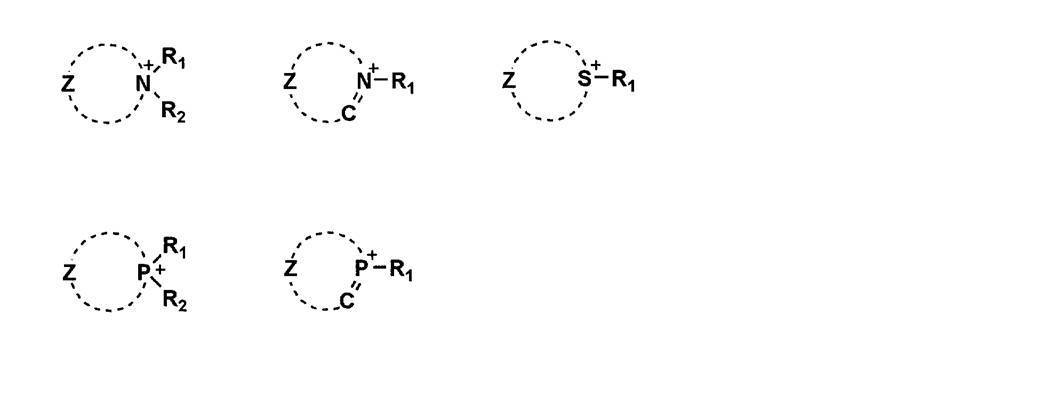
式中、R1およびR2は、この上で定義した通りであり、Zは、N+、N+=C、S+、P+あるいはP+=Cを含む4~10員環を構成しうる原子を指し、この構成する原子には置換基を有していても良い。
上述の中で、R1からR4の具体的な例はとしては、メチル、エチル、n-プロピル、イソプロピル、n-ブチル、イソブチル、sec-ブチル、tert-ブチル、ペンチル、ヘキシル、ヘプチル、オクチル、ノニル、デシルなどの直鎖又は分枝を有するアルキル基、シクロプロピル、シクロブチル、シクロペンチル、シクロヘキシル、シクロヘプチル、シクロオクチルなどのシクロアルキル基、無置換あるいはハロゲン原子(例えば、F、Cl、Br、I)、水酸基、低級アルコキシ基(例えば、メトキシ、エトキシ、プロポキシ、ブトキシ等の各基)、カルボキシル基、アセチル基、プロパノイル基、チオール基、低級アルキルチオ基(例えば、メチルチオ、エチルチオ、プロピルチオ、ブチルチオ等の各基)、アミノ基、低級アルキルアミノ基、ジ低級アルキルアミノ基などの置換基を1~3個有するフェニル、ナフチル、トルイル、キシリル等のアリール基、ベンジルなどのアラルキル基などを挙げることができる。また、R5の具体的な例としては、メチル、エチル、n-プロピル、イソプロピル、n-ブチル、イソブチル、sec-ブチル、tert-ブチルなどのアルキル基などが挙げられ、R6としてはメチレン基、エチレン基、プロピレン基、ブチレン基などのアルキレン基などを挙げることができる。さらにR7の具体的な例はとしては、メチレン、エチレン、プロピレン、ブチレンなどのアルキレン基、フェニレンなどのフェニレン基などを挙げることができる。
また、一般式において、A-で表される対アニオンとしては、ヘキサフルオロ燐酸塩、ヘキサフルオロアンチモン酸塩、ヘキサフルオロヒ酸塩、フルオロスルホン酸塩、テトラフルオロホウ酸塩、硝酸塩、アルキルスルホン酸塩、フッ化アルキルスルホン酸塩または水素硫酸塩を表す。
さらに、WO95/18456号、特開平8-259543号、特開2001-243995号、電気化学第65巻11号923頁(1997年)、EP-718288号、J.Electrochem.Soc.,Vol.143,No.10,3099(1996)、Inorg.Chem.1996,35,1168~1178等に記載されているピリジニウム塩、イミダゾリウム塩、トリアゾリウム塩なども本発明に応じては適時選択して用いることができる。
〔固体電解質、ゲル電解質〕
本発明に係る電解質は、溶媒やイオン性液体から成る溶液状の電解質以外にも、実質的に溶媒を含まない固体電解質や高分子化合物を含有した高粘度な電解質やゲル状の電解質(以下、ゲル電解質)を用いることができる。
本発明に係る電解質は、溶媒やイオン性液体から成る溶液状の電解質以外にも、実質的に溶媒を含まない固体電解質や高分子化合物を含有した高粘度な電解質やゲル状の電解質(以下、ゲル電解質)を用いることができる。
本発明に適用可能な固体電解質、ゲル電解質としては、例えば、特開2002-341387号公報に記載の固体電解質、特開2002-341387号公報に記載のポリマー固体電解質、特開2004-20928号公報に記載の高分子固体電解質、特開2004-191945号公報に記載の高分子固体電解質、特開2005-338204号公報に記載の固体高分子電解質、特開2006-323022号公報に記載の高分子固体電解質、特開2007-141658号公報に記載の固体電解質、特開2007-163865号公報に記載の固体電解質、ゲル電解質等を挙げることができる。
〔電子絶縁層〕
本発明の表示素子には、電子絶縁層を設けることができる。
本発明の表示素子には、電子絶縁層を設けることができる。
本発明に適用可能な電子絶縁層は、イオン電導性、電子絶縁性を合わせて有する層であればよく、例えば、極性基を有する高分子や塩をフィルム状にした固体電解質膜、電子絶縁性の高い多孔質膜とその空隙に電解質を担持する擬固体電解質膜、空隙を有する高分子多孔質膜、含ケイ素化合物の様な比誘電率が低い無機材料の多孔質膜、等が挙げられる。
多孔質膜の形成方法としては、焼結法(融着法)(高分子微粒子や無機粒子をバインダ等を添加して部分的に融着させ粒子間に生じた孔を利用する)、抽出法(溶剤に可溶な有機物又は無機物類と溶剤に溶解しないバインダ等で構成層を形成した後に、溶剤で有機物又は無機物類を溶解させ細孔を得る)、高分子重合体等を加熱や脱気するなどして発泡させる発泡法、良溶媒と貧溶媒を操作して高分子類の混合物を相分離させる相転換法、各種放射線を輻射して細孔を形成させる放射線照射法等の公知の形成方法を用いることができる。具体的な電気絶縁層としては、例えば、特開平10-30181号、特開2003-107626号、特公平7-95403号、特許第2635715号、同第2849523号、同第2987474号、同第3066426号、同第3464513号、同第3483644号、同第3535942号、同第3062203号等に記載の電子絶縁層を挙げることができる。
〔電解質添加の増粘剤〕
本発明の表示素子においては、電解質に増粘剤を使用することができ、例えば、ゼラチン、アラビアゴム、ポリ(ビニルアルコール)、ヒドロキシエチルセルロース、ヒドロキシプロピルセルロース、セルロースアセテート、セルロースアセテートブチレート、ポリ(ビニルピロリドン)、ポリ(アルキレングリコール)、カゼイン、デンプン、ポリ(アクリル酸)、ポリ(メチルメタクリル酸)、ポリ(塩化ビニル)、ポリ(メタクリル酸)、コポリ(スチレン-無水マレイン酸)、コポリ(スチレン-アクリロニトリル)、コポリ(スチレン-ブタジエン)、ポリ(ビニルアセタール)類(例えば、ポリ(ビニルホルマール)及びポリ(ビニルブチラール))、ポリ(エステル)類、ポリ(ウレタン)類、フェノキシ樹脂、ポリ(塩化ビニリデン)、ポリ(エポキシド)類、ポリ(カーボネート)類、ポリ(ビニルアセテート)、セルロースエステル類、ポリ(アミド)類、疎水性透明バインダとして、ポリビニルブチラール、セルロースアセテート、セルロースアセテートブチレート、ポリエステル、ポリカーボネート、ポリアクリル酸、ポリウレタン等が挙げられる。
本発明の表示素子においては、電解質に増粘剤を使用することができ、例えば、ゼラチン、アラビアゴム、ポリ(ビニルアルコール)、ヒドロキシエチルセルロース、ヒドロキシプロピルセルロース、セルロースアセテート、セルロースアセテートブチレート、ポリ(ビニルピロリドン)、ポリ(アルキレングリコール)、カゼイン、デンプン、ポリ(アクリル酸)、ポリ(メチルメタクリル酸)、ポリ(塩化ビニル)、ポリ(メタクリル酸)、コポリ(スチレン-無水マレイン酸)、コポリ(スチレン-アクリロニトリル)、コポリ(スチレン-ブタジエン)、ポリ(ビニルアセタール)類(例えば、ポリ(ビニルホルマール)及びポリ(ビニルブチラール))、ポリ(エステル)類、ポリ(ウレタン)類、フェノキシ樹脂、ポリ(塩化ビニリデン)、ポリ(エポキシド)類、ポリ(カーボネート)類、ポリ(ビニルアセテート)、セルロースエステル類、ポリ(アミド)類、疎水性透明バインダとして、ポリビニルブチラール、セルロースアセテート、セルロースアセテートブチレート、ポリエステル、ポリカーボネート、ポリアクリル酸、ポリウレタン等が挙げられる。
これらの増粘剤は2種以上を併用して用いてもよい。また、特開昭64-13546号公報の71~75頁に記載の化合物を挙げることができる。これらの中で好ましく用いられる化合物は、各種添加剤との相溶性と白色粒子の分散安定性向上の観点から、ポリビニルアルコール類、ポリビニルピロリドン類、ヒドロキシプロピルセルロース類、ポリアルキレングリコール類である。
〔その他〕
本発明の表示素子においては、構成層として、保護層、フィルター層、ハレーション防止層、クロスオーバー光カット層、バッキング層等の補助層を必要に応じて設けることができ、これらの補助層中には、各種の化学増感剤、貴金属増感剤、感光色素、強色増感剤、カプラー、高沸点溶剤、カブリ防止剤、安定剤、現像抑制剤、漂白促進剤、定着促進剤、混色防止剤、ホルマリンスカベンジャー、色調剤、硬膜剤、界面活性剤、増粘剤、可塑剤、スベリ剤、紫外線吸収剤、イラジエーション防止染料、フィルター光吸収染料、防ばい剤、ポリマーラテックス、重金属、帯電防止剤、マット剤等を、必要に応じて含有させることができる。
本発明の表示素子においては、構成層として、保護層、フィルター層、ハレーション防止層、クロスオーバー光カット層、バッキング層等の補助層を必要に応じて設けることができ、これらの補助層中には、各種の化学増感剤、貴金属増感剤、感光色素、強色増感剤、カプラー、高沸点溶剤、カブリ防止剤、安定剤、現像抑制剤、漂白促進剤、定着促進剤、混色防止剤、ホルマリンスカベンジャー、色調剤、硬膜剤、界面活性剤、増粘剤、可塑剤、スベリ剤、紫外線吸収剤、イラジエーション防止染料、フィルター光吸収染料、防ばい剤、ポリマーラテックス、重金属、帯電防止剤、マット剤等を、必要に応じて含有させることができる。
上述したこれらの添加剤は、より詳しくは、リサーチ・ディスクロージャー(以下、RDと略す)第176巻Item/17643(1978年12月)、同184巻Item/18431(1979年8月)、同187巻Item/18716(1979年11月)及び同308巻Item/308119(1989年12月)に記載されている。
これら三つのリサーチ・ディスクロージャーに示されている化合物種類と記載箇所を、下記表1に示す。

〔基板〕
本発明で用いることのできる基板としては、透明基板であることが好ましく、このような透明基板としては、ポリエステル(例えば、ポリエチレンテレフタレート等)、ポリイミド、ポリメタクリル酸メチル、ポリスチレン、ポリプロピレン、ポリエチレン、ポリアミド、ナイロン、ポリ塩化ビニル、ポリ塩化ビニリデン、ポリカーボネート、ポリエーテルスルフォン、シリコン樹脂、ポリアセタール樹脂、フッ素樹脂、セルロース誘導体、ポリオレフィンなどの高分子のフィルムや板状基板、ガラス基板などが好ましく用いられる。本発明に用いられる透明な基板とは、可視光に対する透過率が少なくとも50%以上の基板をいう。
本発明で用いることのできる基板としては、透明基板であることが好ましく、このような透明基板としては、ポリエステル(例えば、ポリエチレンテレフタレート等)、ポリイミド、ポリメタクリル酸メチル、ポリスチレン、ポリプロピレン、ポリエチレン、ポリアミド、ナイロン、ポリ塩化ビニル、ポリ塩化ビニリデン、ポリカーボネート、ポリエーテルスルフォン、シリコン樹脂、ポリアセタール樹脂、フッ素樹脂、セルロース誘導体、ポリオレフィンなどの高分子のフィルムや板状基板、ガラス基板などが好ましく用いられる。本発明に用いられる透明な基板とは、可視光に対する透過率が少なくとも50%以上の基板をいう。
また、対向基板としては、例えば、金属基板、セラミック基板等の無機基板など不透明な基板を用いることもできる。
〔電極〕
(表示側透明電極)
対向電極のうち、表示側に配置する電極としては、透明電極であることが好ましい。
(表示側透明電極)
対向電極のうち、表示側に配置する電極としては、透明電極であることが好ましい。
透明電極としては、透明で電気を通じるものであれば特に制限はない。例えば、Indium Tin Oxide(ITO:インジウム錫酸化物)、Indium Zinc Oxide(IZO:インジウム亜鉛酸化物)、フッ素ドープ酸化スズ(FTO)、酸化インジウム、酸化亜鉛、白金、金、銀、ロジウム、銅、クロム、炭素、アルミニウム、シリコン、アモルファスシリコン、BSO(Bismuth Silicon Oxide)等が挙げられる。
また、ポリチオフェン、ポリピロール、ポリアニリン、ポリアセチレン、ポリパラフェニレン、ポリセレノフェニレン等、およびそれらの修飾化合物を単独あるいは混合して用いることができる。
表面抵抗値としては、100Ω/□以下が好ましく、10Ω/□以下がより好ましい。透明電極の厚みは特に制限はないが、0.1~20μmであるのが一般的である。
(透明多孔質電極)
透明電極の一つの態様として、上記透明電極上にナノ多孔質構造を有するナノ多孔質電極を設けることができる。このナノ多孔質電極は、表示素子を形成した際に実質的に透明で、エレクトロクロミック色素等の電気活性物質を担持することができる。
透明電極の一つの態様として、上記透明電極上にナノ多孔質構造を有するナノ多孔質電極を設けることができる。このナノ多孔質電極は、表示素子を形成した際に実質的に透明で、エレクトロクロミック色素等の電気活性物質を担持することができる。
本発明でいうナノ多孔質化構造とは、層中にナノメートルサイズの孔が無数に存在し、ナノ多孔質化構造内を電解質中に含まれるイオン種が移動可能な状態のことを言う。
このようなナノ多孔質電極の形成方法としては、ナノ多孔質電極を構成する微粒子を含んだ分散物をインクジェット法、スクリーン印刷法、ブレード塗布法などで層状に形成した後に、所定の温度で加熱、乾燥、焼成することよって多孔質化する方法や、スパッタ法、CVD法、大気圧プラズマ法などで電極層を構成した後に、陽極酸化、光電気化学エッチングすることによってナノ多孔質化する方法などが挙げられる。また、ゾルゲル法や、Adv.Mater.2006,18,2980-2983に記載された方法でも、形成することができる。
ナノ多孔質電極を構成する微粒子の主成分は、Cu、Al、Pt、Ag、Pd、Au等の金属やITO、SnO2、TiO2、ZnO等の金属酸化物やカーボンナノチューブ、グラッシーカーボン、ダイヤモンドライクカーボン、窒素含有カーボン等の炭素電極から選択することができ、好ましくは、ITO、SnO2、TiO2、ZnO等の金属酸化物から選択されることである。
ナノ多孔質電極が透明性を有するためには、平均粒子径が5nm~10μm程度の微粒子を用いることが好ましい。微粒子の形状は不定形、針状、球形など任意の形状のものを用いることができる。
ナノ多孔質電極の膜厚は、0.1~10μmの範囲であることが好ましく、より好ましくは0.25~5μmの範囲である。
(グリッド電極:補助電極)
本発明に係る対向電極のうち少なくとも一方の電極に、補助電極を付帯させることができる。
本発明に係る対向電極のうち少なくとも一方の電極に、補助電極を付帯させることができる。
補助電極は、主となる電極部より電気抵抗が低い材料を用いることが好ましい。例えば、白金、金、銀、銅、アルミニウム、亜鉛、ニッケル、チタン、ビスマスなどの金属およびそれらの合金等を好ましく用いることができる。
補助電極は、主となる電極部と基板との間と、主となる電極部の基板と反対側の表面とのいずれに設置することもできる。いずれにしても、補助電極が主となる電極部と電気的に接続していればよい。
補助電極の配置パターンには、特に制限はない。直線状、メッシュ状、円形など、求められる性能に応じて適宜形成することが可能である。主となる電極部が複数の部分に分割されている場合には、分割された電極部同士を接続する形で設けてもよい。ただし、主となる電極部が表示側の基板に設けられた透明電極の場合、補助電極は、表示素子の視認性を阻害しない形状と頻度で設けることが求められる。
補助電極を形成する方法としては、公知の方法を用いることができる。例えば、フォトリソグラフィー法でパターニングする方法、印刷法やインクジェット法、電解メッキや無電解メッキ、銀塩感光材料を用いて露光、現像処理してパターン形成する方法でも良い。
補助電極パターンのライン幅やライン間隔は、任意の値で構わないが、導電性を高くするためにはライン幅を太くする必要がある。一方、透明電極に補助電極を付帯させる場合には、視認性の観点から、表示素子観察側から見た補助電極の面積被覆率は30%以下が好ましく、さらに好ましくは10%以下である。
このように透過率と導電性の点から、補助電極のライン幅は1μm以上、100μm以下が好ましく、ライン間隔は50μmから1000μmが好ましい。
(電極の形成方法)
透明電極、金属補助電極を形成するには、公知の方法を用いることができる。例えば、基板上にスパッタリング法等でマスク蒸着する方法や、全面形成した後に、フォトリソグラフィー法でパターニングする方法等が挙げられる。
透明電極、金属補助電極を形成するには、公知の方法を用いることができる。例えば、基板上にスパッタリング法等でマスク蒸着する方法や、全面形成した後に、フォトリソグラフィー法でパターニングする方法等が挙げられる。
また、電解メッキや無電解メッキ、印刷法や、インクジェット法によっても電極形成が可能である。
インクジェット方式を用いて基板上にモノマー重合能を有する触媒層を含む電極パターンを形成した後に、該触媒により重合されて重合後に導電性高分子層になりうるモノマー成分を付与して、モノマー成分を重合し、さらに、該導電性高分子層の上に銀等の金属メッキを行うことにより金属電極パターンを形成することもでき、フォトレジストやマスクパターンを使用することがないので、工程を大幅に簡略化できる。
電極材料を塗布方式で形成する場合には、例えば、ディッピング法、スピナー法、スプレー法、ロールコーター法、フレキソ印刷法、スクリーン印刷法等の公知の方法を用いることができる。
インクジェット方式の中でも、下記の静電インクジェット方式は高粘度の液体を高精度に連続的に印字することが可能であり、本発明においては、透明電極や金属補助電極の形成に好ましく用いられる。インクの粘度は、好ましくは30mPa・s以上であり、更に好ましくは100mPa・s以上である。
〈静電インクジェット方式〉
本発明の表示素子においては、複合電極の透明電極及び金属補助電極の少なくとも1方が、帯電した液体を吐出する内部直径が30μm以下のノズルを有する液体吐出ヘッドと、前記ノズル内に溶液を供給する供給手段と、前記ノズル内の溶液に吐出電圧を印加する吐出電圧印加手段とを備えた液体吐出装置を用いて形成されることが好ましい態様の1つである。さらにノズル内の溶液がノズル先端部から凸状に盛り上がった状態を形成する凸状メニスカス形成手段を設けた吐出装置を用いて形成されることが好ましい。
本発明の表示素子においては、複合電極の透明電極及び金属補助電極の少なくとも1方が、帯電した液体を吐出する内部直径が30μm以下のノズルを有する液体吐出ヘッドと、前記ノズル内に溶液を供給する供給手段と、前記ノズル内の溶液に吐出電圧を印加する吐出電圧印加手段とを備えた液体吐出装置を用いて形成されることが好ましい態様の1つである。さらにノズル内の溶液がノズル先端部から凸状に盛り上がった状態を形成する凸状メニスカス形成手段を設けた吐出装置を用いて形成されることが好ましい。
また、凸状メニスカス形成手段を駆動する駆動電圧の印加及び吐出電圧印加手段による吐出電圧の印加を制御する動作制御手段を備え、この動作制御手段は、前記吐出電圧印加手段による吐出電圧の印加を行わせつつ液滴の吐出に際して、凸状メニスカス形成手段の駆動電圧の印加を行わせる第一の吐出制御部を有する液体吐出装置を用いることも好ましい。
また、凸状メニスカス形成手段の駆動及び吐出電圧印加手段による電圧印加を制御する動作制御手段を備え、この動作制御手段は、前記凸状メニスカス形成手段による溶液の盛り上げ動作と前記吐出電圧の印加とを同期させて行う第二の吐出制御部を有することを特徴とする液体吐出装置を用いること、前記動作制御手段は、前記溶液の盛り上げ動作及び吐出電圧の印加の後に前記ノズル先端部の液面を内側に引き込ませる動作制御を行う液面安定化制御部を有する液体吐出装置を用いることも好ましい形態である。
この様な静電インクジェットを用いて電極パターンを作製することにより、オンデマンド性に優れ、廃棄材料が少なく、寸法精度に優れた電極を得ることができ有利である。
〔表示素子のその他の構成要素〕
本発明の表示素子には、必要に応じて、シール剤、柱状構造物、スペーサー粒子を用いることができる。
本発明の表示素子には、必要に応じて、シール剤、柱状構造物、スペーサー粒子を用いることができる。
シール剤は外に漏れないように封入するためのものであり封止剤とも呼ばれ、エポキシ樹脂、ウレタン系樹脂、アクリル系樹脂、酢酸ビニル系樹脂、エン-チオール系樹脂、シリコン系樹脂、変性ポリマー樹脂等の、熱硬化型、光硬化型、湿気硬化型、嫌気硬化型等の硬化タイプを用いることができる。
柱状構造物は、基板間の強い自己保持性(強度)を付与し、例えば、格子配列等の所定のパターンに一定の間隔で配列された、円柱状体、四角柱状体、楕円柱状体、台形柱状体等の柱状構造物を挙げることができる。また、所定間隔で配置されたストライプ状のものでもよい。この柱状構造物はランダムな配列ではなく、等間隔な配列、間隔が徐々に変化する配列、所定の配置パターンが一定の周期で繰り返される配列等、基板の間隔を適切に保持でき、且つ、画像表示を妨げないように考慮された配列であることが好ましい。柱状構造物は表示素子の表示領域に占める面積の割合が1~40%であれば、表示素子として実用上十分な強度が得られる。
一対の基板間には、該基板間のギャップを均一に保持するためのスペーサーが設けられていてもよい。このスペーサーとしては、樹脂製または無機酸化物製の球体を例示できる。また、表面に熱可塑性の樹脂がコーティングしてある固着スペーサーも好適に用いられる。基板間のギャップを均一に保持するために柱状構造物のみを設けてもよいが、スペーサー及び柱状構造物をいずれも設けてもよいし、柱状構造物に代えて、スペーサーのみをスペース保持部材として使用してもよい。スペーサーの直径は柱状構造物を形成する場合はその高さ以下、好ましくは当該高さに等しい。柱状構造物を形成しない場合は、スペーサーの直径がセルギャップの厚みに相当する。
〔表示素子駆動方法〕
本発明の表示素子の駆動操作は、単純マトリックス駆動であっても、アクティブマトリック駆動であってもよい。本発明でいう単純マトリックス駆動とは、複数の正極を含む正極ラインと複数の負極を含む負極ラインとが対向する形で互いのラインが垂直方向に交差した回路に、順次電流を印加する駆動方法のことを言う。単純マトリックス駆動を用いることにより、回路構成や駆動ICを簡略化でき安価に製造できるメリットがある。アクティブマトリックス駆動は、走査線、データライン、電流供給ラインが碁盤目状に形成され、各碁盤目に設けられたTFT回路により駆動させる方式である。画素毎にスイッチングが行えるので、階調やメモリー機能などのメリットがあり、例えば、特開2004-29327号の図5に記載されている回路を用いることができる。
本発明の表示素子の駆動操作は、単純マトリックス駆動であっても、アクティブマトリック駆動であってもよい。本発明でいう単純マトリックス駆動とは、複数の正極を含む正極ラインと複数の負極を含む負極ラインとが対向する形で互いのラインが垂直方向に交差した回路に、順次電流を印加する駆動方法のことを言う。単純マトリックス駆動を用いることにより、回路構成や駆動ICを簡略化でき安価に製造できるメリットがある。アクティブマトリックス駆動は、走査線、データライン、電流供給ラインが碁盤目状に形成され、各碁盤目に設けられたTFT回路により駆動させる方式である。画素毎にスイッチングが行えるので、階調やメモリー機能などのメリットがあり、例えば、特開2004-29327号の図5に記載されている回路を用いることができる。
〔商品適用〕
本発明の表示素子は、電子書籍分野、IDカード関連分野、公共関連分野、交通関連分野、放送関連分野、決済関連分野、流通物流関連分野等の用いることができる。具体的には、ドア用のキー、学生証、社員証、各種会員カード、コンビニストアー用カード、デパート用カード、自動販売機用カード、ガソリンステーション用カード、地下鉄や鉄道用のカード、バスカード、キャッシュカード、クレジットカード、ハイウェイカード、運転免許証、病院の診察カード、電子カルテ、健康保険証、住民基本台帳、パスポート、電子ブック等が挙げられる。
本発明の表示素子は、電子書籍分野、IDカード関連分野、公共関連分野、交通関連分野、放送関連分野、決済関連分野、流通物流関連分野等の用いることができる。具体的には、ドア用のキー、学生証、社員証、各種会員カード、コンビニストアー用カード、デパート用カード、自動販売機用カード、ガソリンステーション用カード、地下鉄や鉄道用のカード、バスカード、キャッシュカード、クレジットカード、ハイウェイカード、運転免許証、病院の診察カード、電子カルテ、健康保険証、住民基本台帳、パスポート、電子ブック等が挙げられる。
以下、実施例を挙げて本発明を具体的に説明するが、本発明はこれらに限定されるものではない。なお、実施例において「部」あるいは「%」の表示を用いるが、特に断りがない限り「質量部」あるいは「質量%」を表す。
《電解液の調製》
(電解液1の調製)
ジメチルスルホキシド(表2には、DMSOと略記)2.5g中に、p-トルエンスルホン酸銀0.1g、ヨウ化ナトリウム0.2g及びトリエチルアンモニウムブロマイド0.025gを溶解させて、電解液1を得た。
(電解液1の調製)
ジメチルスルホキシド(表2には、DMSOと略記)2.5g中に、p-トルエンスルホン酸銀0.1g、ヨウ化ナトリウム0.2g及びトリエチルアンモニウムブロマイド0.025gを溶解させて、電解液1を得た。
(電解液2の調製)
ジメチルスルホキシド2.5g中に、p-トルエンスルホン酸銀0.1g、一般式(2)で表される化合物として例示化合物(2)-20を0.2g及びトリエチルアンモニウムブロマイド0.025gを溶解させて、電解液2を得た。
ジメチルスルホキシド2.5g中に、p-トルエンスルホン酸銀0.1g、一般式(2)で表される化合物として例示化合物(2)-20を0.2g及びトリエチルアンモニウムブロマイド0.025gを溶解させて、電解液2を得た。
(電解液3の調製)
ジメチルスルホキシド2.5g中に、p-トルエンスルホン酸銀0.1g、一般式(1)で表される化合物として例示化合物(1)-57を0.2g及びトリエチルアンモニウムブロマイド0.025gを溶解させて、電解液3を得た。
ジメチルスルホキシド2.5g中に、p-トルエンスルホン酸銀0.1g、一般式(1)で表される化合物として例示化合物(1)-57を0.2g及びトリエチルアンモニウムブロマイド0.025gを溶解させて、電解液3を得た。
(電解液4の調製)
ジメチルスルホキシド2.5g中に、p-トルエンスルホン酸銀0.1g、例示化合物(1)-57を1.87g、例示化合物(2)-20を0.13g及びトリエチルアンモニウムブロマイド0.025gを溶解させて、電解液4を得た。なお、電解液4における例示化合物(1)-57と例示化合物(2)-20とのモル比は、80mol%:20mol%である。
ジメチルスルホキシド2.5g中に、p-トルエンスルホン酸銀0.1g、例示化合物(1)-57を1.87g、例示化合物(2)-20を0.13g及びトリエチルアンモニウムブロマイド0.025gを溶解させて、電解液4を得た。なお、電解液4における例示化合物(1)-57と例示化合物(2)-20とのモル比は、80mol%:20mol%である。
(電解液5の調製)
ジメチルスルホキシド2.5g中に、p-トルエンスルホン酸銀0.1g、一般式(1)で表される化合物として例示化合物(1)-30を1.85g、一般式(2)で表される化合物として例示化合物(2)-20を0.15g及びトリエチルアンモニウムブロマイド0.025gを溶解させて、電解液5を得た。なお、電解液5における例示化合物(1)-30と例示化合物(2)-20とのモル比は、80mol%:20mol%である。
ジメチルスルホキシド2.5g中に、p-トルエンスルホン酸銀0.1g、一般式(1)で表される化合物として例示化合物(1)-30を1.85g、一般式(2)で表される化合物として例示化合物(2)-20を0.15g及びトリエチルアンモニウムブロマイド0.025gを溶解させて、電解液5を得た。なお、電解液5における例示化合物(1)-30と例示化合物(2)-20とのモル比は、80mol%:20mol%である。
(電解液6の調製)
ジメチルスルホキシド2.5g中に、p-トルエンスルホン酸銀0.1g、一般式(1)で表される化合物として例示化合物(1)-2を1.84g、一般式(2)で表される化合物として例示化合物(2)-20を0.16g及びトリエチルアンモニウムブロマイド0.025gを溶解させて、電解液6を得た。なお、電解液6における例示化合物(1)-2と例示化合物(2)-20とのモル比は、80mol%:20mol%である。
ジメチルスルホキシド2.5g中に、p-トルエンスルホン酸銀0.1g、一般式(1)で表される化合物として例示化合物(1)-2を1.84g、一般式(2)で表される化合物として例示化合物(2)-20を0.16g及びトリエチルアンモニウムブロマイド0.025gを溶解させて、電解液6を得た。なお、電解液6における例示化合物(1)-2と例示化合物(2)-20とのモル比は、80mol%:20mol%である。
(電解液7の調製)
ジメチルスルホキシド2.5g中に、p-トルエンスルホン酸銀0.1g、一般式(1)で表される化合物として例示化合物(1)-2を1.80g、一般式(2)で表される化合物として例示化合物(2)-12を0.20g及びトリエチルアンモニウムブロマイド0.025gを溶解させて、電解液7を得た。なお、電解液7における例示化合物(1)-2と例示化合物(2)-12とのモル比は、80mol%:20mol%である。
ジメチルスルホキシド2.5g中に、p-トルエンスルホン酸銀0.1g、一般式(1)で表される化合物として例示化合物(1)-2を1.80g、一般式(2)で表される化合物として例示化合物(2)-12を0.20g及びトリエチルアンモニウムブロマイド0.025gを溶解させて、電解液7を得た。なお、電解液7における例示化合物(1)-2と例示化合物(2)-12とのモル比は、80mol%:20mol%である。
(電解液8~11の調製)
上記電解液7の調製において、一般式(1)で表される化合物として例示化合物(1)-2と、一般式(2)で表される化合物として例示化合物(2)-12を、表2に記載のモル比率となるように変更した以外は同様にして、電解液8~11を得た。
上記電解液7の調製において、一般式(1)で表される化合物として例示化合物(1)-2と、一般式(2)で表される化合物として例示化合物(2)-12を、表2に記載のモル比率となるように変更した以外は同様にして、電解液8~11を得た。
(電解液12~14の調製)
上記電解液8の調製において、ジメチルスルホキシド(DMSO)を表2に記載の各溶媒に変更した以外は同様にして、電解液12~14を得た。
上記電解液8の調製において、ジメチルスルホキシド(DMSO)を表2に記載の各溶媒に変更した以外は同様にして、電解液12~14を得た。
(電解液15、16の調製)
上記電解液12の調製において、トリエチルアンモニウムブロマイドを、表2に記載の各リチウム塩に変更した以外は同様にして、電解液15、16を得た。なお、リチウム塩L-1はビス(トリフルオロメチルスルホニル)イミドリチウムであり、リチウム塩L-2はトリフルオロメタンスルホン酸リチウムである。
上記電解液12の調製において、トリエチルアンモニウムブロマイドを、表2に記載の各リチウム塩に変更した以外は同様にして、電解液15、16を得た。なお、リチウム塩L-1はビス(トリフルオロメチルスルホニル)イミドリチウムであり、リチウム塩L-2はトリフルオロメタンスルホン酸リチウムである。
(電解液17、18の調製)
上記電解液16の調製において、表2に記載のポリエチレングリコールを添加した以外は同様にして、電解液17、18を得た。なお、ポリエチレングリコールP-1は、重量平均分子量が10万のポリエチレングリコールであり、ポリエチレングリコールP-2は、重量平均分子量が1500のポリエチレングリコールである。
上記電解液16の調製において、表2に記載のポリエチレングリコールを添加した以外は同様にして、電解液17、18を得た。なお、ポリエチレングリコールP-1は、重量平均分子量が10万のポリエチレングリコールであり、ポリエチレングリコールP-2は、重量平均分子量が1500のポリエチレングリコールである。
(電解液19の調製)
上記電解液17の調製において、例示化合物(1)-2を、例示化合物(1)-1に変更した以外は同様にして、電解液19を得た。
上記電解液17の調製において、例示化合物(1)-2を、例示化合物(1)-1に変更した以外は同様にして、電解液19を得た。
(電解液20の調製)
上記電解液19の調製において、例示化合物(1)-1と例示化合物(2)-12の添加量を、表2に記載のモル比率に変更した以外は同様にして、電解液20を得た。
上記電解液19の調製において、例示化合物(1)-1と例示化合物(2)-12の添加量を、表2に記載のモル比率に変更した以外は同様にして、電解液20を得た。
(電解液21~23の調製)
上記電解液17の調製において、例示化合物(1)-2を表2に記載の各化合物に変更した以外は同様にして、電解液21~23を得た。
上記電解液17の調製において、例示化合物(1)-2を表2に記載の各化合物に変更した以外は同様にして、電解液21~23を得た。
《電極の作製》
(電極1の作製)
厚さ1.5mmで2cm×4cmのガラス基板上に、ピッチ145μm、電極幅130μmのITO(Indium Tin Oxide、インジウム錫酸化物)膜を真空蒸着法に従って形成して、透明電極(電極1)を得た。
(電極1の作製)
厚さ1.5mmで2cm×4cmのガラス基板上に、ピッチ145μm、電極幅130μmのITO(Indium Tin Oxide、インジウム錫酸化物)膜を真空蒸着法に従って形成して、透明電極(電極1)を得た。
(電極2の作製)
厚さ1.5mmで2cm×4cmのガラス基板上に、真空蒸着法を用いて、電極厚み0.1μm、ピッチ145μm、電極間隔130μmのニッケル電極を形成し、得られた電極をさらに置換金メッキ浴に浸漬し、電極表面から深さ0.05μmが金で置換された金-ニッケル電極(電極2)を得た。
厚さ1.5mmで2cm×4cmのガラス基板上に、真空蒸着法を用いて、電極厚み0.1μm、ピッチ145μm、電極間隔130μmのニッケル電極を形成し、得られた電極をさらに置換金メッキ浴に浸漬し、電極表面から深さ0.05μmが金で置換された金-ニッケル電極(電極2)を得た。
(電極3の作製)
上記作製した電極2上に、下記二酸化チタン分散物を乾燥後の平均膜厚が20μmになるようにスクリーン印刷し、その後50℃で30分間乾燥して溶媒を蒸発させた後、85℃の雰囲気中で1時間乾燥させて多孔質白色散乱層を形成した電極3を作製した。
上記作製した電極2上に、下記二酸化チタン分散物を乾燥後の平均膜厚が20μmになるようにスクリーン印刷し、その後50℃で30分間乾燥して溶媒を蒸発させた後、85℃の雰囲気中で1時間乾燥させて多孔質白色散乱層を形成した電極3を作製した。
〈二酸化チタン分散物の調製〉
水/エタノール混合溶液(1/1)に、クラレポバールPVA235(クラレ社製、ポリビニルアルコール樹脂)を固形分濃度で2質量%になるように添加し、加熱溶解させた後、石原産業社製の二酸化チタンCR-90を20質量%となるように超音波分散機で分散させて、二酸化チタン分散物を得た。
水/エタノール混合溶液(1/1)に、クラレポバールPVA235(クラレ社製、ポリビニルアルコール樹脂)を固形分濃度で2質量%になるように添加し、加熱溶解させた後、石原産業社製の二酸化チタンCR-90を20質量%となるように超音波分散機で分散させて、二酸化チタン分散物を得た。
《表示素子の作製》
(表示素子1の作製)
電極3の周辺部を、平均粒径40μmのガラス製球形ビーズを体積分率として10%含むオレフィン系封止剤で縁取りした後に、電極3と電極1とを、それぞれストライプ状の電極が直交するように貼り合わせ、さらに加熱押圧して空セルを作製した。該空セルに電解液1を真空注入し、注入口をエポキシ系の紫外線硬化樹脂にて封止し、表示素子1を作製した。
(表示素子1の作製)
電極3の周辺部を、平均粒径40μmのガラス製球形ビーズを体積分率として10%含むオレフィン系封止剤で縁取りした後に、電極3と電極1とを、それぞれストライプ状の電極が直交するように貼り合わせ、さらに加熱押圧して空セルを作製した。該空セルに電解液1を真空注入し、注入口をエポキシ系の紫外線硬化樹脂にて封止し、表示素子1を作製した。
(表示素子2~23の作製)
上記表示素子1の作製において、電解液1をそれぞれ電解液2~23に変更した以外は同様にして、表示素子2~23を作製した。
上記表示素子1の作製において、電解液1をそれぞれ電解液2~23に変更した以外は同様にして、表示素子2~23を作製した。
《表示素子の評価》
〔反射率安定性の評価〕
定電圧電源の両端子に作製した表示素子の両電極を接続し、各表示素子の表示電極側に+1.5Vの電圧を1秒間印加した後、-1.5Vの電圧を0.5秒間印加してグレーを表示させたときの波長550nmでの反射率をコニカミノルタセンシング社製の分光測色計CM-3700dで測定した。同様な駆動条件で合計10回駆動させ、得られた反射率の平均値をRave1とした。さらに1万回繰返し駆動させた後に同様な方法でRave2を求めた。ΔRBK1=|Rave1-Rave2|とし、ΔRBK1を繰返し駆動させたときの反射率の安定性の指標とした。
〔反射率安定性の評価〕
定電圧電源の両端子に作製した表示素子の両電極を接続し、各表示素子の表示電極側に+1.5Vの電圧を1秒間印加した後、-1.5Vの電圧を0.5秒間印加してグレーを表示させたときの波長550nmでの反射率をコニカミノルタセンシング社製の分光測色計CM-3700dで測定した。同様な駆動条件で合計10回駆動させ、得られた反射率の平均値をRave1とした。さらに1万回繰返し駆動させた後に同様な方法でRave2を求めた。ΔRBK1=|Rave1-Rave2|とし、ΔRBK1を繰返し駆動させたときの反射率の安定性の指標とした。
〔メモリー性の評価〕
定電圧電源の両端子に作製した表示素子の両電極を接続し、各表示素子の表示電極側に+1.5Vの電圧を1.5秒間印加して白表示させた後に、印加時間を調整しながら-1.5Vの電圧を印加し、反射率10%のグレーを表示させた。次に、グレー表示させた表示素子を50℃の環境下で放置し、10分後の反射率を測定し、反射率10%からの変化量をΔRGlayとし、ΔRGlayをメモリー性の指標とした。この時の反射率はコニカミノルタセンシング社製の分光測色計CM-3700dで測定した波長550nmでの反射率とする。
定電圧電源の両端子に作製した表示素子の両電極を接続し、各表示素子の表示電極側に+1.5Vの電圧を1.5秒間印加して白表示させた後に、印加時間を調整しながら-1.5Vの電圧を印加し、反射率10%のグレーを表示させた。次に、グレー表示させた表示素子を50℃の環境下で放置し、10分後の反射率を測定し、反射率10%からの変化量をΔRGlayとし、ΔRGlayをメモリー性の指標とした。この時の反射率はコニカミノルタセンシング社製の分光測色計CM-3700dで測定した波長550nmでの反射率とする。
以上により得られた各表示素子の構成及び評価結果を、表2に示す。
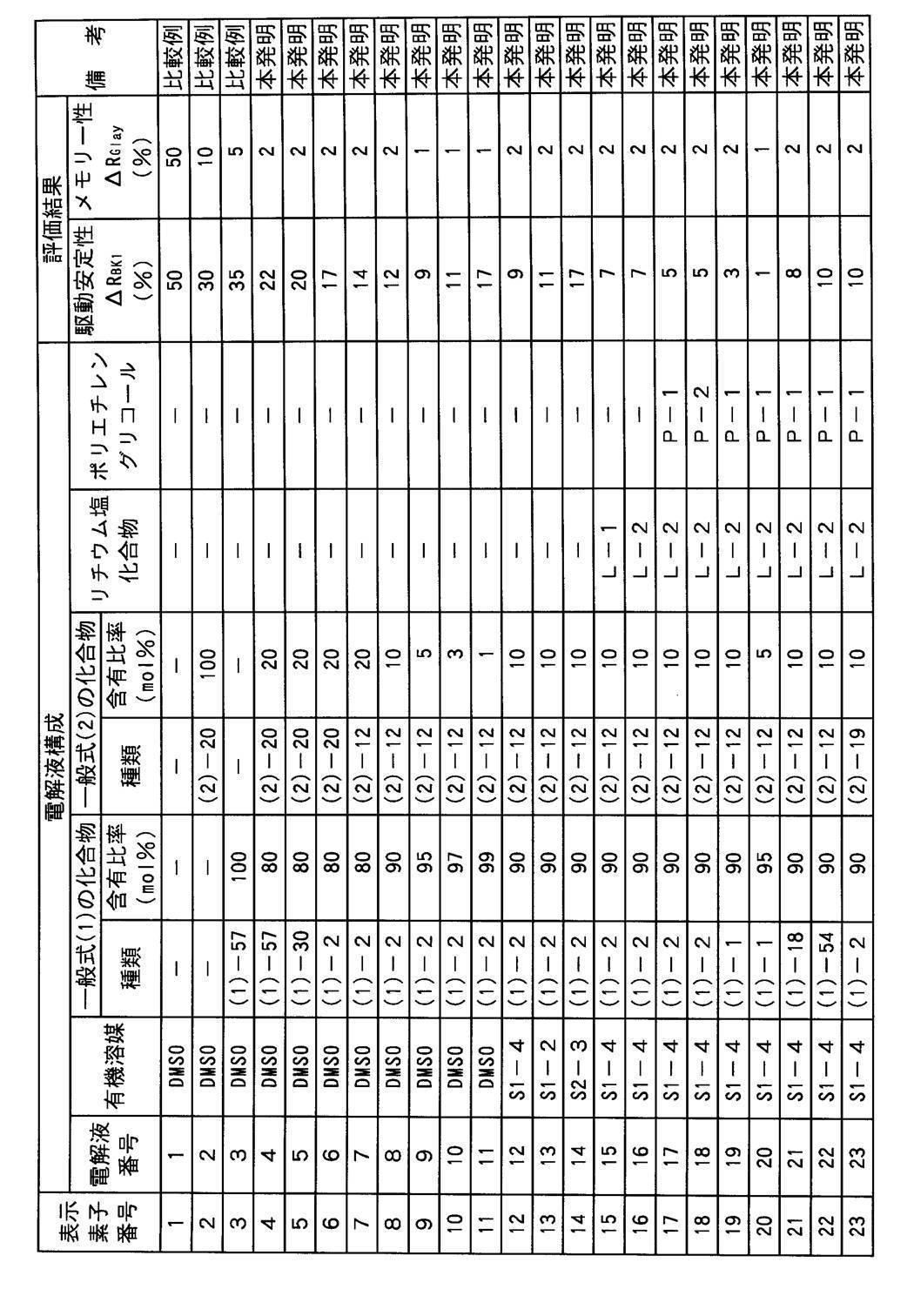
表2に記載の結果より明らかなように、電解質層に本発明に係る一般式(1)で表される化合物及び一般式(2)で表される化合物を含有した本発明の表示素子は、比較例に対し、メモリー性及び繰返し駆動させたときの反射率の安定性に優れていることが分かる。
更に、電解質層が有機溶媒として一般式(S1)また一般式(S2)で表される化合物を含有すること、リチウム塩を用いること、あるいはポリエチレングリコールを含有すること上記効果がより一層発現していることが分かる。特に、リチウム塩及びポリエチレングリコールを含有し、かつ一般式(2)で表される化合物の含有比率が5mol%である表示素子番号20は、良い効果を示すことが分かる。
Claims (9)
- 対向電極間に銀塩化合物を含有した電解質層を有する表示素子において、該電解質層が下記一般式(1)で表される化合物及び一般式(2)で表される化合物を含有していることを特徴とする表示素子。

〔式中、Xは硫黄原子または酸素原子を表し、化合物中の少なくとも1つのXは硫黄原子である。n、mは各々1以上、10以下の整数を、aは1以上、50以下の整数を表す。R1、R2、R3、R4、R5、R6は各々解離性プロトンを有していない置換基を表し、そのうちひとつはカルボニル基を含む。また、それぞれは、同じであっても異なっていても良く、それぞれで連結して環状構造を形成していてもよい。[]内は繰り返し単位を表し、繰り返されている場合、Xが表す原子はそれぞれ異なっていても良い。その場合、同様にR1およびR2もそれぞれ異なっていても良く、mの表す整数も異なっていても良い。〕
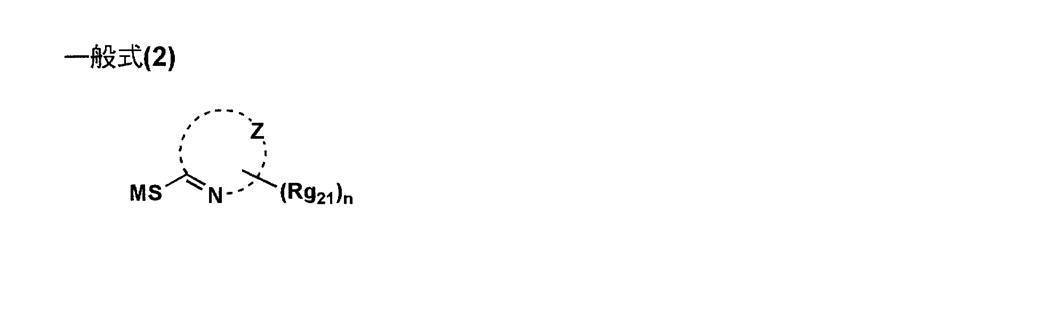
〔式中、Mは水素原子、金属原子または4級アンモニウムを表す。Zは含窒素複素環を構成するのに必要な原子群表す。nは0~5の整数を表し、Rg21は、水素原子、ハロゲン原子、アルキル基、アリール基、アルキルカルボンアミド基、アリールカルボンアミド基、アルキルスルホンアミド基、アリールスルホンアミド基、アルコキシ基、アリールオキシ基、アルキルチオ基、アリールチオ基、アルキルカルバモイル基、アリールカルバモイル基、カルバモイル基、アルキルスルファモイル基、アリールスルファモイル基、スルファモイル基、シアノ基、アルキルスルホニル基、アリールスルホニル基、アルコキシカルボニル基、アリールオキシカルボニル基、アルキルカルボニル基、アリールカルボニル基、アシルオキシ基、カルボキシル基、カルボニル基、スルホニル基、アミノ基、ヒドロキシ基または複素環基を表し、nが2以上の場合、それぞれのRg21は同じであってもよく、異なってもよく、お互いに連結して縮合環を形成してもよい。〕 - 前記一般式(1)で表される化合物におけるR5、R6が、各々カルボニル基を有していることを特徴とする請求項1に記載の表示素子。
- 前記一般式(1)で表される化合物におけるn及びmが、各々2または3であることを特徴とする請求項1または2に記載の表示素子。
- 前記一般式(1)で表される化合物におけるaが、2または3であることを特徴とする請求項1から3のいずれか1項に記載の表示素子。
- 前記一般式(2)で表される化合物におけるZが形成する含窒素複素環が、トリアゾール環であることを特徴とする請求項1から4のいずれか1項に記載の表示素子。
- 前記電解質層における前記一般式(1)で表される化合物及び一般式(2)で表される化合物の総含有量を100mol%としたとき、前記一般式(2)で表される化合物の含有比率が1mol%以上、5mol%以下であることを特徴とする請求項1から5のいずれか1項に記載の表示素子。
- 前記電解質層を構成する溶媒が、下記一般式(S1)で表される化合物または一般式(S2)で表される化合物であることを特徴とする請求項1から6のいずれか1項に記載の表示素子。

〔式中、Lは酸素原子またはアルキレン基を表し、Rs11からRs14は各々水素原子、アルキル基、アルケニル基、アリール基、シクロアルキル基、アルコキシアルキル基またはアルコキシ基を表す。〕
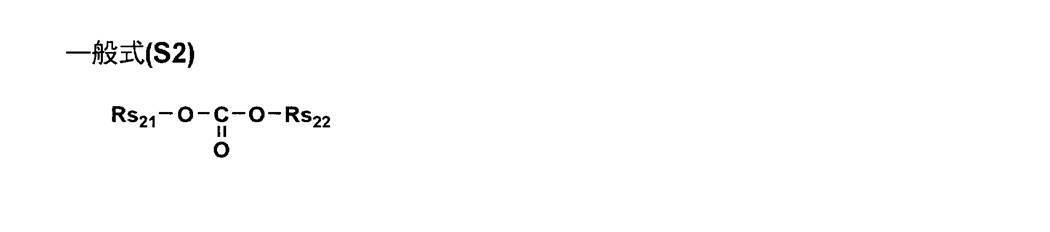
〔式中、Rs21、Rs22は各々アルキル基、アルケニル基、アリール基、シクロアルキル基、アルコキシアルキル基またはアルコキシ基を表す。〕 - 前記電解質層が、リチウム塩を含有していることを特徴とする請求項1から7のいずれか1項に記載の表示素子。
- 前記電解質層が、ポリエチレングリコールを含有していることを特徴とする請求項1から8のいずれか1項に記載の表示素子。
Priority Applications (1)
| Application Number | Priority Date | Filing Date | Title |
|---|---|---|---|
| JP2011521877A JP5488600B2 (ja) | 2009-07-08 | 2010-06-22 | 表示素子 |
Applications Claiming Priority (2)
| Application Number | Priority Date | Filing Date | Title |
|---|---|---|---|
| JP2009-161644 | 2009-07-08 | ||
| JP2009161644 | 2009-07-08 |
Publications (1)
| Publication Number | Publication Date |
|---|---|
| WO2011004699A1 true WO2011004699A1 (ja) | 2011-01-13 |
Family
ID=43429123
Family Applications (1)
| Application Number | Title | Priority Date | Filing Date |
|---|---|---|---|
| PCT/JP2010/060512 Ceased WO2011004699A1 (ja) | 2009-07-08 | 2010-06-22 | 表示素子 |
Country Status (2)
| Country | Link |
|---|---|
| JP (1) | JP5488600B2 (ja) |
| WO (1) | WO2011004699A1 (ja) |
Citations (1)
| Publication number | Priority date | Publication date | Assignee | Title |
|---|---|---|---|---|
| JP2008224717A (ja) * | 2007-03-08 | 2008-09-25 | Konica Minolta Holdings Inc | 表示素子 |
-
2010
- 2010-06-22 JP JP2011521877A patent/JP5488600B2/ja not_active Expired - Fee Related
- 2010-06-22 WO PCT/JP2010/060512 patent/WO2011004699A1/ja not_active Ceased
Patent Citations (1)
| Publication number | Priority date | Publication date | Assignee | Title |
|---|---|---|---|---|
| JP2008224717A (ja) * | 2007-03-08 | 2008-09-25 | Konica Minolta Holdings Inc | 表示素子 |
Also Published As
| Publication number | Publication date |
|---|---|
| JP5488600B2 (ja) | 2014-05-14 |
| JPWO2011004699A1 (ja) | 2012-12-20 |
Similar Documents
| Publication | Publication Date | Title |
|---|---|---|
| JP5177219B2 (ja) | 電気化学的表示素子 | |
| JP5131278B2 (ja) | 表示素子 | |
| JP5353894B2 (ja) | 表示素子 | |
| JP2010117635A (ja) | 表示素子 | |
| JP2010243632A (ja) | 表示素子の駆動方法及び表示素子 | |
| JP4998470B2 (ja) | 表示素子 | |
| JP5488600B2 (ja) | 表示素子 | |
| JPWO2008056510A1 (ja) | 表示素子 | |
| JP2010164683A (ja) | 表示素子 | |
| JP5347516B2 (ja) | 電気化学的表示素子の製造方法 | |
| JP2010256436A (ja) | 電気化学表示素子 | |
| JP2010117409A (ja) | 表示素子 | |
| JP2010139541A (ja) | 表示素子 | |
| JP2011017837A (ja) | 表示素子 | |
| JP2010243563A (ja) | 修飾電極及び電気化学表示素子 | |
| JP2010054566A (ja) | 電解質組成物及び表示素子 | |
| JP2010217692A (ja) | 表示素子 | |
| JP5256480B2 (ja) | 表示素子 | |
| JP2010164861A (ja) | 表示素子 | |
| JP2010197809A (ja) | 表示素子の駆動方法 | |
| WO2009150947A1 (ja) | 表示素子 | |
| JP2010237242A (ja) | 表示素子 | |
| JP2010197673A (ja) | 表示素子 | |
| JP2010256603A (ja) | 表示素子 | |
| JP2010197674A (ja) | 表示素子 |
Legal Events
| Date | Code | Title | Description |
|---|---|---|---|
| 121 | Ep: the epo has been informed by wipo that ep was designated in this application |
Ref document number: 10797010 Country of ref document: EP Kind code of ref document: A1 |
|
| WWE | Wipo information: entry into national phase |
Ref document number: 2011521877 Country of ref document: JP |
|
| NENP | Non-entry into the national phase |
Ref country code: DE |
|
| 122 | Ep: pct application non-entry in european phase |
Ref document number: 10797010 Country of ref document: EP Kind code of ref document: A1 |