WO2011002026A1 - アミロイド線維形成抑制剤及びその利用 - Google Patents
アミロイド線維形成抑制剤及びその利用 Download PDFInfo
- Publication number
- WO2011002026A1 WO2011002026A1 PCT/JP2010/061155 JP2010061155W WO2011002026A1 WO 2011002026 A1 WO2011002026 A1 WO 2011002026A1 JP 2010061155 W JP2010061155 W JP 2010061155W WO 2011002026 A1 WO2011002026 A1 WO 2011002026A1
- Authority
- WO
- WIPO (PCT)
- Prior art keywords
- dendrimer
- fibril formation
- amyloid
- amyloid fibril
- formation inhibitor
- Prior art date
- Legal status (The legal status is an assumption and is not a legal conclusion. Google has not performed a legal analysis and makes no representation as to the accuracy of the status listed.)
- Ceased
Links
Images




Classifications
-
- A—HUMAN NECESSITIES
- A61—MEDICAL OR VETERINARY SCIENCE; HYGIENE
- A61K—PREPARATIONS FOR MEDICAL, DENTAL OR TOILETRY PURPOSES
- A61K31/00—Medicinal preparations containing organic active ingredients
- A61K31/13—Amines
- A61K31/132—Amines having two or more amino groups, e.g. spermidine, putrescine
-
- A—HUMAN NECESSITIES
- A61—MEDICAL OR VETERINARY SCIENCE; HYGIENE
- A61K—PREPARATIONS FOR MEDICAL, DENTAL OR TOILETRY PURPOSES
- A61K31/00—Medicinal preparations containing organic active ingredients
- A61K31/70—Carbohydrates; Sugars; Derivatives thereof
- A61K31/7028—Compounds having saccharide radicals attached to non-saccharide compounds by glycosidic linkages
- A61K31/7032—Compounds having saccharide radicals attached to non-saccharide compounds by glycosidic linkages attached to a polyol, i.e. compounds having two or more free or esterified hydroxy groups, including the hydroxy group involved in the glycosidic linkage, e.g. monoglucosyldiacylglycerides, lactobionic acid, gangliosides
-
- A—HUMAN NECESSITIES
- A61—MEDICAL OR VETERINARY SCIENCE; HYGIENE
- A61P—SPECIFIC THERAPEUTIC ACTIVITY OF CHEMICAL COMPOUNDS OR MEDICINAL PREPARATIONS
- A61P1/00—Drugs for disorders of the alimentary tract or the digestive system
- A61P1/16—Drugs for disorders of the alimentary tract or the digestive system for liver or gallbladder disorders, e.g. hepatoprotective agents, cholagogues, litholytics
-
- A—HUMAN NECESSITIES
- A61—MEDICAL OR VETERINARY SCIENCE; HYGIENE
- A61P—SPECIFIC THERAPEUTIC ACTIVITY OF CHEMICAL COMPOUNDS OR MEDICINAL PREPARATIONS
- A61P25/00—Drugs for disorders of the nervous system
-
- A—HUMAN NECESSITIES
- A61—MEDICAL OR VETERINARY SCIENCE; HYGIENE
- A61P—SPECIFIC THERAPEUTIC ACTIVITY OF CHEMICAL COMPOUNDS OR MEDICINAL PREPARATIONS
- A61P25/00—Drugs for disorders of the nervous system
- A61P25/02—Drugs for disorders of the nervous system for peripheral neuropathies
-
- A—HUMAN NECESSITIES
- A61—MEDICAL OR VETERINARY SCIENCE; HYGIENE
- A61P—SPECIFIC THERAPEUTIC ACTIVITY OF CHEMICAL COMPOUNDS OR MEDICINAL PREPARATIONS
- A61P25/00—Drugs for disorders of the nervous system
- A61P25/14—Drugs for disorders of the nervous system for treating abnormal movements, e.g. chorea, dyskinesia
-
- A—HUMAN NECESSITIES
- A61—MEDICAL OR VETERINARY SCIENCE; HYGIENE
- A61P—SPECIFIC THERAPEUTIC ACTIVITY OF CHEMICAL COMPOUNDS OR MEDICINAL PREPARATIONS
- A61P25/00—Drugs for disorders of the nervous system
- A61P25/28—Drugs for disorders of the nervous system for treating neurodegenerative disorders of the central nervous system, e.g. nootropic agents, cognition enhancers, drugs for treating Alzheimer's disease or other forms of dementia
-
- A—HUMAN NECESSITIES
- A61—MEDICAL OR VETERINARY SCIENCE; HYGIENE
- A61P—SPECIFIC THERAPEUTIC ACTIVITY OF CHEMICAL COMPOUNDS OR MEDICINAL PREPARATIONS
- A61P43/00—Drugs for specific purposes, not provided for in groups A61P1/00-A61P41/00
Definitions
- the present invention relates to an amyloid fibril formation inhibitor containing dendrimer or a salt thereof as an active ingredient, and a medicament for preventing and / or treating amyloidosis containing the amyloid fibril formation inhibitor as an active ingredient.
- Amyloidosis refers to a group of diseases in which a protein having a ⁇ -sheet structure is polymerized to form insoluble amyloid or fibrils called amyloid fibrils, which are deposited in the living body and cause tissue damage.
- Virchow a German pathologist, has discovered that tissue samples of amyloidosis are stained purple with iodine. From this result, Virchow considered that the substance deposited in the tissue was a polysaccharide, named it “starch-like substance”, that is, “amyloid”, and proposed that the pathological condition caused by amyloid deposition was called amyloidosis .
- amyloid is a protein that forms fibers by polymerizing like nylon, and that amyloid contains serum amyloid P component, glycosaminoglycan, and the like.
- amyloid is defined as “an accumulation of unbranched fine fibers having a width of 8 to 15 nm that causes a birefringence that is dyed orange-red with Congo red staining and strongly shines green when observed under a polarizing microscope”.
- Amyloidosis includes various diseases such as familial amyloid polyneuropathy (FAP), Alzheimer's disease, Creutzfeldt-Jakob disease (mad cow disease), Huntington's disease and other inherited diseases.
- FAP familial amyloid polyneuropathy
- AD Alzheimer's disease
- Creutzfeldt-Jakob disease familial amyloid polyneuropathy
- Huntington's disease other inherited diseases.
- FAP is a systemic amyloidosis that causes amyloid deposition in systemic organs such as peripheral nerves, autonomic nerves, kidneys, and skin, and penetrates in an autosomal dominant manner. Cases have been confirmed. Since the first report of Portuguese FAP cases in 1952, similar cases have been reported from around the world.
- Amyloid fibrils that cause FAP are mainly composed of mutated serum protein transthyretin (TTR).
- TTR mutated serum protein transthyretin
- Normal TTR has a three-dimensional structure containing many ⁇ -sheet structures, and is produced in the liver, choroid plexus, retina, pancreatic ⁇ cells, etc., and more than 90% of them are said to be produced in the liver. Yes. Normal TTR forms a tetramer and plays a role as a transporter of vitamin A via thyroxine (T4), retinol binding protein (RBP) and the like. More than 100 types of mutants of normal TTR have been reported so far, and it has been clarified that the structural stability is low and the structural change from tetramer to monomer is likely to occur.
- T4 thyroxine
- RBP retinol binding protein
- FAPs in Japan are FAPs that use Val30Met mutant TTR as a causal protein.
- the main characteristics of FAP are multiple neuritis and autonomic neuropathy (alternative diarrhea and constipation, orthostatic hypotension, dysuria, etc.) with perceptual impairment that rises symmetrically from the lower extremity end. Also caused by neuropathy caused by amyloid. Later, amyloid deposits in the heart, kidney, and gastrointestinal tract become prominent, causing dysfunction of these organs. In general, it is a disease with a poor prognosis that develops in the late 20s to 30s, becomes unable to walk in 10 years and dies due to heart failure, renal failure, etc. over 10 years, and is also designated as a specified disease by the Ministry of Health and Welfare Is one of the intractable diseases.
- a mutant TTR protein capable of causing FAP has lower structural stability than normal TTR protein, and ⁇ -sheet structures in the molecule associate with each other to form insoluble amyloid fibrils and are deposited in tissues.
- liver transplantation treatment is performed because about 90% or more of mutant TTR is produced in the liver.
- inhibition of dissociation (dissociation) of tetrameric TTR molecules has been attempted as a method for treating FAP based on the amyloid fibril formation mechanism (Non-patent Documents 1 and 2).
- liver transplantation is ineffective for patients whose disease has progressed and there are many problems such as lack of donors.
- the FAP treatment method based on the amyloid fibril formation mechanism can prevent or treat FAP or both by suppressing amyloid fibril formation by the mutant TTR protein. Since this treatment method does not perform liver transplantation, it can be expected to avoid the above problems related to liver transplantation. However, in such a method, there is no method for treating FAP that has been clinically effective.
- a highly safe substance that suppresses amyloid fibril formation that can be applied to the prevention and / or treatment of amyloidosis has not been known so far.
- an object of the present invention is to provide a highly safe amyloid fibril formation inhibitor containing, as an active ingredient, a substance that can suppress amyloid fibril formation of a TTR protein. Furthermore, the object of the present invention is to provide a medicament for the prevention and / or treatment of amyloidosis, particularly a medicament for the prevention and / or treatment of familial amyloidosis polyneuropathy (FAP), comprising the inhibitor. Furthermore, another object is to provide a medicine for preventing the onset of sensory impairment and autonomic neuropathy caused by amyloidosis, and a medicine for treatment that enables prevention of progression of the perceptual disorder and autonomic neuropathy. .
- FAP familial amyloidosis polyneuropathy
- the present inventors have made various studies to solve the above problems, and found that dendrimers can suppress amyloid fibril formation and have completed the present invention. Therefore, according to this invention, the amyloid fibril formation inhibitor which contains a dendrimer or its salt as an active ingredient is provided.
- the dendrimer is a poly (amidoamine) dendrimer having an alkylene diamine as a core.
- the dendrimer is a second to tenth generation poly (amidoamine) dendrimer having an alkylene diamine as a core.
- the dendrimer is a second to sixth generation poly (amidoamine) dendrimer having an alkylene diamine as a core.
- the alkylene diamine is an alkylene diamine having 1 to 6 carbon atoms.
- At least one amine in the dendrimer is modified with polyethylene glycol or lactose.
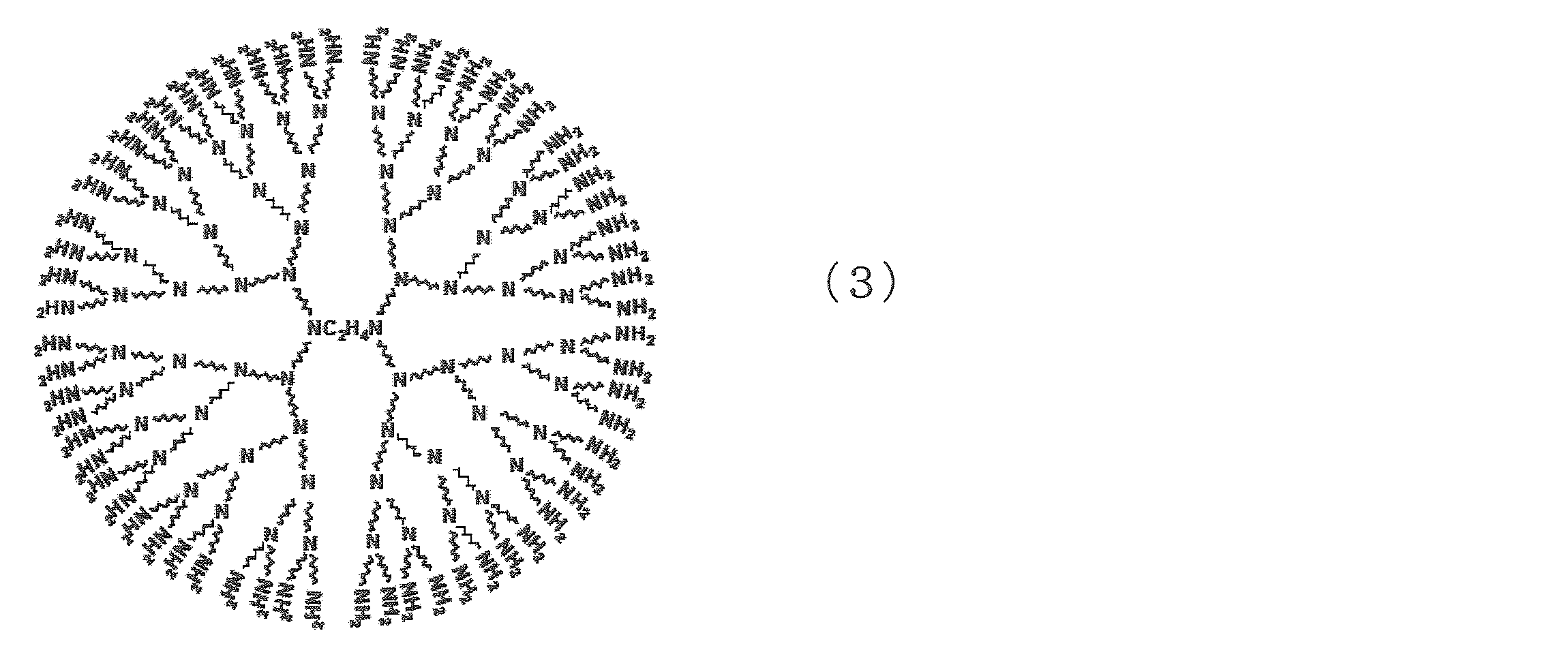
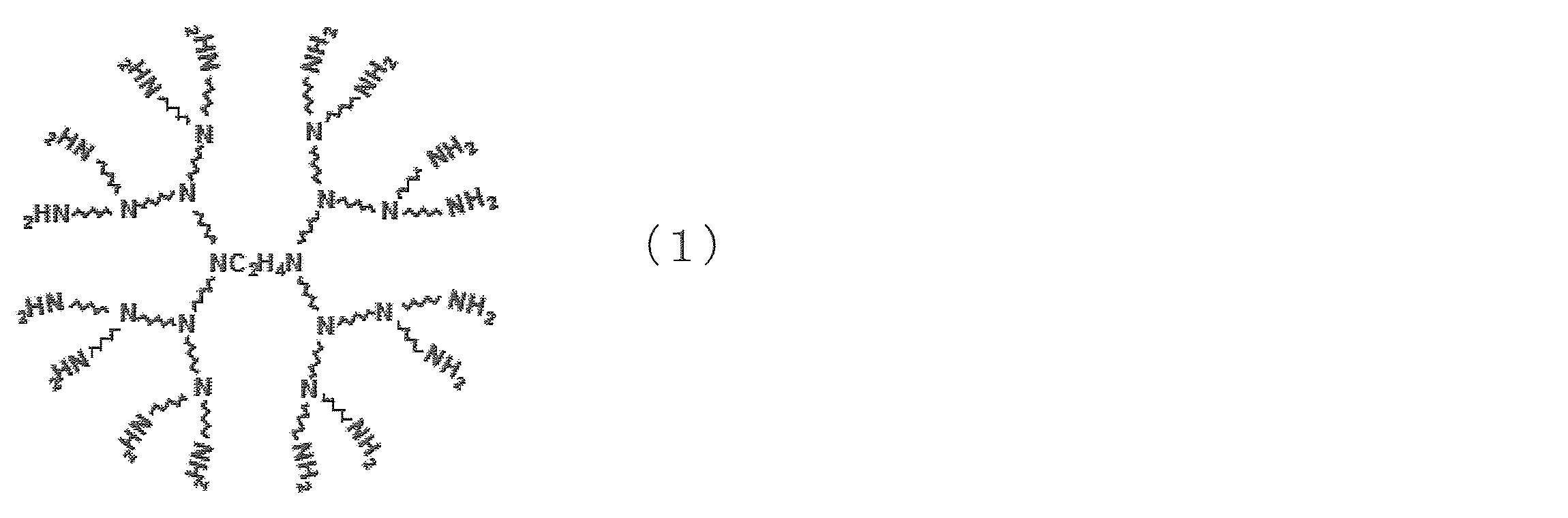
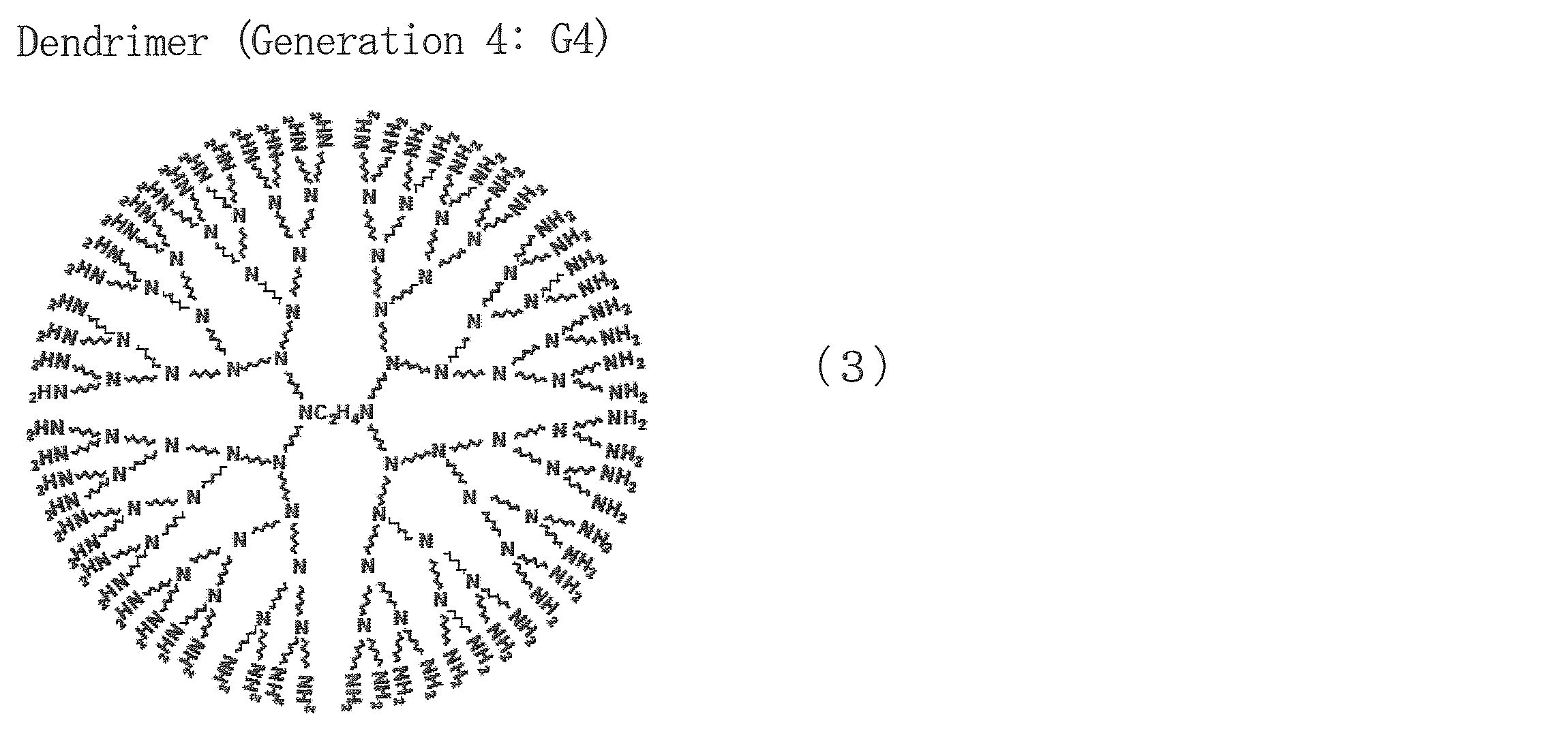
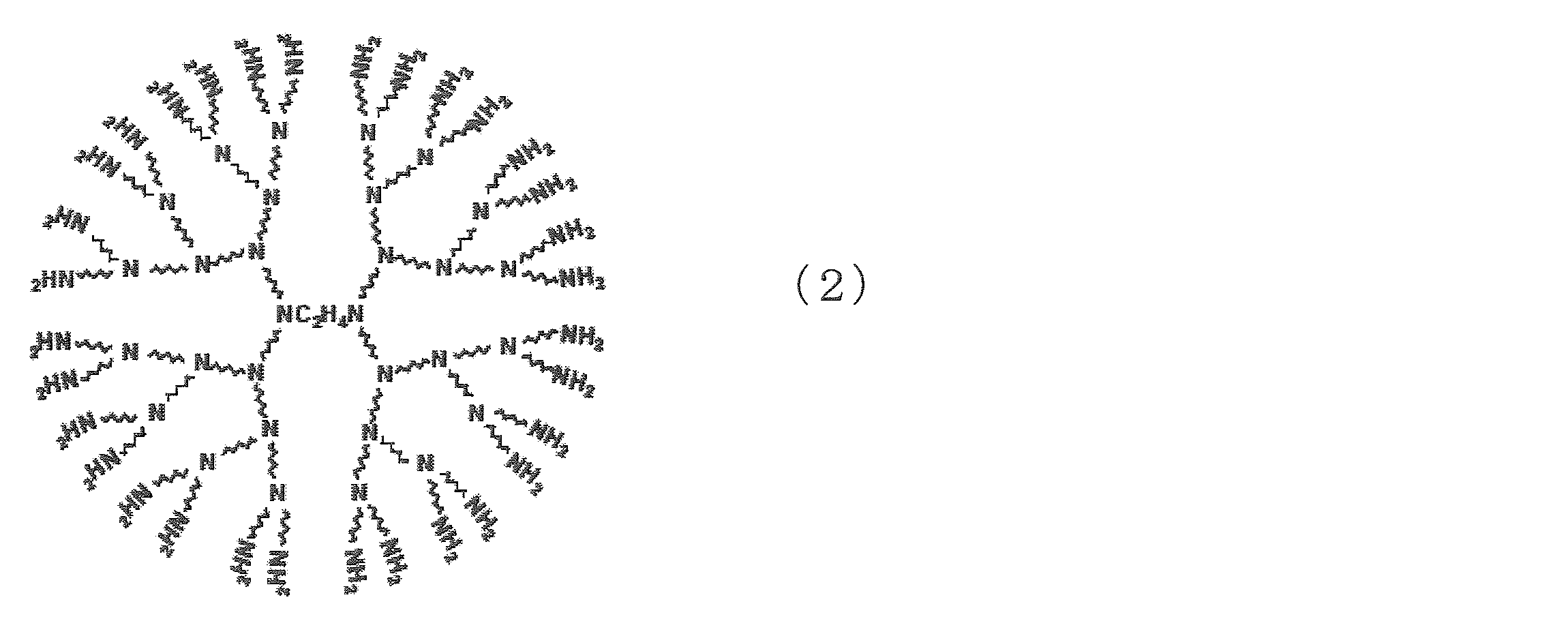
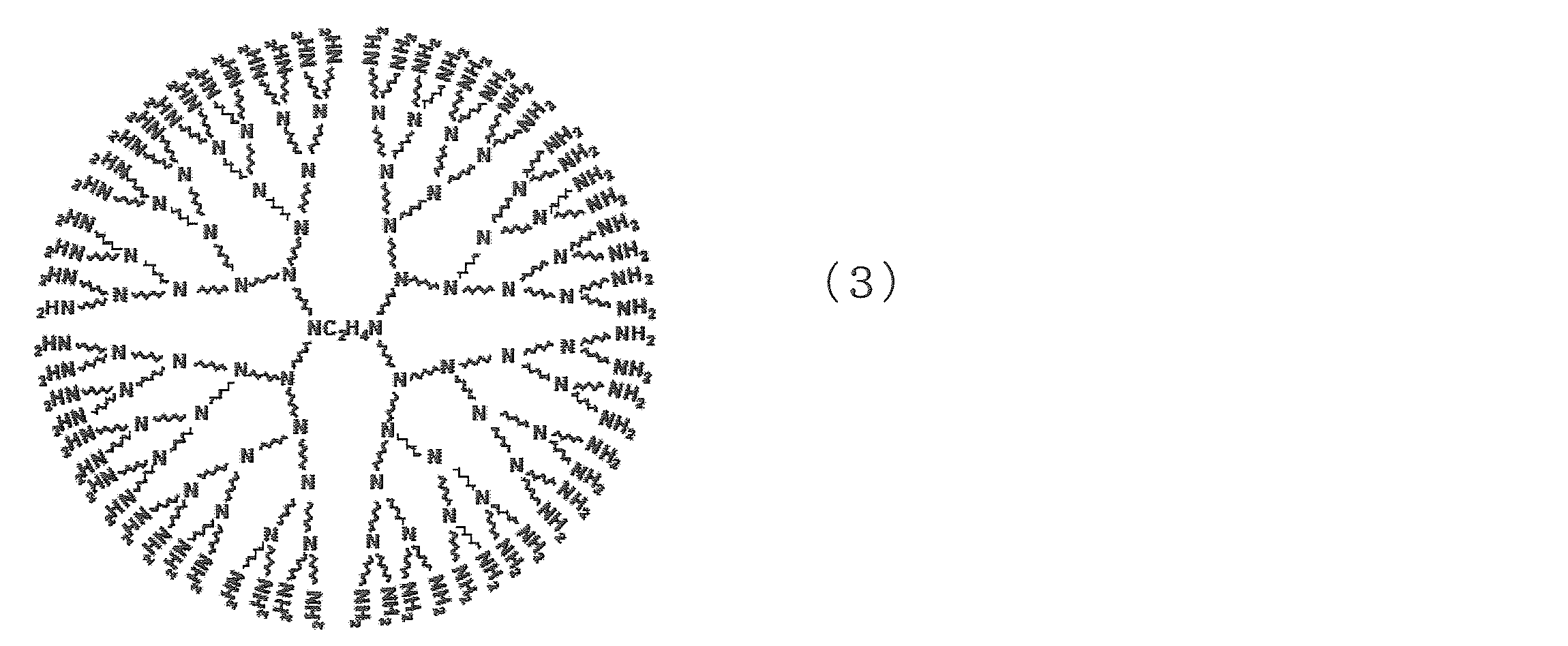
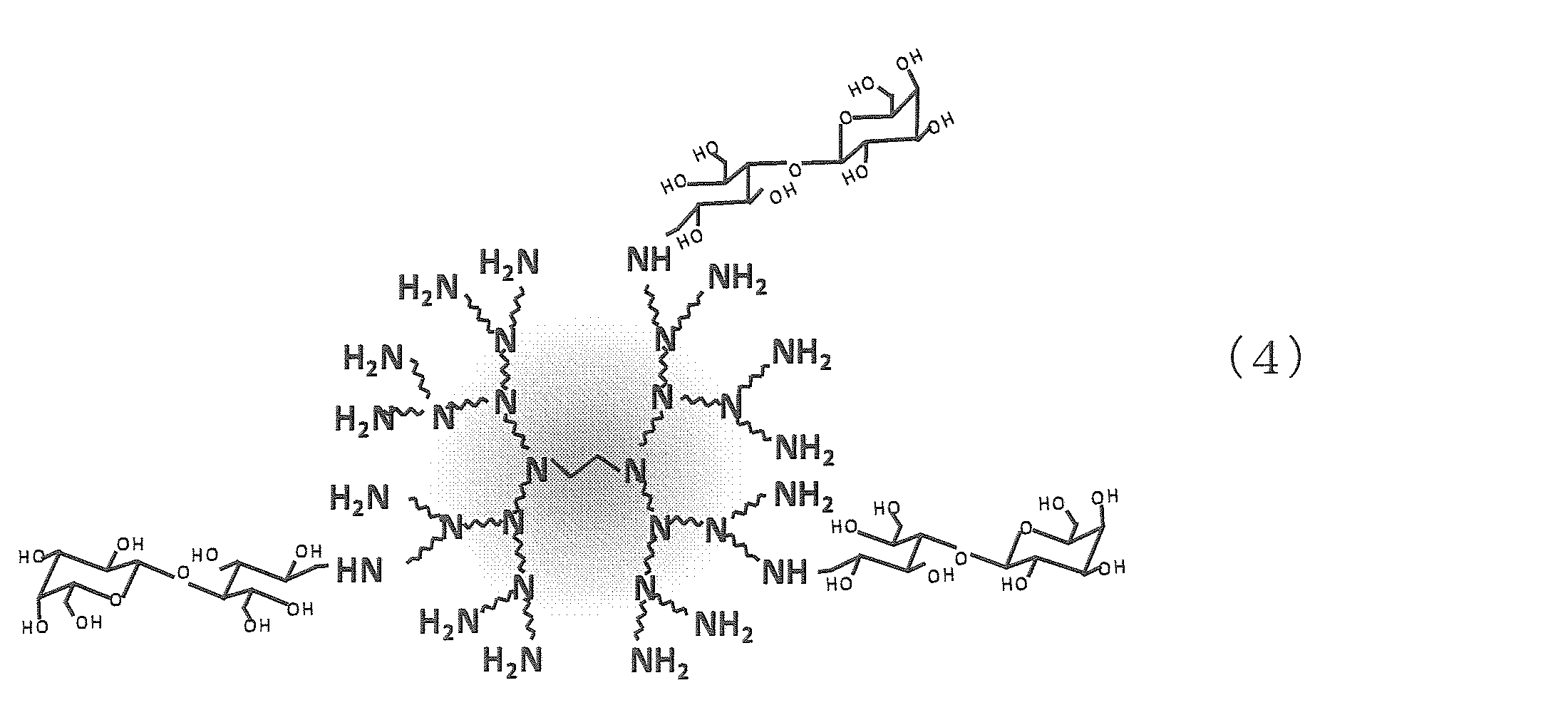
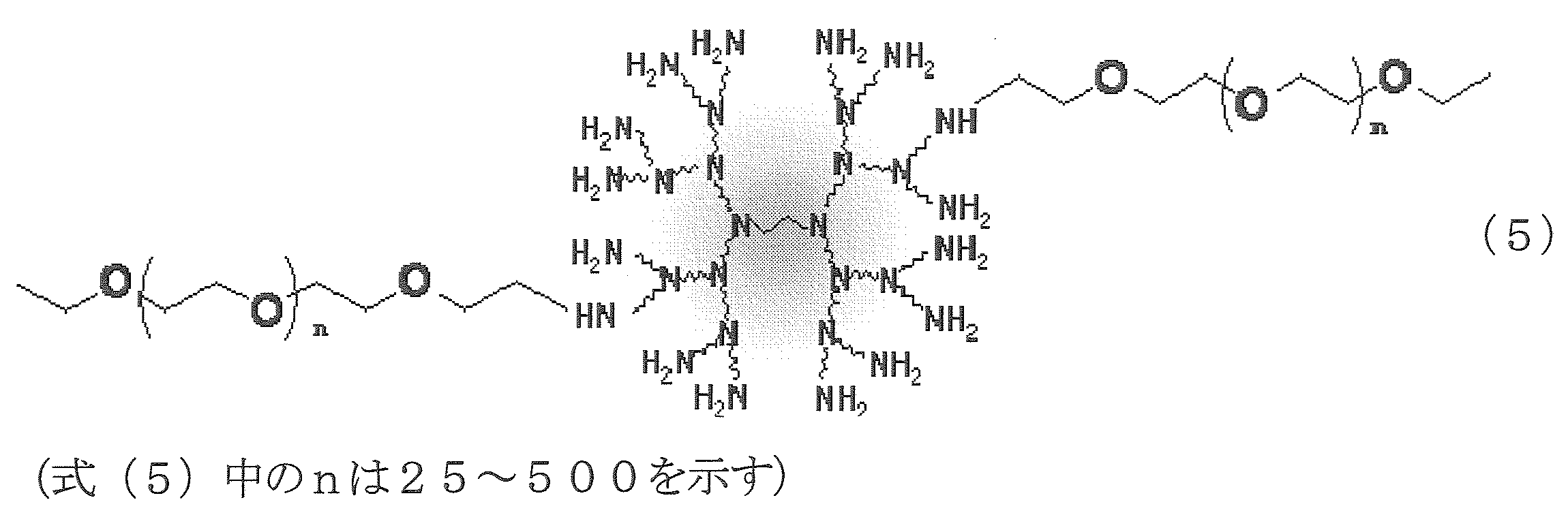
- the dendrimer has the formula (1) A dendrimer represented by the following formula (2) A dendrimer represented by the following formula (3) A dendrimer represented by the following formula (4) And a dendrimer represented by the following formula (5): And at least one dendrimer selected from the group consisting of dendrimers represented by
- a medicament for the prevention and / or treatment of amyloidosis comprising the amyloid fibril formation inhibitor of the present invention.
- the amyloidosis is familial amyloid polyneuropathy (FAP).
- FAP familial amyloid polyneuropathy
- amyloid fibril formation inhibitor of the present invention for producing a medicament for the prevention and / or treatment of amyloidosis of the present invention.
- a method for preventing and / or treating amyloidosis comprising administering the amyloid fibril formation inhibitor of the present invention to a mammal.
- the amyloid fibril formation inhibitor of the present invention can significantly suppress amyloid fibril formation. Therefore, the medicament containing the amyloid fibril formation inhibitor of the present invention is useful as a medicament for the prevention and / or treatment of amyloidosis, and particularly familial amyloidosis polyneuropathy (FAP), which has only a symptomatic treatment or a liver transplantation treatment method. Can be used as a highly effective medicine. Furthermore, the medicament of the present invention is intended to improve drug absorbability, target a specific site (reduction of side effects), maintain action, etc. from the viewpoint of making a drug prodrug. Since it contains, as an active ingredient, a highly safe dendrimer, which is widely used as a pharmaceutical, it is a highly safe pharmaceutical for the human body.
- FAP familial amyloidosis polyneuropathy
- the medicament of the present invention is a medicament that can be put to practical use at an early stage in the prevention and / or treatment of amyloidosis because of its effectiveness and safety.
- the medicament of the present invention can be expected particularly as a medicament for familial amyloidosis polyneuropathy (FAP), which has only a symptomatic treatment or a liver transplantation treatment method.
- FAP familial amyloidosis polyneuropathy
- FIG. 1 is a schematic view of a dendrimer synthesis route.
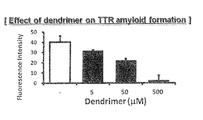
- FIG. 2 is a diagram showing the results of examining the inhibitory effect of dendrimer on amyloid fibril formation for each concentration.
- FIG. 3 is a diagram showing the results of examining the dissolution effect of amyloid fibrils by dendrimers for each concentration.
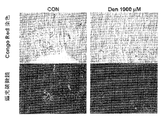
- FIG. 4 is a graph showing a decrease in tissue-deposited TTR amyloid fibrils in FAP patients due to dendrimers.
- FIG. 5 is a diagram showing a dendrimer embodiment together with molecular weight, molecular size, and amino group.
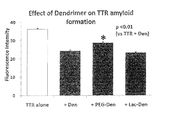
- FIG. 6 is a graph showing the results of examining the inhibitory effect of dendrimer on the formation of amyloid fibrils according to the modification mode of dendrimer.
- FIG. 1 is a schematic view of a dendrimer synthesis route.
- FIG. 2 is a diagram showing the results of examining the inhibitory effect of dendrimer on amyloid fibril formation for each
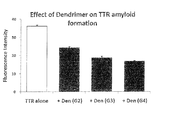
- FIG. 7 is a view showing the results of examining the dendrimer's inhibitory effect on amyloid fibril formation for each generation of dendrimers.
- FIG. 8 is a diagram showing the results of examining the stability of blood TTR in ATTRMV30M rats.
- amyloid fibril formation inhibitor of the present invention contains dendrimer or a salt thereof as an active ingredient.
- Dendrimer A dendrimer is a dendritic polymer compound composed of a core that is a central part and a dendron that is a dendritic side chain part. The number of branching dendrons is called generation.
- Dendrimers are used as new high-performance materials in various fields including the pharmaceutical field and the chemical field because they can introduce a large number of functional groups into the spherical shape and molecular surface. Dendrimers are easier to control the structure than ordinary polymers, and can be modified by introducing functional groups. Therefore, various dendrimer derivatives with improved solubility and functionality of dendrimers have been developed. By using such a dendrimer derivative, a therapeutic effect on various clinical symptoms can be expected along with an inhibitory effect on amyloid fibrils.
- dendrimers include poly (amidoamine) dendrimers having alkylenediamine as a core.
- the alkylene diamine as the core is preferably an alkylene diamine having 1 to 6 carbon atoms, and examples thereof include methylene diamine, ethylene diamine, propylene diamine, butylene diamine, pentylene diamine and n-hexylene diamine. Preferred is methylene diamine, ethylene diamine, propylene diamine or butylene diamine, and more preferred is ethylene diamine.
- Dendron has a dendritic structure by connecting nitrogen atoms as tertiary amines.
- the terminal part of the dendron has two amino groups bonded to one nitrogen atom.
- FIG. 1 shows a synthesis route of a poly (amidoamine) (PAMAM) dendrimer having ethylenediamine as a core.
- PAMAM poly (amidoamine)
- the first generation (Generation 1 in FIG. 1) is a dendrimer in which two amidoamines are bonded per core amine, and the second generation is the one in which an amidoamine is further bonded.
- Dendrimer (Generation 2 in Fig. 1).
- the dendrimer's dendritic structure becomes more complex, and the molecular weight and molecular diameter increase.
- the dendrimer contained in the amyloid fibril formation inhibitor of the present invention as shown in Example 2 described later, the dendrimer having a larger generation number has a greater inhibitory effect on amyloid fibril formation. 2nd to 8th generation dendrimers are more preferable, 2nd to 6th generation dendrimers are more preferable, and 2nd to 4th generation dendrimers are still more preferable.
- At least one, such as 2, 3, 4, 5, 6, 7, 8, 9, 9 or more amines in the dendrimer may be modified with various functional groups.
- a dendrimer modified with lactose or polyethylene glycol as a modifying group can be expected to improve the inhibitory effect of amyloid fibril formation because the hydration structure around the molecule and the interaction mode with proteins change.
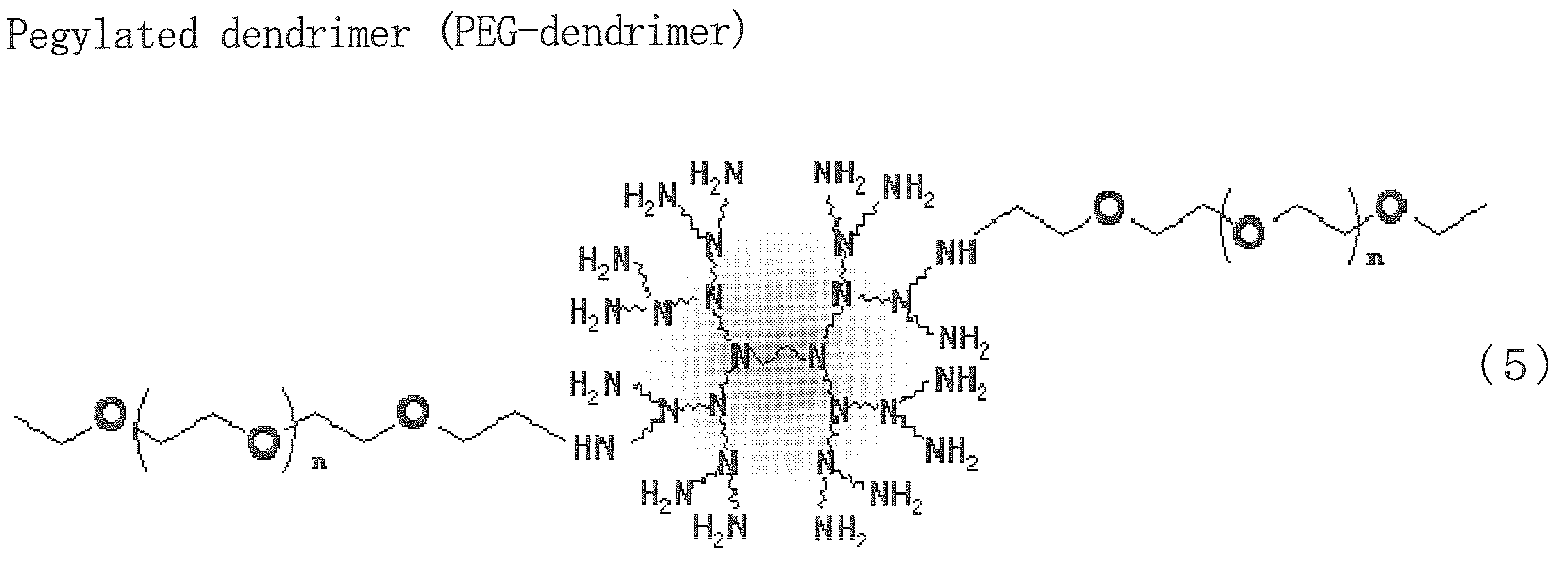
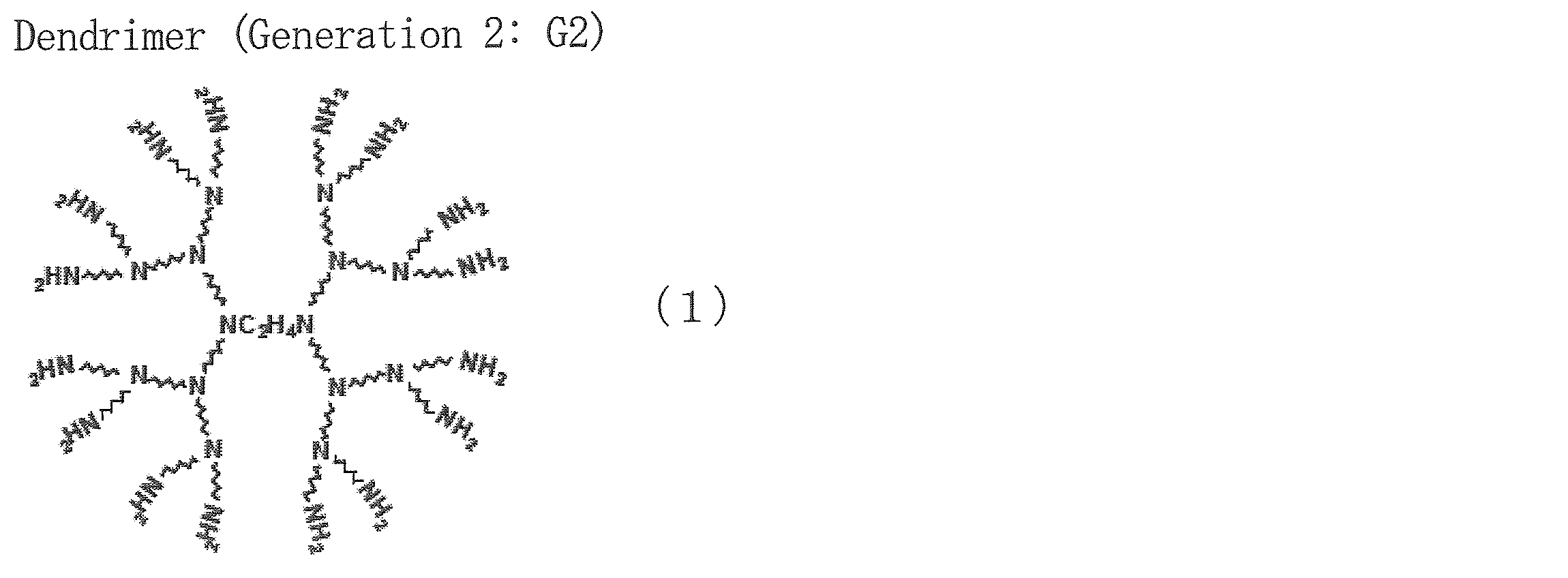
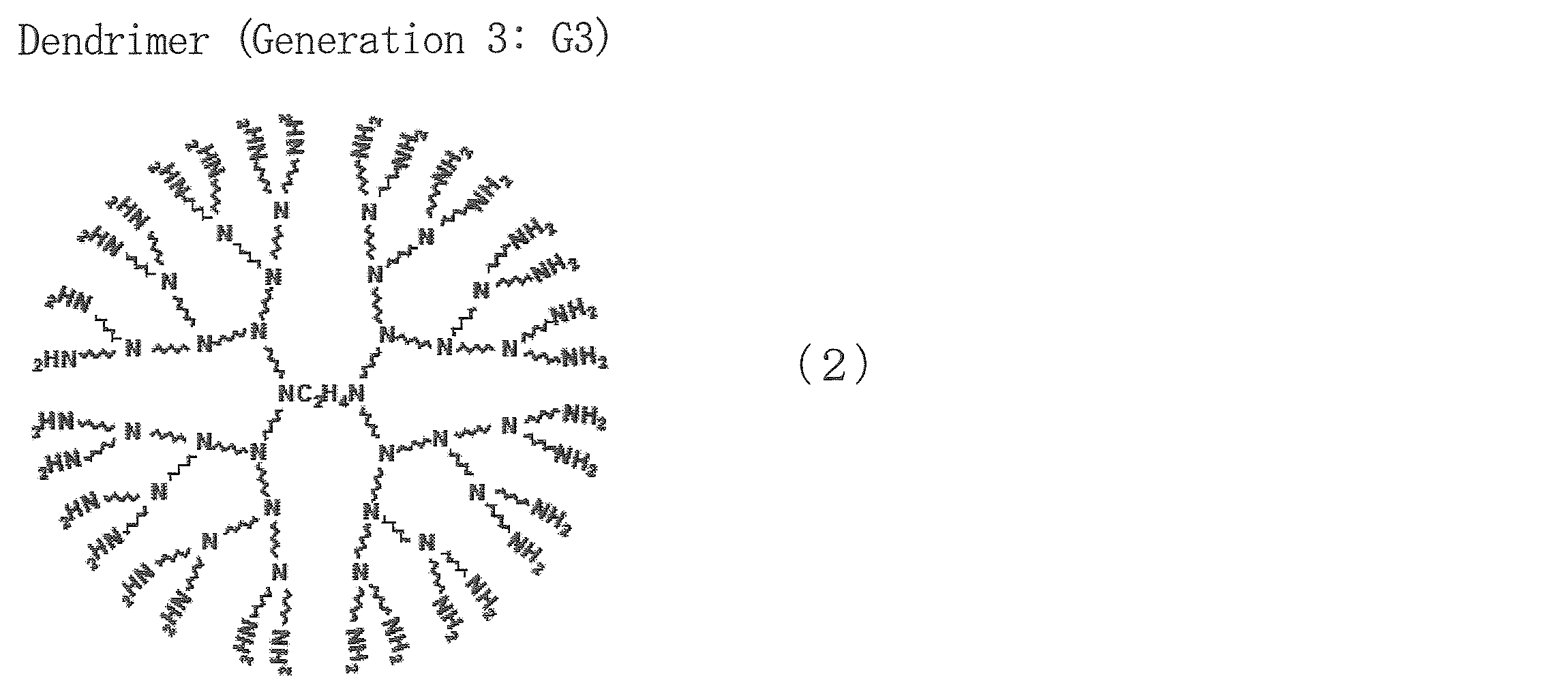
- a preferred embodiment of the dendrimer contained in the amyloid fibril formation inhibitor of the present invention is represented by the following formula (1).
- a dendrimer represented by the following formula (2) A dendrimer represented by the following formula (3)
- a dendrimer represented by the following formula (4) And a dendrimer represented by the following formula (5): Or one or more dendrimers selected from the group consisting of dendrimers.
- FIG. 5 shows the molecular weight, size and number of amino groups of the dendrimers of the above formulas (1) to (3).
- the dendrimers of the above formulas (1) to (3) are three-dimensional macromolecules in which highly branched dendrons are arranged around a multifunctional core. These dendrimers tend to increase cytotoxicity as the molecular weight increases. Therefore, as a dendrimer contained as an active ingredient of the amyloid fibril formation inhibitor of the present invention, a dendrimer represented by the above formula (2) having a large inhibitory effect on amyloid fibril formation and a relatively small molecular weight is more preferable.
- the poly (amidoamine) dendrimer modified with lactose or polyethylene glycol represented by the above formulas (4) or (5) is obtained by using a poly (amidoamine) dendrimer and lactose or polyethylene glycol by a known method.
- lactose modified poly (amidoamine) dendrimers can be prepared by adding 0.2M boric acid to dendrimers, lactose monohydrate, and cyanotrihydroborate such as sodium cyanotrihydroborate. It is obtained by dissolving in a salt buffer (pH 7.5) and then stirring at about 15 ° C. to 40 ° C. for several hours to several tens of hours.
- poly (amidoamine) dendrimers modified with polyethylene glycol include, for example, a dendrimer added to a solution obtained by dissolving a polyethylene glycol modified product such as mPEG-succinyl-NHS in a solvent such as DMSO at about 15 ° C. to 40 ° C. It is obtained by stirring for several hours to several tens of hours and then adding water to stop the reaction, followed by dialysis and lyophilization.
- the poly (amidoamine) dendrimer modified with lactose or polyethylene glycol obtained by these methods is preferably purified by a generally known method such as gel filtration. Polyethylene glycol having a molecular weight of about 1000 to 20000 is preferably used.
- n in the above formula (5) is not particularly limited as long as it is within the range of 25 to 500, but is preferably 22 to 450 in consideration of the hydration structure around the molecule and the interaction mode with the protein. .
- amyloid fibril formation inhibitor The amyloid fibril formation inhibitor of the present invention can suppress the formation reaction of amyloid fibrils from mutant TTR by containing dendrimer or a salt thereof as an active ingredient.
- the amyloid fibril formation inhibitor of the present invention may contain any form as long as it contains dendrimer or a salt thereof.
- the ratio of the active ingredient contained in the amyloid fibril formation inhibitor of the present invention is not particularly limited as long as it is an amount capable of suppressing amyloid fibril formation of mutant TTR. 80% to 100% is preferable.
- amyloid fibril formation inhibitor of the present invention can be used in any form of solid or liquid as long as it contains an effective amount of dendrimer or a salt thereof, and a pharmaceutically acceptable carrier or additive is added to this. It can also be prepared as a solid or liquid pharmaceutical composition.
- the inhibitory effect of amyloid fibril formation by the amyloid fibril formation inhibitor of the present invention is that thioflavin T, which is a fluorescent probe that selectively binds to ⁇ -sheet, is used to fluoresce ⁇ -sheet generated by TTR amyloid fibrillation. It can be confirmed by detecting the intensity. At this time, when the fluorescence intensity in the case of using the amyloid fibril formation inhibitor of the present invention is small compared to the case of not using the amyloid fibril formation inhibitor of the present invention, the amyloid fibril formation inhibitor of the present invention is amyloid fibril formation. Can be judged to have been suppressed.
- Medicament for preventing and / or treating amyloidosis includes a medicament for preventing and / or treating amyloidosis comprising the amyloid fibril formation inhibitor of the present invention as an active ingredient.
- the medicament of the present invention can be applied to a wide range of diseases related to amyloidosis and amyloidosis including familial amyloidosis polyneuropathy (FAP) and senile amyloidosis.
- FAP familial amyloidosis polyneuropathy
- senile amyloidosis As shown in FIG. 4, even a patient who has already suffered from amyloidosis can be expected to improve a tissue in which a disorder is observed by applying the medicament of the present invention. Therefore, according to the medicament of the present invention, not only prevention of amyloidosis and diseases related to amyloidosis and suppression of progression and worsening of the disease state due to these diseases, but also improvement of the disease state, that is, therapeutic effect on these diseases can be expected.
- Specific examples of the disease targeted by the medicament of the present invention include, but are not limited to, familial amyloidosis polyneuropathy (FAP).
- patients with mild symptoms can prevent the progression or worsening of the symptoms by administering the medicament of the present invention, and the therapeutic effects can be obtained even for patients with severe symptoms. There are cases where you can expect.
- an individual having a mutant transthyretin is a potential patient who has a high possibility of developing FAP with aging, but the administration of the medicament of the present invention can prevent the onset of FAP.
- the amyloid fibril formation inhibitor of the present invention may be used as it is.
- the amyloid fibril formation inhibitor of the present invention which is usually an active ingredient, and one or more additives for formulation are used. It is desirable to prepare and use the form of the pharmaceutical composition containing.
- the medicament of the present invention is preferably a parenteral agent, and examples of the pharmaceutical composition suitable for parenteral administration include injections, instillations, inhalants and the like.
- additives for preparation used in the production of the above pharmaceutical composition include excipients such as lactose and oligosaccharides, disintegrants or disintegrants, binders, lubricants, coating agents, dyes, antioxidants Agent, flavoring agent, diluent, base, solubilizer or solubilizer, isotonic agent, preservative, pH adjuster, stabilizer, tonicity agent, propellant, emulsifier, suspending agent, solvent , Fillers, bulking agents, buffering agents, delivery vehicles, carriers, pharmaceutical adjuvants and adhesives, etc., which can be appropriately selected by those skilled in the art depending on the form of the pharmaceutical composition. A combination of the above may also be used.
- An injection may be mentioned as a more preferable form of the medicament of the present invention.
- Injectables are usually substantially free of non-aqueous solvents (or water-soluble organic solvents) and can be dissolved or diluted with a solvent whose medium is substantially water.
- Injections can be prepared by methods well known in the art. For example, injections should be prepared by dissolving in a buffer solution such as physiological saline or PBS, or a solvent such as sterilized water, sterilizing by filtration with a filter, and then filling in a sterile container (for example, an ampoule). Can do.
- This injection may contain a conventional pharmaceutical carrier, if necessary.
- an administration method using a non-invasive catheter may be used.
- the carrier that can be used in the present invention include neutral buffered physiological saline, physiological saline containing serum albumin, and the like.
- lyophilized preparations can also be mentioned as a preferred form of the medicament of the present invention.
- Even such lyophilized preparations can be dissolved in at least one liquid or solvent selected from water for injection (distilled water for injection), an infusion solution containing an electrolyte solution (such as physiological saline), and a nutritional infusion solution.
- An injection solution can be easily prepared, and a glass container and a plastic container can be used as the container.
- the pharmaceutical agent of the present invention can be contained in an amount of 0.01 parts by weight or more, preferably 0.1 to 10 parts by weight based on 100 parts by weight of the contents of the injection.
- the dosage and number of administrations of the medicament of the present invention are not particularly limited, and can be appropriately selected according to conditions such as the age, weight, and sex of the patient, the type and severity of the disease, the purpose of prevention or treatment, etc. It is. Usually, in the case of parenteral administration, the amount of active ingredient is preferably from 0.1 ⁇ g to 10 g per day, more preferably from 10 ⁇ g to 1000 mg, and more preferably from 100 ⁇ g to 500 mg. It may be administered separately.
- the administration frequency of the medicament of the present invention may be, for example, once a day to once every several months, and is not particularly limited.
- TTR Transthyretin
- the fluorescence intensity of 489 nm excited by 442 nm excitation light was measured at 25 ° C using a Hitachi fluorescence spectrophotometer F-4500.
- the slit width was measured at 5 nm on both the excitation side and the fluorescence side.
- wild-type TTR (WT-TTR) derived from human serum is amyloidated in the presence of 0 ⁇ M, 5 ⁇ M, 50 ⁇ M, or 500 ⁇ M dendrimer, and selectively binds to a ⁇ sheet polymerized by amyloidization.
- WT-TTR wild-type TTR
- thioflavin T quantitative analysis of amyloid fibril formation of TTR was performed (see FIG. 2).
- the ability of TTR to form amyloid fibrils decreased in a dose-dependent manner in the presence of dendrimers.
- Amyloid Tissue derived from FAP patients is fixed with 10% formaldehyde, embedded in paraffin, sliced 3 ⁇ m thick, and stretched on MAS-coated slide glass (Matsunami Glass Ind. Ltf., Osaka, Japan) The sections were subjected to the following Congo red staining to identify amyloid deposits.
- tissue sections derived from FAP patients were incubated at 37 ° C. for 21 days in the presence or absence of dendrimers to analyze tissue-deposited TTR amyloid fibrils.
- Fig. 4 shows the result of analyzing a tissue section derived from a FAP patient coexisting with 0 ⁇ M or 1000 ⁇ M dendrimer, and analyzing the change in tissue deposition amyloid by a Congo red and then using a polarizing microscope.
- FIG. 4 as a result of Congo ⁇ ⁇ ⁇ red staining and amyloid fiber analysis using a polarizing microscope, it was confirmed that when dendrimers coexist, tissue-deposited TTR amyloid fibers in FAP patients were reduced.
- Example 2 Experimental Materials Transthyretin (TTR) used in this experiment was purified from healthy volunteers. The purity test was performed using non-heated (non-reduced) SDS-PAGE. As the dendrimer and the dendrimer derivative, compounds of the following formulas (1) to (5) were used. Dendrimer was purchased from Sigma.
- a method for synthesizing the lactose-modified poly (amidoamine) dendrimer of formula (4) is as follows. After dissolving dendrimer (Sigma; 94.2 ⁇ L), lactose monohydrate (9 mg), and sodium cyanotrihydroborate (15.7 mg) in 0.2 M borate buffer (pH 7.5), room temperature For 3 hours. The lactose-modified poly (amidoamine) dendrimer obtained by the reaction was purified by gel filtration (TOSOH TOYOPEARL HW-40F (5.3 cm 2 x 70 cm); eluent: 0.1 M ammonium hydroxycarbonate).
- polyethylene glycol-modified poly (amidoamine) dendrimer The synthesis method of the formula (5) polyethylene glycol-modified poly (amidoamine) dendrimer is as follows. Add polyethylene glycol (50 mg) dissolved in DMSO (500 ⁇ L) to dendrimer (178.5 ⁇ L) and stir overnight. The reaction was stopped by adding water, dialyzed and lyophilized. Polyethylene glycol used was Nippon Oil & Fats Coffee (SUNBRIGHT ME-020CS; molecular weight 2000).
- Quantification of amyloid fibrils using thioflavin T TTR was prepared with 20 mM acetate buffer (pH 3.0-6.5) containing 100 mM sodium chloride to a concentration of 0.2 mg / mL, and incubated at 37 ° C in the dark at amyloid. Fibers were formed. The produced amyloid fibrils were detected using thioflavin T, which is a fluorescent probe that selectively binds to the polymerized ⁇ -sheet. 10 ⁇ L of the incubated sample was added to 1 mL of 10 mM thioflavin T solution dissolved in 50 mM glycine solution (pH 9.5) and mixed to prepare a measurement sample.
- the fluorescence intensity of 489 nm excited by 442 nm excitation light was measured at 25 ° C using a Hitachi fluorescence spectrophotometer F-4500.
- the slit width was measured at 5 nm on both the excitation side and the fluorescence side.
- FIG. 6 and FIG. 7 show the results of quantitative analysis of amyloid fibril formation of TTR using wild-type TTR derived from human serum in the presence or absence of various dendrimers using the above method.
- the inhibitory effect of dendrimer derivatives (10 ⁇ M each) on TTR amyloid fibrils was greatly changed by the difference in substituents between various dendrimers.
- the inhibitory effect with respect to the TTR amyloid fiber of a dendrimer derivative (each 10 micromol) changed with the generation number of the dendrimer, and was strengthened with the increase in the generation number.
- Example 3 To examine the effect of various dendrimers on the stability of blood TTR under physiological conditions (in vivo), transgenic (Tg) rats (ATTR V30M) in FAP disease models expressing atypical TTR (ATTR V30M) Various types of dendrimers were administered, and the stability of blood TTR was compared with the non-administered group (Ueda et al. Biochem. Biophys. Res. Commun 352 (2007) 299-304).
- Den Compound of formula (1) in the above [Chemical Formula 14].
- PEG-Den Compound of formula (5) in the above [Chemical Formula 13]. At least one amine in the dendrimer is modified with polyethylene glycol.
- amyloid fibril deposition Diseases that cause organ damage due to amyloid fibril deposition include FAP, Alzheimer's disease, Creutzfeldt-Jakob disease (mad cow disease), Huntington's disease, and other inherited diseases. For example, Alzheimer's disease accounts for about 10% of elderly people over the age of 65, and is a social problem in Japan, where the aging of the population is further advanced. Since amyloid fibril deposition is due to the formation of insoluble fibrous aggregates of proteins, dendrimers can also be applied to treat these various amyloidosis diseases.
Landscapes
- Health & Medical Sciences (AREA)
- Life Sciences & Earth Sciences (AREA)
- General Health & Medical Sciences (AREA)
- Animal Behavior & Ethology (AREA)
- Veterinary Medicine (AREA)
- Chemical & Material Sciences (AREA)
- Medicinal Chemistry (AREA)
- Public Health (AREA)
- Pharmacology & Pharmacy (AREA)
- Engineering & Computer Science (AREA)
- Bioinformatics & Cheminformatics (AREA)
- Nuclear Medicine, Radiotherapy & Molecular Imaging (AREA)
- Organic Chemistry (AREA)
- General Chemical & Material Sciences (AREA)
- Chemical Kinetics & Catalysis (AREA)
- Neurology (AREA)
- Neurosurgery (AREA)
- Biomedical Technology (AREA)
- Epidemiology (AREA)
- Gastroenterology & Hepatology (AREA)
- Psychiatry (AREA)
- Molecular Biology (AREA)
- Hospice & Palliative Care (AREA)
- Psychology (AREA)
- Acyclic And Carbocyclic Compounds In Medicinal Compositions (AREA)
- Pharmaceuticals Containing Other Organic And Inorganic Compounds (AREA)
- Medicines That Contain Protein Lipid Enzymes And Other Medicines (AREA)
Abstract
本発明の目的は、安全性の高い、TTRタンパク質のアミロイド線維形成を抑制し得る物質を有効成分として含むアミロイド線維形成抑制剤を提供することにある。上記目的は、デンドリマー又はその塩を有効成分として含むアミロイド線維形成抑制剤により解決される。
Description
本発明は、デンドリマー又はその塩を有効成分として含むアミロイド線維形成抑制剤、並びに該アミロイド線維形成抑制剤を有効成分として含むアミロイドーシスを予防及び/又は治療するための医薬に関する。
アミロイドーシスとは、β-シート構造を有するタンパク質が重合して不溶性のアミロイド(amyloid)又はアミロイド線維と呼ばれる細線維を形成し、生体内に沈着して組織傷害をもたらす疾患群のことを指す。ドイツの病理学者であるVirchowは、アミロイドーシスの組織標本がヨードで紫色に染まることを発見した。この結果から、Virchowは組織に沈着した物質は多糖体であると考え、これを「デンプン様物質」すなわち「アミロイド」と命名し、アミロイドの沈着により惹起される病態をアミロイドーシスと呼ぶことを提唱した。その後の研究により、アミロイドの主成分はナイロン様に重合して線維を形成するタンパク質であり、アミロイドには血清アミロイドP成分やグリコサミノグリカンなどが含まれていることが分かっている。現在では、アミロイドは「コンゴレッド染色で橙赤色に染まり、偏光顕微鏡下で観察すると緑色に強く輝く複屈折を起こす幅8-15nmの枝分かれのない細線維の集積からなる」と定義されている。
アミロイドーシスには、家族性アミロイドポリニューロパチー(familial amyloid polyneuropathy;FAP)、アルツハイマー病、クロイツフェルト・ヤコブ病(狂牛病)、ハンチントン病その他遺伝性の疾患など様々な疾患が含まれる。その中でもFAPは、末梢神経、自律神経、腎、皮膚などの全身諸臓器にアミロイド沈着をきたし、常染色体優性遺伝形式で遺伝浸透する全身性アミロイドーシスであり、我が国、特に九州地方及び中部地方で多くの症例が確認されている。1952年にポルトガル人のFAP症例が初めて報告されて以来、世界各国から同様の症例報告がなされている。FAPの原因となるアミロイド線維は、主として、血清タンパク質であるトランスサイレチン(TTR)が変異したもので構成されている。
正常TTRは、β-シート構造を多く含む立体構造をしており、肝臓、脳脈絡叢、網膜、膵α細胞などで産生されるが、特にその90%以上が肝臓で産生されるといわれている。正常TTRは、四量体を形成してサイロキシン(T4)やレチノール結合タンパク質(RBP)などを介したビタミンAの輸送体としての役割を担っている。正常TTRの変異体は、これまでに100種以上が報告されており、構造安定性が低く、四量体から単量体への構造変化を起こしやすいことが明らかになっている。
わが国で多いFAPは、Val30Met型の変異TTRを原因タンパク質とするFAPである。FAPの主要性状は、左右対称性に下肢末端から上行する知覚障害を伴う多発性神経炎と自律神経障害(交代性の下痢と便秘、起立性低血圧、排尿障害等)であり、これらはいずれもアミロイドによる神経障害が原因である。その後、心臓、腎臓、消化管へのアミロイド沈着が著しくなり、これらの臓器の機能不全を引き起こす。一般的には、20代後半から30代で発症し10年で歩行不能となり、10数年の経過で心不全、腎不全などで死亡する予後不良の疾患であり、厚生省特定疾患にも指定されている難病の一つである。
FAPをもたらし得る変異TTRタンパク質は、正常TTRタンパク質に比べ構造安定性が低く、分子中のβ-シート構造が互いに会合し不溶性のアミロイド線維を形成して組織に沈着するといわれている。FAPの治療としては、変異TTRの約90%以上が肝臓で産生されることから肝移植治療が行われている。一方で、アミロイド線維形成メカニズムに基づいたFAPの治療方法として、四量体TTR分子の乖離(解離)の阻害などが試みられている(非特許文献1及び2)。
Yukio Ando, (2005), Med Mol Morphol, 38: pp. 142-154
Yoshiki Sekijima et.al., "Long-term effects of diflunisal on familial amyloid polyneuropathy," 2008, VIIth International symposium on Familial Amyloid Polyneuropathy
FAPの治療方法として、肝移植治療法は、病状が進行した患者には無効で、ドナーも不足しているなど多くの問題がある。一方で、アミロイド線維形成メカニズムに基づいたFAPの治療方法は、変異TTRタンパク質によるアミロイド線維形成を抑制することにより、FAPを予防又は治療、或いはその両方をすることができると考えられている。この治療方法は、肝移植をしないことから、肝移植に関連する上記問題を回避することが期待できる。しかし、このような方法において、臨床的な治療効果が認められているFAPの治療方法はない。また、アミロイドーシスの予防及び/又は治療に応用できる、安全性の高い、アミロイド線維形成を抑制する物質についてもこれまでに知られていない。
したがって、本発明の目的は、安全性の高い、TTRタンパク質のアミロイド線維形成を抑制し得る物質を有効成分として含むアミロイド線維形成抑制剤を提供することにある。さらに、本発明の目的は、該抑制剤を含む、アミロイドーシスの予防及び/又は治療のための医薬、特に家族性アミロイドーシスポリニューロパチー(FAP)の予防及び/又は治療のための医薬を提供することにあり、さらにはアミロイドーシスに起因する知覚障害と自律神経障害の発症を予防するための医薬、及び上記知覚障害と自律神経障害の進行防止などを可能にする治療のための医薬を提供することにある。
本発明者らは、上記の課題を解決すべく種々検討したところ、デンドリマーがアミロイド線維形成を抑制し得ることを見出し、本発明を完成させた。したがって、本発明によれば、デンドリマー又はその塩を有効成分として含むアミロイド線維形成抑制剤が提供される。
好ましくは、デンドリマーが、アルキレンジアミンをコアとするポリ(アミドアミン)デンドリマーである。
好ましくは、デンドリマーが、アルキレンジアミンをコアとする第2~第10世代のポリ(アミドアミン)デンドリマーである。
好ましくは、デンドリマーが、アルキレンジアミンをコアとする第2~第6世代のポリ(アミドアミン)デンドリマーである。
好ましくは、アルキレンジアミンが、炭素数1~6のアルキレンジアミンである。
好ましくは、デンドリマーにおける少なくとも1個のアミンが、ポリエチレングリコール又はラクトースで修飾されている。
好ましくは、デンドリマーが、下記式(1)

で示されるデンドリマー;下記式(2)

で示されるデンドリマー;下記式(3)
で示されるデンドリマー;下記式(4)
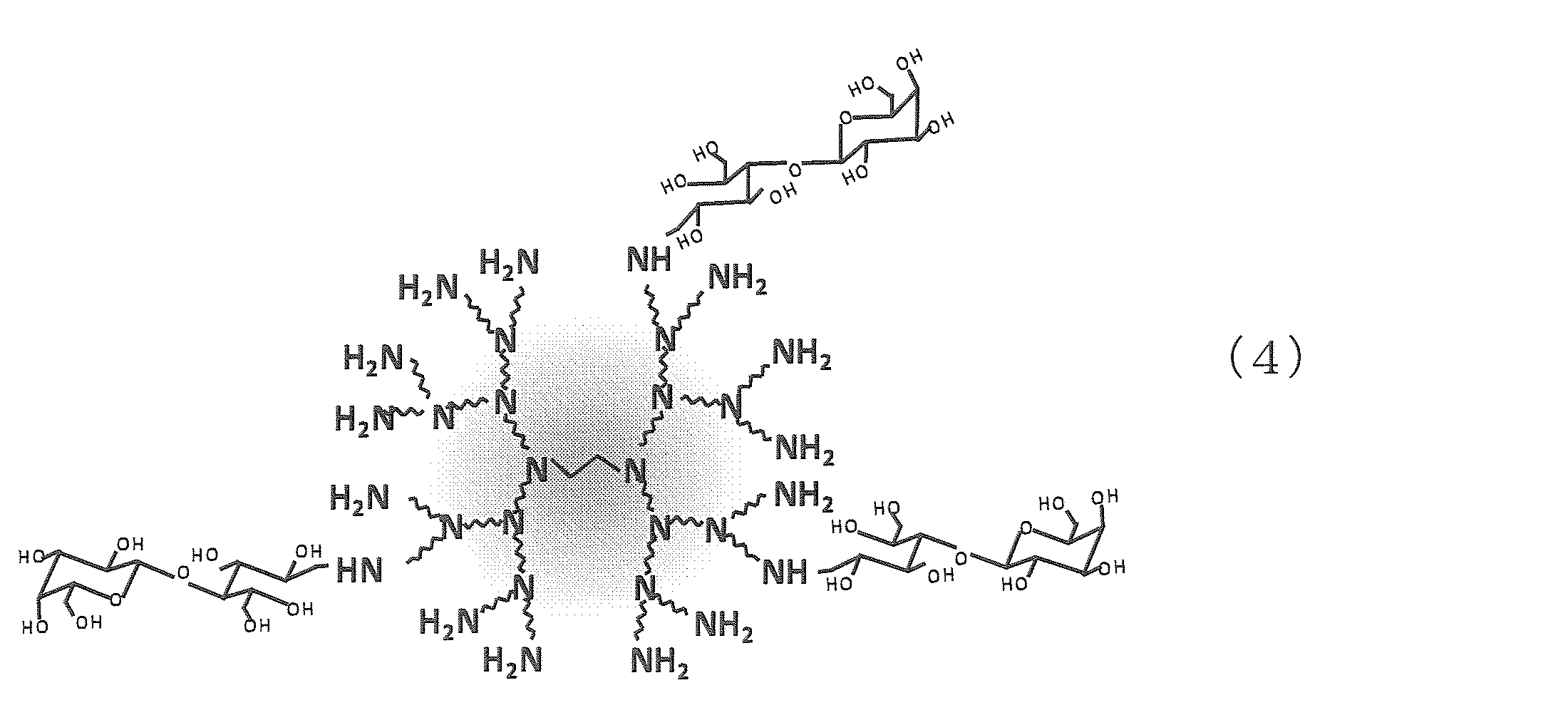
で示されるデンドリマー;及び下記式(5)
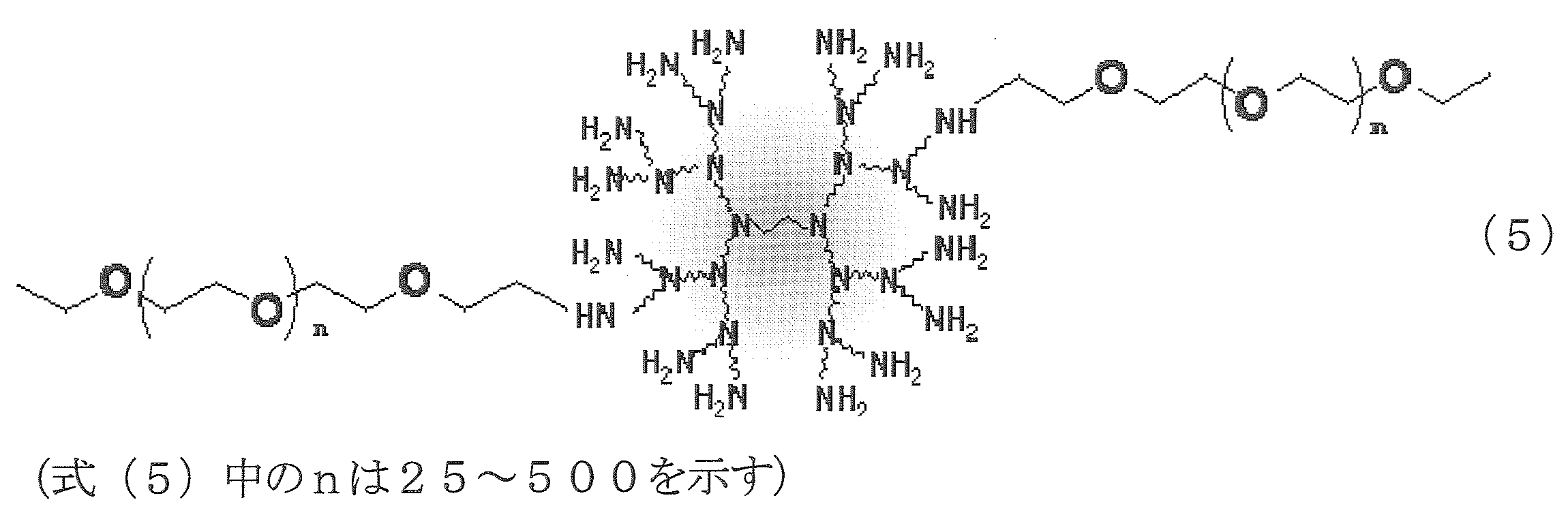
で示されるデンドリマーからなる群から選ばれる少なくとも1種のデンドリマーである。
本発明の別の側面によれば、本発明のアミロイド線維形成抑制剤を含む、アミロイドーシスの予防及び/又は治療のための医薬が提供される。
好ましくは、アミロイドーシスが、家族性アミロイドポリニューロパチー(FAP)である。
本発明の別の側面によれば、本発明のアミロイドーシスの予防及び/又は治療のための医薬を製造するための、本発明のアミロイド線維形成抑制剤の使用が提供される。
本発明の別の側面によれば、本発明のアミロイド線維形成抑制剤を哺乳動物に投与することを含む、アミロイドーシスの予防及び/又は治療する方法が提供される。
本発明のアミロイド線維形成抑制剤は、アミロイド線維形成を有意に抑制することができる。したがって、本発明のアミロイド線維形成抑制剤を含む医薬は、アミロイドーシスの予防及び/又は治療のための医薬として有用であり、特に対症療法や肝臓移植しか治療方法のない家族性アミロイドーシスポリニューロパチー(FAP)に対して有効性の高い医薬として用いることができる。さらに、本発明の医薬は、薬物のプロドラッグ化の観点から、薬物吸収性の改善、特定部位への標的化(副作用の軽減)、作用の持続化などを意図して医薬品製剤や遺伝子デリバリー素材などとして汎用されている安全性の高いデンドリマーを有効成分として含有することから、人体に対して安全性の高い医薬である。したがって、本発明の医薬は、その有効性及び安全性から、アミロイドーシスの予防及び/又は治療に際して早期の実用化が見込める医薬である。特に、本発明の医薬は、特に対症療法や肝臓移植しか治療方法のない家族性アミロイドーシスポリニューロパチー(FAP)に対する医薬として期待できる。
本発明について以下に詳細に説明する。
本発明のアミロイド線維形成抑制剤は、デンドリマー又はその塩を有効成分として含む。
本発明のアミロイド線維形成抑制剤は、デンドリマー又はその塩を有効成分として含む。
[1]デンドリマー
デンドリマーは、中心部であるコア (core)と樹状側鎖部であるデンドロン (dendron)とから構成される樹状高分子化合物である。また、デンドロンの分岐回数は、世代 (generation) と呼ばれている。
デンドリマーは、中心部であるコア (core)と樹状側鎖部であるデンドロン (dendron)とから構成される樹状高分子化合物である。また、デンドロンの分岐回数は、世代 (generation) と呼ばれている。
デンドリマーは、球状の形態や分子表面に多数の官能基を導入できることから、医薬分野や化学分野などをはじめとした様々な分野において新しい高機能材料として利用されている。デンドリマーは、一般の高分子と比べて構造制御が容易であり、官能基を導入するなどの修飾が可能である。そこで、デンドリマーの溶解性や機能性を改善した様々なデンドリマー誘導体が開発されている。このようなデンドリマー誘導体を用いることにより、アミロイド線維の抑制効果と共に、様々な臨床症状に対する治療効果が期待できる。
デンドリマーの具体例として、アルキレンジアミンをコアとするポリ(アミドアミン)デンドリマーを挙げることができる。
コアのアルキレンジアミンは、炭素数1~6のアルキレンジアミンであることが好ましく、例えば、メチレンジアミン、エチレンジアミン、プロピレンジアミン、ブチレンジアミン、ペンチレンジアミン及びn-ヘキシレンジアミンを挙げることができるが、より好ましくはメチレンジアミン、エチレンジアミン、プロピレンジアミン又はブチレンジアミンであり、より好ましくはエチレンジアミンである。
デンドロンは、窒素原子が3級アミンとして連なることで、樹状構造をとる。デンドロンの末端部は1個の窒素原子に2個のアミノ基が結合している。
図1に、エチレンジアミンをコアとするポリ(アミドアミン)(PAMAM)デンドリマーの合成経路を示す。図1が示す通り、コアのアミン1個あたり2個のアミドアミンが結合したものが第1世代(図1のGeneration 1)のデンドリマーであり、さらにその下にアミドアミンが結合したものが第2世代のデンドリマー(図1のGeneration 2)である。以下、世代数が大きくなるにつれて、デンドリマーの樹状構造は複雑になり、分子量及び分子径が大きくなる。
本発明のアミロイド線維形成抑制剤に含まれるデンドリマーとしては、後述する実施例2に示す通り、世代数が大きいデンドリマーほどアミロイド線維形成の抑制効果が大きくなることから、第2~第10世代のデンドリマーが好ましく、第2~第8世代のデンドリマーがより好ましく、第2~第6世代のデンドリマーがさらに好ましく、第2~第4世代のデンドリマーがなおさらに好ましい。
エチレンジアミンをコアとする第2世代のポリ(アミドアミン)デンドリマーの製造方法については、Roseita Esfandらの文献(Roseita Esfand and Donald A. Tomalia, (2001), DDT, Vol.6, No.8, pp427-436)に詳細が記載されている。本記載を参照すれば、当業者は、世代数がさらに大きいデンドリマーやエチレンジアミン以外のアルキレンジアミンをコアとするデンドリマーを合成することができる。または、世代数が10までのエチレンジアミンをコアとするポリ(アミドアミン)デンドリマーは、Sigma社から販売されており入手可能である。
デンドリマーにおける少なくとも1個、例えば、2個、3個、4個、5個、6個、7個、8個、9個又は10個以上のアミンが、種々の官能基で修飾されていてもよい。例えば、修飾基としてラクトースやポリエチレングリコールで修飾されたデンドリマーは、分子周辺の水和構造やタンパク質との相互作用様式が変化するために、アミロイドの線維形成の抑制効果を向上させることが期待できる。
本発明のアミロイド線維形成抑制剤に含まれるデンドリマーの好ましい態様は、下記式(1)
で示されるデンドリマー;下記式(2)
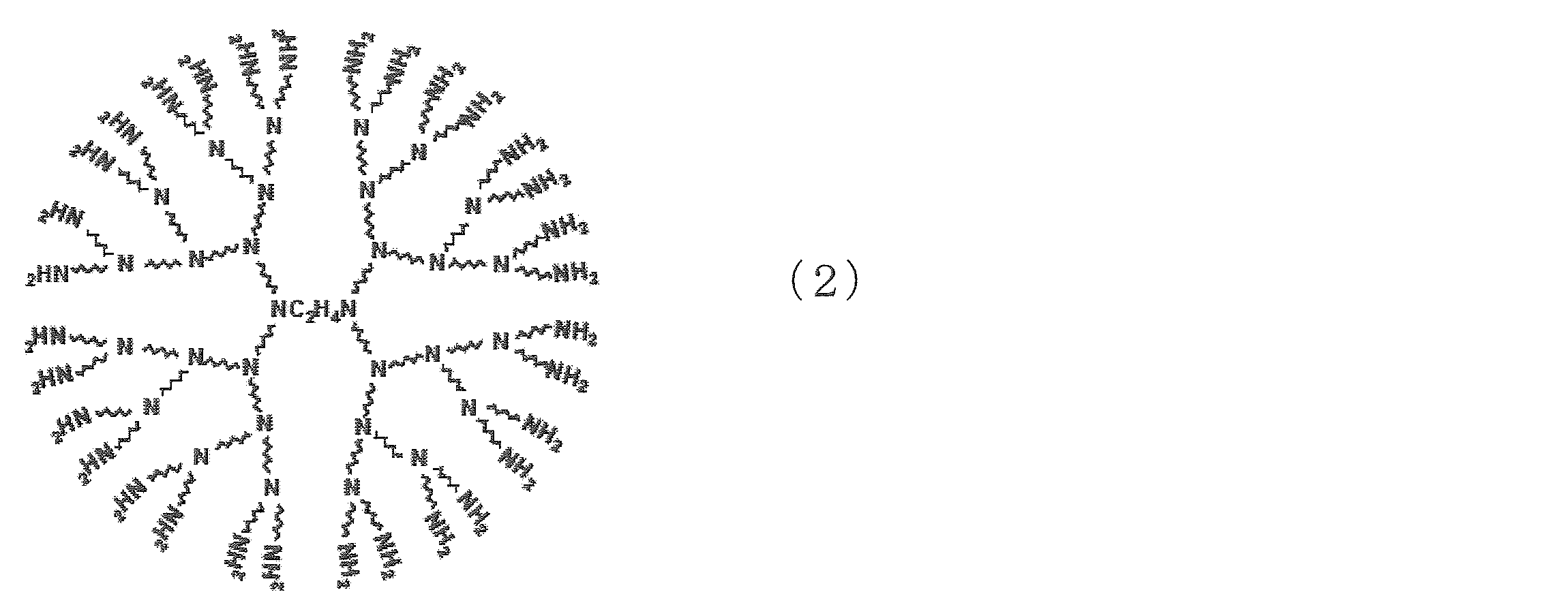
で示されるデンドリマー;下記式(3)

で示されるデンドリマー;下記式(4)

で示されるデンドリマー;及び下記式(5)

で示されるデンドリマーからなる群から選ばれる1種又は2種以上のデンドリマーである。
上記式(1)~(3)のデンドリマーの分子量、サイズ及びアミノ基数を図5に示す。上記式(1)~(3)のデンドリマーは、多機能なコアの周囲に高度に分岐したデンドロンを配置した3次元のマクロ分子である。これらのデンドリマーは、分子量が大きくなるほど、細胞毒性が上昇する傾向にある。したがって、本発明のアミロイド線維形成抑制剤の有効成分として含まれるデンドリマーとしては、アミロイド線維形成の抑制効果が大きく、かつ分子量が比較的小さい、上記式(2)で示されるデンドリマーがより好ましい。
上記式(4)や(5)で示されるラクトースやポリエチレングリコールで修飾されたポリ(アミドアミン)デンドリマーは、これまでに知られている方法によってポリ(アミドアミン)デンドリマー、及びラクトースまたはポリエチレングリコールを用いて製造することができるが、例えば、ラクトースで修飾されたポリ(アミドアミン)デンドリマーは、デンドリマー、ラクトース一水和物、及びシアノトリヒドロホウ酸ナトリウムなどのシアノトリヒドロホウ酸塩を0.2M ホウ酸塩緩衝液(pH 7.5)に溶解した後、15℃~40℃程度で数時間~数十時間攪拌することによって得られる。一方、ポリエチレングリコールで修飾されたポリ(アミドアミン)デンドリマーは、例えば、mPEG-succinyl-NHSなどのポリエチレングリコール修飾物をDMSOなどの溶媒に溶解させた溶液にデンドリマーを加えて15℃~40℃程度で数時間~数十時間攪拌し、次いで水を加えて反応を停止した後、透析および凍結乾燥することによって得られる。これらの方法により得られたラクトースやポリエチレングリコールで修飾されたポリ(アミドアミン)デンドリマーは、ゲルろ過などの通常知られる方法により精製することが好ましい。ポリエチレングリコールとしては、分子量が1000~20000程度のものを使用することが好ましい。
上記式(5)におけるnの数は、25~500の範囲内であれば特に制限されないが、分子周辺の水和構造やタンパク質との相互作用様式を考慮すれば、好ましくは22~450である。
[2]アミロイド線維形成抑制剤
本発明のアミロイド線維形成抑制剤は、デンドリマー又はその塩を有効成分として含むことにより、変異TTRからのアミロイド線維の生成反応を抑制することができる。
本発明のアミロイド線維形成抑制剤は、デンドリマー又はその塩を有効成分として含むことにより、変異TTRからのアミロイド線維の生成反応を抑制することができる。
本発明のアミロイド線維形成抑制剤は、デンドリマー又はその塩を含む限り、これらをどのような形態で含んでもよい。本発明のアミロイド線維形成抑制剤に含まれる有効成分の割合(有効成分の質量/アミロイド線維形成抑制剤の質量)は、変異TTRのアミロイド線維形成を抑制できる量であれば特に制限されないが、例えば、80%~100%が好ましい。
本発明のアミロイド線維形成抑制剤は、デンドリマー又はその塩の有効量を含めば、固体又は液体のいずれの形態でも利用することができるが、これに薬学上許容される担体または添加剤を配合して、固体又は液体状の医薬組成物として調製することもできる。
本発明のアミロイド線維形成抑制剤によるアミロイド線維形成抑制効果は、β-シートに選択的に結合する蛍光プローブであるチオフラビンTを用いて、TTRがアミロイド線維化したことにより生じるβ-シートをを蛍光強度として検出することにより確認することができる。このとき、本発明のアミロイド線維形成抑制剤を用いない場合に比べて、本発明のアミロイド線維形成抑制剤を用いた場合の蛍光強度が小さいとき、本発明のアミロイド線維形成抑制剤はアミロイド線維形成を抑制したと判断できる。
[3]アミロイドーシスの予防及び/又は治療のための医薬
本発明には、本発明のアミロイド線維形成抑制剤を有効成分として含む、アミロイドーシスの予防及び/又は治療のための医薬が包含される。
本発明には、本発明のアミロイド線維形成抑制剤を有効成分として含む、アミロイドーシスの予防及び/又は治療のための医薬が包含される。
本発明の医薬は、家族性アミロイドーシスポリニューロパチー(FAP)や老人性アミロイドーシスなどをはじめとするアミロイドーシスやアミロイドーシスに関連する疾患に対して、広い範囲で適用可能である。図4に示す通り、すでにアミロイドーシスに罹患した患者であっても、本発明の医薬を適用すれば、障害が見られる組織を改善することが期待できる。したがって、本発明の医薬によれば、アミロイドーシスやアミロイドーシスに関連する疾患の予防およびこれらの疾患による病状の進行や悪化の抑制だけでなく、病状の改善、すなわちこれらの疾患に対する治療効果が期待できる。本発明の医薬が対象とする具体的な疾患としては、家族性アミロイドーシスポリニューロパチー(FAP)を挙げることができるが、これに限定されるものではない。
例えば、FAPを発病した患者のうち症状が軽度な患者は本発明の医薬を投与することにより症状の進行や悪化を防ぐことが可能であり、症状が重篤な患者に対しても治療効果を期待できる場合がある。また、変異トランスサイレチンを有する個体は加齢とともにFAPを発症する可能性の高い潜在患者であるが、本発明の医薬を投与することによりFAPの発症を予防することができる。
本発明の医薬としては、本発明のアミロイド線維形成抑制剤をそのまま用いてもよいが、通常は有効成分である本発明のアミロイド線維形成抑制剤と1又は2種以上の製剤用添加物とを含む医薬組成物の形態を調製して用いることが望ましい。
FAPの予防及び治療の際には、本発明の医薬だけでなく、トランスサイレチン四量体を安定化する非ステロイド性抗炎症薬、例えば、ジフルニサールなどと併用することも望ましい。
本発明の医薬は、非経口剤であることが好ましく、非経口投与に適する医薬組成物としては、例えば、注射剤、点滴剤、吸入剤等を挙げることができる。上記の医薬組成物の製造に用いられる製剤用添加物としては、例えば、乳糖やオリゴ糖などの賦形剤、崩壊剤ないし崩壊補助剤、結合剤、滑沢剤、コーティング剤、色素、抗酸化剤、矯味剤、希釈剤、基剤、溶解剤ないし溶解補助剤、等張化剤、保存剤、pH調節剤、安定化剤、等張化剤、噴射剤、乳化剤、懸濁化剤、溶媒、フィラー、増量剤、緩衝剤、送達ビヒクル、キャリア、薬学的アジュバント及び粘着剤等を挙げることができるが、これらは医薬組成物の形態に応じて当業者が適宜選択することができ、2種以上を組み合わせて用いてもよい。
本発明の医薬のより好ましい形態として、注射剤を挙げることができる。注射剤としては、通常、非水溶媒(または水溶性有機溶媒)を実質的に含まず、媒体が実質的に水である溶媒で溶解または希釈可能である。注射剤は当該分野において周知の方法により調製することができる。例えば、注射剤は、生理食塩水、PBSなどの緩衝液、滅菌水等の溶剤に溶解した後、フィルター等で濾過滅菌し、次いで無菌容器(例えば、アンプル等)に充填することにより調製することができる。この注射剤には、必要に応じて、慣用の薬学的キャリアを含めてもよい。また、非侵襲的なカテーテルを用いる投与方法を用いてもよい。本発明で用いることができるキャリアとしては、中性緩衝化生理食塩水、又は血清アルブミンを含む生理食塩水等が挙げられる。
さらに、本発明の医薬の好ましい形態として、凍結乾燥製剤(凍結乾燥した注射剤)もまた挙げることができる。このような凍結乾燥製剤であっても、注射用水(注射用蒸留水)、電解質液(生理食塩水など)などを含む輸液、栄養輸液などから選択された少なくとも1つの液体または溶媒により溶解可能であり容易に注射液を調製でき、その容器もガラス容器およびプラスチック容器が使用できる。注射剤内容物の100重量部に対して本発明の医薬を0.01重量部以上、好ましくは0.1~10重量部含有することができる。
本発明の医薬の投与量及び投与回数などは特に限定されず、患者の年齢、体重、及び性別などの条件、並びに疾患の種類や重篤度、予防又は治療の目的などに応じて適宜選択可能である。通常は、非経口投与による場合には有効成分量として成人一日あたり0.1μg~10gが好ましく、10μg~1000mgがより好ましく、100μg~500mgがより好ましいが、このような投与量を一日数回に分けて投与してもよい。本発明の医薬の投与頻度は、例えば、一日一回~数ヶ月に1回であればよく、特に制限されない。
以下の実施例により本発明をより詳細に説明するが、本発明は以下の実施例に限定されるものではない。
実施例1
1.実験材料
本実験で用いたトランスサイレチン(TTR)は、健常者ボランティアより精製した。純度の検定は非加熱(非還元)SDS-PAGE を用いて行った。また、本研究で使用したデンドリマー(Dendrimer)は、シグマ社から購入した。
1.実験材料
本実験で用いたトランスサイレチン(TTR)は、健常者ボランティアより精製した。純度の検定は非加熱(非還元)SDS-PAGE を用いて行った。また、本研究で使用したデンドリマー(Dendrimer)は、シグマ社から購入した。
2.チオフラビンTを用いたアミロイド線維の定量
ヒト血清由来の野生型TTR を100 mM塩化ナトリウムを含む20 mM酢酸バッファー(pH 3.0-6.5)で0.2 mg/mL の濃度になるように調製し、遮光して37℃でインキュベーションしアミロイド線維を形成させた。作成したアミロイド線維は、重合したβ-シートに選択的に結合する蛍光プローブであるチオフラビンT を用いて検出した。50 mM グリシン溶液(pH 9.5)に溶解した10 mM チオフラビンT 溶液1 mL に、インキュベーションしたサンプル10μL を添加後混合し、測定用試料とした。日立蛍光分光光度計 F-4500 を用い、25℃で442 nm の励起光で励起される489 nm の蛍光強度を測定した。なお、励起側、蛍光側ともにスリット幅は5 nm で測定した。
ヒト血清由来の野生型TTR を100 mM塩化ナトリウムを含む20 mM酢酸バッファー(pH 3.0-6.5)で0.2 mg/mL の濃度になるように調製し、遮光して37℃でインキュベーションしアミロイド線維を形成させた。作成したアミロイド線維は、重合したβ-シートに選択的に結合する蛍光プローブであるチオフラビンT を用いて検出した。50 mM グリシン溶液(pH 9.5)に溶解した10 mM チオフラビンT 溶液1 mL に、インキュベーションしたサンプル10μL を添加後混合し、測定用試料とした。日立蛍光分光光度計 F-4500 を用い、25℃で442 nm の励起光で励起される489 nm の蛍光強度を測定した。なお、励起側、蛍光側ともにスリット幅は5 nm で測定した。
3.デンドリマー共存下でのアミロイド線維形成抑制(1)
上記2のアミロイド線維形成時に、下記式(1)

のデンドリマーを各種濃度で加えて、デンドリマー非共存下と比較することにより、アミロイド線維形成におけるデンドリマーの影響を評価した。
上記2のアミロイド線維形成時に、下記式(1)
上記の通りに、ヒト血清由来の野生型TTR(WT-TTR)を、0μM、5μM、50μM又は500μMのデンドリマーとの共存下でアミロイド化させ、アミロイド化により重合したβシートと選択的に結合するチオフラビンTを用いて、TTR のアミロイド線維形成の定量解析を行った(図2を参照)。その結果、チオフラビンTを用いたアミロイド線維の定量解析の結果、デンドリマー共存下で、TTR のアミロイド線維形成能は用量依存的に低下した。
4.デンドリマー共存下でのアミロイド線維形成抑制(2)
デンドリマーのアミロイド線維溶解作用を検討するために、上記と同様の方法(37℃で14日インキュベーション)で一度TTRをアミロイド線維化させた後、0μM、5μM、50μM又は500μMのデンドリマーを添加しさらに37℃で7日インキュベーションし、チオフラビンTによりTTR のアミロイド線維の定量解析を行った(図3を参照)。その結果、デンドリマーは、一度形成したTTRアミロイド線維に対してアミロイド線維溶解効果を示した。
デンドリマーのアミロイド線維溶解作用を検討するために、上記と同様の方法(37℃で14日インキュベーション)で一度TTRをアミロイド線維化させた後、0μM、5μM、50μM又は500μMのデンドリマーを添加しさらに37℃で7日インキュベーションし、チオフラビンTによりTTR のアミロイド線維の定量解析を行った(図3を参照)。その結果、デンドリマーは、一度形成したTTRアミロイド線維に対してアミロイド線維溶解効果を示した。
5.組織沈着アミロイドの検出
FAP患者由来の組織を10%ホルムアルデヒドで固定し、パラフィン包埋後、3μm厚で薄切し、MASコートスライドグラス(Matsunami Glass Ind.Ltf., Osaka, Japan)上で伸展させた切片で、以下に示すコンゴレッド染色を行いアミロイド沈着の同定を行った。
FAP患者由来の組織を10%ホルムアルデヒドで固定し、パラフィン包埋後、3μm厚で薄切し、MASコートスライドグラス(Matsunami Glass Ind.Ltf., Osaka, Japan)上で伸展させた切片で、以下に示すコンゴレッド染色を行いアミロイド沈着の同定を行った。
Congo red原末(MERCK, Darmstadt, Germany)1 gを蒸留水100 ml に溶解し、攪拌しながら45 gのNaClを加えて、さらに十分攪拌し、100 mlのエタノールを加えて10℃で冷却後ろ過する。このCongo red 原液100 ml に対して、5 gのフェノールと1 mlの酢酸を加えたコンゴレッド染色液で1時間染色し、水洗後にヘマトキシリン液で核染色した。アミロイドの検出は本法を用い、偏光顕微鏡でアップルグリーンを呈することにより同定した。
上記の方法を用い、FAP患者由来の組織切片を、デンドリマーとの共存又は非共存下で37℃で21日間インキュベーションし、組織沈着TTRアミロイド線維の解析を行った。
FAP 患者由来の組織切片を0μM又は1000μMのデンドリマーと共存させ、組織沈着アミロイドの変化をCongo red染色した後に偏光顕微鏡により解析した結果を図4に示す。図4に示す通り、Congo red染色、偏光顕微鏡によるアミロイド線維解析の結果、デンドリマーを共存させると、FAP患者の組織沈着TTRアミロイド線維の減少が確認された。
実施例2
1.実験材料
本実験で用いたトランスサイレチン(TTR)は、健常者ボランティアより精製した。純度の検定は非加熱(非還元)SDS-PAGE を用いて行った。デンドリマー及びデンドリマー誘導体は、以下の式(1)~(5)の化合物を用いた。デンドリマーは、シグマ社から購入した。
1.実験材料
本実験で用いたトランスサイレチン(TTR)は、健常者ボランティアより精製した。純度の検定は非加熱(非還元)SDS-PAGE を用いて行った。デンドリマー及びデンドリマー誘導体は、以下の式(1)~(5)の化合物を用いた。デンドリマーは、シグマ社から購入した。
式(4)のラクトース修飾ポリ(アミドアミン)デンドリマーの合成法は以下の通りである。デンドリマー(シグマ社;94.2μL)、ラクトース一水和物(9mg)、及びシアノトリヒドロホウ酸ナトリウム(15.7mg)を0.2M ホウ酸塩緩衝液(pH 7.5)に溶解した後、室温で3時間攪拌した。反応により得られたラクトース修飾ポリ(アミドアミン)デンドリマーはゲルろ過(TOSOH TOYOPEARL HW-40F (5.3cm2 x 70cm); 溶出液:0.1M ammonium hydroxycarbonate)により精製した。
式(5)ポリエチレングリコール修飾ポリ(アミドアミン)デンドリマーの合成法は以下の通りである。デンドリマー(178.5μL)にDMSO(500μL)に溶解したポリエチレングリコール(50mg)を加え、一晩攪拌する。水を加えて反応を停止した後、透析し、凍結乾燥した。なお、ポリエチレングリコールは、日本油脂製 (SUNBRIGHT ME-020CS;分子量2000)を用いた。

2.チオフラビンT を用いたアミロイド線維の定量
TTR を100 mM塩化ナトリウムを含む20 mM酢酸バッファー(pH 3.0-6.5)で0.2 mg/mL の濃度になるように調製し、遮光して37℃でインキュベーションしアミロイド線維を形成させた。作成したアミロイド線維は、重合したβ-シートに選択的に結合する蛍光プローブであるチオフラビンT を用いて検出した。50 mM グリシン溶液(pH 9.5)に溶解した10 mM チオフラビンT 溶液1 mL に、インキュベーションしたサンプル10 μL を添加後混合し、測定用試料とした。日立蛍光分光光度計 F-4500 を用い、25℃で442 nm の励起光で励起される489 nm の蛍光強度を測定した。なお、励起側、蛍光側ともにスリット幅は5 nm で測定した。
TTR を100 mM塩化ナトリウムを含む20 mM酢酸バッファー(pH 3.0-6.5)で0.2 mg/mL の濃度になるように調製し、遮光して37℃でインキュベーションしアミロイド線維を形成させた。作成したアミロイド線維は、重合したβ-シートに選択的に結合する蛍光プローブであるチオフラビンT を用いて検出した。50 mM グリシン溶液(pH 9.5)に溶解した10 mM チオフラビンT 溶液1 mL に、インキュベーションしたサンプル10 μL を添加後混合し、測定用試料とした。日立蛍光分光光度計 F-4500 を用い、25℃で442 nm の励起光で励起される489 nm の蛍光強度を測定した。なお、励起側、蛍光側ともにスリット幅は5 nm で測定した。
上記の方法を用い、ヒト血清由来の野生型TTRを、各種デンドリマーとの共存、非共存下でアミロイド化させ、TTR のアミロイド線維形成の定量解析を行った結果を図6及び7に示す。図6が示す通り、デンドリマー誘導体(各10μM)のTTRアミロイド線維に対する抑制効果は、各種デンドリマー間の置換基の差異により大きく変化した。また、図7が示す通り、デンドリマー誘導体(各10μM)のTTRアミロイド線維に対する抑制効果は、デンドリマーの世代数により変化し、世代数の上昇とともに増強された。
実施例3
生理的条件下(in vivo)における、各種Dendrimerの血中TTR の安定性に対する影響を検討するため、異型TTR(ATTR V30M)を発現するFAPの疾患モデルのトランスジェニック(Tg)ラット(ATTR V30M)に各種デンドリマーを投与し、非投与群との血中TTR の安定性の比較検討を行った(Ueda et al. Biochem. Biophys. Res. Commun 352 (2007) 299-304)。
生理的条件下(in vivo)における、各種Dendrimerの血中TTR の安定性に対する影響を検討するため、異型TTR(ATTR V30M)を発現するFAPの疾患モデルのトランスジェニック(Tg)ラット(ATTR V30M)に各種デンドリマーを投与し、非投与群との血中TTR の安定性の比較検討を行った(Ueda et al. Biochem. Biophys. Res. Commun 352 (2007) 299-304)。
Den:上記[化14]の式(1)の化合物。中心から規則的に分岐した構造を持つ樹状高分子で、アルキレンジアミンのコアと三級アミンの分岐構造からなり、末端に 1 級アミノ基を有する。
PEG-Den:上記[化13]の式(5)の化合物。デンドリマーにおける少なくとも1個のアミンが、ポリエチレングリコールで修飾されている。
PEG-Den:上記[化13]の式(5)の化合物。デンドリマーにおける少なくとも1個のアミンが、ポリエチレングリコールで修飾されている。
ATTR V30Mラットに各種Dendrimerを投与し、約8時間後に血清を回収しTTR抗体を用いたウェスタンブロッティングにより、各種デンドリマーとの共存、非共存下における血中TTR の安定性の比較検討を行った。結果を図8に示す。各種Dendrimer投与群では、血中の可溶性TTRの減少はみられず、血中TTRの安定性が向上していた。
アミロイド線維の沈着によって臓器障害が引き起こされる疾患には、FAPをはじめ、アルツハイマー病、クロイツフェルト・ヤコブ病(狂牛病)、ハンチントン病、及びその他の遺伝性の疾患が含まれる。例えば、アルツハイマー病は、65歳以上の高齢者の約10%を占め、今後高齢化がさらに進む日本において社会的な問題となっている。アミロイド線維の沈着はタンパク質の不溶性の繊維状凝集体の形成に起因することから、デンドリマーはこれらの多様なアミロイドーシス疾患への治療にも応用が可能である。
Claims (9)
- デンドリマー又はその塩を有効成分として含む、アミロイド線維形成抑制剤。
- デンドリマーが、アルキレンジアミンをコアとするポリ(アミドアミン)デンドリマーである、請求項1に記載のアミロイド線維形成抑制剤。
- デンドリマーが、アルキレンジアミンをコアとする第2~第10世代のポリ(アミドアミン)デンドリマーである、請求項1に記載のアミロイド線維形成抑制剤。
- デンドリマーが、アルキレンジアミンをコアとする第2~第6世代のポリ(アミドアミン)デンドリマーである、請求項1に記載のアミロイド線維形成抑制剤。
- アルキレンジアミンが、炭素数1~6のアルキレンジアミンである、請求項1~4のいずれか1項に記載のアミロイド線維形成抑制剤。
- デンドリマーにおける少なくとも1個のアミンが、ポリエチレングリコール又はラクトースで修飾されている、請求項1~5のいずれか1項に記載のアミロイド線維形成抑制剤。
- デンドリマーが、下記式(1)

- 請求項1~7のいずれか1項に記載のアミロイド線維形成抑制剤を含む、アミロイドーシスの予防及び/又は治療のための医薬。
- アミロイドーシスが、家族性アミロイドポリニューロパチー(FAP)である、請求項8に記載の医薬。
Priority Applications (1)
| Application Number | Priority Date | Filing Date | Title |
|---|---|---|---|
| JP2011520961A JPWO2011002026A1 (ja) | 2009-06-30 | 2010-06-30 | アミロイド線維形成抑制剤及びその利用 |
Applications Claiming Priority (2)
| Application Number | Priority Date | Filing Date | Title |
|---|---|---|---|
| JP2009155158 | 2009-06-30 | ||
| JP2009-155158 | 2009-06-30 |
Publications (1)
| Publication Number | Publication Date |
|---|---|
| WO2011002026A1 true WO2011002026A1 (ja) | 2011-01-06 |
Family
ID=43411096
Family Applications (1)
| Application Number | Title | Priority Date | Filing Date |
|---|---|---|---|
| PCT/JP2010/061155 Ceased WO2011002026A1 (ja) | 2009-06-30 | 2010-06-30 | アミロイド線維形成抑制剤及びその利用 |
Country Status (2)
| Country | Link |
|---|---|
| JP (1) | JPWO2011002026A1 (ja) |
| WO (1) | WO2011002026A1 (ja) |
Cited By (2)
| Publication number | Priority date | Publication date | Assignee | Title |
|---|---|---|---|---|
| WO2016199892A1 (ja) * | 2015-06-10 | 2016-12-15 | 国立大学法人熊本大学 | 新規なアミロイド線維生成抑制剤 |
| WO2022169690A1 (en) * | 2021-02-02 | 2022-08-11 | Yanping Kong | Composition and methods for treating cancer |
-
2010
- 2010-06-30 JP JP2011520961A patent/JPWO2011002026A1/ja active Pending
- 2010-06-30 WO PCT/JP2010/061155 patent/WO2011002026A1/ja not_active Ceased
Non-Patent Citations (7)
| Title |
|---|
| "129th Annual Meeting of Pharmaceutical Society of Japan KYOT02009 Yoshishu 4", March 2009, pages: 214 * |
| KLAJNERT B ET AL.: "Influence of dendrimer's structure on its activity against amyloid fibril formation.", BIOCHEM BIOPHYS RES COMMUN., vol. 345, no. 1, 2006, pages 21 - 28, XP024925049, DOI: doi:10.1016/j.bbrc.2006.04.041 * |
| KLAJNERT B ET AL.: "Influence of phosphorus dendrimers on the aggregation of the prion peptide PrP 185-208.", BIOCHEM BIOPHYS RES COMMUN, vol. 364, no. 1, 2007, pages 20 - 25, XP022308513, DOI: doi:10.1016/j.bbrc.2007.09.083 * |
| KLAJNERT B ET AL.: "Molecular interactions of dendrimers with amyloid peptides: pH dependence.", BIOMACROMOLECULES, vol. 7, no. 7, 2006, pages 2186 - 2191 * |
| NEW JOURNAL OF CHEMISTRY, vol. 33, no. 5, May 2009 (2009-05-01), pages 1087 - 1093 * |
| RONG-QIN ET AL.: "Efficient gene delivery targeted to the brain using a transferrin- conjugated polyethyleneglycol-modified polyamidoamine dendrimer", FASEB JOURNAL, vol. 21, 2007, pages 1117 - 1125, XP008111327, DOI: doi:10.1096/fj.06-7380com * |
| SHINKEI CHIRYO, vol. 26, no. 3, May 2009 (2009-05-01), pages 300 * |
Cited By (2)
| Publication number | Priority date | Publication date | Assignee | Title |
|---|---|---|---|---|
| WO2016199892A1 (ja) * | 2015-06-10 | 2016-12-15 | 国立大学法人熊本大学 | 新規なアミロイド線維生成抑制剤 |
| WO2022169690A1 (en) * | 2021-02-02 | 2022-08-11 | Yanping Kong | Composition and methods for treating cancer |
Also Published As
| Publication number | Publication date |
|---|---|
| JPWO2011002026A1 (ja) | 2012-12-13 |
Similar Documents
| Publication | Publication Date | Title |
|---|---|---|
| JP7759322B2 (ja) | 眼に薬物送達するためのデンドリマー組成物および方法 | |
| JP6464087B2 (ja) | ポリロタキサン、及び医薬組成物 | |
| JP5645813B2 (ja) | ベータアミロイドペプチドに効果的に結合可能なリポソーム | |
| US20230364244A1 (en) | Dendrimer compositions and methods for drug delivery to injured kidney | |
| WO2018188635A1 (zh) | 一种用于靶向活化cd44分子的硅质体递送系统、其制备方法和用途 | |
| JP5406501B2 (ja) | アミロイド線維形成抑制剤 | |
| CN115916263B (zh) | 用于淀粉样蛋白沉积mri的靶向对比剂 | |
| JP6786757B2 (ja) | 新規なアミロイド線維生成抑制剤 | |
| WO2011002026A1 (ja) | アミロイド線維形成抑制剤及びその利用 | |
| US20030211142A1 (en) | Liposome | |
| CN120535672A (zh) | 一种硫辛酸接枝透明质酸衍生物、制备方法及应用 | |
| Wang et al. | Nanochaperones based on hydrophobic interaction and coordination inhibit protein misfolding and fibrillation | |
| JP4827277B2 (ja) | リポソーム | |
| WO2011121645A1 (ja) | アミロイド線維形成抑制剤 | |
| Li et al. | Erythrocyte Membrane-Camouflaged Xanthohumol Nanoparticles Mitigate Doxorubicin-Induced Cardiotoxicity by Inhibiting Ferroptosis | |
| Zeng et al. | Silencing MUC1 to regulate intracellular lipid metabolism: Overcoming sunitinib resistance and inhibiting metastasis in renal cell carcinoma | |
| Kandimalla et al. | Physiological and biophysical factors that influence Alzheimer’s disease amyloid plaque targeting of native and putrescine modified human amyloid β40 | |
| CN115813901B (zh) | 3-苯基戊二酸衍生物类小分子在制备防治顺铂诱导的急性肾损伤药物中的应用 | |
| TW200810782A (en) | Use of perfluoroalkyl-containing metal complexes as contrast media for diagnosis of Alzheimer's disease | |
| CN113521035A (zh) | 化学免疫联合治疗纳米药物的制备方法及应用 | |
| JP6579470B2 (ja) | スフィンゴシン1リン酸により修飾されたヒアルロン酸 | |
| KR102162921B1 (ko) | 니페디핀 함유 나노입자를 포함하는 지방간 질환 및 인슐린 저항성 예방 또는 치료용 조성물 | |
| BR102024002303A2 (pt) | Processo de produção de um complexo nanoestruturado, complexo nanoestruturado ora obtido, processo de produção de um plasma rico em plaquetas, processo de produção de um complexo nanoestruturado recoberto, complexo nanoestruturado recoberto assim obtido, e seus usos | |
| Moreira | Development of aptamer nanoparticles for treatment of retinal diseases | |
| JP2025173504A (ja) | ポリマー薬物複合体 |
Legal Events
| Date | Code | Title | Description |
|---|---|---|---|
| 121 | Ep: the epo has been informed by wipo that ep was designated in this application |
Ref document number: 10794194 Country of ref document: EP Kind code of ref document: A1 |
|
| DPE1 | Request for preliminary examination filed after expiration of 19th month from priority date (pct application filed from 20040101) | ||
| WWE | Wipo information: entry into national phase |
Ref document number: 2011520961 Country of ref document: JP |
|
| NENP | Non-entry into the national phase |
Ref country code: DE |
|
| 122 | Ep: pct application non-entry in european phase |
Ref document number: 10794194 Country of ref document: EP Kind code of ref document: A1 |