WO2010125916A1 - 年齢推定装置、年齢推定方法及びプログラム - Google Patents
年齢推定装置、年齢推定方法及びプログラム Download PDFInfo
- Publication number
- WO2010125916A1 WO2010125916A1 PCT/JP2010/056690 JP2010056690W WO2010125916A1 WO 2010125916 A1 WO2010125916 A1 WO 2010125916A1 JP 2010056690 W JP2010056690 W JP 2010056690W WO 2010125916 A1 WO2010125916 A1 WO 2010125916A1
- Authority
- WO
- WIPO (PCT)
- Prior art keywords
- age
- data
- dimensional
- low
- dimensional data
- Prior art date
- Legal status (The legal status is an assumption and is not a legal conclusion. Google has not performed a legal analysis and makes no representation as to the accuracy of the status listed.)
- Ceased
Links
Images


Classifications
-
- G—PHYSICS
- G06—COMPUTING OR CALCULATING; COUNTING
- G06T—IMAGE DATA PROCESSING OR GENERATION, IN GENERAL
- G06T7/00—Image analysis
-
- G—PHYSICS
- G06—COMPUTING OR CALCULATING; COUNTING
- G06V—IMAGE OR VIDEO RECOGNITION OR UNDERSTANDING
- G06V40/00—Recognition of biometric, human-related or animal-related patterns in image or video data
- G06V40/10—Human or animal bodies, e.g. vehicle occupants or pedestrians; Body parts, e.g. hands
- G06V40/16—Human faces, e.g. facial parts, sketches or expressions
-
- G—PHYSICS
- G06—COMPUTING OR CALCULATING; COUNTING
- G06F—ELECTRIC DIGITAL DATA PROCESSING
- G06F18/00—Pattern recognition
- G06F18/20—Analysing
- G06F18/24—Classification techniques
- G06F18/241—Classification techniques relating to the classification model, e.g. parametric or non-parametric approaches
- G06F18/2413—Classification techniques relating to the classification model, e.g. parametric or non-parametric approaches based on distances to training or reference patterns
- G06F18/24133—Distances to prototypes
- G06F18/24137—Distances to cluster centroïds
- G06F18/2414—Smoothing the distance, e.g. radial basis function networks [RBFN]
-
- G—PHYSICS
- G06—COMPUTING OR CALCULATING; COUNTING
- G06V—IMAGE OR VIDEO RECOGNITION OR UNDERSTANDING
- G06V10/00—Arrangements for image or video recognition or understanding
- G06V10/70—Arrangements for image or video recognition or understanding using pattern recognition or machine learning
- G06V10/764—Arrangements for image or video recognition or understanding using pattern recognition or machine learning using classification, e.g. of video objects
-
- G—PHYSICS
- G06—COMPUTING OR CALCULATING; COUNTING
- G06V—IMAGE OR VIDEO RECOGNITION OR UNDERSTANDING
- G06V40/00—Recognition of biometric, human-related or animal-related patterns in image or video data
- G06V40/10—Human or animal bodies, e.g. vehicle occupants or pedestrians; Body parts, e.g. hands
- G06V40/16—Human faces, e.g. facial parts, sketches or expressions
- G06V40/178—Human faces, e.g. facial parts, sketches or expressions estimating age from face image; using age information for improving recognition
Definitions
- the present invention relates to an age estimation device, an age estimation method, and a program for estimating a human age.
- a method for estimating a human age mechanically using a classifier or the like based on human face image data a method for identifying the age itself, a method for estimating the age as a continuous quantity (age Is a regression problem).
- This method is disclosed in, for example, Non-Patent Document 1, but since it is possible to express continuous ages, it has been proved by experiments that the age can be recognized accurately with less contradiction compared to the identification problem.
- the regression problem can be obtained by solving as a problem that minimizes the difference between the estimated age (estimated age) and the correct answer age (age considered correct).
- Specific examples include multiple regression analysis and (Kernel) Ridge Regression, which perform learning to reduce the average of the square error between the estimated age and the correct answer age, or the average of the absolute value error. .
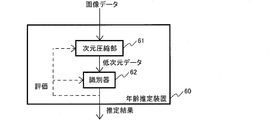
- FIG. 5 shows an example of an age estimation apparatus that performs age estimation as a regression problem.
- the input image data for example, face image data
- the input image data is generally high-dimensional data such as the number of pixels or the number of pixels ⁇ 3 (R, G, B color values). Therefore, the dimension compression unit 61 extracts features from the image data so that age information is emphasized and unnecessary information (such as lighting conditions and face angles) is deleted. As a result, the image data changes from high-dimensional data to low-dimensional data.
- methods such as principal component analysis (PCA), linear discriminant analysis (LDA), and locality preserving projection (LPP) are applied. Is done. This process is also referred to as “feature selection” or “dimensional compression”.
- the classifier 62 estimates the age.
- the dimension compression unit 61 and the discriminator 62 In order to estimate the age from the image data by such an age estimation device 60, it is necessary to learn the dimension compression unit 61 and the discriminator 62. That is, a plurality of image data of a person whose correct age (actual age or perceived age (appearing age)) is known is input to the dimension compression unit 61, and an N-division cross validation or a single cross validation is performed. Evaluate by method. Based on the evaluation result, the output of the discriminator 62 is adjusted so that the error (difference from the correct answer) is reduced. For the learning of the discriminator 62, techniques such as linear regression, multiple regression, Ridge Regression, and neural network are applied.
- the present invention has been made in view of the above circumstances, and an object thereof is to provide an age estimation device, an age estimation method, and a program capable of reducing the labor of labeling work on image data used for age estimation. .
- an age estimation apparatus for estimating the age of a person imaged in image data, and performs dimensional compression on the image data to output low-dimensional data.
- Dimensional compression means clustering means for clustering the output low-dimensional data, labeling means for labeling representative data of each cluster out of the clustered low-dimensional data, and labeling And identifying means for estimating the age of the person based on the learning result using the feature amount included in the low-dimensional data that has been added and the low-dimensional data that has not been labeled.
- the age estimation method of the present invention is an age estimation method for estimating the age of a person imaged in image data, and is output with a dimension compression step of performing dimension compression on the image data and outputting low-dimensional data.
- a clustering process for clustering low-dimensional data, a labeling process for labeling representative data of each cluster out of the clustered low-dimensional data, labeled low-dimensional data and labeling And an identification step of estimating the age of the person based on the learning result using the feature amount included in the low-dimensional data that has not been performed.
- the program of the present invention is a program for estimating the age of a person copied in image data.
- the program performs dimensional compression on the image data and outputs low-dimensional data.
- Clustering processing that performs clustering on the dimensional data, labeling processing that labels the representative data of each cluster out of the clustered low-dimensional data, and labeled low-dimensional data and labels
- the computer is caused to perform an identification process for estimating a person's age based on a learning result using a feature amount included in the low-dimensional data.
- FIG. 1 shows a configuration of an age estimation apparatus according to the present embodiment.
- the age estimation device 10 includes a dimension compression unit 11, a clustering unit 12, a labeling unit 13, and a classifier 14.
- human image data for example, human face image data
- training data learning data
- This image data is high-dimensional data having a dimension of the number of pixels ⁇ the number of luminances.
- the dimension compression unit 11 performs dimension compression (dimension reduction) when high-dimensional image data is input. That is, the dimension compression unit 11 extracts features from the image data so that age information is emphasized and unnecessary information (such as lighting conditions and face angles) is deleted. For example, features are extracted by applying a technique such as PCA, LDA, or LPP. Thus, the high-dimensional image data becomes low-dimensional image data (low-dimensional data).
- the clustering unit 12 performs clustering on the low-dimensional data obtained by dimensional compression.
- clustering a k-means method or the like can be applied.
- the labeling unit 13 performs labeling (applying correct age data) only to the representative data of the clustered low-dimensional data.
- the labeling unit 13 sets the data closest to the average value of the data belonging to each cluster as representative data, and labels the representative data or represents data randomly selected from each cluster.
- the data is labeled, and the representative data is labeled.
- the labeling unit 13 may label a plurality of representative data.
- labeled data is referred to as labeled training data (supervised data)
- unlabeled data is referred to as unlabeled training data (unsupervised data).
- labeling is not performed on all input image data, but only a part of data (representative data) is labeled. Therefore, according to this embodiment, the labor of labeling work can be reduced.
- the discriminator 14 estimates the age based on the features extracted by the dimension compression unit 11.
- the thing of a general structure is applicable for the dimension compression part 11 and the discriminator 14.
- the feature extraction method (dimension compression parameter) and the type of the classifier 14 in the dimension compression unit 11 consider “weight” indicating the seriousness of the estimated age error (difference between the estimated age and the correct age). It is determined based on the evaluation results. Further, the concept of weight is introduced into the learning content of the classifier 14. Here, the reason for introducing the concept of weight will be described below.
- the type and combination of features, the extraction method, and the like are changed based on the face image data.
- parameters and models are selected so that errors are reduced.
- using the square error or absolute value error between the estimated age and the correct answer age causes the accuracy of age recognition to be reduced. For example, even if there is a 10-year difference (error) between the correct answer age and the recognized age, the severity of error between 5 years old and 15 years old and 35 years old and 45 years old Should be different.
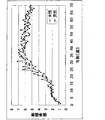
- FIG. 4 shows an example of the result of showing the face image to the evaluator and estimating the age in units of one year.
- the graph shows the “standard deviation of the estimated age (blurring condition)” when the result of estimating a person with a correct answer age is classified for each year, and the horizontal axis is the correct answer age (true age) of the subject, The vertical axis is the standard deviation of the estimation error.
- the correct answer age (true age) is an average value of the ages estimated by the evaluator. It can be seen that young people estimate that most of the evaluated people are of similar age because of the small standard deviation.
- the discriminator 14 creates not only the labeled training data but also the unlabeled training data to create an accurate model (age estimation model).
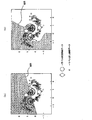
- FIG. 3A shows the data distribution of the model before learning (initial state) in the classifier 14.
- the model before learning two types of labeled training data and unlabeled training data are mixed, and these data are separated by boundaries. That is, in FIG. 3A, unlabeled training data in the range a is classified into labeled training data indicated by diamonds, and unlabeled training data in the range b is classified as labeled training data indicated by circles.
- the model shown in FIG. 3A is changed to an accurate model as shown in FIG. 3B, for example, by semi-supervised learning described later.
- FIG. 3B shows the model before learning
- the boundary is changed as compared with the model shown in FIG. 3 (a), and the unlabeled training data in the range a is classified as labeled training data indicated by a circle, The unlabeled training data in the range b is classified into labeled training data indicated by diamonds.
- This method utilizes unlabeled training data for regularized least squares for kernel functions (a method for weighting regularized least squares for kernel functions, KRWLS: Kernel Regularized Weighted Least Squares). It takes advantage of the manifold structure. The aim is to improve the accuracy of age estimation by smoothing the regression model using information on the structure of graph and manifold (formula (3) described later). Furthermore, the weight of age is considered in the least square method. Because of these characteristics, this method can be called SKRWLS (Semi-supervised Kernel Regularized Weighted Least Squares).
- the age estimation function f (x) is modeled by a linear combination of positive definite kernels k (x, x ′). This is represented by the following formula (1).
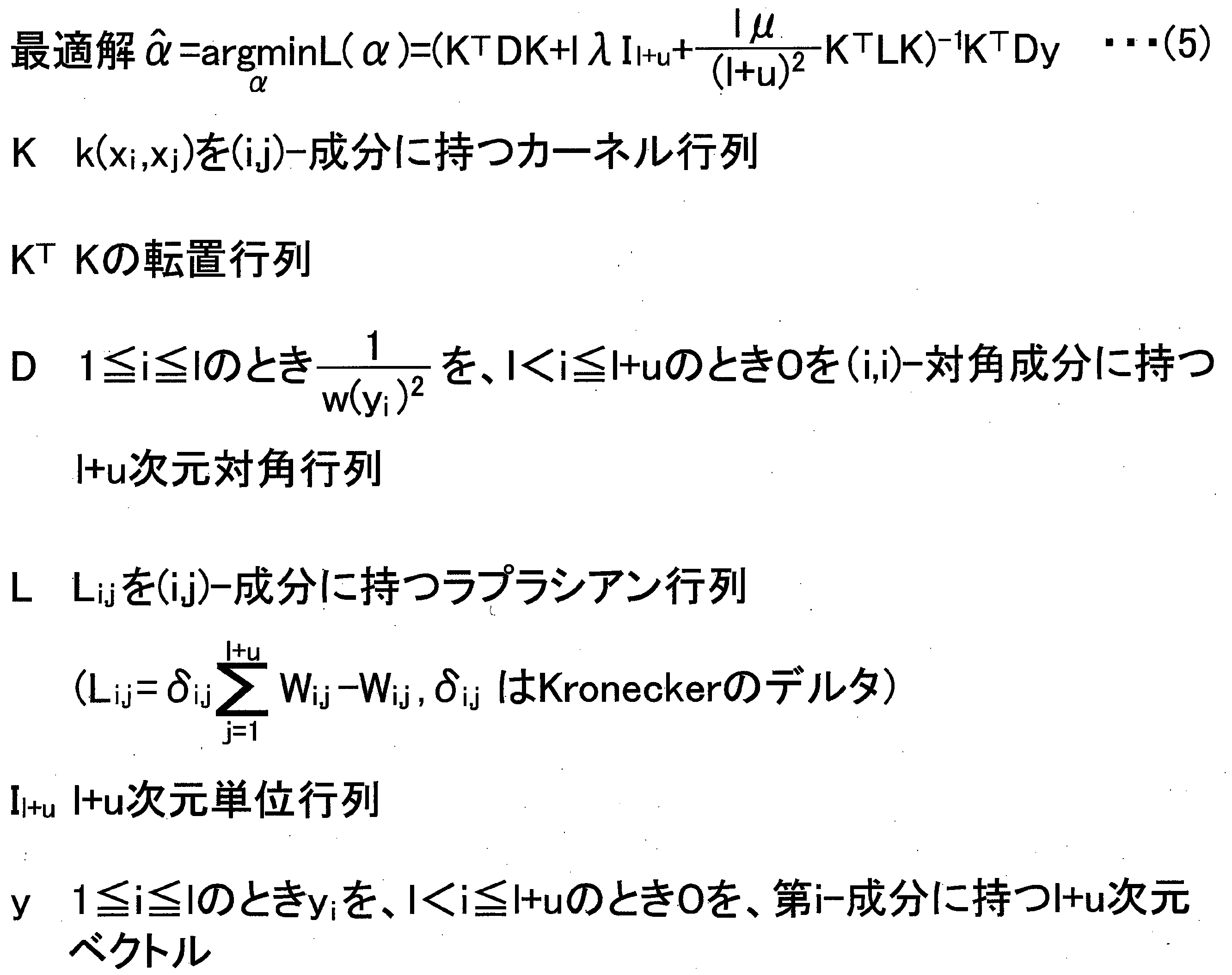
- Expression (1) is an expression for outputting the final age. An optimum solution is obtained in the learning process (details will be described later), and the age is output when the obtained optimum solution is substituted into equation (1).
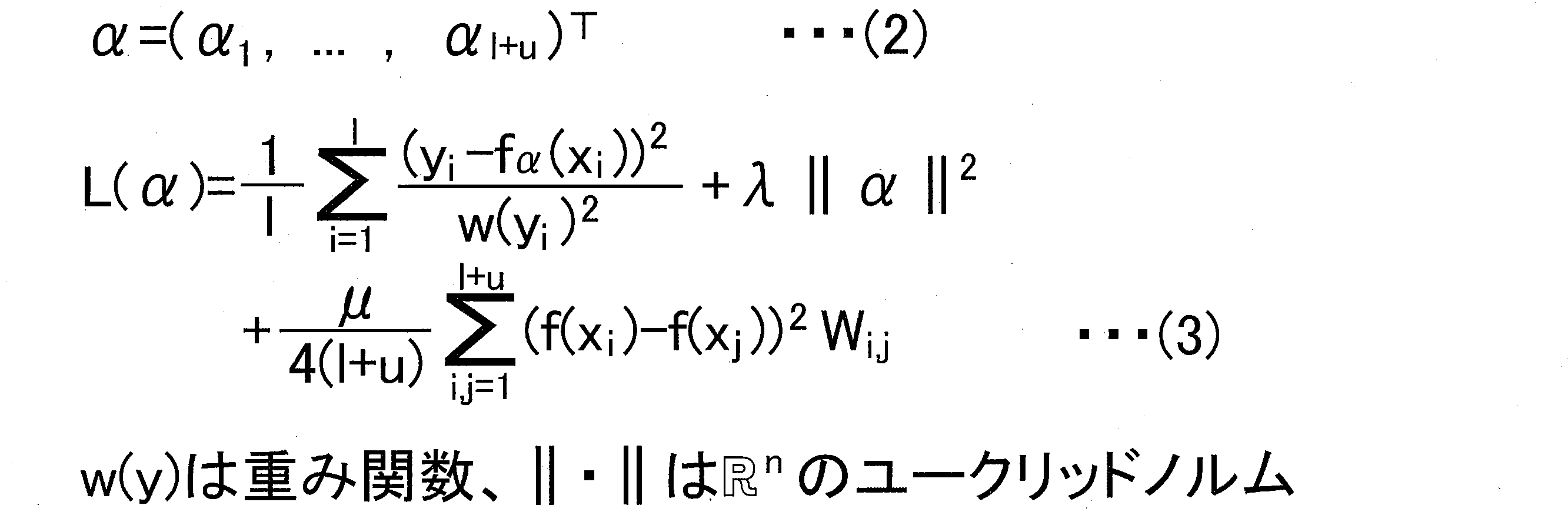
- Equation (3) ⁇ (> 0) is a regularization parameter introduced to prevent overconformity
- the second term of equation (3) is a correction term for preventing overconformity (the size of the parameter to be obtained). This is a term for calculating.
- the first term of the expression (3) is a term for calculating an error for recognizing the age of the training data.
- the third term of Equation (3) calculates an error value that gives a large penalty to a large difference in age even though the distance between the two data (regardless of whether or not there is a label) is short (A term for learning so that the difference between the two ages is small when the distance between the two data is small).
- ⁇ (> 0) in the above equation (3) is a parameter for adjusting the smoothing of the age estimation function f (x).
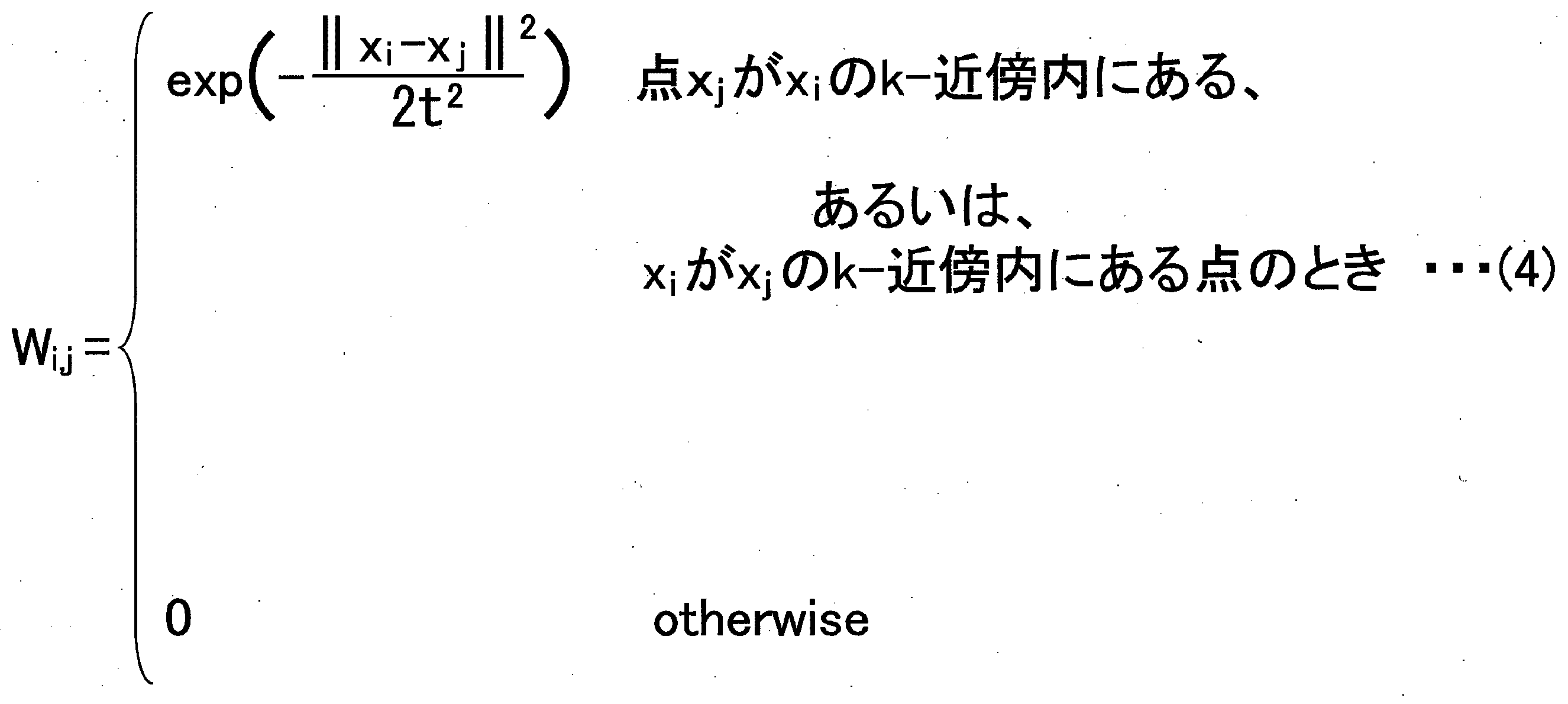
- W i, j in the above equation (3) represents the similarity between two points x i and x j (increases when the distance between the two data is small).
- An example of W i, j is shown in the following formula (4).
- the weighting function w (y) in the above equation (3) is a function representing the seriousness of the estimated age error for each age. The larger the value (weight) of w (y), the more serious the estimated age error. It shows that there is.
- the age of m pieces of test data newly input to the age estimation apparatus 10 is predicted.
- the test data and its true age are expressed as follows.
- Expression (6) is an expression defining an error in test data (an expression for calculating an error in test data).
- the learning data and the test data are used to perform N-division cross-validation, one-off cross-validation, etc. Based on the WMSE of (6), the test data that achieves the highest accuracy (the one with the smallest error) is selected.
- the number of labeled training data 1 is 200
- the number of unlabeled training data u is 5000
- the number of test data m is 1500
- the number of data of each age is almost equal. It is assumed that a Gaussian kernel represented by the following formula (7) is used as the kernel function.
- the kernel width ⁇ and the regularization parameters ⁇ and ⁇ are determined so that the test error is minimized.
- supervised learning is performed on a set of female facial feature vectors using 200 labeled training data and randomly acquired 5000 unlabeled training data obtained by the following three methods.
- FIG. 2 shows the results of performing learning using only labeled training data) and semi-supervised learning (learning using both labeled training data and unlabeled training data).
- the above three methods are as follows.
- LR Randomly acquire training data for labeling LC1: After reducing dimensions to 4 dimensions with PCA, acquire training data for labeling by calculating 200 clusters
- LC2 After reducing dimensions to 10 dimensions with PCA , Labeling training data is obtained by calculating 200 clusters
- a feature extraction method that uses the labeled training data and the unlabeled training data together, and uses WMSE as an evaluation criterion to output an age that is close to the human perceived age.
- the discriminator can be selected.
- the age estimation device Since the feature extraction method and the discriminator are selected so that the age estimation device according to the present embodiment outputs an age that is close to the human perceived age, an estimation result that is close to the human sense can be output. In addition, since the age is estimated by a discriminator that has been learned close to human senses, it is possible to estimate an age that is close to the perceived age.
- a weight function based on actually measured data is used.
- an artificially created weight function may be applied to the above formulas (3), (5), and (6).
- only one weight function is used, but a plurality of weight functions may be used. In this way, it is possible to increase the weight of the age portion for which the estimation accuracy is to be increased. Therefore, it is possible to improve the estimation accuracy of the desired age.
- the operation in the above-described embodiment can be executed by hardware, software, or a combined configuration of both.
- a program in which a processing sequence is recorded may be installed and executed in a memory in a computer incorporated in dedicated hardware. Or you may install and run a program in the general purpose computer which can perform various processes.
- the program can be recorded in advance on a hard disk or ROM (Read Only Memory) as a recording medium.
- the program is temporarily or permanently stored on a removable recording medium such as a CD-ROM (Compact Disc Read Only Memory), MO (Magneto optical) disc, DVD (Digital Versatile Disc), magnetic disk, or semiconductor memory. It can be stored (recorded).
- a removable recording medium can be provided as so-called package software.
- the program may be installed on the computer from the removable recording medium as described above, or may be wirelessly transferred from the download site to the computer. Or you may wire-transfer to a computer via networks, such as LAN (Local Area Network) and the internet.
- the computer can receive the transferred program and install it on a recording medium such as a built-in hard disk.
Landscapes
- Engineering & Computer Science (AREA)
- Theoretical Computer Science (AREA)
- General Physics & Mathematics (AREA)
- Physics & Mathematics (AREA)
- Multimedia (AREA)
- Computer Vision & Pattern Recognition (AREA)
- Health & Medical Sciences (AREA)
- General Health & Medical Sciences (AREA)
- Evolutionary Computation (AREA)
- Artificial Intelligence (AREA)
- Oral & Maxillofacial Surgery (AREA)
- Medical Informatics (AREA)
- Databases & Information Systems (AREA)
- Computing Systems (AREA)
- Data Mining & Analysis (AREA)
- Software Systems (AREA)
- Human Computer Interaction (AREA)
- Life Sciences & Earth Sciences (AREA)
- Evolutionary Biology (AREA)
- General Engineering & Computer Science (AREA)
- Bioinformatics & Computational Biology (AREA)
- Bioinformatics & Cheminformatics (AREA)
- Image Analysis (AREA)
- Information Retrieval, Db Structures And Fs Structures Therefor (AREA)
Abstract
Description
本発明を好適に実施した第1の実施形態について説明する。
図1に、本実施形態にかかる年齢推定装置の構成を示す。年齢推定装置10は、次元圧縮部11と、クラスタリング部12と、ラベル付け部13と、識別器14とを有する。




LR :ラベル付け訓練データをランダムに取得
LC1:PCAで4次元まで次元削減を行った後、200個のクラスタの計算によりラベル付け訓練データを取得
LC2:PCAで10次元まで次元削減を行った後、200個のクラスタの計算によりラベル付け訓練データを取得
11 次元圧縮部
12 クラスタリング部
13 ラベル付け部
14 識別器
Claims (15)
- 画像データに写された人物の年齢を推定する年齢推定装置であって、
前記画像データに対して次元圧縮を施して低次元データを出力する次元圧縮手段と、
出力された低次元データに対してクラスタリングを行うクラスタリング手段と、
クラスタリングされた低次元データのうち、各クラスタの代表データに対してラベル付けを行うラベル付け手段と、
ラベル付けされた低次元データ及びラベル付けされていない低次元データに含まれる特徴量を用いて、人物の年齢を学習結果に基づいて推定する識別手段と、
を有することを特徴とする年齢推定装置。 - 前記次元圧縮手段が次元圧縮を行う際のパラメータと、前記年齢の推定に前記識別手段が用いる特徴量とが、推定年齢誤差の深刻度を年齢ごとに示す重み関数を用いた汎化能力の評価結果に基づいて設定され、
前記重み関数に基づいて前記識別器の学習がなされたことを特徴とする請求の範囲1記載の年齢推定装置。 - 前記汎化能力の評価が、重み付き平均二乗誤差に基づいて行われたことを特徴とする請求の範囲1又は2記載の年齢推定装置。
- 前記重み関数が、知覚年齢ごとの標準偏差に基づいて定義されたことを特徴とする請求の範囲1から3のいずれか1項に記載の年齢推定装置。
- 前記重み関数は、値が小さいほど推定年齢誤差が深刻であることを示すことを特徴とする請求項1から4のいずれか1項に記載の年齢推定装置。
- 画像データに写された人物の年齢を推定する年齢推定方法であって、
前記画像データに対して次元圧縮を施して低次元データを出力する次元圧縮工程と、
出力された低次元データに対してクラスタリングを行うクラスタリング工程と、
クラスタリングされた低次元データのうち、各クラスタの代表データに対してラベル付けを行うラベル付け工程と、
ラベル付けされた低次元データ及びラベル付けされていない低次元データに含まれる特徴量を用いて、人物の年齢を学習結果に基づいて推定する識別工程と、
を有することを特徴とする年齢推定方法。 - 前記次元圧縮工程において次元圧縮を行う際のパラメータと、前記識別工程での前記年齢の推定に用いる特徴量とを、推定年齢誤差の深刻度を年齢ごとに示す重み関数に基づいて設定し、
前記識別工程を実行する識別器を、前記重み関数に基づいて学習させることを特徴とする請求の範囲6記載の年齢推定方法。 - 前記汎化能力の評価を、重み付き平均二乗誤差に基づいて行うことを特徴とする請求の範囲6又は7記載の年齢推定方法。
- 前記重み関数を、知覚年齢ごとの標準偏差に基づいて定義することを特徴とする請求の範囲6から8のいずれか1項に記載の年齢推定方法。
- 前記重み関数を値が小さいほど推定年齢誤差が深刻であることを示す関数とすることを特徴とする請求の範囲6から9のいずれか1項に記載の年齢推定方法。
- 画像データに写された人物の年齢を推定するためのプログラムであって、
前記画像データに対して次元圧縮を施して低次元データを出力する次元圧縮処理と、
出力された低次元データに対してクラスタリングを行うクラスタリング処理と、
クラスタリングされた低次元データのうち、各クラスタの代表データに対してラベル付けを行うラベル付け処理と、
ラベル付けされた低次元データ及びラベル付けされていない低次元データに含まれる特徴量を用いて、人物の年齢を学習結果に基づいて推定する識別処理と、
をコンピュータに実行させることを特徴とするプログラム。 - 前記次元圧縮処理において次元圧縮を行う際のパラメータと、前記識別処理での前記年齢の推定に用いる特徴量とを、推定年齢誤差の深刻度を年齢ごとに示す重み関数に基づいて設定し、
前記識別処理を実行する識別器を、前記重み関数に基づいて学習させる処理をコンピュータに実行させることを特徴とする請求の範囲11記載のプログラム。 - 前記汎化能力の評価を、重み付き平均二乗誤差に基づいて行う処理をコンピュータに実行させることを特徴とする請求の範囲11又は12記載のプログラム。
- 前記重み関数を、知覚年齢ごとの標準偏差に基づいて定義する処理をコンピュータに実行させることを特徴とする請求の範囲11から13のいずれか1項に記載のプログラム。
- 前記重み関数を値が小さいほど推定年齢誤差が深刻であることを示す関数とすることを特徴とする請求の範囲11から14のいずれか1項に記載のプログラム。
Priority Applications (3)
| Application Number | Priority Date | Filing Date | Title |
|---|---|---|---|
| CN201080019028.XA CN102422323B (zh) | 2009-04-28 | 2010-04-14 | 年龄估计装置、年龄估计方法 |
| KR1020117028324A KR101299775B1 (ko) | 2009-04-28 | 2010-04-14 | 연령 추정 장치, 연령 추정 방법 및 기록 매체 |
| US13/263,059 US8818111B2 (en) | 2009-04-28 | 2010-04-14 | Age estimation apparatus, age estimation method, and age estimation program |
Applications Claiming Priority (2)
| Application Number | Priority Date | Filing Date | Title |
|---|---|---|---|
| JP2009-109680 | 2009-04-28 | ||
| JP2009109680A JP4742193B2 (ja) | 2009-04-28 | 2009-04-28 | 年齢推定装置、年齢推定方法及びプログラム |
Publications (1)
| Publication Number | Publication Date |
|---|---|
| WO2010125916A1 true WO2010125916A1 (ja) | 2010-11-04 |
Family
ID=43032069
Family Applications (1)
| Application Number | Title | Priority Date | Filing Date |
|---|---|---|---|
| PCT/JP2010/056690 Ceased WO2010125916A1 (ja) | 2009-04-28 | 2010-04-14 | 年齢推定装置、年齢推定方法及びプログラム |
Country Status (5)
| Country | Link |
|---|---|
| US (1) | US8818111B2 (ja) |
| JP (1) | JP4742193B2 (ja) |
| KR (1) | KR101299775B1 (ja) |
| CN (1) | CN102422323B (ja) |
| WO (1) | WO2010125916A1 (ja) |
Cited By (3)
| Publication number | Priority date | Publication date | Assignee | Title |
|---|---|---|---|---|
| CN112036293A (zh) * | 2020-08-27 | 2020-12-04 | 北京金山云网络技术有限公司 | 年龄估计方法、年龄估计模型的训练方法及装置 |
| JPWO2021166104A1 (ja) * | 2020-02-19 | 2021-08-26 | ||
| CN114299572A (zh) * | 2021-12-22 | 2022-04-08 | 云从科技集团股份有限公司 | 人脸年龄估计方法、装置及电子设备 |
Families Citing this family (23)
| Publication number | Priority date | Publication date | Assignee | Title |
|---|---|---|---|---|
| CN101635009B (zh) * | 2009-08-21 | 2015-06-17 | 腾讯科技(深圳)有限公司 | 基于海量数据的用户年龄估算方法及系统 |
| JP5889019B2 (ja) * | 2012-02-06 | 2016-03-22 | キヤノン株式会社 | ラベル付加装置、ラベル付加方法及びプログラム |
| US9117121B2 (en) * | 2012-05-21 | 2015-08-25 | The Chinese University Of Hong Kong | Detection of disease-related retinal nerve fiber layer thinning |
| TWI485635B (zh) * | 2013-01-30 | 2015-05-21 | Nat Univ Tainan | 年齡評估系統與方法 |
| US10268876B2 (en) * | 2014-07-17 | 2019-04-23 | Nec Solution Innovators, Ltd. | Attribute factor analysis method, device, and program |
| CN104463190B (zh) * | 2014-10-30 | 2017-08-29 | 华为技术有限公司 | 年龄估计方法及设备 |
| US9928410B2 (en) * | 2014-11-24 | 2018-03-27 | Samsung Electronics Co., Ltd. | Method and apparatus for recognizing object, and method and apparatus for training recognizer |
| CN104598871B (zh) * | 2014-12-06 | 2017-11-17 | 电子科技大学 | 一种基于相关回归的面部年龄计算方法 |
| KR101596298B1 (ko) | 2015-03-20 | 2016-02-24 | 이상훈 | 스마트폰을 활용한 비접촉식 지문인식방법 |
| JP2017125809A (ja) * | 2016-01-15 | 2017-07-20 | 株式会社リコー | 情報処理装置、情報処理システムおよびプログラム |
| JP6241576B1 (ja) * | 2016-12-06 | 2017-12-06 | 三菱電機株式会社 | 検査装置及び検査方法 |
| JP6729455B2 (ja) * | 2017-03-15 | 2020-07-22 | 株式会社島津製作所 | 分析データ解析装置及び分析データ解析方法 |
| JP2019219766A (ja) * | 2018-06-15 | 2019-12-26 | 株式会社Lixil | 分析装置、分析システム、及び分析プログラム |
| KR102189362B1 (ko) * | 2018-06-29 | 2020-12-11 | 주식회사 디플리 | 자동 레이블링이 가능한 머신 러닝 방법 및 장치 |
| US10373027B1 (en) * | 2019-01-30 | 2019-08-06 | StradVision, Inc. | Method for acquiring sample images for inspecting label among auto-labeled images to be used for learning of neural network and sample image acquiring device using the same |
| JP7204596B2 (ja) | 2019-06-28 | 2023-01-16 | 富士フイルム株式会社 | 画像処理装置,画像処理方法,画像処理プログラムおよびそのプログラムを格納した記録媒体 |
| CN110287942B (zh) * | 2019-07-03 | 2021-09-17 | 成都旷视金智科技有限公司 | 年龄估计模型的训练方法、年龄估计方法以及对应的装置 |
| CN110543833B (zh) * | 2019-08-15 | 2020-09-22 | 平安国际智慧城市科技股份有限公司 | 基于数据降维的人脸识别方法、装置、设备及存储介质 |
| CN110501290B (zh) * | 2019-08-16 | 2021-09-24 | 安徽优思天成智能科技有限公司 | 船舶废气光谱图像分割与污染预测方法 |
| US20220156572A1 (en) * | 2020-11-17 | 2022-05-19 | International Business Machines Corporation | Data partitioning with neural network |
| KR102942162B1 (ko) * | 2021-09-16 | 2026-03-23 | 주식회사 엘지생활건강 | 인지 나이 예측 장치 |
| WO2024044405A2 (en) * | 2022-08-26 | 2024-02-29 | Xianfa Meng | Apparatus and method of using energy information technology to rapidly evaluate an age of an object |
| KR102538740B1 (ko) * | 2023-02-15 | 2023-06-02 | 강희정 | 맞춤형 매트리스 추천 플랫폼 운용 서버 및 그 동작 방법 |
Citations (2)
| Publication number | Priority date | Publication date | Assignee | Title |
|---|---|---|---|---|
| JP2009514110A (ja) * | 2005-10-28 | 2009-04-02 | 本田技研工業株式会社 | ポーズによるヒト検出 |
| JP2009086901A (ja) * | 2007-09-28 | 2009-04-23 | Nec Soft Ltd | 年齢推定システム及び年齢推定方法 |
Family Cites Families (7)
| Publication number | Priority date | Publication date | Assignee | Title |
|---|---|---|---|---|
| US5781650A (en) * | 1994-02-18 | 1998-07-14 | University Of Central Florida | Automatic feature detection and age classification of human faces in digital images |
| US6625303B1 (en) * | 1999-02-01 | 2003-09-23 | Eastman Kodak Company | Method for automatically locating an image pattern in digital images using eigenvector analysis |
| EP1705611A1 (en) | 2004-01-13 | 2006-09-27 | NEC Corporation | Feature change image creation method, feature change image creation device, and feature change image creation program |
| CN100437641C (zh) | 2004-07-15 | 2008-11-26 | 日本电气株式会社 | 数据对照方法、数据对照装置和数据对照程序 |
| KR100612865B1 (ko) | 2004-10-18 | 2006-08-14 | 삼성전자주식회사 | 시점변화에 강인한 얼굴식별장치 및 방법 |
| JP4410732B2 (ja) | 2005-07-27 | 2010-02-03 | グローリー株式会社 | 顔画像検出装置、顔画像検出方法および顔画像検出プログラム |
| US8520979B2 (en) * | 2008-08-19 | 2013-08-27 | Digimarc Corporation | Methods and systems for content processing |
-
2009
- 2009-04-28 JP JP2009109680A patent/JP4742193B2/ja active Active
-
2010
- 2010-04-14 US US13/263,059 patent/US8818111B2/en active Active
- 2010-04-14 WO PCT/JP2010/056690 patent/WO2010125916A1/ja not_active Ceased
- 2010-04-14 CN CN201080019028.XA patent/CN102422323B/zh not_active Expired - Fee Related
- 2010-04-14 KR KR1020117028324A patent/KR101299775B1/ko not_active Expired - Fee Related
Patent Citations (2)
| Publication number | Priority date | Publication date | Assignee | Title |
|---|---|---|---|---|
| JP2009514110A (ja) * | 2005-10-28 | 2009-04-02 | 本田技研工業株式会社 | ポーズによるヒト検出 |
| JP2009086901A (ja) * | 2007-09-28 | 2009-04-23 | Nec Soft Ltd | 年齢推定システム及び年齢推定方法 |
Non-Patent Citations (1)
| Title |
|---|
| DAISUKE IKEDA ET AL.: "Semi-supervised Learning for Blog Classification", INFORMATION PROCESSING SOCIETY OF JAPAN KENKYU HOKOKU, vol. 2008, no. 4, 21 January 2008 (2008-01-21), pages 59 - 66 * |
Cited By (6)
| Publication number | Priority date | Publication date | Assignee | Title |
|---|---|---|---|---|
| JPWO2021166104A1 (ja) * | 2020-02-19 | 2021-08-26 | ||
| WO2021166104A1 (ja) * | 2020-02-19 | 2021-08-26 | 日本電気株式会社 | 処理装置、推定装置、処理方法及び推定方法 |
| JP7396452B2 (ja) | 2020-02-19 | 2023-12-12 | 日本電気株式会社 | 処理装置、推定装置、処理方法及び推定方法 |
| US12386094B2 (en) | 2020-02-19 | 2025-08-12 | Nec Corporation | Processing apparatus, estimation apparatus, and processing method |
| CN112036293A (zh) * | 2020-08-27 | 2020-12-04 | 北京金山云网络技术有限公司 | 年龄估计方法、年龄估计模型的训练方法及装置 |
| CN114299572A (zh) * | 2021-12-22 | 2022-04-08 | 云从科技集团股份有限公司 | 人脸年龄估计方法、装置及电子设备 |
Also Published As
| Publication number | Publication date |
|---|---|
| JP2010257409A (ja) | 2010-11-11 |
| US8818111B2 (en) | 2014-08-26 |
| US20120051629A1 (en) | 2012-03-01 |
| KR20120014911A (ko) | 2012-02-20 |
| CN102422323A (zh) | 2012-04-18 |
| CN102422323B (zh) | 2014-10-22 |
| KR101299775B1 (ko) | 2013-08-23 |
| JP4742193B2 (ja) | 2011-08-10 |
Similar Documents
| Publication | Publication Date | Title |
|---|---|---|
| JP4742193B2 (ja) | 年齢推定装置、年齢推定方法及びプログラム | |
| JP4742192B2 (ja) | 年齢推定装置及び方法並びにプログラム | |
| US11055538B2 (en) | Object re-identification with temporal context | |
| US10331968B2 (en) | One shot color calibrated metric learning for object re-identification | |
| KR20040008792A (ko) | 얼굴/유사얼굴 영상으로 학습된 패턴 분류기를 이용한얼굴 검출 방법 및 시스템 | |
| KR20090119664A (ko) | 다수의 쓰레숄드 적응적 부스팅을 가진 객체 검출 및 분류를 위한 시스템 및 방법 | |
| JPWO2018207334A1 (ja) | 画像認識装置、画像認識方法および画像認識プログラム | |
| CN119313928B (zh) | 基于机器视觉的新能源场站违规行为智能识别系统及方法 | |
| US20210019636A1 (en) | Prediction model construction device, prediction model construction method and prediction model construction program recording medium | |
| Mustapha et al. | Towards nonuniform illumination face enhancement via adaptive contrast stretching | |
| CN114648487B (zh) | 一种基于异常检测技术的图像篡改定位方法、装置及终端 | |
| CN117392714A (zh) | 基于半监督学习的人脸美丽预测方法、设备及介质 | |
| JP2008077536A (ja) | 画像処理装置および方法、並びにプログラム | |
| Wu et al. | Action unit recognition transfer across datasets | |
| Wu et al. | Simultaneous eye tracking and blink detection with interactive particle filters | |
| TWI632509B (zh) | 人臉辨識裝置及方法、提升影像辨識率的方法、及電腦可讀儲存介質 | |
| WO2025194748A1 (zh) | 基于元学习的人脸美丽度评价方法、装置、设备及介质 | |
| JP7841381B2 (ja) | 学習プログラム、識別プログラム、学習方法および識別方法 | |
| Gomez-Nieto et al. | Quality aware features for performance prediction and time reduction in video object tracking | |
| Ueki et al. | Perceived age estimation under lighting condition change by covariate shift adaptation | |
| JP5210808B2 (ja) | 年齢推定装置及び方法 | |
| Du et al. | [Retracted] Ensemble Learning‐Based Multi‐Cues Fusion Object Tracking in Complex Surveillance Environment | |
| Mathews et al. | “Am I your sibling?” Inferring kinship cues from facial image pairs | |
| US20260105310A1 (en) | Text-based last layer retraining method and apparatus for debiasing image classifier | |
| JP7315933B2 (ja) | 情報処理装置、情報処理方法及び情報処理プログラム |
Legal Events
| Date | Code | Title | Description |
|---|---|---|---|
| WWE | Wipo information: entry into national phase |
Ref document number: 201080019028.X Country of ref document: CN |
|
| 121 | Ep: the epo has been informed by wipo that ep was designated in this application |
Ref document number: 10769615 Country of ref document: EP Kind code of ref document: A1 |
|
| NENP | Non-entry into the national phase |
Ref country code: DE |
|
| WWE | Wipo information: entry into national phase |
Ref document number: 13263059 Country of ref document: US |
|
| ENP | Entry into the national phase |
Ref document number: 20117028324 Country of ref document: KR Kind code of ref document: A |
|
| 122 | Ep: pct application non-entry in european phase |
Ref document number: 10769615 Country of ref document: EP Kind code of ref document: A1 |