WO2010073875A1 - イオン選択性電極用応答ガラス膜及びイオン選択性電極 - Google Patents
イオン選択性電極用応答ガラス膜及びイオン選択性電極 Download PDFInfo
- Publication number
- WO2010073875A1 WO2010073875A1 PCT/JP2009/070030 JP2009070030W WO2010073875A1 WO 2010073875 A1 WO2010073875 A1 WO 2010073875A1 JP 2009070030 W JP2009070030 W JP 2009070030W WO 2010073875 A1 WO2010073875 A1 WO 2010073875A1
- Authority
- WO
- WIPO (PCT)
- Prior art keywords
- glass
- ion
- response
- oxidation number
- oxide
- Prior art date
- Legal status (The legal status is an assumption and is not a legal conclusion. Google has not performed a legal analysis and makes no representation as to the accuracy of the status listed.)
- Ceased
Links
Images


Classifications
-
- G—PHYSICS
- G01—MEASURING; TESTING
- G01N—INVESTIGATING OR ANALYSING MATERIALS BY DETERMINING THEIR CHEMICAL OR PHYSICAL PROPERTIES
- G01N27/00—Investigating or analysing materials by the use of electric, electrochemical, or magnetic means
- G01N27/26—Investigating or analysing materials by the use of electric, electrochemical, or magnetic means by investigating electrochemical variables; by using electrolysis or electrophoresis
- G01N27/28—Electrolytic cell components
- G01N27/30—Electrodes, e.g. test electrodes; Half-cells
- G01N27/36—Glass electrodes
-
- C—CHEMISTRY; METALLURGY
- C03—GLASS; MINERAL OR SLAG WOOL
- C03C—CHEMICAL COMPOSITION OF GLASSES, GLAZES OR VITREOUS ENAMELS; SURFACE TREATMENT OF GLASS; SURFACE TREATMENT OF FIBRES OR FILAMENTS MADE FROM GLASS, MINERALS OR SLAGS; JOINING GLASS TO GLASS OR OTHER MATERIALS
- C03C4/00—Compositions for glass with special properties
- C03C4/18—Compositions for glass with special properties for ion-sensitive glass
-
- G—PHYSICS
- G01—MEASURING; TESTING
- G01N—INVESTIGATING OR ANALYSING MATERIALS BY DETERMINING THEIR CHEMICAL OR PHYSICAL PROPERTIES
- G01N27/00—Investigating or analysing materials by the use of electric, electrochemical, or magnetic means
- G01N27/26—Investigating or analysing materials by the use of electric, electrochemical, or magnetic means by investigating electrochemical variables; by using electrolysis or electrophoresis
- G01N27/28—Electrolytic cell components
- G01N27/30—Electrodes, e.g. test electrodes; Half-cells
- G01N27/333—Ion-selective electrodes or membranes
Definitions
- the present invention relates to a response glass membrane for an ion-selective electrode that exhibits semiconductivity and is excellent in ion response, and an ion-selective electrode including the same.
- a responsive glass membrane used for an ion-selective electrode exhibits ion responsiveness using an ion conductive material such as lithium ion (Li + ) as a mediator.
- an ion conductive material such as lithium ion (Li + ) as a mediator.
- the glass containing such an ionic conductive material has a disadvantage that it has poor durability because the number of bonds in the glass skeleton is small.
- the glass containing an ion conductive substance has a complicated composition, and the mixed cation effect in which the ion conductive cation competes with other cations is easily developed.
- the mixed cation effect appears, the movement of the ion conductive material in the glass is inhibited. Therefore, when glass containing the ion conductive material is used for the response glass membrane of the ion selective electrode, the glass membrane resistance is increased.
- the present invention is intended to provide a response glass membrane for an ion-selective electrode that exhibits semiconductivity and excellent ion response, and an ion-selective electrode including the same.
- Me having an oxidation number of + n and Me ′ having an oxidation number of + (n ⁇ m) (Me and Me ′ represent transition metals of d block elements).
- Me—O ⁇ exchanges electrons with the cation on the surface of the response glass film, and Me n + —O—Me ′ (n ⁇ m) + in the response glass film. It is presumed that Me (n ⁇ m) + -O-Me ′ n + is mutually converted to cause hopping conduction to transmit electrons. For this reason, even if the oxide glass used by this invention does not contain an ion conductive substance, it can show electroconductivity and it becomes possible to express ion responsiveness.
- the response glass membrane for an ion selective electrode according to the present invention is made of an oxide glass containing no ion conductive material, it has the following advantageous characteristics as compared with those containing an ion conductive material. That is, (1) since the number of bonds in the glass skeleton is increased, durability and corrosion resistance are improved. (2) Since it is not ionic conductivity but electronic conductivity, the electrical resistance (specific resistance) is lowered and the ion responsiveness is improved. (3) Since the electric resistance (specific resistance) is low, the film thickness can be increased to improve the strength. (4) Since the composition is simple, it is easy to regenerate the glass.
- oxide glass used in the present invention examples include phosphate glass, silicate glass, borate glass, and oxynitride glass.
- the oxide glass used in the present invention may contain Group 3 elements such as Sc, Y, and lanthanoids, and as raw materials, barium oxide (BaO), calcium oxide (CaO), strontium oxide.
- An alkaline earth metal oxide such as (SrO) may be contained.
- a response glass film made of an oxide glass that is excellent in durability and corrosion resistance has a long life, has a low specific resistance, and can be made tough glass by increasing the film thickness, and the same Can be obtained.
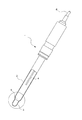
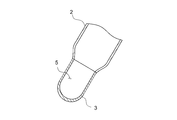
- the fragmentary broken view which shows 1 part of the internal structure of the glass electrode in one Embodiment of this invention The enlarged view of the response glass film
- the ion-selective electrode 1 includes a cylindrical glass support tube 2 and a response glass film 3 bonded to the tip of the support tube 2.
- a response glass film 3 bonded to the tip of the support tube 2.
- ion species such as proton (H + ), potassium ion (K + ), sodium ion (Na + ), ammonium ion (NH 4 + ), silver ion (Ag + ), etc. It is a response.
- the support tube 2 contains an internal electrode 4 and is filled with an internal liquid 5.
- a lead wire 6 is connected to the internal electrode 4, and the lead wire 6 extends outside from the base end portion of the support tube 2 and is connected to an ion concentration meter main body (not shown).
- the internal electrode 4 for example, an Ag / AgCl electrode or the like is used, and as the internal liquid 5, for example, a potassium chloride solution adjusted to pH 7 is used.
- the response glass film 3 has a cylindrical shape that is blow-molded so that the tip portion is substantially hemispherical. To join the response glass film 3 to the support tube 2, the response glass film 3 is used as the response glass film 3. For example, the oxide glass to be obtained is melted in, for example, a furnace maintained at a few hundreds of degrees, and after the tip of the support tube 2 is immersed therein, it is pulled up and blown at a predetermined speed.
- the yield point is included in the devitrification region, whereas in the oxide glass described in detail below, the yield point is included in the devitrification region. I can't.
- the oxide glass can avoid a reaction with a mold or a mold release agent that may occur in the case of lithium glass. For this reason, the response glass film 3 using such an oxide glass can also be formed by press working using a mold, which is impossible with conventional lithium glass.
- Me ′ having an oxidation number of + n and Me ′ having an oxidation number of + (n ⁇ m) (Me and Me ′ represent a transition metal of a d-block element, and Me and Me ′ are the same or different.
- N represents an integer of 1 or more
- m represents an integer of 1 to 3
- Me ′) 0.0001 to 0.6, preferably composed of an oxide glass contained in a molar ratio of 0.01 to 0.6. When the molar ratio exceeds 0.6, vitrification is difficult, and when the molar ratio is less than 0.0001, electrical conductivity necessary for ion responsiveness is not exhibited.
- Me and Me ′ are not particularly limited as long as they are transition metals of the d block element, and examples thereof include Ti, V, Mo, W, Fe, Cr, Mn, Co, Ni, Cu, and Ce.
- both Me and Me ′ are Fe
- Fe 2+ —O—Fe 3+ and Fe 3+ —O—Fe 2+ are mutually converted to cause hopping conduction
- both Me and Me ′ are V
- V 4+ -OV 5+ and V 5+ -OV 4+ are converted into each other to cause hopping conduction.
- Me is Fe and Me ′ is V
- Fe 2+ -OV 5+ , Fe 3+ -OV 4+ , Fe 3+ -OV 5+ and Fe 2+ -OV 4+ Converting to hopping conduction occurs.
- the oxide glass constituting the response glass film 3 may be any of phosphate glass, silicate glass, borate glass, and oxynitride glass, and phosphate glass is particularly preferable. .
- phosphate glass is particularly preferable.
- the oxide glass constituting the response glass film 3 may contain a metal oxide having an oxidation number of +3 to +5 such as Al 2 O 3 as a raw material. If it is such, corrosion resistance can improve more.
- the oxide glass constituting the response glass film 3 may contain a Group 3 element such as Sc, Y, or a lanthanoid. If it is such, an alkali error can be reduced.
- a Group 3 element such as Sc, Y, or a lanthanoid. If it is such, an alkali error can be reduced.
- These Group 3 elements may be used alone or in combination of two or more.
- the oxide glass constituting the response glass film 3 may contain an oxide of an alkaline earth metal such as barium oxide (BaO), calcium oxide (CaO), strontium oxide (SrO) as a raw material. . If it is such, alkali responsiveness can be suppressed. These oxides may be used alone or in combination of two or more.
- the oxide glass constituting the response glass film 3 preferably has a specific resistance of 3 ⁇ 10 10 ⁇ ⁇ cm or less. If the specific resistance exceeds 3 ⁇ 10 10 ⁇ ⁇ cm, the sensitivity may be less than 50%, and sufficient ion response may not be obtained.
- the sensitivity is a value expressed with the theoretical value in the Nernst response as 100%.
- the oxide glass constituting such a response glass film 3 has an oxide of Me that is + (n ⁇ m), and further has an oxidation number as required. It is manufactured by weighing and mixing a raw material compound containing an oxide of Me that is + n, melting in a reducing atmosphere such as N 2 gas, and then cooling. At this time, the melting is performed in a reducing atmosphere in order to prevent the Me in the glass from being biased toward the oxidation number + (n ⁇ m).
- annealing may be further performed at 200 to 1000 ° C. to oxidize only the surface of the response glass film 3 to increase Me—O 2 ⁇ .
- Me is Ti
- the titanol group on the surface of the response glass film 3 is increased, and electron transfer inside the response glass film 3 is not hindered. It is also possible to develop a photocatalytic action.
- response glass membrane 3 in the present embodiment was fabricated that consists Chitanorin silicate glass consisting 70 mol% TiO 2 and 30mol% P 2 O 5 Prefecture.
- Ti 3+ / Ti 4+ (molar ratio) of the titanophosphate glass was examined by a light absorption spectrum method, it was 0.06 to 0.15.
- the measurement solution was switched from an aqueous buffer solution of pH 7 to 99.5% ethanol. The pH response (indicated stability) was examined.
- the response glass film 3 in the present embodiment a glass composed of titanophosphate glass composed of 74 mol% TiO 2 and 26 mol% P 2 O 5 was further produced.
- Ti 3+ / Ti 4+ (molar ratio) of the titanophosphate glass was examined by a light absorption spectrum method, it was 10 ⁇ 4 to 0.2.
- the glass electrode 1 provided with the response glass film 3 was prepared and the potential was measured three times in the order of pH 7 ⁇ pH 4 ⁇ pH 9 using an aqueous buffer solution, as shown in the graph of FIG. It showed pH responsiveness. From the result of this potential measurement, the pH sensitivity between pH 4-9 was determined to be 79.6%.
- the “sensitivity” is a value that represents the theoretical value in the Nernst response as 100%.
- the glass electrode 1 can recover the same responsiveness as before the measurement of the alkaline aqueous solution by washing with an acid after being used for the measurement of the alkaline aqueous solution (pH 13).
- the oxide glass used for the response glass film 3 exhibits electrical conductivity even if it does not contain an ion conductive material, and therefore has a good ion response. It becomes possible to express sex.
- the response glass film 3 of the glass electrode 1 is made of an oxide glass containing no ion conductive material, it has the following advantageous characteristics as compared with those containing an ion conductive material. That is, (1) since the number of bonds in the glass skeleton is increased, durability and corrosion resistance are improved. (2) Since it is not ionic conductivity but electronic conductivity, the electrical resistance (specific resistance) is lowered and the ion responsiveness is improved. (3) Since the electric resistance (specific resistance) is low, the film thickness can be increased to improve the strength. (4) Since the composition is simple, it is easy to regenerate the glass.
- the present invention is not limited to the above embodiment.
- the ion selective electrode of the present invention is not limited to the glass electrode 1, but may be a composite electrode in which the glass electrode and the reference electrode are integrated, or a single electrode in which the temperature compensation electrode is further added to the composite electrode. Good.
- the response glass film 3 of the glass electrode 1 according to the present invention has a low specific resistance and can exhibit a good ion response even when the film thickness is increased, the plate-like oxide glass is cut and polished. It may be produced by casting a molten oxide glass into a predetermined mold and molding it. Since the response glass film 3 obtained in this way has high mechanical strength, it is sealed by bonding to one end opening of the support tube 2 using an adhesive or a mechanical mechanism (mechanical seal). A glass electrode 1 as shown in FIG. 5 can be produced. As the support tube 2 of the glass electrode 1 having such a configuration, for example, one made of borosilicate glass or fluororesin having excellent corrosion resistance and mechanical strength can be used.
- a response glass film made of an oxide glass that is excellent in durability and corrosion resistance, has a long life, has a low specific resistance, and can be made tough vitrified by increasing the film thickness.
- a glass electrode can be obtained.
- the response glass film according to the present invention has a simple composition, it can be easily regenerated and is excellent in terms of environmental protection.
Landscapes
- Chemical & Material Sciences (AREA)
- Life Sciences & Earth Sciences (AREA)
- Health & Medical Sciences (AREA)
- Chemical Kinetics & Catalysis (AREA)
- Biochemistry (AREA)
- Immunology (AREA)
- Physics & Mathematics (AREA)
- Analytical Chemistry (AREA)
- Molecular Biology (AREA)
- General Health & Medical Sciences (AREA)
- General Physics & Mathematics (AREA)
- Electrochemistry (AREA)
- Pathology (AREA)
- Engineering & Computer Science (AREA)
- General Chemical & Material Sciences (AREA)
- Geochemistry & Mineralogy (AREA)
- Materials Engineering (AREA)
- Organic Chemistry (AREA)
- Glass Compositions (AREA)
Abstract
半導性を示し、イオン応答性に優れたイオン選択性電極用応答ガラス膜3及びそれを備えたイオン選択性電極1を提供するものであり、酸化数が+nであるMeと酸化数が+(n±m)であるMe´(Me及びMe´はdブロック元素の遷移金属を表し、Me及びMe´は同じでも異なっていてもよく、nは1以上の整数を表し、mは1~3の整数を表す。)とを、(酸化数が+nであるMe)/(酸化数が+(n±m)であるMe´)=0.0001~0.6のモル比で含有する酸化物ガラスからなるようにしてある。
Description
この発明は、半導性を示し、イオン応答性に優れたイオン選択性電極用応答ガラス膜及びそれを備えたイオン選択性電極に関するものである。
従来、イオン選択性電極に用いられる応答ガラス膜は、リチウムイオン(Li+)等のイオン導電物質を媒介物質としてイオン応答性を発現している。しかしながら、このようなイオン導電物質を含有するガラスはガラス骨格の結合数が少ないため、耐久性に劣るという欠点を有する。
また、イオン導電物質を含有するガラスは組成が複雑になり、イオン導電カチオンが他のカチオンと競合する混合カチオン効果を発現しやすくなる。混合カチオン効果が発現すると、ガラス中のイオン導電物質の移動が阻害されるので、イオン導電物質を含有するガラスをイオン選択性電極の応答ガラス膜に使用するとガラス膜抵抗の増大を招く。
更に、イオン導電物質を含有する応答ガラス膜を水溶液中に浸漬すると、イオン導電物質や他のカチオンが水溶液中に溶解して次第に水和層が厚くなり、イオン応答性が低下するという問題点もある。
加えて、近時、環境保護の観点から廃棄されたガラスの再利用が推進されているが、イオン導電物質を含有するガラスは組成が複雑であるので、再生が困難である。
そこで本発明は、半導性を示し、イオン応答性に優れたイオン選択性電極用応答ガラス膜及びそれを備えたイオン選択性電極を提供すべく図ったものである。
すなわち本発明に係るイオン選択性電極用応答ガラス膜は、酸化数が+nであるMeと酸化数が+(n±m)であるMe´(Me及びMe´はdブロック元素の遷移金属を表し、Me及びMe´は同じでも異なっていてもよく、nは1以上の整数を表し、mは1~3の整数を表す。)とを、(酸化数が+nであるMe)/(酸化数が+(n±m)であるMe´)=0.0001~0.6のモル比で含有する酸化物ガラスからなることを特徴とする。
このようなものであれば、応答ガラス膜表面では、Me-O-がカチオンとの間で電子の授受を行い、応答ガラス膜中では、Men+-O-Me´(n±m)+とMe(n±m)+-O-Me´n+とが相互に変換してホッピング伝導が起こり電子が伝達されると推測される。このため、本発明で用いられる酸化物ガラスはイオン導電物質を含有していなくとも電気伝導性を示すことができ、イオン応答性を発現することが可能となる。
また、本発明に係るイオン選択性電極用応答ガラス膜は、イオン導電物質を含有しない酸化物ガラスからなるので、イオン導電物質を含有するものに比べて、以下のような有利な特徴を有する。すなわち、(1)ガラス骨格の結合数がより多くなるので耐久性・耐蝕性が向上する。(2)イオン導電性ではなく、電子導電性であるため、電気抵抗(比抵抗)が低下してイオン応答性が向上する。(3)電気抵抗(比抵抗)が低いので膜厚を厚くして強度を向上することができる。(4)組成が単純であるのでガラスの再生が容易である。(5)水溶液中に浸漬してもイオン導電カチオンが溶出することがないので、使用に伴い水和層の厚さが増してイオン応答速度が低下することがない。(6)極性有機溶媒中に浸漬してもイオン導電物質がガラス膜表面に局在したり溶媒中に引き抜かれたりして電気伝導性が阻害されることがないので極性有機溶媒中でも高いイオン応答速度を維持することができる。
本発明で用いられる酸化物ガラスとしては、リン酸塩ガラス、ケイ酸塩ガラス、ホウ酸塩ガラス又はオキシナイトライドガラスが挙げられる。
また、本発明で用いられる酸化物ガラスは、Sc、Y、ランタノイド等の3族の元素を含有していてもよく、また、原料として、酸化バリウム(BaO)、酸化カルシウム(CaO)、酸化ストロンチウム(SrO)等のアルカリ土類金属の酸化物を含有していてもよい。
本発明のイオン選択性電極用応答ガラス膜を備えているイオン選択性電極もまた、本発明の1つである。すなわち、本発明に係るイオン選択性電極は、酸化数が+nであるMeと酸化数が+(n±m)であるMe´(Me及びMe´はdブロック元素の遷移金属を表し、Me及びMe´は同じでも異なっていてもよく、nは1以上の整数を表し、mは1~3の整数を表す。)とを、(酸化数が+nであるMe)/(酸化数が+(n±m)であるMe´)=0.0001~0.6のモル比で含有する酸化物ガラスからなる応答ガラス膜を備えていることを特徴とする。
このように本発明によれば、耐久性・耐蝕性に優れ、長寿命であり、比抵抗が低く、膜厚を厚くしてタフガラス化することが可能な酸化物ガラスからなる応答ガラス膜及びそれを備えたガラス電極を得ることができる。
以下に、本発明の一実施形態を、図面を参照して説明する。
本実施形態に係るイオン選択性電極1は、図1及び図2に示すように、円筒状のガラス製の支持管2と、その支持管2の先端部に接合した応答ガラス膜3とを備えたガラス電極であり、例えば、プロトン(H+)、カリウムイオン(K+)、ナトリウムイオン(Na+)、アンモニウムイオン(NH4
+)、銀イオン(Ag+)等のイオン種に選択的に応答するものである。
支持管2には、内部電極4が収容してあり、かつ、内部液5が充填してある。内部電極4には、リード線6が接続してあり、リード線6はこの支持管2の基端部から外部に延出し図示しないイオン濃度計本体に接続されるようにしてある。
内部電極4としては、例えばAg/AgCl電極等が用いられ、内部液5としては、例えばpH7に調整した塩化カリウム溶液等が用いられる。
応答ガラス膜3は、先端部が略半球状をなすようにブロー成形してある円筒状のものであり、この応答ガラス膜3を前記支持管2に接合するには、応答ガラス膜3に用いられる酸化物ガラスを、例えば千数百度に保たれた炉内で溶融状態にしておき、そこに支持管2の先端部を浸漬した後、所定速度で引き上げ、ブローするといった方法がとられる。
また、リチウムイオンを含有するガラス(以下、リチウムガラスという。)では、屈伏点が失透領域に含まれるのに対して、以下に詳述する酸化物ガラスでは、屈伏点が失透領域に含まれない。また、当該酸化物ガラスは、リチウムガラスの場合に起こり得る金型又は金型の離型剤等との反応を回避することが可能である。このため、このような酸化物ガラスを用いた応答ガラス膜3は、従来のリチウムガラスでは不可能であった金型を用いたプレス加工により成形することも可能である。
応答ガラス膜3は、酸化数が+nであるMeと酸化数が+(n±m)であるMe´(Me及びMe´はdブロック元素の遷移金属を表し、Me及びMe´は同じでも異なっていてもよく、nは1以上の整数を表し、mは1~3の整数を表す。)とを、(酸化数が+nであるMe)/(酸化数が+(n±m)であるMe´)=0.0001~0.6、好ましくは0.01~0.6のモル比で含有する酸化物ガラスからなるものである。当該モル比が0.6を超えると、ガラス化が困難であり、当該モル比が0.0001未満であると、イオン応答性に必要な電気伝導性が発現しない。
Me及びMe´としてはdブロック元素の遷移金属であれば特に限定されず、例えば、Ti、V、Mo、W、Fe、Cr、Mn、Co、Ni、Cu、Ce等が挙げられる。
このような応答ガラス膜3においては、その表面では、Me-O-がカチオンとの間で電子の授受を行い、その内部では、Men+-O-Me´(n±m)+とMe(n±m)+-O-Me´n+とが相互に変換してホッピング伝導が起こり電子が伝達されることによって電気伝導性が発現し、この結果イオン応答性が発現すると推測される。
具体的には、例えば、Me及びMe´がいずれもTiである場合、応答ガラス膜3の表面では、チタノール基がカチオンとの間で電子の授受を行い、応答ガラス膜3の内部では、Ti3+-O-Ti4+とTi4+-O-Ti3+とが相互に変換してホッピング伝導が起こり電子が伝達される。
また、Me及びMe´がいずれもFeである場合は、Fe2+-O-Fe3+とFe3+-O-Fe2+とが相互に変換してホッピング伝導が起こり、Me及びMe´がいずれもVである場合は、V4+-O-V5+とV5+-O-V4+とが相互に変換してホッピング伝導が起こる。
更に、MeがFeでMe´がVである場合は、例えば、Fe2+-O-V5+、Fe3+-O-V4+、Fe3+-O-V5+及びFe2+-O-V4+が相互に変換してホッピング伝導が起こる。
MeとMe´との酸化数が離れている場合は、電子の移動がスムーズになり、結果として比抵抗が下がる効果にあり、MeとMe´とが互いに異なる元素である場合は、ガラス化しやすいという効果がある。
なお、Ti以外のMe(又はMe´)が取り得る酸化数はそれぞれ下記表1に記載のとおりである。

応答ガラス膜3を構成する酸化物ガラスは、リン酸塩ガラス、ケイ酸塩ガラス、ホウ酸塩ガラス、及び、オキシナイトライドガラスのいずれであってもよいが、なかでもリン酸塩ガラスが好ましい。このようなリン酸塩ガラスを応答ガラス膜3に用いると、ガラス電極1自体の軽量化を図ることができるうえ、電気抵抗(比抵抗)が低いことからイオン応答性を向上させることもできる。そして、電気抵抗(比抵抗)が低いため、機械的強度等も考慮し、歪みを柔軟に設定することができ、応答ガラス膜3を設計する際の自由度を大幅に高めることができる。
更に、応答ガラス膜3を構成する酸化物ガラスは、原料として、例えばAl2O3等の酸化数が+3~+5である金属の酸化物を含有していてもよい。このようなものであれば、耐蝕性がより向上しうる。
また、応答ガラス膜3を構成する酸化物ガラスは、Sc、Y、ランタノイド等の3族の元素を含有していてもよい。このようなものであれば、アルカリ誤差を低減することができる。これらの3族の元素は単独で用いられてもよく、2種以上が併用されてもよい。
更に、応答ガラス膜3を構成する酸化物ガラスは、原料として、酸化バリウム(BaO)、酸化カルシウム(CaO)、酸化ストロンチウム(SrO)等のアルカリ土類金属の酸化物を含有していてもよい。このようなものであれば、アルカリ応答性を抑制することができる。これらの酸化物は単独で用いられてもよく、2種以上が併用されてもよい。
本実施形態において応答ガラス膜3を構成する酸化物ガラスとしては、比抵抗が3×10¹⁰Ω・cm以下であるものが好ましい。比抵抗が3×10¹⁰Ω・cmを超えると感度が50%を下回ることがあり、充分なイオン応答性が得られない場合がある。なお、ここで、感度とは、ネルンスト応答における理論値を100%として表した値である。
このような応答ガラス膜3を構成する酸化物ガラスは、例えば、MeとMe´とが同じものである場合、+(n±m)であるMeの酸化物、更に必要に応じて酸化数が+nであるMeの酸化物を含む原料化合物を秤量・混合し、N2ガス等による還元雰囲気下で溶融した後、冷却することにより製造される。この際、溶融を還元雰囲気下で行うのは、ガラス中のMeが酸化数+(n±m)であるものに偏るのを防ぐためである。
応答ガラス膜3のイオン応答性を向上させるためには、更に200~1000℃でアニーリングを行い、応答ガラス膜3の表面のみを酸化して、Me-O-を増加させてもよい。また、MeがTiである場合は、応答ガラス膜3の表面のみを酸化することにより、応答ガラス膜3表面のチタノール基を増加して、応答ガラス膜3内部における電子伝達は阻害せずに、光触媒作用を発現させることも可能となる。
ガラス電極1を用いて試料溶液のイオン濃度を測定する際には、ガラス電極1の応答ガラス膜3をイオン濃度を求めたい試料溶液に浸すと、応答ガラス膜3に内部液5と試料溶液との間のイオン濃度の差に応じた起電力が生じる。この起電力を、図示しない比較電極を用いて、ガラス電極1の内部電極4と比較電極の内部電極の電位差(電圧)として測定してイオン濃度を算出する。この起電力は温度によって変動するため、温度素子を用い、この出力信号値をパラメータとして前記電位差を補正して、試料溶液のイオン濃度を算出しイオン濃度計本体に表示することが好ましい。
本実施形態における応答ガラス膜3として、70mol%TiO2と30mol%P2O5とからなるチタノリン酸ガラスから構成されたものを作製した。当該チタノリン酸ガラスのTi3+/Ti4+(モル比)を光吸収スペクトル法で調べたところ、0.06~0.15であった。この応答ガラス膜3を備えたガラス電極1(本発明品)の極性有機溶媒中でのpH応答性を調べるために、pH7の水性緩衝液から99.5%エタノールに測定液を切り替えたときのpH応答性(指示安定性)を調べた。この際、比較として、従来のリチウムシリケートガラスからなる応答ガラス膜を備えた電極(従来品)と、他社の非水溶媒用電極(他社製品)を用いた。その結果、図3のグラフに示すように、本発明品のpH応答性は抜きんでて優れていた。
また、本実施形態における応答ガラス膜3として、更に、74mol%TiO2と26mol%P2O5とからなるチタノリン酸ガラスから構成されるものを作製した。当該チタノリン酸ガラスのTi3+/Ti4+(モル比)を光吸収スペクトル法で調べたところ、10-4~0.2であった。この応答ガラス膜3を備えたガラス電極1を作製し、水性の緩衝液を用いてpH7→pH4→pH9の順で電位測定を3回行ったところ、図4のグラフに示すように、良好なpH応答性を示した。また、この電位測定の結果から、pH4-9間のpH感度を求めたところ79.6%であった。なおここで、「感度」とは、ネルンスト応答における理論値を100%として表した値である。
また、本ガラス電極1は、アルカリ水溶液(pH13)の測定に使用した後、酸で洗浄することにより、アルカリ水溶液測定前と同等の応答性を回復することが可能であると思われる。
したがって、このように構成した本実施形態に係るガラス電極1によれば、応答ガラス膜3に用いられる酸化物ガラスがイオン導電物質を含有していなくとも電気伝導性を示すので、良好なイオン応答性を発現することが可能となる。
また、ガラス電極1の応答ガラス膜3は、イオン導電物質を含有しない酸化物ガラスからなるので、イオン導電物質を含有するものに比べて、以下のような有利な特徴を有する。すなわち、(1)ガラス骨格の結合数がより多くなるので耐久性・耐蝕性が向上する。(2)イオン導電性ではなく、電子導電性であるため、電気抵抗(比抵抗)が低下してイオン応答性が向上する。(3)電気抵抗(比抵抗)が低いので膜厚を厚くして強度を向上することができる。(4)組成が単純であるのでガラスの再生が容易である。(5)水溶液中に浸漬してもイオン導電カチオンが溶出することがないので、使用に伴い水和層の厚さが増してイオン応答速度が低下することがない。(6)極性有機溶媒中に浸漬してもイオン導電物質がガラス膜表面に局在したり溶媒中に引き抜かれたりして電気伝導性が阻害されることがないので極性有機溶媒中でも高いイオン応答速度を維持することができる。
なお、本発明は、前記実施形態に限られるものではない。
例えば、本発明のイオン選択性電極はガラス電極1に限られず、ガラス電極と比較電極を一体化した複合電極や、複合電極に更に温度補償電極を加えて一体化した一本電極であってもよい。
また、本発明に係るガラス電極1の応答ガラス膜3は、比抵抗が低く膜厚を厚くしても良好なイオン応答性を発現することができるので、板状の酸化物ガラスを切削研磨することにより作製されたものや、溶融した酸化物ガラスを所定の型に流し込んで成型することによって作製されたものであってもよい。このようにして得られた応答ガラス膜3は機械的強度が高いので、接着剤又は機械的な機構(メカニカルシール)を用いて支持管2の一端開口部に接合して封止することにより、図5に示すようなガラス電極1を作製することができる。このような構成を有するガラス電極1の支持管2としては、例えば、耐食性や機械的強度に優れたホウケイ酸塩ガラスやフッ素樹脂等からなるものを用いることできる。
その他、本発明は、その趣旨を逸脱しない範囲で種々の変形が可能であることは言うまでもない。
本発明によれば、耐久性・耐蝕性に優れ、長寿命であり、比抵抗が低く、膜厚を厚くしてタフガラス化することが可能な酸化物ガラスからなる応答ガラス膜及びそれを備えたガラス電極を得ることができる。また、本発明に係る応答ガラス膜は、組成が単純であるので、再生が容易であり、環境保護の点からも優れている。
1…ガラス電極
2…支持管
3…応答ガラス膜
4…内部電極
5…内部液
6…リード線
2…支持管
3…応答ガラス膜
4…内部電極
5…内部液
6…リード線
Claims (5)
- 酸化数が+nであるMeと酸化数が+(n±m)であるMe´(Me及びMe´はdブロック元素の遷移金属を表し、Me及びMe´は同じでも異なっていてもよく、nは1以上の整数を表し、mは1~3の整数を表す。)とを、(酸化数が+nであるMe)/(酸化数が+(n±m)であるMe´)=0.0001~0.6のモル比で含有する酸化物ガラスからなることを特徴とするイオン選択性電極用応答ガラス膜。
- 前記酸化物ガラスが、リン酸塩ガラス、ケイ酸塩ガラス、ホウ酸塩ガラス又はオキシナイトライドガラスである請求項1記載のイオン選択性電極用応答ガラス膜。
- 前記酸化物ガラスが、3族の元素を含有する請求項1記載のイオン選択性電極用応答ガラス膜。
- 前記酸化物ガラスが、原料として、アルカリ土類金属の酸化物を含有する請求項1記載のイオン選択性電極用応答ガラス膜。
- 酸化数が+nであるMeと酸化数が+(n±m)であるMe´(Me及びMe´はdブロック元素の遷移金属を表し、Me及びMe´は同じでも異なっていてもよく、nは1以上の整数を表し、mは1~3の整数を表す。)とを、(酸化数が+nであるMe)/(酸化数が+(n±m)であるMe´)=0.0001~0.6のモル比で含有する酸化物ガラスからなる応答ガラス膜を備えていることを特徴とするイオン選択性電極。
Priority Applications (1)
| Application Number | Priority Date | Filing Date | Title |
|---|---|---|---|
| JP2010543989A JP5791023B2 (ja) | 2008-12-25 | 2009-11-27 | イオン選択性電極用イオン応答ガラス膜、イオン選択性電極及びイオン濃度計 |
Applications Claiming Priority (2)
| Application Number | Priority Date | Filing Date | Title |
|---|---|---|---|
| JP2008-329713 | 2008-12-25 | ||
| JP2008329713 | 2008-12-25 |
Publications (1)
| Publication Number | Publication Date |
|---|---|
| WO2010073875A1 true WO2010073875A1 (ja) | 2010-07-01 |
Family
ID=42287493
Family Applications (1)
| Application Number | Title | Priority Date | Filing Date |
|---|---|---|---|
| PCT/JP2009/070030 Ceased WO2010073875A1 (ja) | 2008-12-25 | 2009-11-27 | イオン選択性電極用応答ガラス膜及びイオン選択性電極 |
Country Status (2)
| Country | Link |
|---|---|
| JP (1) | JP5791023B2 (ja) |
| WO (1) | WO2010073875A1 (ja) |
Cited By (2)
| Publication number | Priority date | Publication date | Assignee | Title |
|---|---|---|---|---|
| US20210055252A1 (en) * | 2019-08-21 | 2021-02-25 | Endress+Hauser Conducta Gmbh+Co. Kg | Sensor element for a potentiometric sensor and respective manufacturing method |
| CN116802488A (zh) * | 2021-02-09 | 2023-09-22 | 尤尼森斯公司 | 固体接触离子选择性电极 |
Citations (3)
| Publication number | Priority date | Publication date | Assignee | Title |
|---|---|---|---|---|
| JPS5357895A (en) * | 1976-11-04 | 1978-05-25 | Mihairobuitsuchi Shiyu Mihairu | Glass electrode |
| JPS60200840A (ja) * | 1984-03-23 | 1985-10-11 | Takeshi Nomura | 陰イオン選択性ガラス電極膜 |
| JP2008241696A (ja) * | 2007-02-26 | 2008-10-09 | Mie Univ | イオン選択性電極用応答ガラス及びイオン選択性電極 |
-
2009
- 2009-11-27 WO PCT/JP2009/070030 patent/WO2010073875A1/ja not_active Ceased
- 2009-11-27 JP JP2010543989A patent/JP5791023B2/ja active Active
Patent Citations (3)
| Publication number | Priority date | Publication date | Assignee | Title |
|---|---|---|---|---|
| JPS5357895A (en) * | 1976-11-04 | 1978-05-25 | Mihairobuitsuchi Shiyu Mihairu | Glass electrode |
| JPS60200840A (ja) * | 1984-03-23 | 1985-10-11 | Takeshi Nomura | 陰イオン選択性ガラス電極膜 |
| JP2008241696A (ja) * | 2007-02-26 | 2008-10-09 | Mie Univ | イオン選択性電極用応答ガラス及びイオン選択性電極 |
Cited By (3)
| Publication number | Priority date | Publication date | Assignee | Title |
|---|---|---|---|---|
| US20210055252A1 (en) * | 2019-08-21 | 2021-02-25 | Endress+Hauser Conducta Gmbh+Co. Kg | Sensor element for a potentiometric sensor and respective manufacturing method |
| US11692961B2 (en) * | 2019-08-21 | 2023-07-04 | Endress+Hauser Conducta Gmbh+Co. Kg | Sensor element for a potentiometric sensor and respective manufacturing method |
| CN116802488A (zh) * | 2021-02-09 | 2023-09-22 | 尤尼森斯公司 | 固体接触离子选择性电极 |
Also Published As
| Publication number | Publication date |
|---|---|
| JP5791023B2 (ja) | 2015-10-07 |
| JPWO2010073875A1 (ja) | 2012-06-14 |
Similar Documents
| Publication | Publication Date | Title |
|---|---|---|
| CN103214172B (zh) | 化学强化玻璃板的制造方法 | |
| WO2006035882A1 (ja) | 半導体封止用ガラス及び半導体封止用外套管並びに半導体電子部品 | |
| JPWO2012132328A1 (ja) | 低膨張ガラス及び強化ガラス | |
| CN104302591A (zh) | 强化玻璃基板及其制造方法 | |
| JP2019052081A (ja) | 改善された耐水性を有する高膨張性接合用ガラスおよびその使用 | |
| WO2009128451A1 (ja) | 色素増感型太陽電池用ガラス組成物および色素増感型太陽電池用材料 | |
| JP2012116744A (ja) | 半導体封入用無鉛ガラス及び半導体封入用外套管 | |
| US4028196A (en) | PH Responsive glass compositions and electrodes | |
| JP2015227276A (ja) | ガラス | |
| JP5791023B2 (ja) | イオン選択性電極用イオン応答ガラス膜、イオン選択性電極及びイオン濃度計 | |
| KR20150028786A (ko) | 이온 교환성 전이 금속-함유 유리 | |
| JP5009318B2 (ja) | イオン選択性電極 | |
| US2497235A (en) | ph-responsive glass electrodes | |
| JPH03265538A (ja) | 金属に対するガラスシール作製用シールガラス | |
| JP2013028506A (ja) | ディスプレイ用カバーガラス | |
| JP2010280554A (ja) | 色素増感型太陽電池用ガラスおよび色素増感型太陽電池用材料 | |
| US20240227718A9 (en) | Joint connection comprising a glass, glass, in particular for producing a joint connection, and feedthrough comprising a glass and/or a joint connection, and method for producing same | |
| JP5335288B2 (ja) | ガラス電極及びその応答ガラス | |
| CN101058477B (zh) | 一种电真空玻璃制品无铅封接玻璃及其制备方法 | |
| JP2010042960A (ja) | 色素増感型太陽電池用ガラス組成物および色素増感型太陽電池用材料 | |
| JP6104226B2 (ja) | ナトリウム耐性の接合ガラス及びその使用 | |
| JPWO2010050590A1 (ja) | ガラスペースト | |
| CN106414354A (zh) | 用于密封大面积染料敏化太阳能电池的玻璃材料 | |
| JP6489414B2 (ja) | ガラスの製造方法 | |
| KR20140020222A (ko) | 이온 전도성 재료 및 그 제조 방법 |
Legal Events
| Date | Code | Title | Description |
|---|---|---|---|
| 121 | Ep: the epo has been informed by wipo that ep was designated in this application |
Ref document number: 09834679 Country of ref document: EP Kind code of ref document: A1 |
|
| ENP | Entry into the national phase |
Ref document number: 2010543989 Country of ref document: JP Kind code of ref document: A |
|
| NENP | Non-entry into the national phase |
Ref country code: DE |
|
| 122 | Ep: pct application non-entry in european phase |
Ref document number: 09834679 Country of ref document: EP Kind code of ref document: A1 |