WO2010067563A1 - 糖ペプチドの製造方法 - Google Patents
糖ペプチドの製造方法 Download PDFInfo
- Publication number
- WO2010067563A1 WO2010067563A1 PCT/JP2009/006641 JP2009006641W WO2010067563A1 WO 2010067563 A1 WO2010067563 A1 WO 2010067563A1 JP 2009006641 W JP2009006641 W JP 2009006641W WO 2010067563 A1 WO2010067563 A1 WO 2010067563A1
- Authority
- WO
- WIPO (PCT)
- Prior art keywords
- residue
- galnac
- trans
- peptide
- type
- Prior art date
- Legal status (The legal status is an assumption and is not a legal conclusion. Google has not performed a legal analysis and makes no representation as to the accuracy of the status listed.)
- Ceased
Links
- FRNOQNGNOBQZFI-UHFFFAOYSA-N CC(C(C(C)=O)N(C)C)O Chemical compound CC(C(C(C)=O)N(C)C)O FRNOQNGNOBQZFI-UHFFFAOYSA-N 0.000 description 1
Images





Classifications
-
- C—CHEMISTRY; METALLURGY
- C12—BIOCHEMISTRY; BEER; SPIRITS; WINE; VINEGAR; MICROBIOLOGY; ENZYMOLOGY; MUTATION OR GENETIC ENGINEERING
- C12P—FERMENTATION OR ENZYME-USING PROCESSES TO SYNTHESISE A DESIRED CHEMICAL COMPOUND OR COMPOSITION OR TO SEPARATE OPTICAL ISOMERS FROM A RACEMIC MIXTURE
- C12P21/00—Preparation of peptides or proteins
- C12P21/005—Glycopeptides, glycoproteins
Definitions
- the present invention relates to a method for producing a glycopeptide. More specifically, the present invention relates to a method for producing a glycopeptide containing at least one trans-type proline residue.
- Non-Patent Document 1 J. Mol. Biol. (2005) 354, 801-814
- Non-Patent Document 2 Science (2003), 302, 1364-1368
- Non-Patent Document 3 Science (1997), 278, 82-87
- Non-Patent Document 4 Curr. Opin. Biotechnol. (1995), 6, 460-466
- Non-Patent Document 5 Science (1995), 270, 935-941
- Non-Patent Document 6 Peptides: Chemistry and Biology 2002. Sewald, Norbert / Jakubke, Hans-Dieter, WILEY-VCH The entire description of Non-Patent Documents 1 to 6 is specifically incorporated herein by reference.
- Non-patent Document 6 Generally, most of the amide bonds in peptide chains form a trans isomer, but the X (arbitrary amino acid) -P sequence often forms a cis isomer compared to other sequences (average). 6.5% form a cis isomer) (Non-patent Document 6).
- an object of the present invention is to provide a peptide derivative with controlled function and quality, which has cis-trans isomerization and has a conformation only in the trans form.
- the present inventors focused on the above-mentioned X-P sequence and added a sugar chain at amino acid X. Specifically, by selecting serine (S) and threonine (T) residues as X, and adding a disaccharide core1 type sugar chain (Gal ⁇ (1 ⁇ 3) GalNAc- ⁇ ) to these residues
- S serine
- T threonine
- Gal ⁇ (1 ⁇ 3) GalNAc- ⁇ disaccharide core1 type sugar chain
- the trans-type proline residue includes at least one trans-type proline residue, and the trans-type proline residue is a disaccharide core type 1 sugar chain (Gal ⁇ (1 ⁇ 3) GalNAc- ⁇ ).
- a method for producing a glycopeptide which is an added serine residue or threonine residue Utilizing chemical synthesis methods of peptides, The production method comprising a step of binding serine or threonine to which a disaccharide core1 type sugar chain (Gal ⁇ (1 ⁇ 3) GalNAc- ⁇ ) is added to the N-terminal side of a proline residue to be converted into at least one time.
- the proline residue to be converted to the trans form is a proline residue with the C-terminal immobilized on the solid phase, and binds serine or threonine with a disaccharide core1 type sugar chain (Gal ⁇ (1 ⁇ 3) GalNAc- ⁇ ) added
- the manufacturing method according to [2] includes at least one trans-type proline residue, and the trans-type proline residue is a disaccharide core type 1 sugar chain (Gal ⁇ (1 ⁇ 3) GalNAc- ⁇ ).
- a method for producing a glycopeptide which is an added serine residue or threonine residue A peptide containing a proline residue and containing a serine residue or a threonine residue as an amino acid residue adjacent to the N-terminal side of the proline residue; Including the step of introducing a disaccharide core1 type sugar chain (Gal ⁇ (1 ⁇ 3) GalNAc- ⁇ ) into a serine residue or threonine residue adjacent to the N-terminal side of at least one proline residue of the peptide, Production method.
- a disaccharide core1 type sugar chain Gal ⁇ (1 ⁇ 3) GalNAc- ⁇
- glycopeptides are prepared by controlling the cis-trans isomerization of SP and TP sequences by glycosylation and having a certain conformation, that is, immobilizing proline as a trans isomer. be able to.
- cis-trans isomerization can be suppressed and a peptide showing a certain conformer can be provided. Therefore, it is considered that the drug efficacy of a peptide preparation that must contain proline can be made constant. . If isomerization is still occurring, either of them shows pharmacological activity, resulting in a weakening of the effect and an increase in the dose, whereas using only the active form minimizes the dose. It is done. It can be applied to highly sensitive detection of autoantibodies found in autoimmune diseases (ELISA method as a typical method of use).
- Autoimmune diseases include cases where a protein is overexpressed for some reason and the protein is attacked by an antibody that recognizes it (autoantibody), or that a protein is denatured (such as sugar chain dysfunction). ) Is a disease that causes body modulation.
- the autoantibody recognizes a certain region (epitope) in the protein, but when the region contains proline, it is expected to be predominantly in a trans form.
- an epitope sequence must be synthesized. That is, it is necessary to synthesize a peptide having the same trans form as the natural protein.
- the protein is mucin, control of the three-dimensional structure by sugar chain modification in the production method of the present invention is useful.
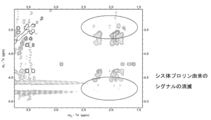
- FIG. 1-1 shows the NMR analysis results for Compound 1.
- FIG. 1-2 shows the NMR analysis results for Compound 2.
- FIG. 1-3 shows the NMR analysis result of Compound 3.
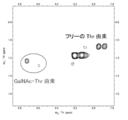
- FIG. 2-1 shows the NH-methyl proton (threonine) correlation region of the TOCSY spectrum for Compound 1.
- FIG. 2-2 shows the correlation region of NH-methyl proton (threonine) in the TOCSY spectrum for compound 2.
- FIG. 2-3 shows the NH-methyl proton (threonine) correlation region of the TOCSY spectrum for compound 3.
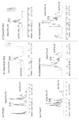
- FIG. 2-4 shows the structure of the main chain structure of compound 2 (left figure) and the structure of the Pro1 to Thr11 region displaying the sugar chain (right figure).
- FIG. 3 shows the results of quantification of cis- and trans-isomers obtained in Example 2 by 1H-NMR.
- the method for producing a glycopeptide of the present invention comprises at least one trans-type proline residue, and the trans-type proline residue is a disaccharide core1 type sugar chain (Gal ⁇ (1 ⁇ 3)
- the peptide of the glycopeptide produced in the production method of the present invention may be any peptide as long as at least one proline residue is adjacent to the serine residue or threonine residue on the N-terminal side of this proline residue.
- the serine residue or threonine residue adjacent to the N-terminal side of the residue is a disaccharide core 1 type sugar chain (Gal ⁇ (1 ⁇ 3) GalNAc- ⁇ ) added, and as a result, the proline residue is It has a trans structure.
- the number of amino acid residues of the peptide is not particularly limited, but can be, for example, in the range of 2 to 200, and further in the range of 10 to 100. Further, the number of proline residues can be, for example, in the range of 1 to 100, and some or all of the proline residues can be trans. There are no particular restrictions on the type or sequence of amino acid residues other than proline residues, serine residues or threonine residues.
- peptides include, for example, tandem repeat sequences of human mucin (MUC), which is a glycoprotein containing a large amount of IgA1 or a partial sequence thereof, O-linked sugar chain (MUC1, MUC9, MUC14, SP and TP are present in all except MUC15, MUC18, MUC19)
- MUC2 PTT TP ITTTTTVTP TPTP TGTQT (SEQ ID NO: 2)
- MUC3A HS TP SFTSSITTTETTS (SEQ ID NO: 3)
- MUC4 TSSASTGHA TP LPVTD (SEQ ID NO: 4)
- the method for producing a glycopeptide of the present invention includes the following first and second aspects.
- a first aspect of the method for producing a glycopeptide of the present invention is the above-described production method, further using a method for chemically synthesizing a peptide, and a disaccharide core1 on the N-terminal side of a proline residue to be converted into a trans form. It includes at least one step of binding serine or threonine to which a type sugar chain (Gal ⁇ (1 ⁇ 3) GalNAc- ⁇ ) is added.
- the second aspect of the method for producing a glycopeptide of the present invention is the above production method, further comprising a proline residue and a serine residue as an amino acid residue adjacent to the N-terminal side of the proline residue.
- the method includes a step of introducing a disaccharide core1-type sugar chain (Gal ⁇ (1 ⁇ 3) GalNAc- ⁇ ) into a serine residue or threonine residue adjacent to the N-terminal side of at least one proline residue of the peptide.
- a first aspect of the method for producing a glycopeptide of the present invention utilizes a method for chemically synthesizing a peptide using a sugar amino acid. Furthermore, as a peptide chemical synthesis method, for example, a solid phase synthesis method can be used. In the first embodiment, serine or threonine to which a disaccharide core1-type sugar chain (Gal ⁇ (1 ⁇ 3) GalNAc- ⁇ ) is added as a sugar amino acid is bound to the N-terminal side of the proline residue to be converted into a trans form.
- a disaccharide core1-type sugar chain Gal ⁇ (1 ⁇ 3) GalNAc- ⁇
- a method for chemically synthesizing a peptide it is appropriate to use a method suitable for synthesizing a peptide using a sugar amino acid which is an amino acid to which a sugar is added.
- a method of performing a peptide synthesis forming reaction while irradiating microwaves described in JP-A-2006-28141 can be mentioned.
- the N-terminal amino group or C-terminal carboxyl group of the first sugar amino acid (or amino acid) is bound to the solid phase carrier (for example, the C-terminal carboxyl group is bonded to a chlorotrityl resin, chloromethyl resin, oxymethyl).
- Resin, p-alkoxybenzyl alcohol resin and the like and optionally using a condensing agent, sugar amino acids (or amino acids) are sequentially bound.
- Serine or threonine to which a disaccharide core 1-type sugar chain (Gal ⁇ (1 ⁇ 3) GalNAc- ⁇ ) is added can be synthesized, for example, as follows. Fmoc-serine and Fmoc-threonine are protected with a t-butyl group using DCC which is a carbodiimide-based condensing agent. Next, a Gal derivative having a hydroxyl group completely acetylated (free only at position 1) is protected with a benzylidene group at positions 4 and 6 and an azide group at position 2 is condensed with TMS triflate in dichloromethane. To do.
- This sugar chain derivative and the amino acid derivative described above are condensed in the same manner to prepare a sugar amino acid derivative.
- the azide group is reduced with zinc
- an N acetyl group is formed with acetic anhydride
- the C-terminal t-butyl group is cleaved with 90% trifluoroacetic acid.
- the condensing agent examples include organic phosphorus compounds such as diphenylphosphoryl azide (DPPA), diethylphosphoryl cyanidate, azidotris (dimethylamino) phosphonium hexafluorophosphate, N-ethoxycarbonyl-2-ethoxy-1,2- Quinoline peptide condensing agents such as dihydroquinoline (EEDQ) and 1-isobutyl-2-isobutyl-1,2-dihydroxyquinoline, 2- (1H-benzotriazol-1-yl) -1,1,3,3- Examples thereof include carbodiimides such as tetramethyluronium hexafluorophosphate (HBTU) and DCC.
- DPPA diphenylphosphoryl azide
- diethylphosphoryl cyanidate azidotris (dimethylamino) phosphonium hexafluorophosphate
- EEDQ dihydroquinoline
- this solid phase synthesis reaction is performed while irradiating with microwaves.
- the solid phase synthesis reaction with microwave irradiation is preferably adapted to all coupling reactions and Fmoc group deprotection reactions.
- microwave refers to an electromagnetic wave having a wavelength of about 0.3 to 30 cm (corresponding to 1 to 100 GHz).
- the wavelength of the microwave is preferably 2300 to 2600 MHz, more preferably 2350 to 2550 MHz, and particularly preferably 2400 to 2500 MHz.
- the peptide formation reaction is promoted by irradiation with microwaves in the solid phase synthesis reaction. This is because microwaves activate only molecules with a high dielectric constant, but amino groups and carboxylic acids are the most polar of the reactive species present in the solid-phase synthesis reaction system. Then, it is speculated that these functional groups are dielectrically polarized and selectively activated / heated to promote the peptide formation reaction. Since other functional groups are not activated, side reactions can be greatly reduced.
- the peptide formation reaction is accelerated by microwave irradiation, and the reaction time can be greatly reduced as compared with the conventional method. Furthermore, since the microwave reaches the inside of the solid phase carrier, it is possible to react with a reactive species that exists in a site where the reaction has been difficult to proceed (for example, inside the solid phase carrier).
- the solid phase synthesis reaction may be performed by applying vibration or ultrasonic waves simultaneously with the microwave irradiation.
- protecting groups for amino groups include benzyloxycarbonyl (Bz), t-butyloxycarbonyl (Boc), p-biphenylisopropyloxycarbonyl, 9-fluorenylmethyloxycarbonyl (Fmoc) and the like.
- protecting group for the carboxyl group include groups capable of forming alkyl esters, benzyl esters and the like.
- the reaction temperature in the solid-phase synthesis is not particularly limited, but is usually 0 to 80 ° C., preferably 25 to 50 ° C.
- the reaction time depends on the reaction temperature, microwave output, etc., but is, for example, 0.1 to 120 minutes, preferably 1 to 60 minutes, and more preferably 1 to 30 minutes.
- the conventional sugar amino acid coupling method usually requires a reaction time of several hours to 24 hours at room temperature, but in comparison with this method, the peptide bond formation reaction is completed in a short time as described above. Is very efficient. Other reaction conditions can be referred to ordinary peptide solid phase synthesis.
- the protecting group is optionally removed, and the bond between the C-terminus of the resulting glycopeptide and the carrier resin is cleaved.
- the cleaved glycopeptide is purified according to a usual method, and can be purified using, for example, ion exchange chromatography, reverse phase liquid chromatography, affinity chromatography, or the like.
- the sequence of the synthesized glycopeptide can be analyzed by, for example, a protein sequencer that reads the amino acid sequence from the N-terminus by Edman degradation method, MALDI-TOF MS / MS, or the like.
- the above production method is particularly suitable for producing a glycopeptide having about 1 to 30 sugar amino acid residues.
- the micro to generate microwaves in a commercially available automatic peptide solid phase synthesizer that automates each step of peptide solid phase synthesis such as reagent / solvent supply, reaction system control, washing, etc. is an output means. It is also possible to automate the production method using the equipped glycopeptide automatic synthesizer.
- the proline residue to be converted into a trans form is a proline residue having a C-terminal immobilized on a solid phase, and a disaccharide core1-type sugar chain (Gal ⁇ (1 ⁇ 3)
- the step of binding serine or threonine to which GalNAc- ⁇ ) has been added can be included once.
- the peptide solid phase synthesis method using the Fmoc group generally uses an amino acid derivative in which the N-terminal amino group is protected with the Fmoc group as described above.
- An amino acid derivative having an N-terminal protected with an Fmoc group and a carboxylic acid at the C-terminal is coupled to the resin, and then the Fmoc group is deprotected with a base (20% piperidine solution). Further, the next amino acid derivative is coupled to extend the amino acid. That is, the target amino acid sequence is synthesized from the C-terminal side by repeating this coupling and deprotection.
- the first coupling to the resin that is, the C-terminal is a proline residue
- the first proline is a mixture of cis-isomer and trans-isomer
- the cis-isomer deprotects the Fmoc group of the second amino acid
- a cyclic diketopiperazine structure is formed, and the peptide chain is separated from the resin.
- the subsequent coupling does not proceed and the yield is greatly deteriorated.
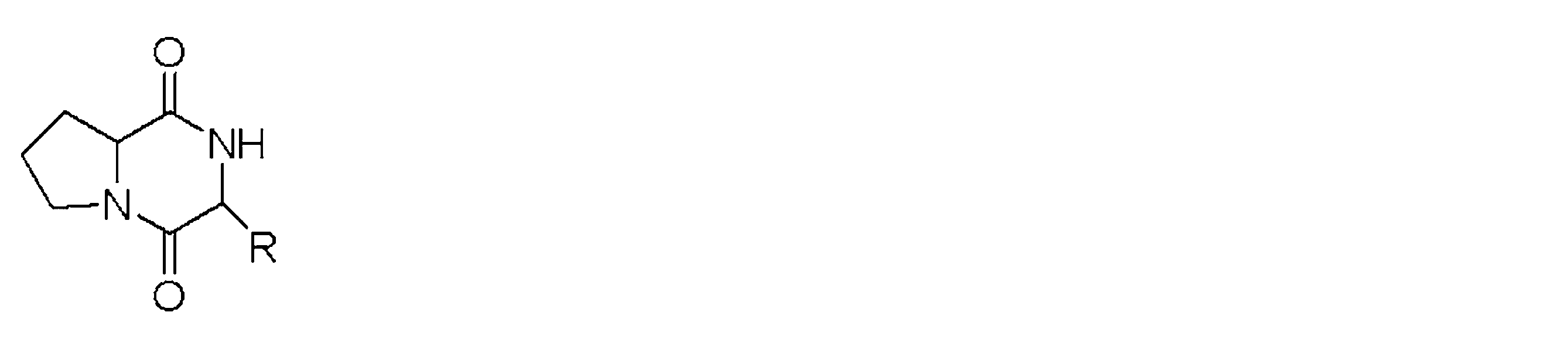
- the first proline is a mixture of cis and trans isomers, and when the cis isomer deprotects the Fmoc group of the second amino acid, it forms the cyclic diketopiperazine structure shown below, and the peptide chain from the resin As a result of divergence, the subsequent coupling does not proceed and the yield is greatly deteriorated.
- the following diketopiperazine structure is a cyclic structure of proline and any amino acid.
- the proline residue to be converted into is a proline residue having a C-terminal immobilized on a solid phase
- serine or threonine glycosylated to the next amino acid of the proline residue By coupling the proline, the diketopiperazine structure can be avoided by controlling the proline in the trans form, and the yield can be improved.
- the glycosylated serine or threonine is a serine or threonine with a disaccharide core1 type sugar chain (Gal ⁇ (1 ⁇ 3) GalNAc- ⁇ ) added, which can avoid the diketopiperazine structure and yield. Can be improved (see Example 2).
- the second aspect of the method for producing a glycopeptide of the present invention is (1) a peptide containing a proline residue and a serine residue or a threonine residue as an amino acid residue adjacent to the N-terminal side of the proline residue. And (2) a disaccharide core type 1 sugar chain (Gal ⁇ (1 ⁇ 3) GalNAc- ⁇ is added to the serine residue or threonine residue adjacent to the N-terminal side of at least one proline residue of the peptide. ) Is introduced.
- a peptide containing a proline residue and a serine residue or a threonine residue as an amino acid residue adjacent to the N-terminal side of the proline residue is prepared.
- This peptide can be a normal peptide having no sugar chain, and may be a synthetic product, a semi-synthetic product, or a natural product.
- this peptide contains a proline residue and contains a serine residue or a threonine residue as an amino acid residue adjacent to the N-terminal side of the proline residue, other amino acid sequences are not limited. .
- a disaccharide core1-type sugar chain (Gal ⁇ (1 ⁇ 1) is added to the serine residue or threonine residue adjacent to the N-terminal side of at least one proline residue of the peptide prepared in step (1).
- Introduction of disaccharide core type 1 sugar chain (Gal ⁇ (1 ⁇ 3) GalNAc- ⁇ ) for example, GalNAc is added to the side chain hydroxyl group of serine residue or threonine residue of the peptide, and then Gal is added to GalNAc Is done.
- the addition of GalNAc to the side chain hydroxyl group of a serine residue or threonine residue can be performed by, for example, GalNAc transferase.
- GalNAc can be added to Gal by, for example, Gal transferase.
- GalNAc transferase The addition of GalNAc to the side chain hydroxyl group of a serine residue or threonine residue performed by GalNAc transferase can be performed, for example, as follows. After introducing a human-derived GalNAc transferase (ppGalNAc-T) gene into a methanol-metabolizing yeast (P. pastris) and transforming it, a large amount of those expressed in sugar-donor UDP-GalNAc, 10 mM manganese chloride and Mix with peptide chain and react overnight. Confirmation of the reaction is based on MADTI-TOF MS.
- ppGalNAc-T human-derived GalNAc transferase
- Gal transferase The addition of Gal to GalNAc performed by Gal transferase can be performed as follows, for example. Using the reverse reaction of Endo-aN-acetylgalactosaminidase, an enzyme that specifically recognizes Core1 and selectively cleaves it, the core1 sugar chain is transferred to serine or threonine (J. Biol. Chem. ( 2005) 280, 37415-37422). Alternatively, Gal is added to the glycopeptide prepared using ppGalNAc-T using an enzyme (C1Gal-T2) that can add Gal with ⁇ 1,3 bonds to GalNAc directly bound to the peptide chain (J. Biol. Chem. (2002), 277, 47724-47731).
- C1Gal-T2 an enzyme that can add Gal with ⁇ 1,3 bonds to GalNAc directly bound to the peptide chain
- the obtained glycopeptide is purified according to a usual method, and can be purified using, for example, ion exchange chromatography, reverse phase liquid chromatography, affinity chromatography, or the like.
- the sequence of the obtained glycopeptide can be analyzed by, for example, a protein sequencer that reads the amino acid sequence from the N-terminus by Edman degradation, MALDI-TOF MS / MS, or the like.
- proteins such as cyclophilin (cyclophilin) A to D mainly promote the cis-trans isomerization reaction of proline due to their PPIase (peptidyl prolyl isomerase) activity.
- PPIase peptidyl prolyl isomerase
- protein unfolding is one of the causes of the disease, which is prominently observed in Alzheimer's disease and IgA nephropathy
- the cis-trans isomerization reaction is suppressed by glycosylation (protection from PPIase)
- it can be expected to prevent the degeneration and delay the progression of the disease by immobilizing it in the trans form.
- IgA nephropathy autoantibodies against only GalNAc have been discovered (J. Clin. Invest 104, 73-81 (1999)).
- IgG that recognizes IgA1 that is only GalNAc is automatically generated in vivo.
- IgA nephropathy occurs when an IgA-IgG complex (immune complex) is deposited in the kidney.
- IgA-IgG complex immunoglobulin complex
- the content of the cis body is increased and presented as an antigen. That is, it is thought that autoantibodies are likely to occur because the cis body (which is rare in the living body) works favorably to the immune system (for IgG production).
- the cis body makes autoantibodies and the disease progresses (see below).
- a peptide in the hinge region of human-derived immunoglobulin A1 was selected as a naturally occurring sequence. This peptide is composed of a 19-residue sequence called PSTPPTPSPSTPPTPSPS (SEQ ID NO: 1).
- the formation of the easily denatured IgA1 aggregate described in 1 above is closely related to the three-dimensional structure stability of the protein.
- Gal and NeuAc deficiency is related to IgA1 self-aggregation (Kokubo, T. et al. J. Am. Soc. Nephrol. 9, 2048-2054, 1998), but the conformational change of IgA1 has not been reported. It is elucidation.
- the antibody (IgG) recognizing the hinge region of IgA1 binds to the formation of the immune complex described in 2 above.
- Fmoc group cleavage before amino acid condensation was performed by immersing the carrier in 1 ml of a 20% piperodine solution and reacting at 50 ° C. for 3 minutes under electromagnetic irradiation of 2450 MHz.
- the protecting group on the peptide residue is removed by reacting in a solution of 95% trifluoroacetic acid (TFA), 2.5%% Triisopropylsilane, 2.5%% water at room temperature for 2 hours, and on the solid support. From which 1 and 2 were released.
- TFA trifluoroacetic acid
- the resin was filtered off and TFA was evaporated and then dissolved in pure water.
- Reversed phase HPLC Inertsil registered mark ODS-3 20 ⁇ 250 column, moving bed A: 0.1% TFA aqueous solution B: 0.1% TFA (1% to 30% gradient of acetonitrile contained) to give compounds 1, 2 and 3
- the spectrum of Compound 1 shown in Fig. 1-1 suggested that the proline in the sequence was a mixture of cis and trans stereoisomers.
- the signal indicated by a circle in the figure is a signal derived from cis-proline.
- the spectrum of compound 3 shown in FIG. 1-3 shows that almost no signal of cis-proline was observed, suggesting that most of proline was immobilized on the trans isomer by glycosylation.
- Figure 2-1 shows the results for Compound 1: PSTPPTPSPSTPPTPSPS-CONH 2 . Although there are only 4 T, a correlation of 8 residues was observed. This is an effect of the cis-trans isomer.
- Compounds in Figure 2-2 2 shows the results of PS T PP T P S P S TPPTPSPS-CONH 2.
- GalNAc-Thr is two places on the sequence. There were two corresponding signals in NMR, and they were consistent. The free threonine should be in two places, but confirmed five signals.
- Fig. 2-3 shows the results of Compound 3: PS T * PP T * P S * P S * TPPTPSPS-CONH 2 .
- Core1-Thr is two places on the array. There were two corresponding signals in NMR, and they were consistent. There should be two free threonines, but four signals were confirmed.
- threonine residues that have undergone glycosylation form a certain conformation, but free threonine is affected by cis-trans isomerization and forms multiple conformations.
- the core 1 adduct (compound 3) has a reduced free threonine signal compared to the GalNAc adduct (compound 2). This indicates that the disaccharide core1 stabilizes the overall peptide conformation more than the monosaccharide GalNAc.
- the three-dimensional structure of Compound 2 is determined by the nuclear magnetic resonance (NMR) method and the result is shown.
- the sample was adjusted to 2 mM and the pH was 6.5.
- the measuring instrument used was Avance 600 (proton resonance frequency 600.03 MHz) manufactured by bruker. Signals of each amino acid residue were assigned by assigning two-dimensional DQF-COSY and two-dimensional TOCSY spectra, and internuclear distance information was collected by two-dimensional NOESY. The mixing time in NOESY measurement was 200 msec.
- the three-dimensional structure was calculated by the distance geometry / simulated annealing method using the collected distance information. 50 structures were calculated, and 20 structures with the lowest molecular potential energy were presented as the structure of this peptide ( Figure 2-4).
- Fig. 2-4 show that the conformation of the peptide can be kept constant by introducing the disaccharide core1 structure into four locations (Thr3, Thr6, Ser8, Ser10) of the IgA1 hinge region (PSTPPTPSPSTPPTPSPS). Indicates.
- the structure also revealed that the sugar chain controls the conformation of the peptide.
- core1 has more sugar chains and less NMR signal, it is clear that cis-trans isomerization is immobilized on the trans side of core1 rather than GalNAc alone, forming a unique conformation. (GalNAc alone still has cis-trans isomerization, so there are multiple conformers and the spectrum is complicated). Therefore, the three-dimensional structure can be calculated for the core1 type IgA1 hinge forming one type of three-dimensional structure.
- a change in sugar chain structure is often known as a disease marker, and a three-dimensional structure analysis is indispensable to investigate the cause.
- the change in sugar chain type (microheterogeneity) generates a plurality of conformers, it does not form a certain three-dimensional structure, and its analysis is generally difficult.
- a structure in which the core1 sugar chain added to Thr6 is particularly well converged is revealed, and it is easily suggested that the sugar chain change in this region is strongly related to the disease. (If Thr6 disaccharide changes, this structure may not be preserved).
- the three-dimensional structure can be fixed to one type by preparing the core type sugar chain. I think that it leads to the three-dimensional structure analysis. In X-ray crystal structure analysis, the presence of a plurality of conformers and the presence of a plurality of types of sugar chains are not uncommon for inhibiting crystallization, but it is considered that this method enables a three-dimensional structure analysis to proceed.
- Example 2 Quantification of cis- and trans-isomers by 1H-NMR A dipeptide consisting of SP and TP sequences having an acetyl group at the N-terminus and an amide group at the C-terminus was synthesized in the same manner as in Example 1. However, peptide synthesis was performed on a scale of 100 mmol (a system capable of producing 100 mmol with a yield of 100%). (1) Thr (T) and Ser (S) of Ac-Thr-Pro-CONH2 and Ac-Ser-Pro-CONH2 sequences have no glycosylation, (2) When ⁇ -GalNAc is added, 3) The case where disaccharide core1 was added was verified. The yield is shown in Table 1 below.
- the present invention is useful, for example, in the field of medicine and diagnosis using a glycopeptide in which the proline conformation of a peptide is stabilized in a trans form.
Landscapes
- Life Sciences & Earth Sciences (AREA)
- Chemical & Material Sciences (AREA)
- Organic Chemistry (AREA)
- Health & Medical Sciences (AREA)
- Zoology (AREA)
- Engineering & Computer Science (AREA)
- Wood Science & Technology (AREA)
- Microbiology (AREA)
- General Chemical & Material Sciences (AREA)
- Chemical Kinetics & Catalysis (AREA)
- Biotechnology (AREA)
- Molecular Biology (AREA)
- Biochemistry (AREA)
- Bioinformatics & Cheminformatics (AREA)
- General Engineering & Computer Science (AREA)
- General Health & Medical Sciences (AREA)
- Genetics & Genomics (AREA)
- Peptides Or Proteins (AREA)
Abstract
シス-トランス異性化を制御してトランス体のみのコンフォメーションを有する、機能・品質を管理されたペプチド誘導体を提供する。少なくとも1のトランス型のプロリン残基を含み、かつ前記トランス型のプロリン残基は、N末端側に隣接するアミノ酸残基が二糖core1型糖鎖(Galβ(1→3)GalNAc-α)を付加したセリン残基またはスレオニン残基である糖ペプチドの製造方法。ペプチドの化学合成方法を利用し、トランス型にしたいプロリン残基のN末端側に、二糖core1型糖鎖(Galβ(1→3)GalNAc-α)を付加したセリンまたはスレオニンを結合する工程を少なくとも1回含む。または、プロリン残基を含み、かつ前記プロリン残基のN末端側に隣接するアミノ酸残基としてセリン残基またはスレオニン残基を含むペプチドを用意し、前記ペプチドの少なくとも1のプロリン残基のN末端側に隣接するセリン残基またはスレオニン残基に、二糖core1型糖鎖(Galβ(1→3)GalNAc-α)を導入する工程を含む。
Description
本出願は、2008年12月8日出願の日本特願2008-312507号の優先権を主張し、その全記載は、ここに特に開示として援用される。
本発明は、糖ペプチドの製造方法に関する。さらに詳しくは、本発明は、少なくとも1のトランス型のプロリン残基を含む糖ペプチドの製造方法に関する。
プロテインデータバンク(PDB)等の立体構造解析データベースを用い、経験的な関数を利用することで人工的に構造をデザインしたタンパク質の合成に成功した例は多くの報告がある(非特許文献1~5)
しかしながら、ペプチド鎖中のシス-トランス異性化反応が、タンパク質の立体構造形成(folding)および変性(unfolding)にとっての1つの重要な要素であることが示唆されているにも関わらず、現在までにシス-トランスの異性化を制御する方法はない。
非特許文献1:J. Mol. Biol. (2005)354, 801-814
非特許文献2:Science (2003), 302, 1364-1368
非特許文献3:Science (1997), 278, 82-87
非特許文献4:Curr. Opin. Biotechnol. (1995), 6, 460-466
非特許文献5:Science (1995), 270, 935-941
非特許文献6:Peptides: Chemistry and Biology 2002. Sewald, Norbert / Jakubke, Hans-Dieter, WILEY-VCH
非特許文献1~6の全記載は、ここに特に開示として援用される。
非特許文献1:J. Mol. Biol. (2005)354, 801-814
非特許文献2:Science (2003), 302, 1364-1368
非特許文献3:Science (1997), 278, 82-87
非特許文献4:Curr. Opin. Biotechnol. (1995), 6, 460-466
非特許文献5:Science (1995), 270, 935-941
非特許文献6:Peptides: Chemistry and Biology 2002. Sewald, Norbert / Jakubke, Hans-Dieter, WILEY-VCH
非特許文献1~6の全記載は、ここに特に開示として援用される。
一般的にはペプチド鎖中のアミド結合はそのほとんどがトランス体を形成しているが、X(任意のアミノ酸)-Pの配列では、他の配列に比べシス体を形成することが多い(平均6.5%がシス体を形成する)(非特許文献6)。

同一配列からなる生理活性ペプチドにおいて、複数のコンフォメーションが存在することは、その機能を低下、あるいは機能を予測することが困難になる要因である。
そこで本発明は、シス-トランス異性化を制御してトランス体のみのコンフォメーションを有する、機能・品質を管理されたペプチド誘導体を提供することを解決すべき課題(目的)とする。
本発明者らは、上記X-Pの配列に着目し、アミノ酸Xにおける糖鎖付加を行った。具体的には、上記Xとしてセリン(S)およびスレオニン(T)残基を選び、かつこれらの残基に二糖core1型糖鎖(Galβ(1→3)GalNAc-α)を付加することでS-P間、およびT-P間のシス-トランス異性化を制御し、トランス体のみのコンフォメーションを有する糖ペプチドを製造できることを見出して、本発明を完成させた。
本発明は以下のとおりである。
[1]
少なくとも1のトランス型のプロリン残基を含み、かつ
前記トランス型のプロリン残基は、N末端側に隣接するアミノ酸残基が二糖core1型糖鎖(Galβ(1→3)GalNAc-α)を付加したセリン残基またはスレオニン残基である糖ペプチドの製造方法であって、
ペプチドの化学合成方法を利用し、
トランス型にしたいプロリン残基のN末端側に、二糖core1型糖鎖(Galβ(1→3)GalNAc-α)を付加したセリンまたはスレオニンを結合する工程を少なくとも1回含む、前記製造方法。
[2]
ペプチドの化学合成方法として固相合成法を用いる[1]に記載の製造方法。
[3]
前記トランス型にしたいプロリン残基がC末端を固相に固定化したプロリン残基であり、かつ二糖core1型糖鎖(Galβ(1→3)GalNAc-α)を付加したセリンまたはスレオニンを結合する工程を1回含む、[2]に記載の製造方法。
[4]
少なくとも1のトランス型のプロリン残基を含み、かつ
前記トランス型のプロリン残基は、N末端側に隣接するアミノ酸残基が二糖core1型糖鎖(Galβ(1→3)GalNAc-α)を付加したセリン残基またはスレオニン残基である糖ペプチドの製造方法であって、
プロリン残基を含み、かつ前記プロリン残基のN末端側に隣接するアミノ酸残基としてセリン残基またはスレオニン残基を含むペプチドを用意し、
前記ペプチドの少なくとも1のプロリン残基のN末端側に隣接するセリン残基またはスレオニン残基に、二糖core1型糖鎖(Galβ(1→3)GalNAc-α)を導入する工程を含む、前記製造方法。
[5]
前記二糖core1型糖鎖(Galβ(1→3)GalNAc-α)の導入が、前記ペプチドが有するセリン残基またはスレオニン残基の側鎖水酸基にGalNAcが付加され、次いでGalNAcにGalが付加されることで行われる[4]に記載の方法。
[6]
セリン残基またはスレオニン残基の側鎖水酸基へのGalNAcの付加が、GalNAc転移酵素によって行われ、GalNAcのGalへの付加が、Gal転移酵素によって行われる[5]に記載の方法。
[7]
ペプチドのアミノ酸残基数が2~200個の範囲であり、
かつトランス型のプロリン残基数が1~100個の範囲である、[1]~[6]のいずれかに記載の方法。
[1]
少なくとも1のトランス型のプロリン残基を含み、かつ
前記トランス型のプロリン残基は、N末端側に隣接するアミノ酸残基が二糖core1型糖鎖(Galβ(1→3)GalNAc-α)を付加したセリン残基またはスレオニン残基である糖ペプチドの製造方法であって、
ペプチドの化学合成方法を利用し、
トランス型にしたいプロリン残基のN末端側に、二糖core1型糖鎖(Galβ(1→3)GalNAc-α)を付加したセリンまたはスレオニンを結合する工程を少なくとも1回含む、前記製造方法。
[2]
ペプチドの化学合成方法として固相合成法を用いる[1]に記載の製造方法。
[3]
前記トランス型にしたいプロリン残基がC末端を固相に固定化したプロリン残基であり、かつ二糖core1型糖鎖(Galβ(1→3)GalNAc-α)を付加したセリンまたはスレオニンを結合する工程を1回含む、[2]に記載の製造方法。
[4]
少なくとも1のトランス型のプロリン残基を含み、かつ
前記トランス型のプロリン残基は、N末端側に隣接するアミノ酸残基が二糖core1型糖鎖(Galβ(1→3)GalNAc-α)を付加したセリン残基またはスレオニン残基である糖ペプチドの製造方法であって、
プロリン残基を含み、かつ前記プロリン残基のN末端側に隣接するアミノ酸残基としてセリン残基またはスレオニン残基を含むペプチドを用意し、
前記ペプチドの少なくとも1のプロリン残基のN末端側に隣接するセリン残基またはスレオニン残基に、二糖core1型糖鎖(Galβ(1→3)GalNAc-α)を導入する工程を含む、前記製造方法。
[5]
前記二糖core1型糖鎖(Galβ(1→3)GalNAc-α)の導入が、前記ペプチドが有するセリン残基またはスレオニン残基の側鎖水酸基にGalNAcが付加され、次いでGalNAcにGalが付加されることで行われる[4]に記載の方法。
[6]
セリン残基またはスレオニン残基の側鎖水酸基へのGalNAcの付加が、GalNAc転移酵素によって行われ、GalNAcのGalへの付加が、Gal転移酵素によって行われる[5]に記載の方法。
[7]
ペプチドのアミノ酸残基数が2~200個の範囲であり、
かつトランス型のプロリン残基数が1~100個の範囲である、[1]~[6]のいずれかに記載の方法。
一般に、糖鎖付加を施さないS-PおよびT-P配列においてはシス体とトランス体が混在する。しかし、上記本発明の方法により、プロリン残基のN末端側に隣接するセリンまたはスレオニンに二糖core1型糖鎖(Galβ(1→3)GalNAc-α)を付加することにより、S-PおよびT-Pのいずれの配列においても、プロリンをトランス体として固定化することができる。このように、本発明では、糖鎖付加により、S-PおよびT-P配列のシス-トランス異性化を制御し、一定のコンフォメーションを有する、即ち、プロリンをトランス体として固定化した、糖ペプチドを調製することができる。
本発明の製造方法によれば、シス-トランスの異性化を抑え、一定のコンフォマーを提示したペプチドを提供できることから、プロリンを含まなければならないペプチド製剤の薬効を一定にすることができると考えられる。異性化が起こったままだと、どちらか一方が薬理活性を示し、結果的にその効果が弱まり、投与量の増加につながるのに対して、活性体のみを用いることで投与量を最小限に抑えられる。自己免疫疾患に見られる、自己抗体の高感度な検出(代表的な使用方法としてはELISA法)に応用できる。自己免疫疾患は、何らかの理由により、あるタンパク質が過剰発現し、それを認識してしまう抗体(自己抗体)にそのタンパク質が攻撃されてしまう場合や、あるタンパク質の変性(糖鎖形成不全等も含む)によって攻撃を受けることによって、体に変調を来す疾患である。この場合、自己抗体はタンパク質中の一定の領域(エピトープ)を認識するが、その領域にプロリンが含まれる場合、圧倒的にトランス体であることが予想される。ここで、自己抗体を診断のために検出する場合、エピトープ配列を合成しなければならない。すなわち、天然タンパク質と同じトランス体を有するペプチドの合成が必要となる。そのタンパク質がムチンである場合、本発明の製造方法における糖鎖修飾による立体構造の制御は有用である。
本発明の糖ペプチドの製造方法は、少なくとも1のトランス型のプロリン残基を含み、かつ前記トランス型のプロリン残基は、N末端側に隣接するアミノ酸残基が二糖core1型糖鎖(Galβ(1→3)GalNAc-α)を付加したセリン残基またはスレオニン残基である糖ペプチドの製造方法である。
本発明の製造方法において製造される糖ペプチドのペプチドは、少なくとも1つのプロリン残基とこのプロリン残基のN末端側にセリン残基またはスレオニン残基が隣接するものであれば良く、さらに、プロリン残基のN末端側に隣接するセリン残基またはスレオニン残基は、二糖core1型糖鎖(Galβ(1→3)GalNAc-α)を付加したものであり、その結果、前記プロリン残基はトランス型の構造を有するものである。
ペプチドのアミノ酸残基数には特に制限はないが、例えば、2~200個の範囲であることができ、さらには、10~100個の範囲であることができる。また、プロリン残基数は、例えば、1~100個の範囲であることができ、その中の一部または全部のプロリン残基がトランス型であることができる。プロリン残基、セリン残基またはスレオニン残基以外のアミノ酸残基の種類や配列には特に制限はない。ペプチドの具体例としては、例えば、IgA1またはその部分配列、O-結合型糖鎖を多量に含む糖タンパク質であるヒト由来ムチン(MUC)のタンデムリピート配列(MUC1~20においてMUC1,MUC9,MUC14, MUC15,MUC18, MUC19以外すべてにSPおよびTPが存在)(MUC2: PTTTPITTTTTVTPTPTPTGTQT(配列番号2), MUC3A: HSTPSFTSSITTTETTS(配列番号3), MUC4: TSSASTGHATPLPVTD(配列番号4), MUC5AC, MUC6,MUC7,MUC8, MUC10, MUC11, MUC12, MUC13, MUC16, MUC17, MUC20 )、不凍活性を有する不凍糖タンパク質AFGPのタンデムリピート配列であるAATAATPATAATPA(配列番号5)等であることができる。
本発明の糖ペプチドの製造方法は、以下の第1の態様および第2の態様を含む。
本発明の糖ペプチドの製造方法の第1の態様は、上記製造方法であって、さらに、ペプチドの化学合成方法を利用し、かつトランス型にしたいプロリン残基のN末端側に、二糖core1型糖鎖(Galβ(1→3)GalNAc-α)を付加したセリンまたはスレオニンを結合する工程を少なくとも1回含むものである。
また、本発明の糖ペプチドの製造方法の第2の態様は、上記製造方法であって、さらに、プロリン残基を含み、かつ前記プロリン残基のN末端側に隣接するアミノ酸残基としてセリン残基またはスレオニン残基を含むペプチドを用意し、
前記ペプチドの少なくとも1のプロリン残基のN末端側に隣接するセリン残基またはスレオニン残基に、二糖core1型糖鎖(Galβ(1→3)GalNAc-α)を導入する工程を含むものである。
前記ペプチドの少なくとも1のプロリン残基のN末端側に隣接するセリン残基またはスレオニン残基に、二糖core1型糖鎖(Galβ(1→3)GalNAc-α)を導入する工程を含むものである。
[糖ペプチドの製造方法(1)]
本発明の糖ペプチドの製造方法の第1の態様は、糖アミノ酸を用いるペプチドの化学合成方法を利用するものである。さらに、ペプチドの化学合成方法としては、例えば、固相合成法を用いることができる。第1の態様では、トランス型にしたいプロリン残基のN末端側に、糖アミノ酸として、二糖core1型糖鎖(Galβ(1→3)GalNAc-α)を付加したセリンまたはスレオニンを結合する。従って、ペプチドの化学合成方法としては、糖を付加したアミノ酸である糖アミノ酸を用いてペプチドを合成するのに適した方法を用いることが適当である。そのような方法として、例えば、特開2006-28141号公報に記載のマイクロ波を照射しながらペプチド合成形成反応を行う方法を挙げることができる。
本発明の糖ペプチドの製造方法の第1の態様は、糖アミノ酸を用いるペプチドの化学合成方法を利用するものである。さらに、ペプチドの化学合成方法としては、例えば、固相合成法を用いることができる。第1の態様では、トランス型にしたいプロリン残基のN末端側に、糖アミノ酸として、二糖core1型糖鎖(Galβ(1→3)GalNAc-α)を付加したセリンまたはスレオニンを結合する。従って、ペプチドの化学合成方法としては、糖を付加したアミノ酸である糖アミノ酸を用いてペプチドを合成するのに適した方法を用いることが適当である。そのような方法として、例えば、特開2006-28141号公報に記載のマイクロ波を照射しながらペプチド合成形成反応を行う方法を挙げることができる。
具体的には、まず、固相担体に最初の糖アミノ酸(又はアミノ酸)のN末端アミノ基又はC末端カルボキシル基を結合し(例えば、C末端のカルボキシル基をクロロトリチル樹脂、クロルメチル樹脂、オキシメチル樹脂、p-アルコキシベンジルアルコール樹脂等の担体に結合する)、所望により縮合剤を用いて、順次糖アミノ酸(又はアミノ酸)を結合していく。
二糖core1型糖鎖(Galβ(1→3)GalNAc-α)を付加したセリンまたはスレオニンは、例えば、以下のように合成することができる。
Fmoc-セリンおよびFmoc-スレオニンをカルボジイミド系の縮合剤であるDCCを用いてC末端のカルボン酸をt-ブチル基で保護する。次に水酸基を完全アセチル化した(1位のみフリー)Gal誘導体に対し、4位と6位がベンジリデン基で保護され、2位にアジド基を有するGal誘導体をジクロロメタン中でTMSトリフラートを用いて縮合する。この糖鎖誘導体と先に述べたアミノ酸誘導体を同様に縮合して糖アミノ酸誘導体を作成する。80%酢酸80℃でベンジリデン基を切断後、アジド基を亜鉛によって還元後無水酢酸でNアセチル基を作成し、最後にC末端のt-ブチル基を90%トリフルオロ酢酸で切断する。
Fmoc-セリンおよびFmoc-スレオニンをカルボジイミド系の縮合剤であるDCCを用いてC末端のカルボン酸をt-ブチル基で保護する。次に水酸基を完全アセチル化した(1位のみフリー)Gal誘導体に対し、4位と6位がベンジリデン基で保護され、2位にアジド基を有するGal誘導体をジクロロメタン中でTMSトリフラートを用いて縮合する。この糖鎖誘導体と先に述べたアミノ酸誘導体を同様に縮合して糖アミノ酸誘導体を作成する。80%酢酸80℃でベンジリデン基を切断後、アジド基を亜鉛によって還元後無水酢酸でNアセチル基を作成し、最後にC末端のt-ブチル基を90%トリフルオロ酢酸で切断する。
縮合剤としては、例えば、ジフェニルホスホリルアジド(DPPA)、ジエチルホスホリルシアニデート、アジドトリス(ジメチルアミノ)ホスホニウムヘキサフルオロリン酸塩等の有機リン化合物、N-エトキシカルボニル-2-エトキシ-1,2-ジハイドロキノリン(EEDQ)、1-イソブチル-2-イソブチル-1,2-ジヒドロキシキノリン等のキノリン系ペプチド縮合剤、2-(1H-ベンゾトリアゾール-1-イル)-1,1,3,3-テトラメチルウロニウムヘキサフルオロホスフェート(HBTU)、DCC等のカルボジイミド類等があげられる。
本発明では、この固相合成反応をマイクロ波を照射しながら行う。マイクロ波を照射しながらの固相合成反応は、すべてのカップリング反応およびFmoc基脱保護反応に適応することが好ましい。本明細書で言う「マイクロ波」とは波長約0.3~30cm程度の電磁波(1~100GHzに相当する)のことをいう。マイクロ波の波長としては、好ましくは2300~2600MHzであるが、さらに好ましくは2350~2550MHz、特に好ましくは2400~2500MHzである。
固相合成反応においてマイクロ波を照射することにより、ペプチド形成反応が促進される。これは、マイクロ波は誘電率の高い分子のみを活性化するが、固相合成反応系に存在する反応種の中で最も極性が高いのはアミノ基及びカルボン酸であるので、マイクロ波を照射するとこれらの官能基が誘電分極して選択的に活性化・加熱され、ペプチド形成反応が促進されるものと推察される。他の官能基は活性化されないので副反応を大幅に低減することができる。
マイクロ波照射によりペプチド形成反応が促進され、従来法と比較して大幅に反応時間を減らすことができる。さらに、マイクロ波は固相担体の内部にまで到達するので、従来は反応の進行が困難な部位(例えば、固相担体の内部)に存在するような反応種でも反応させることが可能となる。
さらに、マイクロ波照射と同時に、振動や超音波を加えて固相合成反応を行ってもよい。
この反応工程において、アミノ酸残基が有する反応に関与すべきでない官能基は、保護基により保護するのが好ましい。アミノ基の保護基としては、例えばベンジルオキシカルボニル(Bz)、t-ブチルオキシカルボニル(Boc),p-ビフェニルイソプロピロオキシカルボニル、9-フルオレニルメチルオキシカルボニル(Fmoc)等が挙げられる。カルボキシル基の保護基としては例えばアルキルエステル、ベンジルエステル等を形成し得る基が挙げられる。
固相合成における反応温度は、特に限定されないが、通常0~80℃とするが、好ましくは25~50℃である。反応時間は、反応温度やマイクロ波の出力等にもよるが、例えば0.1~120分であり、好ましくは1~60分、さらに好ましくは1~30分である。従来法による糖アミノ酸のカップリング法では室温において通常数時間~24時間程度の反応時間を必要とするが、これと比較するとこの製造方法では上記のように短時間でペプチド結合形成反応が完了し、非常に効率的である。その他の反応条件は、通常のペプチド固相合成を参考にすることができる。
縮合反応終了後、場合により保護基を除去し、そして得られた糖ペプチドのC末端と担体樹脂との結合を切断する。切り離された糖ペプチドは通常の方法にしたがって精製され、例えばイオン交換クロマトグラフィー、逆相液体クロマトグラフィー、アフィニティークロマトグラフィー等を用いて精製できる。
合成した糖ペプチドの配列は、例えば、エドマン分解法でN-末端からアミノ酸配列を読み取るプロティンシークエンサー、MALDI-TOF MS/MS等で分析することができる。
上記製造方法は、特には糖アミノ酸残基を1~30個程度有する糖ペプチドを製造するのに好適である。また、試薬・溶媒の供給、反応系の制御、洗浄等のペプチド固相合成の各工程を自動化した市販の一般的な自動ペプチド固相合成装置にマイクロ波を発生するためのマイクロは出力手段を備えた糖ペプチド自動合成装置を用いて、製造方法を自動化して行うことも可能である。
本発明のの糖ペプチドの製造方法の第1の態様においては、前記トランス型にしたいプロリン残基がC末端を固相に固定化したプロリン残基であり、かつ二糖core1型糖鎖(Galβ(1→3)GalNAc-α)を付加したセリンまたはスレオニンを結合する工程を1回含むことができる。
Fmoc基を用いたペプチド固相合成方法は、上述のように一般に、Fmoc基でN末端側アミノ基が保護されたアミノ酸誘導体を用いる。樹脂にN末端がFmoc基で保護されC末端にカルボン酸を有するアミノ酸誘導体をカップリングし、後にFmoc基を塩基(20%ピペリジン溶液)で脱保護する。さらに次のアミノ酸誘導体をカップリングし、アミノ酸を伸長する。すなわちこのカップリングと脱保護を繰り返すことによって目的のアミノ酸配列をC末端側から合成する。
樹脂へ最初のカップリング、すなわちC末端がプロリン残基である場合、そのプロリンのFmoc基を脱離後に次のアミノ酸をカップリングし、そのアミノ酸残基のFmoc基を脱離する際に問題が生じることが知られている。この時、最初のプロリンはシス体とトランス体の混合であり、そのシス体が2番目のアミノ酸のFmoc基を脱保護する際に環状のdiketopiperazine構造を形成し、樹脂からペプチド鎖が乖離することによって以降のカップリングが進行せずに、大きく収率が悪化する。(非特許文献6)。

この時、最初のプロリンはシス体とトランス体の混合であり、そのシス体が2番目のアミノ酸のFmoc基を脱保護する際に、以下に示す環状のdiketopiperazine構造を形成し、樹脂からペプチド鎖が乖離することによって以降のカップリングが進行せずに、大きく収率が悪化する。下記のdiketopiperazine構造はプロリンと任意のアミノ酸の環状構造である。
それに対して本発明の製造方法では、トランス型にしたいプロリン残基がC末端を固相に固定化したプロリン残基である場合、このプロリン残基の次のアミノ酸にグリコシル化されたセリンまたはスレオニンをカップリングすることで、プロリンをトランス体に制御することによってdiketopiperazine構造を回避することができ、収率を向上することができる。特に、グリコシル化されたセリンまたはスレオニンが、二糖core1型糖鎖(Galβ(1→3)GalNAc-α)を付加したセリンまたはスレオニンであることで、diketopiperazine構造を回避することができ、収率を向上することができる(実施例2参照)。
[糖ペプチドの製造方法(2)]
本発明の糖ペプチドの製造方法の第2の態様は、(1)プロリン残基を含み、かつ前記プロリン残基のN末端側に隣接するアミノ酸残基としてセリン残基またはスレオニン残基を含むペプチドを用意する工程、および(2)前記ペプチドの少なくとも1のプロリン残基のN末端側に隣接するセリン残基またはスレオニン残基に、二糖core1型糖鎖(Galβ(1→3)GalNAc-α)を導入する工程を含む。
本発明の糖ペプチドの製造方法の第2の態様は、(1)プロリン残基を含み、かつ前記プロリン残基のN末端側に隣接するアミノ酸残基としてセリン残基またはスレオニン残基を含むペプチドを用意する工程、および(2)前記ペプチドの少なくとも1のプロリン残基のN末端側に隣接するセリン残基またはスレオニン残基に、二糖core1型糖鎖(Galβ(1→3)GalNAc-α)を導入する工程を含む。
上記工程(1)では、プロリン残基を含み、かつ前記プロリン残基のN末端側に隣接するアミノ酸残基としてセリン残基またはスレオニン残基を含むペプチドを用意する。このペプチドは、糖鎖を有さない、通常のペプチドであることができ、合成物であっても、半合成物であっても、天然物であってもよい。但し、このペプチドは、プロリン残基を含み、かつ前記プロリン残基のN末端側に隣接するアミノ酸残基としてセリン残基またはスレオニン残基を含むものであれば、その他のアミノ酸配列に制限はない。
上記工程(2)では、工程(1)で用意されたペプチドの少なくとも1のプロリン残基のN末端側に隣接するセリン残基またはスレオニン残基に、二糖core1型糖鎖(Galβ(1→3)GalNAc-α)を導入する。二糖core1型糖鎖(Galβ(1→3)GalNAc-α)の導入は、例えば、前記ペプチドが有するセリン残基またはスレオニン残基の側鎖水酸基にGalNAcが付加され、次いでGalNAcにGalが付加されることで行われる。具体的には、セリン残基またはスレオニン残基の側鎖水酸基へのGalNAcの付加は、例えば、GalNAc転移酵素によって行うことができる。また、GalNAcのGalへの付加は、例えば、Gal転移酵素によって行うことができる。
GalNAc転移酵素によって行われる、セリン残基またはスレオニン残基の側鎖水酸基へのGalNAcの付加は、例えば、以下のように実施できる。
メタノール代謝酵母(P.pastris)へヒト由来のGalNAc転移酵素(ppGalNAc-T)の遺伝子を導入し形質転換を行った後、大量発現したものを糖供与体であるUDP-GalNAc、10mM 塩化マンガンおよびペプチド鎖と混合し、終夜反応を行う。反応確認はMADTI-TOF MSによる。
メタノール代謝酵母(P.pastris)へヒト由来のGalNAc転移酵素(ppGalNAc-T)の遺伝子を導入し形質転換を行った後、大量発現したものを糖供与体であるUDP-GalNAc、10mM 塩化マンガンおよびペプチド鎖と混合し、終夜反応を行う。反応確認はMADTI-TOF MSによる。
Gal転移酵素によって行われる、GalのGalNAcへの付加は、例えば、以下のように実施できる。
Core1を特異的に認識し、それを選択的に切断する酵素であるEndo-a-N-アセチルガラクトサミニダーゼを逆反応を用いてcore1糖鎖をセリンまたはスレオニンに転移する(J. Biol. Chem. (2005) 280, 37415-37422)。
または、ペプチド鎖に直接結合したGalNAcにβ1,3結合でGalを付加できる酵素(C1Gal-T2)を用いて、上記ppGalNAc-Tを用いて作成した糖ペプチドにGalを付加する(J. Biol. Chem. (2002), 277, 47724-47731)。
Core1を特異的に認識し、それを選択的に切断する酵素であるEndo-a-N-アセチルガラクトサミニダーゼを逆反応を用いてcore1糖鎖をセリンまたはスレオニンに転移する(J. Biol. Chem. (2005) 280, 37415-37422)。
または、ペプチド鎖に直接結合したGalNAcにβ1,3結合でGalを付加できる酵素(C1Gal-T2)を用いて、上記ppGalNAc-Tを用いて作成した糖ペプチドにGalを付加する(J. Biol. Chem. (2002), 277, 47724-47731)。
得られた糖ペプチドは、通常の方法にしたがって精製され、例えばイオン交換クロマトグラフィー、逆相液体クロマトグラフィー、アフィニティークロマトグラフィー等を用いて精製できる。また、得られた糖ペプチドの配列は、例えば、エドマン分解法でN-末端からアミノ酸配列を読み取るプロティンシークエンサー、MALDI-TOF MS/MS等で分析することができる。
生体中において、おもにサイクロフィリン(シクロフィリン)A~Dなどのタンパク質はそのPPIase (peptidyl prolyl isomerase)活性がプロリンのシス-トランス異性化反応を促進することが知られている。アルツハイマー病やIgA腎症などで顕著に観察される、タンパク質のunfolding(変性)が疾患の原因の1つとなっている場合、糖鎖修飾によってシス-トランス異性化反応を抑制(PPIaseからの防御)し、トランス体へ固定化することによって変性を防ぎ、疾患の進行を遅延することが期待できる。
さらに、IgA腎症において、GalNAcのみになったものへの自己抗体が発見されている(J. Clin. Invest 104, 73-81 (1999))。すなわちGalNAcのみになったIgA1を認識するIgGが自動的に生体内で作成される。IgA腎症はIgA-IgGコンプレックス(免疫複合体)が腎臓に沈着して発症する。今のところ、GalNAcのみになり、cis体の含有量が増えて、それが抗原として提示される可能性があると考えられる。即ち、cis体(生体中では少ない)が、免疫系に(IgG産生にとって)有利に働くことで自己抗体ができやすいと考えられる。逆にいえば、cis体が自己抗体を作ってしまって、病気が進行してしまうともいえる(下記参照)。
そこで、本発明の製造方法を利用することで、
(i)糖鎖付加によってcore1型まで伸長し、trans体にすることで、自己抗体の産生を抑えること、
(ii)cisをcore1型より多く含むGalNAcのみのペプチドを「おとり」として利用し、ワクチンのように使うことで「出来てしまった自己抗体IgG-ペプチドの複合体」とし、IgA-IgGのような高分子量の免疫複合体ができるのを抑えることによって、腎臓への沈着を防ぎ症状を緩和することが可能になる、と考えられる。
(i)糖鎖付加によってcore1型まで伸長し、trans体にすることで、自己抗体の産生を抑えること、
(ii)cisをcore1型より多く含むGalNAcのみのペプチドを「おとり」として利用し、ワクチンのように使うことで「出来てしまった自己抗体IgG-ペプチドの複合体」とし、IgA-IgGのような高分子量の免疫複合体ができるのを抑えることによって、腎臓への沈着を防ぎ症状を緩和することが可能になる、と考えられる。
以下、本発明を実施例によりさらに詳細に説明する。
天然に存在する配列としてヒト由来immunoglobulin A1 (IgA1)のヒンジ領域のペプチドを選択した。このペプチドは19残基のPSTPPTPSPSTPPTPSPS(配列番号1)という配列で構成される。
慢性腎疾患、特にIgA腎症は、IgA1が腎糸球体に沈着することで発症することが知られている。現在までに、以下に示すヒンジ領域の糖鎖異常によるIgA1の糸球体沈着機序が考えられている。1.易変性性IgA1凝集体の形成、2.IgA免疫複合体形成、3.IgA1のメサンギウム構成タンパク質との粘着性。(新しい診断と治療のABC23(富野康日己 編), IgA腎症第2章、最新医学社)。
上記1の易変性性IgA1凝集体の形成は、タンパク質の立体構造安定性と密接な関係にある。GalおよびNeuAc欠損がIgA1の自己凝集に関係するという報告(Kokubo, T. et al. J. Am. Soc. Nephrol. 9, 2048-2054, 1998)はあるが、IgA1の立体構造変化については未解明である。また上記2の免疫複合体形成は、IgA1のヒンジ領域を認識する抗体(IgG)が結合することが知られている。
ヒトIgA1 hinge領域の一次構造において、O-結合型糖鎖が付加しうるアミノ酸残基は9箇所(S:4箇所、T:5箇所)であるが、Matthew, B. et al. J. Biol. Chem. 280, 19136-19145, 2005により、T3、T6、S8、S10が特にcore1型(Galβ(1→4)GalNAc-α)の糖鎖修飾を受ける事例が多いことから、本発明ではこれら4アミノ酸残基の糖鎖修飾体をターゲットとして合成した。
実験
1.以下に示す方法によって、以下の化合物1~3を合成した。
化合物 1: PSTPPTPSPSTPPTPSPS-CONH2
化合物 2: PSTPPTPSPSTPPTPSPS-CONH2
(T、Sはそれぞれスレオニン、セリン側鎖水酸基にGalNAcがα結合で付加したもの)
化合物 3: PST*PPT*PS*PS*TPPTPSPS-CONH2
(T*、S*はそれぞれスレオニン、セリン側鎖水酸基にcore1型糖鎖がα結合で付加したもの)
1.以下に示す方法によって、以下の化合物1~3を合成した。
化合物 1: PSTPPTPSPSTPPTPSPS-CONH2
化合物 2: PSTPPTPSPSTPPTPSPS-CONH2
(T、Sはそれぞれスレオニン、セリン側鎖水酸基にGalNAcがα結合で付加したもの)
化合物 3: PST*PPT*PS*PS*TPPTPSPS-CONH2
(T*、S*はそれぞれスレオニン、セリン側鎖水酸基にcore1型糖鎖がα結合で付加したもの)
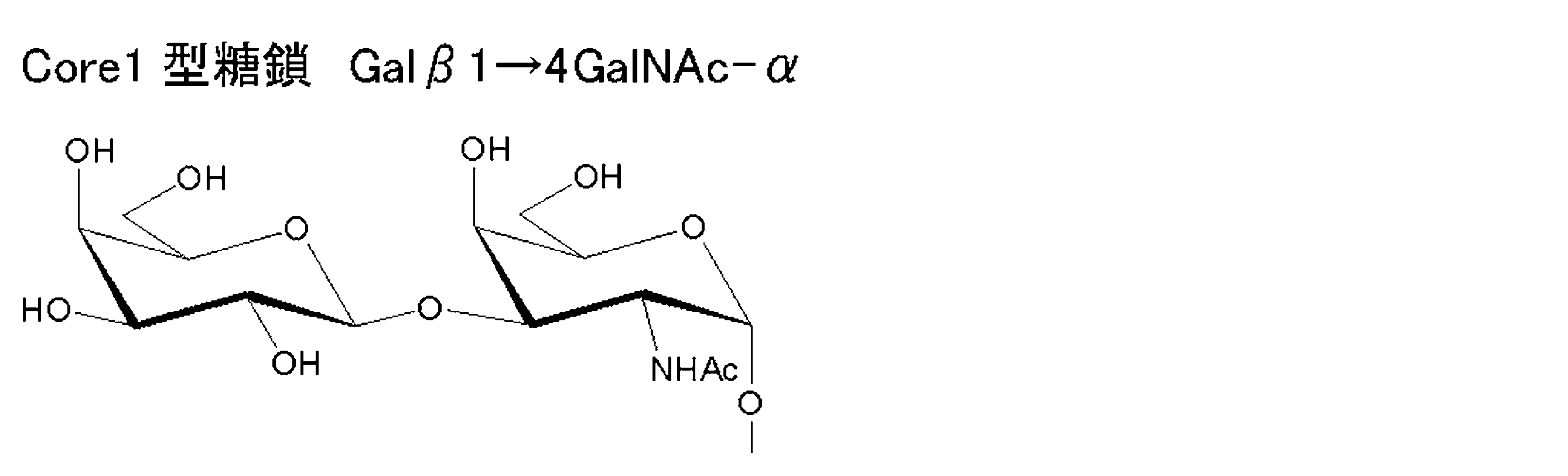
Fmoc Rinkamide Tentagel (Hipep Labpratories, 0.24mmol/mg)、83.3 mg (20μmolスケール)を担体として、N末端保護アミノ酸をマイクロ波支援糖ペプチド製造方法(特開2006-28141号公報)で順次縮合した。
プロリン、セリン、スレオニンの縮合時は合成スケールの5倍等量(100μmol)のFmoc保護アミノ酸を、溶媒N, N-dimethylformamide (DMF) 285μlに溶解し、5倍等量(100μmol)の0.4 M O-Benzotriazole-N,N,N’,N’-tetramethyl-uronium-hexafluoro-phosphate (HBTU)/1-hydroxybenzotriazole(HOBt)と10倍等量(200μmol)のN, N-diisopropylethylamine (DIEA)を混合し、2450 MHzの電磁波照射下で5分間、50℃で反応を行った。
糖アミノ酸の縮合時は、1.5倍等量の各Fmoc保護糖アミノ酸を、溶媒DMF 91μlに溶解し、1.5倍等量のHBTU/HOBtと4.5倍等量のDIEAを混合し、2450 MHzの電磁波照射下で10分間、50℃で反応を行った。
アミノ酸縮合前のFmoc基切断は20 % piperodine溶液1ml中に担体を浸し、2450 MHzの電磁波照射下で3分間、50℃で反応を行った。
ペプチド伸長反応後、95 % trifluoroacetic acid (TFA)、2.5 % Triisopropylsilane、2.5 %水の溶液中で、室温で2時間反応させることによってペプチド残基上の保護基を脱離させるとともに、固相担体上から化合物1, 2を遊離させた。樹脂を濾別し、TFAを揮発留去した後、純水に溶解し逆相HPLC(Inertsil登録標章ODS-3 20 ×250 mmカラム、移動層A:0.1 % TFA水溶液に対するB:0.1 % TFA含有アセトニトリルの2%から30%のグラジエント)により精製して化合物1, 2, 3を得た。
2.化合物1, 2, 3のNMR解析
化合物1, 2, 3の1.0 mM重水溶液300μl(pH 6.8)をそれぞれ調整し、各水溶液についてNMR測定を行った。装置はBruker AVANCE600 (プロトン共鳴周波数600.13MHz)を用い、極低温型高感度プローブ(Cryoprobe)を装着してTOCSY(積算8回)を測定した。結果を図1-1~1-3に示す。
化合物1, 2, 3の1.0 mM重水溶液300μl(pH 6.8)をそれぞれ調整し、各水溶液についてNMR測定を行った。装置はBruker AVANCE600 (プロトン共鳴周波数600.13MHz)を用い、極低温型高感度プローブ(Cryoprobe)を装着してTOCSY(積算8回)を測定した。結果を図1-1~1-3に示す。
図1-1に示す、化合物1のスペクトルは配列中のプロリンがシス体とトランス体の立体異性体の混合物であることが示唆された。図中の丸で示したシグナルはシス体プロリン由来のシグナルである。
図1-2に示す、化合物2のスペクトルからシス体プロリン由来のシグナルが化合物1の場合と比べて減少していることが明らかである。
さらに図1-3に示す、化合物3のスペクトルはシス体プロリンのシグナルはほとんど観測されなかったことを示し、糖鎖付加によってプロリンのほとんどがトランス体に固定化されたことを示唆している。
図1-2に示す、化合物2のスペクトルからシス体プロリン由来のシグナルが化合物1の場合と比べて減少していることが明らかである。
さらに図1-3に示す、化合物3のスペクトルはシス体プロリンのシグナルはほとんど観測されなかったことを示し、糖鎖付加によってプロリンのほとんどがトランス体に固定化されたことを示唆している。
以上より、core1糖鎖がシス-トランス異性化を制御していることが明らかである。
次に、TOCSYスペクトルのNH-メチルプロトン(スレオニン)の相関領域を示す。溶媒の重水素と交換するアミドプロトンとの相関を観測するため、溶媒に90%H2O, 10%D2Oを用いた。濃度、pHは上記の測定と同一である。結果は、図2-1~2-3に示す。
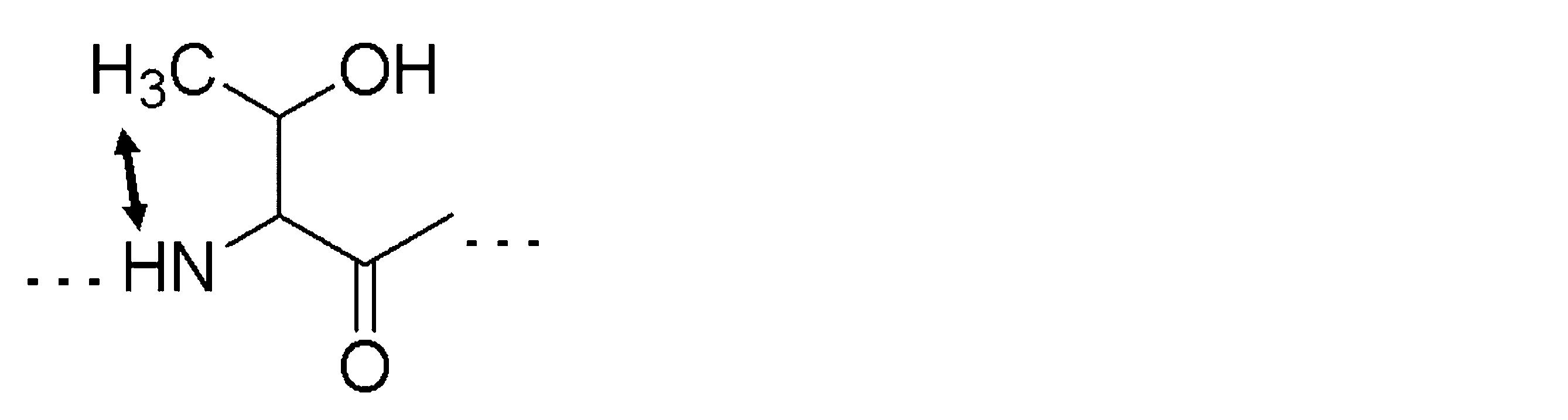
図2-1に化合物 1: PSTPPTPSPSTPPTPSPS-CONH2の結果を示す。
Tは4つしかないが8残基分の相関が観測された。
これはシス-トランス異性体の影響である。
Tは4つしかないが8残基分の相関が観測された。
これはシス-トランス異性体の影響である。
図2-2に化合物 2: PSTPPTPSPSTPPTPSPS-CONH2の結果を示す。
GalNAc-Thrは配列上2か所である。
NMRでそれに対応するシグナルは2か所であり、両者は一致した。
フリーのスレオニンは2か所のはずだが5つのシグナルを確認した。
GalNAc-Thrは配列上2か所である。
NMRでそれに対応するシグナルは2か所であり、両者は一致した。
フリーのスレオニンは2か所のはずだが5つのシグナルを確認した。
図2-3に化合物 3: PST*PPT*PS*PS*TPPTPSPS-CONH2の結果を示す。
Core1-Thrは配列上2か所である。
NMRでそれに対応するシグナルは2か所であり、両者は一致した。
フリーのスレオニンは2か所のはずだが4つのシグナルを確認した。
Core1-Thrは配列上2か所である。
NMRでそれに対応するシグナルは2か所であり、両者は一致した。
フリーのスレオニンは2か所のはずだが4つのシグナルを確認した。
以上の結果から、糖鎖修飾を受けたスレオニン残基は一定のコンフォメーションを形成しているが、フリーのスレオニンはシス-トランス異性化の影響を受け、複数のコンフォメーションを形成していることが明らかである。また、core1付加体(化合物3)はGalNAc付加体(化合物2)に比べ、フリーのスレオニンのシグナルが減少している。これは、二糖core1の方が単糖GalNAcよりもペプチド全体のコンフォメーションを安定化していることを示している。
次に、化合物 2の立体構造は核磁気共鳴(NMR)法によって決定し結果を示す。サンプルは2mMに調整しpHを6.5とした。測定機器はbruker社製Avance600(プロトン共鳴周波数600.03MHz)を用いた。二次元DQF-COSYと二次元TOCSYスペクトルを帰属することによって各アミノ酸残基のシグナルを帰属し、二次元NOESYによって核間距離情報を収集した。NOESY測定におけるミキシングタイムは200msecとした。収集した距離情報を用いてディスタンスジオメトリー/シミュレーテッドアニーリング法によって立体構造を算出した。50個の構造を算出し、もっとも分子ポテンシャルエネルギーが低い20個の立体構造をこのペプチドの構造として提示した(図2-4)。
図2-4に示す結果は、IgA1ヒンジ領域(PSTPPTPSPSTPPTPSPS)の4か所(Thr3, Thr6, Ser8, Ser10)に二糖core1構造を導入することで、ペプチドのコンフォメーションを一定に保つことができることを示す。これにより、二糖core1構造を導入したN末端側領域において、非常によく収束した立体構造を得ることに成功した。また、その構造から糖鎖がペプチドのコンフォメーションを制御していることも明らかになった。
core1の方が糖鎖が多いにもかかわらずNMRシグナルが少ないことから、シス-トランス異性化がGalNAcのみよりcore1型の方がトランス側に固定化され、一意のコンフォメーションを形成することが明らかであると考える(GalNAcのみでは依然としてシス-トランス異性化が存在しているので複数のコンフォマーが存在し、スペクトルが複雑化している)。
よって、一種類の立体構造を形成するcore1型のIgA1ヒンジに関して立体構造の算出が可能となった。
よって、一種類の立体構造を形成するcore1型のIgA1ヒンジに関して立体構造の算出が可能となった。
糖鎖構造の変化が疾患マーカーとして知られていることが多く、その原因を探るために立体構造解析は不可欠である。しかし、糖鎖の種類の変化の多様性(microheterogeneity)が複数のコンフォマーを発生させるため、一定の立体構造を形成せず、その解析は一般に困難である。しかし、二糖core1構造に調整することによって、一定のコンフォメーションを形成させることに成功し、立体構造算出に至った。この例では、特にThr6に付加したcore1糖鎖がよく収束した構造が明らかとなり、この領域の糖鎖変化が疾患と強く関わっていることが容易に示唆される。(Thr6の二糖が変化すれば、この構造は保てないだろうと考えられる)。
TPあるいはSP配列におけるO-結合型糖鎖の種類が多岐にわたり、複数のコンフォマーを形成するために立体構造算出が困難な場合、core1型糖鎖に調製することで立体構造を一種類に固定化し立体構造解析に至るものと考える。X線結晶構造解析では複数のコンフォマーの存在や複数種の糖鎖の存在は、結晶化を阻害することが珍しくないが、この方法により立体構造解析を進めることが可能となると考える。
実施例2
1H-NMRによるシス体とトランス体の定量
N末端にアセチル基、C末端にアミド基をもつSPおよびTPの配列からなるジペプチドを実施例1と同様の方法で固相合成した。但し、ペプチドの合成は、100mmolのスケールで行った(収率100%で100 mmol生成できる系)。(1)Ac-Thr-Pro-CONH2とAc-Ser-Pro-CONH2の配列のThr(T)およびSer(S)に糖鎖付加がない場合、(2) α-GalNAcが付加した場合、(3)二糖core1が付加した場合について検証した。収率を以下の表1に示す。
1H-NMRによるシス体とトランス体の定量
N末端にアセチル基、C末端にアミド基をもつSPおよびTPの配列からなるジペプチドを実施例1と同様の方法で固相合成した。但し、ペプチドの合成は、100mmolのスケールで行った(収率100%で100 mmol生成できる系)。(1)Ac-Thr-Pro-CONH2とAc-Ser-Pro-CONH2の配列のThr(T)およびSer(S)に糖鎖付加がない場合、(2) α-GalNAcが付加した場合、(3)二糖core1が付加した場合について検証した。収率を以下の表1に示す。
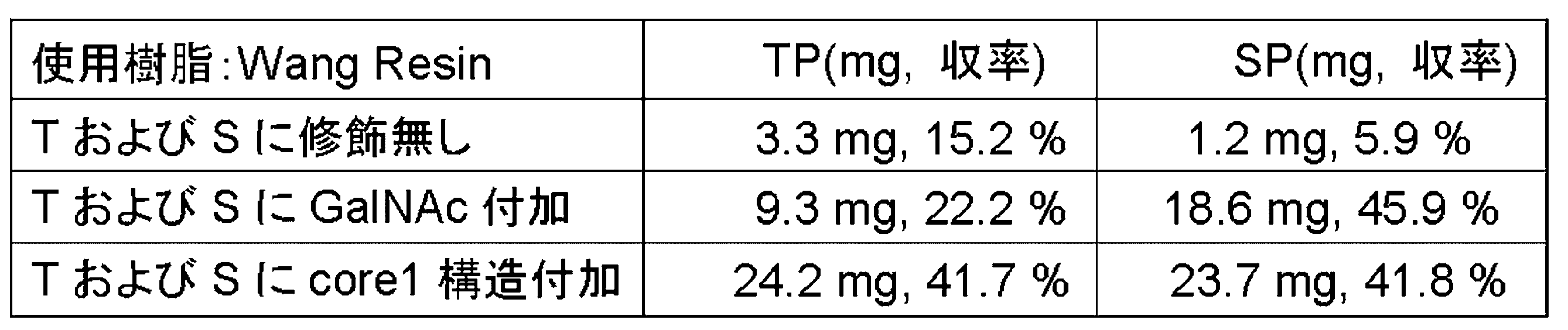
表1に示す結果から、プロリンのN末端側に糖鎖修飾を施したペプチドの場合、非修飾体に比べ著しい収率の向上が認められた。特にスレオニンの場合は単糖GalNAcより二糖core1の方がその効果は顕著であった。但し、セリンに関しては単糖GalNAcでも十分にその効果が認められた。
合成した各(糖)ペプチドを2mMに調整し、プロトン600MHzのNMR(Bruker社製Avance600 )にて測定を行った(積算回数8回)。結果を図3に示す。
その結果、糖鎖なしのAc-TP-NH2、およびAc-SP-NH2ではシス体がそれぞれ16.1%, 12.8%であり、GalNAcのみ付加体ではAc-TP-NH2、およびAc-SP-NH2のシス体はそれぞれ、11.2%、10.6%、さらにcore1付加型ではAc-TP-NH2、およびAc-SP-NH2のシス体はそれぞれ、3.3%、6.7%であった。
このことから、GalNAcのみでもある程度シス-トランス異性化を抑え、トランス側へ偏らせることが可能であるが、core1型にすることで、その効果がより顕著になることが明らかになった。
本発明は、ペプチドが有するプロリンのコンフォメーションをトランス型に安定化した糖ペプチドを利用する例えば、医薬や診断の分野に有用である。
Claims (7)
- 少なくとも1のトランス型のプロリン残基を含み、かつ
前記トランス型のプロリン残基は、N末端側に隣接するアミノ酸残基が二糖core1型糖鎖(Galβ(1→3)GalNAc-α)を付加したセリン残基またはスレオニン残基である糖ペプチドの製造方法であって、
ペプチドの化学合成方法を利用し、
トランス型にしたいプロリン残基のN末端側に、二糖core1型糖鎖(Galβ(1→3)GalNAc-α)を付加したセリンまたはスレオニンを結合する工程を少なくとも1回含む、前記製造方法。 - ペプチドの化学合成方法として固相合成法を用いる請求項1に記載の製造方法。
- 前記トランス型にしたいプロリン残基がC末端を固相に固定化したプロリン残基であり、かつ二糖core1型糖鎖(Galβ(1→3)GalNAc-α)を付加したセリンまたはスレオニンを結合する工程を1回含む、請求項2に記載の製造方法。
- 少なくとも1のトランス型のプロリン残基を含み、かつ
前記トランス型のプロリン残基は、N末端側に隣接するアミノ酸残基が二糖core1型糖鎖(Galβ(1→3)GalNAc-α)を付加したセリン残基またはスレオニン残基である糖ペプチドの製造方法であって、
プロリン残基を含み、かつ前記プロリン残基のN末端側に隣接するアミノ酸残基としてセリン残基またはスレオニン残基を含むペプチドを用意し、
前記ペプチドの少なくとも1のプロリン残基のN末端側に隣接するセリン残基またはスレオニン残基に、二糖core1型糖鎖(Galβ(1→3)GalNAc-α)を導入する工程を含む、前記製造方法。 - 前記二糖core1型糖鎖(Galβ(1→3)GalNAc-α)の導入が、前記ペプチドが有するセリン残基またはスレオニン残基の側鎖水酸基にGalNAcが付加され、次いでGalNAcにGalが付加されることで行われる請求項4に記載の方法。
- セリン残基またはスレオニン残基の側鎖水酸基へのGalNAcの付加が、GalNAc転移酵素によって行われ、GalNAcのGalへの付加が、Gal転移酵素によって行われる請求項5に記載の方法。
- ペプチドのアミノ酸残基数が2~200個の範囲であり、
かつトランス型のプロリン残基数が1~100個の範囲である、請求項1~6のいずれかに記載の方法。
Applications Claiming Priority (2)
| Application Number | Priority Date | Filing Date | Title |
|---|---|---|---|
| JP2008-312507 | 2008-12-08 | ||
| JP2008312507 | 2008-12-08 |
Publications (1)
| Publication Number | Publication Date |
|---|---|
| WO2010067563A1 true WO2010067563A1 (ja) | 2010-06-17 |
Family
ID=42242558
Family Applications (1)
| Application Number | Title | Priority Date | Filing Date |
|---|---|---|---|
| PCT/JP2009/006641 Ceased WO2010067563A1 (ja) | 2008-12-08 | 2009-12-04 | 糖ペプチドの製造方法 |
Country Status (1)
| Country | Link |
|---|---|
| WO (1) | WO2010067563A1 (ja) |
Cited By (1)
| Publication number | Priority date | Publication date | Assignee | Title |
|---|---|---|---|---|
| CN106503487A (zh) * | 2016-11-01 | 2017-03-15 | 北京理工大学 | 一种统计分析蛋白质肽键的顺式和反式结构的方法 |
-
2009
- 2009-12-04 WO PCT/JP2009/006641 patent/WO2010067563A1/ja not_active Ceased
Non-Patent Citations (6)
Cited By (2)
| Publication number | Priority date | Publication date | Assignee | Title |
|---|---|---|---|---|
| CN106503487A (zh) * | 2016-11-01 | 2017-03-15 | 北京理工大学 | 一种统计分析蛋白质肽键的顺式和反式结构的方法 |
| CN106503487B (zh) * | 2016-11-01 | 2019-03-01 | 北京理工大学 | 一种统计分析蛋白质肽键的顺式和反式结构的方法 |
Similar Documents
| Publication | Publication Date | Title |
|---|---|---|
| JP5013693B2 (ja) | 抗原としてペプチドライブラリーを用いたモチーフ特異性および状況独立性抗体の産生 | |
| Schmidt et al. | Molecular interaction between the Strep-tag affinity peptide and its cognate target, streptavidin | |
| Zhang et al. | Enhanced epimerization of glycosylated amino acids during solid-phase peptide synthesis | |
| Levine et al. | O-GlcNAc modification inhibits the calpain-mediated cleavage of α-synuclein | |
| Tan et al. | Toward Homogeneous Erythropoietin: Non-NCL-Based Chemical Synthesis of the Gln78− Arg166 Glycopeptide Domain | |
| Rut et al. | Engineered unnatural ubiquitin for optimal detection of deubiquitinating enzymes | |
| US20160304571A1 (en) | Synthesis of Site Specifically-Linked Ubiquitin | |
| Hayakawa et al. | Impaired O-glycosylation at consecutive threonine TTX motifs in mucins generates conformationally restricted cancer neoepitopes | |
| JP2003527561A (ja) | 蛋白の部位特異的標識化方法およびそのための使用 | |
| JP2002510707A (ja) | 環状並べ換えビオチン結合タンパク質 | |
| US20060128944A1 (en) | Molecular linkers suitable for crystallization and structural analysis of molecules of interest, method of using same, and methods of purifying g protein-coupled receptors | |
| WO2010067563A1 (ja) | 糖ペプチドの製造方法 | |
| Ma et al. | Perinuclear and nuclear envelope localizations of Arabidopsis Ran proteins | |
| Blixt et al. | Synthesis of O-glycopeptides and construction of glycopeptide microarrays | |
| EP2487183A1 (en) | Ubiquitin-isopeptide probes | |
| CN110128503B (zh) | 一种抗Aβ1-42蛋白聚集的合成多肽及其合成方法、应用与编码该合成多肽的基因 | |
| CN120365364A (zh) | 一种暗纹东方鲀来源的小分子肽及其应用 | |
| Lutz | Identification of linkage-and length-selective ubiquitin binding proteins | |
| 早川瞬 | Significance of the Posttranslational O-glycosylations in the Protein Conformation and Function | |
| EP2665743B1 (en) | Ubiquitin-isopeptide probes | |
| Lear | Towards a Total Chemical Synthesis of Human CC Motif Chemokine Ligand 2 | |
| Rojas-Ocáriz et al. | Article III: Design of α‑S‑Neoglycopeptides Derived from MUC1 with a Flexible and Solvent-Exposed Sugar Moiety | |
| 本元貴大 | Structural Analyses of Helices of Poly-Oligo (lactic acid) in Solution-State | |
| Real Fernandez | Modified Glycopeptides to Investigate Antigen-Antibody Interaction in Multiple Sclerosis | |
| Rangappa | Glycoside cluster effects on antibody recognition of MUC1 glycopeptides |
Legal Events
| Date | Code | Title | Description |
|---|---|---|---|
| 121 | Ep: the epo has been informed by wipo that ep was designated in this application |
Ref document number: 09831671 Country of ref document: EP Kind code of ref document: A1 |
|
| NENP | Non-entry into the national phase |
Ref country code: DE |
|
| 122 | Ep: pct application non-entry in european phase |
Ref document number: 09831671 Country of ref document: EP Kind code of ref document: A1 |
|
| NENP | Non-entry into the national phase |
Ref country code: JP |