WO2009158404A1 - Methods of preparing quinazolinone derivatives - Google Patents
Methods of preparing quinazolinone derivatives Download PDFInfo
- Publication number
- WO2009158404A1 WO2009158404A1 PCT/US2009/048457 US2009048457W WO2009158404A1 WO 2009158404 A1 WO2009158404 A1 WO 2009158404A1 US 2009048457 W US2009048457 W US 2009048457W WO 2009158404 A1 WO2009158404 A1 WO 2009158404A1
- Authority
- WO
- WIPO (PCT)
- Prior art keywords
- formula
- compound
- hydroxyethoxy
- dimethylphenyl
- halogen
- Prior art date
- Legal status (The legal status is an assumption and is not a legal conclusion. Google has not performed a legal analysis and makes no representation as to the accuracy of the status listed.)
- Ceased
Links
- 0 *c1cc(C=O)c(*)c(*)c1OCCO Chemical compound *c1cc(C=O)c(*)c(*)c1OCCO 0.000 description 1
- LSDUYZHWQMMNCO-UHFFFAOYSA-N COc1cc(N)c(C(N)=O)c(OC)c1 Chemical compound COc1cc(N)c(C(N)=O)c(OC)c1 LSDUYZHWQMMNCO-UHFFFAOYSA-N 0.000 description 1
- PGTBXQQPHHXUIH-UHFFFAOYSA-N Cc1cc(C(N2)=Nc(cc(cc3OC)OC)c3C2=O)cc(C)c1OCCN1CCOCC1 Chemical compound Cc1cc(C(N2)=Nc(cc(cc3OC)OC)c3C2=O)cc(C)c1OCCN1CCOCC1 PGTBXQQPHHXUIH-UHFFFAOYSA-N 0.000 description 1
- UYGBSRJODQHNLQ-UHFFFAOYSA-N Cc1cc(C=O)cc(C)c1O Chemical compound Cc1cc(C=O)cc(C)c1O UYGBSRJODQHNLQ-UHFFFAOYSA-N 0.000 description 1
- BPSZMJNQIRJYKP-UHFFFAOYSA-N Cc1cc(C=O)cc(C)c1OCCN1CCOCC1 Chemical compound Cc1cc(C=O)cc(C)c1OCCN1CCOCC1 BPSZMJNQIRJYKP-UHFFFAOYSA-N 0.000 description 1
- KMTRUDSVKNLOMY-UHFFFAOYSA-N O=C1OCCO1 Chemical compound O=C1OCCO1 KMTRUDSVKNLOMY-UHFFFAOYSA-N 0.000 description 1
Classifications
-
- C—CHEMISTRY; METALLURGY
- C07—ORGANIC CHEMISTRY
- C07D—HETEROCYCLIC COMPOUNDS
- C07D239/00—Heterocyclic compounds containing 1,3-diazine or hydrogenated 1,3-diazine rings
- C07D239/70—Heterocyclic compounds containing 1,3-diazine or hydrogenated 1,3-diazine rings condensed with carbocyclic rings or ring systems
- C07D239/72—Quinazolines; Hydrogenated quinazolines
- C07D239/86—Quinazolines; Hydrogenated quinazolines with hetero atoms directly attached in position 4
- C07D239/88—Oxygen atoms
- C07D239/91—Oxygen atoms with aryl or aralkyl radicals attached in position 2 or 3
-
- A—HUMAN NECESSITIES
- A61—MEDICAL OR VETERINARY SCIENCE; HYGIENE
- A61P—SPECIFIC THERAPEUTIC ACTIVITY OF CHEMICAL COMPOUNDS OR MEDICINAL PREPARATIONS
- A61P9/00—Drugs for disorders of the cardiovascular system
- A61P9/10—Drugs for disorders of the cardiovascular system for treating ischaemic or atherosclerotic diseases, e.g. antianginal drugs, coronary vasodilators, drugs for myocardial infarction, retinopathy, cerebrovascula insufficiency, renal arteriosclerosis
Definitions
- the present disclosure relates to methods of preparing quinazolinone derivatives, which are useful for regulating the expression of apolipoprotein A-I (ApoA-l) and in the treatment and prevention of cardiovascular disease and related disease states, such as, for example, atherosclerosis.
- ApoA-l apolipoprotein A-I
- HDL-C high-density lipoprotein cholesterol
- HDL-C appears to exert its anti-atherogenic effect by mediating reverse cholesterol transport (RCT), in which cholesterol is recruited from peripheral tissues and transported to the liver.
- RCT reverse cholesterol transport
- HDL-C also possesses pleiotropic biological properties that contribute to its antiatherogenic effects, such as anti-inflammatory, anti-oxidant, and anti-thrombotic activities.
- HDL-C exists in two main forms, one containing both apolipoprotein A-I (ApoA-l) and apolipoprotein A-Il (ApoA-ll), and the other containing ApoA-l without ApoA-ll (Schultz et al. (1993) Nature 365, 762-764).
- the cardioprotective effect of HDL-C is primarily, but not exclusively, attributable to ApoA-l.
- ApoA-l plays a role in enhancing reverse cholesterol transport, attenuating oxidative stress, increasing paraoxonase activity, enhancing anticoagulant activity, and increasing antiinflammatory activity (Andersson (1997) Curr. Opin. Lipidol. 8, 225-228). Accordingly, ApoA-l is an attractive target for therapeutic intervention.
- the methods of the present invention provide improved procedures for preparing up-regulators of ApoA-l expression.
- alkylation of the phenol starting material with ethylene carbonate, rather than alkylating agents of known procedures is more efficient, and thus less expensive on a large scale.
- the coupling procedures of the invention described herein to form the quinazolinones result in lower levels of impurities and increased yield of the final compounds.
- compound of Formula I is intended to include any stereoisomer, tautomer, and/or pharmaceutically acceptable salt as defined herein.
- Compounds of Formula I, Formula Vl, and Formula VIII also include crystalline and amorphous forms of those compounds, including, for example, polymorphs, pseudopolymorphs, solvates, hydrates, unsolvated polymorphs (including anhydrates), conformational polymorphs, and amorphous forms of the compounds, as well as mixtures thereof.
- Crystal form may be used interchangeably herein, and are meant to include all crystalline and amorphous forms of the compound, including, for example, polymorphs, pseudopolymorphs, solvates, hydrates, unsolvated polymorphs (including anhydrates), conformational polymorphs, and amorphous forms, as well as mixtures thereof, unless a particular crystalline or amorphous form is referred to.
- Compounds of Formula I, Formula Vl, and Formula VIII also include pharmaceutically acceptable forms of the recited compounds, including chelates, non-covalent complexes, prodrugs, and mixtures thereof.
- prodrugs also fall within the scope of compounds of Formula I, Formula Vl, and Formula VIII.
- the "prodrugs" described herein include any compound that becomes a compound of Formula I, Formula Vl and/or Formula VIII when administered to a patient, e.g., upon metabolic processing of the prodrug.
- Examples of prodrugs include derivatives of functional groups, such as a carboxylic acid group, in the compounds of Formula I, Formula Vl and/or Formula VIII.
- Exemplary prodrugs of a carboxylic acid group include, but are not limited to, carboxylic acid esters such as alkyl esters, hydroxyalkyl esters, arylalkyl esters, and aryloxyalkyl esters.
- a “solvate” is formed by the interaction of a solvent and a compound.
- the terms “compound of Formula I”, “compound of Formula Vl”, and “compound of Formula VIII” are intended to include solvates of compounds.
- “salts” includes solvates of salts.
- Suitable solvates are pharmaceutically acceptable solvates, such as hydrates, including monohydrates and hem i-hyd rates.
- a "chelate” is formed by the coordination of a compound to a metal ion at two (or more) points.
- the term “compound” is intended to include chelates of compounds. Similarly, “salts” includes chelates of salts.
- a "non-covalent complex” is formed by the interaction of a compound and another molecule wherein a covalent bond is not formed between the compound and the molecule. For example, complexation can occur through van der Waals interactions, hydrogen bonding, and electrostatic interactions (also called ionic bonding). Such non-covalent complexes are included in the term "compound”.
- imido refers to a group having the structure -C(O)NC(O)-R 2 , where R z can be selected from alkyl, alkenyl, alkynyl, aryl, arylalkyl, cycloalkyl, haloalkyl, heteroaryl, and heterocyclyl.
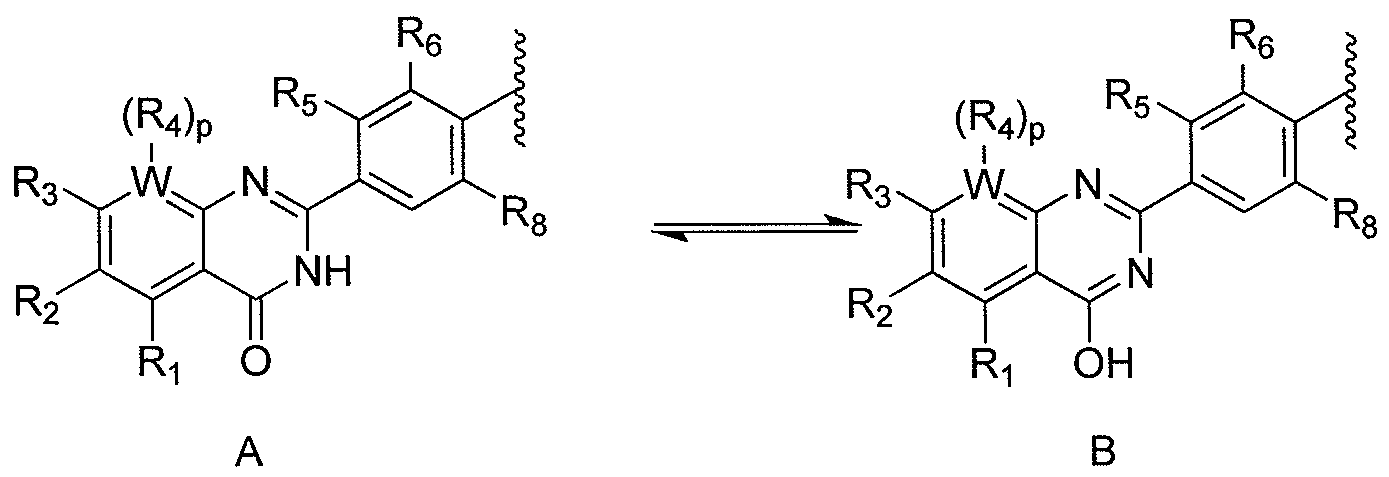
- One embodiment provides a method of preparing a compound of Formula I:
- R-I, R2, R3, and R 4 are each independently selected from alkoxy, alkyl, amido, aryloxy, cycloalkyl, halogen, heterocyclyl, hydrogen, and nitro;
- R 6 is selected from alkyl, alkoxy, and halogen
- R 5 is hydrogen, or R 5 and R 6 may be taken together with the carbon atoms to which they are attached, to form a ring selected from aryl, cycloalkyl, and heterocycyl;
- R 8 is selected from alkyl, alkoxy, halogen, and hydrogen
- W is C or N, where if W is N, then p is 0, and if W is C, then p is 1 ; comprising a) reacting an aldehyde of Formula II:
- R 1 , R 2 , R 3 , and R 4 are as defined above, to form the compound of Formula I.
- Ri and R 3 can each be independently selected from alkoxy, alkyl, halogen, and hydrogen. In another embodiment, R 1 and R 3 can each be independently selected from chloro, hydrogen, methoxy, and methyl. In a further embodiment, Ri and R 3 can each be methoxy.
- R 2 can be selected from bromo, hydrogen, methoxy, and methylamido. In a further embodiment, R 2 can be hydrogen. In one embodiment, W can be N. In another embodiment, W can be C and R 4 can be hydrogen.
- Re can be selected from chloro, methoxy, and methyl.
- R 6 can be methyl.
- R 6 and R 8 can be each independently selected from alkyl and halogen.
- Rs can be selected from chloro, hydrogen, methoxy, and methyl.
- Re and Rs can be each methyl.
- the compound of Formula I can be selected from:
- the compound of Formula I is 2-(4-(2- hydroxyethoxy)-3,5-dimethylphenyl)-5,7-dimethoxyquinazolin-4(3H)-one, or a solvate, hydrate, tautomer, or pharmaceutically acceptable salt thereof.
- a reaction step can be performed in a large scale.
- "large scale” refers to the use of at least 50 grams of a starting material, intermediate or reagent, such as the use of at least 100 grams, at least 500 g, at least 1 kg, at least 10 kg, at least 25 kg, at least 50 kg, at least 100 kg, at least 250 kg, or at least 500 kg.
- Formula Il can be combined with ethylene carbonate in a solvent, such as dimethylformamide, dichloromethane, isopropanol, methanol, tetrahydrofuran, toluene, xylene and water, and stirred at elevated temperature, such as 110 0 C, to form the alkylated compound of Formula III.
- a solvent such as dimethylformamide, dichloromethane, isopropanol, methanol, tetrahydrofuran, toluene, xylene and water
- elevated temperature such as 110 0 C
- This compound can be purified by crystallization from, for example, dichloromethane/heptane.
- Use of ethylene carbonate allows for improved control of the alkylation process and is much more cost effective than other known methods.
- the compound of Formula III can then be combined with a compound of Formula IV in ⁇ /, ⁇ /-dimethylacetamide (DMAC).
- DMAC ⁇ /, ⁇ /-dimethylacetamide
- suitable solvents include acetonitrile, benzene and methanol.
- Sodium bisulfite can then be added in portions, such as one-third portions, with heating, e.g., at approximately 115 0 C.
- An acid such as p- toluenesulfonic acid monohydrate, can be added with the first portion of sodium bisulfite.
- the reaction can be stirred for at least about 90 minutes, such as 90-105 minutes, between addition of the portions. Gradual addition of the portions over at least a 4 hour period significantly reduces the amount of impurities present in the final compound of Formula I, some of which are otherwise difficult to remove during the purification stage of the process.
- the reaction mixture can be cooled and the resulting product can be recrystallized from, for example, DMAC/heptane.
- the unpurified product can be triturated with acetone.
- this first purification step can be omitted.
- the product can then be recrystallized from ethanol/water to provide the compound of Formula I.
- the compound of Formula I can be treated with an isocyanate of Formula V
- Formula V and a base, such as triethylamine or Hunig's base, to form a carbamate compound of Formula Vl.
- a base such as triethylamine or Hunig's base
- R 9 can be selected from alkyl, aryl, cycloalkyl, heteroaryl, and heterocyclyl.
- Rg can be aryl substituted with one or more groups selected from alkoxy, alkyl, and halogen.
- the compound of Formula Vl is 2-(4-(5,7-dimethoxy-4-oxo-3,4- dihydroquinazolin-2-yl)-2,6-dimethylphenoxy)ethyl cyclohexylcarbamate, or a solvate, hydrate, tautomer, or pharmaceutically acceptable salt thereof.
- the compound of Formula I can be treated with a reagent to form a leaving group Ri 0 , as shown in Formula VII.
- the leaving group R 10 may be selected from halogen, sulfonyl, and phosphonium, such as chloride, methanesulfonyl, p-toluenesulfonyl, and triphenylphosphonium.
- the reagent can be selected from thionyl chloride, methanesulfonyl chloride, p-toluenesulfonyl chloride, and PPIVdiethyl azodicarboxylate.
- the compound of Formula VII may then be treated with a nucleophilic reagent, such as an alkoxide, an amine, or a heterocycle having at least one nitrogen, including imido compounds, to provide a compound of Formula VIII.
- a nucleophilic reagent such as an alkoxide, an amine, or a heterocycle having at least one nitrogen, including imido compounds
- Ri 0 is triphenylphosphonium
- the compound of Formula VII can be treated in situ with HN 3 followed by reduction with reagents such as Pd-CVH 2 to form an intermediate amine, which can then be treated with an acylating agent to form the compound of Formula VIII having an amido group or an imido group.
- R 11 can be selected from alkoxy, amido, amino, imido, and heterocyclyl. In one embodiment, R 11 is selected from methoxy, methylamino, morpholino, piperazino, and piperidino.
- a compound of Formula I can be treated with methanesulfonyl chloride and triethylamine in dichloromethane to form the corresponding mesylate.
- the mesylate may then be treated with an amine, such as methylamine, in refluxing ethanol to give the compound of Formula VIII.
- the compound of Formula VIII is 2-(3,5-dimethyl-4-(2- (methylamino)ethoxy)phenyl)-5,7-dimethoxy-quinazolin-4(3/-/)-one, or a solvate, hydrate, tautomer, or pharmaceutically acceptable salt thereof.
- a compound of Formula VIII can be prepared by reacting the aldehyde of Formula Il with ethylene carbonate to provide the compound of Formula III.
- the compound of Formula III can then be reacted with a reagent to create a leaving group R 12 on the compound of Formula IX.
- R 12 can be selected from halogen, sulfonyl, and phosphonium, such as chloride, methanesulfonyl, p-toluenesulfonyl, and triphenylphosphonium.
- the reagent is selected from thionyl chloride, methanesulfonyl chloride, p-toluenesulfonyl chloride, and PPh 3 /diethyl azodicarboxylate.
- the compound of Formula IX may be treated with an nucleophilic reagent, such as an alkoxide, amine or a heterocycle having at least one nitrogen, including imido compounds, to provide a compound of Formula X.
- an nucleophilic reagent such as an alkoxide, amine or a heterocycle having at least one nitrogen, including imido compounds
- the compound of Formula VII can be treated in situ with HN 3 followed by reduction with reagents such as Pd-CYH 2 to form an intermediate amine, which can be treated with an acylating agent to form the compound of Formula VIII having an amido group or an imido group.
- R 13 can be selected from alkoxy, amido, amino, imido, and heterocyclyl. In one embodiment, R 13 is selected from methoxy, methylamino, morpholino, piperazino, and piperidino.
- the compound of Formula X may then be condensed with a compound of Formula IV to form the compound of Formula VIII.
- R 6 and R 8 are each methyl.
- Ri and R 3 are each hydrogen.
- the compound of Formula VIII is 2-(3,5-dimethyl-4-(2- morpholinoethoxy)phenyl) quinazolin-4(3H)-one, or a solvate, hydrate, tautomer, or pharmaceutically acceptable salt thereof.
- acetonitrile MeCN
- DIPEA diisopropylethylamine
- DMAC N- dimethylacetamide
- DMF dimethylformamide
- EtOAc ethyl acetate
- Methanesulfonyl anhydride Ms 2 O
- methanesulfonyl chloride MsCI
- p-TsOH p- toluenesulfonic acid
- Et ⁇ N triethylamine
- the reaction mixture was cooled to 25 0 C and added to water (1770 kg). The mixture was stirred at 20 0 C for 6 hours to complete the crystallization.
- the crude material was isolated by filtration, washed with water (234 kg) and dried under vacuum to constant weight. The crude material was dissolved in ⁇ /, ⁇ /-dimethylacetamide (252 kg) at 80 0 C until all material had dissolved. The solution was cooled to 60 0 C and heptane (918 kg) was slowly added over a period of 1 hour, maintaining a temperature above 35 0 C.
- the dry solid (83.1 kg) was added to a 1 :1 mixture of ethanol and water (1V/1V; 1670 kg), and the mixture was heated to approximately 84 0 C (reflux) until all material was in solution. The solution was cooled to 70 0 C and polish-filtered, and then cooled to 30 0 C over 2 hours. The solution was cooled to 0 0 C. The mixture was stirred at 0 0 C for at least 1 hour, before the material was isolated by filtration, washed with ethanol/water (1V/1V; 33 kg) and dried under vacuum to constant weight.
- Example 2 Compounds that can be prepared similar to Example 1
Landscapes
- Chemical & Material Sciences (AREA)
- Organic Chemistry (AREA)
- Health & Medical Sciences (AREA)
- Engineering & Computer Science (AREA)
- Bioinformatics & Cheminformatics (AREA)
- Medicinal Chemistry (AREA)
- Urology & Nephrology (AREA)
- Cardiology (AREA)
- Chemical Kinetics & Catalysis (AREA)
- General Chemical & Material Sciences (AREA)
- Vascular Medicine (AREA)
- Nuclear Medicine, Radiotherapy & Molecular Imaging (AREA)
- Heart & Thoracic Surgery (AREA)
- Pharmacology & Pharmacy (AREA)
- Life Sciences & Earth Sciences (AREA)
- Animal Behavior & Ethology (AREA)
- General Health & Medical Sciences (AREA)
- Public Health (AREA)
- Veterinary Medicine (AREA)
- Pharmaceuticals Containing Other Organic And Inorganic Compounds (AREA)
- Plural Heterocyclic Compounds (AREA)
Abstract
Description


Claims


Priority Applications (14)
| Application Number | Priority Date | Filing Date | Title |
|---|---|---|---|
| JP2011516584A JP5602728B2 (en) | 2008-06-26 | 2009-06-24 | Method for producing quinazolinone derivative |
| HRP20150477TT HRP20150477T8 (en) | 2008-06-26 | 2009-06-24 | PROCEDURES FOR OBTAINING KINAZOLONE DERIVATIVES |
| SI200931175T SI2346837T1 (en) | 2008-06-26 | 2009-06-24 | Methods of preparing quinazolinone derivatives |
| ES09770937.2T ES2532402T3 (en) | 2008-06-26 | 2009-06-24 | Methods of preparing quinazolinone derivatives |
| CA2711103A CA2711103C (en) | 2008-06-26 | 2009-06-24 | Methods of preparing quinazolinone derivatives |
| DK09770937.2T DK2346837T3 (en) | 2008-06-26 | 2009-06-24 | Methods for preparing quinazolinone derivatives |
| AU2009262252A AU2009262252B2 (en) | 2008-06-26 | 2009-06-24 | Methods of preparing quinazolinone derivatives |
| PL09770937T PL2346837T3 (en) | 2008-06-26 | 2009-06-24 | Methods of preparing quinazolinone derivatives |
| RU2010131833/04A RU2520098C2 (en) | 2008-06-26 | 2009-06-24 | Method of producing quinazolinone derivatives |
| EP09770937.2A EP2346837B8 (en) | 2008-06-26 | 2009-06-24 | Methods of preparing quinazolinone derivatives |
| CN200980106586.7A CN101970416B (en) | 2008-06-26 | 2009-06-24 | Methods of preparing quinazolinone derivatives |
| HK12100731.0A HK1160135B (en) | 2008-06-26 | 2009-06-24 | Methods of preparing quinazolinone derivatives |
| NZ586440A NZ586440A (en) | 2008-06-26 | 2009-06-24 | Methods of preparing quinazolinone derivatives |
| IL206544A IL206544A (en) | 2008-06-26 | 2010-06-22 | Methods of preparing quinazolinone derivatives |
Applications Claiming Priority (2)
| Application Number | Priority Date | Filing Date | Title |
|---|---|---|---|
| US7595208P | 2008-06-26 | 2008-06-26 | |
| US61/075,952 | 2008-06-26 |
Publications (1)
| Publication Number | Publication Date |
|---|---|
| WO2009158404A1 true WO2009158404A1 (en) | 2009-12-30 |
Family
ID=40852111
Family Applications (1)
| Application Number | Title | Priority Date | Filing Date |
|---|---|---|---|
| PCT/US2009/048457 Ceased WO2009158404A1 (en) | 2008-06-26 | 2009-06-24 | Methods of preparing quinazolinone derivatives |
Country Status (18)
| Country | Link |
|---|---|
| US (1) | US8114995B2 (en) |
| EP (1) | EP2346837B8 (en) |
| JP (1) | JP5602728B2 (en) |
| KR (1) | KR101629356B1 (en) |
| CN (1) | CN101970416B (en) |
| AU (1) | AU2009262252B2 (en) |
| CA (1) | CA2711103C (en) |
| CY (1) | CY1116260T1 (en) |
| DK (1) | DK2346837T3 (en) |
| ES (1) | ES2532402T3 (en) |
| HR (1) | HRP20150477T8 (en) |
| IL (1) | IL206544A (en) |
| NZ (1) | NZ586440A (en) |
| PL (1) | PL2346837T3 (en) |
| PT (1) | PT2346837E (en) |
| RU (1) | RU2520098C2 (en) |
| SI (1) | SI2346837T1 (en) |
| WO (1) | WO2009158404A1 (en) |
Cited By (21)
| Publication number | Priority date | Publication date | Assignee | Title |
|---|---|---|---|---|
| WO2010123975A1 (en) * | 2009-04-22 | 2010-10-28 | Resverlogix Corp. | Novel anti-inflammatory agents |
| WO2012028578A1 (en) | 2010-09-03 | 2012-03-08 | Bayer Cropscience Ag | Substituted fused pyrimidinones and dihydropyrimidinones |
| WO2013033269A1 (en) | 2011-08-29 | 2013-03-07 | Coferon, Inc. | Bioorthogonal monomers capable of dimerizing and targeting bromodomains and methods of using same |
| WO2013033268A2 (en) | 2011-08-29 | 2013-03-07 | Coferon, Inc. | Bivalent bromodomain ligands, and methods of using same |
| CN103613550A (en) * | 2013-11-29 | 2014-03-05 | 成都理工大学 | Environment-friendly synthesis method for 4(3H)-quinazolinone |
| WO2015131005A1 (en) | 2014-02-28 | 2015-09-03 | The Regents Of The University Of Michigan | 9h-pyrimido[4,5-b]indoles and related analogs as bet bromodomain inhibitors |
| WO2016138332A1 (en) | 2015-02-27 | 2016-09-01 | The Regents Of The University Of Michigan | 9h-pyrimido [4,5-b] indoles as bet bromodomain inhibitors |
| WO2016196065A1 (en) | 2015-05-29 | 2016-12-08 | Genentech, Inc. | Methods and compositions for assessing responsiveness of cancers to bet inhibitors |
| CN106518789A (en) * | 2015-09-15 | 2017-03-22 | 南京理工大学 | Method for synthesis of quinazolinone derivative |
| WO2017142881A1 (en) | 2016-02-15 | 2017-08-24 | The Regents Of The University Of Michigan | Fused 1,4-oxazepines and related analogs as bet bromodomain inhibitors |
| WO2017176958A1 (en) | 2016-04-06 | 2017-10-12 | The Regents Of The University Of Michigan | Monofunctional intermediates for ligand-dependent target protein degradation |
| WO2017180417A1 (en) | 2016-04-12 | 2017-10-19 | The Regents Of The University Of Michigan | Bet protein degraders |
| WO2018052945A1 (en) | 2016-09-13 | 2018-03-22 | The Regents Of The University Of Michigan | Fused 1,4-oxazepines as bet protein degraders |
| WO2018052949A1 (en) | 2016-09-13 | 2018-03-22 | The Regents Of The University Of Michigan | Fused 1,4-diazepines as bet protein degraders |
| WO2018144789A1 (en) | 2017-02-03 | 2018-08-09 | The Regents Of The University Of Michigan | Fused 1,4-diazepines as bet bromodomain inhibitors |
| WO2019055444A1 (en) | 2017-09-13 | 2019-03-21 | The Regents Of The University Of Michigan | Bet bromodomain protein degraders with cleavable linkers |
| US10456405B2 (en) | 2015-09-07 | 2019-10-29 | Zhejiang Huahai Pharmaceutical Co., Ltd | Nitric oxide-releasing prodrug molecule of substituted quinazolines |
| WO2020020288A1 (en) | 2018-07-25 | 2020-01-30 | 正大天晴药业集团股份有限公司 | Sulfoximine compound as bromodomain protein inhibitor and pharmaceutical composition and medical use thereof |
| US10906917B2 (en) | 2018-06-13 | 2021-02-02 | Dybly Ag | Preparation of condensed triazepine derivatives and their use as BET inhibitors |
| US11192898B2 (en) | 2016-04-06 | 2021-12-07 | The Regents Of The University Of Michigan | MDM2 protein degraders |
| US12551484B2 (en) | 2019-11-05 | 2026-02-17 | Resverlogix Corp. | Methods of treatment and/or prevention of major adverse cardiovascular events (MACE) with a combination of a BET bromodomain inhibitor and a sodium dependent glucose transport 2 inhibitor |
Families Citing this family (20)
| Publication number | Priority date | Publication date | Assignee | Title |
|---|---|---|---|---|
| WO2006045010A2 (en) * | 2004-10-20 | 2006-04-27 | Resverlogix Corp. | Stilbenes and chalcones for the prevention and treatment of cardiovascular diseases |
| US8410109B2 (en) * | 2005-07-29 | 2013-04-02 | Resverlogix Corp. | Pharmaceutical compositions for the prevention and treatment of complex diseases and their delivery by insertable medical devices |
| PT2118074E (en) | 2007-02-01 | 2014-03-20 | Resverlogix Corp | Compounds for the prevention and treatment of cardiovascular diseases |
| US8952021B2 (en) | 2009-01-08 | 2015-02-10 | Resverlogix Corp. | Compounds for the prevention and treatment of cardiovascular disease |
| KR101913109B1 (en) | 2009-03-18 | 2018-10-31 | 리스버로직스 코퍼레이션 | Novel anti-inflammatory agents |
| US20140350181A1 (en) * | 2011-05-26 | 2014-11-27 | Solvay Specialty Polymers Italy S.P.A. | Hydro-fluorocompounds |
| CA2851996C (en) | 2011-11-01 | 2020-01-07 | Resverlogix Corp. | Pharmaceutical compositions for substituted quinazolinones |
| PT2906531T (en) | 2012-10-15 | 2018-02-06 | Resverlogix Corp | Compounds useful in the synthesis of benzamide compounds |
| US9073878B2 (en) | 2012-11-21 | 2015-07-07 | Zenith Epigenetics Corp. | Cyclic amines as bromodomain inhibitors |
| US9765039B2 (en) | 2012-11-21 | 2017-09-19 | Zenith Epigenetics Ltd. | Biaryl derivatives as bromodomain inhibitors |
| JP2016507496A (en) | 2012-12-21 | 2016-03-10 | ゼニス・エピジェネティクス・コーポレイションZenith Epigenetics Corp. | Novel heterocyclic compounds as bromodomain inhibitors |
| EP2970312B1 (en) | 2013-03-11 | 2017-11-15 | The Regents of The University of Michigan | Bet bromodomain inhibitors and therapeutic methods using the same |
| CN103570632B (en) * | 2013-07-22 | 2015-09-30 | 成都理工大学 | The synthetic method of 4 (3H)-quinazolinones of catalyst-free |
| US10111885B2 (en) | 2015-03-13 | 2018-10-30 | Resverlogix Corp. | Compositions and therapeutic methods for the treatment of complement-associated diseases |
| CN106008372B (en) * | 2016-03-16 | 2019-01-15 | 江苏悦兴药业有限公司 | A kind of preparation method and its key intermediate for replacing Buddhist nun up to grammeter |
| EP3490579B1 (en) | 2016-07-27 | 2025-09-10 | Hartis-Pharma SA | Therapeutic combinations to treat red blood cell disorders |
| EP3309154A1 (en) * | 2016-10-13 | 2018-04-18 | Universite De Geneve | New compounds and uses thereof for detection of target molecules in a sample |
| EP3553058A1 (en) * | 2016-12-09 | 2019-10-16 | Crystal Pharmaceutical (Suzhou) Co., Ltd. | Crystal form of bromodomain protein inhibitor drug, preparation method and use thereof |
| CN109897009B (en) * | 2019-03-15 | 2022-06-28 | 深圳晶泰科技有限公司 | Apabetalone hydrate crystal form and preparation method thereof |
| CN115710202B (en) * | 2021-08-23 | 2024-05-03 | 江西同和药业股份有限公司 | Preparation method and application of apataone key intermediate |
Citations (3)
| Publication number | Priority date | Publication date | Assignee | Title |
|---|---|---|---|---|
| US20020004608A1 (en) * | 2000-05-23 | 2002-01-10 | Leo Alig | N-(4-carbamimidoyl-phenyl)-glycine derivatives |
| WO2006012577A2 (en) * | 2004-07-22 | 2006-02-02 | Bayer Pharmaceuticals Corporation | Quinazolinone derivatives useful for the regulation of glucose homeostasis and food intake |
| WO2008092231A1 (en) * | 2007-02-01 | 2008-08-07 | Resverlogix Corp. | Compounds for the prevention and treatment of cardiovascular diseases |
Family Cites Families (184)
| Publication number | Priority date | Publication date | Assignee | Title |
|---|---|---|---|---|
| US2065593A (en) | 1936-12-29 | Water-soluble diazoimino com | ||
| FR472489A (en) | 1914-02-20 | 1914-12-08 | Stas Motor Ges M B H | Metal seal ring for pistons |
| FR803619A (en) | 1935-03-23 | 1936-10-05 | Ig Farbenindustrie Ag | Dihydroxystilbene-dicarboxylic acid and its preparation process |
| US2065900A (en) | 1935-03-23 | 1936-12-29 | Gen Aniline Works Inc | Dihydroxystilbene-dicarboxylic acid and a process of preparing it |
| DE637259C (en) | 1935-03-24 | 1936-10-27 | I G Farbenindustrie Akt Ges | Process for the preparation of a dioxystilbene dicarboxylic acid |
| FR803201A (en) | 1935-07-08 | 1936-09-25 | Ste Ind Chim Bale | Preparation of sulfonic acids |
| US2071329A (en) | 1935-08-22 | 1937-02-23 | Solvay Process Co | Method of recovering phthalic anhydride |
| DE652772C (en) | 1935-11-07 | 1937-11-08 | I G Farbenindustrie Akt Ges | Process for the preparation of N-dihydroazines of the anthraquinone series |
| GB728767A (en) | 1951-10-12 | 1955-04-27 | Wander Ag Dr A | 2-substituted chromone compounds, and a method of making same |
| US3251837A (en) | 1962-09-14 | 1966-05-17 | Pfizer & Co C | Derivatives of 1, 2, 4-benzothiadiazine-1, 1-dioxides |
| GB1179019A (en) | 1967-05-23 | 1970-01-28 | Produits Chimique Soc Et | Polynicotinic Esters of Flavonoids |
| FR6928M (en) | 1967-11-24 | 1969-05-05 | ||
| US3600394A (en) | 1968-05-17 | 1971-08-17 | Searle & Co | 2-aminoalkyl-3-arylisocarbostyrils |
| US3773946A (en) | 1969-09-02 | 1973-11-20 | Parke Davis & Co | Triglyceride-lowering compositions and methods |
| US3930024A (en) | 1969-09-02 | 1975-12-30 | Parke Davis & Co | Pharmaceutical compositions and methods |
| FR2244493A1 (en) | 1973-08-09 | 1975-04-18 | Pluripharm | Flavonoid amino-acid salts - for treatment of haemorrhage, circulatory disorders and atherosclerosis |
| DE2349024A1 (en) | 1973-09-26 | 1975-04-10 | Schering Ag | 6BETA, 7BETA-EPOXY-1ALPHA, 2ALPHAMETHYLENE-D-HOMO-4-PREGNEN-3,20-DIONE |
| US5098903A (en) * | 1980-03-07 | 1992-03-24 | Board Of Regents Of The University Of Oklahoma | Diphenylcyclopropyl analogs as antiestrogenic and antitumor agents |
| IL64542A0 (en) | 1981-12-15 | 1982-03-31 | Yissum Res Dev Co | Long-chain alpha,omega-dicarboxylic acids and derivatives thereof and pharmaceutical compositions containing them |
| JPS60136512A (en) | 1983-12-26 | 1985-07-20 | Eisai Co Ltd | Remedy and preventive for hyperlipemia |
| DE3423166A1 (en) | 1984-06-22 | 1986-01-02 | Epis S.A., Zug | ALPHA, OMEGA DICARBONIC ACIDS, METHOD FOR THE PRODUCTION THEREOF AND MEDICINAL PRODUCTS CONTAINING THESE COMPOUNDS |
| CA1281720C (en) | 1984-11-08 | 1991-03-19 | Makoto Sunagawa | Carbapenem compounds and production thereof |
| DE3515882A1 (en) | 1985-05-03 | 1986-11-06 | Dr. Karl Thomae Gmbh, 7950 Biberach | MEDICINAL PRODUCTS CONTAINING PYRIDINONE WITH ANTITHROMBOTIC EFFECTS AND METHOD FOR THE PRODUCTION THEREOF |
| DE3601417A1 (en) | 1986-01-20 | 1987-07-23 | Nattermann A & Cie | 2'-Alkyl(alkenyl)-substituted quercetins |
| EP0258190B1 (en) | 1986-08-29 | 1991-11-27 | Ciba-Geigy Ag | Process for preparing aromatic ethers and thioethers |
| EP0272455B1 (en) | 1986-11-24 | 1993-02-10 | Fujisawa Pharmaceutical Co., Ltd. | 3-Pyrrolidinylthio-1-azabicyclo [3.2.0] hept-2-ene-2-carboxylic acid compounds |
| GB8804058D0 (en) | 1988-02-22 | 1988-03-23 | Fujisawa Pharmaceutical Co | 3-alkenyl-1-azabicyclo(3 2 0)hept-2-ene-2-carboxylic acid compounds |
| US4925838A (en) | 1988-03-18 | 1990-05-15 | Fujisawa Pharmaceutical Company, Ltd. | 3-pyrrolidinylthio-1-azabicyclo[3.2.0]-hept-2-ene-2-carboxylic acid compounds |
| US4963544A (en) | 1988-05-23 | 1990-10-16 | Fujisawa Pharmaceutical Company, Ltd. | 3-pyrrolidinylthio-1-azabicyclo[3.2.0]-hept-2-ene-2-carboxylic acid compounds |
| GB8926981D0 (en) | 1988-12-23 | 1990-01-17 | Ici Plc | Heterocyclic derivatives |
| WO1991000858A1 (en) | 1989-07-07 | 1991-01-24 | Schering Corporation | Pharmaceutically active compounds |
| IE64358B1 (en) | 1989-07-18 | 1995-07-26 | Ici Plc | Diaryl ether heterocycles |
| GB9018134D0 (en) | 1989-09-29 | 1990-10-03 | Ici Plc | Heterocyclic derivatives |
| ES2098357T3 (en) | 1990-06-05 | 1997-05-01 | Toray Industries | DERIVED FROM INDOL. |
| JP2999579B2 (en) | 1990-07-18 | 2000-01-17 | 武田薬品工業株式会社 | DNA and its uses |
| IE913866A1 (en) | 1990-11-28 | 1992-06-03 | Ici Plc | Aryl derivatives |
| GB9025832D0 (en) | 1990-11-28 | 1991-01-09 | Ashwell Geoffrey J | Novel films for nonlinear optical applications |
| US5141970A (en) * | 1990-12-10 | 1992-08-25 | Loctite (Ireland) Limited | Method of forming high-temperature resistant polymers |
| US5126351A (en) | 1991-01-24 | 1992-06-30 | Glaxo Inc. | Antitumor compounds |
| MX9200299A (en) | 1991-02-07 | 1992-12-01 | Roussel Uclaf | NEW NITROGENATED BICYCLE DERIVATIVES, THEIR PROCEDURE FOR PREPARING THE NEW INTERMEDIATE COMPOUNDS OBTAINED THEIR APPLICATION AS MEDICINES AND THE PHARMACEUTICAL COMPOSITIONS THAT CONTAIN THEM. |
| WO1992018123A2 (en) | 1991-04-10 | 1992-10-29 | Octamer, Inc. | A method for inhibition of retroviral replication |
| US5480883A (en) | 1991-05-10 | 1996-01-02 | Rhone-Poulenc Rorer Pharmaceuticals Inc. | Bis mono- and bicyclic aryl and heteroaryl compounds which inhibit EGF and/or PDGF receptor tyrosine kinase |
| SG64322A1 (en) | 1991-05-10 | 1999-04-27 | Rhone Poulenc Rorer Int | Bis mono and bicyclic aryl and heteroaryl compounds which inhibit egf and/or pdgf receptor tyrosine kinase |
| US5124337A (en) | 1991-05-20 | 1992-06-23 | Schering Corporation | N-acyl-tetrahydroisoquinolines as inhibitors of acyl-coenzyme a:cholesterol acyl transferase |
| US5223506A (en) | 1991-06-04 | 1993-06-29 | Glaxo Inc. | Cyclic antitumor compounds |
| PT100905A (en) | 1991-09-30 | 1994-02-28 | Eisai Co Ltd | BICYCLE HYGIENEOUS HETEROCYCLIC COMPOUNDS CONTAINING BENZENE, CYCLOHEXAN OR PYRIDINE AND PYRIMIDINE, PYRIDINE OR IMIDAZOLE SUBSTITUTES AND PHARMACEUTICAL COMPOSITIONS CONTAINING THEM |
| US5250679A (en) | 1991-10-18 | 1993-10-05 | Genentech, Inc. | Nonpeptidyl platelet aggregation inhibitors having specificity for the GPIIb III.sub. receptor |
| FR2689127B1 (en) | 1992-03-31 | 1994-05-06 | Adir Cie | NEWS 3 ', 5' -DITERTBUTYL-4'-HYDROXY FLAVONES, THEIR PREPARATION PROCESS AND THE PHARMACEUTICAL COMPOSITIONS CONTAINING THEM. |
| DE4215588A1 (en) | 1992-05-12 | 1993-11-18 | Bayer Ag | Biphenylmethyl-substituted pyridones |
| DE4215587A1 (en) | 1992-05-12 | 1993-11-18 | Bayer Ag | Sulfonylbenzyl-substituted benzo- and pyridopyridones |
| GB9218334D0 (en) | 1992-08-28 | 1992-10-14 | Ici Plc | Heterocyclic compounds |
| WO1994014763A1 (en) | 1992-12-23 | 1994-07-07 | Procept, Inc. | Novel agents for inhibition of hiv infectivity and use therefor |
| JPH0725761A (en) | 1993-07-09 | 1995-01-27 | Kureha Chem Ind Co Ltd | Cartilage protectant |
| EP0709373B1 (en) | 1993-07-23 | 2001-10-17 | Zaidan Hojin Biseibutsu Kagaku Kenkyu Kai | Pyrrolidine derivative |
| US5707547A (en) | 1993-08-03 | 1998-01-13 | Sumitomo Chemical Company, Limited | Trans-olefin compounds, method for production thereof, liquid crystal composition containing the same as active ingredient, and liquid crystal element using said composition |
| EP0747381B1 (en) | 1994-02-25 | 2001-10-31 | Banyu Pharmaceutical Co., Ltd. | Carbapenem derivative |
| EP0749974B1 (en) | 1994-03-08 | 2001-06-27 | Otsuka Pharmaceutical Factory, Inc. | Phosphonic diester derivative |
| FR2718329B1 (en) | 1994-03-21 | 2002-09-20 | Rhone Poulenc Rorer Sa | Transgenic rabbit sensitized to dyslipoproteinemias. |
| US6048903A (en) | 1994-05-03 | 2000-04-11 | Robert Toppo | Treatment for blood cholesterol with trans-resveratrol |
| US6168776B1 (en) | 1994-07-19 | 2001-01-02 | University Of Pittsburgh | Alkyl, alkenyl and alkynyl Chrysamine G derivatives for the antemortem diagnosis of Alzheimer's disease and in vivo imaging and prevention of amyloid deposition |
| GB2292149A (en) | 1994-08-09 | 1996-02-14 | Ferring Res Ltd | Peptide inhibitors of pro-interleukin-1beta converting enzyme |
| IL115256A0 (en) | 1994-11-14 | 1995-12-31 | Warner Lambert Co | 6-Aryl pyrido (2,3-d) pyrimidines and naphthyridines and their use |
| US5446071A (en) | 1994-11-18 | 1995-08-29 | Eli Lilly And Company | Methods for lowering serum cholesterol |
| JP4140981B2 (en) | 1994-12-26 | 2008-08-27 | 東菱薬品工業株式会社 | Anti-restenosis and arteriosclerosis drug |
| US5648387A (en) | 1995-03-24 | 1997-07-15 | Warner-Lambert Company | Carboxyalkylethers, formulations, and treatment of vascular diseases |
| WO1996031206A2 (en) | 1995-04-07 | 1996-10-10 | Warner-Lambert Company | Flavones and coumarins as agents for the treatment of atherosclerosis |
| EP0747051B1 (en) | 1995-06-07 | 2002-07-24 | Eli Lilly And Company | Treatment of diseases by inducing BEF-1 transcription factor |
| US5922866A (en) | 1995-08-30 | 1999-07-13 | Otsuka Pharmaceutical Factory, Inc. | Process for preparing quinazolin-4-one derivatives |
| AU4858596A (en) | 1995-09-15 | 1997-04-01 | Torrey Pines Institute For Molecular Studies | Synthesis of quinazolinone libraries |
| US5783577A (en) | 1995-09-15 | 1998-07-21 | Trega Biosciences, Inc. | Synthesis of quinazolinone libraries and derivatives thereof |
| KR19990067010A (en) | 1995-10-23 | 1999-08-16 | 오스테오스크린, 인코포레이티드 | Compositions for the treatment of bone deficiency and methods of treating the same |
| RU2135494C1 (en) | 1995-12-01 | 1999-08-27 | Санкио Компани Лимитед | Heterocyclic compounds and composition on said showing antagonistic effect with respect to tachykinin receptors |
| US5756736A (en) | 1996-01-26 | 1998-05-26 | Syntex (U.S.A.) Inc. | Process for preparing a 2-(2-amino-1,6-dihydro-6-oxo-purin-9-yl)methoxy-1,3-propanediol derivative |
| US5763608A (en) | 1996-02-05 | 1998-06-09 | Hoechst Celanese Corporation | Process for preparing pyrimidine derivatives |
| US5739330A (en) | 1996-02-05 | 1998-04-14 | Hoechst Celanese Corporation | Process for preparing quinazolones |
| WO1997028118A1 (en) | 1996-02-05 | 1997-08-07 | Hoechst Celanese Corporation | Process for preparing anthranilic acids |
| CA2241551A1 (en) | 1996-02-12 | 1997-08-14 | Rutgers, The State University Of New Jersey | Coralyne analogs as topoisomerase inhibitors |
| JPH1029979A (en) * | 1996-04-12 | 1998-02-03 | Ajinomoto Co Inc | New pyridine derivative |
| WO1997048694A1 (en) | 1996-06-20 | 1997-12-24 | Board Of Regents, The University Of Texas System | Compounds and methods for providing pharmacologically active preparations and uses thereof |
| US5854264A (en) | 1996-07-24 | 1998-12-29 | Merck & Co., Inc. | Inhibitors of farnesyl-protein transferase |
| KR100213895B1 (en) | 1996-10-14 | 1999-08-02 | 박원훈 | A composition for preventing and treating cardiovascular diseases comprising citrus peel extract, hesperidin or naringin isolated therefrom |
| DE19651099A1 (en) | 1996-12-09 | 1998-06-10 | Consortium Elektrochem Ind | Multi-component system for changing, breaking down or bleaching lignin, lignin-containing materials or similar substances as well as methods for their use |
| IL119971A (en) | 1997-01-07 | 2003-02-12 | Yissum Res Dev Co | Pharmaceutical compositions containing dicarboxylic acids and derivatives thereof and some novel dicarboxylic acids |
| AR012634A1 (en) | 1997-05-02 | 2000-11-08 | Sugen Inc | QUINAZOLINE BASED COMPOUND, FAMACEUTICAL COMPOSITION THAT UNDERSTANDS IT, METHOD TO SYNTHESIZE IT, ITS USE, METHODS OF MODULATION OF THE DESERINE / TREONIN PROTEIN-KINASE FUNCTION AND IN VITRO METHOD TO IDENTIFY COMPOUNDS THAT MODULATE |
| US5908861A (en) | 1997-05-13 | 1999-06-01 | Octamer, Inc. | Methods for treating inflammation and inflammatory disease using pADPRT inhibitors |
| AU7484798A (en) | 1997-05-13 | 1998-12-08 | Octamer, Inc. | Methods for treating inflammation, inflammatory diseases, arthritis and strok e using padprt inhibitors |
| AU740603B2 (en) | 1997-06-02 | 2001-11-08 | Janssen Pharmaceutica N.V. | (imidazol-5-yl)methyl-2-quinolinone derivatives as inhibitors of smooth muscle cell proliferation |
| IL121165A0 (en) | 1997-06-26 | 1997-11-20 | Yissum Res Dev Co | Pharmaceutical compositions containing carboxylic acids and derivatives thereof |
| CN1159302C (en) | 1997-08-29 | 2004-07-28 | 武田舍林-普劳动物保健株式会社 | Triazine derivatives, their preparation and use |
| US6635642B1 (en) | 1997-09-03 | 2003-10-21 | Guilford Pharmaceuticals Inc. | PARP inhibitors, pharmaceutical compositions comprising same, and methods of using same |
| US6239114B1 (en) | 1997-09-26 | 2001-05-29 | Kgk Synergize | Compositions and methods for treatment of neoplastic diseases with combinations of limonoids, flavonoids and tocotrienols |
| ATE404539T1 (en) | 1997-10-02 | 2008-08-15 | Eisai R&D Man Co Ltd | CONDENSED PYRIDINE DERIVATIVES |
| JP2001520992A (en) | 1997-10-28 | 2001-11-06 | コリア インスティテュート オブ サイエンス アンド テクノロジー | Acyl COA-cholesterol-O-acyl transferase inhibitor, inhibitor of macrophage-lipid complex accumulation on arterial wall, and naringin and naringenin as liver disease preventive or therapeutic agent |
| GB9725782D0 (en) | 1997-12-05 | 1998-02-04 | Pfizer Ltd | Therapeutic agents |
| DE19756388A1 (en) | 1997-12-18 | 1999-06-24 | Hoechst Marion Roussel De Gmbh | New 2-aryl-4-amino-6,7-di:methoxy-quinazoline derivatives useful as guanylate cyclase activators for treating cardiovascular diseases, etc. |
| EP1049767B1 (en) | 1998-01-08 | 2005-08-17 | Aventis Pharmaceuticals Inc. | A transgenic rabbit that expresses a functional human lipoprotein (a) |
| US6414037B1 (en) | 1998-01-09 | 2002-07-02 | Pharmascience | Pharmaceutical formulations of resveratrol and methods of use thereof |
| US6022901A (en) | 1998-05-13 | 2000-02-08 | Pharmascience Inc. | Administration of resveratrol to prevent or treat restenosis following coronary intervention |
| EP1115718A1 (en) | 1998-09-24 | 2001-07-18 | Mitsubishi Chemical Corporation | Hydroxyflavone derivatives as tau protein kinase 1 inhibitors |
| CA2345406A1 (en) | 1998-10-19 | 2000-04-27 | Eisai Co., Ltd. | Analgesic |
| WO2000023073A1 (en) | 1998-10-20 | 2000-04-27 | Korea Institute Of Science And Technology | Bioflavonoids as plasma high density lipoprotein level increasing agent |
| AU2190700A (en) | 1998-12-17 | 2000-07-03 | Tularik Inc. | Tubulin-binding agents |
| US6291456B1 (en) | 1998-12-30 | 2001-09-18 | Signal Pharmaceuticals, Inc. | Compounds and methods for modulation of estrogen receptors |
| US6399633B1 (en) | 1999-02-01 | 2002-06-04 | Aventis Pharmaceuticals Inc. | Use of 4-H-1-benzopryan-4-one derivatives as inhibitors of smooth muscle cell proliferation |
| KR20020008127A (en) | 1999-03-15 | 2002-01-29 | 스티븐 에프. 웨인스톡 | 6-O-substituted macrolides having antibacterial activity |
| US6969720B2 (en) | 1999-03-17 | 2005-11-29 | Amr Technology, Inc. | Biaryl substituted purine derivatives as potent antiproliferative agents |
| US6054435A (en) | 1999-03-19 | 2000-04-25 | Abbott Laboratories | 6-O-substituted macrolides having antibacterial activity |
| YU72201A (en) | 1999-04-28 | 2005-07-19 | Aventis Pharma Deutschland Gmbh. | Di-aryl acid derivatives as ppar receptor ligands |
| US6835755B1 (en) | 1999-06-24 | 2004-12-28 | University Of Pretoria | Naphthoquinone derivatives and their use in the treatment and control of tuberculosis |
| DE19934799B4 (en) | 1999-07-28 | 2008-01-24 | Az Electronic Materials (Germany) Gmbh | Chiral smectic liquid crystal mixture and its use in high contrast active matrix displays |
| JP2001131151A (en) | 1999-11-02 | 2001-05-15 | Shionogi & Co Ltd | New use of olefin derivative |
| JP5278983B2 (en) | 1999-11-17 | 2013-09-04 | 塩野義製薬株式会社 | New uses of amide compounds |
| WO2001042231A2 (en) | 1999-12-06 | 2001-06-14 | Welichem Biotech Inc. | Polyhydroxystilbenes and stilbene oxides as antisoriatic agents and protein kinase inhibitors |
| FR2804679B1 (en) | 2000-02-07 | 2002-04-26 | Clariant France Sa | NOVEL PHENOLIC COMPOUNDS DERIVED FROM DIALCOXYETHANALS, THEIR PREPARATION PROCESS AND THEIR APPLICATION |
| JP2003522810A (en) | 2000-02-17 | 2003-07-29 | アップルトン ペーパーズ インコーポレイテッド | Method for producing alkoxy or allylmethoxyethane |
| KR100774855B1 (en) | 2000-04-27 | 2007-11-08 | 아스텔라스세이야쿠 가부시키가이샤 | Condensed heteroaryl derivatives |
| AU6118001A (en) | 2000-05-03 | 2001-11-12 | Tularik Inc | Combination therapeutic compositions and methods of use |
| JP2001335476A (en) | 2000-05-29 | 2001-12-04 | Shionogi & Co Ltd | New uses for tricyclic compounds |
| US6541522B2 (en) | 2000-08-16 | 2003-04-01 | Insmed Incorporated | Methods of using compositions containing hypotriglyceridemically active stilbenoids |
| CA2356544C (en) | 2000-10-03 | 2006-04-04 | Warner-Lambert Company | Pyridotriazines and pyridopyridazines |
| CN1478077A (en) | 2000-10-05 | 2004-02-25 | ����ҩƷ��ҵ��ʽ���� | Benzamide compounds as inhibitors of APO B secretion |
| JP2004531459A (en) | 2000-10-11 | 2004-10-14 | エスペリオン セラピューティクス,インコーポレイテッド | Sulfoxide and bissulfoxide compounds and compositions and related uses for cholesterol management |
| CN101426763A (en) | 2000-10-11 | 2009-05-06 | 埃斯佩里安医疗公司 | Sulfide and disulfide compounds and compositions for cholesterol management and related uses |
| EP1889891B1 (en) | 2000-11-30 | 2017-11-22 | Canon Kabushiki Kaisha | Luminescence device and display apparatus |
| CN1486302A (en) | 2000-12-07 | 2004-03-31 | CV���ƹ�˾ | Substituted 1,3, 5-triazines and pyrimidines as ABCA-1 potentiating compounds against coronary artery disease or arteriosclerosis |
| KR100472694B1 (en) | 2000-12-30 | 2005-03-07 | 한국생명공학연구원 | Flavanone derivatives and composition for preventing or treating blood lipid level-related diseases comprising same |
| JP2002249483A (en) | 2001-02-21 | 2002-09-06 | Koei Chem Co Ltd | Method of producing aryl substituted heterocyclic compound |
| JP4256679B2 (en) | 2001-03-16 | 2009-04-22 | ノボゲン リサーチ ピーティーワイ リミテッド | How to treat restenosis |
| US20030064967A1 (en) | 2001-04-11 | 2003-04-03 | Jayraz Luchoomun | Methods to increase plasma HDL cholesterol levels and improve HDL functionality with probucol monoesters |
| CA2447475A1 (en) | 2001-05-25 | 2002-12-05 | Chu-Biao Xue | Hydantion derivatives as inhibitors of matrix metalloproteinases |
| WO2003007959A1 (en) | 2001-07-16 | 2003-01-30 | Fujisawa Pharmaceutical Co., Ltd. | Quinoxaline derivatives which have parp inhibitory action |
| JP2005504047A (en) | 2001-08-13 | 2005-02-10 | チバ スペシャルティ ケミカルズ ホールディング インコーポレーテッド | UV absorber |
| US20040248950A1 (en) | 2001-08-24 | 2004-12-09 | Natsuki Ishizuka | Apo ai expression accelerating agent |
| US8124625B2 (en) | 2001-09-14 | 2012-02-28 | Shionogi & Co., Ltd. | Method of enhancing the expression of apolipoprotein AI using olefin derivatives |
| EP2168576A3 (en) | 2001-09-14 | 2010-05-26 | Shionogi & Co., Ltd. | Tricyclic compounds for treating dyslipidemia and arteriosclerotic diseases |
| US7429593B2 (en) | 2001-09-14 | 2008-09-30 | Shionogi & Co., Ltd. | Utilities of amide compounds |
| US6835469B2 (en) | 2001-10-17 | 2004-12-28 | The University Of Southern California | Phosphorescent compounds and devices comprising the same |
| US7250512B2 (en) | 2001-11-07 | 2007-07-31 | E. I. Du Pont De Nemours And Company | Electroluminescent iridium compounds having red-orange or red emission and devices made with such compounds |
| US7166368B2 (en) | 2001-11-07 | 2007-01-23 | E. I. Du Pont De Nemours And Company | Electroluminescent platinum compounds and devices made with such compounds |
| US6541045B1 (en) | 2002-01-04 | 2003-04-01 | Nutraceutical Corporation | Herbal composition and method for combating inflammation |
| WO2003064399A1 (en) | 2002-01-28 | 2003-08-07 | Ube Industries, Ltd. | Process for producing quinazolin-4-one derivative |
| US20050176796A1 (en) | 2002-02-19 | 2005-08-11 | D'alessio Roberto | Tricyclic pyrazole derivatives, process for their preparation and their use as antitumor agents |
| MY140680A (en) | 2002-05-20 | 2010-01-15 | Bristol Myers Squibb Co | Hepatitis c virus inhibitors |
| TW200401770A (en) | 2002-06-18 | 2004-02-01 | Sankyo Co | Fused-ring pyrimidin-4(3H)-one derivatives, processes for the preparation and uses thereof |
| KR20040001144A (en) | 2002-06-27 | 2004-01-07 | 김대경 | Novel phospholipase A2 in the cytosol of red blood cell and the antibody against it, and the use and the preparation methods thereof |
| US20040033480A1 (en) | 2002-08-15 | 2004-02-19 | Wong Norman C.W. | Use of resveratrol to regulate expression of apolipoprotein A1 |
| US20050080024A1 (en) | 2002-08-15 | 2005-04-14 | Joseph Tucker | Nitric oxide donating derivatives for the treatment of cardiovascular disorders |
| US20050080021A1 (en) | 2002-08-15 | 2005-04-14 | Joseph Tucker | Nitric oxide donating derivatives of stilbenes, polyphenols and flavonoids for the treatment of cardiovascular disorders |
| EP1542948A4 (en) | 2002-08-23 | 2008-12-17 | Univ Connecticut | NEW BIPHENYL AND BIPHENYL TYPE CANNABINOIDS |
| EP1407774A1 (en) | 2002-09-10 | 2004-04-14 | LION Bioscience AG | 2-Amino-4-quinazolinones as LXR nuclear receptor binding compounds |
| EP1398032A1 (en) | 2002-09-10 | 2004-03-17 | PheneX Pharmaceuticals AG | 4-Oxo-quinazolines as LXR nuclear receptor binding compounds |
| AU2003284001A1 (en) | 2002-10-07 | 2004-05-04 | Bristol-Myers Squibb Company | Triazolone and triazolethione derivatives |
| WO2004037176A2 (en) | 2002-10-21 | 2004-05-06 | Bristol-Myers Squibb Company | Quinazolinones and derivatives thereof as factor xa inhibitors |
| WO2004039795A2 (en) | 2002-10-29 | 2004-05-13 | Fujisawa Pharmaceutical Co., Ltd. | Amide compounds for the treatment of hyperlipidemia |
| EP1418164A1 (en) | 2002-11-07 | 2004-05-12 | Institut National De La Sante Et De La Recherche Medicale (Inserm) | New stilbene derivatives and their use as aryl hydrocarbon receptor ligand antagonists |
| KR20050075028A (en) | 2002-11-18 | 2005-07-19 | 에프. 호프만-라 로슈 아게 | Diazinopyrimidines |
| RU2342388C2 (en) | 2002-11-22 | 2008-12-27 | Джапан Тобакко Инк. | Condensing dicyclic nitrogen containing heterocycles, which have dgat inhibiting action |
| JP4384053B2 (en) | 2002-12-13 | 2009-12-16 | エフ.ホフマン−ラ ロシュ アーゲー | 3H-quinazolin-4-one derivatives |
| ITRM20020629A1 (en) | 2002-12-19 | 2004-06-20 | Sigma Tau Ind Farmaceuti | USE OF ALPHA-PHENYLTHIOCARBOXYL AND ACHYLPHOXYCARBOXYLIC ACIDS WITH HYPOGLYCEMY AND / OR HYPOLIPIDEMIZING ACTIVITY. |
| WO2004058717A1 (en) | 2002-12-20 | 2004-07-15 | X-Ceptor Therapeutics, Inc. | Isoquinolinone derivatives and their use as therapeutic agents |
| JP2004203751A (en) | 2002-12-24 | 2004-07-22 | Pfizer Inc | Substituted 6,6-heterobicyclic derivatives |
| CA2512000C (en) | 2002-12-26 | 2011-08-09 | Eisai Co., Ltd. | Selective estrogen receptor modulator |
| WO2004065392A1 (en) | 2003-01-24 | 2004-08-05 | Smithkline Beecham Corporation | Condensed pyridines and pyrimidines and their use as alk-5 receptor ligands |
| WO2004072042A2 (en) | 2003-02-12 | 2004-08-26 | Carex S.A. | Quinoline derivative and their use for modulation of lxr activity |
| AU2004230841A1 (en) | 2003-04-03 | 2004-10-28 | Vertex Pharmaceuticals Incorporated | Compositions useful as inhibitors of protein kinases |
| JP4895806B2 (en) | 2003-04-09 | 2012-03-14 | エクセリクシス, インク. | TIE-2 modulator and usage |
| JP2004307440A (en) | 2003-04-10 | 2004-11-04 | Kyorin Pharmaceut Co Ltd | 2-amino-1,3-propanediol derivatives and their addition salts |
| JP4733023B2 (en) | 2003-04-16 | 2011-07-27 | ブリストル−マイヤーズ スクイブ カンパニー | Macrocyclic isoquinoline peptide inhibitor of hepatitis C virus |
| ES2389258T3 (en) | 2003-06-17 | 2012-10-24 | Millennium Pharmaceuticals, Inc. | Compositions and methods to inhibit TGF-s |
| WO2004113307A1 (en) | 2003-06-18 | 2004-12-29 | Ube Industries, Ltd. | Process for producing pyrimidin-4-one compound |
| US20050043300A1 (en) | 2003-08-14 | 2005-02-24 | Pfizer Inc. | Piperazine derivatives |
| JP2007509035A (en) | 2003-10-10 | 2007-04-12 | レスバーロジックス コーポレイション | Treatment of diseases associated with the EGR-1 enhancer element |
| CA2549641A1 (en) | 2003-12-19 | 2005-07-21 | Merck & Co., Inc. | Mitotic kinesin inhibitors |
| WO2005066162A1 (en) | 2003-12-23 | 2005-07-21 | Human Biomolecular Research Institute | Synthetic compounds and derivatives as modulators of smoking or nicotine ingestion and lung cancer |
| TW200536830A (en) | 2004-02-06 | 2005-11-16 | Chugai Pharmaceutical Co Ltd | 1-(2H)-isoquinolone derivative |
| JPWO2005115993A1 (en) | 2004-05-31 | 2008-03-27 | 萬有製薬株式会社 | Quinazoline derivatives |
| US20070218155A1 (en) | 2004-08-20 | 2007-09-20 | Kuhrts Eric H | Methods and compositions for treating dyslipidaemia |
| WO2006045010A2 (en) | 2004-10-20 | 2006-04-27 | Resverlogix Corp. | Stilbenes and chalcones for the prevention and treatment of cardiovascular diseases |
| KR20060079121A (en) | 2004-12-31 | 2006-07-05 | 에스케이케미칼주식회사 | Quinazolin Derivatives Effective in Preventing Diabetes and Obesity |
| CR9465A (en) | 2005-03-25 | 2008-06-19 | Surface Logix Inc | PHARMACOCINETICALLY IMPROVED COMPOUNDS |
| US8410109B2 (en) | 2005-07-29 | 2013-04-02 | Resverlogix Corp. | Pharmaceutical compositions for the prevention and treatment of complex diseases and their delivery by insertable medical devices |
| KR20080089416A (en) | 2005-12-21 | 2008-10-06 | 페인셉터 파마 코포레이션 | Compositions and Methods for Controlling Gated Ion Channels |
| EP2005941A3 (en) | 2007-06-01 | 2009-04-01 | Henkel AG & Co. KGaA | Cellular rejuvenation compounds |
| US8952021B2 (en) | 2009-01-08 | 2015-02-10 | Resverlogix Corp. | Compounds for the prevention and treatment of cardiovascular disease |
-
2009
- 2009-06-24 SI SI200931175T patent/SI2346837T1/en unknown
- 2009-06-24 US US12/490,877 patent/US8114995B2/en active Active
- 2009-06-24 CN CN200980106586.7A patent/CN101970416B/en active Active
- 2009-06-24 RU RU2010131833/04A patent/RU2520098C2/en active
- 2009-06-24 CA CA2711103A patent/CA2711103C/en active Active
- 2009-06-24 PL PL09770937T patent/PL2346837T3/en unknown
- 2009-06-24 KR KR1020107018284A patent/KR101629356B1/en active Active
- 2009-06-24 PT PT97709372T patent/PT2346837E/en unknown
- 2009-06-24 HR HRP20150477TT patent/HRP20150477T8/en unknown
- 2009-06-24 EP EP09770937.2A patent/EP2346837B8/en active Active
- 2009-06-24 WO PCT/US2009/048457 patent/WO2009158404A1/en not_active Ceased
- 2009-06-24 DK DK09770937.2T patent/DK2346837T3/en active
- 2009-06-24 AU AU2009262252A patent/AU2009262252B2/en active Active
- 2009-06-24 ES ES09770937.2T patent/ES2532402T3/en active Active
- 2009-06-24 JP JP2011516584A patent/JP5602728B2/en active Active
- 2009-06-24 NZ NZ586440A patent/NZ586440A/en unknown
-
2010
- 2010-06-22 IL IL206544A patent/IL206544A/en active IP Right Grant
-
2015
- 2015-05-11 CY CY20151100414T patent/CY1116260T1/en unknown
Patent Citations (3)
| Publication number | Priority date | Publication date | Assignee | Title |
|---|---|---|---|---|
| US20020004608A1 (en) * | 2000-05-23 | 2002-01-10 | Leo Alig | N-(4-carbamimidoyl-phenyl)-glycine derivatives |
| WO2006012577A2 (en) * | 2004-07-22 | 2006-02-02 | Bayer Pharmaceuticals Corporation | Quinazolinone derivatives useful for the regulation of glucose homeostasis and food intake |
| WO2008092231A1 (en) * | 2007-02-01 | 2008-08-07 | Resverlogix Corp. | Compounds for the prevention and treatment of cardiovascular diseases |
Non-Patent Citations (1)
| Title |
|---|
| CONNOLLY D J ET AL: "Synthesis of quinazolinones and quinazolines", TETRAHEDRON, ELSEVIER SCIENCE PUBLISHERS, AMSTERDAM, NL, vol. 61, no. 43, 24 October 2005 (2005-10-24), pages 10153 - 10202, XP025383736, ISSN: 0040-4020, [retrieved on 20051024] * |
Cited By (33)
| Publication number | Priority date | Publication date | Assignee | Title |
|---|---|---|---|---|
| EP3431086A1 (en) * | 2009-04-22 | 2019-01-23 | Resverlogix Corp. | Novel anti-inflammatory agents |
| WO2010123975A1 (en) * | 2009-04-22 | 2010-10-28 | Resverlogix Corp. | Novel anti-inflammatory agents |
| WO2012028578A1 (en) | 2010-09-03 | 2012-03-08 | Bayer Cropscience Ag | Substituted fused pyrimidinones and dihydropyrimidinones |
| US9006265B2 (en) | 2010-09-03 | 2015-04-14 | Bayer Intellectual Property Gmbh | Substituted fused pyrimidinones and dihydropyrimidinones |
| WO2013033269A1 (en) | 2011-08-29 | 2013-03-07 | Coferon, Inc. | Bioorthogonal monomers capable of dimerizing and targeting bromodomains and methods of using same |
| WO2013033268A2 (en) | 2011-08-29 | 2013-03-07 | Coferon, Inc. | Bivalent bromodomain ligands, and methods of using same |
| CN103613550A (en) * | 2013-11-29 | 2014-03-05 | 成都理工大学 | Environment-friendly synthesis method for 4(3H)-quinazolinone |
| WO2015131005A1 (en) | 2014-02-28 | 2015-09-03 | The Regents Of The University Of Michigan | 9h-pyrimido[4,5-b]indoles and related analogs as bet bromodomain inhibitors |
| WO2016138332A1 (en) | 2015-02-27 | 2016-09-01 | The Regents Of The University Of Michigan | 9h-pyrimido [4,5-b] indoles as bet bromodomain inhibitors |
| US10307407B2 (en) | 2015-02-27 | 2019-06-04 | The Regents Of The University Of Michigan | 9H-pyrimido [4,5-B] indoles as BET bromodomain inhibitors |
| WO2016196065A1 (en) | 2015-05-29 | 2016-12-08 | Genentech, Inc. | Methods and compositions for assessing responsiveness of cancers to bet inhibitors |
| US10456405B2 (en) | 2015-09-07 | 2019-10-29 | Zhejiang Huahai Pharmaceutical Co., Ltd | Nitric oxide-releasing prodrug molecule of substituted quinazolines |
| CN106518789B (en) * | 2015-09-15 | 2019-04-16 | 南京理工大学 | A method of synthesis Quinazol derivative |
| CN106518789A (en) * | 2015-09-15 | 2017-03-22 | 南京理工大学 | Method for synthesis of quinazolinone derivative |
| US11548899B2 (en) | 2016-02-15 | 2023-01-10 | The Regents Of The University Of Michigan | Fused 1,4-oxazepines and related analogs as BET bromodomain inhibitors |
| WO2017142881A1 (en) | 2016-02-15 | 2017-08-24 | The Regents Of The University Of Michigan | Fused 1,4-oxazepines and related analogs as bet bromodomain inhibitors |
| US11192898B2 (en) | 2016-04-06 | 2021-12-07 | The Regents Of The University Of Michigan | MDM2 protein degraders |
| WO2017176958A1 (en) | 2016-04-06 | 2017-10-12 | The Regents Of The University Of Michigan | Monofunctional intermediates for ligand-dependent target protein degradation |
| WO2017180417A1 (en) | 2016-04-12 | 2017-10-19 | The Regents Of The University Of Michigan | Bet protein degraders |
| US10633386B2 (en) | 2016-04-12 | 2020-04-28 | The Regents Of The University Of Michigan | BET protein degraders |
| EP3858837A1 (en) | 2016-09-13 | 2021-08-04 | The Regents of The University of Michigan | Fused 1,4-diazepines as bet protein degraders |
| US10975093B2 (en) | 2016-09-13 | 2021-04-13 | The Regents Of The University Of Michigan | Fused 1,4-diazepines as BET protein degraders |
| WO2018052949A1 (en) | 2016-09-13 | 2018-03-22 | The Regents Of The University Of Michigan | Fused 1,4-diazepines as bet protein degraders |
| US11466028B2 (en) | 2016-09-13 | 2022-10-11 | The Regents Of The University Of Michigan | Fused 1,4-oxazepines as BET protein degraders |
| WO2018052945A1 (en) | 2016-09-13 | 2018-03-22 | The Regents Of The University Of Michigan | Fused 1,4-oxazepines as bet protein degraders |
| US11046709B2 (en) | 2017-02-03 | 2021-06-29 | The Regents Of The University Of Michigan | Fused 1,4-diazepines as BET bromodomain inhibitors |
| WO2018144789A1 (en) | 2017-02-03 | 2018-08-09 | The Regents Of The University Of Michigan | Fused 1,4-diazepines as bet bromodomain inhibitors |
| WO2019055444A1 (en) | 2017-09-13 | 2019-03-21 | The Regents Of The University Of Michigan | Bet bromodomain protein degraders with cleavable linkers |
| US11267822B2 (en) | 2017-09-13 | 2022-03-08 | The Regents Of The University Of Michigan | BET bromodomain protein degraders with cleavable linkers |
| US10906917B2 (en) | 2018-06-13 | 2021-02-02 | Dybly Ag | Preparation of condensed triazepine derivatives and their use as BET inhibitors |
| US11708374B2 (en) | 2018-06-13 | 2023-07-25 | Worg Pharmaceuticals (Zhejiang) Co., Ltd. | Preparation of condensed triazepine derivatives and their use as BET inhibitors |
| WO2020020288A1 (en) | 2018-07-25 | 2020-01-30 | 正大天晴药业集团股份有限公司 | Sulfoximine compound as bromodomain protein inhibitor and pharmaceutical composition and medical use thereof |
| US12551484B2 (en) | 2019-11-05 | 2026-02-17 | Resverlogix Corp. | Methods of treatment and/or prevention of major adverse cardiovascular events (MACE) with a combination of a BET bromodomain inhibitor and a sodium dependent glucose transport 2 inhibitor |
Also Published As
| Publication number | Publication date |
|---|---|
| KR101629356B1 (en) | 2016-06-13 |
| SI2346837T1 (en) | 2015-05-29 |
| ES2532402T3 (en) | 2015-03-26 |
| CA2711103A1 (en) | 2009-12-30 |
| JP5602728B2 (en) | 2014-10-08 |
| KR20110036525A (en) | 2011-04-07 |
| RU2010131833A (en) | 2012-08-10 |
| HK1160135A1 (en) | 2012-08-10 |
| PL2346837T3 (en) | 2015-07-31 |
| AU2009262252B2 (en) | 2013-05-02 |
| RU2520098C2 (en) | 2014-06-20 |
| CA2711103C (en) | 2016-08-09 |
| PT2346837E (en) | 2015-04-02 |
| US8114995B2 (en) | 2012-02-14 |
| JP2011526287A (en) | 2011-10-06 |
| HRP20150477T1 (en) | 2015-06-05 |
| IL206544A0 (en) | 2010-12-30 |
| CN101970416A (en) | 2011-02-09 |
| HRP20150477T8 (en) | 2016-10-21 |
| DK2346837T3 (en) | 2015-04-20 |
| EP2346837B1 (en) | 2015-03-04 |
| NZ586440A (en) | 2011-07-29 |
| IL206544A (en) | 2014-07-31 |
| AU2009262252A1 (en) | 2009-12-30 |
| EP2346837B8 (en) | 2015-04-15 |
| US20100004448A1 (en) | 2010-01-07 |
| EP2346837A1 (en) | 2011-07-27 |
| CY1116260T1 (en) | 2017-02-08 |
| CN101970416B (en) | 2014-05-28 |
Similar Documents
| Publication | Publication Date | Title |
|---|---|---|
| EP2346837B1 (en) | Methods of preparing quinazolinone derivatives | |
| AU655798B2 (en) | 2,4-diaminoquinazolines derivatives for enhancing antitumor activity | |
| AU2010204106B2 (en) | Compounds for the prevention and treatment of cardiovascular disease | |
| JP3160111B2 (en) | Quinazoline derivative, method for producing the same, and pharmaceutical preparation containing the compound for producing an antitumor effect in a warm-blooded animal | |
| AU722480B2 (en) | Nitrosated and nitrosylated phosphodiesterase inhibitor compounds, compositions and their uses | |
| US20030216402A1 (en) | Oxo-azabicyclic compounds | |
| US6747147B2 (en) | Oxo-azabicyclic compounds | |
| EA008865B1 (en) | 2-imino-4-oxothiazoline derivatives | |
| WO1991009024A1 (en) | Quinazoline-3-alkanoic acid derivative, salt thereof, and production thereof | |
| US6500835B2 (en) | Preventive or therapeutic drugs for fibrosis containing chymase inhibitors as the active ingredient | |
| WO2013013614A1 (en) | 4-(3-heteroarylarylamino)quinazoline and 1-(3-heteroarylarylamino)isoquinoline as hedgehog pathway inhibitor and use thereof | |
| WO2005080392A1 (en) | Pyrazoloquinolone derivative and use thereof | |
| ITMI20082336A1 (en) | COMPOUNDS IRREVERSIBLE EGFR INHIBITORS WITH ANTI-PROLIFERATIVE ACTIVITY | |
| US6472425B1 (en) | Methods for treating female sexual dysfunctions | |
| HK1160135B (en) | Methods of preparing quinazolinone derivatives | |
| EP0905133A1 (en) | Tetrazole derivatives as LTD4 and H1 antagonists | |
| US20030158184A1 (en) | Nitrosated and nitrosylated phosphodiesterase inhibitor compounds, compositions and their uses | |
| JPWO2001062293A1 (en) | Preventive or therapeutic drugs for various diseases associated with increased eosinophilia, containing chymase inhibitors as active ingredients | |
| JP2005298345A (en) | Phenol compound and process for producing the same |
Legal Events
| Date | Code | Title | Description |
|---|---|---|---|
| WWE | Wipo information: entry into national phase |
Ref document number: 200980106586.7 Country of ref document: CN |
|
| 121 | Ep: the epo has been informed by wipo that ep was designated in this application |
Ref document number: 09770937 Country of ref document: EP Kind code of ref document: A1 |
|
| WWE | Wipo information: entry into national phase |
Ref document number: 2009262252 Country of ref document: AU Ref document number: 586440 Country of ref document: NZ |
|
| WWE | Wipo information: entry into national phase |
Ref document number: 2335/KOLNP/2010 Country of ref document: IN |
|
| WWE | Wipo information: entry into national phase |
Ref document number: 2711103 Country of ref document: CA |
|
| WWE | Wipo information: entry into national phase |
Ref document number: MX/A/2010/007457 Country of ref document: MX |
|
| ENP | Entry into the national phase |
Ref document number: 2009262252 Country of ref document: AU Date of ref document: 20090624 Kind code of ref document: A |
|
| ENP | Entry into the national phase |
Ref document number: 20107018284 Country of ref document: KR Kind code of ref document: A |
|
| ENP | Entry into the national phase |
Ref document number: 2011516584 Country of ref document: JP Kind code of ref document: A |
|
| NENP | Non-entry into the national phase |
Ref country code: DE |
|
| WWE | Wipo information: entry into national phase |
Ref document number: 2009770937 Country of ref document: EP |
|
| WWE | Wipo information: entry into national phase |
Ref document number: 2010131833 Country of ref document: RU |