WO2009014347A2 - Stabilized antioxidant-containing particles, process for preparing the same, and composition comprising the same - Google Patents
Stabilized antioxidant-containing particles, process for preparing the same, and composition comprising the same Download PDFInfo
- Publication number
- WO2009014347A2 WO2009014347A2 PCT/KR2008/004201 KR2008004201W WO2009014347A2 WO 2009014347 A2 WO2009014347 A2 WO 2009014347A2 KR 2008004201 W KR2008004201 W KR 2008004201W WO 2009014347 A2 WO2009014347 A2 WO 2009014347A2
- Authority
- WO
- WIPO (PCT)
- Prior art keywords
- polymer
- antioxidant
- coating layer
- particles
- acid
- Prior art date
- Legal status (The legal status is an assumption and is not a legal conclusion. Google has not performed a legal analysis and makes no representation as to the accuracy of the status listed.)
- Ceased
Links
Classifications
-
- A—HUMAN NECESSITIES
- A61—MEDICAL OR VETERINARY SCIENCE; HYGIENE
- A61K—PREPARATIONS FOR MEDICAL, DENTAL OR TOILETRY PURPOSES
- A61K9/00—Medicinal preparations characterised by special physical form
- A61K9/14—Particulate form, e.g. powders, Processes for size reducing of pure drugs or the resulting products, Pure drug nanoparticles
- A61K9/16—Agglomerates; Granulates; Microbeadlets ; Microspheres; Pellets; Solid products obtained by spray drying, spray freeze drying, spray congealing,(multiple) emulsion solvent evaporation or extraction
- A61K9/1605—Excipients; Inactive ingredients
- A61K9/1629—Organic macromolecular compounds
- A61K9/1641—Organic macromolecular compounds obtained otherwise than by reactions only involving carbon-to-carbon unsaturated bonds, e.g. polyethylene glycol, poloxamers
-
- A—HUMAN NECESSITIES
- A61—MEDICAL OR VETERINARY SCIENCE; HYGIENE
- A61K—PREPARATIONS FOR MEDICAL, DENTAL OR TOILETRY PURPOSES
- A61K8/00—Cosmetics or similar toiletry preparations
- A61K8/02—Cosmetics or similar toiletry preparations characterised by special physical form
- A61K8/11—Encapsulated compositions
-
- A—HUMAN NECESSITIES
- A61—MEDICAL OR VETERINARY SCIENCE; HYGIENE
- A61K—PREPARATIONS FOR MEDICAL, DENTAL OR TOILETRY PURPOSES
- A61K8/00—Cosmetics or similar toiletry preparations
- A61K8/18—Cosmetics or similar toiletry preparations characterised by the composition
- A61K8/19—Cosmetics or similar toiletry preparations characterised by the composition containing inorganic ingredients
- A61K8/25—Silicon; Compounds thereof
-
- A—HUMAN NECESSITIES
- A61—MEDICAL OR VETERINARY SCIENCE; HYGIENE
- A61K—PREPARATIONS FOR MEDICAL, DENTAL OR TOILETRY PURPOSES
- A61K8/00—Cosmetics or similar toiletry preparations
- A61K8/18—Cosmetics or similar toiletry preparations characterised by the composition
- A61K8/30—Cosmetics or similar toiletry preparations characterised by the composition containing organic compounds
- A61K8/33—Cosmetics or similar toiletry preparations characterised by the composition containing organic compounds containing oxygen
- A61K8/37—Esters of carboxylic acids
- A61K8/375—Esters of carboxylic acids the alcohol moiety containing more than one hydroxy group
-
- A—HUMAN NECESSITIES
- A61—MEDICAL OR VETERINARY SCIENCE; HYGIENE
- A61K—PREPARATIONS FOR MEDICAL, DENTAL OR TOILETRY PURPOSES
- A61K8/00—Cosmetics or similar toiletry preparations
- A61K8/18—Cosmetics or similar toiletry preparations characterised by the composition
- A61K8/30—Cosmetics or similar toiletry preparations characterised by the composition containing organic compounds
- A61K8/49—Cosmetics or similar toiletry preparations characterised by the composition containing organic compounds containing heterocyclic compounds
- A61K8/4973—Cosmetics or similar toiletry preparations characterised by the composition containing organic compounds containing heterocyclic compounds with oxygen as the only hetero atom
- A61K8/498—Cosmetics or similar toiletry preparations characterised by the composition containing organic compounds containing heterocyclic compounds with oxygen as the only hetero atom having 6-membered rings or their condensed derivatives, e.g. coumarin
-
- A—HUMAN NECESSITIES
- A61—MEDICAL OR VETERINARY SCIENCE; HYGIENE
- A61K—PREPARATIONS FOR MEDICAL, DENTAL OR TOILETRY PURPOSES
- A61K8/00—Cosmetics or similar toiletry preparations
- A61K8/18—Cosmetics or similar toiletry preparations characterised by the composition
- A61K8/30—Cosmetics or similar toiletry preparations characterised by the composition containing organic compounds
- A61K8/49—Cosmetics or similar toiletry preparations characterised by the composition containing organic compounds containing heterocyclic compounds
- A61K8/4986—Cosmetics or similar toiletry preparations characterised by the composition containing organic compounds containing heterocyclic compounds with sulfur as the only hetero atom
-
- A—HUMAN NECESSITIES
- A61—MEDICAL OR VETERINARY SCIENCE; HYGIENE
- A61K—PREPARATIONS FOR MEDICAL, DENTAL OR TOILETRY PURPOSES
- A61K8/00—Cosmetics or similar toiletry preparations
- A61K8/18—Cosmetics or similar toiletry preparations characterised by the composition
- A61K8/30—Cosmetics or similar toiletry preparations characterised by the composition containing organic compounds
- A61K8/67—Vitamins
- A61K8/676—Ascorbic acid, i.e. vitamin C
-
- A—HUMAN NECESSITIES
- A61—MEDICAL OR VETERINARY SCIENCE; HYGIENE
- A61K—PREPARATIONS FOR MEDICAL, DENTAL OR TOILETRY PURPOSES
- A61K8/00—Cosmetics or similar toiletry preparations
- A61K8/18—Cosmetics or similar toiletry preparations characterised by the composition
- A61K8/72—Cosmetics or similar toiletry preparations characterised by the composition containing organic macromolecular compounds
- A61K8/73—Polysaccharides
- A61K8/731—Cellulose; Quaternized cellulose derivatives
-
- A—HUMAN NECESSITIES
- A61—MEDICAL OR VETERINARY SCIENCE; HYGIENE
- A61K—PREPARATIONS FOR MEDICAL, DENTAL OR TOILETRY PURPOSES
- A61K9/00—Medicinal preparations characterised by special physical form
- A61K9/14—Particulate form, e.g. powders, Processes for size reducing of pure drugs or the resulting products, Pure drug nanoparticles
- A61K9/16—Agglomerates; Granulates; Microbeadlets ; Microspheres; Pellets; Solid products obtained by spray drying, spray freeze drying, spray congealing,(multiple) emulsion solvent evaporation or extraction
- A61K9/1605—Excipients; Inactive ingredients
- A61K9/1629—Organic macromolecular compounds
- A61K9/1635—Organic macromolecular compounds obtained by reactions only involving carbon-to-carbon unsaturated bonds, e.g. polyvinyl pyrrolidone, poly(meth)acrylates
-
- A—HUMAN NECESSITIES
- A61—MEDICAL OR VETERINARY SCIENCE; HYGIENE
- A61K—PREPARATIONS FOR MEDICAL, DENTAL OR TOILETRY PURPOSES
- A61K9/00—Medicinal preparations characterised by special physical form
- A61K9/48—Preparations in capsules, e.g. of gelatin, of chocolate
- A61K9/50—Microcapsules having a gas, liquid or semi-solid filling; Solid microparticles or pellets surrounded by a distinct coating layer, e.g. coated microspheres, coated drug crystals
- A61K9/5005—Wall or coating material
- A61K9/5021—Organic macromolecular compounds
- A61K9/5036—Polysaccharides, e.g. gums, alginate; Cyclodextrin
- A61K9/5042—Cellulose; Cellulose derivatives, e.g. phthalate or acetate succinate esters of hydroxypropyl methylcellulose
-
- A—HUMAN NECESSITIES
- A61—MEDICAL OR VETERINARY SCIENCE; HYGIENE
- A61K—PREPARATIONS FOR MEDICAL, DENTAL OR TOILETRY PURPOSES
- A61K9/00—Medicinal preparations characterised by special physical form
- A61K9/48—Preparations in capsules, e.g. of gelatin, of chocolate
- A61K9/50—Microcapsules having a gas, liquid or semi-solid filling; Solid microparticles or pellets surrounded by a distinct coating layer, e.g. coated microspheres, coated drug crystals
- A61K9/5073—Microcapsules having a gas, liquid or semi-solid filling; Solid microparticles or pellets surrounded by a distinct coating layer, e.g. coated microspheres, coated drug crystals having two or more different coatings optionally including drug-containing subcoatings
-
- A—HUMAN NECESSITIES
- A61—MEDICAL OR VETERINARY SCIENCE; HYGIENE
- A61Q—SPECIFIC USE OF COSMETICS OR SIMILAR TOILETRY PREPARATIONS
- A61Q19/00—Preparations for care of the skin
-
- A—HUMAN NECESSITIES
- A61—MEDICAL OR VETERINARY SCIENCE; HYGIENE
- A61K—PREPARATIONS FOR MEDICAL, DENTAL OR TOILETRY PURPOSES
- A61K2800/00—Properties of cosmetic compositions or active ingredients thereof or formulation aids used therein and process related aspects
- A61K2800/40—Chemical, physico-chemical or functional or structural properties of particular ingredients
- A61K2800/52—Stabilizers
- A61K2800/522—Antioxidants; Radical scavengers
Definitions
- the present invention relates to stabilized antioxidant-containing particles, a process for preparing the same, and a pharmaceutical composition or cosmetic composition including the same.
- compositions and/or cosmetic compositions include various antioxidants.
- a variety of compounds such as ⁇ -lipoic acid, coenzyme Q10, ⁇ -tocopherol, retinol, glutathione, ascorbic acid, butylated hydroxy toluene, genistein, quercetin, propyl gallate, epigallocatechin gallate, gallocatechin gallate, sylibin, diosmetin, kaempferol, epicatechin, and galangin are known as antioxidants.
- glutathione plays an important role in cellular respiration processes in mammals and plants, protects red blood cells by reducing hydrogen peroxide that is a toxic byproduct generated by a variety of metabolisms in the body into water, and is involved in restoration of the immune cells as a coenzyme. It has been reported that 75 mg of daily intake of glutathione significantly increases activity of immune cells for the elderly.
- Coenzyme Q10 which is a coenzyme that helps energy production in mitochondria has various pharmacological activities such as antiviral, antibacterial, and anticancer activities.
- tocopherol helps to increase oxygen content in blood, improves blood circulation, prevents arteriosclerosis to maintain elasticity of blood vessel, and prevents coagulation of blood.
- tocopherol's effects on the prevention or treatment of diseases have been reported.
- the antioxidant alone is not stable, particularly in an aqueous medium.
- denaturation e.g., reduction
- unpleasant odor may also be caused.
- ⁇ -lipoic acid which has various pharmacological effects such as improving immune function, reducing blood sugar level, and suppressing appetite in human body, is readily reduced to dihydrolipoic acid which has unpleasant odor.
- a method of encapsulating ⁇ -lipoic acid using liposome has been introduced in order to overcome this problem, it is difficult to encapsulate a large amount of ⁇ -lipoic acid.
- ascorbic acid which is widely used as an antioxidant has a structure similar to that of Y-lactone. Due to its structure, ascorbic acid sensitively reacts with environmental factors such as air, particularly oxygen, heat, and light to be easily decomposed.
- a method of adding an anti-oxidizing agent a method of stabilizing ascorbic acid in a multi-lamellar emulsion, a method of stabilizing ascorbic acid in an oil in water type emulsion, and a method of inhibiting oxidization of ascorbic acid using zinc sulfate and L-tyrosine have been reported (U.S. Patent No. 4,938,969, European Patent Publication No. 533,667 B1, etc.).
- ascorbic acid is chemically modified into a derivative such as sodium ascorbylphosphate, magnesium ascorbyl phosphate, calcium ascorbylphosphate, ascorbic acid polypeptide, ethyl ascorbyl ether, ascorbyl dipalmitate, ascorbyl palmitate, ascorbyl glucoside, and ascorbyl ethylsilanol pectinate.
- a derivative such as sodium ascorbylphosphate, magnesium ascorbyl phosphate, calcium ascorbylphosphate, ascorbic acid polypeptide, ethyl ascorbyl ether, ascorbyl dipalmitate, ascorbyl palmitate, ascorbyl glucoside, and ascorbyl ethylsilanol pectinate.
- the present inventors conducted various researches in order to develop formulation methods for improving stability of various antioxidants such as ⁇ -lipoic acid, glutathione, ascorbic acid, particularly in an aqueous medium.
- various antioxidants such as ⁇ -lipoic acid, glutathione, ascorbic acid
- the present inventors found that, when antioxidants are coated with a polymer to form at lest one polymer-coating layer and then re-coated with inorganic silica to form an inorganic material-coating layer thereon, stability of an antioxidant contained in the obtained antioxidant-containing particles is remarkably increased, particularly in an aqueous medium.
- the present invention provides antioxidant-containing particles having excellent stability by forming at least one polymer-coating layer and an inorganic material-coating layer.
- the present invention also provides a process for preparing the antioxidant-containing particles.
- the present invention also provides a pharmaceutical composition or cosmetic composition including the antioxidant-containing particles.
- stabilized antioxidant-containing particles each of which comprises a core comprising an antioxidant; a polymer-coating layer formed by coating a polymer on the core; and an inorganic material-coating layer formed by coating inorganic silica on the polymer-coating layer.
- a process for preparing stabilized antioxidant-containing particles comprising: (a) forming particles by preparing a particle-forming solution by dissolving an antioxidant and a polymer in an organic solvent and spay-drying the particle-forming solution; and (b) coating inorganic silica on the particles prepared in Step (a).
- a pharmaceutical composition comprising the antioxidant-containing particles and a pharmaceutically acceptable support.
- a cosmetic composition comprising the antioxidant-containing particles as an active ingredient.
- the antioxidant-containing particles according to the present invention include at least one polymer-coating layer and an inorganic material-coating layer, thereby having excellent stability in an aqueous medium.
- the antioxidant-containing particles can be usefully applied to pharmaceutical compositions and cosmetic compositions, since those can minimize denaturation caused by environmental factors such as temperature, light, oxygen, and water, even when being stored in an aqueous composition for a long period of time.
- FIG. 1 schematically illustrates a stabilized antioxidant-containing particle having a multilayered structure according to an embodiment of the present invention.
- a first polymer-coating layer only includes an antioxidant
- a second polymer-coating layer and a third polymer-coating layer do not include an antioxidant.
- An inorganic material-coating layer including inorganic silica is formed on the third polymer-coating layer.
- FIG. 2 schematically illustrates a stabilized antioxidant-containing particle having a multilayered structure according to another embodiment of the present invention.
- a first polymer-coating layer, a second polymer-coating layer and a third polymer-coating layer respectively include an antioxidant, and an inorganic material-coating layer including inorganic silica is formed on the third polymer-coating layer.
- FIG. 3 schematically illustrates a stabilized antioxidant-containing particle having a multilayered structure according to another embodiment of the present invention.
- the particle of FIG. 3 has the structure illustrated in FIG. 2 and further includes a pigment in the third polymer-coating layer.
- the present invention provides stabilized antioxidant-containing particles, each of which comprises a core comprising an antioxidant; a polymer-coating layer formed by coating a polymer on the core; and an inorganic material-coating layer formed by coating inorganic silica on the polymer-coating layer.
- the polymer-coating layer may have a multilayered structure including at least two layers. That is, the polymer-coating layer may have a multi layer including at least two layers formed by coating at least two types of polymers at least twice.
- the core not only the core but also at least one layer of the multi-layers of the polymer-coating layer may include the antioxidant, as an active ingredient.
- the antioxidant may be any compound having anti-oxidizing activity, its derivative, or a salt thereof.
- the antioxidant may be ascorbic acid, sodium ascorbyl phosphate, magnesium ascorbyl phosphate, ascorbic acid-2-glycoside, ascorbyl palmitate, ascorbyl stearate, ⁇ -lipoic acid, glutathione, coenzyme Q10, tocopherol, tocopherol acetate, retinol, retinol palmitate, butylated hydroxy toluene, genistein, quercetin, propyl gallate, epigallocatechin, epigallocatechin gallate, gallocatechin gallate, sylibin, diosmetin, kaempferol, epicatechin, galangin, indolic acid, ⁇ -linolenic acid, linoleic acid, chlorogenic acid, tocotrienol, astaxanthin, or the like.
- the antioxidant may be ascorbic acid, sodium ascorbyl phosphate, magnesium ascorbyl phosphate, ascorbic acid-2-glycoside, chlorogenic acid, epigallocatechin gallate, indolic acid, or ⁇ -lipoic acid.
- the core may further comprises at least one stabilizer selected from the group consisting of sodium sulfite, alginic acid, ascorbic acid, lysine, tryptophan, tyrosine, cystine, cysteine, thiourea, thiouracil, ⁇ -lipoic acid, thioglycerine, and pantethine, and preferably cysteine.
- the stabilizer prevent the state or chemical nature of the antioxidant from being changed.
- the stabilizer reduces influence of heat, light, a microorganism, a chemical reagent, or prevents particles from being precipitated in a colloidal solution.
- the amount of the stabilizer may be in the range of 0.1 to 50 parts by weight, and preferably 0.5 to 20 parts by weight based on 100 parts by weight of the antioxidant. If the amount of the stabilizer is less than 0.1 parts by weight, stabilizing effects of the stabilizer may not be sufficient. On the other hand, if the amount of the stabilizer is greater than 50 parts by weight, the relative amount of the antioxidant may be too low.
- the polymer used to form the polymer-coating layer of the antioxidant-containing particles according to the present invention is degraded in the body, and may be a polymer having a number-average molecular weight of 1 ,000 to 1,000,000, and preferably 2,000 to 500,000.
- the polymer may also function as a binder in forming the layer.
- the polymer may be polyester, poly vinyl pyrrolidone, chitosan, collagen, hyaluronic acid, gelatin, carboxymethyl cellulose, starch, oxidized starch, polycaprolactone, polylactide, polylactic acid, polyglycolic acid, polycaprolactone, a polyethylene glycol block copolymer, a poly(ethylene-vinyl acetate) copolymer, hydroxypropylmethyl cellulose, hydroxypropylmethyl cellulose phthalate, a silicon polymer, polystyrene (wherein a terminal group of the polystyrene may be substituted with at least one of a carboxylic acid group, a hydroxyl group, and an amine group), a styrene-acrylate copolymer, a styrene-acrylate-acrylic acid copolymer, a styrene-maleic acid copolymer, polyurethane, polyacryl urethane, polyiso
- the amount of the polymer may be in the range of 1 to 1 ,000 parts by weight, preferably 5 to 800 parts by weight, and more preferably 50 to 200 parts by weight based on 100 parts by weight of the antioxidant. If the amount of the polymer is less than 1 part by weight, attachment force to the antioxidant may not be sufficient, and the polymer-coating layer may not be completely formed. On the other hand, if the amount of the polymer is greater than 1 ,000 parts by weight, the relative amount of the antioxidant may be too low.
- the polymer-coating layer may have a multilayered structure including at least two layers, for example 2 to 10 layers. Stability of the antioxidant against heat and light may be increased by the multilayered structure.
- the polymers forming the multilayered structure may be same or different.
- properties of each of the polymers for example, stability against heat and light, air permeability, and oxidation stability, may be combined to design the structure of particles suitable for properties of the active ingredient, i.e., the antioxidant.
- the polymer-coating layer has a multilayered structure including at least two layers, for example, 2 to 10 layers, all of the layers or several layers may further include an antioxidant and/or a stabilizer.
- each polymer of the multilayered structure may be a polymer having at least one cross-linking bond selected from the group consisting of urethane, epoxy, amide, and imide bonds. If the strength and density of the polymer-coating layer is increased by introducing the cross-linking bonds, the polymer-coating layer is less influenced by external factors such as moisture, and polyol, and thus stability may further increase.
- the polymer-coating layer comprises a first polymer-coating layer formed on the core and a second polymer-coating layer formed on the first polymer-coating layer, and wherein the first polymer-coating layer comprises polycaprolactone, gelatin, poly vinyl pyrrolidone, or polyester; and the second polymer-coating layer comprises hydroxypropylmethyl cellulose phthalate.
- the polymer-coating layer comprises a first polymer-coating layer formed on the core, a second polymer-coating layer formed on the first polymer-coating layer, and a third polymer-coating layer formed on the second polymer-coating layer, and wherein the first polymer-coating layer comprises polycaprolactone, gelatin, poly vinyl pyrrolidone, or polyester; the second polymer-coating layer comprises hydroxypropylmethyl cellulose phthalate; and the third polymer-coating layer comprises an antioxidant and hydroxypropylmethyl cellulose phthalate.
- the polymer-coating layer comprises a first polymer-coating layer formed on the core, a second polymer-coating layer formed on the first polymer-coating layer, a third polymer-coating layer formed on the second polymer-coating layer, and a fourth polymer-coating layer formed on the third polymer-coating layer
- the first polymer-coating layer comprises polycaprolactone, gelatin, poly vinyl pyrrolidone, or polyester
- the second polymer-coating layer comprises hydroxypropylmethyl cellulose phthalate
- the third polymer-coating layer comprises an antioxidant and hydroxypropylm ⁇ thyl cellulose phthalate
- the fourth polymer-coating layer comprises a silicon polymer.
- the polymer-coating layer may further include a pigment that is conventionally used in the field of pharmaceutics or cosmetics.
- the pigment may be selected from the group consisting of a cyan pigment, a magenta pigment, a yellow pigment, a black pigment, a white pigment, and the like in consideration of color, chromaticity, luminance, resistance to weather, transparency, and affinity for the antioxidant.
- P.Y. 155, P.Y. 180, or the like may be used as the yellow pigment
- P. R. 57:1 , P.R. 184, P.R. 122, or the like may be used as the magenta pigment
- P. B. 15:3, or the like may be used as the cyan pigment.
- P.Y 17, P.Y. 97, P.Y. 174, P.Y 139, P.O. 34, or the like may be used as the yellow color
- P.R. 146, P.V. 19, or the like may be used as the magenta color
- P.V. 23, P.V. 19, P.G. 7, P.B. 15:4, or the like may be used.
- SB4, SB7, SB9, or the like may be used as the black pigment
- a titanium oxide may be used as the white pigment.
- the amount of the pigment may be adjusted in consideration of the color, luminance, etc.
- the antioxidant-containing particle according to the present invention includes an inorganic material-coating layer including inorganic silica as the outermost layer.
- the inorganic material-coating layer not only increases stability of the antioxidant but also improves fluidity of the final particles. Since the antioxidant-containing particles prepared according to the present invention are easily dispersed in a cream or essence, the particles may be efficiently applied to a cosmetic composition.
- the amount of the inorganic silica may be in the range of 1 to 50 parts by weight, and preferably 5 to 30 parts by weight based on 100 parts by weight of the antioxidant. If the amount of the inorganic silica is less than 1 part by weight, fluidity of the final particles may be decreased. On the other hand, if the amount of the inorganic silica is greater than 50 parts by weight, stability of the particles may not be uniformly distributed due to excess silica.
- the antioxidant-containing particles may have an average particle diameter in the range of 0.01 to 1,000 /M, preferably 0.1 to 500 (m, and more preferably 1 to 200 ⁇ m.
- Tg glass transition temperature of the antioxidant-containing particles
- DSC differential scanning calorimeter
- the present invention provides a process for preparing stabilized antioxidant-containing particles, the process comprising: (a) forming particles by preparing a particle-forming solution by dissolving an antioxidant and a polymer in an organic solvent and spay-drying the particle-forming solution; and (b) coating inorganic silica on the particles prepared in Step (a).
- the polymer-coating layer may have a multilayered structure including at least two layers formed by coating at least two types of polymers at least twice.
- the process for preparing stabilized antioxidant-containing particles according to the present invention may further include performing, at least once, a step of dissolving particles prepared in the previous step, a polymer, and an antioxidant in an organic solvent and spray-drying the solution, between Steps (a) and (b).
- the process may comprise (a) forming particles by preparing a particle-forming solution by dissolving a polymer selected from the group consisting of polycaprolactone, gelatin, poly vinyl pyrrolidone, and polyester, and an antioxidant in an organic solvent and spray-drying the particle-forming solution; (a 1 ) forming particles by dissolving the particles prepared in Step (a) and hydroxypropylmethyl cellulose phthalate in an organic solvent, and spray-drying the solution; and (b) coating inorganic silica on the particles prepared in Step (a 1 ).
- the process may comprise (a) forming particles by preparing a particle-forming solution by dissolving a polymer selected from the group consisting of polycaprolactone, gelatin, poly vinyl pyrrolidone, and polyester, and an antioxidant in an organic solvent, and spary-drying the particle-forming solution; (a 1 ) forming particles by dissolving the particles prepared in Step (a) and hydroxypropylmethyl cellulose phthalate in an organic solvent and spray-drying the solution; (a") forming particles by dissolving the particles prepared in Step (a 1 ), an antioxidant and hydroxypropylmethyl cellulose phthalate in an organic solvent and spry-drying the solution; and (b) coating inorganic silica on the particles prepared in Step (a").
- the process may comprise (a) forming particles by preparing a particle-forming solution by dissolving a polymer selected from the group consisting of polycaprolactone, gelatin, poly vinyl pyrrolidone, and polyester, and an antioxidant in an organic solvent, and spry-drying the particle-forming solution; (a 1 ) forming particles by dissolving the particles prepared in Step (a) and hydroxypropylmethyl cellulose phthalate in an organic solvent and spray-drying the solution; (a") forming particles by dissolving the particles prepared in Step (a 1 ), an antioxidant and hydroxypropylmethyl cellulose phthalate in an organic solvent and spry-drying the solution; (a'") forming particles by dissolving the particles prepared in Step (a") and a silicon polymer in an organic solvent and spry-drying the solution; and (b) coating inorganic silica on the particles prepared in Step (a” 1 ).
- the particle-forming solution in Step (a) may further include at least one stabilizer selected from the group consisting of sodium sulfite, alginic acid, ascorbic acid, lysine, tryptophan, tyrosine, cystine, cysteine, thiourea, thiouracil, ⁇ -lipoic acid, thioglycerine, and pantethine, and preferably cysteine.
- the amount of the stabilizer may be in the range of 0.1 to 50 parts by weight, and preferably 0.5 to 20 parts by weight based on 100 parts by weight of the antioxidant.
- the organic solvent may be any volatile solvent, and, for example, selected from the group consisting of ethanol, methanol, isopropyl alcohol, methyl acetate, ethyl acetate, isopropyl acetate, methyl ethyl ketone, acetone, acetonitrile, dimethyl ether, diethyl ether, 1 ,1-dichloroethane, 1 ,2-dichloroethane, dichloromethane, chloroform, hexane, heptane, cyclohexane, toluene, and xylene, but is not limited thereto.
- the organic solvent may be dichloromethane or acetone.
- a polar solvent such as acetone, dichloromethane, and chloroform may be used for a polar polymer.
- a non-polar solvent may be used for a non-polar polymer such as silicon-based polymer or acrylic polymer. If the polymer layer has a multilayered structure, the solvent used to form the second-coating layer or higher layer should not dissolve the polymer of the previous coating layer.
- the solvent may be selected by those or ordinary skill in the art in consideration of the types of the polymer.
- the amount of the organic solvent may be adjusted so as to dissolve elements such as the polymer and the antioxidant.
- the amount of the organic solvent may be in the range of 100 to 10,000 parts by weight, preferably 150 to 5,000 parts by weight, and more preferably 200 to 2,000 parts by weight based on 100 parts by weight of the antioxidant. If the amount of the organic solvent is less than 100 parts by weight, viscosity is so high that particles may not be formed. On the other hand, if the amount of the organic solvent is greater than 10,000 parts by weight, the amount of the solvent is too high, and thus costs for processing the same may be increased.
- the particle-forming solution of operation (a) may have a viscosity in the range of 1 to 1 ,000 cPs, preferably 1 to 800 cPs, and more preferably 1 to 100 cPs at 25 ° C. If the viscosity of the particle-forming solution is less than 1 cPs, the spray-drying process should be performed for a long period of time, and thus the process is not economical. If the viscosity of the particle-forming solution is greater than 1 ,000 cPs, a nozzle may be blocked during the spray-drying process.
- Step (a) while the particle-forming solution is sprayed through a nozzle, the solution is dried using high-temperature and high-pressure air to form the coating layer on the core including the antioxidant.
- the pressure of the spray may be in the range of 1.5 to 50 kg/cm 2 , and the drying may be performed at 60 to 150 0 C .
- the solvent in the particle-forming solution is evaporated, and the remaining solid generally forms a spherical shape due to interfacial tension with air.
- non-spherical shaped particles may be prepared in the spray-drying process by installing at least two twin-fluid atomizers in a spray-dyer, and spray-drying the solution with a co-solvent (or anti-solvent).
- the co-solvent (or anti-solvent) may be an organic solvent having volatility and a low solubility of 0.001 to 0.01 vol/vol% to the polymer, and may be ethanol, methanol, isopropanol, or the like.
- the coating the inorganic silica [i.e., Step (b)] may be performed by mixing particles coated with the polymer-coating layer formed in the previous step with the inorganic silica, and stirring the mixture at a high speed.
- the amount of the inorganic silica may be in the range of 1 to 50 parts by weight, and preferably 5 to 30 parts by weight based on 100 parts by weight of the antioxidant.
- FIGS. 1 to 3 schematically illustrate stabilized antioxidant-containing particles having a multilayered structure according to the present invention.
- a first polymer-coating layer only includes an antioxidant, and a second polymer-coating layer and a third polymer-coating layer do not include an antioxidant.
- An inorganic material-coating layer including inorganic silica is formed on the third polymer-coating layer.
- a first polymer-coating layer, a second polymer-coating layer, and a third polymer-coating layer respectively include an antioxidant, and an inorganic material-coating layer including inorganic silica is formed on the third polymer-coating layer.
- the particle of FIG. 3 includes the structure illustrated in FIG. 2 and further includes a pigment in the third polymer-coating layer.
- the present invention also provides a pharmaceutical composition
- a pharmaceutical composition comprising the antioxidant-containing particles and a pharmaceutically acceptable carrier.
- the pharmaceutical composition may be formulated into various forms for oral or external use, such as powders, granules, tablets, capsules, suspensions, emulsions, syrup, and aerosols, in accordance with a conventional method.
- the pharmaceutically acceptable carrier includes lactose, dextrose, sucrose, sorbitol, mannitol, xylitol, erythritol, maltitol, starch, acacia gum, alginate, gelatin, calcium phosphate, calcium silicate, cellulose, methyl cellulose, amorphous cellulose, poly vinyl pyrrolidone, water, methyl hydroxy benzoate, propyl hydroxy benzoate, talc, magnesium stearate, mineral oil, or the like.
- the pharmaceutical composition may include diluents or additives, such as filler, a bulking agent, binder, a wetting agent, disintegrant, surfactant.
- Solid oral dosage form includes tablets, pills, powders, granules, capsules, or the like.
- the solid oral dosage form may include at least one additive such as starch, calcium carbonate, sucrose, lactose, and gelatin, and further include a lubricant such as magnesium stearate and talc.
- Liquid oral dosage form includes suspensions, oral solutions, emulsions, syrup, or the like.
- the liquid oral dosage form may also include a diluting agent such as water and liquid paraffin, a wetting agent, a sweetener, a fragrance, a preservative, or the like.
- a dose of the antioxidant-containing particles contained in the pharmaceutical composition may vary according to the types of the antioxidant, the status and body weight of patients, degree of disease, dosage form, administration route, and term of administration, and may be appropriately adjusted.
- the antioxidant-containing particles may be administered at a dose of 1 to 1000 mg/kg/day, and preferably 1 to 100 mg/kg/day.
- the antioxidant-containing particles may be administered once or several times a day.
- the pharmaceutical composition may be administered to mammals such as human beings via various administration routes such as oral administration, intravenous injection, intramuscular administration, or hypodermic injection.
- the present invention also provides a cosmetic composition comprising the antioxidant-containing particles as an active ingredient.
- the cosmetic composition may be prepared using the antioxidant-containing particles to various forms using a conventional method.
- the cosmetic composition may be prepared in the form of facial cosmetics, shampoo, hair lotion, hair cream, hair gel, foundation, eye shadow, blusher, nail enamel, eye liner, mascara, lipstick, fancy powder, or the like including the antioxidant-containing particles, and the cosmetic composition may be diluted using a conventional cleansing solution, astringent, and moisturizer.
- the cosmetic composition may further include a conventional adjuvant such as stabilizers, solubilizers, vitamins, pigments, and fragrances.
- Preparation Example 1-3 Particles coated with polycaprolactone were obtained in the same manner as in Preparation Example 1-1 , except that 400 g of sodium ascorbyl phosphate was used instead of ascorbic acid. The particles had an average particle diameter of about 20 ⁇ m.
- Particles coated with polycaprolactone were obtained in the same manner as in Preparation Example 1-1 , except that 400 g of sodium ascorbyl phosphate was used instead of ascorbic acid.
- the particles had an average particle diameter of about 20 ⁇ m.
- Particles coated with polycaprolactone were obtained in the same manner as in Preparation Example 1-1 , except that 400 g of magnesium ascorbyl phosphate was used instead of ascorbic acid.
- the particles had an average particle diameter of about 20 ⁇ m.
- Particles coated with polycaprolactone were obtained in the same manner as in Preparation Example 1-1 , except that 400 g of ascorbic acid-2-glycoside was used instead of ascorbic acid.
- the particles had an average particle diameter of about 20 ⁇ m.
- Preparation Example 1-6 Particles coated with polycaprolactone were obtained in the same manner as in Preparation Example 1-1 , except that 400 g of chlorogenic acid was used instead of ascorbic acid. The particles had an average particle diameter of about 20 ⁇ m.
- Particles coated with polycaprolactone were obtained in the same manner as in Preparation Example 1-1, except that 400 g of epigallocatechin gallate was used instead of ascorbic acid.
- the particles had an average particle diameter of about 10 ⁇ m.
- Particles coated with polycaprolactone were obtained in the same manner as in Preparation Example 1-1 , except that 400 g of indolic acid was used instead of ascorbic acid.
- the particles had an average particle diameter of about 10 ⁇ m.
- Particles coated with polycaprolactone were obtained in the same manner as in Preparation Example 1-1 , except that 400 g of ⁇ -lipoic acid was used instead of ascorbic acid.
- the particles had an average particle diameter of about 10 ⁇ m. Examples 1-1 to 1-9
- Particles prepared in Preparation Examples 1-1 to 1-9 were respectively mixed with inorganic silica in a weight ratio of 10 : 1 , and the mixture was stirred at a high speed to respectively obtain particles uniformly coated with the inorganic silica.
- hydroxypropylmethyl cellulose phthalate (Anycoat-p HP55, Samsung Fine Chemicals Co., Ltd.) was completely dissolved in 10 L of acetone, and 1 kg of particles prepared in Preparation Example 1-1 was uniformly dispersed in the solution.
- the obtained dispersion was spray-dried through a nozzle to prepare particles on which a hydroxypropylmethyl cellulose phthalate coating layer was formed.
- the particles had an average particle diameter of about 30 im and a non-spherical shape.
- Particles on which a hydroxypropylmethyl cellulose phthalate coating layer was formed were prepared in the same manner as in Preparation Example 2-1 , except that 1 kg of particles prepared in Preparation Examples 1-2 to 1-9 were respectively used instead of particles prepared in Preparation Example 1-1. As a result of observing the obtained particles using a microscope, the particles had an average particle diameter of about 30 ⁇ m and a non-spherical shape. Examples 2-1 to 2-9
- Particles including two polymer-coating layers prepared in Preparation Examples 2-1 to 2-9 were respectively mixed with inorganic silica in a weight ratio of 10 : 1 , and the mixture was stirred at a high speed to respectively obtain particles uniformly coated with the inorganic silica. As a result of observing the obtained particles using a microscope, the particles had an average particle diameter of about 50 ⁇ m and a non-spherical shape.
- Preparation Examples 2-1 to 2-9 were respectively uniformly dispersed in 5 L of acetone.
- the obtained dispersion was mixed with the solution of 250 g of epigallocatechin gallate and 250 g of hydroxypropylmethyl cellulose phthalate (Anycoat-p HP55, Samsung Fine Chemicals Co., Ltd.) in 5 L of acetone.
- the mixture solution was spray-dried through a nozzle at a high pressure to prepare particles on which a layer including epigallocatechin gallate and hydroxypropylmethyl cellulose phthalate was further formed.
- the particles had an average particle diameter of about 20-30 ⁇ m.
- Examples 3-1 to 3-9 were respectively mixed with inorganic silica in a weight ratio of 10 : 1 , and the mixture was stirred at a high speed to respectively obtain particles uniformly coated with the inorganic silica. As a result of observing the obtained particles using a microscope, the particles had an average particle diameter of about 50 ⁇ m and a non-spherical shape.
- Preparation Examples 3-1 to 3-9 were respectively uniformly dispersed in 5 L of hexane.
- the obtained dispersion was mixed with the solution of 50 g of Red 7 calcium lake and 50 g of silicon having a weight-average molecular weight of about 3,200 in 1 L of acetone.
- the mixture solution was spray-dried through a nozzle at a high pressure to prepare particles on which a layer including Red 7 calcium lake and silicon was further formed.
- the particles had an average particle diameter of about 30-40
- Particles including four polymer-coating layers prepared in Preparation Examples 4-1 to 4-9 were respectively mixed with inorganic silica in a weight ratio of 10 : 1 , and the mixture was stirred at a high speed to respectively obtain particles uniformly coated with the inorganic silica. As a result of observing the obtained particles using a microscope, the particles had an average particle diameter of about 50-60 ⁇ m and a non-spherical shape.
- the amount of the antioxidant in the each of o/w cream was measured three times using high performance liquid chromatography to calculate the mean values.
- Conditions for the high performance liquid chromatography are as follows, column - ACE 5-C18 (4.6*150mm, 5 ⁇ m), mobile phase - a mixture of acetonitrile and 0.1% phosphoric acid solution (80:20), wavelength of detector - UV 224 nm, flow rate - 1 ml/min, and amount of injection - 2 ⁇ l.
- Stabilities of the antioxidants used in Preparation Examples 1-1 to 1-9 i.e., ascorbic acid, sodium ascorbyl phosphate, magnesium ascorbyl phosphate, ascorbic acid-2-glycoside, chlorogenic acid, epigallocatechin gallate, indolic acid, and ⁇ -lipoic acid were also evaluated in the same manner described above and compared with those of Examples 1-1 to 1-9, 2-1 to 2-9, 3-1 to 3-9, and 4-1 to 4-9. The results of stability tests are shown in Tables 2 to 6.
- the obtained particles maintain high remaining amount in an aqueous medium, thereby increasing stability thereof.
Landscapes
- Health & Medical Sciences (AREA)
- Life Sciences & Earth Sciences (AREA)
- Veterinary Medicine (AREA)
- Animal Behavior & Ethology (AREA)
- General Health & Medical Sciences (AREA)
- Public Health (AREA)
- Epidemiology (AREA)
- Engineering & Computer Science (AREA)
- Birds (AREA)
- Bioinformatics & Cheminformatics (AREA)
- Chemical & Material Sciences (AREA)
- Medicinal Chemistry (AREA)
- Pharmacology & Pharmacy (AREA)
- Emergency Medicine (AREA)
- Inorganic Chemistry (AREA)
- Dermatology (AREA)
- Cosmetics (AREA)
- Medicinal Preparation (AREA)
Abstract
The present invention provides stabilized antioxidant-containing particles, which comprises a core comprising an antioxidant; a polymer-coating layer formed by coating a polymer on the core; and an inorganic material-coating layer formed by coating inorganic silica on the polymer-coating layer and a process for preparing the same. The present invention also provides a pharmaceutical composition or a cosmetic composition including the antioxidant-containing particles. The antioxidant-containing particles according to the present invention include at least one polymer-coating layer and an inorganic material-coating layer, thereby having excellent stability in an aqueous medium. Thus, the antioxidant-containing particles can be usefully applied to pharmaceutical compositions and cosmetic compositions, since those can minimize denaturation caused by environmental factors such as temperature, light, oxygen, and water, even when being stored in an aqueous composition for a long period of time.
Description
[DESCRIPTION]
[Invention Title]
STABILIZED ANTIOXIDANT-CONT AINING PARTICLES, PROCESS FOR PREPARING THE SAME, AND COMPOSITION COMPRISING THE SAME
[TECHNICAL FIELD]
The present invention relates to stabilized antioxidant-containing particles, a process for preparing the same, and a pharmaceutical composition or cosmetic composition including the same.
[BACKGROUND ART]
Pharmaceutical compositions and/or cosmetic compositions include various antioxidants. A variety of compounds such as α-lipoic acid, coenzyme Q10, α-tocopherol, retinol, glutathione, ascorbic acid, butylated hydroxy toluene, genistein, quercetin, propyl gallate, epigallocatechin gallate, gallocatechin gallate, sylibin, diosmetin, kaempferol, epicatechin, and galangin are known as antioxidants. For example, glutathione plays an important role in cellular respiration processes in mammals and plants, protects red blood cells by reducing hydrogen peroxide that is a toxic byproduct generated by a variety of metabolisms in the body into water, and is involved in restoration of the immune cells as a coenzyme. It has been reported that 75 mg of daily intake of glutathione significantly increases
activity of immune cells for the elderly. Coenzyme Q10 which is a coenzyme that helps energy production in mitochondria has various pharmacological activities such as antiviral, antibacterial, and anticancer activities. In addition, tocopherol helps to increase oxygen content in blood, improves blood circulation, prevents arteriosclerosis to maintain elasticity of blood vessel, and prevents coagulation of blood. Thus, tocopherol's effects on the prevention or treatment of diseases such as cardiovascular disease have been reported.
However, the antioxidant alone is not stable, particularly in an aqueous medium. Thus, denaturation (e.g., reduction) of the antioxidant may easily occur, and unpleasant odor may also be caused.
For example, α-lipoic acid, which has various pharmacological effects such as improving immune function, reducing blood sugar level, and suppressing appetite in human body, is readily reduced to dihydrolipoic acid which has unpleasant odor. Although a method of encapsulating α-lipoic acid using liposome has been introduced in order to overcome this problem, it is difficult to encapsulate a large amount of α-lipoic acid.
In addition, ascorbic acid which is widely used as an antioxidant has a structure similar to that of Y-lactone. Due to its structure, ascorbic acid sensitively reacts with environmental factors such as air, particularly oxygen, heat, and light to be easily decomposed. In order to improve stability of ascorbic acid, a method of adding an anti-oxidizing agent, a method of stabilizing ascorbic acid in a multi-lamellar emulsion, a method of stabilizing ascorbic acid in an oil in water type emulsion, and a method of inhibiting oxidization of ascorbic acid using zinc sulfate and L-tyrosine have been reported (U.S. Patent No. 4,938,969, European Patent Publication No. 533,667 B1, etc.). Furthermore, in order to improve stability of
ascorbic acid, ascorbic acid is chemically modified into a derivative such as sodium ascorbylphosphate, magnesium ascorbyl phosphate, calcium ascorbylphosphate, ascorbic acid polypeptide, ethyl ascorbyl ether, ascorbyl dipalmitate, ascorbyl palmitate, ascorbyl glucoside, and ascorbyl ethylsilanol pectinate.
[DETAILED DESCRIPTION OF THE INVENTION]
[TECHNICAL PROBLEM]
The present inventors conducted various researches in order to develop formulation methods for improving stability of various antioxidants such as α-lipoic acid, glutathione, ascorbic acid, particularly in an aqueous medium. As a result, the present inventors found that, when antioxidants are coated with a polymer to form at lest one polymer-coating layer and then re-coated with inorganic silica to form an inorganic material-coating layer thereon, stability of an antioxidant contained in the obtained antioxidant-containing particles is remarkably increased, particularly in an aqueous medium.
Thus, the present invention provides antioxidant-containing particles having excellent stability by forming at least one polymer-coating layer and an inorganic material-coating layer.
The present invention also provides a process for preparing the antioxidant-containing particles.
The present invention also provides a pharmaceutical composition or cosmetic composition including the antioxidant-containing particles.
[TECHNICAL SOLUTION]
According to an aspect of the present invention, there is provided stabilized antioxidant-containing particles, each of which comprises a core comprising an antioxidant; a polymer-coating layer formed by coating a polymer on the core; and an inorganic material-coating layer formed by coating inorganic silica on the polymer-coating layer.
According to another aspect of the present invention, there is provided a process for preparing stabilized antioxidant-containing particles, the process comprising: (a) forming particles by preparing a particle-forming solution by dissolving an antioxidant and a polymer in an organic solvent and spay-drying the particle-forming solution; and (b) coating inorganic silica on the particles prepared in Step (a).
According to still another aspect of the present invention, there is provided a pharmaceutical composition comprising the antioxidant-containing particles and a pharmaceutically acceptable support..
According to still another aspect of the present invention, there is provided a cosmetic composition comprising the antioxidant-containing particles as an active ingredient.
[ADVANTAGEOUS EFFECTS]
The antioxidant-containing particles according to the present invention include at least one polymer-coating layer and an inorganic material-coating layer, thereby having excellent stability in an aqueous medium. Thus, the
antioxidant-containing particles can be usefully applied to pharmaceutical compositions and cosmetic compositions, since those can minimize denaturation caused by environmental factors such as temperature, light, oxygen, and water, even when being stored in an aqueous composition for a long period of time.
[BRIEF DESCRIPTION OF THE DRAWINGS]
FIG. 1 schematically illustrates a stabilized antioxidant-containing particle having a multilayered structure according to an embodiment of the present invention. In the particle illustrated in FIG. 1 , a first polymer-coating layer only includes an antioxidant, and a second polymer-coating layer and a third polymer-coating layer do not include an antioxidant. An inorganic material-coating layer including inorganic silica is formed on the third polymer-coating layer.
FIG. 2 schematically illustrates a stabilized antioxidant-containing particle having a multilayered structure according to another embodiment of the present invention. In the particle illustrated in FIG. 2, a first polymer-coating layer, a second polymer-coating layer and a third polymer-coating layer respectively include an antioxidant, and an inorganic material-coating layer including inorganic silica is formed on the third polymer-coating layer. FIG. 3 schematically illustrates a stabilized antioxidant-containing particle having a multilayered structure according to another embodiment of the present invention. The particle of FIG. 3 has the structure illustrated in FIG. 2 and further includes a pigment in the third polymer-coating layer.
[BEST MODE FOR CARRYING OUT THE INVENTION]
The present invention provides stabilized antioxidant-containing particles, each of which comprises a core comprising an antioxidant; a polymer-coating layer formed by coating a polymer on the core; and an inorganic material-coating layer formed by coating inorganic silica on the polymer-coating layer.
In antioxidant-containing particles according to the present invention, the polymer-coating layer may have a multilayered structure including at least two layers. That is, the polymer-coating layer may have a multi layer including at least two layers formed by coating at least two types of polymers at least twice. In addition, not only the core but also at least one layer of the multi-layers of the polymer-coating layer may include the antioxidant, as an active ingredient.
The antioxidant may be any compound having anti-oxidizing activity, its derivative, or a salt thereof. For example, the antioxidant may be ascorbic acid, sodium ascorbyl phosphate, magnesium ascorbyl phosphate, ascorbic acid-2-glycoside, ascorbyl palmitate, ascorbyl stearate, α-lipoic acid, glutathione, coenzyme Q10, tocopherol, tocopherol acetate, retinol, retinol palmitate, butylated hydroxy toluene, genistein, quercetin, propyl gallate, epigallocatechin, epigallocatechin gallate, gallocatechin gallate, sylibin, diosmetin, kaempferol, epicatechin, galangin, indolic acid, γ-linolenic acid, linoleic acid, chlorogenic acid, tocotrienol, astaxanthin, or the like. Preferably, the antioxidant may be ascorbic acid, sodium ascorbyl phosphate, magnesium ascorbyl phosphate, ascorbic acid-2-glycoside, chlorogenic acid, epigallocatechin gallate, indolic acid, or α-lipoic acid.
In the antioxidant-containing particles according to the present invention, the core may further comprises at least one stabilizer selected from the group consisting of sodium sulfite, alginic acid, ascorbic acid, lysine, tryptophan, tyrosine, cystine, cysteine, thiourea, thiouracil, α-lipoic acid, thioglycerine, and pantethine, and preferably cysteine. The stabilizer prevent the state or chemical nature of the antioxidant from being changed. For example, the stabilizer reduces influence of heat, light, a microorganism, a chemical reagent, or prevents particles from being precipitated in a colloidal solution. The amount of the stabilizer may be in the range of 0.1 to 50 parts by weight, and preferably 0.5 to 20 parts by weight based on 100 parts by weight of the antioxidant. If the amount of the stabilizer is less than 0.1 parts by weight, stabilizing effects of the stabilizer may not be sufficient. On the other hand, if the amount of the stabilizer is greater than 50 parts by weight, the relative amount of the antioxidant may be too low.
The polymer used to form the polymer-coating layer of the antioxidant-containing particles according to the present invention is degraded in the body, and may be a polymer having a number-average molecular weight of 1 ,000 to 1,000,000, and preferably 2,000 to 500,000. The polymer may also function as a binder in forming the layer. The polymer may be polyester, poly vinyl pyrrolidone, chitosan, collagen, hyaluronic acid, gelatin, carboxymethyl cellulose, starch, oxidized starch, polycaprolactone, polylactide, polylactic acid, polyglycolic acid, polycaprolactone, a polyethylene glycol block copolymer, a poly(ethylene-vinyl acetate) copolymer, hydroxypropylmethyl cellulose, hydroxypropylmethyl cellulose phthalate, a silicon polymer, polystyrene (wherein a terminal group of the polystyrene may be substituted with at least one of a carboxylic acid group, a hydroxyl group, and an amine group), a styrene-acrylate
copolymer, a styrene-acrylate-acrylic acid copolymer, a styrene-maleic acid copolymer, polyurethane, polyacryl urethane, polyisocyanate, polyglycidyl ether, multi wax, carnauba wax, bees wax, or the like, and preferably polycaprolactone, gelatin, poly vinyl pyrrolidone, polyester, hydroxypropylmethyl cellulose phthalate, or a silicon polymer.
The amount of the polymer may be in the range of 1 to 1 ,000 parts by weight, preferably 5 to 800 parts by weight, and more preferably 50 to 200 parts by weight based on 100 parts by weight of the antioxidant. If the amount of the polymer is less than 1 part by weight, attachment force to the antioxidant may not be sufficient, and the polymer-coating layer may not be completely formed. On the other hand, if the amount of the polymer is greater than 1 ,000 parts by weight, the relative amount of the antioxidant may be too low.
As described above, the polymer-coating layer may have a multilayered structure including at least two layers, for example 2 to 10 layers. Stability of the antioxidant against heat and light may be increased by the multilayered structure. The polymers forming the multilayered structure may be same or different. When the multilayered structure is formed using different polymers, properties of each of the polymers, for example, stability against heat and light, air permeability, and oxidation stability, may be combined to design the structure of particles suitable for properties of the active ingredient, i.e., the antioxidant. In addition, when the polymer-coating layer has a multilayered structure including at least two layers, for example, 2 to 10 layers, all of the layers or several layers may further include an antioxidant and/or a stabilizer. In addition, each polymer of the multilayered structure may be a polymer having at least one cross-linking bond selected from the group consisting of urethane, epoxy, amide, and imide bonds. If the strength
and density of the polymer-coating layer is increased by introducing the cross-linking bonds, the polymer-coating layer is less influenced by external factors such as moisture, and polyol, and thus stability may further increase.
According to an embodiment of the present invention, the polymer-coating layer comprises a first polymer-coating layer formed on the core and a second polymer-coating layer formed on the first polymer-coating layer, and wherein the first polymer-coating layer comprises polycaprolactone, gelatin, poly vinyl pyrrolidone, or polyester; and the second polymer-coating layer comprises hydroxypropylmethyl cellulose phthalate. According to another embodiment of the present invention, the polymer-coating layer comprises a first polymer-coating layer formed on the core, a second polymer-coating layer formed on the first polymer-coating layer, and a third polymer-coating layer formed on the second polymer-coating layer, and wherein the first polymer-coating layer comprises polycaprolactone, gelatin, poly vinyl pyrrolidone, or polyester; the second polymer-coating layer comprises hydroxypropylmethyl cellulose phthalate; and the third polymer-coating layer comprises an antioxidant and hydroxypropylmethyl cellulose phthalate.
According to still another embodiment of the present invention, the polymer-coating layer comprises a first polymer-coating layer formed on the core, a second polymer-coating layer formed on the first polymer-coating layer, a third polymer-coating layer formed on the second polymer-coating layer, and a fourth polymer-coating layer formed on the third polymer-coating layer, and wherein the first polymer-coating layer comprises polycaprolactone, gelatin, poly vinyl pyrrolidone, or polyester; the second polymer-coating layer comprises hydroxypropylmethyl cellulose phthalate; the third polymer-coating layer comprises
an antioxidant and hydroxypropylmβthyl cellulose phthalate; and the fourth polymer-coating layer comprises a silicon polymer.
The polymer-coating layer may further include a pigment that is conventionally used in the field of pharmaceutics or cosmetics. The pigment may be selected from the group consisting of a cyan pigment, a magenta pigment, a yellow pigment, a black pigment, a white pigment, and the like in consideration of color, chromaticity, luminance, resistance to weather, transparency, and affinity for the antioxidant. P.Y. 155, P.Y. 180, or the like may be used as the yellow pigment, P. R. 57:1 , P.R. 184, P.R. 122, or the like may be used as the magenta pigment, and P. B. 15:3, or the like may be used as the cyan pigment. In addition to these pigments, P.Y 17, P.Y. 97, P.Y. 174, P.Y 139, P.O. 34, or the like may be used as the yellow color, P.R. 146, P.V. 19, or the like may be used as the magenta color, and P.V. 23, P.V. 19, P.G. 7, P.B. 15:4, or the like may be used. In addition, SB4, SB7, SB9, or the like may be used as the black pigment, and a titanium oxide may be used as the white pigment. The amount of the pigment may be adjusted in consideration of the color, luminance, etc.
The antioxidant-containing particle according to the present invention includes an inorganic material-coating layer including inorganic silica as the outermost layer. The inorganic material-coating layer not only increases stability of the antioxidant but also improves fluidity of the final particles. Since the antioxidant-containing particles prepared according to the present invention are easily dispersed in a cream or essence, the particles may be efficiently applied to a cosmetic composition.
The amount of the inorganic silica may be in the range of 1 to 50 parts by weight, and preferably 5 to 30 parts by weight based on 100 parts by weight of the
antioxidant. If the amount of the inorganic silica is less than 1 part by weight, fluidity of the final particles may be decreased. On the other hand, if the amount of the inorganic silica is greater than 50 parts by weight, stability of the particles may not be uniformly distributed due to excess silica. The antioxidant-containing particles may have an average particle diameter in the range of 0.01 to 1,000 /M, preferably 0.1 to 500 (m, and more preferably 1 to 200 ιm. If the glass transition temperature (Tg) of the antioxidant-containing particles is measured using a differential scanning calorimeter (DSC), at least one Tg may be observed at a temperature between 45 to 85 °C, and a plurality of Tgs may be observed based on the number of polymers used.
The present invention provides a process for preparing stabilized antioxidant-containing particles, the process comprising: (a) forming particles by preparing a particle-forming solution by dissolving an antioxidant and a polymer in an organic solvent and spay-drying the particle-forming solution; and (b) coating inorganic silica on the particles prepared in Step (a).
As described above, the polymer-coating layer may have a multilayered structure including at least two layers formed by coating at least two types of polymers at least twice. Accordingly, the process for preparing stabilized antioxidant-containing particles according to the present invention may further include performing, at least once, a step of dissolving particles prepared in the previous step, a polymer, and an antioxidant in an organic solvent and spray-drying the solution, between Steps (a) and (b).
According to an embodiment of the present invention, the process may comprise (a) forming particles by preparing a particle-forming solution by dissolving a polymer selected from the group consisting of polycaprolactone, gelatin, poly
vinyl pyrrolidone, and polyester, and an antioxidant in an organic solvent and spray-drying the particle-forming solution; (a1) forming particles by dissolving the particles prepared in Step (a) and hydroxypropylmethyl cellulose phthalate in an organic solvent, and spray-drying the solution; and (b) coating inorganic silica on the particles prepared in Step (a1).
According to another embodiment of the present invention, the process may comprise (a) forming particles by preparing a particle-forming solution by dissolving a polymer selected from the group consisting of polycaprolactone, gelatin, poly vinyl pyrrolidone, and polyester, and an antioxidant in an organic solvent, and spary-drying the particle-forming solution; (a1) forming particles by dissolving the particles prepared in Step (a) and hydroxypropylmethyl cellulose phthalate in an organic solvent and spray-drying the solution; (a") forming particles by dissolving the particles prepared in Step (a1), an antioxidant and hydroxypropylmethyl cellulose phthalate in an organic solvent and spry-drying the solution; and (b) coating inorganic silica on the particles prepared in Step (a").
According to still another embodiment of the present invention, the process may comprise (a) forming particles by preparing a particle-forming solution by dissolving a polymer selected from the group consisting of polycaprolactone, gelatin, poly vinyl pyrrolidone, and polyester, and an antioxidant in an organic solvent, and spry-drying the particle-forming solution; (a1) forming particles by dissolving the particles prepared in Step (a) and hydroxypropylmethyl cellulose phthalate in an organic solvent and spray-drying the solution; (a") forming particles by dissolving the particles prepared in Step (a1), an antioxidant and hydroxypropylmethyl cellulose phthalate in an organic solvent and spry-drying the solution; (a'") forming particles by dissolving the particles prepared in Step (a") and
a silicon polymer in an organic solvent and spry-drying the solution; and (b) coating inorganic silica on the particles prepared in Step (a"1).
In the process of the present invention, the types and amounts of the antioxidant, the polymer, the pigment, and the inorganic silica are described above. In addition, the particle-forming solution in Step (a) may further include at least one stabilizer selected from the group consisting of sodium sulfite, alginic acid, ascorbic acid, lysine, tryptophan, tyrosine, cystine, cysteine, thiourea, thiouracil, α-lipoic acid, thioglycerine, and pantethine, and preferably cysteine. The amount of the stabilizer may be in the range of 0.1 to 50 parts by weight, and preferably 0.5 to 20 parts by weight based on 100 parts by weight of the antioxidant.
In the process of the present invention, the organic solvent may be any volatile solvent, and, for example, selected from the group consisting of ethanol, methanol, isopropyl alcohol, methyl acetate, ethyl acetate, isopropyl acetate, methyl ethyl ketone, acetone, acetonitrile, dimethyl ether, diethyl ether, 1 ,1-dichloroethane, 1 ,2-dichloroethane, dichloromethane, chloroform, hexane, heptane, cyclohexane, toluene, and xylene, but is not limited thereto. Preferably, the organic solvent may be dichloromethane or acetone. A polar solvent such as acetone, dichloromethane, and chloroform may be used for a polar polymer. A non-polar solvent may be used for a non-polar polymer such as silicon-based polymer or acrylic polymer. If the polymer layer has a multilayered structure, the solvent used to form the second-coating layer or higher layer should not dissolve the polymer of the previous coating layer. The solvent may be selected by those or ordinary skill in the art in consideration of the types of the polymer.
The amount of the organic solvent may be adjusted so as to dissolve elements such as the polymer and the antioxidant. For example, the amount of
the organic solvent may be in the range of 100 to 10,000 parts by weight, preferably 150 to 5,000 parts by weight, and more preferably 200 to 2,000 parts by weight based on 100 parts by weight of the antioxidant. If the amount of the organic solvent is less than 100 parts by weight, viscosity is so high that particles may not be formed. On the other hand, if the amount of the organic solvent is greater than 10,000 parts by weight, the amount of the solvent is too high, and thus costs for processing the same may be increased.
The particle-forming solution of operation (a) may have a viscosity in the range of 1 to 1 ,000 cPs, preferably 1 to 800 cPs, and more preferably 1 to 100 cPs at 25°C. If the viscosity of the particle-forming solution is less than 1 cPs, the spray-drying process should be performed for a long period of time, and thus the process is not economical. If the viscosity of the particle-forming solution is greater than 1 ,000 cPs, a nozzle may be blocked during the spray-drying process.
In the spray-drying process of Step (a), while the particle-forming solution is sprayed through a nozzle, the solution is dried using high-temperature and high-pressure air to form the coating layer on the core including the antioxidant. The pressure of the spray may be in the range of 1.5 to 50 kg/cm2, and the drying may be performed at 60 to 150 0C . During the spray-drying process, the solvent in the particle-forming solution is evaporated, and the remaining solid generally forms a spherical shape due to interfacial tension with air. In addition, non-spherical shaped particles may be prepared in the spray-drying process by installing at least two twin-fluid atomizers in a spray-dyer, and spray-drying the solution with a co-solvent (or anti-solvent). The co-solvent (or anti-solvent) may be an organic solvent having volatility and a low solubility of 0.001 to 0.01 vol/vol% to the polymer, and may be ethanol, methanol, isopropanol, or the like.
The coating the inorganic silica [i.e., Step (b)] may be performed by mixing particles coated with the polymer-coating layer formed in the previous step with the inorganic silica, and stirring the mixture at a high speed. The amount of the inorganic silica may be in the range of 1 to 50 parts by weight, and preferably 5 to 30 parts by weight based on 100 parts by weight of the antioxidant.
FIGS. 1 to 3 schematically illustrate stabilized antioxidant-containing particles having a multilayered structure according to the present invention. In the particle illustrated in FIG. 1 , a first polymer-coating layer only includes an antioxidant, and a second polymer-coating layer and a third polymer-coating layer do not include an antioxidant. An inorganic material-coating layer including inorganic silica is formed on the third polymer-coating layer. In the particle illustrated in FIG. 2, a first polymer-coating layer, a second polymer-coating layer, and a third polymer-coating layer respectively include an antioxidant, and an inorganic material-coating layer including inorganic silica is formed on the third polymer-coating layer. The particle of FIG. 3 includes the structure illustrated in FIG. 2 and further includes a pigment in the third polymer-coating layer.
The present invention also provides a pharmaceutical composition comprising the antioxidant-containing particles and a pharmaceutically acceptable carrier. The pharmaceutical composition may be formulated into various forms for oral or external use, such as powders, granules, tablets, capsules, suspensions, emulsions, syrup, and aerosols, in accordance with a conventional method. The pharmaceutically acceptable carrier includes lactose, dextrose, sucrose, sorbitol, mannitol, xylitol, erythritol, maltitol, starch, acacia gum, alginate, gelatin, calcium phosphate, calcium silicate, cellulose, methyl cellulose, amorphous cellulose, poly vinyl pyrrolidone, water, methyl hydroxy benzoate, propyl hydroxy benzoate, talc,
magnesium stearate, mineral oil, or the like. In addition, the pharmaceutical composition may include diluents or additives, such as filler, a bulking agent, binder, a wetting agent, disintegrant, surfactant. Solid oral dosage form includes tablets, pills, powders, granules, capsules, or the like. The solid oral dosage form may include at least one additive such as starch, calcium carbonate, sucrose, lactose, and gelatin, and further include a lubricant such as magnesium stearate and talc. Liquid oral dosage form includes suspensions, oral solutions, emulsions, syrup, or the like. The liquid oral dosage form may also include a diluting agent such as water and liquid paraffin, a wetting agent, a sweetener, a fragrance, a preservative, or the like.
A dose of the antioxidant-containing particles contained in the pharmaceutical composition may vary according to the types of the antioxidant, the status and body weight of patients, degree of disease, dosage form, administration route, and term of administration, and may be appropriately adjusted. For example, the antioxidant-containing particles may be administered at a dose of 1 to 1000 mg/kg/day, and preferably 1 to 100 mg/kg/day. The antioxidant-containing particles may be administered once or several times a day. The pharmaceutical composition may be administered to mammals such as human beings via various administration routes such as oral administration, intravenous injection, intramuscular administration, or hypodermic injection.
The present invention also provides a cosmetic composition comprising the antioxidant-containing particles as an active ingredient. The cosmetic composition may be prepared using the antioxidant-containing particles to various forms using a conventional method. For example, the cosmetic composition may be prepared in the form of facial cosmetics, shampoo, hair lotion, hair cream, hair gel, foundation,
eye shadow, blusher, nail enamel, eye liner, mascara, lipstick, fancy powder, or the like including the antioxidant-containing particles, and the cosmetic composition may be diluted using a conventional cleansing solution, astringent, and moisturizer. Furthermore, the cosmetic composition may further include a conventional adjuvant such as stabilizers, solubilizers, vitamins, pigments, and fragrances.
The present invention will be described in further detail with reference to the following examples. These examples are for illustrative purposes only and are not intended to limit the scope of the present invention.
Preparation Example 1-1
400 g of polycaprolactone having a weight-average molecular weight of about 10,000, 160 g of cysteine, 160 g of gelatin having a weight-average molecular weight of about 15,000, and 1.6 kg of ascorbic acid were dissolved in 10 L of dichloromethane. The solution was spry-dried through a nozzle at 600C and at an inlet pressure of 2 kg/cm2 to obtain particles. The obtained particles were dried at 450C in an oven to obtain particles coated with polycaprolactone (the amount of ascorbic acid: 69%) (yield: 90%). As a result of observing the obtained particles using a microscope, the particles had an average particle diameter of about 15 Aon and a non-spherical shape.
Preparation Example 1-2
Particles coated with poly vinyl pyrrolidone (the amount of ascorbic acid:
69%) (yield: 93%) were obtained in the same manner as in Preparation Example
1-1 , except that 400 g of poly vinyl pyrrolidone having a weight-average molecular weight of about 12,000 was used instead of polycaprolactone. As a result of
observing the obtained particles using a microscope, the particles had an average particle diameter of about 10 μm and a non-spherical shape.
Preparation Example 1-3 Particles coated with polycaprolactone were obtained in the same manner as in Preparation Example 1-1 , except that 400 g of sodium ascorbyl phosphate was used instead of ascorbic acid. The particles had an average particle diameter of about 20 βm.
Preparation Example 1-3
Particles coated with polycaprolactone were obtained in the same manner as in Preparation Example 1-1 , except that 400 g of sodium ascorbyl phosphate was used instead of ascorbic acid. The particles had an average particle diameter of about 20 μm.
Preparation Example 1-4
Particles coated with polycaprolactone were obtained in the same manner as in Preparation Example 1-1 , except that 400 g of magnesium ascorbyl phosphate was used instead of ascorbic acid. The particles had an average particle diameter of about 20 μm.
Preparation Example 1-5
Particles coated with polycaprolactone were obtained in the same manner as in Preparation Example 1-1 , except that 400 g of ascorbic acid-2-glycoside was
used instead of ascorbic acid. The particles had an average particle diameter of about 20 μm.
Preparation Example 1-6 Particles coated with polycaprolactone were obtained in the same manner as in Preparation Example 1-1 , except that 400 g of chlorogenic acid was used instead of ascorbic acid. The particles had an average particle diameter of about 20 μm.
Preparation Example 1-7
Particles coated with polycaprolactone were obtained in the same manner as in Preparation Example 1-1, except that 400 g of epigallocatechin gallate was used instead of ascorbic acid. The particles had an average particle diameter of about 10 μm.
Preparation Example 1-8
Particles coated with polycaprolactone were obtained in the same manner as in Preparation Example 1-1 , except that 400 g of indolic acid was used instead of ascorbic acid. The particles had an average particle diameter of about 10 μm.
Preparation Example 1-9
Particles coated with polycaprolactone were obtained in the same manner as in Preparation Example 1-1 , except that 400 g of α-lipoic acid was used instead of ascorbic acid. The particles had an average particle diameter of about 10 μm.
Examples 1-1 to 1-9
Particles prepared in Preparation Examples 1-1 to 1-9 were respectively mixed with inorganic silica in a weight ratio of 10 : 1 , and the mixture was stirred at a high speed to respectively obtain particles uniformly coated with the inorganic silica.
Preparation Example 2-1
1 kg of hydroxypropylmethyl cellulose phthalate (Anycoat-p HP55, Samsung Fine Chemicals Co., Ltd.) was completely dissolved in 10 L of acetone, and 1 kg of particles prepared in Preparation Example 1-1 was uniformly dispersed in the solution. The obtained dispersion was spray-dried through a nozzle to prepare particles on which a hydroxypropylmethyl cellulose phthalate coating layer was formed. As a result of observing the obtained particles using a microscope, the particles had an average particle diameter of about 30 im and a non-spherical shape.
Preparation Examples 2-2 to 2-9
Particles on which a hydroxypropylmethyl cellulose phthalate coating layer was formed were prepared in the same manner as in Preparation Example 2-1 , except that 1 kg of particles prepared in Preparation Examples 1-2 to 1-9 were respectively used instead of particles prepared in Preparation Example 1-1. As a result of observing the obtained particles using a microscope, the particles had an average particle diameter of about 30 μm and a non-spherical shape.
Examples 2-1 to 2-9
Particles including two polymer-coating layers prepared in Preparation Examples 2-1 to 2-9 were respectively mixed with inorganic silica in a weight ratio of 10 : 1 , and the mixture was stirred at a high speed to respectively obtain particles uniformly coated with the inorganic silica. As a result of observing the obtained particles using a microscope, the particles had an average particle diameter of about 50 μm and a non-spherical shape.
Preparation Examples 3-1 to 3-9 500 g of particles having two polymer-coating layers prepared in
Preparation Examples 2-1 to 2-9 were respectively uniformly dispersed in 5 L of acetone. The obtained dispersion was mixed with the solution of 250 g of epigallocatechin gallate and 250 g of hydroxypropylmethyl cellulose phthalate (Anycoat-p HP55, Samsung Fine Chemicals Co., Ltd.) in 5 L of acetone. The mixture solution was spray-dried through a nozzle at a high pressure to prepare particles on which a layer including epigallocatechin gallate and hydroxypropylmethyl cellulose phthalate was further formed. As a result of observing the obtained particles using a microscope, the particles had an average particle diameter of about 20-30 βm.
Examples 3-1 to 3-9
Particles including three polymer-coating layers prepared in Preparation
Examples 3-1 to 3-9 were respectively mixed with inorganic silica in a weight ratio of 10 : 1 , and the mixture was stirred at a high speed to respectively obtain particles uniformly coated with the inorganic silica. As a result of observing the
obtained particles using a microscope, the particles had an average particle diameter of about 50 μm and a non-spherical shape.
Preparation Examples 4-1 to 4-9 500 g of particles having three polymer-coating layers prepared in
Preparation Examples 3-1 to 3-9 were respectively uniformly dispersed in 5 L of hexane. The obtained dispersion was mixed with the solution of 50 g of Red 7 calcium lake and 50 g of silicon having a weight-average molecular weight of about 3,200 in 1 L of acetone. The mixture solution was spray-dried through a nozzle at a high pressure to prepare particles on which a layer including Red 7 calcium lake and silicon was further formed. As a result of observing the obtained particles using a microscope, the particles had an average particle diameter of about 30-40
Examples 4-1 to 4-9
Particles including four polymer-coating layers prepared in Preparation Examples 4-1 to 4-9 were respectively mixed with inorganic silica in a weight ratio of 10 : 1 , and the mixture was stirred at a high speed to respectively obtain particles uniformly coated with the inorganic silica. As a result of observing the obtained particles using a microscope, the particles had an average particle diameter of about 50-60 μm and a non-spherical shape.
Experimental Example: Chemical stability test
An o/w cream base was prepared in the composition as shown in Table 1 below, respectively using the particles prepared in Examples 1-1 to 1-9, 2-1 to 2-9, 3-1 to 3-9, and 4-1 to 4-9, and then stored at 450C for 4 weeks. Then, the amount of remaining antioxidant (titer) was measured to evaluate stability.
Table 1
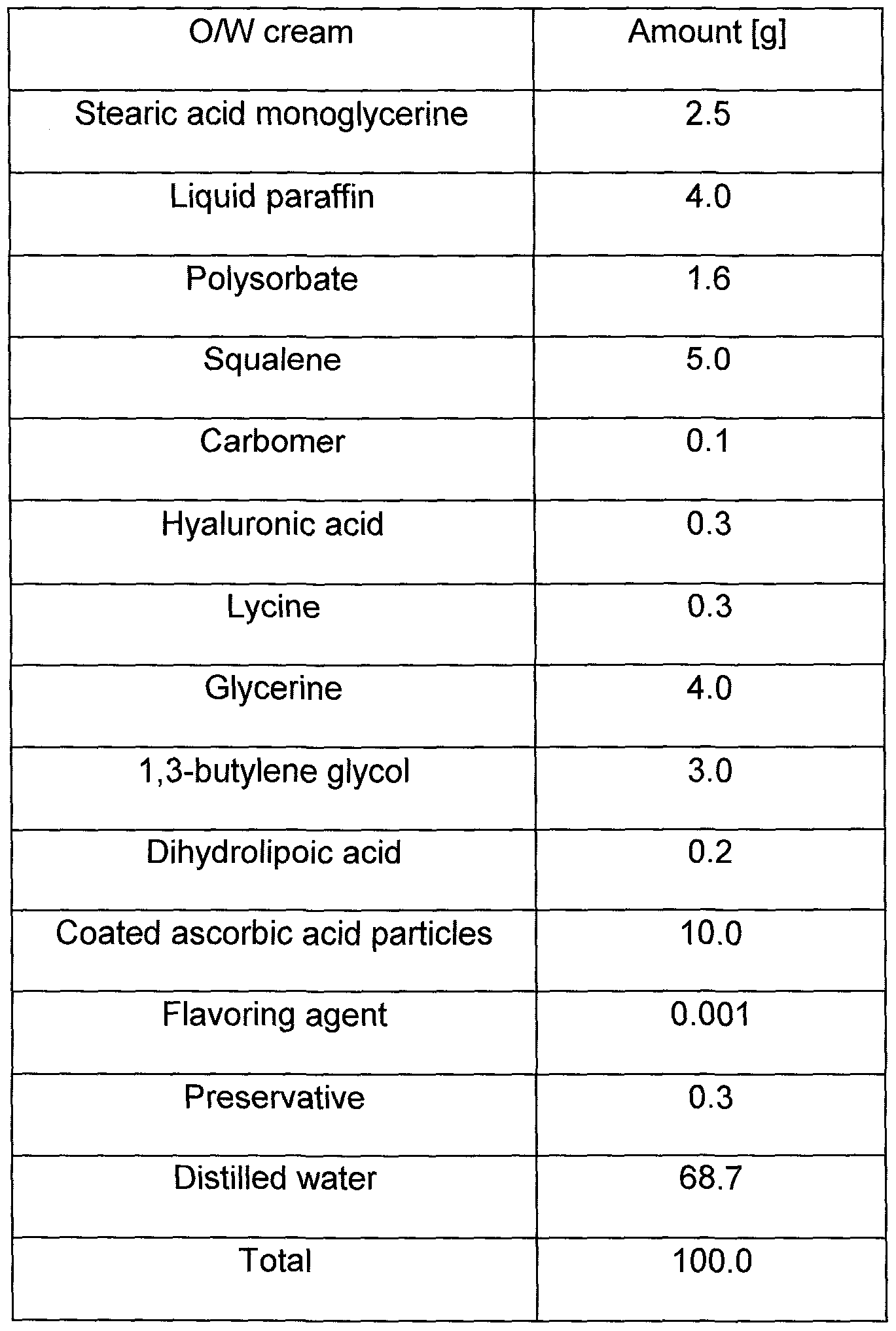
Stabilities of the antioxidants used in Preparation Examples 1-1 to 1-9, i.e., ascorbic acid, sodium ascorbyl phosphate, magnesium ascorbyl phosphate, ascorbic acid-2-glycoside, chlorogenic acid, epigallocatechin gallate, indolic acid, and α-lipoic acid were also evaluated in the same manner described above and compared with those of Examples 1-1 to 1-9, 2-1 to 2-9, 3-1 to 3-9, and 4-1 to 4-9. The results of stability tests are shown in Tables 2 to 6.
Table 2


Table 3


Table 4


Table 5


Table 6


Referring to Tables 2 to 6, when the polymer-coating layer and the inorganic material-coating layer are formed according to the present invention, the obtained particles maintain high remaining amount in an aqueous medium, thereby increasing stability thereof.
Claims
1. Stabilized antioxidant-containing particles, each of which comprises a core comprising an antioxidant; a polymer-coating layer formed by coating a polymer on the core; and an inorganic material-coating layer formed by coating inorganic silica on the polymer-coating layer.
2. The stabilized antioxidant-containing particles of claim 1 , wherein the polymer-coating layer has a multi-layer including at least two layers formed by coating at least two types of polymers at least twice.
3. The stabilized antioxidant-containing particles of claim 2, wherein at least one layer of the multi-layers further comprises an antioxidant.
4. The stabilized antioxidant-containing particles of any one of claims 1 to 3, wherein the antioxidant is at least one selected from the group consisting of ascorbic acid, sodium ascorbyl phosphate, magnesium ascorbyl phosphate, ascorbic acid-2-glycoside, ascorbyl palmitate, ascorbyl stearate, α-lipoic acid, glutathione, coenzyme Q10, tocopherol, tocopherol acetate, retinol, retinol palmitate, butylated hydroxy toluene, genistein, quercetin, propyl gallate, epigallocatechin, epigallocatechin gallate, gallocatechin gallate, sylibin, diosmetin, kaempferol, epicatechin, galangin, indolic acid, γ-linolenic acid, linoleic acid, chlorogenic acid, tocotrienol, and astaxanthin.
5. The stabilized antioxidant-containing particles of claim 4, wherein the antioxidant is selected from the group consisting of ascorbic acid, sodium ascorbyl phosphate, magnesium ascorbyl phosphate, ascorbic acid-2-glycoside, chlorogenic acid, epigallocatechin gallate, indolic acid, and α-lipoic acid.
6. The stabilized antioxidant-containing particles of any one of claims 1 to 3, wherein the core further comprises at least one stabilizer selected from the group consisting of sodium sulfite, alginic acid, ascorbic acid, lysine, tryptophan, tyrosine, cystine, cysteine, thiourea, thiouracil, α-lipoic acid, thioglycerine, and pantethine.
7. The stabilized antioxidant-containing particles of claim 6, wherein the stabilizer is cysteine.
8. The stabilized antioxidant-containing particles of claim 6, wherein the amount of the stabilizer is in the range of 0.1 to 50 parts by weight based on 100 parts by weight of the antioxidant.
9. The stabilized antioxidant-containing particles of any one of claims 1 to 3, wherein the polymer is at least one selected from the group consisting of polyester, poly vinyl pyrrolidone, chitosan, collagen, hyaluronic acid, gelatin, carboxymethyl cellulose, starch, oxidized starch, polycaprolactone, polylactide, polylactic acid, polyglycolic acid, polycaprolactone, a polyethylene glycol block copolymer, a poly(ethylene-vinyl acetate) copolymer, hydroxypropylmethyl cellulose, hydroxypropylmethyl cellulose phthalate, a silicon polymer, polystyrene, a styrene-acrylate copolymer, a styrene-acrylate-acrylic acid copolymer, a styrene-maleic acid copolymer, polyurethane, polyacryl urethane, polyisocyanate, polyglycidyl ether, multi wax, carnauba wax, and bees wax.
10. The stabilized antioxidant-containing particles of claim 9, wherein the polymer is at least one selected from the group consisting of polycaprolactone, gelatin, poly vinyl pyrrolidone, polyester, hydroxypropylmethyl cellulose phthalate, and a silicon polymer.
11. The stabilized antioxidant-containing particles of any one of claims 1 to 3, wherein the amount of the polymer is in the range of 1 to 1000 parts by weight based on 100 parts by weight of the antioxidant.
12. The stabilized antioxidant-containing particles of claim 2, wherein the polymer-coating layer comprises a first polymer-coating layer formed on the core and a second polymer-coating layer formed on the first polymer-coating layer, and wherein the first polymer-coating layer comprises polycaprolactone, gelatin, poly vinyl pyrrolidone, or polyester; and the second polymer-coating layer comprises hydroxypropylmethyl cellulose phthalate.
13. The stabilized antioxidant-containing particles of claim 2, wherein the polymer-coating layer comprises a first polymer-coating layer formed on the core, a second polymer-coating layer formed on the first polymer-coating layer, and a third polymer-coating layer formed on the second polymer-coating layer, and wherein the first polymer-coating layer comprises polycaprolactone, gelatin, poly vinyl pyrrolidone, or polyester; the second polymer-coating layer comprises hydroxypropylmethyl cellulose phthalate; and the third polymer-coating layer comprises an antioxidant and hydroxypropylmethyl cellulose phthalate.
14. The stabilized antioxidant-containing particles of claim 2, wherein the polymer-coating layer comprises a first polymer-coating layer formed on the core, a second polymer-coating layer formed on the first polymer-coating layer, a third polymer-coating layer formed on the second polymer-coating layer, and a fourth polymer-coating layer formed on the third polymer-coating layer, and wherein the first polymer-coating layer comprises polycaprolactone, gelatin, poly vinyl pyrrolidone, or polyester; the second polymer-coating layer comprises hydroxypropylmethyl cellulose phthalate; the third polymer-coating layer comprises an antioxidant and hydroxypropylmethyl cellulose phthalate; and the fourth polymer-coating layer comprises a silicon polymer.
15. The stabilized antioxidant-containing particles of any one of claims 1 to 3, wherein the amount of the inorganic silica is in the range of 1 to 50 parts by weight based on 100 parts by weight of the antioxidant.
16. A process for preparing stabilized antioxidant-containing particles, the process comprising:
(a) forming particles by preparing a particle-forming solution by dissolving an antioxidant and a polymer in an organic solvent and spay-drying the particle-forming solution; and
(b) coating inorganic silica on the particles prepared in Step (a).
17. The process of claim 16, further comprising performing, at least once, a step of dissolving particles prepared in Step (a), a polymer, and an antioxidant in an organic solvent and spray-drying the solution, between Steps (a) and (b).
18. The process of claim 17, comprising:
(a) forming particles by preparing a particle-forming solution by dissolving a polymer selected from the group consisting of polycaprolactone, gelatin, poly vinyl pyrrolidone, and polyester, and an antioxidant in an organic solvent and spray-drying the particle-forming solution; (a1) forming particles by dissolving the particles prepared in Step (a) and hydroxypropylmethyl cellulose phthalate in an organic solvent, and spray-drying the solution; and
(b) coating inorganic silica on the particles prepared in Step (a1).
19. The process of claim 17, comprising:
(a) forming particles by preparing a particle-forming solution by dissolving a polymer selected from the group consisting of polycaprolactone, gelatin, poly vinyl pyrrolidone, and polyester, and an antioxidant in an organic solvent, and spary-drying the particle-forming solution; (a1) forming particles by dissolving the particles prepared in Step (a) and hydroxypropylmethyl cellulose phthalate in an organic solvent and spray-drying the solution;
(a") forming particles by dissolving the particles prepared in Step (a1), an antioxidant and hydroxypropylmethyl cellulose phthalate in an organic solvent and spry-drying the solution; and (b) coating inorganic silica on the particles prepared in Step (a").
20. The process of claim 17, comprising:
(a) forming particles by preparing a particle-forming solution by dissolving a polymer selected from the group consisting of polycaprolactone, gelatin, poly vinyl pyrrolidone, and polyester, and an antioxidant in an organic solvent, and spry-drying the particle-forming solution;
(a1) forming particles by dissolving the particles prepared in Step (a) and hydroxypropylmethyl cellulose phthalate in an organic solvent and spray-drying the solution;
(a") forming particles by dissolving the particles prepared in Step (a1), an antioxidant and hydroxypropylmethyl cellulose phthalate in an organic solvent and spry-drying the solution;
(a1") forming particles by dissolving the particles prepared in Step (a") and a silicon polymer in an organic solvent and spry-drying the solution; and
(b) coating inorganic silica on the particles prepared in Step (a'").
21. The process of any one of claims 16 to 20, wherein the antioxidant is at least one selected from the group consisting of ascorbic acid, sodium ascorbyl phosphate, magnesium ascorbyl phosphate, ascorbic acid-2-glycoside, ascorbyl palmitate, ascorbyl stearate, α-lipoic acid, glutathione, coenzyme Q10, tocopherol, tocopherol acetate, retinol, retinol palmitate, butylated hydroxy toluene, genistein, quercetin, propyl gallate, epigallocatechin, epigallocatechin gallate, gallocatechin gallate, sylibin, diosmetin, kaempferol, epicatechin, galangin, indolic acid, γ-linolenic acid, linoleic acid, chlorogenic acid, tocotrienol, and astaxanthin.
22. The process of any one of claim 21 , wherein the antioxidant is selected from the group consisting of ascorbic acid, sodium ascorbyl phosphate, magnesium ascorbyl phosphate, ascorbic acid-2-glycoside, chlorogenic acid, epigallocatechin gallate, indolic acid, and α-lipoic acid.
23. The process of any one of claims 16 to 20, wherein the particle-forming solution in Step (a) comprises at least one stabilizer selected from the group consisting of sodium sulfite, alginic acid, ascorbic acid, lysine, tryptophan, tyrosine, cystine, cysteine, thiourea, thiouracil, α-lipoic acid, thioglycerine, and pantethine.
24. The process of claim 23, wherein the stabilizer is cysteine.
25. The process of claim 23, wherein the amount of the stabilizer is in the range of 0.1 to 50 parts by weight based on 100 parts by weight of the antioxidant.
26. The process of claims 16 or 17, wherein the polymer is at least one selected from the group consisting of polyester, poly vinyl pyrrolidone, chitosan, collagen, hyaluronic acid, gelatin, carboxymethyl cellulose, starch, oxidized starch, polycaprolactone, polylactide, polylactic acid, polyglycolic acid, polycaprolactone, a polyethylene glycol block copolymer, a poly(ethylene-vinyl acetate) copolymer, hydroxypropylmethyl cellulose, hydroxypropylmethyl cellulose phthalate, a silicon polymer, polystyrene, a styrene-acrylate copolymer, a styrene-acrylate-acrylic acid copolymer, a styrene-maleic acid copolymer, polyurethane, polyacryl urethane, polyisocyanate, polyglycidyl ether, multi wax, carnauba wax, and bees wax.
27. The process of claim 26, wherein the polymer is at least one selected from the group consisting of polycaprolactone, gelatin, poly vinyl pyrrolidone, polyester, hydroxypropylmethyl cellulose phthalate, and a silicon polymer.
28. The process of claim 16 or 17, wherein the amount of the polymer is in the range of 1 to 1 ,000 parts by weight based on 100 parts by weight of the antioxidant.
29. The process of any one of claims 16 to 20, wherein the amount of the inorganic silica is in the range of 1 to 50 parts by weight based on 100 parts by weight of the antioxidant.
30. The process of any one of claims 16 to 20, wherein the organic solvent is selected from the group consisting of ethanol, methanol, isopropyl alcohol, methyl acetate, ethyl acetate, isopropyl acetate, methyl ethyl ketone, acetone, acetonitrile, dimethyl ether, diethyl ether, 1 ,1-dichloroethane, 1 ,2-dichloroethane, dichloromethane, chloroform, hexane, heptane, cyclohexane, toluene, and xylene.
31. The process of claim 30, wherein the organic solvent is dichloromethane or acetone.
32. A pharmaceutical composition comprising antioxidant-containing particles according to any one of claims 1 to 3, and a pharmaceutically acceptable carrier.
33. A cosmetic composition comprising antioxidant-containing particles according to any one of claims 1 to 3 as an active ingredient.
Applications Claiming Priority (4)
| Application Number | Priority Date | Filing Date | Title |
|---|---|---|---|
| KR20070072721 | 2007-07-20 | ||
| KR10-2007-0072721 | 2007-07-20 | ||
| KR10-2008-0069492 | 2008-07-17 | ||
| KR1020080069492A KR20090009722A (en) | 2007-07-20 | 2008-07-17 | Stabilized antioxidant-containing particles, methods for preparing the same, and compositions comprising the same |
Publications (2)
| Publication Number | Publication Date |
|---|---|
| WO2009014347A2 true WO2009014347A2 (en) | 2009-01-29 |
| WO2009014347A3 WO2009014347A3 (en) | 2009-03-12 |
Family
ID=40281965
Family Applications (1)
| Application Number | Title | Priority Date | Filing Date |
|---|---|---|---|
| PCT/KR2008/004201 Ceased WO2009014347A2 (en) | 2007-07-20 | 2008-07-18 | Stabilized antioxidant-containing particles, process for preparing the same, and composition comprising the same |
Country Status (1)
| Country | Link |
|---|---|
| WO (1) | WO2009014347A2 (en) |
Cited By (7)
| Publication number | Priority date | Publication date | Assignee | Title |
|---|---|---|---|---|
| EP2243469A1 (en) | 2009-04-22 | 2010-10-27 | Dr. Suwelack Skin & Health Care AG | Freeze-dried form body containing magnesium ascorbyl phosphate |
| US20120183587A1 (en) * | 2011-01-18 | 2012-07-19 | Mitsunori Ono | Flavonol compositions |
| US10842729B2 (en) | 2017-09-13 | 2020-11-24 | Living Proof, Inc. | Color protectant compositions |
| US10987300B2 (en) | 2017-09-13 | 2021-04-27 | Living Proof, Inc. | Long lasting cosmetic compositions |
| US11622929B2 (en) | 2016-03-08 | 2023-04-11 | Living Proof, Inc. | Long lasting cosmetic compositions |
| US12029805B2 (en) | 2017-11-20 | 2024-07-09 | Living Proof, Inc. | Properties for achieving long-lasting cosmetic performance |
| US12048760B2 (en) | 2018-04-27 | 2024-07-30 | Living Proof, Inc. | Long lasting cosmetic compositions |
Family Cites Families (4)
| Publication number | Priority date | Publication date | Assignee | Title |
|---|---|---|---|---|
| US4486435A (en) * | 1983-05-16 | 1984-12-04 | Basf Wyandotte Corporation | Spray-dried vitamin powders using hydrophobic silica |
| FR2832630B1 (en) * | 2001-11-28 | 2005-01-14 | Oreal | COSMETIC AND / OR DERMATOLOGICAL COMPOSITION CONTAINING AT LEAST ONE OXIDATION-SENSITIVE HYDROPHILIC ACTIVE STABILIZED WITH AT LEAST ONE COPOLYMER OF N-VINYLIMIDAZOLE |
| US20050008596A1 (en) * | 2003-05-27 | 2005-01-13 | L'oreal | Composition containing an oxidation-sensitive active principle and a polyisobutylene polymer |
| KR100588464B1 (en) * | 2004-03-16 | 2006-06-12 | 주식회사 디피아이 솔루션스 | Composition for stabilizing vitamin C and its derivatives in water, and method for stabilizing vitamin C and its derivatives using same |
-
2008
- 2008-07-18 WO PCT/KR2008/004201 patent/WO2009014347A2/en not_active Ceased
Cited By (9)
| Publication number | Priority date | Publication date | Assignee | Title |
|---|---|---|---|---|
| EP2243469A1 (en) | 2009-04-22 | 2010-10-27 | Dr. Suwelack Skin & Health Care AG | Freeze-dried form body containing magnesium ascorbyl phosphate |
| US9125825B2 (en) | 2009-04-22 | 2015-09-08 | Medskin Solutions Dr. Suwelack Ag | Freeze-dried molded article containing magnesium ascorbyl phosphate |
| US20120183587A1 (en) * | 2011-01-18 | 2012-07-19 | Mitsunori Ono | Flavonol compositions |
| US11622929B2 (en) | 2016-03-08 | 2023-04-11 | Living Proof, Inc. | Long lasting cosmetic compositions |
| US10842729B2 (en) | 2017-09-13 | 2020-11-24 | Living Proof, Inc. | Color protectant compositions |
| US10987300B2 (en) | 2017-09-13 | 2021-04-27 | Living Proof, Inc. | Long lasting cosmetic compositions |
| US11707426B2 (en) | 2017-09-13 | 2023-07-25 | Living Proof, Inc. | Color protectant compositions |
| US12029805B2 (en) | 2017-11-20 | 2024-07-09 | Living Proof, Inc. | Properties for achieving long-lasting cosmetic performance |
| US12048760B2 (en) | 2018-04-27 | 2024-07-30 | Living Proof, Inc. | Long lasting cosmetic compositions |
Also Published As
| Publication number | Publication date |
|---|---|
| WO2009014347A3 (en) | 2009-03-12 |
Similar Documents
| Publication | Publication Date | Title |
|---|---|---|
| WO2009014347A2 (en) | Stabilized antioxidant-containing particles, process for preparing the same, and composition comprising the same | |
| KR101219453B1 (en) | Method for production of single- and multi-layer microcapsules | |
| EP1151741A1 (en) | Microcapsules with an aqueous core containing at least an active water-soluble cosmetic or dermatologic ingredient and cosmetic or dermatologic compositions containing these microcapsules | |
| JP2017518866A (en) | Capsules with high active substance content | |
| US20100255109A1 (en) | Stabilized antioxidant particles, composition comprising the same and method for preparing the same | |
| AU2002366029A1 (en) | Preparation compositions containing acid-unstable physiologically active compounds and process for producing the same | |
| Raj et al. | Advances in microencapsulation and nanoemulsion techniques of plant pigments: Improving stability, bioavailability, and bioactivity for application in food industry | |
| JP2004250450A (en) | Cosmetics containing active ingredients in microcapsules | |
| KR20090009722A (en) | Stabilized antioxidant-containing particles, methods for preparing the same, and compositions comprising the same | |
| WO2009020314A2 (en) | Stabilized alpha-lipoic acid particles, composition comprising the same and method for preparing the same | |
| KR102506713B1 (en) | Oil in water type cosmetic composition | |
| KR20110035459A (en) | Egcg/polyester resin complex, process for preparing the same and cosmetic composition comprising the same | |
| US6893646B2 (en) | Coated cosmetic powder | |
| US8329145B1 (en) | Use of cooling agent to improve cosmetics | |
| KR20060028916A (en) | Water-stabilized EVC capsule composition and preparation method thereof | |
| KR100907660B1 (en) | Coated antioxidant particles, compositions comprising the same and methods of making the same | |
| US9198840B1 (en) | Use of cooling agent to improve cosmetics | |
| KR100966919B1 (en) | Aqueous cosmetic composition comprising coated antioxidant particles and method of preparing the coated antioxidant particles | |
| KR20100120731A (en) | Fine capsule particle containing lipophilic active compound, a producing method and a cosmetic composition containing the same | |
| KR100929703B1 (en) | Coated antioxidant particles, compositions comprising the same and methods for preparing the same | |
| US20090274639A1 (en) | Composition for hair | |
| AU2020366134A1 (en) | Controlled release formulations of highly lipophilic physiologically active substances | |
| Sornkamnird | Stability and Nano-encapsulation of Oxyresveratrol | |
| KR20090009217A (en) | Alpha lipoic acid capsule composition stabilized in water phase and preparation method thereof | |
| IL189633A (en) | Method for production of double-layer and triple-layer microcapsules |
Legal Events
| Date | Code | Title | Description |
|---|---|---|---|
| 121 | Ep: the epo has been informed by wipo that ep was designated in this application |
Ref document number: 08778858 Country of ref document: EP Kind code of ref document: A2 |
|
| NENP | Non-entry into the national phase |
Ref country code: DE |
|
| 122 | Ep: pct application non-entry in european phase |
Ref document number: 08778858 Country of ref document: EP Kind code of ref document: A2 |