WO2008069578A1 - Method of optimal data transmission for improving data transmission rate in multi-hop wireless network - Google Patents
Method of optimal data transmission for improving data transmission rate in multi-hop wireless network Download PDFInfo
- Publication number
- WO2008069578A1 WO2008069578A1 PCT/KR2007/006289 KR2007006289W WO2008069578A1 WO 2008069578 A1 WO2008069578 A1 WO 2008069578A1 KR 2007006289 W KR2007006289 W KR 2007006289W WO 2008069578 A1 WO2008069578 A1 WO 2008069578A1
- Authority
- WO
- WIPO (PCT)
- Prior art keywords
- node
- carrier sensing
- data
- data transmission
- transmission power
- Prior art date
- Legal status (The legal status is an assumption and is not a legal conclusion. Google has not performed a legal analysis and makes no representation as to the accuracy of the status listed.)
- Ceased
Links
Classifications
-
- H—ELECTRICITY
- H04—ELECTRIC COMMUNICATION TECHNIQUE
- H04W—WIRELESS COMMUNICATION NETWORKS
- H04W52/00—Power management, e.g. Transmission Power Control [TPC] or power classes
- H04W52/04—Transmission power control [TPC]
- H04W52/38—TPC being performed in particular situations
- H04W52/46—TPC being performed in particular situations in multi-hop networks, e.g. wireless relay networks
-
- H—ELECTRICITY
- H04—ELECTRIC COMMUNICATION TECHNIQUE
- H04L—TRANSMISSION OF DIGITAL INFORMATION, e.g. TELEGRAPHIC COMMUNICATION
- H04L12/00—Data switching networks
- H04L12/28—Data switching networks characterised by path configuration, e.g. LAN [Local Area Networks] or WAN [Wide Area Networks]
-
- H—ELECTRICITY
- H04—ELECTRIC COMMUNICATION TECHNIQUE
- H04W—WIRELESS COMMUNICATION NETWORKS
- H04W52/00—Power management, e.g. Transmission Power Control [TPC] or power classes
- H04W52/04—Transmission power control [TPC]
- H04W52/18—TPC being performed according to specific parameters
- H04W52/24—TPC being performed according to specific parameters using SIR [Signal to Interference Ratio] or other wireless path parameters
- H04W52/242—TPC being performed according to specific parameters using SIR [Signal to Interference Ratio] or other wireless path parameters taking into account path loss
-
- H—ELECTRICITY
- H04—ELECTRIC COMMUNICATION TECHNIQUE
- H04W—WIRELESS COMMUNICATION NETWORKS
- H04W40/00—Communication routing or communication path finding
- H04W40/02—Communication route or path selection, e.g. power-based or shortest path routing
- H04W40/04—Communication route or path selection, e.g. power-based or shortest path routing based on wireless node resources
- H04W40/08—Communication route or path selection, e.g. power-based or shortest path routing based on wireless node resources based on transmission power
-
- H—ELECTRICITY
- H04—ELECTRIC COMMUNICATION TECHNIQUE
- H04W—WIRELESS COMMUNICATION NETWORKS
- H04W40/00—Communication routing or communication path finding
- H04W40/02—Communication route or path selection, e.g. power-based or shortest path routing
- H04W40/12—Communication route or path selection, e.g. power-based or shortest path routing based on transmission quality or channel quality
-
- H—ELECTRICITY
- H04—ELECTRIC COMMUNICATION TECHNIQUE
- H04W—WIRELESS COMMUNICATION NETWORKS
- H04W84/00—Network topologies
- H04W84/02—Hierarchically pre-organised networks, e.g. paging networks, cellular networks, WLAN [Wireless Local Area Network] or WLL [Wireless Local Loop]
- H04W84/10—Small scale networks; Flat hierarchical networks
- H04W84/12—WLAN [Wireless Local Area Networks]
-
- Y—GENERAL TAGGING OF NEW TECHNOLOGICAL DEVELOPMENTS; GENERAL TAGGING OF CROSS-SECTIONAL TECHNOLOGIES SPANNING OVER SEVERAL SECTIONS OF THE IPC; TECHNICAL SUBJECTS COVERED BY FORMER USPC CROSS-REFERENCE ART COLLECTIONS [XRACs] AND DIGESTS
- Y02—TECHNOLOGIES OR APPLICATIONS FOR MITIGATION OR ADAPTATION AGAINST CLIMATE CHANGE
- Y02D—CLIMATE CHANGE MITIGATION TECHNOLOGIES IN INFORMATION AND COMMUNICATION TECHNOLOGIES [ICT], I.E. INFORMATION AND COMMUNICATION TECHNOLOGIES AIMING AT THE REDUCTION OF THEIR OWN ENERGY USE
- Y02D30/00—Reducing energy consumption in communication networks
- Y02D30/70—Reducing energy consumption in communication networks in wireless communication networks
Definitions
- the present invention relates to a method of optimal data transmission for improving a data transmission rate in a multi-hop wireless network; and, more particularly, to a method of optimal data transmission for improving a data transmission rate in a multi-hop wireless network, which can minimize a data collision and maximize an end- to-end throughput by adaptively calculating a carrier sensing range value for a node with variable transmission power to control the transmission power according to the calculated carrier sensing range value and by adaptively adjusting a carrier sensing threshold value for a node with constant transmission power.
- each terminal i.e., a node
- an access point AP
- the terminal (node) and the access point (AP) can recognize each other as one network member to communicate data and control packets with each other.
- AP access point
- MAC Medium Access Control
- CSMA/CA Access/Collision Avoidance
- the CSMA/CA scheme uses two carrier sensing modes: a physical carrier sensing mode and a virtual carrier sensing mode.
- the physical carrier sensing mode checks whether another transmission is performed on a medium before transmitting data from a network interface card (NIC) of the node A.
- Ready-To-Send (RTS) and Clear-To-Send (CTS) control packets are exchanged to avoid data collision, thereby solving hidden problems that may occur in the network.
- Such control packets are also used in the virtual carrier sensing mode.
- neighbor nodes Upon receipt of such control packet, neighbor nodes detect the inhibition of network access for a predetermined time from a Network Allocation Vector (NAV) contained in the received control packet. This is a medium access control method using the virtual carrier sensing mode.
- NAV Network Allocation Vector
- every IEEE 802.11 network interface card uses the physical carrier sensing mode mandatorily and uses a control packet for collision avoidance optionally. Even though medium access control is performed, simultaneous medium access may occur in a predetermined time point, which leads to data collision. In this case, a node experiencing the data collision waits for a selected number of times within a predetermined range of times and then accesses the medium for data transmission. Such a collision resolution method uses a random backoff scheme .
- BEB Backoff
- the number of time slots in a contention window increases twice for every collision from an initial contention window, and a predetermined number of time slots are selected among them.
- a node waits for the corresponding time and then accesses a medium.
- a physical carrier sensing range may be relatively increased in order to minimize a data collision.
- simultaneous-transmission nodes are spaced apart from each other.
- the power of interference between transmission nodes can be reduced and the probability of the success of data transmission through each link can be increased.
- more intermediate nodes are required in a relay network arranged in linear topology.
- a carrier sensing range must be set to be suitable for the trade-off between the above advantage and disadvantage.
- a target SIR of a network interface card may affect data transmission. If the target SIR is set to be high, a relatively large amount of data can be transmission by one successful transmission process, but the data collision probability may increase. Therefore, a target SIR must be set to be suitable for the trade-off between the above advantage and disadvantage.
- An embodiment of the present invention is directed to providing a method of optimal data transmission for improving a data transmission rate in a multi-hop wireless network, which can maximize an end-to-end throughput by minimizing a data collision that may occur during data transmission.
- Another embodiment of the present invention is directed to providing a method of optimal data transmission for improving a data transmission rate in a multi-hop wireless network, which can minimize a data collision and maximize an end-to-end throughput by calculating a carrier sensing range value for a node with variable transmission power and by controlling the transmission power according to the calculated carrier sensing range value or by adaptively adjusting a carrier sensing threshold value for a node with constant transmission power.
- a method for optima data transmission for improving a data transmission rate of a node with variable transmission power in a multi-hop wireless network including the steps of: obtaining channel state information about a current wireless channel of the node; calculating a carrier sensing range in the number of hops using the obtained channel state information, a target signal-to- interference ratio, and a contention window size in order to minimize data collision; calculating the number of nodes attempting data transmission based on signals received from neighbor nodes, the number of the nodes attempting data transmission being the number of contention nodes; and setting transmission power adaptively according to the calculated carrier sensing range value and the contention node numbers and transmitting data at the set transmission power.
- a method for optima data transmission for improving a data transmission rate of a node with constant transmission power in a multi-hop wireless network including the steps of: obtaining channel state information about a current wireless channel of the node; setting a carrier sensing threshold using the obtained channel state information, a target signal-to-interference ratio, the constant transmission power, and a contention window size in order to minimize data collision; and comparing the carrier sensing threshold with the reception power of a signal received from a neighbor node, determining whether to transmit data according to the comparison results, and transmitting data accordingly.
- the present invention adaptively calculates a carrier sensing range value for a node with variable transmission power, thereby making it possible to minimize a data collision and maximize an end-to-end throughput. Also, the present invention adaptively adjusts a carrier sensing threshold value for a node with constant transmission power, thereby making it possible to minimize a data collision and maximize an end-to-end throughput .
- Fig. 1 is a diagram illustrating the distribution of simultaneous transmission nodes in a multi-hop wireless network to which the present invention is applied.
- Fig. 2 is a flowchart illustrating a method for optimal data transmission from a node with variable transmission power on a multi-hop wireless network in accordance with an embodiment of the present invention.
- Fig. 3 is a flowchart illustrating a method for optimal data transmission from a node with constant transmission power on a multi-hop wireless network in accordance with an embodiment of the present invention.
- Fig. 4 is a graph illustrating the relationship between a target SIR and a carrier sensing threshold.
- Fig. 5 is a graph illustrating the relationship between a target SIR and an end-to-end throughput.
- Fig. 1 is a diagram illustrating the distribution of simultaneous transmission nodes in a multi-hop wireless network to which the present invention is applied.
- Fig. 1 is drawn on the assumption that nodes on the multi-hop wireless network are located at regular intervals at the vertexes and centers of hexagons. That is, a reference numeral 10 denotes a linear multi-hop wireless network where nodes 11 are linearly distributed along a road.
- a reference symbol R denotes the radius of a hexagon and a reference symbol D denotes the shortest simultaneous transmission distance.
- small black dots 11 denote nodes that are distributed on the road represented by a thick straight line.
- the node is mounted on a mobile unit, uses a half- duplex scheme, and may have an omni-directional antenna.
- ⁇ node' denotes a mobile unit mounted with a terminal.
- circles 100 to 112 also denote nodes, which represent the distribution of nodes capable of performing simultaneous transmission without affecting data transmission therebetween.
- the nodes 100 to 112, which are spaced apart from each other by at least the distance D, are capable of simultaneous transmission.
- the above linear distribution of the nodes is merely- illustrative, which is merely to perform simulations (see Figs. 4 and 5) with ease.
- the present invention can also be applied even when the nodes are nonlinearly distributed.
- the present invention provides methods for optimal data transmission in a multi-hop wireless network, which may be implemented in the following two schemes.
- One is a scheme applied to a node with 'variable' transmission power, which detects the optimal 'carrier sensing range' value (see Equation 1 below), compares the detected value with an idle state Inter-Arrival Time
- IAT of the current transmission medium (wireless section)
- this scheme is distributive and is thus easy to apply to actual mobile environments.
- Another is a scheme applied to a node with
- a target SIR for a node is provided from an application level. If the node can determine a target SIR value randomly, it may calculate a target SIR of the maximum performance by using given parameters.
- Fig. 2 is a flowchart illustrating a method for optimal data transmission from a node with variable transmission power on a multi-hop wireless network in accordance with an embodiment of the present invention, which illustrates a data transmission process performed by each node with variable transmission power.
- the optimal carrier sensing range n will be described first before describing a data transmission method with reference to Fig. 2.
- the optimal carrier sensing range n used for transmission power control is calculated based on the following Equation 1.
- C(a,W 0 ) is the solution of a fourth-order polynomial found from a path-loss exponent a and an initial contention window size W 0 .
- ⁇ denotes a target Signal-to- Interference Ratio (SIR) .
- nodes i.e., mobile units
- the other nodes when a node performs data transmission, the other nodes within the corresponding carrier sensing range cannot perform data transmission.
- a plurality of nodes must be spaced apart from each other by at least the distance D (i.e., at least n hops) so that they are capable of simultaneous transmission.
- the relative positions of nodes in a transmission mode have the same form as the positions of co-channel base stations of the hexagonal cellular system.
- Equation 2 represents an SIR X 1 (P) of a signal received at a node i (i.e., RX node) 100 located at the center of the hexagon formed by the nodes 101 to 106.
- X 1 29 where X 1 ,Y ⁇ ,Y k ,Y 1 ,--- are random variables of an independent and identical distribution with an average value of 1.
- the SIR Y 1 (P) of the RX signal calculated by Equation 2 is larger than a predetermined target SIR ⁇ , a wireless link is connected successfully. If not, i.e., if the SIR ⁇ ,(P) of the RX signal calculated by Equation 2 is not larger than a predetermined target SIR ⁇ , a transmission failure occurs and a retransmission is performed after a predetermined time by the binary exponential random backoff of medium access control.
- the probability of failure of one wireless link i.e., the wireless link failure probability P c can be calculated based on the following Equation 3.
- u, v are represented by the carrier sensing range n
- the average time ⁇ ( ⁇ ,n) taken to transmit a packet from a source node to a destination node can be calculated based on the following Equation 5.
- t ilol denotes the duration of a single slot used in the binary exponential random backoff system.
- Equation 3 can be
- the target SIR ⁇ is fixed, ⁇ ( ⁇ , n) becomes a concave function of the number n of reuse hops and thus there is the optimal hop number n that minimizes a delay time.
- the exponential item of P c is set to a variable X and ⁇ ( ⁇ ,n) is differentiated to fine a point of "0".
- an exponential function can be approximated using a Taylor series and up to a fifth-order polynomial equation can be obtained.
- a fifth or higher order equation has no general solution and thus cannot be expressed as the closed-form solution.
- an iterative tracking scheme can be used with increasing a numerical accuracy. When more terms are omitted in the Taylor series, a fourth or lower order equation can be obtained. However, the accuracy of the obtained solution decreases.
- the optimal reuse hop number i.e., the number of
- n C(a,W 0 ) ⁇ a (see Equation 1)
- C(a,4) has values of 11.59, 3.6, 2.83, 2.03, 1.79 as the path-loss exponent a has values of 2, 3, 4, 5, 6.
- the carrier sensing threshold T cs can be calculated based on the following Equation 6.
- Pr transmission power and the remaining factors are the same as described above.
- a network interface card i.e., a node
- the optimal target SIR can be calculated using given parameters a, W 0 , n, T cs as follows:
- ⁇ n , ⁇ n l,2,...,m ⁇ .
- the ⁇ n values vary depending on modulation schemes.
- one node provides a plurality of target SIRs and simultaneous transmission is performed at the hop of the optimal carrier sensing range obtained above for a specific ⁇ n .
- the throughput satisfying the maximum data transmission rate can be obtained. Because each ⁇ ⁇ value has no uniform relation with a data transmission rate, the ⁇ n with the maximum throughput can be obtained experimentally.
- the present invention provides a function for adjusting the transmission power for data transmission.
- a node desiring to transmit data at a predetermined data transmission rate which includes a source node and a relay node, receives a pilot signal transmitted periodically from a neighbor infrastructure and analyzes the received pilot signal, thereby determining channel state information of the current wireless channel, i.e., a path-loss exponent a .
- the node analyzes the reception power of a pilot signal received periodically from a neighbor infrastructure (e.g., devices located on a road and transmit a busy tone or a pilot signal) , determines the current channel state (e.g., whether a line-of-site environment or an environment with many reflective objects), and determines a path-loss exponent a as one of 2 through 6 according to the status determination results.
- a neighbor infrastructure e.g., devices located on a road and transmit a busy tone or a pilot signal
- determines the current channel state e.g., whether a line-of-site environment or an environment with many reflective objects
- a path-loss exponent a is obtained by analyzing a pilot signal received periodically from a neighbor infrastructure. In an alternative embodiment, a path-loss exponent a is obtained by analyzing signals received from neighbor nodes .
- step S202 the node calculates a carrier sensing range n, which is capable of minimizing data collision, according to Equation 1 using a path-loss exponent a , a target SIR ⁇ , and an initial contention window size W 0 . That is, assuming that W 0 of n — C(a,W Q )/ a ( se e Equation 1) is "4" (may be different in actuality), C(a,4) has values of 11.59, 3.6, 2.83, 2.03, 1.79 as a path-loss exponent a has values of 2, 3, 4, 5, 6.
- the carrier sensing range n becomes one of 11.59, 3.6, 2.83, 2.03, 1.79.
- the target SIR ⁇ is calculated and provided by an application program of the corresponding node, which is set to be optimal based on a data transmission rate supportable by a network interface card.
- the node senses neighbor nodes and measures an idle state Inter-Arrival Time (IAT) . That is, when there is data to be transmitted, each node checks the time of an idle state of a propagation environment (e.g., a wireless transmission medium) to detect a time interval between idle states.
- IAT Inter-Arrival Time
- step S204 using the idle state IAT, the node calculates the number of nodes attempting data transmission (hereinafter referred to as contention node number) based on the following Equation 7.
- step S206 the node compares the calculated contention node number with the carrier sensing range n.
- ⁇ de notes a transmission slot time of a node on the multi-hop wireless network. If K and the idle state IAT both have the time unit of seconds, the contention node number can be compared with the carrier sensing range n. If the carrier sensing range n is larger than the contention node number, the node increases the previous transmission power by one level and transmits data at the increased transmission power, in step S208. If the carrier sensing range n is equal to the contention node number, the node maintains the previous transmission power and transmits data at the maintained transmission power, in step S210. If the carrier sensing range n is smaller than the contention node number, the node reduces the previous transmission power by one level and transmits data at the reduced transmission power, in step S212.
- Fig. 3 is a flowchart illustrating a method for optimal data transmission from a node with constant transmission power on a multi-hop wireless network m accordance with an embodiment of the present invention.
- an IEEE 802.11 node specifically a network interface card of the node has a constant carrier sensing threshold. If the network interface card is improved to correct the carrier sensing threshold, the optimal carrier sensing threshold can be determined using a suitable calculation scheme. Also, if each node NIC sets a target SIR according to a supportable target data transmission rate, calculates an optimal carrier sensing threshold using the target SIR, and determines whether to transmit data according to the optimal carrier sensing threshold, the maximum throughput can be obtained.
- a node desiring to transmit data at a predetermined data transmission rate i.e., a node with constant transmission power
- a node with constant transmission power receives a pilot signal transmitted periodically from a neighbor infrastructure and analyzes the received pilot signal, thereby determining channel state information of the current wireless channel, i.e., a path-loss exponent a .
- a path-loss exponent a channel state information of the current wireless channel
- the node calculates a carrier sensing threshold T cs , which is capable of minimizing data collision, based on Equation 6 using a path-loss exponent a , a target SIR ⁇ , a predetermined transmission power Pr, and an initial contention window size W 0 .
- the target SIR ⁇ is calculated and provided by an application program of the corresponding node, which is set to be optimal based on a data transmission rate supportable by a network interface card.
- the node senses neighbor nodes and measures an idle state Inter-Arrival Time (IAT) . That is, when there is data to be transmitted, each node checks the time of an idle state of a propagation environment (e.g., a wireless transmission medium) to detect a time interval between idle states.
- IAT Inter-Arrival Time
- step S304 the node compares the reception power of a signal received from a neighbor node with the carrier sensing threshold T cs .
- the node transmits data with the predetermined transmission power Pr , in step S306.
- the node defers data transmission in step S308 and returns to step
- the node knows that it should not transmit data because another node is transmitting data through a wireless medium (e.g., a wireless channel) .
- a wireless medium e.g., a wireless channel
- Fig. 4 is a graph illustrating the relationship between a target SIR and a carrier sensing threshold.
- Fig. 5 is a gxaph illustrating the relationship between a target SIR and an end-to-end throughput.
- the simulation for the present invention is an experiment that arranges 15 nodes linearly and detects the relationship between the target SIR and the optimal carrier sensing threshold.
- the constant C (see Equation 1) may be different from the simulation result. The reason for this is that all parameters of actual conditions are not considered in the present simulation.
- the present simulation disregards constants and focuses on detecting the degree of the similarity of the equation structure to the simulation.
- the simulation exhibits the satisfactory similarity to actual conditions.
- a threshold value for determination of the carrier sensing range is present in a network interface card of each node, and the carrier sensing range may be considered as being reciprocal to the threshold value.
- Fig. 5 shows end-to-end throughput values (i.e., network throughput values) depending on the target SIRs in the graph of Fig. 4. It can be seen from Fig. 5 that the maximum throughput "30" is obtained when the target
- the technology of the present invention can be realized as a program and stored in a computer-readable recording medium, such as CD-ROM, RAM,
- ROM read-only memory
- floppy disk disk
- hard disk disk
- magneto-optical disk magneto-optical disk
- the present application contains subject matter related to Korean Patent Application Nos. 2006-0124027, and 2007-0107682, filed in the Korean Intellectual Property Office on December 07, 2006, and October 25, 2007, respectively, the entire contents of which is incorporated herein by reference.
Landscapes
- Engineering & Computer Science (AREA)
- Computer Networks & Wireless Communication (AREA)
- Signal Processing (AREA)
- Mobile Radio Communication Systems (AREA)
Abstract
There is provided a method for optimal data transmission for improving a data transmission rate of a node with variable transmission power in a multi-hop wireless network, the method including the steps of: obtaining channel state information about a current wireless channel of the node; calculating a carrier sensing range in the number of hops using the obtained channel state information, a target signal-to-interference ratio, and a contention window size in order to minimize data collision; calculating the number of nodes attempting data transmission based on signals received from neighbor nodes, the number of the nodes attempting data transmission being the number of contention nodes; and setting transmission power adaptively according to the calculated carrier sensing range value and the contention node numbers and transmitting data with the set of transmission power.
Description
[DESCRIPTION]
METHOD OF OPTIMAL DATA TRANSMISSION FOR IMPROVING DATA TRANSMISSION RATE IN MULTI-HOP WIRELESS NETWORK
[TECHNICAL FIELD]
The present invention relates to a method of optimal data transmission for improving a data transmission rate in a multi-hop wireless network; and, more particularly, to a method of optimal data transmission for improving a data transmission rate in a multi-hop wireless network, which can minimize a data collision and maximize an end- to-end throughput by adaptively calculating a carrier sensing range value for a node with variable transmission power to control the transmission power according to the calculated carrier sensing range value and by adaptively adjusting a carrier sensing threshold value for a node with constant transmission power.
[BACKGROUND ART] There is no prior patent technology related to a method of modifying a physical carrier sensing range in an ad-hoc network. Some related papers are published in the journals and Proceedings of IEEE Communication Society, but such papers also have little relation with the present invention.
In IEEE 802.11 communication standards called Local Area Network (LAN), each terminal (i.e., a node) and an
access point (AP) might use the same frequency band. In that case, the terminal (node) and the access point (AP) can recognize each other as one network member to communicate data and control packets with each other. There are two modes in the IEEE 802.11 standards. One is an infrastructured mode that allows communication between an access point (AP) and a general node but does not allow direct communication between nodes. The other is an ad-hoc mode that allows nodes to communicate data with each other without using a medium connected to a network backbone such as an access point (AP) .
The above two modes use Medium Access Control (MAC) methods based on a Carrier Sense Multiple
Access/Collision Avoidance (CSMA/CA) scheme, in order to avoid the data collision at a reception node that may occur a wireless medium is shared.
The CSMA/CA scheme uses two carrier sensing modes: a physical carrier sensing mode and a virtual carrier sensing mode. For transmission of data from a node A to another node, the physical carrier sensing mode checks whether another transmission is performed on a medium before transmitting data from a network interface card (NIC) of the node A. Ready-To-Send (RTS) and Clear-To-Send (CTS) control packets are exchanged to avoid data collision, thereby solving hidden problems that may occur in the network.
Such control packets are also used in the virtual carrier sensing mode. Upon receipt of such control packet, neighbor nodes detect the inhibition of network access for a predetermined time from a Network Allocation Vector (NAV) contained in the received control packet. This is a medium access control method using the virtual carrier sensing mode.
In general, every IEEE 802.11 network interface card uses the physical carrier sensing mode mandatorily and uses a control packet for collision avoidance optionally. Even though medium access control is performed, simultaneous medium access may occur in a predetermined time point, which leads to data collision. In this case, a node experiencing the data collision waits for a selected number of times within a predetermined range of times and then accesses the medium for data transmission. Such a collision resolution method uses a random backoff scheme .
If a predetermined range of times increase twice for every collision, this case is called Binary Exponential
Backoff (BEB) . In this case, the number of time slots in a contention window increases twice for every collision from an initial contention window, and a predetermined number of time slots are selected among them. Thus, a node waits for the corresponding time and then accesses a medium. These processes are repeated to solve the collision problem.
Meanwhile, a physical carrier sensing range may be relatively increased in order to minimize a data collision. In this case, simultaneous-transmission nodes are spaced apart from each other. Thus, the power of interference between transmission nodes can be reduced and the probability of the success of data transmission through each link can be increased. However, more intermediate nodes are required in a relay network arranged in linear topology. Thus, a carrier sensing range must be set to be suitable for the trade-off between the above advantage and disadvantage.
Meanwhile, a target SIR of a network interface card may affect data transmission. If the target SIR is set to be high, a relatively large amount of data can be transmission by one successful transmission process, but the data collision probability may increase. Therefore, a target SIR must be set to be suitable for the trade-off between the above advantage and disadvantage.
[DISCLOSURE]
[TECHNICAL PROBLEM]
An embodiment of the present invention is directed to providing a method of optimal data transmission for improving a data transmission rate in a multi-hop wireless network, which can maximize an end-to-end throughput by minimizing a data collision that may occur during data transmission.
Another embodiment of the present invention is directed to providing a method of optimal data transmission for improving a data transmission rate in a multi-hop wireless network, which can minimize a data collision and maximize an end-to-end throughput by calculating a carrier sensing range value for a node with variable transmission power and by controlling the transmission power according to the calculated carrier sensing range value or by adaptively adjusting a carrier sensing threshold value for a node with constant transmission power.
Other objects and advantages of the present invention can be understood by the following description, and become apparent with reference to the embodiments of the present invention. Also, it is obvious to those skilled in the art of the present invention that the objects and advantages of the present invention can be realized by the means as claimed and combinations thereof.
[TECHNICAL SOLUTION]
In accordance with an aspect of the present invention, there is provided a method for optima data transmission for improving a data transmission rate of a node with variable transmission power in a multi-hop wireless network, the method including the steps of: obtaining channel state information about a current wireless channel of the node; calculating a carrier sensing range in the number of hops using the obtained
channel state information, a target signal-to- interference ratio, and a contention window size in order to minimize data collision; calculating the number of nodes attempting data transmission based on signals received from neighbor nodes, the number of the nodes attempting data transmission being the number of contention nodes; and setting transmission power adaptively according to the calculated carrier sensing range value and the contention node numbers and transmitting data at the set transmission power.
In accordance with another aspect of the present invention, there is provided a method for optima data transmission for improving a data transmission rate of a node with constant transmission power in a multi-hop wireless network, the method including the steps of: obtaining channel state information about a current wireless channel of the node; setting a carrier sensing threshold using the obtained channel state information, a target signal-to-interference ratio, the constant transmission power, and a contention window size in order to minimize data collision; and comparing the carrier sensing threshold with the reception power of a signal received from a neighbor node, determining whether to transmit data according to the comparison results, and transmitting data accordingly.
[ADVANTAGEOUS EFFECTS]
If mobile nodes (e.g., cars and vehicles) equipped with IEEE 802.11 network interface card are arranged in linear topology, when a source node is to transmit data through intermediate relay nodes to a destination node, the present invention adjusts the relative distance or the carrier sensing threshold of the simultaneous- transmission nodes to adjust the strength of the interference power received by each reception node, thereby making it possible to maximize an end-to-end throughput.
The present invention adaptively calculates a carrier sensing range value for a node with variable transmission power, thereby making it possible to minimize a data collision and maximize an end-to-end throughput. Also, the present invention adaptively adjusts a carrier sensing threshold value for a node with constant transmission power, thereby making it possible to minimize a data collision and maximize an end-to-end throughput .
[DESCRIPTION OF DRAWINGS]
Fig. 1 is a diagram illustrating the distribution of simultaneous transmission nodes in a multi-hop wireless network to which the present invention is applied. Fig. 2 is a flowchart illustrating a method for optimal data transmission from a node with variable transmission power on a multi-hop wireless network in
accordance with an embodiment of the present invention.
Fig. 3 is a flowchart illustrating a method for optimal data transmission from a node with constant transmission power on a multi-hop wireless network in accordance with an embodiment of the present invention.
Fig. 4 is a graph illustrating the relationship between a target SIR and a carrier sensing threshold.
Fig. 5 is a graph illustrating the relationship between a target SIR and an end-to-end throughput.
[BEST MODE]
The advantages, features and aspects of the invention will become apparent from the following description of the embodiments with reference to the accompanying drawings, which is set forth hereinafter. Therefore, those skilled in the field of this art of the present invention can embody the technological concept and scope of the invention easily. In addition, if it is considered that detailed description on a related art may obscure the points of the present invention, the detailed description will not be provided herein. The preferred embodiments of the present invention will be described in detail hereinafter with reference to the attached drawings . Fig. 1 is a diagram illustrating the distribution of simultaneous transmission nodes in a multi-hop wireless network to which the present invention is applied.
Fig. 1 is drawn on the assumption that nodes on the multi-hop wireless network are located at regular intervals at the vertexes and centers of hexagons. That is, a reference numeral 10 denotes a linear multi-hop wireless network where nodes 11 are linearly distributed along a road. A reference symbol R denotes the radius of a hexagon and a reference symbol D denotes the shortest simultaneous transmission distance.
In FIG. 1, small black dots 11 denote nodes that are distributed on the road represented by a thick straight line. The node is mounted on a mobile unit, uses a half- duplex scheme, and may have an omni-directional antenna. Hereinafter, the term λnode' denotes a mobile unit mounted with a terminal. In FIG. 1, circles 100 to 112 also denote nodes, which represent the distribution of nodes capable of performing simultaneous transmission without affecting data transmission therebetween. The nodes 100 to 112, which are spaced apart from each other by at least the distance D, are capable of simultaneous transmission.
The above linear distribution of the nodes is merely- illustrative, which is merely to perform simulations (see Figs. 4 and 5) with ease. The present invention can also be applied even when the nodes are nonlinearly distributed.
The present invention provides methods for optimal data transmission in a multi-hop wireless network, which
may be implemented in the following two schemes.
One is a scheme applied to a node with 'variable' transmission power, which detects the optimal 'carrier sensing range' value (see Equation 1 below), compares the detected value with an idle state Inter-Arrival Time
(IAT) of the current transmission medium (wireless section) , and obtains the desired performance by adaptively adjusting the transmission power according to the comparison results (see Fig. 2). Also, this scheme is distributive and is thus easy to apply to actual mobile environments.
Another is a scheme applied to a node with
'constant' transmission power, which obtains the desired performance by adjusting the 'carrier sensing threshold' (see Equation 6 below) of a network interface card (see
Fig. 3) .
In general, a target SIR for a node is provided from an application level. If the node can determine a target SIR value randomly, it may calculate a target SIR of the maximum performance by using given parameters.
Hereinafter, the above schemes will be described in detail with reference to Figs. 2 and 3.
Fig. 2 is a flowchart illustrating a method for optimal data transmission from a node with variable transmission power on a multi-hop wireless network in accordance with an embodiment of the present invention, which illustrates a data transmission process performed
by each node with variable transmission power.
The optimal carrier sensing range n will be described first before describing a data transmission method with reference to Fig. 2. The optimal carrier sensing range n used for transmission power control is calculated based on the following Equation 1.

Hereinafter, the way to find the solution C(a,W0) will be described in detail.
Assume that nodes (i.e., mobile units) on a road forms linear topology and that the other nodes are distributed very densely, as illustrated in Fig. 1. In this case, when a node performs data transmission, the
other nodes within the corresponding carrier sensing range cannot perform data transmission. Thus, a plurality of nodes must be spaced apart from each other by at least the distance D (i.e., at least n hops) so that they are capable of simultaneous transmission. Also, because of the distribution with a sufficiently high density, the relative positions of nodes in a transmission mode have the same form as the positions of co-channel base stations of the hexagonal cellular system. Thus, an RX SIR γ,{P) of an RX node located at one vertex of a hexagon (e.g., a hexagon formed by nodes 101 to 106} in Fig. 1 can be calculated based on the following Equation 2. That is, Equation 2 represents an SIR X1(P) of a signal received at a node i (i.e., RX node) 100 located at the center of the hexagon formed by the nodes 101 to 106.
X1 29
 where X1,Y},Yk,Y1,--- are random variables of an independent and identical distribution with an average value of 1.
If the SIR Y1(P) of the RX signal calculated by Equation 2 is larger than a predetermined target SIR γ , a wireless link is connected successfully. If not, i.e.,
if the SIR γ,(P) of the RX signal calculated by Equation 2 is not larger than a predetermined target SIR γ , a transmission failure occurs and a retransmission is performed after a predetermined time by the binary exponential random backoff of medium access control. Herein, the probability of failure of one wireless link, i.e., the wireless link failure probability Pc can be calculated based on the following Equation 3.

Eq. 3
where if
 •
•
Also, u, v are represented by the carrier sensing range n
by using the relationship n-— . Also, /denotes a target
R
SIR.
According to the paper [B. -J. Kwak, N.-O. Song and L. E. Miller, Performance analysis of exponential backoff, IEEE/ACM Trans. Networking, Vol. 13, No. 2, pp. 343-355, 2005] , if the collision probability Pc is given, the average time N{PC,WQ) delayed due to the system of binary- exponential random backoff can be calculated based on the following Equation 4.
 where W0 denotes the initial contention window size used in the binary exponential random backoff system and .P6 denotes the collision probability.
The average time Δ(χ,n) taken to transmit a packet from a source node to a destination node can be calculated based on the following Equation 5.

where tilol denotes the duration of a single slot used in the binary exponential random backoff system.
Because the er*c portion in the wireless link failure p probability c can be approximated to "2", Equation 3 can
be substituted by
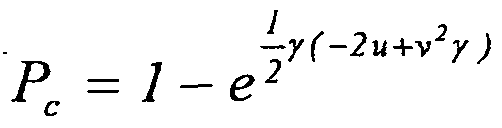 . When
c ~ s applied to Δ(y>n) of Equation 5, the
average
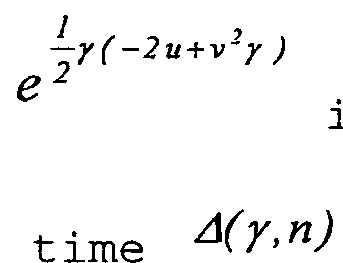 time taken to transmit a packet from a
source node to a destination node is expressed as a
function of '>n>r*o .
If the target SIR γ is fixed, Δ(γ, n) becomes a
concave function of the number n of reuse hops and thus there is the optimal hop number n that minimizes a delay time. In order to calculate the optimal hop number n, the exponential item of Pc is set to a variable X and Δ(γ,n) is differentiated to fine a point of "0". In this case, for the convenience of calculation, an exponential function can be approximated using a Taylor series and up to a fifth-order polynomial equation can be obtained. Arithmetically, a fifth or higher order equation has no general solution and thus cannot be expressed as the closed-form solution. Instead, an iterative tracking scheme can be used with increasing a numerical accuracy. When more terms are omitted in the Taylor series, a fourth or lower order equation can be obtained. However, the accuracy of the obtained solution decreases.
When an X value of a point differentiated to "0" is
determined, it is checked whether the determined value
satisfies the condition of 0<Pc<— / . By doing so, -ΛY.*
satisfying the above condition is obtained finally.
1 2 Because of the assumption of ~Y(~2u +V γ) - X j_n the
intermediate calculation process, when this equation is
solved, the optimal reuse hop number (i.e., the number of
hops for the optimal carrier sensing range) of
n = C(a,W0)γa (see Equation 1) can be obtained.
In brief, the carrier sensing range value n
expressed in the hop number (see Equation 1) is the
solution of the equation ~Y(~2u + v γ) — X _
As an example, for W0 = 4, C(a,4) has values of 11.59, 3.6, 2.83, 2.03, 1.79 as the path-loss exponent a has values of 2, 3, 4, 5, 6.
Using the target SIR γ and the constants calculated above, the carrier sensing threshold Tcs can be calculated based on the following Equation 6.

Assume that there are in target SIRs γ of the network interface card and they are γn,{n = l,2,...,m} . The γn values vary depending on modulation schemes.
In this manner, one node provides a plurality of target SIRs and simultaneous transmission is performed at
the hop of the optimal carrier sensing range obtained above for a specific γn . In this case, when data are transmitted at a data transmission rate supportable for the specific γn , the throughput satisfying the maximum data transmission rate can be obtained. Because each γπ value has no uniform relation with a data transmission rate, the γn with the maximum throughput can be obtained experimentally.
Even when the optimal carrier sensing range is determined using Equation 1, because the carrier sensing range is determined through a centralized calculation process, the determined carrier sensing range is unreasonable to apply directly to actual nodes (i.e., terminals) of distributed environments. In order to solve this problem, the present invention provides a function for adjusting the transmission power for data transmission.
Hereinafter, the method for optimal data transmission from the node with variable transmission power will be described in detail with reference to Fig. 2.
Referring to Fig. 2, in step S200, a node desiring to transmit data at a predetermined data transmission rate, which includes a source node and a relay node, receives a pilot signal transmitted periodically from a neighbor infrastructure and analyzes the received pilot signal, thereby determining channel state information of
the current wireless channel, i.e., a path-loss exponent a . For example, the node analyzes the reception power of a pilot signal received periodically from a neighbor infrastructure (e.g., devices located on a road and transmit a busy tone or a pilot signal) , determines the current channel state (e.g., whether a line-of-site environment or an environment with many reflective objects), and determines a path-loss exponent a as one of 2 through 6 according to the status determination results.
In the above-described embodiment, a path-loss exponent a is obtained by analyzing a pilot signal received periodically from a neighbor infrastructure. In an alternative embodiment, a path-loss exponent a is obtained by analyzing signals received from neighbor nodes .
In step S202, the node calculates a carrier sensing range n, which is capable of minimizing data collision, according to Equation 1 using a path-loss exponent a , a target SIR γ , and an initial contention window size W0. That is, assuming that W0 of n — C(a,WQ)/a (see Equation 1) is "4" (may be different in actuality), C(a,4) has values of 11.59, 3.6, 2.83, 2.03, 1.79 as a path-loss exponent a has values of 2, 3, 4, 5, 6. Thus, when W0 =4 and the path-loss exponent a determined in step S200 are substituted, the carrier sensing range n becomes one of 11.59, 3.6, 2.83, 2.03, 1.79. Herein, the target
SIR γ is calculated and provided by an application program of the corresponding node, which is set to be optimal based on a data transmission rate supportable by a network interface card. Thereafter, the node senses neighbor nodes and measures an idle state Inter-Arrival Time (IAT) . That is, when there is data to be transmitted, each node checks the time of an idle state of a propagation environment (e.g., a wireless transmission medium) to detect a time interval between idle states.
In step S204, using the idle state IAT, the node calculates the number of nodes attempting data transmission (hereinafter referred to as contention node number) based on the following Equation 7. In step S206, the node compares the calculated contention node number with the carrier sensing range n.
IAT Number of Contention Nodes = + 1 Eq. 7
where ^denotes a transmission slot time of a node on the multi-hop wireless network. If K and the idle state IAT both have the time unit of seconds, the contention node number can be compared with the carrier sensing range n. If the carrier sensing range n is larger than the contention node number, the node increases the previous transmission power by one level and transmits data at the increased transmission power, in step S208.
If the carrier sensing range n is equal to the contention node number, the node maintains the previous transmission power and transmits data at the maintained transmission power, in step S210. If the carrier sensing range n is smaller than the contention node number, the node reduces the previous transmission power by one level and transmits data at the reduced transmission power, in step S212.
The above processes are repeated to transmit data at the optimal transmission power.
Fig. 3 is a flowchart illustrating a method for optimal data transmission from a node with constant transmission power on a multi-hop wireless network m accordance with an embodiment of the present invention. In general, an IEEE 802.11 node, specifically a network interface card of the node has a constant carrier sensing threshold. If the network interface card is improved to correct the carrier sensing threshold, the optimal carrier sensing threshold can be determined using a suitable calculation scheme. Also, if each node NIC sets a target SIR according to a supportable target data transmission rate, calculates an optimal carrier sensing threshold using the target SIR, and determines whether to transmit data according to the optimal carrier sensing threshold, the maximum throughput can be obtained.
Referring to Fig. 3, in step S300, a node desiring to transmit data at a predetermined data transmission
rate, i.e., a node with constant transmission power, ' receives a pilot signal transmitted periodically from a neighbor infrastructure and analyzes the received pilot signal, thereby determining channel state information of the current wireless channel, i.e., a path-loss exponent a . A detailed description of this is the same as that in Fig. 2.
In step S302, the node calculates a carrier sensing threshold Tcs , which is capable of minimizing data collision, based on Equation 6 using a path-loss exponent a , a target SIR γ, a predetermined transmission power Pr, and an initial contention window size W0. Herein, the target SIR γ is calculated and provided by an application program of the corresponding node, which is set to be optimal based on a data transmission rate supportable by a network interface card.
Thereafter, the node senses neighbor nodes and measures an idle state Inter-Arrival Time (IAT) . That is, when there is data to be transmitted, each node checks the time of an idle state of a propagation environment (e.g., a wireless transmission medium) to detect a time interval between idle states.
In step S304, the node compares the reception power of a signal received from a neighbor node with the carrier sensing threshold Tcs .
If the signal reception power is smaller than the carrier sensing threshold Tcs , the node transmits data
with the predetermined transmission power Pr , in step S306.
If the signal reception power is larger than or equal to the carrier sensing threshold Tcs , the node defers data transmission in step S308 and returns to step
S300. The reason for this is that when sensing the reception power higher than the carrier sensing threshold
Tcs through a network interface card, the node knows that it should not transmit data because another node is transmitting data through a wireless medium (e.g., a wireless channel) .
Fig. 4 is a graph illustrating the relationship between a target SIR and a carrier sensing threshold. Fig. 5 is a gxaph illustrating the relationship between a target SIR and an end-to-end throughput.
The simulation for the present invention is an experiment that arranges 15 nodes linearly and detects the relationship between the target SIR and the optimal carrier sensing threshold. The constant C (see Equation 1) may be different from the simulation result. The reason for this is that all parameters of actual conditions are not considered in the present simulation.
The present simulation disregards constants and focuses on detecting the degree of the similarity of the equation structure to the simulation. The simulation exhibits the satisfactory similarity to actual conditions.
A threshold value for determination of the carrier sensing range is present in a network interface card of each node, and the carrier sensing range may be considered as being reciprocal to the threshold value. Thus, Fig. 4 shows that the carrier sensing range n and the target SIR γ have a relationship of about n = C(a,W0)γa . If the constant C is considered as a random value, only the product forms can be seen.
Fig. 5 shows end-to-end throughput values (i.e., network throughput values) depending on the target SIRs in the graph of Fig. 4. It can be seen from Fig. 5 that the maximum throughput "30" is obtained when the target
SIR is 8 dB,
As described above, the technology of the present invention can be realized as a program and stored in a computer-readable recording medium, such as CD-ROM, RAM,
ROM, floppy disk, hard disk and magneto-optical disk.
Since the process can be easily implemented by those skilled in the art of the present invention, further description will not be provided herein.
The present application contains subject matter related to Korean Patent Application Nos. 2006-0124027, and 2007-0107682, filed in the Korean Intellectual Property Office on December 07, 2006, and October 25, 2007, respectively, the entire contents of which is incorporated herein by reference.
While the present invention has been described with
respect to certain preferred embodiments, it will be apparent to those skilled in the art that various changes and modifications may be made without departing from the scope of the invention as defined in the following claims.
Claims
[CLAIMS] [Claim 1]
A method for optimal data transmission for improving a data transmission rate of a node with variable transmission power in a multi-hop wireless network, the method comprising the steps of: obtaining channel state information about a current wireless channel of the node; calculating a carrier sensing range in the number of hops using the obtained channel state information, a target signal-to-interference ratio, and a contention window size in order to minimize data collision; calculating the number of nodes attempting data transmission based on signals received from neighbor nodes, the number of the nodes attempting data transmission; and setting a transmission power adaptively according to the calculated carrier sensing range value and the contention node numbers and transmitting data with the set of transmission power.
[Claim 2]
The method of claim 1, wherein the step of obtaining the channel state information includes the steps of obtaining a pass-loss exponent on a wireless channel by analyzing a pilot signal received periodically from a infrastructure of the multi-hop wireless network adjacent to the node.
[Claim 3]
The method of claim 1, wherein the step of obtaining the channel state information includes the steps of obtaining a pass-loss exponent on a wireless channel by analyzing signals received from the neighbor nodes.
[Claim 4] The method of claim 1, wherein the target signal-to- interference ratio is set based on a data transmission rate supportable by a network interface card of the node.
[Claim 5] The method of claim 1, wherein the step of transmitting the data includes the steps of: comparing the calculated carrier sensing range value with the contention node number; transmitting data at transmission power higher than the previous transmission power if the carrier sensing range value is larger than the contention node number; transmitting data at transmission power equal to the previous transmission power if the carrier sensing range value is equal to the contention node number; and transmitting data at transmission power lower than the previous transmission power if the carrier sensing range value is smaller than the contention node number.
[Claim 6]
The method of claim 5, wherein the contention node number is calculated by obtaining an idle state inter- arrival time from the signals received from the neighbor nodes and dividing the idle state inter-arrival time by a transmission slot time of the node on the multi-hop wireless network.
[Claim 7]
A method for optima data transmission for improving a data transmission rate of a node with constant transmission power in a multi-hop wireless network, the method comprising the steps of: obtaining channel state information about a current wireless channel of the node; setting a carrier sensing threshold using the obtained channel state information, a target signal-to- interference ratio, the constant transmission power, and a contention window size in order to minimize data collision; and comparing the carrier sensing threshold with the reception power of a signal received from a neighbor node, determining whether to transmit data according to the comparison results, and transmitting data accordingly.
[Claim 8] The method of claim 7, wherein the step of obtaining the channel state information includes the steps of obtaining a pass-loss exponent on a wireless channel by analyzing a pilot signal received periodically from a infrastructure of the multi-hop wireless network adjacent to the node.
[Claim 9]
The method of claim 7, wherein the step of obtaining the channel state information includes the steps of obtaining a pass-loss exponent on a wireless channel by analyzing signals received from the neighbor nodes.
[Claim 10] The method of claim 7, wherein the target signal-to- interference ratio is set based on a data transmission rate supportable by a network interface card of the node.
[Claim 11] The method of claim I1 wherein the step of transmitting the data includes the steps of: comparing the carrier sensing threshold with the reception power of the signal received from the neighbor node; transmitting data at the constant transmission power if the reception power of the signal received from the neighbor node is smaller than the carrier sensing threshold; and returning to the channel state information obtaining step without performing data transmission if the reception power of the signal received from the neighbor node is larger than or equal to the carrier sensing threshold.
Priority Applications (1)
| Application Number | Priority Date | Filing Date | Title |
|---|---|---|---|
| US12/518,013 US20100317383A1 (en) | 2006-12-07 | 2007-12-05 | Method of optimal data transmission for improving data transmission rate in multi-hop wireless network |
Applications Claiming Priority (4)
| Application Number | Priority Date | Filing Date | Title |
|---|---|---|---|
| KR20060124027 | 2006-12-07 | ||
| KR10-2006-0124027 | 2006-12-07 | ||
| KR1020070107682A KR100925269B1 (en) | 2006-12-07 | 2007-10-25 | Method of optimal data transmission for improving data transmission rate in multi-hop wireless network |
| KR10-2007-0107682 | 2007-10-25 |
Publications (1)
| Publication Number | Publication Date |
|---|---|
| WO2008069578A1 true WO2008069578A1 (en) | 2008-06-12 |
Family
ID=39807188
Family Applications (1)
| Application Number | Title | Priority Date | Filing Date |
|---|---|---|---|
| PCT/KR2007/006289 Ceased WO2008069578A1 (en) | 2006-12-07 | 2007-12-05 | Method of optimal data transmission for improving data transmission rate in multi-hop wireless network |
Country Status (3)
| Country | Link |
|---|---|
| US (1) | US20100317383A1 (en) |
| KR (1) | KR100925269B1 (en) |
| WO (1) | WO2008069578A1 (en) |
Cited By (4)
| Publication number | Priority date | Publication date | Assignee | Title |
|---|---|---|---|---|
| WO2011004349A1 (en) * | 2009-07-09 | 2011-01-13 | Koninklijke Philips Electronics N.V. | Method for granting medium access in a wireless network and network therefor |
| WO2011016618A1 (en) * | 2009-08-05 | 2011-02-10 | Samsung Electronics Co., Ltd. | Communication system and method for single-point transmission and reception and coordinated multi-point transmission and reception |
| WO2014044415A1 (en) * | 2012-09-24 | 2014-03-27 | Nec Europe Ltd. | Method and system for operating stations in a cooperative station network |
| EP2583488A4 (en) * | 2010-06-21 | 2016-02-17 | Sharp Kk | RESOURCE ALLOCATION METHOD FOR RETRIEVAL OF CHANNEL STATE INFORMATION AND METHOD FOR RETRIEVING CHANNEL STATE INFORMATION |
Families Citing this family (16)
| Publication number | Priority date | Publication date | Assignee | Title |
|---|---|---|---|---|
| US8369794B1 (en) * | 2008-06-18 | 2013-02-05 | Meru Networks | Adaptive carrier sensing and power control |
| KR101104430B1 (en) * | 2009-12-31 | 2012-01-12 | 연세대학교 산학협력단 | Sensor node and data packet transmission method of sensor node |
| KR101285762B1 (en) * | 2010-12-01 | 2013-07-18 | 연세대학교기술지주 주식회사 | Method for setting transmission range and transmission power of node in dynamic mobile wireless network |
| KR101386835B1 (en) * | 2012-06-19 | 2014-04-21 | 한경대학교 산학협력단 | Multihop transmission method for increasing node's lifetime in wireless Ad Hoc network |
| KR20150073994A (en) * | 2012-09-26 | 2015-07-01 | 엘지전자 주식회사 | Method and apparatus for gaining access in wireless lan system |
| KR101467310B1 (en) * | 2013-11-19 | 2014-12-01 | 성균관대학교산학협력단 | Method for media access control of vehicular ad hoc network using variable length frame and road side unit using the same |
| CN106233639B (en) * | 2015-02-05 | 2019-10-25 | 华为技术有限公司 | Data transmission method and device |
| JP6315598B2 (en) * | 2015-02-17 | 2018-04-25 | 日本電信電話株式会社 | Multi-hop wireless communication system, multi-hop wireless communication method, and terminal device |
| US11778663B1 (en) * | 2016-09-20 | 2023-10-03 | Marvell Asia Pte, Ltd. | Methods and systems for enabling communications from a station to an access point using a backoff counter and carrier sensing |
| EP3616266A4 (en) * | 2017-04-25 | 2020-12-16 | Center for Medical Interoperability Inc. | Improved wireless network system with multiple access point layers |
| KR102537332B1 (en) | 2019-03-29 | 2023-05-30 | 한국전자통신연구원 | Method for relaying message in low power wide area network and apparatus for the same |
| CN112953676B (en) * | 2019-12-11 | 2023-04-07 | 鹤壁天海电子信息系统有限公司 | Rate self-adaption method and node of multi-bandwidth frequency hopping equipment |
| EP4360389A1 (en) * | 2021-06-24 | 2024-05-01 | Telefonaktiebolaget LM Ericsson (publ) | Efficient random access in a wireless telecommunication system |
| CN114125985B (en) * | 2021-11-18 | 2024-06-25 | 国网冀北电力有限公司电力科学研究院 | A communication network and communication method suitable for a transmission line sensing system |
| CN115734188B (en) * | 2022-10-28 | 2025-05-30 | 南京航空航天大学 | A Markov chain-based method for optimizing synchronization efficiency in multi-hop wireless ad hoc networks |
| USD1121924S1 (en) * | 2023-12-08 | 2026-04-14 | 3Rd Wave Apparel Pty Ltd | Cap |
Family Cites Families (9)
| Publication number | Priority date | Publication date | Assignee | Title |
|---|---|---|---|---|
| GB9019490D0 (en) * | 1990-09-06 | 1990-10-24 | Ncr Co | Transmission control for a wireless local area network station |
| GB9214107D0 (en) * | 1992-07-03 | 1992-08-12 | Ncr Int Inc | Power control method in a wireless communication system |
| JP3704493B2 (en) | 2001-10-17 | 2005-10-12 | 日本電信電話株式会社 | Transmission power setting method and transmission power setting program for tree-type multi-hop wireless network |
| JP4027818B2 (en) * | 2003-02-21 | 2007-12-26 | 株式会社エヌ・ティ・ティ・ドコモ | Multihop communication system, radio control station, radio station, and multihop communication method |
| US7433332B2 (en) | 2003-04-30 | 2008-10-07 | Skypipes Wireless, Inc. | Managed microcell wireless mesh network architecture |
| EP1629677B1 (en) * | 2003-06-05 | 2014-12-31 | Meshnetworks, Inc. | Optimal routing in ad hoc wireless communication network |
| EP1530316A1 (en) * | 2003-11-10 | 2005-05-11 | Go Networks | Improving the performance of a wireless packet data communication system |
| US7463644B2 (en) * | 2003-12-11 | 2008-12-09 | Intel Corporation | Self-configuring physical carrier sensing threshold adaptation |
| WO2005060170A1 (en) * | 2003-12-19 | 2005-06-30 | Telefonaktiebolaget Lm Ericsson (Publ) | Fast/opportunistic distributed resource reallocation for established connections in a multihop network |
-
2007
- 2007-10-25 KR KR1020070107682A patent/KR100925269B1/en not_active Expired - Fee Related
- 2007-12-05 WO PCT/KR2007/006289 patent/WO2008069578A1/en not_active Ceased
- 2007-12-05 US US12/518,013 patent/US20100317383A1/en not_active Abandoned
Non-Patent Citations (3)
| Title |
|---|
| HWANG H.Y. ET AL.: "Effect of Carrier Sensing Range in a Network Architecture with a Multi-sector Antenna Access Point and Omni-directional Mobile Nodes", COMMUNICATIONS, 2004 AND THE 5TH INTERNATIONAL SYMPOSIUM ON MULTI-DIMENSIONAL MOBILE COMMUNICATIONS PROCEEDINGS, vol. 1, 29 August 2004 (2004-08-29), pages 258 - 262, XP010765328 * |
| HWANG J., KIM S.-L.: "A Cross-layer Optimization of IEEE 802.11 MAC for Wireless Multihop Networks", COMMUNICATIONS LETTERS, IEEE, vol. 10, no. 7, July 2006 (2006-07-01), pages 531 - 533, XP011474945, DOI: doi:10.1109/LCOM.2006.224410 * |
| VASAN A., RAMJEE R., WOO T.: "ECHOS - enhanced Capacity 802.11 Hotspots", INFOCOM 2005. 24TH ANNUAL JOINT CONFERENCE OF THE IEEE COMPUTER AND COMMUNICATIONS SOCIETIES. PROCEEDINGS IEEE, vol. 3, 13 March 2005 (2005-03-13) - 17 March 2005 (2005-03-17), pages 1562 - 1572, XP010829351, DOI: doi:10.1109/INFCOM.2005.1498439 * |
Cited By (7)
| Publication number | Priority date | Publication date | Assignee | Title |
|---|---|---|---|---|
| WO2011004349A1 (en) * | 2009-07-09 | 2011-01-13 | Koninklijke Philips Electronics N.V. | Method for granting medium access in a wireless network and network therefor |
| US9526116B2 (en) | 2009-07-09 | 2016-12-20 | Koninklijke Philips N.V. | Method for granting medium access in a wireless network and network therefor |
| WO2011016618A1 (en) * | 2009-08-05 | 2011-02-10 | Samsung Electronics Co., Ltd. | Communication system and method for single-point transmission and reception and coordinated multi-point transmission and reception |
| EP2583488A4 (en) * | 2010-06-21 | 2016-02-17 | Sharp Kk | RESOURCE ALLOCATION METHOD FOR RETRIEVAL OF CHANNEL STATE INFORMATION AND METHOD FOR RETRIEVING CHANNEL STATE INFORMATION |
| US10548113B2 (en) | 2010-06-21 | 2020-01-28 | Sharp Kabushiki Kaisha | Method of resource allocation for channel state information feedback and method of channel state information feedback |
| WO2014044415A1 (en) * | 2012-09-24 | 2014-03-27 | Nec Europe Ltd. | Method and system for operating stations in a cooperative station network |
| US9642093B2 (en) | 2012-09-24 | 2017-05-02 | Nec Corporation | Method and system for operating stations in a cooperative station network |
Also Published As
| Publication number | Publication date |
|---|---|
| US20100317383A1 (en) | 2010-12-16 |
| KR20080052367A (en) | 2008-06-11 |
| KR100925269B1 (en) | 2009-11-05 |
Similar Documents
| Publication | Publication Date | Title |
|---|---|---|
| WO2008069578A1 (en) | Method of optimal data transmission for improving data transmission rate in multi-hop wireless network | |
| EP2014024B1 (en) | Dynamic carrier sensing thresholds | |
| EP1386419B1 (en) | Instantaneous joint transmit power control and link adaptation for rts/cts based channel access | |
| CN112398806B (en) | Underwater acoustic network MAC protocol generation method based on state coloring | |
| Arteaga et al. | Vehicular communications over TV white spaces in the presence of secondary users | |
| Iskandarani | Effectiveness of Vehicular Communication Using NP-CSMA with Bernoulli-Based Gaussian Interpolation Function | |
| Farnoud et al. | Repetition-based broadcast in vehicular ad hoc networks in Rician channel with capture | |
| Djoudi et al. | LoRa network reconfiguration with Markov decision process and fuzzy C-means clustering | |
| Ruffini et al. | Power-rate adaptation in high-mobility distributed ad-hoc wireless networks | |
| Soares et al. | Impact of rayleigh fading channel on ieee 802.11 ah networks under restricted access window mechanism | |
| Kwon et al. | Bayesian game-theoretic approach based on 802.11 p MAC protocol to alleviate beacon collision under urban VANETs | |
| Hoang et al. | An efficient MAC protocol for MIMO-OFDM ad hoc networks | |
| Hassan et al. | Enhancement techniques of IEEE 802.11 wireless local area network distributed coordination function: A review | |
| Natkaniec et al. | ARCAS: A novel solution for mitigating performance drops in dense IEEE 802.11 networks | |
| Sanada et al. | Optimizing backoff by dynamically estimating the number of nodes in multi-hop adhoc networks | |
| Al-Mefleh et al. | High performance distributed coordination function for wireless LANs | |
| Tappeta et al. | Adaptive Velocity-Based Grouping for Enhanced IEEE 802.11 ah Vehicular Communication | |
| Fujii | Environmental Aware Hierarchical Ad Hoc Network with Multiple Frequency Bands using Weighted Laplacian Matrix | |
| Mustapha et al. | Effect of carrier sensing range on the throughput of multi-hop wireless ad-hoc network | |
| Takyu et al. | Multiband hierarchical ad hoc network with wireless environment recognition | |
| Kim et al. | Proportional Fair Secondary Receiver Selection Algorithm for Full-duplex WLAN | |
| Sanada et al. | A Novel MAC Protocol for Improving the Throughput in Multi-Hop Wireless Networks | |
| Wen et al. | Proposal of Capacity Analysis in Wireless Sensor Networks with Multi-Hop Transmissions and Hidden Nodes | |
| Mascolo | Advanced Systems Topics Part on Mobile and Sensor Systems Lecture 1: Wireless Network Systems | |
| Hung | Performance analysis of the IEEE 802.11-based wireless networks in the presence of hidden stations |
Legal Events
| Date | Code | Title | Description |
|---|---|---|---|
| 121 | Ep: the epo has been informed by wipo that ep was designated in this application |
Ref document number: 07834463 Country of ref document: EP Kind code of ref document: A1 |
|
| WWE | Wipo information: entry into national phase |
Ref document number: 12518013 Country of ref document: US |
|
| NENP | Non-entry into the national phase |
Ref country code: DE |
|
| 122 | Ep: pct application non-entry in european phase |
Ref document number: 07834463 Country of ref document: EP Kind code of ref document: A1 |