WO2007148648A1 - 多発性硬化症の治療又は予防剤 - Google Patents
多発性硬化症の治療又は予防剤 Download PDFInfo
- Publication number
- WO2007148648A1 WO2007148648A1 PCT/JP2007/062220 JP2007062220W WO2007148648A1 WO 2007148648 A1 WO2007148648 A1 WO 2007148648A1 JP 2007062220 W JP2007062220 W JP 2007062220W WO 2007148648 A1 WO2007148648 A1 WO 2007148648A1
- Authority
- WO
- WIPO (PCT)
- Prior art keywords
- phenol
- pyrimidine
- dichlorobenzamide
- methyl ester
- chemical
- Prior art date
- Legal status (The legal status is an assumption and is not a legal conclusion. Google has not performed a legal analysis and makes no representation as to the accuracy of the status listed.)
- Ceased
Links
Classifications
-
- C—CHEMISTRY; METALLURGY
- C07—ORGANIC CHEMISTRY
- C07D—HETEROCYCLIC COMPOUNDS
- C07D239/00—Heterocyclic compounds containing 1,3-diazine or hydrogenated 1,3-diazine rings
- C07D239/02—Heterocyclic compounds containing 1,3-diazine or hydrogenated 1,3-diazine rings not condensed with other rings
- C07D239/24—Heterocyclic compounds containing 1,3-diazine or hydrogenated 1,3-diazine rings not condensed with other rings having three or more double bonds between ring members or between ring members and non-ring members
- C07D239/28—Heterocyclic compounds containing 1,3-diazine or hydrogenated 1,3-diazine rings not condensed with other rings having three or more double bonds between ring members or between ring members and non-ring members with hetero atoms or with carbon atoms having three bonds to hetero atoms with at the most one bond to halogen, directly attached to ring carbon atoms
- C07D239/32—One oxygen, sulfur or nitrogen atom
- C07D239/42—One nitrogen atom
-
- A—HUMAN NECESSITIES
- A61—MEDICAL OR VETERINARY SCIENCE; HYGIENE
- A61K—PREPARATIONS FOR MEDICAL, DENTAL OR TOILETRY PURPOSES
- A61K31/00—Medicinal preparations containing organic active ingredients
- A61K31/33—Heterocyclic compounds
- A61K31/335—Heterocyclic compounds having oxygen as the only ring hetero atom, e.g. fungichromin
-
- A—HUMAN NECESSITIES
- A61—MEDICAL OR VETERINARY SCIENCE; HYGIENE
- A61K—PREPARATIONS FOR MEDICAL, DENTAL OR TOILETRY PURPOSES
- A61K31/00—Medicinal preparations containing organic active ingredients
- A61K31/33—Heterocyclic compounds
- A61K31/335—Heterocyclic compounds having oxygen as the only ring hetero atom, e.g. fungichromin
- A61K31/35—Heterocyclic compounds having oxygen as the only ring hetero atom, e.g. fungichromin having six-membered rings with one oxygen as the only ring hetero atom
- A61K31/351—Heterocyclic compounds having oxygen as the only ring hetero atom, e.g. fungichromin having six-membered rings with one oxygen as the only ring hetero atom not condensed with another ring
-
- A—HUMAN NECESSITIES
- A61—MEDICAL OR VETERINARY SCIENCE; HYGIENE
- A61K—PREPARATIONS FOR MEDICAL, DENTAL OR TOILETRY PURPOSES
- A61K31/00—Medicinal preparations containing organic active ingredients
- A61K31/33—Heterocyclic compounds
- A61K31/395—Heterocyclic compounds having nitrogen as a ring hetero atom, e.g. guanethidine or rifamycins
- A61K31/495—Heterocyclic compounds having nitrogen as a ring hetero atom, e.g. guanethidine or rifamycins having six-membered rings with two or more nitrogen atoms as the only ring heteroatoms, e.g. piperazine or tetrazines
- A61K31/505—Pyrimidines; Hydrogenated pyrimidines, e.g. trimethoprim
-
- A—HUMAN NECESSITIES
- A61—MEDICAL OR VETERINARY SCIENCE; HYGIENE
- A61K—PREPARATIONS FOR MEDICAL, DENTAL OR TOILETRY PURPOSES
- A61K31/00—Medicinal preparations containing organic active ingredients
- A61K31/33—Heterocyclic compounds
- A61K31/395—Heterocyclic compounds having nitrogen as a ring hetero atom, e.g. guanethidine or rifamycins
- A61K31/495—Heterocyclic compounds having nitrogen as a ring hetero atom, e.g. guanethidine or rifamycins having six-membered rings with two or more nitrogen atoms as the only ring heteroatoms, e.g. piperazine or tetrazines
- A61K31/505—Pyrimidines; Hydrogenated pyrimidines, e.g. trimethoprim
- A61K31/506—Pyrimidines; Hydrogenated pyrimidines, e.g. trimethoprim not condensed and containing further heterocyclic rings
-
- A—HUMAN NECESSITIES
- A61—MEDICAL OR VETERINARY SCIENCE; HYGIENE
- A61P—SPECIFIC THERAPEUTIC ACTIVITY OF CHEMICAL COMPOUNDS OR MEDICINAL PREPARATIONS
- A61P21/00—Drugs for disorders of the muscular or neuromuscular system
-
- A—HUMAN NECESSITIES
- A61—MEDICAL OR VETERINARY SCIENCE; HYGIENE
- A61P—SPECIFIC THERAPEUTIC ACTIVITY OF CHEMICAL COMPOUNDS OR MEDICINAL PREPARATIONS
- A61P25/00—Drugs for disorders of the nervous system
-
- A—HUMAN NECESSITIES
- A61—MEDICAL OR VETERINARY SCIENCE; HYGIENE
- A61P—SPECIFIC THERAPEUTIC ACTIVITY OF CHEMICAL COMPOUNDS OR MEDICINAL PREPARATIONS
- A61P25/00—Drugs for disorders of the nervous system
- A61P25/28—Drugs for disorders of the nervous system for treating neurodegenerative disorders of the central nervous system, e.g. nootropic agents, cognition enhancers, drugs for treating Alzheimer's disease or other forms of dementia
-
- A—HUMAN NECESSITIES
- A61—MEDICAL OR VETERINARY SCIENCE; HYGIENE
- A61P—SPECIFIC THERAPEUTIC ACTIVITY OF CHEMICAL COMPOUNDS OR MEDICINAL PREPARATIONS
- A61P37/00—Drugs for immunological or allergic disorders
- A61P37/02—Immunomodulators
- A61P37/06—Immunosuppressants, e.g. drugs for graft rejection
-
- C—CHEMISTRY; METALLURGY
- C07—ORGANIC CHEMISTRY
- C07C—ACYCLIC OR CARBOCYCLIC COMPOUNDS
- C07C233/00—Carboxylic acid amides
- C07C233/64—Carboxylic acid amides having carbon atoms of carboxamide groups bound to carbon atoms of six-membered aromatic rings
- C07C233/81—Carboxylic acid amides having carbon atoms of carboxamide groups bound to carbon atoms of six-membered aromatic rings having the nitrogen atom of at least one of the carboxamide groups bound to a carbon atom of a hydrocarbon radical substituted by carboxyl groups
- C07C233/82—Carboxylic acid amides having carbon atoms of carboxamide groups bound to carbon atoms of six-membered aromatic rings having the nitrogen atom of at least one of the carboxamide groups bound to a carbon atom of a hydrocarbon radical substituted by carboxyl groups with the substituted hydrocarbon radical bound to the nitrogen atom of the carboxamide group by an acyclic carbon atom
- C07C233/85—Carboxylic acid amides having carbon atoms of carboxamide groups bound to carbon atoms of six-membered aromatic rings having the nitrogen atom of at least one of the carboxamide groups bound to a carbon atom of a hydrocarbon radical substituted by carboxyl groups with the substituted hydrocarbon radical bound to the nitrogen atom of the carboxamide group by an acyclic carbon atom of an acyclic unsaturated carbon skeleton
-
- C—CHEMISTRY; METALLURGY
- C07—ORGANIC CHEMISTRY
- C07D—HETEROCYCLIC COMPOUNDS
- C07D239/00—Heterocyclic compounds containing 1,3-diazine or hydrogenated 1,3-diazine rings
- C07D239/02—Heterocyclic compounds containing 1,3-diazine or hydrogenated 1,3-diazine rings not condensed with other rings
- C07D239/24—Heterocyclic compounds containing 1,3-diazine or hydrogenated 1,3-diazine rings not condensed with other rings having three or more double bonds between ring members or between ring members and non-ring members
- C07D239/28—Heterocyclic compounds containing 1,3-diazine or hydrogenated 1,3-diazine rings not condensed with other rings having three or more double bonds between ring members or between ring members and non-ring members with hetero atoms or with carbon atoms having three bonds to hetero atoms with at the most one bond to halogen, directly attached to ring carbon atoms
- C07D239/32—One oxygen, sulfur or nitrogen atom
- C07D239/34—One oxygen atom
-
- C—CHEMISTRY; METALLURGY
- C07—ORGANIC CHEMISTRY
- C07D—HETEROCYCLIC COMPOUNDS
- C07D239/00—Heterocyclic compounds containing 1,3-diazine or hydrogenated 1,3-diazine rings
- C07D239/02—Heterocyclic compounds containing 1,3-diazine or hydrogenated 1,3-diazine rings not condensed with other rings
- C07D239/24—Heterocyclic compounds containing 1,3-diazine or hydrogenated 1,3-diazine rings not condensed with other rings having three or more double bonds between ring members or between ring members and non-ring members
- C07D239/28—Heterocyclic compounds containing 1,3-diazine or hydrogenated 1,3-diazine rings not condensed with other rings having three or more double bonds between ring members or between ring members and non-ring members with hetero atoms or with carbon atoms having three bonds to hetero atoms with at the most one bond to halogen, directly attached to ring carbon atoms
- C07D239/46—Two or more oxygen, sulphur or nitrogen atoms
- C07D239/47—One nitrogen atom and one oxygen or sulfur atom, e.g. cytosine
-
- C—CHEMISTRY; METALLURGY
- C07—ORGANIC CHEMISTRY
- C07D—HETEROCYCLIC COMPOUNDS
- C07D239/00—Heterocyclic compounds containing 1,3-diazine or hydrogenated 1,3-diazine rings
- C07D239/02—Heterocyclic compounds containing 1,3-diazine or hydrogenated 1,3-diazine rings not condensed with other rings
- C07D239/24—Heterocyclic compounds containing 1,3-diazine or hydrogenated 1,3-diazine rings not condensed with other rings having three or more double bonds between ring members or between ring members and non-ring members
- C07D239/28—Heterocyclic compounds containing 1,3-diazine or hydrogenated 1,3-diazine rings not condensed with other rings having three or more double bonds between ring members or between ring members and non-ring members with hetero atoms or with carbon atoms having three bonds to hetero atoms with at the most one bond to halogen, directly attached to ring carbon atoms
- C07D239/46—Two or more oxygen, sulphur or nitrogen atoms
- C07D239/52—Two oxygen atoms
-
- C—CHEMISTRY; METALLURGY
- C07—ORGANIC CHEMISTRY
- C07D—HETEROCYCLIC COMPOUNDS
- C07D239/00—Heterocyclic compounds containing 1,3-diazine or hydrogenated 1,3-diazine rings
- C07D239/02—Heterocyclic compounds containing 1,3-diazine or hydrogenated 1,3-diazine rings not condensed with other rings
- C07D239/24—Heterocyclic compounds containing 1,3-diazine or hydrogenated 1,3-diazine rings not condensed with other rings having three or more double bonds between ring members or between ring members and non-ring members
- C07D239/28—Heterocyclic compounds containing 1,3-diazine or hydrogenated 1,3-diazine rings not condensed with other rings having three or more double bonds between ring members or between ring members and non-ring members with hetero atoms or with carbon atoms having three bonds to hetero atoms with at the most one bond to halogen, directly attached to ring carbon atoms
- C07D239/46—Two or more oxygen, sulphur or nitrogen atoms
- C07D239/60—Three or more oxygen or sulfur atoms
-
- C—CHEMISTRY; METALLURGY
- C07—ORGANIC CHEMISTRY
- C07D—HETEROCYCLIC COMPOUNDS
- C07D309/00—Heterocyclic compounds containing six-membered rings having one oxygen atom as the only ring hetero atom, not condensed with other rings
- C07D309/02—Heterocyclic compounds containing six-membered rings having one oxygen atom as the only ring hetero atom, not condensed with other rings having no double bonds between ring members or between ring members and non-ring members
- C07D309/04—Heterocyclic compounds containing six-membered rings having one oxygen atom as the only ring hetero atom, not condensed with other rings having no double bonds between ring members or between ring members and non-ring members with only hydrogen atoms, hydrocarbon or substituted hydrocarbon radicals, directly attached to ring carbon atoms
- C07D309/06—Radicals substituted by oxygen atoms
-
- C—CHEMISTRY; METALLURGY
- C07—ORGANIC CHEMISTRY
- C07D—HETEROCYCLIC COMPOUNDS
- C07D309/00—Heterocyclic compounds containing six-membered rings having one oxygen atom as the only ring hetero atom, not condensed with other rings
- C07D309/02—Heterocyclic compounds containing six-membered rings having one oxygen atom as the only ring hetero atom, not condensed with other rings having no double bonds between ring members or between ring members and non-ring members
- C07D309/08—Heterocyclic compounds containing six-membered rings having one oxygen atom as the only ring hetero atom, not condensed with other rings having no double bonds between ring members or between ring members and non-ring members with hetero atoms or with carbon atoms having three bonds to hetero atoms with at the most one bond to halogen, e.g. ester or nitrile radicals, directly attached to ring carbon atoms
- C07D309/10—Oxygen atoms
- C07D309/12—Oxygen atoms only hydrogen atoms and one oxygen atom directly attached to ring carbon atoms, e.g. tetrahydropyranyl ethers
-
- C—CHEMISTRY; METALLURGY
- C07—ORGANIC CHEMISTRY
- C07D—HETEROCYCLIC COMPOUNDS
- C07D313/00—Heterocyclic compounds containing rings of more than six members having one oxygen atom as the only ring hetero atom
- C07D313/02—Seven-membered rings
- C07D313/04—Seven-membered rings not condensed with other rings
-
- C—CHEMISTRY; METALLURGY
- C07—ORGANIC CHEMISTRY
- C07D—HETEROCYCLIC COMPOUNDS
- C07D401/00—Heterocyclic compounds containing two or more hetero rings, having nitrogen atoms as the only ring hetero atoms, at least one ring being a six-membered ring with only one nitrogen atom
- C07D401/02—Heterocyclic compounds containing two or more hetero rings, having nitrogen atoms as the only ring hetero atoms, at least one ring being a six-membered ring with only one nitrogen atom containing two hetero rings
- C07D401/12—Heterocyclic compounds containing two or more hetero rings, having nitrogen atoms as the only ring hetero atoms, at least one ring being a six-membered ring with only one nitrogen atom containing two hetero rings linked by a chain containing hetero atoms as chain links
-
- C—CHEMISTRY; METALLURGY
- C07—ORGANIC CHEMISTRY
- C07D—HETEROCYCLIC COMPOUNDS
- C07D405/00—Heterocyclic compounds containing both one or more hetero rings having oxygen atoms as the only ring hetero atoms, and one or more rings having nitrogen as the only ring hetero atom
- C07D405/02—Heterocyclic compounds containing both one or more hetero rings having oxygen atoms as the only ring hetero atoms, and one or more rings having nitrogen as the only ring hetero atom containing two hetero rings
- C07D405/12—Heterocyclic compounds containing both one or more hetero rings having oxygen atoms as the only ring hetero atoms, and one or more rings having nitrogen as the only ring hetero atom containing two hetero rings linked by a chain containing hetero atoms as chain links
-
- C—CHEMISTRY; METALLURGY
- C07—ORGANIC CHEMISTRY
- C07D—HETEROCYCLIC COMPOUNDS
- C07D417/00—Heterocyclic compounds containing two or more hetero rings, at least one ring having nitrogen and sulfur atoms as the only ring hetero atoms, not provided for by group C07D415/00
- C07D417/02—Heterocyclic compounds containing two or more hetero rings, at least one ring having nitrogen and sulfur atoms as the only ring hetero atoms, not provided for by group C07D415/00 containing two hetero rings
- C07D417/12—Heterocyclic compounds containing two or more hetero rings, at least one ring having nitrogen and sulfur atoms as the only ring hetero atoms, not provided for by group C07D415/00 containing two hetero rings linked by a chain containing hetero atoms as chain links
Definitions
- the present invention relates to a therapeutic or prophylactic agent for multiple sclerosis comprising a glycine derivative or a pharmacologically acceptable salt thereof as an active ingredient.
- Multiple sclerosis is a neurological demyelinating disease characterized by repeated relapses and remissions, and an unexplained cause of progressive disability. Multiple sclerosis is known to cause visual impairment, loss of balance, poor coordination, obscure language, tremor, numbness, extreme fatigue, changes in intellectual function, muscle weakness, sensory abnormalities, and blindness (For example, see Non-Patent Document 1 and Non-Patent Document 2).
- Treatment of multiple sclerosis is mainly symptomatic and incurable. These treatments alleviate or prevent symptoms but cannot cure the fundamental defect, demyelination.
- Current therapy uses corticosteroids that reduce the period of disease relapse but have not been shown to improve the long-term course.
- Immunosuppressants, cyclophosphamide, leflunomide and cyclosporin A are sometimes used in progressive multiple sclerosis, but they are known to be teratogenic and carcinogenic.
- Patent Document 1 discloses the following general formula that can be regarded as structurally close to the compound contained as an active ingredient in the present application.
- Z represents COOH, R 2 R 3 , R 4 represents hydrogen, etc.
- R 5 represents —C Al
- R 6 represents hydrogen or the like.
- Patent Documents 2 and 3 include, on the claims, formulas including the present compound.
- B represents
- Patent Document 4 discloses a compound contained as an active ingredient in the present application and its use for treating inflammatory bowel disease. However, there is no disclosure of the therapeutic or preventive effect on the multiple sclerosis of the present invention.
- Patent Document 1 Pamphlet of International Publication No. 99Z26923
- Patent Document 2 Pamphlet of International Publication No. 95Z32710
- Patent Document 3 International Publication No. 94Z12181 Pamphlet
- Patent Document 4 Pamphlet of International Publication No. 2006Z068213
- Non-patent literature l Proc. Soc. Exp. Biol. Med., 175, 282-294 (1984)
- Non-Patent Document 2 Immunol. Rev., 100, 307-332 (1987)
- the present invention provides a low-molecular compound useful as a pharmaceutical or a pharmacologically acceptable salt thereof as an effective component.
- the purpose is to provide an agent for treating or preventing multiple sclerosis.
- the present inventors have found that the glycine derivative represented by the general formula (I) or a pharmacologically acceptable salt thereof has excellent oral absorption and in vivo stability, and is frequently produced. As a result, the present invention has been found to be effective in the treatment or prevention of multiple sclerosis.
- R 1 represents hydrogen or alkyl having 1 to 5 carbon atoms
- Each X independently represents fluoro, black mouth, bromo, odo or alkyl having 1 to 3 carbon atoms;
- Y represents the general formula (II) or (III)
- R 2 represents alkyl having 1 to 5 carbons or alkoxy having 1 to 3 carbons
- R 3 represents hydrogen or alkyl having 1 to 5 carbon atoms
- n an integer from 0 to 3
- n 0 or 1
- p represents an integer from 0 to 2
- W represents O or N (R 4 )
- R 4 is hydrogen, alkyl having 1 to 5 carbons, alkyl, carbon having 3 to 6 carbons, phenol, benzyl, benzyl substituted by one or two R 5 , tetrahydrobiral,
- R 5 represents hydroxy or alkoxy having 1 to 3 carbon atoms
- a therapeutic or prophylactic agent for multiple sclerosis is provided.
- the present invention also provides use of the compound represented by the general formula (I) or a pharmacologically acceptable salt thereof for the manufacture of a therapeutic or prophylactic agent for multiple sclerosis.
- the present invention provides a method for treating or preventing multiple sclerosis comprising administering to a patient an effective amount of a compound represented by the above general formula (I) or a pharmacologically acceptable salt thereof. To do.
- the therapeutic or preventive agent for multiple sclerosis of the present invention has excellent oral absorbability and in vivo stability, and thus has an excellent therapeutic or preventive effect.
- alkyl means a straight chain or a branched hydrocarbon chain.
- alkyl include methyl, ethyl, propyl, isopropyl, butyl, isobutyl and the like.
- Alkoxy means an oxygen atom having an alkyl substituent. Examples of alkoxy include methoxy, ethoxy, propoxy, isopropoxy, butoxy and the like.
- Alkenyl means a straight or branched hydrocarbon chain having one or more carbon-carbon double bonds.
- Examples of alcohols are vinyl, aryl, isopropenyl.
- Cycloalkyl means a monocyclic saturated hydrocarbon ring.
- Examples of cycloalkyl include cyclopropyl, cyclobutyl, cyclopentyl, cyclohexyl and the like.
- Cycloalkylmethyl means a methyl group having a cycloalkyl group.
- Examples of cycloalkylmethyl include cyclopropylmethyl, cyclobutylmethyl, cyclopentylmethyl, cyclohexylmethyl and the like.
- X is preferably black, or methyl, even though fluoro, black, or methyl is preferred.
- R 1 hydrogen is preferable among hydrogen, methyl and tert-butyl.
- W is preferably N (R 4 ) —.
- R 2 when present, is preferably methyl, among methyl, ethyl and methoxy.
- R 3 hydrogen and alkyl having 1 to 3 carbon atoms (for example, methyl, ethyl, propyl) are preferable, and methyl is preferable.
- methyl or isopropyl is preferable, among which alkyl having 1 to 3 carbon atoms (for example, methyl, ethyl, propyl, isopropyl), cyanoethyl, tetrahydrovinyl, and phenyl are preferable.
- alkyl having 1 to 3 carbon atoms for example, methyl, ethyl, propyl, isopropyl
- cyanoethyl, tetrahydrovinyl, and phenyl are preferable.
- m an integer of 0 to 2 is preferable, and 0 is preferable.
- n is preferably 0.
- R 1 is hydrogen
- W is —N (R 4 ) —, R 4 is alkyl having 1 to 3 carbons, cyanoethyl, tetrahydrobiranyl or phenyl,
- Y is represented by the general formula (III)
- a compound in which n is 0 and R 3 is alkyl having 1 to 3 carbon atoms or a pharmaceutically acceptable salt thereof is preferred.
- Each X is independently black or methyl
- W is —N (R 4 ) —, R 4 cation or isopropyl
- Y is represented by the general formula (III), a compound which is R 3 acetyl or a pharmacologically acceptable salt thereof is preferred.
- an alkaline salt such as an ammonium salt, sodium or potassium is used.
- inorganic acid salts such as hydrochloric acid, sulfuric acid, nitric acid, hydrobromic acid, phosphoric acid, acetic acid, lactic acid, citrate, maleic acid,
- Organic carboxylic acid salts such as benzoic acid, oxalic acid, dartaric acid, malic acid, tartaric acid, fumaric acid, mandelic acid and succinic acid, and organic sulfonic acid salts such as methanesulfonic acid, p-toluenesulfonic acid and camphorsulfonic acid.
- the structure represented by the general formula (I) includes optical isomers represented by the general formulas (IV) and (V) based on the asymmetric carbon. It also contains the body and its mixtures.
- the present invention when Y has an asymmetric carbon, the present invention also includes its isomers and mixtures.
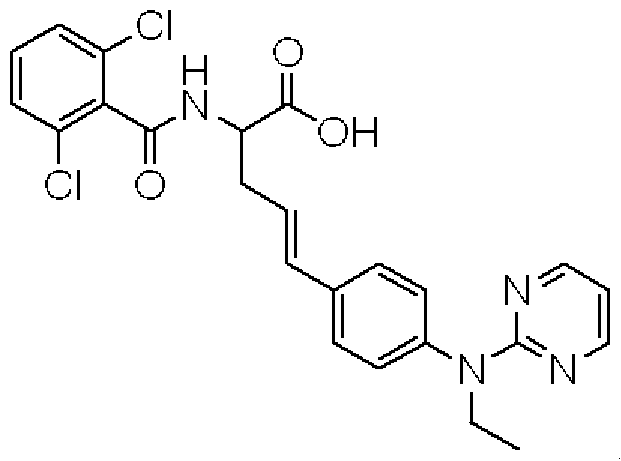
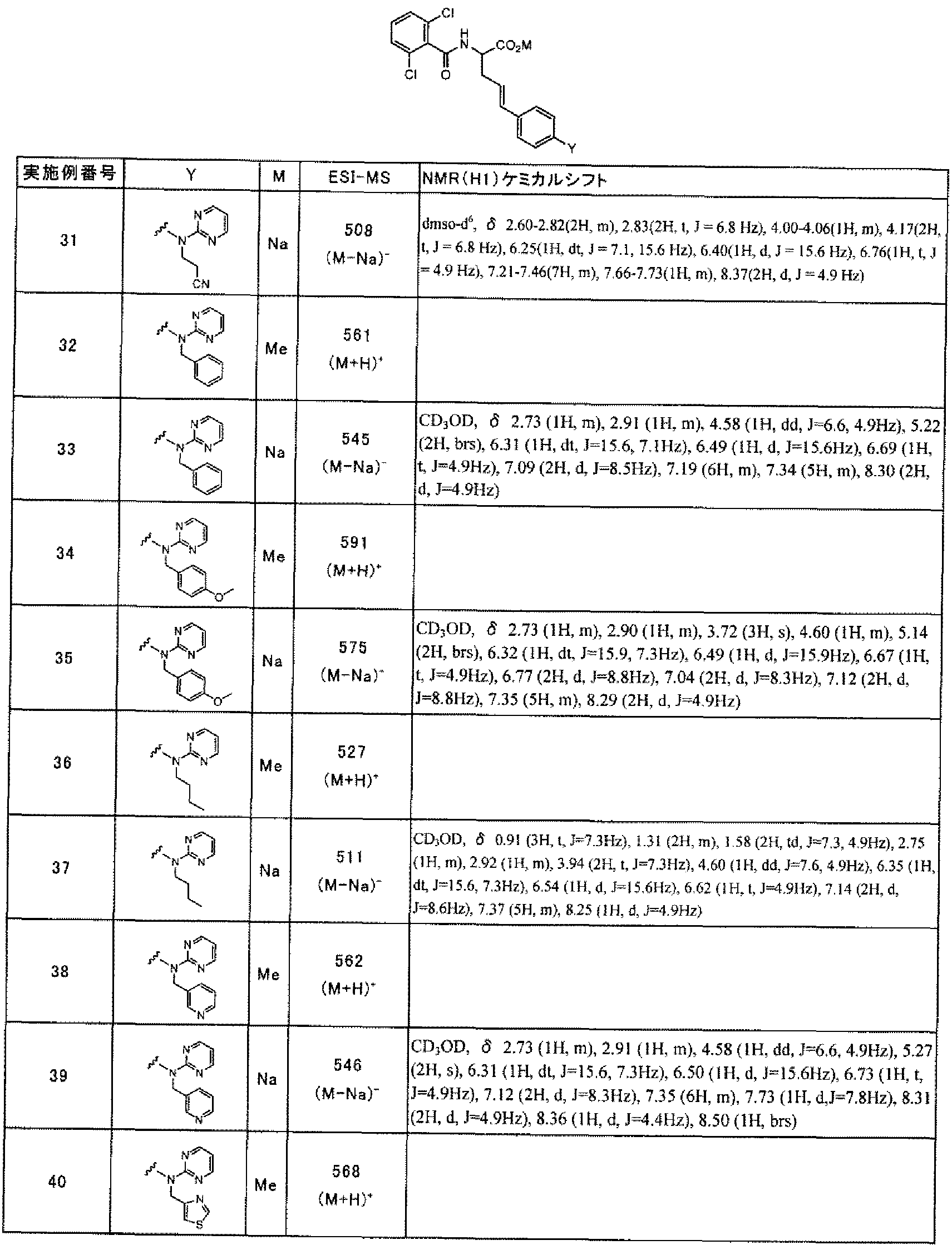
- the active ingredients of the therapeutic or prophylactic agent for multiple sclerosis include compounds contained in the general formula (la) or (lb). Specific examples of the compound represented by the general formula (la) or (lb) are shown in Tables 1 to 5.
- Tables 4 and 5 - u represents a tert- butyl group
- Table 1 Ru described in 3 and 4 - 11 Pr represents a normal propyl group, listed in Table 1
- 3 and 4 Pr represents an isopropyl group.
- the compounds listed in Tables 1 to 5 also include pharmacologically acceptable salts.
- active ingredients of the therapeutic or prophylactic agent for multiple sclerosis include compounds contained in the general formula (Ic) or (Id). Specific examples of the compounds represented by the general formulas (Ic) to (Id) are shown in Table 6 and Table 7.
- Table 7 represents a tert-butyl group, and bonds described in Tables 6 and 7 represent valence bonds.
- the compounds described in Tables 6 and 7 also include pharmacologically acceptable salts.
- the compound represented by the general formula (I) or a pharmaceutically acceptable salt thereof contained as an active ingredient in the agent for treating or preventing multiple sclerosis according to the present invention can be synthesized by the following steps. .
- [0046] is converted into a pharmacologically acceptable salt thereof using a base (an inorganic base such as sodium hydroxide, an organic base such as triethylamine, a basic amino acid such as lysine) or an acid (acetic acid, It can be carried out by a conventional method using an inorganic acid such as acid and sulfuric acid, an organic acid such as acetic acid and maleic acid, an organic sulfonic acid such as p-toluenesulfonic acid, and an acidic amino acid such as aspartic acid.
- a base an inorganic base such as sodium hydroxide, an organic base such as triethylamine, a basic amino acid such as lysine
- an acid acetic acid
- R 16 is alkyl having 1 to 5 carbon atoms, and other symbols are the same as defined above], and the esterified carboxyl group CO R 16 is converted into a carboxyl group.
- a base such as an alkali metal hydroxide such as lithium hydroxide, sodium hydroxide or barium hydroxide
- an acid such as hydrochloric acid
- an acid such as trifluoroacetic acid
- the amount of the base used is usually 0.9 to 100 equivalents, preferably 0.9 to 10.0 equivalents, relative to the compound of formula (VII).
- the amount of the acid used is usually an excess amount of 1.0 equivalent force used as a solvent relative to the compound of formula (VII), preferably 1.0 to 100 equivalents.
- Examples of the solvent include aprotic dipolar solvents such as DMF and DMSO, ether solvents such as jetyl ether, THF, and DME, alcohol solvents such as methanol and ethanol, dichloromethane, chloroform, Among them, DMF, THF, methanol, ethanol, and water are preferably used among those capable of raising a halogen-based solvent such as carbon tetrachloride and 1,2-dichloroethane, water, or a mixed solvent thereof.
- the reaction temperature can range from –30 ° C to 200 ° C. In the case of hydrolysis using a base, ⁇ 20 ° C. to 60 ° C. is preferable, and ⁇ 10 ° C.
- reaction time is appropriately selected according to the reaction temperature and other conditions, but a satisfactory result is usually obtained at about 1 hour at 1 minute force.
- Compound (VII) can be synthesized by the following method (Method A or B) depending on the structure of V in the general formula (I) (V is as defined above).
- Z 1 represents a leaving group such as a halogen atom or a trifluoromethanesulfoxy group, and other symbols are the same as defined above]
- Compound (Vila) is obtained by coupling a compound of formula (Villa) with a compound of formula (IX). It can be synthesized more.
- the coupling reaction is performed in a suitable solvent in the presence of a palladium catalyst and a base, and in the presence or absence of a phosphine ligand.
- the amount of the formula (IX) is 10 equivalents, preferably 1.0 to 1.0 force relative to the compound of the formula (Villa).
- Examples of the palladium catalyst include palladium acetate, tetrakis (triphenylphosphine) palladium, bis (triphenylphosphine) palladium dichloride, palladium (II) chloride, bis (dibenzylideneacetone) palladium, and bis (diphenol- Ruphosphino) phenocene ⁇ radium dichloride and the like.
- palladium acetate, tetrakis (triphenylphosphine) palladium, bis (dibenzylideneacetone) palladium are preferably used.
- the amount of palladium catalyst used is from 0.001 to 1 equivalent, preferably from 0.01 force to 0.2 equivalent, relative to the compound of formula (Villa).
- Examples of the base include potassium carbonate, potassium phosphate, cesium carbonate, sodium hydroxide, potassium hydroxide, sodium tert-butoxide, triethylamine, diisopropylamine, diisopropylethylamine, n-butylamine and the like. Among them, carbonated lithium and potassium phosphate are preferably used.
- the amount of base used is 1 to 10 equivalents, preferably 1 to 4 equivalents, relative to the compound of formula (Villa).
- Examples of the phosphine ligand include triphenylphosphine, tris (2-methylphenol) phosphine, tributylphosphine, triethylphosphine, tri-tertbutylphosphine, 2,2, -bis (diphenylphosphino) -1, 1, -biphenyl, 2- (di-tert-butylphosphino) 1,1,1, binaphthyl, 2- (dicyclohexylphosphino) diphenyl, 9,9 dimethyl-4,5-bis (diphenylphosphino) xanthene Among them, tributylphosphine, tris (2-methylphenol) phosphine, and 9,9dimethyl-4,5-bis (diphenylphosphino) xanthene are preferably used.
- the amount of the phosphine ligand used is 0.001 force to 1 equivalent, preferably 0.01 force to 0.2 equivalent,
- Examples of the solvent include aprotic dipolar solvents such as DMF, DMSO, and NMP, ether solvents such as THF, DME, and dioxane, alcohol solvents such as methanol and ethanol, Examples include halogen solvents such as dichloromethane, chloroform, carbon tetrachloride, and 1,2-dichloroethane, aromatic solvents such as benzene, toluene, and xylene, and water. Among them, DMF, dioxane, and water are preferably used. It is done.
- the reaction temperature may range from 0 ° C to 200 ° C, with 40 ° C to 160 ° C being preferred and 60 ° C to 140 ° C being particularly preferred.
- the reaction time is appropriately selected according to the reaction temperature and other conditions, but satisfactory results are usually obtained in about 30 minutes to 30 hours.
- Method B When V represents -C ⁇ C,
- Compound (Vllb) can be synthesized by a coupling reaction of compound (Vlllb) and (IX).
- the coupling reaction is carried out in a suitable solvent in the presence of a palladium catalyst, a base and a copper catalyst, and in the presence or absence of a phosphine ligand.
- the amount of the formula (IX) is used in an amount of 1.0 to 10 equivalents, preferably 1.0 to 4.0 equivalents, relative to the compound of the formula (Vlllb).
- Examples of the palladium catalyst include palladium acetate, tetrakis (triphenylphosphine) palladium, bis (triphenylphosphine) palladium dichloride, palladium (II) chloride, bis (dibenzylideneacetone) palladium, and bis (diphenyl- Ruphosphino) phenylcene palladium dichloride, and the like.
- tetrakis (triphenylphosphine) palladium and bis (triphenylphosphine) palladium dichloride are preferably used.
- the amount of the palladium catalyst to be used is 1 equivalent to 0.001 force, preferably 0.2 equivalent of 0.005 force, relative to the compound of the formula (Vlllb).
- Examples of the base include potassium carbonate, potassium phosphate, cesium carbonate, sodium hydroxide, potassium hydroxide, sodium-tert-butoxide, jetylamine, triethylamine, diethyl
- examples thereof include isopropylamine, diisopropylethylamine, n-butylamine and the like, and among them, jetylamine, triethylamine, diisopropylamine, and diisopropylethylamine are preferably used.
- the amount of the base used is 1 equivalent to an excess amount used as a solvent, preferably 4 equivalent force excess amount, relative to the compound of the formula (Vlllb).
- Examples of the copper catalyst include copper powder, copper iodide, copper bromide and the like, and preferably copper iodide is used.
- the amount of copper catalyst used is 0.001 force, 0.5 equivalents, preferably 0.01 equivalents to 0.4 equivalents, relative to the compound of formula (vmb).
- phosphine ligands include triphenylphosphine, tris (2-methylphenol) phosphine, tetrakis (triphenyl) phosphine, tributylphosphine, triethylphosphine, tritert-butylphosphine, 2, 2, 1 Bis (diphenylphosphino) 1,1,1,1-biphenyl, 2- (di-tert-butylphosphino) -1,1,1'-binaphthyl, 2- (dicyclohexylphosphino) diphenyl, 9, 9 Dimethyl 4,5 — Bis (diphenylphosphino) xanthene and the like.
- a phosphine ligand is not used, or tris (2-methylphenyl) phosphine or tetrakis (triphenyl) phosphine is used.
- the amount of the phosphine ligand is 0.001 to 0.5 equivalent, preferably 0.005 to 0.4 equivalent, based on the compound of the formula (Vlllb).
- Examples of the solvent include aprotic dipolar solvents such as DMF, DMSO, and NMP, ether solvents such as THF, DME, and dioxane, alcohol solvents such as methanol and ethanol, dichloromethane, black mouth form, and carbon tetrachloride. , Halogen solvents such as 1,2-dichloroethane, aromatic solvents such as benzene, toluene and xylene, organic amine solvents such as jetylamine, triethylamine and diisopropylamine, or water, and mixtures thereof. A solvent can also be used.
- aprotic dipolar solvents such as DMF, DMSO, and NMP
- ether solvents such as THF, DME, and dioxane
- alcohol solvents such as methanol and ethanol, dichloromethane, black mouth form, and carbon tetrachloride.
- Halogen solvents such as 1,2-dichloroethane
- THF triethylamine
- jetylamine diisopropylamine
- triethylamine triethylamine
- the reaction temperature can be in the range of-40 ° C force and 200 ° C. Among them,-20 ° C to 100 ° C is preferred, especially-10 ° C to 60 ° C.
- the reaction time is appropriately selected according to the reaction temperature and other conditions, but satisfactory results are usually obtained in about 1 minute to 30 hours.
- Compounds (Villa) and (Vlllb) can be synthesized by the following method.
- Z 2 represents —CH ⁇ CH or —C ⁇ CH, and other symbols are the same as defined above.
- the compound (Villa) or (Vlllb) can be synthesized by the following method (Method C, Method D or Method E).
- the compound of formula (X), R 16 - OH (R 16 is as defined above) can be synthesized by condensing a.
- the condensation reaction can be carried out in a suitable solvent in the presence of a condensing agent and in the presence or absence of a base.
- the condensing agent include dicyclohexyl carpositimide, BOP reagent, and EDC.
- EDC and BOP reagents are used.
- examples include triethylamine, diisopropylethylamine, pyridine, 4-dimethylaminopyridine, N-methylmorpholine, and preferably triethylamine, 4-dimethylaminopyridine, diisopropylethyl. Ammine is used.
- the amount of R 16 —OH used is 1.0 to 100 equivalents, preferably 1.0 to 4.0 equivalents, relative to the compound of formula (X).
- the amount of the condensing agent to be used is 1.0 to 20 equivalents, preferably 1.0 equivalent to 5.0 equivalents, relative to the compound of formula (X).
- the amount of the base to be used is 1.0 equivalent to 100 equivalents, preferably about 1.0 equivalent to 40 equivalents relative to the compound of the formula (X).
- the solvent examples include aprotic dipolar solvents such as DMF, DMSO, and NMP, ether solvents such as THF, DME, and dioxane, and halogen solvents such as dichloromethane, chloroform, and 1,2-dichloroethane. Is mentioned.
- aprotic dipolar solvents such as DMF, DMSO, and NMP
- ether solvents such as THF, DME, and dioxane
- halogen solvents such as dichloromethane, chloroform, and 1,2-dichloroethane. Is mentioned.
- THF and dichloromethane are used.
- the reaction temperature may range from -40 ° C to 100 ° C, with 0 ° C to 60 ° C being preferred.
- the reaction time is appropriately selected according to the reaction temperature and other conditions, but satisfactory results are usually obtained in about 1 minute to 30 hours.
- a reactive derivative of a compound of formula (X) is prepared in the presence of a base R 16 —OH (R 16 is as defined above). And the like can be synthesized.
- Examples of reactive derivatives of compound (X) include acid halides (such as acid chloride).
- Examples of the base include organic amine bases such as triethylamine, pyridine and diisopropylethylamine, and inorganic bases such as sodium carbonate, potassium carbonate and sodium bicarbonate. Preferably, triethylamine, pyridine and diisopropylethylamine are used.
- the amount of R 16 —OH used is 1.0 to 100 equivalents, preferably 1.0 to 20 equivalents, relative to the compound of formula (X).
- the amount of the base used is 1.0 to 100 equivalents, preferably 1.0 to 40 equivalents, relative to the compound of the formula (X).
- Examples of the solvent include aprotic dipolar solvents such as DMF, DMSO, and NMP; ether solvents such as THF, DME, and dioxane; and halogen solvents such as dichloromethane, chloroform, and 1,2-dichloroethane. And aromatic solvents such as benzene and toluene.
- aprotic dipolar solvents such as DMF, DMSO, and NMP
- ether solvents such as THF, DME, and dioxane
- halogen solvents such as dichloromethane, chloroform, and 1,2-dichloroethane.
- aromatic solvents such as benzene and toluene.
- dichloromethane and THF are used.
- the reaction temperature may range from -10 ° C to 100 ° C, with 0 ° C force of 40 ° C being preferred.
- the reaction time is appropriately selected according to the reaction temperature and other conditions, but a satisfactory result is usually obtained at
- R 16 When R 16 is methyl or ethyl, it can be synthesized by adding the compound of the formula (X) to methanol or a mixed solution of ethanol and chlorothionyl.
- the equivalent amount of methanol or ethanol used is usually an excess amount used as a solvent of 1.0 equivalent force relative to the compound of formula (X), preferably an excess amount of 10 equivalent force used as a solvent.
- an excess amount usually used as a solvent of the formula 1 equivalent force is used.
- the reaction temperature may range from -50 ° C to 60 ° C, with -20 ° C to 40 ° C being preferred.
- the reaction time is appropriately selected according to the reaction temperature and other conditions, but satisfactory results are usually obtained in about 1 minute to 60 hours.
- Compound (X) can be synthesized by the following method.
- the compound of formula (XI) and the compound of formula (XII) can be synthesized by condensing in a suitable solvent in the presence of a base.
- Compounds of formula (XI) and formula (XII) are commonly available raw materials.
- the amount of the compound of the formula (XII) used is 1.0 equivalent to 20 equivalents relative to the compound of the formula (XI), preferably 1.0 equivalent to 1.0 equivalent.
- Examples of the base include organic amine bases such as triethylamine, pyridine and diisopropylethylamine, and inorganic bases such as sodium hydroxide, potassium hydroxide, sodium carbonate, potassium carbonate and sodium hydrogen carbonate. It is done. Preferably, triethylamine, pyridine, disopropylethylamine, sodium hydroxide or potassium hydroxide is used.
- the amount of the base used is 1.0 to 100 equivalents, preferably 1.0 to 50 equivalents, relative to the compound of formula (XI).
- Examples of the solvent include aprotic dipolar solvents such as DMF, DMSO, and NMP, ether solvents such as THF, DME, and dioxane, and halogen solvents such as dichloromethane, chloroform, and 1,2-dichloroethane. Water, and a mixed solvent thereof is also used. Preferably, dichloromethane, THF, dioxane, water, or a mixed solvent selected from these is used.
- the reaction temperature may range from -10 ° C to 100 ° C, with 0 ° C to 40 ° C being preferred.
- the reaction time is appropriately selected according to the reaction temperature and other conditions, but satisfactory results are usually obtained at 1 minute force for about 60 hours.
- the compound of the general formula (IX) can be synthesized by the following methods (Methods F to V) depending on the structure of Y (Y is the same as defined above) in the general formula (IX).
- the compound of formula (XV) can be synthesized by condensing the compound of formula (XIII) and the compound of formula (XIV) in an appropriate solvent in the presence of an acid.
- the acid include acetic acid, trifluoroacetic acid, methanesulfonic acid, p-toluenesulfonic acid, camphorsulfonic acid and the like.
- acetic acid is used.
- the compound of the formula (XIII) is a generally available raw material, and the compound of the formula (XIV) can be synthesized by a publicly available raw material, a known method.
- the amount of the compound of formula (XIV) to be used is 1.0 to 10 equivalents, preferably 1.0 to 4.0 equivalents, relative to the compound of formula (XIII).
- 1.0 equivalent force An excess amount used as a solvent, preferably 1.0 to 20 equivalents is used.
- the solvent examples include ether solvents such as THF, DME, and dioxane, halogen solvents such as dichloromethane and tetrachloride-carbon, aromatic solvents such as benzene, toluene, and xylene, and non-solvents such as DMF and DMSO.
- ether solvents such as THF, DME, and dioxane
- halogen solvents such as dichloromethane and tetrachloride-carbon
- aromatic solvents such as benzene, toluene, and xylene
- non-solvents such as DMF and DMSO.
- Protic dipolar solvents can be mentioned, and DME and dioxane are preferably used.
- the reaction temperature may range from 0 ° C to 160 ° C, with a 40 ° C force of 100 ° C being preferred.
- the reaction time is appropriately selected according to the reaction temperature and other conditions, but satisfactory results are usually obtained in about 1 to
- the compound of the formula (IXa) can be synthesized by adding a base in a suitable solvent to the compound of the formula (XV) and further adding R 4 —Z 1 (the symbols are the same as defined above) and condensing. .
- the amount of R 4 —Z 1 used is 1.0 to 10 equivalents, preferably 4.0 equivalents of 1.0 force, relative to the compound of formula (XV).
- Examples of the base include metal hydrides such as sodium hydride and potassium hydride, inorganic bases such as potassium carbonate, sodium carbonate and cesium carbonate, organic metals such as butyllithium, DBU, diisopropylethylamine, Organic amines such as triethylamine are listed. Good Preferably, sodium hydride is used.
- the amount of the base used is 1.0 to 50 equivalents, preferably 1.0 to 20 equivalents, relative to the compound of formula (XV).
- Solvents include ether solvents such as THF, DME, and dioxane, halogen solvents such as dichloromethane and carbon tetrachloride, aromatic solvents such as benzene, toluene, and xylene, and aprotic bipolar such as DMF and DMSO. Examples of the solvent include DMF or THF.
- the reaction temperature may range from 78 ° C to 160 ° C, with a preferred 20 ° C force of 40 ° C! / ⁇ .
- the reaction time is appropriately selected according to the reaction temperature and other conditions, but satisfactory results are usually obtained in about 15 minutes to 30 hours.
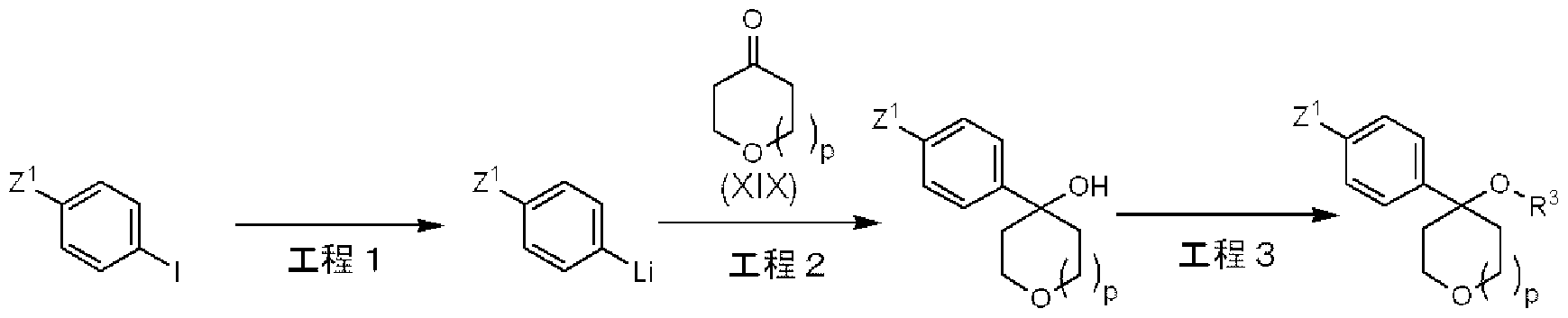
- a compound of the general formula (IX) can be synthesized by the following method.
- the compound of formula (XVI) and the compound of formula (XIV) can be synthesized by condensing in a suitable solvent in the presence of a base.
- the compound of formula (XVI) is a commonly available raw material.
- the amount of the compound of formula (XIV) used is 1.0 to 10 equivalents, preferably 1.0 equivalent of 4.0 equivalents, relative to the compound of formula (XVI).
- Examples of the base include metal hydrides such as sodium hydride and potassium hydride, inorganic bases such as potassium carbonate, sodium carbonate and cesium carbonate, organic metals such as butyl lithium, DBU, diisopropylethylamine, Organic amines such as triethylamine are listed. Good Preferably, potassium carbonate or sodium carbonate is used.
- the amount of base used is 1.0 to 50 equivalents, preferably 1.0 to 20 equivalents, relative to the compound of formula (XVI)
- Solvents include ether solvents such as THF, DME and dioxane, halogen solvents such as dichloromethane and tetrasalt-carbon, aromatic solvents such as benzene, toluene and xylene, and non-solvents such as DMF and DMSO.
- ether solvents such as THF, DME and dioxane
- halogen solvents such as dichloromethane and tetrasalt-carbon
- aromatic solvents such as benzene, toluene and xylene
- non-solvents such as DMF and DMSO.
- a protic dipolar solvent may be mentioned, and DMF is preferably used.
- the reaction temperature may range from 0 ° C to 200 ° C, with 20 ° C to 140 ° C being preferred.
- the reaction time is appropriately selected according to the reaction temperature and other conditions, but satisfactory results are usually obtained in about 30 minutes to 30 hours.
- Y is the following general formula (Ilia)
- a compound of the general formula (IX) can be synthesized by the following method.
- the compound of formula (XVII) is a commonly available raw material.
- Lithioi examples of the agent include lithium, n-butyllithium, sec-butyllithium, tert-butyllithium and the like. Preferably, n-butyllithium is used.
- the amount of the lithiating agent to be used is 1.0 equivalent to 4.0 equivalents, preferably 1.0 equivalent to 2.2 equivalents relative to the compound of formula (XVII).
- the compound of formula (XIX) is a commonly available raw material.
- the amount of the compound (XIX) used is 1.0 equivalent to 10 equivalents, preferably 1.0 equivalent to 4.0 equivalents, relative to formula (XVII).
- the solvent examples include ether solvents such as ether, dioxane and THF, and preferably THF is used.
- the reaction temperature may be in the range of ⁇ 100 ° C. force and 0 ° C.
- the 78 ° C. force is preferably 0 ° C.
- Step 2 a range of 1100 ° C force and 40 ° C can be considered, and -78 ° C force is preferably 40 ° C.
- the reaction time is appropriately selected according to the reaction temperature and other conditions, but usually 5 minutes to 2 hours is appropriate for Step 1, and satisfactory results are obtained for Step 2 from 5 minutes to 24 hours.
- the compound of the formula (IXc) can be synthesized by adding a base in a suitable solvent to the compound of the formula (XX) and subsequently adding —Z 1 (the symbol is the same as defined above) and condensing.
- the compound of R 3 —Z 1 is a generally available raw material.
- R 3 is used - The amount of Z 1, relative to the compound of formula (XX), 1.0 Kakara 20 equivalents, preferably used 4.0 equivalents of 1.0.
- Examples of the base include metal hydrides such as sodium hydride and potassium hydride, inorganic bases such as potassium carbonate, sodium carbonate and cesium carbonate, organic metals such as butyllithium, DBU, diisopropylethylamine, Organic amines such as triethylamine are listed.
- metal hydrides such as sodium hydride and potassium hydride
- inorganic bases such as potassium carbonate, sodium carbonate and cesium carbonate
- organic metals such as butyllithium, DBU, diisopropylethylamine, Organic amines such as triethylamine are listed.
- sodium hydride is used.
- the amount of base used is 1.0 force or 50 equivalents, preferably 1.0 force or 20 equivalents, relative to the compound of formula (XX).
- Solvents include ether solvents such as THF, DME, and dioxane, halogen solvents such as dichloromethane and tetrachloride-carbon, aromatic solvents such as benzene, toluene, and xylene, and non-solvents such as DMF and DMSO.
- ether solvents such as THF, DME, and dioxane
- halogen solvents such as dichloromethane and tetrachloride-carbon
- aromatic solvents such as benzene, toluene, and xylene
- non-solvents such as DMF and DMSO.
- Protic dipolar solvents can be mentioned, and preferably DMF or THF is used.
- the reaction temperature may range from -78 ° C to 100 ° C, with -20 ° C to 40 ° C being preferred.
- the reaction time is appropriately selected according to the reaction temperature and other conditions, but satisfactory results are usually obtained in about 15 minutes to 30 hours.
- the post-treatment and purification of each step in the synthesis of the compound represented by the general formula (I) or a pharmacologically acceptable salt thereof can be carried out by usual methods. That is, methods such as liquid separation extraction and filtration can be used for post-treatment, and methods such as column chromatography, thin layer chromatography, recrystallization, reprecipitation, and distillation can be used for purification.
- the therapeutic or prophylactic agent for multiple sclerosis of the present invention comprises a glycine structure substituted with an aryl group or a pronorgyl group, a partial structure represented by the general formula (II) or (III), and a general formula (I ), which has a 2,6-disubstituted benzoyl structure and has multiple oral cures due to its excellent oral absorption and in vivo stability compared to the compounds disclosed in WO99Z26923 described in the background art. The therapeutic or preventive effect of the disease is shown.
- the oral absorbability and in-vivo stability of the therapeutic or prophylactic agent of the present invention can be confirmed by using the bioavailability (BA) and clearance of the compound administered to an animal as indicators. Not limited.
- the therapeutic or prophylactic agent of the present invention exhibits an excellent effect on multiple sclerosis.
- Experimental autoimmunity of mice described in the literature "Int. Immunol., 9, 1243-1251 (1997)".
- the effect of suppressing an increase in the neurological symptom symptom score can be evaluated using an encephalomyelitis (EAE) model.
- EAE encephalomyelitis
- Experimental autoimmune encephalomyelitis is an animal model in which neurological disorders such as hindlimb paralysis due to demyelination of the central nervous system are induced by immunizing experimental animals with myelin basic protein or a partial peptide thereof. It is widely used for studying the efficacy of multiple sclerosis therapeutics or preventives because of its similarities to human symptoms and pathological findings. However, the evaluation method is not limited to this.
- the therapeutic or prophylactic agent of the present invention suppresses neuropathy such as hindlimb paralysis induced by myelin basic protein or a partial peptide thereof, and thus multiple sclerosis, specifically, rapid multiple sclerosis. It can be used to improve generalized multiple sclerosis, brain stem multiple sclerosis, spinal cord multiple sclerosis, asymptomatic multiple sclerosis, etc.
- the causative agents of multiple sclerosis include, for example, proteolipid protein (PLP); myelin oligodendrocyte glycoprotein (MOG); myelin basic protein (MBP); myelin-associated glycoprotein (MAG), Myelin-associated oligodendrocyte basic protein (MBOP); Citrulline mono-modified MBP (C8 isoform of MBP decitrated from 6 arginines), cyclic nucleotide Examples include myelin proteins such as phosphodiesterase (CNPase) and alpha 1 B crystallin. Infection with measles virus, simple herpes virus, EB virus, retrovirus, human herpes virus 6 and the like can also be a cause.
- the therapeutic or prophylactic agent of the present invention suppresses nerve paralysis caused by demyelination of the central nervous system, acute disseminated encephalomyelitis, a primary demyelinating disease similar to multiple sclerosis, adrenal white matter It can be used for dystrophy, adrenal spinal neuropathy, tropical spastic paralysis, and Leber hereditary optic neuropathy.
- the therapeutic or preventive agent of the present invention is a sensation (for example, numbness, pain), visual acuity (for example, double vision, partial blindness, loss of central vision, dizziness) which is a symptom associated with multiple sclerosis.
- sensation for example, numbness, pain
- visual acuity for example, double vision, partial blindness, loss of central vision, dizziness
- Motor weakness, painful tonic convulsions, stiffness, tremors
- abnormalities of nerves e.g. uplifting, depression, mental disorders
- poor coordination e.g. loss of balance, obscure language
- the effect of the therapeutic or prophylactic agent of the present invention on multiple sclerosis is suppression of leukocyte function (for example, cell adhesion and proliferation) and production of inflammatory mediators (for example, cytokines and chemical mediators) from leukocytes. This can be explained by an inhibitory action.
- leukocyte function for example, cell adhesion and proliferation
- inflammatory mediators for example, cytokines and chemical mediators
- white blood cells peripheral blood-derived neutrophils, monocytes, lymphocytes, or established cell lines thereof are used.
- leukocyte function and inflammatory mediator for example, the method described in Current Protocols in Immnology Qohn Wiley & Sonsjnc) is used, but is not limited thereto.
- the therapeutic or prophylactic agent for multiple sclerosis of the present invention is used as a pharmaceutical for mammals (for example, mouse, rat, mouse, muster, usagi, inu, monkey, ushi, hidge, human, etc.). Can do.
- mammals for example, mouse, rat, mouse, muster, usagi, inu, monkey, ushi, hidge, human, etc..
- the drug when used clinically, may be a free form or a salt thereof, or an excipient, stabilizer, preservative, buffer, solubilizer, emulsifier, diluent, isotonic agent. Such additives may be appropriately mixed.
- the drug can be produced by an ordinary method using these drug carriers as appropriate.
- the dosage forms include tablets, capsules, condyles, powders, syrups and other oral preparations, inhalants, injections, suppositories, liquids, etc. Oral administration or topical administration by ointment, cream, patch etc. can be mentioned. It is also understood to include known sustained-release preparations.
- the therapeutic or prophylactic agent for multiple sclerosis of the present invention preferably contains 0.001 to 90% by weight, preferably 0.01 to 70% by weight of the above active ingredient.
- the dose is appropriately selected according to symptoms, age, body weight, sex, administration method, etc., but in the case of injections for adults, the amount of active ingredient is 1 to 0.01 mg to 25 g, preferably 0.1 mg to : LOg, In the case of oral preparation, 0.1 lm g to 50 g, preferably 1 mg to 20 g can be used.
- the administration period and interval of the therapeutic or prophylactic agent of the present invention are changed according to various situations, but can be used by methods such as divided administration, daily administration, intermittent administration, short-term large-scale administration, repeated administration and the like.
- divided administration daily administration, intermittent administration, short-term large-scale administration, repeated administration and the like.
- oral administration it is desirable to divide once or several times a day (especially 2 to 3 times a day). It is also possible to infuse intravenously over a long period of time.
- the pharmacologically acceptable carriers or diluents include, for example, binders (syrup, gelatin, gum arabic, sorbitol, polybulur chloride, tragacanth, etc.), excipients (sugar, lactose, corn starch, calcium phosphate, etc. Sorbitol, glycine, etc.), lubricants (magnesium stearate, polyethylene glycol, talc, silica, etc.).
- the therapeutic or preventive agent for multiple sclerosis according to the present invention is the compound used in the present invention alone, or for the treatment or prevention of a disease, for the reduction or suppression of symptoms, or the prophylactic or therapeutic effect. It can be used in combination with or combined with other drugs in order to supplement or enhance the dose and reduce the dose.
- Examples of drugs that can be used in combination in the treatment or prevention of multiple sclerosis include adrenal cortical steroids (prednisolone, methylprednisolone, etc.), immunosuppressants (methotrexate, azathioprine, cyclophosphamide, cyclosporin-8, Tacrolimus, mizoribine, refnorenamide, etc.), interferon preparations (interferon a , interferon ⁇ , etc.), copolymer I, immunoglobulin, mitoxantrone, glatiramer acetate, T cell receptor vaccine, adhesion molecule inhibitor, analgesic (indomethacin, diclofenac) Etc.), muscle relaxants (tizagin, eperisone, afroqualone, noclofen, diazepam, dantrolene sodium, etc.), anticonvulsants (carbamazepine, feintoin, clonazepam,
- NMP N-methinolepyrrolidone
- EDC 1-ethyl 3- (3 dimethylaminopropyl) carbodiimide nodular chloride
- n-butyllithium (2.59 M hexane solution) (8.76 ml) was added dropwise to a solution of 1,4-jodobenzene (7.49 g) in anhydrous THF (50 ml) at -78 ° C, The mixture was stirred at 78 ° C for 30 minutes. Tetrahydro-4H pyran-4-one (2.09 ml) was added dropwise, and the mixture was stirred at 78 ° C. for 1.5 hours. After stirring for another 3 hours at room temperature, water is added and ethyl acetate is added. Extracted with The organic layer was washed once with water and saturated brine, and dried over anhydrous sodium sulfate. After anhydrous sodium sulfate was filtered off, the filtrate was concentrated. The residue was recrystallized from a mixed solvent of cyclohexane Z and ethyl acetate.
- an anhydrous DMF (200 ml) suspension of sodium hydride (1.08 g) was added to an anhydrous DMF (50 ml) of N- (4-deodorized) pyrimidine-2-amamine (8.OOg).
- the solution was added dropwise and stirred at room temperature for 80 minutes.
- 2-yodopropane (4.03 ml) was added, and the mixture was stirred at room temperature for 2 hours.
- sodium hydride (1.08 g) was added, and 2-chloropropane (4.03 ml) was added dropwise, followed by stirring at room temperature for 6 hours.
- N- (4 bromophenol) pyrimidine-2-amamine 75 mg was added to a suspension of sodium hydride (16 mg) in anhydrous DMF (3 ml), and the mixture was stirred at room temperature for 30 minutes.
- the reaction mixture was cooled to 0 ° C., 4-methoxybenzyl chloride (0.045 ml) was added, and the mixture was stirred at room temperature for 1 hr.
- Saturated brine was added to the reaction mixture, and the mixture was extracted 3 times with ethyl acetate. The organic layer was washed 3 times with water and once with saturated brine, and dried over anhydrous sodium sulfate.
- N- (4-bromophenol) pyrimidine 2-amine 160 mg was added to a suspension of sodium hydride (33 mg) in anhydrous DMF (3 ml), and the mixture was stirred at room temperature for 30 minutes.
- the reaction solution was cooled to 0 ° C., n-butyl iodide (0.080 ml) was added, and the mixture was stirred at room temperature for 1 hour.
- Saturated brine was added to the reaction mixture, and the mixture was extracted 3 times with ethyl acetate. The organic layer was washed 3 times with water and once with saturated brine, and dried over anhydrous sodium sulfate.
- N- (4 bromophenol) pyrimidine-2-amamine 200 mg was added to a suspension of sodium hydride (48 mg) in anhydrous DMF (8 ml), and the mixture was stirred at room temperature for 30 minutes.
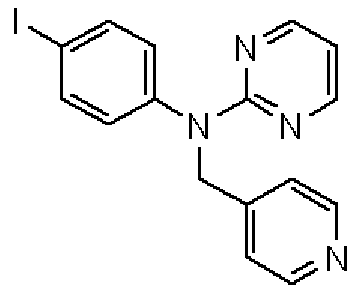
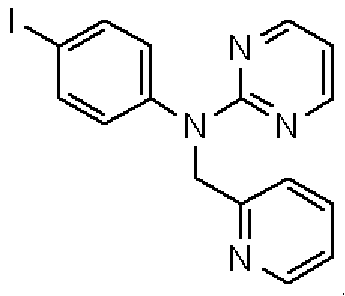
- the reaction solution was cooled to 0 ° C., 3 chloromethylpyridine hydrochloride (600 mg) and triethylamine (1.OOml) were added, and the mixture was stirred at room temperature for 2 hours.
- Saturated brine was added to the reaction mixture, and the mixture was extracted 3 times with ethyl acetate. The organic layer was washed 3 times with water and once with saturated brine, and dried over anhydrous sodium sulfate.
- N- (4 bromophenol) pyrimidine-2-amamine 200 mg was added to a suspension of sodium hydride (48 mg) in anhydrous DMF (8 ml), and the mixture was stirred at room temperature for 30 minutes.
- the reaction mixture was cooled to 0 ° C., thiazoylmethyl chloride hydrochloride (816 mg) and triethylamine (1.OOml) were added, and the mixture was stirred at room temperature for 2 hours.
- Saturated brine was added to the reaction mixture, and the mixture was extracted 3 times with ethyl acetate. The organic layer was washed 3 times with water and once with saturated brine, and dried over anhydrous sodium sulfate.
- N— (4 bromophenol) pyrimidine 2-amamine (250 mg), copper iodide (1.9 mg), trans-1,2-cyclohexanediamine (0.0) in a pressure-resistant test tube in an argon atmosphere. 15 ml) and sodium tert-butoxide (144 mg) in dioxane (1 ml) were stirred at 110 ° C. for 22 hours. The reaction solution was filtered and the filtrate was concentrated. The residue was purified by thin-layer chromatography (silica gel developing solvent: black mouth form Z ethyl acetate 5 Zl) to obtain N- (4 bromophenol) N-phenol birimidine-12 ammine (56 mg).
- Trifluoromethanesulfonic acid 4 [Pyrimidine 1-2-yl (tetrahydropyran-4-yl) ) Amino] Fuel ester
- N-phenolbis (trifluoromethanesulfonimide) (514 mg) was added to a THF (15 ml) suspension of the obtained residue and potassium carbonate (498 mg), and the mixture was stirred at room temperature for 5 hours. Saturated brine was added to the reaction mixture, and the mixture was extracted 3 times with ethyl acetate. The organic layer was dried over anhydrous sodium sulfate. After anhydrous sodium sulfate was filtered off, the filtrate was concentrated.
- Pentho 4 Methyl
Landscapes
- Chemical & Material Sciences (AREA)
- Organic Chemistry (AREA)
- Health & Medical Sciences (AREA)
- General Health & Medical Sciences (AREA)
- Veterinary Medicine (AREA)
- Public Health (AREA)
- Medicinal Chemistry (AREA)
- Animal Behavior & Ethology (AREA)
- Pharmacology & Pharmacy (AREA)
- Life Sciences & Earth Sciences (AREA)
- Epidemiology (AREA)
- Bioinformatics & Cheminformatics (AREA)
- Engineering & Computer Science (AREA)
- General Chemical & Material Sciences (AREA)
- Nuclear Medicine, Radiotherapy & Molecular Imaging (AREA)
- Chemical Kinetics & Catalysis (AREA)
- Neurology (AREA)
- Immunology (AREA)
- Biomedical Technology (AREA)
- Neurosurgery (AREA)
- Hospice & Palliative Care (AREA)
- Psychiatry (AREA)
- Transplantation (AREA)
- Orthopedic Medicine & Surgery (AREA)
- Physical Education & Sports Medicine (AREA)
- Pharmaceuticals Containing Other Organic And Inorganic Compounds (AREA)
- Pyrane Compounds (AREA)
- Plural Heterocyclic Compounds (AREA)
- Medicines Containing Material From Animals Or Micro-Organisms (AREA)
Abstract
Description










Claims


Priority Applications (9)
| Application Number | Priority Date | Filing Date | Title |
|---|---|---|---|
| CA2655573A CA2655573C (en) | 2006-06-19 | 2007-06-18 | Therapeutic or prophylactic agent for multiple sclerosis |
| US12/305,078 US7879837B2 (en) | 2006-06-19 | 2007-06-18 | Therapeutic or prophylactic agent for multiple sclerosis |
| EP07745470A EP2039687B1 (en) | 2006-06-19 | 2007-06-18 | Therapeutic or prophylactic agent for multiple sclerosis |
| AT07745470T ATE556061T1 (de) | 2006-06-19 | 2007-06-18 | Therapeutisches oder prophylaktisches mittel gegen multiple sklerose |
| CN2007800226735A CN101472900B (zh) | 2006-06-19 | 2007-06-18 | 多发性硬化症的治疗或预防药 |
| JP2008522446A JP5228911B2 (ja) | 2006-06-19 | 2007-06-18 | 多発性硬化症の治療又は予防剤 |
| KR1020097000892A KR101423347B1 (ko) | 2006-06-19 | 2007-06-18 | 다발성 경화증의 치료 또는 예방제 |
| ES07745470T ES2384400T3 (es) | 2006-06-19 | 2007-06-18 | Agente terapéutico o profiláctico para la esclerosis múltiple |
| AU2007262147A AU2007262147B2 (en) | 2006-06-19 | 2007-06-18 | Therapeutic or prophylactic agent for multiple sclerosis |
Applications Claiming Priority (2)
| Application Number | Priority Date | Filing Date | Title |
|---|---|---|---|
| JP2006168387 | 2006-06-19 | ||
| JP2006-168387 | 2006-06-19 |
Publications (1)
| Publication Number | Publication Date |
|---|---|
| WO2007148648A1 true WO2007148648A1 (ja) | 2007-12-27 |
Family
ID=38833390
Family Applications (1)
| Application Number | Title | Priority Date | Filing Date |
|---|---|---|---|
| PCT/JP2007/062220 Ceased WO2007148648A1 (ja) | 2006-06-19 | 2007-06-18 | 多発性硬化症の治療又は予防剤 |
Country Status (10)
| Country | Link |
|---|---|
| US (1) | US7879837B2 (ja) |
| EP (1) | EP2039687B1 (ja) |
| JP (1) | JP5228911B2 (ja) |
| KR (1) | KR101423347B1 (ja) |
| CN (1) | CN101472900B (ja) |
| AT (1) | ATE556061T1 (ja) |
| AU (1) | AU2007262147B2 (ja) |
| CA (1) | CA2655573C (ja) |
| ES (1) | ES2384400T3 (ja) |
| WO (1) | WO2007148648A1 (ja) |
Cited By (2)
| Publication number | Priority date | Publication date | Assignee | Title |
|---|---|---|---|---|
| WO2013002364A1 (ja) | 2011-06-30 | 2013-01-03 | 東レ株式会社 | グリシン誘導体の結晶及びその医薬用途 |
| WO2014051056A1 (ja) * | 2012-09-28 | 2014-04-03 | 東レ株式会社 | グリシン誘導体の結晶及びその医薬用途 |
Families Citing this family (22)
| Publication number | Priority date | Publication date | Assignee | Title |
|---|---|---|---|---|
| AR059898A1 (es) | 2006-03-15 | 2008-05-07 | Janssen Pharmaceutica Nv | Derivados de 3-ciano-piridona 1,4-disustituida y su uso como moduladores alostericos de los receptores mglur2 |
| TW200900065A (en) | 2007-03-07 | 2009-01-01 | Janssen Pharmaceutica Nv | 3-cyano-4-(4-pyridinyloxy-phenyl)-pyridin-2-one derivatives |
| TW200845978A (en) | 2007-03-07 | 2008-12-01 | Janssen Pharmaceutica Nv | 3-cyano-4-(4-tetrahydropyran-phenyl)-pyridin-2-one derivatives |
| CN101801930B (zh) | 2007-09-14 | 2013-01-30 | 奥梅-杨森制药有限公司 | 1,3-二取代的-4-苯基-1h-吡啶-2-酮 |
| PL2200985T3 (pl) | 2007-09-14 | 2011-12-30 | Ortho Mcneil Janssen Pharmaceuticals Inc | 1,3-Dipodstawione-4-(arylo-X-fenylo)-1H-pirydyn-2-ony |
| SI2203439T1 (sl) | 2007-09-14 | 2011-05-31 | Ortho Mcneil Janssen Pharm | 1',3'-disubstituirani 4-fenil-3,4,5,6-tetrahidro-2H-1'H-(1,4')bipiridinil-2'-oni |
| CN101861316B (zh) | 2007-11-14 | 2013-08-21 | 奥梅-杨森制药有限公司 | 咪唑并[1,2-a]吡啶衍生物及其作为MGLUR2受体的正变构调节剂的用途 |
| EP2344470B1 (en) | 2008-09-02 | 2013-11-06 | Janssen Pharmaceuticals, Inc. | 3-azabicyclo[3.1.0]hexyl derivatives as modulators of metabotropic glutamate receptors |
| WO2010043396A1 (en) | 2008-10-16 | 2010-04-22 | Ortho-Mcneil-Janssen Pharmaceuticals, Inc. | Indole and benzomorpholine derivatives as modulators of metabotropic glutamate receptors |
| JP5690277B2 (ja) | 2008-11-28 | 2015-03-25 | ジャンセン ファーマシューティカルズ, インコーポレイテッド. | 代謝型グルタミン酸受容体の調節因子としてのインドールおよびベンゾオキサジン誘導体 |
| MY153913A (en) | 2009-05-12 | 2015-04-15 | Janssen Pharmaceuticals Inc | 7-aryl-1,2,4-triazolo[4,3-a]pyridine derivatives and their use as positive allosteric modulators of mglur2 receptors |
| CN102439008B (zh) | 2009-05-12 | 2015-04-29 | 杨森制药有限公司 | 1,2,4-三唑并[4,3-a]吡啶衍生物及其用于治疗或预防神经和精神病症的用途 |
| BRPI1010831A2 (pt) | 2009-05-12 | 2016-04-05 | Addex Pharmaceuticals Sa | derivados de 1,2,4-triazolo[4,3-a]piridina e seu como moduladores alostéricos positivos de receptores de mglur2 |
| US9271967B2 (en) | 2010-11-08 | 2016-03-01 | Janssen Pharmaceuticals, Inc. | 1,2,4-triazolo[4,3-a]pyridine derivatives and their use as positive allosteric modulators of mGluR2 receptors |
| AU2011328203B2 (en) | 2010-11-08 | 2015-03-19 | Janssen Pharmaceuticals, Inc. | 1,2,4-triazolo[4,3-a]pyridine derivatives and their use as positive allosteric modulators of mGluR2 receptors |
| ES2536433T3 (es) | 2010-11-08 | 2015-05-25 | Janssen Pharmaceuticals, Inc. | Derivados de 1,2,4-triazolo[4,3-a]piridina y su uso como moduladores alostéricos positivos de receptores mGluR2 |
| FR2981071B1 (fr) * | 2011-10-10 | 2014-02-07 | Centre Nat Rech Scient | Synthese versatile et stereospecifique d'acides amines gamma,delta-insatures par la reaction de wittig |
| JO3368B1 (ar) | 2013-06-04 | 2019-03-13 | Janssen Pharmaceutica Nv | مركبات 6، 7- ثاني هيدرو بيرازولو [5،1-a] بيرازين- 4 (5 يد)- اون واستخدامها بصفة منظمات تفارغية سلبية لمستقبلات ميجلور 2 |
| JO3367B1 (ar) | 2013-09-06 | 2019-03-13 | Janssen Pharmaceutica Nv | مركبات 2،1، 4- ثلاثي زولو [3،4-a] بيريدين واستخدامها بصفة منظمات تفارغية موجبة لمستقبلات ميجلور 2 |
| ME03518B (me) | 2014-01-21 | 2020-04-20 | Janssen Pharmaceutica Nv | Kombinacije koje obuhvataju pozitivne alosterične modulatore ili ortosterične agoniste metabotropnog glutamatergičnog receptora podtipa 2 i njihova primjena |
| MX386697B (es) | 2014-01-21 | 2025-03-19 | Janssen Pharmaceutica Nv | Combinaciones que comprenden agonistas ortostericos o moduladores alostericos positivos del receptor glutamatergico metabotropico de subtipo 2 y su uso |
| WO2024073067A2 (en) * | 2022-09-30 | 2024-04-04 | Mayo Foundation For Medical Education And Research | Assessing and treating tremor |
Citations (7)
| Publication number | Priority date | Publication date | Assignee | Title |
|---|---|---|---|---|
| WO1994012181A1 (en) | 1992-12-01 | 1994-06-09 | Merck & Co., Inc. | Fibrinogen receptor antagonists |
| WO1995032710A1 (en) | 1994-05-27 | 1995-12-07 | Merck & Co., Inc. | Compounds for inhibiting osteoclast-mediated bone resorption |
| WO1999026923A1 (en) | 1997-11-20 | 1999-06-03 | Merck & Co., Inc. | Para-aminomethylaryl carboxamide derivatives |
| WO2002016329A1 (en) * | 2000-08-18 | 2002-02-28 | Ajinomoto Co., Inc. | Novel phenylalanine derivatives |
| JP2003516396A (ja) * | 1999-12-06 | 2003-05-13 | エフ.ホフマン−ラ ロシュ アーゲー | 4−ピリミジニル−n−アシル−l−フェニルアラニン |
| WO2003053926A1 (en) * | 2001-12-13 | 2003-07-03 | Ajinomoto Co.,Inc. | Novel phenylalanine derivative |
| WO2006068213A1 (ja) | 2004-12-24 | 2006-06-29 | Toray Industries, Inc. | グリシン誘導体及びその用途 |
Family Cites Families (1)
| Publication number | Priority date | Publication date | Assignee | Title |
|---|---|---|---|---|
| US5235910A (en) | 1992-07-07 | 1993-08-17 | A. B. Dick Company | Blanket cylinder impression throw-off |
-
2007
- 2007-06-18 EP EP07745470A patent/EP2039687B1/en not_active Not-in-force
- 2007-06-18 KR KR1020097000892A patent/KR101423347B1/ko not_active Expired - Fee Related
- 2007-06-18 ES ES07745470T patent/ES2384400T3/es active Active
- 2007-06-18 AU AU2007262147A patent/AU2007262147B2/en not_active Ceased
- 2007-06-18 US US12/305,078 patent/US7879837B2/en not_active Expired - Fee Related
- 2007-06-18 WO PCT/JP2007/062220 patent/WO2007148648A1/ja not_active Ceased
- 2007-06-18 AT AT07745470T patent/ATE556061T1/de active
- 2007-06-18 CN CN2007800226735A patent/CN101472900B/zh not_active Expired - Fee Related
- 2007-06-18 JP JP2008522446A patent/JP5228911B2/ja active Active
- 2007-06-18 CA CA2655573A patent/CA2655573C/en not_active Expired - Fee Related
Patent Citations (7)
| Publication number | Priority date | Publication date | Assignee | Title |
|---|---|---|---|---|
| WO1994012181A1 (en) | 1992-12-01 | 1994-06-09 | Merck & Co., Inc. | Fibrinogen receptor antagonists |
| WO1995032710A1 (en) | 1994-05-27 | 1995-12-07 | Merck & Co., Inc. | Compounds for inhibiting osteoclast-mediated bone resorption |
| WO1999026923A1 (en) | 1997-11-20 | 1999-06-03 | Merck & Co., Inc. | Para-aminomethylaryl carboxamide derivatives |
| JP2003516396A (ja) * | 1999-12-06 | 2003-05-13 | エフ.ホフマン−ラ ロシュ アーゲー | 4−ピリミジニル−n−アシル−l−フェニルアラニン |
| WO2002016329A1 (en) * | 2000-08-18 | 2002-02-28 | Ajinomoto Co., Inc. | Novel phenylalanine derivatives |
| WO2003053926A1 (en) * | 2001-12-13 | 2003-07-03 | Ajinomoto Co.,Inc. | Novel phenylalanine derivative |
| WO2006068213A1 (ja) | 2004-12-24 | 2006-06-29 | Toray Industries, Inc. | グリシン誘導体及びその用途 |
Non-Patent Citations (5)
| Title |
|---|
| "Current Protocols in Immunology", JOHN WILEY & SONS, INC |
| "Current Protocols in Immunology", JOHN WILEY & SONS,INC |
| IMMUNOL. REV., vol. 100, 1987, pages 307 - 332 |
| INT. IMMUNOL., vol. 9, 1997, pages 1243 - 1251 |
| PROC. SOC. EXP. BIOL. MED., vol. 175, 1984, pages 282 - 294 |
Cited By (4)
| Publication number | Priority date | Publication date | Assignee | Title |
|---|---|---|---|---|
| WO2013002364A1 (ja) | 2011-06-30 | 2013-01-03 | 東レ株式会社 | グリシン誘導体の結晶及びその医薬用途 |
| JPWO2013002364A1 (ja) * | 2011-06-30 | 2015-02-23 | 東レ株式会社 | グリシン誘導体の結晶及びその医薬用途 |
| US9006434B2 (en) | 2011-06-30 | 2015-04-14 | Toray Industries, Inc. | Crystals of glycine derivative and pharmaceutical use thereof |
| WO2014051056A1 (ja) * | 2012-09-28 | 2014-04-03 | 東レ株式会社 | グリシン誘導体の結晶及びその医薬用途 |
Also Published As
| Publication number | Publication date |
|---|---|
| ES2384400T3 (es) | 2012-07-04 |
| EP2039687B1 (en) | 2012-05-02 |
| CA2655573A1 (en) | 2007-12-27 |
| EP2039687A4 (en) | 2010-09-08 |
| AU2007262147B2 (en) | 2012-08-16 |
| KR101423347B1 (ko) | 2014-07-24 |
| EP2039687A1 (en) | 2009-03-25 |
| JP5228911B2 (ja) | 2013-07-03 |
| US7879837B2 (en) | 2011-02-01 |
| CA2655573C (en) | 2014-04-29 |
| KR20090031422A (ko) | 2009-03-25 |
| JPWO2007148648A1 (ja) | 2009-11-19 |
| CN101472900A (zh) | 2009-07-01 |
| CN101472900B (zh) | 2011-07-27 |
| US20090275599A1 (en) | 2009-11-05 |
| AU2007262147A1 (en) | 2007-12-27 |
| ATE556061T1 (de) | 2012-05-15 |
Similar Documents
| Publication | Publication Date | Title |
|---|---|---|
| WO2007148648A1 (ja) | 多発性硬化症の治療又は予防剤 | |
| EP1040103B1 (en) | Anilide derivative, production and use thereof | |
| EP2888239B1 (en) | Reduced central corneal thickening by use of hydrophilic ester prodrugs of beta-chlorocyclopentanes | |
| MXPA05000718A (es) | Derivados de azuleno y sal del mismo. | |
| KR101250889B1 (ko) | 글리신 유도체 및 그 용도 | |
| WO2007148676A1 (ja) | 白血病の治療又は予防剤 | |
| WO2007145282A1 (ja) | アレルギー性皮膚炎の治療又は予防剤 | |
| US9090595B2 (en) | Reduced central corneal thickening by use of hydrophilic ester prodrugs of beta-chlorocyclopentanes | |
| JP4664634B2 (ja) | 新規なベンズアミジン誘導体またはその塩 | |
| JPH11292854A (ja) | 新規なピリミジン誘導体 |
Legal Events
| Date | Code | Title | Description |
|---|---|---|---|
| WWE | Wipo information: entry into national phase |
Ref document number: 200780022673.5 Country of ref document: CN |
|
| 121 | Ep: the epo has been informed by wipo that ep was designated in this application |
Ref document number: 07745470 Country of ref document: EP Kind code of ref document: A1 |
|
| WWE | Wipo information: entry into national phase |
Ref document number: 2008522446 Country of ref document: JP |
|
| WWE | Wipo information: entry into national phase |
Ref document number: 2655573 Country of ref document: CA |
|
| WWE | Wipo information: entry into national phase |
Ref document number: 12305078 Country of ref document: US |
|
| NENP | Non-entry into the national phase |
Ref country code: DE |
|
| WWE | Wipo information: entry into national phase |
Ref document number: 2007262147 Country of ref document: AU |
|
| WWE | Wipo information: entry into national phase |
Ref document number: 2007745470 Country of ref document: EP |
|
| WWE | Wipo information: entry into national phase |
Ref document number: 1020097000892 Country of ref document: KR |
|
| WWE | Wipo information: entry into national phase |
Ref document number: 241/KOLNP/2009 Country of ref document: IN |
|
| ENP | Entry into the national phase |
Ref document number: 2007262147 Country of ref document: AU Date of ref document: 20070618 Kind code of ref document: A |