WO2007105657A1 - クロスカップリング反応を用いたオリゴマー化合物の合成方法 - Google Patents
クロスカップリング反応を用いたオリゴマー化合物の合成方法 Download PDFInfo
- Publication number
- WO2007105657A1 WO2007105657A1 PCT/JP2007/054729 JP2007054729W WO2007105657A1 WO 2007105657 A1 WO2007105657 A1 WO 2007105657A1 JP 2007054729 W JP2007054729 W JP 2007054729W WO 2007105657 A1 WO2007105657 A1 WO 2007105657A1
- Authority
- WO
- WIPO (PCT)
- Prior art keywords
- group
- compound
- cross
- boronic acid
- coupling
- Prior art date
- Legal status (The legal status is an assumption and is not a legal conclusion. Google has not performed a legal analysis and makes no representation as to the accuracy of the status listed.)
- Ceased
Links
Classifications
-
- B—PERFORMING OPERATIONS; TRANSPORTING
- B01—PHYSICAL OR CHEMICAL PROCESSES OR APPARATUS IN GENERAL
- B01J—CHEMICAL OR PHYSICAL PROCESSES, e.g. CATALYSIS OR COLLOID CHEMISTRY; THEIR RELEVANT APPARATUS
- B01J31/00—Catalysts comprising hydrides, coordination complexes or organic compounds
- B01J31/16—Catalysts comprising hydrides, coordination complexes or organic compounds containing coordination complexes
- B01J31/22—Organic complexes
- B01J31/2204—Organic complexes the ligands containing oxygen or sulfur as complexing atoms
- B01J31/2208—Oxygen, e.g. acetylacetonates
- B01J31/2226—Anionic ligands, i.e. the overall ligand carries at least one formal negative charge
- B01J31/2243—At least one oxygen and one nitrogen atom present as complexing atoms in an at least bidentate or bridging ligand
-
- B—PERFORMING OPERATIONS; TRANSPORTING
- B01—PHYSICAL OR CHEMICAL PROCESSES OR APPARATUS IN GENERAL
- B01J—CHEMICAL OR PHYSICAL PROCESSES, e.g. CATALYSIS OR COLLOID CHEMISTRY; THEIR RELEVANT APPARATUS
- B01J31/00—Catalysts comprising hydrides, coordination complexes or organic compounds
- B01J31/16—Catalysts comprising hydrides, coordination complexes or organic compounds containing coordination complexes
- B01J31/18—Catalysts comprising hydrides, coordination complexes or organic compounds containing coordination complexes containing nitrogen, phosphorus, arsenic or antimony as complexing atoms, e.g. in pyridine ligands, or in resonance therewith, e.g. in isocyanide ligands C=N-R or as complexed central atoms
- B01J31/1805—Catalysts comprising hydrides, coordination complexes or organic compounds containing coordination complexes containing nitrogen, phosphorus, arsenic or antimony as complexing atoms, e.g. in pyridine ligands, or in resonance therewith, e.g. in isocyanide ligands C=N-R or as complexed central atoms the ligands containing nitrogen
-
- B—PERFORMING OPERATIONS; TRANSPORTING
- B01—PHYSICAL OR CHEMICAL PROCESSES OR APPARATUS IN GENERAL
- B01J—CHEMICAL OR PHYSICAL PROCESSES, e.g. CATALYSIS OR COLLOID CHEMISTRY; THEIR RELEVANT APPARATUS
- B01J2231/00—Catalytic reactions performed with catalysts classified in B01J31/00
- B01J2231/40—Substitution reactions at carbon centres, e.g. C-C or C-X, i.e. carbon-hetero atom, cross-coupling, C-H activation or ring-opening reactions
- B01J2231/42—Catalytic cross-coupling, i.e. connection of previously not connected C-atoms or C- and X-atoms without rearrangement
- B01J2231/4205—C-C cross-coupling, e.g. metal catalyzed or Friedel-Crafts type
- B01J2231/4211—Suzuki-type, i.e. RY + R'B(OR)2, in which R, R' are optionally substituted alkyl, alkenyl, aryl, acyl and Y is the leaving group
-
- B—PERFORMING OPERATIONS; TRANSPORTING
- B01—PHYSICAL OR CHEMICAL PROCESSES OR APPARATUS IN GENERAL
- B01J—CHEMICAL OR PHYSICAL PROCESSES, e.g. CATALYSIS OR COLLOID CHEMISTRY; THEIR RELEVANT APPARATUS
- B01J2531/00—Additional information regarding catalytic systems classified in B01J31/00
- B01J2531/80—Complexes comprising metals of Group VIII as the central metal
- B01J2531/82—Metals of the platinum group
- B01J2531/824—Palladium
-
- B—PERFORMING OPERATIONS; TRANSPORTING
- B01—PHYSICAL OR CHEMICAL PROCESSES OR APPARATUS IN GENERAL
- B01J—CHEMICAL OR PHYSICAL PROCESSES, e.g. CATALYSIS OR COLLOID CHEMISTRY; THEIR RELEVANT APPARATUS
- B01J2531/00—Additional information regarding catalytic systems classified in B01J31/00
- B01J2531/80—Complexes comprising metals of Group VIII as the central metal
- B01J2531/84—Metals of the iron group
- B01J2531/847—Nickel
Definitions
- the present invention relates to a novel method for synthesizing oligomeric compounds using a cross-coupling reaction. Specifically, the present invention relates to a method for precisely synthesizing a wide variety of oligomeric compounds using a reaction in which an organic boron compound and an organic halogen compound are cross-coupled in the presence of a Group 10 transition metal catalyst.
- Conjugated aromatic oligomers are useful for functional material chemistry! It is a group of compounds that attract the most attention. Although conjugated aromatic oligomers have a small molecular weight, they can exhibit a conjugated length equivalent to that of the corresponding conjugated polymer, and can be imparted with new functions by precise molecular design. Therefore, it has great potential as various functional materials.
- the properties of these compounds are synthetic methods that can faithfully reproduce the molecular design determined by the control of the degree of polymerization and the support of theoretical chemistry, which depends heavily on the type and number of functional groups incorporated in the monomer unit. Establishment is required. It is also desirable to develop a reaction system that can perform high-throughput rapid synthesis of many candidate compounds.
- the Suzuki Ichiura coupling using palladium which is a Group 10 transition metal, as a catalyst is one of the most frequently used techniques in the synthesis of conjugated aromatic polymers.
- a bifunctional monomer having both a boron moiety and a halogen moiety on an aromatic ring is used, and a polymer having a high degree of polymerization can be obtained by using an appropriate palladium catalyst (for example, non-patent documents 1 to 4). 3).
- an organic boronic acid A and a bifunctional monomer B having both a boric acid moiety and a halogen moiety in the molecule are mixed with a conventional Suzuki-Minoura at a molar ratio of 1: 1.
- Coupling When to conditions reaction will be homopolymers one B n of the polymer A- B n and B having an organic group derived from A to end to produce a wide molecular weight distribution, is not suitable for precise synthesis of co-oligomer.
- Non-Patent Document l Chem. Rev. 1995, 95, 2457
- Non-Patent Document 2 Polymer, 1989, 30, 1060.
- Non-Patent Document 3 J. Polym. Sci. Part A: Polym. Chem., 2001, 39, 1533.
- An object of the present invention is to provide a method for producing a highly versatile oligomer compound efficiently and precisely using a cross-coupling reaction having excellent versatility.
- the present invention has shown that, for example, as shown in FIG. 2, the rogen-substituted arylboronic acid (B) is not affected by the palladium catalyst and is masked. After conversion to a compound ( ⁇ ′) having a modified boronic acid group (indicated by one B (M))
- the compound ( ⁇ ') and the organic boronic acid compound ( ⁇ ) are cross-coupled with a palladium catalyst, followed by removing the masking group ( ⁇ ) on the boron to regenerate the boronic acid group, and further masking. It was found that an oligomer (A—B—C—D) having a single chemical structure and molecular weight can be precisely synthesized by reacting with a compound (C ′) having a boronic acid group and repeating this step. . As a result of further research based on this knowledge, the present invention has been completed.
- the present invention provides the following oligomer compound production method and the like.
- Item 1 A method for producing a cross-coupling compound, wherein a compound having a boronic acid group or a boronic acid ester group, a leaving group, and masking are performed in the presence of a group 10 transition metal catalyst.
- a production method comprising cross-coupling a compound having a boronic acid group in a molecule.
- a 1 and A 2 are the same or different, optionally substituted aromatic rings, optionally substituted heteroaromatic rings, or optionally substituted alkenes;
- Y 2 Represents a divalent group coordinated with at least one nitrogen atom to a boron atom, and p represents an integer of 1 or more.
- R 1 is the same or different and represents a hydrogen atom, an alkyl group or an aryl group or a group in which two R 1 are bonded to each other, and A 1 and p are the same as described above.
- R 10 , R 11 R 2 °, R 21 , R 3 °, R 4 °, R 5 °, R 51 , R 6 °, R 61 , R 7 R 80 , R 9 ° and R 100 is the same or different and represents a hydrogen atom, an alkyl group, an alkyl group, an aryl group or an aralkyl group, R 12 , R 13 , R 14 , R 15 , R 16 , R 17 , R 22 , R 23 , R 24 , R 25 , R 31 , R 32 , R 33 , R 34 , R
- R 74, R 75, R 76, R 81, R 82, R 83 , R 84 , R 91 , R 92 , R 10 ⁇ R 102 , R 103 and R 104 are the same or different and each represents a hydrogen atom, an alkyl group or an aryl group, or two bonded to adjacent carbon atoms. Alkyl groups may be combined to form a ring. )
- Item 3 The production method according to Item 2, which is a divalent group represented by:
- R 10 , R n , R 12 , R 13 , R ′′, R 15 , R 16 and R 17 are the same as described above.
- Item 4 The production method according to Item 3, which is a divalent group represented by:
- Item 5 The production method according to any one of Items 2 to 4, wherein the Group 10 transition metal catalyst is a palladium catalyst or a nickel catalyst.
- Item 6 is a norogen atom, TfO—, TsO—, MsO— or (R ′ O) P (0) 0— (wherein , R ′ represents a hydrogen atom or an alkyl group.
- X 2 is a norogen atom, TfO—, TsO—, MsO— or (R ′ O) P (0) 0— (wherein , R ′ represents a hydrogen atom or an alkyl group.
- Item 7 An aromatic ring which may be substituted by the same or different A 1 or A 2 or substituted !, may! /, Or a heteroaromatic ring. The manufacturing method as described.
- Item 8 A method for producing a cross-coupling compound, comprising:
- the manufacturing method characterized by including.
- Item 9 A method for producing an oligomer compound, comprising:
- the manufacturing method characterized by including.
- Item 10 The method according to Item 9, wherein the step (i) and the step (ii) are repeated twice or more.
- X 2 represents a leaving group
- a 2 represents an optionally substituted aromatic ring, an optionally substituted heteroaromatic ring, or an optionally substituted alkene
- Y 2 Is against the boron atom A divalent group coordinated by at least one nitrogen atom.
- n represents an integer of 1 or more
- Y n + 1 represents a divalent group coordinated with at least one nitrogen atom to the boron atom.
- ⁇ represents an integer of 1 or more.
- n represents an integer of 1 or more
- R n + 1 is the same or different and is a hydrogen atom, an alkyl group or an aryl group, or two R n + 1 represents a bonded group, and p represents an integer of 1 or more.
- X 2 represents a leaving group
- a 2 represents an optionally substituted aromatic ring, an optionally substituted heteroaromatic ring, or an optionally substituted alkene
- Y 2 represents a divalent group coordinated by at least one nitrogen atom to the boron atom.
- a bidentate ligand compound having a coordination site of at least one nitrogen atom and a compound represented by the formula:
- Item 15 A method for producing a cross-coupling compound, comprising a compound having a leaving group, a boronic acid group or a boronic ester group, and a masked boronic acid in the presence of a Group 10 transition metal catalyst.
- a production method comprising cross-coupling with a compound having a group in a molecule.
- a 1 and A 2 are the same or different and each represents an optionally substituted aromatic ring, an optionally substituted heteroaromatic ring, or an optionally substituted alkene;
- Y 2 Represents a divalent group coordinated to a boron atom by at least one nitrogen atom, and q represents an integer of 1 or more.
- R 1 is the same or different and is a hydrogen atom, an alkyl group or an aryl group, or a group in which two R 1 are bonded to each other, and A 2 and Y 2 are the same as above. )
- Item 16 The production method according to Item 15, wherein the compound represented by the formula is cross-coupled.
- R 10 , R 11 R 2 °, R 21 , R 3 °, R 4 °, R 5 °, R 51 , R 6 °, R 61 , R 7 °, R 8 °, R 9 ° and R 10 ° are the same or different and each represents a hydrogen atom, an alkyl group, an alkyl group, an aryl group or an aralkyl group.
- R 74 , R 75 , R 76 , R 81 , R 82 , R 83 , R 84 , R 91 , R 92 , R 102 , R 103 and R 104 are the same or different and each represents a hydrogen atom, an alkyl group or an aryl group, or two alkyl groups bonded to adjacent carbon atoms are bonded to form a ring. Moyo. )
- Item 17 The production method according to Item 16, which is a divalent group represented by:
- Item 18 The production method according to Item 17, which is a divalent group represented by:
- Item 19 The Item 15-18, wherein the Group 10 transition metal catalyst is a palladium catalyst or a nickel catalyst! The manufacturing method according to any of the above.
- X 2 is a norogen atom, TfO—, TsO—, MsO— or (R ′ O) P (0) 0— (formula
- R ′ represents a hydrogen atom or an alkyl group.
- a 1 or A 2 are the same or different and is a an aromatic ring or a substituted also be substituted!, Be O, sections 16 to 20 is a heteroaromatic ring, according to any deviation Production method.
- Item 22 A method for producing a cross-coupling compound, comprising:
- the manufacturing method characterized by including.
- Item 23 A method for producing an oligomeric compound comprising:
- the manufacturing method characterized by including.
- Item 24 The production method according to Item 23, wherein the cross-coupling compound obtained in the step (iii) is further used as a raw material in the step (ii).
- a production method characterized by repeating the steps (ii) and (iii) two or more times.
- R 1 is the same or different and is a hydrogen atom, an alkyl group or an aryl group, or a group in which two R 1 are bonded to each other, and A 2 is an optionally substituted fragrance.
- a ring, an optionally substituted heteroaromatic ring, or an optionally substituted alkene, and Y 2 represents a divalent group coordinated by at least one nitrogen atom to the boron atom.
- R 1 is the same or different and is a hydrogen atom, an alkyl group or an aryl group, or a group in which two R 1 are bonded to each other, and A 2 is an optionally substituted fragrance.
- a ring, an optionally substituted heteroaromatic ring, or an optionally substituted alkene, and Y 2 represents a divalent group coordinated by at least one nitrogen atom to the boron atom.
- R 1 is the same as defined above.
- a production method comprising reacting a compound represented by the formula:
- Item 27 A method for producing a cross-coupling compound, wherein a compound having a leaving group bonded to a solid phase carrier in the presence of a Group 10 transition metal catalyst, and a boronic acid group or a boronic acid ester group And a cross-coupling with a compound having a masked boronic acid group in the molecule.
- P represents a solid phase carrier
- Z represents —O— or —NH—
- a 1 and A 2 are the same or different aromatic rings, which may be substituted, A heteroaromatic ring which may be substituted, or may be an alkene
- Y 2 represents a divalent group coordinated by at least one nitrogen atom to a boron atom
- q is 1 or more Indicates an integer.
- R 1 is the same or different and is a hydrogen atom, an alkyl group or an aryl group, or a group in which two R 1 are bonded to each other, and A 2 and Y 2 are the same as above.
- Item 28 The production method according to Item 27, wherein the compound represented by the formula is cross-coupled.
- ⁇ represents a solid phase carrier
- ⁇ represents — ⁇ — or — ⁇ —
- ⁇ 2 are the same or different aromatic rings that may be substituted, which may be substituted.
- Heteroaromatic ring, or substituted may represent an alkene
- ⁇ 2 represents a divalent group coordinated with at least one nitrogen atom to the boron atom
- q represents an integer of 1 or more Indicates.
- —AB Y ⁇ +1 (lb)
- P represents a solid phase carrier
- Z represents —O— or —NH—
- Ai A 11 may be the same or different, an optionally substituted aromatic ring, which may be substituted.
- a heteroaromatic ring, or substituted, may represent an alkene
- Y 2 represents a divalent group coordinated by at least one nitrogen atom to a boron atom
- q is an integer of 1 or more Indicates.
- Item 31 A method for producing a cross-coupling compound, comprising:
- the manufacturing method characterized by including.
- Item 32 A method for producing an oligomeric compound comprising:
- the manufacturing method characterized by including.
- Item 33 The production method according to Item 32, further comprising the solid phase obtained in the step (iii) A process for producing a cross-coupling compound combined with a carrier is used as a raw material in the step (ii), and the series of steps (ii) and (iii) is repeated twice or more.
- Item 34 The production method according to Item 33, wherein the cross-coupling compound bound to the solid support obtained in the step (iii) is eliminated in the presence of a Group 10 transition metal catalyst.
- a production method comprising removing a solid phase carrier after reacting with a compound having a group.
- the oligomeric compound produced in the present invention has at least 2 selected from the group consisting of an optionally substituted aromatic ring, substituted !, a heteroaromatic ring, and a substituted alkene force.
- the single bond is formed by a cross-coupling reaction using a group 10 transition metal.
- n represents an integer of 1 or more
- Y n + 1 represents a divalent group coordinated with at least one nitrogen atom to the boron atom.
- ⁇ represents an integer of 1 or more.
- ⁇ is not particularly limited as long as it is an integer of 1 or more.
- ⁇ is an integer from 1 to 20
- ⁇ is not particularly limited as long as it is an integer of 1 or more.
- ⁇ is an integer of 1 to 6, and further an integer of 1 to 3.
- the oligomer compound is represented by the general formula ( ⁇ ):
- the aromatic ring of the optionally substituted aromatic ring represented by- +1 includes a single ring or a condensed ring of two or more rings, for example, a benzene ring, a naphthalene ring, an anthracene ring , Phenanthrene ring, fluorene ring and the like.
- Examples of the substituent which may have a substituent on the aromatic ring include, for example, an alkyl group (for example, Cl to 10 alkyl group), an alkyl group (for example, C2 to 10 alkenyl).
- -Alkyl group alkyl group (for example, C2-10 alkyl group), alkoxy group (for example, Cl-10 alkyloxy group), hydroxyl group, amino group, mono- or dialkylamino group, carboxyl group, alkoxycarbo -Group (for example, Cl to 10 alkoxy carbo group), cyan group, nitro group, group containing kaine (for example, trialkylsilyl group), acyl group (for example, acetyl group, formyl group), amino carbo- Group, aryl group (for example, phenyl group), heteroaryl group (for example, pyridyl group, pyrrolyl group, furyl group, etc.), group containing phosphorus atom (for example,
- the monoheteroaromatic ring includes, for example, a pyridine ring, a pyrazine ring, a pyrimidine ring, a pyridazine ring, a pyrrole ring, an imidazole ring, a pyrazole ring, an isoxazole ring, an isothiazole ring, a thiophene ring, and a furan ring.
- bicyclic heteroaromatic ring examples include benzofuran ring, isobenzofuran ring, indolizine ring, isoindole ring, indole ring, purine ring, isoquinoline ring, quinoline ring, phthalazine ring, naphthyridine ring, quinoxaline ring, A quinazoline ring, a cinnoline ring, etc. are mentioned.
- tricyclic heteroaromatic ring examples include a phenanthridine ring, an atalidine ring, a phenantorin ring, and a phenazine ring.
- Examples of the substituent which may have a substituent on the heteroaromatic ring include, for example, Alkyl groups (eg Cl-10 alkyl groups), alkyl groups (eg C2-10 alkyl groups), alkyl groups (eg C2-10 alkyl groups), alkoxy groups (eg C1 To 10 alkoxy groups), hydroxyl groups, amino groups, mono- or dialkylamino groups, carboxyl groups, alkoxy carb groups (for example, Cl to 10 alkoxy carbo groups), cyan groups, nitro groups, and groups containing silicon ( For example, trialkylsilyl group), acyl group (for example, acetyl group, formyl group), aminocarbonyl group, aryl group (for example, fullyl group), heteroaryl group (for example, pyridyl group, pyrrolyl group, furyl) Group), a group containing a phosphorus atom (for example, dialkylphosphino group, dialylphosphino group
- the heteroaromatic ring may have 1 to 3 substituents selected from these groups.
- the alkene of the optionally substituted alkene represented by A 1 to An + 1 is a C2 to 10 linear, branched or cyclic alkene.
- the alkene may have one or two or more carbon-carbon double bonds, and when the double bond has a substituent, it is trans or cis, or E or Z. It may be a geometric isomer. When the double bond has two or more, the double bond may or may not be conjugated.
- Examples of the chain alkene include ethylene, propene, butadiene and the like.
- Examples of the cyclic alkene include cyclopentene, cyclohexene, cyclopentagen, cyclohexagen, cyclohexabutadiene and the like.
- metal atoms metal atoms
- Cyclic alkenes containing (boron atom, silicon atom, germanium atom, etc.) in the ring may be used, and examples thereof include silole (silacyclopentagen), bolol, and gelmol.
- the alkene may have a substituent.
- substituents include an alkyl group (for example, Cl to 10 alkyl group) and an alkenyl group (for example, C2 to 10 alkenyl). Group), an alkyl group (for example, C2-10 alkyl group), an alkoxy group (for example, Cl-10 alkoxy group), a hydroxyl group, an amino group, a mono- or dialkylamino group, a carboxyl group, an alkoxycarbon.
- Groups for example, Cl to 10 alkoxy carbo groups), cyan groups, nitro groups , A group containing a cage (for example, a trialkylsilyl group), an acyl group (for example, an acetyl group, a formyl group), an aminocarbonyl group, an aryl group (for example, a phenyl group), a heteroaryl group (for example, a pyridyl group) , A pyrrolyl group, a furyl group, etc.), a group containing a phosphorus atom (for example, a dialkylphosphino group, a diarylphosphino group, a dialkylphosphoryl group, a diarylphosphoryl group, a dialkoxyphosphoryl group, a diallyloxy group) Phosphoryl group), a group containing a sulfur atom (for example, chenyl group, sulfo group, sulfino group, sulfeno group) and the
- the size of type and n in the above-eight 11 "can be appropriately selected depending on applications for such oligomeric compounds produced. Further, ⁇ eight 11 Both connected by single bond However, the single bond usually has a carbon (sp 2 ) -carbon (sp 2 ) bond strength.
- the divalent group that coordinates with the boron atom represented by Y n + 1 by at least one nitrogen atom has two nitrogen atoms that can coordinate with the boron atom.
- R 74, R 75, R 76, R 81, R 82, R 83 , R 84 , R 91 , R 92 , R 10 ⁇ R 102 , R 103 and R 104 are the same or different and each represents a hydrogen atom, an alkyl group or an aryl group, or two bonded to adjacent carbon atoms. Alkyl groups may be combined to form a ring. )
- R 10, R 11 R 2 ° , R 21, R 3 °, R 4 °, R 5 °, R 51, R 6 °, R 61, R 7 °, R 8 °, R 9 ° And R 10 ° are preferably a hydrogen atom, an alkyl group of Cl to 6 (for example, a methyl group, an ethyl group, or an isopropyl group), an alkenyl group of C2 to 10 (for example, a bur group, an aryl group, Crotyl group), C 6-10 aryl group (for example, phenol group, tolyl group) or C 7-10 aralkyl group (for example, benzyl group, phenethyl group).
- an alkyl group of Cl to 6 for example, a methyl group, an ethyl group, or an isopropyl group
- an alkenyl group of C2 to 10 for example, a bur group, an aryl group, Crotyl group
- R 12 , R 13 , R ", R 15 , R 16 , R 17 , R 22 , R 23 , R 25 , R 31 , R 32 , R 33 , R 34 , R '', R 42 , R 43 , R 44 , R 52 , R 53 , R 54 , R 55 , R 62 , R 63 , R 64 , R 65 , R 66 , R 67 , R 71 , R 72 , R 73 , R 7 5, R 76, R 81, R 82, R 83, R 84, R 91, R 92, R 102 , R 103 and R 104 are preferably a hydrogen atom, an alkyl group (especially a methyl group) or a fur group of Cl to 6, or a formula (a,) to (!
- spiro ring such as a cyclopentane ring or cyclopentane.
- a ring, a cyclohexane ring, a cycloheptane ring or the like may be formed.
- examples of the divalent group represented by (a ′) include those in which R 1C) and R 11 are the same or different and are a hydrogen atom or a methyl group.
- R 12 , R 13 , R 14 , R 15 , R 16 and R 17 are all exemplified by hydrogen atoms.
- Examples of the divalent group represented by (b ') include those in which R 21 and R 3 are the same or different and are a hydrogen atom or a methyl group.
- R 22 , R 23 , R 24 and R 25 are all hydrogen atoms, or R 22 and R 25 are hydrogen atoms and R 23 and R 24 carbyl groups are exemplified.
- Examples of the divalent group represented by (c ') include those in which R 3G is a hydrogen atom or a methyl group. Further, R 31 , R 32 , R 33 and R 34 are all exemplified by hydrogen atoms.
- Examples of the divalent group represented by (d ') include those in which R4G is a hydrogen atom or a methyl group. Further, R 41 , R 42 , R 43 and R 44 are all exemplified by hydrogen atoms.
- Examples of the divalent group represented by (e ') include those in which R 5 and R 51 are a hydrogen atom, a methyl group or a phenyl group.
- R 52 , R 53 , R 54 and R 55 are all hydrogen atoms, R 52 and R 54 are hydrogen atoms and R 53 and R 55 are phenol groups, or R 52 and R 55 Examples are those in which 54 forms a ring as — (CH 2) — and R 53 and R 55 are hydrogen atoms.
- Examples of the divalent group represented by () include those in which R 6G and R 61 are a hydrogen atom or a methyl group.
- Examples of R 62 , R 63 , R 64 , R 65 , R 66 and R 67 are all hydrogen atoms.
- Examples of the divalent group represented by (g ') include those in which R 7 is a hydrogen atom or a methyl group.
- R 71 , R 72 , R 73 , R 74 , R 75 and R 76 are all hydrogen atoms.
- Examples of the divalent group represented by (h ') include those in which R 8 is a hydrogen atom or a methyl group.
- R 81 , R 82 , R 83 and R 84 are all hydrogen atoms, or R 81 and R 82 are hydrogen atoms and R 83 and R 84 are methyl groups.
- Examples of the divalent group represented by (1 ') include those in which R 9 is a hydrogen atom or a methyl group.
- R 91 and R 92 are both hydrogen atoms.
- Examples of the divalent group represented by ( ⁇ ) include those in which R 1CK) is a hydrogen atom or a methyl group.
- R 10 ⁇ R 1G2 , R 1G3 and R 1G4 are all hydrogen atoms, all are methyl groups, or R 1G1 and R 1G2 are hydrogen atoms and R 1G3 and R 1G4 cation groups Is illustrated.
- the divalent group represented by (a ′) is more preferred.
- oligomer compound of the present invention include:
- n represents an integer of 1 or more
- Y n + 1 represents at least one nitrogen atom with respect to the boron atom, which may be the same or differently substituted aromatic ring, optionally substituted heteroaromatic ring, or optionally substituted alkene Represents a divalent group coordinated with q
- q represents an integer of 1 or more.
- n, ⁇ + 1 and Y n + 1 are the same as above.
- q is not particularly limited as long as it is an integer of 1 or more.
- q is an integer of 1 to 6, and further an integer of 1 to 3.
- oligomer compound of the present invention include, for example, the general formula (lb):
- ⁇ represents a solid phase carrier
- ⁇ represents — ⁇ — or — ⁇ —
- Ai A 11 may be the same or different aromatic ring, which may be substituted, or may be substituted.
- Y n + 1 represents a divalent group coordinated by at least one nitrogen atom to a boron atom
- q represents an integer of 1 or more. Show.
- the compound represented by these is mentioned.
- n The definitions of Y n + 1 and q are the same as above.
- a compound having a boronic acid group or a boronic ester group in the presence of a group 10 transition metal catalyst, and a compound having a leaving group and a masked boronic acid group in the molecule is characterized by cross coupling.
- step (i) and the step (ii) two or more times, a plurality of cross-force pulling reactions can be performed to extend the oligomeric compound.
- steps (i) and (ii) once or twice or more, the chemical structure and molecular weight are uniform without forming a conventional homopolymer with a random degree of polymerization as shown in FIG. Oligomer compounds can be produced efficiently ( Figure 2).
- n represents an integer of 1 or more
- -+ 2 are the same or different, optionally substituted aromatic rings, optionally substituted heteroaromatic rings, or optionally substituted alkenes.
- Y 2 to Y n + 1 are the same or different and represent a divalent group coordinated with at least one nitrogen atom to the boron atom
- ⁇ 2 to ⁇ ⁇ + 2 are the same or different and are leaving groups ! ⁇ ⁇ "Is the same or different and is a hydrogen atom, an alkyl group or an aryl group, or a group in which two R's are bonded to each other, and ⁇ represents an integer of 1 or more.
- -6 alkyl groups are exemplified, and examples of aryl groups include a phenyl group, a tolyl group, and the like. Is exemplified.
- an alkylene group particularly a C2-6 alkylene group
- a 1,2 diphenylene group and the like are exemplified.
- the alkylene group include a divalent alkylene group obtained by removing two hydroxyl groups from a dihydric alcohol such as ethylene glycol, propylene glycol, and pinacol.
- the group represented by the formula: —B iOR 1 ) or the formula: —B (OR n + 1 ) includes boron.
- the leaving groups represented by X 2 to X n + 2 include halogen atoms (especially chlorine, bromine and iodine atoms), triflate (one OTf), tosylate (one OTs), mesylate (one OMs ), One OP (O) (OR ′) (wherein R ′ represents a hydrogen atom or an alkyl group).
- halogen atoms especially chlorine, bromine and iodine atoms
- triflate one OTf
- tosylate one OTs
- mesylate one OMs
- One OP (O) OR ′
- R ′ represents a hydrogen atom or an alkyl group
- step (i) in the presence of a Group 10 transition metal catalyst, a compound having a boronic acid group or a boronic ester group is cross-coupled with a compound having a leaving group and a masked boronic acid group in the molecule.
- a cross-coupling compound is obtained.
- Examples of the compound having a boronic acid group or a boronic acid ester group include compounds represented by the general formula (1).
- a powerful compound is good if it has at least one boronic acid group or boronic acid ester group (group represented by one B (OR 1 )) in the molecule.
- this is a compound used as the base point of the oligomer compound of this invention.
- This compound can be directly subjected to this reaction to extend an oligomer by a liquid phase method.
- the oligomer can be extended by the solid phase method after binding and supporting the solid phase carrier using the functional group on A 1 .
- the compound having a leaving group and a masked boronic acid group in the molecule may be represented by the general formula:
- the compound shown by (2) is mentioned.
- the powerful compound has a leaving group (X 2 ) and a boronic acid group masked with a divalent group (Y 2 ) in the molecule.
- the leaving group (X 2 ) Of these, bromine atom, iodine atom, and OTf are preferable.
- the divalent group (Y 2 ) masking the boronic acid group include any of the groups (a ′) to (; j ′) described above.
- R a represents an alkyl group or an aryl group.
- ⁇ and ⁇ are the same as those described above, and X 2 and the boron atom may be substituted with an offset carbon on the ring, respectively. ,.
- Examples of the alkyl group represented by R a include Cl to 10 linear, branched or cyclic alkyl groups, and specifically include methyl, ethyl, propyl, isopropyl, butyl, isopropyl, sbutyl, pentyl, Hexyl, heptyl, octyl and the like are exemplified.
- Examples of aryl groups include phenyl, tolyl, naphthyl, and anthryl. The above aromatic ring or heteroaromatic ring may have the above-mentioned substituents!
- X 2 is preferably a bromine atom, an iodine atom, or —OTf. Particularly preferred is a bromine atom or an iodine atom.
- Preferable Y 2 includes a divalent group represented by the above (a,), R 10 , R 11 , R 12 , R
- R 14 , R 15 , R 16 and R 17 all derived from 1,8-diaminonaphthalene, which is a hydrogen atom, that is, the formula:
- a compound having a leaving group and a masked boronic acid group in the molecule for example, a compound represented by the general formula
- the compound having a leaving group and a masked boronic acid group in the molecule includes a compound having a boronic acid group and a bidentate ligand compound having a coordination site of at least one nitrogen atom. It can be produced by dehydration condensation with (masking compound).
- the compound represented by the general formula (2) includes a compound having a boronic acid group represented by the general formula (2 ′) and the following general formulas (a) to (j): [0155] [Chemical 36]
- any of the compounds represented by (masking compound) can be produced by reacting any of the compounds represented by (masking compound).
- a catalyst for example, It can be produced by reacting in the presence of (para-toluenesulfonic acid).
- the reaction can be carried out while removing water azeotropically using a Gene's Stark apparatus or the like. After completion of the reaction, it is purified by column chromatography, recrystallization, etc. to obtain the compound represented by the general formula (2).
- the compounds represented by the general formulas (5), (8), (11), (14)... Can be produced in the same manner.
- the compound represented by the general formula (2 ′) can be easily produced by those skilled in the art.
- the Group 10 transition metal catalyst used in step (i) includes a palladium catalyst or a nickel catalyst.
- the noradium catalyst is not particularly limited as long as it is a commonly used 0-valent or divalent catalyst.
- palladium bromide, palladium chloride, palladium iodide, paradium cyanide, palladium acetate, palladium trifluoroacetate, Palladium cetylacetonate [Pd (acac)], diacetate bis (triphenylphosphine) palladium
- Triphenylphosphine palladium [Pd (PPh)], dichloro [1,2-bis (diphenylphosphine)
- a phosphine-based catalyst such as hum is preferred.
- bis (tri tert-butylphosphine) paradium is preferable.
- a palladium catalyst prepared from the above palladium catalyst and a ligand can also be used in the cross-coupling reaction system.
- the ligand include triphenylphosphine, trimethylphosphine, triethylphosphine, tri (n-butyl) phosphine, tri (tert-butyl) phosphine, di (tert-butyl) methylphosphine, tri (i-propyl).
- Phosphine tricyclohexylphosphine, tri (o-tolyl) phosphine, tri (2-furyl) phosphine.
- phosphines such as Pd (OAc), Pd (dba), Pd (dba)
- a phosphine ligand such as palladium catalyst and tri (tert-butyl) phosphine, (2-biphenyl) dicyclohexylphosphine, certain! /, Or triphenylphosphine is preferable.
- the nickel catalyst is not particularly limited as long as it is a normally used 0-valent or divalent catalyst.
- a normally used 0-valent or divalent catalyst for example, [NiCl (dppf) + BuLi (reducing agent)], [NiCl (dppf)], [ NiCl (dppe
- IMes is a compound shown below.
- the amount of the Group 10 transition metal catalyst used is the amount of the raw material boronic acid group or boronic acid ester group.
- the compound (compound represented by the general formula (1)) is about 0.0001 to 1 mol, preferably about 0.001 to 0.5 mol, more preferably about 0.001 to 0 mol, per 1 mol of the compound. 2 It is about mono.
- the amount of the ligand used is determined by the amount of the compound having a boronic acid group or a boronic ester group as a raw material (represented by the general formula (1)).
- the compound is about 0.0001 to 1 mol, preferably about 0.001 to 0.5 mol, and more preferably about 0.001 to 0.2 mol with respect to 1 mol.
- the amount of the ligand used may be about 1 to 10 mol, preferably about 1 to 4 mol, per 1 mol of Group 10 transition metal atom in the catalyst.
- an active agent for boron atom is added.
- the boron atom activator is not particularly limited as long as it is a reagent capable of forming an art complex on boron in the Suzuki-Kajiura cross-coupling reaction.
- potassium fluoride, cesium fluoride, sodium hydroxide examples include potassium hydroxide, sodium methoxide, sodium hydrogen carbonate, potassium hydrogen carbonate, sodium carbonate, potassium carbonate, cesium carbonate, and potassium phosphate.
- they are cesium fluoride, cesium carbonate, or potassium phosphate.
- the amount of the boron atom activator used is 0.5 to 5.0 moles with respect to 1 mole of the compound having the boronic acid group or boronic ester group of the raw material (the compound represented by the general formula (1)).
- the degree is preferably about 1.0 to 3.0 moles.
- the reaction solvent for the cross-coupling reaction is not particularly limited as long as it does not affect the reaction, as long as it is appropriately selected depending on the type of catalyst, the type of raw material compound, and the like.
- water aromatic hydrocarbons such as toluene, xylene and benzene; esters such as methyl acetate, ethyl acetate and butyl acetate; ethers such as jetyl ether, tetrahydrofuran, dioxane, dimethoxyethane and diisopropyl ether
- Halogenated hydrocarbons such as methyl chloride, chloroform, dichloromethane, dichloroethane and dibromoethane
- Ketones such as acetone and methylethylketone
- Amides such as dimethylformamide and dimethylacetamide
- Toryls alcohols such as methanol, ethanol, isopropyl alcohol; dimethyl sulfoxide and the like.
- the reaction temperature for this reaction can be usually about 0 to 120 ° C, preferably about 20 to 80 ° C. If the reaction temperature is too high, it is difficult to control the reaction, and if the reaction temperature is too low, the reaction rate becomes slow.
- the reaction time varies depending on the reaction temperature, reaction substrate, type 10 transition metal catalyst, and the like, and is usually 1 minute to 24 hours, preferably 10 minutes to 3 hours. Reaction time is significantly shortened by irradiation with ultrasonic waves and microwaves.
- the crude product is purified using a known purification means such as column chromatography or recrystallization to obtain a cross-coupling compound (for example, a compound represented by the general formula (3)).
- a cross-coupling compound for example, a compound represented by the general formula (3).
- the other step (i) shown in the reaction scheme can also be reacted in the same manner as described above.
- step (ii) the masking group of the boronic acid group is removed from the cross-coupling compound obtained in (i) above, and the cross-coupling compound having a boronic acid group or a boronic acid ester group is removed. Get things. Further, this is provided as a raw material for the step (i).
- the masking group (Y 2 ) of the boronic acid group can usually be removed by solvolysis in the presence of an acid. Specifically, it can be carried out by treating the compound represented by the general formula (3) with an acid in a solvent.
- acids include protic acids such as sulfuric acid, hydrochloric acid, nitric acid, acetic acid, trifluoroacetic acid, p-toluenesulfonic acid, and Lewis acids such as zinc chloride, silyl triflate, aluminum chloride, titanium tetrachloride, and tetraisopropoxy titanium. An acid etc. are mentioned.
- Solvolysis can usually be carried out at room temperature (about 10-30 ° C) for about 1-5 hours.
- the masked boronic acid group is usually hydrolyzed and converted to a boronic acid group by reacting in a solvent containing water in the presence of an acid. Further, the masked boronic acid group does not contain water, and is reacted with an alcohol (corresponding to the above-mentioned RH) in the presence of an acid in the reaction system to cause alcoholysis and to generate a boronic acid group derived from the alcohol. Converted to an ester group. For example, when a masked boronic acid group is reacted with an acid in methanol, a boronic acid dimethyl ester group (—B (OMe)) is obtained, and a diazo such as pinacol is obtained.
- a boronic acid dimethyl ester group —B (OMe)
- the boronic acid pinacol ester group (one B (pin)) is obtained.
- the crude product is purified using a known purification means such as column chromatography. Then, a cross-coupling compound (for example, a compound represented by the general formula (4)) having a boronic acid group or a boronic ester group is obtained. This restores the reactivity of the Group 10 transition metal catalyst.
- a cross-coupling compound for example, a compound represented by the general formula (4)
- the masking compound (for example, the compounds represented by the general formulas (a) to (j)) removed by the solvolysis is a cross-coupled having a boronic acid group or a boronic ester group.
- the aqueous layer can be recovered by separating it from the aqueous phase by making the aqueous layer basic or by adjusting the pH to a predetermined value with a buffer solution.
- the masking compound is a compound represented by the general formula (a) (particularly 1,8-diamineaminophthalene)
- the desired compound represented by the general formula (4) is recovered after the recovery.
- the aqueous layer can be recovered by making it basic (for example, NaOH aqueous solution).
- the recovered masking compound can be used, for example, as a raw material for producing a compound represented by the formula (5), (8), (11), (14) or the like.
- the obtained cross-coupling compound (for example, the compound represented by the general formula (4)) having a boronic acid group or a boronic acid ester group is a Group 10 transition metal catalyst of the above step (i). It can be used for the cross-coupling step.
- the coupling partner is a compound having a leaving group and a masked boronic acid group in the molecule (for example, a compound represented by the general formula (5)). It may be the same as or different from the compound used (for example, the compound represented by the general formula (2)).
- the production method can be produced by reacting the corresponding compound having a boronic acid group with any one of the general formulas (a) to (j) as described in the above step (i).
- the cross-coupling reaction and the removal of the masking group are repeated to extend the carbon-carbon bond, and the oligomeric compound has a uniform chemical structure.
- the compound represented by the general formula (I) is produced by performing the above steps (i) and (ii) n times (n is an integer of 1 or more, particularly an integer of 2 or more).
- the resulting oligomeric compound represented by the general formula (I) is subjected to solvolysis using the general formula: R n + 1 OH in the same manner as in the above step (ii) to give the general formula (II It can also be an oligomeric compound represented by
- the oligomer compound represented by the general formula (II) is subjected to a cross-coupling reaction with the compound represented by the general formula (15).
- the oligomeric compound represented can be obtained.
- a n + 2 has the same meaning as A n + 2, and may be the same or different! /.
- a homooligomer can be produced if the structure of the compound having a leaving group and a masked boronic acid group in the molecule is the same in each repeating step.
- a co-oligomer can be produced by changing the structure of the compound (for example, by changing the compound represented by the formula (5), (8), (11), (14), etc.). In this way, various oligomer compounds can be synthesized. For example, see Figure 3.
- Solid phase synthesis refers to a method of synthesizing a compound on a solid phase carrier by binding the compound on a solid phase carrier (mainly polystyrene resin: particles of 100 to 500 mesh). Since the carrier is insoluble in the solvent, the reagent after the reaction can be removed simply by washing with the solvent, and the target compound remains on the carrier. That is, the post-reaction after reaction is simple, there is no need for purification of intermediates, and there are many advantages compared to the conventional liquid phase synthesis where the synthesis speed is high. By applying the production method of the present invention to solid phase synthesis, automatic synthesis becomes extremely easy.
- a 1 of the compound represented by the formula (1) which is the raw material compound of the present invention, is bound to a predetermined solid phase carrier, and the cross-coupling and unmasking group of the present invention are repeated. , to extend the oligomeric compounds on a solid support followed by cutting the solid phase carrier and a 1, it can be prepared oligomeric compound.
- a compound having a leaving group in the presence of a group 10 transition metal catalyst, a compound having a boronic acid group or a boronic acid ester group and a masked polonic acid group in the molecule Is cross-coupled.
- a cross-coupling compound having a boronic acid group or a phosphonic acid ester group obtained in (ii) above in the presence of a Group 10 transition metal catalyst, a leaving group and a masked boron A step of cross-coupling with a compound having a ronic acid group in the molecule to obtain a cross-coupling compound.
- the cross-coupling compound obtained in the step (iii) is used as a raw material in the step (ii), and the series of the steps (ii) and (iii) is performed twice.
- an oligomeric compound extended by the coupling reaction can be obtained.
- an oligomer compound having a uniform chemical structure and molecular weight can be efficiently produced.
- the leaving group represented by X includes halogen atoms (especially chlorine, bromine and iodine atoms), triflate (one OTf), tosylate (one OTs), mesylate (one OMs), one OP (O) ( OR ') (where R'
- 2 represents a hydrogen atom or an alkyl group. ) And the like. Preferred are bromine atom, iodine atom, and OTf.
- Examples of the compound having a leaving group include compounds represented by the general formula (la). Are either commercially available or can be readily produced by those skilled in the art.
- Examples of the compound having a boronic acid group or a boronic acid ester group and a masked boronic acid group in the molecule include compounds represented by the general formula (2a). This is because a compound having a leaving group and a masked boronic acid group used as raw materials in step (i) of the first method in the presence of a group 10 transition metal catalyst (for example, in the general formula (2) And a bisboronic acid ester compound (compound represented by the general formula (20)) or a hydroboronic acid ester compound (compound represented by the general formula (21)). I'll do it.
- reaction conditions a known method can be employed.
- the compound represented by the general formula (2) is added to a compound (dioxane, etc.), a palladium catalyst (Pd (dba), etc.), a base ( Potassium acetate, etc.)
- a compound having a leaving group (a compound represented by the general formula (la)) and a compound having a boronic acid group or a boronic acid ester group and a masked boronic acid group (represented by the general formula (2a)).
- a compound having a leaving group (a compound represented by the general formula (la)) and a compound having a boronic acid group or a boronic acid ester group and a masked boronic acid group (represented by the general formula (2a)).
- step (i) of the first method can be carried out in the same manner or in accordance with step (i) of the first method.
- purification is performed using a known purification means to obtain a cross-coupling compound (compound represented by the general formula (3a)).
- the resulting cross-coupling compound (compound represented by the general formula (3a)) is obtained by removing the boronic acid group masking group and having a boronic acid group or a boronic acid ester group.
- the step of obtaining (the compound represented by the general formula (4a)) can be carried out in the same manner or according to the step (ii) of the first method.
- a cross-coupling compound (compound represented by the general formula (4a)) having a boronic acid group or a boronic ester group, a leaving group, and a maskin A compound (a compound represented by the general formula (5)) having a bonded boronic acid group in the molecule.
- the step of obtaining a cross-coupling compound by the coupling can be carried out in the same manner as or similar to step (i) of the first method.
- oligomer compound can be produced.
- the compound represented by the general formula (la) is produced by performing the steps (ii) and (iii) n times (n is an integer of 1 or more, particularly an integer of 2 or more).
- the resulting oligomer compound represented by the general formula (la) is subjected to solvolysis using the general formula: R n + 1 OH in the same manner as in the above step (ii) to give the general formula (Ila) It can also be an oligomer compound represented by In the same manner as in the above step (i), the oligomer compound represented by the general formula (Ila) is subjected to a cross-coupling reaction with the compound represented by the general formula (15). The oligomeric compound represented can be obtained.
- a homo-oligomer can be produced if the structure of the compound having a leaving group and a masked boronic acid group in the molecule is the same in each repeating step.
- a co-oligomer can be produced by changing the structure of the compound (for example, by changing the compound represented by the formula (5), (8), (11), (14), etc.). In this way, various oligomer compounds can be synthesized.
- Solid phase synthesis refers to a method of synthesizing a compound on a solid phase carrier by binding the compound on a solid phase carrier (mainly polystyrene resin: particles of 100 to 500 mesh). Since the carrier is insoluble in the solvent, the reagent after the reaction can be removed simply by washing with the solvent, and the target compound remains on the carrier. That is, the post-reaction after reaction is simple, there is no need for purification of intermediates, and there are many advantages compared to the conventional liquid phase synthesis where the synthesis speed is high. By applying the production method of the present invention to solid phase synthesis, automatic synthesis becomes extremely easy.
- a 1 of the compound represented by the formula (la), which is the raw material mixture of the present invention, is converted into a predetermined solid.
- the oligomeric compound is produced by extending the oligomeric compound on the solid phase carrier by repeating the cross-coupling and unmasking group of the present invention by binding to the phase carrier and then cleaving the solid phase carrier. Can do.
- P represents a solid phase carrier
- Z represents —O— or —NH—
- Ai A 11 may be the same or different, optionally substituted aromatic ring, optionally substituted.
- ⁇ 2 to ⁇ ⁇ + 1 represents a divalent group coordinated with at least one nitrogen atom to the boron atom
- 1 ⁇ to + 1 is the same or different and is a hydrogen atom
- R represents an alkyl group
- q represents an integer of 1 or more.
- Examples of the solid phase represented by P include polystyrene and polystyrene Z polyethylene glycol copolymer.
- Wang resin, Wang-PEG regin (all manufactured by Watanabe Chemical Co., Ltd.), ArgoGel-Wang, ArgoPore (all manufactured by Argonaut Co.), etc. are easily available as commercial products.
- Examples of the alkyl group represented by R include Cl-3 alkyl groups such as methyl and ethyl.
- step (i) in the presence of a Group 10 transition metal catalyst, a compound having a leaving group bonded to a solid support (a compound represented by the general formula (lb)), a boronic acid group or a boronic ester group, and A cross-coupling compound (general formula (2)) bonded to a solid support by cross-coupling with a compound having a masked boronic acid group in the molecule (compound represented by general formula (2a)).
- a compound represented by 3b) is obtained.
- This step can be performed in the same manner as or similar to step (i) of the first method.
- step (ii) the cross-coupling compound (compound represented by general formula (3b)) obtained in (i) above is removed.
- the boronic acid group masking group is removed and bound to the solid support.
- a cross-coupling compound (compound represented by the general formula (4b)) having a boronic acid group or a boronic acid ester group is obtained. This step can be performed in the same manner or according to step (ii) of the first method.
- a cross-coupling compound having a boronic acid group or a boronic ester group bonded to the solid phase carrier obtained in (ii) above (general formula (4b) Compound) and a compound having a leaving group and a masked boronic acid group in the molecule (compound represented by the general formula (5)) were cross-coupled and bound to a solid phase carrier.
- a cross-coupling compound (compound represented by the general formula (6b)) is obtained. This step can be carried out in the same manner or according to step (i) of the first method.
- a cross-coupling compound (compound represented by the general formula (6b)) bound to the solid support obtained in the step (iii) is used as a raw material in the step (ii).
- the series of steps (ii) and (i ii) can be repeated twice or more.
- the resulting cross-coupling compound bound to the solid phase carrier represented by the general formula (lb) is obtained using the general formula: R n + 1 OH in the same manner as in the above step (ii). It can also be solvolyzed to give an oligomer compound bound to a solid phase carrier represented by the general formula (lib).
- the oligomeric compound bound to the solid phase carrier represented by the general formula (lib) is subjected to a cross-coupling reaction with the compound represented by the general formula (15) in the same manner as in the above step (i), and the general formula (15) It is possible to obtain an oligomeric compound bound to a solid phase carrier represented by Illb).
- An oligomer compound represented by (IVb) is obtained.
- the method for removing the solid phase carrier is not particularly limited. A known method can be adopted.
- Z is a group represented by —O—
- the ester is hydrolyzed with an aqueous alkali metal solution, and then (trimethylsilyl) diazomethane (TMSCHN) or the like is added.
- TMSCHN trimethylsilyl diazomethane
- an oligomer compound By converting into an oligomer compound, an oligomer compound can be obtained.
- an oligomer compound bonded between sp 2 carbons can be synthesized easily and precisely.
- the production method of the present invention includes pharmaceuticals, dyes, pigments, catalysts, organic semiconductor materials for organic transistors (oligothiophene compounds, etc.), organic light-emitting materials including those for organic EL, electron transport material for organic EL, organic solar It is extremely useful for the synthesis of oligomeric compounds that are useful as various functional materials such as batteries, liquid crystal molecular materials, conductive materials, nonlinear optical materials, and optical filters. It is also useful as a tool for searching for further functional materials.
- an oligomeric compound can be produced efficiently and precisely using the Suzuki Ichinomiyaura cross-coupling reaction having excellent versatility.
- oligomeric (polymer) compounds with a single molecular weight and high selectivity.
- it is a manufacturing method suitable for precision synthesis using an automatic synthesizer, and various functional materials can be adjusted at low cost and in large quantities. And can be developed in various fields.
- Figure 1 Shows a method for synthesizing oligomeric compounds using the conventional Suzuki-Kajiura cross coupling.
- FIG. 2 shows a method for synthesizing oligomeric compounds using the Suzuki-Kajiura cross coupling of the present invention.
- FIG. 3 shows production examples of homo-oligomer compounds and co-oligomer compounds using the production method of the present invention.
Landscapes
- Chemical & Material Sciences (AREA)
- Inorganic Chemistry (AREA)
- Engineering & Computer Science (AREA)
- Materials Engineering (AREA)
- Organic Chemistry (AREA)
- Chemical Kinetics & Catalysis (AREA)
- Organic Low-Molecular-Weight Compounds And Preparation Thereof (AREA)
- Low-Molecular Organic Synthesis Reactions Using Catalysts (AREA)
Abstract
本発明は、汎用性に優れた鈴木-宮浦クロスカップリング反応を用いて、効率的かつ精密にオリゴマー化合物を製造する方法を提供する。具体的には、オリゴマー化合物を製造する方法であって、(i)10族遷移金属触媒の存在下、ボロン酸基又はボロン酸エステル基を有する化合物と、脱離基及びマスキングされたボロン酸基を分子内に有する化合物とをクロスカップリングして、クロスカップリング化合物を得る工程、及び(ii)上記(i)で得られたクロスカップリング化合物からボロン酸基のマスキング基を除去して、ボロン酸基又はボロン酸エステル基を有するクロスカップリング化合物を得て、これを上記(i)の工程の原料として供する工程、を含むことを特徴とする製造方法を提供する。
Description
明 細 書
クロスカップリング反応を用いたオリゴマー化合物の合成方法
技術分野
[0001] 本発明は、クロスカップリング反応を応用したオリゴマー化合物の新規合成方法に 関する。具体的には、 10族遷移金属触媒の存在下、有機ホウ素化合物と有機ハロ ゲンィ匕合物等とをクロスカップリングさせる反応を用いて、多種多様なオリゴマー化合 物を精密に合成する方法に関する。
背景技術
[0002] 共役芳香族オリゴマーは、機能性材料化学にお!ヽて最も注目を集める化合物群で ある。共役芳香族オリゴマーは分子量は小さいものの、相当する共役ポリマーと同等 な共役長を示しうる、精密な分子設計により新たな機能付与が可能な化合物である。 そのため、種々の機能性材料として大きな可能性を秘めている。これらの化合物群の 特性は、重合度の制御と、モノマーユニットに組み込んだ官能基の種類や数に依存 するところが大きぐ理論化学の支援等によって決定された分子デザインを忠実に再 現し得る合成手法の確立が求められている。また、多数の候補ィ匕合物のハイスルー プット迅速合成が行 、得る反応システムの開発も望まれて 、る。
[0003] ところで、 10族遷移金属であるパラジウムを触媒に用いる鈴木一宫浦カップリング は、共役芳香族ポリマーの合成において、最もよく用いられる手法の一つである。一 般に、ホウ素部位とハロゲン部位を芳香環上に併せ持つ 2官能性モノマーが用いら れ、適切なパラジウム触媒の使用により、高い重合度を有するポリマーが得られる(例 えば、非特許文献 1〜3)。
[0004] しかし、一般的に、ハロゲン原子及びボロン酸を含む 2官能性モノマーを用いた鈴 木ー宫浦クロスカップリング反応では、縮合型の重合反応が進み反応の制御が困難 となり、単一の分子量を有するオリゴマーの合成や、多種多様なモノマーユニットを含 むコオリゴマーの精密合成には適して 、な ヽと 、う問題があった。
[0005] 例えば、図 1に示すように、有機ボロン酸 Aと、ホウ酸部位とハロゲン部位を分子内 に併せ持つ 2官能性モノマー Bとを、 1: 1のモル比で通常の鈴木ー宫浦カップリング
条件下反応させると、 A由来の有機基を末端に持つポリマー A— Bnと Bのホモポリマ 一 Bnが広い分子量分布で生成することになり、コオリゴマーの精密合成には適してい ない。
非特許文献 l : Chem. Rev. 1995, 95, 2457
非特許文献 2 : Polymer, 1989, 30, 1060.
非特許文献 3 : J. Polym. Sci. Part A: Polym. Chem., 2001, 39, 1533.
発明の開示
発明が解決しょうとする課題
[0006] 本発明は、汎用性に優れたクロスカップリング反応を用いて、効率的かつ精密に多 様性のあるオリゴマー化合物を製造する方法を提供することを目的とする。
課題を解決するための手段
[0007] 本発明は、上記の課題に鑑みて鋭意研究を行った結果、例えば図 2に示すように、 ノ、ロゲン置換ァリールボロン酸 (B)をー且パラジウム触媒で影響を受けな 、マスキン グされたボロン酸基(一 B (M) で示される)を有する化合物 (Β' )に変換した後、該化
2
合物(Β' )と有機ボロン酸化合物 (Α)とをパラジウム触媒にてクロスカップリングさせ、 続 、てホウ素上のマスキング基 (Μ)を除去してボロン酸基を再生させ、さらにマスキ ングされたボロン酸基を有する化合物(C' )と反応させ、このステップを繰り返すこと で、単一の化学構造及び分子量を有するオリゴマー (A—B— C— D )を精密に 合成できることを見出した。かかる知見に基づき、さらに研究を重ねた結果本発明を 完成するに至った。
[0008] 即ち、本発明は、以下のオリゴマー化合物の製造方法等を提供する。
[0009] 項 1. クロスカップリングイ匕合物を製造する方法であって、 10族遷移金属触媒の存 在下、ボロン酸基又はボロン酸エステル基を有する化合物と、脱離基及びマスキング されたボロン酸基を分子内に有する化合物とをクロスカップリングすることを特徴とす る製造方法。
[0010] 項 2. —般式(3) :
[0011] [化 1]

[0012] (式中、 A1及び A2は同一又は異なって置換されていてもよい芳香環、置換されてい てもよいへテロ芳香環、又は置換されていてもよいアルケンを示し、 Y2はホウ素原子 に対し少なくとも 1個の窒素原子で配位する 2価の基を示し、 pは 1以上の整数を示す 。)
で表されるクロスカップリング化合物を製造する方法であって、 10族遷移金属触媒の 存在下、一般式 (1) :
[0013] [化 2]

[0014] (式中、 R1は同一又は異なって水素原子、アルキル基又はァリール基である力 或い は 2つの R1同士が結合した基を示し、 A1及び pは前記に同じ。 )
で表される化合物と、一般式 (2):
[0015] [化 3]

[0016] (式中、 X2は脱離基を示し、 Α2及び Υ2は前記に同じ。 )
で表される化合物とをクロスカップリングすることを特徴とする項 1に記載の製造方法
[0017] 項 3. Υ2が、式:
[0018] [化 4]

(a') (b') (C) (d1) (e')

[0019] (式中、 R10、 R11 R2°、 R21、 R3°、 R4°、 R5°、 R51、 R6°、 R61、 R7 R80、 R9°及び R100は 同一又は異なって水素原子、アルキル基、ァルケ-ル基、ァリール基又はァラルキル 基を示し、 R12、 R13、 R14、 R15、 R16、 R17、 R22、 R23、 R24、 R25、 R31、 R32、 R33、 R34、 R
41 42 43 44 ^52 ^53 ^ 54 ^ 55 ^62 ^63 ^ 64 ^65 ^66 ^67 ^ 71 ^72 ^73
、_ 、_ 、_ 、_ 、_ 、_ 、_ 、_ 、_ 、_ 、_ 、_ 、_ 、_ 、_ 、_ 、 R74、 R75、 R76、 R81、 R82、 R83、 R84、 R91、 R92、 R10\ R102、 R103及び R104は同一又 は異なって水素原子、アルキル基又はァリール基を示し、或いは、隣接する炭素原 子に結合する 2つのアルキル基が結合して環を形成して 、てもよ 、。 )
で示される 2価の基である項 2に記載の製造方法。
[0020] 項 4. Y2が、式:
[0021] [化 5]

[0022] (式中、 R10、 Rn、 R12、 R13、 R"、 R15、 R16及び R17は前記に同じ。 )
で示される 2価の基である項 3に記載の製造方法。
[0023] 項 5. 10族遷移金属触媒がパラジウム触媒又はニッケル触媒である項 2〜4の ヽ ずれかに記載の製造方法。
[0024] 項 6. X2がノヽロゲン原子、 TfO—、TsO—、 MsO—又は(R' O) P (0) 0— (式中
、 R'は水素原子又はアルキル基を示す。)である項 2〜5のいずれかに記載の製造 方法。
[0025] 項 7. A1又は A2が同一又は異なって置換されていてもよい芳香環又は置換され て!、てもよ!/、ヘテロ芳香環である項 2〜6の 、ずれかに記載の製造方法。
[0026] 項 8. クロスカップリングイ匕合物を製造する方法であって、
(i) 10族遷移金属触媒の存在下、ボロン酸基又はボロン酸エステル基を有する化合 物と、脱離基及びマスキングされたボロン酸基を分子内に有する化合物とをクロス力 ップリングして、クロスカップリングイ匕合物を得る工程、及び
(ii)上記 (i)で得られたクロスカップリング化合物力 ボロン酸基のマスキング基を除 去して、ボロン酸基又はボロン酸エステル基を有するクロスカップリングイ匕合物を得る 工程、
を含むことを特徴とする製造方法。
[0027] 項 9. オリゴマー化合物を製造する方法であって、
(i) 10族遷移金属触媒の存在下、ボロン酸基又はボロン酸エステル基を有する化合 物と、脱離基及びマスキングされたボロン酸基を分子内に有する化合物とをクロス力 ップリングして、クロスカップリングイ匕合物を得る工程、及び
(ii)上記 (i)で得られたクロスカップリング化合物力 ボロン酸基のマスキング基を除 去して、ボロン酸基又はボロン酸エステル基を有するクロスカップリング化合物を得て 、これを上記 (i)の工程の原料として供する工程、
を含むことを特徴とする製造方法。
[0028] 項 10. 項 9に記載の製造方法であって、前記 (i)の工程及び (ii)の工程を 2回以 上繰り返すことを特徴とする製造方法。
[0029] 項 11. 一般式(2) :
[0030] [化 6]
X2— A2— B、,

(式中、 X2は脱離基を示し、 A2は置換されていてもよい芳香環、置換されていてもよ いへテロ芳香環、又は置換されていてもよいアルケンを示し、 Y2はホウ素原子に対し
少なくとも 1個の窒素原子で配位する 2価の基を示す。 )
で表される化合物。
[0032] 項 12. —般式 (I) :
[0033] [化 7]

[0034] (式中、 nは 1以上の整数を示し、

い芳香環、置換されていてもよいへテロ芳香環、又は置換されていてもよいアルケン を示し、 Yn+1はホウ素原子に対し少なくとも 1個の窒素原子で配位する 2価の基を示 し、 ρは 1以上の整数を示す。 )
で表される化合物。
[0035] 項 13. —般式 (Π) :
[0036] [化 8]

[0037] (式中、 nは 1以上の整数を示し、

い芳香環、置換されていてもよいへテロ芳香環、又は置換されていてもよいアルケン を示し、 Rn+ 1は同一又は異なって水素原子、アルキル基又はァリール基であるか、 或いは 2つの Rn+1同士が結合した基を示し、 pは 1以上の整数を示す。 )
で表される化合物。
[0038] 項 14. 一般式(2) :
[0039] [化 9]

[0040] (式中、 X2は脱離基を示し、 A2は置換されていてもよい芳香環、置換されていてもよ いへテロ芳香環、又は置換されていてもよいアルケンを示し、 Y2はホウ素原子に対し 少なくとも 1個の窒素原子で配位する 2価の基を示す。 )
で表される化合物の製造方法であって、一般式 (2' ):
[0041] [化 10]
X2— A2— B(0H)2 (2')
[0042] (式中、 X2及び A2は前記に同じ。 )
で表される化合物と、少なくとも 1個の窒素原子の配位座を有する 2座配位子化合物 とを反応させることを特徴とする製造方法。
[0043] 項 15. クロスカップリング化合物を製造する方法であって、 10族遷移金属触媒の 存在下、脱離基を有する化合物と、ボロン酸基又はボロン酸エステル基及びマスキン グされたボロン酸基を分子内に有する化合物とをクロスカップリングすることを特徴と する製造方法。
[0044] 項 16. 一般式(3a) :
[0045] [化 11]

[0046] (式中、 A1及び A2は同一又は異なって置換されていてもよい芳香環、置換されてい てもよいへテロ芳香環、又は置換されていてもよいアルケンを示し、 Y2はホウ素原子 に対し少なくとも 1個の窒素原子で配位する 2価の基を示し、 qは 1以上の整数を示す 。)
で表されるクロスカップリング化合物を製造する方法であって、 10族遷移金属触媒の 存在下、一般式 (la) :
[0047] [化 12]

[0048] (式中、 Xは脱離基を示し、 A1及び qは前記に同じ。 )
で表される化合物と、一般式 (2a):
[0049] [化 13]

[0050] (式中、 R1は同一又は異なって水素原子、アルキル基又はァリール基である力 或い は 2つの R1同士が結合した基を示し、 A2及び Y2は前記に同じ。 )
で表される化合物とをクロスカップリングすることを特徴とする項 15に記載の製造方 法。
[0051] 項 17. Y2が、式:
[0052] [化 14]

[0053] (式中、 R10、 R11 R2°、 R21、 R3°、 R4°、 R5°、 R51、 R6°、 R61、 R7°、 R8°、 R9°及び R10°は 同一又は異なって水素原子、アルキル基、ァルケ-ル基、ァリール基又はァラルキル 基を示し、 R12、 R13、 R"、 R15、 R16、 R17、 R22、 R23、 R24、 R25、 R31、 R32、 R33、 R34、 R
41 R42 R43 R44 R52 R53 R54 R55 R62 R63 R64 R65 R66 R67 R71 R72 R73
、 R74、 R75、 R76、 R81、 R82、 R83、 R84、 R91、 R92、
 R102、 R103及び R104は同一又 は異なって水素原子、アルキル基又はァリール基を示し、或いは、隣接する炭素原 子に結合する 2つのアルキル基が結合して環を形成して 、てもよ 、。 )
で示される 2価の基である項 16に記載の製造方法。
[0054] 項 18. Y2が、式:
[0055] [化 15]

(a')
[0056] (式中、 R10, 1、 R12、 R13、 R14、 R15、 R16及び R17は前記に同じ。 )
で示される 2価の基である項 17に記載の製造方法。
[0057] 項 19. 10族遷移金属触媒がパラジウム触媒又はニッケル触媒である項 15〜18 の!、ずれかに記載の製造方法。
[0058] 項 20. X2がノヽロゲン原子、 TfO—、TsO—、 MsO—又は(R' O) P (0) 0— (式
2
中、 R'は水素原子又はアルキル基を示す。)である項 16〜19のいずれかに記載の 製造方法。
[0059] 項 21. A1又は A2が同一又は異なって置換されていてもよい芳香環又は置換され て!、てもよ 、ヘテロ芳香環である項 16〜20の 、ずれかに記載の製造方法。
[0060] 項 22. クロスカップリングイ匕合物を製造する方法であって、
(i) 10族遷移金属触媒の存在下、脱離基を有する化合物と、ボロン酸基又はボロン 酸エステル基及びマスキングされたボロン酸基を分子内に有する化合物とをクロス力 ップリングして、クロスカップリングイ匕合物を得る工程、及び
(ii)上記 (i)で得られたクロスカップリング化合物力 ボロン酸基のマスキング基を除 去して、ボロン酸基又はボロン酸エステル基を有するクロスカップリングイ匕合物を得る 工程、
を含むことを特徴とする製造方法。
[0061] 項 23. オリゴマー化合物を製造する方法であって、
(i) 10族遷移金属触媒の存在下、脱離基を有する化合物と、ボロン酸基又はボロン 酸エステル基及びマスキングされたボロン酸基を分子内に有する化合物とをクロス力 ップリングして、クロスカップリングイ匕合物を得る工程、
(ii)上記 (i)で得られたクロスカップリング化合物力 ボロン酸基のマスキング基を除 去して、ボロン酸基又はボロン酸エステル基を有するクロスカップリングイ匕合物を得る
工程、
(iii) 10族遷移金属触媒の存在下、上記 (ii)で得られたボロン酸基又はボロン酸エス テル基を有するクロスカップリングィヒ合物と、脱離基及びマスキングされたボロン酸基 を分子内に有する化合物とをクロスカップリングして、クロスカップリングイ匕合物を得る 工程、
を含むことを特徴とする製造方法。
[0062] 項 24. 項 23に記載の製造方法であって、さらに前記 (iii)の工程で得られるクロス カップリングイ匕合物を、前記 (ii)の工程の原料に供して、一連の前記 (ii)及び (iii)の 工程を 2回以上繰り返すことを特徴とする製造方法。
[0063] 項 25. —般式(2a) :
[0064] [化 16]

[0065] (式中、 R1は同一又は異なって水素原子、アルキル基又はァリール基である力 或い は 2つの R1同士が結合した基を示し、 A2は置換されていてもよい芳香環、置換され ていてもよいへテロ芳香環、又は置換されていてもよいアルケンを示し、 Y2はホウ素 原子に対し少なくとも 1個の窒素原子で配位する 2価の基を示す。)
で表される化合物。
[0066] 項 26. —般式(2a) :
[0067] [化 17]

[0068] (式中、 R1は同一又は異なって水素原子、アルキル基又はァリール基である力 或い は 2つの R1同士が結合した基を示し、 A2は置換されていてもよい芳香環、置換され ていてもよいへテロ芳香環、又は置換されていてもよいアルケンを示し、 Y2はホウ素 原子に対し少なくとも 1個の窒素原子で配位する 2価の基を示す。)
で表される化合物の製造方法であって、一般式 (2):
[0069] [化 18]

[0070] (式中、 X2は脱離基を示し、 Α2及び Υ2は前記に同じ。 )
で表される化合物と、一般式 (20):
[0071] [化 19]
(R10)2B-B(OR1)2 (20)
[0072] (式中、 R1は前記に同じ。 )
で表される化合物、又は、一般式(21):
[0073] [化 20]
HB(0R1)2 (21)
[0074] (式中、 R1は前記に同じ。 )
で表される化合物とを反応させることを特徴とする製造方法。
[0075] 項 27. クロスカップリング化合物を製造する方法であって、 10族遷移金属触媒の 存在下、固相担体に結合した脱離基を有する化合物と、ボロン酸基又はボロン酸ェ ステル基及びマスキングされたボロン酸基を分子内に有する化合物とをクロスカップ リングすることを特徴とする製造方法。
[0076] 項 28. —般式(3b) :
[0077] [化 21]

[0078] (式中、 Pは固相担体を示し、 Zは— O—又は— NH—を示し、 A1及び A2は同一又は 異なって置換されていてもよい芳香環、置換されていてもよいへテロ芳香環、又は置 換されて 、てもよ 、アルケンを示し、 Y2はホウ素原子に対し少なくとも 1個の窒素原 子で配位する 2価の基を示し、 qは 1以上の整数を示す。 )
で表されるクロスカップリング化合物を製造する方法であって、 10族遷移金属触媒の
存在下、一般式 (lb)
[0079] [化 22]

[0080] (式中、 Xは脱離基を示し、 P、 Z、 A1及び qは前記に同じ。 )
で表される化合物と、一般式 (2a):
[0081] [化 23]

[0082] (式中、 R1は同一又は異なって水素原子、アルキル基又はァリール基である力 或い は 2つの R1同士が結合した基を示し、 A2及び Y2は前記に同じ。 )
で表される化合物とをクロスカップリングすることを特徴とする項 27に記載の製造方 法。
[0083] 項 29. —般式(3b) :
[0084] [化 24]

[0085] (式中、 Ρは固相担体を示し、 Ζは—Ο—又は—ΝΗ—を示し、 及び Α2は同一又は 異なって置換されていてもよい芳香環、置換されていてもよいへテロ芳香環、又は置 換されて 、てもよ 、アルケンを示し、 Υ2はホウ素原子に対し少なくとも 1個の窒素原 子で配位する 2価の基を示し、 qは 1以上の整数を示す。 )
で表されるクロスカップリングイ匕合物。
[0086] 項 30. —般式 (lb) :
[0087] [化 25]
0
—A B: Y Π +1 (lb)
[0088] (式中、 Pは固相担体を示し、 Zは—O—又は—NH—を示し、 Ai A11 は同一又は 異なって置換されていてもよい芳香環、置換されていてもよいへテロ芳香環、又は置 換されて 、てもよ 、アルケンを示し、 Y2はホウ素原子に対し少なくとも 1個の窒素原 子で配位する 2価の基を示し、 qは 1以上の整数を示す。 )
で表されるクロスカップリングイ匕合物。
[0089] 項 31. クロスカップリングイ匕合物を製造する方法であって、
(i) 10族遷移金属触媒の存在下、固相担体に結合した脱離基を有する化合物と、ボ ロン酸基又はボロン酸エステル基及びマスキングされたボロン酸基を分子内に有す る化合物とをクロスカップリングして、固相担体に結合したクロスカップリングイ匕合物を 得る工程、及び
(ii)上記 (i)で得られたクロスカップリング化合物力 ボロン酸基のマスキング基を除 去して、固相担体に結合したボロン酸基又はボロン酸エステル基を有するクロスカツ プリングイ匕合物を得る工程、
を含むことを特徴とする製造方法。
[0090] 項 32. オリゴマー化合物を製造する方法であって、
(i) 10族遷移金属触媒の存在下、固相担体に結合した脱離基を有する化合物と、ボ ロン酸基又はボロン酸エステル基及びマスキングされたボロン酸基を分子内に有す る化合物とをクロスカップリングして、固相担体に結合したクロスカップリングイ匕合物を 得る工程、
(ii)上記 (i)で得られた固相担体に結合したクロスカップリングイ匕合物力 ボロン酸基 のマスキング基を除去して、固相担体に結合したボロン酸基又はボロン酸エステル基 を有するクロスカップリングイ匕合物を得る工程、
(iii) 10族遷移金属触媒の存在下、上記 (ii)で得られた固相担体に結合したボロン 酸基又はボロン酸エステル基を有するクロスカップリング化合物と、脱離基及びマス キングされたボロン酸基を分子内に有する化合物とをクロスカップリングして、固相担 体に結合したクロスカップリングイ匕合物を得る工程、
を含むことを特徴とする製造方法。
[0091] 項 33. 項 32に記載の製造方法であって、さらに前記 (iii)の工程で得られる固相
担体に結合したクロスカップリングイ匕合物を、前記 (ii)の工程の原料に供して、前記( ii)及び (iii)の一連の工程を 2回以上繰り返すことを特徴とする製造方法。
[0092] 項 34. 項 33に記載の製造方法であって、さらに前記 (iii)の工程で得られる固相 担体に結合したクロスカップリング化合物を、 10族遷移金属触媒の存在下、脱離基 を有する化合物と反応させた後、固相担体を除去することを特徴とする製造方法。
[0093] 以下、本発明を詳述する。
I.オリゴマー化合物
本発明で製造されるオリゴマー化合物は、置換されていてもよい芳香環、置換され て!、てもよ 、ヘテロ芳香環、及び置換されて 、てもよ 、アルケン力 なる群より選ば れる少なくとも 2種以上が単結合で連続して結合したィ匕合物を意味する。該単結合は 10族遷移金属を用いたクロスカップリング反応により形成される。
[0094] 本発明のオリゴマー化合物としては、例えば、一般式 (I):
[0095] [化 26]

[0096] (式中、 nは 1以上の整数を示し、

い芳香環、置換されていてもよいへテロ芳香環、又は置換されていてもよいアルケン を示し、 Yn+1はホウ素原子に対し少なくとも 1個の窒素原子で配位する 2価の基を示 し、 ρは 1以上の整数を示す。 )
で表される化合物を挙げることができる。
[0097] ηは 1以上の整数であれば特に限定はない。例えば ηは 1〜20の整数が例示される
[0098] ρは 1以上の整数であれば特に限定はない。例えば ρは 1〜6の整数、さらに 1〜3 の整数が例示される。なお、 ρが 1の場合は、オリゴマー化合物は一般式 (Γ ):
[0099] [化 27]
Α】 An+1-BC Yn+1 (Ι')
[0100] (式中、 n、 〜 +1及び Yn+1は前記に同じ。 )
で表される。
[0101] 〜 +1で示される置換されていてもよい芳香環の芳香環としては、単環又は 2以 上の環が縮環したものが挙げられ、例えば、ベンゼン環、ナフタレン環、アントラセン 環、フエナントレン環、フルオレン環等が挙げられる。
[0102] 該芳香環上には置換基を有していても良ぐ該置換基としては、例えば、アルキル 基(例えば、 Cl〜 10アルキル基)、ァルケ-ル基(例えば、 C2〜10アルケ-ル基)、 アルキ-ル基(例えば、 C2〜 10アルキ-ル基)、アルコキシ基(例えば、 Cl〜10ァ ルコキシ基)、水酸基、アミノ基、モノ又はジアルキルアミノ基、カルボキシル基、アル コキシカルボ-ル基(例えば、 Cl〜10アルコキシカルボ-ル基)、シァノ基、ニトロ基 、ケィ素を含む基 (例えば、トリアルキルシリル基)、ァシル基 (例えば、ァセチル基、 ホルミル基)、ァミノカルボ-ル基、ァリール基 (例えば、フエ-ル基)、ヘテロァリール 基 (例えば、ピリジル基、ピロリル基、フリル基等)、リン原子を含む基 (例えば、ジアル キルホスフイノ基、ジァリールホスフイノ基、ジアルキルフォスフォリル基、ジァリールフ ォスフオリル基、ジアルコキシホスフォリル基、ジァリールォキシホスフォリル基)、硫黄 原子を含む基 (例えば、チェニル基、スルホ基、スルフィノ基、スルフエノ基等)等が 例示される。芳香環には、これら力 選ばれる 1〜3個の置換基を有していても良い。
[0103] 八ェ〜八11 で示される置換されて 、てもよ 、ヘテロ芳香環のへテロ芳香環としては、 酸素原子、窒素原子及び硫黄原子力 なる群より選ばれる少なくとも 1種のへテロ原 子を含む、単環又は 2以上の環が縮環した芳香環が挙げられる。具体的には、単環 のへテロ芳香環としては、例えば、ピリジン環、ピラジン環、ピリミジン環、ピリダジン環 、ピロール環、イミダゾール環、ピラゾール環、イソォキサゾール環、イソチアゾール環 、チォフェン環、フラン環等が挙げられる。二環のへテロ芳香環としては、例えば、ベ ンゾフラン環、イソべンゾフラン環、インドリジン環、イソインドール環、インドール環、 プリン環、イソキノリン環、キノリン環、フタラジン環、ナフチリジン環、キノキサリン環、 キナゾリン環、シンノリン環等が挙げられる。三環のへテロ芳香環としては、例えば、 フエナントリジン環、アタリジン環、フエナント口リン環、フエナジン環等が挙げられる。
[0104] 該ヘテロ芳香環上には置換基を有していても良ぐ該置換基としては、例えば、ァ
ルキル基(例えば、 Cl〜 10アルキル基)、ァルケ-ル基(例えば、 C2〜10ァルケ- ル基)、アルキ-ル基(例えば、 C2〜10アルキ-ル基)、アルコキシ基(例えば、 C1 〜 10アルコキシ基)、水酸基、アミノ基、モノ又はジアルキルアミノ基、カルボキシル 基、アルコキシカルボ-ル基(例えば、 Cl〜10アルコキシカルボ-ル基)、シァノ基、 ニトロ基、ケィ素を含む基 (例えば、トリアルキルシリル基)、ァシル基 (例えば、ァセチ ル基、ホルミル基)、ァミノカルボ-ル基、ァリール基(例えば、フ -ル基)、ヘテロァ リール基 (例えば、ピリジル基、ピロリル基、フリル基等)、リン原子を含む基 (例えば、 ジアルキルホスフイノ基、ジァリールホスフイノ基、ジアルキルフォスフォリル基、ジァリ ールフォスフォリル基、ジアルコキシホスフォリル基、ジァリールォキシホスフォリル基) 、硫黄原子を含む基 (例えば、チェニル基、スルホ基、スルフィノ基、スルフエノ基)等 が例示される。ヘテロ芳香環には、これらカゝら選ばれる 1〜3個の置換基を有してい ても良い。
[0105] A1〜An+1で示される置換されていてもよいアルケンのアルケンとしては、 C2〜10 の直鎖、分岐鎖又は環状のアルケンがあげられる。該ァルケンは、炭素 炭素の二 重結合が 1個又は 2個以上有していてもよぐ該二重結合が置換基を有する場合に は、トランス又はシス、或いは E体又は Z体のいずれの幾何異性体であってもよい。ま た、該二重結合が 2個以上有する場合、該二重結合は共役していてもしていなくても よい。鎖状のアルケンとしては、例えば、エチレン、プロペン、ブタジエン等が例示さ れる。環状のアルケンとしては、例えば、シクロペンテン、シクロへキセン、シクロペン タジェン、シクロへキサジェン、シクロへブタジエン等があげられる。さらに、金属原子
(ホウ素原子、ケィ素原子、ゲルマニウム原子等)を環内に含む環状アルケンであつ てもよく、例えば、シロール(シラシクロペンタジェン)、ボロール、ゲルモール等が挙 げられる。
[0106] 該ァルケンには置換基を有していても良ぐ該置換基としては、例えば、アルキル 基(例えば、 Cl〜 10アルキル基)、ァルケ-ル基(例えば、 C2〜10アルケ-ル基)、 アルキ-ル基(例えば、 C2〜 10アルキ-ル基)、アルコキシ基(例えば、 Cl〜10ァ ルコキシ基)、水酸基、アミノ基、モノ又はジアルキルアミノ基、カルボキシル基、アル コキシカルボ-ル基(例えば、 Cl〜10アルコキシカルボ-ル基)、シァノ基、ニトロ基
、ケィ素を含む基 (例えば、トリアルキルシリル基)、ァシル基 (例えば、ァセチル基、 ホルミル基)、ァミノカルボ-ル基、ァリール基 (例えば、フエ-ル基)、ヘテロァリール 基 (例えば、ピリジル基、ピロリル基、フリル基等)、リン原子を含む基 (例えば、ジアル キルホスフイノ基、ジァリールホスフイノ基、ジアルキルフォスフォリル基、ジァリールフ ォスフオリル基、ジアルコキシホスフォリル基、ジァリールォキシホスフォリル基)、硫黄 原子を含む基 (例えば、チェニル基、スルホ基、スルフィノ基、スルフエノ基)等が例 示される。該アルケンには、これらから選ばれる 1〜3個の置換基を有していても良い
[0107] なお、上記した 〜八11"の種類や nの大きさは、製造されるオリゴマー化合物の用 途に応じて適宜選択することができる。また、 〜八11 はいずれも単結合で連結さ れるが、通常該単結合は炭素(sp2)—炭素(sp2)結合力もなる。
[0108] Yn+ 1で示されるホウ素原子に対し少なくとも 1個の窒素原子で配位する 2価の基と しては、ホウ素原子に対して配位することができる 2個の窒素原子を有する 2価の基、 或いは、ホウ素原子に対して配位することができる 1個の窒素原子と他の 1個のへテ 口原子 (例えば、酸素原子等)とを有する 2価の基が挙げられ、 10族遷移金属存在下 のクロスカップリング反応条件下でホウ素原子の反応性をマスクすることができる基( マスキング基)として機能するものであれば特に限定はな!/、。
[0109] Υη+ 1としては、例えば、式:
[0110] [化 28]

(9') (h'》 (i'》 (j'》
[0111] (式中、 R10、 R11 R2°、 R21、 R3°、 R4°、 R5°、 R51、 R6°、 R61、 R7°、 R8°、 R9°及び R10°は
同一又は異なって水素原子、アルキル基、ァルケ-ル基、ァリール基又はァラルキル 基を示し、 R12、 R13、 R14、 R15、 R16、 R17、 R22、 R23、 R24、 R25、 R31、 R32、 R33、 R34、 R
41 42 43 44 ^52 ^53 ^ 54 ^ 55 ^62 ^63 ^ 64 ^65 ^66 ^67 ^ 71 ^72 ^73
、_ 、_ 、_ 、_ 、_ 、_ 、_ 、_ 、_ 、_ 、_ 、_ 、_ 、_ 、_ 、_ 、 R74、 R75、 R76、 R81、 R82、 R83、 R84、 R91、 R92、 R10\ R102、 R103及び R104は同一又 は異なって水素原子、アルキル基又はァリール基を示し、或いは、隣接する炭素原 子に結合する 2つのアルキル基が結合して環を形成して 、てもよ 、。 )
で示される 2価の基が挙げられる。
[0112] 上記の R10、 R11 R2°、 R21、 R3°、 R4°、 R5°、 R51、 R6°、 R61、 R7°、 R8°、 R9°及び R10°と して、好ましくは水素原子、 Cl〜6のアルキル基 (例えば、メチル基、ェチル基、イソ プロピル基)、 C2〜10のァルケ-ル基(例えば、ビュル基、ァリル基、クロチル基)、 C 6〜10のァリール基(例えば、フエ-ル基、トルィル基)又は C7〜 10のァラルキル基( 例えば、ベンジル基、フエネチル基)が挙げられる。
[0113] R12、 R13、 R"、 R15、 R16、 R17、 R22、 R23、
 R25、 R31、 R32、 R33、 R34、 R"、 R42、 R43、 R44、 R52、 R53、 R54、 R55、 R62、 R63、 R64、 R65、 R66、 R67、 R71、 R72、 R73、
 R7 5、 R76、 R81、 R82、 R83、 R84、 R91、 R92、
 R102、 R103及び R104として好ましくは、水 素原子、 Cl〜6のアルキル基(特にメチル基)又はフ -ル基、或いは、式(a,)〜(! 1 ' )及び CF ' )で示される 2価の基にぉ 、て、隣接する炭素原子に結合する 2つのアル キル基が末端で結合してシクロペンタン環、シクロへキサン環又はシクロヘプタン環 を形成したものが好ましい。なお、式 (e' )〜(h' )及び (j ' )で示される 2価の基におい て、隣接する炭素原子に結合する 2つのアルキル基が末端で結合して環を形成する 場合には、その 2つの基が結合する隣接する炭素原子の立体配置は、シン体又はァ ンチ体のいずれであってもよい。また、(e,)〜(; j,)で示される 2価の基において、 1つ の炭素原子に結合する 2つのアルキル基が末端で結合してスピロ環、例えばシクロプ 口パン環、シクロペンタン環、シクロへキサン環又はシクロヘプタン環等を形成したも のであってもよい。
[0114] 具体的には、(a' )で示される 2価の基としては、 R1C)及び R11が同一又は異なって水 素原子又はメチル基のものが例示される。また、 R12、 R13、 R14、 R15、 R16及び R17が ヽずれも水素原子のものが例示される。
[0115] (b' )で示される 2価の基としては、 R21及び R3が同一又は異なって水素原子又はメ チル基のものが例示される。また、 R22、 R23、 R24及び R25がいずれも水素原子のもの 、或いは、 R22及び R25が水素原子であり R23及び R24カ^チル基のものが例示される。
[0116] (c' )で示される 2価の基としては、 R3Gが水素原子又はメチル基のものが例示される 。また、 R31、 R32、 R33及び R34がいずれも水素原子のものが例示される。
[0117] (d' )で示される 2価の基としては、 R4Gが水素原子又はメチル基のものが例示される 。また、 R41、 R42、 R43及び R44がいずれも水素原子のものが例示される。
[0118] (e' )で示される 2価の基としては、 R5及び R51が水素原子、メチル基又はフエ-ル 基のものが例示される。また、 R52、 R53、 R54及び R55がいずれも水素原子のもの、 R52 及び R54が水素原子であり R53及び R55がフエ-ル基のもの、或いは、 R52及び R54が — (CH ) —として環をなし R53及び R55が水素原子のものが例示される。
2 4
[0119] ( )で示される 2価の基としては、 R6G及び R61が水素原子又はメチル基のものが例 示される。また、 R62、 R63、 R64、 R65、 R66及び R67がいずれも水素原子のものが例示さ れる。
[0120] (g' )で示される 2価の基としては、 R7が水素原子又はメチル基のものが例示される
。また、 R71、 R72、 R73、 R74、 R75及び R76がいずれも水素原子のものが例示される。
[0121] (h' )で示される 2価の基としては、 R8が水素原子又はメチル基のものが例示される
。また、 R81、 R82、 R83及び R84がいずれも水素原子のもの、或いは、 R81及び R82が水 素原子であり R83及び R84がメチル基のものが例示される。
[0122] (1' )で示される 2価の基としては、 R9が水素原子又はメチル基のものが例示される
。また、 R91及び R92がいずれも水素原子のものが例示される。
[0123] (Γ )で示される 2価の基としては、 R1CK)が水素原子又はメチル基のものが例示され る。また、 R10\ R1G2、 R1G3及び R1G4がいずれも水素原子のもの、いずれもメチル基の もの、或いは、 R1G1及び R1G2が水素原子であり R1G3及び R1G4カ チル基のものが例示 される。
[0124] 好ましい Yn+1としては、上記の(a,)〜(j,)で示される 2価の基のうち、(a,)、(b,)、
(e ' )又は (f ' )で示される 2価の基が好ましぐそのうち(a' )で示される 2価の基がより 好ましい。特に、(a,)で示される 2価の基において、 R10、 1、 R12、 R13、 R14、 R15、 R
16 - 及び R17の全てが水素原子である 1 , 8—ジァミノナフタレンに由来する基、即ち、式
[0125] [化 29]

[0126] で示される基が好ましい。
[0127] 本発明のオリゴマー化合物の他の例としては、例えば、 -般式 (la)
[0128] [化 30]
A1 -Α nη++11一-Βつ γη+1

q
[0129] (式中、 nは 1以上の整数を示し、
 同一又は異なって置換されていてもよ い芳香環、置換されていてもよいへテロ芳香環、又は置換されていてもよいアルケン を示し、 Yn+ 1はホウ素原子に対し少なくとも 1個の窒素原子で配位する 2価の基を示 し、 qは 1以上の整数を示す。 )
で表される化合物が挙げられる。 n、 〜 +1及び Yn+ 1の定義は前記と同じである。 qは 1以上の整数であれば特に限定はない。例えば qは 1〜6の整数、さらに 1〜3の 整数が例示される。
[0130] 本発明のオリゴマー化合物の他の例としては、例えば、一般式 (lb):
[0131] [化 31]
(lb)

[0132] (式中、 Ρは固相担体を示し、 Ζは—Ο—又は—ΝΗ—を示し、 Ai A11 は同一又は 異なって置換されていてもよい芳香環、置換されていてもよいへテロ芳香環、又は置 換されていてもよいアルケンを示し、 Yn+ 1はホウ素原子に対し少なくとも 1個の窒素原 子で配位する 2価の基を示し、 qは 1以上の整数を示す。 )
で表される化合物が挙げられる。 n、
 Yn+1及び qの定義は前記と同じであ る。
II.オリゴマー化合物の製造
次に、本発明のオリゴマー化合物の製造方法を第 1方法及び第 2方法に分けて説 明する。
[第 1方法]
本発明のオリゴマー化合物の製造方法では、 10族遷移金属触媒の存在下、ボロン 酸基又はボロン酸エステル基を有する化合物と、脱離基及びマスキングされたボロン 酸基を分子内に有する化合物とをクロスカップリングすることを特徴とする。
[0133] 具体的には、 (i) 10族遷移金属触媒の存在下、ボロン酸基又はボロン酸エステル 基を有する化合物と、脱離基及びマスキングされたボロン酸基を分子内に有する化 合物とをクロスカップリングして、クロスカップリングイ匕合物を得る工程、及び (ii)上記( i)で得られたクロスカップリングイ匕合物からボロン酸基のマスキング基を除去して、ボ ロン酸基又はボロン酸エステル基を有するクロスカップリングイ匕合物を得て、これを上 記 (i)の工程の原料として供する工程、を含むことを特徴とする。
[0134] さらに、上記 (i)の工程及び (ii)の工程を 2回以上繰り返すことにより複数のクロス力 ップリング反応を行い、オリゴマー化合物を伸長させることができる。上記 (i)及び (ii) の工程を 1回又は 2回以上繰り返すことにより、図 1のような従来型の重合度がランダ ムなホモポリマーを生成することなく、化学構造及び分子量が均一なオリゴマー化合 物を効率的に製造することができる(図 2)。
[0135] 典型例である一般式 (I)、 (II)及び (III)で表されるオリゴマー化合物の製造方法を 以下に示す。
[0136] [化 32]
X2— Aし B(OH)2
(2')
B{OR2)2
)2

xn+1_An LB Y' n+1
(14) _ Rn+1 OH
A1- -An+1— B: Y 1 A1 - An+1— B(ORn+1)2 工程 (i) P 工程 (ii)
(I) (II)
(15) A -A nn++1,一 A1 +2
(式中、 nは 1以上の整数を示し、 〜 +2は同一又は異なって置換されていてもよ い芳香環、置換されていてもよいへテロ芳香環、又は置換されていてもよいアルケン を示し、 Y2〜Yn+ 1は同一又は異なってホウ素原子に対し少なくとも 1個の窒素原子 で配位する 2価の基を示し、 Χ2〜Χη+2は同一又は異なって脱離基を示し、!^〜 " は同一又は異なって水素原子、アルキル基又はァリール基である力、或いは 2つの R ェ〜 同士が結合した基を示し、 ρは 1以上の整数を示す。 )
R1〜 +1で示されるアルキル基としては、メチル基、ェチル基、プロピル基等の C 1
〜6のアルキル基が例示され、また、ァリール基としては、フエ-ル基、トルィル基等
が例示される。 2つの 1^〜 +1同士が結合した基の場合、アルキレン基 (特に C2〜 6アルキレン基)、 1, 2 ジフエ-レン基等が例示される。アルキレン基としては、ェチ レングリコール、プロピレングリコール、ピナコール等の二価アルコールから 2つの水 酸基を除!、た二価のアルキレン基が例示される。
[0138] 換言すれば、式:—B iOR1)ないし式:—B (ORn+1)で示される基としては、ボロン
2 2
酸基、ボロン酸と一価アルコールから得られるボロン酸ジアルキルエステル基、ボロン 酸とヒドロキシァリールから得られるボロン酸ジァリールエステル基、ボロン酸と二価ァ ルコール(エチレングリコール、プロピレングリコール、ピナコール、力テコーノレ等)力 ら得られる環状ボロン酸エステル基等が挙げられる。
[0139] X2〜Xn+2で示される脱離基としては、ハロゲン原子 (特に、塩素原子、臭素原子、 ヨウ素原子)、トリフラート(一 OTf)、トシラート(一 OTs)、メシラート(一 OMs)、一OP (O) (OR' ) (式中、 R'は水素原子又はアルキル基を示す。 )等が挙げられる。好ま
2
しくは、臭素原子、ヨウ素原子、 OTfである。
[0140] 各工程を上記反応式に従い説明する。
[0141] 工程 ω
工程 (i)では、 10族遷移金属触媒の存在下、ボロン酸基又はボロン酸エステル基 を有する化合物と、脱離基及びマスキングされたボロン酸基を分子内に有する化合 物とをクロスカップリングして、クロスカップリング化合物を得る。
[0142] ボロン酸基又はボロン酸エステル基を有する化合物としては、例えば、一般式(1) で示される化合物が挙げられる。力かる化合物は、分子内にボロン酸基又はボロン 酸エステル基(一 B (OR1)で示される基)を少なくとも 1つ有していれば良ぐ巿販さ
2
れているか或いは当業者が容易に製造できる化合物である。また、これは本発明の オリゴマー化合物の基点となる化合物である。この化合物は、そのまま本反応に供し て液相法によりオリゴマーを伸長することができる。或いは、 A1上の官能基を用いて 固相担体に結合担持してから、固相法によりオリゴマーを伸長させることもできる。
[0143] 脱離基及びマスキングされたボロン酸基を分子内に有する化合物としては、一般式
(2)で示される化合物が挙げられる。力かる化合物は、分子内に脱離基 (X2)と、 2価 の基 (Y2)でマスクされたボロン酸基を有している。脱離基 (X2)としては、上記したも
のが挙げられ、好ましくは、臭素原子、ヨウ素原子、 OTfである。ボロン酸基をマス クする 2価の基 (Y2)としては、上記した(a' )〜(; j ' )の ヽずれかの基が挙げられる。
[0144] 具体的には、下記一般式で示される化合物が例示される。
[0145] [化 33]

X2+ B Y a χ2 千巳: Y' 2 N Β: Y'

[0146] (式中、 Raはアルキル基又はァリール基を示す。 Χ及び ΥΊま前記に同じであり、 X2 及びホウ素原子はそれぞれ環上の 、ずれの炭素に置換して 、てもよ 、。 )
Raで示されるアルキル基としては、 Cl〜10の直鎖、分岐鎖又は環状のアルキル基 が挙げられ、具体的にはメチル、ェチル、プロピル、イソプロピル、ブチル、イソプチ ル、 s ブチル、ペンチル、へキシル、ヘプチル、ォクチル等が例示される。また、ァリ ール基としては、フエニル、トルィル、ナフチル、アンスリル等が挙げられる。なお、上 記の芳香環又はへテロ芳香環には上記した置換基を有して!/ヽても良 ヽ。
[0147] より具体的には、下記一般式で示される化合物が例示される。
[0148] [化 34]

[0149] (式中、 X2、 Y2及び Raは前記に同じ。 )
好ましい X2としては、臭素原子、ヨウ素原子、—OTfである。特に好ましくは臭素原 子又はヨウ素原子である。
[0150] 好ましい Y2としては、上記の(a,)で示される 2価の基が挙げられ、 R10, R11, R12、 R
13、 R14、 R15、 R16及び R17の全てが水素原子である 1, 8—ジァミノナフタレンに由来 する基、即ち、式:
[0151] [化 35]

[0152] で示される基が好ましい。
[0153] 脱離基及びマスキングされたボロン酸基を分子内に有する化合物 (例えば、一般式
(2)で示される化合物)の使用量は、ボロン酸基を有する化合物(例えば、一般式(1 )で示される化合物)中のボロン酸基の数に応じて適宜選択することができる、例えば 、 p= lの時は、ボロン酸基を有する化合物 1モルに対して、 0. 2〜5. 0モル程度、好 ましくは 0. 5〜1. 5モル程度であればよい。また、 p = 2の時は、ボロン酸基を有する 化合物 1モルに対して、 2. 0-10. 0モル程度、 p = 3の時は、ボロン酸基を有する化 合物 1モルに対して、 3. 0〜15. 0モル程度であればよい。
[0154] なお、脱離基及びマスキングされたボロン酸基を分子内に有する化合物は、ボロン 酸基を有する化合物と、少なくとも 1個の窒素原子の配位座を有する 2座配位子化合 物 (マスキング化合物)とを脱水縮合することにより製造することができる。具体的には 、一般式 (2)で示される化合物は、一般式 (2' )で示されるボロン酸基を有する化合 物と、以下に示す、一般式 (a)〜(j):
[0155] [化 36]

[0156] (式中、記号は前記に同じ。 )
で表される化合物(マスキングィ匕合物)の 、ずれかを反応させて製造することができる 。例えば、一般式 (2' )で示される化合物と、一般式 (a)〜(j)のいずれかの化合物と の等モル量を、溶媒 (例えば、トルエン)中、必要に応じ触媒 (例えば、パラトルエンス ルホン酸)存在下に反応させて製造することができる。反応はジーン'スターク装置等 を用いて水を共沸除去しながら行うことができる。反応終了後は、カラムクロマトグラフ ィー、再結晶等により精製して、一般式 (2)で示される化合物を得る。なお、一般式( 5)、(8)、(11)、(14) · · ·で表される化合物も同様にして、製造することができる。な お、一般式 (2' )で表される化合物は、当業者が容易に製造することができる。
[0157] 工程 (i)で用いる 10属遷移金属触媒としては、典型的にはパラジウム触媒又は-ッ ケル触媒が挙げられる。
[0158] ノラジウム触媒としては、通常用いられる 0価又は 2価のものであれば特に限定は なぐ例えば、パラジウムブロマイド、パラジウムクロライド、パラジウムョージド、パラジ ゥムシアニド、パラジウムアセテート、パラジウムトリフルォロアセテート、パラジウムァ セチルァセトナト [Pd (acac) ]、ジアセテートビス(トリフエ-ルホスフィン)パラジウム [
2
Pd (OAc) (PPh ) ]、テトラキス(トリフ ニルホスフィン)パラジウム [Pd (PPh ) ]、
2 3 2 3 4 ジクロロビス(ァセトニトリル)パラジウム [Pd (CH CN) C1 ]、ジクロロビス(ベンゾ-ト
3 2 2
リル)パラジウム [Pd (PhCN) Cl ]、ジクロロ [1, 2—ビス(ジフエ-ルホスフイノ)エタ
2 2
ン]パラジウム [Pd (dppe) Cl ]、ジクロロ [1, ビス(ジフエ-ルホスフイノ)フエロセ
ン]パラジウム [Pd (dppf) Cl ]、ジクロロビス(トリシクロへキシルホスフィン)パラジウム
2
〔Pd[P (C H ) ] C1〕、ジクロロビス(トリフエ-ルホスフィン)パラジウム [Pd (PPh )
6 11 3 2 2 3 2
C1 ]、トリス(ジベンジリデンアセトン)ジパラジウム [Pd (dba) ]、ビス(ジベンジリデン
2 2 3
アセトン)パラジウム [Pd (dba) ]、ビス(トリ tert ブチルホスフィン)パラジウム [Pd(P
2
( ιι) ) ]、等が挙げられる。そのうち、反応収率と反応速度の点から、 1S テトラキス(
3
トリフエニルホスフィン)パラジウム [Pd(PPh ) ]、ジクロロ [1, 2—ビス(ジフエニルホ
3 4
スフイノ)ェタン]パラジウム [Pd (dppe) Cl ]、ビス(トリ tert—ブチルホスフィン)パラジ
2
ゥム等のホスフィン系触媒が好ましい。特に、ビス(トリ tert—ブチルホスフィン)パラジ ゥムが好ましい。
[0159] 上記の他に、クロスカップリング反応系中において、上記のパラジウム触媒と配位子 とから調製されるパラジウム触媒を用いることもできる。配位子としては、例えば、トリフ ェニルホスフィン、トリメチルホスフィン、トリェチルホスフィン、トリ(n—ブチル)ホスフィ ン、トリ(tert—ブチル)ホスフィン、ジ(tert—ブチル)メチルホスフィン、トリ(i プロピ ル)ホスフィン、トリシクロへキシルホスフィン、トリ(o トリル)ホスフィン、トリ(2—フリル )ホスフィンが挙げられる。特に、 Pd (OAc) , Pd (dba) 、Pd (dba) 等のホスフィン
2 2 2 3
を持たな 、パラジウム触媒とトリ(tert—ブチル)ホスフィン、 (2?ビフエ-ル)ジシクロ へキシルホスフィン、ある!/、はトリフエ-ルホスフィン等のホスフィン配位子から調製さ れる触媒が好ましい。
[0160] また、ニッケル触媒としては、通常用いられる 0価又は 2価のものであれば特に限定 はなぐ例えば、 [NiCl (dppf) +BuLi (還元剤)]、 [NiCl (dppf) ]、 [NiCl (dppe
2 2 2
) +TPPTS (トリフエ-ルホスフイノトリ- m-スルホン酸ナトリウム)]、 [NiCl (PPh ) ]
2 3 2
、 [Ni/C + PPh ]、 [NiCl (PCy ) ]、 [Ni (cod) +PCy ]、 [NiCl · 6Η 0]、 [Ni (
3 2 3 2 3 2 2 cod) +IMes]等が例示される。なお、 IMesは、下記で示される化合物である。
2
[0161] [化 37]

[0162] 10属遷移金属触媒の使用量は、原料のボロン酸基又はボロン酸エステル基を有
する化合物(一般式(1)で表される化合物) 1モルに対して、 0. 0001〜1モル程度、 好ましく ίま 0. 001〜0. 5モノレ程度、より好ましく ίま 0. 001〜0. 2モノレ程度である。
[0163] 上記の 10属遷移金属触媒のうち、好ましくはパラジウム触媒である。
[0164] また、反応系中で 10属遷移金属触媒を調製する場合には、配位子の使用量は、 原料のボロン酸基又はボロン酸エステル基を有する化合物(一般式(1)で表される化 合物) 1モルに対して、 0. 0001〜1モル程度、好ましくは 0. 001〜0. 5モル程度、よ り好ましくは 0. 001-0. 2モル程度である。また、配位子の使用量は、触媒中の 10 属遷移金属原子 1モルに対して、 1〜10モル程度、好ましくは 1〜4モル程度であれ ばよい。
[0165] 上記の 10属遷移金属触媒 (特にパラジウム触媒)に加えて、ホウ素原子の活性ィ匕 剤を添加する。ホウ素原子の活性化剤は、鈴木ー宫浦クロスカップリング反応におい て、ホウ素上にアート錯体を形成し得る試薬であれば特に限定はなぐ例えば、フッ 化カリウム、フッ化セシウム、水酸化ナトリウム、水酸ィ匕カリウム、ナトリウムメトキシド、 炭酸水素ナトリウム、炭酸水素カリウム、炭酸ナトリウム、炭酸カリウム、炭酸セシウム、 リン酸カリウム等が挙げられる。好ましくは、フッ化セシウム、炭酸セシウム又はリン酸 カリウムである。ホウ素原子の活性化剤の使用量は、原料のボロン酸基又はボロン酸 エステル基を有する化合物(一般式(1)で表される化合物) 1モルに対して、 0. 5〜5 . 0モル程度、好ましくは 1. 0〜3. 0モル程度である。
[0166] クロスカップリング反応の反応溶媒としては、触媒の種類、原料化合物の種類等に 応じて適宜選択すれば良ぐ反応に影響を及ぼさない限り特に限定されない。例え ば、水;トルエン、キシレン、ベンゼン等の芳香族炭化水素類;酢酸メチル、酢酸ェチ ル、酢酸ブチル等のエステル類;ジェチルエーテル、テトラヒドロフラン、ジォキサン、 ジメトキシェタン、ジイソプロピルエーテル等のエーテル類;塩化メチル、クロ口ホルム 、ジクロロメタン、ジクロロエタン、ジブロモェタン等のハロゲン化炭化水素類;アセトン 、メチルェチルケトン等のケトン類;ジメチルホルムアミド、ジメチルァセトアミド等のァ ミド類、ァセトニトリル等の-トリル類;メタノール、エタノール、イソプロピルアルコール 等のアルコール類;ジメチルスルホキシド等が挙げられる。これらの溶媒は単独で用 いても、二種以上適宜組み合わせて用いてもよい。好ましくは、テトラヒドロフラン又は
ジォキサンである。
[0167] 本反応の反応温度は、通常 0〜120°C程度で行うことができ、好ましくは 20〜80°C 程度である。反応温度が高すぎると反応の制御が困難になり、低すぎると反応速度 が遅くなるため好ましくない。反応時間は、反応温度、反応基質、 10属遷移金属触 媒等の種類等により異なる力 通常 1分〜 24時間、好ましくは 10分〜 3時間である。 超音波やマイクロ波の照射により反応時間は著しく短縮される。
[0168] 反応終了後は、粗生成物をカラムクロマトグラフィーや再結晶等の公知の精製手段 を用いて精製して、クロスカップリングイ匕合物(例えば、一般式(3)で示される化合物 )を得る。なお、反応スキームで示される他の工程 (i)も、上記と同様にして反応させる ことができる。
[0169] 工程 (ii)
工程 (ii)では、上記 (i)で得られたクロスカップリングイ匕合物からボロン酸基のマスキ ング基を除去して、ボロン酸基又はボロン酸エステル基を有するクロスカップリングイ匕 合物を得る。さらに、これを上記 (i)の工程の原料として供する。
[0170] ボロン酸基のマスキング基 (Y2)は、通常、酸の存在下加溶媒分解して除去すること ができる。具体的には、一般式 (3)で示される化合物を、溶媒中、酸で処理すること により行える。酸としては、例えば、硫酸、塩酸、硝酸、酢酸、トリフルォロ酢酸、 p—ト ルエンスルホン酸などのプロトン酸に加え、塩化亜鉛、シリルトリフラート、塩化アルミ 、四塩化チタン、テトライソプロポキシチタンなどのルイス酸等が挙げられる。加溶媒 分解は通常室温(10〜30°C程度)で 1〜5時間程度で実施できる。
[0171] マスクされたボロン酸基は、通常、水を含む溶媒中で酸の存在下で反応させること により、加水分解されてボロン酸基に変換される。また、マスクされたボロン酸基は、 水を含まな 、反応系にお 、て酸の存在下でアルコール(上記 R Hに相当する)と 反応させることにより、アルコリシスして該アルコールに由来するボロン酸エステル基 に変換される。例えば、マスクされたボロン酸基を、メタノール中で酸と反応させると、 ボロン酸ジメチルエステル基(— B (OMe) )が得られ、また、ピナコール等のジォー
2
ルと反応させると、ボロン酸ピナコールエステル基(一 B (pin) )が得られる。
2
[0172] 反応終了後は、粗生成物をカラムクロマトグラフィー等の公知の精製手段を用いて
、ボロン酸基又はボロン酸エステル基を有するクロスカップリングイ匕合物(例えば、一 般式 (4)で示される化合物)を得る。これにより、 10属遷移金属触媒による反応性が 回復する。
[0173] なお、上記加溶媒分解により除去されるマスキングィ匕合物 (例えば、一般式 (a)〜(j )で示される化合物)は、ボロン酸基又はボロン酸エステル基を有するクロスカップリン グ化合物を回収した後、水層を塩基性にしたり、緩衝液で所定の pHにするなどして 水相と分離して回収することができる。例えば、マスキングィ匕合物が一般式 (a)で示さ れる化合物(特に 1,8-ジァミノナフタレン)の場合は、所望の一般式 (4)で示されるィ匕 合物を回収した後、水層を塩基性 (例えば、 NaOH水溶液)にすることにより回収す ることができる。回収した該マスキングィ匕合物は、例えば、式(5)、(8)、(11)、 (14) 等で示される化合物の製造原料として用いることもできる。
[0174] 得られたボロン酸基又はボロン酸エステル基を有するクロスカップリングイ匕合物(例 えば、一般式 (4)で示される化合物)は、上記工程 (i)の 10属遷移金属触媒によるク ロスカップリング工程に供することができる。カップリングの相手は、脱離基及びマス キングされたボロン酸基を分子内に有する化合物 (例えば、一般式 (5)で示される化 合物)であり、この化合物は先のクロスカップリングに用いた化合物(例えば、一般式( 2)で示される化合物)と同一又は異なっていてもよい。その製法は、上記の工程 (i) で記載したと同様に、対応するボロン酸基を有する化合物と、一般式 (a)〜(j)のい ずれかの化合物とを反応させて製造できる。
[0175] このように、前記 (i)及び (ii)の工程を繰り返すことにより、クロスカップリング反応及 びマスキング基の除去が繰り返されて炭素 炭素結合が伸長され、化学構造が均一 なオリゴマー化合物を製造できる。例えば、上記の工程 (i)及び (ii)を n回 (nは 1以上 の整数、特に 2以上の整数)行うことにより、一般式 (I)で表される化合物が製造され る。
[0176] 得られる一般式 (I)で表されるオリゴマー化合物は、上記工程 (ii)と同様にして、一 般式: Rn+1OHを用いて加溶媒分解して、一般式 (II)で表されるオリゴマー化合物と することもできる。一般式 (II)で表されるオリゴマー化合物を、上記工程 (i)と同様にし て、一般式(15)で表される化合物とクロスカップリング反応に付して、一般式 (III)で
表されるオリゴマー化合物を得ることができる。一般式( 15)で表される化合物の An+2 は An+2と同義であり、同一又は異なって!/、てもよ!/、。
[0177] 本発明の製法において、各繰り返し工程において、脱離基及びマスキングされたボ ロン酸基を分子内に有する化合物の構造を同一にすれば、ホモオリゴマーを製造す ることができる。一方、該化合物の構造を変化させることにより(例えば、式 (5)、 (8)、 (11)、 (14)等で示される化合物を変えることにより)、コオリゴマーを製造することが できる。このように多様なオリゴマー化合物の合成が可能となる。例えば、図 3を参照
[0178] 本製造方法は、この様なメリットを有していることから、自動合成装置を用いた精密 合成に適した製造方法であると言える。
[0179] 本製造方法をコンビナトリアルケミストリーの中核技術である「固相合成」へ応用する こともできる。固相合成は、固相担体 (主としてポリスチレン榭脂: 100〜500meshの粒 子)上に化合物を結合させて、該固相担体上で化合物を合成する方法をいう。担体 は溶媒に不溶なため、反応後の試薬は溶媒で洗浄するだけで除去可能であり、担体 上には目的の化合物が残る。即ち、反応後の後処理が簡便で中間体の精製が不要 となり、合成スピードも速ぐ従来の液相合成に比べて優れた点が多いことが特徴で ある。本発明の製造方法を固相合成へ応用することにより、自動合成化は極めて簡 便になる。
[0180] 例えば、本発明の原料化合物である式(1)で示される化合物の A1を、所定の固相 担体と結合させて、本発明のクロスカップリング及び脱マスキング基を繰り返し行うこと により、固相担体上にオリゴマー化合物を伸長させ、その後、固相担体と A1を切断し て、オリゴマー化合物を製造することができる。
[第 2方法]
本発明のオリゴマー化合物の製造方法では、 10族遷移金属触媒の存在下、脱離 基を有する化合物と、ボロン酸基又はボロン酸エステル基及びマスキングされたポロ ン酸基を分子内に有する化合物とをクロスカップリングすることを特徴とする。
[0181] 具体的には、 (i) 10族遷移金属触媒の存在下、脱離基を有する化合物と、ボロン 酸基又はボロン酸エステル基及びマスキングされたボロン酸基を分子内に有する化
合物とをクロスカップリングして、クロスカップリングイ匕合物を得る工程、及び (ii)上記( i)で得られたクロスカップリングイ匕合物からボロン酸基のマスキング基を除去して、ボ ロン酸基又はボロン酸エステル基を有するクロスカップリングイ匕合物を得る工程、を含 むことを特徴とする。
[0182] さらに、(iii) 10族遷移金属触媒の存在下、上記 (ii)で得られたボロン酸基又はポロ ン酸エステル基を有するクロスカップリング化合物と、脱離基及びマスキングされたボ ロン酸基を分子内に有する化合物とをクロスカップリングして、クロスカップリングイ匕合 物を得る工程、を含めることができる。
[0183] さらに、前記 (iii)の工程で得られるクロスカップリングイ匕合物を、前記 (ii)の工程の 原料に供して、一連の前記 (ii)及び (iii)の工程を 2回以上繰り返すことにより、カップ リング反応により伸張されたオリゴマー化合物を得ることができる。これにより、化学構 造及び分子量が均一なオリゴマー化合物を効率的に製造することができる。
[0184] 典型例である一般式 (la)、 (Ila)及び (Ilia)で表されるオリゴマー化合物の製造方 法を以下に示す。
[0185] [化 38]
A^B
(2)
(R 0)2B-B(OR1)2
or HB(OR1)2 (21)
Pd cat.
A1 B(OR2)2


xr+1_ArtLLB: Y n+1
(14) RN+1 OH
A1 -AN+1— B: γη+1 A1 -AN+1— B(ORN+1)2 工程 (iii) q 工程 (ii)
(la) (Ha)
(15) A1 __An+i一 An+2 (Ilia)
[0186] (式中、 Xは脱離基を示し、 qは 1以上の整数を示し、 n、 〜^十2、 γ2〜γη+1、 χ2〜 χη+2、 〜 +1は前記に同じ。 )
Xで示される脱離基としては、ハロゲン原子 (特に、塩素原子、臭素原子、ヨウ素原 子)、トリフラート(一 OTf)、トシラート(一 OTs)、メシラート(一 OMs)、一 OP (O) (O R' ) (式中、 R'
2 は水素原子又はアルキル基を示す。)等が挙げられる。好ましくは、 臭素原子、ヨウ素原子、 OTfである。
[0187] 脱離基を有する化合物としては、一般式(la)で表される化合物が挙げられ、これ
は市販されて 、るか或いは当業者が容易に製造できるものである。
[0188] ボロン酸基又はボロン酸エステル基及びマスキングされたボロン酸基を分子内に有 する化合物としては、一般式(2a)で表される化合物が挙げられる。これは、 10族遷 移金属触媒の存在下、第 1方法の工程 (i)の原料として用いる脱離基及びマスキング されたボロン酸基を分子内に有する化合物 (例えば、一般式 (2)で示される化合物) と、ビスボロン酸エステル化合物(一般式(20)で表される化合物)またはヒドロボロン 酸エステル化合物(一般式 (21)で表される化合物)とを反応させることにより製造す ることがでさる。
[0189] 反応条件は公知の方法を採用することができ、例えば、一般式(2)で表される化合 物に、溶媒中(ジォキサン等)、パラジウム触媒 (Pd(dba)等)、塩基 (酢酸カリウム等)
2
、ホスフィン配位子等の存在下、ビス(ピナコラート)ジボロン等のビスボロン酸エステ ル化合物(20)またはピナコールボラン等のヒドロボロン酸エステルイ匕合物を反応さ せることにより、一般式 (2a)で表される化合物を製造することができる。
[0190] 工程 ω
脱離基を有する化合物(一般式(la)で表される化合物)と、ボロン酸基又はボロン 酸エステル基及びマスキングされたボロン酸基を分子内に有する化合物(一般式(2 a)で表される化合物)との反応は、第 1方法の工程 (i)と同様又はこれに準じて実施 することができる。反応終了後は、公知の精製手段を用いて精製して、クロスカツプリ ング化合物 (一般式 (3a)で表される化合物)を得る。
[0191] 工程 (ii)
得られたクロスカップリングイ匕合物(一般式(3a)で表される化合物)力 ボロン酸基 のマスキング基を除去して、ボロン酸基又はボロン酸エステル基を有するクロスカップ リングイ匕合物(一般式 (4a)で表される化合物)を得る工程は、第 1方法の工程 (ii)と 同様又はこれに準じて実施することができる。
[0192] 工程(iii)
続いて、 10族遷移金属触媒の存在下、ボロン酸基又はボロン酸エステル基を有す るクロスカップリングイ匕合物(一般式 (4a)で表される化合物)と、脱離基及びマスキン グされたボロン酸基を分子内に有する化合物(一般式 (5)で表される化合物)とをクロ
スカップリングして、クロスカップリング化合物を得る工程は、第 1方法の工程 (i)と同 様又はこれに準じて実施することができる。
[0193] 前記工程 (i)を経て、工程 (ii)及び (iii)を繰り返すことにより、クロスカップリング反 応及びマスキング基の除去が繰り返されて炭素 炭素結合が伸長され、化学構造が 均一なオリゴマー化合物を製造できる。例えば、上記の工程 (ii)及び (iii)を n回 (nは 1以上の整数、特に 2以上の整数)行うことにより、一般式 (la)で表される化合物が製 造される。
[0194] 得られる一般式 (la)で表されるオリゴマー化合物は、上記工程 (ii)と同様にして、 一般式: Rn+1OHを用いて加溶媒分解して、一般式 (Ila)で表されるオリゴマー化合 物とすることもできる。一般式 (Ila)で表されるオリゴマー化合物を、上記工程 (i)と同 様にして、一般式(15)で表される化合物とクロスカップリング反応に付して、一般式( Ilia)で表されるオリゴマー化合物を得ることができる。
[0195] 本発明の製法において、各繰り返し工程において、脱離基及びマスキングされたボ ロン酸基を分子内に有する化合物の構造を同一にすれば、ホモオリゴマーを製造す ることができる。一方、該化合物の構造を変化させることにより(例えば、式 (5)、(8)、 (11)、(14)等で示される化合物を変えることにより)、コオリゴマーを製造することが できる。このように多様なオリゴマー化合物の合成が可能となる。
[0196] 本製造方法は、この様なメリットを有していることから、自動合成装置を用いた精密 合成に適した製造方法であると言える。
[0197] 本製造方法をコンビナトリアルケミストリーの中核技術である「固相合成」へ応用する こともできる。固相合成は、固相担体 (主としてポリスチレン榭脂: 100〜500meshの粒 子)上に化合物を結合させて、該固相担体上で化合物を合成する方法をいう。担体 は溶媒に不溶なため、反応後の試薬は溶媒で洗浄するだけで除去可能であり、担体 上には目的の化合物が残る。即ち、反応後の後処理が簡便で中間体の精製が不要 となり、合成スピードも速ぐ従来の液相合成に比べて優れた点が多いことが特徴で ある。本発明の製造方法を固相合成へ応用することにより、自動合成化は極めて簡 便になる。
[0198] 例えば、本発明の原料ィ匕合物である式(la)で示される化合物の A1を、所定の固
相担体と結合させて、本発明のクロスカップリング及び脱マスキング基を繰り返し行う ことにより、固相担体上にオリゴマー化合物を伸長させ、その後、固相担体を切断し て、オリゴマー化合物を製造することができる。
[0199] 上記の第 2方法を固相合成に応用した例を以下に示す。
[0200] 固相合成法の典型例として、一般式 (lb)、 (lib)、 (Illb)及び (IVb)で表されるオリ ゴマー化合物の製造方法を以下に示す。
[0201] [化 39] 2— B:
— A3— B(OR3)2

0
Rn+1OH
-A B: γη+1
」q 工程 (ii)

[0202] (式中、 Pは固相担体を示し、 Zは—O—又は—NH—を示し、 Ai A11 は同一又は 異なって置換されていてもよい芳香環、置換されていてもよいへテロ芳香環、又は置 換されていてもよいアルケンを示し、 γ2〜γη+1はホウ素原子に対し少なくとも 1個の 窒素原子で配位する 2価の基を示し、 1^〜 +1は同一又は異なって水素原子、アル
キル基又はァリール基である力、或いは 2つの 1^〜 + 1同士が結合した基を示し、 R はアルキル基を示し、 qは 1以上の整数を示す。 )
Pで示される固相単体としては、ポリスチレンやポリスチレン Zポリエチレングリコー ルコポリマー等が例示される。例えば、 Wang resin, Wang-PEG regin (いずれも渡辺 化学工業株社製)、 ArgoGel-Wang, ArgoPore (いずれも Argonaut Co.社製)などが巿 販品として容易に入手できる。
[0203] また、 Rで示されるアルキル基としては、メチル、ェチル等の Cl〜3のアルキル基が 例示される。
[0204] 工程 (i)
工程 (i)では、 10族遷移金属触媒の存在下、固相担体に結合した脱離基を有する 化合物(一般式(lb)で表される化合物)と、ボロン酸基又はボロン酸エステル基及び マスキングされたボロン酸基を分子内に有する化合物(一般式 (2a)で表される化合 物)とをクロスカップリングして、固相担体に結合したクロスカップリングイ匕合物(一般 式 (3b)で表される化合物)を得る。本工程は、第 1方法の工程 (i)と同様又はこれに 準じて実施することができる。
[0205] 工程 (ii)
工程 (ii)では、上記 (i)で得られたクロスカップリングイ匕合物(一般式(3b)で表され る化合物)力 ボロン酸基のマスキング基を除去して、固相担体に結合したボロン酸 基又はボロン酸エステル基を有するクロスカップリングイ匕合物(一般式 (4b)で表され る化合物)を得る。本工程は、第 1方法の工程 (ii)と同様又はこれに準じて実施する ことができる。
[0206] 工程(iii)
さらに、 10族遷移金属触媒の存在下、上記 (ii)で得られた固相担体に結合したボ ロン酸基又はボロン酸エステル基を有するクロスカップリングイ匕合物(一般式 (4b)で 表される化合物)と、脱離基及びマスキングされたボロン酸基を分子内に有する化合 物(一般式(5)で表される化合物)とをクロスカップリングして、固相担体に結合したク ロスカップリングイ匕合物(一般式 (6b)で表される化合物)を得る。本工程は、第 1方法 の工程 (i)と同様又はこれに準じて実施することができる。
[0207] さらに、前記 (iii)の工程で得られる固相担体に結合したクロスカップリングイ匕合物( 一般式 (6b)で表される化合物)を、前記 (ii)の工程の原料に供して、前記 (ii)及び (i ii)の一連の工程を 2回以上繰り返すことができる。
[0208] 得られる一般式 (lb)で表される固相担体に結合したクロスカップリングイ匕合物は、 上記工程 (ii)と同様にして、一般式: Rn+1OHを用いて加溶媒分解して、一般式 (lib )で表される固相担体に結合したオリゴマー化合物とすることもできる。一般式 (lib)で 表される固相担体に結合したオリゴマー化合物を、上記工程 (i)と同様にして、一般 式(15)で表される化合物とクロスカップリング反応して、一般式 (Illb)で表される固相 担体に結合したオリゴマー化合物を得ることができる。
[0209] さらに、一般式 (Illb)で表される化合物から、固相担体を除去することにより一般式
(IVb)で表されるオリゴマー化合物を得る。固相担体の除去方法は特に限定はなぐ 公知の方法を採用することができる。例えば、一般式 (IVb)で表されるオリゴマー化 合物において、 Zがー O—で示される基の場合は、アルカリ金属水溶液でエステルを 加水分解した後、 (トリメチルシリル)ジァゾメタン (TMSCHN )等を用いてエステル
2
化することにより、オリゴマー化合物を得ることができる。
[0210] 以上のように、本発明の製造方法によれば、 sp2炭素間で結合したオリゴマー化合 物を簡便かつ精密に合成することができる。本発明の製造方法は、医薬品,染料, 顔料,触媒や,有機トランジスタ用有機半導体材料 (オリゴチォフェン化合物等)、有 機 EL用を含む有機発光材料、有機 EL用電子輸送材料材料、有機太陽電池用色 素、液晶分子材料、導電性材料,非線形光学材料、光学フィルターなどの各種機能 性材料として有用なオリゴマー化合物の合成に極めて有用である。また、さらなる機 能性材料の探索のツールとしても有用である。
発明の効果
[0211] 本発明の製造方法によれば、汎用性に優れた鈴木一宮浦クロスカップリング反応を 用いて、効率的かつ精密にオリゴマー化合物を製造することができる。 2官能性の原 料を用いた既知の合成方法と対比しても、単一の分子量でかつ高選択的にオリゴマ 一 (ポリマー)化合物の精密合成が可能となる。しかも、自動合成装置を用いた精密 合成に適した製造方法であり、各種機能性材料を安価かつ大量に調整することも可
能となり、種々の分野への展開が図られる。
図面の簡単な説明
[0212] [図 1]従来の鈴木ー宫浦クロスカップリングを用いたオリゴマー化合物の合成法を示 す。
[図 2]本発明の鈴木ー宫浦クロスカップリングを用いたオリゴマー化合物の合成法を 示す。
[図 3]本発明の製造方法を用いたホモオリゴマー化合物及びコオリゴマー化合物の 製造例を示す。
発明を実施するための最良の形態
[0213] 本発明を、実施例を用いて更に詳述するが、これに限定されるものではない。
[第 1方法]
列 1
4-ブロモ - 2-(2,3-ジヒドロ- 1H-ナフト [l,8-de]-l,3,2-ジァザボリ-ル) -1-メトキシベン ゼン (2a)の合成
[0214] [化 40]

(2a)
窒素雰囲気下、反応容器に 5-ブロモ -2-メトキシフエ-ルボロン酸(945 mg, 4.09 m mol)と、 1,8-ジァミノナフタレン(1.38 g, 8.72 mmol)をカ卩え、トルエン(250 ml)に溶解さ せた。反応容器をオイルバスにつけ 130 °Cに加熱し、ディーン 'スターク装置で水を 共沸除去しつつ、 3時間加熱撹拌させた後、溶媒を留去した。残渣を CHC1で溶解さ
3 せシリカゲルカラムクロマトグラフィー(hexane; ethyl acetate = 9; 1)で精製し、標記 化合物 (2a)を得た。 収率 95% (1.37 g)。
1H NMR (400 MHz, CDC1 ) δ 3.91 (s, 3Η), 6.39 (dd, J = 0.8 Hz, 7.2 Hz, 2H), 6.45
3
(brs, 2H), 6.83(d, J = 8.8 Hz, 2H), 7.03 (dd, J = 0.8 Hz, 8.4 Hz, 2H), 7.13 (dd, J = 7.2Hz, 8.4 Hz, 2H), 7.50 (dd, J = 2.4 Hz, 8.8 Hz, 1H), 7.60 (d, J = 2.4 Hz, 1H).
C NMR (75 MHz, CDCl ) δ 162.7, 141.1, 136.3, 135.8, 134.1, 127.6, 119.9, 117.
3
6, 113.5, 112.5, 105.9, 55.7. The boron-bound carbon was not detected due to qua drupolar relaxation.
nB NMR (128 MHz, CDCl ) δ 28.0.
3
IR (KBr) 3432, 1599 cm"1.
HRMS (FAB) m/z calcd for C H BBrN O (M+): 352.0383, found: 352.0390.
17 14 2
Anal. Calcd for C H BBrN O: C, 57.84; H, 4.00; N, 7.94. Found: C, 57.92; H, 4.0
17 14 2
5; N, 7.94.
製造例 2
2-ブロモ - 1-(2,3-ジヒドロ- IH-ナフト [l,8-de]-l,3,2-ジァザボリ-ル)ベンゼン (2b)の 合成
[0216] [化 41]

[0217] 窒素雰囲気下、反応容器に 2-ブロモフヱ-ルポロン酸(4.19 g, 24.5 mmol)と、 1,8- ジァミノナフタレン(3.87 g, 24.5 mmol)をカ卩え、トルエン(1.02 1)に溶解させた。反応 容器をオイルバスにつけ 130 °Cに加熱し、ディーン 'スターク装置で水を共沸除去し つつ、 2時間加熱撹拌させた後、溶媒を留去した。残渣を CHC1で溶解させシリカゲ
3
ルカラムクロマトグラフィー(hexane; ethyl acetate = 9; 1)で精製し、標記化合物 (2b) を得た。収率 98% (7.74 g)。
1H NMR (400 MHz, CDCl ) δ 6.00 (brs, 2H), 6.38 (dd, J = 7.2 Hz, 1.0 Hz, 2H), 7.
3
06 (dd, J = 8.4 Hz, 1.0 Hz, 2H), 7.14 (dd, J = 8.4 Hz, 7.2 Hz, 2H), 7.27 (td, J = 7.2 Hz, 1.6 Hz, IH), 7.35 (td, J = 7.2 Hz, 1.2 Hz, IH), 7.48 (dd, J = 7.2 Hz, 1.6 Hz, 1 H), 7.58-7.60 (m, IH).
13C NMR (125 MHz, CDCl ) δ 140.8, 136.3, 134.0, 132.6, 131.0, 127.6, 126.9, 12
3
6.7, 119.8, 118.0, 10b.1. The boron-bound carbon was not detected due to quadru
polar relaxation.
nB NMR (128 MHz, CDCl ) δ 29.8.
3
IR (KBr) 3411, 1595 cm"1.
HRMS (FAB) m/z calcd for C H BBrN (M+): 322.0277, found: 322.0275.
16 12 2
列 3
4-ブロモ -1- (2,3-ジヒドロ- IH-ナフト [1,8- de]- 1,3,2-ジァザボリ-ル)ベンゼン (2c)の 合成
[0218] [化 42]

(2c)
[0219] 製造例 1と同様の条件下で反応させて、 CH C1 hexaneで再結晶し、標記化合物(
2 2
2c)を得た。収率 74% (4.94 g)。
JH NMR (400 MHz, CDCl ) δ 5.98 (brs, 2H) 6.42 (dd, J = 0.8 Hz, 7.2 Hz, 2H), 7.0
3
7 (dd, J = 0.8Hz, 8.4Hz, 2H), 7.15 (dd,J = 7.2 Hz, 8,4 Hz, 2H), 7.51 (dd, J = 1.6 Hz , 6.4 Hz, 2H), 7.58 (dd, J = 1.6Hz, 6.4Hz, 2H).
13C NMR (75 MHz, CDCl ) δ 140.7, 136.3, 130.0, 131.4, 127.6, 124.9, 119.8, 118.
3
0, 106.1. The boron-bound carbon was not detected due to quadrupolar relaxation. nB NMR (128 MHz, CDCl ) δ 29.2.
3
IR (KBr) 3422, 1597 cm"1.
HRMS (FAB) m/z calcd for C H BBrN (M+): 322.0277, found: 322.0277.
16 12 2
Anal. Calcd for C H BBrN: C, 59.50; H, 3.74; N, 8.67. Found: C, 59.53; H, 3.86;
16 12 2
N, 8.53.
製造例 4
3-ブロモ -1- (2,3-ジヒドロ- IH-ナフト [1,8- de]- 1,3,2-ジァザボリ-ル)ベンゼン (2d)の 合成
[0220] [化 43]
Η 9·ε = f 'Ρ) 9ΓΖ '{HZ 'ΖΗ ·8 'ΖΗ Z'L = f 'ΡΡ) fVL '{ΗΖ 'ΖΗ 8·0 'ΖΗ ·8= f 'ΡΡ) Ζ
0"Ζ ΗΖ 'ΖΗ 8·0 'ΖΗ Z'L= f 'ΡΡ) IV9 (ΗΖ Ί Ζ8"3 9 (OQD 'ζ 00,) Η醒 Ητ
\ζ·ζ) %9e*¾i °-M^(Qz ^mm ^ ^
m 回£ 缀氺邈^ Ν3 ¾^) DHD¾¾¾、Q? っェ

(3S)

[ff^ _ZZZ0] べェ ^ ( ; ^、- s's'i- p- 8'ΐ - HI- CI、¾^- ε - rci i- s
•T820"22S: punoj 'nz^ZZZ: N 8 H D P。 。 z/ui (eVH) S HH
111366ST 'π^ε ( !) HI
•8'8S 9 (OQD '2 SZl) 顺 9Π
•uo!;BXBi i jBjod
 snp ps;。3;sp ou SBM punoq-uojoq ΘΙ [丄 ' 'QQi 'ζ·8Π '6'6ΐΐ Ί'Ζ
ζ\ '^LZI '6"62i 'ο'οει 'ζτζι 'νηι 'ε·9ει 'row 9 (OQD 'ΖΗ ζι) ^ηηつ εΐ
"(Ηΐ 'ΖΗ
9·ΐ = f 'Ρ) 9ΓΖ '(Ηΐ 'ΖΗ VS = f 'Ρ) 09"Ζ '(Ηΐ '^Η 9"Ζ = f 'Ρ) SS'Z '(Ηΐ '^Η ·0 'ΖΗ
9"Ζ = f 'ΡΡ) 2S" ΗΖ 'ΖΗ VS 'ΖΗ Z'L = f 'ΡΡ) 3ΓΖ '(Η2 '^Η ·8 'ΖΗ 2"ΐ = f 'ΡΡ) Ζ
0"Ζ '(Η2 'ΖΗ Ζ·ί 'ΖΗ ΖΊ = f 'ΡΡ) £V9 HZ 's-iq) 66'S 9 (OQD 'ΖΗ 00,) Ν Η.
(s 93·ΐ) %Ζ6*¾ί 。 PS)呦^ ^暴遨 ^ 、 止 #^ 翁^^ \\ΖΖϋ]
(PS)

6ZL S0/L00Zdr/13d zv .S9S0T/.00Z OAV
z, 1H), 7.23 (d, J =3.6 Hz, 1H).
13C NMR (125 MHz, CDC1 ) δ 140.4, 136.3, 133.2, 131.5, 127.6, 119.8, 118.2, 11
3
6.9, 106.3. The boron-bound carbon was not detected due to quadrupolar relaxatio n.
nB NMR (128 MHz, CDC1 ) δ 26.6.
3
IR (KBr) 3411, 1599 cm"1.
HRMS (FAB) m/z calcd for C H BBrN S (M+): 327.9841, found: 327.9843.
14 10 2
実施例 1
(l) 3-(2,3-ジヒドロ- 1H-ナフト [l,8-de]-l,3,2-ジァザボリ-ル) -4-メトキシ- 4,-メチル -1,1, -ビフヱニル (3a)の合成
[化 45]

3 2
057 mmol)、 CsF (86.1 mg, 0.567 mmol)、製造例 1で得られた化合物 (2a) (100 mg, 0. 283mmol)、 p-メチルフエ-ルボロン酸(38.5 mg, 0.833 mmol)の順で加えた。最後に テトラヒドロフラン(0.92 ml)をカ卩え、 60 °Cで 2時間撹拌した。反応後、飽和食塩水を加 え CHC1で抽出を行い、 MgSOで乾燥後セライトろ過し、エバポレーターで溶媒留去
3 4
した。 CHC1で溶解させ、シリカゲルカラムクロマトグラフィー(hexane; ethyl acetate;
3
CHC1 = 20; 1;はりグラジェント法)で精製し標記化合物 (3a)を得た。 収率 93% (96.3
3
mg)。
JH NMR (400 MHz, CDC1 ) δ 2.42 (s, 3H), 3.97 (s, 3H), 6.41 (dd, J = 0.8 Hz, 7.2
3
Hz, 2H), 6.57 (brs, 2H), 7.02 (d, J = 8.4 Hz, 1H), 7.03 (dd, J = 8.4 Hz, 0.8 Hz, 2H) , 7.13 (dd, J = 7.2 Hz, 8.4 Hz, 2H), 7.27 (dd J = 6.4 Hz, 1.6 Hz, 2H), 7.49 (dd, J = 6.4 Hz, 1.6 Hz, 2H), 7.62 (dd, J = 2.4 Hz, 8.4 Hz, 1H), 7.70 (d, J = 2.4 Hz, 1H).
 (ι'χ·(ι ' ΐ- ^ —' — 、^ΕΗ —' 9' ( / ; ^、— s's'i— ρρ— 8'ΐΗ — HI ε — ε(ε)
•(Ηΐ 'ΖΗ S'Z = f 'Ρ) Ζ0·8 '(Ηΐ '^Η S'Z 'ΖΗ
8·8 = f 'ΡΡ) 99"Ζ ΗΖ 'ΖΗ 0·8 = f 'Ρ) 6VL ΗΖ 'ΖΗ 0·8 = f 'Ρ) ΖΖ' L '(Ηΐ '^Η 8·8 = f 'Ρ) 66·9 ΗΖ 's-iq) SZ'S '(HS 's) 96"S '(HS 's) 6S"2 9 (\DQD 'z 00,) 醒 HT
°(§ι¾·0
•
 I3HD。 っ辛爵瀚缀 粼


o 8·ε)
 se"o)ベ έ Λ、 ^ ½

[9ffl [9220] "S9"Z 'Ν ζ \ζ κ
■Ζ6' Ή -8S"8Z 'D: Ρ画 d "69"Z 'Ν ·ΐ8"3 Ή -fV6L 'D:0 Ν9 Η D ρ つ -puy
ζ \ζ κ
•SSZr 9S: punoj 'lfirf9 :(+Vi) O N9 H D ^oj P。 。 z/ui (eVH) S HH
1113 S6ST 'Z£f£ ( !) HI
"Z"82 9 ήつ αつ '2 SZl) 顺 9π
3 punoq-uoaoq 丄 ·Ζ·\Ζ '9"SS '8'SOI '8 Π 'S" n '6·6ΐΐ Ί'9ΖΙ '^LZl 'V6ZI 'Z
•οει 'o ει '8·εει 'ε·9ει 's'9si '6" εΐ 'νιη 'ζτ9ΐ 9 (OQD 'ΖΗ ez) ^ηη οεΐ
6Z.l7S0/.00Zdf/X3d ャャ .S9S0T/.00Z OAV
[0228] [化 47]

(2a) (4a) (5a)
[0229] 窒素雰囲気下グローブボックス中、反応容器に上記(2)で得られた化合物 (4a)を入 れ、 Pd(PCBu) ) (72.4 mg, 0.142 mmol), CsF (946.6 mg, 6.23 mmol),製造例 1で得ら
3 2
れた化合物 (2a) (1.00 g, 2.83 mmol)の順で試薬を加えた。最後にテトラヒドロフラン(9 .2 ml)をカ卩え、室温で 41時間撹拌した。反応後、飽和食塩水をカ卩ぇ CHC1抽出を行い
3
、 MgSOで乾燥後セライトろ過し、エバポレーターで溶媒留去した。 CHC1で溶解させ
4 3
、シリカゲルカラムクロマトグラフィー(hexane; ethyl acetate = 20; 1よりグラジェント法 )で精製して、標記化合物 (5a)を得た。上記(1) (2) (3)の 3ステップで収率 72% (964 mg)。
JH NMR (400 MHz.CDCl ) δ 2.42 (s, 3H), 3.88 (s, 3H), 3.98 (s, 3H), 6.39 (dd, J =
3
7.2 Hz, 0.8 Hz, 2H), 6.57 (brs, 2H), 7.00-7.03 (m, 3H), 7.01 (d, J = 9.2 Hz, 1H), 7. 12 (dd, J = 8.0 Hz, 7.2 Hz, 2H), 7.24 (s, 1H), 7.26 (s, 1H), 7.50-7.56 (m, 4H), 7.64 (dd, J = 8.4 Hz, 2.4 Hz, 2H), 7.69 (d, J = 2.4 Hz, 1H).
13C NMR (125 MHz, CDC1 ) δ 163.1, 155.9, 141.5, 137.8, 136.6, 136.4, 134.5, 13
3
4.0, 132.9, 131.0, 130.5, 129.5, 129.4, 127.6, 126.74, 126.66, 119.9, 117.3, 115.5, 110. J, 105.8, 55.8, 55.6, 21.1. The boron-bound carbon was not detected due to q uadrupolar relaxation.
nB NMR (128 MHz, CDC1 ) δ 28.7.
3
IR (KBr) 3430, 1599 cm"1.
HRMS (FAB) m/z calcd for C H BN O (M+): 470.2166, found: 470.2168.
31 27 2 2
(4) 4,6,-ジメトキシ- 4,,-メチル- 1,1,:3,, ,-ターフェ-ル- 3-ボロン酸 (6a)の合成
'Ρ) 90"Ζ '(Ηΐ 's) εθ" ΗΖ 'ΖΗ Ο'Ζ 'ΖΗ VS = f 'ΡΡ) ZO'L HZ 's-iq) 8S"9 ΗΖ 'ΖΗ Ζ' ζ = f ρ) 6ε·9 '(Ηε 's) Ζ6·ε '(Ηε 68·ε '(Ηε ονζ 9 (\DQD 'ζ οο ) Η醒 ΗΤ
0"62) %ε ¾τ :


•(Ηΐ 'ΖΗ VZ = f 'Ρ) ΐ0·8 '(Ηΐ 'ΖΗ VZ 'ΖΗ VS = f 'ΡΡ) 89"Z 'ω) SS'Z— 8 '(Η2 '^Η 0·8 = f 'Ρ) ΖΖ' L ΗΖ 'ΖΗ 9"3ΐ '^Η 0·8 = f 'Ρ
Ρ) WL '{ΗΖ Ί 99'S '(HS 's) 6Τ '(HS S8T '(HS 0 9 ODOD) Η醒 Ητ
^m^mm ^ ^m^ ^mm (s) SIT ^(^m^ ^ ^ (ε) SIT zo]

[0S20]
6Z.l7S0/.00Zdf/X3d 917 .S9S0T/.00Z OAV
o)(B6 /-ェ ^ベ ' ' " ΐ' " 'ε:'" ΐ' "ε: " ΐ' 'ε: Ι-Λ^^-, ( ( (f-^i^
64^- 1 { (9 (9' <9'Μ^-ίί^^-2'ε'ΐ-[9Ρ-8'ΐ]4 :-^-Ηΐ-ΰ^^/ -ε'2)-ε( )
•(Ηΐ 'ΖΗ VZ = ί 'Ρ) 20"8 '(Ηΐ '^Η 8·8 'ΖΗ ΥΖ = ί 'ΡΡ)
69· '(Ηΐ 'ΖΗ VZ = f 'Ρ) 93"Ζ '(Ηΐ WL ΗΖ 'ΖΗ 9'S '^Η 0·8 = f 'ΡΡ) 23" ΗΖ
'ΖΗ 0·8 = f 'Ρ) OS'Z ΗΖ 'ΖΗ 0·8 = f 'Ρ) ZZ'L ΗΖ 'ΖΗ VS = f 'Ρ) WL '(Ηΐ '^Η ·8
= [ 'Ρ) 86·9 '(HS 's) 96·ε '(Η9 <s) 8Τ '(HS 6S 9 (\DQD 'ζ 00,) Η醒 Ητ
^sm^mm ^ ^m^ ^mm (s) SIT ^m^ ^ ^ (s) SIT zo]
(B8)

[oe^] [nzo
 ' ' 9' ' 9' (9)
^8S2"9 S: punoj ' S Z'9L : (+ ) O N9 H D P。 。 z/ui (eVH) S HH
111366ST '0£f£ ( !) HI
"Z"82 9 (\DQD '2 SZl) 顺 9π •uo!;B ¾i i jB{odnj ¾n snp
 punoq-uojoq si [丄 "ΐ2 'S'SS 'SrSS '8'SOI '2 Π '6·0ΐΐ 'S'lII 'mi '6·6ΐΐ '6S'9SI '09'9SI
'^LZI ' ζ'6ζι 'fvezi ' '6ζι '8'6ζι 'S ST 'ο'ιει TTST '6·ιει 'οτζι '6·εει 'L'f ετ 'v 's'9si '8" εΐ 'S'IW 'z'ssi '8'ssi 'ΟΤΘΪ 9 (οαο '^un ζι) ^nn DgI
•(HI 'ZH VZ = f P) \ L '(HI '^H ·8 'ΖΗ O'Z = f 'ΡΡ) Z9"Z '(Ηε'ω) 09"Z-9S"Z '(HI
'ZH 'ZH VS = f 'PP) WL HZ 'ΖΗ 9·ΐ 'ΖΗ V9 = f PP) 0S"Z '(HS '^H = f 'P
) Z'L HZ 'ZH 9·ΐ 'ZH Z'L = f 'PP) ZVL '(HI '^H 9'S = f 'P) 80· '(Ηΐ '^Η 8 = f
6Z.l7S0/.00Zdf/X3d IP .S9S0T/.00Z OAV
— ^ — "9''9—( / ; ^、— ζ'ε'ΐ— ρρ— 8'ΐΗ — Ηΐ— ε¾— mmm i Ζ 6S S
•ζοοε 89: punoj 'εοοε 89 -(+n) ONH H D JOJ P。 。 Z/UI (evd) svmu
111366ST 'Z£f£ ( !) HI ·0·θε 9 (OQD <ZH SZl) H N 9n oqjBO punoq-uojoq 丄 ·ο·ΐΖ 'S'SS '69'SS 'IZ'SS 'SZ'SS '9Z"S0T 'ZZ'SOI 'Ζ'ΟΠ '8· ΟΠ '6·0ΐΐ 'V\\\ '2" n '6·6ΐΐ 'ZS'9SI 'Z^^Zl '^LZl '9S"6SI 'ΖνβΖΙ ' V6ZI ' e
·62ΐ '99"62i 'Ϊ ·62Ϊ 'vozi 'ο'ιει Tisi 'on 'vzz\ 'οτζι 'βτζι 'r ' ε·9ε ΐ 'ZV '8"ZST '3·ΐ ΐ '9'SSI 'Z'SSI '8'SSI 'ΐ·ε9ΐ 9 (OQD 'ΖΗ ΖΙ) Η Ν DgI
•(Ηΐ 'ΖΗ 0
= f 'Ρ) 69"Ζ '(Ηΐ 'ΖΗ Ο'Ζ 'ΖΗ VS = f 'ΡΡ) 99"Ζ '(Η9 'ω) 6S'Z— 9 ΗΖ 'ΖΗ 9"Ζ = f ' Ρ) \ΖΊ ΗΖ 'ΖΗ Z'L 'ΖΗ VS = f 'ΡΡ) ΐΓΖ ΗΖ 'ΖΗ Ζ'Π 'ΖΗ ·8 = f 'ΡΡ) SO' HZ 'ΖΗ VS = f 'Ρ) 00"Z HZ 's-iq) 8S"9 HZ 'ZH Z'L '^H 8 = f 'PP) 8S"9 '(HS 's) 96"S '(HS 's) 68·ε '(HS 's) Ζ8·ε '(HS 's) 98T '(HS 's) 8S 9 (OQD 'z 00,) 醒 HT ζτε) %ζε ? ill :
^^ε )( )¾α¥(9) (9)3ΐτ。 呦^ ^暴遨、ェつ べ ri ^^コ)翁

(B6) (E8) (es)

6Z.l7S0/.00Zdf/X3d 817 .S9S0T/.00Z OAV
[se ] [o ]
— / -ェ 一
 9' ' 9 (s)
·00"9 Ή -8ΓΪ8 'D: Ρ画 d "SrS 'Ν -ZL' Ή ·Ζ£Ί8 'つ : Ο Ν8 H D ^ popo -puy
·6 ^"9½: punoj '8 ^"9½: (+ ) Ο Ν9 Η D po o z/ui (eVH)
τι ) 66ST 'ΐβεε ( !) HI
•9'8S 9 (\DQD '2 SZl) 顺 9π •uo!;BXBi i jBjodna Bn o θηρ
 ou SBM
punoq— uojoq 丄 'Z'SS '8"SS '0·90ΐ 'Ο Π 'S'SII '8"ZU '6·6ΐΐ '9"92ΐ '9ΊΖ
ΐ Ίζ'βζι
 '6"62i 'ο'οει 'ε'οει 'οΐ'ιεΐ 'zvm 'επετ 'on '6·ε ετ 'v '3·9εΐ '8" εΐ 'Θ ^Ϊ ·Ϊ Ϊ 'rssi '8'ssi g (OQD '^un ζι) ^nn DgI
Hf 'ZH Z' l 'ZH 0·8 = f 'PP) 69"Z '(HS 'ω) Ϊ9·Ζ— ZS'Z ' (HI 'ZH VS 'ZH = f 'PP) SS"Z '(H2 '^H 0·8 = f 'P) 6^" HZ 'ZH V9 = f 'P) £Z'L
HZ 'ZH 0·8 'ZH Z'L = f 'ΡΡ) 9ΓΖ '(H 'ω) 0ΓΖ-90"Ζ '(Η2 '^Η Ζ· L = f 'Ρ) W9 '(Η ζ ) 80·9 '(Ηε 's) 68·ε '(Ηε 88·ε '(Ηε ονζ 9 (OQD 'ζ οο) Η醒 ΗΤ
°(§™
 m べ π 翁^;? (ε)
(οι) (B9) (OS)

[2S^ ] [8S20]
6Z.l7S0/.00Zdf/X3d 617 .S9S0T/.00Z OAV
Ζ 'ΖΗ VS = f 'Ρ) LZ'L '(Η9 'ω) LVL-£ 'L HZ 's-iq) 09·9 HZ 'ZH Z'L = f 'P) ZV9
'(HS 's) 86·ε '(HS 's) Ζβτ '(HS 's) 06T '(HS 's) ΐ 9 ODOD 'z 00,) 醒 Ητ
°(Sui 8) %π*¾ί、 。厶
(06) (08) (BZ)

[^e^ ] [ o] o)(36 /-ェ ^ベ ' ' " ΐ' " 'ε:'" ΐ' "ε: " ΐ' 'ε: J'T- ^-{ { { (f-^i^
64^- 11 «9' { {9' <9'Μ^-ίί^^-2'ε'ΐ-[9Ρ-8'ΐ]4 :-^-Ηΐ-ΰ^^/ -ε'2)-ε(ε)
•(Η2 'ΖΗ 0·8 = f 'Ρ) 2S"8 '(Η2 '^Η ·8 = f 'Ρ) 3Ζ"Ζ
'(Η9 'ω) 9· - IS'Z '(Η2 'ΖΗ 0·8 = f 'Ρ) S2" '(Ηΐ '^Η ·8 = f 'Ρ) 60"Ζ '(Ηΐ '^Η ·8
= f 'ρ) 90" '(Ηε 's) 06·ε '(Ηε 68·ε '(Ηε ονζ 9 (OQD 'ζ οο) Η醒 ΗΤ
08) 0 )

6ZL S0/L00Zdr/13d 09 .S9S0T/.00Z OAV
H), 7.50-7.72 (m, 12H), 7.78 (d, J = 2.4 Hz, 1H).
実施例 3
(4) 4- (2,3-ジヒドロ- 1H-ナフト [1,8- de]- 1,3,2-ジァザボリ-ル)- 6,,,6,,,-ジメトキシ- 4" "—メチノレ— 1, 1 ' :4' ,1 " :3" ,1 " ' :3" ' ,1 " "—クインクフエ-ノレ (9d)の合成
[0244] [化 55]

(2C) (8c) (9d)
[0245] 製造例 1で得られた化合物 (2a)と上記(1)で得られた化合物 (8c)とを、実施例 1 (3) と同様にクロスカップリングして、分取 GPCにより標記化合物 (9d)得た。上記 (2)及び( 4)の 2ステップで収率 89% (523.0 mg)。
JH NMR (400 MHz, CDCl ) δ 2.40 (s, 3H), 3.89 (s, 3H), 3.91 (s, 3H), 6.09 (brs, 2
3
H), 6.45 (dd, J = 7.2 Hz, 0.8 Hz, 2H), 7.04—7.10 (m, 4H), 7.16 (dd, J = 8.4 Hz, 7.2 Hz, 2H), 7.24 (d, J = 8.4 Hz, 1H), 7.48—7.51 (m, 2H), 7.53 (dd, J = 8.4 Hz, 2.4 Hz, 1H), 7.57-7.61 (m, 3H), 7.70 (s, 4H), 7.74 (s, 4H).
13C NMR (125 MHz, CDCl ) δ 155.9, 155.7, 142.9, 141.1, 139.2, 138.0, 137.8, 13
3
7.8, 136.5, 136.4, 133.9, 132.03, 131.94, 131.1, 130.3, 130.1, 129.9, 129.7, 129.5, 129.4, 127.6, 126.9, 126.8, 126.63, 126.61, 119.9, 117.8, 111.5, 110.9, 106.0, 55.7 8, 55.71, 21.1. The boron-bound carbon was not detected due to quadrupolar relax ation.
nB NMR (128 MHz, CDCl ) δ 30.3.
3
IR (KBr) 3416, 1601 cm"1. HRMS (FAB) m/z calcd for C H BN O (M+): 622.2792,
43 35 2 2
found: 622.2795.
実施例 4
2- (2,3-ジヒドロ- 1H-ナフト [1,8- de]- 1,3,2-ジァザボリ-ル)- 4,-メチル -Ι, -ビフエ
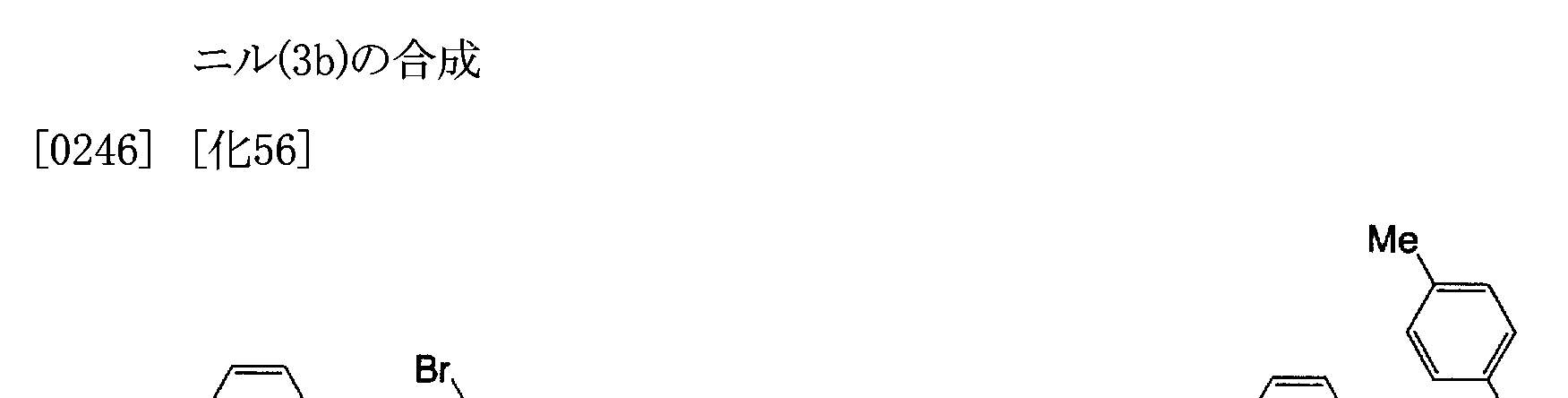
[ e ] [8W0] ェ - 'ΐ'ΐ - ^ -' ( ; ^、- S'S'I- P- 8'ΐ - Ηΐ- ε¾-
Ζ 61 ZZ
·ε 9ΐ· εε: ρ漏 J 'ΐ 9ΐ· εε -(+n) ΝΗ Η D P。 。 z/m (evn) s H
つ το9ΐ 'οζη HI
•8'6S 9 (\DQD '2 SZl) 顺 9π uoqjBO punoq-uoaoq Θ¾ ·γ\ζ ' ^Οΐ 'VLU 'V6U '9"92ΐ 'S" 2T '6"82ΐ '0"621 'S
"62ΐ '9"621 ' -2ST 'S'9SI T ST 'Ζ·6εΐ 'Γΐ^ΐ '^9fl 9 (OQD <ZH SZ) H N DgI
•(HI 'ZH Z'L 'ZH
8 = f 'PP) Z9"Z '(HS 9^"Z-6S"Z '(H2 '^H 9"Z = f 'P) IZ'L '(HZ 'ZH 9"Z = f 'P) S
Z'L \Z 'ZH VS 'ZH 2" = f 'PP) 60· '(Η2 '^Η 8·0 'ΖΗ VS = f 'ΡΡ) ZO'L ΗΖ 'ΖΗ Ζ •ΐ 'ZH Z'L = [ 'ΡΡ) 3Γ9 ΗΖ '^°ί) SS"S '(HS 's) 9 ODOD ^HVi 00,) N Ητ
。( %69*¾ί ^mmz^^mm^m ^w^^ ^ u^
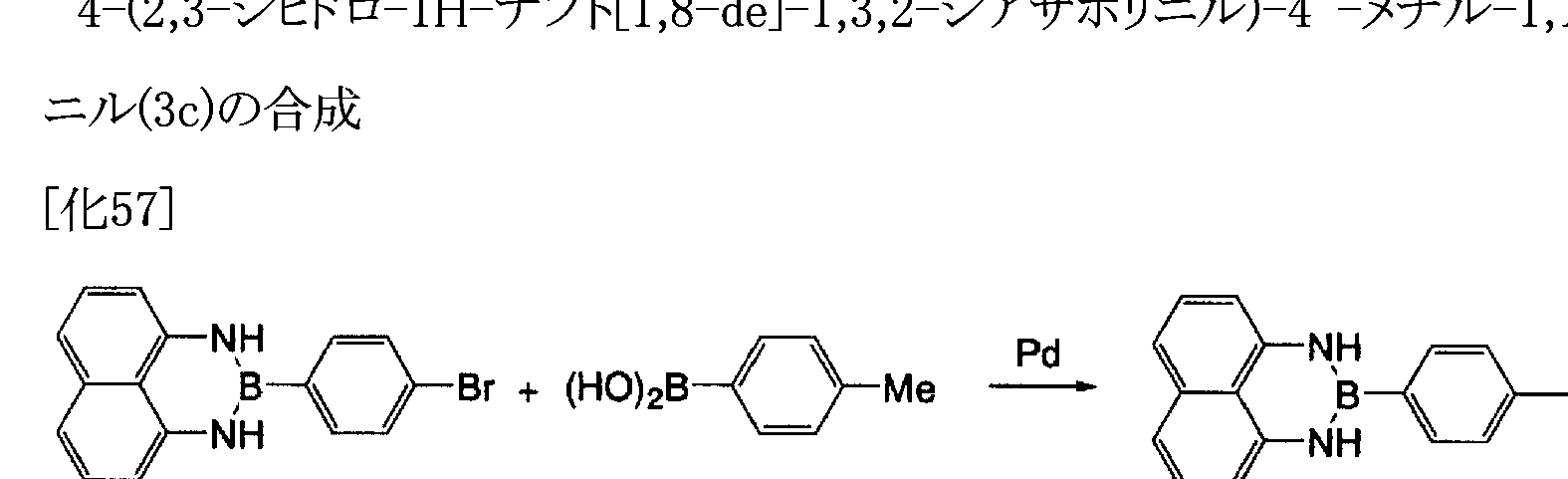
[9S^ ] [9W0]
6ZL S0/L00Zdr/13d 39 .S9S0T/.00Z OAV
077 mmol)、 CsF (51.7 mg, 0.340 mmol)、製造 3で得られた化合物 (2c) (50.0 mg, 0.15 5 mmol)、 p-メチルフエ-ルボロン酸(21.1 mg, 0.155 mmol)の順でカ卩えた。最後にテ トラヒドロフラン(0.50 ml)を加え、 60 °Cで 2時間撹拌した。反応後、飽和食塩水を加え CHC1で抽出を行い、 MgSOで乾燥後セライトろ過し、エバポレーターで溶媒留去し
3 4
た。 CHC1で溶解させ、シリカゲルカラムクロマトグラフィー(hexane; ethyl acetate = 2
3
0;はりグラジェント法)で精製し標記化合物 (3c)を得た。収率 83% (42.3 mg)。
JH NMR (CDCl ) δ 2.42 (s, 3H), 6.07 (brs, 2H), 6.44 (d, J = 6.9 Hz, 2H), 7.07 (d,
3
J = 8.1 Hz, 2H), 7.13-7.19 (m, 2H), 7.27-7.30 (m, 2H), 7.55 (d, J = 7.8 Hz, 2H), 7. 65-7.73 (m, 4H).
13C NMR (CDCl ) δ 21.2, 77.2, 106.0, 117.8, 119.8, 126.7, 126.9, 127.6, 129.5, 1
3
31.9, 136.3, 137.5, 137.8, 141.0, 142.9. The boron-bound carbon was not detected due to quadrupolar relaxation.
nB NMR (128 MHz, CDCl ) δ 29.0.
3
IR (KBr) 3418, 1607 cm"1.
HRMS (FAB) m/z calcd for C H BN (M^: 334.1641, found: 334.1643.
23 19 2
例 6
3- (2,3-ジヒドロ- 1H-ナフト [1,8- de]- 1,3,2-ジァザボリ-ル)- 4,-メチル -Ι, -ビフエ ニル (3d)の合成
[0250] [化 58]

(2d) (3d)
[0251] 製造例 4で得られた化合物 (2d)と Ρ-メチルフ ニルボロン酸とを、上記実施例 1 (1) と同様の方法により合成し精製し標記化合物 (3d)を得た。収率 82% (42.2mg)。
1H NMR (CDCl ) δ 2.45 (s, 3Η), 6.08 (brs, 2H), 6.44 (dd, J = 0.8 Hz, 7.2 Hz, 2H),
3
7.07 (dd, J = 0.8 Hz, 8.4 Hz, 2H), 7.15 (dd J = 7.2 Hz, 8.0 Hz, 2H), 7.30 (d, J = 8.0
•uo!;BXBi i jBjodna Bn o θηρ pa oa ap ou SBM
 punoq-uo •ioq sq丄 -Q-Qz '9'SS '8'S0I 'S U 'S" n '6·6ΐΐ 'Z'LZl DZ) 9'LZl '8'6ΖΙ 'S
•οει 'ε ει 'ΐ^ετ 'νηι 's'ssi 'ε·9ει 'νιη '6 9ΐ 9 (OQD 'ΖΗ ez) ^ηη οεΐ
"(Ηΐ 'ΖΗ VZ = f 'Ρ) LVL '(Ηΐ '^Η VZ 'ΖΗ ·8 = f 'ΡΡ) 6S"Z Hf 'ω) ΐε' - ΖΊ ΗΖ 'ΖΗ Z'L 'ΖΗ VS = f 'ΡΡ) ZVL '(HS 'ω) εθ· - 66·9 '(Η2 Ί ZS'9 ΗΖ 'ΖΗ 8·0 'ΖΗ Z'L = [ 'ΡΡ) 8ε·9 '(HS S£'Z '(HS £'Ζ 9 (OQD 'ζ 00,) Η醒 Ητ
0W) %66*¾ί。 (ιε)呦^ ^暴 m、つ攝慰 ΛΛϋ)— ^Ι^Μム!^マ α^ τ^)¾^ )#^^

[6S^ ] ΐ

賺
· 8 '
Ν ·ΐ6"3 Ή ΥΖ% 'D: Ρ画 d ·8ε·8 'Ν -SZ"S Ή '39"28 'つ : Ν8 Η つュ P^PD "P
·6ε9ΐ· εε: p漏 J 'ΐ 9ΐ· εε: > NH H D P。 。 z/m (evn) s H
ura Τ09Ϊ 'π^ε ( ) HI •6'6S 9 (OQD <ZH 821) H N 9n oqjBO punoq-uojoq
 τχζ 'Γ90ΐ '6"ZU '6·6ΐΐ 'ΓΖ2ΐ '9"Z2T 'Ο'βΖΙ '9·6
 οεΐ
οεΐ
"(Ηΐ 's) 28" '(Ηΐ 'ΖΗ 9"Ζ 'ζ Η 9·ΐ = f 'ΡΡ) 89· '(Ηΐ 'ΖΗ 9"Ζ '^Η 9·ΐ = f 'ΡΡ) Ϊ9"Ζ '(HS 'ω) 9S"Z-0S"Z '(Η2 '^Η
6Z.l7S0/.00Zdf/X3d .S9S0T/.00Z OAV
[ΐ9^ ] [9S20]

6進
ε ζ \ζ ¾
·9 9ΐ·80 : punoj '3 9ΐ·80 -(+Vi) 0 Ν9 Η D P。 。 z/ui (eVH) S HH
1113 Z6ST 'ΐΟΖΐ 'f£f£ ( !) HI
•6'8S 9 (OQD '2 SZl) 顺 9π •uo!;BXBi i jBjodna Bn o θηρ
 ou SBM puno q-uoaoq
 'VSZl TOST 'S
•οει 'ζ'ζζι 's ει 'ε·9ει 'π ΐ 'v 'ο· 9ΐ O" 9i 9 (OQD 'ΖΗ ez) Η Ν οεΐ
"(Ηΐ 'ΖΗ VS = ί 'Ρ) 2Γ8 '(Ηΐ '^Η = f 'Ρ) 9Ζ-Ζ '(HS 'ω) 69 - 39"Ζ '(Η2 'ΖΗ Z'L '^Η ·8 = f 'ΡΡ) ΓΖ '(HS 'ω) 90"Z-20"Z '(Η2 Ί SS'9 ΗΖ 'ΖΗ
8·0 'ΖΗ Z'L = f 'ΡΡ) ·9 '(HS 86Τ '(HS 96·ε 9 (OQD 'ζ 00,) Η醒 Ητ
。( ssT) %68 ? Φ o-M^) ^ m ^ m^

3IT、 ;邈べ ェ / / 、^ H -^ 呦^;] ^; if^^灞 [SS20]
[09^ ] [ SS0]

Z \Z K
•0SZr 9S: punoj 'ifirf9 (+n) O N9 H D P。 。 z/ui (eVH) S HH つ T09T 'szn HI
•9'8S 9 (OQD '2 SZl) 顺 9n
6ZL S0/L00Zdr/13d 99 .S9S0T/.00Z OAV
•Z =
 — 4ム マ ^、

[29^ ] [8S20] ェ 'ΐ'ΐ— ^^ —' ( / ;^ s's'i— ρ— 8'ΐ — HI ε¾—
ommm
series: punoj sriss ONH H D J。J P。 。 z/m (evd) svmn
1113 6ST 'οε^ε ( ) HI
•S'8S 9 ήつ αつ '2 SZl) 顺 9π •uo!;BXBi i jBjodna Bn o θηρ
 ou SBM puno q-uoaoq
 'Ζ'ΟΖΙ 'S ST '2"2ST
'ΐ^εΐ 'LZ^Zl 'ZZ^Zl 'ε·ΐ ΐ 'SZ'ZW '18· ΐ '6X91 9 (OQD <ZH SZ) H N DgI
•(HI
'ZH VZ = f 'ΡΡ) 8·8 '(Ηΐ 'ZH 9·ΐ 'ΖΗ 8·8 = f 'ΡΡ) ZS'8 '(Ηΐ '^Η 9·ΐ 'ΖΗ VS = f '^Ρ
) 38"Ζ '(Ηΐ 'ZH VZ = f 'Ρ) WL '(Ηΐ '^Η '^Η VS = f 'ΡΡ) 09· '(Ηΐ '^Η · '^Η
0·8 = f 'ΡΡ) SS"Z '(Η2 'ZH Z'L '^Η ·8 = f 'ΡΡ) ΐ· '(HS 'ω) SO' - 00 ΗΖ Ί
9·9 ΗΖ 'ΖΗ 8·0 'ΖΗ Z'L = f 'ΡΡ) ZV9 '(HS S6T 9 (\DQD 'ζ 00,) Η醒 Ητ

1H NMR (400 MHz, CDCl ) δ 3.88 (s, 3H), 6.07 (brs, 2H), 6.44 (dd, J = 7.2 Hz, 1.
3
2 Hz, 2 H ), 6.98-7.03 (m, 2H), 7.06 (dd, J = 8.4 Hz, 1.2 Hz, 2H), 7.15 (dt, J = 8.4
Hz, 7.2 Hz, 2H), 7.56—7.61 (m, 2H), 7.62-7.66 (m, 2H),7.69-7.73 (m, 2H).
13C NMR (125 MHz, CDCl ) δ 55.4, 106.0, 114.3, 117.8, 119.8, 126.4, 127.6, 128.
3
2, 131.9, 133.2, 136.3, 141.1, 142.6, 159.4. The boron-bound carbon was not dete cted due to quadrupolar rel
nB NMR (128 MHz, CDCl ) δ 29.3.
3
HRMS (FAB) m/z calcd for C H BN O (M+): 350.1590, found: 350.1589.
23 19 2
実施例 11 (ジチォフェン、テルチオフェンの合成)
(1)化合物 (3e)の合成
[0260] [化 63]

(2e) (3e)
[0261] 窒素雰囲気下、反応容器に 4-トリルボロン酸 (41 mg, 0.30 mmol)、製造例 5で得ら れた化合物 (2e) (99 mg, 0.30 mmol)、フッ化セシウム(91 mg, 0.60 mmol)、ビス (トリ t- ブチルホスフィン)パラジウム(3.1 mg, 0.0060 mmol)を加え、 1,4-ジォキサン(1.0 mL) に溶解させた。水(0.2 mL)を加え、 60度で 6時間加熱攪拌した。反応後室温に冷却 し、水を加え、クロ口ホルムで抽出を行った。有機層を硫酸マグネシウムで乾燥し、ェ バポレーターで溶媒留去した。シリカゲルカラムクロマトグラフィー(へキサン;酢酸ェ チル;クロ口ホルム = 7; 1;はりグラジェント法)で精製し、標記化合物 (3e)を得た。収 率 95% (97 mg)。
JH NMR (400 MHz; CDCl ) δ 2.41 (s, 3H), 5.97 (brs, 2H), 6.42 (d, J = 7.2 Hz, 2H)
3
, 7.08 (d, J = 8.4 Hz, 2H), 7.16 (dd, J = 8.4, 7.2 Hz, 2H), 7.23 (d, J = 8.0 Hz, 2H),
7.38 (d, J = 4.0 Hz, 1H), 7.42-7.44 (m, 1H), 7.50-7.59 (m, 2H).
13C NMR (75 MHz, CDCl ) δ 21.2, 106.1, 117.9, 119.7, 124.1, 126.0, 127.5, 129.6
3
, 131.2, 133.8, 136.3, 137.9, 140.7, 149.5. The boron-bound carbon was not detec
ted due to quadrupolar relaxation.
nB NMR (128 MHz, CDC1 ) δ 26.9.
3
IR (KBr) 3430, 1601 cm"1.
HRMS (FAB) m/z calcd for C H BN S (M+): 340.1205, found: 340.1202.
21 17 2
(2)化合物 (4e)の合成
[0262] [化 64]
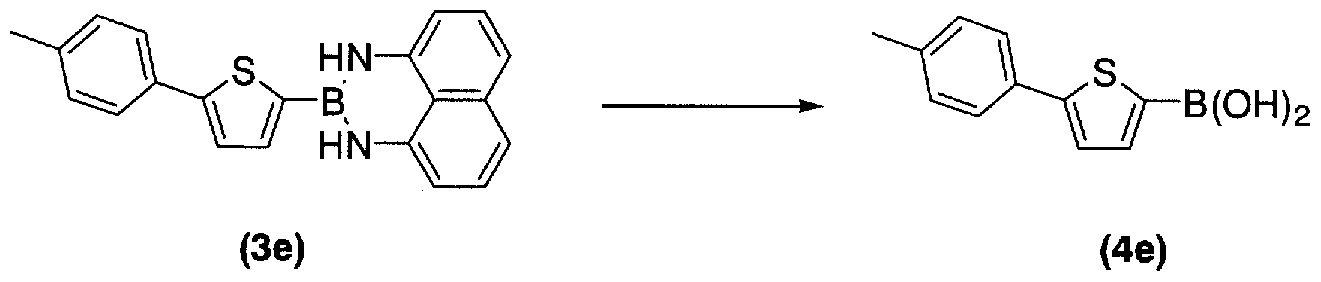
[0263] 反応容器に上記(1)で得られたィ匕合物 (3e) (340 mg, 1.00 mmol)、テトラヒドロフラン
(8.8 mL)、 5規定塩酸水溶液 (0.80 mL)をカ卩え、室温で 10時間攪拌した。反応後 5規 定塩酸水溶液を加え,ジェチルエーテルで抽出を行い、有機層を飽和食塩水で洗 浄後、硫酸マグネシウムで乾燥した。エバポレーターで溶媒留去し、減圧真空乾燥し た。
(3)化合物 (5e)の合成
[0264] [化 65]

(4e) (2e) (5e)
[0265] 窒素雰囲気下、反応容器に上記(2)で得られたィ匕合物 (4e) (218 mg, 1.00 mmol)、 製造例 5で得られた化合物 (2e) (329 mg, 1.00 mmol)、フッ化セシウム(304 mg, 2.00 mmol)、ビス (トリ t-ブチルホスフィン)パラジウム(10.2 mg, 0.020 mmol)を加え、 1,4-ジ ォキサン (3.3 mL)に溶解させた。水(0.67 mL)をカ卩え、 60度で 10時間加熱攪拌した。 反応後室温に冷却し、水を加え、クロ口ホルムで抽出を行った。有機層を硫酸マグネ シゥムで乾燥し、エバポレーターで溶媒留去した。再結晶で精製し、標記化合物 (5e) を得た。収率 86% (362 mg)。
1H NMR (400 MHz; CDC1 ) δ 2.39 (s, 3H), 5.96 (brs, 2H), 6.43 (dd, J = 7.2, 1.2 H
。( 802)% 9*¾ί
 ベ ^^、
ベ ^^、

- ' ^QC^(\omm zwo ,§ω ε·9)マ (ベ ^ :— (H) a iou™
ΖΖ'Ι '§ω Ζ8ΐ) ^^ ^ (\omm 29 '§ω (θ2)<¾?^ ^¾ ^ Ρ^ίΙ
(1°ωυι 29 38ΐ)
 、止^蹈 峯暴 [6920]

[Z9^ ] [8920] ^0)(9 )ί¾?^ (9)
。: ·Π粼 教、つ辛爵瀚缀、 一 一 ェ ^ ^ ^^^m ^Ψ^ ^ ^^、 (louiui 29 ' 092) (es)^^ ^¾ ^ (£) 3ΐΤ^^¾3ϊΗ [Z920]
(39) (as)

[99^ ] [9920]

" 2 9 θοαο 'z ) 顺 en
•uo!;BXBi i jBjodna Bn o θηρ
 punoq— uojoq 丄 T W 'ζ-zfl '9 ^ΐ '8"ZST 'S'9SI SSI ' TST 'S'ISI Ί'βΖΙ '^LZl '9
"SSI 'Z^Zl '^ Zl 'VZZl 'ΖΈΠ 'Ο Π 'S"90I 9 (IDaO 'ZH ZI) ^nn DgI
·( H2 'ZH 0·8 = f 'P)
WL '(HI 'ZH 9·ε = f 'P) OVL '(HI '^H 9"S = f 'P) 0S"Z HZ 's) £IZ'L HZ 'ΖΗ 0·8
= f 'P) LOZ'L HZ 'ZH Z'L 'VS = f 'ΡΡ) 3ΓΖ '(H2 '^H 8 ' ·8 = f 'PP) LO'L HZ 'z
6ZL S0/L00Zdr/13d 69 .S9S0T/.00Z OAV
H NMR (400 MHz; CDCl ) δ 2.39 (s, 3H), 5.96 (brs, 2H), 6.43 (d, J = 7.2 Hz, 2H)
3
, 7.07 (d, J = 8.4 Hz, 2H), 7.11-7.21 (m, 8H), 7.29 (d, J = 3.6 Hz, 1H), 7.40 (d, J = 3.6 Hz, 1H), 7.51 (d, J = 8.0 Hz, 2H ).
[第 2方法]
製造例 6
化合物 (21)の合成
[0270] [化 68]

[0271] 窒素雰囲気下、反応容器に PdCl (dppl) (237 mg, 0.324 mmol),酢酸カリウム(3.18
2
g, 32.4 mmol),製造例 3で得られた化合物 (2c)(3.50 g, 10.8 mmol),ビス (ピナコラート )ジボロン(3.03 g, 11.9 mmol)をカ卩え、 DMSO (67 mL)に溶解させ 80 °Cで 17時間加熱 攪拌した。反応後、室温に戻し水でタエンチし、クロ口ホルムで抽出した。有機溶媒を brineで洗浄した後、硫酸マグネシウムで乾燥し、エバポレーターにより溶媒留去した 。残 をシリカゲルカラムクロマトグラフィー(hexane; dichloromethane = 1; 1)で一度 精製した後、再結晶(CH CI -hexane)により標記化合物 (21)を得た。収率 81% (3.25 g)
2 2 λ NMR (400 MHz, CDCl ) δ 1.38 (s, 12H), 6.06 (brs, 2H), 6.43 (dd, J = 7.2 Hz, 1
3
.2 Hz, 2H), 7.06 (dd, J = 8.4 Hz, 1.2Hz, 2H), 7.14 (dt, J = 8.4 Hz, 7.2 Hz, 2H), 7.6 6 (d, J = 8.4 Hz, 2H), 7.87 (d, J = 8.4 Hz, 2H).
13C NMR (125 MHz, CDCl ) δ 24.9, 83.9, 106.1, 117.9, 119.9, 127.6, 130.6, 134.4
3
, 136.3, 141.0. The boron-bound carbon was not detected due to quadrupolar relax at ion.
nB NMR (128 MHz, CDCl ) δ 29.7.
3
HRMS (FAB) m/z calcd for C H B N O (M+): 370.2024, found: 370.2034.
Anal. Calcd for C H B N O : C, 71.40; H, 6.54; N, 7.57. Found: C, 71.21; H, 6.59
22 24 2 2 2
; N, 7.56.
列 7
化合物 (2g)の合成
[0272] [化 69]

(2d) (2g)
[0273] 窒素雰囲気下、反応容器に Pd(dba) (8.01 mg, 0.014 mmol)、 PCy (9.37 mg, 0.033
2 3
mmol)、酢酸カリウム(68.3 mg, 0.696 mmol)、製造例 4で得られた化合物 (2d)( 150 m g, 0.464 mmol)、ビス (ピナコラート)ジボロン(130 mg, 0.511 mmol)を加え、 1,4—ジォキ サン(3.1 mL)に溶解させ 100 °Cで 24時間加熱攪拌した。反応後、室温に戻し水でク ェンチし、クロ口ホルムで抽出した。有機溶媒を硫酸マグネシウムで乾燥し、エバポレ 一ターにより溶媒留去した。残渣をシリカゲルカラムクロマトグラフィー(hexane; dichl oromethane = 1; 1)で一度精製した後、再結晶(CH CI -hexane)により標記化合物 (2
2 2
g)を得た。収率 77% (133 mg)。
1H NMR (400 MHz, CDC1 ) δ 1.40 (s, 12H), 6.12 (brs, 2H), 6.43 (dd, J = 7.2 Hz, 1
3
.2Hz, 2H), 7.05 (dd, J = 8.4 Hz, 1.2 Hz, 2H), 7.14 (dt, J = 8.4 Hz, 7.2 Hz, 2H), 7.4
6 (t, J = 7.6 Hz, 1 H), 7.75 (dt, J = 7.6 Hz, 1.6 Hz, 1H), 8.08—8.10 (m, 1H).
13C NMR (125 MHz, CDC1 ) δ 24.9, 84.0, 106.0, 117.7, 119.9, 127.6, 134.3, 136.3
3
, 136.8, 137.8, 141. The boron-bound carbon was not detected due to quadrupol ar relaxation.
nB NMR (128 MHz, CDC1 ) δ 31.0.
3
HRMS (FAB) m/z calcd for C H 10BnB N O (M+): 369.2065, found: 370.2068.
22 24 2 2
Anal. Calcd for C H B N O : C, 71.40; H, 6.54; N, 7.57. Found: C, 71.68; H, 6.58
22 24 2 2 2
; N, 7.62.
観告
化合物 (2h)の合成
[0274] [化 70]

[0275] 製造例 6と同様の条件下で反応させて、標記化合物 (2h)を得た。 収率 75% (7.40 g)
H NMR (400 MHz, CDCl ) δ 1.35 (s, 12H), 6.34 (dd, J = 7.2 Hz, 1.2 Hz, 2H), 6.4
3
0 (brs, 2H), 7.03 (dd, J = 8.4 Hz, 1.2 Hz, 2H ), 7.13 (dt, J = 8.4 Hz, 7.2 Hz, 2H ), 7 .40-7.50 (m, 2H), 7.62-7.66 ( m, 1H ), 7.80-7.84 (m, 1H).
13C NMR (125 MHz, CDCl ) δ 24.8, 84.2, 105.5, 117.2, 119.9, 127.6, 128.6, 130.1
3
, 132.2, 135.1, 136.4, 141.7. The boron-bound carbon was not detected due to qua drupolar relaxation.
nB NMR (128 MHz, CDCl ) δ 31.5.
3
HRMS (FAB) m/z calcd for C H 10BnB N O (M+): 369.2065, found: 370.2068.
22 24 2 2
Anal. Calcd for C H B N O : C, 71.40; H, 6.54; N, 7.57. Found: C, 71.11; H, 6.56
22 24 2 2 2
; N, 7.38.
実施例 12
化合物 (10a)の合成
[0276] [化 71]

[0277] 窒素雰囲気下グローブボックス中、乾燥させた反応容器に Pd[P(tBu) ] (1.4 mg, 0.0
027 mmol),製造例 6で得られた化合物 (21) (50 mg, 0.135 mmol), 4-ブロモトルエン( 16.6 n 0.135 mmol)を 1,4-ジォキサンに溶解させた。グローブボックス外にて水酸 化ナトリウム水溶液 (5N) (81.9 μ L, 0.405 mmol)を加え、 60 °Cで 4時間撹拌した。反 応後、水でタエンチし、クロ口ホルムで抽出を行った。有機溶媒を硫酸マグネシウムで 乾燥後、エバポレーターにより溶媒留去した。残渣をシリカゲルカラムクロマトグラフィ 一(hexane; dichloromethane = 3; 1)で精製したで精製し標記化合物 (10a)を得た。 収率 99% (45.0 mg)0実施例 5の化合物 (3c)と同一化合物である。
[0278] 実施例 13〜24
下記表に記載の化合物につ 、て実施例 12と同様にして反応を行った。
[0279] [化 72]

[0280] [表 1]
実施例 a ァリ一ルハライド X 2 生成物 Yield /%b
13 Ph I 2f 10b 92
14 4-MeOC6H4 I 2f 10c 92
15 4-N02C6H4 I 2f 10d 88
16 4-MeC6H4 Br 2g 10e 94
17c 4-MeC6H4 Br 2h 10f 96
18 4-FC6H4 Br 2f 10g 99
19 2,6-Me2C6H3 Br 2f 10h 82
20 2-Naphthyl Br 2f 10i 87
21 2-Pyridyl Br 2f 10j 96
22 2-thiop enyl Br 2f 10k 98
23d 4-N02C6H4 CI 21 101 93
24 β 4-MeC6H4 CI 2f 10m 90 a:ァリールハライド(O.Ummol), 2 f-h (0. 讓 ol), Pd [P(Bu- 1)3]2 (2.7 μΰΐοΐ), 及び 5N NaOH (0.41 腿 ol)を 60^で 4時間撹拌した。
b:単離収率
c:CsFを塩基に用いて、 80°Cで 8時間撹拌した。
d:80 で 4時間撹拌した。
e:3 mo の触媒量、 80°Cで 24時間撹拌した。 化合物 (10b):
1H NMR (400 MHz, CDCl ) δ 6.08 (brs, 2H), 6.45 (dd, J = 7.4 Hz, 0.8 Hz, 2H), 7.
3
07 (dd, J = 8.4 Hz, 0.8 Hz, 2H), 7.16 (dt, J = 8.4 Hz, 7.4 Hz, 2H), 7.38 (tt, J = 7.2 Hz, 1.2Hz, 1H), 7.45-7.50 (m, 2H), 7.61—7.6 (m, 2 H ), 7.66—7.70 (m, 2H), 7.72—7. 75 (m, 2H).
13C NMR (125 MHz, CDCl) δ 106.0, 117.9, 119.9, 126.9, 127.1, 127.6, 128.8, 13
3
1.9, 136.4, 140.7, 141.02, 141.04, 143.0. The boron-bound carbon was not detecte d due to quadrupolar relaxation.
nB NMR (128 MHz, CDCl ) δ 29.9.
3
HRMS (FAB) m/z calcd for C H BN (M^: 320.1485, found: 320.1481.
化合物 (10c):実施例 10の (3i)と同一化合物。
化合物 (10d):
1H NMR (400 MHz, CDCl ) δ 6.07 (brs, 2H), 6.45 (dd, J = 7.2 Hz, 1.2 Hz, 2H), 7.
3
08 (dd, J = 8.2 Hz, 1.2 Hz, 2H), 7.16 (dt, J = 8.2 Hz, 7.2 Hz, 2H), 7.69-7.73 (m, 2 H), 7.77-7.81 (m, 4H), 8.31-8.35 (m, 2H).
13C NMR (125 MHz, CDCl ) δ 106.2, 118.1, 119.9, 124.2, 127.2, 127.6, 127.8, 13
3
2.3, 136.4, 140.4, 140.8, 147.1, 147.3. The boron-bound carbon was not detected due to quadrupolar relaxation.
nB NMR (128 MHz, CDCl ) δ 28.5.
3
HRMS (FAB) m/z calcd for C H BN O (M+): 365.1336, found: 365.1335.
22 16 3 2
化合物 (10e):実施例 6の (3d)と同一化合物
化合物 (101):実施例 4の (3b)と同一化合物
化合物 (10g):
JH NMR (400 MHz, CDCl ) δ 6.07 (brs, 2H), 6.44 (dd, J = 7.2 Hz, 1.2 Hz, 2H), 7.
3
07 (dd, J = 8.4 Hz, 1.2 Hz, 2H), 7.13-7.19 (m, 4H), 7.57-7.65 (m, 4H), 7.70-7.74 ( m, 2H).
13C NMR (125 MHz, CDCl ) δ 106.1, 115.7 (d, 2J = 21.4 Hz), 117.9, 119.8, 126.
3 CF
8, 127.6, 128.7 (d, 3J = 8.5 Hz), 132.0, 136.4, 136.8 (d, 4J = 2.6 Hz), 141.0, 142
CF CF
.0, 162.7 (d, 1] = 247 Hz). The boron-bound carbon was not detected due to qua
CF
drupolar relaxation.
nB NMR (128 MHz, CDCl ) δ 29.2.
3
HRMS (FAB) m/z calcd for C H BFN (M+): 338.1391, found: 338.1398.
22 16 2
化合物 (lOh):
1H NMR (400 MHz, CDCl ) δ 2.06 (s, 6H), 6.10 (brs, 2H), 6.44 (dd, J = 7.2 Hz, 1.
3
2 Hz, 2H), 7.07 (dd, J = 8.4 Hz, 1.2 Hz, 2H), 7.11-7.21 (m, 5H), 7.22-7.26 (m, 2H) , 7.70-7.74 (m, 2H).
13C NMR (125 MHz, CDCl ) δ 20.8, 106.0, 117.8, 119.8, 127.2, 127.3, 127.6, 129.
3
0, 131.6, 135.9, 136.4, 141.1, 141.5, 143.3. The boron-bound carbon was not dete
cted due to quadrupolar relaxation.
nB NMR (128 MHz, CDCl ) δ 29.5.
3
HRMS (FAB) m/z calcd for C H BN (M"): 348.1798, found: 348.1800.
24 21 2
化合物 (100:
1H NMR (400 MHz, CDCl ) δ 6.13 (brs, 2H), 6.47 (dd, J = 7.2 Hz, 1.2 Hz, 2H), 7.
3
08 ( dd, J = 8.4 Hz, 1.2 Hz, 2H), 7.17 (dt, J = 8.4 Hz, 7.2 Hz, 2H), 7.43-7.48 (m, 2 H), 7.49-7.57 (m, 2H), 7.58-7.62 (m, 2H), 7.77-7.81 (m, 2H), 7.87-7.95 (m, 3H). 13C NMR (125 MHz, CDCl ) δ 106.1, 117.9, 119.9, 125.4, 125.8, 125.9, 126.1, 12
3
6.9, 127.6, 127.9, 128.3, 129.9, 131.4, 141.5, 133.8, 136.4, 139.8, 141.1, 142.8. T he boron-bound carbon was not detected due to quadrupolar relaxation.
nB NMR (128 MHz, CDCl ) δ 29.5.
3
HRMS (FAB) m/z calcd for C H BN (M^: 370.1641, found: 370.1645.
26 19 2
化合物 (10j):
JH NMR (400 MHz, CDCl ) δ 6.09 (brs, 2H), 6.45 (dd, J = 7.2 Hz, 1.2 Hz, 2H), 7.
3
07 (dd, J = 8.4 Hz, 1.2 Hz, 2H), 7.16 (dt, J = 8.4 Hz, 7.2 Hz, 2H), 7.27-7.30 (m, 1
H), 7.75-7.81 (m, 4H), 8.06—8.10 (m, 2H), 8.73 (dt, 4.8 Hz, 1.6 Hz, IH).
13C NMR (125 MHz, CDCl ) δ 106.1, 117.8, 119.9, 120.7, 122.40, 122.41, 126.6,
3
127.6, 131.9, 136.3, 136.8, 141.0, 149.8, 157.0. The boron-bound carbon was not detected due to quadrupolar relaxation.
nB NMR (128 MHz, CDCl ) δ 29.7.
3
HRMS (FAB) m/z calcd for C H BN (M"): 321.1437, found: 321.1433.
21 16 3
化合物 (10k):
1H NMR (400 MHz, CDCl ) δ 6.05 (brs, 2H), 6.44 (dd, J = 7.2 Hz, 1.2 Hz, 2H), 7.
3
06 (dd, J = 8.4 Hz, 1.2 Hz, 2H), 7.10-7.18 (m, 3H), 7.33 (dd, J = 5.2 Hz, 1.2 Hz, 1 H), 7.40 (dd, J = 3.6 Hz, 1.2 Hz, IH), 7.64-7.71 (m, 3H).
13C NMR (125 MHz, CDCl ) δ 106.1, 117.9, 119.8, 123.5, 125.3, 125.5, 127.6, 12
3
8.1, 132.0, 136.1, 136.3, 141.0, 144.0. The boron-bound carbon was not detected due to quadrupolar relaxation.
B NMR (128 MHz, CDC1 ) δ 29.1.
3
HRMS (FAB) m/z calcd for C H 10BN S (M+): 326.1085, found: 326.1082.
20 15 2
化合物 (101): (lOd)と同一化合物
化合物 (10m): (10a)と同一化合物
実施例 25
化合物 (10η)の合成
[0283] [化 73]

[0284] 窒素雰囲気下グローブボックス中、乾燥させた反応容器に水酸化リチウム · 1水和 物 (13.6 mg, 0.32 mmol),
Pd(OAc) (0.61 mg, 0.0027 mmol), (2-biphenyl)PCy (1.14 mg, 0.0032 mmol),製造
2 2
例 6で得られた化合物 (2D (50 mg, 0.135 mmol), 4-トリルトリフラート(21.3 mg, 0.135 mmol)を 1,4-ジォキサン(0.82 mL)に溶解させた。グローブボックス外にて水酸化ナト リウム水溶液 (5N) (81.9 μ L, 0.405 mmol)をカ卩え、 60 °Cで 4時間撹拌した。反応後、 水でタエンチし、クロ口ホルムで抽出を行った。有機溶媒を硫酸マグネシウムで乾燥 後、エバポレーターにより溶媒留去した。残渣をシリカゲルカラムクロマトグラフィー (h exane; dichloromethane = 3; 1)で精製したで精製し標記化合物 (1 On)を得た。 収率 89% (40.0 mg)。化合物 10ηは実施例 12の (10a)と同一化合物。
[0285] 実施例 26
実施例 8と同様にして下記の反応を行った。なお、構造式中の記号「dan」は、 1,8- ジァミノナフタレン由来のマスキング基を意味する。
[0286] [化 74]
Η
9
8 'ω) fL-L-S9'L ( 'ω) eVL-fVL Hf 'ω) 60· -90 HZ 's) S0"Z Hf '^H 8 'z
H = f 'PP) S '9 '{ Ί 60·9 '{ <ZH V9 ') 96·ε 'ω) 9Γΐ- 89·ΐ '{
) ·ΐ— 9ε·ΐ '(Η8 'ω) ζ·1- Ζ'1 '(Η9 'ΖΗ 8·9 ' ) 68 9 ODOD 'ζ 00,) Η匪 Ητ
(Η f 's-iq) Γ8 (Η 'ΖΗ VS 'Ρ) 90·8 '(Η 88"Ζ '(Η 'ω) '(Η '^Η 8·0 'ΖΗ
0·8 = f 'ΡΡ) 60· '(Η 'ΖΗ 8·0 'ΖΗ 9"Ζ = f 'ΡΡ) ΐ9·9 9 (OSViQ 'ζ 00,) Η匪 ΗΤ
[6820]
¾) %66 qzi ετ Η930 = Ή

[S ^ ] [8820]
。 Si^o ^止ェつ ^翁^; ^^ 第
瞻
Ζ 61 W
·ιε9ΐ·9 ε: p j 'ΐ 9ΐ·9 ε -(+n) ΝΗ Η D JOJ P z/m (evn) s H
•2"62 9 ( \DQD 'z SZl) 顺 9n •uo!;BXBi i jBjodna Bn o θηρ
 ou
ou
SBM uoqjBO punoq-uoaoq Θ¾ ·ο·ΐ ΐ 'S'6SI T ST '6"TST '9"62ΐ 'Z"82T 'S"8
21 '^LZl '^LZl '9"92T 'S"92T '8·6ΐΐ '8"ZU '0·90ΐ 9 (DOD '^H ZI) H N DgI
•(H2 Z9"Z-S9"Z '(H2 'ω) Ϊ9·Ζ— ZS'Z '(Η2 'ω) ZS"Z-SS"Z '(Η2 'ω
) ZYl-^l '(Ηΐ 'ω) ΐε· -92" '(Η 'ω) 02" -2F '(Η2 '^Η 8·0 'ΖΗ ·8 = f 'ΡΡ) 90 •Ζ ΗΖ 'ΖΗ 8·0 'ΖΗ Z'L = f 'ΡΡ) SS"9 ΗΖ Ί S0'9 9 (\DQD 'ζ 00,) Η醒 Ητ [Ζ820]
(%06) Ιϊ

6ZL S0/L00Zdr/13d 89 .S9S0T/.00Z OAV
C NMR (125 MHz, CDCl ) δ 14.0, 22.6, 25.7, 29.3, 31.4, 69.6, 106.0, 116.2, 11
3
7.8, 119.8, 127.6, 129.3, 130.6, 131.1, 136.3, 140.3, 141.1, 150.3. The boron- bou nd carbon was not detected due to quadrupolar relaxation.
nB NMR (128 MHz, CDCl ) δ 29.2.
3
HRMS (FAB) m/z calcd for C H 10BnBN O (M"): 760.4234, found: 760.4233.
50 51 4 2
実施例 28
実施例 12と同様にして下記の反応を行った。
[0290] [化 76]

[0291] H NMR (400 MHz, CDCl ) δ 0.82—0.95 (m, 3H), 1.30—1.35 (m, 4H), 1.38—1.50 (m,
3
2H), 1.72-1.84 (m, 2H), 4.05 (t, 6.4 Hz, 2H), 6.08 (brs, 2H), 6.10 (bs, 2H), 6.45 (d , J=7.2 Hz, 4H), 7.05-7.11 (m, 5H), 7.13—7.19 (m, 4H), 7.59-7.78 (m, 10H).
13C NMR (125 MHz, CDCl ) δ 14.0, 22.6, 25.7, 29.1, 31.4, 68.6, 106.0, 112.8, 11
3
7.80, 117.82, 119.84, 119.85, 126.5, 127.1, 127.4, 127.6, 129.47, 129.53, 130.8, 1 31.1, 132.0, 133.2, 136.4, 140.5, 141.06, 141.12, 142.46, 155.9. The boron-bound carbon was not detected due to quadrupolar relaxation.
nB NMR (128 MHz, CDCl ) δ 30.0.
3
HRMS (FAB) m/z calcd for C H 10B N O (M^: 660.3461, found: 660.3475.
44 40 2 4
例 29
実施例 12と同様にして下記の反応を行った。
[0292] [化 77]

14(99%)
Π 'ΐ·90ΐ '0·90ΐ '9TZ 'ε'ΐε '8'6S 'V Z '9'ΖΖ 'O'fl 9 (OQD 'ΖΗ ΖΙ) Η Ν DgI
'ω) WL-ZL'L HZ 's) 99"Z '(Η9 'ω) 6ΓΖ-εΓΖ '(Η9 'ω) ΐΐ·Ζ- '(Η9 'ω) 8 ·9- S
V9 '{ Ί ΐΐ·9 '{ΗΖ Ί 80·9 '{HZ 'ΖΗ V9 ' ) OS'S '{ΗΖ 'ω) 92"T-02"T '{ΗΖ
) 9ΐ·ΐ- 80·ΐ '(Η 'ω) 86·0— 6·0 '(HS '^Η Z'L ' ) 6Ζ 9 ODOD 'ζ 00,) Η醒 Ητ
(Η9 ) Γ8 '(Η9 'ΖΗ 0·8 'Ρ) 0Γ8 '(HS SO'8 '(Η9 'ΖΗ 0·8 'Ρ) 06"Ζ '(Η9 'ω) ε
ΓΖ— Ζ0· '(Η9 'ΖΗ VS 'Ρ) ΐ6·9 '(Η9 'ΖΗ 9"Ζ 'Ρ) εε·9 9 (OSViQ 'ζ 00,) Η醒 Ητ
:(5ΐ)ί¾^ [S620]
( Η930 = Ή) %Ρ6 :91
(Η = ¾) %£8: SI

[8Ζ^ ] [ 6S0]
。 ^止ェつ ^翁^; ^^ ¾ϊ第
mmm
·θεθε·ΐ39: punoj '6e0S"TS9 -(+Vi) S Ν9π90ΐ H D JOJ P。 。 Z/UI (eVH) S HH
"S S 9 ήつ αつ '2 SZl) 顺 9Π •uo!;BXBi i jB{odnj ¾n o θηρ

;ou SBM uoqjBO punoq-uoaoq 丄 τ^χ '。·ΐ ΐ 'ε'Ο 'S'ZSI 9£1 'S"9ST O'9ST
'OH Hi '8' '29" 2T 'T9"Z2T 'ζ-9ΖΙ 'V ZI 'S8'6II 'ε8·6ΐΐ '68· ΐΐ 'S8"Zn
'ζο"9θΐ 'eo"90i '9·ιε 'ο'ιε Ί'βζ 'ζ'βζ Ό'βζ '^ζζ 9 ( OQD 'ΖΗ ζι) ^ηηつ εΐ
•(Η9 'ω) ZL'L-WL ΗΖ 'ω) 6
^L-WL '(HI 's) \z'L 6rz-srz 'ω) 60"z-eo-z '(Η 'ΖΗ Z'L = ΓΡ) S
V9 '{ΗΖ Ί 80·9 '{ΗΖ Ί 90·9 '{ΗΖ 'ΖΗ 0·8 ' ) ZVZ '{ΗΖ 'ω) εΓΗ9·ΐ '{ΗΖ
) ο ·ΐ— εε·ΐ '{ υ·ΐ '(Ηε 'ΖΗ τι 06·Ο 9 θοαο 'ζ οο ) Η醒 ΗΤ [£βζο]
6ZLPS0/L00Zdr/lDd 01 .S9S0T/.00Z OAV
7.8, 119.84, 119.85, 126.8, 127.62, 127.64, 129.1, 129.37, 129.38, 131.3, 132.0, 1 36.27, 136.34, 136.4, 136.7, 140.7, 141.00, 141.05, 142.1, 154.1. The boron- boun d carbon was not detected due to quadrupolar relaxation.
nB NMR (128 MHz, CDC1 ) δ 29.1.
3
HRMS (FAB) m/z calcd for C H 10B nBN O (M+): 902.4480, found: 902.4488.
60 51 2 6
実施例 31
化合物 (17)の合成
[0296] [化 79]

16 17
[0297] テトラヒドロフラン(3.5 mL)に溶解させた実施例 30で得られた化合物 (16) (80 mg, 0.
088 mmol)の反応容器に、 5N HCl aq (0.32 mL, 1.60 mmol)を加え、室温で 8時間撹 拌させた。 1H NMRで原料の消失を確認し、 IN HCI aqをカ卩ぇ Et 0で抽出し、 MgSO
2 4 で乾燥後、溶媒留去した。収率 87% (41.3 mg)。
1H NMR (400 MHz, DMSO) δ 0.71 (t, 7.2 Hz, 3H), 0.80—0.98 (m, 4H), 1.02—1.10 ( m, 2H), 1.10-1.20 (m, 2H), 3.17 (t, 2.0 Hz, 2H), 7.59-7.64 (m, 6H), 7.70-7.74 (m, 2H), 7.83-7.91 (m, 6H), 8.06 (brs, 6H)
実施例 32 (固相合成法)
(1)化合物 (22)の合成
[0298] [化 80]

(2)化合物 (23)の合成
[0300] [化 81]

[0301] 窒素雰囲気下、固相合成装置用フィルター付試験管反応容器中のレジン (22)に、 製造例 6で得られたィ匕合物 (2D (80 mg, 0.22 mmol)、ビス (トリ t-ブチルホスフィン)パラ ジゥム (5.5 mg, 0.011 mmol)をカ卩えた。反応容器を固相合成装置に接続した後、窒 素雰囲気下、 1,4-ジォキサン (1.3 mL)、 5規定水酸化ナトリウム水溶液 (0.13 mL, 0.65 mmol)を加え、 60度で 22時間振盪攪拌した。反応後室温に冷却し、テトラヒドロフラン 、飽和食塩水、ジェチルエーテル、水、テトラヒドロフランの順で洗浄してレジン (23)を 得た。
(3)化合物 (24)の合成
[0302] [化 82]

(4)化合物 (25)の合成
[0304] [化 83]

[0305] 窒素雰囲気下、固相合成装置用フィルター付試験管反応容器中のレジン (24)に、 1 -ブロモ- 3-へキシロキシベンゼン(83 mg, 0.32 mmol)、フッ化セシウム(98 mg, 0.65 mmol)、ビス (トリ t-ブチルホスフィン)パラジウム(5.5 mg, 0.011 mmol)をカ卩えた。反応 容器を固相合成装置に接続した後、窒素雰囲気下、 1,4-ジォキサン (2.0 mL)、水(0. 4 mL)を加え、 60度で 10時間振盪攪拌した。反応後室温に冷却し、水、テトラヒドロフ ランの順で洗浄し,レジン (25)を得た。
(5)化合物 (26)の合成
[0306] [化 84]

[0307] 固相合成装置用フィルター付試験管反応容器中のレジン (25)に、 2-プロパノール( 2.0 mL)、塩化メチレン(1.0 mL)、テトラヒドロフラン(1.0 mL)、 1規定水酸化ナトリウム 水溶液 (2.2 mL)を加え、 50度 10時間振盪攪拌した。反応後、室温に冷却し、テトラヒ ドロフラン、水、クロ口ホルムの順で洗いこみ、ろ過した。ろ液に 3規定塩酸水溶液を 加え、クロ口ホルムで抽出を行い、硫酸マグネシウムで乾燥後、エバポレーターで溶 媒留去した。残渣にジェチルエーテル(2.0 mL)、メタノール(1.0 mL)、テトラヒドロフ ラン (2.0 mL)を加え溶解させた後、(トリメチルシリル)ジァゾメタン'ジェチルエーテ
0"Ζ9ΐ 9
•6si 'v '6·ΐ ΐ '6·ο ΐ '6·8ει 'ΐ'οει 's-ezi '6' 'νιζι '^LZI '6'9SI 'ε·6π 'e •επ 'νζιι 'ΐ·89 'νζ '9·ιε 'ζ^ζ '^ζζ 'ο^ΐ 9 (OQD ^u zi) ^ηη οεΐ
\ΗΖ 'ΖΗ VS = f 'Ρ) εΐ·8 ΗΖ 'ΖΗ VS = f 'Ρ) U'Z Hf L'L '(Ηΐ '^Η 0·8 = f ' ) LZ-L '(Ηΐ 'ΖΗ 0·8 = [ 'Ρ) ΖΖ' I '(Ηΐ '^Η 0 = f ' ) 8ΓΖ '(Ηΐ '^Η 0·8 Ζ = ί 'ΡΡ) Ζ6'9 ΗΖ 'ΖΗ V9 = f Wf '(HS 's) 96·ε HZ 'ΖΗ V9 = f '^m ) s'l \ Z fq •ΐ— 9 ·ΐ '{Hf 'ω) 0 ·ΐ— SS'I '(HS 'ZH Z'L = f S6 9 (OQD ·ΖΗ 00,) 醒 HT
°(sds;s g) (Sin ·εΐ)% ^ ¾T。 9S)呦^ ^暴遨
^mm^d -e = 一エ / ェ :べ ^^)— ^ ム! ^目 、つ辛爵瀚缀
、 一 一 。 ェ #3ϊΗ。 ^翻 ¾累 " Di¾n™ ο·ΐ) (η ο·ζ) ^
6ZL S0/L00Zdr/13d I .S9S0T/.00Z OAV
Claims
請求の範囲
[1] クロスカップリング化合物を製造する方法であって、 10族遷移金属触媒の存在下、 ボロン酸基又はボロン酸エステル基を有する化合物と、脱離基及びマスキングされた ボロン酸基を分子内に有する化合物とをクロスカップリングすることを特徴とする製造 方法。
[2] 一般式 (3) :
[化 1]

(式中、 A1及び A2は同一又は異なって置換されていてもよい芳香環、置換されてい てもよいへテロ芳香環、又は置換されていてもよいアルケンを示し、 Y2はホウ素原子 に対し少なくとも 1個の窒素原子で配位する 2価の基を示し、 pは 1以上の整数を示す 。)
で表されるクロスカップリング化合物を製造する方法であって、 10族遷移金属触媒の 存在下、一般式 (1) :
[化 2]

(式中、 R1は同一又は異なって水素原子、アルキル基又はァリール基である力 或い は 2つの R1同士が結合した基を示し、 A1及び pは前記に同じ。 )
で表される化合物と、一般式 (2):
[化 3]

(式中、 X2は脱離基を示し、 A2及び Y2は前記に同じ。 )
で表される化合物とをクロスカップリングすることを特徴とする請求項 1に記載の製造 方法。
[3] Y2が、式:
[化 4]

(式中、 R10、 R11 R2°、 R21、 R3°、 R4°、 R5°、 R51、 R6°、 R61、 R7°、 R8°、 R90及び R100は 同一又は異なって水素原子、アルキル基、ァルケ-ル基、ァリール基又はァラルキル 基を示し、 R12、 R13、 R"、 R15、 R16、 R17、 R22、 R23、 R24、 R25、 R31、 R32、 R33、 R34、 R
41 R42 R43 R44 R52 R53 R54 R55 R62 R63 R64 R65 R66 R67 R71 R72 R73
、 R74、 R75、 R76、 R81、 R82、 R83、 R84、 R91、 R92、
 R102、 R103及び R104は同一又 は異なって水素原子、アルキル基又はァリール基を示し、或いは、隣接する炭素原 子に結合する 2つのアルキル基が結合して環を形成して 、てもよ 、。 )
で示される 2価の基である請求項 2に記載の製造方法。
[4] Y2が、式:
[化 5]

(式中、 R10、 R11 R12、 R13、 R14、 R15、 R16及び R17は前記に同じ。 )
で示される 2価の基である請求項 3に記載の製造方法。
[5] 10族遷移金属触媒がパラジウム触媒又はニッケル触媒である請求項 2〜4のいず
れかに記載の製造方法。
[6] X2がハロゲン原子、 TfO—、TsO—、 MsO—又は(R' O) P (O) O— (式中、 R,は
2
水素原子又はアルキル基を示す。 )である請求項 2〜5の 、ずれかに記載の製造方 法。
[7] A1又は A2が同一又は異なって置換されて 、てもよ 、芳香環又は置換されて ヽても ょ 、ヘテロ芳香環である請求項 2〜6の!、ずれかに記載の製造方法。
[8] クロスカップリングイ匕合物を製造する方法であって、
(i) 10族遷移金属触媒の存在下、ボロン酸基又はボロン酸エステル基を有する化合 物と、脱離基及びマスキングされたボロン酸基を分子内に有する化合物とをクロス力 ップリングして、クロスカップリングイ匕合物を得る工程、及び
(ii)上記 (i)で得られたクロスカップリング化合物力 ボロン酸基のマスキング基を除 去して、ボロン酸基又はボロン酸エステル基を有するクロスカップリングイ匕合物を得る 工程、
を含むことを特徴とする製造方法。
[9] オリゴマー化合物を製造する方法であって、
(i) 10族遷移金属触媒の存在下、ボロン酸基又はボロン酸エステル基を有する化合 物と、脱離基及びマスキングされたボロン酸基を分子内に有する化合物とをクロス力 ップリングして、クロスカップリングイ匕合物を得る工程、及び
(ii)上記 (i)で得られたクロスカップリング化合物力 ボロン酸基のマスキング基を除 去して、ボロン酸基又はボロン酸エステル基を有するクロスカップリング化合物を得て 、これを上記 (i)の工程の原料として供する工程、
を含むことを特徴とする製造方法。
[10] 請求項 9に記載の製造方法であって、前記 (i)の工程及び (ii)の工程を 2回以上繰 り返すことを特徴とする製造方法。
[11] 一般式 (2) :
[化 6]
X2-A2-Bd Y2
(式中、 X2は脱離基を示し、 A2は置換されていてもよい芳香環、置換されていてもよ いへテロ芳香環、又は置換されていてもよいアルケンを示し、 Y2はホウ素原子に対し 少なくとも 1個の窒素原子で配位する 2価の基を示す。 )
で表される化合物。
[12] 一般式 (I) :
[化 7]

(式中、 nは 1以上の整数を示し、

い芳香環、置換されていてもよいへテロ芳香環、又は置換されていてもよいアルケン を示し、 Yn+1はホウ素原子に対し少なくとも 1個の窒素原子で配位する 2価の基を示 し、 ρは 1以上の整数を示す。 )
で表される化合物。
[13] 一般式 (Π) :
[化 8]

(式中、 nは 1以上の整数を示し、

い芳香環、置換されていてもよいへテロ芳香環、又は置換されていてもよいアルケン を示し、 Rn+ 1は同一又は異なって水素原子、アルキル基又はァリール基であるか、 或いは 2つの Rn+1同士が結合した基を示し、 pは 1以上の整数を示す。 )
で表される化合物。
[14] 一般式 (2) :
[化 9]

(式中、 X2は脱離基を示し、 A2は置換されていてもよい芳香環、置換されていてもよ
いへテロ芳香環、又は置換されていてもよいアルケンを示し、 Y2はホウ素原子に対し 少なくとも 1個の窒素原子で配位する 2価の基を示す。 )
で表される化合物の製造方法であって、一般式 (2' ):
[化 10]
X2— A2— B(OH)2 (2')
(式中、 X2及び A2は前記に同じ。 )
で表される化合物と、少なくとも 1個の窒素原子の配位座を有する 2座配位子化合物 とを反応させることを特徴とする製造方法。
[15] クロスカップリング化合物を製造する方法であって、 10族遷移金属触媒の存在下、 脱離基を有する化合物と、ボロン酸基又はボロン酸エステル基及びマスキングされた ボロン酸基を分子内に有する化合物とをクロスカップリングすることを特徴とする製造 方法。
[16] 一般式(3a) :
[化 11]
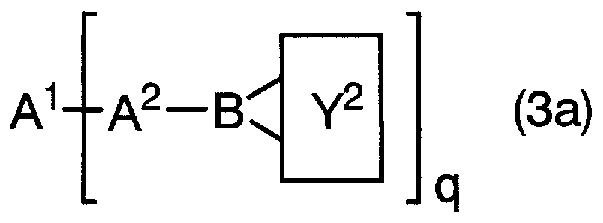
(式中、 A1及び A2は同一又は異なって置換されていてもよい芳香環、置換されてい てもよいへテロ芳香環、又は置換されていてもよいアルケンを示し、 Y2はホウ素原子 に対し少なくとも 1個の窒素原子で配位する 2価の基を示し、 qは 1以上の整数を示す 。)
で表されるクロスカップリング化合物を製造する方法であって、 10族遷移金属触媒の 存在下、一般式 (la) :
[化 12]
(1 a)

(式中、 Xは脱離基を示し、 A1及び qは前記に同じ。 )
で表される化合物と、一般式 (2a):
[化 13]

(式中、 R1は同一又は異なって水素原子、アルキル基又はァリール基である力 或い は 2つの R1同士が結合した基を示し、 A2及び Y2は前記に同じ。 )
で表される化合物とをクロスカップリングすることを特徴とする請求項 15に記載の製 造方法。

(式中、 R10、 R11 R2°、 R21、 R3°、 R4°、 R5°、 R51、 R6°、 R61、 R7°、 R8°、 R90及び R100は 同一又は異なって水素原子、アルキル基、ァルケ-ル基、ァリール基又はァラルキル 基を示し、 R12、 R13、 R"、 R15、 R16、 R17、 R22、 R23、 R24、 R25、 R31、 R32、 R33、 R34、 R
41 42 43 44 ^ 52 ^ 53 ^ 54 ^ 55 ^ 62 ^ 63 ^ 64 ^ 65 ^ 66 ^ 67 ^ 71 ^ 72 ^ 73
、_ 、_ 、_ 、_ 、_ 、_ 、_ 、_ 、_ 、_ 、_ 、_ 、_ 、_ 、_ 、_ 、 R74、 R75、 R76、 R81、 R82、 R83、 R84、 R91、 R92、 R10\ R102、 R103及び R104は同一又 は異なって水素原子、アルキル基又はァリール基を示し、或いは、隣接する炭素原 子に結合する 2つのアルキル基が結合して環を形成して 、てもよ 、。 )
で示される 2価の基である請求項 16に記載の製造方法。
[18] Y2が、式:
[化 15]

(式中、 R10, R11 R12、 R13、 R14、 R15、 R16及び R17は前記に同じ。 )
で示される 2価の基である請求項 17に記載の製造方法。
[19] 10族遷移金属触媒がパラジウム触媒又はニッケル触媒である請求項 15〜18のい ずれかに記載の製造方法。
[20] X2がハロゲン原子、 TfO—、TsO—、 MsO—又は(R' O) P (O) O— (式中、 R,は
2
水素原子又はアルキル基を示す。)である請求項 16〜19のいずれかに記載の製造 方法。
[21] A1又は A2が同一又は異なって置換されて 、てもよ 、芳香環又は置換されて ヽても よいへテロ芳香環である請求項 16〜20のいずれかに記載の製造方法。
[22] クロスカップリングイ匕合物を製造する方法であって、
(i) 10族遷移金属触媒の存在下、脱離基を有する化合物と、ボロン酸基又はボロン 酸エステル基及びマスキングされたボロン酸基を分子内に有する化合物とをクロス力 ップリングして、クロスカップリングイ匕合物を得る工程、及び
(ii)上記 (i)で得られたクロスカップリング化合物力 ボロン酸基のマスキング基を除 去して、ボロン酸基又はボロン酸エステル基を有するクロスカップリングイ匕合物を得る 工程、
を含むことを特徴とする製造方法。
[23] オリゴマー化合物を製造する方法であって、
(i) 10族遷移金属触媒の存在下、脱離基を有する化合物と、ボロン酸基又はボロン 酸エステル基及びマスキングされたボロン酸基を分子内に有する化合物とをクロス力 ップリングして、クロスカップリングイ匕合物を得る工程、
(ii)上記 (i)で得られたクロスカップリング化合物力 ボロン酸基のマスキング基を除 去して、ボロン酸基又はボロン酸エステル基を有するクロスカップリングイ匕合物を得る
工程、
(iii) 10族遷移金属触媒の存在下、上記 (ii)で得られたボロン酸基又はボロン酸エス テル基を有するクロスカップリングィヒ合物と、脱離基及びマスキングされたボロン酸基 を分子内に有する化合物とをクロスカップリングして、クロスカップリングイ匕合物を得る 工程、
を含むことを特徴とする製造方法。
[24] 請求項 23に記載の製造方法であって、さらに前記 (iii)の工程で得られるクロスカツ プリングイ匕合物を、前記 (ii)の工程の原料に供して、一連の前記 (ii)及び (iii)の工程 を 2回以上繰り返すことを特徴とする製造方法。
[25] 一般式(2a) :
[化 16]

(式中、 R1は同一又は異なって水素原子、アルキル基又はァリール基である力 或い は 2つの R1同士が結合した基を示し、 A2は置換されていてもよい芳香環、置換され ていてもよいへテロ芳香環、又は置換されていてもよいアルケンを示し、 Y2はホウ素 原子に対し少なくとも 1個の窒素原子で配位する 2価の基を示す。)
で表される化合物。
[26] 一般式(2a) :
[化 17]

(式中、 R1は同一又は異なって水素原子、アルキル基又はァリール基である力 或い は 2つの R1同士が結合した基を示し、 A2は置換されていてもよい芳香環、置換され ていてもよいへテロ芳香環、又は置換されていてもよいアルケンを示し、 Y2はホウ素 原子に対し少なくとも 1個の窒素原子で配位する 2価の基を示す。)
で表される化合物の製造方法であって、一般式 (2):
[化 18]

(式中、 X ま脱離基を示し、 Α及び Y ま前記に同じ。 )
で表される化合物と、一般式 (20):
[化 19]
(R10)2B-B(OR1)2 (20)
(式中、 R1は前記に同じ。 )
で表される化合物、又は、一般式(21):
[化 20]
HB(0R1)2 (21)
(式中、 R1は前記に同じ。 )
で表される化合物とを反応させることを特徴とする製造方法。
[27] クロスカップリング化合物を製造する方法であって、 10族遷移金属触媒の存在下、 固相担体に結合した脱離基を有する化合物と、ボロン酸基又はボロン酸エステル基 及びマスキングされたボロン酸基を分子内に有する化合物とをクロスカップリングする ことを特徴とする製造方法。
[28] 一般式(3b) :
[化 21]

(式中、 Pは固相担体を示し、 Zは— O—又は— NH—を示し、 A1及び A2は同一又は 異なって置換されていてもよい芳香環、置換されていてもよいへテロ芳香環、又は置 換されて 、てもよ 、アルケンを示し、 Y2はホウ素原子に対し少なくとも 1個の窒素原 子で配位する 2価の基を示し、 qは 1以上の整数を示す。 )
で表されるクロスカップリング化合物を製造する方法であって、 10族遷移金属触媒の
存在下、一般式 (lb) :
[化 22] jn (1 b)

(式中、 Xは脱離基を示し、 P、 Z、 A1及び qは前記に同じ。 )
で表される化合物と、一般式 (2a):
[化 23]

(式中、 R1は同一又は異なって水素原子、アルキル基又はァリール基である力 或い は 2つの R1同士が結合した基を示し、 A2及び Y2は前記に同じ。 )
で表される化合物とをクロスカップリングすることを特徴とする請求項 27に記載の製 造方法。
[29] 一般式(3b) :
[化 24]
(3b)

(式中、 Ρは固相担体を示し、 Ζは—Ο—又は—ΝΗ—を示し、 及び Α2は同一又は 異なって置換されていてもよい芳香環、置換されていてもよいへテロ芳香環、又は置 換されて 、てもよ 、アルケンを示し、 Υ2はホウ素原子に対し少なくとも 1個の窒素原 子で配位する 2価の基を示し、 qは 1以上の整数を示す。 )
で表されるクロスカップリングイ匕合物。
[30] 一般式 (lb) :
[化 25]
1—し- A B: Y n+1
(式中、 Pは固相担体を示し、 Zは—O—又は—NH—を示し、 Ai A11 は同一又は 異なって置換されていてもよい芳香環、置換されていてもよいへテロ芳香環、又は置 換されて 、てもよ 、アルケンを示し、 Y2はホウ素原子に対し少なくとも 1個の窒素原 子で配位する 2価の基を示し、 qは 1以上の整数を示す。 )
で表されるクロスカップリングイ匕合物。
[31] クロスカップリングイ匕合物を製造する方法であって、
(i) 10族遷移金属触媒の存在下、固相担体に結合した脱離基を有する化合物と、ボ ロン酸基又はボロン酸エステル基及びマスキングされたボロン酸基を分子内に有す る化合物とをクロスカップリングして、固相担体に結合したクロスカップリングイ匕合物を 得る工程、及び
(ii)上記 (i)で得られたクロスカップリング化合物力 ボロン酸基のマスキング基を除 去して、固相担体に結合したボロン酸基又はボロン酸エステル基を有するクロスカツ プリングイ匕合物を得る工程、
を含むことを特徴とする製造方法。
[32] オリゴマー化合物を製造する方法であって、
(i) 10族遷移金属触媒の存在下、固相担体に結合した脱離基を有する化合物と、ボ ロン酸基又はボロン酸エステル基及びマスキングされたボロン酸基を分子内に有す る化合物とをクロスカップリングして、固相担体に結合したクロスカップリングイ匕合物を 得る工程、
(ii)上記 (i)で得られた固相担体に結合したクロスカップリングイ匕合物力 ボロン酸基 のマスキング基を除去して、固相担体に結合したボロン酸基又はボロン酸エステル基 を有するクロスカップリングイ匕合物を得る工程、
(iii) 10族遷移金属触媒の存在下、上記 (ii)で得られた固相担体に結合したボロン 酸基又はボロン酸エステル基を有するクロスカップリング化合物と、脱離基及びマス キングされたボロン酸基を分子内に有する化合物とをクロスカップリングして、固相担 体に結合したクロスカップリングイ匕合物を得る工程、
を含むことを特徴とする製造方法。
[33] 請求項 32に記載の製造方法であって、さらに前記 (iii)の工程で得られる固相担体
に結合したクロスカップリングイ匕合物を、前記 (ii)の工程の原料に供して、前記 (ii)及 び (iii)の一連の工程を 2回以上繰り返すことを特徴とする製造方法。
請求項 33に記載の製造方法であって、さらに前記 (iii)の工程で得られる固相担体 に結合したクロスカップリング化合物を、 10族遷移金属触媒の存在下、脱離基を有 する化合物と反応させた後、固相担体を除去することを特徴とする製造方法。
Priority Applications (1)
| Application Number | Priority Date | Filing Date | Title |
|---|---|---|---|
| JP2008505123A JP4929468B2 (ja) | 2006-03-10 | 2007-03-09 | クロスカップリング反応を用いたオリゴマー化合物の合成方法 |
Applications Claiming Priority (2)
| Application Number | Priority Date | Filing Date | Title |
|---|---|---|---|
| JP2006-066051 | 2006-03-10 | ||
| JP2006066051 | 2006-03-10 |
Publications (1)
| Publication Number | Publication Date |
|---|---|
| WO2007105657A1 true WO2007105657A1 (ja) | 2007-09-20 |
Family
ID=38509480
Family Applications (1)
| Application Number | Title | Priority Date | Filing Date |
|---|---|---|---|
| PCT/JP2007/054729 Ceased WO2007105657A1 (ja) | 2006-03-10 | 2007-03-09 | クロスカップリング反応を用いたオリゴマー化合物の合成方法 |
Country Status (2)
| Country | Link |
|---|---|
| JP (1) | JP4929468B2 (ja) |
| WO (1) | WO2007105657A1 (ja) |
Cited By (6)
| Publication number | Priority date | Publication date | Assignee | Title |
|---|---|---|---|---|
| JP2012530739A (ja) * | 2009-06-26 | 2012-12-06 | プライム ユーロピアン テラペウティカルズ ソシエタ ペル アチオニ | アリールピリジニル化合物の調製方法 |
| CN102086179B (zh) * | 2009-12-07 | 2013-04-17 | 温州大学 | 一种联芳基化合物的合成方法 |
| JP2013527858A (ja) * | 2010-03-31 | 2013-07-04 | 中国石油化工股▲ふん▼有限公司 | エチレンのオリゴマー化のための触媒組成物およびオリゴマー化のプロセス |
| JP2014189647A (ja) * | 2013-03-27 | 2014-10-06 | Orient Chemical Industries Co Ltd | チエノチオフェン−ベンゾジチオフェン共重合体の製造方法 |
| WO2015024938A1 (en) * | 2013-08-20 | 2015-02-26 | Saudi Basic Industries Corporation | Process for the preparation of 2,2'-bis-indenyl biphenyl ligands and their metallocene complexes |
| JP2015168671A (ja) * | 2014-03-10 | 2015-09-28 | 学校法人明治大学 | 有機ホウ素化合物及びその製造方法 |
Citations (1)
| Publication number | Priority date | Publication date | Assignee | Title |
|---|---|---|---|---|
| WO2005110410A2 (en) * | 2004-05-14 | 2005-11-24 | Abbott Laboratories | Kinase inhibitors as therapeutic agents |
Family Cites Families (1)
| Publication number | Priority date | Publication date | Assignee | Title |
|---|---|---|---|---|
| JP5532194B2 (ja) * | 2007-04-25 | 2014-06-25 | 株式会社リコー | 重合性化合物、該重合性化合物を用いた電子写真感光体、該電子写真感光体を用いた画像形成方法、画像形成装置及び画像形成装置用プロセスカートリッジ |
-
2007
- 2007-03-09 WO PCT/JP2007/054729 patent/WO2007105657A1/ja not_active Ceased
- 2007-03-09 JP JP2008505123A patent/JP4929468B2/ja active Active
Patent Citations (1)
| Publication number | Priority date | Publication date | Assignee | Title |
|---|---|---|---|---|
| WO2005110410A2 (en) * | 2004-05-14 | 2005-11-24 | Abbott Laboratories | Kinase inhibitors as therapeutic agents |
Non-Patent Citations (3)
| Title |
|---|
| DENG X. ET AL.: "An Efficient Convergent Synthesis of Novel Anisotropic Adsorbates Based on Nanometer-Sized after Tripod-Shaped Oligophenylenes End-Capped with Triallylsilyl Groups", JOURNAL OF ORGANIC CHEMISTRY, vol. 67, no. 15, 2002, pages 5279 - 5283, XP002249823 * |
| HOHN E. ET AL.: "Enantiomerically pure cyclopropane building blocks: Synthesis and transformations of 2-iodocyclopropylboronic esters", ADVANCED SYNTHESIS & CATALYSIS, vol. 346, no. 7, 2004, pages 863 - 866, XP003017819 * |
| SCHULZ M.J. ET AL.: "Microwave-Assisted Preparation of Aryltetrazoleboronate Esters", ORGANIC LETTERS, vol. 6, no. 19, 2004, pages 3265 - 3268, XP003017820 * |
Cited By (11)
| Publication number | Priority date | Publication date | Assignee | Title |
|---|---|---|---|---|
| JP2012530739A (ja) * | 2009-06-26 | 2012-12-06 | プライム ユーロピアン テラペウティカルズ ソシエタ ペル アチオニ | アリールピリジニル化合物の調製方法 |
| CN102086179B (zh) * | 2009-12-07 | 2013-04-17 | 温州大学 | 一种联芳基化合物的合成方法 |
| JP2013527858A (ja) * | 2010-03-31 | 2013-07-04 | 中国石油化工股▲ふん▼有限公司 | エチレンのオリゴマー化のための触媒組成物およびオリゴマー化のプロセス |
| JP2014189647A (ja) * | 2013-03-27 | 2014-10-06 | Orient Chemical Industries Co Ltd | チエノチオフェン−ベンゾジチオフェン共重合体の製造方法 |
| WO2015024938A1 (en) * | 2013-08-20 | 2015-02-26 | Saudi Basic Industries Corporation | Process for the preparation of 2,2'-bis-indenyl biphenyl ligands and their metallocene complexes |
| CN105452260A (zh) * | 2013-08-20 | 2016-03-30 | 沙特基础工业公司 | 制备2,2’-双-茚基联苯配体和它们的茂金属络合物的方法 |
| JP2016531125A (ja) * | 2013-08-20 | 2016-10-06 | サウディ ベーシック インダストリーズ コーポレイション | 2,2’−ビスインデニルビフェニル配位子の調製方法およびそのメタロセン錯体 |
| US9828447B2 (en) | 2013-08-20 | 2017-11-28 | Saudi Basic Industries Corporation | Process for the preparation of 2,2′-bis-indenyl biphenyl ligands and their metallocene complexes |
| CN105452260B (zh) * | 2013-08-20 | 2018-05-22 | 沙特基础工业公司 | 制备2,2’-双-茚基联苯配体和它们的茂金属络合物的方法 |
| EA032159B1 (ru) * | 2013-08-20 | 2019-04-30 | Сауди Бейсик Индастриз Корпорейшн | Способ получения 2,2'-бис-инденилбифенильных лигандов и их металлоценовых комплексов |
| JP2015168671A (ja) * | 2014-03-10 | 2015-09-28 | 学校法人明治大学 | 有機ホウ素化合物及びその製造方法 |
Also Published As
| Publication number | Publication date |
|---|---|
| JPWO2007105657A1 (ja) | 2009-07-30 |
| JP4929468B2 (ja) | 2012-05-09 |
Similar Documents
| Publication | Publication Date | Title |
|---|---|---|
| WO2007105657A1 (ja) | クロスカップリング反応を用いたオリゴマー化合物の合成方法 | |
| WO2016058467A1 (zh) | 磷酸泰地唑胺的制备方法 | |
| CN106957207A (zh) | 2‑芳基(烯基)‑乙烯基磺酰氟化合物的制备方法 | |
| CN103214521A (zh) | 一种制备二苯并磷杂环戊二烯衍生物的方法 | |
| Chen et al. | Highly-efficient and recyclable nanosized MCM-41 anchored palladium bipyridyl complex-catalyzed coupling of acyl chlorides and terminal alkynes for the formation of ynones | |
| Karthikeyan et al. | Development of an efficient solvent free one-pot Heck reaction catalyzed by novel palladium (II) complex-via green approach | |
| JP6318863B2 (ja) | ジチエノベンゾジチオフェン誘導体の製造方法 | |
| JP6367121B2 (ja) | カップリング方法、及び該カップリング方法を用いた芳香族基置換複素環式化合物の製造方法 | |
| Lechel et al. | Novel Furo‐pyridine Derivatives via Sonogashira Reactions of Functionalized Pyridines | |
| Zhu et al. | Nickel-catalyzed Suzuki cross-coupling reaction of alkyl triaryl phosphonium salts | |
| CN106632440B (zh) | 一种芳基硼酸酯和烯基硼酸酯的制备方法 | |
| JP6344063B2 (ja) | ジチエノベンゾジチオフェン誘導体の製造方法 | |
| Gagnon et al. | Csp³-Csp² Palladium-Catalyzed Cross-Coupling Reaction of Trialkylbismuth Reagents with Aryl, Heteroaryl, and Vinyl Halides and Triflates | |
| KR100921783B1 (ko) | 나프틸기를 가지는 방향족 다중 고리 화합물과 이 화합물의제조방법 | |
| CN108440585A (zh) | 一种二氢吲哚硼酯的合成方法 | |
| Kuno et al. | Scyllo-inositol as a convenient protecting group for aryl boronic acids in Suzuki–Miyaura cross-coupling reactions | |
| CN116789612B (zh) | 一种利用乙炔制备氘代1,2,3-三唑化合物的方法 | |
| CN116102551B (zh) | 一种吡啶稠合的喹啉酮类化合物的制备方法 | |
| Deng et al. | Unusual C–O bond cleavage of aromatic ethers in ruthenium complexes bearing a 2-alkoxypyridyl fragment | |
| CN116947586B (zh) | 一种多取代丙烯基芳香化合物的制备方法 | |
| JP6709889B2 (ja) | 多置換芳香族化合物及びその製造方法 | |
| CN105669513A (zh) | 一种多取代3-炔基吡咯衍生物的制备方法 | |
| CN111777582B (zh) | 一种2-氟烷基-3-炔基取代萘并呋喃化合物及其制备方法 | |
| CN110028487B (zh) | 一种硫代色原酮化合物的制备方法 | |
| Danielsiek et al. | DISTAL Dibromoresorcin [4] arenes Through Selective Deactivation: A Practical Optimization |
Legal Events
| Date | Code | Title | Description |
|---|---|---|---|
| 121 | Ep: the epo has been informed by wipo that ep was designated in this application |
Ref document number: 07738214 Country of ref document: EP Kind code of ref document: A1 |
|
| WWE | Wipo information: entry into national phase |
Ref document number: 2008505123 Country of ref document: JP |
|
| NENP | Non-entry into the national phase |
Ref country code: DE |
|
| 122 | Ep: pct application non-entry in european phase |
Ref document number: 07738214 Country of ref document: EP Kind code of ref document: A1 |