WO2007019259A1 - Method of preparation of nitroaminopyridine compounds - Google Patents
Method of preparation of nitroaminopyridine compounds Download PDFInfo
- Publication number
- WO2007019259A1 WO2007019259A1 PCT/US2006/030347 US2006030347W WO2007019259A1 WO 2007019259 A1 WO2007019259 A1 WO 2007019259A1 US 2006030347 W US2006030347 W US 2006030347W WO 2007019259 A1 WO2007019259 A1 WO 2007019259A1
- Authority
- WO
- WIPO (PCT)
- Prior art keywords
- formula
- compound
- brominating
- acetic acid
- conducted
- Prior art date
- Legal status (The legal status is an assumption and is not a legal conclusion. Google has not performed a legal analysis and makes no representation as to the accuracy of the status listed.)
- Ceased
Links
- ORLGLBZRQYOWNA-UHFFFAOYSA-N Cc1cc(N)ncc1 Chemical compound Cc1cc(N)ncc1 ORLGLBZRQYOWNA-UHFFFAOYSA-N 0.000 description 1
- ABONABAGPPZJFF-UHFFFAOYSA-N Cc1ccnc(N[N+]([O-])=O)c1 Chemical compound Cc1ccnc(N[N+]([O-])=O)c1 ABONABAGPPZJFF-UHFFFAOYSA-N 0.000 description 1
Classifications
-
- C—CHEMISTRY; METALLURGY
- C07—ORGANIC CHEMISTRY
- C07D—HETEROCYCLIC COMPOUNDS
- C07D213/00—Heterocyclic compounds containing six-membered rings, not condensed with other rings, with one nitrogen atom as the only ring hetero atom and three or more double bonds between ring members or between ring members and non-ring members
- C07D213/02—Heterocyclic compounds containing six-membered rings, not condensed with other rings, with one nitrogen atom as the only ring hetero atom and three or more double bonds between ring members or between ring members and non-ring members having three double bonds between ring members or between ring members and non-ring members
- C07D213/04—Heterocyclic compounds containing six-membered rings, not condensed with other rings, with one nitrogen atom as the only ring hetero atom and three or more double bonds between ring members or between ring members and non-ring members having three double bonds between ring members or between ring members and non-ring members having no bond between the ring nitrogen atom and a non-ring member or having only hydrogen or carbon atoms directly attached to the ring nitrogen atom
- C07D213/60—Heterocyclic compounds containing six-membered rings, not condensed with other rings, with one nitrogen atom as the only ring hetero atom and three or more double bonds between ring members or between ring members and non-ring members having three double bonds between ring members or between ring members and non-ring members having no bond between the ring nitrogen atom and a non-ring member or having only hydrogen or carbon atoms directly attached to the ring nitrogen atom with hetero atoms or with carbon atoms having three bonds to hetero atoms with at the most one bond to halogen, e.g. ester or nitrile radicals, directly attached to ring carbon atoms
- C07D213/72—Nitrogen atoms
- C07D213/73—Unsubstituted amino or imino radicals
-
- C—CHEMISTRY; METALLURGY
- C07—ORGANIC CHEMISTRY
- C07D—HETEROCYCLIC COMPOUNDS
- C07D213/00—Heterocyclic compounds containing six-membered rings, not condensed with other rings, with one nitrogen atom as the only ring hetero atom and three or more double bonds between ring members or between ring members and non-ring members
- C07D213/02—Heterocyclic compounds containing six-membered rings, not condensed with other rings, with one nitrogen atom as the only ring hetero atom and three or more double bonds between ring members or between ring members and non-ring members having three double bonds between ring members or between ring members and non-ring members
- C07D213/04—Heterocyclic compounds containing six-membered rings, not condensed with other rings, with one nitrogen atom as the only ring hetero atom and three or more double bonds between ring members or between ring members and non-ring members having three double bonds between ring members or between ring members and non-ring members having no bond between the ring nitrogen atom and a non-ring member or having only hydrogen or carbon atoms directly attached to the ring nitrogen atom
- C07D213/60—Heterocyclic compounds containing six-membered rings, not condensed with other rings, with one nitrogen atom as the only ring hetero atom and three or more double bonds between ring members or between ring members and non-ring members having three double bonds between ring members or between ring members and non-ring members having no bond between the ring nitrogen atom and a non-ring member or having only hydrogen or carbon atoms directly attached to the ring nitrogen atom with hetero atoms or with carbon atoms having three bonds to hetero atoms with at the most one bond to halogen, e.g. ester or nitrile radicals, directly attached to ring carbon atoms
- C07D213/72—Nitrogen atoms
- C07D213/76—Nitrogen atoms to which a second hetero atom is attached
- C07D213/77—Hydrazine radicals
Definitions
- the present invention provides a method of preparing an intermediate useful for the preparation of azaindole derivatives.
- One aspect of the present invention provides a method of preparing a compound of formula 4:
- a further aspect of the present invention provides a method of preparing a compound of formula 3:
- the present invention provides processes for the preparation of 2-amino,5- bromo,3-nitropicoline, otherwise referred to herein as the compound of formula 4.
- This compound may be used, for example, as an intermediate useful in the preparation of azaindoles, such as those represented by the compound of formula 8.
- the compound of formula 8 is an azaindole derivative useful in the treatment of HIV.
- the present invention includes the preparation of the compound of formula 4 in addition to the preparation of intermediates as shown in the following scheme. Each of the steps are shown below in more detail following the general Scheme.
- Step 1 includes the conversion of the compound of formula 1 to the compound of formula 2, but the introduction of a nitro function to the amine. This is conducted with a strong acid such as sulfuric acid (H 2 SO 4 ) followed by nitric acid (HNO 3 ).
- a strong acid such as sulfuric acid (H 2 SO 4 ) followed by nitric acid (HNO 3 ).
- Step 2 is the bromination of the compound of formula 2 to a compound of formula 3, which may be performed by a variety of reaction conditions. The reaction may be conducted either at room temperature or with heating. One of the following combinations may also be included (i) acetic acid and sodium acetate followed by introduction of bromine and acetic acid, (ii) dicholoro(m)ethane, acetonitrile and N- bromosuccinamide, (iii) acetic acid and potassium hydrogen phosphate followed by the introduction of bromine and acetic acid, and (iv) dichloromethane, water and tetrabutylammoniumtribromide.
- Step 3 is the conversion from the compound of formula 3 to the compound of formula 4 is conducted with a strong acid such as sulfuric acid.
- Step 2c To a 250 mL single neck round bottom flask was charged 7OmL of 1 ,2- dichloroethane and 2OmL of acetonitrile. Then, 3.488g of N-Bromo Succinamide (NBS) (leq.) was added at one time to this mixture and allowed to stir in the dark. Upon complete dissolution of the NBS, 3g of the compound of formula 2 was added at one time. This white slurry was allowed to stir at room temperature for a period of 15 hours.
- NBS N-Bromo Succinamide
- EXAMPLE 8 - Step 3 The procedure in Example 7 was repeated using 72 mL of sulfuric acid which was maintained between 0-5 0 C. Then, 11.28g of the compound of formula 3 was added over a period of 20 minutes and stirred for an additional 20 minutes. The reaction mixture was allowed to come to room temperature and stirred for an additional one hour.
Landscapes
- Chemical & Material Sciences (AREA)
- Organic Chemistry (AREA)
- Pharmaceuticals Containing Other Organic And Inorganic Compounds (AREA)
- Organic Low-Molecular-Weight Compounds And Preparation Thereof (AREA)
Abstract
A method of preparing an intermediate which is useful for the preparation of azaindole derivatives.
Description
METHOD OF PREPARATION OF NITROAMINOPYRIDINE COMPOUNDS
CROSS- REFERENCE TO RELATED APPLICATIONS
[0001] This application claims the benefit of U.S. Provisional Application Serial Number 60/705,261 filed August 3, 2005.
FIELD OF THE INVENTION
[0002] The present invention provides a method of preparing an intermediate useful for the preparation of azaindole derivatives.
SUMMARY OF THE INVENTION [0003] One aspect of the present invention provides a method of preparing a compound of formula 4:

4 including the steps of:
(a) converting a compound of formula 1 :

1
[0004] to a compound of formula 2:

2 (b) brominating said compound of formula 2 to provide a compound of formula 3:

3 ; and
(c) converting said compound of formula 3 to provide said compound of formula 4.
[0005] A further aspect of the present invention provides a method of preparing a compound of formula 3:

3 [0006] including the steps of:
(a) converting a compound of formula 1 :
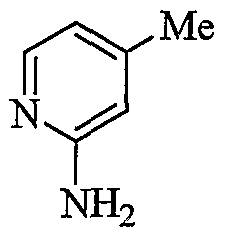
1
[0007] to a compound of formula 2:

2
(b) brominating said compound of formula 2 to provide a compound of formula 3.
DETAILED DESCRIPTION OF THE INVENTION
[0008] The present invention provides processes for the preparation of 2-amino,5- bromo,3-nitropicoline, otherwise referred to herein as the compound of formula 4. This compound may be used, for example, as an intermediate useful in the preparation of azaindoles, such as those represented by the compound of formula 8. The compound of formula 8 is an azaindole derivative useful in the treatment of HIV. The present invention includes the preparation of the compound of formula 4 in addition to the preparation of intermediates as shown in the following scheme. Each of the steps are shown below in more detail following the general Scheme.
SCHEME

[0010] Step 2 is the bromination of the compound of formula 2 to a compound of formula 3, which may be performed by a variety of reaction conditions. The reaction may be conducted either at room temperature or with heating. One of the following combinations may also be included (i) acetic acid and sodium acetate followed by introduction of bromine and acetic acid, (ii) dicholoro(m)ethane, acetonitrile and N- bromosuccinamide, (iii) acetic acid and potassium hydrogen phosphate followed by the introduction of bromine and acetic acid, and (iv) dichloromethane, water and tetrabutylammoniumtribromide.
[0011] Step 3 is the conversion from the compound of formula 3 to the compound of formula 4 is conducted with a strong acid such as sulfuric acid.
[0012] The features and advantages of the present invention are more fully shown by the following examples which are provided for purposes of illustration, and are not to be construed as limiting the invention in any way.
EXAMPLES
EXAMPLE 1 - Step 1

I step 1 2
[0013] hi a 500 mL 3-neck flask, equipped with a stirrer and an internal thermocouple probe (JKEM) was charged 116 mL of concentrated sulfuric acid (H2SO4) and allowed to cool between 0-50C with an ice bath. Then 25g of the compound of formula 1 was charged, over a period of one hour, via an addition funnel.
[0014] After one hour, 15.5mL (1 (eq.)) of concentrated nitric acid (69-71%) was added dropwise maintaining the reaction mixture between -3° to 00C with external cooling (ice/methanol) over a period of 1.25 hours. The mixture was allowed to stir between 0-30C for one hour, after which HPLC analysis revealed complete conversion of the compound of formula 1 to the compound of formula 2.
[0015] The solution was slowly quenched over 60Og of we ice in a 1 L beaker. The ice was allowed to melt and the resulting white slurry was stirred at room temperature for 10 min. The slurry was vacuum filtered, dried in vacuo (5 in Hg) at 5O0C (overnight) giving 84% recovered yield of the compound of formula 2.
[0016] Analytical data: 1H-NMR (CD3OD) (δ, ppm): 2.50 (s, 3H), 7.20 (bd, IH, J = 6.6 Hz, Ar-H)5 7.30 (bs, IH, Ar-H), 8.03 (d, IH, J = 6.6 Hz5 Ar-H): 13C-NMR (CD3OD) (δ, ppm): 21.0O5 118.54, 119.9I5 135.34, 144.0O5 158.46: HRMS calcd for C6H7N3O2 153.05383 found (M+ 1) 154.06166.
EXAMPLE 2 - Step 2a

Step 2a
, [0017] To a 50 mL single neck round bottom flask was charged 23 mL of acetic acid and 3.66g(8eq.) of anhydrous sodium acetate. The resulting mixture was heated to 4O0C until complete dissolution of sodium acetate was achieved.
[0018] One gram of the compound of formula 2 was added at 4O0C and the reaction was allowed to come to room temperature. A molecular bromine solution 1.005g (0.34mL/13mL acetic acid) was slowly added over a period of 30 minutes with an addition funnel and heated to 500C for three hours.
[0019] The slurry containing the product was aged for 30 minutes at room temperature. The product was filtered in vacuo, washed with 5mL cold water, 2mL dichloromethane and dried under reduced pressure (8in Hg, 550C) for one hour. The desired mono bromo derivative of formula 3 was obtained in 70% isolated yield (1.045g).
[0020] Analytical data: 1H-NMR (CD3OD/CDC13) (δ, ppm): 2.39 (s, 3H, -CH3), 7.63 (s, IH5 Ar-H), 8.22 (s, IH5 Ar-H): 13C-NMR (DMF-D7) (δ, ppm): 19.46, 116.05, 116.44, 147.22, 147.80, 159.81: HRMS calcd for C6H6BrN3O2 230.96434 found 231.97217.
EXAMPLE 3 - Step 2b

Step 2b
[0021] To a 250 mL single neck round bottom flask was charged 7OmL of acetic acid and 8.23g (6eq.) of anhydrous sodium acetate. The resulting mixture was stirred at 4O0C until complete dissolution of sodium acetate was achieved.
[0022] Three grams of the compound of formula 2 was added at 40°C under high stirring. This slurry was allowed to come to room temperature (15 minutes). A molecular bromine solution, 31.14g in 4OmL acetic acid, was slowly added over a period of 30 minutes with an addition funnel and the mixture allowed to stir at room temperature for 24 hours.
[0023] The slurry containing the product was aged for an additional 6 hours at room temperature. The product was filtered in vacuo, washed with 5mL cold water, 2mL dichloromethane and dried under reduced pressure (8in Hg, 55°C) for one hour. The desired crude mono bromo derivative of formula 3 was obtained in 83% isolated yield (3.75g). See step 2a for analytical data.
EXAMPLE 4 - Step 2c
Dichloroethane/acetonitrile N-Bromo succinamide
Room Temperature


Step 2c
[0024] To a 250 mL single neck round bottom flask was charged 7OmL of 1 ,2- dichloroethane and 2OmL of acetonitrile. Then, 3.488g of N-Bromo Succinamide (NBS) (leq.) was added at one time to this mixture and allowed to stir in the dark. Upon complete dissolution of the NBS, 3g of the compound of formula 2 was added at one time. This white slurry was allowed to stir at room temperature for a period of 15 hours.
[0025] After 15 hours, the brown slurry was filtered in vacuo, washed with 3mL dichloromethane and dried under reduced pressure (5in Hg, 5O0C) to yield 2.99g of the crude product. See step 2a for analytical data.
EXAMPLE 5 - Step 2d

Step 2d
[0026] To a 50 mL single neck round bottom flask was charged 65mL of acetic acid and 4.5g (leq.) of potassium hydrogen phosphate di basic (K2HPO4). The resulting mixture was heated to 4O0C until complete dissolution of the potassium hydrogen phosphate di basic was achieved.
[0027] Then, 3g of the compound of formula 2 was added at 4O0C and the reaction was allowed to come to room temperature. A molecular bromine solution, 3.137g (5.025mL/40mL acetic acid) was slowly added over a period of 30 minutes with an addition funnel at room temperature and heated to 400C for 12 hours.
[0028] The slurry containing the product was aged for 30 min at room temperature. The product was filtered in vacuo, washed with 5mL cold water, 2mL dichloromethane and dried under reduced pressure (8in Hg, 550C) for 3 hours to yield
the desired mono bromo derivative of formula 3 in 65% isolated yield (corrected for purity, 2.867g). See step 2a for analytical data.
EXAMPLE 6 - Step 2e
Dichloromethane/H2O
TBABr3
 Room Temperature

Step 2e
[0029] To a 50 mL single neck round bottom flask was charged 3OmL of dichloromethane and 3.15g (1.3eq.) of tetrabutylammoniumtribromide. Then, Ig of the compound of formula 2 was added at one time under stirring. After 10 minutes, 2OmL of water was introduced under high stirring. The biphasic reaction mixture was allowed to stir for 48 hours, and aged for an additional one hour at room temperature. The desired mono bromo derivative was filtered, washed with 1 mL of dichloromethane and dried in vacuo (5 in Hg, 500C, 2hours) to yield 01.02g of the compound of formula 3 (65%, based on purity of the isolated solid). See step 2a for analytical data.
EXAMPLE 7 - Step 3

[0030] To a 5OmL single neck flask equipped with a stirrer, an external cooling, and an internal thermocouple probe, was added 10 mL of concentrated sulfuric acid. The mixture was stirred between 0-5°C with an external ice bath. Then, 1 g of the compound of formula 3 was added slowly to the solution. After one hour, the reaction was allowed to come to room temperature and stirred for an additional 5 hours.
[0031] The reaction was quenched over 5Og of wet ice and neutralized with 50%NaOH solution to pH 6.0 under constant stirring.
[0032] The desired compound of formula 4 was obtained as yellow slurry which was filtered and dried in vacuo (5in Hg, 5O0C) for 3 hours. The product of formula 4 was recovered in 98% yield (0.98g).
[0033] Analytical data: m.p. 132 °C. IR (KBr, cm4): 1633, 1581, 1538, 1512, 1458, 1377, 1344, 1321, 1244, 869,779 . 1H-NMR (CDCl3) (δ, ppm): 2.55 (s, 3H), 5.85 (bs, 2H), 8.25 (s, IH): 13C-NMR (CDCl3) (δ, ppm): 20.81, 112.14, 144.49, 151.91, 153.78 (2C); HRMS: calcd for C6H6BrN3O2: 230.96434; found: (M+l): 231.97217.
EXAMPLE 8 - Step 3 [0034] The procedure in Example 7 was repeated using 72 mL of sulfuric acid which was maintained between 0-50C. Then, 11.28g of the compound of formula 3 was added over a period of 20 minutes and stirred for an additional 20 minutes. The reaction mixture was allowed to come to room temperature and stirred for an additional one hour.
[0035] The reaction was quenched over 300 of wet ice and aged for 30 minutes. This cold solution was neutralized with 200 ml of 50% sodium hydroxide to pH 5.2. The resulting yellow slurry was filtered and dried in vacuo (5 in Hg, 4O0C, 10 hours) to yield 9.53g of the compound of formula 4 as a yellow solid in 93% recovery. See Example 7 for analytical data.
[0036] While there have been described what are presently believed to be the preferred embodiments of the invention, those skilled in the art will realize that changes and modifications may be made thereto without departing from the spirit of the invention, and it is intended to include all such changes and modifications as fall within the true scope of the invention.
Claims
1. A method of preparing a compound of formula 4:

(a) converting a compound of formula 1 :

to a compound of formula 2:

(b) brominating said compound of formula 2 to provide a compound of formula 3:

3 ; and
(c) converting said compound of formula 3 to provide said compound of formula 4.
2. The method of claim 1, wherein said converting said compound of formula 1 to said compound of formula 2 is conducted by reaction with sulfuric acid followed by the introduction of nitric acid.
3. The method of claim 1 , wherein said brominating said compound of formula 2 is conducted at room temperature.
4. The method of claim 1 , wherein said brominating said compound of formula 2 is conducted with heating.
5. The method of claim 3, wherein said brominating further comprises steps of combining the compound of formula 2 with acetic acid and sodium acetate followed by introduction of bromine and acetic acid.
6. The method of claim 4, wherein said brominating further comprises steps of combining the compound of formula 2 with acetic acid and sodium acetate followed by introduction of bromine and acetic acid.
7. The method of claim 3, wherein said brominating is conducted in the presence of dichloroethane, acetonitrile and N-bromosuccinamide.
8. The method of claim 3, wherein said brominating further comprises steps of combining the compound of formula 2 with acetic acid and potassium hydrogen phosphate followed by introduction of bromine and acetic acid.
9. The method of claim 4, wherein said brominating is conducted in the presence of dichloromethane, water, and tetrabutylammoniumtribromide.
10. The method of claim 1 , wherein said converting said compound of formula 3 to said compound of formula 4 is conducted in the presence of sulfuric acid.
11. A method of preparing a compound of formula 3 : Br ffVMe
NHNO2
3 comprising the steps of: (a) converting a compound of formula 1 :

to a compound of formula 2:

2
(b) brominating said compound of formula 2 to provide a compound of formula 3.
Applications Claiming Priority (2)
| Application Number | Priority Date | Filing Date | Title |
|---|---|---|---|
| US70526105P | 2005-08-03 | 2005-08-03 | |
| US60/705,261 | 2005-08-03 |
Publications (1)
| Publication Number | Publication Date |
|---|---|
| WO2007019259A1 true WO2007019259A1 (en) | 2007-02-15 |
Family
ID=37508291
Family Applications (1)
| Application Number | Title | Priority Date | Filing Date |
|---|---|---|---|
| PCT/US2006/030347 Ceased WO2007019259A1 (en) | 2005-08-03 | 2006-08-02 | Method of preparation of nitroaminopyridine compounds |
Country Status (2)
| Country | Link |
|---|---|
| US (1) | US20070032657A1 (en) |
| WO (1) | WO2007019259A1 (en) |
Citations (1)
| Publication number | Priority date | Publication date | Assignee | Title |
|---|---|---|---|---|
| EP0530524A1 (en) * | 1991-08-06 | 1993-03-10 | Ichikawa Gosei Chemical Co., Ltd. | Method of producing 2-amino-3-nitro-5-halogenopyridine |
Family Cites Families (1)
| Publication number | Priority date | Publication date | Assignee | Title |
|---|---|---|---|---|
| US5290943A (en) * | 1991-02-21 | 1994-03-01 | Ichikawa Gosei Chemical Co., Ltd. | Method of producing 2-acyl amino 5-halogenopyridine compounds |
-
2006
- 2006-07-25 US US11/492,730 patent/US20070032657A1/en not_active Abandoned
- 2006-08-02 WO PCT/US2006/030347 patent/WO2007019259A1/en not_active Ceased
Patent Citations (1)
| Publication number | Priority date | Publication date | Assignee | Title |
|---|---|---|---|---|
| EP0530524A1 (en) * | 1991-08-06 | 1993-03-10 | Ichikawa Gosei Chemical Co., Ltd. | Method of producing 2-amino-3-nitro-5-halogenopyridine |
Non-Patent Citations (1)
| Title |
|---|
| H. RITTER ET. AL.: "Synthesis and Reactions of Dinitrated Amino and DIaminopyridines", JOURNAL OF HETEROCYCLIC CHEMISTRY. DEC 1971, vol. 32, no. 2, March 1995 (1995-03-01), pages 585 - 590, XP002412572, ISSN: 0022-152X * |
Also Published As
| Publication number | Publication date |
|---|---|
| US20070032657A1 (en) | 2007-02-08 |
Similar Documents
| Publication | Publication Date | Title |
|---|---|---|
| CN100379721C (en) | Preparation of sulfinylacetamide | |
| JP2014201545A (en) | METHOD OF MANUFACTURING 2-HYDROXYMETHYL-2,3-DIHYDRO-THIENO[3,4-b][1,4]DIOXIN-5,7-DICARBOXYLIC ACID DIALKYL ESTER | |
| JPH0314025B2 (en) | ||
| CN107235967A (en) | The synthesis technique of antineoplastic Tegafur | |
| WO2007019259A1 (en) | Method of preparation of nitroaminopyridine compounds | |
| US9169198B2 (en) | Method for the production of 2-amino-5-cyano-N,3-dimethylbenzamide | |
| JP2005502701A (en) | Method for producing 3-bromomethylbenzoic acid | |
| RU2744834C2 (en) | Method for producing 4-alkoxy-3-hydroxypicolinic acids | |
| CN110551123A (en) | Preparation method of 5- (tert-butyloxycarbonyl) -2-methyl-4, 5,6, 7-tetrahydro-2H-pyrazolo [4,3-C ] pyridine-7-carboxylic acid | |
| US4221745A (en) | Preparation of hexanitrostilbene | |
| KR20050013234A (en) | Method for the production of 1,2,4-triazolylmethyl-oxiranes | |
| CN113929633A (en) | A kind of synthetic method and application of favipiravir | |
| JP2010520158A (en) | Novel process for the preparation of 3-methyl-4-phenylisoxazolo [3,4-d] pyridazin-7 (6H) -one | |
| CN106866560B (en) | Lesinurad synthesis method | |
| RU2497810C1 (en) | Method of obtaining n,n-diaryl-substituted 2-trichloromethyl-imidazolidines | |
| RU2806327C1 (en) | Method of producing 5-hydroxy-6-methyluracil | |
| EP0030475B1 (en) | Process for producing solutions of aziridine-2-carboxylic acid salts | |
| JP4223408B2 (en) | Method for producing 2,6-dihalopurine | |
| US6133447A (en) | Process for the preparation of substituted pyridines | |
| KR101329242B1 (en) | Method for preparing p-aminobenzoic acid | |
| KR100982720B1 (en) | Process for the preparation of 2-aminomalonamide as an intermediate for the production of 4-carbamoyl-1-β-D-ribofuranoslimidazolium-5-oleate | |
| JP2964160B2 (en) | Method for isolating cyclopropanecarboxylic acid and method for producing intermediate thereof | |
| JP2002193967A (en) | Production method of 2,6-dichloropurine | |
| US3544640A (en) | Aromatic nitro compounds | |
| JP4690733B2 (en) | Method for producing 3-hydroxypyrazole-1-carboxamide derivative |
Legal Events
| Date | Code | Title | Description |
|---|---|---|---|
| 121 | Ep: the epo has been informed by wipo that ep was designated in this application | ||
| NENP | Non-entry into the national phase |
Ref country code: DE |
|
| 122 | Ep: pct application non-entry in european phase |
Ref document number: 06800727 Country of ref document: EP Kind code of ref document: A1 |