WO2006124205A2 - Hydrophilic polymers with pendant functional groups and method thereof - Google Patents
Hydrophilic polymers with pendant functional groups and method thereof Download PDFInfo
- Publication number
- WO2006124205A2 WO2006124205A2 PCT/US2006/015447 US2006015447W WO2006124205A2 WO 2006124205 A2 WO2006124205 A2 WO 2006124205A2 US 2006015447 W US2006015447 W US 2006015447W WO 2006124205 A2 WO2006124205 A2 WO 2006124205A2
- Authority
- WO
- WIPO (PCT)
- Prior art keywords
- formula
- polymer
- compound
- recurring unit
- recited
- Prior art date
- Legal status (The legal status is an assumption and is not a legal conclusion. Google has not performed a legal analysis and makes no representation as to the accuracy of the status listed.)
- Ceased
Links
- 0 *C(CCC(ON(C(CC1)=O)C1=O)=O)C(ON(C(CC1)=O)C1=O)=O Chemical compound *C(CCC(ON(C(CC1)=O)C1=O)=O)C(ON(C(CC1)=O)C1=O)=O 0.000 description 5
- QJDYHDIFAZDWPN-UHFFFAOYSA-N CCC(C)(CCOC(C)(CC)CCN)N Chemical compound CCC(C)(CCOC(C)(CC)CCN)N QJDYHDIFAZDWPN-UHFFFAOYSA-N 0.000 description 1
Classifications
-
- C—CHEMISTRY; METALLURGY
- C08—ORGANIC MACROMOLECULAR COMPOUNDS; THEIR PREPARATION OR CHEMICAL WORKING-UP; COMPOSITIONS BASED THEREON
- C08G—MACROMOLECULAR COMPOUNDS OBTAINED OTHERWISE THAN BY REACTIONS ONLY INVOLVING UNSATURATED CARBON-TO-CARBON BONDS
- C08G69/00—Macromolecular compounds obtained by reactions forming a carboxylic amide link in the main chain of the macromolecule
- C08G69/02—Polyamides derived from amino-carboxylic acids or from polyamines and polycarboxylic acids
- C08G69/26—Polyamides derived from amino-carboxylic acids or from polyamines and polycarboxylic acids derived from polyamines and polycarboxylic acids
-
- A—HUMAN NECESSITIES
- A61—MEDICAL OR VETERINARY SCIENCE; HYGIENE
- A61K—PREPARATIONS FOR MEDICAL, DENTAL OR TOILETRY PURPOSES
- A61K47/00—Medicinal preparations characterised by the non-active ingredients used, e.g. carriers or inert additives; Targeting or modifying agents chemically bound to the active ingredient
- A61K47/50—Medicinal preparations characterised by the non-active ingredients used, e.g. carriers or inert additives; Targeting or modifying agents chemically bound to the active ingredient the non-active ingredient being chemically bound to the active ingredient, e.g. polymer-drug conjugates
- A61K47/51—Medicinal preparations characterised by the non-active ingredients used, e.g. carriers or inert additives; Targeting or modifying agents chemically bound to the active ingredient the non-active ingredient being chemically bound to the active ingredient, e.g. polymer-drug conjugates the non-active ingredient being a modifying agent
- A61K47/56—Medicinal preparations characterised by the non-active ingredients used, e.g. carriers or inert additives; Targeting or modifying agents chemically bound to the active ingredient the non-active ingredient being chemically bound to the active ingredient, e.g. polymer-drug conjugates the non-active ingredient being a modifying agent the modifying agent being an organic macromolecular compound, e.g. an oligomeric, polymeric or dendrimeric molecule
- A61K47/59—Medicinal preparations characterised by the non-active ingredients used, e.g. carriers or inert additives; Targeting or modifying agents chemically bound to the active ingredient the non-active ingredient being chemically bound to the active ingredient, e.g. polymer-drug conjugates the non-active ingredient being a modifying agent the modifying agent being an organic macromolecular compound, e.g. an oligomeric, polymeric or dendrimeric molecule obtained otherwise than by reactions only involving carbon-to-carbon unsaturated bonds, e.g. polyureas or polyurethanes
- A61K47/595—Polyamides, e.g. nylon
-
- A—HUMAN NECESSITIES
- A61—MEDICAL OR VETERINARY SCIENCE; HYGIENE
- A61K—PREPARATIONS FOR MEDICAL, DENTAL OR TOILETRY PURPOSES
- A61K47/00—Medicinal preparations characterised by the non-active ingredients used, e.g. carriers or inert additives; Targeting or modifying agents chemically bound to the active ingredient
- A61K47/50—Medicinal preparations characterised by the non-active ingredients used, e.g. carriers or inert additives; Targeting or modifying agents chemically bound to the active ingredient the non-active ingredient being chemically bound to the active ingredient, e.g. polymer-drug conjugates
- A61K47/51—Medicinal preparations characterised by the non-active ingredients used, e.g. carriers or inert additives; Targeting or modifying agents chemically bound to the active ingredient the non-active ingredient being chemically bound to the active ingredient, e.g. polymer-drug conjugates the non-active ingredient being a modifying agent
- A61K47/56—Medicinal preparations characterised by the non-active ingredients used, e.g. carriers or inert additives; Targeting or modifying agents chemically bound to the active ingredient the non-active ingredient being chemically bound to the active ingredient, e.g. polymer-drug conjugates the non-active ingredient being a modifying agent the modifying agent being an organic macromolecular compound, e.g. an oligomeric, polymeric or dendrimeric molecule
- A61K47/59—Medicinal preparations characterised by the non-active ingredients used, e.g. carriers or inert additives; Targeting or modifying agents chemically bound to the active ingredient the non-active ingredient being chemically bound to the active ingredient, e.g. polymer-drug conjugates the non-active ingredient being a modifying agent the modifying agent being an organic macromolecular compound, e.g. an oligomeric, polymeric or dendrimeric molecule obtained otherwise than by reactions only involving carbon-to-carbon unsaturated bonds, e.g. polyureas or polyurethanes
- A61K47/60—Medicinal preparations characterised by the non-active ingredients used, e.g. carriers or inert additives; Targeting or modifying agents chemically bound to the active ingredient the non-active ingredient being chemically bound to the active ingredient, e.g. polymer-drug conjugates the non-active ingredient being a modifying agent the modifying agent being an organic macromolecular compound, e.g. an oligomeric, polymeric or dendrimeric molecule obtained otherwise than by reactions only involving carbon-to-carbon unsaturated bonds, e.g. polyureas or polyurethanes the organic macromolecular compound being a polyoxyalkylene oligomer, polymer or dendrimer, e.g. PEG, PPG, PEO or polyglycerol
-
- C—CHEMISTRY; METALLURGY
- C08—ORGANIC MACROMOLECULAR COMPOUNDS; THEIR PREPARATION OR CHEMICAL WORKING-UP; COMPOSITIONS BASED THEREON
- C08G—MACROMOLECULAR COMPOUNDS OBTAINED OTHERWISE THAN BY REACTIONS ONLY INVOLVING UNSATURATED CARBON-TO-CARBON BONDS
- C08G69/00—Macromolecular compounds obtained by reactions forming a carboxylic amide link in the main chain of the macromolecule
- C08G69/02—Polyamides derived from amino-carboxylic acids or from polyamines and polycarboxylic acids
Definitions
- This invention relates generally to novel biocompatible hydrophilic polymers with pendant functional groups and methods for making them. These polymers are useful for a variety of drug, biomolecule and imaging agent delivery applications.
- a variety of systems have been used for the delivery of drugs, biomolecules, and imaging agents.
- such systems include capsules, liposomes, microparticles, nanoparticles, and polymers.
- Polymers are often classified as being either biodegradable or nonbiodegradable.
- polyester-based biodegradable systems have been characterized and studied.
- Polylactic acid (PLA), polyglycolic acid (PGA) and their copolymers polylactic-co-glycolic acid (PLGA) are some of the most well-characterized biomaterials with regard to design and performance for drug-delivery applications. See Uhrich, K.E.; Cannizzaro, S.M.; Langer, R.S. and Shakeshelf, K.M. "Polymeric Systems for Controlled Drug Release.” Chem. Rev. 1999, 99, 3181-3198 and Panyam J, Labhasetwar V. "Biodegradable nanoparticles for drug and gene delivery to cells and tissue.” Adv Drug Deliv Rev. 2003, 55, 329-47.
- Biodegradable systems based on polyorthoesters have also been investigated. See Heller, J.; Barr, J.; Ng, S.Y.; Abdellauoi, K.S. and Gurny, R. "Poly(ortho esters): synthesis, characterization, properties and uses.” Adv. Drug Del. Rev. 2002, 54, 1015-1039. Polyanhydride systems have also been investigated. Such polyanhydrides are typically biocompatible and may degrade in vivo into relatively non-toxic compounds that are eliminated from the body as metabolites. See Kumar, N.; Langer, R.S. and Domb, AJ. "Polyanhydrides: an overview.” Adv. Drug Del. Rev. 2002, 54, 889-91.
- Amino acid-based polymers have also been considered as a potential source of new biomaterials.
- Poly-amino acids having good biocompatibility have been investigated to deliver low molecular-weight compounds.
- a relatively small number of polyglutamic acid and copolymers have been identified as candidate materials for drug delivery. See Bourke, S. L. and Kohn, J. "Polymers derived from the amino acid L-tyrosine: polycarbonates, polyarylates and copolymers with poly(ethylene glycol).” Adv. Drug Del. Rev., 2003, 55, 447- 466.
- Administered hydrophobic anticancer drugs and therapeutic proteins and polypeptides often suffer from poor bio-availability. Such poor bio-availability may be due to incompatibility of bi-phasic solutions of hydrophobic drugs and aqueous solutions and/or rapid removal of these molecules from blood circulation by enzymatic degradation.
- One technique for increasing the efficacy of administered proteins and other small molecule agents entails conjugating the administered agent with a polymer, such as a polyethylene glycol (“PEG”) molecule, that can provide protection from enzymatic degradation in vivo. Such "PEGylation" often improves the circulation time and, hence, big-availability of an administered agent.
- PEG polyethylene glycol
- PEG has shortcomings in certain respects, however. For example, because PEG is a linear polymer, the steric protection afforded by PEG is limited, as compared to branched polymers. Another major shortcoming of PEG is that it is only amenable to derivatization at its two terminals. This limits the number of other functional molecules (e.g. those helpful for protein or drug delivery to specific tissues) that can be conjugated to a PEG.
- the starting materials used to make the polymers include ethylene glycols (FDA-approved biomaterials) and amino acids (natural products), which are typically biocompatible and degradable.Preferred polymers may be used for various bio-delivery applications.
- Embodiments of the invention are directed to polymers comprising a recurring unit of the formula (I):
- X is selected from the group consisting of -(CH 2 CH 2 O) m - CH 2 CH 2 - and -CH 2 CH 2 CH 2 O-(CH 2 CH 2 O) 1n -CH 2 CH 2 CH 2 -, wherein m is an integer in the range of 1 to 100;
- formula (I) represents the following formula (II):
- formula (I) represents the following formula (HI):
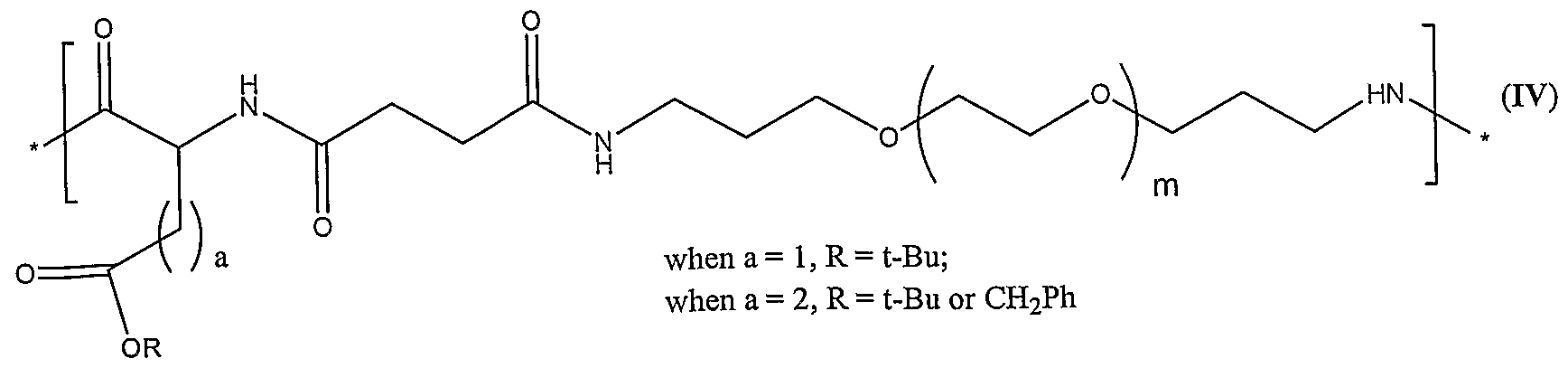
- formula (I) represents the following formula (IV):
- formula (I) represents the following formula (V):
- formula (I) represents the following formula (VI):
- formula (I) represents the following formula (VII):
- formula (I) represents the following formula (VIII):
- formula (I) represents the following formula (IX):
- Embodiments of the invention are directed to compositions comprising the formula (X):
- Embodiments of the invention are directed to a method of producing polymers that include a recurring unit of the formula (II) which comprises reacting a polymer comprising a recurring unit of the formula (VIII) with a Pac-NHS.
- Embodiments of the invention are directed to a method of producing polymers that include a recurring unit of the formula (IH) which comprises reacting a polymer comprising a recurring unit of the formula (IV) with trifluoacetic acid (TFA) or catalytic palladium/carbon hydrogenation.
- TFA trifluoacetic acid
- Embodiments of the invention are directed to a method of producing polymers that include a recurring unit of the formula (IV) which comprises reacting a compound of the formula (X) with a compound of the formula (XII).
- Embodiments of the invention are directed to a method of producing polymers that include a recurring unit of the formula (V) which comprises reacting a compound of the formula (X) with a compound of the formula (XIII).
- Embodiments of the invention are directed to a method of producing polymers that include a recurring unit of the formula (VI) which comprises reacting a polymer comprising a recurring unit of the formula (VII) with TFA or catalytic palladium/carbon hydrogenation.
- R BOC or CBZ
- Embodiments of the invention are directed to a method of producing polymers that include a recurring unit of the formula (VII) which comprises reacting a compound of the formula (XI) with a compound of the formula (XII).
- Embodiments of the invention are directed to a method of producing polymers that include a recurring unit of the formula (VJS) which comprises reacting a polymer comprising a recurring unit of the formula (IX) with TFA or catalytic palladium/carbon hydrogenation.
- Embodiments of the invention are directed to a method of producing polymers that include a recurring unit of the formula (IX) which comprises reacting a compound of the formula (XI) with a compound of the formula (XIII).
- Embodiments of the invention are directed to a method of producing compositions comprising the formula (X) which comprises reacting L-glutamic acid ⁇ -benzyl ester, L-aspartic acid ⁇ -t-butyl ester, or L-glutamic acid ⁇ -t-butyl ester with succinimide anhydride, followed by l-(3-dimethylaminopropyl)-3-ethylcardiimide hydrochloride (EDC), N-hydroxysuccinimide (NHS) coupling.
- EDC l-(3-dimethylaminopropyl)-3-ethylcardiimide hydrochloride
- NHS N-hydroxysuccinimide
- Figure 1 shows conventional use of poly(ethylene glycol) (PEG) as a block co-polymer.
- Figure 2 shows use of ethylene glycol as a small spacer unit in a larger polymer according to an embodiment.
- Figure 3 shows a reaction scheme for making a polymer according to an embodiment.
- Figure 4 shows a reaction scheme for making a polymer according to another embodiment.
- Figure 5 shows a reaction scheme for the preparation of compounds 13-17.
- Figure 6 shows a reaction scheme for making a polymer according to another embodiment.
- Figure 7 shows a reaction scheme for making a polymer according to another embodiment.
- Figure 8 shows a reaction scheme for making a polymer according to another embodiment.
- Figure 9 shows a reaction scheme for making a polymer according to another embodiment. 6 015447
- An embodiment provides a polymer comprising a recurring unit of the formula (I):
- X is selected from the group consisting of -(CH 2 CH 2 O) 1n - CH 2 CH 2 - and -CH 2 CH 2 CH 2 O-(CH 2 CH 2 O) 1n -CH 2 CH 2 CH 2 -, wherein m is an integer in the range of 1 to 100;
- polymers that comprises recurring units of the formula (I) include polymers that comprise recurring units of the formula (II), polymers that comprise recurring units of the formula (IH), polymers that comprise recurring units of the formula (rv), polymers that comprise recurring units of the formula (V), polymers that comprise recurring units of the formula (VI), polymers that comprise recurring units of the formula (VII), polymers that comprise recurring units of the formula (VIII), and polymers that comprise recurring units of the formula (IX):
- Polymers that comprise recurring units of the formula (IT) may be prepared by a process that comprises reacting a polymer comprising a recurring unit of the formula (V ⁇ i) with Pac-NHS.
- Polymers that comprise recurring units of the formula (HI) may be prepared by a process that comprises reacting a polymer comprising a recurring unit of the formula (IV) with trifluoacetic acid (TFA) or catalytic palladium/carbon hydrogenation.
- TFA trifluoacetic acid
- Polymers that comprise recurring units of the formula (IV) may be prepared by a process that comprises reacting a compound of the formula (X) with a compound of the formula (XII).
- Polymers that comprise recurring units of the formula (V) may be prepared by a process that comprises reacting a compound of the formula (X) with a compound of the formula (XIII).
- Polymers that comprise recurring units of the formula (VI) may be prepared by a process that comprises reacting a polymer comprising a recurring unit of the formula (VII) with TFA or catalytic palladium/carbon hydrogenation.
- Polymers that comprise recurring units of the formula (VII) may be prepared by a process that comprises reacting a compound of the formula (XI) with a compound of the formula (XII).
- Polymers that comprise recurring units of the formula (VIII) may be prepared by a process that comprises reacting a polymer comprising a recurring unit of the formula (IX) with TFA or catalytic palladium/carbon hydrogenation.
- Polymers that comprise recurring units of the formula (IX) may be prepared by a process that comprises reacting a compound of the formula (XI) with a compound of the formula (XIII).
- An embodiment provides a composition comprising a compound represented by the formula (X):
- compositions that comprise a compound of the formula (X) may be prepared by a process that comprises reacting L-glutamic acid ⁇ -benzyl ester, L-aspartic acid ⁇ -t-butyl ester, or L-glutamic acid ⁇ -t-butyl ester with succinimide anhydride, followed by 1- (3-Dimethylaminopropyl)-3-ethylcardiimide hydrochloride (EDC), N-hydroxysuccinimide (NHS) coupling.
- a polymer 6 was produced according to the reaction scheme illustrated in Figure 3 as follows: A solution of compound 3 (0.51 g, 2.3 mmol) in dichloromethane (DCM, 10 mL) was added to a solution of compound 1 (1.48 g, 2.3 mmol). The reaction was stirred for 15 hours. Water (50 mL) was added, and organic phases were extracted (50 mL x 2), combined, dried with anhydrous sodium sulfate, filtered, and concentrated by rotary evaporation to yield a polymer 4 (0.80g, 1.6 mmol, 0.71% yield).
- DCM dichloromethane
- the polymer 4 was treated with 95% trifluoacetic acid (TFA) in DCM for 2 hours to yield the polymer 6 (0.30 g, 0.9 mmol, 56%) after dialysis with semi-permeable cellulose (cut-off molecular weight 3,500 daltons) and lyophilization.
- TFA trifluoacetic acid
- a polymer 5 was produced according to the reaction scheme illustrated in Figure 3 in a manner similar to that described in Example 1, except that compound 2 was used in place of compound 1 as illustrated in Figure 3. Synthesis of polymer 6 from polymer 5 was carried out using a catalytic palladium/carbon hydrogenation instead of using TFA.
- a polymer 9 was produced according to the reaction scheme illustrated in Figure 4 in a manner similar to that described in Example 2, except that compound 7 was used in place of compound 3.
- a compound 16 was produced according to the reaction scheme illustrated in Figure 5 as follows: L-glutamic acid ⁇ -t-butyl ester 12 (10.0 g, 49.2 mmol) and succinic anhydride (6.40 g, 64.0 mmol) and catalytic 4-dimethylaminopyridine (100 mg) were stirred in DMF (200 mL) for 15 hours.
- a polymer 25 was produced according to the reaction scheme illustrated in Figure 7 in a manner similar to that described in Example 2, except that compound 23 was used in place of compound 3.
- a polymer 26 was produced according to the reaction scheme illustrated in Figure 8 as follows: Polymer 25 (57 mg) was dissolved in DMF (4 mL). Pac-NHS (50 mg) was added into the solution and continued to stir for 3 hours. The mixture was concentrated by rotary evaporation. The residue was partially redissolved in distilled water (5 mL). Polymer 26 was purified by Sephadex-G25 gel filtration. The product 26 was obtained in fractions after lyophilization.
- a polymer 22 (105 mg) was dissolved in DMF (6 mL). 1,3- Dicyclohexylcarbodiimide (DCC, 0.1 equivalence per unit of 22) and paclitaxel (0.05 equivalence per unit of 22, LC Laboratories), and trace of amount of 1,4- dimethylaminopyridine (DMAP) were added into the solution. The mixture was stirred for 15 hours. The solvent was removed by rotary evaporation. A solution of sodium bicarbonate (10 mL, 1.0 M) was added into the residue.
- DCC 1,3- Dicyclohexylcarbodiimide
- paclitaxel 0.05 equivalence per unit of 22, LC Laboratories
- DMAP 1,4- dimethylaminopyridine
- Precipitate was filtered through a 0.2 ⁇ m filer, and the crude polymer 27 was dialyzed in cellulose semipermeable membrane (cut-off 3,500 daltons) with distilled water for 12 hours at 4 degrees Celsius. The polymer 27 was obtained after lyophilization.
Landscapes
- Health & Medical Sciences (AREA)
- Chemical & Material Sciences (AREA)
- Medicinal Chemistry (AREA)
- Life Sciences & Earth Sciences (AREA)
- Public Health (AREA)
- Veterinary Medicine (AREA)
- Epidemiology (AREA)
- Bioinformatics & Cheminformatics (AREA)
- Animal Behavior & Ethology (AREA)
- General Health & Medical Sciences (AREA)
- Engineering & Computer Science (AREA)
- Pharmacology & Pharmacy (AREA)
- Chemical Kinetics & Catalysis (AREA)
- Polymers & Plastics (AREA)
- Organic Chemistry (AREA)
- Proteomics, Peptides & Aminoacids (AREA)
- Polyamides (AREA)
- Peptides Or Proteins (AREA)
- Addition Polymer Or Copolymer, Post-Treatments, Or Chemical Modifications (AREA)
- Medicinal Preparation (AREA)
Abstract
A polymer comprising a recurring unit of the formula (I) as defined herein is described. In the formula (I), X is selected from the group consisting of -(CH2CH2O)m-CH2CH2- and -CH2CH2CH2O-(CH2CH2O)m-CH2CH2CH2-, wherein m is an integer in the range of 1 to 100; Y is selected from the group consisting of -C*HCH2-, -C*HCH2CH2-, -C*H-NHC(=O)-CH2CH2-, -C*H-NHC(=O)-CH2CH2CH2-, -CH2CH2N*CH2CH2-, -CH2CH2CH2N* CH2CH2CH2-, C2 to C20 alkyl, and C6 to C20 aryl, wherein C* and N* represent atoms to which Z is bonded; and Z is selected from the group consisting of -NHR1, -NH-C(=O)-(CH2)nC(=O)NR1R2, -NH-C(=O)-(CH2)nC(=O)OR1, -(CH2)nC(=O)NR1R2, -(CH2)nC(=O)OR1, -(CH2)nC(=O)SR1, and -(CH2)nNR1R2, wherein n is an integer in the range of 1 to 3, wherein R1 and R2 are each independently selected from the group consisting of hydrogen, C1 to C20 alkyl, C6 to C20 aryl, anticancer drugs, peptides, antibody fragment, lactose, galactose, mannose, transferrin, magnetic resonance imaging agents, succinimyl, and alkali metal.
Description
NDTCO.050VPC
HYDROPHILIC POLYMERS WITH PENDANT FUNCTIONAL GROUPS AND
METHOD THEREOF
BACKGROUND OF THE INVENTION Field of the Invention
[0001] This invention relates generally to novel biocompatible hydrophilic polymers with pendant functional groups and methods for making them. These polymers are useful for a variety of drug, biomolecule and imaging agent delivery applications.
Description of the Related Art
[0002] A variety of systems have been used for the delivery of drugs, biomolecules, and imaging agents. For example, such systems include capsules, liposomes, microparticles, nanoparticles, and polymers. Polymers are often classified as being either biodegradable or nonbiodegradable.
[0003] A variety of polyester-based biodegradable systems have been characterized and studied. Polylactic acid (PLA), polyglycolic acid (PGA) and their copolymers polylactic-co-glycolic acid (PLGA) are some of the most well-characterized biomaterials with regard to design and performance for drug-delivery applications. See Uhrich, K.E.; Cannizzaro, S.M.; Langer, R.S. and Shakeshelf, K.M. "Polymeric Systems for Controlled Drug Release." Chem. Rev. 1999, 99, 3181-3198 and Panyam J, Labhasetwar V. "Biodegradable nanoparticles for drug and gene delivery to cells and tissue." Adv Drug Deliv Rev. 2003, 55, 329-47. Biodegradable systems based on polyorthoesters have also been investigated. See Heller, J.; Barr, J.; Ng, S.Y.; Abdellauoi, K.S. and Gurny, R. "Poly(ortho esters): synthesis, characterization, properties and uses." Adv. Drug Del. Rev. 2002, 54, 1015-1039. Polyanhydride systems have also been investigated. Such polyanhydrides are typically biocompatible and may degrade in vivo into relatively non-toxic compounds that are eliminated from the body as metabolites. See Kumar, N.; Langer, R.S. and Domb, AJ. "Polyanhydrides: an overview." Adv. Drug Del. Rev. 2002, 54, 889-91.
[0004] Amino acid-based polymers have also been considered as a potential source of new biomaterials. Poly-amino acids having good biocompatibility have been
investigated to deliver low molecular-weight compounds. A relatively small number of polyglutamic acid and copolymers have been identified as candidate materials for drug delivery. See Bourke, S. L. and Kohn, J. "Polymers derived from the amino acid L-tyrosine: polycarbonates, polyarylates and copolymers with poly(ethylene glycol)." Adv. Drug Del. Rev., 2003, 55, 447- 466.
[0005] Administered hydrophobic anticancer drugs and therapeutic proteins and polypeptides often suffer from poor bio-availability. Such poor bio-availability may be due to incompatibility of bi-phasic solutions of hydrophobic drugs and aqueous solutions and/or rapid removal of these molecules from blood circulation by enzymatic degradation. One technique for increasing the efficacy of administered proteins and other small molecule agents entails conjugating the administered agent with a polymer, such as a polyethylene glycol ("PEG") molecule, that can provide protection from enzymatic degradation in vivo. Such "PEGylation" often improves the circulation time and, hence, big-availability of an administered agent.
[0006] PEG has shortcomings in certain respects, however. For example, because PEG is a linear polymer, the steric protection afforded by PEG is limited, as compared to branched polymers. Another major shortcoming of PEG is that it is only amenable to derivatization at its two terminals. This limits the number of other functional molecules (e.g. those helpful for protein or drug delivery to specific tissues) that can be conjugated to a PEG.
Summary of the Invention
[0007] The inventors have used relatively small ethylene glycol and amino acid derivatives to make novel hydrophilic polymers, e.g., as schematically illustrated in Figure 2.
[0008] In some embodiments, the starting materials used to make the polymers include ethylene glycols (FDA-approved biomaterials) and amino acids (natural products), which are typically biocompatible and degradable.Preferred polymers may be used for various bio-delivery applications.
[0009] Embodiments of the invention are directed to polymers comprising a recurring unit of the formula (I):

[0010] wherein: X is selected from the group consisting of -(CH2CH2O)m- CH2CH2- and -CH2CH2CH2O-(CH2CH2O)1n-CH2CH2CH2-, wherein m is an integer in the range of 1 to 100; Y is selected from the group consisting of -C*HCH2-, -C*HCH2CH2-, - C*H-NHC(=O)-CH2CH2-, -C*H-NHC(=O)-CH2CH2CH2-, -CH2CH2N=^CH2CH2-, - CH2CH2CH2N* CH2CH2CH2-, C2 to C20 alkyl, and C6 to C20 aiyl, wherein C* and N* represent atoms to which Z is bonded; and Z is selected from the group consisting of -NHR1, -NH-C(=O)-(CH2)nC(=O)NR1R2, -NH-C(=O)-(CH2)nC(=O)OR1, -(CH2)HCC=O)NR1R2, - (CH2)nC(=O)OR1, -(CH2)nC(=O)SR1, and -(CH2)HNR1R2, wherein n is an integer in the range of 1 to 3, wherein R1 and R2 are each independently selected from the group consisting of hydrogen, C1 to C20 alkyl, C6 to C20 aryl, anticancer drugs, peptides, antibody fragment, lactose, galactose, mannose, transferrin, magnetic resonance imaging agents, succinimyl, and alkali metal.
[0011] In preferred embodiments, the formula (I) represents the following formula (II):

[0012] In preferred embodiments, the formula (I) represents the following formula (HI):


[0014] In preferred embodiments, the formula (I) represents the following formula (V):

[0015] In preferred embodiments, the formula (I) represents the following formula (VI):

[0016] In preferred embodiments, the formula (I) represents the following formula (VII):

[0017] hi preferred embodiments, the formula (I) represents the following formula (VIII):

[0018] hi preferred embodiments, the formula (I) represents the following formula (IX):

R=BOC or CBZ
6 015447
[0019] Embodiments of the invention are directed to compositions comprising the formula (X):

[0020] Embodiments of the invention are directed to a method of producing polymers that include a recurring unit of the formula (II) which comprises reacting a polymer comprising a recurring unit of the formula (VIII) with a Pac-NHS.


[0021] Embodiments of the invention are directed to a method of producing polymers that include a recurring unit of the formula (IH) which comprises reacting a polymer comprising a recurring unit of the formula (IV) with trifluoacetic acid (TFA) or catalytic palladium/carbon hydrogenation.


[0023] Embodiments of the invention are directed to a method of producing polymers that include a recurring unit of the formula (V) which comprises reacting a compound of the formula (X) with a compound of the formula (XIII).


R = BOC or CBZ
[0025] Embodiments of the invention are directed to a method of producing polymers that include a recurring unit of the formula (VII) which comprises reacting a compound of the formula (XI) with a compound of the formula (XII).


[0026] Embodiments of the invention are directed to a method of producing polymers that include a recurring unit of the formula (VJS) which comprises reacting a polymer comprising a recurring unit of the formula (IX) with TFA or catalytic palladium/carbon hydrogenation.

R=BOC or CBZ
[0027] Embodiments of the invention are directed to a method of producing polymers that include a recurring unit of the formula (IX) which comprises reacting a compound of the formula (XI) with a compound of the formula (XIII).


[0028] Embodiments of the invention are directed to a method of producing compositions comprising the formula (X) which comprises reacting L-glutamic acid γ-benzyl ester, L-aspartic acid β-t-butyl ester, or L-glutamic acid γ-t-butyl ester with succinimide anhydride, followed by l-(3-dimethylaminopropyl)-3-ethylcardiimide hydrochloride (EDC), N-hydroxysuccinimide (NHS) coupling.
[0029] Detailed descriptions of hydrophilic polymers for drug delivery are described in the following references, which are hereby incorporated by reference: U.S. 6,653,427; U.S. 6,706,836; U.S. 6,743,880; U.S. 5,962,620; U.S. 5,993,972; U.S. 2002/155158; U.S. 2004/185103; U.S. 6,706,289; U.S. 6,652,886; U.S. 2004/0228831; U.S. 2004/0170595; U.S. 2004/0161403; U.S. 2003/0220447; U.S. 2003/0147958; U.S. 2003/0018002; U.S. 6,515,100; U.S. 6,541,015 and WO2003/066069.
[0030] Further aspects, features and advantages of this invention will become apparent from the detailed description of the preferred embodiments which follow.
Brief Description of the Drawings
[0031] These and other feature of this invention will now be described with reference to the drawings of preferred embodiments which are intended to illustrate and not to limit the invention.
[0032] Figure 1 shows conventional use of poly(ethylene glycol) (PEG) as a block co-polymer.
[0033] Figure 2 shows use of ethylene glycol as a small spacer unit in a larger polymer according to an embodiment.
[0034] Figure 3 shows a reaction scheme for making a polymer according to an embodiment.
[0035] Figure 4 shows a reaction scheme for making a polymer according to another embodiment.
[0036] Figure 5 shows a reaction scheme for the preparation of compounds 13-17.
[0037] Figure 6 shows a reaction scheme for making a polymer according to another embodiment.
[0038] Figure 7 shows a reaction scheme for making a polymer according to another embodiment.
[0039] Figure 8 shows a reaction scheme for making a polymer according to another embodiment.
[0040] Figure 9 shows a reaction scheme for making a polymer according to another embodiment.
6 015447
Detailed Description of the Preferred Embodiments [0041] These and other features of this invention will now be described with reference to the drawings of preferred embodiments which are intended to illustrate and not to limit the invention.
[0042] An embodiment provides a polymer comprising a recurring unit of the formula (I):

[0043] wherein: X is selected from the group consisting of -(CH2CH2O)1n- CH2CH2- and -CH2CH2CH2O-(CH2CH2O)1n-CH2CH2CH2-, wherein m is an integer in the range of 1 to 100; Y is selected from the group consisting of -C*HCH2-, -C*HCH2CH2-, - C*H-NHC(=O)-CH2CH2-, -C*H-NHC(=O)~CH2CH2CH2-, -CH2CH2N* CH2CH2-, - CH2CH2CH2N* CH2CH2CH2-, C2 to C20 alkyl, and C6 to C20 aryl, wherein C* and N* represent atoms to which Z is bonded; and Z is selected from the group consisting of -NHR1, -NH-C(=O)-(CH2)nC(=O)NR1R2, -NH-C(=O)-(CH2)nC(-O)OR1, -(CH2)nC(=O)NR1R2, - (CH2)HC(^=O)OR1, -(CH2)nC(=O)SR1, and -(CH^nNR1R2, wherein n is an integer in the range of 1 to 3, wherein R1 and R2 are each independently selected from the group consisting of hydrogen, C1 to C20 alkyl, C6 to C20 aryl, anticancer drugs, peptides, antibody fragment, lactose, galactose, mannose, transferrin, magnetic resonance imaging agents, succinimyl, and alkali metal.
[0044] Examples of polymers that comprises recurring units of the formula (I) include polymers that comprise recurring units of the formula (II), polymers that comprise recurring units of the formula (IH), polymers that comprise recurring units of the formula (rv), polymers that comprise recurring units of the formula (V), polymers that comprise recurring units of the formula (VI), polymers that comprise recurring units of the formula (VII), polymers that comprise recurring units of the formula (VIII), and polymers that comprise recurring units of the formula (IX):




R=BOC or CBZ
[0045] Polymers that comprise recurring units of the formula (IT) may be prepared by a process that comprises reacting a polymer comprising a recurring unit of the formula (Vπi) with Pac-NHS.


[0047] Polymers that comprise recurring units of the formula (IV) may be prepared by a process that comprises reacting a compound of the formula (X) with a compound of the formula (XII).


[0048] Polymers that comprise recurring units of the formula (V) may be prepared by a process that comprises reacting a compound of the formula (X) with a compound of the formula (XIII).


[0049] Polymers that comprise recurring units of the formula (VI) may be prepared by a process that comprises reacting a polymer comprising a recurring unit of the formula (VII) with TFA or catalytic palladium/carbon hydrogenation.

R = BOC w CBZ
[0050] Polymers that comprise recurring units of the formula (VII) may be prepared by a process that comprises reacting a compound of the formula (XI) with a compound of the formula (XII).


[0051] Polymers that comprise recurring units of the formula (VIII) may be prepared by a process that comprises reacting a polymer comprising a recurring unit of the formula (IX) with TFA or catalytic palladium/carbon hydrogenation.

R=BOC or CBZ
2006/015447
[0052] Polymers that comprise recurring units of the formula (IX) may be prepared by a process that comprises reacting a compound of the formula (XI) with a compound of the formula (XIII).


[0053] An embodiment provides a composition comprising a compound represented by the formula (X):

[0054] Compositions that comprise a compound of the formula (X) may be prepared by a process that comprises reacting L-glutamic acid γ-benzyl ester, L-aspartic acid β-t-butyl ester, or L-glutamic acid γ-t-butyl ester with succinimide anhydride, followed by 1- (3-Dimethylaminopropyl)-3-ethylcardiimide hydrochloride (EDC), N-hydroxysuccinimide (NHS) coupling.
EXAMPLES
[0055] The chemical structures of compounds 1-26 are shown in Figures 3-9. Synthesis of compound 1 and compound 2 was carried out by the well-known method of EDC coupling using NHS from N-α-t-boc-L-glutamic acid and N-α-CBZ-L-glutamic acid (EMD Biosciences Inc.), respectively. Compound 3 was purchased from TCI Chemicals, Inc. L-glutamic acid γ-benzyl ester, L-aspartic acid β-t-butyl ester and L-glutamic acid γ-t-butyl ester were purchased from EMD Biosciences, Inc. Pac-NHS was synthesized according to the method described in Thierry et al. J Am Chem Soc. 2005 16;127(6): 1626-7. Compound 23 was purchased from Nektar Therapeutics, Inc. Other chemicals, reagents and solvents were purchased from Aldrich Chemicals Company. Molecular weights are weight average and were determined by aqueous gel permeation chromatography (GPC) using polyethylene glycol standards. Chemical structures were confirmed by 1H and 13C NMR spectra measured at room temperature on a 400 MHz (100 MHz for 13C) instrument in CDCl3, D2O, or DMSO- d6.
EXAMPLE 1
[0056] A polymer 6 was produced according to the reaction scheme illustrated in Figure 3 as follows: A solution of compound 3 (0.51 g, 2.3 mmol) in dichloromethane (DCM, 10 mL) was added to a solution of compound 1 (1.48 g, 2.3 mmol). The reaction was stirred for 15 hours. Water (50 mL) was added, and organic phases were extracted (50 mL x 2), combined, dried with anhydrous sodium sulfate, filtered, and concentrated by rotary evaporation to yield a polymer 4 (0.80g, 1.6 mmol, 0.71% yield). The polymer 4 was treated with 95% trifluoacetic acid (TFA) in DCM for 2 hours to yield the polymer 6 (0.30 g, 0.9 mmol, 56%) after dialysis with semi-permeable cellulose (cut-off molecular weight 3,500 daltons) and lyophilization.
EXAMPLE 2
[0057] A polymer 5 was produced according to the reaction scheme illustrated in Figure 3 in a manner similar to that described in Example 1, except that compound 2 was used in place of compound 1 as illustrated in Figure 3. Synthesis of polymer 6 from polymer 5 was carried out using a catalytic palladium/carbon hydrogenation instead of using TFA.
EXAMPLE 3
[0058] A polymer 9 was produced according to the reaction scheme illustrated in Figure 4 in a manner similar to that described in Example 2, except that compound 7 was used in place of compound 3.
EXAMPLE 4
[0059] A compound 16 was produced according to the reaction scheme illustrated in Figure 5 as follows: L-glutamic acid γ-t-butyl ester 12 (10.0 g, 49.2 mmol) and succinic anhydride (6.40 g, 64.0 mmol) and catalytic 4-dimethylaminopyridine (100 mg) were stirred in DMF (200 mL) for 15 hours. l-(3-Dimethylaminopropyl)-3-ethylcardiimide hydrochloride (EDC, 25 g, 13.0 mmol) was added and continued to stir for 5 minutes, then N- hydroxysuccinimide (NHS, 15.5 g, 13.0 mmol) was added and continued to stir for 2 hours (coupling). The solvent was removed by rotary evaporation. The residue was redissolved in DCM (200 mL) and extracted two times from water. Organic phases were combined, dried with anhydrous sodium sulfate, filtered, and concentrated by rotary evaporation. The compound 16 (13.5 g, 27.2 mmol, 55%) was obtained after silica gel column purification with ethylacetate as an eluent (TLC, Rf= 0.5).
EXAMPLES 5-8
[0060] Compounds 13-15 and 17 were produced according to the reaction scheme illustrated in Figure 5 in a matter similar to that described in Example 4, except that various combinations of compounds 10, 11 or 12 and succinic or glutaric anhydride were used.
EXAMPLE 9-10
[0061] Polymers 21 and 22 were produced according to the reaction scheme illustrated in Figure 6 in a manner similar to that described in Example 1, except that compound 13, 15 or 17 was used in place of compound 1. Synthesis of compounds 18-20 was similar to synthesis of compound 4, and synthesis of compounds 21 and 22 from compounds 18 and 19, respectively, was similar to synthesis of compound 6 from compound 4. Synthesis of compound 22 from compound 20 was similar to synthesis of compound 6 from compound 5 which was described in Example 2.
EXAMPLE Il
[0062] A polymer 25 was produced according to the reaction scheme illustrated in Figure 7 in a manner similar to that described in Example 2, except that compound 23 was used in place of compound 3.
EXAMPLE 12
[0063] A polymer 26 was produced according to the reaction scheme illustrated in Figure 8 as follows: Polymer 25 (57 mg) was dissolved in DMF (4 mL). Pac-NHS (50 mg) was added into the solution and continued to stir for 3 hours. The mixture was concentrated by rotary evaporation. The residue was partially redissolved in distilled water (5 mL). Polymer 26 was purified by Sephadex-G25 gel filtration. The product 26 was obtained in fractions after lyophilization.
EXAMPLE 13
[0064] A polymer 22 (105 mg) was dissolved in DMF (6 mL). 1,3- Dicyclohexylcarbodiimide (DCC, 0.1 equivalence per unit of 22) and paclitaxel (0.05 equivalence per unit of 22, LC Laboratories), and trace of amount of 1,4- dimethylaminopyridine (DMAP) were added into the solution. The mixture was stirred for 15 hours. The solvent was removed by rotary evaporation. A solution of sodium bicarbonate (10 mL, 1.0 M) was added into the residue. Precipitate was filtered through a 0.2 μm filer, and the crude polymer 27 was dialyzed in cellulose semipermeable membrane (cut-off 3,500 daltons) with distilled water for 12 hours at 4 degrees Celsius. The polymer 27 was obtained after lyophilization.
[0065] It will be understood by those of skill in the art that numerous and various modifications can be made without departing from the spirit of the present invention. Therefore, it should be clearly understood that the forms of the present invention are illustrative only and not intended to limit the scope of the present invention.
Claims
1. A polymer comprising a recurring unit of the formula (I) :

wherein:
X is selected from the group consisting of -(CH2CH2O)m-CH2CH2- and - CH2CH2CH2O-(CH2CH2O)111-CH2CH2CH2-, wherein m is an integer in the range of 1 to 100;
Y is selected from the group consisting of -C*HCH2-, -C*HCH2CH2-, -C*H- NHCC=O)-CH2CH2-, -C*H-NHC(=O)-CH2CH2CH2-, -CH2CH2N^CH2CH2-, - CH2CH2CH2N*CH2CH2CH2-, C2 to C20 alkyl, and C6 to C20 aryl, wherein C* and N* represent atoms to which Z is bonded; and
Z is selected from the group consisting of -NHR1, -NH-C(=0)- (CH2)nC(=O)NR1R2, -NH-C(=0)-(CH2)nC(=0)0R1, -(CH2)nC(=O)NR1R2, - (CH2)nC(=O)OR\ -(CH2)HCC=O)SR1, and -(CH2)X1NR1R2, wherein n is an integer in the range of 1 to 3, wherein R1 and R2 are each independently selected from the group consisting of hydrogen, Ci to C20 alkyl, C6 to C20 aryl, anticancer drugs, peptides, antibody fragment, lactose, galactose, mannose, transferrin, magnetic resonance imaging agents, succinimyl, and alkali metal.
2. The polymer as recited in claim 1, wherein the formula (I) represents the following formula (IT):

3. The polymer as recited in claim 1, wherein the formula (I) represents the following formula (III):

4. The polymer as recited in claim 1, wherein the formula (I) represents the following formula (IV): 
5. The polymer as recited in claim 1, wherein the formula (I) represents the following formula (V):

6. The polymer as recited in claim 1, wherein the formula (I) represents the following formula (VT):

7. The polymer as recited in claim 1, wherein the formula (I) represents the following formula (VII): 2006/015447

8. The polymer as recited in claim 1, wherein the formula (I) represents the following formula (VIII):

9. The polymer as recited in claim 1, wherein the formula (I) represents the following formula (IX):

R=BOC or CBZ
10. The polymer as recited in claim 1, which comprises at least one recurring unit selected from the group consisting of a recurring unit of the formula (II), a recurring unit of the formula (VIII), and a recurring unit of the formula (IX):

R=BOC or CBZ
11. The polymer as recited in claim 10, which comprises a recurring unit of the formula (II), a recurring unit of the formula (VIII), and a recurring unit of the formula (IX).
12. A composition comprising a compound of the formula (X) : T7US2006/015447

13. A method of producing the polymer of claim 2 comprising reacting a polymer comprising a recurring unit of the formula (VIII) with Pac-NHS:

14. A method of producing the polymer of claim 3 comprising reacting a polymer comprising a recurring unit of the formula (IV) with trifluoacetic acid (TFA) or catalytic palladium/carbon hydro genation:

15. A method of producing the polymer of claim 4 comprising reacting a compound of the formula (X) with a compound of the formula (XII):


16. A method of producing the polymer of claim 5 comprising reacting a compound of the formula (X) with a compound of the formula (XIII): 

17. A method of producing the polymer of claim 6 comprising reacting a polymer comprising a recurring unit of the formula (VII) with trifluoroacetic acid (TFA) or catalytic palladium/carbon hydrogenation:

R = BOC or CBZ
18. A method of producing the polymer of claim 7 comprising reacting a compound of the formula (XT) with a compound of the formula (XII):
T7US2006/015447


19. A method of producing the polymer of claim 8 comprising reacting a polymer comprising a recurring unit of the formula (IX) with trifluoroacetic acid (TFA) or catalytic palladium/carbon hydrogenation:

R=BOC or CBZ
20. A method of producing the polymer of claim 9 comprising reacting a compound of the formula (XI) with a compound of the formula (XIH):


21. A method of producing the compound of claim 12 comprising reacting L- glutamic acid γ-benzyl ester, L-aspartic acid β-t-butyl ester, or L-glutamic acid γ-t-butyl ester with succinimide anhydride, followed by l-(3-Dimethylaminopropyl)-3-ethylcardiimide hydrochloride (EDC), N-hydroxysuccinimide (NHS) coupling.
Applications Claiming Priority (2)
| Application Number | Priority Date | Filing Date | Title |
|---|---|---|---|
| US11/134,820 US20060263328A1 (en) | 2005-05-19 | 2005-05-19 | Hydrophilic polymers with pendant functional groups and method thereof |
| US11/134,820 | 2005-05-19 |
Publications (2)
| Publication Number | Publication Date |
|---|---|
| WO2006124205A2 true WO2006124205A2 (en) | 2006-11-23 |
| WO2006124205A3 WO2006124205A3 (en) | 2007-04-12 |
Family
ID=37398829
Family Applications (1)
| Application Number | Title | Priority Date | Filing Date |
|---|---|---|---|
| PCT/US2006/015447 Ceased WO2006124205A2 (en) | 2005-05-19 | 2006-04-24 | Hydrophilic polymers with pendant functional groups and method thereof |
Country Status (2)
| Country | Link |
|---|---|
| US (1) | US20060263328A1 (en) |
| WO (1) | WO2006124205A2 (en) |
Families Citing this family (6)
| Publication number | Priority date | Publication date | Assignee | Title |
|---|---|---|---|---|
| EP1667732B1 (en) * | 2003-09-29 | 2010-04-21 | Nitto Denko Corporation | Biodegradable polyacetals for in vivo polynucleotide delivery |
| US7358223B2 (en) * | 2004-10-04 | 2008-04-15 | Nitto Denko Corporation | Biodegradable cationic polymers |
| US7674452B2 (en) * | 2005-03-16 | 2010-03-09 | Nitto Denko Corporation | Polymer coating of cells |
| US7700541B2 (en) * | 2006-04-06 | 2010-04-20 | Nitto Denko Corporation | Biodegradable cationic polymers |
| WO2009007247A1 (en) * | 2007-07-12 | 2009-01-15 | Basf Se | Nitrocellulose based dispersant |
| US10092975B2 (en) | 2008-02-12 | 2018-10-09 | United Technologies Corporation | Solid state additive manufacturing system |
Family Cites Families (38)
| Publication number | Priority date | Publication date | Assignee | Title |
|---|---|---|---|---|
| CS254355B1 (en) * | 1985-04-10 | 1988-01-15 | Vladimir Saudek | Soluble and biodegradatable copolymeres activated for bond of biologicaly active substances |
| JP2517760B2 (en) * | 1989-05-11 | 1996-07-24 | 新技術事業団 | Water-soluble polymerized pharmaceutical preparation |
| US6258354B1 (en) * | 1989-09-29 | 2001-07-10 | Joel S. Greenberger | Method for homing hematopoietic stem cells to bone marrow stromal cells |
| DE4142130A1 (en) * | 1991-12-20 | 1993-06-24 | Basf Ag | USE OF POLYACETALES BASED ON VINYL ETHERS AND DIHYDROXY COMPOUNDS IN WASHING AND CLEANING AGENTS AND POLYACETALES |
| US5811510A (en) * | 1995-04-14 | 1998-09-22 | General Hospital Corporation | Biodegradable polyacetal polymers and methods for their formation and use |
| US5993972A (en) * | 1996-08-26 | 1999-11-30 | Tyndale Plains-Hunter, Ltd. | Hydrophilic and hydrophobic polyether polyurethanes and uses therefor |
| WO1998008884A1 (en) * | 1996-08-26 | 1998-03-05 | Tyndale Plains-Hunter, Ltd. | Hydrophilic and hydrophobic polyether polyurethanes and uses therefor |
| US6214966B1 (en) * | 1996-09-26 | 2001-04-10 | Shearwater Corporation | Soluble, degradable poly(ethylene glycol) derivatives for controllable release of bound molecules into solution |
| US20030113303A1 (en) * | 1998-02-05 | 2003-06-19 | Yitzhack Schwartz | Homing of embryonic stem cells to a target zone in tissue using active therapeutics or substances |
| US7018654B2 (en) * | 1999-03-05 | 2006-03-28 | New River Pharmaceuticals Inc. | Pharmaceutical composition containing an active agent in an amino acid copolymer structure |
| WO2001000708A1 (en) * | 1999-06-25 | 2001-01-04 | Christian Plank | Combinations for introducing nucleic acids into cells |
| AU7346400A (en) * | 1999-09-03 | 2001-04-10 | School Of Pharmacy, University Of London, The | Degradable polymers |
| US6413507B1 (en) * | 1999-12-23 | 2002-07-02 | Shearwater Corporation | Hydrolytically degradable carbamate derivatives of poly (ethylene glycol) |
| AU2001228742A1 (en) * | 2000-02-04 | 2001-08-14 | Supratek Pharma, Inc. | Ligand for vascular endothelial growth factor receptor |
| US6653427B2 (en) * | 2000-03-31 | 2003-11-25 | Avery Dennison Corporation | Hydrophilic polymers, pressure sensitive adhesives and coatings |
| US6743880B2 (en) * | 2000-03-31 | 2004-06-01 | Avery Denison Corporation | Hydrophilic polymers and methods of preparation |
| US6706836B1 (en) * | 2000-03-31 | 2004-03-16 | Avery Dennison Corporation | Hydrophilic polymers, pressure sensitive adhesives and coatings |
| DE60131177T2 (en) * | 2000-09-06 | 2008-08-07 | AP Pharma, Inc., Redwood | DEVELOPABLE POLYACETAL POLYMERS |
| CN1507357A (en) * | 2000-10-31 | 2004-06-23 | PRҩƷ����˾ | Methods and compositions for enhanced delivery of biologically active molecules |
| TWI246524B (en) * | 2001-01-19 | 2006-01-01 | Shearwater Corp | Multi-arm block copolymers as drug delivery vehicles |
| US6652886B2 (en) * | 2001-02-16 | 2003-11-25 | Expression Genetics | Biodegradable cationic copolymers of poly (alkylenimine) and poly (ethylene glycol) for the delivery of bioactive agents |
| FR2822834B1 (en) * | 2001-04-02 | 2005-02-25 | Flamel Tech Sa | COLLOIDAL SUSPENSION OF NANOPARTICLES BASED ON AMPHIPHILIC COPOLYMERS FOR VECTORIZATION OF ACTIVE INGREDIENTS AND THEIR METHOD OF PREPARATION |
| US20030120355A1 (en) * | 2001-06-08 | 2003-06-26 | Urs Hafeli | Biocompatible and biodegradable polymers for diagnostic and therapeutic radioisotope delivery |
| US6586524B2 (en) * | 2001-07-19 | 2003-07-01 | Expression Genetics, Inc. | Cellular targeting poly(ethylene glycol)-grafted polymeric gene carrier |
| US20030147958A1 (en) * | 2002-01-29 | 2003-08-07 | Cheol-Hee Ahn | Biodegradable multi-block copolymers of poly(amino acid)s and poly(ethylene glycol) for the delivery of bioactive agents |
| US20030186916A1 (en) * | 2002-03-12 | 2003-10-02 | Lei Yu | Vector for transfection of eukaryotic cells |
| US20030215395A1 (en) * | 2002-05-14 | 2003-11-20 | Lei Yu | Controllably degradable polymeric biomolecule or drug carrier and method of synthesizing said carrier |
| CA2505251A1 (en) * | 2002-11-05 | 2004-05-27 | Brigham And Women's Hospital, Inc. | Mesenchymal stem cells and methods of use thereof |
| DE60331860D1 (en) * | 2002-12-30 | 2010-05-06 | Nektar Therapeutics | Mehrarmige polypeptid-poly(ethylenglykol)-blockcopolymere als arzneistoffzufuhrvehikel |
| US6878374B2 (en) * | 2003-02-25 | 2005-04-12 | Nitto Denko Corporation | Biodegradable polyacetals |
| US20040228831A1 (en) * | 2003-05-15 | 2004-11-18 | Belinka Benjamin A. | Polymeric conjugates for tissue activated drug delivery |
| US7332477B2 (en) * | 2003-07-10 | 2008-02-19 | Nitto Denko Corporation | Photocleavable DNA transfer agent |
| US7048925B2 (en) * | 2003-08-28 | 2006-05-23 | Nitto Denko Corporation | Acid-sensitive polyacetals and methods |
| EP1667732B1 (en) * | 2003-09-29 | 2010-04-21 | Nitto Denko Corporation | Biodegradable polyacetals for in vivo polynucleotide delivery |
| US7163677B2 (en) * | 2003-10-24 | 2007-01-16 | Nitto Denko Corporation | Cationic polymers having degradable crosslinks |
| US7358223B2 (en) * | 2004-10-04 | 2008-04-15 | Nitto Denko Corporation | Biodegradable cationic polymers |
| US7674452B2 (en) * | 2005-03-16 | 2010-03-09 | Nitto Denko Corporation | Polymer coating of cells |
| US7588754B2 (en) * | 2005-05-10 | 2009-09-15 | Nitto Denko Corporation | Biodegradable polyacetals and methods |
-
2005
- 2005-05-19 US US11/134,820 patent/US20060263328A1/en not_active Abandoned
-
2006
- 2006-04-24 WO PCT/US2006/015447 patent/WO2006124205A2/en not_active Ceased
Also Published As
| Publication number | Publication date |
|---|---|
| WO2006124205A3 (en) | 2007-04-12 |
| US20060263328A1 (en) | 2006-11-23 |
Similar Documents
| Publication | Publication Date | Title |
|---|---|---|
| Chen et al. | Polyion complex micelles with gradient pH-sensitivity for adjustable intracellular drug delivery | |
| CA2636599C (en) | Modified macromolecule | |
| US11912829B2 (en) | Cationic polyphosphazene compound, polyphosphazenes-drug conjugate compound and method for preparing same | |
| EP2042195A1 (en) | Polymer conjugate of combretastatin | |
| JPWO1996033233A1 (en) | Heterotelechelic block copolymer and method for producing the same | |
| US20030054977A1 (en) | Manufacture of polyglutamate-therapeutic agent conjugates | |
| US9988492B2 (en) | Methods for post-fabrication functionalization of poly(ester ureas) | |
| JPWO2009041570A1 (en) | Steroids polymer conjugates | |
| Wang et al. | β-Cyclodextrin-conjugated amino poly (glycerol methacrylate) s for efficient insulin delivery | |
| EP3710513B1 (en) | Method for manufacturing a hyperbranched polyester polyol derivative | |
| Zhu et al. | Paclitaxel-terminated peptide brush polymers | |
| JP5105166B2 (en) | Method for producing polyether | |
| WO2006124205A2 (en) | Hydrophilic polymers with pendant functional groups and method thereof | |
| JP2003528939A (en) | Degradable polymer | |
| US7588754B2 (en) | Biodegradable polyacetals and methods | |
| JP4314229B2 (en) | Amphiphilic cyclic phosphazene trimer having temperature sensitivity and biocompatibility and method for producing the same | |
| KR20010069179A (en) | Cationic lipids for gene transfer and Preparation Method thereof | |
| US20130261194A1 (en) | Functionalized Water-Soluble Polyphosphazenes and Uses Thereof as Modifiers of Biological Agents | |
| JP5189243B2 (en) | Drug complex and carrier for drug delivery | |
| CN105687135B (en) | A class of heterozygous tumor-targeting nanomicelles and uses thereof | |
| RU2500428C1 (en) | Biodegradable polymer carrier for anti-cancer drug delivery (versions) | |
| Floyd III | Synthesis and Evaluation of Dendritic Polymer Carriers for Chemotherapeutic and Imaging Applications | |
| WO2026031745A1 (en) | Method for preparing nitrogen-branched two-arm polyethylene glycol derivative | |
| Li | Cyclodextrin-based Supramolecular Drug-Delivery Nanomaterials and Shear-Thinning Hydrogels Using Ring-Opening Metathesis Polymerization | |
| KR100551096B1 (en) | Novel Y-polyethylene glycol derivatives and preparation method thereof |
Legal Events
| Date | Code | Title | Description |
|---|---|---|---|
| NENP | Non-entry into the national phase |
Ref country code: DE |
|
| NENP | Non-entry into the national phase |
Ref country code: RU |
|
| 122 | Ep: pct application non-entry in european phase |
Ref document number: 06751230 Country of ref document: EP Kind code of ref document: A2 |