WO2006091024A1 - Antibacterial acid dyes containing silver and method of preparing the same and antibacterial fiber thereby - Google Patents
Antibacterial acid dyes containing silver and method of preparing the same and antibacterial fiber thereby Download PDFInfo
- Publication number
- WO2006091024A1 WO2006091024A1 PCT/KR2006/000624 KR2006000624W WO2006091024A1 WO 2006091024 A1 WO2006091024 A1 WO 2006091024A1 KR 2006000624 W KR2006000624 W KR 2006000624W WO 2006091024 A1 WO2006091024 A1 WO 2006091024A1
- Authority
- WO
- WIPO (PCT)
- Prior art keywords
- bacterial
- containing silver
- fiber
- acid dye
- dyes
- Prior art date
- Legal status (The legal status is an assumption and is not a legal conclusion. Google has not performed a legal analysis and makes no representation as to the accuracy of the status listed.)
- Ceased
Links
- JKLYVXNGMCWROF-UHFFFAOYSA-M CCN(C(C(C(N)=O)=C1C)=O)C(O)=C1/N=N/c(cc1)ccc1S(N(c1ncccn1)[Ag])(=O)=O Chemical compound CCN(C(C(C(N)=O)=C1C)=O)C(O)=C1/N=N/c(cc1)ccc1S(N(c1ncccn1)[Ag])(=O)=O JKLYVXNGMCWROF-UHFFFAOYSA-M 0.000 description 1
Classifications
-
- C—CHEMISTRY; METALLURGY
- C09—DYES; PAINTS; POLISHES; NATURAL RESINS; ADHESIVES; COMPOSITIONS NOT OTHERWISE PROVIDED FOR; APPLICATIONS OF MATERIALS NOT OTHERWISE PROVIDED FOR
- C09B—ORGANIC DYES OR CLOSELY-RELATED COMPOUNDS FOR PRODUCING DYES, e.g. PIGMENTS; MORDANTS; LAKES
- C09B29/00—Monoazo dyes prepared by diazotising and coupling
- C09B29/0003—Monoazo dyes prepared by diazotising and coupling from diazotized anilines
-
- A—HUMAN NECESSITIES
- A01—AGRICULTURE; FORESTRY; ANIMAL HUSBANDRY; HUNTING; TRAPPING; FISHING
- A01N—PRESERVATION OF BODIES OF HUMANS OR ANIMALS OR PLANTS OR PARTS THEREOF; BIOCIDES, e.g. AS DISINFECTANTS, AS PESTICIDES OR AS HERBICIDES; PEST REPELLANTS OR ATTRACTANTS; PLANT GROWTH REGULATORS
- A01N59/00—Biocides, pest repellants or attractants, or plant growth regulators containing elements or inorganic compounds
- A01N59/16—Heavy metals; Compounds thereof
-
- C—CHEMISTRY; METALLURGY
- C09—DYES; PAINTS; POLISHES; NATURAL RESINS; ADHESIVES; COMPOSITIONS NOT OTHERWISE PROVIDED FOR; APPLICATIONS OF MATERIALS NOT OTHERWISE PROVIDED FOR
- C09B—ORGANIC DYES OR CLOSELY-RELATED COMPOUNDS FOR PRODUCING DYES, e.g. PIGMENTS; MORDANTS; LAKES
- C09B29/00—Monoazo dyes prepared by diazotising and coupling
- C09B29/34—Monoazo dyes prepared by diazotising and coupling from other coupling components
- C09B29/36—Monoazo dyes prepared by diazotising and coupling from other coupling components from heterocyclic compounds
- C09B29/3604—Monoazo dyes prepared by diazotising and coupling from other coupling components from heterocyclic compounds containing only a nitrogen as heteroatom
- C09B29/3617—Monoazo dyes prepared by diazotising and coupling from other coupling components from heterocyclic compounds containing only a nitrogen as heteroatom containing a six-membered heterocyclic with only one nitrogen as heteroatom
- C09B29/3621—Monoazo dyes prepared by diazotising and coupling from other coupling components from heterocyclic compounds containing only a nitrogen as heteroatom containing a six-membered heterocyclic with only one nitrogen as heteroatom from a pyridine ring
- C09B29/3626—Monoazo dyes prepared by diazotising and coupling from other coupling components from heterocyclic compounds containing only a nitrogen as heteroatom containing a six-membered heterocyclic with only one nitrogen as heteroatom from a pyridine ring from a pyridine ring containing one or more hydroxyl groups (or = O)
- C09B29/363—Monoazo dyes prepared by diazotising and coupling from other coupling components from heterocyclic compounds containing only a nitrogen as heteroatom containing a six-membered heterocyclic with only one nitrogen as heteroatom from a pyridine ring from a pyridine ring containing one or more hydroxyl groups (or = O) from diazotized amino carbocyclic rings
-
- D—TEXTILES; PAPER
- D06—TREATMENT OF TEXTILES OR THE LIKE; LAUNDERING; FLEXIBLE MATERIALS NOT OTHERWISE PROVIDED FOR
- D06M—TREATMENT, NOT PROVIDED FOR ELSEWHERE IN CLASS D06, OF FIBRES, THREADS, YARNS, FABRICS, FEATHERS OR FIBROUS GOODS MADE FROM SUCH MATERIALS
- D06M16/00—Biochemical treatment of fibres, threads, yarns, fabrics, or fibrous goods made from such materials, e.g. enzymatic
-
- D—TEXTILES; PAPER
- D06—TREATMENT OF TEXTILES OR THE LIKE; LAUNDERING; FLEXIBLE MATERIALS NOT OTHERWISE PROVIDED FOR
- D06P—DYEING OR PRINTING TEXTILES; DYEING LEATHER, FURS OR SOLID MACROMOLECULAR SUBSTANCES IN ANY FORM
- D06P1/00—General processes of dyeing or printing textiles, or general processes of dyeing leather, furs, or solid macromolecular substances in any form, classified according to the dyes, pigments, or auxiliary substances employed
- D06P1/02—General processes of dyeing or printing textiles, or general processes of dyeing leather, furs, or solid macromolecular substances in any form, classified according to the dyes, pigments, or auxiliary substances employed using azo dyes
- D06P1/10—General processes of dyeing or printing textiles, or general processes of dyeing leather, furs, or solid macromolecular substances in any form, classified according to the dyes, pigments, or auxiliary substances employed using azo dyes containing metal
-
- D—TEXTILES; PAPER
- D06—TREATMENT OF TEXTILES OR THE LIKE; LAUNDERING; FLEXIBLE MATERIALS NOT OTHERWISE PROVIDED FOR
- D06P—DYEING OR PRINTING TEXTILES; DYEING LEATHER, FURS OR SOLID MACROMOLECULAR SUBSTANCES IN ANY FORM
- D06P1/00—General processes of dyeing or printing textiles, or general processes of dyeing leather, furs, or solid macromolecular substances in any form, classified according to the dyes, pigments, or auxiliary substances employed
- D06P1/39—General processes of dyeing or printing textiles, or general processes of dyeing leather, furs, or solid macromolecular substances in any form, classified according to the dyes, pigments, or auxiliary substances employed using acid dyes
Definitions
- the present invention relates to anti-bacterial agents based on sulfonamides as strong anti-bacterial reactant groups, and more particularly, to anti-bacterial acid dyes containing silver which are prepared by combining silver-containing sulfonamides with any of intermediates of dyes and a preparation method thereof, and an anti- bacterial fiber with a wide range of colors and improved anti-bacterial properties, which is produced by dyeing with the above silver-containing anti-bacterial acid dyes.
- a fabric product used in garment, bedding, etc. needs to undergo a fiber material dyeing process with desired colors to satisfy various tastes of consumer.
- Such manufactured fabric products often become habitable for microorganisms due to poor care, allowing the microorganisms to inhabit and grow with normal bodily secretions as nutrient when the microorganisms contact directly with a human body so that they threaten health of the human body and/ or result bad odor, contamination, discoloration, brittleness of fiber, etc., thereby being a major cause to deteriorate quality of the fabric product such as durability, color fastness or the like.
- the fabric product may become a medium or habitat for pathogenic bacteria to invade the human body.
- the fabric product has anti-bacterial properties, it will become a functional fabric product that inhibits inhabitation or growth of microorganisms and, as a result, protects against contagious disease and bad odor, and prevents staining and brittleness of fiber of the fabric product.
- the post-treatment processes include: as disclosed in Korean Patent Laid-Open No. 2000-007593, a method for giving anti-bacterial properties to fibers, which includes extraction of dyeing ingredient from a natural material such as Saururus chinensis (Lour.) Baill with anti-bacterial properties; a method which cross-links an anti-bacterial material such as organometallic compound or organic material with fibers and thermally fixes the bonded product to surface of the fiber ' s by using a reactant resin; a method which fixes an antibacterial material to surface of fibers by adsorption and so on.
- the fiber improving processes include: a method which comprises introducing an inorganic anti-bacterial agent within fibers by blend-spinning the inorganic anti-bacterial agent into polymer in a process of manufacturing synthetic fibers; a method which disperses a copper compound into fibers during coagulating and regenerating in a process of manufacturing regenerated fibers; a method for synthesizing polymer, which comprises organic copolymer ingredients with anti- bacterial properties and so on.
- the anti-bacterial and moth-proofing processes have not a purpose of sterilization or treatment of diseases but are to inhibit inhabitation and growth of microbes and /or fungi on fibers. Therefore, the processes require that an an ti- bacterial effect is continuously maintained at least a predetermined level rather than only exhibiting high anti-bacterial properties for a short time and must safe to human bodies.
- organic mercury compound, organic tin compound, organic copper compound and organic zinc compound among the organometallic compounds used in the post-treatment processes have very superior anti-bacterial properties, they also have a problem of safety to a human body such as toxicity.
- most of the organometallic compounds for garments are prohibited countries such as Japan, U.S.A., etc.
- organometallic compounds that have demonstrated problems of undesired adhesion to fibers and low laundry durability are restricted in their permanent anti-bacterial effect.
- general organic anti-bacterial materials that could be easily processed compared with inorganic materials and do not affect mechanical properties, transparency, color, etc., as much are widely used at present.
- use of the organic anti-bacterial materials is limited because their anti-bacterial effect is not continued for a long term as described above and they have inferior heat- resistance.
- some of the organic anti- bacterial materials often have disadvantages of causing skin irritation, tearing property and so on.
- Dyes extracted from natural materials have a merit that anti-bacterial properties is early given to fibers in a dyeing process. But, they have a restriction in extracting the dyes due to seasonal limitation and a disadvantage that mordant dyeing accompanied with additional heavy metals is required to improve color fastness as a defect of natural dyes.
- Inorganic anti-bacterial materials are obtained by substitution of an inorganic carrier such as zeolite, silica, alumina, etc. with metal ions such as silver, copper, zinc, etc. having excellent anti-bacterial properties.
- the inorganic anti-bacterial materials that have three- dimensional structure formed with micro-fine pores demonstrate a large surface area and excellent heat-resistance. It is believed as of now that silver, copper and zinc belong to a few metals with superior anti- bacterial effect and safety, and are harmless to the human body.
- the inorganic anti-bacterial materials have higher heat-resistance and stability sufficient not to cause volatilization and decomposition thereof in comparison to conventional organic anti-bacterial materials, thereby being used in a wide variety of applications.
- the inorganic anti-bacterial materials since they express anti-bacterial effect via activated oxygen ions, the inorganic anti-bacterial materials have an excellent anti-bacterial effect superior to the organic anti-bacterial materials.
- metal ions for example, silver, copper or zinc that are apt to deteriorate resin or cause yellowing have a possibility of significantly lowering value of goods containing the same.
- the inorganic anti- bacterial materials may cause cutting of thread if the inorganic anti- bacterial materials are added to micro-fine fibers during blend- spinning, since they generally have a larger average particle diameter above micron units and a wider distribution of particle size called 'fineness'.
- the present invention is directed to solve the problems of conventional anti-bacterial materials used as dyes as described above and, an object of the present invention is to provide an acidic dye containing strong anti-bacterial reactant groups and a preparation method thereof.
- an object of the present invention is to provide an acidic dye containing strong anti-bacterial reactant groups and a preparation method thereof.
- the present invention provides a method for preparing anti-bacterial acid dyes by introducing silversulfadiazine among sulfonamide based anti-bacterial agents with excellent antibacterial function to precursors of acidic dyes.
- an anti-bacterial fiber with advantages, such as, that it needs no alternative process for obtaining anti-bacterial properties by dyeing the fiber with an anti-bacterial acid dye containing silver, exhibits no discoloring of woven fabric and/ or knitted fabric by decomposition of the dye, and demonstrates anti-bacterial properties and excellent durability for maintaining long term an ti- bacterial effect.
- an anti-bacterial acid dye represented by the following chemical formula 1 below, which has silver-containing sulfonamide as a diazo compound, and a preparation method thereof.
- the present invention provides an anti-bacterially functional fiber dyed by the above acid dye, which exhibits a wide range of colors and improved anti-bacterial properties simultaneously.
- Anti-bacterial materials include, for example, penicillin, sulfonamide, fluoroquinolone, tetracycline, aminoglucoside and the like. Among them, preferred are tetracycline, sulfonamide, quinolone, etc. which are widely and commercially available as 0 intermediates of dyes.
- sulfonamide based anti-bacterial agents that endow anti-bacterial properties to a subject matter by inhibiting metabolism function of enzymes in microorganisms such as synthesis of nucleic acid have been used in the present invention.
- Sulfonamide drug that is, the sulfonamide based anti-bacterial agent is one of anti- bacterial agents having SO2NH2 group and used as a general term for sulfanilamide derivatives that disrupt folic acid synthesis by the microorganisms.
- the above anti-bacterial agent is one of anti-bacterial materials that inhibit growth of bacteria including: for example, gram-positive cocci such as streptococci, pneumococci; gram- negative cocci such as meningococci, gonococci; gram-positive bacillus such as Escherichia coli, shigellae; and the like.
- Sulfonamide commonly has a molecular structure of sulfanilamide and includes varied kinds of compounds.
- Sulfonamide based anti-bacterial materials include, but are not limited to, sulfapyridine, sulfadiazine, silver sulfadiazine, sulfamerazine, sulfamethoxine, sulfapyrazine, phthalylsulfathiazole, sulfathiazole, mafenide, sulfadimidine, sulfamethazine, sulfamethoxazole, sulfanilamide, sulfamethoxypyridazine, sulfaguanidine, sulfadimethoxine, sulfisoxazole, sulfadoxine, sulfamethizole, sulphasalazine, sulphinpyrazone, etc.
- the present invention is applied to synthesis of anti-bacterial acid dyes by using silversulfadiazine(monosilver-4-amino-N- pyrimidylbenzene sulfonamide) represented by the following general formula 1 among sulfonamide based an ti- bacterial agents containing silver that are mostly available as intermediates of dyes easily synthesized and exhibit excellent anti-bacterial effect:
- General formula 1 silversulfadiazine
- Silversulfadiazine is one of sulfadiazine derivatives, exhibits anti-bacterial properties against yeast as well as numerous gram- positive and gram-negative microorganisms and is used as a locally and externally applied anti-infectious disease agent effective to protect and l ⁇ treat sepsis of second and/ or third degree burns.
- the present invention provides the anti-bacterial acid
- the anti-bacterial acid dye compounds of the present invention having yellow color can express a wide range of colors when they are used in combination, and be utilized to produce an anti-bacterially functional fiber product dyed by the same that exhibits strong anti-bacterial properties to inhibit inhabitation or growth of microorganisms and, as a result, protects against contagious against disease and bad odor and prevents staining and brittleness of fiber of the fiber product.
- the present invention enables production of the anti-bacterial fiber product with advantages that endows anti-bacterial properties early during a dyeing process, needs no alternative process for providing anti-bacterial properties, exhibits no discoloring of woven fabric and/ or knitted fabric caused by decomposition of dyes, and demonstrates anti- bacterial properties and excellent durability for maintaining long term anti-bacterial effect.
- reaction scheme 1 After dispersing 0.02 moles of silversulfadiazine in distilled water at 5°C or below, 6ml of hydrochloric acid HCl was added and dissolved while stirring. To the obtained solution, slowly added was 0.02 moles of sodium nitrite NaNU2 to proceed diazotization represented by the following reaction scheme 1 : (Reaction scheme 1)
- reaction scheme 2 To this solution, slowly added was the diazo solution previously obtained to proceed azo-coupling reaction represented by the following reaction scheme 2:
- Conditions of the test for determining anti-bacterial properties of the an ti- bacterial fiber containing silver are as follows:
- strain 1 - Staphylococcus aureus ATCC 6538 2) strain 2 - klebsiella pneumoniae ATCC 4352
- control sample nylon (KS K 0905- 1996)
- non-ionic surfactant Tween 80 (0.05%)
- the anti-bacterial acid dye of the present invention having yellow color expresses a wide range of colors when two or more of the dyes are used in combination, and enables production of anti-bacterially functional fiber products dyed by the same that exhibit a strong anti-bacterial properties to inhibit inhabitation or growth of microorganisms and, as a result, protect against contagious disease and bad odor and prevent staining and brittleness of fiber. While the present invention has been described with reference to exemplary embodiments thereof, it will be understood by those skilled in the art that various modifications and variations may be made therein without departing from the scope of the present invention as defined by the appended claims.
Landscapes
- Chemical & Material Sciences (AREA)
- Engineering & Computer Science (AREA)
- Life Sciences & Earth Sciences (AREA)
- Organic Chemistry (AREA)
- Textile Engineering (AREA)
- Inorganic Chemistry (AREA)
- Plant Pathology (AREA)
- General Chemical & Material Sciences (AREA)
- Microbiology (AREA)
- Agronomy & Crop Science (AREA)
- Biochemistry (AREA)
- Pest Control & Pesticides (AREA)
- Chemical Kinetics & Catalysis (AREA)
- Health & Medical Sciences (AREA)
- Dentistry (AREA)
- General Health & Medical Sciences (AREA)
- Wood Science & Technology (AREA)
- Zoology (AREA)
- Environmental Sciences (AREA)
- Agricultural Chemicals And Associated Chemicals (AREA)
Abstract
Disclosed are an anti-bacterial acid dye containing silver which is prepared by combining a sulfonamide based anti-bacterial agent containing silver as a strong anti-bacterial reactant group with any of intermediates of dyes and a preparation method thereof. The inventive anti-bacterial acid dye containing silver which has yellow color can express a wide range of colors when two or more of the dyes are used in combination. If a fiber is dyed using the anti-bacterial acid dye containing silver according to the present invention, it enables production of an anti-bacterially functional fiber product that exhibits strong anti-bacterial properties to inhibit inhabitation or growth of microorganisms and, as a result, protects against contagious disease and bad odor and prevents staining and brittleness of fiber of the product.
Description
ANTIBACTERIAL ACID DYES CONTAINING SILVER AND METHOD OF PREPARING THE SAME AND ANTIBACTERIAL FIBER THEREBY
TECHNICAL FIELD The present invention relates to anti-bacterial agents based on sulfonamides as strong anti-bacterial reactant groups, and more particularly, to anti-bacterial acid dyes containing silver which are prepared by combining silver-containing sulfonamides with any of intermediates of dyes and a preparation method thereof, and an anti- bacterial fiber with a wide range of colors and improved anti-bacterial properties, which is produced by dyeing with the above silver-containing anti-bacterial acid dyes.
Generally, a fabric product used in garment, bedding, etc. needs to undergo a fiber material dyeing process with desired colors to satisfy various tastes of consumer.
Such manufactured fabric products often become habitable for microorganisms due to poor care, allowing the microorganisms to inhabit and grow with normal bodily secretions as nutrient when the microorganisms contact directly with a human body so that they threaten health of the human body and/ or result bad odor, contamination, discoloration, brittleness of fiber, etc., thereby being a major cause to deteriorate quality of the fabric product such as durability, color fastness or the like.
Accordingly, the fabric product may become a medium or habitat for pathogenic bacteria to invade the human body. However, if
the fabric product has anti-bacterial properties, it will become a functional fabric product that inhibits inhabitation or growth of microorganisms and, as a result, protects against contagious disease and bad odor, and prevents staining and brittleness of fiber of the fabric product.
BACKGROUND ART
It is well known that anti-bacterial and moth-proofing processes are generally classified into post-treatment processes and fiber improving processes. The post-treatment processes include: as disclosed in Korean Patent Laid-Open No. 2000-007593, a method for giving anti-bacterial properties to fibers, which includes extraction of dyeing ingredient from a natural material such as Saururus chinensis (Lour.) Baill with anti-bacterial properties; a method which cross-links an anti-bacterial material such as organometallic compound or organic material with fibers and thermally fixes the bonded product to surface of the fiber's by using a reactant resin; a method which fixes an antibacterial material to surface of fibers by adsorption and so on. On the other hand, the fiber improving processes include: a method which comprises introducing an inorganic anti-bacterial agent within fibers by blend-spinning the inorganic anti-bacterial agent into polymer in a process of manufacturing synthetic fibers; a method which disperses a copper compound into fibers during coagulating and regenerating in a process of manufacturing regenerated fibers; a method for synthesizing polymer, which comprises organic copolymer ingredients with anti-
bacterial properties and so on.
The anti-bacterial and moth-proofing processes have not a purpose of sterilization or treatment of diseases but are to inhibit inhabitation and growth of microbes and /or fungi on fibers. Therefore, the processes require that an an ti- bacterial effect is continuously maintained at least a predetermined level rather than only exhibiting high anti-bacterial properties for a short time and must safe to human bodies. Under these circumstances, although organic mercury compound, organic tin compound, organic copper compound and organic zinc compound among the organometallic compounds used in the post-treatment processes have very superior anti-bacterial properties, they also have a problem of safety to a human body such as toxicity. As a result, most of the organometallic compounds for garments are prohibited countries such as Japan, U.S.A., etc. but are partially used in applications that do not involve direct contact with the human body, for example, production of carpet or wallpaper, or other industrial fields. Furthermore, such organometallic compounds that have demonstrated problems of undesired adhesion to fibers and low laundry durability are restricted in their permanent anti-bacterial effect. Also, general organic anti-bacterial materials that could be easily processed compared with inorganic materials and do not affect mechanical properties, transparency, color, etc., as much are widely used at present. However, use of the organic anti-bacterial materials is limited because their anti-bacterial effect is not continued for a long term as described above and they have inferior heat- resistance.
Alternatively, some of the organic anti- bacterial materials often have disadvantages of causing skin irritation, tearing property and so on. Dyes extracted from natural materials have a merit that anti-bacterial properties is early given to fibers in a dyeing process. But, they have a restriction in extracting the dyes due to seasonal limitation and a disadvantage that mordant dyeing accompanied with additional heavy metals is required to improve color fastness as a defect of natural dyes.
Inorganic anti-bacterial materials are obtained by substitution of an inorganic carrier such as zeolite, silica, alumina, etc. with metal ions such as silver, copper, zinc, etc. having excellent anti-bacterial properties. The inorganic anti-bacterial materials that have three- dimensional structure formed with micro-fine pores demonstrate a large surface area and excellent heat-resistance. It is believed as of now that silver, copper and zinc belong to a few metals with superior anti- bacterial effect and safety, and are harmless to the human body. The inorganic anti-bacterial materials have higher heat-resistance and stability sufficient not to cause volatilization and decomposition thereof in comparison to conventional organic anti-bacterial materials, thereby being used in a wide variety of applications. In addition, since they express anti-bacterial effect via activated oxygen ions, the inorganic anti-bacterial materials have an excellent anti-bacterial effect superior to the organic anti-bacterial materials. However, such metal ions, for example, silver, copper or zinc that are apt to deteriorate resin or cause yellowing have a possibility of significantly lowering value of goods containing the same. There is another concern with the inorganic anti-
bacterial materials in that they may cause cutting of thread if the inorganic anti- bacterial materials are added to micro-fine fibers during blend- spinning, since they generally have a larger average particle diameter above micron units and a wider distribution of particle size called 'fineness'.
DISCLOSURE OF THE INVENTION
(TECHNICAL PROBLEM)
Accordingly, the present invention is directed to solve the problems of conventional anti-bacterial materials used as dyes as described above and, an object of the present invention is to provide an acidic dye containing strong anti-bacterial reactant groups and a preparation method thereof. After extensive research and investigation to achieve the above object, the present inventors have found that the anti-bacterial effect activated by silver ions Ag+ increases synergistically with the anti-bacterial effect of sulfonamides, and completed the present invention by using silversulfadiazine containing silver ions Ag+.
Specifically, the present invention provides a method for preparing anti-bacterial acid dyes by introducing silversulfadiazine among sulfonamide based anti-bacterial agents with excellent antibacterial function to precursors of acidic dyes.
Also, it is another object of the present invention to provide an anti-bacterial fiber with advantages, such as, that it needs no alternative process for obtaining anti-bacterial properties by dyeing the fiber with an anti-bacterial acid dye containing silver, exhibits no
discoloring of woven fabric and/ or knitted fabric by decomposition of the dye, and demonstrates anti-bacterial properties and excellent durability for maintaining long term an ti- bacterial effect.
T) (TECHNICAL MEANS TO SOLVE THE PROBLEM)
In accordance with the present invention, there are provided an anti-bacterial acid dye represented by the following chemical formula 1 below, which has silver-containing sulfonamide as a diazo compound, and a preparation method thereof. 0 Also, the present invention provides an anti-bacterially functional fiber dyed by the above acid dye, which exhibits a wide range of colors and improved anti-bacterial properties simultaneously. Chemical formula 1

b The present invention will be described in detail below.
Anti-bacterial materials generally used include, for example, penicillin, sulfonamide, fluoroquinolone, tetracycline, aminoglucoside and the like. Among them, preferred are tetracycline, sulfonamide, quinolone, etc. which are widely and commercially available as 0 intermediates of dyes.
Of these materials, sulfonamide based anti-bacterial agents that endow anti-bacterial properties to a subject matter by inhibiting
metabolism function of enzymes in microorganisms such as synthesis of nucleic acid have been used in the present invention.
Sulfonamide drug, that is, the sulfonamide based anti-bacterial agent is one of anti- bacterial agents having SO2NH2 group and used as a general term for sulfanilamide derivatives that disrupt folic acid synthesis by the microorganisms. The above anti-bacterial agent is one of anti-bacterial materials that inhibit growth of bacteria including: for example, gram-positive cocci such as streptococci, pneumococci; gram- negative cocci such as meningococci, gonococci; gram-positive bacillus such as Escherichia coli, shigellae; and the like. Since it had been initially found that Prontosil® rubrum developed by Gerhard Domagk, a German scientist, in 1932 was in vivo metabolized into sulfanilamide to express strong anti-bacterial effect, a number of derivatives have been synthesized. Sulfonamide commonly has a molecular structure of sulfanilamide and includes varied kinds of compounds. Sulfonamide based anti-bacterial materials include, but are not limited to, sulfapyridine, sulfadiazine, silver sulfadiazine, sulfamerazine, sulfamethoxine, sulfapyrazine, phthalylsulfathiazole, sulfathiazole, mafenide, sulfadimidine, sulfamethazine, sulfamethoxazole, sulfanilamide, sulfamethoxypyridazine, sulfaguanidine, sulfadimethoxine, sulfisoxazole, sulfadoxine, sulfamethizole, sulphasalazine, sulphinpyrazone, etc.
The present invention is applied to synthesis of anti-bacterial acid dyes by using silversulfadiazine(monosilver-4-amino-N- pyrimidylbenzene sulfonamide) represented by the following general
formula 1 among sulfonamide based an ti- bacterial agents containing silver that are mostly available as intermediates of dyes easily synthesized and exhibit excellent anti-bacterial effect: General formula 1 : silversulfadiazine

Silversulfadiazine is one of sulfadiazine derivatives, exhibits anti-bacterial properties against yeast as well as numerous gram- positive and gram-negative microorganisms and is used as a locally and externally applied anti-infectious disease agent effective to protect and l υ treat sepsis of second and/ or third degree burns.
In the following, detailed description is given of a method for preparing the anti-bacterial acid dye containing silver represented by the following chemical formula 1 according to the present invention. More particularly, the present invention provides the anti-bacterial acid
15 dye represented by the following chemical formula 1 synthesized by (a) a first step of conducting diazotization of silversulfadiazine represented by the following general formula 1 with hydrochloric acid and sodium nitrite, and (b) a second step of proceeding azo-coupling reaction of the resulting product with l-ethyl-6-hydroxy-4-methyl-2-oxo- l ,2-dihydro-
20 pyridine-3-carboxylic acid amide represented by the following general formula 2.
General formula 1 : silversulfadiazine

General formula 2: l-ethyl-6-hydroxy-4-methyl-2-oxo- l ,2- ciihydro-pyridine-3-carboxylic acid amide

(ADVANTAGEOUS EFFECTS)
As described in detail above, the anti-bacterial acid dye compounds of the present invention having yellow color can express a wide range of colors when they are used in combination, and be utilized to produce an anti-bacterially functional fiber product dyed by the same that exhibits strong anti-bacterial properties to inhibit inhabitation or growth of microorganisms and, as a result, protects against contagious against disease and bad odor and prevents staining and brittleness of fiber of the fiber product. The present invention enables production of the anti-bacterial fiber product with advantages that endows anti-bacterial properties early during a dyeing process, needs no alternative process for providing anti-bacterial properties, exhibits no discoloring of woven fabric and/ or knitted fabric caused by decomposition of dyes, and demonstrates anti- bacterial properties and excellent durability for maintaining long term
anti-bacterial effect.
Features of the present invention described above and other advantages will be more clearly understood by the following non-limited examples, which are not intended to restrict the scope of the invention but are instead illustrative embodiments of the present invention. Accordingly, it will be obvious to those skilled in the art that the present invention is not restricted to the specific matters stated above and the examples below.
BEST MODE FOR CARRYING OUT THE INVENTION
[Example 1: Preparation of an anti-bacterial acid dye containing silver represented by the chemical formula 1] (Chemical formula 1)
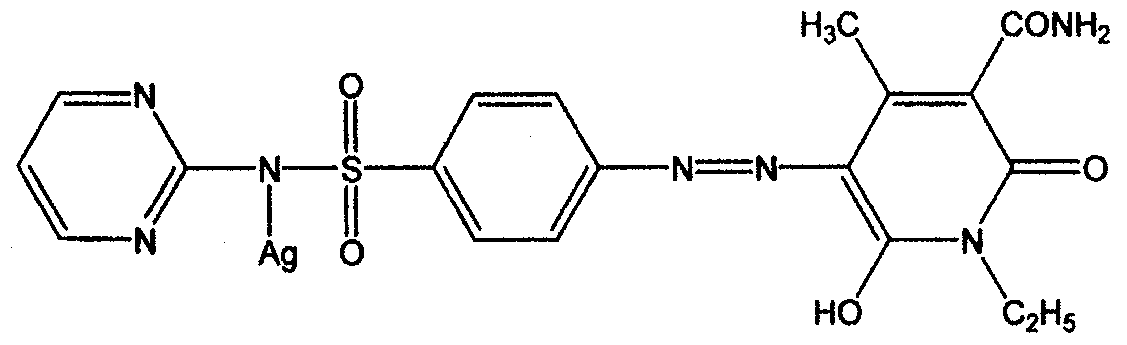
After dispersing 0.02 moles of silversulfadiazine in distilled water at 5°C or below, 6ml of hydrochloric acid HCl was added and dissolved while stirring. To the obtained solution, slowly added was 0.02 moles of sodium nitrite NaNU2 to proceed diazotization represented by the following reaction scheme 1 : (Reaction scheme 1)

To this solution, slowly added was the diazo solution previously obtained to proceed azo-coupling reaction represented by the following reaction scheme 2:
(Reaction scheme 2)

After completing the reaction, the resulting solution was under titration to adjust pH value to 7, filtrated using a filter paper after salting out and dried to yield an anti-bacterial acid dye with yellow color represented by the chemical formula 2 above according to the present invention. Evaluation of anti-bacterial properties
Plain woven nylon fabric which was dyed with a concentration of 1% o.w.f. (on the weight of fiber) using the yellow color dye previously synthesized was tested for anti-bacterial properties by KS K-0693-2001 as a test method for anti-bacterial properties of fabric. The result is
shown in Table 1 that represents anti-bacterial effect of the antibacterial acid dye containing silver according to the present invention. Table 1

Anti-bacterial properties test
Conditions of the test for determining anti-bacterial properties of the an ti- bacterial fiber containing silver are as follows:
1. type of strain: 1) strain 1 - Staphylococcus aureus ATCC 6538 2) strain 2 - klebsiella pneumoniae ATCC 4352
2. concentration of inoculum:
1) strain 1 - 1.3 X 10⁵ numbers/ml, 2) strain 2 - 1.5 X 10⁵ numbers/ ml
3. increasing rate: 1) strain 1 - 34 fold increase, 2) strain 2 - 32 fold increase
4. control sample: nylon (KS K 0905- 1996)
5. non-ionic surfactant: Tween 80 (0.05%)
INDUSTRIAL APPLICABILITY As described in detail above, the anti-bacterial acid dye of the present invention having yellow color expresses a wide range of colors when two or more of the dyes are used in combination, and enables production of anti-bacterially functional fiber products dyed by the
same that exhibit a strong anti-bacterial properties to inhibit inhabitation or growth of microorganisms and, as a result, protect against contagious disease and bad odor and prevent staining and brittleness of fiber. While the present invention has been described with reference to exemplary embodiments thereof, it will be understood by those skilled in the art that various modifications and variations may be made therein without departing from the scope of the present invention as defined by the appended claims.
Claims
1. An anti-bacterial acid dye containing silver with a structure represented by the following formula 1 : (formula 1)

2. A process for preparing anti-bacterial acid dye containing silver comprising synthesizing an anti-bacterial acid dye represented by the following chemical formula 1 by (a) a first step of conducting diazotization of silversulfadiazine with hydrochloric acid and sodium nitrite, and (b) a second step of proceeding azo-coupling reaction of the resulted product with l-ethyl-6-hydroxy-4-methyl-2-oxo-l,2-dihydro- pyridine-3-carboxylic acid amide represented by the following general formula 2:
(General formula 1) silversulfadiazine

(General formula 2) l-ethyl-6-hydroxy-4-methyl-2-oxo-l,2- dihydro-pyridine-3-carboxylic acid amide 
(Chemical formula 1)

3. An anti-bacterial fiber dyed using the anti-bacterial acid dye containing silver as defined in Claim 1.
Applications Claiming Priority (2)
| Application Number | Priority Date | Filing Date | Title |
|---|---|---|---|
| KR10-2005-0014920 | 2005-02-23 | ||
| KR1020050014920A KR100942197B1 (en) | 2005-02-23 | 2005-02-23 | Silver-containing antibacterial acid dyes and preparation method thereof and antibacterial fiber using the same |
Publications (1)
| Publication Number | Publication Date |
|---|---|
| WO2006091024A1 true WO2006091024A1 (en) | 2006-08-31 |
Family
ID=36927629
Family Applications (1)
| Application Number | Title | Priority Date | Filing Date |
|---|---|---|---|
| PCT/KR2006/000624 Ceased WO2006091024A1 (en) | 2005-02-23 | 2006-02-23 | Antibacterial acid dyes containing silver and method of preparing the same and antibacterial fiber thereby |
Country Status (2)
| Country | Link |
|---|---|
| KR (1) | KR100942197B1 (en) |
| WO (1) | WO2006091024A1 (en) |
Families Citing this family (1)
| Publication number | Priority date | Publication date | Assignee | Title |
|---|---|---|---|---|
| WO2008096919A1 (en) * | 2007-02-09 | 2008-08-14 | Kolon Industries, Inc | Antibacterial acid dyes and method of preparing the same and antibacterial fiber dyed thereby |
Citations (4)
| Publication number | Priority date | Publication date | Assignee | Title |
|---|---|---|---|---|
| EP0040172A2 (en) * | 1980-04-30 | 1981-11-18 | Ciba-Geigy Ag | Azo dyestuffs, methods for their preparation and their use as colouring agents in photographic materials in the silver dyestuff bleaching process, and the said photographic materials containing these azo dyestuffs |
| US4358404A (en) * | 1980-08-01 | 1982-11-09 | Eastman Kodak Company | Nondiffusible 6-arylazo-3-pyridinol |
| US5514783A (en) * | 1993-03-16 | 1996-05-07 | Sandoz Ltd. | Azo dyes containing a 2-(arylsulphonylamino)-pyrimidine radical and metal complexes thereof |
| US20040089200A1 (en) * | 2001-04-09 | 2004-05-13 | Toshiki Fujiwara | Coloring composition for image formation and method for improving ozone resistance of color image |
-
2005
- 2005-02-23 KR KR1020050014920A patent/KR100942197B1/en not_active Expired - Lifetime
-
2006
- 2006-02-23 WO PCT/KR2006/000624 patent/WO2006091024A1/en not_active Ceased
Patent Citations (4)
| Publication number | Priority date | Publication date | Assignee | Title |
|---|---|---|---|---|
| EP0040172A2 (en) * | 1980-04-30 | 1981-11-18 | Ciba-Geigy Ag | Azo dyestuffs, methods for their preparation and their use as colouring agents in photographic materials in the silver dyestuff bleaching process, and the said photographic materials containing these azo dyestuffs |
| US4358404A (en) * | 1980-08-01 | 1982-11-09 | Eastman Kodak Company | Nondiffusible 6-arylazo-3-pyridinol |
| US5514783A (en) * | 1993-03-16 | 1996-05-07 | Sandoz Ltd. | Azo dyes containing a 2-(arylsulphonylamino)-pyrimidine radical and metal complexes thereof |
| US20040089200A1 (en) * | 2001-04-09 | 2004-05-13 | Toshiki Fujiwara | Coloring composition for image formation and method for improving ozone resistance of color image |
Also Published As
| Publication number | Publication date |
|---|---|
| KR20060094194A (en) | 2006-08-29 |
| KR100942197B1 (en) | 2010-02-11 |
Similar Documents
| Publication | Publication Date | Title |
|---|---|---|
| CN107604662B (en) | Sterilizing and anti-virus composition for finishing textiles | |
| WO2006091021A1 (en) | Antibacterial acid dybs containing silver and method of preparing the same and antibacterial fiber thereby | |
| WO2006091022A1 (en) | Antibacterial acid dyes containing silver and method of preparing the same and antibacterial fiber thereby | |
| WO2006091023A1 (en) | Antibacterial acid dyes containing silver and method of preparing the same and antibacterial fiber thereby | |
| WO2008096919A1 (en) | Antibacterial acid dyes and method of preparing the same and antibacterial fiber dyed thereby | |
| KR100839512B1 (en) | Acidic antimicrobial dyes with diazotized sulfa agent and antimicrobial fibers using the same | |
| KR100821898B1 (en) | Silver-containing antibacterial acid dyes and preparation method thereof and antibacterial fiber using the same | |
| KR100942197B1 (en) | Silver-containing antibacterial acid dyes and preparation method thereof and antibacterial fiber using the same | |
| Akhtar et al. | Evaluation of Antibacterial Potential of New Acid Dyes Based on Substituted Aryl Amines and Amino Hydroxy Sulfonic Acid. | |
| JP2925628B2 (en) | Manufacturing method of antibacterial fiber | |
| KR100839520B1 (en) | Silver-containing antibacterial acid dyes and preparation method thereof and antibacterial fiber using the same | |
| WO2008096918A1 (en) | Reactive antibioties and a method of preparing the same and antibacterial fiber treated thereby | |
| KR100839511B1 (en) | Acidic antimicrobial dyes having a diazo-containing silver-containing sulfa agent, a method for producing the same, and antimicrobial fibers using the same | |
| KR100821900B1 (en) | Antimicrobial acid dyes, preparation method thereof and antibacterial fiber using the same | |
| KR100821897B1 (en) | Silver-containing antibacterial acid dyes and preparation method thereof and antibacterial fiber using the same | |
| KR100821899B1 (en) | Azo dyes, methods for their preparation and fibers dyed with them | |
| KR100821895B1 (en) | Silver-containing antibacterial acid dyes and preparation method thereof and antibacterial fiber using the same | |
| KR100821896B1 (en) | Silver-containing antibacterial acid dyes and preparation method thereof and antibacterial fiber using the same | |
| CA2028131A1 (en) | Antimicrobial fiber, resin, and method for production thereof | |
| KR100839514B1 (en) | Antibacterial dyes and preparation method thereof and antibacterial fibers using the same | |
| JP3036901B2 (en) | Antimicrobial resin composition and antimicrobial resin molded product | |
| KR100821894B1 (en) | Antibacterial dyes and antibacterial fibers using the same | |
| KR20060034333A (en) | Antimicrobial Disperse Dyes Containing Silver-Containing Modified Sulfases, Methods for Making the Same, and Antimicrobial Fibers Using the Same | |
| KR20060034335A (en) | Antimicrobial Disperse Dyes Containing Silver-Containing Modified Sulfases, Methods for Making the Same, and Antimicrobial Fibers Using the Same | |
| KR20060034334A (en) | Antimicrobial Disperse Dyes Containing Silver-Containing Modified Sulfases, Methods for Making the Same, and Antimicrobial Fibers Using the Same |
Legal Events
| Date | Code | Title | Description |
|---|---|---|---|
| 121 | Ep: the epo has been informed by wipo that ep was designated in this application | ||
| NENP | Non-entry into the national phase |
Ref country code: DE |
|
| 122 | Ep: pct application non-entry in european phase |
Ref document number: 06716074 Country of ref document: EP Kind code of ref document: A1 |