WO2006081165A1 - Improved process for preparing (dihalopropenyl)phenylakeyl substituted benzoxazoles - Google Patents
Improved process for preparing (dihalopropenyl)phenylakeyl substituted benzoxazoles Download PDFInfo
- Publication number
- WO2006081165A1 WO2006081165A1 PCT/US2006/002235 US2006002235W WO2006081165A1 WO 2006081165 A1 WO2006081165 A1 WO 2006081165A1 US 2006002235 W US2006002235 W US 2006002235W WO 2006081165 A1 WO2006081165 A1 WO 2006081165A1
- Authority
- WO
- WIPO (PCT)
- Prior art keywords
- formula
- compound
- catalyst
- reacting
- solvent
- Prior art date
- Legal status (The legal status is an assumption and is not a legal conclusion. Google has not performed a legal analysis and makes no representation as to the accuracy of the status listed.)
- Ceased
Links
- 0 COc1ccc2nc(*)[o]c2c1 Chemical compound COc1ccc2nc(*)[o]c2c1 0.000 description 2
- ROCVGJLXIARCAC-UHFFFAOYSA-N Nc(ccc(O)c1)c1O Chemical compound Nc(ccc(O)c1)c1O ROCVGJLXIARCAC-UHFFFAOYSA-N 0.000 description 1
- CVZNVGSJORCOEO-UHFFFAOYSA-N Oc1ccc2nc(C(F)(F)F)[o]c2c1 Chemical compound Oc1ccc2nc(C(F)(F)F)[o]c2c1 CVZNVGSJORCOEO-UHFFFAOYSA-N 0.000 description 1
Classifications
-
- C—CHEMISTRY; METALLURGY
- C07—ORGANIC CHEMISTRY
- C07D—HETEROCYCLIC COMPOUNDS
- C07D263/00—Heterocyclic compounds containing 1,3-oxazole or hydrogenated 1,3-oxazole rings
- C07D263/52—Heterocyclic compounds containing 1,3-oxazole or hydrogenated 1,3-oxazole rings condensed with carbocyclic rings or ring systems
- C07D263/54—Benzoxazoles; Hydrogenated benzoxazoles
- C07D263/56—Benzoxazoles; Hydrogenated benzoxazoles with only hydrogen atoms, hydrocarbon or substituted hydrocarbon radicals, directly attached in position 2
Definitions
- This invention is in the field of chemical processes; more specifically, an improved process for preparing (dihalopropenyl)phenylalkyl substituted benzoxazoles.
- R 1 and R 2 are halogen; R 3 and R 4 are independently selected from halogen, alkyl and haloalkyl; R 5 is alkyl or haloalkyl; and n is 1, 2, 3, 4, 5 or 6; are useful insecticides and have been described in PCT published application WO 2004/099105. There is a need for processes to produce these compounds at higher yields, at optimal cycle times and with lower catalyst loadings.
- the present invention relates to compounds known as disubstituted benzoxazoles, such as those represented by formula I:
- R 5 is alkyl or haloalkyl; n is 1, 2, 3, 4, 5 or 6; X is halogen or hydroxyl and A is methyl or 4-methylbenzene; which are key intermediates in the process for preparing (dihalopropenyl)phenylalkyl substituted benzoxazoles.
- the present invention also improves the process for preparing disubstituted benzoxazoles of formula I, formula II and formula III.
- overall yield, cycle times and catalyst loading are improved for the production of (dihalopropenyl)phenylalkyl substituted benzoxazoles.
- a disubstituted benzoxazole of formula I, formula II or formula III can be prepared in excellent yield and purity by a process comprising: a) reacting a compound of formula (A):
- R 5 is as defined above;
- Z is halogen
- X is halogen or hydroxyl; and n is 1, 2, 3, 4, 5 or 6;
- the modifier "about” is used herein to indicate that certain preferred jperating ranges, such as ranges for molar ratios for reactants, material amounts, and :emperature, are not fixedly determined. The meaning will often be apparent to one )f ordinary skill. For example, a recitation of a temperature range of about 120° C :o about 135° C in reference to, for example, an organic chemical reaction would be nterpreted to include other like temperatures that can be expected to favor a useful • eaction rate for the reaction, such as 105° C or 150° C.
- alkyl As used in this specification and unless otherwise indicated the substituent :erms "alkyl”, “alkoxy”, and “haloalkyl”, used alone or as part of a larger moiety, includes straight or branched chains of at least one or two carbon atoms, as appropriate to the substituent, and preferably up to 12 carbon atoms, more preferably up to ten carbon atoms, most preferably up to seven carbon atoms.
- "Halogen”, 'halide” or “halo” refers to fluorine, bromine, iodine, or chlorine.
- the term 'ambient temperature refers to a temperature in the range of about 20° C to about 30° C. Certain solvents, catalysts, and the like are known by their acronyms.
- DMAC N,N-dimethylacetamide
- DMF N 5 N-dimethylformamide
- THF tetrahydrofuran.
- the te ⁇ n “glymes” refers to a class of solvents comprised of monoglyme, diglyme, triglyme, tetraglyme, and polyglyme.
- GC refers to gas chromatography or gas chromatographic methods of analyses.
- the present invention relates to a process for preparing a disubstituted benzoxazole of formula I:
- R 5 is alkyl or haloalkyl
- R 5 is as defined above;
- the reaction of step a) can be conducted in the presence of a solvent; in the presence of a catalyst.
- the solvent can be tetrahydrofuran, toluene, xylene, 1,2- dichloroethane, triethylamine,/>-dioxane, N,N-dimethylacetamide, N,N- dimethylformamide, glymes, dimethylsulfoxide or mixtures thereof.
- the solvent can be 1,2-dichloroethane.
- the catalyst can be polyethylene glycol, dimethylaminopyridine, triethylamine, pyridine, phase transfer catalysts such as t- butyl ammonium chloride or t-butyl ammonium bromide or mixtures thereof.
- the catalyst can be present in a concentration of from about 1% by weight to about 20% by weight.
- the elevated temperature of step b) can be in the range of 70°C to 15O 0 C.
- Step b) can be conducted in the presence of a solvent; in the presence of a catalyst.
- the catalyst can be/?-toluenesulfonic acid, phosphorous pentoxide or mixtures thereof.
- the catalyst can be present in a concentration of from about 1% by weight to about 5% by weight.
- the solvent can be tetrahydrofuran, toluene, xylene, 1,2- dichloroethane, triethylamine,/>-dioxane, N,N-dimethylacetamide, N,N- dimethylformamide, glymes, dimethylsulfoxide or mixtures thereof.
- the solvent can be 1,2-dichloroethane.
- R > 5 is alkyl or haloalkyl; n is 1, 2, 3, 4, 5 or 6; and X is halogen or hydroxyl;
- R is as defined above;
- Z is halogen; and n and X are as defined above;
- the reaction to form a compound of formula II can be conducted in the presence of a solvent; at elevated temperature; in the presence of a catalyst; in the presence of a carbonate.
- the solvent can be tetrahydrofuran, toluene, xylene, 1,2- dichloroethane, triethylamine, ju-dioxane, N,N-dimethylacetamide, N 5 N- dimethylformamide, glymes, dimethylsulfoxide or mixtures thereof, preferably the solvent can be 1,2-dichloroethane;
- the elevated temperature can be in the range of 50°C to 100°C;
- the catalyst can be polyethylene glycol, triethylamine, pyridine, phase transfer catalysts such as t-butyl ammonium chloride or t-butyl ammonium bromide or mixtures thereof;
- the carbonate can be sodium carbonate or potassium carbonate.
- the catalyst can be present in a concentration of from about 1% by
- R 5 is alkyl or haloalkyl; n is 1, 2, 3, 4, 5 or 6; and
- A is methyl or 4-methylbenzene
- R 5 and n are as defined above; and X is hydroxyl;
- the reaction to form a compound of formula III can be conducted in the presence of a sblvent; in the presence of a catalyst.
- the solvent can be tetrahydrofuran, toluene, xylene, 1,2-dichloroethane, triethylamine, j>dioxane, N,N- dimethylacetamide, N,N-dimethylformamide, glymes, dimethylsulfoxide or mixtures thereof, preferably the solvent can be 1,2-dichloroethane;
- the catalyst can be dimethylaminopyridine, triethylamine, methylamine, phenylamine, pyridine, phase transfer catalysts such as t-butyl ammonium chloride or t-butyl ammonium bromide or mixtures thereof.
- the catalyst can be present in a concentration of from about 1% by weight to about 5% by weight.
- R 5 is alkyl or haloalkyl
- n is 1, 2, 3, 4, 5 or 6
- X is halogen or hydroxyl
- R 5 is alkyl or haloalkyl; n is 1, 2, 3, 4, 5 or 6; and
- A is methyl or 4-methylbenzene.
- N-(2,4-Dihydroxy-phenyl)-2,2,2- trifluoro-acetamide (C) underwent a ring closure reaction in the presence of a solvent and a catalyst at a temperature in the range of from about 90 0 C to about 150 0 C to form 2-(trifluoromethyl)benzoxazol-6-ol (I), a dark solid.
- NMR data was consistent with the expected product (I).
- step (c) of Example 2 (trifluoromethyl)benzoxazol- ⁇ -ol (I) was cross- coupled with a l-bromo-3-halopropane (D), for example l-bromo-3-chloropropane, in the presence of a carbonate, for example potassium carbonate, a solvent and a catalyst at a temperature from about 50 0 C to about 100°C to afford a 3-halo-l-[2- (trifluoromethyl)benzoxazol-6-yloxy]propane (II), for example 3-chloro-l-[2- (trifluoromethyl)benzoxazol-6-yloxy]propane, an amber oil. NMR data was consistent with the expected product (II).
- D l-bromo-3-halopropane
- a carbonate for example potassium carbonate
- a solvent and a catalyst at a temperature from about 50 0 C to about 100°C to afford a 3-halo-l-[
- step (d) of Example 3 3-hydroxy-l-[2-(trifluoromethyl)benzoxazol-6- yloxy]propane can be reacted with a substituted chlorosulfone, for example chloromethylsulfone, in the presence of a solvent and a catalyst at ambient temperature to form a l-(substitutedsulfonyl)-3-[2-(trifluoromethyl)benzoxazol-6- yloxyjpropane (HI), for example l-(methylsulfonyl)-3-[2-
- step (ab) of Example 4 amino-resorcinol hydrochloride (A) was cross- coupled with 2,2,2-trifluoroacetic acid (Bl) and then condensed in the presence of a solvent and molecular sieves at a temperature in the range of from about 70 0 C to about 140 0 C to form 2-(trifluoromethyl)benzoxazol-6-ol (I), a dark solid. NMR data was consistent with the expected product (I).
Landscapes
- Chemical & Material Sciences (AREA)
- Organic Chemistry (AREA)
- Heterocyclic Carbon Compounds Containing A Hetero Ring Having Nitrogen And Oxygen As The Only Ring Hetero Atoms (AREA)
- Low-Molecular Organic Synthesis Reactions Using Catalysts (AREA)
Abstract
An improved process is described for preparing (dihalopropenyl)phenylalkyl substituted benzoxazoles. This improved process is focused on steps to produce key intermediates, namely disubstituted benzoxazoles of formulae (I), (II) and (III); wherein R5 is alkyl or haloalkyl; n is 1, 2, 3, 4, 5 or 6; X is hydroxyl or halogen; and A is methyl or 4-methylbenzene.
Description
Improved Process for Preparing (Dihalopropenyl)PhenyIalkyl Substituted
Benzoxazoles
This application claims the benefit of U.S. Provisional Application No. 60/647,731, filed January 27, 2005.
Field of Invention
This invention is in the field of chemical processes; more specifically, an improved process for preparing (dihalopropenyl)phenylalkyl substituted benzoxazoles.
Backgound:
(Dihalopropenyl)phenylalkyl substituted benzoxazoles, such as:

wherein R1 and R2 are halogen; R3 and R4 are independently selected from halogen, alkyl and haloalkyl; R5 is alkyl or haloalkyl; and n is 1, 2, 3, 4, 5 or 6; are useful insecticides and have been described in PCT published application WO 2004/099105. There is a need for processes to produce these compounds at higher yields, at optimal cycle times and with lower catalyst loadings.
Summary of the Invention
The present invention relates to compounds known as disubstituted benzoxazoles, such as those represented by formula I:

by formula II:
 π , and by formula III:

III
wherein R5 is alkyl or haloalkyl; n is 1, 2, 3, 4, 5 or 6; X is halogen or hydroxyl and A is methyl or 4-methylbenzene; which are key intermediates in the process for preparing (dihalopropenyl)phenylalkyl substituted benzoxazoles.
The present invention also improves the process for preparing disubstituted benzoxazoles of formula I, formula II and formula III. As a result of the present invention, overall yield, cycle times and catalyst loading are improved for the production of (dihalopropenyl)phenylalkyl substituted benzoxazoles. Specifically, it has now been found that a disubstituted benzoxazole of formula I, formula II or formula III can be prepared in excellent yield and purity by a process comprising: a) reacting a compound of formula (A):

Formula (A);
with a compound of formula (B):

Y is hydroxyl, halogen or -OC(=O)CF3; and R5 is alkyl or haloalkyl;
to form intermediate (C):
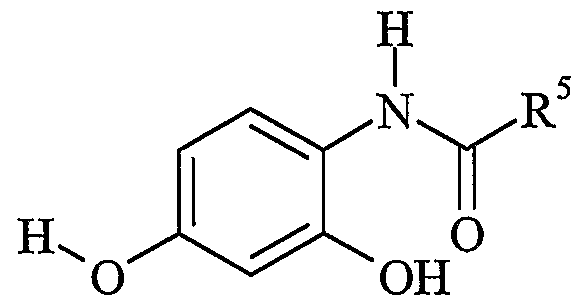
Intermediate (CJ;
wherein R5 is as defined above;
and
b) forming a second ring in intermediate (CJ at elevated temperature to provide a compound of formula I;
optionally, further reacting a compound of formula I with a compound of formula (D):
x-(CH z
Formula (D)
wherein
Z is halogen;
X is halogen or hydroxyl; and n is 1, 2, 3, 4, 5 or 6;
to form a compound of formula II;
optionally, further reacting a compound of formula II, wherein X is hydroxyl, with a compound of formula (E) :

Formula (E)
wherein A methyl or 4-methylbenzene;
to form a compound of formula III.
Definitions
The modifier "about" is used herein to indicate that certain preferred jperating ranges, such as ranges for molar ratios for reactants, material amounts, and :emperature, are not fixedly determined. The meaning will often be apparent to one )f ordinary skill. For example, a recitation of a temperature range of about 120° C :o about 135° C in reference to, for example, an organic chemical reaction would be nterpreted to include other like temperatures that can be expected to favor a useful •eaction rate for the reaction, such as 105° C or 150° C. Where guidance from the sxperience of those of ordinary skill is lacking, guidance from the context is lacking, md where a more specific rule is not recited below, the "about" range shall be not nore than 10% of the absolute value of an end point or 10% of the range recited, whichever is less.
As used in this specification and unless otherwise indicated the substituent :erms "alkyl", "alkoxy", and "haloalkyl", used alone or as part of a larger moiety, includes straight or branched chains of at least one or two carbon atoms, as appropriate to the substituent, and preferably up to 12 carbon atoms, more preferably up to ten carbon atoms, most preferably up to seven carbon atoms. "Halogen", 'halide" or "halo" refers to fluorine, bromine, iodine, or chlorine. The term 'ambient temperature" refers to a temperature in the range of about 20° C to about 30° C. Certain solvents, catalysts, and the like are known by their acronyms. These include the acronyms "DMAC" meaning N,N-dimethylacetamide, "DMF" meaning
N5N-dimethylformamide, "THF" meaning tetrahydrofuran. The teπn "glymes" refers to a class of solvents comprised of monoglyme, diglyme, triglyme, tetraglyme, and polyglyme. The term "GC" refers to gas chromatography or gas chromatographic methods of analyses.
Detailed Description of the Invention
The present invention relates to a process for preparing a disubstituted benzoxazole of formula I:

I wherein R5 is alkyl or haloalkyl;
the process comprising: a) reacting a compound of formula (A):

with a compound of formula (B):

Formula (B)
wherein
Y is hydroxyl, halogen or -OC(=O)CF3; and
R5 is as defined above;
to form intermediate (C):

Intermediate (C);
wherein R5 is as defined above;
and
b) forming a second ring in intermediate (C) at elevated temperature to provide a compound of formula I.
Preferably, Y is hydroxyl, chlorine or-OC(=O)CF3; and R5 is haloalkyl. More preferably, Y is hydroxyl or-OC(=O)CF3; and R5 is CF3.
The reaction of step a) can be conducted in the presence of a solvent; in the presence of a catalyst. The solvent can be tetrahydrofuran, toluene, xylene, 1,2- dichloroethane, triethylamine,/>-dioxane, N,N-dimethylacetamide, N,N- dimethylformamide, glymes, dimethylsulfoxide or mixtures thereof. Preferably, the solvent can be 1,2-dichloroethane. The catalyst can be polyethylene glycol, dimethylaminopyridine, triethylamine, pyridine, phase transfer catalysts such as t- butyl ammonium chloride or t-butyl ammonium bromide or mixtures thereof. The catalyst can be present in a concentration of from about 1% by weight to about 20% by weight.
The elevated temperature of step b) can be in the range of 70°C to 15O0C. Step b) can be conducted in the presence of a solvent; in the presence of a catalyst. The catalyst can be/?-toluenesulfonic acid, phosphorous pentoxide or mixtures
thereof. The catalyst can be present in a concentration of from about 1% by weight to about 5% by weight. The solvent can be tetrahydrofuran, toluene, xylene, 1,2- dichloroethane, triethylamine,/>-dioxane, N,N-dimethylacetamide, N,N- dimethylformamide, glymes, dimethylsulfoxide or mixtures thereof. Preferably, the solvent can be 1,2-dichloroethane.
Another embodiment of the present invention relates to a process for preparing a disubstituted benzoxazole of formula II:

wherein
R > 5 is alkyl or haloalkyl; n is 1, 2, 3, 4, 5 or 6; and X is halogen or hydroxyl;
said process comprising:
reacting a compound of formula I:

wherein R is as defined above;
with a compound of formula (D):
x-(CH z
Formula (D)
wherein
Z is halogen; and n and X are as defined above;
to form a compound of formula II.
The reaction to form a compound of formula II can be conducted in the presence of a solvent; at elevated temperature; in the presence of a catalyst; in the presence of a carbonate. The solvent can be tetrahydrofuran, toluene, xylene, 1,2- dichloroethane, triethylamine, ju-dioxane, N,N-dimethylacetamide, N5N- dimethylformamide, glymes, dimethylsulfoxide or mixtures thereof, preferably the solvent can be 1,2-dichloroethane; the elevated temperature can be in the range of 50°C to 100°C; the catalyst can be polyethylene glycol, triethylamine, pyridine, phase transfer catalysts such as t-butyl ammonium chloride or t-butyl ammonium bromide or mixtures thereof; the carbonate can be sodium carbonate or potassium carbonate. The catalyst can be present in a concentration of from about 1% by weight to about 6% by weight.
Another embodiment of the present invention relates to a process for preparing a disubstituted benzoxazole of formula III:

III wherein
R5 is alkyl or haloalkyl; n is 1, 2, 3, 4, 5 or 6; and
A is methyl or 4-methylbenzene;
said process comprising:
reacting a compound of formula II:

II wherein
R5 and n are as defined above; and X is hydroxyl;
with a compound of formula (E) :
CI-ΓA
O
Formula (E)
wherein A is as defined above;
to form a compound of formula III.
The reaction to form a compound of formula III can be conducted in the presence of a sblvent; in the presence of a catalyst. The solvent can be tetrahydrofuran, toluene, xylene, 1,2-dichloroethane, triethylamine, j>dioxane, N,N- dimethylacetamide, N,N-dimethylformamide, glymes, dimethylsulfoxide or mixtures thereof, preferably the solvent can be 1,2-dichloroethane; the catalyst can be dimethylaminopyridine, triethylamine, methylamine, phenylamine, pyridine, phase transfer catalysts such as t-butyl ammonium chloride or t-butyl ammonium bromide or mixtures thereof. The catalyst can be present in a concentration of from about 1% by weight to about 5% by weight.
Another embodiment of the present invention is a compound of formula II:

II wherein
R5 is alkyl or haloalkyl; n is 1, 2, 3, 4, 5 or 6; and X is halogen or hydroxyl.
Yet another embodiment of the present invention is a compound of formula
III:

III wherein
R5 is alkyl or haloalkyl; n is 1, 2, 3, 4, 5 or 6; and
A is methyl or 4-methylbenzene.
The following examples illustrate processes for preparing disubstituted benzoxazoles of formulae I, II and III.


a) Solvent/Catalyst/Ambient Temperature/2-4 hours b) Solven1/Caltalyst /90°C-150''C/22-26 hours
Li the first step (a) of Example 1, amino-resorcinol hydrochloride (A) was cross-coupled with trifluoroacetic anhydride (B) in the presence of a solvent and a catalyst at ambient temperature to form N-(2,4-Dihydroxy-phenyl)-2,2,2-trifluoro- acetamide (C), a dark colored solid.
In the second step (b) of Example I5 N-(2,4-Dihydroxy-phenyl)-2,2,2- trifluoro-acetamide (C) underwent a ring closure reaction in the presence of a solvent and a catalyst at a temperature in the range of from about 900C to about 150 0C to form 2-(trifluoromethyl)benzoxazol-6-ol (I), a dark solid. NMR data was consistent with the expected product (I).
Example 2

In step (c) of Example 2, (trifluoromethyl)benzoxazol-β-ol (I) was cross- coupled with a l-bromo-3-halopropane (D), for example l-bromo-3-chloropropane, in the presence of a carbonate, for example potassium carbonate, a solvent and a catalyst at a temperature from about 50 0C to about 100°C to afford a 3-halo-l-[2- (trifluoromethyl)benzoxazol-6-yloxy]propane (II), for example 3-chloro-l-[2- (trifluoromethyl)benzoxazol-6-yloxy]propane, an amber oil. NMR data was consistent with the expected product (II).
Example 3

In step (d) of Example 3, 3-hydroxy-l-[2-(trifluoromethyl)benzoxazol-6- yloxy]propane can be reacted with a substituted chlorosulfone, for example chloromethylsulfone, in the presence of a solvent and a catalyst at ambient temperature to form a l-(substitutedsulfonyl)-3-[2-(trifluoromethyl)benzoxazol-6- yloxyjpropane (HI), for example l-(methylsulfonyl)-3-[2-
(trifluoromethyl)benzoxazol-6-yloxy]propane.
Example 4

In step (ab) of Example 4, amino-resorcinol hydrochloride (A) was cross- coupled with 2,2,2-trifluoroacetic acid (Bl) and then condensed in the presence of a solvent and molecular sieves at a temperature in the range of from about 700C to about 140 0C to form 2-(trifluoromethyl)benzoxazol-6-ol (I), a dark solid. NMR data was consistent with the expected product (I).
While this invention has been described with an emphasis upon preferred embodiments, it will be obvious to those of ordinary skill in the art that variations of the preferred embodiments may be used and that it is intended that the invention may be practiced otherwise than as specifically described herein. Accordingly this
invention includes all modifications encompassed within the spirit and scope as defined by the following claims.
Claims
1. A process for preparing a disubstituted benzoxazole of formula I:

wherein R5 is alkyl or haloalkyl;
said process comprising:
a) reacting a compound of formula (A):

Formula (A);
with a compound of formula (B):
O
Jk
Formula (B)
wherein
Y is hydroxyl, halogen or -OC(=O)CF3; and R5 is as defined above;
to form intermediate (G): 
Intermediate (C);
wherein R5 is as defined above;
and
b) forming a second ring in intermediate (CJ at elevated temperature to provide a compound of formula I.
2. The process of claim 1 wherein Y is hydroxyl, chlorine or -OC(=O)CF3 and R5 is haloalkyl.
3. The process of claim 1 wherein the reacting of step a) is conducted in the presence of a solvent.
4. The process of claim 1 wherein the reacting of step a) is conducted in the presence of a catalyst.
5. The process of claim 1 wherein step b) is conducted in the presence of a catalyst.
6. The process of claim 1 wherein step b) is conducted in the presence of a solvent.
7. A process for preparing a disubstituted benzoxazole of formula II:

II wherein
R5 is alkyl or haloalkyl; n is 1, 2, 3, 4, 5 or 6; and X is halogen or hydroxyl;
said process comprising:
reacting a compound of formula I:

wherein R5 is as defined above;
with a compound of formula (D):
x-(CH z
Formula (D)
wherein
Z is halogen; and n and X are as defined above;
to form a compound of formula II.
8. The process of claim 7 wherein n is 3.
9. The process of claim 7 wherein the reacting is conducted in the presence of a solvent.
10. The process of claim 7 wherein the reacting is conducted at elevated temperature.
11. The process of claim 7 wherein the reacting is conducted in the presence of a carbonate.
12. The process of claim 7 wherein the reacting is conducted in the presence of a catalyst.
13. A process for preparing a disubstituted benzoxazole of formula III:

III
wherein
R5 is alkyl or haloalkyl; n is 1, 2, 3, 4, 5 or 6; and
A is methyl or 4-methylbenzene;
said process comprising:
reacting a compound of formula II:

II wherein
R5 and n are as defined above; and X is hydroxyl; with a compound of formula (E) :

Formula (E)
wherein A is as defined above;
to form a compound of formula III.
14. The process of claim 13 wherein n is 3.
15. The process of claim 13 wherein the reacting is conducted in the presence of a solvent.
16. The process of claim 13 wherein the reacting is conducted in the presence of a catalyst.
17. A compound of formula II:

II wherein
R5 is alkyl or haloalkyl; n is 1, 2, 3, 4, 5 or 6; and X is halogen or hydroxyl.
18. A compound of formula III: 
III
wherein
R5 is alkyl or haloalkyl; n is 1, 2, 3, 4, 5 or 6; and
A is methyl or 4-methylbenzene.
Applications Claiming Priority (2)
| Application Number | Priority Date | Filing Date | Title |
|---|---|---|---|
| US64773105P | 2005-01-27 | 2005-01-27 | |
| US60/647,731 | 2005-01-27 |
Publications (1)
| Publication Number | Publication Date |
|---|---|
| WO2006081165A1 true WO2006081165A1 (en) | 2006-08-03 |
Family
ID=36740840
Family Applications (1)
| Application Number | Title | Priority Date | Filing Date |
|---|---|---|---|
| PCT/US2006/002235 Ceased WO2006081165A1 (en) | 2005-01-27 | 2006-01-23 | Improved process for preparing (dihalopropenyl)phenylakeyl substituted benzoxazoles |
Country Status (2)
| Country | Link |
|---|---|
| TW (1) | TW200631946A (en) |
| WO (1) | WO2006081165A1 (en) |
Citations (1)
| Publication number | Priority date | Publication date | Assignee | Title |
|---|---|---|---|---|
| US6376428B1 (en) * | 1994-10-14 | 2002-04-23 | Sumitomo Chemical Company, Limited | Dihalopropene compounds, insecticidal/acaricidal agents containing same, and intermediates for their production |
-
2006
- 2006-01-23 WO PCT/US2006/002235 patent/WO2006081165A1/en not_active Ceased
- 2006-01-26 TW TW095103123A patent/TW200631946A/en unknown
Patent Citations (1)
| Publication number | Priority date | Publication date | Assignee | Title |
|---|---|---|---|---|
| US6376428B1 (en) * | 1994-10-14 | 2002-04-23 | Sumitomo Chemical Company, Limited | Dihalopropene compounds, insecticidal/acaricidal agents containing same, and intermediates for their production |
Also Published As
| Publication number | Publication date |
|---|---|
| TW200631946A (en) | 2006-09-16 |
Similar Documents
| Publication | Publication Date | Title |
|---|---|---|
| KR101297541B1 (en) | Method for producing dichloropyrazine derivative | |
| JP6944519B2 (en) | Method for Producing Cyclopropyl Substituted Acetophenones | |
| CN113549051B (en) | Synthesis method of bisamide insecticide | |
| US10981861B1 (en) | Bromination method for m-diamide compounds | |
| CN115260050B (en) | A kind of NBS participates in the method for preparing 3-bromo-N-aryl propionamide | |
| KR101583851B1 (en) | Method for producing 3-methyl-2-thiophenecarboxylic acid | |
| CN116253692A (en) | A kind of preparation method of trifluoromethyl substituted 1,2,4-triazine compound | |
| CN105980354B (en) | The manufacture method and its intermediate of pest control agent | |
| EP1853614A1 (en) | Improved process for preparing (disubstitutedpropenyl) phenylalkyl substituted dihydrobenzofurans | |
| JP7582997B2 (en) | Method for preparing pesticidal compounds | |
| AU640312B2 (en) | Process for the selective reduction of the 4-halogen in 2,4-dihaloanilines | |
| CN112979581B (en) | Method for preparing benzothiazole compounds by visible light-promoted N-(2-bromophenyl) thioamides | |
| JPH1045706A (en) | Mew disulfide compound, production thereof and production of thiazepine derivative by using the same compound | |
| EP1853577A1 (en) | Improved process for preparing (disubstitutedpropenyl) phenylalkyl substituted dihydrobenzofurans | |
| AU2006240772B2 (en) | Method for producing nicotinic acid derivative or salt thereof | |
| JP2010260805A (en) | Process for producing isothiazole derivatives | |
| JP4265259B2 (en) | Method for producing chloroformic acid benzyl esters | |
| WO2006102387A1 (en) | Improved process for preparing insecticidal (disubstitutedpropenyl) phenylalkyl substituted dihydrobenzofurans | |
| KR20120010353A (en) | Method for synthesizing aromatic halides from aromatic amines | |
| JP4826476B2 (en) | Method for producing tetrahydropyran-4-carboxylic acid compound | |
| JP6853709B2 (en) | Aromatic compounds and methods for producing them | |
| JP4309669B2 (en) | Method for producing (aminoalkoxy) benzene derivative | |
| WO2021193432A1 (en) | Method for producing production intermediate of cyclaniliprole | |
| CN119735562A (en) | A method for synthesizing oxazoline compounds | |
| CN118126005A (en) | A method for preparing a trifluoroacetimide-substituted dihydrobenzofuran compound |
Legal Events
| Date | Code | Title | Description |
|---|---|---|---|
| 121 | Ep: the epo has been informed by wipo that ep was designated in this application | ||
| 122 | Ep: pct application non-entry in european phase |
Ref document number: 06719186 Country of ref document: EP Kind code of ref document: A1 |