WO2006016591A1 - 情報信号処理方法、情報信号処理装置及びコンピュータプログラム記録媒体 - Google Patents
情報信号処理方法、情報信号処理装置及びコンピュータプログラム記録媒体 Download PDFInfo
- Publication number
- WO2006016591A1 WO2006016591A1 PCT/JP2005/014598 JP2005014598W WO2006016591A1 WO 2006016591 A1 WO2006016591 A1 WO 2006016591A1 JP 2005014598 W JP2005014598 W JP 2005014598W WO 2006016591 A1 WO2006016591 A1 WO 2006016591A1
- Authority
- WO
- WIPO (PCT)
- Prior art keywords
- predetermined
- data
- information
- processing
- information signal
- Prior art date
- Legal status (The legal status is an assumption and is not a legal conclusion. Google has not performed a legal analysis and makes no representation as to the accuracy of the status listed.)
- Ceased
Links
Classifications
-
- G—PHYSICS
- G11—INFORMATION STORAGE
- G11B—INFORMATION STORAGE BASED ON RELATIVE MOVEMENT BETWEEN RECORD CARRIER AND TRANSDUCER
- G11B27/00—Editing; Indexing; Addressing; Timing or synchronising; Monitoring; Measuring tape travel
- G11B27/10—Indexing; Addressing; Timing or synchronising; Measuring tape travel
- G11B27/34—Indicating arrangements
-
- G—PHYSICS
- G11—INFORMATION STORAGE
- G11B—INFORMATION STORAGE BASED ON RELATIVE MOVEMENT BETWEEN RECORD CARRIER AND TRANSDUCER
- G11B27/00—Editing; Indexing; Addressing; Timing or synchronising; Monitoring; Measuring tape travel
- G11B27/02—Editing, e.g. varying the order of information signals recorded on, or reproduced from, record carriers
- G11B27/031—Electronic editing of digitised analogue information signals, e.g. audio or video signals
- G11B27/034—Electronic editing of digitised analogue information signals, e.g. audio or video signals on discs
-
- G—PHYSICS
- G06—COMPUTING OR CALCULATING; COUNTING
- G06F—ELECTRIC DIGITAL DATA PROCESSING
- G06F16/00—Information retrieval; Database structures therefor; File system structures therefor
- G06F16/70—Information retrieval; Database structures therefor; File system structures therefor of video data
- G06F16/73—Querying
- G06F16/738—Presentation of query results
- G06F16/739—Presentation of query results in form of a video summary, e.g. the video summary being a video sequence, a composite still image or having synthesized frames
-
- G—PHYSICS
- G11—INFORMATION STORAGE
- G11B—INFORMATION STORAGE BASED ON RELATIVE MOVEMENT BETWEEN RECORD CARRIER AND TRANSDUCER
- G11B27/00—Editing; Indexing; Addressing; Timing or synchronising; Monitoring; Measuring tape travel
- G11B27/10—Indexing; Addressing; Timing or synchronising; Measuring tape travel
- G11B27/102—Programmed access in sequence to addressed parts of tracks of operating record carriers
- G11B27/105—Programmed access in sequence to addressed parts of tracks of operating record carriers of operating discs
-
- H—ELECTRICITY
- H04—ELECTRIC COMMUNICATION TECHNIQUE
- H04N—PICTORIAL COMMUNICATION, e.g. TELEVISION
- H04N21/00—Selective content distribution, e.g. interactive television or video on demand [VOD]
- H04N21/40—Client devices specifically adapted for the reception of or interaction with content, e.g. set-top-box [STB]; Operations thereof
- H04N21/43—Processing of content or additional data, e.g. demultiplexing additional data from a digital video stream; Elementary client operations, e.g. monitoring of home network or synchronising decoder's clock; Client middleware
- H04N21/432—Content retrieval operation from a local storage medium, e.g. hard-disk
- H04N21/4325—Content retrieval operation from a local storage medium, e.g. hard-disk by playing back content from the storage medium
-
- H—ELECTRICITY
- H04—ELECTRIC COMMUNICATION TECHNIQUE
- H04N—PICTORIAL COMMUNICATION, e.g. TELEVISION
- H04N21/00—Selective content distribution, e.g. interactive television or video on demand [VOD]
- H04N21/40—Client devices specifically adapted for the reception of or interaction with content, e.g. set-top-box [STB]; Operations thereof
- H04N21/43—Processing of content or additional data, e.g. demultiplexing additional data from a digital video stream; Elementary client operations, e.g. monitoring of home network or synchronising decoder's clock; Client middleware
- H04N21/433—Content storage operation, e.g. storage operation in response to a pause request, caching operations
- H04N21/4334—Recording operations
-
- H—ELECTRICITY
- H04—ELECTRIC COMMUNICATION TECHNIQUE
- H04N—PICTORIAL COMMUNICATION, e.g. TELEVISION
- H04N21/00—Selective content distribution, e.g. interactive television or video on demand [VOD]
- H04N21/40—Client devices specifically adapted for the reception of or interaction with content, e.g. set-top-box [STB]; Operations thereof
- H04N21/43—Processing of content or additional data, e.g. demultiplexing additional data from a digital video stream; Elementary client operations, e.g. monitoring of home network or synchronising decoder's clock; Client middleware
- H04N21/439—Processing of audio elementary streams
- H04N21/4394—Processing of audio elementary streams involving operations for analysing the audio stream, e.g. detecting features or characteristics in audio streams
-
- H—ELECTRICITY
- H04—ELECTRIC COMMUNICATION TECHNIQUE
- H04N—PICTORIAL COMMUNICATION, e.g. TELEVISION
- H04N21/00—Selective content distribution, e.g. interactive television or video on demand [VOD]
- H04N21/40—Client devices specifically adapted for the reception of or interaction with content, e.g. set-top-box [STB]; Operations thereof
- H04N21/43—Processing of content or additional data, e.g. demultiplexing additional data from a digital video stream; Elementary client operations, e.g. monitoring of home network or synchronising decoder's clock; Client middleware
- H04N21/44—Processing of video elementary streams, e.g. splicing a video clip retrieved from local storage with an incoming video stream or rendering scenes according to encoded video stream scene graphs
- H04N21/44008—Processing of video elementary streams, e.g. splicing a video clip retrieved from local storage with an incoming video stream or rendering scenes according to encoded video stream scene graphs involving operations for analysing video streams, e.g. detecting features or characteristics in the video stream
-
- H—ELECTRICITY
- H04—ELECTRIC COMMUNICATION TECHNIQUE
- H04N—PICTORIAL COMMUNICATION, e.g. TELEVISION
- H04N21/00—Selective content distribution, e.g. interactive television or video on demand [VOD]
- H04N21/40—Client devices specifically adapted for the reception of or interaction with content, e.g. set-top-box [STB]; Operations thereof
- H04N21/45—Management operations performed by the client for facilitating the reception of or the interaction with the content or administrating data related to the end-user or to the client device itself, e.g. learning user preferences for recommending movies, resolving scheduling conflicts
- H04N21/4508—Management of client data or end-user data
- H04N21/4532—Management of client data or end-user data involving end-user characteristics, e.g. viewer profile, preferences
-
- H—ELECTRICITY
- H04—ELECTRIC COMMUNICATION TECHNIQUE
- H04N—PICTORIAL COMMUNICATION, e.g. TELEVISION
- H04N21/00—Selective content distribution, e.g. interactive television or video on demand [VOD]
- H04N21/80—Generation or processing of content or additional data by content creator independently of the distribution process; Content per se
- H04N21/83—Generation or processing of protective or descriptive data associated with content; Content structuring
- H04N21/845—Structuring of content, e.g. decomposing content into time segments
- H04N21/8456—Structuring of content, e.g. decomposing content into time segments by decomposing the content in the time domain, e.g. in time segments
-
- H—ELECTRICITY
- H04—ELECTRIC COMMUNICATION TECHNIQUE
- H04N—PICTORIAL COMMUNICATION, e.g. TELEVISION
- H04N5/00—Details of television systems
- H04N5/76—Television signal recording
- H04N5/78—Television signal recording using magnetic recording
- H04N5/782—Television signal recording using magnetic recording on tape
- H04N5/783—Adaptations for reproducing at a rate different from the recording rate
-
- H—ELECTRICITY
- H04—ELECTRIC COMMUNICATION TECHNIQUE
- H04N—PICTORIAL COMMUNICATION, e.g. TELEVISION
- H04N9/00—Details of colour television systems
- H04N9/79—Processing of colour television signals in connection with recording
- H04N9/80—Transformation of the television signal for recording, e.g. modulation, frequency changing; Inverse transformation for playback
- H04N9/804—Transformation of the television signal for recording, e.g. modulation, frequency changing; Inverse transformation for playback involving pulse code modulation of the colour picture signal components
- H04N9/8042—Transformation of the television signal for recording, e.g. modulation, frequency changing; Inverse transformation for playback involving pulse code modulation of the colour picture signal components involving data reduction
-
- H—ELECTRICITY
- H04—ELECTRIC COMMUNICATION TECHNIQUE
- H04N—PICTORIAL COMMUNICATION, e.g. TELEVISION
- H04N9/00—Details of colour television systems
- H04N9/79—Processing of colour television signals in connection with recording
- H04N9/80—Transformation of the television signal for recording, e.g. modulation, frequency changing; Inverse transformation for playback
- H04N9/82—Transformation of the television signal for recording, e.g. modulation, frequency changing; Inverse transformation for playback the individual colour picture signal components being recorded simultaneously only
- H04N9/8205—Transformation of the television signal for recording, e.g. modulation, frequency changing; Inverse transformation for playback the individual colour picture signal components being recorded simultaneously only involving the multiplexing of an additional signal and the colour video signal
Definitions
- the present invention performs predetermined band compression processing such as MPEG (Moving Picture Export Group) on video and audio data such as a video signal and an audio signal in a broadcast program, for example, and produces a magneto-optical disk and a hard disk (HDD). ),
- An information signal processing method, an information signal processing device, and an information signal processing method for performing a special reproduction operation such as a predetermined summary reproduction (digest reproduction) process in a recording / reproducing apparatus that records and reproduces data on a recording medium such as a semiconductor memory It relates to the computer program recording medium.
- predetermined feature data is extracted based on features appearing in image / audio data (image / audio information signal, image / audio signal, image / audio information data) of the broadcast program to be recorded, and the predetermined feature data is used.
- image / audio data image / audio information signal, image / audio signal, image / audio information data
- predetermined feature data is used.
- the ability to automatically generate position information data indicating a reproduction position at a certain time interval for example, every 3 minutes, 5 minutes, 10 minutes, or the like, or manually desired by the user
- So-called chapter data is generated to generate position information data at the position, and skip playback, editing operation, and thumbnail image display are performed using the position information data (chapter data).
- the feature data described above can extract feature data for a plurality of types of features for each image signal and sound signal, and each feature data is subjected to an extraction process when recording image sound data, for example. And record the feature data along with the image and sound data on the recording medium.
- the recorded feature data is read and signal processing is performed to determine the section for summary playback (digest playback) by a predetermined rule process.
- the number of files increases, and handling of files during signal processing becomes complicated, which is not efficient.
- the object of the present invention is to efficiently process feature data and perform effective summary playback (digest playback) operation or chapter processing using feature data. It is an object to provide an information signal processing method, an information signal processing apparatus, and a computer program recording medium for efficiently performing various operations using summary reproduction (digest reproduction) and chapter data.
- the information signal processing method is based on image / audio feature data for each predetermined section of a predetermined image / audio information signal and additional information data related to the image / audio information signal, or a predetermined recording medium on which the data is recorded Force data is read, and a predetermined first information meaning process is performed for each predetermined section of the image / sound information signal from the read data, and a plurality of first predetermined meaning sections are connected to each other.
- the predetermined evaluation value processing for the second information meaning and the second evaluation meaning processing or the predetermined evaluation value processing for one predetermined section based on the signal of the first meaning processing is performed, and the second evaluation value processing is performed.
- Predetermined playback interval is set based on a signal that has been processed for meaning or a signal that has been processed for evaluation value Or a predetermined playback time point is set.
- Another information signal processing method is based on image / audio feature data for each predetermined section of a predetermined image / audio information signal and additional information data related to the image / audio information signal, or a predetermined recording in which these data are recorded.
- Media force data is read, and the first first information meaning process is performed for each predetermined section of the image / sound information signal from the read data, and a plurality of first predetermined meaning sections are connected to be predetermined.
- the predetermined evaluation value processing for the second informational meaning processing and the predetermined evaluation value processing for the second information meaning or one predetermined section based on the signal of the first meaning processing is performed !,
- the data subjected to the second meaning assignment process or evaluation value process is recorded in a predetermined recording area or a predetermined recording area of a predetermined data memory.
- Still another information signal processing method provides image / audio feature data for each predetermined section of a predetermined image / audio information signal and additional information data related to the image / audio information signal, or data in which these data are recorded.
- Read the file perform the first predetermined information semantic processing for each predetermined section of the video and audio information signal from the read data, and add the first information semantic processing data and the additional information related to the video and audio information signal
- a predetermined calculation process is performed using the additional information data, and a plurality of first predetermined meaning sections are connected in accordance with the result of the calculation process, and the predetermined second process is performed.
- Information evaluation processing and predetermined evaluation value processing for the second information meaning or predetermined evaluation value processing for signals based on the first meaning processing It is.
- Still another information signal processing method provides image / audio feature data for each predetermined section of a predetermined image / audio information signal and additional information data related to the image / audio information signal, or data in which these data are recorded.
- Read the file perform the first predetermined information semantic processing for each predetermined section of the video and audio information signal from the read data, and add the first information semantic processing data and the additional information related to the video and audio information signal.
- a predetermined calculation process is performed using the additional information data, and a plurality of first predetermined meaning sections are connected in accordance with the result of the calculation process, and the predetermined second process is performed.
- Information semantic processing and its second information meaning Performs the evaluation value processing, and the specified recording medium strength in which the data based on the second evaluation process and the data based on the predetermined evaluation value processing for the signal based on the evaluation value processing or the first meaning processing is recorded.
- the reading process is performed, and a predetermined section or a predetermined time point of the video and audio information signal is set based on the read data.
- Still another information signal processing method provides image / audio feature data for each predetermined section of a predetermined image / audio information signal and additional information data related to the image / audio information signal, or data in which these data are recorded.
- the file is read and the first information meaning process is performed for each predetermined section of the image / audio information signal from the read data, and the associated information is added to the data and image / audio information signal by the first information meaning process.
- a predetermined calculation process is performed using the additional information data, and a predetermined second value that connects a plurality of first predetermined meaning sections according to the result of the calculation process.
- a predetermined evaluation value process for the second semantic meaning and a predetermined evaluation value process for the signal based on the first semantic process is performed.
- predetermined data by attaching processing or data by evaluation value processing, or by reading predetermined recording medium force data in which those data are recorded, and setting a predetermined section or predetermined time point of the image / audio signal based on the read data This is what I did.
- image / audio information data having a predetermined time length when image / audio information data having a predetermined time length can be detected, characteristic data for each predetermined section extracted and additional information data related to the image / audio information data can be detected.
- Predetermined semantic feature data generated for each predetermined section in the video / audio information data using the additional information data and predetermined evaluation data for the semantic feature data are detected or the semantic feature data and the evaluation data are detected.
- Semantic feature data and evaluation data are detected by a predetermined process by reading a predetermined recorded file, and if the time length exceeds a predetermined threshold value, the characteristic feature data and evaluation data for data detectability Is used to sequentially reproduce the predetermined sections in the image and audio information data according to the predetermined rule, and the time length is predetermined and does not satisfy the value. Is an image within the time length less than the time length according to rule processing other than the predetermined rule The reproduction control is performed so as to reproduce a predetermined section of the audio information signal.
- image / audio information data having a predetermined time length can be detected, characteristic data for each predetermined section extracted and additional information data related to the image / audio information data can be detected.
- Predetermined semantic feature data generated for each predetermined section in the video / audio information data using the additional information data and predetermined evaluation data for the semantic feature data are detected or the semantic feature data and the evaluation data are detected.
- Semantic feature data and evaluation data are detected by a predetermined process by reading a predetermined recorded file, and if the time length exceeds a predetermined threshold value, the characteristic feature data and evaluation data for data detectability Is used to set a predetermined section or time point in the image and audio information data according to a predetermined rule. Is obtained so as to set processing a predetermined interval or a predetermined point in the image audio information signals in medicine or in between when the predetermined non-rule rule follows the time length depending on the process.
- the information signal processing apparatus is based on image / audio feature data for each predetermined section of a predetermined image / audio information signal or additional information data related to the image / audio information signal, or a recording medium on which the data is recorded or a predetermined medium
- the first information processing means for reading data from the memory means and performing a predetermined first information meaning processing for each predetermined section of the image / audio information signal, and using the signal from the first information processing means
- a plurality of predetermined one-significant sections are connected to a predetermined second information meaning process and a predetermined evaluation value process for the second information meaning or a signal from the first information processing means.
- a second information processing means for performing predetermined evaluation value processing on one predetermined section based on the above and a predetermined reproduction section based on a signal from the first or second information processing means Information for setting the playback time Information signal processing means.
- Another information signal processing apparatus is based on the image / audio feature data for each predetermined section of the predetermined image / audio information signal and the additional information data related to the image / audio information signal, or the recording medium strength on which the data is recorded.
- a first information processing means for reading data and performing a predetermined first information meaning process for each predetermined section of the image and audio information signal from the read data, and a first information using a signal from the information processing means With a given meaning
- a plurality of connected sections are connected to perform a predetermined second information meaning process and a predetermined evaluation value process for the second information meaning, or based on the signal of the first information processing means 1
- Second information processing means for performing predetermined evaluation value processing for one predetermined section; and recording means for recording data from the second information processing means in a predetermined recording medium or a predetermined recording area of a predetermined data memory; Is provided.
- Still another information signal processing apparatus provides image / audio feature data for each predetermined section of a predetermined image / audio information signal, or additional information data related to the image / audio information signal, or a predetermined record in which the data is recorded.
- Recording medium force A first information processing means for reading predetermined data and performing a predetermined first information meaning process for each predetermined section of the image / audio information signal from the read data; If the additional information data related to the data and the image / sound information signal can be detected, a predetermined calculation process is performed using the additional information data, and the first predetermined meaning is given according to the result of the calculation process.
- Predetermined second information semantic processing that connects multiple sections, predetermined evaluation value processing for the second information meaning, or a predetermined signal based on a signal from the first information repair means To Ru and a second information processing means for performing a predetermined evaluation value processing.
- Still another information signal processing apparatus provides image / audio feature data for each predetermined section of a predetermined image / audio information signal, or additional information data related to the image / audio information signal, or a predetermined record in which the data is recorded.
- Recording medium force Reads the predetermined data, performs the predetermined first information meaning processing for each predetermined section of the read image data information signal, the first information meaning processing data and the image sound information If additional information data related to the signal can be detected, the additional information data is used to perform a predetermined calculation process, and multiple first predetermined meaning sections are connected according to the result of the calculation process.
- a predetermined second evaluation process for a predetermined second information meaning process and a predetermined evaluation value process for the second information meaning or a signal based on the first meaning process are performed.
- Still another information signal processing apparatus provides image / audio feature data for each predetermined section of a predetermined image / audio information signal, or additional information data related to the image / audio information signal, or a predetermined record in which the data is recorded. Recording medium power Read predetermined data
- a first information processing means for performing a predetermined first information meaning process for each predetermined section of the image / audio information signal, data from the first information processing means, and related additional information data for the image / audio information signal If this information can be detected, a predetermined calculation process is performed using the additional information data, and predetermined second information for connecting a plurality of first predetermined meaning intervals according to the result of the calculation process.
- a second information processing means for performing a predetermined evaluation value processing on a signal based on a predetermined semantic value processing and a second evaluation meaning for the second information meaning or a signal based on the first information processing means;
- Information processing means for setting a predetermined section or a predetermined time point of the image / audio information signal based on the data from the two information processing means or the predetermined data of the predetermined recording medium strength in which the data is recorded.
- Still another information signal processing apparatus can detect the characteristic data for each predetermined section extracted from the image / audio information data having the predetermined time length and the additional information data related to the image / audio information data.
- Predetermined semantic feature data generated for each predetermined section in the video / audio information data using the additional information data and predetermined evaluation data for the semantic feature data are detected or the semantic feature data and the evaluation data are detected.
- Data detecting means for reading the recorded predetermined data and detecting semantic feature data and evaluation data by predetermined processing, and data detecting means if the time length is equal to or greater than a predetermined threshold in the predetermined operation mode Using the semantic feature data and the evaluation data from If the value is less than or equal to the rule, or in accordance with rule processing other than the predetermined rule, reproduction is performed so as to reproduce a predetermined section of the image / audio information signal within a time period shorter than the time length. Means.
- Still another information signal processing apparatus can detect the characteristic data for each predetermined section extracted from the image / audio information data having the predetermined time length and the additional information data related to the image / audio information data.
- the additional information data The predetermined semantic feature data generated for each predetermined section in the data and its semantic feature data are detected, or the predetermined evaluation data for the semantic feature data is detected, or the semantic feature data and the evaluation data are read in Data detection means for detecting semantic feature data and evaluation data by a predetermined process, and semantic time data and evaluation data from the data detection means when the time length is equal to or greater than a predetermined threshold in a predetermined operation mode.
- a predetermined section or a predetermined time point is set in the image / audio information data, and the time length is predetermined and the value is not satisfied.
- an information processing means for setting and processing a predetermined section or a predetermined time point of the video / audio information signal within a time shorter than the time length.
- the program recording medium is based on the image / audio feature data for each predetermined section of the predetermined image / audio information signal and the additional information data related to the image / audio information signal, or the predetermined recording medium strength on which the data is recorded.
- the data is read, the predetermined first information meaning processing is performed for each predetermined section of the image / sound information signal from the read data, and a plurality of the first predetermined meaning sections are connected to be predetermined.
- a control program that sets a predetermined playback section or sets a predetermined playback time point based on the signal subjected to the second meaning processing or the evaluation value processing is recorded so as to be readable and executable by the computer. Has been.
- Another program recording medium is a predetermined recording medium on or from image / audio feature data for each predetermined section of a predetermined image / audio information signal and additional information data related to the image / audio information signal.
- Force data is read, the first information meaning process is performed for each predetermined section of the video and audio information signal from the read data, and a plurality of first predetermined meaning sections are connected.
- the computer can read and execute a control program that records the data subjected to the second meaning processing or evaluation value processing in a predetermined recording medium or a predetermined recording area of the predetermined data memory. Recorded in Noh.
- Still another program recording medium includes image / audio feature data for each predetermined section of a predetermined image / audio information signal, additional information data related to the image / audio information signal, or a data file in which the data is recorded. , And performs a predetermined first information meaning process for each predetermined section of the image / sound information signal from the read data, and adds the first information meaning process data and the additional information related to the image / sound information signal.
- a predetermined calculation process is performed using the additional information data, and a plurality of first predetermined meaning sections are connected in accordance with the result of the calculation process, and the predetermined second process is performed.
- a predetermined evaluation value process for the information meaning process and its second information meaning or a predetermined evaluation value process for the signal based on the first meaning process is performed. Is recorded so that it can be read and executed by a computer.
- Still another program recording medium includes image / audio feature data for each predetermined section of a predetermined image / audio information signal, additional information data related to the image / audio information signal, or a data file in which the data is recorded. , And performs a predetermined first information meaning process for each predetermined section of the image / sound information signal from the read data, and adds the first information meaning process data and the additional information related to the image / sound information signal.
- a predetermined calculation process is performed using the additional information data, and a plurality of first predetermined meaning sections are connected in accordance with the result of the calculation process, and the predetermined second process is performed.
- Predetermined recording medium strength in which data is recorded by a predetermined evaluation value process for a signal based on the read signal The data is read, and a predetermined section or a predetermined time point of the image / audio information signal is set based on the read data.
- the control program is recorded so as to be readable and executable by a computer.
- Still another program recording medium includes image / audio feature data for each predetermined section of a predetermined image / audio information signal, additional information data related to the image / audio information signal, or a data file in which the data is recorded. And load When the predetermined first information meaning processing is performed for each predetermined section of the image / audio information signal from the data, and the additional information data related to the data by the first information meaning processing and the image / audio information signal can be detected.
- a predetermined second information meaning process for performing a predetermined calculation process using the additional information data and connecting a plurality of first predetermined meaning sections according to the result of the calculation process.
- predetermined evaluation value processing for the signal based on the first evaluation processing or the first evaluation processing for the second information meaning, and the predetermined data or the evaluation value processing data for the second semantic processing.
- a predetermined recording medium force data in which the data is recorded is read, and a predetermined section or a predetermined time point of the image / audio signal is set based on the read data.
- Control program is recorded are recorded feasible read by a computer.
- Still another program recording medium adds the image / audio information data of a predetermined time length when the extracted characteristic data for each predetermined section and additional information data related to the image / audio information data can be detected.
- Predetermined semantic feature data generated for each predetermined section in the video / audio information data using the information data and predetermined evaluation data for the semantic feature data are detected or the semantic feature data and the evaluation data are detected.
- a control program is recorded so as to be readable and executable by a computer, in which reproduction control is performed so that a predetermined section of the image / audio information signal is reproduced within a time period shorter than the time length in accordance with rule processing other than the predetermined rule.
- Still another program recording medium adds the image / audio information data of a predetermined time length when the extracted characteristic data for each predetermined section and additional information data related to the image / audio information data can be detected.
- Predetermined semantic feature data generated for each predetermined section in image / audio information data using the information data and predetermined evaluation data for the semantic feature data are detected or the semantic feature data and evaluation data are detected.
- Data is read from a specified file, and semantic feature data and evaluation data are detected by a predetermined process. If the time length is equal to or greater than a predetermined threshold value, the characteristic feature data and evaluation of data detectability are detected.
- a predetermined section or time point is set in the image / audio information data according to a predetermined rule using data, and if the time length is less than the predetermined threshold value, it is not based on the rule or according to rule processing other than the predetermined rule.
- a control program is recorded so as to be readable and executable by a computer. The control program is characterized in that a predetermined section or a predetermined time point of the image / audio information signal is set within a time period shorter than the time length.
- an effective digest playback operation can be performed without being conscious of the setting operation of each program time length and digest playback time.
- the user can easily operate the function on the purchased apparatus itself.
- multiple types of different image feature data and audio feature data can be efficiently combined as each feature data file or one feature data file.
- Color features, and other audio features such as silence features and sound quality features (for example, whether or not speaking voice is enabled) can be efficiently processed as a data file in a predetermined format.
- File management and file processing during signal processing by recording on a predetermined recording medium can be performed efficiently.
- FIG. 1A to FIG. 1G are diagrams showing operations of summary reproduction and chapter processing in a recording / reproducing apparatus to which the present invention is applied.
- FIG. 2 is a diagram showing an example of display by chapter processing.
- FIG. 3 is a block diagram showing an example of a processing process in the recording / reproducing apparatus.
- FIG. 4 is a block diagram showing rule processing in the recording / reproducing apparatus.
- FIG. 5A is a diagram showing an example of a relationship between a semanticizing process and feature data in a recording / reproducing apparatus.
- FIG. 5B is a diagram showing an example of the relationship between the semanticizing process and the feature data in the recording / reproducing apparatus.
- FIG. 6A to FIG. 6C are diagrams showing an example of a rule file format in the recording / reproducing apparatus.
- FIG. 7 is a diagram showing an example of an evaluation value calculation processing method in the recording / reproducing apparatus.
- FIG. 8A to FIG. 81 are graphs showing an example of a time correction function in the recording / reproducing apparatus.
- FIG. 9 is a graph showing an example of a general type of time correction function in the recording / reproducing apparatus.
- FIG. 10 is a diagram showing an example of the structure of video data in the recording / reproducing apparatus.
- FIG. 11 is a diagram of an example of a connection relationship between playback units in the recording / playback apparatus.
- FIGS. 12A and 12B are diagrams illustrating an example of a meaning assignment process between playback units in the recording / playback apparatus.
- FIG. 13A and FIG. 13B are diagrams showing an example of rule 2 processing in the recording / reproducing apparatus.
- FIG. 14 is a graph showing an example of a time correction function in the recording / reproducing apparatus.
- FIG. 15A and FIG. 5B are explanatory diagrams of an example of the configuration of a rule file in the recording / reproducing apparatus.
- FIG. 16A to FIG. 16D are diagrams showing an example of the processing process of the present invention in the recording / reproducing apparatus.
- FIG. 17 is a block circuit diagram showing a configuration example of a recording / reproducing apparatus to which the present invention is applied.
- FIG. 18 is a diagram showing an example of various predetermined data recording states in the recording / reproducing apparatus.
- FIG. 19 is a diagram showing an example of display on the recording / reproducing apparatus.
- FIG. 20 is a block circuit diagram showing another configuration example of the recording / reproducing apparatus to which the present invention is applied.
- FIG. 21 is a block circuit diagram showing an example of a configuration of an audio feature extraction processing system in the recording / reproducing apparatus.
- FIG. 22 is a block circuit diagram showing another example of the configuration of the audio feature extraction processing system in the recording / reproducing apparatus.
- FIG. 23 is a block circuit diagram showing an example of a configuration of a video system feature extraction processing system in the recording / reproducing apparatus.
- FIG. 24 is a diagram showing scene change processing in the recording / reproducing apparatus.
- FIG. 25 is a diagram showing an example of a telop and color feature detection area in the recording / reproducing apparatus.
- FIG. 26 is a diagram showing an example of similar image characteristics in the recording / reproducing apparatus.
- FIG. 27 is a diagram showing an example of a person feature detection area in the recording / reproducing apparatus.
- FIG. 28 is a diagram showing an example of a person detection process in the recording / reproducing apparatus.
- FIG. 29 is a diagram showing an example of person detection (number of persons determination) processing in the recording / reproducing apparatus.
- FIG. 30 is a diagram showing an example of the number of people detection process in the recording / reproducing apparatus.
- FIG. 31 is a diagram showing an example of the number of people detection process in the recording / reproducing apparatus.
- FIG. 32 is a diagram showing an example of the number of people detection process in the recording / reproducing apparatus.
- FIG. 33 is a diagram showing an example of the number of people detection process in the recording / reproducing apparatus.
- FIG. 34A to FIG. 34E are diagrams showing an example of playback unit processing in the recording / playback apparatus.
- FIG. 35A and FIG. 35B are diagrams showing an example of playback unit processing in the recording / playback apparatus.
- FIG. 36 is a diagram showing an example of CM (commercial) detection processing in the recording / reproducing apparatus.
- FIG. 37 is a block diagram showing a configuration example of a playback unit processing system in the recording / playback apparatus.
- FIG. 38 is a diagram showing an example of the structure of a feature data file in the recording / reproducing apparatus.
- FIG. 39 is a diagram showing an example of a configuration of a feature data file in the recording / reproducing device.
- FIG. 40 is an explanatory diagram showing an example of the structure of a feature data file in the recording / reproducing apparatus.
- FIG. 41 is a diagram showing an example of a hierarchical structure of reproduction unit data in the recording / reproduction device.
- FIG. 42 is a diagram showing an example of a hierarchical structure of reproduction unit data in the recording / reproduction device.
- FIG. 43 is a diagram showing an example of a configuration of playback unit video feature data in the recording / playback apparatus.
- FIG. 44A and FIG. 44B are diagrams showing an example of playlist (summary) data in the recording / reproducing apparatus.
- FIG. 45 is a flowchart showing an example of the operation of the recording / reproducing apparatus.
- FIG. 46 is a diagram showing an example of the relationship between the recording time and the selectable summary playback time in the recording / playback apparatus.
- FIG. 47 is a diagram showing an example of a recording time and the number of automatically set chapters in the recording / reproducing apparatus.
- FIG. 48 is a flowchart showing an example of a recording operation of the recording / reproducing apparatus.
- FIG. 49 is a flowchart showing an example of a reproducing operation of the recording / reproducing apparatus.
- FIG. 50 is a flowchart showing another example of the reproducing operation of the recording / reproducing apparatus.
- playlist data generation in addition to special description, it is also possible to generate playlist data and chapter data together even if not specifically described.
- This video / audio data series includes broadcast programs, movie software, etc., using a predetermined recording medium such as a hard disk (HDD), magneto-optical disk, large-capacity semiconductor memory, etc.
- a predetermined recording medium such as a hard disk (HDD), magneto-optical disk, large-capacity semiconductor memory, etc.
- Recording and playback processing shall be performed using predetermined band compression signal processing such as PEG (Moving Picture Export Group).
- PEG Motion Picture Export Group
- a predetermined meaning is set, and an outline of a predetermined section divided into a predetermined video structure (semantic video structure) according to scene changes, audio segments, etc.
- a schematic diagram is shown in Figure IB.
- each predetermined section predetermined all sections
- predetermined evaluation value for the interval is set.
- Each section in which this evaluation value is set is defined as a predetermined evaluation value section (evaluation data section).
- all sections recorded within a predetermined time refers to all sections of the image / audio data when there is image / audio data for a predetermined time without being limited by the frame of the program.
- the “predetermined program section” indicates the entire section of the program frame when there is video / audio data of a certain program.
- a higher evaluation value (evaluation data) is set as the predetermined evaluation value becomes a predetermined key frame interval (important frame interval, important (image and audio) interval) in all predetermined intervals.
- Fig. 1C shows the outline of the predetermined evaluation value interval.
- each of the fl to f2, f4 to f5, and f7 to f8 intervals is set to the threshold value Th.
- predetermined summary playback digest playback
- FIG. 1E is a conceptual diagram when setting a chapter point, and continues as described above, at the beginning of the predetermined key frame section (important frame section) or its vicinity, and at the end of the key frame section. Set a chapter point at or near the beginning of a section that is not the keyframe section (connected last).
- the time point can be edited. It can be used as a guide for operations, fast forward playback (FF playback), fast forward playback (rewind playback, REW playback), etc.
- FF playback fast forward playback
- REW playback fast forward playback
- chapter point setting processing predetermined time setting processing, predetermined position setting processing
- chapter points can be automatically set at or near the beginning of a section that is connected at the end of a key frame section or is not the last key frame section, it is more effective than conventional chapter processing. It is possible to perform effective editing operations (editing processing) using this chapter processing, FF playback, and RW playback.
- FIG. 2 shows a conceptual diagram in a case where the automatically set chapter points shown in FIG. 1F are displayed on a predetermined image monitor as thumbnail images of a predetermined size.
- fl, f4, and f7 are the key frames after Al, A2, and A3, respectively, and f3, f6, and f9 are the key frames after the Al, A2, and A3 sections, respectively.
- a broadcast recorded on a hard disk which is a recording medium of a recording / reproducing device, can be obtained by viewing the display screen as shown in FIG. 2 at the beginning of or near the beginning of a section Bl, B2, B3 that is not a section.
- the key frame sections Al, A2, and A3 shown in Fig. 1D are cut out and recorded on a disc recording medium such as a DVD (Digital Versatile Disc), or at the time of fl, f4, and f7.
- An operation such as skip playback is assumed.
- a predetermined fixed interval for example, a fixed interval such as a 5-minute interval, a 10-minute interval, or substantially constant Setting points (chapter points) are set at intervals, but they are not always set to key frames (important frames), as shown in Fig. 1C and Fig. 1G.
- predetermined chapter points predetermined set points or predetermined break points
- segment processing automatically using the feature data in the present invention
- FIG. 3 shows an example of the processing process in the present invention.
- the processing process shown in FIG. 3 includes a feature extraction process (2) for extracting image and audio feature data from MPEG image and audio stream data.
- the MPEG stream (1) (MPEG data) is recorded on a predetermined recording medium or is assumed to have data recorded on the predetermined recording medium.
- a predetermined transmission system wireless
- the present invention can be applied to image / audio data transmitted in a system or wireless system.
- the feature extraction process (2) can be performed at the same time as the recording process. However, if the image / audio data has already been recorded on a predetermined recording medium, the characteristic extraction process is performed by reproducing from the recording medium. Processing can also be performed.
- rule processing (rule processing) will be described.
- This rule processing is performed using a rule file or rule data in which rules are described in a predetermined format.
- rule file for example, a rule based on feature data according to the program genre is described.
- This rule file and a PU feature data file (reproduction unit feature data file) in which each feature data of a predetermined section is described, and As a result of this calculation, a predetermined playlist file is generated.
- (*) is assumed to be a predetermined operator using data of a predetermined file.
- the rule file Rf (n) is described in a predetermined format, for example, as described below, and data of predetermined parameters such as a predetermined time correction function, meaning, and weighting coefficient (evaluation value, importance) of meaning. Etc.
- PU processing (3) (playback unit processing), which is one of the features of the present invention, is performed.
- each characteristic data is recorded (stored) in a predetermined recording medium or buffer memory as predetermined data (PU characteristic data file) at the PU (playback unit) t and the separator (4). Is done.
- the PU feature data file is subjected to PU semantic processing by the prescribed rule 1 processing (5).
- rule 1 processing (5) As will be explained later, the outline of rule 1 processing (5) is as follows.
- parameters such as program genre or program genre, time zone, number of playbacks, playback time, playback date and time, etc. that the user has viewed in the past by EPG (electronic program guide) and others, side If information is available, take these parameters into account and perform the prescribed processing.
- EPG electronic program guide
- the designated PU (6) is subjected to the prescribed evaluation value processing in the prescribed rule 2 processing (7).
- the rule 2 processing (7) the importance of the following (processing 1) and (processing 2) is set. Then, all the evaluation values are processed.
- rule switching processing system 900 performs genre A rule data, rule processing data corresponding to a plurality of program genres, Genre B rule data, genre C rule data, ... and some rule processing data (rule processing data), and according to the program genre information data input to the system controller 20, rule 1 processing (5 ), Rule 2 processing (7), or either rule processing.
- the rule processing data is switched for each individual with several efforts.
- the personal 1 rule processing data, the personal 2 rule processing data, and the personal 3 rule processing data are set by a predetermined user input to the system controller. Is selected and processed via the system controller system 20, and predetermined rule processing is performed based on the selected rule processing data.
- each individual performs a predetermined playback operation such as normal playback or special playback, and the playback information, operation information such as playback position, operation position information, etc.
- rule processing As shown in Fig. 4, even if each individual rule processing (rule processing) is switched by the rule switching processing system 901, rule 1 processing (5), rule 2 processing (7), or either rule processing is performed. Switch.
- the semantically processed PU is described in association with predetermined image / audio feature data by setting the following English characters and meaning, for example, assuming a certain broadcast program.
- the meaning of characters is determined by key frames (important frames, Select a scene that is supposed to be a required scene), or a specific recording and playback section that is assumed to be effective for summary playback and chapter setting.
- a scene desired by the user is described.
- a rule desired by the user can be described in a predetermined adjustment mode.
- Table 1 An example of a news (report) program
- the definition character can be set to @ and set as shown in Table 3 below.
- the rule 1 processing for the defined characters (set characters, meaning characters) set as described above will be specifically described by taking a news program as an example.
- the predetermined processing is logical product in the case of ⁇ and logical sum in the case of ⁇ .
- the voice feature attribute is speaker voice
- a predetermined color is detected in the feature detection region 2 or detection region 3
- the first or second frequency of similar image information is detected
- the human feature detection region 1 or detection region 2 or detection region 5 is detected.
- Camera features can be assumed to be stationary.
- each defined character and each feature data is described according to a predetermined format in order to perform predetermined processing, that is, rule 1 processing and rule 2 processing.
- Fig. 6A shows an example of this, assuming that it is a vector component.
- each feature data shown in FIG. 5A and FIG. 5B is an attribute of a voice feature, and when the attribute is speaker voice, Al, when the attribute is music, A2, and when the attribute is other A3.
- the color feature of the video feature is that area 1 is Bl and area 2 is B2.
- (A1) represents the case where the attribute is speaker voice and the voice feature.
- 1.0 of 1.0 (A1) 100 is a weighting coefficient for (A1), and here, for convenience, a range of 0 to 1.0 is assumed.
- the weighting coefficient is a convenient coefficient for performing a predetermined calculation
- the weighting coefficient is set (described) in the range of 0 to 100 or 0 to 10.
- 1.0 (A1) 100 in 1.0 (A1) 100 is a detection rate coefficient for (A1), and when 100% is detected in the playback unit section, 1.0 (A1) 100 shall satisfy the condition.
- 1.0 (A1) 50 means that 50% is detected in the playback unit section.
- the detection ratio coefficient assumes a range of 0 to L00.
- the detection ratio coefficient is a convenient coefficient for performing a predetermined calculation, so set it in the range of 0 to 1 or set (describe) it in the range of 0 to: L0.
- the detection ratio coefficient can be a ratio at which the characteristic can be detected in the playback unit section.
- a predetermined reproduction unit (or play unit) (PU) that is set and processed according to the audio segment feature and the scene change feature.
- a processing concept for setting intervals is introduced.
- the ratio of each predetermined characteristic described above is calculated based on the ratio at which the predetermined feature data is detected with respect to the entire PU section.
- the detection ratio F of feature data P in this case Can be calculated by the following equation (3).
- the ideal value and detection result are processed as follows.
- logical product (*) processing a processing concept such as logical product coefficient r is introduced for convenience, A value obtained by multiplying the result of the average processing.
- the above-described evaluation value processing is an example of a processing method, and processing in which the correspondence between the detected feature data or the ratio detected in the playback unit section and the set “meaning” has a predetermined validity. If it is a method, other processing methods than the above can be used.
- the detection ratio of each feature is shown in Table 4 below, and the detection ratio coefficient and weighting coefficient are shown together.
- the detection attribute is different for the same feature type, such as B2, B3, Cl, C2, etc.
- the average processing is obtained for convenience, and the evaluation value h is expressed by the following formula (6) from formula (2) .
- the value averaged by the type of feature data can be used as the evaluation value.
- the evaluation value is as shown in the following equation (7). You can also.
- the averaging process is performed on feature data type 5.
- r 0.8
- the averaging process is performed on feature data type 5.
- t can also be an evaluation value.
- feature data having different attributes is expressed by a logical product operator (*), but may be a logical sum operator (+).
- the processing is performed based on the concept of the logical sum coefficient w as described in the evaluation value calculation method (3) above.
- the evaluation value processing is a concept introduced for the sake of convenience in evaluating the value of an expression that combines the set meaning with each feature data, various coefficients, etc.
- the range, value, etc. of each coefficient in the above evaluation expression are as described above. Not limited to the case described in the description, it can also be set small or large.
- the evaluation value of each section of the playback unit described in the rule is determined by the rule file by the following evaluation value calculation, for example, In summary playback mode, PU sections with large evaluation values are selected according to the summary playback time, and PU sections with small evaluation values are gradually selected so as to be as close as possible to the summary time.
- w (M) * k and each term of the evaluation formula as the detection rate det weight coefficient w and detection rate coefficient k of each predetermined feature data.
- w (n) be the weighting factor of the feature data n of, and let it be an arithmetic function P and an operator *.
- the midway processing value d (n) is processed to 100 or 0 according to the detection det (n) and the set detection ratio k (n).
- the feature data is markedly characterized compared to the case where the processed value is a difference value! It is effective for / ⁇ cases.
- t can be an evaluation value.
- the evaluation value processing method has several methods. The method described here is not limited to this.
- rule 1 it is an example of a method for expressing the appearance pattern (meaning) of the data to be described, and the meaning is a, b, c- ⁇ ', etc. , B, C,... And * can be used as a wild card.
- the processing is performed in consideration of the connection in the meaning of the playback unit that is the predetermined section implied in the rule 1 processing.
- temporal correction using the time correction function that is, temporal weighting processing is performed.
- temporal weighting processing For example, in the above rule 1, if the evaluation value of meaning a is 70 and the evaluation value of meaning b is 80, ( The evaluation value g of ab) is
- the weighting of the time correction function is, for example, that (ab) described above can be detected at a certain time t, the evaluation value is g, and the time correction coefficient (weighting coefficient) at t is w. Evaluation Value.
- the time correction function describes the change point (information data of the change point coordinate system) in the rule file at the specified description location of rule 2 according to the specified description rule.
- This time correction function can be used to perform summary time correction in a predetermined program genre in the rule file.
- the first half or the second half of the broadcast time has been reproduced mainly depending on a predetermined broadcast program.
- the time in some cases the time in some cases for a given playback section for digest playback (digest playback) for a given playback section for digest playback (digest playback) ) Can be weighted.
- the section that performs this weighting has a greater importance on the importance of playback when performing summary playback (digest playback) than the section that does not perform other weighting in terms of time.
- 8A to 81 show one example of a time correction function for performing the time weighting described above.
- Fig. 8A shows a flat characteristic in which time is not weighted for a given summary playback section.
- FIG. 8B shows a case where weighting is performed to increase the weight of playback as the importance in summary playback by comparing the first half with the second half within a predetermined section.
- FIG. 8C shows a case where weighting is performed to increase the weight of reproduction as the importance in summary reproduction by comparing the latter half with the first half within a predetermined section.
- FIG. 8D shows a case where weighting is performed to increase the weight of reproduction as importance in summary playback by comparing the first half and the latter half with the middle in a predetermined section. Compare the middle part with the first half and second half This is a case where weighting for increasing the weight of reproduction as importance in reproduction is performed.
- Figure 8F is like connecting the two correction functions of different shapes shown in Figure 8D.
- the first half, the first half and the middle, the middle, the middle and the second half, and the second half are weighted. In addition, each weight is made different.
- Fig. 8G is like connecting two correction functions of different shapes as shown in Fig. 8E.
- the first half, the first half and the middle, the middle, the middle and the second half, and the second half are weighted. In addition, each weight is made different.
- FIG. 8H shows the combination function shown in FIGS. 8C and 8D
- FIG. 81 shows the combination function of FIGS. 8D and 8B.
- Figure 9 shows the general time correction function.
- the coordinates of the start point, change point, and end point are PO (ts, s3), Pl (tl, s3), ..., Pe, respectively. (te, sO).
- the y component of the coordinate represents weighting, here, for convenience, the maximum value is assumed to be 100, the minimum value is assumed to be 0, and a value between 0 and L00 is assumed, and the X coordinate is the position information.
- the meaning of the reproduction unit (PU) can be set from feature data obtained by a predetermined feature extraction process.
- Each segment (shot) consists of one frame.
- a scene break is a scene change.
- a segment may be a group of similar images or scenes of similar image (video) characteristics for each scene. Segments and scenes have a unique concept of meaning in the program.
- Segments and scenes with different meanings can be regarded as a video structure that is composed of several programs.
- the pitcher pitches, the batter hits, and the batter strikes the “pitcher image scene”, “batter image scene”, “batter striker image” It can capture the connection between image scenes, each of which has a meaning called a “scene”.
- image feature data and audio feature data are processed for each PU described above in a predetermined program (program), and the meaning of the PU is set according to the feature data.
- the caster announcer
- the scene image
- the caster telop (tip feature)
- voice feature attributes are speaker voice and news program
- the meaning of the PU can be set according to the person feature, voice feature, telop feature, similar image feature, and other predetermined feature data.
- a PU connection with a predetermined meaning is assumed as in the example of the baseball program described above. That is, it can be a predetermined connection between PUs having predetermined feature data or characteristic data.
- Figure 11 shows the connection relationships of PUs that have the above-mentioned predetermined meaning, that is, for which the predetermined meaning is set.
- the predetermined meanings a to d are set in a certain program (weft thread), and in a section 1 3 1; (11) to 1 3 1; (11+ 2)
- the connection relationship shows that the meaning a of PU (n), the meaning of PU (n + l) b, and the meaning c of PU (n + 2) c are the most natural connections.
- connection relationship can be a character sequence that defines the meaning of abc. If this a be sequence is a key frame, search for abc in a program (program), The setting process can be performed using the first and last or the vicinity thereof as a predetermined set point.
- the playback units in a certain section are “throwing”, “hit”, “no meaning”, “score”, and “no meaning”
- the PUs determined to have three meanings, “throw”, “hit”, and “score” are combined into one, and the given PU cluster of “throw, hit, score” is collected. Can be assumed.
- PUs with “no meaning” can be included even if they are determined to be meaningless.
- the above four PUs are grouped into one, and the given PU of “throw, hit, meaningless, score” Can be organized.
- no meaning is taken as an example because the predetermined meaning processing is performed from the predetermined meanings in the predetermined evaluation data from the predetermined feature data in the processing of rule 1 described above. This is because it is possible to assume a case where a certain meaning cannot be given based on predetermined signal processing.
- connection of aabb that is, the connection power of "announcer scene”, “announcer scene”, “site scene”, “site scene” is reasonable and reasonable.
- Figure 12A One case is shown in Figure 12A.
- Figure 12B shows the sumo program described above.
- FIG. 13A and 13B show the case where the above-described program genre is a use program, and as shown in FIG. 13B, the reference pattern (reference character sequence) is “aabb” described above as shown in FIG. 13A.
- the section “aabb” is searched for in the predetermined program recording section, and the sections Al and A2 match “aabb”, indicating that the search has been completed.
- the first positions pl and p3 and the last positions p2 and p4 of the searched “aabb” section are set as predetermined setting positions, and the playlist chapter data described later is used.
- a predetermined process is performed as (position information data). For example, in the summary playback mode, the playback control process is performed so that the set positions pl to p2 and p3 to p4 are played.
- predetermined time point setting predetermined position setting
- the predetermined processing is performed with each of the time points of pl, p2, p3, and p4, or a position in the vicinity of each point as the set position.
- the predetermined feature data force has the meaning of the predetermined PU, and if it has the predetermined meaning, it is set to the PU, and the connection relation of the PU force meaning set by determining the meaning is determined. Assuming a predetermined number of PU connections or a set of a predetermined number of PUs according to a predetermined meaning, processing can be performed.
- Rule 2 processing shown in Fig. 6B it is an example of a method for expressing the appearance pattern (meaning) of the data to be described.
- the meaning is a, b, c "' A, B, C, ..., and * can also be used as a wild card, etc.
- the ruler IJ2 processing shown in Fig. 6B it is a case of the genre of news program.
- A is other than “announcer scene”
- b is “onsite scene” t ⁇
- other than “announcer scene” “onsite scene” It will detect the case of two consecutive.
- the following processing is an example of the evaluation value calculation method.
- the reproduction unit group is (abc)
- the detection ratio (value) of each of a, b, and c and the weighting coefficient may be as shown in Table 5 below according to the above equation (1).
- the scale of the evaluation value can be evaluated in a predetermined manner and there is no problem in the predetermined arithmetic processing. As long as there is no problem in processing such as overflow, there is no need to consider the ratio.
- the above (aabb) may be Gal and a connection such as (GalGal) may be used.
- processing similar to rule 1 is performed for the evaluation value of Gal.
- an evaluation value calculation method in this case for example, the average of the sums of the evaluation values of the reproduction units of each meaning or the average of the products of the evaluation values of the reproduction units of the respective meanings can be obtained.
- the evaluation value of Gal is the sum of
- rule 3 processing Normally, the processing up to rule 2 is sufficient as shown in FIG. 15A. However, when feature data is provided for a plurality of programs, for example, when time weighting processing is performed for each program. Furthermore, as rule processing, rule 3 processing is provided as shown in FIG. 15A.
- Fig. 6C shows an example of weighting and time correction for news programs (news) and sports programs (sports).
- the news program is weighted 100% and the start point Ps (ts, s4), change point Pl (tl, s4), end point Pe (te, s3) are used as the time correction function.
- 70% weighting is applied, and the start point Ps (ts, s4), change point Pl (tl, s4), and end point Pe (te, s3) are used as time correction functions. Make corrections.
- each scene is subjected to some meaning processing based on various predetermined feature data by the rule 1 processing.
- an evaluation value is set to each scene given by rule 2 by a predetermined process as shown in FIG. 16B.
- a scene (image) having the highest evaluation value is selected from the above scenes, and a scene with a high evaluation value is as close to tl as possible. Select the force and set the position information to play the selected section.
- the set position information is stored in a predetermined data memory.
- the position information Is read out, and reproduction of a predetermined section is performed.
- a predetermined summary reproduction (digest reproduction) is performed by sequentially reproducing each section (skip reproduction).
- the PU section is selected so that the evaluation value is as large as possible and the predetermined PU section is selected, and as close as possible to the predetermined playback time.
- a predetermined PU interval is selected.
- a predetermined position is set at the beginning (or its vicinity) of a section with a high evaluation value and the end (or its vicinity) of a section with a high evaluation value. Therefore, it can be used to perform predetermined operations such as editing processing of the section, pause playback pause processing, repeated playback processing, and the like.
- the recorded video and audio data is broadcast program data, and is subjected to predetermined band compression processing by MPEG (Moving Picture Export Group).
- MPEG Motion Picture Export Group
- wavelet transform, fractal analysis signal processing, and the like may be used as other band compression signal processing.
- the DCT coefficient of image data corresponds to the force analysis coefficient in multi-resolution analysis in the case of wavelet transform, and the same signal processing can be performed.
- FIG. 17 shows an example of the overall block configuration of the recording / reproducing apparatus 30 to which the present invention is applied.
- signal processing is performed by a predetermined band compression method such as MPEG audio or AC 3 audio (Dolby AC 3 or Audio Code number 3).
- the video signal is subjected to predetermined AZD conversion signal processing at a predetermined sampling frequency and a predetermined number of quantization bits in the video AZD conversion processing system 8, and then input to the image encoder processing system 9.
- the image encoder processing system 9 performs signal processing using a predetermined band compression method such as MPEG video or wavelet transform.
- Audio data and image data processed by the audio encoder processing system 4 and the image encoder processing system 9 are input to the recording processing system 6 via the multiplexing processing system 5.
- a part of the signal input to the speech encoder processing system 4 or a part of the signal in the process of the signal processing in the predetermined encoder signal processing is input to the feature extraction processing system 10.
- the force input to the feature extraction processing system 10 from the speech encoder processing system 4 is applied to the speech encoder processing system 4. It may be input to the feature extraction processing system 10 at the same time.
- a part of the signal input to the video encoder processing system 9 or a part of the signal in the signal processing process in the predetermined encoder signal processing is the feature extraction processing system 10. Is input.
- a signal is input from the video encoder processing system 9 to the feature extraction processing system 10 as a part of the signal input to the video encoder processing system 9. It may be inputted to the feature extraction processing system 10 as well as being inputted to the processing system 9.
- the feature data is sequentially detected for each predetermined section, and is recorded in a predetermined recording area of the predetermined recording medium 7 together with the image / audio data subjected to the predetermined encoder processing.
- System 19 performs predetermined signal processing.
- the generation of playlist data and chapter data can be performed by the following signal processing process (processing a or processing b).
- the playlist data generation process When the playlist data generation process is completed, it is ready to perform a predetermined summary playback operation, and a predetermined summary playback (digest playback) can be performed using this playlist data.
- signal processing may be performed so that playlist data is not generated anymore, and in this case, it is deleted. If you want to generate data again, such as correcting playlist data, you can leave the feature data as it is!
- the feature data is stored in the playlist / chapter generation processing system 19 after the feature data of the predetermined section is accumulated via the system controller system 20, and the playlist data for predetermined summary playback (digest playback) is generated.
- the generated playlist data is recorded in a predetermined recording area of the recording medium 7 after being subjected to a predetermined recording process in the recording processing system 6.
- the playlist data is composed of a data force that is a pair of playback start point information and playback end point information for each predetermined playback section for skip playback of a predetermined recorded section, for example, for each predetermined section.
- This consists of data such as the playback start frame number and playback end frame number.
- playlist data is used for the process of performing summary playback (digest playback) by skipping a predetermined required section in the recorded program, in addition to the frame data as described above, It may be time code data or time stamp data such as MPEG PTS (Presentation Time Stamp) or DTS (Decode Time Stamp).
- MPEG PTS Presentation Time Stamp
- DTS Decode Time Stamp
- Playlist data is recorded in a recording mode for recording image / audio information data such as a broadcast program as described above.
- the playlist data is set in a playback mode described later.
- the audio encoder processing system 4 may be used when recording an image or audio data that has already been subjected to a predetermined encoding process such as MPEG.
- the audio encoder processing system 4 may be used when recording an image or audio data that has already been subjected to a predetermined encoding process such as MPEG.
- the audio encoder processing system 4 may be used.
- the system controller system 20 it is detected by the system controller system 20 whether the digital image and audio data are directly input and recorded, and whether the analog signal is input by the receiving system 2 and recorded after a predetermined encoding process.
- the predetermined image and audio feature data extraction processing is automatically performed in the recording mode or performed after the recording is completed.
- the analog input system or the digital input system can be set by a user's predetermined operation via the user input IZF system 21.
- the signal from the audio encoder processing system 4 or the audio AZD conversion processing system 3, the video encoder processing system 9 or the image AZD conversion processing system 8 and the digital image and audio data subjected to the predetermined encoding process are directly It can be detected automatically by detecting with the system controller 20.
- the video encoder processing system 9 or the image AZD conversion processing system 8 a predetermined encoding process is performed. It can be determined that digital image and audio data are input.
- Video encoder processing system 9 or image AZD conversion processing system 8 is detected by the system controller system 20 without detecting the predetermined encoded digital data. In this case, it can be judged as analog input.
- the predetermined recording process may be performed with the analog input signal from the receiving system 2 as the initial setting (default setting).
- the DCT processing performed for normal recording processing can be used as the feature extraction processing when predetermined encoding processing is performed.
- the subband processing performed for normal recording processing is also used as the feature extraction processing. be able to.
- the feature extraction process is performed after the recording is completed as necessary.
- the feature extraction processing is performed after the recording is completed, even in the case of the analog input described above, it may be automatically performed when the predetermined recording is completed depending on the load of the signal processing system.
- the feature extraction process can also be performed by software processing, so depending on the performance of the system controller system, it cannot be performed simultaneously with each predetermined signal processing in the recording mode. Force to do.
- the system controller system 20 can be composed of a CPU, DSP (digital signal processor), and other various processors. However, the higher the performance, the more expensive the system controller system 20 is based on the processing capability as described above. It may be determined whether the processing is performed simultaneously with the recording processing or after completion.
- the predetermined feature extraction processing is performed after the end of a predetermined timer recording operation or at night when it can be assumed that the user is not normally operating the device.
- the time at which the apparatus is operating is stored in a predetermined memory means in the system controller system 20, and the time for feature extraction processing is automatically set as appropriate by predetermined learning processing. That's fine.
- the predetermined feature extraction processing can be performed while the time is not being operated.
- the place in the middle of the processing is stored in a predetermined memory means in the system controller system 20, and it is detected that the device is not operating normally, such as recording and playback. Then, if it is determined that there is enough time for processing, it is recommended to perform predetermined signal processing from the middle of the process.
- a predetermined image is recorded from recording medium 7. Audio data, feature data, and the like are recorded, predetermined data is reproduced, and predetermined reproduction processing is performed in the reproduction processing system 12.
- Reproduced predetermined data is separated into predetermined data by a reproduction data separation processing system 13, and audio data is input to the audio decoding processing system 14, and a signal processing method in which band compression signal processing is performed at the time of recording. Is then input to the audio DZA processing system 15 for DZA conversion processing and then output as an audio signal.
- the image (video) data subjected to the predetermined classification processing is subjected to a predetermined decoding process corresponding to the signal processing method in which the band compression signal processing is performed at the time of recording in the video decoding processing system 16 and then the video DZA processing system 17
- the DZA conversion process is performed and output as a video signal.
- the signal processing method differs depending on whether or not feature data and playlist data are recorded on the recording medium together with the image and sound data.
- characteristic data and playlist data are recorded on the recording medium can be organized as shown in FIG.
- playlist data playlist data file
- chapter data corresponding to the cases of FIGS. 18A and 18B
- playlist data and chapter data are stored in a predetermined recording medium (data recording medium).
- a predetermined recording medium data recording medium
- the playback data separation processing system 13 When data is separated and feature data, or parameter data, playlist data, chapter data, etc. are recorded, the separated predetermined feature data, predetermined parameter data, predetermined playlist data, Chapter data is input to the system controller system 20.
- the playback data separation processing system 13 cannot separate feature data, parameter data, playlist data, and chapter data, the above data is not input to the system controller system 20, so playback is performed.
- the data classification processing system 13 and the system controller system 20 perform processing for determining whether or not the feature data, playlist data, predetermined chapter data, parameter data, etc. are recorded on the predetermined recording medium 7.
- the playlist data is composed of reproduction start information data and reproduction end information data of some predetermined reproduction sections in order to perform predetermined summary reproduction.
- the chapter data is the beginning or the vicinity of the predetermined feature section, the end or the vicinity of the predetermined feature section, the beginning or the vicinity of the section other than the feature section connected to the feature section, or the end of the section other than the feature section. Or the position information power in the vicinity of it.
- the system controller system 20 performs summary playback (digest playback) by performing skip playback according to the skip playback start data information and skip playback end data information of the play list data detected for playback.
- a predetermined display process is performed by the display processing system 27 using the predetermined chapter data as an image at a chapter point or its vicinity as a predetermined thumbnail image, and a predetermined image display is performed.
- playlist data playlist data file
- chapter data corresponding to the cases shown in FIGS. 18C and 18D cannot be reproduced, that is, playlist data and chapter data are recorded (stored) on a recording medium or a storage medium.
- a series of chapter related processing such as displaying the thumbnail time point in the predetermined chapter mode and displaying the thumbnail and playing the chapter will be described.
- the recording media 25 is DVD software and the recording media processing system 26 and the playback processing system 12 are used to reproduce the video and audio data from other recording media.
- the recording media processing system 26 and the playback processing system 12 are used to reproduce the video and audio data from other recording media.
- the processing described here is applicable.
- Summary playback playlist data and predetermined chapter related mode chapter data can be generated from the predetermined raw feature data and parameter data.
- the display processing system 27 performs a predetermined display indicating that there is no playlist data as shown in FIG. Also good.
- the generated playlist data is input to the system controller system 20.
- the system controller system 20 controls the playback control system 18 so that a predetermined playback section is sequentially played back (skip playback) based on the playlist data in accordance with a predetermined summary playback time input by the user.
- the reproduction of the recording medium 7 is controlled by this control.
- the generated chapter data is input to the system controller system 20.
- the system controller system 20 displays image thumbnails at the time of a predetermined chapter, editing processing such as cutting and connecting of chapter points, and user selection according to a predetermined chapter-related operation mode by user input.
- the playback control system 18 is controlled so that a predetermined chapter-related operation can be performed, such as skip playback of the selected chapter point, and playback control of the recording medium 7 is performed by that control, and the display processing system 27 via the system controller system 20 Control and so on.
- an external recording medium such as a DVD
- the reproduction control system 18 uses the recording medium processing system. 26 is controlled to perform the predetermined summary reproduction process as described above.
- the reproduction control system 18 controls the recording medium processing system 26 to perform the predetermined signal processing as described above. Further, a case where the feature data shown in FIG. 16D cannot be reproduced will be described.
- the feature data power is also generated as playlist data and chapter data has been described.
- the feature data May not play.
- the audio / video data is played back from the recording medium A7 in the summary playback mode
- the data played back by the playback processing system 12 is input to the playback data separation processing system 13 and a predetermined band compression method is used during the separated recording.
- the image data and audio data processed in the above are input to the feature extraction processing system 10, and the DCT DC coefficient, AC coefficient, motion vector (motion vector) that is the image characteristic data, etc.
- Various predetermined characteristic data detection processes are performed.
- the feature extraction processing system 10 further uses predetermined telop feature data (telop segment determination data), person feature data, and other image feature data (image feature segment determination) based on the above-mentioned various image / audio characteristic data and predetermined parameter data. Data), speaker voice feature data (speaker voice judgment data), applause cheer feature data (applause cheer judgment data) and other voice feature data (speech feature section judgment data).
- the above-mentioned various image feature data and audio feature data are input to the system controller system 20, and it is determined that the feature extraction processing is completed when the predetermined feature extraction processing is completed for a predetermined program or all of the predetermined image audio sections. .
- a signal indicating that the predetermined signal processing is completed is input from the system controller system 20 to the display processing system 27, and a predetermined display as shown in FIG. Let ’s do it.
- the above-mentioned feature data is stored in the memory system 11 for each predetermined feature extraction section, and when the processing of all the above-mentioned predetermined feature data is completed, it is input to the playlist / chapter generation processing system 19 and the predetermined playlist data Alternatively, chapter data is generated.
- the feature extraction processing data of a predetermined section may be sequentially input from the feature extraction processing system 10 directly to the playlist's chapter generation processing system 19. As described above, all predetermined sections and predetermined broadcast programs may be input.
- the playlist / chapter generation processing system 19 may perform the predetermined playlist data or chapter data generation processing as described above by a predetermined signal from the system controller system 20.
- the processed feature data from the feature extraction processing system may be subjected to signal processing so as to be input to the playlist chapter generation processing system 19 via the system controller system 20.
- a signal indicating that the predetermined processing has been completed is input to the system controller system 20 at a desired summary time.
- the corresponding summary reproduction or the predetermined chapter related operation using the predetermined chapter data can be performed.
- a predetermined display indicating that playlist data or chapter data has been generated is displayed, or a display such as summary playback mode or a predetermined operation mode related to the chapter is displayed. Make it to processing system 27.
- the summary playback time desired by the user such as the power to play it in 30 minutes, the playback in 20 minutes, etc. Therefore, it can be considered to generate playlist data corresponding to several summarization times in advance according to the total time length of all sections from which the features of image and sound data such as recorded broadcast programs are extracted.
- each playlist data is generated for summary playback of 40 minutes, 30 minutes, and 20 minutes.
- a summary playback operation corresponding to a predetermined summary time can be immediately performed.
- the case of playing the recording medium 25 is the same as the case of playing the recording medium A7. Then, the recording medium 25 is detected by the recording medium processing system 26, the reproduction signal processing is performed by the reproduction processing system 12, and predetermined image / audio data is separated in the reproduction data separation processing system 13. Subsequent signal processing is the same as in the case of the recording medium 7 described above, and is therefore omitted.
- control program for executing the above-described series of processing is incorporated in dedicated hardware and can execute various functions by installing a computer or various programs. Installed from a recording medium on a personal computer.
- This recording medium is distributed to provide a program to the user separately from a computer that is not only a hard disk in which a control program is recorded, and is a magnetic disk, an optical disk, a magneto-optical disk, or a semiconductor on which a program is recorded. Consists of package media such as memory.
- FIG. 20 will be described as another example of the recording / reproducing apparatus 30 shown in FIG.
- the recording / reproducing apparatus 30A shown in FIG. 20 differs from the recording / reproducing apparatus 30 described above in that a series of signal processing for performing feature extraction processing in the recording mode is performed in software in the system controller system 20.
- predetermined software is downloaded by the network system 24, and feature extraction processing, playlist processing (chapter generation processing (reproduction section, reproduction time position) by software processing as described below. Information generation processing))) is performed.
- the present invention can be applied in software after a while. If the time is not in time, the design and manufacturing side can provide the user with both a system with a simple configuration to which the present invention is not applied and a system to which the present invention is applied. On the user side, after purchasing a system having a simple configuration not applying the present invention, the present invention can be applied by software processing, so that there is an advantage that functions can be added later. In addition, there is an advantage that can be handled by downloading and upgrading the software when the processing system is modified or improved.
- the user When installing the present invention by downloading software, the user connects to a predetermined Internet site via a network system 24 using a predetermined operation system (such as a remote control 22), and the present invention can be operated by a predetermined operation system. Download the software.
- a predetermined operation system such as a remote control 22
- the downloaded software of the present invention is subjected to predetermined decompression processing, installation processing, and the like in the system controller system 20, and will be described later, including feature extraction processing, playlist processing, chapter processing, etc. Equipped with processing function.
- the predetermined feature extraction process described above can be performed simultaneously with the predetermined recording process.
- the memory system 11 described above can also use a predetermined data storage memory provided in the system controller system 20.
- an MPU or CPU or DSP digital signal processor
- the above-described predetermined feature extraction processing, playlist generation processing, and the like can be performed by the same MPU, CPU, or DSP that performs this band compression processing.
- the recording / reproducing apparatus 30A shown in FIG. 20 differs from the above-described recording / reproducing apparatus 30 in that a series of signal processing is performed in the system controller system 20 when the feature data cannot be detected and the feature extraction process is performed in the reproduction mode. To do it.
- a microprocessor MPU or CPU
- the predetermined feature extraction process described above can be performed simultaneously with the predetermined recording process.
- the memory system 11 described above is also the predetermined data provided in the system controller system 20.
- a storage memory can be used.
- the audio system feature extraction processing system As shown in FIG. 21, it is input to the MPEG video / audio stream decoder stream separation system 100, and the separated audio data is input to the audio data decoding system 101 for predetermined decoding processing. Is done.
- the decoded audio data (audio signal) is input to the level processing system 102, the data counter system 103, and the data buffer system 104.
- the level processing system 102 calculates the average power (or average level) Pav of a predetermined section of the audio data.
- the data is converted into an absolute value, and the voice data integration processing system 105 performs the integration processing until the data counter system 103 measures a predetermined number of sample data.
- the average power Pav can be obtained by the calculation of the following equation (32) with the value (level) of the audio data as Ad (n).
- the data Pav output from the sound data integration processing system 105 is input to the determination processing system 106, where it is compared with the predetermined threshold value Ath set in the L threshold value setting system 107, and silence determination processing is performed.
- Ath is fixed.
- the force fixed value AthO that can be set as the constant value AthO
- n the interval where processing is currently considered, and consider the average level Pav (n ⁇ k) of the interval (n ⁇ k) before that, as shown in the following equation (33) It is possible to make it.
- Athm (Pav (n- l) + Pav (n- 2)) / m (34)
- m is set in the range of about 2-20.
- the predetermined audio data accumulated in the data buffer system 104 is input to the frequency analysis processing system 108, and a predetermined frequency analysis process is performed.
- FFT Fast Fourier Transform
- predetermined number of analysis sample data of the data from the data buffer system 104 is, for example, 512, 1024, 2048, etc. Predetermined analysis processing is performed with the number of samples.
- a signal (data) from the frequency analysis processing system 108 is input to the determination processing system 109, and a predetermined determination process is performed.
- the music (musical sound) discrimination process can be performed with the continuity of the spectrum peak in the predetermined frequency band.
- Japanese Unexamined Patent Application Publication No. 2002-116784 discloses such techniques.
- a breathing interval in the speech waveform of a person so a predetermined steep rising or falling interval is seen in the waveform, and the predetermined rising or falling interval is detected.
- predetermined signal processing can be performed.
- the above music (musical sound) signal waveform is more general than the case of speaker voice. Since the probability of the rising or falling edge of the waveform appearing to be small, the characteristics (characteristics) of this musical sound (music) waveform should also be taken into account so that audio signal attribute determination is performed comprehensively. .
- the predetermined determination processing is performed in the baseband domain. It is possible to use the method to perform (signal analysis and judgment processing in the time domain).
- FIG. 22 shows a configuration example of an audio system feature extraction processing system in the case where signal attribute analysis is performed in the compression band without decoding audio signals (audio data).
- a data stream subjected to predetermined band compression signal processing for example, image audio data such as MPEG is input to the stream separation system 100 and separated into image data and audio data.
- the audio data is input to the stream data analysis system 110, and signal analysis processing such as a predetermined sampling frequency and the number of quantization bits is performed.
- the predetermined audio data is input to the subband analysis processing system 111.
- Predetermined subband analysis processing is performed in the subband analysis processing system 111, and predetermined signal processing similar to that described in the above equations (32) to (34) is performed on data in the predetermined subband band.
- a predetermined integration process is performed until a predetermined number of sampling data is detected by the data count system 103 after being input to the voice data integration processing system 105, and then a predetermined threshold set by the threshold setting system 107. Based on the value, the judgment processing system 106 performs a predetermined silence judgment process.
- this silence determination process it is possible to use a predetermined data band of approximately 3 KHz or less as a subband band in a band where a lot of energy is collected in consideration of the spectrum of voice data.
- the signal processing system can perform predetermined frequency analysis by the processing of the subband analysis processing system 111. Since it is the same as that performed, the signal processing for attribute determination can be performed by performing the continuity determination processing for the predetermined spectrum peak as described above.
- the image data that has undergone the predetermined separation processing in the stream separation system is input to the stream data analysis system 200, and is subjected to predetermined detection such as rate detection, pixel number detection, etc.
- Data analysis is performed, and DCT coefficient processing system 201 performs DCT calculation processing (inverse DCT calculation processing) such as DCT DC coefficient detection and AC coefficient detection.
- DCT calculation processing inverse DCT calculation processing
- Motion vector detection processing is performed.
- the scene change detection processing system 202 divides into predetermined screen areas and calculates the average value of Y (luminance data), Cb, and Cr (color difference data) of DCT DC coefficient data for each area to calculate the difference between frames.
- the inter-field difference calculation is performed for each area, and compared with a predetermined threshold value to perform predetermined scene change detection.
- the difference data between frames (or fields) in each region can be detected when there is a scene change that is smaller than a predetermined threshold value.
- the screen division area is, for example, an area that divides the effective screen into 16 as shown in FIG.
- the method of screen division to be calculated is not limited to the case of Fig. 24, but the number of divisions can be increased or decreased, but if it is too small, the accuracy of scene change detection becomes insensitive, and if the number of divisions is large, the accuracy is high. Since it is considered too sharp, an appropriate predetermined number of divisions is set within a range of about 256 (16 X 16) or less. 3.
- the color feature detection processing system 203 can also detect a color feature based on the average value of Y, Cb, and Cr data of a DCT DC coefficient in a predetermined region.
- the predetermined area for example, an area as shown in FIG. 25 can be used.
- the effective screen is divided into four in the horizontal direction to provide detection areas 1 to 4, and four in the vertical direction to provide detection areas 5 to 8.
- Each detection area is given an area ID, and the data of each detection area is identified by the area ID.
- detection areas 1 to 4 only in the horizontal direction or detection areas 5 to 8 only in the vertical direction are provided.
- a grid-like division method such as 5 ⁇ 5 or 6 ⁇ 6 can be used.
- the probability of a “scene where the initiative starts” can be assumed from “soil scene” + “speech attribute or other (or speaker voice)”.
- a scene section can be set as a key frame section.
- the voice level increases due to the cheering of the audience at the start scene of the approach, or data in a voice frequency band different from the normal state is detected.
- the similar image detection processing system 204 is a process of assigning (adding) (or assigning) a predetermined ID (identification number or identification symbol) to each image (scene) for each similar scene (similar image, similar video). Similar images (scenes) are assigned (assigned) with the same ID.
- a predetermined ID identification number or identification symbol
- Similar images (scenes) are assigned (assigned) with the same ID.
- Japanese Patent Application Laid-Open No. 2002-344872 discloses the technique.
- This process of adding (applying) records the ID in a one-to-one correspondence with the position information (frame number, PTS, recording time, etc.) of the image (scene) or image (scene).
- the image ( (Scene) position information and ID correspond one-to-one, and it goes without saying that the image (scene) itself and its position information correspond one-to-one.
- Various predetermined operations using ID can be performed such as image classification and skip playback of image scenes with the same ID.
- detection appearance ranks such as first and second detection frequencies can be set.
- the screen is divided into a plurality of parts (for example, 25 parts), the DCT average DC coefficient of the area corresponding to each divided screen area is calculated, and the calculated average DC coefficient is calculated.
- the predetermined vector distance is predetermined and smaller than the value! /
- the image (scene) corresponding to the place is defined as a similar image (similar scene), and the similar image (similar scene) is the same predetermined. This is the process of assigning an ID (scene ID).
- the maximum ID value plus 1 is used as the new ID, and the image (scene) Assigned).
- a processing method such as calculating the appearance frequency of an ID in a predetermined section and detecting the first to second frequencies.
- the first and second appearance frequencies are considered to have a high probability of being able to detect an announcer scene that can be assumed to have a high appearance frequency.
- Fig. 26 shows the outline for explaining the calculation method of the appearance frequency of ID.
- ID1 which is the same ID in four sections, fl-1 to f2, f3 to f4, f5 to f6, f7 to f8, is shown. Detected. That is, a similar scene appears in this section.
- a section with the same ID for a given section is counted as one, and Calculate the force with a number of different intervals.
- the person detection processing system 205 can determine whether a person appears on the screen by dividing the screen area as shown in FIG. 27 and detecting a predetermined specific color in each area.
- the effective screen is divided into 2 regions of 4 ⁇ 4 regions 1 to 4 and 5 regions near the center of the screen.
- the probability that an announcer's face appears in area 5 is high. It is possible.
- the announcer's face may appear in region 1 or region 2. In that case, it can be assumed that a flip or telop appears in Region 2 or Region 1.
- detecting the specific color according to the following conditional expression is an experimental force.
- the screen size is set to 720 X 480.
- Detection condition from color signal (Cb, Cr) (white skin color condition)
- DCT coefficient Cb, DC component of Cb, Cr is 16 X
- y direction Is 480Z16 30, and the data point is detected every (0 to 29) according to the judgment condition shown in the following formula (3. 2. 3).
- it is compressed to 1Z2 each in x and y directions and processed as X direction 0 to 22 and y direction 0 to 14. Where 0 ⁇ Cb ⁇ 255 and 0 ⁇ Cr ⁇ 255.
- Detection condition from luminance signal AC coefficient (Contour detection condition of person, face, etc.) Based on the judgment condition shown in the above formulas (37) and (38)! , Detect data in x and y directions.
- covariance processing is performed from the detected data.
- the heel portion is a detection point, for example, as follows.
- the data is larger than the predetermined threshold number Lth.
- the detection condition of the correctness of the shape is observed.
- data whose difference or ratio is within a predetermined range (0 to Dth or ethl to eth2) is detected.
- calculation is performed on xl (O) and yl (O).
- the shape of the person's face is considered, and the aspect ratio is calculated assuming that the face is approximated by a quadrilateral.
- the object in the region of xl (0) and yl (O) in FIG. 28 has a high probability of a human face.
- the following (Process 5) It is possible to determine the continuity of detected data.
- the detection time continuity (stability of detection) of the above (Process 1) to (Process 4) is determined.
- equation (48) is also used to set the detected value S (N) in picture N.
- an I picture can be used as a picture to be detected.
- any one or some of the detection values of (Process 1) to (Process 3) described above are used as detection data for picture N, and N + l, N + 2, N + 3 and so on. Try to judge whether you can do it.
- the detected value at frame N is the detected value at frame N
- condition determination may be made by calculating an average value of the detected data of N to (N + 2) pictures.
- condition determination may be made by calculating an average value of the detected data of N to (N + 2) pictures.
- the average value of the detected three picture data is Avxh and Avyh
- condition determination may be made by calculating an average value of the detected data of N to (N + 2) pictures.
- the average value of the detected three picture data is Avxl and Avyl
- the data density ⁇ 1, ie the number of data per unit data point ⁇ 1 is
- the threshold value Mth is the threshold value Mth
- region (1) and region (2) satisfy the condition from equations (81) and (85), and it is determined that the probability that a person has been detected is high.
- one xl (0) is detected in the X direction and one yl (0) is detected in the y direction.
- the average value of yh (y) is yhav and the number of data is m
- the average value is xhav number of data n
- FIG. 36 has a larger data variance value.
- a predetermined threshold value Bth and a threshold value dl, d2 corresponding to the number of detected objects are set for the dispersion value, and the number of detected objects can be detected by determining the following conditions.
- the threshold can be set and determined.
- two xl (0) and xl (l) are detected in the X direction, and two yl (0) and yl (l) are detected in the y direction.
- ⁇ a is a predetermined value !, which is less than the value, so two people are detected in the region specified by xl (0) and (yl (0) + yl (l)) From the equation (109), it can be determined that one person is detected.
- This (115) force also has a low probability that two people are detected in the region Rb.
- human detection can be performed by sequentially determining whether or not a predetermined threshold condition is satisfied in the X direction (0 to 44) and the y direction (0 to 29).
- the size and the position of the detected object are simultaneously divided.
- the data is compressed to 1Z2 in the X and y directions to reduce the number of data processing.
- a person is approximated by a quadrilateral, and the size of the quadrilateral is sequentially changed to determine whether the data in the quadrangular area satisfies a predetermined condition.
- the person can be detected by.
- a quadrangular area of (2 X 2), (3 X 3), and (4 X 4) is set. Move the quadrangular areas with different sizes as described above one by one from the smaller quadrangles in order, and determine the force that the data in the area satisfies the condition. The same processing is performed for a quadrangle of size.
- the telop detection determination processing system 206 detects the average value of the DCT AC coefficient in the screen area as shown in FIG.
- a telop containing character information of a predetermined size within a screen in a predetermined area has a relatively clear outline, and if a telop image appears in any of the areas in Fig. 25, the specified threshold or more is exceeded.
- AC coefficient can be detected, and telop detection can be performed.
- an edge detection method can be used in the baseband domain (time domain signal). For example, the edge is detected by the difference between frames of the luminance data of the image. Try to detect.
- multi-resolution analysis is performed by wavelet transform, and the average value of the area corresponding to Fig. 25 is calculated using data in a predetermined multi-resolution area including predetermined high-frequency component data.
- a telop is not limited to a light-colored area for flipping, but is, for example, text information that appears at the bottom of a news video.
- the appearance area is generally a force depending on the program genre. In the case of right side, etc.
- the camera feature determination processing system 209 is a feature relating to camera operations such as zooming, panning, and the like.
- a motion vector ( The motion vector can be used for determination.
- Japanese Unexamined Patent Publication No. 2002-535894 discloses a technique relating to camera characteristics.
- summary playback is an important playback section of several strengths within a predetermined section by predetermined signal processing using each feature data of audio system feature data and video system feature data by predetermined signal processing.
- Keyframe period can be selected (selected), and each period can be skip-played sequentially.
- a scene change of a video is considered to be a topical break point in broadcast programs, movies, and other video playbacks. Therefore, a scene change point or its vicinity can be used as a skip point candidate.
- a predetermined playback unit (hereinafter referred to as a playback unit or a play unit Play Unit (or PU)) is set for the sake of convenience. Process.
- Predetermined image system feature data and predetermined audio system feature data are processed in the playback unit (PU) set in this way, and predetermined summary playback (digest playback) is performed according to the video, audio feature data, and summary playback time. ) A section is set and skip playback is performed in a predetermined summary playback mode, so that a predetermined summary playback is executed.
- a chapter (or edit point or playback breakpoint) at the first (or near) or last (or near) time point of a PU set by predetermined signal processing just by performing summary playback as described above. can also be set.
- the chapter point can be displayed as a thumbnail by predetermined signal processing, and the user can perform operations such as editing while viewing the thumbnail display.
- the audio segment is the most at 15 seconds regardless of the scene change.
- a near break (predetermined silence detection time) is defined as a playback unit break.
- the scene change interval that is longer than 20 seconds is 20 seconds or less, the scene change detection point closest to 15 seconds is the scene change detection point. The playback unit is separated.
- the playback unit reaches 20 seconds regardless of the audio segment or scene change. Break at that point.
- CM commercial
- the CM detection point is set as the break point of the playback unit.
- the CM section length of a broadcast program is a predetermined time length (usually 15 seconds, 30 seconds, or 60 seconds), and there is a scene change at the CM breakpoint (start or end point).
- CM can be detected as shown in FIG.
- the silent section the section where the audio average level is less than or equal to 20 seconds
- the scene change detection section length is 20 seconds or less
- the scene change closest to 15 seconds The detection point is set as the break point of the playback unit.
- the initial value of the start point of the playback unit is the start time when the program (broadcast program) is recorded.
- a predetermined playback unit corresponding to a predetermined audio feature and a predetermined video feature can be played back.
- the processing system generated by the playback unit described above and the playback unit described later Figure 37 shows an example of a block configuration of a unitized feature data processing system that inserts feature data into.
- Predetermined time setting processes such as summary playback and chapter point setting are set at the start point and end point of the playback unit, so the process is performed in association with the feature data for each playback unit described above.
- processing is performed to reflect each predetermined feature data, audio feature data, and video feature data extracted for each predetermined section based on the playback unit section.
- the silence determination information data is input to the time measurement system 301, the predetermined interval (time length) based on the playback unit processing described above is measured, and the processing output is the playback unit. Input to processing system 302.
- the playback unit processing system 302 also receives scene change judgment information data and CM detection judgment information data, performs signal processing as described in the explanation of each processing method of playback unit processing, and generates a predetermined playback unit. To do.
- CM detection system 304 is input with silence feature detection information data, scene change feature information data, and channel information for determining whether the CM is broadcasted or not, referring to FIG. CM detection processing is performed by a predetermined signal processing method as described above.
- the playback unit feature data processing system 303 includes voice feature data such as voice attribute information and silence information, scene change feature, color feature, similar image feature, person feature, and telop feature.
- Each feature data such as a person feature is input, and the feature data is inserted into the playback unit as described later.
- PU feature data files include audio feature data and video (image) feature data.
- This feature data processing is performed for each audio system and video system feature extracted from the playback unit described above.
- This is data (data file) as a result of the process of inserting the collection data, and various characteristic data is recorded on a predetermined recording medium for each reproduction queue.
- each feature data detected in accordance with a predetermined detection section is recorded on a predetermined recording medium, and then the above-mentioned predetermined section of the playback unit is recorded. Processing is performed on the feature data according to.
- Feature data is obtained by extracting predetermined characteristic data (characteristic signal) from audio signals (audio data) and image (video) signals (image (video) data), and subjecting the extracted signals (data) to predetermined processing.
- characteristic signal characteristic data
- Data characteristic data
- the video (image) signal is the characteristic data of the MPEG stream, the luminance signal (Y signal) in the I picture, the DC signal of the DCT of the color signal (color difference signal) (Cb, Cr signal), the movement of the B or P picture Vector (motion vector) data and DCT AC coefficients are extracted, and the scene change feature (sen feature), camera operation feature (camera feature) ( cam features), similar image features (similar scene features or scene ID features) (sid features), telop features (tip features), color features (color features) (col features), and human features (person features).
- the average level of audio signals is calculated approximately every 20 ms as characteristic data processing, and the attribute (type) and average power (average level) of the audio signal in a predetermined section are calculated from the calculated data and a predetermined value. ) And other audio features (seg features).
- speech attributes such as speaker speech, music (musical sound), and cheers in sports programs are assumed.
- the configuration example 1 of the feature data file shown in Fig. 38 shows the above-mentioned audio system feature data, scene change feature (sen feature), camera feature (cam feature), similar scene feature (sid feature), and telop feature (tip feature).
- video feature data such as color feature (col feature), person feature (person feature), etc. are used as separate feature data files.
- Each feature data file is either text format data or binary format data. Has been written.
- these characteristic data are temporarily stored (recorded) on a predetermined recording medium (such as a semiconductor memory) as normal data, and will be described later. It is also conceivable to read out and use it for predetermined processing such as generation of summary list data and generation of predetermined set points (generation of chapter points). The same applies to FIGS. 39 and 40 described below.
- Example 2 shown in Fig. 39 all the above-mentioned audio system feature data is collected as one file in text format or binary format, and all the above-mentioned video system feature data is combined into one text format or noinary format. This is an example of collecting files.
- Example 3 shown in FIG. 40 is an example in which all the audio system feature data described above and all the video system feature data described above are collected as one file in text format or binary format.
- Example 3 shown in FIG. 40 is the same as Example 2 shown in FIG. 39, in which all audio feature data is described in binary format and all video feature data is described in binary format. It will be.
- the audio feature data processing method in the following description of the feature data file can be applied to the audio feature data shown in FIG.
- (Description method) can be applied to the video feature data in Example 2 of Fig. 39.
- Figure 41 shows the hierarchical structure of feature data in units of playback units.
- the feature data includes feature data header information, program 1 feature data, program 2 feature data, and the like.
- the characteristic data header information includes predetermined data capabilities such as the total recording time of the entire program such as program 1, program 2, recording start time, recording end time, number of programs (number of programs), and other information. It is composed.
- program (program) feature data will be described using program 1 feature data as an example.
- the program 1 feature data includes program 1 information, playback unit 1 information, playback unit 2 information, and the like.
- the program 1 information is composed of predetermined data such as a program recording time, a program start time, an end time, a program genre (program genre), and other information.
- the playback unit 1 information is composed of audio feature data and video feature data.
- the audio system feature data is composed of sequence number information, start / end position information, audio attribute information, feature data, and other information data.
- video feature data is composed of predetermined feature information data such as scene change features, color features, similar image features, person features, telop features, camera features, and the like.
- each feature data such as scene change feature, color feature, similar image feature, person feature, telop feature, power feature, etc.
- the feature data of each item is recorded (written) in a given recording medium in every given section.
- predetermined data processing is performed so that the data is recorded (written) on a predetermined recording medium.
- the predetermined data When performing processing, if it is smaller than the threshold value, the predetermined feature data is not written V, so the threshold value or more is detected and the predetermined recording (writing) processing is performed, When knowing the feature data power from the beginning, it can be found from the sequence number information described below.
- FIG. 43 it includes sequence number information, start / end position information, feature data, and other data.
- sequence number information is information indicating the order in which scene changes occur from the beginning of 0, 1, 2, 3,... And the program (method number thread).
- the start / end position information is information data indicating the start / end positions of the above-described scene changes, and information data such as a frame (field) number, PTS, DTS, and time can be used.
- sequence number information As shown in FIG. 43, there are also powers such as sequence number information, information data for identifying a detection area, start / end position information data, feature data, and other data.
- sequence number information is information indicating the order of color feature detection from the beginning of 0, 1, 2, 3,... And its program (method number thread).
- the start / end position information is information data indicating the start / end position where the feature detection of each area was performed in the color feature detection in each of the above order, and information data such as a frame (field) number, PTS, DTS, and time are used. Can do.
- the feature data includes, for example, data such as RGB, Y, Cb, and Cr.
- FIG. 43 it consists of sequence number information, frequency information start / end position information, feature data, and other data.
- sequence number information is information indicating the order of similar image feature detection from the beginning of 0, 1, 2, 3,... And its program (method number thread).
- the feature data includes the DCT average DC coefficient of each divided area obtained by dividing the effective screen as described above into a predetermined number of areas (for example, divided into 25). (Characteristics)
- sequence number information As shown in FIG. 43, there are also powers such as sequence number information, information data for identifying a detection area, start / end position information data, feature data, and other data.
- sequence number information is information indicating the order of similar image feature detection from the beginning of 0, 1, 2, 3,... And its program (method number thread).
- sequence number information As shown in FIG. 43, there are also powers such as sequence number information, information data for identifying a detection area, start / end position information data, feature data, and other data.
- sequence number information is information indicating the order of telop feature detection from the beginning of 0, 1, 2, 3,... And its program (method number thread).
- sequence number information As shown in FIG. 43, there are also powers such as sequence number information, information data for identifying a detection area, start / end position information data, feature data, and other data.
- sequence number information is information indicating the camera feature detection order from the beginning of 0, 1, 2, 3,... And its program (method number thread).
- the feature extraction processing and the feature data writing processing (recording processing) described here can be performed simultaneously with the predetermined recording processing of the broadcast program, but already recorded. It is also possible to generate a feature data file by performing predetermined feature extraction processing for other broadcast programs, other movies, dramas and other video / audio software.
- PU and feature data can be used in the same way as for program 1 described above when recording other programs 2 and 3, etc. .
- a desired summary playback is performed by performing skip playback processing on the predetermined playback section in units of PUs as described above. Strike playback).
- This file contains predetermined data indicating which of the PUs or PU joints (PU aggregates or PU concatenations) specified according to the above characteristic data is to be selected for playback processing. It is data in which information is described according to a predetermined format.
- the data may be temporarily stored in a predetermined memory means. Conceivable.
- FIGS. 44A and 44B An example of a playlist file is shown in FIGS. 44A and 44B.
- the vertical data series (a) in Example 1 shown in Fig. 44A is the data of the start position information of the playback section, and the PTS (Presentation ⁇ Data) from the frame number, time (time), and stream (compressed video and audio data) Time 'stamp) or predetermined information data such as DTS (decode' time stamp).
- PTS Presentation ⁇ Data
- time time
- stream compressed video and audio data
- DTS decode' time stamp
- the vertical data series of (b) in Example 1 shown in FIG. 44A is data of the end position information of the playback section, and corresponds to the data of (a) of Example 1, corresponding to the data of Example (a), frame number, time (time), stream ( Compressed video / audio data) Predetermined information data such as PTS (Presentation 'Time' Stamp) or DTS (Decoding Time'Stamp).
- Predetermined information data such as PTS (Presentation 'Time' Stamp) or DTS (Decoding Time'Stamp).
- the vertical data series (c) in Example 1 shown in FIG. 44A indicates the importance of the PU (reproduction unit) or reproduction unit group (PU group).
- Example 1 shown in FIG. 44A (d) vertical data series is character data having a meaning defined or set by the summary rule.
- Example 2 shown in Fig. 44B describes semantic characters and evaluation values (importance) for all PU sections, and identification data of "1" and "0" to indicate predetermined points in time such as playback sections and chapter settings. This is an example in the case of providing.
- Example 2 shown in Figure 44B the first start point 0 end point 229 and the next start point 2 Connected to 30 continuously.
- the vertical data series (e) in Example 2 shown in Fig. 44B is flag information data indicating whether or not summary playback is to be performed. When “1”, playback is performed, and when “0” is played, playback is performed. If not.
- first time point of “1” and the first time point of “0” can be regarded as a predetermined time point setting point (a chapter point).
- FIG. 45 is an example of an operation flowchart of the present invention, which will be described.
- step S1 it is first determined in step S1 whether the recording mode or the playback mode.
- step S2 it is determined in step S2 whether the playback mode is digest playback (digest playback) or normal playback mode. If the playback mode is normal playback mode, the process proceeds to normal playback processing (P).
- step S3 the predetermined feature data is recorded on the predetermined recording medium, and it is recorded in the predetermined recording area of the recording medium as the predetermined file data.
- the detection process is determined.
- predetermined playlist data (data file) is recorded in a predetermined recording area of a predetermined recording medium in step S4! If it is detected that playlist data (playlist file) is detected, the predetermined playlist data is read out in step S5.
- step S8 the video / audio data (program, broadcast program) to be summarized and reproduced is read and predetermined feature extraction processing is performed.
- step S9 it is determined whether the process is completed. If the process is not completed, the process returns to step S8 and continues until the process ends.
- step S9 If it is determined in step S9 that the predetermined feature extraction process has been completed, the process proceeds to step S6, where a predetermined playlist data generation process is performed. If it is determined in step S4 that the predetermined playlist data (file) is not detected, the predetermined feature data recorded or stored in the predetermined recording area of the predetermined recording medium in step S6 is read. Whether or not all the playlist generation processing is completed in step S7 by generating the predetermined playlist data (file) and writing the data to the predetermined area of the predetermined recording medium sequentially or after the processing is completed. If not, the process returns to step S6 and repeats the process. If it is determined in S7 that all predetermined playlist data has been generated, the playlist data written in step S5 is read and processed.
- the sequentially generated playlist data may be sequentially recorded in a predetermined recording area on the same recording medium in which image / audio information data such as the broadcast program is recorded, Alternatively, the information may be written to a recording medium different from the one where the image / audio data is recorded, for example, a predetermined memory means that can be attached and detached.
- data may be sequentially written (stored), and all the playlist data generated after the predetermined playlist data has been generated and processed. It is also possible to record (memorize) all together.
- the playlist data includes a plurality of playlist data corresponding to the recording time so that the user can select a plurality of summary playback times. You can generate list data.
- the summary playback time is manipulated according to the evaluation value. It is out.
- step S10 the playback time selection mode is set, and in step S11, the user selects the playback time immediately or the summary playback mode is selected and then the playlist data detection process ends and the user sets the playback time within a predetermined time tmod. It is determined whether the selection process has been performed. If the selection process has not been performed, it is determined in step S12 whether the playback stop has been selected by the user. If playback stop is selected by the user in step S12, the process ends and playback If it is not a stop, the process returns to step S10 and repeats the predetermined process.
- step S11 when the user selects the playback time immediately, or when the playback time is not selected within the predetermined time tm od, the process proceeds to the digest playback operation processing in step SI 3.
- the user selects the playback time. If the predetermined time tmod has elapsed without selecting the playback time, the predetermined default playback time (predetermined playback time) tpbO is set.
- the summary playback time may be arbitrarily selected by the user, or the selection processing can be performed from the preset playback time based on the recorded program recording time and playlist data.
- the selection processing can be performed from the preset playback time based on the recorded program recording time and playlist data.
- the default summary playback time is set according to the recording time, for example, as shown in FIG. You can also.
- the summary playback mode can be set only when the recording time is longer than the predetermined recording time (Trecmin).
- the predetermined recording time Trecmin if the recording time Tree is less than 10 minutes, the time is short.
- the summary playback is not set and only normal playback is set. As an example, if the recording time tree is 60 minutes from FIG. 46, the summary playback time that can be selected by the user is 10, 15, 30, 40 minutes, and the default setting time is 30 minutes.
- the summary by skip playback processing is used. If the total number of sections skipped during playback increases, information will be lost accordingly, and it may be impossible to grasp the playback content.Therefore, the number of selections is reduced so that an appropriate summary time can be selected.
- the recording time is long, the amount of information is large, so the number of selections is increased so that the user can perform effective and effective operations.
- Such a list of summary playback times that can be selected by the user and information such as default playback times are stored in the predetermined display means in the recording / playback apparatus to which the present invention is applied, or in the device. It is conceivable to display on a predetermined display means such as a liquid crystal on a predetermined display means connected to the device or on the remote controller of the device.
- the chapter setting process can be performed simultaneously with the playlist generation process. As shown in FIG. 44 according to the recording time, a predetermined chapter setting process is automatically performed according to the number of settable chapters. Done.
- predetermined signal processing is performed so that 5 to 40 chapters are set.
- step S13 the power at which the summary playback operation is performed.
- the PU section with the highest evaluation value is sequentially selected with the highest priority, and the section with the smaller evaluation value is sequentially selected compared to the highest priority evaluation value so that it is as close as possible to the selected summary playback time. I will do it.
- step S14 it is determined whether or not the playback operation is finished. If it is finished, the process is finished. If not finished, it is judged whether or not the predetermined program (program) played is finished in step S15. In this case, if the process ends and does not end, the process proceeds to step S16 to determine whether to change the playback time.
- step S16 If the playback time is changed in step S16, the process returns to step S10, and the above processing is repeated. If not changed, the process returns to step S13 to repeat the summary playback operation.
- FIG. 1 An example of an operation flowchart in the recording mode is shown in FIG.
- step S1 of the flowchart shown in FIG. 45 it is determined whether the timer recording mode or the normal recording mode is selected in step R1 of the flowchart shown in FIG. 48.
- the normal recording operation is performed.
- step R9 the process proceeds to predetermined recording signal processing, and in step R10, predetermined feature extraction processing is performed from the image / audio data to be subjected to predetermined encoding processing such as MPEG or the encoded image / audio data. Is called.
- predetermined encoding processing such as MPEG or the encoded image / audio data.
- the recording signal processing and the feature extraction signal processing can be performed simultaneously.
- the image / audio data to be subjected to the predetermined encoding process is to perform a predetermined feature extraction process using the image / audio data being subjected to the predetermined encoding process.
- a predetermined feature extraction process using the image / audio data being subjected to the predetermined encoding process.
- the DC coefficient data of the DCT signal processing, AC coefficient data, etc. can be extracted, and by performing predetermined signal processing using the predetermined data, each predetermined characteristic described above, such as scene change characteristic detection (cut point characteristic detection), telop characteristic detection, etc. Perform extraction signal processing.
- signal processing such as speaker voice and music (musical tone) detection detection can be performed by using data in a predetermined subband band in predetermined subband signal processing in predetermined band compression signal processing. it can.
- the determination processing can be performed by determining data continuity in a predetermined subband band.
- baseband image / audio data can be used. For example, using a baseband signal of an image, a scene change detection process by frame (or field) difference signal processing or a telop by edge detection by the difference signal. Other predetermined feature extraction signal processing such as feature signal processing can be performed.
- each image and the feature data subjected to the audio feature extraction signal processing are recorded in the same predetermined recording medium on which the image / audio data is recorded, or predetermined data storage means (data recording means) such as a predetermined buffer memory.
- step Rl1 the normal recording mode end force is determined. If not, the process returns to step R9, and the above operation is repeated. If the process is ended, the process proceeds to step R12 to generate playlist data generation processing (or chapter data generation processing). Migrate to
- step R1 If the timer recording mode is set at step R1, the recording start and recording end times are set at step R2, the predetermined operation time is determined at step R3, and if it is not the predetermined time, the operation waits at step R7, If it is determined at R8 that the user has interrupted the timer operation and the timer operation is continued, return to step R3 and repeat the above operation.
- step R8 If the timer operation is canceled in step R8, return to step S1 in Fig. Operation mode selection processing is performed.
- step R3 If it is determined in step R3 that the predetermined recording operation time has come, the recording operation is started, and the same operations as in steps R9 to R11 described above are performed in steps R4 to R6.
- Image and audio feature extraction signal-processed feature data (feature extraction data) is recorded in the same predetermined recording medium on which image / audio data is recorded, or predetermined data storage means (data recording means) such as a predetermined buffer memory. If it is determined in step R6 that the recording end time is reached, the process proceeds to step R12 to perform playlist data generation processing or chapter data generation processing.
- step R12 feature data subjected to various predetermined feature extraction processing (predetermined feature data subjected to feature extraction processing is subjected to predetermined processing, predetermined signal processing, and predetermined determination processing is performed using these data. (Including performed data) is read from a predetermined recording medium, and predetermined playlist data (file) generation processing and chapter data generation processing are performed.
- the generated playlist data and chapter data are recorded on a predetermined recording medium and subjected to the force determination process in which the generation process is completed in step R13.If not completed, the process returns to step R12 and repeats the above processing operation, and in step R13. If it is determined that the operation has been completed, the operation ends.
- the playlist data and the chapter data are sequentially recorded on a predetermined recording medium simultaneously with the data generation process, and in addition to the predetermined broadcast program, program, or predetermined recording section to be processed. After all the generation processes of the predetermined playlist data and chapter data are completed, they may be recorded together on a predetermined recording medium.
- playlist data (chapter) processing is performed in parallel (simultaneously) with feature extraction processing
- predetermined feature extraction is performed simultaneously with recording processing of video / audio information data such as predetermined broadcast programs and programs.
- FIG. 49 shows an example of an operation flowchart for performing predetermined signal processing from the audio segment detection point and the scene change detection point in the case of the PU signal processing described above.
- step P1 the audio data and the predetermined number of sample data of the image data are read out from the predetermined recording medium on which the audio / video information data is recorded, and the scene change detection processing described later is performed.
- the data read in P2 is stored in a data buffer which is a predetermined recording means such as a memory (write processing and recording processing).
- step P3 If it is determined in step P3 that data of a predetermined number of samples has been recorded in the buffer, the process proceeds to step P4. If it is determined that predetermined sample data has not yet been recorded, the process returns to step P2 and the operation is repeated.
- the predetermined number of sample data in Step P2 is about 0.1 second to 1 second.
- the buffer processing corresponding to the number of data corresponding to the predetermined interval is performed. For example, if the sampling frequency is 48KHz, 48000 sample data is recorded in one second, and if it is 0.1 second, 4800 sample data is recorded in the buffer.
- step P4 the audio data is read from the buffer.
- step P5 the audio level is calculated in the predetermined section as described above.
- step P6 the audio level is compared with the predetermined level.
- a silence detection (silence determination) process is performed by determining whether the level is lower than the level.
- step P6 If it is determined in step P6 that the section is a silent section, the information is stored (recorded) in a predetermined memory (buffer) in step P7. If it is determined that the section is not silent and there is sound, the process proceeds to step P8. The audio buffer processing of the buffer data read in step P1 is completed. If the force determination process is not completed and the process does not end, the process returns to step P2, and the above process is repeated. If the process ends, the process proceeds to step P9.
- step P9 the voice segment information data processed in step P8 is read, and in the step P10, the segment processing of the short silent section, the voiced section, the long silent section, and the voiced section described above is performed.
- step PI 1 DCT processing data of image data of a predetermined number of data samples is recorded in a predetermined buffer memory (predetermined data recording means), and in step P12, it is determined whether recording of the predetermined data amount is completed, If it is not the predetermined amount of data, the process returns to step P11 to repeat the writing process to the buffer memory system, and if it is determined in step P12 that the predetermined amount of data has been written, the process proceeds to step P13. .
- predetermined buffer memory predetermined data recording means
- step P13 the predetermined DCT data in which the predetermined buffer memory system power is recorded (written) is read out.
- step P14 predetermined signal processing such as interframe difference is performed, and predetermined scene change detection processing is performed. .
- step P15 whether or not a predetermined scene change has occurred is determined, and if it is determined that a scene change has occurred, in step P16, a predetermined memory means (data recording means, data buffer means, etc.) The position information data is stored (write process) and the process proceeds to Step P17. If it is determined in Step P15 that there is no scene change, the process proceeds to Step P17.
- step P17 the force determination process is completed when the scene change detection process for the predetermined amount of data in the predetermined data buffer is completed. If not, the process returns to step P11 and the signal processing is repeated, and it is determined that the process is completed in step P17. If so, proceed to Step P18.
- Step P18 the scene change position information recorded (stored) in the predetermined buffer memory means is read, and in Step P19 the scene change detection is detected such that the section that is too short, such as shorter than the predetermined section length, is joined with the front and rear sections. Perform section correction processing.
- step P20 the audio segment position information data and scene change position information data generated and processed in the predetermined section are read out.
- step P21 the audio segment position, audio segment section length, scene change position, scene change section length, etc.
- Predetermined PU information data such as location information and section information for a given PU is generated from the fixed information data.
- step P22 from the PU information processed in step P21, feature data corresponding to the PU section (or feature extraction data, or a signal obtained by performing predetermined signal processing on the feature data) is stored in a predetermined recording medium, Alternatively, a write process is performed on a predetermined data buffer.
- these recording media are separated from the predetermined recording area on the same predetermined recording medium on which the image / audio information data of a predetermined section such as a broadcast program and a program to be processed are recorded. Recording (storing and writing processing) on the specified recording medium is not considered.
- Step P23 the force determination process is completed after a series of signal processing such as the above audio segment processing, scene change processing, and PU processing for a predetermined amount of data. If it is determined that the processing has ended, the processing ends, and it is determined that it has not ended If so, return to Step P1 and repeat the above process.
- the segment processing of the audio data is sequentially performed for each predetermined section of the image / audio data such as the recorded predetermined broadcast program or program, and then the scene change detection process of the image is performed.
- the scene change detection processing is performed and all the scene change detection processing is performed. It is also possible to perform a predetermined PU process after the scene change detection process is completed.
- FIG. 50 shows another example of an operation flowchart for performing predetermined signal processing from the audio segment detection point and the scene change detection point in the case of the PU signal processing described above.
- the processing is started, first, in the first step T1, predetermined speech segment processing as described in steps P1 to P9 in the flowchart shown in FIG. 49 is performed.
- the audio data is obtained by sequentially reading a predetermined data sample amount of data into a predetermined buffer memory.
- the segment position information data that was subjected to the audio segment processing in step T2 is stored in the specified memory. Recording in the means (data storage means, data recording means), and in step T3, the predetermined segment processing is completed for the audio data of all predetermined sections such as broadcast programs and programs that are to be processed. If it is determined that the process is not finished, the process returns to step T1 and the above processing is repeated. If it is determined that the process is finished, the process proceeds to step T4.
- step T4 the predetermined scene change process as described in step P11 to step P18 in the flowchart of FIG. 49 is performed.
- the DCT data of the image is obtained by sequentially reading a predetermined data sample amount of data into a predetermined buffer memory.
- Step T5 Data of the scene change position information that has undergone the predetermined scene change processing in step T5 is recorded in predetermined memory means (data storage means, data recording means), and in step T6, the broadcast program or program currently being processed is recorded. It is determined whether or not the predetermined scene change processing has been completed for the DCT data of all images in the predetermined section. If it is determined that the processing has not ended, the process returns to step T4 and the above processing is repeated to determine that the processing has ended. If yes, go to Step T7.
- step T7 the predetermined memory means power data of the predetermined audio segment position information and the predetermined scene change position information are read, the predetermined PU processing is performed in step T8, and the broadcast program that is currently processed in step T9. Predetermined sections of programs, etc. The force is judged to have ended the predetermined PU process over all sections. If it is determined that the process has ended, the process ends. If it is determined not to end, the process returns to T7 and the above operations are repeated.
- the present invention is not limited to the above-described embodiments described with reference to the drawings.
Landscapes
- Engineering & Computer Science (AREA)
- Multimedia (AREA)
- Signal Processing (AREA)
- Databases & Information Systems (AREA)
- Theoretical Computer Science (AREA)
- Computational Linguistics (AREA)
- Physics & Mathematics (AREA)
- General Engineering & Computer Science (AREA)
- General Physics & Mathematics (AREA)
- Data Mining & Analysis (AREA)
- Television Signal Processing For Recording (AREA)
- Indexing, Searching, Synchronizing, And The Amount Of Synchronization Travel Of Record Carriers (AREA)
- Management Or Editing Of Information On Record Carriers (AREA)
Abstract
Description

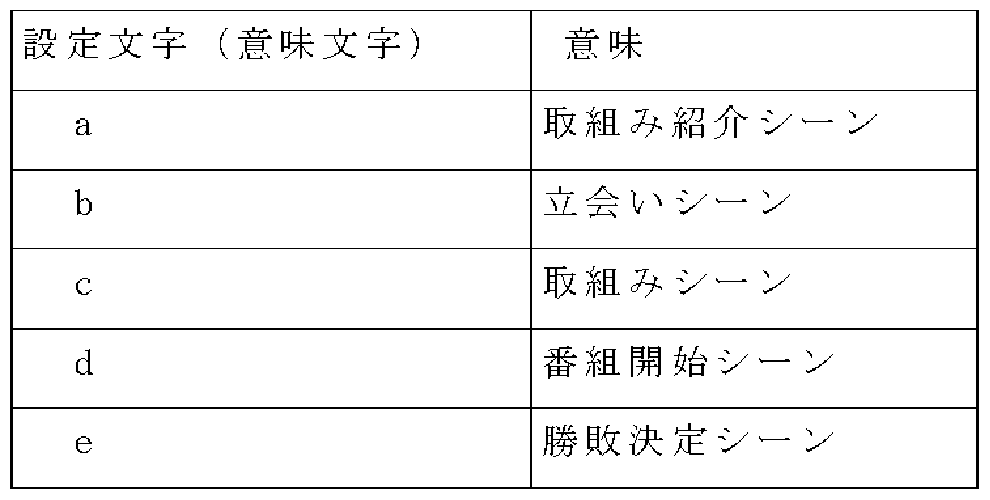


Claims
Priority Applications (2)
| Application Number | Priority Date | Filing Date | Title |
|---|---|---|---|
| JP2006531664A JP4835439B2 (ja) | 2004-08-10 | 2005-08-09 | 情報信号処理方法、情報信号処理装置及びコンピュータプログラム記録媒体 |
| US11/658,321 US8554057B2 (en) | 2004-08-10 | 2005-08-09 | Information signal processing method and apparatus, and computer program product |
Applications Claiming Priority (2)
| Application Number | Priority Date | Filing Date | Title |
|---|---|---|---|
| JP2004-233945 | 2004-08-10 | ||
| JP2004233945 | 2004-08-10 |
Publications (1)
| Publication Number | Publication Date |
|---|---|
| WO2006016591A1 true WO2006016591A1 (ja) | 2006-02-16 |
Family
ID=35839360
Family Applications (1)
| Application Number | Title | Priority Date | Filing Date |
|---|---|---|---|
| PCT/JP2005/014598 Ceased WO2006016591A1 (ja) | 2004-08-10 | 2005-08-09 | 情報信号処理方法、情報信号処理装置及びコンピュータプログラム記録媒体 |
Country Status (3)
| Country | Link |
|---|---|
| US (1) | US8554057B2 (ja) |
| JP (1) | JP4835439B2 (ja) |
| WO (1) | WO2006016591A1 (ja) |
Cited By (2)
| Publication number | Priority date | Publication date | Assignee | Title |
|---|---|---|---|---|
| CN101923882A (zh) * | 2009-06-10 | 2010-12-22 | 索尼公司 | 信息处理装置、信息处理方法和信息处理程序 |
| US8479398B2 (en) | 2008-07-22 | 2013-07-09 | Leon Alon Coresh | Shaving assembly |
Families Citing this family (3)
| Publication number | Priority date | Publication date | Assignee | Title |
|---|---|---|---|---|
| US8345750B2 (en) * | 2009-09-02 | 2013-01-01 | Sony Computer Entertainment Inc. | Scene change detection |
| US10939187B1 (en) * | 2016-08-11 | 2021-03-02 | Amazon Technologies, Inc. | Traversing a semantic graph to process requests for video |
| CN110070896B (zh) * | 2018-10-19 | 2020-09-01 | 北京微播视界科技有限公司 | 图像处理方法、装置、硬件装置 |
Citations (3)
| Publication number | Priority date | Publication date | Assignee | Title |
|---|---|---|---|---|
| JP2002142189A (ja) * | 2000-11-06 | 2002-05-17 | Canon Inc | 画像処理装置、画像処理方法及び記憶媒体 |
| JP2003283993A (ja) * | 2002-03-27 | 2003-10-03 | Sanyo Electric Co Ltd | 映像情報記録再生装置及び映像情報記録再生方法 |
| JP2004364183A (ja) * | 2003-06-06 | 2004-12-24 | Nippon Telegr & Teleph Corp <Ntt> | 部分コンテンツ作成方法、部分コンテンツ作成システム、部分コンテンツ作成装置、及び、部分コンテンツ作成プログラム |
Family Cites Families (8)
| Publication number | Priority date | Publication date | Assignee | Title |
|---|---|---|---|---|
| JP4227241B2 (ja) * | 1999-04-13 | 2009-02-18 | キヤノン株式会社 | 画像処理装置及び方法 |
| US7509580B2 (en) * | 1999-09-16 | 2009-03-24 | Sharp Laboratories Of America, Inc. | Audiovisual information management system with preferences descriptions |
| US7127736B2 (en) * | 2000-11-17 | 2006-10-24 | Sony Corporation | Content processing apparatus and content processing method for digest information based on input of a content user |
| US20030061610A1 (en) * | 2001-03-27 | 2003-03-27 | Errico James H. | Audiovisual management system |
| JP4615166B2 (ja) * | 2001-07-17 | 2011-01-19 | パイオニア株式会社 | 映像情報要約装置、映像情報要約方法及び映像情報要約プログラム |
| US7286749B2 (en) * | 2002-04-16 | 2007-10-23 | Canon Kabushiki Kaisha | Moving image playback apparatus, moving image playback method, and computer program thereof with determining of first voice period which represents a human utterance period and second voice period other than the first voice period |
| WO2005050986A1 (ja) * | 2003-11-19 | 2005-06-02 | National Institute Of Information And Communications Technology, Independent Administrative Agency | 映像内容の提示方法及び装置 |
| TWI259719B (en) * | 2004-01-14 | 2006-08-01 | Mitsubishi Electric Corp | Apparatus and method for reproducing summary |
-
2005
- 2005-08-09 US US11/658,321 patent/US8554057B2/en not_active Expired - Fee Related
- 2005-08-09 WO PCT/JP2005/014598 patent/WO2006016591A1/ja not_active Ceased
- 2005-08-09 JP JP2006531664A patent/JP4835439B2/ja not_active Expired - Fee Related
Patent Citations (3)
| Publication number | Priority date | Publication date | Assignee | Title |
|---|---|---|---|---|
| JP2002142189A (ja) * | 2000-11-06 | 2002-05-17 | Canon Inc | 画像処理装置、画像処理方法及び記憶媒体 |
| JP2003283993A (ja) * | 2002-03-27 | 2003-10-03 | Sanyo Electric Co Ltd | 映像情報記録再生装置及び映像情報記録再生方法 |
| JP2004364183A (ja) * | 2003-06-06 | 2004-12-24 | Nippon Telegr & Teleph Corp <Ntt> | 部分コンテンツ作成方法、部分コンテンツ作成システム、部分コンテンツ作成装置、及び、部分コンテンツ作成プログラム |
Cited By (3)
| Publication number | Priority date | Publication date | Assignee | Title |
|---|---|---|---|---|
| US8479398B2 (en) | 2008-07-22 | 2013-07-09 | Leon Alon Coresh | Shaving assembly |
| CN101923882A (zh) * | 2009-06-10 | 2010-12-22 | 索尼公司 | 信息处理装置、信息处理方法和信息处理程序 |
| CN101923882B (zh) * | 2009-06-10 | 2012-10-03 | 索尼公司 | 信息处理装置、信息处理方法 |
Also Published As
| Publication number | Publication date |
|---|---|
| JP4835439B2 (ja) | 2011-12-14 |
| US20080095512A1 (en) | 2008-04-24 |
| US8554057B2 (en) | 2013-10-08 |
| JPWO2006016591A1 (ja) | 2008-05-01 |
Similar Documents
| Publication | Publication Date | Title |
|---|---|---|
| TWI259719B (en) | Apparatus and method for reproducing summary | |
| JP4935355B2 (ja) | 情報信号処理方法、情報信号処理装置及びコンピュータプログラム記録媒体 | |
| CN100409358C (zh) | 提供一种彩色滑动条的再现装置 | |
| US20080044085A1 (en) | Method and apparatus for playing back video, and computer program product | |
| JP2003101939A (ja) | 映像情報要約装置、映像情報要約方法及び映像情報要約プログラム | |
| JPWO2010073355A1 (ja) | 番組データ処理装置、方法、およびプログラム | |
| JP4882746B2 (ja) | 情報信号処理方法、情報信号処理装置及びコンピュータプログラム記録媒体 | |
| US20060285818A1 (en) | Information processing apparatus, method, and program | |
| WO2006016591A1 (ja) | 情報信号処理方法、情報信号処理装置及びコンピュータプログラム記録媒体 | |
| JP2006054622A (ja) | 情報信号処理方法、情報信号処理装置及びプログラム記録媒体 | |
| JP4341503B2 (ja) | 情報信号処理方法、情報信号処理装置及びプログラム記録媒体 | |
| CN102611863A (zh) | 动画记录重放装置 | |
| JP4470638B2 (ja) | 情報信号処理方法、情報信号処理装置及びプログラム記録媒体 | |
| JP2005167456A (ja) | Avコンテンツ興趣特徴抽出方法及びavコンテンツ興趣特徴抽出装置 | |
| JP2010081531A (ja) | 映像処理装置及びその方法 | |
| JP2008153920A (ja) | 動画像一覧表示装置 | |
| JP2006270233A (ja) | 信号処理方法及び信号記録再生装置 | |
| JP2008103802A (ja) | 映像合成装置 | |
| JP5424306B2 (ja) | 情報処理装置および方法、プログラム、並びに記録媒体 | |
| JP4683277B2 (ja) | 再生装置および方法、並びにプログラム | |
| JP5056687B2 (ja) | 再生装置及びコンテンツ再生プログラム | |
| JP2006333279A (ja) | 記録装置および方法、並びにプログラム | |
| JP2006352631A (ja) | 情報処理装置および方法、並びにプログラム | |
| HK1122893B (en) | Musical composition section detecting method and its device, and data recording method and its device | |
| HK1122893A1 (en) | Musical composition section detecting method and its device, and data recording method and its device |
Legal Events
| Date | Code | Title | Description |
|---|---|---|---|
| AK | Designated states |
Kind code of ref document: A1 Designated state(s): AE AG AL AM AT AU AZ BA BB BG BR BW BY BZ CA CH CN CO CR CU CZ DE DK DM DZ EC EE EG ES FI GB GD GE GH GM HR HU ID IL IN IS JP KE KG KM KP KR KZ LC LK LR LS LT LU LV MA MD MG MK MN MW MX MZ NA NG NI NO NZ OM PG PH PL PT RO RU SC SD SE SG SK SL SM SY TJ TM TN TR TT TZ UA UG US UZ VC VN YU ZA ZM ZW |
|
| AL | Designated countries for regional patents |
Kind code of ref document: A1 Designated state(s): BW GH GM KE LS MW MZ NA SD SL SZ TZ UG ZM ZW AM AZ BY KG KZ MD RU TJ TM AT BE BG CH CY CZ DE DK EE ES FI FR GB GR HU IE IS IT LT LU LV MC NL PL PT RO SE SI SK TR BF BJ CF CG CI CM GA GN GQ GW ML MR NE SN TD TG |
|
| 121 | Ep: the epo has been informed by wipo that ep was designated in this application | ||
| WWE | Wipo information: entry into national phase |
Ref document number: 2006531664 Country of ref document: JP |
|
| WWE | Wipo information: entry into national phase |
Ref document number: 11658321 Country of ref document: US |
|
| NENP | Non-entry into the national phase |
Ref country code: DE |
|
| 122 | Ep: pct application non-entry in european phase | ||
| WWP | Wipo information: published in national office |
Ref document number: 11658321 Country of ref document: US |