WO2005111252A1 - シャドウマスク用素材、その製造方法、シャドウマスク用素材からなるシャドウマスク及びそのシャドウマスクを組み込んだカラー受像管 - Google Patents
シャドウマスク用素材、その製造方法、シャドウマスク用素材からなるシャドウマスク及びそのシャドウマスクを組み込んだカラー受像管 Download PDFInfo
- Publication number
- WO2005111252A1 WO2005111252A1 PCT/JP2005/008858 JP2005008858W WO2005111252A1 WO 2005111252 A1 WO2005111252 A1 WO 2005111252A1 JP 2005008858 W JP2005008858 W JP 2005008858W WO 2005111252 A1 WO2005111252 A1 WO 2005111252A1
- Authority
- WO
- WIPO (PCT)
- Prior art keywords
- shadow mask
- weight
- rolling
- hot
- picture tube
- Prior art date
- Legal status (The legal status is an assumption and is not a legal conclusion. Google has not performed a legal analysis and makes no representation as to the accuracy of the status listed.)
- Ceased
Links
Classifications
-
- H—ELECTRICITY
- H01—ELECTRIC ELEMENTS
- H01J—ELECTRIC DISCHARGE TUBES OR DISCHARGE LAMPS
- H01J29/00—Details of cathode-ray tubes or of electron-beam tubes of the types covered by group H01J31/00
- H01J29/02—Electrodes; Screens; Mounting, supporting, spacing or insulating thereof
- H01J29/06—Screens for shielding; Masks interposed in the electron stream
- H01J29/07—Shadow masks for colour television tubes
-
- C—CHEMISTRY; METALLURGY
- C22—METALLURGY; FERROUS OR NON-FERROUS ALLOYS; TREATMENT OF ALLOYS OR NON-FERROUS METALS
- C22C—ALLOYS
- C22C38/00—Ferrous alloys, e.g. steel alloys
- C22C38/04—Ferrous alloys, e.g. steel alloys containing manganese
-
- B—PERFORMING OPERATIONS; TRANSPORTING
- B21—MECHANICAL METAL-WORKING WITHOUT ESSENTIALLY REMOVING MATERIAL; PUNCHING METAL
- B21B—ROLLING OF METAL
- B21B3/00—Rolling materials of special alloys so far as the composition of the alloy requires or permits special rolling methods or sequences ; Rolling of aluminium, copper, zinc or other non-ferrous metals
- B21B3/02—Rolling special iron alloys, e.g. stainless steel
-
- H—ELECTRICITY
- H01—ELECTRIC ELEMENTS
- H01J—ELECTRIC DISCHARGE TUBES OR DISCHARGE LAMPS
- H01J2229/00—Details of cathode ray tubes or electron beam tubes
- H01J2229/07—Shadow masks
- H01J2229/0727—Aperture plate
- H01J2229/0733—Aperture plate characterised by the material
Definitions
- Shadow mask material manufacturing method thereof, shadow mask made of shadow mask material, and color picture tube incorporating the shadow mask
- the present invention relates to a shadow mask material used for a shadow mask used in a color picture tube.
- the present invention relates to a shadow mask using a material for a shadow mask, and a color picture tube incorporating the shadow mask.
- a cold-rolled steel sheet as a material for a shadow mask has been conventionally manufactured by the following manufacturing process. That is, the ultra-low carbon steel manufactured by the steel maker is subjected to finish hot rolling.
- the finishing temperature may be higher or lower than the Ar transformation point. After that, pickling, cold rolling, and
- the steel was decarburized and annealed in a box-type annealing furnace, and then, if necessary, the thickness of the final product was reduced by secondary cold rolling at a reduction ratio of 50% or more.
- the cold-rolled steel sheet manufactured by this manufacturing method is subjected to photoetching by an etching maker, annealing to softness by a press maker, pressing to a predetermined shape, and then In order to prevent generation of reddish light and reduce emissivity, annealing is performed in an oxidizing atmosphere to form an oxide film called a black oxide film on a surface layer.
- the important properties required here are soft magnetic properties, and the coercive force of the magnetic properties (hereinafter referred to as “Hc”) is 130AZm or less.
- Hc coercive force of the magnetic properties
- Patent Document 1 Japanese Patent Application Laid-Open No. 8-269627 Disclosure of the invention
- the present invention provides a material having a yield point strength in a direction perpendicular to the rolling direction of 120 MPa or more and a coercive force of magnetic properties of 130 AZm or less in consideration of handling properties after photoetching.
- the purpose is to provide.
- the method for producing a material for a shadow mask according to the present invention according to claim 2 includes, as components, C: ⁇ 0.003% by weight, Si: ⁇ 0.05% by weight, and Mn: 0.1 to 0.5. wt%, P:. ⁇ 0 1 wt%, S:. ⁇ 0 05 weight 0/0, A1:. ⁇ 0 02 weight 0/0, N:. 0.
- a shadow mask according to a third aspect of the present invention uses the shadow mask material according to the first aspect.
- a shadow mask according to a fourth aspect of the present invention is manufactured by the method for manufacturing a shadow mask material according to the second aspect.
- a color picture tube according to a fifth aspect of the present invention is a color picture tube incorporating the shadow mask according to any one of the third and fourth aspects.
- the C content in the hot-rolled steel sheet shall be less than 0.003% by weight. If it is more than this, it becomes undesired because it becomes a gap hole due to etching.
- Si in the shadow mask material is an element that inhibits black siding in the black siding processing step in the manufacture of a picture tube, and the smaller the amount, the more preferable.
- Si is an element inevitably contained in A1 killed steel. It is preferable that the content be less than 0.05% by weight.
- the ultra-thin shadow mask material of the present invention tends to crack during cold rolling. It is preferable to positively add a predetermined amount. For this effect, 0.1% by weight or more of added kashi is preferred.
- the upper limit is preferably set to 0.5% by weight.
- P in the shadow mask material deteriorates the magnetic properties due to the refinement of the crystal grains.
- the effect of the ultra-thin shadow mask material of the present invention is remarkable, and preferably less than 0.1% by weight.
- S in the hot-rolled steel sheet is an unavoidable element and is an impurity component that causes red-hot embrittlement during hot-rolling. It is desirable that S be as small as possible. Since the ultra-thin shadow mask material of the present invention is liable to crack during cold rolling, it is preferable to positively remove the shadow mask material. This effect is preferably less than 0.05% by weight.
- A1 in the hot-rolled steel sheet is added to the steel bath as a deoxidizing agent during steelmaking and is removed as slag.
- the remaining solid solution A1 is removed during hot rolling or annealing during the pressing of the shadow mask. It reacts with solute N that causes Tretzier's strain to become A1N, so it is effective in detoxifying solute N.
- B in the hot-rolled steel sheet forms nitrides with N and has the effect of suppressing the stretcher's strain, and it is desirable to add B.
- B is not necessarily required because Ti is contained. .
- the content is limited to 0.01% by weight or less. It is the most important element in this material.
- decarburization annealing usually performed with a shadow mask is not performed.
- C it is difficult to reduce C to 5 ppm or less at low cost and industrially stable only by the steel making method. Therefore, Ti-added kneading is desirable as one of the techniques for detoxifying the amount of solute C in ultra-low carbon steel containing 30 ppm of C during press annealing of a shadow mask.
- both C and N form precipitates. Further, it is superior to Nb, which will be described later, in that the effect of crystal grain refinement is small and the effect of deteriorating magnetic properties is small.
- the content of Ti in the steel is preferably in the range of 0.01 to 0.07% by weight. Desirably, it is in the range of 0.02 to 0.04% by weight. Since Ti in steel forms carbonitrides with C and N, it reduces solid solution C and N, and reduces stretcher strain. I need. Due to the formation of TiN, it was difficult to form fine A1N, and the effect of suppressing crystal grains and the elimination of annealing after cold rolling were made possible. However, if the Ti content is too high, the recrystallization temperature during the soft annealing before the mask forming is increased, so the upper limit is set to 0.07% by weight. To do. In the component system of the present invention, the effect of Ti is most effective at 0.02 to 0.04% by weight.
- Nb is added for the same purpose as Ti described above. Nb may be used alone or in combination with Ti. However, Nb is TU, and Ti alone is preferred because of its high grain refining effect. Therefore, when Nb is used, it is limited to 0.01 to 0.05% by weight.
- the slab heating temperature is lower than 1100 ° C, the hot rollability deteriorates, and it is desirable that the slab heating temperature be higher than 1100 ° C from the viewpoint of securing the hot rolling temperature.
- the slab heating temperature is too high, A1N at the time of slab dissolves completely and becomes fine crystal grains in the hot-rolled sheet, deteriorating magnetic properties. That is, He increases. Therefore, the slab heating temperature should not exceed 1250 ° C.
- the hot-rolling finishing temperature is an important factor for controlling crystal grains. If the Ar temperature is higher than the Ar3 point, ⁇ ⁇ ⁇ transformation occurs after finish rolling, and fine crystal grains are formed. Deterioration of characteristics and increase of He, but not particularly regulated because it does not exceed 130 AZm.
- the hot-rolling finishing temperature is 0 to 30 ° C lower than the Ar3 point, preferably 10 to 20 ° C lower. In this component system, 850 to 880 ° C, preferably 860 to 870 ° C It is desirable to do.
- the Ar3 transformation point is about 880 ° C. for the material component of the present invention.
- the Ar3 transformation point differs depending on the material component. What is important is that the finish rolling of hot rolling is completed at a temperature 0-30 ° C lower than the Ar3 transformation point, preferably 10-20 ° C lower.
- the winding temperature is preferably set to 540 to 700 ° C in consideration of the quality stability in the coil width direction and the longitudinal direction during hot rolling, but the crystal grain of the hot-rolled sheet is increased. For 650-700 ° C is more desirable.
- the upper limit of the winding temperature is not restricted by the magnetic properties, but is set to 700 ° C from the descaling property in the pickling process.
- the thickness of the hot rolled sheet shall be 1.5 to 2.5 mm. More preferably, it is 1.6 to 2. Omm.
- the thickness of the shadow mask material of the present invention after cold rolling is desirably 0.05 to 0.3 mm. If the rolling reduction is less than 30%, the crystal grains are too large, causing grain boundary corrosion in the etching step for forming the holes required for the shadow mask, and the shape of the holes becomes uneven, which is not preferable. On the other hand, when the rolling ratio exceeds 93%, cold rolling cannot be performed due to edge cracks or plate breakage during rolling. Further, an appropriate surface roughness may be given to the steel sheet. As the surface roughness, a rolling roll having an appropriate roughness is used so that the average surface roughness Ra CilS B 06 01) is 0.1 to 1 / ⁇ .
- the surface average roughness Ra is less than 0 .: Lm, the adhesion to the resist is poor. If the surface average roughness Ra is more than Lm, the resist remains even after development, and etching unevenness due to the ferric chloride solution occurs immediately. Easily not desirable. Annealing after cold rolling is unnecessary.
- temper rolling is performed using a rolling roll having an appropriate roughness so that the surface average roughness Ra CilS B 060 1) is 0.1 to 1 ⁇ m. If it is less than 0.1 m, the adhesion to the resist is poor. If it exceeds 1 ⁇ m, the resist remains even after development, and etching unevenness due to the ferric chloride solution easily occurs, which is not preferable.
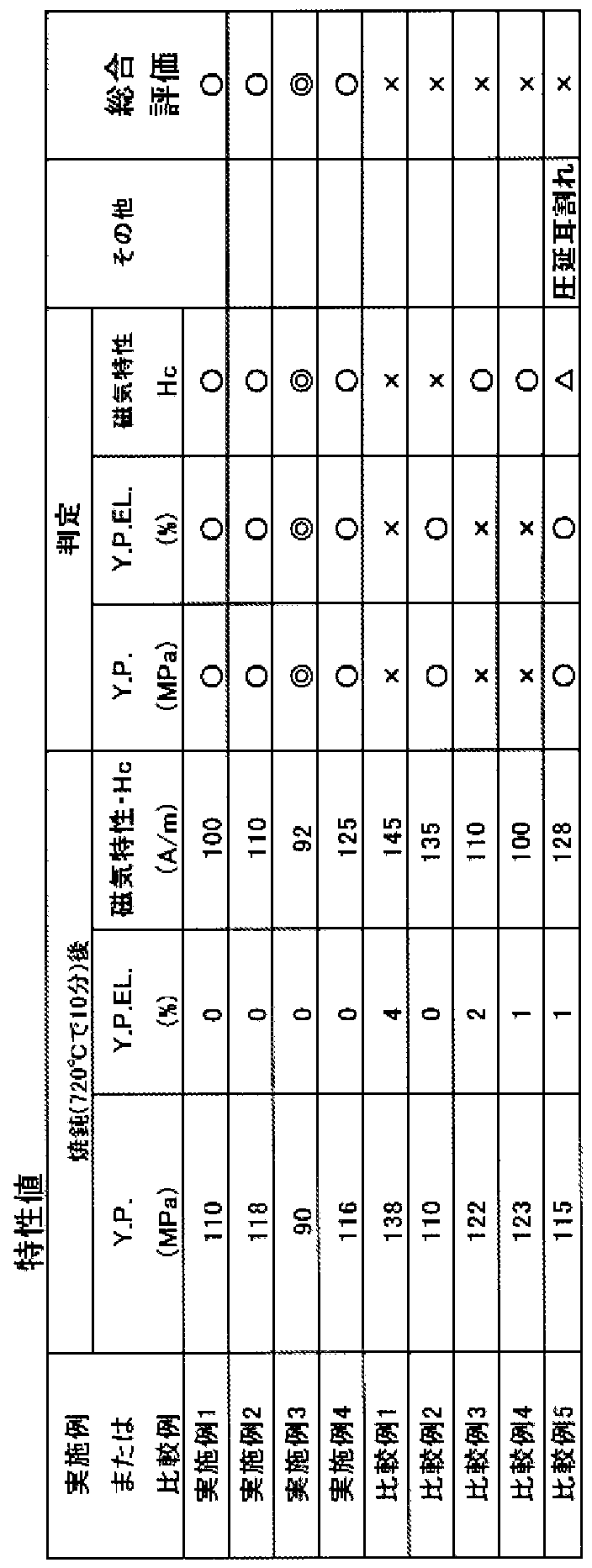
- a steel slab having the chemical composition shown in Table 1 was hot-rolled into a hot-rolled steel sheet of 2.Omm, and after pickling, cold-rolled to produce an ultra-thin shadow mask material with a thickness of 0.05 to 0.3 mm. Manufactured. In Examples 1 to 4 and Comparative Examples 1 to 5, the rolling reduction was 65 to 95%. Further, in Example 4, after cold rolling, temper rolling was performed to set the surface average roughness Ra (jIS B 0601) to 0.4 m. In Examples 1 to 3, the surface average roughness Ra CilS B 0601) was set to 0.1, 1.0, and 0.5 m by cold rolling, respectively. [0022] The characteristics of the material prepared as described above were evaluated. Table 2 shows the evaluation results.
- the JIS No. 5 test piece was subjected to a yield point strength (YP ) And yield point elongation (YPEL) were measured.
- the yield point strength (YP) is preferably less than 120 MPa.
- a yield point elongation (YPEL) of less than 1% was evaluated as good.
- the material was annealed at 720 ° C. for 10 minutes in the same manner as the evaluation for the yield point strength (YP) and the yield point elongation (YPEL).
- the atmosphere was 10% by volume of hydrogen gas and the remaining nitrogen gas, and the dew point was -10 ° C.
- Magnetic properties were evaluated by the coercive force (He) by applying a magnetic field of 796 mZA by the quadrupole Epstein method (a method of applying a primary winding and a secondary winding and applying an external magnetic field). A coercive force of less than 130 AZm was evaluated as good.
- Tables 1 and 2 show the production methods, yield point strength (YP), yield point elongation, and coercive force (He) measured by the quadrupole Ebstein method in Examples and Comparative Examples. As shown in Table 1 and Table 2, under the temperature condition of pre-press annealing at 720 ° C, the shadow mask material having good magnetic properties with He smaller than 130A Zm was obtained. ing. And the yield point strength becomes 120MPa or less.
- Comparative Example 1 In Comparative Example 1, the C content was too large, the yield point strength was too high, and the magnetic properties were high and poor. Comparative Example 2 has poor magnetic properties because the amount of A1 is too large. In Comparative Examples 3 and 4, the yield point strength is too high when the Ti content and the Nb content are small, and is poor. Comparative Example 5 has strength and magnetic characteristics. Although there is no problem in the properties, the rolling ratio is too high, and ear cracks occur during rolling, and there is a risk of plate breakage, which is difficult for industrial production. In Table 2, in the overall evaluation, ⁇ and ⁇ indicate that all are good in terms of YP, YPEL and magnetic properties, and X indicates that any of YP, YPLE or magnetic properties is inferior.
- the shadow mask material of the present invention since Ti and / or Nb are added to low carbon steel, Ti and Z or Nb form carbonitrides, solute C and N are reduced, and the stretch is reduced. Strain is reduced. Therefore, a shadow mask material having excellent yield point strength, yield point elongation and excellent magnetic properties can be obtained.
- the shadow mask material of the present invention can be manufactured by thinning with one cold rolling without much annealing, which is the case with the conventional thinning by repeated cold rolling and annealing.
Landscapes
- Chemical & Material Sciences (AREA)
- Engineering & Computer Science (AREA)
- Materials Engineering (AREA)
- Mechanical Engineering (AREA)
- Metallurgy (AREA)
- Organic Chemistry (AREA)
- Heat Treatment Of Sheet Steel (AREA)
- Electrodes For Cathode-Ray Tubes (AREA)
- Metal Rolling (AREA)
Abstract
Description

Claims
Applications Claiming Priority (2)
| Application Number | Priority Date | Filing Date | Title |
|---|---|---|---|
| JP2004-147182 | 2004-05-18 | ||
| JP2004147182A JP2005330503A (ja) | 2004-05-18 | 2004-05-18 | シャドウマスク用素材、その製造方法、シャドウマスク用素材からなるシャドウマスク及びそのシャドウマスクを組み込んだカラー受像管 |
Publications (1)
| Publication Number | Publication Date |
|---|---|
| WO2005111252A1 true WO2005111252A1 (ja) | 2005-11-24 |
Family
ID=35394171
Family Applications (1)
| Application Number | Title | Priority Date | Filing Date |
|---|---|---|---|
| PCT/JP2005/008858 Ceased WO2005111252A1 (ja) | 2004-05-18 | 2005-05-16 | シャドウマスク用素材、その製造方法、シャドウマスク用素材からなるシャドウマスク及びそのシャドウマスクを組み込んだカラー受像管 |
Country Status (2)
| Country | Link |
|---|---|
| JP (1) | JP2005330503A (ja) |
| WO (1) | WO2005111252A1 (ja) |
Citations (4)
| Publication number | Priority date | Publication date | Assignee | Title |
|---|---|---|---|---|
| JPH1150149A (ja) * | 1997-07-29 | 1999-02-23 | Sumitomo Metal Ind Ltd | シャドウマスクフレーム用冷延鋼板の製造方法 |
| JP3287257B2 (ja) * | 1997-02-05 | 2002-06-04 | 日本鋼管株式会社 | 加工性に優れ、かつ加工性の幅方向での変動が少ない鋼板およびその製造方法 |
| JP2004043871A (ja) * | 2002-07-10 | 2004-02-12 | Toyo Kohan Co Ltd | シャドウマスク用素材、その製造方法、シャドウマスク用素材からなるシャドウマスク及びそのシャドウマスクを組み込んだ受像管 |
| JP2004059937A (ja) * | 2002-07-24 | 2004-02-26 | Toyo Kohan Co Ltd | カラー受像管用磁気シールド用素材、その製造方法、カラー受像管用磁気シールド材およびカラー受像管 |
-
2004
- 2004-05-18 JP JP2004147182A patent/JP2005330503A/ja active Pending
-
2005
- 2005-05-16 WO PCT/JP2005/008858 patent/WO2005111252A1/ja not_active Ceased
Patent Citations (4)
| Publication number | Priority date | Publication date | Assignee | Title |
|---|---|---|---|---|
| JP3287257B2 (ja) * | 1997-02-05 | 2002-06-04 | 日本鋼管株式会社 | 加工性に優れ、かつ加工性の幅方向での変動が少ない鋼板およびその製造方法 |
| JPH1150149A (ja) * | 1997-07-29 | 1999-02-23 | Sumitomo Metal Ind Ltd | シャドウマスクフレーム用冷延鋼板の製造方法 |
| JP2004043871A (ja) * | 2002-07-10 | 2004-02-12 | Toyo Kohan Co Ltd | シャドウマスク用素材、その製造方法、シャドウマスク用素材からなるシャドウマスク及びそのシャドウマスクを組み込んだ受像管 |
| JP2004059937A (ja) * | 2002-07-24 | 2004-02-26 | Toyo Kohan Co Ltd | カラー受像管用磁気シールド用素材、その製造方法、カラー受像管用磁気シールド材およびカラー受像管 |
Also Published As
| Publication number | Publication date |
|---|---|
| JP2005330503A (ja) | 2005-12-02 |
Similar Documents
| Publication | Publication Date | Title |
|---|---|---|
| CN107109563B (zh) | 取向性电磁钢板及其制造方法 | |
| EP3225704B1 (en) | Method for manufacturing grain-oriented electrical steel sheet | |
| EP3530770B1 (en) | Hot-rolled steel sheet for electrical steel sheet production and method of producing same | |
| JP3386751B2 (ja) | 被膜特性と磁気特性に優れた方向性けい素鋼板の製造方法 | |
| WO2016199423A1 (ja) | 方向性電磁鋼板およびその製造方法 | |
| EP3395960B1 (en) | Method for manufacturing grain-oriented electrical steel sheet | |
| JPH09503825A (ja) | シャドウマスク製造用冷間圧延鋼帯およびその製造方法 | |
| JPS6133886B2 (ja) | ||
| JP2021509149A (ja) | 方向性電磁鋼板およびその製造方法 | |
| JP2022512498A (ja) | 方向性電磁鋼板およびその製造方法 | |
| JP2002161335A (ja) | シャドウマスク用素材、その製造方法、その素材からなるシャドウマスク及びそのシャドウマスクを用いた受像管 | |
| WO2005017221A1 (ja) | シャドウマスク用素材、その製造方法、シャドウマスク用素材からなるシャドウマスク及びそのシャドウマスクを組み込んだ受像管 | |
| WO2000073518A1 (fr) | Procede de production de feuilles d'acier pour masques perfores d'une epaisseur extremement precise dans le sens longitudinal | |
| WO2005111252A1 (ja) | シャドウマスク用素材、その製造方法、シャドウマスク用素材からなるシャドウマスク及びそのシャドウマスクを組み込んだカラー受像管 | |
| JP3716608B2 (ja) | 方向性電磁鋼板の製造方法 | |
| JP2006144035A (ja) | シャドウマスク用素材とその製造方法、シャドウマスク用素材からなるシャドウマスク及びそのシャドウマスクを組み込んだカラー受像管 | |
| JPS60255924A (ja) | 磁気シ−ルド部材用素材鋼板の製造方法 | |
| WO2000055383A1 (en) | Material for shadow mask, method for production thereof, shadow mask and image receiving tube | |
| JP2004043871A (ja) | シャドウマスク用素材、その製造方法、シャドウマスク用素材からなるシャドウマスク及びそのシャドウマスクを組み込んだ受像管 | |
| JP2001123229A (ja) | 被膜特性に優れた高磁束密度方向性電磁鋼板の製造方法 | |
| JP2004059937A (ja) | カラー受像管用磁気シールド用素材、その製造方法、カラー受像管用磁気シールド材およびカラー受像管 | |
| JP3235954B2 (ja) | シャドウマスク用鋼板およびその製造方法 | |
| JP2019085632A (ja) | 方向性電磁鋼板及びその製造方法 | |
| JP6863310B2 (ja) | 方向性電磁鋼板の製造方法 | |
| KR20060040573A (ko) | 섀도우 마스크용 소재, 그 제조방법, 섀도우 마스크용소재로 이루어지는 섀도우 마스크 및 그 섀도우 마스크를내장한 수상관 |
Legal Events
| Date | Code | Title | Description |
|---|---|---|---|
| AK | Designated states |
Kind code of ref document: A1 Designated state(s): AE AG AL AM AT AU AZ BA BB BG BR BW BY BZ CA CH CN CO CR CU CZ DE DK DM DZ EC EE EG ES FI GB GD GE GH GM HR HU ID IL IN IS KE KG KM KP KR KZ LC LK LR LS LT LU LV MA MD MG MK MN MW MX MZ NA NG NI NO NZ OM PG PH PL PT RO RU SC SD SE SG SK SL SM SY TJ TM TN TR TT TZ UA UG US UZ VC VN YU ZA ZM ZW |
|
| AL | Designated countries for regional patents |
Kind code of ref document: A1 Designated state(s): GM KE LS MW MZ NA SD SL SZ TZ UG ZM ZW AM AZ BY KG KZ MD RU TJ TM AT BE BG CH CY CZ DE DK EE ES FI FR GB GR HU IE IS IT LT LU MC NL PL PT RO SE SI SK TR BF BJ CF CG CI CM GA GN GQ GW ML MR NE SN TD TG |
|
| 121 | Ep: the epo has been informed by wipo that ep was designated in this application | ||
| NENP | Non-entry into the national phase |
Ref country code: DE |
|
| WWW | Wipo information: withdrawn in national office |
Country of ref document: DE |
|
| 122 | Ep: pct application non-entry in european phase |