WO2005102967A1 - π共役化合物の製造方法 - Google Patents
π共役化合物の製造方法 Download PDFInfo
- Publication number
- WO2005102967A1 WO2005102967A1 PCT/JP2005/007717 JP2005007717W WO2005102967A1 WO 2005102967 A1 WO2005102967 A1 WO 2005102967A1 JP 2005007717 W JP2005007717 W JP 2005007717W WO 2005102967 A1 WO2005102967 A1 WO 2005102967A1
- Authority
- WO
- WIPO (PCT)
- Prior art keywords
- group
- compound
- butadiene
- formula
- conjugated compound
- Prior art date
- Legal status (The legal status is an assumption and is not a legal conclusion. Google has not performed a legal analysis and makes no representation as to the accuracy of the status listed.)
- Ceased
Links
Classifications
-
- C—CHEMISTRY; METALLURGY
- C07—ORGANIC CHEMISTRY
- C07D—HETEROCYCLIC COMPOUNDS
- C07D333/00—Heterocyclic compounds containing five-membered rings having one sulfur atom as the only ring hetero atom
- C07D333/02—Heterocyclic compounds containing five-membered rings having one sulfur atom as the only ring hetero atom not condensed with other rings
- C07D333/04—Heterocyclic compounds containing five-membered rings having one sulfur atom as the only ring hetero atom not condensed with other rings not substituted on the ring sulphur atom
- C07D333/06—Heterocyclic compounds containing five-membered rings having one sulfur atom as the only ring hetero atom not condensed with other rings not substituted on the ring sulphur atom with only hydrogen atoms, hydrocarbon or substituted hydrocarbon radicals, directly attached to the ring carbon atoms
- C07D333/08—Hydrogen atoms or radicals containing only hydrogen and carbon atoms
-
- C—CHEMISTRY; METALLURGY
- C07—ORGANIC CHEMISTRY
- C07C—ACYCLIC OR CARBOCYCLIC COMPOUNDS
- C07C1/00—Preparation of hydrocarbons from one or more compounds, none of them being a hydrocarbon
- C07C1/26—Preparation of hydrocarbons from one or more compounds, none of them being a hydrocarbon starting from organic compounds containing only halogen atoms as hetero-atoms
-
- C—CHEMISTRY; METALLURGY
- C07—ORGANIC CHEMISTRY
- C07C—ACYCLIC OR CARBOCYCLIC COMPOUNDS
- C07C1/00—Preparation of hydrocarbons from one or more compounds, none of them being a hydrocarbon
- C07C1/32—Preparation of hydrocarbons from one or more compounds, none of them being a hydrocarbon starting from compounds containing hetero-atoms other than or in addition to oxygen or halogen
- C07C1/325—Preparation of hydrocarbons from one or more compounds, none of them being a hydrocarbon starting from compounds containing hetero-atoms other than or in addition to oxygen or halogen the hetero-atom being a metal atom
-
- C—CHEMISTRY; METALLURGY
- C07—ORGANIC CHEMISTRY
- C07C—ACYCLIC OR CARBOCYCLIC COMPOUNDS
- C07C1/00—Preparation of hydrocarbons from one or more compounds, none of them being a hydrocarbon
- C07C1/32—Preparation of hydrocarbons from one or more compounds, none of them being a hydrocarbon starting from compounds containing hetero-atoms other than or in addition to oxygen or halogen
- C07C1/325—Preparation of hydrocarbons from one or more compounds, none of them being a hydrocarbon starting from compounds containing hetero-atoms other than or in addition to oxygen or halogen the hetero-atom being a metal atom
- C07C1/326—Preparation of hydrocarbons from one or more compounds, none of them being a hydrocarbon starting from compounds containing hetero-atoms other than or in addition to oxygen or halogen the hetero-atom being a metal atom the hetero-atom being a magnesium atom
-
- C—CHEMISTRY; METALLURGY
- C07—ORGANIC CHEMISTRY
- C07C—ACYCLIC OR CARBOCYCLIC COMPOUNDS
- C07C2/00—Preparation of hydrocarbons from hydrocarbons containing a smaller number of carbon atoms
- C07C2/86—Preparation of hydrocarbons from hydrocarbons containing a smaller number of carbon atoms by condensation between a hydrocarbon and a non-hydrocarbon
- C07C2/861—Preparation of hydrocarbons from hydrocarbons containing a smaller number of carbon atoms by condensation between a hydrocarbon and a non-hydrocarbon the non-hydrocarbon contains only halogen as hetero-atoms
Definitions
- the present invention relates to a novel method for producing a ⁇ -conjugated compound, and more particularly, to a novel method for producing a ⁇ -conjugated compound having a cross-conjugation structure, which is a kind of ⁇ -conjugated structure, in the molecule.
- a polymer in which double bonds represented by polyacetylene are alternately arranged is a polymer in which ⁇ electrons are spread throughout the molecular structure ( ⁇ conjugated polymer), and is attracting attention as an electrically or optically functional material.
- ⁇ conjugated polymer a polymer in which ⁇ electrons are spread throughout the molecular structure
- ⁇ conjugated polymer a polymer in which ⁇ electrons are spread throughout the molecular structure
- Non-Patent Document 1 Non-Patent Document 2, Non-Patent Document 2). 3 or Non-Patent Document 4
- these methods have problems in practicality due to the complicated synthesis route and low yield, and the development of a new method for synthesizing a compound having a cross-conjugated structure is required. Coveted.
- ⁇ represents 1 or more, preferably 2 to an integer of L000.
- Non-Patent Document 1 M. Klokkenburg et al., Chem. Eur. J., 9, 3544-3554 (2003)
- Non-Patent Document 2 MR Bryce et al., Chem. Eur. J., 6, 1955-1962 (2000)
- Non-Patent Document 3 S. Fielder et al., Angew.Chem.Int.Ed., 39, 4331-4333 (2000)
- Non-Patent Document 4 J. Nakayama et al., Chem. Lett., 1173-1176 (1985) Disclosure of the Invention
- the present invention provides a simple method for producing a ⁇ -conjugated compound having a high yield C YI.
- Butadiene halide and a compound having a halogen or a reactive group are reacted to obtain a compound represented by the general formula (Chemical Formula 2)
- substituted conjugate a compound represented by the general formula (Chemical Formula 2)
- the present inventors have found that the above object can be achieved by a method for producing a ⁇ -conjugated compound characterized by obtaining a ⁇ -conjugated compound shown in the above, and completed the present invention.
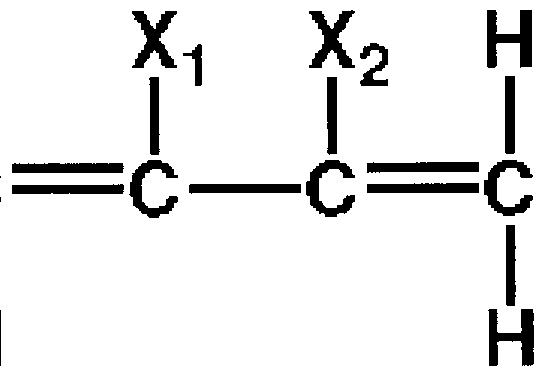
- X represents a halogen atom.
- ⁇ represents a halogen, a reactive group, Or a group from which hydrogen of a reactive group has been removed.
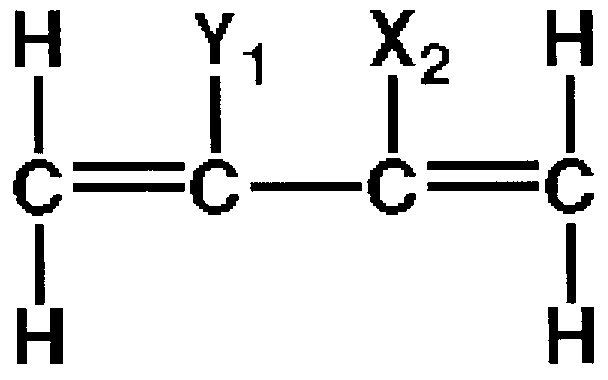
- Y and Y are each a halogen, a reactive group or a reactive group
- the metal and Z or the metal compound be any of nickel, palladium or copper, alone, a compound, a complex or a mixture thereof. Those which are 1,3-butadiene and Z or 2,3-dibutene 1,3-butadiene are preferred.
- the substituted conjugate preferably has a heterocyclic aromatic group or a hydrocarbon aromatic group.
- the reactive group of the substituted compound is preferably a functional group containing magnesium, tin or boron, a vinyl group or ethynyl. It is preferable that the group is different.
- a ⁇ -conjugated compound of the present invention can be produced simply and at a high yield.
- FIG. 1 shows the result of 1 H-NMR spectrum measurement in Example 1.
- the present invention provides a method for converting at least one halogen atom of a halogenated butadiene into a specific compound. By obtaining a ⁇ -conjugated compound having a cross-conjugated structure in the molecule.
- the halogenated butadiene is 2,3-dihalogeno-1,3-butadiene represented by the general formula (I-Dai 1), and specifically, 2,3-dichloro-1,3-butadiene, 2,3-Jib mouth 1,3-butadiene CHH, II 2,3-Jodo-1,3-butadiene and the like.
- concentration of the halogenated butadiene in the solvent is not particularly limited, but is generally from 0.01 to 5 mol / liter, preferably from 0.03 to 0.5 mono / liter.
- X and X each represent a nitrogen atom and may be the same or different.
- metal and metal or metal compound in the present invention a simple substance, a compound, a complex, or a mixture thereof of nickel, noradium, or copper is preferably used.
- nickel compounds include tetrakis (trifluorophosphine) nickel (Ni (PPh;)),
- Ni (cod) nickel
- Ni (cod) nickel
- Ni (cod) nickel
- Ni (cod) nickel
- NiCl nickel
- Neutral ligands in systems containing Br for example, triphenylphosphine, tritertiarybutyl
- Nickel complexes formed by burning phosphine, 1,3-bis (diphenylphosphino) propane, or a nitrogen-containing ligand eg, Ni (cod) (bpy) (where bpy represents bipyridyl), Ni (cod) (PPh) m, Ni (cod) (Pt—Bu) m (where m is a positive number),
- Noradium compounds include tetrakis (triphenylphosphine) palladium (Pd (PPh)), tetrakis (tritertiarybutylphosphine)
- 3 2 2 2 2 pe represents diphosphine ethane), palladium acetate (Pd (OAc)), Pd (OAc)
- Neutral ligands such as triphenylphosphine, tritertiarybutylphosphine
- Examples include palladium complexes formed by fining fins and the like (for example, bis (triphenylphosphine) palladium acetate, bis (tritertiarybutylphosphine) palladium acetate, and the like).
- the copper compound include copper halides such as copper chloride, copper bromide, and Yomi-Dani copper; and copper halides having a neutral ligand, for example, triphenylphosphine coordinated with triphenylphosphine. And bromo (triphenylphosphine) copper.
- basic alkylamine compounds such as Na CO and C
- the amount is twice or more the number of moles charged for the reaction substrate (halogenated butadiene).
- a divalent nickel complex is used, it is 0.1 to 10 mol%, preferably 1 to 5 mol%, based on the reaction substrate.
- Copper complex 0.1 to 10 mole 0/0 for reactive group substance, preferably 1 to 5 mol%.
- the amount of the palladium complex is 0.1 to 10 mol%, preferably 1 to 5 mol%, based on the reaction substrate.
- the basic compound is at least equimolar to the reaction substrate.
- Substituted compounds have a halogen, functional group or terminal hydrogen at one sp2 carbon atom in the molecule, such as a mononuclear and Z or polynuclear hydrocarbon aromatic group, a mononuclear and Z or polynuclear heteroaromatic. It has the functional group which has it.
- a mononuclear and Z- or polynuclear hydrocarbon aromatic groups include phenylene, naphthalene, fluorene, acenaphthene, phenanthrene, anthracene, lanthanum, pyrene, perylene, noreprene, and thalicene.
- Examples of mononuclear and Z or polynuclear heterocyclic aromatic groups include furan, thiophene, pyrrole, oxazole, isoxazole, thiazole, isothiazole, imidazole, oxaziazole, thiadiazole, pyrazole, pyridine, pyridazine, pyrimidine, pyrazine. , Triazine, tetrazen and the like.
- benzo-fused ring systems such as benzoxazole, benzothiazole, benzimidazole, quinoline, isoquinoline, cinnoline, quinazoline, phthalazine, benzothiadiazone, benzotriazine, and phenyl Nazine, phenanthridine, atarizine, carbazole, diphen-lenoxide and the like are also included in the present invention.
- the reactive group or the terminal hydrogen of the reactive group which is the object of the present invention the above-mentioned group of internal groups may be substituted with another substituent other than the halogen or the reactive group. May be substituted with a group. For example, if the carbon number is
- the functional group of the substituted conjugate is preferably a halogen, a substituent containing magnesium, tin, boron, zinc or silicon as a reactive group, or a butyl group or an ethur group.
- halogen include chlorine, bromine, iodine, and the like.
- a substituent containing magnesium is-MgX, where Mg is magnesium, and X is chlorine, bromine or iodine. .
- SnR where Sn is tin and R is hydrocarbyl having 1 to 6 carbon atoms
- OR, (R, is a hydrocarbyl having 1 to 6 carbon atoms or —CH 2 —CH 1 and —CH—C
- H-CH is bonded like a) or is a hydrocarbyl having 1 to 20 carbon atoms
- the substituent containing zinc is ZnX (where Zn is zinc and X is chlorine, bromine or iodine). What is a substituent containing a silicon atom? — SiR '(where Si is a silicon atom and R' is a
- the addition amount of the substituted compound is preferably at least twice the molar amount to the halogenated butadiene.
- the reaction between the halogenated butadiene and the substituted conjugate refers to the step of removing at least one halogen of the halogenated butadiene, and removing the halogen, the reactive group or the reactive group of the substituted conjugate.
- This is a reaction that removes terminal hydrogen and forms a carbon-carbon bond between these molecules.
- This reaction can be used by appropriately selecting a known organic synthesis reaction force. Specifically, a reaction in which both halogens are eliminated in the presence of a nickel complex to form a carbon-carbon bond (for example, T. Yamamoto et al. , Bull. Chem. Soc.
- the solvent of the present invention may be appropriately selected and used in consideration of the stability and solubility of the metal and Z or the metal compound, the reaction temperature, the boiling point of the solvent, and the like. Specific examples include toluene, benzene, xylene, ethylbenzene, ethyl, dimethylformamide, tetrahydrofuran, pyridine, water and the like.
- the reaction temperature is preferably in the range of room temperature to 120 ° C.
- the reaction time is not particularly limited and can be arbitrarily selected. From an economic viewpoint, the range of 0.1 to 24 hours is preferably employed.
- the ⁇ -conjugated compound of the present invention may be in the form of a cis, trans, or micelle! /.
- 2,3-dichloro-1,3-butadiene was used as a halogenated butadiene, a thiophene having a functional group—MgBr bonded to an sp2 carbon atom as a substituted compound, and [1,3-bis (diphene) -Luosphino) propane] dichloronickel ( ⁇ ) as an example.
- the reaction product was 2,3 bis (2 chel) -1,3 butadiene, that is, a ⁇ -conjugated compound having a cross-conjugated structure in the molecule intended by the present invention.
- elemental analysis confirmed that the elemental compositions matched.
- 2,3-dichloro-1,3-butadiene as a halogenated butadiene
- 1,3-bis (diphenylphosphino) propane as a metal catalyst
- dichloronickel ( ⁇ ) is used as an example.
- reaction product was dissolved in double-mouthed form, and its molecular structure and bonding state were identified by 1 H-NMR spectrum.
- the H—NMR ⁇ vector is shown in FIG.
- the peak assignments and the shifts are as follows. ⁇ 7.39 (dd, 8.4Hz, 1.6Hz, 4H), 7.26-7.2Km, 6H), 5.54 (d, 1.6Hz, 2H), 5.31 (d, 1 6Hz, 2H). It was confirmed that the reaction product was 2,3 diphenyl 1,3 butadiene.
- the ⁇ -conjugated compound obtained according to the present invention can be used as a precursor for the synthesis of ⁇ -conjugated polymers and the synthesis of pharmaceutical raw materials.
Landscapes
- Chemical & Material Sciences (AREA)
- Organic Chemistry (AREA)
- Organic Low-Molecular-Weight Compounds And Preparation Thereof (AREA)
- Low-Molecular Organic Synthesis Reactions Using Catalysts (AREA)
Abstract
Description


Claims
Priority Applications (1)
| Application Number | Priority Date | Filing Date | Title |
|---|---|---|---|
| JP2006512604A JPWO2005102967A1 (ja) | 2004-04-23 | 2005-04-22 | π共役化合物の製造方法 |
Applications Claiming Priority (2)
| Application Number | Priority Date | Filing Date | Title |
|---|---|---|---|
| JP2004-127882 | 2004-04-23 | ||
| JP2004127882 | 2004-04-23 |
Publications (1)
| Publication Number | Publication Date |
|---|---|
| WO2005102967A1 true WO2005102967A1 (ja) | 2005-11-03 |
Family
ID=35196891
Family Applications (1)
| Application Number | Title | Priority Date | Filing Date |
|---|---|---|---|
| PCT/JP2005/007717 Ceased WO2005102967A1 (ja) | 2004-04-23 | 2005-04-22 | π共役化合物の製造方法 |
Country Status (2)
| Country | Link |
|---|---|
| JP (1) | JPWO2005102967A1 (ja) |
| WO (1) | WO2005102967A1 (ja) |
Citations (1)
| Publication number | Priority date | Publication date | Assignee | Title |
|---|---|---|---|---|
| US4665257A (en) * | 1986-10-20 | 1987-05-12 | The United States Of America As Represented By The Secretary Of The Army | Facile, high yield synthesis of 2,3-diphenyl-1,3-butadiene |
-
2005
- 2005-04-22 JP JP2006512604A patent/JPWO2005102967A1/ja active Pending
- 2005-04-22 WO PCT/JP2005/007717 patent/WO2005102967A1/ja not_active Ceased
Patent Citations (1)
| Publication number | Priority date | Publication date | Assignee | Title |
|---|---|---|---|---|
| US4665257A (en) * | 1986-10-20 | 1987-05-12 | The United States Of America As Represented By The Secretary Of The Army | Facile, high yield synthesis of 2,3-diphenyl-1,3-butadiene |
Non-Patent Citations (1)
| Title |
|---|
| "Dai 5 Han Jikken Kagaku Koza 13, Yuki Kagobutsu no Gosei I -Tanka Suiso . Halogen Kagobutsu", EDITED BY CSJ: THE CHEMICAL SOCIETY OF JAPAN, 20 February 2004 (2004-02-20), XP002993441 * |
Also Published As
| Publication number | Publication date |
|---|---|
| JPWO2005102967A1 (ja) | 2008-03-13 |
Similar Documents
| Publication | Publication Date | Title |
|---|---|---|
| Grosshenny et al. | Construction of preorganized polytopic ligands via palladium-promoted cross-coupling reactions | |
| JP5021161B2 (ja) | 共役ポリマーに共有結合された金属錯体およびそのような組成物を含む電子デバイス | |
| JP5198856B2 (ja) | 金属錯体 | |
| Long et al. | Metal alkynyl σ complexes: Synthesis and materials | |
| Irwin et al. | Rigid-rod polymers and model compounds with gold (I) centers bridged by diisocyanides and diacetylides | |
| Wong et al. | Electroswitchable Photoluminescence Activity: Synthesis, Spectroscopy, Electrochemistry, Photophysics, and X-ray Crystal and Electronic Structures of [Re (bpy)(CO) 3 (C⋮ C C6H4 C⋮ C) Fe (C5Me5)(dppe)][PF6] n (n= 0, 1) | |
| CN1894266B (zh) | 制备异片段、邻金属化的有机金属化合物的方法 | |
| JP2005538154A (ja) | アリール−アリール結合化合物の製造方法 | |
| Vicente et al. | Platinum (II) and mixed platinum (II)/gold (I) σ-alkynyl complexes. The first anionic σ-alkynyl metal polymers | |
| Wang et al. | Neutral and cationic NCN pincer platinum (II) complexes with 1, 3-bis (benzimidazol-2′-yl) benzene ligands: Synthesis, structures, and their photophysical properties | |
| CN103232365A (zh) | 一种西弗碱类化合物、合成方法及用途 | |
| JP2012025887A (ja) | ポリ(3−置換チオフェン)の製造方法 | |
| Aleksanyan et al. | Synthesis, catalytic activity, and photophysical properties of 5, 6-membered Pd and Pt SCS′-pincer complexes based on thiophosphorylated 3-amino (hydroxy) benzoic acid thioanilides | |
| Maji et al. | Ferrocenyl palladacycles derived from unsymmetrical pincer-type ligands: evidence of Pd (0) nanoparticle generation during the Suzuki–Miyaura reaction and applications in the direct arylation of thiazoles and isoxazoles | |
| CN111454150A (zh) | 一种(s)-2-芳基丙酸酯类化合物的合成方法 | |
| Kilpin et al. | Pyridyl Gold (I) Alkynyls: A Synthetic, Structural, Spectroscopic, and Computational Study | |
| TW201217388A (en) | Metal complex and element using the metal complex | |
| Song et al. | Diplatinum-Center-Mediated Transformation of a Substituted Benzene to a Cyclohexadienyl Dianion and the Breaking of C− Cl Bonds: Syntheses and Structures of Pt2R4 (ttab) and Pt2 (CH3) 4 (ttab) Cl2 | |
| JP2009298730A (ja) | ビスフェナザシリン化合物、ビスフェナザシリン化合物の製造方法、ビスフェナザシリン化合物を用いた有機薄膜トランジスタ | |
| Vicente et al. | Gold (I) Complexes Derived from C6Me3 (C⋮ CH) 3-1, 3, 5, C6Me4 (C⋮ CH) 2-1, 4, and MeC6H4C⋮ CH-4 | |
| Chakravarty et al. | The aryl group transfer process from a triarylphosphine to a chlorotetrakis (amidato) diruthenium (II, III) species: syntheses and molecular structures of Ru2 (R) 2 (R'CONH) 2 [R2POC (R') N] 2 (R= C6H5, R'= 3, 5-(OCH3) 2C6H3; R= p-C6H4CH3, R'= C6H5) | |
| Cheung et al. | Direct functionalization of the cyclometalated 2-(2′-pyridyl) phenyl ligand bound to iridium (III) | |
| WO2005102967A1 (ja) | π共役化合物の製造方法 | |
| JP4333473B2 (ja) | 金属錯体含有フルオレン化合物およびその製造方法 | |
| TWI829792B (zh) | 氟化芳香族第二級或第三級胺化合物之製造方法 |
Legal Events
| Date | Code | Title | Description |
|---|---|---|---|
| AK | Designated states |
Kind code of ref document: A1 Designated state(s): AE AG AL AM AT AU AZ BA BB BG BR BW BY BZ CA CH CN CO CR CU CZ DE DK DM DZ EC EE EG ES FI GB GD GE GH GM HR HU ID IL IN IS JP KE KG KM KP KR KZ LC LK LR LS LT LU LV MA MD MG MK MN MW MX MZ NA NI NO NZ OM PG PH PL PT RO RU SC SD SE SG SK SL SM SY TJ TM TN TR TT TZ UA UG US UZ VC VN YU ZA ZM ZW |
|
| AL | Designated countries for regional patents |
Kind code of ref document: A1 Designated state(s): GM KE LS MW MZ NA SD SL SZ TZ UG ZM ZW AM AZ BY KG KZ MD RU TJ TM AT BE BG CH CY CZ DE DK EE ES FI FR GB GR HU IE IS IT LT LU MC NL PL PT RO SE SI SK TR BF BJ CF CG CI CM GA GN GQ GW ML MR NE SN TD TG |
|
| 121 | Ep: the epo has been informed by wipo that ep was designated in this application | ||
| WWE | Wipo information: entry into national phase |
Ref document number: 2006512604 Country of ref document: JP |
|
| NENP | Non-entry into the national phase |
Ref country code: DE |
|
| WWW | Wipo information: withdrawn in national office |
Country of ref document: DE |
|
| 122 | Ep: pct application non-entry in european phase |