HAIR CARE COMPOSITION
The present invention concerns a composition for the care of hair informally referred to as spongy or sponged. More specifically, it concerns a water-based hair composition comprising an anti-sponginess active group with avocado extract, arginine and silicone, useful in the care and treatment of spongy hair.
BACKGROUND OF THE INVENTION
Spongy or sponged hair is a common characteristic in some ethnic groups, for instance mullatos and mestizos in Central America. Although not scientifically, maybe not even systematically defined, it is currently defined as a combination of high volume and unmanageability, also responsible for a frizzy aspect.
Female consumers of cosmetic hair products deem this as uncomfortable, undesired or unwanted aspect of their own hair, and express that it is a downside to elegance, denoting lack of care, untidiness and even dirtiness.
Also expressed by female consumers with spongy hair, is the fact that they feel that the hair has a lower volume and better manageability soon after the bath, that is, when the hair is very wet, with water within its interstices, walls and follicles. A formulation has now been developed, which is effective in the treatment of spongy hair, making it less
voluminous and more manageable. The important aspect of this formulation is that it comprises known components of hair treatment formulations, but never combined this way, providing an unforeseen synergistic effect.
The inventions concerns, therefore, a hair care product comprising an anti-sponginess active group with avocado extract, arginine and silicone. The hair product can be any known hair car product, such as a treatment cream, a shampoos, a pre-shampoo, a gel, a conditioner, a combing cream, a styling mousse, etc. Also, hair care compositions according to the invention can either comprise one single product to be used alone or more than one product to be used in combination, one after the other.
The hair care product of the invention also contributes to softness and shine of the hair.
Without being bound by theory, the anti-sponginess active group of the invention seems to work as follows: the avocado extract comprises proteins, vitamins and oils, and also contains arginine, which is an amino-acid with water binding properties, therefore related to moisturizing and conditioning properties, with cumulative effects towards repairing damaged hair fibers. The combination of the avocado extract and more arginine, even in small amounts, provides an unexpected strong hydration of the hair, which is made to last longer by the coating of the hair shaft with a silicone compound. The presence of the anti-sponginess
active group in hair products allows one to obtain a less spongy aspect (less volume, more manageability) , less frizziness, easier combing for wet or dry hair, less entanglement during combing, smoothness and hair shine due to better hair alignment.
Avocado is a Lauraceae fruit, including Persia americana Mill., P. schiedeana, P. nubigena and hybrids, known by many names: avocado, aguacate, abuacatl, alligator pear, avocado pear, avocat, butter pear, Guatemalan avocado, Mexican avocado, palta, West Indian avocado. The plant varieties or cultivars are also encompassed by the invention, for instance: Bacon, Booth, Fuerte, Hass, Lulu, Waldin, Zuttano, etc. Some related species are also covered by the invention, such as Coyo (Persea schiedeana Nees) and Anay (Beilschmiedia anay Kosterm) .
The most preferred extract from the avocado is a natural extract, without excluding any other form.
Arginine is an amino acid, with synonyms: 2-amino-5- guanidinovaleric acid; 2-Amino-5-guanidinopentanoic acid; Arg; Arginine; L-Arginine. It can be anhydrated or dihydrated. Also comprised by the invention is the mono- hydrochloride form C6H14N402.HCl .
The silicone utilized in the present invention is in the liquid form, and examples are oil, emulsion, microemulsion, solution, etc. The main feature required by this ingredient in the formulation of the invention is the ability to form a substantially water-tight coating around
the hair shaft. Examples are polyalkylsiloxanes, particularly polydimethylsiloxanes, which have the CTFA designation dimethicone. Preferred silicones are in the emulsion form, alone or blended with other additives, such as the dimethiconol/trietanolamine dodecylbenzene sulfonate - a suitable commercial product is DC1785, supplied by the American company Dow Corning.
The hair products that embody the invention, known in their generality to a person skilled in the art, comprise other common necessary ingredients as surfactants, humectants, thickeners, preservatives, ph and viscosity modifiers, solvents, perfume, etc, which are not part of the invention itself.
Furthermore, it is believed that hair care products incorporating the anti-sponginess active group of the invention present unexpected results due to the concentration and ratio amongst each of their components.
In this particular concern, hair care compositions of the present invention provide for a well appreciated balanced result on care of human spongy hair while, on the one hand, provides for a substantial decrease on said undesired spongy effect and, on the other hand, without turning the hair languid or opaque.
Another contributory reason for a such favorable aforesaid balanced result is the fact that the herein called avocado extract included in the anti-sponginess active group acts as a source of arginine which gradually releases the
necessary dosage of arginine along the time, allowing the hair to absorb and accommodate the required quantity of arginine, without saturation of same. The total concentration of the anti-sponginess active group components of the invention in hair care compositions may vary between about 0,04% and about 30% on a weight basis. The ratios between them vary as follows (where a is avocado extract, b is arginine and c is silicone) : - a/b: about 1/1000 to about 1000/1, preferably about 1/20 to about 20/1; a/c: about 1/1000 to about 500/1, preferably about 1,67/1000 to about 2/1; b/c: 1/1000 to 500/1, preferably about 1,67/100 to about 1/5
Useful ranges of the anti-sponginess active group components of the hair care product of the invention are (percentages in weight of the total composition) : - a. avocado extract: 0.01-10%, preferably 0.01 to 2.00%; b. arginine: 0.01-10%, preferably 0.1 to 0.2%; c. silicone: 0.02-10%, preferably 1 to 6%. As one can see, despite the small quantities of those components, the hair care compositions of the invention effectively affect the spongy hair.
Preferred examples of the present invention comprise hair care products dedicated to cleansing the hair, typically as a shampoo or the like.
In another preferred embodiment of the present invention, the spongy effect is substantially reduced as long as further benefits to the hair are noticed when the invention comprises a combination of at least two distinct products (hereinafter referred to a "hair care system"), e.g., a cleansing products such as a shampoo or the like and a conditioner. In achieving the aforesaid combination, a first product such a shampoo is used by the user and then a second product, such as a conditioner, is then used by the user.
EXAMPLES
The examples that follow are given only as particular embodiments of the invention, imposing no limitations to it other than the ones found in the claims attached hereto.
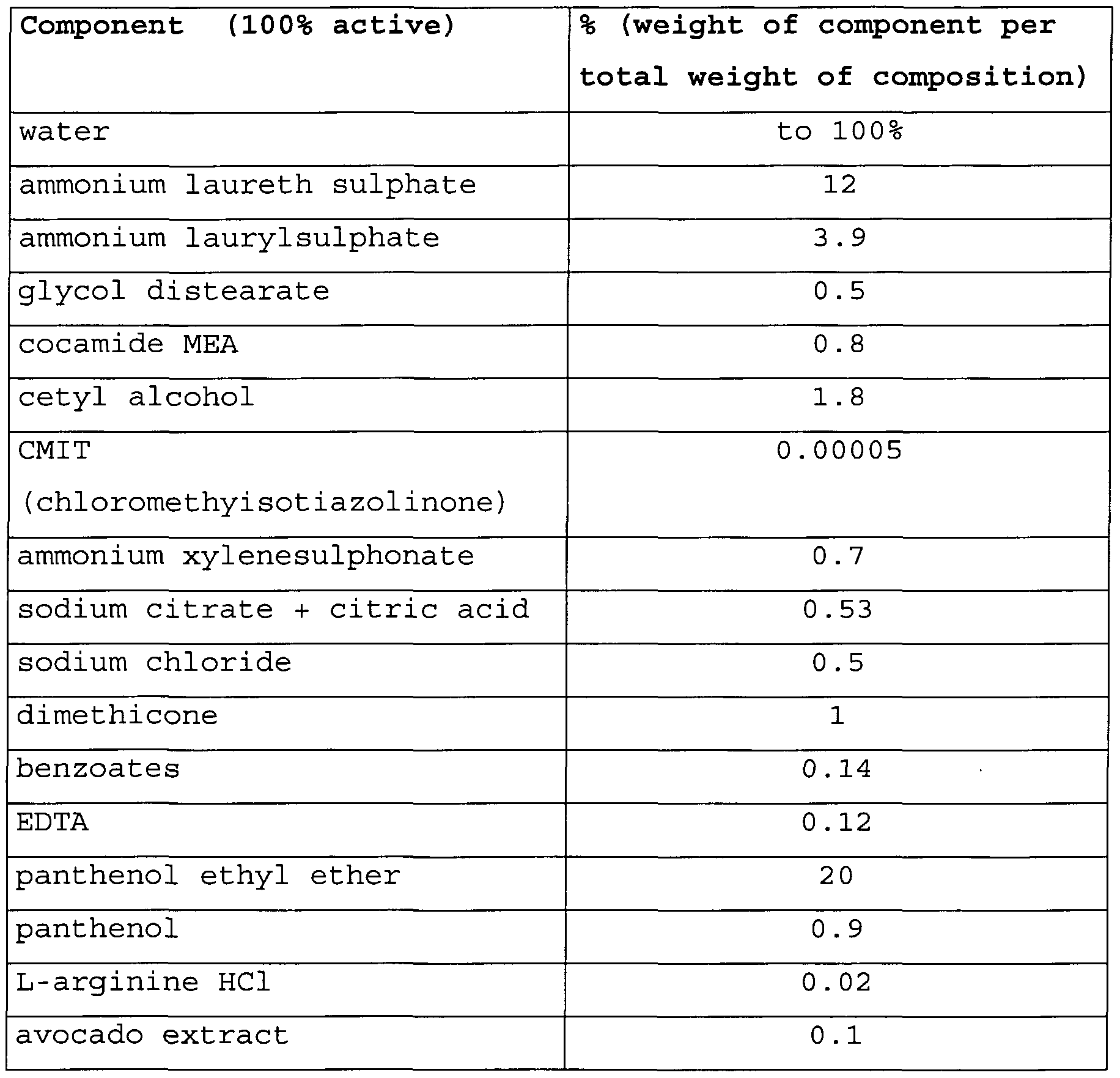
Example 1 - Shampoo
Example 2 - Hair conditioner
Example 3 - Hairspray
Example 4 - Hair Mousse
Example 6 - Hair pretreatment composition
Example 7 - Hair treatment cream
Example 8 - Shampoo
Example 9 - Conditioner
It will be apparent to a person skilled in the art, from the information given in the text and in the examples that variations to the hair care product of the invention are possible, without leaving the realm of the invention.