WO2003019697A2 - Organic electroluminescent device based on 2,5-diaminoterephthalic acid derivatives - Google Patents
Organic electroluminescent device based on 2,5-diaminoterephthalic acid derivatives Download PDFInfo
- Publication number
- WO2003019697A2 WO2003019697A2 PCT/DE2002/003110 DE0203110W WO03019697A2 WO 2003019697 A2 WO2003019697 A2 WO 2003019697A2 DE 0203110 W DE0203110 W DE 0203110W WO 03019697 A2 WO03019697 A2 WO 03019697A2
- Authority
- WO
- WIPO (PCT)
- Prior art keywords
- amino
- cyano
- members
- halogen
- nitro
- Prior art date
- Legal status (The legal status is an assumption and is not a legal conclusion. Google has not performed a legal analysis and makes no representation as to the accuracy of the status listed.)
- Ceased
Links
- 0 C**C(c(c(N1*C(C2)C2C*1)c(*)c(C(*)*)c1N2*CC*2)c1S)=I Chemical compound C**C(c(c(N1*C(C2)C2C*1)c(*)c(C(*)*)c1N2*CC*2)c1S)=I 0.000 description 8
Classifications
-
- H—ELECTRICITY
- H10—SEMICONDUCTOR DEVICES; ELECTRIC SOLID-STATE DEVICES NOT OTHERWISE PROVIDED FOR
- H10K—ORGANIC ELECTRIC SOLID-STATE DEVICES
- H10K85/00—Organic materials used in the body or electrodes of devices covered by this subclass
- H10K85/60—Organic compounds having low molecular weight
- H10K85/631—Amine compounds having at least two aryl rest on at least one amine-nitrogen atom, e.g. triphenylamine
-
- C—CHEMISTRY; METALLURGY
- C09—DYES; PAINTS; POLISHES; NATURAL RESINS; ADHESIVES; COMPOSITIONS NOT OTHERWISE PROVIDED FOR; APPLICATIONS OF MATERIALS NOT OTHERWISE PROVIDED FOR
- C09K—MATERIALS FOR MISCELLANEOUS APPLICATIONS, NOT PROVIDED FOR ELSEWHERE
- C09K11/00—Luminescent materials, e.g. electroluminescent or chemiluminescent
- C09K11/06—Luminescent materials, e.g. electroluminescent or chemiluminescent containing organic luminescent materials
-
- C—CHEMISTRY; METALLURGY
- C07—ORGANIC CHEMISTRY
- C07C—ACYCLIC OR CARBOCYCLIC COMPOUNDS
- C07C229/00—Compounds containing amino and carboxyl groups bound to the same carbon skeleton
- C07C229/52—Compounds containing amino and carboxyl groups bound to the same carbon skeleton having amino and carboxyl groups bound to carbon atoms of six-membered aromatic rings of the same carbon skeleton
- C07C229/54—Compounds containing amino and carboxyl groups bound to the same carbon skeleton having amino and carboxyl groups bound to carbon atoms of six-membered aromatic rings of the same carbon skeleton with amino and carboxyl groups bound to carbon atoms of the same non-condensed six-membered aromatic ring
- C07C229/62—Compounds containing amino and carboxyl groups bound to the same carbon skeleton having amino and carboxyl groups bound to carbon atoms of six-membered aromatic rings of the same carbon skeleton with amino and carboxyl groups bound to carbon atoms of the same non-condensed six-membered aromatic ring with amino groups and at least two carboxyl groups bound to carbon atoms of the same six-membered aromatic ring
-
- C—CHEMISTRY; METALLURGY
- C07—ORGANIC CHEMISTRY
- C07C—ACYCLIC OR CARBOCYCLIC COMPOUNDS
- C07C255/00—Carboxylic acid nitriles
- C07C255/49—Carboxylic acid nitriles having cyano groups bound to carbon atoms of six-membered aromatic rings of a carbon skeleton
- C07C255/58—Carboxylic acid nitriles having cyano groups bound to carbon atoms of six-membered aromatic rings of a carbon skeleton containing cyano groups and singly-bound nitrogen atoms, not being further bound to other hetero atoms, bound to the carbon skeleton
-
- C—CHEMISTRY; METALLURGY
- C07—ORGANIC CHEMISTRY
- C07D—HETEROCYCLIC COMPOUNDS
- C07D209/00—Heterocyclic compounds containing five-membered rings, condensed with other rings, with one nitrogen atom as the only ring hetero atom
- C07D209/02—Heterocyclic compounds containing five-membered rings, condensed with other rings, with one nitrogen atom as the only ring hetero atom condensed with one carbocyclic ring
- C07D209/04—Indoles; Hydrogenated indoles
- C07D209/08—Indoles; Hydrogenated indoles with only hydrogen atoms or radicals containing only hydrogen and carbon atoms, directly attached to carbon atoms of the hetero ring
-
- C—CHEMISTRY; METALLURGY
- C07—ORGANIC CHEMISTRY
- C07D—HETEROCYCLIC COMPOUNDS
- C07D213/00—Heterocyclic compounds containing six-membered rings, not condensed with other rings, with one nitrogen atom as the only ring hetero atom and three or more double bonds between ring members or between ring members and non-ring members
- C07D213/02—Heterocyclic compounds containing six-membered rings, not condensed with other rings, with one nitrogen atom as the only ring hetero atom and three or more double bonds between ring members or between ring members and non-ring members having three double bonds between ring members or between ring members and non-ring members
- C07D213/04—Heterocyclic compounds containing six-membered rings, not condensed with other rings, with one nitrogen atom as the only ring hetero atom and three or more double bonds between ring members or between ring members and non-ring members having three double bonds between ring members or between ring members and non-ring members having no bond between the ring nitrogen atom and a non-ring member or having only hydrogen or carbon atoms directly attached to the ring nitrogen atom
- C07D213/60—Heterocyclic compounds containing six-membered rings, not condensed with other rings, with one nitrogen atom as the only ring hetero atom and three or more double bonds between ring members or between ring members and non-ring members having three double bonds between ring members or between ring members and non-ring members having no bond between the ring nitrogen atom and a non-ring member or having only hydrogen or carbon atoms directly attached to the ring nitrogen atom with hetero atoms or with carbon atoms having three bonds to hetero atoms with at the most one bond to halogen, e.g. ester or nitrile radicals, directly attached to ring carbon atoms
- C07D213/72—Nitrogen atoms
- C07D213/74—Amino or imino radicals substituted by hydrocarbon or substituted hydrocarbon radicals
-
- C—CHEMISTRY; METALLURGY
- C07—ORGANIC CHEMISTRY
- C07D—HETEROCYCLIC COMPOUNDS
- C07D239/00—Heterocyclic compounds containing 1,3-diazine or hydrogenated 1,3-diazine rings
- C07D239/02—Heterocyclic compounds containing 1,3-diazine or hydrogenated 1,3-diazine rings not condensed with other rings
- C07D239/24—Heterocyclic compounds containing 1,3-diazine or hydrogenated 1,3-diazine rings not condensed with other rings having three or more double bonds between ring members or between ring members and non-ring members
- C07D239/28—Heterocyclic compounds containing 1,3-diazine or hydrogenated 1,3-diazine rings not condensed with other rings having three or more double bonds between ring members or between ring members and non-ring members with hetero atoms or with carbon atoms having three bonds to hetero atoms with at the most one bond to halogen, directly attached to ring carbon atoms
- C07D239/32—One oxygen, sulfur or nitrogen atom
- C07D239/42—One nitrogen atom
-
- C—CHEMISTRY; METALLURGY
- C07—ORGANIC CHEMISTRY
- C07D—HETEROCYCLIC COMPOUNDS
- C07D295/00—Heterocyclic compounds containing polymethylene-imine rings with at least five ring members, 3-azabicyclo [3.2.2] nonane, piperazine, morpholine or thiomorpholine rings, having only hydrogen atoms directly attached to the ring carbon atoms
- C07D295/04—Heterocyclic compounds containing polymethylene-imine rings with at least five ring members, 3-azabicyclo [3.2.2] nonane, piperazine, morpholine or thiomorpholine rings, having only hydrogen atoms directly attached to the ring carbon atoms with substituted hydrocarbon radicals attached to ring nitrogen atoms
- C07D295/12—Heterocyclic compounds containing polymethylene-imine rings with at least five ring members, 3-azabicyclo [3.2.2] nonane, piperazine, morpholine or thiomorpholine rings, having only hydrogen atoms directly attached to the ring carbon atoms with substituted hydrocarbon radicals attached to ring nitrogen atoms substituted by singly or doubly bound nitrogen atoms
- C07D295/135—Heterocyclic compounds containing polymethylene-imine rings with at least five ring members, 3-azabicyclo [3.2.2] nonane, piperazine, morpholine or thiomorpholine rings, having only hydrogen atoms directly attached to the ring carbon atoms with substituted hydrocarbon radicals attached to ring nitrogen atoms substituted by singly or doubly bound nitrogen atoms with the ring nitrogen atoms and the substituent nitrogen atoms separated by carbocyclic rings or by carbon chains interrupted by carbocyclic rings
-
- C—CHEMISTRY; METALLURGY
- C07—ORGANIC CHEMISTRY
- C07D—HETEROCYCLIC COMPOUNDS
- C07D295/00—Heterocyclic compounds containing polymethylene-imine rings with at least five ring members, 3-azabicyclo [3.2.2] nonane, piperazine, morpholine or thiomorpholine rings, having only hydrogen atoms directly attached to the ring carbon atoms
- C07D295/16—Heterocyclic compounds containing polymethylene-imine rings with at least five ring members, 3-azabicyclo [3.2.2] nonane, piperazine, morpholine or thiomorpholine rings, having only hydrogen atoms directly attached to the ring carbon atoms acylated on ring nitrogen atoms
- C07D295/18—Heterocyclic compounds containing polymethylene-imine rings with at least five ring members, 3-azabicyclo [3.2.2] nonane, piperazine, morpholine or thiomorpholine rings, having only hydrogen atoms directly attached to the ring carbon atoms acylated on ring nitrogen atoms by radicals derived from carboxylic acids, or sulfur or nitrogen analogues thereof
- C07D295/182—Radicals derived from carboxylic acids
- C07D295/192—Radicals derived from carboxylic acids from aromatic carboxylic acids
-
- C—CHEMISTRY; METALLURGY
- C07—ORGANIC CHEMISTRY
- C07D—HETEROCYCLIC COMPOUNDS
- C07D317/00—Heterocyclic compounds containing five-membered rings having two oxygen atoms as the only ring hetero atoms
- C07D317/08—Heterocyclic compounds containing five-membered rings having two oxygen atoms as the only ring hetero atoms having the hetero atoms in positions 1 and 3
- C07D317/44—Heterocyclic compounds containing five-membered rings having two oxygen atoms as the only ring hetero atoms having the hetero atoms in positions 1 and 3 ortho- or peri-condensed with carbocyclic rings or ring systems
- C07D317/46—Heterocyclic compounds containing five-membered rings having two oxygen atoms as the only ring hetero atoms having the hetero atoms in positions 1 and 3 ortho- or peri-condensed with carbocyclic rings or ring systems condensed with one six-membered ring
- C07D317/48—Methylenedioxybenzenes or hydrogenated methylenedioxybenzenes, unsubstituted on the hetero ring
- C07D317/62—Methylenedioxybenzenes or hydrogenated methylenedioxybenzenes, unsubstituted on the hetero ring with hetero atoms or with carbon atoms having three bonds to hetero atoms with at the most one bond to halogen, e.g. ester or nitrile radicals, directly attached to atoms of the carbocyclic ring
- C07D317/66—Nitrogen atoms not forming part of a nitro radical
-
- C—CHEMISTRY; METALLURGY
- C07—ORGANIC CHEMISTRY
- C07D—HETEROCYCLIC COMPOUNDS
- C07D455/00—Heterocyclic compounds containing quinolizine ring systems, e.g. emetine alkaloids, protoberberine; Alkylenedioxy derivatives of dibenzo [a, g] quinolizines, e.g. berberine
- C07D455/03—Heterocyclic compounds containing quinolizine ring systems, e.g. emetine alkaloids, protoberberine; Alkylenedioxy derivatives of dibenzo [a, g] quinolizines, e.g. berberine containing quinolizine ring systems directly condensed with at least one six-membered carbocyclic ring, e.g. protoberberine; Alkylenedioxy derivatives of dibenzo [a, g] quinolizines, e.g. berberine
- C07D455/04—Heterocyclic compounds containing quinolizine ring systems, e.g. emetine alkaloids, protoberberine; Alkylenedioxy derivatives of dibenzo [a, g] quinolizines, e.g. berberine containing quinolizine ring systems directly condensed with at least one six-membered carbocyclic ring, e.g. protoberberine; Alkylenedioxy derivatives of dibenzo [a, g] quinolizines, e.g. berberine containing a quinolizine ring system condensed with only one six-membered carbocyclic ring, e.g. julolidine
-
- H—ELECTRICITY
- H10—SEMICONDUCTOR DEVICES; ELECTRIC SOLID-STATE DEVICES NOT OTHERWISE PROVIDED FOR
- H10K—ORGANIC ELECTRIC SOLID-STATE DEVICES
- H10K85/00—Organic materials used in the body or electrodes of devices covered by this subclass
- H10K85/60—Organic compounds having low molecular weight
- H10K85/615—Polycyclic condensed aromatic hydrocarbons, e.g. anthracene
- H10K85/621—Aromatic anhydride or imide compounds, e.g. perylene tetra-carboxylic dianhydride or perylene tetracarboxylic di-imide
-
- C—CHEMISTRY; METALLURGY
- C07—ORGANIC CHEMISTRY
- C07C—ACYCLIC OR CARBOCYCLIC COMPOUNDS
- C07C2601/00—Systems containing only non-condensed rings
- C07C2601/12—Systems containing only non-condensed rings with a six-membered ring
- C07C2601/14—The ring being saturated
-
- C—CHEMISTRY; METALLURGY
- C07—ORGANIC CHEMISTRY
- C07C—ACYCLIC OR CARBOCYCLIC COMPOUNDS
- C07C2603/00—Systems containing at least three condensed rings
- C07C2603/02—Ortho- or ortho- and peri-condensed systems
- C07C2603/40—Ortho- or ortho- and peri-condensed systems containing four condensed rings
- C07C2603/42—Ortho- or ortho- and peri-condensed systems containing four condensed rings containing only six-membered rings
-
- H—ELECTRICITY
- H10—SEMICONDUCTOR DEVICES; ELECTRIC SOLID-STATE DEVICES NOT OTHERWISE PROVIDED FOR
- H10K—ORGANIC ELECTRIC SOLID-STATE DEVICES
- H10K2102/00—Constructional details relating to the organic devices covered by this subclass
- H10K2102/10—Transparent electrodes, e.g. using graphene
- H10K2102/101—Transparent electrodes, e.g. using graphene comprising transparent conductive oxides [TCO]
- H10K2102/103—Transparent electrodes, e.g. using graphene comprising transparent conductive oxides [TCO] comprising indium oxides, e.g. ITO
-
- H—ELECTRICITY
- H10—SEMICONDUCTOR DEVICES; ELECTRIC SOLID-STATE DEVICES NOT OTHERWISE PROVIDED FOR
- H10K—ORGANIC ELECTRIC SOLID-STATE DEVICES
- H10K50/00—Organic light-emitting devices
- H10K50/10—OLEDs or polymer light-emitting diodes [PLED]
- H10K50/11—OLEDs or polymer light-emitting diodes [PLED] characterised by the electroluminescent [EL] layers
-
- H—ELECTRICITY
- H10—SEMICONDUCTOR DEVICES; ELECTRIC SOLID-STATE DEVICES NOT OTHERWISE PROVIDED FOR
- H10K—ORGANIC ELECTRIC SOLID-STATE DEVICES
- H10K85/00—Organic materials used in the body or electrodes of devices covered by this subclass
- H10K85/30—Coordination compounds
- H10K85/321—Metal complexes comprising a group IIIA element, e.g. Tris (8-hydroxyquinoline) gallium [Gaq3]
- H10K85/324—Metal complexes comprising a group IIIA element, e.g. Tris (8-hydroxyquinoline) gallium [Gaq3] comprising aluminium, e.g. Alq3
-
- H—ELECTRICITY
- H10—SEMICONDUCTOR DEVICES; ELECTRIC SOLID-STATE DEVICES NOT OTHERWISE PROVIDED FOR
- H10K—ORGANIC ELECTRIC SOLID-STATE DEVICES
- H10K85/00—Organic materials used in the body or electrodes of devices covered by this subclass
- H10K85/60—Organic compounds having low molecular weight
- H10K85/631—Amine compounds having at least two aryl rest on at least one amine-nitrogen atom, e.g. triphenylamine
- H10K85/633—Amine compounds having at least two aryl rest on at least one amine-nitrogen atom, e.g. triphenylamine comprising polycyclic condensed aromatic hydrocarbons as substituents on the nitrogen atom
-
- Y—GENERAL TAGGING OF NEW TECHNOLOGICAL DEVELOPMENTS; GENERAL TAGGING OF CROSS-SECTIONAL TECHNOLOGIES SPANNING OVER SEVERAL SECTIONS OF THE IPC; TECHNICAL SUBJECTS COVERED BY FORMER USPC CROSS-REFERENCE ART COLLECTIONS [XRACs] AND DIGESTS
- Y10—TECHNICAL SUBJECTS COVERED BY FORMER USPC
- Y10S—TECHNICAL SUBJECTS COVERED BY FORMER USPC CROSS-REFERENCE ART COLLECTIONS [XRACs] AND DIGESTS
- Y10S428/00—Stock material or miscellaneous articles
- Y10S428/917—Electroluminescent
Definitions
- the invention relates to a new organic electroluminescent device on the
- OLED organic light emitting diodes
- Electroluminescence used by certain organic compounds The reason for Electroluminescence used by certain organic compounds.
- Fig. 1 outlines:
- the cathode consists of a base metal or an alloy
- the buffer layer made of certain metal salts or their oxides, such as. B. LiF; responsible for improving electron injection into layer 3
- the electron conductor can, for. B. consist of Alq3 (tris (8-hydroxyquinolinato) aluminum); conducts the electrons from the cathode into the interior of the device to the emission layer or the hole conductor
- the hole conductor consists primarily of derivatives of triphenylamine; there can be several perforated conductor layers, the properties of which are matched to the device; responsible for transporting the holes to the emission layer
- the anode is made of ITO, which injects the holes into the hole transport layer
- the carrier consists of a transparent material, for. B. glass
- Such an arrangement emits green light, which arises from the excitation of the Alq3 by the excitons formed from the holes and electrons.
- Alq3 only emits in the green spectral range
- the invention relates to new emitter substances, which eliminates the known disadvantages of Alq3 as an emitter and host material for dopands. As a result, Alq3 is generally only required as an electron conductor.
- the new emitter substances are characterized by
- “Device” in the sense of the invention is understood to mean the arrangement with which the carrier and layers according to FIG. 1 or 2 are applied without being assembled into a light-emitting diode.
- the construction of such a device according to the invention can in principle be as in FIG. 1 or 2.
- the 2,5-diaminoterephthalic acid derivatives according to the invention can be co-evaporated as emitters in such devices, alone or together with other compounds, optionally also known compounds, and are used together with known hole conductors.
- X 1 and X 3 can be identical or different atoms or groups, such as oxygen, sulfur, imino, preferably oxygen;
- X 2 and X 4 can be identical or different atoms or groups, such as oxygen, sulfur, amino, where the amino nitrogen can be substituted by alkyl having 1 to 20 carbon atoms, preferably C1 to C8 or by aryl, such as. B. phenyl, Nap thyl, or by heteroaryl, such as. B. cumaryl, pyridyl, quinolyl, indolyl, carbazolyl, imidazolyl, thienyl, thiazolyl, furyl, oxazolyl;
- R 1 to R 8 , R and R 8 can be identical or different substituents, such as hydrogen, alkyl having 1 to 20 atoms, preferably C1 to C8; Aryl, such as As phenyl, naphthyl, and heteroaryl, such as. B. cumaryl, pyridyl, quinolyl, indolyl, carbazolyl, imidazolyl, thienyl, thiazolyl, furyl, oxazolyl and these radicals by atoms or groups such as. B.
- R 4 and R 8 can also have identical or different substituents, such as halogen, nitro,
- R 2 to R 4 , R 6 to R 8 , R 4 ' and R 8' can also be trifluoromethyl or pentafluorophenyl, and in which the following radicals can form a saturated or unsaturated ring X 1 and X 2 , R 1 and R 2 , R 2 and X 2 , R 2 and R °, R 3 and R 4 , R 4 and X 3 , X 3 and X 4 , R 5 and X 4 , R 6 and X 4 , R 6 and R 7 , R 7 and R 8 , R 8 and X 1 , R 3 and R 4 ' , R 7 and R 8' , R 4 and R 4 ' and R 8 and R 8 the other rings can be condensed.
- R 2 , R 3 , R 6 and R 7 are preferably trifluoromethyl or pentafluorophenyl, R 4 and R 8 are halogen, nitro, cyano or amino, and the other substituents have the meaning given above.
- R 4 and R 8 are particularly preferred trifluoromethyl or pentafluorophenyl, and the other substituents have the meaning given above.
- the invention also relates to new 2,5-diaminoterephthalic acid derivatives of the formula 19
- X 1 is O and X 2 is O or N;
- R 2 and R 6 are methylene (-CH 2 -), which may be substituted by trifluoromethyl,
- R 3 and R 7 are the same or different H, Ci-C ⁇ -alkyl, aryl or heteroaryl and
- R 4 and R 8 are the same or different H, alkyl, aryl or trifluoromethyl.
- Alkyl C1-C4-alkyl is particularly preferred, aryl is phenyl or naphthyl, and heteroaryl is pyridyl, thienyl or furyl.
- Electroluminescent devices according to the invention preferably contain 2 to 3 different substances in a mixture with one another in one device.
- X 2 and R 2 can be members of a ring
- R and R can be members of a ring
- X 3 and X 4 can be members of a ring
- X 4 and R 6 can be members of a ring
- R 7 and R 8 can be members of a ring
- X 1 can be members of a ring
- can if X 1 N;
- R 3 and R 4 and R 7 and R 8 can be members of R 4 and X 3 and R 8 and X 1 members of one; Ring if X 1, '3 _
- X and R 2 can be members of a ring
- R 3 and R 4 can be members of a ring
- R 4 and R 4 can be members of a ring; can;
- X 4 and R 5 can be members of a ring
- R 6 and R 7 can be members of a ring
- R 7 and R 8 can be members of a ring; can;
- R 8 and R 8 can be members of a ring
- X 1 can be members of a ring
- can if X 1 N;
- X 2 and R 2 and X 4 and R 6 can be members of an R 2 and R 3 and R 6 and R 7 can be members of a ring, if X can be 2.4 2,4 N ring, the substituent R 1 ' 5 is omitted
- R 2 and R 3 can be members of a ring
- R 3 and R 4 can be members of a ring; can;
- R 6 and R 7 can be members of a ring
- R 7 and R 8 can be members of a ring; can;
- R 2 and R 3 and R 6 and R 7 can be members of an R 3 and R 4 and R 7 and R 8 members of a ring; Ring can be;
- R 3 and R 4 may be members of a ring
- R 6 and R 7 may be members of a ring
- R 7 and R 8 can be members of a ring of its ring
- Ring can be; Ring can be;
- ' Can be members of a ring
- the emitter substances of the formula can be obtained starting from cyclohexane-2,5-dione-1,4-dicarboxylic acid esters by reaction with primary anilines or amines, subsequent oxidation and optionally further modification as derivatives of 2,5-diamino-terephthalic acid. Cyclized derivatives can be prepared therefrom in a manner known per se, such as e.g. B. shown in formula I and ⁇ .
- the 2,5-diaminocyclohexane-1,4-dicarboxylic acid esters are converted into the hydrazides and reacted with potassium hexacyanoferrate (III) to form the aldehyde.
- the 2,5-diaminocyclohexane-1,4-dicarbaldehydes can be converted into the oximes, and the compounds of formula 4 are obtained by reaction with formic acid.
- the new emitters are used in a device with or without an electron transport layer, it being possible for the layers to be arranged in a device as indicated in FIG. 2:
- the carrier consists of a transparent material, for. B. glass;
- the anode is made of ITO, which injects the holes into the hole transport layer;
- the hole conductor consists primarily of derivatives of triphenylamine; there can be several perforated conductor layers, the properties of which are matched to the device;
- one or more emitter layers are applied between the hole conductor and the electron conductor;
- the electron conductor can, for. B. consist of Alq3 and conducts the electrons from the cathode into the interior of the device to the emission layer or the hole conductor;
- the buffer layer made of certain metal salts or their oxides, such as. B. LiF, improves electron injection into layer 6;
- the cathode is made of a base metal or an alloy (e.g. aluminum or calcium).
- Typical layer thicknesses for the emitters are 3 -10 nm, preferably 4 - 6 nm.
- the emission wavelengths characteristically depend on the chemical structure, whereby obviously electronic and steric factors of the molecules have an influence on the wavelength of the emitted light and the performance achieved , For the examples shown in Table 2, the emission wavelengths are between 538 nm and 618 nm.
- the new emitters of formula 1) -58.0 can be arranged in several layers of the respective pure materials one above the other (FIG. 2) or in a mixture in one or more layers.
- Layers of the new emitters of the formula 1 ⁇ ) - 58.0 can be doped by known emitter materials, as shown in Fig. 1.
- the new emitters of formula 1J) - 58.0 can be used in devices with per se known hole conductors (59 and 60) and other components. Typical examples are shown in FIGS. 1 and 2.
- the devices based on the new emitters can be used in a manner known per se
- Another possibility for the production of the devices consists in coating (coating) from the solution, e.g. B. web coating or spin coating.
- the new emitters of formulas 1) - 58.0 can be applied either as pure substance or as dopant in a suitable polymer.
- Formula 1 particularly efficient devices can be manufactured. In these cases, the photometric efficiency is remarkably high. With the substance JL2, a device is realized which emits a spectrally almost pure green. Experimental part
- Example 1 (substances 2.1. 2.3 - 2.5)
- cyclohexane-2,5-dione-1,4-dicarboxylic acid diester 0.06 mol are suspended in a mixture of 200 ml of glacial acetic acid and 200 ml of alcohol (corresponding to the ester component). 0.135 mol of a primary amine or aniline is rapidly added under nitrogen. The reaction mixture is heated under reflux with intensive stirring for 5-8 h. The acceptor-substituted anilines require an extension of the reaction times.
- the dihydroterephthalic acid esters obtained in Example 1 are oxidized. The isolation is achieved with yields of up to 95%.
- the separated crude product can be recrystallized from DMF, toluene, chloroform or methanol for purification. The substances are sublimable.
- Example 3 (substance 19.1 - 19.4)
- the esters obtained according to Example 2 are saponified in mixtures of n-propanol and water.
- 0.01 moles of the terephthalic acid diester are suspended in about 50 ml of n-propanol, and 50 ml of water containing 0.03 mol of potassium hydroxide are added.
- the suspension is heated under reflux until a clear solution has formed. After a further 2 h, the product is suctioned off. About 5 ml of glacial acetic acid are dropped into the solution for neutralization. The resulting acid is washed with methanol and dried.
- 0.01 mol of the terephthalic acid prepared here was heated under reflux in 100 ml of glacial acetic acid with the addition of 15 ml of formaldehyde solution (37%).
- reaction products are separated off and washed with methanol. It is recrystallized from acetonitrile or chloroform.
- the substances can be purified by sublimation.
- terephthalic acid ester (Example 2) can be alkylated. 0.05 mol of terephthalic acid ester is suspended in 350 ml of anhydrous DMSO and 18.63 g (0.131 mol) of methyl iodide are added. At a temperature between 20 and 23 ° C 6.1 g (0.152 mol) of 60% sodium hydride in paraffin are added in portions with vigorous stirring. After a reaction time of approx. 5 h, the solid components changed color from orange to pure yellow. About 200 ml of methanol are now added to this mixture, which significantly improves the filterability.
- a layer of 55 nm 4,4 ', 4 "tris (N- ( ⁇ -naphthyl) -N-phenylamino) -triphenylamine and another of 5 nm thickness were applied to a structured ITO glass support measuring 50 ⁇ 50 mm 2 N, N'-di ( ⁇ -naphthyl) -N, N'-diphenylbenzidine was evaporated and 5 nm 1,6-bis (2,4-dimethoxyphenyl) -benzo [1, 2-d; 4,5 -d '] - 1, 2,6,7-tetrahydro-bis [1, 3] oxazin-4,9-dione (19.4), and tris (8-hydroxyquinolinato) aluminum with a Layer thickness of 30 nm applied and first a very thin buffer layer (0.5 nm) of lithium fluoride and finally aluminum vapor-deposited.
- the test of this arrangement was carried out at a controllable voltage between 0 and 15 V. This device emits at 578 nm (yellow). A luminance of 100 cd / m 2 was reached at 5.0 V. A maximum luminance of 11400 cd / m 2 was reached.
- a device was produced in accordance with Example 5, 2,5-bis- (N- (2,4-dimethoxyphenyl) amino) terephthalic acid diethyl ester being introduced as a 5 nm thick layer between the hole and electron conductor as the emitter substance. This device was also tested at a controllable voltage between 0 and 15 V. This device emits at 618 nm (red). A luminance of 100 cd / m was reached at 9.5 V. A maximum luminance of 644 cd / m 2 was achieved.
- the device follows the structure in Examples 5 and 6. Diethyl 2,5-bis (N-phenylamino) terephthalate was used as the emitter. A voltage between 0 and 15 volts was again applied for the test. The device lights up yellow (578 nm). The luminance of 100 cd / m 2 was reached at 5.6 V. A maximum luminance of 5300 cd / m 2 was registered.
- Example 8 (Device: Substance 1.2)
- the test of this arrangement was carried out at a controllable voltage between 0 and 15 V.
- a luminance of 100 cd / m 2 was achieved at 5.4 V.
- a maximum luminance of 17700 cd / m 2 was achieved.
- the carrier is made of glass
- the anode consists of ITO
- Another hole conductor layer consists of ⁇ -NPD
- one or more emitter layers are applied between the hole conductor and the electron conductor;
- the electron conductor can, for. B. consist of Alq3;
- the buffer layer consists of LiF
- the cathode is made of a base metal or an alloy (e.g. aluminum or calcium).
- Typical layer thicknesses for the emitters are 3 -10 nm, preferably 4-6 nm.
- Substrate 125nm ITO with approx. 13 ⁇ / sq and 85% transmission 50x50mm 2 glass substrate (1.1mm thick polished soda lime float glass with SiO 2 layer and 8 individual ITO anodes (active area: 2x2mm 2 ) )
Landscapes
- Chemical & Material Sciences (AREA)
- Organic Chemistry (AREA)
- Engineering & Computer Science (AREA)
- Materials Engineering (AREA)
- Physics & Mathematics (AREA)
- Spectroscopy & Molecular Physics (AREA)
- Organic Low-Molecular-Weight Compounds And Preparation Thereof (AREA)
- Electroluminescent Light Sources (AREA)
- Plural Heterocyclic Compounds (AREA)
- Pyridine Compounds (AREA)
Abstract
Description
Organische elektrolumineszierende Vorrichtung auf Basis von 2,5-DiaminoterephthalsäurederivatenOrganic electroluminescent device based on 2,5-diaminoterephthalic acid derivatives
Die Erfindung betrifft eine neue organische elektrolumineszierende Vorrichtung auf derThe invention relates to a new organic electroluminescent device on the
Basis von 2,5-Diaminoterephthalsäurederivaten. Diese Derivate sindBasis of 2,5-diaminoterephthalic acid derivatives. These are derivatives
Emittersubstanzen für organische Leuchtdioden (OLED).Emitter substances for organic light emitting diodes (OLED).
In organischen Leuchtdioden, die seit langem bekannt sind, wird dieIn organic light-emitting diodes, which have been known for a long time, the
Elektrolumineszenz von bestimmten organischen Verbindungen ausgenutzt. DerElectroluminescence used by certain organic compounds. The
Aufbau und die Aufgaben der einzelnen Schichten in einer OLED ist beispielhaft inStructure and the tasks of the individual layers in an OLED is exemplified in
Fig. 1 skizziert:Fig. 1 outlines:
Zwischen zwei Elektroden, von denen mindestens eine lichtdurchlässig sein muß, befindet sich eine Schichtfolge von organischen Substanzen, die im Device jeweils eine spezielle Funktion haben.Between two electrodes, at least one of which must be translucent, there is a layer sequence of organic substances, each of which has a special function in the device.
1. die Kathode besteht aus einem unedlen Metall oder einer Legierung1. The cathode consists of a base metal or an alloy
(z. B. Aluminium oder Calcium); verantwortlich für die Elektroneninjektion(e.g. aluminum or calcium); responsible for electron injection
2. die Pufferschicht aus bestimmten Metallsalzen oder deren Oxiden, wie z. B. LiF; verantwortlich für Verbesserung der Elektroneninjektion in die Schicht 32. the buffer layer made of certain metal salts or their oxides, such as. B. LiF; responsible for improving electron injection into layer 3
3. der Elektronenleiter kann z. B. aus Alq3 (Tris-(8-hydroxychinolinato)-aluminium) bestehen; leitet die Elektronen von der Kathode in das Innere des Devices zur Emissionsschicht bzw. dem Lochleiter3. the electron conductor can, for. B. consist of Alq3 (tris (8-hydroxyquinolinato) aluminum); conducts the electrons from the cathode into the interior of the device to the emission layer or the hole conductor
4. der Lochleiter besteht vorrangig aus Derivaten des Triphenylamins; es können mehrere Lochleiterschichten vorhanden sein, deren Eigenschaften auf das Device abgestimmt sind; verantwortlich für den Transport der Löcher zur Emissionsschicht4. the hole conductor consists primarily of derivatives of triphenylamine; there can be several perforated conductor layers, the properties of which are matched to the device; responsible for transporting the holes to the emission layer
5. die Anode besteht aus ITO, das die Löcher in die Lochtransportschicht injiziert5. The anode is made of ITO, which injects the holes into the hole transport layer
6. der Träger besteht aus einem transparenten Material, z. B. Glas6. the carrier consists of a transparent material, for. B. glass
Eine solche Anordnung emittiert grünes Licht, das durch die Anregung des Alq3 durch die aus den Löchern und Elektronen gebildeten Excitonen entsteht.Such an arrangement emits green light, which arises from the excitation of the Alq3 by the excitons formed from the holes and electrons.
Eine solche einfache Anordnung besitzt jedoch Nachteile:However, such a simple arrangement has disadvantages:
1. Alq3 emittiert nur im grünen Spektralbereich1. Alq3 only emits in the green spectral range
2. die Emission von Alq3 ist zu breitbandig Diese Nachteile lassen sich durch sog. Dotieren z. T. beseitigen. Dabei wird im Herstellungsprozeß der Diode eine oder mehrere Substanzen co-verdampft. Der Gehalt an diesen Substanzen in der Alq3-Schicht beträgt in der Regel nur wenige Prozent. Dieser Co-Verdampfungsprozeß ist schwierig zu steuern.2. The emission of Alq3 is too broadband These disadvantages can be overcome by so-called doping. T. eliminate. One or more substances are co-evaporated in the diode manufacturing process. The content of these substances in the Alq3 layer is usually only a few percent. This co-evaporation process is difficult to control.
Die Erfindung bezieht sich auf neue Emittersubstanzen, welche die bekannten Nachteile von Alq3 als Emitter- und Hostmaterial für Dopanden beseitigt. Alq3 wird dadurch generell nur noch als Elektronenleiter benötigt. Die neuen Emittersubstanzen zeichnen sich aus durchThe invention relates to new emitter substances, which eliminates the known disadvantages of Alq3 as an emitter and host material for dopands. As a result, Alq3 is generally only required as an electron conductor. The new emitter substances are characterized by
1. schmalere Emissionsbanden;1. narrower emission bands;
2. Abdeckung eines breiten Spektralbereiches in den Devices durch Einsatz unterschiedlicher Vertreter, entweder in voneinander getrennten Schichten oder in Mischschichten;2. Covering a wide spectral range in the devices by using different representatives, either in separate layers or in mixed layers;
3. niedrige Treiberspannungen;3. low driver voltages;
4. hohe photometrische Effizienz (niedrige Leistungsaufnahme);4. high photometric efficiency (low power consumption);
5. hohe Leuchtdichten;5. high luminance;
6. hohe thermische Stabilität.6. high thermal stability.
Unter „Device" im Sinne der Erfindung wird die Anordnung verstanden, mit der Träger und Schichten gemäß Fig. 1 oder 2 aufgetragen sind, ohne daß eine Konfektionierung zu einer Leuchtdiode erfolgt ist. Der Aufbau einer solchen erfindungsgemäßen Vorrichtung kann prinzipiell wie in Fig. 1 oder 2 gezeigt erfolgen. Die erfindungsgemäßen 2,5-Diaminoterephthalsäurederivate können in solchen Vorrichtungen allein oder zusammen mit anderen Verbindungen, gegebenenfalls auch bekannten Verbindungen, als Emitter co-verdampft werden. Sie werden zusammen mit bekannten Lochleitern verwendet.“Device” in the sense of the invention is understood to mean the arrangement with which the carrier and layers according to FIG. 1 or 2 are applied without being assembled into a light-emitting diode. The construction of such a device according to the invention can in principle be as in FIG. 1 or 2. The 2,5-diaminoterephthalic acid derivatives according to the invention can be co-evaporated as emitters in such devices, alone or together with other compounds, optionally also known compounds, and are used together with known hole conductors.
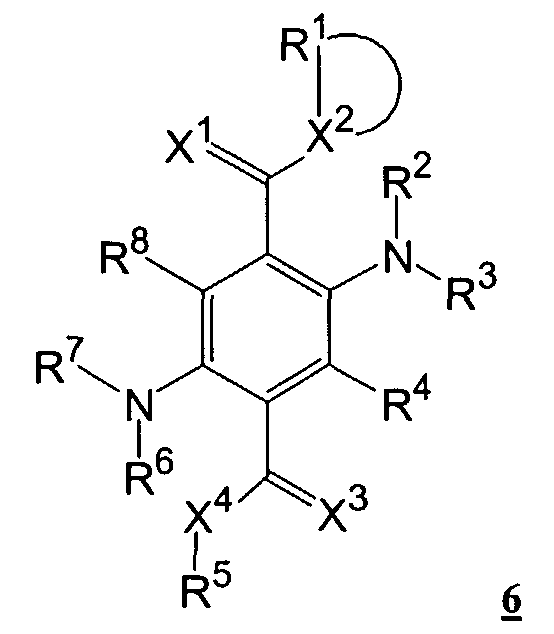
Der Erfindung liegt die Aufgabe zugrunde, neue organische elektrolumineszierende Vorrichtungen mit verbesserten Emittersubstanzen bereitzustellen. Erfindungsgemäß enthält die organische elektrolumineszierende Vorrichtung 2,5-Diaminoterephthalsäurederivate der nachfolgenden Formel la in einer oder mehreren Emitterschichten rein oder dotiert in einem Device

wobeiin which
X1 und X3 gleiche oder ungleiche Atome oder Gruppen, wie Sauerstoff, Schwefel, Imino, vorzugsweise Sauerstoff, sein können;X 1 and X 3 can be identical or different atoms or groups, such as oxygen, sulfur, imino, preferably oxygen;
X2 und X4 gleiche oder ungleiche Atome oder Gruppen sein können, wie Sauerstoff, Schwefel, Amino, wobei der Aminostickstoff substituiert sein kann durch Alkyl mit 1 bis 20 C-Atomen, vorzugsweise C1 bis C8 oder durch Aryl, wie z. B. Phenyl, Nap thyl, oder durch Heteroaryl, wie z. B. Cumaryl, Pyridyl, Chinolyl, Indolyl, Carbazolyl, Imidazolyl, Thienyl, Thiazolyl, Furyl, Oxazolyl;X 2 and X 4 can be identical or different atoms or groups, such as oxygen, sulfur, amino, where the amino nitrogen can be substituted by alkyl having 1 to 20 carbon atoms, preferably C1 to C8 or by aryl, such as. B. phenyl, Nap thyl, or by heteroaryl, such as. B. cumaryl, pyridyl, quinolyl, indolyl, carbazolyl, imidazolyl, thienyl, thiazolyl, furyl, oxazolyl;
R1bis R8, R und R8 gleiche oder ungleiche Substituenten sein können, wie Wasserstoff, Alkyl mit 1 bis 20 Atomen, vorzugsweise C1 bis C8; Aryl, wie z. B. Phenyl, Naphthyl, sowie Heteroaryl, wie z. B. Cumaryl, Pyridyl, Chinolyl, Indolyl, Carbazolyl, Imidazolyl, Thienyl, Thiazolyl, Furyl, Oxazolyl und diese Reste durch Atome oder Gruppen wie z. B. Di-C1-C3-amino oder Alkoxy mit Alkylresten C1 bis C10, vorzugsweise C1-C4; C1-C4-Alkyl, Cyano, Fluor, Chlor, Brom oder lod sowie Phenyl ein- oder zweifach substituiert sein können;R 1 to R 8 , R and R 8 can be identical or different substituents, such as hydrogen, alkyl having 1 to 20 atoms, preferably C1 to C8; Aryl, such as As phenyl, naphthyl, and heteroaryl, such as. B. cumaryl, pyridyl, quinolyl, indolyl, carbazolyl, imidazolyl, thienyl, thiazolyl, furyl, oxazolyl and these radicals by atoms or groups such as. B. Di-C1-C3-amino or alkoxy with alkyl radicals C1 to C10, preferably C1-C4; C1-C4-alkyl, cyano, fluorine, chlorine, bromine or iodine and phenyl can be mono- or disubstituted;
R4 und R8 können auch gleiche oder ungleiche Substituenten, wie Halogen, Nitro,R 4 and R 8 can also have identical or different substituents, such as halogen, nitro,
Cyano oder Amino sein;Be cyano or amino;
R2 bis R4 , R6 bis R8 , R4' und R8' können auch Trifluormethyl oder Pentafluorphenyl sein, und worin die folgenden Reste einen gesättigten oder ungesättigten Ring bilden können X1 und X2, R1 und R2, R2 und X2, R2 und R°, R3 und R4, R4 und X3, X3 und X4, R5 und X4, R6 und X4, R6 und R7, R7 und R8, R8 und X1, R3 und R4', R7 und R8', R4 und R4' und R8 und R8 , an die weitere Ringe ankondensiert sein können.R 2 to R 4 , R 6 to R 8 , R 4 ' and R 8' can also be trifluoromethyl or pentafluorophenyl, and in which the following radicals can form a saturated or unsaturated ring X 1 and X 2 , R 1 and R 2 , R 2 and X 2 , R 2 and R °, R 3 and R 4 , R 4 and X 3 , X 3 and X 4 , R 5 and X 4 , R 6 and X 4 , R 6 and R 7 , R 7 and R 8 , R 8 and X 1 , R 3 and R 4 ' , R 7 and R 8' , R 4 and R 4 ' and R 8 and R 8 the other rings can be condensed.
Bevorzugt sind R2, R3, R6 und R7 Trifluormethyl oder Pentafluorphenyl , R4 und R8 sind Halogen, Nitro, Cyan oder Amino, und die anderen Substituenten haben die oben genannte Bedeutung.R 2 , R 3 , R 6 and R 7 are preferably trifluoromethyl or pentafluorophenyl, R 4 and R 8 are halogen, nitro, cyano or amino, and the other substituents have the meaning given above.
Besonders bevorzugt sind R4 und R8 Trifluormethyl oder Pentafluorphenyl , und die anderen Substituenten haben die oben genannte Bedeutung.R 4 and R 8 are particularly preferred trifluoromethyl or pentafluorophenyl, and the other substituents have the meaning given above.
Bezüglich der Schreibweise im folgenden Text bedeutet R1"8 R1 bis R8; X2,4 ist X2 und X4; R4' 8' ist R4' und R8'.Regarding the notation in the following text, R 1 "8 R 1 to R 8 ; X 2.4 is X 2 and X 4 ; R 4 '8' is R 4 ' and R 8' .
Die Erfindung betrifft auch neue 2,5-Diaminoterephthalsäurederivate der Formel 19The invention also relates to new 2,5-diaminoterephthalic acid derivatives of the formula 19

X1gleich O und X2 gleich O oder N ist; R2 und R6 sind Methylen (-CH2-), das durch Trifluormethyl substituiert sein kann, R3 und R7 sind gleich oder verschieden H, C-i-Cβ-Alkyl, Aryl oder Heteroaryl und R4 und R8 sind gleich oder verschieden H, Alkyl, Aryl oder Trifluormethyl.X 1 is O and X 2 is O or N; R 2 and R 6 are methylene (-CH 2 -), which may be substituted by trifluoromethyl, R 3 and R 7 are the same or different H, Ci-Cβ-alkyl, aryl or heteroaryl and R 4 and R 8 are the same or different H, alkyl, aryl or trifluoromethyl.
Besonders bevorzugt ist Alkyl C1-C4-Alkyl, Aryl ist Phenyl oder Naphthyl, und Heteroaryl ist Pyridyl, Thienyl oder Furyl.Alkyl C1-C4-alkyl is particularly preferred, aryl is phenyl or naphthyl, and heteroaryl is pyridyl, thienyl or furyl.
Generell bevorzugt bei allen Strukturen der Erfindung ist, wenn in der Struktur gegenüberliegende Substituenten wie X1 und X3, X2 und X4, R1 und R5, R2 und R6, R3 und R7, R4 und R8, R4' und R8', R10 und R11 gleich sind, d.h. nicht unterschiedlich sind. Erfindungsgemäße elekrolumineszierende Vorrichtungen enthalten vorzugsweise 2 bis 3 unterschiedliche Substanzen im Gemisch miteinander in einem Device.It is generally preferred for all structures of the invention if in the structure opposing substituents such as X 1 and X 3 , X 2 and X 4 , R 1 and R 5 , R 2 and R 6 , R 3 and R 7 , R 4 and R 8 , R 4 ' and R 8' , R 10 and R 11 are the same, ie they are not different. Electroluminescent devices according to the invention preferably contain 2 to 3 different substances in a mixture with one another in one device.
Nachfolgend werden bevorzugte Strukturen aufgeführt, wobei bei den Strukturen 1Preferred structures are listed below, with structures 1

X1 und X2 Glieder eines Ringes sein X2 und R1 Glieder eines Ringes sein können, wenn X1 = N und für X2 ≠ N der können, wenn X2 = N; Substituent R1 entfällt;X 1 and X 2 can be members of a ring X 2 and R 1 can be members of a ring if X 1 = N and for X 2 ≠ N if X 2 = N; Substituent R 1 is absent;


X2 und R2 Glieder eines Ringes sein R2 und R3 Glieder eines Ringes sein können, wenn X2 = N; können;X 2 and R 2 can be members of a ring R 2 and R 3 can be members of a ring if X 2 = N; can;
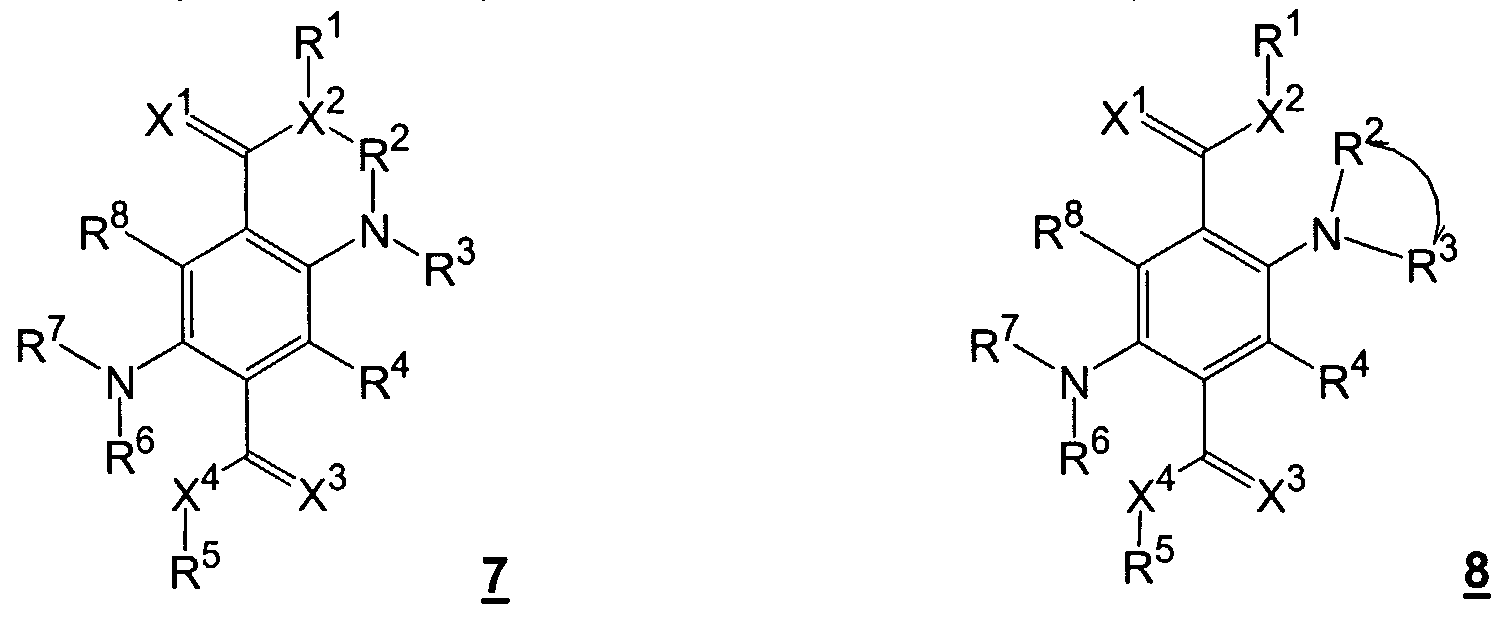


X3 und X4 Glieder eines Ringes sein X4 und R5 Glieder eines Ringes sein können, wenn X3 = N und für X4 ≠ N der können, wenn X4 = N;X 3 and X 4 can be members of a ring X 4 and R 5 can be members of a ring if X 3 = N and for X 4 ≠ N if X 4 = N;
Substituent R1 entfällt;Substituent R 1 is absent;


X4 und R6 Glieder eines Ringes sein R6 und R7 Glieder eines Ringes sein können wenn X4 = N; können;X 4 and R 6 can be members of a ring R 6 and R 7 can be members of a ring if X 4 = N; can;

R7 und R8 Glieder eines Ringes sein R8 und X1 Glieder eines Ringes sein können; können, wenn X1 = N;R 7 and R 8 can be members of a ring R 8 and X 1 can be members of a ring; can if X 1 = N;

Wobei es sich bevorzugt um die symmetrischen Kombinationen dieser Strukturtypen handeltIt is preferably the symmetrical combinations of these structure types
X1 und X2 sowie X3 und X4 Glieder eines X2 und R1 Glieder eines Ringes seinX 1 and X 2 and X 3 and X 4 members of an X 2 and R 1 members of a ring
0. . . .. N 1 3 M j können, wenn X2,4 = N; 0 . , , .. N 1 3 M j if X 2.4 = N;
Ringes sein können, wenn X ' = N und für X2'4 ≠ N der Substituent R1'5 entfällt;Can be ring if X '= N and for X 2 ' 4 ≠ N the substituent R 1 ' 5 is omitted;


X2 und R2 sowie X4 und R6 Glieder eines R2 und R3 sowie R6 und R7 Glieder einesX 2 and R 2 and X 4 and R 6 members of an R 2 and R 3 and R 6 and R 7 members of a
Ringes sein können, wenn X 2,■4 _ = N Ringes sein können;Can be a ring if X 2, ■ 4 _ = N can be a ring;

Ringes = N;Ring = N;

und bei den den Strukturen 2and for the structures 2

X1 und X2 Glieder eines Ringes sein X2 und R1 Glieder eines Ringes sein können, wenn X1 = N und für X2 ≠ N der können wenn X2 = N; Substituent R1 entfällt;X 1 and X 2 can be members of a ring X 2 and R 1 can be members of a ring if X 1 = N and for X 2 ≠ N if X 2 = N; Substituent R 1 is absent;


R3 und R4 Glieder eines Ringes sein R4 und R4 Glieder eines Ringes sein können; können;R 3 and R 4 can be members of a ring R 4 and R 4 can be members of a ring; can;

R4 und X3 Glieder eines Ringes sein X3 und X4 Glieder eines Ringes sein können, wenn X3 = N; können, wenn X3 = N und für X4 ≠ N der Substituent R5 entfällt;R 4 and X 3 can be members of a ring X 3 and X 4 can be members of a ring if X 3 = N; can if X 3 = N and for X 4 ≠ N the substituent R 5 is absent;


R6 und R7 Glieder eines Ringes sein R7 und R8 Glieder eines Ringes sein können; können;R 6 and R 7 can be members of a ring R 7 and R 8 can be members of a ring; can;

R8 und R8 Glieder eines Ringes sein R8 und X1 Glieder eines Ringes sein können; können, wenn X1 = N;R 8 and R 8 can be members of a ring R 8 and X 1 can be members of a ring; can if X 1 = N;

Wobei es sich bevorzugt um die symmetris


X2 und R2 sowie X4 und R6 Glieder eines R2 und R3 sowie R6 und R7 Glieder eines Ringes sein können, wenn für X2,4 ≠ N Ringes sein können, der Substituent R1'5 entfälltX 2 and R 2 and X 4 and R 6 can be members of an R 2 and R 3 and R 6 and R 7 can be members of a ring, if X can be 2.4 2,4 N ring, the substituent R 1 ' 5 is omitted


R3 und R4' sowie R7 und R8' Glieder eines R4 und R4' sowie R8 und R8' Glieder einesR 3 and R 4 ' and R 7 and R 8' members of an R 4 and R 4 ' and R 8 and R 8' members of a
,_,. . . .. Ringes sein können;, _ ,. , , .. ring can be;
Ringes sein können,Ring can be


Und bei den Strukturen 3And with structures 3

R2 und R3 Glieder eines Ringes sein R3 und R4 Glieder eines Ringes sein können; können;R 2 and R 3 can be members of a ring R 3 and R 4 can be members of a ring; can;

R6 und R7 Glieder eines Ringes sein R7 und R8 Glieder eines Ringes sein können; können;R 6 and R 7 can be members of a ring R 7 and R 8 can be members of a ring; can;


Und bei den Strukturen 4And with structures 4

sein R3 und R4 Glieder eines Ringes sein können;its R 3 and R 4 may be members of a ring;


R7 und R8 Glieder eines Ringes sein Ringes sein können;R 7 and R 8 can be members of a ring of its ring;


Ringes sein können; Ringes sein können;Ring can be; Ring can be;


Die Emittersubstanzen der Formel können ausgehend von Cyclohexan-2,5-dion-1 ,4- dicarbonsäureestern durch Umsetzung mit primären Anilinen bzw. Aminen, anschließender Oxidation und gegebenenfalls weiterer Abwandlung als Derivate der 2,5-Diamino-terephthalsäure erhalten werden. Cyclisierte Derivate können daraus in an sich bekannter weise hergestellt werden, wie z. B. in Formelschema I und π gezeigt.The emitter substances of the formula can be obtained starting from cyclohexane-2,5-dione-1,4-dicarboxylic acid esters by reaction with primary anilines or amines, subsequent oxidation and optionally further modification as derivatives of 2,5-diamino-terephthalic acid. Cyclized derivatives can be prepared therefrom in a manner known per se, such as e.g. B. shown in formula I and π.


Formelschema I : Synthese der offenen Verbindungen

Formelschema II : Synthese der cyclisierten VerbindungenFormula Scheme II: Synthesis of Cyclized Compounds
Verbindungen der Formel 3 können über die entsprechenden 2,5- Diaminoterephtalsäureamide durch Umsetzung mit wasserentziehenden Mittel hergestellt werden.Compounds of formula 3 can be prepared via the corresponding 2,5-diaminoterephthalic acid amides by reaction with dehydrating agents.
Zu Herstellung von Verbindungen der Formel 4 mit R4 und R8 sowie R4 und R8 ungleich H werden die 2,5-Diaminocyclohexan-1 ,4-dicarbonsäureester in die Hydrazide überführt und mit Kaliumhexacyanoferrat(lll) zum Aldehyd umgesetzt. Die 2,5-Diaminocyclohexan-1 ,4-dicarbaldehyde können in die Oxime überführt werden, und durch Reaktion mit Ameisensäure erhält man die Verbindungen nach Formel 4.To prepare compounds of the formula 4 with R 4 and R 8 and R 4 and R 8 not equal to H, the 2,5-diaminocyclohexane-1,4-dicarboxylic acid esters are converted into the hydrazides and reacted with potassium hexacyanoferrate (III) to form the aldehyde. The 2,5-diaminocyclohexane-1,4-dicarbaldehydes can be converted into the oximes, and the compounds of formula 4 are obtained by reaction with formic acid.
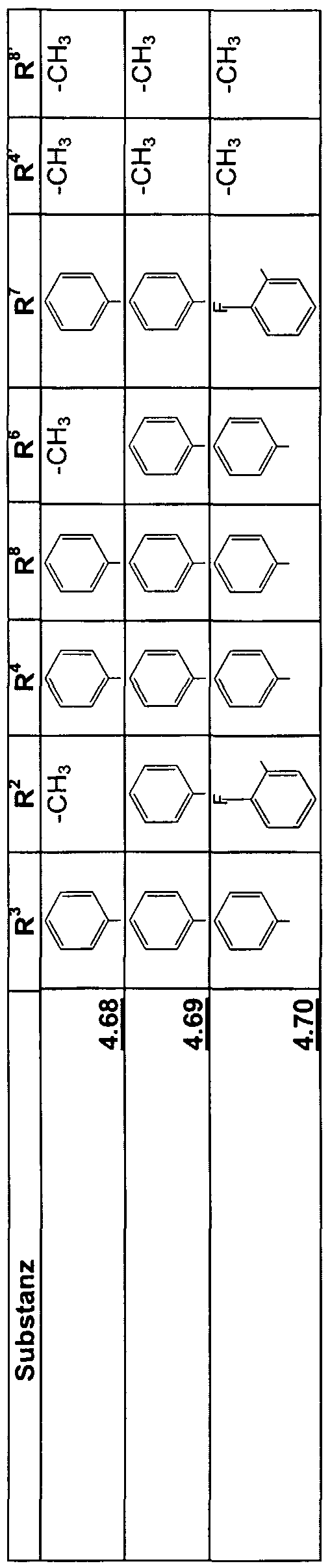
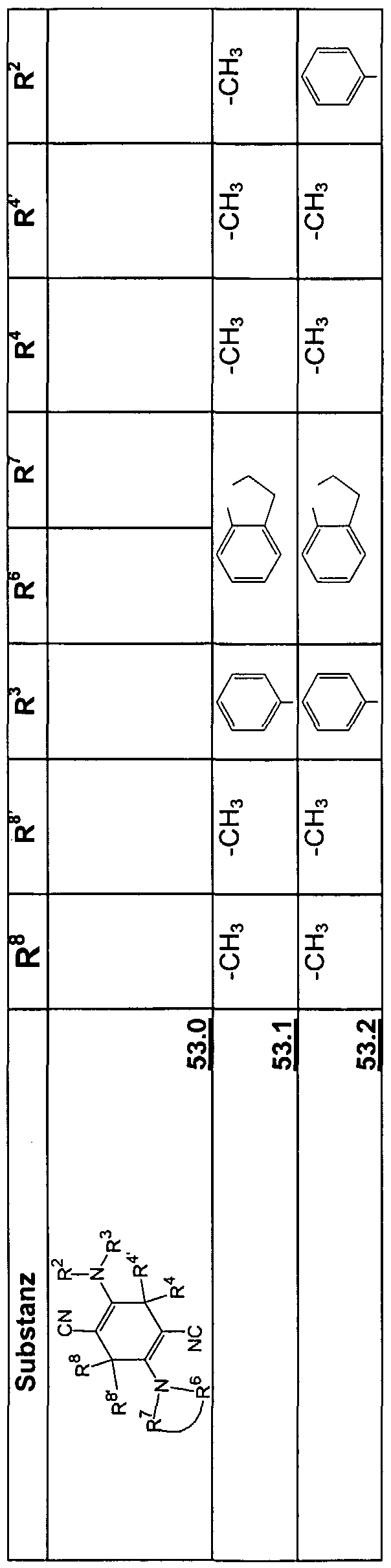
Beispiele für die neuen Emitter entsprechend Formel 1 sind in Tabelle 1 zusammengestellt: Tabelle 1 : 2,5-DiaminoterephthalsäurederivateExamples of the new emitters corresponding to Formula 1 are listed in Table 1: Table 1: 2,5-diaminoterephthalic acid derivatives


Tabelle 2: 2,5-Diamino-3,6-dihydroterephthalsäurederivateTable 2: 2,5-diamino-3,6-dihydroterephthalic acid derivatives


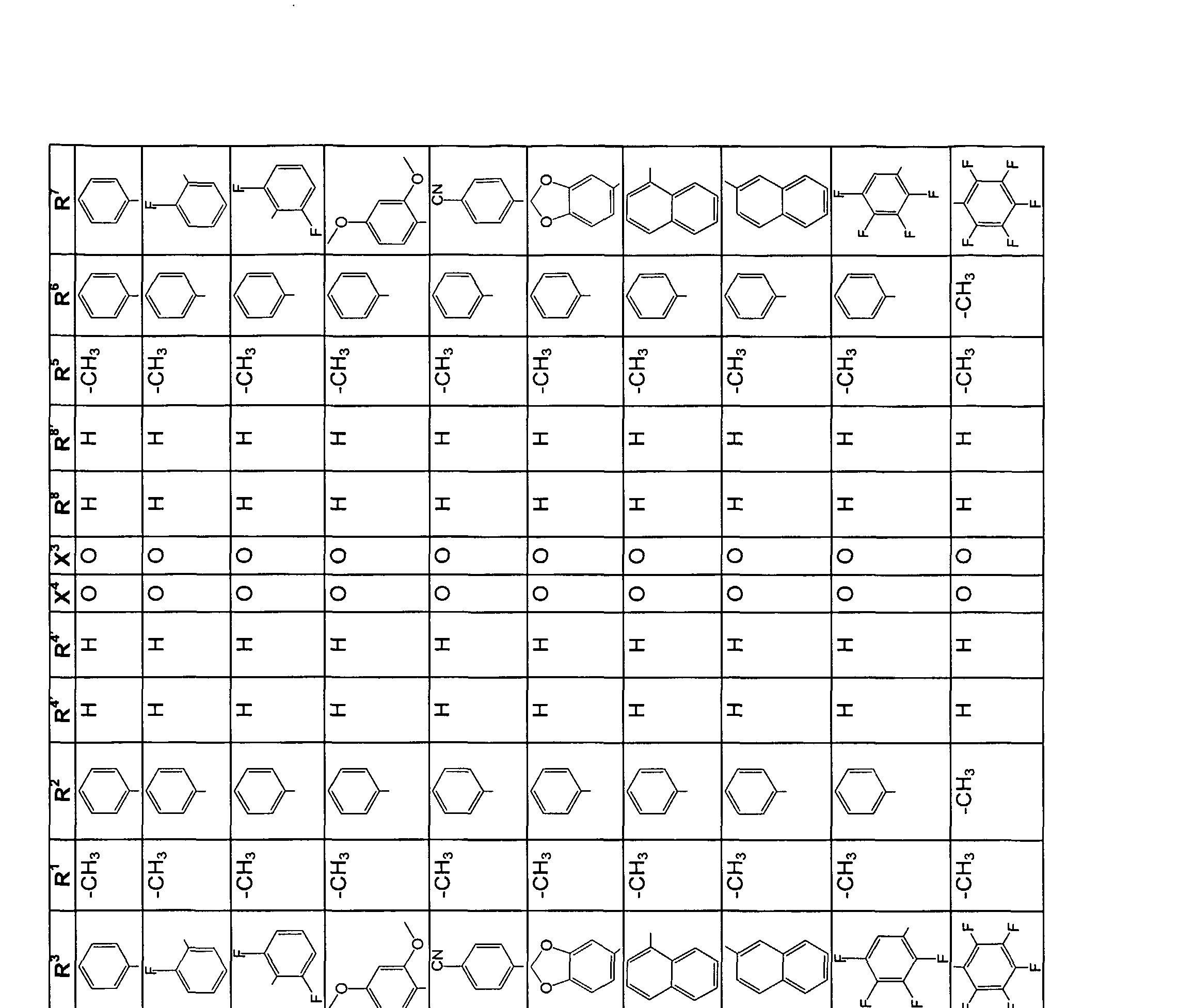


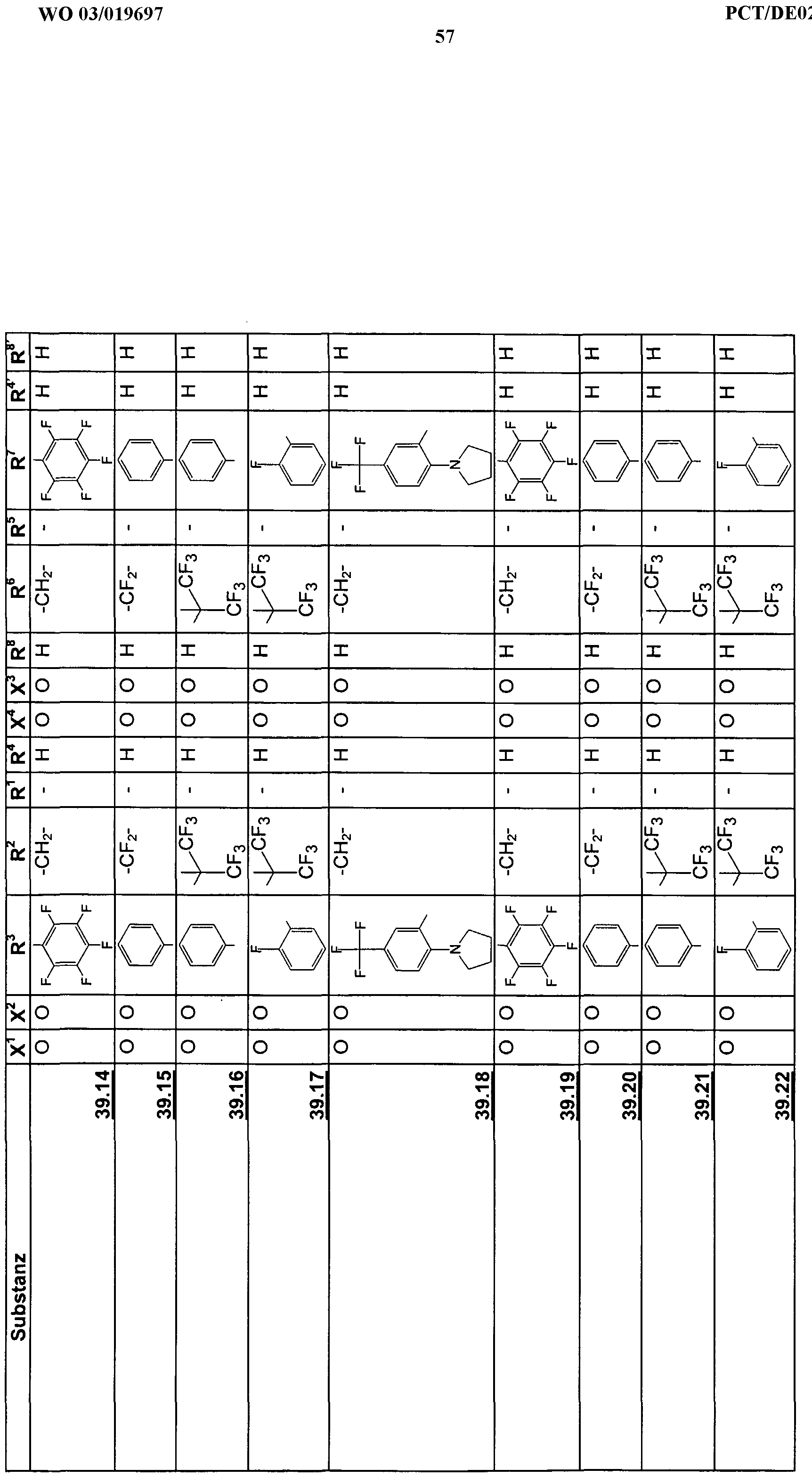


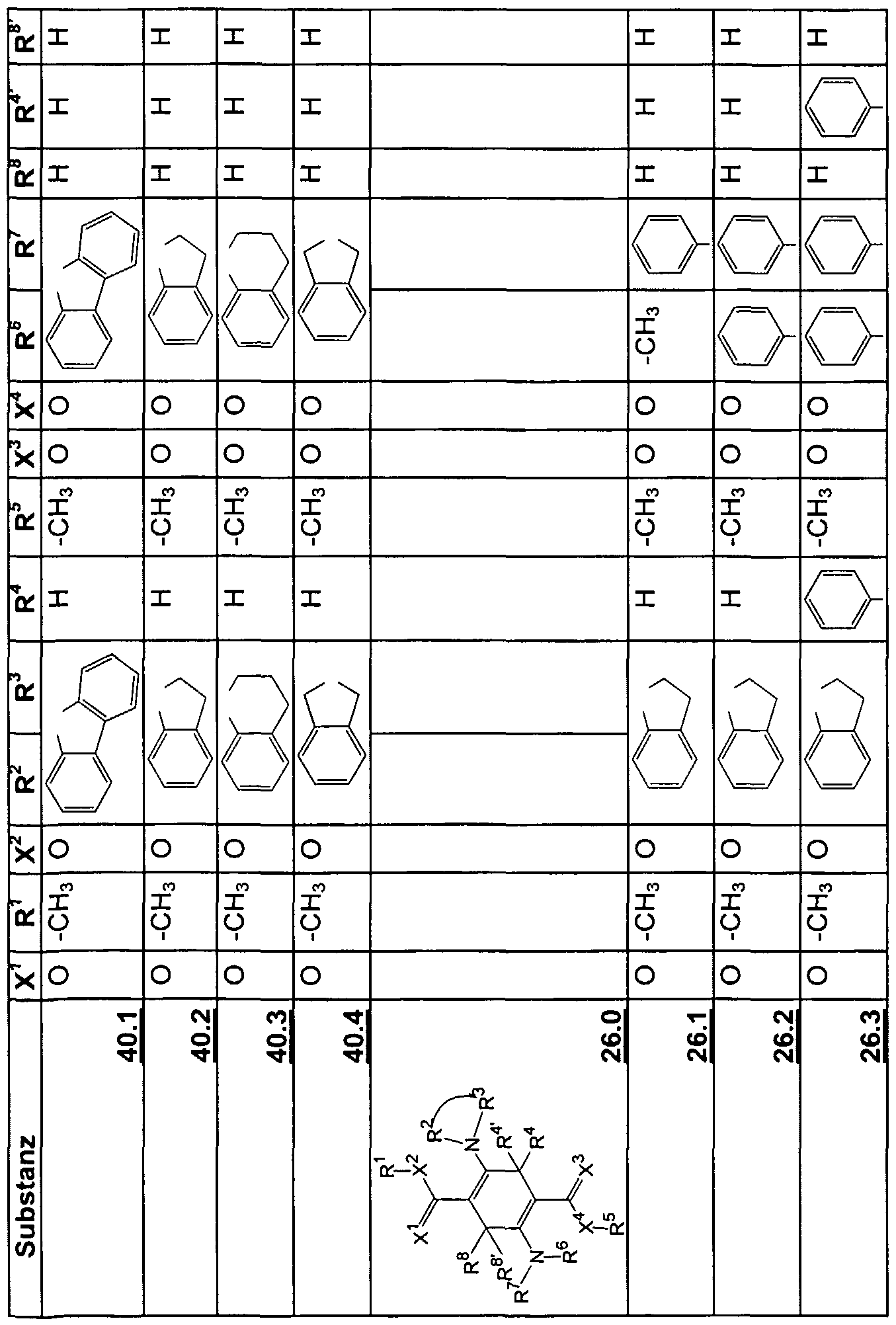


Tabelle 3: Substituierte 2,5-DiaminoterephthalsäuredinitrileTable 3: Substituted 2,5-diaminoterephthalic acid dinitriles


Tabelle 4: Substituierte 2,5-Diamino-3,6-dihydroterephthalsäuredinitrileTable 4: Substituted 2,5-diamino-3,6-dihydroterephthalic acid dinitriles






Die neuen Emitter werden in einem Device mit oder ohne einer Elektronentransportschicht verwendet, wobei die Schichten in einem Device wie in Fig. 2 angegeben angeordnet sein können:The new emitters are used in a device with or without an electron transport layer, it being possible for the layers to be arranged in a device as indicated in FIG. 2:
1. der Träger besteht aus einem transparenten Material, z. B. Glas;1. the carrier consists of a transparent material, for. B. glass;
2. die Anode besteht aus ITO, das die Löcher in die Lochtransportschicht injiziert;2. the anode is made of ITO, which injects the holes into the hole transport layer;
3. u. 4. der Lochleiter besteht vorrangig aus Derivaten des Triphenylamins; es können mehrere Lochleiterschichten vorhanden sein, deren Eigenschaften auf das Device abgestimmt sind;3. u. 4. the hole conductor consists primarily of derivatives of triphenylamine; there can be several perforated conductor layers, the properties of which are matched to the device;
5. zwischen Lochleiter und Elektronenleiter werden eine oder mehrere Emitterschichten aufgebracht;5. one or more emitter layers are applied between the hole conductor and the electron conductor;
6. der Elektronenleiter kann z. B. aus Alq3 bestehen und leitet die Elektronen von der Kathode in das Innere des Devices zur Emissionsschicht bzw. dem Lochleiter;6. the electron conductor can, for. B. consist of Alq3 and conducts the electrons from the cathode into the interior of the device to the emission layer or the hole conductor;
7. die Pufferschicht aus bestimmten Metallsalzen oder deren Oxiden, wie z. B. LiF, verbessert die Elektroneninjektion in die Schicht 6;7. the buffer layer made of certain metal salts or their oxides, such as. B. LiF, improves electron injection into layer 6;
8. die Kathode besteht aus einem unedlen Metall oder einer Legierung (z. B. Aluminium oder Calcium).8. The cathode is made of a base metal or an alloy (e.g. aluminum or calcium).
Typische Schichtdicken für die Emitter sind 3 -10 nm, vorzugsweise 4 - 6 nm. Die Emissionswellenlängen hängen in charakteristischer weise von der chemischen Struktur ab, wobei offensichtlich elektronische und sterische Faktoren der Moleküle einen Einfluß auf die Wellenlänge des emittierten Lichts und der erreichten Performance haben. Für die in Tab 2 gezeigten Beispiele liegen die Emissionswellenlängen zwischen 538 nm und 618 nm.Typical layer thicknesses for the emitters are 3 -10 nm, preferably 4 - 6 nm. The emission wavelengths characteristically depend on the chemical structure, whereby obviously electronic and steric factors of the molecules have an influence on the wavelength of the emitted light and the performance achieved , For the examples shown in Table 2, the emission wavelengths are between 538 nm and 618 nm.
Zum Erreichen von Mischfarben können die neuen Emitter der Formel 1 ) - 58.0 in mehreren Schichten der jeweils reinen Materialien übereinander (Fig. 2) oder im Gemisch in einer oder mehreren Schichten angeordnet werden.To achieve mixed colors, the new emitters of formula 1) -58.0 can be arranged in several layers of the respective pure materials one above the other (FIG. 2) or in a mixture in one or more layers.
Schichten der neuen Emitter der Formel 1Λ) - 58.0 können durch bekannte Emittermaterialien dotiert werden, wie in Fig. 1 gezeigt wird. Die neuen Emitter der Formel 1J) - 58.0 können in Devices mit an sich bekannten Lochleitern (59 u. 60) und anderen Komponenten verwendet werden. Typische Beispiele zeigen die Fig. 1 und 2.Layers of the new emitters of the formula 1Λ) - 58.0 can be doped by known emitter materials, as shown in Fig. 1. The new emitters of formula 1J) - 58.0 can be used in devices with per se known hole conductors (59 and 60) and other components. Typical examples are shown in FIGS. 1 and 2.


Die Devices auf der Basis der neuen Emitter können in an sich bekannter Weise durchThe devices based on the new emitters can be used in a manner known per se
Aufdampfen im Vakuum zwischen 1 und 10"9 Torr hergestellt werden.Evaporation in a vacuum between 1 and 10 "9 Torr can be made.
Eine weitere Möglichkeit zur Herstellung der Devices besteht im Beschichten (Coating) aus der Lösung, z. B. Webcoating oder Spincoating. Dabei können die neuen Emitter der Formeln 1 ) - 58.0 sowohl in als reine Substanz oder als Dopand in einem geeigneten Polymer aufgetragen werden.Another possibility for the production of the devices consists in coating (coating) from the solution, e.g. B. web coating or spin coating. The new emitters of formulas 1) - 58.0 can be applied either as pure substance or as dopant in a suitable polymer.
Überraschend wurde gefunden, daß insbesondere mit fluorsubstituierten Vertretern derSurprisingly, it was found that, in particular, with fluorine-substituted representatives of the
Formel 1 ) besonders effiziente Devices hergestellt werden können. Es zeigt sich in diesen Fällen eine bemerkenswert hohe photometrische Effizienz. Mit der Substanz JL2 wird ein Device realisiert, welches ein spektral nahezu reines grün ausstrahlt. Experimenteller TeilFormula 1) particularly efficient devices can be manufactured. In these cases, the photometric efficiency is remarkably high. With the substance JL2, a device is realized which emits a spectrally almost pure green. Experimental part
Die folgenden Beispiele sollen die Erfindung näher beschreiben, stellen aber keine Beschränkung dar.The following examples are intended to describe the invention in more detail, but do not constitute a limitation.
Beispiel 1 (Substanzen 2.1. 2.3 - 2.5)Example 1 (substances 2.1. 2.3 - 2.5)

In einem Gemisch aus 200 ml Eisessig und 200 ml Alkohol (entsprechend der Esterkomponente) werden 0.06 mol Cyclohexan-2,5-dion-1 ,4-dicarbonsäurediester suspendiert. Unter Stickstoff werden 0.135 mol eines primären Amins bzw. Anilins zügig zugesetzt. Das Reaktionsgemisch wird unter intensivem Rühren 5 - 8 h unter Rückfluß erhitzt. Die akzeptorsubstituierten Aniline erfordern eine Verlängerung der Reaktionszeiten.0.06 mol of cyclohexane-2,5-dione-1,4-dicarboxylic acid diester are suspended in a mixture of 200 ml of glacial acetic acid and 200 ml of alcohol (corresponding to the ester component). 0.135 mol of a primary amine or aniline is rapidly added under nitrogen. The reaction mixture is heated under reflux with intensive stirring for 5-8 h. The acceptor-substituted anilines require an extension of the reaction times.
Zur Isolierung des Rohprodukts genügt es im Falle der Aniline, die abgekühlte Reaktionsmischung abzusaugen, mit Methanol intensiv zu waschen und zu trocknen. Aliphatische Amine bilden Produkte von hoher Löslichkeit, so daß zunächst, sämtliches Lösungsmittel weitestgehend am Rotationverdampfer abgetrennt werden muß. Das Rohprodukt wird in Methanol aufgenommen und nach starker Kühlung abgesaugt und getrocknet.To isolate the crude product, in the case of anilines, it is sufficient to suction off the cooled reaction mixture, to wash it intensively with methanol and to dry it. Aliphatic amines form products of high solubility, so that first of all all of the solvent must be separated off on a rotary evaporator. The crude product is taken up in methanol and, after vigorous cooling, suction filtered and dried.
Beispiel 2 (Substanzen U., 1^3 - U>)Example 2 (Substances U., 1 ^ 3 - U>)

Beispiel 3 (Substanz 19.1 - 19.4)Example 3 (substance 19.1 - 19.4)
Die nach Beispiel 2 erhaltenen Ester werden in Gemischen aus n-Propanol und Wasser verseift. Vom Terephthalsäurediester werden 0.01 mol in etwa 50 ml n-Propanol suspendiert und mit 50 ml Wasser, das 0.03 mol Kaliumhydroxid enthält, versetzt. Die Suspension wird unter Rückfluß erhitzt bis eine klare Lösung entstanden ist. Nach weiteren 2 h wird abgesaugt. Zur Neutralisation werden in die Lösung etwa 5 ml Eisessig getropft. Die anfallende Säure wird mit Methanol gewaschen und getrocknet. Zur Herstellung der Substanzen 19.1 - 19.4 wurden 0.01 mol der hier hergestellten Terephthalsäure in 100 ml Eisessig unter Zusatz von 15 ml Formaldehydlösung (37%) 2 h unter Rückfluß erhitzt.The esters obtained according to Example 2 are saponified in mixtures of n-propanol and water. 0.01 moles of the terephthalic acid diester are suspended in about 50 ml of n-propanol, and 50 ml of water containing 0.03 mol of potassium hydroxide are added. The suspension is heated under reflux until a clear solution has formed. After a further 2 h, the product is suctioned off. About 5 ml of glacial acetic acid are dropped into the solution for neutralization. The resulting acid is washed with methanol and dried. To prepare substances 19.1-19.4, 0.01 mol of the terephthalic acid prepared here was heated under reflux in 100 ml of glacial acetic acid with the addition of 15 ml of formaldehyde solution (37%).
Die Reaktionsprodukte werden abgetrennt und mit Methanol gewaschen. Es wird aus Acetonitril oder Chloroform umkristallisiert. Die Substanzen können durch Sublimation gereinigt werden.The reaction products are separated off and washed with methanol. It is recrystallized from acetonitrile or chloroform. The substances can be purified by sublimation.
Beispiel 4 (Substanz 1.2)Example 4 (substance 1.2)
Um Verbindungen dieses Typs herzustellen kann der entsprechende Terephthalsäureester (Beispiel 2) alkyliert werden. In 350 ml wasserfreien DMSO werden 0.05 mol Terephthalsäureester suspendiert und mit 18.63 g (0.131 mol) Methyliodid versetzt. Bei einer Temperatur zwischen 20 und 23°C werden portionsweise unter starkem Rühren 6.1 g (0.152 mol) 60%iges Natriumhydrid in Paraffin hinzugefügt. Nach ca. 5 h Reaktionszeit hat sich ein Farbumschlag der festen Bestandteile von orange nach rein gelb vollzogen. Zu diesem Gemisch werden nun ca. 200 ml Methanol gegeben, was die Filtrierbarkeit wesentlich verbessert.To prepare compounds of this type, the corresponding terephthalic acid ester (Example 2) can be alkylated. 0.05 mol of terephthalic acid ester is suspended in 350 ml of anhydrous DMSO and 18.63 g (0.131 mol) of methyl iodide are added. At a temperature between 20 and 23 ° C 6.1 g (0.152 mol) of 60% sodium hydride in paraffin are added in portions with vigorous stirring. After a reaction time of approx. 5 h, the solid components changed color from orange to pure yellow. About 200 ml of methanol are now added to this mixture, which significantly improves the filterability.
Das abgetrennte gelbe Reaktionsprodukt wird mit Methanol intensiv gewaschen und getrocknet. Ein reines Produkt wird durch Umkristallisation aus Toluol erhalten. Beispiel 5 (Device: Substanz 19.4)The separated yellow reaction product is washed intensively with methanol and dried. A pure product is obtained by recrystallization from toluene. Example 5 (Device: Substance 19.4)
Auf einen strukturierten ITO-Glasträger von 50 x 50 mm2 wurde eine Schicht von 55 nm 4,4',4"-Tris(N-(α-naphthyl)-N-phenylamino)-triphenylamin und eine weitere von 5 nm Stärke aus N,N'-Di(α-naphthyl)-N,N'-diphenylbenzidin aufgedampft. Auf diesen Lochtransportschichten werden 5 nm 1 ,6-Bis(2,4-dimethoxyphenyl)-benzo[1 ,2-d;4,5-d']- 1 ,2,6,7-tetrahydro-bis[1 ,3]oxazin-4,9-dion (19.4) abgeschieden. Über dieser Emitterschicht wird nun zusätzlich Tris-(8-hydroxychinolinato)-aluminium mit einer Schichtdicke von 30 nm aufgebracht und darüber zunächst eine sehr dünne Pufferschicht (0.5 nm) Lithiumfluorid und abschließend Aluminium aufgedampft. Der Test dieser Anordnung erfolgte bei einer regelbaren Spannung zwischen 0 und 15 V. Diese Vorrichtung emittiert bei 578 nm (gelb). Eine Leuchtdichte von 100 cd/m2 wurde bei 5.0 V erreicht. Maximal wurde eine Leuchtdichte von 11400 cd/m2 erreicht.A layer of 55 nm 4,4 ', 4 "tris (N- (α-naphthyl) -N-phenylamino) -triphenylamine and another of 5 nm thickness were applied to a structured ITO glass support measuring 50 × 50 mm 2 N, N'-di (α-naphthyl) -N, N'-diphenylbenzidine was evaporated and 5 nm 1,6-bis (2,4-dimethoxyphenyl) -benzo [1, 2-d; 4,5 -d '] - 1, 2,6,7-tetrahydro-bis [1, 3] oxazin-4,9-dione (19.4), and tris (8-hydroxyquinolinato) aluminum with a Layer thickness of 30 nm applied and first a very thin buffer layer (0.5 nm) of lithium fluoride and finally aluminum vapor-deposited. The test of this arrangement was carried out at a controllable voltage between 0 and 15 V. This device emits at 578 nm (yellow). A luminance of 100 cd / m 2 was reached at 5.0 V. A maximum luminance of 11400 cd / m 2 was reached.
Beispiel 6 (Device: Substanz 1.21 )Example 6 (Device: Substance 1.21)
Entsprechend Beispiel 5 wurde ein Device hergestellt, wobei als Emittersubstanz 2,5-Bis-(N-(2,4-dimethoxyphenyl)amino)terephthalsäurediethylester als 5 nm starke Schicht zwischen Loch- und Elektronenleiter eingebracht wurde. Der Test dieses Device erfolgte ebenfalls bei einer regelbaren Spannung zwischen 0 und 15 V. Diese Vorrichtung emittiert bei 618 nm (rot). Eine Leuchtdichte von 100 cd/m wurde bei 9.5 V erreicht. Maximal wurde eine Leuchtdichte von 644 cd/m2 erreicht.A device was produced in accordance with Example 5, 2,5-bis- (N- (2,4-dimethoxyphenyl) amino) terephthalic acid diethyl ester being introduced as a 5 nm thick layer between the hole and electron conductor as the emitter substance. This device was also tested at a controllable voltage between 0 and 15 V. This device emits at 618 nm (red). A luminance of 100 cd / m was reached at 9.5 V. A maximum luminance of 644 cd / m 2 was achieved.
Beispiel 7 (Device: Substanz 1.5)Example 7 (Device: Substance 1.5)
Das Device folgt dem Aufbau in den Beispielen 5 und 6. Als Emittersubstanz wurde 2, 5-Bis-(N-phenylamino)-terephthalsäurediethylester eingesetzt. Für den Test wurde wiederum eine Spannung zwischen 0 und 15 Volt angelegt. Das Device leuchtet gelb (578 nm). Die Leuchtdichte von 100 cd/m2 wurde bei 5.6 V erreicht. Maximal wurde eine Leuchtdichte von 5300 cd/m2 registriert. Beispiel 8 (Device: Substanz 1.2)The device follows the structure in Examples 5 and 6. Diethyl 2,5-bis (N-phenylamino) terephthalate was used as the emitter. A voltage between 0 and 15 volts was again applied for the test. The device lights up yellow (578 nm). The luminance of 100 cd / m 2 was reached at 5.6 V. A maximum luminance of 5300 cd / m 2 was registered. Example 8 (Device: Substance 1.2)
In Analogie zu den Beispielen 5 - 7 wurde bei gleichem Bauprinzip auf den Lochtransportschichten eine Schicht von 5 nm N,N'-Dimethyl-2,5-bis-(N-(2-fluorphenyl)- amino)terephthalsäuredimethylester abgeschieden.In analogy to Examples 5-7, a layer of 5 nm N, N'-dimethyl-2,5-bis (N- (2-fluorophenyl) amino) dimethyl terephthalate was deposited on the hole transport layers using the same construction principle.
Der Test dieser Anordnung (Fig. 2) erfolgte bei einer regelbaren Spannung zwischen 0 und 15 V. Das Device leuchtet grün (λmaχ= 547 nm). Eine Leuchtdichte von 100 cd/m2 wurde bei 5.4 V erreicht. Maximal wurde eine Leuchtdichte von 17700 cd/m2 erreicht.The test of this arrangement (FIG. 2) was carried out at a controllable voltage between 0 and 15 V. The device lights up green (λ ma χ = 547 nm). A luminance of 100 cd / m 2 was achieved at 5.4 V. A maximum luminance of 17700 cd / m 2 was achieved.
1. der Träger besteht aus Glas;1. the carrier is made of glass;
2. die Anode besteht aus ITO;2. the anode consists of ITO;
3. als Lochleiter wird 1-Naphdata aufgebracht;3. 1-Naphdata is applied as a hole conductor;
4. eine weitere Lochleiterschicht besteht aus α-NPD;4. Another hole conductor layer consists of α-NPD;
5. zwischen Lochleiter und Elektronenleiter werden eine oder mehrere Emitterschichten aufgebracht;5. one or more emitter layers are applied between the hole conductor and the electron conductor;
6. der Elektronenleiter kann z. B. aus Alq3 bestehen;6. the electron conductor can, for. B. consist of Alq3;
7. die Pufferschicht aus besteht aus LiF;7. the buffer layer consists of LiF;
8. die Kathode besteht aus einem unedlen Metall oder einer Legierung (z. B. Aluminium oder Calcium).8. The cathode is made of a base metal or an alloy (e.g. aluminum or calcium).
Typische Schichtdicken für die Emitter sind 3 -10 nm, vorzugsweise 4 - 6 nm.Typical layer thicknesses for the emitters are 3 -10 nm, preferably 4-6 nm.
Photometrische Kenngrößen ausgewählter EmittersubstanzenPhotometric parameters of selected emitter substances
Tab. 2Tab. 2


1 ) Spannung bei 100 cd/m2 1) Tension at 100 cd / m 2
2) λma der Elektrolumineszenz2) λma of electroluminescence
3) max. Leuchtdichte3) max. luminance
4) max. photometrische Effizienz4) max. photometric efficiency
5) max. Leistungseffizienz5) max. power efficiency
Tab. 3Tab. 3

^ma - Absorptionsmaximum λ, em- Emissionsmaximum λeιι: Maximum der Elelektrolumineszenz^ ma - absorption maximum λ, em emission maximum λ e ιι: maximum of the electroluminescence
Tab. 4Tab. 4
Extinktionskoeffizienten ε ausgewählter EmittersubstanzenExtinction coefficient ε of selected emitter substances


Tab. 5Tab. 5
Absorptionsmaxima ausgewählter Emittersubstanzen in LösungAbsorption maxima of selected emitter substances in solution


Tab. 6Tab. 6
DSC-Werte ausgewählter EmittersubstanzenDSC values of selected emitter substances


a) Substrat: 125nm ITO mit ca. 13Ω/sq und 85% Transmission 50x50mm2-Glas- substrate (1,1mm dickes poliertes Soda Lime-Floatglas mit Siθ2-Schicht und 8 einzelnen ITO-Anoden (aktiven Fläche: 2x2mm2))a) Substrate: 125nm ITO with approx. 13Ω / sq and 85% transmission 50x50mm 2 glass substrate (1.1mm thick polished soda lime float glass with SiO 2 layer and 8 individual ITO anodes (active area: 2x2mm 2 ) )
2 x 20 min im Ultraschallbad mit Aceton selectopur und mit Methanol selectopur gereinigt,2 x 20 min in an ultrasonic bath with acetone selectopur and with methanol selectopur,
3 x Snow Jet Cleaning (Cθ2-Eiskristalle) O2-Plasmabehandlung (5 min bei 450 W und 0,12 mbar)3 x Snow Jet Cleaning (Cθ 2 ice crystals) O2 plasma treatment (5 min at 450 W and 0.12 mbar)
b) Druck (2-4)x1 O^mbar beim Bedampfen Aluminiumoxidkeramik-Tiegel Bedampfungsrate: 0,06nm/sb) Pressure (2-4) x1 O ^ mbar when steaming alumina ceramic crucible Steaming rate: 0.06nm / s
Kontrolle der Schichtdicke über Schwingquartz-Mikrobalance-Messgerät Maskenwechsel mit Zwischenbelüftung der Bedampfungskammer zuerst mit Stickstoff und dann mit Luft Kathoden: jeweils 0,5nm Lithiumfluorid (isolierend) und 100nm AluminiumControl of the layer thickness via Schwingquartz microbalance measuring device. Mask change with intermediate ventilation of the vaporization chamber first with nitrogen and then with air. Cathodes: 0.5nm lithium fluoride (insulating) and 100nm aluminum
c) Das Device nach Fig. 2 wurde in eine Glovebox eingeschleust, aktive OLED- Fläche in einer abgedunkelten Meßeinrichtung über kalibrierten Vλ-Silizium- Photodioden positioniert und die ausgeführten Anoden (ITO) - und Kathoden (AI) - Kontakte mit vergoldeten Feder-Elektroden kontaktiert; programmierbare Spannungsquelle (SMU) und Digitalmultimeter zur Aufnahme und Verarbeitung der OLED-Kennlinien am PC über GPIB-BUS und LabView-Programm Spannungs-Impulsbetrieb (Pulsdauer 1s) von -10V bis +15V (Schrittweite 0,5V): Stromdichte-Spannungs-Kennlinie und Leuchtdichte-Spannungs-Kennlinie sowie die berechneten Werte von photometrische Effizienz (in cd/A) und Leistungs-Effizienz (in Im/W) gegen Uc) The device according to FIG. 2 was introduced into a glove box, active OLED area was positioned in a darkened measuring device via calibrated V λ silicon photodiodes and the anodes (ITO) and cathodes (AI) carried out with gold-plated spring contacts. Electrodes contacted; Programmable voltage source (SMU) and digital multimeter for recording and processing the OLED characteristic curves on the PC via GPIB-BUS and LabView program and luminance-voltage characteristic as well as the calculated values of photometric efficiency (in cd / A) and power efficiency (in Im / W) against U
d) Wellenlänge des Maximums durch Aufzeichnung des Elektrolumineszenz- Spektrums am Xdap-Diodenarray-Spektrometer; d) wavelength of the maximum by recording the electroluminescence spectrum on the Xdap diode array spectrometer;
Claims




Priority Applications (9)
| Application Number | Priority Date | Filing Date | Title |
|---|---|---|---|
| AU2002325807A AU2002325807A1 (en) | 2001-08-21 | 2002-08-21 | Organic electroluminescent device based on 2,5-diaminoterephthalic acid derivatives |
| DE10293842T DE10293842D2 (en) | 2001-08-21 | 2002-08-21 | Organic electroluminescent device based on 2,5-diaminoterephthalic acid derivatives |
| DE50204964T DE50204964D1 (en) | 2001-08-21 | 2002-08-21 | ORGANIC ELECTROLUMINESCENT DEVICE BASED ON 2,5-DIAMINOTEREPHTHALIC ACID DERIVATIVES |
| AT02760128T ATE310320T1 (en) | 2001-08-21 | 2002-08-21 | ORGANIC ELECTROLUMINESCENT DEVICE BASED ON 2,5-DIAMINOTEREPHTHALIC ACID DERIVATIVES |
| JP2003523038A JP2005500666A (en) | 2001-08-21 | 2002-08-21 | Organic electroluminescent devices based on 2,5-diaminoterephthalic acid derivatives. |
| US10/487,138 US7112674B2 (en) | 2001-08-21 | 2002-08-21 | Organic electroluminescent device based on 2,5-diaminoterephthalic acid derivatives |
| EP02760128A EP1421634B1 (en) | 2001-08-21 | 2002-08-21 | Organic electroluminescent device based on 2,5-diaminoterephthalic acid derivatives |
| KR10-2004-7002320A KR20040039291A (en) | 2001-08-21 | 2002-08-21 | Organic electroluminescent device based on 2,5-diaminoterephthalic acid derivatives |
| US10/784,149 US7141312B2 (en) | 2001-08-21 | 2004-02-20 | Organic electroluminescent device based on 2,5-diaminoterephthalic acid derivatives |
Applications Claiming Priority (2)
| Application Number | Priority Date | Filing Date | Title |
|---|---|---|---|
| DE10141266A DE10141266A1 (en) | 2001-08-21 | 2001-08-21 | Electroluminescent derivatives of 2,5-diamino-terephthalic acid and their use in organic light-emitting diodes |
| DE10141266.5 | 2001-08-21 |
Related Child Applications (1)
| Application Number | Title | Priority Date | Filing Date |
|---|---|---|---|
| US10/784,149 Continuation US7141312B2 (en) | 2001-08-21 | 2004-02-20 | Organic electroluminescent device based on 2,5-diaminoterephthalic acid derivatives |
Publications (2)
| Publication Number | Publication Date |
|---|---|
| WO2003019697A2 true WO2003019697A2 (en) | 2003-03-06 |
| WO2003019697A3 WO2003019697A3 (en) | 2003-12-24 |
Family
ID=7696323
Family Applications (1)
| Application Number | Title | Priority Date | Filing Date |
|---|---|---|---|
| PCT/DE2002/003110 Ceased WO2003019697A2 (en) | 2001-08-21 | 2002-08-21 | Organic electroluminescent device based on 2,5-diaminoterephthalic acid derivatives |
Country Status (9)
| Country | Link |
|---|---|
| US (2) | US7112674B2 (en) |
| EP (1) | EP1421634B1 (en) |
| JP (1) | JP2005500666A (en) |
| KR (1) | KR20040039291A (en) |
| CN (1) | CN1545741A (en) |
| AT (1) | ATE310320T1 (en) |
| AU (1) | AU2002325807A1 (en) |
| DE (3) | DE10141266A1 (en) |
| WO (1) | WO2003019697A2 (en) |
Cited By (3)
| Publication number | Priority date | Publication date | Assignee | Title |
|---|---|---|---|---|
| WO2004026809A1 (en) * | 2002-09-17 | 2004-04-01 | Hirose Engineering Co., Ltd. | Luminescent compounds, process for the preparation thereof, and light emitting devices |
| WO2004067674A1 (en) * | 2003-01-31 | 2004-08-12 | Hirose Engineering Co., Ltd. | Material for organic light-emitting device |
| CN118290283A (en) * | 2024-06-06 | 2024-07-05 | 山东海化集团有限公司 | Preparation method and application of near-infrared piezochromic material with AIE (AIE) property |
Families Citing this family (11)
| Publication number | Priority date | Publication date | Assignee | Title |
|---|---|---|---|---|
| JP2005035965A (en) * | 2003-06-30 | 2005-02-10 | Hirose Engineering Co Ltd | White luminescent compound, method for producing the same and white luminescent element |
| SI1934174T1 (en) | 2005-10-07 | 2011-08-31 | Exelixis Inc | Azetidines as mek inhibitors for the treatment of proliferative diseases |
| PL2101759T3 (en) * | 2006-12-14 | 2019-05-31 | Exelixis Inc | Methods of using mek inhibitors |
| JP2008310974A (en) * | 2007-06-12 | 2008-12-25 | Casio Comput Co Ltd | Display device and manufacturing method thereof |
| FR2958455B1 (en) * | 2010-04-06 | 2015-06-26 | Commissariat Energie Atomique | ORGANIC ELECTROLUMINESCENT DIODE COMPRISING AT LEAST TWO ELECTROLUMINESCENT LAYERS. |
| JP2013207139A (en) * | 2012-03-29 | 2013-10-07 | Kaneka Corp | Luminescent material and organic el element |
| KR102204520B1 (en) | 2012-10-12 | 2021-01-20 | 엑셀리시스, 인코포레이티드 | Novel process for making compounds for use in the treatment of cancer |
| DE102016110970A1 (en) * | 2016-06-15 | 2017-12-21 | Technische Universität Dresden | Efficient light-emitting emitter molecules for optoelectronic applications by targeted enhancement of emission from charge-separated CT states based on dual-fluorescent benzene (poly) carboxylate acceptors |
| CN112543750B (en) * | 2018-08-03 | 2023-11-03 | 日产化学株式会社 | Method for producing fluorinated aromatic secondary amine compounds |
| CN110054581A (en) * | 2019-04-09 | 2019-07-26 | 南京邮电大学 | The OLED memory device of electroluminescent organic material and the application material |
| CN113461594B (en) * | 2021-05-20 | 2024-06-21 | 南京邮电大学 | Organic light-emitting memory material and bistable OLED memory using same |
Family Cites Families (25)
| Publication number | Priority date | Publication date | Assignee | Title |
|---|---|---|---|---|
| GB868361A (en) | 1958-09-04 | 1961-05-17 | Ici Ltd | Process for manufacture of intermediates for pigments and dyestuffs |
| NL255441A (en) * | 1959-09-02 | |||
| GB918511A (en) | 1960-05-23 | 1963-02-13 | Ciba Ltd | Process for the manufacture of 2:5-diarylamino-terephthalic acids |
| US3555087A (en) * | 1968-03-27 | 1971-01-12 | American Cyanamid Co | Terephthalamides |
| DE2542494C3 (en) * | 1975-09-24 | 1981-04-30 | Hoechst Ag, 6000 Frankfurt | Process for the preparation of pure substituted 2,5 diarylaminoterephthalic acid esters and the corresponding free acids |
| US4208328A (en) * | 1978-04-27 | 1980-06-17 | General Electric Company | Alkyl 3,5-dihydroxy-4-(2-benzothiazolyl)benzoates |
| JP3069139B2 (en) * | 1990-03-16 | 2000-07-24 | 旭化成工業株式会社 | Dispersion type electroluminescent device |
| US5059861A (en) * | 1990-07-26 | 1991-10-22 | Eastman Kodak Company | Organic electroluminescent device with stabilizing cathode capping layer |
| EP0569823B1 (en) * | 1992-05-12 | 1996-08-28 | Hoechst Aktiengesellschaft | Process for the preparation of 2,5-di-phenylamino terephthalic acid and its dialkyl esters |
| US5409783A (en) * | 1994-02-24 | 1995-04-25 | Eastman Kodak Company | Red-emitting organic electroluminescent device |
| US6312835B1 (en) * | 1997-02-13 | 2001-11-06 | Queen's University At Kingston | Luminescent compounds and methods of making and using same |
| JP3794776B2 (en) | 1997-04-04 | 2006-07-12 | 三井化学株式会社 | Organic electroluminescence device |
| JP3770691B2 (en) | 1997-04-17 | 2006-04-26 | 三井化学株式会社 | Organic electroluminescence device |
| US6355365B1 (en) * | 1998-05-08 | 2002-03-12 | Japan Chemical Innovation Institute | Molecular compound, luminous material using the same, and luminous element |
| US6800380B2 (en) * | 1998-06-23 | 2004-10-05 | Nessdisplay Co., Ltd. | Organometallic luminescent materials and organic electroluminescent device containing same |
| JP3302945B2 (en) * | 1998-06-23 | 2002-07-15 | ネースディスプレイ・カンパニー・リミテッド | Novel organometallic luminescent material and organic electroluminescent device containing the same |
| UA36514C2 (en) * | 1999-12-28 | 2003-12-15 | Інститут Монокристалів Науково-Технологічного Концерну "Інститут Монокристалів" Нан України | A process for producing pyrazolinylnaphtHalIC acid derivatives |
| JP3754856B2 (en) * | 2000-01-27 | 2006-03-15 | キヤノン株式会社 | Organic light emitting device |
| UA37700A (en) * | 2000-04-06 | 2001-05-15 | Інститут Монокристалів Науково - Технологічного Концерну "Інститут Монокристалів" Національної Академії Наук України | 1 -phenyl - 5 - (n-metoxyphenyl) - 3 - [1,8 - naphtoylen - 1',2' -benzimidazolyl - 4 ] -2 - pyrazole as organic luminophore of green luminescence |
| US6329086B1 (en) * | 2000-06-13 | 2001-12-11 | Eastman Kodak Company | Electroluminescent devices having arylamine polymers |
| US6613458B2 (en) * | 2001-09-13 | 2003-09-02 | Cityu Research Ltd. | Organic electroluminescent elements |
| US20030099861A1 (en) * | 2001-11-01 | 2003-05-29 | Shuit -Tong Lee | Efficient red organic electroluminescent devices |
| KR100528323B1 (en) * | 2001-11-16 | 2005-11-15 | 삼성에스디아이 주식회사 | Blue Electroluminescent Polymer And Organo-electroluminescent Device Manufactured By Using The Same |
| AU2003221303A1 (en) | 2002-02-27 | 2003-09-22 | Hirose Engineering Co., Ltd. | Yellow-emitting compounds, process for the production thereof, yellow-emitting devices and white-emitting devices |
| WO2004026809A1 (en) | 2002-09-17 | 2004-04-01 | Hirose Engineering Co., Ltd. | Luminescent compounds, process for the preparation thereof, and light emitting devices |
-
2001
- 2001-08-21 DE DE10141266A patent/DE10141266A1/en not_active Withdrawn
-
2002
- 2002-08-21 JP JP2003523038A patent/JP2005500666A/en active Pending
- 2002-08-21 EP EP02760128A patent/EP1421634B1/en not_active Expired - Lifetime
- 2002-08-21 DE DE50204964T patent/DE50204964D1/en not_active Expired - Lifetime
- 2002-08-21 AU AU2002325807A patent/AU2002325807A1/en not_active Abandoned
- 2002-08-21 DE DE10293842T patent/DE10293842D2/en not_active Expired - Lifetime
- 2002-08-21 AT AT02760128T patent/ATE310320T1/en not_active IP Right Cessation
- 2002-08-21 CN CNA028164679A patent/CN1545741A/en active Pending
- 2002-08-21 KR KR10-2004-7002320A patent/KR20040039291A/en not_active Withdrawn
- 2002-08-21 WO PCT/DE2002/003110 patent/WO2003019697A2/en not_active Ceased
- 2002-08-21 US US10/487,138 patent/US7112674B2/en not_active Expired - Fee Related
-
2004
- 2004-02-20 US US10/784,149 patent/US7141312B2/en not_active Expired - Fee Related
Cited By (3)
| Publication number | Priority date | Publication date | Assignee | Title |
|---|---|---|---|---|
| WO2004026809A1 (en) * | 2002-09-17 | 2004-04-01 | Hirose Engineering Co., Ltd. | Luminescent compounds, process for the preparation thereof, and light emitting devices |
| WO2004067674A1 (en) * | 2003-01-31 | 2004-08-12 | Hirose Engineering Co., Ltd. | Material for organic light-emitting device |
| CN118290283A (en) * | 2024-06-06 | 2024-07-05 | 山东海化集团有限公司 | Preparation method and application of near-infrared piezochromic material with AIE (AIE) property |
Also Published As
| Publication number | Publication date |
|---|---|
| US7112674B2 (en) | 2006-09-26 |
| DE50204964D1 (en) | 2005-12-22 |
| EP1421634A2 (en) | 2004-05-26 |
| EP1421634B1 (en) | 2005-11-16 |
| WO2003019697A3 (en) | 2003-12-24 |
| JP2005500666A (en) | 2005-01-06 |
| DE10141266A1 (en) | 2003-03-06 |
| US7141312B2 (en) | 2006-11-28 |
| AU2002325807A1 (en) | 2003-03-10 |
| ATE310320T1 (en) | 2005-12-15 |
| CN1545741A (en) | 2004-11-10 |
| US20050025992A1 (en) | 2005-02-03 |
| DE10293842D2 (en) | 2004-07-01 |
| US20050003230A1 (en) | 2005-01-06 |
| KR20040039291A (en) | 2004-05-10 |
Similar Documents
| Publication | Publication Date | Title |
|---|---|---|
| DE60003128T2 (en) | ORGANOMETAL COMPLEX MOLECULES AND ORGANIC ELECTROLUMINESCENCE DEVICE IN WHICH THEY ARE USED | |
| DE60216681T2 (en) | ORGANIC CONNECTION WITH DOUBLE SPIRO CONFIGURATION AND ELECTROLUMINESCENTE DEVICES | |
| DE69720925T2 (en) | Organic electroluminescent device fabric and its use | |
| EP1644459B1 (en) | Mixtures of organic emissive semiconductors and matrix materials, and electronic components comprising said mixtures | |
| EP1761962B1 (en) | Organic electroluminescent device | |
| EP1421634B1 (en) | Organic electroluminescent device based on 2,5-diaminoterephthalic acid derivatives | |
| DE69608742T2 (en) | Organic electroluminescent element and light-emitting device with this element | |
| DE69410655T2 (en) | Trisarylaminobenzene derivatives, compounds for an organic electroluminescent element and organic electroluminescent element | |
| DE10203328A1 (en) | New triarylamine derivatives with space-filling wing groups and their use in electro-photographic and organic electroluminescent devices | |
| JP3794819B2 (en) | Fluoranthene derivatives and organic electroluminescent devices | |
| DE69904879T2 (en) | Compound for organic electroluminescent device and organic electroluminescent device | |
| DE10229370A1 (en) | 2,1,3-benzothiadiazoles | |
| KR101646770B1 (en) | Novel donor-acceptor fluorene scaffolds, a process and uses thereof | |
| DE112020004796T5 (en) | Metal coordination compound and its application | |
| DE112014002486T5 (en) | Novel pyrimidine derivatives and organic electroluminescent devices | |
| DE112014004128T5 (en) | Benzopyridoindole derivative and organic electroluminescent element | |
| DE112015006277B4 (en) | Organic electroluminescent devices | |
| DE112015006276T5 (en) | Organic electronic materials | |
| KR100496625B1 (en) | Red organic electroluminescent materials | |
| KR101794217B1 (en) | Phosphoryl derivatives with new structures and organic electronic devices using the same | |
| DE602004005071T2 (en) | ELECTROLUMINESCENT COMPONENTS | |
| EP3429995B1 (en) | Organic molecules for use as emitters | |
| CN110010774B (en) | Organic electroluminescent device | |
| US20020164498A1 (en) | Novel compound for red organic electroluminescent elements and devices | |
| KR100376320B1 (en) | A red dopant for organic electroluminscene device and the organic electroluminscene device using the same |
Legal Events
| Date | Code | Title | Description |
|---|---|---|---|
| AK | Designated states |
Kind code of ref document: A2 Designated state(s): AE AG AL AM AT AU AZ BA BB BG BR BY BZ CA CH CN CO CR CU CZ DE DK DM DZ EC EE ES FI GB GD GE GH GM HR HU ID IL IN IS JP KE KG KP KR KZ LC LK LR LS LT LU LV MA MD MG MK MN MW MX MZ NO NZ OM PH PL PT RO RU SD SE SG SI SK SL TJ TM TN TR TT TZ UA UG US UZ VC VN YU ZA ZM ZW Kind code of ref document: A2 Designated state(s): AE AG AL AM AT AU AZ BA BB BG BY BZ CA CH CN CO CR CU CZ DE DM DZ EC EE ES FI GB GD GE GH HR HU ID IL IN IS JP KE KG KP KR LC LK LR LS LT LU LV MA MD MG MN MW MX MZ NO NZ OM PH PL PT RU SD SE SG SI SK SL TJ TM TN TR TZ UA UG US UZ VC VN YU ZA ZM |
|
| AL | Designated countries for regional patents |
Kind code of ref document: A2 Designated state(s): GH GM KE LS MW MZ SD SL SZ TZ UG ZM ZW AM AZ BY KG KZ MD RU TJ TM AT BE BG CH CY CZ DE DK EE ES FI FR GB GR IE IT LU MC NL PT SE SK TR BF BJ CF CG CI CM GA GN GQ GW ML MR NE SN TD TG Kind code of ref document: A2 Designated state(s): GH GM KE LS MW MZ SD SL SZ UG ZM ZW AM AZ BY KG KZ RU TJ TM AT BE BG CH CY CZ DK EE ES FI FR GB GR IE IT LU MC PT SE SK TR BF BJ CF CG CI GA GN GQ GW ML MR NE SN TD TG |
|
| 121 | Ep: the epo has been informed by wipo that ep was designated in this application | ||
| WWE | Wipo information: entry into national phase |
Ref document number: 1020047002320 Country of ref document: KR |
|
| WWE | Wipo information: entry into national phase |
Ref document number: 2003523038 Country of ref document: JP Ref document number: 10487138 Country of ref document: US Ref document number: 10784149 Country of ref document: US |
|
| WWE | Wipo information: entry into national phase |
Ref document number: 20028164679 Country of ref document: CN |
|
| WWE | Wipo information: entry into national phase |
Ref document number: 2002760128 Country of ref document: EP |
|
| WWP | Wipo information: published in national office |
Ref document number: 2002760128 Country of ref document: EP |
|
| REF | Corresponds to |
Ref document number: 10293842 Country of ref document: DE Date of ref document: 20040701 Kind code of ref document: P |
|
| WWE | Wipo information: entry into national phase |
Ref document number: 10293842 Country of ref document: DE |
|
| WWG | Wipo information: grant in national office |
Ref document number: 2002760128 Country of ref document: EP |