WO2002103073A2 - High-strength alloyed aluminum-system plated steel sheet and high-strength automotive part excellent in heat resistance and after-painting corrosion resistance - Google Patents
High-strength alloyed aluminum-system plated steel sheet and high-strength automotive part excellent in heat resistance and after-painting corrosion resistance Download PDFInfo
- Publication number
- WO2002103073A2 WO2002103073A2 PCT/JP2002/005978 JP0205978W WO02103073A2 WO 2002103073 A2 WO2002103073 A2 WO 2002103073A2 JP 0205978 W JP0205978 W JP 0205978W WO 02103073 A2 WO02103073 A2 WO 02103073A2
- Authority
- WO
- WIPO (PCT)
- Prior art keywords
- steel sheet
- plating
- aluminum
- strength
- steel
- Prior art date
- Legal status (The legal status is an assumption and is not a legal conclusion. Google has not performed a legal analysis and makes no representation as to the accuracy of the status listed.)
- Ceased
Links
Classifications
-
- C—CHEMISTRY; METALLURGY
- C23—COATING METALLIC MATERIAL; COATING MATERIAL WITH METALLIC MATERIAL; CHEMICAL SURFACE TREATMENT; DIFFUSION TREATMENT OF METALLIC MATERIAL; COATING BY VACUUM EVAPORATION, BY SPUTTERING, BY ION IMPLANTATION OR BY CHEMICAL VAPOUR DEPOSITION, IN GENERAL; INHIBITING CORROSION OF METALLIC MATERIAL OR INCRUSTATION IN GENERAL
- C23C—COATING METALLIC MATERIAL; COATING MATERIAL WITH METALLIC MATERIAL; SURFACE TREATMENT OF METALLIC MATERIAL BY DIFFUSION INTO THE SURFACE, BY CHEMICAL CONVERSION OR SUBSTITUTION; COATING BY VACUUM EVAPORATION, BY SPUTTERING, BY ION IMPLANTATION OR BY CHEMICAL VAPOUR DEPOSITION, IN GENERAL
- C23C2/00—Hot-dipping or immersion processes for applying the coating material in the molten state without affecting the shape; Apparatus therefor
- C23C2/04—Hot-dipping or immersion processes for applying the coating material in the molten state without affecting the shape; Apparatus therefor characterised by the coating material
- C23C2/12—Aluminium or alloys based thereon
-
- C—CHEMISTRY; METALLURGY
- C21—METALLURGY OF IRON
- C21D—MODIFYING THE PHYSICAL STRUCTURE OF FERROUS METALS; GENERAL DEVICES FOR HEAT TREATMENT OF FERROUS OR NON-FERROUS METALS OR ALLOYS; MAKING METAL MALLEABLE, e.g. BY DECARBURISATION OR TEMPERING
- C21D1/00—General methods or devices for heat treatment, e.g. annealing, hardening, quenching or tempering
- C21D1/62—Quenching devices
- C21D1/673—Quenching devices for die quenching
-
- C—CHEMISTRY; METALLURGY
- C22—METALLURGY; FERROUS OR NON-FERROUS ALLOYS; TREATMENT OF ALLOYS OR NON-FERROUS METALS
- C22C—ALLOYS
- C22C38/00—Ferrous alloys, e.g. steel alloys
- C22C38/04—Ferrous alloys, e.g. steel alloys containing manganese
-
- C—CHEMISTRY; METALLURGY
- C22—METALLURGY; FERROUS OR NON-FERROUS ALLOYS; TREATMENT OF ALLOYS OR NON-FERROUS METALS
- C22C—ALLOYS
- C22C38/00—Ferrous alloys, e.g. steel alloys
- C22C38/18—Ferrous alloys, e.g. steel alloys containing chromium
- C22C38/22—Ferrous alloys, e.g. steel alloys containing chromium with molybdenum or tungsten
-
- C—CHEMISTRY; METALLURGY
- C22—METALLURGY; FERROUS OR NON-FERROUS ALLOYS; TREATMENT OF ALLOYS OR NON-FERROUS METALS
- C22C—ALLOYS
- C22C38/00—Ferrous alloys, e.g. steel alloys
- C22C38/18—Ferrous alloys, e.g. steel alloys containing chromium
- C22C38/28—Ferrous alloys, e.g. steel alloys containing chromium with titanium or zirconium
-
- C—CHEMISTRY; METALLURGY
- C23—COATING METALLIC MATERIAL; COATING MATERIAL WITH METALLIC MATERIAL; CHEMICAL SURFACE TREATMENT; DIFFUSION TREATMENT OF METALLIC MATERIAL; COATING BY VACUUM EVAPORATION, BY SPUTTERING, BY ION IMPLANTATION OR BY CHEMICAL VAPOUR DEPOSITION, IN GENERAL; INHIBITING CORROSION OF METALLIC MATERIAL OR INCRUSTATION IN GENERAL
- C23C—COATING METALLIC MATERIAL; COATING MATERIAL WITH METALLIC MATERIAL; SURFACE TREATMENT OF METALLIC MATERIAL BY DIFFUSION INTO THE SURFACE, BY CHEMICAL CONVERSION OR SUBSTITUTION; COATING BY VACUUM EVAPORATION, BY SPUTTERING, BY ION IMPLANTATION OR BY CHEMICAL VAPOUR DEPOSITION, IN GENERAL
- C23C2/00—Hot-dipping or immersion processes for applying the coating material in the molten state without affecting the shape; Apparatus therefor
- C23C2/26—After-treatment
- C23C2/28—Thermal after-treatment, e.g. treatment in oil bath
- C23C2/29—Cooling or quenching
-
- C—CHEMISTRY; METALLURGY
- C23—COATING METALLIC MATERIAL; COATING MATERIAL WITH METALLIC MATERIAL; CHEMICAL SURFACE TREATMENT; DIFFUSION TREATMENT OF METALLIC MATERIAL; COATING BY VACUUM EVAPORATION, BY SPUTTERING, BY ION IMPLANTATION OR BY CHEMICAL VAPOUR DEPOSITION, IN GENERAL; INHIBITING CORROSION OF METALLIC MATERIAL OR INCRUSTATION IN GENERAL
- C23C—COATING METALLIC MATERIAL; COATING MATERIAL WITH METALLIC MATERIAL; SURFACE TREATMENT OF METALLIC MATERIAL BY DIFFUSION INTO THE SURFACE, BY CHEMICAL CONVERSION OR SUBSTITUTION; COATING BY VACUUM EVAPORATION, BY SPUTTERING, BY ION IMPLANTATION OR BY CHEMICAL VAPOUR DEPOSITION, IN GENERAL
- C23C2/00—Hot-dipping or immersion processes for applying the coating material in the molten state without affecting the shape; Apparatus therefor
- C23C2/34—Hot-dipping or immersion processes for applying the coating material in the molten state without affecting the shape; Apparatus therefor characterised by the shape of the material to be treated
- C23C2/36—Elongated material
- C23C2/40—Plates; Strips
Definitions
- the present invention relates to an alloyed aluminum-system plated steel sheet suitable for a member, which is produced by a high-temperature press and requires strength, as represented by a structural member for an automotive part, and a method of producing the same and, in particular, to a member which requires high strength such as an undercarriage component of an automobile or the like, and a steel material used for producing the same.
- TRIP Transformation Induced Plasticity
- This technology aims at increasing strength by controlling components in a steel appropriately, heating the steel sheet in the temperature range of ferrite and making use of the precipitation strengthening in the temperature range.
- the technology involves heating in the atmosphere, oxides are generated on the surface of a steel sheet and it is required to remove the oxides in a downstream process.
- a technology of applying aluminum plating for suppressing the oxidation during heating is also disclosed in the aforementioned literature (SAE, 2001-01-0078).
- Japanese Unexamined Patent Publication No. 2000-83640 discloses such a technology and a steel sheet containing carbon at 0.15 to 0.5% is used therefor.
- a hot forming technology and a technology of applying an aluminum plated steel sheet in the hot forming are disclosed in the aforementioned prior arts.
- Fe diffuses up to the surface for a short period of time and an aluminum plated layer changes to an intermetallic compound, hereinafter called "alloyed aluminum-system plated layer” . Since the alloyed aluminum-system plated layer is very hard and brittle, sometimes it generates cracks and peels off in the state of powder, and therefore the deterioration of corrosion resistance after painting has been a concern.
- after-painting corrosion resistance is evaluated after a forming at a high temperature and, when scratches, such as cutting in a cross shape, are provided, the corrosion of the base steel has been apt to propagate from the portion in the direction of the depth and to advance more than the case of a hot-dip galvanized or hot-dip galvannealed steel sheet of a sacrificial corrosion prevention type.
- the exfoliated plated layer piles up on dies and causes flaws during pressing.
- the plated layer can withstand the working of a hot forming, it is practically difficult to work the whole part while it is hot and there is the problem of the plated layer being apt to peel off at the portion where the working has been delayed and the temperature has dropped.
- Another problem here is that, when the temperature drops, the base steel constitutes a hard structure mainly composed of martensite as a result of quenching, and therefore the stress is apt to escalate.
- the present inventors conducted a basic study for solving the aforementioned problems, and found that a plated steel sheet excellent in after-painting corrosion resistance could be produced by applying an Fe-Al-system coating containing Mn and Cr of more than 0.1% in total on the surface of a steel sheet after a high temperature forming.
- An aluminum-system plated layer after being subjected to a hot forming and being rapidly heated locally is transformed into an alloyed aluminum-system plated layer up to its surface, and the compound is very brittle and thus tends to generate cracks during working.
- the aluminum-system plated steel sheet defined in the present invention means a plated steel sheet having a plated layer composed of Al and Fe content of at least 70%.
- the layer has a nobler electric potential than the base steel sheet, the corrosion of the base steel is initiated starting from the cracks and after-painting corrosion resistance is apt to deteriorate.
- Mn addition to the alloyed aluminum-system plated layer is very effective.
- Mn plays the roll of bringing the electric potential of an Fe-Al-system plated layer close to that of the steel sheet by controlling the electric potential of the alloy layer, and, in addition to the function, there is also the possibility that Mn controls also the shape of phosphate crystals in a phosphating treatment which is a pre-painting treatment.
- a plated layer after alloying treatment it is advantageous for a plated layer after alloying treatment to contain Si further, and furthermore, better corrosion resistance is obtained by adding Zn, Mg, etc. It is important that Al content in an alloy layer is not more than 35% in view of suppressing cracks in the alloy layer. Further, it is desirable that the thickness of an Fe-Al-system alloy layer is 3 to 35 ⁇ m from the viewpoint of after-painting corrosion resistance.
- the present inventors studied in detail the factors influencing the workability of an aluminum-system plated steel sheet after alloying treatment, and obtained the following knowledge. That is, since both an alloyed aluminum-system plated layer and a base steel are hard, the internal stress increases, but, since a soft layer exists between the alloyed aluminum-system plated layer and the base steel, the stress is mitigated and therefore exfoliation resistance is improved markedly.
- the soft layer is composed of a ferrite phase, and it is estimated that the fact that the thickness of the soft layer is not less than 1 ⁇ m prevents the cracks in the alloyed layer propagating up to the base steel.
- the present inventors studied in detail the factors influencing the workability of an aluminum-system plated steel sheet after alloying treatment, and obtained the following knowledge. That is, it is possible to prevent the exfoliation of a plated layer by optimizing the heating conditions. The reason is not clear but it is estimated that a plated layer is alloyed according to heating conditions, the phase structure changes complicatedly, and there is an appropriate phase structure for securing workability.
- the gist of the present invention is as follows:
- a high-strength alloyed aluminum-system plated steel sheet excellent in after-painting corrosion resistance characterized by having an Fe-Al-system coating containing Mn and Cr of more than 0.1% in total on the surface of the steel sheet.
- a high-strength alloyed aluminum-system plated steel sheet excellent in heat resistance and after- painting corrosion resistance characterized by having an Fe-Al-system coating containing, in mass, Mn and Cr of more than 0.1% in total on the surface of the steel containing, in mass, C: 0.05 to 0.7%, Si: 0.05 to 1%, Mn: 0.5 to 3%, P: not more than 0.1%, S: not more than 0.1% and Al: not more than 0.2%, and, in addition, one or more element (s) selected from among Ti: 0.01 to 0.8%, Cr: not more than 3% and Mo: not more than 1%, so as to satisfy the following equation 1:
- a high-strength alloyed aluminum-system plated steel sheet excellent in heat resistance and after- painting corrosion resistance according to the item (1), characterized in that the steel contains, in mass, C: 0.15 to 0.55%, Si: not more than 0.5%, Mn: 0.2 to 3%, P: not more than 0.1%, S: not more than 0.04%, Al: 0.01 to 0.1% and N: not more than 0.01%, and also one or more element(s) selected from among B: 0.0002 to 0.0050%, Ti: 0.01 to 0.8%, Cr: not more than 2%, Mo: not more than 1%, Ni: not more than 1%, Cu: not more than 0.5% and Sn: not more than 0.2%.
- An alloyed aluminum-system plated steel sheet for high-strength automotive members according to any one of the items (1) to (5), characterized in that Al concentration in the Fe-Al-system coating layer is not more than 35% in weight.
- An alloyed aluminum-system plated steel sheet for high-strength automotive members characterized by having: a coating layer mainly composed of Fe-Al on the surface of the steel sheet; a ferrite layer having a thickness from not less than 2 ⁇ m to not more than one tenth of the steel sheet thickness at the underside of the coating layer; and the base steel mainly composed of martensite at the underside of the ferrite layer.
- a hot forming method for a high-strength automotive member wherein, when the automotive member is produced by a hot forming using a steel sheet produced by plating a steel containing C of not less than 0.05% in weight as a steel component with a metal mainly composed of Al, the member is formed by press forming after heated on the heating condition of the longer time period side than the following regions, A, B, C and D, and at least a part of the member is cooled at a cooling rate of not lower than 10°C/sec:
- A 800°C, 13 min.
- B 900°C, 6 min.
- C 1,050°C, 1.5 min.
- D 1,200°C, 0.3 min.
- Fig. 1 is a graph showing the influence of the total amount of Mn and Cr in an alloyed aluminum-system plated layer on after-painting corrosion resistance.
- Fig. 2 is a graph showing the relation between the addition amount of Ni, Cu and Sn and bare corrosion resistance.
- Fig. 3 is a graph showing the relation between the addition amount of Ni, Cu and Sn and after-painting corrosion resistance.
- Fig. 4 is a graph showing the relation between the addition amount of Cr and Mo and bare corrosion resistance.
- Fig. 5 is a graph showing the relation between the addition amount of Cr and Mo and after-painting corrosion resistance.
- Fig. 6 is the Fe-Al-Si-system ternary phase diagram at the temperature of 950 °C.
- Fig. 7 is a photograph (back scattered election image) showing an example of structures according to the present invention, taken by an optical microscope.
- F g. 8 is a graph showing the relation between the thickness of an outer layer and the workability of a plated layer.
- Fig. 9 is a photograph (back scattered electron image) showing an example of metallic structures according to the present invention, taken by a microscope.
- Fig. 10 is a view showing a shape obtained by forming a steel sheet according to the present invention.
- Fig. 11 is a graph showing the relation between a heating time and a heating temperature according to the present invention.
- a steel sheet according to the present invention has a high-strength of not lower than 1,000 MPa after forming and is obtained by rapidly cooling it after a high temperature press and thus transforming the structure thereof into a structure mainly composed of martensite.
- a C content of not less than 0.05% is desirable, and, for obtaining a high-strength stably, the content of not less than 0.1% is more desirable.
- the upper limit is set at 0.7%.
- Si Since too low an Si content causes fatigue property to deteriorate, the addition amount of not less than 0.05% is desirable. However, Si is also an element which forms a stable oxide film on the surface of a steel sheet during recrystallizing annealing and hinders aluminum plating properties. For that reason, the upper limit of Si is set at 1%.
- Mn is well known as an element which enhances the hardenability of a steel sheet. Also, Mn is an element which is necessary for preventing hot embrittlement caused by S which is an unavoidable impurity. For that reason, the addition amount of not less than 0.5% is preferable. Further, Mn also enhances heat resistance after aluminum plating. However, since Mn addition amount exceeding 3% causes the impact property after quenching to deteriorate, the value is determined to be the upper limit.
- Ti affects the heat resistance of an aluminum plated layer most.
- Ti addition is preferable from the viewpoint of heat resistance, and an addition amount of not less than 0.01% is desirable for achieving the effect.
- Ti forms TiC with C and decreases the amount of C which contributes to strength, it is necessary to increase C amount corresponding to the Ti addition amount. Further, the effect of Ti is saturated in the amount of about 0.8%, and therefore this value is determined to be the upper limit.
- Cr Cr, like Mn and Ti, contribute to the improvement of the heat resistance after aluminum plating.
- Mn deteriorates aluminum plating properties by forming a stable oxide film on the surface of a steel sheet, in the same way as Si.
- Cr is a relatively expensive element, and therefore the upper limit is set at 3% when it is added.
- Mo Mo, like Mn, Ti and Cr, also contributes to the improvement of the heat resistance after aluminum plating and its addition is desirable. However, since Mo is a relatively expensive element and the effect is saturated, the upper limit is set at 1%.
- the elements which improve the heat resistance after aluminum plating such as Ti, Mn, Cr and Mo, in a manner of satisfying the following expression: Ti+0.5xMn+Cr+0.5xMo > 0.4.
- Ti and Cr have an effect against the exfoliation of a plated layer during heating.
- Mn may be added relatively abundantly and greatly contributes to heat resistance.
- the present invention prescribes that P, S and Al are further added in a steel.
- P and Al deteriorate the ductility and fatigue strength of a steel and S deteriorates toughness thereof, an upper limit is determined for each of them.
- one or more of Ni, Nb, V, N, Cu, B, Sn and Sb can be contained in a steel as occasion demands.
- Ni and Cu contribute to the corrosion resistance of a steel and B improves hardenability.
- a steel sheet is used after an aluminum plated layer is alloyed and then it is painted.
- after-painting corrosion resistance is affected by the amounts of Mn and Cr in an alloyed aluminum-system plated layer.
- an Fe-Al-system coating of one to five phases can have various compositions, such as an Fe-Al-Si-system alloyed aluminum-system plated layer, Fe 2 Al 5 , FeAl 3 , Fe 3 Al, FeAl, Al dissolved ferrite, or the like, in any of the compositions, stable after-painting corrosion resistance can be obtained as long as the total amount of Mn and Cr is not less than 0.1%.
- phase should be analyzed when a plurality of phases exist, since the knowledge that Mn and Cr contribute to the improvement of after-painting corrosion resistance was obtained and the corrosion phenomenon is a macroscopic phenomenon, the present inventors think that; general information can be obtained by analyzing them at about 5 portions at random, even when a plurality of phases exist, and calculating the average thereof and, by so doing, the judgement can be made. Further, it is prescribed that a cross-section is etched with nitral of 2 to 3% for observing the cross-section of a structure after heating. This is because the interface between a base metal and Al dissolved ferrite, which is formed particularly when the heating time is longer, cannot be observed without etching.
- the deposit amount of aluminum plating affects corrosion resistance, weldability, workability and the like. If the deposit amount is too small, after-painting corrosion resistance is insufficient, and if it is too large, weldability and workability deteriorate. With regard to workability, it is because a brittle alloyed aluminum-system plated layer tends to peel off during the press after heating.
- a method of aluminum plating is not specifically restricted, and the hot dip plating method, the electroplating method, the vacuum deposition method, the clad method or the like can be employed.
- the method most widely employed industrially at present is the hot dip plating method, and usually Al-10%Si is frequently used in a plating bath and Fe is contained therein as an unavoidable impurity. It was already described before that, in addition to those, the addition of Cr and Mn improves after-painting corrosion resistance.
- Mg, Ti, Zn, Sb, Sn, Cu, Ni, Co, In, Bi, misch metal, etc. are nominated, and those elements may be applied as long as the plated layer is mainly composed of Al.
- the present invention does not specifically define a pre-treatment and a post-treatment of aluminum plating.
- a plating pre-treatment a pre-plating of Ni, Cu, Cr, or Fe, or the like is nominated, and any of those can be adopted.
- a plating post-treatment a chromate treatment, a resin coating treatment or the like is nominated aiming at primary rust prevention and lubricity, but an organic resin is not preferable because it disappears when heated.
- a chromate treatment considering the recent regulation against hexavalent chrome, a treatment film containing trivalent chrome, such as electrolytic chromate or the like, is preferable.
- Another post-treatment other than an inorganic-system chromate treatment can be applied. It is also possible to apply a treatment of alumina, silica, MoS 2 or the like, beforehand, aiming at lubricity.
- N is an element unavoidably included and is not specifically prescribed when B is not added, but, when B is added and the amount is excessively large, the addition amount of Ti must be increased. As a result, there is a problem that the amount of resultantly generated TiN increases and hot cracking occurs, and that costs increase also. Therefore, the upper limit is set at 0.1%.
- Ni, Cu and Sn have the effect of changing the state of surface cracking during press forming after high temperature heating by changing the state of alloying an aluminum plated layer during the high temperature heating, and are important since they lead to an improvement of after-painting corrosion resistance of a formed product. With regard to those elements, from the results shown in Figs .
- the production conditions of a steel sheet according to the present invention is not specifically prescribed, but preferable production conditions will be explained hereunder.
- a steel having components as described above was cast, and the obtained hot slab, directly or after heated, or the slab once cooled and reheated, was hot- rolled.
- the difference in the properties of the steel between the direct rolling of the hot slab and the rolling after reheating is scarcely recognized.
- the reheating temperature is not specified, but it is preferable to regulate it in the range from 1,000 to 1,300°C, taking productivity into consideration.
- hot-rolling either a regular hot- rolling process or a continuous hot-rolling process wherein slabs are connected with each other and rolled at the finish rolling can be adopted. It is preferable to control the finishing temperature at the hot-rolling to not lower than Ar3 transformation temperature taking the productivity and the accuracy of the sheet thickness into consideration.
- the cooling after hot-rolling is carried out by a usual method. In that case, it is preferable to control the coiling temperature to not lower than 550°C from the viewpoint of productivity. On the other hand, if the coiling temperature is too high, pickling capability deteriorates, and therefore it is preferable to control the coiling temperature to not higher than 750 °C.
- a usual method may be employed, and, for a subsequent aluminum plating process or a subsequent aluminum-zinc plating process, a usual method may be employed too. That is, in case of an aluminum plating process, Si concentration of 5 to 12% in a plating bath is appropriate, and, in case of an aluminum-zinc plating process, Zn concentration of 40 to 50% in a plating bath is appropriate.
- plating can be carried out using either a continuous plating equipment having a non-oxidizing furnace or a continuous plating equipment not having a non-oxidizing furnace as long as usual conditions are preserved. Therefore, no specific control is required in the production of a product according to the present invention and thus the productivity is not hindered.
- metal pre- plating is not applied to the surface of a steel sheet before plating, but no specific problem arises even when Ni pre-plating, Fe pre-plating, or another metal pre- plating which improves plating properties is employed.
- C is an element which is added for making a structure after cooling composed of martensite and securing material quality, and the addition amount of not less than 0.15% is required for securing a strength of not lower than 1,200 MPa.
- the upper limit is set at 0.55%.
- Si is a solute strengthening element and can increase the strength of a steel sheet at a relatively low cost. However, if it is added excessively, plating properties are deteriorated, and therefore the upper limit is set at 0.5%.
- Mn is added for making it possible to secure the strength after cooling in a wide range of cooling rates.
- the range of cooling rates cited here is not higher than 500°C/sec. in the case of the sheet thickness of 1.4 mm. To demonstrate such function, the addition amount of not less than 0.2% is required.
- the Mn amount is too large, not only the cost increases but also the effect is saturated. Therefore, the upper limit is set at 3%.
- S is an element which is included unavoidably and causes the deterioration of workability. Therefore, it is necessary to decrease the amount as much as possible. By decreasing the amount to not more than 0.04%, the problem of the workability is eliminated and therefore the range is determined to be not more than 0.04%.
- P is a solute strengthening element and can increase the strength of a steel sheet at a relatively low cost.
- the addition amount increases too much, cracks are generated during hot-rolling or cold-rolling caused by the embrittlement, and therefore the upper limit is set at 0.1%.
- Al is used as a deoxidizing agent and, for demonstrating the effect, an Al content of not less than 0.005% in a steel is required.
- the addition amount exceeding 0.1% causes the increase of oxide-system inclusions and a problem of the deterioration of surface quality, and therefore the upper limit is set at 0.10%.
- Cr and Mo have the effect of changing the state of surface cracking during press forming after a high temperature heating by changing the state of alloying an aluminum plated layer during the high temperature heating, and are important since they lead to the improvement of after-painting corrosion resistance of a formed product.
- the present inventors found that Cr and Mo had to be added.
- the bare corrosion resistance and the after-painting corrosion resistance were evaluated by the method examined under the conditions shown in Example, using samples taken from the portions to which working was applied after high temperature forming.
- the upper limit of each element is set at 2.0% and 1.0%, respectively. Other components are not specifically prescribed.
- Ni is included unavoidably, and, if the amount is within the usual range, no problem arises.
- the production conditions of a steel sheet according to the present invention are not specifically prescribed, but preferable production conditions will be explained hereunder.
- a steel having components as described above was cast, and the obtained hot slab, directly or after being heated, or the slab once cooled and reheated, was hot- rolled.
- the difference in the properties of the steel between the direct rolling of the hot slab and the rolling after reheating is scarcely recognized.
- the reheating temperature is not specified, but it is preferable to regulate it in the range from 1,000 to 1,300°C taking the productivity into consideration.
- hot-rolling either a regular hot- rolling process or a continuous hot-rolling process wherein slabs are connected with each other and rolled at the finish rolling can be adopted. It is preferable to control the finishing temperature at the hot-rolling to not lower than Ar3 transformation temperature taking the productivity and the accuracy of the sheet thickness into consideration.
- the cooling after hot-rolling is carried out by a usual method. In that case, it is preferable to control the coiling temperature to not lower than 550°C from the viewpoint of productivity. On the other hand, if the coiling temperature is too high, pickling capability deteriorates, and therefore it is preferable to control the coiling temperature to not higher than 750°C.
- a usual method may be employed, and, for a subsequent aluminum plating process or a subsequent aluminum-zinc plating process, a usual method may be employed too. That is, in case of an aluminum plating process, Si concentration of 5 to 12% in a plating bath is appropriate and, in case of an aluminum-zinc plating process, Zn concentration of 40 to 50% in a plating bath is appropriate .
- plating can be carried out using either a continuous plating equipment having a non-oxidizing furnace or a continuous plating equipment not having a non-oxidizing furnace as long as usual conditions are preserved. Therefore, no specific control is required in the production of a product according to the present invention and thus the productivity is not hindered.
- metal pre- plating is not applied to the surface of a steel sheet before plating, but no specific problem arises even when Ni pre-plating, Fe pre-plating, or another metal pre- plating which improves plating properties is employed.
- Embodiment 4 By heating an aluminum plated layer and thus converting it into an alloy layer, namely an Fe-Al-system coating layer, and also by controlling the Al amount to not more than 35% and thus converting the Fe-Al-system coating layer into Fe+Fe 3 Al wherein Al and Si are dissolved, obtained are far more excellent workability and corrosion resistance at a portion which is subjected to working than those of a plated layer which contains other phases than Fe+Fe 3 Al.
- a steel sheet according to the present invention has a high-strength of not lower than 1,000 MPa after forming and is obtained by rapidly cooling it after a hot press and thus transforming the structure thereof into a structure mainly composed of martensite. To do so, a C content of not less than 0.05% is necessary. On the other hand, even though the C content is increased to not less than 0.7%, the strength is saturated and also weld cracking tends to be generated, and therefore the upper limit is set at 0.7%.
- Mo, Ti, Nb, B, Ni, Cu, V, Sn, Sb, etc. are nominated as addition elements or unavoidable impurity elements . Those elements may be added as occasion demands. Examples are: Mn and B are effective in hardenability; Cr, Ti and Mo are effective in the heat resistance of an aluminum plated layer; and Ni and Cu improve corrosion resistance.
- the desirable ranges of their addition are Mn: 0.5 to 3%, Si: not more than 1%, P: not more than 0.1%, S: not more than 0.1%, Al: not more than 0.1%, N: not more than 0.01%, Cr: not more than 2%, Mo: not more than 0.5%, Ti: not more than 0.5%, Nb: not more than 0.1%, B: not more than 0.05%, Ni: not more than 1%, Cu: not more than 1%, V: not more than 0.1%, Sn: not more than 0.1% and Sb: not more than 0.1%.
- a method of aluminum plating is not specifically restricted, and the hot dip plating method, the electroplating method, the vacuum deposition method, the clad method or the like can be employed.
- the method most widely employed industrially at present is the hot dip plating method, and usually Al-10%Si is frequently used in a plating bath and Fe is contained therein as an unavoidable impurity.
- Si enters into an alloy layer after heating and the Si amount may vary depending on the phase structure.
- the Si amount in the Fe+Fe 3 Al region is not more than 15% and therefore the value is determined to be the upper limit of Si.
- the present invention does not specifically define a pre-treatment and a post-treatment of aluminum plating.
- a plating pre-treatment a pre-plating of Ni, Cu, Cr, or Fe, or the like is nominated, and any of these can be adopted.
- a chromate treatment, a resin coating treatment or the like is nominated aiming at primary rust prevention and lubricity, but an organic resin is not preferable because it disappears when heated.
- a chromate treatment considering the recent regulation against hexavalent chrome, a treatment film containing trivalent chrome, such as electrolytic chromate or the like, is preferable.
- Another post-treatment other than an inorganic-system chromate treatment can be applied. It is also possible to apply a treatment of alumina, silica, MoS 2 or the like beforehand aiming at lubricity.
- Embodiment 5 the restriction of the composition of an aluminum-system plated layer will be explained.
- the aluminum-system plated layer cited here means a plated layer which is not heated yet and thus not alloyed yet.
- Si is effective in decreasing the thickness of an alloy layer (a layer composed of an intermetallic compound formed at an interface between a plated layer and a steel sheet) of aluminum-system plating. Further, Si forms Mg 2 Si by adding Mg complexly and is effective in improving corrosion resistance. To enjoy the effects, the addition of not less than 1% is effective. An excessive addition of Si causes the rise of a melting point and, when Si single phase crystallizes at the plated layer, it causes the deterioration of corrosion resistance. Therefore, the upper limit is set at 15%.
- Mg It is known that Mg is effective in improving corrosion resistance particularly under a salt damage environment. By forming Mg 2 Si particularly, a emission efficiency into an environment is increased and corrosion resistance is improved.
- a Mg amount of not less than 0.5% is added. Since an excessive addition causes fierce oxidation at the surface of a plating bath and a rise in the melting point of the plating bath, the addition amount is determined to be not more than 10%. For suppressing the oxidation of the surface of a plating bath, the addition of a small amount of Ca (not more than 0.5%) is effective, and about this amount of Ca may be added.
- Zn has an electric potential more basic than that of Al or steel and a function of suppressing the corrosion of a base steel. The effects begin to appear when Zn addition amount is not less than 1% and the best properties are obtained when Zn amount is 20 to 60%. However, with the addition amount exceeding 60%, corrosion resistance is rather deteriorated. Therefore, the lower limit and the upper limit of Zn amount are set at 1% and 60%, respectively.
- the percentage of martensite is determined to be not less than 60% in volume.
- the percentage of martensite is calculated by polishing and etching a specimen and, after that, observing it with an optical microscope and using image analysis.
- Embodiment 6 The reason why the components of a steel sheet and the like are regulated in Embodiment 6 will be described hereunder.
- a steel sheet according to the present invention has a soft ferrite layer having a thickness from not less than 2 ⁇ m to not more than one tenth of a steel sheet thickness at the interface between an intermetallic compound layer formed by alloying an aluminum plated layer and a base steel mainly composed of martensite.
- the ferrite phase can also contain Si, in addition to Al.
- the thickness is limited to not less than 1 ⁇ m. The reason is that, if the thickness of the soft ferrite layer is not more than the above thickness, the exfoliation resistance of the plated layer is not sufficiently obtained. On the other hand, this layer is soft and, if it is too thick, the strength of the whole steel sheet is deteriorated. For that reason, the upper limit is determined to be not more than one tenth of the steel sheet thickness.
- an aluminum plated steel sheet is often produced by the hot dip plating method, and, in this case, an alloyed aluminum-system plated layer (called “alloy layer”) at the interface between the steel sheet and the plated layer tends to grow. If the layer grows excessively, the workability of the steel sheet is deteriorated and, therefore, the aluminum plated steel sheet is produced in a plating bath wherein Si of about 10% is added.
- Si is not necessarily required to be added in the plating bath, but there is no specific problem even when Si is added.
- the hardness of a ferrite layer is not higher than 200 in terms of Vickers hardness.
- the layer plays a role of preventing a hard alloy layer from peeling off during working. For that reason, it is preferable that the layer is soft.
- the layer contains solute strengthening elements such as Al, Si, etc., it is harder than a usual ferrite layer.
- C amount is not less than 0.05%, preferably not less than 0.1%.
- the elements of Si, Mn, Ti, B, Cr, Mo, Al, P, S, N, etc. are used usually.
- Si is effective in fatigue property
- Mn and B contribute to the improvement of hardenability.
- Ti, Si, Cr, Mo and Al are elements which improve heat resistance after aluminum plating.
- an aluminum plated layer is mainly composed of Al and may contain Si as stated above.
- Cr, Mg, Ti, Sb, Sn, Zn, etc. are nominated, and those are applicable as long as the plated layer is mainly composed of Al.
- Zn has a low boiling point and, when added excessively, Zn generates zinc powder on the surface during heating and that causes galling during pressing. Therefore, the addition amount of not less than 60% is not desirable.
- FeAl 3 , Fe 2 Al 5 , Fe 3 Al, Fe 2 Al 8 Si, etc. are generated as an element of the alloyed aluminum-system plated layer.
- the composition is mainly composed of Al and Fe, and Si is added in an aluminum plating bath, Si of about 5 to 10% is contained. Those elements account for not less than 90% of the composition in total. Further, a small amount of not-alloyed Al may remain, but it does not affect the properties of an aluminum plated steel sheet as long as the amount is small.
- the thickness of a ferrite layer is measured with an optical microscope.
- the thickness of a ferrite layer is clearly observed by polishing a cross-section and, after that, etching it with nital at about 2%.
- EPMA analysis is additionally adopted.
- a ferrite layer can easily be identified from the difference between the radiation strength of Fe and that of Al. It is determined that the measurement of the thickness of a ferrite layer is carried out by measuring the thickness at about 5 portions at random and calculating the average value.
- a base steel consists of a structure mainly composed of martensite, and the structure can be observed, for example, by etching it with picral and using an optical microscope.
- Fig. 7 shows an example of structures according to the present invention. Two layers are recognized at the interface, and, as a result of quantitative analysis with an EPMA, the lower layer is a ferrite layer about 5 ⁇ m in thickness.
- the lower layer is a ferrite layer about 5 ⁇ m in thickness.
- the reference numeral 1 shows the layer composed of Al: 26.85%, Si: 9.83%, Fe: 59.92%; the reference numeral 2 the layer composed of Al: 49.54%, Si: 3.11%, Fe: 44.89%; the reference numeral 3 the layer composed of Al: 30.75%, Si: 8.88%, Fe: 56.91%; and the reference numeral 4 the layer composed of Al: 9.59%, Si: 2.92%, Fe: 84.02%.
- a method of heating and cooling is not specifically defined.
- a cooling rate affects it largely as a matter of course, and a cooling rate of not lower than about 30°C/sec. is desirable. This depends on steel components, and, in case of a steel having good hardenability, a desired structure mainly composed of martensite can be obtained even at a cooling rate of about 10°C/sec, or, in another case, a cooling rate of not lower than 100°C/sec. is required depending on a steel grade.
- the optimization of heating conditions is required.
- Embodiment 7 The reason why the components of a steel sheet and the like are regulated in Embodiment 7 will be described hereunder.
- the present invention is a high-strength steel sheet having a high-strength of not lower than about 1,000 MPa after forming, and is the steel sheet obtained by rapidly cooling it after it is subjected to hot press or partial rapid heating, thus quenching it and, by so doing, transforming it into a structure mainly composed of martensite. Therefore, the hardness of a base steel is determined to be not lower than 250. The hardness is measured in terms of Vickers hardness. For obtaining the hardness, a C amount of 0.05% is desirable. With regard to other elements in a steel, no specific restriction is determined, but the elements of Si, Mn, Ti, B, Cr, Mo, Al, P, S, N, etc. are used usually. Si is effective in fatigue property, and Mn and B contribute to the improvement of hardenability. Ti, Si, Cr, Mo and Al are elements which improve heat resistance after aluminum plating.
- a steel sheet has an alloyed aluminum-system plated layer mainly composed of Al and Fe on the surface of the base steel and the thickness of the alloyed aluminum-system plated layer is limited to 3 to 35 ⁇ m, preferably 3 to 18 ⁇ m.
- the restriction is determined considering the balance among weldability, after-painting corrosion resistance and heat resistance, as described above. That is, when the thickness of a layer is less than 3 ⁇ m, sufficient after- painting corrosion resistance and heat resistance cannot be obtained. In case of not adding Si to an aluminum plated layer in particular, the deterioration of heat resistance is remarkable.
- the upper limit of the thickness is determined by spot weldability.
- a spot weldability (electrode life) identical with a galvanized steel sheet can be obtained when the plating thickness is not more than 35 ⁇ m, and a spot weldability identical with a hot dip alloyed zinc-coated steel sheet can be obtained when the plating thickness is not more than 18 ⁇ m.
- FeAl 3 , Fe 2 Al 5 , Fe 3 Al, Fe 2 Al 8 Si, etc. can be formed as alloyed layers. Further, the formation of a ferrite layer containing Al is recognized very often at the interface between the alloyed layer and the base steel. Usually, in an aluminum plated steel sheet, an Fe- Al-system ally layer tends to grow and deteriorate workability.
- Si is added for suppressing the growth of the alloy layer and improving workability.
- Si is not particularly required to be added.
- Si may be added as a matter of course.
- Si addition is indispensable.
- Cr, Mg, Ti, Sb, Sn, Zn, etc. are nominated as other addition elements in an aluminum plated layer, and those elements are applicable as long as the plated layer is mainly composed of Al.
- Zn has a low boiling point and, when added excessively, Zn generates zinc powder on the surface during heating and that causes galling during press. Therefore, the addition amount of not less than 60% is not desirable.
- the present invention does not specifically define a pre-treatment and a post-treatment of plating, a heating method of a steel sheet during pressing and a cooling method thereof.
- a plating post-treatment a chromate treatment, a resin coating treatment or the like is nominated aiming at primary rust prevention and lubricity.
- a treatment film containing trivalent chrome such as electrolytic chromate or the like, is preferable.
- a resin coating treatment is effective in improving formability in general and it is particularly effective when a part of a steel sheet is rapidly heated after forming. When a steel sheet is heated and then formed, a resin film is decomposed and therefore has no effect.
- a method of producing an aluminum plated steel sheet is not prescribed either. Regular steelmaking conditions and hot-rolling conditions may be applied.
- An aluminum plating is carried out by the hot dip plating method usually, but a method is not limited to it and an electroplating in nonaqueous solvent, a vapor deposition treatment or the like can be used.
- Ni pre-plating or the like is nominated, and it can be adopted.
- a method of heating or cooling a steel sheet is not particularly prescribed either.
- a heating means such as electric heating, heating in a furnace, high-frequency heating or the like may be adopted. Among those means, high-frequency heating is appropriate for rapidly heating a part of a steel sheet.
- the present invention is a technology which secures a desired strength by forming an aluminum plated steel sheet while hot after heating it, cooling it immediately after that, and thus quenching it, and the components of the steel sheet are required to grant excellent hardenability to the steel sheet.
- a C amount of not less than 0.05%, preferably not less than 0.1% is required.
- the elements of Si, Mn, Ti, B, Cr, Mo, Al, P, S, N, etc. are used as usual.
- Si is effective in fatigue property
- Mn and B contribute to the improvement of hardenability.
- Ti, Si, Cr, Mo and Al are elements which improve heat resistance after aluminum plating.
- An element of an alloyed aluminum-system plated layer such as FeAl 3 , Fe 2 Al 5 , Fe 3 Al, Fe 2 Al 8 Si, etc. can be generated on a surface after heating. Those phases tend to form a multi-layered structure in a laminar manner, but the structures of the phases are not specifically regulated.
- the composition is mainly composed of Al and Fe and, Si is added in an aluminum plating bath, Si of about 5 to 10% is contained. Those elements account for not less than 90% of the composition in total.
- an aluminum plated steel sheet is subjected to press working after the plated layer is transformed into an alloyed aluminum-system plated layer up to the surface by heating. This is because, when Al remains abundantly on the surface, weldability and after-painting corrosion resistance are deteriorated.
- a method of heating and that of cooling are not particularly restricted. Any one of heating in an atmospheric furnace, induction heating, electric heating or the like may be used. A heating rate at this time is not restricted either. The heating rate largely depends on the thickness and shape of a steel sheet as a matter of course. New knowledge was obtained that, the longer the retention time in a furnace was, the better the plating adhesiveness during subsequent forming was .
- the heating temperature is in the range roughly from 800 to 1,200°C, preferably 900 to 1,000°C, and it is important to retain a steel sheet within this temperature range for about several minutes.
- the retention time depends on temperature, and it is determined that the retention time must be longer than the four points of A (800°C, 13 min.), B (900°C, 6 min.), C (1,050°C, 1.5 min.) and D (1,200°C, 0.3 min.).
- a practically sufficient plating adhesiveness can be obtained by a heating at 950°C for 5 to 8 min., which condition is determined as a point of compromise.
- a hardened structure is largely affected by a cooling rate as a matter of course, and, to obtain the hardened structure, a cooling rate of not lower than 10°C/sec. is required. This depends on steel components, and, in case of a steel sheet having good hardenability, a desired structure mainly composed of martensite can be obtained even at a cooling rate of about 10°C/sec, or, in another case, a cooling rate of about 30°C/sec. is required depending on the steel grade.
- Hot dip aluminum plating was applied to pickled steel sheets (1.8 mm in thickness) and cold-rolled steel sheets (1.2 mm in thickness) as the materials, having steel compositions shown in Table 1 and being produced through regular hot-rolling and cold-rolling processes. Nos. 1, 3, 5, 7 and 9 in Table 1 are cold-rolled steel sheets, and the rests are hot-rolled steel sheets.
- a line of non-oxidizing furnace-reducing furnace type was used, a deposit amount of plating was adjusted to 40 g/m 2 per one side by the gas wiping method after plating, and, after that, the steel sheets were cooled and subjected to a zero-spangle treatment.
- the plating bath composition at the time was Al-10%Si-2%Fe.
- Fe in the bath is a component unavoidably supplied by the plating apparatus and the steel sheets in the bath.
- the plating appearance was good without having non-plating defects or the like.
- the hardenability and heat resistance of the hot dip aluminum plated steel sheets thus produced were evaluated. The evaluation methods are shown below.
- an aluminum plated steel sheet was heated at 950°C for 30 minutes and thereafter cooled while inserted between dies made of steel under a nitrogen atmosphere.
- the cooling rate was 100°C/sec.
- the exfoliation of a plated later of a steel sheet was evaluated visually. Further, Vickers hardness at the cross-section of a steel sheet was measured imposing a load of 100 g. Thereafter, a steel sheet was subjected to a chemical treatment which was commonly used for aluminum plating, a steel sheet and zinc plating, coated with a cationic electrodeposition paint (Nipponippon
- the depth of the cut in a cross shape was about 50 ⁇ m. Therefore, a value obtained by subtracting 50 ⁇ m from a recorded value is a true corrosion depth.
- the concentrations of Mn and Cr in an Fe-Al intermetallic compound the amounts of Mn and Cr were measured by quantitatively analyzing a specimen after quenched at 5 portions in a cross-section after polished in the region from the surface to the depth of 5 ⁇ m, using an EPMA. The evaluation results are shown in Table 2. Evaluation criteria of heat resistance
- Corrosion depth more than 80 ⁇ m (Each value includes the depth of a cut in a cross shape. )
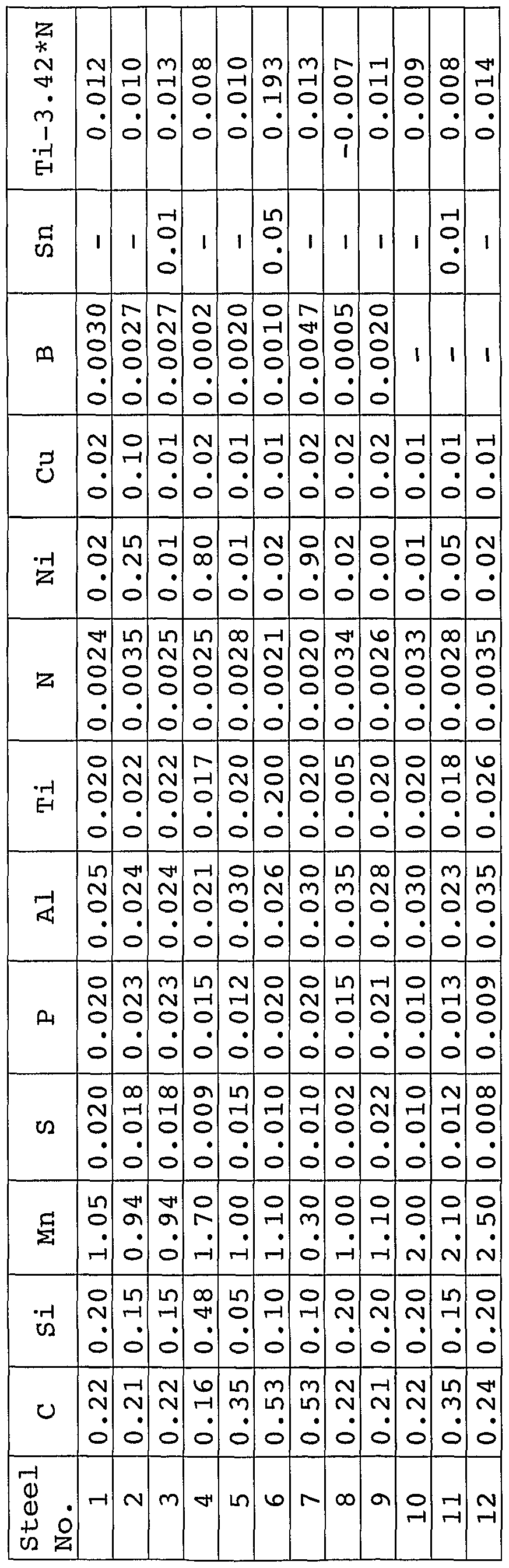
- the steels having various chemical compositions as shown in Table 4 were cast, heated again to a temperature of 1,050 to 1,250°C, thereafter hot-rolled, pickled, cold-rolled, annealed, subjected to a plating treatment (aluminum plating or aluminum-zinc plating: "Galvalium ® " plating), and thereafter subjected to temper rolling at the reduction rate of 0.8%. Further, as alloying process, these steel sheets were heated to a temperature of 900 to 1,000°C, retained for 5 minutes at the temperature, thereafter subjected to press forming with dies of the room temperature, and then subjected to the investigation on the properties.
- a plating treatment aluminum plating or aluminum-zinc plating: "Galvalium ® " plating
- the investigation on material properties was carried out by cutting out the specimens from the portions which were rapidly cooled at the press and applying a tensile test thereto.
- the test was carried out by cutting the specimens into No. 5 test pieces according to JIS-Z2201 and following the test method described in JIS-Z2241.
- the evaluation results are shown in Table 5.
- Specimens were cut out from the portions which underwent working during press forming and bare corrosion resistance and after-painting corrosion resistance were evaluated as the surface properties after high temperature forming.
- the bare corrosion resistance was evaluated by subjecting the specimens to a moisture tank test (relative humidity: 95%, temperature: 40°C) for 3 days, and the after-painting corrosion resistance was evaluated by subjecting the specimens to a salt spray test (JIS-Z2134) for 30 days after the specimens were cut in a cross shape.
- a cationic electrodeposition paint was adopted as the painting in this case and the painting thickness was 15 ⁇ m.
- the bare corrosion resistance was judged from the appearance using a mark O or X, and the evaluation criteria were: X for the occurrence of red rust and O for no red rust.
- the after- painting corrosion resistance was judged from the appearance using a mark O, ⁇ or X, and the evaluation criteria were: O for blistering of not more than 2 mm, ⁇ for blistering from more than 2 mm to not more than 4 mm, and X for blistering of more than 4 mm. Nos.
- 1 to 7 steels are the steels having the components within the range specified in the present invention, and all steel sheets produced on the conditions within the range specified in the present invention can secure high strength after high temperature forming and, moreover, have no problem with respect to both the bare corrosion resistance and the after-painting corrosion resistance.
- No. 7 steel the results of the steel sheet produced on the conditions where the annealing temperature deviates from the range specified in the present invention is also shown, and, in this case, as the strength of the steel sheet is too high, the evaluation of the properties is not carried out thereafter.
- the steel compositions deviate from the range specified in the present invention.
- the strength after high temperature forming which is one of the targets of the present invention, is low, and, in the case of No. 9 steel, the bare corrosion resistance and the after-painting corrosion resistance are not secured.
- Example 3 The steels having various chemical compositions as shown in Table 6 were cast, heated again to a temperature of 1,050 to 1,250°C, thereafter hot-rolled, pickled, cold-rolled, annealed, subjected to a plating treatment (aluminum plating or aluminum-zinc plating), and thereafter subjected to temper rolling at the reduction rate of 0.8%. Further, as substantial alloying process, these steel sheets were heated to a temperature of 900 to 1,000°C, retained for 5 minutes at this temperature, thereafter subjected to press forming with dies of the room temperature, and then subjected to the investigation on the properties. The investigation on material properties was carried out by cutting out specimens from the portions which were rapidly cooled at the press and applying a tensile test thereto. The test was carried out by cutting the specimens into No. 5 test pieces according to JIS-Z2201 and following the test method described in JIS-Z2241. The evaluation results are shown in Table 7.
- Specimens were cut out from the portions which underwent working during press forming and bare corrosion resistance and after-painting corrosion resistance were • evaluated as the surface properties after high temperature forming.
- the bare corrosion resistance was evaluated by subjecting the specimens to a moisture tank test (relative humidity: 95%, temperature: 40°C) for 3 days, and the after-painting corrosion resistance was evaluated by subjecting the specimens to a salt spray test (JIS-Z2134) for 30 days after the specimens were cut in a cross shape.
- a cationic electrodeposition paint was adopted as the painting in this case and the painting thickness was 15 ⁇ m.
- the bare corrosion resistance was judged from the appearance using a mark O or X, and the evaluation criteria were: X for the occurrence of red rust and O for no red rust.
- the after- painting corrosion resistance was judged from the appearance using a mark O, ⁇ or X, and the evaluation criteria were: O for blistering of not more than 2 mm, ⁇ for blistering from more than 2 mm to not more than 4 mm, and X for blistering of more than 4 mm. Nos.
- 1 to 9 steels are the steels having the components within the range specified in the present invention, and all steel sheets produced on the conditions within the range specified in the present invention can secure high strength after high temperature forming, and moreover have no problem with respect to both the bare corrosion resistance and the after-painting corrosion resistance.
- the steel composition deviates from the range specified in the present invention and therefore the bare corrosion resistance and the after-painting corrosion resistance are not secured.
- Example 4 Hot dip aluminum plating was applied to pickled steel sheets (1.8 mm in thickness) and cold-rolled steel sheets (1.2 mm in thickness) as the materials having steel compositions shown in Table 8 and being produced through regular hot-rolling and cold-rolling processes. Nos. 1, 3, 5 and 7 in Table 8 are cold-rolled steel sheets, and the rest are hot-rolled steel sheets.
- a line of non-oxidizing furnace-reducing furnace type was used, a deposit amount of plating was adjusted to 80 g/m 2 per both sides by the gas wiping method after plating, and, after that, the steel sheets were cooled and subjected to a zero-spangle treatment.
- the plating bath composition at the time was Al-10%Si-2%Fe. Fe in the bath is a component unavoidably supplied from the plating apparatus and the steel sheets in the bath. Plating appearance was good without having non-plating defects or the like. The properties are shown in Table 9.
- the hardenability and workability of the hot dip aluminum plated steel sheets thus produced were evaluated.
- the workability was evaluated by heating an aluminum plated steel sheet at 950 °C for 10 minutes under the atmosphere, as substantial alloying process, thereafter cooling it while inserting it between dies made of steel (cooling rate: about 30°C/sec), cooling it to the room temperature, and thereafter subjecting it to an impact test. Further, Vickers hardness at the cross- section of a steel sheet was measured by imposing a load of 100 g.
- the strength is rather low.
- a value close to the tensile strength (MPa) of a material is obtained by multiplying a Vickers hardness by 3, and, in this case, a strength of only 600 MPa class at the most is obtained.
- MPa tensile strength
- both strength and workability show good results.
- the Al amount in the Fe-Al coating layer in this case is quantitatively analyzed using an EPMA, and the value is around 15%.
- the value is obtained by analyzing 5 portions in a cross-section of a specimen after quenching in the range from the surface to the depth of 10 ⁇ m and averaging the analysis data.
- No. 1 steel sheet of this Example in Table 8 was plated with a metal mainly composed of Al-10%Si-2%Fe and the deposit amount of the plating was varied from 60 to 200 g/m 2 per both sides.
- the samples thus obtained were heated at 950 °C under the atmosphere with the retention time being changed, the workability was evaluated with an impact test, and the Al amount in the Fe-Al coating layer was measured by the method described in the item 1 of Example 4. As shown in Table 10, the workability depends on the Al amount in the Fe-Al coating layer, and, when the Al amount is not more than 35%, good workability is obtained.
- the Al amount in the Fe-Al coating layer depends on the deposit amount and the retention time, and it can be understood that, the smaller the deposit amount is and the longer the retention time is, the more the diffusion proceeds and the smaller the Al amount in the Fe-Al coating layer is.
- Hot dip Al-Si-Mg plating was applied to pickled steel sheets (1.8 mm in thickness) and cold-rolled steel sheets (1.2 mm in thickness) as the materials, having steel compositions shown in Table 11 and being produced through regular hot-rolling and cold-rolling processes.
- A, C, E and G in Table 11 are cold-rolled steel sheets, and the rest are hot-rolled steel sheets.
- the hot dip plating a line of non-oxidizing furnace-reducing furnace type was used, a deposit amount of plating was adjusted to 40 g/m 2 per one side by the gas wiping method after plating, and, after that, the steel sheets were cooled and subjected to a zero-spangle treatment.
- the plating bath composition at the time was Al-8%Si-6%Mg-l%Fe- 0.1%Ca.
- Fe in the bath is a component unavoidably supplied from the plating apparatus and the steel sheets in the bath.
- Plating appearance showed a spangle pattern and was good without having non-plating defects or the like.
- the production conditions in this case are shown in Table 12.
- the hardenability and corrosion resistance of the hot dip plated steel sheets thus produced were evaluated. The evaluation methods are described below.
- the hot dip plated steel sheets were subjected to 5% tensile stress, then heated at 950 °C for 5 minutes, and, as substantial alloying process, thereafter cooled while inserted between steel sheets.
- the cooling rate was about 30°C/sec.
- the heat resistance was evaluated by visually observing the specimens after cooling. Then, the bare corrosion resistance was evaluated by subjecting the specimens to a moisture tank test (relative humidity: 95%, temperature: 40 °C) for 3 days, and the after- painting corrosion resistance was evaluated by subjecting the specimens to a salt spray test (JIS-Z2134) for 30 days after the specimens were cut in a cross shape. A cationic electrodeposition paint was adopted as the painting in this case and the painting thickness was 15 ⁇ m. Further, the Vickers hardness of a steel sheet was measured by imposing a load of 100 g.
- Hot dip aluminum plating was applied to cold-rolled steel sheets (1.2 mm in thickness) as the materials, having a steel composition shown in Table 14 and being produced through regular hot-rolling and cold-rolling processes.
- a line of non-oxidizing furnace-reducing furnace type was used, a deposit amount of plating was adjusted to 60 g/m 2 per one side by the gas wiping method after plating, and, after that, the steel sheets were cooled and subjected to a zero-spangle treatment.
- the plating bath composition at the time was Al-10%Si-2%Fe. Fe in the bath is a component unavoidably supplied from the plating apparatus and the steel sheets in the bath. The plating appearance was good without having non-plating defects or the like.
- the aluminum plated steel sheets thus produced were heated to 950 °C, and, as substantial alloying process, the workability (exfoliation resistance) of the plated layers during air-cooling was evaluated.
- the thickness of the ferrite layers was varied by varying the heating times and heating patterns.
- the hardenability was good even at the cooling rate of 10°C/sec. and a structure mainly composed of martensite was obtained even in case of air-cooling.
- the relation between the thickness of the intermediate ferrite layer and the lowest temperature where good working can be obtained in this case is shown in Fig. 8.
- the exfoliation resistance of a plated layer improves .
- the thickness of a ferrite layer is about 0.5 ⁇ m, powdery exfoliation of a plated layer is observed even in the case of the working at 800 °C.
- the workability of a plated layer depends on the deposit amount of plating. Even though the thickness of a ferrite layer is 2 ⁇ m, when the deposit amount is 30 g/m 2 per one side, the lowest temperature where good working is obtained is about 500 °C.
- the structure of the base steel at the time was analyzed by the observation with an optical microscope and the subsequent image analysis, and not less than 80% of the structure was composed of martensite under all conditions.
- Example 7 Hot dip aluminum plating was applied to pickled steel sheets (1.8 mm in thickness) and cold-rolled steel sheets (1.2 mm in thickness) as the materials, having steel compositions shown in Table 15 and being produced through regular hot-rolling and cold-rolling processes. Nos. 1, 3 and 5 in Table 15 are cold-rolled steel sheets, and the rests are hot-rolled steel sheets.
- a line of non-oxidizing furnace- reducing furnace type was used, a deposit amount of plating was adjusted to 60 g/m 2 per one side by the gas wiping method after plating, and, after that, the steel sheets were cooled and subjected to a zero-spangle treatment.
- the plating bath composition at the time was Al-10%Si-2%Fe.
- Plating appearance was good without having non-plating defects or the like.
- the hot dip aluminum plated steel sheets thus produced were heated to 950 °C, and, as substantial alloying process, thereafter subjected to press forming at the time when the temperature reached about 600 °C while cooled by water- cooled dies.
- the exfoliation state of a plated layer at the portion to which bending working was applied was visually judged and the exfoliation of a plated layer was not observed for all steel sheets.
- the thickness of the ferrite layers was 10 to 20 ⁇ m, and the martensite percentage in all base steels was not less than 80%.
- the cooling rate was about 150°C/sec.
- Hot dip aluminum plating was applied to cold-rolled steel sheets (1.2 mm in thickness) as the materials, having a steel composition shown in Table 16 and being produced through regular hot-rolling and cold-rolling processes.
- a line of non-oxidizing furnace-reducing furnace type was used, the deposit amounts of plating were adjusted to 30 to 80 g/m 2 per one side by the gas wiping method after plating, and, after that, the steel sheets were cooled and subjected to a zero-spangle treatment.
- the plating bath composition at the time was Al-10%Si-2%Fe. Fe in the bath is a component unavoidably supplied from the plating apparatus and the steel sheets in the bath. Plating appearance was good without having non-plating defects or the like.
- the hardness after quenching, the thickness of the intermetallic compounds, weldability, heat resistance and after-painting corrosion resistance of the aluminum plated steel sheets thus produced were evaluated.
- the quenching was applied by heating a steel sheet at 950 °C for 0.5 to 20 minutes in the atmosphere, and, as substantial alloying process, thereafter pressing the steel sheet in the state of a plane sheet with dies and cooling it. At the time, the cooling rate was about 300°C/sec.
- Vickers hardness was measured at the center portion in the cross-section of a steel sheet by imposing a load of 100 g. [Thickness of intermetallic compound]
- the thickness of an intermetallic compound was measured by observing the cross-section of a steel sheet using a microscope, then etching it with 2% nitral, and thereafter analyzing the structure using an EPMA.
- An example of the analysis is shown in Fig. 9.
- the reference numeral 1 shows the layer composed of Al: 26.85%, Si: 9.83%, Fe: 59.92%;
- the reference numeral 2 the layer composed of Al: 49.54%, Si: 3.11%, Fe: 44.87%;
- the reference numeral 3 the layer composed of Al: 30.75%, Si: 8.88%, Fe: 56.91%;
- the reference numeral 4 the layer composed of Al: 9.59%, Si: 2.92%, Fe: 84.02%.
- [Weldability] Spot weldability was evaluated on the following conditions:
- Dome electrode made of alumina dispersed copper and having an electrode tip of 6 ⁇ -40R, Pressure; 600 kgf, Welding current; 10 kA,
- a steel sheet was subjected to a chemical treatment for about 2 minutes in a chemical treatment liquid, which was commonly used for aluminum plating a steel sheet and zinc plating, then coated with a cationic electrodeposition paint of 20 ⁇ m in thickness, baked at 140°C for 20 minutes, and thereafter subjected to a salt spray test for 20 days after cut in a cross shape, and the after-painting corrosion resistance was judged by the corrosion depth at the portion cut in a cross shape.
- the depth of the cut in a cross shape with a cutter was about 50 ⁇ m. Therefore, a value obtained by subtracting 50 ⁇ m from a measured value is a true corrosion depth.
- the steel sheet tends to be excellent in spot weldability but to be inferior in after-painting corrosion resistance.
- the steel sheet is inferior in after-painting corrosion resistance
- the steel sheet is inferior in spot weldability.
- the steel sheets tend to be inferior in spot weldability. Therefore, when spot weldability is regarded as important, it is desirable to make the thickness of an alloy layer rather thin.
- Hot dip aluminum plating was applied to cold-rolled steel sheets (1.2 mm in thickness) as the materials having a steel composition shown in Table 19 and being produced through regular hot-rolling and cold-rolling processes.
- a line of non-oxidizing furnace-reducing furnace type was used, a deposit amount of plating was adjusted to 60 g/m 2 per one side by the gas wiping method after plating, and, after that, the steel sheets were cooled and subjected to a zero-spangle treatment.
- the plating bath composition at the time was Al-10%Si-2%Fe. Fe in the bath is a component unavoidably supplied from the plating apparatus and the steel sheets in the bath. The plating appearance was good without having non-plating defects or the like.
- the hot dip aluminum plated steel sheets thus produced were heated in the atmosphere, then retained at various temperatures, and formed into the shape shown in Fig. 10.
- the steel sheets were cooled with water- cooled dies.
- the heating rate was about 5 to 10°C/sec, and the cooling rate was, though it varied with the portions, about 100°C/sec. at a portion where cooling rate was high and about 20°C/sec. at a portion where cooling rate was low.
- the workability (exfoliation resistance) of a plated layer at the time was evaluated.
- the exfoliation of the plated layers was formed in a shape of streak or in a shape of spot on the compressed surface.
- the relation between the heating conditions and the state of the exfoliation of the plated layers is shown in Table 20. Further, the heating conditions according to the present invention are shown in Fig. 11.
- the present invention provides a hot press method for forming a high-strength automotive part, and will greatly contribute to the weight reduction of an automobile in the future.
Landscapes
- Chemical & Material Sciences (AREA)
- Engineering & Computer Science (AREA)
- Materials Engineering (AREA)
- Mechanical Engineering (AREA)
- Metallurgy (AREA)
- Organic Chemistry (AREA)
- Chemical Kinetics & Catalysis (AREA)
- Physics & Mathematics (AREA)
- Thermal Sciences (AREA)
- Oil, Petroleum & Natural Gas (AREA)
- Crystallography & Structural Chemistry (AREA)
- Coating With Molten Metal (AREA)
Abstract
Description




Claims


Priority Applications (2)
| Application Number | Priority Date | Filing Date | Title |
|---|---|---|---|
| KR1020037016351A KR100836282B1 (en) | 2001-06-15 | 2002-06-14 | High Strength Aluminum Based Alloy Plated Steel Sheet |
| AU2002309283A AU2002309283B2 (en) | 2001-06-15 | 2002-06-14 | High-strength Alloyed Aluminum-system Plated Steel Sheet and High-strength Automotive Part Excellent in Heat Resistance and After-painting Corrosion Resistance |
Applications Claiming Priority (22)
| Application Number | Priority Date | Filing Date | Title |
|---|---|---|---|
| JP2001-181833 | 2001-06-15 | ||
| JP2001181833A JP3845271B2 (en) | 2001-06-15 | 2001-06-15 | Aluminum or aluminum-galvanized steel sheet suitable for high temperature forming and having high strength after high temperature forming and method for producing the same |
| JP2001-190709 | 2001-06-25 | ||
| JP2001190709A JP4564207B2 (en) | 2001-06-25 | 2001-06-25 | Hot-pressed hot-dip aluminized steel sheet that is heated to 800 ° C or higher |
| JP2001190707A JP4023710B2 (en) | 2001-06-25 | 2001-06-25 | Aluminum-plated steel sheet for hot press with excellent corrosion resistance and heat resistance, and automotive parts using the same |
| JP2001190708A JP4634655B2 (en) | 2001-06-25 | 2001-06-25 | Aluminized steel sheet for hot press with excellent heat resistance |
| JP2001-190707 | 2001-06-25 | ||
| JP2001-190708 | 2001-06-25 | ||
| JP2001198431 | 2001-06-29 | ||
| JP2001-198431 | 2001-06-29 | ||
| JP2001-220807 | 2001-07-23 | ||
| JP2001220807A JP4612240B2 (en) | 2001-07-23 | 2001-07-23 | High-strength aluminized steel sheet with excellent corrosion resistance after painting and automotive parts using it |
| JP2001228431A JP4990449B2 (en) | 2001-07-27 | 2001-07-27 | Aluminum-coated steel sheet for high-strength automotive parts and automotive parts using the same |
| JP2001-228431 | 2001-07-27 | ||
| JP2001-241633 | 2001-08-09 | ||
| JP2001241633A JP4551034B2 (en) | 2001-08-09 | 2001-08-09 | High-strength aluminum plated steel sheet for automobile parts with excellent weldability and post-painting corrosion resistance, and automobile parts using the same |
| JP2001264727 | 2001-08-31 | ||
| JP2001-264727 | 2001-08-31 | ||
| JP2001-383852 | 2001-12-18 | ||
| JP2001383852A JP2003183802A (en) | 2001-12-18 | 2001-12-18 | High-strength aluminum-coated steel sheet and high-strength automotive parts with excellent heat resistance and corrosion resistance after painting |
| JP2001-390842 | 2001-12-25 | ||
| JP2001390842A JP4022063B2 (en) | 2001-12-25 | 2001-12-25 | High-strength aluminum-plated steel sheet and high-strength automotive parts with excellent workability and corrosion resistance |
Publications (2)
| Publication Number | Publication Date |
|---|---|
| WO2002103073A2 true WO2002103073A2 (en) | 2002-12-27 |
| WO2002103073A3 WO2002103073A3 (en) | 2004-05-21 |
Family
ID=27582331
Family Applications (1)
| Application Number | Title | Priority Date | Filing Date |
|---|---|---|---|
| PCT/JP2002/005978 Ceased WO2002103073A2 (en) | 2001-06-15 | 2002-06-14 | High-strength alloyed aluminum-system plated steel sheet and high-strength automotive part excellent in heat resistance and after-painting corrosion resistance |
Country Status (5)
| Country | Link |
|---|---|
| KR (4) | KR20070087240A (en) |
| CN (1) | CN100370054C (en) |
| AU (1) | AU2002309283B2 (en) |
| TW (1) | TWI317383B (en) |
| WO (1) | WO2002103073A2 (en) |
Cited By (43)
| Publication number | Priority date | Publication date | Assignee | Title |
|---|---|---|---|---|
| US8066829B2 (en) | 2008-01-15 | 2011-11-29 | Arcelormittal France | Process for manufacturing stamped products, and stamped products prepared from the same |
| CN102676918A (en) * | 2012-06-13 | 2012-09-19 | 鞍钢股份有限公司 | Hot rolled steel plate for hot-dip galvanizing pot and production method thereof |
| WO2012137687A1 (en) | 2011-04-01 | 2012-10-11 | 新日本製鐵株式会社 | Hot stamp-molded high-strength component having excellent corrosion resistance after coating, and method for manufacturing same |
| CN102734625A (en) * | 2012-07-17 | 2012-10-17 | 江苏龙源金属科技有限公司 | Steel-aluminum composite board and preparation method thereof |
| US8398786B2 (en) * | 2005-10-06 | 2013-03-19 | Posco | Precipitation hardening cold rolled steel sheet having excellent yield ratios, and the method for manufacturing the same |
| CN103342020A (en) * | 2013-07-10 | 2013-10-09 | 鞍钢股份有限公司 | Heat-resistant wear-resistant composite steel plate and manufacturing method thereof |
| EP2468911A4 (en) * | 2009-08-21 | 2014-07-09 | Jfe Steel Corp | HOT PRESSED ELEMENT, STEEL SHEET FOR HOT PRESSED ELEMENT, AND METHOD FOR MANUFACTURING HOT PRESSED ELEMENT |
| US20140238555A1 (en) * | 2011-11-04 | 2014-08-28 | Jfe Steel Corporation | High strength hot rolled steel sheet and method for manufacturing the same |
| US8911879B2 (en) | 2009-01-16 | 2014-12-16 | Nippon Steel & Sumitomo Metal Corporation | Hot-dip Zn—Al—Mg—Si—Cr alloy-coated steel material with excellent corrosion resistance |
| US9708683B2 (en) | 2006-10-30 | 2017-07-18 | Arcelormittal France | Coated steel strips, methods of making the same, methods of using the same, stamping blanks prepared from the same, stamped products prepared from the same, and articles of manufacture which contain such a stamped product |
| US9718125B2 (en) | 2006-09-06 | 2017-08-01 | Arcelormittal France | Steel plate for producing light structures and method for producing said plate |
| US20170306435A1 (en) * | 2014-10-30 | 2017-10-26 | Jfe Steel Corporation | High-strength steel sheet, high-strength hot-dip galvanized steel sheet, high-strength hot-dip aluminum-coated steel sheet, and high-strength electrogalvanized steel sheet, and methods for manufacturing same |
| WO2018006490A1 (en) * | 2016-07-08 | 2018-01-11 | 东北大学 | Steel for hot stamping forming, hot stamping forming process and hot-stamping formed component |
| TWI616538B (en) * | 2013-05-17 | 2018-03-01 | Ak鋼鐵資產公司 | High-strength steel exhibiting good ductility and manufacturing method by quenching and distributing treatment through zinc bath |
| US9963758B2 (en) | 2014-12-24 | 2018-05-08 | Posco | Hot press formed parts having excellent powdering resistance during hot press forming |
| EP3305938A4 (en) * | 2015-05-26 | 2018-06-20 | Posco | Hot press formed article having good anti-delamination, and preparation method for same |
| US10151013B2 (en) | 2014-12-24 | 2018-12-11 | Posco | Hot press forming parts having excellent bending properties and method for manufacturing the same |
| US10174413B2 (en) | 2013-05-07 | 2019-01-08 | Nippon Steel & Sumitomo Metal Corporation | Al-based alloy plated steel material having excellent post-coating corrosion resistance |
| US10253388B2 (en) | 2013-12-25 | 2019-04-09 | Posco | Steel sheet for hot press formed product having superior bendability and ultra-high strength, hot press formed product using same, and method for manufacturing same |
| WO2019194308A1 (en) | 2018-04-06 | 2019-10-10 | 日本製鉄株式会社 | Layered blank for hot stamping, method for manufacturing layered hot stamping molded body, and layered hot stamping molded body |
| US10590522B2 (en) | 2015-12-23 | 2020-03-17 | Posco | Aluminum-iron alloy-coated steel sheet for hot press forming, having excellent hydrogen delayed fracture resistance, peeling resistance, and weldability and hot-formed member using same |
| US10640840B2 (en) | 2014-12-24 | 2020-05-05 | Posco | Hot press formed article having excellent delamination resistance and method for manufacturing the same |
| US10669603B2 (en) | 2014-09-05 | 2020-06-02 | Thyssenkrupp Steel Europe Ag | Flat steel product with an Al-coating, method for producing the same, steel component and method for producing the same |
| KR20200092352A (en) * | 2018-02-15 | 2020-08-03 | 닛폰세이테츠 가부시키가이샤 | Fe-Al plating hot stamp member and method for manufacturing Fe-Al plating hot stamp member |
| CN111575622A (en) * | 2020-05-11 | 2020-08-25 | 马鞍山钢铁股份有限公司 | Aluminum-plated steel sheet for hot-formed parts having excellent coating properties, method for producing same, and hot-formed parts |
| EP3578680A4 (en) * | 2017-02-02 | 2020-10-14 | Nippon Steel Corporation | WITH ALLOY AL-CLAD STEEL SHEET FOR HOT STAMPING AND HOT STAMPED ELEMENT |
| US11034132B2 (en) | 2016-12-21 | 2021-06-15 | Posco | High manganese hot dip aluminum-plated steel sheet having excellent sacrificial corrosion resistance and platability and manufacturing method therefor |
| CN113308660A (en) * | 2017-06-01 | 2021-08-27 | Posco公司 | Steel sheet for hot press-formed member having excellent plating adhesion and method for producing same |
| WO2021172379A1 (en) | 2020-02-26 | 2021-09-02 | 日本製鉄株式会社 | Method for manufacturing layered hot stamping molded body and layered hot stamping molded body |
| US11167527B2 (en) | 2016-12-23 | 2021-11-09 | Posco | Aluminum-based plated steel having excellent corrosion resistance, aluminum-based alloy plated steel using the same, and method of manufacturing thereof |
| US11285698B2 (en) | 2018-03-20 | 2022-03-29 | Nippon Steel Corporation | Hot-stamped body |
| US11338550B2 (en) | 2018-03-20 | 2022-05-24 | Nippon Steel Corporation | Hot-stamped body |
| JP2022527593A (en) * | 2019-04-09 | 2022-06-02 | アルセロールミタル | Assembly of aluminum parts and pressed hardened steel parts with an alloyed coating containing silicon, iron, zinc and magnesium, with a residue of aluminum. |
| US20220340993A1 (en) * | 2019-09-19 | 2022-10-27 | Baoshan Iron & Steel Co., Ltd. | Hot-rolled steel plate/strip for sulfuric acid dew point corrosion resistance and manufacturing method therefor |
| US11535907B2 (en) * | 2016-12-19 | 2022-12-27 | Posco Co., Ltd | Hot rolled steel plate for electric resistance welded steel pipe having excellent weldability, and manufacturing method thereof |
| EP3889311B1 (en) | 2018-11-30 | 2023-11-01 | POSCO Co., Ltd | Hot press-formed part, and manufacturing method thereof |
| WO2023224122A1 (en) | 2022-05-19 | 2023-11-23 | 日本製鉄株式会社 | Layered blank for hot stamping and layered hot stamp molded body |
| WO2023224123A1 (en) | 2022-05-19 | 2023-11-23 | 日本製鉄株式会社 | Method for producing layered hot stamp molded body |
| US11939651B2 (en) | 2018-05-31 | 2024-03-26 | Posco Co., Ltd | Al—Fe-alloy plated steel sheet for hot forming, having excellent TWB welding characteristics, hot forming member, and manufacturing methods therefor |
| US12129527B2 (en) * | 2015-03-23 | 2024-10-29 | Arcelormittal | Parts with a bainitic structure having high strength properties and manufacturing process |
| US12234538B2 (en) | 2018-11-30 | 2025-02-25 | Nippon Steel Corporation | Aluminum-plated steel sheet, hot-stamped member, and method for manufacturing hot-stamped member |
| US12351886B2 (en) | 2015-07-30 | 2025-07-08 | Arcelormittal | Coated steel sheet |
| US12404575B2 (en) | 2021-04-05 | 2025-09-02 | Nippon Steel Corporation | Hot-stamped product |
Families Citing this family (31)
| Publication number | Priority date | Publication date | Assignee | Title |
|---|---|---|---|---|
| JP4470701B2 (en) * | 2004-01-29 | 2010-06-02 | Jfeスチール株式会社 | High-strength thin steel sheet with excellent workability and surface properties and method for producing the same |
| CN101015971B (en) * | 2007-02-05 | 2011-05-11 | 蒋彩峰 | Steel plate type novel decorative plate and manufacture method |
| KR101316819B1 (en) * | 2008-09-19 | 2013-10-10 | 유니온스틸 주식회사 | Method for Manufacturing Hot-dipped Aluminum Coated Steel Sheet Having Improved Surface Appearance |
| KR101008042B1 (en) * | 2009-01-09 | 2011-01-13 | 주식회사 포스코 | Aluminum plated steel sheet with excellent corrosion resistance, hot press-formed products using the same and manufacturing method thereof |
| ES2876258T3 (en) * | 2009-12-29 | 2021-11-12 | Posco | Zinc Plated Hot Pressed Parts and Production Procedure |
| TWI402360B (en) * | 2010-06-24 | 2013-07-21 | Nippon Steel & Sumitomo Metal Corp | And a method for producing the molten Al-plated steel sheet with excellent heat resistance and blackening property |
| JP5729211B2 (en) * | 2010-08-31 | 2015-06-03 | Jfeスチール株式会社 | Cold rolled steel sheet manufacturing method, cold rolled steel sheet and automobile member |
| US10087510B2 (en) | 2011-05-19 | 2018-10-02 | Nippon Steel & Sumitomo Metal Corporation | Non-post-heat treated steel and non-post-heat treated steel member |
| PL2816139T3 (en) * | 2012-02-14 | 2020-04-30 | Nippon Steel Corporation | Plated steel plate for hot pressing and hot pressing method of plated steel plate |
| CN103509980A (en) * | 2013-10-12 | 2014-01-15 | 北京科技大学 | Al-Mg-Si-CU-Zn aluminum alloy and preparation method and application thereof |
| KR101585736B1 (en) * | 2013-12-25 | 2016-01-15 | 주식회사 포스코 | Steel sheet for hot press forming having high microcracking resistance and corrosion property and hot press formed article using the same and method for manufacturing the same |
| CN105441823B (en) * | 2014-09-26 | 2017-12-05 | 鞍钢股份有限公司 | Ultrahigh-strength hot-dip aluminum-plated steel plate and manufacturing method thereof |
| CN105506509B (en) * | 2014-09-26 | 2017-07-21 | 鞍钢股份有限公司 | High-strength hot-dip aluminum-plated steel plate and manufacturing method thereof |
| KR101696052B1 (en) * | 2014-12-24 | 2017-01-13 | 주식회사 포스코 | Forming part having excellent corrosion resistance and manufacturing method thereof |
| CN105251802B (en) * | 2015-11-05 | 2017-09-15 | 福州大学 | A kind of high-strength medium plate hot stamping method |
| CN105483533A (en) * | 2015-12-08 | 2016-04-13 | 靖江市新程汽车零部件有限公司 | Fixed support for SUV automobile engine and manufacturing method of fixed support |
| CN105695866A (en) * | 2016-04-23 | 2016-06-22 | 徐挺 | High-temperature-resistant alloy steel and preparation method thereof |
| US11111568B2 (en) * | 2016-09-30 | 2021-09-07 | Nippon Steel Corporation | Steel for cold forging and manufacturing method thereof |
| KR101858863B1 (en) | 2016-12-23 | 2018-05-17 | 주식회사 포스코 | Hot dip aluminum alloy plated steel material having excellent corrosion resistance and workability |
| CA3051515A1 (en) * | 2017-02-28 | 2018-09-07 | Tata Steel Ijmuiden B.V. | Method for producing a steel strip with an aluminium alloy coating layer |
| CN107130170B (en) * | 2017-04-21 | 2018-09-14 | 中车齐齐哈尔车辆有限公司 | A kind of steel alloy and integrated form brake beam frame and its manufacturing method |
| EP3421629B1 (en) * | 2017-06-28 | 2020-04-22 | Tata Steel Nederland Technology B.V. | High strength high ductility steel with superior formability |
| CN107858599B (en) * | 2017-09-29 | 2019-06-21 | 重庆沃亚机械有限公司 | A kind of wear-resistant enhanced fan blade and preparation method thereof |
| KR102153164B1 (en) | 2017-12-26 | 2020-09-07 | 주식회사 포스코 | Plated steel for hot press forming and forming part by using the same |
| CN108588570A (en) * | 2018-08-10 | 2018-09-28 | 武汉钢铁集团鄂城钢铁有限责任公司 | 600 DEG C of medium temperature acid corrosion-resistant pressure vessel steels of one kind and preparation method thereof |
| CN109435362B (en) * | 2018-09-25 | 2021-01-15 | 首钢集团有限公司 | A kind of anti-corrosion cold-rolled steel plate and its manufacturing method |
| CN112877590A (en) | 2019-11-29 | 2021-06-01 | 宝山钢铁股份有限公司 | Coated hot-formed part with excellent performance and manufacturing method thereof |
| US11932925B2 (en) * | 2020-01-21 | 2024-03-19 | Novelis Inc. | Aluminum alloys and coated aluminum alloys with high corrosion resistance and methods of making the same |
| KR102330812B1 (en) * | 2020-06-30 | 2021-11-24 | 현대제철 주식회사 | Steel sheet for hot press and manufacturing method thereof |
| CN117529572B (en) * | 2021-06-04 | 2026-05-08 | 方丹控股有限公司 | Production method of fire-resistant steel components |
| CN118668131B (en) * | 2024-05-31 | 2025-10-17 | 马鞍山钢铁股份有限公司 | Economical 800 MPa-grade high-surface-quality high-expansion-ratio steel for pickling automobile and manufacturing method and application thereof |
Family Cites Families (11)
| Publication number | Priority date | Publication date | Assignee | Title |
|---|---|---|---|---|
| ES317653A1 (en) * | 1964-09-23 | 1966-03-16 | Inland Steel Co | A procedure for making steel plate thick with great strength to the traction. (Machine-translation by Google Translate, not legally binding) |
| JPH07100825B2 (en) * | 1986-09-30 | 1995-11-01 | 川崎製鉄株式会社 | Manufacturing method of stainless clad steel |
| JP2505087B2 (en) * | 1992-02-27 | 1996-06-05 | 株式会社神戸製鋼所 | Method for manufacturing high tensile strength steel by low temperature annealing |
| JP3266995B2 (en) * | 1993-07-30 | 2002-03-18 | 株式会社日立製作所 | Method and apparatus for observing and measuring conductive members |
| WO1996026300A1 (en) * | 1995-02-23 | 1996-08-29 | Nippon Steel Corporation | Cold-rolled steel sheet and hot-dipped galvanized steel sheet excellent in uniform workability, and process for producing the sheets |
| EP0743373B1 (en) * | 1995-05-18 | 1999-08-18 | Nippon Steel Corporation | Hot-dipped aluminum coated steel sheet having excellent corrosion resistance and heat resistance, and production method thereof |
| FR2775297B1 (en) * | 1998-02-25 | 2000-04-28 | Lorraine Laminage | SHEET WITH CRACK RESISTANT ALUMINUM COATING |
| CN1117884C (en) * | 1998-09-29 | 2003-08-13 | 川崎制铁株式会社 | High-strength thin steel sheet, high-strength alloyed hot-dip galvanized steel sheet, and manufacturing method thereof |
| JP3962186B2 (en) * | 1998-12-11 | 2007-08-22 | 新日本製鐵株式会社 | Thin steel plate excellent in heat treatment hardening ability and method for producing high-strength press-formed body using the steel plate |
| JP4136286B2 (en) * | 1999-08-09 | 2008-08-20 | 新日本製鐵株式会社 | Zn-Al-Mg-Si alloy plated steel with excellent corrosion resistance and method for producing the same |
| JP2001158938A (en) * | 1999-12-03 | 2001-06-12 | Nkk Corp | Hot-dip coated steel sheet with excellent corrosion resistance at the cut end |
-
2002
- 2002-06-14 WO PCT/JP2002/005978 patent/WO2002103073A2/en not_active Ceased
- 2002-06-14 CN CNB028120361A patent/CN100370054C/en not_active Ceased
- 2002-06-14 TW TW091113018A patent/TWI317383B/en not_active IP Right Cessation
- 2002-06-14 KR KR1020077017549A patent/KR20070087240A/en not_active Ceased
- 2002-06-14 AU AU2002309283A patent/AU2002309283B2/en not_active Ceased
- 2002-06-14 KR KR1020037016351A patent/KR100836282B1/en not_active Ceased
- 2002-06-14 KR KR1020087029007A patent/KR20080108163A/en not_active Ceased
- 2002-06-14 KR KR1020077027723A patent/KR20070119096A/en not_active Withdrawn
Cited By (90)
| Publication number | Priority date | Publication date | Assignee | Title |
|---|---|---|---|---|
| US8398786B2 (en) * | 2005-10-06 | 2013-03-19 | Posco | Precipitation hardening cold rolled steel sheet having excellent yield ratios, and the method for manufacturing the same |
| US8864922B2 (en) | 2005-10-06 | 2014-10-21 | Posco | Method for manufacturing a precipitation-hardening cold-rolled steel sheet having excellent yield ratios |
| US10702916B2 (en) | 2006-09-06 | 2020-07-07 | Arcelormittal France | Steel plate for producing light structures and method for producing said plate |
| US9718125B2 (en) | 2006-09-06 | 2017-08-01 | Arcelormittal France | Steel plate for producing light structures and method for producing said plate |
| EP3587105B1 (en) | 2006-10-30 | 2022-09-21 | ArcelorMittal | Coated steel strips, methods of making the same, methods of using the same, stamping blanks prepared from the same, stamped products prepared from the same, and articles of manufacture which contain such a stamped product |
| US9708683B2 (en) | 2006-10-30 | 2017-07-18 | Arcelormittal France | Coated steel strips, methods of making the same, methods of using the same, stamping blanks prepared from the same, stamped products prepared from the same, and articles of manufacture which contain such a stamped product |
| US10961602B2 (en) | 2006-10-30 | 2021-03-30 | Arcelormittal | Coated steel strips, coated stamped products and methods |
| US11041226B2 (en) | 2006-10-30 | 2021-06-22 | Arcelormittal | Coated steel strips, coated stamped products and methods |
| US12454737B2 (en) | 2006-10-30 | 2025-10-28 | Arcelormittal | Method of forming a hot stamped coated steel product |
| EP3290200B1 (en) | 2006-10-30 | 2021-12-01 | ArcelorMittal | Coated steel strips, methods of making the same, methods of using the same, stamping blanks prepared from the same, stamped products prepared from the same, and articles of manufacture which contain such a stamped product |
| US10597747B2 (en) | 2006-10-30 | 2020-03-24 | Arcelormittal | Coated steel strips, coated stamped products and methods |
| US10590507B2 (en) | 2006-10-30 | 2020-03-17 | Arcelormittal | Coated steel strips, coated stamped products and methods |
| EP3587104B1 (en) | 2006-10-30 | 2022-03-30 | ArcelorMittal | Coated steel strips |
| US11939643B2 (en) | 2006-10-30 | 2024-03-26 | Arcelormittal | Coated steel strips, coated stamped products and methods |
| US10577674B2 (en) | 2006-10-30 | 2020-03-03 | Arcelormittal | Coated steel strips, coated stamped products and methods |
| US10550447B2 (en) | 2006-10-30 | 2020-02-04 | Arcelormittal | Coated steel strips, coated stamped products and methods |
| US11326227B2 (en) | 2006-10-30 | 2022-05-10 | Arcelormittal | Coated steel strips, coated stamped products and methods |
| US12012640B2 (en) | 2006-10-30 | 2024-06-18 | Arcelormittal | Method of forming a hot stamped coated steel product |
| US8066829B2 (en) | 2008-01-15 | 2011-11-29 | Arcelormittal France | Process for manufacturing stamped products, and stamped products prepared from the same |
| US8440323B2 (en) | 2008-01-15 | 2013-05-14 | Arcelormittal France | Coated steel stamped product |
| US8733142B2 (en) | 2008-01-15 | 2014-05-27 | Arcelormittal France | Process for manufacturing stamped products, and stamped products prepared from the same |
| US8911879B2 (en) | 2009-01-16 | 2014-12-16 | Nippon Steel & Sumitomo Metal Corporation | Hot-dip Zn—Al—Mg—Si—Cr alloy-coated steel material with excellent corrosion resistance |
| EP2468911A4 (en) * | 2009-08-21 | 2014-07-09 | Jfe Steel Corp | HOT PRESSED ELEMENT, STEEL SHEET FOR HOT PRESSED ELEMENT, AND METHOD FOR MANUFACTURING HOT PRESSED ELEMENT |
| US8986849B2 (en) | 2011-04-01 | 2015-03-24 | Nippon Steel & Sumitomo Metal Corporation | Hot stamped high strength part excellent in post painting anticorrosion property and method of production of same |
| EP2695963A4 (en) * | 2011-04-01 | 2014-11-05 | Nippon Steel & Sumitomo Metal Corp | HOT STAMPED HIGH RESISTANCE COMPONENT HAVING EXCELLENT CORROSION RESISTANCE AFTER COATING, AND PROCESS FOR PRODUCING THE SAME |
| CN103492605A (en) * | 2011-04-01 | 2014-01-01 | 新日铁住金株式会社 | Hot stamp-molded high-strength component having excellent corrosion resistance after coating, and method for manufacturing same |
| CN103492605B (en) * | 2011-04-01 | 2016-07-06 | 新日铁住金株式会社 | The high-strength parts of the hot forming of corrosion resistance excellent and manufacture method thereof after application |
| WO2012137687A1 (en) | 2011-04-01 | 2012-10-11 | 新日本製鐵株式会社 | Hot stamp-molded high-strength component having excellent corrosion resistance after coating, and method for manufacturing same |
| US9644252B2 (en) | 2011-04-01 | 2017-05-09 | Nippon Steel & Sumitomo Metal Corporation | Hot stamped high strength part excellent in post painting anticorrosion property and method of production of same |
| US20140238555A1 (en) * | 2011-11-04 | 2014-08-28 | Jfe Steel Corporation | High strength hot rolled steel sheet and method for manufacturing the same |
| CN102676918A (en) * | 2012-06-13 | 2012-09-19 | 鞍钢股份有限公司 | Hot rolled steel plate for hot-dip galvanizing pot and production method thereof |
| CN102734625A (en) * | 2012-07-17 | 2012-10-17 | 江苏龙源金属科技有限公司 | Steel-aluminum composite board and preparation method thereof |
| US10174413B2 (en) | 2013-05-07 | 2019-01-08 | Nippon Steel & Sumitomo Metal Corporation | Al-based alloy plated steel material having excellent post-coating corrosion resistance |
| TWI616538B (en) * | 2013-05-17 | 2018-03-01 | Ak鋼鐵資產公司 | High-strength steel exhibiting good ductility and manufacturing method by quenching and distributing treatment through zinc bath |
| CN103342020A (en) * | 2013-07-10 | 2013-10-09 | 鞍钢股份有限公司 | Heat-resistant wear-resistant composite steel plate and manufacturing method thereof |
| US10253388B2 (en) | 2013-12-25 | 2019-04-09 | Posco | Steel sheet for hot press formed product having superior bendability and ultra-high strength, hot press formed product using same, and method for manufacturing same |
| US11692234B2 (en) | 2014-09-05 | 2023-07-04 | Thyssenkrupp Steel Europe Ag | Flat steel product with an AI-coating, method for producing the same, steel component and method for producing the same |
| US10669603B2 (en) | 2014-09-05 | 2020-06-02 | Thyssenkrupp Steel Europe Ag | Flat steel product with an Al-coating, method for producing the same, steel component and method for producing the same |
| US20170306435A1 (en) * | 2014-10-30 | 2017-10-26 | Jfe Steel Corporation | High-strength steel sheet, high-strength hot-dip galvanized steel sheet, high-strength hot-dip aluminum-coated steel sheet, and high-strength electrogalvanized steel sheet, and methods for manufacturing same |
| EP3239336B1 (en) | 2014-12-24 | 2021-03-17 | Posco | Hot press formed parts having excellent powdering resistance during hot press forming, and method for manufacturing same |
| US10533237B2 (en) | 2014-12-24 | 2020-01-14 | Posco | Hot press forming parts having excellent bending properties and method for manufacturing the same |
| US10808292B2 (en) | 2014-12-24 | 2020-10-20 | Posco | Method of manufacturing hot press formed parts having excellent powdering resistance |
| US10151013B2 (en) | 2014-12-24 | 2018-12-11 | Posco | Hot press forming parts having excellent bending properties and method for manufacturing the same |
| US10640840B2 (en) | 2014-12-24 | 2020-05-05 | Posco | Hot press formed article having excellent delamination resistance and method for manufacturing the same |
| US9963758B2 (en) | 2014-12-24 | 2018-05-08 | Posco | Hot press formed parts having excellent powdering resistance during hot press forming |
| US12129527B2 (en) * | 2015-03-23 | 2024-10-29 | Arcelormittal | Parts with a bainitic structure having high strength properties and manufacturing process |
| EP3305938A4 (en) * | 2015-05-26 | 2018-06-20 | Posco | Hot press formed article having good anti-delamination, and preparation method for same |
| US10655204B2 (en) | 2015-05-26 | 2020-05-19 | Posco | Hot press formed article having good anti-delamination, and preparation method for same |
| US12351886B2 (en) | 2015-07-30 | 2025-07-08 | Arcelormittal | Coated steel sheet |
| US12416058B2 (en) | 2015-07-30 | 2025-09-16 | Arcelormittal | Hot formed pre-coated steel part |
| US10590522B2 (en) | 2015-12-23 | 2020-03-17 | Posco | Aluminum-iron alloy-coated steel sheet for hot press forming, having excellent hydrogen delayed fracture resistance, peeling resistance, and weldability and hot-formed member using same |
| US11377703B2 (en) | 2016-07-08 | 2022-07-05 | Northeastern University | Steel material for hot stamping, hot stamping process and hot stamped component |
| WO2018006490A1 (en) * | 2016-07-08 | 2018-01-11 | 东北大学 | Steel for hot stamping forming, hot stamping forming process and hot-stamping formed component |
| US11535907B2 (en) * | 2016-12-19 | 2022-12-27 | Posco Co., Ltd | Hot rolled steel plate for electric resistance welded steel pipe having excellent weldability, and manufacturing method thereof |
| US11034132B2 (en) | 2016-12-21 | 2021-06-15 | Posco | High manganese hot dip aluminum-plated steel sheet having excellent sacrificial corrosion resistance and platability and manufacturing method therefor |
| US11654654B2 (en) | 2016-12-23 | 2023-05-23 | Posco Co., Ltd | Manufacturing method of aluminum-based alloy plated steel |
| US12226976B2 (en) | 2016-12-23 | 2025-02-18 | Posco Co., Ltd | Manufacturing method of aluminum-based alloy plated steel |
| US11167527B2 (en) | 2016-12-23 | 2021-11-09 | Posco | Aluminum-based plated steel having excellent corrosion resistance, aluminum-based alloy plated steel using the same, and method of manufacturing thereof |
| US11904572B2 (en) | 2016-12-23 | 2024-02-20 | Posco Co., Ltd | Manufacturing method of aluminum-based alloy plated steel |
| EP3578680A4 (en) * | 2017-02-02 | 2020-10-14 | Nippon Steel Corporation | WITH ALLOY AL-CLAD STEEL SHEET FOR HOT STAMPING AND HOT STAMPED ELEMENT |
| CN113308660B (en) * | 2017-06-01 | 2023-08-08 | 浦项股份有限公司 | Steel sheet for hot press molded parts excellent in plating adhesion and method for producing same |
| CN113308660A (en) * | 2017-06-01 | 2021-08-27 | Posco公司 | Steel sheet for hot press-formed member having excellent plating adhesion and method for producing same |
| US11820103B2 (en) | 2017-06-01 | 2023-11-21 | Posco Co., Ltd | Steel sheet for hot press formed member having excellent coating adhesion and manufacturing method for the same |
| US11801664B2 (en) | 2017-06-01 | 2023-10-31 | Posco Co., Ltd. | Steel sheet for hot press formed member having excellent resistance to hydrogen delayed fracture and method for manufacturing thereof |
| KR20200092352A (en) * | 2018-02-15 | 2020-08-03 | 닛폰세이테츠 가부시키가이샤 | Fe-Al plating hot stamp member and method for manufacturing Fe-Al plating hot stamp member |
| KR102426324B1 (en) * | 2018-02-15 | 2022-07-29 | 닛폰세이테츠 가부시키가이샤 | Fe-Al-based plated hot stamp member and method for manufacturing Fe-Al-based plated hot stamp member |
| US11530474B2 (en) * | 2018-02-15 | 2022-12-20 | Nippon Steel Corporation | Fe—Al-based plated hot-stamped member and manufacturing method of Fe—Al-based plated hot-stamped member |
| US11338550B2 (en) | 2018-03-20 | 2022-05-24 | Nippon Steel Corporation | Hot-stamped body |
| US11285698B2 (en) | 2018-03-20 | 2022-03-29 | Nippon Steel Corporation | Hot-stamped body |
| KR20200116496A (en) | 2018-04-06 | 2020-10-12 | 닛폰세이테츠 가부시키가이샤 | Overlapping blank for hot stamping, manufacturing method of overlaid hot stamp molded article, and overlaid hot stamp molded article |
| US11364707B2 (en) | 2018-04-06 | 2022-06-21 | Nippon Steel Corporation | Overlapped blank for hot stamping, method of manufacturing overlapped hot stamp molded body, and overlapped hot stamp molded body |
| WO2019194308A1 (en) | 2018-04-06 | 2019-10-10 | 日本製鉄株式会社 | Layered blank for hot stamping, method for manufacturing layered hot stamping molded body, and layered hot stamping molded body |
| US11939651B2 (en) | 2018-05-31 | 2024-03-26 | Posco Co., Ltd | Al—Fe-alloy plated steel sheet for hot forming, having excellent TWB welding characteristics, hot forming member, and manufacturing methods therefor |
| US12234538B2 (en) | 2018-11-30 | 2025-02-25 | Nippon Steel Corporation | Aluminum-plated steel sheet, hot-stamped member, and method for manufacturing hot-stamped member |
| EP3889311B1 (en) | 2018-11-30 | 2023-11-01 | POSCO Co., Ltd | Hot press-formed part, and manufacturing method thereof |
| US11753085B2 (en) | 2019-04-09 | 2023-09-12 | Arcelormittal | Assembly of an aluminum component and of a press hardened steel part having an alloyed coating comprising silicon, iron, zinc and magnesium, the balance being aluminum |
| JP7292412B2 (en) | 2019-04-09 | 2023-06-16 | アルセロールミタル | Assemblies of aluminum parts and press-hardened steel parts having an alloyed coating containing silicon, iron, zinc and magnesium, the balance being aluminum |
| JP2022527593A (en) * | 2019-04-09 | 2022-06-02 | アルセロールミタル | Assembly of aluminum parts and pressed hardened steel parts with an alloyed coating containing silicon, iron, zinc and magnesium, with a residue of aluminum. |
| US12448665B2 (en) * | 2019-09-19 | 2025-10-21 | Baoshan Iron & Steel Co., Ltd. | Hot-rolled steel plate/strip for sulfuric acid dew point corrosion resistance and manufacturing method therefor |
| US20220340993A1 (en) * | 2019-09-19 | 2022-10-27 | Baoshan Iron & Steel Co., Ltd. | Hot-rolled steel plate/strip for sulfuric acid dew point corrosion resistance and manufacturing method therefor |
| WO2021172379A1 (en) | 2020-02-26 | 2021-09-02 | 日本製鉄株式会社 | Method for manufacturing layered hot stamping molded body and layered hot stamping molded body |
| KR20220124788A (en) | 2020-02-26 | 2022-09-14 | 닛폰세이테츠 가부시키가이샤 | Manufacturing method of superimposed hot stamped body and superimposed hot stamped body |
| US12311427B2 (en) | 2020-02-26 | 2025-05-27 | Nippon Steel Corporation | Method of manufacturing overlapped hot stamp molded body, and overlapped hot stamp molded body |
| CN111575622B (en) * | 2020-05-11 | 2022-07-15 | 马鞍山钢铁股份有限公司 | Aluminized steel sheet for thermoforming parts with excellent coating performance, method for producing the same, and thermoforming parts |
| CN111575622A (en) * | 2020-05-11 | 2020-08-25 | 马鞍山钢铁股份有限公司 | Aluminum-plated steel sheet for hot-formed parts having excellent coating properties, method for producing same, and hot-formed parts |
| US12404575B2 (en) | 2021-04-05 | 2025-09-02 | Nippon Steel Corporation | Hot-stamped product |
| KR20250006264A (en) | 2022-05-19 | 2025-01-10 | 닛폰세이테츠 가부시키가이샤 | Overlapping blanks for hot stamping, and overlapping hot stamping molded bodies |
| KR20250006113A (en) | 2022-05-19 | 2025-01-10 | 닛폰세이테츠 가부시키가이샤 | Method for manufacturing a nested hot stamped molded body |
| WO2023224123A1 (en) | 2022-05-19 | 2023-11-23 | 日本製鉄株式会社 | Method for producing layered hot stamp molded body |
| WO2023224122A1 (en) | 2022-05-19 | 2023-11-23 | 日本製鉄株式会社 | Layered blank for hot stamping and layered hot stamp molded body |
Also Published As
| Publication number | Publication date |
|---|---|
| KR20070119096A (en) | 2007-12-18 |
| KR100836282B1 (en) | 2008-06-09 |
| AU2002309283B2 (en) | 2005-04-14 |
| KR20040007718A (en) | 2004-01-24 |
| KR20070087240A (en) | 2007-08-27 |
| KR20080108163A (en) | 2008-12-11 |
| CN1531604A (en) | 2004-09-22 |
| WO2002103073A3 (en) | 2004-05-21 |
| TWI317383B (en) | 2009-11-21 |
| CN100370054C (en) | 2008-02-20 |
Similar Documents
| Publication | Publication Date | Title |
|---|---|---|
| AU2002309283B2 (en) | High-strength Alloyed Aluminum-system Plated Steel Sheet and High-strength Automotive Part Excellent in Heat Resistance and After-painting Corrosion Resistance | |
| AU2002309283A1 (en) | High-strength Alloyed Aluminum-system Plated Steel Sheet and High-strength Automotive Part Excellent in Heat Resistance and After-painting Corrosion Resistance | |
| EP3663425B1 (en) | Hot-dip galvanized steel sheet | |
| KR101636443B1 (en) | HOT-DIP Al-Zn COATED STEEL SHEET AND METHOD FOR MANUFACTURING THE SAME | |
| EP3663426B1 (en) | Hot-dip galvanized steel sheet | |
| EP1980638B1 (en) | High-strength hot-dip zinced steel sheet excellent in moldability and suitability for plating, high-strength alloyed hot-dip zinced steel sheet, and processes and apparatus for producing these | |
| EP2738283B1 (en) | Alloyed hot-dip zinc coat layer, steel sheet having same, and method for producing same | |
| CA2573226C (en) | Method of hot pressing high strength member using steel sheet and such hot pressed parts | |
| EP3216892B1 (en) | Hot-dip galvanized steel sheet | |
| EP1482066A1 (en) | Surface treated steel plate and method for production thereof | |
| EP3382049B1 (en) | Method for manufacturing cold-rolled steel sheet for high-strength hot-dip galvanized steel sheet, method for manufacturing high-strength hot-dip galvanized steel sheet | |
| CN102482753A (en) | High-strength hot-dip galvanized steel sheet and process for producing same | |
| CN103228813A (en) | Al-zn-based hot-dip plated steel sheet | |
| JP7131719B1 (en) | Hot press member, hot press steel sheet, and manufacturing method thereof | |
| JP4410718B2 (en) | Al-based plated steel sheet having excellent paint adhesion and post-coating corrosion resistance, automobile member using the same, and method for producing Al-based plated steel sheet | |
| JP2008024980A (en) | High-strength galvannealed steel sheet and method for producing the same | |
| CN116419989A (en) | Galvanized steel sheet, electrodeposition-coated steel sheet, automobile part, manufacturing method of electrodeposition-coated steel sheet, and manufacturing method of galvanized steel sheet | |
| JPH11131145A (en) | Manufacturing method of high strength and high ductility galvanized steel sheet | |
| CN116457481B (en) | Alloyed galvanized steel sheet, electrodeposition-coated steel sheet, automobile part, method for manufacturing electrodeposition-coated steel sheet, and method for manufacturing alloyed galvanized steel sheet | |
| JP2018090879A (en) | Steel plate for hot press molding, method for producing hot press molding, and hot press molding | |
| JP2003183802A (en) | High-strength aluminum-coated steel sheet and high-strength automotive parts with excellent heat resistance and corrosion resistance after painting | |
| WO2006109522A1 (en) | Hot-dip galvanized steel sheet and alloyed hot-dip galvanized steel sheet | |
| JP7243948B1 (en) | hot pressed parts | |
| JP7243949B1 (en) | hot pressed parts | |
| JP7173368B2 (en) | HOT PRESS MEMBER, HOT PRESS STEEL STEEL, AND METHOD FOR MANUFACTURING HOT PRESS MEMBER |
Legal Events
| Date | Code | Title | Description |
|---|---|---|---|
| AK | Designated states |
Kind code of ref document: A2 Designated state(s): AU CA CN IN KR MX US |
|
| AL | Designated countries for regional patents |
Kind code of ref document: A2 Designated state(s): AT BE CH CY DE DK ES FI FR GB GR IE IT LU MC NL PT SE TR |
|
| 121 | Ep: the epo has been informed by wipo that ep was designated in this application | ||
| DFPE | Request for preliminary examination filed prior to expiration of 19th month from priority date (pct application filed before 20040101) | ||
| WWE | Wipo information: entry into national phase |
Ref document number: 1020037016351 Country of ref document: KR |
|
| WWE | Wipo information: entry into national phase |
Ref document number: 028120361 Country of ref document: CN |
|
| WWE | Wipo information: entry into national phase |
Ref document number: 2002309283 Country of ref document: AU |
|
| 122 | Ep: pct application non-entry in european phase | ||
| WWG | Wipo information: grant in national office |
Ref document number: 2002309283 Country of ref document: AU |
|
| WWE | Wipo information: entry into national phase |
Ref document number: 1020077017549 Country of ref document: KR |
|
| WWE | Wipo information: entry into national phase |
Ref document number: 1020077027723 Country of ref document: KR |