USRE82E - Improvement in machinery for makjnq metallic pipes - Google Patents
Improvement in machinery for makjnq metallic pipes Download PDFInfo
- Publication number
- USRE82E USRE82E US RE82 E USRE82 E US RE82E
- Authority
- US
- United States
- Prior art keywords
- cylinder
- piston
- die
- core
- bridge
- Prior art date
Links
- 239000002184 metal Substances 0.000 description 44
- 229910052751 metal Inorganic materials 0.000 description 44
- 229910000831 Steel Inorganic materials 0.000 description 16
- 239000010959 steel Substances 0.000 description 16
- 230000015572 biosynthetic process Effects 0.000 description 4
- 238000005755 formation reaction Methods 0.000 description 4
- XEEYBQQBJWHFJM-UHFFFAOYSA-N iron Chemical compound [Fe] XEEYBQQBJWHFJM-UHFFFAOYSA-N 0.000 description 4
- 230000004301 light adaptation Effects 0.000 description 4
- 238000004519 manufacturing process Methods 0.000 description 4
- 239000000463 material Substances 0.000 description 4
- 229940116024 Aftera Drugs 0.000 description 2
- 241001190434 Aon Species 0.000 description 2
- 241000845077 Iare Species 0.000 description 2
- 206010022114 Injury Diseases 0.000 description 2
- 241001527806 Iti Species 0.000 description 2
- ROHFNLRQFUQHCH-YFKPBYRVSA-N L-leucine Chemical compound CC(C)C[C@H](N)C(O)=O ROHFNLRQFUQHCH-YFKPBYRVSA-N 0.000 description 2
- OSWPMRLSEDHDFF-UHFFFAOYSA-N Methyl salicylate Chemical compound COC(=O)C1=CC=CC=C1O OSWPMRLSEDHDFF-UHFFFAOYSA-N 0.000 description 2
- JLUFWMXJHAVVNN-UHFFFAOYSA-N Methyltrichlorosilane Chemical compound C[Si](Cl)(Cl)Cl JLUFWMXJHAVVNN-UHFFFAOYSA-N 0.000 description 2
- 229940101201 Ringl Drugs 0.000 description 2
- 239000000956 alloy Substances 0.000 description 2
- 229910045601 alloy Inorganic materials 0.000 description 2
- REDXJYDRNCIFBQ-UHFFFAOYSA-N aluminium(3+) Chemical class [Al+3] REDXJYDRNCIFBQ-UHFFFAOYSA-N 0.000 description 2
- 101700065062 andA Proteins 0.000 description 2
- ZOXJGFHDIHLPTG-UHFFFAOYSA-N boron Chemical group [B] ZOXJGFHDIHLPTG-UHFFFAOYSA-N 0.000 description 2
- 238000005266 casting Methods 0.000 description 2
- 238000010276 construction Methods 0.000 description 2
- 230000003467 diminishing Effects 0.000 description 2
- 230000000694 effects Effects 0.000 description 2
- 229910052742 iron Inorganic materials 0.000 description 2
- 230000001050 lubricating Effects 0.000 description 2
- 150000002739 metals Chemical class 0.000 description 2
- 239000000203 mixture Substances 0.000 description 2
- 230000001105 regulatory Effects 0.000 description 2
- 238000000926 separation method Methods 0.000 description 2
- 239000007787 solid Substances 0.000 description 2
- 125000003696 stearoyl group Chemical group O=C([*])C([H])([H])C([H])([H])C([H])([H])C([H])([H])C([H])([H])C([H])([H])C([H])([H])C([H])([H])C([H])([H])C([H])([H])C([H])([H])C([H])([H])C([H])([H])C([H])([H])C([H])([H])C([H])([H])C([H])([H])[H] 0.000 description 2
- 229910052718 tin Inorganic materials 0.000 description 2
- ATJFFYVFTNAWJD-UHFFFAOYSA-N tin hydride Chemical compound [Sn] ATJFFYVFTNAWJD-UHFFFAOYSA-N 0.000 description 2
Images


Definitions
- Our invention consists in certain: iinprovements upon andadditions to the neachi nery used for manufacturing piptsvand 'tubes from lead or tin or any alloy of soi'tvmetalscapnble of beingforced by great pressure from ont ot' a receiver through orbetween apertures,vdies,l and cores when in aset-or solid state, set forth in thc speciiication of a patent granted to Thomas'urr, of Shrewsbury, in Shropshire,
- the core or mandrel which determined the inner diameter of vthe pipe was a long cylindricall ro'd attached by one end to the center of the face of the' plstou and passing through the centerot'tlie apl erture or die, leavinga space between them forth'e formation of the-pipe.
- the pressure necessary to work the machine was obtainedI from any mechanism of suticient force; but a very powerful hydraulic press was preferred, and the piston was driven home into the cyl-V inder bythe power nt the ram of the hydraulic press, to the top of which press' Athe cylinder was attached. Heat was applied to the cylin'der before and at the time" of using. wliere- ⁇ by the apparatus lworked more easily,l from causes which will hereinafter fsufcieutly appear. The metal to compose thel intended pipe was admitted into the cylinder in a duid state through the same aperture by which the pipe afterward issued.
- said'movabl'ecore 'traversing freely through an aperture in the center of the bridge, which'v as a guide-piece.
- This chamber may be a part of the cylinderitself, or ⁇ of the die, or even of the bridge,or it' may be formed by aseparatepiece .or picccsseeurely fastened to the end of the cylinder or otherwise.
- the chamber should be larger anywaye or in' diameter than .the aperture between the of the metal and to admit of constriction at the die, 'by which the metal is brought in its proper j form go'f pipe, it being the narrowes aperture.
- the die weuse is substantially the same nsl that describedfb'y ⁇ Techniques-:Burr uscente apsteel or other'met'al, with a suitable aperpipe fThe-.particular-form ofthe die is not material; ⁇ lint itfjlis'"essentially di'ereut both in shape and object'from a mold.” Iti'slusually be formed of'sev'eralpieceS, or be ⁇ made a pax-'tof others; or au laperturein k:the l:end of theV cylinder itself mightl be usedas a die. Various forms might be suggested'.
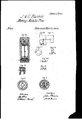
- Fig. 1 on Sheet 1 is a vertical section of the lower portion of a cylinder, with the pist-on ,shown therein, and alsoourimproved construction and adaptation oi' a short core with the die applied thereto.
- Fig. 2 is a horizontal sectionof the cylinder,taken in the line a b-iu Fig. 1, or just above the bridge, core, and' die.
- Fig. 3 is another-similar partial section of the same, taken-on the line c d in Fig. '1, or
- 0 is the piston face or end, (attachedto the body of the piston,) the various' parts of which are shown separate at l Figs. 13 to 18, inclusive,
- v D is the lower end or bottom of the cylinder, firmly attached thereto by bolts, and also to astrong tableor platform placed upona hollow pillar, which stands uponthe top of the usual ram of the hydraulic press. (The table and parts below are shown at Fig.r 22, sheet 2.), E is the' die, which is it'tedinto the bottom of the cylinder in arecess or cup, as showninthe draw-v ings. F F are adjusting-screws for'setting or regulating the situation of the die as regards the core.
- the chamber' may be of any convenient form, and, in fact, thel plate G andthe ring Z (hereinafter described) 'may' -both be dispensed withaltogether; vbut,as a snbstitntefor the plate G, we prefer the steel ring Z, whichmakes the chamber conical, and
- the aperture being thus of the form of an inverted cone; bntwe have sometimes made it cylindrical.
- Fig. 21 is a sectional representation (ou auother scale) of the chamber X as formed by the ring Z, with the die ⁇ E below and the bridge I above it.
- the steel'ringl rests-upon the die E, protects the adjusting-screws F F by interposition, andl forms a support for the 'bridge I.
- K, Figs. 1 and 19 shows the situation of A the aperture inthe upper ⁇ part of the cylinder, or side or end opposite tothe-dies,-
- throngh- whichthe cylinder is filled withv melted metaL'and which is immediately closed l by the passage oil,i.l.ie,piston;end.lThis is more eouvenientthan to withdraw the piston.
- Fig. 7, Sheet 2 is another vertical section of the lower part of a cylinder, showing a novel adaptation of our mechanism for mak# A ing four dierentjengths of pipes at one and the same time.
- Fig. 10 ⁇ is another horizontal section taken through the dies" and cores in the line a I iuFig. 7.- Fig, 1-1 is' a plan view of the bottom o f the cylinder', the diesl and cores be-v the cylinder; B B, the'zbottom of thesame. ⁇ Cj
- Fig. 8 is a'.
- Fig. 9 is a horizontal section or plan thepa Y v 51s,
- E 4E are wedges' '.for adjusting the vertical position of thedies .to the cores.
- F F are the cores or mandrels xed into or forming part of stocks orpieees of .metal G G, wlich arev mortised into one an-4 other, and also into the bottomvof the cylin-v recesses formed in the bottom of the cylinder,
- the bottom of the cylinder has four wells or 'chambers,- K K, formed in it, as shown more. parf- Y- ticularly in Fig. 11. to' allow of the passage of the pipe-metal to the di'erent dies and cores.
- Fig. 13, Sheet ,1 is a representation of the ⁇ end of the piston upon our improved construetion.
- Fig.l 14 .is asimilar representation with rts de'tached.- (Shown separate at Figs. 1b, 16,- 17, and 18,.) ais the body of the piston".
- b is the lower .end or faeeot the inten, attached to the body by the pin c. u the upper part of the piston.
- A Between the-in clined or conical-shaped sides'of the parts d and b is placed the ringe, (shown detached in plan in Fig.,1'lA and in section at Fig. 18,) and being cut-consequently it .will be obliged to expand and keep the pistontightlypaeked with the cylinder under great prsure, and thereby preventt-he escape of the metal;
- piston-faceA is attaehedto'the body a by means' of a pin,rh, passed through it, or in any other y convenient manner.
- Fig. 19 is a vertical section of acylinderand piston, showing' the adaptationof the guidepiece r bridge, through which the long core attached to the piston passes for the purpose of A keeping itcentral'withthedie.
- B' is the piston-body;
- C the fac'eorend ofthe piston;
- D the bottom of the cylinder;
- E the die.
- G is the thin steel plate. (Here ex-'.
- A'.'lhe pipe may bel received in a long descending cooling-trough, or may be :immediately wound upou'reelsas fast as' it is discharged from the machinery.
- the pipe-metal is represented in'I the drawy ings by a tint of red color. Y
- the chamber, and the die when usedto form pipes of metal under heat and pressure in the manner set forth.' or in any other manner substantially the sume.
Description
' UNITED STATES PTENT OFFICE.
.IUH'X INSOX ANI) CHARLES HANSON, 0F HUDDERSFIELD, ENGLAND, AS-
YiwlPucivemiten' 1N ,MACHINERY Fon MAKING META LLl'c Pipes.
Specification -tbrming part ot' Letters-Patent No. 2,091 dated March 1841; Reissue'No. S2, dated.
' '-Marchl-i, 1846.
Io all whom lit may concern.:v I l Be itknownlthat we, JoHN Hanson, of Huddersfield, in the count-y of York, Eng'- land. leaden'- pipe manufacturer, and CHARLES HANsoN, ofthe same place, watch-maker, be-
' ing respectively subjects of the Queen of Great Britain, have' invented certain new and useful Improvements in Machinery or Apparatus' and to the letters and tigures marked there' on-.that is to say:
Our invention consists in certain: iinprovements upon andadditions to the neachi nery used for manufacturing piptsvand 'tubes from lead or tin or any alloy of soi'tvmetalscapnble of beingforced by great pressure from ont ot' a receiver through orbetween apertures,vdies,l and cores when in aset-or solid state, set forth in thc speciiication of a patent granted to Thomas'urr, of Shrewsbury, in Shropshire,
in England, dated the 11th day of April, 1820, recited in the Repertory of Arts, &c., London, secondseries l'or 1822, volume 41,-pages 4267, &c., and described in the London Journal of Arts and SciencesNo. YI, for Novem# ber, A. D. 1820, .page 411, Ste.
The apparatus described by Thomas Burr.
consisted o'f a hollow -vessel, of iron orother metal, made particularly strong. so as to be able to sustain extreme pressure, and bored su tlicientl y truefor a piston to traverse easily within it. This vessel was closed at one end by the piston, andA it was also closed at'. the
other, exceptingn small aperture 'in the eenter, into which was titte-d a washer ordie, of steel or other metal,` intended to determine the external diameter ot' the pipe. The best form of this vessel is cylindrical, and it is termed the-"cylinder but it might be otv varionsshapes.' It, was intended -to contain the lcadlor otherviuetal -to form .the pipes.
The pistou thatiitted this cylinder wals'of,l about equal length, andjwhe'n dri'vcuhonie was intendedtojempty or nearly empty the cylinder ot' its contents. The core or mandrel which determined the inner diameter of vthe pipe was a long cylindricall ro'd attached by one end to the center of the face of the' plstou and passing through the centerot'tlie apl erture or die, leavinga space between them forth'e formation of the-pipe. The pressure necessary to work the machine was obtainedI from any mechanism of suticient force; but a very powerful hydraulic press was preferred, and the piston was driven home into the cyl-V inder bythe power nt the ram of the hydraulic press, to the top of which press' Athe cylinder was attached. Heat was applied to the cylin'der before and at the time" of using. wliere- `by the apparatus lworked more easily,l from causes which will hereinafter fsufcieutly appear. The metal to compose thel intended pipe was admitted into the cylinder in a duid state through the same aperture by which the pipe afterward issued. Upon the metal becoming set or Isolid th'e power 'of the press was exerted 'against the piston, whereby it would rise upward and drive out the metal through the washer or die'having the long core within it, continuallyl advancing withand before the piston, and thus forming,r the pipe.
rDhe machinery audits operation will be better understood by reference to Ythe patent e and to the publications mentioned, which are well known among mechanics and scientific.
men.- But the defects of Thomas Bu-rrs plan, when reduced to practice, (especially inthe manufacture of pipes4 ot less than one and a half inch in bore.) were found to be so great as to prevent that plan from being brought into common use. The long core in his mal chinery, bei ng attached to the piston, is liable,
in advancing with it, t-o warp and twist out of the straight line and out of center with the die, from the difference of expansion and con traction ot the metal under dilferent degrees of temperature, and from' the extreme pressure required, und from other causes which p rcvont or destroy the uniformity of the thick ness and the centrality of the boro nl' tho pipes or tubes,
We have found from experience that leadand` some of its allqyawhen recently become set,
(or ina condition just short ofkfluidty being still .under heat '-and extreme pressure in a close vessel', will reunite perfectly aftera sep-;
arationof its parte, and heh 85 it Wlei by the'irst intention, ascompletely as though it had never been divid We therefore construct our machinery follows','to wit:
' A First. We employ a contrivance which-may' becalled a bridge-"a cross-ha'1", a holder, or a guide-piece, lwhich is' placed near to the die or-aperture at the end ofthe cylinder,
` and ormed in. various ways, as 'convenience the bridge in any secure manner; or the bridge and the core might be constructed in one piece might-suggest.. Instead of thisv -short core,
however, we. sometimesuse the long movable. core attached to the piston, resembling that of r'Ihoina's Burr, and in this case we employ 4the bridge for thepurpose of guiding the -long .dieand the core,to facilitate the p e.
inthiscaseop'crates y core and keeping itcentral with the die, the
said'movabl'ecore 'traversing freely through an aperture in the center of the bridge, which'v as a guide-piece.
Thirdly* We form a chamberbetween the bridgeand the die, wherein the metal, afterV passingthe bridge-,may reuuiteintoone mass, having the core inim center. -It'is the space before the die The chamber may 'be made of Vany convenient form or size. Iu the ac-4 companying drawingsit .is exhibited sometimes cylindrical, as at K`K,Figure 19,S,heet 1, nearly square,as atK K, Figs. 7,9, `10,:lznd` 11, Sheet 2, and sometimes coni-cal,- as at &i`igs. 1, 20, 'and 21, Sheetl 1,- and at Fig. 22,V vSheet 2. This chamber may be a part of the cylinderitself, or `of the die, or even of the bridge,or it' may be formed by aseparatepiece .or picccsseeurely fastened to the end of the cylinder or otherwise. We 'prefer the latter plan from the facility it gives of removing and changing the 'cores and dies, when required, to make pipes of dierent sizes, and the 'conical form may be preferable, vals it may diminish the friction and require lesslessure. The chamber should be larger iare or in' diameter than .the aperture between the of the metal and to admit of constriction at the die, 'by which the metal is brought in its proper j form go'f pipe, it being the narrowes aperture.
- The die weuse is substantially the same nsl that describedfb'y` Themas-:Burr uscente apsteel or other'met'al, with a suitable aperpipe fThe-.particular-form ofthe die is not material; `lint itfjlis'"essentially di'ereut both in shape and object'from a mold." Iti'slusually be formed of'sev'eralpieceS, or be` made a pax-'tof others; or au laperturein k:the l:end of theV cylinder itself mightl be usedas a die. Various forms might be suggested'. Itis best, though not essential, that the surface -inside strength required to sustain .the great pressure audconstriction 'at this narrow passage. lWe use substantially the same cylinder and piston as described by Thomas Burr. -We use f Secondly. With a view to prevent the escape vder, we sometimes use'au improved constructiou'of the piston,` by whichits packing is forced outward against the insideof the cy1.
piston against said packing. -It 'williije better vunderstood by referringto ,the drawings'.
same object c'aube effected.-
Thirdly. We reverse the arrangement of the' cylinder and piston by placing the piston above and the cylinder below, instead of securing the cylinder lto the top of the hydraulic press; as in Thomas Burrs plan. ln -our method, when ahydraulic press of .that kind is used in'which the power of the ram is exerted fromabove, we should-'attach the piston to the ram and cause it to be driven downward into the great force,"ho'wever, being required, we prefer a hydraulic press of the opposite coustruction, in which the ram is made to rise perpeudieularly upward, and in this case we secure the piston tothe top of the press and place thecy-linder beneath,upon the table or platform, supported by a hollow pillar, with an aperture for the passage of the pipe, all restingupon the usualrmn of `the hydraulic press. Thus. whenthe ram nsceuds, tlieylfyx inder is madevto rise and advance n'put-he stationary. pistou. (See Fig. 22,' Sheet 2.) In connection with this reversed arrangement, we feed the cylinder through :in aperture in the upper ond or side opposite to the dics'and directly under thervpiston when the diesand -pellation of a"washe'r.? Itsbould be of4 which forms the exterior ofthe pipe should be as short as possible'consistently with, the
much the vsaine heat and/the same Olltl of .-th'elead lbetween'the pistouand the cylin" There are' also other methodsby which the turethr'ough itto form the exterior of the l constructed of a separatepiece;bu t it might` y vindcr by the pressure of the faee,'or. end of the cylindeilxedstatiouary to receveit. Very f ss A 3 piston are at the greatest distance apart, as shown at K, Fig. 19, Sheet 1, annexed. This l apertureis immediately closed as it passes the lower end lof the piston. By this means the or other lubricating materials may be easily applied to the dies and cores or other parts situated at the bottom of the 'cylinder previous toV pouring in afresh'v charge of metal;
and, further, the. pipes (instead of being forced 'upward and being received above the .top of the hydraulic press. as in Thomas Bu rrs plan) are caused to issue downward, und may be immediately wound upon reels, or may be received in a long descending cooling-trough,` without requiring to be handled while waim and liable to injury.
Fourthly, and lastly. Vesrrange, combine, and adapt our mechanism so as to make two or more leu'gths of pipes at one and the` same time and operation, and for this`pnr-pose we provide two or more apertures furnished with the requisite apparatus for the formation 'of the pipes. I l
All these improvements will be better understood by referringy to the accompanying drawings, which are sectional and detached views of the cylinder and various parts, to which we shall now refer.
. Fig. 1 on Sheet 1 is a vertical section of the lower portion of a cylinder, with the pist-on ,shown therein, and alsoourimproved construction and adaptation oi' a short core with the die applied thereto.r Fig. 2 is a horizontal sectionof the cylinder,taken in the line a b-iu Fig. 1, or just above the bridge, core, and' die. Fig. 3 is another-similar partial section of the same, taken-on the line c d in Fig. '1, or
strong top frame-work of the hydraulic press'.
0 is the piston face or end, (attachedto the body of the piston,) the various' parts of which are shown separate at l Figs. 13 to 18, inclusive,
and willv be described hereinafter.v D is the lower end or bottom of the cylinder, firmly attached thereto by bolts, and also to astrong tableor platform placed upona hollow pillar, which stands uponthe top of the usual ram of the hydraulic press. (The table and parts below are shown at Fig.r 22, sheet 2.), E is the' die, which is it'tedinto the bottom of the cylinder in arecess or cup, as showninthe draw-v ings. F F are adjusting-screws for'setting or regulating the situation of the die as regards the core.
thin steel plate titted into the recess in the bottom of the cylinder,'nierely fol-the pm.'
pose' of preventing the metal from being drivenv between thel edges of the die and the recess,
or to theadjnstiug-screws, the threads lfof :i
which mightotherwise become clogged.- Itis exhibited in severalfof the drawings, thus y leaving thechamber between the bridge and the die of a cylindrical form. A Itis, however,
-not essential, since the chamber' may be of any convenient form, and, in fact, thel plate G andthe ring Z (hereinafter described) 'may' -both be dispensed withaltogether; vbut,as a snbstitntefor the plate G, we prefer the steel ring Z, whichmakes the chamber conical, and
lis employedand exhibited in Figs. 1 and 20,
the aperture being thus of the form of an inverted cone; bntwe have sometimes made it cylindrical.
Fig, '20 ris a view 'of a section of the ring Z.
Fig. 21 is a sectional representation (ou auother scale) of the chamber X as formed by the ring Z, with the die`E below and the bridge I above it. When ltted in their places in the bottom ot' the cylinder, as exhibited in Figs. 1 and 2l, the steel'ringl rests-upon the die E, protects the adjusting-screws F F by interposition, andl forms a support for the 'bridge I.
In Figs. 1, 2, 5, 6, 19, and 2l the bridge isshown bythe letter I andthe short fixed core by the letter H, where used.
K, Figs. 1 and 19, shows the situation of A the aperture inthe upper \part of the cylinder, or side or end opposite tothe-dies,-
throngh-whichthe cylinder is filled withv melted metaL'and which is immediately closed l by the passage oil,i.l.ie,piston;end.lThis is more eouvenientthan to withdraw the piston. Fig. 7, Sheet 2, is another vertical section of the lower part of a cylinder, showing a novel adaptation of our mechanism for mak# A ing four dierentjengths of pipes at one and the same time.
viewltaken at the line 1ev f, the plate H being removed. Fig. 10`is another horizontal section taken through the dies" and cores in the line a I iuFig. 7.- Fig, 1-1 is' a plan view of the bottom o f the cylinder', the diesl and cores be-v the cylinder; B B, the'zbottom of thesame.` Cj
C are thedies, the lcores and apertures ot ,which are in these instances placed in a horizontal position. .DD are the screws for prop Fig. 8 is a'. Apartial v sectionalplan view ofthe same, taken iu the line g h, Fig. 7. Fig. 9 is a horizontal section or plan thepa Y v 51s,
erly adjust-ing the horizontal situation of the dies as regards the "cores, and E 4E are wedges' '.for adjusting the vertical position of thedies .to the cores. F F are the cores or mandrels xed into or forming part of stocks orpieees of .metal G G, wlich arev mortised into one an-4 other, and also into the bottomvof the cylin-v recesses formed in the bottom of the cylinder,
which steel plate is placed on the top of the vdies to prevent the access of metalto the adjusting-screws, and 5I I are other plates placed in front ofthe dies for the same purpose and to preventits access tothe wedges.` The bottom of the cylinder has four wells or 'chambers,- K K, formed in it, as shown more. parf- Y- ticularly in Fig. 11. to' allow of the passage of the pipe-metal to the di'erent dies and cores.
Fig. 13, Sheet ,1, is a representation of the `end of the piston upon our improved construetion. Fig.l 14 .is asimilar representation with rts de'tached.- (Shown separate at Figs. 1b, 16,- 17, and 18,.) ais the body of the piston". b is the lower .end or faeeot the inten, attached to the body by the pin c. u the upper part of the piston.A `Between the-in clined or conical-shaped sides'of the parts d and b is placed the ringe, (shown detached in plan in Fig.,1'lA and in section at Fig. 18,) and being cut-consequently it .will be obliged to expand and keep the pistontightlypaeked with the cylinder under great prsure, and thereby preventt-he escape of the metal; The
' piston-faceA is attaehedto'the body a by means' of a pin,rh, passed through it, or in any other y convenient manner.
Fig. 19 is a vertical section of acylinderand piston, showing' the adaptationof the guidepiece r bridge, through which the long core attached to the piston passes for the purpose of A keeping itcentral'withthedie. AAisthecyl inder. B'is the piston-body; C, the fac'eorend ofthe piston; D, the bottom of the cylinder; E, the die. G is the thin steel plate. (Here ex-'.
hibited instead ot' the steel ring that in Figs. 1
' and-21 makes the chamber'conicalin form.) F, the adjusting-screws." H is the long core attached to the piston C, and traveling with it, passing freely throughl the-,guidepiece or bridge I I, which has a hole properly bored through `it for this purpose, consequently keeping the core at all times steady and een tml with the die. Kis the aperture for sup plying the cylinder with melted metal. Fig. 22, Sheet 2, exhibits the reversed arrangement ol' the cylinder A and the piston L L is the table; M., the top of the hyl drauliel'press. N is the hollow pillar standing upon the ram.v y Y.
, Theoperation of making pipes or tubes is 'as follows: The cylinder should' be warmed,
as mentioned by Thomas Burr; by any con vencnt means, as well for the purpose of mak- -ingethe apparatus work more easily as to preserve the pipe-metalwithin at a uniform temperature'through'out its mass, and thus to permit it to set equabl y. When a die, bridge, and core of the required Vdiameter have been applied tothe cylinder and properly adjusted,"
the cylinder and other parts being lowered, a'
charge of lead or other metal in a ud state .is admitted through the aperture K, Figs. 19
and 1, at the side, or at theend of 'thecylinvder opposite tothe die apd immediatelyunder the' piston, and as soon as thisl metal is set the hydraulic press is put-in action, and as the ram; hollow pillar, table, and cylinder, with its appurtenances. rise upward the feeding-aperture isiirst closed by the stationary piston, and 'when' this is e'ected the metal-is forced, in thedireetion of .the arrows in Fig.
f1, between the arms or apertures of the bridge I through the chamber, and through the space between the'die and the core below it, beingcaused by the extreme pressure and eonstriction to reunite perfectly around the core in lits 'passage,1and leaving the machinery in the for'm of pipes or'tubes. A'.'lhe pipe may bel received in a long descending cooling-trough, or may be :immediately wound upou'reelsas fast as' it is discharged from the machinery.
The pipe-metal is represented in'I the drawy ings by a tint of red color. Y
We wish it to be understood that we do not confine ourselves to the mode of operation herein described, by making the cylinder rise with the hydraulic ram and o'therparts .and keeping'the piston stationary, as the same effects willtake place when the cylinder is stationary and-the power of the ram is .applied tothe top of the pistou to cause it to descend into the cylinder; and our improvements might also be applied to a cylinder and press fitted up in other respects upon Thomas Burrs plan, whereby the pipe is receivedover the top of the machinery, although at some disadvantage; or .the press might b elaid horizon- -zontally or otherwise. Neither do we confine ourselves to making the bridge which holds orguides either te short or the long l:ores
with four arms only, since it mightbe lnade i of various constructions, with one, two, or
three or more arms'or apertures; or it might .be a circular plate-with holes through it; 'or
it might be constructed as a projection at or near the bottom of the cylinder, with one large aperture nearly surrounding it, and thus remarkable feature of which is thatsott metals, where in a set state, being yet under heat, can be made by extreme pressure to reunitev perfectly around a' core after a separation, a nd thus be formed into strong pipes or tubes.'
Pipes thus made are found to'possess great solidit'y and .unusual strength, and a fine uni-- formity of thickness and accuracy of bore is arrived at, such as,it is believed,has never before' been attained by any' other machinery. -The essential difference in .the character of this pipe which distinguishes it' (as well as that contemplated by Thomas Burr) from all others heretofore 'known or attempted is that it is 'wrought under heat by pressure and constriction'from set metal, and that it is nota casting formed `in wmold. l,
e. do 'not claim as oui-""'invtention-and improvement any of the partsof the above-de'-, scribed'machinery independently of their arran ment and combination above set forth.
hat we .claim as orinventim'i, and desire tosecnre by Letters Patent.A is- Tne veombimnm of the following parte above described-te wit, the core and bridge or gnide-pie-with the cylinder, the piston,
the chamber, and the die, when usedto form pipes of metal under heat and pressure in the manner set forth.' or in any other manner substantially the sume.
JOHN HANSQN. CHARLES HANsoN.
Y Clerk to Payne, Eddz'aon d2: Ford, Solz'cz'tcms,y
l Leeds.
Family
ID=
Similar Documents
| Publication | Publication Date | Title |
|---|---|---|
| US10265746B2 (en) | Rotary extrusion producing method for producing inner ring rib with large aspect ratio formed of hollow billet | |
| US3664411A (en) | Die-casting apparatus with ceramic shot duct liner | |
| US20180056353A1 (en) | Rotary Extrusion Producing Mold for Producing Inner Ring Rib with Large Aspect Ratio Formed of Hollow Billet | |
| US2112342A (en) | Pressure casting machine | |
| US2021A (en) | Peters | |
| USRE82E (en) | Improvement in machinery for makjnq metallic pipes | |
| US2276468A (en) | Extrusion die | |
| US3826122A (en) | Mandrel for extruding tubing | |
| US3085812A (en) | Pressing tools | |
| US819261A (en) | Apparatus for treating heated metal under pressure. | |
| US2266189A (en) | Extrusion die structure | |
| CN107999679A (en) | A kind of bucket tooth forging mold and its lower mold assemblies | |
| US2164397A (en) | Extrusion | |
| US5466A (en) | Lead-pipe machiiteby | |
| US2442142A (en) | Upset forging apparatus | |
| US2581550A (en) | Extrusion molding machine | |
| US1084881A (en) | Press for making pipes. | |
| US961128A (en) | Machine for forming seamless tubes. | |
| US1171344A (en) | Apparatus for concentric punching. | |
| US817085A (en) | Machine for making metal bars or rods. | |
| US5253A (en) | Lead-pipe machinery | |
| US1314366A (en) | Apparatus for forming hollow articles | |
| US54121A (en) | Improved machine for the manufacture of rod-solder | |
| US769181A (en) | Hydraulic press. | |
| US2812673A (en) | Mandrel guiding arrangement for billet piercing apparatus |