USPP4591P - Pear tree - Google Patents
Pear tree Download PDFInfo
- Publication number
- USPP4591P USPP4591P US05/931,127 US93112778V US4591P US PP4591 P USPP4591 P US PP4591P US 93112778 V US93112778 V US 93112778V US 4591 P US4591 P US 4591P
- Authority
- US
- United States
- Prior art keywords
- autumn
- tree
- leaves
- length
- blaze
- Prior art date
- Legal status (The legal status is an assumption and is not a legal conclusion. Google has not performed a legal analysis and makes no representation as to the accuracy of the status listed.)
- Expired - Lifetime
Links
- 235000014443 Pyrus communis Nutrition 0.000 title claims abstract description 8
- 240000001987 Pyrus communis Species 0.000 title claims abstract description 5
- 241000220324 Pyrus Species 0.000 claims description 3
- 201000010099 disease Diseases 0.000 claims description 3
- 208000037265 diseases, disorders, signs and symptoms Diseases 0.000 claims description 3
- 241000607479 Yersinia pestis Species 0.000 claims description 2
- 241001506875 Pyrus calleryana Species 0.000 description 8
- 235000013399 edible fruits Nutrition 0.000 description 5
- 241001164374 Calyx Species 0.000 description 2
- 241000894007 species Species 0.000 description 2
- 241001573881 Corolla Species 0.000 description 1
- 241000132456 Haplocarpha Species 0.000 description 1
- 244000300264 Spinacia oleracea Species 0.000 description 1
- 235000009337 Spinacia oleracea Nutrition 0.000 description 1
- 239000002253 acid Substances 0.000 description 1
- 230000034303 cell budding Effects 0.000 description 1
- 239000006071 cream Substances 0.000 description 1
- 230000023753 dehiscence Effects 0.000 description 1
- 230000005094 fruit set Effects 0.000 description 1
- 238000003898 horticulture Methods 0.000 description 1
- 238000005259 measurement Methods 0.000 description 1
- 230000000644 propagated effect Effects 0.000 description 1
- 239000004575 stone Substances 0.000 description 1
Images


Definitions
- the present discovery relates to a new and distinct clone of pear tree.
- This invention is a new and distinct clone of pear tree (Pyrus calleryana Decn.), with characteristics of value for ornamental uses. It was discovered by the applicant in October 1969 in the course of studies to find disease-resistant rootstocks for domestic pear cultivars. The tree is a chance seedling of unnamed P. calleryana parents. It was planted in 1968, in a nursery at the Lewis-Brown Horticultural Research Farm of the Department of Horticulture, at Corvallis, Oreg. It was designated by the code number OPR-250 at the Oregon Experiment Station.
- the new clone which is named Autumn Blaze, produces an upright pyramidal tree of medium size.
- the tree produces moderate to heavy bloom every year.
- Fruiting is sparse, and the small mature fruit do not abscise and fall to the ground.
- the new variety is characterized by its bright red leaves in autumn which differ in color from other Pyrus calleryana clones.
- a color comparison with the Bradford P. calleryana shows the following:
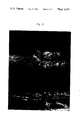
- FIG. 1 The accompanying color photograph (FIG. 1) is typical of the young tree in autumn.
- FIG. 2 is an illustration of the tree habit in a dormant state.
- FIG. 3 is an illustration of the leaves in flattened condition.
- Flower buds (dormant): Egyptian Buff (407/ 2 ) pubescent, 11.6 mm long, 4.8 mm wide, length/width ratio 2.4 (see photo).
- Flower cluster An indeterminate corymb arising from a mixed bud in which the basal leaves open at the time of anthesis; about 13 flowers per cluster (see photo).
- Corolla 18.5 mm diam. at anthesis; color slight pink (prebloom) to white at anthesis (see photo).
- Stamens Numerous, anthers Rose Red (724/ 3 ) before dehiscence (see photo).
- Shape Nearly round, but slightly oblate, length/diam. ratio 0.97.
- Stem 11.4 mm long, thin, (0.8 mm diam.), fruit length/stem length ratio 0.89, no stem basin (attached flush).
- Calyx Deciduous, calyx tube closed.
- Flesh Cream colored, very acid, with a heavy layer of stone cells exterior to the core area.
- Carpels 2, bearing a maximum of 2 seeds per carpel.
- Fruit set Very low (about 5 to 10%), usually only one fruit per cluster.
- Maturity season Fruit ripens about 3 weeks after Delicious apple.
- Tree Medium sized, upright pyramid in shape.
- Leaves Oval base, with acuminate apex, margin crenate; young leaves reddish tinged, mature ones medium to dark green in summer, turning Cardinal Red 822/1 to Oxblood Red 00823 in autumn; spur leaves about 59 mm long, 35 mm wide, length/width ratio 1.67, petiole about 34 mm long, blade length/petiole length ratio 1.73; shoot leaves about 81 mm long, 52 mm wide, length/width ratio 1.56, petiole about 28 mm long, blade length/petiole length 2.91.
Landscapes
- Breeding Of Plants And Reproduction By Means Of Culturing (AREA)
Abstract
A pear tree characterized by its bright red leaves in autumn and its winter hardiness.
Description
The present discovery relates to a new and distinct clone of pear tree. This invention is a new and distinct clone of pear tree (Pyrus calleryana Decn.), with characteristics of value for ornamental uses. It was discovered by the applicant in October 1969 in the course of studies to find disease-resistant rootstocks for domestic pear cultivars. The tree is a chance seedling of unnamed P. calleryana parents. It was planted in 1968, in a nursery at the Lewis-Brown Horticultural Research Farm of the Department of Horticulture, at Corvallis, Oreg. It was designated by the code number OPR-250 at the Oregon Experiment Station.
The new clone, which is named Autumn Blaze, produces an upright pyramidal tree of medium size. The tree produces moderate to heavy bloom every year. Fruiting is sparse, and the small mature fruit do not abscise and fall to the ground. The new variety is characterized by its bright red leaves in autumn which differ in color from other Pyrus calleryana clones. A color comparison with the Bradford P. calleryana, for example, shows the following:
Leaf color on Nov. 8, 1979 at Dayton, Oreg. Autumn Blaze -- Cardinal Red 822/1 to Oxblood Red 00823.
Bradford Pear -- Fern Green 0862/2 to Spinach Green 0960/2. This new clone has the characteristic disease and pest resistance of other P. calleryana trees, but is somewhat more winter hardy than other individuals (including Bradford) of the species. Tests indicate that the xylem parenchyma cells of this new clone are hardy to -27° C., while other P. calleryana trees are hardy to about -25° C. In addition, these tests indicate that Autumn Blaze buds were hardy to -34° C., while others of this species were hardy to -28° C.
The general description for all Pyrus calleryana trees is the same as that given for Chanticleer. But any two clones derived from different seedlings, as were Chanticleer and Autumn Blaze, have several distinct and measureable differences in the detail of their leaves, growth habit, buds, flowers, and fruit. Autumn Blaze has quite a different growth habit and tree form than Chanticleer. The initial branch angles of Autumn Blaze are nearly 90° with the central leader rather than at 40° as reported for Chanticleer. This difference results in Autumn Blaze being a more spreading tree and somewhat broader at the top than is Chanticleer.
Comparison of Autumn Blaze with the Chanticleer pear reveals several differences. The following measurements of leaves show distinct differences in shape and size:
______________________________________
                                       blade/
        mm      mm             mm      petiole
        Blade   width   L/W    Petiole (L/P)
        length (L)
                (W)     ratio  length (P)
                                       ratio
______________________________________
Spur leaves:
Chanticleer
          52.6      51.0    1.03 45.3    1.16
Autumn Blaze
          59.0      35.0    1.67 34.0    1.73
Shoot leaves:
Chanticleer
          71.5      63.3    1.13 37.1    1.93
Autumn Blaze
          81.0      52.0    1.56 28.0    2.91
______________________________________
After selection was made, this clone was propagated asexually by budding and grafting to seedling P. calleryana rootstocks. Grafted trees maintained the same characteristics as the original tree.
The accompanying color photograph (FIG. 1) is typical of the young tree in autumn.
FIG. 2 is an illustration of the tree habit in a dormant state.
FIG. 3 is an illustration of the leaves in flattened condition.
The following is a detailed description of the new cultivar with the color designation according to the Horticultural Chart issued by the British Colour Council in collaboration with the Royal Horticultural Society.
Flower buds (dormant): Egyptian Buff (407/2) pubescent, 11.6 mm long, 4.8 mm wide, length/width ratio 2.4 (see photo).
Flower cluster: An indeterminate corymb arising from a mixed bud in which the basal leaves open at the time of anthesis; about 13 flowers per cluster (see photo).
Corolla: 18.5 mm diam. at anthesis; color slight pink (prebloom) to white at anthesis (see photo).
Stamens: Numerous, anthers Rose Red (724/3) before dehiscence (see photo).
Shape: Nearly round, but slightly oblate, length/diam. ratio 0.97.
Size: Longitudinal length 10.1 mm, transverse diam. 10.4 mm.
Color: Russet-Green to Maize Yellow (607/1) when ripe.
Skin: Russeted, with many small white dots (lenticels).
Stem: 11.4 mm long, thin, (0.8 mm diam.), fruit length/stem length ratio 0.89, no stem basin (attached flush).
Calyx: Deciduous, calyx tube closed.
Flesh: Cream colored, very acid, with a heavy layer of stone cells exterior to the core area.
Carpels: 2, bearing a maximum of 2 seeds per carpel.
Fruit set: Very low (about 5 to 10%), usually only one fruit per cluster.
Maturity season: Fruit ripens about 3 weeks after Delicious apple.
Tree: Medium sized, upright pyramid in shape.
Leaves: Oval base, with acuminate apex, margin crenate; young leaves reddish tinged, mature ones medium to dark green in summer, turning Cardinal Red 822/1 to Oxblood Red 00823 in autumn; spur leaves about 59 mm long, 35 mm wide, length/width ratio 1.67, petiole about 34 mm long, blade length/petiole length ratio 1.73; shoot leaves about 81 mm long, 52 mm wide, length/width ratio 1.56, petiole about 28 mm long, blade length/petiole length 2.91.
Claims (1)
1. A new and distinct variety of pear tree characterized by its bright red leaves in autumn and its resistance to most pear pests and diseases.
Priority Applications (1)
| Application Number | Priority Date | Filing Date | Title |
|---|---|---|---|
| US05/931,127 USPP4591P (en) | 1978-08-04 | 1978-08-04 | Pear tree |
Applications Claiming Priority (1)
| Application Number | Priority Date | Filing Date | Title |
|---|---|---|---|
| US05/931,127 USPP4591P (en) | 1978-08-04 | 1978-08-04 | Pear tree |
Publications (1)
| Publication Number | Publication Date |
|---|---|
| USPP4591P true USPP4591P (en) | 1980-09-09 |
Family
ID=25460254
Family Applications (1)
| Application Number | Title | Priority Date | Filing Date |
|---|---|---|---|
| US05/931,127 Expired - Lifetime USPP4591P (en) | 1978-08-04 | 1978-08-04 | Pear tree |
Country Status (1)
| Country | Link |
|---|---|
| US (1) | USPP4591P (en) |
Cited By (3)
| Publication number | Priority date | Publication date | Assignee | Title |
|---|---|---|---|---|
| USPP8050P (en) * | 1990-12-20 | 1992-12-01 | James W. Zampini | Ornamental pear tree named Valzam |
| USPP10151P (en) * | 1996-08-09 | 1997-12-16 | Wandell; Willet N. | Pyrus calleryana×betulifolia tree named `Edgewood` |
| USPP15299P2 (en) | 2003-04-17 | 2004-11-09 | Sixto C. Veyna | Flowering pear tree |
-
1978
- 1978-08-04 US US05/931,127 patent/USPP4591P/en not_active Expired - Lifetime
Cited By (3)
| Publication number | Priority date | Publication date | Assignee | Title |
|---|---|---|---|---|
| USPP8050P (en) * | 1990-12-20 | 1992-12-01 | James W. Zampini | Ornamental pear tree named Valzam |
| USPP10151P (en) * | 1996-08-09 | 1997-12-16 | Wandell; Willet N. | Pyrus calleryana×betulifolia tree named `Edgewood` |
| USPP15299P2 (en) | 2003-04-17 | 2004-11-09 | Sixto C. Veyna | Flowering pear tree |
Similar Documents
| Publication | Publication Date | Title |
|---|---|---|
| USPP16399P3 (en) | Grape plant named ‘G1-6819’ | |
| USPP26083P3 (en) | Almond tree named ‘Bennett-Hickman’ | |
| USPP36741P2 (en) | Peach tree named ‘CaroRes Delight’ | |
| USPP36072P2 (en) | Peach tree named ‘CaroRes Wonder’ | |
| USPP36688P3 (en) | Apple tree named ‘HOT125A1’ | |
| USPP33139P2 (en) | Plum tree named ‘PLUMRED XIV’ | |
| USPP18483P3 (en) | Apple tree named ‘Dalirail’ | |
| USPP18482P3 (en) | Apple tree named ‘Dalinip’ | |
| USPP32391P2 (en) | Apple tree named ‘CIVM49’ | |
| USPP24091P3 (en) | Apple tree named ‘Gemini’ | |
| USPP32907P2 (en) | Blackberry plant named ‘EXPB3181’ | |
| USPP31006P3 (en) | Kiwifruit plant named ‘ZES007’ | |
| USPP31407P2 (en) | Muscadine grape plant named ‘Florida Onyx’ | |
| USPP17706P3 (en) | Asian pear tree, 85.10-23 | |
| USPP31076P3 (en) | Crabapple tree named ‘JFS KW214MX’ | |
| USPP28580P3 (en) | Kiwifruit plant named ‘Yang's Golden Red No. 1’ | |
| USPP27577P3 (en) | Apple tree named ‘Gala Schnico Red’ | |
| USPP26450P3 (en) | Kiwifruit plant named ‘Yang's Golden Red No. 50’ | |
| USPP26973P3 (en) | Apple tree named ‘CIV323’ | |
| USPP25741P3 (en) | Pear tree named ‘ANP-0118’ | |
| USPP20477P3 (en) | Apple tree variety named ‘Scilate’ | |
| USPP24550P3 (en) | Apple tree named ‘Gaia’ | |
| USPP24570P3 (en) | Apple tree named ‘RENOIRCIV’ | |
| USPP24877P3 (en) | Plum tree named ‘LRP40/205’ | |
| USPP22859P3 (en) | Apple tree named ‘Golden Parsi’ |