US9926468B2 - Process of assembling and repositioning two parts - Google Patents

Process of assembling and repositioning two parts Download PDF

Info

Publication number
US9926468B2
US9926468B2 US15/370,351 US201615370351A US9926468B2 US 9926468 B2 US9926468 B2 US 9926468B2 US 201615370351 A US201615370351 A US 201615370351A US 9926468 B2 US9926468 B2 US 9926468B2
Authority
US
United States
Prior art keywords
temperature
glass transition
polymer block
poly
process according
Prior art date
Legal status (The legal status is an assumption and is not a legal conclusion. Google has not performed a legal analysis and makes no representation as to the accuracy of the status listed.)
Active
Application number
US15/370,351
Other versions
US20170174942A1 (en
Inventor
Claire Rannoux
Maria Fernandez Ciurleo
Current Assignee (The listed assignees may be inaccurate. Google has not performed a legal analysis and makes no representation or warranty as to the accuracy of the list.)
Swatch Group Research and Development SA
Original Assignee
Swatch Group Research and Development SA
Priority date (The priority date is an assumption and is not a legal conclusion. Google has not performed a legal analysis and makes no representation as to the accuracy of the date listed.)
Filing date
Publication date
Application filed by Swatch Group Research and Development SA filed Critical Swatch Group Research and Development SA
Assigned to THE SWATCH GROUP RESEARCH AND DEVELOPMENT LTD reassignment THE SWATCH GROUP RESEARCH AND DEVELOPMENT LTD ASSIGNMENT OF ASSIGNORS INTEREST (SEE DOCUMENT FOR DETAILS). Assignors: FERNANDEZ CIURLEO, Maria, RANNOUX, Claire
Publication of US20170174942A1 publication Critical patent/US20170174942A1/en
Application granted granted Critical
Publication of US9926468B2 publication Critical patent/US9926468B2/en
Active legal-status Critical Current
Anticipated expiration legal-status Critical

Links

Classifications

    • CCHEMISTRY; METALLURGY
    • C09DYES; PAINTS; POLISHES; NATURAL RESINS; ADHESIVES; COMPOSITIONS NOT OTHERWISE PROVIDED FOR; APPLICATIONS OF MATERIALS NOT OTHERWISE PROVIDED FOR
    • C09JADHESIVES; NON-MECHANICAL ASPECTS OF ADHESIVE PROCESSES IN GENERAL; ADHESIVE PROCESSES NOT PROVIDED FOR ELSEWHERE; USE OF MATERIALS AS ADHESIVES
    • C09J5/00Adhesive processes in general; Adhesive processes not provided for elsewhere, e.g. relating to primers
    • C09J5/06Adhesive processes in general; Adhesive processes not provided for elsewhere, e.g. relating to primers involving heating of the applied adhesive
    • BPERFORMING OPERATIONS; TRANSPORTING
    • B29WORKING OF PLASTICS; WORKING OF SUBSTANCES IN A PLASTIC STATE IN GENERAL
    • B29CSHAPING OR JOINING OF PLASTICS; SHAPING OF MATERIAL IN A PLASTIC STATE, NOT OTHERWISE PROVIDED FOR; AFTER-TREATMENT OF THE SHAPED PRODUCTS, e.g. REPAIRING
    • B29C35/00Heating, cooling or curing, e.g. crosslinking or vulcanising; Apparatus therefor
    • B29C35/02Heating or curing, e.g. crosslinking or vulcanizing during moulding, e.g. in a mould
    • BPERFORMING OPERATIONS; TRANSPORTING
    • B29WORKING OF PLASTICS; WORKING OF SUBSTANCES IN A PLASTIC STATE IN GENERAL
    • B29CSHAPING OR JOINING OF PLASTICS; SHAPING OF MATERIAL IN A PLASTIC STATE, NOT OTHERWISE PROVIDED FOR; AFTER-TREATMENT OF THE SHAPED PRODUCTS, e.g. REPAIRING
    • B29C35/00Heating, cooling or curing, e.g. crosslinking or vulcanising; Apparatus therefor
    • B29C35/16Cooling
    • BPERFORMING OPERATIONS; TRANSPORTING
    • B29WORKING OF PLASTICS; WORKING OF SUBSTANCES IN A PLASTIC STATE IN GENERAL
    • B29CSHAPING OR JOINING OF PLASTICS; SHAPING OF MATERIAL IN A PLASTIC STATE, NOT OTHERWISE PROVIDED FOR; AFTER-TREATMENT OF THE SHAPED PRODUCTS, e.g. REPAIRING
    • B29C65/00Joining or sealing of preformed parts, e.g. welding of plastics materials; Apparatus therefor
    • B29C65/48Joining or sealing of preformed parts, e.g. welding of plastics materials; Apparatus therefor using adhesives, i.e. using supplementary joining material; solvent bonding
    • B29C65/4805Joining or sealing of preformed parts, e.g. welding of plastics materials; Apparatus therefor using adhesives, i.e. using supplementary joining material; solvent bonding characterised by the type of adhesives
    • B29C65/481Non-reactive adhesives, e.g. physically hardening adhesives
    • B29C65/4815Hot melt adhesives, e.g. thermoplastic adhesives
    • CCHEMISTRY; METALLURGY
    • C08ORGANIC MACROMOLECULAR COMPOUNDS; THEIR PREPARATION OR CHEMICAL WORKING-UP; COMPOSITIONS BASED THEREON
    • C08FMACROMOLECULAR COMPOUNDS OBTAINED BY REACTIONS ONLY INVOLVING CARBON-TO-CARBON UNSATURATED BONDS
    • C08F293/00Macromolecular compounds obtained by polymerisation on to a macromolecule having groups capable of inducing the formation of new polymer chains bound exclusively at one or both ends of the starting macromolecule
    • CCHEMISTRY; METALLURGY
    • C08ORGANIC MACROMOLECULAR COMPOUNDS; THEIR PREPARATION OR CHEMICAL WORKING-UP; COMPOSITIONS BASED THEREON
    • C08FMACROMOLECULAR COMPOUNDS OBTAINED BY REACTIONS ONLY INVOLVING CARBON-TO-CARBON UNSATURATED BONDS
    • C08F297/00Macromolecular compounds obtained by successively polymerising different monomer systems using a catalyst of the ionic or coordination type without deactivating the intermediate polymer
    • C08F297/06Macromolecular compounds obtained by successively polymerising different monomer systems using a catalyst of the ionic or coordination type without deactivating the intermediate polymer using a catalyst of the coordination type
    • CCHEMISTRY; METALLURGY
    • C08ORGANIC MACROMOLECULAR COMPOUNDS; THEIR PREPARATION OR CHEMICAL WORKING-UP; COMPOSITIONS BASED THEREON
    • C08FMACROMOLECULAR COMPOUNDS OBTAINED BY REACTIONS ONLY INVOLVING CARBON-TO-CARBON UNSATURATED BONDS
    • C08F4/00Polymerisation catalysts
    • C08F4/42Metals; Metal hydrides; Metallo-organic compounds; Use thereof as catalyst precursors
    • C08F4/72Metals; Metal hydrides; Metallo-organic compounds; Use thereof as catalyst precursors selected from metals not provided for in group C08F4/44
    • C08F4/80Metals; Metal hydrides; Metallo-organic compounds; Use thereof as catalyst precursors selected from metals not provided for in group C08F4/44 selected from iron group metals or platinum group metals
    • CCHEMISTRY; METALLURGY
    • C08ORGANIC MACROMOLECULAR COMPOUNDS; THEIR PREPARATION OR CHEMICAL WORKING-UP; COMPOSITIONS BASED THEREON
    • C08GMACROMOLECULAR COMPOUNDS OBTAINED OTHERWISE THAN BY REACTIONS ONLY INVOLVING UNSATURATED CARBON-TO-CARBON BONDS
    • C08G81/00Macromolecular compounds obtained by interreacting polymers in the absence of monomers, e.g. block polymers
    • C08G81/02Macromolecular compounds obtained by interreacting polymers in the absence of monomers, e.g. block polymers at least one of the polymers being obtained by reactions involving only carbon-to-carbon unsaturated bonds
    • C08G81/021Block or graft polymers containing only sequences of polymers of C08C or C08F
    • CCHEMISTRY; METALLURGY
    • C08ORGANIC MACROMOLECULAR COMPOUNDS; THEIR PREPARATION OR CHEMICAL WORKING-UP; COMPOSITIONS BASED THEREON
    • C08KUse of inorganic or non-macromolecular organic substances as compounding ingredients
    • C08K5/00Use of organic ingredients
    • C08K5/04Oxygen-containing compounds
    • C08K5/09Carboxylic acids; Metal salts thereof; Anhydrides thereof
    • CCHEMISTRY; METALLURGY
    • C08ORGANIC MACROMOLECULAR COMPOUNDS; THEIR PREPARATION OR CHEMICAL WORKING-UP; COMPOSITIONS BASED THEREON
    • C08KUse of inorganic or non-macromolecular organic substances as compounding ingredients
    • C08K5/00Use of organic ingredients
    • C08K5/16Nitrogen-containing compounds
    • C08K5/34Heterocyclic compounds having nitrogen in the ring
    • C08K5/3412Heterocyclic compounds having nitrogen in the ring having one nitrogen atom in the ring
    • C08K5/3415Five-membered rings
    • CCHEMISTRY; METALLURGY
    • C09DYES; PAINTS; POLISHES; NATURAL RESINS; ADHESIVES; COMPOSITIONS NOT OTHERWISE PROVIDED FOR; APPLICATIONS OF MATERIALS NOT OTHERWISE PROVIDED FOR
    • C09JADHESIVES; NON-MECHANICAL ASPECTS OF ADHESIVE PROCESSES IN GENERAL; ADHESIVE PROCESSES NOT PROVIDED FOR ELSEWHERE; USE OF MATERIALS AS ADHESIVES
    • C09J153/00Adhesives based on block copolymers containing at least one sequence of a polymer obtained by reactions only involving carbon-to-carbon unsaturated bonds; Adhesives based on derivatives of such polymers
    • CCHEMISTRY; METALLURGY
    • C09DYES; PAINTS; POLISHES; NATURAL RESINS; ADHESIVES; COMPOSITIONS NOT OTHERWISE PROVIDED FOR; APPLICATIONS OF MATERIALS NOT OTHERWISE PROVIDED FOR
    • C09JADHESIVES; NON-MECHANICAL ASPECTS OF ADHESIVE PROCESSES IN GENERAL; ADHESIVE PROCESSES NOT PROVIDED FOR ELSEWHERE; USE OF MATERIALS AS ADHESIVES
    • C09J201/00Adhesives based on unspecified macromolecular compounds
    • C09J201/02Adhesives based on unspecified macromolecular compounds characterised by the presence of specified groups, e.g. terminal or pendant functional groups
    • CCHEMISTRY; METALLURGY
    • C09DYES; PAINTS; POLISHES; NATURAL RESINS; ADHESIVES; COMPOSITIONS NOT OTHERWISE PROVIDED FOR; APPLICATIONS OF MATERIALS NOT OTHERWISE PROVIDED FOR
    • C09JADHESIVES; NON-MECHANICAL ASPECTS OF ADHESIVE PROCESSES IN GENERAL; ADHESIVE PROCESSES NOT PROVIDED FOR ELSEWHERE; USE OF MATERIALS AS ADHESIVES
    • C09J5/00Adhesive processes in general; Adhesive processes not provided for elsewhere, e.g. relating to primers
    • CCHEMISTRY; METALLURGY
    • C09DYES; PAINTS; POLISHES; NATURAL RESINS; ADHESIVES; COMPOSITIONS NOT OTHERWISE PROVIDED FOR; APPLICATIONS OF MATERIALS NOT OTHERWISE PROVIDED FOR
    • C09JADHESIVES; NON-MECHANICAL ASPECTS OF ADHESIVE PROCESSES IN GENERAL; ADHESIVE PROCESSES NOT PROVIDED FOR ELSEWHERE; USE OF MATERIALS AS ADHESIVES
    • C09J5/00Adhesive processes in general; Adhesive processes not provided for elsewhere, e.g. relating to primers
    • C09J5/04Adhesive processes in general; Adhesive processes not provided for elsewhere, e.g. relating to primers involving separate application of adhesive ingredients to the different surfaces to be joined
    • BPERFORMING OPERATIONS; TRANSPORTING
    • B29WORKING OF PLASTICS; WORKING OF SUBSTANCES IN A PLASTIC STATE IN GENERAL
    • B29KINDEXING SCHEME ASSOCIATED WITH SUBCLASSES B29B, B29C OR B29D, RELATING TO MOULDING MATERIALS OR TO MATERIALS FOR MOULDS, REINFORCEMENTS, FILLERS OR PREFORMED PARTS, e.g. INSERTS
    • B29K2105/00Condition, form or state of moulded material or of the material to be shaped
    • B29K2105/0085Copolymers
    • CCHEMISTRY; METALLURGY
    • C08ORGANIC MACROMOLECULAR COMPOUNDS; THEIR PREPARATION OR CHEMICAL WORKING-UP; COMPOSITIONS BASED THEREON
    • C08FMACROMOLECULAR COMPOUNDS OBTAINED BY REACTIONS ONLY INVOLVING CARBON-TO-CARBON UNSATURATED BONDS
    • C08F220/00Copolymers of compounds having one or more unsaturated aliphatic radicals, each having only one carbon-to-carbon double bond, and only one being terminated by only one carboxyl radical or a salt, anhydride ester, amide, imide or nitrile thereof
    • C08F220/02Monocarboxylic acids having less than ten carbon atoms; Derivatives thereof
    • C08F220/10Esters
    • C08F220/12Esters of monohydric alcohols or phenols
    • C08F220/14Methyl esters, e.g. methyl (meth)acrylate
    • CCHEMISTRY; METALLURGY
    • C08ORGANIC MACROMOLECULAR COMPOUNDS; THEIR PREPARATION OR CHEMICAL WORKING-UP; COMPOSITIONS BASED THEREON
    • C08FMACROMOLECULAR COMPOUNDS OBTAINED BY REACTIONS ONLY INVOLVING CARBON-TO-CARBON UNSATURATED BONDS
    • C08F220/00Copolymers of compounds having one or more unsaturated aliphatic radicals, each having only one carbon-to-carbon double bond, and only one being terminated by only one carboxyl radical or a salt, anhydride ester, amide, imide or nitrile thereof
    • C08F220/02Monocarboxylic acids having less than ten carbon atoms; Derivatives thereof
    • C08F220/10Esters
    • C08F220/20Esters of polyhydric alcohols or phenols, e.g. 2-hydroxyethyl (meth)acrylate or glycerol mono-(meth)acrylate
    • C08F2220/1891
    • C09J2201/622
    • C09J2205/302
    • CCHEMISTRY; METALLURGY
    • C09DYES; PAINTS; POLISHES; NATURAL RESINS; ADHESIVES; COMPOSITIONS NOT OTHERWISE PROVIDED FOR; APPLICATIONS OF MATERIALS NOT OTHERWISE PROVIDED FOR
    • C09JADHESIVES; NON-MECHANICAL ASPECTS OF ADHESIVE PROCESSES IN GENERAL; ADHESIVE PROCESSES NOT PROVIDED FOR ELSEWHERE; USE OF MATERIALS AS ADHESIVES
    • C09J2301/00Additional features of adhesives in the form of films or foils
    • C09J2301/30Additional features of adhesives in the form of films or foils characterized by the chemical, physicochemical or physical properties of the adhesive or the carrier
    • C09J2301/312Additional features of adhesives in the form of films or foils characterized by the chemical, physicochemical or physical properties of the adhesive or the carrier parameters being the characterizing feature
    • CCHEMISTRY; METALLURGY
    • C09DYES; PAINTS; POLISHES; NATURAL RESINS; ADHESIVES; COMPOSITIONS NOT OTHERWISE PROVIDED FOR; APPLICATIONS OF MATERIALS NOT OTHERWISE PROVIDED FOR
    • C09JADHESIVES; NON-MECHANICAL ASPECTS OF ADHESIVE PROCESSES IN GENERAL; ADHESIVE PROCESSES NOT PROVIDED FOR ELSEWHERE; USE OF MATERIALS AS ADHESIVES
    • C09J2301/00Additional features of adhesives in the form of films or foils
    • C09J2301/50Additional features of adhesives in the form of films or foils characterized by process specific features
    • C09J2301/502Additional features of adhesives in the form of films or foils characterized by process specific features process for debonding adherents
    • CCHEMISTRY; METALLURGY
    • C09DYES; PAINTS; POLISHES; NATURAL RESINS; ADHESIVES; COMPOSITIONS NOT OTHERWISE PROVIDED FOR; APPLICATIONS OF MATERIALS NOT OTHERWISE PROVIDED FOR
    • C09JADHESIVES; NON-MECHANICAL ASPECTS OF ADHESIVE PROCESSES IN GENERAL; ADHESIVE PROCESSES NOT PROVIDED FOR ELSEWHERE; USE OF MATERIALS AS ADHESIVES
    • C09J2453/00Presence of block copolymer

Definitions

  • the present invention relates to a process for assembling and repositioning two parts by means of a repositionable hot melt adhesive arranged to assemble said parts together and to allow the parts to be repositioned when said adhesive is heated.
  • timepiece parts are assembled together by means of a glue or an adhesive.
  • the gluing points must be formed by means of a repositionable hot melt adhesive to enable them to be reworked using heat in a manual operation and to allow the glued parts to be repositioned in an optimum manner either during assembly or during maintenance or repair of the parts as part of aftersales service.
  • this adhesive must also have resistance to chemical cleaning operations, in particular to withstand timepiece cleaning operations conducted during the aftersales service.
  • the ruby pallet stones are secured to the pallets by gluing, generally by means of a shellac.
  • Shellac is a natural resin that is thermofusible, i.e. it has a honey-like consistency at temperatures higher than its melting temperature (Tf) and is solid below its melting temperature (Tf) or its glass transition temperature (Tg).
  • Tf melting temperature
  • Tf melting temperature
  • Tg glass transition temperature
  • shellac can be softened by an operator using heat so that the pallet-stones can be displaced a few microns on the pallets.
  • shellac is soluble in solvents. Parts assembled using shellac therefore have a poor resistance to timepiece cleaning operations.
  • thermosetting glues such as the resin EpikoteTM.
  • Thermosetting glues have a good chemical resistance. However, they cannot be reworked using heat, and therefore parts assembled using thermosetting glues cannot be separated and repositioned if required.
  • the object of the invention in particular is to remedy the different disadvantages of the known glues used hitherto to assemble parts, in particular timepiece parts.
  • an object of the invention is to provide a process using an adhesive that allows formation of an assembly of parts that can be reworked using heat to allow said parts to be repositioned while still being suitably resistant to chemical cleaning operations.
  • the present invention relates to a process for assembling and repositioning at least two parts by means of a repositionable adhesive arranged to assemble said parts when said adhesive is at a temperature T A and to allow said parts to be repositioned in relation to one another when said adhesive is heated to a temperature T C , wherein said adhesive comprises at least one formulation, which:
  • the polymer chain is a block copolymer comprising at least a first polymer block having a glass transition temperature Tg or a melting temperature Tf ranging between 40° C. and 200° C., and at least a second polymer block comprising at least pendant diene units X and having a glass transition temperature Tg or a melting temperature Tf lower than T DA .
  • said assembly and repositioning process comprises the steps of:
  • This block structure in which the blocks each have their own glass transition temperature or melting temperature, advantageously enables the adhesive to have two properties:
  • the process according to the present invention uses a repositionable adhesive arranged to assemble at least two parts when said adhesive is at a temperature T A and to enable said parts to be repositioned in relation to one another when said adhesive is heated to a temperature T C .
  • the parts to be assembled are, for example, timepiece parts, i.e. any element used in a timepiece mechanism that needs to be assembled on another element by gluing and that must be separable during an aftersales service, for example, to be repositioned in an optimum manner.
  • An assembly of timepiece parts is, for example, a ruby pallet-stone/pallet assembly or balance spring/stud assembly or index/dial assembly.
  • the adhesive comprises at least one formulation which:
  • Temperatures T DA of the Diels-Alder reaction and T RDA of the retro-Diels-Alder reaction are dependent on the X units of the polymer chain and on the coupling molecule. The latter are selected such that temperature T DA of the Diels-Alder reaction advantageously ranges between 0° C. and 100° C., and more preferred between 25° C. and 70° C., and temperature T RDA of the retro-Diels-Alder reaction ranges between 50° C. and 200° C., preferably between 80° C. and 150° C.
  • the polymer chain is preferably a block copolymer comprising at least a first polymer block having a glass transition temperature Tg or a melting temperature Tf ranging between 40° C. and 200° C., preferably between 60° C. and 150° C., and at least a second polymer block comprising at least pendant diene units X and having a glass transition temperature Tg or a melting temperature Tf lower than T DA , and preferably ranging between ⁇ 50° C. and 60° C., and more preferred between ⁇ 50° C. and 20° C.
  • the polymer chain comprises at least one “hard” polymer block formed by the polymer block having a glass transition temperature Tg or a melting temperature Tf ranging between 40° C. and 200° C., preferably between 60° C. and 150° C., and a “soft” polymer block formed by the polymer block comprising at least pendant diene units X and having a glass transition temperature Tg or a melting temperature Tf lower than T DA , and preferably ranging between ⁇ 50° C. and 60° C., and more preferred between ⁇ 50° C. and 20° C.
  • This soft block/hard block structure in which the blocks each have their own glass transition temperature or melting temperature, advantageously enables the adhesive to have two properties: quick repositioning/immobilisation and resistance to chemical cleaning operations.
  • the hard block (with higher Tg or Tf) ensures that the adhesive solidifies at ambient temperature 25° C.) and assures a fine and quick repositioning of the parts at a temperature higher than the glass transition temperature Tg or the melting temperature Tf of the hard block.
  • the hard block plays the same role as a hot melt adhesive.
  • the soft blocks (with lower Tg or Tf) coupled by the coupling molecules enable a thermoreversible three-dimensional network to be created between the block copolymers and thus ensure resistance to chemical cleaning operations such as timepiece cleaning operations.
  • the three-dimensional network is formed by placing for some hours the parts that have been repositioned and immobilised by the hard block at a temperature necessary for conducting the Diels-Alder reaction between the soft blocks and the coupling molecules.
  • the low Tg or Tf of this soft block that is lower than T DA allows a high mobility of the chains and thus assures the coupling by means of the Diels-Alder reaction.
  • the “hard” polymer block with a glass transition temperature Tg or a melting temperature Tf ranging between 40° C. and 200° C., preferably between 60° C. and 150° C. is a homopolymer or copolymer formed from acrylic, methacrylic, acrylamide, styrene methacrylamide or vinyl monomers. Examples of monomers that are particularly suitable to obtain a block with a glass transition temperature or a melting temperature Tf ranging between 60° C. and 150° C.
  • tert-butyl methacrylate isobutyl methacrylate, ethyl methacrylate, isobornyl acrylate, isobornyl methacrylate, phenyl methacrylate, N-isopropylacrylamide, isopropyl methacrylate, methacrylic acid, methacrylic anhydride, methacrylonitrile, methyl acrylate, methyl methacrylate, phenyl methacrylate, styrene, 3-methylstyrene, 4-methylstyrene, vinyl alcohol, vinyl benzoate, vinyl cyclohexanoate.
  • the pendant diene units X are preferably pendant units comprising at least one, preferably terminal, diene function X, and are selected from the group consisting of furan, cyclopentadiene and anthracene.
  • examples of monomers that are particularly suitable for forming a “soft” polymer block comprising pendant diene units X are:
  • the “soft” polymer block can advantageously be a copolymer obtained from different monomers that allow the desired properties to be obtained.
  • the “soft” polymer block can comprise pendant units arranged to have an appropriate affinity with the parts to be assembled. These pendant units are also stable at the temperature cycles that the parts to be assembled would be subjected to.
  • the pendant units arranged to have an appropriate affinity with the parts to be assembled are preferably selected from the group consisting of thiols, thioethers, thioesters, sulphides, thioamides, hydroxyls, catechol, amines, ammoniums, nitrogenated heterocycles such as imidazole or pyridine, carboxylic acids, esters and anhydrides.
  • the “soft” polymer block can advantageously comprise pendant units arranged to adjust the glass transition temperature Tg or melting temperature Tf of said “soft” polymer block to below the T DA .
  • the pendant units arranged to adjust the glass transition temperature Tg or melting temperature Tf of said “soft” polymer block are preferably selected from the group consisting of the possibly functionalised alkyl chains and phenyl derivatives.
  • suitable commercially available monomers for forming the pendant units arranged to adjust the Tg or Tf of the polymer are methacrylic or acrylic esters, styrene derivatives.
  • pendant units arranged to provide a suitable affinity with the parts to be assembled can also serve to adjust the Tg or Tf of the “soft” polymer block.
  • the “soft” polymer block contains between 1 and 50%, preferably between 1 and 30% pendant units X, between 1 and 50%, preferably between 1 and 30% pendant units arranged to provide a suitable affinity with the parts to be assembled, and between 1 and 90%, preferably between 20 and 70% pendant units arranged to adjust the glass transition temperature Tg or the melting temperature Tf of the “soft” polymer block.
  • a first possible route is the sequential synthesis of the blocks. This route can comprise the following steps, for example:
  • a second possible route is synthesis by “click chemistry” between the two hard and soft blocks.
  • This route can comprise the following steps, for example:
  • block copolymer comprising a hard block and a soft block is shown below:
  • their dienophile groups Y are preferably derivatives of compounds selected from the group consisting of maleimide and maleic anhydride.
  • Y is preferably a derivative of maleimide.
  • R1 is an alkyl chain, preferably a (CH 2 ) n chain with 1 ⁇ n ⁇ 35 substituted or not by at least one hydroxy group or by an N-methyl maleimide group, an aryl chain, preferably a phenyl, or a PDMS (polydimethylsiloxane) chain or a structure of the form
  • Y —O—, —S—, —CH 2 —, —C(CH 3 ) 2 — or a PDMS chain or a PEG (polyethylene glycol) chain.
  • the quantity of coupling molecules is such that the ratio of the number of coupling molecules to the number of pendant diene functions X ranges between 0.5:2 and 1.2:2 and preferably is equal to 1:2.
  • the two parts are assembled and can be repositioned using the assembly and repositioning process according to the invention, which comprises the steps of:
  • the latter are glued by means of the adhesive that is resistant to chemical cleaning operations because of the three-dimensional network formed by the block copolymer chains.
  • the bridges formed between the block copolymer chains by the coupling molecules break in order to break the three-dimensional network.
  • the viscosity of the adhesive decreases such that it is then possible to meticulously reposition the parts.
  • the assembly is cooled and placed at a temperature that allows to trigger the Diels-Alder reaction between the block copolymer chains and the coupling molecules in order to reform the three-dimensional network and immobilise the parts in their new position.
  • the advantage of a block structure is that the parts can be repositioned using heat and quickly immobilised by cooling the hard blocks while retaining the flexibility of the soft blocks so that they have sufficient mobility to be able to react by the Diels-Alder reaction with the coupling molecules at a temperature lower than the glass transition temperature of the melting temperature Tf of the hard blocks.
  • the polymer chain is synthesised in the form of an A-B-A block copolymer using the following operating method:
  • furfuryl methacrylate (3 mL, 19.2 mmol), hydroxyethyl methacrylate (1.6 mL, 12.8 mmol), dodecyl methacrylate (5.6 mL, 19.2 mmol), catalyst Ru(Ind)Cl/PPh3)2 (10 mg), a solution of the bifunctional initiator CHCl2(COPh) (0.32 mL of a 400 mmol/L solution in toluene) and a solution of n-Bu3N in toluene (0.64 mL of a 0.27 mmol/L solution) are placed in a Schlenk flask containing toluene (6 mL) that has previously been degassed with nitrogen.
  • the reaction medium is bubbled with nitrogen for 5 min, then agitated and heated to 80° C. for 24 h.
  • the reaction medium is precipitated in acetone.
  • the precipitate is separated by centrifuging, solubilised in toluene, then coagulated in methanol.
  • the polymer is vacuum dried, then used as macroinitiator for the following step. For this, a solution of the macroinitiator polymer in toluene (2 mM) is prepared.
  • the 2M polymer macroinitiator solution (7.1 mL, 0.0142 mmol), catalyst Ru(Ind)Cl/PPh3)2 (10 mg) and methyl methacrylate (0.76 mL, 7.1 mmol) are placed into a Schenk flask. The mixture is heated and agitated for 24 h at 80° C. The reaction medium is precipitated in acetone. The precipitate is separated by centrifuging, solubilised in toluene, then coagulated in methanol. The polymer is vacuum dried, then used as macroinitiator for the following step.

Landscapes

  • Chemical & Material Sciences (AREA)
  • Organic Chemistry (AREA)
  • Chemical Kinetics & Catalysis (AREA)
  • Health & Medical Sciences (AREA)
  • Medicinal Chemistry (AREA)
  • Polymers & Plastics (AREA)
  • Inorganic Chemistry (AREA)
  • Engineering & Computer Science (AREA)
  • Physics & Mathematics (AREA)
  • Oral & Maxillofacial Surgery (AREA)
  • Thermal Sciences (AREA)
  • Materials Engineering (AREA)
  • Mechanical Engineering (AREA)
  • Adhesives Or Adhesive Processes (AREA)
  • Graft Or Block Polymers (AREA)
  • Addition Polymer Or Copolymer, Post-Treatments, Or Chemical Modifications (AREA)

Abstract

The invention relates to a process for assembling and repositioning at least two parts by means of a repositionable hot melt adhesive, wherein said parts are held together in assembled position when said adhesive is at a temperature TA and can be repositioned in relation to one another when said adhesive is heated to a temperature TC, wherein said adhesive comprises at least a formulation, which:
    • at the temperature TC has the form of a mixture of polymer chains comprising at least pendant diene units X and of coupling molecules comprising at least two dienophile end groups Y, wherein said X units and said Y groups are arranged to be able to react with one another and to bond together by means of the Diels-Alder reaction at a temperature TDA and to be able to regenerate by means of the retro-Diels-Alder reaction at a temperature TRDA,
    • at a temperature TA has the form of a three-dimensional network, in which the polymer chains are linked to one another by the coupling molecules by means of the Diels-Alder reaction,
  • where TA<TRDA≤TC, where TDA ranges between 0° C. and 100° C. and TRDA ranges between 50° C. and 200° C., and TDA is strictly lower than TRDA.
The polymer chain is a block copolymer comprising at least a first polymer block having a glass transition temperature Tg or a melting temperature Tf ranging between 40° C. and 200° C., and at least a second polymer block comprising at least pendant diene units X and having a glass transition temperature Tg or a melting temperature Tf lower than TDA.

Description

This application claims priority from European Patent application 15201237.3 of Dec. 18, 2015, the entire disclosure of which is hereby incorporated herein by reference.
FIELD OF THE INVENTION
The present invention relates to a process for assembling and repositioning two parts by means of a repositionable hot melt adhesive arranged to assemble said parts together and to allow the parts to be repositioned when said adhesive is heated.
BACKGROUND OF THE INVENTION
In the field of clock-making timepiece parts are assembled together by means of a glue or an adhesive. The gluing points must be formed by means of a repositionable hot melt adhesive to enable them to be reworked using heat in a manual operation and to allow the glued parts to be repositioned in an optimum manner either during assembly or during maintenance or repair of the parts as part of aftersales service. Moreover, this adhesive must also have resistance to chemical cleaning operations, in particular to withstand timepiece cleaning operations conducted during the aftersales service.
As an example, the ruby pallet stones are secured to the pallets by gluing, generally by means of a shellac. Shellac is a natural resin that is thermofusible, i.e. it has a honey-like consistency at temperatures higher than its melting temperature (Tf) and is solid below its melting temperature (Tf) or its glass transition temperature (Tg). Thus, shellac can be softened by an operator using heat so that the pallet-stones can be displaced a few microns on the pallets. However, like any hot melt compound, shellac is soluble in solvents. Parts assembled using shellac therefore have a poor resistance to timepiece cleaning operations.
Another example relates to the balance spring glued to its stud by means of thermosetting glues such as the resin Epikote™. Thermosetting glues have a good chemical resistance. However, they cannot be reworked using heat, and therefore parts assembled using thermosetting glues cannot be separated and repositioned if required.
SUMMARY OF THE INVENTION
The object of the invention in particular is to remedy the different disadvantages of the known glues used hitherto to assemble parts, in particular timepiece parts.
More precisely, an object of the invention is to provide a process using an adhesive that allows formation of an assembly of parts that can be reworked using heat to allow said parts to be repositioned while still being suitably resistant to chemical cleaning operations.
For this purpose, the present invention relates to a process for assembling and repositioning at least two parts by means of a repositionable adhesive arranged to assemble said parts when said adhesive is at a temperature TA and to allow said parts to be repositioned in relation to one another when said adhesive is heated to a temperature TC, wherein said adhesive comprises at least one formulation, which:
    • at the temperature TC has the form of a mixture of polymer chains comprising at least pendant diene units X and of coupling molecules comprising at least two dienophile end groups Y, wherein said X units and said Y groups are arranged to be able to react with one another and to bond together by means of the Diels-Alder reaction at a temperature TDA and to be able to regenerate by means of the retro-Diels-Alder reaction at a temperature TRDA,
    • at a temperature TA has the form of a three-dimensional network, in which the polymer chains are linked to one another by the coupling molecules by means of the Diels-Alder reaction,
      where TA<TRDA≤TC
      where temperature TDA ranges between 0° C. and 100° C., preferably between 25° C. and 70° C., and temperature TRDA ranges between 50° C. and 200° C., preferably between 80° C. and 150° C., and TDA is strictly lower than TRDA.
According to the invention the polymer chain is a block copolymer comprising at least a first polymer block having a glass transition temperature Tg or a melting temperature Tf ranging between 40° C. and 200° C., and at least a second polymer block comprising at least pendant diene units X and having a glass transition temperature Tg or a melting temperature Tf lower than TDA.
Advantageously, said assembly and repositioning process comprises the steps of:
    • a) preparing a solution of an adhesive comprising at least one formulation having the form of a mixture of block copolymer chains comprising at least a first polymer block having a glass transition temperature Tg or a melting temperature Tf ranging between 40° C. and 200° C., and at least a second polymer block comprising at least pendant diene units X and having a glass transition temperature Tg or a melting temperature Tf lower than TDA, and of coupling molecules comprising at least two dienophile end groups Y, wherein said X units and said Y groups are arranged to be able to react with one another and to bond together by means of the Diels-Alder reaction at a temperature TDA and to be able to regenerate by means of the retro-Diels-Alder reaction at a temperature TRDA,
      • where TA<TRDA≤TC, wherein temperature TDA ranges between 0° C. and 100° C., preferably between 25° C. and 70° C., and temperature TRDA ranges between 50° C. and 200° C., preferably between 80° C. and 150° C., and TDA is strictly lower than TRDA, and temperature TC is higher than the glass transition temperature Tg or the melting temperature Tf of the first polymer block,
    • b) applying the solution of said adhesive to the parts
    • c) drying
    • d) placing the parts at a temperature higher than or equal to the glass transition temperature Tg or the melting temperature Tf of the first polymer block to reposition the parts
    • e) cooling to a temperature lower than or equal to the glass transition temperature Tg or the melting temperature Tf of the first polymer block,
    • f) placing the parts at a temperature higher than or equal to temperature TDA and lower than TRDA to link the block copolymer chains to one another by means of the coupling molecules by means of the Diels-Alder reaction so that the adhesive is in the form of a three-dimensional network
    • g) heating said parts to temperature TC to regenerate the mixture of block copolymer chains and of coupling molecules by means of the retro-Diels-Alder reaction
    • h) repositioning the parts
    • i) duplicating steps e) to f)
    • j) if necessary, repeating steps g) to i) as many times as required to reposition the parts again.
This block structure, in which the blocks each have their own glass transition temperature or melting temperature, advantageously enables the adhesive to have two properties:
quick repositioning/immobilisation and resistance to chemical cleaning operations.
The assembly obtained can then be hot worked to separate the parts and reposition them and is resistant to chemical cleaning operations.
DETAILED DESCRIPTION OF THE INVENTION
The process according to the present invention uses a repositionable adhesive arranged to assemble at least two parts when said adhesive is at a temperature TA and to enable said parts to be repositioned in relation to one another when said adhesive is heated to a temperature TC.
The parts to be assembled are, for example, timepiece parts, i.e. any element used in a timepiece mechanism that needs to be assembled on another element by gluing and that must be separable during an aftersales service, for example, to be repositioned in an optimum manner. An assembly of timepiece parts is, for example, a ruby pallet-stone/pallet assembly or balance spring/stud assembly or index/dial assembly.
The adhesive comprises at least one formulation which:
    • at the temperature TC has the form of a mixture of polymer chains comprising at least pendant diene units X and of coupling molecules comprising at least two dienophile end groups Y, wherein said X units and said Y groups are arranged to be able to react with one another and to bond together by means of the Diels-Alder reaction at a temperature TDA and to be able to regenerate by means of the retro-Diels-Alder reaction at a temperature TRDA,
    • at a temperature TA has the form of a three-dimensional network, in which the polymer chains are linked to one another by the coupling molecules by means of the Diels-Alder reaction,
      where TA<TRDA≤TC
      where temperature TDA ranges between 0° C. and 100° C., preferably between 25° C. and 70° C., and temperature TRDA ranges between 50° C. and 200° C., preferably between 80° C. and 150° C., and TDA is strictly lower than TRDA.
Temperatures TDA of the Diels-Alder reaction and TRDA of the retro-Diels-Alder reaction are dependent on the X units of the polymer chain and on the coupling molecule. The latter are selected such that temperature TDA of the Diels-Alder reaction advantageously ranges between 0° C. and 100° C., and more preferred between 25° C. and 70° C., and temperature TRDA of the retro-Diels-Alder reaction ranges between 50° C. and 200° C., preferably between 80° C. and 150° C.
The polymer chain is preferably a block copolymer comprising at least a first polymer block having a glass transition temperature Tg or a melting temperature Tf ranging between 40° C. and 200° C., preferably between 60° C. and 150° C., and at least a second polymer block comprising at least pendant diene units X and having a glass transition temperature Tg or a melting temperature Tf lower than TDA, and preferably ranging between −50° C. and 60° C., and more preferred between −50° C. and 20° C.
According to a preferred embodiment of the invention the polymer chain is a block copolymer comprising at each of its ends a polymer block having a glass transition temperature Tg or a melting temperature Tf ranging between 40° C. and 200° C., preferably between 60° C. and 150° C., and a central polymer block comprising at least pendant diene units X and having a glass transition temperature Tg or a melting temperature Tf lower than TDA, and preferably ranging between −50° C. and 60° C., and more preferred between −50° C. and 20° C.
Thus, according to the invention the polymer chain comprises at least one “hard” polymer block formed by the polymer block having a glass transition temperature Tg or a melting temperature Tf ranging between 40° C. and 200° C., preferably between 60° C. and 150° C., and a “soft” polymer block formed by the polymer block comprising at least pendant diene units X and having a glass transition temperature Tg or a melting temperature Tf lower than TDA, and preferably ranging between −50° C. and 60° C., and more preferred between −50° C. and 20° C.
This soft block/hard block structure, in which the blocks each have their own glass transition temperature or melting temperature, advantageously enables the adhesive to have two properties: quick repositioning/immobilisation and resistance to chemical cleaning operations.
In fact, the hard block (with higher Tg or Tf) ensures that the adhesive solidifies at ambient temperature 25° C.) and assures a fine and quick repositioning of the parts at a temperature higher than the glass transition temperature Tg or the melting temperature Tf of the hard block. The hard block plays the same role as a hot melt adhesive.
The soft blocks (with lower Tg or Tf) coupled by the coupling molecules enable a thermoreversible three-dimensional network to be created between the block copolymers and thus ensure resistance to chemical cleaning operations such as timepiece cleaning operations. As will be described below, the three-dimensional network is formed by placing for some hours the parts that have been repositioned and immobilised by the hard block at a temperature necessary for conducting the Diels-Alder reaction between the soft blocks and the coupling molecules. The low Tg or Tf of this soft block that is lower than TDA allows a high mobility of the chains and thus assures the coupling by means of the Diels-Alder reaction.
Advantageously, the “hard” polymer block with a glass transition temperature Tg or a melting temperature Tf ranging between 40° C. and 200° C., preferably between 60° C. and 150° C., is a homopolymer or copolymer formed from acrylic, methacrylic, acrylamide, styrene methacrylamide or vinyl monomers. Examples of monomers that are particularly suitable to obtain a block with a glass transition temperature or a melting temperature Tf ranging between 60° C. and 150° C. are tert-butyl methacrylate, isobutyl methacrylate, ethyl methacrylate, isobornyl acrylate, isobornyl methacrylate, phenyl methacrylate, N-isopropylacrylamide, isopropyl methacrylate, methacrylic acid, methacrylic anhydride, methacrylonitrile, methyl acrylate, methyl methacrylate, phenyl methacrylate, styrene, 3-methylstyrene, 4-methylstyrene, vinyl alcohol, vinyl benzoate, vinyl cyclohexanoate.
In the “soft” polymer block the pendant diene units X are preferably pendant units comprising at least one, preferably terminal, diene function X, and are selected from the group consisting of furan, cyclopentadiene and anthracene.
Thus, examples of monomers that are particularly suitable for forming a “soft” polymer block comprising pendant diene units X are:
Figure US09926468-20180327-C00001
These molecules are commercially available or can be synthesised in one step (synthesis described in the publication Organic Letters, 4(14), 2365-2368; 2002), for example.
The “soft” polymer block can advantageously be a copolymer obtained from different monomers that allow the desired properties to be obtained.
Thus, the “soft” polymer block can comprise pendant units arranged to have an appropriate affinity with the parts to be assembled. These pendant units are also stable at the temperature cycles that the parts to be assembled would be subjected to.
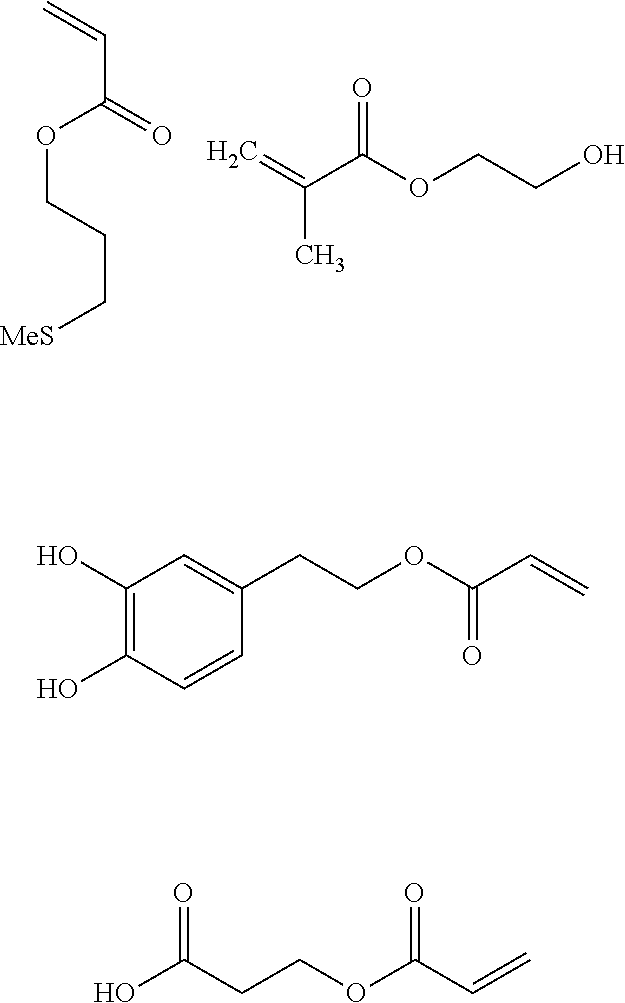
The pendant units arranged to have an appropriate affinity with the parts to be assembled are preferably selected from the group consisting of thiols, thioethers, thioesters, sulphides, thioamides, hydroxyls, catechol, amines, ammoniums, nitrogenated heterocycles such as imidazole or pyridine, carboxylic acids, esters and anhydrides.
Thus, particularly suitable examples of monomers for introducing pendant units arranged to have an appropriate affinity with the parts to be assembled into the “soft” polymer block already comprising pendant units X are:
Figure US09926468-20180327-C00002
These molecules are commercially available.
Moreover, the “soft” polymer block can advantageously comprise pendant units arranged to adjust the glass transition temperature Tg or melting temperature Tf of said “soft” polymer block to below the TDA.
The pendant units arranged to adjust the glass transition temperature Tg or melting temperature Tf of said “soft” polymer block are preferably selected from the group consisting of the possibly functionalised alkyl chains and phenyl derivatives. Thus, examples of suitable commercially available monomers for forming the pendant units arranged to adjust the Tg or Tf of the polymer are methacrylic or acrylic esters, styrene derivatives. The following may be given as example: butyl methacrylate (homo-butyl methacrylate=20° C.), cyclohexyl acrylate (homo-cyclohexyl acrylate=19° C.), tert-butyl methacrylate (Tg homo-tert-butyl methacrylate=118° C.), dodecyl methacrylate (Tf homo dodecyl methacrylate=−65° C.), 2-ethoxyethyl acrylate (Tg homo 2-ethoxyethyl acrylate=−50° C.), ethyl acrylate (Tg homo ethyl acrylate=−24° C.), hexyl acrylate (Tg hexyl acrylate=59° C.), styrene (Tg styrene homopolymer=100° C.).
It will also readily be understood that some of the pendant units arranged to provide a suitable affinity with the parts to be assembled can also serve to adjust the Tg or Tf of the “soft” polymer block.
Advantageously, the “soft” polymer block contains between 1 and 50%, preferably between 1 and 30% pendant units X, between 1 and 50%, preferably between 1 and 30% pendant units arranged to provide a suitable affinity with the parts to be assembled, and between 1 and 90%, preferably between 20 and 70% pendant units arranged to adjust the glass transition temperature Tg or the melting temperature Tf of the “soft” polymer block.
Techniques of block copolymerisation are well known to the person skilled in the art and do not need to be described in detail.
Two synthesis routes can preferably be used to obtain the block copolymer. A first possible route is the sequential synthesis of the blocks. This route can comprise the following steps, for example:
    • anionic styrene polymerisation to obtain the hard polymer block
    • chain end functionalisation of the styrene to obtain a macroinitiator
    • atom-transfer radical polymerisation (ATRP) of furfuryl methacrylate/butyl methacrylate/hydroxyethyl methacrylate to obtain a soft polymer block from the macroinitiator (=functional polystyrene)
      or also:
    • controlled radical polymerisation of furfuryl methacrylate/butyl methacrylate/hydroxyethyl methacrylate from a bifunctional initiator
    • growth of styrene blocks from the macroinitiator (=bifunctional soft block) by controlled radical polymerisation.
A second possible route is synthesis by “click chemistry” between the two hard and soft blocks. This route can comprise the following steps, for example:
    • synthesis by ATRP of an alkyne-functional copolymer of furfuryl methacrylate/hydroxyethyl methacrylate/butyl methacrylate
    • click chemistry coupling of the alkyne-functional copolymer of furfuryl methacrylate/hydroxyethyl methacrylate/butyl methacrylate with the commercially available azide-functional polystyrene shown below:
Figure US09926468-20180327-C00003
An example of block copolymer comprising a hard block and a soft block is shown below:
Figure US09926468-20180327-C00004
As regards the coupling molecules, their dienophile groups Y are preferably derivatives of compounds selected from the group consisting of maleimide and maleic anhydride.
Y is preferably a derivative of maleimide.
Thus the coupling molecule can advantageously have a structure of formula (I) below:
Figure US09926468-20180327-C00005

where R1 is an alkyl chain, preferably a (CH2)n chain with 1<n<35 substituted or not by at least one hydroxy group or by an N-methyl maleimide group, an aryl chain, preferably a phenyl, or a PDMS (polydimethylsiloxane) chain or a structure of the form
Figure US09926468-20180327-C00006

where Y=—O—, —S—, —CH2—, —C(CH3)2— or a PDMS chain or a PEG (polyethylene glycol) chain.
Examples of particularly suitable coupling molecules that are commercially available are:
Figure US09926468-20180327-C00007
Figure US09926468-20180327-C00008
In the formulation provided in the form of a mixture of block copolymer chains comprising at least pendant diene units X and of coupling molecules comprising at least two dienophile end groups Y, the quantity of coupling molecules is such that the ratio of the number of coupling molecules to the number of pendant diene functions X ranges between 0.5:2 and 1.2:2 and preferably is equal to 1:2.
The two parts are assembled and can be repositioned using the assembly and repositioning process according to the invention, which comprises the steps of:
    • a) preparing in a solvent (such as isopropyl alcohol, ethanol, methyl tert-butyl ether, tetrahydrofuran) a solution of an adhesive comprising at least one formulation having the form of a mixture of block copolymer chains comprising at least a first polymer block having a glass transition temperature Tg or a melting temperature Tf ranging between 40° C. and 200° C., and at least a second polymer block comprising at least pendant diene units X and having a glass transition temperature Tg or a melting temperature Tf lower than TDA, and of coupling molecules comprising at least two dienophile end groups Y, wherein said X units and said Y groups are arranged to be able to react with one another and to bond together by means of the Diels-Alder reaction at a temperature TDA and to be able to regenerate by means of the retro-Diels-Alder reaction at a temperature TRDA,
      • where TA<TRDA≤TC, wherein temperature TDA ranges between 0° C. and 100° C., preferably between 25° C. and 70° C., and temperature TRDA ranges between 50° C. and 200° C., preferably between 80° C. and 150° C., and TDA is strictly lower than TRDA, and temperature TC is higher than the glass transition temperature Tg or the melting temperature Tf of the first polymer block,
    • b) applying the solution of said adhesive to the parts to be assembled
    • c) drying, e.g. in vacuum to eliminate the solvent
    • d) placing the parts at a temperature higher than or equal to the glass transition temperature Tg or the melting temperature Tf of the first polymer block to finely reposition the parts
    • e) cooling to a temperature lower than or equal to the glass transition temperature Tg or the melting temperature Tf of the first polymer block in order to immobilise the glued assembly of parts
    • f) placing, e.g. by placing in an oven, for some hours the parts at a temperature higher than or equal to temperature TDA and lower than TRDA to link the block copolymer chains to one another by means of the coupling molecules by the Diels-Alder reaction so that the adhesive is in the form of a three-dimensional network
    • g) if it is necessary to reposition the parts, heating said parts to temperature TC to regenerate the mixture of block copolymer chains and of coupling molecules by means of the retro-Diels-Alder reaction
    • h) repositioning the parts
    • i) duplicating steps e) to f)
    • j) if necessary, repeating steps g) to i) as many times as required to reposition the parts again.
Thus, at ambient temperature in the normal conditions of use of the parts, the latter are glued by means of the adhesive that is resistant to chemical cleaning operations because of the three-dimensional network formed by the block copolymer chains. At higher temperature, i.e. at least at the temperature TRDA of the retro-Diels-Alder reaction, the bridges formed between the block copolymer chains by the coupling molecules break in order to break the three-dimensional network. The viscosity of the adhesive decreases such that it is then possible to meticulously reposition the parts. The assembly is cooled and placed at a temperature that allows to trigger the Diels-Alder reaction between the block copolymer chains and the coupling molecules in order to reform the three-dimensional network and immobilise the parts in their new position.
The advantage of a block structure is that the parts can be repositioned using heat and quickly immobilised by cooling the hard blocks while retaining the flexibility of the soft blocks so that they have sufficient mobility to be able to react by the Diels-Alder reaction with the coupling molecules at a temperature lower than the glass transition temperature of the melting temperature Tf of the hard blocks.
Example of synthesis of block copolymer chains:
The polymer chain is synthesised in the form of an A-B-A block copolymer using the following operating method:
furfuryl methacrylate (3 mL, 19.2 mmol), hydroxyethyl methacrylate (1.6 mL, 12.8 mmol), dodecyl methacrylate (5.6 mL, 19.2 mmol), catalyst Ru(Ind)Cl/PPh3)2 (10 mg), a solution of the bifunctional initiator CHCl2(COPh) (0.32 mL of a 400 mmol/L solution in toluene) and a solution of n-Bu3N in toluene (0.64 mL of a 0.27 mmol/L solution) are placed in a Schlenk flask containing toluene (6 mL) that has previously been degassed with nitrogen. The reaction medium is bubbled with nitrogen for 5 min, then agitated and heated to 80° C. for 24 h. The reaction medium is precipitated in acetone. The precipitate is separated by centrifuging, solubilised in toluene, then coagulated in methanol. The polymer is vacuum dried, then used as macroinitiator for the following step. For this, a solution of the macroinitiator polymer in toluene (2 mM) is prepared. Then, the 2M polymer macroinitiator solution (7.1 mL, 0.0142 mmol), catalyst Ru(Ind)Cl/PPh3)2 (10 mg) and methyl methacrylate (0.76 mL, 7.1 mmol) are placed into a Schenk flask. The mixture is heated and agitated for 24 h at 80° C. The reaction medium is precipitated in acetone. The precipitate is separated by centrifuging, solubilised in toluene, then coagulated in methanol. The polymer is vacuum dried, then used as macroinitiator for the following step.
The following block copolymer is obtained:
Figure US09926468-20180327-C00009
To form the repositionable hot melt adhesive the previously described block copolymer chain is placed in solution in toluene, then mixed with coupling agent 4,4′-(methylene di-p-phenylene)dimaleimide (134 mg, 0.375 mmol).
This solution is then deposited onto parts to be assembled according to the protocol described above.

Claims (19)

What is claimed is:
1. A process for assembling and repositioning at least two timepiece parts through at least one hot melt adhesive, wherein said timepiece parts are held together in assembled position when said hot melt adhesive is at a temperature TA and can be repositioned in relation to one another when said hot melt adhesive is heated to a temperature TC, comprising:
a) preparing a solution comprising at least one hot melt adhesive comprising at least one formulation comprising a mixture of (i) at least one block copolymer comprising at least a first polymer block having a glass transition temperature Tg or a melting temperature Tf ranging between 40° C. and 200° C., and at least a second polymer block comprising at least pendant diene units X and having a glass transition temperature Tg or a melting temperature Tf lower than a temperature TDA, and (ii) at least one coupling molecule comprising at least two dienophile end groups Y, wherein said units X and said groups Y are arranged to be able to react with one another and to bond together through a Diels-Alder reaction at a temperature TDA and to be able to obtain the mixture of block copolymer and of coupling molecules through a retro-Diels-Alder reaction at a temperature TRDA,
wherein TA<TRDA≤TC, temperature TDA ranges between 0° C. and 100° C., temperature TRDA ranges between 50° C. and 200° C., TDA is lower than TRDA, and temperature TC is higher than the glass transition temperature Tg or the melting temperature Tf of the first polymer block,
b) applying the solution of said hot melt adhesive to the timepiece parts to be assembled,
c) drying the solution,
d) placing the timepiece parts at a temperature higher than or equal to the glass transition temperature Tg or the melting temperature Tf of the first polymer block and repositioning the timepiece parts,
e) cooling the timepiece parts to a temperature lower than or equal to the glass transition temperature Tg or the melting temperature Tf of the first polymer block,
f) placing the timepiece parts at a temperature higher than or equal to temperature TDA and lower than TRDA to link the block copolymer through the coupling molecules through a Diels-Alder reaction so that the hot melt adhesive is in the form of a three-dimensional network,
g) heating said timepiece parts to temperature TC to obtain the mixture of block copolymer and of coupling molecules through a retro-Diels-Alder reaction,
h) repositioning the timepiece parts,
i) repeating e) and f), and
j) optionally, repeating g) to i) one or more times to reposition the timepiece parts.
2. The process according to claim 1, wherein temperature TDA ranges between 25° C. and 70° C.
3. The process according to claim 1, wherein temperature TRDA ranges between 80° C. and 150° C.
4. The process according to claim 1, wherein the first polymer block has a glass transition temperature Tg or a melting temperature Tf ranging between 60° C. and 150° C.
5. The process according to claim 1, wherein the second polymer block has a glass transition temperature Tg or a melting temperature Tf ranging between −50° C. and 60° C.
6. The process according to claim 1, wherein the block copolymer comprises at each of its ends a first polymer block having a glass transition temperature Tg or a melting temperature Tf ranging between 40° C. and 200° C., and a central second polymer block comprising at least pendant diene units X and having a glass transition temperature Tg or a melting temperature Tf lower than TDA.
7. The process according to claim 6, wherein the first polymer block which is at each end of the block copolymer has a glass transition temperature Tg or a melting temperature Tf ranging between 60° C. and 150° C.
8. The process according to claim 6, wherein the central second polymer block has a glass transition temperature Tg or a melting temperature Tf ranging between −50° C. and 60° C.
9. The process according to claim 1, wherein the first polymer block having a glass transition temperature Tg or a melting temperature Tf ranging between 40° C. and 200° C. is selected from the group consisting of poly(tert-butyl methacrylate), poly(4-tert-butyl styrene), poly(cyclohexyl methacrylate), polystyrene, poly(methyl methacrylate), and mixtures thereof.
10. The process according to claim 1, wherein the second polymer block comprises pendant units arranged to have affinity with the timepiece parts to be assembled.
11. The process according to claim 1, wherein the second polymer block comprises pendant units arranged to adjust the glass transition temperature Tg or melting temperature Tf of said second polymer block.
12. The process according to claim 1, wherein the pendant diene units X are selected from the group consisting of furan, cyclopentadiene, anthracene, and mixtures thereof.
13. The process according to claim 10, wherein the pendant units arranged to have affinity with the timepiece parts to be assembled are selected from the group consisting of thiols, thioethers, thioesters, sulphides, thioamides, hydroxyls, catechol, amines, ammoniums, nitrogenated heterocycles, carboxylic acids, esters, anhydrides, and mixtures thereof.
14. The process according to claim 11, wherein the pendant units arranged to adjust the glass transition temperature Tg or melting temperature Tf of the second polymer block are selected from the group consisting of alkyl chains, functionalised alkyl chains, phenyl derivatives, and mixtures thereof.
15. The process according to claim 1, wherein the dienophile groups Y are derivatives of compounds selected from the group consisting of maleimide, maleic anhydride, and mixtures thereof.
16. The process according to claim 12, wherein the first polymer block having a glass transition temperature Tg or a melting temperature Tf ranging between 40° C. and 200° C. is selected from the group consisting of poly(tert-butyl methacrylate), poly(4-tert-butyl styrene), poly(cyclohexyl methacrylate), polystyrene, poly(methyl methacrylate), and mixtures thereof.
17. The process according to claim 13, wherein the first polymer block having a glass transition temperature Tg or a melting temperature Tf ranging between 40° C. and 200° C. is selected from the group consisting of poly(tert-butyl methacrylate), poly(4-tert-butyl styrene), poly(cyclohexyl methacrylate), polystyrene, poly(methyl methacrylate), and mixtures thereof.
18. The process according to claim 14, wherein the first polymer block having a glass transition temperature Tg or a melting temperature Tf ranging between 40° C. and 200° C. is selected from the group consisting of poly(tert-butyl methacrylate), poly(4-tert-butyl styrene), poly(cyclohexyl methacrylate), polystyrene, poly(methyl methacrylate), and mixtures thereof.
19. The process according to claim 15, wherein the first polymer block having a glass transition temperature Tg or a melting temperature Tf ranging between 40° C. and 200° C. is selected from the group consisting of poly(tert-butyl methacrylate), poly(4-tert-butyl styrene), poly(cyclohexyl methacrylate), polystyrene, poly(methyl methacrylate), and mixtures thereof.
US15/370,351 2015-12-18 2016-12-06 Process of assembling and repositioning two parts Active US9926468B2 (en)

Applications Claiming Priority (3)

Application Number Priority Date Filing Date Title
EP15201237.3 2015-12-18
EP15201237.3A EP3181652B1 (en) 2015-12-18 2015-12-18 Method for assembling and repositioning two clockmaking parts by a hot-repositionable adhesive
EP15201237 2015-12-18

Publications (2)

Publication Number Publication Date
US20170174942A1 US20170174942A1 (en) 2017-06-22
US9926468B2 true US9926468B2 (en) 2018-03-27

Family

ID=54850423

Family Applications (1)

Application Number Title Priority Date Filing Date
US15/370,351 Active US9926468B2 (en) 2015-12-18 2016-12-06 Process of assembling and repositioning two parts

Country Status (4)

Country Link
US (1) US9926468B2 (en)
EP (1) EP3181652B1 (en)
JP (1) JP6310535B2 (en)
CN (1) CN106893504B (en)

Cited By (1)

* Cited by examiner, † Cited by third party
Publication number Priority date Publication date Assignee Title
US20170174941A1 (en) * 2015-12-18 2017-06-22 The Swatch Group Research And Development Ltd Assembly of timepiece parts assembled using repositionable hot melt adhesive and process for assembling and repositioning such parts

Families Citing this family (2)

* Cited by examiner, † Cited by third party
Publication number Priority date Publication date Assignee Title
JP2023074419A (en) * 2021-11-17 2023-05-29 Toyo Tire株式会社 Rubber composition and method for manufacturing the same
KR20250114334A (en) * 2022-11-21 2025-07-29 다우 글로벌 테크놀로지스 엘엘씨 A primer composition having a thermally releasable multilayer structure bonded with a thermosetting adhesive

Citations (3)

* Cited by examiner, † Cited by third party
Publication number Priority date Publication date Assignee Title
US20030116272A1 (en) * 2001-12-21 2003-06-26 Aubert James H. Method of making thermally removable adhesives
WO2011112447A2 (en) 2010-03-09 2011-09-15 3M Innovative Properties Company Heat activated optically clear adhesive for bonding display panels
US20120309895A1 (en) * 2010-02-16 2012-12-06 Evonik Roehm Gmbh Functional materials with reversible crosslinking

Family Cites Families (5)

* Cited by examiner, † Cited by third party
Publication number Priority date Publication date Assignee Title
JPH02258818A (en) * 1988-12-28 1990-10-19 Nippon Zeon Co Ltd Crosslinked shape memorizing block copolymer, usage thereof and shape memorizing molded body
US5726391A (en) * 1996-12-16 1998-03-10 Shell Oil Company Thermosetting Encapsulants for electronics packaging
CN100432123C (en) * 2003-12-12 2008-11-12 日本电气株式会社 Shape memory resin capable of remolding and excellent in shape recovery and molded product composed of crosslinked resin
JP5759987B2 (en) * 2009-06-11 2015-08-05 ヘンケル アイピー アンド ホールディング ゲゼルシャフト ミット ベシュレンクテル ハフツング Thermoreversible hot melt adhesive composition containing multifunctional diene and dienophile compounds
DE102010044025A1 (en) * 2010-11-17 2012-05-24 Evonik Röhm Gmbh Materials with controllable degree of crosslinking

Patent Citations (4)

* Cited by examiner, † Cited by third party
Publication number Priority date Publication date Assignee Title
US20030116272A1 (en) * 2001-12-21 2003-06-26 Aubert James H. Method of making thermally removable adhesives
US20120309895A1 (en) * 2010-02-16 2012-12-06 Evonik Roehm Gmbh Functional materials with reversible crosslinking
WO2011112447A2 (en) 2010-03-09 2011-09-15 3M Innovative Properties Company Heat activated optically clear adhesive for bonding display panels
US20120325402A1 (en) 2010-03-09 2012-12-27 3M Innovative Properties Company Heat activated optically clear adhesive for bonding display panels

Non-Patent Citations (3)

* Cited by examiner, † Cited by third party
Title
European Search Report dated Jun. 3, 2016 in European Application 15201237, filed on Dec. 18, 2015 ( with English translation of Categories of Cited Documents).
Jing Bai et al. "Dynamic crosslinked poly(styrene-block-butadiene-block-styrene) via Diels-Alder Chemistry: an ideal method to improve solvent resistance and mechanical properties without losing its thermal plastic behavior", Royal Society of Chemistry, vol. 5, No. 56, 2015, 13 pages.
Markus J. Barthel et al. "Self-Healing Materials via Reversible Crosslinking of Poly(ethylene oxide)-Block-Poly(furfuryl glycidyl ether) (PEO-b-PFGE) Block Copolymer Films", Advanced Functional Materials, vol. 23, No. 39, 2013, 12 pages.

Cited By (2)

* Cited by examiner, † Cited by third party
Publication number Priority date Publication date Assignee Title
US20170174941A1 (en) * 2015-12-18 2017-06-22 The Swatch Group Research And Development Ltd Assembly of timepiece parts assembled using repositionable hot melt adhesive and process for assembling and repositioning such parts
US10577520B2 (en) * 2015-12-18 2020-03-03 The Swatch Group Research And Development Ltd Assembly of timepiece parts assembled using repositionable hot melt adhesive and process for assembling and repositioning such parts

Also Published As

Publication number Publication date
EP3181652A1 (en) 2017-06-21
EP3181652B1 (en) 2019-02-27
US20170174942A1 (en) 2017-06-22
JP2017110192A (en) 2017-06-22
CN106893504A (en) 2017-06-27
JP6310535B2 (en) 2018-04-11
CN106893504B (en) 2019-12-03

Similar Documents

Publication Publication Date Title
CN103443129B (en) There is the material of Controllable cross-linking degree
ES2650997T3 (en) Functional materials with controllable viscosity
US9926468B2 (en) Process of assembling and repositioning two parts
US9550851B2 (en) Functional materials with reversible crosslinking
US20170002145A1 (en) Polyhemiaminal and polyhexahydrotriazine materials from 1,4 conjugate addition reactions
CN102844391A (en) Functional materials with reversible crosslinking
JP2013542273A (en) Functional material with controllable viscosity or reversible cross-linking by aza-Diesel-Alder reaction with bishydrazone or conjugated bisschiff base
US10577520B2 (en) Assembly of timepiece parts assembled using repositionable hot melt adhesive and process for assembling and repositioning such parts
JP5800899B2 (en) Aziridinyl-containing compounds
CN103201294A (en) Thermoreversibly cross-linked graft polymers
HK1239723A1 (en) Process of assembling and repositioning two parts
HK1239723B (en) Process of assembling and repositioning two parts
JP6863456B2 (en) 2-Cyanoacrylate-based adhesive composition
JP5534244B2 (en) Method for producing hyperbranched polymer
HK1239722A1 (en) Assembly of timepiece parts assembled using repositionable hot melt adhesive and process for assembling and repositioning such parts
HK1239722B (en) Assembly of timepiece parts assembled using repositionable hot melt adhesive and process for assembling and repositioning such parts
CH711955A2 (en) Hot repositionable adhesive for joining two pieces and method of assembling and repositioning such pieces.
CH711933A2 (en) Set of watch parts assembled by heat repositionable adhesive and process for assembling and repositioning such parts.
HK1177220B (en) Functional materials having controllable viscosity
HK1177220A (en) Functional materials having controllable viscosity
JPWO2002098980A1 (en) Pseudo-crosslinked resin composition, molding material, sheet or film obtained therefrom, and optical component

Legal Events

Date Code Title Description
AS Assignment

Owner name: THE SWATCH GROUP RESEARCH AND DEVELOPMENT LTD, SWI

Free format text: ASSIGNMENT OF ASSIGNORS INTEREST;ASSIGNORS:RANNOUX, CLAIRE;FERNANDEZ CIURLEO, MARIA;SIGNING DATES FROM 20161026 TO 20161108;REEL/FRAME:040536/0045

STCF Information on status: patent grant

Free format text: PATENTED CASE

MAFP Maintenance fee payment

Free format text: PAYMENT OF MAINTENANCE FEE, 4TH YEAR, LARGE ENTITY (ORIGINAL EVENT CODE: M1551); ENTITY STATUS OF PATENT OWNER: LARGE ENTITY

Year of fee payment: 4

MAFP Maintenance fee payment

Free format text: PAYMENT OF MAINTENANCE FEE, 8TH YEAR, LARGE ENTITY (ORIGINAL EVENT CODE: M1552); ENTITY STATUS OF PATENT OWNER: LARGE ENTITY

Year of fee payment: 8