US9925760B2 - Printing head having printing blade with disruptions and a vibration unit - Google Patents

Printing head having printing blade with disruptions and a vibration unit Download PDF

Info

Publication number
US9925760B2
US9925760B2 US14/961,123 US201514961123A US9925760B2 US 9925760 B2 US9925760 B2 US 9925760B2 US 201514961123 A US201514961123 A US 201514961123A US 9925760 B2 US9925760 B2 US 9925760B2
Authority
US
United States
Prior art keywords
printing
blade
disruptions
printing head
screen
Prior art date
Legal status (The legal status is an assumption and is not a legal conclusion. Google has not performed a legal analysis and makes no representation as to the accuracy of the status listed.)
Active
Application number
US14/961,123
Other versions
US20160159074A1 (en
Inventor
Clive Ashmore
Mark Whitmore
Gerry Cox
Current Assignee (The listed assignees may be inaccurate. Google has not performed a legal analysis and makes no representation or warranty as to the accuracy of the list.)
ASMPT SMT Singapore Pte Ltd
Original Assignee
ASM Assembly Systems Singapore Pte Ltd
Priority date (The priority date is an assumption and is not a legal conclusion. Google has not performed a legal analysis and makes no representation as to the accuracy of the date listed.)
Filing date
Publication date
Application filed by ASM Assembly Systems Singapore Pte Ltd filed Critical ASM Assembly Systems Singapore Pte Ltd
Priority to US14/961,123 priority Critical patent/US9925760B2/en
Publication of US20160159074A1 publication Critical patent/US20160159074A1/en
Assigned to ASM ASSEMBLY SYSTEMS SINGAPORE PTE. LTD. reassignment ASM ASSEMBLY SYSTEMS SINGAPORE PTE. LTD. ASSIGNMENT OF ASSIGNORS INTEREST (SEE DOCUMENT FOR DETAILS). Assignors: WHITMORE, MARK, ASHMORE, CLIVE, COX, GERRY
Application granted granted Critical
Publication of US9925760B2 publication Critical patent/US9925760B2/en
Assigned to ASMPT SMT SINGAPORE PTE. LTD. reassignment ASMPT SMT SINGAPORE PTE. LTD. CHANGE OF NAME (SEE DOCUMENT FOR DETAILS). Assignors: ASM ASSEMBLY SYSTEMS SINGAPORE PTE. LTD.
Active legal-status Critical Current
Anticipated expiration legal-status Critical

Links

Images

Classifications

    • BPERFORMING OPERATIONS; TRANSPORTING
    • B41PRINTING; LINING MACHINES; TYPEWRITERS; STAMPS
    • B41FPRINTING MACHINES OR PRESSES
    • B41F15/00Screen printers
    • B41F15/14Details
    • B41F15/40Inking units
    • B41F15/42Inking units comprising squeegees or doctors
    • B41F15/423Driving means for reciprocating squeegees
    • BPERFORMING OPERATIONS; TRANSPORTING
    • B41PRINTING; LINING MACHINES; TYPEWRITERS; STAMPS
    • B41FPRINTING MACHINES OR PRESSES
    • B41F15/00Screen printers
    • B41F15/14Details
    • B41F15/44Squeegees or doctors
    • BPERFORMING OPERATIONS; TRANSPORTING
    • B41PRINTING; LINING MACHINES; TYPEWRITERS; STAMPS
    • B41FPRINTING MACHINES OR PRESSES
    • B41F15/00Screen printers
    • B41F15/08Machines
    • B41F15/12Machines with auxiliary equipment, e.g. for drying printed articles
    • BPERFORMING OPERATIONS; TRANSPORTING
    • B41PRINTING; LINING MACHINES; TYPEWRITERS; STAMPS
    • B41FPRINTING MACHINES OR PRESSES
    • B41F15/00Screen printers
    • B41F15/14Details
    • B41F15/40Inking units
    • B41F15/42Inking units comprising squeegees or doctors
    • BPERFORMING OPERATIONS; TRANSPORTING
    • B41PRINTING; LINING MACHINES; TYPEWRITERS; STAMPS
    • B41MPRINTING, DUPLICATING, MARKING, OR COPYING PROCESSES; COLOUR PRINTING
    • B41M1/00Inking and printing with a printer's forme
    • B41M1/12Stencil printing; Silk-screen printing
    • HELECTRICITY
    • H05ELECTRIC TECHNIQUES NOT OTHERWISE PROVIDED FOR
    • H05KPRINTED CIRCUITS; CASINGS OR CONSTRUCTIONAL DETAILS OF ELECTRIC APPARATUS; MANUFACTURE OF ASSEMBLAGES OF ELECTRICAL COMPONENTS
    • H05K3/00Apparatus or processes for manufacturing printed circuits
    • H05K3/10Apparatus or processes for manufacturing printed circuits in which conductive material is applied to the insulating support in such a manner as to form the desired conductive pattern
    • H05K3/12Apparatus or processes for manufacturing printed circuits in which conductive material is applied to the insulating support in such a manner as to form the desired conductive pattern using thick film techniques, e.g. printing techniques to apply the conductive material or similar techniques for applying conductive paste or ink patterns
    • H05K3/1216Apparatus or processes for manufacturing printed circuits in which conductive material is applied to the insulating support in such a manner as to form the desired conductive pattern using thick film techniques, e.g. printing techniques to apply the conductive material or similar techniques for applying conductive paste or ink patterns by screen printing or stencil printing
    • HELECTRICITY
    • H05ELECTRIC TECHNIQUES NOT OTHERWISE PROVIDED FOR
    • H05KPRINTED CIRCUITS; CASINGS OR CONSTRUCTIONAL DETAILS OF ELECTRIC APPARATUS; MANUFACTURE OF ASSEMBLAGES OF ELECTRICAL COMPONENTS
    • H05K3/00Apparatus or processes for manufacturing printed circuits
    • H05K3/10Apparatus or processes for manufacturing printed circuits in which conductive material is applied to the insulating support in such a manner as to form the desired conductive pattern
    • H05K3/12Apparatus or processes for manufacturing printed circuits in which conductive material is applied to the insulating support in such a manner as to form the desired conductive pattern using thick film techniques, e.g. printing techniques to apply the conductive material or similar techniques for applying conductive paste or ink patterns
    • H05K3/1216Apparatus or processes for manufacturing printed circuits in which conductive material is applied to the insulating support in such a manner as to form the desired conductive pattern using thick film techniques, e.g. printing techniques to apply the conductive material or similar techniques for applying conductive paste or ink patterns by screen printing or stencil printing
    • H05K3/1233Methods or means for supplying the conductive material and for forcing it through the screen or stencil

Definitions

  • the present invention relates to a screen printing head for and a method of printing a print medium through a printing screen, often alternatively referred to as a stencil, for printing deposits of a print medium onto a workpiece.
  • the print medium can be a solder paste, such as in the fabrication of electronics components, or a silver paste, such as in the fabrication of conductor lines, for example, in solar cells.
  • the area ratio is the ratio of the open area of a printing aperture to the area of the walls of the printing aperture, whereby, as the area ratio decreases, there will be an increasing stiction of the print medium to the walls of the printing aperture and a decreasing stiction of the print medium to the substrate on which the print medium is printed.
  • the area ratio currently dictates the stencil design, in that there is a lower limit to the area ratio, currently about 0.6, which can be used to achieve an acceptable transfer efficiency, typically about 75%.
  • Achieving an acceptable transfer efficiency is particularly problematic where deposits of a range of sizes are required, from standard size structures to ultra-fine pitch structures, in that standard size structures require the use of a relatively thick printing screen, typically 100 ⁇ m in thickness, in order to provide the necessary volume of print medium, but the consequence of using a relatively thick printing screen is that the printing apertures for the finer pitch structures necessarily have a low area ratio, which reduces the transfer efficiency for the deposits printed by those printing apertures.
  • the transfer efficiency of the finer pitch apertures can be improved by reducing the thickness of the printing screen, but this has the consequence of reducing the volume of print medium which can be deposited from the standard size apertures.
  • the present inventors have, however, a screen printing head and method which provides for a significantly improved transfer efficiency as compared to existing screen printing techniques.
  • the present invention provides a screen printing head for printing deposits of a print medium onto a workpiece through apertures in a printing screen, comprising: a main, support body for attachment to a screen printing machine; a support element to which a printing blade is in use attached; and a vibration unit which couples the support element to the support body to provide for vibration of the support element, and hence the printing blade when attached thereto.
  • the present invention provides a method of printing deposits of a print medium onto a workpiece through apertures in a printing screen, the method comprising the steps of: attaching a main, support body to a screen printing machine; providing a support element to which a printing blade is attached; coupling the support element to the support body by a vibration unit; and operating the vibration unit to provide for vibration of the support element, and hence the printing blade attached thereto, to condition the print medium forward of the printing blade.
  • the present invention provides a method of printing deposits of a print medium onto a workpiece through apertures in a printing screen, the method comprising the step of vibrating a printing blade to condition print medium forward of the printing blade, wherein the printing blade is vibrated at at least one frequency in the range of from about 20 kHz to about 200 kHz and with a displacement of at least about 0.4 ⁇ m.
  • the present invention provides a printing blade comprising a blade element which includes a plurality of disruptions at spaced locations therealong, which act to isolate applied vibrational energy into respective segments of the blade element.
  • FIG. 1 illustrates an exploded perspective view of a screen printing head in accordance with a first embodiment of the present invention
  • FIG. 2 illustrates an exploded vertical sectional view through the screen printing head of FIG. 1 ;
  • FIG. 3 illustrates an enlarged perspective view of a piezoelectric actuator at one end of the printing head of FIG. 1 , illustrating the folded connection at one end of the busbar assembly;
  • FIG. 4 illustrates an enlarged perspective view of a piezoelectric actuator at the other end of the printing head of FIG. 1 , illustrating the connection terminals at the other end of the busbar assembly;
  • FIG. 5 illustrates plots of transfer efficiency as a function of area ratio for deposits printed in Example #1, both with (Dynamic) and without (Standard) the vibration regime;
  • FIG. 6 illustrates plots of area coverage as a function of area ratio for deposits printed in Example #1, both with (Dynamic) and without (Standard) the vibration regime;
  • FIGS. 7( a ) and ( b ) illustrate micrographs of deposits printed in Example #2, both with (Dynamic) and without (Standard) the vibration regime;
  • FIGS. 8( a ) and ( b ) illustrate micrographs of deposits printed in Example #3, both with (Dynamic) and without (Standard) the vibration regime;
  • FIG. 9 illustrates a perspective view of a screen printing head in accordance with a second embodiment of the present invention.
  • FIG. 10 illustrates an exploded perspective view of the screen printing head of FIG. 9 ;
  • FIG. 11 illustrates an exploded perspective view of a screen printing head as a modification of the screen printing head of FIG. 9 ;
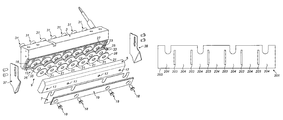
  • FIG. 12 illustrates a printing blade in accordance with a preferred embodiment of the present invention.
  • FIGS. 1 to 4 illustrate a screen printing head in accordance with a first embodiment of the present invention.
  • the screen printing head comprises a main support body 3 , in this embodiment an elongate block, here formed of stainless steel, which is in use coupled to the print head transport mechanism (not illustrated) of a screen printing machine which is operative to displace the printing head over a printing screen which is located over a workpiece and print deposits of a print medium through a pattern of apertures in the printing screen onto the workpiece W, a support element 5 , in this embodiment an elongate element, to which a printing blade 7 is attached, and a vibration unit 9 which couples the support element 5 to the main body 3 to provide for vibration of the support element 5 , and hence the printing blade 7 .
  • the vibration of the printing blade 7 imparts an energy to the print medium ahead of the printing blade 7 , which acts to condition the print medium. This conditioning improves the filling of the apertures in the printing screen and the transfer of the print medium from the filled apertures to the workpiece when separating the workpiece from the printing screen.
  • the main body 3 includes a forwardly-facing mounting surface 15 to which the vibration unit 9 is mounted, in this embodiment inclined to the vertical at an angle corresponding to the angle at which the printing blade 7 depends.
  • the main body 3 includes an O-ring seal 16 about the periphery of the mounting surface 15 thereof, against which the support element 5 is sealed, such as to enclose the vibration unit 9 .
  • the support element 5 includes at least one, in this embodiment a plurality of attachment elements 17 , in this embodiment a plurality of threaded couplings, here blind threaded apertures, arranged along the length of the support element 5 , for enabling the printing blade 7 to be removably fitted to the support element without requiring dis-assembly of the vibration unit 9 .
  • the printing blade 7 is a squeegee blade, here a metal blade, either formed of stainless steel or aluminium.
  • a metal blade either formed of stainless steel or aluminium.
  • Other possible blade materials include rubber, plastic and composite materials.
  • the printing blade 7 could be a hybrid structure, such as a plastic blade with a metal screen-contacting tip element or a metal blade with a plastic screen-contacting tip element.
  • the printing blade 7 is attached to the support element 5 by at least one, in this embodiment a plurality of attachment elements 18 , in this embodiment a plurality of threaded couplings, here a plurality of threaded screws, which are coupled to respective ones of the attachment elements 17 of the support element 5 , and a retaining plate 19 which is clamped against the printing blade 7 .
  • the vibration unit 9 is an ultrasonic unit for ultrasonically vibrating the support element 5 , here in a frequency range of from about 20 kHz to about 200 kHz, in one embodiment at a frequency of at least about 30 kHz, in one embodiment at a frequency of at most about 100 kHz, preferably at most about 80 kHz, more preferably at most about 60 kHz and still more preferably at most about 50 kHz, and here with a displacement of at least about 0.4 ⁇ m, in one embodiment with a displacement of at least about 1 ⁇ m, preferably at least about 2 ⁇ m, more preferably at least about 5 ⁇ m, and in one embodiment with a displacement of at most about 100 ⁇ m, preferably a displacement of at most about 25 ⁇ m.
  • the vibration unit 9 comprises at least one vibrator 21 , here a plurality of vibrators 21 which are spaced along the length of the main body 3 .
  • the or each vibrator 21 comprises a piezoelectric actuator.
  • each piezoelectric actuator 21 comprises a plurality of, here two stacked piezoelectric members 23 , 25 , which are electrically connected to a busbar assembly 26 , and insulator elements 27 , 28 which are located to opposite sides of the busbar assembly 26 , such as to isolate the piezoelectric members 23 , 25 from the main body 3 and the support element 5 .
  • the piezoelectric members 23 , 25 are ring-shaped, here having an inner diameter of 6 mm, an outer diameter of 20 mm and a thickness of 2 mm.
  • the piezoelectric members 23 , 25 could be formed of different shapes, such blocks, cubes and prisms.
  • the piezoelectric members 23 , 25 of the piezoelectric actuators 21 could be formed as an integral element, such as in the form of an elongate bar.
  • the percentage of the area of the engaging surfaces of the piezoelectric actuators 21 to the area of the engaging surface of the support element 5 is about 59%, and about 43% of the engaging surface of the printing blade 7 . In a preferred embodiment the percentage of the area of the engaging surfaces of the piezoelectric actuators 21 to the area of the engaging surface of the support element 5 is at least about 40%, preferably at least about 50%. In a preferred embodiment the percentage of the area of the engaging surfaces of the piezoelectric actuators 21 to the area of the engaging surface of the printing blade is at least about 30%, preferably at least about 40%.
  • the support element 5 is attached by threaded couplings 31 to the main body 3 , with the threaded couplings 31 being set to a predetermined torque, such as to apply a predetermined compressive force to the stacked piezoelectric members 23 , 25 .
  • the busbar assembly 16 comprises a first, inner electrode 33 to opposite sides of which the piezoelectric members 23 , 25 are respectively disposed and a second, common outer electrode 35 between which the piezoelectric members 23 , 25 are sandwiched.
  • the piezoelectric actuators 21 are electrically connected in parallel.
  • the insulator elements 27 , 28 comprise discs, with each piezoelectric actuator 21 having a pair of elements 27 , 28 .
  • the insulator elements 27 , 28 for all of the piezoelectric actuators 21 could be formed as integral elements.
  • the printing head further comprises edge deflectors 37 , 39 which are attached to the opposite ends of the main body 3 and act to prevent the print medium from escaping beyond the ends of the printing head.
  • the printing head further comprises a wideband multi-frequency power supply 41 which is connected to the electrodes 33 , 35 of the vibration unit 9 to cause the vibration of the support element 5 , here sweeping a frequency range of from about 20 kHz to about 200 kHz, in one embodiment at a frequency of at least about 30 kHz, in one embodiment at a frequency of at most about 100 kHz, preferably at most about 80 kHz, more preferably at most about 60 kHz and still more preferably at most about 50 kHz, and here with a displacement of at least about 0.4 ⁇ m, in one embodiment with a displacement of at least about 1 ⁇ m, preferably at least about 2 ⁇ m, more preferably at least about 5 ⁇ m, and in one embodiment with a displacement of at most about 100 ⁇ m, preferably a displacement of at most about 25 ⁇ m.
  • a wideband multi-frequency power supply 41 which is connected to the electrodes 33 , 35 of the vibration unit 9 to cause the vibration of the support element 5 , here sweeping
  • the power supply 41 drives the support element 5 at a resonant frequency of 33.6 kHz when driven at 46 W (50 VA apparent power) and a displacement of 6 ⁇ m.
  • the piezoelectric actuators 21 by sweeping a frequency range, it is ensured that the resonant frequency of each of the piezoelectric actuators 21 is encompassed.
  • This frequency sweeping has the advantage of not requiring the piezoelectric actuators 21 to be all tuned precisely to a single, common resonant frequency, and in one embodiment the piezoelectric actuators 21 can be specifically tuned to different resonant frequencies.
  • the piezoelectric actuators 21 will resonate at different time points in dependence upon their resonant frequency, thereby avoiding simultaneous resonance of the piezoelectric actuators 21 , which could avoid the development of standing waves.
  • the present invention achieves both a significantly increased transfer efficiency from finer pitch apertures, and an increased area coverage, particularly from the finer pitch apertures.
  • solder paste Type 4, lead Free—no clean
  • a solder paste (Type 4, lead Free—no clean) was printed through a 100 ⁇ m thick stainless printing screen having square apertures with dimensions ranging from 100 ⁇ m to 550 ⁇ m, both with (Dynamic) and without (Standard) the vibration regime.
  • FIG. 5 illustrates plots of transfer efficiency as a function of area ratio with (Dynamic) and without (Standard) the vibration regime. As will be observed, the transfer efficiency is significantly increased for finer pitch apertures having smaller area ratios.
  • the printing head when utilizing the vibration regime enables printing at area ratios down to about 0.4, whereas the printing head without the vibration regime (Standard) enables printing down to area ratios of only about 0.47.
  • FIG. 6 illustrates plots of area coverage as a function of area ratio with (Dynamic) and without (Standard) the vibration regime. As will be observed, the area coverage is significantly increased, particularly for finer pitch apertures having smaller area ratios.
  • solder paste Type 4, lead Free—no clean
  • a solder paste (Type 4, lead Free—no clean) was printed through a 100 ⁇ m thick stainless printing screen having square apertures with a side dimension of 210 ⁇ m, thereby having an area ratio on 0.525, both with (Dynamic) and without (Standard) the vibration regime.
  • FIGS. 7( a ) and ( b ) illustrate micrographs of the deposits achieved with (Dynamic) and without (Standard) the vibration regime. As will be observed, there is an improvement in transfer efficiency.
  • solder paste Type 4, lead Free—no clean
  • a solder paste (Type 4, lead Free—no clean) was printed through a 100 ⁇ m thick stainless printing screen having circular apertures with a diameter of 160 ⁇ m, thereby having an area ratio on 0.4, both with (Dynamic) and without (Standard) the vibration regime.
  • FIGS. 8( a ) and ( b ) illustrate micrographs of the deposits achieved with (Dynamic) and without (Standard) the vibration regime. As will be observed, the improvement in transfer efficiency for these finer pitch apertures is remarkable, when compared to the benefit achieved for larger pitch apertures as in Example #2.
  • FIGS. 9 and 10 illustrate a screen printing head in accordance with a second embodiment of the present invention.
  • the screen printing head comprises a main support body 103 , in this embodiment an elongate member, which is in use coupled to the print head transport mechanism (not illustrated) of a screen printing machine which is operative to displace the printing head over a printing screen which is located over a workpiece and print deposits of a print medium through a pattern of apertures in the printing screen onto the workpiece, a support member 105 , in this embodiment an elongate member, to which a printing blade (not illustrated) is attached, and a vibration unit 109 which couples the support member 105 to the main body 103 to provide for vibration of the support member 105 , and hence the printing blade.
  • the vibration of the printing blade imparts an energy to the print medium ahead of the printing blade, which acts to condition the print medium.
  • This conditioning improves the filling of the apertures in the printing screen and the transfer of the print medium from the filled apertures to the workpiece when separating the workpiece from the printing screen.
  • the main body 103 includes oppositely-facing mounting surfaces 115 , 116 to which the vibration unit 109 is mounted.
  • the support member 105 comprises a plurality of mass elements 117 , each being spaced from one another at the interface with the vibration unit 109 and terminating at a single, common attachment surface 118 to which the printing blade is fitted, thereby providing a single common front mass.
  • the mass elements 117 are tuned, through selection of the material, here aluminium, and the dimensions, in order to provide a quarter-wave resonance. In other embodiments the mass elements could be dimensioned to provide resonance at other harmonics, such as 3 ⁇ /4.
  • the mass elements 117 flare outwardly, such that the dimension at the forward end is greater than that at the interface with the main body 103 , thereby enabling the transmission of the vibration to an enlarged surface area.
  • the mass elements 117 comprise horns, here planar horns, which flare outwardly, preferably with a shape having a lateral surface 117 ′ with an exponential surface function.
  • the attachment surface 118 includes at least one, in this embodiment a plurality of attachment elements 119 , in this embodiment a plurality of threaded couplings, here threaded apertures, arranged along the length of the attachment surface 118 , for enabling the printing blade to be removably fitted to the support member 105 without requiring dis-assembly of the vibration unit 109 .
  • the attachment surface 118 is inclined to the vertical at an angle corresponding to the angle at which the printing blade is required to depend.
  • the attachment surface 118 is configured such that the printing blade depends at an angle between about 20 degrees and about 70 degrees, typically at about 45 degrees and about 60 degrees.
  • the printing blade is a squeegee blade, here a metal blade, either formed of stainless steel or aluminium.
  • a metal blade either formed of stainless steel or aluminium.
  • Other possible blade materials include rubber, plastic and composite materials.
  • the printing blade could be a hybrid structure, such as a plastic blade with a metal screen-contacting tip element or a metal blade with a plastic screen-contacting tip element.
  • the printing blade is attached to the support element by at least one, in this embodiment a plurality of attachment elements (not illustrated), in this embodiment a plurality of threaded couplings, here a plurality of threaded screws, which are coupled to respective ones of the attachment elements 119 of the support member 105 , and a retaining plate (not illustrated) which is clamped against the printing blade.
  • a plurality of attachment elements here illustrated
  • a plurality of threaded couplings here a plurality of threaded screws
  • the vibration unit 109 is an ultrasonic unit for ultrasonically vibrating the support member 105 , here in a frequency range of from about 20 kHz to about 200 kHz, in one embodiment at a frequency of at least about 30 kHz, in one embodiment at a frequency of at most about 100 kHz, preferably at most about 80 kHz, more preferably at most about 60 kHz and still more preferably at most about 50 kHz, and here with a displacement of at least about 0.4 ⁇ m, in one embodiment with a displacement of at least about 1 ⁇ m, preferably at least about 2 ⁇ m, more preferably at least about 5 ⁇ m, and in one embodiment with a displacement of at most about 100 ⁇ m, preferably a displacement of at most about 25 ⁇ m.
  • the vibration unit 109 comprises at least one vibrator 121 , here a plurality of vibrators 121 , in this embodiment corresponding in number to the mass elements 117 of the support member 105 , which are spaced along the length of the main body 103 .
  • the or each vibrator 121 comprises a piezoelectric actuator.
  • each piezoelectric actuator 121 comprises a plurality of, here two piezoelectric members 123 , 125 , and a rear mass element 127 , which is counterpart to the respective front mass element 117 of the support member 105 .
  • the rear mass elements 127 are tuned, through selection of the material, here aluminium, and the dimensions, in order to provide a quarter-wave resonance. In other embodiments the mass elements could be dimensioned to provide resonance at other harmonics, such as 3 ⁇ /4.
  • the piezoelectric members 123 , 125 are ring-shaped, here having an inner diameter of 6 mm, an outer diameter of 20 mm and a thickness of 2 mm.
  • the piezoelectric members 123 , 125 could be formed of different shapes, such blocks, cubes and prisms.
  • the piezoelectric members 123 , 125 of the piezoelectric actuators 121 could be formed as an integral element, such as in the form of an elongate bar.
  • the percentage of the area of the engaging surfaces of the piezoelectric actuators 121 to the area of the engaging surface of the support member 105 is at least about 40%, preferably at least about 50%.
  • the percentage of the area of the engaging surfaces of the piezoelectric actuators 121 to the area of the engaging surface of the printing blade is at least about 30%, preferably at least about 40%.
  • the support member 105 and the rear mass elements 127 are attached by threaded couplings 131 to the main body 103 , with the threaded couplings 131 being set to a predetermined torque, such as to apply a predetermined compressive force to the piezoelectric members 123 , 125 .
  • the piezoelectric members 123 , 125 are disposed to opposite sides of the main body 103 , whereby the main body 103 is located at the node of the piezoelectric unit 109 .
  • the main body 103 is an electrical conductor, or at least supports conductive elements, such that the main body 103 provides a common busbar for the piezoelectric members 123 , 125 .
  • the piezoelectric actuators 121 are electrically connected in parallel.
  • the piezoelectric members 123 , 125 could be stacked to one side of the main body 103 .
  • the piezoelectric members 123 , 125 could be stacked and the main body 103 could comprise first and second support members which are located to opposite sides of the stacked piezoelectric members 123 , 125 .
  • the printing head further comprises a wideband multi-frequency power supply of the same kind as the above-described first embodiment, which is connected of the vibration unit 109 to cause the vibration of the support member 105 , here sweeping a frequency range of from about 20 kHz to about 200 kHz, in one embodiment at a frequency of at least about 30 kHz, in one embodiment at a frequency of at most about 100 kHz, preferably at most about 80 kHz, more preferably at most about 60 kHz and still more preferably at most about 50 kHz, and here with a displacement of at least about 0.4 ⁇ m, in one embodiment with a displacement of at least about 1 ⁇ m, preferably at least about 2 ⁇ m, more preferably at least about 5 ⁇ m, and in one embodiment with a displacement of at most about 100 ⁇ m, preferably a displacement of at most about 25 ⁇ m.
  • the present invention achieves both a significantly increased transfer efficiency from finer pitch apertures, and an increased area coverage, particularly from the finer pitch apertures.
  • FIG. 11 illustrates a modification of the screen printing head of FIGS. 9 and 10 .
  • the support member 105 is provided by a plurality of separate front mass elements 117 which do not commonly terminate, but are provided as separate masses, with the attachment surface 118 being provided by a plurality of attachment surfaces 118 ′ as provided by each of the separate front mass elements 117 .
  • FIG. 12 illustrates a printing blade in accordance with a preferred embodiment of the present invention.
  • the printing blade comprises a blade element 201 , in this embodiment an elongate element, which includes a plurality of disruptions 203 at spaced locations therealong, which act to isolate applied vibrational energy into respective segments 204 of the blade element 201 .
  • the disruptions 203 extend in a direction from, here substantially orthogonally, a contact edge 205 of the blade element 201 .
  • disruptions 203 could flare inwardly or outwardly from the contact edge 205 .
  • the disruptions 203 extend from a location spaced from the contact edge 205 , such as to provide a continuous edge.
  • disruptions 203 each comprise an elongate aperture.
  • disruptions 203 could each comprise a plurality of chained apertures, in the form of perforations.
  • disruptions 203 could each comprise an elongate recess or a plurality of chained recesses.
  • disruptions 203 could each comprise an elongate projection or a plurality of chained projections.
  • the printing blade is a squeegee blade, here a metal blade, either formed of stainless steel or aluminium.
  • a metal blade either formed of stainless steel or aluminium.
  • Other possible blade materials include rubber, plastic and composite materials.
  • the printing blade could be a hybrid structure, such as a plastic blade with a metal screen-contacting tip element or a metal blade with a plastic screen-contacting tip element.
  • the power supply 41 could be configured to drive the piezoelectric actuators 21 , 121 at a single frequency, or at selected individual frequencies.
  • the frequency can be determined by identifying the resonant frequency for each piezoelectric actuator 21 , 121 and selecting the driving frequency based on the identified resonant frequencies.
  • the resonant frequency of each piezoelectric actuator 21 , 121 can be identified by scanning the frequency and identifying a peak in the drawn current.
  • the driving frequency for the piezoelectric actuators 21 , 121 can be determined from a best fit to the identified resonant frequencies.
  • the piezoelectric actuators 21 , 121 could be tuned to have a single, common resonant frequency, and the power supply 41 configured to drive the piezoelectric actuators 21 , 121 at the tuned frequency.
  • each vibrator 21 , 121 could comprise a pneumatic vibrator, such as a ball vibrator, a turbine vibrator or a roll vibrator.
  • each vibrator 21 , 121 could comprise a magnetostriction vibrator, such as a ferrite magnetostrictive vibrator.
  • rear mass elements 127 of the second-described embodiment could be provided as a single common mass, in the same manner as the support member 105 thereof.
Landscapes

  • Engineering & Computer Science (AREA)
  • Mechanical Engineering (AREA)
  • Manufacturing & Machinery (AREA)
  • Microelectronics & Electronic Packaging (AREA)
  • Screen Printers (AREA)
  • Printing Methods (AREA)
  • Electric Connection Of Electric Components To Printed Circuits (AREA)
  • Printing Plates And Materials Therefor (AREA)
  • Particle Formation And Scattering Control In Inkjet Printers (AREA)
  • Manufacture Or Reproduction Of Printing Formes (AREA)

Abstract

A screen printing head for and method of printing deposits of a print medium onto a workpiece through apertures in a printing screen, the printing head comprising a vibration unit for vibrating a printing blade to condition print medium forward of the printing blade, wherein the printing blade is vibrated at at least one frequency in the range of from about 20 kHz to about 200 kHz and with a displacement of at least about 0.4 μm.

Description

This application is a continuation of U.S. patent application Ser. No. 13/508,765 filed Jan. 7, 2013, which is a U.S. National Phase of International Application No. PCT/GB2010/002059 filed Nov. 9, 2010, which claims priority to United Kingdom Application No. 0919580.1 filed Nov. 9, 2009, which are all hereby incorporated herein by reference in their entirety.
The present invention relates to a screen printing head for and a method of printing a print medium through a printing screen, often alternatively referred to as a stencil, for printing deposits of a print medium onto a workpiece. Typically, the print medium can be a solder paste, such as in the fabrication of electronics components, or a silver paste, such as in the fabrication of conductor lines, for example, in solar cells.
With the continued miniaturisation of electronics components and structures, many of which utilize a screen printing process, there is a need to be able to print finer pitch deposits which have smaller area ratios, and with an acceptable transfer efficiency and area coverage.
The area ratio is the ratio of the open area of a printing aperture to the area of the walls of the printing aperture, whereby, as the area ratio decreases, there will be an increasing stiction of the print medium to the walls of the printing aperture and a decreasing stiction of the print medium to the substrate on which the print medium is printed. The area ratio currently dictates the stencil design, in that there is a lower limit to the area ratio, currently about 0.6, which can be used to achieve an acceptable transfer efficiency, typically about 75%.
Achieving an acceptable transfer efficiency is particularly problematic where deposits of a range of sizes are required, from standard size structures to ultra-fine pitch structures, in that standard size structures require the use of a relatively thick printing screen, typically 100 μm in thickness, in order to provide the necessary volume of print medium, but the consequence of using a relatively thick printing screen is that the printing apertures for the finer pitch structures necessarily have a low area ratio, which reduces the transfer efficiency for the deposits printed by those printing apertures. The transfer efficiency of the finer pitch apertures can be improved by reducing the thickness of the printing screen, but this has the consequence of reducing the volume of print medium which can be deposited from the standard size apertures.
It thus an aim of the present invention to provide an improved screen printing head and method which allows for the printing of deposits with increased transfer efficiency at lower area ratios.
Screen printing techniques have been developed which utilize vibration of the screen printing head, such as disclosed in U.S. Pat. No. 5,522,929, and these techniques apparently provide for an improved transfer efficiency.
The present inventors have, however, a screen printing head and method which provides for a significantly improved transfer efficiency as compared to existing screen printing techniques.
In one aspect the present invention provides a screen printing head for printing deposits of a print medium onto a workpiece through apertures in a printing screen, comprising: a main, support body for attachment to a screen printing machine; a support element to which a printing blade is in use attached; and a vibration unit which couples the support element to the support body to provide for vibration of the support element, and hence the printing blade when attached thereto.
In another aspect the present invention provides a method of printing deposits of a print medium onto a workpiece through apertures in a printing screen, the method comprising the steps of: attaching a main, support body to a screen printing machine; providing a support element to which a printing blade is attached; coupling the support element to the support body by a vibration unit; and operating the vibration unit to provide for vibration of the support element, and hence the printing blade attached thereto, to condition the print medium forward of the printing blade.
In a further aspect the present invention provides a method of printing deposits of a print medium onto a workpiece through apertures in a printing screen, the method comprising the step of vibrating a printing blade to condition print medium forward of the printing blade, wherein the printing blade is vibrated at at least one frequency in the range of from about 20 kHz to about 200 kHz and with a displacement of at least about 0.4 μm.
In still another aspect the present invention provides a printing blade comprising a blade element which includes a plurality of disruptions at spaced locations therealong, which act to isolate applied vibrational energy into respective segments of the blade element.
Preferred embodiments of the present invention will now be described hereinbelow by way of example only with reference to the accompanying drawings, in which:
FIG. 1 illustrates an exploded perspective view of a screen printing head in accordance with a first embodiment of the present invention;
FIG. 2 illustrates an exploded vertical sectional view through the screen printing head of FIG. 1;
FIG. 3 illustrates an enlarged perspective view of a piezoelectric actuator at one end of the printing head of FIG. 1, illustrating the folded connection at one end of the busbar assembly;
FIG. 4 illustrates an enlarged perspective view of a piezoelectric actuator at the other end of the printing head of FIG. 1, illustrating the connection terminals at the other end of the busbar assembly;
FIG. 5 illustrates plots of transfer efficiency as a function of area ratio for deposits printed in Example #1, both with (Dynamic) and without (Standard) the vibration regime;
FIG. 6 illustrates plots of area coverage as a function of area ratio for deposits printed in Example #1, both with (Dynamic) and without (Standard) the vibration regime;
FIGS. 7(a) and (b) illustrate micrographs of deposits printed in Example #2, both with (Dynamic) and without (Standard) the vibration regime;
FIGS. 8(a) and (b) illustrate micrographs of deposits printed in Example #3, both with (Dynamic) and without (Standard) the vibration regime;
FIG. 9 illustrates a perspective view of a screen printing head in accordance with a second embodiment of the present invention;
FIG. 10 illustrates an exploded perspective view of the screen printing head of FIG. 9;
FIG. 11 illustrates an exploded perspective view of a screen printing head as a modification of the screen printing head of FIG. 9; and
FIG. 12 illustrates a printing blade in accordance with a preferred embodiment of the present invention.
FIGS. 1 to 4 illustrate a screen printing head in accordance with a first embodiment of the present invention.
The screen printing head comprises a main support body 3, in this embodiment an elongate block, here formed of stainless steel, which is in use coupled to the print head transport mechanism (not illustrated) of a screen printing machine which is operative to displace the printing head over a printing screen which is located over a workpiece and print deposits of a print medium through a pattern of apertures in the printing screen onto the workpiece W, a support element 5, in this embodiment an elongate element, to which a printing blade 7 is attached, and a vibration unit 9 which couples the support element 5 to the main body 3 to provide for vibration of the support element 5, and hence the printing blade 7.
As will be discussed in more detail hereinbelow, the vibration of the printing blade 7 imparts an energy to the print medium ahead of the printing blade 7, which acts to condition the print medium. This conditioning improves the filling of the apertures in the printing screen and the transfer of the print medium from the filled apertures to the workpiece when separating the workpiece from the printing screen.
The main body 3 includes a forwardly-facing mounting surface 15 to which the vibration unit 9 is mounted, in this embodiment inclined to the vertical at an angle corresponding to the angle at which the printing blade 7 depends.
In this embodiment the main body 3 includes an O-ring seal 16 about the periphery of the mounting surface 15 thereof, against which the support element 5 is sealed, such as to enclose the vibration unit 9.
The support element 5 includes at least one, in this embodiment a plurality of attachment elements 17, in this embodiment a plurality of threaded couplings, here blind threaded apertures, arranged along the length of the support element 5, for enabling the printing blade 7 to be removably fitted to the support element without requiring dis-assembly of the vibration unit 9.
In this embodiment the printing blade 7 is a squeegee blade, here a metal blade, either formed of stainless steel or aluminium. Other possible blade materials include rubber, plastic and composite materials. In addition, the printing blade 7 could be a hybrid structure, such as a plastic blade with a metal screen-contacting tip element or a metal blade with a plastic screen-contacting tip element.
The printing blade 7 is attached to the support element 5 by at least one, in this embodiment a plurality of attachment elements 18, in this embodiment a plurality of threaded couplings, here a plurality of threaded screws, which are coupled to respective ones of the attachment elements 17 of the support element 5, and a retaining plate 19 which is clamped against the printing blade 7.
In this embodiment the vibration unit 9 is an ultrasonic unit for ultrasonically vibrating the support element 5, here in a frequency range of from about 20 kHz to about 200 kHz, in one embodiment at a frequency of at least about 30 kHz, in one embodiment at a frequency of at most about 100 kHz, preferably at most about 80 kHz, more preferably at most about 60 kHz and still more preferably at most about 50 kHz, and here with a displacement of at least about 0.4 μm, in one embodiment with a displacement of at least about 1 μm, preferably at least about 2 μm, more preferably at least about 5 μm, and in one embodiment with a displacement of at most about 100 μm, preferably a displacement of at most about 25 μm.
In this embodiment the vibration unit 9 comprises at least one vibrator 21, here a plurality of vibrators 21 which are spaced along the length of the main body 3.
In this embodiment the or each vibrator 21 comprises a piezoelectric actuator.
In this embodiment each piezoelectric actuator 21 comprises a plurality of, here two stacked piezoelectric members 23, 25, which are electrically connected to a busbar assembly 26, and insulator elements 27, 28 which are located to opposite sides of the busbar assembly 26, such as to isolate the piezoelectric members 23, 25 from the main body 3 and the support element 5.
In this embodiment the piezoelectric members 23, 25 are ring-shaped, here having an inner diameter of 6 mm, an outer diameter of 20 mm and a thickness of 2 mm. In other embodiments the piezoelectric members 23, 25 could be formed of different shapes, such blocks, cubes and prisms. Also, in another embodiment the piezoelectric members 23, 25 of the piezoelectric actuators 21 could be formed as an integral element, such as in the form of an elongate bar.
In this embodiment the percentage of the area of the engaging surfaces of the piezoelectric actuators 21 to the area of the engaging surface of the support element 5 is about 59%, and about 43% of the engaging surface of the printing blade 7. In a preferred embodiment the percentage of the area of the engaging surfaces of the piezoelectric actuators 21 to the area of the engaging surface of the support element 5 is at least about 40%, preferably at least about 50%. In a preferred embodiment the percentage of the area of the engaging surfaces of the piezoelectric actuators 21 to the area of the engaging surface of the printing blade is at least about 30%, preferably at least about 40%.
In this embodiment the support element 5 is attached by threaded couplings 31 to the main body 3, with the threaded couplings 31 being set to a predetermined torque, such as to apply a predetermined compressive force to the stacked piezoelectric members 23, 25.
In this embodiment the busbar assembly 16 comprises a first, inner electrode 33 to opposite sides of which the piezoelectric members 23, 25 are respectively disposed and a second, common outer electrode 35 between which the piezoelectric members 23, 25 are sandwiched. With this arrangement, in this embodiment the piezoelectric actuators 21 are electrically connected in parallel.
In this embodiment the insulator elements 27, 28 comprise discs, with each piezoelectric actuator 21 having a pair of elements 27, 28. In an alternative embodiment the insulator elements 27, 28 for all of the piezoelectric actuators 21 could be formed as integral elements.
The printing head further comprises edge deflectors 37, 39 which are attached to the opposite ends of the main body 3 and act to prevent the print medium from escaping beyond the ends of the printing head.
The printing head further comprises a wideband multi-frequency power supply 41 which is connected to the electrodes 33, 35 of the vibration unit 9 to cause the vibration of the support element 5, here sweeping a frequency range of from about 20 kHz to about 200 kHz, in one embodiment at a frequency of at least about 30 kHz, in one embodiment at a frequency of at most about 100 kHz, preferably at most about 80 kHz, more preferably at most about 60 kHz and still more preferably at most about 50 kHz, and here with a displacement of at least about 0.4 μm, in one embodiment with a displacement of at least about 1 μm, preferably at least about 2 μm, more preferably at least about 5 μm, and in one embodiment with a displacement of at most about 100 μm, preferably a displacement of at most about 25 μm.
In this embodiment the power supply 41 drives the support element 5 at a resonant frequency of 33.6 kHz when driven at 46 W (50 VA apparent power) and a displacement of 6 μm.
In this embodiment, by sweeping a frequency range, it is ensured that the resonant frequency of each of the piezoelectric actuators 21 is encompassed. This frequency sweeping has the advantage of not requiring the piezoelectric actuators 21 to be all tuned precisely to a single, common resonant frequency, and in one embodiment the piezoelectric actuators 21 can be specifically tuned to different resonant frequencies. By virtue of having the piezoelectric actuators 21 differently tuned, the piezoelectric actuators 21 will resonate at different time points in dependence upon their resonant frequency, thereby avoiding simultaneous resonance of the piezoelectric actuators 21, which could avoid the development of standing waves.
With the described vibration regime, the present invention achieves both a significantly increased transfer efficiency from finer pitch apertures, and an increased area coverage, particularly from the finer pitch apertures.
The present invention will now be described with reference to the following non-limiting Examples.
EXAMPLE #1
Using the above-described printing head, a solder paste (Type 4, lead Free—no clean) was printed through a 100 μm thick stainless printing screen having square apertures with dimensions ranging from 100 μm to 550 μm, both with (Dynamic) and without (Standard) the vibration regime.
FIG. 5 illustrates plots of transfer efficiency as a function of area ratio with (Dynamic) and without (Standard) the vibration regime. As will be observed, the transfer efficiency is significantly increased for finer pitch apertures having smaller area ratios.
In this embodiment, for a transfer efficiency of 75%, the printing head when utilizing the vibration regime (Dynamic) enables printing at area ratios down to about 0.4, whereas the printing head without the vibration regime (Standard) enables printing down to area ratios of only about 0.47.
FIG. 6 illustrates plots of area coverage as a function of area ratio with (Dynamic) and without (Standard) the vibration regime. As will be observed, the area coverage is significantly increased, particularly for finer pitch apertures having smaller area ratios.
EXAMPLE #2
Using the above-described printing head, a solder paste (Type 4, lead Free—no clean) was printed through a 100 μm thick stainless printing screen having square apertures with a side dimension of 210 μm, thereby having an area ratio on 0.525, both with (Dynamic) and without (Standard) the vibration regime.
FIGS. 7(a) and (b) illustrate micrographs of the deposits achieved with (Dynamic) and without (Standard) the vibration regime. As will be observed, there is an improvement in transfer efficiency.
EXAMPLE #3
Using the above-described printing head, a solder paste (Type 4, lead Free—no clean) was printed through a 100 μm thick stainless printing screen having circular apertures with a diameter of 160 μm, thereby having an area ratio on 0.4, both with (Dynamic) and without (Standard) the vibration regime.
FIGS. 8(a) and (b) illustrate micrographs of the deposits achieved with (Dynamic) and without (Standard) the vibration regime. As will be observed, the improvement in transfer efficiency for these finer pitch apertures is remarkable, when compared to the benefit achieved for larger pitch apertures as in Example #2.
FIGS. 9 and 10 illustrate a screen printing head in accordance with a second embodiment of the present invention.
The screen printing head comprises a main support body 103, in this embodiment an elongate member, which is in use coupled to the print head transport mechanism (not illustrated) of a screen printing machine which is operative to displace the printing head over a printing screen which is located over a workpiece and print deposits of a print medium through a pattern of apertures in the printing screen onto the workpiece, a support member 105, in this embodiment an elongate member, to which a printing blade (not illustrated) is attached, and a vibration unit 109 which couples the support member 105 to the main body 103 to provide for vibration of the support member 105, and hence the printing blade.
As will be discussed in more detail hereinbelow, the vibration of the printing blade imparts an energy to the print medium ahead of the printing blade, which acts to condition the print medium. This conditioning improves the filling of the apertures in the printing screen and the transfer of the print medium from the filled apertures to the workpiece when separating the workpiece from the printing screen.
In this embodiment the main body 103 includes oppositely-facing mounting surfaces 115, 116 to which the vibration unit 109 is mounted.
The support member 105 comprises a plurality of mass elements 117, each being spaced from one another at the interface with the vibration unit 109 and terminating at a single, common attachment surface 118 to which the printing blade is fitted, thereby providing a single common front mass.
In this embodiment the mass elements 117 are tuned, through selection of the material, here aluminium, and the dimensions, in order to provide a quarter-wave resonance. In other embodiments the mass elements could be dimensioned to provide resonance at other harmonics, such as 3λ/4.
In this embodiment the mass elements 117 flare outwardly, such that the dimension at the forward end is greater than that at the interface with the main body 103, thereby enabling the transmission of the vibration to an enlarged surface area.
In this embodiment the mass elements 117 comprise horns, here planar horns, which flare outwardly, preferably with a shape having a lateral surface 117′ with an exponential surface function.
In this embodiment the attachment surface 118 includes at least one, in this embodiment a plurality of attachment elements 119, in this embodiment a plurality of threaded couplings, here threaded apertures, arranged along the length of the attachment surface 118, for enabling the printing blade to be removably fitted to the support member 105 without requiring dis-assembly of the vibration unit 109.
In this embodiment the attachment surface 118 is inclined to the vertical at an angle corresponding to the angle at which the printing blade is required to depend. In a preferred embodiment the attachment surface 118 is configured such that the printing blade depends at an angle between about 20 degrees and about 70 degrees, typically at about 45 degrees and about 60 degrees.
In this embodiment the printing blade is a squeegee blade, here a metal blade, either formed of stainless steel or aluminium. Other possible blade materials include rubber, plastic and composite materials. In addition, the printing blade could be a hybrid structure, such as a plastic blade with a metal screen-contacting tip element or a metal blade with a plastic screen-contacting tip element.
The printing blade is attached to the support element by at least one, in this embodiment a plurality of attachment elements (not illustrated), in this embodiment a plurality of threaded couplings, here a plurality of threaded screws, which are coupled to respective ones of the attachment elements 119 of the support member 105, and a retaining plate (not illustrated) which is clamped against the printing blade.
In this embodiment the vibration unit 109 is an ultrasonic unit for ultrasonically vibrating the support member 105, here in a frequency range of from about 20 kHz to about 200 kHz, in one embodiment at a frequency of at least about 30 kHz, in one embodiment at a frequency of at most about 100 kHz, preferably at most about 80 kHz, more preferably at most about 60 kHz and still more preferably at most about 50 kHz, and here with a displacement of at least about 0.4 μm, in one embodiment with a displacement of at least about 1 μm, preferably at least about 2 μm, more preferably at least about 5 μm, and in one embodiment with a displacement of at most about 100 μm, preferably a displacement of at most about 25 μm.
In this embodiment the vibration unit 109 comprises at least one vibrator 121, here a plurality of vibrators 121, in this embodiment corresponding in number to the mass elements 117 of the support member 105, which are spaced along the length of the main body 103.
In this embodiment the or each vibrator 121 comprises a piezoelectric actuator.
In this embodiment each piezoelectric actuator 121 comprises a plurality of, here two piezoelectric members 123, 125, and a rear mass element 127, which is counterpart to the respective front mass element 117 of the support member 105.
In this embodiment the rear mass elements 127 are tuned, through selection of the material, here aluminium, and the dimensions, in order to provide a quarter-wave resonance. In other embodiments the mass elements could be dimensioned to provide resonance at other harmonics, such as 3λ/4.
In this embodiment the piezoelectric members 123, 125 are ring-shaped, here having an inner diameter of 6 mm, an outer diameter of 20 mm and a thickness of 2 mm. In other embodiments the piezoelectric members 123, 125 could be formed of different shapes, such blocks, cubes and prisms. Also, in another embodiment the piezoelectric members 123, 125 of the piezoelectric actuators 121 could be formed as an integral element, such as in the form of an elongate bar.
In a preferred embodiment the percentage of the area of the engaging surfaces of the piezoelectric actuators 121 to the area of the engaging surface of the support member 105 is at least about 40%, preferably at least about 50%.
In a preferred embodiment the percentage of the area of the engaging surfaces of the piezoelectric actuators 121 to the area of the engaging surface of the printing blade is at least about 30%, preferably at least about 40%.
In this embodiment the support member 105 and the rear mass elements 127 are attached by threaded couplings 131 to the main body 103, with the threaded couplings 131 being set to a predetermined torque, such as to apply a predetermined compressive force to the piezoelectric members 123, 125.
In this embodiment the piezoelectric members 123, 125 are disposed to opposite sides of the main body 103, whereby the main body 103 is located at the node of the piezoelectric unit 109.
In this embodiment the main body 103 is an electrical conductor, or at least supports conductive elements, such that the main body 103 provides a common busbar for the piezoelectric members 123, 125. With this arrangement, in this embodiment the piezoelectric actuators 121 are electrically connected in parallel.
In an alternative embodiment the piezoelectric members 123, 125 could be stacked to one side of the main body 103.
In another alternative embodiment the piezoelectric members 123, 125 could be stacked and the main body 103 could comprise first and second support members which are located to opposite sides of the stacked piezoelectric members 123, 125.
The printing head further comprises a wideband multi-frequency power supply of the same kind as the above-described first embodiment, which is connected of the vibration unit 109 to cause the vibration of the support member 105, here sweeping a frequency range of from about 20 kHz to about 200 kHz, in one embodiment at a frequency of at least about 30 kHz, in one embodiment at a frequency of at most about 100 kHz, preferably at most about 80 kHz, more preferably at most about 60 kHz and still more preferably at most about 50 kHz, and here with a displacement of at least about 0.4 μm, in one embodiment with a displacement of at least about 1 μm, preferably at least about 2 μm, more preferably at least about 5 μm, and in one embodiment with a displacement of at most about 100 μm, preferably a displacement of at most about 25 μm.
With the described vibration regime, the present invention achieves both a significantly increased transfer efficiency from finer pitch apertures, and an increased area coverage, particularly from the finer pitch apertures.
FIG. 11 illustrates a modification of the screen printing head of FIGS. 9 and 10.
This embodiment is very similar to that of the second-described embodiment, and thus, in order to avoid unnecessary duplication of description, only the differences will be described in detail, with like parts being designated by like reference signs.
In this embodiment the support member 105 is provided by a plurality of separate front mass elements 117 which do not commonly terminate, but are provided as separate masses, with the attachment surface 118 being provided by a plurality of attachment surfaces 118′ as provided by each of the separate front mass elements 117.
With this configuration, the vibrational energy is more efficiently transferred to the front mass elements 117, and hence the printing blade attached thereto.
FIG. 12 illustrates a printing blade in accordance with a preferred embodiment of the present invention.
The printing blade comprises a blade element 201, in this embodiment an elongate element, which includes a plurality of disruptions 203 at spaced locations therealong, which act to isolate applied vibrational energy into respective segments 204 of the blade element 201.
In this embodiment the disruptions 203 extend in a direction from, here substantially orthogonally, a contact edge 205 of the blade element 201.
In another embodiment the disruptions 203 could flare inwardly or outwardly from the contact edge 205.
In this embodiment the disruptions 203 extend from a location spaced from the contact edge 205, such as to provide a continuous edge.
In this embodiment the disruptions 203 each comprise an elongate aperture.
In another embodiment the disruptions 203 could each comprise a plurality of chained apertures, in the form of perforations.
In a further embodiment the disruptions 203 could each comprise an elongate recess or a plurality of chained recesses.
In still another embodiment the disruptions 203 could each comprise an elongate projection or a plurality of chained projections.
In this embodiment the printing blade is a squeegee blade, here a metal blade, either formed of stainless steel or aluminium. Other possible blade materials include rubber, plastic and composite materials. In addition, the printing blade could be a hybrid structure, such as a plastic blade with a metal screen-contacting tip element or a metal blade with a plastic screen-contacting tip element.
Finally, it will be understood that the present invention has been described in its preferred embodiments and can be modified in many different ways without departing from the scope of the invention as defined by the appended claims.
In one alternative embodiment the power supply 41 could be configured to drive the piezoelectric actuators 21, 121 at a single frequency, or at selected individual frequencies. Where the piezoelectric actuators 21, 121 are driven at a single driving frequency, the frequency can be determined by identifying the resonant frequency for each piezoelectric actuator 21, 121 and selecting the driving frequency based on the identified resonant frequencies. In one embodiment the resonant frequency of each piezoelectric actuator 21, 121 can be identified by scanning the frequency and identifying a peak in the drawn current. In one embodiment the driving frequency for the piezoelectric actuators 21, 121 can be determined from a best fit to the identified resonant frequencies.
In another alternative embodiment the piezoelectric actuators 21, 121 could be tuned to have a single, common resonant frequency, and the power supply 41 configured to drive the piezoelectric actuators 21, 121 at the tuned frequency.
In an alternative embodiment the or each vibrator 21, 121 could comprise a pneumatic vibrator, such as a ball vibrator, a turbine vibrator or a roll vibrator.
In another alternative embodiment the or each vibrator 21, 121 could comprise a magnetostriction vibrator, such as a ferrite magnetostrictive vibrator.
In other alternative embodiments the rear mass elements 127 of the second-described embodiment could be provided as a single common mass, in the same manner as the support member 105 thereof.

Claims (10)

The invention claimed is:
1. A printing head comprising a printing blade and a vibration unit for vibrating the printing blade to condition print medium forward of the printing blade, the printing blade comprising a blade element which includes a plurality of disruptions at spaced locations therealong, which act to isolate applied vibrational energy into respective segments of the blade element as applied by the vibration unit.
2. The printing head of claim 1, wherein the disruptions extend in a direction from a contact edge of the blade element.
3. The printing head of claim 2, wherein the disruptions extend from a location spaced from the contact edge so as to provide a continuous edge.
4. The printing head of claim 2, wherein the disruptions extend substantially orthogonally to the contact edge of the blade element.
5. The printing head of claim 2, wherein the disruptions flare inwardly from the contact edge.
6. The printing head of claim 2, wherein the disruptions flare outwardly from the contact edge.
7. The printing head of claim 1, wherein the disruptions each comprise an elongate aperture.
8. The printing head of claim 1, wherein the disruptions each comprise a plurality of chained apertures, in the form of a perforation.
9. The printing head of claim 1, wherein the disruptions each comprise an elongate recess or plurality of chained recesses.
10. The printing head of claim 1, wherein the disruptions each comprise an elongate projection or plurality of chained projections.
US14/961,123 2009-11-09 2015-12-07 Printing head having printing blade with disruptions and a vibration unit Active US9925760B2 (en)

Priority Applications (1)

Application Number Priority Date Filing Date Title
US14/961,123 US9925760B2 (en) 2009-11-09 2015-12-07 Printing head having printing blade with disruptions and a vibration unit

Applications Claiming Priority (5)

Application Number Priority Date Filing Date Title
GB0919580.1 2009-11-09
GBGB0919580.1A GB0919580D0 (en) 2009-11-09 2009-11-09 Screen printing
PCT/GB2010/002059 WO2011110795A2 (en) 2009-11-09 2010-11-09 Screen printing
US201313508765A 2013-01-07 2013-01-07
US14/961,123 US9925760B2 (en) 2009-11-09 2015-12-07 Printing head having printing blade with disruptions and a vibration unit

Related Parent Applications (2)

Application Number Title Priority Date Filing Date
PCT/GB2010/002059 Continuation WO2011110795A2 (en) 2009-11-09 2010-11-09 Screen printing
US13/508,765 Continuation US9205640B2 (en) 2009-11-09 2010-11-09 Printing method and screen printing head having vibration unit for vibration of the squeegee blade

Publications (2)

Publication Number Publication Date
US20160159074A1 US20160159074A1 (en) 2016-06-09
US9925760B2 true US9925760B2 (en) 2018-03-27

Family

ID=41502086

Family Applications (2)

Application Number Title Priority Date Filing Date
US13/508,765 Expired - Fee Related US9205640B2 (en) 2009-11-09 2010-11-09 Printing method and screen printing head having vibration unit for vibration of the squeegee blade
US14/961,123 Active US9925760B2 (en) 2009-11-09 2015-12-07 Printing head having printing blade with disruptions and a vibration unit

Family Applications Before (1)

Application Number Title Priority Date Filing Date
US13/508,765 Expired - Fee Related US9205640B2 (en) 2009-11-09 2010-11-09 Printing method and screen printing head having vibration unit for vibration of the squeegee blade

Country Status (10)

Country Link
US (2) US9205640B2 (en)
EP (1) EP2498992A2 (en)
JP (2) JP6131047B2 (en)
KR (2) KR20180112093A (en)
CN (1) CN102844191B (en)
GB (2) GB0919580D0 (en)
IN (1) IN2012DN05055A (en)
MX (1) MX337868B (en)
RU (1) RU2603562C2 (en)
WO (1) WO2011110795A2 (en)

Families Citing this family (7)

* Cited by examiner, † Cited by third party
Publication number Priority date Publication date Assignee Title
JP2013169741A (en) * 2012-02-22 2013-09-02 Sony Corp Screen printing apparatus, squeegee mechanism, method of manufacturing printed matter, and method of manufacturing substrate
CN103252986A (en) * 2013-05-07 2013-08-21 孙永兰 Scraper holder
US9836123B2 (en) * 2014-02-13 2017-12-05 Mide Technology Corporation Bussed haptic actuator system and method
GB2525033A (en) 2014-04-10 2015-10-14 Asm Assembly Systems Switzerland Gmbh Screen printing apparatus and method
KR101687655B1 (en) * 2014-12-09 2016-12-19 이동주 Squeeze module
US20170232726A1 (en) * 2016-02-11 2017-08-17 Ricky Paul Bennett Profiled squeegee blade with integrated paste deflectors
KR102406310B1 (en) * 2018-10-31 2022-06-13 마이크로·텍 가부시끼가이샤 Vibration device, vibration method, and vibration transfer device

Citations (22)

* Cited by examiner, † Cited by third party
Publication number Priority date Publication date Assignee Title
US2329277A (en) * 1940-10-17 1943-09-14 Frederick W Lodding Doctor blade for rolls and cylinders
US3902414A (en) 1970-10-01 1975-09-02 Peter Zimmer Screen printer using vibration to improve ink penetration
US3964386A (en) 1972-11-21 1976-06-22 European Rotogravure Association Method and apparatus for removing surplus ink on printing cylinders
US4373445A (en) * 1980-05-29 1983-02-15 M.A.N.-Roland Druckmaschinen Aktiengesellschaft Doctor blade construction for printing machine
JPS63199643A (en) 1987-02-13 1988-08-18 Mitsubishi Electric Corp printing device
US5238495A (en) * 1991-06-19 1993-08-24 J. M. Voith Gmbh Doctor blade
US5254362A (en) 1992-10-23 1993-10-19 Motorola, Inc. Method and apparatus for deposition of solder paste on a printed wiring board
US5522929A (en) 1994-08-29 1996-06-04 Erdmann; Gunter Apparatus for material deposition for circuit board manufacture
JPH08230305A (en) 1995-02-28 1996-09-10 Matsushita Electric Ind Co Ltd How to print solder paste
US5681387A (en) * 1993-04-30 1997-10-28 Jabil Circuit Company Segmented squeegee blade
US5713276A (en) * 1995-09-22 1998-02-03 Motorola, Inc. Flexible self-level squeegee blade
JPH10138456A (en) 1996-11-06 1998-05-26 Katsuya Hiroshige Driving method for squeegee of screen printer
JPH1158682A (en) 1997-08-28 1999-03-02 Tani Denki Kogyo Kk Method and apparatus for controlling snap off for screen printing
DE19854036A1 (en) 1998-11-13 2000-05-18 Helmuth Klatt Applying pasty media e.g. adhesive, solder paste, conductive glue etc. to circuit board by transmitting vibration from squeegee to pasty medium
US6272984B1 (en) * 1998-12-02 2001-08-14 Fuji Machine Mfg. Co., Ltd. Squeegee for screen printing and screen printing method
JP2002001913A (en) 2000-06-21 2002-01-08 Sony Corp Screen printing method and apparatus
JP2005238723A (en) 2004-02-27 2005-09-08 Fujitsu Ltd Printing device and printing plate
JP2005288789A (en) 2004-03-31 2005-10-20 Protec Co Ltd Screen printing machine
US20060255092A1 (en) 2005-05-11 2006-11-16 Yen-Ming Chen Spreading apparatus with vibrator and spreading method thereof
KR20080055715A (en) 2006-12-15 2008-06-19 가부시키가이샤 히타치플랜트테크놀로지 Screen printing device and bump forming method
US20080145972A1 (en) 2006-12-15 2008-06-19 Fujitsu Limited Paste printer and method of printing with paste
JP2008284806A (en) 2007-05-18 2008-11-27 Fujikura Ltd Screen printing squeegee and screen printing method

Patent Citations (23)

* Cited by examiner, † Cited by third party
Publication number Priority date Publication date Assignee Title
US2329277A (en) * 1940-10-17 1943-09-14 Frederick W Lodding Doctor blade for rolls and cylinders
US3902414A (en) 1970-10-01 1975-09-02 Peter Zimmer Screen printer using vibration to improve ink penetration
US3964386A (en) 1972-11-21 1976-06-22 European Rotogravure Association Method and apparatus for removing surplus ink on printing cylinders
US4373445A (en) * 1980-05-29 1983-02-15 M.A.N.-Roland Druckmaschinen Aktiengesellschaft Doctor blade construction for printing machine
JPS63199643A (en) 1987-02-13 1988-08-18 Mitsubishi Electric Corp printing device
US5238495A (en) * 1991-06-19 1993-08-24 J. M. Voith Gmbh Doctor blade
US5254362A (en) 1992-10-23 1993-10-19 Motorola, Inc. Method and apparatus for deposition of solder paste on a printed wiring board
US5681387A (en) * 1993-04-30 1997-10-28 Jabil Circuit Company Segmented squeegee blade
US5522929A (en) 1994-08-29 1996-06-04 Erdmann; Gunter Apparatus for material deposition for circuit board manufacture
JPH08230305A (en) 1995-02-28 1996-09-10 Matsushita Electric Ind Co Ltd How to print solder paste
US5713276A (en) * 1995-09-22 1998-02-03 Motorola, Inc. Flexible self-level squeegee blade
JPH10138456A (en) 1996-11-06 1998-05-26 Katsuya Hiroshige Driving method for squeegee of screen printer
JPH1158682A (en) 1997-08-28 1999-03-02 Tani Denki Kogyo Kk Method and apparatus for controlling snap off for screen printing
DE19854036A1 (en) 1998-11-13 2000-05-18 Helmuth Klatt Applying pasty media e.g. adhesive, solder paste, conductive glue etc. to circuit board by transmitting vibration from squeegee to pasty medium
US6272984B1 (en) * 1998-12-02 2001-08-14 Fuji Machine Mfg. Co., Ltd. Squeegee for screen printing and screen printing method
JP2002001913A (en) 2000-06-21 2002-01-08 Sony Corp Screen printing method and apparatus
JP2005238723A (en) 2004-02-27 2005-09-08 Fujitsu Ltd Printing device and printing plate
JP2005288789A (en) 2004-03-31 2005-10-20 Protec Co Ltd Screen printing machine
US20060255092A1 (en) 2005-05-11 2006-11-16 Yen-Ming Chen Spreading apparatus with vibrator and spreading method thereof
KR20080055715A (en) 2006-12-15 2008-06-19 가부시키가이샤 히타치플랜트테크놀로지 Screen printing device and bump forming method
US20080145972A1 (en) 2006-12-15 2008-06-19 Fujitsu Limited Paste printer and method of printing with paste
CN101207052A (en) 2006-12-15 2008-06-25 株式会社日立工业设备技术 Screen printing device and bump forming method
JP2008284806A (en) 2007-05-18 2008-11-27 Fujikura Ltd Screen printing squeegee and screen printing method

Also Published As

Publication number Publication date
US20160159074A1 (en) 2016-06-09
GB2483731A (en) 2012-03-21
JP2016137720A (en) 2016-08-04
CN102844191A (en) 2012-12-26
RU2603562C2 (en) 2016-11-27
WO2011110795A2 (en) 2011-09-15
WO2011110795A3 (en) 2011-12-15
RU2012123547A (en) 2014-06-20
US9205640B2 (en) 2015-12-08
IN2012DN05055A (en) 2015-08-07
GB201018972D0 (en) 2010-12-22
JP2013510017A (en) 2013-03-21
JP6131047B2 (en) 2017-05-17
EP2498992A2 (en) 2012-09-19
GB0919580D0 (en) 2009-12-23
MX337868B (en) 2016-03-23
KR20180112093A (en) 2018-10-11
US20130098254A1 (en) 2013-04-25
KR20120091354A (en) 2012-08-17
CN102844191B (en) 2016-02-24
MX2012005422A (en) 2012-06-19

Similar Documents

Publication Publication Date Title
US9925760B2 (en) Printing head having printing blade with disruptions and a vibration unit
EP2126992B1 (en) Piezoelectric component
JP4456615B2 (en) Piezoelectric vibrator
US10069440B2 (en) Vibrator and ultrasonic motor
CN105765853B (en) drive
CN104801477B (en) A kind of improved piezo crystals chip ultrasonic transducer
CN102082987A (en) Sound equipment actuating device and sound equipment actuating device system
EP2344295A2 (en) Bonding device, ultrasonic transducer, and bonding method
US8159113B2 (en) Ultrasonic actuator with power supply electrode arrangement
JPWO2013031715A1 (en) Multilayer piezoelectric body
CN2289614Y (en) Ultrasonic transducer
RU2665452C2 (en) Method and device for screen printing
US6445111B2 (en) Laminated piezoelectric transformer
JPS6412111B2 (en)
JP2004274898A (en) Ultrasonic motor
CN204953282U (en) Ultrasonic transducer and medical supersound handpiece
CN212397193U (en) Ultrasonic transducer
JP2016018988A (en) Piezoelectric element and piezoelectric vibration module including the same
JP5491718B2 (en) Ultrasonic motor
CN210431862U (en) Flexible membrane and transducer
JP3214260B2 (en) Resonant drive type piezoelectric actuator
JP4094299B2 (en) Piezoelectric transformer
JP2007115866A (en) Ultrasonic transducer
JPS61120677A (en) Ultrasonic distortion oval vibrator

Legal Events

Date Code Title Description
AS Assignment

Owner name: ASM ASSEMBLY SYSTEMS SINGAPORE PTE. LTD., SINGAPOR

Free format text: ASSIGNMENT OF ASSIGNORS INTEREST;ASSIGNORS:ASHMORE, CLIVE;WHITMORE, MARK;COX, GERRY;SIGNING DATES FROM 20180120 TO 20180212;REEL/FRAME:045006/0144

STCF Information on status: patent grant

Free format text: PATENTED CASE

MAFP Maintenance fee payment

Free format text: PAYMENT OF MAINTENANCE FEE, 4TH YEAR, LARGE ENTITY (ORIGINAL EVENT CODE: M1551); ENTITY STATUS OF PATENT OWNER: LARGE ENTITY

Year of fee payment: 4

AS Assignment

Owner name: ASMPT SMT SINGAPORE PTE. LTD., SINGAPORE

Free format text: CHANGE OF NAME;ASSIGNOR:ASM ASSEMBLY SYSTEMS SINGAPORE PTE. LTD.;REEL/FRAME:062956/0791

Effective date: 20220725

FEPP Fee payment procedure

Free format text: MAINTENANCE FEE REMINDER MAILED (ORIGINAL EVENT CODE: REM.); ENTITY STATUS OF PATENT OWNER: LARGE ENTITY