US9917032B2 - Conductive thermal compositions, uses thereof, and methods for their preparation - Google Patents
Conductive thermal compositions, uses thereof, and methods for their preparation Download PDFInfo
- Publication number
- US9917032B2 US9917032B2 US14/449,074 US201414449074A US9917032B2 US 9917032 B2 US9917032 B2 US 9917032B2 US 201414449074 A US201414449074 A US 201414449074A US 9917032 B2 US9917032 B2 US 9917032B2
- Authority
- US
- United States
- Prior art keywords
- formula
- ocn
- alkyl
- compound
- hydroxyl
- Prior art date
- Legal status (The legal status is an assumption and is not a legal conclusion. Google has not performed a legal analysis and makes no representation as to the accuracy of the status listed.)
- Expired - Fee Related, expires
Links
- 0 CC123*4=C5*=C6[*@]1/C(=*\C1=*2\C(=*/C2=C7C=CC=CC7=C(/*=C\4C4=C5C=CC=C4)[*@@]23)C2=C1C=CC=C2)C1=C6C=CC=C1.[1*]C.[1*]C.[1*]C.[1*]C Chemical compound CC123*4=C5*=C6[*@]1/C(=*\C1=*2\C(=*/C2=C7C=CC=CC7=C(/*=C\4C4=C5C=CC=C4)[*@@]23)C2=C1C=CC=C2)C1=C6C=CC=C1.[1*]C.[1*]C.[1*]C.[1*]C 0.000 description 60
- PLFDFWVFGWQLFC-ZUMCYRATSA-N C.CN1C2=C3C=CC=CC3=C1/N=C1/C3=C(C=CC=C3)C(=N1C)/N=C1/C3=C(C=CC=C3)/C(=N/C3=N(C)/C(=N\2)C2=C3C=CC=C2)N1C.C[N+](=O)[O-].C[N+](=O)[O-].C[N+](=O)[O-].C[N+](=O)[O-].O=C1OC(=O)C2=CC([N+](=O)[O-])=CC=C12 Chemical compound C.CN1C2=C3C=CC=CC3=C1/N=C1/C3=C(C=CC=C3)C(=N1C)/N=C1/C3=C(C=CC=C3)/C(=N/C3=N(C)/C(=N\2)C2=C3C=CC=C2)N1C.C[N+](=O)[O-].C[N+](=O)[O-].C[N+](=O)[O-].C[N+](=O)[O-].O=C1OC(=O)C2=CC([N+](=O)[O-])=CC=C12 PLFDFWVFGWQLFC-ZUMCYRATSA-N 0.000 description 2
- FZELENRNEQAYBY-ZUMCYRATSA-N C.C=CC(=O)NC.C=CC(=O)NC.C=CC(=O)NC.C=CC(=O)NC1=CC=C2C(=O)OC(=O)C2=C1.C=COCNC.CN1C2=C3C=CC=CC3=C1/N=C1/C3=C(C=CC=C3)C(=N1C)/N=C1/C3=C(C=CC=C3)/C(=N/C3=N(C)/C(=N\2)C2=C3C=CC=C2)N1C Chemical compound C.C=CC(=O)NC.C=CC(=O)NC.C=CC(=O)NC.C=CC(=O)NC1=CC=C2C(=O)OC(=O)C2=C1.C=COCNC.CN1C2=C3C=CC=CC3=C1/N=C1/C3=C(C=CC=C3)C(=N1C)/N=C1/C3=C(C=CC=C3)/C(=N/C3=N(C)/C(=N\2)C2=C3C=CC=C2)N1C FZELENRNEQAYBY-ZUMCYRATSA-N 0.000 description 1
- QKJCMUVSXYRFLN-ZUMCYRATSA-N C.C=CC(=O)OC.C=CC(=O)OC.C=CC(=O)OC.C=CC(=O)OC.C=CC(=O)OC1=CC=C2C(=O)OC(=O)C2=C1.CN1C2=C3C=CC=CC3=C1/N=C1/C3=C(C=CC=C3)C(=N1C)/N=C1/C3=C(C=CC=C3)/C(=N/C3=N(C)/C(=N\2)C2=C3C=CC=C2)N1C Chemical compound C.C=CC(=O)OC.C=CC(=O)OC.C=CC(=O)OC.C=CC(=O)OC.C=CC(=O)OC1=CC=C2C(=O)OC(=O)C2=C1.CN1C2=C3C=CC=CC3=C1/N=C1/C3=C(C=CC=C3)C(=N1C)/N=C1/C3=C(C=CC=C3)/C(=N/C3=N(C)/C(=N\2)C2=C3C=CC=C2)N1C QKJCMUVSXYRFLN-ZUMCYRATSA-N 0.000 description 1
- BNBATELIDPPVDQ-ZUMCYRATSA-N C.CC.CC.CC.CC.CC1=CC=C2C(=O)OC(=O)C2=C1.CN1C2=C3C=CC=CC3=C1/N=C1/C3=C(C=CC=C3)C(=N1C)/N=C1/C3=C(C=CC=C3)/C(=N/C3=N(C)/C(=N\2)C2=C3C=CC=C2)N1C Chemical compound C.CC.CC.CC.CC.CC1=CC=C2C(=O)OC(=O)C2=C1.CN1C2=C3C=CC=CC3=C1/N=C1/C3=C(C=CC=C3)C(=N1C)/N=C1/C3=C(C=CC=C3)/C(=N/C3=N(C)/C(=N\2)C2=C3C=CC=C2)N1C BNBATELIDPPVDQ-ZUMCYRATSA-N 0.000 description 1
- KTDUPUOBWRNANT-ZUMCYRATSA-N C.CN1C2=C3C=CC=CC3=C1/N=C1/C3=C(C=CC=C3)C(=N1C)/N=C1/C3=C(C=CC=C3)/C(=N/C3=N(C)/C(=N\2)C2=C3C=CC=C2)N1C.CN=C=O.CN=C=O.COC#N.COC#N.O=C=NC1=CC=C2C(=O)OC(=O)C2=C1 Chemical compound C.CN1C2=C3C=CC=CC3=C1/N=C1/C3=C(C=CC=C3)C(=N1C)/N=C1/C3=C(C=CC=C3)/C(=N/C3=N(C)/C(=N\2)C2=C3C=CC=C2)N1C.CN=C=O.CN=C=O.COC#N.COC#N.O=C=NC1=CC=C2C(=O)OC(=O)C2=C1 KTDUPUOBWRNANT-ZUMCYRATSA-N 0.000 description 1
- MHBKHICCDHVHIQ-UHFFFAOYSA-N C1=CC2=C(C=C1)/C1=N/C3=N4/C(=N\C5=C6C=CC=CC6=C6/N=C7/C8=C(C=CC=C8)C8=N7[AlH2]4(N65)N1C2=N8)C1=C3C=CC=C1.C1=CC2=C(C=C1)/C1=N/C3=N4/C(=N\C5=C6C=CC=CC6=C6/N=C7/C8=C(C=CC=C8)C8=N7[AlH2]4(N65)N1C2=N8)C1=C3C=CC=C1.C=C(C=O)CC.C=C(C=O)NC.C=CC(=O)CC.C=CC(=O)Cl.C=CC(=O)NC.CN.CN.CN.CN Chemical compound C1=CC2=C(C=C1)/C1=N/C3=N4/C(=N\C5=C6C=CC=CC6=C6/N=C7/C8=C(C=CC=C8)C8=N7[AlH2]4(N65)N1C2=N8)C1=C3C=CC=C1.C1=CC2=C(C=C1)/C1=N/C3=N4/C(=N\C5=C6C=CC=CC6=C6/N=C7/C8=C(C=CC=C8)C8=N7[AlH2]4(N65)N1C2=N8)C1=C3C=CC=C1.C=C(C=O)CC.C=C(C=O)NC.C=CC(=O)CC.C=CC(=O)Cl.C=CC(=O)NC.CN.CN.CN.CN MHBKHICCDHVHIQ-UHFFFAOYSA-N 0.000 description 1
- YNKQYVJFMJYMSS-UHFFFAOYSA-N C1=CC2=C(C=C1)/C1=N/C3=N4/C(=N\C5=C6C=CC=CC6=C6/N=C7/C8=C(C=CC=C8)C8=N7[AlH2]4(N65)N1C2=N8)C1=C3C=CC=C1.C1=CC2=C(C=C1)/C1=N/C3=N4/C(=N\C5=C6C=CC=CC6=C6/N=C7/C8=C(C=CC=C8)C8=N7[AlH2]4(N65)N1C2=N8)C1=C3C=CC=C1.CN.CN.CN.CN.C[N+](=O)[O-].C[N+](=O)[O-].C[N+](=O)[O-].C[N+](=O)[O-] Chemical compound C1=CC2=C(C=C1)/C1=N/C3=N4/C(=N\C5=C6C=CC=CC6=C6/N=C7/C8=C(C=CC=C8)C8=N7[AlH2]4(N65)N1C2=N8)C1=C3C=CC=C1.C1=CC2=C(C=C1)/C1=N/C3=N4/C(=N\C5=C6C=CC=CC6=C6/N=C7/C8=C(C=CC=C8)C8=N7[AlH2]4(N65)N1C2=N8)C1=C3C=CC=C1.CN.CN.CN.CN.C[N+](=O)[O-].C[N+](=O)[O-].C[N+](=O)[O-].C[N+](=O)[O-] YNKQYVJFMJYMSS-UHFFFAOYSA-N 0.000 description 1
- HYQOHGPXNVSOHP-UHFFFAOYSA-N C1=CC2=C(C=C1)/C1=N/C3=N4/C(=N\C5=C6C=CC=CC6=C6/N=C7/C8=C(C=CC=C8)C8=N7[Si]4(N65)N1C2=N8)C1=C3C=CC=C1.C1=CC2=C(C=C1)/C1=N/C3=N4/C(=N\C5=C6C=CC=CC6=C6/N=C7/C8=C(C=CC=C8)C8=N7[Si]4(N65)N1C2=N8)C1=C3C=CC=C1.CN.CN.CN.CN.C[N+](=O)[O-].C[N+](=O)[O-].C[N+](=O)[O-].C[N+](=O)[O-] Chemical compound C1=CC2=C(C=C1)/C1=N/C3=N4/C(=N\C5=C6C=CC=CC6=C6/N=C7/C8=C(C=CC=C8)C8=N7[Si]4(N65)N1C2=N8)C1=C3C=CC=C1.C1=CC2=C(C=C1)/C1=N/C3=N4/C(=N\C5=C6C=CC=CC6=C6/N=C7/C8=C(C=CC=C8)C8=N7[Si]4(N65)N1C2=N8)C1=C3C=CC=C1.CN.CN.CN.CN.C[N+](=O)[O-].C[N+](=O)[O-].C[N+](=O)[O-].C[N+](=O)[O-] HYQOHGPXNVSOHP-UHFFFAOYSA-N 0.000 description 1
- MYEOHJIKGJIXTH-CMXBZUQMSA-N C1=CC2=C3/N=C4\N=C(/N=C5\N/C(=N\C6=N/C(=N\C(=C2C=C1)N3)C1=C6C=CC=C1)C1=C5C=CC=C1)C1=C4C=CC=C1.CN.CN.CN.CN.CN.CN.CN.CN.CN1C2=C3C=CC=CC3=C1/N=C1/C3=C(C=CC=C3)C(=N1C)/N=C1/C3=C(C=CC=C3)/C(=N/C3=N(C)/C(=N\2)C2=C3C=CC=C2)N1C.[Zn] Chemical compound C1=CC2=C3/N=C4\N=C(/N=C5\N/C(=N\C6=N/C(=N\C(=C2C=C1)N3)C1=C6C=CC=C1)C1=C5C=CC=C1)C1=C4C=CC=C1.CN.CN.CN.CN.CN.CN.CN.CN.CN1C2=C3C=CC=CC3=C1/N=C1/C3=C(C=CC=C3)C(=N1C)/N=C1/C3=C(C=CC=C3)/C(=N/C3=N(C)/C(=N\2)C2=C3C=CC=C2)N1C.[Zn] MYEOHJIKGJIXTH-CMXBZUQMSA-N 0.000 description 1
- WZSUTCKPOIXMJB-HGVCZKSGSA-N CN.CN.CN.CN.CN1C2=C3C=CC=CC3=C1/N=C1/C3=C(C=CC=C3)C(=N1C)/N=C1/C3=C(C=CC=C3)/C(=N/C3=N(C)/C(=N\2)C2=C3C=CC=C2)N1C.CN1C2=C3C=CC=CC3=C1/N=C1/C3=C(C=CC=C3)C(=N1C)/N=C1/C3=C(C=CC=C3)/C(=N/C3=N(C)/C(=N\2)C2=C3C=CC=C2)N1C.C[N+](=O)[O-].C[N+](=O)[O-].C[N+](=O)[O-].C[N+](=O)[O-].[Zn].[Zn] Chemical compound CN.CN.CN.CN.CN1C2=C3C=CC=CC3=C1/N=C1/C3=C(C=CC=C3)C(=N1C)/N=C1/C3=C(C=CC=C3)/C(=N/C3=N(C)/C(=N\2)C2=C3C=CC=C2)N1C.CN1C2=C3C=CC=CC3=C1/N=C1/C3=C(C=CC=C3)C(=N1C)/N=C1/C3=C(C=CC=C3)/C(=N/C3=N(C)/C(=N\2)C2=C3C=CC=C2)N1C.C[N+](=O)[O-].C[N+](=O)[O-].C[N+](=O)[O-].C[N+](=O)[O-].[Zn].[Zn] WZSUTCKPOIXMJB-HGVCZKSGSA-N 0.000 description 1
- XQZYPMVTSDWCCE-UHFFFAOYSA-N N#Cc1ccccc1C#N Chemical compound N#Cc1ccccc1C#N XQZYPMVTSDWCCE-UHFFFAOYSA-N 0.000 description 1
- PXHIYFMTRHEUHZ-UHFFFAOYSA-N Oc(cc1C(O2)=O)ccc1C2=O Chemical compound Oc(cc1C(O2)=O)ccc1C2=O PXHIYFMTRHEUHZ-UHFFFAOYSA-N 0.000 description 1
Classifications
-
- H01L23/3737—
-
- H—ELECTRICITY
- H10—SEMICONDUCTOR DEVICES; ELECTRIC SOLID-STATE DEVICES NOT OTHERWISE PROVIDED FOR
- H10W—GENERIC PACKAGES, INTERCONNECTIONS, CONNECTORS OR OTHER CONSTRUCTIONAL DETAILS OF DEVICES COVERED BY CLASS H10
- H10W40/00—Arrangements for thermal protection or thermal control
- H10W40/20—Arrangements for cooling
- H10W40/25—Arrangements for cooling characterised by their materials
- H10W40/251—Organics
-
- C—CHEMISTRY; METALLURGY
- C09—DYES; PAINTS; POLISHES; NATURAL RESINS; ADHESIVES; COMPOSITIONS NOT OTHERWISE PROVIDED FOR; APPLICATIONS OF MATERIALS NOT OTHERWISE PROVIDED FOR
- C09K—MATERIALS FOR MISCELLANEOUS APPLICATIONS, NOT PROVIDED FOR ELSEWHERE
- C09K5/00—Heat-transfer, heat-exchange or heat-storage materials, e.g. refrigerants; Materials for the production of heat or cold by chemical reactions other than by combustion
- C09K5/08—Materials not undergoing a change of physical state when used
- C09K5/14—Solid materials, e.g. powdery or granular
-
- H01L2924/00—
-
- H01L2924/0002—
Definitions
- thermal sink that uses a thermal conductive matrix is one of the common requirements for electronic applications to dissipate the heat generated during operation of the encapsulated microelectronics in the polymer matrix.
- Metals can act as good thermal conductors, however, because they are also good electrical conductors they are not very useful as thermal sinks.
- polymer matrices can act as electrical insulators but are very poor thermal conductors and accordingly when the temperature rises the polymer will thermally decompose and not function as a thermal sink.
- compositions that can function as thermal sinks with better properties than what are currently available.
- present disclosure overcomes at least some, or all of the disadvantages of previous compositions as well as provides other advantages as discussed herein.
- thermal conductive compositions comprising a compound of Formula (I)
- A is N or P
- M is Al, B, Si, Co, Ni, Zn, or In;
- X is absent, alkyl, or halo
- R 1 is —C( ⁇ O)OR 2 , —C( ⁇ O)OCH 2 CH(O)CH 2 , —CH 2 CH(O)CH 2 , —NH 2 , —Si(OR 2 ) 3 , —Si(R 2 ) 2 CH 2 CH 2 NH 2 , —Si(R 2 ) 2 CH 2 CH(O)CH 2 , —CH ⁇ CH 2 , —CH 2 CH ⁇ CH 2 , —CH ⁇ CH—CN, OCN, —CH 2 OH, —CH 2 Z, CH 2 OCN, hydroxyl, or a siloxane derivative thereof.
- Z is halo
- R 2 is C 1 -C 6 alkyl
- R 3 is H, C 1 -C 6 alkyl, or C 1 -C 6 alkenyl
- R 4 is H, C 1 -C 6 alkyl, or C 1 -C 6 alkenyl.
- the composition comprises a siloxane derivative of a compound of Formula (I).
- the siloxane derivative is a compound of Formula (II):
- R 5 is: —OCN, or
- R 6 is —C( ⁇ O)O—, —C( ⁇ O)OCH 2 C(OH)HCH2-, —CH 2 C(OH)HCH 2 —, —NH—, —Si(R 2 ) 2 CH 2 CH 2 NH—, —Si(R 2 ) 2 CH 2 C(OH)HCH 2 —, —CH 2 CH 2 —, —CH 2 CH 2 CH 2 —, —CH 2 O—, —CH 2 —, and R 8 is —N + (R 9 ) 3 , wherein R 9 is C 1 -C 6 alkyl.
- the composition is a polyolefin copolymerized or grafted with a compound of Formula (I).
- the polyolefin copolymerized or grafted with a compound of Formula (I) has a formula of:
- G 1 is polyalkylene or polyvinyl alcohol
- R 1 is C 1 -C 6 alkyl or —COO—
- A is N or P
- M is Al, B, Si, Co, Ni, Zn, or In
- X is absent, alkyl, or halo.
- a heat sink comprising a compound of Formula (I)
- A is N or P
- M is Al, B, Si, Co, Ni, Zn, or In;
- X is absent, alkyl, or halo
- R 1 is —C( ⁇ O)OR 4 , —C( ⁇ O)OR 2 , —C( ⁇ O)OCH 2 CH(O)CH2, —CH 2 CH(O)CH 2 , —NH 2 , —Si(OR 2 ) 3 , —Si(R 2 ) 2 CH 2 CH 2 NH 2 , —Si(R 2 ) 2 CH 2 CH(O)CH 2 , —CH ⁇ CH 2 , —CH 2 CH ⁇ CH 2 , —CH ⁇ CH—CN, —OCN, —CH 2 OH, —CH 2 Z, CH 2 OCN, —SR 3 , —N + (CH) 3 ⁇ OH, hydroxyl, or a siloxane derivative thereof.
- Z is halo
- R 2 is C 1 -C 6 alkyl
- R 3 is H, C 1 -C 6 alkyl, or C 1 -C 6 alkenyl
- R 4 is H, C 1 -C 6 alkyl, or C 1 -C 6 alkenyl.
- the heat sink comprises a composition that comprises a siloxane derivative of a compound of Formula (I).
- the siloxane derivative is a compound of Formula (II):
- R 5 is: —OCN
- R 6 is —C( ⁇ O)O—, —C( ⁇ O)OCH 2 C(OH)HCH2-, —CH 2 C(OH)HCH 2 —, —NH—, —Si(R 2 ) 2 CH 2 CH 2 NH—, —Si(R 2 ) 2 CH 2 C(OH)HCH 2 —, —CH 2 CH 2 —, —CH 2 CH 2 CH 2 —, —CH 2 O—, —CH 2 —;
- R 8 is —N + (R 9 ) 3 , wherein R 9 is C 1 -C 6 alkyl, and n is 1-100.
- the composition is a polyolefin copolymerized or grafted with a compound of Formula (I).
- the polyolefin copolymerized or grafted with a compound of Formula (I) has a formula of:
- G 1 is polyalkylene or polyvinyl alcohol
- R 1 is C 1 -C 6 alkyl or —COO—
- A is N or P
- M is Al, B, Si, Co, Ni, Zn, or In
- X is absent, alkyl, or halo.
- heat transfer systems comprising at least one heat source; at least one heat sink; and at least one thermal conductive composition comprising a compound of Formula (I)
- Z is halo
- R 2 is C 1 -C 6 alkyl
- R 3 is H, C 1 -C 6 alkyl, or C 1 -C 6 alkenyl
- R 4 is H, C 1 -C 6 alkyl, or C 1 -C 6 alkenyl
- thermal conductive composition wherein at least a portion of the thermal conductive composition is positioned substantially between the heat source and the heat sink and provides thermal communication between the heat source and heat sink.
- electronic devices are provided, wherein the electronic device is at least partially encapsulated by a thermal conductive composition comprising a compound of Formula (I)
- A is N or P
- M is Al, B, Si, Co, Ni, Zn, or In;
- X is absent, alkyl, or halo
- R 1 is —C( ⁇ O)OR 4 , —C( ⁇ O)OR 2 , —C( ⁇ O)OCH 2 CH(O)CH2, —CH 2 CH(O)CH 2 , —NH 2 , —Si(OR 2 ) 3 , —Si(R 2 ) 2 CH 2 CH 2 NH 2 , —Si(R 2 ) 2 CH 2 CH(O)CH 2 , —CH ⁇ CH 2 , —CH 2 CH ⁇ CH 2 , —CH ⁇ CH—CN, —OCN, —CH 2 OH, —CH 2 Z, CH 2 OCN, —Si(OR 3 ) 3 , —N + (CH3) 3 ⁇ OH, hydroxyl, or any reactive siloxane derivative thereof.
- Z is halo
- R 2 is C 1 -C 6 alkyl
- R 3 is H, C 1 -C 6 alkyl, or C 1 -C 6 alkenyl
- R 4 is H, C 1 -C 6 alkyl, or C 1 -C 6 alkenyl.
- methods of preparing a compound of Formula (I) are provided.
- the method comprises contacting
- A is N;
- M is Al, B, Si, Co, Ni, Zn, or In;
- X is absent, alkyl, or halo
- R 1 is —C( ⁇ O)OR 2 , —C( ⁇ O)OCH 2 CH(O)CH2, —CH 2 CH(O)CH 2 , —NH 2 , —Si(OR 2 ) 3 , —Si(R 2 ) 2 CH 2 CH 2 NH 2 , —Si(R 2 ) 2 CH 2 CH(O)CH 2 , —CH ⁇ CH 2 , —CH 2 CH ⁇ CH 2 , —CH ⁇ CH—CN, OCN, —CH 2 OH, —CH 2 Z, CH 2 OCN, hydroxyl, or a siloxane derivative thereof.
- Z is halo
- R 2 is C 1 -C 6 alkyl
- R 3 is H, C 1 -C 6 alkyl, or C 1 -C 6 alkenyl
- R 4 is H, C 1 -C 6 alkyl, or C 1 -C 6 alkenyl.
- the method comprises:
- A is N;
- R 1 is —C( ⁇ O)OR 2 , —C( ⁇ O)OCH 2 CH(O)CH2, —CH 2 CH(O)CH 2 , —NH 2 , —Si(OR 2 ) 3 , —Si(R 2 ) 2 CH 2 CH 2 NH 2 , —Si(R 2 ) 2 CH 2 CH(O)CH 2 , —CH ⁇ CH 2 , —CH 2 CH ⁇ CH 2 , —CH ⁇ CH—CN, OCN, —CH 2 OH, —CH 2 Z, CH 2 OCN hydroxyl, or a siloxane derivative thereof.
- Z is halo
- R 2 is C 1 -C 6 alkyl
- R 3 is H, C 1 -C 6 alkyl, or C 1 -C 6 alkenyl
- R 4 is H, C 1 -C 6 alkyl, or C 1 -C 6 alkenyl
- A is N;
- M is Al, B, Si, Co, Ni, Zn, or In;
- X is absent, alkyl, or halo
- R 1 is —C( ⁇ O)OR 2 , —C( ⁇ O)OCH 2 CH(O)CH2, —CH 2 CH(O)CH 2 , —NH 2 , —Si(OR 2 ) 3 , —Si(R 2 ) 2 CH 2 CH 2 NH 2 , —Si(R 2 ) 2 CH 2 CH(O)CH 2 , —CH ⁇ CH 2 , —CH 2 CH ⁇ CH 2 , —CH ⁇ CH—CN, OCN, —CH 2 OH, —CH 2 Z, CH 2 OCN, hydroxyl, or a siloxane derivative thereof.
- Z is halo
- R 2 is C 1 -C 6 alkyl
- R 3 is H, C 1 -C 6 alkyl, or C 1 -C 6 alkenyl
- R 4 is H, C 1 -C 6 alkyl, or C 1 -C 6 alkenyl.
- M is Al, B, Si, Co, Ni, Zn, or In;
- X is absent, alkyl, or halo
- R 1 is —C( ⁇ O)OR 2 , —C( ⁇ O)OCH 2 CH(O)CH2, —CH 2 CH(O)CH 2 , —NH 2 , —Si(OR 2 ) 3 , —Si(R 2 ) 2 CH 2 CH 2 NH 2 , —Si(R 2 ) 2 CH 2 CH(O)CH 2 , —CH ⁇ CH 2 , —CH 2 CH ⁇ CH 2 , —CH ⁇ CH—CN, OCN, —CH 2 OH, —CH 2 Z, CH 2 OCN, hydroxyl, or a siloxane derivative thereof.
- Z is halo
- R 2 is C 1 -C 6 alkyl
- R 3 is H, C 1 -C 6 alkyl, or C 1 -C 6 alkenyl
- R 4 is H, C 1 -C 6 alkyl, or C 1 -C 6 alkenyl. In some embodiments, the method comprises contacting
- R 1 is —C( ⁇ O)OR 2 , —C( ⁇ O)OCH 2 CH(O)CH2, —CH 2 CH(O)CH 2 , —NH 2 , —Si(OR 2 ) 3 , —Si(R 2 ) 2 CH 2 CH 2 NH 2 , —Si(R 2 ) 2 CH 2 CH(O)CH 2 , —CH ⁇ CH 2 , —CH 2 CH ⁇ CH 2 , —CH ⁇ CH—CN, OCN, —CH 2 OH, —CH 2 Z, CH 2 OCN, hydroxyl, or a siloxane derivative thereof.
- Z is halo
- R 2 is C 1 -C 6 alkyl
- R 3 is H, C 1 -C 6 alkyl, or C 1 -C 6 alkenyl
- R 4 is H, C 1 -C 6 alkyl, or C 1 -C 6 alkenyl
- the method comprises contacting the compound of formula
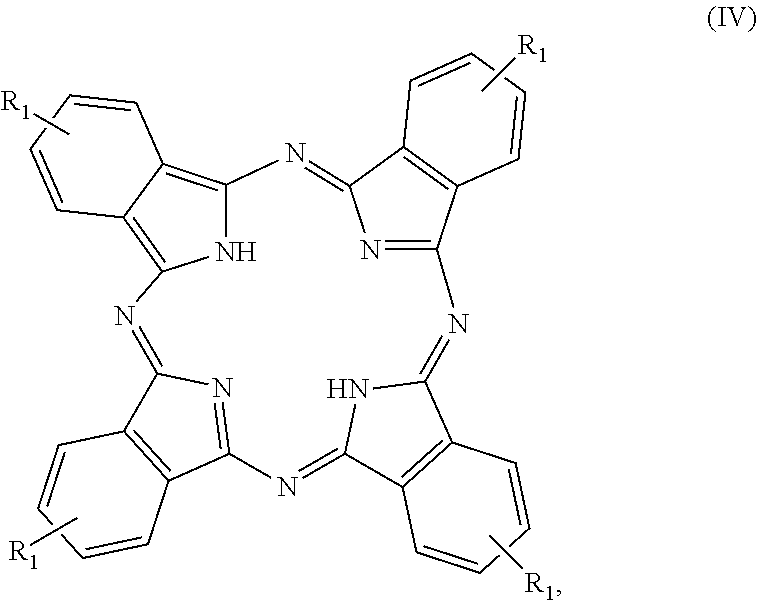
- methods of preparing a metal-free phthalocyanine comprising contacting a metal-phthalocyanine of Formula (III)
- M is Al, B, Si, Co, Ni, Zn, or In;
- X is absent, alkyl, or halo
- R 1 is —C( ⁇ O)OR 2 , —C( ⁇ O)OCH 2 CH(O)CH2, —CH 2 CH(O)CH 2 , —NH 2 , —Si(OR 2 ) 3 , —Si(R 2 ) 2 CH 2 CH 2 NH 2 , —Si(R 2 ) 2 CH 2 CH(O)CH 2 , —CH ⁇ CH 2 , —CH 2 CH ⁇ CH 2 , —CH ⁇ CH—CN, OCN, —CH 2 OH, —CH 2 Z, CH 2 OCN, hydroxyl, or a siloxane derivative thereof.
- Z is halo
- R 2 is C 1 -C 6 alkyl
- R 3 is H, C 1 -C 6 alkyl, or C 1 -C 6 alkenyl
- R 4 is H, C 1 -C 6 alkyl, or C 1 -C 6 alkenyl
- R 1 is —C( ⁇ O)OR 2 , —C( ⁇ O)OCH 2 CH(O)CH2, —CH 2 CH(O)CH 2 , —NH 2 , —Si(OR 2 ) 3 , —Si(R 2 ) 2 CH 2 CH 2 NH 2 , —Si(R 2 ) 2 CH 2 CH(O)CH 2 , —CH ⁇ CH 2 , —CH 2 CH ⁇ CH 2 , —CH ⁇ CH—CN, OCN, —CH 2 OH, —CH 2 Z, CH 2 OCN, hydroxyl, or a siloxane derivative thereof.
- Z is halo
- R 2 is C 1 -C 6 alkyl
- R 3 is H, C 1 -C 6 alkyl, or C 1 -C 6 alkenyl
- R 4 is H, C 1 -C 6 alkyl, or C 1 -C 6 alkenyl.
- alkyl means a saturated or unsaturated hydrocarbon group which is straight-chained or branched.
- An unsaturated alkyl group refers to an alkyl group that contains at least one double bond, which can also be referred to as an “alkenyl.”
- the alkyl chain can also be substituted.
- An alkyl group can contain from 1 to 24, from 1 to 22, from 1 to 20, from 1 to 18, from 1 to 16, from 1 to 14, from 1 to 12, from 2 to 20, from 1 to 10, from 2 to 10, from 1 to 10, from 1 to 8, from 2 to 8, from 1 to 6, from 2 to 6, from 1 to 4, from 2 to 4, from 1 to 3, or 2 or 3 carbon atoms.
- alkyl groups include, but are not limited to, methyl (Me), ethyl (Et), propyl (for example, n-propyl and isopropyl), butyl (for example, n-butyl, t-butyl, isobutyl), pentyl (for example, n-pentyl, isopentyl, neopentyl), hexyl, isohexyl, heptyl, 4,4 dimethylpentyl, octyl, 2,2,4-trimethylpentyl, nonyl, decyl, undecyl, dodecyl, 2-methyl-1-propyl, 2-methyl-2-propyl, 2-methyl-1-butyl, 3-methyl-1-butyl, 2-methyl-3-butyl, 2-methyl-1-pentyl, 2,2-dimethyl-1-propyl, 3-methyl-1-pentyl, 4-methyl-1-pentyl, 2-methyl-2-pent
- C 1 -C 24 alkyl, optionally comprising at least one alkenyl group refers to a C 1 -C 24 alkyl carbon chain that can have at least one alkenyl group located anywhere in the chain.
- the length of the C 1 -C 24 alkyl carbon chain is at least two carbons.
- the carbons in the alkenyl group are counted as carbons in the C 1 -C 24 alkyl carbon chain.
- alkenyl means a straight or branched alkyl group having one or more double carbon-carbon bonds and 2-20 carbon atoms, including, but not limited to, ethylenyl (vinyl), 1-propenyl, 2-propenyl, 2-methyl-1-propenyl, 1-butenyl, 2-butenyl, and the like.
- the alkenyl chain is from 2 to 24 carbon atoms in length, from 2 to 22 carbon atoms in length, from 2 to 20 carbon atoms in length, from 2 to 18 carbon atoms in length, from 2 to 16 carbon atoms in length, from 2 to 14 carbon atoms in length, from 2 to 12 carbon atoms in length, from 2 to 10 carbon atoms in length, from 2 to 8 carbon atoms in length, from 2 to 6 carbon atoms in length, or from 2 to 4 carbon atoms in length.
- the alkenyl group has 1, 2, 3, 4, 5, or 6 double bonds.
- polyalkylene which can also be referred to as a polyolefin, refers to polymeric groups including, but not limited to, polypropylene, polyethylene, polymethylpentene, polybutene, and the like.
- compositions, methods, and devices are described in terms of “comprising” various components or steps (interpreted as meaning “including, but not limited to”), the compositions, methods, and devices can also “consist essentially of” or “consist of” the various components and steps, and such terminology should be interpreted as defining essentially closed-member groups.
- Embodiments disclosed herein provide new thermal conductive compositions that can act, for example, as heat sinks and/or be used in heat transfer systems
- thermal conductive compositions comprising a compound of Formula (I)
- A is N or P
- M is Al, B, Si, Co, Ni, Zn, or In;
- X is absent, alkyl, or halo
- R 1 is —C( ⁇ O)OR 2 , —C( ⁇ O)OCH 2 CH(O)CH2, —CH 2 CH(O)CH 2 , —NH 2 , —Si(OR 2 ) 3 , —Si(R 2 ) 2 CH 2 CH 2 NH 2 , —Si(R 2 ) 2 CH 2 CH(O)CH 2 , —CH ⁇ CH 2 , —CH 2 CH ⁇ CH 2 , —CH ⁇ CH—CN, OCN, —CH 2 OH, —CH 2 Z, CH 2 OCN, hydroxyl, or a siloxane derivative thereof.
- Z is halo
- R 2 is C 1 -C 6 alkyl
- R 3 is H, C 1 -C 6 alkyl, or C 1 -C 6 alkenyl
- R 4 is H, C 1 -C 6 alkyl, or C 1 -C 6 alkenyl are provided.
- R 1 is —C( ⁇ O)OR 2 , —C( ⁇ O)OCH 2 CH(O)CH 2 , —NH 2 , CH 2 ⁇ CH—, CH 2 ⁇ CH—CH 2 —, —Si(OR 3 ) 3 , or a reactive siloxane derivative thereof.
- R 1 is hydroxyl, —C( ⁇ O)OH, OCN, or —C( ⁇ O)OR 2 .
- R 1 is —Si(OR 3 ) 3 .
- A is N. In some embodiments, A is P.
- M is Al or Zn.
- X is Cl or I.
- Z is chloro
- the composition comprising a compound of Formula (I), A is N, M is Zn, X is absent, and the other variables are as above.
- R 1 is —Si(OR 3 ) 3 .
- R 1 is —OH, —C( ⁇ O)OR 2 , or —OCN.
- the composition comprises a siloxane derivative of a compound of Formula (I).
- the siloxane derivative is a compound of Formula (II):
- R 5 is: —OCN, or
- R 6 is —C( ⁇ O)O—, —C( ⁇ O)OCH 2 C(OH)HCH2-, —CH 2 C(OH)HCH 2 —, —NH—, —Si(R 2 ) 2 CH 2 CH 2 NH—, —Si(R 2 ) 2 CH 2 C(OH)HCH 2 —, —CH 2 CH 2 —, —CH 2 CH 2 CH 2 —, —CH 2 O—, —CH 2 —, and R 8 is —N + (R 9 ) 3 , wherein R 9 is C 1 -C 6 alkyl.
- the composition is a polyolefin copolymerized or grafted with a compound of Formula (I).
- the polyolefin copolymerized or grafted with a compound of Formula (I) has a formula of:
- G 1 is polyalkylene or polyvinyl alcohol
- R 1 is C 1 -C 6 alkyl or —COO—
- A is N or P
- M is Al, B, Si, Co, Ni, Zn, or In
- X is absent, alkyl, or halo.
- G 1 is polypropylene, polyethylene, polymethylpentene, or polybutene.
- the thermal conductive composition described herein has a thermal conductivity of about 10 W/(m ⁇ K) to about 50 W/(m ⁇ K).
- Heat sinks are also provided by embodiments disclosed herein.
- a heat sink can be a passive heat exchanger that cools a device by dissipating heat into the surrounding medium.
- a heat sink comprising a compound of Formula (I)
- A is N or P
- M is Al, B, Si, Co, Ni, Zn, or In;
- X is absent, alkyl, or halo
- R 1 is —C( ⁇ O)OR 4 , —C( ⁇ O)OR 2 , —C( ⁇ O)OCH 2 CH(O)CH2, —CH 2 CH(O)CH 2 , —NH 2 , —Si(OR 2 )3, —Si(R 2 ) 2 CH 2 CH 2 NH 2 , —Si(R 2 ) 2 CH 2 CH(O)CH 2 , —CH ⁇ CH 2 , —CH 2 CH ⁇ CH 2 , —CH ⁇ CH—CN, —OCN, —CH 2 OH, —CH 2 Z, CH 2 OCN, —SR 3 , —N + (CH) 3 ⁇ OH, hydroxyl, or a siloxane derivative thereof.
- Z is halo
- R 2 is C 1 -C 6 alkyl
- R 3 is H, C 1 -C 6 alkyl, or C 1 -C 6 alkenyl
- R 4 is H, C 1 -C 6 alkyl, or C 1 -C 6 alkenyl is provided.
- R 1 is —C( ⁇ O)OR 4 , —C( ⁇ O)OCH 2 CH(O)CH 2 , —NH 2 , CH 2 ⁇ CH—, CH 2 ⁇ CH—CH 2 —, —Si(R 3 ) 3 , or a siloxane derivative thereof.
- R 1 is hydroxyl, —C( ⁇ O)OH, —OCN, or —C( ⁇ O)OR 4 .
- A is N or P.
- M is Al or Zn.
- X is chloro or iodo.
- Z is chloro.
- G 1 is polypropylene, polyethylene, polymethylpentene, or polybutene.
- the composition comprising a compound of Formula (I), wherein A is N, M is Zn, X is absent, and the other variables are as above.
- R 1 is —Si(OR 3 ) 3 .
- R 1 is —OH, —C( ⁇ O)OR 4 , or
- the composition comprises a siloxane derivative of a compound of Formula (I).
- the siloxane derivative is a compound of Formula (II):
- R 5 is: —OCN
- R 6 is —C( ⁇ O)O—, —C( ⁇ O)OCH 2 C(OH)HCH2-, —CH 2 C(OH)HCH 2 —, —NH—, —Si(R 2 ) 2 CH 2 CH 2 NH—, —Si(R 2 ) 2 CH 2 C(OH)HCH 2 —, —CH 2 CH 2 —, —CH 2 CH 2 CH 2 —, —CH 2 O—, —CH 2 —;
- R 8 is —N + (R 9 ) 3 , wherein R 9 is C 1 -C 6 alkyl, and n is 1-100.
- the composition is a polyolefin copolymerized or grafted with a compound of Formula (I).
- the polyolefin copolymerized or grafted with a compound of Formula (I) has a formula of:
- G 1 is polyalkylene or polyvinyl alcohol
- R 1 is C 1 -C 6 alkyl or —COO—
- A is N or P
- M is Al, B, Si, Co, Ni, Zn, or In
- X is absent, alkyl, or halo.
- the heat sink is capable of transferring 40-50 W/mK.
- G 1 is polypropylene, polyethylene, polymethylpentene, or polybutene.
- a heat transfer system comprises at least one heat source, at least one heat sink; and, at least one thermal conductive composition comprising a compound of Formula (I)
- A is N or P
- M is Al, B, Si, Co, Ni, Zn, or In;
- X is absent, alkyl, or halo
- R 1 is —C( ⁇ O)OR 2 , —C( ⁇ O)OCH 2 CH(O)CH2, —CH 2 CH(O)CH 2 , —NH 2 , —Si(OR 2 ) 3 , —Si(R 2 ) 2 CH 2 CH 2 NH 2 , —Si(R 2 ) 2 CH 2 CH(O)CH 2 , —CH ⁇ CH 2 , —CH 2 CH ⁇ CH 2 , —CH ⁇ CH—CN, —OCN, —CH 2 OH, —CH 2 Z, CH 2 OCN, —SR 3 , —N + (CH3) 3 ⁇ OH, hydroxyl, or any reactive siloxane derivative thereof.
- Z is halo
- R 2 is C 1 -C 6 alkyl
- R 3 is H, C 1 -C 6 alkyl, or C 1 -C 6 alkenyl
- R 4 is H, C 1 -C 6 alkyl, or C 1 -C 6 alkenyl.
- thermal conductive composition wherein at least a portion of the thermal conductive composition is positioned substantially between the heat source and the heat sink and provides thermal communication between the heat source and heat sink.
- R 1 is —C( ⁇ O)OR 2 , —C( ⁇ O)OCH 2 CH(O)CH 2 , —NH 2 , CH 2 ⁇ CH—, CH 2 ⁇ CH—CH 2 —, —Si(OR 3 ) 3 , or a reactive siloxane derivative thereof.
- R 1 is hydroxyl, —C( ⁇ O)OH, OCN, or —C( ⁇ O)OR 2 .
- R 1 is —Si(OR 3 ) 3 .
- A is N.
- A is P.
- M is Al or Zn.
- X is Cl or I. In some embodiments, Z is chloro. In some embodiments of the heat transfer system, the thermal composition comprises a compound of Formula (I), A is N, M is Zn, X is absent, and the other variables are as above.
- R 1 is —Si(OR 3 ) 3 . In some embodiments, R 1 is —OH, —C( ⁇ O)OR 2 , or —OCN.
- the thermal conductive composition comprises a siloxane derivative of a compound of Formula (I).
- the siloxane derivative is a compound of Formula (II):
- R 5 is: —OCN, or
- R 6 is —C( ⁇ O)O—, —C( ⁇ O)OCH 2 C(OH)HCH2-, —CH 2 C(OH)HCH 2 —, —NH—, —Si(R 2 ) 2 CH 2 CH 2 NH—, —Si(R 2 ) 2 CH 2 C(OH)HCH 2 —, —CH 2 CH 2 —, —CH 2 CH 2 CH 2 —, —CH 2 O—, —CH 2 —, and R 8 is —N + (R 9 ) 3 , wherein R 9 is C 1 -C 6 alkyl.
- the thermal conductive composition is a polyolefin copolymerized or grafted with a compound of Formula (I).
- the polyolefin copolymerized or grafted with a compound of Formula (I) has a formula of:
- G 1 is polyalkylene or polyvinyl alcohol
- R 1 is C 1 -C 6 alkyl or —COO—
- A is N or P
- M is Al, B, Si, Co, Ni, Zn, or In
- X is absent, alkyl, or halo.
- the thermal conductive composition present in the heat transfer system has a conductivity of about 10-50 W/mK.
- G 1 is polypropylene, polyethylene, polymethylpentene, or polybutene.
- an electronic device wherein the electronic device is at least partially encapsulated by a thermal conductive composition comprising a compound of Formula (I)
- A is N or P
- M is Al, B, Si, Co, Ni, Zn, or In;
- X is absent, alkyl, or halo
- R 1 is —C( ⁇ O)OR 4 , —C( ⁇ O)OR 2 , —C( ⁇ O)OCH 2 CH(O)CH2, —CH 2 CH(O)CH 2 , —NH 2 , —Si(OR 2 ) 3 , —Si(R 2 ) 2 CH 2 CH 2 NH 2 , —Si(R 2 ) 2 CH 2 CH(O)CH 2 , —CH ⁇ CH 2 , —CH 2 CH ⁇ CH 2 , —CH ⁇ CH—CN, —OCN, —CH 2 OH, —CH 2 Z, CH 2 OCN, —Si(OR 3 ) 3 , —N + (CH3) 3 ⁇ OH, hydroxyl, or any reactive siloxane derivative thereof.
- Z is halo
- R 2 is C 1 -C 6 alkyl
- R 3 is H, C 1 -C 6 alkyl, or C 1 -C 6 alkenyl
- R 4 is H, C 1 -C 6 alkyl, or C 1 -C 6 alkenyl.
- R 1 is —C( ⁇ O)OR 2 , —C( ⁇ O)OCH 2 CH(O)CH 2 , —NH 2 , CH 2 ⁇ CH—, CH 2 ⁇ CH—CH 2 —, —Si(OR 3 ) 3 , or a reactive siloxane derivative thereof.
- R 1 is hydroxyl, —C( ⁇ O)OH, OCN, or —C( ⁇ O)OR 2 .
- R 1 is —Si(OR 3 ) 3 .
- A is N.
- A is P.
- M is Al or Zn.
- X is Cl or I.
- Z is chloro.
- A is N, M is Zn, X is absent, and the other variables can be as described above.
- R 1 is —Si(OR 3 ) 3 .
- R 1 is —OH, —C( ⁇ O)OR 2 , or —OCN.
- the thermal conductive composition comprises a siloxane derivative of a compound of Formula (I).
- the siloxane derivative is a compound of Formula (II):
- R 5 is: —OCN, or
- R 6 is —C( ⁇ O)O—, —C( ⁇ O)OCH 2 C(OH)HCH2-, —CH 2 C(OH)HCH 2 —, —NH—, —Si(R 2 ) 2 CH 2 CH 2 NH—, —Si(R 2 ) 2 CH 2 C(OH)HCH 2 —, —CH 2 CH 2 —, —CH 2 CH 2 CH 2 —, —CH 2 O—, —CH 2 —, and R 8 is —N + (R 9 ) 3 , wherein R 9 is C 1 -C 6 alkyl.
- the thermal conductive composition is a polyolefin copolymerized or grafted with a compound of Formula (I).
- the polyolefin copolymerized or grafted with a compound of Formula (I) has a formula of:
- G 1 is polyalkylene or polyvinyl alcohol
- R 1 is C 1 -C 6 alkyl or —COO—
- A is N or P
- M is Al, B, Si, Co, Ni, Zn, or In
- X is absent, alkyl, or halo.
- G 1 is polypropylene, polyethylene, polymethylpentene, or polybutene.
- the electronic device is encapsulated by the composition.
- the type of electronic device can be any device that is suitable to be partially encapsulated or encapsulated by the compositions described herein.
- suitable electronic devices include, but are not limited to, a semiconductor chip, a conductive wire, an electronic component, or an electronic circuit.
- the compounds described herein can be prepared according to any suitable method and as described in the Examples section below.
- a method of preparing a compound of Formula (I) is provided.
- the method includes contacting
- A is N;
- M is Al, B, Si, Co, Ni, Zn, or In;
- X is absent, alkyl, or halo
- R 1 is —C( ⁇ O)OR 2 , —C( ⁇ O)OCH 2 CH(O)CH2, —CH 2 CH(O)CH 2 , —NH 2 , —Si(OR 2 ) 3 , —Si(R 2 ) 2 CH 2 CH 2 NH 2 , —Si(R 2 ) 2 CH 2 CH(O)CH 2 , —CH ⁇ CH 2 , —CH 2 CH ⁇ CH 2 , —CH ⁇ CH—CN, OCN, —CH 2 OH, —CH 2 Z, CH 2 OCN, hydroxyl, or a siloxane derivative thereof.
- Z is halo
- R 2 is C 1 -C 6 alkyl
- R 3 is H, C 1 -C 6 alkyl, or C 1 -C 6 alkenyl
- R 4 is H, C 1 -C 6 alkyl, or C 1 -C 6 alkenyl.
- the conditions are heating the reaction in a closed system at temperatures of about 160-200 C.
- the metal salt is an Al, B, Si, Co, Ni, Zn, or In salt.
- the method comprising contacting
- A is N;
- R 1 is —C( ⁇ O)OR 2 , —C( ⁇ O)OCH 2 CH(O)CH2, —CH 2 CH(O)CH 2 , —NH 2 , —Si(OR 2 ) 3 , —Si(R 2 ) 2 CH 2 CH 2 NH 2 , —Si(R 2 ) 2 CH 2 CH(O)CH 2 , —CH ⁇ CH 2 , —CH 2 CH ⁇ CH 2 , —CH ⁇ CH—CN, OCN, —CH 2 OH, —CH 2 Z, CH 2 OCN hydroxyl, or a siloxane derivative thereof.
- Z is halo
- R 2 is C 1 -C 6 alkyl
- R 3 is H, C 1 -C 6 alkyl, or C 1 -C 6 alkenyl
- R 4 is H, C 1 -C 6 alkyl, or C 1 -C 6 alkenyl.
- the method further comprises contacting the compound of Formula (IA) with a metal salt under conditions sufficient to form a compound of Formula (I)
- A is N;
- M is Al, B, Si, Co, Ni, Zn, or In;
- X is absent, alkyl, or halo
- R 1 is —C( ⁇ O)OR 2 , —C( ⁇ O)OCH 2 CH(O)CH2, —CH 2 CH(O)CH 2 , —NH 2 , —Si(OR 2 ) 3 , —Si(R 2 ) 2 CH 2 CH 2 NH 2 , —Si(R 2 ) 2 CH 2 CH(O)CH 2 , —CH ⁇ CH 2 , —CH 2 CH ⁇ CH 2 , —CH ⁇ CH—CN, OCN, —CH 2 OH, —CH 2 Z, CH 2 OCN, hydroxyl, or a siloxane derivative thereof.
- Z is halo
- R 2 is C 1 -C 6 alkyl
- R 3 is H, C 1 -C 6 alkyl, or C 1 -C 6 alkenyl
- R 4 is H, C 1 -C 6 alkyl, or C 1 -C 6 alkenyl.
- the metal salt is an Al, B, Si, Co, Ni, Zn, or In salt.
- the methods described herein are modified to yield the different species that are desired to be produced.
- the procedures described in “Phthalocyanine materials-synthesis, structure and functions” Neil B. McKowown, Cambridge university 1998, can be modified based upon the present disclosure to yield the compounds and compositions described herein.
- the method comprises contacting a substituted phthalic anhydride with a metal salt in the presence of urea at temperatures of about 160-200 C.
- the method includes refluxing the product with pyridine and pyridine hydrochloride for about 10-48 h to obtain metal free phthalocyanine.
- the metal free complex can be transferred to any metal phthalocyanine by contacting with its salt as shown, for example, in Example 11.
- the method comprises contacting substituted phthalic anhydride with a metal salt in the presence of urea at temperatures of about 160-200 C.
- a metal salt in the presence of urea at temperatures of about 160-200 C.
- M is Al, B, Si, Co, Ni, Zn, or In.
- M is Al, B, Si, Co, Ni, Zn, or In;
- X is absent, alkyl, or halo
- R 1 is —C( ⁇ O)OR 2 , —C( ⁇ O)OCH 2 CH(O)CH2, —CH 2 CH(O)CH 2 , —NH 2 , —Si(OR 2 ) 3 , —Si(R 2 ) 2 CH 2 CH 2 NH 2 , —Si(R 2 ) 2 CH 2 CH(O)CH 2 , —CH ⁇ CH 2 , —CH 2 CH ⁇ CH 2 , —CH ⁇ CH—CN, OCN, —CH 2 OH, —CH 2 Z, CH 2 OCN, hydroxyl, or a siloxane derivative thereof.
- Z is halo
- R 2 is C 1 -C 6 alkyl
- R 3 is H, C 1 -C 6 alkyl, or C 1 -C 6 alkenyl
- R 4 is H, C 1 -C 6 alkyl, or C 1 -C 6 alkenyl are also provided.
- the method includes contacting
- R 1 is —C( ⁇ O)OR 2 , —C( ⁇ O)OCH 2 CH(O)CH2, —CH 2 CH(O)CH 2 , —NH 2 , —Si(OR 2 ) 3 , —Si(R 2 ) 2 CH 2 CH 2 NH 2 , —Si(R 2 ) 2 CH 2 CH(O)CH 2 , —CH ⁇ CH 2 , —CH 2 CH ⁇ CH 2 , —CH ⁇ CH—CN, OCN, —CH 2 OH, —CH 2 Z, CH 2 OCN, hydroxyl, or a siloxane derivative thereof.
- Z is halo
- R 2 is C 1 -C 6 alkyl
- R 3 is H, C 1 -C 6 alkyl, or C 1 -C 6 alkenyl
- R 4 is H, C 1 -C 6 alkyl, or C 1 -C 6 alkenyl
- R 1 is NO 2 , CH 3 , NH 2 , or CH 2 ⁇ CH—CO—NH—.
- the method is performed in the presence of Mo 7 (NH 4 ) 6 O 24 .
- Methods of preparing a metal-free phthalocyanine are also provided.
- the method comprises contacting a compound a metal-phthalocyanine of Formula (III)
- M is Al, B, Si, Co, Ni, Zn, or In;
- X is absent, alkyl, or halo
- R 1 is —C( ⁇ O)OR 2 , —C( ⁇ O)OCH 2 CH(O)CH2, —CH 2 CH(O)CH 2 , —NH 2 , —Si(OR 2 ) 3 , —Si(R 2 ) 2 CH 2 CH 2 NH 2 , —Si(R 2 ) 2 CH 2 CH(O)CH 2 , —CH ⁇ CH 2 , —CH 2 CH ⁇ CH 2 , —CH ⁇ CH—CN, OCN, —CH 2 OH, —CH 2 Z, CH 2 OCN, hydroxyl, or a siloxane derivative thereof.
- Z is halo
- R 2 is C 1 -C 6 alkyl
- R 3 is H, C 1 -C 6 alkyl, or C 1 -C 6 alkenyl
- R 4 is H, C 1 -C 6 alkyl, or C 1 -C 6 alkenyl
- R 1 is —C( ⁇ O)OR 2 , —C( ⁇ O)OCH 2 CH(O)CH2, —CH 2 CH(O)CH 2 , —NH 2 , —Si(OR 2 ) 3 , —Si(R 2 ) 2 CH 2 CH 2 NH 2 , —Si(R 2 ) 2 CH 2 CH(O)CH 2 , —CH ⁇ CH 2 , —CH 2 CH ⁇ CH 2 , —CH ⁇ CH—CN, OCN, —CH 2 OH, —CH 2 Z, CH 2 OCN, hydroxyl, or a siloxane derivative thereof.
- Z is halo
- R 2 is C 1 -C 6 alkyl
- R 3 is H, C 1 -C 6 alkyl, or C 1 -C 6 alkenyl
- R 4 is H, C 1 -C 6 alkyl, or C 1 -C 6 alkenyl.
- M is Zn. In some embodiments, R 1 is NH 2 . In some embodiments, the method is performed at a temperature of about 100-150 C.
- Tetra amino zinc phthalocyanine is prepared from tetra nitro zinc phthalocyanine according to the reported procedure (Cong, F.-D. N., Bo; Du, Xi-Guang; Ma, Chun-Yu; Yu, Hai-Feng; Chen, Bin Dyes and Pigments 2005, 66, 149.) and as following: A five necked flanged top reaction vessel (500 mL) equipped with mechanical stirrer, thermometer, and condenser is charged with 150 mL of nitrobenzene, 3.83 g of zinc chloride, 30 g urea and 20 g of 4-nitrophthalic anhydride. The reaction mixture is flashed with nitrogen. 130 mg of ammonium molybdate is added to the solution mixture.
- reaction is carried out with continuous stirring under nitrogen at 185° C. for four hours then the reaction mixture is cooled to ambient temperature.
- the product is precipitated by addition of 250 mL toluene portion wise with continuous cooling.
- the resulting precipitate is separated and washed with toluene, water, and MeOH/ether (1:9), ethyl acetate/hexane (2:1), and dried to afford a dark green solid (20 g, yield 98%).
- the tetra nitrozincphathalocyanine is reduced to the amino derivative as following:
- Tetramino-zinc-phthalocyanine is prepared according to the modified published procedure.
- the reaction vessel is charged with 19.5 g of tetra nitro zinc phthalocyanine previously prepared, 150 mL of DMF, mixed under nitrogen for 10 minutes then 74 g of Na2S9.H20 is added to the solution.
- the reaction mixture is stirred under N2 and heated at 60° C. After 1.5 hours, the mixture is cooled to ambient temperature, diluted with ice water (350 mL).
- the precipitate is separated and washed with MeOH/ether (1:9) several times and then with ethyl acetate.
- the precipitate is dried under vacuum at 80° C. to obtain a dark colored product.
- the scheme for the preparation is shown below.
- a five necked flanged top reaction vessel (500 mL) equipped with mechanical stirrer, thermometer, and condenser is charged with 150 mL of nitrobenzene, 3.72 g of AlCl 3 , 30 g urea and 20 g of 4-nitrophthalic anhydride.
- the reaction mixture is flashed with nitrogen. 130 mg of ammonium molybdate is added to the solution mixture.
- the reaction is carried out with continuous stirring under nitrogen at 185° C. for four hours then the reaction mixture is cooled to ambient temperature.
- the product is precipitated by addition of 250 mL toluene portion wise with continuous cooling.
- the tetra nitro aluminium phthalocyanine is reduced to the amino derivative as following.
- the reaction vessel is charged with 15 g of tetra nitro aluminium phthalocyanine previously prepared, 150 mL of DMF, mixed under nitrogen for 10 minutes then 74 g of Na 2 S 9.H 2 O is added to the solution.
- the reaction mixture is stirred under N 2 and heated at 60° C. After 6 h, the mixture is cooled to ambient temperature, and diluted with ice water (350 mL).
- the precipitate is separated and washed with MeOH/ether (1:9) several times and followed by an ethyl acetate wash.
- the precipitate is dried under vacuum at 80° C. to obtain a dark colored product.
- the obtained product can be used as a curing agent to epoxy resin, and as crosslinking agent to polyurethane and siloxane polymers.
- a five necked flanged top reaction vessel (500 mL) equipped with mechanical stirrer, thermometer, and condenser is charged with 150 mL of nitrobenzene, 4.16 g (26 mmol) of CH 3 SiCl 3 , 30 g urea, and 20 g of 4-nitrophthalic anhydride.
- the reaction mixture is flashed with nitrogen. 130 mg of ammonium molybdate is added to the solution mixture.
- the reaction is carried out with continuous stirring under nitrogen at 185° C. for four hours, then the reaction mixture is cooled to ambient temperature.
- the product is precipitated by addition of 250 mL toluene portion-wise with continuous cooling.
- the reaction vessel is charged with 16.5 g of tetra nitro silicon phthalocyanine previously prepared, 150 mL of DMF, and mixed under nitrogen for 10 minutes. 74 g of Na 2 S 9.H 2 O is added to the solution. The reaction mixture is stirred under N 2 and heated at 60° C. After 6 hours, the mixture is cooled to ambient temperature and ice water (350 mL) is added. The precipitate is separated and washed with MeOH/ether (1:9) several times and followed by an ethyl acetate wash, and then dried under vacuum at 80° C. to obtain a dark colored product to be used as thermal conductive ingredient.
- Tetra methyl zinc phthalocyanine can be prepared according to the scheme below.
- a five necked flanged top reaction vessel (500 mL) vessel equipped with mechanical stirrer, thermometer, and condenser is charged with 150 mL of nitrobenzene, 3.83 g of zinc chloride, 30 g urea, and 20 g of 4-nitrophthalic anhydride.
- the reaction mixture is flashed with nitrogen. 130 mg of ammonium molybdate is added to the solution mixture.
- the reaction is carried out with continuous stirring under nitrogen at 185° C. for four hours then the reaction mixture is cooled to ambient temperature.
- the product is precipitated by addition of 250 mL toluene portion-wise with continuous cooling.
- the resulting precipitate is separated.
- the thermal conductive active ingredient is grafted onto commercial polymers as described herein.
- Tetra acrylamide aluminium phthalocyanine is prepared according to the following scheme.
- the polymerizable acrylamide can also be prepared according to the following scheme adopting the procedure shown in Example 1 in the presence benzoquinone retarder to prevent polymerization in situ.
- a five necked flanged top reaction vessel equipped with mechanical stirrer, thermometer, nitrogen inlet tube, and condenser guarded with drying tube filled calcium chloride, and separating funnel immersed is placed in a cooling water.
- the reaction vessel is charged with 20 g of tetra aminoaluminum phthalocyanine, 150 mL methylene chloride, and 50 mL redistilled pyridine.
- the separating funnel is charged with 50 g acryloyl chloride which is added portion wise with continuous mixing to the reaction mixture. When the addition is completed the reaction is continued for one hour. At the end of the reaction time the reaction mixture is poured over 200 g ice water with efficient mixing to precipitate the product. The precipitate is separated and can be used in the production of thermal conductive gels.
- a fusion reactor is charged with 50 g hydroxyl phenyldinitrile and 12 g of anhydrous AlCl 3 . Several steel balls are added to mix the mixture. The reactor is sealed and heated to 250 C with mixing for 3 hours. The bulk reactor is cooled to ambient temperature. The product is washed with MeOH/ether (1:9) several times followed by an ethyl acetate wash and then dried under vacuum at 80° C. to obtain a dark colored product. The product can be used as an active ingredient for preparation of several polymerizable ingredients.
- Aluminium phthalocyanate tetra acrylate can be prepared according to the following scheme:
- a reaction vessel immersed in a water bath at 30 C is charged with 100 mL of pyridine, 20 g of tetra hydroxyl aluminium phthalocyanine (see Example 6), and mixed. 145 ml of acryloyl chloride is added from a dropping funnel with continuous mixing. The reaction is carried out under dry conditions. At the end of addition the reaction is continued for one hour. The reaction product is poured over 250 g of ice/water with mixing. The hydrolyzed acryloyl chloride is extracted with 10% sodium carbonate. The product is washed with MeOH/ether (1:9) several times, followed with an ethyl acetate wash, and dried under vacuum at 50° C. over night to obtain dark colored product, which can be used in the preparation of a thermal conductive polyacrylate (see Example 8).
- a five neck flanged top reaction vessel (500 mL) equipped with mechanical stirrer, thermometer, dropping funnel nitrogen inlet tube, and condenser immersed in oil bath at 120 C is charged with 150 mL DMF, 70 ml pyridine, 10 g of terahydroxy aluminium phthalocyanine, 66 g of analar grad bisphenol ⁇ A, and 30 g diphenyl carbonate.
- the reaction mixture is heated to 115-120 C for 3 hours under nitrogen atmosphere.
- the formed phenol is distilled off.
- the product is cooled to ambient temperature.
- the mixture is poured over 250 g of ice water with mixing.
- the formed polycarbonate is precipitated and washed with water several times, and dried under vacuum at 80 C.
- Tetracyanate aluminium phthalocyanine can be prepared according to the following scheme:
- Example 2 The procedure described in Example 1 is used. The product is mixed with 90% (w/w) of commercial phenolic resin. The product is cured by thermal curing heating at 160 C to form thermal conductive thermoset resin.
- Metal-free tetra amino phthalocyanine can be prepared by modifying the procedure described in Alzeer, et al., Chem. Commun. 15: 1970-1971 (2009).
- the metal-free tetra amino phthalocyanine can be prepared according to the following scheme:
- the reaction vessel fitted with condenser, stirrer, immersed in oil bath at 110 C is charged with 3.5 g tetra amino zinc phthalocyanine, 20 mL pyridine, and 10 g pyridine hydrochloride, and stirred to reflex under nitrogen atmosphere for 24 hours.
- the product is cooled to ambient temperature.
- the product is added portion-wise to 100 g cold water with vigorous mixing.
- the precipitate is washed with water several times, then with distilled water, methanol, and ethylacetate, and then dried under vacuum.
- the product can be transferred to any other metal phthalocyanine complex as alternative procedure.
- compositions described herein can function as thermal conductive materials with superior and unexpected properties.
- the materials allow for new uses that have not been possible prior to the present embodiments.
Landscapes
- Chemical & Material Sciences (AREA)
- Engineering & Computer Science (AREA)
- Organic Chemistry (AREA)
- Physics & Mathematics (AREA)
- Thermal Sciences (AREA)
- Materials Engineering (AREA)
- Chemical Kinetics & Catalysis (AREA)
- Combustion & Propulsion (AREA)
- Compositions Of Macromolecular Compounds (AREA)
- Mechanical Engineering (AREA)
- General Engineering & Computer Science (AREA)
Abstract
Description

wherein:

wherein
R5 is: —OCN, or

wherein
R6 is —C(═O)O—, —C(═O)OCH2C(OH)HCH2-, —CH2C(OH)HCH2—, —NH—, —Si(R2)2CH2CH2NH—, —Si(R2)2CH2C(OH)HCH2—, —CH2CH2—, —CH2CH2CH2—, —CH2O—, —CH2—, and
R8 is —N+(R9)3, wherein R9 is C1-C6 alkyl.

wherein:
G1 is polyalkylene or polyvinyl alcohol;
R1 is C1-C6 alkyl or —COO—;
A is N or P;
M is Al, B, Si, Co, Ni, Zn, or In; and
X is absent, alkyl, or halo.

wherein:

wherein
R5 is: —OCN,

wherein
R6 is —C(═O)O—, —C(═O)OCH2C(OH)HCH2-, —CH2C(OH)HCH2—, —NH—, —Si(R2)2CH2CH2NH—, —Si(R2)2CH2C(OH)HCH2—, —CH2CH2—, —CH2CH2CH2—, —CH2O—, —CH2—;
R8 is —N+(R9)3, wherein R9 is C1-C6 alkyl, and
n is 1-100.

wherein:
G1 is polyalkylene or polyvinyl alcohol;
R1 is C1-C6 alkyl or —COO—;
A is N or P;
M is Al, B, Si, Co, Ni, Zn, or In; and
X is absent, alkyl, or halo.

wherein:
-
- A is N or P;
- M is Al, B, Si, Co, Ni, Zn, or In;
- X is absent, alkyl, or halo;
- R1 is —C(═O)OR2, —C(═O)OCH2CH(O)CH2, —CH2CH(O)CH2, —NH2, —Si(OR2)3, —Si(R2)2CH2CH2NH2, —Si(R2)2CH2CH(O)CH2, —CH═CH2, —CH2CH═CH2, —CH═CH—CN, —OCN, —CH2OH, —CH2Z, CH2OCN, —SR3, —N+(CH3)3 −OH, hydroxyl, or any reactive siloxane derivative thereof.

wherein:

with a metal salt under conditions sufficient to produce a compound of Formula (I)

wherein:

with lithium and an alcohol under conditions sufficient to produce a compound of Formula (IA)

wherein A is N;

wherein:

wherein

wherein

urea, M and nitrobenzene in the presence of Mo7(NH4)6O24.

wherein

wherein

wherein:

wherein
R5 is: —OCN, or

wherein
R6 is —C(═O)O—, —C(═O)OCH2C(OH)HCH2-, —CH2C(OH)HCH2—, —NH—, —Si(R2)2CH2CH2NH—, —Si(R2)2CH2C(OH)HCH2—, —CH2CH2—, —CH2CH2CH2—, —CH2O—, —CH2—, and
R8 is —N+(R9)3, wherein R9 is C1-C6 alkyl.

wherein:
G1 is polyalkylene or polyvinyl alcohol;
R1 is C1-C6 alkyl or —COO—;
A is N or P;
M is Al, B, Si, Co, Ni, Zn, or In; and
X is absent, alkyl, or halo.
In some embodiments, G1 is polypropylene, polyethylene, polymethylpentene, or polybutene.

wherein:

wherein
R5 is: —OCN,

wherein
R6 is —C(═O)O—, —C(═O)OCH2C(OH)HCH2-, —CH2C(OH)HCH2—, —NH—, —Si(R2)2CH2CH2NH—, —Si(R2)2CH2C(OH)HCH2—, —CH2CH2—, —CH2CH2CH2—, —CH2O—, —CH2—;
R8 is —N+(R9)3, wherein R9 is C1-C6 alkyl, and n is 1-100.

wherein:
G1 is polyalkylene or polyvinyl alcohol;
R1 is C1-C6 alkyl or —COO—;
A is N or P;
M is Al, B, Si, Co, Ni, Zn, or In; and
X is absent, alkyl, or halo.

wherein:

wherein
R5 is: —OCN, or

wherein
R6 is —C(═O)O—, —C(═O)OCH2C(OH)HCH2-, —CH2C(OH)HCH2—, —NH—, —Si(R2)2CH2CH2NH—, —Si(R2)2CH2C(OH)HCH2—, —CH2CH2—, —CH2CH2CH2—, —CH2O—, —CH2—, and R8 is —N+(R9)3, wherein R9 is C1-C6 alkyl.

wherein:
G1 is polyalkylene or polyvinyl alcohol;
R1 is C1-C6 alkyl or —COO—;
A is N or P;
M is Al, B, Si, Co, Ni, Zn, or In; and
X is absent, alkyl, or halo.

wherein:

wherein
R5 is: —OCN, or

wherein R6 is —C(═O)O—, —C(═O)OCH2C(OH)HCH2-, —CH2C(OH)HCH2—, —NH—, —Si(R2)2CH2CH2NH—, —Si(R2)2CH2C(OH)HCH2—, —CH2CH2—, —CH2CH2CH2—, —CH2O—, —CH2—, and R8 is —N+(R9)3, wherein R9 is C1-C6 alkyl.

wherein:
G1 is polyalkylene or polyvinyl alcohol;
R1 is C1-C6 alkyl or —COO—;
A is N or P;
M is Al, B, Si, Co, Ni, Zn, or In; and
X is absent, alkyl, or halo. In some embodiments, G1 is polypropylene, polyethylene, polymethylpentene, or polybutene.

with a metal salt under conditions sufficient to produce a compound of Formula (I)

wherein:

with lithium and an alcohol under conditions sufficient to produce a compound of Formula (IA)

wherein A is N;

wherein:

wherein, M is Al, B, Si, Co, Ni, Zn, or In.

wherein

wherein

wherein

wherein


Claims (10)


Priority Applications (1)
| Application Number | Priority Date | Filing Date | Title |
|---|---|---|---|
| US14/449,074 US9917032B2 (en) | 2014-07-31 | 2014-07-31 | Conductive thermal compositions, uses thereof, and methods for their preparation |
Applications Claiming Priority (1)
| Application Number | Priority Date | Filing Date | Title |
|---|---|---|---|
| US14/449,074 US9917032B2 (en) | 2014-07-31 | 2014-07-31 | Conductive thermal compositions, uses thereof, and methods for their preparation |
Publications (2)
| Publication Number | Publication Date |
|---|---|
| US20160033213A1 US20160033213A1 (en) | 2016-02-04 |
| US9917032B2 true US9917032B2 (en) | 2018-03-13 |
Family
ID=55179672
Family Applications (1)
| Application Number | Title | Priority Date | Filing Date |
|---|---|---|---|
| US14/449,074 Expired - Fee Related US9917032B2 (en) | 2014-07-31 | 2014-07-31 | Conductive thermal compositions, uses thereof, and methods for their preparation |
Country Status (1)
| Country | Link |
|---|---|
| US (1) | US9917032B2 (en) |
Citations (4)
| Publication number | Priority date | Publication date | Assignee | Title |
|---|---|---|---|---|
| US4627859A (en) * | 1985-02-15 | 1986-12-09 | Allied Corporation | Facilitated gas enrichment membrane composites and a process for the preparation thereof |
| JPH0481469A (en) | 1990-07-04 | 1992-03-16 | Nippon Shokubai Co Ltd | Conductive resin composition |
| JP2513487B2 (en) * | 1987-08-26 | 1996-07-03 | 大日本インキ化学工業株式会社 | Novel phthalocyanine compound |
| US20090030120A1 (en) | 2005-02-09 | 2009-01-29 | Josephina Cornelia Maria Zijp | Electrical Conductive Polymer Composition |
-
2014
- 2014-07-31 US US14/449,074 patent/US9917032B2/en not_active Expired - Fee Related
Patent Citations (4)
| Publication number | Priority date | Publication date | Assignee | Title |
|---|---|---|---|---|
| US4627859A (en) * | 1985-02-15 | 1986-12-09 | Allied Corporation | Facilitated gas enrichment membrane composites and a process for the preparation thereof |
| JP2513487B2 (en) * | 1987-08-26 | 1996-07-03 | 大日本インキ化学工業株式会社 | Novel phthalocyanine compound |
| JPH0481469A (en) | 1990-07-04 | 1992-03-16 | Nippon Shokubai Co Ltd | Conductive resin composition |
| US20090030120A1 (en) | 2005-02-09 | 2009-01-29 | Josephina Cornelia Maria Zijp | Electrical Conductive Polymer Composition |
Non-Patent Citations (17)
| Title |
|---|
| Aluminium nitride, http://en.wikipedia.org/wiki/Aluminium-nitride, May 12, 2014. |
| Aluminium nitride, http://en.wikipedia.org/wiki/Aluminium—nitride, May 12, 2014. |
| Alzeer et al., An efficient two-step synthesis of metal-free phthalocyanines using a Zn(II) template, Chemical Communications, (15) pp. 1970-1971 (2009). |
| English translation of JP 2513487 B2 Abstract, retrieved on Aug. 2, 2017 from Espacenet.com. * |
| Janssen et al., Thermally-conductive plastics: balancing material properties with application needs, Compounding World (Feb. 2010), pp. 38-42. |
| Keyanpour-Rad, M. "Synthesis of a functionalized insoluble polystyrene-bound zinc(II)phthalocyanine and the metal free resin" Iran. Polym. J. 2001, 10, 223-228. * |
| Lu et al., Aluminum phthalocyanine complex covalently bonded to MCM-41 silica as heterogeneous catalyst for the synthesis of cyclic carbonates, Journal of Molecular Catalysis A: Chemical, (Jul. 2002), 186(1-2):33-42. |
| Partial English translation of JP 2513487 B2 at col. 3:23-26, John DiNatale, USPTO, Alexandria, VA (Aug. 2017). * |
| Saravanan et al., Dielectric and Conductivity Studies on Cobalt Phthalocyanine Tetramers, Journal of Applied Polymer Sciences (2004), 91:2529-2535. |
| Sauls et al., Coordination compounds of aluminum as precursors to aluminium nitride, Coordination Chemistry Reviews, (1993), 128:193-207. |
| Shaposhnikov et al. "Synthesis and Properties of Extracomplexes of Tetrasubstitued Phthalocyanines" Russ. J. Org. Chem. 2005, 75, 1830-1839. * |
| Sherman, Hot topic: adding thermal conductivity to plastics, Compounding World (Feb. 2010), pp. 28-36. |
| Thermal Conductivity, http://hyperphysics.phy-astr.gsu.edu/hbase/tables/thron.html (Jul. 9, 2014), pp. 1-3. |
| Thomas, Electro-Optical Properties of Metal Phthalocyanines and Naphthalocyanines, Department of Applied Chemistry, Cochin University of Science and Technology, Kochi, India.(Dec. 1995). |
| Xu et al., Increasing the thermal conductivity of boron nitride and aluminum nitride particle epoxy-matrix composites by particle surface treatments, Composite Interfaces, (2000), 7(4):243-256. |
| Xu et al., Thermally conducting aluminum nitride polymer-matrix composites, Composites: Part A (2001), 32:1749-1757. |
| Zhang et al. "Luminescence. A Sensitive Fluorimetric Method for the Determination of Nitrite and Nitrate in Seawater by a Novel Red-Region Fluorescence Dye." Anal. Lett. 2001, 34, 2761-2770. * |
Also Published As
| Publication number | Publication date |
|---|---|
| US20160033213A1 (en) | 2016-02-04 |
Similar Documents
| Publication | Publication Date | Title |
|---|---|---|
| TWI585147B (en) | Resin composition, resin sheet, resin sheet with metal foil, resin cured sheet, structure, and semiconductor element for power or light source | |
| TWI327581B (en) | Silicon compound containing epoxy group and thermosetting resin composition | |
| US20150207047A1 (en) | Gradient polymer structures and methods | |
| Devaraju et al. | Low surface free energy cyanate ester–silica hybrid (CE–SiO 2) nanomaterials for low k dielectric applications | |
| CN105131877B (en) | A kind of silane-modified phenolic resin adhesive | |
| TW201004995A (en) | Electronic packaging | |
| KR102696048B1 (en) | Resin compositions, heat accumulators, and articles | |
| US20150087772A1 (en) | Compositions of resin-linear organosiloxane block copolymers | |
| CN104262558A (en) | Manufacture method of electronic-grade phenolic resin with low melt viscosity | |
| CN105385110A (en) | Environment-friendly epoxy resin composition and preparing method thereof | |
| JP2001055425A (en) | Resorcinol novolak resin, epoxy resin composition and its cured material | |
| KR20160014024A (en) | Hydrophobic inorganic particles, resin composition for heat dissipation member, and electronic component device | |
| US20160033213A1 (en) | Conductive thermal compositions, uses thereof, and methods for their preparation | |
| JP6065975B2 (en) | Semiconductor sealing resin composition and semiconductor device | |
| JP7283984B2 (en) | Epoxy resin curing accelerator and epoxy resin composition | |
| CN110903604A (en) | A ternary resin composition for power device encapsulation | |
| TW201710367A (en) | Resin composition for film formation, sealing film using the same, sealing film with support, and semiconductor device | |
| JP3369323B2 (en) | Epoxy resin composition for semiconductor encapsulation | |
| JP6216265B2 (en) | Aluminum nitride powder, resin composition, thermally conductive molded body, method for producing aluminum nitride powder, method for producing resin composition, and method for producing thermally conductive molded body | |
| US9512150B2 (en) | Thermal conductive compositions and methods for their preparation and use | |
| KR102696054B1 (en) | Resin compositions, heat accumulators, and articles | |
| JP2004339371A (en) | Epoxy resin composition and cured product thereof | |
| JPH1149846A (en) | Triphenylmethane type phenol resin, epoxy resin composition and cured products of the same | |
| CN104789113B (en) | Organic silicon modified benzoxazine high-voltage motor impregnating varnish and preparation method thereof | |
| CN105385017A (en) | Insulating heat conduction type composite material |
Legal Events
| Date | Code | Title | Description |
|---|---|---|---|
| AS | Assignment |
Owner name: EMPIRE TECHNOLOGY DEVELOPMENT LLC, DELAWARE Free format text: ASSIGNMENT OF ASSIGNORS INTEREST;ASSIGNOR:MORDEHAI MARGALIT HOLDINGS LTD.;REEL/FRAME:033440/0305 Effective date: 20131115 Owner name: ADAMS INVENTION CONSULTING PTY LTD, AUSTRALIA Free format text: ASSIGNMENT OF ASSIGNORS INTEREST;ASSIGNOR:ADAM, GEORGIUS ABIDAL;REEL/FRAME:033440/0266 Effective date: 20130910 Owner name: MORDEHAI MARGALIT HOLDINGS LTD., ISRAEL Free format text: ASSIGNMENT OF ASSIGNORS INTEREST;ASSIGNOR:MARGALIT, MORDEHAI;REEL/FRAME:033440/0288 Effective date: 20130910 Owner name: EMPIRE TECHNOLOGY DEVELOPMENT LLC, DELAWARE Free format text: ASSIGNMENT OF ASSIGNORS INTEREST;ASSIGNOR:ADAMS INVENTION CONSULTING PTY LTD;REEL/FRAME:033440/0283 Effective date: 20131115 |
|
| STCF | Information on status: patent grant |
Free format text: PATENTED CASE |
|
| AS | Assignment |
Owner name: CRESTLINE DIRECT FINANCE, L.P., TEXAS Free format text: SECURITY INTEREST;ASSIGNOR:EMPIRE TECHNOLOGY DEVELOPMENT LLC;REEL/FRAME:048373/0217 Effective date: 20181228 |
|
| FEPP | Fee payment procedure |
Free format text: MAINTENANCE FEE REMINDER MAILED (ORIGINAL EVENT CODE: REM.); ENTITY STATUS OF PATENT OWNER: LARGE ENTITY |
|
| LAPS | Lapse for failure to pay maintenance fees |
Free format text: PATENT EXPIRED FOR FAILURE TO PAY MAINTENANCE FEES (ORIGINAL EVENT CODE: EXP.); ENTITY STATUS OF PATENT OWNER: LARGE ENTITY |
|
| STCH | Information on status: patent discontinuation |
Free format text: PATENT EXPIRED DUE TO NONPAYMENT OF MAINTENANCE FEES UNDER 37 CFR 1.362 |
|
| FP | Lapsed due to failure to pay maintenance fee |
Effective date: 20220313 |