US9899613B2 - Organic light-emitting element - Google Patents
Organic light-emitting element Download PDFInfo
- Publication number
- US9899613B2 US9899613B2 US14/758,683 US201414758683A US9899613B2 US 9899613 B2 US9899613 B2 US 9899613B2 US 201414758683 A US201414758683 A US 201414758683A US 9899613 B2 US9899613 B2 US 9899613B2
- Authority
- US
- United States
- Prior art keywords
- group
- ring
- carbon atoms
- less carbon
- general formula
- Prior art date
- Legal status (The legal status is an assumption and is not a legal conclusion. Google has not performed a legal analysis and makes no representation as to the accuracy of the status listed.)
- Active, expires
Links
- 0 C.[1*]C1=C([2*])[N+]2=C(CC[Ir-]2)C2=C1C1=C(C([4*])=C2[3*])C([5*])=C([6*])C([7*])=C1[8*] Chemical compound C.[1*]C1=C([2*])[N+]2=C(CC[Ir-]2)C2=C1C1=C(C([4*])=C2[3*])C([5*])=C([6*])C([7*])=C1[8*] 0.000 description 13
- NCJSXIYQMRIUCB-UHFFFAOYSA-N B.C.C1C[NH2+][Ir-]C1 Chemical compound B.C.C1C[NH2+][Ir-]C1 NCJSXIYQMRIUCB-UHFFFAOYSA-N 0.000 description 3
- NXEWGTXRZJNXAF-UHFFFAOYSA-N C.C.C.C#C.C#C.CC.CC.CC.CC.CCC.CN(C)C[Ar].C[Ar][Ar].C[Y][Y].C[Y][Y].[Ar].[Ar] Chemical compound C.C.C.C#C.C#C.CC.CC.CC.CC.CCC.CN(C)C[Ar].C[Ar][Ar].C[Y][Y].C[Y][Y].[Ar].[Ar] NXEWGTXRZJNXAF-UHFFFAOYSA-N 0.000 description 2
- ONNOQQLCIVQHKB-UHFFFAOYSA-N C.C.CC1=CC2=C(C)C3=C4C(=C2C=C1C)/C=C(C)\C=C/4C1=CC([Ar][Ar])=C(C)C(C)=C1O3.[Ar] Chemical compound C.C.CC1=CC2=C(C)C3=C4C(=C2C=C1C)/C=C(C)\C=C/4C1=CC([Ar][Ar])=C(C)C(C)=C1O3.[Ar] ONNOQQLCIVQHKB-UHFFFAOYSA-N 0.000 description 2
- NIHNNTQXNPWCJQ-UHFFFAOYSA-N C1=CC2=C(C=C1)C1=C(/C=C\C=C/1)C2 Chemical compound C1=CC2=C(C=C1)C1=C(/C=C\C=C/1)C2 NIHNNTQXNPWCJQ-UHFFFAOYSA-N 0.000 description 2
- ULCXEEWJXLDVOC-UHFFFAOYSA-N C1=CC2=C(C=C1)C1=C(/C=C\C=C/1)C2.C1=CC2=C(C=C1)C1=C(C3=C2C=CC=C3)C2=C(/C=C\C=C/2)C1.C1=CC2=C(C=C1)C1=C(C=C2)C2=C(/C=C\C=C/2)C1.C1=CC2=C(C=C1)C1=C(C=C2)C=CC2=C1CC1=C2/C=C\C=C/1.C1=CC2=C(C=C1)C1=C(C=C2)CC2=C1/C=C\C=C/2.C1=CC2=CC3=C(C=C2C=C1)C1=C(/C=C\C=C/1)C3.C1=CC=C2C(=C1)CC1=C3C2=CC=C/C3=C/C=C\1.C1=CC=C2C(=C1)CC1=C3C2=CC=C/C3=C2\C=CC=C\C2=C\1 Chemical compound C1=CC2=C(C=C1)C1=C(/C=C\C=C/1)C2.C1=CC2=C(C=C1)C1=C(C3=C2C=CC=C3)C2=C(/C=C\C=C/2)C1.C1=CC2=C(C=C1)C1=C(C=C2)C2=C(/C=C\C=C/2)C1.C1=CC2=C(C=C1)C1=C(C=C2)C=CC2=C1CC1=C2/C=C\C=C/1.C1=CC2=C(C=C1)C1=C(C=C2)CC2=C1/C=C\C=C/2.C1=CC2=CC3=C(C=C2C=C1)C1=C(/C=C\C=C/1)C3.C1=CC=C2C(=C1)CC1=C3C2=CC=C/C3=C/C=C\1.C1=CC=C2C(=C1)CC1=C3C2=CC=C/C3=C2\C=CC=C\C2=C\1 ULCXEEWJXLDVOC-UHFFFAOYSA-N 0.000 description 2
- KSBWNRXRISUODJ-YGJXFZMTSA-N B=NS.Br/C1=C/C2=C(SC3=C2C=CC=C3)C2=CC=CC=C21.C1=CC2=C(C=C1)C1=CC(C3=CC=C(C4=CC=C5C(=C4)C4=C(C=CC=C4)C4=C5C=CC=C4)C=C3)=C3C=CC=CC3=C1S2.C1=CC=C2C(=C1)/C=C\C1=C2SC2=C1C=CC=C2.CC1(C)OB(C2=CC=C(C3=CC=C4C(=C3)C3=C(C=CC=C3)C3=C4C=CC=C3)C=C2)OC1(C)C.[2H]CF Chemical compound B=NS.Br/C1=C/C2=C(SC3=C2C=CC=C3)C2=CC=CC=C21.C1=CC2=C(C=C1)C1=CC(C3=CC=C(C4=CC=C5C(=C4)C4=C(C=CC=C4)C4=C5C=CC=C4)C=C3)=C3C=CC=CC3=C1S2.C1=CC=C2C(=C1)/C=C\C1=C2SC2=C1C=CC=C2.CC1(C)OB(C2=CC=C(C3=CC=C4C(=C3)C3=C(C=CC=C3)C3=C4C=CC=C3)C=C2)OC1(C)C.[2H]CF KSBWNRXRISUODJ-YGJXFZMTSA-N 0.000 description 1
- ADOOUAGXEJFJTA-UHFFFAOYSA-N BrC1=CC2=C(C=C1)C=C(C1=CC3=CC=C4C=CC=CC4=C3C=C1)C=C2.BrC1=CC2=C(C=C1)C=C(C1=CC3=CC=CC=C3C=C1)C=C2.BrC1=CC=C(C2=CC=C(C3=CC=CC=C3)C=C2)C=C1.BrC1=CC=CC=C1Br.C1=CC2=C(C=C1)C1=CC=C(C3=CC4=CC=C(C5=CC=CC6=C5OC5=C7C6=CC=C/C7=C6\C=CC=C\C6=C\5)C=C4C=C3)C=C1C=C2.C1=CC2=CC3=C4C(=C2C=C1)/C=C\C=C/4C1=C(C=CC=C1)O3.C1=CC2=CC=C(C3=CC4=CC=C(C5=CC=CC6=C5OC5=C7C6=CC=C/C7=C6\C=CC=C\C6=C\5)C=C4C=C3)C=C2C=C1.C1=CC=C(C2=CC=C(C3=CC=C(C4=CC=CC5=C4OC4=C6C5=CC=C/C6=C5\C=CC=C\C5=C\4)C=C3)C=C2)C=C1.C1CCOC1.OB(O)C1=CC=CC2=C1OC1=C3C(=C4C=CC=CC4=C1)/C=C\C=C\23.OC1=C2/C=C\C=C/C2=C2C=CC=CC2=C1 Chemical compound BrC1=CC2=C(C=C1)C=C(C1=CC3=CC=C4C=CC=CC4=C3C=C1)C=C2.BrC1=CC2=C(C=C1)C=C(C1=CC3=CC=CC=C3C=C1)C=C2.BrC1=CC=C(C2=CC=C(C3=CC=CC=C3)C=C2)C=C1.BrC1=CC=CC=C1Br.C1=CC2=C(C=C1)C1=CC=C(C3=CC4=CC=C(C5=CC=CC6=C5OC5=C7C6=CC=C/C7=C6\C=CC=C\C6=C\5)C=C4C=C3)C=C1C=C2.C1=CC2=CC3=C4C(=C2C=C1)/C=C\C=C/4C1=C(C=CC=C1)O3.C1=CC2=CC=C(C3=CC4=CC=C(C5=CC=CC6=C5OC5=C7C6=CC=C/C7=C6\C=CC=C\C6=C\5)C=C4C=C3)C=C2C=C1.C1=CC=C(C2=CC=C(C3=CC=C(C4=CC=CC5=C4OC4=C6C5=CC=C/C6=C5\C=CC=C\C5=C\4)C=C3)C=C2)C=C1.C1CCOC1.OB(O)C1=CC=CC2=C1OC1=C3C(=C4C=CC=CC4=C1)/C=C\C=C\23.OC1=C2/C=C\C=C/C2=C2C=CC=CC2=C1 ADOOUAGXEJFJTA-UHFFFAOYSA-N 0.000 description 1
- MCGBAQCTRMVGNX-UHFFFAOYSA-N BrC1=CC2=C(C=C1)C=C(C1=CC=C3C(=C1)C1=C(C=CC=C1)C1=C3C=CC=C1)C=C2.BrC1=CC=C(C2=CC=C3C(=C2)C2=C(C=CC=C2)C2=C3C=CC=C2)C=C1.C1=CC2=C(C=C1)C1=CC=CC(C3=CC4=C(C=C3)C=C(C3=CC=C5C(=C3)C3=C(C=CC=C3)C3=C5C=CC=C3)C=C4)=C1S2.C1=CC2=C(C=C1)C1=CC=CC(C3=CC=C(C4=CC=C5C(=C4)C4=C(C=CC=C4)C4=C5C=CC=C4)C=C3)=C1S2.C1=CC2=CC=C(C3=CC4=C(C=C3)C=CC3=C4C=CC4=C3C=C(C3=C5SC6=C(C=CC=C6)C5=CC=C3)C=C4)C=C2C=C1.ClC1=CC2=C(C=C1)C=CC1=C2C=CC2=C1C=C(C1=CC=C3C=CC=CC3=C1)C=C2.OB(O)C1=C2SC3=C(C=CC=C3)C2=CC=C1 Chemical compound BrC1=CC2=C(C=C1)C=C(C1=CC=C3C(=C1)C1=C(C=CC=C1)C1=C3C=CC=C1)C=C2.BrC1=CC=C(C2=CC=C3C(=C2)C2=C(C=CC=C2)C2=C3C=CC=C2)C=C1.C1=CC2=C(C=C1)C1=CC=CC(C3=CC4=C(C=C3)C=C(C3=CC=C5C(=C3)C3=C(C=CC=C3)C3=C5C=CC=C3)C=C4)=C1S2.C1=CC2=C(C=C1)C1=CC=CC(C3=CC=C(C4=CC=C5C(=C4)C4=C(C=CC=C4)C4=C5C=CC=C4)C=C3)=C1S2.C1=CC2=CC=C(C3=CC4=C(C=C3)C=CC3=C4C=CC4=C3C=C(C3=C5SC6=C(C=CC=C6)C5=CC=C3)C=C4)C=C2C=C1.ClC1=CC2=C(C=C1)C=CC1=C2C=CC2=C1C=C(C1=CC=C3C=CC=CC3=C1)C=C2.OB(O)C1=C2SC3=C(C=CC=C3)C2=CC=C1 MCGBAQCTRMVGNX-UHFFFAOYSA-N 0.000 description 1
- KRKBVXXBXCLVKE-GAGCQBTPSA-N BrC1=CC2=C(C=CC=C2)S1.BrC1=CC=C(C2=CC=C3C(=C2)C2=C(C=CC=C2)C2=C3C=CC=C2)C=C1.BrC1=CC=CC(C2=CC=C3C=C(C4=CC=C5C=CC6=C(C=CC7=C6C=CC=C7)C5=C4)C=CC3=C2)=C1.C/C=C/C1=CC=CC=C1C1=CC2=C(C=CC=C2)S1.C1=CC(C2=CC=C3C=C(C4=CC=C5C=CC6=C(C=CC7=C6C=CC=C7)C5=C4)C=CC3=C2)=CC(C2=C3SC4=C(C=CC5=C4C=CC=C5)C3=CC=C2)=C1.C1=CC2=C(C=C1)C1=C(C=C2)C2=CC=CC(C3=CC=C(C4=CC=C5C(=C4)C4=C(C=CC=C4)C4=C5C=CC=C4)C=C3)=C2S1.C1=CC=C2C(=C1)/C=C\C1=C/2SC2=C1C=CC=C2.COC1=CC=CC=C1C1=CC2=C(C=CC=C2)S1.COC[P+](C1=CC=CC=C1)(C1=CC=CC=C1)C1=CC=CC=C1.CS(=O)(=O)O.O=CC1=CC=CC=C1B(O)O.OB(O)C1=CC=CC2=C1S/C1=C2/C=C\C2=CC=CC=C21.[Cl-] Chemical compound BrC1=CC2=C(C=CC=C2)S1.BrC1=CC=C(C2=CC=C3C(=C2)C2=C(C=CC=C2)C2=C3C=CC=C2)C=C1.BrC1=CC=CC(C2=CC=C3C=C(C4=CC=C5C=CC6=C(C=CC7=C6C=CC=C7)C5=C4)C=CC3=C2)=C1.C/C=C/C1=CC=CC=C1C1=CC2=C(C=CC=C2)S1.C1=CC(C2=CC=C3C=C(C4=CC=C5C=CC6=C(C=CC7=C6C=CC=C7)C5=C4)C=CC3=C2)=CC(C2=C3SC4=C(C=CC5=C4C=CC=C5)C3=CC=C2)=C1.C1=CC2=C(C=C1)C1=C(C=C2)C2=CC=CC(C3=CC=C(C4=CC=C5C(=C4)C4=C(C=CC=C4)C4=C5C=CC=C4)C=C3)=C2S1.C1=CC=C2C(=C1)/C=C\C1=C/2SC2=C1C=CC=C2.COC1=CC=CC=C1C1=CC2=C(C=CC=C2)S1.COC[P+](C1=CC=CC=C1)(C1=CC=CC=C1)C1=CC=CC=C1.CS(=O)(=O)O.O=CC1=CC=CC=C1B(O)O.OB(O)C1=CC=CC2=C1S/C1=C2/C=C\C2=CC=CC=C21.[Cl-] KRKBVXXBXCLVKE-GAGCQBTPSA-N 0.000 description 1
- GRPUBDDSELRCNH-UHFFFAOYSA-N C.C.C.C Chemical compound C.C.C.C GRPUBDDSELRCNH-UHFFFAOYSA-N 0.000 description 1
- RPKIDFTXIZLLEY-UHFFFAOYSA-K C.C.C.C.C.C.C.Cl[Ir](Cl)Cl.O=[Ag]S(=O)(=O)C(F)(F)F Chemical compound C.C.C.C.C.C.C.Cl[Ir](Cl)Cl.O=[Ag]S(=O)(=O)C(F)(F)F RPKIDFTXIZLLEY-UHFFFAOYSA-K 0.000 description 1
- CSDYJZVJFZRVDB-UHFFFAOYSA-N C.C.C.C.C.C.CC1=CC([Ar][Ar])=C2SC3=C(C=C(C)C=C3C)C2=C1.CC1=CC([Ar][Ar])=C2SC3=C(C=CC4=C3C=C(C)C(C)=C4C)C2=C1.CC1=CC2=C(SC3=C4C5=C(C=CC([Ar][Ar])=C5)/C=C\C4=C(C)C=C23)C(C)=C1.CC1=CC2=C3C=C(C)C(C)=CC3=C(C)C3=C2C(=C1)C1=CC(C)=C(C)C([Ar][Ar])=C1O3.[Ar].[Ar].[Ar].[Ar] Chemical compound C.C.C.C.C.C.CC1=CC([Ar][Ar])=C2SC3=C(C=C(C)C=C3C)C2=C1.CC1=CC([Ar][Ar])=C2SC3=C(C=CC4=C3C=C(C)C(C)=C4C)C2=C1.CC1=CC2=C(SC3=C4C5=C(C=CC([Ar][Ar])=C5)/C=C\C4=C(C)C=C23)C(C)=C1.CC1=CC2=C3C=C(C)C(C)=CC3=C(C)C3=C2C(=C1)C1=CC(C)=C(C)C([Ar][Ar])=C1O3.[Ar].[Ar].[Ar].[Ar] CSDYJZVJFZRVDB-UHFFFAOYSA-N 0.000 description 1
- BPLUNWAYNZGFSY-UHFFFAOYSA-N C.C.C.C1=CC(C2=CC=C3C(=C2)C2=C(C=CC=C2)C2=C3C=CC=C2)=CC(C2=CC=C3SC4=C(C=CC=C4)C3=C2)=C1.C1=CC(C2=CC=C3SC4=C(C=CC=C4)C3=C2)=CC(C2=CC3=C(C=C2)C=C(C2=CC4=C(C=CC=C4)C=C2)C=C3)=C1.C1=CC(C2=CC=CC(C3=CC4=C(C=C3)C3=C(C=CC=C3)C3=C4C=CC=C3)=C2)=CC(C2=CC=C3SC4=C(C=CC=C4)C3=C2)=C1.C1=CC2=C(C=C1)C1=C(C=C2)C2=C(C=CC(C3=CC=C4SC5=C(C=CC=C5)C4=C3)=C2)C=C1.C1=CC2=C(C=C1)C1=C/C=C(C3=CC=C(C4=CC=C5SC6=C(C=CC=C6)C5=C4)C=C3)\C=C\1C=C2.C1=CC2=C(C=C1)C1=CC(C3=CC4=C(C=C3)C3=C(C=CC=C3)C3=C4C=CC=C3)=CC=C1S2.C1=CC2=C(C=C1)C1=CC(C3=CC=C(C4=C/C5=C(\C=C/4)C4=C(C=CC=C4)C4=C5C=CC=C4)C=C3)=CC=C1S2.C1=CC2=C(C=C1)C1=CC(C3=CC=C(C4=CC=C(C5=C/C6=C(\C=C/5)C5=C(C=CC=C5)C5=C6C=CC=C5)C=C4)C=C3)=CC=C1S2.C1=CC2=C(C=C1)C=C(C1=CC3=C(C=C1)C=C(C1=CC=C(C4=CC=C5SC6=C(C=CC=C6)C5=C4)C=C1)C=C3)C=C2.C1=CC2=C(C=C1)C=C(C1=CC3=C(C=C1)C=C(C1=CC=C4SC5=C(C=CC=C5)C4=C1)C=C3)C=C2 Chemical compound C.C.C.C1=CC(C2=CC=C3C(=C2)C2=C(C=CC=C2)C2=C3C=CC=C2)=CC(C2=CC=C3SC4=C(C=CC=C4)C3=C2)=C1.C1=CC(C2=CC=C3SC4=C(C=CC=C4)C3=C2)=CC(C2=CC3=C(C=C2)C=C(C2=CC4=C(C=CC=C4)C=C2)C=C3)=C1.C1=CC(C2=CC=CC(C3=CC4=C(C=C3)C3=C(C=CC=C3)C3=C4C=CC=C3)=C2)=CC(C2=CC=C3SC4=C(C=CC=C4)C3=C2)=C1.C1=CC2=C(C=C1)C1=C(C=C2)C2=C(C=CC(C3=CC=C4SC5=C(C=CC=C5)C4=C3)=C2)C=C1.C1=CC2=C(C=C1)C1=C/C=C(C3=CC=C(C4=CC=C5SC6=C(C=CC=C6)C5=C4)C=C3)\C=C\1C=C2.C1=CC2=C(C=C1)C1=CC(C3=CC4=C(C=C3)C3=C(C=CC=C3)C3=C4C=CC=C3)=CC=C1S2.C1=CC2=C(C=C1)C1=CC(C3=CC=C(C4=C/C5=C(\C=C/4)C4=C(C=CC=C4)C4=C5C=CC=C4)C=C3)=CC=C1S2.C1=CC2=C(C=C1)C1=CC(C3=CC=C(C4=CC=C(C5=C/C6=C(\C=C/5)C5=C(C=CC=C5)C5=C6C=CC=C5)C=C4)C=C3)=CC=C1S2.C1=CC2=C(C=C1)C=C(C1=CC3=C(C=C1)C=C(C1=CC=C(C4=CC=C5SC6=C(C=CC=C6)C5=C4)C=C1)C=C3)C=C2.C1=CC2=C(C=C1)C=C(C1=CC3=C(C=C1)C=C(C1=CC=C4SC5=C(C=CC=C5)C4=C1)C=C3)C=C2 BPLUNWAYNZGFSY-UHFFFAOYSA-N 0.000 description 1
- RLEGIEOILKALEF-UHFFFAOYSA-N C.C.C1=CC(C2=C3SC4=C(C=CC=C4)C3=CC=C2)=CC(C2=CC=C(C3=CC=CC4=C3SC3=C4C=CC=C3)C=C2)=C1.C1=CC2=C(C=C1)C1=C(C=C2)C2=CC(C3=CC=C(C4=CC=C(C5=CC=CC6=C5SC5=C6C=CC=C5)C=C4)C=C3)=CC=C2C=C1.C1=CC2=C(C=C1)C1=C(O2)C(C2=CC=C(C3=CC=C(C4=CC=CC5=C4SC4=C5C=CC=C4)C=C3)C=C2)=CC=C1.C1=CC2=C(C=C1)C1=C(S2)C(C2=CC=C(C3=CC=C(C4=CC=CC5=C4SC4=C5C=CC=C4)C=C3)C=C2)=CC=C1.C1=CC=C(C2=CC(C3=CC=CC=C3)=CC(C3=CC(C4=CC=C(C5=CC=CC6=C5SC5=C6C=CC=C5)C=C4)=CC=C3)=C2)C=C1 Chemical compound C.C.C1=CC(C2=C3SC4=C(C=CC=C4)C3=CC=C2)=CC(C2=CC=C(C3=CC=CC4=C3SC3=C4C=CC=C3)C=C2)=C1.C1=CC2=C(C=C1)C1=C(C=C2)C2=CC(C3=CC=C(C4=CC=C(C5=CC=CC6=C5SC5=C6C=CC=C5)C=C4)C=C3)=CC=C2C=C1.C1=CC2=C(C=C1)C1=C(O2)C(C2=CC=C(C3=CC=C(C4=CC=CC5=C4SC4=C5C=CC=C4)C=C3)C=C2)=CC=C1.C1=CC2=C(C=C1)C1=C(S2)C(C2=CC=C(C3=CC=C(C4=CC=CC5=C4SC4=C5C=CC=C4)C=C3)C=C2)=CC=C1.C1=CC=C(C2=CC(C3=CC=CC=C3)=CC(C3=CC(C4=CC=C(C5=CC=CC6=C5SC5=C6C=CC=C5)C=C4)=CC=C3)=C2)C=C1 RLEGIEOILKALEF-UHFFFAOYSA-N 0.000 description 1
- CYMHMXBYSFZBPJ-UHFFFAOYSA-N C.C.C1=CC(C2=CC3=C(C=C2)C2=C(C=CC=C2)C2=C3C=CC=C2)=CC(C2=CC=CC3=C2SC2=C3C=CC=C2)=C1.C1=CC(C2=CC3=C(C=C2)C=CC2=C3C=CC=C2)=CC(C2=CC=CC3=C2SC2=C3C=CC=C2)=C1.C1=CC2=C(C=C1)C1=C(S2)C(C2=CC=C(C3=CC=C(C4=CC=C5C(=C4)C4=C(C=CC=C4)C4=C5C=CC=C4)C=C3)C=C2)=CC=C1.C1=CC2=C(C=C1)C1=C(S2)C(C2=CC=C(C3=CC=C4C(=C3)C3=C(C=CC=C3)C3=C4C=CC=C3)C=C2)=CC=C1.CC1(C)C2=C(C=CC(C3=CC=CC4=C3SC3=C4C=CC=C3)=C2)C2=C1C=C(C1=C3SC4=C(C=CC=C4)C3=CC=C1)C=C2.CC1(C)C2=CC(C3=CC=C(C4=CC=CC5=C4SC4=C5C=CC=C4)C=C3)=CC=C2C2=C1C=CC=C2 Chemical compound C.C.C1=CC(C2=CC3=C(C=C2)C2=C(C=CC=C2)C2=C3C=CC=C2)=CC(C2=CC=CC3=C2SC2=C3C=CC=C2)=C1.C1=CC(C2=CC3=C(C=C2)C=CC2=C3C=CC=C2)=CC(C2=CC=CC3=C2SC2=C3C=CC=C2)=C1.C1=CC2=C(C=C1)C1=C(S2)C(C2=CC=C(C3=CC=C(C4=CC=C5C(=C4)C4=C(C=CC=C4)C4=C5C=CC=C4)C=C3)C=C2)=CC=C1.C1=CC2=C(C=C1)C1=C(S2)C(C2=CC=C(C3=CC=C4C(=C3)C3=C(C=CC=C3)C3=C4C=CC=C3)C=C2)=CC=C1.CC1(C)C2=C(C=CC(C3=CC=CC4=C3SC3=C4C=CC=C3)=C2)C2=C1C=C(C1=C3SC4=C(C=CC=C4)C3=CC=C1)C=C2.CC1(C)C2=CC(C3=CC=C(C4=CC=CC5=C4SC4=C5C=CC=C4)C=C3)=CC=C2C2=C1C=CC=C2 CYMHMXBYSFZBPJ-UHFFFAOYSA-N 0.000 description 1
- XDTBIXNFEYLHKT-UHFFFAOYSA-N C.C.C1=CC2=C(C=C1)C1=C(C=C2)C2=C(C=CC(C3=CC4=C(C=C3)C3=CC=C(C5=CC=CC6=C5SC5=C6C=CC=C5)C=C3/C=C\4)=C2)C=C1.C1=CC2=C(C=C1)C=C(C1=CC3=C(C=C1)C1=CC=C(C4=CC=CC5=C4SC4=C5C=CC=C4)C=C1/C=C\3)C=C2.CC1(C)C2=C(C=CC(C3=CC=C4C=CC5=C(C=CC=C5)C4=C3)=C2)C2=C1C=C(C1=CC=CC3=C1SC1=C3C=CC=C1)C=C2.CC1(C)C2=C(C=CC(C3=CC=C4C=CC=CC4=C3)=C2)C2=C1C=C(C1=CC=CC3=C1SC1=C3C=CC=C1)C=C2.CC1(C)C2=C(C=CC=C2)C2=C1C=C(C1=CC3=C(C=C1)C1=C(C=C(C4=CC=CC5=C4SC4=C5C=CC=C4)C=C1)C3(C)C)C=C2.CC1(C)C2=C(C=CC=C2)C2=C1C=C(C1=CC3=C(C=C1)C1=CC=C(C4=CC=CC5=C4SC4=C5C=CC=C4)C=C1/C=C\3)C=C2 Chemical compound C.C.C1=CC2=C(C=C1)C1=C(C=C2)C2=C(C=CC(C3=CC4=C(C=C3)C3=CC=C(C5=CC=CC6=C5SC5=C6C=CC=C5)C=C3/C=C\4)=C2)C=C1.C1=CC2=C(C=C1)C=C(C1=CC3=C(C=C1)C1=CC=C(C4=CC=CC5=C4SC4=C5C=CC=C4)C=C1/C=C\3)C=C2.CC1(C)C2=C(C=CC(C3=CC=C4C=CC5=C(C=CC=C5)C4=C3)=C2)C2=C1C=C(C1=CC=CC3=C1SC1=C3C=CC=C1)C=C2.CC1(C)C2=C(C=CC(C3=CC=C4C=CC=CC4=C3)=C2)C2=C1C=C(C1=CC=CC3=C1SC1=C3C=CC=C1)C=C2.CC1(C)C2=C(C=CC=C2)C2=C1C=C(C1=CC3=C(C=C1)C1=C(C=C(C4=CC=CC5=C4SC4=C5C=CC=C4)C=C1)C3(C)C)C=C2.CC1(C)C2=C(C=CC=C2)C2=C1C=C(C1=CC3=C(C=C1)C1=CC=C(C4=CC=CC5=C4SC4=C5C=CC=C4)C=C1/C=C\3)C=C2 XDTBIXNFEYLHKT-UHFFFAOYSA-N 0.000 description 1
- BNDSYLGQEPLNGN-XIIYYJFXSA-J C.C.CC1=CC(N(C)C)=[O+][Ir-](C2=CC=C(C(C)(C)C)C=C2C2=NC=CC3=C2C=CC2=C3C=CC=C2)(C2=C(C3=CC(C(C)(C)C)=CC=N3)C=CC=C2)O1.CC1=CC=C([Ir-]2(C3=C(C4=CC=CC=N4)C=CC=C3)OC(=O)C3=CC=CC=[N+]32)C(C2=NC=CC3=C2C=CC2=C3C=CC=C2)=C1.FC1=CC=C([Ir-]2(C3=C(C4=CC=CC=N4)C=C(C(F)(F)F)C=C3)[NH2+]C3=C(C=CC=C3)S2)C(C2=NC=CC3=C2C=CC2=C3C=CC=C2)=C1.[C-]#[N+]C1=CC=C([Ir-]2(C3=C(C4=CC=CC=N4)C=CC=C3)OC(C)=C(C#N)C(C)=[O+]2)C(C2=NC=CC3=C2C=CC2=C3C=CC=C2)=C1.[CH2+][CH2-].[CH2+][CH2-].[CH2+][CH2-].[CH2+][CH2-].[CH2+][CH2-].[CH2+][CH2-].[CH2+][CH2-].[CH2+][CH2-] Chemical compound C.C.CC1=CC(N(C)C)=[O+][Ir-](C2=CC=C(C(C)(C)C)C=C2C2=NC=CC3=C2C=CC2=C3C=CC=C2)(C2=C(C3=CC(C(C)(C)C)=CC=N3)C=CC=C2)O1.CC1=CC=C([Ir-]2(C3=C(C4=CC=CC=N4)C=CC=C3)OC(=O)C3=CC=CC=[N+]32)C(C2=NC=CC3=C2C=CC2=C3C=CC=C2)=C1.FC1=CC=C([Ir-]2(C3=C(C4=CC=CC=N4)C=C(C(F)(F)F)C=C3)[NH2+]C3=C(C=CC=C3)S2)C(C2=NC=CC3=C2C=CC2=C3C=CC=C2)=C1.[C-]#[N+]C1=CC=C([Ir-]2(C3=C(C4=CC=CC=N4)C=CC=C3)OC(C)=C(C#N)C(C)=[O+]2)C(C2=NC=CC3=C2C=CC2=C3C=CC=C2)=C1.[CH2+][CH2-].[CH2+][CH2-].[CH2+][CH2-].[CH2+][CH2-].[CH2+][CH2-].[CH2+][CH2-].[CH2+][CH2-].[CH2+][CH2-] BNDSYLGQEPLNGN-XIIYYJFXSA-J 0.000 description 1
- WKUUCANABTWEIH-UHFFFAOYSA-N C.C.CC1=CC([Ar][Ar])=C2SC3=C(C=C(C)C=C3C)C2=C1.[Ar] Chemical compound C.C.CC1=CC([Ar][Ar])=C2SC3=C(C=C(C)C=C3C)C2=C1.[Ar] WKUUCANABTWEIH-UHFFFAOYSA-N 0.000 description 1
- LSSMNNIZZXYBNQ-UHFFFAOYSA-N C.C.CC1=CC([Ar][Ar])=C2SC3=C(C=CC4=C3C=C(C)C(C)=C4C)C2=C1.[Ar] Chemical compound C.C.CC1=CC([Ar][Ar])=C2SC3=C(C=CC4=C3C=C(C)C(C)=C4C)C2=C1.[Ar] LSSMNNIZZXYBNQ-UHFFFAOYSA-N 0.000 description 1
- GIFISHYCPQLUOX-UHFFFAOYSA-N C.C.CC1=CC2=C(SC3=C4C(=C(C)C=C23)C=CC2=C4C=C([Ar][Ar])C=C2)C(C)=C1.[Ar] Chemical compound C.C.CC1=CC2=C(SC3=C4C(=C(C)C=C23)C=CC2=C4C=C([Ar][Ar])C=C2)C(C)=C1.[Ar] GIFISHYCPQLUOX-UHFFFAOYSA-N 0.000 description 1
- FWHIUJBFHHXARC-UHFFFAOYSA-N C.C1=CC2=CC3=C4C(=CC=CC4=C2C=C1)C1=C(O3)C(C2=CC=C3C=C(C4=CC5=C(C=C4)C=CC4=C5C=CC=C4)C=CC3=C2)=CC=C1.CC(C)(C)C1=CC2=C(C=C1)C1=C(C=CC(C3=CC4=CC=C(C5=CC=CC6=C5OC5=C7C6=CC=CC7=C6C=CC=CC6=C5)C=C4C=C3)=C1)C=C2.CC1(C)C2=CC(C3=CC4=CC=C(C5=CC=CC6=C5OC5=C7C6=CC=CC7=C6C=CC=CC6=C5)C=C4C=C3)=CC=C2C2=C1C=CC=C2.N#CC1=CC(C2=CC=CC(C3=CC4=CC=C(C5=CC=CC6=C5OC5=C7C6=CC=CC7=C6C=CC=CC6=C5)C=C4C=C3)=C2)=CC=C1 Chemical compound C.C1=CC2=CC3=C4C(=CC=CC4=C2C=C1)C1=C(O3)C(C2=CC=C3C=C(C4=CC5=C(C=C4)C=CC4=C5C=CC=C4)C=CC3=C2)=CC=C1.CC(C)(C)C1=CC2=C(C=C1)C1=C(C=CC(C3=CC4=CC=C(C5=CC=CC6=C5OC5=C7C6=CC=CC7=C6C=CC=CC6=C5)C=C4C=C3)=C1)C=C2.CC1(C)C2=CC(C3=CC4=CC=C(C5=CC=CC6=C5OC5=C7C6=CC=CC7=C6C=CC=CC6=C5)C=C4C=C3)=CC=C2C2=C1C=CC=C2.N#CC1=CC(C2=CC=CC(C3=CC4=CC=C(C5=CC=CC6=C5OC5=C7C6=CC=CC7=C6C=CC=CC6=C5)C=C4C=C3)=C2)=CC=C1 FWHIUJBFHHXARC-UHFFFAOYSA-N 0.000 description 1
- KJRHTOOSPYRTAG-UZQYCJNBSA-J C.CC1=CC(C)=[O+][Ir-](C2=CC=CC=C2C2=NC=CC3=C2C=CC2=C3C=C(N(C)C)C=C2)(C2=C(C3=NC4=C(C=CC=C4)S3)C=CC=C2)O1.CC1=CC2=C(C(CC3=CC=CC=C3)=CC=C2)C2=C1C(/C1=C(\[Ir-]3(C4=C(C5=CC6=C(C=CC=C6)C=N5)C(C)=CC=C4)OC(=O)C4=[N+]3C=CC=C4)C3=C(C=CC=C3)S1)=NC=C2.COC1=CC2=C(C=C1)C1=C(C=C2)C(C2=C(C)N=CC=C2[Ir-]2(C3=C(C4=NC=CO4)C=CC=C3)OC(C)=CC(C)=[O+]2)=NC=C1.[C-]#[N+]C1=CC2=C(C=C1)C1=C(C=C2)C(C2=C([Ir-]3(C4=C(N5C=CC=N5)C=CC=C4)OC(C)=CC(C)=[O+]3)C=CS2)=NC=C1.[CH2+][CH2-].[CH2+][CH2-].[CH2+][CH2-].[CH2+][CH2-].[CH2+][CH2-].[CH2+][CH2-].[CH2+][CH2-].[CH2+][CH2-] Chemical compound C.CC1=CC(C)=[O+][Ir-](C2=CC=CC=C2C2=NC=CC3=C2C=CC2=C3C=C(N(C)C)C=C2)(C2=C(C3=NC4=C(C=CC=C4)S3)C=CC=C2)O1.CC1=CC2=C(C(CC3=CC=CC=C3)=CC=C2)C2=C1C(/C1=C(\[Ir-]3(C4=C(C5=CC6=C(C=CC=C6)C=N5)C(C)=CC=C4)OC(=O)C4=[N+]3C=CC=C4)C3=C(C=CC=C3)S1)=NC=C2.COC1=CC2=C(C=C1)C1=C(C=C2)C(C2=C(C)N=CC=C2[Ir-]2(C3=C(C4=NC=CO4)C=CC=C3)OC(C)=CC(C)=[O+]2)=NC=C1.[C-]#[N+]C1=CC2=C(C=C1)C1=C(C=C2)C(C2=C([Ir-]3(C4=C(N5C=CC=N5)C=CC=C4)OC(C)=CC(C)=[O+]3)C=CS2)=NC=C1.[CH2+][CH2-].[CH2+][CH2-].[CH2+][CH2-].[CH2+][CH2-].[CH2+][CH2-].[CH2+][CH2-].[CH2+][CH2-].[CH2+][CH2-] KJRHTOOSPYRTAG-UZQYCJNBSA-J 0.000 description 1
- ABEZLNOTRKOVMD-DOHACDFESA-K C.CC1=CC=C(C2=C([Ir+]3(C4=CC=C(C)C=C4C4=NC=CC5=C4C=CC4=C5C=C(C)C=C4C)OC4=C(C=CC=C4)[P-]3(C3=CC=CC=C3)C3=CC=CC=C3)C=CC=C2)N=C1.CC1=CC=NC(C2=C([Ir-]3(C4=CC=C(C5=CC=C(C6=CC=CC=C6)C=C5)C=C4C4=NC=CC5=C4C=CC4=C5C=CC=C4)OC(C(C)(C)C)=CC(C(C)(C)C)=[O+]3)C=C(F)C=C2F)=C1.COC1=CC=C([Ir-]2(C3=C(C4=CC=C(OC5=CC=CC=C5)C=N4)C=CC(CC4=CC=CC=C4)=C3)OC(C)=CC(C)=[O+]2)C(C2=NC=CC3=C2C=CC2=C3C=CC=C2)=C1.[CH2+][CH2-].[CH2+][CH2-].[CH2+][CH2-].[CH2+][CH2-].[CH2+][CH2-].[CH2+][CH2-] Chemical compound C.CC1=CC=C(C2=C([Ir+]3(C4=CC=C(C)C=C4C4=NC=CC5=C4C=CC4=C5C=C(C)C=C4C)OC4=C(C=CC=C4)[P-]3(C3=CC=CC=C3)C3=CC=CC=C3)C=CC=C2)N=C1.CC1=CC=NC(C2=C([Ir-]3(C4=CC=C(C5=CC=C(C6=CC=CC=C6)C=C5)C=C4C4=NC=CC5=C4C=CC4=C5C=CC=C4)OC(C(C)(C)C)=CC(C(C)(C)C)=[O+]3)C=C(F)C=C2F)=C1.COC1=CC=C([Ir-]2(C3=C(C4=CC=C(OC5=CC=CC=C5)C=N4)C=CC(CC4=CC=CC=C4)=C3)OC(C)=CC(C)=[O+]2)C(C2=NC=CC3=C2C=CC2=C3C=CC=C2)=C1.[CH2+][CH2-].[CH2+][CH2-].[CH2+][CH2-].[CH2+][CH2-].[CH2+][CH2-].[CH2+][CH2-] ABEZLNOTRKOVMD-DOHACDFESA-K 0.000 description 1
- YDQMKRGKHLKXTP-UHFFFAOYSA-N C1=CC(C2=C3OC4=C(C3=CC=C2)C2=C(C=CC=C2)C2=C4C=CC=C2)=CC(C2=CC3=C(C=C2)C2=C(C=CC=C2)C2=C3C=CC=C2)=C1.C1=CC2=C(C=C1)C1=C(C=C(C3=CC=C(C4=C5OC6=C(C5=CC=C4)C4=C(C=CC=C4)C4=C6C=CC=C4)C=C3)C=C1)C1=C2C=CC=C1.C1=CC2=C(C=C1)C1=C(C=C2)C2=CC=CC(C3=CC=C(C4=C/C=C5/C=C(C6=C/C=C7\C=CC=C\C7=C\6)C=C/C5=C\4)C=C3)=C2O1.C1=CC2=C(C=C1)C1=C(C=C2)C2=CC=CC(C3=CC=C(C4=CC=C5C(=C4)C4=C(C=CC=C4)C4=C5C=CC=C4)C=C3)=C2O1.C1=CC2=C(C=C1)C=C1C(=C2)OC2=C1C=C(C1=CC=C(C3=CC4=C(C=C3)C3=C(C=CC=C3)C3=C4C=CC=C3)C=C1)C=C2.C1=CC2=CC3=C(C=C2C=C1)C1=CC=CC(C2=CC=C(C4=CC5=C(C=C4)C4=C(C=CC=C4)C4=C5C=CC=C4)C=C2)=C1O3.C1=CC2=CC=C3OC4=C(C=C(C5=CC=C(C6=CC7=C(C=C6)C6=C(C=CC=C6)C6=C7C=CC=C6)C=C5)C=C4)C3=C2C=C1.C1=CC=C2C(=C1)C1=C(C=CC=C1)C1=C2C=C(C2=CC=C(C3=C4\OC5=C(C=CC6=C5C5=C(C=CC=C5)C5=C6C=CC=C5)\C4=C\C=C\3)C=C2)C=C1 Chemical compound C1=CC(C2=C3OC4=C(C3=CC=C2)C2=C(C=CC=C2)C2=C4C=CC=C2)=CC(C2=CC3=C(C=C2)C2=C(C=CC=C2)C2=C3C=CC=C2)=C1.C1=CC2=C(C=C1)C1=C(C=C(C3=CC=C(C4=C5OC6=C(C5=CC=C4)C4=C(C=CC=C4)C4=C6C=CC=C4)C=C3)C=C1)C1=C2C=CC=C1.C1=CC2=C(C=C1)C1=C(C=C2)C2=CC=CC(C3=CC=C(C4=C/C=C5/C=C(C6=C/C=C7\C=CC=C\C7=C\6)C=C/C5=C\4)C=C3)=C2O1.C1=CC2=C(C=C1)C1=C(C=C2)C2=CC=CC(C3=CC=C(C4=CC=C5C(=C4)C4=C(C=CC=C4)C4=C5C=CC=C4)C=C3)=C2O1.C1=CC2=C(C=C1)C=C1C(=C2)OC2=C1C=C(C1=CC=C(C3=CC4=C(C=C3)C3=C(C=CC=C3)C3=C4C=CC=C3)C=C1)C=C2.C1=CC2=CC3=C(C=C2C=C1)C1=CC=CC(C2=CC=C(C4=CC5=C(C=C4)C4=C(C=CC=C4)C4=C5C=CC=C4)C=C2)=C1O3.C1=CC2=CC=C3OC4=C(C=C(C5=CC=C(C6=CC7=C(C=C6)C6=C(C=CC=C6)C6=C7C=CC=C6)C=C5)C=C4)C3=C2C=C1.C1=CC=C2C(=C1)C1=C(C=CC=C1)C1=C2C=C(C2=CC=C(C3=C4\OC5=C(C=CC6=C5C5=C(C=CC=C5)C5=C6C=CC=C5)\C4=C\C=C\3)C=C2)C=C1 YDQMKRGKHLKXTP-UHFFFAOYSA-N 0.000 description 1
- FXDPELZOJPFPMZ-UHFFFAOYSA-N C1=CC(C2=C3SC4=C(C=CC=C4)C3=CC=C2)=CC(C2=CC=C(C3=CC4=C(C=C3)C=CC3=CC=C5C6=C(C=CC=C6)SC5=C34)C=C2)=C1.C1=CC(C2=CC3=C(C=C2)C2=C(C=CC=C2)C2=C3C=CC=C2)=CC(C2=CC=C(C3=CC4=C(C=C3)C=CC3=CC=C5C6=C(C=CC=C6)SC5=C34)C=C2)=C1.C1=CC(C2=CC3=C(C=C2)C=CC2=CC=C4C5=C(C=CC=C5)SC4=C23)=CC(C2=CC=CC(C3=C4SC5=C(C=CC=C5)C4=CC=C3)=C2)=C1.C1=CC2=C(C=C1)C1=C(C=C2)C2=CC(C3=CC=C(C4=CC=C(C5=CC6=C(C=C5)C=CC5=CC=C7C8=C(C=CC=C8)SC7=C56)C=C4)C=C3)=CC=C2C=C1.C1=CC2=C(C=C1)C1=CC=C3C=CC4=C(C=C(C5=CC=C(C6=CC=C(C7=CC=C8C(=C7)C7=C(C=CC=C7)C7=C8C=CC=C7)C=C6)C=C5)C=C4)C3=C1S2 Chemical compound C1=CC(C2=C3SC4=C(C=CC=C4)C3=CC=C2)=CC(C2=CC=C(C3=CC4=C(C=C3)C=CC3=CC=C5C6=C(C=CC=C6)SC5=C34)C=C2)=C1.C1=CC(C2=CC3=C(C=C2)C2=C(C=CC=C2)C2=C3C=CC=C2)=CC(C2=CC=C(C3=CC4=C(C=C3)C=CC3=CC=C5C6=C(C=CC=C6)SC5=C34)C=C2)=C1.C1=CC(C2=CC3=C(C=C2)C=CC2=CC=C4C5=C(C=CC=C5)SC4=C23)=CC(C2=CC=CC(C3=C4SC5=C(C=CC=C5)C4=CC=C3)=C2)=C1.C1=CC2=C(C=C1)C1=C(C=C2)C2=CC(C3=CC=C(C4=CC=C(C5=CC6=C(C=C5)C=CC5=CC=C7C8=C(C=CC=C8)SC7=C56)C=C4)C=C3)=CC=C2C=C1.C1=CC2=C(C=C1)C1=CC=C3C=CC4=C(C=C(C5=CC=C(C6=CC=C(C7=CC=C8C(=C7)C7=C(C=CC=C7)C7=C8C=CC=C7)C=C6)C=C5)C=C4)C3=C1S2 FXDPELZOJPFPMZ-UHFFFAOYSA-N 0.000 description 1
- IZCLIJQROPNVJC-UHFFFAOYSA-N C1=CC(C2=C3\C=CC=C4C5=C(C=CC=C5)OC(=C43)/C=C\2)=CC(C2=CC3=C(C=C2)C=C(C2=CC4=C(C=CC=C4)C=C2)C=C3)=C1.C1=CC2=C(C=C1)/C1=C/C=C\C3=C(C4=CC5=C(C=C4)C4=C(C=C(C6=C7SC8=C(C=CC=C8)C7=CC=C6)C=C4)C4=C5C=CC=C4)C=CC(=C31)O2.C1=CC2=C(C=C1)/C1=C/C=C\C3=C(C4=CC=C(C5=CC=C(C6=C7SC8=C(C=CC=C8)C7=CC=C6)C=C5)C=C4)C=CC(=C31)O2.C1=CC2=C(C=C1)C1=C(C=C2)C=C(C2=CC3=C(C=C2)C=C(C2=C4/C=C\C=C5\C6=C(C=CC=C6)OC(=C45)C=C2)C=C3)C=C1.C1=CC2=C(C=C1)C1=C(O2)C(C2=CC3=C(C=C2)C=C(C2=C4/C=C\C=C5\C6=C(C=CC=C6)OC(=C45)C=C2)C=C3)=CC=C1.C1=CC2=C(C=C1)C1=CC=CC(C3=CC4=C(C=C3)C3=C(C=CC=C3)C3=C4C=CC=C3)=C1O2.C1=CC2=C(C=C1)C=C(C1=CC3=C(C=C1)C=C(C1=C4/C=C\C=C5\C6=C(C=CC=C6)OC(=C45)C=C1)C=C3)C=C2.C1=CC2=C(C=C1)C=C(C1=CC3=C(C=C1)C=C(C1=CC=C(C4=C5/C=C\C=C6\C7=C(C=CC=C7)OC(=C56)C=C4)C=C1)C=C3)C=C2.C1=CC2=CC=C(C3=CC4=C(C=C3)C=CC3=C4/C=C\C4=C3\C=C(C3=C5/C=CC=C6C7=C(C=CC=C7)OC(=C65)/C=C\3)/C=C/4)C=C2C=C1.C1=CC=C(C2=CC(C3=CC=CC=C3)=CC(C3=CC=CC(C4=CC(C5=C6C=CC=CC6=C6/C=C\C=C7\C8=C(C=CC=C8)OC5=C67)=CC=C4)=C3)=C2)C=C1 Chemical compound C1=CC(C2=C3\C=CC=C4C5=C(C=CC=C5)OC(=C43)/C=C\2)=CC(C2=CC3=C(C=C2)C=C(C2=CC4=C(C=CC=C4)C=C2)C=C3)=C1.C1=CC2=C(C=C1)/C1=C/C=C\C3=C(C4=CC5=C(C=C4)C4=C(C=C(C6=C7SC8=C(C=CC=C8)C7=CC=C6)C=C4)C4=C5C=CC=C4)C=CC(=C31)O2.C1=CC2=C(C=C1)/C1=C/C=C\C3=C(C4=CC=C(C5=CC=C(C6=C7SC8=C(C=CC=C8)C7=CC=C6)C=C5)C=C4)C=CC(=C31)O2.C1=CC2=C(C=C1)C1=C(C=C2)C=C(C2=CC3=C(C=C2)C=C(C2=C4/C=C\C=C5\C6=C(C=CC=C6)OC(=C45)C=C2)C=C3)C=C1.C1=CC2=C(C=C1)C1=C(O2)C(C2=CC3=C(C=C2)C=C(C2=C4/C=C\C=C5\C6=C(C=CC=C6)OC(=C45)C=C2)C=C3)=CC=C1.C1=CC2=C(C=C1)C1=CC=CC(C3=CC4=C(C=C3)C3=C(C=CC=C3)C3=C4C=CC=C3)=C1O2.C1=CC2=C(C=C1)C=C(C1=CC3=C(C=C1)C=C(C1=C4/C=C\C=C5\C6=C(C=CC=C6)OC(=C45)C=C1)C=C3)C=C2.C1=CC2=C(C=C1)C=C(C1=CC3=C(C=C1)C=C(C1=CC=C(C4=C5/C=C\C=C6\C7=C(C=CC=C7)OC(=C56)C=C4)C=C1)C=C3)C=C2.C1=CC2=CC=C(C3=CC4=C(C=C3)C=CC3=C4/C=C\C4=C3\C=C(C3=C5/C=CC=C6C7=C(C=CC=C7)OC(=C65)/C=C\3)/C=C/4)C=C2C=C1.C1=CC=C(C2=CC(C3=CC=CC=C3)=CC(C3=CC=CC(C4=CC(C5=C6C=CC=CC6=C6/C=C\C=C7\C8=C(C=CC=C8)OC5=C67)=CC=C4)=C3)=C2)C=C1 IZCLIJQROPNVJC-UHFFFAOYSA-N 0.000 description 1
- LRBKGIPCMGUARJ-UHFFFAOYSA-N C1=CC(C2=CC(C3=C4OC5=C(C=CC=C5)C4=CC=C3)=CC=C2)=CC(C2=CC=CC3=C2SC2=C3C=CC=C2)=C1.C1=CC(C2=CC(C3=C4SC5=C(C=CC=C5)C4=CC=C3)=CC=C2)=CC(C2=CC=CC3=C2SC2=C3C=CC=C2)=C1.C1=CC(C2=CC3=C(C=C2)C2=C(C=CC=C2)C2=C3C=CC=C2)=CC(C2=CC=C(C3=CC=CC4=C3SC3=C4C=CC=C3)C=C2)=C1.C1=CC(C2=CC3=C(C=C2)C=CC2=C3C=CC3=C2C=CC=C3)=CC(C2=CC=C(C3=CC=CC4=C3SC3=C4C=CC=C3)C=C2)=C1.N#CC1=CC2=C(C=C1)C=C(C1=CC(C3=CC=C(C4=CC=CC5=C4SC4=C5C=CC=C4)C=C3)=CC=C1)C=C2 Chemical compound C1=CC(C2=CC(C3=C4OC5=C(C=CC=C5)C4=CC=C3)=CC=C2)=CC(C2=CC=CC3=C2SC2=C3C=CC=C2)=C1.C1=CC(C2=CC(C3=C4SC5=C(C=CC=C5)C4=CC=C3)=CC=C2)=CC(C2=CC=CC3=C2SC2=C3C=CC=C2)=C1.C1=CC(C2=CC3=C(C=C2)C2=C(C=CC=C2)C2=C3C=CC=C2)=CC(C2=CC=C(C3=CC=CC4=C3SC3=C4C=CC=C3)C=C2)=C1.C1=CC(C2=CC3=C(C=C2)C=CC2=C3C=CC3=C2C=CC=C3)=CC(C2=CC=C(C3=CC=CC4=C3SC3=C4C=CC=C3)C=C2)=C1.N#CC1=CC2=C(C=C1)C=C(C1=CC(C3=CC=C(C4=CC=CC5=C4SC4=C5C=CC=C4)C=C3)=CC=C1)C=C2 LRBKGIPCMGUARJ-UHFFFAOYSA-N 0.000 description 1
- CVKRVDIYNWCLGE-UHFFFAOYSA-N C1=CC(C2=CC(C3=C4SC5=C(C=CC6=C5C=CC=C6)C4=CC=C3)=CC=C2)=CC(C2=CC=C3C(=C2)C2=C(C=CC=C2)C2=C3C=CC=C2)=C1.C1=CC(C2=CC(C3=C4SC5=C(C=CC6=C5C=CC=C6)C4=CC=C3)=CC=C2)=CC(C2=CC=C3C(=C2)C=CC2=C3C=CC=C2)=C1.C1=CC(C2=CC3=C(C=C2)C2=C(C=CC=C2)C2=C3C=CC=C2)=CC(C2=CC=C(C3=C4SC5=C(C=CC6=C5C=CC=C6)C4=CC=C3)C=C2)=C1.C1=CC(C2=CC3=C(C=C2)C=C(C2=CC4=C(C=C2)C=CC2=C4C=CC=C2)C=C3)=CC(C2=C3SC4=C(C=CC5=C4C=CC=C5)C3=CC=C2)=C1.COC1=CC2=C(C=C1)C=C(C1=CC(C3=CC=C(C4=C5SC6=C(C=CC7=C6C=CC=C7)C5=CC=C4)C=C3)=CC=C1)C=C2 Chemical compound C1=CC(C2=CC(C3=C4SC5=C(C=CC6=C5C=CC=C6)C4=CC=C3)=CC=C2)=CC(C2=CC=C3C(=C2)C2=C(C=CC=C2)C2=C3C=CC=C2)=C1.C1=CC(C2=CC(C3=C4SC5=C(C=CC6=C5C=CC=C6)C4=CC=C3)=CC=C2)=CC(C2=CC=C3C(=C2)C=CC2=C3C=CC=C2)=C1.C1=CC(C2=CC3=C(C=C2)C2=C(C=CC=C2)C2=C3C=CC=C2)=CC(C2=CC=C(C3=C4SC5=C(C=CC6=C5C=CC=C6)C4=CC=C3)C=C2)=C1.C1=CC(C2=CC3=C(C=C2)C=C(C2=CC4=C(C=C2)C=CC2=C4C=CC=C2)C=C3)=CC(C2=C3SC4=C(C=CC5=C4C=CC=C5)C3=CC=C2)=C1.COC1=CC2=C(C=C1)C=C(C1=CC(C3=CC=C(C4=C5SC6=C(C=CC7=C6C=CC=C7)C5=CC=C4)C=C3)=CC=C1)C=C2 CVKRVDIYNWCLGE-UHFFFAOYSA-N 0.000 description 1
- HOGGPAUDWBTQMT-UHFFFAOYSA-N C1=CC(C2=CC(C3=CC=CC4=C3SC3=C4C=CC=C3)=CC=C2)=CC(C2=CC3=C(C=C2)C2=C(C=CC=C2)C2=C3C=CC=C2)=C1.C1=CC(C2=CC(C3=CC=CC4=C3SC3=C4C=CC=C3)=CC=C2)=CC(C2=CC3=C(C=C2)C=CC2=C3C=CC3=C2C=CC=C3)=C1.C1=CC(C2=CC(C3=CC=CC4=C3SC3=C4C=CC=C3)=CC=C2)=CC(C2=CC3=C(C=C2)C=CC2=C3C=CC=C2)=C1.C1=CC=C(C2=CC(C3=CC=CC=C3)=CC(C3=CC4=CC=C(C5=CC=CC6=C5SC5=C6C=CC=C5)C=C4C=C3)=C2)C=C1.CC1(C)C2=CC(C3=CC4=CC=C(C5=CC=CC6=C5SC5=C6C=CC=C5)C=C4C=C3)=CC=C2C2=C1C=CC=C2 Chemical compound C1=CC(C2=CC(C3=CC=CC4=C3SC3=C4C=CC=C3)=CC=C2)=CC(C2=CC3=C(C=C2)C2=C(C=CC=C2)C2=C3C=CC=C2)=C1.C1=CC(C2=CC(C3=CC=CC4=C3SC3=C4C=CC=C3)=CC=C2)=CC(C2=CC3=C(C=C2)C=CC2=C3C=CC3=C2C=CC=C3)=C1.C1=CC(C2=CC(C3=CC=CC4=C3SC3=C4C=CC=C3)=CC=C2)=CC(C2=CC3=C(C=C2)C=CC2=C3C=CC=C2)=C1.C1=CC=C(C2=CC(C3=CC=CC=C3)=CC(C3=CC4=CC=C(C5=CC=CC6=C5SC5=C6C=CC=C5)C=C4C=C3)=C2)C=C1.CC1(C)C2=CC(C3=CC4=CC=C(C5=CC=CC6=C5SC5=C6C=CC=C5)C=C4C=C3)=CC=C2C2=C1C=CC=C2 HOGGPAUDWBTQMT-UHFFFAOYSA-N 0.000 description 1
- GQTJSDNZGWLLQQ-UHFFFAOYSA-N C1=CC(C2=CC3=C(C=C2)C2=C(C=CC=C2)C2=C3C=CC=C2)=CC(C2=C3SC4=C(C=CC5=C4C=CC=C5)C3=CC=C2)=C1.C1=CC(C2=CC3=C(C=C2)C=C(C2=CC4=C(C=C2)C=CC2=C4C=CC4=C2C=CC=C4)C=C3)=CC(C2=C3CC4=C(C=CC5=C4C=CC=C5)C3=CC=C2)=C1.C1=CC(C2=CC3=C(C=C2)C=CC2=C3C=CC3=C2C=CC=C3)=CC(C2=C3SC4=C(C=CC5=C4C=CC=C5)C3=CC=C2)=C1.C1=CC2=C(C=C1)C(C1=CC=C(C3=C4SC5=C(C=CC6=C5C=CC=C6)C4=CC=C3)C=C1)=CC=C2.C1=CC2=C(C=C1)C1=C(C=C2)C2=CC=CC(C3=CC=C(C4=CC=C5C(=C4)C4=C(C=CC=C4)C4=C5C=CC=C4)C=C3)=C2S1 Chemical compound C1=CC(C2=CC3=C(C=C2)C2=C(C=CC=C2)C2=C3C=CC=C2)=CC(C2=C3SC4=C(C=CC5=C4C=CC=C5)C3=CC=C2)=C1.C1=CC(C2=CC3=C(C=C2)C=C(C2=CC4=C(C=C2)C=CC2=C4C=CC4=C2C=CC=C4)C=C3)=CC(C2=C3CC4=C(C=CC5=C4C=CC=C5)C3=CC=C2)=C1.C1=CC(C2=CC3=C(C=C2)C=CC2=C3C=CC3=C2C=CC=C3)=CC(C2=C3SC4=C(C=CC5=C4C=CC=C5)C3=CC=C2)=C1.C1=CC2=C(C=C1)C(C1=CC=C(C3=C4SC5=C(C=CC6=C5C=CC=C6)C4=CC=C3)C=C1)=CC=C2.C1=CC2=C(C=C1)C1=C(C=C2)C2=CC=CC(C3=CC=C(C4=CC=C5C(=C4)C4=C(C=CC=C4)C4=C5C=CC=C4)C=C3)=C2S1 GQTJSDNZGWLLQQ-UHFFFAOYSA-N 0.000 description 1
- QPTGVMQUCWWUJB-UHFFFAOYSA-N C1=CC(C2=CC3=C(C=C2)C2=C(C=CC=C2)C2=C3C=CC=C2)=CC(C2=CC3=C(C=C2)C=CC2=CC=C4C5=C(C=CC=C5)SC4=C23)=C1.C1=CC(C2=CC3=C(C=C2)C=CC2=C3C=CC3=C2C=CC=C3)=CC(C2=CC3=C(C=C2)C=CC2=CC=C4C5=C(C=CC=C5)SC4=C23)=C1.C1=CC(C2=CC3=C(C=C2)C=CC2=C3C=CC=C2)=CC(C2=CC3=C(C=C2)C=CC2=CC=C4C5=C(C=CC=C5)SC4=C23)=C1.C1=CC(C2=CC3=C(C=C2)C=CC2=CC=C4C5=C(C=CC=C5)SC4=C23)=CC(C2=CC=CC(C3=CC4=C(C=C3)C3=C(C=CC=C3)C3=C4C=CC=C3)=C2)=C1.C1=CC2=C(C=C1)C1=C(C=C(C3=CC=C(C4=CC5=C(C=C4)C=CC4=CC=C6C7=C(C=CC=C7)SC6=C45)C=C3)C=C1)/C=C\2 Chemical compound C1=CC(C2=CC3=C(C=C2)C2=C(C=CC=C2)C2=C3C=CC=C2)=CC(C2=CC3=C(C=C2)C=CC2=CC=C4C5=C(C=CC=C5)SC4=C23)=C1.C1=CC(C2=CC3=C(C=C2)C=CC2=C3C=CC3=C2C=CC=C3)=CC(C2=CC3=C(C=C2)C=CC2=CC=C4C5=C(C=CC=C5)SC4=C23)=C1.C1=CC(C2=CC3=C(C=C2)C=CC2=C3C=CC=C2)=CC(C2=CC3=C(C=C2)C=CC2=CC=C4C5=C(C=CC=C5)SC4=C23)=C1.C1=CC(C2=CC3=C(C=C2)C=CC2=CC=C4C5=C(C=CC=C5)SC4=C23)=CC(C2=CC=CC(C3=CC4=C(C=C3)C3=C(C=CC=C3)C3=C4C=CC=C3)=C2)=C1.C1=CC2=C(C=C1)C1=C(C=C(C3=CC=C(C4=CC5=C(C=C4)C=CC4=CC=C6C7=C(C=CC=C7)SC6=C45)C=C3)C=C1)/C=C\2 QPTGVMQUCWWUJB-UHFFFAOYSA-N 0.000 description 1
- DPPWOXWTDBQAIV-UHFFFAOYSA-N C1=CC(C2=CC3=C(C=C2)C=C(C2=CC4=C(C=CC=C4)C=C2)C=C3)=CC(C2=CC=C3SC4=C(C=CC5=C4C4=C(C=CC=C4)C4=C5C=CC=C4)C3=C2)=C1.C1=CC2=C(C=C1)C1=C(C=CC=C1)C1=CC(C3=CC=C4SC5=C(C=CC6=C5C5=C(C=CC=C5)C5=C6C=CC=C5)C4=C3)=CC=C12.C1=CC=C2C(=C1)C1=C(C=CC=C1)C1=C2C=C(C2=CC=C(C3=C4SC5=C(/C=C\C6=C/5C5=C(C=CC=C5)C5=C6C=CC=C5)C\4=C/C=C\3)C=C2)C=C1 Chemical compound C1=CC(C2=CC3=C(C=C2)C=C(C2=CC4=C(C=CC=C4)C=C2)C=C3)=CC(C2=CC=C3SC4=C(C=CC5=C4C4=C(C=CC=C4)C4=C5C=CC=C4)C3=C2)=C1.C1=CC2=C(C=C1)C1=C(C=CC=C1)C1=CC(C3=CC=C4SC5=C(C=CC6=C5C5=C(C=CC=C5)C5=C6C=CC=C5)C4=C3)=CC=C12.C1=CC=C2C(=C1)C1=C(C=CC=C1)C1=C2C=C(C2=CC=C(C3=C4SC5=C(/C=C\C6=C/5C5=C(C=CC=C5)C5=C6C=CC=C5)C\4=C/C=C\3)C=C2)C=C1 DPPWOXWTDBQAIV-UHFFFAOYSA-N 0.000 description 1
- XZCFIIRWPWRAAS-UHFFFAOYSA-N C1=CC(C2=CC3=C(C=C2)C=CC2=C3C=CC=C2)=CC(C2=CC=CC(C3=CC4=C(C=C3)C=CC3=CC=C5C6=C(C=CC=C6)SC5=C34)=C2)=C1.C1=CC(C2=CC3=C(C=C2)C=CC2=CC=C4C5=C(C=CC=C5)SC4=C23)=CC(C2=CC=CC(C3=C4SC5=C(C=CC=C5)C4=CC=C3)=C2)=C1.C1=CC(C2=CC3=C(C=C2)C=CC2=CC=C4C5=C(C=CC=C5)SC4=C23)=CC(C2=CC=CC(C3=CC4=C(C=C3)C3=C(C=CC=C3)C3=C4C=CC=C3)=C2)=C1.C1=CC=C(C2=CC(C3=CC=CC=C3)=CC(C3=CC(C4=CC=CC(C5=CC6=C(C=C5)C=CC5=CC=C7C8=C(C=CC=C8)SC7=C56)=C4)=CC=C3)=C2)C=C1.C1=CC=C(C2=CC(C3=CC=CC=C3)=CC(C3=CC=CC(C4=CC5=C(C=C4)C=CC4=CC=C6C7=C(/C=C\C=C/7)SC6=C45)=C3)=C2)C=C1 Chemical compound C1=CC(C2=CC3=C(C=C2)C=CC2=C3C=CC=C2)=CC(C2=CC=CC(C3=CC4=C(C=C3)C=CC3=CC=C5C6=C(C=CC=C6)SC5=C34)=C2)=C1.C1=CC(C2=CC3=C(C=C2)C=CC2=CC=C4C5=C(C=CC=C5)SC4=C23)=CC(C2=CC=CC(C3=C4SC5=C(C=CC=C5)C4=CC=C3)=C2)=C1.C1=CC(C2=CC3=C(C=C2)C=CC2=CC=C4C5=C(C=CC=C5)SC4=C23)=CC(C2=CC=CC(C3=CC4=C(C=C3)C3=C(C=CC=C3)C3=C4C=CC=C3)=C2)=C1.C1=CC=C(C2=CC(C3=CC=CC=C3)=CC(C3=CC(C4=CC=CC(C5=CC6=C(C=C5)C=CC5=CC=C7C8=C(C=CC=C8)SC7=C56)=C4)=CC=C3)=C2)C=C1.C1=CC=C(C2=CC(C3=CC=CC=C3)=CC(C3=CC=CC(C4=CC5=C(C=C4)C=CC4=CC=C6C7=C(/C=C\C=C/7)SC6=C45)=C3)=C2)C=C1 XZCFIIRWPWRAAS-UHFFFAOYSA-N 0.000 description 1
- OLBPMRYHJRQGBL-UHFFFAOYSA-N C1=CC(C2=CC3=C(C=C2)OC2=C4C3=CC=CC4=C3C=CC=CC3=C2)=CC(C2=CC(C3=CC=CC4=C3SC3=C4C=CC=C3)=CC=C2)=C1.C1=CC2=CC3=C4C(=CC=CC4=C2C=C1)C1=C(C=CC(C2=CC=C4C=C(C5=C6SC7=C(C=CC=C7)C6=CC=C5)C=CC4=C2)=C1)O3.C1=CC2=CC3=C4C(=CC=CC4=C2C=C1)C1=C(C=CC(C2=CC=C4C=C(C5=CC=C6C(=C5)C5=C(C=CC=C5)C5=C6C=CC=C5)C=CC4=C2)=C1)O3.C1=CC2=CC3=C4C(=CC=CC4=C2C=C1)C1=C(C=CC(C2=CC=C4C=C(C5=CC=C6C=CC7=C(C=CC8=C7C=CC=C8)C6=C5)C=CC4=C2)=C1)O3.C1=CC2=CC3=C4C(=CC=CC4=C2C=C1)C1=C(C=CC(C2=CC=C4C=CC5=C(C=CC6=C5C=C(C5=CC7=C(C=CC=C7)C=C5)C=C6)C4=C2)=C1)O3.C1=CC=C(N(C2=CC=C3C=CC=CC3=C2)C2=CC3=CC=C(C4=CC5=C(C=C4)OC4=C6C5=CC=CC6=C5C=CC=CC5=C4)C=C3C=C2)C=C1 Chemical compound C1=CC(C2=CC3=C(C=C2)OC2=C4C3=CC=CC4=C3C=CC=CC3=C2)=CC(C2=CC(C3=CC=CC4=C3SC3=C4C=CC=C3)=CC=C2)=C1.C1=CC2=CC3=C4C(=CC=CC4=C2C=C1)C1=C(C=CC(C2=CC=C4C=C(C5=C6SC7=C(C=CC=C7)C6=CC=C5)C=CC4=C2)=C1)O3.C1=CC2=CC3=C4C(=CC=CC4=C2C=C1)C1=C(C=CC(C2=CC=C4C=C(C5=CC=C6C(=C5)C5=C(C=CC=C5)C5=C6C=CC=C5)C=CC4=C2)=C1)O3.C1=CC2=CC3=C4C(=CC=CC4=C2C=C1)C1=C(C=CC(C2=CC=C4C=C(C5=CC=C6C=CC7=C(C=CC8=C7C=CC=C8)C6=C5)C=CC4=C2)=C1)O3.C1=CC2=CC3=C4C(=CC=CC4=C2C=C1)C1=C(C=CC(C2=CC=C4C=CC5=C(C=CC6=C5C=C(C5=CC7=C(C=CC=C7)C=C5)C=C6)C4=C2)=C1)O3.C1=CC=C(N(C2=CC=C3C=CC=CC3=C2)C2=CC3=CC=C(C4=CC5=C(C=C4)OC4=C6C5=CC=CC6=C5C=CC=CC5=C4)C=C3C=C2)C=C1 OLBPMRYHJRQGBL-UHFFFAOYSA-N 0.000 description 1
- WNSXNTFGSSRYAQ-UHFFFAOYSA-N C1=CC(C2=CC=C3C(=C2)C2=C(C=CC=C2)C2=C3C=CC=C2)=CC(C2=CC(C3=C/C=C/C4=C\3OC3=C5C4=CC=CC5=C4C=CC=CC4=C3)=CC=C2)=C1.C1=CC(C2=CC=CC(C3=C4OC5=C(C=CC=C5)C4=CC=C3)=C2)=CC(C2=CC=CC3=C2OC2=C4C3=CC=CC4=C3C=CC=CC3=C2)=C1.C1=CC2=CC3=C4C(=CC=CC4=C2C=C1)C1=C(O3)C(C2=CC=C(C3=CC=C(C4=C5SC6=C(C=CC=C6)C5=CC=C4)C=C3)C=C2)=CC=C1.C1=CC=C2C(=C1)C1=C(C=CC=C1)C1=C2C=CC(C2=CC=C(C3=CC=C(C4=CC=CC5=C4OC4=C6C5=CC=CC6=C5C=CC=CC5=C4)C=C3)C=C2)=C1 Chemical compound C1=CC(C2=CC=C3C(=C2)C2=C(C=CC=C2)C2=C3C=CC=C2)=CC(C2=CC(C3=C/C=C/C4=C\3OC3=C5C4=CC=CC5=C4C=CC=CC4=C3)=CC=C2)=C1.C1=CC(C2=CC=CC(C3=C4OC5=C(C=CC=C5)C4=CC=C3)=C2)=CC(C2=CC=CC3=C2OC2=C4C3=CC=CC4=C3C=CC=CC3=C2)=C1.C1=CC2=CC3=C4C(=CC=CC4=C2C=C1)C1=C(O3)C(C2=CC=C(C3=CC=C(C4=C5SC6=C(C=CC=C6)C5=CC=C4)C=C3)C=C2)=CC=C1.C1=CC=C2C(=C1)C1=C(C=CC=C1)C1=C2C=CC(C2=CC=C(C3=CC=C(C4=CC=CC5=C4OC4=C6C5=CC=CC6=C5C=CC=CC5=C4)C=C3)C=C2)=C1 WNSXNTFGSSRYAQ-UHFFFAOYSA-N 0.000 description 1
- OUXUGRAMWNSNOA-UHFFFAOYSA-N C1=CC(C2=CC=C3C(=C2)C2=C(C=CC=C2)C2=C3C=CC=C2)=CC(C2=CC=C(N3C4=CC5=C(C=CC=C5)C=C4C4=C3C=CC=C4)C=C2)=C1.C1=CC=C2C(=C1)C1=C(C3=C(C=CC=C3)C=C1)N2C1=CC(C2=CC(N3C4=C(C=CC=C4)C4=CC=C5C=CC=CC5=C43)=CC=C2)=CC=C1.C1=CC=C2C(=C1)C1=C(C=CC=C1)N2C1=CC=C(C2=CC=C(N3C4=CC=CC=C4C4=C3C=CC=C4)C=C2)C=C1.C1=CC=C2C(=C1)SC1=C2C=CC=C1C1=CC=C(N2C3=CC4=C(C=C3C3=C2C=CC=C3)C2=C(C=CC=C2)C2=C4C=CC=C2)C=C1 Chemical compound C1=CC(C2=CC=C3C(=C2)C2=C(C=CC=C2)C2=C3C=CC=C2)=CC(C2=CC=C(N3C4=CC5=C(C=CC=C5)C=C4C4=C3C=CC=C4)C=C2)=C1.C1=CC=C2C(=C1)C1=C(C3=C(C=CC=C3)C=C1)N2C1=CC(C2=CC(N3C4=C(C=CC=C4)C4=CC=C5C=CC=CC5=C43)=CC=C2)=CC=C1.C1=CC=C2C(=C1)C1=C(C=CC=C1)N2C1=CC=C(C2=CC=C(N3C4=CC=CC=C4C4=C3C=CC=C4)C=C2)C=C1.C1=CC=C2C(=C1)SC1=C2C=CC=C1C1=CC=C(N2C3=CC4=C(C=C3C3=C2C=CC=C3)C2=C(C=CC=C2)C2=C4C=CC=C2)C=C1 OUXUGRAMWNSNOA-UHFFFAOYSA-N 0.000 description 1
- UAJVHTKGCFOAKJ-UHFFFAOYSA-N C1=CC(C2=CC=C3C(=C2)C2=C(C=CC=C2)C2=C3C=CC=C2)=CC(N2C3=C4C=CC=CC4=CC=C3C3=C2C2=C(C=CC=C2)C=C3)=C1.C1=CC=C(N2C3=CC=CC=C3/C3=C/C=C\C4=C(C5=CC6=C(C=C5)C=C(C5=CC=C7C=CC8=C(C=CC=C8)C7=C5)C=C6)C=CC2=C43)C=C1 Chemical compound C1=CC(C2=CC=C3C(=C2)C2=C(C=CC=C2)C2=C3C=CC=C2)=CC(N2C3=C4C=CC=CC4=CC=C3C3=C2C2=C(C=CC=C2)C=C3)=C1.C1=CC=C(N2C3=CC=CC=C3/C3=C/C=C\C4=C(C5=CC6=C(C=C5)C=C(C5=CC=C7C=CC8=C(C=CC=C8)C7=C5)C=C6)C=CC2=C43)C=C1 UAJVHTKGCFOAKJ-UHFFFAOYSA-N 0.000 description 1
- XWNIQHUJEDXTGI-UHFFFAOYSA-N C1=CC(C2=CC=C3C(=C2)C=CC2=C3C=CC=C2)=CC(C2=CC(C3=CC=CC4=C3OC3=C5C4=CC=CC5=C4C=CC=CC4=C3)=CC=C2)=C1.C1=CC=C(C2=CC(C3=CC(C4=CC=CC(C5=CC=C(C6=CC=CC7=C6OC6=C8C7=CC=CC8=C7C=CC=CC7=C6)C=C5)=C4)=CC=C3)=CC=C2)C=C1.C1=CC=C(C2=CC=CC(C3=CC(C4=CC(C5=CC(C6=CC=CC7=C6OC6=C8C7=CC=CC8=C7C=CC=CC7=C6)=CC=C5)=CC=C4)=CC(C4=CC=CC(C5=CC=CC=C5)=C4)=C3)=C2)C=C1.CC1(C)C2=CC=CC=C2C2=C1C=C(C1=CC(C3=CC(C4=CC=CC5=C4OC4=C6C5=CC=CC6=C5C=CC=CC5=C4)=CC=C3)=CC=C1)C=C2 Chemical compound C1=CC(C2=CC=C3C(=C2)C=CC2=C3C=CC=C2)=CC(C2=CC(C3=CC=CC4=C3OC3=C5C4=CC=CC5=C4C=CC=CC4=C3)=CC=C2)=C1.C1=CC=C(C2=CC(C3=CC(C4=CC=CC(C5=CC=C(C6=CC=CC7=C6OC6=C8C7=CC=CC8=C7C=CC=CC7=C6)C=C5)=C4)=CC=C3)=CC=C2)C=C1.C1=CC=C(C2=CC=CC(C3=CC(C4=CC(C5=CC(C6=CC=CC7=C6OC6=C8C7=CC=CC8=C7C=CC=CC7=C6)=CC=C5)=CC=C4)=CC(C4=CC=CC(C5=CC=CC=C5)=C4)=C3)=C2)C=C1.CC1(C)C2=CC=CC=C2C2=C1C=C(C1=CC(C3=CC(C4=CC=CC5=C4OC4=C6C5=CC=CC6=C5C=CC=CC5=C4)=CC=C3)=CC=C1)C=C2 XWNIQHUJEDXTGI-UHFFFAOYSA-N 0.000 description 1
- NOWIXZRTSVZJDE-UHFFFAOYSA-N C1=CC(C2=CC=C3SC4=C(C=CC5=C4C=CC=C5)C3=C2)=CC(C2=CC=C3C=C(C4=CC5=C(C=CC=C5)C=C4)C=CC3=C2)=C1.C1=CC2=C(C=C1)C1=C(C=C2)C2=CC(C3=CC=C(C4=CC=C(C5=CC6=C(C=C5)C5=C(C=CC=C5)C5=C6C=CC=C5)C=C4)C=C3)=CC=C2S1.C1=CC2=C(C=C1)C=C(C1=CC3=CC=C(C4=CC=C(C5=CC=C6SC7=C(C=CC8=C7C=CC=C8)C6=C5)C=C4)C=C3C=C1)C=C2.C1=CC2=C(C=C1)C=C(C1=CC3=CC=C(C4=CC=C5SC6=C(C=CC7=C6C=CC=C7)C5=C4)C=C3C=C1)C=C2.C1=CC2=C(C=C1)C=C1C(=C2)SC2=C1C=CC=C2C1=CC=C2C(=C1)C1=C(C=CC=C1)C1=C2C=CC=C1.C1=CC2=C(C=C1)C=C1C(=C2)SC2=C1C=CC=C2C1=CC=C2C=C(C3=C/C4=C(C=CC=C4)/C=C\3)C=CC2=C1.C1=CC2=CC3=C(C=C2C=C1)C1=CC=CC(C2=CC=C(C4=CC5=C(C=C4)C4=C(C=CC=C4)C4=C5C=CC=C4)C=C2)=C1S3.C1=CC2=CC3=C(C=C2C=C1)C1=CC=CC(C2=CC=C(C4=CC=C(C5=CC6=C(C=C5)C5=C(C=CC=C5)C5=C6C=CC=C5)C=C4)C=C2)=C1S3 Chemical compound C1=CC(C2=CC=C3SC4=C(C=CC5=C4C=CC=C5)C3=C2)=CC(C2=CC=C3C=C(C4=CC5=C(C=CC=C5)C=C4)C=CC3=C2)=C1.C1=CC2=C(C=C1)C1=C(C=C2)C2=CC(C3=CC=C(C4=CC=C(C5=CC6=C(C=C5)C5=C(C=CC=C5)C5=C6C=CC=C5)C=C4)C=C3)=CC=C2S1.C1=CC2=C(C=C1)C=C(C1=CC3=CC=C(C4=CC=C(C5=CC=C6SC7=C(C=CC8=C7C=CC=C8)C6=C5)C=C4)C=C3C=C1)C=C2.C1=CC2=C(C=C1)C=C(C1=CC3=CC=C(C4=CC=C5SC6=C(C=CC7=C6C=CC=C7)C5=C4)C=C3C=C1)C=C2.C1=CC2=C(C=C1)C=C1C(=C2)SC2=C1C=CC=C2C1=CC=C2C(=C1)C1=C(C=CC=C1)C1=C2C=CC=C1.C1=CC2=C(C=C1)C=C1C(=C2)SC2=C1C=CC=C2C1=CC=C2C=C(C3=C/C4=C(C=CC=C4)/C=C\3)C=CC2=C1.C1=CC2=CC3=C(C=C2C=C1)C1=CC=CC(C2=CC=C(C4=CC5=C(C=C4)C4=C(C=CC=C4)C4=C5C=CC=C4)C=C2)=C1S3.C1=CC2=CC3=C(C=C2C=C1)C1=CC=CC(C2=CC=C(C4=CC=C(C5=CC6=C(C=C5)C5=C(C=CC=C5)C5=C6C=CC=C5)C=C4)C=C2)=C1S3 NOWIXZRTSVZJDE-UHFFFAOYSA-N 0.000 description 1
- VDVPKEQQEMHZCZ-UHFFFAOYSA-N C1=CC2=C(C=C1)/C=C(C1=CC3=C(C=C1)/C=C(C1=CC=C(C4=C5OC6=C(C=CC=C6)C5=CC=C4)C=C1)\C=C/3)\C=C/2.C1=CC2=C(C=C1)C1=C(C=C2)/C=C\C(C2=CC3=C(C=C2)C=C(C2=C4OC5=C(C=CC=C5)C4=CC=C2)C=C3)=C/1.C1=CC2=C(C=C1)C1=C(C=C2)C2=C(C=CC(C3=CC=C4OC5=C(C=CC=C5)C4=C3)=C2)C=C1.C1=CC2=C(C=C1)C1=C(C=CC(C3=CC=C(C4=C5C=CC=CC5=C5OC6=C(C=CC=C6)C5=C4)C=C3)=C1)C=C2.C1=CC2=C(C=C1)C1=CC(C3=CC4=C(C=C3)C3=C(C=CC=C3)C3=C4C=CC=C3)=CC=C1O2.C1=CC2=C(C=C1)C1=CC(C3=CC=C(C4=CC5=C(C=C4)C4=C(C=CC=C4)C4=C5C=CC=C4)C=C3)=CC=C1O2.C1=CC2=C(C=C1)C1=CC=CC(C3=CC=C(C4=CC5=C(C=C4)C4=C(C=CC=C4)C4=C5C=CC=C4)C=C3)=C1O2.C1=CC2=C(C=C1)C1=C\C=C(C3=CC4=C(C=C3)C=C(C3=C5OC6=C(C=CC=C6)C5=CC=C3)C=C4)/C=C\1C=C2.C1=CC=C2C(=C1)OC1=C2C=C(C2=CC=C(C3=CC4=C(C=C3)C3=C(C=CC=C3)C3=C4C=CC=C3)C=C2)C2=C1C=CC=C2.C1=CC=C2C(=C1)OC1=C2C=C(C2=CC=C3C(=C2)C2=C(C=CC=C2)C2=C3C=CC=C2)C2=C1C=CC=C2 Chemical compound C1=CC2=C(C=C1)/C=C(C1=CC3=C(C=C1)/C=C(C1=CC=C(C4=C5OC6=C(C=CC=C6)C5=CC=C4)C=C1)\C=C/3)\C=C/2.C1=CC2=C(C=C1)C1=C(C=C2)/C=C\C(C2=CC3=C(C=C2)C=C(C2=C4OC5=C(C=CC=C5)C4=CC=C2)C=C3)=C/1.C1=CC2=C(C=C1)C1=C(C=C2)C2=C(C=CC(C3=CC=C4OC5=C(C=CC=C5)C4=C3)=C2)C=C1.C1=CC2=C(C=C1)C1=C(C=CC(C3=CC=C(C4=C5C=CC=CC5=C5OC6=C(C=CC=C6)C5=C4)C=C3)=C1)C=C2.C1=CC2=C(C=C1)C1=CC(C3=CC4=C(C=C3)C3=C(C=CC=C3)C3=C4C=CC=C3)=CC=C1O2.C1=CC2=C(C=C1)C1=CC(C3=CC=C(C4=CC5=C(C=C4)C4=C(C=CC=C4)C4=C5C=CC=C4)C=C3)=CC=C1O2.C1=CC2=C(C=C1)C1=CC=CC(C3=CC=C(C4=CC5=C(C=C4)C4=C(C=CC=C4)C4=C5C=CC=C4)C=C3)=C1O2.C1=CC2=C(C=C1)C1=C\C=C(C3=CC4=C(C=C3)C=C(C3=C5OC6=C(C=CC=C6)C5=CC=C3)C=C4)/C=C\1C=C2.C1=CC=C2C(=C1)OC1=C2C=C(C2=CC=C(C3=CC4=C(C=C3)C3=C(C=CC=C3)C3=C4C=CC=C3)C=C2)C2=C1C=CC=C2.C1=CC=C2C(=C1)OC1=C2C=C(C2=CC=C3C(=C2)C2=C(C=CC=C2)C2=C3C=CC=C2)C2=C1C=CC=C2 VDVPKEQQEMHZCZ-UHFFFAOYSA-N 0.000 description 1
- TXCDCPKCNAJMEE-UHFFFAOYSA-N C1=CC2=C(C=C1)C1=C(/C=C\C=C/1)O2 Chemical compound C1=CC2=C(C=C1)C1=C(/C=C\C=C/1)O2 TXCDCPKCNAJMEE-UHFFFAOYSA-N 0.000 description 1
- IYYZUPMFVPLQIF-UHFFFAOYSA-N C1=CC2=C(C=C1)C1=C(/C=C\C=C/1)S2 Chemical compound C1=CC2=C(C=C1)C1=C(/C=C\C=C/1)S2 IYYZUPMFVPLQIF-UHFFFAOYSA-N 0.000 description 1
- YXIMPBUBQBDLMJ-UHFFFAOYSA-N C1=CC2=C(C=C1)C1=C(C3=C2C=CC=C3)C2=C(C=C1)C1=C/C=C/C(C3=CC=C4=C5C=CC=CC5=C5C=CC=CC5C4=C3)=C\1O2.C1=CC2=C(C=C1)C1=C(C=C2)C2=C(C=CC(C3=C/C4=CC=C(C5=C/C6=C(C=CC7=C6C6=C(C=C7)C7=C(C=CC=C7)O6)/C=C\5)C=C4/C=C\3)=C2)C=C1.C1=CC2=C(C=C1)C1=C(O2)C2=C(C=CC3=C2/C=C(C2=CC=C(C4=CC5=C(C=C4)C4=C(C=CC=C4)C4=C5C=CC=C4)C=C2)\C=C/3)C=C1.C1=CC2=C(C=C1)C1=C(O2)C2=C(C=CC3=C2C=CC(C2=CC=C(C4=C/C5=C(\C=C/4)C4=C(C=CC=C4)C4=C5C=CC=C4)C=C2)=C3)C=C1.C1=CC2=CC=C(C3=CC4=C(C=C3)/C=C(C3=CC=C(C5=CC6=C(C=C5)C5=C(C=C6)C=CC6=C5OC5=C6C=CC=C5)C=C3)\C=C/4)C=C2C=C1 Chemical compound C1=CC2=C(C=C1)C1=C(C3=C2C=CC=C3)C2=C(C=C1)C1=C/C=C/C(C3=CC=C4=C5C=CC=CC5=C5C=CC=CC5C4=C3)=C\1O2.C1=CC2=C(C=C1)C1=C(C=C2)C2=C(C=CC(C3=C/C4=CC=C(C5=C/C6=C(C=CC7=C6C6=C(C=C7)C7=C(C=CC=C7)O6)/C=C\5)C=C4/C=C\3)=C2)C=C1.C1=CC2=C(C=C1)C1=C(O2)C2=C(C=CC3=C2/C=C(C2=CC=C(C4=CC5=C(C=C4)C4=C(C=CC=C4)C4=C5C=CC=C4)C=C2)\C=C/3)C=C1.C1=CC2=C(C=C1)C1=C(O2)C2=C(C=CC3=C2C=CC(C2=CC=C(C4=C/C5=C(\C=C/4)C4=C(C=CC=C4)C4=C5C=CC=C4)C=C2)=C3)C=C1.C1=CC2=CC=C(C3=CC4=C(C=C3)/C=C(C3=CC=C(C5=CC6=C(C=C5)C5=C(C=C6)C=CC6=C5OC5=C6C=CC=C5)C=C3)\C=C/4)C=C2C=C1 YXIMPBUBQBDLMJ-UHFFFAOYSA-N 0.000 description 1
- IXNFHLOUWVCZRW-UHFFFAOYSA-N C1=CC2=C(C=C1)C1=C(C=C(C3=CC=C(C4=C5SC6=C(C5=CC=C4)C4=C(C=CC=C4)C4=C6C=CC=C4)C=C3)C=C1)C1=C2C=CC=C1.C1=CC2=C(C=C1)C1=C(C=C(C3=CC=C(C4=CC=C5SC6=C(C5=C4)C4=C(C=CC=C4)C4=C6C=CC=C4)C=C3)C=C1)C1=C2C=CC=C1.C1=CC2=C(C=C1)C1=C(C=C2)C2=CC(C3=C4SC5=C(C4=CC=C3)C3=C(C=CC=C3)C3=C5C=CC=C3)=CC=C2C=C1.C1=CC2=C(C=C1)C1=C(C=CC=C1)C1=CC(C3=C4SC5=C(/C=C\C6=C/5C5=C(C=CC=C5)C5=C6C=CC=C5)C\4=C/C=C\3)=CC=C12.C1=CC2=C(C=C1)C1=C(C=CC=C1)C1=CC(C3=C4SC5=C(C4=CC=C3)C3=C(C=CC=C3)C3=C5C=CC=C3)=CC=C12.C1=CC2=C(C=C1)C1=C(C=CC=C1)C1=CC(C3=CC=C4SC5=C(C4=C3)C3=C(C=CC=C3)C3=C5C=CC=C3)=CC=C12.C1=CC2=C(C=C1)C=C(C1=CC3=C(C=C1)C=C(C1=CC=C(C4=CC=C5SC6=C(C5=C4)C4=C(C=CC=C4)C4=C6C=CC=C4)C=C1)C=C3)C=C2.C1=CC2=C(C=C1)C=C(C1=CC3=CC=C(C4=C5SC6=C(/C=C\C7=C/6C6=C(C=CC=C6)C6=C7C=CC=C6)C\5=C/C=C\4)C=C3C=C1)C=C2 Chemical compound C1=CC2=C(C=C1)C1=C(C=C(C3=CC=C(C4=C5SC6=C(C5=CC=C4)C4=C(C=CC=C4)C4=C6C=CC=C4)C=C3)C=C1)C1=C2C=CC=C1.C1=CC2=C(C=C1)C1=C(C=C(C3=CC=C(C4=CC=C5SC6=C(C5=C4)C4=C(C=CC=C4)C4=C6C=CC=C4)C=C3)C=C1)C1=C2C=CC=C1.C1=CC2=C(C=C1)C1=C(C=C2)C2=CC(C3=C4SC5=C(C4=CC=C3)C3=C(C=CC=C3)C3=C5C=CC=C3)=CC=C2C=C1.C1=CC2=C(C=C1)C1=C(C=CC=C1)C1=CC(C3=C4SC5=C(/C=C\C6=C/5C5=C(C=CC=C5)C5=C6C=CC=C5)C\4=C/C=C\3)=CC=C12.C1=CC2=C(C=C1)C1=C(C=CC=C1)C1=CC(C3=C4SC5=C(C4=CC=C3)C3=C(C=CC=C3)C3=C5C=CC=C3)=CC=C12.C1=CC2=C(C=C1)C1=C(C=CC=C1)C1=CC(C3=CC=C4SC5=C(C4=C3)C3=C(C=CC=C3)C3=C5C=CC=C3)=CC=C12.C1=CC2=C(C=C1)C=C(C1=CC3=C(C=C1)C=C(C1=CC=C(C4=CC=C5SC6=C(C5=C4)C4=C(C=CC=C4)C4=C6C=CC=C4)C=C1)C=C3)C=C2.C1=CC2=C(C=C1)C=C(C1=CC3=CC=C(C4=C5SC6=C(/C=C\C7=C/6C6=C(C=CC=C6)C6=C7C=CC=C6)C\5=C/C=C\4)C=C3C=C1)C=C2 IXNFHLOUWVCZRW-UHFFFAOYSA-N 0.000 description 1
- NWBBYPIHYDCMCH-UHFFFAOYSA-N C1=CC2=C(C=C1)C1=C(C=C(C3=CC=CC4=C3SC3=CC=C5/C=C\C=C/C5=C34)C=C1)C1=C2C=CC=C1.C1=CC2=C(C=C1)C=C1C(=C2)SC2=C1C=C(C1=CC=C(C3=CC4=C(C=C3)C3=C(C=CC=C3)C3=C4C=CC=C3)C=C1)C=C2.C1=CC2=C(C=C1)C=C1C(=C2)SC2=C1C=C(C1=CC=C(C3=CC=C4C=CC5=C(C=CC6=C5C=CC=C6)C4=C3)C=C1)C=C2.C1=CC2=C(C=C1)C=C1C(=C2)SC2=C1C=C(C1=CC=C3C(=C1)C1=C(C=CC=C1)C1=C3C=CC=C1)C=C2.C1=CC2=CC=C(C3=CC4=CC=C(C5=CC=C(C6=C7\SC8=C(C=C9C=CC=CC9=C8)\C7=C\C=C\6)C=C5)C=C4C=C3)C=C2C=C1.C1=CC2=CC=C3SC4=C(C=C(C5=CC=C(C6=CC7=C(C=C6)C6=C(C=CC=C6)C6=C7C=CC=C6)C=C5)C=C4)C3=C2C=C1.C1=CC2=CC=C3SC4=C(C=C(C5=CC=C6C(=C5)C5=C(C=CC=C5)C5=C6C=CC=C5)C=C4)C3=C2C=C1.C1=CC2=CC=C3SC4=C(C=CC=C4C4=CC=C(C5=CC=C6C(=C5)C5=C(C=CC=C5)C5=C6C=CC=C5)C=C4)C3=C2C=C1.C1=CC2=CC=C3SC4=C(C=CC=C4C4=CC=C(C5=CC=C6C=CC7=C(C=CC8=C7C=CC=C8)C6=C5)C=C4)C3=C2C=C1 Chemical compound C1=CC2=C(C=C1)C1=C(C=C(C3=CC=CC4=C3SC3=CC=C5/C=C\C=C/C5=C34)C=C1)C1=C2C=CC=C1.C1=CC2=C(C=C1)C=C1C(=C2)SC2=C1C=C(C1=CC=C(C3=CC4=C(C=C3)C3=C(C=CC=C3)C3=C4C=CC=C3)C=C1)C=C2.C1=CC2=C(C=C1)C=C1C(=C2)SC2=C1C=C(C1=CC=C(C3=CC=C4C=CC5=C(C=CC6=C5C=CC=C6)C4=C3)C=C1)C=C2.C1=CC2=C(C=C1)C=C1C(=C2)SC2=C1C=C(C1=CC=C3C(=C1)C1=C(C=CC=C1)C1=C3C=CC=C1)C=C2.C1=CC2=CC=C(C3=CC4=CC=C(C5=CC=C(C6=C7\SC8=C(C=C9C=CC=CC9=C8)\C7=C\C=C\6)C=C5)C=C4C=C3)C=C2C=C1.C1=CC2=CC=C3SC4=C(C=C(C5=CC=C(C6=CC7=C(C=C6)C6=C(C=CC=C6)C6=C7C=CC=C6)C=C5)C=C4)C3=C2C=C1.C1=CC2=CC=C3SC4=C(C=C(C5=CC=C6C(=C5)C5=C(C=CC=C5)C5=C6C=CC=C5)C=C4)C3=C2C=C1.C1=CC2=CC=C3SC4=C(C=CC=C4C4=CC=C(C5=CC=C6C(=C5)C5=C(C=CC=C5)C5=C6C=CC=C5)C=C4)C3=C2C=C1.C1=CC2=CC=C3SC4=C(C=CC=C4C4=CC=C(C5=CC=C6C=CC7=C(C=CC8=C7C=CC=C8)C6=C5)C=C4)C3=C2C=C1 NWBBYPIHYDCMCH-UHFFFAOYSA-N 0.000 description 1
- PMLNJXRBVWUQDB-VYJMZGGCSA-K C1=CC2=C(C=C1)C1=C(C=C2)C(C2=CC3=C(C=C2)SC2=C3C=CC=C2)=NC=C1.CC(=O)CC(C)=O.CC1=CC(C)=[O+][Ir-3]23(O1)(C1=CC4=C(C=C1C1=[N+]2C=CC2=C1C=CC1=C2C=CC=C1)C1=C(C=CC=C1)S4)C1=C(C=CC=C1)C1=CC=CC=[N+]13.C[OH+][Ir-3]1([OH+]C)C2=CC=CC=C2C2=[N+]1C=CC=C2.O=COO[Na].O=S(=O)([O-])C(F)(F)F.[NaH] Chemical compound C1=CC2=C(C=C1)C1=C(C=C2)C(C2=CC3=C(C=C2)SC2=C3C=CC=C2)=NC=C1.CC(=O)CC(C)=O.CC1=CC(C)=[O+][Ir-3]23(O1)(C1=CC4=C(C=C1C1=[N+]2C=CC2=C1C=CC1=C2C=CC=C1)C1=C(C=CC=C1)S4)C1=C(C=CC=C1)C1=CC=CC=[N+]13.C[OH+][Ir-3]1([OH+]C)C2=CC=CC=C2C2=[N+]1C=CC=C2.O=COO[Na].O=S(=O)([O-])C(F)(F)F.[NaH] PMLNJXRBVWUQDB-VYJMZGGCSA-K 0.000 description 1
- ZDJXNFULGICRHW-UHFFFAOYSA-N C1=CC2=C(C=C1)C1=C(C=C2)C2=C(C=CC(C3=C4SC5=C(C=CC6=C5C=CC=C6)C4=CC=C3)=C2)C=C1.C1=CC2=C(C=C1)C1=C(C=C2)C2=CC=C(C3=C4SC5=C(C=CC6=C5C=CC=C6)C4=CC=C3)C=C2C=C1.C1=CC2=C(C=C1)C1=C(C=C2)C2=CC=CC(C3=CC=C4C(=C3)C3=C(C=CC=C3)C3=C4C=CC=C3)=C2S1.C1=CC2=C(C=C1)C1=CC(C3=CC=C(C4=C5SC6=C(C=CC7=C6C=CC=C7)C5=CC=C4)C=C3)=CC=C1C=C2.CC(C)(C)C1=CC2=C(C=C1)C1=CC=C(C3=C4SC5=C(C=CC6=C5C=CC=C6)C4=CC=C3)C=C1C1=C2C=CC=C1 Chemical compound C1=CC2=C(C=C1)C1=C(C=C2)C2=C(C=CC(C3=C4SC5=C(C=CC6=C5C=CC=C6)C4=CC=C3)=C2)C=C1.C1=CC2=C(C=C1)C1=C(C=C2)C2=CC=C(C3=C4SC5=C(C=CC6=C5C=CC=C6)C4=CC=C3)C=C2C=C1.C1=CC2=C(C=C1)C1=C(C=C2)C2=CC=CC(C3=CC=C4C(=C3)C3=C(C=CC=C3)C3=C4C=CC=C3)=C2S1.C1=CC2=C(C=C1)C1=CC(C3=CC=C(C4=C5SC6=C(C=CC7=C6C=CC=C7)C5=CC=C4)C=C3)=CC=C1C=C2.CC(C)(C)C1=CC2=C(C=C1)C1=CC=C(C3=C4SC5=C(C=CC6=C5C=CC=C6)C4=CC=C3)C=C1C1=C2C=CC=C1 ZDJXNFULGICRHW-UHFFFAOYSA-N 0.000 description 1
- XTEOEFVSRUFMTN-UHFFFAOYSA-N C1=CC2=C(C=C1)C1=C(C=C2)C2=C(C=CC(C3=CC(C4=CC=CC5=C4SC4=C5C=CC=C4)=CC(C4=C5SC6=C(C=CC=C6)C5=CC=C4)=C3)=C2)/C=C\1.C1=CC2=C(C=C1)C1=CC=CC(C3=CC(C4=CC5=C(C=C4)C4=C(C=CC=C4)C4=C5C=CC=C4)=CC(C4=CC=CC5=C4SC4=C5C=CC=C4)=C3)=C1S2.C1=CC=C(C2=CC3=C(SC4=C3C=C(C3=CC=CC=C3)C=C4C3=CC4=C(C=C3)C3=C(C=CC=C3)C3=C4C=CC=C3)C(C3=CC=CC=C3)=C2)C=C1.C1=CC=C(C2=CC3=C(SC4=C3C=C(C3=CC=CC=C3)C=C4C3=CC4=C(C=C3)C=CC3=C4C=CC=C3)C(C3=CC=CC=C3)=C2)C=C1 Chemical compound C1=CC2=C(C=C1)C1=C(C=C2)C2=C(C=CC(C3=CC(C4=CC=CC5=C4SC4=C5C=CC=C4)=CC(C4=C5SC6=C(C=CC=C6)C5=CC=C4)=C3)=C2)/C=C\1.C1=CC2=C(C=C1)C1=CC=CC(C3=CC(C4=CC5=C(C=C4)C4=C(C=CC=C4)C4=C5C=CC=C4)=CC(C4=CC=CC5=C4SC4=C5C=CC=C4)=C3)=C1S2.C1=CC=C(C2=CC3=C(SC4=C3C=C(C3=CC=CC=C3)C=C4C3=CC4=C(C=C3)C3=C(C=CC=C3)C3=C4C=CC=C3)C(C3=CC=CC=C3)=C2)C=C1.C1=CC=C(C2=CC3=C(SC4=C3C=C(C3=CC=CC=C3)C=C4C3=CC4=C(C=C3)C=CC3=C4C=CC=C3)C(C3=CC=CC=C3)=C2)C=C1 XTEOEFVSRUFMTN-UHFFFAOYSA-N 0.000 description 1
- HXVJQDDBHSXFSC-UHFFFAOYSA-N C1=CC2=C(C=C1)C1=C(C=C2)C2=C(C=CC(C3=CC4=CC=C(C5=CC6=C(C=C5)OC5=C7C(=C8/C=C\C=C/C8=C5)/C=C\C=C\67)C=C4C=C3)=C2)C=C1.C1=CC2=C(C=C1)C1=C(C=C2)C=C(C2=CC3=CC=C(C4=CC5=C(C=C4)OC4=C6C(=C7/C=C\C=C/C7=C4)/C=C\C=C\56)C=C3C=C2)C=C1.C1=CC2=C(C=C1)C=C(C1=CC3=CC=C(C4=CC5=C(C=C4)OC4=C6C(=C7/C=C\C=C/C7=C4)/C=C\C=C\56)C=C3C=C1)C=C2.CC1(C)OB(C2=CC=C3C=C(C4=CC5=C(C=C4)C4=C(C=CC=C4)C=C5)C=CC3=C2)OC1(C)C.CC1(C)OB(C2=CC=C3C=C(C4=CC5=C(C=C4)C=CC4=C5C=CC5=C4C=CC=C5)C=CC3=C2)OC1(C)C.CC1(C)OB(C2=CC=C3C=C(C4=CC5=C(C=CC=C5)C=C4)C=CC3=C2)OC1(C)C.ClC1=CC2=C(C=C1)OC1=C3C(=C4C=CC=CC4=C1)/C=C\C=C\23.ClC1=CC=C(I)C(Br)=C1.OC1=C2/C=C\C=C/C2=C2C=CC=CC2=C1 Chemical compound C1=CC2=C(C=C1)C1=C(C=C2)C2=C(C=CC(C3=CC4=CC=C(C5=CC6=C(C=C5)OC5=C7C(=C8/C=C\C=C/C8=C5)/C=C\C=C\67)C=C4C=C3)=C2)C=C1.C1=CC2=C(C=C1)C1=C(C=C2)C=C(C2=CC3=CC=C(C4=CC5=C(C=C4)OC4=C6C(=C7/C=C\C=C/C7=C4)/C=C\C=C\56)C=C3C=C2)C=C1.C1=CC2=C(C=C1)C=C(C1=CC3=CC=C(C4=CC5=C(C=C4)OC4=C6C(=C7/C=C\C=C/C7=C4)/C=C\C=C\56)C=C3C=C1)C=C2.CC1(C)OB(C2=CC=C3C=C(C4=CC5=C(C=C4)C4=C(C=CC=C4)C=C5)C=CC3=C2)OC1(C)C.CC1(C)OB(C2=CC=C3C=C(C4=CC5=C(C=C4)C=CC4=C5C=CC5=C4C=CC=C5)C=CC3=C2)OC1(C)C.CC1(C)OB(C2=CC=C3C=C(C4=CC5=C(C=CC=C5)C=C4)C=CC3=C2)OC1(C)C.ClC1=CC2=C(C=C1)OC1=C3C(=C4C=CC=CC4=C1)/C=C\C=C\23.ClC1=CC=C(I)C(Br)=C1.OC1=C2/C=C\C=C/C2=C2C=CC=CC2=C1 HXVJQDDBHSXFSC-UHFFFAOYSA-N 0.000 description 1
- FZPGPCNMMWNXAV-UHFFFAOYSA-N C1=CC2=C(C=C1)C1=C(C=C2)C2=C(C=CC(C3=CC4=CC=C(C5=CC=CC6=C5SC5=C6C=CC=C5)C=C4C=C3)=C2)C=C1.C1=CC2=C(C=C1)C1=C(C=C2)C=C(C2=CC3=CC=C(C4=CC=CC5=C4SC4=C5C=CC=C4)C=C3C=C2)C=C1.C1=CC2=C(C=C1)C1=C(C=CC(C3=CC4=CC=C(C5=CC=CC6=C5SC5=C6C=CC=C5)C=C4C=C3)=C1)C=C2.C1=CC2=C(C=C1)C1=C(S2)C(C2=CC=C3C=C(C4=CC5=C(C=C4)C4=C(C=CC=C4)C4=C5C=CC=C4)C=CC3=C2)=CC=C1.C1=CC2=CC=C(C3=CC4=CC=C(C5=CC=CC6=C5SC5=C6C=CC=C5)C=C4C=C3)C=C2C=C1 Chemical compound C1=CC2=C(C=C1)C1=C(C=C2)C2=C(C=CC(C3=CC4=CC=C(C5=CC=CC6=C5SC5=C6C=CC=C5)C=C4C=C3)=C2)C=C1.C1=CC2=C(C=C1)C1=C(C=C2)C=C(C2=CC3=CC=C(C4=CC=CC5=C4SC4=C5C=CC=C4)C=C3C=C2)C=C1.C1=CC2=C(C=C1)C1=C(C=CC(C3=CC4=CC=C(C5=CC=CC6=C5SC5=C6C=CC=C5)C=C4C=C3)=C1)C=C2.C1=CC2=C(C=C1)C1=C(S2)C(C2=CC=C3C=C(C4=CC5=C(C=C4)C4=C(C=CC=C4)C4=C5C=CC=C4)C=CC3=C2)=CC=C1.C1=CC2=CC=C(C3=CC4=CC=C(C5=CC=CC6=C5SC5=C6C=CC=C5)C=C4C=C3)C=C2C=C1 FZPGPCNMMWNXAV-UHFFFAOYSA-N 0.000 description 1
- WVUAZXDQHYNTNC-UHFFFAOYSA-N C1=CC2=C(C=C1)C1=C(C=C2)C2=C(C=CC(C3=CC=CC4=C3SC3=C4C=CC=C3)=C2)C=C1.C1=CC2=C(C=C1)C1=C(S2)C(C2=CC3=C(C=C2)C2=C(C=CC=C2)C2=C3C=CC=C2)=CC=C1.C1=CC2=C(C=C1)C1=CC=CC(C3=CC4=C(C=C3)C3=C(C=C(C5=CC=CC6=C5SC5=C6C=CC=C5)C=C3)C3=C4C=CC=C3)=C1S2.CC(C)(C)C1=CC2=C(C=C1)C1=C(C=C(C3=CC=CC4=C3SC3=C4C=CC=C3)C=C1)C1=C2C=CC=C1.COC1=CC2=C(C=C1)C1=C(C=C(C3=CC=CC4=C3SC3=C4C=CC=C3)C=C1)C1=C2C=CC=C1 Chemical compound C1=CC2=C(C=C1)C1=C(C=C2)C2=C(C=CC(C3=CC=CC4=C3SC3=C4C=CC=C3)=C2)C=C1.C1=CC2=C(C=C1)C1=C(S2)C(C2=CC3=C(C=C2)C2=C(C=CC=C2)C2=C3C=CC=C2)=CC=C1.C1=CC2=C(C=C1)C1=CC=CC(C3=CC4=C(C=C3)C3=C(C=C(C5=CC=CC6=C5SC5=C6C=CC=C5)C=C3)C3=C4C=CC=C3)=C1S2.CC(C)(C)C1=CC2=C(C=C1)C1=C(C=C(C3=CC=CC4=C3SC3=C4C=CC=C3)C=C1)C1=C2C=CC=C1.COC1=CC2=C(C=C1)C1=C(C=C(C3=CC=CC4=C3SC3=C4C=CC=C3)C=C1)C1=C2C=CC=C1 WVUAZXDQHYNTNC-UHFFFAOYSA-N 0.000 description 1
- KYPHGCJCIKPIHK-UHFFFAOYSA-N C1=CC2=C(C=C1)C1=C(C=C2)C2=CC(C3=CC4=C(C=C3)C=CC3=CC=C5C6=C(C=CC=C6)SC5=C34)=CC=C2C=C1.C1=CC2=C(C=C1)C1=C(C=CC(C3=CC=C(C4=CC5=C(C=C4)C=CC4=CC=C6C7=C(C=CC=C7)SC6=C45)C=C3)=C1)C=C2.C1=CC2=C(C=C1)C1=CC=C3C=CC4=C(C=C(C5=CC=C(C6=CC7=C(C=C6)C6=C(C=CC=C6)C6=C7C=CC=C6)C=C5)C=C4)C3=C1S2.C1=CC2=C(C=C1)C1=CC=C3C=CC4=C(C=C(C5=CC=C6C(=C5)C5=C(C=CC=C5)C5=C6C=CC=C5)C=C4)C3=C1S2.C1=CC2=CC=C(C3=CC4=C(C=C3)C3=CC=C(C5=CC6=C(C=C5)C=CC5=CC=C7C8=C(C=CC=C8)SC7=C56)C=C3C3=C4C=CC=C3)C=C2C=C1 Chemical compound C1=CC2=C(C=C1)C1=C(C=C2)C2=CC(C3=CC4=C(C=C3)C=CC3=CC=C5C6=C(C=CC=C6)SC5=C34)=CC=C2C=C1.C1=CC2=C(C=C1)C1=C(C=CC(C3=CC=C(C4=CC5=C(C=C4)C=CC4=CC=C6C7=C(C=CC=C7)SC6=C45)C=C3)=C1)C=C2.C1=CC2=C(C=C1)C1=CC=C3C=CC4=C(C=C(C5=CC=C(C6=CC7=C(C=C6)C6=C(C=CC=C6)C6=C7C=CC=C6)C=C5)C=C4)C3=C1S2.C1=CC2=C(C=C1)C1=CC=C3C=CC4=C(C=C(C5=CC=C6C(=C5)C5=C(C=CC=C5)C5=C6C=CC=C5)C=C4)C3=C1S2.C1=CC2=CC=C(C3=CC4=C(C=C3)C3=CC=C(C5=CC6=C(C=C5)C=CC5=CC=C7C8=C(C=CC=C8)SC7=C56)C=C3C3=C4C=CC=C3)C=C2C=C1 KYPHGCJCIKPIHK-UHFFFAOYSA-N 0.000 description 1
- WTWIAYCRRFKBCZ-UHFFFAOYSA-N C1=CC2=C(C=C1)C1=C(C=C2)C2=CC(C3=CC4=CC=C(C5=C6C=CC=CC6=C6C=CC=C7C8=C(C=CC=C8)OC5=C76)C=C4C=C3)=CC=C2C=C1.C1=CC2=C(C=C1)C1=CC=C(C3=CC4=CC=C(C5=CC6=CC7=C8C(=CC=CC8=C6C=C5)C5=C(C=CC=C5)O7)C=C4C=C3)C=C1C=C2.C1=CC2=C(C=C1)C1=CC=CC3=C4C=CC=CC4=C(C4=CC=C5C=C(C6=CC=C7C(=C6)C6=C(C=CC=C6)C6=C7C=CC=C6)C=CC5=C4)C(=C13)O2.C1=CC2=CC=C(C3=CC4=C(C=C3)C=CC3=C4C=CC4=C3C=C(C3=C/C5=C6C=CC=CC6=CC6=C5\C(=C/3)C3=C(C=CC=C3)O6)C=C4)C=C2C=C1.C1=CC2=CC=C(C3=CC4=CC=C(C5=C6C=CC=CC6=C6C=CC=C7C8=C(C=CC=C8)OC5=C76)C=C4C=C3)C=C2C=C1.C1=CC2=CC=C(C3=CC4=CC=C(C5=CC6=CC7=C8C(=CC=CC8=C6C=C5)C5=C(C=CC=C5)O7)C=C4C=C3)C=C2C=C1.C1=CC=C(C2=CC=CC(C3=CC=CC(C4=CC(C5=CC6=CC7=C8C(=CC=CC8=C6C=C5)C5=C(C=CC=C5)O7)=CC=C4)=C3)=C2)C=C1.CC1(C)C2=CC(C3=CC4=C(C=C3)C=C(C3=C/C5=C6C=CC=CC6=CC6=C5\C(=C/3)C3=C(C=CC=C3)O6)C=C4)=CC=C2C2=C1C=CC=C2 Chemical compound C1=CC2=C(C=C1)C1=C(C=C2)C2=CC(C3=CC4=CC=C(C5=C6C=CC=CC6=C6C=CC=C7C8=C(C=CC=C8)OC5=C76)C=C4C=C3)=CC=C2C=C1.C1=CC2=C(C=C1)C1=CC=C(C3=CC4=CC=C(C5=CC6=CC7=C8C(=CC=CC8=C6C=C5)C5=C(C=CC=C5)O7)C=C4C=C3)C=C1C=C2.C1=CC2=C(C=C1)C1=CC=CC3=C4C=CC=CC4=C(C4=CC=C5C=C(C6=CC=C7C(=C6)C6=C(C=CC=C6)C6=C7C=CC=C6)C=CC5=C4)C(=C13)O2.C1=CC2=CC=C(C3=CC4=C(C=C3)C=CC3=C4C=CC4=C3C=C(C3=C/C5=C6C=CC=CC6=CC6=C5\C(=C/3)C3=C(C=CC=C3)O6)C=C4)C=C2C=C1.C1=CC2=CC=C(C3=CC4=CC=C(C5=C6C=CC=CC6=C6C=CC=C7C8=C(C=CC=C8)OC5=C76)C=C4C=C3)C=C2C=C1.C1=CC2=CC=C(C3=CC4=CC=C(C5=CC6=CC7=C8C(=CC=CC8=C6C=C5)C5=C(C=CC=C5)O7)C=C4C=C3)C=C2C=C1.C1=CC=C(C2=CC=CC(C3=CC=CC(C4=CC(C5=CC6=CC7=C8C(=CC=CC8=C6C=C5)C5=C(C=CC=C5)O7)=CC=C4)=C3)=C2)C=C1.CC1(C)C2=CC(C3=CC4=C(C=C3)C=C(C3=C/C5=C6C=CC=CC6=CC6=C5\C(=C/3)C3=C(C=CC=C3)O6)C=C4)=CC=C2C2=C1C=CC=C2 WTWIAYCRRFKBCZ-UHFFFAOYSA-N 0.000 description 1
- PDEWFHZPWOSIGR-UHFFFAOYSA-N C1=CC2=C(C=C1)C1=C(C=C2)C2=CC(C3=CC4=CC=C(C5=C6SC7=C(C=CC8=C7C=CC=C8)C6=CC=C5)C=C4C=C3)=CC=C2C=C1.C1=CC2=C(C=C1)C1=C(C=C2)C2=CC(C3=CC=C(C4=CC=C(C5=C6SC7=C(C=CC8=C7C=CC=C8)C6=CC=C5)C=C4)C=C3)=CC=C2C=C1.C1=CC2=C(C=C1)C1=C(C=C2)C2=CC=CC(C3=CC=C(C4=CC=C(C5=CC=C6C(=C5)C5=C(C=CC=C5)C5=C6C=CC=C5)C=C4)C=C3)=C2S1.C1=CC2=CC=C(C3=CC4=CC=C(C5=C6SC7=C(C=CC8=C7C=CC=C8)C6=CC=C5)C=C4C=C3)C=C2C=C1.CC1(C)C2=C(C=CC=C2)C2=C1C=C(C1=CC3=CC=C(C4=C5SC6=C(C=CC7=C6C=CC=C7)C5=CC=C4)C=C3C=C1)C=C2 Chemical compound C1=CC2=C(C=C1)C1=C(C=C2)C2=CC(C3=CC4=CC=C(C5=C6SC7=C(C=CC8=C7C=CC=C8)C6=CC=C5)C=C4C=C3)=CC=C2C=C1.C1=CC2=C(C=C1)C1=C(C=C2)C2=CC(C3=CC=C(C4=CC=C(C5=C6SC7=C(C=CC8=C7C=CC=C8)C6=CC=C5)C=C4)C=C3)=CC=C2C=C1.C1=CC2=C(C=C1)C1=C(C=C2)C2=CC=CC(C3=CC=C(C4=CC=C(C5=CC=C6C(=C5)C5=C(C=CC=C5)C5=C6C=CC=C5)C=C4)C=C3)=C2S1.C1=CC2=CC=C(C3=CC4=CC=C(C5=C6SC7=C(C=CC8=C7C=CC=C8)C6=CC=C5)C=C4C=C3)C=C2C=C1.CC1(C)C2=C(C=CC=C2)C2=C1C=C(C1=CC3=CC=C(C4=C5SC6=C(C=CC7=C6C=CC=C7)C5=CC=C4)C=C3C=C1)C=C2 PDEWFHZPWOSIGR-UHFFFAOYSA-N 0.000 description 1
- JPAGEZLTEXVVAT-UHFFFAOYSA-N C1=CC2=C(C=C1)C1=C(C=C2)C2=CC(C3=CC4=CC=C(C5=CC6=C(C=C5)C=CC5=CC=C7C8=C(C=CC=C8)SC7=C56)C=C4C=C3)=CC=C2C=C1.C1=CC2=C(C=C1)C1=CC=C3C=CC4=C(C=C(C5=CC=C6C=C(C7=CC=C8C(=C7)C7=C(C=CC=C7)C7=C8C=CC=C7)C=CC6=C5)C=C4)C3=C1S2.C1=CC2=CC=C(C3=CC4=CC=C(C5=CC6=C(C=C5)C=CC5=CC=C7C8=C(C=CC=C8)SC7=C56)C=C4C=C3)C=C2C=C1.CC1(C)C2=C(C=CC=C2)C2=C1C=C(C1=CC3=C(C=C1)C1=C(C=C(C4=CC5=C(C=C4)C=CC4=CC=C6C7=C(C=CC=C7)SC6=C45)C=C1)C3(C)C)C=C2.CC1(C)C2=C(C=CC=C2)C2=C1C=C(C1=CC3=CC=C(C4=CC5=C(C=C4)C=CC4=CC=C6C7=C(C=CC=C7)SC6=C45)C=C3C=C1)C=C2 Chemical compound C1=CC2=C(C=C1)C1=C(C=C2)C2=CC(C3=CC4=CC=C(C5=CC6=C(C=C5)C=CC5=CC=C7C8=C(C=CC=C8)SC7=C56)C=C4C=C3)=CC=C2C=C1.C1=CC2=C(C=C1)C1=CC=C3C=CC4=C(C=C(C5=CC=C6C=C(C7=CC=C8C(=C7)C7=C(C=CC=C7)C7=C8C=CC=C7)C=CC6=C5)C=C4)C3=C1S2.C1=CC2=CC=C(C3=CC4=CC=C(C5=CC6=C(C=C5)C=CC5=CC=C7C8=C(C=CC=C8)SC7=C56)C=C4C=C3)C=C2C=C1.CC1(C)C2=C(C=CC=C2)C2=C1C=C(C1=CC3=C(C=C1)C1=C(C=C(C4=CC5=C(C=C4)C=CC4=CC=C6C7=C(C=CC=C7)SC6=C45)C=C1)C3(C)C)C=C2.CC1(C)C2=C(C=CC=C2)C2=C1C=C(C1=CC3=CC=C(C4=CC5=C(C=C4)C=CC4=CC=C6C7=C(C=CC=C7)SC6=C45)C=C3C=C1)C=C2 JPAGEZLTEXVVAT-UHFFFAOYSA-N 0.000 description 1
- UISYZHPDSXOTRR-UHFFFAOYSA-N C1=CC2=C(C=C1)C1=C(C=C2)C2=CC(C3=CC=C(C4=C/C5=C(\C=C/4)C4=C(C=CC=C4)C4=C5C=CC=C4)C=C3)=CC=C2S1.C1=CC2=C(C=C1)C1=C(C=C2)C2=CC(C3=CC=C4C(=C3)C3=C(C=CC=C3)C3=C4C=CC=C3)=CC=C2S1.C1=CC2=C(C=C1)C1=C(C=C2)C2=CC(C3=CC=C4C(=C3)C3=C(C=CC=C3)C3=C4C=CC=C3)=CC=C2S1.C1=CC2=C(C=C1)C1=C(C=CC=C1)C(C1=CC=C(C3=C4C=CC=CC4=C4SC5=C(C=CC=C5)C4=C3)C=C1)=C2.C1=CC2=C(C=C1)C=C(C1=CC3=C(C=C1)C=C(C1=CC=C(C4=C5C=CC=CC5=C5SC6=C(C=CC=C6)C5=C4)C=C1)C=C3)C=C2.C1=CC=C2C(=C1)SC1=C2C=C(C2=CC=C(C3=C/C4=C(\C=C/3)C3=C(C=CC=C3)C3=C4C=CC=C3)C=C2)C2=C1C=CC=C2.C1=CC=C2C(=C1)SC1=C2C=C(C2=CC=C(C3=CC=C(C4=C/C5=C(\C=C/4)C4=C(C=CC=C4)C4=C5C=CC=C4)C=C3)C=C2)C2=C1C=CC=C2.C1=CC=C2C(=C1)SC1=C2C=C(C2=CC=C(C3=CC=CC(C4=CC5=C(C=C4)C4=C(C=CC=C4)C4=C5C=CC=C4)=C3)C=C2)C2=C1C=CC=C2.C1=CC=C2C(=C1)SC1=C2C=C(C2=CC=C3C(=C2)C2=C(C=CC=C2)C2=C3C=CC=C2)C2=C1C=CC=C2.C1=CC=C2C(=C1)SC1=C2C=C(C2=CC=C3C=CC4=C(C=CC5=C4C=C(C4=CC=C6C=CC=CC6=C4)C=C5)C3=C2)C2=C1C=CC=C2 Chemical compound C1=CC2=C(C=C1)C1=C(C=C2)C2=CC(C3=CC=C(C4=C/C5=C(\C=C/4)C4=C(C=CC=C4)C4=C5C=CC=C4)C=C3)=CC=C2S1.C1=CC2=C(C=C1)C1=C(C=C2)C2=CC(C3=CC=C4C(=C3)C3=C(C=CC=C3)C3=C4C=CC=C3)=CC=C2S1.C1=CC2=C(C=C1)C1=C(C=C2)C2=CC(C3=CC=C4C(=C3)C3=C(C=CC=C3)C3=C4C=CC=C3)=CC=C2S1.C1=CC2=C(C=C1)C1=C(C=CC=C1)C(C1=CC=C(C3=C4C=CC=CC4=C4SC5=C(C=CC=C5)C4=C3)C=C1)=C2.C1=CC2=C(C=C1)C=C(C1=CC3=C(C=C1)C=C(C1=CC=C(C4=C5C=CC=CC5=C5SC6=C(C=CC=C6)C5=C4)C=C1)C=C3)C=C2.C1=CC=C2C(=C1)SC1=C2C=C(C2=CC=C(C3=C/C4=C(\C=C/3)C3=C(C=CC=C3)C3=C4C=CC=C3)C=C2)C2=C1C=CC=C2.C1=CC=C2C(=C1)SC1=C2C=C(C2=CC=C(C3=CC=C(C4=C/C5=C(\C=C/4)C4=C(C=CC=C4)C4=C5C=CC=C4)C=C3)C=C2)C2=C1C=CC=C2.C1=CC=C2C(=C1)SC1=C2C=C(C2=CC=C(C3=CC=CC(C4=CC5=C(C=C4)C4=C(C=CC=C4)C4=C5C=CC=C4)=C3)C=C2)C2=C1C=CC=C2.C1=CC=C2C(=C1)SC1=C2C=C(C2=CC=C3C(=C2)C2=C(C=CC=C2)C2=C3C=CC=C2)C2=C1C=CC=C2.C1=CC=C2C(=C1)SC1=C2C=C(C2=CC=C3C=CC4=C(C=CC5=C4C=C(C4=CC=C6C=CC=CC6=C4)C=C5)C3=C2)C2=C1C=CC=C2 UISYZHPDSXOTRR-UHFFFAOYSA-N 0.000 description 1
- SSHWPDORIXOTHZ-UHFFFAOYSA-N C1=CC2=C(C=C1)C1=C(C=C2)C2=CC(C3=CC=CC4=C3SC3=C4C=CC=C3C3=CC4=C(C=C3)/C=C\C3=C4C=CC4=C3C=CC=C4)=CC=C2C=C1.C1=CC2=C(C=C1)C1=C(C=CC=C1)C1=CC(C3=CC=CC4=C3SC3=C4C=CC=C3C3=CC4=C(C=C3)C3=C(C=CC=C3)C3=C4C=CC=C3)=CC=C12.C1=CC2=CC=C(C3=CC=CC4=C3SC3=C4C=CC=C3C3=CC4=C(C=C3)C3=C(C=CC=C3)C3=C4C=CC=C3)C=C2C=C1.C1=CC=C(C2=CC3=C(C=C2)SC2=C3C=C(C3=CC=CC=C3)C=C2C2=CC3=C(C=C2)C2=C(C=CC=C2)C2=C3C=CC=C2)C=C1 Chemical compound C1=CC2=C(C=C1)C1=C(C=C2)C2=CC(C3=CC=CC4=C3SC3=C4C=CC=C3C3=CC4=C(C=C3)/C=C\C3=C4C=CC4=C3C=CC=C4)=CC=C2C=C1.C1=CC2=C(C=C1)C1=C(C=CC=C1)C1=CC(C3=CC=CC4=C3SC3=C4C=CC=C3C3=CC4=C(C=C3)C3=C(C=CC=C3)C3=C4C=CC=C3)=CC=C12.C1=CC2=CC=C(C3=CC=CC4=C3SC3=C4C=CC=C3C3=CC4=C(C=C3)C3=C(C=CC=C3)C3=C4C=CC=C3)C=C2C=C1.C1=CC=C(C2=CC3=C(C=C2)SC2=C3C=C(C3=CC=CC=C3)C=C2C2=CC3=C(C=C2)C2=C(C=CC=C2)C2=C3C=CC=C2)C=C1 SSHWPDORIXOTHZ-UHFFFAOYSA-N 0.000 description 1
- LKHIIQONDCAEJU-UHFFFAOYSA-N C1=CC2=C(C=C1)C1=C(C=C2)C2=CC=CC(C3=CC=C4C=CC5=C(C=CC6=C5C=C(C5=C7SC8=C(C=CC=C8)C7=CC=C5)C=C6)C4=C3)=C2S1.C1=CC2=CC=C(C3=CC4=C(C=C3)C3=C(C=C4)C4=CC=CC(C5=CC=C6C=CC=CC6=C5)=C4S3)C=C2C=C1.C1=CC2=CC=C(C3=CC4=C(C=C3)C3=CC=C(C5=C6SC7=C(C=CC8=C7C=CC=C8)C6=CC=C5)C=C3C3=C4C=CC=C3)C=C2C=C1.CC1=CC(C2=CC=C3C=CC4=C(C=CC5=C4C=C(C4=CC6=C(C=CC=C6)C=C4)C=C5)C3=C2)=C2SC3=C(C=CC4=C3C=C(C)C(C)=C4C)C2=C1 Chemical compound C1=CC2=C(C=C1)C1=C(C=C2)C2=CC=CC(C3=CC=C4C=CC5=C(C=CC6=C5C=C(C5=C7SC8=C(C=CC=C8)C7=CC=C5)C=C6)C4=C3)=C2S1.C1=CC2=CC=C(C3=CC4=C(C=C3)C3=C(C=C4)C4=CC=CC(C5=CC=C6C=CC=CC6=C5)=C4S3)C=C2C=C1.C1=CC2=CC=C(C3=CC4=C(C=C3)C3=CC=C(C5=C6SC7=C(C=CC8=C7C=CC=C8)C6=CC=C5)C=C3C3=C4C=CC=C3)C=C2C=C1.CC1=CC(C2=CC=C3C=CC4=C(C=CC5=C4C=C(C4=CC6=C(C=CC=C6)C=C4)C=C5)C3=C2)=C2SC3=C(C=CC4=C3C=C(C)C(C)=C4C)C2=C1 LKHIIQONDCAEJU-UHFFFAOYSA-N 0.000 description 1
- KHMJKWFCTBXSQX-UHFFFAOYSA-N C1=CC2=C(C=C1)C1=C(C=C2)C2=CC=CC(C3=CC=C4C=CC5=C(C=CC6=C5C=C(C5=CC7=C(C=C5)C5=C(C=CC=C5)C5=C7C=CC=C5)C=C6)C4=C3)=C2S1.C1=CC2=C(C=C1)C1=CC=C(C3=CC4=CC=C(C5=C6SC7=C(C=CC8=C7C=CC=C8)C6=CC=C5)C=C4C=C3)C=C1C=C2.C1=CC2=C(C=C1)C=C(C1=CC3=C(C=C1)C=CC1=C3C=CC3=CC=C(C4=C5SC6=C(C=CC7=C6C=CC=C7)C5=CC=C4)C=C31)C=C2.C1=CC2=CC=C(C3=CC4=C(C=C3)C3=CC=C(C5=C6SC7=C(C=CC8=C7C=CC=C8)C6=CC=C5)C=C3/C=C\4)C=C2C=C1.CC1(C)C2=C(C=CC=C2)C2=C1C=C(C1=CC3=C(C=C1)C1=C(C=C(C4=C5SC6=C(C=CC7=C6C=CC=C7)C5=CC=C4)C=C1)C3(C)C)C=C2 Chemical compound C1=CC2=C(C=C1)C1=C(C=C2)C2=CC=CC(C3=CC=C4C=CC5=C(C=CC6=C5C=C(C5=CC7=C(C=C5)C5=C(C=CC=C5)C5=C7C=CC=C5)C=C6)C4=C3)=C2S1.C1=CC2=C(C=C1)C1=CC=C(C3=CC4=CC=C(C5=C6SC7=C(C=CC8=C7C=CC=C8)C6=CC=C5)C=C4C=C3)C=C1C=C2.C1=CC2=C(C=C1)C=C(C1=CC3=C(C=C1)C=CC1=C3C=CC3=CC=C(C4=C5SC6=C(C=CC7=C6C=CC=C7)C5=CC=C4)C=C31)C=C2.C1=CC2=CC=C(C3=CC4=C(C=C3)C3=CC=C(C5=C6SC7=C(C=CC8=C7C=CC=C8)C6=CC=C5)C=C3/C=C\4)C=C2C=C1.CC1(C)C2=C(C=CC=C2)C2=C1C=C(C1=CC3=C(C=C1)C1=C(C=C(C4=C5SC6=C(C=CC7=C6C=CC=C7)C5=CC=C4)C=C1)C3(C)C)C=C2 KHMJKWFCTBXSQX-UHFFFAOYSA-N 0.000 description 1
- FLBQIODDSARMSR-UHFFFAOYSA-N C1=CC2=C(C=C1)C1=C(S2)C(C2=CC(C3=CC4=C(C=C3)C3=C(C=CC=C3)C3=C4C=CC=C3)=CC(C3=C/C4=C(/C=C/3)C3=C(C=CC=C3)C3=C4C=CC=C3)=C2)=CC=C1.C1=CC2=C(C=C1)C1=CC=CC(C3=CC=C(C4=CC=CC5=C4SC4=C(C6=CC=C(C7=CC=CC8=C7SC7=C8C=CC=C7)C=C6)C=CC=C54)C=C3)=C1S2.C1=CC=C(C2=CC=CC3=C2SC2=C(C4=CC=C(C5=CC=CC6=C5SC5=C(C7=CC=C(C8=CC=CC9=C8SC8=C9C=CC=C8C8=CC=CC=C8)C=C7)C=CC=C65)C=C4)C=CC=C32)C=C1.CC(C)(C)C1=CC2=C(C=C1)SC1=C2C=C(C(C)(C)C)C=C1C1=CC=C(C2=CC=C3C(=C2)C2=C(C=CC=C2)C2=C3C=CC=C2)C=C1 Chemical compound C1=CC2=C(C=C1)C1=C(S2)C(C2=CC(C3=CC4=C(C=C3)C3=C(C=CC=C3)C3=C4C=CC=C3)=CC(C3=C/C4=C(/C=C/3)C3=C(C=CC=C3)C3=C4C=CC=C3)=C2)=CC=C1.C1=CC2=C(C=C1)C1=CC=CC(C3=CC=C(C4=CC=CC5=C4SC4=C(C6=CC=C(C7=CC=CC8=C7SC7=C8C=CC=C7)C=C6)C=CC=C54)C=C3)=C1S2.C1=CC=C(C2=CC=CC3=C2SC2=C(C4=CC=C(C5=CC=CC6=C5SC5=C(C7=CC=C(C8=CC=CC9=C8SC8=C9C=CC=C8C8=CC=CC=C8)C=C7)C=CC=C65)C=C4)C=CC=C32)C=C1.CC(C)(C)C1=CC2=C(C=C1)SC1=C2C=C(C(C)(C)C)C=C1C1=CC=C(C2=CC=C3C(=C2)C2=C(C=CC=C2)C2=C3C=CC=C2)C=C1 FLBQIODDSARMSR-UHFFFAOYSA-N 0.000 description 1
- KVRVJJAYJCMXGL-NPXKDDBTSA-N C1=CC2=C(C=C1)C1=CC=C3C=CC4=C(C=C(C5=CC=C(C6=CC=C(C7=CC=C8C(=C7)C7=C(C=CC=C7)C7=C8C=CC=C7)C=C6)C=C5)C=C4)C3=C1S2.CC1(C)C2=C(C=CC=C2)C2=C1C=C(C1=CC3=CC=C(B4OC(C)(C)C(C)(C)O4)C=C3C=C1)C=C2.CC1(C)C2=C(C=CC=C2)C2=C1C=C(C1=CC3=CC=C(C4=CC5=C(C=C4)C=CC4=CC=C6C7=C(C=CC=C7)SC6=C45)C=C3C=C1)C=C2.CC1(C)OB(C2=CC=C(C3=CC=C(C4=CC=C5C(=C4)C4=C(C=CC=C4)C4=C5C=CC=C4)C=C3)C=C2)OC1(C)C.CO/C=C/C1=C(C2=C3SC4=C(C=CC=C4)C3=CC=C2)C=C(Cl)C=C1.COC[P+](C1=CC=CC=C1)(C1=CC=CC=C1)C1=CC=CC=C1.CS(=O)(=O)O.ClC1=CC2=C(C=C1)C=CC1=CC=C3C4=C(C=CC=C4)SC3=C12.O=CC1=C(Br)C=C(Cl)C=C1.O=CC1=C(C2=C3SC4=C(C=CC=C4)C3=CC=C2)C=C(Cl)C=C1.OB(O)C1=C2SC3=C(C=CC=C3)C2=CC=C1.[Cl-] Chemical compound C1=CC2=C(C=C1)C1=CC=C3C=CC4=C(C=C(C5=CC=C(C6=CC=C(C7=CC=C8C(=C7)C7=C(C=CC=C7)C7=C8C=CC=C7)C=C6)C=C5)C=C4)C3=C1S2.CC1(C)C2=C(C=CC=C2)C2=C1C=C(C1=CC3=CC=C(B4OC(C)(C)C(C)(C)O4)C=C3C=C1)C=C2.CC1(C)C2=C(C=CC=C2)C2=C1C=C(C1=CC3=CC=C(C4=CC5=C(C=C4)C=CC4=CC=C6C7=C(C=CC=C7)SC6=C45)C=C3C=C1)C=C2.CC1(C)OB(C2=CC=C(C3=CC=C(C4=CC=C5C(=C4)C4=C(C=CC=C4)C4=C5C=CC=C4)C=C3)C=C2)OC1(C)C.CO/C=C/C1=C(C2=C3SC4=C(C=CC=C4)C3=CC=C2)C=C(Cl)C=C1.COC[P+](C1=CC=CC=C1)(C1=CC=CC=C1)C1=CC=CC=C1.CS(=O)(=O)O.ClC1=CC2=C(C=C1)C=CC1=CC=C3C4=C(C=CC=C4)SC3=C12.O=CC1=C(Br)C=C(Cl)C=C1.O=CC1=C(C2=C3SC4=C(C=CC=C4)C3=CC=C2)C=C(Cl)C=C1.OB(O)C1=C2SC3=C(C=CC=C3)C2=CC=C1.[Cl-] KVRVJJAYJCMXGL-NPXKDDBTSA-N 0.000 description 1
- HFABDFDFTNQVAP-NJMPMXJSSA-R C1=CC2=C(C=C1)C1=[N+](C=C2)[Ir-]C2=C1C=CC=C2.C1=CC=C(C2=C3C4=CC=C5C6=C(C=CC(=C46)C3=C(C3=CC=CC=C3)C3=C2C=CC=C3)C2=C3C4=C(C=C2)C2=C(C6=CC=CC=C6)C6=C(C=CC=C6)C(C6=CC=CC=C6)=C2/C4=C/C=C/53)C=C1.C1=CC=C(C2=CC(C3=CC=CC=C3)=[NH+]C=C2)C=C1.C1=CC=C(C2=CC(C3=CC=CC=C3)=[NH+]C=C2)C=C1.C1=CC=C(C2=CC3=[N+](C=C2)[Ir-]C2=C3C=CC=C2)C=C1.C1=CC=C(C2=[NH+]C=CC3=C2C=CC=C3)C=C1.C1=CC=C(C2=[NH+]C=CC3=C2C=CC=C3)C=C1.C1=CC=C(C2=[NH+]C=CC3=C2C=CC=C3)C=C1.CC1=CC(C)=[O+][Ir-2]2(O1)C1=C(C=CC=C1)C1=[N+]2C=CC2=C1C=CC=C2.COC1=CC=C(C2=C3C(C4=CC=C(C(C)(C)C)C=C4)=CC(C4=CC=C(C(C)(C)C)C=C4)=N3CN3C(C4=CC=C(C(C)(C)C)C=C4)=CC(C4=CC=C(C(C)(C)C)C=C4)=C23)C=C1 Chemical compound C1=CC2=C(C=C1)C1=[N+](C=C2)[Ir-]C2=C1C=CC=C2.C1=CC=C(C2=C3C4=CC=C5C6=C(C=CC(=C46)C3=C(C3=CC=CC=C3)C3=C2C=CC=C3)C2=C3C4=C(C=C2)C2=C(C6=CC=CC=C6)C6=C(C=CC=C6)C(C6=CC=CC=C6)=C2/C4=C/C=C/53)C=C1.C1=CC=C(C2=CC(C3=CC=CC=C3)=[NH+]C=C2)C=C1.C1=CC=C(C2=CC(C3=CC=CC=C3)=[NH+]C=C2)C=C1.C1=CC=C(C2=CC3=[N+](C=C2)[Ir-]C2=C3C=CC=C2)C=C1.C1=CC=C(C2=[NH+]C=CC3=C2C=CC=C3)C=C1.C1=CC=C(C2=[NH+]C=CC3=C2C=CC=C3)C=C1.C1=CC=C(C2=[NH+]C=CC3=C2C=CC=C3)C=C1.CC1=CC(C)=[O+][Ir-2]2(O1)C1=C(C=CC=C1)C1=[N+]2C=CC2=C1C=CC=C2.COC1=CC=C(C2=C3C(C4=CC=C(C(C)(C)C)C=C4)=CC(C4=CC=C(C(C)(C)C)C=C4)=N3CN3C(C4=CC=C(C(C)(C)C)C=C4)=CC(C4=CC=C(C(C)(C)C)C=C4)=C23)C=C1 HFABDFDFTNQVAP-NJMPMXJSSA-R 0.000 description 1
- ZXOZCVMLJAPWND-UHFFFAOYSA-R C1=CC2=C(C=C1)C1=[N+](C=CC=C1)[Ir-]2.C1=CC=C(C2=C3C=CC=CC3=C(C3=CC=CC=C3)C3=C2C2=CC=C4C5=C(C=CC3=C25)C2=C4C(C3=CC=CC=C3)=C3C=CC=CC3=C2C2=CC=CC=C2)C=C1.C1=CC=C(C2=CC(C3=[NH+]C=CC=C3)=CC=C2)C=C1.C1=CC=C(C2=CC(C3=[NH+]C=CC=C3)=CC=C2)C=C1.C1=CC=C(C2=CC3=C(C=C2)[Ir-][N+]2=C3C=CC=C2)C=C1.C1=CC=C(C2=[NH+]C=CC=C2)C=C1.C1=CC=C(C2=[NH+]C=CC=C2)C=C1.CC(C)(C)C1=CC=C(N(C2=CC=C(C(C)(C)C)C=C2)C2=C3C=CC=CC3=C(C3=CC=C4C=CC5=CC(C(C)(C)C)=C/C6=C/C=C/3C4=C56)C3=C2C=CC=C3)C=C1.CC(C)C1=CC=C(N(C2=C3C=CC=CC3=CC=C2)C2=C3C=CC=CC3=C(C3=C4C=CC=CC4=C(N(C4=CC=C(C(C)C)C=C4)C4=C5C=CC=CC5=CC=C4)C4=C3C=CC=C4)C3=C2C=CC=C3)C=C1 Chemical compound C1=CC2=C(C=C1)C1=[N+](C=CC=C1)[Ir-]2.C1=CC=C(C2=C3C=CC=CC3=C(C3=CC=CC=C3)C3=C2C2=CC=C4C5=C(C=CC3=C25)C2=C4C(C3=CC=CC=C3)=C3C=CC=CC3=C2C2=CC=CC=C2)C=C1.C1=CC=C(C2=CC(C3=[NH+]C=CC=C3)=CC=C2)C=C1.C1=CC=C(C2=CC(C3=[NH+]C=CC=C3)=CC=C2)C=C1.C1=CC=C(C2=CC3=C(C=C2)[Ir-][N+]2=C3C=CC=C2)C=C1.C1=CC=C(C2=[NH+]C=CC=C2)C=C1.C1=CC=C(C2=[NH+]C=CC=C2)C=C1.CC(C)(C)C1=CC=C(N(C2=CC=C(C(C)(C)C)C=C2)C2=C3C=CC=CC3=C(C3=CC=C4C=CC5=CC(C(C)(C)C)=C/C6=C/C=C/3C4=C56)C3=C2C=CC=C3)C=C1.CC(C)C1=CC=C(N(C2=C3C=CC=CC3=CC=C2)C2=C3C=CC=CC3=C(C3=C4C=CC=CC4=C(N(C4=CC=C(C(C)C)C=C4)C4=C5C=CC=CC5=CC=C4)C4=C3C=CC=C4)C3=C2C=CC=C3)C=C1 ZXOZCVMLJAPWND-UHFFFAOYSA-R 0.000 description 1
- NUCAWDYAEFOQPX-UHFFFAOYSA-N C1=CC2=C(C=C1)C=C(C1=CC3=C(C=C1)C1=CC=C(C4=CC=CC5=C4SC4=C5C=CC=C4)C=C1C1=C3C=CC=C1)C=C2.C1=CC2=C(C=C1)C=C(C1=CC3=C(C=C1)C=CC1=C3C=CC3=CC=C(C4=CC=CC5=C4SC4=C5C=CC=C4)C=C31)C=C2.C1=CC=C(C2=CC=CC3=C2SC2=C3C=CC=C2C2=CC3=C(C=C2)C2=C(C=CC=C2)C2=C3C=CC=C2)C=C1.C1=CC=C(C2=CC=CC3=C2SC2=C3C=CC=C2C2=CC=C(C3=CC=C4C(=C3)C3=C(C=CC=C3)C3=C4C=CC=C3)C=C2)C=C1.CC1(C)C2=C(C=CC=C2)C2=C1C=C(C1=CC3=C(C=C1)C=CC1=C3C=CC3=CC=C(C4=CC=CC5=C4SC4=C5C=CC=C4)C=C31)C=C2 Chemical compound C1=CC2=C(C=C1)C=C(C1=CC3=C(C=C1)C1=CC=C(C4=CC=CC5=C4SC4=C5C=CC=C4)C=C1C1=C3C=CC=C1)C=C2.C1=CC2=C(C=C1)C=C(C1=CC3=C(C=C1)C=CC1=C3C=CC3=CC=C(C4=CC=CC5=C4SC4=C5C=CC=C4)C=C31)C=C2.C1=CC=C(C2=CC=CC3=C2SC2=C3C=CC=C2C2=CC3=C(C=C2)C2=C(C=CC=C2)C2=C3C=CC=C2)C=C1.C1=CC=C(C2=CC=CC3=C2SC2=C3C=CC=C2C2=CC=C(C3=CC=C4C(=C3)C3=C(C=CC=C3)C3=C4C=CC=C3)C=C2)C=C1.CC1(C)C2=C(C=CC=C2)C2=C1C=C(C1=CC3=C(C=C1)C=CC1=C3C=CC3=CC=C(C4=CC=CC5=C4SC4=C5C=CC=C4)C=C31)C=C2 NUCAWDYAEFOQPX-UHFFFAOYSA-N 0.000 description 1
- HFSPDDDOVKVYIK-UHFFFAOYSA-N C1=CC2=C(C=C1)C=C(C1=CC3=C(C=C1)C=C(C1=C4\C=CC=C5C6=CC=C/C7=C/C=C\C(=C67)C(=C54)/C=C\1)C=C3)C=C2.C1=CC2=C(C=C1)N(C1=CC=C(C3=CC=C(N4C5=C(C=CC=C5)C5=C4/C=C\C=C/5)C=C3)C=C1)C1=C2C=CC=C1.C1=CC2=CC=CC(C3=C4C=CC=CC4=C(C4=CC5=C(C=CC=C5)C=C4)C4=C3C=CC=C4)=C2C=C1.C1=CC=C(C2=C3C=C4C=CC=CC4=CC3=C(C3=CC=CC=C3)C3=C2C2=C(C=CC=C2)C2=C3C=CC=C2)C=C1.C1=CC=C(C2=CC=C(C3=C4C=CC=CC4=C(C4=CC5=C(C=CC=C5)C=C4)C4=C3C=CC=C4)C=C2)C=C1.C1=CC=C2C(=C1)C1=C(C=CC=C1)C1=C2C=CC(C2=CC=CC(C3=CC(C4=CC5=C(C=C4)C4=C(C=CC=C4)C4=C5C=CC=C4)=CC=C3)=C2)=C1.C1=CC=C2C(=C1)C1=C(C=CC=C1)C1=C2C=CC(C2=CC=CC(C3=CC4=C(C=C3)C3=C(C=CC=C3)C3=C4C=CC=C3)=C2)=C1.CC(C)(C)C1=CC2=CC=C3C=CC(C4=CC=C5C6=CC=C(/C7=C/C=C8/C=C/C9=C/C(C(C)(C)C)=C\C%10=CC=C7C8=C%109)C=C6C(C)(C)C5=C4)=C4/C=C\C(=C1)C2=C34.CC1(C)C2=CC(C3=C4/C=C\C5=CC=CC6=CC=C(C=C3)C4=C65)=CC=C2C2=CC=C(/C3=C/C=C4/C=C/C5=C/C=C\C6=CC=C3C4=C65)C=C21.CC1(C)C2=CC=CC=C2C2=CC=C(C3=CC4=C(C=C3)C=C(C3=CC5=C(C=C3)C=C(C3=CC=C6C7=CC=CC=C7C(C)(C)C6=C3)C=C5)C=C4)C=C21.CC1(C)C2=CC=CC=C2C2=CC=C(C3=CC4=C(C=C3)C=C(C3=CC=C5CC=C6=CC=CC7=CC=C3C5=C76)C=C4)C=C21.CC1(C)C2=CC=CC=C2C2=CC=C(C3=CC=C4C5=CC=C(C6=CC=C7C8=CC=C(C9=CC=C%10C%11=CC=CC=C%11C(C)(C)C%10=C9)C=C8C(C)(C)C7=C6)C=C5C(C)(C)C4=C3)C=C21 Chemical compound C1=CC2=C(C=C1)C=C(C1=CC3=C(C=C1)C=C(C1=C4\C=CC=C5C6=CC=C/C7=C/C=C\C(=C67)C(=C54)/C=C\1)C=C3)C=C2.C1=CC2=C(C=C1)N(C1=CC=C(C3=CC=C(N4C5=C(C=CC=C5)C5=C4/C=C\C=C/5)C=C3)C=C1)C1=C2C=CC=C1.C1=CC2=CC=CC(C3=C4C=CC=CC4=C(C4=CC5=C(C=CC=C5)C=C4)C4=C3C=CC=C4)=C2C=C1.C1=CC=C(C2=C3C=C4C=CC=CC4=CC3=C(C3=CC=CC=C3)C3=C2C2=C(C=CC=C2)C2=C3C=CC=C2)C=C1.C1=CC=C(C2=CC=C(C3=C4C=CC=CC4=C(C4=CC5=C(C=CC=C5)C=C4)C4=C3C=CC=C4)C=C2)C=C1.C1=CC=C2C(=C1)C1=C(C=CC=C1)C1=C2C=CC(C2=CC=CC(C3=CC(C4=CC5=C(C=C4)C4=C(C=CC=C4)C4=C5C=CC=C4)=CC=C3)=C2)=C1.C1=CC=C2C(=C1)C1=C(C=CC=C1)C1=C2C=CC(C2=CC=CC(C3=CC4=C(C=C3)C3=C(C=CC=C3)C3=C4C=CC=C3)=C2)=C1.CC(C)(C)C1=CC2=CC=C3C=CC(C4=CC=C5C6=CC=C(/C7=C/C=C8/C=C/C9=C/C(C(C)(C)C)=C\C%10=CC=C7C8=C%109)C=C6C(C)(C)C5=C4)=C4/C=C\C(=C1)C2=C34.CC1(C)C2=CC(C3=C4/C=C\C5=CC=CC6=CC=C(C=C3)C4=C65)=CC=C2C2=CC=C(/C3=C/C=C4/C=C/C5=C/C=C\C6=CC=C3C4=C65)C=C21.CC1(C)C2=CC=CC=C2C2=CC=C(C3=CC4=C(C=C3)C=C(C3=CC5=C(C=C3)C=C(C3=CC=C6C7=CC=CC=C7C(C)(C)C6=C3)C=C5)C=C4)C=C21.CC1(C)C2=CC=CC=C2C2=CC=C(C3=CC4=C(C=C3)C=C(C3=CC=C5CC=C6=CC=CC7=CC=C3C5=C76)C=C4)C=C21.CC1(C)C2=CC=CC=C2C2=CC=C(C3=CC=C4C5=CC=C(C6=CC=C7C8=CC=C(C9=CC=C%10C%11=CC=CC=C%11C(C)(C)C%10=C9)C=C8C(C)(C)C7=C6)C=C5C(C)(C)C4=C3)C=C21 HFSPDDDOVKVYIK-UHFFFAOYSA-N 0.000 description 1
- OBQPUCGSPWYDCK-UHFFFAOYSA-N C1=CC2=C(C=C1)C=C(C1=CC3=C(C=C1)C=CC1=C3C=CC3=C1C=C(C1=CC4=C(C=C1)C=CC1=CC=C5C6=C(C=CC=C6)SC5=C14)C=C3)C=C2.C1=CC2=CC=C(C3=CC4=CC=C(C5=CC=C(C6=CC7=C(C=C6)C=CC6=CC=C8C9=C(C=CC=C9)SC8=C67)C=C5)C=C4C=C3)C=C2C=C1.C1=CC=C(C2=CC=CC3=C2SC2=C4C(=CC=C32)/C=C\C2=C4C=C(C3=CC=C4C=CC5=C(C=CC6=C5C=CC=C6)C4=C3)C=C2)C=C1.CC(C)(C)C1=CC2=C(C=C1)SC1=C3C(=CC=C21)/C=C\C1=C3C=C(C2=CC=C3C(=C2)C2=C(C=CC=C2)C2=C3C=CC(C(C)(C)C)=C2)C=C1 Chemical compound C1=CC2=C(C=C1)C=C(C1=CC3=C(C=C1)C=CC1=C3C=CC3=C1C=C(C1=CC4=C(C=C1)C=CC1=CC=C5C6=C(C=CC=C6)SC5=C14)C=C3)C=C2.C1=CC2=CC=C(C3=CC4=CC=C(C5=CC=C(C6=CC7=C(C=C6)C=CC6=CC=C8C9=C(C=CC=C9)SC8=C67)C=C5)C=C4C=C3)C=C2C=C1.C1=CC=C(C2=CC=CC3=C2SC2=C4C(=CC=C32)/C=C\C2=C4C=C(C3=CC=C4C=CC5=C(C=CC6=C5C=CC=C6)C4=C3)C=C2)C=C1.CC(C)(C)C1=CC2=C(C=C1)SC1=C3C(=CC=C21)/C=C\C1=C3C=C(C2=CC=C3C(=C2)C2=C(C=CC=C2)C2=C3C=CC(C(C)(C)C)=C2)C=C1 OBQPUCGSPWYDCK-UHFFFAOYSA-N 0.000 description 1
- SXHNPQJSFHOOMJ-BILJREGUSA-N C1=CC2=C(C=C1)[NH+]=C(C1=CCCC1)C=C2.CC1(C)C2=CC(C3=[NH+]C4=C(C=CC=C4)C=C3)=CC=C2C2=C1C=CC=C2.CC1=CC(C)=CC(C2=[NH+]C3=C(C=CC=C3)C=C2)=C1.CC1=CC(C)=[O+][Ir-2]2(O1)C1=C(C=C3C(=C1)C1=C(C=CC=C1)C3(C)C)C1=[N+]2C2=C(C=CC=C2)C=C1.CC1=CC(C)=[O+][Ir-2]2(O1)C1=C(CCC1)C1=[N+]2C2=C(C=CC=C2)C=C1.CC1=CC2=C(C(C)=C1)[Ir-2]1(OC(C)=CC(C)=[O+]1)[N+]1=C2C=CC2=C1C=CC=C2.CCC1=CC2=C(C=C1)C1=[N+](C=CC3=C1C=CC=C3)[Ir-2]21OC(C)=CC(C)=[O+]1.CCC1=CC=C(C2=[NH+]C=CC3=C2C=CC=C3)C=C1 Chemical compound C1=CC2=C(C=C1)[NH+]=C(C1=CCCC1)C=C2.CC1(C)C2=CC(C3=[NH+]C4=C(C=CC=C4)C=C3)=CC=C2C2=C1C=CC=C2.CC1=CC(C)=CC(C2=[NH+]C3=C(C=CC=C3)C=C2)=C1.CC1=CC(C)=[O+][Ir-2]2(O1)C1=C(C=C3C(=C1)C1=C(C=CC=C1)C3(C)C)C1=[N+]2C2=C(C=CC=C2)C=C1.CC1=CC(C)=[O+][Ir-2]2(O1)C1=C(CCC1)C1=[N+]2C2=C(C=CC=C2)C=C1.CC1=CC2=C(C(C)=C1)[Ir-2]1(OC(C)=CC(C)=[O+]1)[N+]1=C2C=CC2=C1C=CC=C2.CCC1=CC2=C(C=C1)C1=[N+](C=CC3=C1C=CC=C3)[Ir-2]21OC(C)=CC(C)=[O+]1.CCC1=CC=C(C2=[NH+]C=CC3=C2C=CC=C3)C=C1 SXHNPQJSFHOOMJ-BILJREGUSA-N 0.000 description 1
- FWEHZHRUCQRSJP-UHFFFAOYSA-N C1=CC2=C(N=C1)C1=C(/C=C\C=C/1)C2 Chemical compound C1=CC2=C(N=C1)C1=C(/C=C\C=C/1)C2 FWEHZHRUCQRSJP-UHFFFAOYSA-N 0.000 description 1
- NMNPVQJVQCADIT-LVIPUXSPSA-N C1=CC2=C3C(=C1)[Ir]N1=CC=CC(=C31)/C=C\2.C1=CC=C2C(=C1)[Ir]N1=CC=CC=C21.C=C1[Ir]N(=C)/C2=C(C)/C=C\C(C)=C\12.C=C1[Ir]N(=C)/C2=C(C)/C=C\C(C)=C\12.C=C1[Ir]N(=C)C(=C\C)/C1=C/C.C=C1[Ir]N(=C)C(=C\C)/C1=C/C.C=C1[Ir]N2=CC=C(CC)C=C2/C1=C/C.C=C1[Ir]N2=CC=C(CC)C=C2/C1=C/C.C=CC1=CC=C2[Ir]N3=CC=C(CC)C=C3C2=C1.C=CC1=CC=C2[Ir]N3=CC=C(CC)C=C3C2=C1.CC(C)(C)C1=CC=N2[Ir]C3=CC=C(C4=CC=CC=C4)C=C3C2=C1.CC(C)(C)C1=CC=N2[Ir]C3=CC=CC=C3C2=C1 Chemical compound C1=CC2=C3C(=C1)[Ir]N1=CC=CC(=C31)/C=C\2.C1=CC=C2C(=C1)[Ir]N1=CC=CC=C21.C=C1[Ir]N(=C)/C2=C(C)/C=C\C(C)=C\12.C=C1[Ir]N(=C)/C2=C(C)/C=C\C(C)=C\12.C=C1[Ir]N(=C)C(=C\C)/C1=C/C.C=C1[Ir]N(=C)C(=C\C)/C1=C/C.C=C1[Ir]N2=CC=C(CC)C=C2/C1=C/C.C=C1[Ir]N2=CC=C(CC)C=C2/C1=C/C.C=CC1=CC=C2[Ir]N3=CC=C(CC)C=C3C2=C1.C=CC1=CC=C2[Ir]N3=CC=C(CC)C=C3C2=C1.CC(C)(C)C1=CC=N2[Ir]C3=CC=C(C4=CC=CC=C4)C=C3C2=C1.CC(C)(C)C1=CC=N2[Ir]C3=CC=CC=C3C2=C1 NMNPVQJVQCADIT-LVIPUXSPSA-N 0.000 description 1
- SISXILJQFXCARG-UHFFFAOYSA-N C1=CC2=CC3=C4C(=CC=CC4=C2C=C1)C1=C(C=CC(C2=CC=C4C=C(C5=CC6=C(C=C5)C5=C(C=CC=C5)C=C6)C=CC4=C2)=C1)O3.C1=CC2=CC=C(C3=CC4=CC=C(C5=CC6=C(C=C5)OC5=C7C6=CC=CC7=C6C=CC=CC6=C5)C=C4C=C3)C=C2C=C1.C1=CC=C(C2=CC(C3=CC=CC=C3)=CC(C3=CC=CC(C4=CC=CC(C5=CC6=C(C=C5)OC5=C7C6=CC=CC7=C6C=CC=CC6=C5)=C4)=C3)=C2)C=C1.C1=CC=C(C2=CC=CC(C3=CC=CC(C4=CC5=C(C=C4)OC4=C6C5=CC=CC6=C5C=CC=CC5=C4)=C3)=C2)C=C1.CC1(C)C2=C(C=CC(C3=CC4=C(C=C3)OC3=C5C4=CC=CC5=C4C=CC=CC4=C3)=C2)C2=C1C=C(C1=C/C3=C(\C=C/1)C1=C(C=CC=C1)C3(C)C)C=C2.CC1=CC(C)=C(C2=CC=CC(C3=CC=CC(C4=CC5=C(C=C4)OC4=C6C5=CC=CC6=C5C=CC=CC5=C4)=C3)=C2)C(C)=C1.COC1=CC=CC(C2=CC=CC(C3=CC(C(C)C)=CC(C4=CC5=C(C=C4)OC4=C6C5=CC=CC6=C5C=CC=CC5=C4)=C3)=C2)=C1.FC1=C(C2=CC=CC(C(F)(F)F)=C2)C=CC(C2=CC=CC(C3=CC4=C(C=C3)OC3=C5C4=CC=CC5=C4C=CC=CC4=C3)=C2)=C1 Chemical compound C1=CC2=CC3=C4C(=CC=CC4=C2C=C1)C1=C(C=CC(C2=CC=C4C=C(C5=CC6=C(C=C5)C5=C(C=CC=C5)C=C6)C=CC4=C2)=C1)O3.C1=CC2=CC=C(C3=CC4=CC=C(C5=CC6=C(C=C5)OC5=C7C6=CC=CC7=C6C=CC=CC6=C5)C=C4C=C3)C=C2C=C1.C1=CC=C(C2=CC(C3=CC=CC=C3)=CC(C3=CC=CC(C4=CC=CC(C5=CC6=C(C=C5)OC5=C7C6=CC=CC7=C6C=CC=CC6=C5)=C4)=C3)=C2)C=C1.C1=CC=C(C2=CC=CC(C3=CC=CC(C4=CC5=C(C=C4)OC4=C6C5=CC=CC6=C5C=CC=CC5=C4)=C3)=C2)C=C1.CC1(C)C2=C(C=CC(C3=CC4=C(C=C3)OC3=C5C4=CC=CC5=C4C=CC=CC4=C3)=C2)C2=C1C=C(C1=C/C3=C(\C=C/1)C1=C(C=CC=C1)C3(C)C)C=C2.CC1=CC(C)=C(C2=CC=CC(C3=CC=CC(C4=CC5=C(C=C4)OC4=C6C5=CC=CC6=C5C=CC=CC5=C4)=C3)=C2)C(C)=C1.COC1=CC=CC(C2=CC=CC(C3=CC(C(C)C)=CC(C4=CC5=C(C=C4)OC4=C6C5=CC=CC6=C5C=CC=CC5=C4)=C3)=C2)=C1.FC1=C(C2=CC=CC(C(F)(F)F)=C2)C=CC(C2=CC=CC(C3=CC4=C(C=C3)OC3=C5C4=CC=CC5=C4C=CC=CC4=C3)=C2)=C1 SISXILJQFXCARG-UHFFFAOYSA-N 0.000 description 1
- OIPPVAURZOVBIE-UHFFFAOYSA-N C1=CC2=CC3=C4C(=CC=CC4=C2C=C1)C1=C(O3)C(C2=CC=C3C(=C2)C2=C(C=CC=C2)C2=C3C=CC(C3=CC4=C(C=CC=C4)C=C3)=C2)=CC=C1.CC(C)C1=CC2=C(OC3=C4C2=CC=CC4=C2C=CC=CC2=C3)C(C2=CC=C3C=C(C4=CC=C5C(=C4)C=CC4=C5C=CC=C4)C=CC3=C2)=C1.CC1(C)C2=CC(C3=CC4=C5C=CC=CC5=C(C5=CC=CC6=C5OC5=C7C6=CC=CC7=C6C=CC=CC6=C5)C=C4C4=C3C=CC=C4)=CC=C2C2=C1C=CC=C2.CC1=CC2=C3C=C(C)C=C4C5=C(OC(=C43)C=C2C=C1)C(C1=CC=C2C=C(C3=CC4=C(C=CC=C4)C=C3)C=CC2=C1)=CC=C5 Chemical compound C1=CC2=CC3=C4C(=CC=CC4=C2C=C1)C1=C(O3)C(C2=CC=C3C(=C2)C2=C(C=CC=C2)C2=C3C=CC(C3=CC4=C(C=CC=C4)C=C3)=C2)=CC=C1.CC(C)C1=CC2=C(OC3=C4C2=CC=CC4=C2C=CC=CC2=C3)C(C2=CC=C3C=C(C4=CC=C5C(=C4)C=CC4=C5C=CC=C4)C=CC3=C2)=C1.CC1(C)C2=CC(C3=CC4=C5C=CC=CC5=C(C5=CC=CC6=C5OC5=C7C6=CC=CC7=C6C=CC=CC6=C5)C=C4C4=C3C=CC=C4)=CC=C2C2=C1C=CC=C2.CC1=CC2=C3C=C(C)C=C4C5=C(OC(=C43)C=C2C=C1)C(C1=CC=C2C=C(C3=CC4=C(C=CC=C4)C=C3)C=CC2=C1)=CC=C5 OIPPVAURZOVBIE-UHFFFAOYSA-N 0.000 description 1
- IAOIKFJKVSPOJY-UHFFFAOYSA-N C1=CC2=CC3=C4C(=CC=CC4=C2C=C1)C1=C(O3)C(C2=CC=C3C(=C2)C=CC2=C3C=CC(C3=CC4=C(C=C3)C3=C(C=CC=C3)C=C4)=C2)=CC=C1.C1=CC2=CC3=C4C(=CC=CC4=C2C=C1)C1=C(O3)C(C2=CC=C3C(=C2)C=CC2=C3C=CC(C3=CC4=C(C=CC=C4)C=C3)=C2)=CC=C1.C1=CC2=CC3=C4C(=CC=CC4=C2C=C1)C1=C(O3)C(C2=CC=C3C=C(C4=CC=C5C(=C4)C4=C(C=CC=C4)C4=C5C=CC=C4)C=CC3=C2)=CC=C1.FC(F)(F)C1=CC=C(C2=CC=CC(C3=CC4=C(C=C3)C3=CC=C(C5=CC=CC6=C5OC5=C7C6=CC=CC7=C6C=CC=CC6=C5)C=C3C=C4)=C2)C=C1 Chemical compound C1=CC2=CC3=C4C(=CC=CC4=C2C=C1)C1=C(O3)C(C2=CC=C3C(=C2)C=CC2=C3C=CC(C3=CC4=C(C=C3)C3=C(C=CC=C3)C=C4)=C2)=CC=C1.C1=CC2=CC3=C4C(=CC=CC4=C2C=C1)C1=C(O3)C(C2=CC=C3C(=C2)C=CC2=C3C=CC(C3=CC4=C(C=CC=C4)C=C3)=C2)=CC=C1.C1=CC2=CC3=C4C(=CC=CC4=C2C=C1)C1=C(O3)C(C2=CC=C3C=C(C4=CC=C5C(=C4)C4=C(C=CC=C4)C4=C5C=CC=C4)C=CC3=C2)=CC=C1.FC(F)(F)C1=CC=C(C2=CC=CC(C3=CC4=C(C=C3)C3=CC=C(C5=CC=CC6=C5OC5=C7C6=CC=CC7=C6C=CC=CC6=C5)C=C3C=C4)=C2)C=C1 IAOIKFJKVSPOJY-UHFFFAOYSA-N 0.000 description 1
- XXUOGFKTWPMFIH-UHFFFAOYSA-N C1=CC2=CC3=C4C(=CC=CC4=C2C=C1)C1=C(O3)C(C2=CC=C3C(=C2)C=CC2=C3C=CC=C2)=CC=C1.C1=CC2=CC3=C4C(=CC=CC4=C2C=C1)C1=C(O3)C(C2=CC=C3C=CC4=C(C=CC5=C4C=CC=C5)C3=C2)=CC=C1.C1=CC=C2C(=C1)C(C1=CC=CC3=C1OC1=C4C3=CC=CC4=C3C=CC=CC3=C1)=CC1=C2C=CC2=C1C=CC1=C2C=CC=C1.C1=CC=C2C(=C1)C(C1=CC=CC3=C1OC1=C4C3=CC=CC4=C3C=CC=CC3=C1)=CC1=C2C=CC2=C1C=CC=C2 Chemical compound C1=CC2=CC3=C4C(=CC=CC4=C2C=C1)C1=C(O3)C(C2=CC=C3C(=C2)C=CC2=C3C=CC=C2)=CC=C1.C1=CC2=CC3=C4C(=CC=CC4=C2C=C1)C1=C(O3)C(C2=CC=C3C=CC4=C(C=CC5=C4C=CC=C5)C3=C2)=CC=C1.C1=CC=C2C(=C1)C(C1=CC=CC3=C1OC1=C4C3=CC=CC4=C3C=CC=CC3=C1)=CC1=C2C=CC2=C1C=CC1=C2C=CC=C1.C1=CC=C2C(=C1)C(C1=CC=CC3=C1OC1=C4C3=CC=CC4=C3C=CC=CC3=C1)=CC1=C2C=CC2=C1C=CC=C2 XXUOGFKTWPMFIH-UHFFFAOYSA-N 0.000 description 1
- JHLALNSUHQMYLB-UHFFFAOYSA-N C1=CC2=CC3=C4C(=CC=CC4=C2C=C1)C1=C(O3)C(C2=CC=C3C=C(C4=CC5=C(C=C4)C4=C(C=CC=C4)C=C5)C=CC3=C2)=CC=C1.C1=CC2=CC3=C4C(=CC=CC4=C2C=C1)C1=C(O3)C(C2=CC=C3C=C(C4=CC=C5C=CC6=C(C=CC7=C6C=CC=C7)C5=C4)C=CC3=C2)=CC=C1.C1=CC2=CC3=C4C(=CC=CC4=C2C=C1)C1=C(O3)C(C2=CC=C3C=C(C4=CC=CC5=C4C=CC=C5)C=CC3=C2)=CC=C1.C1=CC2=CC=C(C3=CC4=CC=C(C5=CC=CC6=C5OC5=C7C6=CC=CC7=C6C=CC=CC6=C5)C=C4C=C3)C=C2C=C1 Chemical compound C1=CC2=CC3=C4C(=CC=CC4=C2C=C1)C1=C(O3)C(C2=CC=C3C=C(C4=CC5=C(C=C4)C4=C(C=CC=C4)C=C5)C=CC3=C2)=CC=C1.C1=CC2=CC3=C4C(=CC=CC4=C2C=C1)C1=C(O3)C(C2=CC=C3C=C(C4=CC=C5C=CC6=C(C=CC7=C6C=CC=C7)C5=C4)C=CC3=C2)=CC=C1.C1=CC2=CC3=C4C(=CC=CC4=C2C=C1)C1=C(O3)C(C2=CC=C3C=C(C4=CC=CC5=C4C=CC=C5)C=CC3=C2)=CC=C1.C1=CC2=CC=C(C3=CC4=CC=C(C5=CC=CC6=C5OC5=C7C6=CC=CC7=C6C=CC=CC6=C5)C=C4C=C3)C=C2C=C1 JHLALNSUHQMYLB-UHFFFAOYSA-N 0.000 description 1
- PCRBHBUQZJZXEE-UHFFFAOYSA-N C1=CC2=CC3=C4C(=CC=CC4=C2C=C1)C1=C(O3)C(C2=CC=C3C=CC4=C(C=CC5=C4C=C(C4=CC6=C(C=CC=C6)C=C4)C=C5)C3=C2)=CC=C1.C1=CC2=CC=C(C3=CC4=C(C=C3)C3=C(C=C4)C4=CC(C5=CC=CC6=C5OC5=C7C6=CC=CC7=C6C=CC=CC6=C5)=CC=C4C=C3)C=C2C=C1.CC1(C)C2=CC(C3=CC=CC4=C3OC3=C5C4=CC=CC5=C4C=CC=CC4=C3)=CC=C2C2=C1C=C(C1=C/C=C3/C4=C(C=CC=C4)C(C)(C)/C3=C\1)C=C2.CC1(C)C2=CC(C3=CC=CC4=C3OC3=C5C4=CC=CC5=C4C=CC=CC4=C3)=CC=C2C2=C1C=C(C1=CC=C3C=CC=CC3=C1)C=C2 Chemical compound C1=CC2=CC3=C4C(=CC=CC4=C2C=C1)C1=C(O3)C(C2=CC=C3C=CC4=C(C=CC5=C4C=C(C4=CC6=C(C=CC=C6)C=C4)C=C5)C3=C2)=CC=C1.C1=CC2=CC=C(C3=CC4=C(C=C3)C3=C(C=C4)C4=CC(C5=CC=CC6=C5OC5=C7C6=CC=CC7=C6C=CC=CC6=C5)=CC=C4C=C3)C=C2C=C1.CC1(C)C2=CC(C3=CC=CC4=C3OC3=C5C4=CC=CC5=C4C=CC=CC4=C3)=CC=C2C2=C1C=C(C1=C/C=C3/C4=C(C=CC=C4)C(C)(C)/C3=C\1)C=C2.CC1(C)C2=CC(C3=CC=CC4=C3OC3=C5C4=CC=CC5=C4C=CC=CC4=C3)=CC=C2C2=C1C=C(C1=CC=C3C=CC=CC3=C1)C=C2 PCRBHBUQZJZXEE-UHFFFAOYSA-N 0.000 description 1
- WDMQXBUSPBPWPU-UHFFFAOYSA-N C1=CC2=CC=C(C3=CC4=C5C=CC=C6C7=C(C=CC(C8=CC9=C(C=C8)C=CC8=C9C=CC=C8)=C7)OC(=C65)C=C4C=C3)C=C2C=C1.C1=CC=C(C2=C/C3=C4C=CC=CC4=CC4=C3\C(=C/2)C2=C(C=CC(C3=CC=C5C=C(C6=CC=C7C=CC=CC7=C6)C=CC5=C3)=C2)O4)C=C1.C1=CC=C(C2=C3C=CC=CC3=C3C=CC=C4C5=C(C=CC(C6=CC7=C(C=C6)C=CC6=C7C=CC7=C6C=CC=C7)=C5)OC2=C43)C=C1.CC(C)(C)C1=CC2=C3C=CC=C4C5=C(C=CC(C6=CC=C7C=C(C8=CC=C9C=CC=CC9=C8)C=CC7=C6)=C5)OC(=C43)C=C2C=C1 Chemical compound C1=CC2=CC=C(C3=CC4=C5C=CC=C6C7=C(C=CC(C8=CC9=C(C=C8)C=CC8=C9C=CC=C8)=C7)OC(=C65)C=C4C=C3)C=C2C=C1.C1=CC=C(C2=C/C3=C4C=CC=CC4=CC4=C3\C(=C/2)C2=C(C=CC(C3=CC=C5C=C(C6=CC=C7C=CC=CC7=C6)C=CC5=C3)=C2)O4)C=C1.C1=CC=C(C2=C3C=CC=CC3=C3C=CC=C4C5=C(C=CC(C6=CC7=C(C=C6)C=CC6=C7C=CC7=C6C=CC=C7)=C5)OC2=C43)C=C1.CC(C)(C)C1=CC2=C3C=CC=C4C5=C(C=CC(C6=CC=C7C=C(C8=CC=C9C=CC=CC9=C8)C=CC7=C6)=C5)OC(=C43)C=C2C=C1 WDMQXBUSPBPWPU-UHFFFAOYSA-N 0.000 description 1
- RYZZZATWFKIXQT-UHFFFAOYSA-N C1=CC2=CC=C(C3=CC=CC4=C3OC3=C5C4=CC=CC5=C4C=CC=CC4=C3)C=C2C=C1.C1=CC=C(N(C2=CC=CC=C2)C2=C/C3=CC=C(C4=C/C=C/C5=C\4OC4=C6C5=CC=CC6=C5C=CC=CC5=C4)C=C3/C=C\2)C=C1.CC(C)(C)C1=CC2=C(C=C1)C1=CC=C(C3=CC=CC4=C3OC3=C5C4=CC=CC5=C4C=CC=CC4=C3)C=C1C2(C)C.CC1(C)C2=CC(C3=CC=CC4=C3OC3=C5C4=CC=CC5=C4C=CC=CC4=C3)=CC=C2C2=C1C=CC=C2 Chemical compound C1=CC2=CC=C(C3=CC=CC4=C3OC3=C5C4=CC=CC5=C4C=CC=CC4=C3)C=C2C=C1.C1=CC=C(N(C2=CC=CC=C2)C2=C/C3=CC=C(C4=C/C=C/C5=C\4OC4=C6C5=CC=CC6=C5C=CC=CC5=C4)C=C3/C=C\2)C=C1.CC(C)(C)C1=CC2=C(C=C1)C1=CC=C(C3=CC=CC4=C3OC3=C5C4=CC=CC5=C4C=CC=CC4=C3)C=C1C2(C)C.CC1(C)C2=CC(C3=CC=CC4=C3OC3=C5C4=CC=CC5=C4C=CC=CC4=C3)=CC=C2C2=C1C=CC=C2 RYZZZATWFKIXQT-UHFFFAOYSA-N 0.000 description 1
- QPGWQABRVOIXKH-UHFFFAOYSA-N C1=CC=C(C2=C3C4=C5C(=C(C6=C7C=CC=C8C9=CC=CC=C9C(=C87)C=C6)C=C4)/C=C\C=C/5C3=C(C3=CC=CC=C3)C3=C2C=CC=C3)C=C1.C1=CC=C(C2=C3C4=CC5=C(C=CC=C5)/C5=C/C=C\C(=C45)C3=C(C3=CC=CC=C3)C3=C2C=C2C(=C3)C3=CC=CC4=C3/C2=C\C=C/4)C=C1.C1=CC=C(N(C2=CC=CC=C2)C2=C3C=CC=CC3=C(C3=C4C=CC=CC4=C(N(C4=CC=CC=C4)C4=CC=CC=C4)C4=C3C=CC=C4)C3=C2C=CC=C3)C=C1.CC1=CC(N(C2=CC=CC=C2)C2=C3C=CC=CC3=C(N(C3=CC=CC=C3)C3=CC=CC(C)=C3)C3=C2C=CC(C(C)(C)C)=C3)=CC=C1.FC1=CC(F)=C(C2=[NH+]C=CC=C2)C=C1.O=C1O[Ir-2]2(C3=CC(F)=CC(F)=C3C3=[N+]2C=CC=C3)[N+]2=C1C=CC=C2 Chemical compound C1=CC=C(C2=C3C4=C5C(=C(C6=C7C=CC=C8C9=CC=CC=C9C(=C87)C=C6)C=C4)/C=C\C=C/5C3=C(C3=CC=CC=C3)C3=C2C=CC=C3)C=C1.C1=CC=C(C2=C3C4=CC5=C(C=CC=C5)/C5=C/C=C\C(=C45)C3=C(C3=CC=CC=C3)C3=C2C=C2C(=C3)C3=CC=CC4=C3/C2=C\C=C/4)C=C1.C1=CC=C(N(C2=CC=CC=C2)C2=C3C=CC=CC3=C(C3=C4C=CC=CC4=C(N(C4=CC=CC=C4)C4=CC=CC=C4)C4=C3C=CC=C4)C3=C2C=CC=C3)C=C1.CC1=CC(N(C2=CC=CC=C2)C2=C3C=CC=CC3=C(N(C3=CC=CC=C3)C3=CC=CC(C)=C3)C3=C2C=CC(C(C)(C)C)=C3)=CC=C1.FC1=CC(F)=C(C2=[NH+]C=CC=C2)C=C1.O=C1O[Ir-2]2(C3=CC(F)=CC(F)=C3C3=[N+]2C=CC=C3)[N+]2=C1C=CC=C2 QPGWQABRVOIXKH-UHFFFAOYSA-N 0.000 description 1
- FXYIQPHXUKTRJC-UHFFFAOYSA-N C1=CC=C(C2=C3C=CC=CC3=C(C3=CC=CC=C3)C3=CC4=C(C=C32)C2=CC=CC3=C2C4=CC2=C3C=CC=C2)C=C1.C1=CC=C(C2=CC(C3=CC=CC=C3)=CC(C3=CC(C4=CC=CC(C5=C6\C=CC=C7C8=CC=C/C9=C/C=C\C(=C89)C(=C76)/C=C\5)=C4)=CC=C3)=C2)C=C1.CC1(C)C2=CC(C3=CC4=C(C=C3)SC3=C(C=C(C5=CC6=C(C=C5)C5=C(C=CC=C5)C6(C)C)C=C3)C4=O)=CC=C2C2=C1C=CC=C2.O=C(C1=CC=C2C(=C1)C1(C3=C2C=CC=C3)C2=C(C=CC=C2)C2=C1C=CC=C2)C1=CC=C2C(=C1)C1(C3=C2C=CC=C3)C2=C(C=CC=C2)C2=C1C=CC=C2.O=C1C2=CC(C3=CC(C4=CC=CC=C4)=CC(C4=CC=CC=C4)=C3)=CC=C2OC2=C1C=C(C1=CC(C3=CC=CC=C3)=CC(C3=CC=CC=C3)=C1)C=C2 Chemical compound C1=CC=C(C2=C3C=CC=CC3=C(C3=CC=CC=C3)C3=CC4=C(C=C32)C2=CC=CC3=C2C4=CC2=C3C=CC=C2)C=C1.C1=CC=C(C2=CC(C3=CC=CC=C3)=CC(C3=CC(C4=CC=CC(C5=C6\C=CC=C7C8=CC=C/C9=C/C=C\C(=C89)C(=C76)/C=C\5)=C4)=CC=C3)=C2)C=C1.CC1(C)C2=CC(C3=CC4=C(C=C3)SC3=C(C=C(C5=CC6=C(C=C5)C5=C(C=CC=C5)C6(C)C)C=C3)C4=O)=CC=C2C2=C1C=CC=C2.O=C(C1=CC=C2C(=C1)C1(C3=C2C=CC=C3)C2=C(C=CC=C2)C2=C1C=CC=C2)C1=CC=C2C(=C1)C1(C3=C2C=CC=C3)C2=C(C=CC=C2)C2=C1C=CC=C2.O=C1C2=CC(C3=CC(C4=CC=CC=C4)=CC(C4=CC=CC=C4)=C3)=CC=C2OC2=C1C=C(C1=CC(C3=CC=CC=C3)=CC(C3=CC=CC=C3)=C1)C=C2 FXYIQPHXUKTRJC-UHFFFAOYSA-N 0.000 description 1
- QQSQGUWDQCNRFN-UHFFFAOYSA-N C1=CC=C(C2=CC(C3=CC=CC=C3)=CC(C3=CC(C4=CC(C5=CC=CC6=C5OC5=C7C6=CC=CC7=C6C=CC=CC6=C5)=CC=C4)=CC=C3)=C2)C=C1.C1=CC=C(C2=CC=C(C3=CC=C(C4=CC=CC5=C4OC4=C6C5=CC=CC6=C5C=CC=CC5=C4)C=C3)C=C2)C=C1.CC(C)(C)C1=CC=CC(C2=CC(C3=CC(C4=CC(C5=CC=CC6=C5OC5=C7C6=CC=CC7=C6C=CC=CC6=C5)=CC=C4)=CC=C3)=CC(C3=CC=CC(C(C)(C)C)=C3)=C2)=C1.COC1=CC(C2=CC=CC(C3=CC=C(C4=CC=CC5=C4OC4=C6C5=CC=CC6=C5C=CC=CC5=C4)C=C3)=C2)=CC=C1 Chemical compound C1=CC=C(C2=CC(C3=CC=CC=C3)=CC(C3=CC(C4=CC(C5=CC=CC6=C5OC5=C7C6=CC=CC7=C6C=CC=CC6=C5)=CC=C4)=CC=C3)=C2)C=C1.C1=CC=C(C2=CC=C(C3=CC=C(C4=CC=CC5=C4OC4=C6C5=CC=CC6=C5C=CC=CC5=C4)C=C3)C=C2)C=C1.CC(C)(C)C1=CC=CC(C2=CC(C3=CC(C4=CC(C5=CC=CC6=C5OC5=C7C6=CC=CC7=C6C=CC=CC6=C5)=CC=C4)=CC=C3)=CC(C3=CC=CC(C(C)(C)C)=C3)=C2)=C1.COC1=CC(C2=CC=CC(C3=CC=C(C4=CC=CC5=C4OC4=C6C5=CC=CC6=C5C=CC=CC5=C4)C=C3)=C2)=CC=C1 QQSQGUWDQCNRFN-UHFFFAOYSA-N 0.000 description 1
- RVPUGWKZVKLEFC-RPOSXLGYSA-K C1=CC=C(C2=CC=C(C3=NC=CC4=C3C=CC3=C4C=CC=C3)C=C2)C=C1.CC(=O)CC(=O)C1=CC=CC=C1.CC(C)(C)C1=CC(C2=CC=CC=C2)=NC=C1.CC(C)(C)C1=CC(Cl)=NC=C1.CC1=CC(C2=CC=CC=C2)=[O+][Ir-3]23(O1)(C1=CC(C4=CC=CC=C4)=CC=C1C1=[N+]2C=CC2=C1C=CC1=C2C=CC=C1)C1=C(C=CC=C1)C1=CC(C(C)(C)C)=CC=[N+]13.C[OH+][Ir-3]1([OH+]C)C2=CC=CC=C2C2=[N+]1C=CC(C(C)(C)C)=C2.O=COO[Na].O=S(=O)([O-])C(F)(F)F.OBOC1=CC=CC=C1.[NaH] Chemical compound C1=CC=C(C2=CC=C(C3=NC=CC4=C3C=CC3=C4C=CC=C3)C=C2)C=C1.CC(=O)CC(=O)C1=CC=CC=C1.CC(C)(C)C1=CC(C2=CC=CC=C2)=NC=C1.CC(C)(C)C1=CC(Cl)=NC=C1.CC1=CC(C2=CC=CC=C2)=[O+][Ir-3]23(O1)(C1=CC(C4=CC=CC=C4)=CC=C1C1=[N+]2C=CC2=C1C=CC1=C2C=CC=C1)C1=C(C=CC=C1)C1=CC(C(C)(C)C)=CC=[N+]13.C[OH+][Ir-3]1([OH+]C)C2=CC=CC=C2C2=[N+]1C=CC(C(C)(C)C)=C2.O=COO[Na].O=S(=O)([O-])C(F)(F)F.OBOC1=CC=CC=C1.[NaH] RVPUGWKZVKLEFC-RPOSXLGYSA-K 0.000 description 1
- WDNZVXZVGZQASU-VYJMZGGCSA-K C1=CC=C(C2=CC=C(C3=NC=CC4=C3C=CC3=C4C=CC=C3)C=C2)C=C1.CC(=O)CC(C)=O.CC1=CC(C)=[O+][Ir-3]23(O1)(C1=CC(C4=CC=CC=C4)=CC=C1C1=[N+]2C=CC2=C1C=CC1=C2C=CC=C1)C1=C(C=CC=C1)C1=CC=CC=[N+]13.C[OH+][Ir-3]1([OH+]C)C2=CC=CC=C2C2=[N+]1C=CC=C2.O=COO[Na].O=S(=O)([O-])C(F)(F)F.[NaH] Chemical compound C1=CC=C(C2=CC=C(C3=NC=CC4=C3C=CC3=C4C=CC=C3)C=C2)C=C1.CC(=O)CC(C)=O.CC1=CC(C)=[O+][Ir-3]23(O1)(C1=CC(C4=CC=CC=C4)=CC=C1C1=[N+]2C=CC2=C1C=CC1=C2C=CC=C1)C1=C(C=CC=C1)C1=CC=CC=[N+]13.C[OH+][Ir-3]1([OH+]C)C2=CC=CC=C2C2=[N+]1C=CC=C2.O=COO[Na].O=S(=O)([O-])C(F)(F)F.[NaH] WDNZVXZVGZQASU-VYJMZGGCSA-K 0.000 description 1
- FLAJXIRBBIEGJO-VNROCRGLSA-K C1=CC=C(C2=CC=C(C3=NC=CC4=C3C=CC3=C4C=CC=C3)C=C2)C=C1.CC(C)(C)C(=O)CC(=O)C(C)(C)C.CC(C)(C)C1=CC(C(C)(C)C)=[O+][Ir-3]23(O1)(C1=CC(C4=CC=CC=C4)=CC=C1C1=[N+]2C=CC2=C1C=CC1=C2C=CC=C1)C1=C(C=CC=C1)C1=CC=CC=[N+]13.C[OH+][Ir-3]1([OH+]C)C2=CC=CC=C2C2=[N+]1C=CC=C2.O=COO[Na].O=S(=O)([O-])C(F)(F)F.[NaH] Chemical compound C1=CC=C(C2=CC=C(C3=NC=CC4=C3C=CC3=C4C=CC=C3)C=C2)C=C1.CC(C)(C)C(=O)CC(=O)C(C)(C)C.CC(C)(C)C1=CC(C(C)(C)C)=[O+][Ir-3]23(O1)(C1=CC(C4=CC=CC=C4)=CC=C1C1=[N+]2C=CC2=C1C=CC1=C2C=CC=C1)C1=C(C=CC=C1)C1=CC=CC=[N+]13.C[OH+][Ir-3]1([OH+]C)C2=CC=CC=C2C2=[N+]1C=CC=C2.O=COO[Na].O=S(=O)([O-])C(F)(F)F.[NaH] FLAJXIRBBIEGJO-VNROCRGLSA-K 0.000 description 1
- CQGPLTJVPIYLNS-DVACKJPTSA-N C1=CC=C(C2=CC=C(C3=[NH+]C=CC4=C3C=CC3=C4C=CC=C3)C=C2)C=C1.CC1=CC(C)=[O+][Ir-2]2(O1)C1=CC(C3=CC=CC=C3)=CC=C1C1=[N+]2C=CC2=C1C=CC1=C2C=CC=C1 Chemical compound C1=CC=C(C2=CC=C(C3=[NH+]C=CC4=C3C=CC3=C4C=CC=C3)C=C2)C=C1.CC1=CC(C)=[O+][Ir-2]2(O1)C1=CC(C3=CC=CC=C3)=CC=C1C1=[N+]2C=CC2=C1C=CC1=C2C=CC=C1 CQGPLTJVPIYLNS-DVACKJPTSA-N 0.000 description 1
- MLQRPIHIQWYAPV-UHFFFAOYSA-N C1=CC=C(C2=CC=C(N(C3=CC=C(C4=CC=CC=C4)C=C3)C3=CC=C(C4=CC=C(C5=CC=C6C(=C5)C5=C(C=CC=C5)N6C5=CC=CC=C5)C=C4)C=C3)C=C2)C=C1.C1=CC=C(C2=CC=C(N(C3=CC=C(C4=CC=CC=C4)C=C3)C3=CC=C(C4=CC=C(N5C6=C(C=CC=C6)C6=C5/C=C\C=C/6)C=C4)C=C3)C=C2)C=C1.C1=CC=C(C2=CC=CC(N(C3=CC=C(C4=CC=C(N5C6=C(C=CC=C6)C6=C5/C=C\C=C/6)C=C4)C=C3)C3=CC=CC(C4=CC=CC=C4)=C3)=C2)C=C1.C1=CC=C(N(C2=CC=C(C3=CC=C(N(C4=CC=CC=C4)C4=CC=C5C(=C4)SC4=CC=CC=C45)C=C3)C=C2)C2=CC=C3C(=C2)SC2=CC=CC=C23)C=C1.C1=CC=C(N(C2=CC=C3SC4=C/C=C(N(C5=CC=CC=C5)C5=C6C=CC=CC6=CC=C5)\C=C\4C3=C2)C2=CC=CC3=C2C=CC=C3)C=C1.CC1(C)C2=C(C=CC=C2)C2=C1C=C(N(C1=CC=CC=C1)C1=CC=C(C3=CC=C(N4C5=C(C=CC=C5)C5=C4/C=C\C=C/5)C=C3)C=C1)C=C2.CC1(C)C2=CC(N3C4=C(C=CC=C4)C4=C3/C=C\C=C/4)=CC=C2C2=C1C=C(N(C1=CC=C(C3=CC=CC=C3)C=C1)C1=CC=C(C3=CC=CC=C3)C=C1)C=C2 Chemical compound C1=CC=C(C2=CC=C(N(C3=CC=C(C4=CC=CC=C4)C=C3)C3=CC=C(C4=CC=C(C5=CC=C6C(=C5)C5=C(C=CC=C5)N6C5=CC=CC=C5)C=C4)C=C3)C=C2)C=C1.C1=CC=C(C2=CC=C(N(C3=CC=C(C4=CC=CC=C4)C=C3)C3=CC=C(C4=CC=C(N5C6=C(C=CC=C6)C6=C5/C=C\C=C/6)C=C4)C=C3)C=C2)C=C1.C1=CC=C(C2=CC=CC(N(C3=CC=C(C4=CC=C(N5C6=C(C=CC=C6)C6=C5/C=C\C=C/6)C=C4)C=C3)C3=CC=CC(C4=CC=CC=C4)=C3)=C2)C=C1.C1=CC=C(N(C2=CC=C(C3=CC=C(N(C4=CC=CC=C4)C4=CC=C5C(=C4)SC4=CC=CC=C45)C=C3)C=C2)C2=CC=C3C(=C2)SC2=CC=CC=C23)C=C1.C1=CC=C(N(C2=CC=C3SC4=C/C=C(N(C5=CC=CC=C5)C5=C6C=CC=CC6=CC=C5)\C=C\4C3=C2)C2=CC=CC3=C2C=CC=C3)C=C1.CC1(C)C2=C(C=CC=C2)C2=C1C=C(N(C1=CC=CC=C1)C1=CC=C(C3=CC=C(N4C5=C(C=CC=C5)C5=C4/C=C\C=C/5)C=C3)C=C1)C=C2.CC1(C)C2=CC(N3C4=C(C=CC=C4)C4=C3/C=C\C=C/4)=CC=C2C2=C1C=C(N(C1=CC=C(C3=CC=CC=C3)C=C1)C1=CC=C(C3=CC=CC=C3)C=C1)C=C2 MLQRPIHIQWYAPV-UHFFFAOYSA-N 0.000 description 1
- BEYQWZKRCXDDBL-UHFFFAOYSA-N C1=CC=C(C2=CC=C(N(C3=CC=C(C4=CC=CC=C4)C=C3)C3=CC=C(C4=CC=C(N(C5=CC=C(C6=CC=CC=C6)C=C5)C5=CC=C(C6=CC=CC=C6)C=C5)C=C4)C=C3)C=C2)C=C1.C1=CC=C(N(C2=CC=C(C3=CC=C(N(C4=CC=CC=C4)C4=C5C=CC=CC5=CC=C4)C=C3)C=C2)C2=C3C=CC=CC3=CC=C2)C=C1.C1=CC=C(N(C2=CC=C(C3=CC=C(N(C4=CC=CC=C4)C4=CC5=C(C=C4)C4=C(C=CC=C4)C4=C5C=CC=C4)C=C3)C=C2)C2=CC3=C(C=C2)C2=C(C=CC=C2)C2=C3C=CC=C2)C=C1.C1=CC=C(N(C2=CC=CC=C2)C2=CC=C(N(C3=CC=CC=C3)C3=CC=C(C4=CC=C(N(C5=CC=CC=C5)C5=CC=C(N(C6=CC=CC=C6)C6=CC=CC=C6)C=C5)C=C4)C=C3)C=C2)C=C1.CC1(C)C2=CC(N(C3=CC=CC=C3)C3=CC=CC(C4=CC(N(C5=CC=CC=C5)C5=CC6=C(C=C5)C5=C(C=CC=C5)C6(C)C)=CC=C4)=C3)=CC=C2C2=C1C=CC=C2.CC1(C)C2=CC=CC=C2C2=CC=C(N(C3=CC=CC=C3)C3=CC=C(C4=CC=C(N(C5=CC=CC=C5)C5=C/C=C6\C7=CC=CC=C7C(C)(C)\C6=C\5)C=C4)C=C3)C=C21 Chemical compound C1=CC=C(C2=CC=C(N(C3=CC=C(C4=CC=CC=C4)C=C3)C3=CC=C(C4=CC=C(N(C5=CC=C(C6=CC=CC=C6)C=C5)C5=CC=C(C6=CC=CC=C6)C=C5)C=C4)C=C3)C=C2)C=C1.C1=CC=C(N(C2=CC=C(C3=CC=C(N(C4=CC=CC=C4)C4=C5C=CC=CC5=CC=C4)C=C3)C=C2)C2=C3C=CC=CC3=CC=C2)C=C1.C1=CC=C(N(C2=CC=C(C3=CC=C(N(C4=CC=CC=C4)C4=CC5=C(C=C4)C4=C(C=CC=C4)C4=C5C=CC=C4)C=C3)C=C2)C2=CC3=C(C=C2)C2=C(C=CC=C2)C2=C3C=CC=C2)C=C1.C1=CC=C(N(C2=CC=CC=C2)C2=CC=C(N(C3=CC=CC=C3)C3=CC=C(C4=CC=C(N(C5=CC=CC=C5)C5=CC=C(N(C6=CC=CC=C6)C6=CC=CC=C6)C=C5)C=C4)C=C3)C=C2)C=C1.CC1(C)C2=CC(N(C3=CC=CC=C3)C3=CC=CC(C4=CC(N(C5=CC=CC=C5)C5=CC6=C(C=C5)C5=C(C=CC=C5)C6(C)C)=CC=C4)=C3)=CC=C2C2=C1C=CC=C2.CC1(C)C2=CC=CC=C2C2=CC=C(N(C3=CC=CC=C3)C3=CC=C(C4=CC=C(N(C5=CC=CC=C5)C5=C/C=C6\C7=CC=CC=C7C(C)(C)\C6=C\5)C=C4)C=C3)C=C21 BEYQWZKRCXDDBL-UHFFFAOYSA-N 0.000 description 1
- OEAWFPCJIILNMY-UHFFFAOYSA-N C1=CC=C(C2=CC=CC3=C2SC2=C3C=CC=C2C2=CC3=C(C=C2)C=C(C2=CC4=C(C=C2)C2=C(C=CC=C2)C2=C4C=CC=C2)C=C3)C=C1.C1=CC=C(C2=CC=CC3=C2SC2=C3C=CC=C2C2=CC3=C(C=C2)C=C(C2=CC4=C(C=C2)C2=C(C=CC=C2)C=C4)C=C3)C=C1.C1=CC=C(C2=CC=CC3=C2SC2=C3C=CC=C2C2=CC3=C(C=C2)C=CC2=C3C=CC3=C2C=CC=C3)C=C1.C1=CC=C(C2=CC=CC3=C2SC2=C3C=CC=C2C2=CC=CC(C3=CC4=C(C=C3)C3=C(C=CC=C3)C3=C4C=CC=C3)=C2)C=C1 Chemical compound C1=CC=C(C2=CC=CC3=C2SC2=C3C=CC=C2C2=CC3=C(C=C2)C=C(C2=CC4=C(C=C2)C2=C(C=CC=C2)C2=C4C=CC=C2)C=C3)C=C1.C1=CC=C(C2=CC=CC3=C2SC2=C3C=CC=C2C2=CC3=C(C=C2)C=C(C2=CC4=C(C=C2)C2=C(C=CC=C2)C=C4)C=C3)C=C1.C1=CC=C(C2=CC=CC3=C2SC2=C3C=CC=C2C2=CC3=C(C=C2)C=CC2=C3C=CC3=C2C=CC=C3)C=C1.C1=CC=C(C2=CC=CC3=C2SC2=C3C=CC=C2C2=CC=CC(C3=CC4=C(C=C3)C3=C(C=CC=C3)C3=C4C=CC=C3)=C2)C=C1 OEAWFPCJIILNMY-UHFFFAOYSA-N 0.000 description 1
- JKSYBZQHUQRNNB-UHFFFAOYSA-N C1=CC=C(C2=CC=NC3=C2/C=C\C2=C(C4=CC=CC=C4)C=CN=C23)C=C1.C1=CC=C(C2=NC3=C(C=CC=C3)N2C2=CC=C(C3=CC4=C(C5=CC=CC=C5)C5=CC=CC=C5C(C5=CC=CC=C5)=C4C=C3)C=C2)C=C1.C1=CC=C2C(=C1)C(C1=CC3=C(C=CC=C3)C=C1)=CC1=C2C=C(C2=CC3=C(C=CC=C3)C=C2)C2=C1C=CC=C2.C1=CC=C2C(=C1)C(C1=CC3=C(C=CC=C3)C=C1)=CC1=C2C=C(C2=CC=C(C3=C4C=CC=CC4=CC=C3)C=C2)C2=C1C=CC=C2.CC1(C)C2=CC(C3=NC4=C(C=C3)/C=C\C3=CC=C(C5=CC6=C(C=C5)C5=C(C=CC=C5)C6(C)C)N=C34)=CC=C2C2=C1C=CC=C2 Chemical compound C1=CC=C(C2=CC=NC3=C2/C=C\C2=C(C4=CC=CC=C4)C=CN=C23)C=C1.C1=CC=C(C2=NC3=C(C=CC=C3)N2C2=CC=C(C3=CC4=C(C5=CC=CC=C5)C5=CC=CC=C5C(C5=CC=CC=C5)=C4C=C3)C=C2)C=C1.C1=CC=C2C(=C1)C(C1=CC3=C(C=CC=C3)C=C1)=CC1=C2C=C(C2=CC3=C(C=CC=C3)C=C2)C2=C1C=CC=C2.C1=CC=C2C(=C1)C(C1=CC3=C(C=CC=C3)C=C1)=CC1=C2C=C(C2=CC=C(C3=C4C=CC=CC4=CC=C3)C=C2)C2=C1C=CC=C2.CC1(C)C2=CC(C3=NC4=C(C=C3)/C=C\C3=CC=C(C5=CC6=C(C=C5)C5=C(C=CC=C5)C6(C)C)N=C34)=CC=C2C2=C1C=CC=C2 JKSYBZQHUQRNNB-UHFFFAOYSA-N 0.000 description 1
- WSGGRVMYASJXIN-UHFFFAOYSA-N C1=CC=C(N(C2=CC=C(C3=CC=C(N(C4=CC=CC=C4)C4=C5C=CC=CC5=CC=C4)C=C3)C=C2)C2=CC=CC3=C2C=CC=C3)C=C1.C1=CC=C(N(C2=CC=C(C3=CC=C(N(C4=CC=CC=C4)C4=CC5=C(C=C4)N(C4=CC=CC=C4)C4=C5C=CC=C4)C=C3)C=C2)C2=CC=C3C(=C2)C2=C(C=CC=C2)N3C2=CC=CC=C2)C=C1.C1=CC=C(N(C2=CC=C(C3=CC=C(N4C5=CC=CC=C5C5=C4C=CC=C5)C=C3)C=C2)C2=CC=CC3=C2C=CC=C3)C=C1.CC1=CC(N(C2=CC=CC=C2)C2=CC=C(N(C3=CC=C(N(C4=CC=CC=C4)C4=CC=CC(C)=C4)C=C3)C3=CC=C(N(C4=CC=CC=C4)C4=CC=CC(C)=C4)C=C3)C=C2)=CC=C1 Chemical compound C1=CC=C(N(C2=CC=C(C3=CC=C(N(C4=CC=CC=C4)C4=C5C=CC=CC5=CC=C4)C=C3)C=C2)C2=CC=CC3=C2C=CC=C3)C=C1.C1=CC=C(N(C2=CC=C(C3=CC=C(N(C4=CC=CC=C4)C4=CC5=C(C=C4)N(C4=CC=CC=C4)C4=C5C=CC=C4)C=C3)C=C2)C2=CC=C3C(=C2)C2=C(C=CC=C2)N3C2=CC=CC=C2)C=C1.C1=CC=C(N(C2=CC=C(C3=CC=C(N4C5=CC=CC=C5C5=C4C=CC=C5)C=C3)C=C2)C2=CC=CC3=C2C=CC=C3)C=C1.CC1=CC(N(C2=CC=CC=C2)C2=CC=C(N(C3=CC=C(N(C4=CC=CC=C4)C4=CC=CC(C)=C4)C=C3)C3=CC=C(N(C4=CC=CC=C4)C4=CC=CC(C)=C4)C=C3)C=C2)=CC=C1 WSGGRVMYASJXIN-UHFFFAOYSA-N 0.000 description 1
- WLLRHFOXFKWDMQ-UHFFFAOYSA-N C1=CC=C(N(C2=CC=CC=C2)C2=CC=C(C3=CC=C(N(C4=CC=CC=C4)C4=CC=C(C5=CC=C(N(C6=CC=CC=C6)C6=CC=C(C7=CC=C(N(C8=CC=CC=C8)C8=CC=CC=C8)C=C7)C=C6)C=C5)C=C4)C=C3)C=C2)C=C1 Chemical compound C1=CC=C(N(C2=CC=CC=C2)C2=CC=C(C3=CC=C(N(C4=CC=CC=C4)C4=CC=C(C5=CC=C(N(C6=CC=CC=C6)C6=CC=C(C7=CC=C(N(C8=CC=CC=C8)C8=CC=CC=C8)C=C7)C=C6)C=C5)C=C4)C=C3)C=C2)C=C1 WLLRHFOXFKWDMQ-UHFFFAOYSA-N 0.000 description 1
- QSHNVNUTXXEHAX-UHFFFAOYSA-N C1=CC=C2C(=C1)C1=C(C=CC=C1)C1=C2C=CC(C2=CC=CC(C3=CC=CC(C4=CC=C5C(=C4)C4=C(C=CC=C4)C4=C5C=CC=C4)=C3)=C2)=N1.CC1(C)C2=CC(C3=C/C4=C(/C=C/3)C3=CC=CC=C3C4(C)C)=CN=C2C2=C1/C=C(C1=C/C=C3/C4=C(C=CC=C4)C(C)(C)\C3=C/1)\C=N/2.CC1(C)C2=CC(C3=CC4=C(C=C3)C=C(C3=CC5=C(C=CC=C5)C=C3)C=C4)=CC=C2C2=C1C=C(C1=C/C=C3/C4=C(C=CC=N4)C(C)(C)/C3=C\1)C=C2.CC1(C)C2=CC(C3=CC4=C(C=C3)C=C(C3=CC=C5C=CC6=C(C=CC7=C6N=CC=C7)C5=N3)C=C4)=CC=C2C2=C1C=CC=C2.CC1(C)C2=CC=CC=C2C2=C1/C=C(C1=NC3=C(C=C1)C(C)(C)/C1=C/C=C(C4=C/C=C5/C6=C(C=CC=C6)C(C)(C)/C5=C\4)\N=C\31)\C=C/2 Chemical compound C1=CC=C2C(=C1)C1=C(C=CC=C1)C1=C2C=CC(C2=CC=CC(C3=CC=CC(C4=CC=C5C(=C4)C4=C(C=CC=C4)C4=C5C=CC=C4)=C3)=C2)=N1.CC1(C)C2=CC(C3=C/C4=C(/C=C/3)C3=CC=CC=C3C4(C)C)=CN=C2C2=C1/C=C(C1=C/C=C3/C4=C(C=CC=C4)C(C)(C)\C3=C/1)\C=N/2.CC1(C)C2=CC(C3=CC4=C(C=C3)C=C(C3=CC5=C(C=CC=C5)C=C3)C=C4)=CC=C2C2=C1C=C(C1=C/C=C3/C4=C(C=CC=N4)C(C)(C)/C3=C\1)C=C2.CC1(C)C2=CC(C3=CC4=C(C=C3)C=C(C3=CC=C5C=CC6=C(C=CC7=C6N=CC=C7)C5=N3)C=C4)=CC=C2C2=C1C=CC=C2.CC1(C)C2=CC=CC=C2C2=C1/C=C(C1=NC3=C(C=C1)C(C)(C)/C1=C/C=C(C4=C/C=C5/C6=C(C=CC=C6)C(C)(C)/C5=C\4)\N=C\31)\C=C/2 QSHNVNUTXXEHAX-UHFFFAOYSA-N 0.000 description 1
- QMPZUPWXEUHVHO-UHFFFAOYSA-K C1=CC=C2C(=C1)C=CC1=C2C=CC(C2=CC3=C(C=CC(C4=CC=C5C(=C4)C=CC4=C5C=CC=C4)=C3)C=C2)=C1.CC(C)(C)C1=CC2=CC=C(C(C)(C)C)C(C3=CC=C4C5=C(C=C(C6=C(C(C)(C)C)C=CC7=C6C=CC(C(C)(C)C)=C7)C=C5)C5=CC=CC3=C45)=C2C=C1.CC1=[N+]2C3=C(C=C1)/C=C\C=C/3O[Al-2]21(OC2=CC=C(C3=CC=CC=C3)C=C2)OC2=CC=CC3=C2/[N+]1=C(C)\C=C/3 Chemical compound C1=CC=C2C(=C1)C=CC1=C2C=CC(C2=CC3=C(C=CC(C4=CC=C5C(=C4)C=CC4=C5C=CC=C4)=C3)C=C2)=C1.CC(C)(C)C1=CC2=CC=C(C(C)(C)C)C(C3=CC=C4C5=C(C=C(C6=C(C(C)(C)C)C=CC7=C6C=CC(C(C)(C)C)=C7)C=C5)C5=CC=CC3=C45)=C2C=C1.CC1=[N+]2C3=C(C=C1)/C=C\C=C/3O[Al-2]21(OC2=CC=C(C3=CC=CC=C3)C=C2)OC2=CC=CC3=C2/[N+]1=C(C)\C=C/3 QMPZUPWXEUHVHO-UHFFFAOYSA-K 0.000 description 1
- HPDXCYZYAKIFGQ-UHFFFAOYSA-H C1=CC=C2C(=C1)O[Zn-2]1(OC3=CC=CC=C3C3=[N+]1C1=C(C=CC=C1)O3)[N+]1=C2OC2=C1C=CC=C2.C1=CC=C2C(=C1)O[Zn-2]1(OC3=CC=CC=C3C3=[N+]1C1=C(C=CC=C1)S3)[N+]1=C2SC2=C1C=CC=C2.CC1(C)C2=C(C=CC=C2)C2=C1C=C1C(=C2)O[Zn-2]2(OC3=CC4=C(C=C3C3=[N+]2C2=C(C=CC=C2)S3)C(C)(C)C2=C4C=CC=C2)[N+]2=C1SC1=C2C=CC=C1 Chemical compound C1=CC=C2C(=C1)O[Zn-2]1(OC3=CC=CC=C3C3=[N+]1C1=C(C=CC=C1)O3)[N+]1=C2OC2=C1C=CC=C2.C1=CC=C2C(=C1)O[Zn-2]1(OC3=CC=CC=C3C3=[N+]1C1=C(C=CC=C1)S3)[N+]1=C2SC2=C1C=CC=C2.CC1(C)C2=C(C=CC=C2)C2=C1C=C1C(=C2)O[Zn-2]2(OC3=CC4=C(C=C3C3=[N+]2C2=C(C=CC=C2)S3)C(C)(C)C2=C4C=CC=C2)[N+]2=C1SC1=C2C=CC=C1 HPDXCYZYAKIFGQ-UHFFFAOYSA-H 0.000 description 1
- LASLZBHQLLZTAV-UHFFFAOYSA-K C1=C\C2=C\C/C3=C/C/C4=C/C=C5/C/C=C/1C1=C5C4C3=C12.CC1=[N+]2C3=C(C=CC=C3O[Al-2]23(OC2=CC=C(C4=CC=CC=C4)C=C2)O/C2=C/C=C\C4C=CC(C)=[N+]3C24)C=C1 Chemical compound C1=C\C2=C\C/C3=C/C/C4=C/C=C5/C/C=C/1C1=C5C4C3=C12.CC1=[N+]2C3=C(C=CC=C3O[Al-2]23(OC2=CC=C(C4=CC=CC=C4)C=C2)O/C2=C/C=C\C4C=CC(C)=[N+]3C24)C=C1 LASLZBHQLLZTAV-UHFFFAOYSA-K 0.000 description 1
- RNMGFHPKDVRNEZ-VYJMZGGCSA-K CC(=O)CC(C)=O.CC(C)(C)C1=CC2=C(C=C1)C1=C(C=C2)C(C2=C3OC4=C(C=CC=C4)C3=CC=C2)=NC=C1.CC1=CC(C)=[O+][Ir-3]23(O1)(C1=CC=C4C5=C(C=CC=C5)OC4=C1C1=[N+]2C=CC2=C1C=CC1=C2C=CC(C(C)(C)C)=C1)C1=C(C=CC=C1)C1=CC=CC=[N+]13.C[OH+][Ir-3]1([OH+]C)C2=CC=CC=C2C2=[N+]1C=CC=C2.O=COO[Na].O=S(=O)([O-])C(F)(F)F.[NaH] Chemical compound CC(=O)CC(C)=O.CC(C)(C)C1=CC2=C(C=C1)C1=C(C=C2)C(C2=C3OC4=C(C=CC=C4)C3=CC=C2)=NC=C1.CC1=CC(C)=[O+][Ir-3]23(O1)(C1=CC=C4C5=C(C=CC=C5)OC4=C1C1=[N+]2C=CC2=C1C=CC1=C2C=CC(C(C)(C)C)=C1)C1=C(C=CC=C1)C1=CC=CC=[N+]13.C[OH+][Ir-3]1([OH+]C)C2=CC=CC=C2C2=[N+]1C=CC=C2.O=COO[Na].O=S(=O)([O-])C(F)(F)F.[NaH] RNMGFHPKDVRNEZ-VYJMZGGCSA-K 0.000 description 1
- RJJCPWVESKZZOM-YXIJBFCGSA-K CC(=O)CC(C)=O.CC(C)(C)C1=CC2=C(C=C1)C1=CC=NC(C3=CC=C(C4=CC=CC=C4)C=C3)=C1C=C2.CC(C)(C)C1=CC2=C(C=C1)C=CC1=C(Cl)N=CC=C21.CC(C)(C)C1=CC2=C(C=C1)C=CC1=C2C=CN=C1C1=CC=C(C2=CC=CC=C2)C=C1.CC1=CC(C)=[O+][Ir-3]23(O1)(C1=CC(C4=CC=CC=C4)=CC=C1C1=[N+]2C=CC2=C1C=CC1=C2C=C(C(C)(C)C)C=C1)C1=C(C=CC=C1)C1=CC=CC=[N+]13.C[OH+][Ir-3]1([OH+]C)C2=CC=CC=C2C2=[N+]1C=CC=C2.O=COO[Na].O=S(=O)([O-])C(F)(F)F.OB(O)C1=C[C+]=C(C2=CC=CC=C2)C=C1.[NaH] Chemical compound CC(=O)CC(C)=O.CC(C)(C)C1=CC2=C(C=C1)C1=CC=NC(C3=CC=C(C4=CC=CC=C4)C=C3)=C1C=C2.CC(C)(C)C1=CC2=C(C=C1)C=CC1=C(Cl)N=CC=C21.CC(C)(C)C1=CC2=C(C=C1)C=CC1=C2C=CN=C1C1=CC=C(C2=CC=CC=C2)C=C1.CC1=CC(C)=[O+][Ir-3]23(O1)(C1=CC(C4=CC=CC=C4)=CC=C1C1=[N+]2C=CC2=C1C=CC1=C2C=C(C(C)(C)C)C=C1)C1=C(C=CC=C1)C1=CC=CC=[N+]13.C[OH+][Ir-3]1([OH+]C)C2=CC=CC=C2C2=[N+]1C=CC=C2.O=COO[Na].O=S(=O)([O-])C(F)(F)F.OB(O)C1=C[C+]=C(C2=CC=CC=C2)C=C1.[NaH] RJJCPWVESKZZOM-YXIJBFCGSA-K 0.000 description 1
- BPZGBFUFQRMOTP-LCLOTFKGSA-K CC(=O)CC(C)=O.CC(C)(C)C1=CC2=C(C=C1)C1=CC=NC(Cl)=C1/C=C\2.CC(C)(C)C1=CC2=C(C=C1)C1=CC=NC(Cl)=C1/C=C\2.CC(C)(C)C1=CC=C(B(O)O)C=C1.CC(C)(C)C1=CC=C(C2=CC=NC(Cl)=C2C=O)C=C1.CC(C)(C)O[K].CC1=CC(B(O)O)=CC=C1.CC1=CC(C2=C3C=CC4=C(C=CC(C(C)(C)C)=C4)C3=CC=N2)=CC=C1.CC1=CC=C2C(=C1)C1=[N+](C=CC3=C1C=CC1=C3C=CC(C(C)(C)C)=C1)[Ir-3]213(OC(C)=CC(C)=[O+]1)C1=C(C=CC=C1)C1=CC=CC=[N+]13.CC1=CC=CC(C2=NC=CC3=C2C=CC2=C3C=CC(C(C)(C)C)=C2)=C1.COC=CC1=C(Cl)N=CC=C1C1=CC=C(C(C)(C)C)C=C1.COC[P+](C1=CC=CC=C1)(C1=CC=CC=C1)C1=CC=CC=C1.C[OH+][Ir-3]1([OH+]C)C2=CC=CC=C2C2=[N+]1C=CC=C2.O=CC1=C(Cl)N=CC=C1I.O=COO[Na].O=S(=O)(O)O.O=S(=O)([O-])C(F)(F)F.[Cl-].[NaH] Chemical compound CC(=O)CC(C)=O.CC(C)(C)C1=CC2=C(C=C1)C1=CC=NC(Cl)=C1/C=C\2.CC(C)(C)C1=CC2=C(C=C1)C1=CC=NC(Cl)=C1/C=C\2.CC(C)(C)C1=CC=C(B(O)O)C=C1.CC(C)(C)C1=CC=C(C2=CC=NC(Cl)=C2C=O)C=C1.CC(C)(C)O[K].CC1=CC(B(O)O)=CC=C1.CC1=CC(C2=C3C=CC4=C(C=CC(C(C)(C)C)=C4)C3=CC=N2)=CC=C1.CC1=CC=C2C(=C1)C1=[N+](C=CC3=C1C=CC1=C3C=CC(C(C)(C)C)=C1)[Ir-3]213(OC(C)=CC(C)=[O+]1)C1=C(C=CC=C1)C1=CC=CC=[N+]13.CC1=CC=CC(C2=NC=CC3=C2C=CC2=C3C=CC(C(C)(C)C)=C2)=C1.COC=CC1=C(Cl)N=CC=C1C1=CC=C(C(C)(C)C)C=C1.COC[P+](C1=CC=CC=C1)(C1=CC=CC=C1)C1=CC=CC=C1.C[OH+][Ir-3]1([OH+]C)C2=CC=CC=C2C2=[N+]1C=CC=C2.O=CC1=C(Cl)N=CC=C1I.O=COO[Na].O=S(=O)(O)O.O=S(=O)([O-])C(F)(F)F.[Cl-].[NaH] BPZGBFUFQRMOTP-LCLOTFKGSA-K 0.000 description 1
- RSIVHTZFERZVSB-VYJMZGGCSA-K CC(=O)CC(C)=O.CC1(C)C2=C(C=CC=C2)C2=C1C=CC(C1=NC=CC3=C1C=CC1=C3C=CC=C1)=C2.CC1=CC(C)=[O+][Ir-3]23(O1)(C1=CC4=C(C=C1C1=[N+]2C=CC2=C1C=CC1=C2C=CC=C1)C1=C(C=CC=C1)C4(C)C)C1=C(C=CC=C1)C1=CC=CC=[N+]13.C[OH+][Ir-3]1([OH+]C)C2=CC=CC=C2C2=[N+]1C=CC=C2.O=COO[Na].O=S(=O)([O-])C(F)(F)F.[NaH] Chemical compound CC(=O)CC(C)=O.CC1(C)C2=C(C=CC=C2)C2=C1C=CC(C1=NC=CC3=C1C=CC1=C3C=CC=C1)=C2.CC1=CC(C)=[O+][Ir-3]23(O1)(C1=CC4=C(C=C1C1=[N+]2C=CC2=C1C=CC1=C2C=CC=C1)C1=C(C=CC=C1)C4(C)C)C1=C(C=CC=C1)C1=CC=CC=[N+]13.C[OH+][Ir-3]1([OH+]C)C2=CC=CC=C2C2=[N+]1C=CC=C2.O=COO[Na].O=S(=O)([O-])C(F)(F)F.[NaH] RSIVHTZFERZVSB-VYJMZGGCSA-K 0.000 description 1
- AIDLBIZJCXBHKN-VYJMZGGCSA-K CC(=O)CC(C)=O.CC1=CC=C2C(=C1)C1=[N+](C=CC3=C1C=CC1=C3C=CC=C1)[Ir-3]213(OC(C)=CC(C)=[O+]1)C1=C(C=C(C2=CC=CC=C2)C=C1)C1=CC(C(C)(C)C)=CC=[N+]13.CC1=CC=CC(C2=NC=CC3=C2C=CC2=C3C=CC=C2)=C1.C[OH+][Ir-3]1([OH+]C)C2=CC=C(C3=CC=CC=C3)C=C2C2=[N+]1C=CC(C(C)(C)C)=C2.O=COO[Na].O=S(=O)([O-])C(F)(F)F.[NaH] Chemical compound CC(=O)CC(C)=O.CC1=CC=C2C(=C1)C1=[N+](C=CC3=C1C=CC1=C3C=CC=C1)[Ir-3]213(OC(C)=CC(C)=[O+]1)C1=C(C=C(C2=CC=CC=C2)C=C1)C1=CC(C(C)(C)C)=CC=[N+]13.CC1=CC=CC(C2=NC=CC3=C2C=CC2=C3C=CC=C2)=C1.C[OH+][Ir-3]1([OH+]C)C2=CC=C(C3=CC=CC=C3)C=C2C2=[N+]1C=CC(C(C)(C)C)=C2.O=COO[Na].O=S(=O)([O-])C(F)(F)F.[NaH] AIDLBIZJCXBHKN-VYJMZGGCSA-K 0.000 description 1
- ITFSDINPEJYOID-JBOQPCCJSA-K CC(C)(C)C1=CC(C(C)(C)C)=[O+][Ir-](C2=CC3=C(C=C2C2=NC=CC4=C2C=CC2=C4C=CC=C2)C2=C(C=CC=C2)C=C3)(C2=C(C3=CC=CC=N3)C=CC=C2)O1.CC(C)(C)C1=CC=NC(C2=C([Ir-]3(C4=CC5=C(C=C4C4=NC=CC6=C4C=CC4=C6C=CC=C4)C4=C(C=CC=C4)N5C4=CC=CC=C4)OC(C(C)(C)C)=CC(C(C)(C)C)=[O+]3)C=CC=C2)=C1.CC1=CC(C)=[O+][Ir-](C2=CC=C3C4=C(C=CC=C4)OC3=C2C2=NC=CC3=C2C=CC2=C3C=CC(C(C)(C)C)=C2)(C2=C(C3=CC=CC=N3)C=CC=C2)O1.[CH2+][CH2-].[CH2+][CH2-].[CH2+][CH2-].[CH2+][CH2-].[CH2+][CH2-].[CH2+][CH2-] Chemical compound CC(C)(C)C1=CC(C(C)(C)C)=[O+][Ir-](C2=CC3=C(C=C2C2=NC=CC4=C2C=CC2=C4C=CC=C2)C2=C(C=CC=C2)C=C3)(C2=C(C3=CC=CC=N3)C=CC=C2)O1.CC(C)(C)C1=CC=NC(C2=C([Ir-]3(C4=CC5=C(C=C4C4=NC=CC6=C4C=CC4=C6C=CC=C4)C4=C(C=CC=C4)N5C4=CC=CC=C4)OC(C(C)(C)C)=CC(C(C)(C)C)=[O+]3)C=CC=C2)=C1.CC1=CC(C)=[O+][Ir-](C2=CC=C3C4=C(C=CC=C4)OC3=C2C2=NC=CC3=C2C=CC2=C3C=CC(C(C)(C)C)=C2)(C2=C(C3=CC=CC=N3)C=CC=C2)O1.[CH2+][CH2-].[CH2+][CH2-].[CH2+][CH2-].[CH2+][CH2-].[CH2+][CH2-].[CH2+][CH2-] ITFSDINPEJYOID-JBOQPCCJSA-K 0.000 description 1
- NGCWAHAIEDKUNE-PGHYXBSISA-J CC(C)(C)C1=CC(C(C)(C)C)=[O+][Ir-](C2=CC=C3C=CC=CC3=C2C2=NC=CC3=C2C=CC2=C3C=CC=C2)(C2=C(C3=CC=CC=N3)C=C(C3=C(F)C=C(F)C=C3)C=C2)O1.CC1=CC(C(F)(F)F)=[O+][Ir-](C2=CC(C3=CC=CC=C3)=C(C3=CC=CC=C3)C=C2C2=NC=CC3=C2C=CC2=C3C=CC=C2)(C2=C(C3=CC(C4=CC=CC=C4)=CC=N3)C=CC=C2)O1.CC1=CC(C)=[O+][Ir-](C2=CC3=C(C=CC(C(C)(C)C)=C3)C=C2C2=NC=CC3=C2C=CC2=C3C=CC=C2)(C2=C(C3=CC(C(C)(C)C)=CC=N3)C=CC=C2)O1.CC1=CC(C)=[O+][Ir-](C2=CC3=C(C=CC=C3)C=C2C2=NC=CC3=C2C=CC2=C3C=CC=C2)(C2=C(C3=CC=CC=N3)C=CC=C2)O1.[CH2+][CH2-].[CH2+][CH2-].[CH2+][CH2-].[CH2+][CH2-].[CH2+][CH2-].[CH2+][CH2-].[CH2+][CH2-].[CH2+][CH2-] Chemical compound CC(C)(C)C1=CC(C(C)(C)C)=[O+][Ir-](C2=CC=C3C=CC=CC3=C2C2=NC=CC3=C2C=CC2=C3C=CC=C2)(C2=C(C3=CC=CC=N3)C=C(C3=C(F)C=C(F)C=C3)C=C2)O1.CC1=CC(C(F)(F)F)=[O+][Ir-](C2=CC(C3=CC=CC=C3)=C(C3=CC=CC=C3)C=C2C2=NC=CC3=C2C=CC2=C3C=CC=C2)(C2=C(C3=CC(C4=CC=CC=C4)=CC=N3)C=CC=C2)O1.CC1=CC(C)=[O+][Ir-](C2=CC3=C(C=CC(C(C)(C)C)=C3)C=C2C2=NC=CC3=C2C=CC2=C3C=CC=C2)(C2=C(C3=CC(C(C)(C)C)=CC=N3)C=CC=C2)O1.CC1=CC(C)=[O+][Ir-](C2=CC3=C(C=CC=C3)C=C2C2=NC=CC3=C2C=CC2=C3C=CC=C2)(C2=C(C3=CC=CC=N3)C=CC=C2)O1.[CH2+][CH2-].[CH2+][CH2-].[CH2+][CH2-].[CH2+][CH2-].[CH2+][CH2-].[CH2+][CH2-].[CH2+][CH2-].[CH2+][CH2-] NGCWAHAIEDKUNE-PGHYXBSISA-J 0.000 description 1
- XNHHAIZXPCZNOW-FCKWPLOISA-J CC(C)(C)C1=CC(C(C)(C)C)=[O+][Ir-]2(O1)C1=C(C3=CC=CC=N3)C=CC=C1C1=C2C(C2=NC=CC3=C2C=CC2=C3C=CC=C2)=CC=C1C1=CC=CC=C1.CC1=CC(C)=[O+][Ir-](C2=CC(C3=CC=CC=C3)=CC=C2C2=NC=CC3=C2C=CC2=C3C=C(C(C)(C)C)C=C2)(C2=C(C3=CC=CC=N3)C=CC=C2)O1.CC1=CC(C)=[O+][Ir-](C2=CC(C3=CC=CC=C3)=CC=C2C2=NC=CC3=C2C=CC2=C3C=CC(C(C)(C)C)=C2)(C2=C(C3=CC=CC=N3)C=CC=C2)O1.CC1=CC(C)=[O+][Ir-](C2=CC(C3=CC=CC=C3)=CC=C2C2=NC=CC3=C2C=CC2=C3C=CC=C2)(C2=C(C3=CC=CC=N3)C=CC=C2)O1.[CH2+][CH2-].[CH2+][CH2-].[CH2+][CH2-].[CH2+][CH2-].[CH2+][CH2-].[CH2+][CH2-].[CH2+][CH2-].[CH2+][CH2-] Chemical compound CC(C)(C)C1=CC(C(C)(C)C)=[O+][Ir-]2(O1)C1=C(C3=CC=CC=N3)C=CC=C1C1=C2C(C2=NC=CC3=C2C=CC2=C3C=CC=C2)=CC=C1C1=CC=CC=C1.CC1=CC(C)=[O+][Ir-](C2=CC(C3=CC=CC=C3)=CC=C2C2=NC=CC3=C2C=CC2=C3C=C(C(C)(C)C)C=C2)(C2=C(C3=CC=CC=N3)C=CC=C2)O1.CC1=CC(C)=[O+][Ir-](C2=CC(C3=CC=CC=C3)=CC=C2C2=NC=CC3=C2C=CC2=C3C=CC(C(C)(C)C)=C2)(C2=C(C3=CC=CC=N3)C=CC=C2)O1.CC1=CC(C)=[O+][Ir-](C2=CC(C3=CC=CC=C3)=CC=C2C2=NC=CC3=C2C=CC2=C3C=CC=C2)(C2=C(C3=CC=CC=N3)C=CC=C2)O1.[CH2+][CH2-].[CH2+][CH2-].[CH2+][CH2-].[CH2+][CH2-].[CH2+][CH2-].[CH2+][CH2-].[CH2+][CH2-].[CH2+][CH2-] XNHHAIZXPCZNOW-FCKWPLOISA-J 0.000 description 1
- LWPIRVGSWMOCHY-DEPIXNCNSA-N CC(C)(C)C1=CC=C(N(C2=CC=C(C(C)(C)C)C=C2)C2=CCC3C4=CC=C(C5=CC=C6/C=C\C7=CC(C(C)(C)C)=CC8=CC=C5C6=C87)C=C4C(C)(C)C3=C2)C=C1.CC(C)(C)C1=CC=C(N(C2=CC=CC=C2)C2=CC3=C4C=CC=CC4=C(N(C4=CC=CC=C4)C4=CC=C(C(C)(C)C)C=C4)C=C3C3=C2C=CC=C3)C=C1.CC1=CC(C)=C(C2=CC3=C(C=C2)N2C(=NC4=N(C5=C(C=C4)C=C(C4=C(C)C=C(C)C=C4C)C=C5)B2(F)F)C=C3)C(C)=C1.CC1=CC=C(N(C2=CC=C(C)C=C2)C2=CC3=C4C=CC=CC4=C(N(C4=CC=C(C)C=C4)C4=CC=C(C)C=C4)C=C3C3=C2C=C(C(C)(C)C)C=C3)C=C1.CC1=CC=C(N(C2=CC=C(C)C=C2)C2=CC=C(/C=C/C3=CC=C(/C=C/C4=CC=C(N(C5=CC=C(C)C=C5)C5=CC=C(C)C=C5)C=C4)C=C3)C=C2)C=C1 Chemical compound CC(C)(C)C1=CC=C(N(C2=CC=C(C(C)(C)C)C=C2)C2=CCC3C4=CC=C(C5=CC=C6/C=C\C7=CC(C(C)(C)C)=CC8=CC=C5C6=C87)C=C4C(C)(C)C3=C2)C=C1.CC(C)(C)C1=CC=C(N(C2=CC=CC=C2)C2=CC3=C4C=CC=CC4=C(N(C4=CC=CC=C4)C4=CC=C(C(C)(C)C)C=C4)C=C3C3=C2C=CC=C3)C=C1.CC1=CC(C)=C(C2=CC3=C(C=C2)N2C(=NC4=N(C5=C(C=C4)C=C(C4=C(C)C=C(C)C=C4C)C=C5)B2(F)F)C=C3)C(C)=C1.CC1=CC=C(N(C2=CC=C(C)C=C2)C2=CC3=C4C=CC=CC4=C(N(C4=CC=C(C)C=C4)C4=CC=C(C)C=C4)C=C3C3=C2C=C(C(C)(C)C)C=C3)C=C1.CC1=CC=C(N(C2=CC=C(C)C=C2)C2=CC=C(/C=C/C3=CC=C(/C=C/C4=CC=C(N(C5=CC=C(C)C=C5)C5=CC=C(C)C=C5)C=C4)C=C3)C=C2)C=C1 LWPIRVGSWMOCHY-DEPIXNCNSA-N 0.000 description 1
- WHJITSSSMQKXBW-YJKVTCAKSA-K CC(C)(C)C1=CC=NC(C2=C([Ir-]3(C4=CC5=C(C=C4C4=NC=CC6=C4C=CC4=C6C=CC=C4)C(C)(C)C4=C5C=CC=C4)OC(C(C)(C)C)=CC(C(C)(C)C)=[O+]3)C=CC=C2)=C1.CC1=CC(C)=[O+][Ir-](C2=CC3=C(C=C2C2=NC=CC4=C2C=CC2=C4C=CC=C2)C(C)(C)C2=C3C=CC=C2)(C2=C(C3=CC(C(C)(C)C)=CC=N3)C=CC=C2)O1.CC1=CC(C)=[O+][Ir-](C2=CC3=C(C=CC4=C3C=CC=C4)C=C2C2=NC=CC3=C2C=CC2=C3C=CC=C2)(C2=C(C3=CC(C(C)(C)C)=CC=N3)C=CC=C2)O1.[CH2+][CH2-].[CH2+][CH2-].[CH2+][CH2-].[CH2+][CH2-].[CH2+][CH2-].[CH2+][CH2-] Chemical compound CC(C)(C)C1=CC=NC(C2=C([Ir-]3(C4=CC5=C(C=C4C4=NC=CC6=C4C=CC4=C6C=CC=C4)C(C)(C)C4=C5C=CC=C4)OC(C(C)(C)C)=CC(C(C)(C)C)=[O+]3)C=CC=C2)=C1.CC1=CC(C)=[O+][Ir-](C2=CC3=C(C=C2C2=NC=CC4=C2C=CC2=C4C=CC=C2)C(C)(C)C2=C3C=CC=C2)(C2=C(C3=CC(C(C)(C)C)=CC=N3)C=CC=C2)O1.CC1=CC(C)=[O+][Ir-](C2=CC3=C(C=CC4=C3C=CC=C4)C=C2C2=NC=CC3=C2C=CC2=C3C=CC=C2)(C2=C(C3=CC(C(C)(C)C)=CC=N3)C=CC=C2)O1.[CH2+][CH2-].[CH2+][CH2-].[CH2+][CH2-].[CH2+][CH2-].[CH2+][CH2-].[CH2+][CH2-] WHJITSSSMQKXBW-YJKVTCAKSA-K 0.000 description 1
- JYZNCNLXWMSSBX-MSCCGXTDSA-J CC(C)(C)C1=CC=NC(C2=C([Ir-]3(C4=CC5=C(C=C4C4=NC=CC6=C4C=CC4=C6C=CC=C4)C4=C(C=CC=C4)C5(C)C)OC(C(C)(C)C)=CC(C(C)(C)C)=[O+]3)C=CC=C2)=C1.CC1=CC(C)=[O+][Ir-](C2=CC3=C(C=C2C2=NC=CC4=C2C=CC2=C4C=CC=C2)C(C)(C)C2=C3C=CC=C2)(C2=C(C3=CC=CC=N3)C=CC=C2)O1.CC1=CC(C)=[O+][Ir-](C2=CC3=C(C=C2C2=NC=CC4=C2C=CC2=C4C=CC=C2)C2=C(C=CC=C2)C3(C)C)(C2=C(C3=CC(C(C)(C)C)=CC=N3)C=CC=C2)O1.CC1=CC(C)=[O+][Ir-](C2=CC3=C(C=C2C2=NC=CC4=C2C=CC2=C4C=CC=C2)C2=C(C=CC=C2)C3(C)C)(C2=C(C3=CC=CC=N3)C=CC=C2)O1.[CH2+][CH2-].[CH2+][CH2-].[CH2+][CH2-].[CH2+][CH2-].[CH2+][CH2-].[CH2+][CH2-].[CH2+][CH2-].[CH2+][CH2-] Chemical compound CC(C)(C)C1=CC=NC(C2=C([Ir-]3(C4=CC5=C(C=C4C4=NC=CC6=C4C=CC4=C6C=CC=C4)C4=C(C=CC=C4)C5(C)C)OC(C(C)(C)C)=CC(C(C)(C)C)=[O+]3)C=CC=C2)=C1.CC1=CC(C)=[O+][Ir-](C2=CC3=C(C=C2C2=NC=CC4=C2C=CC2=C4C=CC=C2)C(C)(C)C2=C3C=CC=C2)(C2=C(C3=CC=CC=N3)C=CC=C2)O1.CC1=CC(C)=[O+][Ir-](C2=CC3=C(C=C2C2=NC=CC4=C2C=CC2=C4C=CC=C2)C2=C(C=CC=C2)C3(C)C)(C2=C(C3=CC(C(C)(C)C)=CC=N3)C=CC=C2)O1.CC1=CC(C)=[O+][Ir-](C2=CC3=C(C=C2C2=NC=CC4=C2C=CC2=C4C=CC=C2)C2=C(C=CC=C2)C3(C)C)(C2=C(C3=CC=CC=N3)C=CC=C2)O1.[CH2+][CH2-].[CH2+][CH2-].[CH2+][CH2-].[CH2+][CH2-].[CH2+][CH2-].[CH2+][CH2-].[CH2+][CH2-].[CH2+][CH2-] JYZNCNLXWMSSBX-MSCCGXTDSA-J 0.000 description 1
- LUTDZPKPVQFUIX-UHFFFAOYSA-N CC1(C)C2=C(C=C(C3=CC=CC(C4=CC=CC=C4)=C3)C=C2)C(=O)C2=C1C=CC(C1=CC(C3=CC=CC=C3)=CC=C1)=C2.CC1(C)C2=CC=CC=C2C2=CC=C(C3=CC4=C(C=C3)OC3=C(C=C(C5=CC6=C(C=C5)C5=C(C=CC=C5)C6(C)C)C=C3)C4=O)C=C21.O=C(C1=CC=C2C3=CC=CC=C3C3(C4=CC=CC=C4C4=CC=CC=C43)C2=C1)C1=CC2=C(C=C1)C1=C(C=CC=C1)C21C2=C(C=CC=C2)C2=C1C=CC=C2.O=C1C2=C(C=CC(C3=CC(C4=CC=CC=C4)=CC(C4=CC=CC=C4)=C3)=C2)OC2=C1C=C(C1=CC(C3=CC=CC=C3)=CC(C3=CC=CC=C3)=C1)C=C2.O=C1C2=C(C=CC(C3=CC=CC(C4=CC=CC=C4)=C3)=C2)SC2=C1C=C(C1=CC(C3=CC=CC=C3)=CC=C1)C=C2 Chemical compound CC1(C)C2=C(C=C(C3=CC=CC(C4=CC=CC=C4)=C3)C=C2)C(=O)C2=C1C=CC(C1=CC(C3=CC=CC=C3)=CC=C1)=C2.CC1(C)C2=CC=CC=C2C2=CC=C(C3=CC4=C(C=C3)OC3=C(C=C(C5=CC6=C(C=C5)C5=C(C=CC=C5)C6(C)C)C=C3)C4=O)C=C21.O=C(C1=CC=C2C3=CC=CC=C3C3(C4=CC=CC=C4C4=CC=CC=C43)C2=C1)C1=CC2=C(C=C1)C1=C(C=CC=C1)C21C2=C(C=CC=C2)C2=C1C=CC=C2.O=C1C2=C(C=CC(C3=CC(C4=CC=CC=C4)=CC(C4=CC=CC=C4)=C3)=C2)OC2=C1C=C(C1=CC(C3=CC=CC=C3)=CC(C3=CC=CC=C3)=C1)C=C2.O=C1C2=C(C=CC(C3=CC=CC(C4=CC=CC=C4)=C3)=C2)SC2=C1C=C(C1=CC(C3=CC=CC=C3)=CC=C1)C=C2 LUTDZPKPVQFUIX-UHFFFAOYSA-N 0.000 description 1
- UBNVPGHWSQSUMN-UHFFFAOYSA-N CC1(C)C2=C(C=CC=C2)C2=C1C=C(C1=CC3=C(C=C1)C=C(C1=CC=CC4=C1OC1=C5C4=CC=CC5=C4C=C(C5=CC=CC=C5)C=CC4=C1)C=C3)C=C2.CC1(C)C2=C(C=CC=C2)C2=C1C=C(C1=CC3=C4C=CC=CC4=CC4=C3C(=C1)C1=C(O4)C(C3=CC4=C(C=CC=C4)C=C3)=CC=C1)C=C2.CC1(C)C2=C(C=CC=C2)C2=C1C=CC(C1=CC=CC3=C1OC1=C4C3=CC=C/C4=C3\C=C(C4=CC=C5C=CC=CC5=C4)C=C\C3=C\1)=C2.CC1(C)C2=CC=CC=C2C2=C1C=C(C1=CC=C(C3=CC=CC4=C3OC3=C5C4=CC=CC5=C4C=CC=CC4=C3C3=CC=CC=C3)C=C1)C=C2 Chemical compound CC1(C)C2=C(C=CC=C2)C2=C1C=C(C1=CC3=C(C=C1)C=C(C1=CC=CC4=C1OC1=C5C4=CC=CC5=C4C=C(C5=CC=CC=C5)C=CC4=C1)C=C3)C=C2.CC1(C)C2=C(C=CC=C2)C2=C1C=C(C1=CC3=C4C=CC=CC4=CC4=C3C(=C1)C1=C(O4)C(C3=CC4=C(C=CC=C4)C=C3)=CC=C1)C=C2.CC1(C)C2=C(C=CC=C2)C2=C1C=CC(C1=CC=CC3=C1OC1=C4C3=CC=C/C4=C3\C=C(C4=CC=C5C=CC=CC5=C4)C=C\C3=C\1)=C2.CC1(C)C2=CC=CC=C2C2=C1C=C(C1=CC=C(C3=CC=CC4=C3OC3=C5C4=CC=CC5=C4C=CC=CC4=C3C3=CC=CC=C3)C=C1)C=C2 UBNVPGHWSQSUMN-UHFFFAOYSA-N 0.000 description 1
- VZYZZKOUCVXTOJ-UHFFFAOYSA-N CC1(C)C2=CC(N(C3=CC=CC=C3)C3=CC=C(C4=CC=C(N(C5=CC=CC=C5)C5=CC6=C(C=C5)C5=C(C=CC=C5)C6(C)C)C=C4)C=C3)=CC=C2C2=C1C=CC=C2 Chemical compound CC1(C)C2=CC(N(C3=CC=CC=C3)C3=CC=C(C4=CC=C(N(C5=CC=CC=C5)C5=CC6=C(C=C5)C5=C(C=CC=C5)C6(C)C)C=C4)C=C3)=CC=C2C2=C1C=CC=C2 VZYZZKOUCVXTOJ-UHFFFAOYSA-N 0.000 description 1
- DATZOFRGYONKMR-UHFFFAOYSA-L CC1(C)C2=CC=CC=C2C2=C1C=C1O[Be-2]3(OC4=CC5=C(C=C4C4=[N+]3C3=C(C=CC=C3)S4)C3=CC=CC=C3C5(C)C)[N+]3=C(SC4=C3C=CC=C4)C1=C2 Chemical compound CC1(C)C2=CC=CC=C2C2=C1C=C1O[Be-2]3(OC4=CC5=C(C=C4C4=[N+]3C3=C(C=CC=C3)S4)C3=CC=CC=C3C5(C)C)[N+]3=C(SC4=C3C=CC=C4)C1=C2 DATZOFRGYONKMR-UHFFFAOYSA-L 0.000 description 1
- WTXZSQFSXVOMAC-SOXFEEAWSA-J CC1=C(C2=C([Ir-]3(C4=CC=C(C5=CC=CC=C5)C=C4C4=NC=CC5=C4C=CC4=C5C=CC(C(C)C)=C4)OC(C(C)C)=CC(C(C)C)=[O+]3)C=CC=C2)N=CC=C1.CC1=CC(C)=[O+][Ir-](C2=CC(C3=CC=CC=C3)=C(C)C=C2C2=NC=CC3=C2C=CC2=C3C=CC=C2)(C2=C(C3=CC(C(C)(C)C)=CC=N3)C=CC=C2)O1.CC1=CC(C)=[O+][Ir-](C2=CC(C3=CC=CC=C3)=C(C)C=C2C2=NC=CC3=C2C=CC2=C3C=CC=C2)(C2=C(C3=CC=CC=N3)C=CC=C2)O1.CC1=CC(C)=[O+][Ir-](C2=CC=C(C3=CC=CC=C3)C=C2C2=NC=CC3=C2C=CC2=C3C=CC=C2)(C2=C(C3=CC=CC=N3)C=CC=C2)O1.[CH2+][CH2-].[CH2+][CH2-].[CH2+][CH2-].[CH2+][CH2-].[CH2+][CH2-].[CH2+][CH2-].[CH2+][CH2-].[CH2+][CH2-] Chemical compound CC1=C(C2=C([Ir-]3(C4=CC=C(C5=CC=CC=C5)C=C4C4=NC=CC5=C4C=CC4=C5C=CC(C(C)C)=C4)OC(C(C)C)=CC(C(C)C)=[O+]3)C=CC=C2)N=CC=C1.CC1=CC(C)=[O+][Ir-](C2=CC(C3=CC=CC=C3)=C(C)C=C2C2=NC=CC3=C2C=CC2=C3C=CC=C2)(C2=C(C3=CC(C(C)(C)C)=CC=N3)C=CC=C2)O1.CC1=CC(C)=[O+][Ir-](C2=CC(C3=CC=CC=C3)=C(C)C=C2C2=NC=CC3=C2C=CC2=C3C=CC=C2)(C2=C(C3=CC=CC=N3)C=CC=C2)O1.CC1=CC(C)=[O+][Ir-](C2=CC=C(C3=CC=CC=C3)C=C2C2=NC=CC3=C2C=CC2=C3C=CC=C2)(C2=C(C3=CC=CC=N3)C=CC=C2)O1.[CH2+][CH2-].[CH2+][CH2-].[CH2+][CH2-].[CH2+][CH2-].[CH2+][CH2-].[CH2+][CH2-].[CH2+][CH2-].[CH2+][CH2-] WTXZSQFSXVOMAC-SOXFEEAWSA-J 0.000 description 1
- FMGJGAYJDYSJDI-DVACKJPTSA-M CC1=CC(C)=[O+][Ir-3]23(O1)(C1=CC(C4=CC=CC=C4)=CC=C1C1=[N+]2C=CC2=C1C=CC1=C2C=CC=C1)C1=C(C=CC=C1)C1=CC=CC=[N+]13 Chemical compound CC1=CC(C)=[O+][Ir-3]23(O1)(C1=CC(C4=CC=CC=C4)=CC=C1C1=[N+]2C=CC2=C1C=CC1=C2C=CC=C1)C1=C(C=CC=C1)C1=CC=CC=[N+]13 FMGJGAYJDYSJDI-DVACKJPTSA-M 0.000 description 1
- QPTIZERICQKUEY-DVACKJPTSA-M CC1=CC(C)=[O+][Ir-3]23(O1)(C1=CC=CC=C1C1=[N+]2C=CC2=C1C=CC=C2)C1=C(C=C([Si](C)(C)C)C=C1)C1=C2C=CC=CC2=CC=[N+]13 Chemical compound CC1=CC(C)=[O+][Ir-3]23(O1)(C1=CC=CC=C1C1=[N+]2C=CC2=C1C=CC=C2)C1=C(C=C([Si](C)(C)C)C=C1)C1=C2C=CC=CC2=CC=[N+]13 QPTIZERICQKUEY-DVACKJPTSA-M 0.000 description 1
- IKYYRBPIZOQJBZ-MSCCGXTDSA-J CC1=CC(C)=[O+][Ir-](C2=CC(C)=C(C)C=C2C2=NC=CC3=C2C=CC2=C3C=CC=C2)(C2=C(C3=C4C=CC5=C(C=CC=C5)C4=CC=N3)C=C(C(C)(C)C)C=C2)O1.CC1=CC(C)=[O+][Ir-](C2=CC(C3=CC=CC=C3)=CC=C2C2=NC=CC3=C2C=CC2=C3C=CC=C2)(C2=C(C3=C4C=CC5=C(C=CC(C(C)(C)C)=C5)C4=CC=N3)C=CC=C2)O1.CC1=CC(C)=[O+][Ir-](C2=CC3=C(C=C2C2=NC=CC4=C2C=CC2=C4C=CC(C(C)(C)C)=C2)C2=C(C=CC=C2)C2=C3C=CC=C2)(C2=C(C3=CC(C(C)(C)C)=CC=N3)C=CC=C2)O1.CC1=CC=NC(C2=C([Ir-]3(C4=CC5=C(C=CC6=C5C=CC5=C6C=CC=C5)C=C4C4=NC=C(C)C5=C4C=C(C)C4=C5C=CC=C4)OC(C(C)(C)C)=CC(C(C)(C)C)=[O+]3)C=CC=C2)=C1.[CH2+][CH2-].[CH2+][CH2-].[CH2+][CH2-].[CH2+][CH2-].[CH2+][CH2-].[CH2+][CH2-].[CH2+][CH2-].[CH2+][CH2-] Chemical compound CC1=CC(C)=[O+][Ir-](C2=CC(C)=C(C)C=C2C2=NC=CC3=C2C=CC2=C3C=CC=C2)(C2=C(C3=C4C=CC5=C(C=CC=C5)C4=CC=N3)C=C(C(C)(C)C)C=C2)O1.CC1=CC(C)=[O+][Ir-](C2=CC(C3=CC=CC=C3)=CC=C2C2=NC=CC3=C2C=CC2=C3C=CC=C2)(C2=C(C3=C4C=CC5=C(C=CC(C(C)(C)C)=C5)C4=CC=N3)C=CC=C2)O1.CC1=CC(C)=[O+][Ir-](C2=CC3=C(C=C2C2=NC=CC4=C2C=CC2=C4C=CC(C(C)(C)C)=C2)C2=C(C=CC=C2)C2=C3C=CC=C2)(C2=C(C3=CC(C(C)(C)C)=CC=N3)C=CC=C2)O1.CC1=CC=NC(C2=C([Ir-]3(C4=CC5=C(C=CC6=C5C=CC5=C6C=CC=C5)C=C4C4=NC=C(C)C5=C4C=C(C)C4=C5C=CC=C4)OC(C(C)(C)C)=CC(C(C)(C)C)=[O+]3)C=CC=C2)=C1.[CH2+][CH2-].[CH2+][CH2-].[CH2+][CH2-].[CH2+][CH2-].[CH2+][CH2-].[CH2+][CH2-].[CH2+][CH2-].[CH2+][CH2-] IKYYRBPIZOQJBZ-MSCCGXTDSA-J 0.000 description 1
- LMICHDQQSVVMBV-YJKVTCAKSA-K CC1=CC(C)=[O+][Ir-](C2=CC3=C(C=C2C2=NC=CC4=C2C=CC2=C4C=CC=C2)C2=C(C=CC=C2)S3)(C2=C(C3=CC=CC=N3)C=CC=C2)O1.CC1=CC(C)=[O+][Ir-](C2=CC=C3C4=C(C=CC=C4)SC3=C2C2=NC=CC3=C2C=CC2=C3C=CC=C2)(C2=C(C3=CC(C(C)(C)C)=CC=N3)C=CC=C2)O1.CC1=CC(C2=CC=CC=C2)=[O+][Ir-](C2=CC(C3=CC=CC=C3)=CC=C2C2=NC=CC3=C2C=CC2=C3C=CC=C2)(C2=C(C3=CC(C(C)(C)C)=CC=N3)C=CC=C2)O1.[CH2+][CH2-].[CH2+][CH2-].[CH2+][CH2-].[CH2+][CH2-].[CH2+][CH2-].[CH2+][CH2-] Chemical compound CC1=CC(C)=[O+][Ir-](C2=CC3=C(C=C2C2=NC=CC4=C2C=CC2=C4C=CC=C2)C2=C(C=CC=C2)S3)(C2=C(C3=CC=CC=N3)C=CC=C2)O1.CC1=CC(C)=[O+][Ir-](C2=CC=C3C4=C(C=CC=C4)SC3=C2C2=NC=CC3=C2C=CC2=C3C=CC=C2)(C2=C(C3=CC(C(C)(C)C)=CC=N3)C=CC=C2)O1.CC1=CC(C2=CC=CC=C2)=[O+][Ir-](C2=CC(C3=CC=CC=C3)=CC=C2C2=NC=CC3=C2C=CC2=C3C=CC=C2)(C2=C(C3=CC(C(C)(C)C)=CC=N3)C=CC=C2)O1.[CH2+][CH2-].[CH2+][CH2-].[CH2+][CH2-].[CH2+][CH2-].[CH2+][CH2-].[CH2+][CH2-] LMICHDQQSVVMBV-YJKVTCAKSA-K 0.000 description 1
- SQDFMOLEBWTYFP-QYBFQLOKSA-J CC1=CC(C)=[O+][Ir-](C2=CC=C(C(C)(C)C)C=C2C2=NC=CC3=C2C=CC2=C3C=CC=C2)(C2=C(C3=CC(C(C)(C)C)=CC=N3)C=C(C3=CC=CC=C3)C=C2)O1.CC1=CC(C)=[O+][Ir-](C2=CC=C(C(C)(C)C)C=C2C2=NC=CC3=C2C=CC2=C3C=CC=C2)(C2=C(C3=CC(C(C)(C)C)=CC=N3)C=CC(C3=CC=CC=C3)=C2)O1.CC1=CC(C)=[O+][Ir-](C2=CC=C(C(C)(C)C)C=C2C2=NC=CC3=C2C=CC2=C3C=CC=C2)(C2=C(C3=CC(C(C)(C)C)=CC=N3)C=CC=C2)O1.CCC1=CC(CC)=[O+][Ir-](C2=CC=C(C)C=C2C2=NC=CC3=C2C=CC2=C3C(C)=CC=C2)(C2=C(C3=CC(C)=CC=N3)C=C(C3=C(C)C=CC=C3C)C=C2)O1.[CH2+][CH2-].[CH2+][CH2-].[CH2+][CH2-].[CH2+][CH2-].[CH2+][CH2-].[CH2+][CH2-].[CH2+][CH2-].[CH2+][CH2-] Chemical compound CC1=CC(C)=[O+][Ir-](C2=CC=C(C(C)(C)C)C=C2C2=NC=CC3=C2C=CC2=C3C=CC=C2)(C2=C(C3=CC(C(C)(C)C)=CC=N3)C=C(C3=CC=CC=C3)C=C2)O1.CC1=CC(C)=[O+][Ir-](C2=CC=C(C(C)(C)C)C=C2C2=NC=CC3=C2C=CC2=C3C=CC=C2)(C2=C(C3=CC(C(C)(C)C)=CC=N3)C=CC(C3=CC=CC=C3)=C2)O1.CC1=CC(C)=[O+][Ir-](C2=CC=C(C(C)(C)C)C=C2C2=NC=CC3=C2C=CC2=C3C=CC=C2)(C2=C(C3=CC(C(C)(C)C)=CC=N3)C=CC=C2)O1.CCC1=CC(CC)=[O+][Ir-](C2=CC=C(C)C=C2C2=NC=CC3=C2C=CC2=C3C(C)=CC=C2)(C2=C(C3=CC(C)=CC=N3)C=C(C3=C(C)C=CC=C3C)C=C2)O1.[CH2+][CH2-].[CH2+][CH2-].[CH2+][CH2-].[CH2+][CH2-].[CH2+][CH2-].[CH2+][CH2-].[CH2+][CH2-].[CH2+][CH2-] SQDFMOLEBWTYFP-QYBFQLOKSA-J 0.000 description 1
- NBFPJBBQTXKJSK-CKAHFIBWSA-J CC1=CC(C)=[O+][Ir-](C2=CC=C(C(C)(C)C)C=C2C2=NC=CC3=C2C=CC2=C3C=CC=C2)(C2=C(C3=CC(C(C)(C)C)=CC=N3)C=C3C(=C2)C2=C(C=CC=C2)C3(C)C)O1.CC1=CC(C)=[O+][Ir-](C2=CC=CC=C2C2=NC=CC3=C2C=CC2=C3C=CC(C(C)(C)C)=C2)(C2=C(C3=CC=CC=N3)C=C3C=CC=CC3=C2)O1.CC1=CC(CC2=CC=CC=C2)=[O+][Ir-](C2=CC=C(OC3=CC=CC=C3)C=C2C2=NC=CC3=C2C=CC2=C3C=CC=C2)(C2=C(C3=CC=CC=N3)C=C(N(C3=CC=CC=C3)C3=CC=CC=C3)C=C2)O1.CC1=CC=C(C2=CC(C3=CC=CC=N3)=C([Ir-]3(C4=CC5=C(C=CC=C5)C=C4C4=NC=CC5=C4C=CC4=C5C=CC=C4)OC(C)=CC(C)=[O+]3)C=C2)C(C)=N1.[CH2+][CH2-].[CH2+][CH2-].[CH2+][CH2-].[CH2+][CH2-].[CH2+][CH2-].[CH2+][CH2-].[CH2+][CH2-].[CH2+][CH2-] Chemical compound CC1=CC(C)=[O+][Ir-](C2=CC=C(C(C)(C)C)C=C2C2=NC=CC3=C2C=CC2=C3C=CC=C2)(C2=C(C3=CC(C(C)(C)C)=CC=N3)C=C3C(=C2)C2=C(C=CC=C2)C3(C)C)O1.CC1=CC(C)=[O+][Ir-](C2=CC=CC=C2C2=NC=CC3=C2C=CC2=C3C=CC(C(C)(C)C)=C2)(C2=C(C3=CC=CC=N3)C=C3C=CC=CC3=C2)O1.CC1=CC(CC2=CC=CC=C2)=[O+][Ir-](C2=CC=C(OC3=CC=CC=C3)C=C2C2=NC=CC3=C2C=CC2=C3C=CC=C2)(C2=C(C3=CC=CC=N3)C=C(N(C3=CC=CC=C3)C3=CC=CC=C3)C=C2)O1.CC1=CC=C(C2=CC(C3=CC=CC=N3)=C([Ir-]3(C4=CC5=C(C=CC=C5)C=C4C4=NC=CC5=C4C=CC4=C5C=CC=C4)OC(C)=CC(C)=[O+]3)C=C2)C(C)=N1.[CH2+][CH2-].[CH2+][CH2-].[CH2+][CH2-].[CH2+][CH2-].[CH2+][CH2-].[CH2+][CH2-].[CH2+][CH2-].[CH2+][CH2-] NBFPJBBQTXKJSK-CKAHFIBWSA-J 0.000 description 1
- LZSMKRPCKVHZBO-QIOWJADVSA-J CC1=CC(C)=[O+][Ir-](C2=CC=C(C(C)(C)C)C=C2C2=NC=CC3=C2C=CC2=C3C=CC=C2)(C2=C(C3=CC(C(C)(C)C)=CC=N3)SC=C2)O1.CC1=CC(C)=[O+][Ir-](C2=CC=C(C(C)(C)C)C=C2C2=NC=CC3=C2C=CC2=C3C=CC=C2)(C2=C(C3=CC4=C(C=CC=C4)C=N3)C=CC=C2)O1.CC1=CC([Ir-]2(C3=CC=CC=C3C3=NC=CC4=C3C=CC3=C4C=CC=C3)OC(C(C)(C)C)=CC(C(C)(C)C)=[O+]2)=C(C2=C3C=CC=CC3=CC=N2)C=C1.CC1=CC=C([Ir-]2(C3=C(C4=NC=CC=N4)C(C)=NC=C3)OC(C)=CC(C)=[O+]2)C(C2=NC=CC3=C2C=CC2=C3C=CC=C2)=C1.[CH2+][CH2-].[CH2+][CH2-].[CH2+][CH2-].[CH2+][CH2-].[CH2+][CH2-].[CH2+][CH2-].[CH2+][CH2-].[CH2+][CH2-] Chemical compound CC1=CC(C)=[O+][Ir-](C2=CC=C(C(C)(C)C)C=C2C2=NC=CC3=C2C=CC2=C3C=CC=C2)(C2=C(C3=CC(C(C)(C)C)=CC=N3)SC=C2)O1.CC1=CC(C)=[O+][Ir-](C2=CC=C(C(C)(C)C)C=C2C2=NC=CC3=C2C=CC2=C3C=CC=C2)(C2=C(C3=CC4=C(C=CC=C4)C=N3)C=CC=C2)O1.CC1=CC([Ir-]2(C3=CC=CC=C3C3=NC=CC4=C3C=CC3=C4C=CC=C3)OC(C(C)(C)C)=CC(C(C)(C)C)=[O+]2)=C(C2=C3C=CC=CC3=CC=N2)C=C1.CC1=CC=C([Ir-]2(C3=C(C4=NC=CC=N4)C(C)=NC=C3)OC(C)=CC(C)=[O+]2)C(C2=NC=CC3=C2C=CC2=C3C=CC=C2)=C1.[CH2+][CH2-].[CH2+][CH2-].[CH2+][CH2-].[CH2+][CH2-].[CH2+][CH2-].[CH2+][CH2-].[CH2+][CH2-].[CH2+][CH2-] LZSMKRPCKVHZBO-QIOWJADVSA-J 0.000 description 1
- OTNNZTVYINKKMZ-PDMJNTNHSA-J CC1=CC(C)=[O+][Ir-](C2=CC=CC=C2C2=NC=CC3=C2C=CC2=C3C=CC=C2)(C2=C(C3=CC=CC=N3)C=CC=C2)O1.CC1=CC=C([Ir-]2(C3=C(C4=CC=CC=N4)C=CC=C3)OC(C)=CC(C)=[O+]2)C(C2=NC=CC3=C2C=CC2=C3C=CC=C2)=C1.CC1=CC=CC(C)=C1C1=CC2=C(C=C1)C1=C(C=C2)C(C2=CC=CC=C2[Ir-]2(C3=C(C4=CC=C(C5=CC=CC=C5)C=N4)C=CC=C3)OC(C)=C(C)C(C)=[O+]2)=NC=C1.CC1=[O+][Ir-](C2=CC=CC=C2C2=NC=CC3=C2C=CC2=C3C=CC=C2)(C2=C(C3=CC(C(C)(C)C)=CC=N3)C=C(C(C)(C)C)C=C2)OC(C(C)(C)C)=C1.[CH2+][CH2-].[CH2+][CH2-].[CH2+][CH2-].[CH2+][CH2-].[CH2+][CH2-].[CH2+][CH2-].[CH2+][CH2-].[CH2+][CH2-] Chemical compound CC1=CC(C)=[O+][Ir-](C2=CC=CC=C2C2=NC=CC3=C2C=CC2=C3C=CC=C2)(C2=C(C3=CC=CC=N3)C=CC=C2)O1.CC1=CC=C([Ir-]2(C3=C(C4=CC=CC=N4)C=CC=C3)OC(C)=CC(C)=[O+]2)C(C2=NC=CC3=C2C=CC2=C3C=CC=C2)=C1.CC1=CC=CC(C)=C1C1=CC2=C(C=C1)C1=C(C=C2)C(C2=CC=CC=C2[Ir-]2(C3=C(C4=CC=C(C5=CC=CC=C5)C=N4)C=CC=C3)OC(C)=C(C)C(C)=[O+]2)=NC=C1.CC1=[O+][Ir-](C2=CC=CC=C2C2=NC=CC3=C2C=CC2=C3C=CC=C2)(C2=C(C3=CC(C(C)(C)C)=CC=N3)C=C(C(C)(C)C)C=C2)OC(C(C)(C)C)=C1.[CH2+][CH2-].[CH2+][CH2-].[CH2+][CH2-].[CH2+][CH2-].[CH2+][CH2-].[CH2+][CH2-].[CH2+][CH2-].[CH2+][CH2-] OTNNZTVYINKKMZ-PDMJNTNHSA-J 0.000 description 1
- FRPGLBWSUIIZLB-UHFFFAOYSA-N CC1=CC2=C3/C=C(C)C(C)=C/C3=C(C)/C3=C\2C(=C1)C1=CC(C)=C(C)C([Ar][Ar])=C1O3.[Ar] Chemical compound CC1=CC2=C3/C=C(C)C(C)=C/C3=C(C)/C3=C\2C(=C1)C1=CC(C)=C(C)C([Ar][Ar])=C1O3.[Ar] FRPGLBWSUIIZLB-UHFFFAOYSA-N 0.000 description 1
- FMPCSSYDBVZRCJ-SHBBTNISSA-J CC1=CC=C([Ir-]2(C3=C(C4=CC(C(C)(C)C)=CC=N4)C=C(C4=CC=CC=C4)C=C3)OC(C)=CC(C)=[O+]2)C(C2=NC=CC3=C2C=CC2=C3C=CC=C2)=C1.CC1=CC=C([Ir-]2(C3=C(C4=CC(C(C)(C)C)=CC=N4)C=CC(C4=CC=CC=C4)=C3)OC(C)=CC(C)=[O+]2)C(C2=NC=CC3=C2C=CC2=C3C=CC=C2)=C1.CC1=CC=C([Ir-]2(C3=C(C4=CC(C(C)(C)C)=CC=N4)C=CC=C3)OC(C)=CC(C)=[O+]2)C(C2=NC=CC3=C2C=CC2=C3C=CC=C2)=C1.CC1=CC=C([Ir-]2(C3=C(C4=CC=CC=N4)C=CC=C3)OC(C)=CC(C)=[O+]2)C(C2=NC=CC3=C2C=CC2=C3C=CC(C(C)(C)C)=C2)=C1.[CH2+][CH2-].[CH2+][CH2-].[CH2+][CH2-].[CH2+][CH2-].[CH2+][CH2-].[CH2+][CH2-].[CH2+][CH2-].[CH2+][CH2-] Chemical compound CC1=CC=C([Ir-]2(C3=C(C4=CC(C(C)(C)C)=CC=N4)C=C(C4=CC=CC=C4)C=C3)OC(C)=CC(C)=[O+]2)C(C2=NC=CC3=C2C=CC2=C3C=CC=C2)=C1.CC1=CC=C([Ir-]2(C3=C(C4=CC(C(C)(C)C)=CC=N4)C=CC(C4=CC=CC=C4)=C3)OC(C)=CC(C)=[O+]2)C(C2=NC=CC3=C2C=CC2=C3C=CC=C2)=C1.CC1=CC=C([Ir-]2(C3=C(C4=CC(C(C)(C)C)=CC=N4)C=CC=C3)OC(C)=CC(C)=[O+]2)C(C2=NC=CC3=C2C=CC2=C3C=CC=C2)=C1.CC1=CC=C([Ir-]2(C3=C(C4=CC=CC=N4)C=CC=C3)OC(C)=CC(C)=[O+]2)C(C2=NC=CC3=C2C=CC2=C3C=CC(C(C)(C)C)=C2)=C1.[CH2+][CH2-].[CH2+][CH2-].[CH2+][CH2-].[CH2+][CH2-].[CH2+][CH2-].[CH2+][CH2-].[CH2+][CH2-].[CH2+][CH2-] FMPCSSYDBVZRCJ-SHBBTNISSA-J 0.000 description 1
- XFWFGNXQFCMNIF-DVACKJPTSA-N CC1=CC=C2C(=C1)C1=[N+](C=CC3=C1C=CC1=C3C=CC=C1)[Ir-2]21OC(C)=CC(C)=[O+]1.CC1=CC=CC(C2=[NH+]C=CC3=C2C=CC2=C3C=CC=C2)=C1 Chemical compound CC1=CC=C2C(=C1)C1=[N+](C=CC3=C1C=CC1=C3C=CC=C1)[Ir-2]21OC(C)=CC(C)=[O+]1.CC1=CC=CC(C2=[NH+]C=CC3=C2C=CC2=C3C=CC=C2)=C1 XFWFGNXQFCMNIF-DVACKJPTSA-N 0.000 description 1
- NNZYUUHFRXMBHI-UHFFFAOYSA-K CC1=CC=C2C(=C1)C1=[N+](C=CC3=C1C=CC1=C3C=CC=C1)[Ir-3]213(OC(=O)C2=[N+]1C=CC=C2)C1=C(C=CC=C1)C1=CC=CC=[N+]13.CC1=CC=CC(C2=NC=CC3=C2C=CC2=C3C=CC=C2)=C1.C[OH+][Ir-3]1([OH+]C)C2=CC=CC=C2C2=[N+]1C=CC=C2.O=C(O)C1=NC=CC=C1.O=COO[Na].O=S(=O)([O-])C(F)(F)F.[NaH] Chemical compound CC1=CC=C2C(=C1)C1=[N+](C=CC3=C1C=CC1=C3C=CC=C1)[Ir-3]213(OC(=O)C2=[N+]1C=CC=C2)C1=C(C=CC=C1)C1=CC=CC=[N+]13.CC1=CC=CC(C2=NC=CC3=C2C=CC2=C3C=CC=C2)=C1.C[OH+][Ir-3]1([OH+]C)C2=CC=CC=C2C2=[N+]1C=CC=C2.O=C(O)C1=NC=CC=C1.O=COO[Na].O=S(=O)([O-])C(F)(F)F.[NaH] NNZYUUHFRXMBHI-UHFFFAOYSA-K 0.000 description 1
- FMPPNYLRAZCMPK-DVACKJPTSA-M CC1=CC=C2C(=C1)C1=[N+](C=CC3=C1C=CC1=C3C=CC=C1)[Ir-3]213(OC(C)=CC(C)=[O+]1)C1=CC=C(C2=CC=CC=C2)C=C1C1=[N+]3C=CC(C(C)(C)C)=C1 Chemical compound CC1=CC=C2C(=C1)C1=[N+](C=CC3=C1C=CC1=C3C=CC=C1)[Ir-3]213(OC(C)=CC(C)=[O+]1)C1=CC=C(C2=CC=CC=C2)C=C1C1=[N+]3C=CC(C(C)(C)C)=C1 FMPPNYLRAZCMPK-DVACKJPTSA-M 0.000 description 1
Images


Classifications
-
- H01L51/0085—
-
- C—CHEMISTRY; METALLURGY
- C09—DYES; PAINTS; POLISHES; NATURAL RESINS; ADHESIVES; COMPOSITIONS NOT OTHERWISE PROVIDED FOR; APPLICATIONS OF MATERIALS NOT OTHERWISE PROVIDED FOR
- C09K—MATERIALS FOR MISCELLANEOUS APPLICATIONS, NOT PROVIDED FOR ELSEWHERE
- C09K11/00—Luminescent materials, e.g. electroluminescent or chemiluminescent
- C09K11/06—Luminescent materials, e.g. electroluminescent or chemiluminescent containing organic luminescent materials
-
- H01L27/3209—
-
- H01L27/322—
-
- H01L51/0054—
-
- H01L51/0058—
-
- H01L51/0073—
-
- H01L51/0074—
-
- H01L51/5004—
-
- H01L51/5206—
-
- H01L51/5234—
-
- H—ELECTRICITY
- H10—SEMICONDUCTOR DEVICES; ELECTRIC SOLID-STATE DEVICES NOT OTHERWISE PROVIDED FOR
- H10K—ORGANIC ELECTRIC SOLID-STATE DEVICES
- H10K50/00—Organic light-emitting devices
- H10K50/10—OLEDs or polymer light-emitting diodes [PLED]
- H10K50/11—OLEDs or polymer light-emitting diodes [PLED] characterised by the electroluminescent [EL] layers
-
- H—ELECTRICITY
- H10—SEMICONDUCTOR DEVICES; ELECTRIC SOLID-STATE DEVICES NOT OTHERWISE PROVIDED FOR
- H10K—ORGANIC ELECTRIC SOLID-STATE DEVICES
- H10K50/00—Organic light-emitting devices
- H10K50/80—Constructional details
- H10K50/805—Electrodes
- H10K50/81—Anodes
-
- H—ELECTRICITY
- H10—SEMICONDUCTOR DEVICES; ELECTRIC SOLID-STATE DEVICES NOT OTHERWISE PROVIDED FOR
- H10K—ORGANIC ELECTRIC SOLID-STATE DEVICES
- H10K50/00—Organic light-emitting devices
- H10K50/80—Constructional details
- H10K50/805—Electrodes
- H10K50/82—Cathodes
- H10K50/828—Transparent cathodes, e.g. comprising thin metal layers
-
- H—ELECTRICITY
- H10—SEMICONDUCTOR DEVICES; ELECTRIC SOLID-STATE DEVICES NOT OTHERWISE PROVIDED FOR
- H10K—ORGANIC ELECTRIC SOLID-STATE DEVICES
- H10K59/00—Integrated devices, or assemblies of multiple devices, comprising at least one organic light-emitting element covered by group H10K50/00
- H10K59/30—Devices specially adapted for multicolour light emission
- H10K59/32—Stacked devices having two or more layers, each emitting at different wavelengths
-
- H—ELECTRICITY
- H10—SEMICONDUCTOR DEVICES; ELECTRIC SOLID-STATE DEVICES NOT OTHERWISE PROVIDED FOR
- H10K—ORGANIC ELECTRIC SOLID-STATE DEVICES
- H10K59/00—Integrated devices, or assemblies of multiple devices, comprising at least one organic light-emitting element covered by group H10K50/00
- H10K59/30—Devices specially adapted for multicolour light emission
- H10K59/38—Devices specially adapted for multicolour light emission comprising colour filters or colour changing media [CCM]
-
- H—ELECTRICITY
- H10—SEMICONDUCTOR DEVICES; ELECTRIC SOLID-STATE DEVICES NOT OTHERWISE PROVIDED FOR
- H10K—ORGANIC ELECTRIC SOLID-STATE DEVICES
- H10K85/00—Organic materials used in the body or electrodes of devices covered by this subclass
- H10K85/30—Coordination compounds
- H10K85/341—Transition metal complexes, e.g. Ru(II)polypyridine complexes
- H10K85/342—Transition metal complexes, e.g. Ru(II)polypyridine complexes comprising iridium
-
- H—ELECTRICITY
- H10—SEMICONDUCTOR DEVICES; ELECTRIC SOLID-STATE DEVICES NOT OTHERWISE PROVIDED FOR
- H10K—ORGANIC ELECTRIC SOLID-STATE DEVICES
- H10K85/00—Organic materials used in the body or electrodes of devices covered by this subclass
- H10K85/60—Organic compounds having low molecular weight
- H10K85/615—Polycyclic condensed aromatic hydrocarbons, e.g. anthracene
- H10K85/622—Polycyclic condensed aromatic hydrocarbons, e.g. anthracene containing four rings, e.g. pyrene
-
- H—ELECTRICITY
- H10—SEMICONDUCTOR DEVICES; ELECTRIC SOLID-STATE DEVICES NOT OTHERWISE PROVIDED FOR
- H10K—ORGANIC ELECTRIC SOLID-STATE DEVICES
- H10K85/00—Organic materials used in the body or electrodes of devices covered by this subclass
- H10K85/60—Organic compounds having low molecular weight
- H10K85/615—Polycyclic condensed aromatic hydrocarbons, e.g. anthracene
- H10K85/626—Polycyclic condensed aromatic hydrocarbons, e.g. anthracene containing more than one polycyclic condensed aromatic rings, e.g. bis-anthracene
-
- H—ELECTRICITY
- H10—SEMICONDUCTOR DEVICES; ELECTRIC SOLID-STATE DEVICES NOT OTHERWISE PROVIDED FOR
- H10K—ORGANIC ELECTRIC SOLID-STATE DEVICES
- H10K85/00—Organic materials used in the body or electrodes of devices covered by this subclass
- H10K85/60—Organic compounds having low molecular weight
- H10K85/649—Aromatic compounds comprising a hetero atom
- H10K85/657—Polycyclic condensed heteroaromatic hydrocarbons
- H10K85/6574—Polycyclic condensed heteroaromatic hydrocarbons comprising only oxygen in the heteroaromatic polycondensed ring system, e.g. cumarine dyes
-
- H—ELECTRICITY
- H10—SEMICONDUCTOR DEVICES; ELECTRIC SOLID-STATE DEVICES NOT OTHERWISE PROVIDED FOR
- H10K—ORGANIC ELECTRIC SOLID-STATE DEVICES
- H10K85/00—Organic materials used in the body or electrodes of devices covered by this subclass
- H10K85/60—Organic compounds having low molecular weight
- H10K85/649—Aromatic compounds comprising a hetero atom
- H10K85/657—Polycyclic condensed heteroaromatic hydrocarbons
- H10K85/6576—Polycyclic condensed heteroaromatic hydrocarbons comprising only sulfur in the heteroaromatic polycondensed ring system, e.g. benzothiophene
-
- C—CHEMISTRY; METALLURGY
- C09—DYES; PAINTS; POLISHES; NATURAL RESINS; ADHESIVES; COMPOSITIONS NOT OTHERWISE PROVIDED FOR; APPLICATIONS OF MATERIALS NOT OTHERWISE PROVIDED FOR
- C09K—MATERIALS FOR MISCELLANEOUS APPLICATIONS, NOT PROVIDED FOR ELSEWHERE
- C09K2211/00—Chemical nature of organic luminescent or tenebrescent compounds
- C09K2211/10—Non-macromolecular compounds
- C09K2211/1003—Carbocyclic compounds
- C09K2211/1007—Non-condensed systems
-
- C—CHEMISTRY; METALLURGY
- C09—DYES; PAINTS; POLISHES; NATURAL RESINS; ADHESIVES; COMPOSITIONS NOT OTHERWISE PROVIDED FOR; APPLICATIONS OF MATERIALS NOT OTHERWISE PROVIDED FOR
- C09K—MATERIALS FOR MISCELLANEOUS APPLICATIONS, NOT PROVIDED FOR ELSEWHERE
- C09K2211/00—Chemical nature of organic luminescent or tenebrescent compounds
- C09K2211/10—Non-macromolecular compounds
- C09K2211/1003—Carbocyclic compounds
- C09K2211/1011—Condensed systems
-
- C—CHEMISTRY; METALLURGY
- C09—DYES; PAINTS; POLISHES; NATURAL RESINS; ADHESIVES; COMPOSITIONS NOT OTHERWISE PROVIDED FOR; APPLICATIONS OF MATERIALS NOT OTHERWISE PROVIDED FOR
- C09K—MATERIALS FOR MISCELLANEOUS APPLICATIONS, NOT PROVIDED FOR ELSEWHERE
- C09K2211/00—Chemical nature of organic luminescent or tenebrescent compounds
- C09K2211/10—Non-macromolecular compounds
- C09K2211/1018—Heterocyclic compounds
- C09K2211/1025—Heterocyclic compounds characterised by ligands
- C09K2211/1029—Heterocyclic compounds characterised by ligands containing one nitrogen atom as the heteroatom
-
- C—CHEMISTRY; METALLURGY
- C09—DYES; PAINTS; POLISHES; NATURAL RESINS; ADHESIVES; COMPOSITIONS NOT OTHERWISE PROVIDED FOR; APPLICATIONS OF MATERIALS NOT OTHERWISE PROVIDED FOR
- C09K—MATERIALS FOR MISCELLANEOUS APPLICATIONS, NOT PROVIDED FOR ELSEWHERE
- C09K2211/00—Chemical nature of organic luminescent or tenebrescent compounds
- C09K2211/10—Non-macromolecular compounds
- C09K2211/1018—Heterocyclic compounds
- C09K2211/1025—Heterocyclic compounds characterised by ligands
- C09K2211/1088—Heterocyclic compounds characterised by ligands containing oxygen as the only heteroatom
-
- C—CHEMISTRY; METALLURGY
- C09—DYES; PAINTS; POLISHES; NATURAL RESINS; ADHESIVES; COMPOSITIONS NOT OTHERWISE PROVIDED FOR; APPLICATIONS OF MATERIALS NOT OTHERWISE PROVIDED FOR
- C09K—MATERIALS FOR MISCELLANEOUS APPLICATIONS, NOT PROVIDED FOR ELSEWHERE
- C09K2211/00—Chemical nature of organic luminescent or tenebrescent compounds
- C09K2211/10—Non-macromolecular compounds
- C09K2211/1018—Heterocyclic compounds
- C09K2211/1025—Heterocyclic compounds characterised by ligands
- C09K2211/1092—Heterocyclic compounds characterised by ligands containing sulfur as the only heteroatom
-
- C—CHEMISTRY; METALLURGY
- C09—DYES; PAINTS; POLISHES; NATURAL RESINS; ADHESIVES; COMPOSITIONS NOT OTHERWISE PROVIDED FOR; APPLICATIONS OF MATERIALS NOT OTHERWISE PROVIDED FOR
- C09K—MATERIALS FOR MISCELLANEOUS APPLICATIONS, NOT PROVIDED FOR ELSEWHERE
- C09K2211/00—Chemical nature of organic luminescent or tenebrescent compounds
- C09K2211/18—Metal complexes
- C09K2211/185—Metal complexes of the platinum group, i.e. Os, Ir, Pt, Ru, Rh or Pd
-
- H01L2251/305—
-
- H01L51/5016—
-
- H01L51/5024—
-
- H—ELECTRICITY
- H10—SEMICONDUCTOR DEVICES; ELECTRIC SOLID-STATE DEVICES NOT OTHERWISE PROVIDED FOR
- H10K—ORGANIC ELECTRIC SOLID-STATE DEVICES
- H10K2101/00—Properties of the organic materials covered by group H10K85/00
- H10K2101/10—Triplet emission
-
- H—ELECTRICITY
- H10—SEMICONDUCTOR DEVICES; ELECTRIC SOLID-STATE DEVICES NOT OTHERWISE PROVIDED FOR
- H10K—ORGANIC ELECTRIC SOLID-STATE DEVICES
- H10K2101/00—Properties of the organic materials covered by group H10K85/00
- H10K2101/40—Interrelation of parameters between multiple constituent active layers or sublayers, e.g. HOMO values in adjacent layers
-
- H—ELECTRICITY
- H10—SEMICONDUCTOR DEVICES; ELECTRIC SOLID-STATE DEVICES NOT OTHERWISE PROVIDED FOR
- H10K—ORGANIC ELECTRIC SOLID-STATE DEVICES
- H10K2102/00—Constructional details relating to the organic devices covered by this subclass
- H10K2102/10—Transparent electrodes, e.g. using graphene
- H10K2102/101—Transparent electrodes, e.g. using graphene comprising transparent conductive oxides [TCO]
-
- H—ELECTRICITY
- H10—SEMICONDUCTOR DEVICES; ELECTRIC SOLID-STATE DEVICES NOT OTHERWISE PROVIDED FOR
- H10K—ORGANIC ELECTRIC SOLID-STATE DEVICES
- H10K50/00—Organic light-emitting devices
- H10K50/10—OLEDs or polymer light-emitting diodes [PLED]
- H10K50/11—OLEDs or polymer light-emitting diodes [PLED] characterised by the electroluminescent [EL] layers
- H10K50/12—OLEDs or polymer light-emitting diodes [PLED] characterised by the electroluminescent [EL] layers comprising dopants
Definitions
- the present invention relates to an organic light-emitting element.
- Organic light-emitting elements are each an electronic element including an anode, a cathode, and an organic compound layer placed between both of these electrodes. A hole and electron injected from both the electrodes recombine in the organic compound layer to produce an exciton, and the organic light-emitting element emits light upon return of the exciton to its ground state. Recent advance of the organic light-emitting elements is significant and the advanced light-emitting elements have, for example, the following features.
- the elements can be driven at low voltages, emit light beams having various wavelengths, have high-speed responsiveness, and can be reduced in thickness and weight.
- a phosphorescent light-emitting element is an organic light-emitting element that: includes, in its organic compound layer, a material that emits phosphorescence; and provides light emission derived from a triplet exciton of the material that emits phosphorescence.
- creation of a novel phosphorescent light-emitting material has been vigorously performed for providing a high-performance phosphorescent light-emitting element.
- a trivalent iridium complex having a metal-carbon bond has been frequently used as a guest material for a phosphorescent light-emitting element because of its high phosphorescence quantum yield.
- PTL 1 describes an iridium complex shown below in which three different kinds of bidentate ligands coordinate to iridium.
- an organic light-emitting element including: an anode; a cathode; and an organic compound layer placed between the anode and the cathode, in which: the organic compound layer includes an emission layer; the emission layer includes at least a host and a guest; the guest includes an iridium complex represented by the following general formula [1]; the host includes a heterocycle-containing compound; and the content of the host is 50 wt % or more with reference to the total amount of constituent materials for the emission layer: Ir(L 1 )(L 2 )(L 3 ) [1] in the general formula [1], a partial structure IrL 1 includes a partial structure represented by the following general formula [2]:
- a ring A 1 represents an aromatic ring or an aromatic heterocycle
- the aromatic ring and aromatic heterocycle each represented by the ring A 1 may each further have a substituent selected from an alkyl group having 1 or more and 4 or less carbon atoms, an aralkyl group, an aryl group, a heterocyclic group, a substituted amino group, an alkoxy group, an aryloxy group, a halogen atom, and a cyano group.
- R 1 to R 8 each represent a hydrogen atom, an alkyl group having 1 or more and 4 or less carbon atoms, an aralkyl group, an aryl group, a heterocyclic group, a substituted amino group, an alkoxy group, an aryloxy group, a halogen atom, or a cyano group, and may be identical to or different from one another, and when any one of substituents represented by the R 1 to R 8 is an alkyl group having 1 or more and 4 or less carbon atoms, an aralkyl group, an aryl group, a heterocyclic group, a substituted amino group, an alkoxy group, or an aryloxy group, the substituent may further have any substituent selected from an alkyl group having 1 or more and 4 or less carbon atoms, an aralkyl group, an aryl group, a heterocyclic group, a substituted amino group, an alkoxy group, an aryloxy group, a halogen atom,
- a partial structure IrL 2 includes a partial structure represented by the following general formula [3].
- a ring A 2 represents an aromatic ring or an aromatic heterocycle
- the aromatic ring and aromatic heterocycle each represented by the ring A 2 may each further have any substituent selected from an alkyl group having 1 or more and 4 or less carbon atoms, an aralkyl group, an aryl group, a heterocyclic group, a substituted amino group, an alkoxy group, an aryloxy group, a halogen atom, and a cyano group.
- a ring B represents a nitrogen-containing aromatic heterocycle, and the nitrogen-containing aromatic heterocycle represented by the ring B may further have any substituent selected from an alkyl group having 1 or more and 4 or less carbon atoms, an aralkyl group, an aryl group, a heterocyclic group, a substituted amino group, an alkoxy group, an aryloxy group, a halogen atom, and a cyano group.
- L 1 and L 2 represent ligands that are different from each other and are not identical to each other.
- L 3 represents a monovalent bidentate ligand having a first atom that forms a coordinate bond with iridium and is selected from N, O, S, and P, and a second atom that forms a coordinate bond with iridium and is selected from N, O, S, and P. It is to be noted that the first atom and the second atom may be identical to or different from each other.
- FIG. 1 is a schematic sectional view illustrating an example of a display apparatus including an organic light-emitting element and a switching element to be connected to the organic light-emitting element.
- the present invention has been accomplished to solve the problems, and an object of the present invention is to provide an organic light-emitting element having high light-emitting efficiency and a long element lifetime.
- An organic light-emitting element of the present invention is a light-emitting element including at least: an anode and a cathode; and an organic compound layer placed between the anode and the cathode.
- the organic compound layer of the organic light-emitting element of the present invention includes at least an emission layer, and the emission layer includes at least a host and a guest.
- the host is a heterocycle-containing compound and the guest is an iridium complex represented by the following general formula [1]. Ir(L 1 )(L 2 )(L 3 ) [1]
- the content of the host is 50 wt % or more with reference to the total amount of the constituent materials for the emission layer.
- the element construction of the organic light-emitting element of the present invention is, for example, a multilayer-type element construction obtained by sequentially stacking, on a substrate, electrode layers and an organic compound layer described in each of the following constructions (1) to (4). It is to be noted that in each of the element constructions, the organic compound layer necessarily includes an emission layer including a light-emitting material.
- an insulating layer an adhesion layer, or an interference layer is provided at an interface between an electrode and the organic compound layer
- the electron transport layer or the hole transport layer is constructed of two layers having different ionization potentials
- the emission layer is constructed of two layers including different light-emitting materials.
- the aspect according to which light output from the emission layer is extracted may be the so-called bottom emission system in which the light is extracted from an electrode on a side closer to the substrate or may be the so-called top emission system in which the light is extracted from a side opposite to the substrate.
- a double-face extraction system tandem system in which the light is extracted from each of the side closer to the substrate and the side opposite to the substrate can be adopted.
- the iridium complex represented by the general formula [1] as the guest and the heterocycle-containing compound as the host are incorporated into the emission layer.
- the applications of the compounds to be incorporated into the emission layer in this case vary depending on their content concentrations in the emission layer. Specifically, the compounds are classified into a main component and a sub-component depending on their content concentrations in the emission layer.
- the compound serving as the main component is a compound having the largest weight ratio (content concentration) out of the group of compounds to be incorporated into the emission layer and is a compound also called a host.
- the host is a compound present as a matrix around the light-emitting material in the emission layer, and is a compound mainly responsible for the transport of a carrier to the light-emitting material and the donation of an excitation energy to the light-emitting material.
- the compound serving as the sub-component is a compound except the main component and can be called a guest (dopant), a light emission assist material, or a charge-injecting material depending on a function of the compound.
- the guest as one kind of sub-component is a compound (light-emitting material) responsible for main light emission in the emission layer.
- the light emission assist material as one kind of sub-component is a compound that assists the light emission of the guest and is a compound having a smaller weight ratio (content concentration) in the emission layer than that of the host.
- the light emission assist material is also called a second host by virtue of its function.
- the concentration of the guest with respect to the host is 0.01 wt % or more and 50 wt % or less, preferably 0.1 wt % or more and 20 wt % or less with reference to the total amount of the constituent materials for the emission layer.
- the concentration of the guest is particularly preferably 1 wt % or more and 15 wt % or less from the viewpoint of preventing concentration quenching.
- the guest may be uniformly incorporated into the entirety of the layer in which the host serves as a matrix, or may be incorporated so as to have a concentration gradient.
- the guest may be partially incorporated into a specific region in the emission layer to make the layer a layer having a region free of the guest and formed only of the host.
- both the iridium complex represented by the general formula [1] and the heterocycle-containing compound to be described later are incorporated as the guest and the host, respectively, into the emission layer.
- another phosphorescent light-emitting material may be further incorporated into the emission layer for assisting the transfer of an exciton or a carrier.
- a compound different from the heterocycle-containing compound as the host may be further incorporated as the second host (or the light emission assist material) into the emission layer for assisting the transfer of the exciton or the carrier.
- the second host (or the light emission assist material) is incorporated into the emission layer, the content of the second host (or the light emission assist material) is desirably less than 50 wt % with reference to the total amount of the constituent materials for the emission layer.
- the iridium complex to be incorporated as the guest into the emission layer is a compound represented by the following general formula [1]. Ir(L 1 )(L 2 )(L 3 ) [1]
- L 1 , L 2 , and L 3 represent bidentate ligands different from one another.
- a partial structure IrL 1 is specifically a partial structure represented by the following general formula [2].
- a ring A 1 represents an aromatic ring or an aromatic heterocycle.
- Examples of the aromatic ring represented by the ring A 1 include, but, of course, not limited to, a benzene ring, a naphthalene ring, a fluorene ring, a phenanthrene ring, an anthracene ring, a chrysene ring, a triphenylene ring, and a pyrene ring.
- a benzene ring, a naphthalene ring, a fluorene ring, or a phenanthrene ring is preferred from the viewpoint of controlling the color of the phosphorescence of the iridium complex represented by the general formula [1] to an orange color to a red color.
- Examples of the aromatic heterocycle represented by the ring A 1 include, but, of course, not limited to, a thiophene ring, a furan ring, an imidazole ring, a pyridine ring, a benzothiophene ring, a benzofuran ring, a quinoline ring, a carbazole ring, a dibenzofuran ring, and a dibenzothiophene ring.
- a carbazole ring, a dibenzofuran ring, or a dibenzothiophene ring is preferred from the viewpoint of controlling the color of the phosphorescence of the iridium complex represented by the general formula [1] to an orange color to a red color.
- the aromatic ring and aromatic heterocycle each represented by the ring A 1 may further have a substituent selected from: an alkyl group having 1 or more and 4 or less carbon atoms selected from a methyl group, an ethyl group, an n-propyl group, an isopropyl group, an n-butyl group, a 1-methylpropyl group, a 2-methylpropyl group, and a tert-butyl group; an aralkyl group such as a benzyl group or a phenethyl group; an aryl group such as a phenyl group, a biphenyl group, a terphenyl group, a naphthyl group, a fluorenyl group, a phenanthrenyl group, an anthracenyl group, a chrysenyl group, a triphenylenyl group, a pyrenyl group, a
- R 1 to R 8 each represent a hydrogen atom, an alkyl group having 1 or more and 4 or less carbon atoms, an aralkyl group, an aryl group, a heterocyclic group, a substituted amino group, an alkoxy group, an aryloxy group, a halogen atom, or a cyano group.
- Examples of the alkyl group represented by any one of R 1 to R 8 include a methyl group, an ethyl group, an n-propyl group, an isopropyl group, an n-butyl group, a 1-methylpropyl group, a 2-methylpropyl group, and a tert-butyl group.
- Examples of the aralkyl group represented by any one of R 1 to R 8 include a benzyl group and a phenethyl group.
- Examples of the aryl group represented by any one of R 1 to R 8 include a phenyl group, a biphenyl group, a terphenyl group, a naphthyl group, a fluorenyl group, a phenanthrenyl group, an anthracenyl group, a chrysenyl group, a triphenylenyl group, and a pyrenyl group.
- Examples of the heterocyclic group represented by any one of R 1 to R 8 include a thienyl group, a furanyl group, an imidazolyl group, a 1-pyrrolidinyl group, a pyridyl group, a benzothienyl group, a benzofuranyl group, a quinolyl group, a carbazolyl group, a dibenzofuranyl group, and a dibenzothienyl group.
- Examples of the substituted amino group represented by any one of R 1 to R 8 include a dimethylamino group, a diethylamino group, a dibenzylamino group, a diphenylamino group, and a ditolylamino group.
- Examples of the alkoxy group represented by any one of R 1 to R 8 include a methoxy group, an ethoxy group, an isopropoxy group, and a tert-butoxy group.
- An example of the aryloxy group represented by any one of R 1 to R 8 is a phenoxy group.
- halogen atom represented by any one of R 1 to R 8 examples include fluorine, chlorine, bromine, and iodine atoms.
- Substituents represented by R 1 to R 8 are each preferably an alkyl group or a phenyl group. This is because an alkyl group and a phenyl group each exhibit an effect of weakening an intermolecular interaction between complex molecules such as ⁇ - ⁇ stacking. In addition, an intermolecular interaction when alkyl groups or phenyl groups are brought close to each other is weak, and hence an effect of strengthening the intermolecular interaction between the complex molecules is not exhibited. It is to be noted that a phenyl group has a small ring plane and hence acts as an alienating group rather than causing the ⁇ - ⁇ stacking.
- alkyl groups to be introduced are each preferably an alkyl group having 1 or more and 4 or less carbon atoms because the sublimability of the complex itself reduces when the number of carbon atoms is excessively large.
- alkyl groups that can be incorporated into the ligands L 2 and L 3 are each preferably an alkyl group having 1 or more and 4 or less carbon atoms because the sublimability of the complex itself reduces when the number of carbon atoms is excessively large.
- R 1 to R 8 may be identical to or different from one another.
- any one of the substituents represented by R 1 to R 8 is an alkyl group having 1 or more and 4 or less carbon atoms, an aralkyl group, an aryl group, a heterocyclic group, a substituted amino group, an alkoxy group, or an aryloxy group
- the substituent of interest may further have a substituent selected from: an alkyl group having 1 or more and 4 or less carbon atoms selected from a methyl group, an ethyl group, an n-propyl group, an isopropyl group, an n-butyl group, a 1-methylpropyl group, a 2-methylpropyl group, and a tert-butyl group; an aralkyl group such as a benzyl group or a phenethyl group; an aryl group such as a phenyl group, a biphenyl group, a terphenyl group, a naphthyl group,
- the partial structure represented by the general formula [2] is preferably a partial structure represented by the following general formula [4].
- a ring A 3 is a ring structure selected from a benzene ring, a naphthalene ring, a fluorene ring, a phenanthrene ring, a carbazole ring, a dibenzofuran ring, and a dibenzothiophene ring.
- the ring A 3 may further have a substituent selected from: an alkyl group having 1 or more and 4 or less carbon atoms selected from a methyl group, an ethyl group, an n-propyl group, an isopropyl group, an n-butyl group, a 1-methylpropyl group, a 2-methylpropyl group, and a tert-butyl group; an aralkyl group such as a benzyl group or a phenethyl group; an aryl group such as a phenyl group, a biphenyl group, a terphenyl group, a naphthyl group, a fluorenyl group, a phenanthrenyl group, an anthracenyl group, a chrysenyl group, a triphenylenyl group, or a pyrenyl group; a heterocyclic group such as a thienyl group,
- R 9 to R 12 each represent a hydrogen atom, an alkyl group having 1 or more and 4 or less carbon atoms, or a phenyl group, and may be identical to or different from one another.
- alkyl group having 1 or more and 4 or less carbon atoms and phenyl group each represented by any one of R 9 to R 12 are same as the specific examples of R 1 to R 8 in the general formula [2].
- any one of the substituents each represented by R 9 to R 12 is an alkyl group having 1 or more and 4 or less carbon atoms or a phenyl group
- the corresponding substituent may further have a substituent selected from: an alkyl group having 1 or more and 4 or less carbon atoms selected from a methyl group, an ethyl group, an n-propyl group, an isopropyl group, an n-butyl group, a 1-methylpropyl group, a 2-methylpropyl group, and a tert-butyl group; an aralkyl group such as a benzyl group or a phenethyl group; an aryl group such as a phenyl group, a biphenyl group, a terphenyl group, a naphthyl group, a fluorenyl group, a phenanthrenyl group, an anthracenyl group, a chrys
- the partial structure represented by the general formula [2] is more preferably a partial structure represented by the following general formula [22]. This is because an organic light-emitting element including, as a guest, an iridium complex having the partial structure represented by the following general formula [22] provides high light-emitting efficiency and a long element lifetime.
- a ring A 4 represents any one of partial structures represented by the following general formulae [23] to [27]. It is to be noted that details about the partial structures represented by the following general formulae [23] to [27] are described later.
- *1 represents a bond between the ring A 4 and a benzo[f]isoquinoline skeleton and *2 represents a bond between the ring A 4 and an Ir metal.
- R 24 to R 27 each represent a hydrogen atom, an alkyl group having 1 or more and 4 or less carbon atoms, or a phenyl group.
- alkyl group having 1 or more and 4 or less carbon atoms and phenyl group represented by any one of R 24 to R 27 are same as the specific examples of R 1 to R 8 in the general formula [2].
- substituents represented by R 24 to R 27 may be identical to or different from one another.
- any one of the substituents represented by R 24 to R 27 is an alkyl group having 1 or more and 4 or less carbon atoms or a phenyl group
- the corresponding substituent may further have a substituent selected from: an alkyl group having 1 or more and 4 or less carbon atoms selected from a methyl group, an ethyl group, an n-propyl group, an isopropyl group, an n-butyl group, a 1-methylpropyl group, a 2-methylpropyl group, and a tert-butyl group; an aralkyl group such as a benzyl group or a phenethyl group; an aryl group such as a phenyl group, a biphenyl group, a terphenyl group, a naphthyl group, a fluorenyl group, a phenanthrenyl group, an anthracenyl group, a chrysen
- R 28 to R 50 each represent an alkyl group having 1 or more and 4 or less carbon atoms, an aralkyl group, an aryl group, a heterocyclic group, a substituted amino group, an alkoxy group, an aryloxy group, a halogen atom, or a cyano group.
- alkyl group having 1 or more and 4 or less carbon atoms aralkyl group, aryl group, heterocyclic group, substituted amino group, alkoxy group, aryloxy group, and halogen atom each represented by any one of R 28 to R 50 are same as the specific examples of R 1 to R 8 in the general formula [2].
- substituents represented by R 28 to R 50 may be identical to or different from one another.
- any one of the substituents represented by R 28 to R 50 is an alkyl group having 1 or more and 4 or less carbon atoms, an aralkyl group, an aryl group, a heterocyclic group, a substituted amino group, an alkoxy group, or an aryloxy group
- the corresponding substituent may further have a substituent selected from: an alkyl group having 1 or more and 4 or less carbon atoms selected from a methyl group, an ethyl group, an n-propyl group, an isopropyl group, an n-butyl group, a 1-methylpropyl group, a 2-methylpropyl group, and a tert-butyl group; an aralkyl group such as a benzyl group or a phenethyl group; an aryl group such as a phenyl group, a biphenyl group, a terphenyl group, a naphthyl group,
- a partial structure IrL 2 is a partial structure represented by the following general formula [3].
- a ring A 2 represents an aromatic ring or an aromatic heterocycle. Specific examples of the aromatic ring represented by the ring A 2 are the same as the specific examples of the ring A 1 in the formula [2].
- the aromatic ring is preferably a benzene ring, a naphthalene ring, a fluorene ring, or a phenanthrene ring because any such ring can form a stable complex with trivalent iridium.
- aromatic heterocycle represented by the ring A 2 are the same as the specific examples of the ring A 1 in the formula [2].
- the aromatic heterocycle is preferably a carbazole ring, a dibenzofuran ring, or a dibenzothiophene ring because any such heterocycle can form a stable complex with trivalent iridium.
- the ring A 2 may further have a substituent selected from an alkyl group having 1 or more and 4 or less carbon atoms, an aralkyl group, an aryl group, a heterocyclic group, a substituted amino group, an alkoxy group, an aryloxy group, a halogen atom, and a cyano group.
- alkyl group having 1 or more and 4 or less carbon atoms examples include the aralkyl group, the aryl group, the heterocyclic group, the substituted amino group, the alkoxy group, the aryloxy group, and the halogen atom each serving as a substituent that the ring A 2 may further have are the same as the specific examples in the ring A 1 in the formula [2].
- a ring B represents a nitrogen-containing aromatic heterocycle.
- Examples of the nitrogen-containing aromatic heterocycle represented by the ring B include, but, of course, not limited to, a pyridine ring, a pyrimidine ring, a pyrazine ring, a triazine ring, a quinoline ring, an isoquinoline ring, a benzo[f]quinoline ring, a benzo[h]quinoline ring, a benzo[f]isoquinoline ring, a benzo[h]isoquinoline ring, an oxazole ring, a benzo[d]oxazole ring, a benzo[d]thiazole ring, an imidazole ring, and a pyrazole ring.
- the ring B may further have a substituent selected from an alkyl group having 1 or more and 4 or less carbon atoms, an aralkyl group, an aryl group, a heterocyclic group, a substituted amino group, an alkoxy group, an aryloxy group, a halogen atom, and a cyano group.
- alkyl group having 1 or more and 4 or less carbon atoms examples of the alkyl group having 1 or more and 4 or less carbon atoms, the aralkyl group, the aryl group, the heterocyclic group, the substituted amino group, the alkoxy group, the aryloxy group, and the halogen atom each serving as a substituent that the ring B may further have are same as the specific examples in the ring A 1 in the formula [2].
- the alkyl group to be introduced is preferably an alkyl group having 1 or more and 4 or less carbon atoms because the sublimability of the complex itself reduces when the number of carbon atoms is excessively large.
- the partial structure represented by the general formula [3] is preferably a partial structure represented by the following general formula [5].
- R 13 to R 20 each represent a hydrogen atom, an alkyl group having 1 or more and 4 or less carbon atoms, an aralkyl group, an aryl group, a heterocyclic group, a substituted amino group, an alkoxy group, an aryloxy group, a halogen atom, or a cyano group.
- the substituents represented by R 13 to R 20 may be identical to or different from one another.
- alkyl group having 1 or more and 4 or less carbon atoms aralkyl group, aryl group, heterocyclic group, substituted amino group, alkoxy group, aryloxy group, and halogen atom represented by R 13 to R 20 are same as the specific examples of R 1 to R 8 in the general formula [2].
- any one of the substituents represented by R 13 to R 20 is an alkyl group having 1 or more and 4 or less carbon atoms, an aralkyl group, an aryl group, a heterocyclic group, a substituted amino group, an alkoxy group, or an aryloxy group
- the corresponding substituent may further have a substituent selected from: an alkyl group having 1 or more and 4 or less carbon atoms selected from a methyl group, an ethyl group, an n-propyl group, an isopropyl group, an n-butyl group, a 1-methylpropyl group, a 2-methylpropyl group, and a tert-butyl group; an aralkyl group such as a benzyl group or a phenethyl group; an aryl group such as a phenyl group, a biphenyl group, a terphenyl group, a naphthyl group, a fluor
- R 13 to R 20 each preferably represent a hydrogen atom, an alkyl group having 1 or more and 4 or less carbon atoms, or a phenyl group. This is because an alkyl group having 1 or more and 4 or less carbon atoms, and a phenyl group are each a substituent that reduces an intermolecular interaction between molecules of the complex.
- R 13 to R 20 represents an alkyl group having 1 or more and 4 or less carbon atoms or a phenyl group
- the corresponding substituent may further have an alkyl group having 1 or more and 4 or less carbon atoms, an aralkyl group, an aryl group, a heterocyclic group, a substituted amino group, an alkoxy group, an aryloxy group, a halogen atom, or a cyano group.
- the ligand L 1 and the ligand L 2 are different from each other and are not identical to each other.
- L 3 represents a monovalent bidentate ligand having a first atom that forms a coordinate bond with iridium and is selected from N, O, S, and P, and a second atom that forms a coordinate bond with iridium and is selected from N, O, S, and P.
- the first atom and the second atom may be identical to or different from each other.
- Examples of the ligand represented by L 3 include ⁇ -diketonate, picolinate, 2-aminoethanethiolate, 2-aminobenzenethiolate, and 2-(diphenylphosphino)phenolate.
- a partial structure IrL 3 is preferably a structure represented by the following general formula [6].
- R 21 to R 23 each represent a hydrogen atom, an alkyl group having 1 or more and 4 or less carbon atoms, an aralkyl group, an aryl group, a heterocyclic group, a substituted amino group, an alkoxy group, an aryloxy group, a halogen atom, or a cyano group, and may be identical to or different from one another.
- alkyl group having 1 or more and 4 or less carbon atoms aralkyl group, aryl group, heterocyclic group, substituted amino group, alkoxy group, and aryloxy group represented by R 21 or R 23 are same as the specific examples of R 1 to R 8 in the general formula [2].
- any one of the substituents represented by R 21 to R 23 is an alkyl group having 1 or more and 4 or less carbon atoms, an aralkyl group, an aryl group, a heterocyclic group, a substituted amino group, an alkoxy group, or an aryloxy group
- the corresponding substituent may further have a substituent selected from: an alkyl group having 1 or more and 4 or less carbon atoms selected from a methyl group, an ethyl group, an n-propyl group, an isopropyl group, an n-butyl group, a 1-methylpropyl group, a 2-methylpropyl group, and a tert-butyl group; an aralkyl group such as a benzyl group or a phenethyl group; an aryl group such as a phenyl group, a biphenyl group, a terphenyl group, a naphthyl group, a fluor
- R 21 to R 23 each preferably represent a hydrogen atom or an alkyl group having 1 or more and 4 or less carbon atoms. It is to be noted that when any one of the substituents represented by R 21 to R 23 is an alkyl group having 1 or more and 4 or less carbon atoms, the corresponding substituent may further have an alkyl group having 1 or more and 4 or less carbon atoms, an aralkyl group, an aryl group, a heterocyclic group, a substituted amino group, an alkoxy group, an aryloxy group, a halogen atom, or a cyano group.
- R 21 to R 23 each more preferably represent a hydrogen atom or an alkyl group having 1 or more and 4 or less carbon atoms.
- R 21 to R 23 each represent a hydrogen atom, its molecular weight reduces and hence the sublimability of the complex itself can be improved.
- R 21 to R 23 each represent an alkyl group having 1 or more and 4 or less carbon atoms, an interaction between molecules of the complex reduces and hence the sublimability of the complex itself can be improved.
- the iridium complex of the present invention is synthesized by, for example, a synthesis scheme 1 shown below.
- a triflate form of an iridium complex having two L 1 's or L 2 's is synthesized according to a method described in PTL 2.
- the triflate form of the iridium complex and a compound HL 2 or HL 1 including a ligand are heated in a solution.
- ligand exchange is performed.
- concentration of the solution is properly adjusted before the reaction is performed because a form to which three luminous ligands coordinate is produced when the concentration is high.
- a reaction check is desirably performed as appropriate by taking out part of the solution and causing the solution to react with HL 3 .
- the heating is continued until the concentration of a product shows no change.
- the iridium complex of the present invention can be synthesized by adding HL 3 and a base to the reaction solution. It is to be noted that the resultant may contain Ir(L 1 ) 2 (L 3 ) or Ir(L 2 ) 2 (L 3 ) as a by-product and hence the by-product needs to be appropriately removed by column purification.
- the iridium complex of the present invention can be synthesized according to a method described in NPL 1.
- the method is specifically a method of synthesizing the complex by a synthesis scheme 2 shown below.
- [Ir(COD) ( ⁇ -Cl)] 2 (COD: 1,5-cyclooctadiene), which is an iridium complex, is used as a starting raw material, and HL 1 and HL 2 are caused to react with the iridium complex simultaneously.
- the reaction product is obtained in the form of a mixture containing a chloro-crosslinked dimer ([Ir(L 1 )(L 2 )( ⁇ -Cl)] 2 ) having the ligands L 1 and L 2 .
- the mixture and HL 3 are caused to react with each other under a basic condition.
- a crude product produced by the reaction is subjected to column purification to provide the iridium complex of the present invention.
- the employment of the method according to the synthesis schemes 1 and 2 typically provides, as a main component, a complex in which nitrogen atoms in L 1 and L 2 , and iridium are coaxially placed like N—Ir—N.
- a structural isomer is sometimes produced as a by-product but even a mixture containing the isomer as a by-product is used in some cases in terms of cost.
- the complex when the complex is obtained as a mixture of enantiomers, the mixture may be used without being treated or may be subjected to optical resolution depending on intended purposes.
- the heterocycle-containing compound to be used as the host for the emission layer in the organic light-emitting element of the present invention is described.
- the heterocycle-containing compound to be incorporated into the organic light-emitting element of the present invention is a heterocyclic aromatic compound containing a heteroatom such as nitrogen, oxygen, or sulfur.
- the heterocycle-containing compound is preferably a compound represented by the following general formula [7] or [8].
- Z represents an oxygen atom or a sulfur atom.
- a ring C 1 and a ring C 2 each represent a cyclic structure selected from a benzene ring, a naphthalene ring, a phenanthrene ring, a triphenylene ring, and a chrysene ring.
- the compound represented by the general formula [7] has formed therein a heterocycle formed of an N atom, the ring C 1 , and the ring C 2 .
- the compound represented by the general formula [8] has formed therein a heterocycle formed of Z (an oxygen atom or a sulfur atom), the ring C 1 , and the ring C 2 .
- the ring C 1 and the ring C 2 may be identical to or different from each other.
- ring C 1 and ring C 2 may each further have a group of substituents to be described later, i.e., substituents except Y 1 , Y 2 , and —(Ar 1 ) p —Ar 2 .
- an alkyl group having 1 to 4 carbon atoms selected from a methyl group, an ethyl group, an n-propyl group, an i-propyl group, an n-butyl group, an i-butyl group, a sec-butyl group, and a tert-butyl group; a halogen atom selected from fluorine, chlorine, bromine, and iodine atoms; an alkoxy group such as a methoxy group, an ethoxy group, an i-propoxy group, an n-butoxy group, or a tert-butoxy group; a substituted amino group such as an N-methylamino group, an N-ethylamino group, an N,N-dimethylamino group, an N,N-diethylamino group, an N-methyl-N-ethylamino group, an N-benzylamino group, an N-methyl-N-benzy
- a methyl group, a tert-butyl group, a methoxy group, an ethoxy group, a carbazolyl group, a dibenzothienyl group, a dibenzofuranyl group, a phenyl group, a naphthyl group, a fluorenyl group, or a biphenyl group is preferred.
- substituent that the substituent represented by the ring C 1 or the ring C 2 may each further have is an aromatic hydrocarbon group, a phenyl group is particularly preferred.
- Y 1 and Y 2 each represent an alkyl group having 1 to 4 carbon atoms or an aromatic hydrocarbon group.
- alkyl group having 1 to 4 carbon atoms represented by Y 1 or Y 2 include a methyl group, an ethyl group, an n-propyl group, an i-propyl group, an n-butyl group, an i-butyl group, a sec-butyl group, and a tert-butyl group. Of those alkyl groups, a methyl group or a tert-butyl group is preferred.
- aromatic hydrocarbon group represented by Y 1 or Y 2 include, but, of course, not limited to, a phenyl group, a naphthyl group, a phenanthryl group, an anthryl group, a fluorenyl group, a biphenylenyl group, an acenaphthylenyl group, a chrysenyl group, a pyrenyl group, a triphenylenyl group, a picenyl group, a fluoranthenyl group, a perylenyl group, a naphthacenyl group, a biphenyl group, and a terphenyl group.
- aromatic hydrocarbon groups a phenyl group, a naphthyl group, a fluorenyl group, or a biphenyl group is preferred, and a phenyl group is more preferred.
- any one of the substituents represented by Y 1 and Y 2 is an alkyl group having 1 to 4 carbon atoms or an aromatic hydrocarbon group
- the corresponding substituent may further have any other substituent.
- Specific examples of the substituent that the substituent represented by Y 1 or Y 2 may further have include: an alkyl group having 1 to 4 carbon atoms selected from a methyl group, an ethyl group, an n-propyl group, an i-propyl group, an n-butyl group, an i-butyl group, a sec-butyl group, and a tert-butyl group; a halogen atom selected from fluorine, chlorine, bromine, and iodine atoms; an alkoxy group such as a methoxy group, an ethoxy group, an i-propoxy group, an n-butoxy group, or a tert-butoxy group; a substituted amino group such as an N-methylamino
- a methyl group, a tert-butyl group, a phenyl group, a naphthyl group, a fluorenyl group, or a biphenyl group is preferred, and a phenyl group is more preferred.
- a represents an integer of 0 to 4.
- Y 1 's may be identical to or different from each other.
- b represents an integer of 0 to 4.
- b represents an integer of 0 to 3.
- b represents 2 or more, multiple Y 2 's may be identical to or different from each other.
- Ar 1 represents a divalent aromatic hydrocarbon group.
- the divalent aromatic hydrocarbon group represented by Ar 1 include a phenylene group, a biphenylene group, a terphenylene group, a naphthalenediyl group, a phenanthrenediyl group, an anthracenediyl group, a benzo[a]anthracenediyl group, a fluorenediyl group, a benzo[a]fluorenediyl group, a benzo[b]fluorenediyl group, a benzo[c]fluorenediyl group, a dibenzo[a,c]fluorenediyl group, a dibenzo[b,h]fluorenediyl group, a dibenzo[c,g]fluorenediyl group, a biphenylenediyl group, an acenaphthylenediyl group, a biphenylenediyl group, an ace
- a substituent selected from a phenylene group, a biphenylene group, a terphenylene group, a naphthalenediyl group, a fluorenediyl group, a phenanthrenediyl group, a chrysenediyl group, and a triphenylenediyl group is preferred from the viewpoint of ease of sublimation purification.
- Ar 1 may further have a substituent.
- a substituent include: an alkyl group having 1 to 4 carbon atoms selected from a methyl group, an ethyl group, an n-propyl group, an i-propyl group, an n-butyl group, an i-butyl group, a sec-butyl group, and a tert-butyl group; a halogen atom selected from fluorine, chlorine, bromine, and iodine atoms; an alkoxy group such as a methoxy group, an ethoxy group, an i-propoxy group, an n-butoxy group, or a tert-butoxy group; a substituted amino group such as an N-methylamino group, an N-ethylamino group, an N,N-dimethylamino group, an N,N-diethylamino group, an N-methyl-N-ethylamino group, an N-
- a methyl group, a tert-butyl group, a methoxy group, an ethoxy, a carbazolyl group, a dibenzothienyl group, a dibenzofuranyl group, a phenyl group, a naphthyl group, a fluorenyl group, or a biphenyl group is preferred.
- the substituent that the substituent represented by Ar 1 may further have is an aromatic hydrocarbon group, a phenyl group is particularly preferred.
- p represents an integer of 0 to 4.
- p represents 2 or more, multiple Ar 1 's may be identical to or different from each other.
- Ar 2 represents a substituted or unsubstituted monovalent aromatic hydrocarbon group. Specific examples thereof include a phenyl group, a naphthyl group, a phenanthryl group, an anthryl group, a benzo[a]anthryl group, a fluorenyl group, a benzo[a]fluorenyl group, a benzo[b]fluorenyl group, a benzo[c]fluorenyl group, a dibenzo[a,c]fluorenyl group, a dibenzo[b,h]fluorenyl group, a dibenzo[c,g]fluorenyl group, a biphenylenyl group, an acenaphthylenyl group, a chrysenyl group, a benzo[b]chrysenyl group, a pyrenyl group, a benzo[e]pyrenyl group
- a phenyl group a biphenyl group, a terphenyl group, a naphthyl group, a fluorenyl group, a phenanthryl group, a chrysenyl group, or a triphenylenyl group is preferred from the viewpoint of ease of sublimation purification.
- the substituent that the monovalent aromatic hydrocarbon group represented by Ar 2 may further have include: an alkyl group such as a methyl group, an ethyl group, an n-propyl group, an i-propyl group, an n-butyl group, an i-butyl group, a sec-butyl group, a tert-butyl group, an n-pentyl group, an i-pentyl group, a tert-pentyl group, a neopentyl group, an n-hexyl group, or a cyclohexyl group; a halogen atom selected from fluorine, chlorine, bromine, and iodine atoms; an alkoxy group such as a methoxy group, an ethoxy group, an i-propoxy group, an n-butoxy group, or a tert-butoxy group; a substituted amino group such as an N-methylamin
- the carbazole-based compound represented by the general formula [7] has been frequently used as a host to be incorporated into an organic light-emitting element using a guest that emits phosphorescence.
- each of its HOMO level and LUMO level tends to be higher than that of the compound represented by the general formula [8] owing to the electron-donating property of a nitrogen atom. Therefore, the use of the compound represented by the general formula [7] as the host makes it difficult to inject an electron into the emission layer while the use facilitates the injection of a hole into the layer. Accordingly, the kinds of applicable charge transport layers and guests are limited.
- the compound represented by the general formula [8] is preferred as the host as compared to the compound represented by the general formula [7].
- a compound having preferred physical properties as a host for the iridium complex represented by the general formula [1] is preferably used.
- the emission peak wavelength of the iridium complex represented by the general formula [1] is 580 nm or more (2.14 eV or less), and hence a compound having a T 1 energy at least equal to or higher than the value (2.14 eV) is desirable.
- the S 1 energy of the host is desirably as low as possible in order that the driving voltage of the element may be reduced by good carrier injection, and the S 1 energy is preferably 3.0 eV or less. In other words, a compound having as small a ⁇ S ⁇ T value as possible is preferred.
- a heterocycle formed of the ring C 1 and the ring C 2 is preferably selected from heterocycles represented by the following general formulae [9] to [16].
- Z represents an oxygen atom or a sulfur atom.
- any one of the compounds represented by the following general formulae [17] to [21] is particularly preferred as the host for the iridium complex represented by the general formula [1].
- the selection of a heterocyclic compound represented by any one of the following general formulae [17] to [21] provides an organic light-emitting element having high light-emitting efficiency and a long lifetime.
- E 1 to E 3 each represent a hydrogen atom, an alkyl group, or a substituted or unsubstituted aromatic hydrocarbon group.
- Specific examples of the alkyl group and aromatic hydrocarbon group represented by E 1 and E 2 , and the substituent that the aromatic hydrocarbon group may further have are the same as the specific examples of Y 1 in the general formula [8].
- an alkyl group having 1 or more and 6 or less carbon atoms a phenyl group, a naphthyl group, a fluorenyl group, a biphenyl group, or a terphenyl group is preferred, and a methyl group, a tert-butyl group, or a phenyl group is more preferred.
- alkyl group and aromatic hydrocarbon group each represented by E 3 and the substituent that the aromatic hydrocarbon group may further have are the same as the specific examples of Y 2 in the general formula [8].
- an alkyl group having 1 or more and 6 or less carbon atoms a phenyl group, a naphthyl group, a fluorenyl group, a biphenyl group, or a terphenyl group is preferred, and a methyl group, a tert-butyl group, or a phenyl group is more preferred.
- E 4 to E 7 each represent a hydrogen atom, an alkyl group, or a substituted or unsubstituted aromatic hydrocarbon group.
- Specific examples of the alkyl group and aromatic hydrocarbon group represented by E 4 to E 6 , and the substituent that the aromatic hydrocarbon group may further have are the same as the specific examples of Y 1 in the general formula [8].
- an alkyl group having 1 or more and 6 or less carbon atoms a phenyl group, a naphthyl group, a fluorenyl group, a biphenyl group, or a terphenyl group is preferred, and a methyl group, a tert-butyl group, or a phenyl group is more preferred.
- alkyl group and aromatic hydrocarbon group each represented by E 7 and the substituent that the aromatic hydrocarbon group may further have are the same as the specific examples of Y 2 in the general formula [8].
- an alkyl group having 1 or more and 6 or less carbon atoms a phenyl group, a naphthyl group, a fluorenyl group, a biphenyl group, or a terphenyl group is preferred, and a methyl group, a tert-butyl group, or a phenyl group is more preferred.
- E 8 to E 10 each represent a hydrogen atom, an alkyl group, or a substituted or unsubstituted aromatic hydrocarbon group.
- Specific examples of the alkyl group and aromatic hydrocarbon group represented by E 8 and E 9 , and the substituent that the aromatic hydrocarbon group may further have are the same as the specific examples of Y 1 in the general formula [8].
- an alkyl group having 1 or more and 6 or less carbon atoms a phenyl group, a naphthyl group, a fluorenyl group, a biphenyl group, or a terphenyl group is preferred, and a methyl group, a tert-butyl group, or a phenyl group is more preferred.
- alkyl group and aromatic hydrocarbon group each represented by E 10 and the substituent that the aromatic hydrocarbon group may further have are the same as the specific examples of Y 2 in the general formula [8].
- an alkyl group having 1 or more and 6 or less carbon atoms a phenyl group, a naphthyl group, a fluorenyl group, a biphenyl group, or a terphenyl group is preferred, and a methyl group, a tert-butyl group, or a phenyl group is more preferred.
- E 11 to E 16 each represent a hydrogen atom, an alkyl group, or a substituted or unsubstituted aromatic hydrocarbon group.
- Specific examples of the alkyl group and aromatic hydrocarbon group represented by E 11 to E 14 , and the substituent that the aromatic hydrocarbon group may further have are the same as the specific examples of Y 1 in the general formula [8].
- an alkyl group having 1 or more and 6 or less carbon atoms a phenyl group, a naphthyl group, a fluorenyl group, a biphenyl group, or a terphenyl group is preferred, and a methyl group, a tert-butyl group, or a phenyl group is more preferred.
- alkyl group and aromatic hydrocarbon group represented by E 15 and E 16 and the substituent that the aromatic hydrocarbon group may further have are the same as the specific examples of Y 2 in the general formula [8].
- an alkyl group having 1 or more and 6 or less carbon atoms a phenyl group, a naphthyl group, a fluorenyl group, a biphenyl group, or a terphenyl group is preferred, and a methyl group, a tert-butyl group, or a phenyl group is more preferred.
- E 17 to E 22 each represent a hydrogen atom, an alkyl group, or a substituted or unsubstituted aromatic hydrocarbon group.
- Specific examples of the alkyl group and aromatic hydrocarbon group represented by E 17 to E 20 , and the substituent that the aromatic hydrocarbon group may further have are the same as the specific examples of Y 1 in the general formula [8].
- an alkyl group having 1 or more and 6 or less carbon atoms a phenyl group, a naphthyl group, a fluorenyl group, a biphenyl group, or a terphenyl group is preferred, and a methyl group, a tert-butyl group, or a phenyl group is more preferred.
- alkyl group and aromatic hydrocarbon group represented by E 21 and E 22 and the substituent that the aromatic hydrocarbon group may further have are the same as the specific examples of Y 2 in the general formula [8].
- an alkyl group having 1 or more and 6 or less carbon atoms a phenyl group, a naphthyl group, a fluorenyl group, a biphenyl group, or a terphenyl group is preferred, and a methyl group, a tert-butyl group, or a phenyl group is more preferred.
- E 1 to E 22 each preferably represent a hydrogen atom.
- E 1 to E 22 each represent a hydrogen atom, a molecular weight reduction is achieved, though the reduction is in a trade-off relationship with chemical stability.
- Ar 1 represents a substituted or unsubstituted divalent aromatic hydrocarbon group. It is to be noted that specific examples of Ar 1 are the same as the specific examples of Ar 1 in the formula [8].
- Ar 2 represents a substituted or unsubstituted monovalent aromatic hydrocarbon group. It is to be noted that specific examples of Ar 2 are the same as the specific examples of Ar 2 in the formula [8].
- p represents an integer of 0 to 4.
- p preferably represents 1.
- multiple Ar 1 's may be identical to or different from each other.
- a first possible reason why the compounds represented by the formulae [17] to [21] are preferred as described above is as follows: in the case of a five-membered ring compound, a thiophene derivative is more stable than a furan derivative is, and in the case of a six-membered ring compound, a xanthene derivative is more stable than a thioxanthene derivative is.
- a second possible reason is that the presence of a substituent at a site having high chemical reactivity in an (aromatic) heterocyclic skeleton (each of ortho and para positions with respect to an oxygen atom or a sulfur atom) improves the chemical stability.
- a compound to be used as a constituent material for the organic light-emitting element of the present invention is desirably purified in advance.
- Sublimation purification is preferred as a method of purifying the compound. This is because the sublimation purification exhibits a large purifying effect in an increase in purity of an organic compound.
- the sublimation purification requires heating at higher temperature as the molecular weight of an organic compound to be purified increases. At this time, for example, the thermal decomposition of the compound is liable to occur owing to the high temperature.
- an organic compound to be used as a constituent material for the organic light-emitting element preferably has a molecular weight of 1,500 or less so that the compound can be subjected to the sublimation purification without any excessive heating.
- a compound having a smaller ⁇ -conjugated plane in its molecular skeleton is more advantageous for the sublimation purification because an intermolecular interaction becomes relatively small.
- a compound having a large ⁇ -conjugated plane in its molecular skeleton is disadvantageous for the sublimation purification because the intermolecular interaction is (relatively) large.
- p preferably represents 1 in each of the heterocycle-containing compounds represented by the general formulae [17] to [21]. Further, all of E 1 to E 22 each additionally preferably represent a hydrogen atom because a molecular weight reduction is achieved, though the reduction is in a trade-off relationship with the chemical stability.
- a compound serving as a third component may be further incorporated into the emission layer in addition to the host (heterocycle-containing compound) and guest (iridium complex).
- the concentration (weight ratio) of a constituent material for the emission layer is as follows: the host accounts for 50 wt % or more of the entirety, and the total of the guest and the third component accounts for less than 50 wt % thereof. That is, even when the third component is incorporated into the emission layer, the host is a material corresponding to the main component out of the constituent materials for the emission layer.
- the compound serving as the third component is a material having the following feature (4a), (4b), or (4c):
- the material having the feature (4a) facilitates the injection and transport of a hole into the emission layer by virtue of its shallow HOMO level. As a result, a reduction in driving voltage of the element is achieved and the light-emitting material can be suppressed from being excessively brought into an anion state, and hence the lifetime of the element is lengthened.
- the material having the feature (4b) lengthens the lifetime of the element by the following reason. That is, the LUMO level of the host is shallower (larger in energy) than that of the light-emitting material, and hence the addition of the third component having a deeper LUMO level than the LUMO level of the host can suppress the light-emitting material from being excessively brought into an anion state. Therefore, the lifetime is lengthened.
- the material having the feature (4c) can improve hole injection property and alleviate electron trapping by the light-emitting material. Accordingly, the lifetime is lengthened as a result of the foregoing.
- the iridium complex represented by the general formula [1] as the guest is a complex compound formed of trivalent iridium and three kinds of ligands (L 1 , L 2 , and L 3 ) that are not identical to one another in structure.
- the three kinds of ligands in the complex are different from one another particularly from a structural viewpoint. Accordingly, the iridium complex represented by the general formula [1] becomes a complex having no symmetry. Therefore, the iridium complex represented by the general formula [1] has low crystallinity in a solid state and an energy for bonding molecules of the complex is small. As a result, the iridium complex represented by the general formula [1] has high sublimability. It is to be noted that details about the sublimability of the complex are described later.
- L 1 and L 2 each have a carbon atom that forms a covalent bond with iridium and a nitrogen atom that forms a coordinate bond with iridium.
- L 1 and L 2 each serve as a ligand that coordinates to iridium to form a five-membered ring formed of iridium and a partial skeleton N—C—C—C, thereby affecting the phosphorescence characteristics of the complex. That is, the ligands L 1 and L 2 are each a ligand called a luminous ligand.
- L 3 is called an auxiliary ligand because of its small contribution to the phosphorescence characteristics, though L 3 is a monovalent bidentate ligand as in L 1 and L 2 .
- L 1 as a luminous ligand is described.
- L 1 is a ligand having a benzo[f]quinoline skeleton as a basic skeleton and the ring A 1 that is an aromatic ring or an aromatic heterocycle.
- the selection of a predetermined aromatic ring or aromatic heterocycle as the ring A 1 causes the partial structure IrL 1 including L 1 to form a triplet energy level that generates phosphorescence having a wavelength equal to or longer than that of an orange color.
- the phosphorescence having a wavelength equal to or longer than that of an orange color refers to such light that the maximum peak wavelength of a phosphorescence spectrum is 580 nm or more.
- the partial structure IrL 1 causes the partial structure IrL 1 to form a triplet energy level that generates phosphorescence whose color ranges from an orange color to a red color.
- the phosphorescence whose color ranges from an orange color to a red color refers to such light that the maximum peak wavelength of a phosphorescence spectrum is 580 nm or more and 650 nm or less.
- Phosphorescence having a wavelength in the region can be suitably applied to a display apparatus, a lighting apparatus, or an exposure light source for an image-forming apparatus of an electrophotographic system.
- the benzo[f]quinoline skeleton in the ligand L 1 is liable to interact with a benzo[f]quinoline skeleton in an adjacent complex. That is, ring planes in the benzo[f]quinoline skeletons may overlap each other to cause ⁇ - ⁇ stacking. As a result, an energy for bonding molecules of the complex to each other increases to reduce the sublimability.
- the benzo[f]quinoline skeleton is preferably provided with a substituent as appropriate to inhibit the approach of the ring planes.
- a substituent preferably an alkyl group having 1 to 4 carbon atoms or a phenyl group
- a substituent is introduced into a substituent bonded to a carbon atom distant from iridium out of the carbon atoms in the benzo[f]quinoline skeleton, specifically, any one of R 5 to R 8 in the general formula [2].
- L 2 is a luminous ligand as in L 1 , and is a ligand formed of two kinds of ring structures, i.e., the ring A 2 and the ring B.
- the ring A 2 is appropriately selected from an aromatic ring and an aromatic heterocyclic group
- the ring B is appropriately selected from nitrogen-containing aromatic rings depending on desired purposes.
- a skeleton capable of forming a stable complex with trivalent iridium is preferred.
- the iridium complex of the present invention generates only phosphorescence derived from a partial structure having the lower triplet energy level out of the partial structures IrL 1 and IrL 2 . This is because energy transfer from the partial structure having the higher triplet energy level to the partial structure having the lower triplet energy level occurs. Which partial structure is caused to emit phosphorescence can be appropriately selected depending on desired purposes.
- molecular design is preferably performed so that phosphorescence may be generated from the partial structure (IrL 1 ) including the benzo[f]quinoline skeleton. This is because the phosphorescence quantum yield of the complex having the partial structure IrL 1 is high as described in PTL 3.
- the number of heteroatoms in the basic skeleton of each of the ring A 2 and the ring B is preferably as small as possible in consideration of the chemical stability of the ligand L 2 .
- the molecular weight of the basic skeleton of each of the ring A 2 and the ring B is preferably as small as possible in consideration of the sublimability of the iridium complex represented by the general formula [1].
- a preferred aspect of the partial structure IrL 2 is such a structure that the ring A 2 is a benzene ring and the ring B is a pyridine ring, specifically, the partial structure represented by the general formula [5].
- the ligand L 3 is not particularly limited as long as the ligand forms a stable complex with trivalent iridium and does not largely reduce the emission quantum yield.
- the ligand is preferably a ligand that is formed of a skeleton having a smaller molecular weight than those of the luminous ligands (L 1 and L 2 ), and that improves the sublimability of the complex.
- the ligand L 3 that satisfies the requirements is preferably ⁇ -diketonate, more preferably a ligand constituting the partial structure represented by the general formula [6].
- a complex having the partial structure IrL 1 when a complex having the partial structure IrL 1 is obtained, a complex including one kind of luminous ligand represented by the following general formula [a], or a complex including at least one luminous ligand represented by the following general formula [b] and at least one auxiliary ligand is general.
- Ir(L 1 ) 3 [a] Ir(L 1 ) 2 (L 3 ) [b] (L 1 represented in each of the formula [a] and the formula [b], and L 3 represented in the formula [b] are the same as L 1 and L 3 in the general formula [1], respectively.)
- the iridium complex represented by the general formula [b] is improved in sublimability as compared to the iridium complex represented by the general formula [a] because the auxiliary ligand (L 3 ) is used.
- the iridium complex of the present invention and the iridium complex represented by the general formula [b] were compared from the viewpoints of sublimability and heat stability.
- a small ⁇ T is industrially disadvantageous because the range of regulation of a sublimation rate is small, i.e., step tolerance is small.
- Table 1 shows that the T sub of Exemplified Compound Ir-113 is lower than that of Complex 2 by 70° C. and is hence largely improved in sublimability.
- a first possible factor for the foregoing is a reduction in crystallinity. While Complex 2 has a C 2 symmetrical structure, Exemplified Compound Ir-113 is asymmetrical. Therefore, in Exemplified Compound Ir-113, ⁇ - ⁇ stacking caused by the approach of L 1 's in complex molecules adjacent to each other hardly occurs as compared to Complex 2.
- a second possible factor therefor is the fact that the molecular weight of Exemplified Compound Ir-113 is smaller than the molecular weight of Complex 2 by 176.2.
- the molecular weight of Exemplified Compound Ir-113 was smaller than that of Complex 2, and hence its T d was lower than that of Complex 2 by 45° C., while its ⁇ T (T d ⁇ T sub ) was larger than that of Complex 2 by 25° C.
- T d ⁇ T sub was larger than that of Complex 2 by 25° C.
- the T sub of Exemplified Compound Ir-106 is lower than that of Complex 3 by 55° C. despite the fact that its molecular weight is larger than that of Complex 3 by 18.1.
- the foregoing means that an intermolecular interaction between complex molecules significantly reduced.
- a possible factor for the foregoing is the fact that an effect peculiar to the ligand L 2 , i.e., a phenyl group and tert-butyl group introduced into 2-phenylpyridine as well as the asymmetry of the complex itself inhibit the intermolecular interaction between the complex molecules.
- Exemplified Compound Ir-106 is a ligand largely improved in heat stability.
- the iridium complex of the present invention is reduced in crystallinity and improved in sublimability because the complex has three kinds of ligands structurally different from one another to become an asymmetrical complex. Further, the degree of freedom in molecular design of the complex can be increased because the action and effect of the present invention are exhibited as long as the complex has a predetermined partial structure. Specifically, the complex can be additionally improved in sublimability and heat stability as compared to a conventional iridium complex by reducing its molecular weight or introducing a substituent.
- the heterocycle-containing compound to be used as the host in the organic light-emitting element of the present invention is such a compound that an energy difference ( ⁇ S ⁇ T) between the lowest singlet energy level (S 1 ) and the lowest triplet energy level (T 1 ) can be reduced as compared to an aromatic hydrocarbon compound.
- Table 2 shows the results of molecular orbital calculation for, for example, fluorene and compounds each obtained by substituting part of the carbon atoms constituting a fluorene skeleton with a heteroatom (ab initio molecular orbital calculation program: Gaussian, basis function: 3-21G*).
- fluorene has the highest S 1 . Accordingly, out of the five kinds of compounds, fluorene has the largest ⁇ S ⁇ T value.
- a heterocycle-containing compound containing a heteroatom in its ring structure can be reduced in ⁇ S ⁇ T as compared to an aromatic hydrocarbon compound as long as the compounds are similar to each other from the viewpoint of a skeleton construction. That is, when the heterocycle-containing compound is used as the host, the band gap can be made smaller in the case where the T 1 is constant, and hence the driving voltage of the organic light-emitting element can be reduced. Therefore, when the iridium complex represented by the general formula [1] is used as the guest, it is suitable to use the heterocycle-containing compound as the host.
- sp 2 carbon atoms of benzene, naphthalene, and a fused polycyclic compound with nitrogen atoms are available as heterocycle-containing compounds.
- nitrogen atoms such as pyridine, quinoline, and azafluorene
- HOMO highest occupied molecular orbital
- LUMO lowest unoccupied molecular orbital
- the use of a compound having the skeleton of a compound obtained by substituting an sp 2 carbon atom of any one of benzene, naphthalene, and a fused polycyclic compound with a nitrogen atom as the host makes it difficult to inject a hole into the emission layer while the use facilitates the injection of an electron into the layer. Accordingly, the kinds of applicable charge transport layers and guests are limited.
- Ir-101 to Ir-136 each have a structure given below.
- the partial structure including the ligand L 1 is the structure represented by the general formula [4].
- the partial structure including the ligand L 2 is the structure represented by the general formula [5], and R 13 to R 20 in the formula [5] each represent a hydrogen atom, an alkyl group having 1 or more and 4 or less carbon atoms, or a phenyl group.
- the partial structure including the ligand L 3 is the structure represented by the general formula [6], and R 21 to R 23 in the formula [6] each represent a hydrogen atom or an alkyl group having 1 or more and 4 or less carbon atoms.
- Ir-101 to Ir-136 are each particularly excellent in sublimability because preferred aspects of the three kinds of ligands to be incorporated into the iridium complex of the present invention are combined.
- the complexes each generate phosphorescence whose color ranges from an orange color to a red color resulting from the partial structure IrL 1 .
- Ir-201 to Ir-206 each use ⁇ -diketonate or any other bidentate ligand having a specific substituent as the ligand L 3 .
- the phosphorescence characteristics of any such iridium complex such as an emission peak wavelength and the waveform of an emission spectrum can be appropriately regulated by changing L 3 as the auxiliary ligand.
- Ir-301 to Ir-312 are each such that the ligand L 2 is the ligand represented by the general formula [3] or [5].
- the ligand L 2 can be selected from a wider range of alternatives as long as its basic structure is represented by the general formula [3].
- the (energy level of the) HOMO or LUMO of any such iridium complex can be changed, or phosphorescence based mainly on the partial structure IrL 2 can be generated by appropriately selecting the ligand L 2 .
- Ir-401 to Ir-406 each have a structure given below.
- the partial structure including the ligand L 1 is the structure represented by the general formula [2].
- the partial structure including the ligand L 2 is the structure represented by the general formula [3].
- phosphorescence whose color ranges from an orange color to a red color but also phosphorescence having a longer wavelength can be generated by L 1 represented in each of Ir-401 to Ir-406.
- a complex having various physical properties can be designed by appropriately combining L 1 and L 2 represented in each of Ir-401 to Ir-406.
- the heterocycle-containing compounds represented by H-101 to H-158 are each a dibenzothiophene compound represented by the general formula [17].
- Each of those heterocycle-containing compounds in the group 1 has a moderately low hole mobility and high structural stability because the advantages of dibenzothiophene are exploited. Therefore, the incorporation of any one of those heterocycle-containing compounds in the group 1 as the host into the emission layer optimizes a carrier balance between the host and guest (iridium complex represented by the general formula [1]) in the emission layer. Therefore, an organic light-emitting element having high light-emitting efficiency and a long lifetime is obtained.
- the heterocycle-containing compounds represented by H-201 to H-229 are each a benzonaphthothiophene compound represented by the general formula [18].
- those heterocycle-containing compounds in the group 2 can each also optimize the carrier balance between the host and guest (iridium complex represented by the general formula [1]) in the emission layer. Therefore, an organic light-emitting element having high light-emitting efficiency and a long lifetime is obtained.
- each heterocycle-containing compound in the group 2 is smaller than that of each heterocycle-containing compound in the group 1 because the ⁇ conjugation of benzonaphthothiophene is larger than that of dibenzothiophene. Therefore, the incorporation of the compound as the host into the emission layer can reduce the driving voltage of the light-emitting element because the incorporation reduces a carrier injection barrier from the carrier transport layer.
- the heterocycle-containing compounds represented by H-301 to H-329 are each a benzophenanthrothiophene compound represented by the general formula [19].
- those heterocycle-containing compounds in the group 3 can each also optimize the carrier balance between the host and guest (iridium complex represented by the general formula [1]) in the emission layer. Therefore, an organic light-emitting element having high light-emitting efficiency and a long lifetime is obtained.
- the ⁇ conjugation of benzophenanthrothiophene is larger than those of benzonaphthothiophene and dibenzothiophene. Accordingly, by the same reason as the foregoing, the driving voltage of the light-emitting element can be additionally reduced.
- the heterocycle-containing compounds represented by H-401 to H-444 are each a dibenzoxanthene compound represented by the general formula [20].
- Each of those heterocycle-containing compounds in the group 4 has a moderately low hole mobility, high structural stability, and a relatively shallow HOMO level because the advantages of dibenzoxanthene are exploited.
- the incorporation of any one of those heterocycle-containing compounds in the group 4 as the host into the emission layer can also optimize the carrier balance between the host and guest (iridium complex represented by the general formula [1]) in the emission layer. Therefore, an organic light-emitting element having high light-emitting efficiency and a long lifetime is obtained.
- the heterocycle-containing compounds represented by H-501 to H-518 are each a dibenzoxanthene compound represented by the general formula [21].
- the incorporation of any one of those heterocycle-containing compounds in the group 5 as the host into the emission layer can also optimize the carrier balance between the host and guest (iridium complex represented by the general formula [1]) in the emission layer. Therefore, an organic light-emitting element having high light-emitting efficiency and a long lifetime is obtained.
- the heterocycle-containing compounds represented by H-601 to H-642 are each a compound having an oxygen-containing heterocycle in which Z represents an oxygen atom out of the heterocycle-containing compounds each represented by the general formula [8].
- the compounds in the group (group 6) are each an oxygen-containing heterocycle-containing compound except the dibenzoxanthene compounds represented by the general formulae [20] and [21].
- Those heterocycle-containing compounds in the group 6 are each a compound having high structural stability as in the heterocycle-containing compounds in the group 1 to the group 5, and are each a compound having a relatively shallow HOMO level because the electron-donating property of the oxygen atom comes into play.
- the incorporation of any one of those heterocycle-containing compounds in the group 6 as the host into the emission layer can also optimize the carrier balance between the host and guest (iridium complex represented by the general formula [1]) in the emission layer. Therefore, an organic light-emitting element having high light-emitting efficiency and a long lifetime is obtained.
- the heterocycle-containing compounds represented by H-701 to H-748 are each a compound in which Z in the formula [8] represents a sulfur atom, and which does not correspond to the benzo-fused thiophene compounds represented by the general formulae [17] to [19] out of the heterocycle-containing compounds each represented by the general formula [8].
- those heterocycle-containing compounds in the group 7 are each a compound having high structural stability.
- the compounds are each a compound having a relatively small S 1 energy because the compound contains the sulfur atom in a molecule thereof.
- the incorporation of any one of those heterocycle-containing compounds in the group 7 as the host into the emission layer can also optimize the carrier balance between the host and guest (iridium complex represented by the general formula [1]) in the emission layer. Therefore, an organic light-emitting element having high light-emitting efficiency and a long lifetime is obtained.
- the incorporation of any one of the heterocycle-containing compounds in the group 7 as the host into the emission layer can reduce the driving voltage.
- the heterocycle-containing compounds represented by H-801 to H-806 are each a carbazole compound represented by the general formula [7].
- Each of those heterocycle-containing compounds in the group 8 has a relatively high HOMO and a relatively high LUMO, and has high hole transportability.
- a carrier balance in its emission layer is adjusted, whereby its light-emitting efficiency and lifetime characteristic improve.
- the heterocycle-containing compounds represented by H-901 to H-905 are each a nitrogen-containing six-membered ring aromatic compound.
- Each of those heterocycle-containing compounds in the group 9 has a relatively low HOMO and a relatively low LUMO, and has high electron transportability.
- any one of the nitrogen-containing six-membered ring aromatic compounds in the group 9 is used in such an organic light-emitting element that the amount of holes to be injected from an anode is large, a carrier balance in its emission layer is adjusted, whereby its light-emitting efficiency and lifetime characteristic improve.
- Each compound belonging to the group M is an amine-containing compound and a compound having a high hole injection/transport ability.
- Each compound belonging to the group N is a metal complex (iridium complex) and is a compound having a smaller ⁇ S ⁇ T value than that of the hydrocarbon compound as the host. Accordingly, the incorporation of the compound as the third component can reduce the band gap and hence improves a charge transport ability.
- each compound belonging to the group L is a metal complex containing a heavy metal (iridium) and has a long retention time of the triplet excited state (T 1 ). Accordingly, the compound can efficiently transfer an energy obtained from the host to the light-emitting material.
- the compounds belonging to the group O are a group of compounds each having the feature (2b).
- the compounds belonging to the group P are a group of compounds each having the feature (2c).
- the emission layer contains at least the iridium complex represented by the general formula [1] as a guest and the heterocycle-containing compound as a host.
- the iridium complex represented by the general formula [1] as a guest
- the heterocycle-containing compound as a host.
- conventionally known low-molecular weight and high-molecular weight materials can each be used as required in addition to those compounds. More specifically, a hole-injectable/transportable material, a host, a light emission assist material, an electron-injectable/transportable material, or the like can be used together with the iridium complex and the heterocycle-containing compound.
- the hole-injectable/transportable material is preferably a material having a high hole mobility so that the injection of a hole from the anode may be facilitated and the injected hole can be transported to the emission layer.
- the material is preferably a material having a high glass transition point for preventing the deterioration of film quality such as crystallization in the organic light-emitting element.
- Examples of the low-molecular weight and high-molecular weight materials each having hole-injecting/transporting performance include a triarylamine derivative, an arylcarbazole derivative, a phenylenediamine derivative, a stilbene derivative, a phthalocyanine derivative, a porphyrin derivative, poly(vinyl carbazole), poly(thiophene), and other conductive polymers. Further, the hole-injectable/transportable material is suitably used for the electron blocking layer as well.
- Examples of the light-emitting material mainly involved in a light-emitting function include: condensed ring compounds (such as a fluorene derivative, a naphthalene derivative, a pyrene derivative, a perylene derivative, a tetracene derivative, an anthracene derivative, and rubrene); a quinacridone derivative; a coumarin derivative; a stilbene derivative; an organic aluminum complex such as tris(8-quinolinolato)aluminum; a platinum complex; a rhenium complex; a copper complex; a europium complex; a ruthenium complex; and polymer derivatives such as a poly(phenylene vinylene) derivative, a poly(fluorene) derivative, and a poly(phenylene) derivative in addition to the iridium complex represented by the general formula [1] or a derivative thereof.
- condensed ring compounds such as a fluorene derivative, a naphthalen
- Examples of the host or assist material to be incorporated into the emission layer include: an aromatic hydrocarbon compound or a derivative thereof; a carbazole derivative; a dibenzofuran derivative; a dibenzothiophene derivative; an organic aluminum complex such as tris(8-quinolinolato)aluminum; and an organic beryllium complex in addition to the heterocycle-containing compound.
- the electron-injectable/transportable material can be arbitrarily selected from materials that allow electrons to be easily injected from the cathode and can transport the injected electrons to the emission layer in consideration of, for example, the balance with the hole mobility of the hole-transportable material.
- Examples of the material having electron-injecting performance and electron-transporting performance include an oxadiazole derivative, an oxazole derivative, a pyrazine derivative, a triazole derivative, a triazine derivative, a quinoline derivative, a quinoxaline derivative, a phenanthroline derivative, and an organic aluminum complex.
- the electron-injectable/transportable material is suitably used for the hole blocking layer as well.
- a mixture obtained by mixing the electron-injectable/transportable material and a compound of an alkali metal or an alkaline earth metal may be used as the electron-injectable/transportable material.
- the metal compound to be mixed with the electron-injectable/transportable material include LiF, KF, Cs 2 CO 3 , and CsF.
- a constituent material for the anode desirably has as large a work function as possible.
- metal simple substances such as gold, platinum, silver, copper, nickel, palladium, cobalt, selenium, vanadium, and tungsten or alloys obtained by combining these metal simple substances
- metal oxides such as tin oxide, zinc oxide, indium oxide, indium tin oxide (ITO), indium zinc oxide, gallium zinc oxide, and indium gallium zinc oxide
- conductive polymers such as polyaniline, polypyrrole, and polythiophene.
- a transparent oxide semiconductor e.g., indium tin oxide (ITO), indium zinc oxide, or indium gallium zinc oxide
- ITO indium tin oxide
- ITO indium zinc oxide
- indium gallium zinc oxide has a high mobility, and hence is suitable for an electrode material.
- the anode may be of a single-layer construction or may be of a multilayer construction.
- a constituent material for the cathode desirably has as small a work function as possible.
- examples thereof include: alkali metals such as lithium; alkaline earth metals such as calcium; and metal simple substances such as aluminum, titanium, manganese, silver, lead, and chromium.
- alloys obtained by combining those metal simple substances can be used.
- a magnesium-silver alloy, an aluminum-lithium alloy, or an aluminum-magnesium alloy can be used.
- a metal oxide such as indium tin oxide (ITO) can also be utilized.
- ITO indium tin oxide
- the cathode may be of a single-layer construction or may be of a multilayer construction.
- the organic compound layer (such as the hole injection layer, the hole transport layer, the electron blocking layer, the emission layer, the hole blocking layer, the electron transport layer, or the electron injection layer) for forming the organic light-emitting element of the present invention is formed by the following method.
- a dry process such as a vacuum vapor deposition method, an ionized vapor deposition method, sputtering, or a plasma process can be used for the formation of the organic compound layer for forming the organic light-emitting element of the present invention.
- a wet process involving dissolving the constituent materials in an appropriate solvent and forming a layer by a known application method (such as spin coating, dipping, a casting method, an LB method, or an ink jet method) can be used instead of the dry process.
- the layer when the layer is formed by the vacuum vapor deposition method, the solution application method, or the like, the layer hardly undergoes crystallization or the like and is excellent in stability over time.
- the film when the layer is formed by the application method, the film can be formed by using the constituent materials in combination with an appropriate binder resin.
- binder resin examples include, but not limited to, a polyvinyl carbazole resin, a polycarbonate resin, a polyester resin, an ABS resin, an acrylic resin, a polyimide resin, a phenol resin, an epoxy resin, a silicone resin, and a urea resin.
- binder resins may be used alone as a homopolymer or a copolymer, or two or more kinds thereof may be used as a mixture.
- a known additive such as a plasticizer, an antioxidant, or a UV absorber may be used in combination as required.
- the organic light-emitting element of the present invention can be used as a constituent member for a display apparatus or lighting apparatus.
- the element finds use in applications such as an exposure light source for an image-forming apparatus of an electrophotographic system, a backlight for a liquid crystal display apparatus, and a light-emitting apparatus including a white light source and a color filter.
- the color filter include filters that transmit light beams having three colors, i.e., red, green, and blue colors.
- a display apparatus of the present invention includes the organic light-emitting element of the present invention in its display portion. It is to be noted that the display portion includes multiple pixels.
- the pixels each have the organic light-emitting element of the present invention and a transistor as an example of an active element (switching element) or amplifying element for controlling emission luminance, and the anode or cathode of the organic light-emitting element and the drain electrode or source electrode of the transistor are electrically connected to each other.
- the display apparatus can be used as an image display apparatus for a PC or the like.
- the transistor is, for example, a TFT element and the TFT element is, for example, an element formed of a transparent oxide semiconductor and is provided on the insulating surface of a substrate.
- the display apparatus may be an information processing apparatus that includes an image input portion for inputting image information from, for example, an area CCD, a linear CCD, or a memory card, and displays an input image on its display portion.
- the display portion of an imaging apparatus or inkjet printer may have a touch panel function.
- the drive system of the touch panel function is not particularly limited.
- the display apparatus may be used in the display portion of a multifunction printer.
- a lighting apparatus is an apparatus for lighting, for example, the inside of a room.
- the lighting apparatus may emit light having any one of the following colors: a white color (having a color temperature of 4,200 K), a daylight color (having a color temperature of 5,000 K), and colors ranging from blue to red colors.
- a lighting apparatus of the present invention includes the organic light-emitting element of the present invention and an inverter circuit connected to the organic light-emitting element. It is to be noted that the lighting apparatus may further include a color filter.
- An image-forming apparatus of the present invention is an image-forming apparatus including: a photosensitive member; a charging unit for charging the surface of the photosensitive member; an exposing unit for exposing the photosensitive member to form an electrostatic latent image; and a developing unit for developing the electrostatic latent image formed on the surface of the photosensitive member.
- the exposing unit to be provided in the image-forming apparatus includes the organic light-emitting element of the present invention.
- the organic light-emitting element of the present invention can be used as a constituent member for an exposing apparatus for exposing a photosensitive member.
- An exposing apparatus including a plurality of the organic light-emitting elements of the present invention is, for example, an exposing apparatus in which the organic light-emitting elements of the present invention are placed to form a line along a predetermined direction.
- FIG. 1 is a schematic sectional view illustrating an example of a display apparatus including an organic light-emitting element and a TFT element connected to the organic light-emitting element. It is to be noted that the organic light-emitting element of the present invention is used as the organic light-emitting element constituting a display apparatus 1 of FIG. 1 .
- the display apparatus 1 of FIG. 1 includes a substrate 11 made of glass or the like and a moisture-proof film 12 for protecting a TFT element or organic compound layer, the film being provided on the substrate.
- a metal gate electrode 13 is represented by reference numeral 13
- a gate insulating film 14 is represented by reference numeral 14
- a semiconductor layer is represented by reference numeral 15 .
- a TFT element 18 includes the semiconductor layer 15 , a drain electrode 16 , and a source electrode 17 .
- An insulating film 19 is provided on the TFT element 18 .
- An anode 21 constituting the organic light-emitting element and the source electrode 17 are connected to each other through a contact hole 20 .
- a system for the electrical connection between the electrode (anode or cathode) in the organic light-emitting element and the electrode (source electrode or drain electrode) in the TFT is not limited to the aspect illustrated in FIG. 1 .
- one of the anode and the cathode, and one of the source electrode and drain electrode of the TFT element have only to be electrically connected to each other.
- an organic compound layer 22 may be multiple layers.
- a first protective layer 24 and second protective layer 25 for suppressing the deterioration of the organic light-emitting element are provided on a cathode 23 .
- an emission layer in the organic compound layer 22 in FIG. 1 may be a layer obtained by mixing a red light-emitting material, a green light-emitting material, and a blue light-emitting material.
- the layer may be a stacked emission layer obtained by stacking a layer formed of the red light-emitting material, a layer formed of the green light-emitting material, and a layer formed of the blue light-emitting material.
- the layer formed of the red light-emitting material, the layer formed of the green light-emitting material, and the layer formed of the blue light-emitting material are, for example, arranged side by side to form domains in one emission layer.
- an MIM element may be used instead of the transistor as the switching element.
- the transistor to be used in the display apparatus 1 of FIG. 1 is not limited to a transistor using a monocrystalline silicon wafer and may be a thin-film transistor including an active layer on the insulating surface of a substrate.
- a thin-film transistor using monocrystalline silicon as the active layer, a thin-film transistor using non-monocrystalline silicon such as amorphous silicon or microcrystalline silicon as the active layer, or a thin-film transistor using a non-monocrystalline oxide semiconductor such as an indium zinc oxide or an indium gallium zinc oxide as the active layer is also permitted.
- the thin-film transistor is also called a TFT element.
- the transistor in the display apparatus 1 of FIG. 1 may be formed in a substrate such as an Si substrate.
- a substrate such as an Si substrate.
- the phrase “formed in a substrate” means that the transistor is produced by processing the substrate itself such as an Si substrate.
- the presence of the transistor in the substrate can be regarded as follows: the substrate and the transistor are integrally formed.
- the transistor is provided in the substrate is selected depending on definition.
- the organic light-emitting element is preferably provided in the Si substrate.
- the driving of the display apparatus using the organic light-emitting element of the present invention enables display that has good image quality and is stable over a long time period.
- reaction solution was heated to 160° C. under nitrogen. After that, the reaction solution was stirred at the temperature (160° C.) for 6 hours. At this time, the color of the reaction solution changed from a yellow color to a dark red color. Next, the temperature of the reaction solution was reduced to 120° C. and then the following reagents were added.
- Acetylacetone manufactured by Tokyo Chemical Industry Co., Ltd.: 0.606 g (6.05 mmol)
- Matrix-assisted laser desorption/ionization time-of-flight mass spectrometry (MALDI-TOF MS, Autoflex LRF manufactured by Bruker) confirmed that the compound had an M + of 776.2.
- the phosphorescence spectrum of a dilute toluene solution (1 ⁇ 10 ⁇ 5 M) of Exemplified Compound Ir-113 was measured with an F-4500 manufactured by Hitachi, Ltd. It is to be noted that the measurement was performed under the following conditions: the measurement was performed under a nitrogen atmosphere at room temperature and an excitation wavelength was set to 450 nm. As a result of the measurement, the peak wavelength of the phosphorescence spectrum was 609 nm.
- thermogravimetric analysis of Exemplified Compound Ir-113 was performed with a TG-DTA 2410SA manufactured by Bruker AXS and then its sublimation temperature (T sub ) was determined by the following procedure. First, the thermogravimetric change of the sample was measured under a vacuum of 1 ⁇ 10 ⁇ 3 Pa.
- m (1/ U ) ⁇ ( d ⁇ W/dt ) (ii) (U: the area of a sample dish [m 2 ], d ⁇ W/dt: the first derivation of a thermogravimetric curve with respect to time).
- a weight change rate within 20 seconds ⁇ (amount of weight change)/(20 seconds) ⁇ was used as the d ⁇ W/dt.
- a temperature after a lapse of 20 seconds was used as the temperature T.
- a saturated vapor pressure curve is obtained by plotting the P obtained by the calculation against the T.
- the P starts to increase immediately after the initiation of the sublimation of the complex.
- the temperature at which the P exceeded 5 ⁇ 10 ⁇ 4 Pa was defined as the T sub .
- the T sub in Exemplified Compound Ir-113 was 300° C.
- Exemplified Compound Ir-114 was obtained by the same method as that of Synthesis Example 1 with the exception that in the section (2) of Synthesis Example 1, dipivaloylmethane (manufactured by Tokyo Chemical Industry Co., Ltd.) was used instead of acetylacetone.
- Exemplified Compound Ir-125 was obtained by the same method as that of Synthesis Example 1 with the exception that in Synthesis Example 1, Ligand 2 was used instead of Ligand 1. It is to be noted that Ligand 2 is a ligand synthesized with reference to PTL 3.
- Exemplified Compound Ir-106 was obtained by the same method as that of Synthesis Example 1 with the exception that in the section (2) of Synthesis Example 1, Intermediate 2 was used instead of Intermediate 1 and Ligand 3 was used instead of Ligand 1.
- T sub and T d of Exemplified Compound Ir-106 were determined in the same manner as in Synthesis Example 1. As a result, the T sub and the T d were 290° C. and 375° C., respectively.
- Exemplified Compound Ir-136 was obtained by the same method as that of Synthesis Example 1 with the exception that in Synthesis Example 1, Ligand 4 was used instead of Ligand 1. It is to be noted that Ligand 4 was synthesized according to the method described in PTL 3.
- Ligand 5 was synthesized according to the scheme by using Intermediate 3 and 3-methylphenylboronic acid (manufactured by Tokyo Chemical Industry Co., Ltd.).
- Exemplified Compound Ir-108 was obtained by the same method as that of Synthesis Example 1 with the exception that in the section (2) of Synthesis Example 1, Ligand 5 was used instead of Ligand 1.
- Ligand 6 was obtained by the same method as that of the section (2) of Synthesis Example 6 with the exception that in the section (2) of Synthesis Example 6, 4-(dibenzofuranyl)boronic acid (manufactured by Sigma-Aldrich) was used instead of 3-methylphenylboronic acid.
- Exemplified Compound Ir-134 was obtained by the same method as that of Synthesis Example 1 with the exception that in the section (2) of Synthesis Example 1, Ligand 6 was used instead of Ligand 1.
- Ligand 7 was obtained by the same method as that of the section (2) of Synthesis Example 6 with the exception that in the section (2) of Synthesis Example 6, Intermediate 4 was used instead of Intermediate 3 and 4-biphenylboronic acid (manufactured by Tokyo Chemical Industry Co., Ltd.) was used instead of 3-methylphenylboronic acid.
- Exemplified Compound Ir-116 was obtained by the same method as that of Synthesis Example 1 with the exception that in Synthesis Example 1, Ligand 7 was used instead of Ligand 1.
- Ligand 8 was synthesized according to the scheme by using 2-chloro-4-tert-butylpyridine synthesized by the method described in NPL 1 and phenylboronic acid (Tokyo Chemical Industry Co., Ltd.) as starting raw materials.
- Exemplified Compound Ir-201 was obtained by the same method as that of Synthesis Example 1 with the exception that in the section (2) of Synthesis Example 1, Intermediate 5 was used instead of Intermediate 1 and 1-phenyl-1,3-butanedione (manufactured by Tokyo Chemical Industry Co., Ltd.) was used instead of acetylacetone.
- Exemplified Compound Ir-204 was obtained by the same method as that of Synthesis Example 1 with the exception that in the section (2) of Synthesis Example 1, Ligand 3 was used instead of Ligand 1 and pyridine-2-carboxylic acid (manufactured by Tokyo Chemical Industry Co., Ltd.) was used instead of acetylacetone.
- Exemplified Compounds H-108, H-131, and H-139 were identified by MALDI-TOF-MS. As a result, it was confirmed that Exemplified Compounds H-108, H-131, and H-139 had M + 's of 486.1, 536.2, and 536.2, respectively.
- Exemplified Compounds H-206 and H-210 were each synthesized according to the following synthesis scheme by synthesizing benzo[b]naphtho[2,1-d]thiophene-10-boronic acid and then performing a cross-coupling reaction involving using a Pd catalyst.
- Exemplified Compounds H-206 and H-210 were identified by MALDI-TOF-MS. As a result, it was confirmed that Exemplified Compounds H-206 and H-210 had M + 's of 536.2 and 662.2, respectively.
- Exemplified Compounds H-317 and H-322 were each synthesized according to the following synthesis scheme by synthesizing 2-chrolobenzo[b]phenanthro[3,4-d]thiophene and then performing a cross-coupling reaction involving using a Pd catalyst.
- Exemplified Compounds H-317 and H-322 were identified by MALDI-TOF-MS. As a result, it was confirmed that Exemplified Compounds H-317 and H-322 had M + 's of 662.2 and 602.2, respectively.
- Dibenzo[b,mn]xanthene-7-boronic acid was synthesized according to the following synthesis scheme with reference to NPL 1. Subsequently, Exemplified Compounds H-401, H-422, and H-424 were each synthesized by performing a cross-coupling reaction involving using a Pd catalyst.
- Exemplified Compounds H-401, H-422, and H-424 were identified by MALDI-TOF-MS. As a result, it was confirmed that Exemplified Compounds H-401, H-422, and H-424 had M + 's of 496.2, 520.2, and 570.2, respectively.
- Exemplified Compound H-439 was synthesized by the same method as that of Synthesis Example 19 with the exception that in Synthesis Example 19, the starting raw material was changed from 9-hydroxyphenanthrene to 3,6-dimethylphenanthrene-9-ol.
- the resultant compound (Exemplified Compound H-439) was identified by MALDI-TOF-MS. As a result, it was confirmed that Exemplified Compound H-439 had an M + of 548.2.
- Exemplified Compounds H-507, H-508, and H-509 were each synthesized according to the following synthesis scheme by synthesizing 5-chrolodibenzo[b,mn]xanthene and then performing a cross-coupling reaction involving using a Pd catalyst.
- Exemplified Compounds H-507, H-508, and H-509 were identified by MALDI-TOF-MS. As a result, it was confirmed that Exemplified Compounds H-507, H-508, and H-509 had M + 's of 520.2, 570.2, and 620.2, respectively.
- Exemplified Compound H-629 was synthesized by the same method as that of Synthesis Example 22 with the exception that in Synthesis Example 14, the starting raw material was changed from 2-bromobenzo[b]thiophene to 2-bromobenzofuran.
- Exemplified Compound H-629 had an M + of 520.2.
- Exemplified Compound H-712 was identified by MALDI-TOF-MS. As a result, it was confirmed that Exemplified Compound H-712 had an M + of 536.2.
- Exemplified Compound H-905 was synthesized according to the method described in PTL 5.
- an organic light-emitting element having a construction in which an anode, a hole injection layer, a hole transport layer, an emission layer, a hole/exciton blocking layer, an electron transport layer, and a cathode were formed on a substrate in the stated order was produced by the following method.
- ITO transparent conductive supporting substrate
- organic compound layers and electrode layers shown below were continuously formed on the ITO substrate by a vacuum deposition method involving utilizing resistance heating in a vacuum chamber at 1 ⁇ 10 ⁇ 5 Pa. At this time, the formation was performed so that the electrode area of an opposing electrode (metal electrode layer or cathode) became 3 mm 2 .
- the produced element was sealed with a glass cap with a moisture absorbent in an inert atmosphere to provide an organic light-emitting element.
- the current-voltage characteristics of the resultant organic light-emitting element were measured with an ammeter 2700 manufactured by Keithley Instruments, and its emission luminance was measured with a BM7-fast manufactured by TOPCON CORPORATION.
- Table 4 shows a light-emitting efficiency when a current having a density of 10 mA/cm 2 was applied by using the ITO electrode as a positive electrode and the Al electrode as a negative electrode, and a luminance half-life when a current having a density of 100 mA/cm 2 was applied.
- Organic light-emitting elements were each obtained by the same method as that of Example 11 with the exception that in Example 11, the host and the guest were each changed to a material shown in Table 4.
- Example 11 The resultant organic light-emitting elements were evaluated in the same manner as in Example 11. As a result, good red light emission was observed in each of the elements.
- Table 4 shows a light-emitting efficiency when a current having a density of 10 mA/cm 2 was applied and a luminance half-life when a current having a density of 100 mA/cm 2 was applied.
- Organic light-emitting elements were each obtained by the same method as that of Example 1 with the exception that in Example 1, the host, guest, and third component shown in Table 4 below were used upon formation of the emission layer. It is to be noted that a weight ratio “host:guest:third component” among the host, guest, and third component in the emission layer is 75:5:20.
- Example 4 The resultant organic light-emitting elements were evaluated in the same manner as in Example 1. As a result, good red light emission was observed in each of the elements.
- Table 4 shows a light-emitting efficiency when a current having a density of 10 mA/cm 2 was applied and a luminance half-life when a current having a density of 100 mA/cm 2 was applied.
- a top emission-type organic light-emitting element was produced by a method described below.
- Al was formed into a film on a glass substrate (transparent substrate) by a sputtering method to produce an Al layer.
- an indium zinc oxide was formed into a film on the Al layer by the sputtering method to form a transparent electrode layer.
- the thickness of the transparent electrode layer was set to 80 nm. It is to be noted that a stack formed of the Al layer and the transparent electrode layer functions as an anode.
- an acrylic resin was formed into a film on the anode and then the acrylic resin was subjected to patterning to form a pixel separation film. Thus, the substrate with the anode was obtained.
- organic compound layers and an electrode layer (cathode) shown in Table 5 below were formed on the substrate with the anode by a vacuum deposition method involving utilizing resistance heating in a vacuum chamber at 1 ⁇ 10 ⁇ 5 Pa.
- the produced element was sealed with a glass cap with a moisture absorbent in an inert atmosphere to provide an organic light-emitting element.
- the element performance of the resultant organic light-emitting element was measured and evaluated in the same manner as in Example 1. As a result, its light-emitting efficiency when a current having a density of 10 mA/cm 2 was applied was 36 cd/A.
- an organic light-emitting element showing good light-emitting efficiency and a good element lifetime was obtained by incorporating, into its emission layer, the iridium complex according to the present invention as a guest and an aromatic hydrocarbon compound having a predetermined structure as a host as described above.
- the organic light-emitting element having high light-emitting efficiency and a long element lifetime.
Landscapes
- Chemical & Material Sciences (AREA)
- Engineering & Computer Science (AREA)
- Materials Engineering (AREA)
- Physics & Mathematics (AREA)
- Spectroscopy & Molecular Physics (AREA)
- Optics & Photonics (AREA)
- Organic Chemistry (AREA)
- Crystallography & Structural Chemistry (AREA)
- Inorganic Chemistry (AREA)
- Electroluminescent Light Sources (AREA)
- Pyrane Compounds (AREA)
- Devices For Indicating Variable Information By Combining Individual Elements (AREA)
Abstract
Description

- PTL 1: International Publication No. WO2007/143201
- PTL 2: International Publication No. WO2010/028151
- PTL 3: International Publication No. WO2009/060995
- PTL 4: International Publication No. WO2010/137285
- PTL 5: Japanese Patent Application Laid-Open No. 2004-091444
- NPL 1: Bull. Chem. Soc. Jpn. (1999), Vol. 72, 2345-2350
Ir(L1)(L2)(L3) [1]
in the general formula [1], a partial structure IrL1 includes a partial structure represented by the following general formula [2]:


Ir(L1)(L2)(L3) [1]
Ir(L1)(L2)(L3) [1]


(Lx represents L1 or L2, Sol represents a solvent molecule, n represents an integer, when the solvent molecule is a monodentate ligand, n represents 2, when the solvent molecule is a ligand that is bidentate or more, n represents 1, when Lx represents L1, Ly represents L2, and when Lx represents L2, Ly represents L1.)


Ir(L1)3 [a]
Ir(L1)2(L3) [b]
(L1 represented in each of the formula [a] and the formula [b], and L3 represented in the formula [b] are the same as L1 and L3 in the general formula [1], respectively.)
| TABLE 1 | |||||
| Mole- | Sublimation | Decomposition | |||
| cular | temperature | temperature | |||
| Structure | weight | Tsub/° C. | Td/° C. | ΔT/° C. | |
| Exemplified Compound IR-113 |
 |
775.9 | 300 | 355 | 55 |
| Complex 2 |
 |
952.1 | 370 | 400 | 30 |
| Exemplified Compound Ir-106 |
 |
846.1 | 290 | 375 | 85 |
| Complex 3 |
 |
828.0 | 345 | 375 | 30 |
| TABLE 2 | |||
| Structural formula | S1/eV | T1/eV | |
| Fluorene |
 |
4.86 | 3.21 |
| 4-Azafluorene |
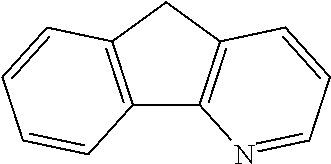 |
4.44 | 3.26 |
| Carbazole |
 |
4.63 | 3.34 |
| Dibenzofuran |
 |
4.29 | 3.28 |
| Dibenzothiophene |
 |
4.26 | 3.32 |


(1) Synthesis of
P=m/{4.38×10−3·(M/T)1/2} (i)
(m: an evaporation rate per unit area [kg/m2·s], M: the molecular weight of the complex, T: the temperature of an evaporation surface [K]).
m=(1/U)·(dΔW/dt) (ii)
(U: the area of a sample dish [m2], dΔW/dt: the first derivation of a thermogravimetric curve with respect to time).


(1) Synthesis of Intermediate 2 and Ligand 3


(1) Synthesis of Intermediate 3

(1) Synthesis of Ligand 6

(1) Synthesis of Ligand 7

(1) Synthesis of Ligand 8


| TABLE 3 | |||
| Thickness | |||
| Material | (nm) | ||
| Hole injection layer | HT-1 | 50 | ||
| Hole transport layer | HT-8 | 10 | ||
| Emission layer | Host: H-108 | 30 | ||
| Guest: Ir-113 | ||||
| (H-108:Ir- | ||||
| 113 = 95:5 | ||||
| (weight ratio)) | ||||
| Hole/exciton blocking | ET-3 | 10 | ||
| layer | ||||
| Electron transport layer | ET-2 | 50 | ||
| First metal electrode | LiF | 0.5 | ||
| layer | ||||
| Second metal electrode | Al | 100 | ||
| layer | ||||
| TABLE 4 | ||||||
| Light- | ||||||
| emitting | Luminance | |||||
| Third | efficiency | half-life | ||||
| Host | Guest | component | (cd/A) | (h) | ||
| Example 1 | H-108 | Ir-113 | — | 24 | 410 |
| Example 2 | H-712 | Ir-114 | — | 24 | 140 |
| Example 3 | H-507 | Ir-125 | — | 27 | 580 |
| Example 4 | H-509 | Ir-106 | — | 28 | 360 |
| Example 5 | H-322 | Ir-136 | — | 22 | 370 |
| Example 6 | H-508 | Ir-108 | — | 28 | 600 |
| Example 7 | H-439 | Ir-134 | — | 20 | 180 |
| Example 8 | H-424 | Ir-116 | — | 23 | 620 |
| Example 9 | H-131 | Ir-201 | — | 22 | 290 |
| Example 10 | H-210 | Ir-204 | — | 21 | 150 |
| Example 11 | H-629 | Ir-106 | — | 27 | 300 |
| Example 12 | H-139 | Ir-125 | — | 26 | 530 |
| Example 13 | H-801 | Ir-113 | N-103 | 20 | 120 |
| Example 14 | H-401 | Ir-106 | M-103 | 31 | 460 |
| Example 15 | H-422 | Ir-113 | M-105 | 29 | 710 |
| Example 16 | H-905 | Ir-116 | N-104 | 21 | 120 |
| Example 17 | H-206 | Ir-125 | O-101 | 27 | 520 |
| Example 18 | H-317 | Ir-136 | O-104 | 25 | 480 |
| TABLE 5 | |||
| Thickness | |||
| Material | [nm] | ||
| Hole injection layer | HT-1 | 50 |
| Hole transport layer | HT-8 | 10 |
| Emission layer | Host: H-422 | 30 |
| Guest: Ir-106 | ||
| Third component: M-103 | ||
| (Host:Guest:Third | ||
| component = 75:5:25 | ||
| (weight ratio)) | ||
| Hole/exciton blocking | ET-3 | 10 |
| layer | ||
| Electron transport layer | ET-2, cesium carbonate | 50 |
| (ET-2:Cs2CO3 = 97:3) | ||
| Transparent electrode | Indium zinc oxide | 30 |
| layer | ||
Claims (28)
Ir(L1)(L2)(L3) [1]


Applications Claiming Priority (3)
| Application Number | Priority Date | Filing Date | Title |
|---|---|---|---|
| JP2013008464A JP6222931B2 (en) | 2013-01-21 | 2013-01-21 | Organic light emitting device |
| JP2013-008464 | 2013-01-21 | ||
| PCT/JP2014/051598 WO2014112658A1 (en) | 2013-01-21 | 2014-01-20 | Organic light-emitting element |
Publications (2)
| Publication Number | Publication Date |
|---|---|
| US20150357586A1 US20150357586A1 (en) | 2015-12-10 |
| US9899613B2 true US9899613B2 (en) | 2018-02-20 |
Family
ID=51209743
Family Applications (1)
| Application Number | Title | Priority Date | Filing Date |
|---|---|---|---|
| US14/758,683 Active 2034-11-17 US9899613B2 (en) | 2013-01-21 | 2014-01-20 | Organic light-emitting element |
Country Status (4)
| Country | Link |
|---|---|
| US (1) | US9899613B2 (en) |
| EP (1) | EP2946421A4 (en) |
| JP (1) | JP6222931B2 (en) |
| WO (1) | WO2014112658A1 (en) |
Cited By (1)
| Publication number | Priority date | Publication date | Assignee | Title |
|---|---|---|---|---|
| US12063850B2 (en) | 2019-12-24 | 2024-08-13 | Samsung Electronics Co., Ltd. | Organometallic compound, organic light-emitting device including the same and electronic apparatus including the organic light-emitting device |
Families Citing this family (19)
| Publication number | Priority date | Publication date | Assignee | Title |
|---|---|---|---|---|
| JP6016482B2 (en) * | 2012-07-03 | 2016-10-26 | キヤノン株式会社 | Dibenzoxanthene compound, organic light emitting device, display device, image information processing device, and image forming device |
| JP5984689B2 (en) * | 2013-01-21 | 2016-09-06 | キヤノン株式会社 | Organometallic complex and organic light emitting device using the same |
| CN105453272B (en) * | 2013-08-19 | 2020-08-21 | 出光兴产株式会社 | Oxide semiconductor substrate and schottky barrier diode element |
| JP6552201B2 (en) | 2015-01-19 | 2019-07-31 | キヤノン株式会社 | Organic light emitting device |
| CN107250087B (en) | 2015-02-03 | 2022-01-18 | 株式会社Lg化学 | Electroactive material |
| US10270046B2 (en) | 2015-03-06 | 2019-04-23 | Universal Display Corporation | Organic electroluminescent materials and devices |
| KR101984244B1 (en) | 2015-09-09 | 2019-05-30 | 삼성에스디아이 주식회사 | Organic compound and organic optoelectric device and display device |
| US10672997B2 (en) | 2016-06-20 | 2020-06-02 | Universal Display Corporation | Organic electroluminescent materials and devices |
| KR102032955B1 (en) * | 2017-06-07 | 2019-10-16 | 주식회사 엘지화학 | Novel hetero-cyclic compound and organic light emitting device comprising the same |
| US11760769B2 (en) * | 2019-03-29 | 2023-09-19 | Samsung Electronics Co., Ltd. | Composition and organic light-emitting device including the same |
| KR102761436B1 (en) * | 2019-12-20 | 2025-02-03 | 삼성전자주식회사 | Organometallic compound and organic light emitting device including the same |
| EP3892705B1 (en) * | 2020-04-09 | 2022-12-14 | Canon Kabushiki Kaisha | Iridium complex-containing composition, organic light emitting device having the same, display apparatus, imaging apparatus, electronic equipment, lighting apparatus, and moving body |
| JP7520571B2 (en) | 2020-05-15 | 2024-07-23 | キヤノン株式会社 | Composition containing an iridium complex, organic light-emitting element having the same, display device, imaging device, electronic device, lighting device, and mobile object |
| CN116261922B (en) * | 2020-10-20 | 2026-05-05 | 株式会社Lg化学 | Organic light-emitting devices |
| JP7822716B2 (en) | 2021-07-29 | 2026-03-03 | キヤノン株式会社 | Organic light-emitting device, display device, photoelectric conversion device, electronic device, lighting device, moving object, and exposure light source |
| CN115745932A (en) * | 2021-09-03 | 2023-03-07 | 三星Sdi株式会社 | Compound for organic photoelectric device, organic photoelectric device and display device |
| JP7749386B2 (en) * | 2021-09-16 | 2025-10-06 | キヤノン株式会社 | Organic compounds, organic light-emitting devices, display devices, photoelectric conversion devices, electronic devices, lighting devices, mobile objects, and exposure light sources |
| JP7721404B2 (en) * | 2021-11-09 | 2025-08-12 | キヤノン株式会社 | Organic light-emitting devices |
| JP2023180700A (en) * | 2022-06-10 | 2023-12-21 | キヤノン株式会社 | Organic compounds and organic light emitting devices |
Citations (13)
| Publication number | Priority date | Publication date | Assignee | Title |
|---|---|---|---|---|
| JP2004091444A (en) | 2002-09-04 | 2004-03-25 | Canon Inc | Diazafluorene compound and organic light emitting device using the same |
| US6824894B2 (en) | 2001-06-25 | 2004-11-30 | Canon Kabushiki Kaisha | Metal coordination compound and electroluminescence device |
| US7232618B2 (en) | 2002-04-12 | 2007-06-19 | Canon Kabushiki Kaisha | Organic light-emitting device |
| WO2007143201A1 (en) | 2006-06-02 | 2007-12-13 | E. I. Du Pont De Nemours And Company | Red emitter complexes of ir(iii) and devices made with such compounds |
| US20080210930A1 (en) | 2004-11-30 | 2008-09-04 | Canon Kabushiki Kaisha | Metal Complex, Light-Emitting Device, and Image Display Apparatus |
| US20080265491A1 (en) | 2007-04-26 | 2008-10-30 | Kohichi Yamauchi | Paper feeding apparatus |
| WO2009060995A1 (en) | 2007-11-08 | 2009-05-14 | Canon Kabushiki Kaisha | Organic metal complex, and organic light emitting device and display apparatus using the same |
| WO2010028151A1 (en) | 2008-09-03 | 2010-03-11 | Universal Display Corporation | Phosphorescent materials |
| US20100289406A1 (en) | 2009-05-12 | 2010-11-18 | Universal Display Corporation | 2-azatriphenylene materials for organic light emitting diodes |
| WO2010137285A1 (en) | 2009-05-29 | 2010-12-02 | 出光興産株式会社 | Anthracene derivative and organic electroluminescent element using the same |
| US7976958B2 (en) | 2006-11-28 | 2011-07-12 | Canon Kabushiki Kaisha | Metal complex compound, electroluminescent device and display apparatus |
| WO2012107419A1 (en) | 2011-02-09 | 2012-08-16 | Roche Diagnostics Gmbh | New iridium-based complexes for ecl |
| US8330153B2 (en) | 2010-01-20 | 2012-12-11 | Canon Kabushiki Kaisha | Organic light-emitting device |
Family Cites Families (1)
| Publication number | Priority date | Publication date | Assignee | Title |
|---|---|---|---|---|
| US8106199B2 (en) * | 2007-02-13 | 2012-01-31 | Arizona Board Of Regents For And On Behalf Of Arizona State University | Organometallic materials for optical emission, optical absorption, and devices including organometallic materials |
-
2013
- 2013-01-21 JP JP2013008464A patent/JP6222931B2/en active Active
-
2014
- 2014-01-20 WO PCT/JP2014/051598 patent/WO2014112658A1/en not_active Ceased
- 2014-01-20 EP EP14740483.4A patent/EP2946421A4/en not_active Withdrawn
- 2014-01-20 US US14/758,683 patent/US9899613B2/en active Active
Patent Citations (17)
| Publication number | Priority date | Publication date | Assignee | Title |
|---|---|---|---|---|
| US6824894B2 (en) | 2001-06-25 | 2004-11-30 | Canon Kabushiki Kaisha | Metal coordination compound and electroluminescence device |
| US7078115B2 (en) | 2001-06-25 | 2006-07-18 | Canon Kabushiki Kaisha | Metal coordination compound and electroluminescence device |
| US7232618B2 (en) | 2002-04-12 | 2007-06-19 | Canon Kabushiki Kaisha | Organic light-emitting device |
| JP2004091444A (en) | 2002-09-04 | 2004-03-25 | Canon Inc | Diazafluorene compound and organic light emitting device using the same |
| US20080210930A1 (en) | 2004-11-30 | 2008-09-04 | Canon Kabushiki Kaisha | Metal Complex, Light-Emitting Device, and Image Display Apparatus |
| WO2007143201A1 (en) | 2006-06-02 | 2007-12-13 | E. I. Du Pont De Nemours And Company | Red emitter complexes of ir(iii) and devices made with such compounds |
| US7976958B2 (en) | 2006-11-28 | 2011-07-12 | Canon Kabushiki Kaisha | Metal complex compound, electroluminescent device and display apparatus |
| US20080265491A1 (en) | 2007-04-26 | 2008-10-30 | Kohichi Yamauchi | Paper feeding apparatus |
| WO2009060995A1 (en) | 2007-11-08 | 2009-05-14 | Canon Kabushiki Kaisha | Organic metal complex, and organic light emitting device and display apparatus using the same |
| US20100219407A1 (en) | 2007-11-08 | 2010-09-02 | Canon Kabushiki Kaisha | Organic metal complex, and organic light emitting device and display apparatus using the same |
| WO2010028151A1 (en) | 2008-09-03 | 2010-03-11 | Universal Display Corporation | Phosphorescent materials |
| US20100289406A1 (en) | 2009-05-12 | 2010-11-18 | Universal Display Corporation | 2-azatriphenylene materials for organic light emitting diodes |
| WO2010137285A1 (en) | 2009-05-29 | 2010-12-02 | 出光興産株式会社 | Anthracene derivative and organic electroluminescent element using the same |
| US8330153B2 (en) | 2010-01-20 | 2012-12-11 | Canon Kabushiki Kaisha | Organic light-emitting device |
| WO2012107419A1 (en) | 2011-02-09 | 2012-08-16 | Roche Diagnostics Gmbh | New iridium-based complexes for ecl |
| US20130323719A1 (en) | 2011-02-09 | 2013-12-05 | Roche Diagnostics Operations, Inc. | New iridium-based complexes for ecl |
| US20160145281A1 (en) | 2011-02-09 | 2016-05-26 | Roche Diagnostics Operations, Inc. | New iridium-based complexes for ecl |
Non-Patent Citations (9)
| Title |
|---|
| Extended European Search Report dated Aug. 8, 2016, in counterpart EP application No. 14740483.4 (5 pages). |
| Pending U.S. Appl. No. 14/648,095, filed May 28, 2015 (not yet published). |
| Pending U.S. Appl. No. 14/648,494, filed May 29, 2015 (not yet published). |
| Pending U.S. Appl. No. 14/649,048, filed Jun. 2, 2015 (not yet published). |
| Pending U.S. Appl. No. 14/760,093, filed Jul. 9, 2015 (not yet published). |
| Pending U.S. Appl. No. 14/761,049, filed Jul. 15, 2015 (not yet published). |
| Pending U.S. Appl. No. 14/764,204, filed Jul. 29, 2015 (not yet published). |
| Pending U.S. Appl. No. 14/764,376, filed Jul. 29, 2015 (not yet published) |
| Y. Terao, et al., "Palladiuim-Catalyzed Cross-Coupling of Benzyl Ketones and Alpha, Beta-Unsaturated Carbonyl and Phenolic Compounds with o-Dibromobezenes to Produce Cyclic Products", Bull. Chem. Soc. Jpn., vol. 72, pp. 2345-2350 (1999). |
Cited By (1)
| Publication number | Priority date | Publication date | Assignee | Title |
|---|---|---|---|---|
| US12063850B2 (en) | 2019-12-24 | 2024-08-13 | Samsung Electronics Co., Ltd. | Organometallic compound, organic light-emitting device including the same and electronic apparatus including the organic light-emitting device |
Also Published As
| Publication number | Publication date |
|---|---|
| JP6222931B2 (en) | 2017-11-01 |
| EP2946421A4 (en) | 2016-09-07 |
| US20150357586A1 (en) | 2015-12-10 |
| EP2946421A1 (en) | 2015-11-25 |
| JP2014139987A (en) | 2014-07-31 |
| WO2014112658A1 (en) | 2014-07-24 |
Similar Documents
| Publication | Publication Date | Title |
|---|---|---|
| US10038152B2 (en) | Organic light-emitting element | |
| US20150357586A1 (en) | Organic light-emitting element | |
| US9466804B2 (en) | Organic light-emitting element | |
| US9917264B2 (en) | Organometallic complex and organic light-emitting element using the complex | |
| US10615350B2 (en) | Organic light-emitting element and display apparatus | |
| US10916711B2 (en) | Spiro compound having azafluorene ring structure, light-emitting material, and organic electroluminescent device | |
| US10636982B2 (en) | Iridium complex and organic light-emitting device including the same | |
| US20150372244A1 (en) | Organic light-emitting device | |
| US9601704B2 (en) | Organic light-emitting device and display apparatus | |
| US20150303386A1 (en) | Organic light-emitting device and display apparatus | |
| KR20230156057A (en) | Organic electroluminescent device and electronic devices thereof | |
| WO2017086357A1 (en) | Organic electroluminescence element | |
| CN109844978B (en) | Indenocarbazole compound and organic electroluminescent element | |
| US8829502B2 (en) | Condensed polycyclic compound and organic light emitting element including the same | |
| CN114787170B (en) | Pyrromethene boron complex, light-emitting element, display device and lighting device containing the same | |
| EP2963032A1 (en) | Novel naphthotriazole derivative and organic electroluminescence element | |
| WO2023013615A1 (en) | Amine compound, hole injection layer and organic electroluminescent element | |
| CN112654611B (en) | Compounds having pyrimidine ring structure and organic electroluminescent element | |
| CN113795481A (en) | Compound having benzotriazole ring structure and organic electroluminescent element | |
| JP2024000077A (en) | Compounds, light-emitting device materials, and light-emitting devices using them |
Legal Events
| Date | Code | Title | Description |
|---|---|---|---|
| AS | Assignment |
Owner name: CANON KABUSHIKI KAISHA, JAPAN Free format text: ASSIGNMENT OF ASSIGNORS INTEREST;ASSIGNORS:HORIUCHI, TAKAYUKI;KOSUGE, TETSUYA;MIYASHITA, HIROKAZU;AND OTHERS;SIGNING DATES FROM 20150422 TO 20150512;REEL/FRAME:036157/0854 |
|
| STCF | Information on status: patent grant |
Free format text: PATENTED CASE |
|
| AS | Assignment |
Owner name: SAMSUNG ELECTRONICS CO., LTD., KOREA, REPUBLIC OF Free format text: CHANGE OF NAME;ASSIGNOR:CANON KABUSHIKI KAISHA;REEL/FRAME:049501/0097 Effective date: 20190618 |
|
| MAFP | Maintenance fee payment |
Free format text: PAYMENT OF MAINTENANCE FEE, 4TH YEAR, LARGE ENTITY (ORIGINAL EVENT CODE: M1551); ENTITY STATUS OF PATENT OWNER: LARGE ENTITY Year of fee payment: 4 |
|
| MAFP | Maintenance fee payment |
Free format text: PAYMENT OF MAINTENANCE FEE, 8TH YEAR, LARGE ENTITY (ORIGINAL EVENT CODE: M1552); ENTITY STATUS OF PATENT OWNER: LARGE ENTITY Year of fee payment: 8 |