US9882792B1 - Filter component tuning method - Google Patents
Filter component tuning method Download PDFInfo
- Publication number
- US9882792B1 US9882792B1 US15/227,169 US201615227169A US9882792B1 US 9882792 B1 US9882792 B1 US 9882792B1 US 201615227169 A US201615227169 A US 201615227169A US 9882792 B1 US9882792 B1 US 9882792B1
- Authority
- US
- United States
- Prior art keywords
- tuned
- filter component
- frequencies
- mode
- parameters
- Prior art date
- Legal status (The legal status is an assumption and is not a legal conclusion. Google has not performed a legal analysis and makes no representation as to the accuracy of the status listed.)
- Active
Links
Images




Classifications
-
- G—PHYSICS
- G06—COMPUTING OR CALCULATING; COUNTING
- G06F—ELECTRIC DIGITAL DATA PROCESSING
- G06F30/00—Computer-aided design [CAD]
- G06F30/20—Design optimisation, verification or simulation
-
- H—ELECTRICITY
- H03—ELECTRONIC CIRCUITRY
- H03H—IMPEDANCE NETWORKS, e.g. RESONANT CIRCUITS; RESONATORS
- H03H3/00—Apparatus or processes specially adapted for the manufacture of impedance networks, resonating circuits, resonators
-
- G—PHYSICS
- G01—MEASURING; TESTING
- G01R—MEASURING ELECTRIC VARIABLES; MEASURING MAGNETIC VARIABLES
- G01R23/00—Arrangements for measuring frequencies; Arrangements for analysing frequency spectra
- G01R23/02—Arrangements for measuring frequency, e.g. pulse repetition rate; Arrangements for measuring period of current or voltage
- G01R23/06—Arrangements for measuring frequency, e.g. pulse repetition rate; Arrangements for measuring period of current or voltage by converting frequency into an amplitude of current or voltage
- G01R23/07—Arrangements for measuring frequency, e.g. pulse repetition rate; Arrangements for measuring period of current or voltage by converting frequency into an amplitude of current or voltage using response of circuits tuned on resonance, e.g. grid-drip meter
-
- H—ELECTRICITY
- H01—ELECTRIC ELEMENTS
- H01P—WAVEGUIDES; RESONATORS, LINES, OR OTHER DEVICES OF THE WAVEGUIDE TYPE
- H01P1/00—Auxiliary devices
- H01P1/20—Frequency-selective devices, e.g. filters
-
- H—ELECTRICITY
- H01—ELECTRIC ELEMENTS
- H01P—WAVEGUIDES; RESONATORS, LINES, OR OTHER DEVICES OF THE WAVEGUIDE TYPE
- H01P1/00—Auxiliary devices
- H01P1/20—Frequency-selective devices, e.g. filters
- H01P1/207—Hollow waveguide filters
- H01P1/208—Cascaded cavities; Cascaded resonators inside a hollow waveguide structure
- H01P1/2084—Cascaded cavities; Cascaded resonators inside a hollow waveguide structure with dielectric resonators
- H01P1/2086—Cascaded cavities; Cascaded resonators inside a hollow waveguide structure with dielectric resonators multimode
-
- H—ELECTRICITY
- H01—ELECTRIC ELEMENTS
- H01P—WAVEGUIDES; RESONATORS, LINES, OR OTHER DEVICES OF THE WAVEGUIDE TYPE
- H01P11/00—Apparatus or processes specially adapted for manufacturing waveguides or resonators, lines, or other devices of the waveguide type
- H01P11/008—Manufacturing resonators
-
- H—ELECTRICITY
- H01—ELECTRIC ELEMENTS
- H01P—WAVEGUIDES; RESONATORS, LINES, OR OTHER DEVICES OF THE WAVEGUIDE TYPE
- H01P7/00—Resonators of the waveguide type
- H01P7/06—Cavity resonators
-
- H—ELECTRICITY
- H01—ELECTRIC ELEMENTS
- H01P—WAVEGUIDES; RESONATORS, LINES, OR OTHER DEVICES OF THE WAVEGUIDE TYPE
- H01P7/00—Resonators of the waveguide type
- H01P7/10—Dielectric resonators
- H01P7/105—Multimode resonators
-
- H—ELECTRICITY
- H03—ELECTRONIC CIRCUITRY
- H03H—IMPEDANCE NETWORKS, e.g. RESONANT CIRCUITS; RESONATORS
- H03H3/00—Apparatus or processes specially adapted for the manufacture of impedance networks, resonating circuits, resonators
- H03H3/007—Apparatus or processes specially adapted for the manufacture of impedance networks, resonating circuits, resonators for the manufacture of electromechanical resonators or networks
- H03H3/013—Apparatus or processes specially adapted for the manufacture of impedance networks, resonating circuits, resonators for the manufacture of electromechanical resonators or networks for obtaining desired frequency or temperature coefficient
-
- H—ELECTRICITY
- H04—ELECTRIC COMMUNICATION TECHNIQUE
- H04B—TRANSMISSION
- H04B7/00—Radio transmission systems, i.e. using radiation field
- H04B7/02—Diversity systems; Multi-antenna system, i.e. transmission or reception using multiple antennas
- H04B7/04—Diversity systems; Multi-antenna system, i.e. transmission or reception using multiple antennas using two or more spaced independent antennas
- H04B7/0413—MIMO systems
- H04B7/0456—Selection of precoding matrices or codebooks, e.g. using matrices antenna weighting
-
- H—ELECTRICITY
- H04—ELECTRIC COMMUNICATION TECHNIQUE
- H04L—TRANSMISSION OF DIGITAL INFORMATION, e.g. TELEGRAPHIC COMMUNICATION
- H04L43/00—Arrangements for monitoring or testing data switching networks
- H04L43/02—Capturing of monitoring data
- H04L43/028—Capturing of monitoring data by filtering
-
- H—ELECTRICITY
- H04—ELECTRIC COMMUNICATION TECHNIQUE
- H04L—TRANSMISSION OF DIGITAL INFORMATION, e.g. TELEGRAPHIC COMMUNICATION
- H04L7/00—Arrangements for synchronising receiver with transmitter
- H04L7/02—Speed or phase control by the received code signals, the signals containing no special synchronisation information
- H04L7/027—Speed or phase control by the received code signals, the signals containing no special synchronisation information extracting the synchronising or clock signal from the received signal spectrum, e.g. by using a resonant or bandpass circuit
- H04L7/0276—Self-sustaining, e.g. by tuned delay line and a feedback path to a logical gate
-
- Y—GENERAL TAGGING OF NEW TECHNOLOGICAL DEVELOPMENTS; GENERAL TAGGING OF CROSS-SECTIONAL TECHNOLOGIES SPANNING OVER SEVERAL SECTIONS OF THE IPC; TECHNICAL SUBJECTS COVERED BY FORMER USPC CROSS-REFERENCE ART COLLECTIONS [XRACs] AND DIGESTS
- Y10—TECHNICAL SUBJECTS COVERED BY FORMER USPC
- Y10T—TECHNICAL SUBJECTS COVERED BY FORMER US CLASSIFICATION
- Y10T29/00—Metal working
- Y10T29/49—Method of mechanical manufacture
- Y10T29/49002—Electrical device making
- Y10T29/49016—Antenna or wave energy "plumbing" making
Definitions
- This invention relates generally to filter components and, more specifically, relates to a method for tuning of the filter components.
- a filter is composed of a number of resonating structures and energy coupling structures which are arranged to exchange RF energy between themselves and the input and output ports.
- the pattern of interconnection of these resonators to one another and to the input/output ports, the strength of these interconnections and the resonant frequencies of the resonators determine the response of the filter.
- the arrangement of the parts, the materials from which the parts are made and the precise dimensions of the parts are determined such that an ideal filter so composed will perform the desired filtering function. If a physical filter conforming exactly to this design could be manufactured, then the resulting filter would perform exactly as intended by the designer.
- a common way to accomplish this is to include tuning screws or other devices, such as are well known in the art.
- An alternative way often used in small ceramic monoblock filters is to remove selected portions of the metallization on the exterior of these filters, and possibly portions of ceramic as well, to accomplish the tuning.
- An alternative tuning method is to build the separate resonator parts, tune them individually to a specification calculated for the separated parts from the ideal filter model, and then assemble them into the final filter. Since the individual parts are simple compared with the fully assembled filter, the tuning procedure for these individual parts can also be made very simple. This minimizes the need for skilled operators to tune the filters. This procedure also provides the benefit of either reducing or entirely eliminating the tuning process for the assembled filter.
- a tuning method may include the manipulation of a tuning device or structure included as part of the resonator, such as a tuning screw or deformable metal part.
- a method may comprise an operation performed on the resonator, such as the removal of material from a selected region.
- the method may also comprise a combination of these, or any other means or process which can alter the resonant frequencies of the resonator part.
- a tuning physical adjustment can then be defined as one or more manipulations of tuning structures and/or one or more operations causing one or more of the resonant frequencies to be altered.
- such physical adjustment includes but is not limited to removal of material from a surface/face, drilling of holes, adjustments of screws, and/or denting of material.
- the tuning methods for the parts will need to be able to independently adjust the resonant frequencies of the several modes of the resonator. For example, if the multimode resonator has three modes requiring independent adjustment, then at least three independent tuning adjustments will be required. It is a common situation with multimode resonators that an individual adjustment causes more than one of the mode frequencies to change. As a result, there is not a one-to-one correspondence between a single adjustment and a frequency change in a single mode.
- a method is disclosed in an exemplary embodiment.
- the method includes calculating one or more target mode frequencies for a defined filter component used as a reference for filter components to be subsequently tuned.
- the defined filter component has one or more resonant modes, each of which has a mode frequency which can be tuned to a corresponding target mode frequency via physical adjustment of one or more parameters associated with the filter component.
- the method includes forming a tuning equation at least by linearly relating, via a slope matrix, changes in the one or more mode frequencies to corresponding physical adjustment in the one or more parameters, and by using an inverse of the slope matrix as part of the tuning equation.
- the method includes, for a filter component to be tuned, performing a tuning procedure.
- the tuning procedure comprises: determining, using at least the tuning equation, adjustment information for at least one of the one or more parameters of the filter component to adjust each of one or more measured mode frequencies of the filter component toward meeting a corresponding target mode frequency for a corresponding resonant mode within a corresponding tolerance; and outputting the determined adjustment information for the at least one parameter to be used for physical adjustment of the at least one parameter.
- this method comprises performing a tuning procedure using a tuning equation.
- the tuning equation has been previously formed and linearly relates, via a slope matrix, changes in one or more mode frequencies for a defined filter component to corresponding physical adjustment in one or more parameters of the defined filter component.
- Each of one or more resonant modes of the filter component can be tuned to a corresponding target mode frequency via physical adjustment of the one or more parameters.
- Performing the tuning procedure comprises: physically adjusting at least one of the one or more parameters of a filter component to be tuned until a tuned version of the filter component to be tuned has each of a set of the one or more measured mode frequencies meeting a corresponding target frequency for a corresponding resonant mode within a corresponding tolerance.
- FIG. 1 is an example of a filter component, e.g., used for the methods of FIGS. 11 and 12 and described throughout;
- FIG. 2 which includes both FIGS. 2A and 2B , illustrates the filter component of FIG. 1 with a test structure and transmission line attached, where FIG. 2A illustrates the test structure attached to a face of the filter component and the transmission line connected to the test structure, and where FIG. 2B illustrates the face of the filter component on which the test structure is attached;
- FIG. 3 which includes FIGS. 3A, 3B, and 3C illustrates electric and magnetic fields of the X ( FIG. 3A ) modes, Y ( FIG. 3B ) modes, and Z ( FIG. 3C ) modes, for a cuboidal resonator;
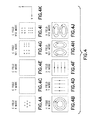
- FIG. 4 includes FIGS. 4A-4K , FIGS. 4A, 4C, 4E, 4G, and 4I indicate electric (E) fields for the X mode, Y mode, Z mode, X21 mode and X12 mode, respectively, FIGS. 4B, 4D, 4F, 4H, and 4J indicate magnetic (H) fields for the X mode, Y mode, Z mode, X21 mode and X12 mode, respectively, and FIG. 4K illustrates the planar orientation for FIGS. 4A-4J ;
- FIG. 5 which includes FIGS. 5A and 5B , illustrates S-parameters (in dB versus frequency) for cubes with a 45 degree bridge ( FIG. 5A ) and a 37 degree bridge ( FIG. 5B );
- FIG. 6 illustrates a cylindrical resonator with regions removed
- FIG. 7 illustrates a spherical resonator with regions removed
- FIGS. 8, 9, and 10 illustrate possible adjustment hole locations for a cuboid, sphere, and cylinder, respectively;
- FIG. 11 which includes FIGS. 11A and 11B , illustrates a process for forming a tuning equation in accordance with an exemplary embodiment
- FIG. 12 which includes both FIGS. 12A and 12B , illustrates a process for performing a tuning procedure in accordance with an exemplary embodiment
- FIGS. 13A, 13B, and 13C represent possible physical adjustments in the X, Y, and Z directions, respectively, in the methods of FIGS. 11 and 12
- FIG. 13D shows multiple physical adjustments in the X, Y, and Z directions, in the methods of FIGS. 11 and 12 .
- the one or more of the above components is a multimode resonator, then at least as many independent physical adjustments are required as there are resonant mode frequencies to be adjusted.
- the typical situation with such multimode resonators is that each individual physical adjustment alters more than one of the mode frequencies, so that there is not a one-to-one correspondence between an individual physical adjustment and an individual mode frequency change. Consequently, if the multimode component is to be conveniently tuned, some means of calculating the set of physical adjustments which will effect a desired set of changes in the mode frequencies is required. Such a means is provided by the instant invention which will be described below.
- the full tuning process described herein requires a filter design which can be split into individual resonator components, where these components are configured to allow the resonant frequencies to be measured, where the desired resonant frequencies can be calculated and where methods to adjust the frequencies of the resonant modes are available. It also requires a method to calculate the required set of physical adjustments which will bring all of the mode frequencies into agreement with the calculated frequency targets.
- the cuboid component 100 (also called a resonator) includes a dielectric cuboid 140 that has six sides: a top side 110 - 1 , a right side 110 - 2 , a bottom side 110 - 3 , a left side 110 - 4 , a back side 110 - 5 , and a front side 110 - 6 .
- Each individual side 110 is also considered to be a face of the component 100 .
- the sides 110 are typically covered with conductive material (see FIG. 2A ).
- the X, Y, and Z axes are shown, as are the corresponding dimensions Sx, Sy, and Sz. These axes are used throughout the figures. It is noted that the cuboid is used merely for ease of exposition, and other components 100 may be used, as is illustrated below.
- FIG. 2 An example of a measurement structure 210 is shown in FIG. 2 , and will be referred to as a keyhole.
- FIG. 2 includes both FIGS. 2A and 2B , and illustrates the filter component of FIG. 1 with a keyhole 210 attached.
- FIG. 2A illustrates the test structure 210 attached to a face 110 - 4 of the filter component and illustrates a transmission line connected to the test structure 210 .
- FIG. 2B illustrates the face 110 - 4 of the filter component 100 on which the test structure 210 is attached.
- the face 110 - 4 has a surface 211 .
- the filter component 100 has a conductive coating 250 that covers a dielectric cuboid 140 .
- This measurement structure 210 is formed in part as a region 220 devoid of metallization in an otherwise continuous coating 250 on the exterior of a ceramic resonator component 100 .
- the measurement structure 210 comprises also a central conductive island 270 with a short conductive bridge 280 connecting the island 270 to the surrounding grounded perimeter 271 (of the coating 250 ).
- the center conductor 290 of an external coaxial or similar transmission line 240 is connected to the island 270 of the keyhole 210 and the shield 295 of the transmission line 240 is connected to the grounded perimeter 271 of the keyhole 210 .
- the island 270 couples to any electric field striking the inside surface of the conductive coating 250 in the location of the keyhole structure, while the bridge 280 couples to any magnetic field running parallel to the surface 211 and at any angle not parallel to the bridge 280 , also at the location of the keyhole 210 .
- Such a measurement structure 210 will exchange energy with any resonant modes which conform to the above field distributions, and so will permit the frequencies of those modes to be determined by connecting the above transmission line to a vector network analyzer (VNA) or similar instrument.
- VNA vector network analyzer
- the multimode resonator is a ceramic block formed into a cuboid shape and covered with a conducting layer such as silver (see FIG. 1 ).
- the three lowest order modes of such a resonator will frequently be employed as the active in-band modes of the filter, so only those modes will be considered here.
- These have electric fields running in three orthogonal directions which are parallel to each axis of the cube, and have magnetic fields circulating around the main axis of the electric field of each mode, as illustrated in FIG. 3 .
- the modes with electric field lines running parallel to the X, Y and Z axes are referred to as the X ( FIG. 3A ), Y ( FIG. 3B ) and Z ( FIG. 3C ) modes, respectively.
- the field distribution of most relevance to a measurement structure set into the conductive coating of the multimode resonator, such as the above keyhole, is that which occurs at the boundary between the ceramic and the inside surface of the conductive coating on the face on which the measurement structure is located.
- FIG. 4 shows the electric and magnetic fields existing at the boundary between the ceramic and the conductive coating of the X face.
- the electric field of the X mode strikes the inside of the conductive coating perpendicularly, reaching a maximum at the center of the face and dropping to zero at the edges. This is indicated by the group of small crosses in the center of FIG. 4A .
- FIG. 4B The corresponding magnetic field circulates around the face, having a maximum strength at the edge, and dropping to zero in the center, as shown in FIG. 4B .
- the Y and Z modes illustrated in FIGS. 4C-F have zero electric field over the entire face (see FIGS. 4C and 4E ), while the corresponding magnetic fields are parallel to the Z and Y axes (see FIGS. 4D and 4F ), respectively. Examples of additional higher order modes are shown in FIGS. 4G-4J .
- FIG. 4K illustrates the planar orientation for FIGS. 4A-4J .
- FIG. 5A An example of such a measured signal is shown in FIG. 5A .
- FIG. 5 includes FIGS. 5A and 5B , and illustrates S-parameters (in dB versus frequency) for cubes with a 45 degree bridge ( FIG. 5A ) and a 37 degree bridge ( FIG. 5B ).
- the lowest frequency dip is the X mode
- the next dip is the Z mode
- the highest frequency dip is the Y mode. Note that the depths of the dips are not the same.
- the angle 230 of the bridge 280 relative to the Y axis 272 in FIG. 2 , the relative heights of the Y mode and Z mode dips can be varied, with approximate equality occurring at 45 degrees, as seen in FIG. 5A .
- the X mode dip is smaller than the other two. If the measurement structure 210 is placed in the center of the one of the faces of the cuboid resonator 100 , and the angle of the bridge 280 is set to about 37 degrees to the Y axis 272 , rather than the more obvious and symmetrical 45 degrees, then the amplitudes of the dips form a sequence in the order X smallest, Z intermediate and Y largest, which can assist in the identification of the dips during a frequency measurement. This signal is illustrated in FIG. 5B .
- a variety of physical adjustment methods are possible, such as removing ceramic material, drilling holes, inserting tuning screws and deforming a metal enclosure.
- a set of such methods may be employed to allow multiple mode frequencies to be altered.
- the essential feature is that the set of methods must provide a sufficient number of independent adjustments to allow the resonant frequencies of all of the desired modes to be altered.
- Each physical adjustment may comprise one or more individual actions, such as adjusting a tuning screw, drilling a hole or lapping material from a surface.
- each adjustment can be composite, comprising a number of separate manipulations or operations, but the number of independent composite adjustments must equal the number of modes. It is also necessary that the adjustments be quantified so that the amount or size or extent of the adjustments can be specified by a mathematical procedure. For example, consider the case of a cuboid resonator where the three lowest order modes are to be adjusted, and where the adjustments to be employed are uniform removal of material from three orthogonal faces. Useful quantifications in this case are the three side lengths of the cuboid, or the amounts of material removed from each of the faces, or the change in size of the three side lengths.
- One adjustment could be uniform removal of material from one of the flat faces, quantified by the height of the cylinder.
- the second adjustment could be the drilling of two holes of equal depth oppositely located on the curved surface, and quantified by the hole's depth.
- the third adjustment could be another pair of equal depth holes located on the curved surface but orthogonally located relative to the first pair of holes, and quantified by the depth of the holes.
- One convenient method for adjusting the resonant frequencies of a silvered ceramic resonator is to remove the silver from several regions to expose the ceramic, remove specified amounts of the ceramic from each exposed region, then resilver the regions.
- Each of these sequences of activities on a particular region constitutes an individual adjustment action (as described above), where the action may be quantified by the depth of ceramic removed, or alternatively by the change in the corresponding dimension of the part.
- the lapping method If the regions are comparable in size with a side of the resonator, then this method has the advantage that it minimally disturbs the geometry of the resonator and so largely preserves the distribution of electric and magnetic fields of the modes of interest.
- This method is very well adapted to a cuboid resonator, where the abovementioned regions are three orthogonal faces, such as illustrated in FIG. 1 .
- it also may be applied to other shapes, such as a cylindrical resonator, where one region is the flat top, and the other two regions are removed from the curved surfaces such that the resulting regions form three substantially perpendicular flattened areas.
- FIG. 6 shows a cylindrical resonator 100 - 1 .
- the flat top 430 is shown, as is the outer curved surface 420 of the cylinder resonator 100 - 1 .
- Two regions 410 - 1 and 410 - 2 are removed from the curved surface 420 .
- FIG. 7 illustrates a spherical resonator 100 - 2 with an outside surface 520 and three regions 510 - 1 , 510 - 2 , and 510 - 3 removed from the outside surface 520 .
- the adjustment information quantifying the adjustments might then be the amounts of material removed from each of the three substantially orthogonal regions.
- a set of adjustment actions which are suitable for adjusting the resonant frequencies of a bare ceramic block located in a conductive enclosure is similar to that described above, except that because there is no silver coating, the ceramic can be removed directly.
- the removal of ceramic from a particular region constitutes an individual adjustment. We will refer to this as the direct lapping method.
- the locations and manner of ceramic removal for the examples of cuboidal, cylindrical and spherical blocks are the same as for the silvered case above. Of course, the blocks may need to be removed from the enclosure to perform the adjustment and then replaced afterward.
- Yet another alternative set of adjustments which are applicable to both a silver coated ceramic resonator and a ceramic block located in a conductive enclosure is to drill holes of specified diameters and depths into the ceramic in selected locations.
- the drilling of an individual hole, or the further drilling of an already existing hole constitutes an individual adjustment.
- a convenient quantification of the adjustment action is the increase in hole depth. We will refer to this as the drilling method. This is a fast operation, but has the disadvantage of disturbing the electric and magnetic field distributions of the resonant modes to a significantly greater degree than occurs with the either of the lapping methods described above.
- FIG. 8 shows a cuboid resonator 100 - 3 with three adjustment holes 610 - 1 , 610 - 1 , and 610 - 3 .
- a convenient set in the case of a spherical block is to use three holes 710 positioned such that the three radius lines between the center of the sphere and each of the three holes form a mutually orthogonal set, such as illustrated in FIG. 9 .
- FIG. 8 shows a cuboid resonator 100 - 3 with three adjustment holes 610 - 1 , 610 - 1 , and 610 - 3 .
- a convenient set in the case of a spherical block is to use three holes 710 positioned such that the three radius lines between the center of the sphere and each of the three holes form a mutually orthogonal set, such as illustrated in FIG. 9 .
- FIG. 10 illustrates a spherical resonator 100 - 4 with three adjustment holes 710 - 1 , 710 - 1 , and 710 - 3 .
- convenient locations for the holes are one in the center of the top face, and two more holes halfway up the curved side separated by about 90 degrees from one another, as illustrated in FIG. 10 .
- FIG. 10 illustrates a cylindrical resonator 100 - 5 with three adjustment holes 810 - 1 , 810 - 1 , and 810 - 3 .
- the mode frequencies will vary by a small amount so that the relationship between the adjustments and the frequencies will be approximately linear.
- the relation between them can be expressed as a simple matrix equation, where the matrix represents the slope (i.e., derivative) of frequency change versus adjustment parameter.
- the parameters correspond to physical structure such as the following: surface or face measurements; whether holes exist and if the holes exist what size (e.g., diameter plus depth) they are; whether screws are used and if so their configuration (e.g., diameter, depth of hole, how far screw goes into hole, material of screw, physical structure of end of screw); whether a structure is or is not dented and if dented to what degree.
- surface or face measurements e.g., surface or face measurements
- M [ ⁇ f 1 ⁇ s 1 ⁇ f 1 ⁇ s 2 ⁇ f 1 ⁇ s 3 ⁇ f 2 ⁇ s 1 ⁇ f 2 ⁇ s 2 ⁇ f 2 ⁇ s 3 ⁇ f 3 ⁇ s 1 ⁇ f 3 ⁇ s 2 ⁇ f 3 ⁇ s 3 ] .
- ⁇ ⁇ ⁇ F [ ⁇ ⁇ ⁇ f 1 ⁇ ⁇ ⁇ f 2 ⁇ ⁇ ⁇ f 3 ⁇ ⁇ ⁇ ⁇ f N ] , and the slope matrix composed of partial derivatives of mode frequencies with respect to adjustment parameters is denoted by:
- M [ ⁇ f 1 ⁇ s 1 ⁇ f 1 ⁇ s 2 ⁇ f 1 ⁇ s 3 ... ⁇ f 1 ⁇ s N ⁇ f 2 ⁇ s 1 ⁇ f 2 ⁇ s 2 ⁇ f 2 ⁇ s 3 ... ⁇ f 2 ⁇ s N ⁇ f 3 ⁇ s 1 ⁇ f 3 ⁇ s 2 ⁇ f 3 ⁇ s 3 ... ⁇ f 3 ⁇ s N ⁇ ⁇ ⁇ ⁇ ⁇ ⁇ f N ⁇ s 1 ⁇ f N ⁇ s 2 ⁇ f N ⁇ s 3 ... ⁇ f N ⁇ s N ] .
- the multimode resonator is of a simple geometrical shape such that analytic equations are available for the mode frequencies
- the derivatives of these frequencies versus the resonator dimensions may be calculated and used to build the slope matrix.
- a 3D (three dimensional) electromagnetic simulation software package may be used to calculate the frequencies, and the changes to these frequencies, for small adjustments. These changes may be used to calculate a finite difference approximation to the slope matrix.
- the presence of a frequency measurement test structure on the multimode resonator slightly shifts the frequencies relative to a bare resonator structure.
- the target frequencies towards which the part is to be tuned should be calculated to take these shifts into account. This can be done by performing a full 3D electromagnetic calculation, or may be done by perturbation analysis if the resonator has analytic equations for the mode frequencies and the test structure is small.
- FIG. 11 which includes both FIGS. 11A and 11B , illustrates a process for forming a tuning equation in accordance with an exemplary embodiment.
- FIG. 12 which includes both FIGS. 12A and 12B , illustrates a process for performing a tuning procedure in accordance with an exemplary embodiment. That is, FIG. 11 provides preparation for the tuning procedure that will be carried out in FIG. 12 . Note that the methods in FIGS.
- FIGS. 11 and 12 are typically used in a manufacturing process, where the filter components are manufactured to a nominal size, usually a little larger than the theoretical size to provide room to make the adjustments (e.g., one typically cannot add material, only take it away, in the examples of FIGS. 11 and 12 presented below).
- the adjustments made using the processes in FIGS. 11 and 12 then create a tuned filter component by physical adjustments of parameters of the component.
- a user defines a component to be tuned.
- the example that will be used is a cuboid, as illustrated in FIG. 1 .
- the cuboid component 100 has six sides: a top side 110 - 1 , a right side 110 - 2 , a bottom side 110 - 3 , a left side 110 - 4 , a back side 110 - 5 , and a front side 110 - 6 .
- the X, Y, and Z axes are shown, as are the corresponding dimensions S x , S y , and S z . For this example, these dimensions are employed as the quantified adjustments discussed earlier. These axes are used throughout the figures. It is noted that the cuboid is used merely for ease of exposition, and other components 100 may be used. See, e.g., FIGS. 6 and 7 as additional possible examples.
- a user identifies modes to be tuned. For instance, any one or more of the modes illustrated by FIG. 3A, 3B , or 3 C may be identified.
- FIGS. 3A, 3B, and 3C represent electric and magnetic fields for modes along the X, Y, and Z directions, respectively, to be tuned.
- FIGS. 13A, 13B, and 13C represent possible adjustments in the X, Y, and Z directions, respectively, in the methods of FIGS. 11 and 12 .
- Each cuboid component 1400 is a version of cuboid component 100 , with one dimension elongated along one axis.
- FIG. 13A shows an adjustment, ⁇ S x , in the X direction for a cuboid component 1400 .
- FIG. 13B shows an adjustment, ⁇ S y , in the Y direction for this cuboid component 1400
- FIG. 13C shows an adjustment, ⁇ S Z , in the Z direction for this cuboid component 1400 .
- FIGS. 13A, 13B and 13C One axis in each of FIGS. 13A, 13B and 13C is shown elongated to draw attention to the axis being adjusted. This does not imply that the adjustment must be carried out on the longest axis.
- the three diagrams are meant to represent three possible adjustments which might be performed on a single component. A single one or multiple ones of these adjustment methods may be selected. For instance, FIG. 13D illustrates adjustments (in X, Y, and Z directions) being performed on the same cuboid, and other combinations such as X and Y, X and Z, and Y and Z could be performed on the same cuboid.
- FIG. 11 assumes all three adjustment methods may be selected, but this is merely exemplary.
- the same number of adjustments as there are modes must be available, and further, these adjustments must be able to control all of the modes.
- Changes in the block adjustments lead to changes in the resonant frequencies of the block. For small changes, these are linearly related in a vector equation sense.
- the three lowest order modes are usually the ones of interest and the adjustments are variations in the three dimensions (X, Y, Z) of the block (though higher order modes may also be used). This is a good embodiment to use when it is desired to maintain the shape of the block to the ideal as closely as possible during the tuning process.
- a similar process may be applied to blocks of other shapes; for example, a truncated sphere (a sphere with one or more regions removed from the surface of the sphere, such as illustrated in FIG. 7 ).
- a truncated sphere a sphere with one or more regions removed from the surface of the sphere, such as illustrated in FIG. 7 .
- a truncated sphere a sphere with one or more regions removed from the surface of the sphere, such as illustrated in FIG. 7 .
- FIG. 2 illustrates the filter component 100 of FIG. 3 with a test structure attached.
- the filter component e.g., cuboid component 100 with a conductive coating 250 that covers a dielectric cuboid 140
- the filter component has a keyhole 210 in the coating 250 that covers the cuboid dielectric 140 and a probe (here, a transmission line 240 ).
- a probe here, a transmission line 240
- one possibility is to use fine sandpaper to remove the conductive coating (e.g., silver for this example) from three orthogonal faces, then use diamond abrasive to grind off the required amount of ceramic ( ⁇ S x , ⁇ S y , and/or ⁇ S z ), and then re-apply silver to those three faces. Because material is being removed, the changes in the sizes, S x , S y , and S z will be negative. The faces are selected so that the measurement structure (e.g., comprising a keyhole) remains in place during this adjustment process.
- the measurement structure e.g., comprising a keyhole
- the user calculates mode frequencies of the filter component 100 with the test structure 210 present. These are the target frequencies. This calculation may be performed by using a 3D electromagnetic simulation software or via other techniques, although a human would set up the calculation (such as known in the art). These calculations are so complex that it will almost always be essential for a computer to be used.
- the target frequencies of the X, Y, and Z modes are denoted by f tx , f ty , and f tz , respectively. These are to be used as the target frequencies for tuning the component.
- the user specifies frequency tolerances of mode frequencies (e.g., the permissible limits of variation in mode frequencies) which will be sufficient for the assembled filter containing the component to meet its performance specification.
- mode frequencies e.g., the permissible limits of variation in mode frequencies
- each mode frequency will have its own tolerance.
- the tolerances will be determined by performing a sensitivity analysis on the filter design. The details of this analysis are outside the scope of this disclosure. However, as a brief and non-limiting introduction, such an analysis typically involves changing the mode frequencies in the filter model by varying amounts from their nominal (e.g., design) values and then calculating the resulting filter performance. These changes simulate the effect of a filter with detuned resonator parts.
- the magnitudes of the mode frequency changes which cause the simulated filter to fail to meet its specification are then noted.
- the magnitudes of the differences between these altered mode frequencies and the nominal (e.g., design) frequencies then constitute the individual tolerances for each of the mode frequencies.
- Step 7 calculates elements of a slope matrix and obtains a tuning equation, which will be subsequently used in FIG. 12 .
- Step 7 has a number of sub-steps, described below.
- the user linearly relates changes in mode frequencies to changes in adjustable parameters, using a slope matrix. That is, changes in mode frequencies are linearly related (e.g., for small changes) in adjustable parameters or features such as changes in cuboid dimensions. Strictly speaking, small changes give an approximate linear dependence, where the departure from linearity becomes less and less significant the smaller the changes become. Whether one can assume linearity depends on how large an error can be tolerated.
- the tuning adjustment method is reversible (for example, tuning screws) this does not matter because you can fix the error in the next tuning cycle (e.g., steps 8 f - 8 i of FIG. 12 ).
- the tuning method is irreversible (for example, material removal) then overshooting means scrapping the component. To avoid this problem, it is safest to take less than the full amount of material off (such as in step 8 f of FIG. 12 ).
- a parameter of the component (to be tuned through physical adjustment) is made to a design dimension, which is the dimension specified by the theoretical filter model.
- this parameter of the component is made such that some amount of modification from a design dimension is required to reach the design size. That modification could be an increased amount of material (such as in a cuboid where the manufactured size along one axis is larger than the design dimension) or a different dimension (such as a drilled hole depth that has less depth than the design dimension).
- FIG. 12 e.g., see step 8 a
- a further example involves an irreversible drilling or lapping operation, where the component is made with extra material compared with design dimension(s), so a larger cube than nominal if lapping is the tuning operation, and a shallower hole than nominal if drilling is the tuning operation, and an un-dented metal enclosure if denting is the tuning operation.
- the tuning process could start with the parts at least 50 ⁇ m oversize.
- the adjustable parameters are the dimensions of the cuboid, but other exemplary embodiments could use other parameters.
- the user forms a tuning equation, e.g., based on the shape of the component.
- step 7 a the user calculates the derivatives of the mode frequencies with respect to the adjustment parameters. That is, it is possible that analytic equations are available for the filter component being tuned in the method of FIG. 11 . If analytic equations are available, the equations may be used to determine the matrix elements and to obtain a tuning equation (see Equation (4a)) below. If the analytic mode frequency equations are available, the calculation of the tuning matrix can be performed using analytic equations (in which case a computer is probably used to calculate the results of the equations, although one could potentially use a calculator, or a slide rule, or a pencil).
- step 7 a No
- the user uses steps 7 a .ii. 1 , 7 a .ii. 2 , and 7 a .ii. 3 to numerically calculate the matrix.
- steps 7 a .ii. 1 , 7 a .ii. 2 , and 7 a .ii. 3 to numerically calculate the matrix.
- analytic equations are not available, such as for a truncated sphere, one may use 3D electromagnetic simulations to calculate changes to mode frequencies and hence matrix elements for adjusted parameters.
- step 7 a .ii. 1 the user changes each (e.g., physical) adjustment a small amount in turn, then for each adjustment calculates the new mode frequencies.
- step 7 a .ii. 2 the user subtracts the target frequencies from the new frequencies to determine the frequency changes resulting from the adjustments.
- Step 7 a .ii. 3 involves dividing these changes by the size of the adjustments used previously (e.g., in step 7 a .ii. 1 ) to derive a finite difference approximation to the derivatives of mode frequencies with respect to the adjustment parameters.
- step 7 b the user composes the derivatives into the slope matrix and, in step 7 c , the user inverts the matrix to obtain the tuning matrix.
- Equation (1) is written as follows:
- Equation (2) can be rewritten as follows:
- Equation ⁇ ⁇ ( 3 ) M - 1 ⁇ [ ⁇ ⁇ ⁇ f x ⁇ ⁇ ⁇ f y ⁇ ⁇ ⁇ f z ] , Equation ⁇ ⁇ ( 3 )
- M ⁇ 1 is the inverse of the slope matrix, M, and is also referred to as the tuning matrix.
- the ⁇ S x , ⁇ S y , and ⁇ S z are changes in the adjustable parameters that are needed to produce the frequency changes ⁇ f x , ⁇ f y , and ⁇ f z .
- step 8 has a user performing part of a method for performing tuning. That tuning operation has a number of sub-steps.
- step 8 the user performs a tuning procedure.
- Steps 8 a - 8 j are examples of one possible tuning procedure.
- the user manufactures a component to a nominal size. This nominal-sized component will be tuned in part of FIG. 12 .
- step 8 b the user applies the test structure to the component.
- step 8 c measurements are taken of the component mode frequencies, e.g., using the test structure 210 of FIG. 2 .
- the measured component mode frequencies in this example are f mx , f my , and f mz .
- the physical measurement of the frequencies could be done by a human, using an instrument (a VNA most likely). It is possible that an automated machine could be used to take the physical measurements.
- the measured frequencies would then be fed into the tuning equation to calculate the required adjustments. This part could be done by hand, but in practice this would be performed using at least a calculator and most likely using a computer.
- step 8 d the user (e.g., using a computer) subtracts target frequencies from the measured mode frequencies to obtain a vector of mode frequency errors. It is assumed the user has previously calculated the target frequencies for the ideal component including the test structure (see step 5 of FIG. 11 ).
- the target frequencies are as follows: f tx , f ty , and f tz .
- the target frequencies are those of a cuboid of the same size as the ideal component in the final filter, but without the coupling structures of the final filter. Instead, in an exemplary embodiment, the component is simply silvered all over and then the test structure put in place.
- the component as used in the final filter will have additional apertures or other structures formed into the silver coating.
- step 8 e the user multiplies the inverted slope matrix from step 7 c by the frequency error vector from step 8 d (or step 8 h if traversing the loop multiple times) and negates to obtain magnitudes of the adjustment actions (e.g., amounts of material removed) required to tune the component.
- the physical adjustment could be many things, such as an amount of material removed from a face of a cuboid or a truncated surface, or the adjustment could be drill hole depth, or tuning screw insertion depth, or many other possible parameters. That is, the user calculates the adjustments in the parameters (in this case, the dimensions ⁇ S) required to alter the mode frequencies by the amount from step 8 d , and so correct the frequency errors.
- ⁇ ⁇ ⁇ S a [ ⁇ ⁇ ⁇ S ax ⁇ ⁇ ⁇ S ay ⁇ ⁇ ⁇ S az ] , Equation ⁇ ⁇ ( 4 ⁇ b )
- ⁇ F e [ ⁇ ⁇ ⁇ f ex ⁇ ⁇ ⁇ f ey ⁇ ⁇ ⁇ f ez ] , Equation ⁇ ⁇ ( 4 ⁇ c )
- ⁇ F e is the vector of frequency errors calculated earlier and ⁇ S ax , ⁇ S ay , and ⁇ S az are changes in adjustable parameters needed to correct the frequency errors. In one example, these correspond to an amount of material that should be physically removed. In another example, these correspond to an amount that should be changed, e.g., by tuning screw(s) or denting.
- step 8 f the user performs the required physical adjustments, either in full, or partially (e.g., 50% or 70%).
- step 8 g measures the mode frequencies using the test structure. Similar to step 8 d , in step 8 h , the user the user subtracts target frequencies from the measured mode frequencies to obtain the mode frequency errors.
- the output in step 8 j is a filter component that has been tuned to a set of frequencies.
- the tuned component is modified as needed for use in communication device. For instance, any hole in the silver coating for the measurement structure may be covered (e.g., with silver or other suitable conductive coating) and then other coupling structures are etched into the conductive coating to complete the component. The component is then ready to be assembled into a filter.
- the modified component is assembled into a filter and the filter is placed in a communication device.
- the modified, tuned component is used (as part of a filter) in a communication device to receive and/or transmit RF signals.
- Size error actual size ⁇ ideal size
- the slope matrix may be thought of as the derivative of frequency with respect to size (or more generally, with respect to the adjustment parameters).
- FIGS. 11 and 12 concerned a cuboid.
- the techniques presented herein are not limited to a cuboid, however.
- an alternative implementation is a cuboid as above, but the adjustments are small silvered or unsilvered holes drilled into three orthogonal faces. This is a useful implementation when it is desired that the adjustments make only a small impact on the block. Drilling adjustments make a small impact on the block in terms of overall size, but in terms of distortion of the geometry, they make a larger impact.
- a similar process as in FIGS. 11 and 12 may be applied to blocks of other shapes.
- the process may be applied to a truncated sphere (a sphere with one or more regions removed from the surface of the sphere), where the modes of interest are the three lowest order modes, and the adjustments are removal of material from three approximately orthogonally placed regions on the surface of the sphere. These might be planar regions, or curved regions. Adjustments could then be made by removing material from the regions (whether they are dips or bumps). If the block is termed a truncated sphere then this implies the former (dips).
- the process may be applied to a truncated cylinder where the height is chosen to make the three lowest order modes fall into the desired frequency region.
- the truncated cylinder could be adjusted by removing material from three approximately orthogonal regions.
- Both sphere and cylinder could also be adjusted by three approximately orthogonally placed drill holes, either silvered or unsilvered.
- a filter component consisting of a metallized ceramic cuboid.
- the filter design calls for a cuboid of a dielectric constant and size such that the three near-degenerate resonant frequencies are 1820 MHz, 1840 MHz and 1860 MHz.
- Such a set of frequencies may be suitable for a filter for the downlink portion of the 1800 MHz mobile band.
- the sizes are such that these three mode frequencies correspond to the X, Z and Y modes, respectively. If the dielectric constant of the ceramic is 45 (a common material available from multiple ceramic manufacturers), then the required size of the cuboid is 16.813 mm, 17.560 mm and 17.172 mm in the X, Y and Z dimensions, respectively.
- the measurement structure and associated connecting probe introduced earlier is formed in the metallized coating on one of the X faces.
- the form and dimensions of this structure are shown in FIG. 2B .
- a 3D electromagnetic simulation of this component with attached measurement structure was performed to determine the mode frequencies in the presence of the measurement structure.
- the perturbed mode frequencies are now 1819.734 MHz, 1859.478 MHz, and 1839.486 MHz for the X, Y and Z modes, respectively.
- the above three mode frequencies will be used as the target frequencies for the subsequent tuning operations, and denoted by:
- the tuning method disclosed here also requires some kind of adjustment method or structure.
- a particularly convenient means to adjust the frequencies is to use the lapping method described earlier, and so that will be assumed for this example. Tuning actions for this method will be quantified by the changes (decreases) in the dimensions (S x , S y , and S z , below), of the cuboid due to the material removed during lapping.
- F x c 2 ⁇ e r ⁇ ( 1 S y 2 + 1 S z 2 )
- F y c 2 ⁇ e r ⁇ ( 1 S x 2 + 1 S z 2 )
- F z c 2 ⁇ e r ⁇ ( 1 S x 2 + 1 S y 2 ) .
- the slope matrix may then be formed from the above expressions, as shown in Equation (1). Substituting the values for the cuboid example above, inverting the matrix and converting to units of ⁇ m/MHz yields the following inverse slope matrix, or tuning matrix:
- M - 1 [ 8.66 - 8.85 - 8.76 - 9.87 10.09 - 9.98 - 9.23 - 9.43 9.33 ] ⁇ ⁇ ⁇ M / M ⁇ ⁇ H ⁇ ⁇ z .
- This tuning matrix can also be calculated using the finite difference approximation discussed earlier. Even though one would not use such a method for a cuboid since the analytic equations are quite simple to use, it is instructive to do the calculation as an exercise to illustrate the accuracy of the method. Accordingly, the 3D electromagnetic simulation software used to calculate the frequency targets above was also used to calculate the mode frequencies under small changes in dimensions. The results are shown in the following table.
- M [ 0.41 - 50.48 - 53.96 - 56.38 0.02 - 52.98 - 56.93 - 50.16 - 0.11 ] M ⁇ ⁇ H ⁇ ⁇ z / m ⁇ ⁇ m .
- M - 1 [ 8.69 - 8.84 - 8.75 - 9.85 10.05 - 10.02 - 9.26 - 9.47 9.31 ] ⁇ ⁇ ⁇ M / M ⁇ ⁇ H ⁇ ⁇ z .
- the differences between the resonant frequencies of the unmodified cuboid (1820, 1860 and 1840 MHz for the X, Y and Z modes) and the cuboid with attached keyhole measurement structure (1819.734, 1859.478 and 1839.486 MHz for the X, Y and Z modes) are large enough to be significant for the tuning of a filter, so even though the analytic equations can be used to calculate the slope matrix, they should not be used to calculate the target frequencies. These should be calculated using a 3D electromagnetic simulation.
- the measured frequencies of the X, Y and Z modes are 1816, 1855 and 1837 Mhz, respectively. These measure frequencies are denoted by:
- the X, Y and Z sizes of the cuboid resonator need to be reduced by 29, 17 and 100 um, respectively. This would be achieved by performing the lapping process (described earlier) on each of the X, Y and Z faces in turn, removing the amounts of material given above. Assuming that errors in the 3D electromagnetic model, the calculated matrix, the measurement and the lapping adjustment are not too large then the above operation should have brought all three of the resonant frequencies of the cuboid into agreement with the frequency targets, F t . The part would then be tuned.
- a filter component consisting of a metallized ceramic cylinder with four truncated regions on the curved sides located 90 degrees apart, such as illustrated in FIG. 6 .
- this resonator have a dielectric constant of 45, a diameter of 19.173 mm, a height of 18.646 mm, two planar truncations of depth 0.924 mm on two opposing sides of the curved region (and denoted as the X truncations), two planar truncations of depth 0.5 mm on two opposing sides of the curved region at right angles to the above X truncations (and denoted as the Y truncations).
- the cylinder also have a keyhole measurement structure of the form and dimensions shown in FIG. 2B be formed in the flat region 430 at the top of the cylinder.
- the slope matrix must be calculated using the finite difference method. Accordingly, the resonant frequencies were calculated using a 3D electromagnetic simulation, both with the dimensions of the cylinder and the truncations at the design sizes given above, and also with small changes to allow the slope matrix to be calculated.
- the resulting target frequencies are 1819.669 MHz for the mode with the electric field running parallel to the X direction (perpendicular to the X truncation planes), 1859.612 MHz for the mode with the electric field running parallel to the Y direction (perpendicular to the Y truncation planes), and 1839.905 MHz for the mode with electric field running in the Z direction (perpendicular to the planar end faces).
- These target frequencies are denoted by:
- the adjustment method assumed in this example is the lapping method, where the tuning actions for this will be quantified by the depth of ceramic material lapped off one of the two X truncations, the depth lapped off one of the two Y truncations, and the height of the cylinder in the Z direction. These are denoted by U x , U y , and U z , respectively.
- the symbol U is used here instead of the symbol S to avoid confusion with size. In the cuboid case, the size of the cube is physically being adjusted.
- the tuning matrix Since there are no analytic equations for the resonant frequencies of a truncated cylinder, the tuning matrix must be calculated using the finite difference approximation discussed earlier. Accordingly, the 3D electromagnetic simulation software used to calculate the frequency targets above was also used to calculate the mode frequencies under small changes in U x , U y , and U z . The results are shown in the following table.
- M - 1 [ - 9.05 8.97 15.02 12.64 - 13.23 19.98 - 12.17 - 11.75 9.04 ] ⁇ ⁇ ⁇ m / M ⁇ ⁇ H ⁇ ⁇ z .
- the measured frequencies of the X, Y and Z modes are 1816, 1855 and 1837 Mhz, respectively. These measured frequencies are denoted by:
- one X truncation needs to be deepened by 52 um
- one Y truncation needs to be deepened by 43 um
- the cylinder height needs to be decreased by 73 um.
- FIG. 8 illustrates three holes 610 - 1 , 610 - 2 , and 610 - 3 on a Z face, a Y face, and an X face, respectively. There would be an additional two holes 610 on the Y and Z faces opposite the Y and Z faces that are shown in FIG. 8 . These two additional holes 610 are not shown in this figure.
- the adjustment method to be employed in this example is the drilling method.
- the first adjustment consists of drilling one hole of 2.0 mm diameter and depth, U x , in the X face opposite to the face on which the measurement structure is located.
- the second adjustment consists of drilling two holes of 1.5 mm diameter and with the same depth, U y one in each of the two Y faces.
- the third adjustment consists of drilling two holes of 1.5 mm diameter and with the same depth, U z , one in each of the two Z faces.
- M [ 1.683 0.280 0.254 0.274 2.027 0.260 0.283 0.299 2.071 ] M ⁇ ⁇ H ⁇ ⁇ z / m ⁇ ⁇ m .
- M - 1 [ 618 - 76 - 66 - 74 512 - 55 - 74 - 64 500 ] ⁇ ⁇ ⁇ m / M ⁇ ⁇ H ⁇ ⁇ z .
- the measured frequencies of the X, Y and Z modes are 1712.492, 1765.180 and 1809.976 Mhz, respectively. These measured frequencies are denoted by:
- the depth of the X face hole needs to be increased by 314 ⁇ m
- the depths of both of the holes on the Y faces need to be increased by 921 ⁇ m
- the depths of both holes on the Z face need to be increased by 621 ⁇ m.
- the above operation should have brought all three of the resonant frequencies of the cuboid into agreement with the frequency targets, F t . The part would then be tuned.
- the tuning process may be split into multiple cycles. For this example, the departure from linearity between the hole depths and resultant frequency changes are large enough that splitting the tuning into multiple cycles may be necessary to avoid overshooting the target, as will be demonstrated below.
- a technical effect of one or more of the example embodiments disclosed herein allow multimode resonator blocks to be tuned with a minimum of steps.
- three adjustments are made per tuning cycle. This saves time and lowers the cost of the resulting filters. If the tuning matrix method is not used, and the three adjustments are performed singly, then the steps taken would need to be very small to avoid overshooting on one frequency as a result of adjustments to the other. Thus, the cost of tuning could be greatly increased.
- the different functions discussed herein may be performed in a different order and/or concurrently with each other. Furthermore, if desired, one or more of the above-described functions may be optional or may be combined.
Landscapes
- Engineering & Computer Science (AREA)
- Computer Networks & Wireless Communication (AREA)
- Signal Processing (AREA)
- Manufacturing & Machinery (AREA)
- Physics & Mathematics (AREA)
- General Physics & Mathematics (AREA)
- Theoretical Computer Science (AREA)
- Computer Hardware Design (AREA)
- Evolutionary Computation (AREA)
- Geometry (AREA)
- General Engineering & Computer Science (AREA)
- Control Of Motors That Do Not Use Commutators (AREA)
Abstract
Description
and the adjustments be quantified by the vector:
ΔF=MΔS,
where the vector of adjustment changes is denoted by:
the vector of resultant frequency changes is denoted by:
and the slope matrix composed of partial derivatives of mode frequencies with respect to adjustment parameters is denoted by:
and the adjustments be quantified by the vector:
ΔF=MΔS,
where the vector of adjustment changes is denoted by:
the vector of resultant frequency changes is denoted by:
and the slope matrix composed of partial derivatives of mode frequencies with respect to adjustment parameters is denoted by:
ΔS a =−M −1 ΔF e.
which relates changes in mode frequencies Δf (here, cuboid modes) to a slope matrix of partial derivatives and changes in adjustable parameters ΔS (here, cuboid sizes in three dimensions).
where M is the slope matrix, Equation (2) can be rewritten as follows:
where M−1 is the inverse of the slope matrix, M, and is also referred to as the tuning matrix. The ΔSx, ΔSy, and ΔSz are changes in the adjustable parameters that are needed to produce the frequency changes Δfx, Δfy, and Δfz.
Δf ex =f mx −f tx,
Δf ey =f my −f ty, and
Δf ez =f mz −f tz.
ΔS a =−ΔS=−M −1 ΔF e, Equation (4a)
where ΔFe is the vector of frequency errors calculated earlier and ΔSax, ΔSay, and ΔSaz are changes in adjustable parameters needed to correct the frequency errors. In one example, these correspond to an amount of material that should be physically removed. In another example, these correspond to an amount that should be changed, e.g., by tuning screw(s) or denting. In
| Target Values | Vary Sx | Vary Sy | Vary Sz | |
| Sx (mm) | 16.813 | 16.823 | 16.813 | 16.813 |
| Sy (mm) | 17.560 | 17.560 | 17.570 | 17.560 |
| Sz (mm) | 17.172 | 17.172 | 17.172 | 17.182 |
| |
0 | 0.01 | 0 | 0 |
| |
0 | 0 | 0.01 | 0 |
| |
0 | 0 | 0 | 0.01 |
| Fx (MHz) | 1819.7344 | 1819.7385 | 1819.2296 | 1819.1948 |
| Fy (MHz) | 1859.4782 | 1858.9144 | 1859.4785 | 1858.9485 |
| Fz (MHz) | 1839.4857 | 1838.9164 | 1838.9841 | 1839.4846 |
| |
0 | 0.0041 | −0.5048 | −0.5396 |
| |
0 | −0.5638 | 0.0002 | −0.5298 |
| |
0 | −0.5693 | −0.5016 | −0.0011 |
| ΔFx/ΔSx | 0.41 | |||
| ΔFx/ΔSy | −50.48 | |||
| ΔFx/ΔSz | −53.96 | |||
| ΔFy/ΔSx | −56.38 | |||
| ΔFy/ΔSy | 0.02 | |||
| ΔFy/ΔSz | −52.98 | |||
| ΔFz/ΔSx | −56.93 | |||
| ΔFz/ΔSy | −50.16 | |||
| ΔFz/ΔSz | −0.11 | |||
| Target Values | Vary Ux | Vary Uy | Vary Uz | |
| Ux (mm) | 0.924 | 0.934 | 0.924 | 0.924 |
| Uy (mm) | 0.500 | 0.500 | 0.510 | 0.500 |
| Uz (mm) | 18.646 | 18.646 | 18.646 | 18.656 |
| |
0 | 0.01 | 0 | 0 |
| |
0 | 0 | 0.01 | 0 |
| |
0 | 0 | 0 | 0.01 |
| Fx (MHz) | 1819.6690 | 1819.5396 | 1819.9584 | 1819.2442 |
| Fy (MHz) | 1859.6118 | 1860.0134 | 1859.4984 | 1859.1953 |
| Fz (MHz) | 1839.9051 | 1840.2530 | 1840.1473 | 1839.8979 |
| |
0 | −0.1293 | 0.2895 | −0.4247 |
| |
0 | 0.4016 | −0.1134 | −0.4165 |
| |
0 | 0.3479 | 0.2422 | −0.0071 |
| ΔFx/ΔUx | −12.93 | |||
| ΔFx/ΔUy | 28.95 | |||
| ΔFx/ΔUz | −42.47 | |||
| ΔFy/ΔUx | 40.16 | |||
| ΔFy/ΔUy | −11.34 | |||
| ΔFy/ΔUz | −41.65 | |||
| ΔFz/ΔUx | 34.79 | |||
| ΔFz/ΔUy | 24.22 | |||
| ΔFz/ΔUz | −0.71 | |||
| Target Values | Vary Ux | VaryUy | Vary Uz | |
| Ux (mm) | 1.5 | 2.0 | 1.5 | 1.5 |
| Uy (mm) | 1.5 | 1.5 | 2.0 | 1.5 |
| Uz (mm) | 1.5 | 1.5 | 1.5 | 2.0 |
| |
0 | 0.5 | 0 | 0 |
| |
0 | 0 | 0.5 | 0 |
| |
0 | 0 | 0 | 0.5 |
| Fx (MHz) | 1713.4368 | 1714.2782 | 1713.5767 | 1713.564 |
| Fy (MHz) | 1767.2922 | 1767.4291 | 1768.3055 | 1767.4220 |
| Fz (MHz) | 1811.6280 | 1811.7696 | 1811.7776 | 1812.6636 |
| |
0 | 0.8414 | 0.1400 | 0.1272 |
| |
0 | 0.1368 | 1.0133 | 0.1298 |
| |
0 | 0.1416 | 0.1497 | 1.0356 |
| ΔFx/ΔUx | 1.6828 | |||
| ΔFx/ΔUy | 0.2799 | |||
| ΔFx/ΔUz | 0.2544 | |||
| ΔFy/ΔUx | 0.2736 | |||
| ΔFy/ΔUy | 2.0266 | |||
| ΔFy/ΔUz | 0.2596 | |||
| ΔFz/ΔUx | 0.2832 | |||
| ΔFz/ΔUy | 0.2993 | |||
| ΔFz/ΔUz | 2.0712 | |||
Claims (27)
ΔF=MΔS;
Priority Applications (5)
| Application Number | Priority Date | Filing Date | Title |
|---|---|---|---|
| US15/227,169 US9882792B1 (en) | 2016-08-03 | 2016-08-03 | Filter component tuning method |
| US15/351,646 US10476462B2 (en) | 2016-08-03 | 2016-11-15 | Filter component tuning using size adjustment |
| EP17181885.9A EP3280002A1 (en) | 2016-08-03 | 2017-07-18 | Filter component tuning method |
| CN201710657345.8A CN107688692A (en) | 2016-08-03 | 2017-08-03 | Filter assembly tuning methods |
| PCT/EP2017/075878 WO2018091207A1 (en) | 2016-08-03 | 2017-10-11 | Filter component tuning using size adjustment |
Applications Claiming Priority (1)
| Application Number | Priority Date | Filing Date | Title |
|---|---|---|---|
| US15/227,169 US9882792B1 (en) | 2016-08-03 | 2016-08-03 | Filter component tuning method |
Related Child Applications (1)
| Application Number | Title | Priority Date | Filing Date |
|---|---|---|---|
| US15/351,646 Continuation-In-Part US10476462B2 (en) | 2016-08-03 | 2016-11-15 | Filter component tuning using size adjustment |
Publications (2)
| Publication Number | Publication Date |
|---|---|
| US9882792B1 true US9882792B1 (en) | 2018-01-30 |
| US20180041407A1 US20180041407A1 (en) | 2018-02-08 |
Family
ID=59564091
Family Applications (2)
| Application Number | Title | Priority Date | Filing Date |
|---|---|---|---|
| US15/227,169 Active US9882792B1 (en) | 2016-08-03 | 2016-08-03 | Filter component tuning method |
| US15/351,646 Expired - Fee Related US10476462B2 (en) | 2016-08-03 | 2016-11-15 | Filter component tuning using size adjustment |
Family Applications After (1)
| Application Number | Title | Priority Date | Filing Date |
|---|---|---|---|
| US15/351,646 Expired - Fee Related US10476462B2 (en) | 2016-08-03 | 2016-11-15 | Filter component tuning using size adjustment |
Country Status (4)
| Country | Link |
|---|---|
| US (2) | US9882792B1 (en) |
| EP (1) | EP3280002A1 (en) |
| CN (1) | CN107688692A (en) |
| WO (1) | WO2018091207A1 (en) |
Cited By (1)
| Publication number | Priority date | Publication date | Assignee | Title |
|---|---|---|---|---|
| CN119726030A (en) * | 2024-12-02 | 2025-03-28 | 中电信智能网络科技有限公司 | Filter and filter assembly having the same |
Families Citing this family (2)
| Publication number | Priority date | Publication date | Assignee | Title |
|---|---|---|---|---|
| CN108663569B (en) * | 2018-05-16 | 2020-07-17 | 浙江大学台州研究院 | High-precision frequency statistical calibration method for quartz wafer grinding |
| CN111384493B (en) * | 2018-12-29 | 2022-02-11 | 深圳市大富科技股份有限公司 | A kind of dielectric filter and debugging method thereof |
Citations (6)
| Publication number | Priority date | Publication date | Assignee | Title |
|---|---|---|---|---|
| US6313722B1 (en) * | 1999-02-24 | 2001-11-06 | Advanced Mobile Telecommunication Technology Inc. | Filter having resonant frequency adjusted with dielectric layer |
| US6437655B1 (en) | 1998-11-09 | 2002-08-20 | Murata Manufacturing Co., Ltd. | Method and apparatus for automatically adjusting the characteristics of a dielectric filter |
| US20030016099A1 (en) | 2001-07-23 | 2003-01-23 | Manseau David J. | Tunable resonator and method of tuning the same |
| US20060176131A1 (en) * | 2005-02-09 | 2006-08-10 | Alcatel | RF-resonator tuning |
| US20060202775A1 (en) | 2004-11-30 | 2006-09-14 | Superconductor Technologies, Inc. | Systems and methods for tuning filters |
| US20160182065A1 (en) * | 2014-12-22 | 2016-06-23 | Intel IP Corporation | Coarse tuning selection for phase locked loops |
Family Cites Families (39)
| Publication number | Priority date | Publication date | Assignee | Title |
|---|---|---|---|---|
| US3657670A (en) | 1969-02-14 | 1972-04-18 | Nippon Electric Co | Microwave bandpass filter with higher harmonics rejection function |
| US5023866A (en) | 1987-02-27 | 1991-06-11 | Motorola, Inc. | Duplexer filter having harmonic rejection to control flyback |
| US4879533A (en) | 1988-04-01 | 1989-11-07 | Motorola, Inc. | Surface mount filter with integral transmission line connection |
| US4963844A (en) | 1989-01-05 | 1990-10-16 | Uniden Corporation | Dielectric waveguide-type filter |
| US5307036A (en) | 1989-06-09 | 1994-04-26 | Lk-Products Oy | Ceramic band-stop filter |
| JP2643677B2 (en) | 1991-08-29 | 1997-08-20 | 株式会社村田製作所 | Dielectric resonator device |
| US5528204A (en) * | 1994-04-29 | 1996-06-18 | Motorola, Inc. | Method of tuning a ceramic duplex filter using an averaging step |
| JP3389819B2 (en) | 1996-06-10 | 2003-03-24 | 株式会社村田製作所 | Dielectric waveguide resonator |
| JP3405140B2 (en) | 1996-12-11 | 2003-05-12 | 株式会社村田製作所 | Dielectric resonator |
| JP3379415B2 (en) | 1997-02-14 | 2003-02-24 | 株式会社村田製作所 | Dielectric filter and dielectric duplexer |
| WO1998043924A1 (en) | 1997-04-02 | 1998-10-08 | Kyocera Corporation | Dielectric ceramic composition and dielectric resonator made by using the same |
| JP3506013B2 (en) | 1997-09-04 | 2004-03-15 | 株式会社村田製作所 | Multi-mode dielectric resonator device, dielectric filter, composite dielectric filter, combiner, distributor, and communication device |
| KR100624048B1 (en) | 1999-01-29 | 2006-09-18 | 도꼬가부시끼가이샤 | Dielectric filter |
| US6762658B1 (en) | 1999-08-20 | 2004-07-13 | Tokin Corporation | Dielectric resonator and dielectric filter |
| FR2809870B1 (en) | 2000-06-05 | 2002-08-09 | Agence Spatiale Europeenne | BI-MODE MICROWAVE FILTER |
| JP3562454B2 (en) | 2000-09-08 | 2004-09-08 | 株式会社村田製作所 | High frequency porcelain, dielectric antenna, support base, dielectric resonator, dielectric filter, dielectric duplexer, and communication device |
| JP2002135003A (en) | 2000-10-27 | 2002-05-10 | Toko Inc | Waveguide type dielectric filter |
| SE519892C2 (en) * | 2000-12-15 | 2003-04-22 | Allgon Ab | A method of tuning a radio filter, a radio filter and a system comprising such a radio filter. |
| KR100761616B1 (en) | 2001-01-19 | 2007-09-27 | 마츠시타 덴끼 산교 가부시키가이샤 | High frequency circuit element and high frequency circuit module |
| WO2002078119A1 (en) | 2001-03-19 | 2002-10-03 | Ube Industries, Ltd. | Dielectric filter and branching filter |
| JP3902072B2 (en) | 2001-07-17 | 2007-04-04 | 東光株式会社 | Dielectric waveguide filter and its mounting structure |
| US7042314B2 (en) | 2001-11-14 | 2006-05-09 | Radio Frequency Systems | Dielectric mono-block triple-mode microwave delay filter |
| US6825740B2 (en) | 2002-02-08 | 2004-11-30 | Tdk Corporation | TEM dual-mode rectangular dielectric waveguide bandpass filter |
| GB2390230B (en) | 2002-06-07 | 2005-05-25 | Murata Manufacturing Co | Applications of a three dimensional structure |
| WO2004066430A1 (en) | 2003-01-24 | 2004-08-05 | Murata Manufacturing Co., Ltd. | Multimode dielectric resonator device, dielectric filter composite dielectric filter, and communication device |
| US6954122B2 (en) | 2003-12-16 | 2005-10-11 | Radio Frequency Systems, Inc. | Hybrid triple-mode ceramic/metallic coaxial filter assembly |
| KR100578733B1 (en) | 2003-12-30 | 2006-05-12 | 학교법인 포항공과대학교 | Multi-layer dielectric resonator |
| US7663454B2 (en) | 2004-04-09 | 2010-02-16 | Dielectric Laboratories, Inc. | Discrete dielectric material cavity resonator and filter having isolated metal contacts |
| EP1784939A1 (en) | 2004-08-27 | 2007-05-16 | Koninklijke Philips Electronics N.V. | Method of distributing multimedia content |
| CN101112007A (en) * | 2004-11-30 | 2008-01-23 | 超导技术公司 | Systems and methods for tuning filters |
| JP4550119B2 (en) | 2005-02-16 | 2010-09-22 | ダイエレクトリック ラボラトリーズ インコーポレイテッド | Individual voltage tunable resonators made of dielectric material |
| ITMI20052347A1 (en) * | 2005-12-06 | 2007-06-07 | Andrew Telecomm Products S R L | AUTOMATIC ADJUSTMENT OF THE TUNE OF MULTICAVITY FILTERS OF HIGH FREQUENCY SIGNALS |
| US7639101B2 (en) * | 2006-11-17 | 2009-12-29 | Superconductor Technologies, Inc. | Low-loss tunable radio frequency filter |
| GB2465522B (en) | 2007-09-19 | 2012-02-15 | Ngk Spark Plug Co | Dielectric resonator, dielectric resonator filter and method for controlling dielectric resonator |
| US9030278B2 (en) * | 2011-05-09 | 2015-05-12 | Cts Corporation | Tuned dielectric waveguide filter and method of tuning the same |
| US9130255B2 (en) | 2011-05-09 | 2015-09-08 | Cts Corporation | Dielectric waveguide filter with direct coupling and alternative cross-coupling |
| US20130049892A1 (en) | 2011-08-23 | 2013-02-28 | Mesaplexx Pty Ltd | Filter |
| JP2013168868A (en) | 2012-02-16 | 2013-08-29 | Ngk Spark Plug Co Ltd | Dielectric resonator and band-pass filter |
| CN105680124B (en) * | 2016-01-21 | 2019-07-02 | 电子科技大学 | A kind of filter and transmission zero point adjustment method of filter |
-
2016
- 2016-08-03 US US15/227,169 patent/US9882792B1/en active Active
- 2016-11-15 US US15/351,646 patent/US10476462B2/en not_active Expired - Fee Related
-
2017
- 2017-07-18 EP EP17181885.9A patent/EP3280002A1/en not_active Withdrawn
- 2017-08-03 CN CN201710657345.8A patent/CN107688692A/en active Pending
- 2017-10-11 WO PCT/EP2017/075878 patent/WO2018091207A1/en not_active Ceased
Patent Citations (6)
| Publication number | Priority date | Publication date | Assignee | Title |
|---|---|---|---|---|
| US6437655B1 (en) | 1998-11-09 | 2002-08-20 | Murata Manufacturing Co., Ltd. | Method and apparatus for automatically adjusting the characteristics of a dielectric filter |
| US6313722B1 (en) * | 1999-02-24 | 2001-11-06 | Advanced Mobile Telecommunication Technology Inc. | Filter having resonant frequency adjusted with dielectric layer |
| US20030016099A1 (en) | 2001-07-23 | 2003-01-23 | Manseau David J. | Tunable resonator and method of tuning the same |
| US20060202775A1 (en) | 2004-11-30 | 2006-09-14 | Superconductor Technologies, Inc. | Systems and methods for tuning filters |
| US20060176131A1 (en) * | 2005-02-09 | 2006-08-10 | Alcatel | RF-resonator tuning |
| US20160182065A1 (en) * | 2014-12-22 | 2016-06-23 | Intel IP Corporation | Coarse tuning selection for phase locked loops |
Non-Patent Citations (6)
| Title |
|---|
| Anonymous; "Quasi-Newlon method"; Wikipedia, the free encyclopedia; 2015; whole document (4 pages). |
| Clemente-Fernandez FJ et al.; "A new sensor-based self-configurable bandstop filter for reducing the energy leakage in industrial microwave ovens"; 2012; Meas.Sci, Technol. 23 (2012); whole document (14 pages). |
| Gongal-Reddy, V. et al.; "Parallel Computational Approach to Gradient Based EM Optimization of Passive Microwave Circuits"; 2016; IEEE Transactions on Microwave Theory and Techniques, vol. 64, No. 1, Jan. 2016; pp. 44-59. |
| Harscher, P. et al.; "Automated Filter Tuning Using Generalized Low-Pass Prototype Networks and Gradient-Based Parameter Extraction"; 2001; IEEE Transactions on Microwave Theory and Techniques, vol. 49, No. 12, Dec. 2001; pp. 2532-2538. |
| Hirtenfelder. F.; "Filter Design and Tuning using CST Studio Suite"; 2012; CST-Computer Simulation Technology; whole document (40 pages). |
| Hirtenfelder. F.; "Filter Design and Tuning using CST Studio Suite"; 2012; CST—Computer Simulation Technology; whole document (40 pages). |
Cited By (1)
| Publication number | Priority date | Publication date | Assignee | Title |
|---|---|---|---|---|
| CN119726030A (en) * | 2024-12-02 | 2025-03-28 | 中电信智能网络科技有限公司 | Filter and filter assembly having the same |
Also Published As
| Publication number | Publication date |
|---|---|
| EP3280002A1 (en) | 2018-02-07 |
| WO2018091207A1 (en) | 2018-05-24 |
| US10476462B2 (en) | 2019-11-12 |
| CN107688692A (en) | 2018-02-13 |
| US20180041181A1 (en) | 2018-02-08 |
| US20180041407A1 (en) | 2018-02-08 |
Similar Documents
| Publication | Publication Date | Title |
|---|---|---|
| US20180041407A1 (en) | Filter component tuning method | |
| Viana et al. | Moving least square reproducing kernel method for electromagnetic field computation | |
| CN104036114B (en) | A kind of fast determination method of the hexagon active phase array antenna structure tolerance based on mechanical-electric coupling | |
| US8212628B1 (en) | Harmonic impedance tuner with four wideband probes and method | |
| CN118049979B (en) | Harmonic oscillator de-duplication leveling and flatness detection method of hemispherical resonator gyroscope | |
| CN115329975B (en) | Simulation method, simulation device, simulation equipment and storage medium | |
| CN105527598B (en) | A kind of field sensor calibration system and method | |
| Payapulli et al. | Polymer-based 3-D printed 140 to 220 GHz metal waveguide thru lines, twist and filters | |
| CN104636553B (en) | The time domain spectral element emulation mode of microwave ferrite component | |
| CN110673337B (en) | A Fast Vector Analysis Method for Transmission Characteristics of Multicore Waveguides | |
| Wang et al. | A three-dimensional angle-optimized finite-difference time-domain algorithm | |
| CN115219816B (en) | A waveguide port S parameter calibration method and device based on circumscribed circle center | |
| CN115290997B (en) | A waveguide port S parameter calibration method and device based on center of gravity | |
| CN115659607A (en) | Method for determining multilayer wave-transparent structure | |
| Campion et al. | Silicon micromachined waveguide calibration standards for terahertz metrology | |
| CN103474737B (en) | SVMs is to the Millimeter Wave E face filter of diaphragm modeling and diaphragm modeling method | |
| Zhao et al. | Highly compact silicon micromachined filter with axial ports at sub-terahertz band | |
| CN108365319A (en) | A kind of high-precision logarithm period element antenna integral forming method | |
| Tag et al. | Design, simulation, and fabrication of broadband coaxial matched loads for the frequency range from 0 to 110 GHz | |
| Che et al. | Multiphysics design of a resonator tuning system and dimensionless formulae | |
| KR101619498B1 (en) | Device and method for modeling inhomogeneous transmission lines for electromagnetic coupled signals analysis | |
| CN121279233B (en) | Radio frequency chip fan-out type package design method based on machine learning optimization | |
| CN118350255B (en) | Method and system for calculating electromagnetic characteristics of circular waveguide device based on finite element | |
| Kravchenko et al. | Analysis of the dispersion characteristics of slow-wave structures with two microwave propagation channels | |
| CN119089140A (en) | Analysis method for the impact of MEMS multi-layer integration process errors on device performance |
Legal Events
| Date | Code | Title | Description |
|---|---|---|---|
| AS | Assignment |
Owner name: MESAPLEXX PTY LTD, AUSTRALIA Free format text: ASSIGNMENT OF ASSIGNORS INTEREST;ASSIGNORS:COOPER, STEVEN;HENDRY, DAVID;REEL/FRAME:039330/0548 Effective date: 20160713 |
|
| AS | Assignment |
Owner name: NOKIA SOLUTIONS AND NETWORKS OY, FINLAND Free format text: ASSIGNMENT OF ASSIGNORS INTEREST;ASSIGNOR:MESAPLEXX PTY LTD;REEL/FRAME:039958/0123 Effective date: 20161005 |
|
| STCF | Information on status: patent grant |
Free format text: PATENTED CASE |
|
| MAFP | Maintenance fee payment |
Free format text: PAYMENT OF MAINTENANCE FEE, 4TH YEAR, LARGE ENTITY (ORIGINAL EVENT CODE: M1551); ENTITY STATUS OF PATENT OWNER: LARGE ENTITY Year of fee payment: 4 |
|
| MAFP | Maintenance fee payment |
Free format text: PAYMENT OF MAINTENANCE FEE, 8TH YEAR, LARGE ENTITY (ORIGINAL EVENT CODE: M1552); ENTITY STATUS OF PATENT OWNER: LARGE ENTITY Year of fee payment: 8 |