US9867273B2 - Printed circuit, thin film transistor and manufacturing method thereof - Google Patents

Printed circuit, thin film transistor and manufacturing method thereof Download PDF

Info

Publication number
US9867273B2
US9867273B2 US15/253,841 US201615253841A US9867273B2 US 9867273 B2 US9867273 B2 US 9867273B2 US 201615253841 A US201615253841 A US 201615253841A US 9867273 B2 US9867273 B2 US 9867273B2
Authority
US
United States
Prior art keywords
metal
layer
metal oxide
oxide precursor
nanostructures
Prior art date
Legal status (The legal status is an assumption and is not a legal conclusion. Google has not performed a legal analysis and makes no representation as to the accuracy of the status listed.)
Active, expires
Application number
US15/253,841
Other versions
US20170295639A1 (en
Inventor
Yu-Hsuan Ho
Current Assignee (The listed assignees may be inaccurate. Google has not performed a legal analysis and makes no representation or warranty as to the accuracy of the list.)
Winbond Electronics Corp
Original Assignee
Winbond Electronics Corp
Priority date (The priority date is an assumption and is not a legal conclusion. Google has not performed a legal analysis and makes no representation as to the accuracy of the date listed.)
Filing date
Publication date
Application filed by Winbond Electronics Corp filed Critical Winbond Electronics Corp
Assigned to WINBOND ELECTRONICS CORP. reassignment WINBOND ELECTRONICS CORP. ASSIGNMENT OF ASSIGNORS INTEREST (SEE DOCUMENT FOR DETAILS). Assignors: HO, YU-HSUAN
Publication of US20170295639A1 publication Critical patent/US20170295639A1/en
Application granted granted Critical
Publication of US9867273B2 publication Critical patent/US9867273B2/en
Active legal-status Critical Current
Adjusted expiration legal-status Critical

Links

Images

Classifications

    • HELECTRICITY
    • H10SEMICONDUCTOR DEVICES; ELECTRIC SOLID-STATE DEVICES NOT OTHERWISE PROVIDED FOR
    • H10DINORGANIC ELECTRIC SEMICONDUCTOR DEVICES
    • H10D30/00Field-effect transistors [FET]
    • H10D30/60Insulated-gate field-effect transistors [IGFET]
    • H10D30/67Thin-film transistors [TFT]
    • HELECTRICITY
    • H05ELECTRIC TECHNIQUES NOT OTHERWISE PROVIDED FOR
    • H05KPRINTED CIRCUITS; CASINGS OR CONSTRUCTIONAL DETAILS OF ELECTRIC APPARATUS; MANUFACTURE OF ASSEMBLAGES OF ELECTRICAL COMPONENTS
    • H05K1/00Printed circuits
    • H05K1/02Details
    • H05K1/0201Thermal arrangements, e.g. for cooling, heating or preventing overheating
    • BPERFORMING OPERATIONS; TRANSPORTING
    • B81MICROSTRUCTURAL TECHNOLOGY
    • B81BMICROSTRUCTURAL DEVICES OR SYSTEMS, e.g. MICROMECHANICAL DEVICES
    • B81B1/00Devices without movable or flexible elements, e.g. microcapillary devices
    • BPERFORMING OPERATIONS; TRANSPORTING
    • B81MICROSTRUCTURAL TECHNOLOGY
    • B81CPROCESSES OR APPARATUS SPECIALLY ADAPTED FOR THE MANUFACTURE OR TREATMENT OF MICROSTRUCTURAL DEVICES OR SYSTEMS
    • B81C1/00Manufacture or treatment of devices or systems in or on a substrate
    • HELECTRICITY
    • H01ELECTRIC ELEMENTS
    • H01LSEMICONDUCTOR DEVICES NOT COVERED BY CLASS H10
    • H01L21/00Processes or apparatus adapted for the manufacture or treatment of semiconductor or solid state devices or of parts thereof
    • H01L21/02Manufacture or treatment of semiconductor devices or of parts thereof
    • H01L21/02104Forming layers
    • H01L21/02107Forming insulating materials on a substrate
    • H01L21/02109Forming insulating materials on a substrate characterised by the type of layer, e.g. type of material, porous/non-porous, pre-cursors, mixtures or laminates
    • H01L21/02112Forming insulating materials on a substrate characterised by the type of layer, e.g. type of material, porous/non-porous, pre-cursors, mixtures or laminates characterised by the material of the layer
    • H01L21/02172Forming insulating materials on a substrate characterised by the type of layer, e.g. type of material, porous/non-porous, pre-cursors, mixtures or laminates characterised by the material of the layer the material containing at least one metal element, e.g. metal oxides, metal nitrides, metal oxynitrides or metal carbides
    • H01L21/02175Forming insulating materials on a substrate characterised by the type of layer, e.g. type of material, porous/non-porous, pre-cursors, mixtures or laminates characterised by the material of the layer the material containing at least one metal element, e.g. metal oxides, metal nitrides, metal oxynitrides or metal carbides characterised by the metal
    • HELECTRICITY
    • H01ELECTRIC ELEMENTS
    • H01LSEMICONDUCTOR DEVICES NOT COVERED BY CLASS H10
    • H01L21/00Processes or apparatus adapted for the manufacture or treatment of semiconductor or solid state devices or of parts thereof
    • H01L21/02Manufacture or treatment of semiconductor devices or of parts thereof
    • H01L21/02104Forming layers
    • H01L21/02107Forming insulating materials on a substrate
    • H01L21/02109Forming insulating materials on a substrate characterised by the type of layer, e.g. type of material, porous/non-porous, pre-cursors, mixtures or laminates
    • H01L21/02112Forming insulating materials on a substrate characterised by the type of layer, e.g. type of material, porous/non-porous, pre-cursors, mixtures or laminates characterised by the material of the layer
    • H01L21/02172Forming insulating materials on a substrate characterised by the type of layer, e.g. type of material, porous/non-porous, pre-cursors, mixtures or laminates characterised by the material of the layer the material containing at least one metal element, e.g. metal oxides, metal nitrides, metal oxynitrides or metal carbides
    • H01L21/02175Forming insulating materials on a substrate characterised by the type of layer, e.g. type of material, porous/non-porous, pre-cursors, mixtures or laminates characterised by the material of the layer the material containing at least one metal element, e.g. metal oxides, metal nitrides, metal oxynitrides or metal carbides characterised by the metal
    • H01L21/02186Forming insulating materials on a substrate characterised by the type of layer, e.g. type of material, porous/non-porous, pre-cursors, mixtures or laminates characterised by the material of the layer the material containing at least one metal element, e.g. metal oxides, metal nitrides, metal oxynitrides or metal carbides characterised by the metal the material containing titanium, e.g. TiO2
    • HELECTRICITY
    • H01ELECTRIC ELEMENTS
    • H01LSEMICONDUCTOR DEVICES NOT COVERED BY CLASS H10
    • H01L21/00Processes or apparatus adapted for the manufacture or treatment of semiconductor or solid state devices or of parts thereof
    • H01L21/02Manufacture or treatment of semiconductor devices or of parts thereof
    • H01L21/02104Forming layers
    • H01L21/02107Forming insulating materials on a substrate
    • H01L21/02225Forming insulating materials on a substrate characterised by the process for the formation of the insulating layer
    • H01L21/0226Forming insulating materials on a substrate characterised by the process for the formation of the insulating layer formation by a deposition process
    • H01L21/02282Forming insulating materials on a substrate characterised by the process for the formation of the insulating layer formation by a deposition process liquid deposition, e.g. spin-coating, sol-gel techniques, spray coating
    • H01L21/02288Forming insulating materials on a substrate characterised by the process for the formation of the insulating layer formation by a deposition process liquid deposition, e.g. spin-coating, sol-gel techniques, spray coating printing, e.g. ink-jet printing
    • HELECTRICITY
    • H01ELECTRIC ELEMENTS
    • H01LSEMICONDUCTOR DEVICES NOT COVERED BY CLASS H10
    • H01L21/00Processes or apparatus adapted for the manufacture or treatment of semiconductor or solid state devices or of parts thereof
    • H01L21/02Manufacture or treatment of semiconductor devices or of parts thereof
    • H01L21/04Manufacture or treatment of semiconductor devices or of parts thereof the devices having potential barriers, e.g. a PN junction, depletion layer or carrier concentration layer
    • H01L21/18Manufacture or treatment of semiconductor devices or of parts thereof the devices having potential barriers, e.g. a PN junction, depletion layer or carrier concentration layer the devices having semiconductor bodies comprising elements of Group IV of the Periodic Table or AIIIBV compounds with or without impurities, e.g. doping materials
    • H01L21/28Manufacture of electrodes on semiconductor bodies using processes or apparatus not provided for in groups H01L21/20 - H01L21/268
    • H01L21/283Deposition of conductive or insulating materials for electrodes conducting electric current
    • H01L21/288Deposition of conductive or insulating materials for electrodes conducting electric current from a liquid, e.g. electrolytic deposition
    • H01L29/45
    • H01L29/66742
    • H01L29/78618
    • HELECTRICITY
    • H05ELECTRIC TECHNIQUES NOT OTHERWISE PROVIDED FOR
    • H05KPRINTED CIRCUITS; CASINGS OR CONSTRUCTIONAL DETAILS OF ELECTRIC APPARATUS; MANUFACTURE OF ASSEMBLAGES OF ELECTRICAL COMPONENTS
    • H05K1/00Printed circuits
    • H05K1/02Details
    • H05K1/03Use of materials for the substrate
    • H05K1/0306Inorganic insulating substrates, e.g. ceramic, glass
    • HELECTRICITY
    • H05ELECTRIC TECHNIQUES NOT OTHERWISE PROVIDED FOR
    • H05KPRINTED CIRCUITS; CASINGS OR CONSTRUCTIONAL DETAILS OF ELECTRIC APPARATUS; MANUFACTURE OF ASSEMBLAGES OF ELECTRICAL COMPONENTS
    • H05K1/00Printed circuits
    • H05K1/02Details
    • H05K1/09Use of materials for the conductive, e.g. metallic pattern
    • HELECTRICITY
    • H05ELECTRIC TECHNIQUES NOT OTHERWISE PROVIDED FOR
    • H05KPRINTED CIRCUITS; CASINGS OR CONSTRUCTIONAL DETAILS OF ELECTRIC APPARATUS; MANUFACTURE OF ASSEMBLAGES OF ELECTRICAL COMPONENTS
    • H05K1/00Printed circuits
    • H05K1/02Details
    • H05K1/09Use of materials for the conductive, e.g. metallic pattern
    • H05K1/092Dispersed materials, e.g. conductive pastes or inks
    • H05K1/097Inks comprising nanoparticles and specially adapted for being sintered at low temperature
    • HELECTRICITY
    • H05ELECTRIC TECHNIQUES NOT OTHERWISE PROVIDED FOR
    • H05KPRINTED CIRCUITS; CASINGS OR CONSTRUCTIONAL DETAILS OF ELECTRIC APPARATUS; MANUFACTURE OF ASSEMBLAGES OF ELECTRICAL COMPONENTS
    • H05K3/00Apparatus or processes for manufacturing printed circuits
    • H05K3/10Apparatus or processes for manufacturing printed circuits in which conductive material is applied to the insulating support in such a manner as to form the desired conductive pattern
    • H05K3/12Apparatus or processes for manufacturing printed circuits in which conductive material is applied to the insulating support in such a manner as to form the desired conductive pattern using thick film techniques, e.g. printing techniques to apply the conductive material or similar techniques for applying conductive paste or ink patterns
    • HELECTRICITY
    • H05ELECTRIC TECHNIQUES NOT OTHERWISE PROVIDED FOR
    • H05KPRINTED CIRCUITS; CASINGS OR CONSTRUCTIONAL DETAILS OF ELECTRIC APPARATUS; MANUFACTURE OF ASSEMBLAGES OF ELECTRICAL COMPONENTS
    • H05K3/00Apparatus or processes for manufacturing printed circuits
    • H05K3/22Secondary treatment of printed circuits
    • HELECTRICITY
    • H10SEMICONDUCTOR DEVICES; ELECTRIC SOLID-STATE DEVICES NOT OTHERWISE PROVIDED FOR
    • H10DINORGANIC ELECTRIC SEMICONDUCTOR DEVICES
    • H10D30/00Field-effect transistors [FET]
    • H10D30/01Manufacture or treatment
    • H10D30/021Manufacture or treatment of FETs having insulated gates [IGFET]
    • H10D30/031Manufacture or treatment of FETs having insulated gates [IGFET] of thin-film transistors [TFT]
    • HELECTRICITY
    • H10SEMICONDUCTOR DEVICES; ELECTRIC SOLID-STATE DEVICES NOT OTHERWISE PROVIDED FOR
    • H10DINORGANIC ELECTRIC SEMICONDUCTOR DEVICES
    • H10D30/00Field-effect transistors [FET]
    • H10D30/60Insulated-gate field-effect transistors [IGFET]
    • H10D30/67Thin-film transistors [TFT]
    • H10D30/6704Thin-film transistors [TFT] having supplementary regions or layers in the thin films or in the insulated bulk substrates for controlling properties of the device
    • H10D30/6713Thin-film transistors [TFT] having supplementary regions or layers in the thin films or in the insulated bulk substrates for controlling properties of the device characterised by the properties of the source or drain regions, e.g. compositions or sectional shapes
    • HELECTRICITY
    • H10SEMICONDUCTOR DEVICES; ELECTRIC SOLID-STATE DEVICES NOT OTHERWISE PROVIDED FOR
    • H10DINORGANIC ELECTRIC SEMICONDUCTOR DEVICES
    • H10D30/00Field-effect transistors [FET]
    • H10D30/60Insulated-gate field-effect transistors [IGFET]
    • H10D30/67Thin-film transistors [TFT]
    • H10D30/674Thin-film transistors [TFT] characterised by the active materials
    • H10D30/6755Oxide semiconductors, e.g. zinc oxide, copper aluminium oxide or cadmium stannate
    • HELECTRICITY
    • H10SEMICONDUCTOR DEVICES; ELECTRIC SOLID-STATE DEVICES NOT OTHERWISE PROVIDED FOR
    • H10DINORGANIC ELECTRIC SEMICONDUCTOR DEVICES
    • H10D62/00Semiconductor bodies, or regions thereof, of devices having potential barriers
    • H10D62/10Shapes, relative sizes or dispositions of the regions of the semiconductor bodies; Shapes of the semiconductor bodies
    • HELECTRICITY
    • H10SEMICONDUCTOR DEVICES; ELECTRIC SOLID-STATE DEVICES NOT OTHERWISE PROVIDED FOR
    • H10DINORGANIC ELECTRIC SEMICONDUCTOR DEVICES
    • H10D64/00Electrodes of devices having potential barriers
    • H10D64/60Electrodes characterised by their materials
    • H10D64/62Electrodes ohmically coupled to a semiconductor
    • H10P14/40
    • H10P14/46
    • H10P14/6346
    • H10P14/6939
    • H10P14/69394
    • H10W20/40
    • HELECTRICITY
    • H05ELECTRIC TECHNIQUES NOT OTHERWISE PROVIDED FOR
    • H05KPRINTED CIRCUITS; CASINGS OR CONSTRUCTIONAL DETAILS OF ELECTRIC APPARATUS; MANUFACTURE OF ASSEMBLAGES OF ELECTRICAL COMPONENTS
    • H05K2201/00Indexing scheme relating to printed circuits covered by H05K1/00
    • H05K2201/02Fillers; Particles; Fibers; Reinforcement materials
    • H05K2201/0203Fillers and particles
    • H05K2201/0242Shape of an individual particle
    • H05K2201/0257Nanoparticles
    • HELECTRICITY
    • H05ELECTRIC TECHNIQUES NOT OTHERWISE PROVIDED FOR
    • H05KPRINTED CIRCUITS; CASINGS OR CONSTRUCTIONAL DETAILS OF ELECTRIC APPARATUS; MANUFACTURE OF ASSEMBLAGES OF ELECTRICAL COMPONENTS
    • H05K2201/00Indexing scheme relating to printed circuits covered by H05K1/00
    • H05K2201/02Fillers; Particles; Fibers; Reinforcement materials
    • H05K2201/0203Fillers and particles
    • H05K2201/0242Shape of an individual particle
    • H05K2201/026Nanotubes or nanowires
    • HELECTRICITY
    • H05ELECTRIC TECHNIQUES NOT OTHERWISE PROVIDED FOR
    • H05KPRINTED CIRCUITS; CASINGS OR CONSTRUCTIONAL DETAILS OF ELECTRIC APPARATUS; MANUFACTURE OF ASSEMBLAGES OF ELECTRICAL COMPONENTS
    • H05K2203/00Indexing scheme relating to apparatus or processes for manufacturing printed circuits covered by H05K3/00
    • H05K2203/07Treatments involving liquids, e.g. plating, rinsing
    • H05K2203/0779Treatments involving liquids, e.g. plating, rinsing characterised by the specific liquids involved
    • H05K2203/0783Using solvent, e.g. for cleaning; Regulating solvent content of pastes or coatings for adjusting the viscosity
    • HELECTRICITY
    • H05ELECTRIC TECHNIQUES NOT OTHERWISE PROVIDED FOR
    • H05KPRINTED CIRCUITS; CASINGS OR CONSTRUCTIONAL DETAILS OF ELECTRIC APPARATUS; MANUFACTURE OF ASSEMBLAGES OF ELECTRICAL COMPONENTS
    • H05K2203/00Indexing scheme relating to apparatus or processes for manufacturing printed circuits covered by H05K3/00
    • H05K2203/11Treatments characterised by their effect, e.g. heating, cooling, roughening
    • H05K2203/1194Thermal treatment leading to a different chemical state of a material, e.g. annealing for stress-relief, aging

Definitions

  • the invention relates to a printed circuit, a thin film transistor and manufacturing methods thereof, and particularly relates to a printed circuit having excellent heat resistance and conductivity, a thin film transistor having an improved operating voltage and manufacturing methods thereof.
  • the used conductive ink is mostly formed from mixing nanostructured metal particles and a solvent.
  • the current conductive ink is mostly formed from gold and/or silver nanoparticles or nanowires having high stability, but even so, when the conductive ink is exposed in air, the issues of reduction of stability and shortening of retention period are still generated.
  • the current solution is mostly focused on the development of chemical synthesis methods, for example, forming a protective layer or a protective film on the metal nanoparticles.
  • such method can only correspond to the specific metal. Therefore, the development of the manufacturing method of universal protective layers is the goal that needs to be made currently.
  • the invention provides a printed circuit having a metal oxide layer on metal nanostructures, and the metal oxide layer fills a space at an intersection of the metal nanostructures.
  • the invention provides a manufacturing method of a printed circuit capable of manufacturing a printed circuit having high stability and excellent conductivity.
  • the invention provides a thin film transistor having a metal oxide layer on metal nanostructures of a source and a drain thereof, and the metal oxide layer fills a space at an intersection of the metal nano structures.
  • the invention provides a manufacturing method of a thin film transistor capable of manufacturing a thin film transistor having an improved operating voltage.
  • the invention provides a printed circuit located on a substrate.
  • the printed circuit includes a plurality of metal nanostructures and a metal oxide layer.
  • the metal oxide layer is disposed on a surface of the metal nanostructures and fills a space at an intersection of the metal nanostructures, wherein the metal oxide layer located on the surface of the metal nanostructures has a thickness of 0.1 nm to 10 nm.
  • the invention provides a manufacturing method of a printed circuit including the following steps. First, a first printing process is performed to form a metal layer on a substrate, wherein the metal layer includes a plurality of metal nanostructures. Next, a second printing process is performed to form a metal oxide precursor layer on the metal layer, and the metal oxide precursor layer covers the metal layer, wherein the metal oxide precursor layer includes a metal oxide precursor and a solvent. Then, a heating process is performed to remove the solvent in the metal oxide precursor layer and reduce the metal oxide precursor in the metal oxide precursor layer to a metal oxide, so as to form a metal oxide layer on a surface of the metal nanostructures. Also, the metal oxide layer fills a space at an intersection of the metal nanostructures.
  • the metal oxide layer formed on the surface of the metal nanostructure has a thickness of 0.1 nm to 10 nm.
  • the invention provides a thin film transistor including a source, a drain, an active layer, a dielectric layer, and a gate.
  • the source and the drain are disposed on a substrate.
  • the active layer covers the source and the drain and fills a space between the source and the drain.
  • the dielectric layer covers the active layer.
  • the gate is disposed on the dielectric layer.
  • the source and the drain include a plurality of metal nanostructures and a metal oxide layer.
  • the metal oxide layer is disposed on a surface of the metal nanostructures and fills a space at an intersection of the metal nanostructures, and the metal oxide layer disposed on the surface of the metal nanostructures has a thickness of 0.1 nm to 10 nm.
  • the invention provides a manufacturing method of a thin film transistor including the following steps. First, a first printing process is performed to form a patterned conductive layer on a substrate, wherein the patterned conductive layer includes a plurality of metal nanostructures. Next, a second printing process is performed to form a metal oxide precursor layer on the patterned conductive layer, and the metal oxide precursor layer covers the patterned conductive layer, wherein the metal oxide precursor layer includes a metal oxide precursor and a solvent. Then, a heating process is performed to remove the solvent in the metal oxide precursor layer and reduce the metal oxide precursor in the metal oxide precursor layer to a metal oxide, so as to form a metal oxide layer on a surface of the metal nanostructures.
  • the metal oxide layer fills a space at an intersection of the metal nanostructures.
  • an active layer is formed on the substrate to cover the patterned conductive layer and the metal oxide layer and fill a space between the patterned conductive layer.
  • a dielectric layer is formed on the substrate to cover the active layer.
  • a gate is formed on the dielectric layer.
  • the metal oxide layer formed on the surface of the metal nanostructures has a thickness of 0.1 nm to 10 nm.
  • the printed circuit of the invention since the printed circuit of the invention has the metal oxide layer on the surface of the metal nanostructures, it can prevent moisture from entering to avoid oxidation. Also, it can increase the heat resistance thereof and maintain the conductivity. Additionally, since the metal oxide layer will aggregate at the intersection between the metal nanostructures, it can help the bonding between the adjacent metal nanostructures, thereby enhancing the stability and the conductivity of the circuit. Additionally, since the thin film transistor of the invention has the metal oxide layer on the metal nanostructures in the source/drain, it can help the injection of electrons and holes, thereby changing the work function and improving the operating voltage of the thin film transistor.
  • FIG. 1 to FIG. 3 are schematic diagrams illustrating a manufacturing process of a printed circuit of an embodiment of the invention.
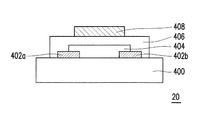
  • FIG. 4A to FIG. 4D are schematic cross-sectional diagrams illustrating a manufacturing process of a thin film transistor of an embodiment of the invention.
  • FIG. 5A is a scanning electron microscope (SEM) photograph of silver nanowires before printing a colloid composition.
  • FIG. 5B is a scanning electron microscope photograph of silver nanowires after printing the colloid composition and baking.
  • FIG. 6A is an SEM photograph of silver nanowires of Example 2.
  • FIG. 6B is an SEM photograph of silver nanowires of Comparative example 1.
  • FIG. 7 is a curve diagram of the relationship between temperature and sheet resistance of Example 3 and Comparative example 2.
  • FIG. 1 to FIG. 3 are schematic diagrams illustrating a manufacturing process of a printed circuit of an embodiment of the invention.
  • a first printing process is performed to form a metal layer 110 on a substrate 100 .
  • the substrate 100 is a glass substrate or a silicon substrate, for example.
  • a method of forming the metal layer 110 is an inkjet printing method, for example.
  • the metal layer 110 includes a plurality of metal nanostructures 112 .
  • the metal nanostructures 112 may be metal nanowires, nanoparticles, or a combination thereof.
  • a material of the metal nanostructures 112 is gold, silver, or copper, for example.
  • a line width of the metal nanowires is between 10 nm and 50 nm, for example.
  • a particle size of the metal nanoparticles is between 10 nm and 300 nm, for example.
  • a second printing process is performed to form a metal oxide precursor layer 120 on the metal layer 110 , and the metal oxide precursor layer 120 covers the metal layer 110 .
  • a method of forming the metal oxide precursor layer 120 is that, for example, printing a metal oxide precursor solution in colloidal state onto the metal layer 110 using the inkjet printing method, so that the metal oxide precursor solution in colloidal state completely covers the metal layer 110 .
  • the metal oxide precursor solution includes a metal oxide precursor and a solvent.
  • a material of the metal oxide precursor is a titanium dioxide precursor, a zinc oxide precursor, or a tungsten oxide precursor, for example.
  • the solvent is water, for example.
  • the metal oxide precursor layer 120 is printed on the metal layer 110 after the metal layer 110 is printed on the substrate 100 , rather than mixing the solution for forming the metal layer and the solution forming the metal oxide precursor layer 120 and then printing the above mixture onto the substrate 100 .
  • the issue of nozzle blocking caused by improper mixing can be reduced.
  • a heating process is performed to heat the metal oxide precursor layer 120 , so as to form a metal oxide layer 130 on a surface of the metal nanostructures 112 .
  • the fabrication of the printed circuit 10 is completed.
  • the solvent in the metal oxide precursor layer 120 is removed by heating, and the metal oxide precursor is reduced to a metal oxide.
  • the metal oxide layer 130 is not only formed on the surface of the metal nanostructures 112 , but also gradually aggregates toward an intersection 132 of the metal nanostructures 112 . That is to say, after the heating process, the metal oxide layer 130 will fill the space at the intersection 132 of the metal nanostructures 112 .
  • the metal oxide layer 130 formed on the surface of the metal nanostructures 112 has a thickness T of 0.1 nm to 10 nm.
  • a method of heating the metal oxide precursor layer 120 is that, for example, the substrate formed with the metal oxide precursor layer is placed in an oven to heat.
  • the metal oxide precursor layer 120 can be heated by using a heating plate, irradiation, or hot air.
  • the temperature of heating the metal oxide precursor layer 120 is between 50° C. and 200° C., for example.
  • the time of heating the metal oxide precursor layer 120 is between 5 min and 120 min, for example.
  • the metal oxide layer 130 since the metal oxide layer 130 is formed on the surface of the metal nanostructures 112 , the metal oxide layer 130 can be used as a protective film to prevent moisture and avoid oxidation. Additionally, the metal oxide layer 130 which aggregates at the intersection 132 of the metal nanostructures 112 may also help the bonding between the adjacent metal nanostructures 112 , thereby enhancing the stability and the conductivity of the circuit. Additionally, the metal oxide layer 130 may also increase the adhesion between the circuit and the substrate, thereby enhancing the stability of the overall circuit structure.
  • FIG. 4A to FIG. 4D are schematic cross-sectional diagrams illustrating a manufacturing process of a thin film transistor 20 of an embodiment of the invention.
  • a source 402 a and a drain 402 b are formed on a substrate 400 .
  • the methods of forming the source 402 a and the drain 402 b are the same as FIG. 1 to FIG. 3 .
  • the first printing process is performed to form a patterned conductive layer (not shown) on the substrate 400 .
  • the second printing process and the heating process are performed on the patterned conductive layer to form the source 402 a and the drain 402 b on the substrate 400 .
  • the metal oxide layer can be used as a protective film to prevent moisture and avoid oxidation. Additionally, the metal oxide layer which aggregates at the intersection of the metal nanostructures may also help the bonding between the adjacent metal nanostructures, thereby enhancing the stability and the conductivity of the source 402 a and the drain 402 b.
  • an active layer 404 is formed on the substrate 400 .
  • the active layer 404 covers the source 402 a and the drain 402 b and fills the space between the source 402 a and the drain 402 b .
  • the active layer 404 covers parts of upper surface of the source 402 a and the drain 402 b .
  • the active layer 404 may also completely cover the source 402 a and the drain 402 b .
  • a material of the active layer 404 is an organic semiconductor or an inorganic semiconductor, for example.
  • a method of forming the active layer 404 is an inkjet printing method, for example.
  • a dielectric layer 406 is formed on the substrate 400 .
  • the dielectric layer 406 covers the active layer 404 .
  • a material of the dielectric layer 406 is a dielectric material, such as silicon oxide or silicon nitride.
  • a method of forming the dielectric layer 406 is an inkjet printing method, for example.
  • a gate 408 is formed on the dielectric layer 406 .
  • a material of the gate 408 is a conductive material, such as metal, doped polycrystalline silicon, or transparent conductive oxide.
  • the metal is gold, silver, aluminum, copper, chromium, nickel, titanium, platinum, palladium, or an alloy of the above materials, for example.
  • the transparent conductive oxide is indium tin oxide, for example.
  • a method of forming the gate 408 is an inkjet printing method, for example. At this point, the fabrication of the thin film transistor 20 is completed.
  • the source and the drain have the metal oxide layer on the metal nanostructures, and the metal oxide layer fills the space at the intersection of the metal nanostructures, it helps the injection of electrons and holes, thereby changing the work function and improving the operating voltage of the thin film transistor.
  • a metal ink containing silver nanowires was printed on a substrate.
  • a colloid composition containing a TiO 2 precursor was printed on the metal ink, and then baked at 150° C. for 1 hour to remove a solvent, so that the TiO 2 precursor was reduced to TiO 2 on the surface of the silver nanowires.
  • the printed circuit having the TiO 2 protective film was formed on the substrate.
  • FIG. 5A is an SEM photograph of silver nanowires before printing a colloid composition.
  • FIG. 5B is an SEM photograph of silver nanowires after printing the colloid composition and baking. It can be learned from FIG. 5B that, after the printed colloid composition is baked, the collide is not only formed on the surface of the silver nanowires, but also aggregates at the intersection of the silver nanowires, which helps the bonding between the adjacent silver nanowires, thereby enhancing the stability and the conductivity of the circuit.
  • a metal ink containing silver nanowires was printed on a substrate.
  • a colloid composition containing a TiO 2 precursor was printed on the metal ink.
  • a heating process was performed to remove a solvent.
  • the state of the silver nanowires was observed using a scanning electron microscope.
  • a metal ink containing silver nanowires was printed on a substrate.
  • a heating process was performed to remove a solvent.
  • the state of the silver nanowires was observed using a scanning electron microscope.
  • FIG. 6A is an SEM photograph of silver nanowires of Example 2.
  • FIG. 6B is an SEM photograph of silver nanowires of Comparative example 1.
  • the conductivity of the silver nanowires formed at different baking temperature was further tested.
  • the baking manufacturing process under different temperature conditions was performed on the silver nanowires with the protective film and the silver nanowires without the protective film, and sheet resistance of the silver nanowires manufactured under each temperature condition was measured.
  • a metal ink containing silver nanowires was printed on a substrate.
  • a colloid composition containing a TiO 2 precursor was printed on the metal ink.
  • a heating process was performed to remove a solvent.
  • sheet resistance of the silver nanowires having the protective film at each temperature point was measured.
  • a metal ink containing silver nanowires was printed on a substrate.
  • a heating process was performed to remove a solvent.
  • sheet resistance of the silver nanowires having the protective film at each temperature point was measured.
  • FIG. 7 is a curve diagram of the relationship between temperature and sheet resistance of Example 3 and Comparative example 2. It can be learned from FIG. 7 that, sheet resistance of the silver nanowires of Comparative example 2 is significantly increased after baking at 200° C. Compared to Example 3, since the silver nanowires of Example 3 have the protective film, low sheet resistance is still maintained even after baking at 300° C. In other words, since the silver nanowires of Example 3 are coated with the protective film in colloidal state, it can prevent moisture from entering. Also, it can effectively increase the heat resistance and maintain the conductivity of the silver nanowires.
  • the circuit structure of the invention since the circuit structure of the invention has the metal oxide protective film on the metal nanostructures thereof, it can prevent moisture from entering to avoid oxidation. Also, it can increase the heat resistance thereof and maintain the conductivity. Additionally, the metal oxide layer which aggregates at the intersection of the metal nanostructures may also help the bonding between the adjacent metal nanostructures, thereby enhancing the stability and the conductivity of the circuit structure. Additionally, since the source/drain of the thin film transistor of the invention has the metal oxide layer, it can help the injection of electrons and holes, thereby changing the work function and improving the operating voltage of the thin film transistor.

Landscapes

  • Engineering & Computer Science (AREA)
  • Microelectronics & Electronic Packaging (AREA)
  • Manufacturing & Machinery (AREA)
  • Chemical & Material Sciences (AREA)
  • Computer Hardware Design (AREA)
  • Nanotechnology (AREA)
  • Dispersion Chemistry (AREA)
  • Physics & Mathematics (AREA)
  • Condensed Matter Physics & Semiconductors (AREA)
  • General Physics & Mathematics (AREA)
  • Power Engineering (AREA)
  • Ceramic Engineering (AREA)
  • Inorganic Chemistry (AREA)
  • Thin Film Transistor (AREA)

Abstract

A printed circuit, a thin film transistor and manufacturing methods thereof are provided. The printed circuit includes a plurality of metal nanostructures and a metal oxide layer. The metal oxide layer is disposed on a surface of the metal nanostructures and fills a space at an intersection of the metal nanostructures. The metal oxide layer disposed on the surface of the metal nanostructures has a thickness of 0.1 nm to 10 nm.

Description

CROSS-REFERENCE TO RELATED APPLICATION
This application claims the priority benefit of China application serial no. 201610220055.2, filed on Apr. 11, 2016. The entirety of the above-mentioned patent application is hereby incorporated by reference herein and made a part of this specification.
BACKGROUND OF THE INVENTION Field of the Invention
The invention relates to a printed circuit, a thin film transistor and manufacturing methods thereof, and particularly relates to a printed circuit having excellent heat resistance and conductivity, a thin film transistor having an improved operating voltage and manufacturing methods thereof.
Description of Related Art
In a manufacturing process of a printed circuit today, the used conductive ink is mostly formed from mixing nanostructured metal particles and a solvent. However, since the oxidation rate of metal structures formed from the metal particles after nanostructured is significantly increased, the stability is reduced and the retention period is shortened. The current conductive ink is mostly formed from gold and/or silver nanoparticles or nanowires having high stability, but even so, when the conductive ink is exposed in air, the issues of reduction of stability and shortening of retention period are still generated. To solve the above issues, the current solution is mostly focused on the development of chemical synthesis methods, for example, forming a protective layer or a protective film on the metal nanoparticles. However, such method can only correspond to the specific metal. Therefore, the development of the manufacturing method of universal protective layers is the goal that needs to be made currently.
SUMMARY OF THE INVENTION
The invention provides a printed circuit having a metal oxide layer on metal nanostructures, and the metal oxide layer fills a space at an intersection of the metal nanostructures.
The invention provides a manufacturing method of a printed circuit capable of manufacturing a printed circuit having high stability and excellent conductivity.
The invention provides a thin film transistor having a metal oxide layer on metal nanostructures of a source and a drain thereof, and the metal oxide layer fills a space at an intersection of the metal nano structures.
The invention provides a manufacturing method of a thin film transistor capable of manufacturing a thin film transistor having an improved operating voltage.
The invention provides a printed circuit located on a substrate. The printed circuit includes a plurality of metal nanostructures and a metal oxide layer. The metal oxide layer is disposed on a surface of the metal nanostructures and fills a space at an intersection of the metal nanostructures, wherein the metal oxide layer located on the surface of the metal nanostructures has a thickness of 0.1 nm to 10 nm.
The invention provides a manufacturing method of a printed circuit including the following steps. First, a first printing process is performed to form a metal layer on a substrate, wherein the metal layer includes a plurality of metal nanostructures. Next, a second printing process is performed to form a metal oxide precursor layer on the metal layer, and the metal oxide precursor layer covers the metal layer, wherein the metal oxide precursor layer includes a metal oxide precursor and a solvent. Then, a heating process is performed to remove the solvent in the metal oxide precursor layer and reduce the metal oxide precursor in the metal oxide precursor layer to a metal oxide, so as to form a metal oxide layer on a surface of the metal nanostructures. Also, the metal oxide layer fills a space at an intersection of the metal nanostructures. The metal oxide layer formed on the surface of the metal nanostructure has a thickness of 0.1 nm to 10 nm.
The invention provides a thin film transistor including a source, a drain, an active layer, a dielectric layer, and a gate. The source and the drain are disposed on a substrate. The active layer covers the source and the drain and fills a space between the source and the drain. The dielectric layer covers the active layer. The gate is disposed on the dielectric layer. The source and the drain include a plurality of metal nanostructures and a metal oxide layer. The metal oxide layer is disposed on a surface of the metal nanostructures and fills a space at an intersection of the metal nanostructures, and the metal oxide layer disposed on the surface of the metal nanostructures has a thickness of 0.1 nm to 10 nm.
The invention provides a manufacturing method of a thin film transistor including the following steps. First, a first printing process is performed to form a patterned conductive layer on a substrate, wherein the patterned conductive layer includes a plurality of metal nanostructures. Next, a second printing process is performed to form a metal oxide precursor layer on the patterned conductive layer, and the metal oxide precursor layer covers the patterned conductive layer, wherein the metal oxide precursor layer includes a metal oxide precursor and a solvent. Then, a heating process is performed to remove the solvent in the metal oxide precursor layer and reduce the metal oxide precursor in the metal oxide precursor layer to a metal oxide, so as to form a metal oxide layer on a surface of the metal nanostructures. Also, the metal oxide layer fills a space at an intersection of the metal nanostructures. After that, an active layer is formed on the substrate to cover the patterned conductive layer and the metal oxide layer and fill a space between the patterned conductive layer. Thereafter, a dielectric layer is formed on the substrate to cover the active layer. Further, a gate is formed on the dielectric layer. The metal oxide layer formed on the surface of the metal nanostructures has a thickness of 0.1 nm to 10 nm.
Based on the above, since the printed circuit of the invention has the metal oxide layer on the surface of the metal nanostructures, it can prevent moisture from entering to avoid oxidation. Also, it can increase the heat resistance thereof and maintain the conductivity. Additionally, since the metal oxide layer will aggregate at the intersection between the metal nanostructures, it can help the bonding between the adjacent metal nanostructures, thereby enhancing the stability and the conductivity of the circuit. Additionally, since the thin film transistor of the invention has the metal oxide layer on the metal nanostructures in the source/drain, it can help the injection of electrons and holes, thereby changing the work function and improving the operating voltage of the thin film transistor.
In order to make the aforementioned features and advantages of the disclosure more comprehensible, embodiments accompanied with figures are described in detail below.
BRIEF DESCRIPTION OF THE DRAWINGS
The accompanying drawings are included to provide a further understanding of the invention, and are incorporated in and constitute a part of this specification. The drawings illustrate embodiments of the invention and, together with the description, serve to explain the principles of the invention.
FIG. 1 to FIG. 3 are schematic diagrams illustrating a manufacturing process of a printed circuit of an embodiment of the invention.
FIG. 4A to FIG. 4D are schematic cross-sectional diagrams illustrating a manufacturing process of a thin film transistor of an embodiment of the invention.
FIG. 5A is a scanning electron microscope (SEM) photograph of silver nanowires before printing a colloid composition.
FIG. 5B is a scanning electron microscope photograph of silver nanowires after printing the colloid composition and baking.
FIG. 6A is an SEM photograph of silver nanowires of Example 2.
FIG. 6B is an SEM photograph of silver nanowires of Comparative example 1.
FIG. 7 is a curve diagram of the relationship between temperature and sheet resistance of Example 3 and Comparative example 2.
DESCRIPTION OF THE EMBODIMENTS
In the following detailed description, for purposes of explanation, numerous specific details are set forth in order to provide a thorough understanding of the disclosed embodiments. It will be apparent, however, that one or more embodiments may be practiced without these specific details. In other instances, well-known structures and devices are schematically shown in order to simplify the drawing.
FIG. 1 to FIG. 3 are schematic diagrams illustrating a manufacturing process of a printed circuit of an embodiment of the invention.
First, referring to FIG. 1, a first printing process is performed to form a metal layer 110 on a substrate 100. The substrate 100 is a glass substrate or a silicon substrate, for example. A method of forming the metal layer 110 is an inkjet printing method, for example. In the embodiment, the metal layer 110 includes a plurality of metal nanostructures 112. The metal nanostructures 112 may be metal nanowires, nanoparticles, or a combination thereof. A material of the metal nanostructures 112 is gold, silver, or copper, for example. A line width of the metal nanowires is between 10 nm and 50 nm, for example. A particle size of the metal nanoparticles is between 10 nm and 300 nm, for example.
Next, referring to FIG. 2, a second printing process is performed to form a metal oxide precursor layer 120 on the metal layer 110, and the metal oxide precursor layer 120 covers the metal layer 110. A method of forming the metal oxide precursor layer 120 is that, for example, printing a metal oxide precursor solution in colloidal state onto the metal layer 110 using the inkjet printing method, so that the metal oxide precursor solution in colloidal state completely covers the metal layer 110. In the embodiment, the metal oxide precursor solution includes a metal oxide precursor and a solvent. A material of the metal oxide precursor is a titanium dioxide precursor, a zinc oxide precursor, or a tungsten oxide precursor, for example. The solvent is water, for example.
In the embodiment, the metal oxide precursor layer 120 is printed on the metal layer 110 after the metal layer 110 is printed on the substrate 100, rather than mixing the solution for forming the metal layer and the solution forming the metal oxide precursor layer 120 and then printing the above mixture onto the substrate 100. Thus, it is not necessary to test or adjust the optimum parameters for printing the above mixture. Thereby, in addition to simplify the manufacturing process, the issue of nozzle blocking caused by improper mixing can be reduced.
Then, referring to FIG. 3, a heating process is performed to heat the metal oxide precursor layer 120, so as to form a metal oxide layer 130 on a surface of the metal nanostructures 112. At this point, the fabrication of the printed circuit 10 is completed. In specific, in the process of heating, the solvent in the metal oxide precursor layer 120 is removed by heating, and the metal oxide precursor is reduced to a metal oxide. Additionally, in the process of solvent evaporation, the metal oxide layer 130 is not only formed on the surface of the metal nanostructures 112, but also gradually aggregates toward an intersection 132 of the metal nanostructures 112. That is to say, after the heating process, the metal oxide layer 130 will fill the space at the intersection 132 of the metal nanostructures 112. In the embodiment, the metal oxide layer 130 formed on the surface of the metal nanostructures 112 has a thickness T of 0.1 nm to 10 nm.
In the embodiment, a method of heating the metal oxide precursor layer 120 is that, for example, the substrate formed with the metal oxide precursor layer is placed in an oven to heat. However, the invention is not limited thereto. In another embodiment, the metal oxide precursor layer 120 can be heated by using a heating plate, irradiation, or hot air. The temperature of heating the metal oxide precursor layer 120 is between 50° C. and 200° C., for example. The time of heating the metal oxide precursor layer 120 is between 5 min and 120 min, for example.
In the embodiment, since the metal oxide layer 130 is formed on the surface of the metal nanostructures 112, the metal oxide layer 130 can be used as a protective film to prevent moisture and avoid oxidation. Additionally, the metal oxide layer 130 which aggregates at the intersection 132 of the metal nanostructures 112 may also help the bonding between the adjacent metal nanostructures 112, thereby enhancing the stability and the conductivity of the circuit. Additionally, the metal oxide layer 130 may also increase the adhesion between the circuit and the substrate, thereby enhancing the stability of the overall circuit structure.
FIG. 4A to FIG. 4D are schematic cross-sectional diagrams illustrating a manufacturing process of a thin film transistor 20 of an embodiment of the invention.
First, referring to FIG. 4A, a source 402 a and a drain 402 b are formed on a substrate 400. In the embodiment, the methods of forming the source 402 a and the drain 402 b are the same as FIG. 1 to FIG. 3. Particularly, first, the first printing process is performed to form a patterned conductive layer (not shown) on the substrate 400. Next, the second printing process and the heating process are performed on the patterned conductive layer to form the source 402 a and the drain 402 b on the substrate 400.
In the embodiment, since the surface of the metal nanostructures of the source 402 a and the drain 402 b has the metal oxide layer, the metal oxide layer can be used as a protective film to prevent moisture and avoid oxidation. Additionally, the metal oxide layer which aggregates at the intersection of the metal nanostructures may also help the bonding between the adjacent metal nanostructures, thereby enhancing the stability and the conductivity of the source 402 a and the drain 402 b.
Then, referring to FIG. 4B, an active layer 404 is formed on the substrate 400. The active layer 404 covers the source 402 a and the drain 402 b and fills the space between the source 402 a and the drain 402 b. In the embodiment, the active layer 404 covers parts of upper surface of the source 402 a and the drain 402 b. In another embodiment, the active layer 404 may also completely cover the source 402 a and the drain 402 b. A material of the active layer 404 is an organic semiconductor or an inorganic semiconductor, for example. A method of forming the active layer 404 is an inkjet printing method, for example.
Then, referring to FIG. 4C, a dielectric layer 406 is formed on the substrate 400. The dielectric layer 406 covers the active layer 404. A material of the dielectric layer 406 is a dielectric material, such as silicon oxide or silicon nitride. A method of forming the dielectric layer 406 is an inkjet printing method, for example.
After that, referring to FIG. 4D, a gate 408 is formed on the dielectric layer 406. A material of the gate 408 is a conductive material, such as metal, doped polycrystalline silicon, or transparent conductive oxide. The metal is gold, silver, aluminum, copper, chromium, nickel, titanium, platinum, palladium, or an alloy of the above materials, for example. The transparent conductive oxide is indium tin oxide, for example. A method of forming the gate 408 is an inkjet printing method, for example. At this point, the fabrication of the thin film transistor 20 is completed.
In the embodiment, since the source and the drain have the metal oxide layer on the metal nanostructures, and the metal oxide layer fills the space at the intersection of the metal nanostructures, it helps the injection of electrons and holes, thereby changing the work function and improving the operating voltage of the thin film transistor.
Hereinafter, examples of the invention are listed to describe the invention more particularly. However, without departing from the spirit of the invention, the material and the using method which are described in the following examples can be suitably modified. Accordingly, restrictive interpretation should not be made to the invention based on the examples described below.
[Manufacturing of Printed Circuit Having Protective Film]
Example 1
First, a metal ink containing silver nanowires was printed on a substrate. Next, a colloid composition containing a TiO2 precursor was printed on the metal ink, and then baked at 150° C. for 1 hour to remove a solvent, so that the TiO2 precursor was reduced to TiO2 on the surface of the silver nanowires. At this point, the printed circuit having the TiO2 protective film was formed on the substrate.
FIG. 5A is an SEM photograph of silver nanowires before printing a colloid composition. FIG. 5B is an SEM photograph of silver nanowires after printing the colloid composition and baking. It can be learned from FIG. 5B that, after the printed colloid composition is baked, the collide is not only formed on the surface of the silver nanowires, but also aggregates at the intersection of the silver nanowires, which helps the bonding between the adjacent silver nanowires, thereby enhancing the stability and the conductivity of the circuit.
[Thermal Stability Test]
Example 2 (Printing Metal Ink and Colloid Composition Containing TiO2 Precursor)
First, a metal ink containing silver nanowires was printed on a substrate. Next, a colloid composition containing a TiO2 precursor was printed on the metal ink. Then, a heating process was performed to remove a solvent. Then, after baking at 400° C. for 1 hour, the state of the silver nanowires was observed using a scanning electron microscope.
Comparative Example 1 (Only Printing Metal Ink)
First, a metal ink containing silver nanowires was printed on a substrate. Next, a heating process was performed to remove a solvent. Then, after baking at 250° C. for 1 hour, the state of the silver nanowires was observed using a scanning electron microscope.
FIG. 6A is an SEM photograph of silver nanowires of Example 2. FIG. 6B is an SEM photograph of silver nanowires of Comparative example 1.
It can be learned from FIG. 6A that, the appearance of the silver nanowires of Example 1 still remains intact and transparent after baking at 400° C. for 1 hour. Compared to Comparative example 1, it can be learned from FIG. 6B that, the silver nanowires of Comparative example 1 is melted and aggregates into silver particles due to high temperature after baking at 250° C. for 1 hour. From the above results, since the silver nanowires of Example 1 are coated with the protective film in colloidal state, it can prevent moisture from entering and enhance the thermal stability.
[Effects of Different Temperature on Conductivity]
Since high temperature may affect the stability of the silver nanowires, and the stability of the silver nanowires may correspond to the conductivity of the silver nanowires, the conductivity of the silver nanowires formed at different baking temperature was further tested. In the embodiment, the baking manufacturing process under different temperature conditions was performed on the silver nanowires with the protective film and the silver nanowires without the protective film, and sheet resistance of the silver nanowires manufactured under each temperature condition was measured.
Example 3
First, a metal ink containing silver nanowires was printed on a substrate. Next, a colloid composition containing a TiO2 precursor was printed on the metal ink. Then, a heating process was performed to remove a solvent. Then, after baking at 25° C., 50° C., 100° C., 150° C., 200° C., 250° C., 300° C., and 400° C. for 1 hour respectively, sheet resistance of the silver nanowires having the protective film at each temperature point was measured.
Comparative Example 2
First, a metal ink containing silver nanowires was printed on a substrate. Next, a heating process was performed to remove a solvent. Then, after baking at 25° C., 50° C., 100° C., 150° C., 200° C., 250° C., 300° C., and 400° C. for 1 hour respectively, sheet resistance of the silver nanowires having the protective film at each temperature point was measured.
FIG. 7 is a curve diagram of the relationship between temperature and sheet resistance of Example 3 and Comparative example 2. It can be learned from FIG. 7 that, sheet resistance of the silver nanowires of Comparative example 2 is significantly increased after baking at 200° C. Compared to Example 3, since the silver nanowires of Example 3 have the protective film, low sheet resistance is still maintained even after baking at 300° C. In other words, since the silver nanowires of Example 3 are coated with the protective film in colloidal state, it can prevent moisture from entering. Also, it can effectively increase the heat resistance and maintain the conductivity of the silver nanowires.
In summary, since the circuit structure of the invention has the metal oxide protective film on the metal nanostructures thereof, it can prevent moisture from entering to avoid oxidation. Also, it can increase the heat resistance thereof and maintain the conductivity. Additionally, the metal oxide layer which aggregates at the intersection of the metal nanostructures may also help the bonding between the adjacent metal nanostructures, thereby enhancing the stability and the conductivity of the circuit structure. Additionally, since the source/drain of the thin film transistor of the invention has the metal oxide layer, it can help the injection of electrons and holes, thereby changing the work function and improving the operating voltage of the thin film transistor.
Although the invention has been described with reference to the above embodiments, it will be apparent to one of ordinary skill in the art that modifications to the described embodiments may be made without departing from the spirit of the invention. Accordingly, the scope of the invention is defined by the attached claims not by the above detailed descriptions.
Claims (6)

What is claimed is:
1. A manufacturing method of a thin film transistor, comprising:
performing a first printing process to form a patterned conductive layer on a substrate, wherein the patterned conductive layer comprises a plurality of metal nanostructures;
performing a second printing process to form a metal oxide precursor layer on the patterned conductive layer, the metal oxide precursor layer covering the patterned conductive layer, wherein the metal oxide precursor layer comprises a metal oxide precursor and a solvent; and
performing a heating process to remove the solvent in the metal oxide precursor layer and transforming the metal oxide precursor in the metal oxide precursor layer to a metal oxide, so as to form a metal oxide layer on a surface of the metal nanostructures, the metal oxide layer aggregates in a space at an intersection of the metal nanostructures;
forming an active layer on the substrate to cover the patterned conductive layer and the metal oxide layer and fill a space between the patterned conductive layer;
forming a dielectric layer on the substrate to cover the active layer; and
forming a gate on the dielectric layer,
wherein the metal oxide layer formed on the surface of the metal nanostructures has a thickness of 0.1 nm to 10 nm.
2. The manufacturing method of the thin film transistor according to claim 1, wherein the metal nanostructures comprise metal nanowires, metal nanoparticles, or a combination thereof.
3. The manufacturing method of the thin film transistor according to claim 1, wherein a material of the metal nanostructures comprises gold, silver, or copper.
4. The manufacturing method of the thin film transistor according to claim 1, wherein a material of the metal oxide precursor comprises a titanium dioxide precursor, a zinc oxide precursor, or a tungsten oxide precursor.
5. The manufacturing method of the thin film transistor according to claim 1, wherein the solvent comprises water.
6. The manufacturing method of the thin film transistor according to claim 1, wherein a temperature for performing the heating process is between 50° C. and 200° C.
US15/253,841 2016-04-11 2016-08-31 Printed circuit, thin film transistor and manufacturing method thereof Active 2036-09-04 US9867273B2 (en)

Applications Claiming Priority (3)

Application Number Priority Date Filing Date Title
CN201610220055.2A CN107293591B (en) 2016-04-11 2016-04-11 Printed circuit, thin film transistor and manufacturing method thereof
CN201610220055 2016-04-11
CN201610220055.2 2016-04-11

Publications (2)

Publication Number Publication Date
US20170295639A1 US20170295639A1 (en) 2017-10-12
US9867273B2 true US9867273B2 (en) 2018-01-09

Family

ID=59999801

Family Applications (1)

Application Number Title Priority Date Filing Date
US15/253,841 Active 2036-09-04 US9867273B2 (en) 2016-04-11 2016-08-31 Printed circuit, thin film transistor and manufacturing method thereof

Country Status (2)

Country Link
US (1) US9867273B2 (en)
CN (1) CN107293591B (en)

Citations (6)

* Cited by examiner, † Cited by third party
Publication number Priority date Publication date Assignee Title
TW200845155A (en) 2007-02-21 2008-11-16 Nantero Inc Method of forming a carbon nanotube-based contact to semiconductor
TWI375280B (en) 2006-08-15 2012-10-21 Kovio Inc Printed dopant layers
US8760606B2 (en) * 2006-10-12 2014-06-24 Cambrios Technologies Corporation Nanowire-based transparent conductors and applications thereof
US20150287871A1 (en) * 2012-11-05 2015-10-08 University Of Florida Research Foundation, Inc. Solution-processed ultraviolet light detector based on p-n junctions of metal oxides
WO2015198857A1 (en) 2014-06-24 2015-12-30 富士フイルム株式会社 Method of manufacturing metal oxide layer, metal oxide layer, thin film transistor and electronic device
TW201610006A (en) 2014-07-31 2016-03-16 C3奈米有限公司 Metal nanowire ink for forming a transparent conductive film having a condensed network

Family Cites Families (8)

* Cited by examiner, † Cited by third party
Publication number Priority date Publication date Assignee Title
KR101165484B1 (en) * 2004-02-25 2012-07-13 나노잉크, 인크. A method of delivering ink to a substrate surface, a method of writing conductive metal, an ink formulation for nanolithography or microlithography, a method for depositing metallic traces, a method and device for repair of a flat panel display substrate
TWI487125B (en) * 2007-04-20 2015-06-01 Cambrios Technologies Corp Composite transparent conductor and method of forming same
CN101993032B (en) * 2009-08-14 2013-03-27 京东方科技集团股份有限公司 Method for manufacturing microstructural film pattern and TFT-LCD array substrate
KR20130010471A (en) * 2010-02-27 2013-01-28 이노바 다이나믹스, 인코포레이티드 Structures with surface-embedded additives and related manufacturing methods
WO2012103528A2 (en) * 2011-01-28 2012-08-02 Northwestern University Low-temperature fabrication of metal oxide thin films and nanomaterial-derived metal composite thin films
US8884285B2 (en) * 2011-07-13 2014-11-11 Rutgers, The State University Of New Jersey Multifunctional zinc oxide nano-structure-based circuit building blocks for re-configurable electronics and optoelectronics
GB201212407D0 (en) * 2012-07-12 2012-08-22 Intrinsiq Materials Ltd Composition for forming a seed layer
CN104521005B (en) * 2013-04-05 2016-08-24 苏州诺菲纳米科技有限公司 Transparency conductive electrode, their structure with fused metal nano wire design and manufacture method

Patent Citations (6)

* Cited by examiner, † Cited by third party
Publication number Priority date Publication date Assignee Title
TWI375280B (en) 2006-08-15 2012-10-21 Kovio Inc Printed dopant layers
US8760606B2 (en) * 2006-10-12 2014-06-24 Cambrios Technologies Corporation Nanowire-based transparent conductors and applications thereof
TW200845155A (en) 2007-02-21 2008-11-16 Nantero Inc Method of forming a carbon nanotube-based contact to semiconductor
US20150287871A1 (en) * 2012-11-05 2015-10-08 University Of Florida Research Foundation, Inc. Solution-processed ultraviolet light detector based on p-n junctions of metal oxides
WO2015198857A1 (en) 2014-06-24 2015-12-30 富士フイルム株式会社 Method of manufacturing metal oxide layer, metal oxide layer, thin film transistor and electronic device
TW201610006A (en) 2014-07-31 2016-03-16 C3奈米有限公司 Metal nanowire ink for forming a transparent conductive film having a condensed network

Non-Patent Citations (1)

* Cited by examiner, † Cited by third party
Title
"Office Action of Taiwan Counterpart Application," dated May 12, 2017, p1-p11.

Also Published As

Publication number Publication date
CN107293591A (en) 2017-10-24
US20170295639A1 (en) 2017-10-12
CN107293591B (en) 2020-03-31

Similar Documents

Publication Publication Date Title
CN104620168B (en) Transparent conducting electrodes with fused metal nanowires, their structural design and methods of fabrication
US8785939B2 (en) Transparent and conductive nanostructure-film pixel electrode and method of making the same
JP2016012726A (en) Transparent conductor of nanowire base and application of the same
TWI524565B (en) Production method of transistor and transistor
KR20130048717A (en) Nanowire-based transparent conductors and methods of patterning same
CN103329281A (en) Solar cell, manufacturing method thereof, and solar cell module
JP5063832B2 (en) Field effect transistor and manufacturing method thereof
TW201810697A (en) Solid junction type photoelectric conversion element and method of manufacturing same
US20090236977A1 (en) Organic light emitting diode display device and method of fabricating the same
US20200203292A1 (en) Method for producing conductive film, method for producing field effect transistor using same, and method for producing wireless communication device
WO2016115824A1 (en) Thin film transistor and array substrate, and manufacturing method therefor
JP5017338B2 (en) Manufacturing method of organic transistor
TWI573496B (en) Printing compatible design and layout of printed electronics
KR102045027B1 (en) Method for Preparing Oxide Thin Transistor, and Oxide Thin Transistor Prepared by Using the Same
KR101955671B1 (en) Patterning Method for Graphene or Graphene-Metal Hybrid Films
US9536912B2 (en) Method of transferring thin film, method of manufacturing thin film transistor, method of forming pixel electrode of liquid crystal display device
US9867273B2 (en) Printed circuit, thin film transistor and manufacturing method thereof
CN1951162B (en) Component placement substrate and production method thereof
CN104049464A (en) Grid insulation membrane, radiation sensitivity composition, hardened membrane, semiconductor element, manufacturing method of semiconductor element, and display device
TWI601454B (en) Printed circuit, thin film transistor and manufacturing method thereof
JP6585148B2 (en) Manufacturing method of semiconductor film
KR20120105951A (en) Ferroelectric polymer nanodot arrays and dewetting process for manufacturing the same
US20140356997A1 (en) Donor substrate, method of manufacturing the same, and method of forming transfer pattern using the same
TWI426566B (en) Thin film transistor and its preparation method
TW201432800A (en) Method for manufacturing electronic device

Legal Events

Date Code Title Description
AS Assignment

Owner name: WINBOND ELECTRONICS CORP., TAIWAN

Free format text: ASSIGNMENT OF ASSIGNORS INTEREST;ASSIGNOR:HO, YU-HSUAN;REEL/FRAME:039645/0533

Effective date: 20160831

STCF Information on status: patent grant

Free format text: PATENTED CASE

MAFP Maintenance fee payment

Free format text: PAYMENT OF MAINTENANCE FEE, 4TH YEAR, LARGE ENTITY (ORIGINAL EVENT CODE: M1551); ENTITY STATUS OF PATENT OWNER: LARGE ENTITY

Year of fee payment: 4

MAFP Maintenance fee payment

Free format text: PAYMENT OF MAINTENANCE FEE, 8TH YEAR, LARGE ENTITY (ORIGINAL EVENT CODE: M1552); ENTITY STATUS OF PATENT OWNER: LARGE ENTITY

Year of fee payment: 8