US9840468B1 - Methods for the preparation of 6-aminoisoquinoline - Google Patents
Methods for the preparation of 6-aminoisoquinoline Download PDFInfo
- Publication number
- US9840468B1 US9840468B1 US15/395,068 US201615395068A US9840468B1 US 9840468 B1 US9840468 B1 US 9840468B1 US 201615395068 A US201615395068 A US 201615395068A US 9840468 B1 US9840468 B1 US 9840468B1
- Authority
- US
- United States
- Prior art keywords
- compound
- aminoisoquinoline
- nitroisoquinoline
- reacting
- mol
- Prior art date
- Legal status (The legal status is an assumption and is not a legal conclusion. Google has not performed a legal analysis and makes no representation as to the accuracy of the status listed.)
- Active
Links
- 0 *OC(=O)C(C(=O)O*)C1=C(C(=O)O)C=CC([N+](=O)[O-])=C1.*OC(=O)C*OC=O.CC1=C(C(=O)O)C=CC([N+](=O)[O-])=C1.I.II.I[IH]I.NC(N)=O.NC1=CC2=C(C=C1)C=NC=C2.O=C(O)CC1=C(C(=O)O)C=CC([N+](=O)[O-])=C1.O=C1CC2=C(C=CC([N+](=O)[O-])=C2)C(=O)N1.O=[N+]([O-])C1=CC2=C(C=C1)C(Cl)=NC(Cl)=C2.[1*]P(=O)(Cl)Cl Chemical compound *OC(=O)C(C(=O)O*)C1=C(C(=O)O)C=CC([N+](=O)[O-])=C1.*OC(=O)C*OC=O.CC1=C(C(=O)O)C=CC([N+](=O)[O-])=C1.I.II.I[IH]I.NC(N)=O.NC1=CC2=C(C=C1)C=NC=C2.O=C(O)CC1=C(C(=O)O)C=CC([N+](=O)[O-])=C1.O=C1CC2=C(C=CC([N+](=O)[O-])=C2)C(=O)N1.O=[N+]([O-])C1=CC2=C(C=C1)C(Cl)=NC(Cl)=C2.[1*]P(=O)(Cl)Cl 0.000 description 6
- WAGPXYVOIFCJMH-UHFFFAOYSA-N CC1=CC2=C(C=CC([N+](=O)[O-])=C2)C(Cl)=N1 Chemical compound CC1=CC2=C(C=CC([N+](=O)[O-])=C2)C(Cl)=N1 WAGPXYVOIFCJMH-UHFFFAOYSA-N 0.000 description 5
- JBIJLHTVPXGSAM-UHFFFAOYSA-N NC1=CC2=C(C=CC=C2)C=C1 Chemical compound NC1=CC2=C(C=CC=C2)C=C1 JBIJLHTVPXGSAM-UHFFFAOYSA-N 0.000 description 4
- CUIWDSQKMAZXBN-UHFFFAOYSA-N C=C1CC2=C(C=CC([N+](=O)[O-])=C2)C(=O)N1 Chemical compound C=C1CC2=C(C=CC([N+](=O)[O-])=C2)C(=O)N1 CUIWDSQKMAZXBN-UHFFFAOYSA-N 0.000 description 3
- SNADQOSPCWXDST-UHFFFAOYSA-N CCC1=C(C(=O)O)C=CC([N+](=O)[O-])=C1 Chemical compound CCC1=C(C(=O)O)C=CC([N+](=O)[O-])=C1 SNADQOSPCWXDST-UHFFFAOYSA-N 0.000 description 3
- HFZKOYWDLDYELC-UHFFFAOYSA-N CC1=C(C)C=C([N+](=O)[O-])C=C1 Chemical compound CC1=C(C)C=C([N+](=O)[O-])C=C1 HFZKOYWDLDYELC-UHFFFAOYSA-N 0.000 description 2
- TZBKVCUKSMTGMP-UHFFFAOYSA-N NC1=CC2=C(C=C1)C(Cl)=NC=C2 Chemical compound NC1=CC2=C(C=C1)C(Cl)=NC=C2 TZBKVCUKSMTGMP-UHFFFAOYSA-N 0.000 description 2
- OOXVUWYCPLHJBS-UHFFFAOYSA-M C.C.C.CC(=O)O.CCCC(=O)OCC.CCO.CCOC(=O)C(C(=O)OCC)C1=C(C(=O)O)C=CC([N+](=O)[O-])=C1.NC(N)=O.NC1=CC2=C(C=CC=C2)C=C1.O=C(O)C1=C(Cl)C=C([N+](=O)[O-])C=C1.O=C(O)CC1=C(C(=O)O)C=CC([N+](=O)[O-])=C1.O=C1CC2=C(C=CC([N+](=O)[O-])=C2)C(=O)N1.O=C=O.O=P(Cl)(Cl)C1=CC=CC=C1.O=[N+]([O-])C1=CC2=C(C=C1)C(Cl)=NC(Cl)=C2.O[K] Chemical compound C.C.C.CC(=O)O.CCCC(=O)OCC.CCO.CCOC(=O)C(C(=O)OCC)C1=C(C(=O)O)C=CC([N+](=O)[O-])=C1.NC(N)=O.NC1=CC2=C(C=CC=C2)C=C1.O=C(O)C1=C(Cl)C=C([N+](=O)[O-])C=C1.O=C(O)CC1=C(C(=O)O)C=CC([N+](=O)[O-])=C1.O=C1CC2=C(C=CC([N+](=O)[O-])=C2)C(=O)N1.O=C=O.O=P(Cl)(Cl)C1=CC=CC=C1.O=[N+]([O-])C1=CC2=C(C=C1)C(Cl)=NC(Cl)=C2.O[K] OOXVUWYCPLHJBS-UHFFFAOYSA-M 0.000 description 1
- OMPGZMBIXGWBSU-UHFFFAOYSA-M C.C.C.CCCC(=O)OCC.CCO.CCOC(=O)C(C(=O)OCC)C1=C(C(=O)O)C=CC([N+](=O)[O-])=C1.O=C(O)C1=C(Cl)C=C([N+](=O)[O-])C=C1.O=C(O)CC1=C(C(=O)O)C=CC([N+](=O)[O-])=C1.O=C=O.O[K] Chemical compound C.C.C.CCCC(=O)OCC.CCO.CCOC(=O)C(C(=O)OCC)C1=C(C(=O)O)C=CC([N+](=O)[O-])=C1.O=C(O)C1=C(Cl)C=C([N+](=O)[O-])C=C1.O=C(O)CC1=C(C(=O)O)C=CC([N+](=O)[O-])=C1.O=C=O.O[K] OMPGZMBIXGWBSU-UHFFFAOYSA-M 0.000 description 1
- YTLAELQWNRNODG-UHFFFAOYSA-N C.C.C.CCCC(=O)OCC.CCOC(=O)C(C(=O)OCC)C1=C(C(=O)O)C=CC([N+](=O)[O-])=C1.NC(N)=O.NC1=CC2=C(C=C1)C=NC=C2.O=C(O)C1=C(Cl)C=C([N+](=O)[O-])C=C1.O=C(O)CC1=C(C(=O)O)C=CC([N+](=O)[O-])=C1.O=C1CC2=C(C=CC([N+](=O)[O-])=C2)C(=O)N1.O=C=O.O=[N+]([O-])C1=CC2=C(C=C1)C(Cl)=NC(Cl)=C2 Chemical compound C.C.C.CCCC(=O)OCC.CCOC(=O)C(C(=O)OCC)C1=C(C(=O)O)C=CC([N+](=O)[O-])=C1.NC(N)=O.NC1=CC2=C(C=C1)C=NC=C2.O=C(O)C1=C(Cl)C=C([N+](=O)[O-])C=C1.O=C(O)CC1=C(C(=O)O)C=CC([N+](=O)[O-])=C1.O=C1CC2=C(C=CC([N+](=O)[O-])=C2)C(=O)N1.O=C=O.O=[N+]([O-])C1=CC2=C(C=C1)C(Cl)=NC(Cl)=C2 YTLAELQWNRNODG-UHFFFAOYSA-N 0.000 description 1
- CZWJMQJWNXXYRK-UHFFFAOYSA-N CC(=O)O.NC(N)=O.O=C(O)CC1=C(C(=O)O)C=CC([N+](=O)[O-])=C1.O=C1CC2=C(C=CC([N+](=O)[O-])=C2)C(=O)N1 Chemical compound CC(=O)O.NC(N)=O.O=C(O)CC1=C(C(=O)O)C=CC([N+](=O)[O-])=C1.O=C1CC2=C(C=CC([N+](=O)[O-])=C2)C(=O)N1 CZWJMQJWNXXYRK-UHFFFAOYSA-N 0.000 description 1
- LLYXJBROWQDVMI-UHFFFAOYSA-N CC1=C(Cl)C=C([N+](=O)[O-])C=C1 Chemical compound CC1=C(Cl)C=C([N+](=O)[O-])C=C1 LLYXJBROWQDVMI-UHFFFAOYSA-N 0.000 description 1
- XQOSMOJREIEKJB-UHFFFAOYSA-N CCOC(=O)C(C)C1=C(C(=O)O)C=CC([N+](=O)[O-])=C1 Chemical compound CCOC(=O)C(C)C1=C(C(=O)O)C=CC([N+](=O)[O-])=C1 XQOSMOJREIEKJB-UHFFFAOYSA-N 0.000 description 1
- ZHJODKWNBDDZDL-UHFFFAOYSA-N NC1=CC2=C(C=C1)C(Cl)=NC(Cl)=C2 Chemical compound NC1=CC2=C(C=C1)C(Cl)=NC(Cl)=C2 ZHJODKWNBDDZDL-UHFFFAOYSA-N 0.000 description 1
- KKXXUSBGVQSUCR-UHFFFAOYSA-N NC1=CC2=C(C=C1)C=NC(Cl)=C2 Chemical compound NC1=CC2=C(C=C1)C=NC(Cl)=C2 KKXXUSBGVQSUCR-UHFFFAOYSA-N 0.000 description 1
- XZYQORQJKVQCED-UHFFFAOYSA-N NC1=CC2=C(C=C1)C=NC=C2.O=[N+]([O-])C1=CC2=C(C=C1)C(Cl)=NC(Cl)=C2 Chemical compound NC1=CC2=C(C=C1)C=NC=C2.O=[N+]([O-])C1=CC2=C(C=C1)C(Cl)=NC(Cl)=C2 XZYQORQJKVQCED-UHFFFAOYSA-N 0.000 description 1
- DRGUQIQEUWFBDE-UHFFFAOYSA-N NC1=CC2=C(C=CN=C2)C=C1 Chemical compound NC1=CC2=C(C=CN=C2)C=C1 DRGUQIQEUWFBDE-UHFFFAOYSA-N 0.000 description 1
- DTVYNUOOZIKEEX-UHFFFAOYSA-N NC1=CC=CC2=C1C=CN=C2 Chemical compound NC1=CC=CC2=C1C=CN=C2 DTVYNUOOZIKEEX-UHFFFAOYSA-N 0.000 description 1
- GUSYANXQYUJOBH-UHFFFAOYSA-N NC1=CC=CC2=C1C=NC=C2 Chemical compound NC1=CC=CC2=C1C=NC=C2 GUSYANXQYUJOBH-UHFFFAOYSA-N 0.000 description 1
- NGFCTYXFMDWFRQ-UHFFFAOYSA-N Nc(cc1)cc2c1cncc2 Chemical compound Nc(cc1)cc2c1cncc2 NGFCTYXFMDWFRQ-UHFFFAOYSA-N 0.000 description 1
- CIFZCWVTOIXQPZ-UHFFFAOYSA-N O=C1CC2=C(C=CC([N+](=O)[O-])=C2)C(=O)N1.O=P(Cl)(Cl)C1=CC=CC=C1.O=[N+]([O-])C1=CC2=C(C=C1)C(Cl)=NC(Cl)=C2 Chemical compound O=C1CC2=C(C=CC([N+](=O)[O-])=C2)C(=O)N1.O=P(Cl)(Cl)C1=CC=CC=C1.O=[N+]([O-])C1=CC2=C(C=C1)C(Cl)=NC(Cl)=C2 CIFZCWVTOIXQPZ-UHFFFAOYSA-N 0.000 description 1
- NMAWJZLWHVKEMY-UHFFFAOYSA-N [O-][N+](c1cc2cc(Cl)nc(Cl)c2cc1)=O Chemical compound [O-][N+](c1cc2cc(Cl)nc(Cl)c2cc1)=O NMAWJZLWHVKEMY-UHFFFAOYSA-N 0.000 description 1
Classifications
-
- C—CHEMISTRY; METALLURGY
- C07—ORGANIC CHEMISTRY
- C07D—HETEROCYCLIC COMPOUNDS
- C07D217/00—Heterocyclic compounds containing isoquinoline or hydrogenated isoquinoline ring systems
- C07D217/02—Heterocyclic compounds containing isoquinoline or hydrogenated isoquinoline ring systems with only hydrogen atoms or radicals containing only carbon and hydrogen atoms, directly attached to carbon atoms of the nitrogen-containing ring; Alkylene-bis-isoquinolines
-
- C—CHEMISTRY; METALLURGY
- C07—ORGANIC CHEMISTRY
- C07C—ACYCLIC OR CARBOCYCLIC COMPOUNDS
- C07C201/00—Preparation of esters of nitric or nitrous acid or of compounds containing nitro or nitroso groups bound to a carbon skeleton
- C07C201/06—Preparation of nitro compounds
- C07C201/12—Preparation of nitro compounds by reactions not involving the formation of nitro groups
-
- C—CHEMISTRY; METALLURGY
- C07—ORGANIC CHEMISTRY
- C07D—HETEROCYCLIC COMPOUNDS
- C07D217/00—Heterocyclic compounds containing isoquinoline or hydrogenated isoquinoline ring systems
- C07D217/22—Heterocyclic compounds containing isoquinoline or hydrogenated isoquinoline ring systems with hetero atoms or with carbon atoms having three bonds to hetero atoms with at the most one bond to halogen, e.g. ester or nitrile radicals, directly attached to carbon atoms of the nitrogen-containing ring
Definitions
- the present disclosure relates to methods for preparing 6-aminoisoquinoline, an intermediate compound in the synthesis of compounds useful for treating kinase-related diseases and/or disorders.
- 6-aminoisoquinoline moiety Several kinase inhibitors useful for treating a variety of diseases and/or disorders possess a 6-aminoisoquinoline moiety. There exists a need for a process to produce 6-aminoisoquinoline in an efficient, scaleable, and reproducible manner that will allow for the generation of large scale quantities.
- the method may comprise converting 1,3-dichloro-6-nitroisoquinoline,
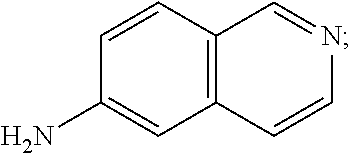
- 6-Aminoisoquinoline is a useful intermediate for the synthesis of kinase inhibitors.
- 6-Aminoisoquinoline may be prepared in a manner that efficiently generates large scale quantities and enables the production of kinase inhibitors, which can be used to treat or prevent kinase-related diseases and/or disorders.
- diseases and disorders related to the eye e.g., glaucoma and ocular hypertension, and retinal diseases such as AMD, Diabetic Retinopathy, DME and inflammatory diseases of the retina
- the respiratory system e.g., glaucoma and ocular hypertension
- DME Diabetic Retinopathy
- inflammatory diseases of the retina e.g., AMD, Diabetic Retinopathy, DME and inflammatory diseases of the retina
- the modifier “about” or “at least” used in connection with a quantity is inclusive of the stated value and has the meaning dictated by the context (for example, it includes at least the degree of error associated with the measurement of the particular quantity).
- the modifier “about” or “at least” should also be considered as disclosing the range defined by the absolute values of the two endpoints.
- the expression “from about or least 2 to about or at least 4” also discloses the range “from 2 to 4.”
- the term “about or at least” may refer to plus or minus 10% of the indicated number.
- “about 10%” may indicate a range of 9% to 11%, and “about 1” may mean from 0.9-1.1.
- Other meanings of “about or at least” may be apparent from the context, such as rounding off, so, for example “about 1” may also mean from 0.5 to 1.4.
- alkyl as used herein, means a straight or branched, saturated hydrocarbon chain containing from 1 to 10 carbon atoms.
- lower alkyl or “C 1 -C 6 alkyl” means a straight or branched chain hydrocarbon containing from 1 to 6 carbon atoms.
- C 3 -C 7 branched alkyl means a branched chain hydrocarbon containing from 3 to 7 carbon atoms.
- C 1 -C 4 alkyl means a straight or branched chain hydrocarbon containing from 1 to 4 carbon atoms.
- alkyl include, but are not limited to, methyl, ethyl, n-propyl, iso-propyl, n-butyl, sec-butyl, iso-butyl, tert-butyl, n-pentyl, isopentyl, neopentyl, n-hexyl, 3-methylhexyl, 2,2-dimethylpentyl, 2,3-dimethylpentyl, n-heptyl, n-octyl, n-nonyl, and n-decyl.
- An alkyl may be substituted or unsubstituted.
- alkylene refers to a divalent group derived from a straight or branched chain hydrocarbon of 1 to 10 carbon atoms, for example, of 2 to 5 carbon atoms.
- Representative examples of alkylene include, but are not limited to, —CH 2 CH 2 —, —CH 2 CH 2 CH 2 —, —CH 2 CH 2 CH 2 CH 2 —, and —CH 2 CH 2 CH 2 CH 2 CH 2 —.
- An alkylene may be substituted or unsubstituted.
- aryl refers to a phenyl group, or a bicyclic fused ring system.
- Bicyclic fused ring systems are exemplified by a phenyl group appended to the parent molecular moiety and fused to a cycloalkyl group, as defined herein, a phenyl group, a heteroaryl group, as defined herein, or a heterocycle, as defined herein.
- Representative examples of aryl include, but are not limited to, indolyl, naphthyl, phenyl, quinolinyl and tetrahydroquinolinyl.
- Aryl groups may be substituted or unsubstituted. Suitable substituents of the aryl groups may be, but are not limited to alkyl, nitro, cyano, halo, haloalkyl and sulfonyl.
- halogen or “halo” as used herein, means Cl, Br, I, or F.
- haloalkyl as used herein, means at least one halo group, as defined herein, appended to the parent molecular moiety through an alkyl group, as defined herein.
- Representative examples of haloalkyl include trifluoromethyl and 2,2,2-trifluoroethyl.
- catalyst loading refers to the amount of catalyst used in a reaction, and is typically reported as mol %.
- the catalyst loading is determined as a molar percentage of the limiting reactant of a particular reaction. For example, a reaction with 1 mole of starting material may require 0.1 moles of catalyst, which is equivalent to 10.0 mol % catalyst loading.
- groups and substituents thereof may be selected in accordance with permitted valence of the atoms and the substituents, such that the selections and substitutions result in a stable compound, e.g., which does not spontaneously undergo transformation such as by rearrangement, cyclization, elimination, etc., at normal temperatures and pressures.
- each intervening number there between with the same degree of precision is explicitly contemplated.
- the numbers 7 and 8 are contemplated in addition to 6 and 9, and for the range 6.0-7.0, the number 6.0, 6.1, 6.2, 6.3, 6.4, 6.5, 6.6, 6.7, 6.8, 6.9, and 7.0 are explicitly contemplated.
- the methods may include reacting the compound of formula (I), wherein X is halogen or OSO 2 R a ; and R a is aryl, alkyl or haloalkyl; with the compound of formula (II), wherein R is alkyl, to form the compound of formula (III), wherein R is alkyl; transforming the compound of formula (III) to 2-(carboxymethyl)-4-nitrobenzoic acid (compound 1) by hydrolysis of the esters and decarboxylation; reacting 2-(carboxymethyl)-4-nitrobenzoic acid (compound 1) with urea to form the bicyclic 6-nitroisoquinoline-1,3(2H, 4H)-dione (compound 2); converting 6-nitroisoquinoline-1,3(2H,4H)-dione (compound 2) to 1,3-dichloro-6-nitroisoquinoline (compound 3) by reaction with R 1 —P(O)Cl 2 , wherein R 1 is alkyl, ary
- the methods may comprise converting 1,3-dichloro-6-nitroisoquinoline (compound 3),
- converting 1,3-dichloro-6-nitroisoquinoline (compound 3) to 6-aminoisoquinoline (compound 4) comprises hydrogenation of 1,3-dichloro-6-nitroisoquinoline (compound 3) in the presence of a metal catalyst.
- the metal catalyst comprises a transition metal.
- the transition metal is selected from the group consisting of palladium, platinum, nickel, rhodium, ruthenium, iridium, cobalt and iron, and combinations thereof.
- the metal catalyst is palladium on carbon.
- the total catalyst loading in the reaction may be about or at least 0.1 mol % to about or at least 5.0 mol %.
- the catalyst loading may be about or at least about or at least 0.1 mol %, about or at least 0.2 mol %, about or at least 0.3 mol %, about or at least 0.4 mol %, about or at least 0.5 mol %, about or at least 0.6 mol %, about or at least 0.7 mol %, about or at least 0.8 mol %, about or at least 0.9 mol %, about or at least 1.0 mol %, about or at least 1.1 mol %, about or at least 1.2 mol %, about or at least 1.3 mol %, about or at least 1.4 mol %, about or at least 1.5 mol %, about or at least 1.6 mol %, about or at least 1.7 mol %, about or at least 1.8 mol %, about or at least 1.9 mol %, about or at least 2.0 mol %, about or at least 2.1 mol %, about or at least 2.2 mol %, about or at least
- 1,3-dichloro-6-nitroisoquinoline (compound 3) may be converted to 6-aminoisoquinoline (compound 4) in the presence of a solvent or mixture of solvents.
- a solvent or mixture of solvents Any suitable solvent that is compatible with the components of the reaction mixture may be used.
- a solvent will be selected such that the starting materials will be at least partially soluble (or fully soluble) and will allow the reaction mixture to be heated, if necessary, to a temperature sufficient for the reaction to produce 6-aminoisoquinoline (compound 4).
- the solvents may include, but are not limited to: ethers such as diethyl ether, dibutyl ether, 1,2-dimethoxyethane, diglyme, t-butyl methyl ether, tetrahydrofuran and dioxane; aliphatic or aromatic hydrocarbon solvents such as benzene, xylene, toluene, hexane, and pentane; polar protic solvents such as methanol, ethanol, n-propanol, isopropanol, n-butanol, acetic acid and water; or any combination of two or more solvents.
- ethers such as diethyl ether, dibutyl ether, 1,2-dimethoxyethane, diglyme, t-butyl methyl ether, tetrahydrofuran and dioxane
- aliphatic or aromatic hydrocarbon solvents such as benzene, xylene, toluen
- the solvent is tetrahydrofuran. In certain embodiments, the solvent is a mixture of tetrahydrofuran and methanol.
- the converting of 1,3-dichloro-6-nitroisoquinoline (compound 3) to 6-aminoisoquinoline (compound 4) may further comprise heating.
- the reaction mixture may be heated at a temperature greater than ambient or room temperature, wherein ambient or room temperature is about 18° C. to about 25° C.
- the reaction mixture may be heated at a temperature of about 25° C. to about 60° C., or about 30° C. to about 60° C.
- the reaction mixture may be heated at a temperature of about or at least 25° C., about or at least 30° C., about or at least 35° C., about or at least 40° C., about or at least 45° C., about or at least 50° C., about or at least 55° C., or about or at least 60° C.
- the reaction mixture may be heated at a temperature of less than about 60° C., less than about 55° C., less than about 50° C., less than about 45° C., less than about 40° C., less than about 35° C., or less than about 30° C.
- the converting of 1,3-dichloro-6-nitroisoquinoline (compound 3) to 6-aminoisoquinoline (compound 4) may further comprise pressurizing the reaction under an atmosphere of hydrogen.
- the reaction mixture may be pressurized to a pressure greater than atmospheric pressure, wherein ambient or atmospheric pressure is about or at least 0.1 MP.
- the reaction mixture may be pressurized to about 0.1 MP to about 1.0 MP, or about 0.2 MP to about 0.8 MP.
- the reaction mixture may be pressurized to at least 0.1 MP, at least 0.2 MP, at least 0.3 MP, at least 0.4 MP, at least 0.5 MP, at least 0.6 MP, at least 0.7 MP, or at least 0.8 MP.
- the reaction mixture may be pressurized to less than 0.8 MP, less than 0.7 MP, less than 0.6 MP, less than 0.5 MP, less than 0.4 MP, less than 0.3 MP, or less than about 0.2 MP.
- the reaction mixture may be pressurized to about 0.1 MP, about 0.2 MP, about 0.3 MP, about 0.4 MP, about 0.5 MP, about 0.6 MP, about 0.7 MP, or about 0.8 MP.
- reaction mixture other components may also be added to the reaction mixture, such as an acid, a base or a salt.
- potassium carbonate may be added to the reaction mixture.
- the converting of 1,3-dichloro-6-nitroisoquinoline (compound 3) to 6-aminoisoquinoline (compound 4) is achieved by hydrogenation of the nitro group followed by hydrogenation of the carbon-chlorine bonds.
- complete hydrogenation of the nitro group may be achieved in tetrahydrofuran in the presence of palladium on carbon at a pressure of about or at least 0.6 MP and a temperature of about or at least 45° C. Partial hydrogenation of the carbon-chlorine bonds may occur under these conditions.
- Complete hydrogenation of the carbon-chlorine bonds may be achieved by adding a second solvent, such as methanol; adding a salt, such as potassium carbonate; and adding palladium on carbon catalyst, and allowing the reaction to proceed at a pressure of about or at least 0.6 MP and a temperature of about or at least 45° C.
- a second solvent such as methanol
- a salt such as potassium carbonate
- palladium on carbon catalyst and allowing the reaction to proceed at a pressure of about or at least 0.6 MP and a temperature of about or at least 45° C.
- the methods may comprise allowing the conversion of 1,3-dichloro-6-nitroisoquinoline (compound 3) to 6-aminoisoquinoline (compound 4) to proceed for a period of time sufficient to form 6-aminoisoquinoline (compound 4).
- the reaction may be allowed to proceed for about 2 hours to about 4 days.
- the reaction may be allowed to proceed for about 2 to about 8 hours for hydrogenation of the nitro group to the amino group.
- the reaction may be allowed to proceed for an additional 2 hours to 4 days for hydrogenation of the carbon-chlorine bonds to be complete.
- the methods may form 6-aminoisoquinoline (compound 4) in a yield of about 20% to about 100%, e.g., about 20% to about 99%.
- the methods may form 6-aminoisoquinoline (compound 4) in about or at least 20%, about or at least 25%, about or at least 30%, about or at least 35%, about or at least 40%, about or at least 45%, about or at least 50%, about or at least 51%, about or at least 52%, about or at least 53%, about or at least 54%, about or at least 55%, about or at least 56%, about or at least 57%, about or at least 58%, about or at least 59%, about or at least 60%, about or at least 61%, about or at least 62%, about or at least 63%, about or at least 64%, about or at least 65%, about or at least 66%, about or at least 67%, about or at least 68%, about or at least 69%, about or at least 70%, about or at least 71%, about or at least 72%
- the methods may form 6-aminoisoquinoline (compound 4) with a purity of greater than or equal to about 60%, greater than or equal to about 65%, greater than or equal to about 70%, greater than or equal to about 75%, greater than or equal to about 80%, greater than or equal to about 85%, greater than or equal to about 90%, greater than or equal to about 95%, greater than or equal to about 96%, greater than or equal to about 97%, greater than or equal to about 98%, or greater than or equal to about 99%, or greater than or equal to about 99.5%, or greater than or equal to about 99.9% as determined by HPLC.
- one or more impurities or byproducts may be formed by the methods.
- the following compounds may form while carrying out the disclosed methods (some of them arising from impurities in the starting materials):
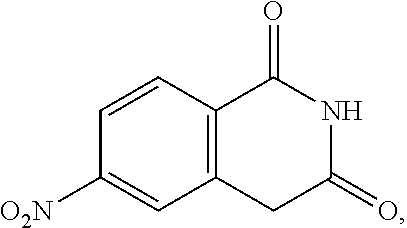
- the methods may further comprise reacting 6-nitroisoquinoline-1,3(2H,4H)-dione (compound 2),
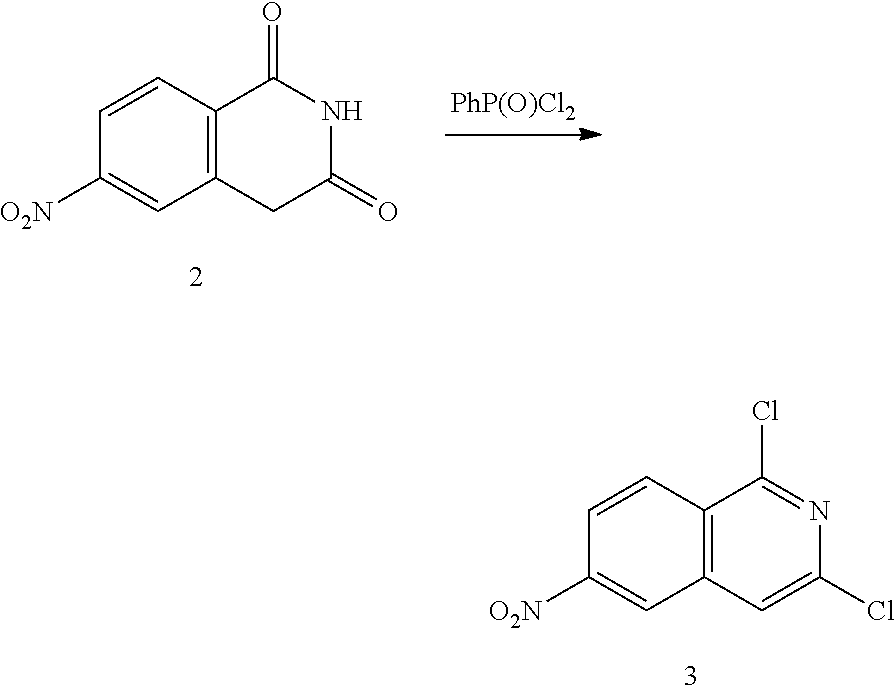
- R 1 P(O)Cl 2 , wherein R 1 is aryl, alkyl or chloro; to form 1,3-dichloro-6-nitroisoquinoline (compound 3).
- R 1 is unsubstituted or substituted aryl. In certain embodiments, R 1 is unsubstituted or substituted phenyl. In certain embodiments, R 1 is phenyl.
- the reaction of 6-nitroisoquinoline-1,3(2H,4H)-dione (compound 2) with R 1 —P(O)Cl 2 may further comprise a solvent or mixture of solvents. Any suitable solvent that is compatible with the components of the reaction mixture may be used. Suitably, a solvent will be selected such that the starting materials will be at least partially soluble (or fully soluble) and will allow the reaction mixture to be heated, if necessary, to a temperature sufficient for the reaction to produce 1,3-dichloro-6-nitroisoquinoline (compound 3).
- the reacting of 6-nitroisoquinoline-1,3(2H, 4H)-dione (compound 2) with R 1 —P(O)Cl 2 may not comprise a solvent. In certain embodiments, R 1 —P(O)Cl 2 is the solvent.
- the reacting of 6-nitroisoquinoline-1,3(2H,4H)-dione (compound 2) with R 1 —P(O)Cl 2 may further comprise heating.
- the reaction mixture may be heated at a temperature greater than ambient or room temperature, wherein ambient or room temperature is about 18° C. to about 25° C.
- the reaction mixture may be heated at a temperature of about 25° C. to about 160° C., or about 30° C. to about 150° C.
- the reaction mixture may be heated at a temperature of at least 90° C., at least 100° C., at least 110° C., at least 120° C., at least 130° C., or at least 140° C.
- the reaction mixture may be heated at a temperature of less than 140° C., less than 130° C., less than 120° C., less than 110° C., or less than 100° C.
- the reaction mixture may be heated at a temperature of about 90° C., about 100° C., about 110° C., about 120° C., about 130° C., about 140° C., about 150° C., or about 160° C.
- reaction mixture other components may also be added to the reaction mixture, such as an acid, a base or a salt.
- the methods may comprise allowing the reacting of 6-nitroisoquinoline-1,3(2H,4H)-dione (compound 2) with R 1 —P(O)Cl 2 to proceed for a period of time sufficient to form 1,3-dichloro-6-nitroisoquinoline (compound 3).
- the reaction may be allowed to proceed for about 20 minutes to about 12 hours, or about 1 hour to about 4 hours.
- the methods may form 1,3-dichloro-6-nitroisoquinoline (compound 3) in a yield of about or at least 20% to about or at least 100%, e.g., about or at least 20% to about or at least 99%.
- the method may form 1,3-dichloro-6-nitroisoquinoline (compound 3) in about or at least 20%, about or at least 25%, about or at least 30%, about or at least 35%, about or at least 40%, about or at least 45%, about or at least 50%, about or at least 51%, about or at least 52%, about or at least 53%, about or at least 54%, about or at least 55%, about or at least 56%, about or at least 57%, about or at least 58%, about or at least 59%, about or at least 60%, about or at least 61%, about or at least 62%, about or at least 63%, about or at least 64%, about or at least 65%, about or at least 66%, about or at least 67%, about or at least 68%,
- the method may form 1,3-dichloro-6-nitroisoquinoline (compound 3) with a purity of greater than or equal to about 60%, greater than or equal to about 65%, greater than or equal to about 70%, greater than or equal to about 75%, greater than or equal to about 80%, greater than or equal to about 85%, greater than or equal to about 90%, greater than or equal to about 95%, greater than or equal to about 96%, greater than or equal to about 97%, greater than or equal to about 98%, or greater than or equal to about 99%, as determined by HPLC.
- the methods may further comprise reacting 2-(carboxymethyl)-4-nitrobenzoic acid (compound 1),
- the acid is an organic acid selected from the group consisting of formic acid, acetic acid, propionic acid, and combinations thereof. In certain embodiments the acid is acetic acid.
- the reacting of 2-(carboxymethyl)-4-nitrobenzoic acid (compound 1) with urea in the presence of an acid may further comprise a solvent or mixture of solvents. Any suitable solvent that is compatible with the components of the reaction mixture may be used. Suitably, a solvent will be selected such that the starting materials will be at least partially soluble (or fully soluble) and will allow the reaction mixture to be heated, if necessary, to a temperature sufficient for the reaction to produce 1,3-dichloro-6-nitroisoquinoline (compound 2).
- the reacting of 2-(carboxymethyl)-4-nitrobenzoic acid (compound 1) with urea in the presence of an acid may not comprise an additional solvent. In certain embodiments, the organic acid (e.g., acetic acid) is added in a sufficient amount to be the solvent.
- the reacting of 2-(carboxymethyl)-4-nitrobenzoic acid (compound 1) with urea in the presence of an acid may further comprise heating.
- the reaction mixture may be heated at a temperature greater than ambient or room temperature, wherein ambient or room temperature is about 18° C. to about 25° C.
- the reaction mixture may be heated at a temperature of about 25° C. to about 140° C., or about 90° C. to about 140° C.
- the reaction mixture may be heated at a temperature of at least 60° C., at least 70° C., at least 80° C., at least 90° C., at least 100° C., or at least 110° C.
- the reaction mixture may be heated at a temperature of less than 110° C., less than 100° C., less than 90° C., less than 80° C., or less than 70° C.
- the reaction mixture may be heated at a temperature of about 70° C., about 80° C., about 90° C., about 100° C., about 110° C., about 120° C., about 130° C., or about 140° C.
- reaction mixture other components may also be added to the reaction mixture, such as an acid, a base or a salt.
- the methods may comprise allowing the reacting of 2-(carboxymethyl)-4-nitrobenzoic acid (compound 1) with urea in the presence of an acid to proceed for a period of time sufficient to form 6-nitroisoquinoline-1,3(2H, 4H)-dione (compound 2).
- the reaction may be allowed to proceed for about 20 minutes to about 12 hours, or about 1 hour to about 8 hours.
- the methods may form 6-nitroisoquinoline-1,3(2H,4H)-dione (compound 2) in a yield of about 20% to 100%, e.g., about 20% to about 99%.
- the methods may form 6-nitroisoquinoline-1,3(2H,4H)-dione (compound 2) in about or at least 20%, about or at least 25%, about or at least 30%, about or at least 35%, about or at least 40%, about or at least 45%, about or at least 50%, about or at least 51%, about or at least 52%, about or at least 53%, about or at least 54%, about or at least 55%, about or at least 56%, about or at least 57%, about or at least 58%, about or at least 59%, about or at least 60%, about or at least 61%, about or at least 62%, about or at least 63%, about or at least 64%, about or at least 65%, about or at least 66%, about or at least 67%, about or at least 68%, about or at
- the methods may form 6-nitroisoquinoline-1,3(2H,4H)-dione (compound 2) with a purity of greater than or equal to about 60%, greater than or equal to about 65%, greater than or equal to about 70%, greater than or equal to about 75%, greater than or equal to about 80%, greater than or equal to about 85%, greater than or equal to about 90%, greater than or equal to about 95%, greater than or equal to about 96%, greater than or equal to about 97%, greater than or equal to about 98%, or greater than or equal to about 99%, as determined by HPLC.
- the methods may further comprise reacting a compound of formula (III),
- R is alkyl; with a base, to form 2-(carboxymethyl)-4-nitrobenzoic acid (compound 1).
- R is C 1 -C 6 alkyl. In certain embodiments, R is C 1 -C 4 alkyl. In certain embodiments R is ethyl. In certain embodiments, the compound of formula (III) is 2-(1,3-diethoxy-1,3-dioxopropan-2-yl)-4-nitrobenzoic acid.
- the base is an alkali metal hydroxide, an alkaline earth metal hydroxide, or a combination thereof.
- Alkali metal hydroxides include LiOH, NaOH, KOH, RbOH and CsOH.
- Alkaline earth metal hydroxides include Be(OH) 2 , Mg(OH) 2 , Ca(OH) 2 , Sr(OH) 2 , and Ba(OH) 2 .
- the base is KOH.
- the reacting of a compound of formula (III) with a base may further comprise a solvent or mixture of solvents.
- a solvent that is compatible with the components of the reaction mixture may be used.
- a solvent will be selected such that the starting materials will be at least partially soluble (or fully soluble) and will allow the reaction mixture to be heated, if necessary, to a temperature sufficient for the reaction to form 2-(carboxymethyl)-4-nitrobenzoic acid (compound 1).
- the solvent is water.
- the reacting of a compound of formula (III) with a base may further comprise heating.
- the reaction mixture may be heated at a temperature greater than ambient or room temperature, wherein ambient or room temperature is about 18° C. to about 25° C.
- the reaction mixture may be heated at a temperature of about 25° C. to about 100° C.
- the reaction mixture may be heated at a temperature of at least 60° C., at least 70° C., at least 80° C., at least 90° C., or at least 100° C.
- the reaction mixture may be heated at a temperature of less than 100° C., less than 90° C., less than 80° C., less than 70° C., or less than 60° C.
- the reaction mixture may not be heated, but allowed to proceed at ambient or room temperature.
- the methods may comprise allowing the reacting of compound of formula (III) with a base to proceed for a period of time sufficient to form 2-(carboxymethyl)-4-nitrobenzoic acid (compound 1).
- the reaction may be allowed to proceed for about 20 minutes to about 24 hours, about 1 hour to about 18 hours, or about 6 hours to about 16 hours.
- the methods may form 2-(carboxymethyl)-4-nitrobenzoic acid (compound 1) in a yield of about 20% to 100%, or about 20% to about 99%.
- the methods may form 2-(carboxymethyl)-4-nitrobenzoic acid (compound 1) in about or at least 20%, about or at least 25%, about or at least 30%, about or at least 35%, about or at least 40%, about or at least 45%, about or at least 50%, about or at least 51%, about or at least 52%, about or at least 53%, about or at least 54%, about or at least 55%, about or at least 56%, about or at least 57%, about or at least 58%, about or at least 59%, about or at least 60%, about or at least 61%, about or at least 62%, about or at least 63%, about or at least 64%, about or at least 65%, about or at least 66%, about or at least 67%, about or at least 68%, about or at least 69%, about or at least 70%, about or at least 71%,
- the methods may form 2-(carboxymethyl)-4-nitrobenzoic acid (compound 1) with a purity of greater than or equal to about 60%, greater than or equal to about 65%, greater than or equal to about 70%, greater than or equal to about 75%, greater than or equal to about 80%, greater than or equal to about 85%, greater than or equal to about 90%, greater than or equal to about 95%, greater than or equal to about 96%, greater than or equal to about 97%, greater than or equal to about 98%, or greater than or equal to about 99%, as determined by HPLC.
- the methods may further comprise reacting a compound of formula (I),
- X is halogen or OSO 2 R a ; and R a is aryl, alkyl or haloalkyl; with a compound of formula
- R is alkyl
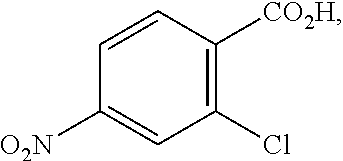
- X is halogen. In certain embodiments, X is Cl. In certain embodiments, X is SO 2 R a ; and R a is C 1 -C 6 alkyl, aryl, or C 1 -C 6 haloalkyl. In certain embodiments, X is SO 2 R a ; and R a is methyl, 4-methylphenyl, or trifluoromethyl. In certain embodiments, the compound of formula (I) is 2-chloro-4-nitrobenzoic acid.
- R is C 1 -C 6 alkyl. In certain embodiments, R is C 1 -C 4 alkyl. In certain embodiments, R is ethyl. In certain embodiments, the compound of formula (II) is diethyl malonate.
- reacting a compound of formula (I) with a compound of formula (II) comprises adding a base.
- the base is a metal alkoxide.
- An alkoxide is the conjugate base of an alcohol.
- the metal alkoxide may be a lithium alkoxide, a sodium alkoxide, a potassium alkoxide, or a combination thereof.
- the metal alkoxide may comprise a C 1 -C 6 alkyl group, as defined herein.
- the metal alkoxide is sodium methoxide.
- reacting a compound of formula (I) with a compound of formula (II) comprises adding a catalyst.
- the catalyst comprises a transition metal.
- the transition metal is selected from the group consisting of palladium, platinum, nickel, rhodium, ruthenium, iridium, cobalt, iron, copper, gold silver, and combinations thereof.
- the transition metal is copper.
- the catalyst is copper (I) bromide.
- the catalyst loading in the reaction may be about 1 mol % to about 50 mol %, about 1 mol % to about 30 mol %, about 10 mol % to about 30 mol %, or about 15 mol % to about 25 mol %.
- the catalyst loading may be about or at least 1 mol %, about or at least 2 mol %, about or at least 3 mol %, about or at least 4 mol %, about or at least 5 mol %, about or at least 6 mol %, about or at least 7 mol %, about or at least 8 mol %, about or at least 9 mol %, about or at least 10 mol %, about or at least 11 mol %, about or at least 12 mol %, about or at least 13 mol %, about or at least 14 mol %, about or at least 15 mol %, about or at least 16 mol %, about or at least 17 mol %, about or at least 18 mol %, about or at least 19 mol %, about or at least 20 mol %, about or at least 21 mol %, about or at least 22 mol %, about or at least 23 mol %, about or at least 24 mol %, about or at least 25 mol %
- the reacting of a compound of formula (I) with a compound of formula (II) may further comprise adding a solvent or mixture of solvents.
- a solvent Any suitable solvent that is compatible with the components of the reaction mixture may be used.
- a solvent will be selected such that the starting materials will be at least partially soluble (or fully soluble) and will allow the reaction mixture to be heated, if necessary, to a temperature sufficient for the reaction to produce the compound of formula (III).
- the solvents may include, but are not limited to: ethers such as diethyl ether, dibutyl ether, 1,2-dimethoxyethane, diglyme, t-butyl methyl ether, tetrahydrofuran and dioxane; aliphatic or aromatic hydrocarbon solvents such as benzene, xylene, toluene, hexane, and pentane; polar aprotic solvents such as acetonitrile, dimethylformamide, and dimethylsulfoxide; polar protic solvents such as methanol, ethanol, n-propanol, isopropanol, n-butanol, acetic acid and water; or any combination of two or more solvents.
- the solvent is ethanol.
- the reacting of a compound of formula (I) with a compound of formula (II) may further comprise heating.
- the reaction mixture may be heated at a temperature greater than ambient or room temperature, wherein ambient or room temperature is about 18° C. to about 25° C.
- the reaction mixture may be heated at a temperature of about 25° C. to about 90° C., or about 30° C. to about 80° C.
- the reaction mixture may be heated at a temperature of at least 25° C., at least 30° C., at least 35° C., at least 40° C., at least 45° C., at least 50° C., at least 55° C., at least 60° C., at least 65° C., at least 70° C., at least 75° C., at least 78° C., or at least 80° C.
- the reaction mixture may be heated at a temperature less than 90° C., less than 80° C., less than 78° C., less than 75° C., less than 70° C., less than 60° C., less than 55° C., less than 50° C., less than 45° C., less than 40° C., less than 35° C., or less than 30° C.
- the reaction mixture may be heated at a temperature of about 25° C., about 30° C., about 35° C., about 40° C., about 45° C., about 50° C., about 55° C., about 60° C., about 70° C., about 75° C., about 78° C., about 80° C., or about 90° C.
- the methods may comprise allowing the conversion to proceed for a period of time sufficient to form the compound of formula (III).
- the reaction may be allowed to proceed for about 1 hour to about 24 hours, about 2 hours to about 18 hours, or about 12 hours to about 18 hours.
- the methods may form the compound of formula (III) in a yield of about 20% to 100%, e.g., about 20% to about 99%.
- the methods may provide the compound of formula (III) in about or at least 20%, about or at least 25%, about or at least 30%, about or at least 35%, about or at least 40%, about or at least 45%, about or at least 50%, about or at least 51%, about or at least 52%, about or at least 53%, about or at least 54%, about or at least 55%, about or at least 56%, about or at least 57%, about or at least 58%, about or at least 59%, about or at least 60%, about or at least 61%, about or at least 62%, about or at least 63%, about or at least 64%, about or at least 65%, about or at least 66%, about or at least 67%, about or at least 68%, about or at least 69%, about or at least 70%, about or at least 71%, about or at least 72%, about or at least 73%, about or at
- the methods may form the compound of formula (III) with a purity of greater than or equal to about 60%, greater than or equal to about 65%, greater than or equal to about 70%, greater than or equal to about 75%, greater than or equal to about 80%, greater than or equal to about 85%, greater than or equal to about 90%, greater than or equal to about 95%, greater than or equal to about 96%, greater than or equal to about 97%, greater than or equal to about 98%, or greater than or equal to about 99%, or greater than or equal to about 99.5% or greater than or equal to about 99.9% as determined by HPLC.
- the methods include reacting 2-chloro-4-nitrobenzoic acid (I-a) with diethylmalonate (II-a) to form 2-(1,3-diethoxy-1,3-dioxopropan-2-yl)-4-nitrobenzoic acid (III-a); reacting 2-(1,3-diethoxy-1,3-dioxopropan-2-yl)-4-nitrobenzoic acid (III-a) with a base to form 2-(carboxymethyl)-4-nitrobenzoic acid (compound 1); reacting 2-(carboxymethyl)-4-nitrobenzoic acid (compound 1) with urea to form 6-nitroisoquinoline-1,3(2H,4H)-dione (compound 2); reacting 6-nitroisoquinoline-1,3(2H, 4H)-dione (compound 2) with R 1 —P(O)Cl 2 to form 1,3-dichloro-6-nitroisoquinoline (compound 3); and converting 1,3
- the methods include reacting 2-chloro-4-nitrobenzoic acid (I-a) with diethylmalonate (II-a) in the presence of sodium methoxide and copper (I) bromide to form 2-(1,3-diethoxy-1,3-dioxopropan-2-yl)-4-nitrobenzoic acid (III-a); reacting 2-(1,3-diethoxy-1,3-dioxopropan-2-yl)-4-nitrobenzoic acid (III-a) with potassium hydroxide to form 2-(carboxymethyl)-4-nitrobenzoic acid (compound 1); reacting 2-(carboxymethyl)-4-nitrobenzoic acid (compound 1) with urea in acetic acid to form 6-nitroisoquinoline-1,3(2H,4H)-dione (compound 2); reacting 6-nitroisoquinoline-1,3(2H, 4H)-dione (compound 2) with phenylphosphonic dichloride to form 1,
- the compounds and intermediates may be isolated and purified by methods well-known to those skilled in the art of organic synthesis.
- Examples of conventional methods for isolating and purifying compounds can include, but are not limited to, chromatography on solid supports such as silica gel, alumina, or silica derivatized with alkylsilane groups, by recrystallization at high or low temperature with an optional pretreatment with activated carbon, thin-layer chromatography, distillation at various pressures, sublimation under vacuum, and trituration, as described for instance in “Vogel's Textbook of Practical Organic Chemistry”, 5th edition (1989), by Furniss, Hannaford, Smith, and Tatchell, pub. Longman Scientific & Technical, Essex CM20 2JE, England.
- 6-aminoisoquinoline may be purified via a multi-step process.
- the multi-step process comprises (1) removal of insoluble impurities via filtration; (2) acid and base extraction; and (3) recrystallization.
- crude 6-aminoisoquinoline may be mixed with activated charcoal for a suitable time period in a solvent or a mixture of solvents to form a first mixture.
- the period of time may be at least about 4 hours.
- Any suitable solvent that is compatible with the components may be used.
- the solvent may be methanol or ethanol.
- the first mixture may be filtered through at least one filter to form a filtrate.
- the resulting filtrate may then be condensed and dissolved in an acidic solution to form a second mixture.
- the acidic solution may be, for example, a citric acid solution such as about or at least 5% citric acid.
- the second mixture is optionally heated to 35 ⁇ 5° C. for a period of time of 1-6 h.
- the resulting solution is washed at least one time with a solvent to form a third mixture. Any suitable solvent that is compatible with the components may be used. In an embodiment, the solvent may be dichloromethane.
- the resulting aqueous layer is mixed with a basic solution to form a precipitate.
- the basic solution may be, for example, concentrated ammonium hydroxide, 10% aqueous potassium hydroxide, 10% aqueous potassium carbonate, or combinations thereof.
- the resulting precipitate may be filtered and dried to obtain a solid.
- the solid may be suspended in a solvent to form a suspension.
- a solvent Any suitable solvent that is compatible with the components may be used.
- the solvent may be ethanol.
- the suspension may be heated to a temperature of about 75° C. for a period of time. The period of time may be about 45 minutes. Subsequently, the suspension is gradually cooled over the course of about 16 hours, and filtered to obtain 6-aminoisoquinonline.
- the methods may form 6-aminoisoquinonline with a purity of greater than or equal to 99%, as determined by HPLC. The steps recited in this paragraph may be repeated as necessary, e.g., one time, two times, three times, etc.
- the filters may be nylon or PTFE filters.
- a disclosed compound may have at least one basic nitrogen whereby the compound can be treated with an acid to form a desired salt.
- a compound may be reacted with an acid at or above room temperature to provide the desired salt, which is deposited, and collected by filtration after cooling.
- acids suitable for the reaction include, but are not limited to tartaric acid, lactic acid, succinic acid, as well as mandelic, atrolactic, methanesulfonic, ethanesulfonic, toluenesulfonic, naphthalenesulfonic, benzenesulfonic, carbonic, fumaric, maleic, gluconic, acetic, propionic, salicylic, hydrochloric, hydrobromic, phosphoric, sulfuric, citric, hydroxybutyric, camphorsulfonic, malic, phenylacetic, aspartic, or glutamic acid, combinations thereof and the like.
- reaction conditions and reaction times for each individual step can vary depending on the particular reactants employed and substituents present in the reactants used. Specific procedures are provided in the Examples section. Reactions can be worked up in the conventional manner, e.g. by eliminating the solvent from the residue and further purified according to methodologies generally known in the art such as, but not limited to, crystallization, distillation, extraction, trituration and chromatography. Unless otherwise described, the starting materials and reagents are either commercially available or can be prepared by one skilled in the art from commercially available materials using methods described in the chemical literature.
- the present disclosure also includes isotopically-labeled compounds, which are identical to any of those recited in the methods, but for the fact that one or more positions in the molecule are enriched with an isotope of the same atom, having an atomic mass or mass number that is different from the atomic mass or mass number usually found in nature.
- isotopes suitable for inclusion in the compounds of the invention are hydrogen, carbon, nitrogen, oxygen, phosphorus, sulfur, fluorine, and chlorine, such as, but not limited to 2 H, 3 H, 13 C, 14 C, 5 N, 18 O, 17 O, 31 P, 32 P, 35 S, 18 F, and 36 Cl, respectively.
- the compound may incorporate positron-emitting isotopes for medical imaging and positron-emitting tomography (PET) studies for determining the distribution of receptors.
- PET positron-emitting tomography
- Suitable positron-emitting isotopes that can be incorporated in compounds of formula (I) are 11 C, 13 N, 15 O, and 18 F.
- Isotopically-labeled compounds of formula (I) can generally be prepared by conventional techniques known to those skilled in the art or by processes analogous to those described herein. Examples using appropriate isotopically-labeled reagent in place of non-isotopically-labeled reagent.
- Basic addition salts may be prepared during the final isolation and purification of the disclosed compounds by reaction of a carboxyl group with a suitable base such as the hydroxide, carbonate, or bicarbonate of a metal cation such as lithium, sodium, potassium, calcium, magnesium, or aluminum, or an organic primary, secondary, or tertiary amine.
- a suitable base such as the hydroxide, carbonate, or bicarbonate of a metal cation such as lithium, sodium, potassium, calcium, magnesium, or aluminum, or an organic primary, secondary, or tertiary amine.
- Quaternary amine salts can be prepared, such as those derived from methylamine, dimethylamine, trimethylamine, triethylamine, diethylamine, ethylamine, tributylamine, pyridine, N,N-dimethylaniline, N-methylpiperidine, N-methylmorpholine, dicyclohexylamine, procaine, dibenzylamine, N,N-dibenzylphenethylamine, 1-ephenamine and N,N′-dibenzylethylenediamine, ethylenediamine, ethanolamine, diethanolamine, piperidine, piperazine, and the like.
- temperatures are given in degrees Celsius (° C.); synthetic operations were carried out at ambient temperature, “rt,” or “RT,” (typically a range of from about 18-25° C.); evaporation of solvents was carried out using a rotary evaporator under reduced pressure (typically, 4.5-30 mm Hg) with a bath temperature of up to 60° C.; the course of reactions was typically followed using thin layer chromatography (TLC); all melting points, if given, are uncorrected; all intermediates as well as the final product exhibited satisfactory 1H-NMR, HPLC and/or microanalytical data; and the following conventional abbreviations are used: L (liter(s)), mL (milliliters), mmol (millimoles), g (grams), mg (milligrams), min (minutes), and h (hours).
- DMSO dimethylsulfoxide
- EtOAc ethyl acetate
- EtOH ethanol
- HOAc acetic acid
- MeOH methanol
- MTBE methyl tert-butyl ether
- Pd/C palladium on carbon
- THF tetrahydrofuran
- TLC thin layer chromatography
- the aqueous layer of the crude 2-(1,3-diethoxy-1,3-dioxopropan-2-yl)-4-nitrobenzoic acid was charged into a 100 L reactor, followed by the addition of solid KOH (7.58 kg, 135.3 mol). The basic reaction mixture was stirred at RT overnight. After 2-(1,3-diethoxy-1,3-dioxopropan-2-yl)-4-nitrobenzoic acid was consumed as indicated by HPLC analysis, the reaction mixture was carefully acidified with concentrated HCl to pH 6 ⁇ 7. EtOAc (50 L) was then added and the mixture was further acidified with concentrated HCl to pH 2 ⁇ 3. The organic layer was separated. The aqueous layer was extracted with EtOAc (40 L ⁇ 2).
- 1,3-Dichloro-6-nitroisoquinoline 700 g, 2.88 mol, 1 eq
- 10% Pd/C 45 g, 6.5% w/w
- THF 5.5 L
- the reaction mixture was hydrogenated at 45° C. under a pressure of 0.6 MP for about 6 ⁇ 8 h until the nitro group was fully reduced to the amino group. Partial formation of the des-chloride intermediate was also indicated by TLC and HPLC analysis. After the pressure of the reactor was released, K 2 CO 3 (1 kg), MeOH (1.5 L), and additional Pd/C (10%, 45 g) were added to the reaction suspension.
Landscapes
- Chemical & Material Sciences (AREA)
- Organic Chemistry (AREA)
- Chemical Kinetics & Catalysis (AREA)
- Low-Molecular Organic Synthesis Reactions Using Catalysts (AREA)
- Other In-Based Heterocyclic Compounds (AREA)
- Organic Low-Molecular-Weight Compounds And Preparation Thereof (AREA)
Abstract
Description

the method may comprise converting 1,3-dichloro-6-nitroisoquinoline,

to 6-aminoisoquinoline, then purifying the material to at least about 99.9% pure using a triple purification system.


to 6-aminoisoquinoline (compound 4).

-
- 1,3-dichloro-6-nitroisoquinoline;

-
- isoquinolin-8-amine;
-
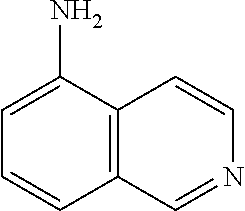
- isoquinolin-5-amine;

-
- isoquinolin-7-amine;

-
- 3-chloroisoquinolin-6-amine;

-
- 1-chloroisoquinolin-6-amine; and

-
- 1,3-dichloroisoquinolin-6-amine;
- or any combination thereof.

with R1—P(O)Cl2, wherein R1 is aryl, alkyl or chloro; to form 1,3-dichloro-6-nitroisoquinoline (compound 3).

with urea in the presence of an acid, to form 6-nitroisoquinoline-1,3(2H, 4H)-dione (compound 2).

wherein R is alkyl; with a base, to form 2-(carboxymethyl)-4-nitrobenzoic acid (compound 1).

wherein X is halogen or OSO2Ra; and Ra is aryl, alkyl or haloalkyl; with a compound of formula

wherein R is alkyl; to form the compound of formula (III).



Claims (27)





Priority Applications (6)
| Application Number | Priority Date | Filing Date | Title |
|---|---|---|---|
| US15/395,068 US9840468B1 (en) | 2016-12-30 | 2016-12-30 | Methods for the preparation of 6-aminoisoquinoline |
| EP17886003.7A EP3562806A4 (en) | 2016-12-30 | 2017-12-11 | Methods for the preparation of 6-aminoisoquinoline |
| CA3048667A CA3048667A1 (en) | 2016-12-30 | 2017-12-11 | Methods for the preparation of 6-aminoisoquinoline |
| PCT/US2017/065631 WO2018125548A1 (en) | 2016-12-30 | 2017-12-11 | Methods for the preparation of 6-aminoisoquinoline |
| AU2017387801A AU2017387801B2 (en) | 2016-12-30 | 2017-12-11 | Methods for the preparation of 6-aminoisoquinoline |
| JP2019535803A JP7082980B2 (en) | 2016-12-30 | 2017-12-11 | 6-Method for preparing aminoisoquinoline |
Applications Claiming Priority (1)
| Application Number | Priority Date | Filing Date | Title |
|---|---|---|---|
| US15/395,068 US9840468B1 (en) | 2016-12-30 | 2016-12-30 | Methods for the preparation of 6-aminoisoquinoline |
Publications (1)
| Publication Number | Publication Date |
|---|---|
| US9840468B1 true US9840468B1 (en) | 2017-12-12 |
Family
ID=60516487
Family Applications (1)
| Application Number | Title | Priority Date | Filing Date |
|---|---|---|---|
| US15/395,068 Active US9840468B1 (en) | 2016-12-30 | 2016-12-30 | Methods for the preparation of 6-aminoisoquinoline |
Country Status (6)
| Country | Link |
|---|---|
| US (1) | US9840468B1 (en) |
| EP (1) | EP3562806A4 (en) |
| JP (1) | JP7082980B2 (en) |
| AU (1) | AU2017387801B2 (en) |
| CA (1) | CA3048667A1 (en) |
| WO (1) | WO2018125548A1 (en) |
Families Citing this family (1)
| Publication number | Priority date | Publication date | Assignee | Title |
|---|---|---|---|---|
| CN108929270B (en) * | 2018-08-15 | 2021-06-08 | 上海罕道医药科技有限公司 | Synthesis of drug intermediate disubstituted nitrogen heterocyclic ring-containing amine compound |
Citations (5)
| Publication number | Priority date | Publication date | Assignee | Title |
|---|---|---|---|---|
| WO2003068749A1 (en) | 2002-02-15 | 2003-08-21 | Glaxo Group Limited | Vanilloid receptor modulators |
| WO2003080578A1 (en) | 2002-03-22 | 2003-10-02 | Merck Sharp & Dohme Limited | Heteroaromatic urea derivatives as vr-1 receptor modulators for treating pain |
| WO2010019903A1 (en) | 2008-08-15 | 2010-02-18 | N30 Pharmaceuticals, Llc | Novel pyrrole inhibitors of s-nitrosoglutathione reductase as therapeutic agents |
| WO2010146881A1 (en) | 2009-06-19 | 2010-12-23 | 株式会社デ・ウエスタン・セラピテクス研究所 | Substituted isoquinoline derivative |
| WO2016123627A1 (en) * | 2015-01-30 | 2016-08-04 | Vanderbilt University | Isoquiniline and napthalene-substituted compounds as mglur4 allosteric potentiators, compounds, and methods of treating neurological dysfunction |
Family Cites Families (3)
| Publication number | Priority date | Publication date | Assignee | Title |
|---|---|---|---|---|
| WO1988003137A1 (en) * | 1986-10-28 | 1988-05-05 | Smith Kline & French Laboratories Limited | Tetrahydroisoquinolin-2-yl derivatives of carboxylic acids as thromboxane a2 antagonists |
| WO2003045921A1 (en) | 2001-11-28 | 2003-06-05 | Fujisawa Pharmaceutical Co., Ltd. | Heterocyclic amide compounds as apolipoprotein b inhibitors |
| CN105017152B (en) * | 2015-07-17 | 2017-05-10 | 北京六合宁远科技有限公司 | Preparation method of 3-chloro-6-nitroisoquinoline or 3-bromine-6-nitroisoquinoline |
-
2016
- 2016-12-30 US US15/395,068 patent/US9840468B1/en active Active
-
2017
- 2017-12-11 CA CA3048667A patent/CA3048667A1/en not_active Abandoned
- 2017-12-11 AU AU2017387801A patent/AU2017387801B2/en active Active
- 2017-12-11 WO PCT/US2017/065631 patent/WO2018125548A1/en not_active Ceased
- 2017-12-11 EP EP17886003.7A patent/EP3562806A4/en not_active Withdrawn
- 2017-12-11 JP JP2019535803A patent/JP7082980B2/en active Active
Patent Citations (5)
| Publication number | Priority date | Publication date | Assignee | Title |
|---|---|---|---|---|
| WO2003068749A1 (en) | 2002-02-15 | 2003-08-21 | Glaxo Group Limited | Vanilloid receptor modulators |
| WO2003080578A1 (en) | 2002-03-22 | 2003-10-02 | Merck Sharp & Dohme Limited | Heteroaromatic urea derivatives as vr-1 receptor modulators for treating pain |
| WO2010019903A1 (en) | 2008-08-15 | 2010-02-18 | N30 Pharmaceuticals, Llc | Novel pyrrole inhibitors of s-nitrosoglutathione reductase as therapeutic agents |
| WO2010146881A1 (en) | 2009-06-19 | 2010-12-23 | 株式会社デ・ウエスタン・セラピテクス研究所 | Substituted isoquinoline derivative |
| WO2016123627A1 (en) * | 2015-01-30 | 2016-08-04 | Vanderbilt University | Isoquiniline and napthalene-substituted compounds as mglur4 allosteric potentiators, compounds, and methods of treating neurological dysfunction |
Non-Patent Citations (10)
Also Published As
| Publication number | Publication date |
|---|---|
| EP3562806A4 (en) | 2020-05-27 |
| AU2017387801A1 (en) | 2019-06-20 |
| WO2018125548A1 (en) | 2018-07-05 |
| JP7082980B2 (en) | 2022-06-09 |
| EP3562806A1 (en) | 2019-11-06 |
| CA3048667A1 (en) | 2018-07-05 |
| JP2020503338A (en) | 2020-01-30 |
| AU2017387801B2 (en) | 2020-04-30 |
Similar Documents
| Publication | Publication Date | Title |
|---|---|---|
| TWI496781B (en) | Preparation of {4,6-diamino-2-[1-(2-fluorobenzyl)-1H-pyrazolo[3,4-b]pyridin-3-yl]pyrimidin-5-yl}methyl Method for methyl methacrylate and its use as purification of pharmaceutically active compounds | |
| CN102639486B (en) | Process for producing N-acylbiphenylalanine | |
| TWI697494B (en) | Synthesis of copanlisib and its dihydrochloride salt | |
| CN114805314B (en) | Synthesis method of Entecavir | |
| WO2022052683A1 (en) | Method for preparing water-soluble magnolol derivative and honokiol derivative, methods for preparing intermediates of water-soluble magnolol derivative and honokiol derivative, and related monohydroxy protected intermediate | |
| KR101420892B1 (en) | Process for the preparation of Imatinib and intermediates thereof | |
| JP2020528916A (en) | Intermediates useful for the synthesis of selective inhibitors of protein kinases and the process for preparing them | |
| JP2013539771A (en) | Process for producing dihydropteridinone and intermediates thereof | |
| RU2440978C2 (en) | Method of producing 1-(3, 4-dichlorobenzyl)-5-octyl biguanide or salt thereof | |
| KR20190035680A (en) | Polymorphism of binalinostet and its production method | |
| EP0213850B1 (en) | Decyanation of pergolide intermediate | |
| AU2017387801B2 (en) | Methods for the preparation of 6-aminoisoquinoline | |
| CN113614069B (en) | Method for preparing (3R, 4R)-1-benzyl-N, 4-dimethylpiperidin-3-amine or its salt and method for preparing tofacitinib using the same | |
| CN117567466B (en) | A method for preparing quinazoline derivatives | |
| KR101012134B1 (en) | Method for preparing imatinib and imatinib mesylate salt | |
| TW202019872A (en) | Preparation method for fused tricyclic [gamma]-amino acid derivative and intermediate thereof | |
| TWI844663B (en) | Process for the production of substituted 2-[2-(phenyl)ethylamino]alkaneamide derivatives | |
| CN118930551B (en) | Process for preparing beta-aminopyrazine acetate | |
| US7145014B2 (en) | Process for the preparation of quinoline derivatives | |
| JP4568824B2 (en) | Method for producing diarylsulfonic acid derivative | |
| US8802860B2 (en) | Method for producing substituted pyridin-2-one | |
| WO2022202814A1 (en) | Method for producing pyrimidine compound | |
| US20240336607A1 (en) | Preparation method for hepatitis b virus nucleocapsid inhibitor | |
| CN104870425B (en) | Synthesis method of hydrazine which can be used for treating papillomavirus | |
| JP2024150777A (en) | Method for producing prolinamide compound |
Legal Events
| Date | Code | Title | Description |
|---|---|---|---|
| AS | Assignment |
Owner name: AERIE PHARMACEUTICALS, INC., NORTH CAROLINA Free format text: ASSIGNMENT OF ASSIGNORS INTEREST;ASSIGNORS:DELONG, MITCHELL A.;CHAMBOURNIER, GILLES;SIGNING DATES FROM 20170117 TO 20170120;REEL/FRAME:041196/0041 |
|
| STCF | Information on status: patent grant |
Free format text: PATENTED CASE |
|
| AS | Assignment |
Owner name: DEERFIELD PRIVATE DESIGN FUND III, L.P., NEW YORK Free format text: SECURITY INTEREST;ASSIGNOR:AERIE PHARMACEUTICALS, INC.;REEL/FRAME:046432/0307 Effective date: 20180723 |
|
| AS | Assignment |
Owner name: AERIE PHARMACEUTICALS, INC., NEW JERSEY Free format text: RELEASE BY SECURED PARTY;ASSIGNOR:DEERFIELD PRIVATE DESIGN FUND III, L.P.;REEL/FRAME:050276/0807 Effective date: 20190904 |
|
| MAFP | Maintenance fee payment |
Free format text: PAYMENT OF MAINTENANCE FEE, 4TH YR, SMALL ENTITY (ORIGINAL EVENT CODE: M2551); ENTITY STATUS OF PATENT OWNER: SMALL ENTITY Year of fee payment: 4 |
|
| FEPP | Fee payment procedure |
Free format text: ENTITY STATUS SET TO UNDISCOUNTED (ORIGINAL EVENT CODE: BIG.); ENTITY STATUS OF PATENT OWNER: LARGE ENTITY |
|
| AS | Assignment |
Owner name: ALCON INC., SWITZERLAND Free format text: ASSIGNMENT OF ASSIGNORS INTEREST;ASSIGNOR:AERIE PHARMACEUTICALS, INC.;REEL/FRAME:067822/0168 Effective date: 20240618 |
|
| MAFP | Maintenance fee payment |
Free format text: PAYMENT OF MAINTENANCE FEE, 8TH YEAR, LARGE ENTITY (ORIGINAL EVENT CODE: M1552); ENTITY STATUS OF PATENT OWNER: LARGE ENTITY Year of fee payment: 8 |