US9834969B2 - Roller carriage for the reception of a sliding door - Google Patents
Roller carriage for the reception of a sliding door Download PDFInfo
- Publication number
- US9834969B2 US9834969B2 US14/938,645 US201514938645A US9834969B2 US 9834969 B2 US9834969 B2 US 9834969B2 US 201514938645 A US201514938645 A US 201514938645A US 9834969 B2 US9834969 B2 US 9834969B2
- Authority
- US
- United States
- Prior art keywords
- roller
- sound
- modulus
- roller carriage
- sliding door
- Prior art date
- Legal status (The legal status is an assumption and is not a legal conclusion. Google has not performed a legal analysis and makes no representation as to the accuracy of the status listed.)
- Expired - Fee Related
Links
Images




Classifications
-
- E—FIXED CONSTRUCTIONS
- E05—LOCKS; KEYS; WINDOW OR DOOR FITTINGS; SAFES
- E05D—HINGES OR SUSPENSION DEVICES FOR DOORS, WINDOWS OR WINGS
- E05D15/00—Suspension arrangements for wings
- E05D15/06—Suspension arrangements for wings for wings sliding horizontally more or less in their own plane
- E05D15/0621—Details, e.g. suspension or supporting guides
- E05D15/0626—Details, e.g. suspension or supporting guides for wings suspended at the top
- E05D15/0643—Details, e.g. suspension or supporting guides for wings suspended at the top on balls or floating rollers
-
- E—FIXED CONSTRUCTIONS
- E05—LOCKS; KEYS; WINDOW OR DOOR FITTINGS; SAFES
- E05D—HINGES OR SUSPENSION DEVICES FOR DOORS, WINDOWS OR WINGS
- E05D15/00—Suspension arrangements for wings
- E05D15/06—Suspension arrangements for wings for wings sliding horizontally more or less in their own plane
- E05D15/0621—Details, e.g. suspension or supporting guides
- E05D15/0626—Details, e.g. suspension or supporting guides for wings suspended at the top
- E05D15/063—Details, e.g. suspension or supporting guides for wings suspended at the top on wheels with fixed axis
-
- E—FIXED CONSTRUCTIONS
- E05—LOCKS; KEYS; WINDOW OR DOOR FITTINGS; SAFES
- E05D—HINGES OR SUSPENSION DEVICES FOR DOORS, WINDOWS OR WINGS
- E05D15/00—Suspension arrangements for wings
- E05D15/06—Suspension arrangements for wings for wings sliding horizontally more or less in their own plane
- E05D15/0621—Details, e.g. suspension or supporting guides
- E05D15/0626—Details, e.g. suspension or supporting guides for wings suspended at the top
- E05D15/063—Details, e.g. suspension or supporting guides for wings suspended at the top on wheels with fixed axis
- E05D15/0634—Details, e.g. suspension or supporting guides for wings suspended at the top on wheels with fixed axis with height adjustment
-
- E—FIXED CONSTRUCTIONS
- E05—LOCKS; KEYS; WINDOW OR DOOR FITTINGS; SAFES
- E05D—HINGES OR SUSPENSION DEVICES FOR DOORS, WINDOWS OR WINGS
- E05D15/00—Suspension arrangements for wings
- E05D15/06—Suspension arrangements for wings for wings sliding horizontally more or less in their own plane
- E05D15/0621—Details, e.g. suspension or supporting guides
- E05D15/0626—Details, e.g. suspension or supporting guides for wings suspended at the top
- E05D15/0647—Details, e.g. suspension or supporting guides for wings suspended at the top on sliding blocks
-
- E—FIXED CONSTRUCTIONS
- E05—LOCKS; KEYS; WINDOW OR DOOR FITTINGS; SAFES
- E05D—HINGES OR SUSPENSION DEVICES FOR DOORS, WINDOWS OR WINGS
- E05D15/00—Suspension arrangements for wings
- E05D15/06—Suspension arrangements for wings for wings sliding horizontally more or less in their own plane
- E05D15/0621—Details, e.g. suspension or supporting guides
- E05D15/0626—Details, e.g. suspension or supporting guides for wings suspended at the top
- E05D15/0652—Tracks
-
- E—FIXED CONSTRUCTIONS
- E06—DOORS, WINDOWS, SHUTTERS, OR ROLLER BLINDS IN GENERAL; LADDERS
- E06B—FIXED OR MOVABLE CLOSURES FOR OPENINGS IN BUILDINGS, VEHICLES, FENCES OR LIKE ENCLOSURES IN GENERAL, e.g. DOORS, WINDOWS, BLINDS, GATES
- E06B3/00—Window sashes, door leaves, or like elements for closing wall or like openings; Layout of fixed or moving closures, e.g. windows in wall or like openings; Features of rigidly-mounted outer frames relating to the mounting of wing frames
- E06B3/32—Arrangements of wings characterised by the manner of movement; Arrangements of movable wings in openings; Features of wings or frames relating solely to the manner of movement of the wing
- E06B3/34—Arrangements of wings characterised by the manner of movement; Arrangements of movable wings in openings; Features of wings or frames relating solely to the manner of movement of the wing with only one kind of movement
- E06B3/42—Sliding wings; Details of frames with respect to guiding
- E06B3/46—Horizontally-sliding wings
- E06B3/4636—Horizontally-sliding wings for doors
-
- E—FIXED CONSTRUCTIONS
- E06—DOORS, WINDOWS, SHUTTERS, OR ROLLER BLINDS IN GENERAL; LADDERS
- E06B—FIXED OR MOVABLE CLOSURES FOR OPENINGS IN BUILDINGS, VEHICLES, FENCES OR LIKE ENCLOSURES IN GENERAL, e.g. DOORS, WINDOWS, BLINDS, GATES
- E06B3/00—Window sashes, door leaves, or like elements for closing wall or like openings; Layout of fixed or moving closures, e.g. windows in wall or like openings; Features of rigidly-mounted outer frames relating to the mounting of wing frames
- E06B3/32—Arrangements of wings characterised by the manner of movement; Arrangements of movable wings in openings; Features of wings or frames relating solely to the manner of movement of the wing
- E06B3/34—Arrangements of wings characterised by the manner of movement; Arrangements of movable wings in openings; Features of wings or frames relating solely to the manner of movement of the wing with only one kind of movement
- E06B3/42—Sliding wings; Details of frames with respect to guiding
- E06B3/46—Horizontally-sliding wings
- E06B3/4681—Horizontally-sliding wings made of glass panes without frames
-
- E—FIXED CONSTRUCTIONS
- E06—DOORS, WINDOWS, SHUTTERS, OR ROLLER BLINDS IN GENERAL; LADDERS
- E06B—FIXED OR MOVABLE CLOSURES FOR OPENINGS IN BUILDINGS, VEHICLES, FENCES OR LIKE ENCLOSURES IN GENERAL, e.g. DOORS, WINDOWS, BLINDS, GATES
- E06B3/00—Window sashes, door leaves, or like elements for closing wall or like openings; Layout of fixed or moving closures, e.g. windows in wall or like openings; Features of rigidly-mounted outer frames relating to the mounting of wing frames
- E06B3/54—Fixing of glass panes or like plates
- E06B3/5454—Fixing of glass panes or like plates inside U-shaped section members
-
- E—FIXED CONSTRUCTIONS
- E06—DOORS, WINDOWS, SHUTTERS, OR ROLLER BLINDS IN GENERAL; LADDERS
- E06B—FIXED OR MOVABLE CLOSURES FOR OPENINGS IN BUILDINGS, VEHICLES, FENCES OR LIKE ENCLOSURES IN GENERAL, e.g. DOORS, WINDOWS, BLINDS, GATES
- E06B5/00—Doors, windows, or like closures for special purposes; Border constructions therefor
- E06B5/20—Doors, windows, or like closures for special purposes; Border constructions therefor for insulation against noise
-
- E—FIXED CONSTRUCTIONS
- E05—LOCKS; KEYS; WINDOW OR DOOR FITTINGS; SAFES
- E05Y—INDEXING SCHEME ASSOCIATED WITH SUBCLASSES E05D AND E05F, RELATING TO CONSTRUCTION ELEMENTS, ELECTRIC CONTROL, POWER SUPPLY, POWER SIGNAL OR TRANSMISSION, USER INTERFACES, MOUNTING OR COUPLING, DETAILS, ACCESSORIES, AUXILIARY OPERATIONS NOT OTHERWISE PROVIDED FOR, APPLICATION THEREOF
- E05Y2800/00—Details, accessories and auxiliary operations not otherwise provided for
- E05Y2800/40—Physical or chemical protection
- E05Y2800/422—Physical or chemical protection against vibration or noise
-
- E—FIXED CONSTRUCTIONS
- E05—LOCKS; KEYS; WINDOW OR DOOR FITTINGS; SAFES
- E05Y—INDEXING SCHEME ASSOCIATED WITH SUBCLASSES E05D AND E05F, RELATING TO CONSTRUCTION ELEMENTS, ELECTRIC CONTROL, POWER SUPPLY, POWER SIGNAL OR TRANSMISSION, USER INTERFACES, MOUNTING OR COUPLING, DETAILS, ACCESSORIES, AUXILIARY OPERATIONS NOT OTHERWISE PROVIDED FOR, APPLICATION THEREOF
- E05Y2800/00—Details, accessories and auxiliary operations not otherwise provided for
- E05Y2800/67—Materials; Strength alteration thereof
- E05Y2800/68—Combinations of materials creating distinct article parts
Definitions
- the present disclosure relates to a roller carriage for receiving a sliding door, as well as a sliding door installation having a roller running path and at least one roller carriage, which is supported to be displaceable on the roller running path.
- said respective vibration may result in noise emission.
- the structure-borne noise generated in the respective structure and forwarded is emitted from at least one of the structures and is perceptible by the user of the sliding door installation as an acoustic frequency.
- the above-described vibration may increase within the entire system of the sliding door installation and, in this way, can even further increase the negative impression of a loud movement.
- the user notices the sound level during the movement of a sliding door as one of the main criteria, when it comes to evaluate the quality of the sliding door installation.
- a loud moving sliding door is a poor, respectively inferior product.
- the present disclosure overcomes the above-described disadvantages of conventional sliding doors by providing a roller carriage that improves its running smoothness in a cost-efficient and simple way.
- a roller carriage for receiving a sliding door.
- the roller carriage includes a roller module for the displaceable affixing at a roller running path and a basic body is provided for attaching to the sliding door.
- An inventive roller carriage is distinguished in that the roller module is made from a first material and the basic body is made from a second material.
- the first material conducts structure-borne sound in a first sound conducting range, and in a second sound conducting range, said first material dampens the structure-borne sound.
- the second material conducts the structure-borne sound in the second sound conducting range and again dampens the structure-borne sound in the first sound conducting range.
- An inventive roller carriage includes at least two structural components, the roller module and the basic body. In this case, further structural components may be provided and/or said two structural components may be composed of individual bodies.
- a roller carriage according to the idea of the present disclosure is an overall system, which fulfills at least two functions.
- the roller module allows for the displaceable affixing on the roller running path. Even if, already in this stage, the terminology of rollers is utilized, an affixing of bearing devices for rollers represents only one optional embodiment of an inventive roller carriage.
- the displaceable bearing such a roller carriage may likewise include a linear guidance, for example an anti-friction bearing or a linear drive.
- the embodiment with rotatable rollers is preferred for such a bearing device.
- the second function provides the attachment of the sliding door. In this case, the attachment may be a clamped attachment.
- the roller module and the basic body are separate structural components. each one, namely the roller module and/or the basic body, may in turn include a plurality of individual components, which are connected among each other.
- the roller module may include, for example, corresponding bearing devices in the shape of rotatably supported rollers.
- the basic body may include a plurality of individual structural components, such as for example further devices for additional functions.
- they may as well include a securing device, a fixing device or else a clamping device, by means of which the sliding door can be attached to the basic body.
- the direction of movement by means of the roller carriage is freely selectable.
- a movement along a straight can be performed, just as well as a movement along a line of movement, which is curved or curved several times, is conceivable.
- a displaceable affixing to a roller running path is to be understood for the respective embodiment of the bearing.
- bearing devices in the shape of individual rollers are provided, said rollers are inserted into a corresponding roller running path.
- affixing the roller module is realized on a corresponding sliding rail, respectively at a corresponding sliding rail.
- the roller module includes, at least to the largest extent with regard to its sound technical efficiency, the first material, respectively the second material.
- add-on parts, respectively further structural components may include as well other materials.
- the two materials, namely the first material and the second material are exclusively, or essentially exclusively disposed.
- a sound conducting range may refer for example to the type of sound.
- the sound will propagate as structure-borne sound in different directions.
- a longitudinal wave and a transverse wave are distinguished.
- a sound conducting range may define exactly one of said two orientations, respectively orientation directions of the sound. So it is conceivable the first material has a dampening property in the longitudinal wave range, whereas the second material includes a dampening effect for transverse waves.
- the corresponding conducting property is likewise configured to be complementary. In this case, obviously different sound conducting ranges may also overlap each other.
- Sound conducting ranges may distinguish in addition or as an alternative likewise other types of sound. In this way, in particular different frequencies and/or different frequency amplitudes can be employed to differentiate different sound conducting ranges.
- the two materials are configured to dampen each other.
- a structure-borne sound, which is generated in the second material or is picked-up by the latter will be dampened by the first material by means of the complementary configured dampening property in exactly said sound conducting range.
- the dampening property for the generated type of structure-borne sound is directly provided in the material, in which the structure-borne sound is generated, respectively picked-up, the dampening occurs even within said material.
- the two materials act so to say as sound specifically complementary or at least as partially sound specifically complementary to each other.
- This independency of the type of the sound achieves a dampening, which can be realized by means of a specific material combination.
- dampening devices just this material combination alone, which surprisingly was discovered, provides a dampening, which prevents structure-borne sound within the system of the roller carriage either completely, when the sound is created or dampens it when it is conducted in the roller carriage.
- Preventing structure-borne sound, respectively dampening structure-borne sound results in the user of such a sliding door installation perceiving the movement of the sliding door between the different positions as considerably quieter and therefore as of superior quality. So that a corresponding conducting, respectively transferring of structure-borne sound between the individual structural components of a roller carriage is guaranteed, they are usually in, respectively advantageously in a connection with each other. Thus, a sound-transferring contact may exist between the first material and the second material.
- the roller module includes a transferring portion and the basic body includes a counter-transferring portion, wherein the transferring portion contacts the counter-transferring portion, in particular in full contact.
- the full contact may include a flat configured full contact.
- the contact just serves for providing a transfer of structure-borne sound between the two materials of the roller module and of the basic body. The larger the corresponding surface for such a transfer, the more efficiently the corresponding dampening property of the complementary material can act on the associated material.
- the inventive complementary dampening effect is increased such that the function of dampening, respectively prevention of structure-borne sound can be even further improved.
- contacting is preferably configured in two or more directions such that the corresponding transfer of structure-borne sound can be likewise provided in two or more directions.
- different transfer directions are positioned vertically or essentially vertically to each other such that the contacting portion and the counter-contacting portion are likewise configured to be vertically or essentially vertically to each other.
- This arrangement results in that, in particular structure-borne sound waves, which vertically or essentially vertically oriented to each other, being transferable by means of one and the same transferring portion, respectively counter-transferring portion.
- the roller module presents in particular a first surface, for example a lateral surface of the roller module, which preferably, in a range of 80% and 100%, abuts in a contacting manner against the basic body.
- a contacting surface increased in this manner between said two structural components results in an improved sound transfer and thereby in an improved inventive dampening effect.
- the basic body and/or the roller module are configured to be monolithic.
- an integral configuration or a configuration in one piece of the respectively structural component is to be understood by monolithic.
- This configuration allows for achieving considerable advantages during manufacturing.
- the monolithic configuration of the respective structural component may achieve the advantage of providing a uniform and thus predictable propagation of the structure-borne sound within the structural component. Thereby, additional fixtures, respectively negative influence or reinforcements of the generated or picked-up structure-borne sound is even further prevented. Thereby, the dampening properties can be improved.
- the first material of the roller module presents at least one of the following material parameters:
- the above enumeration is considered a non-exhaustive list.
- the density is in particular in a range of approximately 7.9 kg/dm 3 , the shear modulus in the range of 80 kN/mm 2 , and the E-modulus in the range of approximately 210 kN/mm 2 .
- the above parameters will be later considered in relation to other parameters, and form an exemplary embodiment option of the feature of the first material to be provided by the disclosure with regard to the sound specification.
- the second material of the basic body presents at least one of the following material parameters:
- the E-modulus may be preferably in the range of approximately 85 kN/mm 2 , the shear modulus in the range of 40 kN/mm 2 , and the density in the range of approximately 6.7 kg/dm 2 .
- the inventive complementary dampening property between the first and the second materials.
- the basic body includes a glass clamp having at least one of the following material parameters:
- the first material of the roller module is employed for the glass clamp.
- the glass clamp may have for example an E-modulus in the range of approximately 210 kN/mm 2 , a shear modulus in the range of 80 kN/mm 2 , and a density in the range of approximately 7.9 kg/dm 2 .
- the corresponding correlations, which may result in the inventive configuration of the dampening material effect, will be illustrated later for this case as well.
- the multiplication of the dampening should be noted in particular, if not only a first material pairing between the first and the second materials is provided but also a linkage of three or more material pairings.
- an alternating configuration of different materials should be noted such that for example structural components can be put together as follows: Structural component 1 with the first material, structural component 2 with the second material, and structural component 3 with the third material. Accordingly, the corresponding contacting row is composed of structural component 1 to structural component 2 and structural component 2 to structural component 3.
- the dampening effect can be further reinforced, so to say as a dampening cascade, respectively as a dampening chain.
- a cascade is configured in particular along the force path as a roller running path, a roller module, a basic body and a glass clamp.
- the following combination options are conceivable as a cascade for the individual structural components:
- the basic body includes a U-shaped glass clamp for the clamped attachment of the sliding door.
- the glass clamp may be in particular the one according to the preceding paragraph.
- a U-shaped configuration in particular in the shape of two U-shaped glass clamps, which are disposed at both ends of the basic body, allows for a particularly simple and inexpensive attachment possibility for the sliding door.
- the respective glass clamp serves thereby for picking-up structure-borne sound from the sliding door, which is picked-up from there and conducted further, respectively generated in the sliding door.
- said U-shaped glass clamp includes at least one displaceable clamping plate, which is able to increase or reduce a gap within the open U. By reducing the corresponding gap, the clamping force and thereby the clamping effect can be applied to the sliding door.
- the glass clamp is configured in particular from a material as explained in the above paragraph. In this case, for an improved transfer of the sound between said two structural components, the glass clamp may abut against the basic body, in particular in full contact. Also, according to the present disclosure, it is conceivable, if the glass clamp partially or completely surrounds the basic body.
- the roller module is connected to the basic body non-positively, positively and/or by friction connection, in particular by means of attachment screws.
- a non-positive, a positive and/or a friction connection serve in this case in particular to provide the corresponding possibility of transferring structure-borne sound. It is said transfer possibility, which allows so to say for providing the exchange of dampening properties complementarily between the two materials and to provide it to the respective neighboring material.
- two or more different connection types combined to each other may be employed according to the idea of the present disclosure.
- the roller module includes a bearing device with at least one, in particular at least two rotatable rollers.
- a bearing device with at least one, in particular at least two rotatable rollers.
- basically any form of bearing device may be employed, namely also a sliding bearing or else a linear drive having a corresponding anti-friction bearing.
- a configuration of the bearing device with at least one roller is advantageous.
- a variation from dynamic friction to rolling friction may achieve a considerably reduced vibration.
- the generation of structure-borne sound is in this case already reduced prior to occurring of the inventive acting dampening effect.
- the individual rollers run on ball bearings and have a reduced roughness at their surface.
- said at least one roller is configured from plastic material, in particular having one of the following material parameters:
- the E-modulus is preferably in the range of approximately 2.6 kN/mm 2
- the shear modulus in the range of approximately 4 kN/mm 2
- the density is preferably in the range of approximately 1.4 kg/dm 3 .
- the E-modulus of the first material to the E-modulus of the second material is configured to be between 1.5:1 and 2.5:1 and/or the shear modulus of the first material to the shear modulus of the second material to be between 2.5:1 and 3.5:1.
- a longer listing of possible correlations, respectively ratios which are likewise able to act in an inventive manner.
- a corresponding inversion of the materials may likewise achieve the same or an improved effect.
- the stronger material with regard to the functionality of the E-modulus and/or the shear modulus will be employed for the structural component being subject to higher mechanical load.
- corresponding ratios are combined, as will be explained in the following.
- a sound technical density may be defined for the respective material.
- the material density is multiplied by the quotient of E-modulus divided by the shear modulus [density ⁇ (E-modulus/shear modulus)].
- Said sound specific density for the first material results in a range of approximately 10 kg/dm 3 to approximately 30 kg/dm 3 and in a similar range of values for the second material.
- Another option involves the selection of at least one parameter for one of the two materials, wherein subsequently the corresponding parameter for the second material results from the indicated ratios.
- the described ratios of the sound specific density between the individual structural components are decisive.
- the ratio ranges, which according to the disclosure are able to provide the specific ratio will be explained in detail for the E-modulus, the shear modulus, the density, and the sound specific density.
- roller module basic body:glass clamp:
- roller module basic body:glass clamp:
- roller module basic body:glass clamp:
- roller module basic body:glass clamp:
- each material has a sound specific density, which results from the material density multiplied by the quotient of the E-modulus divided by the shear modulus of the respective material, wherein the sound specific density of the first material to the sound specific density of the second material is configured to be in the range between 1:0.5 and 1:1.7.
- said dampening function is provided.
- a sliding door installation including a roller running path and at least one inventive roller carriage, which is supported in the roller running path to be displaceable according to the present disclosure.
- two roller carriages may be provided, to which a sliding door is already attached.
- the inventive sliding door installation thus offers the same advantages as those described in detail with regard to an inventive roller carriage.
- FIG. 1 is a perspective view of a roller carriage according to the disclosure
- FIG. 2 is a perspective view of a sliding door installation having at least one roller carriage as shown in FIG. 1 ,
- FIG. 3 is an elevational view of a roller carriage as shown in FIG. 2 in a roller running path
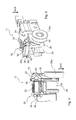
- FIG. 4 is a cross-sectional view of a roller carriage as shown in FIG. 1 through the line 4 - 4 ,
- FIG. 5 is a perspective view of the roller carriage shown in FIG. 4 .
- FIG. 6 is a perspective view of the basic body and the roller module as shown in FIG. 1 .
- FIG. 7 is hypothetical chart showing abstract correlation of two materials in two different sound conducting ranges according to the roller module shown in FIG. 1 .
- a roller carriage 10 includes two structural components, the roller module 20 and the basic body 30 .
- both structural components, namely the roller module 20 and the basic body 30 include a plurality of individual parts. Said individual parts will be briefly explained in the following.
- the roller module 20 is equipped with a bearing device 26 having two rollers 26 a , which are supported to be rotatable at a basic body of the roller module 20 . Said rollers 26 a can be placed onto, respectively inserted into a roller running path 120 , as can be clearly seen in FIG. 2 and FIG. 3 .
- a part of a height adjusting device 70 is provided furthermore at the roller module 20 . The detailed components of said height adjusting device 70 are in particular illustrated in the FIGS. 4 and 5 .
- a first adjusting means 32 is provided, which by means of a manipulation interface 36 is able to perform an adjusting movement.
- the first adjusting means 32 is configured as a threaded bolt in an adjusting thread, a rotary motion is performed at the manipulation interface 36 , which motion simultaneously produces a linear translatory motion of the first adjusting means 32 .
- the first adjusting means 32 is in operative connection with a counter-contacting portion 24 of the second adjusting means 22 of the roller module 20 .
- the explicit action of said adjusting device relates to converting the adjusting movement into a fine-tuning movement along the direction of gravity SKR.
- the roller carriage 10 is equipped with a plurality of different mounting devices 90 , which are able to provide different mounting functions.
- the already described fine-tuning function of the height of the sliding door 110 is provided by means of the mounting device 90 in the shape of the height adjusting device 70 .
- a mounting device in the shape of a securing device 50 is provided, which, after completed fine-tuning of the height of the sliding door 110 , provides a clamping fixing between the basic body 30 and the roller module 20 .
- a further mounting device 90 includes an accessory device 40 , which is provided by means of a corresponding interface and an affixed accessory module 300 .
- a lift-off protection device 60 is a mounting device, which provides a lift-off protection against unwanted removal of the roller carriage 10 out of the position in which it is inserted into the roller running path 120 .
- an attachment device 80 is provided as a glass clamp for a mounting device, in order to affix the sliding door 110 in a clamping manner.
- All mounting devices include at least one mounting means 92 , in order to be able to perform a corresponding mounting movement. Moreover, a manipulation interface is provided, intended to allow for performing exactly said mounting movement with the mounting means.
- the roller carriage 10 has different sides, namely the first side 12 and the second side 14 .
- all mounting devices are preferably aligned from the same side, namely the first side 12 opposite to the second side 14 , on which the bearing device 26 is disposed. This arrangement offers a considerably simpler access.
- FIG. 2 reveals how a sliding door 110 is retained by means of two roller carriages 10 according to FIG. 1 , and that said two roller carriages 10 are already inserted into the roller running path 120 .
- FIG. 3 in particular the correlation of the rollers 26 a with the roller running path 120 is well visible.
- FIG. 6 shows how basically two structural components can be distinguished from each other.
- the components are the roller module 20 and the basic body 30 .
- rollers 26 a which are configured in this case from plastic material, of the bearing device 26 are visible at the roller module 20 .
- the transferring portions 21 are visible, which are able to reach full contact with the appropriate counter-transferring portions 31 of the basic body 30 .
- the basic body includes two U-shaped glass clamps 39 , in which the sliding door 110 can be disposed in a clamped attachment.
- the two structural components of the basic body 30 and the roller module 20 are attached to each other, an inventive material pairing is the result.
- the two materials, namely the first material of the roller module 20 and the second material of the basic body 30 have sound technical properties in this case, as illustrated in an abstract way in FIG. 7 .
- the corresponding conductibility of structure-borne sound is illustrated on the y-axis, whereas a corresponding distinction in different directions, respectively of different types of structure-borne sound is represented on the x-axis.
- the angle of propagation of the structure-borne sound can be plotted on the x-axis.
- a frequency spectrum or an amplitude spectrum can be plotted on the x-axis.
- the two basic sound conducting ranges I and II can be clearly distinguished from each other.
- the corresponding resulting curves for the first material and the second material, namely for the roller module 20 and the basic body 30 are in this case oriented to be complementary, respectively essentially complementary.
- Said structure-borne sound is transferred via the transferring portion 21 and the counter-transferring portion 31 onto the basic body 30 .
- the basic body is equipped with a very poor sound conductance and thereby with a dampening property.
- FIGS. 6 and 7 show in a very illustrative way, in which way the complementary dampening property of the two different materials of roller module 20 and basic body 30 provide the dampening effect within the system.
Landscapes
- Engineering & Computer Science (AREA)
- Mechanical Engineering (AREA)
- Civil Engineering (AREA)
- Structural Engineering (AREA)
- Support Devices For Sliding Doors (AREA)
- Elevator Door Apparatuses (AREA)
Abstract
Description
-
- density between 7 kg/dm3 and 9 kg/dm3,
- shear modulus between 70 kN/mm2 and 90 kN/mm2, and
- E-modulus between 180 kN/mm2 and 240 kN/mm2.
-
- density between 6 kg/dm3 and 8 kg/dm3,
- shear modulus between 30 kN/mm2 and 50 kN/mm2, and
- E-modulus between 70 kN/mm2 and 100 kN/mm2.
-
- density between 7 kg/dm3 and 9 kg/dm3,
- shear modulus between 70 kN/mm2 and 90 kN/mm2, and
- E-modulus between 180 kN/mm2 and 240 kN/mm2.
| STRUC- | |||
| TURAL | |||
| COMPONENT | STRUCTURAL | STRUCTURAL | STRUCTURAL |
| 1 | COMPONENT 2 | COMPONENT 3 | COMPONENT 4 |
| roller running | roller | basic body | glass clamp |
| path | module | ||
| roller module | basic body | glass clamp | |
| roller running | roller module | basic body | |
| path | |||
-
- density between 1 kg/dm3 and 2 kg/dm3,
- shear modulus between 2 kN/mm2 and 6 kN/mm2, and
- E-modulus between 2 kN/mm2 and 3 kN/mm2.
Claims (13)
Applications Claiming Priority (3)
| Application Number | Priority Date | Filing Date | Title |
|---|---|---|---|
| EP14193359 | 2014-11-14 | ||
| EP14193359.8 | 2014-11-14 | ||
| EP14193359.8A EP3020898B1 (en) | 2014-11-14 | 2014-11-14 | Roller carriage for mounting a sliding door |
Publications (2)
| Publication Number | Publication Date |
|---|---|
| US20160138313A1 US20160138313A1 (en) | 2016-05-19 |
| US9834969B2 true US9834969B2 (en) | 2017-12-05 |
Family
ID=51897194
Family Applications (1)
| Application Number | Title | Priority Date | Filing Date |
|---|---|---|---|
| US14/938,645 Expired - Fee Related US9834969B2 (en) | 2014-11-14 | 2015-11-11 | Roller carriage for the reception of a sliding door |
Country Status (3)
| Country | Link |
|---|---|
| US (1) | US9834969B2 (en) |
| EP (1) | EP3020898B1 (en) |
| CN (1) | CN105604427A (en) |
Cited By (2)
| Publication number | Priority date | Publication date | Assignee | Title |
|---|---|---|---|---|
| US10392844B2 (en) * | 2014-11-14 | 2019-08-27 | Dormakaba Deutschland Gmbh | Roller carriage for the reception of a sliding door having at least two mounting devices |
| US11993967B2 (en) * | 2021-12-02 | 2024-05-28 | Amesbury Group, Inc. | Sliding door rollers |
Families Citing this family (5)
| Publication number | Priority date | Publication date | Assignee | Title |
|---|---|---|---|---|
| KR101661080B1 (en) * | 2016-01-11 | 2016-09-28 | 신정철 | A Self-Closing Device for Sliding Door capable of multi-direction rotation |
| KR101718659B1 (en) * | 2016-01-11 | 2017-03-21 | 신정철 | A Self-Closing Device for Sliding Door |
| MX2018008213A (en) * | 2016-09-15 | 2018-12-06 | Goldbrecht Inc | Sliding door and window roller assembly. |
| ES1211844Y (en) * | 2018-03-23 | 2018-07-30 | Cantal Oscar Torrabias | PERIMETER FRAMEWORK FOR GLASS DOORS |
| CN114575693B (en) * | 2022-03-14 | 2023-06-16 | 广东欧派克家居智能科技有限公司 | Damping pulley mechanism |
Citations (13)
| Publication number | Priority date | Publication date | Assignee | Title |
|---|---|---|---|---|
| US2611920A (en) * | 1948-09-14 | 1952-09-30 | Haughton Elevator Company | Track for sliding doors |
| US3837119A (en) * | 1973-05-14 | 1974-09-24 | Ardco Inc | Refrigerator door closure system |
| US5165142A (en) * | 1990-10-04 | 1992-11-24 | Inventio Ag | Runner guide for a sliding elevator door |
| EP0478938B1 (en) * | 1990-10-04 | 1995-01-25 | Inventio Ag | Runner guide for sliding elevator door |
| US6381904B1 (en) * | 2000-06-27 | 2002-05-07 | Kohler Co. | Track mounted bath doors with clip anti-derailer |
| US6540068B1 (en) * | 2000-11-10 | 2003-04-01 | Otis Elevator Company | Rim assembly for a roller assembly for use with cargo mover systems |
| US7143871B2 (en) * | 2000-08-25 | 2006-12-05 | Otis Elevator Company | Elevator roller guide and rail assembly |
| US20070261198A1 (en) * | 2004-10-15 | 2007-11-15 | Dorma Gmbh + Co. Kg | Clamping Connection Between the Clamping Shoe of a Roller and a Sliding Leaf |
| DE102006021443A1 (en) * | 2006-05-09 | 2007-11-29 | Schaeffler Kg | Running device of a horizontally movable sliding door |
| US7779578B2 (en) * | 2005-03-14 | 2010-08-24 | Gray Bill M | Rolling door retainer |
| US20100307063A1 (en) * | 2009-06-04 | 2010-12-09 | Serge Bouthillier | Sliding door system for glass doors |
| US8955195B2 (en) * | 2012-11-25 | 2015-02-17 | Door & Window Hardware Co. | Clamping-sliding assembly for a single-track-suspension sliding door |
| EP2440732B1 (en) * | 2009-06-09 | 2016-01-27 | Planet GDZ AG | Door sealing system |
Family Cites Families (8)
| Publication number | Priority date | Publication date | Assignee | Title |
|---|---|---|---|---|
| US3107947A (en) * | 1961-11-15 | 1963-10-22 | Flambeau Plastics Corp | Nylon wheel and axle assembly |
| DE4002487C2 (en) * | 1990-01-29 | 2002-11-07 | Geze Gmbh | Drive for sliding guidance of sliding windows, sliding doors, machine parts or the like |
| CN2672237Y (en) * | 2003-09-22 | 2005-01-19 | 夏仕成 | Rotary shaft sliding type slide wheel of door and window |
| CN2748610Y (en) * | 2004-11-18 | 2005-12-28 | 夏仕成 | Bridge-shaped support type pulley for plastic-steel door and window |
| CN201486329U (en) * | 2009-06-03 | 2010-05-26 | 林克俭 | Bridge cutoff aluminum alloy pulley |
| WO2010147845A2 (en) * | 2009-06-17 | 2010-12-23 | Hunter Douglas Industries B.V. | Slidable partition suspension systems |
| CN203430262U (en) * | 2013-07-26 | 2014-02-12 | 周裕佳 | Adjustable suspension clamp structure |
| CN203879174U (en) * | 2013-12-11 | 2014-10-15 | 广东坚朗五金制品股份有限公司 | Pulley device for sliding door |
-
2014
- 2014-11-14 EP EP14193359.8A patent/EP3020898B1/en active Active
-
2015
- 2015-11-11 US US14/938,645 patent/US9834969B2/en not_active Expired - Fee Related
- 2015-11-11 CN CN201510767044.1A patent/CN105604427A/en active Pending
Patent Citations (14)
| Publication number | Priority date | Publication date | Assignee | Title |
|---|---|---|---|---|
| US2611920A (en) * | 1948-09-14 | 1952-09-30 | Haughton Elevator Company | Track for sliding doors |
| US3837119A (en) * | 1973-05-14 | 1974-09-24 | Ardco Inc | Refrigerator door closure system |
| US5165142A (en) * | 1990-10-04 | 1992-11-24 | Inventio Ag | Runner guide for a sliding elevator door |
| EP0478938B1 (en) * | 1990-10-04 | 1995-01-25 | Inventio Ag | Runner guide for sliding elevator door |
| US6381904B1 (en) * | 2000-06-27 | 2002-05-07 | Kohler Co. | Track mounted bath doors with clip anti-derailer |
| US7143871B2 (en) * | 2000-08-25 | 2006-12-05 | Otis Elevator Company | Elevator roller guide and rail assembly |
| US6540068B1 (en) * | 2000-11-10 | 2003-04-01 | Otis Elevator Company | Rim assembly for a roller assembly for use with cargo mover systems |
| US20070261198A1 (en) * | 2004-10-15 | 2007-11-15 | Dorma Gmbh + Co. Kg | Clamping Connection Between the Clamping Shoe of a Roller and a Sliding Leaf |
| US7779578B2 (en) * | 2005-03-14 | 2010-08-24 | Gray Bill M | Rolling door retainer |
| DE102006021443A1 (en) * | 2006-05-09 | 2007-11-29 | Schaeffler Kg | Running device of a horizontally movable sliding door |
| US20100307063A1 (en) * | 2009-06-04 | 2010-12-09 | Serge Bouthillier | Sliding door system for glass doors |
| US20150020457A1 (en) * | 2009-06-04 | 2015-01-22 | Groupe Vfg Inc. | Sliding door system for glass doors |
| EP2440732B1 (en) * | 2009-06-09 | 2016-01-27 | Planet GDZ AG | Door sealing system |
| US8955195B2 (en) * | 2012-11-25 | 2015-02-17 | Door & Window Hardware Co. | Clamping-sliding assembly for a single-track-suspension sliding door |
Cited By (2)
| Publication number | Priority date | Publication date | Assignee | Title |
|---|---|---|---|---|
| US10392844B2 (en) * | 2014-11-14 | 2019-08-27 | Dormakaba Deutschland Gmbh | Roller carriage for the reception of a sliding door having at least two mounting devices |
| US11993967B2 (en) * | 2021-12-02 | 2024-05-28 | Amesbury Group, Inc. | Sliding door rollers |
Also Published As
| Publication number | Publication date |
|---|---|
| CN105604427A (en) | 2016-05-25 |
| US20160138313A1 (en) | 2016-05-19 |
| EP3020898A1 (en) | 2016-05-18 |
| EP3020898B1 (en) | 2020-12-30 |
Similar Documents
| Publication | Publication Date | Title |
|---|---|---|
| US20160138313A1 (en) | Roller carriage for the reception of a sliding door | |
| EP4549855A3 (en) | Refrigerator | |
| MX2007011420A (en) | Damper embedded in a home bar door of a refrigerator and method for manufacturing the same. | |
| JP2013503988A5 (en) | ||
| US20170167173A1 (en) | Hinge constructions | |
| BRPI0514846A (en) | U-shaped clamping piece | |
| MX2011011677A (en) | Stricker with round antichuck bumper. | |
| NZ587451A (en) | Stationary household appliance, in particular a dishwasher with sound damping means on the hinge support. | |
| TW200737150A (en) | Viscous fluid-filled damper and mounting structure for viscous fluid-filled damper | |
| US20100236871A1 (en) | Elevator door vibration and noise isolator | |
| CN106998909B (en) | Improved furniture pieces including roller assemblies | |
| RU2443839C2 (en) | Rotary support for clamping mechanism of closing device | |
| DE502005006848D1 (en) | INSTALLATION HOUSEHOLD APPLIANCE | |
| EP1319783A1 (en) | Door stop for vehicles | |
| JPH1193553A (en) | Guide support device | |
| JP7759837B2 (en) | Door device | |
| DE202004002672U1 (en) | Attachment for two housing parts, preferably of window lifter, to body part forming bearer part has holding element with spring-elastic element near mounting opening that interacts with outer surface of journal | |
| ES2430321T3 (en) | Door opening device | |
| CN213477960U (en) | Spring hinge | |
| US8209906B2 (en) | Noise dampener for a garage door opener | |
| JP2014001763A (en) | Chain | |
| KR101446574B1 (en) | Door stopper with damping function | |
| GB0808562D0 (en) | Door hinge assembly | |
| SE0502835L (en) | Mounts | |
| JPH0737961Y2 (en) | Wedge bumper device for vehicle door |
Legal Events
| Date | Code | Title | Description |
|---|---|---|---|
| AS | Assignment |
Owner name: DORMA DEUTSCHLAND GMBH, GERMANY Free format text: ASSIGNMENT OF ASSIGNORS INTEREST;ASSIGNORS:KREYENBORG, RALF;VOGLER, THOMAS;SIGNING DATES FROM 20151113 TO 20151119;REEL/FRAME:037320/0173 |
|
| AS | Assignment |
Owner name: DORMAKABA DEUTSCHLAND GMBH, GERMANY Free format text: CHANGE OF NAME;ASSIGNOR:DORMA DEUTSCHLAND GMBH;REEL/FRAME:044090/0447 Effective date: 20161014 |
|
| STCF | Information on status: patent grant |
Free format text: PATENTED CASE |
|
| MAFP | Maintenance fee payment |
Free format text: PAYMENT OF MAINTENANCE FEE, 4TH YEAR, LARGE ENTITY (ORIGINAL EVENT CODE: M1551); ENTITY STATUS OF PATENT OWNER: LARGE ENTITY Year of fee payment: 4 |
|
| AS | Assignment |
Owner name: DORMA-GLAS GMBH, GERMANY Free format text: ASSIGNMENT OF ASSIGNORS INTEREST;ASSIGNOR:DORMAKABA DEUTSCHLAND GMBH;REEL/FRAME:058671/0328 Effective date: 20211028 |
|
| FEPP | Fee payment procedure |
Free format text: MAINTENANCE FEE REMINDER MAILED (ORIGINAL EVENT CODE: REM.); ENTITY STATUS OF PATENT OWNER: LARGE ENTITY |
|
| LAPS | Lapse for failure to pay maintenance fees |
Free format text: PATENT EXPIRED FOR FAILURE TO PAY MAINTENANCE FEES (ORIGINAL EVENT CODE: EXP.); ENTITY STATUS OF PATENT OWNER: LARGE ENTITY |
|
| STCH | Information on status: patent discontinuation |
Free format text: PATENT EXPIRED DUE TO NONPAYMENT OF MAINTENANCE FEES UNDER 37 CFR 1.362 |
|
| FP | Lapsed due to failure to pay maintenance fee |
Effective date: 20251205 |