US9829794B2 - Exposure apparatus, and method of manufacturing device - Google Patents

Exposure apparatus, and method of manufacturing device Download PDF

Info

Publication number
US9829794B2
US9829794B2 US14/994,686 US201614994686A US9829794B2 US 9829794 B2 US9829794 B2 US 9829794B2 US 201614994686 A US201614994686 A US 201614994686A US 9829794 B2 US9829794 B2 US 9829794B2
Authority
US
United States
Prior art keywords
substrate
exposure
optical system
light
peripheral portion
Prior art date
Legal status (The legal status is an assumption and is not a legal conclusion. Google has not performed a legal analysis and makes no representation as to the accuracy of the status listed.)
Active
Application number
US14/994,686
Other versions
US20160209763A1 (en
Inventor
Nobuyuki Saito
Current Assignee (The listed assignees may be inaccurate. Google has not performed a legal analysis and makes no representation or warranty as to the accuracy of the list.)
Canon Inc
Original Assignee
Canon Inc
Priority date (The priority date is an assumption and is not a legal conclusion. Google has not performed a legal analysis and makes no representation as to the accuracy of the date listed.)
Filing date
Publication date
Application filed by Canon Inc filed Critical Canon Inc
Assigned to CANON KABUSHIKI KAISHA reassignment CANON KABUSHIKI KAISHA ASSIGNMENT OF ASSIGNORS INTEREST (SEE DOCUMENT FOR DETAILS). Assignors: SAITO, NOBUYUKI
Publication of US20160209763A1 publication Critical patent/US20160209763A1/en
Application granted granted Critical
Publication of US9829794B2 publication Critical patent/US9829794B2/en
Active legal-status Critical Current
Anticipated expiration legal-status Critical

Links

Images

Classifications

    • GPHYSICS
    • G03PHOTOGRAPHY; CINEMATOGRAPHY; ANALOGOUS TECHNIQUES USING WAVES OTHER THAN OPTICAL WAVES; ELECTROGRAPHY; HOLOGRAPHY
    • G03FPHOTOMECHANICAL PRODUCTION OF TEXTURED OR PATTERNED SURFACES, e.g. FOR PRINTING, FOR PROCESSING OF SEMICONDUCTOR DEVICES; MATERIALS THEREFOR; ORIGINALS THEREFOR; APPARATUS SPECIALLY ADAPTED THEREFOR
    • G03F7/00Photomechanical, e.g. photolithographic, production of textured or patterned surfaces, e.g. printing surfaces; Materials therefor, e.g. comprising photoresists; Apparatus specially adapted therefor
    • G03F7/70Microphotolithographic exposure; Apparatus therefor
    • G03F7/70483Information management; Active and passive control; Testing; Wafer monitoring, e.g. pattern monitoring
    • GPHYSICS
    • G03PHOTOGRAPHY; CINEMATOGRAPHY; ANALOGOUS TECHNIQUES USING WAVES OTHER THAN OPTICAL WAVES; ELECTROGRAPHY; HOLOGRAPHY
    • G03FPHOTOMECHANICAL PRODUCTION OF TEXTURED OR PATTERNED SURFACES, e.g. FOR PRINTING, FOR PROCESSING OF SEMICONDUCTOR DEVICES; MATERIALS THEREFOR; ORIGINALS THEREFOR; APPARATUS SPECIALLY ADAPTED THEREFOR
    • G03F7/00Photomechanical, e.g. photolithographic, production of textured or patterned surfaces, e.g. printing surfaces; Materials therefor, e.g. comprising photoresists; Apparatus specially adapted therefor
    • G03F7/20Exposure; Apparatus therefor
    • G03F7/2022Multi-step exposure, e.g. hybrid; backside exposure; blanket exposure, e.g. for image reversal; edge exposure, e.g. for edge bead removal; corrective exposure
    • G03F7/2026Multi-step exposure, e.g. hybrid; backside exposure; blanket exposure, e.g. for image reversal; edge exposure, e.g. for edge bead removal; corrective exposure for the removal of unwanted material, e.g. image or background correction
    • G03F7/2028Multi-step exposure, e.g. hybrid; backside exposure; blanket exposure, e.g. for image reversal; edge exposure, e.g. for edge bead removal; corrective exposure for the removal of unwanted material, e.g. image or background correction of an edge bead on wafers
    • GPHYSICS
    • G03PHOTOGRAPHY; CINEMATOGRAPHY; ANALOGOUS TECHNIQUES USING WAVES OTHER THAN OPTICAL WAVES; ELECTROGRAPHY; HOLOGRAPHY
    • G03FPHOTOMECHANICAL PRODUCTION OF TEXTURED OR PATTERNED SURFACES, e.g. FOR PRINTING, FOR PROCESSING OF SEMICONDUCTOR DEVICES; MATERIALS THEREFOR; ORIGINALS THEREFOR; APPARATUS SPECIALLY ADAPTED THEREFOR
    • G03F7/00Photomechanical, e.g. photolithographic, production of textured or patterned surfaces, e.g. printing surfaces; Materials therefor, e.g. comprising photoresists; Apparatus specially adapted therefor
    • G03F7/70Microphotolithographic exposure; Apparatus therefor
    • G03F7/70691Handling of masks or workpieces
    • G03F7/70716Stages
    • G03F7/70725Stages control

Definitions

  • the present invention relates to an exposure apparatus, and a method of manufacturing a device.
  • a resist photosensitive agent
  • the resist is peeled off, for example, during substrate transfer, which may cause a defect of the semiconductor devices.
  • the resist of the peripheral portion of the substrate is exposed (peripheral exposure) using an exposure apparatus (a so-called peripheral exposure apparatus), and the resist is removed in a subsequent developing process.
  • an exposure apparatus a so-called peripheral exposure apparatus
  • Japanese Patent Laid-Open No. 9-260263 discloses a peripheral exposure apparatus that performs focus adjustment by detecting a change in a relative distance between a peripheral exposure means and a resist coating surface of the substrate, and by performing the driving of the focusing direction of the peripheral exposure means based on the detected relative distance.
  • the present invention provides, for example, an exposure apparatus that is advantageous in accuracy of a portion of a substrate exposed by peripheral exposure thereof to light.
  • the present invention has an exposure apparatus that exposes a peripheral portion of a substrate to light.
  • the apparatus comprising: an optical system configured to irradiate the substrate with the light; a stage configured to hold the substrate and be moved in a direction to position the substrate in a direction perpendicular to an optical axis of the optical system; and a controller configured to cause the stage to be moved, wherein the controller is configured to cause the stage to be moved based on information about a distance between the optical system and the peripheral portion in a direction parallel to the optical axis and a telecentricity of the optical system so that a predetermined portion of the substrate is irradiated with the light from the optical system.
  • FIG. 1 is a diagram illustrating a configuration of an exposure apparatus according to a first embodiment.
  • FIG. 2A is a diagram illustrating a state at the time of a peripheral exposure in the first embodiment.
  • FIG. 2B is a diagram illustrating a state at the time of the peripheral exposure in the first embodiment.
  • FIG. 3 is a flow chart illustrating the flow of the peripheral exposure in the first embodiment.
  • FIG. 4A is a diagram illustrating a configuration of an exposure apparatus according to a second embodiment.
  • FIG. 4B is a diagram illustrating the configuration of the exposure apparatus according to the second embodiment.
  • FIG. 5 is a flowchart illustrating the flow of the peripheral exposure in the second embodiment.
  • FIG. 6 is a diagram illustrating a configuration of an exposure apparatus according to a third embodiment.
  • FIG. 7A is a diagram illustrating a state at the time of the peripheral exposure in the third embodiment.
  • FIG. 7B is a diagram illustrating a state at the time of the peripheral exposure in the third embodiment.
  • FIG. 8 is a flowchart illustrating the flow of the peripheral exposure in the third embodiment.
  • FIG. 9 is a diagram illustrating a configuration of an exposure apparatus according to a fourth embodiment.
  • FIG. 10 is a flowchart illustrating the flow of the peripheral exposure in the fourth embodiment.
  • FIG. 11 is a diagram illustrating a configuration of an exposure system according to an embodiment.
  • FIG. 1 is a schematic cross-sectional view illustrating a configuration of an exposure apparatus 100 according to this embodiment.
  • the exposure apparatus 100 has a stage S including a substrate holder 1 , a rotary driving unit 2 and a translational driving unit 3 , a detector 4 , an exposure unit 5 , and a control system 20 . Further, in each drawing below FIG.
  • an X-axis and a Y-axis in a direction perpendicular to the X-axis are defined in a plane perpendicular to a Z-axis in a vertical direction.
  • the substrate W is, for example, made of monocrystalline silicon, and is a substrate to be processed on which the resist is applied to the surface.
  • the substrate holder 1 holds a substantially central position of a rear surface of the substrate W.
  • the rotary driving unit (rotary unit) 2 supports the substrate holder 1 and is rotatable.
  • the translational driving unit 3 supports the rotary driving unit 2 and is, for example, movable in the X-axis direction, that is, allows the substrate holder 1 to move in the X-axis direction.
  • the detector 4 detects the position of the peripheral portion of the substrate W held by the substrate holder 1 , for example, a position of a notch or an orientation flat that is previously formed on the substrate W.
  • the exposure unit 5 includes a light source (not illustrated), a driving slit 6 and an exposure optical system (an optical system) 18 .
  • the light source emits light (e.g., ultraviolet light) toward the exposure optical system 18 .
  • the driving slit (a member of a field stop) 6 has an opening through which light emitted from the light source passes to define an exposure region, and its opening shape (an opening width) is variable.
  • the exposure optical system 18 irradiates (images) a predetermined position on the substrate W using the light passing through the opening of the driving slit 6 as the exposure light.
  • the control system (a controller) 20 performs the control of the operation of each element constituting the exposure apparatus 100 (the movement operation of the substrate holder 1 , the driving operation of the driving slit 6 and the like), and the arithmetic operations for the operation, and includes an input unit and a control circuit as follows.
  • Information about conditions of the peripheral exposure, such as an exposure amount, an exposure position or an exposure width is received by (input to) a first information input unit 9 from the outside.
  • Information (distance information D) about a distance between the substrate W held by the substrate holder 1 and the exposure optical system 18 in the direction parallel to the optical axis of the exposure optical system 18 is received by (input to) a second information input unit 12 from the outside.
  • a driving condition calculation unit 8 calculates the rotational speed of the rotary driving unit 2 at the time of the peripheral exposure based on the exposure amount obtained from the first information input unit 9 . Further, the driving condition calculation unit 8 calculates the position in the X-axis direction of the substrate W at the time of the peripheral exposure based on the exposure position obtained from the first information input unit 9 . The driving condition calculation unit 8 may calculate the position in the X-axis direction of the substrate W to adjust the deviation of the center position of the substrate W in the X-Y plane obtained by the detection using the detector 4 .
  • the driving condition calculation unit 8 obtains an azimuth angle ⁇ of the substrate W held by the substrate holder 1 W based on a reference position in an azimuth angle direction of the substrate W, such as a notch or an orientation flat detected by the detector 4 . Furthermore, the driving condition calculation unit 8 calculates the position in the X-axis direction of the translational driving unit 3 based on the distance information D obtained from the second information input unit 12 . The driving slit condition calculation unit 10 calculates an opening width set in the driving slit 6 based on the exposure width obtained from the first information input unit 9 .
  • An X ⁇ controller 7 drives the rotary driving unit 2 an amount of movement (driving amount) at which the substrate W is located at the position in the X-axis direction determined by the driving condition calculation unit 8 .
  • the driving slit opening width controller 11 drives the driving slit 6 to an opening width determined by the driving slit condition calculation unit 10 .
  • the exposure unit 5 irradiates a part of the peripheral portion of the substrate W with the exposure light while the X ⁇ controller 7 rotates the rotary driving unit (rotation device) 2 at a desired rotational speed, and thus the exposure apparatus 100 can expose the entire peripheral portion of the substrate W at a set exposure position or a set exposure width.
  • the X ⁇ controller 7 rotates the rotary driving unit (rotation device) 2 at a desired rotational speed, and thus the exposure apparatus 100 can expose the entire peripheral portion of the substrate W at a set exposure position or a set exposure width.
  • the shape of the substrate W is not flat and especially when the peripheral portion is warped, or when the thickness is uneven, if the peripheral exposure is performed without taking any precautions, there is a possibility of the following inconvenience.
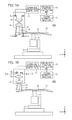
  • FIGS. 2A and 2B are schematic cross-sectional views illustrating a state of the exposure apparatus 100 when the peripheral exposure of the substrate W is performed while a peripheral portion is warped toward a vertically lower side.
  • FIG. 2A illustrates a state prior to offsetting the position of the substrate W.
  • the exposed surface on the substrate W is defocused from an ideal imaging surface 15 illustrated by a two-dot chain line.
  • a general peripheral exposure apparatus is designed so that the main light beam 13 of the exposure optical system is perpendicular to the ideal imaging surface 15 , in other words, parallel to the optical axis of the exposure optical system.
  • the main light beam of the exposure optical system is not perpendicular to the ideal imaging surface 15 due to manufacturing errors or assembly errors, and for example, as illustrated by the main light beam 14 in the drawings, the on-axis main light beam and the off-axis main light beam are inclined in the same direction. Therefore, when the peripheral exposure of the substrate W is performed while the main light beam is inclined without applying the present embodiment, the main light beam is exposed to a position 17 deviated by an amount ⁇ p determined by the defocus amount and the amount of inclination of the main beam with respect to the ideal exposure position 16 . Therefore, in this embodiment, the exposure apparatus 100 performs the peripheral exposure after adjusting the position of the substrate W (the exposure position relative to the substrate W), that is, after offsetting the position of the substrate W by the amount of deviation ⁇ p of the exposure position as follows.
  • FIG. 3 is a flowchart illustrating the flow of the peripheral exposure in the present embodiment.
  • the second information input unit 12 acquires distance information D about the distance between the substrate W held by the substrate holder 1 and the exposure optical system 18 (step S 101 ).
  • the distance information D includes at least one of the warp amount and the thickness of the substrate W, and before the substrate W is held by the substrate holder 1 , the information is measured in advance using a measuring device (measuring unit) (not illustrated). Further, the measuring device may be included or may not be included as a component of the exposure apparatus 100 .
  • the measuring device configured to measure the distance between the substrate W held by the substrate holder 1 and the exposure optical system 18 may be installed inside the exposure apparatus 100 , and the results measured by the measuring device may be directly input to the second information input unit 12 .
  • the measuring device can also be used in combination with the detector 4 .
  • the second information input unit 12 can acquire as accurate distance information D as possible.
  • the timing (timing of executing step S 101 ) of acquiring the distance information D may be provided for each substrate W, may be provided for each lot including a plurality of substrates W, or may be provided for each process.
  • the driving condition calculation unit 8 acquires the amount of inclination of the main light beam 14 of the exposure optical system 18 (step S 102 ).
  • the amount of inclination of the main light beam 14 is an amount of inclination of the on-axis main beam or the off-axis main beam to the ideal main light beam 13 (the optical axis of the exposure optical system 18 ), and may be telecentricity.
  • the telecentricity also includes an amount of inclination (an amount of spread) when there is spreading with respect to the optical axis of the exposure optical system 18 , as in a main light beam 19 referred to in the following third embodiment, as well as the amount of inclination when the on-axis main light beam and the off-axis main light beam are inclined in parallel in the same direction.
  • the amount of inclination of the main light beam 14 is obtained in advance, for example, by performing the peripheral exposure of the substrates W having the different thicknesses, and by measuring a change in position of the peripheral exposure for each thickness of the substrate W using an inspecting device (inspection unit) (not illustrated).
  • the driving condition calculation unit 8 calculates the amount of deviation ⁇ p of the exposure position based on the distance information D obtained in step S 101 and the amount of inclination of the main light beam 14 of the exposure optical system 18 (step S 103 ).
  • an inclination angle of the main light beam 14 with respect to the ideal imaging surface 15
  • d an amount of deviation (defocus amount) of the position in the focusing direction (in this case, the Z-axis direction) of the substrate W from the ideal imaging surface 15
  • the driving condition calculation unit 8 further calculates the position in the X-axis direction of the substrate W to adjust the amount of deviation ⁇ p of the exposure position (step S 104 ).
  • the X ⁇ controller 7 drives the translational driving unit 3 , and moves the rotary driving unit 2 to a position in the X-axis direction determined in step S 104 (step S 105 ). In this way, the movement of the rotary driving unit 2 only in the X-axis direction reduces the influence of telecentricity, and one positioned in the Y-axis direction in advance is assumed.
  • the X-axis direction is an example, and it may be any direction in a radial direction of the substrate W.
  • an exposure controller (not illustrated) irradiates the exposure unit 5 with the exposure light, while the X ⁇ controller 7 drives the rotary driving unit 2 to rotate the substrate W on the substrate holder 1 at a desired rotational speed, thereby performing the peripheral exposure (step S 106 ).
  • FIG. 2B illustrates a state when the peripheral exposure is performed the position of the substrate W offset by ⁇ p.
  • the exposure apparatus 100 does not require a driving unit for moving the substrate W held by the substrate holder 1 in the focusing direction (Z-axis direction) when the position of the substrate W is offset. Therefore, the exposure apparatus 100 can have a simple configuration.
  • the exposure apparatus 100 can also be applied to a case in which the peripheral portion of the substrate W is warped upward. Furthermore, as factors in which the position in the focusing direction of the surface to be exposed on the substrate W is deviated from the ideal imaging surface 15 , since the thickness of the substrate W is also included without being limited to the warp of the substrate W, the exposure apparatus 100 is also applicable to the substrate W in which the thickness locally changes.
  • the exposure apparatus according to this embodiment is characterized in that the distance information D( ⁇ ) for each azimuth angle ⁇ of the substrate W is provided instead of the distance information D in the first embodiment, and the peripheral exposure is performed while the offset amount ⁇ p( ⁇ ) of the substrate W is changed according to the distance information D( ⁇ ) depending on the azimuth angle ⁇ .
  • FIGS. 4A and 4B are schematic cross-sectional views illustrating the configuration of the exposure apparatus 200 according to this embodiment, and a state of the exposure apparatus 200 when the peripheral exposure of the substrate W is performed while the peripheral portion is warped toward the vertically lower side.
  • FIG. 4A illustrates a state when an azimuth angle of the substrate W is ⁇ 1 , and the position of the substrate W is offset by ⁇ p( ⁇ 1 ) to perform the peripheral exposure.
  • FIG. 4B illustrates a state when the azimuth angle of the substrate W is ⁇ 2 , and the position of the substrate W is offset by ⁇ p( ⁇ 2 ) to perform the peripheral exposure.
  • the exposure apparatus 200 performs the peripheral exposure, by offsetting the position of the substrate W in the case illustrated in FIG. 4A more significantly than in the case illustrated in FIG. 4B .
  • FIG. 5 is a flowchart illustrating the flow of the peripheral exposure in the present embodiment.
  • the second information input unit 12 acquires distance information D( ⁇ ) about the distance between the substrate W held by the substrate holder 1 and the exposure optical system 18 , for each azimuth angle ⁇ of the substrate W (step S 201 ).
  • the driving condition calculation unit 8 acquires the amount of inclination of the main light beam 14 of the exposure optical system 18 (step S 202 ).
  • the driving condition calculation unit 8 further calculates the position in the X-axis direction of the substrate W to adjust the amount of deviation ⁇ p of the exposure position for each azimuth angle ⁇ of the substrate (step S 204 ).
  • the X ⁇ controller 7 rotates the substrate W at a desired rotational speed by driving the rotary driving unit 2 , and at the same time, the peripheral exposure is performed while the translational driving unit 3 is driven to the position in the X-axis direction determined in step S 204 for each azimuth angle ⁇ of the substrate W (step S 205 ).
  • the means for adjusting the exposure position is not limited thereto.
  • the driving slit 6 may be moved in the X-axis direction while the opening width is maintained (in the case of the configuration in which the driving slit 6 includes a plurality of blades with which the opening width is variable, a constant interval is maintained between the plurality of blades).
  • the exposure apparatus according to this embodiment is characterized in that the peripheral exposure is performed after changing the opening width of the driving slit (adjustment unit) 6 depending on the distance information D referred to in the first embodiment.
  • FIG. 6 is a schematic cross-sectional view illustrating a configuration of an exposure apparatus 300 according to this embodiment.
  • FIGS. 7A and 7B are schematic cross-sectional views illustrating a state of the exposure apparatus 300 when the peripheral exposing of the substrate W is performed while the peripheral portion is warped toward the vertically lower side.
  • FIG. 7A illustrates a state before the offset of the opening width of the driving slit 6 .
  • FIG. 7B illustrates a state after the offset of the opening width of the driving slit 6 .
  • the same configurations as those of the exposure apparatus 100 according to the first embodiment illustrated in FIGS. 1, 2A and 2B are denoted by the same reference numerals, and the description thereof will be omitted.
  • the main light beam of the actual exposure optical system is not perpendicular to the ideal imaging surface 15 , due to a manufacturing error or an assembly error as described above.
  • the exposure width of the peripheral exposure changes to spread with respect to the optical axis of the exposure optical system 18 , the exposure is performed at a position deviated by ⁇ w from a predetermined exposure position.
  • the driving slit condition calculation unit 10 calculates the amount of deviation ⁇ w of the exposure width based on the distance information D, and the driving slit opening width controller 11 controls the opening width of the driving slit 6 so that the exposure width on the surface of the substrate W is offset by ⁇ w at the time of the peripheral exposure.
  • the offset amount of the opening width of the driving slit 6 is (amount of deviation ⁇ w of the exposure width on the surface of the substrate W)/(magnification ⁇ of the exposure optical system 18 ).
  • FIG. 8 is a flowchart illustrating the flow of the peripheral exposure in the present embodiment.
  • step S 301 is identical to step S 101 of FIG. 3 in the first embodiment.
  • the driving condition calculation unit 8 acquires an amount of inclination (an amount of spread) of the main light beam 19 of the exposure optical system 18 (step S 302 ).
  • the driving slit condition calculation unit 10 calculates the amount of deviation ⁇ w of the exposure width based on the distance information D obtained in step S 301 and the amount of inclination of the main light beam 19 of the exposure optical system 18 (step S 303 ).
  • the driving slit condition calculation unit 10 calculates the opening width to adjust the amount of deviation ⁇ w of the exposure width (step S 304 ).
  • the driving slit opening width controller 11 drives the driving slit 6 to an opening width determined in step S 304 (step S 305 ).
  • the X ⁇ controller 7 drives the rotary driving unit 2 to rotate the substrate W on the substrate holder 1 at a desired rotational speed, the peripheral exposure is performed (step S 306 ).
  • a means of changing the opening width of the driving slit 6 is adopted as the means for adjusting the exposure width
  • a means of changing the magnification ⁇ of the exposure optical system 18 by moving a part of the optical element constituting the exposure optical system 18 in the optical axis direction may be adopted.
  • an amount of deviation ⁇ w( ⁇ ) may be determined for each azimuth angle ⁇ of the substrate W, and the peripheral exposure may be performed with the opening width ⁇ w( ⁇ )/ ⁇ of the driving slit 6 offset.
  • the exposure apparatus according to this embodiment is characterized in that the opening width of the driving slit (adjustment unit) 6 is more complexly changed depending on the distance information D to improve upon the third embodiment.
  • FIG. 9 is a schematic cross-sectional view illustrating a configuration of an exposure apparatus 400 of the present embodiment, and a state of the exposure apparatus 400 when the peripheral exposure of the substrate W is performed while the peripheral portion is warped toward the vertically lower side.
  • the same configurations as those of the exposure apparatus 100 according to the first embodiment illustrated FIGS. 1, 2A and FIG. 2B are denoted by the same reference numerals, and the description thereof will be omitted.
  • the driving slit 6 includes a plurality (two in this embodiment) of blades 6 a and 6 b that form an opening interposed from both sides in the X-axis direction and are movable by different amounts of movement (amounts of drive) from each other by driving of the driving unit.
  • the exposure apparatus 300 determines each of the offset amount ( ⁇ w 1 / ⁇ ) of the blade 6 a and the offset amount ( ⁇ w 2 / ⁇ ) of the blade 6 b , and suitably changes the amount of offset for each of the blades 6 a and 6 b to perform the peripheral exposure.
  • FIG. 10 is a flowchart illustrating the flow of the peripheral exposure in the present embodiment.
  • the second information input unit 12 acquires the distance information D about the distance in the radial distances X 1 and X 2 of the substrate W between the substrate W held by the substrate holder 1 and the exposure optical system 18 (step S 401 ).
  • the driving condition calculation unit 8 acquires an amount of inclination of the main light beam 19 of the exposure optical system 18 (step S 402 ).
  • the driving slit opening width controller 11 drives the respective blades 6 a and 6 b to the positions calculated in step S 404 (step S 405 ). Further, while the X ⁇ controller 7 drives the rotary driving unit 2 to rotate the substrate W on the substrate holder 1 at a desired rotation speed, the peripheral exposure is performed (step S 406 ).
  • the distance information D including the warp amount and the thickness of the substrate W is set as values obtained by the actual measurement.
  • the distance information D that is acquired by the second information input unit 12 in step S 101 or the like and is used in the subsequent process may be classified into a plurality of degrees between the substrate W and the exposure optical system 18 depending on the magnitude.
  • the degrees for example, there is a warp amount of the substrate W that can be recognized in advance due to the process, and this can be classified into several degrees such as “large,” “medium” and “small.” If the degree is “large,” the driving condition calculation unit 8 and the driving slit condition calculation unit 10 may determine the offset amount depending on the degree of “large” and may offset the substrate holder 1 and the driving slit 6 .
  • the offset amounts of the exposure position or the exposure width were determined to adjust the deviation of the exposure position due to the amount of defocus (warp amount or the like) of the substrate W and the amount of inclination (telecentricity) of the main light beam.
  • the offset amount is not limited to this determination method, and for example, it may be determined in consideration of a blurring width of a boundary of the exposure region due to defocus.
  • the blurring width refers to a radial width of a blurred region that is generated at the boundary between an irradiation region of the exposure light and a non-irradiation region of the exposure light by the defocus.
  • the driving condition calculation unit 8 acquires the number of openings NA of the exposure optical system 18 stored in a memory or the like in advance.
  • FIG. 11 is a schematic diagram illustrating a configuration of an exposure system 500 according to this embodiment.
  • the exposure system 500 for example, is used in a lithography process in the manufacturing process of the semiconductor device, and is a projection exposure apparatus that exposes (transfers) an image of a pattern formed on an original R onto the substrate W (on the substrate) in a step-and-repeat method.
  • the exposure system 500 includes an illumination system 90 , an original stage 80 , a projection optical system 70 and a substrate stage 21 .
  • the illumination system 90 adjusts the light emitted from a light source (not illustrated) to illuminate the original (reticle) R.
  • the original (reticle) R is, for example, made of quartz glass, and is formed with a pattern (e.g., a circuit pattern) to be transferred onto the substrate W.
  • the original stage 80 holds the original R and is movable in each of the X- and Y-axis directions.
  • the projection optical system 70 projects the light passing through the original R onto the substrate W at a predetermined magnification (e.g., 1 ⁇ 2).
  • the substrate stage 21 holds the substrate and is movable in each of the W and X-, Y- and Z-axis directions.
  • the exposure system 500 includes two types of alignment units including a first alignment unit 600 and a second alignment unit 700 . Furthermore, the exposure system 500 includes a first carrying mechanism 50 which carries the substrate W from an interface 40 , such as a line or a FOUP, to the first alignment unit 600 , and a second carrying mechanism 60 that carries the substrate W from the first alignment unit 600 to the second alignment unit 700 .
  • a first carrying mechanism 50 which carries the substrate W from an interface 40 , such as a line or a FOUP, to the first alignment unit 600
  • a second carrying mechanism 60 that carries the substrate W from the first alignment unit 600 to the second alignment unit 700 .
  • the first alignment unit 600 performs so-called pre-alignment of aligning the position of the substrate W to a desired position with precision that is coarser than precision of the positioning (alignment) performed by the second alignment unit 700 .
  • an exposure apparatus a peripheral exposure apparatus
  • the first alignment unit 600 includes a control system 20 as a first controller including an image processing unit, a rotary driving unit 2 and a translational driving unit 3 as the first driving unit, a detector 4 as a first detection unit, and an exposure unit 5 .
  • the control system 20 causes the detector 4 to detect the shape of the substrate W, performs the image processing on the detection result, and causes the rotary driving unit 2 and the translational driving unit 3 to appropriately change the attitude of the substrate W based on the image processing result to a desired position.
  • the second alignment unit 700 performs the alignment that matches an irradiation region irradiated with the exposure light emitted from the projection optical system 70 , and a pattern region (a shot region) set on the substrate W in advance. Specifically, the second alignment unit 700 detects and matches marks (alignment marks) 31 formed on the substrate W in advance with precision finer than the positioning precision of the first alignment unit 600 .
  • the second alignment unit 700 includes a second controller 24 , a second detection unit 22 and an image processing unit 23 , in addition to the substrate stage 21 as the second driving unit.
  • the second detection unit 22 is, for example, an alignment scope which detects the marks 31 .
  • the second controller 24 causes the second detection unit 22 to detect the marks 31 , causes the image processing unit 23 to perform the image-processing on the detection result, and causes the substrate stage 21 to appropriately change the position of the substrate W based on the image processing result to a desired position.
  • the exposure system 500 has a controller 30 .
  • the controller 30 for example, is constituted by a computer or the like, is connected to each component of the exposure system 500 via a line, and can control the operation and the adjustment of each component according to a program or the like.
  • the controller 30 is electrically connected to each of the control system 20 and the second controller 24 via communication lines, controls the operation of the first alignment unit 600 and the second alignment unit 700 , and receives each detection result.
  • the controller 30 may be configured integrally with other parts of the exposure system 500 (within a common casing), and may be configured separately from other parts of the exposure system 500 (within a separate casing).
  • the exposure system 500 performs positioning twice with the first alignment unit 600 and the second alignment unit 700 before the exposure is initiated.
  • the first carrying mechanism 50 carries the substrate W carried in from the interface 40 to the first alignment unit 600 , and the first alignment unit 600 performs the pre-alignment of the wafer W as a target.
  • the second carrying mechanism 60 carries the substrate W, on which the pre-alignment is completed by the first alignment unit 600 , to the substrate stage 21 as a component of the second alignment unit 700 .
  • the second alignment unit 700 performs the alignment of the wafer W as a target.
  • the exposure system 500 performs the pattern exposure on the substrate W on which the alignment is completed.
  • the entire system can have a simple configuration. Further, according to the exposure system 500 , in the first alignment unit 600 , since the occurrence of deviation of the exposure position in the peripheral portion of the substrate W is suppressed and the peripheral exposure can be accurately performed, it is possible to suppress undesirable effects on the patterns formed on the substrate W.
  • a method of manufacturing devices is suitable for manufacturing an article such as a microdevice (for example, a liquid crystal display device) or an element having a microstructure.
  • This manufacturing method can include a step of forming a latent image pattern on a photosensitive agent of a substrate onto which the photosensitive agent is applied by using the above-described exposure system (step of exposing on the substrate), and a step of developing the substrate on which the latent image pattern is formed. Further, this manufacturing method includes other well-known steps (for example, oxidization, deposition, vapor deposition, doping, planarization, etching, resist removal, dicing, bonding, packaging and the like).
  • the method of manufacturing devices according to the embodiment is superior to a conventional method in at least one of the performance, quality, productivity, and production cost of the article.

Landscapes

  • Physics & Mathematics (AREA)
  • General Physics & Mathematics (AREA)
  • Exposure And Positioning Against Photoresist Photosensitive Materials (AREA)
  • Health & Medical Sciences (AREA)
  • Engineering & Computer Science (AREA)
  • Environmental & Geological Engineering (AREA)
  • Epidemiology (AREA)
  • Public Health (AREA)
  • Container, Conveyance, Adherence, Positioning, Of Wafer (AREA)
  • Exposure Of Semiconductors, Excluding Electron Or Ion Beam Exposure (AREA)

Abstract

An exposure apparatus exposes a peripheral portion of a substrate to light, and includes an optical system configured to irradiate the substrate with the light, a stage configured to hold the substrate and be moved in a direction to position the substrate in a direction perpendicular to the optical axis of the optical system, and a controller configured to cause the stage to be moved. The controller moves the stage based on information about a distance between the optical system and the peripheral portion in a direction parallel to the optical axis and a telecentricity of the optical system so that a predetermined portion of the substrate is irradiated with the light from the optical system.

Description

BACKGROUND OF THE INVENTION
Field of the Invention
The present invention relates to an exposure apparatus, and a method of manufacturing a device.
Description of the Related Art
In a lithography process for manufacturing semiconductor devices, when a resist (photosensitive agent) remains on a peripheral portion (a peripheral edge portion) of a substrate, the resist is peeled off, for example, during substrate transfer, which may cause a defect of the semiconductor devices. Thus, in order to obviate the peeling-off of the resist in advance, before the pattern exposure to the substrate, the resist of the peripheral portion of the substrate is exposed (peripheral exposure) using an exposure apparatus (a so-called peripheral exposure apparatus), and the resist is removed in a subsequent developing process. However, in some cases, due to an increase in a warp amount of the substrate caused by a lamination of the semiconductor device and an increase in the substrate size, the position of the substrate is defocused at the time of the peripheral exposure. Further, in the defocused state, since deviation occurs in the exposure position or the edge of the exposure region is blurred, it is not possible to accurately perform the peripheral exposure. Therefore, Japanese Patent Laid-Open No. 9-260263 discloses a peripheral exposure apparatus that performs focus adjustment by detecting a change in a relative distance between a peripheral exposure means and a resist coating surface of the substrate, and by performing the driving of the focusing direction of the peripheral exposure means based on the detected relative distance.
However, in the exposure apparatus disclosed in Japanese Patent Laid-Open No. 9-260263, since there is a need for a drive mechanism for moving the substrate in the focusing direction, the apparatus configuration is large and the apparatus cost increases.
SUMMARY OF THE INVENTION
The present invention provides, for example, an exposure apparatus that is advantageous in accuracy of a portion of a substrate exposed by peripheral exposure thereof to light.
The present invention has an exposure apparatus that exposes a peripheral portion of a substrate to light. The apparatus comprising: an optical system configured to irradiate the substrate with the light; a stage configured to hold the substrate and be moved in a direction to position the substrate in a direction perpendicular to an optical axis of the optical system; and a controller configured to cause the stage to be moved, wherein the controller is configured to cause the stage to be moved based on information about a distance between the optical system and the peripheral portion in a direction parallel to the optical axis and a telecentricity of the optical system so that a predetermined portion of the substrate is irradiated with the light from the optical system.
Further features of the present invention will become apparent from the following description of exemplary embodiments (with reference to the attached drawings).
BRIEF DESCRIPTION OF THE DRAWINGS
FIG. 1 is a diagram illustrating a configuration of an exposure apparatus according to a first embodiment.
FIG. 2A is a diagram illustrating a state at the time of a peripheral exposure in the first embodiment.
FIG. 2B is a diagram illustrating a state at the time of the peripheral exposure in the first embodiment.
FIG. 3 is a flow chart illustrating the flow of the peripheral exposure in the first embodiment.
FIG. 4A is a diagram illustrating a configuration of an exposure apparatus according to a second embodiment.
FIG. 4B is a diagram illustrating the configuration of the exposure apparatus according to the second embodiment.
FIG. 5 is a flowchart illustrating the flow of the peripheral exposure in the second embodiment.
FIG. 6 is a diagram illustrating a configuration of an exposure apparatus according to a third embodiment.
FIG. 7A is a diagram illustrating a state at the time of the peripheral exposure in the third embodiment.
FIG. 7B is a diagram illustrating a state at the time of the peripheral exposure in the third embodiment.
FIG. 8 is a flowchart illustrating the flow of the peripheral exposure in the third embodiment.
FIG. 9 is a diagram illustrating a configuration of an exposure apparatus according to a fourth embodiment.
FIG. 10 is a flowchart illustrating the flow of the peripheral exposure in the fourth embodiment.
FIG. 11 is a diagram illustrating a configuration of an exposure system according to an embodiment.
DESCRIPTION OF THE EMBODIMENTS
Hereinafter, modes for carrying out the present invention will be described with reference to the drawings.
First Embodiment
First, an exposure apparatus according to a first embodiment of the present invention will be described. An exposure apparatus according to this embodiment is a so-called peripheral exposure apparatus that exposes, for example, a resist (photosensitive agent) adhering to a peripheral portion (a peripheral edge portion) of a substrate such as a wafer in a subsequent developing process, before the pattern exposure. FIG. 1 is a schematic cross-sectional view illustrating a configuration of an exposure apparatus 100 according to this embodiment. The exposure apparatus 100 has a stage S including a substrate holder 1, a rotary driving unit 2 and a translational driving unit 3, a detector 4, an exposure unit 5, and a control system 20. Further, in each drawing below FIG. 1, an X-axis and a Y-axis in a direction perpendicular to the X-axis are defined in a plane perpendicular to a Z-axis in a vertical direction. The substrate W is, for example, made of monocrystalline silicon, and is a substrate to be processed on which the resist is applied to the surface.
The substrate holder 1 holds a substantially central position of a rear surface of the substrate W. The rotary driving unit (rotary unit) 2 supports the substrate holder 1 and is rotatable. The translational driving unit 3 supports the rotary driving unit 2 and is, for example, movable in the X-axis direction, that is, allows the substrate holder 1 to move in the X-axis direction. The detector 4 detects the position of the peripheral portion of the substrate W held by the substrate holder 1, for example, a position of a notch or an orientation flat that is previously formed on the substrate W. The exposure unit 5 includes a light source (not illustrated), a driving slit 6 and an exposure optical system (an optical system) 18. The light source emits light (e.g., ultraviolet light) toward the exposure optical system 18. The driving slit (a member of a field stop) 6 has an opening through which light emitted from the light source passes to define an exposure region, and its opening shape (an opening width) is variable. The exposure optical system 18 irradiates (images) a predetermined position on the substrate W using the light passing through the opening of the driving slit 6 as the exposure light.
The control system (a controller) 20 performs the control of the operation of each element constituting the exposure apparatus 100 (the movement operation of the substrate holder 1, the driving operation of the driving slit 6 and the like), and the arithmetic operations for the operation, and includes an input unit and a control circuit as follows. Information about conditions of the peripheral exposure, such as an exposure amount, an exposure position or an exposure width is received by (input to) a first information input unit 9 from the outside. Information (distance information D) about a distance between the substrate W held by the substrate holder 1 and the exposure optical system 18 in the direction parallel to the optical axis of the exposure optical system 18 is received by (input to) a second information input unit 12 from the outside. A driving condition calculation unit 8 calculates the rotational speed of the rotary driving unit 2 at the time of the peripheral exposure based on the exposure amount obtained from the first information input unit 9. Further, the driving condition calculation unit 8 calculates the position in the X-axis direction of the substrate W at the time of the peripheral exposure based on the exposure position obtained from the first information input unit 9. The driving condition calculation unit 8 may calculate the position in the X-axis direction of the substrate W to adjust the deviation of the center position of the substrate W in the X-Y plane obtained by the detection using the detector 4. Further, the driving condition calculation unit 8 obtains an azimuth angle θ of the substrate W held by the substrate holder 1 W based on a reference position in an azimuth angle direction of the substrate W, such as a notch or an orientation flat detected by the detector 4. Furthermore, the driving condition calculation unit 8 calculates the position in the X-axis direction of the translational driving unit 3 based on the distance information D obtained from the second information input unit 12. The driving slit condition calculation unit 10 calculates an opening width set in the driving slit 6 based on the exposure width obtained from the first information input unit 9. An Xθ controller 7 drives the rotary driving unit 2 an amount of movement (driving amount) at which the substrate W is located at the position in the X-axis direction determined by the driving condition calculation unit 8. The driving slit opening width controller 11 drives the driving slit 6 to an opening width determined by the driving slit condition calculation unit 10.
Next, the operation of the exposure apparatus 100 will be described. The exposure unit 5 irradiates a part of the peripheral portion of the substrate W with the exposure light while the Xθ controller 7 rotates the rotary driving unit (rotation device) 2 at a desired rotational speed, and thus the exposure apparatus 100 can expose the entire peripheral portion of the substrate W at a set exposure position or a set exposure width. However, when the shape of the substrate W is not flat and especially when the peripheral portion is warped, or when the thickness is uneven, if the peripheral exposure is performed without taking any precautions, there is a possibility of the following inconvenience.
FIGS. 2A and 2B are schematic cross-sectional views illustrating a state of the exposure apparatus 100 when the peripheral exposure of the substrate W is performed while a peripheral portion is warped toward a vertically lower side. FIG. 2A illustrates a state prior to offsetting the position of the substrate W. When the substrate W is warped, the exposed surface on the substrate W is defocused from an ideal imaging surface 15 illustrated by a two-dot chain line. A general peripheral exposure apparatus is designed so that the main light beam 13 of the exposure optical system is perpendicular to the ideal imaging surface 15, in other words, parallel to the optical axis of the exposure optical system. However, in practice, the main light beam of the exposure optical system is not perpendicular to the ideal imaging surface 15 due to manufacturing errors or assembly errors, and for example, as illustrated by the main light beam 14 in the drawings, the on-axis main light beam and the off-axis main light beam are inclined in the same direction. Therefore, when the peripheral exposure of the substrate W is performed while the main light beam is inclined without applying the present embodiment, the main light beam is exposed to a position 17 deviated by an amount Δp determined by the defocus amount and the amount of inclination of the main beam with respect to the ideal exposure position 16. Therefore, in this embodiment, the exposure apparatus 100 performs the peripheral exposure after adjusting the position of the substrate W (the exposure position relative to the substrate W), that is, after offsetting the position of the substrate W by the amount of deviation Δp of the exposure position as follows.
FIG. 3 is a flowchart illustrating the flow of the peripheral exposure in the present embodiment. First, the second information input unit 12 acquires distance information D about the distance between the substrate W held by the substrate holder 1 and the exposure optical system 18 (step S101). Here, the distance information D includes at least one of the warp amount and the thickness of the substrate W, and before the substrate W is held by the substrate holder 1, the information is measured in advance using a measuring device (measuring unit) (not illustrated). Further, the measuring device may be included or may not be included as a component of the exposure apparatus 100. For example, the measuring device configured to measure the distance between the substrate W held by the substrate holder 1 and the exposure optical system 18 may be installed inside the exposure apparatus 100, and the results measured by the measuring device may be directly input to the second information input unit 12. The measuring device can also be used in combination with the detector 4. With this configuration, for example, even when the substrate W held by the substrate holder 1 is deflected by gravity and the distance between the substrate W and the exposure optical system 18 changes, the second information input unit 12 can acquire as accurate distance information D as possible. The timing (timing of executing step S101) of acquiring the distance information D may be provided for each substrate W, may be provided for each lot including a plurality of substrates W, or may be provided for each process.
Next, the driving condition calculation unit 8 acquires the amount of inclination of the main light beam 14 of the exposure optical system 18 (step S102). Here, the amount of inclination of the main light beam 14 is an amount of inclination of the on-axis main beam or the off-axis main beam to the ideal main light beam 13 (the optical axis of the exposure optical system 18), and may be telecentricity. The telecentricity also includes an amount of inclination (an amount of spread) when there is spreading with respect to the optical axis of the exposure optical system 18, as in a main light beam 19 referred to in the following third embodiment, as well as the amount of inclination when the on-axis main light beam and the off-axis main light beam are inclined in parallel in the same direction. Moreover, the amount of inclination of the main light beam 14 is obtained in advance, for example, by performing the peripheral exposure of the substrates W having the different thicknesses, and by measuring a change in position of the peripheral exposure for each thickness of the substrate W using an inspecting device (inspection unit) (not illustrated).
Next, the driving condition calculation unit 8 calculates the amount of deviation Δp of the exposure position based on the distance information D obtained in step S101 and the amount of inclination of the main light beam 14 of the exposure optical system 18 (step S103). Here, when an inclination angle of the main light beam 14 with respect to the ideal imaging surface 15 is defined as φ and an amount of deviation (defocus amount) of the position in the focusing direction (in this case, the Z-axis direction) of the substrate W from the ideal imaging surface 15 is defined as d, the amount of deviation Δp of the exposure position is calculated according to the formula Δp=d×tan φ.
Next, the driving condition calculation unit 8 further calculates the position in the X-axis direction of the substrate W to adjust the amount of deviation Δp of the exposure position (step S104). Next, the Xθ controller 7 drives the translational driving unit 3, and moves the rotary driving unit 2 to a position in the X-axis direction determined in step S104 (step S105). In this way, the movement of the rotary driving unit 2 only in the X-axis direction reduces the influence of telecentricity, and one positioned in the Y-axis direction in advance is assumed. In addition, the X-axis direction is an example, and it may be any direction in a radial direction of the substrate W.
Next, an exposure controller (not illustrated) irradiates the exposure unit 5 with the exposure light, while the Xθ controller 7 drives the rotary driving unit 2 to rotate the substrate W on the substrate holder 1 at a desired rotational speed, thereby performing the peripheral exposure (step S106).
FIG. 2B illustrates a state when the peripheral exposure is performed the position of the substrate W offset by Δp. In this way, even when the substrate W is warped, by offsetting (offset amount Δp) the position of the substrate W, it is possible to perform the peripheral exposure at a desired position. In addition, as described above, the exposure apparatus 100 does not require a driving unit for moving the substrate W held by the substrate holder 1 in the focusing direction (Z-axis direction) when the position of the substrate W is offset. Therefore, the exposure apparatus 100 can have a simple configuration.
As described above, according to this embodiment, it is possible to provide an exposure apparatus that is advantageous for suppressing an occurrence of deviation of the exposure position in the peripheral portion of the substrate with a simple configuration.
Further, in the above description, although the peripheral portion of the substrate W is described as being warped downward as an example, the exposure apparatus 100 can also be applied to a case in which the peripheral portion of the substrate W is warped upward. Furthermore, as factors in which the position in the focusing direction of the surface to be exposed on the substrate W is deviated from the ideal imaging surface 15, since the thickness of the substrate W is also included without being limited to the warp of the substrate W, the exposure apparatus 100 is also applicable to the substrate W in which the thickness locally changes.
Second Embodiment
Next, an exposure apparatus according to a second embodiment of the present invention will be described. The exposure apparatus according to this embodiment is characterized in that the distance information D(θ) for each azimuth angle θ of the substrate W is provided instead of the distance information D in the first embodiment, and the peripheral exposure is performed while the offset amount Δp(θ) of the substrate W is changed according to the distance information D(θ) depending on the azimuth angle θ.
FIGS. 4A and 4B are schematic cross-sectional views illustrating the configuration of the exposure apparatus 200 according to this embodiment, and a state of the exposure apparatus 200 when the peripheral exposure of the substrate W is performed while the peripheral portion is warped toward the vertically lower side. FIG. 4A illustrates a state when an azimuth angle of the substrate W is θ1, and the position of the substrate W is offset by Δp(θ1) to perform the peripheral exposure. FIG. 4B illustrates a state when the azimuth angle of the substrate W is θ2, and the position of the substrate W is offset by Δp(θ2) to perform the peripheral exposure. Further, in the exposure apparatus 200, the same configurations as those of the exposure apparatus 100 according to the first embodiment illustrated in FIGS. 1 and 2 are denoted by the same reference numerals, and the descriptions thereof will be omitted. Here, the warp amount of the substrate W at the azimuth angle θ1 is greater than that at the azimuth angle θ2. Therefore, the distance information D(θ1) and the distance information D(θ2) are different from each other, and the offset amount Δp(θ1) of the substrate W becomes greater than the offset amount Δp(θ2). Therefore, the exposure apparatus 200 performs the peripheral exposure, by offsetting the position of the substrate W in the case illustrated in FIG. 4A more significantly than in the case illustrated in FIG. 4B. In addition, in order to more accurately adjust the exposure position, it is desirable to obtain the offset amount Δp(θ) at a large number of azimuth angles θ and to offset the position of the substrate W by referring to them. However, in the case of the substrate W in which changes in the warp amount and the warping direction are small, a small number of azimuth angles θ may be referred to. For example, the offset amount Δp(θ) may be obtained for each azimuth angle θ=0° and 180°, and may be obtained for each azimuth angle θ=0°, 90°, 180° and 270°.
FIG. 5 is a flowchart illustrating the flow of the peripheral exposure in the present embodiment. First, the second information input unit 12 acquires distance information D(θ) about the distance between the substrate W held by the substrate holder 1 and the exposure optical system 18, for each azimuth angle θ of the substrate W (step S201). Next, the driving condition calculation unit 8 acquires the amount of inclination of the main light beam 14 of the exposure optical system 18 (step S202). Next, the driving condition calculation unit 8 calculates the amount of deviation Δp(Δp=d×tan φ) of the exposure position for each azimuth angle θ of the substrate W based on the distance information D(θ) obtained in step S201 and the amount of inclination of the main light beam 14 of the exposure optical system 18 (step S203). Next, the driving condition calculation unit 8 further calculates the position in the X-axis direction of the substrate W to adjust the amount of deviation Δp of the exposure position for each azimuth angle θ of the substrate (step S204). Further, the Xθ controller 7 rotates the substrate W at a desired rotational speed by driving the rotary driving unit 2, and at the same time, the peripheral exposure is performed while the translational driving unit 3 is driven to the position in the X-axis direction determined in step S204 for each azimuth angle θ of the substrate W (step S205).
In this way, according to this embodiment, since it is possible to optimize the position of the peripheral exposure for each azimuth angle θ of the substrate W, it is also possible to perform the peripheral exposure at a desired exposure position on a substrate W having a rotationally asymmetric warp shape in which the warp amount and the warping direction are not constant with respect to the azimuth angle θ.
Further, in the first and second embodiments described above, although the position of the substrate W was moved in the X-axis direction when the exposure position was adjusted, the means for adjusting the exposure position is not limited thereto. For example, the driving slit 6 may be moved in the X-axis direction while the opening width is maintained (in the case of the configuration in which the driving slit 6 includes a plurality of blades with which the opening width is variable, a constant interval is maintained between the plurality of blades).
Third Embodiment
Next, an exposure apparatus according to a third embodiment of the present invention will be described. The exposure apparatus according to this embodiment is characterized in that the peripheral exposure is performed after changing the opening width of the driving slit (adjustment unit) 6 depending on the distance information D referred to in the first embodiment.
FIG. 6 is a schematic cross-sectional view illustrating a configuration of an exposure apparatus 300 according to this embodiment. FIGS. 7A and 7B are schematic cross-sectional views illustrating a state of the exposure apparatus 300 when the peripheral exposing of the substrate W is performed while the peripheral portion is warped toward the vertically lower side. FIG. 7A illustrates a state before the offset of the opening width of the driving slit 6. FIG. 7B illustrates a state after the offset of the opening width of the driving slit 6. Further, in the exposure apparatus 300, the same configurations as those of the exposure apparatus 100 according to the first embodiment illustrated in FIGS. 1, 2A and 2B are denoted by the same reference numerals, and the description thereof will be omitted. The main light beam of the actual exposure optical system is not perpendicular to the ideal imaging surface 15, due to a manufacturing error or an assembly error as described above. In this state, for example, as in the main light beam 19 illustrated in FIG. 7A, since the off-axis main light beam is inclined, in other words, the exposure width of the peripheral exposure changes to spread with respect to the optical axis of the exposure optical system 18, the exposure is performed at a position deviated by Δw from a predetermined exposure position. Therefore, in this embodiment, the driving slit condition calculation unit 10 calculates the amount of deviation Δw of the exposure width based on the distance information D, and the driving slit opening width controller 11 controls the opening width of the driving slit 6 so that the exposure width on the surface of the substrate W is offset by Δw at the time of the peripheral exposure. In this case, the offset amount of the opening width of the driving slit 6 is (amount of deviation Δw of the exposure width on the surface of the substrate W)/(magnification β of the exposure optical system 18).
FIG. 8 is a flowchart illustrating the flow of the peripheral exposure in the present embodiment. First, step S301 is identical to step S101 of FIG. 3 in the first embodiment. Next, the driving condition calculation unit 8 acquires an amount of inclination (an amount of spread) of the main light beam 19 of the exposure optical system 18 (step S302). Next, the driving slit condition calculation unit 10 calculates the amount of deviation Δw of the exposure width based on the distance information D obtained in step S301 and the amount of inclination of the main light beam 19 of the exposure optical system 18 (step S303). Here, when the inclination angle of the main light beam 19 to the ideal imaging surface 15 is defined as φ and the amount of deviation of the position in the focusing direction (in this case, the Z-axis direction) of the substrate W from the ideal imaging surface 15 is defined as d, the amount of deviation Δw of the exposure width is calculated according to the formula Δw=d×tan φ×2. Next, the driving slit condition calculation unit 10 calculates the opening width to adjust the amount of deviation Δw of the exposure width (step S304). Next, the driving slit opening width controller 11 drives the driving slit 6 to an opening width determined in step S304 (step S305). Further, while the Xθ controller 7 drives the rotary driving unit 2 to rotate the substrate W on the substrate holder 1 at a desired rotational speed, the peripheral exposure is performed (step S306).
In this way, according to the present embodiment, even by changing the opening width of the driving slit 6 depending on the distance information D, it is possible to perform the peripheral exposure at a desired position as illustrated in FIG. 7B, and consequently, the same effects as in the first embodiment can be exhibited.
Further, in the above description, although a means of changing the opening width of the driving slit 6 is adopted as the means for adjusting the exposure width, for example, a means of changing the magnification β of the exposure optical system 18 by moving a part of the optical element constituting the exposure optical system 18 in the optical axis direction may be adopted. Also, in this embodiment, similarly to the second embodiment, an amount of deviation Δw(θ) may be determined for each azimuth angle θ of the substrate W, and the peripheral exposure may be performed with the opening width Δw(θ)/β of the driving slit 6 offset.
Fourth Embodiment
Next, an exposure apparatus according to a fourth embodiment of the present invention will be described. The exposure apparatus according to this embodiment is characterized in that the opening width of the driving slit (adjustment unit) 6 is more complexly changed depending on the distance information D to improve upon the third embodiment.
FIG. 9 is a schematic cross-sectional view illustrating a configuration of an exposure apparatus 400 of the present embodiment, and a state of the exposure apparatus 400 when the peripheral exposure of the substrate W is performed while the peripheral portion is warped toward the vertically lower side. Further, in the exposure apparatus 400, the same configurations as those of the exposure apparatus 100 according to the first embodiment illustrated FIGS. 1, 2A and FIG. 2B are denoted by the same reference numerals, and the description thereof will be omitted. Here, when the substrate W is warped, since the amount of defocus d1 in the radial position X1 of the substrate W is different from the amount of defocus d2 in the radial position X2 of the substrate W, the amount of deviation Δw1 of the exposure position at the position X1 is different from the amount of deviation Δw2 of the exposure position at the position X2. Therefore, in this embodiment, the driving slit 6, for example, includes a plurality (two in this embodiment) of blades 6 a and 6 b that form an opening interposed from both sides in the X-axis direction and are movable by different amounts of movement (amounts of drive) from each other by driving of the driving unit. Further, the exposure apparatus 300 determines each of the offset amount (Δw1/β) of the blade 6 a and the offset amount (Δw2/β) of the blade 6 b, and suitably changes the amount of offset for each of the blades 6 a and 6 b to perform the peripheral exposure.
FIG. 10 is a flowchart illustrating the flow of the peripheral exposure in the present embodiment. First, the second information input unit 12 acquires the distance information D about the distance in the radial distances X1 and X2 of the substrate W between the substrate W held by the substrate holder 1 and the exposure optical system 18 (step S401). Next, the driving condition calculation unit 8 acquires an amount of inclination of the main light beam 19 of the exposure optical system 18 (step S402). Next, the driving slit condition calculation unit 10 calculates an amount of deviation Δw1 of the exposure position at the position X1 and an amount of deviation Δw2 of the exposure position at the position X2 based on the distance information D obtained in step S401 and the amount of inclination of the main light beam 19 of the exposure optical system 18 (step S403). Further, herein, the amount of deviation Δw of the exposure position is calculated according to the formula of Δw=d×tan φ. Next, the driving slit condition calculation unit 10 calculates the positions of the respective blades 6 a and 6 b to adjust the amount of deviation Δw of the exposure position (step S404). Next, the driving slit opening width controller 11 drives the respective blades 6 a and 6 b to the positions calculated in step S404 (step S405). Further, while the Xθ controller 7 drives the rotary driving unit 2 to rotate the substrate W on the substrate holder 1 at a desired rotation speed, the peripheral exposure is performed (step S406).
In this way, according to the present embodiment, while exhibiting the same effect as the first embodiment, in particular, even when the substrate W has a shape in which an amount of defocus differs depending on the radial position, it is possible to further optimize the exposure position.
Other Embodiments
In the above-described embodiments, in order to more accurately calculate each offset amount, the distance information D including the warp amount and the thickness of the substrate W is set as values obtained by the actual measurement. In contrast, from the viewpoint of further simplification of the apparatus configuration, and an improvement in productivity due to omission of the measurement time, there may be a configuration that does not use a measurer configured to measure the value included in the distance information D. For example, in place of the measured value, the distance information D that is acquired by the second information input unit 12 in step S101 or the like and is used in the subsequent process may be classified into a plurality of degrees between the substrate W and the exposure optical system 18 depending on the magnitude. As the degrees, for example, there is a warp amount of the substrate W that can be recognized in advance due to the process, and this can be classified into several degrees such as “large,” “medium” and “small.” If the degree is “large,” the driving condition calculation unit 8 and the driving slit condition calculation unit 10 may determine the offset amount depending on the degree of “large” and may offset the substrate holder 1 and the driving slit 6.
Further, in the above-described embodiments, the offset amounts of the exposure position or the exposure width were determined to adjust the deviation of the exposure position due to the amount of defocus (warp amount or the like) of the substrate W and the amount of inclination (telecentricity) of the main light beam. However, the offset amount is not limited to this determination method, and for example, it may be determined in consideration of a blurring width of a boundary of the exposure region due to defocus. Here, the blurring width refers to a radial width of a blurred region that is generated at the boundary between an irradiation region of the exposure light and a non-irradiation region of the exposure light by the defocus. Since the illuminance is low in the blurred region, a desired amount of exposure is performed only in a region of a position shifted by a half distance of the blurring width with respect to a desired exposure position, and the resist remaining is also considered at the time of development after exposure. Therefore, in order to prevent the resist from remaining, it is desirable to determine the offset amount so that the exposure position changes by a half distance of the blurring width in advance. More specifically, since the number of openings NA of the exposure optical system 18 is determined according to the design value, when the deviation of the exposure position is adjusted, the driving condition calculation unit 8 acquires the number of openings NA of the exposure optical system 18 stored in a memory or the like in advance. Here, the blurring width W is a value obtained by multiplying the amount of defocus d and the number of openings NA of the exposure optical system 18, that is, the blurring width W can be calculated according to the formula W=d×NA. Further, in the subsequent peripheral exposure, after the position of the X-axis direction of the substrate W is changed by a distance of half the blurring width W, illuminance (amount of exposure) increases to an extent at which no resist remains in the blurred region. Thus, the exposure apparatus 100 or the like according to the above-described embodiments can perform the peripheral exposure at a desired exposure position, even if a boundary of the exposure region is blurred.
(Exposure System)
Next, a configuration of an exposure system according to an embodiment of the present invention will be described. FIG. 11 is a schematic diagram illustrating a configuration of an exposure system 500 according to this embodiment. The exposure system 500, for example, is used in a lithography process in the manufacturing process of the semiconductor device, and is a projection exposure apparatus that exposes (transfers) an image of a pattern formed on an original R onto the substrate W (on the substrate) in a step-and-repeat method.
The exposure system 500 includes an illumination system 90, an original stage 80, a projection optical system 70 and a substrate stage 21. The illumination system 90 adjusts the light emitted from a light source (not illustrated) to illuminate the original (reticle) R. The original (reticle) R is, for example, made of quartz glass, and is formed with a pattern (e.g., a circuit pattern) to be transferred onto the substrate W. The original stage 80 holds the original R and is movable in each of the X- and Y-axis directions. The projection optical system 70 projects the light passing through the original R onto the substrate W at a predetermined magnification (e.g., ½). The substrate stage 21 holds the substrate and is movable in each of the W and X-, Y- and Z-axis directions.
Further, the exposure system 500 includes two types of alignment units including a first alignment unit 600 and a second alignment unit 700. Furthermore, the exposure system 500 includes a first carrying mechanism 50 which carries the substrate W from an interface 40, such as a line or a FOUP, to the first alignment unit 600, and a second carrying mechanism 60 that carries the substrate W from the first alignment unit 600 to the second alignment unit 700.
The first alignment unit 600 performs so-called pre-alignment of aligning the position of the substrate W to a desired position with precision that is coarser than precision of the positioning (alignment) performed by the second alignment unit 700. In particular, in this embodiment, an exposure apparatus (a peripheral exposure apparatus) according to the above-described embodiments can be applied to the first alignment unit 600. In this case, the first alignment unit 600 includes a control system 20 as a first controller including an image processing unit, a rotary driving unit 2 and a translational driving unit 3 as the first driving unit, a detector 4 as a first detection unit, and an exposure unit 5. Here, in the first alignment unit 600 as the positioning means, the control system 20 causes the detector 4 to detect the shape of the substrate W, performs the image processing on the detection result, and causes the rotary driving unit 2 and the translational driving unit 3 to appropriately change the attitude of the substrate W based on the image processing result to a desired position.
The second alignment unit 700 performs the alignment that matches an irradiation region irradiated with the exposure light emitted from the projection optical system 70, and a pattern region (a shot region) set on the substrate W in advance. Specifically, the second alignment unit 700 detects and matches marks (alignment marks) 31 formed on the substrate W in advance with precision finer than the positioning precision of the first alignment unit 600. The second alignment unit 700 includes a second controller 24, a second detection unit 22 and an image processing unit 23, in addition to the substrate stage 21 as the second driving unit. The second detection unit 22 is, for example, an alignment scope which detects the marks 31. The second controller 24 causes the second detection unit 22 to detect the marks 31, causes the image processing unit 23 to perform the image-processing on the detection result, and causes the substrate stage 21 to appropriately change the position of the substrate W based on the image processing result to a desired position.
Furthermore, the exposure system 500 has a controller 30. The controller 30, for example, is constituted by a computer or the like, is connected to each component of the exposure system 500 via a line, and can control the operation and the adjustment of each component according to a program or the like. In particular, the controller 30 is electrically connected to each of the control system 20 and the second controller 24 via communication lines, controls the operation of the first alignment unit 600 and the second alignment unit 700, and receives each detection result. The controller 30 may be configured integrally with other parts of the exposure system 500 (within a common casing), and may be configured separately from other parts of the exposure system 500 (within a separate casing).
The exposure system 500 performs positioning twice with the first alignment unit 600 and the second alignment unit 700 before the exposure is initiated. First, the first carrying mechanism 50 carries the substrate W carried in from the interface 40 to the first alignment unit 600, and the first alignment unit 600 performs the pre-alignment of the wafer W as a target. Next, the second carrying mechanism 60 carries the substrate W, on which the pre-alignment is completed by the first alignment unit 600, to the substrate stage 21 as a component of the second alignment unit 700. Next, the second alignment unit 700 performs the alignment of the wafer W as a target. Further, the exposure system 500 performs the pattern exposure on the substrate W on which the alignment is completed.
According to such an exposure system 500, since the exposure apparatuses according to the above-described embodiments are applied to the first alignment unit 600, first, the entire system can have a simple configuration. Further, according to the exposure system 500, in the first alignment unit 600, since the occurrence of deviation of the exposure position in the peripheral portion of the substrate W is suppressed and the peripheral exposure can be accurately performed, it is possible to suppress undesirable effects on the patterns formed on the substrate W.
(Device Manufacturing Method)
A method of manufacturing devices according to an embodiment of the present invention is suitable for manufacturing an article such as a microdevice (for example, a liquid crystal display device) or an element having a microstructure. This manufacturing method can include a step of forming a latent image pattern on a photosensitive agent of a substrate onto which the photosensitive agent is applied by using the above-described exposure system (step of exposing on the substrate), and a step of developing the substrate on which the latent image pattern is formed. Further, this manufacturing method includes other well-known steps (for example, oxidization, deposition, vapor deposition, doping, planarization, etching, resist removal, dicing, bonding, packaging and the like). The method of manufacturing devices according to the embodiment is superior to a conventional method in at least one of the performance, quality, productivity, and production cost of the article.
While the present invention has been described with reference to exemplary embodiments, it is to be understood that the invention is not limited to the disclosed exemplary embodiments. The scope of the following claims is to be accorded the broadest interpretation so as to encompass all such modifications and equivalent structures and functions.
This application claims the benefit of Japanese Patent Application No. 2015-007122 filed Jan. 16, 2015, which is hereby incorporated by reference herein in its entirety.

Claims (20)

What is claimed is:
1. An exposure apparatus that exposes a peripheral portion of a substrate to light, the apparatus comprising:
an optical system configured to expose the substrate to the light with respect to an exposure position of the substrate;
a stage configured to hold the substrate and be moved in a direction perpendicular to an optical axis of the optical system to position the substrate in the direction; and
a controller configured to cause the stage to be moved in the direction,
wherein the controller is configured to cause the stage to be moved in the direction by an amount of deviation, of the exposure position from an ideal exposure position thereof, obtained based on information about a distance between the optical system and the peripheral portion in a direction parallel to the optical axis and a telecentricity of the optical system so that a predetermined peripheral portion of the substrate is exposed to the light from the optical system.
2. The exposure apparatus according to claim 1, wherein the controller is configured to obtain the amount based on information about the distance which changes with an azimuth angle defined on the substrate.
3. The exposure apparatus according to claim 1, further comprising a measuring device configured to measure the distance.
4. The exposure apparatus according to claim 1, wherein the information about the distance includes a warp amount or a thickness of the substrate or both thereof.
5. The exposure apparatus according to claim 1, wherein the information about the distance includes one of a plurality of degrees each of which represents a degree of the distance.
6. The exposure apparatus according to claim 1, wherein the telecentricity is an amount of inclination of an on-axis principal ray of the light relative to the optical axis.
7. The exposure apparatus according to claim 1, wherein the telecentricity is an amount of inclination of an off-axis principal ray of the light relative to the optical axis.
8. The exposure apparatus according to claim 1, wherein the controller is configured to cause the stage to be moved further based on a numerical aperture of the optical system.
9. The exposure apparatus according to claim 1, further comprising a rotation device configured to rotate the stage, and
wherein the controller is configured to cause the rotation device to rotate the stage to expose the peripheral portion to the light while the substrate is rotated.
10. The exposure apparatus according to claim 1, further comprising:
an exposure device configured to expose the substrate to light via an original to form a pattern on the substrate.
11. An exposure apparatus that exposes a peripheral portion of a substrate to light, the apparatus comprising:
an optical system including a field stop and configured to expose the substrate to the light with respect to an exposure position of the substrate in a field of view determined via the field stop;
a driving device configured to move a member of the field stop to change the field of view; and
a controller configured to control the driving device,
wherein the controller is configured to cause the driving device to move the member, to change the field of view based on an amount of deviation, of the exposure position from an ideal position thereof, obtained based on information about a distance between the optical system and the peripheral portion in a direction parallel to an optical axis of the optical system and a telecentricity of the optical system so that a predetermined peripheral portion of the substrate is exposed to the light from the optical system.
12. The exposure apparatus according to claim 11, wherein the member includes two blades, and
the controller is configured to cause the driving device to move the member so that an interval of the two blades is constant.
13. The exposure apparatus according to claim 11, wherein the member includes two blades, and
the controller is configured to cause the driving device to move the member so that moving amounts of the two blades are different from each other.
14. The exposure apparatus according to claim 11, further comprising:
an exposure device configured to expose the substrate to light via an original to form a pattern on the substrate.
15. A method of manufacturing a device, the method comprising steps of:
exposing a substrate to light using an exposure apparatus;
developing the exposed substrate; and
processing the developed substrate to manufacture the device,
wherein the exposure apparatus exposes a peripheral portion of the substrate to light, and includes:
an optical system configured to expose the substrate to the light with respect to an exposure position of the substrate;
a stage configured to hold the substrate and be moved in a direction perpendicular to an optical axis of the optical system to position the substrate in the direction; and
a controller configured to cause the stage to be moved in the direction,
wherein the controller is configured to cause the stage to be moved in the direction by an amount of deviation, of the exposure position from a predetermined peripheral portion of the substrate, obtained based on information about a distance between the optical system and the peripheral portion in a direction parallel to the optical axis and a telecentricity of the optical system so that the predetermined peripheral portion is exposed to the light from the optical system.
16. A method of manufacturing a device, the method comprising steps of:
exposing a substrate to light using an exposure apparatus;
developing the exposed substrate; and
processing the developed substrate to manufacture the device,
wherein the exposure apparatus exposes a peripheral portion of the substrate to light, and includes:
an optical system including a field stop and configured to expose the substrate to the light in a field of view determined via the field stop;
a driving device configured to move a member of the field stop to change the field of view; and
a controller configured to control the driving device,
wherein the controller is configured to cause the driving device to move the member, to change the field of view based on an amount of deviation, of the exposure position from a predetermined peripheral portion of the substrate, obtained based on information about a distance between the optical system and the peripheral portion in a direction parallel to an optical axis of the optical system and a telecentricity of the optical system so that the predetermined peripheral portion is exposed to the light from the optical system.
17. An exposure apparatus that exposes a peripheral portion of a substrate to light, the apparatus comprising:
an optical system configured to expose the substrate to the light with respect to an exposure position of the substrate;
wherein the apparatus is configured to adjust the exposure position in a direction perpendicular to an optical axis of the optical system based on an amount of deviation, of the exposure position from an ideal exposure position thereof, obtained based on information about a distance between the optical system and the peripheral portion in a direction parallel to the optical axis and a telecentricity of the optical system so that a predetermined peripheral portion of the substrate is exposed to the light from the optical system.
18. The exposure apparatus according to claim 17, further comprising a stage configured to hold the substrate and to be rotated to rotate the substrate,
wherein the apparatus is configured to expose the peripheral portion to light with the substrate being rotated with the stage.
19. The exposure apparatus according to claim 18, wherein the apparatus is configured to adjust the exposure position in a radial direction of the substrate.
20. A method of manufacturing a device, the method comprising steps of:
exposing a substrate to light using an exposure apparatus;
developing the exposed substrate; and
processing the developed substrate to manufacture the device,
wherein the exposure apparatus exposes a peripheral portion of the substrate to light, and includes:
an optical system configured to expose the substrate to the light with respect to an exposure position of the substrate;
wherein the apparatus is configured to adjust the exposure position based on an amount of deviation, of the exposure position from an ideal exposure position thereof, obtained based on information about a distance between the optical system and the peripheral portion in a direction parallel to the optical axis and a telecentricity of the optical system so that a predetermined peripheral portion of the substrate is exposed to the light from the optical system.
US14/994,686 2015-01-16 2016-01-13 Exposure apparatus, and method of manufacturing device Active US9829794B2 (en)

Applications Claiming Priority (2)

Application Number Priority Date Filing Date Title
JP2015007122A JP6661270B2 (en) 2015-01-16 2015-01-16 Exposure apparatus, exposure system, and article manufacturing method
JP2015-007122 2015-01-16

Publications (2)

Publication Number Publication Date
US20160209763A1 US20160209763A1 (en) 2016-07-21
US9829794B2 true US9829794B2 (en) 2017-11-28

Family

ID=56407787

Family Applications (1)

Application Number Title Priority Date Filing Date
US14/994,686 Active US9829794B2 (en) 2015-01-16 2016-01-13 Exposure apparatus, and method of manufacturing device

Country Status (5)

Country Link
US (1) US9829794B2 (en)
JP (1) JP6661270B2 (en)
KR (1) KR101988084B1 (en)
CN (1) CN105807576B (en)
TW (1) TWI604278B (en)

Families Citing this family (10)

* Cited by examiner, † Cited by third party
Publication number Priority date Publication date Assignee Title
JP6444909B2 (en) * 2016-02-22 2018-12-26 東京エレクトロン株式会社 Substrate processing method, substrate processing apparatus, and computer-readable recording medium
CN108803245B (en) * 2017-04-28 2020-04-10 上海微电子装备(集团)股份有限公司 Silicon wafer processing device and method
JP2019096669A (en) * 2017-11-20 2019-06-20 東京エレクトロン株式会社 Substrate processing apparatus, adjustment method for adjusting parameter of coating module, and storage medium
JP7202828B2 (en) * 2018-09-26 2023-01-12 東京エレクトロン株式会社 Board inspection method, board inspection apparatus and recording medium
JP6608507B2 (en) * 2018-11-28 2019-11-20 東京エレクトロン株式会社 Substrate processing method, substrate processing apparatus, and computer-readable recording medium
JP7170524B2 (en) * 2018-12-14 2022-11-14 キヤノントッキ株式会社 Substrate mounting method, film forming method, film forming apparatus, organic EL panel manufacturing system
JP7204507B2 (en) * 2019-02-05 2023-01-16 キオクシア株式会社 Exposure method and exposure apparatus
JP7038178B2 (en) * 2020-10-29 2022-03-17 東京エレクトロン株式会社 Board processing method, board processing equipment and computer-readable recording medium
JP7619805B2 (en) * 2020-12-29 2025-01-22 川崎重工業株式会社 ROBOT SYSTEM AND IMAGING METHOD
CN120898271A (en) * 2023-04-17 2025-11-04 东京毅力科创株式会社 Substrate processing method and substrate processing apparatus

Citations (12)

* Cited by examiner, † Cited by third party
Publication number Priority date Publication date Assignee Title
JPH09260263A (en) 1996-03-18 1997-10-03 Canon Inc Edge exposure device
US20060250594A1 (en) 2005-05-09 2006-11-09 Tokyo Electron Limited Edge exposure apparatus, coating and developing apparatus, and edge exposure method
CN101339367A (en) 2008-08-14 2009-01-07 上海微电子装备有限公司 Projection exposure device and method and device for calibrating illumination light beam dynamic positional error
US20110026006A1 (en) * 2006-01-19 2011-02-03 Nikon Corporation Movable body drive method, movable body drive system, pattern formation method, pattern forming apparatus, exposure method, exposure apparatus, and device manufacturing method
CN101978323A (en) 2008-01-16 2011-02-16 卡尔蔡司Smt股份公司 Projection exposure system for microlithography with measuring device
CN103295863A (en) 2012-02-22 2013-09-11 佳能株式会社 Drawing apparatus, and method of manufacturing article
US20130265559A1 (en) * 2012-04-05 2013-10-10 Canon Kabushiki Kaisha Illumination optical system, exposure apparatus, and device manufacturing method
US20130286373A1 (en) * 2009-07-02 2013-10-31 Canon Kabushiki Kaisha Exposure method, exposure apparatus, and method of manuacturing device
WO2014008994A1 (en) 2012-07-12 2014-01-16 Carl Zeiss Smt Gmbh Microlithographic projection exposure apparatus and method for varying an optical wavefront in a catoptric lens of such an apparatus
US8842278B2 (en) 2009-08-25 2014-09-23 Nikon Corporation Exposure method, exposure apparatus, and device manufacturing method
TWM487460U (en) 2014-04-16 2014-10-01 Chime Ball Technology Co Ltd Exposure platform of exposure machine
CN204086811U (en) 2014-08-06 2015-01-07 叙丰企业股份有限公司 Light source unit for exposure equipment

Family Cites Families (4)

* Cited by examiner, † Cited by third party
Publication number Priority date Publication date Assignee Title
JPH09186066A (en) * 1995-12-27 1997-07-15 Sony Corp Edge exposure method and apparatus
JP3552600B2 (en) * 1998-07-13 2004-08-11 東京エレクトロン株式会社 Substrate processing equipment
TWI417188B (en) * 2009-11-19 2013-12-01 Sibelco Asia Pte Ltd A copper foil substrate and an impregnating liquid for producing the copper foil substrate
CN103034062B (en) * 2011-09-29 2014-11-26 中芯国际集成电路制造(北京)有限公司 Method for edge exposure of wafer, optical modules and automatic focusing systems

Patent Citations (16)

* Cited by examiner, † Cited by third party
Publication number Priority date Publication date Assignee Title
JPH09260263A (en) 1996-03-18 1997-10-03 Canon Inc Edge exposure device
TW417188B (en) 1996-03-18 2001-01-01 Canon Kk Margin exposure apparatus
US20060250594A1 (en) 2005-05-09 2006-11-09 Tokyo Electron Limited Edge exposure apparatus, coating and developing apparatus, and edge exposure method
US20110026006A1 (en) * 2006-01-19 2011-02-03 Nikon Corporation Movable body drive method, movable body drive system, pattern formation method, pattern forming apparatus, exposure method, exposure apparatus, and device manufacturing method
CN101978323A (en) 2008-01-16 2011-02-16 卡尔蔡司Smt股份公司 Projection exposure system for microlithography with measuring device
US9001304B2 (en) 2008-01-16 2015-04-07 Carl Zeiss Smt Gmbh Projection exposure system for microlithography with a measurement device
CN101339367A (en) 2008-08-14 2009-01-07 上海微电子装备有限公司 Projection exposure device and method and device for calibrating illumination light beam dynamic positional error
US20130286373A1 (en) * 2009-07-02 2013-10-31 Canon Kabushiki Kaisha Exposure method, exposure apparatus, and method of manuacturing device
US8842278B2 (en) 2009-08-25 2014-09-23 Nikon Corporation Exposure method, exposure apparatus, and device manufacturing method
TW201447507A (en) 2009-08-25 2014-12-16 尼康股份有限公司 Exposure method and exposure apparatus, and component manufacturing method
CN103295863A (en) 2012-02-22 2013-09-11 佳能株式会社 Drawing apparatus, and method of manufacturing article
US20130265559A1 (en) * 2012-04-05 2013-10-10 Canon Kabushiki Kaisha Illumination optical system, exposure apparatus, and device manufacturing method
WO2014008994A1 (en) 2012-07-12 2014-01-16 Carl Zeiss Smt Gmbh Microlithographic projection exposure apparatus and method for varying an optical wavefront in a catoptric lens of such an apparatus
TW201421167A (en) 2012-07-12 2014-06-01 Zeiss Carl Smt Gmbh Microlithographic projection exposure apparatus and method for varying an optical wavefront in a catoptric lens of such an apparatus
TWM487460U (en) 2014-04-16 2014-10-01 Chime Ball Technology Co Ltd Exposure platform of exposure machine
CN204086811U (en) 2014-08-06 2015-01-07 叙丰企业股份有限公司 Light source unit for exposure equipment

Non-Patent Citations (3)

* Cited by examiner, † Cited by third party
Title
machine translation of JP,09-260263,A is attached. *
Office Action issued in Chinese Application No. 201610019083.8 dated Aug. 31, 2017. English translation provided.
Office Action issued in Taiwanese Appln. No. 104144091, dated Oct. 20, 2016. English translation provided.

Also Published As

Publication number Publication date
JP2016134444A (en) 2016-07-25
CN105807576A (en) 2016-07-27
TW201627778A (en) 2016-08-01
KR101988084B1 (en) 2019-09-30
CN105807576B (en) 2019-01-22
JP6661270B2 (en) 2020-03-11
KR20160088802A (en) 2016-07-26
US20160209763A1 (en) 2016-07-21
TWI604278B (en) 2017-11-01

Similar Documents

Publication Publication Date Title
US9829794B2 (en) Exposure apparatus, and method of manufacturing device
US8625073B2 (en) Exposure apparatus and device manufacturing method
US9639008B2 (en) Lithography apparatus, and article manufacturing method
TW200821772A (en) Line width measuring method, image forming status detecting method, adjusting method, exposure method and device manufacturing method
CN106483773B (en) Projection exposure apparatus, projection exposure method, and mask blank
JP2019086709A (en) Exposure system, exposure method, and manufacturing method of panel substrate for display
JP5789135B2 (en) Exposure apparatus and device manufacturing method
TWI605316B (en) Lithographic apparatus and method
JP2008288347A (en) Exposure apparatus and device manufacturing method
JP5084432B2 (en) Exposure method, exposure apparatus, and device manufacturing method
KR101870001B1 (en) Exposure apparatus, exposure method, and device manufacturing method
JP3651630B2 (en) Projection exposure method and projection exposure apparatus
JP6245838B2 (en) Lithographic apparatus, lithographic method, and article manufacturing method
KR102353128B1 (en) Methods for determining stress in a substrate, a control system for controlling a lithographic process, a lithographic apparatus and a computer program product
JP2010206175A (en) Manufacturing method for semiconductor device
JP6798017B2 (en) Processing equipment and methods for correcting parameter fluctuations across the board
US8212990B2 (en) Exposure apparatus, information processing apparatus, and method of manufacturing device
US10036967B2 (en) Lithography apparatus, lithography method, and article manufacturing method
TW201445616A (en) Lithography cluster, method and control unit for automatic rework of exposed substrates
US9575413B2 (en) Exposure apparatus, exposure method, and device manufacturing method
TW202147476A (en) Height measurement method and height measurement system
JP2013205678A (en) Proximity exposure device, substrate positioning method of proximity exposure device, and manufacturing method of display panel substrate
JP2026508882A (en) System and method for aligning substrates
JP2005167073A (en) Exposure system
JPH10242043A (en) Exposure method

Legal Events

Date Code Title Description
AS Assignment

Owner name: CANON KABUSHIKI KAISHA, JAPAN

Free format text: ASSIGNMENT OF ASSIGNORS INTEREST;ASSIGNOR:SAITO, NOBUYUKI;REEL/FRAME:038224/0203

Effective date: 20151224

STCF Information on status: patent grant

Free format text: PATENTED CASE

MAFP Maintenance fee payment

Free format text: PAYMENT OF MAINTENANCE FEE, 4TH YEAR, LARGE ENTITY (ORIGINAL EVENT CODE: M1551); ENTITY STATUS OF PATENT OWNER: LARGE ENTITY

Year of fee payment: 4

MAFP Maintenance fee payment

Free format text: PAYMENT OF MAINTENANCE FEE, 8TH YEAR, LARGE ENTITY (ORIGINAL EVENT CODE: M1552); ENTITY STATUS OF PATENT OWNER: LARGE ENTITY

Year of fee payment: 8