US9819315B2 - Scaleable RF tuned low noise amplifier - Google Patents

Scaleable RF tuned low noise amplifier Download PDF

Info

Publication number
US9819315B2
US9819315B2 US14/945,785 US201514945785A US9819315B2 US 9819315 B2 US9819315 B2 US 9819315B2 US 201514945785 A US201514945785 A US 201514945785A US 9819315 B2 US9819315 B2 US 9819315B2
Authority
US
United States
Prior art keywords
differential
transformer
coupled
secondary winding
output
Prior art date
Legal status (The legal status is an assumption and is not a legal conclusion. Google has not performed a legal analysis and makes no representation as to the accuracy of the status listed.)
Active
Application number
US14/945,785
Other versions
US20170005630A1 (en
Inventor
Anthony Kresimir STAMPALIA
Current Assignee (The listed assignees may be inaccurate. Google has not performed a legal analysis and makes no representation or warranty as to the accuracy of the list.)
Sunrise Micro Devices Inc
Original Assignee
Sunrise Micro Devices Inc
Priority date (The priority date is an assumption and is not a legal conclusion. Google has not performed a legal analysis and makes no representation as to the accuracy of the date listed.)
Filing date
Publication date
Application filed by Sunrise Micro Devices Inc filed Critical Sunrise Micro Devices Inc
Priority to US14/945,785 priority Critical patent/US9819315B2/en
Assigned to SUNRISE MICRO DEVICES, INC. reassignment SUNRISE MICRO DEVICES, INC. ASSIGNMENT OF ASSIGNORS INTEREST (SEE DOCUMENT FOR DETAILS). Assignors: STAMPALIA, ANTHONY KRESIMIR
Priority to KR1020160070981A priority patent/KR102624600B1/en
Priority to GB1611127.0A priority patent/GB2541782B/en
Priority to CN201610509229.7A priority patent/CN106330118B/en
Publication of US20170005630A1 publication Critical patent/US20170005630A1/en
Priority to US15/809,173 priority patent/US10305436B2/en
Application granted granted Critical
Publication of US9819315B2 publication Critical patent/US9819315B2/en
Active legal-status Critical Current
Anticipated expiration legal-status Critical

Links

Images

Classifications

    • HELECTRICITY
    • H03ELECTRONIC CIRCUITRY
    • H03FAMPLIFIERS
    • H03F3/00Amplifiers with only discharge tubes or only semiconductor devices as amplifying elements
    • H03F3/45Differential amplifiers
    • H03F3/45071Differential amplifiers with semiconductor devices only
    • H03F3/45076Differential amplifiers with semiconductor devices only characterised by the way of implementation of the active amplifying circuit in the differential amplifier
    • HELECTRICITY
    • H03ELECTRONIC CIRCUITRY
    • H03FAMPLIFIERS
    • H03F1/00Details of amplifiers with only discharge tubes, only semiconductor devices or only unspecified devices as amplifying elements
    • H03F1/56Modifications of input or output impedances, not otherwise provided for
    • H03F1/565Modifications of input or output impedances, not otherwise provided for using inductive elements
    • HELECTRICITY
    • H03ELECTRONIC CIRCUITRY
    • H03FAMPLIFIERS
    • H03F1/00Details of amplifiers with only discharge tubes, only semiconductor devices or only unspecified devices as amplifying elements
    • H03F1/08Modifications of amplifiers to reduce detrimental influences of internal impedances of amplifying elements
    • H03F1/14Modifications of amplifiers to reduce detrimental influences of internal impedances of amplifying elements by use of neutralising means
    • HELECTRICITY
    • H03ELECTRONIC CIRCUITRY
    • H03FAMPLIFIERS
    • H03F1/00Details of amplifiers with only discharge tubes, only semiconductor devices or only unspecified devices as amplifying elements
    • H03F1/08Modifications of amplifiers to reduce detrimental influences of internal impedances of amplifying elements
    • H03F1/22Modifications of amplifiers to reduce detrimental influences of internal impedances of amplifying elements by use of cascode coupling, i.e. earthed cathode or emitter stage followed by earthed grid or base stage respectively
    • H03F1/223Modifications of amplifiers to reduce detrimental influences of internal impedances of amplifying elements by use of cascode coupling, i.e. earthed cathode or emitter stage followed by earthed grid or base stage respectively with MOSFET's
    • HELECTRICITY
    • H03ELECTRONIC CIRCUITRY
    • H03FAMPLIFIERS
    • H03F3/00Amplifiers with only discharge tubes or only semiconductor devices as amplifying elements
    • H03F3/189High-frequency amplifiers, e.g. radio frequency amplifiers
    • H03F3/19High-frequency amplifiers, e.g. radio frequency amplifiers with semiconductor devices only
    • H03F3/193High-frequency amplifiers, e.g. radio frequency amplifiers with semiconductor devices only with field-effect devices
    • HELECTRICITY
    • H03ELECTRONIC CIRCUITRY
    • H03FAMPLIFIERS
    • H03F3/00Amplifiers with only discharge tubes or only semiconductor devices as amplifying elements
    • H03F3/26Push-pull amplifiers; Phase-splitters therefor
    • H03F3/265Push-pull amplifiers; Phase-splitters therefor with field-effect transistors only
    • HELECTRICITY
    • H03ELECTRONIC CIRCUITRY
    • H03FAMPLIFIERS
    • H03F3/00Amplifiers with only discharge tubes or only semiconductor devices as amplifying elements
    • H03F3/30Single-ended push-pull [SEPP] amplifiers; Phase-splitters therefor
    • H03F3/3001Single-ended push-pull [SEPP] amplifiers; Phase-splitters therefor with field-effect transistors
    • H03F3/3061Bridge type, i.e. two complementary controlled SEPP output stages
    • H03F3/3064Bridge type, i.e. two complementary controlled SEPP output stages with symmetrical driving of the end stage
    • HELECTRICITY
    • H03ELECTRONIC CIRCUITRY
    • H03FAMPLIFIERS
    • H03F3/00Amplifiers with only discharge tubes or only semiconductor devices as amplifying elements
    • H03F3/45Differential amplifiers
    • H03F3/45071Differential amplifiers with semiconductor devices only
    • H03F3/45076Differential amplifiers with semiconductor devices only characterised by the way of implementation of the active amplifying circuit in the differential amplifier
    • H03F3/45179Differential amplifiers with semiconductor devices only characterised by the way of implementation of the active amplifying circuit in the differential amplifier using MOSFET transistors as the active amplifying circuit
    • HELECTRICITY
    • H03ELECTRONIC CIRCUITRY
    • H03FAMPLIFIERS
    • H03F3/00Amplifiers with only discharge tubes or only semiconductor devices as amplifying elements
    • H03F3/68Combinations of amplifiers, e.g. multi-channel amplifiers for stereophonics
    • HELECTRICITY
    • H03ELECTRONIC CIRCUITRY
    • H03FAMPLIFIERS
    • H03F2200/00Indexing scheme relating to amplifiers
    • H03F2200/06A balun, i.e. balanced to or from unbalanced converter, being present at the input of an amplifier
    • HELECTRICITY
    • H03ELECTRONIC CIRCUITRY
    • H03FAMPLIFIERS
    • H03F2200/00Indexing scheme relating to amplifiers
    • H03F2200/294Indexing scheme relating to amplifiers the amplifier being a low noise amplifier [LNA]
    • HELECTRICITY
    • H03ELECTRONIC CIRCUITRY
    • H03FAMPLIFIERS
    • H03F2200/00Indexing scheme relating to amplifiers
    • H03F2200/451Indexing scheme relating to amplifiers the amplifier being a radio frequency amplifier
    • HELECTRICITY
    • H03ELECTRONIC CIRCUITRY
    • H03FAMPLIFIERS
    • H03F2200/00Indexing scheme relating to amplifiers
    • H03F2200/534Transformer coupled at the input of an amplifier
    • HELECTRICITY
    • H03ELECTRONIC CIRCUITRY
    • H03FAMPLIFIERS
    • H03F2200/00Indexing scheme relating to amplifiers
    • H03F2200/546A tunable capacitance being present in an amplifier circuit
    • HELECTRICITY
    • H03ELECTRONIC CIRCUITRY
    • H03FAMPLIFIERS
    • H03F2203/00Indexing scheme relating to amplifiers with only discharge tubes or only semiconductor devices as amplifying elements covered by H03F3/00
    • H03F2203/30Indexing scheme relating to single-ended push-pull [SEPP]; Phase-splitters therefor
    • H03F2203/30099Indexing scheme relating to single-ended push-pull [SEPP]; Phase-splitters therefor the pull transistor being gated by a switching element
    • HELECTRICITY
    • H03ELECTRONIC CIRCUITRY
    • H03FAMPLIFIERS
    • H03F2203/00Indexing scheme relating to amplifiers with only discharge tubes or only semiconductor devices as amplifying elements covered by H03F3/00
    • H03F2203/30Indexing scheme relating to single-ended push-pull [SEPP]; Phase-splitters therefor
    • H03F2203/30132Indexing scheme relating to single-ended push-pull [SEPP]; Phase-splitters therefor the push transistor being gated by a switching element

Definitions

  • LNA receiver front end low noise amplifier
  • CG common-gate
  • CS common-source
  • the generic inductively-degenerated CS stage does utilize passive voltage gain through the resonance of the reactive components, but the circuit architecture cannot maximize the transconductance or g m through the use of complementary devices, and it cannot scale in power consumption as the input impedance matching condition would not be maintained.
  • the CG architecture does not utilize passive voltage gain and it also cannot be scaled in power consumption without negative impact on the input impedance matching condition.
  • the nature of the matched impedance of the CG stage limits the amount of selectivity that can be obtained through simple inductive-capacitive (LC) resonance (before the signal reaches the active devices of the CG stage) to a lower quantity than the inductively degenerated CS.
  • selectivity is highly desirable as the power constraints generally make circuit tolerance to large signal conditions very poor.
  • FIG. 1 illustrates a block diagram of a neutralized signal amplifier, in accordance with various representative embodiments.
  • FIG. 2 illustrates a block diagram of a neutralized signal amplifier that employs a transconductance-gain cell, in accordance with various representative embodiments.
  • FIG. 3 illustrates a block diagram of a neutralized signal amplifier in which tapped-inductor neutralization is shown, in accordance with various representative embodiments.
  • FIG. 4 illustrates a block diagram of a neutralized signal amplifier in which transformer neutralization is shown, in accordance with various representative embodiments.
  • FIG. 5 illustrates a block diagram of a neutralized signal amplifier having an impedance transformation element, in accordance with various representative embodiments.
  • the various apparatus and devices described herein provide a circuit design of a power-efficient neutralized signal amplifier for use in ultra-low power narrowband receiver applications.
  • a neutralized signal amplifier having an input and an output, the amplifier having: an impedance transformation element coupled to the amplifier input and having a differential output; a gain cell, having a differential input and a differential output, the differential input coupled to the differential output of the impedance transformation element and the differential output coupled to the amplifier output; and a neutralization element coupled to the gain cell differential output and cross-coupled to the differential output of the impedance transformation element, where the coupling of the neutralization element to the differential output of the impedance transformation element provides that the input impedance of the neutralized signal amplifier is substantially determined by reflected resistive parasitics of the impedance transformation element.
  • a neutralized signal amplifier having an input and an output
  • the amplifier having: a transformer, having a primary winding and a differential secondary winding, the primary winding coupled to the amplifier input; a gain cell, having a differential input and a differential output, the differential input coupled to the transformer differential secondary winding and the differential output coupled to the amplifier output; a neutralization element coupled to the gain cell differential output and cross-coupled to the transformer differential secondary winding; and a capacitive element at the transformer differential secondary winding, where the coupling of the neutralization element and the capacitive element to the differential secondary winding provides that reflected resistive parasitics of the transformer substantially determine an input impedance of the neutralized signal amplifier.
  • a neutralized signal amplifier with an input and an output
  • the amplifier having: a transformer, having a primary winding and a differential secondary winding, the primary winding coupled to the amplifier input; a scaleable transconductance-gain cell, having a differential input and a differential output, the differential input coupled to the transformer differential secondary winding and the differential output coupled to the amplifier output; neutralization capacitors coupled to the gain cell differential output and cross-coupled to the transformer differential secondary winding; and a capacitive element coupled across the transformer differential secondary winding, where the coupling of the neutralization capacitors and the capacitive element to the differential secondary winding provides that reflected resistive parasitics of the transformer substantially determine an input impedance of the neutralized signal amplifier.
  • the disclosed embodiments have utility.
  • the various representative embodiments disclosed herein maximize the efficiency, defined as gain for a given power consumption, and the selectivity of an RF amplifier front end gain cell or stage for a given power consumption. Additionally, scaling provides the benefit of further power reduction as the system requirement for noise performance (generally due to the automatic gain control (AGC) action of a receiver in the presence of sufficient signal strength conditions) is reduced.
  • a gain cell has associated with it a relatively high input impedance, a gain, an efficiency, and a differential input and a differential output.
  • a gain cell could have multiple gain stages and a gain cell could be a transconductance-gain cell or a voltage-gain cell.
  • the disclosed embodiments define an implementation that can yield maximum power efficiency and maximum selectivity with power scalability.
  • maximum transconductance efficiency i.e. transconductance-per-unit-current efficiency
  • maximum selectivity of a transconductance-gain cell may be obtained as power consumption by the transconductance-gain cell is varied.
  • transconductance is denoted by the symbol g m while gain in a voltage-gain cell is denoted by the symbol g v .
  • a high impedance differential node is created by use of a high Q transformer to drive a neutralized differential gain cell or stage.
  • the differential operation at the transformer differential secondary winding combined by a cross-coupled replica feedback path, neutralizes the parasitic feedback path in active devices of the gain cell, thus creating a high impedance node at the interface of the transformer differential secondary winding and the active devices of the gain cell. Therefore, when resonated with a capacitive element at or of the transformer differential secondary winding, the impedance loading at the transformer differential secondary winding that is due to the active complementary gain stage is effectively removed.
  • the capacitive element may be the inherent parasitic capacitance of the transformer differential secondary winding itself or the capacitive element may be a capacitor, variable or otherwise, across the transformer differential secondary winding, as shown in the figures.
  • the impedance as seen at the transformer differential secondary winding is substantially defined by the equivalent parasitic shunt resistance of the secondary winding and the step-up turns ratio of the transformer, which is then essentially limited by the Q factor of the transformer in a given process technology.
  • This equivalent parasitic shunt resistance of the transformer defines the match at the input of the amplifier network, as the use of neutralization and LC resonance at the secondary decouples the effect of the gain cell on the input impedance of the amplifier and may be referred to as the reflected resistive parasitics of the transformer.
  • the equivalent parasitic shunt resistance of the combination of the transformer differential secondary winding resonated by the capacitive element has a value such that, when reduced by the square of the transformer turns ratio, it sets the resistive portion of the amplifier input impedance to a desired value. This is made possible by the neutralization, which ensures that the effective input impedance of the gain cell is at such a high value that it does not significantly load the equivalent parasitic shunt resistance of the transformer secondary winding.
  • the input impedance of the amplifier is thus substantially independent of the input impedance of the gain cell or stage itself Because of this feature, the gain and power consumption of the gain cell can be varied over a wide range, while keeping the amplifier input match unchanged.
  • Prudent selection of a transformer allows voltage gain for a desired input impedance of the amplifier to be controlled; selection of a transformer with the highest possible turns ratio, consistent with obtaining the desired input impedance of the amplifier, achieves maximum voltage gain.
  • parasitic resistance may be described as equivalent parasitic series resistance.
  • the embodiments presented herein describe an amplifier, such as a receiver front end LNA or other receiver preamplifier, having an input impedance that is substantially independent of the input impedance of the gain cell (or gain stage) itself. Because of this feature, the gain and power consumption of the gain cell can be varied over a wide range, while keeping the input match of the amplifier unchanged. This feature can be useful for automatic gain control (AGC) and reduction of power consumption in sufficient signal strength conditions, for example.
  • AGC automatic gain control
  • field-effect transistors are useful given the relatively high input impedance needed for the gain cell described herein.
  • FETs field-effect transistors
  • CMOS complementary metal-oxide semiconductor
  • MESFETs metal-semiconductor field-effect transistors
  • HEMTs high-electron-mobility transistors
  • SOI silicon-on-insulator
  • MESFETs and HEMTs may be implemented in gallium arsenide (GaAs) or other suitable compounds.
  • GaAs gallium arsenide
  • input transformers formed from them will typically have a lower loss (higher Q) than equivalent transformers manufactured on bulk silicon.
  • Transformer 120 has a primary winding 122 and a differential secondary winding 124 , with the primary winding 122 coupled to the amplifier input 110 .
  • the primary winding may be single-ended or differential.
  • Gain cell 140 is arranged in a differential arrangement with a differential input and a differential output, with differential input 142 coupled to the transformer differential secondary winding 124 and the differential output 144 coupled to the amplifier output 160 .
  • neutralization element 150 is also coupled to the gain cell differential output 144 and cross-coupled to the transformer differential secondary winding 124 .
  • neutralization element 150 may be implemented using capacitors, inductors or transformers; there are many neutralization schemes that may be employed with the disclosed embodiments.
  • a capacitive element 130 is coupled across the transformer differential secondary winding 124 , operable to produce a high differential impedance at high impedance differential node 135 that is coupled to the transformer differential secondary winding 124 as shown.
  • capacitive element 130 may be a capacitor separate from the transformer secondary winding 124 as shown; alternately, the parasitic capacitance of transformer differential secondary winding 124 can provide the functionality of capacitive element 130 .
  • Capacitive element 130 may be a single capacitor, a variable capacitor, a bank of switchable capacitors, or other elements that have a capacitance characteristic.
  • a high impedance differential node 135 with shunt LC resonance is created through a combination of LC impedance scaling provided by the step-up balun transformer action of transformer 120 ′.
  • Neutralization is implemented via the replica cross-coupled feedback path 145 coupled to the differential transconductance-gain cell 140 ′, denoted with symbol g m , as shown.
  • the high impedance node 135 maximizes passive voltage gain and selectivity due to the LC resonance implemented at node 135 by the inductors of differential secondary winding 124 ′ and capacitive element 130 .
  • a low impedance receiver chain may be coupled to the differential output 144 as shown.
  • high impedance differential node 135 is created by step-up balun transformer 120 ′, a high Q transformer, which drives neutralized differential transconductance-gain cell 140 ′, a scaleable complementary transconductance gain cell.
  • impedance loading at the balun transformer differential secondary winding 124 ′ caused by the active complementary transconductance-gain cell is effectively removed.
  • the impedance at the differential secondary winding 124 ′ is driven by the equivalent resistance of the secondary winding and the step-up turns ratio of the transformer 120 ′, the impedance of which is then essentially limited by the Q factor of the transformer 124 ′ in a given process technology.
  • This equivalent parasitic shunt resistance of the transformer is the reflected resistive parasitics of the transformer in this embodiment and defines the match at the input 110 of the amplifier 100 , as the use of neutralization and LC resonance at the differential secondary winding 124 ′ decouples the effect of the transconductance-gain cell on the input impedance of the amplifier 100 .
  • Impedance matching at the frequency of operation of the receiver is achieved through the appropriate design of the noise impedance matching element 112 , shown in FIGS. 1 and 2 , and step-up transformer 120 ′ (Q and turns ratio) and programmable tank resonance at the differential secondary winding 124 ′. While noise impedance matching element 112 of FIG. 2 illustrates an inductor and capacitor in the arrangement shown, many different configurations of noise impedance matching are contemplated. This impedance matching (or impedance step-up) may be entirely achieved through specific design parameters of the balun transformer 120 ′.
  • the explicit and additional impedance matching network 112 can be implementation specific and can perform a portion of the impedance transformation, but is not required to perform any portion of the impedance transformation described herein.
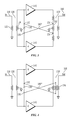
  • FIGS. 3 and 4 illustrate a tapped-inductor neutralization scheme and a transformer neutralization scheme, respectively.
  • the center-tapped primary winding 152 of transformer neutralization element 150 ′′ has additional feedback taps 154 cross-coupled back to the differential secondary winding 124 of input transformer 120 in the cross-coupled feedback path 145 ′′, thereby providing tapped-inductor neutralization.
  • FIG. 3 the center-tapped primary winding 152 of transformer neutralization element 150 ′′ has additional feedback taps 154 cross-coupled back to the differential secondary winding 124 of input transformer 120 in the cross-coupled feedback path 145 ′′, thereby providing tapped-inductor neutralization.
  • Trifilar-wound output transformer 150 ′′′ has a winding 156 , which is also cross-coupled back to the differential secondary winding of the input transformer 120 in the cross-coupled feedback path 145 ′′′, providing transformer neutralization as shown.
  • FIGS. 1-4 While various embodiments that employ discrete impedance matching, transformer, and capacitive elements are shown in FIGS. 1-4 , these functionalities may optionally be replaced with an impedance transformation element coupled to the input of a neutralized signal amplifier, the input(s) of a gain cell, and cross-coupled to a neutralization element.
  • FIG. 5 a block diagram of such a neutralized signal amplifier having an impedance transformation element 170 is shown.
  • the noise impedance matching element 112 , the transformer with differential secondary winding 120 and the capacitive element 130 of FIG. 1 may be replaced by impedance transformation element 170 of FIG. 5 .
  • a single IN pin at input 110 may be replaced with IN+and IN ⁇ and the common node would be removed.
  • impedance transformation element 170 operates to transform the input impedance of the amplifier input 110 to a high impedance at its output (high impedance differential node 135 ), the individual configuration of elements within impedance transformation element 170 can be as shown in FIG. 5 or be otherwise configured.
  • the structure of impedance transformation element 170 is tuned in frequency with the appropriate choice of inductive and capacitive elements such that resonance is achieved at the desired frequency.
  • the capacitive and inductive elements may be selected such that the voltage gain is maximized and “balanced” on both differential outputs 135 while an input impedance matching condition is maintained through the reflection of the parasitic resistances of the matching elements of impedance transformation element 170 , i.e.

Landscapes

  • Engineering & Computer Science (AREA)
  • Power Engineering (AREA)
  • Amplifiers (AREA)

Abstract

A power-efficient neutralized signal amplifier for use in ultra-low power narrowband receiver applications. A neutralized signal amplifier having: an impedance transformation element coupled to an amplifier input and having a differential output; a gain cell, having a differential input and a differential output, the differential input coupled to the differential output of the impedance transformation element and the differential output coupled to the amplifier output; and a neutralization element coupled to the gain cell differential output and cross-coupled to the differential output of the impedance transformation element, where the coupling of the neutralization element to the differential output of the impedance transformation element provides that the input impedance of the neutralized signal amplifier is substantially determined by reflected resistive parasitics of the impedance transformation element.

Description

PRIORITY CLAIM
This application claims the benefit of Provisional Patent Application No. 62/187,672, filed Jul. 1, 2015, the contents of which are hereby incorporated by reference in their entirety.
BACKGROUND
General implementations of a receiver front end low noise amplifier (LNA) utilize either a common-gate (CG) stage or an inductively-degenerated common-source (CS) stage. The generic inductively-degenerated CS stage does utilize passive voltage gain through the resonance of the reactive components, but the circuit architecture cannot maximize the transconductance or gm through the use of complementary devices, and it cannot scale in power consumption as the input impedance matching condition would not be maintained. Alternatively, the CG architecture does not utilize passive voltage gain and it also cannot be scaled in power consumption without negative impact on the input impedance matching condition. Furthermore, the nature of the matched impedance of the CG stage limits the amount of selectivity that can be obtained through simple inductive-capacitive (LC) resonance (before the signal reaches the active devices of the CG stage) to a lower quantity than the inductively degenerated CS. In ultra-low power applications, selectivity is highly desirable as the power constraints generally make circuit tolerance to large signal conditions very poor.
BRIEF DESCRIPTION OF THE DRAWINGS
The accompanying drawings provide visual representations which will be used to more fully describe various representative embodiments and can be used by those skilled in the art to better understand the representative embodiments disclosed and their inherent advantages. In these drawings, like reference numerals identify corresponding elements.
FIG. 1 illustrates a block diagram of a neutralized signal amplifier, in accordance with various representative embodiments.
FIG. 2 illustrates a block diagram of a neutralized signal amplifier that employs a transconductance-gain cell, in accordance with various representative embodiments.
FIG. 3 illustrates a block diagram of a neutralized signal amplifier in which tapped-inductor neutralization is shown, in accordance with various representative embodiments.
FIG. 4 illustrates a block diagram of a neutralized signal amplifier in which transformer neutralization is shown, in accordance with various representative embodiments.
FIG. 5 illustrates a block diagram of a neutralized signal amplifier having an impedance transformation element, in accordance with various representative embodiments.
DETAILED DESCRIPTION
The various apparatus and devices described herein provide a circuit design of a power-efficient neutralized signal amplifier for use in ultra-low power narrowband receiver applications.
In accordance with certain representative embodiments of the present disclosure, there is provided a neutralized signal amplifier having an input and an output, the amplifier having: an impedance transformation element coupled to the amplifier input and having a differential output; a gain cell, having a differential input and a differential output, the differential input coupled to the differential output of the impedance transformation element and the differential output coupled to the amplifier output; and a neutralization element coupled to the gain cell differential output and cross-coupled to the differential output of the impedance transformation element, where the coupling of the neutralization element to the differential output of the impedance transformation element provides that the input impedance of the neutralized signal amplifier is substantially determined by reflected resistive parasitics of the impedance transformation element.
In accordance with certain other representative embodiments of the present disclosure, there is provided a neutralized signal amplifier having an input and an output, the amplifier having: a transformer, having a primary winding and a differential secondary winding, the primary winding coupled to the amplifier input; a gain cell, having a differential input and a differential output, the differential input coupled to the transformer differential secondary winding and the differential output coupled to the amplifier output; a neutralization element coupled to the gain cell differential output and cross-coupled to the transformer differential secondary winding; and a capacitive element at the transformer differential secondary winding, where the coupling of the neutralization element and the capacitive element to the differential secondary winding provides that reflected resistive parasitics of the transformer substantially determine an input impedance of the neutralized signal amplifier.
Further, in accordance with certain representative embodiments of the present disclosure, there is provided a neutralized signal amplifier with an input and an output, the amplifier having: a transformer, having a primary winding and a differential secondary winding, the primary winding coupled to the amplifier input; a scaleable transconductance-gain cell, having a differential input and a differential output, the differential input coupled to the transformer differential secondary winding and the differential output coupled to the amplifier output; neutralization capacitors coupled to the gain cell differential output and cross-coupled to the transformer differential secondary winding; and a capacitive element coupled across the transformer differential secondary winding, where the coupling of the neutralization capacitors and the capacitive element to the differential secondary winding provides that reflected resistive parasitics of the transformer substantially determine an input impedance of the neutralized signal amplifier.
While this invention is susceptible of embodiment in many different forms, there is shown in the drawings and will herein be described in detail specific embodiments, with the understanding that the present disclosure is to be considered as an example of the principles of the invention and not intended to limit the invention to the specific embodiments shown and described. In the description below, like reference numerals are used to describe the same, similar or corresponding parts in the several views of the drawings.
In this document, relational terms such as first and second, top and bottom, and the like may be used solely to distinguish one entity or action from another entity or action without necessarily requiring or implying any actual such relationship or order between such entities or actions. The terms “comprises,” “comprising,” or any other variation thereof, are intended to cover a non-exclusive inclusion, such that a process, method, article, or apparatus that comprises a list of elements does not include only those elements but may include other elements not expressly listed or inherent to such process, method, article, or apparatus. An element preceded by “comprises . . . a” does not, without more constraints, preclude the existence of additional identical elements in the process, method, article, or apparatus that comprises the element.
Reference throughout this document to “one embodiment”, “certain embodiments”, “an embodiment” or similar terms means that a particular feature, structure, or characteristic described in connection with the embodiment is included in at least one embodiment of the present invention. Thus, the appearances of such phrases or in various places throughout this specification are not necessarily all referring to the same embodiment. Furthermore, the particular features, structures, or characteristics may be combined in any suitable manner in one or more embodiments without limitation.
The term “or” as used herein is to be interpreted as an inclusive or meaning any one or any combination. Therefore, “A, B or C” means “any of the following: A; B; C; A and B; A and C; B and C; A, B and C”. An exception to this definition will occur only when a combination of elements, functions, steps or acts are in some way inherently mutually exclusive.
For simplicity and clarity of illustration, reference numerals may be repeated among the figures to indicate corresponding or analogous elements. Numerous details are set forth to provide an understanding of the embodiments described herein. The embodiments may be practiced without these details. In other instances, well-known methods, procedures, and components have not been described in detail to avoid obscuring the embodiments described. The description is not to be considered as limited to the scope of the embodiments described herein.
In ultra-low power narrowband receiver applications, where power consumption is a primary specification that supersedes absolute minimum noise performance, the disclosed embodiments have utility. The various representative embodiments disclosed herein maximize the efficiency, defined as gain for a given power consumption, and the selectivity of an RF amplifier front end gain cell or stage for a given power consumption. Additionally, scaling provides the benefit of further power reduction as the system requirement for noise performance (generally due to the automatic gain control (AGC) action of a receiver in the presence of sufficient signal strength conditions) is reduced. A gain cell has associated with it a relatively high input impedance, a gain, an efficiency, and a differential input and a differential output. As used herein, a gain cell could have multiple gain stages and a gain cell could be a transconductance-gain cell or a voltage-gain cell. Thus the disclosed embodiments define an implementation that can yield maximum power efficiency and maximum selectivity with power scalability. As will be described in connection with a transconductance-gain cell, due to transconductance scaling, maximum transconductance efficiency, i.e. transconductance-per-unit-current efficiency, and maximum selectivity of a transconductance-gain cell may be obtained as power consumption by the transconductance-gain cell is varied. As understood in the art, transconductance is denoted by the symbol gm while gain in a voltage-gain cell is denoted by the symbol gv.
This concept is based on creating a high impedance node, which in effect maximizes impedance matched passive voltage gain and selectivity due to the LC resonance implemented at this node. A high impedance differential node is created by use of a high Q transformer to drive a neutralized differential gain cell or stage. The differential operation at the transformer differential secondary winding, combined by a cross-coupled replica feedback path, neutralizes the parasitic feedback path in active devices of the gain cell, thus creating a high impedance node at the interface of the transformer differential secondary winding and the active devices of the gain cell. Therefore, when resonated with a capacitive element at or of the transformer differential secondary winding, the impedance loading at the transformer differential secondary winding that is due to the active complementary gain stage is effectively removed. The capacitive element may be the inherent parasitic capacitance of the transformer differential secondary winding itself or the capacitive element may be a capacitor, variable or otherwise, across the transformer differential secondary winding, as shown in the figures.
Thus the impedance as seen at the transformer differential secondary winding is substantially defined by the equivalent parasitic shunt resistance of the secondary winding and the step-up turns ratio of the transformer, which is then essentially limited by the Q factor of the transformer in a given process technology. This equivalent parasitic shunt resistance of the transformer, as seen reflected back to the input, defines the match at the input of the amplifier network, as the use of neutralization and LC resonance at the secondary decouples the effect of the gain cell on the input impedance of the amplifier and may be referred to as the reflected resistive parasitics of the transformer. The equivalent parasitic shunt resistance of the combination of the transformer differential secondary winding resonated by the capacitive element has a value such that, when reduced by the square of the transformer turns ratio, it sets the resistive portion of the amplifier input impedance to a desired value. This is made possible by the neutralization, which ensures that the effective input impedance of the gain cell is at such a high value that it does not significantly load the equivalent parasitic shunt resistance of the transformer secondary winding. The input impedance of the amplifier is thus substantially independent of the input impedance of the gain cell or stage itself Because of this feature, the gain and power consumption of the gain cell can be varied over a wide range, while keeping the amplifier input match unchanged. Prudent selection of a transformer allows voltage gain for a desired input impedance of the amplifier to be controlled; selection of a transformer with the highest possible turns ratio, consistent with obtaining the desired input impedance of the amplifier, achieves maximum voltage gain. In the case where parasitic resistance is modeled with a resistor in series with an inductor rather than with a shunt resistor configuration, parasitic resistance may be described as equivalent parasitic series resistance.
Accordingly, the embodiments presented herein describe an amplifier, such as a receiver front end LNA or other receiver preamplifier, having an input impedance that is substantially independent of the input impedance of the gain cell (or gain stage) itself. Because of this feature, the gain and power consumption of the gain cell can be varied over a wide range, while keeping the input match of the amplifier unchanged. This feature can be useful for automatic gain control (AGC) and reduction of power consumption in sufficient signal strength conditions, for example.
With regard to process technologies that may be used in the disclosed embodiments, field-effect transistors (FETs) are useful given the relatively high input impedance needed for the gain cell described herein. In addition to complementary metal-oxide semiconductor (CMOS) technology, metal-semiconductor field-effect transistors (MESFETs), high-electron-mobility transistors (HEMTs), FETs on silicon-on-insulator (SOI) or other suitable semiconductor process technologies may be used. MESFETs and HEMTs, for example, may be implemented in gallium arsenide (GaAs) or other suitable compounds. And, because compound semiconductor and SOI devices form insulating substrates, input transformers formed from them will typically have a lower loss (higher Q) than equivalent transformers manufactured on bulk silicon.
Benefits of the embodiments disclosed herein therefore include at least the following:
    • The high impedance node can drive a complementary gain cell or gain stage, such as a complementary CS gain cell, with a voltage-amplified version of the input to maximize effective transconductance for the gain cell for a given power consumption, and reduce the effective noise contribution from the active devices of the gain cell.
    • The high impedance node allows a high Q tank at the differential secondary winding of the transformer to allow for maximum filtering selectivity with the use of a LC parallel resonance condition.
    • The high impedance node allows for scaling of gain cell transconductance for power consumption benefit, since impedance matching is already performed in the creation of the high impedance node and decoupled from active devices of the gain cell via neutralization.
Referring now to FIG. 1, a neutralized signal amplifier 100 having an input 110 and an output 160, in accordance with various embodiments, is shown. Transformer 120 has a primary winding 122 and a differential secondary winding 124, with the primary winding 122 coupled to the amplifier input 110. The primary winding may be single-ended or differential. Gain cell 140 is arranged in a differential arrangement with a differential input and a differential output, with differential input 142 coupled to the transformer differential secondary winding 124 and the differential output 144 coupled to the amplifier output 160. Also coupled to the gain cell differential output 144 and cross-coupled to the transformer differential secondary winding 124 is neutralization element 150. As will be seen in FIGS. 2-4, neutralization element 150 may be implemented using capacitors, inductors or transformers; there are many neutralization schemes that may be employed with the disclosed embodiments. A capacitive element 130 is coupled across the transformer differential secondary winding 124, operable to produce a high differential impedance at high impedance differential node 135 that is coupled to the transformer differential secondary winding 124 as shown. As noted previously, capacitive element 130 may be a capacitor separate from the transformer secondary winding 124 as shown; alternately, the parasitic capacitance of transformer differential secondary winding 124 can provide the functionality of capacitive element 130. Capacitive element 130 may be a single capacitor, a variable capacitor, a bank of switchable capacitors, or other elements that have a capacitance characteristic.
In accordance with an example implementation in which the gain cell is a transconductance-gain or “gm” cell, as shown in the block diagram of a neutralized signal amplifier in FIG. 2, a high impedance differential node 135 with shunt LC resonance is created through a combination of LC impedance scaling provided by the step-up balun transformer action of transformer 120′. Neutralization is implemented via the replica cross-coupled feedback path 145 coupled to the differential transconductance-gain cell 140′, denoted with symbol gm, as shown. The high impedance node 135 maximizes passive voltage gain and selectivity due to the LC resonance implemented at node 135 by the inductors of differential secondary winding 124′ and capacitive element 130. A low impedance receiver chain may be coupled to the differential output 144 as shown.
As has been described, high impedance differential node 135 is created by step-up balun transformer 120′, a high Q transformer, which drives neutralized differential transconductance-gain cell 140′, a scaleable complementary transconductance gain cell. The differential operation at the transformer differential secondary winding 124′, combined by a cross-coupled replica feedback path 145, neutralizes the parasitic feedback path in active devices of transconductance-gain cell 140′, thus creating a high impedance node 135 at the interface of the transformer differential secondary winding 124′ and the active devices of the transconductance-gain cell 140′. When resonated with the capacitor element 130′ at the differential secondary winding 124′, shown as a variable capacitive element in this embodiment, impedance loading at the balun transformer differential secondary winding 124′ caused by the active complementary transconductance-gain cell is effectively removed. Thus the impedance at the differential secondary winding 124′ is driven by the equivalent resistance of the secondary winding and the step-up turns ratio of the transformer 120′, the impedance of which is then essentially limited by the Q factor of the transformer 124′ in a given process technology. This equivalent parasitic shunt resistance of the transformer, as seen reflected back to the input, is the reflected resistive parasitics of the transformer in this embodiment and defines the match at the input 110 of the amplifier 100, as the use of neutralization and LC resonance at the differential secondary winding 124′ decouples the effect of the transconductance-gain cell on the input impedance of the amplifier 100.
Impedance matching at the frequency of operation of the receiver is achieved through the appropriate design of the noise impedance matching element 112, shown in FIGS. 1 and 2, and step-up transformer 120′ (Q and turns ratio) and programmable tank resonance at the differential secondary winding 124′. While noise impedance matching element 112 of FIG. 2 illustrates an inductor and capacitor in the arrangement shown, many different configurations of noise impedance matching are contemplated. This impedance matching (or impedance step-up) may be entirely achieved through specific design parameters of the balun transformer 120′. The explicit and additional impedance matching network 112, can be implementation specific and can perform a portion of the impedance transformation, but is not required to perform any portion of the impedance transformation described herein.
As previously mentioned, there are various neutralization schemes that may be employed. As an alternative to the capacitive neutralization scheme provided by neutralization capacitors 150′ coupled to the gain cell differential output 144 and cross-coupled to the transformer differential secondary winding 124′ in FIG. 2, FIGS. 3 and 4 illustrate a tapped-inductor neutralization scheme and a transformer neutralization scheme, respectively. Referring now to FIG. 3, the center-tapped primary winding 152 of transformer neutralization element 150″ has additional feedback taps 154 cross-coupled back to the differential secondary winding 124 of input transformer 120 in the cross-coupled feedback path 145″, thereby providing tapped-inductor neutralization. In FIG. 4, an output transformer serves as the neutralization element 150′″ in the neutralized signal amplifier. Trifilar-wound output transformer 150′″ has a winding 156, which is also cross-coupled back to the differential secondary winding of the input transformer 120 in the cross-coupled feedback path 145′″, providing transformer neutralization as shown.
While various embodiments that employ discrete impedance matching, transformer, and capacitive elements are shown in FIGS. 1-4, these functionalities may optionally be replaced with an impedance transformation element coupled to the input of a neutralized signal amplifier, the input(s) of a gain cell, and cross-coupled to a neutralization element. Referring now to FIG. 5, a block diagram of such a neutralized signal amplifier having an impedance transformation element 170 is shown. The noise impedance matching element 112, the transformer with differential secondary winding 120 and the capacitive element 130 of FIG. 1, for example, may be replaced by impedance transformation element 170 of FIG. 5. Thus, for example, the explicit capacitor 130′ of FIG. 2, for example, becomes embedded, together with noise impedance matching element 112 and balun transformer 120′, in the impedance transforming network of impedance transformation element 170. In an embodiment in which the amplifier input is differential, a single IN pin at input 110 may be replaced with IN+and IN− and the common node would be removed.
As long as impedance transformation element 170 operates to transform the input impedance of the amplifier input 110 to a high impedance at its output (high impedance differential node 135), the individual configuration of elements within impedance transformation element 170 can be as shown in FIG. 5 or be otherwise configured. In a particular implementation, the structure of impedance transformation element 170 is tuned in frequency with the appropriate choice of inductive and capacitive elements such that resonance is achieved at the desired frequency. Additionally, the capacitive and inductive elements may be selected such that the voltage gain is maximized and “balanced” on both differential outputs 135 while an input impedance matching condition is maintained through the reflection of the parasitic resistances of the matching elements of impedance transformation element 170, i.e. the reflected resistive parasitics of impedance transformation element 170, at the input of the amplifier. The LC resonance achievable at differential node 135 is somewhat compromised by this approach, however, making filtering less effective. Accordingly, some aspects and features of the disclosed embodiments are set out in the following numbered items:
  • 1. A neutralized signal amplifier having an input and an output, comprising: a transformer, having a primary winding and a differential secondary winding, the primary winding coupled to the amplifier input;
  • a transconductance-gain cell, having a differential input and a differential output, the differential input coupled to the transformer differential secondary winding and the differential output coupled to the amplifier output;
  • neutralization capacitors coupled to the gain cell differential output and cross-coupled to the transformer differential secondary winding; and
  • a capacitive element coupled across the transformer differential secondary winding, where the coupling of the neutralization capacitors and the capacitive element to the differential secondary winding provides that reflected resistive parasitics of the transformer substantially determine an input impedance of the neutralized signal amplifier.
  • 2. The neutralized signal amplifier of item 1, where the transformer primary winding is single-ended.
  • 3. The neutralized signal amplifier of item 1, where the transformer is a balun transformer and the transformer differential secondary winding is a balun transformer differential secondary winding.
  • 4. The neutralized signal amplifier of item 1, where the transformer primary winding is differential.
  • 5. The neutralized signal amplifier of item 1, where an equivalent parasitic shunt resistance of the combination of the transformer differential secondary winding resonated by the capacitive element has a value such that, when reduced by the square of the transformer turns ratio of the transformer, the equivalent parasitic shunt resistance sets the resistive portion of the input impedance of the neutralized signal amplifier to a desired value.
  • 6. The neutralized signal amplifier of item 1, where maximum transconductance efficiency and maximum frequency selectivity of the transconductance-gain cell are maintained as power consumption by the transconductance-gain cell is varied.
  • 7. The neutralized signal amplifier of item 1, where the capacitive element is a variable capacitor.
  • 8. The neutralized signal amplifier of item 1, wherein the neutralization capacitors are coupled to the gain cell differential output and cross-coupled to the transformer differential secondary winding and the capacitive element is coupled across the transformer differential secondary winding at a high impedance differential node.
  • 9. A neutralized signal amplifier having an input and an output, comprising: a transformer, having a primary winding and a differential secondary winding, the primary winding coupled to the amplifier input;
  • a gain cell, having a differential input and a differential output, the differential input coupled to the transformer differential secondary winding and the differential output coupled to the amplifier output;
  • a neutralization element coupled to the gain cell differential output and cross-coupled to the transformer differential secondary winding; and
  • a capacitive element at the transformer differential secondary winding, where the coupling of the neutralization element and the capacitive element to the differential secondary winding provides that reflected resistive parasitics of the transformer substantially determine an input impedance of the neutralized signal amplifier.
  • 10. The neutralized signal amplifier of item 9, where the transformer primary winding is single-ended.
  • 11. The neutralized signal amplifier of item 9, where the transformer is a balun transformer and the transformer differential secondary winding is a balun transformer differential secondary winding.
  • 12. The neutralized signal amplifier of item 8, where the transformer primary winding is differential.
  • 13. The neutralized signal amplifier of item 9, where an equivalent parasitic shunt resistance of the combination of the transformer differential secondary winding resonated by the capacitive element has a value such that, when reduced by the square of the transformer turns ratio of the transformer, the equivalent parasitic shunt resistance sets the resistive portion of the input impedance of the neutralized signal amplifier to a desired value.
  • 14. The neutralized signal amplifier of item 9, where maximum efficiency and maximum frequency selectivity of the gain cell are maintained as power consumption by the gain cell is varied.
  • 15. The neutralized signal amplifier of item 9, where the gain cell is a transconductance-gain cell or a voltage-gain cell.
  • 16. The neutralized signal amplifier of item 9, where the neutralization element comprises neutralization capacitors coupled to the gain cell differential output and cross-coupled to the transformer differential secondary winding.
  • 17. The neutralized signal amplifier of item 9, where the neutralization element comprises an output transformer coupled to the gain cell differential output and where feedback taps of a center-tapped primary winding of the output transformer are cross-coupled to the transformer differential secondary winding.
  • 18. The neutralized signal amplifier of item 9, where the neutralization element comprises an output transformer coupled to the gain cell differential output and where the output transformer is a trifilar-wound output transformer that is cross-coupled to the transformer differential secondary winding.
  • 19. The neutralized signal amplifier of item 9, wherein the neutralization element is coupled to the gain cell differential output and cross-coupled to the transformer differential secondary winding and the capacitive element is coupled across the transformer differential secondary winding at a high impedance differential node.
  • 20. The neutralized signal amplifier of item 9, where the capacitive element is one or more of the parasitic capacitance of the transformer differential secondary winding and a capacitor coupled across the transformer differential secondary winding.
  • 21. A neutralized signal amplifier having an input and an output, with: an impedance transformation element coupled to the amplifier input and having a differential output;
  • a gain cell, having a differential input and a differential output, the differential input coupled to the differential output of the impedance transformation element and the differential output coupled to the amplifier output; and
  • a neutralization element coupled to the gain cell differential output and cross-coupled to the differential output of the impedance transformation element,
  • where the coupling of the neutralization element to the differential output of the impedance transformation element provides that the input impedance of the neutralized signal amplifier is substantially determined by the reflected resistive parasitics of the impedance transformation element.
The various representative embodiments, which have been described in detail herein, have been presented by way of example and not by way of limitation. It will be understood by those skilled in the art that various changes may be made in the form and details of the described embodiments resulting in equivalent embodiments that remain within the scope of the appended claims.

Claims (24)

What is claimed is:
1. A neutralized signal amplifier having an input and an output, comprising:
a transformer, having a primary winding and a differential secondary winding, the primary winding coupled to the amplifier input;
a power scaleable transconductance-gain cell, having a differential input and a differential output, the differential input coupled to the transformer differential secondary winding and the differential output coupled to the amplifier output;
neutralization capacitors coupled to the gain cell differential output and cross-coupled to the transformer differential secondary winding; and
a capacitive element coupled across the transformer differential secondary winding, where the coupling of the neutralization capacitors and the capacitive element to the differential secondary winding creates a high impedance node at the transformer differential secondary winding and provides that reflected resistive parasitics of the transformer substantially determine an input impedance of the neutralized signal amplifier.
2. The neutralized signal amplifier of claim 1, where the transformer primary winding is single-ended.
3. The neutralized signal amplifier of claim 1, where the transformer is a balun transformer and the transformer differential secondary winding is a balun transformer differential secondary winding.
4. The neutralized signal amplifier of claim 1, where the transformer primary winding is differential.
5. A neutralized signal amplifier having an input and an output, comprising:
a transformer, having a primary winding and a differential secondary winding, the primary winding coupled to the amplifier input;
a scaleable transconductance-gain cell, having a differential input and a differential output, the differential input coupled to the transformer differential secondary winding and the differential output coupled to the amplifier output;
neutralization capacitors coupled to the gain cell differential output and cross-coupled to the transformer differential secondary winding; and
a capacitive element coupled across the transformer differential secondary winding, where the coupling of the neutralization capacitors and the capacitive element to the differential secondary winding provides that reflected resistive parasitics of the transformer substantially determine an input impedance of the neutralized signal amplifier,
where an equivalent parasitic shunt resistance of the combination of the transformer differential secondary winding resonated by the capacitive element has a value such that, when reduced by the square of the transformer turns ratio of the transformer, the equivalent parasitic shunt resistance sets the resistive portion of the input impedance of the neutralized signal amplifier to a desired value.
6. A neutralized signal amplifier having an input and an output, comprising:
a transformer, having a primary winding and a differential secondary winding, the primary winding coupled to the amplifier input
a scaleable transconductance-gain cell, having a differential input and a differential output, the differential input coupled to the transformer differential secondary winding and the differential output coupled to the amplifier output;
neutralization capacitors coupled to the gain cell differential output and cross-coupled to the transformer differential secondary winding; and
a capacitive element coupled across the transformer differential secondary winding, where the coupling of the neutralization capacitors and the capacitive element to the differential secondary winding creates a high impedance node at the transformer differential secondary winding and provides that reflected resistive parasitics of the transformer substantially determine an input impedance of the neutralized signal amplifier,
where maximum transconductance efficiency and maximum frequency selectivity of the transconductance-gain cell are maintained as power consumption by the transconductance-gain cell is varied.
7. The neutralized signal amplifier of claim 1, where the capacitive element is a variable capacitor.
8. The neutralized signal amplifier of claim 1, wherein the neutralization capacitors are coupled to the transconductance-gain cell differential output and cross-coupled to the transformer differential secondary winding and the capacitive element is coupled across the transformer differential secondary winding at the high impedance differential node.
9. A neutralized signal amplifier having an input and an output, comprising:
a transformer, having a primary winding and a differential secondary winding, the primary winding coupled to the amplifier input;
a scaleable gain cell, having a differential input and a differential output, the differential input coupled to the transformer differential secondary winding and the differential output coupled to the amplifier output, where maximum efficiency and maximum frequency selectivity of the gain cell are maintained as power consumption by the gain cell is varied;
a neutralization element coupled to the gain cell differential output and cross-coupled to the transformer differential secondary winding; and
a capacitive element at the transformer differential secondary winding, where the coupling of the neutralization element and the capacitive element to the differential secondary winding creates a high impedance node at the transformer differential secondary winding and provides that reflected resistive parasitics of the transformer substantially determine an input impedance of the neutralized signal amplifier.
10. The neutralized signal amplifier of claim 9, where the transformer primary winding is single-ended.
11. The neutralized signal amplifier of claim 9, where the transformer is a balun transformer and the transformer differential secondary winding is a balun transformer differential secondary winding.
12. The neutralized signal amplifier of claim 8, where the transformer primary winding is differential.
13. A neutralized signal amplifier having an input and an output, comprising:
a transformer, having a primary winding and a differential secondary winding, the primary winding coupled to the amplifier input;
a gain cell, having a differential input and a differential output, the differential input coupled to the transformer differential secondary winding and the differential output coupled to the amplifier output;
a neutralization element coupled to the gain cell differential output and cross-coupled to the transformer differential secondary winding; and
a capacitive element at the transformer differential secondary winding, where the coupling of the neutralization element and the capacitive element to the differential secondary winding provides that reflected resistive parasitics of the transformer substantially determine an input impedance of the neutralized signal amplifier, where an equivalent parasitic shunt resistance of the combination of the transformer differential secondary winding resonated by the capacitive element has a value such that, when reduced by the square of the transformer turns ratio of the transformer, the equivalent parasitic shunt resistance sets the resistive portion of the input impedance of the neutralized signal amplifier to a desired value.
14. The neutralized signal amplifier of claim 9, where the gain cell is a transconductance-gain cell or a voltage-gain cell.
15. The neutralized signal amplifier of claim 9, where the neutralization element comprises neutralization capacitors coupled to the gain cell differential output and cross-coupled to the transformer differential secondary winding.
16. A neutralized signal amplifier having an input and an output, comprising:
a transformer, having a primary winding and a differential secondary winding, the primary winding coupled to the amplifier input;
a gain cell, having a differential input and a differential output, the differential input coupled to the transformer differential secondary winding and the differential output coupled to the amplifier output;
a neutralization element coupled to the gain cell differential output and cross-coupled to the transformer differential secondary winding; and
a capacitive element at the transformer differential secondary winding, where the coupling of the neutralization element and the capacitive element to the differential secondary winding provides that reflected resistive parasitics of the transformer substantially determine an input impedance of the neutralized signal amplifier, where the neutralization element comprises an output transformer coupled to the gain cell differential output and where feedback taps of a center-tapped primary winding of the output transformer are cross-coupled to the transformer differential secondary winding.
17. The neutralized signal amplifier of claim 9, where the neutralization element comprises an output transformer coupled to the gain cell differential output and where the output transformer is a trifilar-wound output transformer that is cross-coupled to the transformer differential secondary winding.
18. The neutralized signal amplifier of claim 9, wherein the neutralization element is coupled to the gain cell differential output and cross-coupled to the transformer differential secondary winding and the capacitive element is coupled across the transformer differential secondary winding at the high impedance differential node.
19. The neutralized signal amplifier of claim 9, where the capacitive element is one or more of the parasitic capacitance of the transformer differential secondary winding and a capacitor coupled across the transformer differential secondary winding.
20. A neutralized signal amplifier having an input and an output, comprising:
an impedance transformation element coupled to the amplifier input and having a differential output;
a power scaleable gain cell, having a differential input and a differential output, the differential input coupled to the differential output of the impedance transformation element and the differential output coupled to the amplifier output; and
a neutralization element coupled to the gain cell differential output and cross-coupled to the differential output of the impedance transformation element, where the coupling of the neutralization element to the differential output of the impedance transformation element creates a high impedance node at the differential output of the impedance transformation element and provides that the input impedance of the neutralized signal amplifier is substantially determined by reflected resistive parasitics of the impedance transformation element and
where an equivalent parasitic shunt resistance of the combination of the impedance transformation element resonated by a portion of the neutralization element cross-coupled to the differential output of the impedance transformation element sets a resistive portion of an input impedance of the neutralized signal amplifier to a desired value.
21. A neutralized signal amplifier having an input and an output, comprising:
a transformer, having a primary winding and a differential secondary winding, the primary winding coupled to the amplifier input;
a scaleable complementary transconductance-gain cell, having a differential input and a differential output, the differential input coupled to the transformer differential secondary winding and the differential output coupled to the amplifier output;
neutralization capacitors coupled to the gain cell differential output and cross-coupled to the transformer differential secondary winding; and
a capacitive element coupled across the transformer differential secondary winding, where the coupling of the neutralization capacitors and the capacitive element to the differential secondary winding creates a high impedance node at the transformer differential secondary winding and provides that reflected resistive parasitics of the transformer substantially determine an input impedance of the neutralized signal amplifier.
22. The neutralized signal amplifier of claim 21, where the scaleable complementary transconductance-gain cell is power scaleable.
23. A neutralized signal amplifier having an input and an output, comprising:
an impedance transformation element coupled to the amplifier input and having a differential output;
a scaleable complementary gain cell, having a differential input and a differential output, the differential input coupled to the differential output of the impedance transformation element and the differential output coupled to the amplifier output; and
a neutralization element coupled to the gain cell differential output and cross-coupled to the differential output of the impedance transformation element, where the coupling of the neutralization element to the differential output of the impedance transformation element creates a high impedance node at the differential output of the impedance transformation element and provides that the input impedance of the neutralized signal amplifier is substantially determined by reflected resistive parasitics of the impedance transformation element and
where an equivalent parasitic shunt resistance of the combination of the impedance transformation element resonated by a portion of the neutralization element cross-coupled to the differential output of the impedance transformation element sets a resistive portion of an input impedance of the neutralized signal amplifier to a desired value.
24. The neutralized signal amplifier of claim 23, where the scaleable complementary gain cell is power scaleable.
US14/945,785 2015-07-01 2015-11-19 Scaleable RF tuned low noise amplifier Active US9819315B2 (en)

Priority Applications (5)

Application Number Priority Date Filing Date Title
US14/945,785 US9819315B2 (en) 2015-07-01 2015-11-19 Scaleable RF tuned low noise amplifier
KR1020160070981A KR102624600B1 (en) 2015-07-01 2016-06-08 Scaleable rf tuned low noise amplifier
GB1611127.0A GB2541782B (en) 2015-07-01 2016-06-27 Scaleable RF tuned low noise amplifier
CN201610509229.7A CN106330118B (en) 2015-07-01 2016-06-30 Scalable RF tuned low noise amplifier
US15/809,173 US10305436B2 (en) 2015-07-01 2017-11-10 Scaleable RF tuned low noise amplifier

Applications Claiming Priority (2)

Application Number Priority Date Filing Date Title
US201562187672P 2015-07-01 2015-07-01
US14/945,785 US9819315B2 (en) 2015-07-01 2015-11-19 Scaleable RF tuned low noise amplifier

Related Child Applications (1)

Application Number Title Priority Date Filing Date
US15/809,173 Continuation US10305436B2 (en) 2015-07-01 2017-11-10 Scaleable RF tuned low noise amplifier

Publications (2)

Publication Number Publication Date
US20170005630A1 US20170005630A1 (en) 2017-01-05
US9819315B2 true US9819315B2 (en) 2017-11-14

Family

ID=57683319

Family Applications (2)

Application Number Title Priority Date Filing Date
US14/945,785 Active US9819315B2 (en) 2015-07-01 2015-11-19 Scaleable RF tuned low noise amplifier
US15/809,173 Active US10305436B2 (en) 2015-07-01 2017-11-10 Scaleable RF tuned low noise amplifier

Family Applications After (1)

Application Number Title Priority Date Filing Date
US15/809,173 Active US10305436B2 (en) 2015-07-01 2017-11-10 Scaleable RF tuned low noise amplifier

Country Status (3)

Country Link
US (2) US9819315B2 (en)
KR (1) KR102624600B1 (en)
CN (1) CN106330118B (en)

Cited By (1)

* Cited by examiner, † Cited by third party
Publication number Priority date Publication date Assignee Title
TWI690152B (en) * 2018-02-28 2020-04-01 美商格芯(美國)集成電路科技有限公司 Method and equipment for back gate bias of power amplifier using millimeter wave device

Families Citing this family (7)

* Cited by examiner, † Cited by third party
Publication number Priority date Publication date Assignee Title
US10581385B2 (en) 2018-07-27 2020-03-03 Qualcomm Incorporated Low-noise amplifier (LNA) transformer notch
US10419045B1 (en) 2018-07-27 2019-09-17 Qualcomm Incorporated Low-noise amplifier (LNA) transformer notch
US11533027B2 (en) * 2019-10-18 2022-12-20 Analog Devices, Inc. Low power receiver circuit for isolated data communications
WO2022180762A1 (en) * 2021-02-26 2022-09-01 三菱電機株式会社 Differential amplification device
CN113162564B (en) * 2021-03-25 2023-05-26 成都知融科技有限公司 CMOS power amplifier with temperature compensation function on chip
WO2023062291A1 (en) * 2021-10-14 2023-04-20 Stmicroelectronics Sa Phase calibration using a neutralised amplifier with varactors
KR102850842B1 (en) * 2023-11-20 2025-08-25 고려대학교 산학협력단 Wideband series-parallel combined power amplifier using transformer with grounded center tap technique

Citations (6)

* Cited by examiner, † Cited by third party
Publication number Priority date Publication date Assignee Title
US3835406A (en) 1972-10-02 1974-09-10 Gte Sylvania Inc Neutralized amplifier circuit
US6518841B1 (en) 2001-08-14 2003-02-11 Stmicroelectronics Inc. Enhanced folded cascade voltage gain cell
WO2004086608A1 (en) 2003-03-28 2004-10-07 Koninklijke Philips Electronics N.V. Neutralization of feedback capacitance in amplifiers
US7256646B2 (en) * 2005-06-21 2007-08-14 Seiko Epson Corporation Neutralization techniques for differential low noise amplifiers
US8130039B2 (en) * 2006-05-17 2012-03-06 Dishop Steven M Solid-state RF power amplifier for radio transmitters
US20130234798A1 (en) 2012-03-12 2013-09-12 Fujitsu Limited Amplifier and amplification method

Family Cites Families (9)

* Cited by examiner, † Cited by third party
Publication number Priority date Publication date Assignee Title
JPH10135750A (en) * 1996-11-01 1998-05-22 Mitsubishi Electric Corp Microwave band amplifier
KR100682993B1 (en) * 2004-12-13 2007-02-15 한국전자통신연구원 Optical Receiving Device Using Transformer
DE102005062767A1 (en) * 2005-12-28 2007-07-12 Atmel Germany Gmbh Cascode differential amplifier and differential amplifier
US8095082B2 (en) * 2007-10-10 2012-01-10 Qualcomm, Incorporated Dual band radio frequency transmitter
US8968026B2 (en) * 2011-01-03 2015-03-03 Amphenol Corporation High speed network interface
TW201245668A (en) * 2011-05-05 2012-11-16 Elan Microelectronics Corp Circuit and method for sensing differential capacitance
CN102624411A (en) * 2012-02-28 2012-08-01 西安电子科技大学 Low frequency tuning antenna applicable to explosive detection
JP6363822B2 (en) * 2013-05-15 2018-07-25 ルネサスエレクトロニクス株式会社 Signal processing circuit and resolver digital converter
CN104300928B (en) * 2013-07-19 2017-03-29 晨星半导体股份有限公司 Differential to Single-Ended Converter

Patent Citations (7)

* Cited by examiner, † Cited by third party
Publication number Priority date Publication date Assignee Title
US3835406A (en) 1972-10-02 1974-09-10 Gte Sylvania Inc Neutralized amplifier circuit
US6518841B1 (en) 2001-08-14 2003-02-11 Stmicroelectronics Inc. Enhanced folded cascade voltage gain cell
WO2004086608A1 (en) 2003-03-28 2004-10-07 Koninklijke Philips Electronics N.V. Neutralization of feedback capacitance in amplifiers
US20070046376A1 (en) * 2003-03-28 2007-03-01 Koninklijke Philips Electronics N.V. Neutralization of feedback capacitance in amplifiers
US7256646B2 (en) * 2005-06-21 2007-08-14 Seiko Epson Corporation Neutralization techniques for differential low noise amplifiers
US8130039B2 (en) * 2006-05-17 2012-03-06 Dishop Steven M Solid-state RF power amplifier for radio transmitters
US20130234798A1 (en) 2012-03-12 2013-09-12 Fujitsu Limited Amplifier and amplification method

Non-Patent Citations (1)

* Cited by examiner, † Cited by third party
Title
Allstot et al., "Design considerations for CMOS low-noise amplifiers", 2004 IEEE Radio Frequency Integrated Circuits Symposium, Jun. 6-8, 2004, pp. 97-100.

Cited By (1)

* Cited by examiner, † Cited by third party
Publication number Priority date Publication date Assignee Title
TWI690152B (en) * 2018-02-28 2020-04-01 美商格芯(美國)集成電路科技有限公司 Method and equipment for back gate bias of power amplifier using millimeter wave device

Also Published As

Publication number Publication date
CN106330118B (en) 2021-08-24
KR20170004850A (en) 2017-01-11
KR102624600B1 (en) 2024-01-12
US20170005630A1 (en) 2017-01-05
US20180076778A1 (en) 2018-03-15
CN106330118A (en) 2017-01-11
US10305436B2 (en) 2019-05-28

Similar Documents

Publication Publication Date Title
US10305436B2 (en) Scaleable RF tuned low noise amplifier
US8463226B2 (en) Amplifiers and related receiver systems
US20060132242A1 (en) Low noise amplifier for wideband tunable matching
EP2557687A1 (en) Low-noise amplifier, receiver, method and computer program
EP3501101B1 (en) Low noise amplifier with reactive feedback
EP2736168A1 (en) Class AB amplifiers
WO2009137160A2 (en) Controlling power with an output network
US9954523B1 (en) Receiver for resonance-coupled signaling
CN106059505A (en) Transconductance amplifier with low noise and high output resistance
US10666204B2 (en) Tunable power amplifier with wide frequency range
US8437723B2 (en) Amplifier circuit and communication device
CN101938256A (en) Fully Integrated Dual Band Configurable RF Power Amplifier
US10855253B2 (en) Filter
US8264276B2 (en) Low-noise amplifier
GB2541782A (en) Scaleable RF tuned low noise amplifier
JPWO2007099622A1 (en) Amplifier circuit
US20060006849A1 (en) Inductor compensating circuit
US8688063B2 (en) Signal converting apparatus and receiving apparatus for supporting concurrent dual bands in wireless communication system
JP2012249114A (en) Amplification circuit, and transmission device and communication device using the same
LC Cw+ SCR)+ LC

Legal Events

Date Code Title Description
AS Assignment

Owner name: SUNRISE MICRO DEVICES, INC., FLORIDA

Free format text: ASSIGNMENT OF ASSIGNORS INTEREST;ASSIGNOR:STAMPALIA, ANTHONY KRESIMIR;REEL/FRAME:037147/0146

Effective date: 20151118

STCF Information on status: patent grant

Free format text: PATENTED CASE

MAFP Maintenance fee payment

Free format text: PAYMENT OF MAINTENANCE FEE, 4TH YEAR, LARGE ENTITY (ORIGINAL EVENT CODE: M1551); ENTITY STATUS OF PATENT OWNER: LARGE ENTITY

Year of fee payment: 4

MAFP Maintenance fee payment

Free format text: PAYMENT OF MAINTENANCE FEE, 8TH YEAR, LARGE ENTITY (ORIGINAL EVENT CODE: M1552); ENTITY STATUS OF PATENT OWNER: LARGE ENTITY

Year of fee payment: 8