US9758480B2 - 1-(cycloalkyl-carbonyl)proline derivative - Google Patents
1-(cycloalkyl-carbonyl)proline derivative Download PDFInfo
- Publication number
- US9758480B2 US9758480B2 US14/414,838 US201314414838A US9758480B2 US 9758480 B2 US9758480 B2 US 9758480B2 US 201314414838 A US201314414838 A US 201314414838A US 9758480 B2 US9758480 B2 US 9758480B2
- Authority
- US
- United States
- Prior art keywords
- group
- optionally substituted
- halogen atoms
- alkyl
- membered
- Prior art date
- Legal status (The legal status is an assumption and is not a legal conclusion. Google has not performed a legal analysis and makes no representation as to the accuracy of the status listed.)
- Expired - Fee Related
Links
- 0 CC.CCN.[1*]N([2*])C(=O)C(CC1=CC=CC=C1)NC(=O)C1CCC(C)CC1 Chemical compound CC.CCN.[1*]N([2*])C(=O)C(CC1=CC=CC=C1)NC(=O)C1CCC(C)CC1 0.000 description 81
- GYKZBFQSACMTDF-PABKXGBDSA-N CCOC(=O)C1=CC2=CC(CC(=O)[C@@H]3[C@H](C4CCC(OC)CC4)CCN3C(=O)[C@H]3CC[C@H]([C@H](C)CF)CC3)=CC=C2O1 Chemical compound CCOC(=O)C1=CC2=CC(CC(=O)[C@@H]3[C@H](C4CCC(OC)CC4)CCN3C(=O)[C@H]3CC[C@H]([C@H](C)CF)CC3)=CC=C2O1 GYKZBFQSACMTDF-PABKXGBDSA-N 0.000 description 4
- ARYDMPLHKBBZTP-COXRKTEDSA-N COC1CCC([C@@H]2CCN(C(=O)[C@H]3CC[C@H]([C@H](C)CF)CC3)[C@@H]2C(=O)CC2=CC=C3OC(C(=O)O)=CC3=C2)CC1 Chemical compound COC1CCC([C@@H]2CCN(C(=O)[C@H]3CC[C@H]([C@H](C)CF)CC3)[C@@H]2C(=O)CC2=CC=C3OC(C(=O)O)=CC3=C2)CC1 ARYDMPLHKBBZTP-COXRKTEDSA-N 0.000 description 4
- CNIGVTHFJWUJNK-PUQAOBSFSA-N C.CC.CC.CC.CC(=O)N1CCC(C)C1C(=O)N(C)C.[2HH] Chemical compound C.CC.CC.CC.CC(=O)N1CCC(C)C1C(=O)N(C)C.[2HH] CNIGVTHFJWUJNK-PUQAOBSFSA-N 0.000 description 3
- HPIYFMIYNGXZEL-IWSPIJDZSA-N C[C@H](CF)[C@H]1CC[C@H](C(=O)O)CC1 Chemical compound C[C@H](CF)[C@H]1CC[C@H](C(=O)O)CC1 HPIYFMIYNGXZEL-IWSPIJDZSA-N 0.000 description 3
- SMEGYFDTLLPGMO-UHFFFAOYSA-N C.CC1CCN(C(=O)C2CCC(C(C)(C)N)CC2)C1C(=O)N(C)C Chemical compound C.CC1CCN(C(=O)C2CCC(C(C)(C)N)CC2)C1C(=O)N(C)C SMEGYFDTLLPGMO-UHFFFAOYSA-N 0.000 description 2
- STVQFARDKPQVHV-VWNXMTODSA-N CC(C)(C)OC(=O)C1=CC=C(CC(=O)[C@@H]2[C@@H](C3=CC=CC=C3)CCN2C(=O)OC(C)(C)C)C=C1 Chemical compound CC(C)(C)OC(=O)C1=CC=C(CC(=O)[C@@H]2[C@@H](C3=CC=CC=C3)CCN2C(=O)OC(C)(C)C)C=C1 STVQFARDKPQVHV-VWNXMTODSA-N 0.000 description 2
- SYSFQDGWPFDBDD-CTNGQTDRSA-N CC(C)(C)OC(=O)C1=CC=C(CC(=O)[C@H]2NCC[C@@H]2C2=CC=CC=C2)C=C1 Chemical compound CC(C)(C)OC(=O)C1=CC=C(CC(=O)[C@H]2NCC[C@@H]2C2=CC=CC=C2)C=C1 SYSFQDGWPFDBDD-CTNGQTDRSA-N 0.000 description 2
- GGKJTWWEFDVJDS-UONOGXRCSA-N CC(C)(C)OC(=O)N1CC[C@@H](C2=CC=C(F)C=C2)[C@H]1CO Chemical compound CC(C)(C)OC(=O)N1CC[C@@H](C2=CC=C(F)C=C2)[C@H]1CO GGKJTWWEFDVJDS-UONOGXRCSA-N 0.000 description 2
- YCRIFATXXXUQRB-UHFFFAOYSA-N CC(C)CC1CCCO1 Chemical compound CC(C)CC1CCCO1 YCRIFATXXXUQRB-UHFFFAOYSA-N 0.000 description 2
- OVXXNAJEKANJBQ-OTBUODGKSA-N CC(C)OC(OC(C)OC(c1cc(cc(cc2)NC([C@H]([C@@H](CC3)C4CCCCC4)N3C([C@H](CC3)CC[C@@H]3[C@@H](CF)N)=O)=O)c2[nH]1)=O)=O Chemical compound CC(C)OC(OC(C)OC(c1cc(cc(cc2)NC([C@H]([C@@H](CC3)C4CCCCC4)N3C([C@H](CC3)CC[C@@H]3[C@@H](CF)N)=O)=O)c2[nH]1)=O)=O OVXXNAJEKANJBQ-OTBUODGKSA-N 0.000 description 2
- CJFGPBXZLAOSNZ-WKILWMFISA-N CC(C)[C@H]1CC[C@H](C(=O)OCC2=CC=CC=C2)CC1 Chemical compound CC(C)[C@H]1CC[C@H](C(=O)OCC2=CC=CC=C2)CC1 CJFGPBXZLAOSNZ-WKILWMFISA-N 0.000 description 2
- RPMDUWCZLADGCN-UHFFFAOYSA-N CC1(C)COCCN1CCCBr Chemical compound CC1(C)COCCN1CCCBr RPMDUWCZLADGCN-UHFFFAOYSA-N 0.000 description 2
- TYCULZXFRITPPA-UHFFFAOYSA-N CCC(C)C1CCC(C(=O)OCC2=CC=CC=C2)CC1 Chemical compound CCC(C)C1CCC(C(=O)OCC2=CC=CC=C2)CC1 TYCULZXFRITPPA-UHFFFAOYSA-N 0.000 description 2
- WTECGKNWKUCTRZ-BWKNWUBXSA-N CCOC(=O)C1=CC2=CC(CC(=O)[C@@H]3[C@@H](C4=CC=CC=C4)CCN3C(=O)OC(C)(C)C)=CC=C2N1 Chemical compound CCOC(=O)C1=CC2=CC(CC(=O)[C@@H]3[C@@H](C4=CC=CC=C4)CCN3C(=O)OC(C)(C)C)=CC=C2N1 WTECGKNWKUCTRZ-BWKNWUBXSA-N 0.000 description 2
- WTECGKNWKUCTRZ-OFVILXPXSA-N CCOC(=O)C1=CC2=CC(CC(=O)[C@@H]3[C@H](C4=CC=CC=C4)CCN3C(=O)OC(C)(C)C)=CC=C2N1 Chemical compound CCOC(=O)C1=CC2=CC(CC(=O)[C@@H]3[C@H](C4=CC=CC=C4)CCN3C(=O)OC(C)(C)C)=CC=C2N1 WTECGKNWKUCTRZ-OFVILXPXSA-N 0.000 description 2
- IIHZGRHZARTGOX-NVQXNPDNSA-N CCOC(=O)C1=CC2=CC(CC(=O)[C@@H]3[C@H](C4=CC=CC=C4)CCN3C(=O)OC(C)(C)C)=CC=C2N1C Chemical compound CCOC(=O)C1=CC2=CC(CC(=O)[C@@H]3[C@H](C4=CC=CC=C4)CCN3C(=O)OC(C)(C)C)=CC=C2N1C IIHZGRHZARTGOX-NVQXNPDNSA-N 0.000 description 2
- LBZPSFBTQMEMRD-PWAGCUNGSA-N CCOC(=O)C1=CC2=CC(CC(=O)[C@@H]3[C@H](C4CCC(OC)CC4)CCN3C(=O)OC(C)(C)C)=CC=C2O1 Chemical compound CCOC(=O)C1=CC2=CC(CC(=O)[C@@H]3[C@H](C4CCC(OC)CC4)CCN3C(=O)OC(C)(C)C)=CC=C2O1 LBZPSFBTQMEMRD-PWAGCUNGSA-N 0.000 description 2
- UMYINXIXCRQZIF-CVDCTZTESA-N CCOC(=O)C1=CC2=CC(CC(=O)[C@H]3NCC[C@H]3C3=CC=CC=C3)=CC=C2N1C Chemical compound CCOC(=O)C1=CC2=CC(CC(=O)[C@H]3NCC[C@H]3C3=CC=CC=C3)=CC=C2N1C UMYINXIXCRQZIF-CVDCTZTESA-N 0.000 description 2
- WKFRBJURAIPSQX-AVRDEDQJSA-N CCOC(=O)C1=CC2=CC(CC(=O)[C@H]3NCC[C@H]3C3=CC=CC=C3)=CC=C2O1 Chemical compound CCOC(=O)C1=CC2=CC(CC(=O)[C@H]3NCC[C@H]3C3=CC=CC=C3)=CC=C2O1 WKFRBJURAIPSQX-AVRDEDQJSA-N 0.000 description 2
- VTKUYUSXXPQYLV-ATGXHKCPSA-N CCOC(=O)C1=CC2=CC(CC(=O)[C@H]3NCC[C@H]3C3CCC(OC)CC3)=CC=C2O1 Chemical compound CCOC(=O)C1=CC2=CC(CC(=O)[C@H]3NCC[C@H]3C3CCC(OC)CC3)=CC=C2O1 VTKUYUSXXPQYLV-ATGXHKCPSA-N 0.000 description 2
- GYKZBFQSACMTDF-KCZMGYHISA-N CCOC(=O)C1=CC2=CC(CC(=O)[C@H]3[C@@H](C4CCC(OC)CC4)CCN3C(=O)[C@H]3CC[C@H]([C@H](C)CF)CC3)=CC=C2O1 Chemical compound CCOC(=O)C1=CC2=CC(CC(=O)[C@H]3[C@@H](C4CCC(OC)CC4)CCN3C(=O)[C@H]3CC[C@H]([C@H](C)CF)CC3)=CC=C2O1 GYKZBFQSACMTDF-KCZMGYHISA-N 0.000 description 2
- WPRKJQVJYKGTLF-UHFFFAOYSA-N CCOC(=O)C1=CC2=CC(N)=CC=C2N1C Chemical compound CCOC(=O)C1=CC2=CC(N)=CC=C2N1C WPRKJQVJYKGTLF-UHFFFAOYSA-N 0.000 description 2
- HFJKJOMCXCADEH-LXJUYELASA-N CCOCCCOC(=O)C1=CC2=CC(CC(=O)[C@@H]3[C@H](C4CCCCC4)CCN3C(=O)[C@H]3CC[C@H]([C@H](N)CF)CC3)=CC=C2O1.N[C@H](CF)[C@H]1CC[C@H](C(=O)N2CC[C@@H](C3CCCCC3)[C@H]2C(=O)CC2=CC=C3CC(C(=O)OCC4CCOCC4)=CC3=C2)CC1.N[C@H](CF)[C@H]1CC[C@H](C(=O)N2CC[C@@H](C3CCCCC3)[C@H]2C(=O)CC2=CC=C3OC(C(=O)OC[C@@H]4CCCO4)=CC3=C2)CC1.N[C@H](CF)[C@H]1CC[C@H](C(=O)N2CC[C@@H](C3CCCCC3)[C@H]2C(=O)CC2=CC=C3OC(C(=O)OC[C@H]4CCCO4)=CC3=C2)CC1 Chemical compound CCOCCCOC(=O)C1=CC2=CC(CC(=O)[C@@H]3[C@H](C4CCCCC4)CCN3C(=O)[C@H]3CC[C@H]([C@H](N)CF)CC3)=CC=C2O1.N[C@H](CF)[C@H]1CC[C@H](C(=O)N2CC[C@@H](C3CCCCC3)[C@H]2C(=O)CC2=CC=C3CC(C(=O)OCC4CCOCC4)=CC3=C2)CC1.N[C@H](CF)[C@H]1CC[C@H](C(=O)N2CC[C@@H](C3CCCCC3)[C@H]2C(=O)CC2=CC=C3OC(C(=O)OC[C@@H]4CCCO4)=CC3=C2)CC1.N[C@H](CF)[C@H]1CC[C@H](C(=O)N2CC[C@@H](C3CCCCC3)[C@H]2C(=O)CC2=CC=C3OC(C(=O)OC[C@H]4CCCO4)=CC3=C2)CC1 HFJKJOMCXCADEH-LXJUYELASA-N 0.000 description 2
- FVUSQNSQOVRHGR-HXOBPVMBSA-N CCOCCCOC(c1cc(cc(cc2)NC([C@H]([C@@H](CC3)C4CCCCC4)N3C([C@H](CC3)CC[C@@H]3[C@@H](CF)N)=O)=O)c2[o]1)=O Chemical compound CCOCCCOC(c1cc(cc(cc2)NC([C@H]([C@@H](CC3)C4CCCCC4)N3C([C@H](CC3)CC[C@@H]3[C@@H](CF)N)=O)=O)c2[o]1)=O FVUSQNSQOVRHGR-HXOBPVMBSA-N 0.000 description 2
- FIVJTYOIQLOTOW-APYKVSSYSA-N CN(C(=O)C1C(C2=CC=CC=C2)CCN1C(=O)[C@H]1CC[C@H](CN)CC1)C1=CC=C2NC(C(=O)O)=CC2=C1 Chemical compound CN(C(=O)C1C(C2=CC=CC=C2)CCN1C(=O)[C@H]1CC[C@H](CN)CC1)C1=CC=C2NC(C(=O)O)=CC2=C1 FIVJTYOIQLOTOW-APYKVSSYSA-N 0.000 description 2
- SIMBULBEQVHFPK-UHFFFAOYSA-N COC(=O)C1=CC2=CC(N)=CC=C2S1 Chemical compound COC(=O)C1=CC2=CC(N)=CC=C2S1 SIMBULBEQVHFPK-UHFFFAOYSA-N 0.000 description 2
- BWDZJEDDEZKORP-TZHYSIJRSA-N COC(=O)C1[C@H](N2CCCCC2)CCN1C(=O)OCC1=CC=CC=C1 Chemical compound COC(=O)C1[C@H](N2CCCCC2)CCN1C(=O)OCC1=CC=CC=C1 BWDZJEDDEZKORP-TZHYSIJRSA-N 0.000 description 2
- FNVBZJUQOSCURV-XYPYZODXSA-N COC(=O)[C@H]1CC[C@H](C(=O)CC(=O)OC(C)(C)C)CC1 Chemical compound COC(=O)[C@H]1CC[C@H](C(=O)CC(=O)OC(C)(C)C)CC1 FNVBZJUQOSCURV-XYPYZODXSA-N 0.000 description 2
- IVQQRHGRPAJFNI-ZKCHVHJHSA-N COC(=O)[C@H]1CC[C@H](C(=O)CF)CC1 Chemical compound COC(=O)[C@H]1CC[C@H](C(=O)CF)CC1 IVQQRHGRPAJFNI-ZKCHVHJHSA-N 0.000 description 2
- DMEJGZVLOLUIOF-TWLMWLPYSA-N COC(CC1)CCC1[C@H](CC1)[C@@H](C(Nc2ccc3[o]c(C(O)=O)cc3c2)=O)N1C([C@H](CC1)CC[C@@H]1[C@@H](CF)N)=O Chemical compound COC(CC1)CCC1[C@H](CC1)[C@@H](C(Nc2ccc3[o]c(C(O)=O)cc3c2)=O)N1C([C@H](CC1)CC[C@@H]1[C@@H](CF)N)=O DMEJGZVLOLUIOF-TWLMWLPYSA-N 0.000 description 2
- ZCGVDMBFOVJKIF-UHFFFAOYSA-N COC1CC(C(=O)OCC2=CC=CC=C2)C1 Chemical compound COC1CC(C(=O)OCC2=CC=CC=C2)C1 ZCGVDMBFOVJKIF-UHFFFAOYSA-N 0.000 description 2
- FVWJFUWYFGPINI-BTRGCRBASA-N COCCCOC(=O)C1=CC2=CC(CC(=O)[C@@H]3[C@H](C4CCCCC4)CCN3C(=O)[C@H]3CC[C@H]([C@H](N)CF)CC3)=CC=C2N1.COCCCOC(=O)C1=CC2=CC(CC(=O)[C@@H]3[C@H](C4CCCCC4)CCN3C(=O)[C@H]3CC[C@H]([C@H](N)CF)CC3)=CC=C2O1.N[C@H](CF)[C@H]1CC[C@H](C(=O)N2CC[C@@H](C3CCCCC3)[C@H]2C(=O)CC2=CC=C3NC(C(=O)O)=CC3=C2)CC1.N[C@H](CF)[C@H]1CC[C@H](C(=O)N2CC[C@@H](C3CCCCC3)[C@H]2C(=O)CC2=CC=C3OC(C(=O)O)=CC3=C2)CC1 Chemical compound COCCCOC(=O)C1=CC2=CC(CC(=O)[C@@H]3[C@H](C4CCCCC4)CCN3C(=O)[C@H]3CC[C@H]([C@H](N)CF)CC3)=CC=C2N1.COCCCOC(=O)C1=CC2=CC(CC(=O)[C@@H]3[C@H](C4CCCCC4)CCN3C(=O)[C@H]3CC[C@H]([C@H](N)CF)CC3)=CC=C2O1.N[C@H](CF)[C@H]1CC[C@H](C(=O)N2CC[C@@H](C3CCCCC3)[C@H]2C(=O)CC2=CC=C3NC(C(=O)O)=CC3=C2)CC1.N[C@H](CF)[C@H]1CC[C@H](C(=O)N2CC[C@@H](C3CCCCC3)[C@H]2C(=O)CC2=CC=C3OC(C(=O)O)=CC3=C2)CC1 FVWJFUWYFGPINI-BTRGCRBASA-N 0.000 description 2
- RQKVGZDHYUZKNT-UHFFFAOYSA-N COCCCOC(=O)C1=CC2=CC(N)=CC=C2O1 Chemical compound COCCCOC(=O)C1=CC2=CC(N)=CC=C2O1 RQKVGZDHYUZKNT-UHFFFAOYSA-N 0.000 description 2
- AVIZGUDJGBBRKZ-SVEHJYQDSA-N COCCOCCCOC(=O)C1=CC2=CC(CC(=O)[C@@H]3[C@H](C4CCCCC4)CCN3C(=O)OC(C)(C)C)=CC=C2O1 Chemical compound COCCOCCCOC(=O)C1=CC2=CC(CC(=O)[C@@H]3[C@H](C4CCCCC4)CCN3C(=O)OC(C)(C)C)=CC=C2O1 AVIZGUDJGBBRKZ-SVEHJYQDSA-N 0.000 description 2
- PYFHHOFUKHQKTA-NVQXNPDNSA-N COCCOCCCOC(=O)C1=CC2=CC(CC(=O)[C@H]3NCC[C@H]3C3CCCCC3)=CC=C2O1.Cl Chemical compound COCCOCCCOC(=O)C1=CC2=CC(CC(=O)[C@H]3NCC[C@H]3C3CCCCC3)=CC=C2O1.Cl PYFHHOFUKHQKTA-NVQXNPDNSA-N 0.000 description 2
- PPTVFHUTFSVXHH-PUGXKFDNSA-N C[C@H](CF)[C@H]1CC[C@H](C(=O)N2CC[C@@H](C3CCCCC3)[C@H]2C(=O)CC2=CC=C(C(=O)CS(=O)(=O)N(C)C)C=C2)CC1 Chemical compound C[C@H](CF)[C@H]1CC[C@H](C(=O)N2CC[C@@H](C3CCCCC3)[C@H]2C(=O)CC2=CC=C(C(=O)CS(=O)(=O)N(C)C)C=C2)CC1 PPTVFHUTFSVXHH-PUGXKFDNSA-N 0.000 description 2
- MORSWRNVQMZSGV-NVCBAMDISA-N C[C@H](CF)[C@H]1CC[C@H](C(=O)N2CC[C@@H](C3CCCCC3)[C@H]2C(=O)CC2=CC=C(C3=NN=NC3)C=C2)CC1 Chemical compound C[C@H](CF)[C@H]1CC[C@H](C(=O)N2CC[C@@H](C3CCCCC3)[C@H]2C(=O)CC2=CC=C(C3=NN=NC3)C=C2)CC1 MORSWRNVQMZSGV-NVCBAMDISA-N 0.000 description 2
- RRXAVUPAOFDPKA-VOOMBXQDSA-N C[C@H](COC(c1cc2cc(NC([C@H]([C@@H](CC3)C4CCCCC4)N3C([C@H](CC3)CC[C@@H]3[C@@H](CF)N)=O)=O)ccc2[nH]1)=O)OC Chemical compound C[C@H](COC(c1cc2cc(NC([C@H]([C@@H](CC3)C4CCCCC4)N3C([C@H](CC3)CC[C@@H]3[C@@H](CF)N)=O)=O)ccc2[nH]1)=O)OC RRXAVUPAOFDPKA-VOOMBXQDSA-N 0.000 description 2
- KMFLJKABOBBQFX-BRSZPPNISA-N NC[C@H]1CC[C@H](C(=O)N2CCC(C3=CC=CC=C3)C2C(=O)CC2=CC=C(C(=O)O)C=C2)CC1 Chemical compound NC[C@H]1CC[C@H](C(=O)N2CCC(C3=CC=CC=C3)C2C(=O)CC2=CC=C(C(=O)O)C=C2)CC1 KMFLJKABOBBQFX-BRSZPPNISA-N 0.000 description 2
- LPDUUZOYCWBXQB-RSXGOPAZSA-N O=C(CC1=CC=C(C2=NN=NC2)C=C1)[C@@H]1[C@H](N2CCCCC2)CCN1C(=O)OCC1=CC=CC=C1 Chemical compound O=C(CC1=CC=C(C2=NN=NC2)C=C1)[C@@H]1[C@H](N2CCCCC2)CCN1C(=O)OCC1=CC=CC=C1 LPDUUZOYCWBXQB-RSXGOPAZSA-N 0.000 description 2
- IBSPTJUREJABRP-MCZXLEFBSA-N C.C.CC(C)(C)C(=O)OCOC(=O)C1=CC2=CC(CC(=O)[C@@H]3[C@H](C4CCCCC4)CCN3C(=O)[C@H]3CC[C@H](C(N)CF)CC3)=CC=C2O1.CC(N)[C@H]1CC[C@H](C(=O)N2CC[C@@H](C3=CC=CC=C3)[C@H]2C(=O)CC2=CC=C(C(=O)OCOC(=O)C(C)(C)C)C(F)=C2)CC1.CC(N)[C@H]1CC[C@H](C(=O)N2CC[C@@H](C3CCCCC3)[C@H]2C(=O)CC2=CC=C(C(=O)OCOC(=O)C(C)(C)C)C(F)=C2)CC1.Cl.Cl.Cl.NC(CF)[C@H]1CC[C@H](C(=O)N2CC[C@@H](C3CCCCC3)[C@H]2C(=O)CC2=CC=C3OC(C(=O)OCCCN4CCOCC4)=CC3=C2)CC1.NC(CF)[C@H]1CC[C@H](C(=O)N2CC[C@@H](C3CCCCC3)[C@H]2C(=O)CC2=CC=C3OC(C(=O)OCCN4CCOCC4)=CC3=C2)CC1 Chemical compound C.C.CC(C)(C)C(=O)OCOC(=O)C1=CC2=CC(CC(=O)[C@@H]3[C@H](C4CCCCC4)CCN3C(=O)[C@H]3CC[C@H](C(N)CF)CC3)=CC=C2O1.CC(N)[C@H]1CC[C@H](C(=O)N2CC[C@@H](C3=CC=CC=C3)[C@H]2C(=O)CC2=CC=C(C(=O)OCOC(=O)C(C)(C)C)C(F)=C2)CC1.CC(N)[C@H]1CC[C@H](C(=O)N2CC[C@@H](C3CCCCC3)[C@H]2C(=O)CC2=CC=C(C(=O)OCOC(=O)C(C)(C)C)C(F)=C2)CC1.Cl.Cl.Cl.NC(CF)[C@H]1CC[C@H](C(=O)N2CC[C@@H](C3CCCCC3)[C@H]2C(=O)CC2=CC=C3OC(C(=O)OCCCN4CCOCC4)=CC3=C2)CC1.NC(CF)[C@H]1CC[C@H](C(=O)N2CC[C@@H](C3CCCCC3)[C@H]2C(=O)CC2=CC=C3OC(C(=O)OCCN4CCOCC4)=CC3=C2)CC1 IBSPTJUREJABRP-MCZXLEFBSA-N 0.000 description 1
- BDIXEXLHOLSMTF-AVYPOLDGSA-N C.C.COC(=O)C1=NC2=CC=C(CC(=O)[C@@H]3[C@H](C4CCCCC4)CCN3C(=O)[C@H]3CC[C@H]([C@H](N)CF)CC3)C=C2O1.COC1CCC([C@H]2CCN(C(=O)[C@H]3CC[C@H]([C@H](N)CF)CC3)[C@H]2C(=O)CC2=CC=C3OC(C(=O)O)=CC3=C2)CC1.Cl.Cl.Cl.Cl.N[C@H](CF)[C@H]1CC[C@H](C(=O)N2CC[C@@H](C3CCCCC3)[C@H]2C(=O)CC2=CC=C3NC(C(=O)O)=C(Cl)C3=C2)CC1.N[C@H](CF)[C@H]1CC[C@H](C(=O)N2CC[C@@H](C3CCCCC3)[C@H]2C(=O)CC2=NC=C3NC(C(=O)O)=CC3=C2)CC1.N[C@H](CF)[C@H]1CC[C@H](C(=O)N2CC[C@@H](N3CCCCC3)[C@H]2C(=O)CC2=CC=C3NC(C(=O)O)=CC3=N2)CC1.N[C@H](CF)[C@H]1CC[C@H](C(=O)N2CC[C@H](C3=CC=CC=C3)[C@H]2C(=O)CC2=CC=C3NC(C(=O)O)=C(Cl)C3=C2)CC1 Chemical compound C.C.COC(=O)C1=NC2=CC=C(CC(=O)[C@@H]3[C@H](C4CCCCC4)CCN3C(=O)[C@H]3CC[C@H]([C@H](N)CF)CC3)C=C2O1.COC1CCC([C@H]2CCN(C(=O)[C@H]3CC[C@H]([C@H](N)CF)CC3)[C@H]2C(=O)CC2=CC=C3OC(C(=O)O)=CC3=C2)CC1.Cl.Cl.Cl.Cl.N[C@H](CF)[C@H]1CC[C@H](C(=O)N2CC[C@@H](C3CCCCC3)[C@H]2C(=O)CC2=CC=C3NC(C(=O)O)=C(Cl)C3=C2)CC1.N[C@H](CF)[C@H]1CC[C@H](C(=O)N2CC[C@@H](C3CCCCC3)[C@H]2C(=O)CC2=NC=C3NC(C(=O)O)=CC3=C2)CC1.N[C@H](CF)[C@H]1CC[C@H](C(=O)N2CC[C@@H](N3CCCCC3)[C@H]2C(=O)CC2=CC=C3NC(C(=O)O)=CC3=N2)CC1.N[C@H](CF)[C@H]1CC[C@H](C(=O)N2CC[C@H](C3=CC=CC=C3)[C@H]2C(=O)CC2=CC=C3NC(C(=O)O)=C(Cl)C3=C2)CC1 BDIXEXLHOLSMTF-AVYPOLDGSA-N 0.000 description 1
- ONCYPGVHMVAJPL-GYQXNWGASA-N C.CC1=C(COC(=O)C2=CC3=CC(CC(=O)[C@@H]4[C@@H](C5=CC=CC=C5)CCN4C(=O)[C@H]4CC[C@H]([C@H](N)CF)CC4)=CC=C3N2)OC(=O)O1.COC1=CC=C([C@H]2CCN(C(=O)[C@H]3CC[C@H]([C@H](N)CF)CC3)[C@@H]2C(=O)CC2=CC=C3NC(C(=O)O)=CC3=C2)C=C1.COCCOC(=O)C1=CC2=CC(CC(=O)[C@@H]3[C@@H](C4=CC=CC=C4)CCN3C(=O)[C@H]3CC[C@H]([C@H](N)CF)CC3)=CC=C2N1.COCCO[C@H](C)COC(=O)C1=CC2=CC(CC(=O)[C@@H]3[C@H](C4CCCCC4)CCN3C(=O)[C@H]3CC[C@H]([C@H](N)CF)CC3)=CC=C2O1.CO[C@@H](C)COC(=O)C1=CC2=CC(CC(=O)[C@@H]3[C@@H](C4=CC=CC=C4)CCN3C(=O)[C@H]3CC[C@H]([C@H](N)CF)CC3)=CC=C2N1.Cl.Cl.Cl.Cl.Cl.Cl.Cl.N[C@H](CF)[C@H]1CC[C@H](C(=O)N2CC[C@@H](N3CCCCC3)[C@H]2C(=O)CC2=CC=C3OC(C(=O)O)=CC3=C2)CC1.N[C@H](CF)[C@H]1CC[C@H](C(=O)N2CC[C@H](C3=CC=CC=C3)[C@H]2C(=O)CC2=CC=C3NC(C(=O)OCCCOCC4=CC=CC=C4)=CC3=C2)CC1.N[C@H](CF)[C@H]1CC[C@H](C(=O)N2CC[C@H](C3=CC=CC=C3)[C@H]2C(=O)CC2=CC=C3NC(C(=O)OCCN4CCOCC4)=CC3=C2)CC1 Chemical compound C.CC1=C(COC(=O)C2=CC3=CC(CC(=O)[C@@H]4[C@@H](C5=CC=CC=C5)CCN4C(=O)[C@H]4CC[C@H]([C@H](N)CF)CC4)=CC=C3N2)OC(=O)O1.COC1=CC=C([C@H]2CCN(C(=O)[C@H]3CC[C@H]([C@H](N)CF)CC3)[C@@H]2C(=O)CC2=CC=C3NC(C(=O)O)=CC3=C2)C=C1.COCCOC(=O)C1=CC2=CC(CC(=O)[C@@H]3[C@@H](C4=CC=CC=C4)CCN3C(=O)[C@H]3CC[C@H]([C@H](N)CF)CC3)=CC=C2N1.COCCO[C@H](C)COC(=O)C1=CC2=CC(CC(=O)[C@@H]3[C@H](C4CCCCC4)CCN3C(=O)[C@H]3CC[C@H]([C@H](N)CF)CC3)=CC=C2O1.CO[C@@H](C)COC(=O)C1=CC2=CC(CC(=O)[C@@H]3[C@@H](C4=CC=CC=C4)CCN3C(=O)[C@H]3CC[C@H]([C@H](N)CF)CC3)=CC=C2N1.Cl.Cl.Cl.Cl.Cl.Cl.Cl.N[C@H](CF)[C@H]1CC[C@H](C(=O)N2CC[C@@H](N3CCCCC3)[C@H]2C(=O)CC2=CC=C3OC(C(=O)O)=CC3=C2)CC1.N[C@H](CF)[C@H]1CC[C@H](C(=O)N2CC[C@H](C3=CC=CC=C3)[C@H]2C(=O)CC2=CC=C3NC(C(=O)OCCCOCC4=CC=CC=C4)=CC3=C2)CC1.N[C@H](CF)[C@H]1CC[C@H](C(=O)N2CC[C@H](C3=CC=CC=C3)[C@H]2C(=O)CC2=CC=C3NC(C(=O)OCCN4CCOCC4)=CC3=C2)CC1 ONCYPGVHMVAJPL-GYQXNWGASA-N 0.000 description 1
- UNVZXWMYBWZACA-YFVHVTQSSA-N C.CCC(=O)[C@@H]1[C@H](C2CCCCC2)CCN1C(=O)[C@H]1CC[C@H]([C@H](N)CF)CC1 Chemical compound C.CCC(=O)[C@@H]1[C@H](C2CCCCC2)CCN1C(=O)[C@H]1CC[C@H]([C@H](N)CF)CC1 UNVZXWMYBWZACA-YFVHVTQSSA-N 0.000 description 1
- VNHOGFIZMLTBNU-MSUZFDJDSA-N C.COC(=O)C1=CC=C(CC(=O)[C@@H]2[C@@H](C3=CC=CC=C3)CCN2C(=O)[C@H]2CC[C@H](C(N)CF)CC2)N=C1 Chemical compound C.COC(=O)C1=CC=C(CC(=O)[C@@H]2[C@@H](C3=CC=CC=C3)CCN2C(=O)[C@H]2CC[C@H](C(N)CF)CC2)N=C1 VNHOGFIZMLTBNU-MSUZFDJDSA-N 0.000 description 1
- MXSNROGZCGXAPB-GVIHWUCHSA-N C.COC1=CC(CC(=O)[C@@H]2C(C3=CC=CC=C3)CCN2C(=O)[C@H]2CC[C@H](CN)CC2)=CC=C1C(=O)O.Cl.Cl.Cl.NC[C@H]1CC[C@H](C(=O)N2CCC(C3=CC=CC=C3)[C@H]2C(=O)CC2=CC=C(C(=O)O)C(Cl)=C2)CC1.NC[C@H]1CC[C@H](C(=O)N2CCC(C3=CC=CC=C3)[C@H]2C(=O)CC2=CC=C3N=CC=CC3=C2)CC1.NC[C@H]1CC[C@H](C(=O)N2CC[C@@H](C3=CC=CC=C3)[C@H]2C(=O)CC2=CC=C(C(N)=O)C(F)=C2)CC1 Chemical compound C.COC1=CC(CC(=O)[C@@H]2C(C3=CC=CC=C3)CCN2C(=O)[C@H]2CC[C@H](CN)CC2)=CC=C1C(=O)O.Cl.Cl.Cl.NC[C@H]1CC[C@H](C(=O)N2CCC(C3=CC=CC=C3)[C@H]2C(=O)CC2=CC=C(C(=O)O)C(Cl)=C2)CC1.NC[C@H]1CC[C@H](C(=O)N2CCC(C3=CC=CC=C3)[C@H]2C(=O)CC2=CC=C3N=CC=CC3=C2)CC1.NC[C@H]1CC[C@H](C(=O)N2CC[C@@H](C3=CC=CC=C3)[C@H]2C(=O)CC2=CC=C(C(N)=O)C(F)=C2)CC1 MXSNROGZCGXAPB-GVIHWUCHSA-N 0.000 description 1
- MWSCIWRKMIUMIY-UHFFFAOYSA-N C/C(N)=N\OC(=O)C1=CC=C([N+](=O)[O-])C=C1 Chemical compound C/C(N)=N\OC(=O)C1=CC=C([N+](=O)[O-])C=C1 MWSCIWRKMIUMIY-UHFFFAOYSA-N 0.000 description 1
- VMHBRUXNIWZFFI-UHFFFAOYSA-N C1=CC2=C(/C=C\C=C/2)N1.C1=CC2=C(/C=C\C=C/2)S1.C1=CC2=C(C=C1)OC=C2.C1=CC2=C(C=N1)OC=C2.C1=CC=NC=C1.C1=CN=CC=N1.C1=CN=CN=C1.C1=CN=NC=C1.C1=NC2=C(/C=C\C=C/2)S1.CC.CC.CC.CC.CC.CC.CC.CC.CC Chemical compound C1=CC2=C(/C=C\C=C/2)N1.C1=CC2=C(/C=C\C=C/2)S1.C1=CC2=C(C=C1)OC=C2.C1=CC2=C(C=N1)OC=C2.C1=CC=NC=C1.C1=CN=CC=N1.C1=CN=CN=C1.C1=CN=NC=C1.C1=NC2=C(/C=C\C=C/2)S1.CC.CC.CC.CC.CC.CC.CC.CC.CC VMHBRUXNIWZFFI-UHFFFAOYSA-N 0.000 description 1
- SYXRWORANKUERH-UHFFFAOYSA-N C1=CC2=C(/C=C\C=N/2)N1.C1=CC2=C(/C=C\N=C/2)N1.C1=CC2=C(/C=C\N=C/2)O1.C1=CC2=C(/C=N\C=C/2)N1.C1=CC2=C(/C=N\C=C/2)S1.C1=CC2=C(C=CO2)N=C1.C1=NC2=C(/C=C\C=C/2)N1.C1=NC2=C(/C=C\C=C/2)O1.C1=NNC2=C1/C=C\C=C/2.C1=NOC2=C1/C=C\C=C/2.CC.CC.CC.CC.CC.CC.CC.CC.CC.CC Chemical compound C1=CC2=C(/C=C\C=N/2)N1.C1=CC2=C(/C=C\N=C/2)N1.C1=CC2=C(/C=C\N=C/2)O1.C1=CC2=C(/C=N\C=C/2)N1.C1=CC2=C(/C=N\C=C/2)S1.C1=CC2=C(C=CO2)N=C1.C1=NC2=C(/C=C\C=C/2)N1.C1=NC2=C(/C=C\C=C/2)O1.C1=NNC2=C1/C=C\C=C/2.C1=NOC2=C1/C=C\C=C/2.CC.CC.CC.CC.CC.CC.CC.CC.CC.CC SYXRWORANKUERH-UHFFFAOYSA-N 0.000 description 1
- LSCKMQCSOSOZBK-UHFFFAOYSA-N C1=CC2=C(C=C1)CCCC2.C1=CC2=C(C=C1)CCCCC2.C1=CC2=C(C=C1)COCC2.C1=CC2=C(C=C1)OCC=C2.C1=CC2=C(C=C1)OCCCO2.C1=C\C2=C(\C=C/1)CCC2.C1=C\C2=C(\C=C/1)COC2.C1=C\C2=C(\C=C/1)OCC2.CC.CC.CC.CC.CC.CC.CC.CC.CC.CC.O=C1C=CC2=C(C=CC=C2)O1.O=C1COC2=C(C=CC=C2)N1 Chemical compound C1=CC2=C(C=C1)CCCC2.C1=CC2=C(C=C1)CCCCC2.C1=CC2=C(C=C1)COCC2.C1=CC2=C(C=C1)OCC=C2.C1=CC2=C(C=C1)OCCCO2.C1=C\C2=C(\C=C/1)CCC2.C1=C\C2=C(\C=C/1)COC2.C1=C\C2=C(\C=C/1)OCC2.CC.CC.CC.CC.CC.CC.CC.CC.CC.CC.O=C1C=CC2=C(C=CC=C2)O1.O=C1COC2=C(C=CC=C2)N1 LSCKMQCSOSOZBK-UHFFFAOYSA-N 0.000 description 1
- MFWXCXBMOISZRD-UHFFFAOYSA-N C1=CC2=C(C=C1)CCCC2.C1=CC2=C(CCCC2)N=C1.C1=C\C2=C(CCC2)\N=C/1.C1=C\C2=C(\C=C/1)CCC2.CC.CC.CC.CC Chemical compound C1=CC2=C(C=C1)CCCC2.C1=CC2=C(CCCC2)N=C1.C1=C\C2=C(CCC2)\N=C/1.C1=C\C2=C(\C=C/1)CCC2.CC.CC.CC.CC MFWXCXBMOISZRD-UHFFFAOYSA-N 0.000 description 1
- YYGQZFNPAPAAQR-UHFFFAOYSA-N C1=CC2=C(C=C1)CNCC2.C1=CC2=C(C=C1)NCC=C2.C1=CC2=C(C=C1)NCCC2.C1=CC2=C(C=C1)NCCC2.C1=CC2=C(C=C1)OCCC2.C1=CC2=C(C=C1)OCCN2.C1=CC2=C(C=C1)OCCO2.C1=CC2=C(C=C1)SCCN2.C1=C\C2=C(\C=C/1)CNC2.C1=C\C2=C(\C=C/1)NCC2.C1=C\C2=C(\C=C/1)OCO2.CC.CC.CC.CC.CC.CC.CC.CC.CC.CC.CC Chemical compound C1=CC2=C(C=C1)CNCC2.C1=CC2=C(C=C1)NCC=C2.C1=CC2=C(C=C1)NCCC2.C1=CC2=C(C=C1)NCCC2.C1=CC2=C(C=C1)OCCC2.C1=CC2=C(C=C1)OCCN2.C1=CC2=C(C=C1)OCCO2.C1=CC2=C(C=C1)SCCN2.C1=C\C2=C(\C=C/1)CNC2.C1=C\C2=C(\C=C/1)NCC2.C1=C\C2=C(\C=C/1)OCO2.CC.CC.CC.CC.CC.CC.CC.CC.CC.CC.CC YYGQZFNPAPAAQR-UHFFFAOYSA-N 0.000 description 1
- XWOCQCNXBUPUMN-UHFFFAOYSA-N C1=CC2=C(C=C1)OC=C2.CC Chemical compound C1=CC2=C(C=C1)OC=C2.CC XWOCQCNXBUPUMN-UHFFFAOYSA-N 0.000 description 1
- JOMUWDLOXDPVBU-UHFFFAOYSA-N C1=CC2=C(C=NC=C2)N=C1.C1=CC2=C(N=C1)N=CC=C2.C1=CC2=C(N=C1)N=CC=N2.C1=CC2=C(N=C1)N=CN=C2.C1=CC2=CC=NC=C2C=C1.C1=CC2=CC=NN=C2C=C1.C1=CC2C=NN=CC2C=C1.C1=CN=C2C=CC=CC2=C1.C1=NC2=C(/N=C\C=C/2)N1.CC.CC.CC.CC.CC.CC.CC.CC.CC Chemical compound C1=CC2=C(C=NC=C2)N=C1.C1=CC2=C(N=C1)N=CC=C2.C1=CC2=C(N=C1)N=CC=N2.C1=CC2=C(N=C1)N=CN=C2.C1=CC2=CC=NC=C2C=C1.C1=CC2=CC=NN=C2C=C1.C1=CC2C=NN=CC2C=C1.C1=CN=C2C=CC=CC2=C1.C1=NC2=C(/N=C\C=C/2)N1.CC.CC.CC.CC.CC.CC.CC.CC.CC JOMUWDLOXDPVBU-UHFFFAOYSA-N 0.000 description 1
- NXGDFHPXLIFXGJ-UHFFFAOYSA-N C1=CC2=C(CCCC2)N=C1.CC Chemical compound C1=CC2=C(CCCC2)N=C1.CC NXGDFHPXLIFXGJ-UHFFFAOYSA-N 0.000 description 1
- NHEGMKJOXYUJRX-UHFFFAOYSA-N C1=CC2=CN=CN=C2C=C1.C1=CC2=NC=CNC2C=C1.CC.CC.CC.CC.CC.CC.O=S1(=O)C=CC2=C1/C=C\C=C/2.O=S1(=O)C=CC2=C1/C=C\C=C/2.O=S1(=O)C=CC=C1.O=S1C=CC=C1 Chemical compound C1=CC2=CN=CN=C2C=C1.C1=CC2=NC=CNC2C=C1.CC.CC.CC.CC.CC.CC.O=S1(=O)C=CC2=C1/C=C\C=C/2.O=S1(=O)C=CC2=C1/C=C\C=C/2.O=S1(=O)C=CC=C1.O=S1C=CC=C1 NHEGMKJOXYUJRX-UHFFFAOYSA-N 0.000 description 1
- DXRKHXODSOHCAP-UHFFFAOYSA-N C1=CNC=C1.C1=CNC=N1.C1=CNN=C1.C1=COC=C1.C1=COC=N1.C1=CON=C1.C1=CSC=C1.C1=CSC=N1.C1=CSN=C1.C1=NC=NN1.C1=NC=NO1.C1=NC=NS1.C1=NN=CN1.C1=NN=CO1.C1=NN=CS1.CC.CC.CC.CC.CC.CC.CC.CC.CC.CC.CC.CC.CC.CC.CC.CC1=NN=NN1 Chemical compound C1=CNC=C1.C1=CNC=N1.C1=CNN=C1.C1=COC=C1.C1=COC=N1.C1=CON=C1.C1=CSC=C1.C1=CSC=N1.C1=CSN=C1.C1=NC=NN1.C1=NC=NO1.C1=NC=NS1.C1=NN=CN1.C1=NN=CO1.C1=NN=CS1.CC.CC.CC.CC.CC.CC.CC.CC.CC.CC.CC.CC.CC.CC.CC.CC1=NN=NN1 DXRKHXODSOHCAP-UHFFFAOYSA-N 0.000 description 1
- LGLVCYAQLYHILZ-UHFFFAOYSA-N C1=COC=C1.CC Chemical compound C1=COC=C1.CC LGLVCYAQLYHILZ-UHFFFAOYSA-N 0.000 description 1
- XUGHIUQCKSIJEE-UHFFFAOYSA-N C1=C\C2=C(\C=C/1)NCC2.CC Chemical compound C1=C\C2=C(\C=C/1)NCC2.CC XUGHIUQCKSIJEE-UHFFFAOYSA-N 0.000 description 1
- DKFNHIJMNQBECD-UHFFFAOYSA-N C1=NC2=C(/C=C\N=C/2)O1.C1=NC2=C(/C=C\N=C/2)S1.C1=NC2=C(/C=N\C=C/2)O1.C1=NC2=C(/C=N\C=C/2)S1.C1=NC2=C(/N=C\N=C/2)N1.C1=NNC2=C1/C=C\C=N/2.C1=NOC2=C1/C=C\N=C/2.C1=NOC2=C1/N=C\C=C/2.C1=NSC2=C1/C=C\C=C/2.C1=NSC2=C1/C=C\N=C/2.C1=NSC2=C1/C=N\C=C/2.C1=NSC2=C1/N=C\C=C/2.CC.CC.CC.CC.CC.CC.CC.CC.CC.CC.CC.CC Chemical compound C1=NC2=C(/C=C\N=C/2)O1.C1=NC2=C(/C=C\N=C/2)S1.C1=NC2=C(/C=N\C=C/2)O1.C1=NC2=C(/C=N\C=C/2)S1.C1=NC2=C(/N=C\N=C/2)N1.C1=NNC2=C1/C=C\C=N/2.C1=NOC2=C1/C=C\N=C/2.C1=NOC2=C1/N=C\C=C/2.C1=NSC2=C1/C=C\C=C/2.C1=NSC2=C1/C=C\N=C/2.C1=NSC2=C1/C=N\C=C/2.C1=NSC2=C1/N=C\C=C/2.CC.CC.CC.CC.CC.CC.CC.CC.CC.CC.CC.CC DKFNHIJMNQBECD-UHFFFAOYSA-N 0.000 description 1
- UVEHIBAMGOOFMV-PYMNWPSQSA-N C=C[C@@H](CC1)[C@@H](C(Nc2ccc3[o]c(C(OCCCO)=O)cc3c2)=O)N1C([C@H](CC1)CC[C@@H]1[C@@H](CF)N)=O Chemical compound C=C[C@@H](CC1)[C@@H](C(Nc2ccc3[o]c(C(OCCCO)=O)cc3c2)=O)N1C([C@H](CC1)CC[C@@H]1[C@@H](CF)N)=O UVEHIBAMGOOFMV-PYMNWPSQSA-N 0.000 description 1
- YZWDEGMXFZIHIT-UHFFFAOYSA-N CC(C)(C)OC(=O)C1=CC2=CC(N)=CC=C2O1 Chemical compound CC(C)(C)OC(=O)C1=CC2=CC(N)=CC=C2O1 YZWDEGMXFZIHIT-UHFFFAOYSA-N 0.000 description 1
- JOAPRIPBRKUTHQ-UHFFFAOYSA-N CC(C)(C)OC(=O)C1=CC2=CC([N+](=O)[O-])=CC=C2O1 Chemical compound CC(C)(C)OC(=O)C1=CC2=CC([N+](=O)[O-])=CC=C2O1 JOAPRIPBRKUTHQ-UHFFFAOYSA-N 0.000 description 1
- STVQFARDKPQVHV-GITCGBDTSA-N CC(C)(C)OC(=O)C1=CC=C(CC(=O)[C@@H]2C(C3=CC=CC=C3)CCN2C(=O)OC(C)(C)C)C=C1 Chemical compound CC(C)(C)OC(=O)C1=CC=C(CC(=O)[C@@H]2C(C3=CC=CC=C3)CCN2C(=O)OC(C)(C)C)C=C1 STVQFARDKPQVHV-GITCGBDTSA-N 0.000 description 1
- STVQFARDKPQVHV-UPVQGACJSA-N CC(C)(C)OC(=O)C1=CC=C(CC(=O)[C@@H]2[C@H](C3=CC=CC=C3)CCN2C(=O)OC(C)(C)C)C=C1 Chemical compound CC(C)(C)OC(=O)C1=CC=C(CC(=O)[C@@H]2[C@H](C3=CC=CC=C3)CCN2C(=O)OC(C)(C)C)C=C1 STVQFARDKPQVHV-UPVQGACJSA-N 0.000 description 1
- JKQPHQYVAOGPLJ-UPVQGACJSA-N CC(C)(C)OC(=O)C1=CC=C(CC(=O)[C@@H]2[C@H](C3CCCCC3)CCN2C(=O)OC(C)(C)C)C=C1 Chemical compound CC(C)(C)OC(=O)C1=CC=C(CC(=O)[C@@H]2[C@H](C3CCCCC3)CCN2C(=O)OC(C)(C)C)C=C1 JKQPHQYVAOGPLJ-UPVQGACJSA-N 0.000 description 1
- SMTSPMAFYBFYGK-RDPSFJRHSA-N CC(C)(C)OC(=O)C1=CC=C(CC(=O)[C@@H]2[C@H](C3CCCCC3)CCN2C(=O)OC(C)(C)C)C=C1F Chemical compound CC(C)(C)OC(=O)C1=CC=C(CC(=O)[C@@H]2[C@H](C3CCCCC3)CCN2C(=O)OC(C)(C)C)C=C1F SMTSPMAFYBFYGK-RDPSFJRHSA-N 0.000 description 1
- SYSFQDGWPFDBDD-QWAKEFERSA-N CC(C)(C)OC(=O)C1=CC=C(CC(=O)[C@H]2NCCC2C2=CC=CC=C2)C=C1.Cl Chemical compound CC(C)(C)OC(=O)C1=CC=C(CC(=O)[C@H]2NCCC2C2=CC=CC=C2)C=C1.Cl SYSFQDGWPFDBDD-QWAKEFERSA-N 0.000 description 1
- SYSFQDGWPFDBDD-FPOVZHCZSA-N CC(C)(C)OC(=O)C1=CC=C(CC(=O)[C@H]2NCC[C@H]2C2=CC=CC=C2)C=C1.Cl Chemical compound CC(C)(C)OC(=O)C1=CC=C(CC(=O)[C@H]2NCC[C@H]2C2=CC=CC=C2)C=C1.Cl SYSFQDGWPFDBDD-FPOVZHCZSA-N 0.000 description 1
- XQCHXYKZLIBFFO-FPOVZHCZSA-N CC(C)(C)OC(=O)C1=CC=C(CC(=O)[C@H]2NCC[C@H]2C2CCCCC2)C=C1.Cl Chemical compound CC(C)(C)OC(=O)C1=CC=C(CC(=O)[C@H]2NCC[C@H]2C2CCCCC2)C=C1.Cl XQCHXYKZLIBFFO-FPOVZHCZSA-N 0.000 description 1
- HPYRFPWJJMBSSA-UWJYYQICSA-N CC(C)(C)OC(=O)C1=CC=C(CC(=O)[C@H]2NCC[C@H]2C2CCCCC2)C=C1F.Cl Chemical compound CC(C)(C)OC(=O)C1=CC=C(CC(=O)[C@H]2NCC[C@H]2C2CCCCC2)C=C1F.Cl HPYRFPWJJMBSSA-UWJYYQICSA-N 0.000 description 1
- LHVKYVVKFCIMSL-NEWMUCERSA-N CC(C)(C)OC(=O)C[C@H](CF)[C@H]1CC[C@H](C(=O)N2CC[C@@H](C3CCCCC3)[C@H]2C(=O)CC2=CC=C3NC(C(=O)O)=C(Cl)C3=C2)CC1 Chemical compound CC(C)(C)OC(=O)C[C@H](CF)[C@H]1CC[C@H](C(=O)N2CC[C@@H](C3CCCCC3)[C@H]2C(=O)CC2=CC=C3NC(C(=O)O)=C(Cl)C3=C2)CC1 LHVKYVVKFCIMSL-NEWMUCERSA-N 0.000 description 1
- TXJSDRJQWNEGBQ-BBPDIJDWSA-N CC(C)(C)OC(=O)C[C@H](CF)[C@H]1CC[C@H](C(=O)N2CC[C@@H](C3CCCCC3)[C@H]2C(=O)CC2=CC=C3NC(C(=O)OCC4CCCO4)=CC3=C2)CC1 Chemical compound CC(C)(C)OC(=O)C[C@H](CF)[C@H]1CC[C@H](C(=O)N2CC[C@@H](C3CCCCC3)[C@H]2C(=O)CC2=CC=C3NC(C(=O)OCC4CCCO4)=CC3=C2)CC1 TXJSDRJQWNEGBQ-BBPDIJDWSA-N 0.000 description 1
- RLZDKRFZUGNKSS-PUCBDYCHSA-N CC(C)(C)OC(=O)C[C@H](CF)[C@H]1CC[C@H](C(=O)N2CC[C@@H](C3CCCCC3)[C@H]2C(=O)CC2=CC=C3NC(C(=O)OCC4CCOCC4)=CC3=C2)CC1 Chemical compound CC(C)(C)OC(=O)C[C@H](CF)[C@H]1CC[C@H](C(=O)N2CC[C@@H](C3CCCCC3)[C@H]2C(=O)CC2=CC=C3NC(C(=O)OCC4CCOCC4)=CC3=C2)CC1 RLZDKRFZUGNKSS-PUCBDYCHSA-N 0.000 description 1
- PVMJTXOUSHLZQB-ZKFNRFAESA-N CC(C)(C)OC(=O)C[C@H](CF)[C@H]1CC[C@H](C(=O)N2CC[C@@H](C3CCCCC3)[C@H]2C(=O)CC2=CC=C3OC(C(=O)O)CC3=C2)CC1 Chemical compound CC(C)(C)OC(=O)C[C@H](CF)[C@H]1CC[C@H](C(=O)N2CC[C@@H](C3CCCCC3)[C@H]2C(=O)CC2=CC=C3OC(C(=O)O)CC3=C2)CC1 PVMJTXOUSHLZQB-ZKFNRFAESA-N 0.000 description 1
- YCUKWQOCGYKDME-HSJZKHIHSA-N CC(C)(C)OC(=O)C[C@H](CF)[C@H]1CC[C@H](C(=O)N2CC[C@@H](C3CCCCC3)[C@H]2C(=O)CC2=CC=C3SC(C(=O)O)=CC3=C2)CC1 Chemical compound CC(C)(C)OC(=O)C[C@H](CF)[C@H]1CC[C@H](C(=O)N2CC[C@@H](C3CCCCC3)[C@H]2C(=O)CC2=CC=C3SC(C(=O)O)=CC3=C2)CC1 YCUKWQOCGYKDME-HSJZKHIHSA-N 0.000 description 1
- QVAWOFMFOCSGJS-YEKBSVJUSA-N CC(C)(C)OC(=O)C[C@H](CF)[C@H]1CC[C@H](C(=O)N2CC[C@@H](C3CCCCC3)[C@H]2C(=O)CC2=CN=C3OC(C(=O)O)=CC3=C2)CC1 Chemical compound CC(C)(C)OC(=O)C[C@H](CF)[C@H]1CC[C@H](C(=O)N2CC[C@@H](C3CCCCC3)[C@H]2C(=O)CC2=CN=C3OC(C(=O)O)=CC3=C2)CC1 QVAWOFMFOCSGJS-YEKBSVJUSA-N 0.000 description 1
- VMLFHGPSAHWDOO-JYMXFNQESA-N CC(C)(C)OC(=O)C[C@H](CF)[C@H]1CC[C@H](C(=O)N2CC[C@@H](C3CCCCC3)[C@H]2C(=O)CC2=NC=C3NC(C(=O)O)=CC3=C2)CC1 Chemical compound CC(C)(C)OC(=O)C[C@H](CF)[C@H]1CC[C@H](C(=O)N2CC[C@@H](C3CCCCC3)[C@H]2C(=O)CC2=NC=C3NC(C(=O)O)=CC3=C2)CC1 VMLFHGPSAHWDOO-JYMXFNQESA-N 0.000 description 1
- UYMFOCLVDALIKL-RQKLGFGCSA-M CC(C)(C)OC(=O)C[C@H](CF)[C@H]1CC[C@H](C(=O)N2CC[C@@H](C3CCCCC3)[C@H]2C(=O)CC2=NC=C3NC(C(=O)O[Er])=CC3=C2)CC1 Chemical compound CC(C)(C)OC(=O)C[C@H](CF)[C@H]1CC[C@H](C(=O)N2CC[C@@H](C3CCCCC3)[C@H]2C(=O)CC2=NC=C3NC(C(=O)O[Er])=CC3=C2)CC1 UYMFOCLVDALIKL-RQKLGFGCSA-M 0.000 description 1
- QANXLWZVUQEIIO-DUYZWJDESA-N CC(C)(C)OC(=O)C[C@H](CF)[C@H]1CC[C@H](C(=O)N2CC[C@H](C3=CC=CC=C3)[C@H]2C(=O)CC2=CC=C3NC(C(=O)O)=C(Cl)C3=C2)CC1 Chemical compound CC(C)(C)OC(=O)C[C@H](CF)[C@H]1CC[C@H](C(=O)N2CC[C@H](C3=CC=CC=C3)[C@H]2C(=O)CC2=CC=C3NC(C(=O)O)=C(Cl)C3=C2)CC1 QANXLWZVUQEIIO-DUYZWJDESA-N 0.000 description 1
- TXUDOXZJOAYWQN-KZUDCZAMSA-N CC(C)(C)OC(=O)N1CCC(C2=CC=CC=C2)[C@@H]1CO Chemical compound CC(C)(C)OC(=O)N1CCC(C2=CC=CC=C2)[C@@H]1CO TXUDOXZJOAYWQN-KZUDCZAMSA-N 0.000 description 1
- AJISPVUUZAWPBP-STQMWFEESA-N CC(C)(C)OC(=O)N1CC[C@@H](C2=CC=C(F)C=C2)[C@H]1C(=O)O Chemical compound CC(C)(C)OC(=O)N1CC[C@@H](C2=CC=C(F)C=C2)[C@H]1C(=O)O AJISPVUUZAWPBP-STQMWFEESA-N 0.000 description 1
- SVULUFOOQBMRJV-UONOGXRCSA-N CC(C)(C)OC(=O)N1CC[C@@H](C2=CC=C(O)C=C2)[C@H]1CO Chemical compound CC(C)(C)OC(=O)N1CC[C@@H](C2=CC=C(O)C=C2)[C@H]1CO SVULUFOOQBMRJV-UONOGXRCSA-N 0.000 description 1
- KQOSTPKYTLGWEN-CVDCTZTESA-N CC(C)(C)OC(=O)N1CC[C@@H](C2=CC=CC=C2)[C@H]1C(=O)CC1=CC=C2NC(C(=O)O)=CC2=C1 Chemical compound CC(C)(C)OC(=O)N1CC[C@@H](C2=CC=CC=C2)[C@H]1C(=O)CC1=CC=C2NC(C(=O)O)=CC2=C1 KQOSTPKYTLGWEN-CVDCTZTESA-N 0.000 description 1
- KSOBNLMPKQRTLO-STQMWFEESA-N CC(C)(C)OC(=O)N1CC[C@@H](C2CCC(=O)CC2)[C@H]1C(=O)O Chemical compound CC(C)(C)OC(=O)N1CC[C@@H](C2CCC(=O)CC2)[C@H]1C(=O)O KSOBNLMPKQRTLO-STQMWFEESA-N 0.000 description 1
- HQLZGWCACJRUTI-VJVQGSMTSA-N CC(C)(C)OC(=O)N1CC[C@@H](C2CCC(O)CC2)[C@H]1CO.CC(C)(C)OC(=O)N1CC[C@@H](C2CCC(O)CC2)[C@H]1CO Chemical compound CC(C)(C)OC(=O)N1CC[C@@H](C2CCC(O)CC2)[C@H]1CO.CC(C)(C)OC(=O)N1CC[C@@H](C2CCC(O)CC2)[C@H]1CO HQLZGWCACJRUTI-VJVQGSMTSA-N 0.000 description 1
- KYIDNCFMPKNXJE-UNMCSNQZSA-N CC(C)(C)OC(=O)N1CC[C@@H](C2CCCCC2)[C@H]1C(=O)CC1=CC=C(C#N)C=C1 Chemical compound CC(C)(C)OC(=O)N1CC[C@@H](C2CCCCC2)[C@H]1C(=O)CC1=CC=C(C#N)C=C1 KYIDNCFMPKNXJE-UNMCSNQZSA-N 0.000 description 1
- YFVWDMSRORJONR-REWPJTCUSA-N CC(C)(C)OC(=O)N1CC[C@@H](C2CCCCC2)[C@H]1C(=O)CC1=CC=C(C(=N)CO)C=C1 Chemical compound CC(C)(C)OC(=O)N1CC[C@@H](C2CCCCC2)[C@H]1C(=O)CC1=CC=C(C(=N)CO)C=C1 YFVWDMSRORJONR-REWPJTCUSA-N 0.000 description 1
- YUQBDHANFVDVFF-WNJJXGMVSA-N CC(C)(C)OC(=O)N1CC[C@@H](C2CCCCC2)[C@H]1C(=O)CC1=CC=C(C(=O)CCC2=CC=CC=N2)C=C1 Chemical compound CC(C)(C)OC(=O)N1CC[C@@H](C2CCCCC2)[C@H]1C(=O)CC1=CC=C(C(=O)CCC2=CC=CC=N2)C=C1 YUQBDHANFVDVFF-WNJJXGMVSA-N 0.000 description 1
- XBHLXGUSMVXKFB-OUTSHDOLSA-N CC(C)(C)OC(=O)N1CC[C@@H](C2CCCCC2)[C@H]1C(=O)CC1=CC=C(C(=O)CS(=O)(=O)C2=CC=CC=C2)C(F)=C1 Chemical compound CC(C)(C)OC(=O)N1CC[C@@H](C2CCCCC2)[C@H]1C(=O)CC1=CC=C(C(=O)CS(=O)(=O)C2=CC=CC=C2)C(F)=C1 XBHLXGUSMVXKFB-OUTSHDOLSA-N 0.000 description 1
- OLKUCUMRUKZGCO-WNJJXGMVSA-N CC(C)(C)OC(=O)N1CC[C@@H](C2CCCCC2)[C@H]1C(=O)CC1=CC=C(C(=O)CS(=O)(=O)C2=CC=CC=C2)C=C1 Chemical compound CC(C)(C)OC(=O)N1CC[C@@H](C2CCCCC2)[C@H]1C(=O)CC1=CC=C(C(=O)CS(=O)(=O)C2=CC=CC=C2)C=C1 OLKUCUMRUKZGCO-WNJJXGMVSA-N 0.000 description 1
- GHFIJDGBAVDQQW-OUTSHDOLSA-N CC(C)(C)OC(=O)N1CC[C@@H](C2CCCCC2)[C@H]1C(=O)CC1=CC=C(C(=O)CS(=O)(=O)C2=CC=CC=C2F)C=C1 Chemical compound CC(C)(C)OC(=O)N1CC[C@@H](C2CCCCC2)[C@H]1C(=O)CC1=CC=C(C(=O)CS(=O)(=O)C2=CC=CC=C2F)C=C1 GHFIJDGBAVDQQW-OUTSHDOLSA-N 0.000 description 1
- VSGGCFZCYNIXSV-CUBQBAPOSA-N CC(C)(C)OC(=O)N1CC[C@@H](C2CCCCC2)[C@H]1C(=O)CC1=CC=C(C(=O)CS(=O)(=O)C2=CC=CC=N2)C=C1 Chemical compound CC(C)(C)OC(=O)N1CC[C@@H](C2CCCCC2)[C@H]1C(=O)CC1=CC=C(C(=O)CS(=O)(=O)C2=CC=CC=N2)C=C1 VSGGCFZCYNIXSV-CUBQBAPOSA-N 0.000 description 1
- BDYRZQUXQAYHDZ-UWJYYQICSA-N CC(C)(C)OC(=O)N1CC[C@@H](C2CCCCC2)[C@H]1C(=O)CC1=CC=C(C(=O)O)C(F)=C1 Chemical compound CC(C)(C)OC(=O)N1CC[C@@H](C2CCCCC2)[C@H]1C(=O)CC1=CC=C(C(=O)O)C(F)=C1 BDYRZQUXQAYHDZ-UWJYYQICSA-N 0.000 description 1
- QHXBJKFMCIPMLJ-FPOVZHCZSA-N CC(C)(C)OC(=O)N1CC[C@@H](C2CCCCC2)[C@H]1C(=O)CC1=CC=C(C(=O)O)C=C1 Chemical compound CC(C)(C)OC(=O)N1CC[C@@H](C2CCCCC2)[C@H]1C(=O)CC1=CC=C(C(=O)O)C=C1 QHXBJKFMCIPMLJ-FPOVZHCZSA-N 0.000 description 1
- HQGYBAZDRJWIDQ-REWPJTCUSA-N CC(C)(C)OC(=O)N1CC[C@@H](C2CCCCC2)[C@H]1C(=O)CC1=CC=C(C2=NC(=O)OC2)C=C1 Chemical compound CC(C)(C)OC(=O)N1CC[C@@H](C2CCCCC2)[C@H]1C(=O)CC1=CC=C(C2=NC(=O)OC2)C=C1 HQGYBAZDRJWIDQ-REWPJTCUSA-N 0.000 description 1
- FLIVADNHSWCUGH-REWPJTCUSA-N CC(C)(C)OC(=O)N1CC[C@@H](C2CCCCC2)[C@H]1C(=O)CC1=CC=C(C2=NN=NC2)C=C1 Chemical compound CC(C)(C)OC(=O)N1CC[C@@H](C2CCCCC2)[C@H]1C(=O)CC1=CC=C(C2=NN=NC2)C=C1 FLIVADNHSWCUGH-REWPJTCUSA-N 0.000 description 1
- SJHLAEOOSZZJAM-CVDCTZTESA-N CC(C)(C)OC(=O)N1CC[C@@H](C2CCCCC2)[C@H]1C(=O)CC1=CC=C2N=C(N3CCOC3=O)SC2=C1 Chemical compound CC(C)(C)OC(=O)N1CC[C@@H](C2CCCCC2)[C@H]1C(=O)CC1=CC=C2N=C(N3CCOC3=O)SC2=C1 SJHLAEOOSZZJAM-CVDCTZTESA-N 0.000 description 1
- YUBDMPCLJGAYAB-URXFXBBRSA-N CC(C)(C)OC(=O)N1CC[C@@H](C2CCCCC2)[C@H]1C(=O)CC1=CC=C2N=CC=CC2=C1 Chemical compound CC(C)(C)OC(=O)N1CC[C@@H](C2CCCCC2)[C@H]1C(=O)CC1=CC=C2N=CC=CC2=C1 YUBDMPCLJGAYAB-URXFXBBRSA-N 0.000 description 1
- VTWMMQRUAVYKPM-RDPSFJRHSA-N CC(C)(C)OC(=O)N1CC[C@@H](C2CCCCC2)[C@H]1C(=O)CC1=CC=C2NC(C(=O)NS(C)(=O)=O)=CC2=C1 Chemical compound CC(C)(C)OC(=O)N1CC[C@@H](C2CCCCC2)[C@H]1C(=O)CC1=CC=C2NC(C(=O)NS(C)(=O)=O)=CC2=C1 VTWMMQRUAVYKPM-RDPSFJRHSA-N 0.000 description 1
- CLHQMMOEYYZGEB-CVDCTZTESA-N CC(C)(C)OC(=O)N1CC[C@@H](C2CCCCC2)[C@H]1C(=O)CC1=CC=C2NC(C(=O)O)=CC2=C1 Chemical compound CC(C)(C)OC(=O)N1CC[C@@H](C2CCCCC2)[C@H]1C(=O)CC1=CC=C2NC(C(=O)O)=CC2=C1 CLHQMMOEYYZGEB-CVDCTZTESA-N 0.000 description 1
- SPWLUCTVQZWETD-ZGRJYMNTSA-N CC(C)(C)OC(=O)N1CC[C@@H](C2CCCCC2)[C@H]1C(=O)CC1=CC=C2NC(C(=O)OCC3CCCO3)=CC2=C1 Chemical compound CC(C)(C)OC(=O)N1CC[C@@H](C2CCCCC2)[C@H]1C(=O)CC1=CC=C2NC(C(=O)OCC3CCCO3)=CC2=C1 SPWLUCTVQZWETD-ZGRJYMNTSA-N 0.000 description 1
- CYODHIPLUKXICK-CPJSRVTESA-N CC(C)(C)OC(=O)N1CC[C@@H](C2CCCCC2)[C@H]1C(=O)CC1=CC=C2OC(C(=O)NCC(F)F)=CC2=C1 Chemical compound CC(C)(C)OC(=O)N1CC[C@@H](C2CCCCC2)[C@H]1C(=O)CC1=CC=C2OC(C(=O)NCC(F)F)=CC2=C1 CYODHIPLUKXICK-CPJSRVTESA-N 0.000 description 1
- HTDHEALSUSIFJW-SVEHJYQDSA-N CC(C)(C)OC(=O)N1CC[C@@H](C2CCCCC2)[C@H]1C(=O)CC1=CC=C2OC(C(=O)NS(=O)(=O)C3=CC=CC=C3)=CC2=C1 Chemical compound CC(C)(C)OC(=O)N1CC[C@@H](C2CCCCC2)[C@H]1C(=O)CC1=CC=C2OC(C(=O)NS(=O)(=O)C3=CC=CC=C3)=CC2=C1 HTDHEALSUSIFJW-SVEHJYQDSA-N 0.000 description 1
- DHGCIQYYOUTZQM-CVDCTZTESA-N CC(C)(C)OC(=O)N1CC[C@@H](C2CCCCC2)[C@H]1C(=O)CC1=CC=C2OC(C(=O)O)=CC2=C1 Chemical compound CC(C)(C)OC(=O)N1CC[C@@H](C2CCCCC2)[C@H]1C(=O)CC1=CC=C2OC(C(=O)O)=CC2=C1 DHGCIQYYOUTZQM-CVDCTZTESA-N 0.000 description 1
- JFCULVBRKGKIRI-ZGRJYMNTSA-N CC(C)(C)OC(=O)N1CC[C@@H](C2CCCCC2)[C@H]1C(=O)CC1=CC=C2OC(C(=O)OCC3CCCO3)=CC2=C1 Chemical compound CC(C)(C)OC(=O)N1CC[C@@H](C2CCCCC2)[C@H]1C(=O)CC1=CC=C2OC(C(=O)OCC3CCCO3)=CC2=C1 JFCULVBRKGKIRI-ZGRJYMNTSA-N 0.000 description 1
- FULSXZAQHXIQEY-SVEHJYQDSA-N CC(C)(C)OC(=O)N1CC[C@@H](C2CCCCC2)[C@H]1C(=O)CC1=CC=C2OC(C(=O)OCC3CCOCC3)=CC2=C1 Chemical compound CC(C)(C)OC(=O)N1CC[C@@H](C2CCCCC2)[C@H]1C(=O)CC1=CC=C2OC(C(=O)OCC3CCOCC3)=CC2=C1 FULSXZAQHXIQEY-SVEHJYQDSA-N 0.000 description 1
- JFCULVBRKGKIRI-QONNDPFASA-N CC(C)(C)OC(=O)N1CC[C@@H](C2CCCCC2)[C@H]1C(=O)CC1=CC=C2OC(C(=O)OC[C@@H]3CCCO3)=CC2=C1 Chemical compound CC(C)(C)OC(=O)N1CC[C@@H](C2CCCCC2)[C@H]1C(=O)CC1=CC=C2OC(C(=O)OC[C@@H]3CCCO3)=CC2=C1 JFCULVBRKGKIRI-QONNDPFASA-N 0.000 description 1
- JFCULVBRKGKIRI-NYULUDCUSA-N CC(C)(C)OC(=O)N1CC[C@@H](C2CCCCC2)[C@H]1C(=O)CC1=CC=C2OC(C(=O)OC[C@H]3CCCO3)=CC2=C1 Chemical compound CC(C)(C)OC(=O)N1CC[C@@H](C2CCCCC2)[C@H]1C(=O)CC1=CC=C2OC(C(=O)OC[C@H]3CCCO3)=CC2=C1 JFCULVBRKGKIRI-NYULUDCUSA-N 0.000 description 1
- BMRSNFIPEDVKTG-STQMWFEESA-N CC(C)(C)OC(=O)N1CC[C@@H](C2CCCCC2)[C@H]1C(=O)O Chemical compound CC(C)(C)OC(=O)N1CC[C@@H](C2CCCCC2)[C@H]1C(=O)O BMRSNFIPEDVKTG-STQMWFEESA-N 0.000 description 1
- BHJZSTFYCQLUFJ-CTNGQTDRSA-N CC(C)(C)OC(=O)N1CC[C@@H](N2CCCCC2)[C@H]1C(=O)CC1=CC=C(C#N)C=C1 Chemical compound CC(C)(C)OC(=O)N1CC[C@@H](N2CCCCC2)[C@H]1C(=O)CC1=CC=C(C#N)C=C1 BHJZSTFYCQLUFJ-CTNGQTDRSA-N 0.000 description 1
- HJUPHCSUZIBHGY-IRLDBZIGSA-N CC(C)(C)OC(=O)N1CC[C@@H](N2CCCCC2)[C@H]1C(=O)CC1=CC=C(C(=N)CO)C=C1 Chemical compound CC(C)(C)OC(=O)N1CC[C@@H](N2CCCCC2)[C@H]1C(=O)CC1=CC=C(C(=N)CO)C=C1 HJUPHCSUZIBHGY-IRLDBZIGSA-N 0.000 description 1
- BWGSIFQENLEPLL-IRLDBZIGSA-N CC(C)(C)OC(=O)N1CC[C@@H](N2CCCCC2)[C@H]1C(=O)CC1=CC=C(C2=NC(=O)OC2)C=C1 Chemical compound CC(C)(C)OC(=O)N1CC[C@@H](N2CCCCC2)[C@H]1C(=O)CC1=CC=C(C2=NC(=O)OC2)C=C1 BWGSIFQENLEPLL-IRLDBZIGSA-N 0.000 description 1
- GKXCBJHHBGELPZ-NEPJUHHUSA-N CC(C)(C)OC(=O)N1CC[C@@H](N2CCCCC2)[C@H]1C(=O)O Chemical compound CC(C)(C)OC(=O)N1CC[C@@H](N2CCCCC2)[C@H]1C(=O)O GKXCBJHHBGELPZ-NEPJUHHUSA-N 0.000 description 1
- KUSMJYMRRJDJCA-KGLIPLIRSA-N CC(C)(C)OC(=O)N1CC[C@@H](OCC2=CC=CC=C2)[C@H]1C(=O)O Chemical compound CC(C)(C)OC(=O)N1CC[C@@H](OCC2=CC=CC=C2)[C@H]1C(=O)O KUSMJYMRRJDJCA-KGLIPLIRSA-N 0.000 description 1
- AJISPVUUZAWPBP-OLZOCXBDSA-N CC(C)(C)OC(=O)N1CC[C@H](C2=CC=C(F)C=C2)[C@H]1C(=O)O Chemical compound CC(C)(C)OC(=O)N1CC[C@H](C2=CC=C(F)C=C2)[C@H]1C(=O)O AJISPVUUZAWPBP-OLZOCXBDSA-N 0.000 description 1
- SVULUFOOQBMRJV-KGLIPLIRSA-N CC(C)(C)OC(=O)N1CC[C@H](C2=CC=C(O)C=C2)[C@@H]1CO Chemical compound CC(C)(C)OC(=O)N1CC[C@H](C2=CC=C(O)C=C2)[C@@H]1CO SVULUFOOQBMRJV-KGLIPLIRSA-N 0.000 description 1
- NRWZYMBSVKGONR-KGLIPLIRSA-N CC(C)(C)OC(=O)N1CC[C@H](C2=CC=CC=C2)[C@@H]1C=O Chemical compound CC(C)(C)OC(=O)N1CC[C@H](C2=CC=CC=C2)[C@@H]1C=O NRWZYMBSVKGONR-KGLIPLIRSA-N 0.000 description 1
- KQOSTPKYTLGWEN-XXBNENTESA-N CC(C)(C)OC(=O)N1CC[C@H](C2=CC=CC=C2)[C@H]1C(=O)CC1=CC=C2NC(C(=O)O)=CC2=C1 Chemical compound CC(C)(C)OC(=O)N1CC[C@H](C2=CC=CC=C2)[C@H]1C(=O)CC1=CC=C2NC(C(=O)O)=CC2=C1 KQOSTPKYTLGWEN-XXBNENTESA-N 0.000 description 1
- LNVFMMJOXRYVKX-OLZOCXBDSA-N CC(C)(C)OC(=O)N1CC[C@H](C2=CC=CC=C2)[C@H]1C(=O)O Chemical compound CC(C)(C)OC(=O)N1CC[C@H](C2=CC=CC=C2)[C@H]1C(=O)O LNVFMMJOXRYVKX-OLZOCXBDSA-N 0.000 description 1
- NRWZYMBSVKGONR-ZIAGYGMSSA-N CC(C)(C)OC(=O)N1CC[C@H](C2=CC=CC=C2)[C@H]1C=O Chemical compound CC(C)(C)OC(=O)N1CC[C@H](C2=CC=CC=C2)[C@H]1C=O NRWZYMBSVKGONR-ZIAGYGMSSA-N 0.000 description 1
- KSOBNLMPKQRTLO-CHWSQXEVSA-N CC(C)(C)OC(=O)N1CC[C@H](C2CCC(=O)CC2)[C@@H]1C(=O)O Chemical compound CC(C)(C)OC(=O)N1CC[C@H](C2CCC(=O)CC2)[C@@H]1C(=O)O KSOBNLMPKQRTLO-CHWSQXEVSA-N 0.000 description 1
- HQLZGWCACJRUTI-AECNFCMRSA-N CC(C)(C)OC(=O)N1CC[C@H](C2CCC(O)CC2)[C@@H]1CO.CC(C)(C)OC(=O)N1CC[C@H](C2CCC(O)CC2)[C@@H]1CO Chemical compound CC(C)(C)OC(=O)N1CC[C@H](C2CCC(O)CC2)[C@@H]1CO.CC(C)(C)OC(=O)N1CC[C@H](C2CCC(O)CC2)[C@@H]1CO HQLZGWCACJRUTI-AECNFCMRSA-N 0.000 description 1
- YUBDMPCLJGAYAB-QPPBQGQZSA-N CC(C)(C)OC(=O)N1CC[C@H](C2CCCCC2)[C@H]1C(=O)CC1=CC=C2N=CC=CC2=C1 Chemical compound CC(C)(C)OC(=O)N1CC[C@H](C2CCCCC2)[C@H]1C(=O)CC1=CC=C2N=CC=CC2=C1 YUBDMPCLJGAYAB-QPPBQGQZSA-N 0.000 description 1
- BMRSNFIPEDVKTG-OLZOCXBDSA-N CC(C)(C)OC(=O)N1CC[C@H](C2CCCCC2)[C@H]1C(=O)O Chemical compound CC(C)(C)OC(=O)N1CC[C@H](C2CCCCC2)[C@H]1C(=O)O BMRSNFIPEDVKTG-OLZOCXBDSA-N 0.000 description 1
- KUSMJYMRRJDJCA-KBPBESRZSA-N CC(C)(C)OC(=O)N1CC[C@H](OCC2=CC=CC=C2)[C@H]1C(=O)O Chemical compound CC(C)(C)OC(=O)N1CC[C@H](OCC2=CC=CC=C2)[C@H]1C(=O)O KUSMJYMRRJDJCA-KBPBESRZSA-N 0.000 description 1
- XRRKLXVMDBUBSY-PXNSSMCTSA-N CC(C)(C)OC(N(CC[C@H]1C2CCCCC2)[C@@H]1C(Nc1ccc(C(OC)=O)c(F)c1)=O)=O Chemical compound CC(C)(C)OC(N(CC[C@H]1C2CCCCC2)[C@@H]1C(Nc1ccc(C(OC)=O)c(F)c1)=O)=O XRRKLXVMDBUBSY-PXNSSMCTSA-N 0.000 description 1
- AHYYUAWEYCYWPQ-HQTBQRKCSA-N CC(C)(C)OC(NC[C@H](CC1)CC[C@@H]1C(N(CCC1c2ccccc2)C1C(Nc(cc1F)ccc1C#N)=O)=O)=O Chemical compound CC(C)(C)OC(NC[C@H](CC1)CC[C@@H]1C(N(CCC1c2ccccc2)C1C(Nc(cc1F)ccc1C#N)=O)=O)=O AHYYUAWEYCYWPQ-HQTBQRKCSA-N 0.000 description 1
- KWJHFEKWYVIARD-YXTZEIFQSA-N CC(C)(C)OC(NC[C@H](CC1)CC[C@@H]1C(N(CCC1c2ccccc2)C1C(Nc1ccc(C(NO2)=NC2=O)c(F)c1)=O)=O)=O Chemical compound CC(C)(C)OC(NC[C@H](CC1)CC[C@@H]1C(N(CCC1c2ccccc2)C1C(Nc1ccc(C(NO2)=NC2=O)c(F)c1)=O)=O)=O KWJHFEKWYVIARD-YXTZEIFQSA-N 0.000 description 1
- VNHJOTWZHXPLPR-YXTZEIFQSA-N CC(C)(C)OC(NC[C@H](CC1)CC[C@@H]1C(N(CCC1c2ccccc2)C1C(Nc1ccc(C(O)=O)c(Cl)c1)=O)=O)=O Chemical compound CC(C)(C)OC(NC[C@H](CC1)CC[C@@H]1C(N(CCC1c2ccccc2)C1C(Nc1ccc(C(O)=O)c(Cl)c1)=O)=O)=O VNHJOTWZHXPLPR-YXTZEIFQSA-N 0.000 description 1
- HRXDFKLHVSRDIB-SNIHPLIZSA-N CC(C)(C)OC(NC[C@H](CC1)CC[C@@H]1C(N(CCC1c2ccccc2)C1C(Nc1ccc(C(O)=O)c(OC)c1)=O)=O)=O Chemical compound CC(C)(C)OC(NC[C@H](CC1)CC[C@@H]1C(N(CCC1c2ccccc2)C1C(Nc1ccc(C(O)=O)c(OC)c1)=O)=O)=O HRXDFKLHVSRDIB-SNIHPLIZSA-N 0.000 description 1
- LQOBBXYMNNOXKA-CAAWEGIDSA-N CC(C)(C)OC(NC[C@H](CC1)CC[C@@H]1C(N(CCC1c2ccccc2)C1C(O)=O)=O)=O Chemical compound CC(C)(C)OC(NC[C@H](CC1)CC[C@@H]1C(N(CCC1c2ccccc2)C1C(O)=O)=O)=O LQOBBXYMNNOXKA-CAAWEGIDSA-N 0.000 description 1
- RLBUSTVLGWFKGV-RZVQSFSYSA-N CC(C)(C)OC(NC[C@H](CC1)CC[C@@H]1C(N(CC[C@H]1c2ccccc2)[C@@H]1C(Nc(cc1)cc2c1[nH]c(C(O)=O)c2)=O)=O)=O Chemical compound CC(C)(C)OC(NC[C@H](CC1)CC[C@@H]1C(N(CC[C@H]1c2ccccc2)[C@@H]1C(Nc(cc1)cc2c1[nH]c(C(O)=O)c2)=O)=O)=O RLBUSTVLGWFKGV-RZVQSFSYSA-N 0.000 description 1
- FQQKEEARJCSZNJ-KPAASYQMSA-N CC(C)(C)OC(N[C@H](CF)[C@H](CC1)CC[C@@H]1C(N(CC[C@@H]1c2ccccc2)[C@@H]1C(Nc(cc1)cc2c1[o]c(C(OCCCOC)=O)c2)=O)=O)=O Chemical compound CC(C)(C)OC(N[C@H](CF)[C@H](CC1)CC[C@@H]1C(N(CC[C@@H]1c2ccccc2)[C@@H]1C(Nc(cc1)cc2c1[o]c(C(OCCCOC)=O)c2)=O)=O)=O FQQKEEARJCSZNJ-KPAASYQMSA-N 0.000 description 1
- KZLKYUPKLRUXOC-NYJAJDOYSA-N CC(C)(C)OC(N[C@H](CF)[C@H](CC1)CC[C@@H]1C(N(CC[C@H]1C(CC2)CCC2OC)[C@@H]1C(Nc(cc1)cc2c1[o]c(C(OCC1CCCC1)=O)c2)=O)=O)=O Chemical compound CC(C)(C)OC(N[C@H](CF)[C@H](CC1)CC[C@@H]1C(N(CC[C@H]1C(CC2)CCC2OC)[C@@H]1C(Nc(cc1)cc2c1[o]c(C(OCC1CCCC1)=O)c2)=O)=O)=O KZLKYUPKLRUXOC-NYJAJDOYSA-N 0.000 description 1
- AFXQEWHRCOMCSD-YBCCZRHBSA-N CC(C)(C)OC(N[C@H](CF)[C@H](CC1)CC[C@@H]1C(N(CC[C@H]1C2CCCCC2)[C@@H]1C(Nc(cc1)cc2c1[o]c(C(NS(N1CCCCC1)(=O)=O)=O)c2)=O)=O)=O Chemical compound CC(C)(C)OC(N[C@H](CF)[C@H](CC1)CC[C@@H]1C(N(CC[C@H]1C2CCCCC2)[C@@H]1C(Nc(cc1)cc2c1[o]c(C(NS(N1CCCCC1)(=O)=O)=O)c2)=O)=O)=O AFXQEWHRCOMCSD-YBCCZRHBSA-N 0.000 description 1
- UGAISHDOSKNWTJ-KNGAXBMTSA-N CC(C)(C)OC(N[C@H](CF)[C@H](CC1)CC[C@@H]1C(N(CC[C@H]1C2CCCCC2)[C@@H]1C(Nc(cc1)ccc1C(O)=O)=O)=O)=O Chemical compound CC(C)(C)OC(N[C@H](CF)[C@H](CC1)CC[C@@H]1C(N(CC[C@H]1C2CCCCC2)[C@@H]1C(Nc(cc1)ccc1C(O)=O)=O)=O)=O UGAISHDOSKNWTJ-KNGAXBMTSA-N 0.000 description 1
- MJBGJJNRSWWBIZ-SEOBKGAOSA-N CC(C)(C)OC(N[C@H](CF)[C@H](CC1)CC[C@@H]1C(N(CC[C@H]1C2CCCCC2)[C@@H]1C(Nc(cc1C2)ccc1OC2C(OCCCOC)=O)=O)=O)=O Chemical compound CC(C)(C)OC(N[C@H](CF)[C@H](CC1)CC[C@@H]1C(N(CC[C@H]1C2CCCCC2)[C@@H]1C(Nc(cc1C2)ccc1OC2C(OCCCOC)=O)=O)=O)=O MJBGJJNRSWWBIZ-SEOBKGAOSA-N 0.000 description 1
- XRYJXNLQBOIEQM-ZUZYQJFISA-N CC(C)(C)OC(N[C@H](CF)[C@H](CC1)CC[C@@H]1C(N(CC[C@H]1c2ccccc2)[C@@H]1C(Nc1ccc2[nH]c(C(O)=O)cc2c1)=O)=O)=O Chemical compound CC(C)(C)OC(N[C@H](CF)[C@H](CC1)CC[C@@H]1C(N(CC[C@H]1c2ccccc2)[C@@H]1C(Nc1ccc2[nH]c(C(O)=O)cc2c1)=O)=O)=O XRYJXNLQBOIEQM-ZUZYQJFISA-N 0.000 description 1
- NBVJJSRXKOTGOR-GMTAPVOTSA-N CC(C)(C)OC(N[C@H](CF)[C@H](CC1)CC[C@@H]1C(O)=O)=O Chemical compound CC(C)(C)OC(N[C@H](CF)[C@H](CC1)CC[C@@H]1C(O)=O)=O NBVJJSRXKOTGOR-GMTAPVOTSA-N 0.000 description 1
- NNPPMTNAJDCUHE-UHFFFAOYSA-N CC(C)C Chemical compound CC(C)C NNPPMTNAJDCUHE-UHFFFAOYSA-N 0.000 description 1
- JAIJMFSBQHYUMC-QGLVNBMWSA-N CC(C)C(=O)O[C@@H](C)OC(=O)C[C@H](CF)[C@H]1CC[C@H](C(=O)N2CC[C@@H](C3CCCCC3)[C@H]2C(=O)CC2=CC=C(C3=NN=NC3)C=C2)CC1 Chemical compound CC(C)C(=O)O[C@@H](C)OC(=O)C[C@H](CF)[C@H]1CC[C@H](C(=O)N2CC[C@@H](C3CCCCC3)[C@H]2C(=O)CC2=CC=C(C3=NN=NC3)C=C2)CC1 JAIJMFSBQHYUMC-QGLVNBMWSA-N 0.000 description 1
- GGAJVAPVYJMREH-UHFFFAOYSA-N CC(C)C(C)OC(=O)OC1CCCCC1 Chemical compound CC(C)C(C)OC(=O)OC1CCCCC1 GGAJVAPVYJMREH-UHFFFAOYSA-N 0.000 description 1
- KBIJSNKXGMFDMX-FIVIVDPESA-N CC(C)C(OC(c1cc2cc(NC([C@H]([C@@H](C)CC3)N3C([C@H](CC3)CC[C@@H]3[C@@H](CF)N)=O)=O)ccc2[nH]1)=O)OC(OC)=O Chemical compound CC(C)C(OC(c1cc2cc(NC([C@H]([C@@H](C)CC3)N3C([C@H](CC3)CC[C@@H]3[C@@H](CF)N)=O)=O)ccc2[nH]1)=O)OC(OC)=O KBIJSNKXGMFDMX-FIVIVDPESA-N 0.000 description 1
- YJAFQFFVPIFRBT-UHFFFAOYSA-N CC(C)C1=CC=C(C(=O)CS(=O)(=O)N(C)C)C=C1 Chemical compound CC(C)C1=CC=C(C(=O)CS(=O)(=O)N(C)C)C=C1 YJAFQFFVPIFRBT-UHFFFAOYSA-N 0.000 description 1
- XHBPJKKDIDZULO-UHFFFAOYSA-N CC(C)C1=CC=C2C(=C1)C=C(C(=O)NS(=O)(=O)N1CCCC1)N2C Chemical compound CC(C)C1=CC=C2C(=C1)C=C(C(=O)NS(=O)(=O)N1CCCC1)N2C XHBPJKKDIDZULO-UHFFFAOYSA-N 0.000 description 1
- FBJGRYKFJWLZAK-UHFFFAOYSA-N CC(C)C1=CC=C2NC(C(=O)NS(=O)(=O)N(C(C)C)C(C)C)=CC2=C1 Chemical compound CC(C)C1=CC=C2NC(C(=O)NS(=O)(=O)N(C(C)C)C(C)C)=CC2=C1 FBJGRYKFJWLZAK-UHFFFAOYSA-N 0.000 description 1
- SZMZOHGYTBIGMH-UHFFFAOYSA-N CC(C)C1=CC=C2NC(C(=O)NS(=O)(=O)N3CCCC3)=CC2=C1 Chemical compound CC(C)C1=CC=C2NC(C(=O)NS(=O)(=O)N3CCCC3)=CC2=C1 SZMZOHGYTBIGMH-UHFFFAOYSA-N 0.000 description 1
- ADRYMFKCWLNMLC-UHFFFAOYSA-N CC(C)C1=CC=C2OC(C(=O)NS(=O)(=O)N(C(C)C)C(C)C)=CC2=C1 Chemical compound CC(C)C1=CC=C2OC(C(=O)NS(=O)(=O)N(C(C)C)C(C)C)=CC2=C1 ADRYMFKCWLNMLC-UHFFFAOYSA-N 0.000 description 1
- ZSBJBYDKVWJFEX-UHFFFAOYSA-N CC(C)C1=CC=C2OC(C(=O)NS(=O)(=O)N3CCCC3)=CC2=C1 Chemical compound CC(C)C1=CC=C2OC(C(=O)NS(=O)(=O)N3CCCC3)=CC2=C1 ZSBJBYDKVWJFEX-UHFFFAOYSA-N 0.000 description 1
- BJNJKOKPKYNBHD-UHFFFAOYSA-N CC(C)C1CCOC1 Chemical compound CC(C)C1CCOC1 BJNJKOKPKYNBHD-UHFFFAOYSA-N 0.000 description 1
- LVQDLURAEDSMES-UHFFFAOYSA-N CC(C)CC(=O)N(C)C Chemical compound CC(C)CC(=O)N(C)C LVQDLURAEDSMES-UHFFFAOYSA-N 0.000 description 1
- XIMCWSMVGVJQQN-UHFFFAOYSA-N CC(C)CC1CC1 Chemical compound CC(C)CC1CC1 XIMCWSMVGVJQQN-UHFFFAOYSA-N 0.000 description 1
- MTQUKYRLCVNXJC-UHFFFAOYSA-N CC(C)CC1CCC1 Chemical compound CC(C)CC1CCC1 MTQUKYRLCVNXJC-UHFFFAOYSA-N 0.000 description 1
- FDZXGTMQTJUINZ-UHFFFAOYSA-N CC(C)CC1CCOCC1 Chemical compound CC(C)CC1CCOCC1 FDZXGTMQTJUINZ-UHFFFAOYSA-N 0.000 description 1
- UWNADWZGEHDQAB-UHFFFAOYSA-N CC(C)CCC(C)C Chemical compound CC(C)CCC(C)C UWNADWZGEHDQAB-UHFFFAOYSA-N 0.000 description 1
- HDEUOOBSAKUIRJ-UHFFFAOYSA-N CC(C)CCCCN1CCOCC1 Chemical compound CC(C)CCCCN1CCOCC1 HDEUOOBSAKUIRJ-UHFFFAOYSA-N 0.000 description 1
- UDTSOMVFKUDENF-UHFFFAOYSA-N CC(C)CCCN1CCOC(C)(C)C1 Chemical compound CC(C)CCCN1CCOC(C)(C)C1 UDTSOMVFKUDENF-UHFFFAOYSA-N 0.000 description 1
- YIYSIMLIWDXTER-UHFFFAOYSA-N CC(C)CCCN1CCOCC1 Chemical compound CC(C)CCCN1CCOCC1 YIYSIMLIWDXTER-UHFFFAOYSA-N 0.000 description 1
- FXZDQKPMYFEZPY-UHFFFAOYSA-N CC(C)CCCN1CCOCC1(C)C Chemical compound CC(C)CCCN1CCOCC1(C)C FXZDQKPMYFEZPY-UHFFFAOYSA-N 0.000 description 1
- LDPMZUZZTJITHV-TXEJJXNPSA-N CC(C)CCCN1C[C@H](C)O[C@H](C)C1 Chemical compound CC(C)CCCN1C[C@H](C)O[C@H](C)C1 LDPMZUZZTJITHV-TXEJJXNPSA-N 0.000 description 1
- PWPUPXJJCPIOGY-UHFFFAOYSA-N CC(C)CCN1CCOCC1 Chemical compound CC(C)CCN1CCOCC1 PWPUPXJJCPIOGY-UHFFFAOYSA-N 0.000 description 1
- IFVLZKSUYNTRHJ-UHFFFAOYSA-N CC(C)COC(=O)C(C)(C)C Chemical compound CC(C)COC(=O)C(C)(C)C IFVLZKSUYNTRHJ-UHFFFAOYSA-N 0.000 description 1
- BXIGFZCCLSYMAP-XTUPYUEHSA-N CC(C)COC(=O)C1=CC2=CC(CC(=O)[C@@H]3[C@H](C4CCCCC4)CCN3C(=O)[C@H]3CC[C@H]([C@@H](CF)CC(=O)OC(C)(C)C)CC3)=CC=C2N1 Chemical compound CC(C)COC(=O)C1=CC2=CC(CC(=O)[C@@H]3[C@H](C4CCCCC4)CCN3C(=O)[C@H]3CC[C@H]([C@@H](CF)CC(=O)OC(C)(C)C)CC3)=CC=C2N1 BXIGFZCCLSYMAP-XTUPYUEHSA-N 0.000 description 1
- YXGQATWZGDVLCL-RAKRSBOHSA-N CC(C)COC(=O)C1=CC2=CC(CC(=O)[C@@H]3[C@H](C4CCCCC4)CCN3C(=O)[C@H]3CC[C@H]([C@H](N)CF)CC3)=CC=C2N1.CC(C)OC(=O)OC(C)OC(=O)C1=CC2=CC(CC(=O)[C@@H]3[C@H](C4CCCCC4)CCN3C(=O)[C@H]3CC[C@H]([C@H](N)CF)CC3)=CC=C2N1.COC(C)COC(=O)C1=CC2=CC(CC(=O)[C@@H]3[C@H](C4CCCCC4)CCN3C(=O)[C@H]3CC[C@H]([C@H](N)CF)CC3)=CC=C2N1.N[C@H](CF)[C@H]1CC[C@H](C(=O)N2CC[C@@H](C3CCCCC3)[C@H]2C(=O)CC2=CC=C3NC(C(=O)OCC4CCCO4)=CC3=C2)CC1.N[C@H](CF)[C@H]1CC[C@H](C(=O)N2CC[C@@H](C3CCCCC3)[C@H]2C(=O)CC2=CC=C3NC(C(=O)OCC4CCOCC4)=CC3=C2)CC1 Chemical compound CC(C)COC(=O)C1=CC2=CC(CC(=O)[C@@H]3[C@H](C4CCCCC4)CCN3C(=O)[C@H]3CC[C@H]([C@H](N)CF)CC3)=CC=C2N1.CC(C)OC(=O)OC(C)OC(=O)C1=CC2=CC(CC(=O)[C@@H]3[C@H](C4CCCCC4)CCN3C(=O)[C@H]3CC[C@H]([C@H](N)CF)CC3)=CC=C2N1.COC(C)COC(=O)C1=CC2=CC(CC(=O)[C@@H]3[C@H](C4CCCCC4)CCN3C(=O)[C@H]3CC[C@H]([C@H](N)CF)CC3)=CC=C2N1.N[C@H](CF)[C@H]1CC[C@H](C(=O)N2CC[C@@H](C3CCCCC3)[C@H]2C(=O)CC2=CC=C3NC(C(=O)OCC4CCCO4)=CC3=C2)CC1.N[C@H](CF)[C@H]1CC[C@H](C(=O)N2CC[C@@H](C3CCCCC3)[C@H]2C(=O)CC2=CC=C3NC(C(=O)OCC4CCOCC4)=CC3=C2)CC1 YXGQATWZGDVLCL-RAKRSBOHSA-N 0.000 description 1
- OJFCHIIBODRMJF-FDNFXDHESA-N CC(C)COC(=O)C1=CC2=CC(CC(=O)[C@@H]3[C@H](C4CCCCC4)CCN3C(=O)[C@H]3CC[C@H]([C@H](N)CF)CC3)=CC=C2N1.CC(C)OC(=O)OC(C)OC(=O)C1=CC2=CC(CC(=O)[C@@H]3[C@H](C4CCCCC4)CCN3C(=O)[C@H]3CC[C@H]([C@H](N)CF)CC3)=CC=C2N1.COC(C)COC(=O)C1=CC2=CC(CC(=O)[C@@H]3[C@H](C4CCCCC4)CCN3C(=O)[C@H]3CC[C@H]([C@H](N)CF)CC3)=CC=C2N1.N[C@H](CF)[C@H]1CC[C@H](C(=O)N2CC[C@@H](C3CCCCC3)[C@H]2C(=O)CC2=CC=C3NC(C(=O)OCC4CCOCC4)=CC3=C2)CC1 Chemical compound CC(C)COC(=O)C1=CC2=CC(CC(=O)[C@@H]3[C@H](C4CCCCC4)CCN3C(=O)[C@H]3CC[C@H]([C@H](N)CF)CC3)=CC=C2N1.CC(C)OC(=O)OC(C)OC(=O)C1=CC2=CC(CC(=O)[C@@H]3[C@H](C4CCCCC4)CCN3C(=O)[C@H]3CC[C@H]([C@H](N)CF)CC3)=CC=C2N1.COC(C)COC(=O)C1=CC2=CC(CC(=O)[C@@H]3[C@H](C4CCCCC4)CCN3C(=O)[C@H]3CC[C@H]([C@H](N)CF)CC3)=CC=C2N1.N[C@H](CF)[C@H]1CC[C@H](C(=O)N2CC[C@@H](C3CCCCC3)[C@H]2C(=O)CC2=CC=C3NC(C(=O)OCC4CCOCC4)=CC3=C2)CC1 OJFCHIIBODRMJF-FDNFXDHESA-N 0.000 description 1
- VSEJTNQNBDTOFQ-SGMSMBNCSA-N CC(C)COC(=O)C1=CC2=CC(CC(=O)[C@@H]3[C@H](C4CCCCC4)CCN3C(=O)[C@H]3CC[C@H]([C@H](N)CF)CC3)=CC=C2N1.N[C@H](CF)[C@H]1CC[C@H](C(=O)N2CC[C@@H](C3CCCCC3)[C@H]2C(=O)CC2=CC=C(C(=O)CS(=O)(=O)C3=CC=CC=C3)C(F)=C2)CC1.N[C@H](CF)[C@H]1CC[C@H](C(=O)N2CC[C@@H](C3CCCCC3)[C@H]2C(=O)CC2=CC=C(C(=O)CS(=O)(=O)C3=CC=CC=N3)C(F)=C2)CC1.N[C@H](CF)[C@H]1CC[C@H](C(=O)N2CC[C@H](C3=CC=C(F)C=C3)[C@H]2C(=O)CC2=CC=C3NC(C(=O)O)=CC3=C2)CC1 Chemical compound CC(C)COC(=O)C1=CC2=CC(CC(=O)[C@@H]3[C@H](C4CCCCC4)CCN3C(=O)[C@H]3CC[C@H]([C@H](N)CF)CC3)=CC=C2N1.N[C@H](CF)[C@H]1CC[C@H](C(=O)N2CC[C@@H](C3CCCCC3)[C@H]2C(=O)CC2=CC=C(C(=O)CS(=O)(=O)C3=CC=CC=C3)C(F)=C2)CC1.N[C@H](CF)[C@H]1CC[C@H](C(=O)N2CC[C@@H](C3CCCCC3)[C@H]2C(=O)CC2=CC=C(C(=O)CS(=O)(=O)C3=CC=CC=N3)C(F)=C2)CC1.N[C@H](CF)[C@H]1CC[C@H](C(=O)N2CC[C@H](C3=CC=C(F)C=C3)[C@H]2C(=O)CC2=CC=C3NC(C(=O)O)=CC3=C2)CC1 VSEJTNQNBDTOFQ-SGMSMBNCSA-N 0.000 description 1
- PIOPBHUOFBWZJD-LKNGMUJVSA-N CC(C)N(C(C)C)S(=O)(=O)NC(=O)C1=CC2=CC(CC(=O)[C@@H]3[C@H](C4CCCCC4)CCN3C(=O)[C@H]3CC[C@H]([C@H](C)CF)CC3)=CC=C2N1 Chemical compound CC(C)N(C(C)C)S(=O)(=O)NC(=O)C1=CC2=CC(CC(=O)[C@@H]3[C@H](C4CCCCC4)CCN3C(=O)[C@H]3CC[C@H]([C@H](C)CF)CC3)=CC=C2N1 PIOPBHUOFBWZJD-LKNGMUJVSA-N 0.000 description 1
- ZUTHLFGTVBEFAN-LKNGMUJVSA-N CC(C)N(C(C)C)S(=O)(=O)NC(=O)C1=CC2=CC(CC(=O)[C@@H]3[C@H](C4CCCCC4)CCN3C(=O)[C@H]3CC[C@H]([C@H](C)CF)CC3)=CC=C2O1 Chemical compound CC(C)N(C(C)C)S(=O)(=O)NC(=O)C1=CC2=CC(CC(=O)[C@@H]3[C@H](C4CCCCC4)CCN3C(=O)[C@H]3CC[C@H]([C@H](C)CF)CC3)=CC=C2O1 ZUTHLFGTVBEFAN-LKNGMUJVSA-N 0.000 description 1
- QGZZJSWVUJHUQE-XKJZPXIUSA-N CC(C)N(C(C)C)S(NC(c1cc(cc(cc2)NC([C@H]([C@@H](CC3)C4CCCCC4)N3C([C@H](CC3)CC[C@@H]3[C@@H](CF)NC(OC(C)(C)C)=O)=O)=O)c2[nH]1)=O)(=O)=O Chemical compound CC(C)N(C(C)C)S(NC(c1cc(cc(cc2)NC([C@H]([C@@H](CC3)C4CCCCC4)N3C([C@H](CC3)CC[C@@H]3[C@@H](CF)NC(OC(C)(C)C)=O)=O)=O)c2[nH]1)=O)(=O)=O QGZZJSWVUJHUQE-XKJZPXIUSA-N 0.000 description 1
- CPJDAUQSYCLWLL-JXBVMZKOSA-N CC(C)N(C(C)C)S(NC(c1cc(cc(cc2)NC([C@H]([C@@H](CC3)C4CCCCC4)N3C([C@H](CC3)CC[C@@H]3[C@@H](CF)NC(OC(C)(C)C)=O)=O)=O)c2[o]1)=O)(=O)=O Chemical compound CC(C)N(C(C)C)S(NC(c1cc(cc(cc2)NC([C@H]([C@@H](CC3)C4CCCCC4)N3C([C@H](CC3)CC[C@@H]3[C@@H](CF)NC(OC(C)(C)C)=O)=O)=O)c2[o]1)=O)(=O)=O CPJDAUQSYCLWLL-JXBVMZKOSA-N 0.000 description 1
- LGYDDRAIOZPUTN-UHFFFAOYSA-N CC(C)OC(=O)OC(C)C(C)C Chemical compound CC(C)OC(=O)OC(C)C(C)C LGYDDRAIOZPUTN-UHFFFAOYSA-N 0.000 description 1
- LUGMJEIQRMWFBQ-PTRLQNGPSA-N CC(C)OC(=O)OC(C)OC(=O)C1=CC2=CC(CC(=O)[C@@H]3[C@H](C4CCCCC4)CCN3C(=O)[C@H]3CC[C@H](C(C)CF)CC3)=CC=C2O1 Chemical compound CC(C)OC(=O)OC(C)OC(=O)C1=CC2=CC(CC(=O)[C@@H]3[C@H](C4CCCCC4)CCN3C(=O)[C@H]3CC[C@H](C(C)CF)CC3)=CC=C2O1 LUGMJEIQRMWFBQ-PTRLQNGPSA-N 0.000 description 1
- HINRDLACKLTWJT-CVEDYEEXSA-N CC(C)OC(=O)OC(C)OC(=O)C1=CC2=CC(CC(=O)[C@@H]3[C@H](C4CCCCC4)CCN3C(=O)[C@H]3CC[C@H](C(N)CF)CC3)=CC=C2O1.CC(C)OC(=O)OCOC(=O)C1=CC2=CC(CC(=O)[C@@H]3[C@H](C4CCCCC4)CCN3C(=O)[C@H]3CC[C@H](C(N)CF)CC3)=CC=C2O1.CCCC(=O)OCOC(=O)C1=CC2=CC(CC(=O)[C@@H]3[C@H](C4CCCCC4)CCN3C(=O)[C@H]3CC[C@H](C(N)CF)CC3)=CC=C2O1.COCCCOC(=O)C1=C(C)C2=CC(CC(=O)[C@@H]3[C@H](C4CCCCC4)CCN3C(=O)[C@H]3CC[C@H]([C@H](N)CF)CC3)=CC=C2O1.COCCCOC(=O)C1=CC2=CC(CC(=O)[C@@H]3[C@H](C4CCCCC4)CCN3C(=O)[C@H]3CC[C@H](C(N)CF)CC3)=CC=C2O1.Cl.Cl.Cl.Cl.Cl Chemical compound CC(C)OC(=O)OC(C)OC(=O)C1=CC2=CC(CC(=O)[C@@H]3[C@H](C4CCCCC4)CCN3C(=O)[C@H]3CC[C@H](C(N)CF)CC3)=CC=C2O1.CC(C)OC(=O)OCOC(=O)C1=CC2=CC(CC(=O)[C@@H]3[C@H](C4CCCCC4)CCN3C(=O)[C@H]3CC[C@H](C(N)CF)CC3)=CC=C2O1.CCCC(=O)OCOC(=O)C1=CC2=CC(CC(=O)[C@@H]3[C@H](C4CCCCC4)CCN3C(=O)[C@H]3CC[C@H](C(N)CF)CC3)=CC=C2O1.COCCCOC(=O)C1=C(C)C2=CC(CC(=O)[C@@H]3[C@H](C4CCCCC4)CCN3C(=O)[C@H]3CC[C@H]([C@H](N)CF)CC3)=CC=C2O1.COCCCOC(=O)C1=CC2=CC(CC(=O)[C@@H]3[C@H](C4CCCCC4)CCN3C(=O)[C@H]3CC[C@H](C(N)CF)CC3)=CC=C2O1.Cl.Cl.Cl.Cl.Cl HINRDLACKLTWJT-CVEDYEEXSA-N 0.000 description 1
- ZZJKPHKFXRZLHA-QZOXYNNMSA-N CC(C)OC(=O)OC(C)OC(=O)C1=CC2=CC(CC(=O)[C@@H]3[C@H](C4CCCCC4)CCN3C(=O)[C@H]3CC[C@H]([C@@H](CF)CC(=O)OC(C)(C)C)CC3)=CC=C2N1 Chemical compound CC(C)OC(=O)OC(C)OC(=O)C1=CC2=CC(CC(=O)[C@@H]3[C@H](C4CCCCC4)CCN3C(=O)[C@H]3CC[C@H]([C@@H](CF)CC(=O)OC(C)(C)C)CC3)=CC=C2N1 ZZJKPHKFXRZLHA-QZOXYNNMSA-N 0.000 description 1
- DPHSJQAFJKEMPU-FCTZJIDASA-N CC(C)OC(=O)OC(C)OC(=O)C1=CC2=CC(CC(=O)[C@@H]3[C@H](C4CCCCC4)CCN3C(=O)[C@H]3CC[C@H]([C@H](N)CF)CC3)=CC=C2N1.CCC(=O)OC(OC(=O)C1=CC2=CC(CC(=O)[C@@H]3[C@@H](C4=CC=CC=C4)CCN3C(=O)[C@H]3CC[C@H]([C@H](N)CF)CC3)=CC=C2N1)C(C)C.COC(C)COC(=O)C1=CC2=CC(CC(=O)[C@@H]3[C@H](C4CCCCC4)CCN3C(=O)[C@H]3CC[C@H]([C@H](N)CF)CC3)=CC=C2N1.N[C@H](CF)[C@H]1CC[C@H](C(=O)N2CC[C@@H](C3CCCCC3)[C@H]2C(=O)CC2=CC=C3NC(C(=O)OCC4CCOCC4)=CC3=C2)CC1 Chemical compound CC(C)OC(=O)OC(C)OC(=O)C1=CC2=CC(CC(=O)[C@@H]3[C@H](C4CCCCC4)CCN3C(=O)[C@H]3CC[C@H]([C@H](N)CF)CC3)=CC=C2N1.CCC(=O)OC(OC(=O)C1=CC2=CC(CC(=O)[C@@H]3[C@@H](C4=CC=CC=C4)CCN3C(=O)[C@H]3CC[C@H]([C@H](N)CF)CC3)=CC=C2N1)C(C)C.COC(C)COC(=O)C1=CC2=CC(CC(=O)[C@@H]3[C@H](C4CCCCC4)CCN3C(=O)[C@H]3CC[C@H]([C@H](N)CF)CC3)=CC=C2N1.N[C@H](CF)[C@H]1CC[C@H](C(=O)N2CC[C@@H](C3CCCCC3)[C@H]2C(=O)CC2=CC=C3NC(C(=O)OCC4CCOCC4)=CC3=C2)CC1 DPHSJQAFJKEMPU-FCTZJIDASA-N 0.000 description 1
- RVCSQMURIAUYDF-LCLFPOQASA-N CC(C)OC(=O)OCOC(=O)C1=CC2=CC(CC(=O)[C@@H]3[C@H](C4CCCCC4)CCN3C(=O)[C@H]3CC[C@H](C(C)CF)CC3)=CC=C2O1 Chemical compound CC(C)OC(=O)OCOC(=O)C1=CC2=CC(CC(=O)[C@@H]3[C@H](C4CCCCC4)CCN3C(=O)[C@H]3CC[C@H](C(C)CF)CC3)=CC=C2O1 RVCSQMURIAUYDF-LCLFPOQASA-N 0.000 description 1
- QSAXFWLRTUXHQS-MUTMFWBRSA-N CC(C)OC(=O)[C@H]1CC[C@H](/C(=N/[S@@](=O)C(C)(C)C)C(F)F)CC1 Chemical compound CC(C)OC(=O)[C@H]1CC[C@H](/C(=N/[S@@](=O)C(C)(C)C)C(F)F)CC1 QSAXFWLRTUXHQS-MUTMFWBRSA-N 0.000 description 1
- OJIIOKFUAHLVJS-JYTZEUNGSA-N CC(C)OC(=O)[C@H]1CC[C@H]([C@H](C[S@@](=O)C(C)(C)C)C(F)F)CC1 Chemical compound CC(C)OC(=O)[C@H]1CC[C@H]([C@H](C[S@@](=O)C(C)(C)C)C(F)F)CC1 OJIIOKFUAHLVJS-JYTZEUNGSA-N 0.000 description 1
- UUALSNWGQCFQIV-ZPZLASHUSA-N CC(C)OC(OC(C)OC(c1cc2cc(NC([C@H]([C@@H](CC3)C4CCCCC4)N3C([C@H](CC3)CC[C@@H]3[C@@H](CF)NC(OC(C)(C)C)=O)=O)=O)ccc2[nH]1)=O)=O Chemical compound CC(C)OC(OC(C)OC(c1cc2cc(NC([C@H]([C@@H](CC3)C4CCCCC4)N3C([C@H](CC3)CC[C@@H]3[C@@H](CF)NC(OC(C)(C)C)=O)=O)=O)ccc2[nH]1)=O)=O UUALSNWGQCFQIV-ZPZLASHUSA-N 0.000 description 1
- JNESPCAMJULBTN-IQZMFCRQSA-N CC(C)[C@H]1CC[C@H](C(=O)N2CC[C@@H](C3=CC=CC=C3)[C@H]2C(=O)CC2=CC=C(C(=O)O)C(F)=C2)CC1 Chemical compound CC(C)[C@H]1CC[C@H](C(=O)N2CC[C@@H](C3=CC=CC=C3)[C@H]2C(=O)CC2=CC=C(C(=O)O)C(F)=C2)CC1 JNESPCAMJULBTN-IQZMFCRQSA-N 0.000 description 1
- FOIWMCJEBGKAEU-NZOAYYAZSA-N CC(C)[C@H]1CC[C@H](C(=O)N2CC[C@@H](C3=CC=CC=C3)[C@H]2C(=O)CC2=CC=C(C(=O)OCOC(=O)C(C)(C)C)C(F)=C2)CC1 Chemical compound CC(C)[C@H]1CC[C@H](C(=O)N2CC[C@@H](C3=CC=CC=C3)[C@H]2C(=O)CC2=CC=C(C(=O)OCOC(=O)C(C)(C)C)C(F)=C2)CC1 FOIWMCJEBGKAEU-NZOAYYAZSA-N 0.000 description 1
- OXTBHYOCSLHAMR-IQZMFCRQSA-N CC(C)[C@H]1CC[C@H](C(=O)N2CC[C@@H](C3CCCCC3)[C@H]2C(=O)CC2=CC=C(C(=O)O)C(F)=C2)CC1 Chemical compound CC(C)[C@H]1CC[C@H](C(=O)N2CC[C@@H](C3CCCCC3)[C@H]2C(=O)CC2=CC=C(C(=O)O)C(F)=C2)CC1 OXTBHYOCSLHAMR-IQZMFCRQSA-N 0.000 description 1
- NIQDDOCMYDNIQW-NZOAYYAZSA-N CC(C)[C@H]1CC[C@H](C(=O)N2CC[C@@H](C3CCCCC3)[C@H]2C(=O)CC2=CC=C(C(=O)OCOC(=O)C(C)(C)C)C(F)=C2)CC1 Chemical compound CC(C)[C@H]1CC[C@H](C(=O)N2CC[C@@H](C3CCCCC3)[C@H]2C(=O)CC2=CC=C(C(=O)OCOC(=O)C(C)(C)C)C(F)=C2)CC1 NIQDDOCMYDNIQW-NZOAYYAZSA-N 0.000 description 1
- WPZVRGJZPSTLCT-UKLYQAKESA-N CC(C)[C@H]1CC[C@H](C(=O)N2CC[C@@H](C3CCCCC3)[C@H]2C(=O)CC2=CC=C3N=CC=CC3=C2)CC1 Chemical compound CC(C)[C@H]1CC[C@H](C(=O)N2CC[C@@H](C3CCCCC3)[C@H]2C(=O)CC2=CC=C3N=CC=CC3=C2)CC1 WPZVRGJZPSTLCT-UKLYQAKESA-N 0.000 description 1
- XDGOQKXPCJCZIB-LRDFLTGASA-N CC(C)[C@H]1CC[C@H](C(=O)N2CC[C@H](C3=CC=CC=C3)[C@H]2C(=O)CC2=CC=C3OC(C(=O)O)=CC3=C2)CC1 Chemical compound CC(C)[C@H]1CC[C@H](C(=O)N2CC[C@H](C3=CC=CC=C3)[C@H]2C(=O)CC2=CC=C3OC(C(=O)O)=CC3=C2)CC1 XDGOQKXPCJCZIB-LRDFLTGASA-N 0.000 description 1
- JNJNBSCJSIHRPU-QQAPUSRYSA-N CC(C)[C@H]1CC[C@H](C(=O)N2CC[C@H](C3CCCCC3)[C@H]2C(=O)CC2=CC=C(C(=O)O)C=C2F)CC1 Chemical compound CC(C)[C@H]1CC[C@H](C(=O)N2CC[C@H](C3CCCCC3)[C@H]2C(=O)CC2=CC=C(C(=O)O)C=C2F)CC1 JNJNBSCJSIHRPU-QQAPUSRYSA-N 0.000 description 1
- WPZVRGJZPSTLCT-HUPNWNGMSA-N CC(C)[C@H]1CC[C@H](C(=O)N2CC[C@H](C3CCCCC3)[C@H]2C(=O)CC2=CC=C3N=CC=CC3=C2)CC1 Chemical compound CC(C)[C@H]1CC[C@H](C(=O)N2CC[C@H](C3CCCCC3)[C@H]2C(=O)CC2=CC=C3N=CC=CC3=C2)CC1 WPZVRGJZPSTLCT-HUPNWNGMSA-N 0.000 description 1
- YRQKWRUZZCBSIG-KYZUINATSA-N CC(C)[C@H]1CC[C@H](C(=O)O)CC1 Chemical compound CC(C)[C@H]1CC[C@H](C(=O)O)CC1 YRQKWRUZZCBSIG-KYZUINATSA-N 0.000 description 1
- NKOSOYWSZNWRCQ-ZHMNATMWSA-N CC(CF)[C@H]1CC[C@H](C(=O)N2CC[C@@H](C3=CC=C(F)C=C3)[C@H]2C(=O)CC2=CC=C3NC(C(=O)O)=CC3=C2)CC1 Chemical compound CC(CF)[C@H]1CC[C@H](C(=O)N2CC[C@@H](C3=CC=C(F)C=C3)[C@H]2C(=O)CC2=CC=C3NC(C(=O)O)=CC3=C2)CC1 NKOSOYWSZNWRCQ-ZHMNATMWSA-N 0.000 description 1
- PWFYTTPNYHWHJG-ZHMNATMWSA-N CC(CF)[C@H]1CC[C@H](C(=O)N2CC[C@@H](C3=CC=C(F)C=C3)[C@H]2C(=O)CC2=CC=C3OC(C(=O)O)=CC3=C2)CC1 Chemical compound CC(CF)[C@H]1CC[C@H](C(=O)N2CC[C@@H](C3=CC=C(F)C=C3)[C@H]2C(=O)CC2=CC=C3OC(C(=O)O)=CC3=C2)CC1 PWFYTTPNYHWHJG-ZHMNATMWSA-N 0.000 description 1
- FGQHUIWOWYAZEE-QUKFIJLYSA-N CC(CF)[C@H]1CC[C@H](C(=O)N2CC[C@@H](C3=CC=CC=C3)[C@H]2C(=O)CC2=CC=C3C(=C2)C=C(C(=O)O)N3C)CC1 Chemical compound CC(CF)[C@H]1CC[C@H](C(=O)N2CC[C@@H](C3=CC=CC=C3)[C@H]2C(=O)CC2=CC=C3C(=C2)C=C(C(=O)O)N3C)CC1 FGQHUIWOWYAZEE-QUKFIJLYSA-N 0.000 description 1
- UIDFJSODDHEKRV-FUWHDNOHSA-N CC(CF)[C@H]1CC[C@H](C(=O)N2CC[C@@H](C3=CC=CC=C3)[C@H]2C(=O)CC2=CC=C3OC(C(=O)O)=CC3=C2)CC1 Chemical compound CC(CF)[C@H]1CC[C@H](C(=O)N2CC[C@@H](C3=CC=CC=C3)[C@H]2C(=O)CC2=CC=C3OC(C(=O)O)=CC3=C2)CC1 UIDFJSODDHEKRV-FUWHDNOHSA-N 0.000 description 1
- ASSZHYJGFOTDSL-QUKFIJLYSA-N CC(CF)[C@H]1CC[C@H](C(=O)N2CC[C@@H](C3CCCCC3)[C@H]2C(=O)CC2=CC=C3C(=C2)C=C(C(=O)O)N3C)CC1 Chemical compound CC(CF)[C@H]1CC[C@H](C(=O)N2CC[C@@H](C3CCCCC3)[C@H]2C(=O)CC2=CC=C3C(=C2)C=C(C(=O)O)N3C)CC1 ASSZHYJGFOTDSL-QUKFIJLYSA-N 0.000 description 1
- GOIHKXGWAXRZJX-NFIZUGSTSA-N CC(CF)[C@H]1CC[C@H](C(=O)N2CC[C@@H](C3CCCCC3)[C@H]2C(=O)CC2=CC=C3NC(C(=O)O)=C(Cl)C3=C2)CC1 Chemical compound CC(CF)[C@H]1CC[C@H](C(=O)N2CC[C@@H](C3CCCCC3)[C@H]2C(=O)CC2=CC=C3NC(C(=O)O)=C(Cl)C3=C2)CC1 GOIHKXGWAXRZJX-NFIZUGSTSA-N 0.000 description 1
- LXKBXSHXFXKLFV-NFIZUGSTSA-N CC(CF)[C@H]1CC[C@H](C(=O)N2CC[C@@H](C3CCCCC3)[C@H]2C(=O)CC2=CC=C3NC(C(=O)O)=C(F)C3=C2)CC1 Chemical compound CC(CF)[C@H]1CC[C@H](C(=O)N2CC[C@@H](C3CCCCC3)[C@H]2C(=O)CC2=CC=C3NC(C(=O)O)=C(F)C3=C2)CC1 LXKBXSHXFXKLFV-NFIZUGSTSA-N 0.000 description 1
- VFKBWIRXBSRMHL-FUWHDNOHSA-N CC(CF)[C@H]1CC[C@H](C(=O)N2CC[C@@H](C3CCCCC3)[C@H]2C(=O)CC2=CC=C3NC(C(=O)O)=CC3=C2)CC1 Chemical compound CC(CF)[C@H]1CC[C@H](C(=O)N2CC[C@@H](C3CCCCC3)[C@H]2C(=O)CC2=CC=C3NC(C(=O)O)=CC3=C2)CC1 VFKBWIRXBSRMHL-FUWHDNOHSA-N 0.000 description 1
- MQPSNKIWDFYYNH-LCLFPOQASA-N CC(CF)[C@H]1CC[C@H](C(=O)N2CC[C@@H](C3CCCCC3)[C@H]2C(=O)CC2=CC=C3OC(C(=O)N4CCOCC4)=CC3=C2)CC1 Chemical compound CC(CF)[C@H]1CC[C@H](C(=O)N2CC[C@@H](C3CCCCC3)[C@H]2C(=O)CC2=CC=C3OC(C(=O)N4CCOCC4)=CC3=C2)CC1 MQPSNKIWDFYYNH-LCLFPOQASA-N 0.000 description 1
- MGHUQNPZAXCFSS-FUWHDNOHSA-N CC(CF)[C@H]1CC[C@H](C(=O)N2CC[C@@H](C3CCCCC3)[C@H]2C(=O)CC2=CC=C3OC(C(=O)O)=CC3=C2)CC1 Chemical compound CC(CF)[C@H]1CC[C@H](C(=O)N2CC[C@@H](C3CCCCC3)[C@H]2C(=O)CC2=CC=C3OC(C(=O)O)=CC3=C2)CC1 MGHUQNPZAXCFSS-FUWHDNOHSA-N 0.000 description 1
- WXUILCSACOHFPY-SQTOSDMRSA-N CC(CF)[C@H]1CC[C@H](C(=O)N2CC[C@@H](C3CCCCC3)[C@H]2C(=O)CC2=CC=C3OC(C(=O)OCC4CCCO4)=CC3=C2)CC1 Chemical compound CC(CF)[C@H]1CC[C@H](C(=O)N2CC[C@@H](C3CCCCC3)[C@H]2C(=O)CC2=CC=C3OC(C(=O)OCC4CCCO4)=CC3=C2)CC1 WXUILCSACOHFPY-SQTOSDMRSA-N 0.000 description 1
- XQHMKXSAALKPJY-MCCGZTQESA-N CC(CF)[C@H]1CC[C@H](C(=O)N2CC[C@@H](C3CCCCC3)[C@H]2C(=O)CC2=CC=C3OC(C(=O)OCCCN4CCOCC4)=CC3=C2)CC1 Chemical compound CC(CF)[C@H]1CC[C@H](C(=O)N2CC[C@@H](C3CCCCC3)[C@H]2C(=O)CC2=CC=C3OC(C(=O)OCCCN4CCOCC4)=CC3=C2)CC1 XQHMKXSAALKPJY-MCCGZTQESA-N 0.000 description 1
- AWYFEKHNHMTZDJ-NFYLFWRNSA-N CC(CF)[C@H]1CC[C@H](C(=O)N2CC[C@@H](C3CCCCC3)[C@H]2C(=O)CC2=CC=C3OC(C(=O)OCCN4CCOCC4)=CC3=C2)CC1 Chemical compound CC(CF)[C@H]1CC[C@H](C(=O)N2CC[C@@H](C3CCCCC3)[C@H]2C(=O)CC2=CC=C3OC(C(=O)OCCN4CCOCC4)=CC3=C2)CC1 AWYFEKHNHMTZDJ-NFYLFWRNSA-N 0.000 description 1
- XQWHJVWVSOEULM-LCLFPOQASA-N CC(CF)[C@H]1CC[C@H](C(=O)N2CC[C@@H](C3CCCCC3)[C@H]2C(=O)CC2=CC=C3OC(C(=O)OCOC(=O)C(C)(C)C)=CC3=C2)CC1 Chemical compound CC(CF)[C@H]1CC[C@H](C(=O)N2CC[C@@H](C3CCCCC3)[C@H]2C(=O)CC2=CC=C3OC(C(=O)OCOC(=O)C(C)(C)C)=CC3=C2)CC1 XQWHJVWVSOEULM-LCLFPOQASA-N 0.000 description 1
- TZJNBHLIACOFFV-CRCAUHBOSA-N CC(CF)[C@H]1CC[C@H](C(=O)N2CC[C@@H](C3CCCCC3)[C@H]2C(=O)CC2=CC=C3OC(CO)=CC3=C2)CC1 Chemical compound CC(CF)[C@H]1CC[C@H](C(=O)N2CC[C@@H](C3CCCCC3)[C@H]2C(=O)CC2=CC=C3OC(CO)=CC3=C2)CC1 TZJNBHLIACOFFV-CRCAUHBOSA-N 0.000 description 1
- MJBFYWNQEMMLRU-ZVRYOHPQSA-N CC(CF)[C@H]1CC[C@H](C(=O)N2CC[C@H](C3=CC=CC=C3)[C@H]2C(=O)CC2=CC=C(C(=O)O)C=N2)CC1 Chemical compound CC(CF)[C@H]1CC[C@H](C(=O)N2CC[C@H](C3=CC=CC=C3)[C@H]2C(=O)CC2=CC=C(C(=O)O)C=N2)CC1 MJBFYWNQEMMLRU-ZVRYOHPQSA-N 0.000 description 1
- IMXYQYPSTIHCNC-TWBWVISCSA-N CC(CF)[C@H]1CC[C@H](C(=O)N2CC[C@H](C3=CC=CC=C3)[C@H]2C(=O)CC2=CC=C(C(=O)OC(C)(C)C)C=C2)CC1 Chemical compound CC(CF)[C@H]1CC[C@H](C(=O)N2CC[C@H](C3=CC=CC=C3)[C@H]2C(=O)CC2=CC=C(C(=O)OC(C)(C)C)C=C2)CC1 IMXYQYPSTIHCNC-TWBWVISCSA-N 0.000 description 1
- AVCLRMABBVIPCH-PPZLEXJVSA-N CC(CF)[C@H]1CC[C@H](C(=O)N2CC[C@H](C3=CC=CC=C3)[C@H]2C(=O)CC2=CC=C3C(=C2)C(Cl)=C(C(=O)O)N3C)CC1 Chemical compound CC(CF)[C@H]1CC[C@H](C(=O)N2CC[C@H](C3=CC=CC=C3)[C@H]2C(=O)CC2=CC=C3C(=C2)C(Cl)=C(C(=O)O)N3C)CC1 AVCLRMABBVIPCH-PPZLEXJVSA-N 0.000 description 1
- FGQHUIWOWYAZEE-OKSYNPJJSA-N CC(CF)[C@H]1CC[C@H](C(=O)N2CC[C@H](C3=CC=CC=C3)[C@H]2C(=O)CC2=CC=C3C(=C2)C=C(C(=O)O)N3C)CC1 Chemical compound CC(CF)[C@H]1CC[C@H](C(=O)N2CC[C@H](C3=CC=CC=C3)[C@H]2C(=O)CC2=CC=C3C(=C2)C=C(C(=O)O)N3C)CC1 FGQHUIWOWYAZEE-OKSYNPJJSA-N 0.000 description 1
- UIDFJSODDHEKRV-BZYMRRTISA-N CC(CF)[C@H]1CC[C@H](C(=O)N2CC[C@H](C3=CC=CC=C3)[C@H]2C(=O)CC2=CC=C3OC(C(=O)O)=CC3=C2)CC1 Chemical compound CC(CF)[C@H]1CC[C@H](C(=O)N2CC[C@H](C3=CC=CC=C3)[C@H]2C(=O)CC2=CC=C3OC(C(=O)O)=CC3=C2)CC1 UIDFJSODDHEKRV-BZYMRRTISA-N 0.000 description 1
- HPIYFMIYNGXZEL-YEURCFEDSA-N CC(CF)[C@H]1CC[C@H](C(=O)O)CC1 Chemical compound CC(CF)[C@H]1CC[C@H](C(=O)O)CC1 HPIYFMIYNGXZEL-YEURCFEDSA-N 0.000 description 1
- NQRXTHQUNFJYEW-QBIRGWOPSA-N CC(CF)[C@H]1CC[C@H](C(=O)OCC2=CC=CC=C2)CC1 Chemical compound CC(CF)[C@H]1CC[C@H](C(=O)OCC2=CC=CC=C2)CC1 NQRXTHQUNFJYEW-QBIRGWOPSA-N 0.000 description 1
- HXSPJJPSIQGAHF-CGHGNLLESA-N CC(N)[C@H]1CC[C@H](C(=O)N2CC[C@@H](C3=CC=CC=C3)[C@H]2C(=O)CC2=CC=C(C(=O)O)C(F)=C2)CC1.Cl Chemical compound CC(N)[C@H]1CC[C@H](C(=O)N2CC[C@@H](C3=CC=CC=C3)[C@H]2C(=O)CC2=CC=C(C(=O)O)C(F)=C2)CC1.Cl HXSPJJPSIQGAHF-CGHGNLLESA-N 0.000 description 1
- MNEXNISBCKEILS-CGHGNLLESA-N CC(N)[C@H]1CC[C@H](C(=O)N2CC[C@@H](C3CCCCC3)[C@H]2C(=O)CC2=CC=C(C(=O)O)C(F)=C2)CC1.Cl Chemical compound CC(N)[C@H]1CC[C@H](C(=O)N2CC[C@@H](C3CCCCC3)[C@H]2C(=O)CC2=CC=C(C(=O)O)C(F)=C2)CC1.Cl MNEXNISBCKEILS-CGHGNLLESA-N 0.000 description 1
- SPHFYNYKSASHLF-CEJLAGLGSA-N CC(N)[C@H]1CC[C@H](C(=O)N2CC[C@@H](C3CCCCC3)[C@H]2C(=O)CC2=CC=C3N=CC=CC3=C2)CC1 Chemical compound CC(N)[C@H]1CC[C@H](C(=O)N2CC[C@@H](C3CCCCC3)[C@H]2C(=O)CC2=CC=C3N=CC=CC3=C2)CC1 SPHFYNYKSASHLF-CEJLAGLGSA-N 0.000 description 1
- HGYMRKSLSXEEAF-VSUULSMSSA-N CC(N)[C@H]1CC[C@H](C(=O)N2CC[C@H](C3=CC=CC=C3)[C@H]2C(=O)CC2=CC=C3OC(C(=O)O)=CC3=C2)CC1.CN1C(C(=O)O)=CC2=CC(CC(=O)[C@@H]3[C@@H](C4=CC=CC=C4)CCN3C(=O)[C@H]3CC[C@H](C(N)CF)CC3)=CC=C21.Cl.Cl.Cl.Cl.NC(CF)[C@H]1CC[C@H](C(=O)N2CC[C@@H](C3=CC=CC=C3)[C@H]2C(=O)CC2=CC=C3OC(C(=O)O)=CC3=C2)CC1.NC(CF)[C@H]1CC[C@H](C(=O)N2CC[C@H](C3=CC=CC=C3)[C@H]2C(=O)CC2=CC=C3OC(C(=O)O)=CC3=C2)CC1 Chemical compound CC(N)[C@H]1CC[C@H](C(=O)N2CC[C@H](C3=CC=CC=C3)[C@H]2C(=O)CC2=CC=C3OC(C(=O)O)=CC3=C2)CC1.CN1C(C(=O)O)=CC2=CC(CC(=O)[C@@H]3[C@@H](C4=CC=CC=C4)CCN3C(=O)[C@H]3CC[C@H](C(N)CF)CC3)=CC=C21.Cl.Cl.Cl.Cl.NC(CF)[C@H]1CC[C@H](C(=O)N2CC[C@@H](C3=CC=CC=C3)[C@H]2C(=O)CC2=CC=C3OC(C(=O)O)=CC3=C2)CC1.NC(CF)[C@H]1CC[C@H](C(=O)N2CC[C@H](C3=CC=CC=C3)[C@H]2C(=O)CC2=CC=C3OC(C(=O)O)=CC3=C2)CC1 HGYMRKSLSXEEAF-VSUULSMSSA-N 0.000 description 1
- JNHSBTYBWANCFH-KEBRYOGASA-N CC(N)[C@H]1CC[C@H](C(=O)N2CC[C@H](C3CCCCC3)[C@H]2C(=O)CC2=CC=C(C(=O)O)C=C2F)CC1.CNC(=O)C1=C(F)C=C(CC(=O)[C@@H]2[C@@H](C3=CC=CC=C3)CCN2C(=O)[C@H]2CC[C@H](CN)CC2)C(F)=C1.Cl.Cl.Cl.Cl.NC[C@H]1CC[C@H](C(=O)N2CC[C@@H](C3CCCCC3)[C@H]2C(=O)CC2=CC=C(C(=O)O)C=C2F)CC1.NC[C@H]1CC[C@H](C(=O)N2CC[C@H](C3=CC=CC=C3)[C@H]2C(=O)CC2=CC(F)=C(C(=O)O)C=C2F)CC1 Chemical compound CC(N)[C@H]1CC[C@H](C(=O)N2CC[C@H](C3CCCCC3)[C@H]2C(=O)CC2=CC=C(C(=O)O)C=C2F)CC1.CNC(=O)C1=C(F)C=C(CC(=O)[C@@H]2[C@@H](C3=CC=CC=C3)CCN2C(=O)[C@H]2CC[C@H](CN)CC2)C(F)=C1.Cl.Cl.Cl.Cl.NC[C@H]1CC[C@H](C(=O)N2CC[C@@H](C3CCCCC3)[C@H]2C(=O)CC2=CC=C(C(=O)O)C=C2F)CC1.NC[C@H]1CC[C@H](C(=O)N2CC[C@H](C3=CC=CC=C3)[C@H]2C(=O)CC2=CC(F)=C(C(=O)O)C=C2F)CC1 JNHSBTYBWANCFH-KEBRYOGASA-N 0.000 description 1
- SPHFYNYKSASHLF-JFQRZYBISA-N CC(N)[C@H]1CC[C@H](C(=O)N2CC[C@H](C3CCCCC3)[C@H]2C(=O)CC2=CC=C3N=CC=CC3=C2)CC1 Chemical compound CC(N)[C@H]1CC[C@H](C(=O)N2CC[C@H](C3CCCCC3)[C@H]2C(=O)CC2=CC=C3N=CC=CC3=C2)CC1 SPHFYNYKSASHLF-JFQRZYBISA-N 0.000 description 1
- PXKCQPULMCKIST-YDRRXPLNSA-N CC(N=[N+]=[N-])[C@H]1CC[C@H](C(=O)OCC2=CC=CC=C2)CC1 Chemical compound CC(N=[N+]=[N-])[C@H]1CC[C@H](C(=O)OCC2=CC=CC=C2)CC1 PXKCQPULMCKIST-YDRRXPLNSA-N 0.000 description 1
- YHDBCQMRCBCULG-YDRRXPLNSA-N CC(O)[C@H]1CC[C@H](C(=O)OCC2=CC=CC=C2)CC1 Chemical compound CC(O)[C@H]1CC[C@H](C(=O)OCC2=CC=CC=C2)CC1 YHDBCQMRCBCULG-YDRRXPLNSA-N 0.000 description 1
- XJJYLNZNFDYIMN-BQCOPGPNSA-N CC(OC(=O)OC1CCCCC1)OC(=O)C1=CC2=CC(CC(=O)[C@@H]3[C@@H](C4=CC=CC=C4)CCN3C(=O)[C@H]3CC[C@H]([C@H](C)CF)CC3)=CC=C2N1 Chemical compound CC(OC(=O)OC1CCCCC1)OC(=O)C1=CC2=CC(CC(=O)[C@@H]3[C@@H](C4=CC=CC=C4)CCN3C(=O)[C@H]3CC[C@H]([C@H](C)CF)CC3)=CC=C2N1 XJJYLNZNFDYIMN-BQCOPGPNSA-N 0.000 description 1
- YBKXRBZFZVQPLH-USWTVKSTSA-N CC(OC(=O)OC1CCCCC1)OC(=O)C1=CC2=CC(CC(=O)[C@@H]3[C@@H](C4=CC=CC=C4)CCN3C(=O)[C@H]3CC[C@H]([C@H](N)CF)CC3)=CC=C2N1.CC1=C(C)OC(CS(=O)(=O)C2=CC=C(CC(=O)[C@@H]3[C@H](C4CCCCC4)CCN3C(=O)[C@H]3CC[C@H]([C@H](N)CF)CC3)C=C2)=N1.N[C@H](CF)[C@H]1CC[C@H](C(=O)N2CC[C@@H](C3CCCCC3)[C@H]2C(=O)CC2=CC=C(C(=O)CS(=O)(=O)C3=CC=CC=C3)C=C2)CC1.N[C@H](CF)[C@H]1CC[C@H](C(=O)N2CC[C@@H](N3CCCCC3)[C@H]2C(=O)CC2=CC=C(C3=NC(=O)OC3)C=C2)CC1 Chemical compound CC(OC(=O)OC1CCCCC1)OC(=O)C1=CC2=CC(CC(=O)[C@@H]3[C@@H](C4=CC=CC=C4)CCN3C(=O)[C@H]3CC[C@H]([C@H](N)CF)CC3)=CC=C2N1.CC1=C(C)OC(CS(=O)(=O)C2=CC=C(CC(=O)[C@@H]3[C@H](C4CCCCC4)CCN3C(=O)[C@H]3CC[C@H]([C@H](N)CF)CC3)C=C2)=N1.N[C@H](CF)[C@H]1CC[C@H](C(=O)N2CC[C@@H](C3CCCCC3)[C@H]2C(=O)CC2=CC=C(C(=O)CS(=O)(=O)C3=CC=CC=C3)C=C2)CC1.N[C@H](CF)[C@H]1CC[C@H](C(=O)N2CC[C@@H](N3CCCCC3)[C@H]2C(=O)CC2=CC=C(C3=NC(=O)OC3)C=C2)CC1 YBKXRBZFZVQPLH-USWTVKSTSA-N 0.000 description 1
- DYZHEUYTDXJMQV-FGUZKAEPSA-N CC(OC(=O)OC1CCCCC1)OC(=O)C1=CC2=CC(CC(=O)[C@@H]3[C@@H](C4=CC=CC=C4)CCN3C(=O)[C@H]3CC[C@H]([C@H](N)CF)CC3)=CC=C2N1.CCC(=O)OC(OC(=O)C1=CC2=CC(CC(=O)[C@@H]3[C@@H](C4=CC=CC=C4)CCN3C(=O)[C@H]3CC[C@H]([C@H](N)CF)CC3)=CC=C2N1)C(C)C.COC1CCC([C@@H]2CCN(C(=O)[C@H]3CC[C@H]([C@H](N)CF)CC3)[C@@H]2C(=O)CC2=CC=C3OC(C(=O)O)=CC3=C2)CC1.N[C@H](CF)[C@H]1CC[C@H](C(=O)N2CC[C@H](C3=CC=CC=C3)[C@H]2C(=O)CC2=CC=C3NC(C(=O)O)=CC3=C2)CC1.N[C@H](CF)[C@H]1CC[C@H](C(=O)N2CC[C@H](C3=CC=CC=C3)[C@H]2C(=O)CC2=CC=C3NC(C(=O)OCCCN4CCOCC4)=CC3=C2)CC1 Chemical compound CC(OC(=O)OC1CCCCC1)OC(=O)C1=CC2=CC(CC(=O)[C@@H]3[C@@H](C4=CC=CC=C4)CCN3C(=O)[C@H]3CC[C@H]([C@H](N)CF)CC3)=CC=C2N1.CCC(=O)OC(OC(=O)C1=CC2=CC(CC(=O)[C@@H]3[C@@H](C4=CC=CC=C4)CCN3C(=O)[C@H]3CC[C@H]([C@H](N)CF)CC3)=CC=C2N1)C(C)C.COC1CCC([C@@H]2CCN(C(=O)[C@H]3CC[C@H]([C@H](N)CF)CC3)[C@@H]2C(=O)CC2=CC=C3OC(C(=O)O)=CC3=C2)CC1.N[C@H](CF)[C@H]1CC[C@H](C(=O)N2CC[C@H](C3=CC=CC=C3)[C@H]2C(=O)CC2=CC=C3NC(C(=O)O)=CC3=C2)CC1.N[C@H](CF)[C@H]1CC[C@H](C(=O)N2CC[C@H](C3=CC=CC=C3)[C@H]2C(=O)CC2=CC=C3NC(C(=O)OCCCN4CCOCC4)=CC3=C2)CC1 DYZHEUYTDXJMQV-FGUZKAEPSA-N 0.000 description 1
- MCJJCPHFCRKVDV-BGLLVPOFSA-N CC(OC(=O)OC1CCCCC1)OC(=O)C1=CC2=CC(CC(=O)[C@@H]3[C@@H](C4=CC=CC=C4)CCN3C(=O)[C@H]3CC[C@H]([C@H](N)CF)CC3)=CC=C2N1.COC1CCC([C@@H]2CCN(C(=O)[C@H]3CC[C@H]([C@H](N)CF)CC3)[C@@H]2C(=O)CC2=CC=C3OC(C(=O)O)=CC3=C2)CC1.N[C@H](CF)[C@H]1CC[C@H](C(=O)N2CC[C@H](C3=CC=CC=C3)[C@H]2C(=O)CC2=CC=C3NC(C(=O)O)=CC3=C2)CC1.N[C@H](CF)[C@H]1CC[C@H](C(=O)N2CC[C@H](C3=CC=CC=C3)[C@H]2C(=O)CC2=CC=C3NC(C(=O)OCCCN4CCOCC4)=CC3=C2)CC1 Chemical compound CC(OC(=O)OC1CCCCC1)OC(=O)C1=CC2=CC(CC(=O)[C@@H]3[C@@H](C4=CC=CC=C4)CCN3C(=O)[C@H]3CC[C@H]([C@H](N)CF)CC3)=CC=C2N1.COC1CCC([C@@H]2CCN(C(=O)[C@H]3CC[C@H]([C@H](N)CF)CC3)[C@@H]2C(=O)CC2=CC=C3OC(C(=O)O)=CC3=C2)CC1.N[C@H](CF)[C@H]1CC[C@H](C(=O)N2CC[C@H](C3=CC=CC=C3)[C@H]2C(=O)CC2=CC=C3NC(C(=O)O)=CC3=C2)CC1.N[C@H](CF)[C@H]1CC[C@H](C(=O)N2CC[C@H](C3=CC=CC=C3)[C@H]2C(=O)CC2=CC=C3NC(C(=O)OCCCN4CCOCC4)=CC3=C2)CC1 MCJJCPHFCRKVDV-BGLLVPOFSA-N 0.000 description 1
- ZPRZBIBEWXIYCC-DFSPDLMTSA-N CC(OC(c1cc(cc(cc2)NC([C@H]([C@H](CC3)c4ccccc4)N3C([C@H](CC3)CC[C@@H]3[C@@H](CF)N)=O)=O)c2[nH]1)=O)OC(OC1CCCCC1)=O Chemical compound CC(OC(c1cc(cc(cc2)NC([C@H]([C@H](CC3)c4ccccc4)N3C([C@H](CC3)CC[C@@H]3[C@@H](CF)N)=O)=O)c2[nH]1)=O)OC(OC1CCCCC1)=O ZPRZBIBEWXIYCC-DFSPDLMTSA-N 0.000 description 1
- RYFZIKHGBNRIQO-PYDABEJNSA-N CC([C@H](CC1)CC[C@@H]1C(N(CC[C@@H]1C2CCCCC2)[C@@H]1C(Nc(c(F)c1)ccc1C(OC)=O)=O)=O)NC(OC(C)(C)C)=O Chemical compound CC([C@H](CC1)CC[C@@H]1C(N(CC[C@@H]1C2CCCCC2)[C@@H]1C(Nc(c(F)c1)ccc1C(OC)=O)=O)=O)NC(OC(C)(C)C)=O RYFZIKHGBNRIQO-PYDABEJNSA-N 0.000 description 1
- CXFLWFDPOQQNNS-UHFFFAOYSA-N CC.CC.CC.CC.CC.CC.CC.CC.O=C1C=CC2=C(C=CC=C2)N1.O=C1CC2=C(/C=C\C=C/2)N1.O=C1CCC2=C(C=CC=C2)N1.O=C1CCC2=C1/C=C\C=C/2.O=C1CS(=O)(=O)C2=C(C=CC=C2)N1.O=C1NC2=C(/C=C\C=C/2)N1.O=C1NC2=C(/C=C\C=C/2)O1.O=C1NCCC2=C1C=CC=C2 Chemical compound CC.CC.CC.CC.CC.CC.CC.CC.O=C1C=CC2=C(C=CC=C2)N1.O=C1CC2=C(/C=C\C=C/2)N1.O=C1CCC2=C(C=CC=C2)N1.O=C1CCC2=C1/C=C\C=C/2.O=C1CS(=O)(=O)C2=C(C=CC=C2)N1.O=C1NC2=C(/C=C\C=C/2)N1.O=C1NC2=C(/C=C\C=C/2)O1.O=C1NCCC2=C1C=CC=C2 CXFLWFDPOQQNNS-UHFFFAOYSA-N 0.000 description 1
- KWPBUTYDTZGPRX-UHFFFAOYSA-N CC.CC.CC.O=C1CC2=C(/C=C\C=C/2)S1(=O)=O.O=C1CCOC2=C1C=CC=C2.O=C1NC2=C(C=CC=C2)CO1 Chemical compound CC.CC.CC.O=C1CC2=C(/C=C\C=C/2)S1(=O)=O.O=C1CCOC2=C1C=CC=C2.O=C1NC2=C(C=CC=C2)CO1 KWPBUTYDTZGPRX-UHFFFAOYSA-N 0.000 description 1
- NEAPLJZKSHAYCS-UHFFFAOYSA-N CC1(C)CC1.CC1(C)CCC1.CCC1(C)CC1.CCC1(C)CC1 Chemical compound CC1(C)CC1.CC1(C)CCC1.CCC1(C)CC1.CCC1(C)CC1 NEAPLJZKSHAYCS-UHFFFAOYSA-N 0.000 description 1
- GFIOZQWQBDWLOU-UHFFFAOYSA-N CC1(C)CN(CCCBr)CCO1 Chemical compound CC1(C)CN(CCCBr)CCO1 GFIOZQWQBDWLOU-UHFFFAOYSA-N 0.000 description 1
- DHMMPZCADNCWMM-UHFFFAOYSA-N CC12CCCC1C2.CC1C2CCCC12.CC1C2CCCC12.CC1CC2CC2C1.CC1CC2CCC(C1)C2 Chemical compound CC12CCCC1C2.CC1C2CCCC12.CC1C2CCCC12.CC1CC2CC2C1.CC1CC2CCC(C1)C2 DHMMPZCADNCWMM-UHFFFAOYSA-N 0.000 description 1
- XWRLJUBWNAHLSW-UHFFFAOYSA-N CC12COCC1C2.CC1C2CCCOC12.CC1C2COCC12.CC1CC12CCOCC2.CC1CC2CCC1O2.CC1OCC2CC21 Chemical compound CC12COCC1C2.CC1C2CCCOC12.CC1C2COCC12.CC1CC12CCOCC2.CC1CC2CCC1O2.CC1OCC2CC21 XWRLJUBWNAHLSW-UHFFFAOYSA-N 0.000 description 1
- QTXMIUODHDHMKQ-UHFFFAOYSA-N CC1=C(C(=O)NS(=O)(=O)N2CCCCC2)NC2=CC=C(C(C)C)C=C21 Chemical compound CC1=C(C(=O)NS(=O)(=O)N2CCCCC2)NC2=CC=C(C(C)C)C=C21 QTXMIUODHDHMKQ-UHFFFAOYSA-N 0.000 description 1
- UPSGGUUTQVIOIO-BRHGWMMCSA-N CC1=C(C(=O)NS(=O)(=O)N2CCCCC2)NC2=CC=C(CC(=O)[C@@H]3[C@H](C4CCCCC4)CCN3C(=O)[C@H]3CC[C@H]([C@H](C)CF)CC3)C=C21 Chemical compound CC1=C(C(=O)NS(=O)(=O)N2CCCCC2)NC2=CC=C(CC(=O)[C@@H]3[C@H](C4CCCCC4)CCN3C(=O)[C@H]3CC[C@H]([C@H](C)CF)CC3)C=C21 UPSGGUUTQVIOIO-BRHGWMMCSA-N 0.000 description 1
- GPAJRNSHCOTHDH-QVSDKDMQSA-N CC1=C(C(=O)O)NC2=CC=C(CC(=O)[C@@H]3[C@H](C4CCCCC4)CCN3C(=O)[C@H]3CC[C@H](C(C)CF)CC3)C=C21 Chemical compound CC1=C(C(=O)O)NC2=CC=C(CC(=O)[C@@H]3[C@H](C4CCCCC4)CCN3C(=O)[C@H]3CC[C@H](C(C)CF)CC3)C=C21 GPAJRNSHCOTHDH-QVSDKDMQSA-N 0.000 description 1
- ICQCCAOIEYYWBN-YUUUJMRGSA-N CC1=C(C(=O)O)NC2=CC=C(CC(=O)[C@@H]3[C@H](C4CCCCC4)CCN3C(=O)[C@H]3CC[C@H](C(N)CF)CC3)C=C21.NC(CF)[C@H]1CC[C@H](C(=O)N2CC[C@@H](C3CCCCC3)[C@H]2C(=O)CC2=CC=C3NC(C(=O)O)=C(F)C3=C2)CC1 Chemical compound CC1=C(C(=O)O)NC2=CC=C(CC(=O)[C@@H]3[C@H](C4CCCCC4)CCN3C(=O)[C@H]3CC[C@H](C(N)CF)CC3)C=C21.NC(CF)[C@H]1CC[C@H](C(=O)N2CC[C@@H](C3CCCCC3)[C@H]2C(=O)CC2=CC=C3NC(C(=O)O)=C(F)C3=C2)CC1 ICQCCAOIEYYWBN-YUUUJMRGSA-N 0.000 description 1
- GPAJRNSHCOTHDH-COEDAXGISA-N CC1=C(C(=O)O)NC2=CC=C(CC(=O)[C@@H]3[C@H](C4CCCCC4)CCN3C(=O)[C@H]3CC[C@H]([C@H](C)CF)CC3)C=C21 Chemical compound CC1=C(C(=O)O)NC2=CC=C(CC(=O)[C@@H]3[C@H](C4CCCCC4)CCN3C(=O)[C@H]3CC[C@H]([C@H](C)CF)CC3)C=C21 GPAJRNSHCOTHDH-COEDAXGISA-N 0.000 description 1
- YYFVFSXSQMPYJM-AORJKUCYSA-N CC1=C(C(=O)O)NC2=CC=C(CC(=O)[C@@H]3[C@H](C4CCCCC4)CCN3C(=O)[C@H]3CC[C@H]([C@H](N)CF)CC3)C=C21.CC1=NOC(C2=CC=C(CC(=O)[C@@H]3[C@H](C4CCCCC4)CCN3C(=O)[C@H]3CC[C@H]([C@H](N)CF)CC3)C=C2)=N1.COC1=CC=C([C@H]2CCN(C(=O)[C@H]3CC[C@H]([C@H](N)CF)CC3)[C@@H]2C(=O)CC2=CC=C3NC(C(=O)O)=CC3=C2)C=C1.CS(=O)(=O)NC(=O)C1=CC2=CC(CC(=O)[C@@H]3[C@H](C4CCCCC4)CCN3C(=O)[C@H]3CC[C@H]([C@H](N)CF)CC3)=CC=C2N1.N[C@H](CF)[C@H]1CC[C@H](C(=O)N2CC[C@@H](C3CCCCC3)[C@H]2C(=O)CC2=CC=C(C3=NC(=O)OC3)C=C2)CC1.N[C@H](CF)[C@H]1CC[C@H](C(=O)N2CC[C@H](C3=CC=CC=C3)[C@H]2C(=O)CC2=CC=C3NC(C(=O)O)=CC3=C2)CC1.N[C@H](CF)[C@H]1CC[C@H](C(=O)N2CC[C@H](C3=CC=CC=C3)[C@H]2C(=O)CC2=CC=C3NC(C(=O)OCCCN4CCOCC4)=CC3=C2)CC1 Chemical compound CC1=C(C(=O)O)NC2=CC=C(CC(=O)[C@@H]3[C@H](C4CCCCC4)CCN3C(=O)[C@H]3CC[C@H]([C@H](N)CF)CC3)C=C21.CC1=NOC(C2=CC=C(CC(=O)[C@@H]3[C@H](C4CCCCC4)CCN3C(=O)[C@H]3CC[C@H]([C@H](N)CF)CC3)C=C2)=N1.COC1=CC=C([C@H]2CCN(C(=O)[C@H]3CC[C@H]([C@H](N)CF)CC3)[C@@H]2C(=O)CC2=CC=C3NC(C(=O)O)=CC3=C2)C=C1.CS(=O)(=O)NC(=O)C1=CC2=CC(CC(=O)[C@@H]3[C@H](C4CCCCC4)CCN3C(=O)[C@H]3CC[C@H]([C@H](N)CF)CC3)=CC=C2N1.N[C@H](CF)[C@H]1CC[C@H](C(=O)N2CC[C@@H](C3CCCCC3)[C@H]2C(=O)CC2=CC=C(C3=NC(=O)OC3)C=C2)CC1.N[C@H](CF)[C@H]1CC[C@H](C(=O)N2CC[C@H](C3=CC=CC=C3)[C@H]2C(=O)CC2=CC=C3NC(C(=O)O)=CC3=C2)CC1.N[C@H](CF)[C@H]1CC[C@H](C(=O)N2CC[C@H](C3=CC=CC=C3)[C@H]2C(=O)CC2=CC=C3NC(C(=O)OCCCN4CCOCC4)=CC3=C2)CC1 YYFVFSXSQMPYJM-AORJKUCYSA-N 0.000 description 1
- VQRHNRIVJJUECG-BNIJHUSHSA-N CC1=C(C(=O)O)OC2=CC=C(CC(=O)[C@@H]3[C@H](C4CCCCC4)CCN3C(=O)[C@H]3CC[C@H]([C@H](C)CF)CC3)C=C21 Chemical compound CC1=C(C(=O)O)OC2=CC=C(CC(=O)[C@@H]3[C@H](C4CCCCC4)CCN3C(=O)[C@H]3CC[C@H]([C@H](C)CF)CC3)C=C21 VQRHNRIVJJUECG-BNIJHUSHSA-N 0.000 description 1
- LTEXNTQRZPNDJR-FGCNROPVSA-N CC1=C(C(=O)O)OC2=CC=C(CC(=O)[C@@H]3[C@H](C4CCCCC4)CCN3C(=O)[C@H]3CC[C@H]([C@H](N)CF)CC3)C=C21.Cl.Cl.Cl.Cl.N[C@@H](CF)[C@H]1CC[C@H](C(=O)N2CC[C@@H](C3CCCCC3)[C@H]2C(=O)CC2=CC=C3OC(C(=O)O)=CC3=C2)CC1.N[C@H](CF)[C@H]1CC[C@H](C(=O)N2CC[C@@H](C3=CC=CC=C3)[C@H]2C(=O)CC2=CC=C3OC(C(=O)O)=CC3=C2)CC1.N[C@H](CF)[C@H]1CC[C@H](C(=O)N2CC[C@@H](C3CCCCC3)[C@H]2C(=O)CC2=CC=C3OC(C(=O)O)=CC3=C2)CC1 Chemical compound CC1=C(C(=O)O)OC2=CC=C(CC(=O)[C@@H]3[C@H](C4CCCCC4)CCN3C(=O)[C@H]3CC[C@H]([C@H](N)CF)CC3)C=C21.Cl.Cl.Cl.Cl.N[C@@H](CF)[C@H]1CC[C@H](C(=O)N2CC[C@@H](C3CCCCC3)[C@H]2C(=O)CC2=CC=C3OC(C(=O)O)=CC3=C2)CC1.N[C@H](CF)[C@H]1CC[C@H](C(=O)N2CC[C@@H](C3=CC=CC=C3)[C@H]2C(=O)CC2=CC=C3OC(C(=O)O)=CC3=C2)CC1.N[C@H](CF)[C@H]1CC[C@H](C(=O)N2CC[C@@H](C3CCCCC3)[C@H]2C(=O)CC2=CC=C3OC(C(=O)O)=CC3=C2)CC1 LTEXNTQRZPNDJR-FGCNROPVSA-N 0.000 description 1
- BKARWTCKYOTHCZ-IGKIAQTJSA-N CC1=C(C)OC(CS(=O)(=O)C2=CC=C(CC(=O)[C@@H]3[C@H](C4CCCCC4)CCN3C(=O)OC(C)(C)C)C=C2)=N1 Chemical compound CC1=C(C)OC(CS(=O)(=O)C2=CC=C(CC(=O)[C@@H]3[C@H](C4CCCCC4)CCN3C(=O)OC(C)(C)C)C=C2)=N1 BKARWTCKYOTHCZ-IGKIAQTJSA-N 0.000 description 1
- JIDIJGNTTFQXAR-XQXZAPJLSA-N CC1=C(C)OC(CS(=O)(=O)C2=CC=C(CC(=O)[C@@H]3[C@H](C4CCCCC4)CCN3C(=O)[C@H]3CC[C@H]([C@H](C)CF)CC3)C=C2)=N1 Chemical compound CC1=C(C)OC(CS(=O)(=O)C2=CC=C(CC(=O)[C@@H]3[C@H](C4CCCCC4)CCN3C(=O)[C@H]3CC[C@H]([C@H](C)CF)CC3)C=C2)=N1 JIDIJGNTTFQXAR-XQXZAPJLSA-N 0.000 description 1
- CFJAXBIANUGFIS-URXFXBBRSA-N CC1=C(C)OC(CS(=O)(=O)C2=CC=C(CC(=O)[C@H]3NCC[C@H]3C3CCCCC3)C=C2)=N1 Chemical compound CC1=C(C)OC(CS(=O)(=O)C2=CC=C(CC(=O)[C@H]3NCC[C@H]3C3CCCCC3)C=C2)=N1 CFJAXBIANUGFIS-URXFXBBRSA-N 0.000 description 1
- BWHWAPBFDKJAPU-UHFFFAOYSA-N CC1=C(CCCC(C)C)OC(=O)O1 Chemical compound CC1=C(CCCC(C)C)OC(=O)O1 BWHWAPBFDKJAPU-UHFFFAOYSA-N 0.000 description 1
- XSOAUFYIALKJTH-PUTMAMGJSA-N CC1=C(COC(=O)C2=CC3=CC(CC(=O)[C@@H]4[C@@H](C5=CC=CC=C5)CCN4C(=O)[C@H]4CC[C@H]([C@H](C)CF)CC4)=CC=C3N2)OC(=O)O1 Chemical compound CC1=C(COC(=O)C2=CC3=CC(CC(=O)[C@@H]4[C@@H](C5=CC=CC=C5)CCN4C(=O)[C@H]4CC[C@H]([C@H](C)CF)CC4)=CC=C3N2)OC(=O)O1 XSOAUFYIALKJTH-PUTMAMGJSA-N 0.000 description 1
- PPGIWZLCUMCXDJ-ZMLAOBHRSA-N CC1=C(COC(=O)C2=CC3=CC(CC(=O)[C@@H]4[C@@H](C5=CC=CC=C5)CCN4C(=O)[C@H]4CC[C@H]([C@H](N)CF)CC4)=CC=C3N2)OC(=O)O1.CCOCCCOC(=O)C1=CC2=CC(CC(=O)[C@@H]3[C@@H](C4=CC=CC=C4)CCN3C(=O)[C@H]3CC[C@H]([C@H](N)CF)CC3)=CC=C2N1.COCCO[C@H](C)COC(=O)C1=CC2=CC(CC(=O)[C@@H]3[C@H](C4CCCCC4)CCN3C(=O)[C@H]3CC[C@H]([C@H](N)CF)CC3)=CC=C2O1.CO[C@@H](C)COC(=O)C1=CC2=CC(CC(=O)[C@@H]3[C@H](C4CCCCC4)CCN3C(=O)[C@H]3CC[C@H]([C@H](N)CF)CC3)=CC=C2O1.Cl Chemical compound CC1=C(COC(=O)C2=CC3=CC(CC(=O)[C@@H]4[C@@H](C5=CC=CC=C5)CCN4C(=O)[C@H]4CC[C@H]([C@H](N)CF)CC4)=CC=C3N2)OC(=O)O1.CCOCCCOC(=O)C1=CC2=CC(CC(=O)[C@@H]3[C@@H](C4=CC=CC=C4)CCN3C(=O)[C@H]3CC[C@H]([C@H](N)CF)CC3)=CC=C2N1.COCCO[C@H](C)COC(=O)C1=CC2=CC(CC(=O)[C@@H]3[C@H](C4CCCCC4)CCN3C(=O)[C@H]3CC[C@H]([C@H](N)CF)CC3)=CC=C2O1.CO[C@@H](C)COC(=O)C1=CC2=CC(CC(=O)[C@@H]3[C@H](C4CCCCC4)CCN3C(=O)[C@H]3CC[C@H]([C@H](N)CF)CC3)=CC=C2O1.Cl PPGIWZLCUMCXDJ-ZMLAOBHRSA-N 0.000 description 1
- VCJWLEHORGEGRS-GZRAFKAKSA-N CC1=C(COC(=O)C2=CC3=CC(CC(=O)[C@@H]4[C@@H](C5=CC=CC=C5)CCN4C(=O)[C@H]4CC[C@H]([C@H](N)CF)CC4)=CC=C3N2)OC(=O)O1.CO[C@@H](C)COC(=O)C1=CC2=CC(CC(=O)[C@@H]3[C@@H](C4=CC=CC=C4)CCN3C(=O)[C@H]3CC[C@H]([C@H](N)CF)CC3)=CC=C2N1.N[C@H](CF)[C@H]1CC[C@H](C(=O)N2CC[C@H](C3=CC=CC=C3)[C@H]2C(=O)CC2=CC=C3NC(C(=O)OCCCOCC4=CC=CC=C4)=CC3=C2)CC1.N[C@H](CF)[C@H]1CC[C@H](C(=O)N2CC[C@H](C3=CC=CC=C3)[C@H]2C(=O)CC2=CC=C3NC(C(=O)OCCN4CCOCC4)=CC3=C2)CC1 Chemical compound CC1=C(COC(=O)C2=CC3=CC(CC(=O)[C@@H]4[C@@H](C5=CC=CC=C5)CCN4C(=O)[C@H]4CC[C@H]([C@H](N)CF)CC4)=CC=C3N2)OC(=O)O1.CO[C@@H](C)COC(=O)C1=CC2=CC(CC(=O)[C@@H]3[C@@H](C4=CC=CC=C4)CCN3C(=O)[C@H]3CC[C@H]([C@H](N)CF)CC3)=CC=C2N1.N[C@H](CF)[C@H]1CC[C@H](C(=O)N2CC[C@H](C3=CC=CC=C3)[C@H]2C(=O)CC2=CC=C3NC(C(=O)OCCCOCC4=CC=CC=C4)=CC3=C2)CC1.N[C@H](CF)[C@H]1CC[C@H](C(=O)N2CC[C@H](C3=CC=CC=C3)[C@H]2C(=O)CC2=CC=C3NC(C(=O)OCCN4CCOCC4)=CC3=C2)CC1 VCJWLEHORGEGRS-GZRAFKAKSA-N 0.000 description 1
- IHLGLAXLNLKKMT-SELKITKHSA-N CC1=C([C@@H]2CCN(C(=O)[C@H]3CC[C@H]([C@H](C)CF)CC3)[C@@H]2C(=O)CC2=CC=C3OC(C(=O)O)=CC3=C2)C=CC=C1 Chemical compound CC1=C([C@@H]2CCN(C(=O)[C@H]3CC[C@H]([C@H](C)CF)CC3)[C@@H]2C(=O)CC2=CC=C3OC(C(=O)O)=CC3=C2)C=CC=C1 IHLGLAXLNLKKMT-SELKITKHSA-N 0.000 description 1
- NKTNYTFZPXRCKD-ZUGYVFOXSA-N CC1=CC(C(=O)O)=CC=C1CC(=O)[C@@H]1[C@H](C2=CC=CC=C2)CCN1C(=O)[C@H]1CC[C@H](C(C)C)CC1 Chemical compound CC1=CC(C(=O)O)=CC=C1CC(=O)[C@@H]1[C@H](C2=CC=CC=C2)CCN1C(=O)[C@H]1CC[C@H](C(C)C)CC1 NKTNYTFZPXRCKD-ZUGYVFOXSA-N 0.000 description 1
- CDVBEOJVPXGJFR-CDHAPWFFSA-N CC1=CC(C(=O)O)=CC=C1CC(=O)[C@@H]1[C@H](C2=CC=CC=C2)CCN1C(=O)[C@H]1CC[C@H](C(C)N)CC1.Cl Chemical compound CC1=CC(C(=O)O)=CC=C1CC(=O)[C@@H]1[C@H](C2=CC=CC=C2)CCN1C(=O)[C@H]1CC[C@H](C(C)N)CC1.Cl CDVBEOJVPXGJFR-CDHAPWFFSA-N 0.000 description 1
- FGOQBGPKPJDDOA-UHFFFAOYSA-N CC1=CC(CC(=O)OC(C)(C)C)=NC=C1[N+](=O)[O-] Chemical compound CC1=CC(CC(=O)OC(C)(C)C)=NC=C1[N+](=O)[O-] FGOQBGPKPJDDOA-UHFFFAOYSA-N 0.000 description 1
- URVXTYCJJIFFBN-ZTFLRWDPSA-N CC1=CC2=CC(CC(=O)[C@@H]3[C@H](C4CCCCC4)CCN3C(=O)[C@H]3CC[C@H]([C@H](N)CF)CC3)=CC=C2N1 Chemical compound CC1=CC2=CC(CC(=O)[C@@H]3[C@H](C4CCCCC4)CCN3C(=O)[C@H]3CC[C@H]([C@H](N)CF)CC3)=CC=C2N1 URVXTYCJJIFFBN-ZTFLRWDPSA-N 0.000 description 1
- VDUWVHTUZXCJFG-ZTFLRWDPSA-N CC1=CC2=CC(CC(=O)[C@@H]3[C@H](C4CCCCC4)CCN3C(=O)[C@H]3CC[C@H]([C@H](N)CF)CC3)=CC=C2O1 Chemical compound CC1=CC2=CC(CC(=O)[C@@H]3[C@H](C4CCCCC4)CCN3C(=O)[C@H]3CC[C@H]([C@H](N)CF)CC3)=CC=C2O1 VDUWVHTUZXCJFG-ZTFLRWDPSA-N 0.000 description 1
- AETHUDGJSSKZKT-UHFFFAOYSA-N CC1=CC=C([N+](=O)[O-])C(C)=N1 Chemical compound CC1=CC=C([N+](=O)[O-])C(C)=N1 AETHUDGJSSKZKT-UHFFFAOYSA-N 0.000 description 1
- SKSHIJKPJYEXJA-KBPBESRZSA-N CC1=CC=CC=C1[C@@H]1CCN(C(=O)OC(C)(C)C)[C@@H]1C(=O)O Chemical compound CC1=CC=CC=C1[C@@H]1CCN(C(=O)OC(C)(C)C)[C@@H]1C(=O)O SKSHIJKPJYEXJA-KBPBESRZSA-N 0.000 description 1
- LLTDILQOBNSDKV-GYEOOCRYSA-N CC1=CC=CC=C1[C@@H]1CCN(C(=O)[C@H]2CC[C@H]([C@H](N)CF)CC2)[C@@H]1C(=O)CC1=CC=C2OC(C(=O)O)=CC2=C1.CN1C(C(=O)O)=CC2=CC(CC(=O)[C@@H]3[C@H](C4=CC=CC=C4)CCN3C(=O)[C@H]3CC[C@H]([C@H](N)CF)CC3)=CC=C21.Cl.Cl.Cl.Cl.N[C@H](CF)[C@H]1CC[C@H](C(=O)N2CC[C@@H](OCC3=CC=CC=C3)[C@H]2C(=O)CC2=CC=C3OC(C(=O)O)=CC3=C2)CC1.N[C@H](CF)[C@H]1CC[C@H](C(=O)N2CC[C@H](C3=CC=CC=C3)[C@H]2C(=O)CC2=CC=C3NC(C(=O)O)=CC3=C2)CC1 Chemical compound CC1=CC=CC=C1[C@@H]1CCN(C(=O)[C@H]2CC[C@H]([C@H](N)CF)CC2)[C@@H]1C(=O)CC1=CC=C2OC(C(=O)O)=CC2=C1.CN1C(C(=O)O)=CC2=CC(CC(=O)[C@@H]3[C@H](C4=CC=CC=C4)CCN3C(=O)[C@H]3CC[C@H]([C@H](N)CF)CC3)=CC=C21.Cl.Cl.Cl.Cl.N[C@H](CF)[C@H]1CC[C@H](C(=O)N2CC[C@@H](OCC3=CC=CC=C3)[C@H]2C(=O)CC2=CC=C3OC(C(=O)O)=CC3=C2)CC1.N[C@H](CF)[C@H]1CC[C@H](C(=O)N2CC[C@H](C3=CC=CC=C3)[C@H]2C(=O)CC2=CC=C3NC(C(=O)O)=CC3=C2)CC1 LLTDILQOBNSDKV-GYEOOCRYSA-N 0.000 description 1
- MHWSHAFDDBVDSB-GMAHTHKFSA-N CC1=NOC(C2=CC=C(CC(=O)[C@@H]3[C@H](C4CCCCC4)CCN3C(=O)OC(C)(C)C)C=C2)=N1 Chemical compound CC1=NOC(C2=CC=C(CC(=O)[C@@H]3[C@H](C4CCCCC4)CCN3C(=O)OC(C)(C)C)C=C2)=N1 MHWSHAFDDBVDSB-GMAHTHKFSA-N 0.000 description 1
- UPQPWURONRVYFX-CBYKBZENSA-N CC1=NOC(C2=CC=C(CC(=O)[C@@H]3[C@H](C4CCCCC4)CCN3C(=O)[C@H]3CC[C@H]([C@H](C)CF)CC3)C=C2)=N1 Chemical compound CC1=NOC(C2=CC=C(CC(=O)[C@@H]3[C@H](C4CCCCC4)CCN3C(=O)[C@H]3CC[C@H]([C@H](C)CF)CC3)C=C2)=N1 UPQPWURONRVYFX-CBYKBZENSA-N 0.000 description 1
- NQQZAXKMIGQNPC-ICSRJNTNSA-N CC1=NOC(C2=CC=C(CC(=O)[C@H]3NCC[C@H]3C3CCCCC3)C=C2)=N1 Chemical compound CC1=NOC(C2=CC=C(CC(=O)[C@H]3NCC[C@H]3C3CCCCC3)C=C2)=N1 NQQZAXKMIGQNPC-ICSRJNTNSA-N 0.000 description 1
- SLXBJYRWWOPAOU-UHFFFAOYSA-N CC1=NOC(C2=CC=C(N)C=C2)=N1 Chemical compound CC1=NOC(C2=CC=C(N)C=C2)=N1 SLXBJYRWWOPAOU-UHFFFAOYSA-N 0.000 description 1
- KERMQEPCZAFEFF-UHFFFAOYSA-N CC1=NOC(C2=CC=C([N+](=O)[O-])C=C2)=N1 Chemical compound CC1=NOC(C2=CC=C([N+](=O)[O-])C=C2)=N1 KERMQEPCZAFEFF-UHFFFAOYSA-N 0.000 description 1
- NIIGGDICLXQSEG-UHFFFAOYSA-N CC1CCC(C)N1S(C)(=O)=O Chemical compound CC1CCC(C)N1S(C)(=O)=O NIIGGDICLXQSEG-UHFFFAOYSA-N 0.000 description 1
- MNOPNOZKOZPHQX-UHFFFAOYSA-N CC1CCC(C)N1S(N)(=O)=O Chemical compound CC1CCC(C)N1S(N)(=O)=O MNOPNOZKOZPHQX-UHFFFAOYSA-N 0.000 description 1
- BDEABVQOVFNMSX-UHFFFAOYSA-N CC1CCC2=C(C=CC=C2)N1.CN1CC2=C(/C=C\C=C/2)C1.CN1CC2=C(C1)/N=C\C=C/2.CN1CC=CC2=C1C=CC=C2.CN1CCC2=C(C1)N=CC=C2.CN1CCC2=C(C=CC=N2)C1.CN1CCC2=C1/C=C\C=C/2.CN1CCCC2=C1C=CC=C2.CN1CCOC2=C1C=CC=C2.CN1CCSC2=C1C=CC=C2 Chemical compound CC1CCC2=C(C=CC=C2)N1.CN1CC2=C(/C=C\C=C/2)C1.CN1CC2=C(C1)/N=C\C=C/2.CN1CC=CC2=C1C=CC=C2.CN1CCC2=C(C1)N=CC=C2.CN1CCC2=C(C=CC=N2)C1.CN1CCC2=C1/C=C\C=C/2.CN1CCCC2=C1C=CC=C2.CN1CCOC2=C1C=CC=C2.CN1CCSC2=C1C=CC=C2 BDEABVQOVFNMSX-UHFFFAOYSA-N 0.000 description 1
- FQZMDOQIYWSURX-UHFFFAOYSA-N CC1CCCN1S(C)(=O)=O Chemical compound CC1CCCN1S(C)(=O)=O FQZMDOQIYWSURX-UHFFFAOYSA-N 0.000 description 1
- GOIPDVYVCIWKHC-UHFFFAOYSA-N CC1CCCN1S(N)(=O)=O Chemical compound CC1CCCN1S(N)(=O)=O GOIPDVYVCIWKHC-UHFFFAOYSA-N 0.000 description 1
- PJCGKANGSNLYDP-FEXBTQHWSA-N CCC(=O)OC(OC(=O)C1=CC2=CC(CC(=O)[C@@H]3[C@@H](C4=CC=CC=C4)CCN3C(=O)[C@H]3CC[C@H]([C@H](C)CF)CC3)=CC=C2N1)C(C)C Chemical compound CCC(=O)OC(OC(=O)C1=CC2=CC(CC(=O)[C@@H]3[C@@H](C4=CC=CC=C4)CCN3C(=O)[C@H]3CC[C@H]([C@H](C)CF)CC3)=CC=C2N1)C(C)C PJCGKANGSNLYDP-FEXBTQHWSA-N 0.000 description 1
- VFTRSMGETVEFDD-UHFFFAOYSA-N CCC(C)C1CCC(C(=O)O)CC1 Chemical compound CCC(C)C1CCC(C(=O)O)CC1 VFTRSMGETVEFDD-UHFFFAOYSA-N 0.000 description 1
- GWRWDFVKBMLLPW-NFBCDMEOSA-N CCC(C)[C@H]1CC[C@H](C(=O)N2CC[C@@H](C3CCCCC3)[C@H]2C(=O)CC2=CC=C3N=CC=CC3=C2)CC1 Chemical compound CCC(C)[C@H]1CC[C@H](C(=O)N2CC[C@@H](C3CCCCC3)[C@H]2C(=O)CC2=CC=C3N=CC=CC3=C2)CC1 GWRWDFVKBMLLPW-NFBCDMEOSA-N 0.000 description 1
- PQEKQKRXIABGSI-ZEHUCDDUSA-N CCC(C)[C@H]1CC[C@H](C(=O)N2CC[C@H](C3=CC=CC=C3)[C@H]2C(=O)CC2=CC=C(C(=O)O)C=C2F)CC1 Chemical compound CCC(C)[C@H]1CC[C@H](C(=O)N2CC[C@H](C3=CC=CC=C3)[C@H]2C(=O)CC2=CC=C(C(=O)O)C=C2F)CC1 PQEKQKRXIABGSI-ZEHUCDDUSA-N 0.000 description 1
- QCUADMWOFNWGCF-BSXSZGSISA-N CCC(C)[C@H]1CC[C@H](C(=O)N2CC[C@H](C3=CC=CC=C3)[C@H]2C(=O)CC2=CC=C(C(=O)OC)C=C2F)CC1 Chemical compound CCC(C)[C@H]1CC[C@H](C(=O)N2CC[C@H](C3=CC=CC=C3)[C@H]2C(=O)CC2=CC=C(C(=O)OC)C=C2F)CC1 QCUADMWOFNWGCF-BSXSZGSISA-N 0.000 description 1
- OESCCUKQNCPDFY-JAIHKNKKSA-N CCC(N)[C@H]1CC[C@H](C(=O)N2CC[C@@H](C3CCCCC3)[C@H]2C(=O)CC2=CC=C3N=CC=CC3=C2)CC1 Chemical compound CCC(N)[C@H]1CC[C@H](C(=O)N2CC[C@@H](C3CCCCC3)[C@H]2C(=O)CC2=CC=C3N=CC=CC3=C2)CC1 OESCCUKQNCPDFY-JAIHKNKKSA-N 0.000 description 1
- YAGKELGPUDZSLE-QZFKSUIESA-N CCC(N)[C@H]1CC[C@H](C(=O)N2CC[C@H](C3=CC=CC=C3)[C@H]2C(=O)CC2=CC=C(C(=O)O)C=C2F)CC1.CN1C(C(=O)O)=CC2=CC(CC(=O)[C@@H]3[C@H](C4=CC=CC=C4)CCN3C(=O)[C@H]3CC[C@H](C(N)CF)CC3)=CC=C21.CN1C(C(=O)O)=CC2=CC(CC(=O)[C@@H]3[C@H](C4CCCCC4)CCN3C(=O)[C@H]3CC[C@H](C(N)CF)CC3)=CC=C21.NC(CF)[C@H]1CC[C@H](C(=O)N2CC[C@H](C3=CC=CC=C3)[C@H]2C(=O)CC2=CC=C(C(=O)O)C=C2)CC1 Chemical compound CCC(N)[C@H]1CC[C@H](C(=O)N2CC[C@H](C3=CC=CC=C3)[C@H]2C(=O)CC2=CC=C(C(=O)O)C=C2F)CC1.CN1C(C(=O)O)=CC2=CC(CC(=O)[C@@H]3[C@H](C4=CC=CC=C4)CCN3C(=O)[C@H]3CC[C@H](C(N)CF)CC3)=CC=C21.CN1C(C(=O)O)=CC2=CC(CC(=O)[C@@H]3[C@H](C4CCCCC4)CCN3C(=O)[C@H]3CC[C@H](C(N)CF)CC3)=CC=C21.NC(CF)[C@H]1CC[C@H](C(=O)N2CC[C@H](C3=CC=CC=C3)[C@H]2C(=O)CC2=CC=C(C(=O)O)C=C2)CC1 YAGKELGPUDZSLE-QZFKSUIESA-N 0.000 description 1
- WFLUWNGGDASJMJ-STYDYDTASA-N CCC(N)[C@H]1CC[C@H](C(=O)N2CC[C@H](C3=CC=CC=C3)[C@H]2C(=O)CC2=CC=C(C(=O)OC)C=C2F)CC1.CCOC(=O)C1=CC2=CC(CC(=O)[C@@H]3[C@H](C4CCCCC4)CCN3C(=O)[C@H]3CC[C@H](C(N)CF)CC3)=CC=C2N1C.CCOC(=O)C1=CC=C(CC(=O)[C@@H]2[C@H](C3CCCCC3)CCN2C(=O)[C@H]2CC[C@H](C(N)CC)CC2)C=C1.COC(=O)C1=CC=C(CC(=O)[C@@H]2[C@@H](C3=CC=CC=C3)CCN2C(=O)[C@H]2CC[C@H](C(N)CF)CC2)C(F)=C1 Chemical compound CCC(N)[C@H]1CC[C@H](C(=O)N2CC[C@H](C3=CC=CC=C3)[C@H]2C(=O)CC2=CC=C(C(=O)OC)C=C2F)CC1.CCOC(=O)C1=CC2=CC(CC(=O)[C@@H]3[C@H](C4CCCCC4)CCN3C(=O)[C@H]3CC[C@H](C(N)CF)CC3)=CC=C2N1C.CCOC(=O)C1=CC=C(CC(=O)[C@@H]2[C@H](C3CCCCC3)CCN2C(=O)[C@H]2CC[C@H](C(N)CC)CC2)C=C1.COC(=O)C1=CC=C(CC(=O)[C@@H]2[C@@H](C3=CC=CC=C3)CCN2C(=O)[C@H]2CC[C@H](C(N)CF)CC2)C(F)=C1 WFLUWNGGDASJMJ-STYDYDTASA-N 0.000 description 1
- WLHQEICTVFMVRC-UHFFFAOYSA-N CCC(N=[N+]=[N-])C1CCC(C(=O)OCC2=CC=CC=C2)CC1 Chemical compound CCC(N=[N+]=[N-])C1CCC(C(=O)OCC2=CC=CC=C2)CC1 WLHQEICTVFMVRC-UHFFFAOYSA-N 0.000 description 1
- FMMLYRIYCAAUNW-UHFFFAOYSA-N CCC(O)C1CCC(C(=O)OCC2=CC=CC=C2)CC1 Chemical compound CCC(O)C1CCC(C(=O)OCC2=CC=CC=C2)CC1 FMMLYRIYCAAUNW-UHFFFAOYSA-N 0.000 description 1
- FIQFXBCTHXUDLA-BMBFTBAISA-N CCC1=C(C(=O)O)NC2=CC=C(CC(=O)[C@@H]3[C@H](C4CCCCC4)CCN3C(=O)[C@H]3CC[C@H]([C@H](C)CF)CC3)C=C21 Chemical compound CCC1=C(C(=O)O)NC2=CC=C(CC(=O)[C@@H]3[C@H](C4CCCCC4)CCN3C(=O)[C@H]3CC[C@H]([C@H](C)CF)CC3)C=C21 FIQFXBCTHXUDLA-BMBFTBAISA-N 0.000 description 1
- HUTTXVIYPAJTAC-DZESYLBDSA-N CCC1=C(C(=O)O)NC2=CC=C(CC(=O)[C@@H]3[C@H](C4CCCCC4)CCN3C(=O)[C@H]3CC[C@H]([C@H](N)CF)CC3)C=C21.COC1CCC([C@@H]2CCN(C(=O)[C@H]3CC[C@H]([C@H](N)CF)CC3)[C@@H]2C(=O)CC2=CC=C3OC(C(=O)O)=CC3=C2)CC1.COC1CCC([C@@H]2CCN(C(=O)[C@H]3CC[C@H]([C@H](N)CF)CC3)[C@@H]2C(=O)CC2=CC=C3OC(C(=O)O)=CC3=C2)CC1.COC1CCC([C@@H]2CCN(C(=O)[C@H]3CC[C@H]([C@H](N)CF)CC3)[C@@H]2C(=O)CC2=CC=C3OC(C(=O)O)=CC3=C2)CC1.COCCCOC(=O)C1=CC2=CC(CC(=O)[C@@H]3[C@H](C4CCCCC4)CCN3C(=O)[C@H]3CC[C@H]([C@H](N)CF)CC3)=CC=C2N1.COCCCOC(=O)C1=CC=C(CC(=O)[C@@H]2[C@H](C3CCCCC3)CCN2C(=O)[C@H]2CC[C@H]([C@H](N)CF)CC2)C=C1.N[C@H](CF)[C@H]1CC[C@H](C(=O)N2CC[C@@H](C3CCCCC3)[C@H]2C(=O)CC2=CC=C(C(=O)O)C=C2)CC1.N[C@H](CF)[C@H]1CC[C@H](C(=O)N2CC[C@@H](C3CCCCC3)[C@H]2C(=O)CC2=CC=C3NC(C(=O)O)=CC3=C2)CC1 Chemical compound CCC1=C(C(=O)O)NC2=CC=C(CC(=O)[C@@H]3[C@H](C4CCCCC4)CCN3C(=O)[C@H]3CC[C@H]([C@H](N)CF)CC3)C=C21.COC1CCC([C@@H]2CCN(C(=O)[C@H]3CC[C@H]([C@H](N)CF)CC3)[C@@H]2C(=O)CC2=CC=C3OC(C(=O)O)=CC3=C2)CC1.COC1CCC([C@@H]2CCN(C(=O)[C@H]3CC[C@H]([C@H](N)CF)CC3)[C@@H]2C(=O)CC2=CC=C3OC(C(=O)O)=CC3=C2)CC1.COC1CCC([C@@H]2CCN(C(=O)[C@H]3CC[C@H]([C@H](N)CF)CC3)[C@@H]2C(=O)CC2=CC=C3OC(C(=O)O)=CC3=C2)CC1.COCCCOC(=O)C1=CC2=CC(CC(=O)[C@@H]3[C@H](C4CCCCC4)CCN3C(=O)[C@H]3CC[C@H]([C@H](N)CF)CC3)=CC=C2N1.COCCCOC(=O)C1=CC=C(CC(=O)[C@@H]2[C@H](C3CCCCC3)CCN2C(=O)[C@H]2CC[C@H]([C@H](N)CF)CC2)C=C1.N[C@H](CF)[C@H]1CC[C@H](C(=O)N2CC[C@@H](C3CCCCC3)[C@H]2C(=O)CC2=CC=C(C(=O)O)C=C2)CC1.N[C@H](CF)[C@H]1CC[C@H](C(=O)N2CC[C@@H](C3CCCCC3)[C@H]2C(=O)CC2=CC=C3NC(C(=O)O)=CC3=C2)CC1 HUTTXVIYPAJTAC-DZESYLBDSA-N 0.000 description 1
- KNSYNKCNIVPZNZ-RIUXTNTNSA-N CCCC(=O)OCOC(=O)C1=CC2=CC(CC(=O)[C@@H]3[C@H](C4CCCCC4)CCN3C(=O)[C@H]3CC[C@H](C(C)CF)CC3)=CC=C2O1 Chemical compound CCCC(=O)OCOC(=O)C1=CC2=CC(CC(=O)[C@@H]3[C@H](C4CCCCC4)CCN3C(=O)[C@H]3CC[C@H](C(C)CF)CC3)=CC=C2O1 KNSYNKCNIVPZNZ-RIUXTNTNSA-N 0.000 description 1
- AFABGHUZZDYHJO-UHFFFAOYSA-N CCCC(C)C Chemical compound CCCC(C)C AFABGHUZZDYHJO-UHFFFAOYSA-N 0.000 description 1
- GXDHCNNESPLIKD-UHFFFAOYSA-N CCCCC(C)C Chemical compound CCCCC(C)C GXDHCNNESPLIKD-UHFFFAOYSA-N 0.000 description 1
- JVSWJIKNEAIKJW-UHFFFAOYSA-N CCCCCC(C)C Chemical compound CCCCCC(C)C JVSWJIKNEAIKJW-UHFFFAOYSA-N 0.000 description 1
- ZUBZATZOEPUUQF-UHFFFAOYSA-N CCCCCCC(C)C Chemical compound CCCCCCC(C)C ZUBZATZOEPUUQF-UHFFFAOYSA-N 0.000 description 1
- YAADIJKYMDGKNM-FVUGYNLQSA-N CCCCCCOC(=O)C1=CC2=CC(CC(=O)[C@@H]3[C@H](C4CCC(OC)CC4)CCN3C(=O)[C@H]3CC[C@H]([C@H](N)CF)CC3)=CC=C2O1.CCCCOC(=O)C1=CC2=CC(CC(=O)[C@@H]3[C@H](C4CCC(OC)CC4)CCN3C(=O)[C@H]3CC[C@H]([C@H](N)CF)CC3)=CC=C2O1.COC1CCC([C@@H]2CCN(C(=O)[C@H]3CC[C@H]([C@H](N)CF)CC3)[C@@H]2C(=O)CC2=CC=C3OC(C(=O)OCC4=C(C)OC(=O)O4)=CC3=C2)CC1.COCCCCOC(=O)C1=CC2=CC(CC(=O)[C@@H]3[C@H](C4CCC(OC)CC4)CCN3C(=O)[C@H]3CC[C@H]([C@H](N)CF)CC3)=CC=C2O1 Chemical compound CCCCCCOC(=O)C1=CC2=CC(CC(=O)[C@@H]3[C@H](C4CCC(OC)CC4)CCN3C(=O)[C@H]3CC[C@H]([C@H](N)CF)CC3)=CC=C2O1.CCCCOC(=O)C1=CC2=CC(CC(=O)[C@@H]3[C@H](C4CCC(OC)CC4)CCN3C(=O)[C@H]3CC[C@H]([C@H](N)CF)CC3)=CC=C2O1.COC1CCC([C@@H]2CCN(C(=O)[C@H]3CC[C@H]([C@H](N)CF)CC3)[C@@H]2C(=O)CC2=CC=C3OC(C(=O)OCC4=C(C)OC(=O)O4)=CC3=C2)CC1.COCCCCOC(=O)C1=CC2=CC(CC(=O)[C@@H]3[C@H](C4CCC(OC)CC4)CCN3C(=O)[C@H]3CC[C@H]([C@H](N)CF)CC3)=CC=C2O1 YAADIJKYMDGKNM-FVUGYNLQSA-N 0.000 description 1
- BJKFNRKUUXSJCP-POGHRCMUSA-N CCCCCCOC(=O)C1=CC2=CC(CC(=O)[C@@H]3[C@H](C4CCC(OC)CC4)CCN3C(=O)[C@H]3CC[C@H]([C@H](N)CF)CC3)=CC=C2O1.COC1CCC([C@@H]2CCN(C(=O)[C@H]3CC[C@H]([C@H](N)CF)CC3)[C@@H]2C(=O)CC2=CC=C3OC(C(=O)OCC4=C(C)OC(=O)O4)=CC3=C2)CC1.COC1CCC([C@@H]2CCN(C(=O)[C@H]3CC[C@H]([C@H](N)CF)CC3)[C@@H]2C(=O)CC2=CC=C3OC(C(=O)OCC4CCC4)=CC3=C2)CC1.COC1CCC([C@@H]2CCN(C(=O)[C@H]3CC[C@H]([C@H](N)CF)CC3)[C@@H]2C(=O)CC2=CC=C3OC(C(=O)OCOC(=O)C(C)(C)C)=CC3=C2)CC1 Chemical compound CCCCCCOC(=O)C1=CC2=CC(CC(=O)[C@@H]3[C@H](C4CCC(OC)CC4)CCN3C(=O)[C@H]3CC[C@H]([C@H](N)CF)CC3)=CC=C2O1.COC1CCC([C@@H]2CCN(C(=O)[C@H]3CC[C@H]([C@H](N)CF)CC3)[C@@H]2C(=O)CC2=CC=C3OC(C(=O)OCC4=C(C)OC(=O)O4)=CC3=C2)CC1.COC1CCC([C@@H]2CCN(C(=O)[C@H]3CC[C@H]([C@H](N)CF)CC3)[C@@H]2C(=O)CC2=CC=C3OC(C(=O)OCC4CCC4)=CC3=C2)CC1.COC1CCC([C@@H]2CCN(C(=O)[C@H]3CC[C@H]([C@H](N)CF)CC3)[C@@H]2C(=O)CC2=CC=C3OC(C(=O)OCOC(=O)C(C)(C)C)=CC3=C2)CC1 BJKFNRKUUXSJCP-POGHRCMUSA-N 0.000 description 1
- FHMNBOQTTNGJDR-YYNIHBNNSA-N CCCCCCOC(=O)C1=CC2=CC(CC(=O)[C@@H]3[C@H]([C@H]4CC[C@H](OC)CC4)CCN3C(=O)[C@H]3CC[C@H]([C@H](C)CF)CC3)=CC=C2O1 Chemical compound CCCCCCOC(=O)C1=CC2=CC(CC(=O)[C@@H]3[C@H]([C@H]4CC[C@H](OC)CC4)CCN3C(=O)[C@H]3CC[C@H]([C@H](C)CF)CC3)=CC=C2O1 FHMNBOQTTNGJDR-YYNIHBNNSA-N 0.000 description 1
- CHLZFZIJZQCQET-BPODIGFASA-N CCCCCOC(=O)C1=CC2=CC(CC(=O)[C@@H]3[C@H](C4CCC(OC)CC4)CCN3C(=O)[C@H]3CC[C@H]([C@H](N)CF)CC3)=CC=C2O1.COC1CCC([C@@H]2CCN(C(=O)[C@H]3CC[C@H]([C@H](N)CF)CC3)[C@@H]2C(=O)CC2=CC=C3OC(C(=O)OC(C)OC(=O)OC(C)C)=CC3=C2)CC1.COC1CCC([C@@H]2CCN(C(=O)[C@H]3CC[C@H]([C@H](N)CF)CC3)[C@@H]2C(=O)CC2=CC=C3OC(C(=O)OC(C)OC(=O)OC4CCCCC4)=CC3=C2)CC1.COC1CCC([C@@H]2CCN(C(=O)[C@H]3CC[C@H]([C@H](N)CF)CC3)[C@@H]2C(=O)CC2=CC=C3OC(C(=O)OCC4CC4)=CC3=C2)CC1 Chemical compound CCCCCOC(=O)C1=CC2=CC(CC(=O)[C@@H]3[C@H](C4CCC(OC)CC4)CCN3C(=O)[C@H]3CC[C@H]([C@H](N)CF)CC3)=CC=C2O1.COC1CCC([C@@H]2CCN(C(=O)[C@H]3CC[C@H]([C@H](N)CF)CC3)[C@@H]2C(=O)CC2=CC=C3OC(C(=O)OC(C)OC(=O)OC(C)C)=CC3=C2)CC1.COC1CCC([C@@H]2CCN(C(=O)[C@H]3CC[C@H]([C@H](N)CF)CC3)[C@@H]2C(=O)CC2=CC=C3OC(C(=O)OC(C)OC(=O)OC4CCCCC4)=CC3=C2)CC1.COC1CCC([C@@H]2CCN(C(=O)[C@H]3CC[C@H]([C@H](N)CF)CC3)[C@@H]2C(=O)CC2=CC=C3OC(C(=O)OCC4CC4)=CC3=C2)CC1 CHLZFZIJZQCQET-BPODIGFASA-N 0.000 description 1
- YDPYZJMOALYGCC-DZVBFXQMSA-N CCCCCOC(=O)C1=CC2=CC(CC(=O)[C@@H]3[C@H](C4CCC(OC)CC4)CCN3C(=O)[C@H]3CC[C@H]([C@H](N)CF)CC3)=CC=C2O1.COC1CCC([C@@H]2CCN(C(=O)[C@H]3CC[C@H]([C@H](N)CF)CC3)[C@@H]2C(=O)CC2=CC=C3OC(C(=O)OCC4CC4)=CC3=C2)CC1.COC1CCC([C@@H]2CCN(C(=O)[C@H]3CC[C@H]([C@H](N)CF)CC3)[C@@H]2C(=O)CC2=CC=C3OC(C(=O)OCC4CCOCC4)=CC3=C2)CC1.COC1CCC([C@@H]2CCN(C(=O)[C@H]3CC[C@H]([C@H](N)CF)CC3)[C@@H]2C(=O)CC2=CC=C3OC(C(=O)OCCN4CCOCC4)=CC3=C2)CC1 Chemical compound CCCCCOC(=O)C1=CC2=CC(CC(=O)[C@@H]3[C@H](C4CCC(OC)CC4)CCN3C(=O)[C@H]3CC[C@H]([C@H](N)CF)CC3)=CC=C2O1.COC1CCC([C@@H]2CCN(C(=O)[C@H]3CC[C@H]([C@H](N)CF)CC3)[C@@H]2C(=O)CC2=CC=C3OC(C(=O)OCC4CC4)=CC3=C2)CC1.COC1CCC([C@@H]2CCN(C(=O)[C@H]3CC[C@H]([C@H](N)CF)CC3)[C@@H]2C(=O)CC2=CC=C3OC(C(=O)OCC4CCOCC4)=CC3=C2)CC1.COC1CCC([C@@H]2CCN(C(=O)[C@H]3CC[C@H]([C@H](N)CF)CC3)[C@@H]2C(=O)CC2=CC=C3OC(C(=O)OCCN4CCOCC4)=CC3=C2)CC1 YDPYZJMOALYGCC-DZVBFXQMSA-N 0.000 description 1
- PRTSAJNOMCBPDL-WSSCMGLSSA-N CCCCCOC(=O)C1=CC2=CC(CC(=O)[C@@H]3[C@H]([C@H]4CC[C@H](OC)CC4)CCN3C(=O)[C@H]3CC[C@H]([C@H](C)CF)CC3)=CC=C2O1 Chemical compound CCCCCOC(=O)C1=CC2=CC(CC(=O)[C@@H]3[C@H]([C@H]4CC[C@H](OC)CC4)CCN3C(=O)[C@H]3CC[C@H]([C@H](C)CF)CC3)=CC=C2O1 PRTSAJNOMCBPDL-WSSCMGLSSA-N 0.000 description 1
- LYXYUVHCRLOLSR-GPUNAOIOSA-N CCCCCOC(c1cc(cc(cc2)NC([C@H]([C@@H](CC3)[C@H](CC4)CC[C@@H]4OC)N3C([C@H](CC3)CC[C@@H]3[C@@H](CF)NC(OC(C)(C)C)=O)=O)=O)c2[o]1)=O Chemical compound CCCCCOC(c1cc(cc(cc2)NC([C@H]([C@@H](CC3)[C@H](CC4)CC[C@@H]4OC)N3C([C@H](CC3)CC[C@@H]3[C@@H](CF)NC(OC(C)(C)C)=O)=O)=O)c2[o]1)=O LYXYUVHCRLOLSR-GPUNAOIOSA-N 0.000 description 1
- NNPDPDANUMFNDC-CCBIJGAZSA-N CCCCOC(=O)C1=CC2=CC(CC(=O)[C@@H]3[C@H](C4CCC(OC)CC4)CCN3C(=O)[C@H]3CC[C@H]([C@H](N)CF)CC3)=CC=C2O1.COC1CCC([C@@H]2CCN(C(=O)[C@H]3CC[C@H]([C@H](N)CF)CC3)[C@@H]2C(=O)CC2=CC=C3OC(C(=O)OCC4CCCO4)=CC3=C2)CC1.COC1CCC([C@@H]2CCN(C(=O)[C@H]3CC[C@H]([C@H](N)CF)CC3)[C@@H]2C(=O)CC2=CC=C3OC(C(=O)OCCCN4CCOCC4)=CC3=C2)CC1.COCCCCOC(=O)C1=CC2=CC(CC(=O)[C@@H]3[C@H](C4CCC(OC)CC4)CCN3C(=O)[C@H]3CC[C@H]([C@H](N)CF)CC3)=CC=C2O1 Chemical compound CCCCOC(=O)C1=CC2=CC(CC(=O)[C@@H]3[C@H](C4CCC(OC)CC4)CCN3C(=O)[C@H]3CC[C@H]([C@H](N)CF)CC3)=CC=C2O1.COC1CCC([C@@H]2CCN(C(=O)[C@H]3CC[C@H]([C@H](N)CF)CC3)[C@@H]2C(=O)CC2=CC=C3OC(C(=O)OCC4CCCO4)=CC3=C2)CC1.COC1CCC([C@@H]2CCN(C(=O)[C@H]3CC[C@H]([C@H](N)CF)CC3)[C@@H]2C(=O)CC2=CC=C3OC(C(=O)OCCCN4CCOCC4)=CC3=C2)CC1.COCCCCOC(=O)C1=CC2=CC(CC(=O)[C@@H]3[C@H](C4CCC(OC)CC4)CCN3C(=O)[C@H]3CC[C@H]([C@H](N)CF)CC3)=CC=C2O1 NNPDPDANUMFNDC-CCBIJGAZSA-N 0.000 description 1
- KRYPHMYEWQGJKU-MXJHIERPSA-N CCCCOC(=O)C1=CC2=CC(CC(=O)[C@@H]3[C@H]([C@H]4CC[C@H](OC)CC4)CCN3C(=O)[C@H]3CC[C@H]([C@H](C)CF)CC3)=CC=C2O1 Chemical compound CCCCOC(=O)C1=CC2=CC(CC(=O)[C@@H]3[C@H]([C@H]4CC[C@H](OC)CC4)CCN3C(=O)[C@H]3CC[C@H]([C@H](C)CF)CC3)=CC=C2O1 KRYPHMYEWQGJKU-MXJHIERPSA-N 0.000 description 1
- SASVDUVCZWJBHB-OMMYQGDZSA-N CCCOC(=O)C1=CC2=CC(CC(=O)[C@@H]3[C@H](C4CCC(OC)CC4)CCN3C(=O)[C@H]3CC[C@H]([C@H](N)CF)CC3)=CC=C2O1.COC(=O)C1=CC2=CC(CC(=O)[C@@H]3[C@H](C4CCC(OC)CC4)CCN3C(=O)[C@H]3CC[C@H]([C@H](N)CF)CC3)=CC=C2O1.COC1CCC([C@@H]2CCN(C(=O)[C@H]3CC[C@H]([C@H](N)CF)CC3)[C@@H]2C(=O)CC2=CC=C3OC(C(=O)OCC4CCC4)=CC3=C2)CC1.COC1CCC([C@@H]2CCN(C(=O)[C@H]3CC[C@H]([C@H](N)CF)CC3)[C@@H]2C(=O)CC2=CC=C3OC(C(=O)OCOC(=O)C(C)(C)C)=CC3=C2)CC1 Chemical compound CCCOC(=O)C1=CC2=CC(CC(=O)[C@@H]3[C@H](C4CCC(OC)CC4)CCN3C(=O)[C@H]3CC[C@H]([C@H](N)CF)CC3)=CC=C2O1.COC(=O)C1=CC2=CC(CC(=O)[C@@H]3[C@H](C4CCC(OC)CC4)CCN3C(=O)[C@H]3CC[C@H]([C@H](N)CF)CC3)=CC=C2O1.COC1CCC([C@@H]2CCN(C(=O)[C@H]3CC[C@H]([C@H](N)CF)CC3)[C@@H]2C(=O)CC2=CC=C3OC(C(=O)OCC4CCC4)=CC3=C2)CC1.COC1CCC([C@@H]2CCN(C(=O)[C@H]3CC[C@H]([C@H](N)CF)CC3)[C@@H]2C(=O)CC2=CC=C3OC(C(=O)OCOC(=O)C(C)(C)C)=CC3=C2)CC1 SASVDUVCZWJBHB-OMMYQGDZSA-N 0.000 description 1
- CLBLKGTZNGZKAB-XGPVAKPXSA-N CCCOC(=O)C1=CC2=CC(CC(=O)[C@@H]3[C@H](C4CCC(OC)CC4)CCN3C(=O)[C@H]3CC[C@H]([C@H](N)CF)CC3)=CC=C2O1.COC(=O)C1=CC2=CC(CC(=O)[C@@H]3[C@H](C4CCC(OC)CC4)CCN3C(=O)[C@H]3CC[C@H]([C@H](N)CF)CC3)=CC=C2O1.COC1CCC([C@@H]2CCN(C(=O)[C@H]3CC[C@H]([C@H](N)CF)CC3)[C@@H]2C(=O)CC2=CC=C3OC(C(=O)OCC4CCOCC4)=CC3=C2)CC1.COC1CCC([C@@H]2CCN(C(=O)[C@H]3CC[C@H]([C@H](N)CF)CC3)[C@@H]2C(=O)CC2=CC=C3OC(C(=O)OCCN4CCOCC4)=CC3=C2)CC1 Chemical compound CCCOC(=O)C1=CC2=CC(CC(=O)[C@@H]3[C@H](C4CCC(OC)CC4)CCN3C(=O)[C@H]3CC[C@H]([C@H](N)CF)CC3)=CC=C2O1.COC(=O)C1=CC2=CC(CC(=O)[C@@H]3[C@H](C4CCC(OC)CC4)CCN3C(=O)[C@H]3CC[C@H]([C@H](N)CF)CC3)=CC=C2O1.COC1CCC([C@@H]2CCN(C(=O)[C@H]3CC[C@H]([C@H](N)CF)CC3)[C@@H]2C(=O)CC2=CC=C3OC(C(=O)OCC4CCOCC4)=CC3=C2)CC1.COC1CCC([C@@H]2CCN(C(=O)[C@H]3CC[C@H]([C@H](N)CF)CC3)[C@@H]2C(=O)CC2=CC=C3OC(C(=O)OCCN4CCOCC4)=CC3=C2)CC1 CLBLKGTZNGZKAB-XGPVAKPXSA-N 0.000 description 1
- QLOXHKBCLPIVTE-HRHUVMEOSA-N CCCOC(=O)C1=CC2=CC(CC(=O)[C@@H]3[C@H]([C@H]4CC[C@H](OC)CC4)CCN3C(=O)[C@H]3CC[C@H]([C@H](C)CF)CC3)=CC=C2O1 Chemical compound CCCOC(=O)C1=CC2=CC(CC(=O)[C@@H]3[C@H]([C@H]4CC[C@H](OC)CC4)CCN3C(=O)[C@H]3CC[C@H]([C@H](C)CF)CC3)=CC=C2O1 QLOXHKBCLPIVTE-HRHUVMEOSA-N 0.000 description 1
- DWDBWFCZDHUMLO-UHFFFAOYSA-N CCN(C(C)C)S(=O)(=O)NC(=O)C1=CC2=CC(C(C)C)=CC=C2O1 Chemical compound CCN(C(C)C)S(=O)(=O)NC(=O)C1=CC2=CC(C(C)C)=CC=C2O1 DWDBWFCZDHUMLO-UHFFFAOYSA-N 0.000 description 1
- QPGUXVYKNIBAIA-DMVOMIPUSA-N CCN(C(C)C)S(=O)(=O)NC(=O)C1=CC2=CC(CC(=O)[C@@H]3[C@H](C4CCCCC4)CCN3C(=O)[C@H]3CC[C@H]([C@H](C)CF)CC3)=CC=C2O1 Chemical compound CCN(C(C)C)S(=O)(=O)NC(=O)C1=CC2=CC(CC(=O)[C@@H]3[C@H](C4CCCCC4)CCN3C(=O)[C@H]3CC[C@H]([C@H](C)CF)CC3)=CC=C2O1 QPGUXVYKNIBAIA-DMVOMIPUSA-N 0.000 description 1
- ULEQDHUNECYXKL-YBCCZRHBSA-N CCN(C(C)C)S(NC(c1cc(cc(cc2)NC([C@H]([C@@H](CC3)C4CCCCC4)N3C([C@H](CC3)CC[C@@H]3[C@@H](CF)NC(OC(C)(C)C)=O)=O)=O)c2[o]1)=O)(=O)=O Chemical compound CCN(C(C)C)S(NC(c1cc(cc(cc2)NC([C@H]([C@@H](CC3)C4CCCCC4)N3C([C@H](CC3)CC[C@@H]3[C@@H](CF)NC(OC(C)(C)C)=O)=O)=O)c2[o]1)=O)(=O)=O ULEQDHUNECYXKL-YBCCZRHBSA-N 0.000 description 1
- RWAKMSFOQVAPFK-UHFFFAOYSA-N CCOC(=O)C(=O)CC1=CC(CC(=O)OC(C)(C)C)=NC=C1[N+](=O)[O-] Chemical compound CCOC(=O)C(=O)CC1=CC(CC(=O)OC(C)(C)C)=NC=C1[N+](=O)[O-] RWAKMSFOQVAPFK-UHFFFAOYSA-N 0.000 description 1
- PEEUHIODTMCWRH-UHFFFAOYSA-N CCOC(=O)C(=O)CC1=NC(C)=CC=C1[N+](=O)[O-] Chemical compound CCOC(=O)C(=O)CC1=NC(C)=CC=C1[N+](=O)[O-] PEEUHIODTMCWRH-UHFFFAOYSA-N 0.000 description 1
- DDWKCUIGOWDOKJ-UHFFFAOYSA-N CCOC(=O)C1=C(Br)C2=CC(C)=CC=C2N1 Chemical compound CCOC(=O)C1=C(Br)C2=CC(C)=CC=C2N1 DDWKCUIGOWDOKJ-UHFFFAOYSA-N 0.000 description 1
- JWEFHKDYAVNLDQ-LVXARBLLSA-N CCOC(=O)C1=C(C)C2=CC(CC(=O)[C@@H]3[C@H](C4CCCCC4)CCN3C(=O)OC(C)(C)C)=CC=C2N1 Chemical compound CCOC(=O)C1=C(C)C2=CC(CC(=O)[C@@H]3[C@H](C4CCCCC4)CCN3C(=O)OC(C)(C)C)=CC=C2N1 JWEFHKDYAVNLDQ-LVXARBLLSA-N 0.000 description 1
- HUMBCFFWHUEGSY-OFVILXPXSA-N CCOC(=O)C1=C(C)C2=CC(CC(=O)[C@@H]3[C@H](C4CCCCC4)CCN3C(=O)OC(C)(C)C)=CC=C2O1 Chemical compound CCOC(=O)C1=C(C)C2=CC(CC(=O)[C@@H]3[C@H](C4CCCCC4)CCN3C(=O)OC(C)(C)C)=CC=C2O1 HUMBCFFWHUEGSY-OFVILXPXSA-N 0.000 description 1
- CCSHNBIPIYZEFJ-OFPIZYSRSA-N CCOC(=O)C1=C(C)C2=CC(CC(=O)[C@@H]3[C@H](C4CCCCC4)CCN3C(=O)[C@H]3CC[C@H](C(C)CF)CC3)=CC=C2N1 Chemical compound CCOC(=O)C1=C(C)C2=CC(CC(=O)[C@@H]3[C@H](C4CCCCC4)CCN3C(=O)[C@H]3CC[C@H](C(C)CF)CC3)=CC=C2N1 CCSHNBIPIYZEFJ-OFPIZYSRSA-N 0.000 description 1
- ZFRLVUOSBUDKBU-NXWYDAHKSA-N CCOC(=O)C1=C(C)C2=CC(CC(=O)[C@@H]3[C@H](C4CCCCC4)CCN3C(=O)[C@H]3CC[C@H](C(N)CF)CC3)=CC=C2N1.CCOC(=O)C1=CC2=CC(CC(=O)[C@@H]3[C@H](C4=CC=C(F)C=C4)CCN3C(=O)[C@H]3CC[C@H](C(N)CF)CC3)=CC=C2N1.CCOC(=O)C1=CC2=CC(CC(=O)[C@@H]3[C@H](C4=CC=C(F)C=C4)CCN3C(=O)[C@H]3CC[C@H](C(N)CF)CC3)=CC=C2O1.COCCCOC(=O)C1=CC2=CC(CC(=O)[C@@H]3[C@H](C4=CC=CC=C4)CCN3C(=O)[C@H]3CC[C@H](C(N)CF)CC3)=CC=C2N1 Chemical compound CCOC(=O)C1=C(C)C2=CC(CC(=O)[C@@H]3[C@H](C4CCCCC4)CCN3C(=O)[C@H]3CC[C@H](C(N)CF)CC3)=CC=C2N1.CCOC(=O)C1=CC2=CC(CC(=O)[C@@H]3[C@H](C4=CC=C(F)C=C4)CCN3C(=O)[C@H]3CC[C@H](C(N)CF)CC3)=CC=C2N1.CCOC(=O)C1=CC2=CC(CC(=O)[C@@H]3[C@H](C4=CC=C(F)C=C4)CCN3C(=O)[C@H]3CC[C@H](C(N)CF)CC3)=CC=C2O1.COCCCOC(=O)C1=CC2=CC(CC(=O)[C@@H]3[C@H](C4=CC=CC=C4)CCN3C(=O)[C@H]3CC[C@H](C(N)CF)CC3)=CC=C2N1 ZFRLVUOSBUDKBU-NXWYDAHKSA-N 0.000 description 1
- CCSHNBIPIYZEFJ-ZGISHSORSA-N CCOC(=O)C1=C(C)C2=CC(CC(=O)[C@@H]3[C@H](C4CCCCC4)CCN3C(=O)[C@H]3CC[C@H]([C@H](C)CF)CC3)=CC=C2N1 Chemical compound CCOC(=O)C1=C(C)C2=CC(CC(=O)[C@@H]3[C@H](C4CCCCC4)CCN3C(=O)[C@H]3CC[C@H]([C@H](C)CF)CC3)=CC=C2N1 CCSHNBIPIYZEFJ-ZGISHSORSA-N 0.000 description 1
- LYOQITYAIVGZAD-MPCLMEHLSA-N CCOC(=O)C1=C(C)C2=CC(CC(=O)[C@@H]3[C@H](C4CCCCC4)CCN3C(=O)[C@H]3CC[C@H]([C@H](C)CF)CC3)=CC=C2O1 Chemical compound CCOC(=O)C1=C(C)C2=CC(CC(=O)[C@@H]3[C@H](C4CCCCC4)CCN3C(=O)[C@H]3CC[C@H]([C@H](C)CF)CC3)=CC=C2O1 LYOQITYAIVGZAD-MPCLMEHLSA-N 0.000 description 1
- UKJWILWVCPMBHJ-MBSDFSHPSA-N CCOC(=O)C1=C(C)C2=CC(CC(=O)[C@H]3NCC[C@H]3C3CCCCC3)=CC=C2N1 Chemical compound CCOC(=O)C1=C(C)C2=CC(CC(=O)[C@H]3NCC[C@H]3C3CCCCC3)=CC=C2N1 UKJWILWVCPMBHJ-MBSDFSHPSA-N 0.000 description 1
- PZJDTTJGRHBTNX-AVRDEDQJSA-N CCOC(=O)C1=C(C)C2=CC(CC(=O)[C@H]3NCC[C@H]3C3CCCCC3)=CC=C2O1.Cl Chemical compound CCOC(=O)C1=C(C)C2=CC(CC(=O)[C@H]3NCC[C@H]3C3CCCCC3)=CC=C2O1.Cl PZJDTTJGRHBTNX-AVRDEDQJSA-N 0.000 description 1
- PPLPTNVCVSBQBM-UHFFFAOYSA-N CCOC(=O)C1=C(C)C2=CC(N)=CC=C2N1 Chemical compound CCOC(=O)C1=C(C)C2=CC(N)=CC=C2N1 PPLPTNVCVSBQBM-UHFFFAOYSA-N 0.000 description 1
- FMMKUYKFFMPILL-UHFFFAOYSA-N CCOC(=O)C1=C(C)C2=CC(N)=CC=C2O1 Chemical compound CCOC(=O)C1=C(C)C2=CC(N)=CC=C2O1 FMMKUYKFFMPILL-UHFFFAOYSA-N 0.000 description 1
- AAAIPGCJPYGDAY-UHFFFAOYSA-N CCOC(=O)C1=C(C)C2=CC([N+](=O)[O-])=CC=C2N1 Chemical compound CCOC(=O)C1=C(C)C2=CC([N+](=O)[O-])=CC=C2N1 AAAIPGCJPYGDAY-UHFFFAOYSA-N 0.000 description 1
- DYALFVBZQQWMGJ-UHFFFAOYSA-N CCOC(=O)C1=C(CC)C2=CC(C)=CC=C2N1 Chemical compound CCOC(=O)C1=C(CC)C2=CC(C)=CC=C2N1 DYALFVBZQQWMGJ-UHFFFAOYSA-N 0.000 description 1
- VZVZBVVMAHEBQD-CUNXSJBXSA-N CCOC(=O)C1=C(CC)C2=CC(CC(=O)[C@@H]3[C@H](C4CCCCC4)CCN3C(=O)OC(C)(C)C)=CC=C2N1 Chemical compound CCOC(=O)C1=C(CC)C2=CC(CC(=O)[C@@H]3[C@H](C4CCCCC4)CCN3C(=O)OC(C)(C)C)=CC=C2N1 VZVZBVVMAHEBQD-CUNXSJBXSA-N 0.000 description 1
- HRPRCCPCHMMJSV-CYIBARHUSA-N CCOC(=O)C1=C(CC)C2=CC(CC(=O)[C@@H]3[C@H](C4CCCCC4)CCN3C(=O)[C@H]3CC[C@H]([C@H](C)CF)CC3)=CC=C2N1 Chemical compound CCOC(=O)C1=C(CC)C2=CC(CC(=O)[C@@H]3[C@H](C4CCCCC4)CCN3C(=O)[C@H]3CC[C@H]([C@H](C)CF)CC3)=CC=C2N1 HRPRCCPCHMMJSV-CYIBARHUSA-N 0.000 description 1
- JDCAVHOZOZPATJ-CVDCTZTESA-N CCOC(=O)C1=C(CC)C2=CC(CC(=O)[C@H]3NCC[C@H]3C3CCCCC3)=CC=C2N1 Chemical compound CCOC(=O)C1=C(CC)C2=CC(CC(=O)[C@H]3NCC[C@H]3C3CCCCC3)=CC=C2N1 JDCAVHOZOZPATJ-CVDCTZTESA-N 0.000 description 1
- LIWFTODZIOQWJK-UHFFFAOYSA-N CCOC(=O)C1=C(CC)C2=CC(N)=CC=C2N1.Cl Chemical compound CCOC(=O)C1=C(CC)C2=CC(N)=CC=C2N1.Cl LIWFTODZIOQWJK-UHFFFAOYSA-N 0.000 description 1
- FDQPICZHYZBVOW-XLFDIANZSA-N CCOC(=O)C1=C(Cl)C2=CC(CC(=O)[C@@H]3[C@@H](C4=CC=CC=C4)CCN3C(=O)[C@H]3CC[C@H](C(C)CF)CC3)=CC=C2N1C Chemical compound CCOC(=O)C1=C(Cl)C2=CC(CC(=O)[C@@H]3[C@@H](C4=CC=CC=C4)CCN3C(=O)[C@H]3CC[C@H](C(C)CF)CC3)=CC=C2N1C FDQPICZHYZBVOW-XLFDIANZSA-N 0.000 description 1
- GFKWZTBMDNMVOE-DFBJGRDBSA-N CCOC(=O)C1=C(Cl)C2=CC(CC(=O)[C@@H]3[C@H](C4CCCCC4)CCN3C(=O)OC(C)(C)C)=CC=C2N1 Chemical compound CCOC(=O)C1=C(Cl)C2=CC(CC(=O)[C@@H]3[C@H](C4CCCCC4)CCN3C(=O)OC(C)(C)C)=CC=C2N1 GFKWZTBMDNMVOE-DFBJGRDBSA-N 0.000 description 1
- QFESAIRBHSVSAL-SHBHMJBTSA-N CCOC(=O)C1=C(Cl)C2=CC(CC(=O)[C@@H]3[C@H](C4CCCCC4)CCN3C(=O)[C@H]3CC[C@H](C(C)CF)CC3)=CC=C2N1 Chemical compound CCOC(=O)C1=C(Cl)C2=CC(CC(=O)[C@@H]3[C@H](C4CCCCC4)CCN3C(=O)[C@H]3CC[C@H](C(C)CF)CC3)=CC=C2N1 QFESAIRBHSVSAL-SHBHMJBTSA-N 0.000 description 1
- PIIKONFSAQRTMY-DMJUPUIVSA-N CCOC(=O)C1=C(Cl)C2=CC(CC(=O)[C@@H]3[C@H](C4CCCCC4)CCN3C(=O)[C@H]3CC[C@H](C(N)CF)CC3)=CC=C2N1.CCOC(=O)C1=CC2=CC(CC(=O)[C@@H]3[C@H](C4=CC=CC=C4)CCN3C(=O)[C@H]3CC[C@H](C(N)CF)CC3)=CC=C2N1C.CCOC(=O)C1=CC2=CC(CC(=O)[C@@H]3[C@H](C4CCC(OC)CC4)CCN3C(=O)[C@H]3CC[C@H](C(N)CF)CC3)=CC=C2N1C.CCOC(=O)C1=CC2=CC(CC(=O)[C@@H]3[C@H](C4CCCCC4)CCN3C(=O)[C@H]3CC[C@H](C(N)CF)CC3)=CC=C2N1 Chemical compound CCOC(=O)C1=C(Cl)C2=CC(CC(=O)[C@@H]3[C@H](C4CCCCC4)CCN3C(=O)[C@H]3CC[C@H](C(N)CF)CC3)=CC=C2N1.CCOC(=O)C1=CC2=CC(CC(=O)[C@@H]3[C@H](C4=CC=CC=C4)CCN3C(=O)[C@H]3CC[C@H](C(N)CF)CC3)=CC=C2N1C.CCOC(=O)C1=CC2=CC(CC(=O)[C@@H]3[C@H](C4CCC(OC)CC4)CCN3C(=O)[C@H]3CC[C@H](C(N)CF)CC3)=CC=C2N1C.CCOC(=O)C1=CC2=CC(CC(=O)[C@@H]3[C@H](C4CCCCC4)CCN3C(=O)[C@H]3CC[C@H](C(N)CF)CC3)=CC=C2N1 PIIKONFSAQRTMY-DMJUPUIVSA-N 0.000 description 1
- QFESAIRBHSVSAL-UVYWEDDZSA-N CCOC(=O)C1=C(Cl)C2=CC(CC(=O)[C@@H]3[C@H](C4CCCCC4)CCN3C(=O)[C@H]3CC[C@H]([C@H](C)CF)CC3)=CC=C2N1 Chemical compound CCOC(=O)C1=C(Cl)C2=CC(CC(=O)[C@@H]3[C@H](C4CCCCC4)CCN3C(=O)[C@H]3CC[C@H]([C@H](C)CF)CC3)=CC=C2N1 QFESAIRBHSVSAL-UVYWEDDZSA-N 0.000 description 1
- FWMUNKBDCYVMHG-KKSFZXQISA-N CCOC(=O)C1=C(Cl)C2=CC(CC(=O)[C@H]3NCC[C@H]3C3CCCCC3)=CC=C2N1 Chemical compound CCOC(=O)C1=C(Cl)C2=CC(CC(=O)[C@H]3NCC[C@H]3C3CCCCC3)=CC=C2N1 FWMUNKBDCYVMHG-KKSFZXQISA-N 0.000 description 1
- XCCFJTSGCKWBGU-CVDCTZTESA-N CCOC(=O)C1=C(Cl)N2C=C(CC(=O)[C@@H]3[C@H](C4CCCCC4)CCN3C(=O)OC(C)(C)C)C=CC2=N1 Chemical compound CCOC(=O)C1=C(Cl)N2C=C(CC(=O)[C@@H]3[C@H](C4CCCCC4)CCN3C(=O)OC(C)(C)C)C=CC2=N1 XCCFJTSGCKWBGU-CVDCTZTESA-N 0.000 description 1
- JLIQOLJANXFMQO-ABAMTWPHSA-N CCOC(=O)C1=C(Cl)N2C=C(CC(=O)[C@@H]3[C@H](C4CCCCC4)CCN3C(=O)[C@H]3CC[C@H]([C@H](C)CF)CC3)C=CC2=N1 Chemical compound CCOC(=O)C1=C(Cl)N2C=C(CC(=O)[C@@H]3[C@H](C4CCCCC4)CCN3C(=O)[C@H]3CC[C@H]([C@H](C)CF)CC3)C=CC2=N1 JLIQOLJANXFMQO-ABAMTWPHSA-N 0.000 description 1
- NHVXMGBOMAMELW-LPHOPBHVSA-N CCOC(=O)C1=C(Cl)N2C=C(CC(=O)[C@H]3NCC[C@H]3C3CCCCC3)C=CC2=N1 Chemical compound CCOC(=O)C1=C(Cl)N2C=C(CC(=O)[C@H]3NCC[C@H]3C3CCCCC3)C=CC2=N1 NHVXMGBOMAMELW-LPHOPBHVSA-N 0.000 description 1
- DUKPCQDALDXWAV-DFBJGRDBSA-N CCOC(=O)C1=C(F)C2=CC(CC(=O)[C@@H]3[C@H](C4CCCCC4)CCN3C(=O)OC(C)(C)C)=CC=C2N1 Chemical compound CCOC(=O)C1=C(F)C2=CC(CC(=O)[C@@H]3[C@H](C4CCCCC4)CCN3C(=O)OC(C)(C)C)=CC=C2N1 DUKPCQDALDXWAV-DFBJGRDBSA-N 0.000 description 1
- ADBLFGUGLWVZJC-SHBHMJBTSA-N CCOC(=O)C1=C(F)C2=CC(CC(=O)[C@@H]3[C@H](C4CCCCC4)CCN3C(=O)[C@H]3CC[C@H](C(C)CF)CC3)=CC=C2N1 Chemical compound CCOC(=O)C1=C(F)C2=CC(CC(=O)[C@@H]3[C@H](C4CCCCC4)CCN3C(=O)[C@H]3CC[C@H](C(C)CF)CC3)=CC=C2N1 ADBLFGUGLWVZJC-SHBHMJBTSA-N 0.000 description 1
- XUMHSBXMRNWXMG-KKSFZXQISA-N CCOC(=O)C1=C(F)C2=CC(CC(=O)[C@H]3NCC[C@H]3C3CCCCC3)=CC=C2N1 Chemical compound CCOC(=O)C1=C(F)C2=CC(CC(=O)[C@H]3NCC[C@H]3C3CCCCC3)=CC=C2N1 XUMHSBXMRNWXMG-KKSFZXQISA-N 0.000 description 1
- KMVFKXFOPNKHEM-UHFFFAOYSA-N CCOC(=O)C1=CC2=CC(C)=CC=C2N1 Chemical compound CCOC(=O)C1=CC2=CC(C)=CC=C2N1 KMVFKXFOPNKHEM-UHFFFAOYSA-N 0.000 description 1
- QCFSTFUVRLITCX-QZFZASPYSA-N CCOC(=O)C1=CC2=CC(CC(=O)C3C(C4=CC=CC=C4)CCN3C(=O)[C@H]3CC[C@H](CN)CC3)=CC=C2N1.Cl Chemical compound CCOC(=O)C1=CC2=CC(CC(=O)C3C(C4=CC=CC=C4)CCN3C(=O)[C@H]3CC[C@H](CN)CC3)=CC=C2N1.Cl QCFSTFUVRLITCX-QZFZASPYSA-N 0.000 description 1
- GJGXGYXNNHLTEY-UHFFFAOYSA-N CCOC(=O)C1=CC2=CC(CC(=O)OC(C)(C)C)=NC=C2N1 Chemical compound CCOC(=O)C1=CC2=CC(CC(=O)OC(C)(C)C)=NC=C2N1 GJGXGYXNNHLTEY-UHFFFAOYSA-N 0.000 description 1
- JQKACLNLYZGYEN-INYVGBFMSA-N CCOC(=O)C1=CC2=CC(CC(=O)[C@@H]3C(C4=CC=CC=C4)CCN3C(=O)[C@H]3CC[C@H](CC)CC3)=CC=C2N1 Chemical compound CCOC(=O)C1=CC2=CC(CC(=O)[C@@H]3C(C4=CC=CC=C4)CCN3C(=O)[C@H]3CC[C@H](CC)CC3)=CC=C2N1 JQKACLNLYZGYEN-INYVGBFMSA-N 0.000 description 1
- QPXPPBPBZXORGQ-XMSQKQJNSA-N CCOC(=O)C1=CC2=CC(CC(=O)[C@@H]3NCC[C@@H]3C3CCC(=O)CC3)=CC=C2O1.Cl Chemical compound CCOC(=O)C1=CC2=CC(CC(=O)[C@@H]3NCC[C@@H]3C3CCC(=O)CC3)=CC=C2O1.Cl QPXPPBPBZXORGQ-XMSQKQJNSA-N 0.000 description 1
- VTKUYUSXXPQYLV-WSNCNUTRSA-N CCOC(=O)C1=CC2=CC(CC(=O)[C@@H]3NCC[C@@H]3C3CCC(OC)CC3)=CC=C2O1.Cl Chemical compound CCOC(=O)C1=CC2=CC(CC(=O)[C@@H]3NCC[C@@H]3C3CCC(OC)CC3)=CC=C2O1.Cl VTKUYUSXXPQYLV-WSNCNUTRSA-N 0.000 description 1
- GRJLTPYQGKWHBA-BWKNWUBXSA-N CCOC(=O)C1=CC2=CC(CC(=O)[C@@H]3[C@@H](C4=CC=C(F)C=C4)CCN3C(=O)OC(C)(C)C)=CC=C2N1 Chemical compound CCOC(=O)C1=CC2=CC(CC(=O)[C@@H]3[C@@H](C4=CC=C(F)C=C4)CCN3C(=O)OC(C)(C)C)=CC=C2N1 GRJLTPYQGKWHBA-BWKNWUBXSA-N 0.000 description 1
- CSCCXZDKUOQQAY-PJGUAECESA-N CCOC(=O)C1=CC2=CC(CC(=O)[C@@H]3[C@@H](C4=CC=C(F)C=C4)CCN3C(=O)[C@H]3CC[C@H]([C@H](C)CF)CC3)=CC=C2N1 Chemical compound CCOC(=O)C1=CC2=CC(CC(=O)[C@@H]3[C@@H](C4=CC=C(F)C=C4)CCN3C(=O)[C@H]3CC[C@H]([C@H](C)CF)CC3)=CC=C2N1 CSCCXZDKUOQQAY-PJGUAECESA-N 0.000 description 1
- IXCUWCIVQFHGGN-GJZUVCINSA-N CCOC(=O)C1=CC2=CC(CC(=O)[C@@H]3[C@@H](C4=CC=C(OC)C=C4)CCN3C(=O)OC(C)(C)C)=CC=C2N1 Chemical compound CCOC(=O)C1=CC2=CC(CC(=O)[C@@H]3[C@@H](C4=CC=C(OC)C=C4)CCN3C(=O)OC(C)(C)C)=CC=C2N1 IXCUWCIVQFHGGN-GJZUVCINSA-N 0.000 description 1
- FTKGUQZIVWRITM-JPYUODTQSA-N CCOC(=O)C1=CC2=CC(CC(=O)[C@@H]3[C@@H](C4=CC=C(OC)C=C4)CCN3C(=O)[C@H]3CC[C@H]([C@H](C)CF)CC3)=CC=C2N1 Chemical compound CCOC(=O)C1=CC2=CC(CC(=O)[C@@H]3[C@@H](C4=CC=C(OC)C=C4)CCN3C(=O)[C@H]3CC[C@H]([C@H](C)CF)CC3)=CC=C2N1 FTKGUQZIVWRITM-JPYUODTQSA-N 0.000 description 1
- IIHZGRHZARTGOX-GJZUVCINSA-N CCOC(=O)C1=CC2=CC(CC(=O)[C@@H]3[C@@H](C4=CC=CC=C4)CCN3C(=O)OC(C)(C)C)=CC=C2N1C Chemical compound CCOC(=O)C1=CC2=CC(CC(=O)[C@@H]3[C@@H](C4=CC=CC=C4)CCN3C(=O)OC(C)(C)C)=CC=C2N1C IIHZGRHZARTGOX-GJZUVCINSA-N 0.000 description 1
- UDWUQUYAJPQQNK-BWKNWUBXSA-N CCOC(=O)C1=CC2=CC(CC(=O)[C@@H]3[C@@H](C4=CC=CC=C4)CCN3C(=O)OC(C)(C)C)=CC=C2O1 Chemical compound CCOC(=O)C1=CC2=CC(CC(=O)[C@@H]3[C@@H](C4=CC=CC=C4)CCN3C(=O)OC(C)(C)C)=CC=C2O1 UDWUQUYAJPQQNK-BWKNWUBXSA-N 0.000 description 1
- LOGOQIMYBMAULY-JNBGVHSRSA-N CCOC(=O)C1=CC2=CC(CC(=O)[C@@H]3[C@@H](C4=CC=CC=C4)CCN3C(=O)[C@H]3CC[C@H](C(C)C)CC3)=CC=C2O1 Chemical compound CCOC(=O)C1=CC2=CC(CC(=O)[C@@H]3[C@@H](C4=CC=CC=C4)CCN3C(=O)[C@H]3CC[C@H](C(C)C)CC3)=CC=C2O1 LOGOQIMYBMAULY-JNBGVHSRSA-N 0.000 description 1
- VRFIRHWZIBKIHI-IJCMVTAGSA-N CCOC(=O)C1=CC2=CC(CC(=O)[C@@H]3[C@@H](C4=CC=CC=C4)CCN3C(=O)[C@H]3CC[C@H](C(C)CF)CC3)=CC=C2N1C Chemical compound CCOC(=O)C1=CC2=CC(CC(=O)[C@@H]3[C@@H](C4=CC=CC=C4)CCN3C(=O)[C@H]3CC[C@H](C(C)CF)CC3)=CC=C2N1C VRFIRHWZIBKIHI-IJCMVTAGSA-N 0.000 description 1
- FOYMYGPFYHMRBY-FKBZBBEFSA-N CCOC(=O)C1=CC2=CC(CC(=O)[C@@H]3[C@@H](C4=CC=CC=C4)CCN3C(=O)[C@H]3CC[C@H](C(C)CF)CC3)=CC=C2O1 Chemical compound CCOC(=O)C1=CC2=CC(CC(=O)[C@@H]3[C@@H](C4=CC=CC=C4)CCN3C(=O)[C@H]3CC[C@H](C(C)CF)CC3)=CC=C2O1 FOYMYGPFYHMRBY-FKBZBBEFSA-N 0.000 description 1
- UFVSPGGLYXOMPB-LYBLWPRZSA-N CCOC(=O)C1=CC2=CC(CC(=O)[C@@H]3[C@@H](C4=CC=CC=C4)CCN3C(=O)[C@H]3CC[C@H](C(C)N)CC3)=CC=C2O1.COC(=O)C1=C(F)C=C(CC(=O)[C@@H]2[C@@H](C3=CC=CC=C3)CCN2C(=O)[C@H]2CC[C@H](CN)CC2)C(F)=C1.COC(=O)C1=CC=C(CC(=O)[C@@H]2[C@@H](C3CCCCC3)CCN2C(=O)[C@H]2CC[C@H](C(C)N)CC2)C(F)=C1.COC(=O)C1=CC=C(CC(=O)[C@@H]2[C@H](C3CCCCC3)CCN2C(=O)[C@H]2CC[C@H](CN)CC2)C(F)=C1.Cl.Cl.Cl.Cl Chemical compound CCOC(=O)C1=CC2=CC(CC(=O)[C@@H]3[C@@H](C4=CC=CC=C4)CCN3C(=O)[C@H]3CC[C@H](C(C)N)CC3)=CC=C2O1.COC(=O)C1=C(F)C=C(CC(=O)[C@@H]2[C@@H](C3=CC=CC=C3)CCN2C(=O)[C@H]2CC[C@H](CN)CC2)C(F)=C1.COC(=O)C1=CC=C(CC(=O)[C@@H]2[C@@H](C3CCCCC3)CCN2C(=O)[C@H]2CC[C@H](C(C)N)CC2)C(F)=C1.COC(=O)C1=CC=C(CC(=O)[C@@H]2[C@H](C3CCCCC3)CCN2C(=O)[C@H]2CC[C@H](CN)CC2)C(F)=C1.Cl.Cl.Cl.Cl UFVSPGGLYXOMPB-LYBLWPRZSA-N 0.000 description 1
- OUXYJWPJBCUETB-CITASGDMSA-N CCOC(=O)C1=CC2=CC(CC(=O)[C@@H]3[C@@H](C4=CC=CC=C4)CCN3C(=O)[C@H]3CC[C@H](C(N)CF)CC3)=CC=C2N1C.CCOC(=O)C1=CC2=CC(CC(=O)[C@@H]3[C@@H](C4=CC=CC=C4)CCN3C(=O)[C@H]3CC[C@H](C(N)CF)CC3)=CC=C2O1.CCOC(=O)C1=CC2=CC(CC(=O)[C@@H]3[C@H](C4=CC=CC=C4)CCN3C(=O)[C@H]3CC[C@H](C(N)CF)CC3)=CC=C2O1.CCOC(=O)C1=CC2=CC(CC(=O)[C@@H]3[C@H](C4CCCCC4)CCN3C(=O)[C@H]3CC[C@H](C(N)CF)CC3)=CC=C2O1.Cl.Cl.Cl.Cl Chemical compound CCOC(=O)C1=CC2=CC(CC(=O)[C@@H]3[C@@H](C4=CC=CC=C4)CCN3C(=O)[C@H]3CC[C@H](C(N)CF)CC3)=CC=C2N1C.CCOC(=O)C1=CC2=CC(CC(=O)[C@@H]3[C@@H](C4=CC=CC=C4)CCN3C(=O)[C@H]3CC[C@H](C(N)CF)CC3)=CC=C2O1.CCOC(=O)C1=CC2=CC(CC(=O)[C@@H]3[C@H](C4=CC=CC=C4)CCN3C(=O)[C@H]3CC[C@H](C(N)CF)CC3)=CC=C2O1.CCOC(=O)C1=CC2=CC(CC(=O)[C@@H]3[C@H](C4CCCCC4)CCN3C(=O)[C@H]3CC[C@H](C(N)CF)CC3)=CC=C2O1.Cl.Cl.Cl.Cl OUXYJWPJBCUETB-CITASGDMSA-N 0.000 description 1
- JEDPSJRKAKLOHF-SJDVNBGWSA-N CCOC(=O)C1=CC2=CC(CC(=O)[C@@H]3[C@@H](C4=CC=CC=C4)CCN3C(=O)[C@H]3CC[C@H]([C@H](C)CF)CC3)=CC=C2N1 Chemical compound CCOC(=O)C1=CC2=CC(CC(=O)[C@@H]3[C@@H](C4=CC=CC=C4)CCN3C(=O)[C@H]3CC[C@H]([C@H](C)CF)CC3)=CC=C2N1 JEDPSJRKAKLOHF-SJDVNBGWSA-N 0.000 description 1
- FOYMYGPFYHMRBY-SJDVNBGWSA-N CCOC(=O)C1=CC2=CC(CC(=O)[C@@H]3[C@@H](C4=CC=CC=C4)CCN3C(=O)[C@H]3CC[C@H]([C@H](C)CF)CC3)=CC=C2O1 Chemical compound CCOC(=O)C1=CC2=CC(CC(=O)[C@@H]3[C@@H](C4=CC=CC=C4)CCN3C(=O)[C@H]3CC[C@H]([C@H](C)CF)CC3)=CC=C2O1 FOYMYGPFYHMRBY-SJDVNBGWSA-N 0.000 description 1
- ZBWORBRUVNUBKG-AZGAKELHSA-N CCOC(=O)C1=CC2=CC(CC(=O)[C@@H]3[C@@H](OCC4=CC=CC=C4)CCN3C(=O)OC(C)(C)C)=CC=C2O1 Chemical compound CCOC(=O)C1=CC2=CC(CC(=O)[C@@H]3[C@@H](OCC4=CC=CC=C4)CCN3C(=O)OC(C)(C)C)=CC=C2O1 ZBWORBRUVNUBKG-AZGAKELHSA-N 0.000 description 1
- YQTLBNWKVJBTQB-BYJNWKMESA-N CCOC(=O)C1=CC2=CC(CC(=O)[C@@H]3[C@@H](OCC4=CC=CC=C4)CCN3C(=O)[C@H]3CC[C@H]([C@H](C)CF)CC3)=CC=C2O1 Chemical compound CCOC(=O)C1=CC2=CC(CC(=O)[C@@H]3[C@@H](OCC4=CC=CC=C4)CCN3C(=O)[C@H]3CC[C@H]([C@H](C)CF)CC3)=CC=C2O1 YQTLBNWKVJBTQB-BYJNWKMESA-N 0.000 description 1
- CIZCEGYYSZBOJW-NVQXNPDNSA-N CCOC(=O)C1=CC2=CC(CC(=O)[C@@H]3[C@H](C4=C(C)C=CC=C4)CCN3C(=O)OC(C)(C)C)=CC=C2O1 Chemical compound CCOC(=O)C1=CC2=CC(CC(=O)[C@@H]3[C@H](C4=C(C)C=CC=C4)CCN3C(=O)OC(C)(C)C)=CC=C2O1 CIZCEGYYSZBOJW-NVQXNPDNSA-N 0.000 description 1
- ZPHSUSKLEAGRTP-ZRTQRFLTSA-N CCOC(=O)C1=CC2=CC(CC(=O)[C@@H]3[C@H](C4=C(C)C=CC=C4)CCN3C(=O)[C@H]3CC[C@H]([C@H](C)CF)CC3)=CC=C2O1 Chemical compound CCOC(=O)C1=CC2=CC(CC(=O)[C@@H]3[C@H](C4=C(C)C=CC=C4)CCN3C(=O)[C@H]3CC[C@H]([C@H](C)CF)CC3)=CC=C2O1 ZPHSUSKLEAGRTP-ZRTQRFLTSA-N 0.000 description 1
- GRJLTPYQGKWHBA-OFVILXPXSA-N CCOC(=O)C1=CC2=CC(CC(=O)[C@@H]3[C@H](C4=CC=C(F)C=C4)CCN3C(=O)OC(C)(C)C)=CC=C2N1 Chemical compound CCOC(=O)C1=CC2=CC(CC(=O)[C@@H]3[C@H](C4=CC=C(F)C=C4)CCN3C(=O)OC(C)(C)C)=CC=C2N1 GRJLTPYQGKWHBA-OFVILXPXSA-N 0.000 description 1
- GVJPTVDTRTWTPS-OFVILXPXSA-N CCOC(=O)C1=CC2=CC(CC(=O)[C@@H]3[C@H](C4=CC=C(F)C=C4)CCN3C(=O)OC(C)(C)C)=CC=C2O1 Chemical compound CCOC(=O)C1=CC2=CC(CC(=O)[C@@H]3[C@H](C4=CC=C(F)C=C4)CCN3C(=O)OC(C)(C)C)=CC=C2O1 GVJPTVDTRTWTPS-OFVILXPXSA-N 0.000 description 1
- CSCCXZDKUOQQAY-AQTKJNMTSA-N CCOC(=O)C1=CC2=CC(CC(=O)[C@@H]3[C@H](C4=CC=C(F)C=C4)CCN3C(=O)[C@H]3CC[C@H](C(C)CF)CC3)=CC=C2N1 Chemical compound CCOC(=O)C1=CC2=CC(CC(=O)[C@@H]3[C@H](C4=CC=C(F)C=C4)CCN3C(=O)[C@H]3CC[C@H](C(C)CF)CC3)=CC=C2N1 CSCCXZDKUOQQAY-AQTKJNMTSA-N 0.000 description 1
- UVWAERQVESZLET-AQTKJNMTSA-N CCOC(=O)C1=CC2=CC(CC(=O)[C@@H]3[C@H](C4=CC=C(F)C=C4)CCN3C(=O)[C@H]3CC[C@H](C(C)CF)CC3)=CC=C2O1 Chemical compound CCOC(=O)C1=CC2=CC(CC(=O)[C@@H]3[C@H](C4=CC=C(F)C=C4)CCN3C(=O)[C@H]3CC[C@H](C(C)CF)CC3)=CC=C2O1 UVWAERQVESZLET-AQTKJNMTSA-N 0.000 description 1
- VRFIRHWZIBKIHI-SZWXDCJWSA-N CCOC(=O)C1=CC2=CC(CC(=O)[C@@H]3[C@H](C4=CC=CC=C4)CCN3C(=O)[C@H]3CC[C@H](C(C)CF)CC3)=CC=C2N1C Chemical compound CCOC(=O)C1=CC2=CC(CC(=O)[C@@H]3[C@H](C4=CC=CC=C4)CCN3C(=O)[C@H]3CC[C@H](C(C)CF)CC3)=CC=C2N1C VRFIRHWZIBKIHI-SZWXDCJWSA-N 0.000 description 1
- FOYMYGPFYHMRBY-IAGLPGBWSA-N CCOC(=O)C1=CC2=CC(CC(=O)[C@@H]3[C@H](C4=CC=CC=C4)CCN3C(=O)[C@H]3CC[C@H](C(C)CF)CC3)=CC=C2O1 Chemical compound CCOC(=O)C1=CC2=CC(CC(=O)[C@@H]3[C@H](C4=CC=CC=C4)CCN3C(=O)[C@H]3CC[C@H](C(C)CF)CC3)=CC=C2O1 FOYMYGPFYHMRBY-IAGLPGBWSA-N 0.000 description 1
- JEDPSJRKAKLOHF-VNBVKWIASA-N CCOC(=O)C1=CC2=CC(CC(=O)[C@@H]3[C@H](C4=CC=CC=C4)CCN3C(=O)[C@H]3CC[C@H]([C@H](C)CF)CC3)=CC=C2N1 Chemical compound CCOC(=O)C1=CC2=CC(CC(=O)[C@@H]3[C@H](C4=CC=CC=C4)CCN3C(=O)[C@H]3CC[C@H]([C@H](C)CF)CC3)=CC=C2N1 JEDPSJRKAKLOHF-VNBVKWIASA-N 0.000 description 1
- VRFIRHWZIBKIHI-PUPCTQPWSA-N CCOC(=O)C1=CC2=CC(CC(=O)[C@@H]3[C@H](C4=CC=CC=C4)CCN3C(=O)[C@H]3CC[C@H]([C@H](C)CF)CC3)=CC=C2N1C Chemical compound CCOC(=O)C1=CC2=CC(CC(=O)[C@@H]3[C@H](C4=CC=CC=C4)CCN3C(=O)[C@H]3CC[C@H]([C@H](C)CF)CC3)=CC=C2N1C VRFIRHWZIBKIHI-PUPCTQPWSA-N 0.000 description 1
- FOYMYGPFYHMRBY-VNBVKWIASA-N CCOC(=O)C1=CC2=CC(CC(=O)[C@@H]3[C@H](C4=CC=CC=C4)CCN3C(=O)[C@H]3CC[C@H]([C@H](C)CF)CC3)=CC=C2O1 Chemical compound CCOC(=O)C1=CC2=CC(CC(=O)[C@@H]3[C@H](C4=CC=CC=C4)CCN3C(=O)[C@H]3CC[C@H]([C@H](C)CF)CC3)=CC=C2O1 FOYMYGPFYHMRBY-VNBVKWIASA-N 0.000 description 1
- WEEYUMNZLAHUDM-PMLBGIKJSA-N CCOC(=O)C1=CC2=CC(CC(=O)[C@@H]3[C@H](C4CCC(OC)CC4)CCN3C(=O)OC(C)(C)C)=CC=C2N1C Chemical compound CCOC(=O)C1=CC2=CC(CC(=O)[C@@H]3[C@H](C4CCC(OC)CC4)CCN3C(=O)OC(C)(C)C)=CC=C2N1C WEEYUMNZLAHUDM-PMLBGIKJSA-N 0.000 description 1
- CWTDBBUDJZNAHE-SLIWBZDRSA-N CCOC(=O)C1=CC2=CC(CC(=O)[C@@H]3[C@H](C4CCC(OC)CC4)CCN3C(=O)[C@H]3CC[C@H](C(C)CF)CC3)=CC=C2N1C Chemical compound CCOC(=O)C1=CC2=CC(CC(=O)[C@@H]3[C@H](C4CCC(OC)CC4)CCN3C(=O)[C@H]3CC[C@H](C(C)CF)CC3)=CC=C2N1C CWTDBBUDJZNAHE-SLIWBZDRSA-N 0.000 description 1
- GYKZBFQSACMTDF-RVUMBGEZSA-N CCOC(=O)C1=CC2=CC(CC(=O)[C@@H]3[C@H](C4CCC(OC)CC4)CCN3C(=O)[C@H]3CC[C@H](C(C)CF)CC3)=CC=C2O1 Chemical compound CCOC(=O)C1=CC2=CC(CC(=O)[C@@H]3[C@H](C4CCC(OC)CC4)CCN3C(=O)[C@H]3CC[C@H](C(C)CF)CC3)=CC=C2O1 GYKZBFQSACMTDF-RVUMBGEZSA-N 0.000 description 1
- COQDKZXZDVQVPF-NRACUSHFSA-N CCOC(=O)C1=CC2=CC(CC(=O)[C@@H]3[C@H](C4CCC(OC)CC4)CCN3C(=O)[C@H]3CC[C@H]([C@H](N)CF)CC3)=CC=C2O1.COC1CCC([C@@H]2CCN(C(=O)[C@H]3CC[C@H]([C@H](N)CF)CC3)[C@@H]2C(=O)CC2=CC=C3OC(C(=O)OCC4CCCC4)=CC3=C2)CC1.COC1CCC([C@@H]2CCN(C(=O)[C@H]3CC[C@H]([C@H](N)CF)CC3)[C@@H]2C(=O)CC2=CC=C3OC(C(=O)OCC4CCCCC4)=CC3=C2)CC1.COC1CCC([C@@H]2CCN(C(=O)[C@H]3CC[C@H]([C@H](N)CF)CC3)[C@@H]2C(=O)CC2=CC=C3OC(C(=O)OC[C@@H](C)OC)=CC3=C2)CC1.COC1CCC([C@@H]2CCN(C(=O)[C@H]3CC[C@H]([C@H](N)CF)CC3)[C@@H]2C(=O)CC2=CC=C3OC(C(=O)OC[C@H](C)OC)=CC3=C2)CC1.COCCCOC(=O)C1=CC2=CC(CC(=O)[C@@H]3[C@H](C4CCC(OC)CC4)CCN3C(=O)[C@H]3CC[C@H]([C@H](N)CF)CC3)=CC=C2O1.COCCOCCCOC(=O)C1=CC2=CC(CC(=O)[C@@H]3[C@H](C4CCC(OC)CC4)CCN3C(=O)[C@H]3CC[C@H]([C@H](N)CF)CC3)=CC=C2O1.Cl.Cl.Cl.Cl.Cl.Cl.Cl Chemical compound CCOC(=O)C1=CC2=CC(CC(=O)[C@@H]3[C@H](C4CCC(OC)CC4)CCN3C(=O)[C@H]3CC[C@H]([C@H](N)CF)CC3)=CC=C2O1.COC1CCC([C@@H]2CCN(C(=O)[C@H]3CC[C@H]([C@H](N)CF)CC3)[C@@H]2C(=O)CC2=CC=C3OC(C(=O)OCC4CCCC4)=CC3=C2)CC1.COC1CCC([C@@H]2CCN(C(=O)[C@H]3CC[C@H]([C@H](N)CF)CC3)[C@@H]2C(=O)CC2=CC=C3OC(C(=O)OCC4CCCCC4)=CC3=C2)CC1.COC1CCC([C@@H]2CCN(C(=O)[C@H]3CC[C@H]([C@H](N)CF)CC3)[C@@H]2C(=O)CC2=CC=C3OC(C(=O)OC[C@@H](C)OC)=CC3=C2)CC1.COC1CCC([C@@H]2CCN(C(=O)[C@H]3CC[C@H]([C@H](N)CF)CC3)[C@@H]2C(=O)CC2=CC=C3OC(C(=O)OC[C@H](C)OC)=CC3=C2)CC1.COCCCOC(=O)C1=CC2=CC(CC(=O)[C@@H]3[C@H](C4CCC(OC)CC4)CCN3C(=O)[C@H]3CC[C@H]([C@H](N)CF)CC3)=CC=C2O1.COCCOCCCOC(=O)C1=CC2=CC(CC(=O)[C@@H]3[C@H](C4CCC(OC)CC4)CCN3C(=O)[C@H]3CC[C@H]([C@H](N)CF)CC3)=CC=C2O1.Cl.Cl.Cl.Cl.Cl.Cl.Cl COQDKZXZDVQVPF-NRACUSHFSA-N 0.000 description 1
- LLICZSXIZRYQGC-USCMUOLQSA-N CCOC(=O)C1=CC2=CC(CC(=O)[C@@H]3[C@H](C4CCC(OC)CC4)CCN3C(=O)[C@H]3CC[C@H]([C@H](N)CF)CC3)=CC=C2O1.COC1CCC([C@@H]2CCN(C(=O)[C@H]3CC[C@H]([C@H](N)CF)CC3)[C@@H]2C(=O)CC2=CC=C3OC(C(=O)OCC4CCCC4)=CC3=C2)CC1.COC1CCC([C@@H]2CCN(C(=O)[C@H]3CC[C@H]([C@H](N)CF)CC3)[C@@H]2C(=O)CC2=CC=C3OC(C(=O)OCC4CCCCC4)=CC3=C2)CC1.COCCCOC(=O)C1=CC2=CC(CC(=O)[C@@H]3[C@H](C4CCC(OC)CC4)CCN3C(=O)[C@H]3CC[C@H]([C@H](N)CF)CC3)=CC=C2O1 Chemical compound CCOC(=O)C1=CC2=CC(CC(=O)[C@@H]3[C@H](C4CCC(OC)CC4)CCN3C(=O)[C@H]3CC[C@H]([C@H](N)CF)CC3)=CC=C2O1.COC1CCC([C@@H]2CCN(C(=O)[C@H]3CC[C@H]([C@H](N)CF)CC3)[C@@H]2C(=O)CC2=CC=C3OC(C(=O)OCC4CCCC4)=CC3=C2)CC1.COC1CCC([C@@H]2CCN(C(=O)[C@H]3CC[C@H]([C@H](N)CF)CC3)[C@@H]2C(=O)CC2=CC=C3OC(C(=O)OCC4CCCCC4)=CC3=C2)CC1.COCCCOC(=O)C1=CC2=CC(CC(=O)[C@@H]3[C@H](C4CCC(OC)CC4)CCN3C(=O)[C@H]3CC[C@H]([C@H](N)CF)CC3)=CC=C2O1 LLICZSXIZRYQGC-USCMUOLQSA-N 0.000 description 1
- QKGGOEDMWHPVTL-UFZFLRTRSA-N CCOC(=O)C1=CC2=CC(CC(=O)[C@@H]3[C@H](C4CCC(OC)CC4)CCN3C(=O)[C@H]3CC[C@H]([C@H](N)CF)CC3)=CC=C2O1.COC1CCC([C@@H]2CCN(C(=O)[C@H]3CC[C@H]([C@H](N)CF)CC3)[C@@H]2C(=O)CC2=CC=C3OC(C(=O)OCC4CCCC4)=CC3=C2)CC1.COCCCCOC(=O)C1=CC2=CC(CC(=O)[C@@H]3[C@@H](C4=CC=CC=C4)CCN3C(=O)[C@H]3CC[C@H]([C@H](N)CF)CC3)=CC=C2N1.COCCOC(=O)C1=CC2=CC(CC(=O)[C@@H]3[C@@H](C4=CC=CC=C4)CCN3C(=O)[C@H]3CC[C@H]([C@H](N)CF)CC3)=CC=C2N1 Chemical compound CCOC(=O)C1=CC2=CC(CC(=O)[C@@H]3[C@H](C4CCC(OC)CC4)CCN3C(=O)[C@H]3CC[C@H]([C@H](N)CF)CC3)=CC=C2O1.COC1CCC([C@@H]2CCN(C(=O)[C@H]3CC[C@H]([C@H](N)CF)CC3)[C@@H]2C(=O)CC2=CC=C3OC(C(=O)OCC4CCCC4)=CC3=C2)CC1.COCCCCOC(=O)C1=CC2=CC(CC(=O)[C@@H]3[C@@H](C4=CC=CC=C4)CCN3C(=O)[C@H]3CC[C@H]([C@H](N)CF)CC3)=CC=C2N1.COCCOC(=O)C1=CC2=CC(CC(=O)[C@@H]3[C@@H](C4=CC=CC=C4)CCN3C(=O)[C@H]3CC[C@H]([C@H](N)CF)CC3)=CC=C2N1 QKGGOEDMWHPVTL-UFZFLRTRSA-N 0.000 description 1
- FQPBGPDQRWEUSL-OFVILXPXSA-N CCOC(=O)C1=CC2=CC(CC(=O)[C@@H]3[C@H](C4CCCCC4)CCN3C(=O)OC(C)(C)C)=CC=C2N1 Chemical compound CCOC(=O)C1=CC2=CC(CC(=O)[C@@H]3[C@H](C4CCCCC4)CCN3C(=O)OC(C)(C)C)=CC=C2N1 FQPBGPDQRWEUSL-OFVILXPXSA-N 0.000 description 1
- ADFXPBDVGRIQBP-NVQXNPDNSA-N CCOC(=O)C1=CC2=CC(CC(=O)[C@@H]3[C@H](C4CCCCC4)CCN3C(=O)OC(C)(C)C)=CC=C2N1C Chemical compound CCOC(=O)C1=CC2=CC(CC(=O)[C@@H]3[C@H](C4CCCCC4)CCN3C(=O)OC(C)(C)C)=CC=C2N1C ADFXPBDVGRIQBP-NVQXNPDNSA-N 0.000 description 1
- UTKDWRNKBCPRJO-HOFKKMOUSA-N CCOC(=O)C1=CC2=CC(CC(=O)[C@@H]3[C@H](C4CCCCC4)CCN3C(=O)OC(C)(C)C)=CC=C2N1CCF Chemical compound CCOC(=O)C1=CC2=CC(CC(=O)[C@@H]3[C@H](C4CCCCC4)CCN3C(=O)OC(C)(C)C)=CC=C2N1CCF UTKDWRNKBCPRJO-HOFKKMOUSA-N 0.000 description 1
- GYSWTLXEWACQGU-OFVILXPXSA-N CCOC(=O)C1=CC2=CC(CC(=O)[C@@H]3[C@H](C4CCCCC4)CCN3C(=O)OC(C)(C)C)=CC=C2O1 Chemical compound CCOC(=O)C1=CC2=CC(CC(=O)[C@@H]3[C@H](C4CCCCC4)CCN3C(=O)OC(C)(C)C)=CC=C2O1 GYSWTLXEWACQGU-OFVILXPXSA-N 0.000 description 1
- CHHMAIUPDLQPGH-RDPSFJRHSA-N CCOC(=O)C1=CC2=CC(CC(=O)[C@@H]3[C@H](C4CCCCC4)CCN3C(=O)OC(C)(C)C)=NC=C2N1 Chemical compound CCOC(=O)C1=CC2=CC(CC(=O)[C@@H]3[C@H](C4CCCCC4)CCN3C(=O)OC(C)(C)C)=NC=C2N1 CHHMAIUPDLQPGH-RDPSFJRHSA-N 0.000 description 1
- UBDUEQJJTGYVDN-IAGLPGBWSA-N CCOC(=O)C1=CC2=CC(CC(=O)[C@@H]3[C@H](C4CCCCC4)CCN3C(=O)[C@H]3CC[C@H](C(C)CF)CC3)=CC=C2N1 Chemical compound CCOC(=O)C1=CC2=CC(CC(=O)[C@@H]3[C@H](C4CCCCC4)CCN3C(=O)[C@H]3CC[C@H](C(C)CF)CC3)=CC=C2N1 UBDUEQJJTGYVDN-IAGLPGBWSA-N 0.000 description 1
- CMKVAGZNFVRIOY-SZWXDCJWSA-N CCOC(=O)C1=CC2=CC(CC(=O)[C@@H]3[C@H](C4CCCCC4)CCN3C(=O)[C@H]3CC[C@H](C(C)CF)CC3)=CC=C2N1C Chemical compound CCOC(=O)C1=CC2=CC(CC(=O)[C@@H]3[C@H](C4CCCCC4)CCN3C(=O)[C@H]3CC[C@H](C(C)CF)CC3)=CC=C2N1C CMKVAGZNFVRIOY-SZWXDCJWSA-N 0.000 description 1
- CCJIOJIORIWQTK-IAGLPGBWSA-N CCOC(=O)C1=CC2=CC(CC(=O)[C@@H]3[C@H](C4CCCCC4)CCN3C(=O)[C@H]3CC[C@H](C(C)CF)CC3)=CC=C2O1 Chemical compound CCOC(=O)C1=CC2=CC(CC(=O)[C@@H]3[C@H](C4CCCCC4)CCN3C(=O)[C@H]3CC[C@H](C(C)CF)CC3)=CC=C2O1 CCJIOJIORIWQTK-IAGLPGBWSA-N 0.000 description 1
- CCJIOJIORIWQTK-MWCUXUKISA-N CCOC(=O)C1=CC2=CC(CC(=O)[C@@H]3[C@H](C4CCCCC4)CCN3C(=O)[C@H]3CC[C@H]([C@@H](C)CF)CC3)=CC=C2O1 Chemical compound CCOC(=O)C1=CC2=CC(CC(=O)[C@@H]3[C@H](C4CCCCC4)CCN3C(=O)[C@H]3CC[C@H]([C@@H](C)CF)CC3)=CC=C2O1 CCJIOJIORIWQTK-MWCUXUKISA-N 0.000 description 1
- UBDUEQJJTGYVDN-VNBVKWIASA-N CCOC(=O)C1=CC2=CC(CC(=O)[C@@H]3[C@H](C4CCCCC4)CCN3C(=O)[C@H]3CC[C@H]([C@H](C)CF)CC3)=CC=C2N1 Chemical compound CCOC(=O)C1=CC2=CC(CC(=O)[C@@H]3[C@H](C4CCCCC4)CCN3C(=O)[C@H]3CC[C@H]([C@H](C)CF)CC3)=CC=C2N1 UBDUEQJJTGYVDN-VNBVKWIASA-N 0.000 description 1
- CMKVAGZNFVRIOY-PUPCTQPWSA-N CCOC(=O)C1=CC2=CC(CC(=O)[C@@H]3[C@H](C4CCCCC4)CCN3C(=O)[C@H]3CC[C@H]([C@H](C)CF)CC3)=CC=C2N1C Chemical compound CCOC(=O)C1=CC2=CC(CC(=O)[C@@H]3[C@H](C4CCCCC4)CCN3C(=O)[C@H]3CC[C@H]([C@H](C)CF)CC3)=CC=C2N1C CMKVAGZNFVRIOY-PUPCTQPWSA-N 0.000 description 1
- PBSVLILALDCPOC-IDVAJMGFSA-N CCOC(=O)C1=CC2=CC(CC(=O)[C@@H]3[C@H](C4CCCCC4)CCN3C(=O)[C@H]3CC[C@H]([C@H](C)CF)CC3)=CC=C2N1CCF Chemical compound CCOC(=O)C1=CC2=CC(CC(=O)[C@@H]3[C@H](C4CCCCC4)CCN3C(=O)[C@H]3CC[C@H]([C@H](C)CF)CC3)=CC=C2N1CCF PBSVLILALDCPOC-IDVAJMGFSA-N 0.000 description 1
- CCJIOJIORIWQTK-VNBVKWIASA-N CCOC(=O)C1=CC2=CC(CC(=O)[C@@H]3[C@H](C4CCCCC4)CCN3C(=O)[C@H]3CC[C@H]([C@H](C)CF)CC3)=CC=C2O1 Chemical compound CCOC(=O)C1=CC2=CC(CC(=O)[C@@H]3[C@H](C4CCCCC4)CCN3C(=O)[C@H]3CC[C@H]([C@H](C)CF)CC3)=CC=C2O1 CCJIOJIORIWQTK-VNBVKWIASA-N 0.000 description 1
- KFJKOYSHURMDHG-YKSBVNFPSA-N CCOC(=O)C1=CC2=CC(CC(=O)[C@@H]3[C@H](N4CCCCC4)CCN3C(=O)OC(C)(C)C)=CC=C2O1 Chemical compound CCOC(=O)C1=CC2=CC(CC(=O)[C@@H]3[C@H](N4CCCCC4)CCN3C(=O)OC(C)(C)C)=CC=C2O1 KFJKOYSHURMDHG-YKSBVNFPSA-N 0.000 description 1
- JWAJCDDELSDACF-JWSWLVMDSA-N CCOC(=O)C1=CC2=CC(CC(=O)[C@@H]3[C@H](N4CCCCC4)CCN3C(=O)[C@H]3CC[C@H]([C@H](C)CF)CC3)=CC=C2O1 Chemical compound CCOC(=O)C1=CC2=CC(CC(=O)[C@@H]3[C@H](N4CCCCC4)CCN3C(=O)[C@H]3CC[C@H]([C@H](C)CF)CC3)=CC=C2O1 JWAJCDDELSDACF-JWSWLVMDSA-N 0.000 description 1
- ZBWORBRUVNUBKG-AOYPEHQESA-N CCOC(=O)C1=CC2=CC(CC(=O)[C@@H]3[C@H](OCC4=CC=CC=C4)CCN3C(=O)OC(C)(C)C)=CC=C2O1 Chemical compound CCOC(=O)C1=CC2=CC(CC(=O)[C@@H]3[C@H](OCC4=CC=CC=C4)CCN3C(=O)OC(C)(C)C)=CC=C2O1 ZBWORBRUVNUBKG-AOYPEHQESA-N 0.000 description 1
- YQTLBNWKVJBTQB-DARSEYGASA-N CCOC(=O)C1=CC2=CC(CC(=O)[C@@H]3[C@H](OCC4=CC=CC=C4)CCN3C(=O)[C@H]3CC[C@H]([C@H](C)CF)CC3)=CC=C2O1 Chemical compound CCOC(=O)C1=CC2=CC(CC(=O)[C@@H]3[C@H](OCC4=CC=CC=C4)CCN3C(=O)[C@H]3CC[C@H]([C@H](C)CF)CC3)=CC=C2O1 YQTLBNWKVJBTQB-DARSEYGASA-N 0.000 description 1
- KUSYUNSOKVDKBA-YSYXNDDBSA-N CCOC(=O)C1=CC2=CC(CC(=O)[C@H]3NCCC3C3=CC=CC=C3)=CC=C2N1.Cl Chemical compound CCOC(=O)C1=CC2=CC(CC(=O)[C@H]3NCCC3C3=CC=CC=C3)=CC=C2N1.Cl KUSYUNSOKVDKBA-YSYXNDDBSA-N 0.000 description 1
- QXVAWQXKEZWJAU-GCJKJVERSA-N CCOC(=O)C1=CC2=CC(CC(=O)[C@H]3NCC[C@@H]3C3=CC=C(F)C=C3)=CC=C2N1 Chemical compound CCOC(=O)C1=CC2=CC(CC(=O)[C@H]3NCC[C@@H]3C3=CC=C(F)C=C3)=CC=C2N1 QXVAWQXKEZWJAU-GCJKJVERSA-N 0.000 description 1
- LKIZFVAWOPGMCC-XXBNENTESA-N CCOC(=O)C1=CC2=CC(CC(=O)[C@H]3NCC[C@@H]3C3=CC=C(OC)C=C3)=CC=C2N1 Chemical compound CCOC(=O)C1=CC2=CC(CC(=O)[C@H]3NCC[C@@H]3C3=CC=C(OC)C=C3)=CC=C2N1 LKIZFVAWOPGMCC-XXBNENTESA-N 0.000 description 1
- KUSYUNSOKVDKBA-GCJKJVERSA-N CCOC(=O)C1=CC2=CC(CC(=O)[C@H]3NCC[C@@H]3C3=CC=CC=C3)=CC=C2N1.Cl Chemical compound CCOC(=O)C1=CC2=CC(CC(=O)[C@H]3NCC[C@@H]3C3=CC=CC=C3)=CC=C2N1.Cl KUSYUNSOKVDKBA-GCJKJVERSA-N 0.000 description 1
- UMYINXIXCRQZIF-XXBNENTESA-N CCOC(=O)C1=CC2=CC(CC(=O)[C@H]3NCC[C@@H]3C3=CC=CC=C3)=CC=C2N1C.Cl Chemical compound CCOC(=O)C1=CC2=CC(CC(=O)[C@H]3NCC[C@@H]3C3=CC=CC=C3)=CC=C2N1C.Cl UMYINXIXCRQZIF-XXBNENTESA-N 0.000 description 1
- WKFRBJURAIPSQX-GCJKJVERSA-N CCOC(=O)C1=CC2=CC(CC(=O)[C@H]3NCC[C@@H]3C3=CC=CC=C3)=CC=C2O1.Cl Chemical compound CCOC(=O)C1=CC2=CC(CC(=O)[C@H]3NCC[C@@H]3C3=CC=CC=C3)=CC=C2O1.Cl WKFRBJURAIPSQX-GCJKJVERSA-N 0.000 description 1
- OFHCYTOYJJUIMN-JTHBVZDNSA-N CCOC(=O)C1=CC2=CC(CC(=O)[C@H]3NCC[C@@H]3OCC3=CC=CC=C3)=CC=C2O1.Cl Chemical compound CCOC(=O)C1=CC2=CC(CC(=O)[C@H]3NCC[C@@H]3OCC3=CC=CC=C3)=CC=C2O1.Cl OFHCYTOYJJUIMN-JTHBVZDNSA-N 0.000 description 1
- WSDGOQIHRDFGLT-CVDCTZTESA-N CCOC(=O)C1=CC2=CC(CC(=O)[C@H]3NCC[C@H]3C3=C(C)C=CC=C3)=CC=C2O1.Cl Chemical compound CCOC(=O)C1=CC2=CC(CC(=O)[C@H]3NCC[C@H]3C3=C(C)C=CC=C3)=CC=C2O1.Cl WSDGOQIHRDFGLT-CVDCTZTESA-N 0.000 description 1
- QXVAWQXKEZWJAU-AVRDEDQJSA-N CCOC(=O)C1=CC2=CC(CC(=O)[C@H]3NCC[C@H]3C3=CC=C(F)C=C3)=CC=C2N1 Chemical compound CCOC(=O)C1=CC2=CC(CC(=O)[C@H]3NCC[C@H]3C3=CC=C(F)C=C3)=CC=C2N1 QXVAWQXKEZWJAU-AVRDEDQJSA-N 0.000 description 1
- XXKWHAIVXOLTRK-AVRDEDQJSA-N CCOC(=O)C1=CC2=CC(CC(=O)[C@H]3NCC[C@H]3C3=CC=C(F)C=C3)=CC=C2O1 Chemical compound CCOC(=O)C1=CC2=CC(CC(=O)[C@H]3NCC[C@H]3C3=CC=C(F)C=C3)=CC=C2O1 XXKWHAIVXOLTRK-AVRDEDQJSA-N 0.000 description 1
- NWRUWBZACOLVLT-CUOMNUCZSA-N CCOC(=O)C1=CC2=CC(CC(=O)[C@H]3NCC[C@H]3C3CCC(OC)CC3)=CC=C2N1C Chemical compound CCOC(=O)C1=CC2=CC(CC(=O)[C@H]3NCC[C@H]3C3CCC(OC)CC3)=CC=C2N1C NWRUWBZACOLVLT-CUOMNUCZSA-N 0.000 description 1
- WFCRBMUAHWRDKG-AVRDEDQJSA-N CCOC(=O)C1=CC2=CC(CC(=O)[C@H]3NCC[C@H]3C3CCCCC3)=CC=C2N1 Chemical compound CCOC(=O)C1=CC2=CC(CC(=O)[C@H]3NCC[C@H]3C3CCCCC3)=CC=C2N1 WFCRBMUAHWRDKG-AVRDEDQJSA-N 0.000 description 1
- BTNAMEXOPRDTRT-CVDCTZTESA-N CCOC(=O)C1=CC2=CC(CC(=O)[C@H]3NCC[C@H]3C3CCCCC3)=CC=C2N1C Chemical compound CCOC(=O)C1=CC2=CC(CC(=O)[C@H]3NCC[C@H]3C3CCCCC3)=CC=C2N1C BTNAMEXOPRDTRT-CVDCTZTESA-N 0.000 description 1
- ROFPZQKEXRKRAH-RDPSFJRHSA-N CCOC(=O)C1=CC2=CC(CC(=O)[C@H]3NCC[C@H]3C3CCCCC3)=CC=C2N1CCF Chemical compound CCOC(=O)C1=CC2=CC(CC(=O)[C@H]3NCC[C@H]3C3CCCCC3)=CC=C2N1CCF ROFPZQKEXRKRAH-RDPSFJRHSA-N 0.000 description 1
- QGQKXNHBVPVWAS-AVRDEDQJSA-N CCOC(=O)C1=CC2=CC(CC(=O)[C@H]3NCC[C@H]3C3CCCCC3)=CC=C2O1.Cl Chemical compound CCOC(=O)C1=CC2=CC(CC(=O)[C@H]3NCC[C@H]3C3CCCCC3)=CC=C2O1.Cl QGQKXNHBVPVWAS-AVRDEDQJSA-N 0.000 description 1
- MZMBRURNOLOGBY-UTKZUKDTSA-N CCOC(=O)C1=CC2=CC(CC(=O)[C@H]3NCC[C@H]3N3CCCCC3)=CC=C2O1 Chemical compound CCOC(=O)C1=CC2=CC(CC(=O)[C@H]3NCC[C@H]3N3CCCCC3)=CC=C2O1 MZMBRURNOLOGBY-UTKZUKDTSA-N 0.000 description 1
- OFHCYTOYJJUIMN-FYYLOGMGSA-N CCOC(=O)C1=CC2=CC(CC(=O)[C@H]3NCC[C@H]3OCC3=CC=CC=C3)=CC=C2O1.Cl Chemical compound CCOC(=O)C1=CC2=CC(CC(=O)[C@H]3NCC[C@H]3OCC3=CC=CC=C3)=CC=C2O1.Cl OFHCYTOYJJUIMN-FYYLOGMGSA-N 0.000 description 1
- JQKWLITWLOTDRS-PXDATVDWSA-N CCOC(=O)C1=CC2=CC(CC(=O)[C@H]3[C@@H](C4CCC(=O)CC4)CCN3C(=O)OC(C)(C)C)=CC=C2O1 Chemical compound CCOC(=O)C1=CC2=CC(CC(=O)[C@H]3[C@@H](C4CCC(=O)CC4)CCN3C(=O)OC(C)(C)C)=CC=C2O1 JQKWLITWLOTDRS-PXDATVDWSA-N 0.000 description 1
- FIJDELYIIHSNPE-QANKFAMFSA-N CCOC(=O)C1=CC2=CC(CC(=O)[C@H]3[C@@H](C4CCC(=O)CC4)CCN3C(=O)[C@H]3CC[C@H]([C@H](C)CF)CC3)=CC=C2O1 Chemical compound CCOC(=O)C1=CC2=CC(CC(=O)[C@H]3[C@@H](C4CCC(=O)CC4)CCN3C(=O)[C@H]3CC[C@H]([C@H](C)CF)CC3)=CC=C2O1 FIJDELYIIHSNPE-QANKFAMFSA-N 0.000 description 1
- UJDQWZPWZSPSMH-SYPWUMLFSA-N CCOC(=O)C1=CC2=CC(CC(=O)[C@H]3[C@@H](C4CCC(OC)CC4)CCN3C(=O)OC(C)(C)C)=CC=C2N1 Chemical compound CCOC(=O)C1=CC2=CC(CC(=O)[C@H]3[C@@H](C4CCC(OC)CC4)CCN3C(=O)OC(C)(C)C)=CC=C2N1 UJDQWZPWZSPSMH-SYPWUMLFSA-N 0.000 description 1
- LBZPSFBTQMEMRD-SYPWUMLFSA-N CCOC(=O)C1=CC2=CC(CC(=O)[C@H]3[C@@H](C4CCC(OC)CC4)CCN3C(=O)OC(C)(C)C)=CC=C2O1 Chemical compound CCOC(=O)C1=CC2=CC(CC(=O)[C@H]3[C@@H](C4CCC(OC)CC4)CCN3C(=O)OC(C)(C)C)=CC=C2O1 LBZPSFBTQMEMRD-SYPWUMLFSA-N 0.000 description 1
- UGGQSJKEZQRGBS-HZGCDAAMSA-N CCOC(=O)C1=CC2=CC(CC(=O)[C@H]3[C@@H](C4CCC(OC)CC4)CCN3C(=O)[C@H]3CC[C@H]([C@@H](CF)CC(=O)OC(C)(C)C)CC3)=CC=C2N1 Chemical compound CCOC(=O)C1=CC2=CC(CC(=O)[C@H]3[C@@H](C4CCC(OC)CC4)CCN3C(=O)[C@H]3CC[C@H]([C@@H](CF)CC(=O)OC(C)(C)C)CC3)=CC=C2N1 UGGQSJKEZQRGBS-HZGCDAAMSA-N 0.000 description 1
- PVOIEZUPYVNYLA-FYOZJISOSA-N CCOC(=O)C1=CC2=CC(CC(=O)[C@H]3[C@@H](C4CCC(OC)CC4)CCN3C(=O)[C@H]3CC[C@H]([C@H](N)CF)CC3)=CC=C2O1.COC1CCC([C@H]2CCN(C(=O)[C@H]3CC[C@H]([C@H](N)CF)CC3)[C@H]2C(=O)CC2=CC=C3NC(C(=O)O)=CC3=C2)CC1.COC1CCC([C@H]2CCN(C(=O)[C@H]3CC[C@H]([C@H](N)CF)CC3)[C@H]2C(=O)CC2=CC=C3OC(C(=O)OC[C@@H](C)OC)=CC3=C2)CC1.COC1CCC([C@H]2CCN(C(=O)[C@H]3CC[C@H]([C@H](N)CF)CC3)[C@H]2C(=O)CC2=CC=C3OC(C(=O)OC[C@H](C)OC)=CC3=C2)CC1.COCCCOC(=O)C1=CC2=CC(CC(=O)[C@H]3[C@@H](C4CCC(OC)CC4)CCN3C(=O)[C@H]3CC[C@H]([C@H](N)CF)CC3)=CC=C2O1.COCCOCCCOC(=O)C1=CC2=CC(CC(=O)[C@H]3[C@@H](C4CCC(OC)CC4)CCN3C(=O)[C@H]3CC[C@H]([C@H](N)CF)CC3)=CC=C2O1.Cl.Cl.Cl.Cl.Cl.Cl Chemical compound CCOC(=O)C1=CC2=CC(CC(=O)[C@H]3[C@@H](C4CCC(OC)CC4)CCN3C(=O)[C@H]3CC[C@H]([C@H](N)CF)CC3)=CC=C2O1.COC1CCC([C@H]2CCN(C(=O)[C@H]3CC[C@H]([C@H](N)CF)CC3)[C@H]2C(=O)CC2=CC=C3NC(C(=O)O)=CC3=C2)CC1.COC1CCC([C@H]2CCN(C(=O)[C@H]3CC[C@H]([C@H](N)CF)CC3)[C@H]2C(=O)CC2=CC=C3OC(C(=O)OC[C@@H](C)OC)=CC3=C2)CC1.COC1CCC([C@H]2CCN(C(=O)[C@H]3CC[C@H]([C@H](N)CF)CC3)[C@H]2C(=O)CC2=CC=C3OC(C(=O)OC[C@H](C)OC)=CC3=C2)CC1.COCCCOC(=O)C1=CC2=CC(CC(=O)[C@H]3[C@@H](C4CCC(OC)CC4)CCN3C(=O)[C@H]3CC[C@H]([C@H](N)CF)CC3)=CC=C2O1.COCCOCCCOC(=O)C1=CC2=CC(CC(=O)[C@H]3[C@@H](C4CCC(OC)CC4)CCN3C(=O)[C@H]3CC[C@H]([C@H](N)CF)CC3)=CC=C2O1.Cl.Cl.Cl.Cl.Cl.Cl PVOIEZUPYVNYLA-FYOZJISOSA-N 0.000 description 1
- ZQWZRBQTNBKJJK-DGHZXLSYSA-N CCOC(=O)C1=CC2=CC(N(C)C(=O)[C@@H]3C(C4=CC=CC=C4)CCN3C(=O)[C@H]3CC[C@H](CC)CC3)=CC=C2N1 Chemical compound CCOC(=O)C1=CC2=CC(N(C)C(=O)[C@@H]3C(C4=CC=CC=C4)CCN3C(=O)[C@H]3CC[C@H](CC)CC3)=CC=C2N1 ZQWZRBQTNBKJJK-DGHZXLSYSA-N 0.000 description 1
- WCGCOZXVVVIAEF-UHFFFAOYSA-N CCOC(=O)C1=CC2=CC(N)=CC=C2N1 Chemical compound CCOC(=O)C1=CC2=CC(N)=CC=C2N1 WCGCOZXVVVIAEF-UHFFFAOYSA-N 0.000 description 1
- FNMINIUMUDWCFB-UHFFFAOYSA-N CCOC(=O)C1=CC2=CC(N)=CC=C2N1CCF Chemical compound CCOC(=O)C1=CC2=CC(N)=CC=C2N1CCF FNMINIUMUDWCFB-UHFFFAOYSA-N 0.000 description 1
- DTGUXIWYZIAUIT-UHFFFAOYSA-N CCOC(=O)C1=CC2=CC([N+](=O)[O-])=CC=C2N1C Chemical compound CCOC(=O)C1=CC2=CC([N+](=O)[O-])=CC=C2N1C DTGUXIWYZIAUIT-UHFFFAOYSA-N 0.000 description 1
- KJQYMGOEIJKAFC-UHFFFAOYSA-N CCOC(=O)C1=CC2=CC([N+](=O)[O-])=CC=C2N1CCF Chemical compound CCOC(=O)C1=CC2=CC([N+](=O)[O-])=CC=C2N1CCF KJQYMGOEIJKAFC-UHFFFAOYSA-N 0.000 description 1
- SJTMGDNAVMZPPG-CYFREDJKSA-N CCOC(=O)C1=CC2=NC(CC(=O)[C@@H]3[C@H](C4CCCCC4)CCN3C(=O)OC(C)(C)C)=CC=C2N1 Chemical compound CCOC(=O)C1=CC2=NC(CC(=O)[C@@H]3[C@H](C4CCCCC4)CCN3C(=O)OC(C)(C)C)=CC=C2N1 SJTMGDNAVMZPPG-CYFREDJKSA-N 0.000 description 1
- KACBPCLGEILHLX-KMKKRJFSSA-N CCOC(=O)C1=CC2=NC(CC(=O)[C@@H]3[C@H](C4CCCCC4)CCN3C(=O)[C@H]3CC[C@H]([C@H](C)CF)CC3)=CC=C2N1 Chemical compound CCOC(=O)C1=CC2=NC(CC(=O)[C@@H]3[C@H](C4CCCCC4)CCN3C(=O)[C@H]3CC[C@H]([C@H](C)CF)CC3)=CC=C2N1 KACBPCLGEILHLX-KMKKRJFSSA-N 0.000 description 1
- WDROBFNRUJMTOP-KKSFZXQISA-N CCOC(=O)C1=CC2=NC(CC(=O)[C@H]3NCC[C@H]3C3CCCCC3)=CC=C2N1 Chemical compound CCOC(=O)C1=CC2=NC(CC(=O)[C@H]3NCC[C@H]3C3CCCCC3)=CC=C2N1 WDROBFNRUJMTOP-KKSFZXQISA-N 0.000 description 1
- OAJJMLMPCJNQJF-UHFFFAOYSA-N CCOC(=O)C1=CC2=NC(N)=CC=C2N1 Chemical compound CCOC(=O)C1=CC2=NC(N)=CC=C2N1 OAJJMLMPCJNQJF-UHFFFAOYSA-N 0.000 description 1
- RLJDTMZYXQJIGW-GMAHTHKFSA-N CCOC(=O)C1=CC=C(CC(=O)[C@@H]2[C@H](C3CCCCC3)CCN2C(=O)OC(C)(C)C)C=C1 Chemical compound CCOC(=O)C1=CC=C(CC(=O)[C@@H]2[C@H](C3CCCCC3)CCN2C(=O)OC(C)(C)C)C=C1 RLJDTMZYXQJIGW-GMAHTHKFSA-N 0.000 description 1
- VGGHLWSFZFSWKH-VLINYLEPSA-N CCOC(=O)C1=CC=C(CC(=O)[C@@H]2[C@H](C3CCCCC3)CCN2C(=O)[C@H]2CC[C@H](C(C)CC)CC2)C=C1 Chemical compound CCOC(=O)C1=CC=C(CC(=O)[C@@H]2[C@H](C3CCCCC3)CCN2C(=O)[C@H]2CC[C@H](C(C)CC)CC2)C=C1 VGGHLWSFZFSWKH-VLINYLEPSA-N 0.000 description 1
- FEGSHFONIBSBPO-JPUYRHDSSA-N CCOC(=O)C1=CC=C(CC(=O)[C@@H]2[C@H](C3CCCCC3)CCN2C(=O)[C@H]2CC[C@H]([C@H](C)CF)CC2)C=C1 Chemical compound CCOC(=O)C1=CC=C(CC(=O)[C@@H]2[C@H](C3CCCCC3)CCN2C(=O)[C@H]2CC[C@H]([C@H](C)CF)CC2)C=C1 FEGSHFONIBSBPO-JPUYRHDSSA-N 0.000 description 1
- XMFPYJQSKJVUOP-ICSRJNTNSA-N CCOC(=O)C1=CC=C(CC(=O)[C@H]2NCC[C@H]2C2CCCCC2)C=C1 Chemical compound CCOC(=O)C1=CC=C(CC(=O)[C@H]2NCC[C@H]2C2CCCCC2)C=C1 XMFPYJQSKJVUOP-ICSRJNTNSA-N 0.000 description 1
- RUHIGISCLXIIFI-RDPSFJRHSA-N CCOC(=O)C1=CN2C=C(CC(=O)[C@@H]3[C@H](C4CCCCC4)CCN3C(=O)OC(C)(C)C)C=CC2=N1 Chemical compound CCOC(=O)C1=CN2C=C(CC(=O)[C@@H]3[C@H](C4CCCCC4)CCN3C(=O)OC(C)(C)C)C=CC2=N1 RUHIGISCLXIIFI-RDPSFJRHSA-N 0.000 description 1
- XBCQOPNIUNXLLV-KGLIPLIRSA-N CCOC(=O)[C@@H]1[C@H](N2CCCCC2)CCN1C(=O)OC(C)(C)C Chemical compound CCOC(=O)[C@@H]1[C@H](N2CCCCC2)CCN1C(=O)OC(C)(C)C XBCQOPNIUNXLLV-KGLIPLIRSA-N 0.000 description 1
- GZVUGXAEUYBPIL-RDPSFJRHSA-N CCOC(c1c(C)c(cc(cc2)NC([C@H]([C@@H](CC3)C4CCCCC4)N3C(OC(C)(C)C)=O)=O)c2[nH]1)=O Chemical compound CCOC(c1c(C)c(cc(cc2)NC([C@H]([C@@H](CC3)C4CCCCC4)N3C(OC(C)(C)C)=O)=O)c2[nH]1)=O GZVUGXAEUYBPIL-RDPSFJRHSA-N 0.000 description 1
- JEEUUTYQEKZTIX-AVRDEDQJSA-N CCOC(c1cc(cc(NC([C@H]([C@@H](CC2)C3CCCCC3)N2C(OC(C)(C)C)=O)=O)nc2)c2[nH]1)=O Chemical compound CCOC(c1cc(cc(NC([C@H]([C@@H](CC2)C3CCCCC3)N2C(OC(C)(C)C)=O)=O)nc2)c2[nH]1)=O JEEUUTYQEKZTIX-AVRDEDQJSA-N 0.000 description 1
- UKYHFOBPUHAZFK-TYUZFBOASA-N CCOC(c1cc(cc(cc2)NC([C@H]([C@@H](CC3)C(CC4)CCC4OC)N3C([C@H](CC3)CC[C@@H]3C(CF)NC(OC(C)(C)C)=O)=O)=O)c2[o]1)=O Chemical compound CCOC(c1cc(cc(cc2)NC([C@H]([C@@H](CC3)C(CC4)CCC4OC)N3C([C@H](CC3)CC[C@@H]3C(CF)NC(OC(C)(C)C)=O)=O)=O)c2[o]1)=O UKYHFOBPUHAZFK-TYUZFBOASA-N 0.000 description 1
- PIPCCVFRZQHUPN-JRVUJDHSSA-N CCOC(c1cc(cc(cc2)NC([C@H]([C@@H](CC3)C(CC4)CCC4OC)N3C([C@H](CC3)CC[C@@H]3[C@@H](CCF)NC(OC(C)(C)C)=O)=O)=O)c2[o]1)=O Chemical compound CCOC(c1cc(cc(cc2)NC([C@H]([C@@H](CC3)C(CC4)CCC4OC)N3C([C@H](CC3)CC[C@@H]3[C@@H](CCF)NC(OC(C)(C)C)=O)=O)=O)c2[o]1)=O PIPCCVFRZQHUPN-JRVUJDHSSA-N 0.000 description 1
- QEEIIWOLPJWYBL-REWPJTCUSA-N CCOC(c1cc(cc(cc2)NC([C@H]([C@@H](CC3)c(cc4)ccc4F)N3C(OC(C)(C)C)=O)=O)c2[o]1)=O Chemical compound CCOC(c1cc(cc(cc2)NC([C@H]([C@@H](CC3)c(cc4)ccc4F)N3C(OC(C)(C)C)=O)=O)c2[o]1)=O QEEIIWOLPJWYBL-REWPJTCUSA-N 0.000 description 1
- CLWXCUQXACUAJG-IYEAGRQSSA-N CCOC(c1cc(cc(cc2)NC([C@H]3NCC[C@H]3C(CC3)CCC3OC)=O)c2[o]1)=O Chemical compound CCOC(c1cc(cc(cc2)NC([C@H]3NCC[C@H]3C(CC3)CCC3OC)=O)c2[o]1)=O CLWXCUQXACUAJG-IYEAGRQSSA-N 0.000 description 1
- QHYNNNQUSNPKQH-UKIOLQFBSA-N CCOC(c1cc2cc(NC([C@H]([C@@H](CC3)c4ccccc4)N3C([C@H](CC3)CC[C@@H]3[C@@H](CF)NC(OC(C)(C)C)=O)=O)=O)ccc2[nH]1)=O Chemical compound CCOC(c1cc2cc(NC([C@H]([C@@H](CC3)c4ccccc4)N3C([C@H](CC3)CC[C@@H]3[C@@H](CF)NC(OC(C)(C)C)=O)=O)=O)ccc2[nH]1)=O QHYNNNQUSNPKQH-UKIOLQFBSA-N 0.000 description 1
- ZOAHGFILZAKBKB-RXVVDRJESA-N CCOC(c1cc2cc(NC([C@H]3NCC[C@H]3c3c(C)cccc3)=O)ccc2[o]1)=O Chemical compound CCOC(c1cc2cc(NC([C@H]3NCC[C@H]3c3c(C)cccc3)=O)ccc2[o]1)=O ZOAHGFILZAKBKB-RXVVDRJESA-N 0.000 description 1
- DEIUTEXDTLPUGD-YZNIXAGQSA-N CCOCC(COCC)OC(=O)C1=CC2=CC(CC(=O)[C@@H]3[C@H](C4CCCCC4)CCN3C(=O)OC(C)(C)C)=CC=C2O1 Chemical compound CCOCC(COCC)OC(=O)C1=CC2=CC(CC(=O)[C@@H]3[C@H](C4CCCCC4)CCN3C(=O)OC(C)(C)C)=CC=C2O1 DEIUTEXDTLPUGD-YZNIXAGQSA-N 0.000 description 1
- FFHQZILDXDUTIL-ICTCQBLHSA-N CCOCC(COCC)OC(=O)C1=CC2=CC(CC(=O)[C@@H]3[C@H](C4CCCCC4)CCN3C(=O)[C@H]3CC[C@H]([C@H](C)CF)CC3)=CC=C2O1 Chemical compound CCOCC(COCC)OC(=O)C1=CC2=CC(CC(=O)[C@@H]3[C@H](C4CCCCC4)CCN3C(=O)[C@H]3CC[C@H]([C@H](C)CF)CC3)=CC=C2O1 FFHQZILDXDUTIL-ICTCQBLHSA-N 0.000 description 1
- YMNYSKHVDFVRPU-OZPXXKGXSA-N CCOCC(COCC)OC(=O)C1=CC2=CC(CC(=O)[C@@H]3[C@H](C4CCCCC4)CCN3C(=O)[C@H]3CC[C@H]([C@H](N)CF)CC3)=CC=C2O1.CCOCCCCOC(=O)C1=CC2=CC(CC(=O)[C@@H]3[C@H](C4CCCCC4)CCN3C(=O)[C@H]3CC[C@H]([C@H](N)CF)CC3)=CC=C2O1.COCC(COC)OC(=O)C1=CC2=CC(CC(=O)[C@@H]3[C@H](C4CCCCC4)CCN3C(=O)[C@H]3CC[C@H]([C@H](N)CF)CC3)=CC=C2O1.COCCCCOC(=O)C1=CC2=CC(CC(=O)[C@@H]3[C@H](C4CCCCC4)CCN3C(=O)[C@H]3CC[C@H]([C@H](N)CF)CC3)=CC=C2O1.COCCOCCCOC(=O)C1=CC2=CC(CC(=O)[C@@H]3[C@H](C4CCCCC4)CCN3C(=O)[C@H]3CC[C@H]([C@H](N)CF)CC3)=CC=C2O1 Chemical compound CCOCC(COCC)OC(=O)C1=CC2=CC(CC(=O)[C@@H]3[C@H](C4CCCCC4)CCN3C(=O)[C@H]3CC[C@H]([C@H](N)CF)CC3)=CC=C2O1.CCOCCCCOC(=O)C1=CC2=CC(CC(=O)[C@@H]3[C@H](C4CCCCC4)CCN3C(=O)[C@H]3CC[C@H]([C@H](N)CF)CC3)=CC=C2O1.COCC(COC)OC(=O)C1=CC2=CC(CC(=O)[C@@H]3[C@H](C4CCCCC4)CCN3C(=O)[C@H]3CC[C@H]([C@H](N)CF)CC3)=CC=C2O1.COCCCCOC(=O)C1=CC2=CC(CC(=O)[C@@H]3[C@H](C4CCCCC4)CCN3C(=O)[C@H]3CC[C@H]([C@H](N)CF)CC3)=CC=C2O1.COCCOCCCOC(=O)C1=CC2=CC(CC(=O)[C@@H]3[C@H](C4CCCCC4)CCN3C(=O)[C@H]3CC[C@H]([C@H](N)CF)CC3)=CC=C2O1 YMNYSKHVDFVRPU-OZPXXKGXSA-N 0.000 description 1
- SHGRLQZDKOPPLT-BLVANYKVSA-N CCOCC(COCC)OC(=O)C1=CC2=CC(CC(=O)[C@@H]3[C@H](C4CCCCC4)CCN3C(=O)[C@H]3CC[C@H]([C@H](N)CF)CC3)=CC=C2O1.CCOCCCOC(=O)C1=CC2=CC(CC(=O)[C@@H]3[C@H](C4CCCCC4)CCN3C(=O)[C@H]3CC[C@H]([C@H](N)CF)CC3)=CC=C2O1.CC[C@@H]1CCN(C(=O)[C@H]2CC[C@H]([C@H](N)CF)CC2)[C@@H]1C(=O)CC1=CC=C2OC(C(=O)OC[C@@H]3CCCO3)=CC2=C1.COCCCOC(=O)C1=CC2=CC(CC(=O)[C@@H]3[C@H](C4CCCCC4)CCN3C(=O)[C@H]3CC[C@H]([C@H](N)C(F)F)CC3)=CC=C2O1.CS(=O)(=O)CC(=O)C1=CC=C(CC(=O)[C@@H]2[C@H](C3CCCCC3)CCN2C(=O)[C@H]2CC[C@H]([C@H](N)CF)CC2)C=C1.Cl.Cl.Cl.Cl.Cl.Cl.Cl.Cl.N[C@H](C(F)F)[C@H]1CC[C@H](C(=O)N2CC[C@@H](C3CCCCC3)[C@H]2C(=O)CC2=CC=C3OC(C(=O)O)=CC3=C2)CC1.N[C@H](CF)[C@H]1CC[C@H](C(=O)N2CC[C@@H](C3CCCCC3)[C@H]2C(=O)CC2=CC=C3CC(C(=O)OCC4CCOCC4)=CC3=C2)CC1.N[C@H](CF)[C@H]1CC[C@H](C(=O)N2CC[C@@H](C3CCCCC3)[C@H]2C(=O)CC2=CC=C3OC(C(=O)OC[C@H]4CCCO4)=CC3=C2)CC1 Chemical compound CCOCC(COCC)OC(=O)C1=CC2=CC(CC(=O)[C@@H]3[C@H](C4CCCCC4)CCN3C(=O)[C@H]3CC[C@H]([C@H](N)CF)CC3)=CC=C2O1.CCOCCCOC(=O)C1=CC2=CC(CC(=O)[C@@H]3[C@H](C4CCCCC4)CCN3C(=O)[C@H]3CC[C@H]([C@H](N)CF)CC3)=CC=C2O1.CC[C@@H]1CCN(C(=O)[C@H]2CC[C@H]([C@H](N)CF)CC2)[C@@H]1C(=O)CC1=CC=C2OC(C(=O)OC[C@@H]3CCCO3)=CC2=C1.COCCCOC(=O)C1=CC2=CC(CC(=O)[C@@H]3[C@H](C4CCCCC4)CCN3C(=O)[C@H]3CC[C@H]([C@H](N)C(F)F)CC3)=CC=C2O1.CS(=O)(=O)CC(=O)C1=CC=C(CC(=O)[C@@H]2[C@H](C3CCCCC3)CCN2C(=O)[C@H]2CC[C@H]([C@H](N)CF)CC2)C=C1.Cl.Cl.Cl.Cl.Cl.Cl.Cl.Cl.N[C@H](C(F)F)[C@H]1CC[C@H](C(=O)N2CC[C@@H](C3CCCCC3)[C@H]2C(=O)CC2=CC=C3OC(C(=O)O)=CC3=C2)CC1.N[C@H](CF)[C@H]1CC[C@H](C(=O)N2CC[C@@H](C3CCCCC3)[C@H]2C(=O)CC2=CC=C3CC(C(=O)OCC4CCOCC4)=CC3=C2)CC1.N[C@H](CF)[C@H]1CC[C@H](C(=O)N2CC[C@@H](C3CCCCC3)[C@H]2C(=O)CC2=CC=C3OC(C(=O)OC[C@H]4CCCO4)=CC3=C2)CC1 SHGRLQZDKOPPLT-BLVANYKVSA-N 0.000 description 1
- XOMSSQDRBWSBOG-IUYHFSPHSA-N CCOCC(COCC)OC(=O)C1=CC2=CC(CC(=O)[C@@H]3[C@H](C4CCCCC4)CCN3C(=O)[C@H]3CC[C@H]([C@H](N)CF)CC3)=CC=C2O1.COCC(COC)OC(=O)C1=CC2=CC(CC(=O)[C@@H]3[C@H](C4CCCCC4)CCN3C(=O)[C@H]3CC[C@H]([C@H](N)CF)CC3)=CC=C2O1.COCCCCOC(=O)C1=CC2=CC(CC(=O)[C@@H]3[C@H](C4CCCCC4)CCN3C(=O)[C@H]3CC[C@H]([C@H](N)CF)CC3)=CC=C2O1.COCCOCCCOC(=O)C1=CC2=CC(CC(=O)[C@@H]3[C@H](C4CCCCC4)CCN3C(=O)[C@H]3CC[C@H]([C@H](N)CF)CC3)=CC=C2O1 Chemical compound CCOCC(COCC)OC(=O)C1=CC2=CC(CC(=O)[C@@H]3[C@H](C4CCCCC4)CCN3C(=O)[C@H]3CC[C@H]([C@H](N)CF)CC3)=CC=C2O1.COCC(COC)OC(=O)C1=CC2=CC(CC(=O)[C@@H]3[C@H](C4CCCCC4)CCN3C(=O)[C@H]3CC[C@H]([C@H](N)CF)CC3)=CC=C2O1.COCCCCOC(=O)C1=CC2=CC(CC(=O)[C@@H]3[C@H](C4CCCCC4)CCN3C(=O)[C@H]3CC[C@H]([C@H](N)CF)CC3)=CC=C2O1.COCCOCCCOC(=O)C1=CC2=CC(CC(=O)[C@@H]3[C@H](C4CCCCC4)CCN3C(=O)[C@H]3CC[C@H]([C@H](N)CF)CC3)=CC=C2O1 XOMSSQDRBWSBOG-IUYHFSPHSA-N 0.000 description 1
- VYKPDSDUMZVUPY-HOFKKMOUSA-N CCOCC(COCC)OC(=O)C1=CC2=CC(CC(=O)[C@H]3NCC[C@H]3C3CCCCC3)=CC=C2O1.Cl Chemical compound CCOCC(COCC)OC(=O)C1=CC2=CC(CC(=O)[C@H]3NCC[C@H]3C3CCCCC3)=CC=C2O1.Cl VYKPDSDUMZVUPY-HOFKKMOUSA-N 0.000 description 1
- SITPSKHIXQTGDN-UHFFFAOYSA-N CCOCC(COCC)OC(=O)C1=CC2=CC(N)=CC=C2O1 Chemical compound CCOCC(COCC)OC(=O)C1=CC2=CC(N)=CC=C2O1 SITPSKHIXQTGDN-UHFFFAOYSA-N 0.000 description 1
- IJUCNEJCZPJKQN-UHFFFAOYSA-N CCOCC(COCC)OC(=O)C1=CC2=CC([N+](=O)[O-])=CC=C2O1 Chemical compound CCOCC(COCC)OC(=O)C1=CC2=CC([N+](=O)[O-])=CC=C2O1 IJUCNEJCZPJKQN-UHFFFAOYSA-N 0.000 description 1
- SVUVESPNNAWKQS-SVEHJYQDSA-N CCOCCCCOC(=O)C1=CC2=CC(CC(=O)[C@@H]3[C@H](C4CCCCC4)CCN3C(=O)OC(C)(C)C)=CC=C2O1 Chemical compound CCOCCCCOC(=O)C1=CC2=CC(CC(=O)[C@@H]3[C@H](C4CCCCC4)CCN3C(=O)OC(C)(C)C)=CC=C2O1 SVUVESPNNAWKQS-SVEHJYQDSA-N 0.000 description 1
- ZKVOWPIMSSOKRS-LKNGMUJVSA-N CCOCCCCOC(=O)C1=CC2=CC(CC(=O)[C@@H]3[C@H](C4CCCCC4)CCN3C(=O)[C@H]3CC[C@H]([C@H](C)CF)CC3)=CC=C2O1 Chemical compound CCOCCCCOC(=O)C1=CC2=CC(CC(=O)[C@@H]3[C@H](C4CCCCC4)CCN3C(=O)[C@H]3CC[C@H]([C@H](C)CF)CC3)=CC=C2O1 ZKVOWPIMSSOKRS-LKNGMUJVSA-N 0.000 description 1
- QDSBQAAXQUDDMU-ZBNFNQBRSA-N CCOCCCCOC(=O)C1=CC2=CC(CC(=O)[C@@H]3[C@H](C4CCCCC4)CCN3C(=O)[C@H]3CC[C@H]([C@H](N)CF)CC3)=CC=C2O1.CCOCCCOC(=O)C1=CC2=CC(CC(=O)[C@@H]3[C@@H](C4=CC=CC=C4)CCN3C(=O)[C@H]3CC[C@H]([C@H](N)CF)CC3)=CC=C2O1.COCCO[C@H](C)COC(=O)C1=CC2=CC(CC(=O)[C@@H]3[C@H](C4CCCCC4)CCN3C(=O)[C@H]3CC[C@H]([C@H](N)CF)CC3)=CC=C2O1.CO[C@@H](C)COC(=O)C1=CC2=CC(CC(=O)[C@@H]3[C@H](C4CCCCC4)CCN3C(=O)[C@H]3CC[C@H]([C@H](N)CF)CC3)=CC=C2O1.Cl Chemical compound CCOCCCCOC(=O)C1=CC2=CC(CC(=O)[C@@H]3[C@H](C4CCCCC4)CCN3C(=O)[C@H]3CC[C@H]([C@H](N)CF)CC3)=CC=C2O1.CCOCCCOC(=O)C1=CC2=CC(CC(=O)[C@@H]3[C@@H](C4=CC=CC=C4)CCN3C(=O)[C@H]3CC[C@H]([C@H](N)CF)CC3)=CC=C2O1.COCCO[C@H](C)COC(=O)C1=CC2=CC(CC(=O)[C@@H]3[C@H](C4CCCCC4)CCN3C(=O)[C@H]3CC[C@H]([C@H](N)CF)CC3)=CC=C2O1.CO[C@@H](C)COC(=O)C1=CC2=CC(CC(=O)[C@@H]3[C@H](C4CCCCC4)CCN3C(=O)[C@H]3CC[C@H]([C@H](N)CF)CC3)=CC=C2O1.Cl QDSBQAAXQUDDMU-ZBNFNQBRSA-N 0.000 description 1
- WOKDPJGUOVNPOO-DSXDYFLQSA-N CCOCCCCOC(=O)C1=CC2=CC(CC(=O)[C@@H]3[C@H](C4CCCCC4)CCN3C(=O)[C@H]3CC[C@H]([C@H](N)CF)CC3)=CC=C2O1.CCOCCCOC(=O)C1=CC2=CC(CC(=O)[C@@H]3[C@H](C4=CC=CC=C4)CCN3C(=O)[C@H]3CC[C@H]([C@H](N)CF)CC3)=CC=C2N1.Cl.Cl.Cl.Cl.N[C@H](CF)[C@H]1CC[C@H](C(=O)N2CC[C@@H](C3=CC=CC=C3)[C@H]2C(=O)CC2=CC=C3NC(C(=O)O)=CC3=C2)CC1.N[C@H](CF)[C@H]1CC[C@H](C(=O)N2CC[C@@H](C3CCCCC3)[C@H]2C(=O)CC2=CC=C3N=C(N4CCOC4=O)SC3=C2)CC1 Chemical compound CCOCCCCOC(=O)C1=CC2=CC(CC(=O)[C@@H]3[C@H](C4CCCCC4)CCN3C(=O)[C@H]3CC[C@H]([C@H](N)CF)CC3)=CC=C2O1.CCOCCCOC(=O)C1=CC2=CC(CC(=O)[C@@H]3[C@H](C4=CC=CC=C4)CCN3C(=O)[C@H]3CC[C@H]([C@H](N)CF)CC3)=CC=C2N1.Cl.Cl.Cl.Cl.N[C@H](CF)[C@H]1CC[C@H](C(=O)N2CC[C@@H](C3=CC=CC=C3)[C@H]2C(=O)CC2=CC=C3NC(C(=O)O)=CC3=C2)CC1.N[C@H](CF)[C@H]1CC[C@H](C(=O)N2CC[C@@H](C3CCCCC3)[C@H]2C(=O)CC2=CC=C3N=C(N4CCOC4=O)SC3=C2)CC1 WOKDPJGUOVNPOO-DSXDYFLQSA-N 0.000 description 1
- GMNCDOHOJDKSNF-NVQXNPDNSA-N CCOCCCCOC(=O)C1=CC2=CC(CC(=O)[C@H]3NCC[C@H]3C3CCCCC3)=CC=C2O1.Cl Chemical compound CCOCCCCOC(=O)C1=CC2=CC(CC(=O)[C@H]3NCC[C@H]3C3CCCCC3)=CC=C2O1.Cl GMNCDOHOJDKSNF-NVQXNPDNSA-N 0.000 description 1
- MSUVPCDYYSMYTE-JXBVMZKOSA-N CCOCCCCOC(c1cc(cc(cc2)NC([C@H]([C@@H](CC3)C4CCCCC4)N3C([C@H](CC3)CC[C@@H]3[C@@H](CF)NC(OC(C)(C)C)=O)=O)=O)c2[o]1)=O Chemical compound CCOCCCCOC(c1cc(cc(cc2)NC([C@H]([C@@H](CC3)C4CCCCC4)N3C([C@H](CC3)CC[C@@H]3[C@@H](CF)NC(OC(C)(C)C)=O)=O)=O)c2[o]1)=O MSUVPCDYYSMYTE-JXBVMZKOSA-N 0.000 description 1
- CEWZBFYPKHDIIO-CEQPTMJLSA-N CCOCCCOC(=O)C1=CC2=CC(CC(=O)[C@@H]3[C@@H](C4=CC=CC=C4)CCN3C(=O)[C@H]3CC[C@H]([C@H](C)CF)CC3)=CC=C2N1 Chemical compound CCOCCCOC(=O)C1=CC2=CC(CC(=O)[C@@H]3[C@@H](C4=CC=CC=C4)CCN3C(=O)[C@H]3CC[C@H]([C@H](C)CF)CC3)=CC=C2N1 CEWZBFYPKHDIIO-CEQPTMJLSA-N 0.000 description 1
- OVWBINJEVUFCHZ-FZWXXCGQSA-N CCOCCCOC(=O)C1=CC2=CC(CC(=O)[C@@H]3[C@@H](C4=CC=CC=C4)CCN3C(=O)[C@H]3CC[C@H]([C@H](N)CF)CC3)=CC=C2N1.CCOCCCOC(=O)C1=CC2=CC(CC(=O)[C@@H]3[C@H](C4=CC=CC=C4)CCN3C(=O)[C@H]3CC[C@H]([C@H](N)CF)CC3)=CC=C2N1C.CCOCCCOC(=O)C1=CC=C(CC(=O)[C@@H]2[C@H](C3CCCCC3)CCN2C(=O)[C@H]2CC[C@H](C(C)N)CC2)C=C1F.CN1C(C(=O)O)=CC2=CC(CC(=O)[C@@H]3[C@H](C4CCCCC4)CCN3C(=O)[C@H]3CC[C@H]([C@H](N)CF)CC3)=CC=C21.Cl.Cl.Cl.Cl Chemical compound CCOCCCOC(=O)C1=CC2=CC(CC(=O)[C@@H]3[C@@H](C4=CC=CC=C4)CCN3C(=O)[C@H]3CC[C@H]([C@H](N)CF)CC3)=CC=C2N1.CCOCCCOC(=O)C1=CC2=CC(CC(=O)[C@@H]3[C@H](C4=CC=CC=C4)CCN3C(=O)[C@H]3CC[C@H]([C@H](N)CF)CC3)=CC=C2N1C.CCOCCCOC(=O)C1=CC=C(CC(=O)[C@@H]2[C@H](C3CCCCC3)CCN2C(=O)[C@H]2CC[C@H](C(C)N)CC2)C=C1F.CN1C(C(=O)O)=CC2=CC(CC(=O)[C@@H]3[C@H](C4CCCCC4)CCN3C(=O)[C@H]3CC[C@H]([C@H](N)CF)CC3)=CC=C21.Cl.Cl.Cl.Cl OVWBINJEVUFCHZ-FZWXXCGQSA-N 0.000 description 1
- DQTSVRBSWXPAHZ-CUBQBAPOSA-N CCOCCCOC(=O)C1=CC2=CC(CC(=O)[C@@H]3[C@H](C4=CC=CC=C4)CCN3C(=O)OC(C)(C)C)=CC=C2N1 Chemical compound CCOCCCOC(=O)C1=CC2=CC(CC(=O)[C@@H]3[C@H](C4=CC=CC=C4)CCN3C(=O)OC(C)(C)C)=CC=C2N1 DQTSVRBSWXPAHZ-CUBQBAPOSA-N 0.000 description 1
- QCGMSGNKEFJQCU-SVEHJYQDSA-N CCOCCCOC(=O)C1=CC2=CC(CC(=O)[C@@H]3[C@H](C4=CC=CC=C4)CCN3C(=O)OC(C)(C)C)=CC=C2N1C Chemical compound CCOCCCOC(=O)C1=CC2=CC(CC(=O)[C@@H]3[C@H](C4=CC=CC=C4)CCN3C(=O)OC(C)(C)C)=CC=C2N1C QCGMSGNKEFJQCU-SVEHJYQDSA-N 0.000 description 1
- CEWZBFYPKHDIIO-DMVOMIPUSA-N CCOCCCOC(=O)C1=CC2=CC(CC(=O)[C@@H]3[C@H](C4=CC=CC=C4)CCN3C(=O)[C@H]3CC[C@H]([C@H](C)CF)CC3)=CC=C2N1 Chemical compound CCOCCCOC(=O)C1=CC2=CC(CC(=O)[C@@H]3[C@H](C4=CC=CC=C4)CCN3C(=O)[C@H]3CC[C@H]([C@H](C)CF)CC3)=CC=C2N1 CEWZBFYPKHDIIO-DMVOMIPUSA-N 0.000 description 1
- WSDAOHPEAYHTCE-LKNGMUJVSA-N CCOCCCOC(=O)C1=CC2=CC(CC(=O)[C@@H]3[C@H](C4=CC=CC=C4)CCN3C(=O)[C@H]3CC[C@H]([C@H](C)CF)CC3)=CC=C2N1C Chemical compound CCOCCCOC(=O)C1=CC2=CC(CC(=O)[C@@H]3[C@H](C4=CC=CC=C4)CCN3C(=O)[C@H]3CC[C@H]([C@H](C)CF)CC3)=CC=C2N1C WSDAOHPEAYHTCE-LKNGMUJVSA-N 0.000 description 1
- SYYZPQVCGRBKON-KJWDDJATSA-N CCOCCCOC(=O)C1=CC2=CC(CC(=O)[C@@H]3[C@H](C4CCC(OC)CC4)CCN3C(=O)[C@H]3CC[C@H]([C@H](C)CF)CC3)=CC=C2O1 Chemical compound CCOCCCOC(=O)C1=CC2=CC(CC(=O)[C@@H]3[C@H](C4CCC(OC)CC4)CCN3C(=O)[C@H]3CC[C@H]([C@H](C)CF)CC3)=CC=C2O1 SYYZPQVCGRBKON-KJWDDJATSA-N 0.000 description 1
- LNMAVBNBFRODIY-QTCAUTPGSA-N CCOCCCOC(=O)C1=CC2=CC(CC(=O)[C@@H]3[C@H](C4CCC(OC)CC4)CCN3C(=O)[C@H]3CC[C@H]([C@H](N)CF)CC3)=CC=C2O1.COC1CCC([C@@H]2CCN(C(=O)[C@H]3CC[C@H]([C@H](N)CF)CC3)[C@@H]2C(=O)CC2=CC=C3OC(C(=O)OCC(C)C)=CC3=C2)CC1.COC1CCC([C@@H]2CCN(C(=O)[C@H]3CC[C@H]([C@H](N)CF)CC3)[C@@H]2C(=O)CC2=CC=C3OC(C(=O)OCCCOCC(C)C)=CC3=C2)CC1.Cl.Cl.Cl Chemical compound CCOCCCOC(=O)C1=CC2=CC(CC(=O)[C@@H]3[C@H](C4CCC(OC)CC4)CCN3C(=O)[C@H]3CC[C@H]([C@H](N)CF)CC3)=CC=C2O1.COC1CCC([C@@H]2CCN(C(=O)[C@H]3CC[C@H]([C@H](N)CF)CC3)[C@@H]2C(=O)CC2=CC=C3OC(C(=O)OCC(C)C)=CC3=C2)CC1.COC1CCC([C@@H]2CCN(C(=O)[C@H]3CC[C@H]([C@H](N)CF)CC3)[C@@H]2C(=O)CC2=CC=C3OC(C(=O)OCCCOCC(C)C)=CC3=C2)CC1.Cl.Cl.Cl LNMAVBNBFRODIY-QTCAUTPGSA-N 0.000 description 1
- PNBMCGWKBGBBKH-JRHDZXAISA-N CCOCCCOC(=O)C1=CC2=CC(CC(=O)[C@@H]3[C@H](C4CCC(OC)CC4)CCN3C(=O)[C@H]3CC[C@H]([C@H](N)CF)CC3)=CC=C2O1.COC1CCC([C@@H]2CCN(C(=O)[C@H]3CC[C@H]([C@H](N)CF)CC3)[C@@H]2C(=O)CC2=CC=C3OC(C(=O)OCC(C)C)=CC3=C2)CC1.COC1CCC([C@@H]2CCN(C(=O)[C@H]3CC[C@H]([C@H](N)CF)CC3)[C@@H]2C(=O)CC2=CC=C3OC(C(=O)OC[C@@H](C)OC)=CC3=C2)CC1.COCCOCCCOC(=O)C1=CC2=CC(CC(=O)[C@@H]3[C@H](C4CCC(OC)CC4)CCN3C(=O)[C@H]3CC[C@H]([C@H](N)CF)CC3)=CC=C2O1 Chemical compound CCOCCCOC(=O)C1=CC2=CC(CC(=O)[C@@H]3[C@H](C4CCC(OC)CC4)CCN3C(=O)[C@H]3CC[C@H]([C@H](N)CF)CC3)=CC=C2O1.COC1CCC([C@@H]2CCN(C(=O)[C@H]3CC[C@H]([C@H](N)CF)CC3)[C@@H]2C(=O)CC2=CC=C3OC(C(=O)OCC(C)C)=CC3=C2)CC1.COC1CCC([C@@H]2CCN(C(=O)[C@H]3CC[C@H]([C@H](N)CF)CC3)[C@@H]2C(=O)CC2=CC=C3OC(C(=O)OC[C@@H](C)OC)=CC3=C2)CC1.COCCOCCCOC(=O)C1=CC2=CC(CC(=O)[C@@H]3[C@H](C4CCC(OC)CC4)CCN3C(=O)[C@H]3CC[C@H]([C@H](N)CF)CC3)=CC=C2O1 PNBMCGWKBGBBKH-JRHDZXAISA-N 0.000 description 1
- ORQLRJBVRIPJBF-MNJUYJTASA-N CCOCCCOC(=O)C1=CC2=CC(CC(=O)[C@@H]3[C@H](C4CCC(OC)CC4)CCN3C(=O)[C@H]3CC[C@H]([C@H](N)CF)CC3)=CC=C2O1.COC1CCC([C@@H]2CCN(C(=O)[C@H]3CC[C@H]([C@H](N)CF)CC3)[C@@H]2C(=O)CC2=CC=C3OC(C(=O)OCCCOCC(C)C)=CC3=C2)CC1.COC1CCC([C@@H]2CCN(C(=O)[C@H]3CC[C@H]([C@H](N)CF)CC3)[C@@H]2C(=O)CC2=CC=C3OC(C(=O)OC[C@@H](C)OC)=CC3=C2)CC1.COC1CCC([C@@H]2CCN(C(=O)[C@H]3CC[C@H]([C@H](N)CF)CC3)[C@@H]2C(=O)CC2=CC=C3OC(C(=O)OC[C@H](C)OC)=CC3=C2)CC1 Chemical compound CCOCCCOC(=O)C1=CC2=CC(CC(=O)[C@@H]3[C@H](C4CCC(OC)CC4)CCN3C(=O)[C@H]3CC[C@H]([C@H](N)CF)CC3)=CC=C2O1.COC1CCC([C@@H]2CCN(C(=O)[C@H]3CC[C@H]([C@H](N)CF)CC3)[C@@H]2C(=O)CC2=CC=C3OC(C(=O)OCCCOCC(C)C)=CC3=C2)CC1.COC1CCC([C@@H]2CCN(C(=O)[C@H]3CC[C@H]([C@H](N)CF)CC3)[C@@H]2C(=O)CC2=CC=C3OC(C(=O)OC[C@@H](C)OC)=CC3=C2)CC1.COC1CCC([C@@H]2CCN(C(=O)[C@H]3CC[C@H]([C@H](N)CF)CC3)[C@@H]2C(=O)CC2=CC=C3OC(C(=O)OC[C@H](C)OC)=CC3=C2)CC1 ORQLRJBVRIPJBF-MNJUYJTASA-N 0.000 description 1
- ATDBNEPTGRHTKL-SVEHJYQDSA-N CCOCCCOC(=O)C1=CC2=CC(CC(=O)[C@@H]3[C@H](C4CCCCC4)CCN3C(=O)OC(C)(C)C)=CC=C2N1C Chemical compound CCOCCCOC(=O)C1=CC2=CC(CC(=O)[C@@H]3[C@H](C4CCCCC4)CCN3C(=O)OC(C)(C)C)=CC=C2N1C ATDBNEPTGRHTKL-SVEHJYQDSA-N 0.000 description 1
- FUYZXDQAGPBBRE-CUBQBAPOSA-N CCOCCCOC(=O)C1=CC2=CC(CC(=O)[C@@H]3[C@H](C4CCCCC4)CCN3C(=O)OC(C)(C)C)=CC=C2O1 Chemical compound CCOCCCOC(=O)C1=CC2=CC(CC(=O)[C@@H]3[C@H](C4CCCCC4)CCN3C(=O)OC(C)(C)C)=CC=C2O1 FUYZXDQAGPBBRE-CUBQBAPOSA-N 0.000 description 1
- KUYRQHQOYURNPX-LKNGMUJVSA-N CCOCCCOC(=O)C1=CC2=CC(CC(=O)[C@@H]3[C@H](C4CCCCC4)CCN3C(=O)[C@H]3CC[C@H]([C@H](C)CF)CC3)=CC=C2N1C Chemical compound CCOCCCOC(=O)C1=CC2=CC(CC(=O)[C@@H]3[C@H](C4CCCCC4)CCN3C(=O)[C@H]3CC[C@H]([C@H](C)CF)CC3)=CC=C2N1C KUYRQHQOYURNPX-LKNGMUJVSA-N 0.000 description 1
- KXTYALWQLNOJTP-DMVOMIPUSA-N CCOCCCOC(=O)C1=CC2=CC(CC(=O)[C@@H]3[C@H](C4CCCCC4)CCN3C(=O)[C@H]3CC[C@H]([C@H](C)CF)CC3)=CC=C2O1 Chemical compound CCOCCCOC(=O)C1=CC2=CC(CC(=O)[C@@H]3[C@H](C4CCCCC4)CCN3C(=O)[C@H]3CC[C@H]([C@H](C)CF)CC3)=CC=C2O1 KXTYALWQLNOJTP-DMVOMIPUSA-N 0.000 description 1
- RDRHIAWENPKVHJ-QFJVLVSPSA-N CCOCCCOC(=O)C1=CC2=CC(CC(=O)[C@@H]3[C@H](C4CCCCC4)CCN3C(=O)[C@H]3CC[C@H]([C@H](N)CF)CC3)=CC=C2N1C.CO[C@@H](C)COC(=O)C1=CC2=CC(CC(=O)[C@@H]3[C@H](C4CCCCC4)CCN3C(=O)[C@H]3CC[C@H]([C@H](N)CF)CC3)=CC=C2O1.Cl.Cl Chemical compound CCOCCCOC(=O)C1=CC2=CC(CC(=O)[C@@H]3[C@H](C4CCCCC4)CCN3C(=O)[C@H]3CC[C@H]([C@H](N)CF)CC3)=CC=C2N1C.CO[C@@H](C)COC(=O)C1=CC2=CC(CC(=O)[C@@H]3[C@H](C4CCCCC4)CCN3C(=O)[C@H]3CC[C@H]([C@H](N)CF)CC3)=CC=C2O1.Cl.Cl RDRHIAWENPKVHJ-QFJVLVSPSA-N 0.000 description 1
- KBXMJIMGMJBRNT-OFVILXPXSA-N CCOCCCOC(=O)C1=CC2=CC(CC(=O)[C@H]3NCC[C@H]3C3=CC=CC=C3)=CC=C2N1.Cl Chemical compound CCOCCCOC(=O)C1=CC2=CC(CC(=O)[C@H]3NCC[C@H]3C3=CC=CC=C3)=CC=C2N1.Cl KBXMJIMGMJBRNT-OFVILXPXSA-N 0.000 description 1
- FYTDRJLVTMYFLR-NVQXNPDNSA-N CCOCCCOC(=O)C1=CC2=CC(CC(=O)[C@H]3NCC[C@H]3C3=CC=CC=C3)=CC=C2N1C.Cl Chemical compound CCOCCCOC(=O)C1=CC2=CC(CC(=O)[C@H]3NCC[C@H]3C3=CC=CC=C3)=CC=C2N1C.Cl FYTDRJLVTMYFLR-NVQXNPDNSA-N 0.000 description 1
- OUHLLPDSOXEHHL-NVQXNPDNSA-N CCOCCCOC(=O)C1=CC2=CC(CC(=O)[C@H]3NCC[C@H]3C3CCCCC3)=CC=C2N1C.Cl Chemical compound CCOCCCOC(=O)C1=CC2=CC(CC(=O)[C@H]3NCC[C@H]3C3CCCCC3)=CC=C2N1C.Cl OUHLLPDSOXEHHL-NVQXNPDNSA-N 0.000 description 1
- BUYJGQIBBFHSJO-OFVILXPXSA-N CCOCCCOC(=O)C1=CC2=CC(CC(=O)[C@H]3NCC[C@H]3C3CCCCC3)=CC=C2O1.Cl Chemical compound CCOCCCOC(=O)C1=CC2=CC(CC(=O)[C@H]3NCC[C@H]3C3CCCCC3)=CC=C2O1.Cl BUYJGQIBBFHSJO-OFVILXPXSA-N 0.000 description 1
- QBUSANXKVHEQEC-NVQXNPDNSA-N CCOCCCOC(=O)C1=CC=C(CC(=O)[C@@H]2[C@H](C3CCCCC3)CCN2C(=O)OC(C)(C)C)C=C1F Chemical compound CCOCCCOC(=O)C1=CC=C(CC(=O)[C@@H]2[C@H](C3CCCCC3)CCN2C(=O)OC(C)(C)C)C=C1F QBUSANXKVHEQEC-NVQXNPDNSA-N 0.000 description 1
- NUSCLCYIMPCMFC-ODQHTRFYSA-N CCOCCCOC(=O)C1=CC=C(CC(=O)[C@@H]2[C@H](C3CCCCC3)CCN2C(=O)[C@H]2CC[C@H](C(C)C)CC2)C=C1F Chemical compound CCOCCCOC(=O)C1=CC=C(CC(=O)[C@@H]2[C@H](C3CCCCC3)CCN2C(=O)[C@H]2CC[C@H](C(C)C)CC2)C=C1F NUSCLCYIMPCMFC-ODQHTRFYSA-N 0.000 description 1
- INHJVBMLMXLJGW-CVDCTZTESA-N CCOCCCOC(=O)C1=CC=C(CC(=O)[C@H]2NCC[C@H]2C2CCCCC2)C=C1F.Cl Chemical compound CCOCCCOC(=O)C1=CC=C(CC(=O)[C@H]2NCC[C@H]2C2CCCCC2)C=C1F.Cl INHJVBMLMXLJGW-CVDCTZTESA-N 0.000 description 1
- OJOGVFYFIIPUJQ-OZXSUGGESA-N CCOCCCOC(c1cc2cc(NC([C@H]([C@@H](CC3)C4CCCCC4)N3C(OC(C)(C)C)=O)=O)ccc2[o]1)=O Chemical compound CCOCCCOC(c1cc2cc(NC([C@H]([C@@H](CC3)C4CCCCC4)N3C(OC(C)(C)C)=O)=O)ccc2[o]1)=O OJOGVFYFIIPUJQ-OZXSUGGESA-N 0.000 description 1
- TXTVWBINUOUZEO-SLRDMNLKSA-N CC[C@H]1CC[C@H](C(=O)N2CCC(C3=CC=CC=C3)[C@H]2C(=O)CC2=CC=C(C(=O)OC(C)(C)C)C=C2)CC1 Chemical compound CC[C@H]1CC[C@H](C(=O)N2CCC(C3=CC=CC=C3)[C@H]2C(=O)CC2=CC=C(C(=O)OC(C)(C)C)C=C2)CC1 TXTVWBINUOUZEO-SLRDMNLKSA-N 0.000 description 1
- MVHXGQDHCZLWPZ-XWDLTKTRSA-N CC[C@H]1CC[C@H](C(=O)N2CCC(C3=CC=CC=C3)[C@H]2C(=O)CC2=CC=C3NC(C(=O)O)=CC3=C2)CC1 Chemical compound CC[C@H]1CC[C@H](C(=O)N2CCC(C3=CC=CC=C3)[C@H]2C(=O)CC2=CC=C3NC(C(=O)O)=CC3=C2)CC1 MVHXGQDHCZLWPZ-XWDLTKTRSA-N 0.000 description 1
- UDTSZXOLCSHCEH-XWDLTKTRSA-N CC[C@H]1CC[C@H](C(=O)N2CCC(C3=CC=CC=C3)[C@H]2C(=O)CC2=CC=C3NC(C(N)=O)=CC3=C2)CC1 Chemical compound CC[C@H]1CC[C@H](C(=O)N2CCC(C3=CC=CC=C3)[C@H]2C(=O)CC2=CC=C3NC(C(N)=O)=CC3=C2)CC1 UDTSZXOLCSHCEH-XWDLTKTRSA-N 0.000 description 1
- RYEJUWHNUVRUFV-XCQLGRFRSA-N CC[C@H]1CC[C@H](C(=O)N2CCC(C3=CC=CC=C3)[C@H]2C(=O)N(C)C2=CC=C3NC(C(=O)O)=CC3=C2)CC1 Chemical compound CC[C@H]1CC[C@H](C(=O)N2CCC(C3=CC=CC=C3)[C@H]2C(=O)N(C)C2=CC=C3NC(C(=O)O)=CC3=C2)CC1 RYEJUWHNUVRUFV-XCQLGRFRSA-N 0.000 description 1
- GIFLJRHIQAKMNU-CLKGCZJISA-N CC[C@H]1CC[C@H](C(=O)N2CC[C@@H](C3=CC=CC=C3)[C@@H]2C(=O)CC2=CC=C(C(=O)O)C=C2)CC1 Chemical compound CC[C@H]1CC[C@H](C(=O)N2CC[C@@H](C3=CC=CC=C3)[C@@H]2C(=O)CC2=CC=C(C(=O)O)C=C2)CC1 GIFLJRHIQAKMNU-CLKGCZJISA-N 0.000 description 1
- QDDPZEAKOUTKDG-WHTZKJIOSA-N CC[C@H]1CC[C@H](C(=O)N2CC[C@@H](C3=CC=CC=C3)[C@@H]2C(=O)CC2=CC=C(C(=O)OC)C=C2)CC1 Chemical compound CC[C@H]1CC[C@H](C(=O)N2CC[C@@H](C3=CC=CC=C3)[C@@H]2C(=O)CC2=CC=C(C(=O)OC)C=C2)CC1 QDDPZEAKOUTKDG-WHTZKJIOSA-N 0.000 description 1
- FCYMCJGTQDFKKZ-ZMQODUKBSA-N CC[C@H]1CC[C@H](C(=O)N2CC[C@@H](C3=CC=CC=C3)[C@H]2C(=O)CC2=CC=C(C#N)C(F)=C2)CC1 Chemical compound CC[C@H]1CC[C@H](C(=O)N2CC[C@@H](C3=CC=CC=C3)[C@H]2C(=O)CC2=CC=C(C#N)C(F)=C2)CC1 FCYMCJGTQDFKKZ-ZMQODUKBSA-N 0.000 description 1
- ZBQXQKFVUITUPQ-DCBAMDGSSA-N CC[C@H]1CC[C@H](C(=O)N2CC[C@@H](C3=CC=CC=C3)[C@H]2C(=O)CC2=CC=C(C#N)C=C2)CC1 Chemical compound CC[C@H]1CC[C@H](C(=O)N2CC[C@@H](C3=CC=CC=C3)[C@H]2C(=O)CC2=CC=C(C#N)C=C2)CC1 ZBQXQKFVUITUPQ-DCBAMDGSSA-N 0.000 description 1
- HMIUUGSSZPLBRZ-XYQHTRRXSA-N CC[C@H]1CC[C@H](C(=O)N2CC[C@@H](C3=CC=CC=C3)[C@H]2C(=O)CC2=CC=C(C(=O)O)C(Cl)=C2)CC1 Chemical compound CC[C@H]1CC[C@H](C(=O)N2CC[C@@H](C3=CC=CC=C3)[C@H]2C(=O)CC2=CC=C(C(=O)O)C(Cl)=C2)CC1 HMIUUGSSZPLBRZ-XYQHTRRXSA-N 0.000 description 1
- KXWUBZDTJVFFSB-JMAOBZJLSA-N CC[C@H]1CC[C@H](C(=O)N2CC[C@@H](C3=CC=CC=C3)[C@H]2C(=O)CC2=CC=C(C(=O)O)C(OC)=C2)CC1 Chemical compound CC[C@H]1CC[C@H](C(=O)N2CC[C@@H](C3=CC=CC=C3)[C@H]2C(=O)CC2=CC=C(C(=O)O)C(OC)=C2)CC1 KXWUBZDTJVFFSB-JMAOBZJLSA-N 0.000 description 1
- TXTVWBINUOUZEO-OUXSMCDZSA-N CC[C@H]1CC[C@H](C(=O)N2CC[C@@H](C3=CC=CC=C3)[C@H]2C(=O)CC2=CC=C(C(=O)OC(C)(C)C)C=C2)CC1 Chemical compound CC[C@H]1CC[C@H](C(=O)N2CC[C@@H](C3=CC=CC=C3)[C@H]2C(=O)CC2=CC=C(C(=O)OC(C)(C)C)C=C2)CC1 TXTVWBINUOUZEO-OUXSMCDZSA-N 0.000 description 1
- XTHFCZVASDUXLJ-JMAOBZJLSA-N CC[C@H]1CC[C@H](C(=O)N2CC[C@@H](C3=CC=CC=C3)[C@H]2C(=O)CC2=CC=C(C(=O)OC)C(Cl)=C2)CC1 Chemical compound CC[C@H]1CC[C@H](C(=O)N2CC[C@@H](C3=CC=CC=C3)[C@H]2C(=O)CC2=CC=C(C(=O)OC)C(Cl)=C2)CC1 XTHFCZVASDUXLJ-JMAOBZJLSA-N 0.000 description 1
- SKZABZBLTCJFIW-OSIQOQRZSA-N CC[C@H]1CC[C@H](C(=O)N2CC[C@@H](C3=CC=CC=C3)[C@H]2C(=O)CC2=CC=C(C(=O)OC)C(OC)=C2)CC1 Chemical compound CC[C@H]1CC[C@H](C(=O)N2CC[C@@H](C3=CC=CC=C3)[C@H]2C(=O)CC2=CC=C(C(=O)OC)C(OC)=C2)CC1 SKZABZBLTCJFIW-OSIQOQRZSA-N 0.000 description 1
- AJXVMQAWQLCZBH-XYQHTRRXSA-N CC[C@H]1CC[C@H](C(=O)N2CC[C@@H](C3=CC=CC=C3)[C@H]2C(=O)CC2=CC=C(C(N)=O)C(F)=C2)CC1 Chemical compound CC[C@H]1CC[C@H](C(=O)N2CC[C@@H](C3=CC=CC=C3)[C@H]2C(=O)CC2=CC=C(C(N)=O)C(F)=C2)CC1 AJXVMQAWQLCZBH-XYQHTRRXSA-N 0.000 description 1
- WYDMXMIREZFINS-PMYIEUMKSA-N CC[C@H]1CC[C@H](C(=O)N2CC[C@@H](C3=CC=CC=C3)[C@H]2C(=O)CC2=CC=C(C3=NC(=O)OC3)C(F)=C2)CC1 Chemical compound CC[C@H]1CC[C@H](C(=O)N2CC[C@@H](C3=CC=CC=C3)[C@H]2C(=O)CC2=CC=C(C3=NC(=O)OC3)C(F)=C2)CC1 WYDMXMIREZFINS-PMYIEUMKSA-N 0.000 description 1
- UEARYLFACOJBJN-QIBSBUDHSA-N CC[C@H]1CC[C@H](C(=O)N2CC[C@@H](C3=CC=CC=C3)[C@H]2C(=O)CC2=CC=C(C3=NC(=O)OC3)C=C2)CC1 Chemical compound CC[C@H]1CC[C@H](C(=O)N2CC[C@@H](C3=CC=CC=C3)[C@H]2C(=O)CC2=CC=C(C3=NC(=O)OC3)C=C2)CC1 UEARYLFACOJBJN-QIBSBUDHSA-N 0.000 description 1
- JCNSNABGJBROAW-FMWPERMMSA-N CC[C@H]1CC[C@H](C(=O)N2CC[C@@H](C3=CC=CC=C3)[C@H]2C(=O)CC2=CC=C3N=CC=CC3=C2)CC1 Chemical compound CC[C@H]1CC[C@H](C(=O)N2CC[C@@H](C3=CC=CC=C3)[C@H]2C(=O)CC2=CC=C3N=CC=CC3=C2)CC1 JCNSNABGJBROAW-FMWPERMMSA-N 0.000 description 1
- MVHXGQDHCZLWPZ-AAIXPWDYSA-N CC[C@H]1CC[C@H](C(=O)N2CC[C@@H](C3=CC=CC=C3)[C@H]2C(=O)CC2=CC=C3NC(C(=O)O)=CC3=C2)CC1 Chemical compound CC[C@H]1CC[C@H](C(=O)N2CC[C@@H](C3=CC=CC=C3)[C@H]2C(=O)CC2=CC=C3NC(C(=O)O)=CC3=C2)CC1 MVHXGQDHCZLWPZ-AAIXPWDYSA-N 0.000 description 1
- UDTSZXOLCSHCEH-AAIXPWDYSA-N CC[C@H]1CC[C@H](C(=O)N2CC[C@@H](C3=CC=CC=C3)[C@H]2C(=O)CC2=CC=C3NC(C(N)=O)=CC3=C2)CC1 Chemical compound CC[C@H]1CC[C@H](C(=O)N2CC[C@@H](C3=CC=CC=C3)[C@H]2C(=O)CC2=CC=C3NC(C(N)=O)=CC3=C2)CC1 UDTSZXOLCSHCEH-AAIXPWDYSA-N 0.000 description 1
- JNFCOGFDUSTNPN-DKIMLUQUSA-N CC[C@H]1CC[C@H](C(=O)N2CC[C@@H](C3=CC=CC=C3)[C@H]2C(=O)O)CC1 Chemical compound CC[C@H]1CC[C@H](C(=O)N2CC[C@@H](C3=CC=CC=C3)[C@H]2C(=O)O)CC1 JNFCOGFDUSTNPN-DKIMLUQUSA-N 0.000 description 1
- HVUOOXGAWQXDRF-WNHJNPCNSA-N CC[C@H]1CC[C@H](C(=O)N2CC[C@@H](C3=CC=CC=C3)[C@H]2C(=O)OC)CC1 Chemical compound CC[C@H]1CC[C@H](C(=O)N2CC[C@@H](C3=CC=CC=C3)[C@H]2C(=O)OC)CC1 HVUOOXGAWQXDRF-WNHJNPCNSA-N 0.000 description 1
- MGZMRLGEUYZDOY-BYHUZDBLSA-N CC[C@H]1CC[C@H](C(=O)N2CC[C@@H](C3CCCCC3)[C@H]2C(=O)CC2=CC=C(C(=O)O)C=C2F)CC1 Chemical compound CC[C@H]1CC[C@H](C(=O)N2CC[C@@H](C3CCCCC3)[C@H]2C(=O)CC2=CC=C(C(=O)O)C=C2F)CC1 MGZMRLGEUYZDOY-BYHUZDBLSA-N 0.000 description 1
- FTXYWZDLBCAGBT-VONISOPNSA-N CC[C@H]1CC[C@H](C(=O)N2CC[C@@H](C3CCCCC3)[C@H]2C(=O)CC2=CC=C(C(=O)OC(C)(C)C)C(F)=C2)CC1 Chemical compound CC[C@H]1CC[C@H](C(=O)N2CC[C@@H](C3CCCCC3)[C@H]2C(=O)CC2=CC=C(C(=O)OC(C)(C)C)C(F)=C2)CC1 FTXYWZDLBCAGBT-VONISOPNSA-N 0.000 description 1
- QYFNSAIFXSZRNH-OUXSMCDZSA-N CC[C@H]1CC[C@H](C(=O)N2CC[C@@H](C3CCCCC3)[C@H]2C(=O)CC2=CC=C(C(=O)OC(C)(C)C)C=C2)CC1 Chemical compound CC[C@H]1CC[C@H](C(=O)N2CC[C@@H](C3CCCCC3)[C@H]2C(=O)CC2=CC=C(C(=O)OC(C)(C)C)C=C2)CC1 QYFNSAIFXSZRNH-OUXSMCDZSA-N 0.000 description 1
- AIOONLVDISFEHD-PTPZFQRBSA-N CC[C@H]1CC[C@H](C(=O)N2CC[C@@H](C3CCCCC3)[C@H]2C(=O)CC2=CC=C(C(=O)OC)C=C2F)CC1 Chemical compound CC[C@H]1CC[C@H](C(=O)N2CC[C@@H](C3CCCCC3)[C@H]2C(=O)CC2=CC=C(C(=O)OC)C=C2F)CC1 AIOONLVDISFEHD-PTPZFQRBSA-N 0.000 description 1
- IRAPIIXEZJDGGV-AAIXPWDYSA-N CC[C@H]1CC[C@H](C(=O)N2CC[C@@H](C3CCCCC3)[C@H]2C(=O)CC2=CC=C3OC(C(=O)O)=CC3=C2)CC1 Chemical compound CC[C@H]1CC[C@H](C(=O)N2CC[C@@H](C3CCCCC3)[C@H]2C(=O)CC2=CC=C3OC(C(=O)O)=CC3=C2)CC1 IRAPIIXEZJDGGV-AAIXPWDYSA-N 0.000 description 1
- MTXBNXPLVQZEBT-WQXIQOFMSA-N CC[C@H]1CC[C@H](C(=O)N2CC[C@@H](C3CCCCC3)[C@H]2C(=O)CC2=CC=C3OC(C(=O)OCCCOCCOC)=CC3=C2)CC1 Chemical compound CC[C@H]1CC[C@H](C(=O)N2CC[C@@H](C3CCCCC3)[C@H]2C(=O)CC2=CC=C3OC(C(=O)OCCCOCCOC)=CC3=C2)CC1 MTXBNXPLVQZEBT-WQXIQOFMSA-N 0.000 description 1
- SBKSEZRLTIUKAQ-OAGPJDQZSA-N CC[C@H]1CC[C@H](C(=O)N2CC[C@H](C3=CC=CC=C3)[C@H]2C(=O)CC2=CC(F)=C(C(=O)NC)C=C2F)CC1 Chemical compound CC[C@H]1CC[C@H](C(=O)N2CC[C@H](C3=CC=CC=C3)[C@H]2C(=O)CC2=CC(F)=C(C(=O)NC)C=C2F)CC1 SBKSEZRLTIUKAQ-OAGPJDQZSA-N 0.000 description 1
- MMIIDOKFWYVGTB-RGVYVJLOSA-N CC[C@H]1CC[C@H](C(=O)N2CC[C@H](C3=CC=CC=C3)[C@H]2C(=O)CC2=CC(F)=C(C(=O)O)C=C2F)CC1 Chemical compound CC[C@H]1CC[C@H](C(=O)N2CC[C@H](C3=CC=CC=C3)[C@H]2C(=O)CC2=CC(F)=C(C(=O)O)C=C2F)CC1 MMIIDOKFWYVGTB-RGVYVJLOSA-N 0.000 description 1
- RCYALJUUPGOVDN-OAGPJDQZSA-N CC[C@H]1CC[C@H](C(=O)N2CC[C@H](C3=CC=CC=C3)[C@H]2C(=O)CC2=CC(F)=C(C(=O)OC)C=C2F)CC1 Chemical compound CC[C@H]1CC[C@H](C(=O)N2CC[C@H](C3=CC=CC=C3)[C@H]2C(=O)CC2=CC(F)=C(C(=O)OC)C=C2F)CC1 RCYALJUUPGOVDN-OAGPJDQZSA-N 0.000 description 1
- TXTVWBINUOUZEO-AMOMVJEUSA-N CC[C@H]1CC[C@H](C(=O)N2CC[C@H](C3=CC=CC=C3)[C@H]2C(=O)CC2=CC=C(C(=O)OC(C)(C)C)C=C2)CC1 Chemical compound CC[C@H]1CC[C@H](C(=O)N2CC[C@H](C3=CC=CC=C3)[C@H]2C(=O)CC2=CC=C(C(=O)OC(C)(C)C)C=C2)CC1 TXTVWBINUOUZEO-AMOMVJEUSA-N 0.000 description 1
- YNQLUTRBYVCPMQ-UHFFFAOYSA-N CCc1ccccc1 Chemical compound CCc1ccccc1 YNQLUTRBYVCPMQ-UHFFFAOYSA-N 0.000 description 1
- QGFDMNIJWAMFME-DHLKQENFSA-N CN(C)S(=O)(=O)CC(=O)C1=CC=C(CC(=O)[C@@H]2[C@H](C3CCCCC3)CCN2C(=O)OC(C)(C)C)C=C1 Chemical compound CN(C)S(=O)(=O)CC(=O)C1=CC=C(CC(=O)[C@@H]2[C@H](C3CCCCC3)CCN2C(=O)OC(C)(C)C)C=C1 QGFDMNIJWAMFME-DHLKQENFSA-N 0.000 description 1
- PTGJCRUPEBAPLX-ZAQQGGPXSA-N CN(C)S(=O)(=O)CC(=O)C1=CC=C(CC(=O)[C@@H]2[C@H](C3CCCCC3)CCN2C(=O)[C@H]2CC[C@H]([C@H](N)CF)CC2)C=C1.CN1C(C(=O)OC[C@@H]2CCCO2)=CC2=CC(CC(=O)[C@@H]3[C@H](C4CCCCC4)CCN3C(=O)[C@H]3CC[C@H]([C@H](N)CF)CC3)=CC=C21.COCCOCCCOC(=O)C1=CC2=CC(CC(=O)[C@@H]3[C@H](C4CCCCC4)CCN3C(=O)[C@H]3CC[C@H]([C@H](N)CF)CC3)=CC=C2N1C.N[C@H](CF)[C@H]1CC[C@H](C(=O)N2CC[C@@H](C3CCCCC3)[C@H]2C(=O)CC2=CC=C(C3=NN=NC3)C=C2)CC1.N[C@H](CF)[C@H]1CC[C@H](C(=O)N2CC[C@@H](C3CCCCC3)[C@H]2C(=O)CC2=CC=C3C(=C2)C=C(C(=O)O)N3CCF)CC1.N[C@H](CF)[C@H]1CC[C@H](C(=O)N2CC[C@@H](C3CCCCC3)[C@H]2C(=O)CC2=CC=C3NC(C(=O)O)=C(Cl)C3=C2)CC1 Chemical compound CN(C)S(=O)(=O)CC(=O)C1=CC=C(CC(=O)[C@@H]2[C@H](C3CCCCC3)CCN2C(=O)[C@H]2CC[C@H]([C@H](N)CF)CC2)C=C1.CN1C(C(=O)OC[C@@H]2CCCO2)=CC2=CC(CC(=O)[C@@H]3[C@H](C4CCCCC4)CCN3C(=O)[C@H]3CC[C@H]([C@H](N)CF)CC3)=CC=C21.COCCOCCCOC(=O)C1=CC2=CC(CC(=O)[C@@H]3[C@H](C4CCCCC4)CCN3C(=O)[C@H]3CC[C@H]([C@H](N)CF)CC3)=CC=C2N1C.N[C@H](CF)[C@H]1CC[C@H](C(=O)N2CC[C@@H](C3CCCCC3)[C@H]2C(=O)CC2=CC=C(C3=NN=NC3)C=C2)CC1.N[C@H](CF)[C@H]1CC[C@H](C(=O)N2CC[C@@H](C3CCCCC3)[C@H]2C(=O)CC2=CC=C3C(=C2)C=C(C(=O)O)N3CCF)CC1.N[C@H](CF)[C@H]1CC[C@H](C(=O)N2CC[C@@H](C3CCCCC3)[C@H]2C(=O)CC2=CC=C3NC(C(=O)O)=C(Cl)C3=C2)CC1 PTGJCRUPEBAPLX-ZAQQGGPXSA-N 0.000 description 1
- JBIHPGLGBJTEJL-BPARTEKVSA-N CN(C)S(=O)(=O)CC(=O)C1=CC=C(CC(=O)[C@H]2NCCC2C2CCCCC2)C=C1.Cl Chemical compound CN(C)S(=O)(=O)CC(=O)C1=CC=C(CC(=O)[C@H]2NCCC2C2CCCCC2)C=C1.Cl JBIHPGLGBJTEJL-BPARTEKVSA-N 0.000 description 1
- DYDCEHWYCRBDGC-LJLJGZAKSA-N CN(C)S(=O)(=O)NC(=O)C1=CC2=CC(CC(=O)[C@@H]3[C@@H](C4=CC=CC=C4)CCN3C(=O)[C@H]3CC[C@H]([C@H](N)CF)CC3)=CC=C2N1.CN(C)S(=O)(=O)NC(=O)C1=CC2=CC(CC(=O)[C@@H]3[C@H](C4CCCCC4)CCN3C(=O)[C@H]3CC[C@H]([C@H](N)CF)CC3)=CC=C2N1.CN(C)S(=O)(=O)NC(=O)C1=CC2=CC(CC(=O)[C@@H]3[C@H](C4CCCCC4)CCN3C(=O)[C@H]3CC[C@H]([C@H](N)CF)CC3)=CC=C2O1.N[C@H](CF)[C@H]1CC[C@H](C(=O)N2CC[C@@H](C3CCCCC3)[C@H]2C(=O)CC2=CC=C3NC(C(=O)NS(=O)(=O)N4CCOCC4)=CC3=C2)CC1 Chemical compound CN(C)S(=O)(=O)NC(=O)C1=CC2=CC(CC(=O)[C@@H]3[C@@H](C4=CC=CC=C4)CCN3C(=O)[C@H]3CC[C@H]([C@H](N)CF)CC3)=CC=C2N1.CN(C)S(=O)(=O)NC(=O)C1=CC2=CC(CC(=O)[C@@H]3[C@H](C4CCCCC4)CCN3C(=O)[C@H]3CC[C@H]([C@H](N)CF)CC3)=CC=C2N1.CN(C)S(=O)(=O)NC(=O)C1=CC2=CC(CC(=O)[C@@H]3[C@H](C4CCCCC4)CCN3C(=O)[C@H]3CC[C@H]([C@H](N)CF)CC3)=CC=C2O1.N[C@H](CF)[C@H]1CC[C@H](C(=O)N2CC[C@@H](C3CCCCC3)[C@H]2C(=O)CC2=CC=C3NC(C(=O)NS(=O)(=O)N4CCOCC4)=CC3=C2)CC1 DYDCEHWYCRBDGC-LJLJGZAKSA-N 0.000 description 1
- BNPCWGLETWPXHC-RDPSFJRHSA-N CN1C(C(=O)O)=CC2=CC(CC(=O)[C@@H]3[C@H](C4CCCCC4)CCN3C(=O)OC(C)(C)C)=CC=C21 Chemical compound CN1C(C(=O)O)=CC2=CC(CC(=O)[C@@H]3[C@H](C4CCCCC4)CCN3C(=O)OC(C)(C)C)=CC=C21 BNPCWGLETWPXHC-RDPSFJRHSA-N 0.000 description 1
- PTCMAWIHDQTMGJ-QEMZJVQQSA-N CN1C(C(=O)OC[C@@H]2CCCO2)=CC2=CC(CC(=O)[C@@H]3[C@H](C4CCCCC4)CCN3C(=O)OC(C)(C)C)=CC=C21 Chemical compound CN1C(C(=O)OC[C@@H]2CCCO2)=CC2=CC(CC(=O)[C@@H]3[C@H](C4CCCCC4)CCN3C(=O)OC(C)(C)C)=CC=C21 PTCMAWIHDQTMGJ-QEMZJVQQSA-N 0.000 description 1
- WJFXRXSHDDTMCW-MCEYFSPLSA-N CN1C(C(=O)OC[C@@H]2CCCO2)=CC2=CC(CC(=O)[C@H]3NCC[C@H]3C3CCCCC3)=CC=C21 Chemical compound CN1C(C(=O)OC[C@@H]2CCCO2)=CC2=CC(CC(=O)[C@H]3NCC[C@H]3C3CCCCC3)=CC=C21 WJFXRXSHDDTMCW-MCEYFSPLSA-N 0.000 description 1
- RECJJVRCXMSDQD-BJSWPOGASA-N CN1C2=CC=C(CC(=O)[C@@H]3[C@@H](C4=CC=CC=C4)CCN3C(=O)[C@H]3CC[C@H](C(N)CF)CC3)C=C2C(Cl)=C1C(=O)O.Cl.Cl.Cl.Cl.NC(CF)[C@H]1CC[C@H](C(=O)N2CC[C@@H](C3CCCCC3)[C@H]2C(=O)CC2=CC=C3OC(C(=O)N4CCOCC4)=CC3=C2)CC1.NC(CF)[C@H]1CC[C@H](C(=O)N2CC[C@@H](C3CCCCC3)[C@H]2C(=O)CC2=CC=C3OC(C(=O)O)=CC3=C2)CC1.NC(CF)[C@H]1CC[C@H](C(=O)N2CC[C@H](C3=CC=CC=C3)[C@H]2C(=O)CC2=CC=C(C(=O)O)C=N2)CC1 Chemical compound CN1C2=CC=C(CC(=O)[C@@H]3[C@@H](C4=CC=CC=C4)CCN3C(=O)[C@H]3CC[C@H](C(N)CF)CC3)C=C2C(Cl)=C1C(=O)O.Cl.Cl.Cl.Cl.NC(CF)[C@H]1CC[C@H](C(=O)N2CC[C@@H](C3CCCCC3)[C@H]2C(=O)CC2=CC=C3OC(C(=O)N4CCOCC4)=CC3=C2)CC1.NC(CF)[C@H]1CC[C@H](C(=O)N2CC[C@@H](C3CCCCC3)[C@H]2C(=O)CC2=CC=C3OC(C(=O)O)=CC3=C2)CC1.NC(CF)[C@H]1CC[C@H](C(=O)N2CC[C@H](C3=CC=CC=C3)[C@H]2C(=O)CC2=CC=C(C(=O)O)C=N2)CC1 RECJJVRCXMSDQD-BJSWPOGASA-N 0.000 description 1
- QAZDXWYSRGDWRP-UHFFFAOYSA-N CN1C=CS(=O)(=O)C2=C1C=CC=C2.CN1CC(=O)C2=C1/C=C\C=C/2.CN1CC(=O)OC2=C1C=CC=C2.CN1CCC2=C(C1)NN=C2.CN1CCC2=C(C=NC=C2)C1.CN1CCN2C=CN=C2C1 Chemical compound CN1C=CS(=O)(=O)C2=C1C=CC=C2.CN1CC(=O)C2=C1/C=C\C=C/2.CN1CC(=O)OC2=C1C=CC=C2.CN1CCC2=C(C1)NN=C2.CN1CCC2=C(C=NC=C2)C1.CN1CCN2C=CN=C2C1 QAZDXWYSRGDWRP-UHFFFAOYSA-N 0.000 description 1
- HPYBUUOPJAYNAT-UHFFFAOYSA-N CN1CC2=C(/C=N\C=C/2)C1.CN1CCC2=C(C1)N=CO2.CN1CCC2=C(C1)N=CS2.CN1CCC2=C(C1)NC=C2.CN1CCC2=C(C1)NC=N2.CN1CCC2=C(C1)OC=C2.CN1CCC2=C(C1)OC=N2.CN1CCC2=C(C1)SC=C2.CN1CCC2=C(C1)SC=N2.CN1CCC2=C(C=CN2)C1.CN1CCC2=C(C=CN=C2)C1.CN1CCC2=C(C=CO2)C1.CN1CCC2=C(C=CS2)C1.CN1CCC2=C(C=NN2)C1 Chemical compound CN1CC2=C(/C=N\C=C/2)C1.CN1CCC2=C(C1)N=CO2.CN1CCC2=C(C1)N=CS2.CN1CCC2=C(C1)NC=C2.CN1CCC2=C(C1)NC=N2.CN1CCC2=C(C1)OC=C2.CN1CCC2=C(C1)OC=N2.CN1CCC2=C(C1)SC=C2.CN1CCC2=C(C1)SC=N2.CN1CCC2=C(C=CN2)C1.CN1CCC2=C(C=CN=C2)C1.CN1CCC2=C(C=CO2)C1.CN1CCC2=C(C=CS2)C1.CN1CCC2=C(C=NN2)C1 HPYBUUOPJAYNAT-UHFFFAOYSA-N 0.000 description 1
- YIEZLOONWINGOX-UHFFFAOYSA-N CN1CC2CC2C1.CN1CC2CC2C1.CN1CC2CCC(C2)C1.CN1CC2CCC1C2.CN1CCC2(CC1)CC2.CN1CCC2(CCCC2)C1.CN1CCC2CC21.CN1CCCC2CC21 Chemical compound CN1CC2CC2C1.CN1CC2CC2C1.CN1CC2CCC(C2)C1.CN1CC2CCC1C2.CN1CCC2(CC1)CC2.CN1CCC2(CCCC2)C1.CN1CCC2CC21.CN1CCCC2CC21 YIEZLOONWINGOX-UHFFFAOYSA-N 0.000 description 1
- NWQQITVXXMWVCG-UHFFFAOYSA-N CN1CC2CCC(=O)N2C1.CN1CC2CCC2C1.CN1CC2CCCC(=O)N2C1.CN1CC2CCCCC2C1.CN1CC2COC(=O)N2C1.CN1CCN2CCC2C1.CN1CCN2CCCC2C1.CN1CCN2CCCCC2C1.CN1CCN2CCOCC2C1 Chemical compound CN1CC2CCC(=O)N2C1.CN1CC2CCC2C1.CN1CC2CCCC(=O)N2C1.CN1CC2CCCCC2C1.CN1CC2COC(=O)N2C1.CN1CCN2CCC2C1.CN1CCN2CCCC2C1.CN1CCN2CCCCC2C1.CN1CCN2CCOCC2C1 NWQQITVXXMWVCG-UHFFFAOYSA-N 0.000 description 1
- QNZSGCKZOSHBEI-UHFFFAOYSA-N CN1CC2CCC(=O)NC2C1.CN1CC2CCC2C1.CN1CC2CCCNC2C1 Chemical compound CN1CC2CCC(=O)NC2C1.CN1CC2CCC2C1.CN1CC2CCCNC2C1 QNZSGCKZOSHBEI-UHFFFAOYSA-N 0.000 description 1
- DEBLYOLTHYNFSP-VGSWGCGISA-N COC(=O)C1=C(F)C=C(CC(=O)[C@@H]2[C@@H](C3=CC=CC=C3)CCN2C(=O)OC(C)(C)C)C(F)=C1 Chemical compound COC(=O)C1=C(F)C=C(CC(=O)[C@@H]2[C@@H](C3=CC=CC=C3)CCN2C(=O)OC(C)(C)C)C(F)=C1 DEBLYOLTHYNFSP-VGSWGCGISA-N 0.000 description 1
- BLQJAWSUWVELCZ-KUHUBIRLSA-N COC(=O)C1=C(F)C=C(CC(=O)[C@H]2NCC[C@@H]2C2=CC=CC=C2)C(F)=C1 Chemical compound COC(=O)C1=C(F)C=C(CC(=O)[C@H]2NCC[C@@H]2C2=CC=CC=C2)C(F)=C1 BLQJAWSUWVELCZ-KUHUBIRLSA-N 0.000 description 1
- WFHMJOPCOWABHH-UHFFFAOYSA-N COC(=O)C1=C(F)C=C(N)C(F)=C1 Chemical compound COC(=O)C1=C(F)C=C(N)C(F)=C1 WFHMJOPCOWABHH-UHFFFAOYSA-N 0.000 description 1
- MSLPJPCAGPBREV-RDPSFJRHSA-N COC(=O)C1=CC2=CC(CC(=O)[C@@H]3[C@H](C4CCCCC4)CCN3C(=O)OC(C)(C)C)=CC=C2S1 Chemical compound COC(=O)C1=CC2=CC(CC(=O)[C@@H]3[C@H](C4CCCCC4)CCN3C(=O)OC(C)(C)C)=CC=C2S1 MSLPJPCAGPBREV-RDPSFJRHSA-N 0.000 description 1
- NEXWWQQYIGGQJC-UGKGYDQZSA-N COC(=O)C1=CC2=CC(CC(=O)[C@@H]3[C@H](C4CCCCC4)CCN3C(=O)OC(C)(C)C)=CN=C2O1 Chemical compound COC(=O)C1=CC2=CC(CC(=O)[C@@H]3[C@H](C4CCCCC4)CCN3C(=O)OC(C)(C)C)=CN=C2O1 NEXWWQQYIGGQJC-UGKGYDQZSA-N 0.000 description 1
- WCRQZVFPQNSNQO-NBIILFAOSA-N COC(=O)C1=CC2=CC(CC(=O)[C@@H]3[C@H](C4CCCCC4)CCN3C(=O)[C@H]3CC[C@H]([C@@H](CF)CC(=O)OC(C)(C)C)CC3)=CC=C2S1 Chemical compound COC(=O)C1=CC2=CC(CC(=O)[C@@H]3[C@H](C4CCCCC4)CCN3C(=O)[C@H]3CC[C@H]([C@@H](CF)CC(=O)OC(C)(C)C)CC3)=CC=C2S1 WCRQZVFPQNSNQO-NBIILFAOSA-N 0.000 description 1
- OXSXCCPOKNYXDZ-KWCFLCLVSA-N COC(=O)C1=CC2=CC(CC(=O)[C@@H]3[C@H](C4CCCCC4)CCN3C(=O)[C@H]3CC[C@H]([C@@H](CF)CC(=O)OC(C)(C)C)CC3)=CN=C2O1 Chemical compound COC(=O)C1=CC2=CC(CC(=O)[C@@H]3[C@H](C4CCCCC4)CCN3C(=O)[C@H]3CC[C@H]([C@@H](CF)CC(=O)OC(C)(C)C)CC3)=CN=C2O1 OXSXCCPOKNYXDZ-KWCFLCLVSA-N 0.000 description 1
- NRBKGTGMRNYTNF-KMTKKLMMSA-N COC(=O)C1=CC2=CC(CC(=O)[C@@H]3[C@H]([C@H]4CC[C@H](OC)CC4)CCN3C(=O)[C@H]3CC[C@H]([C@H](C)CF)CC3)=CC=C2O1 Chemical compound COC(=O)C1=CC2=CC(CC(=O)[C@@H]3[C@H]([C@H]4CC[C@H](OC)CC4)CCN3C(=O)[C@H]3CC[C@H]([C@H](C)CF)CC3)=CC=C2O1 NRBKGTGMRNYTNF-KMTKKLMMSA-N 0.000 description 1
- IBOMFNOIIWZDLV-UHFFFAOYSA-N COC(=O)C1=CC2=CC(N)=CN=C2O1 Chemical compound COC(=O)C1=CC2=CC(N)=CN=C2O1 IBOMFNOIIWZDLV-UHFFFAOYSA-N 0.000 description 1
- OSVZEJHBIFIMJF-UHFFFAOYSA-N COC(=O)C1=CC2=CC([N+](=O)[O-])=CC=C2S1 Chemical compound COC(=O)C1=CC2=CC([N+](=O)[O-])=CC=C2S1 OSVZEJHBIFIMJF-UHFFFAOYSA-N 0.000 description 1
- LLMSASCUQOAXNG-UHFFFAOYSA-N COC(=O)C1=CC2=CC([N+](=O)[O-])=CN=C2O1 Chemical compound COC(=O)C1=CC2=CC([N+](=O)[O-])=CN=C2O1 LLMSASCUQOAXNG-UHFFFAOYSA-N 0.000 description 1
- GWHFXGHHCAHNBB-PKOBYXMFSA-N COC(=O)C1=CC=C(CC(=O)[C@@H]2NCC[C@H]2C2=CC=CC=C2)C=C1.Cl Chemical compound COC(=O)C1=CC=C(CC(=O)[C@@H]2NCC[C@H]2C2=CC=CC=C2)C=C1.Cl GWHFXGHHCAHNBB-PKOBYXMFSA-N 0.000 description 1
- OUGDEOUCINZHDJ-KNQAVFIVSA-N COC(=O)C1=CC=C(CC(=O)[C@@H]2[C@@H](C3=CC=CC=C3)CCN2C(=O)OC(C)(C)C)C(F)=C1 Chemical compound COC(=O)C1=CC=C(CC(=O)[C@@H]2[C@@H](C3=CC=CC=C3)CCN2C(=O)OC(C)(C)C)C(F)=C1 OUGDEOUCINZHDJ-KNQAVFIVSA-N 0.000 description 1
- CZINDCYHBDXZAR-CTNGQTDRSA-N COC(=O)C1=CC=C(CC(=O)[C@@H]2[C@@H](C3=CC=CC=C3)CCN2C(=O)OC(C)(C)C)N=C1 Chemical compound COC(=O)C1=CC=C(CC(=O)[C@@H]2[C@@H](C3=CC=CC=C3)CCN2C(=O)OC(C)(C)C)N=C1 CZINDCYHBDXZAR-CTNGQTDRSA-N 0.000 description 1
- SXIXRWFIVINXNH-ZEHUCDDUSA-N COC(=O)C1=CC=C(CC(=O)[C@@H]2[C@@H](C3=CC=CC=C3)CCN2C(=O)[C@H]2CC[C@H](C(C)CF)CC2)C(F)=C1 Chemical compound COC(=O)C1=CC=C(CC(=O)[C@@H]2[C@@H](C3=CC=CC=C3)CCN2C(=O)[C@H]2CC[C@H](C(C)CF)CC2)C(F)=C1 SXIXRWFIVINXNH-ZEHUCDDUSA-N 0.000 description 1
- UXNMRPPPQJZPAP-MCCYLRKCSA-N COC(=O)C1=CC=C(CC(=O)[C@@H]2[C@@H](C3=CC=CC=C3)CCN2C(=O)[C@H]2CC[C@H](C(C)CF)CC2)N=C1 Chemical compound COC(=O)C1=CC=C(CC(=O)[C@@H]2[C@@H](C3=CC=CC=C3)CCN2C(=O)[C@H]2CC[C@H](C(C)CF)CC2)N=C1 UXNMRPPPQJZPAP-MCCYLRKCSA-N 0.000 description 1
- CFPDLITTXRURRL-KNQAVFIVSA-N COC(=O)C1=CC=C(CC(=O)[C@@H]2[C@@H](C3CCCCC3)CCN2C(=O)OC(C)(C)C)C(F)=C1 Chemical compound COC(=O)C1=CC=C(CC(=O)[C@@H]2[C@@H](C3CCCCC3)CCN2C(=O)OC(C)(C)C)C(F)=C1 CFPDLITTXRURRL-KNQAVFIVSA-N 0.000 description 1
- JMHSZLKQSFNAJH-DCFGDTRGSA-N COC(=O)C1=CC=C(CC(=O)[C@@H]2[C@@H](C3CCCCC3)CCN2C(=O)[C@H]2CC[C@H](C(C)C)CC2)C(F)=C1 Chemical compound COC(=O)C1=CC=C(CC(=O)[C@@H]2[C@@H](C3CCCCC3)CCN2C(=O)[C@H]2CC[C@H](C(C)C)CC2)C(F)=C1 JMHSZLKQSFNAJH-DCFGDTRGSA-N 0.000 description 1
- FGPUVMQLBXJMNW-GMAHTHKFSA-N COC(=O)C1=CC=C(CC(=O)[C@@H]2[C@H](C3=CC=CC=C3)CCN2C(=O)OC(C)(C)C)C(C)=C1 Chemical compound COC(=O)C1=CC=C(CC(=O)[C@@H]2[C@H](C3=CC=CC=C3)CCN2C(=O)OC(C)(C)C)C(C)=C1 FGPUVMQLBXJMNW-GMAHTHKFSA-N 0.000 description 1
- UACQMFVREOPGJB-UNMCSNQZSA-N COC(=O)C1=CC=C(CC(=O)[C@@H]2[C@H](C3=CC=CC=C3)CCN2C(=O)OC(C)(C)C)C=C1 Chemical compound COC(=O)C1=CC=C(CC(=O)[C@@H]2[C@H](C3=CC=CC=C3)CCN2C(=O)OC(C)(C)C)C=C1 UACQMFVREOPGJB-UNMCSNQZSA-N 0.000 description 1
- XVZGXPJVDUSQQY-AVRDEDQJSA-N COC(=O)C1=CC=C(CC(=O)[C@@H]2[C@H](C3=CC=CC=C3)CCN2C(=O)OC(C)(C)C)C=C1F Chemical compound COC(=O)C1=CC=C(CC(=O)[C@@H]2[C@H](C3=CC=CC=C3)CCN2C(=O)OC(C)(C)C)C=C1F XVZGXPJVDUSQQY-AVRDEDQJSA-N 0.000 description 1
- RGIYYHFTUAGRMV-OCONPWJJSA-N COC(=O)C1=CC=C(CC(=O)[C@@H]2[C@H](C3=CC=CC=C3)CCN2C(=O)[C@H]2CC[C@H](C(C)C)CC2)C(C)=C1 Chemical compound COC(=O)C1=CC=C(CC(=O)[C@@H]2[C@H](C3=CC=CC=C3)CCN2C(=O)[C@H]2CC[C@H](C(C)C)CC2)C(C)=C1 RGIYYHFTUAGRMV-OCONPWJJSA-N 0.000 description 1
- IBKGJAZRTRDAJY-GLIKCIFVSA-N COC(=O)C1=CC=C(CC(=O)[C@@H]2[C@H](C3=CC=CC=C3)CCN2C(=O)[C@H]2CC[C@H](C(C)C)CC2)C=C1F Chemical compound COC(=O)C1=CC=C(CC(=O)[C@@H]2[C@H](C3=CC=CC=C3)CCN2C(=O)[C@H]2CC[C@H](C(C)C)CC2)C=C1F IBKGJAZRTRDAJY-GLIKCIFVSA-N 0.000 description 1
- HMDDTATVSNCGPN-GUSDNSPPSA-N COC(=O)C1=CC=C(CC(=O)[C@@H]2[C@H](C3=CC=CC=C3)CCN2C(=O)[C@H]2CC[C@H](C(C)N)CC2)C(C)=C1 Chemical compound COC(=O)C1=CC=C(CC(=O)[C@@H]2[C@H](C3=CC=CC=C3)CCN2C(=O)[C@H]2CC[C@H](C(C)N)CC2)C(C)=C1 HMDDTATVSNCGPN-GUSDNSPPSA-N 0.000 description 1
- YAICNPQFQZZWJT-PMTJDAOUSA-N COC(=O)C1=CC=C(CC(=O)[C@@H]2[C@H](C3=CC=CC=C3)CCN2C(=O)[C@H]2CC[C@H](C(C)N)CC2)C=C1F Chemical compound COC(=O)C1=CC=C(CC(=O)[C@@H]2[C@H](C3=CC=CC=C3)CCN2C(=O)[C@H]2CC[C@H](C(C)N)CC2)C=C1F YAICNPQFQZZWJT-PMTJDAOUSA-N 0.000 description 1
- XQHUIYNSOQSGSF-GRLIWSMHSA-N COC(=O)C1=CC=C(CC(=O)[C@@H]2[C@H](C3=CC=CC=C3)CCN2C(=O)[C@H]2CC[C@H](CO)CC2)C=C1 Chemical compound COC(=O)C1=CC=C(CC(=O)[C@@H]2[C@H](C3=CC=CC=C3)CCN2C(=O)[C@H]2CC[C@H](CO)CC2)C=C1 XQHUIYNSOQSGSF-GRLIWSMHSA-N 0.000 description 1
- CFPDLITTXRURRL-UGKGYDQZSA-N COC(=O)C1=CC=C(CC(=O)[C@@H]2[C@H](C3CCCCC3)CCN2C(=O)OC(C)(C)C)C(F)=C1 Chemical compound COC(=O)C1=CC=C(CC(=O)[C@@H]2[C@H](C3CCCCC3)CCN2C(=O)OC(C)(C)C)C(F)=C1 CFPDLITTXRURRL-UGKGYDQZSA-N 0.000 description 1
- HFGFQVLABUOBBR-AVRDEDQJSA-N COC(=O)C1=CC=C(CC(=O)[C@@H]2[C@H](C3CCCCC3)CCN2C(=O)OC(C)(C)C)C=C1F Chemical compound COC(=O)C1=CC=C(CC(=O)[C@@H]2[C@H](C3CCCCC3)CCN2C(=O)OC(C)(C)C)C=C1F HFGFQVLABUOBBR-AVRDEDQJSA-N 0.000 description 1
- UVOUZJCUQZNPGA-GLIKCIFVSA-N COC(=O)C1=CC=C(CC(=O)[C@@H]2[C@H](C3CCCCC3)CCN2C(=O)[C@H]2CC[C@H](C(C)C)CC2)C=C1F Chemical compound COC(=O)C1=CC=C(CC(=O)[C@@H]2[C@H](C3CCCCC3)CCN2C(=O)[C@H]2CC[C@H](C(C)C)CC2)C=C1F UVOUZJCUQZNPGA-GLIKCIFVSA-N 0.000 description 1
- YSSQDTSIPYFVEI-APWZRJJASA-N COC(=O)C1=CC=C(CC(=O)[C@H]2NCC[C@@H]2C2=CC=CC=C2)C(F)=C1 Chemical compound COC(=O)C1=CC=C(CC(=O)[C@H]2NCC[C@@H]2C2=CC=CC=C2)C(F)=C1 YSSQDTSIPYFVEI-APWZRJJASA-N 0.000 description 1
- LSMZRYWWHQZFLP-AEFFLSMTSA-N COC(=O)C1=CC=C(CC(=O)[C@H]2NCC[C@@H]2C2=CC=CC=C2)N=C1.Cl Chemical compound COC(=O)C1=CC=C(CC(=O)[C@H]2NCC[C@@H]2C2=CC=CC=C2)N=C1.Cl LSMZRYWWHQZFLP-AEFFLSMTSA-N 0.000 description 1
- CRAYTRVKJMGDGF-APWZRJJASA-N COC(=O)C1=CC=C(CC(=O)[C@H]2NCC[C@@H]2C2CCCCC2)C(F)=C1 Chemical compound COC(=O)C1=CC=C(CC(=O)[C@H]2NCC[C@@H]2C2CCCCC2)C(F)=C1 CRAYTRVKJMGDGF-APWZRJJASA-N 0.000 description 1
- WBRDKCRQVRIWID-ICSRJNTNSA-N COC(=O)C1=CC=C(CC(=O)[C@H]2NCC[C@H]2C2=CC=CC=C2)C(C)=C1 Chemical compound COC(=O)C1=CC=C(CC(=O)[C@H]2NCC[C@H]2C2=CC=CC=C2)C(C)=C1 WBRDKCRQVRIWID-ICSRJNTNSA-N 0.000 description 1
- GWHFXGHHCAHNBB-HKUYNNGSSA-N COC(=O)C1=CC=C(CC(=O)[C@H]2NCC[C@H]2C2=CC=CC=C2)C=C1.Cl Chemical compound COC(=O)C1=CC=C(CC(=O)[C@H]2NCC[C@H]2C2=CC=CC=C2)C=C1.Cl GWHFXGHHCAHNBB-HKUYNNGSSA-N 0.000 description 1
- JEPSHBZVEVTHEG-KXBFYZLASA-N COC(=O)C1=CC=C(CC(=O)[C@H]2NCC[C@H]2C2=CC=CC=C2)C=C1F Chemical compound COC(=O)C1=CC=C(CC(=O)[C@H]2NCC[C@H]2C2=CC=CC=C2)C=C1F JEPSHBZVEVTHEG-KXBFYZLASA-N 0.000 description 1
- CRAYTRVKJMGDGF-LPHOPBHVSA-N COC(=O)C1=CC=C(CC(=O)[C@H]2NCC[C@H]2C2CCCCC2)C(F)=C1.Cl Chemical compound COC(=O)C1=CC=C(CC(=O)[C@H]2NCC[C@H]2C2CCCCC2)C(F)=C1.Cl CRAYTRVKJMGDGF-LPHOPBHVSA-N 0.000 description 1
- ISKFNYQWEQJWOR-KXBFYZLASA-N COC(=O)C1=CC=C(CC(=O)[C@H]2NCC[C@H]2C2CCCCC2)C=C1F.Cl Chemical compound COC(=O)C1=CC=C(CC(=O)[C@H]2NCC[C@H]2C2CCCCC2)C=C1F.Cl ISKFNYQWEQJWOR-KXBFYZLASA-N 0.000 description 1
- UACQMFVREOPGJB-RBBKRZOGSA-N COC(=O)C1=CC=C(CC(=O)[C@H]2[C@H](C3=CC=CC=C3)CCN2C(=O)OC(C)(C)C)C=C1 Chemical compound COC(=O)C1=CC=C(CC(=O)[C@H]2[C@H](C3=CC=CC=C3)CCN2C(=O)OC(C)(C)C)C=C1 UACQMFVREOPGJB-RBBKRZOGSA-N 0.000 description 1
- BVIZCJIHLZALTA-AVRDEDQJSA-N COC(=O)C1=NC2=CC(CC(=O)[C@@H]3[C@H](C4CCCCC4)CCN3C(=O)OC(C)(C)C)=CC=C2O1 Chemical compound COC(=O)C1=NC2=CC(CC(=O)[C@@H]3[C@H](C4CCCCC4)CCN3C(=O)OC(C)(C)C)=CC=C2O1 BVIZCJIHLZALTA-AVRDEDQJSA-N 0.000 description 1
- VIFXIMIMSSUUTP-KLFBBKTLSA-N COC(=O)C1=NC2=CC(CC(=O)[C@@H]3[C@H](C4CCCCC4)CCN3C(=O)[C@H]3CC[C@H]([C@H](C)CF)CC3)=CC=C2O1 Chemical compound COC(=O)C1=NC2=CC(CC(=O)[C@@H]3[C@H](C4CCCCC4)CCN3C(=O)[C@H]3CC[C@H]([C@H](C)CF)CC3)=CC=C2O1 VIFXIMIMSSUUTP-KLFBBKTLSA-N 0.000 description 1
- IBCFDICVKKKVCH-YHTUYVCFSA-N COC(=O)C1=NC2=CC(CC(=O)[C@@H]3[C@H](C4CCCCC4)CCN3C(=O)[C@H]3CC[C@H]([C@H](N)CF)CC3)=CC=C2O1.COCCCCOC(=O)C1=CC2=CC(CC(=O)[C@@H]3[C@@H](C4=CC=CC=C4)CCN3C(=O)[C@H]3CC[C@H]([C@H](N)CF)CC3)=CC=C2N1.COCCOCCCOC(=O)C1=CC2=CC(CC(=O)[C@@H]3[C@@H](C4=CC=CC=C4)CCN3C(=O)[C@H]3CC[C@H]([C@H](N)CF)CC3)=CC=C2N1C.COCCOCCCOC(=O)C1=CC2=CC(CC(=O)[C@@H]3[C@H](C4CCCCC4)CCN3C(=O)[C@H]3CC[C@H](CN)CC3)=CC=C2O1.Cl.Cl.Cl.Cl.Cl.N[C@H](CF)[C@H]1CC[C@H](C(=O)N2CC[C@H](C3=CC=C(F)C=C3)[C@H]2C(=O)CC2=CC=C3NC(C(=O)O)=CC3=C2)CC1 Chemical compound COC(=O)C1=NC2=CC(CC(=O)[C@@H]3[C@H](C4CCCCC4)CCN3C(=O)[C@H]3CC[C@H]([C@H](N)CF)CC3)=CC=C2O1.COCCCCOC(=O)C1=CC2=CC(CC(=O)[C@@H]3[C@@H](C4=CC=CC=C4)CCN3C(=O)[C@H]3CC[C@H]([C@H](N)CF)CC3)=CC=C2N1.COCCOCCCOC(=O)C1=CC2=CC(CC(=O)[C@@H]3[C@@H](C4=CC=CC=C4)CCN3C(=O)[C@H]3CC[C@H]([C@H](N)CF)CC3)=CC=C2N1C.COCCOCCCOC(=O)C1=CC2=CC(CC(=O)[C@@H]3[C@H](C4CCCCC4)CCN3C(=O)[C@H]3CC[C@H](CN)CC3)=CC=C2O1.Cl.Cl.Cl.Cl.Cl.N[C@H](CF)[C@H]1CC[C@H](C(=O)N2CC[C@H](C3=CC=C(F)C=C3)[C@H]2C(=O)CC2=CC=C3NC(C(=O)O)=CC3=C2)CC1 IBCFDICVKKKVCH-YHTUYVCFSA-N 0.000 description 1
- ZPCZSVTVAFLUDE-KXBFYZLASA-N COC(=O)C1=NC2=CC(CC(=O)[C@H]3NCC[C@H]3C3CCCCC3)=CC=C2O1.Cl Chemical compound COC(=O)C1=NC2=CC(CC(=O)[C@H]3NCC[C@H]3C3CCCCC3)=CC=C2O1.Cl ZPCZSVTVAFLUDE-KXBFYZLASA-N 0.000 description 1
- OQSFSXRJLZYTAJ-PXNSSMCTSA-N COC(=O)C1=NC2=CC=C(CC(=O)[C@@H]3[C@H](C4CCCCC4)CCN3C(=O)OC(C)(C)C)N=C2O1 Chemical compound COC(=O)C1=NC2=CC=C(CC(=O)[C@@H]3[C@H](C4CCCCC4)CCN3C(=O)OC(C)(C)C)N=C2O1 OQSFSXRJLZYTAJ-PXNSSMCTSA-N 0.000 description 1
- QGGVWHMFXFFASJ-KLFBBKTLSA-N COC(=O)C1=NC2=CC=C(CC(=O)[C@@H]3[C@H](C4CCCCC4)CCN3C(=O)[C@H]3CC[C@H]([C@H](C)CF)CC3)C=C2O1 Chemical compound COC(=O)C1=NC2=CC=C(CC(=O)[C@@H]3[C@H](C4CCCCC4)CCN3C(=O)[C@H]3CC[C@H]([C@H](C)CF)CC3)C=C2O1 QGGVWHMFXFFASJ-KLFBBKTLSA-N 0.000 description 1
- PCJKSNZAKKDBJV-YOEHRIQHSA-N COC(=O)C1=NC2=CC=C(CC(=O)[C@H]3NCC[C@H]3C3CCCCC3)N=C2O1.Cl Chemical compound COC(=O)C1=NC2=CC=C(CC(=O)[C@H]3NCC[C@H]3C3CCCCC3)N=C2O1.Cl PCJKSNZAKKDBJV-YOEHRIQHSA-N 0.000 description 1
- NMSOXKSKKBENTO-AVRDEDQJSA-N COC(=O)NC1=NC2=CC=C(CC(=O)[C@@H]3[C@H](C4CCCCC4)CCN3C(=O)OC(C)(C)C)C=C2S1 Chemical compound COC(=O)NC1=NC2=CC=C(CC(=O)[C@@H]3[C@H](C4CCCCC4)CCN3C(=O)OC(C)(C)C)C=C2S1 NMSOXKSKKBENTO-AVRDEDQJSA-N 0.000 description 1
- JNLGHBCJYMMIAA-KLFBBKTLSA-N COC(=O)NC1=NC2=CC=C(CC(=O)[C@@H]3[C@H](C4CCCCC4)CCN3C(=O)[C@H]3CC[C@H]([C@H](C)CF)CC3)C=C2S1 Chemical compound COC(=O)NC1=NC2=CC=C(CC(=O)[C@@H]3[C@H](C4CCCCC4)CCN3C(=O)[C@H]3CC[C@H]([C@H](C)CF)CC3)C=C2S1 JNLGHBCJYMMIAA-KLFBBKTLSA-N 0.000 description 1
- DCYFJFIGRJDXJY-HJSYGIQJSA-N COC(=O)NC1=NC2=CC=C(CC(=O)[C@@H]3[C@H](C4CCCCC4)CCN3C(=O)[C@H]3CC[C@H]([C@H](N)CF)CC3)C=C2S1.COCC(COC)OC(=O)C1=CC2=CC(CC(=O)[C@@H]3[C@H](C4CCCCC4)CCN3C(=O)[C@H]3CC[C@H]([C@H](N)CF)CC3)=CC=C2O1.COCCCCOC(=O)C1=CC2=CC(CC(=O)[C@@H]3[C@H](C4CCCCC4)CCN3C(=O)[C@H]3CC[C@H]([C@H](N)CF)CC3)=CC=C2O1.COCCOCCCOC(=O)C1=CC2=CC(CC(=O)[C@@H]3[C@H](C4CCCCC4)CCN3C(=O)[C@H]3CC[C@H]([C@H](N)CF)CC3)=CC=C2O1.Cl.Cl.Cl.Cl.Cl.Cl.N[C@H](CF)[C@H]1CC[C@H](C(=O)N2CC[C@@H](C3CCCCC3)[C@H]2C(=O)CC2=CC=C3OC(C(=O)O)CC3=C2)CC1.N[C@H](CF)[C@H]1CC[C@H](C(=O)N2CC[C@H](OCC3=CC=CC=C3)[C@H]2C(=O)CC2=CC=C3OC(C(=O)O)=CC3=C2)CC1 Chemical compound COC(=O)NC1=NC2=CC=C(CC(=O)[C@@H]3[C@H](C4CCCCC4)CCN3C(=O)[C@H]3CC[C@H]([C@H](N)CF)CC3)C=C2S1.COCC(COC)OC(=O)C1=CC2=CC(CC(=O)[C@@H]3[C@H](C4CCCCC4)CCN3C(=O)[C@H]3CC[C@H]([C@H](N)CF)CC3)=CC=C2O1.COCCCCOC(=O)C1=CC2=CC(CC(=O)[C@@H]3[C@H](C4CCCCC4)CCN3C(=O)[C@H]3CC[C@H]([C@H](N)CF)CC3)=CC=C2O1.COCCOCCCOC(=O)C1=CC2=CC(CC(=O)[C@@H]3[C@H](C4CCCCC4)CCN3C(=O)[C@H]3CC[C@H]([C@H](N)CF)CC3)=CC=C2O1.Cl.Cl.Cl.Cl.Cl.Cl.N[C@H](CF)[C@H]1CC[C@H](C(=O)N2CC[C@@H](C3CCCCC3)[C@H]2C(=O)CC2=CC=C3OC(C(=O)O)CC3=C2)CC1.N[C@H](CF)[C@H]1CC[C@H](C(=O)N2CC[C@H](OCC3=CC=CC=C3)[C@H]2C(=O)CC2=CC=C3OC(C(=O)O)=CC3=C2)CC1 DCYFJFIGRJDXJY-HJSYGIQJSA-N 0.000 description 1
- STZXCPORENFGTK-KXBFYZLASA-N COC(=O)NC1=NC2=CC=C(CC(=O)[C@H]3NCC[C@H]3C3CCCCC3)C=C2S1.Cl Chemical compound COC(=O)NC1=NC2=CC=C(CC(=O)[C@H]3NCC[C@H]3C3CCCCC3)C=C2S1.Cl STZXCPORENFGTK-KXBFYZLASA-N 0.000 description 1
- IUAAZKVKXRHUIM-UHFFFAOYSA-N COC(=O)NC1=NC2=CC=C(N)C=C2S1 Chemical compound COC(=O)NC1=NC2=CC=C(N)C=C2S1 IUAAZKVKXRHUIM-UHFFFAOYSA-N 0.000 description 1
- RAPHVMRKTITFGV-UHFFFAOYSA-N COC(=O)NC1=NC2=CC=C([N+](=O)[O-])C=C2S1 Chemical compound COC(=O)NC1=NC2=CC=C([N+](=O)[O-])C=C2S1 RAPHVMRKTITFGV-UHFFFAOYSA-N 0.000 description 1
- KDDUFJSZMDHUOX-QJFFFANGSA-N COC(=O)OC(OC(=O)C1=CC2=CC(CC(=O)[C@@H]3[C@@H](C4=CC=CC=C4)CCN3C(=O)[C@H]3CC[C@H]([C@H](N)CF)CC3)=CC=C2N1)C(C)C.N[C@H](CF)[C@H]1CC[C@H](C(=O)N2CC[C@@H](C3CCCCC3)[C@H]2C(=O)CC2=CC=C3NC(C(=O)OCC4CCCO4)=CC3=C2)CC1 Chemical compound COC(=O)OC(OC(=O)C1=CC2=CC(CC(=O)[C@@H]3[C@@H](C4=CC=CC=C4)CCN3C(=O)[C@H]3CC[C@H]([C@H](N)CF)CC3)=CC=C2N1)C(C)C.N[C@H](CF)[C@H]1CC[C@H](C(=O)N2CC[C@@H](C3CCCCC3)[C@H]2C(=O)CC2=CC=C3NC(C(=O)OCC4CCCO4)=CC3=C2)CC1 KDDUFJSZMDHUOX-QJFFFANGSA-N 0.000 description 1
- IPSTXSLQSRUBCS-GJZGRUSLSA-N COC(=O)[C@@H]1[C@@H](OCC2=CC=CC=C2)CCN1C(=O)OC(C)(C)C Chemical compound COC(=O)[C@@H]1[C@@H](OCC2=CC=CC=C2)CCN1C(=O)OC(C)(C)C IPSTXSLQSRUBCS-GJZGRUSLSA-N 0.000 description 1
- UTKGFRQTYAYXFH-KBPBESRZSA-N COC(=O)[C@@H]1[C@H](C2=CC=CC=C2)CCN1C(=O)OC(C)(C)C Chemical compound COC(=O)[C@@H]1[C@H](C2=CC=CC=C2)CCN1C(=O)OC(C)(C)C UTKGFRQTYAYXFH-KBPBESRZSA-N 0.000 description 1
- LMWGFDNMPHTPJM-KBPBESRZSA-N COC(=O)[C@@H]1[C@H](C2CCC(=O)CC2)CCN1C(=O)OC(C)(C)C Chemical compound COC(=O)[C@@H]1[C@H](C2CCC(=O)CC2)CCN1C(=O)OC(C)(C)C LMWGFDNMPHTPJM-KBPBESRZSA-N 0.000 description 1
- SOBCXSZIBIQYMJ-HOAMVYINSA-N COC(=O)[C@@H]1[C@H](C2CCC(O)CC2)CCN1C(=O)OC(C)(C)C Chemical compound COC(=O)[C@@H]1[C@H](C2CCC(O)CC2)CCN1C(=O)OC(C)(C)C SOBCXSZIBIQYMJ-HOAMVYINSA-N 0.000 description 1
- WCYJVSGOTVMPQL-WUCCLRPBSA-N COC(=O)[C@@H]1[C@H](C2CCC(OC)CC2)CCN1C(=O)OC(C)(C)C Chemical compound COC(=O)[C@@H]1[C@H](C2CCC(OC)CC2)CCN1C(=O)OC(C)(C)C WCYJVSGOTVMPQL-WUCCLRPBSA-N 0.000 description 1
- SVSSZFBZFUSINI-SFYZADRCSA-N COC(=O)[C@@H]1[C@H](O)CCN1C(=O)OC(C)(C)C Chemical compound COC(=O)[C@@H]1[C@H](O)CCN1C(=O)OC(C)(C)C SVSSZFBZFUSINI-SFYZADRCSA-N 0.000 description 1
- BCYSEBNZITWYJF-KGLIPLIRSA-N COC(=O)[C@@H]1[C@H](OC(=O)C2=CC=CC=C2)CCN1C(=O)OC(C)(C)C Chemical compound COC(=O)[C@@H]1[C@H](OC(=O)C2=CC=CC=C2)CCN1C(=O)OC(C)(C)C BCYSEBNZITWYJF-KGLIPLIRSA-N 0.000 description 1
- IPSTXSLQSRUBCS-CABCVRRESA-N COC(=O)[C@@H]1[C@H](OCC2=CC=CC=C2)CCN1C(=O)OC(C)(C)C Chemical compound COC(=O)[C@@H]1[C@H](OCC2=CC=CC=C2)CCN1C(=O)OC(C)(C)C IPSTXSLQSRUBCS-CABCVRRESA-N 0.000 description 1
- HPLLMVBZQYAUMV-ZKCHVHJHSA-N COC(=O)[C@H]1CC[C@H](C(=O)CBr)CC1 Chemical compound COC(=O)[C@H]1CC[C@H](C(=O)CBr)CC1 HPLLMVBZQYAUMV-ZKCHVHJHSA-N 0.000 description 1
- UKOQCNMJEBLCBF-PHAYGUFNSA-N COC(=O)[C@H]1CC[C@H](C(C)CF)CC1 Chemical compound COC(=O)[C@H]1CC[C@H](C(C)CF)CC1 UKOQCNMJEBLCBF-PHAYGUFNSA-N 0.000 description 1
- MKWDZFHPOIHZOY-YRUACDTOSA-N COC(=O)[C@H]1CC[C@H](C(O)CF)CC1 Chemical compound COC(=O)[C@H]1CC[C@H](C(O)CF)CC1 MKWDZFHPOIHZOY-YRUACDTOSA-N 0.000 description 1
- LMWGFDNMPHTPJM-ZIAGYGMSSA-N COC(=O)[C@H]1[C@@H](C2CCC(=O)CC2)CCN1C(=O)OC(C)(C)C Chemical compound COC(=O)[C@H]1[C@@H](C2CCC(=O)CC2)CCN1C(=O)OC(C)(C)C LMWGFDNMPHTPJM-ZIAGYGMSSA-N 0.000 description 1
- SOBCXSZIBIQYMJ-NWINJMCUSA-N COC(=O)[C@H]1[C@@H](C2CCC(O)CC2)CCN1C(=O)OC(C)(C)C Chemical compound COC(=O)[C@H]1[C@@H](C2CCC(O)CC2)CCN1C(=O)OC(C)(C)C SOBCXSZIBIQYMJ-NWINJMCUSA-N 0.000 description 1
- WCYJVSGOTVMPQL-NEXFUWMNSA-N COC(=O)[C@H]1[C@@H](C2CCC(OC)CC2)CCN1C(=O)OC(C)(C)C Chemical compound COC(=O)[C@H]1[C@@H](C2CCC(OC)CC2)CCN1C(=O)OC(C)(C)C WCYJVSGOTVMPQL-NEXFUWMNSA-N 0.000 description 1
- JFMUGACVCBCTKK-QPGRGACMSA-N COC(C)COC(=O)C1=CC2=CC(CC(=O)[C@@H]3[C@H](C4CCC(OC)CC4)CCN3C(=O)[C@H]3CC[C@H]([C@H](C)CF)CC3)=CC=C2O1 Chemical compound COC(C)COC(=O)C1=CC2=CC(CC(=O)[C@@H]3[C@H](C4CCC(OC)CC4)CCN3C(=O)[C@H]3CC[C@H]([C@H](C)CF)CC3)=CC=C2O1 JFMUGACVCBCTKK-QPGRGACMSA-N 0.000 description 1
- QJKJUOYFLKWRDT-PXAZEXFGSA-N COC(c(c(F)c1)cc(F)c1NC([C@H]1NCC[C@@H]1c1ccccc1)=O)=O Chemical compound COC(c(c(F)c1)cc(F)c1NC([C@H]1NCC[C@@H]1c1ccccc1)=O)=O QJKJUOYFLKWRDT-PXAZEXFGSA-N 0.000 description 1
- OWPBEBQCKYDMHZ-YOEHRIQHSA-N COC(c(ccc(NC([C@H]1NCC[C@H]1c1ccccc1)=O)c1)c1F)=O Chemical compound COC(c(ccc(NC([C@H]1NCC[C@H]1c1ccccc1)=O)c1)c1F)=O OWPBEBQCKYDMHZ-YOEHRIQHSA-N 0.000 description 1
- YIGFHXXASACQBC-HOFKKMOUSA-N COC1=CC=C([C@@H]2CCN(C(=O)OC(C)(C)C)[C@@H]2C(=O)CC2=CC=C3OC(C(=O)OC(C)(C)C)=CC3=C2)C=C1 Chemical compound COC1=CC=C([C@@H]2CCN(C(=O)OC(C)(C)C)[C@@H]2C(=O)CC2=CC=C3OC(C(=O)OC(C)(C)C)=CC3=C2)C=C1 YIGFHXXASACQBC-HOFKKMOUSA-N 0.000 description 1
- JJSLPYBKGUUQEP-KBPBESRZSA-N COC1=CC=C([C@@H]2CCN(C(=O)OC(C)(C)C)[C@@H]2C(=O)O)C=C1 Chemical compound COC1=CC=C([C@@H]2CCN(C(=O)OC(C)(C)C)[C@@H]2C(=O)O)C=C1 JJSLPYBKGUUQEP-KBPBESRZSA-N 0.000 description 1
- QIWGQXCUOCEJNY-LSDHHAIUSA-N COC1=CC=C([C@@H]2CCN(C(=O)OC(C)(C)C)[C@@H]2CO)C=C1 Chemical compound COC1=CC=C([C@@H]2CCN(C(=O)OC(C)(C)C)[C@@H]2CO)C=C1 QIWGQXCUOCEJNY-LSDHHAIUSA-N 0.000 description 1
- WJTYEUBHQZBSJX-HOVDJJGYSA-N COC1=CC=C([C@@H]2CCN(C(=O)[C@H]3CC[C@H](C(C)CF)CC3)[C@@H]2C(=O)CC2=CC=C3OC(C(=O)OC(C)(C)C)=CC3=C2)C=C1 Chemical compound COC1=CC=C([C@@H]2CCN(C(=O)[C@H]3CC[C@H](C(C)CF)CC3)[C@@H]2C(=O)CC2=CC=C3OC(C(=O)OC(C)(C)C)=CC3=C2)C=C1 WJTYEUBHQZBSJX-HOVDJJGYSA-N 0.000 description 1
- GHABZHWGCOXBIJ-IWXOWZCTSA-N COC1=CC=C([C@@H]2CCN(C(=O)[C@H]3CC[C@H](C(N)CF)CC3)[C@@H]2C(=O)CC2=CC=C3OC(C(=O)O)=CC3=C2)C=C1.NC(CF)[C@H]1CC[C@H](C(=O)N2CC[C@@H](C3=CC=C(F)C=C3)[C@H]2C(=O)CC2=CC=C3NC(C(=O)O)=CC3=C2)CC1.NC(CF)[C@H]1CC[C@H](C(=O)N2CC[C@@H](C3=CC=C(F)C=C3)[C@H]2C(=O)CC2=CC=C3OC(C(=O)O)=CC3=C2)CC1 Chemical compound COC1=CC=C([C@@H]2CCN(C(=O)[C@H]3CC[C@H](C(N)CF)CC3)[C@@H]2C(=O)CC2=CC=C3OC(C(=O)O)=CC3=C2)C=C1.NC(CF)[C@H]1CC[C@H](C(=O)N2CC[C@@H](C3=CC=C(F)C=C3)[C@H]2C(=O)CC2=CC=C3NC(C(=O)O)=CC3=C2)CC1.NC(CF)[C@H]1CC[C@H](C(=O)N2CC[C@@H](C3=CC=C(F)C=C3)[C@H]2C(=O)CC2=CC=C3OC(C(=O)O)=CC3=C2)CC1 GHABZHWGCOXBIJ-IWXOWZCTSA-N 0.000 description 1
- FYAUGYPZYWSTRI-RDPSFJRHSA-N COC1=CC=C([C@@H]2CCN[C@@H]2C(=O)CC2=CC=C3OC(C(=O)OC(C)(C)C)=CC3=C2)C=C1.Cl Chemical compound COC1=CC=C([C@@H]2CCN[C@@H]2C(=O)CC2=CC=C3OC(C(=O)OC(C)(C)C)=CC3=C2)C=C1.Cl FYAUGYPZYWSTRI-RDPSFJRHSA-N 0.000 description 1
- JJSLPYBKGUUQEP-KGLIPLIRSA-N COC1=CC=C([C@H]2CCN(C(=O)OC(C)(C)C)[C@@H]2C(=O)O)C=C1 Chemical compound COC1=CC=C([C@H]2CCN(C(=O)OC(C)(C)C)[C@@H]2C(=O)O)C=C1 JJSLPYBKGUUQEP-KGLIPLIRSA-N 0.000 description 1
- QIWGQXCUOCEJNY-CABCVRRESA-N COC1=CC=C([C@H]2CCN(C(=O)OC(C)(C)C)[C@H]2CO)C=C1 Chemical compound COC1=CC=C([C@H]2CCN(C(=O)OC(C)(C)C)[C@H]2CO)C=C1 QIWGQXCUOCEJNY-CABCVRRESA-N 0.000 description 1
- FXKZXBMJBVABAI-BJPCIBICSA-N COC1=CC=C([C@H]2CCN(C(=O)[C@H]3CC[C@H]([C@H](C)CF)CC3)[C@@H]2C(=O)CC2=CC=C3NC(C(=O)O)=CC3=C2)C=C1 Chemical compound COC1=CC=C([C@H]2CCN(C(=O)[C@H]3CC[C@H]([C@H](C)CF)CC3)[C@@H]2C(=O)CC2=CC=C3NC(C(=O)O)=CC3=C2)C=C1 FXKZXBMJBVABAI-BJPCIBICSA-N 0.000 description 1
- SDCALUTTZSKTSO-UHFFFAOYSA-N COC1CC(CC(C)C)C1 Chemical compound COC1CC(CC(C)C)C1 SDCALUTTZSKTSO-UHFFFAOYSA-N 0.000 description 1
- XIICKNMLKKNTGN-UHFFFAOYSA-N COC1CC(CO)C1 Chemical compound COC1CC(CO)C1 XIICKNMLKKNTGN-UHFFFAOYSA-N 0.000 description 1
- SBZVSGNDIRKOMT-FBEKXZIJSA-N COC1CC(COC(=O)C2=CC3=CC(CC(=O)[C@@H]4[C@H]([C@H]5CC[C@H](OC)CC5)CCN4C(=O)[C@H]4CC[C@H]([C@H](C)CF)CC4)=CC=C3O2)C1 Chemical compound COC1CC(COC(=O)C2=CC3=CC(CC(=O)[C@@H]4[C@H]([C@H]5CC[C@H](OC)CC5)CCN4C(=O)[C@H]4CC[C@H]([C@H](C)CF)CC4)=CC=C3O2)C1 SBZVSGNDIRKOMT-FBEKXZIJSA-N 0.000 description 1
- VREGHAZHXBQZAQ-HOAMVYINSA-N COC1CCC([C@@H]2CCN(C(=O)OC(C)(C)C)[C@@H]2C(=O)O)CC1 Chemical compound COC1CCC([C@@H]2CCN(C(=O)OC(C)(C)C)[C@@H]2C(=O)O)CC1 VREGHAZHXBQZAQ-HOAMVYINSA-N 0.000 description 1
- KXHPVGMIQJTRFI-PYTVOMCRSA-N COC1CCC([C@@H]2CCN(C(=O)[C@H]3CC[C@H](C(C)CF)CC3)[C@@H]2C(=O)CC2=CC=C3C(=C2)C=C(C(=O)O)N3C)CC1 Chemical compound COC1CCC([C@@H]2CCN(C(=O)[C@H]3CC[C@H](C(C)CF)CC3)[C@@H]2C(=O)CC2=CC=C3C(=C2)C=C(C(=O)O)N3C)CC1 KXHPVGMIQJTRFI-PYTVOMCRSA-N 0.000 description 1
- ARYDMPLHKBBZTP-MPTOVOIVSA-N COC1CCC([C@@H]2CCN(C(=O)[C@H]3CC[C@H](C(C)CF)CC3)[C@@H]2C(=O)CC2=CC=C3OC(C(=O)O)=CC3=C2)CC1 Chemical compound COC1CCC([C@@H]2CCN(C(=O)[C@H]3CC[C@H](C(C)CF)CC3)[C@@H]2C(=O)CC2=CC=C3OC(C(=O)O)=CC3=C2)CC1 ARYDMPLHKBBZTP-MPTOVOIVSA-N 0.000 description 1
- MKAAUYDSCPUDBZ-QMMFORKNSA-N COC1CCC([C@@H]2CCN(C(=O)[C@H]3CC[C@H](C(N)CF)CC3)[C@@H]2C(=O)CC2=CC=C3C(=C2)C=C(C(=O)O)N3C)CC1.COC1CCC([C@@H]2CCN(C(=O)[C@H]3CC[C@H](C(N)CF)CC3)[C@@H]2C(=O)CC2=CC=C3OC(C(=O)O)=CC3=C2)CC1.NC(CF)[C@H]1CC[C@H](C(=O)N2CC[C@@H](C3CCCCC3)[C@H]2C(=O)CC2=CC=C3NC(C(=O)O)=C(Cl)C3=C2)CC1.NC(CF)[C@H]1CC[C@H](C(=O)N2CC[C@@H](C3CCCCC3)[C@H]2C(=O)CC2=CC=C3NC(C(=O)O)=CC3=C2)CC1 Chemical compound COC1CCC([C@@H]2CCN(C(=O)[C@H]3CC[C@H](C(N)CF)CC3)[C@@H]2C(=O)CC2=CC=C3C(=C2)C=C(C(=O)O)N3C)CC1.COC1CCC([C@@H]2CCN(C(=O)[C@H]3CC[C@H](C(N)CF)CC3)[C@@H]2C(=O)CC2=CC=C3OC(C(=O)O)=CC3=C2)CC1.NC(CF)[C@H]1CC[C@H](C(=O)N2CC[C@@H](C3CCCCC3)[C@H]2C(=O)CC2=CC=C3NC(C(=O)O)=C(Cl)C3=C2)CC1.NC(CF)[C@H]1CC[C@H](C(=O)N2CC[C@@H](C3CCCCC3)[C@H]2C(=O)CC2=CC=C3NC(C(=O)O)=CC3=C2)CC1 MKAAUYDSCPUDBZ-QMMFORKNSA-N 0.000 description 1
- SNUZBXVIGBYMNR-BMTKVEEXSA-N COC1CCC([C@@H]2CCN(C(=O)[C@H]3CC[C@H]([C@@H](CF)CC(=O)OC(C)(C)C)CC3)[C@@H]2C(=O)CC2=CC=C3OC(C(=O)OC[C@H](C)OC)=CC3=C2)CC1 Chemical compound COC1CCC([C@@H]2CCN(C(=O)[C@H]3CC[C@H]([C@@H](CF)CC(=O)OC(C)(C)C)CC3)[C@@H]2C(=O)CC2=CC=C3OC(C(=O)OC[C@H](C)OC)=CC3=C2)CC1 SNUZBXVIGBYMNR-BMTKVEEXSA-N 0.000 description 1
- HESFFZUVZWUKNY-XSULESKPSA-N COC1CCC([C@@H]2CCN(C(=O)[C@H]3CC[C@H]([C@H](C)CF)CC3)[C@@H]2C(=O)CC2=CC=C3OC(C(=O)OCC(C)C)=CC3=C2)CC1 Chemical compound COC1CCC([C@@H]2CCN(C(=O)[C@H]3CC[C@H]([C@H](C)CF)CC3)[C@@H]2C(=O)CC2=CC=C3OC(C(=O)OCC(C)C)=CC3=C2)CC1 HESFFZUVZWUKNY-XSULESKPSA-N 0.000 description 1
- SAOBJKJSJCURQE-FBMJIQDXSA-N COC1CCC([C@@H]2CCN(C(=O)[C@H]3CC[C@H]([C@H](C)CF)CC3)[C@@H]2C(=O)CC2=CC=C3OC(C(=O)OCC4CCCC4)=CC3=C2)CC1 Chemical compound COC1CCC([C@@H]2CCN(C(=O)[C@H]3CC[C@H]([C@H](C)CF)CC3)[C@@H]2C(=O)CC2=CC=C3OC(C(=O)OCC4CCCC4)=CC3=C2)CC1 SAOBJKJSJCURQE-FBMJIQDXSA-N 0.000 description 1
- VHUDFYSJAHQYNV-XZUQDYKLSA-N COC1CCC([C@@H]2CCN(C(=O)[C@H]3CC[C@H]([C@H](C)CF)CC3)[C@@H]2C(=O)CC2=CC=C3OC(C(=O)OCC4CCCCC4)=CC3=C2)CC1 Chemical compound COC1CCC([C@@H]2CCN(C(=O)[C@H]3CC[C@H]([C@H](C)CF)CC3)[C@@H]2C(=O)CC2=CC=C3OC(C(=O)OCC4CCCCC4)=CC3=C2)CC1 VHUDFYSJAHQYNV-XZUQDYKLSA-N 0.000 description 1
- PATSSQMFBWYMMG-FDJRRJPLSA-N COC1CCC([C@@H]2CCN(C(=O)[C@H]3CC[C@H]([C@H](C)CF)CC3)[C@@H]2C(=O)CC2=CC=C3OC(C(=O)OCCCOCC(C)C)=CC3=C2)CC1 Chemical compound COC1CCC([C@@H]2CCN(C(=O)[C@H]3CC[C@H]([C@H](C)CF)CC3)[C@@H]2C(=O)CC2=CC=C3OC(C(=O)OCCCOCC(C)C)=CC3=C2)CC1 PATSSQMFBWYMMG-FDJRRJPLSA-N 0.000 description 1
- IDYGGIZITNQNLN-QPIHIITJSA-N COC1CCC([C@@H]2CCN(C(=O)[C@H]3CC[C@H]([C@H](N)CF)CC3)[C@@H]2C(=O)CC2=CC=C3OC(C(=O)OC(C)OC(=O)OC(C)C)=CC3=C2)CC1.COC1CCC([C@@H]2CCN(C(=O)[C@H]3CC[C@H]([C@H](N)CF)CC3)[C@@H]2C(=O)CC2=CC=C3OC(C(=O)OC(C)OC(=O)OC4CCCCC4)=CC3=C2)CC1.COC1CCC([C@@H]2CCN(C(=O)[C@H]3CC[C@H]([C@H](N)CF)CC3)[C@@H]2C(=O)CC2=CC=C3OC(C(=O)OCCCN4CCOC(C)(C)C4)=CC3=C2)CC1.COC1CCC([C@@H]2CCN(C(=O)[C@H]3CC[C@H]([C@H](N)CF)CC3)[C@@H]2C(=O)CC2=CC=C3OC(C(=O)OCCCN4C[C@H](C)O[C@H](C)C4)=CC3=C2)CC1 Chemical compound COC1CCC([C@@H]2CCN(C(=O)[C@H]3CC[C@H]([C@H](N)CF)CC3)[C@@H]2C(=O)CC2=CC=C3OC(C(=O)OC(C)OC(=O)OC(C)C)=CC3=C2)CC1.COC1CCC([C@@H]2CCN(C(=O)[C@H]3CC[C@H]([C@H](N)CF)CC3)[C@@H]2C(=O)CC2=CC=C3OC(C(=O)OC(C)OC(=O)OC4CCCCC4)=CC3=C2)CC1.COC1CCC([C@@H]2CCN(C(=O)[C@H]3CC[C@H]([C@H](N)CF)CC3)[C@@H]2C(=O)CC2=CC=C3OC(C(=O)OCCCN4CCOC(C)(C)C4)=CC3=C2)CC1.COC1CCC([C@@H]2CCN(C(=O)[C@H]3CC[C@H]([C@H](N)CF)CC3)[C@@H]2C(=O)CC2=CC=C3OC(C(=O)OCCCN4C[C@H](C)O[C@H](C)C4)=CC3=C2)CC1 IDYGGIZITNQNLN-QPIHIITJSA-N 0.000 description 1
- KOGWDSZQVCOKNV-URQHKPQDSA-N COC1CCC([C@@H]2CCN(C(=O)[C@H]3CC[C@H]([C@H](N)CF)CC3)[C@@H]2C(=O)CC2=CC=C3OC(C(=O)OC4CCOC4)=CC3=C2)CC1.COC1CCC([C@@H]2CCN(C(=O)[C@H]3CC[C@H]([C@H](N)CF)CC3)[C@@H]2C(=O)CC2=CC=C3OC(C(=O)OCC(=O)N(C)C)=CC3=C2)CC1.COC1CCC([C@@H]2CCN(C(=O)[C@H]3CC[C@H]([C@H](N)CF)CC3)[C@@H]2C(=O)CC2=CC=C3OC(C(=O)OCCCCN4CCOCC4)=CC3=C2)CC1.COC1CCC([C@@H]2CCN(C(=O)[C@H]3CC[C@H]([C@H](N)CF)CC3)[C@@H]2C(=O)CC2=CC=C3OC(C(=O)OCCCN4CCOCC4(C)C)=CC3=C2)CC1 Chemical compound COC1CCC([C@@H]2CCN(C(=O)[C@H]3CC[C@H]([C@H](N)CF)CC3)[C@@H]2C(=O)CC2=CC=C3OC(C(=O)OC4CCOC4)=CC3=C2)CC1.COC1CCC([C@@H]2CCN(C(=O)[C@H]3CC[C@H]([C@H](N)CF)CC3)[C@@H]2C(=O)CC2=CC=C3OC(C(=O)OCC(=O)N(C)C)=CC3=C2)CC1.COC1CCC([C@@H]2CCN(C(=O)[C@H]3CC[C@H]([C@H](N)CF)CC3)[C@@H]2C(=O)CC2=CC=C3OC(C(=O)OCCCCN4CCOCC4)=CC3=C2)CC1.COC1CCC([C@@H]2CCN(C(=O)[C@H]3CC[C@H]([C@H](N)CF)CC3)[C@@H]2C(=O)CC2=CC=C3OC(C(=O)OCCCN4CCOCC4(C)C)=CC3=C2)CC1 KOGWDSZQVCOKNV-URQHKPQDSA-N 0.000 description 1
- SIKPBAKXXIBDML-DYQMCZKDSA-N COC1CCC([C@@H]2CCN(C(=O)[C@H]3CC[C@H]([C@H](N)CF)CC3)[C@@H]2C(=O)CC2=CC=C3OC(C(=O)OC4CCOC4)=CC3=C2)CC1.COC1CCC([C@@H]2CCN(C(=O)[C@H]3CC[C@H]([C@H](N)CF)CC3)[C@@H]2C(=O)CC2=CC=C3OC(C(=O)OCC4CC(C)C4)=CC3=C2)CC1 Chemical compound COC1CCC([C@@H]2CCN(C(=O)[C@H]3CC[C@H]([C@H](N)CF)CC3)[C@@H]2C(=O)CC2=CC=C3OC(C(=O)OC4CCOC4)=CC3=C2)CC1.COC1CCC([C@@H]2CCN(C(=O)[C@H]3CC[C@H]([C@H](N)CF)CC3)[C@@H]2C(=O)CC2=CC=C3OC(C(=O)OCC4CC(C)C4)=CC3=C2)CC1 SIKPBAKXXIBDML-DYQMCZKDSA-N 0.000 description 1
- JERARFWPACOAOB-UUMXGYFKSA-N COC1CCC([C@@H]2CCN(C(=O)[C@H]3CC[C@H]([C@H](N)CF)CC3)[C@@H]2C(=O)CC2=CC=C3OC(C(=O)OCC(=O)N(C)C)=CC3=C2)CC1.COC1CCC([C@@H]2CCN(C(=O)[C@H]3CC[C@H]([C@H](N)CF)CC3)[C@@H]2C(=O)CC2=CC=C3OC(C(=O)OCCCCN4CCOCC4)=CC3=C2)CC1.COC1CCC([C@@H]2CCN(C(=O)[C@H]3CC[C@H]([C@H](N)CF)CC3)[C@@H]2C(=O)CC2=CC=C3OC(C(=O)OCCCN4CCOC(C)(C)C4)=CC3=C2)CC1.COC1CCC([C@@H]2CCN(C(=O)[C@H]3CC[C@H]([C@H](N)CF)CC3)[C@@H]2C(=O)CC2=CC=C3OC(C(=O)OCCCN4CCOCC4(C)C)=CC3=C2)CC1 Chemical compound COC1CCC([C@@H]2CCN(C(=O)[C@H]3CC[C@H]([C@H](N)CF)CC3)[C@@H]2C(=O)CC2=CC=C3OC(C(=O)OCC(=O)N(C)C)=CC3=C2)CC1.COC1CCC([C@@H]2CCN(C(=O)[C@H]3CC[C@H]([C@H](N)CF)CC3)[C@@H]2C(=O)CC2=CC=C3OC(C(=O)OCCCCN4CCOCC4)=CC3=C2)CC1.COC1CCC([C@@H]2CCN(C(=O)[C@H]3CC[C@H]([C@H](N)CF)CC3)[C@@H]2C(=O)CC2=CC=C3OC(C(=O)OCCCN4CCOC(C)(C)C4)=CC3=C2)CC1.COC1CCC([C@@H]2CCN(C(=O)[C@H]3CC[C@H]([C@H](N)CF)CC3)[C@@H]2C(=O)CC2=CC=C3OC(C(=O)OCCCN4CCOCC4(C)C)=CC3=C2)CC1 JERARFWPACOAOB-UUMXGYFKSA-N 0.000 description 1
- MLONBBXOCQPPPZ-HNZGKRNSSA-N COC1CCC([C@@H]2CCN(C(=O)[C@H]3CC[C@H]([C@H](N)CF)CC3)[C@@H]2C(=O)CC2=CC=C3OC(C(=O)OCC(C)C)=CC3=C2)CC1.COC1CCC([C@@H]2CCN(C(=O)[C@H]3CC[C@H]([C@H](N)CF)CC3)[C@@H]2C(=O)CC2=CC=C3OC(C(=O)OCC4CCCCC4)=CC3=C2)CC1.COCCCOC(=O)C1=CC2=CC(CC(=O)[C@@H]3[C@H](C4CCC(OC)CC4)CCN3C(=O)[C@H]3CC[C@H]([C@H](N)CF)CC3)=CC=C2O1.COCCOCCCOC(=O)C1=CC2=CC(CC(=O)[C@@H]3[C@H](C4CCC(OC)CC4)CCN3C(=O)[C@H]3CC[C@H]([C@H](N)CF)CC3)=CC=C2O1 Chemical compound COC1CCC([C@@H]2CCN(C(=O)[C@H]3CC[C@H]([C@H](N)CF)CC3)[C@@H]2C(=O)CC2=CC=C3OC(C(=O)OCC(C)C)=CC3=C2)CC1.COC1CCC([C@@H]2CCN(C(=O)[C@H]3CC[C@H]([C@H](N)CF)CC3)[C@@H]2C(=O)CC2=CC=C3OC(C(=O)OCC4CCCCC4)=CC3=C2)CC1.COCCCOC(=O)C1=CC2=CC(CC(=O)[C@@H]3[C@H](C4CCC(OC)CC4)CCN3C(=O)[C@H]3CC[C@H]([C@H](N)CF)CC3)=CC=C2O1.COCCOCCCOC(=O)C1=CC2=CC(CC(=O)[C@@H]3[C@H](C4CCC(OC)CC4)CCN3C(=O)[C@H]3CC[C@H]([C@H](N)CF)CC3)=CC=C2O1 MLONBBXOCQPPPZ-HNZGKRNSSA-N 0.000 description 1
- FOQVGMPOEDYDEP-XDVYMWHJSA-N COC1CCC([C@@H]2CCN(C(=O)[C@H]3CC[C@H]([C@H](N)CF)CC3)[C@@H]2C(=O)CC2=CC=C3OC(C(=O)OCC4CC(C)C4)=CC3=C2)CC1 Chemical compound COC1CCC([C@@H]2CCN(C(=O)[C@H]3CC[C@H]([C@H](N)CF)CC3)[C@@H]2C(=O)CC2=CC=C3OC(C(=O)OCC4CC(C)C4)=CC3=C2)CC1 FOQVGMPOEDYDEP-XDVYMWHJSA-N 0.000 description 1
- HZBOGEDELUXZOB-XAVYHEBGSA-N COC1CCC([C@@H]2CCN(C(=O)[C@H]3CC[C@H]([C@H](N)CF)CC3)[C@@H]2C(=O)CC2=CC=C3OC(C(=O)OCC4CCCO4)=CC3=C2)CC1.COC1CCC([C@@H]2CCN(C(=O)[C@H]3CC[C@H]([C@H](N)CF)CC3)[C@@H]2C(=O)CC2=CC=C3OC(C(=O)OCCC(C)C)=CC3=C2)CC1.COC1CCC([C@@H]2CCN(C(=O)[C@H]3CC[C@H]([C@H](N)CF)CC3)[C@@H]2C(=O)CC2=CC=C3OC(C(=O)OCCCN4CCOCC4)=CC3=C2)CC1.N[C@H](CF)[C@H]1CC[C@H](C(=O)N2CC[C@@H](C3CCCCC3)[C@H]2C(=O)CC2=CC=C3OC(C(=O)OCCCO)=CC3=C2)CC1 Chemical compound COC1CCC([C@@H]2CCN(C(=O)[C@H]3CC[C@H]([C@H](N)CF)CC3)[C@@H]2C(=O)CC2=CC=C3OC(C(=O)OCC4CCCO4)=CC3=C2)CC1.COC1CCC([C@@H]2CCN(C(=O)[C@H]3CC[C@H]([C@H](N)CF)CC3)[C@@H]2C(=O)CC2=CC=C3OC(C(=O)OCCC(C)C)=CC3=C2)CC1.COC1CCC([C@@H]2CCN(C(=O)[C@H]3CC[C@H]([C@H](N)CF)CC3)[C@@H]2C(=O)CC2=CC=C3OC(C(=O)OCCCN4CCOCC4)=CC3=C2)CC1.N[C@H](CF)[C@H]1CC[C@H](C(=O)N2CC[C@@H](C3CCCCC3)[C@H]2C(=O)CC2=CC=C3OC(C(=O)OCCCO)=CC3=C2)CC1 HZBOGEDELUXZOB-XAVYHEBGSA-N 0.000 description 1
- LHNBOOHCRDPQFI-AIBPOJPASA-N COC1CCC([C@@H]2CCN(C(=O)[C@H]3CC[C@H]([C@H](N)CF)CC3)[C@@H]2C(=O)CC2=CC=C3OC(C(=O)OCCC(C)C)=CC3=C2)CC1.COC1CCC([C@@H]2CCN(C(=O)[C@H]3CC[C@H]([C@H](N)CF)CC3)[C@@H]2C(=O)CC2=CC=C3OC(C(=O)OCCCOCC(C)C)=CC3=C2)CC1.COC1CCC([C@@H]2CCN(C(=O)[C@H]3CC[C@H]([C@H](N)CF)CC3)[C@@H]2C(=O)CC2=CC=C3OC(C(=O)OC[C@H](C)OC)=CC3=C2)CC1.N[C@H](CF)[C@H]1CC[C@H](C(=O)N2CC[C@@H](C3CCCCC3)[C@H]2C(=O)CC2=CC=C3OC(C(=O)OCCCO)=CC3=C2)CC1 Chemical compound COC1CCC([C@@H]2CCN(C(=O)[C@H]3CC[C@H]([C@H](N)CF)CC3)[C@@H]2C(=O)CC2=CC=C3OC(C(=O)OCCC(C)C)=CC3=C2)CC1.COC1CCC([C@@H]2CCN(C(=O)[C@H]3CC[C@H]([C@H](N)CF)CC3)[C@@H]2C(=O)CC2=CC=C3OC(C(=O)OCCCOCC(C)C)=CC3=C2)CC1.COC1CCC([C@@H]2CCN(C(=O)[C@H]3CC[C@H]([C@H](N)CF)CC3)[C@@H]2C(=O)CC2=CC=C3OC(C(=O)OC[C@H](C)OC)=CC3=C2)CC1.N[C@H](CF)[C@H]1CC[C@H](C(=O)N2CC[C@@H](C3CCCCC3)[C@H]2C(=O)CC2=CC=C3OC(C(=O)OCCCO)=CC3=C2)CC1 LHNBOOHCRDPQFI-AIBPOJPASA-N 0.000 description 1
- VMSGQVIDSWRTRT-WWTMNKLFSA-N COC1CCC([C@@H]2CCN(C(=O)[C@H]3CC[C@H]([C@H](N)CF)CC3)[C@@H]2C(=O)CC2=CC=C3OC(C(=O)OCCCN4C[C@H](C)O[C@H](C)C4)=CC3=C2)CC1 Chemical compound COC1CCC([C@@H]2CCN(C(=O)[C@H]3CC[C@H]([C@H](N)CF)CC3)[C@@H]2C(=O)CC2=CC=C3OC(C(=O)OCCCN4C[C@H](C)O[C@H](C)C4)=CC3=C2)CC1 VMSGQVIDSWRTRT-WWTMNKLFSA-N 0.000 description 1
- FIDUYTFHONLNSW-FAQPDDQDSA-N COC1CCC([C@@H]2CCN(C(=O)[C@H]3CC[C@H]([C@H](N)CF)CC3)[C@@H]2C(=O)CC2=CC=C3OC(C)=CC3=C2)CC1 Chemical compound COC1CCC([C@@H]2CCN(C(=O)[C@H]3CC[C@H]([C@H](N)CF)CC3)[C@@H]2C(=O)CC2=CC=C3OC(C)=CC3=C2)CC1 FIDUYTFHONLNSW-FAQPDDQDSA-N 0.000 description 1
- VREGHAZHXBQZAQ-NWINJMCUSA-N COC1CCC([C@H]2CCN(C(=O)OC(C)(C)C)[C@H]2C(=O)O)CC1 Chemical compound COC1CCC([C@H]2CCN(C(=O)OC(C)(C)C)[C@H]2C(=O)O)CC1 VREGHAZHXBQZAQ-NWINJMCUSA-N 0.000 description 1
- IDECUNOIIBUGCC-KPSMCPNDSA-N COC1CCC([C@H]2CCN(C(=O)[C@H]3CC[C@H]([C@@H](CF)CC(=O)OC(C)(C)C)CC3)[C@H]2C(=O)CC2=CC=C3NC(C(=O)O)=CC3=C2)CC1 Chemical compound COC1CCC([C@H]2CCN(C(=O)[C@H]3CC[C@H]([C@@H](CF)CC(=O)OC(C)(C)C)CC3)[C@H]2C(=O)CC2=CC=C3NC(C(=O)O)=CC3=C2)CC1 IDECUNOIIBUGCC-KPSMCPNDSA-N 0.000 description 1
- ARYDMPLHKBBZTP-JYUFAQEKSA-N COC1CCC([C@H]2CCN(C(=O)[C@H]3CC[C@H]([C@H](C)CF)CC3)[C@H]2C(=O)CC2=CC=C3OC(C(=O)O)=CC3=C2)CC1 Chemical compound COC1CCC([C@H]2CCN(C(=O)[C@H]3CC[C@H]([C@H](C)CF)CC3)[C@H]2C(=O)CC2=CC=C3OC(C(=O)O)=CC3=C2)CC1 ARYDMPLHKBBZTP-JYUFAQEKSA-N 0.000 description 1
- JFMUGACVCBCTKK-WGTBCGSFSA-N COC1CCC([C@H]2CCN(C(=O)[C@H]3CC[C@H]([C@H](C)CF)CC3)[C@H]2C(=O)CC2=CC=C3OC(C(=O)OC[C@@H](C)OC)=CC3=C2)CC1 Chemical compound COC1CCC([C@H]2CCN(C(=O)[C@H]3CC[C@H]([C@H](C)CF)CC3)[C@H]2C(=O)CC2=CC=C3OC(C(=O)OC[C@@H](C)OC)=CC3=C2)CC1 JFMUGACVCBCTKK-WGTBCGSFSA-N 0.000 description 1
- JFMUGACVCBCTKK-GQMOTNIUSA-N COC1CCC([C@H]2CCN(C(=O)[C@H]3CC[C@H]([C@H](C)CF)CC3)[C@H]2C(=O)CC2=CC=C3OC(C(=O)OC[C@H](C)OC)=CC3=C2)CC1 Chemical compound COC1CCC([C@H]2CCN(C(=O)[C@H]3CC[C@H]([C@H](C)CF)CC3)[C@H]2C(=O)CC2=CC=C3OC(C(=O)OC[C@H](C)OC)=CC3=C2)CC1 JFMUGACVCBCTKK-GQMOTNIUSA-N 0.000 description 1
- WYSGFGFVJQPALU-CUBQBAPOSA-N COCC(COC)OC(=O)C1=CC2=CC(CC(=O)[C@@H]3[C@H](C4CCCCC4)CCN3C(=O)OC(C)(C)C)=CC=C2O1 Chemical compound COCC(COC)OC(=O)C1=CC2=CC(CC(=O)[C@@H]3[C@H](C4CCCCC4)CCN3C(=O)OC(C)(C)C)=CC=C2O1 WYSGFGFVJQPALU-CUBQBAPOSA-N 0.000 description 1
- JAQUXZHZGXDJHP-NRTVRGRGSA-N COCC(COC)OC(=O)C1=CC2=CC(CC(=O)[C@@H]3[C@H](C4CCCCC4)CCN3C(=O)[C@H]3CC[C@H]([C@H](C)CF)CC3)=CC=C2O1 Chemical compound COCC(COC)OC(=O)C1=CC2=CC(CC(=O)[C@@H]3[C@H](C4CCCCC4)CCN3C(=O)[C@H]3CC[C@H]([C@H](C)CF)CC3)=CC=C2O1 JAQUXZHZGXDJHP-NRTVRGRGSA-N 0.000 description 1
- KTHUGFOQAJKQAO-OFVILXPXSA-N COCC(COC)OC(=O)C1=CC2=CC(CC(=O)[C@H]3NCC[C@H]3C3CCCCC3)=CC=C2O1.Cl Chemical compound COCC(COC)OC(=O)C1=CC2=CC(CC(=O)[C@H]3NCC[C@H]3C3CCCCC3)=CC=C2O1.Cl KTHUGFOQAJKQAO-OFVILXPXSA-N 0.000 description 1
- XMERRGJBBSPNKT-UHFFFAOYSA-N COCCCCC(C)C Chemical compound COCCCCC(C)C XMERRGJBBSPNKT-UHFFFAOYSA-N 0.000 description 1
- UMHQHCGILMNRCL-CEQPTMJLSA-N COCCCCOC(=O)C1=CC2=CC(CC(=O)[C@@H]3[C@@H](C4=CC=CC=C4)CCN3C(=O)[C@H]3CC[C@H]([C@H](C)CF)CC3)=CC=C2N1 Chemical compound COCCCCOC(=O)C1=CC2=CC(CC(=O)[C@@H]3[C@@H](C4=CC=CC=C4)CCN3C(=O)[C@H]3CC[C@H]([C@H](C)CF)CC3)=CC=C2N1 UMHQHCGILMNRCL-CEQPTMJLSA-N 0.000 description 1
- UJADZKFMHTWPEP-ZGWYZUASSA-N COCCCCOC(=O)C1=CC2=CC(CC(=O)[C@@H]3[C@@H](C4=CC=CC=C4)CCN3C(=O)[C@H]3CC[C@H]([C@H](N)CF)CC3)=CC=C2N1.COCCOC(=O)C1=CC2=CC(CC(=O)[C@@H]3[C@@H](C4=CC=CC=C4)CCN3C(=O)[C@H]3CC[C@H]([C@H](N)CF)CC3)=CC=C2N1.CO[C@@H](C)COC(=O)C1=CC2=CC(CC(=O)[C@@H]3[C@@H](C4=CC=CC=C4)CCN3C(=O)[C@H]3CC[C@H]([C@H](N)CF)CC3)=CC=C2N1.N[C@H](CF)[C@H]1CC[C@H](C(=O)N2CC[C@H](C3=CC=CC=C3)[C@H]2C(=O)CC2=CC=C3NC(C(=O)OCCCOCC4=CC=CC=C4)=CC3=C2)CC1.N[C@H](CF)[C@H]1CC[C@H](C(=O)N2CC[C@H](C3=CC=CC=C3)[C@H]2C(=O)CC2=CC=C3NC(C(=O)OCCN4CCOCC4)=CC3=C2)CC1 Chemical compound COCCCCOC(=O)C1=CC2=CC(CC(=O)[C@@H]3[C@@H](C4=CC=CC=C4)CCN3C(=O)[C@H]3CC[C@H]([C@H](N)CF)CC3)=CC=C2N1.COCCOC(=O)C1=CC2=CC(CC(=O)[C@@H]3[C@@H](C4=CC=CC=C4)CCN3C(=O)[C@H]3CC[C@H]([C@H](N)CF)CC3)=CC=C2N1.CO[C@@H](C)COC(=O)C1=CC2=CC(CC(=O)[C@@H]3[C@@H](C4=CC=CC=C4)CCN3C(=O)[C@H]3CC[C@H]([C@H](N)CF)CC3)=CC=C2N1.N[C@H](CF)[C@H]1CC[C@H](C(=O)N2CC[C@H](C3=CC=CC=C3)[C@H]2C(=O)CC2=CC=C3NC(C(=O)OCCCOCC4=CC=CC=C4)=CC3=C2)CC1.N[C@H](CF)[C@H]1CC[C@H](C(=O)N2CC[C@H](C3=CC=CC=C3)[C@H]2C(=O)CC2=CC=C3NC(C(=O)OCCN4CCOCC4)=CC3=C2)CC1 UJADZKFMHTWPEP-ZGWYZUASSA-N 0.000 description 1
- IKBFPZXRFISQBI-CUBQBAPOSA-N COCCCCOC(=O)C1=CC2=CC(CC(=O)[C@@H]3[C@H](C4CCCCC4)CCN3C(=O)OC(C)(C)C)=CC=C2O1 Chemical compound COCCCCOC(=O)C1=CC2=CC(CC(=O)[C@@H]3[C@H](C4CCCCC4)CCN3C(=O)OC(C)(C)C)=CC=C2O1 IKBFPZXRFISQBI-CUBQBAPOSA-N 0.000 description 1
- HOLFPLYFXBVDGP-DMVOMIPUSA-N COCCCCOC(=O)C1=CC2=CC(CC(=O)[C@@H]3[C@H](C4CCCCC4)CCN3C(=O)[C@H]3CC[C@H]([C@H](C)CF)CC3)=CC=C2O1 Chemical compound COCCCCOC(=O)C1=CC2=CC(CC(=O)[C@@H]3[C@H](C4CCCCC4)CCN3C(=O)[C@H]3CC[C@H]([C@H](C)CF)CC3)=CC=C2O1 HOLFPLYFXBVDGP-DMVOMIPUSA-N 0.000 description 1
- HXTZWYQSWSVECE-WSSCMGLSSA-N COCCCCOC(=O)C1=CC2=CC(CC(=O)[C@@H]3[C@H]([C@H]4CC[C@H](OC)CC4)CCN3C(=O)[C@H]3CC[C@H]([C@H](C)CF)CC3)=CC=C2O1 Chemical compound COCCCCOC(=O)C1=CC2=CC(CC(=O)[C@@H]3[C@H]([C@H]4CC[C@H](OC)CC4)CCN3C(=O)[C@H]3CC[C@H]([C@H](C)CF)CC3)=CC=C2O1 HXTZWYQSWSVECE-WSSCMGLSSA-N 0.000 description 1
- JXLUEECKUOKMCV-OFVILXPXSA-N COCCCCOC(=O)C1=CC2=CC(CC(=O)[C@H]3NCC[C@H]3C3CCCCC3)=CC=C2O1.Cl Chemical compound COCCCCOC(=O)C1=CC2=CC(CC(=O)[C@H]3NCC[C@H]3C3CCCCC3)=CC=C2O1.Cl JXLUEECKUOKMCV-OFVILXPXSA-N 0.000 description 1
- IAEXFXLSPAVHLL-GHCMFIGSSA-N COCCCOC(=O)C1=C(C)C2=CC(CC(=O)[C@@H]3[C@H](C4CCCCC4)CCN3C(=O)[C@H]3CC[C@H]([C@H](C)CF)CC3)=CC=C2O1 Chemical compound COCCCOC(=O)C1=C(C)C2=CC(CC(=O)[C@@H]3[C@H](C4CCCCC4)CCN3C(=O)[C@H]3CC[C@H]([C@H](C)CF)CC3)=CC=C2O1 IAEXFXLSPAVHLL-GHCMFIGSSA-N 0.000 description 1
- NULSVAWTZSXMPQ-KCWPFWIISA-N COCCCOC(=O)C1=CC2=CC(CC(=O)[C@@H]3[C@@H](C4=CC=CC=C4)CCN3C(=O)OC(C)(C)C)=CC=C2N1 Chemical compound COCCCOC(=O)C1=CC2=CC(CC(=O)[C@@H]3[C@@H](C4=CC=CC=C4)CCN3C(=O)OC(C)(C)C)=CC=C2N1 NULSVAWTZSXMPQ-KCWPFWIISA-N 0.000 description 1
- PVQCTVDVYMSYFC-BZUKQKSDSA-N COCCCOC(=O)C1=CC2=CC(CC(=O)[C@@H]3[C@@H](C4=CC=CC=C4)CCN3C(=O)[C@H]3CC[C@H](C(C)CF)CC3)=CC=C2N1 Chemical compound COCCCOC(=O)C1=CC2=CC(CC(=O)[C@@H]3[C@@H](C4=CC=CC=C4)CCN3C(=O)[C@H]3CC[C@H](C(C)CF)CC3)=CC=C2N1 PVQCTVDVYMSYFC-BZUKQKSDSA-N 0.000 description 1
- NURGDENQXCFPHZ-UFYZZSTRSA-N COCCCOC(=O)C1=CC2=CC(CC(=O)[C@@H]3[C@@H](C4=CC=CC=C4)CCN3C(=O)[C@H]3CC[C@H](C(N)CF)CC3)=CC=C2N1 Chemical compound COCCCOC(=O)C1=CC2=CC(CC(=O)[C@@H]3[C@@H](C4=CC=CC=C4)CCN3C(=O)[C@H]3CC[C@H](C(N)CF)CC3)=CC=C2N1 NURGDENQXCFPHZ-UFYZZSTRSA-N 0.000 description 1
- UZQXKBHSWTVDRF-WQXMAJOXSA-N COCCCOC(=O)C1=CC2=CC(CC(=O)[C@@H]3[C@@H](C4=CC=CC=C4)CCN3C(=O)[C@H]3CC[C@H]([C@H](C)CF)CC3)=CC=C2O1 Chemical compound COCCCOC(=O)C1=CC2=CC(CC(=O)[C@@H]3[C@@H](C4=CC=CC=C4)CCN3C(=O)[C@H]3CC[C@H]([C@H](C)CF)CC3)=CC=C2O1 UZQXKBHSWTVDRF-WQXMAJOXSA-N 0.000 description 1
- SLLSZKWFKRSUCP-RDWJZCSLSA-N COCCCOC(=O)C1=CC2=CC(CC(=O)[C@@H]3[C@@H](C4=CC=CC=C4)CCN3C(=O)[C@H]3CC[C@H]([C@H](N)CF)CC3)=CC=C2O1.COCCCOC(=O)C1=CC2=CC(CC(=O)[C@@H]3[C@H](C4=CC=CC=C4)CCN3C(=O)[C@H]3CC[C@H]([C@H](N)CF)CC3)=CC=C2O1.COCCCOC(=O)C1=CC2=CC(CC(=O)[C@@H]3[C@H](C4CCCCC4)CCN3C(=O)[C@H]3CC[C@H]([C@H](N)CF)CC3)=CC=C2O1.Cl.Cl.Cl.Cl.NC(CF)[C@H]1CC[C@H](C(=O)N2CC[C@@H](C3CCCCC3)[C@H]2C(=O)CC2=CC=C3OC(C(=O)OCC4CCCO4)=CC3=C2)CC1 Chemical compound COCCCOC(=O)C1=CC2=CC(CC(=O)[C@@H]3[C@@H](C4=CC=CC=C4)CCN3C(=O)[C@H]3CC[C@H]([C@H](N)CF)CC3)=CC=C2O1.COCCCOC(=O)C1=CC2=CC(CC(=O)[C@@H]3[C@H](C4=CC=CC=C4)CCN3C(=O)[C@H]3CC[C@H]([C@H](N)CF)CC3)=CC=C2O1.COCCCOC(=O)C1=CC2=CC(CC(=O)[C@@H]3[C@H](C4CCCCC4)CCN3C(=O)[C@H]3CC[C@H]([C@H](N)CF)CC3)=CC=C2O1.Cl.Cl.Cl.Cl.NC(CF)[C@H]1CC[C@H](C(=O)N2CC[C@@H](C3CCCCC3)[C@H]2C(=O)CC2=CC=C3OC(C(=O)OCC4CCCO4)=CC3=C2)CC1 SLLSZKWFKRSUCP-RDWJZCSLSA-N 0.000 description 1
- NULSVAWTZSXMPQ-HOFKKMOUSA-N COCCCOC(=O)C1=CC2=CC(CC(=O)[C@@H]3[C@H](C4=CC=CC=C4)CCN3C(=O)OC(C)(C)C)=CC=C2N1 Chemical compound COCCCOC(=O)C1=CC2=CC(CC(=O)[C@@H]3[C@H](C4=CC=CC=C4)CCN3C(=O)OC(C)(C)C)=CC=C2N1 NULSVAWTZSXMPQ-HOFKKMOUSA-N 0.000 description 1
- PVQCTVDVYMSYFC-LCLFPOQASA-N COCCCOC(=O)C1=CC2=CC(CC(=O)[C@@H]3[C@H](C4=CC=CC=C4)CCN3C(=O)[C@H]3CC[C@H](C(C)CF)CC3)=CC=C2N1 Chemical compound COCCCOC(=O)C1=CC2=CC(CC(=O)[C@@H]3[C@H](C4=CC=CC=C4)CCN3C(=O)[C@H]3CC[C@H](C(C)CF)CC3)=CC=C2N1 PVQCTVDVYMSYFC-LCLFPOQASA-N 0.000 description 1
- UZQXKBHSWTVDRF-IDVAJMGFSA-N COCCCOC(=O)C1=CC2=CC(CC(=O)[C@@H]3[C@H](C4=CC=CC=C4)CCN3C(=O)[C@H]3CC[C@H]([C@H](C)CF)CC3)=CC=C2O1 Chemical compound COCCCOC(=O)C1=CC2=CC(CC(=O)[C@@H]3[C@H](C4=CC=CC=C4)CCN3C(=O)[C@H]3CC[C@H]([C@H](C)CF)CC3)=CC=C2O1 UZQXKBHSWTVDRF-IDVAJMGFSA-N 0.000 description 1
- SQIJHVSHVMBOGL-XSULESKPSA-N COCCCOC(=O)C1=CC2=CC(CC(=O)[C@@H]3[C@H](C4CCC(OC)CC4)CCN3C(=O)[C@H]3CC[C@H]([C@H](C)CF)CC3)=CC=C2O1 Chemical compound COCCCOC(=O)C1=CC2=CC(CC(=O)[C@@H]3[C@H](C4CCC(OC)CC4)CCN3C(=O)[C@H]3CC[C@H]([C@H](C)CF)CC3)=CC=C2O1 SQIJHVSHVMBOGL-XSULESKPSA-N 0.000 description 1
- SCNBAOMDIXMCJN-HOFKKMOUSA-N COCCCOC(=O)C1=CC2=CC(CC(=O)[C@@H]3[C@H](C4CCCCC4)CCN3C(=O)OC(C)(C)C)=CC=C2N1 Chemical compound COCCCOC(=O)C1=CC2=CC(CC(=O)[C@@H]3[C@H](C4CCCCC4)CCN3C(=O)OC(C)(C)C)=CC=C2N1 SCNBAOMDIXMCJN-HOFKKMOUSA-N 0.000 description 1
- GABYGHSUDUSMDG-HOFKKMOUSA-N COCCCOC(=O)C1=CC2=CC(CC(=O)[C@@H]3[C@H](C4CCCCC4)CCN3C(=O)OC(C)(C)C)=CC=C2O1 Chemical compound COCCCOC(=O)C1=CC2=CC(CC(=O)[C@@H]3[C@H](C4CCCCC4)CCN3C(=O)OC(C)(C)C)=CC=C2O1 GABYGHSUDUSMDG-HOFKKMOUSA-N 0.000 description 1
- QNAUYEJWYGKTDX-LCLFPOQASA-N COCCCOC(=O)C1=CC2=CC(CC(=O)[C@@H]3[C@H](C4CCCCC4)CCN3C(=O)[C@H]3CC[C@H](C(C)CF)CC3)=CC=C2O1 Chemical compound COCCCOC(=O)C1=CC2=CC(CC(=O)[C@@H]3[C@H](C4CCCCC4)CCN3C(=O)[C@H]3CC[C@H](C(C)CF)CC3)=CC=C2O1 QNAUYEJWYGKTDX-LCLFPOQASA-N 0.000 description 1
- GBWDATSJJAAAJQ-KEWFMRDBSA-N COCCCOC(=O)C1=CC2=CC(CC(=O)[C@@H]3[C@H](C4CCCCC4)CCN3C(=O)[C@H]3CC[C@H]([C@H](C)C(F)F)CC3)=CC=C2O1 Chemical compound COCCCOC(=O)C1=CC2=CC(CC(=O)[C@@H]3[C@H](C4CCCCC4)CCN3C(=O)[C@H]3CC[C@H]([C@H](C)C(F)F)CC3)=CC=C2O1 GBWDATSJJAAAJQ-KEWFMRDBSA-N 0.000 description 1
- NYENTOYKFOQCMM-IDVAJMGFSA-N COCCCOC(=O)C1=CC2=CC(CC(=O)[C@@H]3[C@H](C4CCCCC4)CCN3C(=O)[C@H]3CC[C@H]([C@H](C)CF)CC3)=CC=C2N1 Chemical compound COCCCOC(=O)C1=CC2=CC(CC(=O)[C@@H]3[C@H](C4CCCCC4)CCN3C(=O)[C@H]3CC[C@H]([C@H](C)CF)CC3)=CC=C2N1 NYENTOYKFOQCMM-IDVAJMGFSA-N 0.000 description 1
- QNAUYEJWYGKTDX-IDVAJMGFSA-N COCCCOC(=O)C1=CC2=CC(CC(=O)[C@@H]3[C@H](C4CCCCC4)CCN3C(=O)[C@H]3CC[C@H]([C@H](C)CF)CC3)=CC=C2O1 Chemical compound COCCCOC(=O)C1=CC2=CC(CC(=O)[C@@H]3[C@H](C4CCCCC4)CCN3C(=O)[C@H]3CC[C@H]([C@H](C)CF)CC3)=CC=C2O1 QNAUYEJWYGKTDX-IDVAJMGFSA-N 0.000 description 1
- SNCYBIZEIJHFJV-YKSBVNFPSA-N COCCCOC(=O)C1=CC2=CC(CC(=O)[C@H]3NCC[C@@H]3C3=CC=CC=C3)=CC=C2N1 Chemical compound COCCCOC(=O)C1=CC2=CC(CC(=O)[C@H]3NCC[C@@H]3C3=CC=CC=C3)=CC=C2N1 SNCYBIZEIJHFJV-YKSBVNFPSA-N 0.000 description 1
- SNCYBIZEIJHFJV-RDPSFJRHSA-N COCCCOC(=O)C1=CC2=CC(CC(=O)[C@H]3NCC[C@H]3C3=CC=CC=C3)=CC=C2N1 Chemical compound COCCCOC(=O)C1=CC2=CC(CC(=O)[C@H]3NCC[C@H]3C3=CC=CC=C3)=CC=C2N1 SNCYBIZEIJHFJV-RDPSFJRHSA-N 0.000 description 1
- NOQBSSUYFSXJNV-RDPSFJRHSA-N COCCCOC(=O)C1=CC2=CC(CC(=O)[C@H]3NCC[C@H]3C3CCCCC3)=CC=C2N1 Chemical compound COCCCOC(=O)C1=CC2=CC(CC(=O)[C@H]3NCC[C@H]3C3CCCCC3)=CC=C2N1 NOQBSSUYFSXJNV-RDPSFJRHSA-N 0.000 description 1
- MTVLYSIKEZWWTA-RDPSFJRHSA-N COCCCOC(=O)C1=CC2=CC(CC(=O)[C@H]3NCC[C@H]3C3CCCCC3)=CC=C2O1.Cl Chemical compound COCCCOC(=O)C1=CC2=CC(CC(=O)[C@H]3NCC[C@H]3C3CCCCC3)=CC=C2O1.Cl MTVLYSIKEZWWTA-RDPSFJRHSA-N 0.000 description 1
- SQIJHVSHVMBOGL-BPSAGVAJSA-N COCCCOC(=O)C1=CC2=CC(CC(=O)[C@H]3[C@@H](C4CCC(OC)CC4)CCN3C(=O)[C@H]3CC[C@H]([C@H](C)CF)CC3)=CC=C2O1 Chemical compound COCCCOC(=O)C1=CC2=CC(CC(=O)[C@H]3[C@@H](C4CCC(OC)CC4)CCN3C(=O)[C@H]3CC[C@H]([C@H](C)CF)CC3)=CC=C2O1 SQIJHVSHVMBOGL-BPSAGVAJSA-N 0.000 description 1
- LROWGERJQGKSDX-ZCYQVOJMSA-N COCCCOC(=O)C1=CC=C(CC(=O)[C@@H]2[C@H](C3CCCCC3)CCN2C(=O)OC(C)(C)C)C=C1 Chemical compound COCCCOC(=O)C1=CC=C(CC(=O)[C@@H]2[C@H](C3CCCCC3)CCN2C(=O)OC(C)(C)C)C=C1 LROWGERJQGKSDX-ZCYQVOJMSA-N 0.000 description 1
- YUWLFEJILZGHRW-WPMOXUMKSA-N COCCCOC(=O)C1=CC=C(CC(=O)[C@@H]2[C@H](C3CCCCC3)CCN2C(=O)[C@H]2CC[C@H]([C@H](C)CF)CC2)C=C1 Chemical compound COCCCOC(=O)C1=CC=C(CC(=O)[C@@H]2[C@H](C3CCCCC3)CCN2C(=O)[C@H]2CC[C@H]([C@H](C)CF)CC2)C=C1 YUWLFEJILZGHRW-WPMOXUMKSA-N 0.000 description 1
- YCWSCRORFSOQPQ-UNMCSNQZSA-N COCCCOC(=O)C1=CC=C(CC(=O)[C@H]2NCC[C@H]2C2CCCCC2)C=C1 Chemical compound COCCCOC(=O)C1=CC=C(CC(=O)[C@H]2NCC[C@H]2C2CCCCC2)C=C1 YCWSCRORFSOQPQ-UNMCSNQZSA-N 0.000 description 1
- USLNOIBWLJHYCP-BBDOPMDFSA-N COCCCOC(=O)C1CC2=CC(CC(=O)[C@@H]3[C@H](C4CCCCC4)CCN3C(=O)OC(C)(C)C)=CC=C2O1 Chemical compound COCCCOC(=O)C1CC2=CC(CC(=O)[C@@H]3[C@H](C4CCCCC4)CCN3C(=O)OC(C)(C)C)=CC=C2O1 USLNOIBWLJHYCP-BBDOPMDFSA-N 0.000 description 1
- VMKIZHKLRVJSAU-VNJBVNRISA-N COCCCOC(=O)C1CC2=CC(CC(=O)[C@@H]3[C@H](C4CCCCC4)CCN3C(=O)[C@H]3CC[C@H]([C@@H](CF)CC(=O)OC(C)(C)C)CC3)=CC=C2O1 Chemical compound COCCCOC(=O)C1CC2=CC(CC(=O)[C@@H]3[C@H](C4CCCCC4)CCN3C(=O)[C@H]3CC[C@H]([C@@H](CF)CC(=O)OC(C)(C)C)CC3)=CC=C2O1 VMKIZHKLRVJSAU-VNJBVNRISA-N 0.000 description 1
- MAWIFASYTNCPKL-IQUGSAJESA-N COCCCOC(c1cc(cc(cc2)NC([C@H]([C@@H](CC3)C4CCCCC4)N3C([C@H](CC3)CC[C@@H]3[C@@H](CF)N)=O)=O)c2[nH]1)=O Chemical compound COCCCOC(c1cc(cc(cc2)NC([C@H]([C@@H](CC3)C4CCCCC4)N3C([C@H](CC3)CC[C@@H]3[C@@H](CF)N)=O)=O)c2[nH]1)=O MAWIFASYTNCPKL-IQUGSAJESA-N 0.000 description 1
- RXKZERMIVICSEG-CXJAEBIQSA-N COCCOC(=O)C1=CC2=CC(CC(=O)[C@@H]3[C@@H](C4=CC=CC=C4)CCN3C(=O)[C@H]3CC[C@H]([C@H](C)CF)CC3)=CC=C2N1 Chemical compound COCCOC(=O)C1=CC2=CC(CC(=O)[C@@H]3[C@@H](C4=CC=CC=C4)CCN3C(=O)[C@H]3CC[C@H]([C@H](C)CF)CC3)=CC=C2N1 RXKZERMIVICSEG-CXJAEBIQSA-N 0.000 description 1
- JVFMADUZQBCTHF-AZPYYZGTSA-N COCCOCCCOC(=O)C1=CC2=CC(CC(=O)[C@@H]3[C@@H](C4=CC=CC=C4)CCN3C(=O)[C@H]3CC[C@H]([C@H](C)CF)CC3)=CC=C2N1 Chemical compound COCCOCCCOC(=O)C1=CC2=CC(CC(=O)[C@@H]3[C@@H](C4=CC=CC=C4)CCN3C(=O)[C@H]3CC[C@H]([C@H](C)CF)CC3)=CC=C2N1 JVFMADUZQBCTHF-AZPYYZGTSA-N 0.000 description 1
- JJHIIBXFUBRDKZ-YTHZFLGCSA-N COCCOCCCOC(=O)C1=CC2=CC(CC(=O)[C@@H]3[C@H](C4CCC(OC)CC4)CCN3C(=O)[C@H]3CC[C@H]([C@H](C)CF)CC3)=CC=C2O1 Chemical compound COCCOCCCOC(=O)C1=CC2=CC(CC(=O)[C@@H]3[C@H](C4CCC(OC)CC4)CCN3C(=O)[C@H]3CC[C@H]([C@H](C)CF)CC3)=CC=C2O1 JJHIIBXFUBRDKZ-YTHZFLGCSA-N 0.000 description 1
- NONWOYMMHHQFNT-YZNIXAGQSA-N COCCOCCCOC(=O)C1=CC2=CC(CC(=O)[C@@H]3[C@H](C4CCCCC4)CCN3C(=O)OC(C)(C)C)=CC=C2N1C Chemical compound COCCOCCCOC(=O)C1=CC2=CC(CC(=O)[C@@H]3[C@H](C4CCCCC4)CCN3C(=O)OC(C)(C)C)=CC=C2N1C NONWOYMMHHQFNT-YZNIXAGQSA-N 0.000 description 1
- BPGAPSSNEVXRBO-GPTMLQTJSA-N COCCOCCCOC(=O)C1=CC2=CC(CC(=O)[C@@H]3[C@H](C4CCCCC4)CCN3C(=O)[C@H]3CC[C@H]([C@H](C)CF)CC3)=CC=C2N1C Chemical compound COCCOCCCOC(=O)C1=CC2=CC(CC(=O)[C@@H]3[C@H](C4CCCCC4)CCN3C(=O)[C@H]3CC[C@H]([C@H](C)CF)CC3)=CC=C2N1C BPGAPSSNEVXRBO-GPTMLQTJSA-N 0.000 description 1
- VMABAQRMGIKWLJ-LKNGMUJVSA-N COCCOCCCOC(=O)C1=CC2=CC(CC(=O)[C@@H]3[C@H](C4CCCCC4)CCN3C(=O)[C@H]3CC[C@H]([C@H](C)CF)CC3)=CC=C2O1 Chemical compound COCCOCCCOC(=O)C1=CC2=CC(CC(=O)[C@@H]3[C@H](C4CCCCC4)CCN3C(=O)[C@H]3CC[C@H]([C@H](C)CF)CC3)=CC=C2O1 VMABAQRMGIKWLJ-LKNGMUJVSA-N 0.000 description 1
- PVBJTZUNZBAOBM-HOFKKMOUSA-N COCCOCCCOC(=O)C1=CC2=CC(CC(=O)[C@H]3NCC[C@H]3C3CCCCC3)=CC=C2N1C Chemical compound COCCOCCCOC(=O)C1=CC2=CC(CC(=O)[C@H]3NCC[C@H]3C3CCCCC3)=CC=C2N1C PVBJTZUNZBAOBM-HOFKKMOUSA-N 0.000 description 1
- JJHIIBXFUBRDKZ-MURHTXMBSA-N COCCOCCCOC(=O)C1=CC2=CC(CC(=O)[C@H]3[C@@H](C4CCC(OC)CC4)CCN3C(=O)[C@H]3CC[C@H]([C@H](C)CF)CC3)=CC=C2O1 Chemical compound COCCOCCCOC(=O)C1=CC2=CC(CC(=O)[C@H]3[C@@H](C4CCC(OC)CC4)CCN3C(=O)[C@H]3CC[C@H]([C@H](C)CF)CC3)=CC=C2O1 JJHIIBXFUBRDKZ-MURHTXMBSA-N 0.000 description 1
- JUVLKHUNJZRWLN-ZCFIWIBFSA-N COCCO[C@H](C)CO Chemical compound COCCO[C@H](C)CO JUVLKHUNJZRWLN-ZCFIWIBFSA-N 0.000 description 1
- GARPJUPSHPAMKZ-MWHMUUQXSA-N COCCO[C@H](C)COC(=O)C1=CC2=CC(CC(=O)[C@@H]3[C@H](C4CCCCC4)CCN3C(=O)[C@H]3CC[C@H]([C@H](C)CF)CC3)=CC=C2O1 Chemical compound COCCO[C@H](C)COC(=O)C1=CC2=CC(CC(=O)[C@@H]3[C@H](C4CCCCC4)CCN3C(=O)[C@H]3CC[C@H]([C@H](C)CF)CC3)=CC=C2O1 GARPJUPSHPAMKZ-MWHMUUQXSA-N 0.000 description 1
- UTRAOQPRDRIDRD-GFCCVEGCSA-N COCCO[C@H](C)COCC1=CC=CC=C1 Chemical compound COCCO[C@H](C)COCC1=CC=CC=C1 UTRAOQPRDRIDRD-GFCCVEGCSA-N 0.000 description 1
- YTTFFPATQICAQN-BYPYZUCNSA-N CO[C@@H](C)CO Chemical compound CO[C@@H](C)CO YTTFFPATQICAQN-BYPYZUCNSA-N 0.000 description 1
- PZOJOFSKCKKJJW-NYTVKROVSA-N CO[C@@H](C)COC(=O)C1=CC2=CC(CC(=O)[C@@H]3[C@@H](C4=CC=CC=C4)CCN3C(=O)[C@H]3CC[C@H]([C@H](C)CF)CC3)=CC=C2N1 Chemical compound CO[C@@H](C)COC(=O)C1=CC2=CC(CC(=O)[C@@H]3[C@@H](C4=CC=CC=C4)CCN3C(=O)[C@H]3CC[C@H]([C@H](C)CF)CC3)=CC=C2N1 PZOJOFSKCKKJJW-NYTVKROVSA-N 0.000 description 1
- IRNLCQXFQIYVAJ-UHORWHLBSA-N CO[C@@H](C)COC(=O)C1=CC2=CC(CC(=O)[C@@H]3[C@H](C4CCCCC4)CCN3C(=O)OC(C)(C)C)=CC=C2O1 Chemical compound CO[C@@H](C)COC(=O)C1=CC2=CC(CC(=O)[C@@H]3[C@H](C4CCCCC4)CCN3C(=O)OC(C)(C)C)=CC=C2O1 IRNLCQXFQIYVAJ-UHORWHLBSA-N 0.000 description 1
- BPCXAAKYNBLQTC-VONHKLSASA-N CO[C@@H](C)COC(=O)C1=CC2=CC(CC(=O)[C@@H]3[C@H](C4CCCCC4)CCN3C(=O)[C@H]3CC[C@H]([C@@H](CF)CC(=O)OC(C)(C)C)CC3)=CC=C2N1 Chemical compound CO[C@@H](C)COC(=O)C1=CC2=CC(CC(=O)[C@@H]3[C@H](C4CCCCC4)CCN3C(=O)[C@H]3CC[C@H]([C@@H](CF)CC(=O)OC(C)(C)C)CC3)=CC=C2N1 BPCXAAKYNBLQTC-VONHKLSASA-N 0.000 description 1
- DERWKNXPYKEVKQ-STTFLLCBSA-N CO[C@@H](C)COC(=O)C1=CC2=CC(CC(=O)[C@@H]3[C@H](C4CCCCC4)CCN3C(=O)[C@H]3CC[C@H]([C@H](C)CF)CC3)=CC=C2O1 Chemical compound CO[C@@H](C)COC(=O)C1=CC2=CC(CC(=O)[C@@H]3[C@H](C4CCCCC4)CCN3C(=O)[C@H]3CC[C@H]([C@H](C)CF)CC3)=CC=C2O1 DERWKNXPYKEVKQ-STTFLLCBSA-N 0.000 description 1
- BNCISFAGKREESA-YFBXQHAESA-N CO[C@@H](C)COC(=O)C1=CC2=CC(CC(=O)[C@H]3NCC[C@H]3C3CCCCC3)=CC=C2O1.Cl Chemical compound CO[C@@H](C)COC(=O)C1=CC2=CC(CC(=O)[C@H]3NCC[C@H]3C3CCCCC3)=CC=C2O1.Cl BNCISFAGKREESA-YFBXQHAESA-N 0.000 description 1
- GCBSEILIYWJECR-JTQLQIEISA-N CO[C@@H](C)COCC1=CC=CC=C1 Chemical compound CO[C@@H](C)COCC1=CC=CC=C1 GCBSEILIYWJECR-JTQLQIEISA-N 0.000 description 1
- YTTFFPATQICAQN-SCSAIBSYSA-N CO[C@H](C)CO Chemical compound CO[C@H](C)CO YTTFFPATQICAQN-SCSAIBSYSA-N 0.000 description 1
- BDAPWHRIYOXWPX-HDJSIYSDSA-N CO[C@H]1CC[C@H](C(=O)OCC2=CC=CC=C2)CC1 Chemical compound CO[C@H]1CC[C@H](C(=O)OCC2=CC=CC=C2)CC1 BDAPWHRIYOXWPX-HDJSIYSDSA-N 0.000 description 1
- OUYQNZTZCCOTJZ-BUCCVPMJSA-N CO[C@H]1CC[C@H]([C@@H]2CCN(C(=O)[C@H]3CC[C@H]([C@H](C)CF)CC3)[C@@H]2C(=O)CC2=CC=C3OC(C(=O)OC(C)OC(=O)OC(C)C)=CC3=C2)CC1 Chemical compound CO[C@H]1CC[C@H]([C@@H]2CCN(C(=O)[C@H]3CC[C@H]([C@H](C)CF)CC3)[C@@H]2C(=O)CC2=CC=C3OC(C(=O)OC(C)OC(=O)OC(C)C)=CC3=C2)CC1 OUYQNZTZCCOTJZ-BUCCVPMJSA-N 0.000 description 1
- OJTLHZGVRYTLQM-LKROFHQISA-N CO[C@H]1CC[C@H]([C@@H]2CCN(C(=O)[C@H]3CC[C@H]([C@H](C)CF)CC3)[C@@H]2C(=O)CC2=CC=C3OC(C(=O)OC(C)OC(=O)OC4CCCCC4)=CC3=C2)CC1 Chemical compound CO[C@H]1CC[C@H]([C@@H]2CCN(C(=O)[C@H]3CC[C@H]([C@H](C)CF)CC3)[C@@H]2C(=O)CC2=CC=C3OC(C(=O)OC(C)OC(=O)OC4CCCCC4)=CC3=C2)CC1 OJTLHZGVRYTLQM-LKROFHQISA-N 0.000 description 1
- PMVDDBQQMRDACJ-GWDRGNJWSA-N CO[C@H]1CC[C@H]([C@@H]2CCN(C(=O)[C@H]3CC[C@H]([C@H](C)CF)CC3)[C@@H]2C(=O)CC2=CC=C3OC(C(=O)OC4CCOC4)=CC3=C2)CC1 Chemical compound CO[C@H]1CC[C@H]([C@@H]2CCN(C(=O)[C@H]3CC[C@H]([C@H](C)CF)CC3)[C@@H]2C(=O)CC2=CC=C3OC(C(=O)OC4CCOC4)=CC3=C2)CC1 PMVDDBQQMRDACJ-GWDRGNJWSA-N 0.000 description 1
- FNYBXJZNTNHEKH-VKJYUZOHSA-N CO[C@H]1CC[C@H]([C@@H]2CCN(C(=O)[C@H]3CC[C@H]([C@H](C)CF)CC3)[C@@H]2C(=O)CC2=CC=C3OC(C(=O)OCC(=O)N(C)C)=CC3=C2)CC1 Chemical compound CO[C@H]1CC[C@H]([C@@H]2CCN(C(=O)[C@H]3CC[C@H]([C@H](C)CF)CC3)[C@@H]2C(=O)CC2=CC=C3OC(C(=O)OCC(=O)N(C)C)=CC3=C2)CC1 FNYBXJZNTNHEKH-VKJYUZOHSA-N 0.000 description 1
- AWIQMTLIKYOLMF-LEAZBFPASA-N CO[C@H]1CC[C@H]([C@@H]2CCN(C(=O)[C@H]3CC[C@H]([C@H](C)CF)CC3)[C@@H]2C(=O)CC2=CC=C3OC(C(=O)OCC4=C(C)OC(=O)O4)=CC3=C2)CC1 Chemical compound CO[C@H]1CC[C@H]([C@@H]2CCN(C(=O)[C@H]3CC[C@H]([C@H](C)CF)CC3)[C@@H]2C(=O)CC2=CC=C3OC(C(=O)OCC4=C(C)OC(=O)O4)=CC3=C2)CC1 AWIQMTLIKYOLMF-LEAZBFPASA-N 0.000 description 1
- UTKNHQXKTUIHHA-LUKQMSQBSA-N CO[C@H]1CC[C@H]([C@@H]2CCN(C(=O)[C@H]3CC[C@H]([C@H](C)CF)CC3)[C@@H]2C(=O)CC2=CC=C3OC(C(=O)OCC4CC4)=CC3=C2)CC1 Chemical compound CO[C@H]1CC[C@H]([C@@H]2CCN(C(=O)[C@H]3CC[C@H]([C@H](C)CF)CC3)[C@@H]2C(=O)CC2=CC=C3OC(C(=O)OCC4CC4)=CC3=C2)CC1 UTKNHQXKTUIHHA-LUKQMSQBSA-N 0.000 description 1
- OLTJQGNMGJWFNR-BNMSVZIUSA-N CO[C@H]1CC[C@H]([C@@H]2CCN(C(=O)[C@H]3CC[C@H]([C@H](C)CF)CC3)[C@@H]2C(=O)CC2=CC=C3OC(C(=O)OCC4CCC4)=CC3=C2)CC1 Chemical compound CO[C@H]1CC[C@H]([C@@H]2CCN(C(=O)[C@H]3CC[C@H]([C@H](C)CF)CC3)[C@@H]2C(=O)CC2=CC=C3OC(C(=O)OCC4CCC4)=CC3=C2)CC1 OLTJQGNMGJWFNR-BNMSVZIUSA-N 0.000 description 1
- GEAMCSTURAGZHH-VHOHFFENSA-N CO[C@H]1CC[C@H]([C@@H]2CCN(C(=O)[C@H]3CC[C@H]([C@H](C)CF)CC3)[C@@H]2C(=O)CC2=CC=C3OC(C(=O)OCC4CCCO4)=CC3=C2)CC1 Chemical compound CO[C@H]1CC[C@H]([C@@H]2CCN(C(=O)[C@H]3CC[C@H]([C@H](C)CF)CC3)[C@@H]2C(=O)CC2=CC=C3OC(C(=O)OCC4CCCO4)=CC3=C2)CC1 GEAMCSTURAGZHH-VHOHFFENSA-N 0.000 description 1
- ABGDITHJDCSUAN-HSBUAEKCSA-N CO[C@H]1CC[C@H]([C@@H]2CCN(C(=O)[C@H]3CC[C@H]([C@H](C)CF)CC3)[C@@H]2C(=O)CC2=CC=C3OC(C(=O)OCC4CCOCC4)=CC3=C2)CC1 Chemical compound CO[C@H]1CC[C@H]([C@@H]2CCN(C(=O)[C@H]3CC[C@H]([C@H](C)CF)CC3)[C@@H]2C(=O)CC2=CC=C3OC(C(=O)OCC4CCOCC4)=CC3=C2)CC1 ABGDITHJDCSUAN-HSBUAEKCSA-N 0.000 description 1
- LIKZYDDHTNLSPK-WSSCMGLSSA-N CO[C@H]1CC[C@H]([C@@H]2CCN(C(=O)[C@H]3CC[C@H]([C@H](C)CF)CC3)[C@@H]2C(=O)CC2=CC=C3OC(C(=O)OCCC(C)C)=CC3=C2)CC1 Chemical compound CO[C@H]1CC[C@H]([C@@H]2CCN(C(=O)[C@H]3CC[C@H]([C@H](C)CF)CC3)[C@@H]2C(=O)CC2=CC=C3OC(C(=O)OCCC(C)C)=CC3=C2)CC1 LIKZYDDHTNLSPK-WSSCMGLSSA-N 0.000 description 1
- FAJVCEZCAMMBSX-IXLNMHCFSA-N CO[C@H]1CC[C@H]([C@@H]2CCN(C(=O)[C@H]3CC[C@H]([C@H](C)CF)CC3)[C@@H]2C(=O)CC2=CC=C3OC(C(=O)OCCCCN4CCOCC4)=CC3=C2)CC1 Chemical compound CO[C@H]1CC[C@H]([C@@H]2CCN(C(=O)[C@H]3CC[C@H]([C@H](C)CF)CC3)[C@@H]2C(=O)CC2=CC=C3OC(C(=O)OCCCCN4CCOCC4)=CC3=C2)CC1 FAJVCEZCAMMBSX-IXLNMHCFSA-N 0.000 description 1
- XUHNMVLEFZQQRD-IXLNMHCFSA-N CO[C@H]1CC[C@H]([C@@H]2CCN(C(=O)[C@H]3CC[C@H]([C@H](C)CF)CC3)[C@@H]2C(=O)CC2=CC=C3OC(C(=O)OCCCN4CCOC(C)(C)C4)=CC3=C2)CC1 Chemical compound CO[C@H]1CC[C@H]([C@@H]2CCN(C(=O)[C@H]3CC[C@H]([C@H](C)CF)CC3)[C@@H]2C(=O)CC2=CC=C3OC(C(=O)OCCCN4CCOC(C)(C)C4)=CC3=C2)CC1 XUHNMVLEFZQQRD-IXLNMHCFSA-N 0.000 description 1
- HTGFNMNVMCSSBP-IXLNMHCFSA-N CO[C@H]1CC[C@H]([C@@H]2CCN(C(=O)[C@H]3CC[C@H]([C@H](C)CF)CC3)[C@@H]2C(=O)CC2=CC=C3OC(C(=O)OCCCN4CCOCC4(C)C)=CC3=C2)CC1 Chemical compound CO[C@H]1CC[C@H]([C@@H]2CCN(C(=O)[C@H]3CC[C@H]([C@H](C)CF)CC3)[C@@H]2C(=O)CC2=CC=C3OC(C(=O)OCCCN4CCOCC4(C)C)=CC3=C2)CC1 HTGFNMNVMCSSBP-IXLNMHCFSA-N 0.000 description 1
- VFQMYJDHJKKCOJ-OAAUQFLYSA-N CO[C@H]1CC[C@H]([C@@H]2CCN(C(=O)[C@H]3CC[C@H]([C@H](C)CF)CC3)[C@@H]2C(=O)CC2=CC=C3OC(C(=O)OCCCN4CCOCC4)=CC3=C2)CC1 Chemical compound CO[C@H]1CC[C@H]([C@@H]2CCN(C(=O)[C@H]3CC[C@H]([C@H](C)CF)CC3)[C@@H]2C(=O)CC2=CC=C3OC(C(=O)OCCCN4CCOCC4)=CC3=C2)CC1 VFQMYJDHJKKCOJ-OAAUQFLYSA-N 0.000 description 1
- SFIUBDFSRUBFTQ-GZZDUPRGSA-N CO[C@H]1CC[C@H]([C@@H]2CCN(C(=O)[C@H]3CC[C@H]([C@H](C)CF)CC3)[C@@H]2C(=O)CC2=CC=C3OC(C(=O)OCCCN4C[C@H](C)O[C@H](C)C4)=CC3=C2)CC1 Chemical compound CO[C@H]1CC[C@H]([C@@H]2CCN(C(=O)[C@H]3CC[C@H]([C@H](C)CF)CC3)[C@@H]2C(=O)CC2=CC=C3OC(C(=O)OCCCN4C[C@H](C)O[C@H](C)C4)=CC3=C2)CC1 SFIUBDFSRUBFTQ-GZZDUPRGSA-N 0.000 description 1
- KEPCWYQFNXGCNC-YYNIHBNNSA-N CO[C@H]1CC[C@H]([C@@H]2CCN(C(=O)[C@H]3CC[C@H]([C@H](C)CF)CC3)[C@@H]2C(=O)CC2=CC=C3OC(C(=O)OCCN4CCOCC4)=CC3=C2)CC1 Chemical compound CO[C@H]1CC[C@H]([C@@H]2CCN(C(=O)[C@H]3CC[C@H]([C@H](C)CF)CC3)[C@@H]2C(=O)CC2=CC=C3OC(C(=O)OCCN4CCOCC4)=CC3=C2)CC1 KEPCWYQFNXGCNC-YYNIHBNNSA-N 0.000 description 1
- CBQGEFSUYHJLCH-MXJHIERPSA-N CO[C@H]1CC[C@H]([C@@H]2CCN(C(=O)[C@H]3CC[C@H]([C@H](C)CF)CC3)[C@@H]2C(=O)CC2=CC=C3OC(C(=O)OCOC(=O)C(C)(C)C)=CC3=C2)CC1 Chemical compound CO[C@H]1CC[C@H]([C@@H]2CCN(C(=O)[C@H]3CC[C@H]([C@H](C)CF)CC3)[C@@H]2C(=O)CC2=CC=C3OC(C(=O)OCOC(=O)C(C)(C)C)=CC3=C2)CC1 CBQGEFSUYHJLCH-MXJHIERPSA-N 0.000 description 1
- GMQPIGJXSZAXSJ-UHFFFAOYSA-N CS(=O)(=O)N1CCCC1 Chemical compound CS(=O)(=O)N1CCCC1 GMQPIGJXSZAXSJ-UHFFFAOYSA-N 0.000 description 1
- JJWOMLRJNXMLSO-UHFFFAOYSA-N CS(=O)(=O)N1CCCCC1 Chemical compound CS(=O)(=O)N1CCCCC1 JJWOMLRJNXMLSO-UHFFFAOYSA-N 0.000 description 1
- GVZKQMUSVBGSIZ-UHFFFAOYSA-N CS(=O)(=O)N1CCOCC1 Chemical compound CS(=O)(=O)N1CCOCC1 GVZKQMUSVBGSIZ-UHFFFAOYSA-N 0.000 description 1
- MPXTWEQBIAJTMK-XBQVPRIGSA-N CS(=O)(=O)NC(=O)C1=CC2=CC(CC(=O)[C@@H]3[C@H](C4CCCCC4)CCN3C(=O)[C@H]3CC[C@H]([C@H](N)CF)CC3)=CC=C2N1 Chemical compound CS(=O)(=O)NC(=O)C1=CC2=CC(CC(=O)[C@@H]3[C@H](C4CCCCC4)CCN3C(=O)[C@H]3CC[C@H]([C@H](N)CF)CC3)=CC=C2N1 MPXTWEQBIAJTMK-XBQVPRIGSA-N 0.000 description 1
- FLPIPMNKPHCAHS-UWJYYQICSA-N CS(=O)(=O)NC(=O)C1=CC2=CC(CC(=O)[C@H]3NCC[C@H]3C3CCCCC3)=CC=C2N1.Cl Chemical compound CS(=O)(=O)NC(=O)C1=CC2=CC(CC(=O)[C@H]3NCC[C@H]3C3CCCCC3)=CC=C2N1.Cl FLPIPMNKPHCAHS-UWJYYQICSA-N 0.000 description 1
- NXDJEWXXRRDLDS-NHYWBVRUSA-N C[C@@H](CC1)[C@@H](C(Nc(c(F)c2)ccc2C(OC)=O)=O)N1C(OC(C)(C)C)=O Chemical compound C[C@@H](CC1)[C@@H](C(Nc(c(F)c2)ccc2C(OC)=O)=O)N1C(OC(C)(C)C)=O NXDJEWXXRRDLDS-NHYWBVRUSA-N 0.000 description 1
- IPYHAUYOBFITAZ-FQUSIJSXSA-N C[C@@H](CC1)[C@@H](C(Nc2ccc3[nH]c(C(O)=O)cc3c2)=O)N1C([C@H](CC1)CC[C@@H]1[C@@H](CF)N)=O Chemical compound C[C@@H](CC1)[C@@H](C(Nc2ccc3[nH]c(C(O)=O)cc3c2)=O)N1C([C@H](CC1)CC[C@@H]1[C@@H](CF)N)=O IPYHAUYOBFITAZ-FQUSIJSXSA-N 0.000 description 1
- PYBYTPKFQNKMOG-GUYCJALGSA-N C[C@@H](CC1)[C@@H](C(Nc2ccc3ncccc3c2)=O)N1C(OC(C)(C)C)=O Chemical compound C[C@@H](CC1)[C@@H](C(Nc2ccc3ncccc3c2)=O)N1C(OC(C)(C)C)=O PYBYTPKFQNKMOG-GUYCJALGSA-N 0.000 description 1
- MGHUQNPZAXCFSS-XROYGVBNSA-N C[C@@H](CF)[C@H]1CC[C@H](C(=O)N2CC[C@@H](C3CCCCC3)[C@H]2C(=O)CC2=CC=C3OC(C(=O)O)=CC3=C2)CC1 Chemical compound C[C@@H](CF)[C@H]1CC[C@H](C(=O)N2CC[C@@H](C3CCCCC3)[C@H]2C(=O)CC2=CC=C3OC(C(=O)O)=CC3=C2)CC1 MGHUQNPZAXCFSS-XROYGVBNSA-N 0.000 description 1
- HPIYFMIYNGXZEL-CIUDSAMLSA-N C[C@@H](CF)[C@H]1CC[C@H](C(=O)O)CC1 Chemical compound C[C@@H](CF)[C@H]1CC[C@H](C(=O)O)CC1 HPIYFMIYNGXZEL-CIUDSAMLSA-N 0.000 description 1
- NQRXTHQUNFJYEW-BPUTZDHNSA-N C[C@@H](CF)[C@H]1CC[C@H](C(=O)OCC2=CC=CC=C2)CC1 Chemical compound C[C@@H](CF)[C@H]1CC[C@H](C(=O)OCC2=CC=CC=C2)CC1 NQRXTHQUNFJYEW-BPUTZDHNSA-N 0.000 description 1
- RRXAVUPAOFDPKA-PMCSXNDQSA-N C[C@@H](COC(c1cc(cc(cc2)NC([C@H]([C@@H](CC3)C4CCCCC4)N3C([C@H](CC3)CC[C@@H]3[C@@H](CF)N)=O)=O)c2[nH]1)=O)OC Chemical compound C[C@@H](COC(c1cc(cc(cc2)NC([C@H]([C@@H](CC3)C4CCCCC4)N3C([C@H](CC3)CC[C@@H]3[C@@H](CF)N)=O)=O)c2[nH]1)=O)OC RRXAVUPAOFDPKA-PMCSXNDQSA-N 0.000 description 1
- FMGLUJMWJLPJLU-HGYWJUKYSA-N C[C@@H]1CCN(C)[C@@H]1C.C[C@H]1CCN(C)[C@@H]1C.C[C@H]1[C@H](C)CCN1C Chemical compound C[C@@H]1CCN(C)[C@@H]1C.C[C@H]1CCN(C)[C@@H]1C.C[C@H]1[C@H](C)CCN1C FMGLUJMWJLPJLU-HGYWJUKYSA-N 0.000 description 1
- OLCZPXZGARBUGA-ZQCMNIPWSA-N C[C@H](C(F)F)[C@H]1CC[C@H](C(=O)N2CC[C@@H](C3CCCCC3)[C@H]2C(=O)CC2=CC=C3OC(C(=O)O)=CC3=C2)CC1 Chemical compound C[C@H](C(F)F)[C@H]1CC[C@H](C(=O)N2CC[C@@H](C3CCCCC3)[C@H]2C(=O)CC2=CC=C3OC(C(=O)O)=CC3=C2)CC1 OLCZPXZGARBUGA-ZQCMNIPWSA-N 0.000 description 1
- JPNCUIBHUVPKIP-FXQIFTODSA-N C[C@H](C(F)F)[C@H]1CC[C@H](C(=O)O)CC1 Chemical compound C[C@H](C(F)F)[C@H]1CC[C@H](C(=O)O)CC1 JPNCUIBHUVPKIP-FXQIFTODSA-N 0.000 description 1
- CXIHFQPRFGWOFG-GJEVPHGXSA-N C[C@H](CF)[C@H]1CC[C@H](C(=O)N2CCC(C3CCCCC3)[C@H]2C(=O)CC2=CC=C3NC(C(=O)NS(=O)(=O)N4CCOCC4)=CC3=C2)CC1 Chemical compound C[C@H](CF)[C@H]1CC[C@H](C(=O)N2CCC(C3CCCCC3)[C@H]2C(=O)CC2=CC=C3NC(C(=O)NS(=O)(=O)N4CCOCC4)=CC3=C2)CC1 CXIHFQPRFGWOFG-GJEVPHGXSA-N 0.000 description 1
- FGQHUIWOWYAZEE-PWPHSFBWSA-N C[C@H](CF)[C@H]1CC[C@H](C(=O)N2CC[C@@H](C3=CC=CC=C3)[C@H]2C(=O)CC2=CC=C3C(=C2)C=C(C(=O)O)N3C)CC1 Chemical compound C[C@H](CF)[C@H]1CC[C@H](C(=O)N2CC[C@@H](C3=CC=CC=C3)[C@H]2C(=O)CC2=CC=C3C(=C2)C=C(C(=O)O)N3C)CC1 FGQHUIWOWYAZEE-PWPHSFBWSA-N 0.000 description 1
- VLWWLIHIPUYKGR-JLLZORRZSA-N C[C@H](CF)[C@H]1CC[C@H](C(=O)N2CC[C@@H](C3=CC=CC=C3)[C@H]2C(=O)CC2=CC=C3NC(C(=O)O)=CC3=C2)CC1 Chemical compound C[C@H](CF)[C@H]1CC[C@H](C(=O)N2CC[C@@H](C3=CC=CC=C3)[C@H]2C(=O)CC2=CC=C3NC(C(=O)O)=CC3=C2)CC1 VLWWLIHIPUYKGR-JLLZORRZSA-N 0.000 description 1
- UIDFJSODDHEKRV-JLLZORRZSA-N C[C@H](CF)[C@H]1CC[C@H](C(=O)N2CC[C@@H](C3=CC=CC=C3)[C@H]2C(=O)CC2=CC=C3OC(C(=O)O)=CC3=C2)CC1 Chemical compound C[C@H](CF)[C@H]1CC[C@H](C(=O)N2CC[C@@H](C3=CC=CC=C3)[C@H]2C(=O)CC2=CC=C3OC(C(=O)O)=CC3=C2)CC1 UIDFJSODDHEKRV-JLLZORRZSA-N 0.000 description 1
- ULNJMNIJAGRMKX-IUELZCHQSA-N C[C@H](CF)[C@H]1CC[C@H](C(=O)N2CC[C@@H](C3CCCCC3)[C@H]2C(=O)CC2=CC=C(C(=O)CCC3=CC=CC=N3)C=C2)CC1 Chemical compound C[C@H](CF)[C@H]1CC[C@H](C(=O)N2CC[C@@H](C3CCCCC3)[C@H]2C(=O)CC2=CC=C(C(=O)CCC3=CC=CC=N3)C=C2)CC1 ULNJMNIJAGRMKX-IUELZCHQSA-N 0.000 description 1
- OHEQIHUUAMYEBG-DRZGSKOQSA-N C[C@H](CF)[C@H]1CC[C@H](C(=O)N2CC[C@@H](C3CCCCC3)[C@H]2C(=O)CC2=CC=C(C(=O)CS(=O)(=O)C3=CC=CC=C3)C(F)=C2)CC1 Chemical compound C[C@H](CF)[C@H]1CC[C@H](C(=O)N2CC[C@@H](C3CCCCC3)[C@H]2C(=O)CC2=CC=C(C(=O)CS(=O)(=O)C3=CC=CC=C3)C(F)=C2)CC1 OHEQIHUUAMYEBG-DRZGSKOQSA-N 0.000 description 1
- LOROKRTXPGDUPG-IUELZCHQSA-N C[C@H](CF)[C@H]1CC[C@H](C(=O)N2CC[C@@H](C3CCCCC3)[C@H]2C(=O)CC2=CC=C(C(=O)CS(=O)(=O)C3=CC=CC=C3)C=C2)CC1 Chemical compound C[C@H](CF)[C@H]1CC[C@H](C(=O)N2CC[C@@H](C3CCCCC3)[C@H]2C(=O)CC2=CC=C(C(=O)CS(=O)(=O)C3=CC=CC=C3)C=C2)CC1 LOROKRTXPGDUPG-IUELZCHQSA-N 0.000 description 1
- AEFQUNFHURTROQ-ZEBIIYJZSA-N C[C@H](CF)[C@H]1CC[C@H](C(=O)N2CC[C@@H](C3CCCCC3)[C@H]2C(=O)CC2=CC=C(C(=O)CS(=O)(=O)C3=CC=CC=C3F)C=C2)CC1 Chemical compound C[C@H](CF)[C@H]1CC[C@H](C(=O)N2CC[C@@H](C3CCCCC3)[C@H]2C(=O)CC2=CC=C(C(=O)CS(=O)(=O)C3=CC=CC=C3F)C=C2)CC1 AEFQUNFHURTROQ-ZEBIIYJZSA-N 0.000 description 1
- BDUAUZCDZFEGAF-JEQSATHKSA-N C[C@H](CF)[C@H]1CC[C@H](C(=O)N2CC[C@@H](C3CCCCC3)[C@H]2C(=O)CC2=CC=C(C(=O)CS(=O)(=O)C3=CC=CC=N3)C=C2)CC1 Chemical compound C[C@H](CF)[C@H]1CC[C@H](C(=O)N2CC[C@@H](C3CCCCC3)[C@H]2C(=O)CC2=CC=C(C(=O)CS(=O)(=O)C3=CC=CC=N3)C=C2)CC1 BDUAUZCDZFEGAF-JEQSATHKSA-N 0.000 description 1
- DLHQKUGWZPKNFM-XZLBSWLLSA-N C[C@H](CF)[C@H]1CC[C@H](C(=O)N2CC[C@@H](C3CCCCC3)[C@H]2C(=O)CC2=CC=C(C(=O)CS(C)(=O)=O)C=C2)CC1 Chemical compound C[C@H](CF)[C@H]1CC[C@H](C(=O)N2CC[C@@H](C3CCCCC3)[C@H]2C(=O)CC2=CC=C(C(=O)CS(C)(=O)=O)C=C2)CC1 DLHQKUGWZPKNFM-XZLBSWLLSA-N 0.000 description 1
- JOHVAMDNBNYLRT-OJRXUVQGSA-N C[C@H](CF)[C@H]1CC[C@H](C(=O)N2CC[C@@H](C3CCCCC3)[C@H]2C(=O)CC2=CC=C(C(=O)O)C=C2)CC1 Chemical compound C[C@H](CF)[C@H]1CC[C@H](C(=O)N2CC[C@@H](C3CCCCC3)[C@H]2C(=O)CC2=CC=C(C(=O)O)C=C2)CC1 JOHVAMDNBNYLRT-OJRXUVQGSA-N 0.000 description 1
- RYWZUHBTHZSQJI-NVCBAMDISA-N C[C@H](CF)[C@H]1CC[C@H](C(=O)N2CC[C@@H](C3CCCCC3)[C@H]2C(=O)CC2=CC=C(C3=NC(=O)OC3)C=C2)CC1 Chemical compound C[C@H](CF)[C@H]1CC[C@H](C(=O)N2CC[C@@H](C3CCCCC3)[C@H]2C(=O)CC2=CC=C(C3=NC(=O)OC3)C=C2)CC1 RYWZUHBTHZSQJI-NVCBAMDISA-N 0.000 description 1
- CPBLPTHUSREUBJ-DMVOMIPUSA-N C[C@H](CF)[C@H]1CC[C@H](C(=O)N2CC[C@@H](C3CCCCC3)[C@H]2C(=O)CC2=CC=C3C(=C2)C=C(C(=O)NS(=O)(=O)N2CCCC2)N3C)CC1 Chemical compound C[C@H](CF)[C@H]1CC[C@H](C(=O)N2CC[C@@H](C3CCCCC3)[C@H]2C(=O)CC2=CC=C3C(=C2)C=C(C(=O)NS(=O)(=O)N2CCCC2)N3C)CC1 CPBLPTHUSREUBJ-DMVOMIPUSA-N 0.000 description 1
- ASSZHYJGFOTDSL-PWPHSFBWSA-N C[C@H](CF)[C@H]1CC[C@H](C(=O)N2CC[C@@H](C3CCCCC3)[C@H]2C(=O)CC2=CC=C3C(=C2)C=C(C(=O)O)N3C)CC1 Chemical compound C[C@H](CF)[C@H]1CC[C@H](C(=O)N2CC[C@@H](C3CCCCC3)[C@H]2C(=O)CC2=CC=C3C(=C2)C=C(C(=O)O)N3C)CC1 ASSZHYJGFOTDSL-PWPHSFBWSA-N 0.000 description 1
- UBUOSPUKAOCXJH-VNBVKWIASA-N C[C@H](CF)[C@H]1CC[C@H](C(=O)N2CC[C@@H](C3CCCCC3)[C@H]2C(=O)CC2=CC=C3C(=C2)C=C(C(=O)O)N3CCF)CC1 Chemical compound C[C@H](CF)[C@H]1CC[C@H](C(=O)N2CC[C@@H](C3CCCCC3)[C@H]2C(=O)CC2=CC=C3C(=C2)C=C(C(=O)O)N3CCF)CC1 UBUOSPUKAOCXJH-VNBVKWIASA-N 0.000 description 1
- AVOPPTCVIQWEEW-JADYLBBGSA-N C[C@H](CF)[C@H]1CC[C@H](C(=O)N2CC[C@@H](C3CCCCC3)[C@H]2C(=O)CC2=CC=C3C(=C2)C=C(C(=O)OC[C@@H]2CCCO2)N3C)CC1 Chemical compound C[C@H](CF)[C@H]1CC[C@H](C(=O)N2CC[C@@H](C3CCCCC3)[C@H]2C(=O)CC2=CC=C3C(=C2)C=C(C(=O)OC[C@@H]2CCCO2)N3C)CC1 AVOPPTCVIQWEEW-JADYLBBGSA-N 0.000 description 1
- YMYOGQCMVJGONP-ABAMTWPHSA-N C[C@H](CF)[C@H]1CC[C@H](C(=O)N2CC[C@@H](C3CCCCC3)[C@H]2C(=O)CC2=CC=C3N=C(N4CCOC4=O)SC3=C2)CC1 Chemical compound C[C@H](CF)[C@H]1CC[C@H](C(=O)N2CC[C@@H](C3CCCCC3)[C@H]2C(=O)CC2=CC=C3N=C(N4CCOC4=O)SC3=C2)CC1 YMYOGQCMVJGONP-ABAMTWPHSA-N 0.000 description 1
- KTQXOFXITQYDCG-VNBVKWIASA-N C[C@H](CF)[C@H]1CC[C@H](C(=O)N2CC[C@@H](C3CCCCC3)[C@H]2C(=O)CC2=CC=C3NC(C(=O)NS(=O)(=O)N(C)C)=CC3=C2)CC1 Chemical compound C[C@H](CF)[C@H]1CC[C@H](C(=O)N2CC[C@@H](C3CCCCC3)[C@H]2C(=O)CC2=CC=C3NC(C(=O)NS(=O)(=O)N(C)C)=CC3=C2)CC1 KTQXOFXITQYDCG-VNBVKWIASA-N 0.000 description 1
- NDYMPQXKDITDHV-IDVAJMGFSA-N C[C@H](CF)[C@H]1CC[C@H](C(=O)N2CC[C@@H](C3CCCCC3)[C@H]2C(=O)CC2=CC=C3NC(C(=O)NS(=O)(=O)N4CCCC4)=CC3=C2)CC1 Chemical compound C[C@H](CF)[C@H]1CC[C@H](C(=O)N2CC[C@@H](C3CCCCC3)[C@H]2C(=O)CC2=CC=C3NC(C(=O)NS(=O)(=O)N4CCCC4)=CC3=C2)CC1 NDYMPQXKDITDHV-IDVAJMGFSA-N 0.000 description 1
- YIIHDPZDZVVVJX-DMVOMIPUSA-N C[C@H](CF)[C@H]1CC[C@H](C(=O)N2CC[C@@H](C3CCCCC3)[C@H]2C(=O)CC2=CC=C3NC(C(=O)NS(=O)(=O)N4CCCCC4)=CC3=C2)CC1 Chemical compound C[C@H](CF)[C@H]1CC[C@H](C(=O)N2CC[C@@H](C3CCCCC3)[C@H]2C(=O)CC2=CC=C3NC(C(=O)NS(=O)(=O)N4CCCCC4)=CC3=C2)CC1 YIIHDPZDZVVVJX-DMVOMIPUSA-N 0.000 description 1
- GUBLVYRFBQEVIN-PWPHSFBWSA-N C[C@H](CF)[C@H]1CC[C@H](C(=O)N2CC[C@@H](C3CCCCC3)[C@H]2C(=O)CC2=CC=C3NC(C(=O)NS(C)(=O)=O)=CC3=C2)CC1 Chemical compound C[C@H](CF)[C@H]1CC[C@H](C(=O)N2CC[C@@H](C3CCCCC3)[C@H]2C(=O)CC2=CC=C3NC(C(=O)NS(C)(=O)=O)=CC3=C2)CC1 GUBLVYRFBQEVIN-PWPHSFBWSA-N 0.000 description 1
- GOIHKXGWAXRZJX-KUVCNCLKSA-N C[C@H](CF)[C@H]1CC[C@H](C(=O)N2CC[C@@H](C3CCCCC3)[C@H]2C(=O)CC2=CC=C3NC(C(=O)O)=C(Cl)C3=C2)CC1 Chemical compound C[C@H](CF)[C@H]1CC[C@H](C(=O)N2CC[C@@H](C3CCCCC3)[C@H]2C(=O)CC2=CC=C3NC(C(=O)O)=C(Cl)C3=C2)CC1 GOIHKXGWAXRZJX-KUVCNCLKSA-N 0.000 description 1
- VFKBWIRXBSRMHL-JLLZORRZSA-N C[C@H](CF)[C@H]1CC[C@H](C(=O)N2CC[C@@H](C3CCCCC3)[C@H]2C(=O)CC2=CC=C3NC(C(=O)O)=CC3=C2)CC1 Chemical compound C[C@H](CF)[C@H]1CC[C@H](C(=O)N2CC[C@@H](C3CCCCC3)[C@H]2C(=O)CC2=CC=C3NC(C(=O)O)=CC3=C2)CC1 VFKBWIRXBSRMHL-JLLZORRZSA-N 0.000 description 1
- LQWMBYQBAOQBGE-CEKOIZQWSA-N C[C@H](CF)[C@H]1CC[C@H](C(=O)N2CC[C@@H](C3CCCCC3)[C@H]2C(=O)CC2=CC=C3NC(C(=O)O)=CC3=N2)CC1 Chemical compound C[C@H](CF)[C@H]1CC[C@H](C(=O)N2CC[C@@H](C3CCCCC3)[C@H]2C(=O)CC2=CC=C3NC(C(=O)O)=CC3=N2)CC1 LQWMBYQBAOQBGE-CEKOIZQWSA-N 0.000 description 1
- XPELNGAGSGKPHP-BMBFTBAISA-N C[C@H](CF)[C@H]1CC[C@H](C(=O)N2CC[C@@H](C3CCCCC3)[C@H]2C(=O)CC2=CC=C3OC(C(=O)NCC(F)F)=CC3=C2)CC1 Chemical compound C[C@H](CF)[C@H]1CC[C@H](C(=O)N2CC[C@@H](C3CCCCC3)[C@H]2C(=O)CC2=CC=C3OC(C(=O)NCC(F)F)=CC3=C2)CC1 XPELNGAGSGKPHP-BMBFTBAISA-N 0.000 description 1
- VZBGEPBPHFJRLM-KFNCJCCWSA-N C[C@H](CF)[C@H]1CC[C@H](C(=O)N2CC[C@@H](C3CCCCC3)[C@H]2C(=O)CC2=CC=C3OC(C(=O)NS(=O)(=O)C4=CC=CC=C4)=CC3=C2)CC1 Chemical compound C[C@H](CF)[C@H]1CC[C@H](C(=O)N2CC[C@@H](C3CCCCC3)[C@H]2C(=O)CC2=CC=C3OC(C(=O)NS(=O)(=O)C4=CC=CC=C4)=CC3=C2)CC1 VZBGEPBPHFJRLM-KFNCJCCWSA-N 0.000 description 1
- CIFIAWQUQUDYAX-VNBVKWIASA-N C[C@H](CF)[C@H]1CC[C@H](C(=O)N2CC[C@@H](C3CCCCC3)[C@H]2C(=O)CC2=CC=C3OC(C(=O)NS(=O)(=O)N(C)C)=CC3=C2)CC1 Chemical compound C[C@H](CF)[C@H]1CC[C@H](C(=O)N2CC[C@@H](C3CCCCC3)[C@H]2C(=O)CC2=CC=C3OC(C(=O)NS(=O)(=O)N(C)C)=CC3=C2)CC1 CIFIAWQUQUDYAX-VNBVKWIASA-N 0.000 description 1
- KXGCLHDVYKDBEZ-IDVAJMGFSA-N C[C@H](CF)[C@H]1CC[C@H](C(=O)N2CC[C@@H](C3CCCCC3)[C@H]2C(=O)CC2=CC=C3OC(C(=O)NS(=O)(=O)N4CCCC4)=CC3=C2)CC1 Chemical compound C[C@H](CF)[C@H]1CC[C@H](C(=O)N2CC[C@@H](C3CCCCC3)[C@H]2C(=O)CC2=CC=C3OC(C(=O)NS(=O)(=O)N4CCCC4)=CC3=C2)CC1 KXGCLHDVYKDBEZ-IDVAJMGFSA-N 0.000 description 1
- HZAOCHXFSCYCPN-DMVOMIPUSA-N C[C@H](CF)[C@H]1CC[C@H](C(=O)N2CC[C@@H](C3CCCCC3)[C@H]2C(=O)CC2=CC=C3OC(C(=O)NS(=O)(=O)N4CCCCC4)=CC3=C2)CC1 Chemical compound C[C@H](CF)[C@H]1CC[C@H](C(=O)N2CC[C@@H](C3CCCCC3)[C@H]2C(=O)CC2=CC=C3OC(C(=O)NS(=O)(=O)N4CCCCC4)=CC3=C2)CC1 HZAOCHXFSCYCPN-DMVOMIPUSA-N 0.000 description 1
- SFMIPPIGAQOOFG-IDVAJMGFSA-N C[C@H](CF)[C@H]1CC[C@H](C(=O)N2CC[C@@H](C3CCCCC3)[C@H]2C(=O)CC2=CC=C3OC(C(=O)NS(=O)(=O)N4CCOCC4)=CC3=C2)CC1 Chemical compound C[C@H](CF)[C@H]1CC[C@H](C(=O)N2CC[C@@H](C3CCCCC3)[C@H]2C(=O)CC2=CC=C3OC(C(=O)NS(=O)(=O)N4CCOCC4)=CC3=C2)CC1 SFMIPPIGAQOOFG-IDVAJMGFSA-N 0.000 description 1
- MGHUQNPZAXCFSS-JLLZORRZSA-N C[C@H](CF)[C@H]1CC[C@H](C(=O)N2CC[C@@H](C3CCCCC3)[C@H]2C(=O)CC2=CC=C3OC(C(=O)O)=CC3=C2)CC1 Chemical compound C[C@H](CF)[C@H]1CC[C@H](C(=O)N2CC[C@@H](C3CCCCC3)[C@H]2C(=O)CC2=CC=C3OC(C(=O)O)=CC3=C2)CC1 MGHUQNPZAXCFSS-JLLZORRZSA-N 0.000 description 1
- OJJCTVDKWPPSLX-QAIAOXLZSA-N C[C@H](CF)[C@H]1CC[C@H](C(=O)N2CC[C@@H](C3CCCCC3)[C@H]2C(=O)CC2=CC=C3OC(C(=O)OCC4CCOCC4)=CC3=C2)CC1 Chemical compound C[C@H](CF)[C@H]1CC[C@H](C(=O)N2CC[C@@H](C3CCCCC3)[C@H]2C(=O)CC2=CC=C3OC(C(=O)OCC4CCOCC4)=CC3=C2)CC1 OJJCTVDKWPPSLX-QAIAOXLZSA-N 0.000 description 1
- RQMDNABRQPMGLS-PUPCTQPWSA-N C[C@H](CF)[C@H]1CC[C@H](C(=O)N2CC[C@@H](C3CCCCC3)[C@H]2C(=O)CC2=CC=C3OC(C(=O)OCCCO)=CC3=C2)CC1 Chemical compound C[C@H](CF)[C@H]1CC[C@H](C(=O)N2CC[C@@H](C3CCCCC3)[C@H]2C(=O)CC2=CC=C3OC(C(=O)OCCCO)=CC3=C2)CC1 RQMDNABRQPMGLS-PUPCTQPWSA-N 0.000 description 1
- WXUILCSACOHFPY-GHXRNRTMSA-N C[C@H](CF)[C@H]1CC[C@H](C(=O)N2CC[C@@H](C3CCCCC3)[C@H]2C(=O)CC2=CC=C3OC(C(=O)OC[C@@H]4CCCO4)=CC3=C2)CC1 Chemical compound C[C@H](CF)[C@H]1CC[C@H](C(=O)N2CC[C@@H](C3CCCCC3)[C@H]2C(=O)CC2=CC=C3OC(C(=O)OC[C@@H]4CCCO4)=CC3=C2)CC1 WXUILCSACOHFPY-GHXRNRTMSA-N 0.000 description 1
- WXUILCSACOHFPY-VJIHHNTKSA-N C[C@H](CF)[C@H]1CC[C@H](C(=O)N2CC[C@@H](C3CCCCC3)[C@H]2C(=O)CC2=CC=C3OC(C(=O)OC[C@H]4CCCO4)=CC3=C2)CC1 Chemical compound C[C@H](CF)[C@H]1CC[C@H](C(=O)N2CC[C@@H](C3CCCCC3)[C@H]2C(=O)CC2=CC=C3OC(C(=O)OC[C@H]4CCCO4)=CC3=C2)CC1 WXUILCSACOHFPY-VJIHHNTKSA-N 0.000 description 1
- OGKDJUHNJNWVEA-JELSEBDFSA-N C[C@H](CF)[C@H]1CC[C@H](C(=O)N2CC[C@@H](C3CCCCC3)[C@H]2C(=O)CC2=CN3C(=NC(C(=O)O)=C3Cl)C=C2)CC1 Chemical compound C[C@H](CF)[C@H]1CC[C@H](C(=O)N2CC[C@@H](C3CCCCC3)[C@H]2C(=O)CC2=CN3C(=NC(C(=O)O)=C3Cl)C=C2)CC1 OGKDJUHNJNWVEA-JELSEBDFSA-N 0.000 description 1
- UBXJLDQTWDERAI-RXJJYXDZSA-N C[C@H](CF)[C@H]1CC[C@H](C(=O)N2CC[C@@H](N3CCCCC3)[C@H]2C(=O)CC2=CC=C(C3=NC(=O)OC3)C=C2)CC1 Chemical compound C[C@H](CF)[C@H]1CC[C@H](C(=O)N2CC[C@@H](N3CCCCC3)[C@H]2C(=O)CC2=CC=C(C3=NC(=O)OC3)C=C2)CC1 UBXJLDQTWDERAI-RXJJYXDZSA-N 0.000 description 1
- BCFYEIUJESZQSR-LYPCLIHNSA-N C[C@H](CF)[C@H]1CC[C@H](C(=O)N2CC[C@@H](N3CCCCC3)[C@H]2C(=O)CC2=CC=C3OC(C(=O)O)=CC3=C2)CC1 Chemical compound C[C@H](CF)[C@H]1CC[C@H](C(=O)N2CC[C@@H](N3CCCCC3)[C@H]2C(=O)CC2=CC=C3OC(C(=O)O)=CC3=C2)CC1 BCFYEIUJESZQSR-LYPCLIHNSA-N 0.000 description 1
- ZKFWNUGNYYYKRV-LRDAIZLJSA-N C[C@H](CF)[C@H]1CC[C@H](C(=O)N2CC[C@@H](OCC3=CC=CC=C3)[C@H]2C(=O)CC2=CC=C3OC(C(=O)O)=CC3=C2)CC1 Chemical compound C[C@H](CF)[C@H]1CC[C@H](C(=O)N2CC[C@@H](OCC3=CC=CC=C3)[C@H]2C(=O)CC2=CC=C3OC(C(=O)O)=CC3=C2)CC1 ZKFWNUGNYYYKRV-LRDAIZLJSA-N 0.000 description 1
- NKOSOYWSZNWRCQ-HQMSDNTHSA-N C[C@H](CF)[C@H]1CC[C@H](C(=O)N2CC[C@H](C3=CC=C(F)C=C3)[C@H]2C(=O)CC2=CC=C3NC(C(=O)O)=CC3=C2)CC1 Chemical compound C[C@H](CF)[C@H]1CC[C@H](C(=O)N2CC[C@H](C3=CC=C(F)C=C3)[C@H]2C(=O)CC2=CC=C3NC(C(=O)O)=CC3=C2)CC1 NKOSOYWSZNWRCQ-HQMSDNTHSA-N 0.000 description 1
- IYDJXUWJAULYSB-SJDVNBGWSA-N C[C@H](CF)[C@H]1CC[C@H](C(=O)N2CC[C@H](C3=CC=CC=C3)[C@H]2C(=O)CC2=CC=C3NC(C(=O)NS(=O)(=O)N(C)C)=CC3=C2)CC1 Chemical compound C[C@H](CF)[C@H]1CC[C@H](C(=O)N2CC[C@H](C3=CC=CC=C3)[C@H]2C(=O)CC2=CC=C3NC(C(=O)NS(=O)(=O)N(C)C)=CC3=C2)CC1 IYDJXUWJAULYSB-SJDVNBGWSA-N 0.000 description 1
- VLWWLIHIPUYKGR-ASCBAQNCSA-N C[C@H](CF)[C@H]1CC[C@H](C(=O)N2CC[C@H](C3=CC=CC=C3)[C@H]2C(=O)CC2=CC=C3NC(C(=O)O)=CC3=C2)CC1 Chemical compound C[C@H](CF)[C@H]1CC[C@H](C(=O)N2CC[C@H](C3=CC=CC=C3)[C@H]2C(=O)CC2=CC=C3NC(C(=O)O)=CC3=C2)CC1 VLWWLIHIPUYKGR-ASCBAQNCSA-N 0.000 description 1
- APTZZDHWXRCUQG-QPMMLGLCSA-N C[C@H](CF)[C@H]1CC[C@H](C(=O)N2CC[C@H](C3=CC=CC=C3)[C@H]2C(=O)CC2=CC=C3NC(C(=O)OCCCN4CCOCC4)=CC3=C2)CC1 Chemical compound C[C@H](CF)[C@H]1CC[C@H](C(=O)N2CC[C@H](C3=CC=CC=C3)[C@H]2C(=O)CC2=CC=C3NC(C(=O)OCCCN4CCOCC4)=CC3=C2)CC1 APTZZDHWXRCUQG-QPMMLGLCSA-N 0.000 description 1
- JTORNUHMULEPSY-KOYWNEMMSA-N C[C@H](CF)[C@H]1CC[C@H](C(=O)N2CC[C@H](C3=CC=CC=C3)[C@H]2C(=O)CC2=CC=C3NC(C(=O)OCCCOCC4=CC=CC=C4)=CC3=C2)CC1 Chemical compound C[C@H](CF)[C@H]1CC[C@H](C(=O)N2CC[C@H](C3=CC=CC=C3)[C@H]2C(=O)CC2=CC=C3NC(C(=O)OCCCOCC4=CC=CC=C4)=CC3=C2)CC1 JTORNUHMULEPSY-KOYWNEMMSA-N 0.000 description 1
- JOVJPEPFRLQZIM-AZPYYZGTSA-N C[C@H](CF)[C@H]1CC[C@H](C(=O)N2CC[C@H](C3=CC=CC=C3)[C@H]2C(=O)CC2=CC=C3NC(C(=O)OCCN4CCOCC4)=CC3=C2)CC1 Chemical compound C[C@H](CF)[C@H]1CC[C@H](C(=O)N2CC[C@H](C3=CC=CC=C3)[C@H]2C(=O)CC2=CC=C3NC(C(=O)OCCN4CCOCC4)=CC3=C2)CC1 JOVJPEPFRLQZIM-AZPYYZGTSA-N 0.000 description 1
- JUXUXKQUKDZLEG-WQXMAJOXSA-N C[C@H](CF)[C@H]1CC[C@H](C(=O)N2CC[C@H](C3=CC=CC=C3)[C@H]2C(=O)CC2=CC=C3OC(C(=O)NS(=O)(=O)N4CCOCC4)=CC3=C2)CC1 Chemical compound C[C@H](CF)[C@H]1CC[C@H](C(=O)N2CC[C@H](C3=CC=CC=C3)[C@H]2C(=O)CC2=CC=C3OC(C(=O)NS(=O)(=O)N4CCOCC4)=CC3=C2)CC1 JUXUXKQUKDZLEG-WQXMAJOXSA-N 0.000 description 1
- UIDFJSODDHEKRV-ASCBAQNCSA-N C[C@H](CF)[C@H]1CC[C@H](C(=O)N2CC[C@H](C3=CC=CC=C3)[C@H]2C(=O)CC2=CC=C3OC(C(=O)O)=CC3=C2)CC1 Chemical compound C[C@H](CF)[C@H]1CC[C@H](C(=O)N2CC[C@H](C3=CC=CC=C3)[C@H]2C(=O)CC2=CC=C3OC(C(=O)O)=CC3=C2)CC1 UIDFJSODDHEKRV-ASCBAQNCSA-N 0.000 description 1
- ORZNHEBKBHEKKD-ZJTAZPQVSA-N C[C@H](CF)[C@H]1CC[C@H](C(=O)N2CC[C@H](C3CCC(=O)CC3)[C@@H]2C(=O)CC2=CC=C3OC(C(=O)O)=CC3=C2)CC1 Chemical compound C[C@H](CF)[C@H]1CC[C@H](C(=O)N2CC[C@H](C3CCC(=O)CC3)[C@@H]2C(=O)CC2=CC=C3OC(C(=O)O)=CC3=C2)CC1 ORZNHEBKBHEKKD-ZJTAZPQVSA-N 0.000 description 1
- ZKFWNUGNYYYKRV-VYVOSIPVSA-N C[C@H](CF)[C@H]1CC[C@H](C(=O)N2CC[C@H](OCC3=CC=CC=C3)[C@H]2C(=O)CC2=CC=C3OC(C(=O)O)=CC3=C2)CC1 Chemical compound C[C@H](CF)[C@H]1CC[C@H](C(=O)N2CC[C@H](OCC3=CC=CC=C3)[C@H]2C(=O)CC2=CC=C3OC(C(=O)O)=CC3=C2)CC1 ZKFWNUGNYYYKRV-VYVOSIPVSA-N 0.000 description 1
- NQRXTHQUNFJYEW-FVQBIDKESA-N C[C@H](CF)[C@H]1CC[C@H](C(=O)OCC2=CC=CC=C2)CC1 Chemical compound C[C@H](CF)[C@H]1CC[C@H](C(=O)OCC2=CC=CC=C2)CC1 NQRXTHQUNFJYEW-FVQBIDKESA-N 0.000 description 1
- OUPPJKRBYAKACK-DEDHSZPPSA-N C[C@H]1CC[C@@H](C)CC1.C[C@H]1CC[C@H](C)CC1.C[C@H]1CC[C@H](C)CC1 Chemical compound C[C@H]1CC[C@@H](C)CC1.C[C@H]1CC[C@H](C)CC1.C[C@H]1CC[C@H](C)CC1 OUPPJKRBYAKACK-DEDHSZPPSA-N 0.000 description 1
- KSPNJBWVBZKJFY-DTORHVGOSA-N C[C@H]1CN(CCCBr)C[C@@H](C)O1 Chemical compound C[C@H]1CN(CCCBr)C[C@@H](C)O1 KSPNJBWVBZKJFY-DTORHVGOSA-N 0.000 description 1
- CQUWKBMNIIRRAB-HFMPRLQTSA-N C[n](c(C(OC[C@H]1OCCC1)=O)cc1c2)c1ccc2NC([C@H]1NCC[C@H]1C1CCCCC1)=O Chemical compound C[n](c(C(OC[C@H]1OCCC1)=O)cc1c2)c1ccc2NC([C@H]1NCC[C@H]1C1CCCCC1)=O CQUWKBMNIIRRAB-HFMPRLQTSA-N 0.000 description 1
- QYFANBHDAYXUBZ-ROUUACIJSA-N Cc1n[o]c(-c(cc2)ccc2NC([C@H]2NCC[C@H]2C2CCCCC2)=O)n1 Chemical compound Cc1n[o]c(-c(cc2)ccc2NC([C@H]2NCC[C@H]2C2CCCCC2)=O)n1 QYFANBHDAYXUBZ-ROUUACIJSA-N 0.000 description 1
- IQQFLRZULRVAEL-JWQSMDIBSA-N Cl.Cl.NC[C@H]1CC[C@H](C(=O)N2CC[C@@H](C3=CC=CC=C3)[C@H]2C(=O)CC2=CC=C3NC(C(=O)O)=CC3=C2)CC1.NC[C@H]1CC[C@H](C(=O)N2CC[C@@H](C3=CC=CC=C3)[C@H]2C(=O)CC2=CC=C3NC(C(N)=O)=CC3=C2)CC1 Chemical compound Cl.Cl.NC[C@H]1CC[C@H](C(=O)N2CC[C@@H](C3=CC=CC=C3)[C@H]2C(=O)CC2=CC=C3NC(C(=O)O)=CC3=C2)CC1.NC[C@H]1CC[C@H](C(=O)N2CC[C@@H](C3=CC=CC=C3)[C@H]2C(=O)CC2=CC=C3NC(C(N)=O)=CC3=C2)CC1 IQQFLRZULRVAEL-JWQSMDIBSA-N 0.000 description 1
- AZQKJJLXCOMOLS-DSJFEOFRSA-N Cl.NC[C@H]1CC[C@H](C(=O)N2CCC(C3=CC=CC=C3)C2C(=O)CC2=CC=C3NC(C(N)=O)=CC3=C2)CC1 Chemical compound Cl.NC[C@H]1CC[C@H](C(=O)N2CCC(C3=CC=CC=C3)C2C(=O)CC2=CC=C3NC(C(N)=O)=CC3=C2)CC1 AZQKJJLXCOMOLS-DSJFEOFRSA-N 0.000 description 1
- BMDNMHPZEXUYAB-PXIOFLNLSA-N Cl.NC[C@H]1CC[C@H](C(=O)N2CC[C@@H](C3CCCCC3)[C@H]2C(=O)CC2=CC=C3OC(C(=O)O)=CC3=C2)CC1 Chemical compound Cl.NC[C@H]1CC[C@H](C(=O)N2CC[C@@H](C3CCCCC3)[C@H]2C(=O)CC2=CC=C3OC(C(=O)O)=CC3=C2)CC1 BMDNMHPZEXUYAB-PXIOFLNLSA-N 0.000 description 1
- ANKFNSNWQQEBEC-YPVPCOMOSA-N Cl.N[C@H](CF)[C@H]1CC[C@H](C(=O)N2CC[C@H](C3=CC=CC=C3)[C@H]2C(=O)CC2=CC=C3OC(C(=O)O)=CC3=C2)CC1 Chemical compound Cl.N[C@H](CF)[C@H]1CC[C@H](C(=O)N2CC[C@H](C3=CC=CC=C3)[C@H]2C(=O)CC2=CC=C3OC(C(=O)O)=CC3=C2)CC1 ANKFNSNWQQEBEC-YPVPCOMOSA-N 0.000 description 1
- DCFRBMPDZCRNTH-PXNSSMCTSA-N Cl.O=C(CC1=CC=C(C2=NN=NC2)C=C1)[C@H]1NCC[C@H]1C1CCCCC1 Chemical compound Cl.O=C(CC1=CC=C(C2=NN=NC2)C=C1)[C@H]1NCC[C@H]1C1CCCCC1 DCFRBMPDZCRNTH-PXNSSMCTSA-N 0.000 description 1
- WHUZYEQDMOTTCI-NVQXNPDNSA-N Cl.O=C(OCC1CCOCC1)C1=CC2=CC(CC(=O)[C@H]3NCC[C@H]3C3CCCCC3)=CC=C2O1 Chemical compound Cl.O=C(OCC1CCOCC1)C1=CC2=CC(CC(=O)[C@H]3NCC[C@H]3C3CCCCC3)=CC=C2O1 WHUZYEQDMOTTCI-NVQXNPDNSA-N 0.000 description 1
- CIXFUDWNWYTPCW-WATLYSKOSA-N Cl.O=C(OC[C@@H]1CCCO1)C1=CC2=CC(CC(=O)[C@H]3NCC[C@H]3C3CCCCC3)=CC=C2O1 Chemical compound Cl.O=C(OC[C@@H]1CCCO1)C1=CC2=CC(CC(=O)[C@H]3NCC[C@H]3C3CCCCC3)=CC=C2O1 CIXFUDWNWYTPCW-WATLYSKOSA-N 0.000 description 1
- CIXFUDWNWYTPCW-CZSZKKDXSA-N Cl.O=C(OC[C@H]1CCCO1)C1=CC2=CC(CC(=O)[C@H]3NCC[C@H]3C3CCCCC3)=CC=C2O1 Chemical compound Cl.O=C(OC[C@H]1CCCO1)C1=CC2=CC(CC(=O)[C@H]3NCC[C@H]3C3CCCCC3)=CC=C2O1 CIXFUDWNWYTPCW-CZSZKKDXSA-N 0.000 description 1
- ONZZAOCKPGIVCL-PXNSSMCTSA-N Cl.O=C1N=C(C2=CC=C(CC(=O)[C@H]3NCC[C@H]3C3CCCCC3)C=C2)CO1 Chemical compound Cl.O=C1N=C(C2=CC=C(CC(=O)[C@H]3NCC[C@H]3C3CCCCC3)C=C2)CO1 ONZZAOCKPGIVCL-PXNSSMCTSA-N 0.000 description 1
- XNAZAMJZPVZHFZ-GCGHPOPJSA-N N#CC1=CC=C(CC(=O)[C@@H]2[C@H](C3=CC=CC=C3)CCN2C(=O)[C@H]2CC[C@H](CN)CC2)C=C1.NC[C@H]1CC[C@H](C(=O)N2CC[C@@H](C3=CC=CC=C3)[C@@H]2C(=O)CC2=CC=C(C(=O)O)C=C2)CC1.NC[C@H]1CC[C@H](C(=O)N2CC[C@@H](C3=CC=CC=C3)[C@H]2C(=O)CC2=CC=C(C3=NC(=O)ON3)C(F)=C2)CC1.NC[C@H]1CC[C@H](C(=O)N2CC[C@@H](C3=CC=CC=C3)[C@H]2C(=O)CC2=CC=C(C3=NC(=O)ON3)C=C2)CC1 Chemical compound N#CC1=CC=C(CC(=O)[C@@H]2[C@H](C3=CC=CC=C3)CCN2C(=O)[C@H]2CC[C@H](CN)CC2)C=C1.NC[C@H]1CC[C@H](C(=O)N2CC[C@@H](C3=CC=CC=C3)[C@@H]2C(=O)CC2=CC=C(C(=O)O)C=C2)CC1.NC[C@H]1CC[C@H](C(=O)N2CC[C@@H](C3=CC=CC=C3)[C@H]2C(=O)CC2=CC=C(C3=NC(=O)ON3)C(F)=C2)CC1.NC[C@H]1CC[C@H](C(=O)N2CC[C@@H](C3=CC=CC=C3)[C@H]2C(=O)CC2=CC=C(C3=NC(=O)ON3)C=C2)CC1 XNAZAMJZPVZHFZ-GCGHPOPJSA-N 0.000 description 1
- CQZUFXVTAJVVRI-VESLSYGQSA-N NC(CF)[C@H]1CC[C@H](C(=O)N2CC[C@@H](C3CCCCC3)[C@H]2C(=O)CC2=CC=C3OC(CO)=CC3=C2)CC1 Chemical compound NC(CF)[C@H]1CC[C@H](C(=O)N2CC[C@@H](C3CCCCC3)[C@H]2C(=O)CC2=CC=C3OC(CO)=CC3=C2)CC1 CQZUFXVTAJVVRI-VESLSYGQSA-N 0.000 description 1
- LZEYKWPXMZFESE-UHFFFAOYSA-N NC1=CC=C2N=C(N3CCOC3=O)SC2=C1 Chemical compound NC1=CC=C2N=C(N3CCOC3=O)SC2=C1 LZEYKWPXMZFESE-UHFFFAOYSA-N 0.000 description 1
- BGAWNLBPNMRUBT-DSJFEOFRSA-N NC[C@H]1CC[C@H](C(=O)N2CCC(C3=CC=CC=C3)C2C(=O)CC2=CC=C3NC(C(=O)O)=CC3=C2)CC1 Chemical compound NC[C@H]1CC[C@H](C(=O)N2CCC(C3=CC=CC=C3)C2C(=O)CC2=CC=C3NC(C(=O)O)=CC3=C2)CC1 BGAWNLBPNMRUBT-DSJFEOFRSA-N 0.000 description 1
- SNIFMWKMGWINAL-UKSNUUJMSA-N NC[C@H]1CC[C@H](C(=O)N2CC[C@@H](C3CCCCC3)[C@H]2C(=O)CC2=CC=C(C(=O)O)C(F)=C2)CC1.NC[C@H]1CC[C@H](C(=O)N2CC[C@@H](C3CCCCC3)[C@H]2C(=O)CC2=CC=C(C(=O)O)C=C2)CC1.NC[C@H]1CC[C@H](C(=O)N2CC[C@H](C3=CC=CC=C3)[C@H]2C(=O)CC2=CC=C(C(=O)O)C=C2)CC1 Chemical compound NC[C@H]1CC[C@H](C(=O)N2CC[C@@H](C3CCCCC3)[C@H]2C(=O)CC2=CC=C(C(=O)O)C(F)=C2)CC1.NC[C@H]1CC[C@H](C(=O)N2CC[C@@H](C3CCCCC3)[C@H]2C(=O)CC2=CC=C(C(=O)O)C=C2)CC1.NC[C@H]1CC[C@H](C(=O)N2CC[C@H](C3=CC=CC=C3)[C@H]2C(=O)CC2=CC=C(C(=O)O)C=C2)CC1 SNIFMWKMGWINAL-UKSNUUJMSA-N 0.000 description 1
- LPPOVVJDAVMOET-UHFFFAOYSA-N NS(=O)(=O)N1CCCC1 Chemical compound NS(=O)(=O)N1CCCC1 LPPOVVJDAVMOET-UHFFFAOYSA-N 0.000 description 1
- FLKRMXAWABTWSH-UHFFFAOYSA-N NS(=O)(=O)N1CCCCC1 Chemical compound NS(=O)(=O)N1CCCCC1 FLKRMXAWABTWSH-UHFFFAOYSA-N 0.000 description 1
- WZWQJRQCWCFUTM-UHFFFAOYSA-N NS(=O)(=O)N1CCOCC1 Chemical compound NS(=O)(=O)N1CCOCC1 WZWQJRQCWCFUTM-UHFFFAOYSA-N 0.000 description 1
- FBJGGMFTWXIPCF-KPAASYQMSA-N N[C@H](CF)[C@H](CC1)CC[C@@H]1C(N(CC[C@@H]1c2ccccc2)[C@@H]1C(Nc(cc1)cc2c1[nH]c(C(OCCCN1CCOCC1)=O)c2)=O)=O Chemical compound N[C@H](CF)[C@H](CC1)CC[C@@H]1C(N(CC[C@@H]1c2ccccc2)[C@@H]1C(Nc(cc1)cc2c1[nH]c(C(OCCCN1CCOCC1)=O)c2)=O)=O FBJGGMFTWXIPCF-KPAASYQMSA-N 0.000 description 1
- MRZVNOYQBUDOJN-FNPJULINSA-N N[C@H](CF)[C@H](CC1)CC[C@@H]1C(N(CC[C@H]1C2CCCCC2)[C@@H]1C(Nc1ccc(CC(C(OCC2CCOCC2)=O)=C2)c2c1)=O)=O Chemical compound N[C@H](CF)[C@H](CC1)CC[C@@H]1C(N(CC[C@H]1C2CCCCC2)[C@@H]1C(Nc1ccc(CC(C(OCC2CCOCC2)=O)=C2)c2c1)=O)=O MRZVNOYQBUDOJN-FNPJULINSA-N 0.000 description 1
- GHONFNMMHVGTLP-YCIQEQERSA-N N[C@H](CF)[C@H](CC1)CC[C@@H]1C(N(CC[C@H]1C2CCCCC2)[C@@H]1C(Nc1ccc2[nH]c(C(OCC3OCCC3)=O)cc2c1)=O)=O Chemical compound N[C@H](CF)[C@H](CC1)CC[C@@H]1C(N(CC[C@H]1C2CCCCC2)[C@@H]1C(Nc1ccc2[nH]c(C(OCC3OCCC3)=O)cc2c1)=O)=O GHONFNMMHVGTLP-YCIQEQERSA-N 0.000 description 1
- CHKADNUMPDRBTG-IPOJILEGSA-N N[C@H](CF)[C@H]1CC[C@H](C(=O)N2CC[C@@H](C3CCCCC3)[C@H]2C(=O)CC2=CC=C(C(=O)CCC3=CC=CC=N3)C=C2)CC1.N[C@H](CF)[C@H]1CC[C@H](C(=O)N2CC[C@@H](C3CCCCC3)[C@H]2C(=O)CC2=CC=C(C(=O)CS(=O)(=O)C3=CC=CC=C3F)C=C2)CC1.N[C@H](CF)[C@H]1CC[C@H](C(=O)N2CC[C@@H](C3CCCCC3)[C@H]2C(=O)CC2=CN3C(=NC(C(=O)O)=C3Cl)C=C2)CC1.N[C@H](CF)[C@H]1CC[C@H](C(=O)N2CC[C@@H](N3CCCCC3)[C@H]2C(=O)CC2=CC=C(C3=NN=NC3)C=C2)CC1 Chemical compound N[C@H](CF)[C@H]1CC[C@H](C(=O)N2CC[C@@H](C3CCCCC3)[C@H]2C(=O)CC2=CC=C(C(=O)CCC3=CC=CC=N3)C=C2)CC1.N[C@H](CF)[C@H]1CC[C@H](C(=O)N2CC[C@@H](C3CCCCC3)[C@H]2C(=O)CC2=CC=C(C(=O)CS(=O)(=O)C3=CC=CC=C3F)C=C2)CC1.N[C@H](CF)[C@H]1CC[C@H](C(=O)N2CC[C@@H](C3CCCCC3)[C@H]2C(=O)CC2=CN3C(=NC(C(=O)O)=C3Cl)C=C2)CC1.N[C@H](CF)[C@H]1CC[C@H](C(=O)N2CC[C@@H](N3CCCCC3)[C@H]2C(=O)CC2=CC=C(C3=NN=NC3)C=C2)CC1 CHKADNUMPDRBTG-IPOJILEGSA-N 0.000 description 1
- ODYNFIUAOPGXRY-NVOQCIBGSA-N N[C@H](CF)[C@H]1CC[C@H](C(=O)N2CC[C@@H](C3CCCCC3)[C@H]2C(=O)CC2=CC=C3NC(C(=O)NS(=O)(=O)N4CCCCC4)=CC3=C2)CC1.N[C@H](CF)[C@H]1CC[C@H](C(=O)N2CC[C@@H](C3CCCCC3)[C@H]2C(=O)CC2=CC=C3OC(C(=O)NS(=O)(=O)N4CCCCC4)=CC3=C2)CC1.N[C@H](CF)[C@H]1CC[C@H](C(=O)N2CC[C@@H](C3CCCCC3)[C@H]2C(=O)CC2=CC=C3OC(C(=O)NS(=O)(=O)N4CCOCC4)=CC3=C2)CC1 Chemical compound N[C@H](CF)[C@H]1CC[C@H](C(=O)N2CC[C@@H](C3CCCCC3)[C@H]2C(=O)CC2=CC=C3NC(C(=O)NS(=O)(=O)N4CCCCC4)=CC3=C2)CC1.N[C@H](CF)[C@H]1CC[C@H](C(=O)N2CC[C@@H](C3CCCCC3)[C@H]2C(=O)CC2=CC=C3OC(C(=O)NS(=O)(=O)N4CCCCC4)=CC3=C2)CC1.N[C@H](CF)[C@H]1CC[C@H](C(=O)N2CC[C@@H](C3CCCCC3)[C@H]2C(=O)CC2=CC=C3OC(C(=O)NS(=O)(=O)N4CCOCC4)=CC3=C2)CC1 ODYNFIUAOPGXRY-NVOQCIBGSA-N 0.000 description 1
- BFEBFDLNWPMOAY-ZFPMZIPBSA-N N[C@H](CF)[C@H]1CC[C@H](C(=O)N2CC[C@@H](C3CCCCC3)[C@H]2C(=O)CC2=CC=C3NC(C(=O)OCC4CCCO4)=CC3=C2)CC1.N[C@H](CF)[C@H]1CC[C@H](C(=O)N2CC[C@@H](C3CCCCC3)[C@H]2C(=O)CC2=CC=C3OC(C(=O)NCC(F)F)=CC3=C2)CC1.N[C@H](CF)[C@H]1CC[C@H](C(=O)N2CC[C@@H](C3CCCCC3)[C@H]2C(=O)CC2=CC=C3OC(C(=O)NS(=O)(=O)C4=CC=CC=C4)=CC3=C2)CC1.N[C@H](CF)[C@H]1CC[C@H](C(=O)N2CC[C@H](C3=CC=CC=C3)[C@H]2C(=O)CC2=CC=C3NC(C(=O)NS(=O)(=O)N4CCOCC4)=CC3=C2)CC1 Chemical compound N[C@H](CF)[C@H]1CC[C@H](C(=O)N2CC[C@@H](C3CCCCC3)[C@H]2C(=O)CC2=CC=C3NC(C(=O)OCC4CCCO4)=CC3=C2)CC1.N[C@H](CF)[C@H]1CC[C@H](C(=O)N2CC[C@@H](C3CCCCC3)[C@H]2C(=O)CC2=CC=C3OC(C(=O)NCC(F)F)=CC3=C2)CC1.N[C@H](CF)[C@H]1CC[C@H](C(=O)N2CC[C@@H](C3CCCCC3)[C@H]2C(=O)CC2=CC=C3OC(C(=O)NS(=O)(=O)C4=CC=CC=C4)=CC3=C2)CC1.N[C@H](CF)[C@H]1CC[C@H](C(=O)N2CC[C@H](C3=CC=CC=C3)[C@H]2C(=O)CC2=CC=C3NC(C(=O)NS(=O)(=O)N4CCOCC4)=CC3=C2)CC1 BFEBFDLNWPMOAY-ZFPMZIPBSA-N 0.000 description 1
- NVIDJUHHKLXNOX-ODLJDGPESA-N N[C@H](CF)[C@H]1CC[C@H](C(=O)N2CC[C@@H](C3CCCCC3)[C@H]2C(=O)CC2=CC=C3OC(C(=O)NS(=O)(=O)N4CCOCC4)=CC3=C2)CC1 Chemical compound N[C@H](CF)[C@H]1CC[C@H](C(=O)N2CC[C@@H](C3CCCCC3)[C@H]2C(=O)CC2=CC=C3OC(C(=O)NS(=O)(=O)N4CCOCC4)=CC3=C2)CC1 NVIDJUHHKLXNOX-ODLJDGPESA-N 0.000 description 1
- PBQRSBLRGADXAV-ACWQFCSSSA-N N[C@H](CF)[C@H]1CC[C@H](C(=O)N2CC[C@@H](C3CCCCC3)[C@H]2C(=O)CC2=CC=C3OC(C(=O)O)=CC3=C2)CC1 Chemical compound N[C@H](CF)[C@H]1CC[C@H](C(=O)N2CC[C@@H](C3CCCCC3)[C@H]2C(=O)CC2=CC=C3OC(C(=O)O)=CC3=C2)CC1 PBQRSBLRGADXAV-ACWQFCSSSA-N 0.000 description 1
- YMDWJKZJTBHQQA-JNLZZATHSA-N N[C@H](CF)[C@H]1CC[C@H](C(=O)N2CC[C@@H](C3CCCCC3)[C@H]2C(=O)CC2=CC=C3OC(C(=O)OCCCO)=CC3=C2)CC1 Chemical compound N[C@H](CF)[C@H]1CC[C@H](C(=O)N2CC[C@@H](C3CCCCC3)[C@H]2C(=O)CC2=CC=C3OC(C(=O)OCCCO)=CC3=C2)CC1 YMDWJKZJTBHQQA-JNLZZATHSA-N 0.000 description 1
- PZMOCFMKCIEJRC-TXKGZMDKSA-N N[C@H](CF)[C@H]1CC[C@H](C(=O)N2CC[C@@H](C3CCCCC3)[C@H]2C(=O)CC2=CC=C3SC(C(=O)O)=CC3=C2)CC1.N[C@H](CF)[C@H]1CC[C@H](C(=O)N2CC[C@@H](C3CCCCC3)[C@H]2C(=O)CC2=CN=C3OC(C(=O)O)=CC3=C2)CC1 Chemical compound N[C@H](CF)[C@H]1CC[C@H](C(=O)N2CC[C@@H](C3CCCCC3)[C@H]2C(=O)CC2=CC=C3SC(C(=O)O)=CC3=C2)CC1.N[C@H](CF)[C@H]1CC[C@H](C(=O)N2CC[C@@H](C3CCCCC3)[C@H]2C(=O)CC2=CN=C3OC(C(=O)O)=CC3=C2)CC1 PZMOCFMKCIEJRC-TXKGZMDKSA-N 0.000 description 1
- SGSQAYVHUGVCPM-ZQGQPDMXSA-N N[C@H](CF)[C@H]1CC[C@H](C(=O)N2CC[C@H](C3=CC=CC=C3)[C@H]2C(=O)CC2=CC=C3OC(C(=O)OCCCO)=CC3=C2)CC1 Chemical compound N[C@H](CF)[C@H]1CC[C@H](C(=O)N2CC[C@H](C3=CC=CC=C3)[C@H]2C(=O)CC2=CC=C3OC(C(=O)OCCCO)=CC3=C2)CC1 SGSQAYVHUGVCPM-ZQGQPDMXSA-N 0.000 description 1
- DTYBLKRRDKUPGK-RIUZBUNTSA-N N[C@H](CF)[C@H]1CC[C@H](C(=O)N2CC[C@H](C3CCC(=O)CC3)[C@@H]2C(=O)CC2=CC=C3OC(C(=O)O)=CC3=C2)CC1 Chemical compound N[C@H](CF)[C@H]1CC[C@H](C(=O)N2CC[C@H](C3CCC(=O)CC3)[C@@H]2C(=O)CC2=CC=C3OC(C(=O)O)=CC3=C2)CC1 DTYBLKRRDKUPGK-RIUZBUNTSA-N 0.000 description 1
- URXNBCCWULQCRW-MJGOQNOKSA-N O=C(CC1=CC=C(C2=NN=NC2)C=C1)[C@H]1NCC[C@H]1N1CCCCC1 Chemical compound O=C(CC1=CC=C(C2=NN=NC2)C=C1)[C@H]1NCC[C@H]1N1CCCCC1 URXNBCCWULQCRW-MJGOQNOKSA-N 0.000 description 1
- MMEVDEIAXRKGRF-JXFKEZNVSA-N O=C(CC1=CC=C2N=C(N3CCOC3=O)SC2=C1)[C@H]1NCC[C@H]1C1CCCCC1 Chemical compound O=C(CC1=CC=C2N=C(N3CCOC3=O)SC2=C1)[C@H]1NCC[C@H]1C1CCCCC1 MMEVDEIAXRKGRF-JXFKEZNVSA-N 0.000 description 1
- DWXMGCIPLQQUFJ-NQIIRXRSSA-N O=C(CC1=CC=C2N=CC=CC2=C1)[C@H]1NCC[C@@H]1C1CCCCC1 Chemical compound O=C(CC1=CC=C2N=CC=CC2=C1)[C@H]1NCC[C@@H]1C1CCCCC1 DWXMGCIPLQQUFJ-NQIIRXRSSA-N 0.000 description 1
- DWXMGCIPLQQUFJ-RXVVDRJESA-N O=C(CC1=CC=C2N=CC=CC2=C1)[C@H]1NCC[C@H]1C1CCCCC1 Chemical compound O=C(CC1=CC=C2N=CC=CC2=C1)[C@H]1NCC[C@H]1C1CCCCC1 DWXMGCIPLQQUFJ-RXVVDRJESA-N 0.000 description 1
- CDUXHCZIKIACFI-OZXSUGGESA-N O=C(CCC1=CC=CC=N1)C1=CC=C(CC(=O)[C@H]2NCC[C@H]2C2CCCCC2)C=C1 Chemical compound O=C(CCC1=CC=CC=N1)C1=CC=C(CC(=O)[C@H]2NCC[C@H]2C2CCCCC2)C=C1 CDUXHCZIKIACFI-OZXSUGGESA-N 0.000 description 1
- DFZHMSNDVLAGGP-OZXSUGGESA-N O=C(CS(=O)(=O)C1=CC=CC=C1)C1=CC=C(CC(=O)[C@H]2NCC[C@H]2C2CCCCC2)C=C1 Chemical compound O=C(CS(=O)(=O)C1=CC=CC=C1)C1=CC=C(CC(=O)[C@H]2NCC[C@H]2C2CCCCC2)C=C1 DFZHMSNDVLAGGP-OZXSUGGESA-N 0.000 description 1
- QRXZDCLZBGWTBI-LVXARBLLSA-N O=C(CS(=O)(=O)C1=CC=CC=C1)C1=CC=C(CC(=O)[C@H]2NCC[C@H]2C2CCCCC2)C=C1F Chemical compound O=C(CS(=O)(=O)C1=CC=CC=C1)C1=CC=C(CC(=O)[C@H]2NCC[C@H]2C2CCCCC2)C=C1F QRXZDCLZBGWTBI-LVXARBLLSA-N 0.000 description 1
- ZADWWNMUYUVYDL-LVXARBLLSA-N O=C(CS(=O)(=O)C1=CC=CC=C1F)C1=CC=C(CC(=O)[C@H]2NCC[C@H]2C2CCCCC2)C=C1 Chemical compound O=C(CS(=O)(=O)C1=CC=CC=C1F)C1=CC=C(CC(=O)[C@H]2NCC[C@H]2C2CCCCC2)C=C1 ZADWWNMUYUVYDL-LVXARBLLSA-N 0.000 description 1
- ZTDGNUKMOSJVRV-OFVILXPXSA-N O=C(CS(=O)(=O)C1=CC=CC=N1)C1=CC=C(CC(=O)[C@H]2NCC[C@H]2C2CCCCC2)C=C1 Chemical compound O=C(CS(=O)(=O)C1=CC=CC=N1)C1=CC=C(CC(=O)[C@H]2NCC[C@H]2C2CCCCC2)C=C1 ZTDGNUKMOSJVRV-OFVILXPXSA-N 0.000 description 1
- YSHZJTNBMOSUBM-JTSKRJEESA-N O=C(NCC(F)F)C1=CC2=CC(CC(=O)[C@H]3NCC[C@H]3C3CCCCC3)=CC=C2O1 Chemical compound O=C(NCC(F)F)C1=CC2=CC(CC(=O)[C@H]3NCC[C@H]3C3CCCCC3)=CC=C2O1 YSHZJTNBMOSUBM-JTSKRJEESA-N 0.000 description 1
- NDZOBAHZRNMGCN-NVQXNPDNSA-N O=C(NS(=O)(=O)C1=CC=CC=C1)C1=CC2=CC(CC(=O)[C@H]3NCC[C@H]3C3CCCCC3)=CC=C2O1 Chemical compound O=C(NS(=O)(=O)C1=CC=CC=C1)C1=CC2=CC(CC(=O)[C@H]3NCC[C@H]3C3CCCCC3)=CC=C2O1 NDZOBAHZRNMGCN-NVQXNPDNSA-N 0.000 description 1
- VMUFXIRXHXRKMQ-WLLREPHDSA-N O=C(O)C1=CC=C(CC(=O)[C@@H]2C(C3=CC=CC=C3)CCN2C(=O)[C@H]2CC[C@H](CO)CC2)C=C1 Chemical compound O=C(O)C1=CC=C(CC(=O)[C@@H]2C(C3=CC=CC=C3)CCN2C(=O)[C@H]2CC[C@H](CO)CC2)C=C1 VMUFXIRXHXRKMQ-WLLREPHDSA-N 0.000 description 1
- DGULMATWGMLUJA-CVEARBPZSA-N O=C(O)[C@@H]1[C@H](N2CCCCC2)CCN1C(=O)OCC1=CC=CC=C1 Chemical compound O=C(O)[C@@H]1[C@H](N2CCCCC2)CCN1C(=O)OCC1=CC=CC=C1 DGULMATWGMLUJA-CVEARBPZSA-N 0.000 description 1
- XNZBUAFOVHWZNQ-UHFFFAOYSA-N O=C(OCC1=CC=CC=C1)C1CC(O)C1 Chemical compound O=C(OCC1=CC=CC=C1)C1CC(O)C1 XNZBUAFOVHWZNQ-UHFFFAOYSA-N 0.000 description 1
- IDFFHDRDVFCWGA-MQMHXKEQSA-N O=C(OCC1=CC=CC=C1)[C@H]1CC[C@H](CO)CC1 Chemical compound O=C(OCC1=CC=CC=C1)[C@H]1CC[C@H](CO)CC1 IDFFHDRDVFCWGA-MQMHXKEQSA-N 0.000 description 1
- RXDDRADJCABNTI-MJGOQNOKSA-N O=C1N=C(C2=CC=C(CC(=O)[C@H]3NCC[C@H]3N3CCCCC3)C=C2)CO1 Chemical compound O=C1N=C(C2=CC=C(CC(=O)[C@H]3NCC[C@H]3N3CCCCC3)C=C2)CO1 RXDDRADJCABNTI-MJGOQNOKSA-N 0.000 description 1
- PZMYGLDMWWPUCJ-XZBOMNEBSA-N O=C[C@H]1NCC[C@@H]1C1=CC=CC=C1.O=C[C@H]1NCC[C@H]1C1=CC=CC=C1 Chemical compound O=C[C@H]1NCC[C@@H]1C1=CC=CC=C1.O=C[C@H]1NCC[C@H]1C1=CC=CC=C1 PZMYGLDMWWPUCJ-XZBOMNEBSA-N 0.000 description 1
- LMLDHQLNASRFLE-UONOGXRCSA-N [H]C(=O)[C@@H]1[C@H](C2=CC=C(F)C=C2)CCN1C(=O)OC(C)(C)C Chemical compound [H]C(=O)[C@@H]1[C@H](C2=CC=C(F)C=C2)CCN1C(=O)OC(C)(C)C LMLDHQLNASRFLE-UONOGXRCSA-N 0.000 description 1
- ULPVBXNIAHGWKA-LSDHHAIUSA-N [H]C(=O)[C@@H]1[C@H](C2=CC=C(OC)C=C2)CCN1C(=O)OC(C)(C)C Chemical compound [H]C(=O)[C@@H]1[C@H](C2=CC=C(OC)C=C2)CCN1C(=O)OC(C)(C)C ULPVBXNIAHGWKA-LSDHHAIUSA-N 0.000 description 1
Images

Classifications
-
- C—CHEMISTRY; METALLURGY
- C07—ORGANIC CHEMISTRY
- C07D—HETEROCYCLIC COMPOUNDS
- C07D207/00—Heterocyclic compounds containing five-membered rings not condensed with other rings, with one nitrogen atom as the only ring hetero atom
- C07D207/02—Heterocyclic compounds containing five-membered rings not condensed with other rings, with one nitrogen atom as the only ring hetero atom with only hydrogen or carbon atoms directly attached to the ring nitrogen atom
- C07D207/04—Heterocyclic compounds containing five-membered rings not condensed with other rings, with one nitrogen atom as the only ring hetero atom with only hydrogen or carbon atoms directly attached to the ring nitrogen atom having no double bonds between ring members or between ring members and non-ring members
- C07D207/10—Heterocyclic compounds containing five-membered rings not condensed with other rings, with one nitrogen atom as the only ring hetero atom with only hydrogen or carbon atoms directly attached to the ring nitrogen atom having no double bonds between ring members or between ring members and non-ring members with hetero atoms or with carbon atoms having three bonds to hetero atoms with at the most one bond to halogen, e.g. ester or nitrile radicals, directly attached to ring carbon atoms
- C07D207/16—Carbon atoms having three bonds to hetero atoms with at the most one bond to halogen, e.g. ester or nitrile radicals
-
- A—HUMAN NECESSITIES
- A61—MEDICAL OR VETERINARY SCIENCE; HYGIENE
- A61P—SPECIFIC THERAPEUTIC ACTIVITY OF CHEMICAL COMPOUNDS OR MEDICINAL PREPARATIONS
- A61P1/00—Drugs for disorders of the alimentary tract or the digestive system
- A61P1/04—Drugs for disorders of the alimentary tract or the digestive system for ulcers, gastritis or reflux esophagitis, e.g. antacids, inhibitors of acid secretion, mucosal protectants
-
- A—HUMAN NECESSITIES
- A61—MEDICAL OR VETERINARY SCIENCE; HYGIENE
- A61P—SPECIFIC THERAPEUTIC ACTIVITY OF CHEMICAL COMPOUNDS OR MEDICINAL PREPARATIONS
- A61P19/00—Drugs for skeletal disorders
- A61P19/02—Drugs for skeletal disorders for joint disorders, e.g. arthritis, arthrosis
-
- A—HUMAN NECESSITIES
- A61—MEDICAL OR VETERINARY SCIENCE; HYGIENE
- A61P—SPECIFIC THERAPEUTIC ACTIVITY OF CHEMICAL COMPOUNDS OR MEDICINAL PREPARATIONS
- A61P29/00—Non-central analgesic, antipyretic or antiinflammatory agents, e.g. antirheumatic agents; Non-steroidal antiinflammatory drugs [NSAID]
-
- A—HUMAN NECESSITIES
- A61—MEDICAL OR VETERINARY SCIENCE; HYGIENE
- A61P—SPECIFIC THERAPEUTIC ACTIVITY OF CHEMICAL COMPOUNDS OR MEDICINAL PREPARATIONS
- A61P43/00—Drugs for specific purposes, not provided for in groups A61P1/00-A61P41/00
-
- A—HUMAN NECESSITIES
- A61—MEDICAL OR VETERINARY SCIENCE; HYGIENE
- A61P—SPECIFIC THERAPEUTIC ACTIVITY OF CHEMICAL COMPOUNDS OR MEDICINAL PREPARATIONS
- A61P7/00—Drugs for disorders of the blood or the extracellular fluid
- A61P7/02—Antithrombotic agents; Anticoagulants; Platelet aggregation inhibitors
-
- A—HUMAN NECESSITIES
- A61—MEDICAL OR VETERINARY SCIENCE; HYGIENE
- A61P—SPECIFIC THERAPEUTIC ACTIVITY OF CHEMICAL COMPOUNDS OR MEDICINAL PREPARATIONS
- A61P9/00—Drugs for disorders of the cardiovascular system
- A61P9/10—Drugs for disorders of the cardiovascular system for treating ischaemic or atherosclerotic diseases, e.g. antianginal drugs, coronary vasodilators, drugs for myocardial infarction, retinopathy, cerebrovascula insufficiency, renal arteriosclerosis
-
- C—CHEMISTRY; METALLURGY
- C07—ORGANIC CHEMISTRY
- C07D—HETEROCYCLIC COMPOUNDS
- C07D401/00—Heterocyclic compounds containing two or more hetero rings, having nitrogen atoms as the only ring hetero atoms, at least one ring being a six-membered ring with only one nitrogen atom
- C07D401/02—Heterocyclic compounds containing two or more hetero rings, having nitrogen atoms as the only ring hetero atoms, at least one ring being a six-membered ring with only one nitrogen atom containing two hetero rings
- C07D401/12—Heterocyclic compounds containing two or more hetero rings, having nitrogen atoms as the only ring hetero atoms, at least one ring being a six-membered ring with only one nitrogen atom containing two hetero rings linked by a chain containing hetero atoms as chain links
-
- C—CHEMISTRY; METALLURGY
- C07—ORGANIC CHEMISTRY
- C07D—HETEROCYCLIC COMPOUNDS
- C07D403/00—Heterocyclic compounds containing two or more hetero rings, having nitrogen atoms as the only ring hetero atoms, not provided for by group C07D401/00
- C07D403/02—Heterocyclic compounds containing two or more hetero rings, having nitrogen atoms as the only ring hetero atoms, not provided for by group C07D401/00 containing two hetero rings
- C07D403/12—Heterocyclic compounds containing two or more hetero rings, having nitrogen atoms as the only ring hetero atoms, not provided for by group C07D401/00 containing two hetero rings linked by a chain containing hetero atoms as chain links
-
- C—CHEMISTRY; METALLURGY
- C07—ORGANIC CHEMISTRY
- C07D—HETEROCYCLIC COMPOUNDS
- C07D405/00—Heterocyclic compounds containing both one or more hetero rings having oxygen atoms as the only ring hetero atoms, and one or more rings having nitrogen as the only ring hetero atom
- C07D405/02—Heterocyclic compounds containing both one or more hetero rings having oxygen atoms as the only ring hetero atoms, and one or more rings having nitrogen as the only ring hetero atom containing two hetero rings
- C07D405/12—Heterocyclic compounds containing both one or more hetero rings having oxygen atoms as the only ring hetero atoms, and one or more rings having nitrogen as the only ring hetero atom containing two hetero rings linked by a chain containing hetero atoms as chain links
-
- C—CHEMISTRY; METALLURGY
- C07—ORGANIC CHEMISTRY
- C07D—HETEROCYCLIC COMPOUNDS
- C07D405/00—Heterocyclic compounds containing both one or more hetero rings having oxygen atoms as the only ring hetero atoms, and one or more rings having nitrogen as the only ring hetero atom
- C07D405/14—Heterocyclic compounds containing both one or more hetero rings having oxygen atoms as the only ring hetero atoms, and one or more rings having nitrogen as the only ring hetero atom containing three or more hetero rings
-
- C—CHEMISTRY; METALLURGY
- C07—ORGANIC CHEMISTRY
- C07D—HETEROCYCLIC COMPOUNDS
- C07D409/00—Heterocyclic compounds containing two or more hetero rings, at least one ring having sulfur atoms as the only ring hetero atoms
- C07D409/02—Heterocyclic compounds containing two or more hetero rings, at least one ring having sulfur atoms as the only ring hetero atoms containing two hetero rings
- C07D409/12—Heterocyclic compounds containing two or more hetero rings, at least one ring having sulfur atoms as the only ring hetero atoms containing two hetero rings linked by a chain containing hetero atoms as chain links
-
- C—CHEMISTRY; METALLURGY
- C07—ORGANIC CHEMISTRY
- C07D—HETEROCYCLIC COMPOUNDS
- C07D413/00—Heterocyclic compounds containing two or more hetero rings, at least one ring having nitrogen and oxygen atoms as the only ring hetero atoms
- C07D413/02—Heterocyclic compounds containing two or more hetero rings, at least one ring having nitrogen and oxygen atoms as the only ring hetero atoms containing two hetero rings
- C07D413/12—Heterocyclic compounds containing two or more hetero rings, at least one ring having nitrogen and oxygen atoms as the only ring hetero atoms containing two hetero rings linked by a chain containing hetero atoms as chain links
-
- C—CHEMISTRY; METALLURGY
- C07—ORGANIC CHEMISTRY
- C07D—HETEROCYCLIC COMPOUNDS
- C07D413/00—Heterocyclic compounds containing two or more hetero rings, at least one ring having nitrogen and oxygen atoms as the only ring hetero atoms
- C07D413/14—Heterocyclic compounds containing two or more hetero rings, at least one ring having nitrogen and oxygen atoms as the only ring hetero atoms containing three or more hetero rings
-
- C—CHEMISTRY; METALLURGY
- C07—ORGANIC CHEMISTRY
- C07D—HETEROCYCLIC COMPOUNDS
- C07D417/00—Heterocyclic compounds containing two or more hetero rings, at least one ring having nitrogen and sulfur atoms as the only ring hetero atoms, not provided for by group C07D415/00
- C07D417/02—Heterocyclic compounds containing two or more hetero rings, at least one ring having nitrogen and sulfur atoms as the only ring hetero atoms, not provided for by group C07D415/00 containing two hetero rings
- C07D417/12—Heterocyclic compounds containing two or more hetero rings, at least one ring having nitrogen and sulfur atoms as the only ring hetero atoms, not provided for by group C07D415/00 containing two hetero rings linked by a chain containing hetero atoms as chain links
-
- C—CHEMISTRY; METALLURGY
- C07—ORGANIC CHEMISTRY
- C07D—HETEROCYCLIC COMPOUNDS
- C07D417/00—Heterocyclic compounds containing two or more hetero rings, at least one ring having nitrogen and sulfur atoms as the only ring hetero atoms, not provided for by group C07D415/00
- C07D417/14—Heterocyclic compounds containing two or more hetero rings, at least one ring having nitrogen and sulfur atoms as the only ring hetero atoms, not provided for by group C07D415/00 containing three or more hetero rings
-
- C—CHEMISTRY; METALLURGY
- C07—ORGANIC CHEMISTRY
- C07D—HETEROCYCLIC COMPOUNDS
- C07D471/00—Heterocyclic compounds containing nitrogen atoms as the only ring hetero atoms in the condensed system, at least one ring being a six-membered ring with one nitrogen atom, not provided for by groups C07D451/00 - C07D463/00
- C07D471/02—Heterocyclic compounds containing nitrogen atoms as the only ring hetero atoms in the condensed system, at least one ring being a six-membered ring with one nitrogen atom, not provided for by groups C07D451/00 - C07D463/00 in which the condensed system contains two hetero rings
- C07D471/04—Ortho-condensed systems
-
- C—CHEMISTRY; METALLURGY
- C07—ORGANIC CHEMISTRY
- C07D—HETEROCYCLIC COMPOUNDS
- C07D491/00—Heterocyclic compounds containing in the condensed ring system both one or more rings having oxygen atoms as the only ring hetero atoms and one or more rings having nitrogen atoms as the only ring hetero atoms, not provided for by groups C07D451/00 - C07D459/00, C07D463/00, C07D477/00 or C07D489/00
- C07D491/02—Heterocyclic compounds containing in the condensed ring system both one or more rings having oxygen atoms as the only ring hetero atoms and one or more rings having nitrogen atoms as the only ring hetero atoms, not provided for by groups C07D451/00 - C07D459/00, C07D463/00, C07D477/00 or C07D489/00 in which the condensed system contains two hetero rings
- C07D491/04—Ortho-condensed systems
- C07D491/044—Ortho-condensed systems with only one oxygen atom as ring hetero atom in the oxygen-containing ring
- C07D491/048—Ortho-condensed systems with only one oxygen atom as ring hetero atom in the oxygen-containing ring the oxygen-containing ring being five-membered
Definitions
- the present invention relates to a 1-(cycloalkylcarbonyl)proline derivative having anticoagulant activity or a salt thereof. Specifically, the present invention relates to a 1-(cycloalkylcarbonyl)proline derivative that is useful as an activated factor XI (FXIa) inhibitor. Moreover, the present invention relates to medicinal use of the 1-cycloalkylcarbonyl)proline derivative that is useful as an FXIa inhibitor.
- FXIa activated factor XI
- Atherothrombosis which is caused by arteriosclerosis and induces myocardial infarction, cerebral infarction and the like, and deep vein thrombosis, which induces pulmonary embolism, accounts for a majority of causes of death for human beings.
- Warfarin which is currently most frequently used as an anticoagulant agent having the efficacy and effect of the “treatment and prevention of thromboembolism such as vein thrombosis, myocardial infarction, pulmonary embolism, cerebral embolism, slowly progressive cerebral thrombosis, and the like”, exhibits excellent antithrombotic activity.
- warfarin has problems of causing difficult hemostasis during bleeding and thus severe side effects of hemorrhagic complication.
- Protease inhibitors comprising, as active ingredients, phenylalanine derivatives represented by Formula 1 and Formula 2 are disclosed in Patent Literatures 1 and 2, respectively.
- X represents —COY wherein Y represents a lower alkyl group optionally substituted with a specific substituent or the like;
- R 1 and R 2 each represent a hydrogen atom, with the proviso that R 1 and R 2 do not simultaneously represent hydrogen atoms, an alkyl group optionally substituted with a specific substituent, a cycloalkyl group, a phenyl group optionally substituted with a specific substituent, or a pyridyl group optionally substituted with a specific substituent, or R 1 and R 2 represent, together with a nitrogen atom to which they bind, a cyclic piperidyl group optionally substituted with a specific group; and n represents 4 or 10.
- X represents a hydrogen atom or the like;
- Y represents —NR 1 R 2 , wherein R 1 and R 2 each independently represent a hydrogen atom, with the proviso that R 1 and R 2 do not simultaneously represent hydrogen atoms, a phenyl group optionally substituted with a specific substituent, a pyridyl group optionally substituted with a specific substituent, a C 1 to C 4 alkyl group optionally substituted with a specific substituent, or a C 5 to C 7 cycloalkyl group, or R 1 and R 2 represent, together with a nitrogen atom to which they bind, a piperidino group optionally substituted with a specific group, or a pyrrolidyl group optionally substituted with a specific group.
- protease inhibitor comprising, as an active ingredient, a phenylalanine derivative represented by the following [Formula 3] is disclosed in Patent Literature 3.
- the present inventors have found that a compound represented by Formula (1) below and a pharmaceutically acceptable salt thereof, which are hereinafter abbreviated as “the compound of the present invention” if necessary, are novel compounds having different chemical structures from those of the phenylalanine derivatives represented by the above formulae, described in Patent Literatures 1 to 3, in that the phenylalanine derivatives disclosed in Patent Literatures 1 to 3 do not have a pyrrolidine ring in the central portion thereof. It has been found that these novel compounds have FXIa inhibitory activity and anticoagulant action and are therefore useful as an FXIa inhibitor or an anticoagulant agent. Based on these findings, the present invention has been completed.
- the present invention provides as follows.
- ring D represents a 3- to 8-membered hydrocarbon ring
- R a represents an optionally substituted amino group, an optionally substituted amidino group, an optionally substituted guanidino group, an optionally substituted aminocarbonyl group, an optionally substituted aminosulfonyl group, an optionally substituted C 1-6 alkoxycarbonylamino group, an optionally substituted amino C 1-6 alkyl group, an optionally substituted amidino C 1-6 alkyl group, an optionally substituted imino C 1-6 alkyl group, an optionally substituted amino C 3-10 cycloalkyl group, an optionally substituted amidino C 3-10 cycloalkyl group, an optionally substituted imino C 3-10 cycloalkyl group, an optionally substituted C 1-6 alkoxy C 1-6 alkyl group, an optionally substituted C 1-6 alkylthio C 1-6 alkyl group, an optionally substituted mercapto C 1-6 alkyl group, an optionally substituted hydroxy C 1-6 alkyl group, an optionally substitute
- R b1 and R b2 each independently represent a hydrogen atom, a halogen atom, a hydroxy group, an optionally substituted C 1-6 alkyl group, or an optionally substituted C 1-6 alkoxy group;
- R c represents a halogen atom, a cyano group, a carboxyl group, a hydroxy group, an optionally substituted C 1-6 alkyl group, an optionally substituted C 2-6 alkenyl group, an optionally substituted C 2-6 alkynyl group, an optionally substituted C 1-6 alkoxy group, an optionally substituted C 2-6 alkenyloxy group, an optionally substituted C 3-10 cycloalkyl group, an optionally substituted C 3-10 cycloalkoxy group, an optionally substituted C 1-6 alkylthio group, an optionally substituted C 1-6 alkoxycarbonyl group, an optionally substituted C 6-10 aryl group, an optionally substituted 5- to 10-membered heteroaryl group, an optionally substituted 4- to 10-membered saturated heterocyclic group, an optionally substituted C 6-10 aryloxy group, an optionally substituted 5- to 10-membered heteroaryloxy group, an optionally substituted 4- to 10-membered saturated
- R d represents a hydrogen atom, an optionally substituted C 1-6 alkyl group, or an optionally substituted C 3-10 cycloalkyl group
- ring Q is a group represented by any one of formulae (2a) to (2d):
- X 1 , X 2 , and X 3 each independently represent N or CR 1 ;
- X 4 and X 5 each independently represent CR 2 , O, S, N or NR 3 ;
- a 1 and A 2 each independently represent N or C;
- X 1 , X 2 , X 3 , X 4 , X 5 , A 1 and A 2 are selected in such a manner that a ring containing these can form a bicyclic aromatic heterocyclic group;
- X 6 and X 9 each independently represent N or CR 4 ;
- X 7 and X 8 each independently represent N or CR f ;
- X 10 and X 11 each independently represent N or CR 5 ;
- X 12 represents O, S or NR 3 ;
- R 1 represents a hydrogen atom, a halogen atom, a cyano group, an optionally substituted C 1-6 alkyl group, an optionally substituted C 1-6 alkoxy group, or an optionally substituted C 3-10 cycloalkyl group, wherein when two or three R 1 are present in the formula, these R 1 groups represent groups identical to or different from one another;
- R 2 represents a hydrogen atom, a halogen atom, a cyano group, a hydroxy group, an optionally substituted C 2-6 alkenyl group, an optionally substituted C 2-6 alkynyl group, an optionally substituted C 1-6 alkyl group, an optionally substituted C 3-10 cycloalkyl group, an optionally substituted amino group, an optionally substituted 4- to 10-membered cyclic amino group, an optionally substituted C 1-6 alkylcarbonyl group, an optionally substituted aminocarbonyl group, an optionally substituted 4- to 10-membered cyclic aminocarbonyl group, an optionally substituted C 1-6 alkylsulfonylamino group, an optionally substituted C 1-6 alkylcarbonylamino group, an optionally substituted C 1-6 alkoxycarbonylamino group, an optionally substituted C 6-10 aryl group, an optionally substituted 5- to 10-membered heteroaryl group, an optionally substituted 4- to 10-
- R 3 represents a hydrogen atom, an optionally substituted C 1-6 alkyl group, an optionally substituted C 3-10 cycloalkyl group, an optionally substituted C 2-6 alkenyl group, an optionally substituted C 2-6 alkynyl group, an optionally substituted C 6-10 aryl group, an optionally substituted 5- to 10-membered heteroaryl group, an optionally substituted 4- to 10-membered saturated heterocyclic group, an optionally substituted C 1-6 alkylcarbonyl group, an optionally substituted C 3-10 cycloalkylcarbonyl group, an optionally substituted C 1-6 alkoxycarbonyl group, an optionally substituted aminocarbonyl group, an optionally substituted 4- to 10-membered cyclic aminocarbonyl group, an optionally substituted aminosulfonyl group, an optionally substituted 4- to 10-membered cyclic aminosulfonyl group, an optionally substituted C 3-10 cycloalkylsulfonyl group,
- R 4 represents a hydrogen atom, a halogen atom, a cyano group, a carboxyl group, a 4- to 10-membered saturated heterocyclic oxycarbonyl group, a C 1-6 alkoxycarbonyl group, an optionally substituted C 1-6 alkyl group, an optionally substituted C 3-10 cycloalkyl group, an optionally substituted amino group, an optionally substituted 4- to 10-membered cyclic amino group, an optionally substituted aminocarbonyl group, an optionally substituted 4- to 10-membered cyclic aminocarbonyl group, or an optionally substituted C 1-6 alkoxy group, wherein when two R 4 are present in the formula, these R 4 groups represent groups identical to or different from each other;
- R 5 represents a hydrogen atom, a halogen atom, a cyano group, a hydroxy group, an optionally substituted C 1-6 alkyl group, an optionally substituted C 3-10 cycloalkyl group, an optionally substituted C 1-6 alkoxy group, an optionally substituted amino group, an optionally substituted 4- to 10-membered cyclic amino group, an optionally substituted C 1-6 alkylcarbonyl group, an optionally substituted aminocarbonyl group, an optionally substituted 4- to 10-membered cyclic aminocarbonyl group, an optionally substituted C 1-6 alkylsulfonylamino group, an optionally substituted C 1-6 alkylcarbonylamino group, an optionally substituted C 1-6 alkoxycarbonylamino group, an optionally substituted 4- to 10-membered saturated heterocyclic group, an optionally substituted C 1-6 alkoxycarbonyl group, an optionally substituted 4- to 10-membered saturated heterocyclic group, an optionally
- R e and R f each independently represent a hydrogen atom, a halogen atom, a cyano group, a carboxyl group, a hydroxy group, an optionally substituted C 3-10 cycloalkyl group, an optionally substituted C 1-6 alkoxy group, an optionally substituted C 3-10 cycloalkoxy group, an optionally substituted C 6-10 aryloxy group, an optionally substituted 5- to 10-membered heteroaryloxy group, an optionally substituted 4- to 10-membered saturated heterocyclic oxy group, an optionally substituted C 1-6 alkylthio group, an optionally substituted C 3-10 cycloalkylthio group, an optionally substituted C 6-10 arylthio group, an optionally substituted 5- to 10-membered heteroarylthio group, an optionally substituted 4- to 10-membered saturated heterocyclic thio group, an optionally substituted amino group, an optionally substituted aminocarbonyl group, an optionally substituted aminosulfon
- R g represents a hydrogen atom, a halogen atom, a cyano group, a carboxyl group, a hydroxy group, an optionally substituted C 3-10 cycloalkyl group, an optionally substituted C 1-6 alkoxy group, an optionally substituted C 3-10 cycloalkoxy group, an optionally substituted C 6-10 aryloxy group, an optionally substituted 4- to 10-membered heteroaryloxy group, an optionally substituted 4- to 10-membered saturated heterocyclic oxy group, an optionally substituted C 1-6 alkylthio group, an optionally substituted C 3-10 cycloalkylthio group, an optionally substituted 5- to 10-membered heteroarylthio group, an optionally substituted 4- to 10-membered saturated heterocyclic thio group, an optionally substituted C 6-10 arylthio group, an optionally substituted amino group, an optionally substituted aminocarbonyl group, an optionally substituted aminosulfonyl group, an optional
- ring D represents a cyclobutane ring, a cyclopentane ring, a cyclohexane ring, or a cycloheptane ring;
- R a represents
- X represents a single bond or an oxygen atom
- R b1 and R b2 each independently represent a hydrogen atom, a halogen atom, a hydroxy group, a C 1-6 alkyl group which may be optionally substituted with one to three halogen atoms or a C 1-6 alkoxy group, or a C 1-6 alkoxy group which may be optionally substituted with one to three halogen atoms or a C 1-6 alkoxy group; and
- R d represents a hydrogen atom, a C 1-6 alkyl group which may be optionally substituted with one to three halogen atoms or a C 1-6 alkoxy group, or a C 3-10 cycloalkyl group which may be optionally substituted with one to three halogen atoms or a C 1-6 alkoxy group).
- ring D represents a cyclohexane ring
- R a represents
- X represents a single bond or an oxygen atom
- R b1 and R b2 each represent a hydrogen atom
- R d represents a hydrogen atom or a C 1-4 alkyl group.
- R c represents
- a C 1-6 alkyl group which may be optionally substituted with one to three halogen atoms, a cyano group, a hydroxy group, a C 1-6 alkoxy group, a C 3-10 cycloalkyl group, a phenyl group, a 5- or 6-membered heteroaryl group, a 4- to 7-membered saturated heterocyclic group, or a C 1-6 alkoxycarbonylamino group,
- a phenyl group which may be optionally substituted with one to four, same or different groups selected from the group consisting of a halogen atom, a cyano group, a C 1-6 alkyl group, a C 1-6 alkoxycarbonylamino group, and a C 1-6 alkoxy group, or
- R c represents
- ring Q is a group represented by any one of formulae (3a) to (3v):
- X 51 represents CR 21 or N
- X 41 represents NR 31 , O or S
- R 11 , R 12 and R 13 each independently represent a hydrogen atom, a halogen atom, a cyano group, an optionally substituted C 1-6 alkyl group, an optionally substituted C 1-6 alkoxy group, or an optionally substituted C 3-10 cycloalkyl group;
- R 21 represents a hydrogen atom, a halogen atom, a cyano group, a hydroxy group, an optionally substituted C 2-6 alkenyl group, an optionally substituted C 2-6 alkynyl group, an optionally substituted C 1-6 alkyl group, an optionally substituted C 3-10 cycloalkyl group, an optionally substituted amino group, an optionally substituted 4- to 10-membered cyclic amino group, an optionally substituted C 1-6 alkylcarbonyl group, an optionally substituted aminocarbonyl group, an optionally substituted 4- to 10-membered cyclic aminocarbonyl group, an optionally substituted C 1-6 alkylsulfonylamino group, an optionally substituted C 1-6 alkylcarbonylamino group, an optionally substituted C 1-6 alkoxycarbonylamino group, an optionally substituted C 6-10 aryl group, an optionally substituted 5- to 10-membered heteroaryl group, an optionally substituted 4- to 10-
- R 31 represents a hydrogen atom, an optionally substituted C 1-6 alkyl group, an optionally substituted C 3-10 cycloalkyl group, an optionally substituted C 2-6 alkenyl group, an optionally substituted C 2-6 alkynyl group, an optionally substituted C 6-10 aryl group, an optionally substituted 5- to 10-membered heteroaryl group, an optionally substituted 4- to 10-membered saturated heterocyclic group, an optionally substituted C 1-6 alkylcarbonyl group, an optionally substituted C 1-6 alkoxycarbonyl group, an optionally substituted aminocarbonyl group, an optionally substituted 4- to 10-membered cyclic aminocarbonyl group, an optionally substituted aminosulfonyl group, an optionally substituted 4- to 10-membered cyclic aminosulfonyl group, an optionally substituted C 3-10 cycloalkylsulfonyl group, or an optionally substituted C 1-6 alkylsulfonyl group
- R 41 and R 42 each independently represent a hydrogen atom, a halogen atom, a cyano group, a carboxyl group, an optionally substituted 4- to 10-membered saturated heterocyclic oxycarbonyl group, an optionally substituted C 1-6 alkoxycarbonyl group, an optionally substituted C 1-6 alkyl group, an optionally substituted C 3-10 cycloalkyl group, an optionally substituted amino group, an optionally substituted 4- to 10-membered cyclic amino group, an optionally substituted aminocarbonyl group, an optionally substituted 4- to 10-membered cyclic aminocarbonyl group, or an optionally substituted C 1-6 alkoxy group;
- R 51 and R 52 each independently represent a hydrogen atom, a halogen atom, a cyano group, an optionally substituted C 1-6 alkyl group, an optionally substituted C 3-10 cycloalkyl group, an optionally substituted C 1-6 alkoxy group, an optionally substituted amino group, an optionally substituted 4- to 10-membered cyclic amino group, an optionally substituted C 1-6 alkylcarbonyl group, an optionally substituted aminocarbonyl group, an optionally substituted 4- to 10-membered cyclic aminocarbonyl group, an optionally substituted C 1-6 alkylsulfonylamino group, an optionally substituted C 1-6 alkylcarbonylamino group, an optionally substituted C 1-6 alkoxycarbonylamino group, an optionally substituted 4- to 10-membered saturated heterocyclic group, an optionally substituted C 1-6 alkoxycarbonyl group, an optionally substituted 4- to 10-membered saturated heterocyclic group, an optionally substitute
- R f , R i and R k each independently represent a hydrogen atom, a halogen atom, a cyano group, a carboxyl group, a hydroxy group, an optionally substituted C 3-10 cycloalkyl group, an optionally substituted C 1-6 alkoxy group, an optionally substituted C 3-10 cycloalkoxy group, an optionally substituted C 6-10 aryloxy group, an optionally substituted 5- to 10-membered heteroaryloxy group, an optionally substituted 4- to 10-membered saturated heterocyclic oxy group, an optionally substituted C 1-6 alkylthio group, an optionally substituted C 3-10 cycloalkylthio group, an optionally substituted C 6-10 arylthio group, an optionally substituted amino group, an optionally substituted aminocarbonyl group, an optionally substituted aminosulfonyl group, an optionally substituted 4- to 10-membered cyclic amino group, an optionally substituted 4- to 10-membered
- R m represents a hydrogen atom, a halogen atom, a cyano group, a carboxyl group, a hydroxy group, an optionally substituted C 3-10 cycloalkyl group, an optionally substituted C 1-6 alkoxy group, an optionally substituted C 3-10 cycloalkoxy group, an optionally substituted C 6-10 aryloxy group, an optionally substituted 4- to 10-membered heteroaryloxy group, an optionally substituted 4- to 10-membered saturated heterocyclic oxy group, an optionally substituted C 1-6 alkylthio group, an optionally substituted C 3-10 cycloalkylthio group, an optionally substituted C 6-10 arylthio group, an optionally substituted amino group, an optionally substituted aminocarbonyl group, an optionally substituted aminosulfonyl group, an optionally substituted 4- to 10-membered cyclic amino group, an optionally substituted 4- to 10-membered cyclic aminocarbonyl group, an optionally
- R 11 , R 12 , R 13 , R 41 and R 42 each independently represent a hydrogen atom, a halogen atom, a cyano group, a C 1-6 alkyl group which may be optionally substituted with one to three halogen atoms, a C 1-6 alkoxy group which may be optionally substituted with one to three halogen atoms, or a C 3-10 cycloalkyl group which may be optionally substituted with one to three halogen atoms;
- R 21 represents
- R 31 represents
- aminocarbonyl group wherein the amino may be optionally substituted with one or two, same or different groups selected from the group consisting of:
- R 51 and R 52 each independently represent
- R 11 , R 12 , R 13 , R 41 and R 42 each independently represent a hydrogen atom, a halogen atom, a C 1-6 alkyl group which may be optionally substituted with one to three halogen atoms, or a C 1-6 alkoxy group which may be optionally substituted with one to three halogen atoms;
- R 21 represents a hydrogen atom, a halogen atom, a cyano group or a C 1-6 alkyl group which may be optionally substituted with one to three halogen atoms;
- R 31 represents a hydrogen atom, a C 1-6 alkyl group which may be optionally substituted with one to three halogen atoms, a C 1-6 alkoxy group or a carboxyl group, a C 3-10 cycloalkyl group which may be optionally substituted with one to three halogen atoms or a C 1-6 alkyl group, a C 1-6 alkylsulfonyl group or a C 1-6 alkylcarbonyl group; and
- R 51 and R 52 each independently represent a hydrogen atom, a halogen atom, a cyano group, a C 1-6 alkyl group which may be optionally substituted with one to three halogen atoms, a C 1-6 alkoxy group which may be optionally substituted with one to three halogen atoms; or a carboxyl group.
- R 11 , R 12 , R 13 , R 41 , R 42 , R 51 and R 52 each independently represent a hydrogen atom, a halogen atom, a C 1-6 alkyl group or a C 1-6 alkoxy group;
- R 21 represents a hydrogen atom, a halogen atom or a C 1-6 alkyl group
- R 31 represents a hydrogen atom or a C 1-6 alkyl group which may be optionally substituted with one to three halogen atoms.
- R f , R i and R k each independently represent
- a phenyl group which may be optionally substituted with one to four, same or different groups selected from the group consisting of a halogen atom, a cyano group, a C 1-6 alkyl group, a C 1-6 alkoxycarbonylamino group, and a C 1-6 alkoxy group,
- a 5- or 6-membered heteroaryl group which may be optionally substituted with one to four, same or different groups selected from the group consisting of a halogen atom, a cyano group, a C 1-6 alkyl group, a C 1-6 alkoxycarbonylamino group, and a C 1-6 alkoxy group, and
- a 4- to 6-membered saturated heterocyclic group which may be optionally substituted with one to four, same or different groups selected from the group consisting of a halogen atom, a cyano group, a C 1-6 alkyl group, a C 1-6 alkoxycarbonylamino group, and a C 1-6 alkoxy group,
- R 61 represents
- X 1 represents a single bond or an oxygen atom
- R 61 represents
- X represents a single bond or an oxygen atom
- a C 6-10 aryl group which may be optionally substituted with one to four, same or different groups selected from the group consisting of a halogen atom and a C 6-10 aryl group wherein the aryl may be optionally substituted with one to four, same or different groups selected from the group consisting of a halogen atom and a C 1-4 alkoxy group,
- a C 1-6 alkyl group which may be optionally substituted with one to three halogen atoms, a hydroxy group, a C 1-4 alkoxy group, a carboxyl group, a 5- or 6-membered saturated heterocyclic group, a C 3-6 cycloalkyl group, a C 1-4 alkoxycarbonyl group, a C 1-4 alkoxycarbonylamino group, an amino group, a mono- or di-C 1-6 alkylamino group, a 4- to 7-membered cyclic amine group, one or two nitrooxy groups, an aminocarbonyl group, or a 4- to 7-membered cyclic aminocarbonyl group,
- R f , R i and R k each independently represent
- R 62 represents a hydrogen atom or a C 1-4 alkyl group, or,
- X 2 represents a single bond or an oxygen atom
- R 62 represents a hydrogen atom or a C 1-4 alkyl group, or
- X 2 represents a single bond or an oxygen atom
- R m represents
- a phenyl group which may be optionally substituted with one to four, same or different groups selected from the group consisting of a halogen atom, a cyano group, a C 1-6 alkyl group, a C 1-6 alkoxycarbonylamino group, and a C 1-6 alkoxy group,
- a 5- or 6-membered heteroaryl group which may be optionally substituted with one to four, same or different groups selected from the group consisting of a halogen atom, a cyano group, a C 1-6 alkyl group, a C 1-6 alkoxycarbonylamino group, and a C 1-6 alkoxy group, and
- a 4- to 6-membered saturated heterocyclic group which may be optionally substituted with one to four, same or different groups selected from the group consisting of a halogen atom, a cyano group, a C 1-6 alkyl group, a C 1-6 alkoxycarbonylamino group, and a C 1-6 alkoxy group,
- R 63 represents
- X 3 represents a single bond or an oxygen atom
- R 63 represents
- X 3 represents a single bond or an oxygen atom
- R 93 represents
- a C 1-6 alkyl group which may be optionally substituted with one to three halogen atoms, a hydroxy group, a C 1-4 alkoxy group, a carboxy group, a 5- or 6-membered saturated heterocyclic group, a C 3-6 cycloalkyl group, a C 1-4 alkoxycarbonyl group, a C 1-4 alkoxycarbonylamino group, an amino group, a mono- or di-C 1-6 alkylamino group, a 4- to 7-membered cyclic amine group, one or two nitrooxy groups, an aminocarbonyl group, or a 4- to 7-membered cyclic aminocarbonyl group,
- R 64 represents a hydrogen atom or a C 1-4 alkyl group, or
- X 4 represents a single bond or an oxygen atom
- R 64 represents a hydrogen atom or a C 1-4 alkyl group, or
- X represents a single bond or an oxygen atom
- R x and R y each independently represent a hydrogen atom or an optionally substituted C 1-6 alkyl group, or these may together form an optionally substituted 3- to 6-membered cycloalkane ring;
- R c1 represents an optionally substituted 4- to 7-membered cycloalkyl group, an optionally substituted phenyl group, an optionally substituted pyridyl group, an optionally substituted phenoxy group, an optionally substituted 4- to 7-membered cyclic amino group or an optionally substituted C 1-6 alkoxy group;
- R d1 represents a hydrogen atom or an optionally substituted C 1-6 alkyl group
- ring Q 1 is a group represented by any one of formulae (7a) to (7i):
- X 52 represents CR 22 or N
- R x and R y each independently represent a hydrogen atom or a C 1-6 alkyl group which may be optionally substituted with one to three halogen atoms, or these may together form a 3- to 6-membered cycloalkane ring which may be optionally substituted with one to three halogen atoms;
- R c1 represents
- R d1 represents a hydrogen atom or a C 1-6 alkyl group
- X 52 represents CR 22 ;
- X 42 represents NR 32 , S or O;
- R 14 , R 15 , R 16 , R 17 , R 43 and R 44 each independently represent a hydrogen atom, a halogen atom, a C 1-6 alkyl group which may be optionally substituted with one to three halogen atoms, or a C 1-6 alkoxy group which may be optionally substituted with one to three halogen atoms;
- R 22 represents a hydrogen atom, a halogen atom or a C 1-6 alkyl group
- R 32 represents a hydrogen atom or a C 1-6 alkyl group which may be optionally substituted with one to three halogen atoms;
- R w represents
- R 65 represents a hydrogen atom or a C 1-4 alkyl group, or
- X 5 represents a single bond or an oxygen atom
- ring Q 1 is a group represented by formula (7a) or (7c).
- ring Q 1 is a group represented by formula (7a); X 52 represents CR 22 ; X 42 represents NH or O; and R 14 , R 15 , R 16 and R 22 each independently represent a hydrogen atom or a halogen atom.
- R x and R y each independently represent a hydrogen atom or a methyl group which may be optionally substituted with one to three fluorine atoms.
- R c1 represents
- R c1 represents a cyclohexyl group which may be optionally substituted with one to four, same or different groups selected from the group consisting of:
- R w represents
- R 65 represents a hydrogen atom or a C 1-4 alkyl group, or
- X 5 represents a single bond or an oxygen atom
- [27]A medicament comprising, as an active ingredient, the compound according to any one of [1] to [26] or a pharmaceutically acceptable salt thereof.
- An FXIa inhibitor comprising, as an active ingredient, the compound according to any one of [1] to [26] or a pharmaceutically acceptable salt thereof.
- An anticoagulant agent comprising, as an active ingredient, the compound according to any one of [1] to [26] or a pharmaceutically acceptable salt thereof.
- a therapeutic agent for thrombosis comprising, as an active ingredient, the compound according to any one of [1] to [26] or a pharmaceutically acceptable salt thereof.
- a therapeutic agent for thromboembolism comprising, as an active ingredient, the compound according to any one of [1] to [26] or a pharmaceutically acceptable salt thereof.
- a method for inhibiting FXIa activity which comprises administering the compound according to any one of [1] to [26] or a pharmaceutically acceptable salt thereof to a subject in need thereof.
- a method for suppressing blood coagulation which comprises administering the compound according to any one of [1] to [26] or a pharmaceutically acceptable salt thereof to a subject in need thereof.
- a method for treating thrombosis which comprises administering the compound according to any one of [1] to [26] or a pharmaceutically acceptable salt thereof to a subject in need thereof.
- a method for treating thromboembolism which comprises administering the compound according to any one of [1] to [26] or a pharmaceutically acceptable salt thereof to a subject in need thereof.
- the compound of the present invention has FXIa-inhibitory activity and anticoagulant activity and is therefore useful as a therapeutic agent for thrombosis, thromboembolism or the like.
- FIG. 1 is a view showing a change in thrombus weight by administration of the compound of Example 53 (Test Example 2).
- FIG. 2 is a view showing a change in the activated partial thromboplastin time (aPTT) of a blood sample by administration of the compound of Example 53 (Test Example 2).
- aPTT activated partial thromboplastin time
- C 1-6 alkyl has the same meaning as an alkyl group containing 1 to 6 carbon atoms.
- a group defined as an “optionally substituted” group can be substituted with a possible number of substitute groups in a substitutable position(s), unless otherwise specified.
- an optionally substituted C 1-6 alkyl group is a methyl group
- the number of possible substituents can be from 1 to 3.
- an optionally substituted C 6-10 aryl group is a phenyl group
- the number of possible substituents can be from 1 to 5. If there are two or more substituted groups, they may be identical to or different from one another.
- the explanation of each group is applicable to a case in which the group constitutes a part or a substituent of a different group.
- halogen atom includes a fluorine atom, a chlorine atom, a bromine atom or an iodine atom.
- C 1-6 alkyl group means a linear or branched saturated hydrocarbon group containing 1 to 6 carbon atoms. It is preferably a “C 1-4 alkyl group”.
- Examples of the “C 1-6 alkyl group” specifically include methyl, ethyl, propyl, isopropyl, butyl, isobutyl, sec-butyl, tert-butyl, pentyl, isopentyl, neopentyl, 1-ethylpropyl, hexyl, isohexyl, 1,1-dimethylbutyl, 2,2-dimethylbutyl, 3,3-dimethylbutyl and 2-ethylbutyl.
- C 2-6 alkenyl group means a linear or branched unsaturated hydrocarbon group containing 2 to 6 carbon atoms and having one or two double bonds.
- Examples of the “C 2-6 alkenyl group” specifically include vinyl, propenyl, methylpropenyl, butenyl and methylbutenyl.
- C 2-6 alkynyl group means a linear or branched unsaturated hydrocarbon group containing 2 to 6 carbon atoms and having one or two triple bonds.
- Examples of the “C 2-6 alkynyl group” specifically include ethynyl, 1-propynyl, 2-propynyl, 2-butynyl, pentynyl and hexynyl. In these groups, carbon atoms constituting triple bonds do not have a bond with a “group”.
- C 3-10 cycloalkyl group means a 3- to 10-membered, monocyclic- or polycyclic, saturated or partially unsaturated hydrocarbon group. It is preferably a “C 3-6 cycloalkyl group”. Examples of the “C 3-10 cycloalkyl group” specifically include cyclopropyl, cyclobutyl, cyclopentyl, cyclohexyl, cyclopentenyl, cyclohexenyl, decalinyl, adamantyl and norbornyl.
- the “C 3-10 cycloalkyl group” encompasses a group which is formed by condensing the “C 3-10 cycloalkyl” with a phenyl or a 5- or 6-membered ring containing one or more (e.g., one to four), same or different heteroatoms selected from a nitrogen atom, a sulfur atom and an oxygen atom. Examples of this group specifically include those represented by the formulae below.
- the phenyl and 5- or 6-membered ring containing one or more (e.g., one to four), same or different heteroatoms selected from a nitrogen atom, a sulfur atom and an oxygen atom may be optionally substituted, and examples of such a substituent include those mentioned in the “optionally substituted C 6-10 aryl group” and “optionally substituted heteroaryl group”.
- C 6-10 aryl group means an aromatic hydrocarbon group containing 6 to 10 carbon atoms. It is preferably a “C 6 aryl group” phenyl. Examples of the “C 6-10 aryl group” specifically include a phenyl group, a 1-naphthyl group and a 2-naphthyl group.
- the “C 6-10 aryl group” encompasses a group formed by condensing a phenyl with a 5- to 7-membered ring containing one or more (e.g., one to four) same or different heteroatoms selected from a nitrogen atom, a sulfur atom and an oxygen atom, or with a 5- to 7-membered saturated hydrocarbon ring (cyclopentane or cyclohexane). Examples of this group specifically include groups represented by the following formulae.
- a “group” binds in the 4-, 5-, 6-, or 7-position.
- heteroaryl group examples include a 5- to 10-membered monocyclic or polycyclic aromatic group. This group may contain one or more (e.g., one to four) same or different heteroatoms selected from a nitrogen atom, a sulfur atom and an oxygen atom.
- the “polycyclic heteroaryl group” is preferably a bi- or tri-cyclic group and more preferably a bicyclic group.
- the polycyclic heteroaryl group encompasses a group formed by condensing the above-mentioned monocyclic heteroaryl group with an aromatic ring (benzene, pyridine, etc.) or with a non-aromatic ring (cyclohexyl, piperidine, etc.).
- Examples of the “heteroaryl group” specifically include groups represented by the following formulae.
- heteroaryl group is a polycyclic group, for example, the group represented by the following formula:
- a “group” may bind in the 2-, 3- or 4-position.
- the “heteroaryl group” is preferably a 5- to 10-membered monocyclic or polycyclic aromatic group, and more preferably a 5- or 6-membered monocyclic aromatic group.
- the “3- to 8-membered hydrocarbon ring” in ring D means a 3- to 8-membered monocyclic saturated or partially unsaturated hydrocarbon ring. It is preferably a saturated hydrocarbon ring, and more preferably a 5- or 6-membered saturated hydrocarbon ring.
- Examples of the “3- to 8-membered hydrocarbon ring” specifically include a cyclopropane ring, a cyclobutane ring, a cyclopentane ring, a cyclohexane ring, a cycloheptane ring, a cyclooctane ring, a cyclopentene ring and a cyclohexene ring.
- saturated hydrocarbon ring specifically include a cyclopropane ring, a cyclobutane ring, a cyclopentane ring, a cyclohexane ring, a cycloheptane ring and a cyclooctane ring.
- saturated heterocyclic group examples include a 4- to 10-membered monocyclic or polycyclic saturated heterocyclic group containing one to three, same or different atoms selected from a nitrogen atom, an oxygen atom and a sulfur atom.
- the nitrogen atom, oxygen atom and sulfur atom can all constitute a ring.
- the heterocyclic group may be either a saturated or a partially unsaturated group. It is preferably a saturated heterocyclic group, and more preferably a 5- or 6-membered saturated heterocyclic group.
- heterocyclic group specifically include pyranyl, dihydropyranyl, tetrahydropyranyl, tetrahydrofuryl, pyrrolidinyl, imidazolidinyl, piperidinyl, morpholinyl, thiomorpholinyl, dioxothiomorpholinyl, hexamethyleneiminyl, oxazolidinyl, thiazolidinyl, imidazolidinyl, tetrahydrofuranyl, oxooxazolidyl, dioxooxazolidinyl, dioxothiazolidinyl, tetrahydropyranyl, 5-oxo-1,2,4-oxadiazol-3-yl, 5-oxo-1,2,4-thiadiazol-3-yl and 5-thioxo-1,2,4-oxadiazol-3-yl.
- a nitrogen atom constituting a ring does not have a bond with
- the “4- to 6-membered saturated heterocyclic group” encompasses a saturated bicyclo ring group and a saturated spiro ring group, which both comprise a “4- to 6-membered saturated heterocyclic group” as a basic skeleton.
- Examples of the 4- to 6-membered saturated heterocyclic group specifically include the following “groups”.
- the “saturated heterocyclic group” may form a condensed ring containing a phenyl or a 6-membered heteroaryl.
- the saturated heterocyclic group encompasses a group formed by condensing the above-mentioned 4- to 6-membered saturated heterocyclic group with a phenyl or a 6-membered heteroaryl.
- the 6-membered heteroaryl include pyridine, pyrimidine and pyridazine.
- saturated heterocyclic group examples include dihydroindolyl, dihydroisoindolyl, dihydropurinyl, dihydrothiazolopyrimidinyl, dihydrobenzodioxanyl, isoindolinyl, tetrahydroquinolinyl, decahydroquinolinyl, tetrahydroisoquinolinyl, decahydroisoquinolinyl, tetrahydronaphthyridinyl and tetrahydropyridoazepinyl.
- the phenyl or 6-membered heteroaryl may be optionally substituted, and examples of such a substituent include those mentioned in the “optionally substituted C 6-10 aryl group” and the “optionally substituted heteroaryl group”.
- C 1-6 alkoxy group is synonymous with a “C 1-6 alkyloxy group”, and the “C 1-6 alkyl” portion has the same definitions as those of the above described “C 1-6 alkyl”. It is preferably a “C 1-4 alkoxy group”. Examples of the “C 1-6 alkoxy group” specifically include methoxy, ethoxy, propoxy, isopropoxy, butoxy, isobutoxy, sec-butoxy and tert-butoxy.
- the “C 1-6 alkyl” portion of the “C 1-6 alkylthio group” has the same definitions as those of the above described “C 1-6 alkyl”. It is preferably a “C 1-4 alkylthio group”. Examples of the “C 1-6 alkylthio group” specifically include methylthio, ethylthio, propylthio, isopropylthio, butylthio, pentylthio and hexylthio.
- the “C 1-6 alkyl” portion of the “C 1-6 alkylsulfonyl group” has the same definitions as those of the above described “C 1-6 alkyl”. It is preferably a “C 1-4 alkylsulfonyl group”. Examples of the “C 1-6 alkylsulfonyl group” specifically include methylsulfonyl, ethylsulfonyl, propylsulfonyl, isopropylsulfonyl, butylsulfonyl, pentylsulfonyl and hexylsulfonyl.
- the “C 3-10 cycloalkyl” portion of the “C 3-10 cycloalkylsulfonyl group” has the same definitions as those of the above described “C 3-10 cycloalkyl”.
- Examples of the “C 3-10 cycloalkylsulfonyl group” include cyclopropylsulfonyl, cyclobutylsulfonyl, cyclopentylsulfonyl and cyclohexylsulfonyl.
- the “C 6-10 aryl” portion of the “C 6-10 arylsulfonyl group” has the same definitions as those of the above described “C 6-10 aryl”.
- Examples of the “C 6-10 arylsulfonyl group” include phenylsulfonyl, 1-naphthylsulfonyl and 2-naphthylsulfonyl.
- C 3-10 cycloalkoxy group is synonymous with a “C 3-10 cycloalkyloxy group”, and the “C 3-10 cycloalkyl” portion has the same definitions as those of the above described “C 3-10 cycloalkyl”.
- Examples of the “C 3-10 cycloalkoxy group” include cyclopropyloxy, cyclobutyloxy, cyclopentyloxy and cyclohexyloxy.
- C 6-10 aryl portion of the “C 6-10 aryloxy group” has the same definitions as those of the above described “C 6-10 aryl”. It is preferably “C 6 aryloxy” (phenoxy). Examples of the “C 6-10 aryloxy group” specifically include phenoxy, 1-naphthyloxy and 2-naphthyloxy.
- heteroaryl portion of the “5 to 10-membered heteroaryloxy group” has the same definitions as those of the above described “heteroaryl”.
- Examples of the “5 to 10-membered monocyclic or polycyclic heteroaryloxy group” specifically include pyridyloxy, imidazolyloxy and thiazolyloxy.
- the “saturated heterocyclic” portion of the “4 to 10-membered saturated heterocyclic oxy group” has the same definitions as those of the above described “saturated heterocyclic group”. It is preferably a “5- or 6-membered saturated heterocyclic oxy group”.
- Examples of the “4 to 10-membered saturated heterocyclic oxy group” specifically include tetrahydropyranyloxy, tetrahydrofuryloxy, pyrrolidinyloxy, imidazolidinyloxy, piperidinyloxy and morpholinyloxy.
- the “C 3-10 cycloalkyl” portion of the “C 3-10 cycloalkylthio group” has the same definitions as those of the above described “C 3-10 cycloalkyl”.
- Examples of the “C 3-10 cycloalkylthio group” include cyclopropylthio, cyclobutylthio, cyclopentylthio and cyclohexylthio.
- C 6-10 aryl portion of the “C 6-10 arylthio group” has the same definitions as those of the above described “C 6-10 aryl”. It is preferably “C 6 arylthio” (phenylthio). Examples of the “C 6-10 arylthio group” specifically include phenylthio, 1-naphthylthio and 2-naphthylthio.
- the “C 1-6 alkyl” portion of the “C 1-6 alkylcarbonyl group” has the same definitions as those of the above described “C 1-6 alkyl”. It is preferably a “C 1-4 alkylcarbonyl group”. Examples of the “C 1-6 alkylcarbonyl group” specifically include methylcarbonyl, ethylcarbonyl, propylcarbonyl, isopropylcarbonyl, pentylcarbonyl, isobutylcarbonyl and butylcarbonyl.
- the “C 1-6 alkoxy” portion of the “C 1-6 alkoxycarbonyl group” has the same definitions as those of the above described “C 1-6 alkoxy”. It is preferably a “C 1-4 alkoxycarbonyl group”. Examples of the “C 1-6 alkoxycarbonyl group” specifically include methoxycarbonyl, ethoxycarbonyl, tert-butoxycarbonyl and isobutoxycarbonyl.
- the “C 1-6 alkyl” portion of the “C 1-6 alkylcarbonylamino group” has the same definitions as those of the above described “C 1-6 alkyl”. It is preferably a “C 1-4 alkylcarbonylamino group”. Examples of the “C 1-6 alkylcarbonylamino group” specifically include methylcarbonylamino, ethylcarbonylamino, propylcarbonylamino and tert-butylcarbonylamino.
- the “C 3-10 cycloalkyl” portion of the “C 3-10 cycloalkylcarbonylamino group” has the same definitions as those of the above described “C 3-10 cycloalkyl”.
- Examples of the “C 3-10 cycloalkylcarbonylamino group” specifically include cyclopropylcarbonylamino, cyclobutylcarbonylamino, cyclopentylcarbonylamino and cyclohexylcarbonylamino.
- C 6-10 aryl portion of the “C 6-10 arylcarbonylamino group” has the same definitions as those of the above described “C 6-10 aryl”. It is preferably “C 6 arylcarbonylamino” (phenylcarbonylamino). Examples of the “C 6-10 arylcarbonylamino group” specifically include phenylcarbonylamino, 1-naphthylcarbonylamino and 2-naphthylcarbonylamino.
- heteroaryl portion of the “5 to 10-membered heteroarylcarbonylamino group” has the same definitions as those of the above described “heteroaryl”.
- Examples of the “5 to 10-membered heteroarylcarbonylamino group” specifically include pyridylcarbonylamino, imidazolylcarbonylamino and thiazolylcarbonylamino.
- the “saturated heterocyclic” portion of the “4 to 10-membered saturated heterocyclic carbonylamino group” has the same definitions as those of the above described “saturated heterocyclic group”. It is preferably a “5- or 6-membered saturated heterocyclic carbonylamino group”.
- Examples of the “4 to 10-membered saturated heterocyclic carbonylamino group” specifically include tetrahydropyranylcarbonylamino, tetrahydrofurylcarbonylamino, pyrrolidinylcarbonylamino, imidazolidinylcarbonylamino, piperidinylcarbonylamino and morpholinylcarbonylamino.
- the “C 1-6 alkoxy” portion of the “C 1-6 alkoxycarbonylamino group” has the same definitions as those of the above described “C 1-6 alkoxy”. It is preferably a “C 1-4 alkoxycarbonylamino group”. Examples of the “C 1-6 alkoxycarbonylamino group” specifically include methoxycarbonylamino, ethoxycarbonylamino, propoxycarbonylamino and tert-butoxycarbonylamino.
- the “C 3-10 cycloalkyl” portion of the “C 3-10 cycloalkoxycarbonylamino group” has the same definitions as those of the above described “C 3-10 cycloalkyl”.
- Examples of the “C 3-10 cycloalkoxycarbonylamino group specifically include cyclopropyloxycarbonylamino, cyclobutyloxycarbonylamino, cyclopentyloxycarbonylamino and cyclohexyloxycarbonylamino.
- the “C 6-10 aryl” portion of the “C 6-10 aryloxycarbonylamino group” has the same definitions as those of the above described “C 6-10 aryl”. It is preferably “C 6 aryloxycarbonylamino” (phenoxycarbonylamino). Examples of the “C 6-10 aryloxycarbonylamino group” specifically include phenoxycarbonylamino, 1-naphthyloxycarbonylamino and 2-naphthyloxycarbonylamino.
- heteroaryl portion of the “5 to 10-membered heteroaryloxycarbonylamino group” has the same definitions as those of the above described “heteroaryl”.
- Examples of the “5 to 10-membered heteroaryloxycarbonylamino group” specifically include pyridyloxycarbonylamino, imidazolyloxycarbonylamino and thiazolyloxycarbonylamino.
- the “saturated heterocyclic” portion of the “4 to 10-membered saturated heterocyclic oxycarbonylamino group” has the same definitions as those of the above described “saturated heterocyclic group”. It is preferably a “5- or 6-membered saturated heterocyclic oxycarbonylamino group”.
- Examples of the “4 to 10-membered saturated heterocyclic oxycarbonylamino group” specifically include tetrahydropyranyloxycarbonylamino, tetrahydrofuryloxycarbonylamino, pyrrolidinyloxycarbonylamino, imidazolidinyloxycarbonylamino, piperidinyloxycarbonylamino and morpholinyloxycarbonylamino.
- the “C 1-6 alkyl” portion of the “C 1-6 alkylsulfonylamino group” has the same definitions as those of the above described “C 1-6 alkyl”. It is preferably a “C 1-4 alkylsulfonylamino group”. Examples of the “C 1-6 alkylsulfonylamino group” specifically include methoxysulfonylamino, ethoxysulfonylamino, propoxysulfonylamino and tert-butoxysulfonylamino.
- the “C 3-10 cycloalkyl” portion of the “C 3-10 cycloalkylsulfonylamino group” has the same definitions as those of the above described “C 3-10 cycloalkyl”.
- Examples of the “C 3-10 cycloalkylsulfonylamino group” specifically include cyclopropylsulfonylamino, cyclobutylsulfonylamino, cyclopentylsulfonylamino and cyclohexylsulfonylamino.
- the “C 6-10 aryl” portion of the “C 6-10 arylsulfonylamino group” has the same definitions as those of the above described “C 6-10 aryl”. It is preferably “C 6 arylsulfonylamino” (phenylsulfonylamino). Examples of the “C 6-10 arylsulfonylamino group” specifically include phenylsulfonylamino, 1-naphthylsulfonylamino and 2-naphthylsulfonylamino.
- heteroaryl portion of the “5 to 10-membered heteroarylsulfonylamino group” has the same definitions as those of the above described “heteroaryl”.
- Examples of the “5 to 10-membered heteroarylsulfonylamino group” specifically include pyridylsulfonylamino, imidazolylsulfonylamino and thiazolylsulfonylamino.
- the “saturated heterocyclic” portion of the “4 to 10-membered saturated heterocyclic sulfonylamino group” has the same definitions as those of the above described “saturated heterocyclic group”. It is preferably a “5- or 6-membered saturated heterocyclic sulfonylamino group”.
- Examples of the “4 to 10-membered saturated heterocyclic sulfonylamino group” specifically include tetrahydropyranylsulfonylamino, tetrahydrofurylsulfonylamino, pyrrolidinylsulfonylamino, imidazolidinylsulfonylamino, piperidinylsulfonylamino and morpholinylsulfonylamino.
- the “C 1-6 alkyl” portion of the “C 1-6 alkylsulfonylaminocarbonyl group” has the same definitions as those of the above described “C 1-6 alkyl”. It is preferably a “C 1-4 alkylsulfonylaminocarbonyl group”. Examples of the “C 1-6 alkylsulfonylaminocarbonyl group” specifically include methoxysulfonylaminocarbonyl, ethoxysulfonylaminocarbonyl, propoxysulfonylaminocarbonyl and tert-butoxysulfonylaminocarbonyl.
- the term “4- to 10-membered cyclic amino group” means a 4- to 10-membered monocyclic or polycyclic amino group. In this group, a nitrogen atom constituting the ring has a direct bond with a “group”. It is preferably a 5- to 7-membered group.
- Examples of the “4- to 10-membered cyclic amino group” include azetidino, pyrrolidino, piperidino, morpholino, thiomorpholino, thiomorpholinooxide, thiomorpholinodioxide, piperazino and the “groups” shown below. It is to be noted that this group may have a ring containing a partially unsaturated portion.
- the “4- to 10-membered cyclic amino group” may form a condensed ring containing a phenyl or a 5- or 6-membered monocyclic heteroaryl.
- Examples of the “4- to 10-membered cyclic amino group” specifically include the following “groups”.
- the phenyl or 5- or 6-membered heteroaryl may be optionally substituted, and examples of such a substituent include those mentioned in the “optionally substituted C 6-10 aryl group” and the “optionally substituted heteroaryl group”.
- 5- or 6-membered cyclic amino group encompasses a saturated bicyclo ring group and a saturated spiro ring group, which both comprise a “5- or 6-membered saturated heterocyclic group” as a basic skeleton.
- Examples of the “5- or 6-membered cyclic amino group” specifically include the following “groups”.
- the “cyclic amino” portion of the “4- to 10-membered cyclic aminocarbonyl group” has the same definitions as those of the above described “cyclic amino”. It is preferably a “5 to 6-membered cyclic aminocarbonylamino group”.
- Examples of the “4- to 10-membered cyclic aminocarbonyl group” specifically include azetidinocarbonyl, pyrrolidinocarbonyl, piperidinocarbonyl, morpholinocarbonyl, thiomorpholinocarbonyl and piperazinocarbonyl.
- the “cyclic amino” portion of the “4- to 10-membered cyclic aminosulfonyl group” has the same definitions as those of the above described “cyclic amino”. It is preferably a “5 to 6-membered cyclic aminosulfonylamino group”.
- Examples of the “4- to 10-membered cyclic aminosulfonyl group” specifically include azetidinosulfonyl, pyrrolidinosulfonyl, piperidinosulfonyl, morpholinosulfonyl, thiomorpholinosulfonyl and piperazinosulfonyl.
- cyclic amino portion of the “4- to 7-membered cyclic aminosulfonylaminocarbonyl group” has the same definitions as those of the above described “cyclic amino”. It is preferably a “5 to 6-membered cyclic aminosulfonylaminocarbonylamino group”.
- Examples of the “4- to 7-membered cyclic aminocarbonyl group” specifically include azetidinosulfonylaminocarbonyl, pyrrolidinosulfonylaminocarbonyl, piperidinosulfonylaminocarbonyl, morpholinosulfonylaminocarbonyl, thiomorpholinosulfonylaminocarbonyl and piperazinosulfonylaminocarbonyl.
- C 1-6 alkoxy C 1-6 alkyl group means a “C 1-6 alkyl” group substituted with a “C 1-6 alkoxy” group.
- Examples of the “C 1-6 alkoxy C 1-6 alkyl group” specifically include methoxymethyl, ethoxymethyl, propoxymethyl, isopropoxymethyl, butylmethyl, methoxyethyl, ethoxyethyl, methoxypropyl and methoxybutyl.
- C 1-6 alkylthio C 1-6 alkyl group means a “C 1-6 alkyl” group substituted with a “C 1-6 alkylthio” group.
- Examples of the “C 1-6 alkylthio C 1-6 alkyl group” specifically include methylthiomethyl, ethylthiomethyl, propylthiomethyl, isopropylthiomethyl, butylthiomethyl, methylthioethyl, ethylthioethyl, methylthiopropyl and methylthiobutyl.
- amino C 1-6 alkyl group means a “C 1-6 alkyl” group substituted with an amino group.
- Examples of the “amino C 1-6 alkyl group” specifically include aminomethyl, 1-aminoethyl, 1-aminopropyl, 2-aminoethyl and 2-aminopropyl.
- amino C 1-6 alkyl group means a “C 1-6 alkyl” group substituted with an amidino group.
- Examples of the “amidino C 1-6 alkyl group” specifically include amidinomethyl, 1-amidinoethyl, 1-amidinopropyl, 2-amidinoethyl and 2-amidinopropyl.
- amino C 1-6 alkyl group is a “C 1-6 alkyl” group substituted with an imino group.
- Examples of the “imino C 1-6 alkyl group” specifically include iminomethyl, 1-iminoethyl, 1-iminopropyl, 2-iminoethyl and 2-iminopropyl.
- C 1-6 alkoxycarbonylamino C 1-6 alkyl group means a “C 1-4 alkyl” group substituted with “C 1-6 alkoxycarbonylamino”.
- Examples of the “C 1-6 alkoxycarbonylamino C 1-6 alkyl group” specifically include methoxycarbonylaminomethyl, ethoxycarbonylaminomethyl and tert-butoxycarbonylaminomethyl.
- the “C 1-6 alkyl group” portion of the “C 1-6 alkoxy C 1-6 alkyl group”, the “C 1-6 alkylthio C 1-6 alkyl group”, the “amino C 1-6 alkyl group”, “amidino C 1-6 alkyl group”, the “imino C 1-6 alkyl group”, the “C 1-6 alkoxycarbonylamino C 1-6 alkyl group”, the “mercapto C 1-6 alkyl group”, the “hydroxy C 1-6 alkyl group”, and the “carboxy C 1-6 alkyl group” in R 1 means a linear or branched saturated hydrocarbon group containing 1 to 6 carbon atoms, or a saturated hydrocarbon group having a cyclic structure and containing 3 to 6 carbon atoms. Examples of the saturated hydrocarbon group having a cyclic structure include the groups represented by the following.
- amino C 3-10 cycloalkyl group means a “C 3-10 cycloalkyl” group substituted with an amino group.
- amino C 3-10 cycloalkyl group specifically include aminocyclopropyl, aminocyclobutyl, aminocyclopentyl and aminocyclohexyl.
- a C 6-10 aryl group which may be optionally substituted with one to four, same or different groups selected from the group consisting of a halogen atom, a cyano group, a C 1-6 alkyl group which may be optionally substituted with one to three halogen atoms, a C 1-6 alkoxycarbonylamino group, and a C 1-6 alkoxy group which may be optionally substituted with one to three halogen atoms,
- (l) an aminocarbonyl group which may be optionally substituted with one or two, same or different groups selected from the group consisting of (i) to (iii) in (lk) above,
- (k) a 5- or 6-membered saturated heterocyclic carbonyloxy group which may be optionally substituted with a C 1-4 alkyl group or a C 1-4 alkoxy group
- Examples of a substituent which may be contained in the “optionally substituted C 1-6 alkoxy group”, “optionally substituted C 1-6 alkylthio group”, “optionally substituted C 1-6 alkylcarbonyl group”, “optionally substituted C 1-6 alkylcarbonylamino group”, “optionally substituted C 1-6 alkylsulfonyl group”, “optionally substituted C 1-6 alkylsulfonylamino group”, “optionally substituted C 1-6 alkylsulfonylaminocarbonyl group”, “optionally substituted C 1-6 alkoxycarbonylamino group”, “optionally substituted C 2-6 alkenyl group”, “optionally substituted C 2-6 alkenyloxy group” and “optionally substituted C 2-6 alkynyl group” include groups selected from the substituents mentioned in the “optionally substituted C 1-6 alkyl group”.
- Examples of a substituent which may be contained in the “optionally substituted amino group”, the “optionally substituted aminocarbonyl group”, the “optionally substituted aminosulfonyl group”, the “optionally substituted amino C 1-6 alkyl group”, the amino portion of the “optionally substituted amino C 3-10 cycloalkyl group”; the “optionally substituted amidino group”, the “optionally substituted amidino C 1-6 alkyl group”, the amidino portion of the “optionally substituted amidino C 3-10 cycloalkyl group”; the “optionally substituted imino C 1-6 alkyl group”, the imino portion of the “optionally substituted imino C 3-10 cycloalkyl group” and the guanidino portion of “optionally substituted guanidino group” include one or two, same or different groups selected from the group consisting of:
- Examples of a substituent which may be contained in the alkyl portions of the “optionally substituted amino C 1-6 alkyl group”, the “optionally substituted C 1-6 alkoxycarbonylamino C 1-6 alkyl group”, the “optionally substituted amidino C 1-6 alkyl group”, “optionally substituted imino C 1-6 alkyl group”, the “optionally substituted C 1-6 alkoxy C 1-6 alkyl group”, the “optionally substituted C 1-6 alkylthio C 1-6 alkyl group”, the “mercapto C 1-6 alkyl group”, the “hydroxy C 1-6 alkyl group” and the “carboxyl C 1-6 alkyl group” include
- the substituents preferably include one or two fluorine atoms.
- examples of a substituent which may be contained in the “optionally substituted C 1-6 alkoxycarbonyl group” include groups selected from the substituents mentioned in the “optionally substituted C 1-6 alkyl group”.
- examples of a substituent which may be contained in the “optionally substituted C 1-6 alkoxycarbonyl group” include
- a C 1-6 alkoxy group Preferrably included are a C 1-6 alkoxy group, a C 3-7 cycloalkoxy group, a mono- or di-C 1-6 alkylamino group, a 4- to 7-membered cyclic amino group, a C 1-6 alkylcarbonyloxy group, a C 1-6 alkoxycarbonyloxy group and a 2-oxo-1,3-dioxol-4-yl group which may be optionally substituted with a C 1-4 alkyl group.
- the compound represented by Formula (1) and a pharmaceutically acceptable salt thereof may be present in the form of a hydrate and/or a solvate. Accordingly, such a hydrate and/or a solvate (e.g., an ethanol solvate, etc.) are also encompassed with the compound of the present invention. Moreover, the compound of the present invention encompasses all types of crystalline forms.
- a pharmaceutically acceptable salt thereof may include: alkaline metal salts such as sodium salt and potassium salt; alkaline-earth metal salts such as calcium salt and magnesium salt; inorganic metal salts such as zinc salt; and organic base salts such as triethylamine, triethanolamine, trihydroxymethylaminomethane, and amino acid.
- a pharmaceutically acceptable salt thereof may include: inorganic acid salts such as hydrochloride, hydrobromate, sulfate, phosphate, and nitrate; and organic acid salts such as acetate, propionate, succinate, lactate, malate, tartrate, citrate, maleate, fumarate, methanesulfonate, p-toluenesulfonate, benzenesulfonate, and ascorbate.
- inorganic acid salts such as hydrochloride, hydrobromate, sulfate, phosphate, and nitrate
- organic acid salts such as acetate, propionate, succinate, lactate, malate, tartrate, citrate, maleate, fumarate, methanesulfonate, p-toluenesulfonate, benzenesulfonate, and ascorbate.
- the compound (1) represented by Formula (1) may be present in the form of a tautomer. Accordingly, the compound of the present invention encompasses a tautomer of the compound represented by Formula (1).
- the compound represented by Formula (1) has at least two asymmetric carbon atoms. Accordingly, the compound of the present invention encompasses stereoisomers of the compound and a mixture thereof. The compound of the present invention also encompasses a racemate and an optically active form of the compound represented by Formula (1).
- the compound represented by Formula (1) may generate an atropisomer based on axial or planar chirality caused by hindered rotation in molecules. Accordingly, the compound of the present invention also encompasses stereoisomers of the compound and the mixtures thereof.
- the compounds according to the present invention can be synthesized by the following synthetic methods and the methods combining known compounds with known synthetic methods.
- the functional group may be protected if necessary, and after completion of a reaction or a series of reactions, the functional group may be deprotected so as to obtain a product of interest.
- protecting groups for instance, common ones described in T. W. Greene and P. G. M. Wuts, “Protective Groups in Organic Synthesis”, 3rd Ed., John Wiley and Sons, inc., New York (1999) can be used.
- Examples of a protecting group for an amino group specifically include benzyloxycarbonyl, tert-butoxycarbonyl, acetyl and benzyl; and examples of a protecting group for a hydroxy group specifically include trialkylsilyl, acetyl and benzyl.
- the compound represented by Formula (1) is produced, for example, by the following process.
- R 100 represents a C 1-4 alkyl group or a benzyl group
- R 101 represents a Cbz group, a Boc group, an Alloc group, a benzyl group or a Fmoc group.
- the compounds represented by Formula (1-1), Formula (1-2) and Formula (1-7) are commercially available or can be produced by known synthetic methods (e.g., Tetrahedron Lett. 2010, 51, 6745, Org. Lett. 2009, 11, 4056, Bioorg. Med. Chem. 2011, 19, 5833).
- Compound (1-3) is commercially available or can be produced by known synthetic methods (e.g., WO1993/005021, WO2009/152133, JP55151539).
- Compound (1-6) is commercially available or can be produced by known synthetic methods (e.g., Chem. Commun. 2009, 48, 7581, WO2008/012782).
- Step 1-1 Step of Producing Compound (1-2)
- Compound (1-2) can be produced, for instance, according to the method described in Protective Groups in Organic Synthesis 3 rd Edition (John Wiley & Sons, Inc.), using Compound (1-1) as a raw material.
- Step 1-2 Step of Producing Compound (1-4)
- Compound (1-4) can be produced by allowing Compound (1-2) to react with Compound (1-3) in an inert solvent, using a condenser, and if necessary, in the presence of a base. If necessary, a phase-transfer catalyst can be added to the reaction system.
- the base is not particularly limited and may be a compound used as a base in a common reaction.
- the base include: organic bases such as N-methylmorpholine, triethylamine, diisopropylethylamine, tributylamine, 1,8-diazabicyclo[4.3.0]non-5-ene, 1,4-diazabicyclo[5.4.0]undec-7-ene, pyridine, dimethylaminopyridine, and picoline; and inorganic bases such as sodium hydrogen carbonate, potassium hydrogen carbonate, sodium carbonate, potassium carbonate, sodium hydroxide, and sodium hydride.
- the base can be used at an equivalent ratio of generally 0.1:1 to 100:1, and preferably 1:1 to 5:1, with respect to Compound (1-3).
- phase-transfer catalyst examples include quaternary ammonium salts such as tetrabutylammonium bromide and benzyltriethylammonium bromide, and crown ether such as 18-crown-6-ether.
- the phase-transfer catalyst can be used at an equivalent ratio of generally 0.01:1 to 100:1, and preferably 0.1:1 to 3:1, with respect to Compound (1-3).
- Examples of the condenser include those described in Jikken Kagaku Koza (edited by The Chemical Society of Japan, Maruzen), Vol. 22.
- Examples of such a condenser include: phosphoric esters such as diethyl cyanophosphate and diphenylphosphoryl azide; carbodiimides such as 1-ethyl-3-(3-dimethylaminopropyl)-carbodiimide hydrochloride (WSC.HCl) and dicyclohexyl carbodiimide (DCC); combinations of disulfides such as 2,2′-dipyridyldisulfide with phosphines such as triphenylphosphine; phosphorus halides such as N,N′-bis(2-oxo-3-oxazolidinyl)phosphinic chloride (BOPCl); combinations of azodicarboxylic diesters such as diethyl azodicarboxylate with phosphines such as triphen
- the inert solvent examples include: ether solvents such as tetrahydrofuran, diethyl ether, 1,4-dioxane, and 1,2-dimethoxyethane; hydrocarbon solvents such as hexane, heptane, toluene, benzene, and xylene; halogenated hydrocarbon solvents such as dichloromethane, chloroform, and dichloroethane; ketone solvents such as acetone; and aprotic solvents such as acetonitrile, N,N-dimethylformamide, dimethyl sulfoxide, and hexamethylenephosphoramide. A mixed solvent thereof may also be used.
- ether solvents such as tetrahydrofuran, diethyl ether, 1,4-dioxane, and 1,2-dimethoxyethane
- hydrocarbon solvents such as hexane, heptane, toluene, benzene, and
- the reaction temperature is not particularly limited, and it is preferably selected from a range between approximately ⁇ 70° C. and 100° C. and more preferably 0° C. to 40° C.
- Compound (1-4) can also be produced by converting Compound (1-3) to an acid halide using a halogenating reagent (e.g., 1-chloro-N,N,2-trimethylpropenylamine, phosphorus oxychloride, phosphorus trichloride, thionyl chloride, or phosphorous pentachloride), and then allowing the acid halide to react with Compound (1-2), in an inert solvent, and if necessary in the presence of a base.
- a halogenating reagent e.g., 1-chloro-N,N,2-trimethylpropenylamine, phosphorus oxychloride, phosphorus trichloride, thionyl chloride, or phosphorous pentachloride
- the inert solvent examples include: ether solvents such as tetrahydrofuran, diethyl ether, 1,4-dioxane, and 1,2-dimethoxyethane; hydrocarbon solvents such as hexane, heptane, toluene, benzene, and xylene; halogenated hydrocarbon solvents such as dichloromethane, chloroform, and dichloroethane; ester solvents such as ethyl acetate and isopropyl acetate; ketone solvents such as methyl ethyl ketone and acetone; and aprotic solvents such as acetonitrile, N,N-dimethylformamide, dimethyl sulfoxide, and hexamethylenephosphoramide.
- ether solvents such as tetrahydrofuran, diethyl ether, 1,4-dioxane, and 1,2-dimethoxyethane
- hydrocarbon solvents
- the base examples include organic bases such as N-methylmorpholine, triethylamine, diisopropylethylamine, tributylamine, 1,8-diazabicyclo[4.3.0]non-5-ene, 1,4-diazabicyclo[5.4.0]undec-7-ene, pyridine, dimethylaminopyridine, and picoline.
- the halogenating reagent can be used at an equivalent ratio of 0.1:1 to 100:1, and preferably 0.8:1 to 3:1, with respect to Compound (1-3).
- the reaction temperature is not particularly limited, and it is preferably selected from a range between approximately ⁇ 30° C. and 60° C.
- Step 1-3 Step of Producing Compound (1-5)
- Compound (1-5) can be produced by hydrolyzing Compound (1-4) according to a known method (e.g., see Protective Groups in Organic Synthesis 3 rd Edition (John Wiley & Sons, Inc.), Comprehensive Organic transformation, R. C. Larock, et al., VCH publisher Inc., 1989. etc.).
- Step 1-4 Step of Producing the Compound Represented by Formula (1)
- the compound represented by Formula (1) can be produced from Compound (1-5) and Compound (1-6) according to the manner of Step 1-2.
- Step 1-5 Step of Producing Compound (1-7)
- Compound (1-7) can be produced from Compound (1-1) according to the manner of Step 1-3.
- Step 1-6 Step of Producing Compound (1-8)
- Compound (1-8) can be produced from Compound (1-7) and Compound (1-6) according to the manner of Step 1-2.
- Step 1-7 Step of Producing Compound (1-9)
- Compound (1-9) can be produced from Compound (1-8) according to the manner of Step 1-1.
- Step 1-8 Step of Producing the Compound Represented by Formula (1)
- the compound represented by Formula (1) can be produced from Compound (1-9) and Compound (1-3) according to the manner of Step 1-2.
- 3-substituted pyrrolidine-2-carboxylic acid derivatives (racemate) represented by Formula (2-11) and (2-12) can be produced, for example, by the following process.
- R c have the same definitions as those described in [1] above;
- R 100 represents a C 1-4 alkyl group or a benzyl group;
- R 300 represents a C 1-6 alkyl group, or they may bind to each other to form a ring structure;
- R 101 represents a Cbz group, a Boc group, an Alloc group, a benzyl group, or a Fmoc group].
- the compound represented by Formula (2-1) can be produced by suitably protecting a functional group(s) of 3-hydroxyproline, which is commercially available, according to a known protection method (e.g., Protective Groups in Organic Synthesis 3 rd Edition (John Wiley & Sons, Inc.)).
- a known protection method e.g., Protective Groups in Organic Synthesis 3 rd Edition (John Wiley & Sons, Inc.)
- the compound represented by Formula (2-2) can be produced according to a known production method (e.g., Org. Lett. 2007, 9, 4255., Tetrahedron Lett. 1995, 36, 6209).
- Compound (2-2) can be produced by oxidizing Compound (2-1), for instance, according to the known method described in Comprehensive Organic transformation, R. C. Larock, et al., VCH publisher Inc., 1989. etc.
- Examples of the oxidation method preferably include Dess-Martin oxidation, Swern oxidation, Parikh-Doering oxidation, TPAP oxidation and PCC oxidation.
- Compound (2-3) can be produced by allowing Compound (2-2) to react with trifluoromethanesulfonic anhydride or N,N-ditrifluoromethanesulfonylaminobenzene in an inert solvent and in the presence of a base.
- the base is not particularly limited and may be a compound used as a base in a common reaction.
- the base include: organic bases such as N-methylmorpholine, triethylamine, diisopropylethylamine, tributylamine, 1,8-diazabicyclo[4.3.0]non-5-ene, 1,4-diazabicyclo[5.4.0]undec-7-ene, pyridine, dimethylaminopyridine, and picoline; and inorganic bases such as sodium methoxide, sodium tert-butoxide, potassium tert-butoxide, lithium diisopropylamide, lithium bis(trimethylsilyl)amide, potassium bis(trimethylsilyl)amide, sodium bis(trimethylsilyl)amide, lithiumamide, n-butyllithium, sodium hydrogen carbonate, potassium hydrogen carbonate, sodium carbonate, potassium carbonate, sodium hydroxide, and sodium hydride.
- the base can be used at an equivalent ratio of generally 0.1:
- the inert solvent examples include: ether solvents such as tetrahydrofuran, diethyl ether, 1,4-dioxane, and 1,2-dimethoxyethane; hydrocarbon solvents such as hexane, heptane, toluene, benzene, and xylene; halogenated hydrocarbon solvents such as dichloromethane, chloroform, and dichloroethane; and aprotic solvents such as N,N-dimethylformamide, dimethyl sulfoxide, and hexamethylenephosphoramide. A mixed solvent thereof may also be used.
- the reaction temperature is not particularly limited. It is preferably selected from a range between approximately 0° C. and 40° C.
- Compound (2-6) can be produced by allowing Compound (2-3) to react with Compound (2-4) or Compound (2-5) in a suitable inert solvent, in the presence of a suitable metallic reagent or a suitable ligand, and if necessary, in the presence of a base.
- the reaction temperature is in a range between approximately ⁇ 78° C. and the boiling point of the solvent, and it is preferably 25° C. to 120° C.
- the reaction time is 10 minutes to 5 days.
- the metallic reagent specifically include: copper reagents such as copper iodide; and palladium reagents such as palladium(II) acetate, palladium(II) chloride, tetrakis(triphenylphosphine)palladium, tris(dibenzylideneacetone)dipalladium(0), bis(dibenzylideneacetone)palladium, 1,1′-bis(diphenylphosphino)ferrocenedichloropalladium(II), palladium-carbon, dichlorobis(tri-o-tolylphosphine)palladium(II), bis(tri-tert-butylphosphine)palladium(0), bis(triphenylphosphine)palladium(II) dichloride, bis(triphenylphosphine)palladium(II) diacetate, benzyl bis(triphenylphosphine)palladium(II) chloride
- the base examples include: organic bases such as triethylamine, N-methylmorpholine, diisopropylethylamine, pyridine, and 4-dimethylaminopyridine; inorganic bases such as potassium carbonate, sodium hydroxide, potassium hydroxide, lithium hydroxide, sodium hydride, potassium hydride, cesium carbonate, sodium carbonate, sodium hydrogen carbonate, and potassium phosphate; and organic metallic reagents such as sodium methoxide, sodium tert-butoxide, potassium tert-butoxide, lithium diisopropylamide, lithium bis(trimethylsilyl)amide, potassium bis(trimethylsilyl)amide, sodium bis(trimethylsilyl)amide, lithium amide, and n-butyl lithium.
- examples of the base preferably include potassium carbonate and cesium carbonate.
- the base can be used at an equivalent ratio of 0.1:1 to 100:1, and preferably 0.5:1 to 5:1, with respect to Compound (2-3).
- the inert solvent specifically include: acetone; acetonitrile; halogenated hydrocarbons such as chloroform and dichloromethane; aromatic hydrocarbons such as benzene and toluene; ether solvents such as diethyl ether, tetrahydrofuran (THF), 1,4-dioxane, dimethoxyethane, tert-butyl methyl ether, and cyclopentyl methyl ether; lower alcohols such as methanol, ethanol, and isopropanol; and aprotic polar solvents such as N,N-dimethylformamide, N-methyl pyrrolidone, and dimethyl sulfoxide. A mixed solvent thereof may also be used.
- the inert solvent is preferably toluene or N,N-dimethylformamide.
- Step 2-4 Step of Producing Compound (2-7)
- Compound (2-8) can be produced by reducing Compound (2-7), for instance, according to the known method described in Comprehensive Organic transformation, R. C. Larock, et al., VCH publisher Inc., 1989.
- Compound (2-9) can be produced by oxidizing Compound (2-8), for instance, the known method described in Comprehensive Organic transformation, R. C. Larock, et al., VCH publisher Inc., 1989.
- Examples of the oxidation method preferably include Dess-Martin oxidation, Swern oxidation, TPAP oxidation, and PCC oxidation.
- Compound (2-9) can be directly obtained from Compound (2-7) by reducing the Compound (2-7) with diisobutyl aluminum hydride in an inert solvent.
- the reaction temperature is selected from a range between ⁇ 100° C. and 100° C.
- the inert solvent specifically include halogenated hydrocarbons such as chloroform and dichloromethane.
- Step 2-7 Step of Producing Compound (2-10)
- Compound (2-10) can be produced by treating Compound (2-9) with a base such as 1,8-diazabicyclo[5.4.0]undec-7-ene (DBU) according to a method similar to a known method (e.g., Org. Lett. 2009, 11, 4056. etc.), so as to isomerize it.
- the reaction temperature is not particularly limited, and it is preferably selected from a range between approximately 0° C. and 80° C.
- Step 2-8 Step of Producing Compound (2-11)
- Compound (2-11) can be produced by oxidizing Compound (2-10) by a method similar to a known method (e.g., Comprehensive Organic transformation, R. C. Larock, et al., VCH publisher Inc., 1989. etc.).
- oxidation method preferably include Pinnick oxidation and PDC oxidation.
- Step 2-9 Step of Producing Compound (2-12)
- Compound (2-12) can be produced by a method similar to Step 1-3 using Compound (2-7).
- optically active 3-substituted pyrrolidine-2-carboxylic acid esters represented by Formulae (3-10) and (3-13) can be produced, for example, by the following process.
- R 100c represents an optionally substituted C 6-10 aryl group, an optionally substituted 5- to 10-membered heteroaryl group, an optionally substituted C 1-6 alkyl group, an optionally substituted 4- to 10-membered saturated heterocyclic group, or an optionally substituted C 3-10 cycloalkyl group;
- R 100 represents a hydrogen atom, a C 1-4 alkyl group, or a benzyl group;
- R 103 represents a C 1-4 alkyl group or a benzyl group;
- R 101 represents a Cbz group, a Boc group, an Alloc group, a benzyl group, or a Fmoc group].
- Step 3-1 Step of Producing Compound (3-2)
- Compound (3-2) can be produced by allowing Compound (3-1) to react with Compound (3-14) or Compound (3-15) in an inert solvent and in the presence of a base.
- the base is not particularly limited and may be a compound used as a base in a common reaction.
- the base include: organic bases such as N-methylmorpholine, triethylamine, diisopropylethylamine, tributylamine, 1,8-diazabicyclo[4.3.0]non-5-ene, 1,8-diazabicyclo[5.4.0]undec-7-ene, pyridine, dimethylaminopyridine, and picoline; and inorganic bases such as sodium hydrogen carbonate, potassium hydrogen carbonate, sodium carbonate, potassium carbonate, sodium hydroxide, and sodium hydride.
- the base can be used at an equivalent ratio of generally 0.1:1 to 100:1, and preferably 0.8:1 to 2:1, with respect to Compound (3-14) or Compound (3-15).
- the inert solvent examples include: ether solvents such as tetrahydrofuran, diethyl ether, 1,4-dioxane, and 1,2-dimethoxyethane; hydrocarbon solvents such as hexane, heptane, toluene, benzene, and xylene; and aprotic solvents such as N,N-dimethylformamide, dimethyl sulfoxide, and hexamethylenephosphoamide. A mixed solvent thereof may also be used.
- the reaction temperature is not particularly limited. It is preferably selected from a range between approximately 0° C. and 60° C.
- Step 3-2 Step of Producing Compound (3-3)
- Compound (3-3) can be produced by reducing Compound (3-2), for instance, according to the known method described in Comprehensive Organic transformation, R. C. Larock, et al., VCH publisher Inc., 1989.
- the reducing agent may be preferably lithium aluminum hydride
- the insert solvent may be preferably tetrahydrofuran.
- Step 3-3 Step of Producing Compound (3-4)
- Compound (3-4) can be produced by oxidizing Compound (3-3), for instance, according to the known method described in Comprehensive Organic transformation, R. C. Larock, et al., VCH publisher Inc., 1989. etc.
- Examples of the oxidation method preferably include Dess-Martin oxidation, Swern oxidation, TPAP oxidation and PCC oxidation.
- Step 3-4 Step of Producing Compound (3-5)
- Compound (3-5) can be produced by allowing Compound (3-4) to react with 2-nitroethanol, for instance, according to the known method described in Org. Lett. 2009, 11, 4056 in the presence of optically active diphenyl prolinol trimethylsilyl ether and benzoic acid.
- Step 3-5 Step of producing Compound (3-6)
- Compound (3-7) can be produced from Compound (3-6), for instance, according to the known method described in Protective Groups in Organic Synthesis 3 rd Edition (John Wiley & Sons, Inc.).
- Step 3-8 Step of Producing Compound (3-9)
- Compound (3-9) can be produced by oxidizing Compound (3-8) by the known method described in Comprehensive Organic transformation, R. C. Larock, et al., VCH publisher Inc., 1989.
- Examples of the oxidation method preferably include Pinnick oxidation and PDC oxidation.
- Step 3-11 Step of Producing Compound (3-12)
- Compound (3-12) can be produced by oxidizing Compound (3-11), for instance, according to the known method described in Comprehensive Organic transformation, R. C. Larock et al., VCH publisher Inc., 1989.
- Examples of the oxidation method preferably include Pinnick oxidation and PDC oxidation.
- Step 3-12 Step of Producing Compound (3-13)
- R 200 represents an optionally substituted C 1-6 alkyl group, an optionally substituted C 1-6 alkoxy group or a fluorine atom; n represents 0 to 4; R 100 represents a hydrogen atom, a C 1-4 alkyl group or a benzyl group; R 101 represents a Cbz group, a Boc group, an Alloc group, a benzyl group or a Fmoc group; and R 104 represents an optionally substituted C 1-6 alkyl group, an optionally substituted C 3-10 cycloalkyl group, an optionally substituted C 1-6 alkylcarbonyl group, an optionally substituted C 3-10 cycloalkylcarbonyl group, an optionally substituted C 6-10 arylcarbonyl group, an optionally substituted 5- to 10-membered heteroarylcarbonyl group, an optionally substituted 4- to 10-membered saturated heterocyclic carbonyl group, an optionally substituted C 1-6 alkylsulfonyl group, an optionally
- Examples of the acid include hydrochloric acid water, hydrogen bromide water, sulfuric acid water, acetic acid and trifluoroacetic acid.
- the reaction temperature is not particularly limited, and it is preferably selected from a range between approximately 0° C. and 100° C. and more preferably 25° C. to 80° C.
- Step 4-2 Step of Producing Compound (4-3)
- Compound (4-3), in which R 104 represents an optionally substituted C 1-6 alkyl group or an optionally substituted C 3-10 cycloalkyl group, can be produced by allowing Compound (4-2) to react with an aldehyde or ketone corresponding thereto in an inert solvent and in the presence of sodium triacetoxyborohydride or sodium cyanoborohydride.
- the inert solvent examples include: ether solvents such as tetrahydrofuran, diethyl ether, 1,4-dioxane, and 1,2-dimethoxyethane; halogenated hydrocarbon solvents such as dichloromethane, chloroform, and dichloroethane; alcohol solvents such as ethanol, methanol, and isopropanol; water; and acetic acid.
- ether solvents such as tetrahydrofuran, diethyl ether, 1,4-dioxane, and 1,2-dimethoxyethane
- halogenated hydrocarbon solvents such as dichloromethane, chloroform, and dichloroethane
- alcohol solvents such as ethanol, methanol, and isopropanol
- water and acetic acid.
- acetic acid A mixed solvent thereof may also be used.
- the reaction temperature is not particularly limited, and it is preferably selected from a range between approximately 0° C. and 40
- the base is not particularly limited and may be a compound used as a base in a common reaction.
- the base include: organic bases such as N-methylmorpholine, triethylamine, diisopropylethylamine, tributylamine, 1,8-diazabicyclo[4.3.0]non-5-ene, 1,8-diazabicyclo[5.4.0]undec-7-ene, pyridine, dimethylaminopyridine, and picoline; and inorganic bases such as sodium hydrogen carbonate, potassium hydrogen carbonate, sodium carbonate, potassium carbonate, sodium hydroxide, and sodium hydride.
- the base can be used at an equivalent ratio of generally 0.1:1 to 100:1, and preferably 0.8:1 to 5:1, with respect to Compound (2-14) or Formula (2-15).
- the inert solvent examples include: ether solvents such as tetrahydrofuran, diethyl ether, 1,4-dioxane, and 1,2-dimethoxyethane; hydrocarbon solvents such as hexane, heptane, toluene, benzene, and xylene; halogenated hydrocarbon solvents such as dichloromethane, chloroform, and dichloroethane; and aprotic solvents such as N,N-dimethylformamide, dimethyl sulfoxide, and hexamethylenephosphoamide. A mixture thereof may also be used.
- the reaction temperature is not particularly limited. It is preferably selected from a range between approximately 0° C. and 40° C.
- the compound represented by Formula (5-2) can be produced, for example, by the following process.
- the compound represented by Formula (5-1) can be produced through the above described Production Method 2, 3 or 4, or it is commercially available.
- Step 5-1 Step of Producing Compound (5-2)
- Examples of the base preferably include lithium diisopropylamide and lithium bis(trimethylsilyl)amide.
- the base can be used at an equivalent ratio of 0.1:1 to 100:1, and preferably 0.5:1 to 5:1, with respect to Compound (3-3).
- the inert solvent specifically include: halogenated hydrocarbons such as chloroform and dichloromethane; aromatic hydrocarbons such as benzene and toluene; ether solvents such as diethyl ether, tetrahydrofuran (THF), 1,4-dioxane, dimethoxyethane, tert-butyl methyl ether, and cyclopentyl methyl ether; aprotic polar solvents such as N,N-dimethylformamide, N-methyl pyrrolidone, and dimethyl sulfoxide; and a mixed solvent thereof.
- the solvent preferably include tetrahydrofuran and N,N-dimethylformamide.
- the compound represented by Formula (6-8) can be produced, for example, by the following process.
- R 500 represents a C 1-4 alkyl group, a benzyl group, a 4-methoxybenzyl group or a 2,4-dimethoxybenzyl group
- R 600 represents an optionally substituted C 1-6 alkyl group or an optionally substituted C 3-10 cycloalkyl group
- X 1 represents a leaving group (e.g., a methanesulfonyloxy group, a chloromethanesulfonyloxy group, a trifluoromethanesulfonyloxy group, a benzenesulfonyloxy group, a p-toluenemethanesulfonyloxy group, a chlorine atom, a bromine atom, an iodine atom, etc.); M 1 represents a lithium or a magnesium halide; and R 101 represents a Cbz group, a Boc group, an Alloc group, a benzyl group, or a Fmoc group].
- the compound represented by Formula (6-1) can be produced by suitably protecting a functional group(s) of trans-4-(hydroxymethyl)cyclohexanecarboxylic acid, which is commercially available, for instance, according to the known protection method described in Protective Groups in Organic Synthesis 3 rd Edition (John Wiley & Sons, Inc.), or it is commercially available.
- Step 6-1 Step of Producing Compound (6-2)
- Compound (6-2) can be produced by oxidizing Compound (6-1), for instance, according to the known method described in Comprehensive Organic transformation, R. C. Larock et al, VCH publisher Inc., 1989.
- Examples of the oxidation method preferably include Dess-Martin oxidation, Swern oxidation, TPAP oxidation, Parikh-Doering oxidation, PCC oxidation and PDC oxidation.
- Step 6-2 Step of Producing Compound (6-3)
- Compound (6-3) can be produced by allowing Compound (6-2) to react with alkyl lithium or a Grignard reagent in an inert solvent.
- Lewis acid can be added to the reaction system.
- Lewis acid specifically include lithium chloride, lithium bromide, lithium iodide, titanium(IV) tetraisopropoxide, zinc chloride, zinc bromide, aluminum chloride, bismuth(III) chloride, and manganese(II) chloride.
- the Lewis acid can be used at an equivalent ratio of generally 0.01:1 to 100:1, and preferably 0.1:1 to 3:1, with respect to Compound (6-2).
- alkyl lithium specifically include methyl lithium, ethyl lithium, n-propyl lithium, n-pentyl lithium, n-hexyl lithium, isopropyl lithium, isobutyl lithium, sec-butyl lithium, tert-butyl lithium, neopentyl lithium, and cyclopentyl lithium.
- the inert solvent examples include: ether solvents such as tetrahydrofuran, diethyl ether, 1,4-dioxane, and 1,2-dimethoxyethane; hydrocarbon solvents such as hexane, heptane, toluene, benzene, and xylene; and halogenated hydrocarbon solvents such as dichloromethane, chloroform, and 1,2-dichloroethane. A mixed solvent thereof may also be used.
- the reaction temperature is not particularly limited, and it is preferably selected from a range between approximately ⁇ 100° C. and 100° C. and more preferably ⁇ 100° C. to 0° C.
- Step 6-3 Step of Producing Compound (6-4)
- Compound (6-4) can be produced by allowing Compound (6-3) to react with methanesulfonyl chloride, methanesulfonic acid anhydride, chloromethanesulfonyl chloride, trifluoromethanesulfonyl chloride, trifluoromethanesulfonic acid anhydride, benzenesulfonyl chloride, benzenesulfonic acid anhydride, p-toluenesulfonyl chloride or p-toluenesulfonic acid anhydride, respectively, in an inert solvent and in the presence of a base.
- the inert solvent examples include: ether solvents such as tetrahydrofuran, diethyl ether, 1,4-dioxane, and 1,2-dimethoxyethane; hydrocarbon solvents such as hexane, heptane, toluene, benzene, and xylene; halogenated hydrocarbon solvents such as dichloromethane, chloroform, and dichloroethane; and aprotic solvents such as N,N-dimethylformamide, dimethyl sulfoxide, and hexamethylenephosphoamide. A mixed solvent thereof may also be used.
- the reaction temperature is not particularly limited. It is preferably selected from a range between approximately ⁇ 20° C. and 40° C.
- Compound (6-4) can be produced by chlorinating Compound (6-3), for instance, according to the known method described in Comprehensive Organic transformation, R. C. Larock, etc., VCH publisher Inc., 1989.
- the chlorinating reagent preferably include oxalyl chloride, thionyl chloride, phosphorus oxychloride, sulfuryl chloride, cyanuric trichloride, carbon tetrachloride or N-chlorosuccinimide.
- Compound (6-4) can be produced by brominating Compound (6-3), for instance, according to the known method described in Comprehensive Organic transformation, R. C. Larock et al., VCH publisher Inc., 1989.
- the brominating reagent preferably include phosphorus tribromide, carbon tetrabromide, bromine and N-bromosuccinimide.
- Compound (6-4) can be produced by iodinating Compound (6-3), for instance, according to the known method described in Comprehensive Organic transformation, R. C. Larock, et al., VCH publisher Inc., 1989.
- the iodinating reagent preferably include iodine and N-iodosuccinimide.
- Step 6-4 Step of Producing Compound (6-5)
- Compound (6-5) can be produced by allowing Compound (6-4) to react with sodium azide, potassium azide or lithium azide in an inert solvent.
- the inert solvent examples include: ether solvents such as tetrahydrofuran, diethyl ether, 1,4-dioxane, and 1,2-dimethoxyethane; hydrocarbon solvents such as hexane, heptane, toluene, benzene, and xylene; halogenated hydrocarbon solvents such as dichloromethane, chloroform, and dichloroethane; and aprotic solvents such as N,N-dimethylformamide, dimethyl sulfoxide, and hexamethylenephosphoramide. A mixed solvent thereof may also be used.
- the reaction temperature is not particularly limited, and it is preferably selected from a range between approximately 20° C. and 160° C.
- Step 6-5 Step of Producing Compound (6-6)
- Compound (6-6) can be produced by reducing Compound (6-5), for instance, according to the known method described in Jikken Kagaku Koza (edited by The Chemical Society of Japan, Maruzen), Vol. 14.
- Step 6-6 Step of Producing Compound (6-7)
- Compound (6-7) can be produced from Compound (6-6), for instance, according to the known method described in Protective Groups in Organic Synthesis 3 rd Edition (John Wiley & Sons, Inc.).
- Step 6-7 Step of Producing Compound (6-8)
- Compound (6-8) can be produced by hydrolyzing Compound (6-7), for instance, according to the known method described in Protective Groups in Organic Synthesis 3 rd Edition (John Wiley & Sons, Inc.), or Comprehensive Organic transformation, R. C. Larock, et al., VCH publisher Inc., 1989.
- the compound represented by Formula (7-5) can be produced, for example, by the following process.
- R 500 represents a C 1-4 alkyl group, a benzyl group, a 4-methoxybenzyl group or a 2,4-dimethoxybenzyl group
- R 700 represents an optionally substituted benzyl group
- R 600 represents an optionally substituted C 1-6 alkyl group or an optionally substituted C 3-10 cycloalkyl group
- M 1 represents a lithium or a magnesium halide
- R 101 represents a Cbz group, a Boc group, an Alloc group, a benzyl group or a Fmoc group.
- Compound (7-1) can be produced from Compound (6-2), for instance, according to the known method described in Synlett 1995, 2, 142, Tetrahedron 1999, 53, 4153.
- Step 7-2 Step of Producing Compound (7-2)
- Compound (7-2) can be produced from Compound (7-1) according to the manner of Step 6-2.
- Step 7-3 Step of Producing Compound (7-3)
- Compound (7-3) can be produced by reacting Compound (7-2) under hydrogen atmosphere, in an inert solvent, and in the presence of palladium-carbon, palladium hydroxide or platinum oxide. If necessary, an acid can be added to the reaction system.
- Examples of the acid include hydrochloric acid water, hydrogen bromide water, sulfuric acid water, acetic acid and trifluoroacetic acid.
- the acid can be used at an equivalent ratio of generally 0.01:1 to 100:1, and preferably 0.01:1 to 3:1, with respect to Compound (7-2).
- the inert solvent examples include ether solvents such as tetrahydrofuran, diethyl ether, 1,4-dioxane and 1,2-dimethoxyethane; hydrocarbon solvents such as hexane, heptane, toluene, benzene and xylene; halogenated hydrocarbon solvents such as dichloromethane, chloroform and dichloroethane; alcohol solvents such as ethanol, methanol and isopropanol; and acetic acid. A mixed solvent thereof may also be used.
- the reaction temperature is not particularly limited, and it is preferably selected from a range between approximately 0° C. and 100° C. and more preferably 25° C. to 80° C.
- Step 7-4 Step of Producing Compound (7-4)
- Compound (7-4) can be produced from Compound (7-3) according to the manner of Step 6-6.
- Step 7-5 Step of Producing Compound (7-5)
- Compound (7-5) can be produced from Compound (7-4) according to the manner of Step 6-7.
- the compound represented by Formula (8-10) can be produced, for example, by the following process.
- R 500 represents a C 1-4 alkyl group, a benzyl group, a 4-methoxybenzyl group or a 2,4-dimethoxybenzyl group
- X 2 represents a leaving group (e.g., a methanesulfonyloxy group, a chloromethanesulfonyloxy group, a trifluoromethanesulfonyloxy group, a benzenesulfonyloxy group, a p-toluenemethanesulfonyloxy group, a chlorine atom, a bromine atom or an iodine atom);
- R 101 represents a Cbz group, a Boc group, an Alloc group, a benzyl group or a Fmoc group; and
- X 800 represents a bromine atom or a chlorine atom.
- the compound represented by Formula (8-1) can be produced by suitably protecting a functional group(s) of trans-1,4-cyclohexanedicarboxylic acid, which is commercially available, for instance, according to the known protection method described in Protective Groups in Organic Synthesis 3 rd Edition (John Wiley & Sons, Inc.), or trans-1,4-cyclohexanedicarboxylic acid monomethyl ester is commercially available.
- Step 8-1 Step of Producing Compound (8-2)
- Compound (8-2) can be produced by converting Compound (8-1) to an acid chloride, for instance, according to the known method described in Comprehensive Organic transformation, R. C. Larock et al.
- Compound (8-3) can be produced by allowing Compound (8-2) to react with diazomethane or trimethylsilyldiazomethane in an inert solvent, and then adding hydrobromic acid or hydrochloric acid to the reaction system.
- the inert solvent examples include: ether solvents such as tetrahydrofuran, diethyl ether, 1,4-dioxane, and 1,2-dimethoxyethane; halogenated hydrocarbon solvents such as dichloromethane, chloroform, and dichloroethane; hydrocarbon solvents such as hexane, heptane, toluene, benzene, and xylene; and acetonitrile. A mixed solvent thereof may also be used.
- the reaction temperature is not particularly limited, and it is preferably selected from a range between approximately ⁇ 40° C. and 40° C.
- Step 8-3 Step of Producing Compound (8-4)
- a crown ether or an acid can be added to the reaction system.
- Examples of the crown ether include 18-crown-6, 15-crown-5, dicyclohexyl-18-crown-6, and dibenzo-18-crown-6.
- the crown ether can be used at an equivalent ratio of generally 0.01:1 to 100:1, and preferably 0.1:1 to 3:1, with respect to Compound (8-3).
- the inert solvent examples include: ether solvents such as tetrahydrofuran, diethyl ether, 1,4-dioxane, and 1,2-dimethoxyethane; halogenated hydrocarbon solvents such as dichloromethane, chloroform, and dichloroethane; hydrocarbon solvents such as hexane, heptane, toluene, benzene, and xylene; aprotic solvents such as acetonitrile, N,N-dimethylformamide, dimethyl sulfoxide, hexamethylenephosphoramide, and pyridine; and ethylene glycol.
- a mixed solvent thereof may also be used.
- the reaction temperature is not particularly limited, and it is preferably selected from a range between approximately 20° C. and 130° C.
- Step 8-4 Step of Producing Compound (8-5)
- Compound (8-5) can be produced by reducing Compound (8-4), for instance, according to the known method described in Comprehensive Organic transformation, R. C. Larock et al.
- Step 8-5 Step of Producing Compound (8-6)
- Compound (8-6) can be produced from Compound (8-5) according to the manner of Step 6-3.
- Step 8-6 Step of Producing Compound (8-7)
- Step 8-7 Step of Producing Compound (8-8)
- Compound (8-8) can be produced from Compound (8-7) according to the manner of Step 6-5.
- Step 8-8 Step of Producing Compound (8-9)
- Compound (8-9) can be produced from Compound (8-8) according to the manner of Step 6-6.
- Step 8-9 Step of Producing Compound (8-10)
- Compound (8-10) can be produced from Compound (8-9) according to the manner of Step 6-7.
- the compound represented by Formula (9-9) can be produced, for example, by the following process.
- R 500 represents a C 1-4 alkyl group, a benzyl group, a 4-methoxybenzyl group or a 2,4-dimethoxybenzyl group
- R 900 represents a trimethylsilyl group, a triethylsilyl group, a tert-butyldimethylsilyl group, a tert-butyldiphenylsilyl group, a triisopropylsilyl group, a diethylisopropylsilyl group or an optionally substituted benzyl group
- R 901 represents an optionally substituted C 1-6 alkyl group or an optionally substituted C 3-10 cycloalkyl group
- M 1 represents a lithium or a magnesium halide
- R 101 represents a Cbz group, a Boc group, an Alloc group, a benzyl group or a Fmoc group.
- Compound (9-2) can be produced from Compound (6-1), for instance, according to the known method described in Protective Groups in Organic Synthesis 3 rd Edition (John Wiley & Sons, Inc.).
- Step 9-2 Step of Producing Compound (9-3)
- Compound (9-3) can be produced by allowing Compound (9-2) to react with alkyl lithium or a Grignard reagent in an inert solvent. If necessary, Lewis acid can also be added to the reaction system.
- the Lewis acid examples include lithium chloride, lithium bromide, lithium iodide, titanium(IV) tetraisopropoxide, zinc chloride, zinc bromide, aluminum chloride, bismuth(III) chloride and manganese(II) chloride.
- the Lewis acid can be used at an equivalent ratio of generally 0.01:1 to 100:1, and preferably 0.1:1 to 3:1, with respect to Compound (9-2).
- alkyl lithium specifically include methyl lithium, ethyl lithium, n-propyl lithium, n-pentyl lithium, n-hexyl lithium, isopropyl lithium, isobutyl lithium, sec-butyl lithium, tert-butyl lithium, neopentyl lithium and cyclopentyl lithium.
- Grignard reagent specifically include methyl magnesium chloride, ethyl magnesium chloride, propyl magnesium chloride, n-butyl magnesium chloride, n-pentyl magnesium chloride, n-hexyl magnesium chloride, isopropyl magnesium chloride, isobutyl magnesium chloride, tert-butyl magnesium chloride, sec-butyl magnesium chloride, cyclopropyl magnesium chloride, cyclobutyl magnesium chloride, cyclopentyl magnesium chloride, cyclohexyl magnesium chloride, cycloheptyl magnesium chloride, 1,1-dimethyl propyl magnesium chloride, 2,2-dimethyl propyl magnesium chloride, 3,3-dimethyl-1-butyl magnesium chloride, 3-methyl butyl magnesium chloride, 2-methyl-2-pentyl magnesium chloride, 2-methyl pentyl magnesium chloride, methyl magnesium bromide, ethyl magnesium bromide, propyl magnesium bromide, n-but
- the inert solvent examples include: ether solvents such as tetrahydrofuran, diethyl ether, 1,4-dioxane, and 1,2-dimethoxyethane; hydrocarbon solvents such as hexane, heptane, toluene, benzene, and xylene; and halogenated hydrocarbon solvents such as dichloromethane, chloroform, and dichloroethane. A mixed solvent thereof may also be used.
- the reaction temperature is not particularly limited, and it is preferably selected from a range between approximately ⁇ 20° C. and 50° C.
- Step 9-3 Step of Producing Compound (9-4)
- Compound (9-4) can be produced by allowing Compound (9-3) to react with hydrogen azide, sodium azide or trimethylsilyl azide in an inert solvent and in the presence or absence of an acid. If necessary, an additive can be added to the reaction system.
- Examples of the acid specifically include trifluoroacetic acid, sulfuric acid, and hydrochloric acid.
- the acid can be used at an equivalent ratio of generally 0.01:1 to 100:1, and preferably 0.1:1 to 20:1, with respect to Compound (9-3).
- Examples of the additive specifically include a boron trifluoride diethyl ether complex, 15-crown-5, 18-crown-6, and HY-zeolite.
- the additive can be used at an equivalent ratio of generally 0.01:1 to 100:1, and preferably 0.1:1 to 20:1, with respect to Compound (9-3).
- the inert solvent examples include: ether solvents such as tetrahydrofuran, diethyl ether, 1,4-dioxane, and 1,2-dimethoxyethane; halogenated hydrocarbon solvents such as dichloromethane, chloroform, and dichloroethane; hydrocarbon solvents such as hexane, heptane, toluene, benzene, and xylene; and aprotic solvents such as acetonitrile, N,N-dimethylformamide, dimethyl sulfoxide, hexamethylenephosphoramide, and pyridine. A mixed solvent thereof may also be used.
- the reaction temperature is not particularly limited, and it is preferably selected from a range between approximately ⁇ 20° C. and 100° C.
- Step 9-4 Step of Producing Compound (9-5)
- Compound (9-5) can be produced from Compound (9-4) according to the manner of Step 6-5.
- Step 9-5 Step of Producing Compound (9-6)
- Compound (9-6) can be produced from Compound (9-5) according to the manner of Step 6-6.
- Step 9-6 Step of Producing Compound (9-7)
- Compound (9-7) can be produced by deprotecting Compound (9-6), for instance, according to the known method described in Protective Groups in Organic Synthesis 3 rd Edition (John Wiley & Sons, Inc.), or Comprehensive Organic transformation, R. C. Larock et al., VCH publisher Inc., 1989.
- Step 9-7 Step of Producing Compound (9-8)
- Compound (9-8) can be produced by oxidizing Compound (9-7) according to the manner of Step 2-6.
- the oxidation method preferably include Dess-Martin oxidation, Swern oxidation, Parikh-Doering oxidation, TPAP oxidation and PCC oxidation.
- Step 9-8 Step of Producing Compound (9-9)
- Compound (9-9) can be produced by oxidizing Compound (9-8) according to the manner of Step 2-8.
- Examples of the oxidation method preferably include Pinnick oxidation and PDC oxidation.
- the compound represented by Formula (10-7) can be produced, for example, by the following process.
- R 500 represents a C 1-4 alkyl group, a benzyl group, a 4-methoxybenzyl group or a 2,4-dimethoxybenzyl group
- R 900 represents a trimethylsilyl group, a triethylsilyl group, a tert-butyldimethylsilyl group, a tert-butyldiphenylsilyl group, a triisopropylsilyl group, a diethylisopropylsilyl group or an optionally substituted benzyl group
- R 101 represents a Cbz group, a Boc group, an Alloc group, a benzyl group or a Fmoc group.
- Compound (10-1) can be produced by hydrolyzing Compound (9-2), for instance, according to the known method described in Protective Groups in Organic Synthesis 3 rd Edition (John Wiley & Sons, Inc.), Comprehensive Organic transformation, R. C. Larock et al., VCH publisher Inc., 1989.
- Step 10-2 Step of Producing Compound (10-2)
- Compound (10-2) can be produced by condensing Compound (10-1) using ammonium chloride or ammonia water, for instance, according to the known method described in Comprehensive Organic transformation, R. C. Larock et al., VCH publisher Inc., 1989.
- Step 10-3 Step of Producing Compound (10-3)
- Compound (10-3) can be produced by dehydrating Compound (10-2), for instance, according to the known method described in Comprehensive Organic transformation, R. C. Larock et al., VCH publisher Inc., 1989.
- Step 10-4 Step of Producing Compound (10-4)
- Compound (10-4) can be produced by subjecting Compound (10-3) to the following reactions (1) and (2).
- the inert solvent examples include: ether solvents such as tetrahydrofuran, diethyl ether, 1,4-dioxane and 1,2-dimethoxyethane; and hydrocarbon solvents such as hexane, heptane, toluene, benzene and xylene. A mixed solvent thereof may also be used.
- the reaction temperature is not particularly limited, and it is preferably selected from a range between approximately ⁇ 20° C. and 60° C.
- Compound (10-5) can be produced by removing a protecting group from Compound (10-4) according to the manner of Step 9-6.
- Step 10-6 Step of Producing Compound (10-6)
- Compound (10-6) can be produced from Compound (10-5) according to the manner of Step 2-6.
- the oxidation method preferably include Dess-Martin oxidation, Swern oxidation, Parikh-Doering oxidation, TPAP oxidation and PCC oxidation.
- Step 10-7 Step of Producing Compound (10-7)
- Compound (10-7) can be produced from Compound (10-6) according to the manner of Step 2-8.
- Examples of the oxidation method preferably include Pinnick oxidation and PDC oxidation.
- those having a group that is hydrolyzed in vivo to regenerate a carboxyl group can be produced by esterifying the corresponding carboxylic acid, for instance, according to the known method described in Comprehensive Organic transformation, R. C. Larock et al., VCH publisher Inc., 1989.
- the compound represented by Formula (12-9) can be produced, for example, by the following process.
- R 500 represents a C 1-4 alkyl group, a benzyl group, a 4-methoxybenzyl group or a 2,4-dimethoxybenzyl group
- R 121 represents a 4-methylphenyl group or a tert-butyl group
- R 101 represents a Cbz group, a Boc group, an Alloc group, a benzyl group or a Fmoc group.
- Compound (12-2) can be produced, for example, by performing the following production method i, ii or iii.
- Compound (12-3) can be produced by allowing Compound (12-2) to react with Selectfluor, N-fluorobenzenesulfonimide, N-fluoromethanesulfonimide, N-fluorotrifluoromethanesulfonimide, or fluorine in an inert solvent.
- the inert solvent examples include ether solvents such as tetrahydrofuran, diethyl ether, 1,4-dioxane, and 1,2-dimethoxyethane; halogenated hydrocarbon solvents such as dichloromethane, chloroform, and dichloroethane; hydrocarbon solvents such as hexane, heptane, toluene, benzene, and xylene; and acetonitrile. A mixed solvent thereof may also be used.
- the reaction temperature is not particularly limited, and it is preferably selected from a range between approximately ⁇ 40° C. and 50° C.
- Step 12-3 Step of Producing Compound (12-4)
- Compound (12-4) can be produced by decarboxylating Compound (12-3), for instance, according to the known method described in Comprehensive Organic transformation, R. C. Larock et al.
- Step 12-4 Step of Producing Compound (12-5)
- Compound (12-5) can be produced by allowing Compound (12-4) to react with (R)-2-methyl-2-propanesulfinamide, (S)-2-methyl-2-propanesulfinamide, (R)-4-methylbenzene-1-sulfinamide or (S)-4-methylbenzene-1-sulfinamide in an inert solvent and in the presence of titanium tetrabutoxide, titanium tetraethoxide or titanium tetraisopropoxide.
- the inert solvent examples include: ether solvents such as tetrahydrofuran, diethyl ether, 1,4-dioxane and 1,2-dimethoxyethane; halogenated hydrocarbon solvents such as dichloromethane, chloroform and dichloroethane; and hydrocarbon solvents such as hexane, heptane, toluene, benzene and xylene. A mixed solvent thereof may also be used.
- the reaction temperature is not particularly limited, and it is preferably selected from a range between approximately ⁇ 20° C. and 100° C.
- Step 12-5 Step of Producing Compound (12-6)
- Compound (12-6) can be produced, for example, by performing the following production method i or ii.
- the reaction temperature is not particularly limited, and it is preferably selected from a range between approximately ⁇ 100° C. and 100° C.
- Step 12-6 Step of Producing Compound (12-7)
- Compound (12-7) can be produced by allowing Compound (12-6) to react with an acid in an inert solvent.
- Examples of the acid include hydrochloric acid, hydrobromic acid, sulfuric acid, trifluoroacetic acid, benzenesulfonic acid, p-toluenesulfonic acid and acetic acid.
- the inert solvent examples include ether solvents such as tetrahydrofuran, diethyl ether, 1,4-dioxane, and 1,2-dimethoxyethane; halogenated hydrocarbon solvents such as dichloromethane, chloroform, and dichloroethane; hydrocarbon solvents such as hexane, heptane, toluene, benzene, and xylene; alcohol solvents such as ethanol, methanol, and isopropanol; and aprotic solvents such as acetonitrile, N,N-dimethylformamide, dimethyl sulfoxide, hexamethylenephosphoramide, and pyridine. A mixed solvent thereof may also be used.
- the reaction temperature is not particularly limited, and it is preferably selected from a range between approximately ⁇ 100° C. and 100° C.
- Step 12-7 Step of Producing Compound (12-8)
- Compound (12-8) can be produced from Compound (12-7) according to the manner of Step 6-6.
- Step 12-8 Step of Producing Compound (12-9)
- Compound (12-9) can be produced from Compound (12-8) according to the manner of Step 6-7.
- the intermediates and final products obtained in the above described processes can be converted to other compounds included in the present invention by appropriately converting the functional groups thereof to other groups.
- they can be converted to other compounds included in the present invention by extending various side chains on the basis of an amino group, an amidino group, a hydroxy group, a carbonyl group, a halogen group, etc.; by converting a nitro group, a carboxyl group, a halogen group, a hydroxy group, etc. to amino groups; or by converting a carboxyl group, etc. to ester or amido groups, and as appropriate by performing appropriate protection and deprotection.
- Such conversion of functional groups and extension of side chains are carried out according to common general methods (e.g., Comprehensive Organic transformation, R. C. Larock et al.).
- the intermediates and final products obtained in the above described processes can be isolated and purified by subjecting them to common purification methods in organic synthetic chemistry, such as neutralization, filtration, extraction, washing, drying, concentration, recrystallization, and various types of chromatography.
- the intermediates may also be subjected to the subsequent reaction without being particularly purified.
- Optical isomers or atropisomers of the compound of the present invention may be obtained as racemates, or when optically active starting raw materials or intermediates are used, they may be obtained as optically active substances.
- a racemate as a raw material, an intermediate or a final product can be physically or chemically divided into the corresponding optical enantiomers, at a suitable stage in each of the above described processes, according to known separation methods such as a method of using an optically active column or a fractional crystallization method.
- separation methods such as a method of using an optically active column or a fractional crystallization method.
- a diastereomer method two types of diastereomers or diastereomeric salts are formed from a racemate using an optically active resolution agent. Since these different diastereomers generally have different physical properties, they can be divided according to known methods such as fractional crystallization.
- a pharmaceutically acceptable salt of the compound of the present invention which is represented by Formula (1), can be produced by mixing the compound represented by Formula (1) having sufficient basicity or acidity for the formation of a salt with a pharmaceutically acceptable acid or base in a solvent such as water, methanol, ethanol, or acetone.
- the compound of the present invention is considered to be applicable to the treatment of various diseases because of FXIa-inhibitory activity and blood coagulation-suppressive activity.
- the compound described in the present description is useful as a preventive agent or a therapeutic agent for thromboembolism (e.g., vein thrombosis, myocardial infarction, pulmonary embolism, cerebral embolism, slowly progressing cerebral thrombosis).
- the present compound is expected to be effective for arterial thrombosis, vein thrombosis, septicemia and thrombosis caused by exposing blood to an artificial surface such as of an artificial valve, an indwelling catheter, a stent, a heart and lung apparatus, or a blood dialysis device.
- the present compound is expected to be effective for inflammatory diseases such as articular rheumatism or ulcerative colitis.
- the present compound is effective for the improvement of therapeutic effects on these diseases.
- the compound of the present invention can be orally or parenterally administered.
- oral administration it can be administered in a commonly used dosage form.
- parenteral administration it can be administered in the form of a local administration agent, an injection, a transdermal agent, a transnasal agent, or the like.
- An oral agent and a rectal administration agent may be in the form of a capsule, a tablet, a pill, powder, a cachet, a suppository, and liquid.
- An injection may be in the form of an aseptic solution or suspension.
- a local administration agent may be in the form of a cream, an ointment, lotion, or a transdermal agent such as an ordinary patch agent, and matrix agent.
- dosage forms can be prepared with pharmaceutically acceptable excipients and additives according to ordinary methods.
- pharmaceutically acceptable excipients and additives include a carrier, a binder, a perfume, a buffer, a thickener, a coloring agent, a stabilizer, an emulsifier, a disperser, a suspending agent, and an antiseptic.
- Examples of the pharmaceutically acceptable carrier include magnesium carbonate, magnesium stearate, talc, sugar, lactose, pectin, dextrin, starch, gelatin, Tragacanth, methyl cellulose, sodium carboxymethyl cellulose, low melting wax, and cacao butter.
- a capsule can be formulated by putting the compound of the present invention and a pharmaceutically acceptable carrier thereinto.
- the compound of the present invention may be mixed with a pharmaceutically acceptable excipient, or without being mixed with the excipient, it may be putted into a capsule.
- a cachet can be produced in the same manner.
- Examples of a liquid formulation used for injection include a solution, a suspension, and an emulsion.
- the liquid formulation includes, for example, an aqueous solution or a water-propylene glycol solution.
- the liquid formulation can be also produced in the form of a solution of polyethylene glycol or/and propylene glycol, which may contain water.
- a liquid formulation suitable for oral administration can be produced by adding the compound of the present invention to water, and if necessary, adding a coloring agent, a perfume, a stabilizer, a sweetener, a solubilizer, a thickener, and the like to the solution.
- such a liquid formulation suitable for oral administration can also be produced by adding the compound of the present invention and a disperser to water to thicken the mixed solution.
- the thickener include pharmaceutically acceptable natural or synthetic rubber, resin, methyl cellulose, sodium carboxymethyl cellulose, and known suspending agents.
- the applied dose varies depending on the type of each compound, or depending on the disease, age, body weight, sex and symptom of a patient, an administration route, and the like.
- the compound of the present invention is administered to an adult (body weight: 50 kg) at a dose of 0.1 to 1000 mg/day, and preferably of 1 to 300 mg/day, once or divided over two or three administrations per day.
- the present compound can also be administered once for several days or several weeks.
- the compound of the present invention can be used in combination with another drug such as a different anticoagulant agent or antiplatelet agent (hereinafter abbreviated as a “combined drug”) for the purpose of enhancing the effects thereof.
- a different anticoagulant agent or antiplatelet agent hereinafter abbreviated as a “combined drug”
- the administration periods of the compound of the present invention and a combined drug are not limited. They may be administered to a subject, simultaneously or with a certain time lag. Moreover, the compound of the present invention and a combined drug may also be combined as a mixture.
- the dose of a combined drug can be determined, as appropriate, based on a clinically applied dose as a standard.
- the mixing ratio between the compound of the present invention and a combined drug can be determined, as appropriate, depending on a subject, an administration route, a disease, symptoms, a combination, etc. For instance, when a subject is a human, 0.01 to 100 parts by weight of a combined drug may be used with respect to
- thrombin inhibitors e.g., dabigatran, AZD-0837, MPC-0920, Org-27306 and NU-172
- FXIa factor inhibitors e.g., ISIS-FXIRx
- other plasma kallikrein inhibitors e.g., FVIIa factor inhibitors (e.g., PCI-27483,), FIXa factor inhibitors (e.g., TTP-889, REGI and REG2)
- FXa factor inhibitors e.g., rivaroxaban, apixaban, edoxaban, YM-150, TAK-442, betrixaban, erivaxaban, LY-517717, AVE-3247, GW-813893, R-1663 and DB-772d.
- antiplatelet agent examples include GPIIb/IIIa blockers (e.g., Abciximab, Epifibatide and Tirofiban), P2Y1 and P2Y12 antagonists (e.g., clopidogrel, prasugrel, Ticagrelor and Elinogrel), thromboxane receptor antagonists, and aspirin.
- GPIIb/IIIa blockers e.g., Abciximab, Epifibatide and Tirofiban
- P2Y1 and P2Y12 antagonists e.g., clopidogrel, prasugrel, Ticagrelor and Elinogrel
- thromboxane receptor antagonists examples include aspirin.
- the combined drug is preferably an antiplatelet agent or the like.
- the aforementioned combined drugs may also be used by combining two or more types of the drugs at an appropriate ratio.
- the doses of these agents can be reduced to a safe range in view of the side effects thereof. Accordingly, side effects, which would be caused by these agents, can be safely prevented.
- the organic layer was washed with a saturated aqueous solution of ammonium chloride twice and with a saturated aqueous solution of sodium bicarbonate and a saturated saline solution once, then dried over sodium sulfate, and filtered, and the filtrate was concentrated under reduced pressure.
- the obtained residue was purified by silica gel column chromatography to obtain the title compound (90.6 mg, 23%).
- tert-Butyl 4-aminobenzoate (815 mg, 4.22 mmol) known from literature (e.g., J. Med. Chem. 2008, 51, 7751.) and commercially available cis-1-tert-butoxycarbonyl-3-phenylpyrrolidine-2-carboxylic acid (1.29 g, 4.43 mmol) were dissolved in pyridine (13 mL), then phosphorus oxychloride (551 ⁇ L, 5.91 mmol) was added thereto dropwise in an ice bath. After 3 hours, a saturated aqueous solution of sodium bicarbonate was added to the reaction solution, followed by extraction with ethyl acetate.
- the organic layer was washed with a saturated aqueous solution of ammonium chloride twice and with a saturated aqueous solution of sodium bicarbonate and a saturated saline solution once, dried over sodium sulfate, filtered, and then the organic layer was concentrated under reduced pressure to obtain the title compound (68.7 mg, 100%).
Landscapes
- Chemical & Material Sciences (AREA)
- Organic Chemistry (AREA)
- Health & Medical Sciences (AREA)
- General Health & Medical Sciences (AREA)
- Veterinary Medicine (AREA)
- Public Health (AREA)
- Chemical Kinetics & Catalysis (AREA)
- General Chemical & Material Sciences (AREA)
- Medicinal Chemistry (AREA)
- Nuclear Medicine, Radiotherapy & Molecular Imaging (AREA)
- Bioinformatics & Cheminformatics (AREA)
- Pharmacology & Pharmacy (AREA)
- Life Sciences & Earth Sciences (AREA)
- Animal Behavior & Ethology (AREA)
- Engineering & Computer Science (AREA)
- Rheumatology (AREA)
- Pain & Pain Management (AREA)
- Immunology (AREA)
- Vascular Medicine (AREA)
- Cardiology (AREA)
- Heart & Thoracic Surgery (AREA)
- Diabetes (AREA)
- Hematology (AREA)
- Urology & Nephrology (AREA)
- Orthopedic Medicine & Surgery (AREA)
- Physical Education & Sports Medicine (AREA)
- Pharmaceuticals Containing Other Organic And Inorganic Compounds (AREA)
- Nitrogen Condensed Heterocyclic Rings (AREA)
- Plural Heterocyclic Compounds (AREA)
- Pyrrole Compounds (AREA)
Abstract

Description

wherein X represents —COY wherein Y represents a lower alkyl group optionally substituted with a specific substituent or the like; R1 and R2 each represent a hydrogen atom, with the proviso that R1 and R2 do not simultaneously represent hydrogen atoms, an alkyl group optionally substituted with a specific substituent, a cycloalkyl group, a phenyl group optionally substituted with a specific substituent, or a pyridyl group optionally substituted with a specific substituent, or R1 and R2 represent, together with a nitrogen atom to which they bind, a cyclic piperidyl group optionally substituted with a specific group; and n represents 4 or 10.

wherein A represents H2N— or the like; B represents —CH2-cyclohexane ring- or the like; X represents a hydrogen atom or the like; and Y represents —NR1R2, wherein R1 and R2 each independently represent a hydrogen atom, with the proviso that R1 and R2 do not simultaneously represent hydrogen atoms, a phenyl group optionally substituted with a specific substituent, a pyridyl group optionally substituted with a specific substituent, a C1 to C4 alkyl group optionally substituted with a specific substituent, or a C5 to C7 cycloalkyl group, or R1 and R2 represent, together with a nitrogen atom to which they bind, a piperidino group optionally substituted with a specific group, or a pyrrolidyl group optionally substituted with a specific group.

wherein A represents H2N— or the like; B represents —CH2-cyclohexane ring- or the like; X represents a hydroxyl group or the like; and Y represents —NR1R2, wherein R1 and R2 each independently represent a hydrogen atom, a phenyl group optionally substituted with a specific group, a pyridyl group optionally substituted with a specific group, an imidazolyl group, a pyrimidyl group, a tetrazolyl group, a thiazolyl group optionally substituted with a specific group, a C1 to C6 alkyl group optionally substituted with a specific substituent, or a C5 to C7 cycloalkyl group optionally substituted with a specific group, or R1 and R2 represent, together with a nitrogen atom to which they bind, a piperazyl group optionally substituted with a specific group, a piperidino group optionally substituted with a specific group, a pyrrolidyl group optionally substituted with a specific group, or a morpholino group, or represent —OR3 wherein R3 represents a hydrogen atom or the like, or a pyridyl group.
- Patent Literature 1: JP 63-233963 A
- Patent Literature 2: JP 63-238051 A
- Patent Literature 3: JP 63-239256 A
- Non Patent Literature 1: Blood 2010, 115, 2569.
- Non Patent Literature 2: Arterioscler Thromb Vasc Biol 2010, 30, 388.
- Non Patent Literature 3: J. Thromb. Haemost. 2006, 4, 1982.

wherein

wherein
- (1) an amino C1-6 alkyl group, wherein the amino may be optionally substituted with one or two, same or different C1-6 alkyl groups which may be optionally substituted with one to three halogen atoms, and the C1-6 alkyl may be optionally substituted with one to three halogen atoms,
- (2) a hydroxy C1-6 alkyl group wherein the C1-6 alkyl may be optionally substituted with one to three halogen atoms,
- (3) a group represented by formula (2e):

wherein X represents a single bond or an oxygen atom;
- R6, R7, R8, and R9 each independently represent a hydrogen atom or a C1-4 alkyl group which may be optionally substituted with one to three halogen atoms, and
- R10 represents a C1-4 alkyl group or a C4-7 cycloalkyl group,
- (4) an amino C3-10 cycloalkyl group, wherein the amino may be optionally substituted with one or two, same or different C1-6 alkyl groups which may be optionally substituted with one to three halogen atoms, and the C3-10 cycloalkyl may be optionally substituted with one to three halogen atoms, or
- (5) an amidino group which may be optionally substituted with one or two, same or different C1-6 alkyl groups which may be optionally substituted with one to three halogen atoms;
- (1) an amino C1-4 alkyl group wherein the C1-4 alkyl may be optionally substituted with one to three halogen atoms,
- (2) a hydroxy C1-4 alkyl group wherein the C1-4 alkyl may be optionally substituted with one to three halogen atoms, or
- (3) a group represented by formula (2e):

wherein X represents a single bond or an oxygen atom;
- R6, R7, R8 and R9 each independently represent a hydrogen atom or a C1-4 alkyl group which may be optionally substituted with one to three halogen atoms; and
- R10 represents a C1-4 alkyl group or a C4-7 cycloalkyl group;
- (1) a C1-6 alkyl group which may be optionally substituted with one to three halogen atoms, a phenyl group, a C3-10 cycloalkyl group or a C1-6 alkoxy group,
- (2) a C1-6 alkoxy group which may be optionally substituted with one to three halogen atoms, a phenyl group, a C3-10 cycloalkyl group or a C1-6 alkoxy group,
- (3) a C3-10 cycloalkyl group which may be optionally substituted with one or two, same or different groups selected from the group consisting of:
- (4) a C3-10 cycloalkoxy group which may be optionally substituted with one to four, same or different groups selected from the group consisting of (a) to (f) in (3) above,
- (5) a phenyl group which may be optionally substituted with
-
- (i) a C1-6 alkyl group which may be optionally substituted with one to three halogen atoms, a cyano group, a hydroxyl group, a C1-6 alkoxy group, a C3-10 cycloalkyl group or a C1-6 alkoxycarbonylamino group,
- (ii) a C3-10 cycloalkyl group which may be optionally substituted with one to three halogen atoms, a C1-6 alkoxy group, or a C1-6 alkyl group, and
- (iii) a phenyl group which may be optionally substituted with one to four, same or different groups selected from the group consisting of a halogen atom, a cyano group, a C1-6 alkyl group, a C3-10 cycloalkyl group, a C1-6 alkoxycarbonylamino group, and a C1-6 alkoxy group,
-
- (i) a halogen atom,
- (ii) a C1-6 alkyl group which may be optionally substituted with a C1-6 alkoxy group, a hydroxy group, or one to three halogen atoms,
- (iii) a C1-6 alkoxy group which may be optionally substituted with one to three halogen atoms, and
- (iv) a C1-6 alkoxycarbonylamino group, and
- (6) a 5- or 6-membered heteroaryl group which may be optionally substituted with one to four, same or different groups selected from the group consisting of (a) to (n) in (5) above,
- (7) a 4- to 10-membered saturated heterocyclic group which may be optionally substituted with one to four, same or different groups selected from the group consisting of:
- (8) a phenoxy group which may be optionally substituted with one to four, same or different groups selected from the group consisting of (a) to (n) in (5) above,
- (9) a 5- or 6-membered heteroaryloxy group which may be optionally substituted with one to four, same or different groups selected from the group consisting of (a) to (n) in (5) above,
- (10) a 4- to 10-membered saturated heterocyclic oxy group which may be optionally substituted with one to four, same or different groups selected from the group consisting of (a) to (e) in (7) above,
- (11) an amino group which may be optionally substituted with one or two, same or different groups selected from the group consisting of:
- (12) a 4- to 10-membered cyclic amino group which may be optionally substituted with one to four, same or different groups selected from the group consisting of (i) to (iv) in (m) of (5) above.
- (1) a cyclohexyl group which may be optionally substituted with one or two, same or different groups selected from the group consisting of:
- (2) a phenyl group which may be optionally substituted with one to four, same or different groups selected from the group consisting of (a) to (d) in (1) above,
- (3) a pyridyl group which may be optionally substituted with one to four, same or different groups selected from the group consisting of (a) to (d) in (1) above, or
- (4) a 4- to 7-membered cyclic amino group which may be optionally substituted with one or two, same or different groups selected from the group consisting of (a) to (e) in (1) above.


wherein
- (1) a hydrogen atom,
- (2) a halogen atom,
- (3) a cyano group,
- (4) a C1-6 alkyl group which may be optionally substituted with one to three halogen atoms or a C1-6 alkoxy group,
- (5) a C3-10 cycloalkyl group which may be optionally substituted with one to three halogen atoms or a C1-6 alkoxy group,
- (6) an amino group which may be optionally substituted with one or two, same or different C1-6 alkyl groups which may be optionally substituted with one to three halogen atoms,
- (7) a C1-6 alkylcarbonyl group which may be optionally substituted with one to three halogen atoms,
- (8) a C1-6 alkylcarbonylamino group which may be optionally substituted with one to three halogen atoms,
- (9) a C1-6 alkoxycarbonylamino group,
- (10) a phenyl group which may be optionally substituted with
-
- (i) a C1-6 alkyl group which may be optionally substituted with one to three halogen atoms, a cyano group, a hydroxy group, a C1-6 alkoxy group, a C3-10 cycloalkyl group, or a C1-6 alkoxycarbonylamino group,
- (ii) a C3-10 cycloalkyl group which may be optionally substituted with one to three halogen atoms or a C1-6 alkyl group,
- (iii) a phenyl group which may be optionally substituted with one to four, same or different groups selected from the group consisting of a halogen atom, a cyano group, a C1-6 alkyl group, a C1-6 alkoxycarbonylamino group, and a C1-6 alkoxy group,
- (iv) a 5- or 6-membered heteroaryl group which may be optionally substituted with one to four, same or different groups selected from the group consisting of a halogen atom, a cyano group, a C1-6 alkyl group, a C1-6 alkoxycarbonylamino group, and a C1-6 alkoxy group, and
- (v) a 5- or 6-membered saturated heterocyclic group which may be optionally substituted with one to three halogen atoms, a C1-6 alkyl group, or a C1-6 alkoxy group,
-
- (i) a C1-6 alkyl group which may be optionally substituted with a hydroxy group, a C1-6 alkoxy group, or one to three halogen atoms,
- (ii) a C1-6 alkoxy group which may be optionally substituted with one to three halogen atoms or a C1-6 alkoxy group,
- (iii) a C1-6 alkoxycarbonylamino group, and
- (iv) a halogen atom, or
- (11) a 5- or 6-membered heteroaryl group which may be optionally substituted with one to four, same or different groups selected from the group consisting of (a) to (n) in (10) above,
- (12) a 5- or 6-membered saturated heterocyclic group which may be optionally substituted with one to four, same or different groups selected from the group consisting of (a) to (n) in (10) above,
- (13) a C1-6 alkoxycarbonyl group,
- (14) an aminocarbonyl group which may be optionally substituted with one or two, same or different groups selected from the group consisting of (i) to (v) in (k) of (10) above,
- (15) a 4- to 10-membered cyclic aminocarbonyl group which may be optionally substituted with one to four, same or different groups selected from the group consisting of (i) to (iv) in (m) of 10) above, or
- (16) a carboxyl group;
- (1) a hydrogen atom,
- (2) a C1-6 alkyl group which may be optionally substituted with
-
- (i) a C1-6 alkyl group which may be optionally substituted with one to three halogen atoms, a cyano group, a hydroxy group, a C1-6 alkoxy group, a C3-10 cycloalkyl group, or a C1-6 alkoxycarbonylamino group, and
- (ii) a C3-10 cycloalkyl group which may be optionally substituted with one to three halogen atoms or a C1-6 alkyl group,
-
- (i) a C1-6 alkyl group which may be optionally substituted with a halogen atom, a hydroxy group, a C1-6 alkoxy group, or one to three halogen atoms,
- (ii) a C1-6 alkoxy group which may be optionally substituted with one to three halogen atoms, and
- (iii) a C1-6 alkoxycarbonylamino group,
- (3) a C3-10 cycloalkyl group which may be optionally substituted with one to three halogen atoms or a C1-6 alkyl group,
- (4) a C1-6 alkylcarbonyl group which may be optionally substituted with one to three halogen atoms, or
- (5) a C1-6 alkylsulfonyl group which may be optionally substituted with one to three halogen atoms; and
- (1) a hydrogen atom,
- (2) a halogen atom,
- (3) a cyano group,
- (4) a C1-6 alkyl group which may be optionally substituted with
-
- (i) a C1-6 alkyl group which may be optionally substituted with a hydroxy group, a C1-6 alkoxy group, or one to three halogen atoms,
- (ii) a C1-6 alkoxy group which may be optionally substituted with one to three halogen atoms,
- (iii) a C1-6 alkoxycarbonylamino group, and
- (iv) a halogen atom, or
-
- (i) a C1-6 alkyl group which may be optionally substituted with a C1-6 alkoxy group, a hydroxy group, or one to three halogen atoms,
- (ii) a C1-6 alkoxy group which may be optionally substituted with one to three halogen atoms,
- (iii) a C1-6 alkoxycarbonylamino group, and
- (iv) a halogen atom,
- (5) a C3-10 cycloalkyl group which may be optionally substituted with one to three halogen atoms or a C1-6 alkyl group,
- (6) an amino group which may be optionally substituted with one or two, same or different C1-6 alkyl groups, wherein the alkyl may be optionally substituted with one to three halogen atoms,
- (7) a C1-6 alkylcarbonyl group which may be optionally substituted with one to three halogen atoms,
- (8) an aminocarbonyl group which may be optionally substituted with one or two, same or different C1-6 alkyl groups,
- (9) a 4- to 10-membered cyclic aminocarbonyl group which may be optionally substituted with one to four, same or different groups selected from the group consisting of:
- (10) a C1-6 alkylcarbonylamino group which may be optionally substituted with one to four, same or different groups selected from the group consisting of:
-
- (i) a C1-6 alkyl group which may be optionally substituted with a C1-6 alkoxy group, a hydroxy group, or one to three halogen atoms,
- (ii) a C1-6 alkoxy group which may be optionally substituted with one to three halogen atoms,
- (iii) a C1-6 alkoxycarbonylamino group, and
- (iv) a halogen atom, and
- (11) a C1-6 alkoxycarbonylamino group,
- (12) a saturated heterocyclic oxycarbonyl group which may be optionally substituted with one to four, same or different groups selected from the group consisting of (a) to (m) in (10) above,
- (13) a 5- or 6-membered saturated heterocyclic group which may be optionally substituted with one to four, same or different groups selected from the group consisting of (a) to (m) in (10) above,
- (14) a C1-6 alkoxy group which may be optionally substituted with one to three halogen atoms, or
- (15) a carboxyl group.
- (1) a hydrogen atom,
- (2) a cyano group,
- (3) a carboxyl group,
- (4) an amino group which may be optionally substituted with one or two, same or different groups selected from the group consisting of:
- (5) an aminocarbonyl group, wherein the amino may be optionally substituted with one or two, same or different groups selected from the group consisting of (a) to (e) in (4) above,
- (6) a 4- to 10-membered cyclic amino group which may be optionally substituted with one to four, same or different groups selected from the group consisting of:
-
- (i) one to three halogen atoms,
- (ii) a carboxyl group,
- (iii) an aminocarbonyl group, wherein the amino may be optionally substituted with one or two, same or different groups selected from the group consisting of (a) to (e) in (4) above,
- (iv) a 4- to 10-membered cyclic aminocarbonyl group which may be optionally substituted with one to four, same or different groups selected from the group consisting of a halogen atom, a cyano group, a hydroxy group, a C1-6 alkyl group, a C1-6 alkoxy group, and a C1-6 alkoxycarbonylamino group, or
- (v) a C1-6 alkoxycarbonylamino group,
-
- (i) one to three halogen atoms,
- (ii) a carboxyl group,
- (iii) an aminocarbonyl group, wherein the amino may be optionally substituted with one or two, same or different groups selected from the group consisting of (a) to (e) in (4) above,
- (iv) a 4- to 10-membered cyclic aminocarbonyl group which may be optionally substituted with one to four, same or different groups selected from the group consisting of a halogen atom, a cyano group, a hydroxy group, a C1-6 alkyl group, a C1-6 alkoxy group, and a C1-6 alkoxycarbonylamino group,
- (v) a C1-6 alkoxycarbonylamino group, or
- (vi) a C1-6 alkoxycarbonyl group, and
- (7) a 4- to 10-membered cyclic aminocarbonyl group which may be optionally substituted with one to four, same or different groups selected from the group consisting of (a) to (f) in (6) above,
- (8) a phenyl group which may be optionally substituted with one to four, same or different groups selected from the group consisting of:
-
- (i) one to three halogen atoms,
- (ii) a carboxyl group,
- (iii) an aminocarbonyl group, wherein the amino may be optionally substituted with one or two, same or different groups selected from the group consisting of (a) to (e) in (4) above,
- (iv) a 4- to 10-membered cyclic aminocarbonyl group which may be optionally substituted with one to four, same or different groups selected from the group consisting of a halogen atom, a cyano group, a hydroxy group, a C1-6 alkyl group, a C1-6 alkoxy group, and a C1-6 alkoxycarbonylamino group, or
- (v) a C1-6 alkoxycarbonylamino group,
-
- (i) one to three halogen atoms,
- (ii) a carboxyl group,
- (iii) an aminocarbonyl group, wherein the amino may be optionally substituted with one or two, same or different groups selected from the group consisting of (a) to (e) in (4) above,
- (iv) a 4- to 10-membered cyclic aminocarbonyl group which may be optionally substituted with one to four, same or different groups selected from the group consisting of (a) to (f) in (6) above, or
- (v) a C1-6 alkoxycarbonylamino group,
- (9) a 5- or 6-membered heteroaryl group which may be optionally substituted with one to four, same or different groups selected from the group consisting of (a) to (o) in (8) above,
- (10) a 4- to 10-membered saturated heterocyclic group which may be optionally substituted with one to four, same or different groups selected from the group consisting of (a) to (o) in (8) above,
- (11) a C1-6 alkyl group which may be optionally substituted with
-
- (l1) a C1-6 alkoxy group which may be optionally substituted with one to three halogen atoms,
- (l2) a C3-7 cycloalkoxy group which may be optionally substituted with one to three halogen atoms,
- (l3) a mono- or di-C1-6 alkylamino group wherein the alkyl may be optionally substituted with one to three halogen atoms,
- (l4) a 4- to 7-membered cyclic amino group which may be optionally substituted with one to three halogen atoms, a C1-6 alkyl group, or a C1-6 alkoxy group,
- (l5) a mono- or di-C1-6 alkylaminocarbonyl group, wherein the alkyl may be optionally substituted with one to three halogen atoms,
- (l6) a 4- to 7-membered cyclic aminocarbonyl group which may be optionally substituted with one to three halogen atoms, a C1-6 alkyl group, or a C1-6 alkoxy group, and
- (l7) a C3-7 cycloalkyl group which may be optionally substituted with one to three halogen atoms,

wherein R61 represents
-
- (m1) a hydrogen atom,
- (m2) a C1-4 alkyl group which may be optionally substituted with one to three halogen atoms or a C1-4 alkoxy group,
- (m3) a C3-6 cycloalkyl group which may be optionally substituted with a C1-4 alkoxy group, or
- (m4) a C6-10 aryl group which may be optionally substituted with a C1-4 alkyl group, one to three halogen atoms, or a C1-4 alkoxy group, or

wherein X1 represents a single bond or an oxygen atom;
- R71 and R81 each independently represent
- (n11) a hydrogen atom,
- (n12) a C1-4 alkyl group which may be optionally substituted with one to three halogen atoms; a C3-6 cycloalkyl group which may be optionally substituted with a C1-4 alkoxy group; a 5- or 6-membered saturated heterocyclic group, or a 5- or 6-membered saturated heterocyclic oxy group,
- (n13) a C3-10 cycloalkyl group which may be optionally substituted with one to three halogen atoms or a C1-4 alkoxy group,
- (n14) a C6-10 aryl group which may be optionally substituted with one to four, same or different groups selected from the group consisting of a halogen atom and a C6-10 aryl group wherein the aryl may be optionally substituted with one to four, same or different groups selected from the group consisting of a halogen atom and a C1-4 alkoxy group,
- (n15) a 5- or 6-membered saturated heterocyclic group which may be optionally substituted with one to three halogen atoms, or
- (n16) a 5- to 10-membered heteroaryl group which may be optionally substituted with one to four, same or different groups selected from the group consisting of a C1-4 alkyl group and a C1-4 alkoxy group; and
R91 represents - (n21) a C1-6 alkyl group which may be optionally substituted with one to three halogen atoms, a hydroxy group, a C1-4 alkoxy group, a carboxyl group, a 5- or 6-membered saturated heterocyclic group, a C3-6 cycloalkyl group, a C1-4 alkoxycarbonyl group, a C1-4 alkoxycarbonylamino group, an amino group, a mono- or di-C1-6 alkylamino group, a 4- to 7-membered cyclic amine group, one or two nitrooxy groups, an aminocarbonyl group, or a 4- to 7-membered cyclic aminocarbonyl group,
- (n22) a C3-10 cycloalkyl group which may be optionally substituted with a hydroxy group,
- (n23) a C6-10 aryl group which may be optionally substituted with a halogen atom, a C1-4 alkyl group, a C1-4 alkoxy group, or a C1-4 alkylcarbonyloxy group,
- (n24) a 5- to 10-membered heteroaryl group, or
- (n25) a 5- or 6-membered saturated heterocyclic group which may be optionally substituted with a C1-4 alkyl group or a C1-4 alkoxy group,
- (12) a C2-6 alkenyl group which may be optionally substituted with (a) to (n) in (11) above,
- (13) a C1-6 alkoxy group which may be optionally substituted with (a) to (n) in (11) above,
- (14) a C1-6 alkoxycarbonylamino group which may be optionally substituted with one to three halogen atoms,
- (15) a C1-6 alkylsulfonylamino group which may be optionally substituted with one to three halogen atoms,
- (16) a C1-6 alkylsulfonylaminocarbonyl group which may be optionally substituted with one to three halogen atoms,
- (17) a C3-10 cycloalkylsulfonylaminocarbonyl group which may be optionally substituted with one to three halogen atoms,
- (18) a phenylsulfonylaminocarbonyl group which may be optionally substituted with one to four, same or different groups selected from the group consisting of (a) to (o) in (8) above,
- (19) a 5- or 6-membered heteroarylsulfonylaminocarbonyl group which may be optionally substituted with one to four, same or different groups selected from the group consisting of (a) to (o) in (8) above,
- (20) a 4- to 10-membered saturated heterocyclic sulfonylaminocarbonyl group which may be optionally substituted with one to four, same or different groups selected from the group consisting of (a) to (o) in (8) above,
- (21) an aminosulfonylaminocarbonyl group wherein the amino may be optionally substituted with one or two, same or different C1-6 alkyl groups which may be optionally substituted with one to three halogen atoms,
- (22) a 4- to 7-membered cyclic aminosulfonylaminocarbonyl group which may be optionally substituted with one to four, same or different groups selected from the group consisting of (a) to (o) in (8) above,
- (23) a C4-7 cycloalkoxycarbonyl group which may be optionally substituted with one to four, same or different groups selected from the group consisting of (a) to (o) in (8) above,
- (24) a 4- to 10-membered saturated heterocyclic oxycarbonyl group which may be optionally substituted with one to four, same or different groups selected from the group consisting of (a) to (o) in (8) above,
- (25) a C1-6 alkoxycarbonyl group which may be optionally substituted with
- (26) a group represented by formula (4a):

wherein R61 represents
- (27) a group represented by the following formula (5a):

wherein X represents a single bond or an oxygen atom;
- R71 and R81 each independently represent
- R91 represents
- (1) a hydrogen atom,
- (2) a cyano group,
- (3) a carboxyl group,
- (4) an aminocarbonyl group which may be optionally substituted with one or two, same or different C1-6 alkyl groups which may be optionally substituted with one to three halogen atoms or a C1-6 alkoxy group,
- (5) a 4- to 6-membered cyclic aminocarbonyl group which may be optionally substituted with one to four, same or different groups selected from the group consisting of one to three halogen atoms, a C1-6 alkyl group, a C1-6 alkoxy group, a C1-6 alkoxycarbonyl group, and a C1-6 alkoxycarbonylamino group,
- (6) a tetrazolyl group,
- (7) a 5-oxo-1,2,4-oxadiazol-3-yl group,
- (8) a C1-6 alkyl group which may be optionally substituted with

wherein R62 represents a hydrogen atom or a C1-4 alkyl group, or,

wherein X2 represents a single bond or an oxygen atom;
- R72 and R82 each independently represent a hydrogen atom or a C1-4 alkyl group; and
- R92 represents a C1-4 alkyl group or a C4-7 cycloalkyl group,
- (9) a C1-6 alkoxycarbonylamino group,
- (10) a C1-6 alkylsulfonylamino group,
- (11) a C1-6 alkylsulfonylaminocarbonyl group which may be optionally substituted with one to three halogen atoms,
- (12) a pyridylsulfonylaminocarbonyl group,
- (13) a mono- or di-C1-6 alkylaminosulfonylaminocarbonyl group,
- (14) a 4- to 7-membered cyclic aminosulfonylaminocarbonyl group,
- (15) a 4- to 10-membered saturated heterocyclic oxycarbonyl group,
- (16) a C1-6 alkoxycarbonyl group which may be optionally substituted with
- (17) a group represented by formula (4b):

wherein R62 represents a hydrogen atom or a C1-4 alkyl group, or
- (18) a group represented by the following formula (5b):

wherein X2 represents a single bond or an oxygen atom;
- R72 and R82 each independently represent a hydrogen atom or a C1-4 alkyl group; and
- R92 represents a C1-4 alkyl group or a C4-7 cycloalkyl group.
- (1) a hydrogen atom,
- (2) a cyano group,
- (3) a carboxyl group,
- (4) an amino group which may be optionally substituted with one or two, same or different groups selected from the group consisting of:
- (5) an aminocarbonyl group wherein the amino may be optionally substituted with one or two, same or different groups selected from the group consisting of (a) to (e) in (4) above,
- (6) a 4- to 10-membered cyclic amino group which may be optionally substituted with one to four, same or different groups selected from the group consisting of:
-
- (i) one to three halogen atoms,
- (ii) a carboxyl group,
- (iii) an aminocarbonyl group wherein the amino may be optionally substituted with one or two, same or different groups selected from the group consisting of (a) to (e) in (4) above,
- (iv) a 4- to 10-membered cyclic aminocarbonyl group which may be optionally substituted with a halogen atom, a cyano group, a hydroxy group, a C1-6 alkyl group, a C1-6 alkoxy group, or a C1-6 alkoxycarbonylamino group, or
- (v) a C1-6 alkoxycarbonylamino group,
-
- (i) one to three halogen atoms,
- (ii) a carboxyl group,
- (iii) an aminocarbonyl group, wherein the amino may be optionally substituted with one or two, same or different groups selected from the group consisting of (a) to (e) in (4) above,
- (iv) a 4- to 10-membered cyclic aminocarbonyl group which may be optionally substituted with a halogen atom, a cyano group, a hydroxy group, a C1-6 alkyl group, a C1-6 alkoxy group, or a C1-6 alkoxycarbonylamino group, or
- (v) a C1-6 alkoxycarbonylamino group, and
- (7) a 4- to 10-membered cyclic aminocarbonyl group which may be optionally substituted with one to four, same or different groups selected from the group consisting of (a) to (f) in (6) above,
- (8) a 4- to 10-membered saturated heterocyclic group which may be optionally substituted with one to four, same or different groups selected from the group consisting of:
-
- (i) one to three halogen atoms,
- (ii) a carboxyl group,
- (iii) an aminocarbonyl group wherein the amino may be optionally substituted with one or two, same or different groups selected from the group consisting of (a) to (e) in (4) above,
- (iv) a 4- to 10-membered cyclic aminocarbonyl group which may be optionally substituted with one to four, same or different groups selected from the group consisting of a halogen atom, a cyano group, a hydroxy group, a C1-6 alkyl group, a C1-6 alkoxy group, and a C1-6 alkoxycarbonylamino group, or
- (v) a C1-6 alkoxycarbonylamino group,
-
- (i) one to three halogen atoms,
- (ii) a carboxyl group,
- (iii) an aminocarbonyl group, wherein the amino may be optionally substituted with one or two, same or different groups selected from the group consisting of (a) to (e) in (4) above,
- (iv) a 4- to 10-membered cyclic aminocarbonyl group which may be optionally substituted with one to four, same or different groups selected from the group consisting of (a) to (f) in (6) above, or
- (v) a C1-6 alkoxycarbonylamino group,
- (9) a C1-6 alkyl group which may be optionally substituted with
-
- (l1) a C1-6 alkoxy group which may be optionally substituted with one to three halogen atoms,
- (l2) a C3-7 cycloalkoxy group which may be optionally substituted with one to three halogen atoms,
- (l3) a mono- or di-C1-6 alkylamino group wherein the alkyl may be optionally substituted with one to three halogen atoms,
- (l4) a 4- to 7-membered cyclic amino group which may be optionally substituted with one to three halogen atoms, a C1-6 alkyl group, or a C1-6 alkoxy group,
- (l5) a mono- or di-C1-6 alkylaminocarbonyl group, wherein the alkyl may be optionally substituted with one to three halogen atoms,
- (l6) a 4- to 7-membered cyclic aminocarbonyl group which may be optionally substituted with one to three halogen atoms, a C1-6 alkyl group, or a C1-6 alkoxy group, and
- (l7) a C3-7 cycloalkyl group which may be optionally substituted with one to three halogen atoms,

wherein R63 represents
-
- (m1) a hydrogen atom,
- (m2) a C1-4 alkyl group which may be optionally substituted with one to three halogen atoms or a C1-4 alkoxy group,
- (m3) a C3-6 cycloalkyl group which may be optionally substituted with a C1-4 alkoxy group, or
- (m4) a C6-10 aryl group which may be optionally substituted with a C1-4 alkyl group, one to three halogen atoms, or a C1-4 alkoxy group, or

wherein X3 represents a single bond or an oxygen atom;
- R73 and R83 each independently represent
- (n11) a hydrogen atom,
- (n12) a C1-4 alkyl group which may be optionally substituted with one to three halogen atoms; a C3-6 cycloalkyl group which may be optionally substituted with a C1-4 alkoxy group; a 5- or 6-membered saturated heterocyclic group, or a 5- or 6-membered saturated heterocyclic oxy group,
- (n13) a C3-10 cycloalkyl group which may be optionally substituted with one to three halogen atoms or a C1-4 alkoxy group,
- (n14) a C6-10 aryl group which may be optionally substituted with one to four, same or different groups selected from the group consisting of a halogen atom and a C6-10 aryl group which may be optionally substituted with one to four, same or different groups selected from the group consisting of a halogen atom and a C1-4 alkoxy group,
- (n15) a 5- or 6-membered saturated heterocyclic group which may be optionally substituted with one to three halogen atoms,
- (n16) a 5- to 10-membered heteroaryl group which may be optionally substituted with one to four, same or different groups selected from the group consisting of a C1-4 alkyl group and a C1-4 alkoxy group; and
R93 represents - (n21) a C1-6 alkyl group which may be optionally substituted with one to three halogen atoms, a hydroxy group, a C1-4 alkoxy group, a carboxyl group, a 5- or 6-membered saturated heterocyclic group, a C3-6 cycloalkyl group, a C1-4 alkoxycarbonyl group, a C1-4 alkoxycarbonylamino group, an amino group, a mono- or di-C1-6 alkylamino group, a 4- to 7-membered cyclic amine group, one or two nitrooxy groups, an aminocarbonyl group, or a 4- to 7-membered cyclic aminocarbonyl group,
- (n22) a C3-10 cycloalkyl group which may be optionally substituted with a hydroxy group,
- (n23) a C6-10 aryl group which may be optionally substituted with a halogen atom, a C1-4 alkyl group, a C1-4 alkoxy group, or a C1-4 alkylcarbonyloxy group,
- (n24) a 5- to 10-membered heteroaryl group, or
- (n25) a 5- or 6-membered saturated heterocyclic group which may be optionally substituted with a C1-4 alkyl group or a C1-4 alkoxy group,
- (10) a C2-6 alkenyl group which may be optionally substituted with (a) to (n) in (9) above,
- (11) a C1-6 alkoxy group which may be optionally substituted with (a) to (n) in (9) above,
- (12) a C1-6 alkoxycarbonylamino group which may be optionally substituted with one to three halogen atoms,
- (13) a C1-6 alkylsulfonylamino group which may be optionally substituted with one to three halogen atoms,
- (14) a C1-6 alkylsulfonylaminocarbonyl group which may be optionally substituted with one to three halogen atoms,
- (15) a C3-10 cycloalkylsulfonylaminocarbonyl group which may be optionally substituted with one to three halogen atoms,
- (16) a phenylsulfonylaminocarbonyl group which may be optionally substituted with one to four, same or different groups selected from the group consisting of (a) to (o) in (8) above,
- (17) a 5- or 6-membered heteroarylsulfonylaminocarbonyl group which may be optionally substituted with one to four, same or different groups selected from the group consisting of (a) to (o) in (8) above,
- (18) a 4- to 10-membered saturated heterocyclic sulfonylaminocarbonyl group which may be optionally substituted with one to four, same or different groups selected from the group consisting of (a) to (o) in (8) above,
- (19) an aminosulfonylaminocarbonyl group, wherein the amino may be optionally substituted with one or two, same or different C1-6 alkyl groups which may be optionally substituted with one to three halogen atoms,
- (20) a 4- to 7-membered cyclic aminosulfonylaminocarbonyl group which may be optionally substituted with one to four, same or different groups selected from the group consisting of (a) to (o) in (8) above,
- (21) a C4-7 cycloalkoxycarbonyl group which may be optionally substituted with one to four, same or different groups selected from the group consisting of (a) to (o) in (8) above,
- (22) a 4- to 10-membered saturated heterocyclic oxycarbonyl group which may be optionally substituted with one to four, same or different groups selected from the group consisting of (a) to (o) in (8) above,
- (23) a C1-6 alkoxycarbonyl group which may be optionally substituted with one or two, same or different groups selected from the group consisting of:
- (24) a group represented by the following formula (4c):

wherein R63 represents
- (25) a group represented by the following formula (5c):

wherein X3 represents a single bond or an oxygen atom;
- R73 and R83 each independently represent
- (1) a cyano group,
- (2) a carboxyl group,
- (3) an aminocarbonyl group which may be optionally substituted with one or two, same or different C1-6 alkyl groups which may be optionally substituted with one to three halogen atoms or a C1-6 alkoxy group,
- (4) a 4- to 6-membered cyclic aminocarbonyl group which may be optionally substituted with one to four, same or different groups selected from the group consisting of one to three halogen atoms, a C1-6 alkyl group, a C1-6 alkoxy group, a C1-6 alkoxycarbonyl group and a C1-6 alkoxycarbonylamino group,
- (5) a tetrazolyl group,
- (6) a 5-oxo-1,2,4-oxadiazol-3-yl group,
- (7) a C1-6 alkyl group which may be optionally substituted with

wherein R64 represents a hydrogen atom or a C1-4 alkyl group, or

wherein X4 represents a single bond or an oxygen atom;
- R74 and R84 each independently represent a hydrogen atom or a C1-4 alkyl group; and
- R94 represents a C1-4 alkyl group or a C4-7 cycloalkyl group,
- (8) a C1-6 alkoxycarbonylamino group,
- (9) a C1-6 alkylsulfonylamino group,
- (10) a C1-6 alkylsulfonylaminocarbonyl group which may be optionally substituted with one to three halogen atoms,
- (11) a pyridylsulfonylaminocarbonyl group,
- (12) a mono- or di-C1-6 alkylaminosulfonylaminocarbonyl group,
- (13) a 4- to 7-membered cyclic aminosulfonylaminocarbonyl group,
- (14) a 4- to 10-membered saturated heterocyclic oxycarbonyl group,
- (15) a C1-6 alkoxycarbonyl group which may be optionally substituted with
- (16) a group represented by formula (4d):

wherein R64 represents a hydrogen atom or a C1-4 alkyl group, or
- (19) a group represented by formula (5d):

wherein X represents a single bond or an oxygen atom;
- R74 and R84 each independently represent a hydrogen atom or a C1-4 alkyl group; and
- R94 represents a C1-4 alkyl group or a C4-7 cycloalkyl group.


wherein X52 represents CR22 or N;
- X42 represents NR32, O, or S;
- R14, R15, R16, R17, R43 and R44 each independently represent a hydrogen atom, a halogen atom, an optionally substituted C1-6 alkyl group or an optionally substituted C1-6 alkoxy group;
- R22 represents a hydrogen atom, a halogen atom, a cyano group or an optionally substituted C1-6 alkyl group;
- R32 represents a hydrogen atom or an optionally substituted C1-6 alkyl group;
- Rw represents a hydrogen atom, a carboxyl group, a cyano group, an optionally substituted aminocarbonyl group, an optionally substituted 4- to 7-membered cyclic aminocarbonyl group, a tetrazolyl group, a 5-oxo-1,2,4-oxadiazol-3-yl group, an optionally substituted C1-6 alkylsulfonylaminocarbonyl group, an optionally substituted 5- to 10-membered heteroarylsulfonylaminocarbonyl group, an optionally substituted aminosulfonylaminocarbonyl group, an optionally substituted 4- to 7-membered cyclic aminosulfonylaminocarbonyl group, an optionally substituted 4- to 7-membered saturated heterocyclic oxycarbonyl group or an optionally substituted C1-6 alkoxycarbonyl group.
- (1) a cyclohexyl group which may be optionally substituted with one to four, same or different groups selected from the group consisting of:
- (2) a phenyl group which may be optionally substituted with one to four, same or different groups selected from the group consisting of (a) to (c) in (1) above,
- (3) a pyridyl group which may be optionally substituted with one to four, same or different groups selected from the group consisting of (a) to (c) in (1) above,
- (4) a 4- to 7-membered cyclic amino group which may be optionally substituted with one to four, same or different groups selected from the group consisting of (a) to (c) in (1) above, or
- (5) a benzyloxy group which may be optionally substituted with one to four, same or different groups selected from the group consisting of (a) to (c) in (1) above;
- (1) a hydrogen atom,
- (2) a carboxyl group,
- (3) a cyano group,
- (4) an aminocarbonyl group which may be optionally substituted with one or two, same or different C1-6 alkyl groups which may be optionally substituted with one to three halogen atoms,
- (5) a 4- to 7-membered cyclic aminocarbonyl group which may be optionally substituted with one to four, same or different groups selected from the group consisting of:
- (6) a tetrazolyl group,
- (7) a 5-oxo-1,2,4-oxadiazol-3-yl group,
- (8) a C1-6 alkylsulfonylaminocarbonyl group which may be optionally substituted with one to three halogen atoms,
- (9) a pyridylsulfonylaminocarbonyl group,
- (10) a mono- or di-C1-6 alkylaminosulfonylaminocarbonyl group,
- (11) a 4- to 7-membered cyclic aminosulfonylaminocarbonyl group,
- (12) a 4- to 7-membered saturated heterocyclic oxycarbonyl group,
- (13) a C1-6 alkoxycarbonyl group which may be optionally substituted with
- (14) a group represented by formula (4e):

wherein R65 represents a hydrogen atom or a C1-4 alkyl group, or
- (15) a group represented by formula (5e):

wherein X5 represents a single bond or an oxygen atom;
- R75 and R85 each independently represent a hydrogen atom or a C1-4 alkyl group; and
- R95 represents a C1-4 alkyl group or a C4-7 cycloalkyl group.
- (1) a cyclohexyl group which may be optionally substituted with one to four, same or different groups selected from the group consisting of:
- (2) a phenyl group which may be optionally substituted with one to four, same or different groups selected from the group consisting of (a) to (c) in (1) above, or
- (3) a 4- to 7-membered cyclic amino group which may be optionally substituted with one to four, same or different groups selected from the group consisting of (a) to (c) in (1) above.
- (1) a carboxyl group,
- (2) a tetrazolyl group,
- (3) a 5-oxo-1,2,4-oxadiazol-3-yl group,
- (4) a C1-6 alkylsulfonylaminocarbonyl group which may be optionally substituted with one to three halogen atoms,
- (5) a pyridylsulfonylaminocarbonyl group,
- (6) a mono- or di-C1-6 alkylaminosulfonylaminocarbonyl group,
- (7) a 4- to 7-membered cyclic aminosulfonylaminocarbonyl group,
- (8) a C1-6 alkoxycarbonyl group which may be optionally substituted with
- (9) a group represented by the following formula (4e):

wherein R65 represents a hydrogen atom or a C1-4 alkyl group, or
- (10) a group represented by formula (5e):

wherein X5 represents a single bond or an oxygen atom;
- R75 and R85 each independently represent a hydrogen atom or a C1-4 alkyl group; and
- R95 represents a C1-4 alkyl group or a C4-7 cycloalkyl group.


a “group” binds in the 4-, 5-, 6-, or 7-position.


may be a 2-furyl group or a 3-furyl group.

may be 4-, 5-, 6- or 7-benzofuryl, as well as 2-benzofuryl or 3-benzofuryl.

a “group” may bind in the 2-, 3- or 4-position. The “heteroaryl group” is preferably a 5- to 10-membered monocyclic or polycyclic aromatic group, and more preferably a 5- or 6-membered monocyclic aromatic group.


- (1) a halogen atom,
- (2) a cyano group,
- (3) a hydroxy group,
- (4) a C1-6 alkylcarbonyl group which may be optionally substituted with one to three halogen atoms,
- (5) a carboxyl group,
- (6) an amino group which may be optionally substituted with one or two, same or different groups selected from the group consisting of:
-
- (a1) one to three halogen atoms,
- (a2) a cyano group,
- (a3) a hydroxyl group,
- (a4) a C1-6 alkoxy group,
- (a5) a C3-10 cycloalkyl group,
- (a6) a C3-10 cycloalkoxy group, or
- (a7) a C1-6 alkoxycarbonylamino group,
- (7) a 4- to 10-membered cyclic amino group wherein the ring may be optionally substituted with
- (8) a C1-6 alkoxy group which may be optionally substituted with
- (9) a 4- to 10-membered saturated heterocyclic group, wherein the ring may be optionally substituted with (g1) to (g5) above,
- (10) a 4- to 10-membered cyclic amino group, wherein the ring may be optionally substituted with (g1) to (g5) above,
- (11) a 4- to 10-membered cyclic aminocarbonyl group, wherein the ring may be optionally substituted with (g1) to (g5) above,
- (12) a C6-10 aryl group which may be optionally substituted with one to four, same or different groups selected from the group consisting of:
-
- (k1) a C1-6 alkyl group which may be optionally substituted with one to three halogen atoms, a cyano group, a hydroxy group, a C1-6 alkoxy group, a C3-10 cycloalkyl group or a C1-6 alkoxycarbonylamino group,
- (k2) a C3-10 cycloalkyl group which may be optionally substituted with one to three halogen atoms or a C1-6 alkyl group, and
- (k3) a phenyl group which may be optionally substituted with one to four, same or different groups selected from the group consisting of a halogen atom, a cyano group, a C1-6 alkyl group, a C1-6 alkoxycarbonylamino group and a C1-6 alkoxy group,
-
- (m1) a halogen atom,
- (m2) a C1-6 alkyl group which may be optionally substituted with C1-6 alkoxy, hydroxy, or one to three halogen atoms,
- (m3) a C1-6 alkoxy group which may be optionally substituted with one to three halogen atoms, and
- (m4) a C1-6 alkoxycarbonylamino group,
- (13) a 5- to 10-membered heteroaryl group which may be optionally substituted with (la) to (ln) above,
- (14) a C3-10 cycloalkyl group which may be optionally substituted with a halogen atom or a C1-6 alkyl group,
- (15) a C3-10 cycloalkoxy group which may be optionally substituted with a halogen atom or a C1-6 alkyl group,
- (16) a C6-10 aryloxy group which may be optionally substituted with (la) to (ln) above,
- (17) a 5- to 10-membered heteroaryloxy group which may be optionally substituted with (la) to (ln) above,
- (18) a 4- to 10-membered saturated heterocyclic oxy group which may be optionally substituted with (la) to (ln) above,
- (19) a mono- or di-C1-6 alkylaminocarbonyl group wherein the alkyl may be optionally substituted with one to three halogen atoms,
- (20) a mono- or di-C1-6 alkylaminosulfonyl group wherein the alkyl may be optionally substituted with one to three halogen atoms,
- (21) a C1-6 alkylsulfonyl group wherein the alkyl may be optionally substituted with one to three halogen atoms,
- (22) a C1-6 alkylcarbonylamino group wherein the alkyl may be optionally substituted with one to three halogen atoms,
- (23) a C1-6 alkylsulfonylamino group wherein the alkyl may be optionally substituted with one to three halogen atoms,
- (24) a C1-6 alkoxycarbonylamino group, and
- (25) a C1-6 alkoxycarbonyl group wherein the alkoxy may be optionally substituted with
-
- (g1) one to three fluorine atoms,
- (g2) a hydroxy group,
- (g3) a C1-4 alkoxy group,
- (g4) a carboxyl group,
- (g5) a 5- or 6-membered saturated heterocyclic group,
- (g6) a C3-6 cycloalkyl group,
- (g7) a C1-4 alkoxycarbonyl group,
- (g8) a C1-4 alkoxycarbonylamino group,
- (g9) a mono- or di-C1-6 alkylamino group,
- (g10) a 5- to 7-membered cyclic amine group,
- (g11) one or two nitrooxy groups,
- (g12) a mono- or di-C1-6 alkylaminocarbonyl group, or
- (g13) a 5- to 7-membered cyclic aminocarbonyl group,
-
- (n1) a C1-4 alkyl group which may be optionally substituted with one to three halogen atoms or a C1-4 alkoxy group),
- (n2) a C3-6 cycloalkyl group which may be optionally substituted with a C1-4 alkoxy group, or
- (n3) a C6-10 aryl group which may be optionally substituted with a C1-4 alkyl group, one to three halogen atoms, or a C1-4 alkoxy group.
- (1) a halogen atom,
- (2) a cyano group,
- (3) a hydroxy group,
- (4) a C1-6 alkylcarbonyl group, wherein the alkyl may be optionally substituted with one to three halogen atoms,
- (5) a carboxyl group,
- (6) an amino group which may be optionally substituted with one or two, same or different groups selected from the group consisting of:
-
- (a1) one to three halogen atoms,
- (a2) a cyano group,
- (a3) a hydroxy group,
- (a4) a C1-6 alkoxy group,
- (a5) a C3-10 cycloalkyl group which may be optionally substituted with one to three halogen atoms or a C1-6 alkyl group, or
- (a6) a C1-6 alkoxycarbonylamino group,
-
- (c1) a halogen atom,
- (c2) a cyano group,
- (c3) a C1-6 alkyl group which may be optionally substituted with one to three halogen atoms,
- (c4) a C1-6 alkoxycarbonylamino group, or
- (c5) a C1-6 alkoxy group which may be optionally substituted with one to three halogen atoms,
- (7) a 4- to 10-membered cyclic amino group wherein the ring may be optionally substituted with
- (8) a C1-6 alkyl group which may be optionally substituted with
- (9) a C1-6 alkoxy group which may be optionally substituted with any of (a) to (d) in (8) above,
- (10) a 4- to 10-membered saturated heterocyclic group which may be optionally substituted with (a) to (e) in (7) above,
- (11) an aminocarbonyl group wherein the ring may be optionally substituted with one or two, same or different groups selected from the group consisting of (a) to (e) in (6) above,
- (12) a 4- to 10-membered cyclic aminocarbonyl group wherein the ring may be optionally substituted with (a) to (e) in (7) above,
- (13) a C6-10 aryl group which may be optionally substituted with any of (c1) to (c5) above,
- (14) a 5- to 10-membered heteroaryl group which may be optionally substituted with any of (c1) to (c5) above,
- (15) a C3-10 cycloalkyl group which may be optionally substituted with a halogen atom or a C1-6 alkyl group,
- (16) a C3-10 cycloalkoxy group which may be optionally substituted with a halogen atom or a C1-6 alkyl group,
- (17) a C6-10 aryloxy group which may be optionally substituted with any of (c1) to (c5) above,
- (18) a 5- to 10-membered heteroaryloxy group which may be optionally substituted with any of (c1) to (c5) above,
- (19) a 4- to 10-membered saturated heterocyclic oxy group which may be optionally substituted with any of (a) to (e) in (7) above,
- (20) a mono- or di-C1-6 alkylaminocarbonyl group wherein the alkyl may be optionally substituted with one to three halogen atoms,
- (21) a mono- or di-C1-6 alkylaminosulfonyl group wherein the alkyl may be optionally substituted with one to three halogen atoms,
- (22) a C1-6 alkylsulfonyl group wherein the alkyl may be optionally substituted with one to three halogen atoms,
- (23) a C1-6 alkylcarbonylamino group wherein the alkyl may be optionally substituted with one to three halogen atoms,
- (24) a C1-6 alkylsulfonylamino group wherein the alkyl may be optionally substituted with one to three halogen atoms, and
- (25) a C1-6 alkoxycarbonylamino group.
- (1) a C1-6 alkyl group which may be optionally substituted with
- (2) a C3-10 cycloalkyl group which may be optionally substituted with a C1-6 alkyl group, a C1-6 alkoxy group or one to three halogen atoms,
- (3) a phenyl group which may be optionally substituted with one to four, same or different groups selected from the group consisting of:
- (4) a 5- or 6-membered heteroaryl group which may be optionally substituted with one to four, same or different groups selected from the group consisting of (a) to (e) in (3) above, and
- (5) a 5- or 6-membered saturated heterocyclic group.
- (1) one to three halogen atoms,
- (2) a cyano group,
- (3) a hydroxy group,
- (4) a C1-6 alkoxy group which may be optionally substituted with one to three halogen atoms,
- (5) a C3-10 cycloalkyl group which may be optionally substituted with one to three halogen atoms or a C1-6 alkyl group,
- (6) a phenyl group which may be optionally substituted with one to four, same or different groups selected from the group consisting of:
- (7) a 5- or 6-membered heteroaryl group which may be optionally substituted with one to four, same or different groups selected from the group consisting of (fl) to (f5) above, and
- (8) a 4- to 6-membered saturated heterocyclic group.
- (1) a C1-6 alkoxy group,
- (2) a C3-7 cycloalkoxy group,
- (3) a mono- or di-C1-6 alkylamino group wherein the alkyl may be optionally substituted with one to three halogen atoms, a C1-4 alkoxy group or a C3-10 cycloalkoxy group,
- (4) a 4- to 7-membered cyclic amino group which may be optionally substituted with a C1-4 alkyl group, one to three halogen atoms, a C1-4 alkoxy group, a C3-7 cycloalkyl group, a C3-7 cycloalkoxy group, a hydroxy group, or a cyano group,
- (5) a mono- or di-C1-6 alkylaminocarbonyl group wherein the alkyl may be optionally substituted with one to three halogen atoms, a C1-4 alkoxy group, or a C3-10 cycloalkoxy group,
- (6) a 4- to 7-membered cyclic aminocarbonyl group which may be optionally substituted with a C1-4 alkyl group, one to three halogen atoms, a C1-4 alkoxy group, a C3-7 cycloalkyl group, a C3-7 cycloalkoxy group, a hydroxy group, or a cyano group,
- (7) a C1-6 alkylcarbonyloxy group which may be optionally substituted with
- (8) a C3-10 cycloalkylcarbonyloxy group which may be optionally substituted with a hydroxy group,
- (9) a C6-10 arylcarbonyloxy group which may be optionally substituted with one to four, same or different substituents selected from the group consisting of a halogen atom, a C1-4 alkyl group, a C1-4 alkoxy group, a cyano group and a hydroxy group,
- (10) a 5- to 10-membered heteroarylcarbonyloxy group which may be optionally substituted with one to four, same or different substituents selected from the group consisting of a halogen atom, a C1-4 alkyl group, a C1-4 alkoxy group, a cyano group and a hydroxy group,
- (11) a 4- to 7-membered saturated heterocyclic carbonyloxy group which may be optionally substituted with one to four, same or different substituents selected from the group consisting of a halogen atom, a C1-4 alkyl group, a C1-4 alkoxy group, a cyano group and a hydroxy group,
- (12) a C1-6 alkoxycarbonyloxy group, wherein the alkoxy may be optionally substituted with one to three halogen atoms,
- (13) a C3-10 cycloalkoxycarbonyloxy group,
- (14) a 2-oxo-1,3-dioxol-4-yl group which may be optionally substituted with
- (15) a hydroxy group,
- (16) a cyano group, and
- (17) a carboxyl group.


- Boc group: a tert-butoxycarbonyl group
- Cbz group: a benzyloxycarbonyl group
- Alloc group: an allyloxycarbonyl group
- Fmoc group: a 9-fluorenylmethyloxycarbonyl group
- THF: tetrahydrofuran
- DMF: N,N-dimethylformamide
Production Method

[wherein ring D, L, Ra, Rb1, Rb2, Rc, Rd, and ring Q have the same definitions as those described in [1] above, R100 represents a C1-4 alkyl group or a benzyl group, and R101 represents a Cbz group, a Boc group, an Alloc group, a benzyl group or a Fmoc group].
Raw Material Compounds

wherein Rc have the same definitions as those described in [1] above; R100 represents a C1-4 alkyl group or a benzyl group; R300 represents a C1-6 alkyl group, or they may bind to each other to form a ring structure; and R101 represents a Cbz group, a Boc group, an Alloc group, a benzyl group, or a Fmoc group].
Raw Material Compounds

[wherein R100c represents an optionally substituted C6-10 aryl group, an optionally substituted 5- to 10-membered heteroaryl group, an optionally substituted C1-6 alkyl group, an optionally substituted 4- to 10-membered saturated heterocyclic group, or an optionally substituted C3-10 cycloalkyl group; R100 represents a hydrogen atom, a C1-4 alkyl group, or a benzyl group; R103 represents a C1-4 alkyl group or a benzyl group; and R101 represents a Cbz group, a Boc group, an Alloc group, a benzyl group, or a Fmoc group].
- i. Compound (3-6) can be produced by allowing Compound (3-5) to react with iron, zinc and tin in an inert solvent. Examples of the inert solvent include: water; acetic acid; alcohol solvents such as methanol, ethanol or 2-propanol; and ether solvents such as tetrahydrofuran, diethyl ether, 1,4-dioxane or 1,2-dimethoxyethane. A mixed solvent thereof may also be used. The reaction temperature is selected from a range between approximately 30° C. and approximately 100° C.
- ii. Compound (3-6) can be produced by subjecting Compound (3-5) to a hydrogenation reaction, for instance, according to the known method described in Org. Lett. 2009, 11, 4056. Metal catalysts that can be preferably used herein include palladium hydroxide, palladium-carbon and platinum oxide.
Step 3-6: Step of Producing Compound (3-7)

wherein R200 represents an optionally substituted C1-6 alkyl group, an optionally substituted C1-6 alkoxy group or a fluorine atom; n represents 0 to 4; R100 represents a hydrogen atom, a C1-4 alkyl group or a benzyl group; R101 represents a Cbz group, a Boc group, an Alloc group, a benzyl group or a Fmoc group; and R104 represents an optionally substituted C1-6 alkyl group, an optionally substituted C3-10 cycloalkyl group, an optionally substituted C1-6 alkylcarbonyl group, an optionally substituted C3-10 cycloalkylcarbonyl group, an optionally substituted C6-10 arylcarbonyl group, an optionally substituted 5- to 10-membered heteroarylcarbonyl group, an optionally substituted 4- to 10-membered saturated heterocyclic carbonyl group, an optionally substituted C1-6 alkylsulfonyl group, an optionally substituted C3-10 cycloalkylsulfonyl group, an optionally substituted C6-10 arylsulfonyl group, an optionally substituted 5- to 10-membered heteroarylsulfonyl group, an optionally substituted 4- to 10-membered saturated heterocyclic sulfonyl group, an optionally substituted C1-6 alkoxycarbonyl group, an optionally substituted C3-10 cycloalkoxycarbonyl group, an optionally substituted C6-10 aryloxycarbonyl group, an optionally substituted 5- to 10-membered heteroaryloxycarbonyl group or an optionally substituted 4- to 10-membered saturated heterocyclic oxycarbonyl group.

wherein Rc has the same definitions as those described in [1] above; R500 represents a C1-4 alkyl group, a benzyl group, a 4-methoxybenzyl group or a 2,4-dimethoxybenzyl group; and R101 represents a Cbz group, a Boc group, an Alloc group or a Fmoc group.

wherein R500 represents a C1-4 alkyl group, a benzyl group, a 4-methoxybenzyl group or a 2,4-dimethoxybenzyl group; R600 represents an optionally substituted C1-6 alkyl group or an optionally substituted C3-10 cycloalkyl group; X1 represents a leaving group (e.g., a methanesulfonyloxy group, a chloromethanesulfonyloxy group, a trifluoromethanesulfonyloxy group, a benzenesulfonyloxy group, a p-toluenemethanesulfonyloxy group, a chlorine atom, a bromine atom, an iodine atom, etc.); M1 represents a lithium or a magnesium halide; and R101 represents a Cbz group, a Boc group, an Alloc group, a benzyl group, or a Fmoc group].

wherein R500 represents a C1-4 alkyl group, a benzyl group, a 4-methoxybenzyl group or a 2,4-dimethoxybenzyl group; R700 represents an optionally substituted benzyl group; R600 represents an optionally substituted C1-6 alkyl group or an optionally substituted C3-10 cycloalkyl group; M1 represents a lithium or a magnesium halide; and R101 represents a Cbz group, a Boc group, an Alloc group, a benzyl group or a Fmoc group.
Step 7-1: Step of Producing Compound (7-1)


wherein R500 represents a C1-4 alkyl group, a benzyl group, a 4-methoxybenzyl group or a 2,4-dimethoxybenzyl group; X2 represents a leaving group (e.g., a methanesulfonyloxy group, a chloromethanesulfonyloxy group, a trifluoromethanesulfonyloxy group, a benzenesulfonyloxy group, a p-toluenemethanesulfonyloxy group, a chlorine atom, a bromine atom or an iodine atom); R101 represents a Cbz group, a Boc group, an Alloc group, a benzyl group or a Fmoc group; and X800 represents a bromine atom or a chlorine atom.
Raw Material Compounds

wherein R500 represents a C1-4 alkyl group, a benzyl group, a 4-methoxybenzyl group or a 2,4-dimethoxybenzyl group; R900 represents a trimethylsilyl group, a triethylsilyl group, a tert-butyldimethylsilyl group, a tert-butyldiphenylsilyl group, a triisopropylsilyl group, a diethylisopropylsilyl group or an optionally substituted benzyl group; R901 represents an optionally substituted C1-6 alkyl group or an optionally substituted C3-10 cycloalkyl group; M1 represents a lithium or a magnesium halide; and R101 represents a Cbz group, a Boc group, an Alloc group, a benzyl group or a Fmoc group.
Step 9-1: Step of Producing Compound (9-2)

wherein R500 represents a C1-4 alkyl group, a benzyl group, a 4-methoxybenzyl group or a 2,4-dimethoxybenzyl group; R900 represents a trimethylsilyl group, a triethylsilyl group, a tert-butyldimethylsilyl group, a tert-butyldiphenylsilyl group, a triisopropylsilyl group, a diethylisopropylsilyl group or an optionally substituted benzyl group; and R101 represents a Cbz group, a Boc group, an Alloc group, a benzyl group or a Fmoc group.
Step 10-1: Step of Producing Compound (10-1)
- (1) Compound (10-3) is allowed to react with ethylmagnesium bromide in an inert solvent and in the presence of titanium(IV) tetraisopropoxide or methyltitanium(IV) triisopropoxide. The titanium(IV) tetraisopropoxide or methyltitanium(IV) triisopropoxide can be used at an equivalent ratio of generally 0.01:1 to 100:1, and preferably 0.1:1 to 3:1, with respect to Compound (10-3).
- (2) A boron trifluoride diethyl ether complex was added to the reaction solution obtained in (1) above to react with them. The boron trifluoride diethyl ether complex can be used at an equivalent ratio of generally 0.01:1 to 100:1, and preferably 0.1:1 to 5:1, with respect to Compound (10-3).
Step 10-5: Step of Producing Compound (10-5)


wherein R500 represents a C1-4 alkyl group, a benzyl group, a 4-methoxybenzyl group or a 2,4-dimethoxybenzyl group; R121 represents a 4-methylphenyl group or a tert-butyl group; and R101 represents a Cbz group, a Boc group, an Alloc group, a benzyl group or a Fmoc group.
Step 12-1: Step of Producing Compound (12-2)
- i. Compound (8-1) is allowed to react with N,N′-carbonyl diimidazole, oxalyl chloride, thionyl chloride, ethyl chloroformate, isobutyl chloroformate, propyl chloroformate or isopropyl chloroformate, for instance, according to the known method described in J. Org. Chem., 1997, 62, 2292. The reaction temperature is selected from a range between approximately −10° C. and approximately 50° C. Subsequently, a metal enolate of tert-butyl acetate is added to this reaction mixture to react with them so as to produce Compound (12-2). The reaction temperature is selected from a range between approximately −80° C. and approximately 50° C.
- ii. Compound (8-1) is allowed to react with N,N′-carbonyl diimidazole by a method similar to a known method (e.g., Org. Lett., 2011, 13, 6284. etc.). The reaction temperature is selected from a range between approximately −20° C. and approximately 50° C. Subsequently, the reaction product is allowed to react with isopropylmagnesium bromide or isopropylmagnesium chloride, so as to produce Compound (12-2). The reaction temperature is selected from a range between approximately −20° C. and approximately 50° C.
- iii. From Compound (8-1), an acid chloride can be prepared, for instance, according to the known method described in Comprehensive Organic transformation, R. C. Larock, et al.
Subsequently, the acid chloride is allowed to react with Meldrum's acid in an inert solvent and if necessary in the presence of a base. Examples of the inert solvent include: halogenated hydrocarbon solvents such as dichloromethane, chloroform or 1,2-dichloroethane; ether solvents such as tetrahydrofuran, diethyl ether, 1,4-dioxane or 1,2-dimethoxyethane; and hydrocarbon solvents such as hexane, heptane, toluene, benzene or xylene. A mixed solvent thereof may also be used. The reaction temperature is not particularly limited, and it is preferably selected from a range between approximately −40° C. and 50° C. The base is not particularly limited and may be a compound used as a base in a common reaction. Examples of the base include: organic bases such as N-methylmorpholine, triethylamine, diisopropylethylamine, tributylamine, 1,8-diazabicyclo[4.3.0]non-5-ene, 1,4-diazabicyclo[5.4.0]undec-7-ene, pyridine, dimethylaminopyridine and picoline; and inorganic bases such as sodium hydrogen carbonate, potassium hydrogen carbonate, sodium carbonate, potassium carbonate, sodium hydroxide and sodium hydride. The base can be used at an equivalent ratio of generally 0.1:1 to 100:1, and preferably 1:1 to 5:1, with respect to Compound (8-1). The generated product is then allowed to react with tert-butyl alcohol so as to produce Compound (12-2). The reaction temperature is selected from a range between approximately −20° C. and approximately 120° C.
Step 12-2: Step of Producing Compound (12-3)
- i. Compound (12-6) can be produced by reducing Compound (12-5) with borane, sodium borohydride, sodium triacetoxyborohydride, sodium cyanoborohydride, L-selectride, K-selectride, diisobutyl aluminum hydride, lithium borohydride, lithium aluminum hydride, lithium triethylborohydride, boron zinc hydride, sodium bis(2-methoxyethoxy)aluminum hydride or 9-BBN in an inert solvent. Examples of the inert solvent include ether solvents such as tetrahydrofuran, diethyl ether, 1,4-dioxane and 1,2-dimethoxyethane; halogenated hydrocarbon solvents such as dichloromethane, chloroform and dichloroethane; hydrocarbon solvents such as hexane, heptane, toluene, benzene and xylene; and aprotic solvents such as acetonitrile, N,N-dimethylformamide, dimethyl sulfoxide, hexamethylenephosphoramide and pyridine. A mixed solvent thereof may also be used. The reaction temperature is not particularly limited, and it is preferably selected from a range between approximately −100° C. and 100° C.
- ii. Compound (12-6) can be produced by allowing Compound (12-5) to react with a dichloro(cymene)ruthenium dimer and a ligand in an isopropanol solvent, and if necessary in the presence of a base and Molecular Sieves 4 Å. Examples of the ligand include 2-amino-2-methyl-1-propanol, 2-aminoethanol, (1R,2S)-2-amino-1,2-diphenylethanol, (1S,2R)-2-amino-1,2-diphenylethanol, (1S,2R)-cis-1-amino-2-indanol, (1R,2S)-cis-1-amino-2-indanol, L-prolinol, R-prolinol, (S)-diphenyl(pyrrolidin-2-yl)methanol, and (R)-diphenyl(pyrrolidin-2-yl)methanol. The ligand can be used at an equivalent ratio of generally 0.01:1 to 2:1, and preferably 0.01:1 to 0.2:1, with respect to Compound (12-5). Examples of the base include tert-butoxy potassium and potassium hydroxide. The base can be used at an equivalent ratio of generally 0.01:1 to 2:1, and preferably 0.01:1 to 1.0:1, with respect to Compound (12-5).
- Me: Methyl group
- Et: Ethyl group
- Bu: Butyl group
- Bn: Benzyl group
- Bz: Benzoyl group
- tert-: tertiary
- Boc: tert-Butoxycarbonyl group
- Tf: Trifluoromethane sulfonyl group
- THF: Tetrahydrofuran
- DMF: N,N-Dimethylformamide
- TFA: Trifluoroacetic acid
- DBU: 1,8-Diazabicyclo[5.4.0]undeca-7-ene
- WSC.HCl: 1-Ethyl-3-(3-dimethylaminopropyl)carbodiimide hydrochloride
- s: Singlet
- brs: Broad singlet
- d: Doublet
- t: Triplet
- m: Multiplet
- br: Broad
- J: Coupling constant
- Hz: Hertz
- CDCl3: Deuterated chloroform
- DMSO-d6: Deuterated dimethylsulfoxide


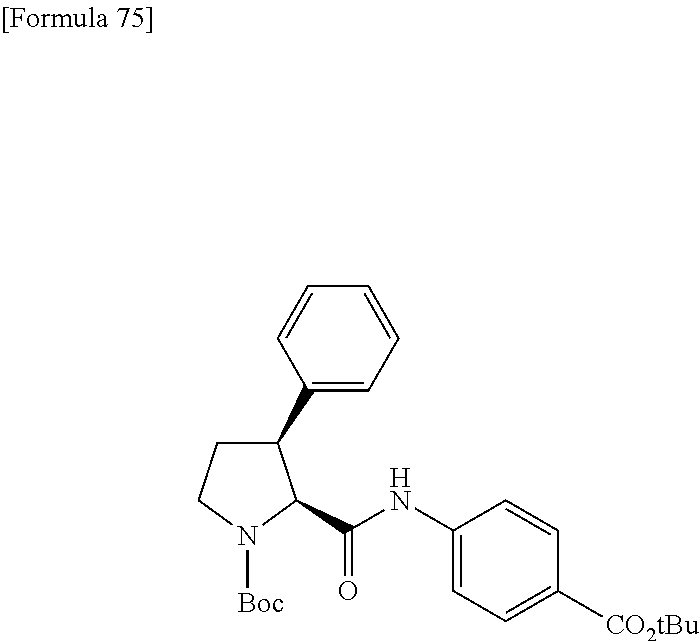


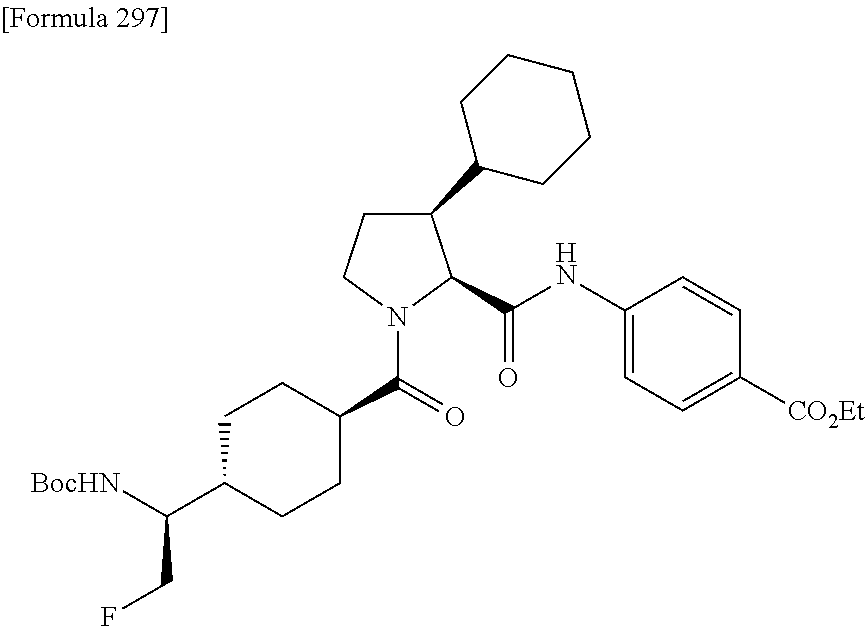


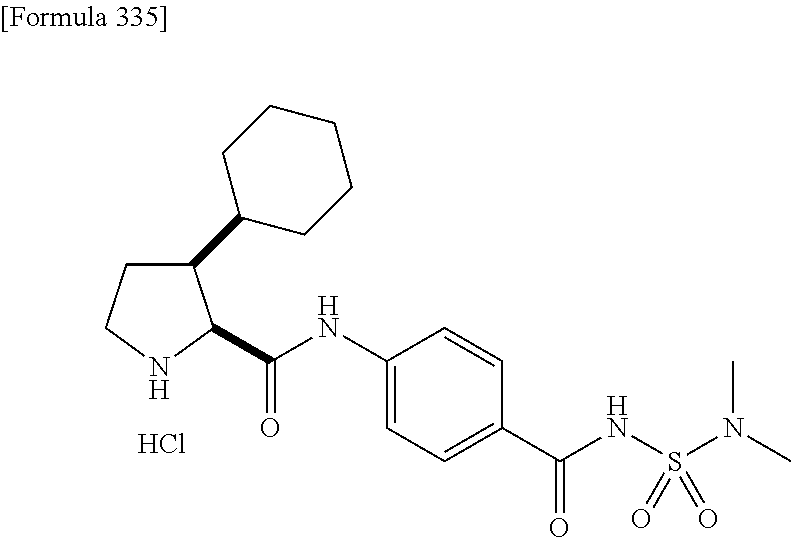


- A: tert-Butyl [(1S)-2-fluoro-1-(trans-4-{[(2S,3R)-2-{[4-(5-oxo-2,5-dihydro-1,2,4-oxadiazol-3-yl)phenyl]carbamoyl}-3-(piperidin-1-yl)pyrrolidin-1-yl]carbonyl}cyclohexyl)ethyl]carbamate
- B: tert-Butyl [(1S)-2-fluoro-1-(trans-4-{[(2R,3S)-2-{[4-(5-oxo-2,5-dihydro-1,2,4-oxadiazol-3-yl)phenyl]carbamoyl}-3-(piperidin-1-yl)pyrrolidin-1-yl]carbonyl}cyclohexyl)ethyl]carbamate


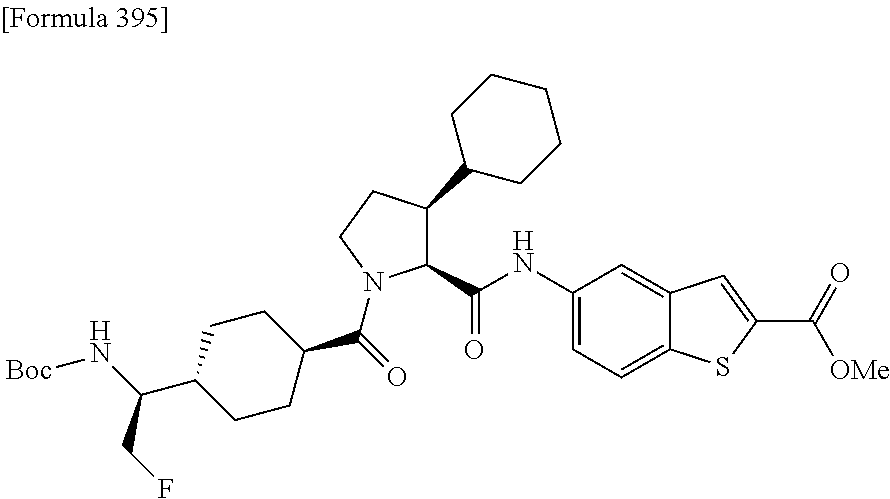


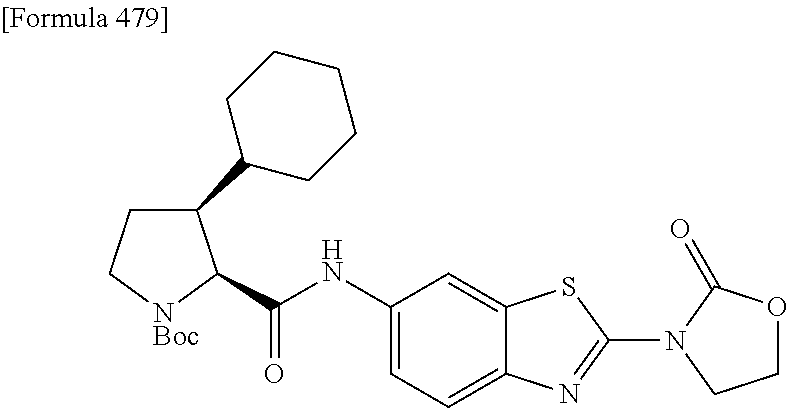


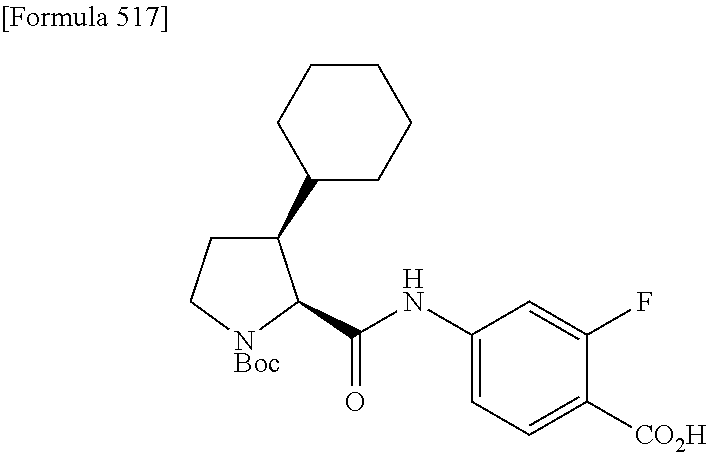


- A: Ethyl 5-{[(3R)-1-[(trans-4-{(1S)-1-[(tert-butoxycarbonyl)amino]-2-fluoroethyl}cyclohexyl)carbonyl]-3-(piperidin-1-yl)-L-prolyl]amino}-1-benzofuran-2-carboxylate
- B: Ethyl 5-{[(3S)-1-[(trans-4-{(1S)-1-[(tert-butoxycarbonyl)amino]-2-fluoroethyl}cyclohexyl)carbonyl]-3-(piperidin-1-yl)-D-prolyl]amino}-1-benzofuran-2-carboxylate


- A: tert-Butyl (2R,3R)-3-(cis-4-hydroxycyclohexyl)-2-(hydroxymethyl)pyrrolidine-1-carboxylate
- B: tert-Butyl (2R,3R)-3-(trans-4-hydroxycyclohexyl)-2-(hydroxymethyl)pyrrolidine-1-carboxylate


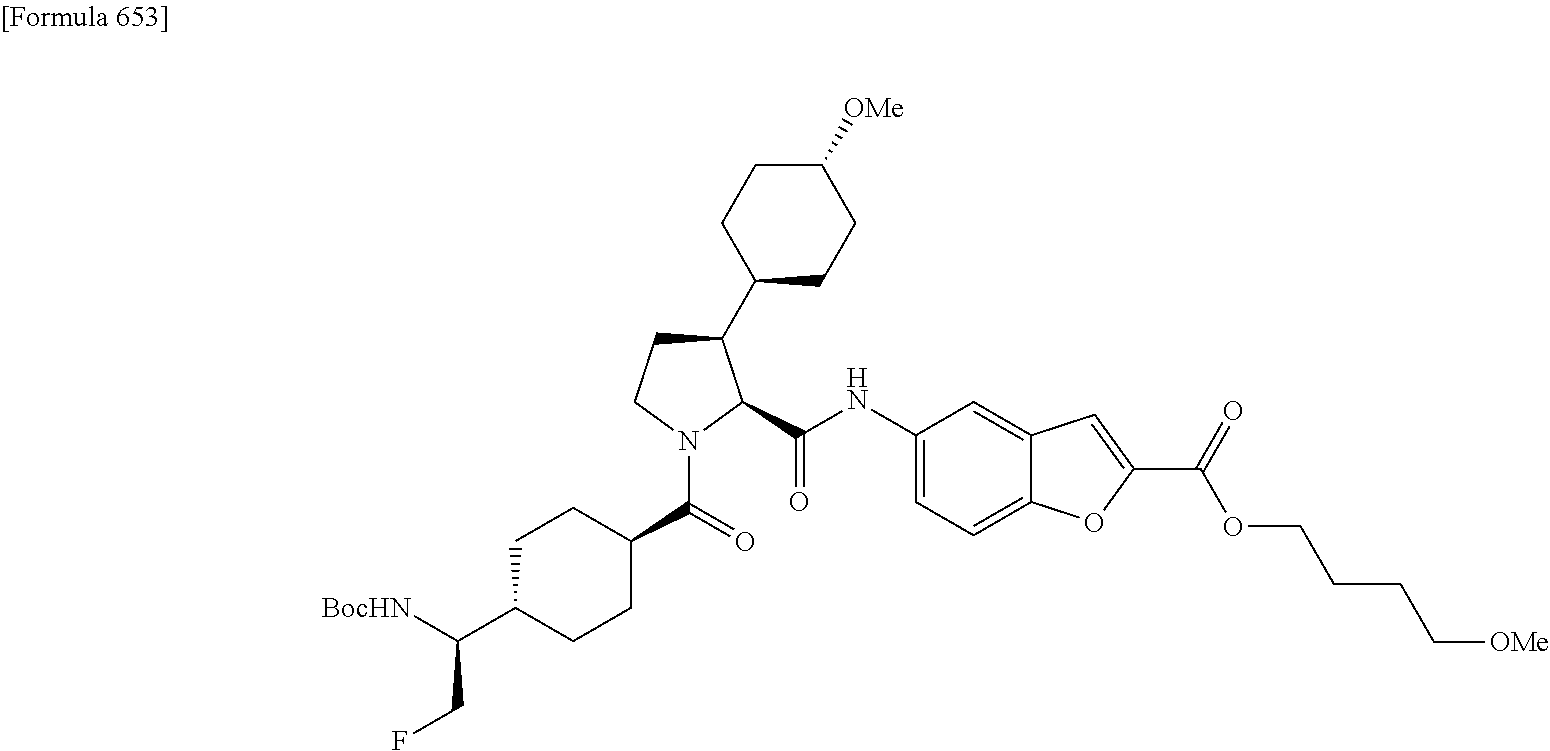


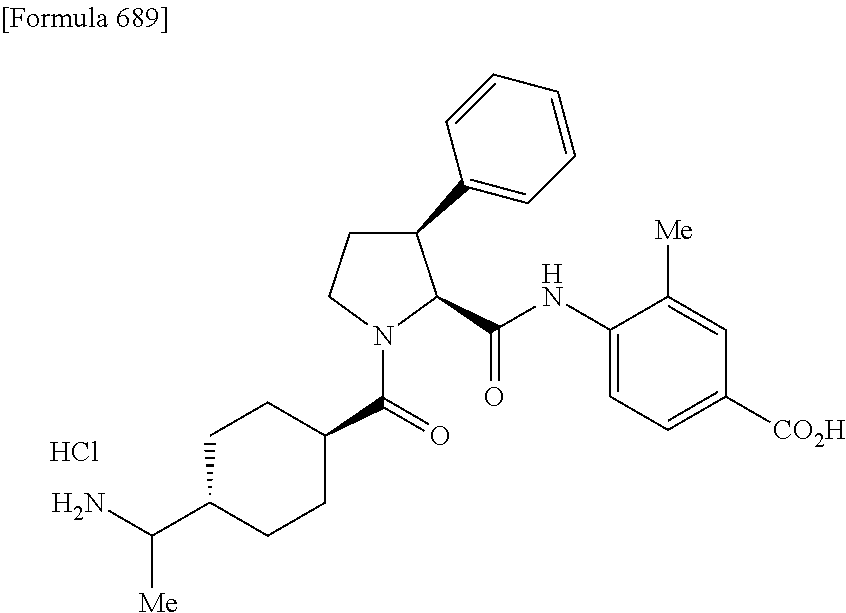


| TABLE 1 | |
| Example | Instrumental analysis data |
| 12 | RT 3.163 min (Condition A). MS (ESI+) 431 (M + 1, 100%) |
| 13 | RT 3.037 min (Condition A). MS (ESI+) 490 (M + 1, 100%) |
| 14 | RT 3.096 min (Condition A). MS (ESI+) 508 (M + 1, 100%) |
| 15 | RT 2.963 min (Condition A). MS (ESI+) 450 (M + 1, 100%) |
| 16 | RT 2.963 min (Condition A). MS (ESI+) 450 (M + 1, 100%) |
| 17 | RT 3.365 min (Condition A). MS (ESI+) 456 (M + 1, 100%) |
| 18 | RT 3.424 min (Condition A). MS (ESI+) 474 (M + 1, 100%) |


| TABLE 2 | |
| Example | Instrumental analysis data |
| 19 | RT 3.017 min (Condition A). MS (ESI+) 480 (M + 1, 100%) |
| 20 | RT 3.139 min (Condition A). MS (ESI+) 484 (M + 1, 100%) |
| 21 | RT 2.693 min (Condition A). MS (ESI+) 457 (M + 1, 100%) |
| 22 | RT 2.965 min (Condition A). MS (ESI+) 467 (M + 1, 100%) |
| 23 | RT 3.274 min (Condition A). MS (ESI+) 489 (M + 1, 100%) |
| 24 | RT 2.883 min (Condition A). MS (ESI+) 488 (M + 1, 100%) |


| TABLE 3 | |
| Example | Instrumental analysis data |
| 28 | RT 3.280 min (Condition A). MS (ESI+) 496 (M + 1, 100%) |
| 29 | RT 3.613 min (Condition A). MS (ESI+) 541 (M + 1, 100%) |
| 30 | RT 3.208 min (Condition A). MS (ESI+) 535 (M + 1, 100%) |
| 31 | RT 3.133 min (Condition A). MS (ESI+) 482 (M + 1, 100%) |
| 32 | RT 3.306 min (Condition A). MS (ESI+) 571 (M + 1, 100%) |
| 33 | RT 3.094, 3.213 min (Condition A). MS (ESI+) 558 |
| (M + 1, 100%) | |
| 34 | RT 3.635 min (Condition A). MS (ESI+) 561 (M + 1, 100%) |
| 35 | RT 3.501 min (Condition A). MS (ESI+) 527 (M + 1, 100%) |
| 36 | RT 3.133 min (Condition A). MS (ESI+) 552 (M + 1, 100%) |
| 37 | RT 3.224 min (Condition A). MS (ESI+) 540 (M + 1, 100%) |
| 38 | RT 3.165 min (Condition A). MS (ESI+) 539 (M + 1, 100%) |
| 39 | RT 3.643 min (Condition A). MS (ESI+) 541 (M + 1, 100%) |
| 40 | RT 3.609 min (Condition A). MS (ESI+) 545 (M + 1, 100%) |


| TABLE 4 | |
| Example | Instrumental analysis data |
| 41 | RT 3.723 min (Condition A). MS (ESI+) 488 (M + 1, 100%) |
| 42 | RT 3.379 min (Condition A). MS (ESI+) 486 (M + 1, 100%) |
| 43 | RT 3.360 min (Condition A). MS (ESI+) 499 (M + 1, 100%) |
| 44 | RT 3.675 min (Condition A). MS (ESI+) 474 (M + 1, 100%) |
| 45 | RT 3.357 min (Condition A). MS (ESI+) 522 (M + 1, 72%) |
| 46 | RT 3.382 min (Condition A). MS (ESI+) 504 (M + 1, 100%) |
| 47 | RT 3.483 min (Condition A). MS (ESI+) 535 (M + 1, 100%) |
| 48 | RT 3.323 min (Condition A). MS (ESI+) 522 (M + 1, 100%) |
| 49 | RT 3.637 min (Condition A). MS (ESI+) 528 (M + 1, 100%) |
| 50 | RT 3.832 min (Condition A). MS (ESI+) 528 (M + 1, 100%) |
| 51 | RT 3.899 min (Condition A). MS (ESI+) 597 (M + 1, 100%) |
| 52 | RT 3.373 min (Condition A). MS (ESI+) 583 (M + 1, 100%) |
| 53 | 1H NMR (400 MHz, DMSO-d6) δ 10.74 (s, 0.31H), 10.23 |
| (s, 0.69H), 8.60-8.00 (br, 2H), 8.15 (s, 0.64H), 8.14 | |
| (s, 0.36H), 7.69-7.61 (m, 2H), 7.58-7.50 (m, 1H), | |
| 4.80-4.66 (m, 1H), 4.66-4.46 (m, 2H), 4.36 (br, | |
| 0.34H), 3.76 (m, 0.66H), 3.51-3.38 (m, 2H), 3.30-3.10 | |
| (m, 1H), 2.69-2.30 (m, 2H), 2.21-2.08 (m, 1H), | |
| 2.08-1.87 (m, 3H), 1.87-1.34 (m, 6H), 1.34-1.25 | |
| (m, 2H), 1.25-1.04 (m, 4H), 1.04-0.88 (m, 3H). | |
| RT 3.832 min (Condition A). MS (ESI+) 528 (M + 1, 100%) | |
| 54 | RT 3.839 min (Condition A). MS (ESI+) 528 (M + 1, 100%) |
| 55 | RT 3.933 min (Condition A). MS (ESI+) 542 (M + 1, 100%) |
| 56 | RT 3.451 min (Condition A). MS (ESI+) 522 (M + 1, 100%) |
| 57 | RT 3.552 min (Condition A). MS (ESI+) 522 (M + 1, 72%) |


| TABLE 5 | |
| Example | |
| 60 | RT 4.302 min (Condition A). MS (ESI+) 502 (M + 1, 100%) |
| 61 | RT 3.968 min (Condition A). MS (ESI+) 500 (M + 1, 89%) |
| 62 | RT 4.264 min (Condition A). MS (ESI+) 488 (M + 1, 100%) |
| 63 | RT 4.096 min (Condition A). MS (ESI+) 532 (M + 1, 100%) |
| 64 | RT 4.0617 min (Condition A). MS (ESI+) 550 (M + 1, 72%) |
| 65 | RT 4.173 min (Condition A). MS (ESI+) 563 (M + 1, 100%) |
| 66 | RT 4.021 min (Condition A). MS (ESI+) 550 (M + 1, 100%) |
| 67 | RT 4.421 min (Condition A). MS (ESI+) 556 (M + 1, 100%) |
| 68 | RT 3.832 min (Condition A). MS (ESI+) 497 (M + 1, 100%) |


| TABLE 6 | |
| Example | Instrumental analysis data |
| 69 | RT 4.403 min (Condition A). MS (ESI+) 595 (M + 1, 100%) |
| 70 | RT 4.810 min (Condition A). MS (ESI+) 602 (M + 1, 100%) |
| 71 | RT 4.765 min (Condition A). MS (ESI+) 642 (M + 1, 100%) |
| 72 | RT 3.803 min (Condition A). MS (ESI+) 655 (M + 1, 100%) |
| 73 | RT 3.771 min (Condition A). MS (ESI+) 641 (M + 1, 72%) |
| 74 | RT 4.741 min (Condition A). MS (ESI+) 658 (M + 1, 100%) |
| 75 | RT 4.685 min (Condition A). MS (ESI+) 628 (M + 1, 100%) |
| 76 | RT 4.504 min (Condition A). MS (ESI+) 600 (M + 1, 100%) |
| 77 | RT 4.680 min (Condition A). MS (ESI+) 644 (M + 1, 100%) |
| 78 | RT 4.621 min (Condition A). MS (ESI+) 614 (M + 1, 100%) |
| 79 | RT 4.520 min (Condition A). MS (ESI+) 612 (M + 1, 100%) |
| 80 | RT 4.155 min (Condition A). MS (ESI+) 594 (M + 1, 100%) |
| 81 | RT 4.229 min (Condition A). MS (ESI+) 594 (M + 1, 100%) |
| 82 | RT 4.552 min (Condition A). MS (ESI+) 600 (M + 1, 100%) |


| TABLE 7 | |
| Example | Instrumental analysis data |
| 83 | RT 4.630 min (Condition A). MS (ESI+) 512 (M + 1, 100%) |
| 84 | RT 4.192 min (Condition A). MS (ESI+) 510 (M + 1, 100%) |
| 85 | RT 4.133 min (Condition A). MS (ESI+) 514 (M + 1, 100%) |
| 86 | RT 4.684 min (Condition A). MS (ESI+) 569 (M + 1, 60%) |
| 87 | RT 4.331 min (Condition A). MS (ESI+) 563 (M + 1, 70%) |
| 88 | RT 4.267, 4.440 min (Condition A). MS (ESI+) 599 |
| (M + 1, 60%) | |
| 89 | RT 4.488 min (Condition A). MS (ESI+) 555 (M + 1, 100%) |
| 90 | RT 4.640 min (Condition A). MS (ESI+) 589 (M + 1, 100%) |
| 91 | RT 4.296 min (Condition A). MS (ESI+) 568 (M + 1, 100%) |
| 92 | RT 4.184 min (Condition A). MS (ESI+) 567 (M + 1, 100%) |
| 93 | RT 4.640 min (Condition A). MS (ESI+) 569 (M + 1, 100%) |
| 94 | RT 4.157 min (Condition A). MS (ESI+) 593 (M + 1, 100%) |
| 95 | RT 4.229 min (Condition A). MS (ESI+) 593 (M + 1, 100%) |


| TABLE 8 | |
| Example | Instrumental analysis data |
| 96 | RT 3.977 min (Kinetex 1.7μ C18 100A, 0.1% |
| trifluoro acetic acid in water/acetonitrile, acetonitrile | |
| 1-99% 7.0 min, 0.9 mL/min (Condition B)). | |
| MS (ESI+) 488 (M + 1, 100%) | |
| 97 | RT 3.618 min (Condition B). MS (ESI+) 588 (M + 1, 100%) |
| 98 | RT 4.134 min (Condition B). MS (ESI+) 555 (M + 1, 100%) |
| 99 | RT 3.917 min (Condition B). MS (ESI+) 527 (M + 1, 100%) |
| 100 | RT 4.557 min (Condition B). MS (ESI+) 560 (M + 1, 100%) |
| 101 | RT 4.403 min (Condition B). MS (ESI+) 599 (M + 1, 100%) |
| 102 | 1H NMR (400 MHz, DMSO-d6) δ 10.77 (s, 0.27H), |
| 10.24 (s, 0.63H), 8.12-8.08 (m, 1H), 7.67-7.62 (m, 2H), | |
| 7.55-7.49 (m, 1H), 4.77-4.66 (m, 1H), 4.63-4.55 (m, 1H), | |
| 4.51-4.50 (m, 1H), 3.77-3.73 (m, 1H), 3.20-3.16 (m, 2H), | |
| 3.14 (s, 3H), 3.04-2.97 (m, 2H), 2.42-2.36 (m, 1H), | |
| 2.19-2.17 (m, 1H), 1.98-1.90 (m, 4H), 1.81-1.57 (m, 6H), | |
| 1.31-0.75 (m, 9H). | |
| RT 3.527 min (Condition B). MS (ESI+) 558 (M + 1, 100%) | |
| 103 | RT 3.581 min (Condition B). MS (ESI+) 558 (M + 1, 100%) |
| 104 | RT 4.080 min (Condition B). MS (ESI+) 561 (M + 1, 100%) |
| 105 | RT 3.934 min (Condition B). MS (ESI+) 670 (M + 1, 100%) |
| 106 | RT 4.174 min (Condition B). MS (ESI+) 573 (M + 1, 100%) |
| 107 | RT 4.207 min (Condition B). MS (ESI+) 594 (M + 1, 100%) |
| 108 | RT 4.683 min (Condition B). MS (ESI+) 625 (M + 1, 100%) |
| 109 | RT 4.659 min (Condition B). MS (ESI+) 657 (M + 1, 100%) |
| 110 | RT 3.595 min (Condition B). MS (ESI+) 521 (M + 1, 100%) |
| 111 | RT 3.325 min (Condition B). MS (ESI+) 648 (M + 1, 100%) |
| 112 | RT 3.571 min (Condition B). MS (ESI+) 551 (M + 1, 100%) |
| 113 | RT 4.028 min (Condition B). MS (ESI+) 541 (M + 1, 100%) |
| 114 | RT 3.972 min (Condition B). MS (ESI+) 604 (M + 1, 100%) |
| 115 | RT 4.455 min (Condition B). MS (ESI+) 526 (M + 1, 100%) |
| 116 | RT 4.036 min (Condition B). MS (ESI+) 528 (M + 1, 100%) |


| TABLE 9 | |
| Example | Instrumental analysis data |
| 117 | RT 1.250 min (Kinetex 1.7μ C18 100A, 0.1% |
| trifluoro acetic acid in water/acetonitrile, acetonitrile | |
| 10-99% 3.0 min, 0.5 mL/min (Condition C)). | |
| MS (ESI+) 529 (M + 1, 100%) | |
| 118 | RT 4.386 min (Condition B). MS (ESI+) 627 (M + 1, 100%) |
| 119 | RT 4.011 min (Condition B). MS (ESI+) 618 (M + 1, 100%) |
| 120 | RT 4.826 min (Condition B). MS (ESI+) 691 (M + 1, 100%) |
| 121 | RT 4.484 min (Condition B). MS (ESI+) 667 (M + 1, 100%) |
| 122 | RT 3.813 min (Condition B). MS (ESI+) 669 (M + 1, 100%) |
| 123 | RT 4.219 min (Condition B). MS (ESI+) 591 (M + 1, 100%) |
| 124 | RT 4.381 min (Condition B). MS (ESI+) 611 (M + 1, 100%) |
| 125 | RT 4.639 min (Condition B). MS (ESI+) 649 (M + 1, 100%) |
| 126 | RT 4.437 min (Condition B). MS (ESI+) 625 (M + 1, 100%) |
| 127 | RT 4.432 min (Condition B). MS (ESI+) 599 (M + 1, 100%) |
| 128 | RT 4.795 min (Condition B). MS (ESI+) 657 (M + 1, 100%) |
| 129 | RT 3.854 min (Condition B). MS (ESI+) 529 (M + 1, 100%) |
| 130 | RT 4.228 min (Condition B). MS (ESI+) 544 (M + 1, 100%) |


| TABLE 10 | |
| Example | Instrumental analysis data |
| 131 | RT 4.414 min (Condition B). MS (ESI+) 599 (M + 1, 100%) |
| 132 | RT 3.645 min (Condition B). MS (ESI+) 539 (M + 1, 100%) |
| 133 | RT 4.509 min (Condition B). MS (ESI+) 645 (M + 1, 100%) |
| 134 | RT 4.151 min (Condition B). MS (ESI+) 628 (M + 1, 100%) |
| 135 | RT 0.500 min (Condition C). MS (ESI+) 513 (M + 1, 100%) |
| 136 | RT 4.423 min (Condition B). MS (ESI+) 645 (M + 1, 100%) |
| 137 | RT 3.514 min (Condition B). MS (ESI+) 578 (M + 1, 100%) |
| 138 | RT 3.756 min (Condition B). MS (ESI+) 526 (M + 1, 100%) |
| 139 | RT 3.072 min (Condition B). MS (ESI+) 542 (M + 1, 100%) |


| TABLE 11 | |
| Example | Instrumental analysis data |
| 140 | RT 4.818 min (Condition B). MS (ESI+) 614 (M + 1, 100%) |
| 141 | RT 4.678 min (Condition B). MS (ESI+) 626 (M + 1, 100%) |
| 142 | RT 4.598 min (Condition B). MS (ESI+) 612 (M + 1, 100%) |
| 143 | RT 4.630 min (Condition B). MS (ESI+) 612 (M + 1, 100%) |
| 144 | RT 4.811 min (Condition B). MS (ESI+) 658 (M + 1, 100%) |
| 145 | RT 4.645 min (Condition B). MS (ESI+) 617 (M + 1, 60%) |
| 146 | RT 3.944 min (Condition B). MS (ESI+) 546 (M + 1, 100%) |
| 147 | RT 3.991 min (Condition B). MS (ESI+) 565 (M + 1, 100%) |
| 148 | RT 4.210 min (Condition B). MS (ESI+) 574 (M + 1, 100%) |
| 149 | RT 4.576 min (Condition B). MS (ESI+) 530 (M + 1, 100%) |
| 150 | RT 4.576 min (Condition B). MS (ESI+) 630 (M + 1, 100%) |
| 151 | RT 4.758 min (Condition B). MS (ESI+) 614 (M + 1, 100%) |
| 152 | RT 4.578 min (Condition B). MS (ESI+) 644 (M + 1, 100%) |
| 153 | RT 3.796 min (Condition B). MS (ESI+) 552 (M + 1, 100%) |


| TABLE 12 | |
| Example | Instrumental analysis data |
| 154 | RT 4.252 min (Condition B). MS (ESI+) 586 (M + 1, 100%) |
| 155 | RT 4.937 min (Condition B). MS (ESI+) 628 (M + 1, 100%) |
| 156 | RT 3.560 min (Condition B). MS (ESI+) 521 (M + 1, 100%) |
| 157 | RT 4.133 min (Condition B). MS (ESI+) 607 (M + 1, 60%) |
| 158 | RT 3.632 min (Condition B). MS (ESI+) 552 (M + 1, 100%) |
| 159 | RT 3.707 min (Condition B). MS (ESI+) 536 (M + 1, 60%) |
| 160 | RT 3.683 min (Condition B). MS (ESI+) 535 (M + 1, 100%) |
| 161 | RT 3.595 min (Condition B). MS (ESI+) 521 (M + 1, 100%) |
| 162 | RT 4.204 min (Condition B). MS (ESI+) 607 (M + 1, 100%) |
| 163 | RT 4.384 min (Condition B). MS (ESI+) 621 (M + 1, 100%) |
| 164 | RT 4.901 min (Condition B). MS (ESI+) 574 (M + 1, 100%) |
| 165 | RT 4.122 min (Condition B). MS (ESI+) 541 (M + 1, 100%) |
| 166 | RT 4.843 min (Condition B). MS (ESI+) 627 (M + 1, 100%) |
| 167 | RT 4.637 min (Condition B). MS (ESI+) 600 (M + 1, 100%) |


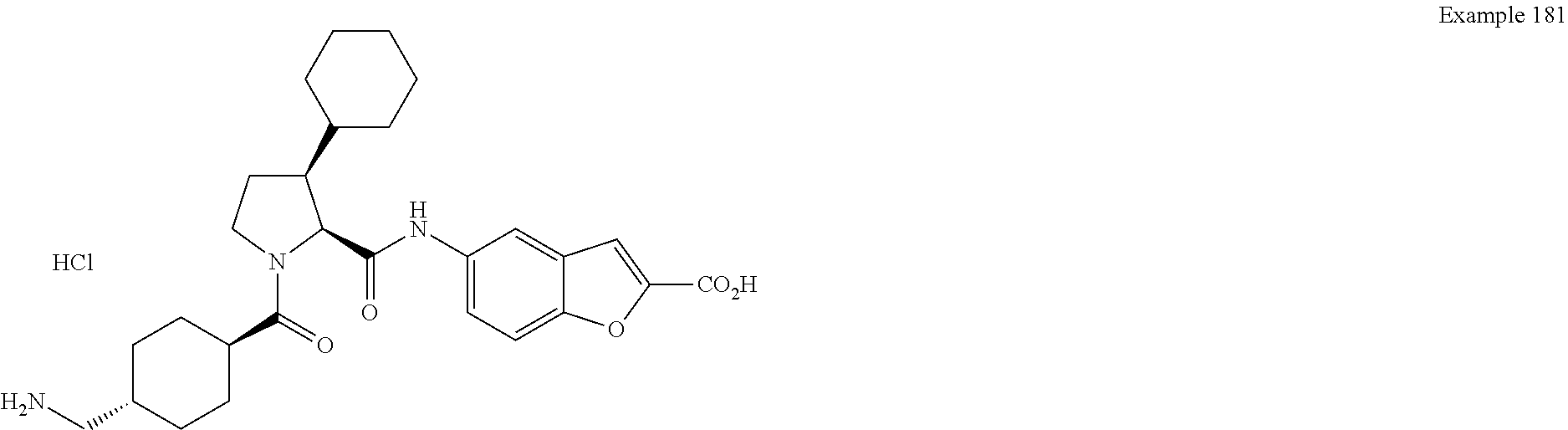
| TABLE 13 | |
| Example | Instrumental analysis data |
| 168 | RT 2.760 min (Condition B). MS (ESI+) 529 (M + 1, 100%) |
| 169 | RT 4.669 min (Condition B). MS (ESI+) 644 (M + 1, 100%) |
| 170 | RT 3.560 min (Condition B). MS (ESI+) 551 (M + 1, 100%) |
| 171 | RT 4.112 min (Condition B). MS (ESI+) 633 (M + 1, 60%) |
| 172 | RT 3.332 min (Condition B). MS (ESI+) 634 (M + 1, 100%) |
| 173 | RT 4.597 min (Condition B). MS (ESI+) 669 (M + 1, 100%) |
| 174 | RT 4.066 min (Condition B). MS (ESI+) 693 (M + 1, 100%) |
| 175 | RT 3.923 min (Condition B). MS (ESI+) 579 (M + 1, 100%) |
| 176 | RT 4.165 min (Condition B). MS (ESI+) 607 (M + 1, 100%) |
| 177 | RT 4.035 min (Condition B). MS (ESI+) 637 (M + 1, 100%) |
| 178 | RT 3.645 min (Condition B). MS (ESI+) 539 (M + 1, 100%) |
| 179 | RT 4.251 min (Condition B). MS (ESI+) 543 (M + 1, 100%) |
| 180 | RT 4.545 min (Condition B). MS (ESI+) 612 (M + 1, 100%) |
| 181 | RT 3.999 min (Condition B). MS (ESI+) 496 (M + 1, 100%) |


| TABLE 14 | |
| Example | Instrumental analysis data |
| 182 | RT 3.580 min (Condition B). MS (ESI+) 528 (M + 1, 100%) |
| 183 | RT 3.461 min (Condition A). MS (ESI+) 528 (M + 1, 100%) |
| 184 | RT 4.066 min (Condition A). MS (ESI+) 561 (M + 1, 100%) |
| 185 | RT 4.275 min (Condition B). MS (ESI+) 543 (M + 1, 100%) |
| 186 | RT 3.644 min (Condition A). MS (ESI+) 555 (M + 1, 100%) |
| 187 | RT 3.427 min (Condition B). MS (ESI+) 558 (M + 1, 100%) |
| 188 | RT 4.014 min (Condition B). MS (ESI+) 630 (M + 1, 100%) |
| 189 | RT 3.940 min (Condition B). MS (ESI+) 674 (M + 1, 100%) |
| 190 | RT 4.018 min (Condition B). MS (ESI+) 558 (M + 1, 100%) |
| 191 | RT 4.109 min (Condition B). MS (ESI+) 630 (M + 1, 100%) |
| 192 | RT 3.987 min (Condition B). MS (ESI+) 630 (M + 1, 100%) |
| 193 | RT 3.273 min (Condition B). MS (ESI+) 557 (M + 1, 100%) |


| TABLE 15 | |
| Example | Instrumental analysis data |
| 194 | RT 4.236 min (Condition B). MS (ESI+) 586 (M + 1, 100%) |
| 195 | RT 4.102 min (Condition B). MS (ESI+) 630 (M + 1, 100%) |
| 196 | RT 4.0673 min (Condition B). MS (ESI+) 674 (M + 1, 100%) |
| 197 | RT 4.103 min (Condition B). MS (ESI+) 630 (M + 1, 100%) |
| 198 | RT 4.099 min (Condition B). MS (ESI+) 630 (M + 1, 100%) |
| 199 | RT 4.786 min (Condition B). MS (ESI+) 640 (M + 1, 100%) |
| 200 | RT 4.786 min (Condition B). MS (ESI+) 640 (M + 1, 100%) |
| 201 | RT 4.540 min (Condition B). MS (ESI+) 614 (M + 1, 100%) |
| 202 | RT 4.266 min (Condition B). MS (ESI+) 644 (M + 1, 100%) |
| 203 | RT 4.757 min (Condition B). MS (ESI+) 672 (M + 1, 100%) |


| TABLE 16 | |
| Example | Instrumental analysis data |
| 208 | RT 4.146 min (Condition B). MS (ESI+) 633 (M + 1, 100%) |
| 209 | RT 3.802 min (Condition B). MS (ESI+) 627 (M + 1, 100%) |
| 210 | RT 4.056 min (Condition B). MS (ESI+) 675 (M + 1, 100%) |
| 211 | RT 4.270 min (Condition B). MS (ESI+) 634 (M + 1, 100%) |
| 212 | RT 4.251 min (Condition B). MS (ESI+) 676 (M + 1, 100%) |
| 213 | RT 4.438 min (Condition B). MS (ESI+) 673 (M + 1, 100%) |
| 214 | RT 4.638 min (Condition B). MS (ESI+) 674 (M + 1, 100%) |
| TABLE 17 |
 |
| Q |
 |
Example 215 |
 |
Example 216 |
 |
Example 217 |
 |
Example 218 |
 |
Example 219 |
 |
Example 220 |
 |
Example 221 |
 |
Example 222 |
| TABLE 18 | |
| Example | Instrumental analysis data |
| 215 | RT 4.207 min (Condition B). MS (ESI+) 594 (M + 1, 100%) |
| 216 | RT 3.267 min (Condition B). MS (ESI+) 659 (M + 1, 100%) |
| 217 | RT 3.312 min (Condition B). MS (ESI+) 660 (M + 1, 100%) |
| 218 | RT 4.536 min (Condition B). MS (ESI+) 673 (M + 1, 100%) |
| 219 | RT 3.369 min (Condition B). MS (ESI+) 687 (M + 1, 100%) |
| 220 | RT 4.612 min (Condition B). MS (ESI+) 689 (M + 1, 100%) |
| 221 | RT 3.054 min (Condition B). MS (ESI+) 676 (M + 1, 100%) |
| 222 | RT 2.972 min (Condition B). MS (ESI+) 690 (M + 1, 100%) |
| TABLE 19 |
 |
| R |
 |
Example 223 |
 |
Example 224 |
 |
Example 225 |
 |
Example 226 |
 |
Example 227 |
 |
Example 228 |
 |
Example 229 |
 |
Example 230 |
 |
Example 231 |
 |
Example 232 |
 |
Example 233 |
 |
Example 234 |
 |
Example 235 |
 |
Example 236 |
 |
Example 237 |
 |
Example 238 |
 |
Example 239 |
| TABLE 20 | |
| Example | Instrumental analysis data |
| 223 | RT 4.744 min (Condition B). MS (ESI+) 628 (M + 1, 100%) |
| 224 | RT 4.070 min (Condition B). MS (ESI+) 642 (M + 1, 100%) |
| 225 | RT 3.339 min (Condition B). MS (ESI+) 685 (M + 1, 100%) |
| 226 | RT 4.190 min (Condition B). MS (ESI+) 644 (M + 1, 100%) |
| 227 | RT 4.533 min (Condition B). MS (ESI+) 614 (M + 1, 100%) |
| 228 | RT 4.077 min (Condition B). MS (ESI+) 670 (M + 1, 100%) |
| 229 | RT 4.907 min (Condition B). MS (ESI+) 642 (M + 1, 100%) |
| 230 | RT 4.581 min (Condition B). MS (ESI+) 626 (M + 1, 100%) |
| 231 | RT 4.544 min (Condition B). MS (ESI+) 672 (M + 1, 100%) |
| 232 | RT 4.298 min (Condition B). MS (ESI+) 600 (M + 1, 100%) |
| 233 | RT 3.924 min (Condition B). MS (ESI+) 572 (M + 1, 100%) |
| 234 | RT 3.283 min (Condition B). MS (ESI+) 671 (M + 1, 100%) |
| 235 | RT 4.085 min (Condition B). MS (ESI+) 656 (M + 1, 100%) |
| 236 | RT 4.697 min (Condition B). MS (ESI+) 628 (M + 1, 100%) |
| 237 | RT 4.333 min (Condition B). MS (ESI+) 612 (M + 1, 100%) |
| 238 | RT 4.909 min (Condition B). MS (ESI+) 728 (M + 1, 100%) |
| 239 | RT 4.199 min (Condition B). MS (ESI+) 688 (M + 1, 100%) |
| TABLE 21 |
 |
| R |
 |
Example 240 |
 |
Example 241 |
 |
Example 242 |
 |
Example 243 |
 |
Example 244 |
 |
Example 245 |
 |
Example 246 |
| TABLE 22 | |
| Example | Instrumental analysis data |
| 240 | RT 2.859 min (Kinetex 1.7μ C18 100A, 0.1% |
| trifluoro acetic acid in water/acetonitrile, acetonitrile | |
| 1-99% 5.5 min, 0.8 mL/min(Condition D)). | |
| MS (ESI+) 713 (M + 1, 100%) | |
| 241 | RT 2.863 min (Condition D). MS (ESI+) 713 (M + 1, 100%) |
| 242 | RT 2.851 min (Condition D). MS (ESI+) 713 (M + 1, 100%) |
| 243 | RT 2.839 min (Condition D). MS (ESI+) 700 (M + 1, 100%) |
| 244 | RT 2.987 min (Condition D). MS (ESI+) 644 (M + 1, 100%) |
| 245 | RT 2.905 min (Condition D). MS (ESI+) 628 (M + 1, 100%) |
| 246 | RT 3.197 min (Condition D). MS (ESI+) 656 (M + 1, 100%) |
| TABLE 23 | |||
| FXIa inhibitory activity | |||
| Example No. | IC50 (nM) | ||
| 5 | 125 | ||
| 14 | 130 | ||
| 23 | 9 | ||
| 24 | 34 | ||
| 29 | 82 | ||
| 34 | 28 | ||
| 35 | 14 | ||
| 38 | 30 | ||
| 39 | 63 | ||
| 40 | 45 | ||
| 46 | 90 | ||
| 50 | 84 | ||
| 53 | 34 | ||
| 55 | 220 | ||
| 96 | 98 | ||
| 99 | 6 | ||
| 102 | 93 | ||
| 103 | 2350 | ||
| 113 | 145 | ||
| 114 | 7 | ||
| 115 | 1500 | ||
| 118 | 65 | ||
| 121 | 43 | ||
| 122 | 690 | ||
| 130 | 195 | ||
| 133 | 99 | ||
| 134 | 54 | ||
| 137 | 380 | ||
| 138 | 72 | ||
| 141 | 3450 | ||
| 146 | 916 | ||
| 147 | 205 | ||
| 148 | 140 | ||
| 170 | 76 | ||
| 171 | 300 | ||
| 178 | 33 | ||
| 184 | 30 | ||
| 186 | 60 | ||
| 187 | 285 | ||
| 196 | 3500 | ||
| 201 | 4100 | ||
| 211 | 29 | ||
| 212 | 8 | ||
| 213 | 10 | ||
| TABLE 24 | ||
| Compound | Vehicle | Example 53 |
| Dose (mg/kg, i.v.) | 0 | 0.1 | 0.3 | 1.0 | 3.0 |
| Thrombus weight (mg) | 68.8 | 51.3 | 30.3 | 14.7 | 14.0 |
| Thrombus (% inhibition) | 0 | 25 | 56 | 79 | 80 |
| aPTT (s) | 17.3 | 17.8 | 20.3 | 24.2 | 28.8 |
| aPTT (% vehicle) | 100 | 103 | 117 | 140 | 166 |
- (1) Human Liver Stabilization Test
- (2) Stabilization in Human Plasma Test
| TABLE 25 | |||
| Residual percentage (%) | |||
| Example No. | Human liver S9 | Human plasma |
| 82 | 5.8 | 92 |
| 120 | 4.9 | 65 |
| 125 | 5.6 | 86 |
| 128 | 47 | 82 |
| 141 | 17 | 94 |
| 143 | 1.3 | 92 |
| 171 | 18 | <1 |
| 179 | 4.7 | 20 |
| 180 | 33 | 81 |
| 189 | 85 | 41 |
| 201 | 45 | 85 |
| 202 | 82 | 44 |
| 203 | 74 | 45 |
| 205 | 3.5 | 60 |
| 225 | 74 | 7.4 |
| 226 | 79 | 62 |
| 228 | 1.3 | <1 |
| 230 | 28 | 73 |
| 234 | 66 | 54 |
| 238 | 1.0 | 88 |
Claims (39)


Applications Claiming Priority (3)
| Application Number | Priority Date | Filing Date | Title |
|---|---|---|---|
| JP2012160745 | 2012-07-19 | ||
| JP2012-160745 | 2012-07-19 | ||
| PCT/JP2013/069499 WO2014014050A1 (en) | 2012-07-19 | 2013-07-18 | 1-(cycloalkyl-carbonyl)proline derivative |
Publications (2)
| Publication Number | Publication Date |
|---|---|
| US20150210640A1 US20150210640A1 (en) | 2015-07-30 |
| US9758480B2 true US9758480B2 (en) | 2017-09-12 |
Family
ID=49948873
Family Applications (1)
| Application Number | Title | Priority Date | Filing Date |
|---|---|---|---|
| US14/414,838 Expired - Fee Related US9758480B2 (en) | 2012-07-19 | 2013-07-18 | 1-(cycloalkyl-carbonyl)proline derivative |
Country Status (9)
| Country | Link |
|---|---|
| US (1) | US9758480B2 (en) |
| EP (1) | EP2876105A4 (en) |
| JP (1) | JP6220786B2 (en) |
| CN (1) | CN104640843A (en) |
| AU (1) | AU2013291098A1 (en) |
| CA (1) | CA2881566A1 (en) |
| HK (1) | HK1209747A1 (en) |
| TW (1) | TW201416362A (en) |
| WO (1) | WO2014014050A1 (en) |
Families Citing this family (52)
| Publication number | Priority date | Publication date | Assignee | Title |
|---|---|---|---|---|
| LT2766346T (en) | 2011-10-14 | 2017-06-12 | Bristol-Myers Squibb Company | Substituted tetrahydroisoquinoline compounds as factor xia inhibitors |
| IN2014CN02806A (en) | 2011-10-14 | 2015-07-03 | Bristol Myers Squibb Co | |
| IN2014CN02805A (en) | 2011-10-14 | 2015-07-03 | Bristol Myers Squibb Co | |
| MX2014005304A (en) | 2011-10-31 | 2015-03-20 | Xenon Pharmaceuticals Inc | Biaryl ether sulfonamides and their use as therapeutic agents. |
| ES2586213T3 (en) | 2011-10-31 | 2016-10-13 | Xenon Pharmaceuticals Inc. | Benzenesulfonamide compounds and their use as therapeutic agents |
| CA2874621A1 (en) | 2012-05-22 | 2013-11-28 | Genentech, Inc. | N-substituted benzamides and their use in the treatment of pain |
| US10071957B2 (en) | 2012-07-06 | 2018-09-11 | Genentech, Inc. | N-substituted benzamides and methods of use thereof |
| HRP20180465T1 (en) | 2012-10-12 | 2018-05-04 | Bristol-Myers Squibb Company | CRYSTAL FORMS OF FACTOR XIA INHIBITOR |
| US9403774B2 (en) | 2012-10-12 | 2016-08-02 | Bristol-Myers Squibb Company | Guanidine and amine substituted tetrahydroisoquinoline compounds as factor xia inhibitors |
| EP2906552B1 (en) | 2012-10-12 | 2017-11-22 | Bristol-Myers Squibb Company | Guanidine substituted tetrahydroisoquinoline compounds as factor xia inhibitors |
| CN105263490B (en) | 2013-03-14 | 2018-05-22 | 基因泰克公司 | Substituted triazolopyridines and methods of use thereof |
| CA2898680A1 (en) | 2013-03-15 | 2014-09-18 | Genentech,Inc. | Substituted benzoxazoles and methods of use thereof |
| JP6479763B2 (en) | 2013-03-25 | 2019-03-06 | ブリストル−マイヤーズ スクイブ カンパニーBristol−Myers Squibb Company | Substituted azole containing tetrahydroisoquinolines as factor XIA inhibitors |
| EP3049406A1 (en) * | 2013-09-26 | 2016-08-03 | Bayer Pharma Aktiengesellschaft | Substituted phenylalanine derivatives and use thereof to treat thrombotic/thromboembolic diseases |
| JP6383418B2 (en) | 2013-11-27 | 2018-08-29 | ジェネンテック, インコーポレイテッド | Substituted benzamide and method of use |
| EP3095786A4 (en) * | 2014-01-14 | 2017-10-11 | Sumitomo Dainippon Pharma Co., Ltd. | Condensed 5-oxazolidinone derivative |
| NO2760821T3 (en) | 2014-01-31 | 2018-03-10 | ||
| JP6505727B2 (en) | 2014-01-31 | 2019-04-24 | ブリストル−マイヤーズ スクイブ カンパニーBristol−Myers Squibb Company | Macrocycles as factor XIA inhibitors with heterocyclic P2 'groups |
| CN106715418A (en) | 2014-07-07 | 2017-05-24 | 基因泰克公司 | Therapeutic compounds and methods of use thereof |
| JP6526796B2 (en) | 2014-09-04 | 2019-06-05 | ブリストル−マイヤーズ スクイブ カンパニーBristol−Myers Squibb Company | Diamide macrocycles that are FXIA inhibitors |
| WO2016054129A1 (en) * | 2014-09-30 | 2016-04-07 | Stc.Unm | Graphene-based inorganic-organic hybrid materials and separation of racemic mixtures |
| US9453018B2 (en) | 2014-10-01 | 2016-09-27 | Bristol-Myers Squibb Company | Pyrimidinones as factor XIa inhibitors |
| CN107406380B (en) * | 2015-02-04 | 2020-04-28 | 上海海雁医药科技有限公司 | Heterocyclic substituted N-sulfonyl benzamide derivative, preparation method and medical application thereof |
| MA42118A (en) | 2015-05-22 | 2018-03-28 | Genentech Inc | BENZAMIDES SUBSTITUTED AND THEIR METHODS OF USE |
| WO2017035271A1 (en) | 2015-08-27 | 2017-03-02 | Genentech, Inc. | Therapeutic compounds and methods of use thereof |
| JP6987746B2 (en) | 2015-09-28 | 2022-01-05 | ジェネンテック, インコーポレイテッド | Therapeutic compounds and their usage |
| WO2017074833A1 (en) | 2015-10-29 | 2017-05-04 | Merck Sharp & Dohme Corp. | Macrocyclic spirocarbamate derivatives as factor xia inhibitors, pharmaceutically acceptable compositions and their use |
| US10899732B2 (en) | 2015-11-25 | 2021-01-26 | Genentech, Inc. | Substituted benzamides useful as sodium channel blockers |
| CN107200726B (en) * | 2016-03-17 | 2021-04-06 | 江苏恒瑞医药股份有限公司 | Pyrrolidine-amide derivative, preparation method and medical application thereof |
| US10766858B2 (en) | 2016-03-30 | 2020-09-08 | Genentech, Inc. | Substituted benzamides and methods of use thereof |
| US10143681B2 (en) | 2016-08-22 | 2018-12-04 | Merck Sharp & Dohme Corp. | Factor XIa inhibitors |
| BR112019007763A2 (en) | 2016-10-17 | 2019-07-02 | Genentech Inc | compound of formula, pharmaceutical composition, methods for treating a disease or condition, for treating pain, for reducing the flow of ions and for treating itching, use of a compound and invention |
| CN107115334A (en) * | 2017-03-04 | 2017-09-01 | 王宏 | A kind of pharmaceutical composition for treating immunity miscarriage |
| AR111295A1 (en) | 2017-03-20 | 2019-06-26 | Forma Therapeutics Inc | PIRROLOPIRROL COMPOSITIONS AS PIRUVATO QUINASA ACTIVATORS (PKR) |
| EP3601273B1 (en) | 2017-03-24 | 2021-12-01 | Genentech, Inc. | 4-piperidin-n-(pyrimidin-4-yl)chroman-7-sulfonamide derivatives as sodium channel inhibitors |
| AU2018244449B2 (en) | 2017-03-29 | 2024-07-11 | Minerva Biotechnologies Corporation | Agents for differentiating stem cells and treating cancer |
| AR114263A1 (en) | 2018-02-26 | 2020-08-12 | Genentech Inc | THERAPEUTIC COMPOUNDS AND METHODS TO USE THEM |
| CN110240591A (en) * | 2018-03-08 | 2019-09-17 | 天津药物研究院有限公司 | Proline derivative and its preparation method and application |
| WO2019191702A1 (en) | 2018-03-30 | 2019-10-03 | F. Hoffmann-La Roche Ag | Substituted hydro-pyrido-azines as sodium channel inhibitors |
| TW202003490A (en) | 2018-05-22 | 2020-01-16 | 瑞士商赫孚孟拉羅股份公司 | Therapeutic compounds and methods of use thereof |
| CN109030652A (en) * | 2018-08-13 | 2018-12-18 | 江苏悦兴医药技术有限公司 | A kind of high-efficiency liquid chromatography method for detecting of hexichol base oxethyl phosphine |
| WO2020061255A1 (en) | 2018-09-19 | 2020-03-26 | Forma Therapeutics, Inc. | Activating pyruvate kinase r |
| US20200129485A1 (en) | 2018-09-19 | 2020-04-30 | Forma Therapeutics, Inc. | Treating sickle cell disease with a pyruvate kinase r activating compound |
| CA3150492A1 (en) | 2019-09-11 | 2021-03-18 | Donna L. Romero | USP30 INHIBITORS AND USES THEREOF |
| MX2022003025A (en) | 2019-09-19 | 2022-04-07 | Forma Therapeutics Inc | ACTIVATION OF PYRUVATE KINASE R. |
| CN112573978B (en) * | 2019-09-30 | 2022-05-13 | 北京大学 | High-efficiency halogenation synthesis method of aryl halide |
| PH12022551379A1 (en) | 2019-12-06 | 2023-05-03 | Vertex Pharma | Substituted tetrahydrofurans as modulators of sodium channels |
| EP4305021A4 (en) * | 2021-03-10 | 2025-07-16 | Vincere Biosciences Inc | USP30 INHIBITORS AND USES THEREOF |
| US12128035B2 (en) | 2021-03-19 | 2024-10-29 | Novo Nordisk Health Care Ag | Activating pyruvate kinase R |
| SI4347031T1 (en) | 2021-06-04 | 2026-01-30 | Vertex Pharmaceuticals Incorporated | N-(hydroxyalkyl (hetero)aryl) tetrahydrofuran carboxamides as modulators of sodium channels |
| JP2025529931A (en) * | 2022-08-28 | 2025-09-09 | シャンハイ ホイルン ファーマシューティカル カンパニー リミテッド | Sodium channel modulators and their applications |
| CN117285459B (en) * | 2023-11-24 | 2024-02-27 | 上海美迪西生物医药股份有限公司 | Preparation method of small molecule kinase inhibitor compound |
Citations (14)
| Publication number | Priority date | Publication date | Assignee | Title |
|---|---|---|---|---|
| JPS63233963A (en) | 1987-03-24 | 1988-09-29 | Showa Denko Kk | Phenylalanine derivative and proteinase inhibiting agent |
| JPS63238051A (en) | 1987-03-27 | 1988-10-04 | Showa Denko Kk | Phenylalanine derivative and protease inhibitor |
| JPS63239256A (en) | 1987-03-27 | 1988-10-05 | Showa Denko Kk | Phenylalanine derivative and proteinase-inhibiting agent |
| EP0671390A2 (en) | 1994-03-04 | 1995-09-13 | Eli Lilly And Company | Antithrombotic agents |
| EP0673936A1 (en) | 1994-03-04 | 1995-09-27 | Eli Lilly And Company | Antithrombotic agents |
| EP1087937A1 (en) | 1998-06-17 | 2001-04-04 | Du Pont Pharmaceuticals Company | Cyclic hydroxamic acids as metalloproteinase inhibitors |
| WO2004087646A2 (en) | 2003-04-03 | 2004-10-14 | Merck Patent Gmbh | Pyrrolidino-1,2-dicarboxy-1-(phenylamide)-2-(4-(3-oxo-morpholino-4-yl)-phenylamide) derivatives and related compounds for use as inhibitors of coagulation factor xa in the treatment of thrombo-embolic diseases |
| EP1791597A2 (en) | 2004-09-22 | 2007-06-06 | Merck Patent GmbH | Carbonyl compound-containing drug and the use thereof |
| WO2008157162A1 (en) | 2007-06-13 | 2008-12-24 | Bristol-Myers Squibb Company | Dipeptide analogs as coagulation factor inhibitors |
| WO2013056034A1 (en) | 2011-10-14 | 2013-04-18 | Bristol-Myers Squibb Company | Substituted tetrahydroisoquinoline compounds as factor xia inhibitors |
| WO2013056060A1 (en) | 2011-10-14 | 2013-04-18 | Bristol-Myers Squibb Company | Substituted tetrahydroisoquinoline compounds as factor xia inhibitors |
| WO2013093484A1 (en) | 2011-12-21 | 2013-06-27 | Ono Pharmaceutical Co., Ltd. | Pyridinone and pyrimidinone derivatives as factor xia inhibitors |
| WO2013118805A1 (en) | 2012-02-08 | 2013-08-15 | 大日本住友製薬株式会社 | 3-substituted proline derivative |
| WO2013174937A1 (en) | 2012-05-24 | 2013-11-28 | Ono Pharmaceutical Co., Ltd | Substituted pyrrolidines as factor xia inhibitors for the treatment thromboembolic diseases |
Family Cites Families (5)
| Publication number | Priority date | Publication date | Assignee | Title |
|---|---|---|---|---|
| JPS55151539A (en) | 1979-05-14 | 1980-11-26 | Dai Ichi Seiyaku Co Ltd | Novel cyclohexane derivative |
| ES2148179T3 (en) | 1991-09-06 | 2000-10-16 | Yoshitomi Pharmaceutical | COMPOUND OF 4-AMINO (RENT) CICLOHEXAN-1-CARBOXAMIDE AND USE OF THE SAME. |
| DE10315377A1 (en) * | 2003-04-03 | 2004-10-14 | Merck Patent Gmbh | New carbonyl-substituted carbocyclic or heterocyclic compounds, are factor Xa and factor VIIa inhibitors useful e.g. for treating thrombosis, myocardial infarction, arteriosclerosis, inflammation or tumors |
| FR2904317A1 (en) | 2006-07-27 | 2008-02-01 | Inst Nat Sante Rech Med | ANALOGUES OF HALOGENOBENZAMIDES BRANDED AS RADIOPHARMACEUTICALS |
| AU2009257602B2 (en) | 2008-06-10 | 2015-10-08 | Abbvie Inc. | Novel tricyclic compounds |
-
2013
- 2013-07-18 US US14/414,838 patent/US9758480B2/en not_active Expired - Fee Related
- 2013-07-18 CN CN201380048531.1A patent/CN104640843A/en active Pending
- 2013-07-18 HK HK15110632.6A patent/HK1209747A1/en unknown
- 2013-07-18 JP JP2014525859A patent/JP6220786B2/en not_active Expired - Fee Related
- 2013-07-18 TW TW102125743A patent/TW201416362A/en unknown
- 2013-07-18 CA CA2881566A patent/CA2881566A1/en not_active Abandoned
- 2013-07-18 EP EP13819255.4A patent/EP2876105A4/en not_active Withdrawn
- 2013-07-18 WO PCT/JP2013/069499 patent/WO2014014050A1/en not_active Ceased
- 2013-07-18 AU AU2013291098A patent/AU2013291098A1/en not_active Abandoned
Patent Citations (27)
| Publication number | Priority date | Publication date | Assignee | Title |
|---|---|---|---|---|
| JPS63233963A (en) | 1987-03-24 | 1988-09-29 | Showa Denko Kk | Phenylalanine derivative and proteinase inhibiting agent |
| JPS63238051A (en) | 1987-03-27 | 1988-10-04 | Showa Denko Kk | Phenylalanine derivative and protease inhibitor |
| JPS63239256A (en) | 1987-03-27 | 1988-10-05 | Showa Denko Kk | Phenylalanine derivative and proteinase-inhibiting agent |
| EP0671390A2 (en) | 1994-03-04 | 1995-09-13 | Eli Lilly And Company | Antithrombotic agents |
| EP0673936A1 (en) | 1994-03-04 | 1995-09-27 | Eli Lilly And Company | Antithrombotic agents |
| JPH07278091A (en) | 1994-03-04 | 1995-10-24 | Eli Lilly & Co | Antithrombotic agent |
| US5484772A (en) | 1994-03-04 | 1996-01-16 | Eli Lilly And Company | Antithrombotic agents |
| US5488037A (en) | 1994-03-04 | 1996-01-30 | Eli Lilly And Company | Antithrombotic agents |
| JPH0841095A (en) | 1994-03-04 | 1996-02-13 | Eli Lilly & Co | Compounds with antithrombotic activity |
| EP1087937A1 (en) | 1998-06-17 | 2001-04-04 | Du Pont Pharmaceuticals Company | Cyclic hydroxamic acids as metalloproteinase inhibitors |
| JP2002518368A (en) | 1998-06-17 | 2002-06-25 | デュポン ファーマシューティカルズ カンパニー | Cyclic hydroxamic acids as metalloproteinase inhibitors |
| US20030139597A1 (en) | 1998-06-17 | 2003-07-24 | Chu-Biao Xue | Novel Cyclic hydroxamic acid as metalloproteinase inhibitors |
| WO2004087646A2 (en) | 2003-04-03 | 2004-10-14 | Merck Patent Gmbh | Pyrrolidino-1,2-dicarboxy-1-(phenylamide)-2-(4-(3-oxo-morpholino-4-yl)-phenylamide) derivatives and related compounds for use as inhibitors of coagulation factor xa in the treatment of thrombo-embolic diseases |
| US20100256131A1 (en) | 2003-04-03 | 2010-10-07 | Christos Tsaklakidis | Carbonyl compounds |
| JP2006522033A (en) | 2003-04-03 | 2006-09-28 | メルク パテント ゲゼルシャフト ミット ベシュレンクテル ハフトング | Carbonyl compounds |
| EP1720844A2 (en) | 2003-04-03 | 2006-11-15 | MERCK PATENT GmbH | Pyrrolidino-1,2-dicarboxy-1-(phenylamide)-2-(4-(3-oxo-morpholino-4-yl)-phenylamide) derivatives and related compounds for use as inhibitors of coagulation factor xa in the treatment of thrombo-embolic diseases |
| US20060183739A1 (en) | 2003-04-03 | 2006-08-17 | Christos Tsaklakidis | Carbonyl compounds |
| EP1791597A2 (en) | 2004-09-22 | 2007-06-06 | Merck Patent GmbH | Carbonyl compound-containing drug and the use thereof |
| US20080003214A1 (en) | 2004-09-22 | 2008-01-03 | Bertram Cezanne | Medicaments Comprising Carbonyl Compounds, And The Use Thereof |
| JP2008513387A (en) | 2004-09-22 | 2008-05-01 | メルク パテント ゲゼルシャフト ミット ベシュレンクテル ハフトング | Medicaments containing carbonyl compounds and uses thereof |
| WO2008157162A1 (en) | 2007-06-13 | 2008-12-24 | Bristol-Myers Squibb Company | Dipeptide analogs as coagulation factor inhibitors |
| US20100173899A1 (en) | 2007-06-13 | 2010-07-08 | Bristol-Myers Squibb Company | Dipeptide analogs as coagulation factor inhibitors |
| WO2013056034A1 (en) | 2011-10-14 | 2013-04-18 | Bristol-Myers Squibb Company | Substituted tetrahydroisoquinoline compounds as factor xia inhibitors |
| WO2013056060A1 (en) | 2011-10-14 | 2013-04-18 | Bristol-Myers Squibb Company | Substituted tetrahydroisoquinoline compounds as factor xia inhibitors |
| WO2013093484A1 (en) | 2011-12-21 | 2013-06-27 | Ono Pharmaceutical Co., Ltd. | Pyridinone and pyrimidinone derivatives as factor xia inhibitors |
| WO2013118805A1 (en) | 2012-02-08 | 2013-08-15 | 大日本住友製薬株式会社 | 3-substituted proline derivative |
| WO2013174937A1 (en) | 2012-05-24 | 2013-11-28 | Ono Pharmaceutical Co., Ltd | Substituted pyrrolidines as factor xia inhibitors for the treatment thromboembolic diseases |
Non-Patent Citations (14)
| Title |
|---|
| Communication dated Dec. 16, 2015, issued by the European Patent Office in corresponding European Application No. 13819255.4. |
| Cover letter and Office Action dated Dec. 12, 2016 in corresponding Taiwanese Patent Application No. 102125743. |
| English translation of Office Action dated Jun. 2, 2017 in counterpart Japanese Patent Application No. 2014-525859. |
| Examination Report No. 1 dated Dec. 21, 2016 in corresponding Australian Patent Application No. 2013291098. |
| First Office Action dated Nov. 25, 2015 in corresponding Chinese Patent Application No. 201380048531.1 with translation. |
| International Preliminary Report on Patentability issued Jan. 20, 2015 in International Application No. PCT/JP2013/069499. |
| International Search Report issued Oct. 15, 2013 in International Application No. PCT/JP2013/069499. |
| Jonas Emsley, et al., "Structure and function of factor XI", Blood, vol. 115, No. 13, 2010, pp. 2569-2577. |
| Okada et al., "Development of Plasma Kallikrein Selective Inhibitors", Biopolymers, 1999, vol. 51, pp. 41-50. |
| Second Office Action dated Sep. 7, 2016 in corresponding Chinese Patent Application No. 201380048531.1 with translation. |
| Tsuda et al., "Design of Plasma Kallikrein Inhibitors: Functional and Structural Requirements of Plasma Kallikrein Inhibitors", Chem. Pharm. Bull., 1998, vol. 46, No. 3, pp. 452-457. |
| William A. Schumacher, et al., "Inhibition of Factor XIa as a New Approach to Anticoagulation", Arterioscler Thromb Vasc Biol., 2010, vol. 30, pp. 388-392. |
| Written Opinion of the International Searching Authority issued Oct. 15, 2013 in International Application No. PCT/JP2013/069499. |
| X. Wang, et al., "Effects of factor XI deficiency on ferric chloride-induced vena cava thrombosis in mice", Journal of Thrombosis and Haemostasis, vol. 4, 2006, pp. 1982-1988. |
Also Published As
| Publication number | Publication date |
|---|---|
| US20150210640A1 (en) | 2015-07-30 |
| JP6220786B2 (en) | 2017-10-25 |
| WO2014014050A1 (en) | 2014-01-23 |
| JPWO2014014050A1 (en) | 2016-07-07 |
| HK1209747A1 (en) | 2016-04-08 |
| EP2876105A4 (en) | 2016-01-13 |
| TW201416362A (en) | 2014-05-01 |
| EP2876105A1 (en) | 2015-05-27 |
| AU2013291098A1 (en) | 2015-02-05 |
| CA2881566A1 (en) | 2014-01-23 |
| CN104640843A (en) | 2015-05-20 |
Similar Documents
| Publication | Publication Date | Title |
|---|---|---|
| US20150210640A1 (en) | 1-(cycloalkyl-carbonyl)proline derivative | |
| TWI838626B (en) | Lpa receptor antagonists and uses thereof | |
| CN112312904B (en) | Spirocyclic compounds | |
| JP6399148B2 (en) | Substituted pyrrolidines as factor XIa inhibitors for the treatment of thromboembolism | |
| US11572374B2 (en) | N-cyano-7-azanorbornane derivatives and uses thereof | |
| AU2016328436B2 (en) | New bicyclic compounds as dual ATX/CA inhibitors | |
| US9718840B2 (en) | Condensed 5-oxazolidinone derivative | |
| WO2013118805A1 (en) | 3-substituted proline derivative | |
| AU2018217488A1 (en) | Aminotriazolopyridines as kinase inhibitors | |
| KR20140040774A (en) | Imidazopyridine compound | |
| TW202346289A (en) | Compounds as glp-1r agonists | |
| WO2002006237A1 (en) | Medicine comprising dicyanopyridine derivative | |
| KR102680160B1 (en) | 5-membered-aminoheterocycle and 5,6- or 6,6-membered bicyclic aminoheterocyclic inhibitors of ROCK for the treatment of heart failure | |
| TW200843752A (en) | Novel diamide derivative | |
| JP6337750B2 (en) | Compound | |
| EP3759094A1 (en) | Piperidinyl-3-(aryloxy)propanamides and propanoates | |
| CN108699106B (en) | Novel trifluoromethylpropionamide derivatives as HTRA1 inhibitors | |
| TW202333663A (en) | Rxfp1 agonists | |
| TW202341987A (en) | Pol[Theta] inhibitor | |
| TW202200565A (en) | Antiviral 1,3-di-oxo-indene compounds | |
| WO2019189555A1 (en) | Heterocyclic compound | |
| JP2019507176A (en) | Novel difluoroketamide derivatives as HTRA1 inhibitors | |
| IL303320A (en) | Substances that function as modulators of cMYC -mRNA translation and their uses for cancer treatment | |
| US20250171414A1 (en) | Compound serving as masp-2 inhibitor, pharmaceutical composition, preparation method therefor, and use thereof | |
| WO2017202896A1 (en) | Pyrazol compounds as eaat3 inhibitors |
Legal Events
| Date | Code | Title | Description |
|---|---|---|---|
| AS | Assignment |
Owner name: SUMITOMO DAINIPPON PHARMA CO., LTD., JAPAN Free format text: ASSIGNMENT OF ASSIGNORS INTEREST;ASSIGNORS:IKUMA, YOHEI;FUKUDA, NOBUHISA;IWATA, MASATO;AND OTHERS;SIGNING DATES FROM 20141114 TO 20141118;REEL/FRAME:034713/0131 |
|
| FEPP | Fee payment procedure |
Free format text: PAYOR NUMBER ASSIGNED (ORIGINAL EVENT CODE: ASPN) |
|
| STCF | Information on status: patent grant |
Free format text: PATENTED CASE |
|
| CC | Certificate of correction | ||
| FEPP | Fee payment procedure |
Free format text: MAINTENANCE FEE REMINDER MAILED (ORIGINAL EVENT CODE: REM.); ENTITY STATUS OF PATENT OWNER: LARGE ENTITY |
|
| LAPS | Lapse for failure to pay maintenance fees |
Free format text: PATENT EXPIRED FOR FAILURE TO PAY MAINTENANCE FEES (ORIGINAL EVENT CODE: EXP.); ENTITY STATUS OF PATENT OWNER: LARGE ENTITY |
|
| STCH | Information on status: patent discontinuation |
Free format text: PATENT EXPIRED DUE TO NONPAYMENT OF MAINTENANCE FEES UNDER 37 CFR 1.362 |
|
| FP | Lapsed due to failure to pay maintenance fee |
Effective date: 20210912 |