US9755478B2 - Brushless motor - Google Patents

Brushless motor Download PDF

Info

Publication number
US9755478B2
US9755478B2 US14/790,415 US201514790415A US9755478B2 US 9755478 B2 US9755478 B2 US 9755478B2 US 201514790415 A US201514790415 A US 201514790415A US 9755478 B2 US9755478 B2 US 9755478B2
Authority
US
United States
Prior art keywords
magnetic member
magnet
detent torque
shaft
brushless motor
Prior art date
Legal status (The legal status is an assumption and is not a legal conclusion. Google has not performed a legal analysis and makes no representation as to the accuracy of the status listed.)
Active, expires
Application number
US14/790,415
Other versions
US20160065017A1 (en
Inventor
Yuta AMAGI
Ryoji Saneshige
Toshiyuki Nishikata
Current Assignee (The listed assignees may be inaccurate. Google has not performed a legal analysis and makes no representation or warranty as to the accuracy of the list.)
MinebeaMitsumi Inc
Original Assignee
Minebea Co Ltd
Priority date (The priority date is an assumption and is not a legal conclusion. Google has not performed a legal analysis and makes no representation as to the accuracy of the date listed.)
Filing date
Publication date
Application filed by Minebea Co Ltd filed Critical Minebea Co Ltd
Assigned to MINEBEA CO., LTD. reassignment MINEBEA CO., LTD. ASSIGNMENT OF ASSIGNORS INTEREST (SEE DOCUMENT FOR DETAILS). Assignors: AMAGI, YUTA, NISHIKATA, TOSHIYUKI, SANESHIGE, RYOJI
Publication of US20160065017A1 publication Critical patent/US20160065017A1/en
Application granted granted Critical
Publication of US9755478B2 publication Critical patent/US9755478B2/en
Assigned to MINEBEA MITSUMI INC. reassignment MINEBEA MITSUMI INC. ASSIGNMENT OF ASSIGNORS INTEREST (SEE DOCUMENT FOR DETAILS). Assignors: MINEBEA CO., LTD.
Active legal-status Critical Current
Adjusted expiration legal-status Critical

Links

Images

Classifications

    • HELECTRICITY
    • H02GENERATION; CONVERSION OR DISTRIBUTION OF ELECTRIC POWER
    • H02KDYNAMO-ELECTRIC MACHINES
    • H02K7/00Arrangements for handling mechanical energy structurally associated with dynamo-electric machines, e.g. structural association with mechanical driving motors or auxiliary dynamo-electric machines
    • H02K7/10Structural association with clutches, brakes, gears, pulleys or mechanical starters
    • H02K7/106Structural association with clutches, brakes, gears, pulleys or mechanical starters with dynamo-electric brakes
    • HELECTRICITY
    • H02GENERATION; CONVERSION OR DISTRIBUTION OF ELECTRIC POWER
    • H02KDYNAMO-ELECTRIC MACHINES
    • H02K29/00Motors or generators having non-mechanical commutating devices, e.g. discharge tubes or semiconductor devices
    • H02K29/03Motors or generators having non-mechanical commutating devices, e.g. discharge tubes or semiconductor devices with a magnetic circuit specially adapted for avoiding torque ripples or self-starting problems
    • HELECTRICITY
    • H02GENERATION; CONVERSION OR DISTRIBUTION OF ELECTRIC POWER
    • H02KDYNAMO-ELECTRIC MACHINES
    • H02K21/00Synchronous motors having permanent magnets; Synchronous generators having permanent magnets
    • H02K21/12Synchronous motors having permanent magnets; Synchronous generators having permanent magnets with stationary armatures and rotating magnets
    • H02K21/22Synchronous motors having permanent magnets; Synchronous generators having permanent magnets with stationary armatures and rotating magnets with magnets rotating around the armatures, e.g. flywheel magnetos

Definitions

  • the present invention relates to a brushless motor.
  • a pole tooth is formed in a stator yoke, and three types of pole teeth having different areas by varying height and/or width thereof are provided.
  • the detent torque can be increased by shifting or displacing the three types of pole teeth in combination at a predetermined angle.
  • the stator yoke has a direct effect on rotary drive of the motor, and also has a great effect on other properties of the motor.
  • rotation torque of the motor is greatly decreased.
  • the original properties of the motor is compromised.
  • the present invention is provided for solving the afore-mentioned problems.
  • the objective of the invention is to provide a brushless motor with simple construction being capable of improving or increasing detent torque thereof without lowering rotation torque thereof.
  • a brushless motor which is provided with a base portion; a shaft supported by the base portion; a stator fixed to the base portion to surround the shaft and having a stator core provided with a plurality of salient poles arranged in a circumferential direction thereof, and a winding wire wound around the plurality of salient poles through an insulator; and a rotor coupled to the shaft and having a tubular rotor yoke arranged to surround the stator, an annular magnet for detent torque arranged in an inner peripheral portion of the winding wire on the stator core and surrounding the shaft, and a magnetic member coupled to an interior surface of a ceiling portion of the rotor yoke to be opposed to the magnet for detent torque, and surrounding the shaft.
  • the tubular rotor yoke is provided with a magnet for rotary drive on an inner periphery thereof.
  • the annular magnet for detent torque is magnetized to have a plurality of poles arranged in a circumferential direction thereof.
  • the magnetic member has a plurality of pole teeth arranged in a circumferential direction thereof. A number of the plurality of poles of the magnet for detent torque is equal to a number of the plurality of pole teeth of the magnetic member.
  • a brushless motor which is provided with a base portion; a frame together with the base portion to form a case; a shaft supported by the base portion and the frame; a stator fixed to the base portion to surround the shaft, and having a stator core provided with a plurality of salient poles arranged in a circumferential direction thereof, and a winding wire wound around the plurality of salient poles through an insulator; and a rotor coupled to the shaft, and having a tubular rotor yoke arranged to surround the stator, an annular magnet for detent torque arranged in an inner peripheral portion of the winding wire on the stator core and surrounding the shaft, and a magnetic member which the shaft is inserted into and passes through.
  • the tubular rotor yoke is provided with a magnet for rotary drive on an inner periphery thereof.
  • the annular magnet for detent torque is magnetized to have a plurality of poles arranged in a circumferential direction thereof.
  • the magnetic member has a plurality of pole teeth arranged in a circumferential direction thereof, wherein the plurality of pole teeth of the magnetic member is opposed to an inner periphery of the magnet for detent torque.
  • a number of the plurality of poles of the magnet for detent torque is equal to a number of the plurality of pole teeth of the magnetic member.
  • FIG. 1 is a cross-sectional view of a first embodiment of a brushless motor in accordance with the present invention.
  • FIG. 2 is a top view of a magnet for detent torque mounted in the brushless motor of FIG. 1 .
  • FIG. 3A is a top view of a magnetic member mounted in the brushless motor of FIG. 1 .
  • FIG. 3B is a cross-sectional view of a magnetic member mounted in the brushless motor of FIG. 1 along the line b-b in FIG. 3A .
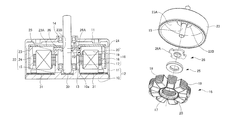
  • FIG. 4 is a partial exploded perspective view of FIG. 1 .
  • a stator, a magnet for detent torque, a magnetic member, and a rotor yoke are shown in FIG. 4 .
  • FIG. 5 is a cross-sectional view of a second embodiment of a brushless motor in accordance with the present invention.
  • FIG. 6 shows an interior surface of a rotor yoke mounted in the brushless motor of FIG. 5 .
  • FIG. 7 is a cross-sectional view of a third embodiment of a brushless motor in accordance with the present invention.
  • FIG. 8A is a top view of a magnetic member mounted in the brushless motor of FIG. 7 .
  • FIG. 8B is a cross-sectional view of a magnetic member mounted in the brushless motor of FIG. 7 along the line b-b.
  • FIG. 9 is a partial exploded perspective view of FIG. 7 .
  • a stator, a magnet for detent torque, a magnetic member, and a rotor yoke are shown in FIG. 9 .
  • FIG. 10 is a cross-sectional view of a forth embodiment of a brushless motor in accordance with the present invention.
  • FIG. 11 is a cross-sectional view of a fifth embodiment of a brushless motor in accordance with the present invention.
  • FIG. 1 is a cross-sectional view of a first embodiment of a brushless motor in accordance with the present invention.
  • a case 12 of a brushless motor has a base portion 10 and a frame 11 disposed to cover one surface (i.e., an upper surface in FIG. 1 ) of the base portion 10 .
  • the base portion 10 is disposed at an approximately center portion of the case 12 .
  • the base portion 10 is provided with a cylindrical portion 10 a , which is integrally formed with the base portion 10 .
  • a shaft 15 is rotatably supported by a bearing 13 fixed to an interior of the cylindrical portion 10 a and a bearing 14 fixed to the frame 11 .
  • the lower end portion of the shaft 15 located adjacent to the base portion 10 is provided with a thrust plate 30 .
  • One end portion of the shaft 15 extends beyond the frame 11 .
  • a circuit board 31 is disposed in a bottom surface of the case 12 (in particularly, on the base portion 10 ), and a stator 16 is fixed to the cylindrical portion 10 a of the base portion 10 so as to surround the shaft 15 .
  • the stator 16 has a stator core 17 having a salient poles 18 (for example, nine salient poles 18 ) arranged in a circumferential direction thereof, and a winding wire 20 wound around the salient pole 18 through an insulator 19 .
  • a rotor 22 which is coupled to the shaft 15 is disposed to surround the stator 16 .
  • the rotor 22 has a rotor yoke 23 having a cylindrical shape with one end closed.
  • the shaft 15 is coupled to the closed end 23 A (i.e., a ceiling portion) of the rotor yoke 23 along a central axis of the rotor yoke 23 .
  • a magnet for rotary drive 24 is disposed on the inner periphery of the rotor yoke 23 and opposed to the stator core 17 .
  • the magnet for rotary drive 24 is magnetized such that N pole and S pole are alternated in a circumferential direction of the magnet for rotary drive 24 .
  • FIG. 2 is a top view of the magnet for detent torque 25 , which is magnetized such that a plurality of poles (for example, four poles including N pole, S pole, N pole, and S pole) is arranged in a circumferential direction of the magnet for detent torque 25 .
  • a plurality of poles for example, four poles including N pole, S pole, N pole, and S pole
  • FIG. 3A is a top view of the magnetic member 26 .
  • four pole teeth 26 A are arranged in a circumferential direction, and each of the four pole teeth 26 A outwardly or exteriorly extends from the outer periphery.
  • the number of the pole teeth 26 A of the magnetic member 26 used corresponds to the number of the poles of the magnet for detent torque 25.
  • the number of the pole teeth 26 A of the magnetic member 26 used is equal to the number of the poles of the magnet for detent torque 25 .
  • the number of the pole teeth 26 A of the magnetic member 26 is six.
  • FIG. 3B which is a cross-sectional view of FIG. 3A along the line b-b, the magnetic member 26 has a connecting portion 26 B, which is disposed at an inner periphery of the magnetic member 26 and has a thickness greater than that of the pole tooth 26 A. Due to this, as shown in FIG.
  • the magnetic member 26 at the pole tooth 26 A section has an outer diameter R 1 greater than an outer diameter R 2 of the magnet for detent torque 25 .
  • FIG. 4 is a partial exploded perspective view of FIG. 1 .
  • the stator 16 , the magnet for detent torque 25 , the magnet member 26 , and the rotor yoke 23 are shown in FIG. 4 .
  • the magnet for detent torque 25 is fixed with respect to the stator 16
  • the magnetic member 26 is rotatable with the rotation of the rotor yoke 23 .
  • both of the magnet for detent torque 25 and the magnetic member 26 are formed of relatively thin plate material, the thickness of the brushless motor can be suppressed.
  • the neighboring poles of the magnet for detent torque 25 attract each other through the magnetic member 26 when the motor is in a resting state, thereby increasing the detent torque.
  • a rotation force greater than the detent torque is applied to the motor yoke 23 .
  • a configuration for rotation and a configuration for detent torque are independent of each other, and thus do not influence each other. For the above reason, the original properties of the motor can be prevented from degradation.
  • both of the magnet for detent torque 25 and the magnetic member 26 are formed of relatively thin plate material, the thickness of the motor body can be suppressed.
  • the column of “comparative examples” relates to data values of a conventional brushless motor
  • the column of “examples” relates to data values of the inventive brushless motor, which is obtained by applying the present invention to the comparative examples (i.e., the conventional brushless motor).
  • the conventional brushless motor is not provided with the magnet for detent torque as well as the magnetic member as employed in the inventive brushless motor
  • “CW” means clockwise rotation
  • “CCW” means counterclockwise rotation.
  • the number of samples is ten, and an average of the data is also provided. Table 1 demonstrates that in any of the cases the inventive brushless motor produces greater detent torque.
  • FIG. 5 is a cross-sectional view of a second embodiment of a brushless motor in accordance with the present invention, and substantially corresponds to FIG. 1 .
  • the second embodiment as shown in Fig, 5 is substantially equivalent to the first embodiment as shown in FIG. 1 except that a magnetic member 27 is integrally formed with the rotor yoke 23 by a punching process.
  • the magnetic member 26 is formed independently of the rotor yoke 23 .
  • the rotor yoke 23 is formed of magnetic material, it is partially provided with a function as the magnetic member 27 .
  • a portion of the closed end 23 A (i.e., the ceiling portion) of the rotor yoke 23 adjacent to the shaft 15 is stepped (see “D” in FIG.
  • the section or area of the magnetic member 27 is provided with, for example, four notches 27 C, thereby forming four pole teeth 27 A.
  • the second embodiment in which the magnetic member 27 is integrally formed with the rotor yoke 23 has an effect similar to the first embodiment.
  • FIG. 7 is a cross-sectional view of a third embodiment of a brushless motor in accordance with the present invention, and substantially corresponds to FIG. 1 ,
  • FIG. 7 is equivalent to the first embodiment as shown in FIG. 1 except for a magnetic member 28 .
  • FIG. 8A is a top view of the magnetic member 28 viewed from a pole tooth 28 A side
  • FIG. 8B is a cross-sectional view of FIG. 8A along the line b-b.
  • the magnetic member 28 has a cylindrical shape provided with a hole 28 C for inserting the shaft 15 therein and passing the shaft 15 therethrough arranged in the center thereof, and a pole tooth 28 A extending in its axial direction at its one end.
  • four pole teeth 28 A may be circumferentially arranged at even intervals. Referring to FIG.
  • the magnetic member 28 coupled to the shaft 15 is disposed such that the pole tooth 28 A is opposed to the inner periphery of the magnet for detent torque 25 . Furthermore, the magnet for detent torque 25 used in this embodiment has the same configuration as described in the first embodiment.
  • FIG. 9 is a partial exploded perspective view of FIG. 7 .
  • the stator 16 , the magnet for detent torque 25 , the magnet member 28 , and the rotor yoke 23 are shown in FIG. 9 .
  • the magnet for detent torque 25 is fixed with respect to the stator 16
  • the magnetic member 28 coupled to the shaft 15 is rotatable with the rotation of the rotor yoke 23 .
  • the magnetic member 28 is normally rotatable with the pole tooth 28 A opposed to the inner periphery of the magnet for detent torque 25 .
  • any of the afore-mentioned embodiments is provided with the frame 11 .
  • the present invention is not limited to the afore-mentioned embodiments provided with the frame 11 .
  • the present invention also includes the configuration as shown in FIG. 10 which is not provided with the frame 11 .
  • both of the bearing 14 and the bearing 13 are coupled to the base portion 10 .
  • the bearing 13 and the bearing 14 are coupled to the base portion 10 with being aligned perpendicularly to the base portion 10 . Due to this, even if there is not the frame 11 , the shaft 15 supported by the bearing 13 and bearing 14 are reliably supported by the base portion 10 alone.
  • a fifth embodiment as shown in FIG. 11 employs a slide bearing 32 instead of the bearing 13 and the bearing 14 as employed in the forth embodiment. Due to the slide bearing 32 a support area can be secured in an axial direction, thereby sufficiently supporting the shaft 15 .

Landscapes

  • Engineering & Computer Science (AREA)
  • Power Engineering (AREA)
  • Brushless Motors (AREA)
  • Iron Core Of Rotating Electric Machines (AREA)
  • Permanent Magnet Type Synchronous Machine (AREA)

Abstract

The invention provides a brushless motor. A stator 16 of the brushless motor has a stator core 17 provided with a plurality of salient poles 18 arranged in its a circumferential direction, and a winding wire 20 wound around the plurality of salient poles 18 through an insulator 19. A rotor 22 of the brushless motor has a tubular rotor yoke 23 arranged to surround the stator 16, an annular magnet for detent torque 25 arranged in an inner peripheral portion of the winding wire 20 on the stator core 17 and surrounding the shaft 15, and a magnetic member 27 coupled to an interior surface of a ceiling portion of the rotor yoke 23 to be opposed to the magnet for detent torque 25, and surrounding the shaft 15.

Description

CROSS-REFERENCE TO RELATED APPLICATIONS
This application claims priority from Japanese Patent Application No. 2014-175851 filed on Aug. 29, 2014, which is incorporated herein by reference.
BACKGROUND OF THE INVENTION
1. Field of the Invention
The present invention relates to a brushless motor.
2. Background of the Invention
Conventionally, studies for increasing detent torque have been done to exactly control a stop position when a motor is not excited. Such a brushless motor being capable of increasing the detent torque is disclosed in, for example, JP 2007-143289(A).
In accordance with the brushless motor as described in JP 2007-143289(A), a pole tooth is formed in a stator yoke, and three types of pole teeth having different areas by varying height and/or width thereof are provided. The detent torque can be increased by shifting or displacing the three types of pole teeth in combination at a predetermined angle.
However, in the afore-mentioned conventional brushless motor configuration, the stator yoke has a direct effect on rotary drive of the motor, and also has a great effect on other properties of the motor. For the above reasons, when the pole tooth is formed in the stator yoke in order to increase the detent torque, rotation torque of the motor is greatly decreased. As a result, even if the detent torque is increased, the original properties of the motor is compromised.
SUMMARY OF THE INVENTION
The present invention is provided for solving the afore-mentioned problems. In other words, the objective of the invention is to provide a brushless motor with simple construction being capable of improving or increasing detent torque thereof without lowering rotation torque thereof.
In accordance with one aspect of the invention, there is provided a brushless motor, which is provided with a base portion; a shaft supported by the base portion; a stator fixed to the base portion to surround the shaft and having a stator core provided with a plurality of salient poles arranged in a circumferential direction thereof, and a winding wire wound around the plurality of salient poles through an insulator; and a rotor coupled to the shaft and having a tubular rotor yoke arranged to surround the stator, an annular magnet for detent torque arranged in an inner peripheral portion of the winding wire on the stator core and surrounding the shaft, and a magnetic member coupled to an interior surface of a ceiling portion of the rotor yoke to be opposed to the magnet for detent torque, and surrounding the shaft. The tubular rotor yoke is provided with a magnet for rotary drive on an inner periphery thereof. The annular magnet for detent torque is magnetized to have a plurality of poles arranged in a circumferential direction thereof. The magnetic member has a plurality of pole teeth arranged in a circumferential direction thereof. A number of the plurality of poles of the magnet for detent torque is equal to a number of the plurality of pole teeth of the magnetic member.
In accordance with another aspect of the invention, there is provided a brushless motor, which is provided with a base portion; a frame together with the base portion to form a case; a shaft supported by the base portion and the frame; a stator fixed to the base portion to surround the shaft, and having a stator core provided with a plurality of salient poles arranged in a circumferential direction thereof, and a winding wire wound around the plurality of salient poles through an insulator; and a rotor coupled to the shaft, and having a tubular rotor yoke arranged to surround the stator, an annular magnet for detent torque arranged in an inner peripheral portion of the winding wire on the stator core and surrounding the shaft, and a magnetic member which the shaft is inserted into and passes through. The tubular rotor yoke is provided with a magnet for rotary drive on an inner periphery thereof. The annular magnet for detent torque is magnetized to have a plurality of poles arranged in a circumferential direction thereof. The magnetic member has a plurality of pole teeth arranged in a circumferential direction thereof, wherein the plurality of pole teeth of the magnetic member is opposed to an inner periphery of the magnet for detent torque. A number of the plurality of poles of the magnet for detent torque is equal to a number of the plurality of pole teeth of the magnetic member.
BRIEF DESCRIPTION OF THE DRAWINGS
FIG. 1 is a cross-sectional view of a first embodiment of a brushless motor in accordance with the present invention.
FIG. 2 is a top view of a magnet for detent torque mounted in the brushless motor of FIG. 1.
FIG. 3A is a top view of a magnetic member mounted in the brushless motor of FIG. 1.
FIG. 3B is a cross-sectional view of a magnetic member mounted in the brushless motor of FIG. 1 along the line b-b in FIG. 3A.
FIG. 4 is a partial exploded perspective view of FIG. 1. A stator, a magnet for detent torque, a magnetic member, and a rotor yoke are shown in FIG. 4.
FIG. 5 is a cross-sectional view of a second embodiment of a brushless motor in accordance with the present invention.
FIG. 6 shows an interior surface of a rotor yoke mounted in the brushless motor of FIG. 5.
FIG. 7 is a cross-sectional view of a third embodiment of a brushless motor in accordance with the present invention.
FIG. 8A is a top view of a magnetic member mounted in the brushless motor of FIG. 7.
FIG. 8B is a cross-sectional view of a magnetic member mounted in the brushless motor of FIG. 7 along the line b-b.
FIG. 9 is a partial exploded perspective view of FIG. 7. A stator, a magnet for detent torque, a magnetic member, and a rotor yoke are shown in FIG. 9.
FIG. 10 is a cross-sectional view of a forth embodiment of a brushless motor in accordance with the present invention.
FIG. 11 is a cross-sectional view of a fifth embodiment of a brushless motor in accordance with the present invention.
DETAILED DESCRIPTION OF THE INVENTION
Referring to the accompanying drawings, one embodiment of the present invention will be hereinafter described in detail. Furthermore, the same reference numeral is assigned to the same element or part throughout the overall specification.
First Embodiment 1
FIG. 1 is a cross-sectional view of a first embodiment of a brushless motor in accordance with the present invention. Referring to FIG. 1, a case 12 of a brushless motor has a base portion 10 and a frame 11 disposed to cover one surface (i.e., an upper surface in FIG. 1) of the base portion 10.
The base portion 10 is disposed at an approximately center portion of the case 12. The base portion 10 is provided with a cylindrical portion 10 a, which is integrally formed with the base portion 10. A shaft 15 is rotatably supported by a bearing 13 fixed to an interior of the cylindrical portion 10 a and a bearing 14 fixed to the frame 11. The lower end portion of the shaft 15 located adjacent to the base portion 10 is provided with a thrust plate 30. One end portion of the shaft 15 extends beyond the frame 11.
A circuit board 31 is disposed in a bottom surface of the case 12 (in particularly, on the base portion 10), and a stator 16 is fixed to the cylindrical portion 10 a of the base portion 10 so as to surround the shaft 15. The stator 16 has a stator core 17 having a salient poles 18 (for example, nine salient poles 18) arranged in a circumferential direction thereof, and a winding wire 20 wound around the salient pole 18 through an insulator 19.
A rotor 22 which is coupled to the shaft 15 is disposed to surround the stator 16. In other words, the rotor 22 has a rotor yoke 23 having a cylindrical shape with one end closed. The shaft 15 is coupled to the closed end 23A (i.e., a ceiling portion) of the rotor yoke 23 along a central axis of the rotor yoke 23. A magnet for rotary drive 24 is disposed on the inner periphery of the rotor yoke 23 and opposed to the stator core 17. The magnet for rotary drive 24 is magnetized such that N pole and S pole are alternated in a circumferential direction of the magnet for rotary drive 24.
An annular magnet for detent torque 25 is fixed to the stator core 17 while surrounding the shaft 15. The annular magnet for detent torque 25 is formed of relatively thin plate material. The annular magnet for detent torque 25 is arranged in the inner peripheral portion of the winding wire 20 on the stator core 17. FIG. 2 is a top view of the magnet for detent torque 25, which is magnetized such that a plurality of poles (for example, four poles including N pole, S pole, N pole, and S pole) is arranged in a circumferential direction of the magnet for detent torque 25.
Returning to FIG. 1, a magnetic member 26 surrounding the shaft 15 is coupled to an interior surface of the closed end 23A (i.e., the ceiling portion) of the rotor yoke 23. The magnetic member 26 is formed of relatively thin plate material. Due to this the magnetic member 26 is opposed to the magnet for detent torque 25. FIG. 3A is a top view of the magnetic member 26. In FIG. 3A, four pole teeth 26A are arranged in a circumferential direction, and each of the four pole teeth 26A outwardly or exteriorly extends from the outer periphery. The number of the pole teeth 26A of the magnetic member 26 used corresponds to the number of the poles of the magnet for detent torque 25. In other words, the number of the pole teeth 26A of the magnetic member 26 used is equal to the number of the poles of the magnet for detent torque 25. In a case where the number of the poles of the magnet for detent torque 25 is, for example, six, the number of the pole teeth 26A of the magnetic member 26 is six. Referring to FIG. 3B which is a cross-sectional view of FIG. 3A along the line b-b, the magnetic member 26 has a connecting portion 26B, which is disposed at an inner periphery of the magnetic member 26 and has a thickness greater than that of the pole tooth 26A. Due to this, as shown in FIG. 1, a reliable connection between the connecting portion 26B and a bent portion 2313 which is curved or bent along an axis and in which the rotor yoke 23 is fixed to the shaft 15 can be achieved. Furthermore, as shown in FIG. 1, the magnetic member 26 at the pole tooth 26A section has an outer diameter R 1 greater than an outer diameter R 2 of the magnet for detent torque 25.
FIG. 4 is a partial exploded perspective view of FIG. 1. The stator 16, the magnet for detent torque 25, the magnet member 26, and the rotor yoke 23 are shown in FIG. 4. The magnet for detent torque 25 is fixed with respect to the stator 16, and the magnetic member 26 is rotatable with the rotation of the rotor yoke 23. As both of the magnet for detent torque 25 and the magnetic member 26 are formed of relatively thin plate material, the thickness of the brushless motor can be suppressed.
In accordance with the brushless motor as described previously, the neighboring poles of the magnet for detent torque 25 attract each other through the magnetic member 26 when the motor is in a resting state, thereby increasing the detent torque. When applying current onto the winding wire 20 of the motor, a rotation force greater than the detent torque is applied to the motor yoke 23. However, a configuration for rotation and a configuration for detent torque are independent of each other, and thus do not influence each other. For the above reason, the original properties of the motor can be prevented from degradation. As both of the magnet for detent torque 25 and the magnetic member 26 are formed of relatively thin plate material, the thickness of the motor body can be suppressed.
Data values of the detent torques in the inventive brushless motor and the conventional brushless motor are provided in Table 1 as listed below.
TABLE 1
Comparative Examples Exmaples
direction of rotation
Sample No. CW CCW CW CCW
1 6 16 32 26
2 7 13 35 22
3 13 17 42 24
4 7 12 24 30
5 6 15 28 28
6 6 15 28 30
7 7 20 35 26
8 8 15 33 30
9 7 18 44 20
10 12 17 44 34
Average 7.9 15.8 34.5 27.0
Average of CW & CCW 11.8 30.8
Difference from Com. Ex. 260.0
(%)
In Table 1, the column of “comparative examples” relates to data values of a conventional brushless motor, and the column of “examples” relates to data values of the inventive brushless motor, which is obtained by applying the present invention to the comparative examples (i.e., the conventional brushless motor). For reference, the conventional brushless motor is not provided with the magnet for detent torque as well as the magnetic member as employed in the inventive brushless motor, In Table 1 “CW” means clockwise rotation, and “CCW” means counterclockwise rotation. The number of samples is ten, and an average of the data is also provided. Table 1 demonstrates that in any of the cases the inventive brushless motor produces greater detent torque.
Second Embodiment
FIG. 5 is a cross-sectional view of a second embodiment of a brushless motor in accordance with the present invention, and substantially corresponds to FIG. 1.
The second embodiment as shown in Fig, 5 is substantially equivalent to the first embodiment as shown in FIG. 1 except that a magnetic member 27 is integrally formed with the rotor yoke 23 by a punching process. For reference, in FIG. 1 the magnetic member 26 is formed independently of the rotor yoke 23. As the rotor yoke 23 is formed of magnetic material, it is partially provided with a function as the magnetic member 27. In other words, referring to FIG. 5, a portion of the closed end 23A (i.e., the ceiling portion) of the rotor yoke 23 adjacent to the shaft 15 is stepped (see “D” in FIG. 5) to further approximate the magnet for detent torque 25 with only slight gap between the magnet for detent torque 25 and the portion of the closed end 23A, thereby forming a section or area of the magnetic member 27. Referring to FIG. 6 showing the interior surface of the rotor yoke 23, the section or area of the magnetic member 27 is provided with, for example, four notches 27C, thereby forming four pole teeth 27A. As mentioned previously, the second embodiment in which the magnetic member 27 is integrally formed with the rotor yoke 23 has an effect similar to the first embodiment.
Third Embodiment
FIG. 7 is a cross-sectional view of a third embodiment of a brushless motor in accordance with the present invention, and substantially corresponds to FIG. 1,
The third embodiment as shown in FIG. 7 is equivalent to the first embodiment as shown in FIG. 1 except for a magnetic member 28. FIG. 8A is a top view of the magnetic member 28 viewed from a pole tooth 28A side, and FIG. 8B is a cross-sectional view of FIG. 8A along the line b-b. Referring to FIG. 8A, the magnetic member 28 has a cylindrical shape provided with a hole 28C for inserting the shaft 15 therein and passing the shaft 15 therethrough arranged in the center thereof, and a pole tooth 28A extending in its axial direction at its one end. For example, four pole teeth 28A may be circumferentially arranged at even intervals. Referring to FIG. 7, the magnetic member 28 coupled to the shaft 15 is disposed such that the pole tooth 28A is opposed to the inner periphery of the magnet for detent torque 25. Furthermore, the magnet for detent torque 25 used in this embodiment has the same configuration as described in the first embodiment.
FIG. 9 is a partial exploded perspective view of FIG. 7. The stator 16, the magnet for detent torque 25, the magnet member 28, and the rotor yoke 23 are shown in FIG. 9. The magnet for detent torque 25 is fixed with respect to the stator 16, and the magnetic member 28 coupled to the shaft 15 is rotatable with the rotation of the rotor yoke 23. In this case, the magnetic member 28 is normally rotatable with the pole tooth 28A opposed to the inner periphery of the magnet for detent torque 25.
Forth Embodiment
Any of the afore-mentioned embodiments is provided with the frame 11. However, the present invention is not limited to the afore-mentioned embodiments provided with the frame 11. The present invention also includes the configuration as shown in FIG. 10 which is not provided with the frame 11. Referring to FIG. 10, both of the bearing 14 and the bearing 13 are coupled to the base portion 10. In other words, the bearing 13 and the bearing 14 are coupled to the base portion 10 with being aligned perpendicularly to the base portion 10. Due to this, even if there is not the frame 11, the shaft 15 supported by the bearing 13 and bearing 14 are reliably supported by the base portion 10 alone.
Fifth Embodiment
While the afore-mentioned embodiments employ two ball bearings, the present invention is not limited to the afore-mentioned embodiments employing two ball bearings. A fifth embodiment as shown in FIG. 11 employs a slide bearing 32 instead of the bearing 13 and the bearing 14 as employed in the forth embodiment. Due to the slide bearing 32 a support area can be secured in an axial direction, thereby sufficiently supporting the shaft 15.
The above embodiments and examples are given to illustrate the scope and spirit of the instant invention. These embodiments and examples will make apparent, to those skilled in the art, other embodiments and examples. These other embodiments and examples are within the contemplation of the present invention. Therefore, the instant invention should be limited only by the appended claims.
Claims (7)

The invention claimed is:
1. A brushless motor, comprising
a base portion;
a shaft supported by the base portion;
a stator fixed to the base portion to surround the shaft, the stator having a stator core provided with a plurality of salient poles arranged in a circumferential direction thereof, and a winding wire wound around the plurality of salient poles through an insulator; and
a rotor coupled to the shaft, the rotor having a tubular rotor yoke arranged to surround the stator, an annular magnet for detent torque arranged in an inner peripheral portion of the winding wire on the stator core and surrounding the shaft, and a magnetic member coupled to an interior surface of a ceiling portion of the rotor yoke to be opposed to the magnet for detent torque, and surrounding the shaft, wherein the tubular rotor yoke is provided with a magnet for rotary drive on an inner periphery thereof, wherein the annular magnet for detent torque is magnetized to have a plurality of poles arranged in a circumferential direction thereof, wherein the magnetic member has a plurality of pole teeth arranged in a circumferential direction thereof, and wherein a number of the plurality of poles of the magnet for detent torque is equal to a number of the plurality of pole teeth of the magnetic member.
2. The brushless motor according to claim 1, wherein the magnetic member at a section where each of the pole teeth is formed has an outer diameter greater than an outer diameter of the magnet for detent torque.
3. The brushless motor according to claim 1, wherein the magnetic member has a connecting portion arranged in an inner periphery thereof, and the plurality of pole teeth exteriorly extending from an outer periphery thereof.
4. The brushless motor according to claim 2, wherein the magnetic member has a connecting portion arranged in an inner periphery thereof, and the plurality of pole teeth exteriorly extending from an outer periphery thereof.
5. The brushless motor according to claim 1, wherein the magnetic member is formed together with the plurality of pole teeth during a punching process of the rotor yoke.
6. The brushless motor according to claim 2, wherein the magnetic member is formed together with the plurality of pole teeth during a punching process of the rotor yoke.
7. A brushless motor, comprising
a base portion;
a frame together with the base portion to form a case;
a shaft supported by the base portion and the frame;
a stator fixed to the base portion to surround the shaft, the stator having a stator core provided with a plurality of salient poles arranged in a circumferential direction thereof, and a winding wire wound around the plurality of salient poles through an insulator; and
a rotor coupled to the shaft, the rotor having a tubular rotor yoke arranged to surround the stator, an annular magnet for detent torque arranged in an inner peripheral portion of the winding wire on the stator core and surrounding the shaft, and a magnetic member which the shaft is inserted into and passes through, wherein the tubular rotor yoke is provided with a magnet for rotary drive on an inner periphery thereof, wherein the annular magnet for detent torque is magnetized to have a plurality of poles arranged in a circumferential direction thereof, wherein the magnetic member has a plurality of pole teeth arranged in a circumferential direction thereof, wherein the plurality of pole teeth of the magnetic member is opposed to an inner periphery of the magnet for detent torque, and wherein a number of the plurality of poles of the magnet for detent torque is equal to a number of the plurality of pole teeth of the magnetic member.
US14/790,415 2014-08-29 2015-07-02 Brushless motor Active 2036-03-03 US9755478B2 (en)

Applications Claiming Priority (2)

Application Number Priority Date Filing Date Title
JP2014175851A JP6195309B2 (en) 2014-08-29 2014-08-29 Brushless motor
JP2014-175851 2014-08-29

Publications (2)

Publication Number Publication Date
US20160065017A1 US20160065017A1 (en) 2016-03-03
US9755478B2 true US9755478B2 (en) 2017-09-05

Family

ID=55403665

Family Applications (1)

Application Number Title Priority Date Filing Date
US14/790,415 Active 2036-03-03 US9755478B2 (en) 2014-08-29 2015-07-02 Brushless motor

Country Status (3)

Country Link
US (1) US9755478B2 (en)
JP (1) JP6195309B2 (en)
CN (2) CN106208585B (en)

Cited By (1)

* Cited by examiner, † Cited by third party
Publication number Priority date Publication date Assignee Title
US20160233734A1 (en) * 2013-10-07 2016-08-11 Moving Magnet Technologies (Mmt) Slotless electrical machine with concentrated winding

Families Citing this family (2)

* Cited by examiner, † Cited by third party
Publication number Priority date Publication date Assignee Title
CN112534692A (en) * 2018-06-21 2021-03-19 阿库斯科技有限公司 Motor with internal encoder unit
CN115943544A (en) * 2020-10-01 2023-04-07 株式会社村田制作所 brushless motor

Citations (2)

* Cited by examiner, † Cited by third party
Publication number Priority date Publication date Assignee Title
US6172442B1 (en) * 1997-11-13 2001-01-09 Samsung Electro-Mechanics Co., Ltd. Disk-type brushless single-phase DC motor
JP2007143289A (en) 2005-11-18 2007-06-07 Minebea-Matsushita Motor Corp Stepping motor for generating vibration

Family Cites Families (12)

* Cited by examiner, † Cited by third party
Publication number Priority date Publication date Assignee Title
JPH04275053A (en) * 1991-03-01 1992-09-30 Toshiba Corp Motor fitted with standstill retaining torque mechanism
JPH0767311A (en) * 1993-08-27 1995-03-10 Toshiba Corp Stepping motor
JPH11187591A (en) * 1997-12-17 1999-07-09 Toshiba Ave Co Ltd motor
JP2003079095A (en) * 2001-08-31 2003-03-14 Tokyo Parts Ind Co Ltd Axial vibration preventing mechanism and brushless motor provided therewith
JP2004304958A (en) * 2003-03-31 2004-10-28 Fujitsu General Ltd Permanent magnet motor
JP2005051963A (en) * 2003-07-31 2005-02-24 Tokyo Parts Ind Co Ltd Motor
CN1324789C (en) * 2004-05-18 2007-07-04 建准电机工业股份有限公司 Rotational Balance Structure of Fan Motor Rotor
JP2006314196A (en) * 2006-07-18 2006-11-16 Matsushita Electric Ind Co Ltd Permanent magnet embedded motor
CN101192762A (en) * 2006-11-23 2008-06-04 台达电子工业股份有限公司 Electric machine
CN101212150B (en) * 2006-12-27 2011-05-18 财团法人工业技术研究院 Double air gap electromagnetic structure
CN101951088B (en) * 2010-09-07 2011-11-23 哈尔滨工业大学 Radial-shaft radial magnetic field modulated brushless composite structure motor
CN202997786U (en) * 2012-08-01 2013-06-12 日本电产株式会社 Motor

Patent Citations (3)

* Cited by examiner, † Cited by third party
Publication number Priority date Publication date Assignee Title
US6172442B1 (en) * 1997-11-13 2001-01-09 Samsung Electro-Mechanics Co., Ltd. Disk-type brushless single-phase DC motor
JP2007143289A (en) 2005-11-18 2007-06-07 Minebea-Matsushita Motor Corp Stepping motor for generating vibration
US20090134733A1 (en) * 2005-11-18 2009-05-28 Minebea-Matsushita Motor Corporation Vibration generating stepping motor

Cited By (2)

* Cited by examiner, † Cited by third party
Publication number Priority date Publication date Assignee Title
US20160233734A1 (en) * 2013-10-07 2016-08-11 Moving Magnet Technologies (Mmt) Slotless electrical machine with concentrated winding
US10050487B2 (en) * 2013-10-07 2018-08-14 Moving Magnet Technologies (Mmt) Slotless electrical machine with concentrated winding

Also Published As

Publication number Publication date
CN106208585A (en) 2016-12-07
US20160065017A1 (en) 2016-03-03
CN106208585B (en) 2019-07-23
CN110336439A (en) 2019-10-15
CN110336439B (en) 2022-04-29
JP6195309B2 (en) 2017-09-13
JP2016052181A (en) 2016-04-11

Similar Documents

Publication Publication Date Title
US9088191B2 (en) Armature and motor
JP2016086565A (en) Rotating electric machine stator
US20150280535A1 (en) Permanent Magnet Brushless Motor
US20180034336A1 (en) Rotary electric machine and insulator for rotary electric machine
US9755478B2 (en) Brushless motor
US10622855B2 (en) Permanent magnet electric motor
JP2010035375A (en) Motor
JP6616367B2 (en) motor
CN110100376B (en) Rotors and Motors
JP2021057992A (en) Rotor and motor
JP7225700B2 (en) motor and blower
US20170324313A1 (en) Motor
US11165289B2 (en) Electronically commutated DC motor
WO2019064747A1 (en) Rotor and motor comprising rotor
WO2019181523A1 (en) Stator and motor provided therewith
JP6455218B2 (en) Rotor and motor
JP2019062650A (en) Stator and motor
US20250088069A1 (en) Motor
US11658521B2 (en) Stator and motor
JP6086827B2 (en) Armature and motor
JP2019205279A (en) motor
JP2019062649A (en) Stator and motor
JP2019057984A (en) Rotor of permanent magnet type rotary electric machine
JP5352202B2 (en) Magnet holder and rotor of rotating electric machine
WO2019064746A1 (en) Rotor and motor comprising rotor

Legal Events

Date Code Title Description
AS Assignment

Owner name: MINEBEA CO., LTD., JAPAN

Free format text: ASSIGNMENT OF ASSIGNORS INTEREST;ASSIGNORS:AMAGI, YUTA;SANESHIGE, RYOJI;NISHIKATA, TOSHIYUKI;REEL/FRAME:035971/0342

Effective date: 20150625

STCF Information on status: patent grant

Free format text: PATENTED CASE

AS Assignment

Owner name: MINEBEA MITSUMI INC., JAPAN

Free format text: ASSIGNMENT OF ASSIGNORS INTEREST;ASSIGNOR:MINEBEA CO., LTD.;REEL/FRAME:051803/0293

Effective date: 20170127

MAFP Maintenance fee payment

Free format text: PAYMENT OF MAINTENANCE FEE, 4TH YEAR, LARGE ENTITY (ORIGINAL EVENT CODE: M1551); ENTITY STATUS OF PATENT OWNER: LARGE ENTITY

Year of fee payment: 4

MAFP Maintenance fee payment

Free format text: PAYMENT OF MAINTENANCE FEE, 8TH YEAR, LARGE ENTITY (ORIGINAL EVENT CODE: M1552); ENTITY STATUS OF PATENT OWNER: LARGE ENTITY

Year of fee payment: 8