US9720324B2 - Resist composition and pattern forming process - Google Patents
Resist composition and pattern forming process Download PDFInfo
- Publication number
- US9720324B2 US9720324B2 US15/210,025 US201615210025A US9720324B2 US 9720324 B2 US9720324 B2 US 9720324B2 US 201615210025 A US201615210025 A US 201615210025A US 9720324 B2 US9720324 B2 US 9720324B2
- Authority
- US
- United States
- Prior art keywords
- group
- recurring units
- acid
- resist composition
- branched
- Prior art date
- Legal status (The legal status is an assumption and is not a legal conclusion. Google has not performed a legal analysis and makes no representation as to the accuracy of the status listed.)
- Active
Links
- 0 [1*]C(C)(CC)CC(=O)N1C(=C)CC([2*])([3*])C1=O Chemical compound [1*]C(C)(CC)CC(=O)N1C(=C)CC([2*])([3*])C1=O 0.000 description 92
- GWVNWLZEZRQETF-UHFFFAOYSA-N C1=CC2CC1CC21CCOC1.C1=COCC1.C1=COCCC1.C=C(C)C(=O)OC1C2CC3C(=O)OC1C3O2.C=COC12CC3CC(CC(O)(C3)C1)C2.C=COC1C2CC3C(=O)OC1C3C2.C=COC1C2CC3C(=O)OC1C3O2.C=COC1CC2CC1C1COC(=O)C21.C=COC1CC2CC1CC21COC(=O)C1.C=COC1CC2CCC1C2.C=COC1CCCCC1.CC(O)(C1CC2C=CC1C2)C(F)(F)F.CC(O)(CC1CC2C=CC1C2)C(F)(F)F.O=C(OC1C2CC3C(=O)OC1C3C2)C1CC2C=CC1C2.O=C(OC1C2CC3C(=O)OC1C3O2)C1CC2C=CC1C2.O=C1CC(CC2CC3C=CC2C3)CO1.O=C1CCCC1OC(=O)C1CC2C=CC1C2.OC1(C(F)(F)F)CC2C=CC1C2 Chemical compound C1=CC2CC1CC21CCOC1.C1=COCC1.C1=COCCC1.C=C(C)C(=O)OC1C2CC3C(=O)OC1C3O2.C=COC12CC3CC(CC(O)(C3)C1)C2.C=COC1C2CC3C(=O)OC1C3C2.C=COC1C2CC3C(=O)OC1C3O2.C=COC1CC2CC1C1COC(=O)C21.C=COC1CC2CC1CC21COC(=O)C1.C=COC1CC2CCC1C2.C=COC1CCCCC1.CC(O)(C1CC2C=CC1C2)C(F)(F)F.CC(O)(CC1CC2C=CC1C2)C(F)(F)F.O=C(OC1C2CC3C(=O)OC1C3C2)C1CC2C=CC1C2.O=C(OC1C2CC3C(=O)OC1C3O2)C1CC2C=CC1C2.O=C1CC(CC2CC3C=CC2C3)CO1.O=C1CCCC1OC(=O)C1CC2C=CC1C2.OC1(C(F)(F)F)CC2C=CC1C2 GWVNWLZEZRQETF-UHFFFAOYSA-N 0.000 description 1
- YOWCLEUWSJHQOJ-UHFFFAOYSA-N C1=CC2CC1CC21COCO1.C=C(C)C(=O)OC12CC3(O)CC(O)(CC(O)(C3)C1)C2.C=C(C)C(=O)OC12CC3CC(CC(O)(C3)C1)C2.C=C(C)C(=O)OC12CC3CC(CC(OC(C)=O)(C3)C1)C2.C=C(C)C(=O)OC12CC3CC(O)(CC(O)(C3)C1)C2.C=C(C)C(=O)OC12CC3CC(OC(C)=O)(CC(OC(C)=O)(C3)C1)C2.C=C(C)C(=O)OC1CCC2C3CC(CC3OC(C)=O)C12.C=C1CC(=O)OC1=O.C=C1CC(C)(C)OC1=O.C=C1CCOC1=O.COC(=O)C1CC2C=CC1C2.O=C1C=CC(=O)O1.O=C1CC(C2CC3C=CC2C3)CO1.O=C1CC2(CO1)CC1C=CC2C1.O=C1OCCC12CC1C=CC2C1 Chemical compound C1=CC2CC1CC21COCO1.C=C(C)C(=O)OC12CC3(O)CC(O)(CC(O)(C3)C1)C2.C=C(C)C(=O)OC12CC3CC(CC(O)(C3)C1)C2.C=C(C)C(=O)OC12CC3CC(CC(OC(C)=O)(C3)C1)C2.C=C(C)C(=O)OC12CC3CC(O)(CC(O)(C3)C1)C2.C=C(C)C(=O)OC12CC3CC(OC(C)=O)(CC(OC(C)=O)(C3)C1)C2.C=C(C)C(=O)OC1CCC2C3CC(CC3OC(C)=O)C12.C=C1CC(=O)OC1=O.C=C1CC(C)(C)OC1=O.C=C1CCOC1=O.COC(=O)C1CC2C=CC1C2.O=C1C=CC(=O)O1.O=C1CC(C2CC3C=CC2C3)CO1.O=C1CC2(CO1)CC1C=CC2C1.O=C1OCCC12CC1C=CC2C1 YOWCLEUWSJHQOJ-UHFFFAOYSA-N 0.000 description 1
- MMRLICITXUARNP-UHFFFAOYSA-M C1=CC=C([S+](C2=CC=CC=C2)C2=CC=C(OC3CC4CCC3C4)C=C2)C=C1.CC(F)(F)C(F)(F)S(=O)(=O)[O-] Chemical compound C1=CC=C([S+](C2=CC=CC=C2)C2=CC=C(OC3CC4CCC3C4)C=C2)C=C1.CC(F)(F)C(F)(F)S(=O)(=O)[O-] MMRLICITXUARNP-UHFFFAOYSA-M 0.000 description 1
- BODLTYWMWJRPJU-UHFFFAOYSA-E C1=CC=C([S+](C2=CC=CC=C2)C2=CC=CC3=C2C=CC=C3)C=C1.C1=CC=C([S+](C2=CC=CC=C2)C2=CC=CC=C2)C=C1.C1=CC=C([S+](C2=CC=CC=C2)C2=CC=CC=C2)C=C1.CC(=O)OC(C(F)(F)F)C(F)(F)S(=O)(=O)[O-].CC(=O)OC1CC2CC(C)CCC2(C)C2CC(OC(C)=O)C3(C)C(C(C)CCC(=O)OC(C(F)(F)F)C(F)(F)S(=O)(=O)[O-])CCC3C12.CC(C)(C)C(=O)OCC(F)(F)S(=O)(=O)[O-].CC(C)(C)C(=O)OCC(F)(F)S(=O)(=O)[O-].CC(C)(C)C(=O)OCC(F)(F)S(=O)(=O)[O-].CC(C)(C)C(=O)OCC(F)(F)S(=O)(=O)[O-].CC(C)(C)C(=O)OCC(F)(F)S(=O)(=O)[O-].CC(C)(C)C(=O)OCC(F)(F)S(=O)(=O)[O-].CC(C)(C)C1=CC=C([S+](C2=CC=CC=C2)C2=CC=CC=C2)C=C1.CC(C)(C)C1=CC=C([S+](C2=CC=CC=C2)C2=CC=CC=C2)C=C1.CC(CCC(=O)OC(C(F)(F)F)C(F)(F)S(=O)(=O)[O-])C1CCC2C3C(=O)CC4CC(=O)CCC4(C)C3CC(=O)C12C.CC1=CC(C)=CC([S+](C2=CC=CC=C2)C2=CC=CC=C2)=C1.CC1=CC=C([S+](C2=CC=CC=C2)C2=CC=CC=C2)C=C1.CC1=CC=C([S+](C2=CC=CC=C2)C2=CC=CC=C2)C=C1.FC1=CC=C([S+](C2=CC=CC=C2)C2=CC=CC=C2)C=C1.O=C(OC(C(F)(F)F)C(F)(F)S(=O)(=O)[O-])C12CC3CC(CC(C3)C1)C2.OC1=CC=C([S+](C2=CC=CC=C2)C2=CC=CC=C2)C=C1 Chemical compound C1=CC=C([S+](C2=CC=CC=C2)C2=CC=CC3=C2C=CC=C3)C=C1.C1=CC=C([S+](C2=CC=CC=C2)C2=CC=CC=C2)C=C1.C1=CC=C([S+](C2=CC=CC=C2)C2=CC=CC=C2)C=C1.CC(=O)OC(C(F)(F)F)C(F)(F)S(=O)(=O)[O-].CC(=O)OC1CC2CC(C)CCC2(C)C2CC(OC(C)=O)C3(C)C(C(C)CCC(=O)OC(C(F)(F)F)C(F)(F)S(=O)(=O)[O-])CCC3C12.CC(C)(C)C(=O)OCC(F)(F)S(=O)(=O)[O-].CC(C)(C)C(=O)OCC(F)(F)S(=O)(=O)[O-].CC(C)(C)C(=O)OCC(F)(F)S(=O)(=O)[O-].CC(C)(C)C(=O)OCC(F)(F)S(=O)(=O)[O-].CC(C)(C)C(=O)OCC(F)(F)S(=O)(=O)[O-].CC(C)(C)C(=O)OCC(F)(F)S(=O)(=O)[O-].CC(C)(C)C1=CC=C([S+](C2=CC=CC=C2)C2=CC=CC=C2)C=C1.CC(C)(C)C1=CC=C([S+](C2=CC=CC=C2)C2=CC=CC=C2)C=C1.CC(CCC(=O)OC(C(F)(F)F)C(F)(F)S(=O)(=O)[O-])C1CCC2C3C(=O)CC4CC(=O)CCC4(C)C3CC(=O)C12C.CC1=CC(C)=CC([S+](C2=CC=CC=C2)C2=CC=CC=C2)=C1.CC1=CC=C([S+](C2=CC=CC=C2)C2=CC=CC=C2)C=C1.CC1=CC=C([S+](C2=CC=CC=C2)C2=CC=CC=C2)C=C1.FC1=CC=C([S+](C2=CC=CC=C2)C2=CC=CC=C2)C=C1.O=C(OC(C(F)(F)F)C(F)(F)S(=O)(=O)[O-])C12CC3CC(CC(C3)C1)C2.OC1=CC=C([S+](C2=CC=CC=C2)C2=CC=CC=C2)C=C1 BODLTYWMWJRPJU-UHFFFAOYSA-E 0.000 description 1
- FFKVWQKMAPGZCJ-UHFFFAOYSA-C C1=CC=C([S+](C2=CC=CC=C2)C2=CC=CC=C2)C=C1.C1=CC=C([S+](C2=CC=CC=C2)C2=CC=CC=C2)C=C1.C1=CC=C([S+](C2=CC=CC=C2)C2=CC=CC=C2)C=C1.C1=CC=C([S+](C2=CC=CC=C2)C2=CC=CC=C2)C=C1.C1=CC=C([S+](C2=CC=CC=C2)C2=CC=CC=C2)C=C1.C1=CC=C([S+](C2=CC=CC=C2)C2=CC=CC=C2)C=C1.C1=CC=C([S+](C2=CC=CC=C2)C2=CC=CC=C2)C=C1.C1=CC=C([S+](C2=CC=CC=C2)C2=CC=CC=C2)C=C1.C1=CC=C([S+](C2=CC=CC=C2)C2=CC=CC=C2)C=C1.C1=CC=C([S+](C2=CC=CC=C2)C2=CC=CC=C2)C=C1.C1=CC=C([S+](C2=CC=CC=C2)C2=CC=CC=C2)C=C1.CC(=O)OC(C(F)(F)F)C(F)(F)S(=O)(=O)[O-].CC(=O)OCC(F)(F)S(=O)(=O)[O-].CC(C)(C)C(=O)OC(C(F)(F)F)C(F)(F)S(=O)(=O)[O-].CC(C)(C)C(=O)OCC(F)(F)S(=O)(=O)[O-].O=C(OC(C(F)(F)F)C(F)(F)S(=O)(=O)[O-])C12CC3CC(CC(C3)C1)C2.O=C(OC(C(F)(F)F)C(F)(F)S(=O)(=O)[O-])C1CC=CCC1.O=C(OC(C(F)(F)F)C(F)(F)S(=O)(=O)[O-])C1CCCCC1.O=C(OCC(F)(F)S(=O)(=O)[O-])C12CC3CC(CC(C3)C1)C2.O=C(OCC(F)(F)S(=O)(=O)[O-])C1C2CC3OC(=O)C1C3C2.O=C(OCC(F)(F)S(=O)(=O)[O-])C1CC=CCC1.O=C(OCC(F)(F)S(=O)(=O)[O-])C1CCCCC1 Chemical compound C1=CC=C([S+](C2=CC=CC=C2)C2=CC=CC=C2)C=C1.C1=CC=C([S+](C2=CC=CC=C2)C2=CC=CC=C2)C=C1.C1=CC=C([S+](C2=CC=CC=C2)C2=CC=CC=C2)C=C1.C1=CC=C([S+](C2=CC=CC=C2)C2=CC=CC=C2)C=C1.C1=CC=C([S+](C2=CC=CC=C2)C2=CC=CC=C2)C=C1.C1=CC=C([S+](C2=CC=CC=C2)C2=CC=CC=C2)C=C1.C1=CC=C([S+](C2=CC=CC=C2)C2=CC=CC=C2)C=C1.C1=CC=C([S+](C2=CC=CC=C2)C2=CC=CC=C2)C=C1.C1=CC=C([S+](C2=CC=CC=C2)C2=CC=CC=C2)C=C1.C1=CC=C([S+](C2=CC=CC=C2)C2=CC=CC=C2)C=C1.C1=CC=C([S+](C2=CC=CC=C2)C2=CC=CC=C2)C=C1.CC(=O)OC(C(F)(F)F)C(F)(F)S(=O)(=O)[O-].CC(=O)OCC(F)(F)S(=O)(=O)[O-].CC(C)(C)C(=O)OC(C(F)(F)F)C(F)(F)S(=O)(=O)[O-].CC(C)(C)C(=O)OCC(F)(F)S(=O)(=O)[O-].O=C(OC(C(F)(F)F)C(F)(F)S(=O)(=O)[O-])C12CC3CC(CC(C3)C1)C2.O=C(OC(C(F)(F)F)C(F)(F)S(=O)(=O)[O-])C1CC=CCC1.O=C(OC(C(F)(F)F)C(F)(F)S(=O)(=O)[O-])C1CCCCC1.O=C(OCC(F)(F)S(=O)(=O)[O-])C12CC3CC(CC(C3)C1)C2.O=C(OCC(F)(F)S(=O)(=O)[O-])C1C2CC3OC(=O)C1C3C2.O=C(OCC(F)(F)S(=O)(=O)[O-])C1CC=CCC1.O=C(OCC(F)(F)S(=O)(=O)[O-])C1CCCCC1 FFKVWQKMAPGZCJ-UHFFFAOYSA-C 0.000 description 1
- LSDVGLZEGBGAOJ-UHFFFAOYSA-E C1=CC=C([S+](C2=CC=CC=C2)C2=CC=CC=C2)C=C1.C1=CC=C([S+](C2=CC=CC=C2)C2=CC=CC=C2)C=C1.C1=CC=C([S+](C2=CC=CC=C2)C2=CC=CC=C2)C=C1.C1=CC=C([S+](C2=CC=CC=C2)C2=CC=CC=C2)C=C1.C1=CC=C([S+](C2=CC=CC=C2)C2=CC=CC=C2)C=C1.C1=CC=C([S+](C2=CC=CC=C2)C2=CC=CC=C2)C=C1.C1=CC=C([S+](C2=CC=CC=C2)C2=CC=CC=C2)C=C1.C1=CC=C([S+](C2=CC=CC=C2)C2=CC=CC=C2)C=C1.C1=CC=C([S+](C2=CC=CC=C2)C2=CC=CC=C2)C=C1.CC(=O)OC1C2CC3C1OC(=O)C3C2C(=O)OC(CS(=O)(=O)[O-])(C(F)(F)F)C(F)(F)F.CC(C)(C)C(=O)OC(CS(=O)(=O)[O-])(C(F)(F)F)C(F)(F)F.O=C(CC12CC3CC(CC(C3)C1)C2)OC(CS(=O)(=O)[O-])(C(F)(F)F)C(F)(F)F.O=C(OC(CS(=O)(=O)[O-])(C(F)(F)F)C(F)(F)F)C12CC3CC(CC(C3)C1)C2.O=C(OC(CS(=O)(=O)[O-])(C(F)(F)F)C(F)(F)F)C1C2CC3OC(=O)C1C3C2.O=C(OC(CS(=O)(=O)[O-])(C(F)(F)F)C(F)(F)F)C1CC=CCC1.O=C(OC(CS(=O)(=O)[O-])(C(F)(F)F)C(F)(F)F)C1CCCCC1.O=C1C2CC3CC1CC(C(=O)OC(CS(=O)(=O)[O-])(C(F)(F)F)C(F)(F)F)(C3)C2.O=C1OC2C3CC(C2OC(=O)C24CC5CC(CC(C5)C2)C4)C(C(=O)OC(CS(=O)(=O)[O-])(C(F)(F)F)C(F)(F)F)C13 Chemical compound C1=CC=C([S+](C2=CC=CC=C2)C2=CC=CC=C2)C=C1.C1=CC=C([S+](C2=CC=CC=C2)C2=CC=CC=C2)C=C1.C1=CC=C([S+](C2=CC=CC=C2)C2=CC=CC=C2)C=C1.C1=CC=C([S+](C2=CC=CC=C2)C2=CC=CC=C2)C=C1.C1=CC=C([S+](C2=CC=CC=C2)C2=CC=CC=C2)C=C1.C1=CC=C([S+](C2=CC=CC=C2)C2=CC=CC=C2)C=C1.C1=CC=C([S+](C2=CC=CC=C2)C2=CC=CC=C2)C=C1.C1=CC=C([S+](C2=CC=CC=C2)C2=CC=CC=C2)C=C1.C1=CC=C([S+](C2=CC=CC=C2)C2=CC=CC=C2)C=C1.CC(=O)OC1C2CC3C1OC(=O)C3C2C(=O)OC(CS(=O)(=O)[O-])(C(F)(F)F)C(F)(F)F.CC(C)(C)C(=O)OC(CS(=O)(=O)[O-])(C(F)(F)F)C(F)(F)F.O=C(CC12CC3CC(CC(C3)C1)C2)OC(CS(=O)(=O)[O-])(C(F)(F)F)C(F)(F)F.O=C(OC(CS(=O)(=O)[O-])(C(F)(F)F)C(F)(F)F)C12CC3CC(CC(C3)C1)C2.O=C(OC(CS(=O)(=O)[O-])(C(F)(F)F)C(F)(F)F)C1C2CC3OC(=O)C1C3C2.O=C(OC(CS(=O)(=O)[O-])(C(F)(F)F)C(F)(F)F)C1CC=CCC1.O=C(OC(CS(=O)(=O)[O-])(C(F)(F)F)C(F)(F)F)C1CCCCC1.O=C1C2CC3CC1CC(C(=O)OC(CS(=O)(=O)[O-])(C(F)(F)F)C(F)(F)F)(C3)C2.O=C1OC2C3CC(C2OC(=O)C24CC5CC(CC(C5)C2)C4)C(C(=O)OC(CS(=O)(=O)[O-])(C(F)(F)F)C(F)(F)F)C13 LSDVGLZEGBGAOJ-UHFFFAOYSA-E 0.000 description 1
- AJMFNGCDWSTQIP-UHFFFAOYSA-F C1=CC=C([S+](C2=CC=CC=C2)C2=CC=CC=C2)C=C1.C1=CC=C([S+](C2=CC=CC=C2)C2=CC=CC=C2)C=C1.C1=CC=C([S+](C2=CC=CC=C2)C2=CC=CC=C2)C=C1.C1=CC=C([S+](C2=CC=CC=C2)C2=CC=CC=C2)C=C1.C1=CC=C([S+](C2=CC=CC=C2)C2=CC=CC=C2)C=C1.C1=CC=C([S+](C2=CC=CC=C2)C2=CC=CC=C2)C=C1.C1=CC=C([S+](C2=CC=CC=C2)C2=CC=CC=C2)C=C1.C1=CC=C([S+](C2=CC=CC=C2)C2=CC=CC=C2)C=C1.CC(=O)OC1C2CC3C1OC(=O)C3C2C(=O)OC(C(F)(F)F)C(F)(F)S(=O)(=O)[O-].CC(C)(C)C(=O)OC12CC3CC(C1)CC(C(=O)OC(C(F)(F)F)C(F)(F)S(=O)(=O)[O-])(C3)C2.O=C(CC12CC3CC(CC(C3)C1)C2)OC(C(F)(F)F)C(F)(F)S(=O)(=O)[O-].O=C(COC(=O)C12CC3CC(CC(C3)C1)C2)OC(C(F)(F)F)C(F)(F)S(=O)(=O)[O-].O=C(OC(C(F)(F)F)C(F)(F)S(=O)(=O)[O-])C12CC3CC(CC(O)(C3)C1)C2.O=C(OC(C(F)(F)F)C(F)(F)S(=O)(=O)[O-])C1C2CC3OC(=O)C1C3C2.O=C1C2CC3CC1CC(C(=O)OC(C(F)(F)F)C(F)(F)S(=O)(=O)[O-])(C3)C2.O=C1OC2C3CC(C2OC(=O)C24CC5CC(CC(C5)C2)C4)C(C(=O)OC(C(F)(F)F)C(F)(F)S(=O)(=O)[O-])C13 Chemical compound C1=CC=C([S+](C2=CC=CC=C2)C2=CC=CC=C2)C=C1.C1=CC=C([S+](C2=CC=CC=C2)C2=CC=CC=C2)C=C1.C1=CC=C([S+](C2=CC=CC=C2)C2=CC=CC=C2)C=C1.C1=CC=C([S+](C2=CC=CC=C2)C2=CC=CC=C2)C=C1.C1=CC=C([S+](C2=CC=CC=C2)C2=CC=CC=C2)C=C1.C1=CC=C([S+](C2=CC=CC=C2)C2=CC=CC=C2)C=C1.C1=CC=C([S+](C2=CC=CC=C2)C2=CC=CC=C2)C=C1.C1=CC=C([S+](C2=CC=CC=C2)C2=CC=CC=C2)C=C1.CC(=O)OC1C2CC3C1OC(=O)C3C2C(=O)OC(C(F)(F)F)C(F)(F)S(=O)(=O)[O-].CC(C)(C)C(=O)OC12CC3CC(C1)CC(C(=O)OC(C(F)(F)F)C(F)(F)S(=O)(=O)[O-])(C3)C2.O=C(CC12CC3CC(CC(C3)C1)C2)OC(C(F)(F)F)C(F)(F)S(=O)(=O)[O-].O=C(COC(=O)C12CC3CC(CC(C3)C1)C2)OC(C(F)(F)F)C(F)(F)S(=O)(=O)[O-].O=C(OC(C(F)(F)F)C(F)(F)S(=O)(=O)[O-])C12CC3CC(CC(O)(C3)C1)C2.O=C(OC(C(F)(F)F)C(F)(F)S(=O)(=O)[O-])C1C2CC3OC(=O)C1C3C2.O=C1C2CC3CC1CC(C(=O)OC(C(F)(F)F)C(F)(F)S(=O)(=O)[O-])(C3)C2.O=C1OC2C3CC(C2OC(=O)C24CC5CC(CC(C5)C2)C4)C(C(=O)OC(C(F)(F)F)C(F)(F)S(=O)(=O)[O-])C13 AJMFNGCDWSTQIP-UHFFFAOYSA-F 0.000 description 1
- SNJJLXZEJDRDLZ-UHFFFAOYSA-F C1=CC=C([S+](C2=CC=CC=C2)C2=CC=CC=C2)C=C1.C1=CC=C([S+]2C3=CC=CC=C3C3=C2C=CC=C3)C=C1.C1=CC=C([S+]2C3=CC=CC=C3CC3=C2C=CC=C3)C=C1.C1=CC=C([S+]2C3=CC=CC=C3OC3=C2C=CC=C3)C=C1.C1=CC=C([S+]2C3=CC=CC=C3SC3=C2C=CC=C3)C=C1.CC(C)(C)C(=O)OC(CS(=O)(=O)[O-])(C(F)(F)F)C(F)(F)F.CC(C)(C)C1=CC=C([S+](C2=CC=CC=C2)C2=CC=CC=C2)C=C1.CC(C)(C)OC1=CC=C([S+](C2=CC=CC=C2)C2=CC=CC=C2)C=C1.CC(CCC(=O)OC(CS(=O)(=O)[O-])(C(F)(F)F)C(F)(F)F)C1CCC2C3C(=O)CC4CC(=O)CCC4(C)C3CC(=O)C12C.FC1=CC=C([S+](C2=CC=CC=C2)C2=CC=CC=C2)C=C1.O=C(OC(CS(=O)(=O)[O-])(C(F)(F)F)C(F)(F)F)C12CC3CC(CC(C3)C1)C2.O=C(OC(CS(=O)(=O)[O-])(C(F)(F)F)C(F)(F)F)C12CC3CC(CC(C3)C1)C2.O=C(OC(CS(=O)(=O)[O-])(C(F)(F)F)C(F)(F)F)C12CC3CC(CC(C3)C1)C2.O=C(OC(CS(=O)(=O)[O-])(C(F)(F)F)C(F)(F)F)C12CC3CC(CC(C3)C1)C2.O=C(OC(CS(=O)(=O)[O-])(C(F)(F)F)C(F)(F)F)C1CC2CC1C1C3C=CC(C3)C21.O=C(OC(CS(=O)(=O)[O-])(C(F)(F)F)C(F)(F)F)C1CCCCC1.O=C1C2CC3CC1CC(C(=O)OC(CS(=O)(=O)[O-])(C(F)(F)F)C(F)(F)F)(C3)C2.OC1=CC=C([S+](C2=CC=CC=C2)C2=CC=CC=C2)C=C1 Chemical compound C1=CC=C([S+](C2=CC=CC=C2)C2=CC=CC=C2)C=C1.C1=CC=C([S+]2C3=CC=CC=C3C3=C2C=CC=C3)C=C1.C1=CC=C([S+]2C3=CC=CC=C3CC3=C2C=CC=C3)C=C1.C1=CC=C([S+]2C3=CC=CC=C3OC3=C2C=CC=C3)C=C1.C1=CC=C([S+]2C3=CC=CC=C3SC3=C2C=CC=C3)C=C1.CC(C)(C)C(=O)OC(CS(=O)(=O)[O-])(C(F)(F)F)C(F)(F)F.CC(C)(C)C1=CC=C([S+](C2=CC=CC=C2)C2=CC=CC=C2)C=C1.CC(C)(C)OC1=CC=C([S+](C2=CC=CC=C2)C2=CC=CC=C2)C=C1.CC(CCC(=O)OC(CS(=O)(=O)[O-])(C(F)(F)F)C(F)(F)F)C1CCC2C3C(=O)CC4CC(=O)CCC4(C)C3CC(=O)C12C.FC1=CC=C([S+](C2=CC=CC=C2)C2=CC=CC=C2)C=C1.O=C(OC(CS(=O)(=O)[O-])(C(F)(F)F)C(F)(F)F)C12CC3CC(CC(C3)C1)C2.O=C(OC(CS(=O)(=O)[O-])(C(F)(F)F)C(F)(F)F)C12CC3CC(CC(C3)C1)C2.O=C(OC(CS(=O)(=O)[O-])(C(F)(F)F)C(F)(F)F)C12CC3CC(CC(C3)C1)C2.O=C(OC(CS(=O)(=O)[O-])(C(F)(F)F)C(F)(F)F)C12CC3CC(CC(C3)C1)C2.O=C(OC(CS(=O)(=O)[O-])(C(F)(F)F)C(F)(F)F)C1CC2CC1C1C3C=CC(C3)C21.O=C(OC(CS(=O)(=O)[O-])(C(F)(F)F)C(F)(F)F)C1CCCCC1.O=C1C2CC3CC1CC(C(=O)OC(CS(=O)(=O)[O-])(C(F)(F)F)C(F)(F)F)(C3)C2.OC1=CC=C([S+](C2=CC=CC=C2)C2=CC=CC=C2)C=C1 SNJJLXZEJDRDLZ-UHFFFAOYSA-F 0.000 description 1
- NCOKEVKUCVZBCE-UHFFFAOYSA-M C1=CC=C([S+](C2=CC=CC=C2)C2=CC=CC=C2)C=C1.CCC(F)(F)OC(F)(C(=O)[O-])C(F)(F)F Chemical compound C1=CC=C([S+](C2=CC=CC=C2)C2=CC=CC=C2)C=C1.CCC(F)(F)OC(F)(C(=O)[O-])C(F)(F)F NCOKEVKUCVZBCE-UHFFFAOYSA-M 0.000 description 1
- RJQFQOLJPLQQDT-UHFFFAOYSA-L C1=CC=C([S+]2C3=C(C=CC=C3)C3=C2/C=C\C=C/3)C=C1.C1=CC=C([S+]2C3=C(C=CC=C3)OC3=C2C=CC=C3)C=C1.C=C(C)C(=O)OC12CC3CC(C1)CC(C(=O)OC(CS(=O)(=O)[O-])C(F)(F)F)(C3)C2.C=C(C)C(=O)OC12CC3CC(C1)CC(C(=O)OC(CS(=O)(=O)[O-])C(F)(F)F)(C3)C2 Chemical compound C1=CC=C([S+]2C3=C(C=CC=C3)C3=C2/C=C\C=C/3)C=C1.C1=CC=C([S+]2C3=C(C=CC=C3)OC3=C2C=CC=C3)C=C1.C=C(C)C(=O)OC12CC3CC(C1)CC(C(=O)OC(CS(=O)(=O)[O-])C(F)(F)F)(C3)C2.C=C(C)C(=O)OC12CC3CC(C1)CC(C(=O)OC(CS(=O)(=O)[O-])C(F)(F)F)(C3)C2 RJQFQOLJPLQQDT-UHFFFAOYSA-L 0.000 description 1
- LBGFLCPFBXNMCS-UHFFFAOYSA-M C1=CC=C([S+]2C3=C(C=CC=C3)C3=C2/C=C\C=C/3)C=C1.CCC(C)(C)C(=O)N1C(=O)OC(C)(C)C1=O.CCC(C)(C)C(=O)OC(C)(C)C12CC3CC(CC(C3)C1)C2.CCC(C)(C)C(=O)OC12CC3CC(C1)CC(C(=O)OC(CS(=O)(=O)[O-])C(F)(F)F)(C3)C2.CCC(C)(C)C(=O)OC1=CC=C(O)C=C1.CCC(C)C1=CC=C(OC2(C)CCCC2)C=C1 Chemical compound C1=CC=C([S+]2C3=C(C=CC=C3)C3=C2/C=C\C=C/3)C=C1.CCC(C)(C)C(=O)N1C(=O)OC(C)(C)C1=O.CCC(C)(C)C(=O)OC(C)(C)C12CC3CC(CC(C3)C1)C2.CCC(C)(C)C(=O)OC12CC3CC(C1)CC(C(=O)OC(CS(=O)(=O)[O-])C(F)(F)F)(C3)C2.CCC(C)(C)C(=O)OC1=CC=C(O)C=C1.CCC(C)C1=CC=C(OC2(C)CCCC2)C=C1 LBGFLCPFBXNMCS-UHFFFAOYSA-M 0.000 description 1
- WVAKQMBSJLIVQE-UHFFFAOYSA-M C1=CC=C([S+]2C3=C(C=CC=C3)C3=C2/C=C\C=C/3)C=C1.CCC(C)(C)C(=O)OC(C)(C)C12CC3CC(CC(C3)C1)C2.CCC(C)(C)C(=O)OC12CC3CC(C1)CC(C(=O)OC(CS(=O)(=O)[O-])C(F)(F)F)(C3)C2.CCC(C)(C)C(=O)OC1=CC=C(O)C=C1.CCC(C)(C)C(=O)OC1CCOC1=O.CCC(C)C1=CC=C(OC2(C)CCCC2)C=C1 Chemical compound C1=CC=C([S+]2C3=C(C=CC=C3)C3=C2/C=C\C=C/3)C=C1.CCC(C)(C)C(=O)OC(C)(C)C12CC3CC(CC(C3)C1)C2.CCC(C)(C)C(=O)OC12CC3CC(C1)CC(C(=O)OC(CS(=O)(=O)[O-])C(F)(F)F)(C3)C2.CCC(C)(C)C(=O)OC1=CC=C(O)C=C1.CCC(C)(C)C(=O)OC1CCOC1=O.CCC(C)C1=CC=C(OC2(C)CCCC2)C=C1 WVAKQMBSJLIVQE-UHFFFAOYSA-M 0.000 description 1
- FYDIWTMILLQJMQ-UHFFFAOYSA-M C1=CC=C([S+]2C3=C(C=CC=C3)OC3=C2C=CC=C3)C=C1.CCC(C)(C)C(=O)N1C(=O)CSC1=O.CCC(C)(C)C(=O)OC12CC3CC(C1)CC(C(=O)OC(CS(=O)(=O)[O-])C(F)(F)F)(C3)C2.CCC(C)(C)C(=O)OC1=CC=C(O)C=C1.CCC(C)(C)C(=O)OC1=CC=C(OC2(C)CCCCC2)C=C1 Chemical compound C1=CC=C([S+]2C3=C(C=CC=C3)OC3=C2C=CC=C3)C=C1.CCC(C)(C)C(=O)N1C(=O)CSC1=O.CCC(C)(C)C(=O)OC12CC3CC(C1)CC(C(=O)OC(CS(=O)(=O)[O-])C(F)(F)F)(C3)C2.CCC(C)(C)C(=O)OC1=CC=C(O)C=C1.CCC(C)(C)C(=O)OC1=CC=C(OC2(C)CCCCC2)C=C1 FYDIWTMILLQJMQ-UHFFFAOYSA-M 0.000 description 1
- NBDRCGDGGYOUGD-UHFFFAOYSA-H C1=CC=C([S+]2C3=CC=CC=C3C3=C2C=CC=C3)C=C1.C1=CC=C([S+]2C3=CC=CC=C3OC3=C2C=CC=C3)C=C1.C1=CC=C([S+]2C3=CC=CC=C3SC3=C2C=CC=C3)C=C1.CC(C)(C)C(=O)OC(C(F)(F)F)C(F)(F)S(=O)(=O)[O-].CC(C)(C)OC1=CC=C([S+](C2=CC=CC=C2)C2=CC=CC=C2)C=C1.FC1=CC=C([S+](C2=CC=CC=C2)C2=CC=CC=C2)C=C1.O=C(OC(C(F)(F)F)C(F)(F)S(=O)(=O)[O-])C12CC3CC(CC(C3)C1)C2.O=C(OC(C(F)(F)F)C(F)(F)S(=O)(=O)[O-])C12CC3CC(CC(C3)C1)C2.O=C(OC(C(F)(F)F)C(F)(F)S(=O)(=O)[O-])C12CC3CC(CC(C3)C1)C2.O=C(OC(C(F)(F)F)C(F)(F)S(=O)(=O)[O-])C1CC2CC1C1C3/C=C\C(C3)C21.O=C(OC(C(F)(F)F)C(F)(F)S(=O)(=O)[O-])C1CCCCC1.O=C1C2CC3CC1CC(C(=O)OC(C(F)(F)F)C(F)(F)S(=O)(=O)[O-])(C3)C2.OC1=CC=C([S+](C2=CC=CC=C2)C2=CC=CC=C2)C=C1 Chemical compound C1=CC=C([S+]2C3=CC=CC=C3C3=C2C=CC=C3)C=C1.C1=CC=C([S+]2C3=CC=CC=C3OC3=C2C=CC=C3)C=C1.C1=CC=C([S+]2C3=CC=CC=C3SC3=C2C=CC=C3)C=C1.CC(C)(C)C(=O)OC(C(F)(F)F)C(F)(F)S(=O)(=O)[O-].CC(C)(C)OC1=CC=C([S+](C2=CC=CC=C2)C2=CC=CC=C2)C=C1.FC1=CC=C([S+](C2=CC=CC=C2)C2=CC=CC=C2)C=C1.O=C(OC(C(F)(F)F)C(F)(F)S(=O)(=O)[O-])C12CC3CC(CC(C3)C1)C2.O=C(OC(C(F)(F)F)C(F)(F)S(=O)(=O)[O-])C12CC3CC(CC(C3)C1)C2.O=C(OC(C(F)(F)F)C(F)(F)S(=O)(=O)[O-])C12CC3CC(CC(C3)C1)C2.O=C(OC(C(F)(F)F)C(F)(F)S(=O)(=O)[O-])C1CC2CC1C1C3/C=C\C(C3)C21.O=C(OC(C(F)(F)F)C(F)(F)S(=O)(=O)[O-])C1CCCCC1.O=C1C2CC3CC1CC(C(=O)OC(C(F)(F)F)C(F)(F)S(=O)(=O)[O-])(C3)C2.OC1=CC=C([S+](C2=CC=CC=C2)C2=CC=CC=C2)C=C1 NBDRCGDGGYOUGD-UHFFFAOYSA-H 0.000 description 1
- UXHMKRXUJLKYLX-UHFFFAOYSA-J C1=CC=C([S+]2C3=CC=CC=C3CC3=C2C=CC=C3)C=C1.COCCOC1=CC=C([S+]2CCCC2)C2=CC=CC=C12.COCCOC1=CC=C([S+]2CCCC2)C2=CC=CC=C12.FC(F)(F)COC1=CC=C([S+]2CCCC2)C2=CC=CC=C12.FC(F)(F)COC1=CC=C([S+]2CCCC2)C2=CC=CC=C12.O=C(OC(C(F)(F)F)C(F)(F)S(=O)(=O)[O-])C12CC3CC(CC(C3)C1)C2.O=C(OC(C(F)(F)F)C(F)(F)S(=O)(=O)[O-])C12CC3CC(CC(C3)C1)C2.O=C(OCC(F)(F)S(=O)(=O)[O-])C12CC3CC(CC(C3)C1)C2.O=C(OCC(F)(F)S(=O)(=O)[O-])C12CC3CC(CC(C3)C1)C2 Chemical compound C1=CC=C([S+]2C3=CC=CC=C3CC3=C2C=CC=C3)C=C1.COCCOC1=CC=C([S+]2CCCC2)C2=CC=CC=C12.COCCOC1=CC=C([S+]2CCCC2)C2=CC=CC=C12.FC(F)(F)COC1=CC=C([S+]2CCCC2)C2=CC=CC=C12.FC(F)(F)COC1=CC=C([S+]2CCCC2)C2=CC=CC=C12.O=C(OC(C(F)(F)F)C(F)(F)S(=O)(=O)[O-])C12CC3CC(CC(C3)C1)C2.O=C(OC(C(F)(F)F)C(F)(F)S(=O)(=O)[O-])C12CC3CC(CC(C3)C1)C2.O=C(OCC(F)(F)S(=O)(=O)[O-])C12CC3CC(CC(C3)C1)C2.O=C(OCC(F)(F)S(=O)(=O)[O-])C12CC3CC(CC(C3)C1)C2 UXHMKRXUJLKYLX-UHFFFAOYSA-J 0.000 description 1
- CFUXOAMGODQOCU-UHFFFAOYSA-N C1=CC=C2C=CC=CC2=C1.C1=CC=C2C=CC=CC2=C1.C=C(C)C.C=C(C)C.C=C(C)C.C=C(C)C.C=C(C)C(=O)OC1C2CC3C1OC(=O)C3C2C(=O)OC1=CC=C2NC(=O)OC2=C1.C=C(C)C(=O)OC1C2CC3C1OC(=O)C3C2C(=O)OC1=CC=C2SC(=O)OC2=C1.C=C(C)C(=O)OCC(=O)OC1=CC=C2SC(=O)OC2=C1.C=C(C)C(=O)OCCN1CCCC1=O.C=CN1CCCC1=O.CC(=O)OC1=CC=C2NC(=O)OC2=C1.CC(=O)OC1=CC=C2SC(=O)OC2=C1.O=C1NC2=CC=C(OC(=O)C3=CC=CC=C3)C=C2O1.O=C1OC2=CC(OC(=O)C3=CC=CC=C3)=CC=C2S1 Chemical compound C1=CC=C2C=CC=CC2=C1.C1=CC=C2C=CC=CC2=C1.C=C(C)C.C=C(C)C.C=C(C)C.C=C(C)C.C=C(C)C(=O)OC1C2CC3C1OC(=O)C3C2C(=O)OC1=CC=C2NC(=O)OC2=C1.C=C(C)C(=O)OC1C2CC3C1OC(=O)C3C2C(=O)OC1=CC=C2SC(=O)OC2=C1.C=C(C)C(=O)OCC(=O)OC1=CC=C2SC(=O)OC2=C1.C=C(C)C(=O)OCCN1CCCC1=O.C=CN1CCCC1=O.CC(=O)OC1=CC=C2NC(=O)OC2=C1.CC(=O)OC1=CC=C2SC(=O)OC2=C1.O=C1NC2=CC=C(OC(=O)C3=CC=CC=C3)C=C2O1.O=C1OC2=CC(OC(=O)C3=CC=CC=C3)=CC=C2S1 CFUXOAMGODQOCU-UHFFFAOYSA-N 0.000 description 1
- HRQFYEWMDNKQJV-UHFFFAOYSA-N C=C(C)C#N.C=C(C)C(=O)OC1C2CC3(C)C(=O)OC1C3O2.C=C(C)C(=O)OC1C2CC3C(=O)OC1C3S2.C=C(C)C(=O)OC1C2OC3C1OC(=O)C3C2C.C=C(C)C(=O)OCC(=O)OC1C2CC3C(=O)OC1C3O2.C=C(C)C(=O)OCC1C2CC3C(=O)OC1C3O2.C=C(CO)C(=O)OC1C2CC3C(=O)OC1C3C2.C=C(CO)C(=O)OC1CCOC1=O.C=C(CO)C(=O)OC1COC(=O)C1.C=CC#N.C=COC.C=COC(C)C.C=COCC.C=COCCCC Chemical compound C=C(C)C#N.C=C(C)C(=O)OC1C2CC3(C)C(=O)OC1C3O2.C=C(C)C(=O)OC1C2CC3C(=O)OC1C3S2.C=C(C)C(=O)OC1C2OC3C1OC(=O)C3C2C.C=C(C)C(=O)OCC(=O)OC1C2CC3C(=O)OC1C3O2.C=C(C)C(=O)OCC1C2CC3C(=O)OC1C3O2.C=C(CO)C(=O)OC1C2CC3C(=O)OC1C3C2.C=C(CO)C(=O)OC1CCOC1=O.C=C(CO)C(=O)OC1COC(=O)C1.C=CC#N.C=COC.C=COC(C)C.C=COCC.C=COCCCC HRQFYEWMDNKQJV-UHFFFAOYSA-N 0.000 description 1
- ZGGSHVIYVRGLCL-UHFFFAOYSA-N C=C(C)C(=C)OCC1(C)OCOC(O)(C(F)(F)F)C1(F)F.C=C(C)C(=O)OC(C)(C1CCC(C(C)(O)C(F)(F)F)CC1)C(F)(F)F.C=C(C)C(=O)OC(C)CC(C)(O)C(F)(F)F.C=C(C)C(=O)OC(CC)CC(C)(O)C(F)(F)F.C=C(C)C(=O)OC1(C)C(F)(F)OC(O)(C(F)(F)F)C1(F)F.C=C(C)C(=O)OC1(C)COC(O)(C(F)(F)F)C1.C=C(C)C(=O)OC1(C)COC(O)(C(F)(F)F)C1(F)F.C=C(C)C(=O)OC1(C)COC(O)(C(F)(F)F)C1(F)F.C=C(C)C(=O)OC1(C)COC(O)(C(F)(F)F)C1(F)F.C=C(C)C(=O)OC1(C)OCOC(O)(C(F)(F)F)C1(F)F.C=C(C)C(=O)OC1C(F)(F)OC(O)(C(F)(F)F)C1(F)F.C=C(C)C(=O)OC1COC(O)(C(F)(F)F)C1.C=C(C)C(=O)OC1COC(O)(C(F)(F)F)C1(F)F.C=C(C)C(=O)OC1COC(O)(C(F)(F)F)C1(F)F.C=C(C)C(=O)OCCC(C)(O)C(F)(F)F.C=C(C)C(=O)OCCCC(C)(C)O Chemical compound C=C(C)C(=C)OCC1(C)OCOC(O)(C(F)(F)F)C1(F)F.C=C(C)C(=O)OC(C)(C1CCC(C(C)(O)C(F)(F)F)CC1)C(F)(F)F.C=C(C)C(=O)OC(C)CC(C)(O)C(F)(F)F.C=C(C)C(=O)OC(CC)CC(C)(O)C(F)(F)F.C=C(C)C(=O)OC1(C)C(F)(F)OC(O)(C(F)(F)F)C1(F)F.C=C(C)C(=O)OC1(C)COC(O)(C(F)(F)F)C1.C=C(C)C(=O)OC1(C)COC(O)(C(F)(F)F)C1(F)F.C=C(C)C(=O)OC1(C)COC(O)(C(F)(F)F)C1(F)F.C=C(C)C(=O)OC1(C)COC(O)(C(F)(F)F)C1(F)F.C=C(C)C(=O)OC1(C)OCOC(O)(C(F)(F)F)C1(F)F.C=C(C)C(=O)OC1C(F)(F)OC(O)(C(F)(F)F)C1(F)F.C=C(C)C(=O)OC1COC(O)(C(F)(F)F)C1.C=C(C)C(=O)OC1COC(O)(C(F)(F)F)C1(F)F.C=C(C)C(=O)OC1COC(O)(C(F)(F)F)C1(F)F.C=C(C)C(=O)OCCC(C)(O)C(F)(F)F.C=C(C)C(=O)OCCCC(C)(C)O ZGGSHVIYVRGLCL-UHFFFAOYSA-N 0.000 description 1
- SLFNLIPZYVPTMP-UHFFFAOYSA-N C=C(C)C(=O)N1C(=O)C(C)(C)OC1=S Chemical compound C=C(C)C(=O)N1C(=O)C(C)(C)OC1=S SLFNLIPZYVPTMP-UHFFFAOYSA-N 0.000 description 1
- HGOWMAUGZPHOKE-UHFFFAOYSA-N C=C(C)C(=O)N1C(=O)CSC1=O Chemical compound C=C(C)C(=O)N1C(=O)CSC1=O HGOWMAUGZPHOKE-UHFFFAOYSA-N 0.000 description 1
- FUVDMEJUBNIXRL-UHFFFAOYSA-N C=C(C)C(=O)N1C(=O)CSC1=S Chemical compound C=C(C)C(=O)N1C(=O)CSC1=S FUVDMEJUBNIXRL-UHFFFAOYSA-N 0.000 description 1
- MKEUJAJITKKZRX-UHFFFAOYSA-N C=C(C)C(=O)N1C(=O)OC(C)(C)C1=O Chemical compound C=C(C)C(=O)N1C(=O)OC(C)(C)C1=O MKEUJAJITKKZRX-UHFFFAOYSA-N 0.000 description 1
- KUKNEOFZIFERTF-UHFFFAOYSA-N C=C(C)C(=O)N1CCCC1.C=C(C)C(=O)NC Chemical compound C=C(C)C(=O)N1CCCC1.C=C(C)C(=O)NC KUKNEOFZIFERTF-UHFFFAOYSA-N 0.000 description 1
- WLSYYNBJHWWFLM-UHFFFAOYSA-N C=C(C)C(=O)O.C=C(C)C(=O)OC.C=C(C)C(=O)OC1C2CC3C(=O)OC1C3C2.C=C(C)C(=O)OC1C2CC3C1OC(=O)C3C2C(=O)OC.C=C(C)C(=O)OC1C2CCC3C(C2)C(=O)OC31.C=C(C)C(=O)OC1C2OC(=O)C3C2OC1C3C(=O)OC.C=C(C)C(=O)OC1CC2CC1C1COC(=O)C21.C=C(C)C(=O)OC1CC2CCC1C1COC(=O)C21.C=C(C)C(=O)OC1CC2CCC1O2.C=C(C)C(=O)OC1CC2OC1C1COC(=O)C21.C=C(C)C(=O)OC1CCC(=O)O1.C=C(C)C(=O)OC1CCC2CC1OC2=O.C=C(C)C(=O)OC1CCCO1.C=C(C)C(=O)OC1CCOC1.C=C(C)C(=O)OC1CCOC1=O.C=C(C)C(=O)OC1COC(=O)C1.C=C(C)C(=O)OCC1CC2CCC1O2.C=C(C)C(=O)OCCO Chemical compound C=C(C)C(=O)O.C=C(C)C(=O)OC.C=C(C)C(=O)OC1C2CC3C(=O)OC1C3C2.C=C(C)C(=O)OC1C2CC3C1OC(=O)C3C2C(=O)OC.C=C(C)C(=O)OC1C2CCC3C(C2)C(=O)OC31.C=C(C)C(=O)OC1C2OC(=O)C3C2OC1C3C(=O)OC.C=C(C)C(=O)OC1CC2CC1C1COC(=O)C21.C=C(C)C(=O)OC1CC2CCC1C1COC(=O)C21.C=C(C)C(=O)OC1CC2CCC1O2.C=C(C)C(=O)OC1CC2OC1C1COC(=O)C21.C=C(C)C(=O)OC1CCC(=O)O1.C=C(C)C(=O)OC1CCC2CC1OC2=O.C=C(C)C(=O)OC1CCCO1.C=C(C)C(=O)OC1CCOC1.C=C(C)C(=O)OC1CCOC1=O.C=C(C)C(=O)OC1COC(=O)C1.C=C(C)C(=O)OCC1CC2CCC1O2.C=C(C)C(=O)OCCO WLSYYNBJHWWFLM-UHFFFAOYSA-N 0.000 description 1
- ZSRSYYAHHKHESP-UHFFFAOYSA-N C=C(C)C(=O)OC(C(C)C)(C(C)C)C(C)(O)C(F)(F)F.C=C(C)C(=O)OC(C(C)C)C(C)(O)C(F)(F)F.C=C(C)C(=O)OC(C)(C1CCCC1)C(C)(O)C(F)(F)F.C=C(C)C(=O)OC(C12CC3CC(CC(C3)C1)C2)C(C)(O)C(F)(F)F.C=C(C)C(=O)OC(C1CC2CCC1C2)C(C)(O)C(F)(F)F.C=C(C)C(=O)OC(C1CCCC1)C(C)(O)C(F)(F)F.C=C(C)C(=O)OC(C1CCCCC1)C(C)(O)C(F)(F)F.C=C(C)C(=O)OC(CC(C)C)C(C)(O)C(F)(F)F.C=C(C)C(=O)OC(CC)(CC)C(C)(O)C(F)(F)F.C=C(C)C(=O)OC(CC)C(C)(O)C(F)(F)F.C=C(C)C(=O)OC(CC1CCCC1)C(C)(O)C(F)(F)F.C=C(C)C(=O)OC1(C(C)(O)C(F)(F)F)CC2CCC1C2.C=C(C)C(=O)OC1(C(C)(O)C(F)(F)F)CCCC1.C=C(C)C(=O)OC1(C(C)(O)C(F)(F)F)CCCCC1.C=CC(=O)OC(C)(C)C(C)(O)C(F)(F)F.C=COC(C)(C)C(C)(O)C(F)(F)F Chemical compound C=C(C)C(=O)OC(C(C)C)(C(C)C)C(C)(O)C(F)(F)F.C=C(C)C(=O)OC(C(C)C)C(C)(O)C(F)(F)F.C=C(C)C(=O)OC(C)(C1CCCC1)C(C)(O)C(F)(F)F.C=C(C)C(=O)OC(C12CC3CC(CC(C3)C1)C2)C(C)(O)C(F)(F)F.C=C(C)C(=O)OC(C1CC2CCC1C2)C(C)(O)C(F)(F)F.C=C(C)C(=O)OC(C1CCCC1)C(C)(O)C(F)(F)F.C=C(C)C(=O)OC(C1CCCCC1)C(C)(O)C(F)(F)F.C=C(C)C(=O)OC(CC(C)C)C(C)(O)C(F)(F)F.C=C(C)C(=O)OC(CC)(CC)C(C)(O)C(F)(F)F.C=C(C)C(=O)OC(CC)C(C)(O)C(F)(F)F.C=C(C)C(=O)OC(CC1CCCC1)C(C)(O)C(F)(F)F.C=C(C)C(=O)OC1(C(C)(O)C(F)(F)F)CC2CCC1C2.C=C(C)C(=O)OC1(C(C)(O)C(F)(F)F)CCCC1.C=C(C)C(=O)OC1(C(C)(O)C(F)(F)F)CCCCC1.C=CC(=O)OC(C)(C)C(C)(O)C(F)(F)F.C=COC(C)(C)C(C)(O)C(F)(F)F ZSRSYYAHHKHESP-UHFFFAOYSA-N 0.000 description 1
- CTXSESYNTJLBSN-UHFFFAOYSA-N C=C(C)C(=O)OC(C(C)C)C1CC2CCC1O2.C=C(C)C(=O)OC(C)C1CC2CCC1O2.C=C(C)C(=O)OC(C)CC1C2CC3C(=O)CC1C3O2.C=C(C)C(=O)OC1CC2CC(C)C1O2.C=C(C)C(=O)OC1CC2OC1CC2C.C=C(C)C(=O)OCC(=O)OC1CC2CCC1O2.C=C(C)C(=O)OCCC(=O)OC1CC2CCC1O2.C=C(C)C(=O)OCCC1C2CC3C(=O)CC1C3O2.C=C(C)C(=O)OCCC1CC2CCC1O2.C=C(C)C(=O)OCCOC1C2CC3C(=O)OC1C3O2.C=CC(=O)OC1C2CC3C(=O)OC1C3O2.C=CC(=O)OC1CC2CCC1O2 Chemical compound C=C(C)C(=O)OC(C(C)C)C1CC2CCC1O2.C=C(C)C(=O)OC(C)C1CC2CCC1O2.C=C(C)C(=O)OC(C)CC1C2CC3C(=O)CC1C3O2.C=C(C)C(=O)OC1CC2CC(C)C1O2.C=C(C)C(=O)OC1CC2OC1CC2C.C=C(C)C(=O)OCC(=O)OC1CC2CCC1O2.C=C(C)C(=O)OCCC(=O)OC1CC2CCC1O2.C=C(C)C(=O)OCCC1C2CC3C(=O)CC1C3O2.C=C(C)C(=O)OCCC1CC2CCC1O2.C=C(C)C(=O)OCCOC1C2CC3C(=O)OC1C3O2.C=CC(=O)OC1C2CC3C(=O)OC1C3O2.C=CC(=O)OC1CC2CCC1O2 CTXSESYNTJLBSN-UHFFFAOYSA-N 0.000 description 1
- MCIAGOZIZHMYEC-UHFFFAOYSA-N C=C(C)C(=O)OC(C)C1C2CC3C(=O)OC1C3O2.C=C(C)C(=O)OCCC(=O)OC1C2CC3C(=O)OC1C3O2 Chemical compound C=C(C)C(=O)OC(C)C1C2CC3C(=O)OC1C3O2.C=C(C)C(=O)OCCC(=O)OC1C2CC3C(=O)OC1C3O2 MCIAGOZIZHMYEC-UHFFFAOYSA-N 0.000 description 1
- YMRABCSGBXFQFU-UHFFFAOYSA-N C=C(C)C(=O)OC(CC12CC3CC(CC(C3)C1)C2)C(C)(O)C(F)(F)F.C=C(C)C(=O)OC(CC1C2CC3CC(C2)CC1C3)C(C)(O)C(F)(F)F.C=C(C)C(=O)OC(CC1CC2CCC1C2)C(C)(O)C(F)(F)F.C=C(C)C(=O)OC(CC1CCCCC1)C(C)(O)C(F)(F)F.C=C(C)C(=O)OC1(C(F)(F)F)CC(C)(C)OC(O)(C(F)(F)F)C1.C=C(C)C(=O)OC1(C(F)(F)F)CCOC(O)(C(F)(F)F)C1.C=C(C)C(=O)OC1(C)CC(C)(C)OC(O)(C(F)(F)F)C1.C=C(C)C(=O)OC1(C)CC(F)(F)OC(O)(C(F)(F)F)C1.C=C(C)C(=O)OC1(C)CCOC(O)(C(F)(F)F)C1.C=C(C)C(=O)OC1C(F)(F)C(C)(C)OC(O)(C(F)(F)F)C1(F)F.C=C(C)C(=O)OC1C(F)(F)C(C)OC(O)(C(F)(F)F)C1(F)F.C=C(C)C(=O)OC1C(F)(F)COC(O)(C(F)(F)F)C1(F)F.C=C(C)C(=O)OC1CC(O)(C(F)(F)F)OCO1.C=C(C)C(=O)OC1CCOC(O)(C(F)(F)F)C1.C=C(C)C(=O)OC1CCOC(O)(C(F)(F)F)C1(F)F.C=C(C)C(=O)OC1OCOC(O)(C(F)(F)F)C1(F)F Chemical compound C=C(C)C(=O)OC(CC12CC3CC(CC(C3)C1)C2)C(C)(O)C(F)(F)F.C=C(C)C(=O)OC(CC1C2CC3CC(C2)CC1C3)C(C)(O)C(F)(F)F.C=C(C)C(=O)OC(CC1CC2CCC1C2)C(C)(O)C(F)(F)F.C=C(C)C(=O)OC(CC1CCCCC1)C(C)(O)C(F)(F)F.C=C(C)C(=O)OC1(C(F)(F)F)CC(C)(C)OC(O)(C(F)(F)F)C1.C=C(C)C(=O)OC1(C(F)(F)F)CCOC(O)(C(F)(F)F)C1.C=C(C)C(=O)OC1(C)CC(C)(C)OC(O)(C(F)(F)F)C1.C=C(C)C(=O)OC1(C)CC(F)(F)OC(O)(C(F)(F)F)C1.C=C(C)C(=O)OC1(C)CCOC(O)(C(F)(F)F)C1.C=C(C)C(=O)OC1C(F)(F)C(C)(C)OC(O)(C(F)(F)F)C1(F)F.C=C(C)C(=O)OC1C(F)(F)C(C)OC(O)(C(F)(F)F)C1(F)F.C=C(C)C(=O)OC1C(F)(F)COC(O)(C(F)(F)F)C1(F)F.C=C(C)C(=O)OC1CC(O)(C(F)(F)F)OCO1.C=C(C)C(=O)OC1CCOC(O)(C(F)(F)F)C1.C=C(C)C(=O)OC1CCOC(O)(C(F)(F)F)C1(F)F.C=C(C)C(=O)OC1OCOC(O)(C(F)(F)F)C1(F)F YMRABCSGBXFQFU-UHFFFAOYSA-N 0.000 description 1
- UCYXWYXJYFTYEY-UHFFFAOYSA-N C=C(C)C(=O)OC.C=C(C)C(=O)OC.C=C(C)C(=O)OC(C)(C)C(C)(O)C(F)(F)F.C=C(C)C(=O)OC(C)C(C)(O)C(F)(F)F.C=C(C)C(=O)OC1CC(C(C)(O)C(F)(F)F)CC(C(O)(C(F)(F)F)C(F)(F)F)C1.C=C(C)C(=O)OC1CCC2CC(C(C)(O)C(F)(F)F)CCC21.C=C(C)C(=O)OC1CCCCC1C(O)(C(F)(F)F)C(F)(F)F.C=C(C)C(=O)OCC.C=C(C)C(=O)OCC(C)(O)C(F)(F)F.C=CC(=O)OC1CC(C(C)(O)C(F)(F)F)CC(C(O)(C(F)(F)F)C(F)(F)F)C1.C=CC(=O)OC1CCCCC1C(O)(C(F)(F)F)C(F)(F)F.C=CC(=O)OCC.OC1(C(F)(F)F)C2CCC(C2)C1(F)F.OC1(C(F)(F)F)C2CCC(C2)C1(F)F.OC1(C(F)(F)F)C2CCC(C2)C1(F)F.OC1(F)C2CCC(C2)C1(F)F Chemical compound C=C(C)C(=O)OC.C=C(C)C(=O)OC.C=C(C)C(=O)OC(C)(C)C(C)(O)C(F)(F)F.C=C(C)C(=O)OC(C)C(C)(O)C(F)(F)F.C=C(C)C(=O)OC1CC(C(C)(O)C(F)(F)F)CC(C(O)(C(F)(F)F)C(F)(F)F)C1.C=C(C)C(=O)OC1CCC2CC(C(C)(O)C(F)(F)F)CCC21.C=C(C)C(=O)OC1CCCCC1C(O)(C(F)(F)F)C(F)(F)F.C=C(C)C(=O)OCC.C=C(C)C(=O)OCC(C)(O)C(F)(F)F.C=CC(=O)OC1CC(C(C)(O)C(F)(F)F)CC(C(O)(C(F)(F)F)C(F)(F)F)C1.C=CC(=O)OC1CCCCC1C(O)(C(F)(F)F)C(F)(F)F.C=CC(=O)OCC.OC1(C(F)(F)F)C2CCC(C2)C1(F)F.OC1(C(F)(F)F)C2CCC(C2)C1(F)F.OC1(C(F)(F)F)C2CCC(C2)C1(F)F.OC1(F)C2CCC(C2)C1(F)F UCYXWYXJYFTYEY-UHFFFAOYSA-N 0.000 description 1
- USANZJXRONJCFT-UHFFFAOYSA-N C=C(C)C(=O)OC.C=C(C)C(=O)OC.C=C(C)C(=O)OC.C=C(C)C(=O)OC.C=C(C)C(=O)OC.C=C(C)C(=O)OC.C=C(C)C(=O)OC1CCC(C(C)(O)C(F)(F)F)C2CCCCC12.C=C(C)C(=O)OC1CCC(C(C)(O)C(F)(F)F)CC1.C=C(C)C(=O)OCC.C=C(C)C(=O)OCC1CNC(=O)O1.C=C(C)C(=O)OCC1COC(C)(C)O1.C=CC(=O)OC.C=COC.C=COC.CC(C)(O)CC1CC2CCC1C2.CC(O)(C1CC2CCC1C2)C(F)(F)F.CC(O)(CC1CC2CCC1C2)C(F)(F)F.CC(O)(CC1CC2CCC1C2)C(F)(F)F.CC(O)(CC1CC2CCC1C2)C(F)(F)F.CC(O)(CC1CC2CCC1C2)C(F)(F)F.CC(O)(CC1CC2CCC1CC2)C(F)(F)F.CC(O)(CC1CC2CCC1S2)C(F)(F)F.CC(O)(CC1CCCCC1)C(F)(F)F.OC1(C(F)(F)F)CC2CCC1C2 Chemical compound C=C(C)C(=O)OC.C=C(C)C(=O)OC.C=C(C)C(=O)OC.C=C(C)C(=O)OC.C=C(C)C(=O)OC.C=C(C)C(=O)OC.C=C(C)C(=O)OC1CCC(C(C)(O)C(F)(F)F)C2CCCCC12.C=C(C)C(=O)OC1CCC(C(C)(O)C(F)(F)F)CC1.C=C(C)C(=O)OCC.C=C(C)C(=O)OCC1CNC(=O)O1.C=C(C)C(=O)OCC1COC(C)(C)O1.C=CC(=O)OC.C=COC.C=COC.CC(C)(O)CC1CC2CCC1C2.CC(O)(C1CC2CCC1C2)C(F)(F)F.CC(O)(CC1CC2CCC1C2)C(F)(F)F.CC(O)(CC1CC2CCC1C2)C(F)(F)F.CC(O)(CC1CC2CCC1C2)C(F)(F)F.CC(O)(CC1CC2CCC1C2)C(F)(F)F.CC(O)(CC1CC2CCC1CC2)C(F)(F)F.CC(O)(CC1CC2CCC1S2)C(F)(F)F.CC(O)(CC1CCCCC1)C(F)(F)F.OC1(C(F)(F)F)CC2CCC1C2 USANZJXRONJCFT-UHFFFAOYSA-N 0.000 description 1
- PJTOBADSCUVSRV-UHFFFAOYSA-N C=C(C)C(=O)OC.C=C(C)C(=O)OC.C=C(C)C(=O)OC.C=C(C)C(=O)OC.C=C(C)C(=O)OC1C2CCCCC2C(C(C)(O)C(F)(F)F)C2CCCCC21.C=C(C)C(=O)OC1CCCC2C1CCCC2C(C)(O)C(F)(F)F.C=C(C)C(=O)OCC.C=C(CC(=O)OC)C(=O)OC.C=CC(=O)OC.C=COC.C=COC.C=COC1C2CCCCC2C(C(C)(O)C(F)(F)F)C2CCCCC21.C=COC1CCC(C(C)(O)C(F)(F)F)C2CCCCC12.CC(=O)OC(C)(CC1CC2CCC1C2)C(F)(F)F.CC(=O)OC(C)(CC1CC2CCC1C2)C(F)(F)F.CC(=O)OC1(C(F)(F)F)CC2CCC1C2.CC(=O)OC1(C(F)(F)F)CC2CCC1C2.CC(O)(CC1CC2CCC1C2)C(F)(F)F.OC1(C(F)(F)F)CC2CCC1C2.OC1(C(F)(F)F)CC2CCC1C2.OC1(C(F)(F)F)CC2CCC1C2.OC1(F)CC2CCC1C2 Chemical compound C=C(C)C(=O)OC.C=C(C)C(=O)OC.C=C(C)C(=O)OC.C=C(C)C(=O)OC.C=C(C)C(=O)OC1C2CCCCC2C(C(C)(O)C(F)(F)F)C2CCCCC21.C=C(C)C(=O)OC1CCCC2C1CCCC2C(C)(O)C(F)(F)F.C=C(C)C(=O)OCC.C=C(CC(=O)OC)C(=O)OC.C=CC(=O)OC.C=COC.C=COC.C=COC1C2CCCCC2C(C(C)(O)C(F)(F)F)C2CCCCC21.C=COC1CCC(C(C)(O)C(F)(F)F)C2CCCCC12.CC(=O)OC(C)(CC1CC2CCC1C2)C(F)(F)F.CC(=O)OC(C)(CC1CC2CCC1C2)C(F)(F)F.CC(=O)OC1(C(F)(F)F)CC2CCC1C2.CC(=O)OC1(C(F)(F)F)CC2CCC1C2.CC(O)(CC1CC2CCC1C2)C(F)(F)F.OC1(C(F)(F)F)CC2CCC1C2.OC1(C(F)(F)F)CC2CCC1C2.OC1(C(F)(F)F)CC2CCC1C2.OC1(F)CC2CCC1C2 PJTOBADSCUVSRV-UHFFFAOYSA-N 0.000 description 1
- MRBMFJNFOURNRM-UHFFFAOYSA-N C=C(C)C(=O)OC.C=C(C)C(=O)OC.C=C(C)C(=O)OC.C=C(C)C(=O)OC1(C)CCC(=O)CC1.C=C(C)C(=O)OC1(C)CCC(=O)OC1.C=C(C)C(=O)OC1CCC(=O)C1.C=C(C)C(=O)OC1CCC(=O)CC1.C=C(C)C(=O)OC1CCC(=O)OC1.C=C(C)C(=O)OC1CCCC1=O.C=C(C)C(=O)OCC1COCO1.C=C(C)C(=O)OCC1CSC(=O)O1.C=C(C)C(=O)OCC1CSC(=S)O1.C=C(C)C(=O)OCC1OCC(C)O1.N#CC1CC2CCC1C2.[C-]#[N+]C1C2CCC(C2)C1C#N.[C-]#[N+]CC1CC2CCC1C2 Chemical compound C=C(C)C(=O)OC.C=C(C)C(=O)OC.C=C(C)C(=O)OC.C=C(C)C(=O)OC1(C)CCC(=O)CC1.C=C(C)C(=O)OC1(C)CCC(=O)OC1.C=C(C)C(=O)OC1CCC(=O)C1.C=C(C)C(=O)OC1CCC(=O)CC1.C=C(C)C(=O)OC1CCC(=O)OC1.C=C(C)C(=O)OC1CCCC1=O.C=C(C)C(=O)OCC1COCO1.C=C(C)C(=O)OCC1CSC(=O)O1.C=C(C)C(=O)OCC1CSC(=S)O1.C=C(C)C(=O)OCC1OCC(C)O1.N#CC1CC2CCC1C2.[C-]#[N+]C1C2CCC(C2)C1C#N.[C-]#[N+]CC1CC2CCC1C2 MRBMFJNFOURNRM-UHFFFAOYSA-N 0.000 description 1
- XJWKTUVPVZIVDR-UHFFFAOYSA-N C=C(C)C(=O)OC1=C2CC(=O)OC2=CC=C1.C=C(C)C(=O)OC1=C2SC(=O)OC2=CC=C1.C=C(C)C(=O)OC1=CC2=C(C=C1)OC(=O)N2.C=C(C)C(=O)OC1=CC2=C(C=C1)OC(=O)S2.C=C(C)C(=O)OC1=CC=C2C=CC=C(O)C2=C1.C=C(C)C(=O)OC1=CC=C2NC(=O)OC2=C1.C=C(C)C(=O)OC1=CC=C2SC(=O)OC2=C1.C=C(C)C(=O)OC1=CC=CC2=C1OC(=O)N2.C=C(C)C(=O)OC1=CC=CC2=C1OC(=O)S2.C=C(C)C(=O)OCC(=O)OC1=CC=C2NC(=O)OC2=C1.C=C(C)C1=CC=C(C(=O)OC2=CC=C3NC(=O)OC3=C2)C=C1.C=C(C)C1=CC=C(C(=O)OC2=CC=C3SC(=O)OC3=C2)C=C1 Chemical compound C=C(C)C(=O)OC1=C2CC(=O)OC2=CC=C1.C=C(C)C(=O)OC1=C2SC(=O)OC2=CC=C1.C=C(C)C(=O)OC1=CC2=C(C=C1)OC(=O)N2.C=C(C)C(=O)OC1=CC2=C(C=C1)OC(=O)S2.C=C(C)C(=O)OC1=CC=C2C=CC=C(O)C2=C1.C=C(C)C(=O)OC1=CC=C2NC(=O)OC2=C1.C=C(C)C(=O)OC1=CC=C2SC(=O)OC2=C1.C=C(C)C(=O)OC1=CC=CC2=C1OC(=O)N2.C=C(C)C(=O)OC1=CC=CC2=C1OC(=O)S2.C=C(C)C(=O)OCC(=O)OC1=CC=C2NC(=O)OC2=C1.C=C(C)C1=CC=C(C(=O)OC2=CC=C3NC(=O)OC3=C2)C=C1.C=C(C)C1=CC=C(C(=O)OC2=CC=C3SC(=O)OC3=C2)C=C1 XJWKTUVPVZIVDR-UHFFFAOYSA-N 0.000 description 1
- RYWBOOXXMQEQKN-UHFFFAOYSA-N C=C(C)C(=O)OC1=CC(=O)OC2=C1C=CC=C2.C=C(C)C(=O)OC1=CC(C)=C(O)C(C)=C1.C=C(C)C(=O)OC1=CC2=C(C=C1)OC=C2.C=C(C)C(=O)OC1=CC=C(O)C=C1.C=C(C)C(=O)OC1=CC=C2C=COC2=C1.C=C(C)C(=O)OC1=CC=C2OC(=O)C=CC2=C1.C=C(C)C(=O)OC1=CC=C2OC(=O)CCC2=C1.C=C(C)C(=O)OC1=CC=C2OC=CC(=O)C2=C1.C=C(C)C(=O)OC1=CC=C2OCC(=O)C2=C1.C=C(C)C(=O)OC1=CC=C2OCCC(=O)C2=C1.C=C(C)C(=O)OC1=CC=C2OCCCC2=C1.C=C(C)C(=O)OC1=CC=CC2=C1OC=C2.C=C(C)C(=O)OC1C(=O)OC2=C1C=CC=C2.C=C(C)C(=O)OC1CC(=O)C2=C1C=CC=C2.C=C(C)C(=O)OC1CC(=O)OC2=C1C=CC=C2.C=C(C)C(=O)OC1COC2=C1C=CC=C2 Chemical compound C=C(C)C(=O)OC1=CC(=O)OC2=C1C=CC=C2.C=C(C)C(=O)OC1=CC(C)=C(O)C(C)=C1.C=C(C)C(=O)OC1=CC2=C(C=C1)OC=C2.C=C(C)C(=O)OC1=CC=C(O)C=C1.C=C(C)C(=O)OC1=CC=C2C=COC2=C1.C=C(C)C(=O)OC1=CC=C2OC(=O)C=CC2=C1.C=C(C)C(=O)OC1=CC=C2OC(=O)CCC2=C1.C=C(C)C(=O)OC1=CC=C2OC=CC(=O)C2=C1.C=C(C)C(=O)OC1=CC=C2OCC(=O)C2=C1.C=C(C)C(=O)OC1=CC=C2OCCC(=O)C2=C1.C=C(C)C(=O)OC1=CC=C2OCCCC2=C1.C=C(C)C(=O)OC1=CC=CC2=C1OC=C2.C=C(C)C(=O)OC1C(=O)OC2=C1C=CC=C2.C=C(C)C(=O)OC1CC(=O)C2=C1C=CC=C2.C=C(C)C(=O)OC1CC(=O)OC2=C1C=CC=C2.C=C(C)C(=O)OC1COC2=C1C=CC=C2 RYWBOOXXMQEQKN-UHFFFAOYSA-N 0.000 description 1
- VWBQDDBPZBCEOW-UHFFFAOYSA-N C=C(C)C(=O)OC1=CC=C2C(=O)OCC2=C1.C=C(C)C(=O)OC1=CC=C2CC(=O)OC2=C1.C=C(C)C(=O)OC1=CC=C2CCC(=O)OC2=C1.C=C(C)C(=O)OC1=CC=C2OC(=O)CC2=C1.C=C(C)C(=O)OC1=CC=C2OC=CCC2=C1.C=C(C)C(=O)OC1=CC=CC2=C1C(=O)CC2.C=C(C)C(=O)OC1=CC=CC2=C1C(=O)CO2.C=C(C)C(=O)OC1=CC=CC2=C1CC(=O)C2.C=C(C)C(=O)OC1=CC=CC2=C1CCC2=O.C=C(C)C(=O)OC1=CC=CC2=C1OC(=O)C2.C=C(C)C(=O)OC1=CC=CC2=C1OCO2 Chemical compound C=C(C)C(=O)OC1=CC=C2C(=O)OCC2=C1.C=C(C)C(=O)OC1=CC=C2CC(=O)OC2=C1.C=C(C)C(=O)OC1=CC=C2CCC(=O)OC2=C1.C=C(C)C(=O)OC1=CC=C2OC(=O)CC2=C1.C=C(C)C(=O)OC1=CC=C2OC=CCC2=C1.C=C(C)C(=O)OC1=CC=CC2=C1C(=O)CC2.C=C(C)C(=O)OC1=CC=CC2=C1C(=O)CO2.C=C(C)C(=O)OC1=CC=CC2=C1CC(=O)C2.C=C(C)C(=O)OC1=CC=CC2=C1CCC2=O.C=C(C)C(=O)OC1=CC=CC2=C1OC(=O)C2.C=C(C)C(=O)OC1=CC=CC2=C1OCO2 VWBQDDBPZBCEOW-UHFFFAOYSA-N 0.000 description 1
- UVSBOVKSTKBPJP-UHFFFAOYSA-N C=C(C)C(=O)OC1=CC=C2C=C(O)C=CC2=C1.C=C(C)C(=O)OC1=CC=C2C=CC(O)=CC2=C1.C=C(C)C(=O)OC1=CC=CC(O)=C1.C=C(C)C(=O)OC1=CC=CC2=C1C(O)=CC=C2.C=C(C)C(=O)OC1=CC=CC2=C1C=CC(O)=C2O.C=C(C)C(=O)OC1=CC=CC2=C1C=CC=C2O.C=C(C)C(=O)OCC1=CC=C(O)C2=C1C=CC=C2.C=C(C)C(=O)OCC1=CC=C(O)C=C1.C=C(C)C(=O)OCC1=CC=CC2=C1C=CC=C2O.C=CC1=CC=C(O)C=C1.C=CC1=CC=C2C(=O)OC(=O)C2=C1.C=CC1=CC=C2C=C(O)C=CC2=C1.C=CC1=CC=C2COC(=O)C2=C1.C=CC1=CC=CC(O)=C1.C=CC1=CC=CC2=C1C=CC=C2O Chemical compound C=C(C)C(=O)OC1=CC=C2C=C(O)C=CC2=C1.C=C(C)C(=O)OC1=CC=C2C=CC(O)=CC2=C1.C=C(C)C(=O)OC1=CC=CC(O)=C1.C=C(C)C(=O)OC1=CC=CC2=C1C(O)=CC=C2.C=C(C)C(=O)OC1=CC=CC2=C1C=CC(O)=C2O.C=C(C)C(=O)OC1=CC=CC2=C1C=CC=C2O.C=C(C)C(=O)OCC1=CC=C(O)C2=C1C=CC=C2.C=C(C)C(=O)OCC1=CC=C(O)C=C1.C=C(C)C(=O)OCC1=CC=CC2=C1C=CC=C2O.C=CC1=CC=C(O)C=C1.C=CC1=CC=C2C(=O)OC(=O)C2=C1.C=CC1=CC=C2C=C(O)C=CC2=C1.C=CC1=CC=C2COC(=O)C2=C1.C=CC1=CC=CC(O)=C1.C=CC1=CC=CC2=C1C=CC=C2O UVSBOVKSTKBPJP-UHFFFAOYSA-N 0.000 description 1
- KSACAUYRFLTXQM-UHFFFAOYSA-N C=C(C)C(=O)OC1C2CC3C1CS(=O)(=O)C3C2.C=C(C)C(=O)OC1C2CC3C1OS(=O)(=O)C3C2.C=C(C)C(=O)OC1C2CC3OS(=O)(=O)C1C3C2.C=C(C)C(=O)OC1CC2CC1CC2OS(C)(=O)=O.C=C(C)C(=O)OC1CC2CC1CC2S(=O)(=O)OC.C=C(C)C(=O)OCC(=O)OC1C2CC3C1OC(=O)C3C2C(=O)OC.C=C(C)C(=O)OCC1C2CC3C1OC(=O)C3C2C(=O)OC.C=C(C)C(=O)OCCC(=O)OC1C2CC3C1OC(=O)C3C2C(=O)OC Chemical compound C=C(C)C(=O)OC1C2CC3C1CS(=O)(=O)C3C2.C=C(C)C(=O)OC1C2CC3C1OS(=O)(=O)C3C2.C=C(C)C(=O)OC1C2CC3OS(=O)(=O)C1C3C2.C=C(C)C(=O)OC1CC2CC1CC2OS(C)(=O)=O.C=C(C)C(=O)OC1CC2CC1CC2S(=O)(=O)OC.C=C(C)C(=O)OCC(=O)OC1C2CC3C1OC(=O)C3C2C(=O)OC.C=C(C)C(=O)OCC1C2CC3C1OC(=O)C3C2C(=O)OC.C=C(C)C(=O)OCCC(=O)OC1C2CC3C1OC(=O)C3C2C(=O)OC KSACAUYRFLTXQM-UHFFFAOYSA-N 0.000 description 1
- NMBRSUXBRRSKMS-UHFFFAOYSA-N C=C(C)C(=O)OC1CC2CC1C1C3CC(O)C(C3)C21.C=C(C)C(=O)OC1CC2CC1C1C3CC(OC(C)=O)C(C3)C21.C=C(C)C(=O)OC1CC2CC1C1CC(O)CC21.C=C(C)C(=O)OC1CC2CC1C1CC(OC(C)=O)CC21.C=C(C)C(=O)OC1CC2CC1CC21CCOC1=O.C=C(C)C(=O)OC1CC2CC1CC21COC(=O)C1.C=C(C)C(=O)OC1CC2CC1CC2CO.C=C(C)C(=O)OC1CC2CC1CC2COC(C)=O.C=C(C)C(=O)OC1CC2CC1CC2O.C=C(C)C(=O)OC1CC2CC1CC2OC(C)=O.C=C(C)C(=O)OC1CC2CCC1CC21COC(=O)C1.C=C(C)C(=O)OC1CC2OC1CC21COC(=O)C1.C=C(C)C(=O)OC1CCC2C3CC(CC3O)C12 Chemical compound C=C(C)C(=O)OC1CC2CC1C1C3CC(O)C(C3)C21.C=C(C)C(=O)OC1CC2CC1C1C3CC(OC(C)=O)C(C3)C21.C=C(C)C(=O)OC1CC2CC1C1CC(O)CC21.C=C(C)C(=O)OC1CC2CC1C1CC(OC(C)=O)CC21.C=C(C)C(=O)OC1CC2CC1CC21CCOC1=O.C=C(C)C(=O)OC1CC2CC1CC21COC(=O)C1.C=C(C)C(=O)OC1CC2CC1CC2CO.C=C(C)C(=O)OC1CC2CC1CC2COC(C)=O.C=C(C)C(=O)OC1CC2CC1CC2O.C=C(C)C(=O)OC1CC2CC1CC2OC(C)=O.C=C(C)C(=O)OC1CC2CCC1CC21COC(=O)C1.C=C(C)C(=O)OC1CC2OC1CC21COC(=O)C1.C=C(C)C(=O)OC1CCC2C3CC(CC3O)C12 NMBRSUXBRRSKMS-UHFFFAOYSA-N 0.000 description 1
- RZZPAFCNLWQOAG-UHFFFAOYSA-N CC(C)(C)C.COC(=O)C(C)C.COC(C)(C)C Chemical compound CC(C)(C)C.COC(=O)C(C)C.COC(C)(C)C RZZPAFCNLWQOAG-UHFFFAOYSA-N 0.000 description 1
- SQUFJDJDFCYNNS-UHFFFAOYSA-N CC(C)(C)C12CC3CC(CC(C3)C1)C2.CC(C)(C)C12CC3CC(CC1C3)C2 Chemical compound CC(C)(C)C12CC3CC(CC(C3)C1)C2.CC(C)(C)C12CC3CC(CC1C3)C2 SQUFJDJDFCYNNS-UHFFFAOYSA-N 0.000 description 1
- WNLKPXMQEKEKRJ-UHFFFAOYSA-N CC(C)(C)C1=CC=C([S+](C2=CC=C(OC(C(F)(F)F)C(F)(F)S(=O)(=O)[O-])C=C2)C2=CC=C(C(C)(C)C)C=C2)C=C1 Chemical compound CC(C)(C)C1=CC=C([S+](C2=CC=C(OC(C(F)(F)F)C(F)(F)S(=O)(=O)[O-])C=C2)C2=CC=C(C(C)(C)C)C=C2)C=C1 WNLKPXMQEKEKRJ-UHFFFAOYSA-N 0.000 description 1
- NJQAZPJNPVUENN-UHFFFAOYSA-N CC(C)(C)CC(C)(C)C.CCC(=O)OC(C)(C)CC(C)(C)OC(=O)CC Chemical compound CC(C)(C)CC(C)(C)C.CCC(=O)OC(C)(C)CC(C)(C)OC(=O)CC NJQAZPJNPVUENN-UHFFFAOYSA-N 0.000 description 1
- FMEWDGHHIZEGGJ-UHFFFAOYSA-N CC(C)C(C)OC(C)(C)C.CC(C)C(C)OC1C2=C(C=CC=C2)C2=C1C=CC=C2.CC(C)OC(C)C(C)C.CC(C)OC1C2=C(C=CC=C2)C2=C1C=CC=C2.CCC(C)OC1C2=C(C=CC=C2)C2=C1C=CC=C2.COC(C)C1CCCC1.COC(C)C1CCCCC1.COC(C)C1CCCCCC1.COC(C)C1CCCCCCC1 Chemical compound CC(C)C(C)OC(C)(C)C.CC(C)C(C)OC1C2=C(C=CC=C2)C2=C1C=CC=C2.CC(C)OC(C)C(C)C.CC(C)OC1C2=C(C=CC=C2)C2=C1C=CC=C2.CCC(C)OC1C2=C(C=CC=C2)C2=C1C=CC=C2.COC(C)C1CCCC1.COC(C)C1CCCCC1.COC(C)C1CCCCCC1.COC(C)C1CCCCCCC1 FMEWDGHHIZEGGJ-UHFFFAOYSA-N 0.000 description 1
- XYAVARWFERWPPF-UHFFFAOYSA-N CC(C)C(C)OC1CC2=C(C=CC=C2)C1.CC(C)C(C)OC1CC2CC1C1C=CCC21.CC(C)C(C)OCC1=CC=CC2=C1CC1=C2C=CC=C1.CC(C)OC1CC2=C(C=CC=C2)C1.CC(C)OC1CC2CC1C1C=CCC21.CC(C)OCC1=CC=CC2=C1CC1=C2C=CC=C1.CCC(C)OC1CC2=C(C=CC=C2)C1.CCC(C)OC1CC2CC1C1C=CCC21.CCC(C)OCC1=CC=CC2=C1CC1=C2C=CC=C1 Chemical compound CC(C)C(C)OC1CC2=C(C=CC=C2)C1.CC(C)C(C)OC1CC2CC1C1C=CCC21.CC(C)C(C)OCC1=CC=CC2=C1CC1=C2C=CC=C1.CC(C)OC1CC2=C(C=CC=C2)C1.CC(C)OC1CC2CC1C1C=CCC21.CC(C)OCC1=CC=CC2=C1CC1=C2C=CC=C1.CCC(C)OC1CC2=C(C=CC=C2)C1.CCC(C)OC1CC2CC1C1C=CCC21.CCC(C)OCC1=CC=CC2=C1CC1=C2C=CC=C1 XYAVARWFERWPPF-UHFFFAOYSA-N 0.000 description 1
- KTTDMBGUBMEFRS-UHFFFAOYSA-N CC(C)C(C)OC1CC2=CC=CC3=C2/C1=C\C=C/3.CC(C)C(C)OC1CC2CC1C1CCCC21.CC(C)C(C)OC1CCC2=C1C=CC=C2.CC(C)OC1CC2=CC=CC3=C2/C1=C\C=C/3.CC(C)OC1CC2CC1C1CCCC21.CC(C)OC1CCC2=C1C=CC=C2.CCC(C)OC1CC2=CC=CC3=C2/C1=C\C=C/3.CCC(C)OC1CC2CC1C1CCCC21.CCC(C)OC1CCC2=C1C=CC=C2 Chemical compound CC(C)C(C)OC1CC2=CC=CC3=C2/C1=C\C=C/3.CC(C)C(C)OC1CC2CC1C1CCCC21.CC(C)C(C)OC1CCC2=C1C=CC=C2.CC(C)OC1CC2=CC=CC3=C2/C1=C\C=C/3.CC(C)OC1CC2CC1C1CCCC21.CC(C)OC1CCC2=C1C=CC=C2.CCC(C)OC1CC2=CC=CC3=C2/C1=C\C=C/3.CCC(C)OC1CC2CC1C1CCCC21.CCC(C)OC1CCC2=C1C=CC=C2 KTTDMBGUBMEFRS-UHFFFAOYSA-N 0.000 description 1
- TVKDAMVUHRTKGF-UHFFFAOYSA-N CC(C)C(C)OCC1=CC=C2C(=C1)CC1=C2C=CC=C1.CC(C)OCC1=CC=C2C(=C1)CC1=C2C=CC=C1.CCC(C)OCC1=CC=C2C(=C1)CC1=C2C=CC=C1 Chemical compound CC(C)C(C)OCC1=CC=C2C(=C1)CC1=C2C=CC=C1.CC(C)OCC1=CC=C2C(=C1)CC1=C2C=CC=C1.CCC(C)OCC1=CC=C2C(=C1)CC1=C2C=CC=C1 TVKDAMVUHRTKGF-UHFFFAOYSA-N 0.000 description 1
- XZIMHKPICJDNRV-UHFFFAOYSA-N CC(C)OC1=CC=CC=C1.CC(C)OC1CCCCC1.CC(C)OCC1=CC=CC=C1.CC(C)OCCC1=CC=CC=C1.CCC(C)OCC1=CC=CC=C1.CCOC(C)(C)C.CCOC1CC2CCC1(C)C2(C)C.CCOC1CC2CCC1C2.CCOCC1CC2CCC1C2.CCOCC1CCCCC1.CCOCCC1CC2CCC1C2.CCOCCC1CCCCC1.COC(C)(C)C Chemical compound CC(C)OC1=CC=CC=C1.CC(C)OC1CCCCC1.CC(C)OCC1=CC=CC=C1.CC(C)OCCC1=CC=CC=C1.CCC(C)OCC1=CC=CC=C1.CCOC(C)(C)C.CCOC1CC2CCC1(C)C2(C)C.CCOC1CC2CCC1C2.CCOCC1CC2CCC1C2.CCOCC1CCCCC1.CCOCCC1CC2CCC1C2.CCOCCC1CCCCC1.COC(C)(C)C XZIMHKPICJDNRV-UHFFFAOYSA-N 0.000 description 1
- HTAVNZRPFJFIHV-UHFFFAOYSA-N CC(C)OC1CCC(OC(C)C)CC1.CC(C)OCCCCOC(C)C.CC(C)OCCOC(C)C.CC(C)OCCOC1=CC(OCCOC(C)C)=CC(OCCOC(C)C)=C1.CC(C)OCCOC1=CC=C(C(C)(C)C2=CC=C(OCCOC(C)C)C=C2)C=C1.CC(C)OCCOC1=CC=CC(OCCOC(C)C)=C1.CC(C)OCCOC1=COC=C1OCCOC(C)C.CC(C)OCCOCCOCCOC(C)C Chemical compound CC(C)OC1CCC(OC(C)C)CC1.CC(C)OCCCCOC(C)C.CC(C)OCCOC(C)C.CC(C)OCCOC1=CC(OCCOC(C)C)=CC(OCCOC(C)C)=C1.CC(C)OCCOC1=CC=C(C(C)(C)C2=CC=C(OCCOC(C)C)C=C2)C=C1.CC(C)OCCOC1=CC=CC(OCCOC(C)C)=C1.CC(C)OCCOC1=COC=C1OCCOC(C)C.CC(C)OCCOCCOCCOC(C)C HTAVNZRPFJFIHV-UHFFFAOYSA-N 0.000 description 1
- OKAQHOKZUVIOIE-UHFFFAOYSA-N CC(C)OC1CCCC1.CCC(C)OC.CCCC(C)OC.CCCC(C)OCC.CCCCOCC.CCCOC(C)C.CCCOC(C)CC.CCCOC(C)CCC.CCCOCC.CCOC(C)(C)C.CCOC(C)C.CCOC(C)C.CCOC(C)CC.CCOCC.COC.COC(C)C Chemical compound CC(C)OC1CCCC1.CCC(C)OC.CCCC(C)OC.CCCC(C)OCC.CCCCOCC.CCCOC(C)C.CCCOC(C)CC.CCCOC(C)CCC.CCCOCC.CCOC(C)(C)C.CCOC(C)C.CCOC(C)C.CCOC(C)CC.CCOCC.COC.COC(C)C OKAQHOKZUVIOIE-UHFFFAOYSA-N 0.000 description 1
- DAKVYJZYYKKHGD-UHFFFAOYSA-N CC(OC(=O)C12CC3CC(C1)C(OC1=CC=C([S+](C4=CC=CC=C4)C4=CC=CC=C4)C=C1)C(C3)C2)C(F)(F)S(=O)(=O)[O-].O=C(OC1=CC=C([S+](C2=CC=CC=C2)C2=CC=CC=C2)C=C1)C(F)(C(F)(F)F)S(=O)(=O)[O-].O=C(OC1=CC=C([S+](C2=CC=CC=C2)C2=CC=CC=C2)C=C1)C(F)(F)S(=O)(=O)[O-].O=S(=O)([O-])C(F)(F)C(F)(F)C(F)(F)CCCOC1=CC=C([S+](C2=CC=CC=C2)C2=CC=CC=C2)C=C1.O=S(=O)([O-])C(F)(F)C(F)(F)CCOC1=CC=C([S+](C2=CC=CC=C2)C2=CC=CC=C2)C=C1.O=S(=O)([O-])C(F)(F)C(F)CCOC1=CC=C([S+](C2=CC=CC=C2)C2=CC=CC=C2)C=C1.O=S(=O)([O-])C(F)(F)S(=O)(=O)CCCOC1=CC=C([S+](C2=CC=CC=C2)C2=CC=CC=C2)C=C1 Chemical compound CC(OC(=O)C12CC3CC(C1)C(OC1=CC=C([S+](C4=CC=CC=C4)C4=CC=CC=C4)C=C1)C(C3)C2)C(F)(F)S(=O)(=O)[O-].O=C(OC1=CC=C([S+](C2=CC=CC=C2)C2=CC=CC=C2)C=C1)C(F)(C(F)(F)F)S(=O)(=O)[O-].O=C(OC1=CC=C([S+](C2=CC=CC=C2)C2=CC=CC=C2)C=C1)C(F)(F)S(=O)(=O)[O-].O=S(=O)([O-])C(F)(F)C(F)(F)C(F)(F)CCCOC1=CC=C([S+](C2=CC=CC=C2)C2=CC=CC=C2)C=C1.O=S(=O)([O-])C(F)(F)C(F)(F)CCOC1=CC=C([S+](C2=CC=CC=C2)C2=CC=CC=C2)C=C1.O=S(=O)([O-])C(F)(F)C(F)CCOC1=CC=C([S+](C2=CC=CC=C2)C2=CC=CC=C2)C=C1.O=S(=O)([O-])C(F)(F)S(=O)(=O)CCCOC1=CC=C([S+](C2=CC=CC=C2)C2=CC=CC=C2)C=C1 DAKVYJZYYKKHGD-UHFFFAOYSA-N 0.000 description 1
- CPSJZHVKAJALPA-UHFFFAOYSA-N CC(OC(=O)C1=CC2=C(C=C1)C=C(OC1=CC=C([S+](C3=CC=CC=C3)C3=CC=CC=C3)C=C1)C=C2)C(F)(F)S(=O)(=O)[O-].CC(OC(=O)C1=CC=C(OC2=CC=C([S+](C3=CC=CC=C3)C3=CC=CC=C3)C=C2)C=C1)C(F)(F)S(=O)(=O)[O-].CC(OC(=O)CCCOC1=CC=C([S+](C2=CC=CC=C2)C2=CC=CC=C2)C=C1)C(F)(F)S(=O)(=O)[O-].CC(OC(=O)COC1=CC=C([S+](C2=CC=CC=C2)C2=CC=CC=C2)C=C1)C(F)(F)S(=O)(=O)[O-].CC1CC(C2=CC=C([S+](C3=CC=C(OC(C)C(F)(F)S(=O)(=O)[O-])C=C3)C3=CC=C(C4CC(C)CC(C)(C)C4)C=C3)C=C2)CC(C)(C)C1 Chemical compound CC(OC(=O)C1=CC2=C(C=C1)C=C(OC1=CC=C([S+](C3=CC=CC=C3)C3=CC=CC=C3)C=C1)C=C2)C(F)(F)S(=O)(=O)[O-].CC(OC(=O)C1=CC=C(OC2=CC=C([S+](C3=CC=CC=C3)C3=CC=CC=C3)C=C2)C=C1)C(F)(F)S(=O)(=O)[O-].CC(OC(=O)CCCOC1=CC=C([S+](C2=CC=CC=C2)C2=CC=CC=C2)C=C1)C(F)(F)S(=O)(=O)[O-].CC(OC(=O)COC1=CC=C([S+](C2=CC=CC=C2)C2=CC=CC=C2)C=C1)C(F)(F)S(=O)(=O)[O-].CC1CC(C2=CC=C([S+](C3=CC=C(OC(C)C(F)(F)S(=O)(=O)[O-])C=C3)C3=CC=C(C4CC(C)CC(C)(C)C4)C=C3)C=C2)CC(C)(C)C1 CPSJZHVKAJALPA-UHFFFAOYSA-N 0.000 description 1
- ALPWCBBIYLGBGQ-UHFFFAOYSA-N CC(OC(=O)C1=CC=CC2=C1C=CC=C2OC1=CC=C([S+](C2=CC=CC=C2)C2=CC=CC=C2)C=C1)C(F)(F)S(=O)(=O)[O-].CC(OC(=O)C1CCC(OC2=CC=C([S+](C3=CC=CC=C3)C3=CC=CC=C3)C=C2)CC1)C(F)(F)S(=O)(=O)[O-] Chemical compound CC(OC(=O)C1=CC=CC2=C1C=CC=C2OC1=CC=C([S+](C2=CC=CC=C2)C2=CC=CC=C2)C=C1)C(F)(F)S(=O)(=O)[O-].CC(OC(=O)C1CCC(OC2=CC=C([S+](C3=CC=CC=C3)C3=CC=CC=C3)C=C2)CC1)C(F)(F)S(=O)(=O)[O-] ALPWCBBIYLGBGQ-UHFFFAOYSA-N 0.000 description 1
- HULNONYHVHIKDG-UHFFFAOYSA-N CC(OC1=CC=C([S+](C2=CC=C(C(C)(C)C)C=C2)C2=CC=C(C(C)(C)C)C=C2)C=C1)C(F)(F)S(=O)(=O)[O-].CC(OC1=CC=C([S+](C2=CC=CC=C2)C2=CC=C(C(C)(C)C)C=C2)C=C1)C(F)(F)S(=O)(=O)[O-].CC(OC1=CC=C([S+](C2=CC=CC=C2)C2=CC=CC=C2)C=C1)C(F)(F)S(=O)(=O)[O-].CC1=CC=C([S+](C2=CC=C(C)C=C2)C2=CC=C(OC(C)C(F)(F)S(=O)(=O)[O-])C=C2)C=C1.CC1=CC=C([S+](C2=CC=C(OC(C)C(F)(F)S(=O)(=O)[O-])C=C2)C2=CC=C(C(C)(C)C)C=C2)C=C1.CC1=CC=C([S+](C2=CC=CC=C2)C2=CC=C(OC(C)C(F)(F)S(=O)(=O)[O-])C=C2)C=C1 Chemical compound CC(OC1=CC=C([S+](C2=CC=C(C(C)(C)C)C=C2)C2=CC=C(C(C)(C)C)C=C2)C=C1)C(F)(F)S(=O)(=O)[O-].CC(OC1=CC=C([S+](C2=CC=CC=C2)C2=CC=C(C(C)(C)C)C=C2)C=C1)C(F)(F)S(=O)(=O)[O-].CC(OC1=CC=C([S+](C2=CC=CC=C2)C2=CC=CC=C2)C=C1)C(F)(F)S(=O)(=O)[O-].CC1=CC=C([S+](C2=CC=C(C)C=C2)C2=CC=C(OC(C)C(F)(F)S(=O)(=O)[O-])C=C2)C=C1.CC1=CC=C([S+](C2=CC=C(OC(C)C(F)(F)S(=O)(=O)[O-])C=C2)C2=CC=C(C(C)(C)C)C=C2)C=C1.CC1=CC=C([S+](C2=CC=CC=C2)C2=CC=C(OC(C)C(F)(F)S(=O)(=O)[O-])C=C2)C=C1 HULNONYHVHIKDG-UHFFFAOYSA-N 0.000 description 1
- AQIGTEZJLBIEPI-UHFFFAOYSA-N CC(OC1=CC=C([S+](C2=CC=C(C3CCCCC3)C=C2)C2=CC=C(C3CCCCC3)C=C2)C=C1)C(F)(F)S(=O)(=O)[O-].CC(OC1=CC=C([S+](C2=CC=CC=C2)C2=CC=C(OC3CCCC3)C=C2)C=C1)C(F)(F)S(=O)(=O)[O-].CC(OC1=CC=C([S+](C2=CC=CC=C2)C2=CC=C(OCC(F)(F)F)C=C2)C=C1)C(F)(F)S(=O)(=O)[O-].CCCCCOC1=CC=C([S+](C2=CC=CC=C2)C2=CC=C(OC(C)C(F)(F)S(=O)(=O)[O-])C=C2)C=C1.CCCCOC1=CC=C([S+](C2=CC=C(OCCCC)C=C2)C2=CC=C(OC(C)C(F)(F)S(=O)(=O)[O-])C=C2)C=C1 Chemical compound CC(OC1=CC=C([S+](C2=CC=C(C3CCCCC3)C=C2)C2=CC=C(C3CCCCC3)C=C2)C=C1)C(F)(F)S(=O)(=O)[O-].CC(OC1=CC=C([S+](C2=CC=CC=C2)C2=CC=C(OC3CCCC3)C=C2)C=C1)C(F)(F)S(=O)(=O)[O-].CC(OC1=CC=C([S+](C2=CC=CC=C2)C2=CC=C(OCC(F)(F)F)C=C2)C=C1)C(F)(F)S(=O)(=O)[O-].CCCCCOC1=CC=C([S+](C2=CC=CC=C2)C2=CC=C(OC(C)C(F)(F)S(=O)(=O)[O-])C=C2)C=C1.CCCCOC1=CC=C([S+](C2=CC=C(OCCCC)C=C2)C2=CC=C(OC(C)C(F)(F)S(=O)(=O)[O-])C=C2)C=C1 AQIGTEZJLBIEPI-UHFFFAOYSA-N 0.000 description 1
- WTZRSGUYXPPQIR-UHFFFAOYSA-N CC(OC1=CC=C([S+](C2=CC=C(O)C=C2)C2=CC=C(O)C=C2)C=C1)C(F)(F)S(=O)(=O)[O-].CC(OC1=CC=C([S+](C2=CC=C(OC(C)(C)C)C=C2)C2=CC=C(OC(C)(C)C)C=C2)C=C1)C(F)(F)S(=O)(=O)[O-].CC(OC1=CC=C([S+](C2=CC=CC=C2)C2=CC=C(O)C=C2)C=C1)C(F)(F)S(=O)(=O)[O-].CC(OC1=CC=C([S+](C2=CC=CC=C2)C2=CC=C(OC(C)(C)C)C=C2)C=C1)C(F)(F)S(=O)(=O)[O-].CC1=CC([S+](C2=CC=CC=C2)C2=CC=CC=C2)=CC(C)=C1OC(C)C(F)(F)S(=O)(=O)[O-] Chemical compound CC(OC1=CC=C([S+](C2=CC=C(O)C=C2)C2=CC=C(O)C=C2)C=C1)C(F)(F)S(=O)(=O)[O-].CC(OC1=CC=C([S+](C2=CC=C(OC(C)(C)C)C=C2)C2=CC=C(OC(C)(C)C)C=C2)C=C1)C(F)(F)S(=O)(=O)[O-].CC(OC1=CC=C([S+](C2=CC=CC=C2)C2=CC=C(O)C=C2)C=C1)C(F)(F)S(=O)(=O)[O-].CC(OC1=CC=C([S+](C2=CC=CC=C2)C2=CC=C(OC(C)(C)C)C=C2)C=C1)C(F)(F)S(=O)(=O)[O-].CC1=CC([S+](C2=CC=CC=C2)C2=CC=CC=C2)=CC(C)=C1OC(C)C(F)(F)S(=O)(=O)[O-] WTZRSGUYXPPQIR-UHFFFAOYSA-N 0.000 description 1
- YDWNVCHYWLMSPS-UHFFFAOYSA-N CC.CC(C)C(=O)OC1(C)C2CC3CC(C2)CC1C3 Chemical compound CC.CC(C)C(=O)OC1(C)C2CC3CC(C2)CC1C3 YDWNVCHYWLMSPS-UHFFFAOYSA-N 0.000 description 1
- GAQPQMBWCGRQMG-UHFFFAOYSA-N CC.CC.CC(C)(C)C1CC2CC1C1C3CCC(C3)C21.CC(C)(C)C1CC2CC1C1CCCC21.CC(C)(C)C1CC2CC1C1CCCCC21.CC(C)(C)C1CC2CCC1C2.CC(C)(C)C1CCCCC1.CC1(C)C2CC3CC(C2)C1C3.CC1(C)C2CC3CC(C2)CC1C3 Chemical compound CC.CC.CC(C)(C)C1CC2CC1C1C3CCC(C3)C21.CC(C)(C)C1CC2CC1C1CCCC21.CC(C)(C)C1CC2CC1C1CCCCC21.CC(C)(C)C1CC2CCC1C2.CC(C)(C)C1CCCCC1.CC1(C)C2CC3CC(C2)C1C3.CC1(C)C2CC3CC(C2)CC1C3 GAQPQMBWCGRQMG-UHFFFAOYSA-N 0.000 description 1
- GTIGHJQQPOLOBT-UHFFFAOYSA-N CC.CC.CC.CC(CC1=CC=C([S+](C2=CC=CC=C2)C2=CC=CC=C2)C=C1)C(F)(F)S(=O)(=O)[O-] Chemical compound CC.CC.CC.CC(CC1=CC=C([S+](C2=CC=CC=C2)C2=CC=CC=C2)C=C1)C(F)(F)S(=O)(=O)[O-] GTIGHJQQPOLOBT-UHFFFAOYSA-N 0.000 description 1
- AIYVOGRCAKQKCJ-UHFFFAOYSA-N CC.CC.CC.CC.CC.CC.CC(C)C(=O)OC(C)(C)C.CC(C)C(=O)OC(C)(C)C.CC(C)C(=O)OC(C)(C)C12CC3CC(CC(C3)C1)C2.CC(C)C(=O)OC(C)(C)C1CC2CCC1C2.CC(C)C(=O)OC(C)(C)C1CCCCC1.CC(C)C(=O)OC(C)(C)C1CCCCC1.CC(C)C(=O)OC1(C)CC2CCC1C2.CC(C)C(=O)OC1(C)CCCC1.CC(C)C(=O)OC1(C)CCCCC1 Chemical compound CC.CC.CC.CC.CC.CC.CC(C)C(=O)OC(C)(C)C.CC(C)C(=O)OC(C)(C)C.CC(C)C(=O)OC(C)(C)C12CC3CC(CC(C3)C1)C2.CC(C)C(=O)OC(C)(C)C1CC2CCC1C2.CC(C)C(=O)OC(C)(C)C1CCCCC1.CC(C)C(=O)OC(C)(C)C1CCCCC1.CC(C)C(=O)OC1(C)CC2CCC1C2.CC(C)C(=O)OC1(C)CCCC1.CC(C)C(=O)OC1(C)CCCCC1 AIYVOGRCAKQKCJ-UHFFFAOYSA-N 0.000 description 1
- VPJBNLFVZOQGRB-UHFFFAOYSA-N CC.CC.CC.CC.CC.CC.CC.CC.CC.CC.CC.CC(C)(C)C.CC1(C)C=CCC1.CC1(C)C=CCCC1.CC1(C)CC2CC1C1C3CCC(C3)C21.CC1(C)CC2CC1C1CCCC21.CC1(C)CC2CC1C1CCCCC21.CC1(C)CC2CCC1C2.CC1(C)CCCC1.CC1(C)CCCCC1 Chemical compound CC.CC.CC.CC.CC.CC.CC.CC.CC.CC.CC.CC(C)(C)C.CC1(C)C=CCC1.CC1(C)C=CCCC1.CC1(C)CC2CC1C1C3CCC(C3)C21.CC1(C)CC2CC1C1CCCC21.CC1(C)CC2CC1C1CCCCC21.CC1(C)CC2CCC1C2.CC1(C)CCCC1.CC1(C)CCCCC1 VPJBNLFVZOQGRB-UHFFFAOYSA-N 0.000 description 1
- UZOHRFJHWWAOKJ-UHFFFAOYSA-N CC.CC1CC2=CC=CC3=CC=CC1=C32 Chemical compound CC.CC1CC2=CC=CC3=CC=CC1=C32 UZOHRFJHWWAOKJ-UHFFFAOYSA-N 0.000 description 1
- XQOIPCLYRRNINJ-UHFFFAOYSA-N CC1=CC(C)=CC([S+](C2=CC(C)=CC(C)=C2)C2=CC(C)=C(OC(C)C(F)(F)S(=O)(=O)[O-])C(C)=C2)=C1.CC1=CC(C)=CC([S+](C2=CC=C(OC(C)C(F)(F)S(=O)(=O)[O-])C=C2)C2=CC(C)=CC(C)=C2)=C1.COCCOC1=CC=C([S+](C2=CC=C(OCCOC)C=C2)C2=CC=C(OC(C)C(F)(F)S(=O)(=O)[O-])C=C2)C=C1.COCCOC1=CC=C([S+](C2=CC=CC=C2)C2=CC=C(OC(C)C(F)(F)S(=O)(=O)[O-])C=C2)C=C1.COCCOCCOC1=CC=C([S+](C2=CC=C(OCCOCCOC)C=C2)C2=CC=C(OC(C)C(F)(F)S(=O)(=O)[O-])C=C2)C=C1.COCCOCCOC1=CC=C([S+](C2=CC=CC=C2)C2=CC=C(OC(C)C(F)(F)S(=O)(=O)[O-])C=C2)C=C1 Chemical compound CC1=CC(C)=CC([S+](C2=CC(C)=CC(C)=C2)C2=CC(C)=C(OC(C)C(F)(F)S(=O)(=O)[O-])C(C)=C2)=C1.CC1=CC(C)=CC([S+](C2=CC=C(OC(C)C(F)(F)S(=O)(=O)[O-])C=C2)C2=CC(C)=CC(C)=C2)=C1.COCCOC1=CC=C([S+](C2=CC=C(OCCOC)C=C2)C2=CC=C(OC(C)C(F)(F)S(=O)(=O)[O-])C=C2)C=C1.COCCOC1=CC=C([S+](C2=CC=CC=C2)C2=CC=C(OC(C)C(F)(F)S(=O)(=O)[O-])C=C2)C=C1.COCCOCCOC1=CC=C([S+](C2=CC=C(OCCOCCOC)C=C2)C2=CC=C(OC(C)C(F)(F)S(=O)(=O)[O-])C=C2)C=C1.COCCOCCOC1=CC=C([S+](C2=CC=CC=C2)C2=CC=C(OC(C)C(F)(F)S(=O)(=O)[O-])C=C2)C=C1 XQOIPCLYRRNINJ-UHFFFAOYSA-N 0.000 description 1
- PGIWRBQNEBFKFG-UHFFFAOYSA-N CC1C2CC3C1OC(=O)C3C2C Chemical compound CC1C2CC3C1OC(=O)C3C2C PGIWRBQNEBFKFG-UHFFFAOYSA-N 0.000 description 1
- CPYVICQWBSDNQJ-UHFFFAOYSA-N CCC(C)(C)C(=O)N1C(=O)C(C)(C)OC1=S.CCC(C)(C)C(=O)OC1(C(C)(C)C)CCCC1.CCC(C)(C)C(=O)OC1(C)CC(=O)OC1C.CCC(C)(C)C(=O)OC1(CC)CC2CC1C1C3CCC(C3)C21 Chemical compound CCC(C)(C)C(=O)N1C(=O)C(C)(C)OC1=S.CCC(C)(C)C(=O)OC1(C(C)(C)C)CCCC1.CCC(C)(C)C(=O)OC1(C)CC(=O)OC1C.CCC(C)(C)C(=O)OC1(CC)CC2CC1C1C3CCC(C3)C21 CPYVICQWBSDNQJ-UHFFFAOYSA-N 0.000 description 1
- VZFUATCMJQVEGG-UHFFFAOYSA-N CCC(C)(C)C(=O)N1C(=O)CSC1=O.CCC(C)(C)C(=O)OC1(C(C)C)CC2CC1C1C3CCC(C3)C21.CCC(C)(C)C(=O)OC1(C(C)C)CCCC1.CCC(C)(C)C(=O)OC1(C)CC(=O)OC1C Chemical compound CCC(C)(C)C(=O)N1C(=O)CSC1=O.CCC(C)(C)C(=O)OC1(C(C)C)CC2CC1C1C3CCC(C3)C21.CCC(C)(C)C(=O)OC1(C(C)C)CCCC1.CCC(C)(C)C(=O)OC1(C)CC(=O)OC1C VZFUATCMJQVEGG-UHFFFAOYSA-N 0.000 description 1
- WRORBCCPDPYDIQ-UHFFFAOYSA-N CCC(C)(C)C(=O)N1C(=O)CSC1=S.CCC(C)(C)C(=O)OC1(C(C)(C)C)CCCC1.CCC(C)(C)C(=O)OC1(C)CC(=O)OC1C.CCC(C)(C)C(=O)OC1(CC)CC2CC1C1C3CCC(C3)C21 Chemical compound CCC(C)(C)C(=O)N1C(=O)CSC1=S.CCC(C)(C)C(=O)OC1(C(C)(C)C)CCCC1.CCC(C)(C)C(=O)OC1(C)CC(=O)OC1C.CCC(C)(C)C(=O)OC1(CC)CC2CC1C1C3CCC(C3)C21 WRORBCCPDPYDIQ-UHFFFAOYSA-N 0.000 description 1
- WGWRSOYAYZBJAQ-UHFFFAOYSA-N CCC(C)(C)C(=O)N1C(=O)OC(C)(C)C1=O.CCC(C)(C)C(=O)OC1(C(C)C)CC2CC1C1C3CCC(C3)C21.CCC(C)(C)C(=O)OC1(C(C)C)CCCC1.CCC(C)(C)C(=O)OC1(C)CC(=O)OC1C Chemical compound CCC(C)(C)C(=O)N1C(=O)OC(C)(C)C1=O.CCC(C)(C)C(=O)OC1(C(C)C)CC2CC1C1C3CCC(C3)C21.CCC(C)(C)C(=O)OC1(C(C)C)CCCC1.CCC(C)(C)C(=O)OC1(C)CC(=O)OC1C WGWRSOYAYZBJAQ-UHFFFAOYSA-N 0.000 description 1
- DBQKDHLOBIKXBY-UHFFFAOYSA-N CCC(C)(C)C(=O)OC(C(C)C)C(F)(F)CC(F)(F)F Chemical compound CCC(C)(C)C(=O)OC(C(C)C)C(F)(F)CC(F)(F)F DBQKDHLOBIKXBY-UHFFFAOYSA-N 0.000 description 1
- TWGGGIDJRYWCAG-UHFFFAOYSA-N CCC(C)(C)C(=O)OC1(C(C)C)CC2CC1C1C3CCC(C3)C21.CCC(C)(C)C(=O)OC1(C(C)C)CCCC1.CCC(C)(C)C(=O)OC1(C)CC(=O)OC1C Chemical compound CCC(C)(C)C(=O)OC1(C(C)C)CC2CC1C1C3CCC(C3)C21.CCC(C)(C)C(=O)OC1(C(C)C)CCCC1.CCC(C)(C)C(=O)OC1(C)CC(=O)OC1C TWGGGIDJRYWCAG-UHFFFAOYSA-N 0.000 description 1
- LTXQKCFWGVPMDE-UHFFFAOYSA-N CCC(C)C(C)OC.CCOC(C)C(C)C.CCOC12CC3CC(CC(C3)C1)C2.CCOC1C2CC3CC(C2)CC1C3.CCOC1CC(C)CCC1C(C)C.CCOC1CCCC(C2CCCCC2)C1.CCOCC12CC3CC(CC(C3)C1)C2.CCOCC1C2CC3CC(C2)CC1C3.COC(C)C(C)C.COC(C)C(C)C(C)C Chemical compound CCC(C)C(C)OC.CCOC(C)C(C)C.CCOC12CC3CC(CC(C3)C1)C2.CCOC1C2CC3CC(C2)CC1C3.CCOC1CC(C)CCC1C(C)C.CCOC1CCCC(C2CCCCC2)C1.CCOCC12CC3CC(CC(C3)C1)C2.CCOCC1C2CC3CC(C2)CC1C3.COC(C)C(C)C.COC(C)C(C)C(C)C LTXQKCFWGVPMDE-UHFFFAOYSA-N 0.000 description 1
- LQSQJCHHCWACTG-UHFFFAOYSA-N CCC1CCC(CO)CC1.CCC1COC(=O)O1.CCCCCCCO.CCCCCO.CCCCOCCC.CCCOCCO Chemical compound CCC1CCC(CO)CC1.CCC1COC(=O)O1.CCCCCCCO.CCCCCO.CCCCOCCC.CCCOCCO LQSQJCHHCWACTG-UHFFFAOYSA-N 0.000 description 1
- JWYVIWLYDPPASN-UHFFFAOYSA-N CCCC(C)(C)C(OC1(C(C)C)C(C2)C(C3CC4CC3)C4C2C1)=O Chemical compound CCCC(C)(C)C(OC1(C(C)C)C(C2)C(C3CC4CC3)C4C2C1)=O JWYVIWLYDPPASN-UHFFFAOYSA-N 0.000 description 1
- HLKLWDOLNHEHME-UHFFFAOYSA-N CCCCCCCCCCCCCCCCCC(=O)OCCN1CCOCC1 Chemical compound CCCCCCCCCCCCCCCCCC(=O)OCCN1CCOCC1 HLKLWDOLNHEHME-UHFFFAOYSA-N 0.000 description 1
- NDZTVIRBJJLVQI-UHFFFAOYSA-L CCCCOC1=CC=C([S+]2CCCC2)C2=CC=CC=C12.CCCCOC1=CC=C([S+]2CCCC2)C2=CC=CC=C12.O=C(OC(C(F)(F)F)C(F)(F)S(=O)(=O)[O-])C12CC3CC(CC(C3)C1)C2.O=C(OC(C(F)(F)F)C(F)(F)S(=O)(=O)[O-])C12CC3CC(CC(C3)C1)C2.O=C(OCC(F)(F)S(=O)(=O)[O-])C12CC3CC(CC(C3)C1)C2.O=C(OCC(F)(F)S(=O)(=O)[O-])C12CC3CC(CC(C3)C1)C2.OC1=CC=C([S+]2CCCC2)C2=CC=CC=C12.OC1=CC=C([S+]2CCCC2)C2=CC=CC=C12 Chemical compound CCCCOC1=CC=C([S+]2CCCC2)C2=CC=CC=C12.CCCCOC1=CC=C([S+]2CCCC2)C2=CC=CC=C12.O=C(OC(C(F)(F)F)C(F)(F)S(=O)(=O)[O-])C12CC3CC(CC(C3)C1)C2.O=C(OC(C(F)(F)F)C(F)(F)S(=O)(=O)[O-])C12CC3CC(CC(C3)C1)C2.O=C(OCC(F)(F)S(=O)(=O)[O-])C12CC3CC(CC(C3)C1)C2.O=C(OCC(F)(F)S(=O)(=O)[O-])C12CC3CC(CC(C3)C1)C2.OC1=CC=C([S+]2CCCC2)C2=CC=CC=C12.OC1=CC=C([S+]2CCCC2)C2=CC=CC=C12 NDZTVIRBJJLVQI-UHFFFAOYSA-L 0.000 description 1
Classifications
-
- G—PHYSICS
- G03—PHOTOGRAPHY; CINEMATOGRAPHY; ANALOGOUS TECHNIQUES USING WAVES OTHER THAN OPTICAL WAVES; ELECTROGRAPHY; HOLOGRAPHY
- G03F—PHOTOMECHANICAL PRODUCTION OF TEXTURED OR PATTERNED SURFACES, e.g. FOR PRINTING, FOR PROCESSING OF SEMICONDUCTOR DEVICES; MATERIALS THEREFOR; ORIGINALS THEREFOR; APPARATUS SPECIALLY ADAPTED THEREFOR
- G03F7/00—Photomechanical, e.g. photolithographic, production of textured or patterned surfaces, e.g. printing surfaces; Materials therefor, e.g. comprising photoresists; Apparatus specially adapted therefor
- G03F7/004—Photosensitive materials
-
- C—CHEMISTRY; METALLURGY
- C08—ORGANIC MACROMOLECULAR COMPOUNDS; THEIR PREPARATION OR CHEMICAL WORKING-UP; COMPOSITIONS BASED THEREON
- C08F—MACROMOLECULAR COMPOUNDS OBTAINED BY REACTIONS ONLY INVOLVING CARBON-TO-CARBON UNSATURATED BONDS
- C08F18/00—Homopolymers and copolymers of compounds having one or more unsaturated aliphatic radicals, each having only one carbon-to-carbon double bond, and at least one being terminated by an acyloxy radical of a saturated carboxylic acid, of carbonic acid or of a haloformic acid
- C08F18/22—Esters containing nitrogen
-
- C—CHEMISTRY; METALLURGY
- C08—ORGANIC MACROMOLECULAR COMPOUNDS; THEIR PREPARATION OR CHEMICAL WORKING-UP; COMPOSITIONS BASED THEREON
- C08F—MACROMOLECULAR COMPOUNDS OBTAINED BY REACTIONS ONLY INVOLVING CARBON-TO-CARBON UNSATURATED BONDS
- C08F20/00—Homopolymers and copolymers of compounds having one or more unsaturated aliphatic radicals, each having only one carbon-to-carbon double bond, and only one being terminated by only one carboxyl radical or a salt, anhydride, ester, amide, imide or nitrile thereof
- C08F20/02—Monocarboxylic acids having less than ten carbon atoms, Derivatives thereof
- C08F20/10—Esters
- C08F20/38—Esters containing sulfur
-
- C—CHEMISTRY; METALLURGY
- C08—ORGANIC MACROMOLECULAR COMPOUNDS; THEIR PREPARATION OR CHEMICAL WORKING-UP; COMPOSITIONS BASED THEREON
- C08F—MACROMOLECULAR COMPOUNDS OBTAINED BY REACTIONS ONLY INVOLVING CARBON-TO-CARBON UNSATURATED BONDS
- C08F216/00—Copolymers of compounds having one or more unsaturated aliphatic radicals, each having only one carbon-to-carbon double bond, and at least one being terminated by an alcohol, ether, aldehydo, ketonic, acetal or ketal radical
- C08F216/12—Copolymers of compounds having one or more unsaturated aliphatic radicals, each having only one carbon-to-carbon double bond, and at least one being terminated by an alcohol, ether, aldehydo, ketonic, acetal or ketal radical by an ether radical
- C08F216/14—Monomers containing only one unsaturated aliphatic radical
- C08F216/1416—Monomers containing oxygen in addition to the ether oxygen, e.g. allyl glycidyl ether
-
- C—CHEMISTRY; METALLURGY
- C08—ORGANIC MACROMOLECULAR COMPOUNDS; THEIR PREPARATION OR CHEMICAL WORKING-UP; COMPOSITIONS BASED THEREON
- C08F—MACROMOLECULAR COMPOUNDS OBTAINED BY REACTIONS ONLY INVOLVING CARBON-TO-CARBON UNSATURATED BONDS
- C08F220/00—Copolymers of compounds having one or more unsaturated aliphatic radicals, each having only one carbon-to-carbon double bond, and only one being terminated by only one carboxyl radical or a salt, anhydride ester, amide, imide or nitrile thereof
- C08F220/02—Monocarboxylic acids having less than ten carbon atoms; Derivatives thereof
- C08F220/10—Esters
- C08F220/26—Esters containing oxygen in addition to the carboxy oxygen
- C08F220/28—Esters containing oxygen in addition to the carboxy oxygen containing no aromatic rings in the alcohol moiety
- C08F220/283—Esters containing oxygen in addition to the carboxy oxygen containing no aromatic rings in the alcohol moiety and containing one or more carboxylic moiety in the chain, e.g. acetoacetoxyethyl(meth)acrylate
-
- C—CHEMISTRY; METALLURGY
- C08—ORGANIC MACROMOLECULAR COMPOUNDS; THEIR PREPARATION OR CHEMICAL WORKING-UP; COMPOSITIONS BASED THEREON
- C08F—MACROMOLECULAR COMPOUNDS OBTAINED BY REACTIONS ONLY INVOLVING CARBON-TO-CARBON UNSATURATED BONDS
- C08F220/00—Copolymers of compounds having one or more unsaturated aliphatic radicals, each having only one carbon-to-carbon double bond, and only one being terminated by only one carboxyl radical or a salt, anhydride ester, amide, imide or nitrile thereof
- C08F220/02—Monocarboxylic acids having less than ten carbon atoms; Derivatives thereof
- C08F220/52—Amides or imides
- C08F220/54—Amides, e.g. N,N-dimethylacrylamide or N-isopropylacrylamide
- C08F220/58—Amides, e.g. N,N-dimethylacrylamide or N-isopropylacrylamide containing oxygen in addition to the carbonamido oxygen, e.g. N-methylolacrylamide, N-(meth)acryloylmorpholine
- C08F220/585—Amides, e.g. N,N-dimethylacrylamide or N-isopropylacrylamide containing oxygen in addition to the carbonamido oxygen, e.g. N-methylolacrylamide, N-(meth)acryloylmorpholine and containing other heteroatoms, e.g. 2-acrylamido-2-methylpropane sulfonic acid [AMPS]
-
- C—CHEMISTRY; METALLURGY
- C08—ORGANIC MACROMOLECULAR COMPOUNDS; THEIR PREPARATION OR CHEMICAL WORKING-UP; COMPOSITIONS BASED THEREON
- C08F—MACROMOLECULAR COMPOUNDS OBTAINED BY REACTIONS ONLY INVOLVING CARBON-TO-CARBON UNSATURATED BONDS
- C08F222/00—Copolymers of compounds having one or more unsaturated aliphatic radicals, each having only one carbon-to-carbon double bond, and at least one being terminated by a carboxyl radical and containing at least one other carboxyl radical in the molecule; Salts, anhydrides, esters, amides, imides, or nitriles thereof
- C08F222/10—Esters
- C08F222/12—Esters of phenols or saturated alcohols
- C08F222/20—Esters containing oxygen in addition to the carboxy oxygen
-
- C—CHEMISTRY; METALLURGY
- C08—ORGANIC MACROMOLECULAR COMPOUNDS; THEIR PREPARATION OR CHEMICAL WORKING-UP; COMPOSITIONS BASED THEREON
- C08F—MACROMOLECULAR COMPOUNDS OBTAINED BY REACTIONS ONLY INVOLVING CARBON-TO-CARBON UNSATURATED BONDS
- C08F222/00—Copolymers of compounds having one or more unsaturated aliphatic radicals, each having only one carbon-to-carbon double bond, and at least one being terminated by a carboxyl radical and containing at least one other carboxyl radical in the molecule; Salts, anhydrides, esters, amides, imides, or nitriles thereof
- C08F222/36—Amides or imides
- C08F222/40—Imides, e.g. cyclic imides
-
- C—CHEMISTRY; METALLURGY
- C08—ORGANIC MACROMOLECULAR COMPOUNDS; THEIR PREPARATION OR CHEMICAL WORKING-UP; COMPOSITIONS BASED THEREON
- C08F—MACROMOLECULAR COMPOUNDS OBTAINED BY REACTIONS ONLY INVOLVING CARBON-TO-CARBON UNSATURATED BONDS
- C08F224/00—Copolymers of compounds having one or more unsaturated aliphatic radicals, each having only one carbon-to-carbon double bond, and at least one being terminated by a heterocyclic ring containing oxygen
-
- C—CHEMISTRY; METALLURGY
- C08—ORGANIC MACROMOLECULAR COMPOUNDS; THEIR PREPARATION OR CHEMICAL WORKING-UP; COMPOSITIONS BASED THEREON
- C08F—MACROMOLECULAR COMPOUNDS OBTAINED BY REACTIONS ONLY INVOLVING CARBON-TO-CARBON UNSATURATED BONDS
- C08F226/00—Copolymers of compounds having one or more unsaturated aliphatic radicals, each having only one carbon-to-carbon double bond, and at least one being terminated by a single or double bond to nitrogen or by a heterocyclic ring containing nitrogen
- C08F226/02—Copolymers of compounds having one or more unsaturated aliphatic radicals, each having only one carbon-to-carbon double bond, and at least one being terminated by a single or double bond to nitrogen or by a heterocyclic ring containing nitrogen by a single or double bond to nitrogen
-
- C—CHEMISTRY; METALLURGY
- C08—ORGANIC MACROMOLECULAR COMPOUNDS; THEIR PREPARATION OR CHEMICAL WORKING-UP; COMPOSITIONS BASED THEREON
- C08F—MACROMOLECULAR COMPOUNDS OBTAINED BY REACTIONS ONLY INVOLVING CARBON-TO-CARBON UNSATURATED BONDS
- C08F226/00—Copolymers of compounds having one or more unsaturated aliphatic radicals, each having only one carbon-to-carbon double bond, and at least one being terminated by a single or double bond to nitrogen or by a heterocyclic ring containing nitrogen
- C08F226/06—Copolymers of compounds having one or more unsaturated aliphatic radicals, each having only one carbon-to-carbon double bond, and at least one being terminated by a single or double bond to nitrogen or by a heterocyclic ring containing nitrogen by a heterocyclic ring containing nitrogen
-
- C—CHEMISTRY; METALLURGY
- C08—ORGANIC MACROMOLECULAR COMPOUNDS; THEIR PREPARATION OR CHEMICAL WORKING-UP; COMPOSITIONS BASED THEREON
- C08F—MACROMOLECULAR COMPOUNDS OBTAINED BY REACTIONS ONLY INVOLVING CARBON-TO-CARBON UNSATURATED BONDS
- C08F228/00—Copolymers of compounds having one or more unsaturated aliphatic radicals, each having only one carbon-to-carbon double bond, and at least one being terminated by a bond to sulfur or by a heterocyclic ring containing sulfur
- C08F228/02—Copolymers of compounds having one or more unsaturated aliphatic radicals, each having only one carbon-to-carbon double bond, and at least one being terminated by a bond to sulfur or by a heterocyclic ring containing sulfur by a bond to sulfur
-
- C—CHEMISTRY; METALLURGY
- C08—ORGANIC MACROMOLECULAR COMPOUNDS; THEIR PREPARATION OR CHEMICAL WORKING-UP; COMPOSITIONS BASED THEREON
- C08F—MACROMOLECULAR COMPOUNDS OBTAINED BY REACTIONS ONLY INVOLVING CARBON-TO-CARBON UNSATURATED BONDS
- C08F228/00—Copolymers of compounds having one or more unsaturated aliphatic radicals, each having only one carbon-to-carbon double bond, and at least one being terminated by a bond to sulfur or by a heterocyclic ring containing sulfur
- C08F228/06—Copolymers of compounds having one or more unsaturated aliphatic radicals, each having only one carbon-to-carbon double bond, and at least one being terminated by a bond to sulfur or by a heterocyclic ring containing sulfur by a heterocyclic ring containing sulfur
-
- C—CHEMISTRY; METALLURGY
- C08—ORGANIC MACROMOLECULAR COMPOUNDS; THEIR PREPARATION OR CHEMICAL WORKING-UP; COMPOSITIONS BASED THEREON
- C08F—MACROMOLECULAR COMPOUNDS OBTAINED BY REACTIONS ONLY INVOLVING CARBON-TO-CARBON UNSATURATED BONDS
- C08F28/00—Homopolymers and copolymers of compounds having one or more unsaturated aliphatic radicals, each having only one carbon-to-carbon double bond, and at least one being terminated by a bond to sulfur or by a heterocyclic ring containing sulfur
- C08F28/02—Homopolymers and copolymers of compounds having one or more unsaturated aliphatic radicals, each having only one carbon-to-carbon double bond, and at least one being terminated by a bond to sulfur or by a heterocyclic ring containing sulfur by a bond to sulfur
-
- G—PHYSICS
- G03—PHOTOGRAPHY; CINEMATOGRAPHY; ANALOGOUS TECHNIQUES USING WAVES OTHER THAN OPTICAL WAVES; ELECTROGRAPHY; HOLOGRAPHY
- G03F—PHOTOMECHANICAL PRODUCTION OF TEXTURED OR PATTERNED SURFACES, e.g. FOR PRINTING, FOR PROCESSING OF SEMICONDUCTOR DEVICES; MATERIALS THEREFOR; ORIGINALS THEREFOR; APPARATUS SPECIALLY ADAPTED THEREFOR
- G03F1/00—Originals for photomechanical production of textured or patterned surfaces, e.g., masks, photo-masks, reticles; Mask blanks or pellicles therefor; Containers specially adapted therefor; Preparation thereof
- G03F1/22—Masks or mask blanks for imaging by radiation of 100nm or shorter wavelength, e.g. X-ray masks, extreme ultraviolet [EUV] masks; Preparation thereof
-
- G—PHYSICS
- G03—PHOTOGRAPHY; CINEMATOGRAPHY; ANALOGOUS TECHNIQUES USING WAVES OTHER THAN OPTICAL WAVES; ELECTROGRAPHY; HOLOGRAPHY
- G03F—PHOTOMECHANICAL PRODUCTION OF TEXTURED OR PATTERNED SURFACES, e.g. FOR PRINTING, FOR PROCESSING OF SEMICONDUCTOR DEVICES; MATERIALS THEREFOR; ORIGINALS THEREFOR; APPARATUS SPECIALLY ADAPTED THEREFOR
- G03F7/00—Photomechanical, e.g. photolithographic, production of textured or patterned surfaces, e.g. printing surfaces; Materials therefor, e.g. comprising photoresists; Apparatus specially adapted therefor
- G03F7/004—Photosensitive materials
- G03F7/0045—Photosensitive materials with organic non-macromolecular light-sensitive compounds not otherwise provided for, e.g. dissolution inhibitors
-
- G—PHYSICS
- G03—PHOTOGRAPHY; CINEMATOGRAPHY; ANALOGOUS TECHNIQUES USING WAVES OTHER THAN OPTICAL WAVES; ELECTROGRAPHY; HOLOGRAPHY
- G03F—PHOTOMECHANICAL PRODUCTION OF TEXTURED OR PATTERNED SURFACES, e.g. FOR PRINTING, FOR PROCESSING OF SEMICONDUCTOR DEVICES; MATERIALS THEREFOR; ORIGINALS THEREFOR; APPARATUS SPECIALLY ADAPTED THEREFOR
- G03F7/00—Photomechanical, e.g. photolithographic, production of textured or patterned surfaces, e.g. printing surfaces; Materials therefor, e.g. comprising photoresists; Apparatus specially adapted therefor
- G03F7/004—Photosensitive materials
- G03F7/0046—Photosensitive materials with perfluoro compounds, e.g. for dry lithography
-
- G—PHYSICS
- G03—PHOTOGRAPHY; CINEMATOGRAPHY; ANALOGOUS TECHNIQUES USING WAVES OTHER THAN OPTICAL WAVES; ELECTROGRAPHY; HOLOGRAPHY
- G03F—PHOTOMECHANICAL PRODUCTION OF TEXTURED OR PATTERNED SURFACES, e.g. FOR PRINTING, FOR PROCESSING OF SEMICONDUCTOR DEVICES; MATERIALS THEREFOR; ORIGINALS THEREFOR; APPARATUS SPECIALLY ADAPTED THEREFOR
- G03F7/00—Photomechanical, e.g. photolithographic, production of textured or patterned surfaces, e.g. printing surfaces; Materials therefor, e.g. comprising photoresists; Apparatus specially adapted therefor
- G03F7/004—Photosensitive materials
- G03F7/038—Macromolecular compounds which are rendered insoluble or differentially wettable
- G03F7/0382—Macromolecular compounds which are rendered insoluble or differentially wettable the macromolecular compound being present in a chemically amplified negative photoresist composition
-
- G—PHYSICS
- G03—PHOTOGRAPHY; CINEMATOGRAPHY; ANALOGOUS TECHNIQUES USING WAVES OTHER THAN OPTICAL WAVES; ELECTROGRAPHY; HOLOGRAPHY
- G03F—PHOTOMECHANICAL PRODUCTION OF TEXTURED OR PATTERNED SURFACES, e.g. FOR PRINTING, FOR PROCESSING OF SEMICONDUCTOR DEVICES; MATERIALS THEREFOR; ORIGINALS THEREFOR; APPARATUS SPECIALLY ADAPTED THEREFOR
- G03F7/00—Photomechanical, e.g. photolithographic, production of textured or patterned surfaces, e.g. printing surfaces; Materials therefor, e.g. comprising photoresists; Apparatus specially adapted therefor
- G03F7/004—Photosensitive materials
- G03F7/039—Macromolecular compounds which are photodegradable, e.g. positive electron resists
- G03F7/0392—Macromolecular compounds which are photodegradable, e.g. positive electron resists the macromolecular compound being present in a chemically amplified positive photoresist composition
-
- G—PHYSICS
- G03—PHOTOGRAPHY; CINEMATOGRAPHY; ANALOGOUS TECHNIQUES USING WAVES OTHER THAN OPTICAL WAVES; ELECTROGRAPHY; HOLOGRAPHY
- G03F—PHOTOMECHANICAL PRODUCTION OF TEXTURED OR PATTERNED SURFACES, e.g. FOR PRINTING, FOR PROCESSING OF SEMICONDUCTOR DEVICES; MATERIALS THEREFOR; ORIGINALS THEREFOR; APPARATUS SPECIALLY ADAPTED THEREFOR
- G03F7/00—Photomechanical, e.g. photolithographic, production of textured or patterned surfaces, e.g. printing surfaces; Materials therefor, e.g. comprising photoresists; Apparatus specially adapted therefor
- G03F7/004—Photosensitive materials
- G03F7/039—Macromolecular compounds which are photodegradable, e.g. positive electron resists
- G03F7/0392—Macromolecular compounds which are photodegradable, e.g. positive electron resists the macromolecular compound being present in a chemically amplified positive photoresist composition
- G03F7/0397—Macromolecular compounds which are photodegradable, e.g. positive electron resists the macromolecular compound being present in a chemically amplified positive photoresist composition the macromolecular compound having an alicyclic moiety in a side chain
-
- G—PHYSICS
- G03—PHOTOGRAPHY; CINEMATOGRAPHY; ANALOGOUS TECHNIQUES USING WAVES OTHER THAN OPTICAL WAVES; ELECTROGRAPHY; HOLOGRAPHY
- G03F—PHOTOMECHANICAL PRODUCTION OF TEXTURED OR PATTERNED SURFACES, e.g. FOR PRINTING, FOR PROCESSING OF SEMICONDUCTOR DEVICES; MATERIALS THEREFOR; ORIGINALS THEREFOR; APPARATUS SPECIALLY ADAPTED THEREFOR
- G03F7/00—Photomechanical, e.g. photolithographic, production of textured or patterned surfaces, e.g. printing surfaces; Materials therefor, e.g. comprising photoresists; Apparatus specially adapted therefor
- G03F7/004—Photosensitive materials
- G03F7/085—Photosensitive compositions characterised by adhesion-promoting non-macromolecular additives
-
- G—PHYSICS
- G03—PHOTOGRAPHY; CINEMATOGRAPHY; ANALOGOUS TECHNIQUES USING WAVES OTHER THAN OPTICAL WAVES; ELECTROGRAPHY; HOLOGRAPHY
- G03F—PHOTOMECHANICAL PRODUCTION OF TEXTURED OR PATTERNED SURFACES, e.g. FOR PRINTING, FOR PROCESSING OF SEMICONDUCTOR DEVICES; MATERIALS THEREFOR; ORIGINALS THEREFOR; APPARATUS SPECIALLY ADAPTED THEREFOR
- G03F7/00—Photomechanical, e.g. photolithographic, production of textured or patterned surfaces, e.g. printing surfaces; Materials therefor, e.g. comprising photoresists; Apparatus specially adapted therefor
- G03F7/16—Coating processes; Apparatus therefor
- G03F7/162—Coating on a rotating support, e.g. using a whirler or a spinner
-
- G—PHYSICS
- G03—PHOTOGRAPHY; CINEMATOGRAPHY; ANALOGOUS TECHNIQUES USING WAVES OTHER THAN OPTICAL WAVES; ELECTROGRAPHY; HOLOGRAPHY
- G03F—PHOTOMECHANICAL PRODUCTION OF TEXTURED OR PATTERNED SURFACES, e.g. FOR PRINTING, FOR PROCESSING OF SEMICONDUCTOR DEVICES; MATERIALS THEREFOR; ORIGINALS THEREFOR; APPARATUS SPECIALLY ADAPTED THEREFOR
- G03F7/00—Photomechanical, e.g. photolithographic, production of textured or patterned surfaces, e.g. printing surfaces; Materials therefor, e.g. comprising photoresists; Apparatus specially adapted therefor
- G03F7/16—Coating processes; Apparatus therefor
- G03F7/168—Finishing the coated layer, e.g. drying, baking, soaking
-
- G—PHYSICS
- G03—PHOTOGRAPHY; CINEMATOGRAPHY; ANALOGOUS TECHNIQUES USING WAVES OTHER THAN OPTICAL WAVES; ELECTROGRAPHY; HOLOGRAPHY
- G03F—PHOTOMECHANICAL PRODUCTION OF TEXTURED OR PATTERNED SURFACES, e.g. FOR PRINTING, FOR PROCESSING OF SEMICONDUCTOR DEVICES; MATERIALS THEREFOR; ORIGINALS THEREFOR; APPARATUS SPECIALLY ADAPTED THEREFOR
- G03F7/00—Photomechanical, e.g. photolithographic, production of textured or patterned surfaces, e.g. printing surfaces; Materials therefor, e.g. comprising photoresists; Apparatus specially adapted therefor
- G03F7/20—Exposure; Apparatus therefor
- G03F7/2041—Exposure; Apparatus therefor in the presence of a fluid, e.g. immersion; using fluid cooling means
-
- G—PHYSICS
- G03—PHOTOGRAPHY; CINEMATOGRAPHY; ANALOGOUS TECHNIQUES USING WAVES OTHER THAN OPTICAL WAVES; ELECTROGRAPHY; HOLOGRAPHY
- G03F—PHOTOMECHANICAL PRODUCTION OF TEXTURED OR PATTERNED SURFACES, e.g. FOR PRINTING, FOR PROCESSING OF SEMICONDUCTOR DEVICES; MATERIALS THEREFOR; ORIGINALS THEREFOR; APPARATUS SPECIALLY ADAPTED THEREFOR
- G03F7/00—Photomechanical, e.g. photolithographic, production of textured or patterned surfaces, e.g. printing surfaces; Materials therefor, e.g. comprising photoresists; Apparatus specially adapted therefor
- G03F7/20—Exposure; Apparatus therefor
- G03F7/2051—Exposure without an original mask, e.g. using a programmed deflection of a point source, by scanning, by drawing with a light beam, using an addressed light or corpuscular source
- G03F7/2053—Exposure without an original mask, e.g. using a programmed deflection of a point source, by scanning, by drawing with a light beam, using an addressed light or corpuscular source using a laser
-
- G—PHYSICS
- G03—PHOTOGRAPHY; CINEMATOGRAPHY; ANALOGOUS TECHNIQUES USING WAVES OTHER THAN OPTICAL WAVES; ELECTROGRAPHY; HOLOGRAPHY
- G03F—PHOTOMECHANICAL PRODUCTION OF TEXTURED OR PATTERNED SURFACES, e.g. FOR PRINTING, FOR PROCESSING OF SEMICONDUCTOR DEVICES; MATERIALS THEREFOR; ORIGINALS THEREFOR; APPARATUS SPECIALLY ADAPTED THEREFOR
- G03F7/00—Photomechanical, e.g. photolithographic, production of textured or patterned surfaces, e.g. printing surfaces; Materials therefor, e.g. comprising photoresists; Apparatus specially adapted therefor
- G03F7/20—Exposure; Apparatus therefor
- G03F7/2051—Exposure without an original mask, e.g. using a programmed deflection of a point source, by scanning, by drawing with a light beam, using an addressed light or corpuscular source
- G03F7/2053—Exposure without an original mask, e.g. using a programmed deflection of a point source, by scanning, by drawing with a light beam, using an addressed light or corpuscular source using a laser
- G03F7/2055—Exposure without an original mask, e.g. using a programmed deflection of a point source, by scanning, by drawing with a light beam, using an addressed light or corpuscular source using a laser for the production of printing plates; Exposure of liquid photohardening compositions
-
- G—PHYSICS
- G03—PHOTOGRAPHY; CINEMATOGRAPHY; ANALOGOUS TECHNIQUES USING WAVES OTHER THAN OPTICAL WAVES; ELECTROGRAPHY; HOLOGRAPHY
- G03F—PHOTOMECHANICAL PRODUCTION OF TEXTURED OR PATTERNED SURFACES, e.g. FOR PRINTING, FOR PROCESSING OF SEMICONDUCTOR DEVICES; MATERIALS THEREFOR; ORIGINALS THEREFOR; APPARATUS SPECIALLY ADAPTED THEREFOR
- G03F7/00—Photomechanical, e.g. photolithographic, production of textured or patterned surfaces, e.g. printing surfaces; Materials therefor, e.g. comprising photoresists; Apparatus specially adapted therefor
- G03F7/26—Processing photosensitive materials; Apparatus therefor
- G03F7/30—Imagewise removal using liquid means
- G03F7/32—Liquid compositions therefor, e.g. developers
-
- G—PHYSICS
- G03—PHOTOGRAPHY; CINEMATOGRAPHY; ANALOGOUS TECHNIQUES USING WAVES OTHER THAN OPTICAL WAVES; ELECTROGRAPHY; HOLOGRAPHY
- G03F—PHOTOMECHANICAL PRODUCTION OF TEXTURED OR PATTERNED SURFACES, e.g. FOR PRINTING, FOR PROCESSING OF SEMICONDUCTOR DEVICES; MATERIALS THEREFOR; ORIGINALS THEREFOR; APPARATUS SPECIALLY ADAPTED THEREFOR
- G03F7/00—Photomechanical, e.g. photolithographic, production of textured or patterned surfaces, e.g. printing surfaces; Materials therefor, e.g. comprising photoresists; Apparatus specially adapted therefor
- G03F7/26—Processing photosensitive materials; Apparatus therefor
- G03F7/30—Imagewise removal using liquid means
- G03F7/32—Liquid compositions therefor, e.g. developers
- G03F7/325—Non-aqueous compositions
-
- G—PHYSICS
- G03—PHOTOGRAPHY; CINEMATOGRAPHY; ANALOGOUS TECHNIQUES USING WAVES OTHER THAN OPTICAL WAVES; ELECTROGRAPHY; HOLOGRAPHY
- G03F—PHOTOMECHANICAL PRODUCTION OF TEXTURED OR PATTERNED SURFACES, e.g. FOR PRINTING, FOR PROCESSING OF SEMICONDUCTOR DEVICES; MATERIALS THEREFOR; ORIGINALS THEREFOR; APPARATUS SPECIALLY ADAPTED THEREFOR
- G03F7/00—Photomechanical, e.g. photolithographic, production of textured or patterned surfaces, e.g. printing surfaces; Materials therefor, e.g. comprising photoresists; Apparatus specially adapted therefor
- G03F7/26—Processing photosensitive materials; Apparatus therefor
- G03F7/40—Treatment after imagewise removal, e.g. baking
-
- C—CHEMISTRY; METALLURGY
- C08—ORGANIC MACROMOLECULAR COMPOUNDS; THEIR PREPARATION OR CHEMICAL WORKING-UP; COMPOSITIONS BASED THEREON
- C08F—MACROMOLECULAR COMPOUNDS OBTAINED BY REACTIONS ONLY INVOLVING CARBON-TO-CARBON UNSATURATED BONDS
- C08F18/00—Homopolymers and copolymers of compounds having one or more unsaturated aliphatic radicals, each having only one carbon-to-carbon double bond, and at least one being terminated by an acyloxy radical of a saturated carboxylic acid, of carbonic acid or of a haloformic acid
- C08F18/20—Esters containing halogen
-
- C—CHEMISTRY; METALLURGY
- C08—ORGANIC MACROMOLECULAR COMPOUNDS; THEIR PREPARATION OR CHEMICAL WORKING-UP; COMPOSITIONS BASED THEREON
- C08F—MACROMOLECULAR COMPOUNDS OBTAINED BY REACTIONS ONLY INVOLVING CARBON-TO-CARBON UNSATURATED BONDS
- C08F220/00—Copolymers of compounds having one or more unsaturated aliphatic radicals, each having only one carbon-to-carbon double bond, and only one being terminated by only one carboxyl radical or a salt, anhydride ester, amide, imide or nitrile thereof
- C08F220/02—Monocarboxylic acids having less than ten carbon atoms; Derivatives thereof
- C08F220/10—Esters
- C08F220/12—Esters of monohydric alcohols or phenols
- C08F220/16—Esters of monohydric alcohols or phenols of phenols or of alcohols containing two or more carbon atoms
- C08F220/18—Esters of monohydric alcohols or phenols of phenols or of alcohols containing two or more carbon atoms with acrylic or methacrylic acids
- C08F220/1808—C8-(meth)acrylate, e.g. isooctyl (meth)acrylate or 2-ethylhexyl (meth)acrylate
-
- C—CHEMISTRY; METALLURGY
- C08—ORGANIC MACROMOLECULAR COMPOUNDS; THEIR PREPARATION OR CHEMICAL WORKING-UP; COMPOSITIONS BASED THEREON
- C08F—MACROMOLECULAR COMPOUNDS OBTAINED BY REACTIONS ONLY INVOLVING CARBON-TO-CARBON UNSATURATED BONDS
- C08F220/00—Copolymers of compounds having one or more unsaturated aliphatic radicals, each having only one carbon-to-carbon double bond, and only one being terminated by only one carboxyl radical or a salt, anhydride ester, amide, imide or nitrile thereof
- C08F220/02—Monocarboxylic acids having less than ten carbon atoms; Derivatives thereof
- C08F220/10—Esters
- C08F220/12—Esters of monohydric alcohols or phenols
- C08F220/16—Esters of monohydric alcohols or phenols of phenols or of alcohols containing two or more carbon atoms
- C08F220/18—Esters of monohydric alcohols or phenols of phenols or of alcohols containing two or more carbon atoms with acrylic or methacrylic acids
- C08F220/1809—C9-(meth)acrylate
-
- C—CHEMISTRY; METALLURGY
- C08—ORGANIC MACROMOLECULAR COMPOUNDS; THEIR PREPARATION OR CHEMICAL WORKING-UP; COMPOSITIONS BASED THEREON
- C08F—MACROMOLECULAR COMPOUNDS OBTAINED BY REACTIONS ONLY INVOLVING CARBON-TO-CARBON UNSATURATED BONDS
- C08F220/00—Copolymers of compounds having one or more unsaturated aliphatic radicals, each having only one carbon-to-carbon double bond, and only one being terminated by only one carboxyl radical or a salt, anhydride ester, amide, imide or nitrile thereof
- C08F220/02—Monocarboxylic acids having less than ten carbon atoms; Derivatives thereof
- C08F220/10—Esters
- C08F220/12—Esters of monohydric alcohols or phenols
- C08F220/16—Esters of monohydric alcohols or phenols of phenols or of alcohols containing two or more carbon atoms
- C08F220/18—Esters of monohydric alcohols or phenols of phenols or of alcohols containing two or more carbon atoms with acrylic or methacrylic acids
- C08F220/1818—C13or longer chain (meth)acrylate, e.g. stearyl (meth)acrylate
-
- C—CHEMISTRY; METALLURGY
- C08—ORGANIC MACROMOLECULAR COMPOUNDS; THEIR PREPARATION OR CHEMICAL WORKING-UP; COMPOSITIONS BASED THEREON
- C08F—MACROMOLECULAR COMPOUNDS OBTAINED BY REACTIONS ONLY INVOLVING CARBON-TO-CARBON UNSATURATED BONDS
- C08F220/00—Copolymers of compounds having one or more unsaturated aliphatic radicals, each having only one carbon-to-carbon double bond, and only one being terminated by only one carboxyl radical or a salt, anhydride ester, amide, imide or nitrile thereof
- C08F220/02—Monocarboxylic acids having less than ten carbon atoms; Derivatives thereof
- C08F220/10—Esters
- C08F220/26—Esters containing oxygen in addition to the carboxy oxygen
- C08F220/28—Esters containing oxygen in addition to the carboxy oxygen containing no aromatic rings in the alcohol moiety
-
- C—CHEMISTRY; METALLURGY
- C08—ORGANIC MACROMOLECULAR COMPOUNDS; THEIR PREPARATION OR CHEMICAL WORKING-UP; COMPOSITIONS BASED THEREON
- C08F—MACROMOLECULAR COMPOUNDS OBTAINED BY REACTIONS ONLY INVOLVING CARBON-TO-CARBON UNSATURATED BONDS
- C08F220/00—Copolymers of compounds having one or more unsaturated aliphatic radicals, each having only one carbon-to-carbon double bond, and only one being terminated by only one carboxyl radical or a salt, anhydride ester, amide, imide or nitrile thereof
- C08F220/02—Monocarboxylic acids having less than ten carbon atoms; Derivatives thereof
- C08F220/52—Amides or imides
- C08F220/54—Amides, e.g. N,N-dimethylacrylamide or N-isopropylacrylamide
- C08F220/60—Amides, e.g. N,N-dimethylacrylamide or N-isopropylacrylamide containing nitrogen in addition to the carbonamido nitrogen
-
- C—CHEMISTRY; METALLURGY
- C08—ORGANIC MACROMOLECULAR COMPOUNDS; THEIR PREPARATION OR CHEMICAL WORKING-UP; COMPOSITIONS BASED THEREON
- C08F—MACROMOLECULAR COMPOUNDS OBTAINED BY REACTIONS ONLY INVOLVING CARBON-TO-CARBON UNSATURATED BONDS
- C08F222/00—Copolymers of compounds having one or more unsaturated aliphatic radicals, each having only one carbon-to-carbon double bond, and at least one being terminated by a carboxyl radical and containing at least one other carboxyl radical in the molecule; Salts, anhydrides, esters, amides, imides, or nitriles thereof
- C08F222/36—Amides or imides
- C08F222/40—Imides, e.g. cyclic imides
- C08F222/404—Imides, e.g. cyclic imides substituted imides comprising oxygen other than the carboxy oxygen
-
- C—CHEMISTRY; METALLURGY
- C08—ORGANIC MACROMOLECULAR COMPOUNDS; THEIR PREPARATION OR CHEMICAL WORKING-UP; COMPOSITIONS BASED THEREON
- C08F—MACROMOLECULAR COMPOUNDS OBTAINED BY REACTIONS ONLY INVOLVING CARBON-TO-CARBON UNSATURATED BONDS
- C08F222/00—Copolymers of compounds having one or more unsaturated aliphatic radicals, each having only one carbon-to-carbon double bond, and at least one being terminated by a carboxyl radical and containing at least one other carboxyl radical in the molecule; Salts, anhydrides, esters, amides, imides, or nitriles thereof
- C08F222/36—Amides or imides
- C08F222/40—Imides, e.g. cyclic imides
- C08F222/408—Imides, e.g. cyclic imides substituted imides comprising other heteroatoms
-
- C08F2222/404—
-
- C08F2222/408—
-
- G—PHYSICS
- G03—PHOTOGRAPHY; CINEMATOGRAPHY; ANALOGOUS TECHNIQUES USING WAVES OTHER THAN OPTICAL WAVES; ELECTROGRAPHY; HOLOGRAPHY
- G03F—PHOTOMECHANICAL PRODUCTION OF TEXTURED OR PATTERNED SURFACES, e.g. FOR PRINTING, FOR PROCESSING OF SEMICONDUCTOR DEVICES; MATERIALS THEREFOR; ORIGINALS THEREFOR; APPARATUS SPECIALLY ADAPTED THEREFOR
- G03F7/00—Photomechanical, e.g. photolithographic, production of textured or patterned surfaces, e.g. printing surfaces; Materials therefor, e.g. comprising photoresists; Apparatus specially adapted therefor
- G03F7/26—Processing photosensitive materials; Apparatus therefor
- G03F7/30—Imagewise removal using liquid means
Definitions
- This invention relates to a resist composition and a patterning process using the composition.
- the candidates for the next generation 32-nm node include ultra-high NA lens immersion lithography using a liquid having a higher refractive index than water in combination with a high refractive index lens and a high refractive index resist film, extreme ultraviolet (EUV) lithography of 13.5 nm wavelength, and double patterning version of the ArF lithography, on which active research efforts have been made.
- EUV extreme ultraviolet
- resist materials With respect to high-energy radiation of very short wavelength such as EB or X-ray, hydrocarbons used in resist materials have little absorption. Then resist materials based on polyhvdroxystvrene composed mainly of hydrocarbon are under consideration.
- the exposure system for mask manufacturing made a transition from the laser beam exposure system to the EH exposure system to increase the accuracy of line width. Since a further size reduction became possible by increasing the accelerating voltage of the electron gun in the EB exposure system, the accelerating voltage increased from 10 kV to 30 kV and reached 50 kV in the current mainstream system, with a voltage of 100 kV being under investigation.
- Non-Patent Document 1 Since chemically amplified resist compositions are designed such that sensitivity and contrast are enhanced by acid diffusion, an attempt to minimize acid diffusion by reducing the temperature and/or time of post-exposure bake (PEE) fails, resulting in drastic reductions of sensitivity and contrast,
- Patent Document 1 discloses a sulfonium salt having oolvmerizable unsaturated bond capable of generating a specific sulfonic lo acid and a similar iodonium salt.
- Patent Document 2 discloses a sulfonium salt having sulfonic acid directly attached to the backbone.
- Patent is Documents 3 to 8 describe nitrogen-containing adhesive groups.
- the presence of an electron pair in nitrogen atom is effective for control of acid diffusion.
- nitrogen atom not only retards acid diffusion, but also inhibits acid catalyzed reaction. In such case, deprotection reaction does not take place, or even when deprotection reaction takes place, a slow reaction rate leads to a loss of contrast.
- Patent Document 1 JP-A 2006-045311 (U.S. Pat. No. 7,482,108)
- Patent Document 2 JP-A 2006-178317
- Patent Document 3 JP-A 2011-203656
- Patent Document 4 WO 2011/024953
- Patent Document 5 WO 2012/043102
- Patent Document 6 WO 2013/129342
- Patent Document 7 JP-A 2012-062371
- Patent Document 8 JP-A 2012-197382
- Non-Patent Document 1 SPIE Vol. 6520 65203L-1 (2007)
- An object of the present invention is to provide a resist composition which suppresses acid diffusion, exhibits a high resolution surpassing prior art resist compositions, and forms a pattern of satisfactory profile with low edge roughness (LER, LWR); and a patterning process using the resist composition.
- the inventors have further found that when a polymer comprising recurring units having a carboxyl group substituted with an acid labile group and/or recurring units having a phenolic hydroxyl group substituted with an acid labile group, and recurring units having an oxazolidinedione, thioxooxazolidinone, thiazolidinedione or thioxothiazolidinone structure is used as base resin in a resist composition, typically chemically amplified resist composition, the resulting resist composition exhibits a high sensitivity, a very high contrast of alkaline dissolution rate before and after exposure, full suppression of acid diffusion, and high resolution, and forms a pattern of satisfactory profile with minimal edge roughness.
- the resist composition is fully useful in commercial application and best suited as the fine pattern-forming material for the manufacture of VLSIs and photomasks.
- the resist composition allows an acid generator to be effectively decomposed, it has many advantages including a high sensitivity, full suppression of acid diffusion, high resolution, minimal edge roughness, process adaptability, and a good pattern profile after exposure. Because of these advantages, the resist composition is. best suited as the fine pattern-forming material for the manufacture of VLSIs and masks.
- the invention provides a resist composition
- a resist composition comprising as base resin a polymer comprising recurring units represented by the formula (a) and recurring units having a carboxyl group substituted with an acid labile group and/or recurring units having a phenolic hydroxyl group substituted with an acid labile group, the polymer having a weight average molecular weight of 1,000 to 500,000.
- R 1 is hydrogen or methyl
- R 2 and R 3 are each independently hydrogen or a straight, branched or cyclic C 1 -C 6 alkyl group
- X 1 is a single bond
- phenylene or naphthvlene group X 2 and X 3 are each independently oxygen or sulfur
- a is a positive number in the range: 0 ⁇ a ⁇ 1.0.
- the recurring units having a carboxyl group substituted with an acid labile group are represented by the formula (b1) and the recurring units having a phenolic hydroxyl group substituted with an acid labile group are represented by the formula (b2).
- R 4 and R 6 are each independently hydrogen or methyl
- R 5 and R 9 are each independently an acid labile group
- R 7 is a single bond or a straight or branched C 1 -C 6 alkylene group
- R 8 is hydrogen, fluorine, trifluoromethyl, cyano, or a straight, branched or cyclic C 1 -C 6 alkyl
- p is 1 or 2
- q is an integer of 0 to 4
- Y 1 is a single bond, a C 1 -C 12 linking group containing an ester moiety, ether moiety or lactone ring, phenylene or naphthylene group
- Y 2 is a single bond, —C( ⁇ O)—O— or —C( ⁇ O)—NH—
- b1 and b2 are numbers in the range: 0 ⁇ b1 ⁇ 1.0, 0 ⁇ b2 ⁇ 1.0, and 0
- the polymer further comprises recurring units having an adhesive group selected from among hydroxyl, carboxyl, lactone ring, carbonate, thiocarbonate, carbonyl, cyclic acetal, ether, ester, sulfonic acid ester, cyano, amide, and —O—C( ⁇ O)-G- wherein G is —S— or —NH—.
- an adhesive group selected from among hydroxyl, carboxyl, lactone ring, carbonate, thiocarbonate, carbonyl, cyclic acetal, ether, ester, sulfonic acid ester, cyano, amide, and —O—C( ⁇ O)-G- wherein G is —S— or —NH—.
- the polymer further comprises recurring units of at least one type selected from recurring units represented by the formulae (d1) to (d3).
- R 20 , R 24 , and R 28 are each independently hydrogen or methyl
- R 21 is a single bond, phenylene, —O—R A —, or —C( ⁇ O)—Y 0 —R A —, Y 0 is —O— or —NH—
- R A is a straight, branched or cyclic C 1 -C 6 alkylene or alkenylene group which may contain a carbonyl, ester, ether or hydroxyl moiety, or phenylene group
- R 22 , R 23 , R 25 , R 26 , R 27 , R 29 , R 30 , and R 31 are each independently a straight, branched or cyclic C 3 -C 12 alkyl group which may contain a carbonyl, ester or ether moiety, or a C 6 -C 12 aryl, C 7 -C 20 aralkyl, or mercaptophenyl group
- Z 1 is a single bond, a straight
- the resist composition may further comprise an acid generator, an organic solvent, optionally a basic compound and surfactant.
- the invention provides a pattern forming process comprising the steps of applying the resist composition defined above onto a substrate to form a coating, baking, exposing the coating to high-energy radiation, and developing the exposed coating in a developer.
- the high-energy radiation is i-line, KrF excimer laser, ArF excimer laser., electron beam or soft X-ray of wavelength 3 to 15 nm.
- the resist composition typically chemically amplified resist composition is used not only in the lithography for forming semiconductor circuits, but also in the formation of mask circuit patterns, micromachines, and thin-film magnetic head circuits.
- the resist composition is effective for suppressing acid diffusion, exhibits a high resolution, and forms a pattern of satisfactory profile with minimal edge roughness after exposure. Because of these advantages, the resist composition is best suited as a fine pattern-forming material for the manufacture of VLSIs and photomasks and a pattern-forming material for lithography using i-line, KrF excimer laser, ArF excimer laser, EB or EUV.
- Cn-Cm means a group containing from n to m carbon atoms per group.
- the broken line designates a valence bond, Me is methyl, Ac is acetyl, and Ph is phenyl.
- EUV extreme ultraviolet
- PEB post-exposure bake
- Mw/Mn molecular weight distribution or dispersity
- a first embodiment of the invention is a resist composition
- a base resin which includes a polymer comprising recurring units represented by the formula (a), also referred to as recurring units (a), and recurring units having a carboxyl group whose hydrogen atom is substituted by an acid labile group and/or recurring units having a phenolic hydroxyl group whose hydrogen atom is substituted by an acid labile group.
- the polymer is sometimes referred to as “base polymer.”
- R 1 is hydrogen or methyl
- R 2 and R 3 are each independently hydrogen or a straight, branched or cyclic C 1 -C 6 alkyl group
- X 1 is a single bond
- X 2 and X 3 are each independently oxygen or sulfur
- a is a positive number the range: 0 ⁇ a ⁇ 1.0.
- Monomers Ma from which recurring units (a) are derived include those represented by the formula (Ma).
- R 1 to R 3 and X 1 to X 3 are as defined above.
- the monomer Ma may be synthesized, for example, by amidation reaction of a compound having the formula (a1) with a compound having the formula (a2).
- R 1 to R 3 and X 1 to X 3 are as defined above.
- X 4 is hydrogen, halogen such as chlorine or bromine, or a group of the following formula:
- R 1 and X 1 are as defined above.
- Examples of the monomer Ma are shown below, but not limited thereto.
- R 1 is as defined above.
- the recurring unit (a) is characterized by inclusion of an oxazolidinedione, thioxooxazolidinone, thiazolidinedione or thioxothiazolidinone structure. While the amide or carbamate group containing both nitrogen and oxygen atoms has the drawback that deprotection reaction is inhibited due to an extreme effect of suppressing acid diffusion, the recurring unit (a) having an oxazolidinedione, thioxooxazolidinone, thiazolidinedione or thioxothiazolidinone derivative bonded to the main chain via amide bond does not inhibit acid-catalyzed deprotection reaction because the presence of three carbonyl groups or two carbonyl groups and one thiocarbonyl group around the nitrogen atom prevents the nitrogen atom from exerting basicity.
- the unpaired electron in the nitrogen atom is highly effective for is suppressing acid diffusion.
- Three carbonyl groups provide for adhesion, and the unpaired electron in the nitrogen atom suppresses acid diffusion. As a result, pattern collapse is prevented and edge roughness (LWR) is mitigated.
- the recurring units having a carboxyl group substituted with an acid labile group are represented by the formula (b1) and the recurring units having a phenolic hydroxyl group substituted with an acid labile group are represented by the formula (b2).
- these units are also referred to as recurring units (b1) and (b2).
- R 4 and R 6 are each independently hydrogen or methyl
- R 5 and R 9 are each independently an acid labile group
- R 7 is a single bond or a straight or branched C 1 -C 6 alkylene group
- R 8 is hydrogen, fluorine, trifluoromethyl, cyano, or a straight, branched or cyclic C 1 -C 6 alkyl, acyl, alkoxy, acyloxy or alkoxycarbonyl group
- p is 1 or 2
- q is an integer of 0 to 4
- Y 1 is a single bond, a C 1 -C 12 linking group containing an ester moiety, ether moiety or lactone ring, a phenylene or naphthylene group
- Y 2 is a single bond, —C( ⁇ O)—O— or —C(O)—NH—.
- the monomer Mb1 from which recurring unit (b1) is derived has the formula (Mb1)
- the monomer Mb2 from which recurring unit (b2) is derived has the formula (Mb2).
- R 4 to R 9 , Y l , Y 2 , p and q are as defined above.
- R 4 and R 5 are as defined above.
- R 6 and R 9 are as defined above.
- the acid labile groups represented by R 8 and R 9 may be selected from a variety of such groups.
- the acid labile groups may be the same or different and preferably include groups of the following formulae (A-1) to (A-3).
- R L1 is a tertiary alkyl group of 4 to 20 carbon atoms, preferably 4 to 15 carbon atoms, trialkylsilyl group in which each alkyl moiety is of carbon atoms, oxoalkyl group of 4 to 20 carbon atoms, or a group of formula (A-3).
- A1 is an integer of 0 to 6.
- Suitable tertiary alkyl groups include t-butyl, t-pentyl, 1,1-diethylpropyl, 1-ethylcyclopentyl, 1-butylcyclopentyl, 1-ethylcyclohexyl, 1-butylcyclohexyl, 1-ethyl-2-cyclopentenyl, 1-ethyl-2-cyclohexenyl, and 2-methyl-2-adamantyl.
- Suitable trialkylsilyl groups include trimethylsilyl, triethylsilyl, and dimethyl-t-butylsilyl.
- Suitable oxoalkyl groups include 3-oxocyclohexyl, 4-methyl-2-oxooxan-4-yl, and 5-methyl-2-oxooxolan-5-yl.
- Examples of the acid labile group having formula (A-1) include t-butoxycarbonyl, t-butoxycarbonylmethyl, t-pentyloxycarbonyl, t-pentyloxycarbonylmethyl, 1,1-diethylpropyloxycarbonyl, 1,1-diethylpropyloxycarbonylmethyl, 1-ethylcyclopentyloxycarbonyl, 1-ethylcyclopentyloxycarbonylmethyl, 1-ethyl-2-cyclopentenyloxycarbonyl, 1-ethyl-2-cyclopentenyloxycarbonylmethyl, 1-ethoxyethoxycarbonylmethyl, 2-tetrahydropyranyloxycarbonylmethyl, and 2-tetrahydrofuranyloxycarbonylmethyl.
- R L8 is each independently a straight, branched or cyclic C 1 -C 10 alkyl group or a C 6 -C 20 aryl group.
- R L9 is hydrogen or a straight, branched or cyclic C 1 -C 10 alkyl group.
- R L10 is a straight, branched or cyclic C 2 -C 10 alkyl group or C 6 -C 20 aryl group.
- A1 is an integer of 0 to 6.
- R L2 and R L3 are each independently hydrogen or a straight, branched or cyclic alkyl group of 1 to 18 carbon atoms, preferably 1 to 10 carbon atoms. Suitable alkyl groups include methyl, ethyl, propyl, isopropyl, n-butyl, s-butyl, t-butyl, cyclopentyl, cyclohexyl, 2-ethylhexyl, and n-octyl.
- R L4 is a monovalent hydrocarbon group of 1 to 18 carbon atoms, preferably 1 to 10 carbon atoms, which may contain a heteroatom such as oxygen.
- Suitable monovalent hydrocarbon groups include straight, branched or cyclic alkyl groups and substituted forms of these alkyl groups in which some hydrogen atoms are substituted by hydroxyl, alkoxy, oxo, amino, or alkylamino groups. Examples of the substituted alkyl groups are shown below.
- R L2 and R L3 , R L2 and R L4 , or R L3 and R L4 may bond together to form a ring with the carbon atom or carbon and oxygen atoms to which they are attached.
- the ring-forming combination of R L2 and R L3 , R L2 and R L4 , or L L3 and R L4 is a straight or branched alkylene group of 1 to 18 carbon atoms, preferably 1 to 10 carbon atoms while the carbon count of the ring preferably ranges from 3 to 10, more preferably from 4 to 10.
- the cyclic ones are, for example, tetrahydrofuran-2-yl, 2-methyltetrahydrofuran-2-yl, tetrahydropyran-2-yl, and 2-methyltetrahydropyran-2-yl.
- acid labile groups include those of the following formula (A-2a) or (A-2b) while the base polymer may be crosslinked within the molecule or between molecules with these acid labile groups.
- R L11 and R L12 each are hydrogen or a straight, branched or cyclic C 1 -C 6 alkyl group.
- R L11 and R L12 may bond together to form a ring with the carbon atom to which they are attached, and the ring-forming combination of R L40 and R L41 is a straight or branched C 1 -C 8 alkylene group.
- R L13 is a straight, branched or cyclic C 1 -C 10 alkylene group.
- B1 and D1 is an integer of 0 to 10, preferably an integer of 0 to 5, and C1 is an integer of 1 to 7, preferably 1 to 3.
- A is a (C1+1)-valent aliphatic or alicyclic saturated hydrocarbon group, aromatic hydrocarbon group or heterocyclic group having 1 to 50 carbon atoms, which may be separated by a heteroatom or in which a carbon-bonded hydrogen atom may be substituted by hydroxyl, carboxyl, acyl moiety or fluorine atom.
- A is selected from straight, branched or cyclic C 1 -C 20 alkylene, alkyltriyl and alkyltetrayl groups, and C 6 -C 30 arylene groups.
- B is —CO—O—, —NHCO—O— or —NHCONH—.
- crosslinking acetal groups of formulae (A-2a) and (A-2b) are exemplified by the following formulae (A-2)-70 through (A-2)-77.
- R L5 , R L6 and R L7 are each independently a monovalent hydrocarbon group, typically a straight, branched or cyclic C 1 -C 20 alkyl group or straight, branched or cyclic C 2 -C 20 alkenyl group, which may contain a heteroatom such as oxygen, sulfur, nitrogen or fluorine.
- a pair of R L5 and R L6 , R L5 and R L7 , or R L6 and R L7 may bond together to form a C 3 -C 20 ring with the carbon atom to which they are attached.
- Exemplary tertiary alkyl groups of formula (A-3) include t-butyl, triethylcarbyl, 1-ethylnorbornyl, 1-methylcyclohexyl, 1-ethylcyclopentyl, 2-(2-methyl)adamantyl, 2-(2-ethyl)adamantyl, and t-pentyl.
- R L14 is each independently a straight, branched or cyclic C 1 -C 8 alkyl group or C 6 -C 20 aryl group, typically phenyl.
- R L15 and R L17 are each independently hydrogen or a straight, branched or cyclic C 1 -C 20 alkyl group.
- R L16 is a C 6 -C 20 aryl group, typically phenyl.
- acid labile groups include those having the formulae (A-3)-19 and (A-3)-20,
- the polymer may be crosslinked within the molecule or between molecules with these acid labile groups.
- R L14 is as defined above, R L18 is a (E1+1)-valent, straight, branched or cyclic C 1 -C 20 aliphatic hydrocarbon group or di- to tetravalent C 6 -C 20 aromatic hydrocarbon group, which may contain a heteroatom such as oxygen, sulfur or nitrogen, and E1 is an integer of 1 to 3.
- R 4 is as defined above;
- R Lc1 is a straight, branched or cyclic C 1 -C 8 alkyl group or an optionally substituted C 6 - 20 aryl group;
- R Lc2 to R Lc7 , R Lc10 and R Lc11 are each independently hydrogen or a monovalent C l -C 1 , hydrocarbon group which may contain a heteroatom; and
- R Lc8 and R Lc9 are hydrogen.
- a pair of R Lc2 and R Lc3 , R Lc4 and R Lc6 , R Lc4 and R Lc7 , R Lc5 and R Lc7 , R Lc5 and R Lc11 , R Lc6 and R Lc10 , R Lc8 and R Lc9 , or R Lc9 and R Lc10 , taken together, may form a ring with the carbon atom to which they are attached, and in that event, the ring-forming combination is a divalent C 1 -C 15 hydrocarbon group which may contain a heteroatom.
- R Lc2 and R Lc11 , R Lc8 and R Lc11 , or R Lc4 and R Lc6 which are attached to vicinal carbon atoms may bond together directly to form a double bond.
- the formula also represents an enantiomer.
- recurring units having an acid labile group of formula (A-3) are recurring units of (meth)acrylate having furandiyl, tetrahydrofurandiyl or oxanorbornanediyl group as represented by the following formula (A-3)-22.
- R 4 is as defined above;
- R Lc12 and R Lc13 are each independently a straight, branched or cyclic C 1 -C 10 monovalent hydrocarbon group, or R Lc12 and R Lc13 , taken together, may form an aliphatic ring with the carbon atom to which they are attached.
- R Lc14 is furandiyl, tetrehydrofurandiyl or oxanorbornanediyl.
- R Lc15 is hydrogen or a straight, branched or cyclic C 1 -C 10 monovalent hydrocarbon group which may contain a heteroatom. Examples of the monomer from which the recurring units having formula (A-3)-22 are derived are shown below, but not limited thereto.
- An acid labile group having the following formula (A-3)-23 is also exemplary of the acid labile group having formula (A-3).
- the base polymer contains the acid labile group having formula (A-3)-23, recurring units (b1) substituted with this acid labile group are preferably incorporated.
- R L100 is hydrogen, halogen, cyano, C 1 -C 4 alkyl, C 1 -C 4 alkoxy, C 2 -C 5 acyl, C 2 -C 5 alkoxycarbonyl, or C 6 -C 10 aryl group, and K 1 is an integer of 1 to 4.
- R 4 is as defined above.
- An acid labile group having the following formula (A-3)-24 is also exemplary of the acid labile group having formula (A-3).
- recurring units (b1) substituted with this acid labile group are preferably incorporated.
- R L101 and R L102 are each independently hydrogen, halogen, cyano, hydroxyl, C 1 -C 4 alkyl, C 1 -C 4 alkoxy, C 2 -C 5 acyl, C 2 -C 5 alkoxycarbonyl, or C 6 -C 10 aryl group;
- R is hydrogen, a straight, branched or cyclic C 1 -C 12 alkyl group which may contain an oxygen or sulfur atom, C 2 -C 12 alkenyl, C 2 -C 12 alkynyl, or C 4 -C 10 aryl group;
- R L103 , R L104 , R 105 , and R L106 each are hydrogen, or a pair of R L103 and R L104 , R L104 and R L105 , or R L105 and R L106 may bond together to form a benzene ring;
- k 2 and k 3 each are an integer of 1 to 4.
- R 4 is as defined above.
- An acid labile group having the following formula (A-3)-25 is also exemplary of the acid labile group having formula (A-3).
- recurring units (b1) substituted with this acid labile group are preferably incorporated.
- R L107 is each independently hydrogen or a straight, branched or cyclic C 1 -C 6 alkyl group, and in case k 4 is 2 or more, R L107 may bond together to form a non-aromatic ring of 2 to 8 carbon atoms; the circle Z denotes a divalent link between carbons C A and C 8 , selected from among ethylene, propylene, butylene and pentylene; R L107 is not hydrogen when Z denotes ethylene or propylene; R L108 is each independently hydrogen, hydroxyl, nitro, halogen, cyano, C 1 -C 4 alkyl, C 1 -C 4 alkoxy, C 2 -C 5 acyl, C 2 -C 5 alkoxycarbonyl or C 6 -C 10 aryl group; k 4 and k 5 each are an integer of 1 to 4.
- R 4 is as defined above.
- An acid labile group having the following formula (A-3)-26 is also exemplary of the acid labile group having formula (A-3).
- recurring units (bl) substituted with this acid labile group are preferably incorporated.
- R is as defined above;
- R L109 and R L110 are each independently hydrogen, hydroxyl, nitro, halogen, cyano, C 1 -C 4 alkyl, C 1 -C 4 alkoxy, C 2 -C 5 acyl, C 2 -C 5 alkoxycarbonyl or C 6 -C 10 aryl group; and k 6 and k 7 each are an integer of 1 to 4.
- R 4 is as defined above.
- An acid labile group having the following formula (A-3)-27 is also exemplary of the acid labile group having formula (A-3).
- recurring units (b1) substituted with this acid labile group are preferably incorporated.
- R is as defined above;
- R L111 and R L112 are each independently hydrogen, hydroxyl, nitro, halogen, cyano, C 1 -C 4 alkyl, C 1 -C 4 alkoxy, C 2 -C 5 acyl, C 2 -C 5 alkoxycarbonyl or C 6 -C 10 aryl group;
- K 8 and k 9 each are an integer of 1 to 4; and
- J is methylene, ethylene, vinylene or —CH 2 —S—.
- R 4 is as defined above.
- An acid labile group having the following formula (A-3)-28 is also exemplary of the acid labile group haying formula (A-3).
- recurring units (b1) substituted with this acid labile group are preferably incorporated.
- R is as defined above;
- R L113 and R L114 are each independently hydrogen, hydroxyl, halogen, cyano, C 1 -C 4 alkyl, C 1 -C 4 alkoxy, C 2 -C 5 acyl, C 2 -C 5 alkoxycarbonyl or C 6 -C 10 aryl group;
- k 10 and k 11 each are an integer of 1 to 4; and
- L is carbonyl, ether, sulfide, —S( ⁇ O)— or —S( ⁇ O) 2 —.
- R 4 is as defined above.
- the base polymer may further comprise recurring units (c) having an adhesive group.
- the adhesive group is selected from among hydroxyl, carboxyl, lactone ring, carbonate, thiocarbonate, carbonyl, cyclic acetal, ether, ester, sulfonic acid ester, cyano, amide, and —O—C( ⁇ O)-G- wherein G is —S— or —NH—. Examples of the monomer from which the recurring units (c) are derived are shown below, but not limited thereto.
- the hydroxyl group may be replaced by an acetal group susceptible to deprotection with acid, typically ethoxyethoxy, prior to polymerization, and the polymerization be followed by deprotection with weak acid and water.
- the hydroxyl group may be replaced by an acetyl, formyl, pivaloyl or similar group prior to polymerization, and the polymerization be followed by alkaline hydrolysis.
- the base polymer may further comprise recurring units derived from sulfonium salts represented by the following formulae (d1) to (d3), which are also referred to as recurring units (d1) to (d3).
- R 20 , R 24 , and R 28 eachare hydrogen or methyl
- R 21 is a single bond, phenylene, —O—R A —, or —C( ⁇ O)—Y 0 —R A — wherein Y ) is —O— or —NH— and R A is a straight, branched or cyclic C 1 -C 6 alkylene or alkenylene group which may contain a carbonyl (—CO—), ester (—COO—), ether (—O—) or hydroxyl moiety, or phenylene group.
- R 22 , R 23 , R 25 , R 26 , R 27 , R 29 , R 30 , and R 31 are each independently a straight, branched or cyclic C 1 -C 12 alkyl group which may contain a carbonyl, ester or ether moiety, a C 6 -C 12 aryl group, C 7 -C 20 aralkyl group, or mercaptophenyl group.
- Z 1 is a single bond or a straight, branched or cyclic C 1 -C 12 alkylene or C 2 -C 12 alkenylene group which may contain an ether moiety, ester moiety or lactone ring, or C 6 -C 10 arylene group.
- Z 2 is a single bond, methylene, ethylene, phenylene, fluorinated phenylene, —O—R 32 —, or —C( ⁇ O)—Z 3 —R 32 — wherein Z 3 is —O— or —NH— and R 32 is a straight, branched or cyclic C 1 -C 12 alkylene or C 2 -C 12 alkenylene group which may contain a carbonyl, ester, ether or hydroxyl moiety, or phenvlene group.
- M ⁇ is a non-nucleophilic counter ion.
- Binding an acid generator to the polymer backbone is effective for reducing acid diffusion and preventing the resolution from lowering due to blur by acid diffusion. Additionally, edge roughness (LER, LWR) is improved because the acid generator is uniformly dispersed.
- non-nucleophilic counter ion represented by M ⁇ examples include halide ions such as chloride and bromide ions; fluoroalkylsulfonate ions such as triflate, 1,1,1-trifluoroethanesulfonate, and nonafluorobutanesulfonate; arylsulfonate ions such as tosylate, benzenesulfonate, 4-fluorobenzenesulfonate, and 1,2,3,4,5-pentafluorobenzenesulfonate; alkylsulfonate ions such as mesylate and butanesulfonate; imidates such as bis(trifluoromethylsulfonyl)imide, bis(perfluoroethylsulfonyl)imide and bis(perfluorobutylsulfonyl)imide; methidates such as tris(trifluoromethylsulfonyl)meth
- non-nucleophilic counter ions include sulfonates having fluorine substituted at ⁇ -position as represented by the formula (K-1) and sulfonates having fluorine substituted at ⁇ - and ⁇ -positions as represented by the formula (K-2).
- R 41 is hydrogen, or a straight, branched or cyclic C 1 -C 20 alkyl group, C 2 -C 20 alkenyl group, or C 6 -C 20 aryl group, which may have an ether, ester, carbonyl moiety, lactone ring or fluorine.
- R 42 is hydrogen, or a straight, branched or cyclic C 1 -C 30 alkyl or acyl group.
- C 2 -C 20 alkenyl group, or C 6 -C 20 aryl or aryloxy group which may have an ether, ester, carbonyl moiety or lactone ring.
- the base polymer may have further copolymerized therein recurring units of any type selected from units having the formulae (e1) to (e5), which are also referred to as recurring units (e1) to (e5).
- R 110 to R 114 each are hydrogen C 1 -C 30 alkyl, partially or entirely halo-substituted C 1 -C 30 alkyl, hydroxyl, C 1 -C 30 alkoxy, acyl, C 2 -C 30 alkoxycarbonyl, C 6 -C 10 aryl, halogen, or 1,1,1,3,3,3-hexafluoro-2-propanol group; and
- X 9 is a methylene, ether or sulfide group.
- Additional recurring units (f) may be copolymerized in the base polymer.
- Exemplary recurring units (f) are derived from styrene, vinylnaphthalene, vinylanthracene, vinylpyrene, methyleneindane, and the like.
- the base polymer defined herein may be synthesized by any desired methods, for example, by dissolving suitable monomers selected from the monomers corresponding to recurring units (a) to (f) in an organic solvent, adding a radical polymerization initiator thereto, and effecting heat polymerization.
- suitable monomers selected from the monomers corresponding to recurring units (a) to (f) in an organic solvent
- a radical polymerization initiator thereto, and effecting heat polymerization.
- the organic solvent which can be used for polymerization include toluene, benzene, tetrahydrofuran, diethyl ether, dioxane, cyclohexane, cyclopentane, methyl ethyl ketone, and ⁇ -butyrolactone.
- polymerization initiator examples include 2,2′-azobisisobutyronitrile (AIBN), 2,2′-azobis(2,4-dimethyl-valeronitrile), dimethyl 2,2-azobis(2-methylpropionate), benzoyl peroxide, and laurayl peroxide.
- AIBN 2,2′-azobisisobutyronitrile
- 2,2′-azobis(2,4-dimethyl-valeronitrile) dimethyl 2,2-azobis(2-methylpropionate
- benzoyl peroxide benzoyl peroxide
- laurayl peroxide laurayl peroxide.
- AIBN 2,2′-azobisisobutyronitrile
- the system is heated at 50 to 80° C. for polymerization to take place.
- the reaction time is 2 to 100 hours, preferably 5 to 20 hours.
- hydroxystyrene or hydroxyvinylnaphthalene is copolymerized
- an alternative method is possible. Specifically, acetoxystyrene or acetoxyvinylnaphthalene is used instead of hydroxystyrene or hydroxyvinylnaphthalene, and after polymerization, the acetoxy group is deprotected by alkaline hydrolysis, for conversion to hydroxystyrene or hydroxyvinylnaphthalene units.
- a base such as aqueous ammonia or triethylamine may be used.
- the reaction temperature is ⁇ 20° C. to 100° C., preferably 0° C. to 60° C., and the reaction time is 0.2 to 100 hours, preferably 0.5 to 20 hours.
- recurring units (a) and (b) may be incorporated in the following molar fraction: 0 ⁇ a ⁇ 1.0, 0 ⁇ b1 ⁇ 1.0, 0 ⁇ b2 ⁇ 1.0, 0 ⁇ b1+b2 ⁇ 1.0, and 0.1 ⁇ a+b1+b2 ⁇ 1.0, the fraction of recurring units (c) is in the range: 0 ⁇ c ⁇ 0.9, where unit (c) is incorporated, 0 ⁇ c ⁇ 0.9 and 0.2 ⁇ a+b1+b2+c ⁇ 1.0; more preferably 0.02 ⁇ a ⁇ 0.8, 0 ⁇ b1 ⁇ 0.8, 0 ⁇ b2 ⁇ 0.8, 0.1 ⁇ b1+b2 ⁇ 0.8, 0.1 ⁇ c ⁇ 0.88; even more preferably 0.05 ⁇ a ⁇ 0.75, 0 ⁇ b1 ⁇ 0.7, 0 ⁇ b2 ⁇ 0.7, 0.1 ⁇ b1+b2 ⁇ 0.75, 0.15 ⁇ c ⁇ 0.85; and most preferably 0.07 ⁇ a ⁇ 0.7, 0 ⁇ b1 ⁇ 0.65, 0 ⁇ b2 ⁇ 0.65, 0.1 ⁇ b1+b2 ⁇ 1.0
- the fraction of recurring units (d1) to (d3) is in the range: 0 ⁇ d1 ⁇ 0.5, 0 ⁇ d2 ⁇ 0.5, 0 ⁇ d3 ⁇ 0.5, and 0 ⁇ d1+d2+d3 ⁇ 0.5, and where any of units (d1) to (d3) is incorporated, 0 ⁇ d1+d2+d3 ⁇ 0.5; preferably 0 ⁇ d1 ⁇ 0.4, 0 ⁇ d2 ⁇ 0.4, 0 ⁇ d3 ⁇ 0.4, and 0 ⁇ d1+d2+d3 ⁇ 0.4; more preferably 0 ⁇ d1 ⁇ 0.3, 0 ⁇ d2 ⁇ 0.3, 0 ⁇ d3 ⁇ 0.3, and 0 ⁇ d1+d2+d3 ⁇ 0.3; and even more preferably 0 ⁇ d1 ⁇ 0.2, 0 ⁇ d2 ⁇ 0.2, 0 ⁇ d3 ⁇ 0.2, and 0 ⁇ d1+d2+d3 ⁇ 0.25.
- the sum is preferably in a range; 0.2 ⁇ a+b1+b2+c+d1+d2+d3 ⁇ 1.0, more preferably 0.4 ⁇ a+b1+b2+c+d1+d2+d3 ⁇ 1.0.
- the preferred range is 0 ⁇ d1+d2+d3 ⁇ 0.5.
- the fraction of recurring units (e1) to (e5) is in the range: 0 ⁇ e1 ⁇ 0.5, 0 ⁇ e2 ⁇ 0.5, 0 ⁇ e3 ⁇ 0.5, 0 ⁇ e4 ⁇ 0.5, 0 ⁇ e5 ⁇ 0.5, and 0 ⁇ e1+e2+e3+e4+e5 ⁇ 0.5, and where any of units (e1) to (e5) is incorporated, 0 ⁇ e1+e2+e3+e4+e5 ⁇ 0.5; preferably 0 ⁇ e1 ⁇ 0.4, 0 ⁇ e2 ⁇ 0.4, 0 ⁇ e3 ⁇ 0.4, 0 ⁇ e4 ⁇ 0.4, 0 ⁇ e5 ⁇ 0.4, and 0 ⁇ e1+e2+e3+e4+e5 ⁇ 0.4; more preferably 0 ⁇ e1 ⁇ 0.3, 0 ⁇ e2 ⁇ 0.3, 0 ⁇ e3 ⁇ 0.3, 0 ⁇ e4 ⁇ 0.3, 0 ⁇ e5 ⁇ 0.3, and 0 ⁇ e1+e2+e3+e4+e5 ⁇ 0.3.
- the base polymer should have a weight average molecular weight (MW) in the range of 1,000 to 500,000, and preferably 2,000 to 30,000, as measured versus polystyrene standards by GPC using tetrahydrofuran solvent. With Mw ⁇ 1,000, the resist composition is heat resistant. A polymer with Mw ⁇ 500,000 is fully alkali soluble and avoids a footing phenomenon after pattern formation.
- MW weight average molecular weight
- the base polymer should preferably have a narrow dispersity (Mw/Mn) of 1.0 to 2.0, especially 1.0 to 1.5, in order to provide a resist composition suitable for micropatterning to a small feature size.
- the polymer defined above is advantageously used as a base resin in a resist composition, typically chemically amplified resist composition.
- a base resin typically chemically amplified resist composition.
- inventive polymers may be used as the base resin, but also a blend of two or more inventive polymers which differ in compositional ratio, molecular weight or dispersity or a blend of an inventive polymer and a polymer free of recurring unit (a) is acceptable.
- An acid generator may be added to a resist composition so that it may function as a chemically amplified resist composition.
- Typical of the acid generator used herein is a photoacid generator (PAG) capable of generating an acid in response to actinic light or radiation.
- PAG photoacid generator
- the PAG is any compound capable of generating an acid upon exposure to high-energy radiation.
- Suitable PAGs include sulfonium salts, iodonium salts, sulfonyldiazo e ne, N-sulfonyloxyimide, and oxime-O-sulfonate acid generators.
- Exemplary PAGs are described in U.S. Pat. No. 7,537,880 (JP-A 2008-111103, paragraphs [0122] to [0142]).
- R 101 , R 102 and R 103 are each independently a straight, branched or cyclic C 1 -C 20 monovalent hydrocarbon group which may contain a heteroatom, any two or more of R 101 , R 102 and R 103 may bond together to form a ring with the sulfur atom to which they are attached.
- X ⁇ is an anion selected from the formulae (1A) to (1D),
- R fa is fluorine or a straight, branched or cyclic C 1 -C 40 monovalent hydrocarbon group which may contain a heteroatom.
- R 104 is hydrogen or trifluoromethyl, preferably trifluoromethyl.
- R 105 is a straight, branched or cyclic C 1 -C 38 monovalent hydrocarbon group which may contain a heteroatom. Suitable heteroatoms include oxygen, nitrogen, sulfur and halogen, with oxygen being preferred. Of the monovalent hydrocarbon groups, those of 6 to 30 carbon atoms are preferred because a high resolution is available in fine pattern formation.
- Suitable monovalent hydrocarbon groups include methyl, ethyl, propyl, isopropyl, butyl, isobutyl, s-butyl, t-butyl, pentyl, neopentyl, cyclopentyl, hexyl, cyclohexyl, 3-cyclohexenyl, heptyl, 2-ethylhexyl, nonyl, undecyl, tridecyl, pentadecyl, heptadecyl, 1-adamantyl, 2-adamantyl, 1-adamantylmethyl, norbornyl, norbornylmethyl, tricyclodecanyl, tetracyclododecanyl, tetracyclododecanylmethyl, dicyclohexylmethyl, icosanyl, allyl, benzyl, diphenylmethyl, tetrahydrofurvl, methoxymethyl
- a radical containing a heteroatom such as oxygen, sulfur, nitrogen or halogen
- a radical containing a heteroatom such as oxygen, sulfur or nitrogen intervenes between carbon atoms, so that the group may contain a hydroxyl, cyano, carbonyl, ether, ester, sulfonic acid ester, carbonate, lactone ring, sultone ring, carboxylic acid anhydride or haloalkyl radical.
- R fb1 and R fb2 are each independently fluorine or a straight, branched or cyclic C 1 -C 40 monovalent hydrocarbon group which may contain a heteroatom. Suitable monovalent hydrocarbon groups are as exemplified above for R 105 . Preferably R fb1 and R fb2 each are fluorine or a straight C 1 -C 4 fluorinated alkyl group.
- a pair of R fb1 and R fb2 may bond together to form a ring with the linkage (—CF 2 —SO 2 —N ⁇ —SO 2 —CF 2 —) to which they are attached, and preferably the pair is a fluorinated ethylene or fluorinated propylene group.
- R fc1 , R fc2 and R fc3 are each independently fluorine or a straight, branched or cyclic C 1 -C 40 monovalent hydrocarbon group which may contain a heteroatom. Suitable monovalent hydrocarbon groups are as exemplified above for R 105 .
- R fc1 , R fc2 and R fc3 each are fluorine or a straight C 1 -C 4 fluorinated alkyl group.
- a pair of R fc1 and R fc2 may bond together to form a ring with the the linkage (—CF 2 —SO 2 —C ⁇ —SO 2 —CF 2 —) to which they are attached, and preferably the pair is a fluorinated ethylene or fluorinated propylene group.
- R fd is a straight, branched or cyclic C 1 -C 40 monovalent hydrocarbon group which may contain a heteroatom. Suitable monovalent hydrocarbon groups are as exemplified above for R 105 .
- the compound having the anion of formula (1D) has a sufficient acid strength to cleave acid labile groups in the base polymer because it is free of fluorine at ⁇ -position of sulfo group, but has two trifluoromethyl groups at ⁇ -position. Thus the compound is a useful PAG.
- R 201 and R 202 are each independently a straight, branched or cyclic C 1 -C 30 monovalent hydrocarbon group which may contain a heteroatom.
- R 203 is a straight, branched or cyclic C 1 -C 30 divalent hydrocarbon group which may contain a heteroatom. Any two or more of R 201 , R 202 and R 203 may bond together to form a ring with the sulfur atom to which they are attached.
- L A is a single bond, ether bond or a straight, branched or cyclic C 1 -C 20 divalent hydrocarbon group which may contain a heteroatom.
- X A , X B , X C and X D are each independently hydrogen, fluorine or trifluoromethyl, with the proviso that at least one of X A , X B , X C and X D is fluorine or trifluoromethyl, and k is an integer of 0 to 3.
- Suitable monovalent hydrocarbon groups include methyl, ethyl, propyl, isopropyl, n-butyl, s-butyl, t-butyl, n-pentyl, t-pentyl, n-hexyl, n-octyl, n-nonyl, n-decyl, cyclopentyl, cyclohexyl, 2-ethylhexyl, cyclopentylmethyl, cyclopentylethyl, cyclopentylbutyl, cyclohexylmethyl, cyclohexylethyl, cyclohexylbutyl, norbornyl, oxanorbornyl, tricyclo[5.2.1.0 2,6 ]decanyl, adamantyl, phenyl, naphthyl and anthracenyl.
- the foregoing groups in which at least one hydrogen is replaced by a heteroatom such as oxygen, sulfur, nitrogen or halogen, or in which at least one carbon is replaced by a heteroatom such as oxygen, sulfur or nitrogen, so that the group may contain a hydroxyl, cyano, carbonyl, ether bond, ester bond, sulfonic acid ester bond, carbonate bond, lactone ring, sultone ring, carboxylic acid anhydride or haloalkyl radical.
- Suitable divalent hydrocarbon groups include linear alkane diyl groups such as methylene, ethylene, propane-1,3-diyl, butane-1,4-diyl, pentane-1,5-diyl, hexane-1,6-diyl, heptane-1,7-diyl, octane-1,8-diyl, nonane-1,9-diyl, decane-1,10-diyl, undecane-1,11-diyl, dodecane-1,12-diyl, tridecane-1,13-diyl, tetradecane-1,14-diyl, pentadecane-1,15-diyl, hexadecane-1,16-diyl, heptadecane-1,17-diyl; saturated cyclic divalent hydrocarbon groups such as eyclopentanediyl, cyclohe
- At least one hydrogen atom is replaced by an alkyl group such as methyl, ethyl, propyl, n-butyl or t-butyl, or in which at least one hydrogen atom is replaced by a radical containing a heteroatom such as oxygen, sulfur, nitrogen or halogen, or in which a radical containing a heteroatom such as oxygen, sulfur or nitrogen intervenes between carbon atoms, so that the group may contain a hydroxyl, cyano, carbonyl, ether, ester, sulfonic acid ester, carbonate, lactone ring, sultone ring, carboxylic acid anhydride or haloalkyl radical.
- Suitable heteroatoms include oxygen, nitrogen, sulfur and halogen, with oxygen being preferred.
- L A is as defined above.
- L B is hydrogen or trifluoromethyl, preferably trifluoromethyl.
- R 301 , R 302 and R 303 are each independently hydrogen or a straight, branched or cyclic C 1 -C 20 monovalent hydrocarbon group which may contain a heteroatom. Suitable monovalent hydrocarbon groups are as exemplified above for R 105 .
- the subscripts x and y each are an integer of 0 to 5, and z is an integer of 0 to 4.
- those compounds having an anion of formula (1A′) or (1D) are especially preferred because of reduced acid diffusion and high solubility in resist solvent, and those compounds having an anion of formula (2′) are especially preferred because of minimized acid diffusion.
- An appropriate amount of the PAG added is 0.01 to 100 parts, more preferably 0.1 to 80 parts by weight per 100 parts by weight of the base resin.
- the PAGs may be used alone or in admixture.
- the resist composition may comprise an organic solvent.
- organic solvent examples include ketones such as cyclohexanone and methyl n-pentyl ketone; alcohols such as 3-methoxybutanol, 3-methyl-3-methoxybutanol, 1-methoxy-2-propanol, and 1-ethoxy-2-propanol; ethers such as propylene glycol monomethyl ether, ethylene glycol monomethyl ether, propylene glycol monoethyl ether, ethylene glycol monoethyl ether, propylene glycol dimethyl ether, and diethylene glycol dimethyl ether; esters such as propylene glycol monomethyl ether acetate (PGMEA), propylene glycol monoethyl ether acetate, ethyl lactate, ethyl pyr
- An appropriate amount of the organic solvent used is 50 to 10,000 parts, more preferably 100 to 5,000 parts by weight per 100 parts by weight of the base resin.
- the resist composition may further comprise any additives such as a basic compound, dissolution regulator, surfactant, and acetylene alcohol.
- the addition of the basic compound to the resist composition is effective, for example, for reducing the rate of acid diffusion in the resist film, thus contributing to a further improvement in resolution.
- exemplary basic compounds include primary, secondary and tertiary amine compounds, specifically amine compounds having a hydroxyl, ether, ester, lactone, cyano or sulfonic ester group, as described in JP-A 2008-111103, paragraphs [0146]-[0164] (U.S. Pat. No. 7,537,880).
- An appropriate amount of the basic compound added is 0 to 100 parts, more preferably 0.001 to 50 parts by weight per 100 parts by weight of the base resin.
- the addition of the surfactant to the resist composition is effective for facilitating or controlling coating operation.
- exemplary surfactants are described in JP-A 2006-111103, paragraphs [0165]-[0166].
- An appropriate amount of the surfactant added is 0 to 10 parts, more preferably 0.0001 to 5 parts by weight per 100 parts by weight of the base resin.
- dissolution regulator to the resist composition is effective for exaggerating a difference in dissolution rate between exposed and unexposed regions, thus contributing to a further improvement in resolution.
- Exemplary dissolution regulators are described in US 2008090172 (JP-A 2008-122932, paragraphs [0155]-[0178]).
- An appropriate amount of the dissolution regulator added is 0 to 50 parts, more preferably 0 to 40 parts by weight per 100 parts by weight of the base resin.
- acetylene alcohols are described in JP-A 2008-122932, paragraphs [0179]-[0182].
- An appropriate amount of the acetylene alcohol added is 0 to 2%, more preferably 0.02 to 11 by weight of the resist composition.
- the polymeric quencher segregates at the resist surface after coating and thus enhances the rectangularity of resist pattern.
- the polymeric quencher is also effective for preventing any film thickness loss of resist pattern or rounding of pattern top.
- the polymeric quencher is added, its amount is arbitrary as long as the benefits of the invention are not impaired.
- an onium salt of sulfonic acid which is not fluorinated at ⁇ -position or carboxylic acid as represented by the formula (3) or (4) is useful as the quencher.
- R 151 , R 152 and R 153 are each independently hydrogen, halogen exclusive of fluorine, or a straight, branched or cyclic C 1 -C 40 monovalent hydrocarbon group which may contain a heteroatom, any two or more of R 151 , R 152 and R 153 may bond together to form a ring with the carbon atom to which they are attached.
- R 154 is a straight, branched or cyclic C 1 -C 40 monovalent hydrocarbon group which may contain a heteroatom.
- M + is an onium cation.
- the onium salt of sulfonic acid which is not fluorinated at ⁇ -position is described in U.S. Pat. No. 8,795,942 (JP-A 2008-158339).
- the PAGs capable of generating sulfonic acid which is not fluorinated at ⁇ -position are exemplified in JP-A 2010-155824, paragraphs [0019]-[0036] and JP-A 2010-215608, paragraphs [0047]-[0082].
- the onium salts of carboxylic acid are described in JP 3991462.
- the anion in formula (3) or (4) is a conjugated base of weak acid.
- the weak acid indicates an acidity insufficient to deprotect an acid labile group from an acid labile group-containing unit in the base resin.
- the onium salt haying formula (3) or (4) functions as a quencher when used in combination with an onium salt type PAG having a conjugated base of a strong acid, typically a sulfonic acid which is fluorinated at ⁇ -position as the counter anion.
- an onium salt capable of generating a strong acid e.g., ⁇ -position fluorinated sulfonic acid
- an onium salt capable of generating a weak acid e.g., ⁇ -position non-fluorinated sulfonic acid or carboxylic acid
- a salt exchange occurs whereby the weak acid is released and an onium salt having a strong acid anion is formed.
- the strong acid is exchanged into the weak acid having a low catalysis, incurring apparent deactivation of the acid for enabling to control acid diffusion.
- sulfonium salts and iodonium salts of an ⁇ -position non-fluorinated sulfonic acid and a carboxylic acid are photo-decomposable, those portions receiving a high light intensity are reduced in quenching capability and increased in the concentration of an ⁇ -position fluorinated sulfonic acid, imide acid, or methide acid. This enables to form a pattern having an improved contrast in exposed area, further improved depth of focus (DOF) and satisfactory dimensional control.
- DOE depth of focus
- a PAG capable of generating a strong acid is an onium salt
- an exchange from the strong acid generated upon exposure to high-energy radiation to a weak acid as above can take place, but it never happens that the weak acid generated upon exposure to high-energy radiation collides with the unreacted onium salt capable of generating a strong acid to induce a salt exchange. This is because of a likelihood of an onium cation forming an ion pair with a stronger acid anion.
- the acid for eliminating the protective group need not necessarily be an ⁇ -fluorinated sulfonic acid, imide acid or methide acid. Sometimes, deprotection reaction may take place even with ⁇ -position non-fluorinated sulfonic acid. In this case, since an onium salt of sulfonic acid cannot be used as the quencher, an onium salt of carboxylic acid is preferably used alone as the quencher.
- onium salts of a-position non-fluorinated sulfonic acid and carboxylic acid sulfonium salts of sulfonic acid haying the following formula (3′) and sulfonium salts of carboxylic acid having the following formula (4′) are preferred.
- R 251 , R 252 and R 253 are each independently a straight, branched or cyclic C 1 -C 20 monovalent hydrocarbon group which may contain a heteroatom, any two or more of R 253 , R 252 and R 253 may bond together to form a ring with the atom to which they are attached and intervening atoms.
- R 254 is a straight, branched or cyclic C 1 -C 40 monovalent hydrocarbon group which may contain a heteroatom.
- R 255 and R 256 are each independently hydrogen or trifluoromethyl.
- R 257 and R 258 are each independently hydrogen, fluorine or trifluoromethyl.
- R 259 is hydrogen, hydroxyl, a straight, branched or cyclic C 1 -C 35 monovalent hydrocarbon group which may contain a heteroatom, or optionally substituted C 6 -C 30 aryl group.
- the subscript r is an integer of 1 to 3
- z 1 , z 2 and z 3 are each independently an integer of 0 to 5.
- the quencher may be used alone or in admixture of two or more.
- An appropriate amount of the quencher is 0 to 50 parts, preferably 0.001 to 50 parts, more preferably 0.01 to 20 parts by weight, per 100 parts by weight of the base resin.
- the inclusion of quencher facilitates adjustment of resist sensitivity and holds down the rate of acid diffusion within the resist film, resulting in better resolution. In addition, it suppresses changes in sensitivity following exposure and reduces substrate and environment dependence, as well as le improving the exposure latitude and the pattern profile.
- the inclusion of quencher is also effective for improving adhesion to the substrate.
- a polymeric additive may be added for improving the water repellency on surface of a resist film as spin coated.
- the water repellency improver may be used in the topcoatless immersion lithography.
- the preferred water repellency improvers have a specific structure with a 1,1,1,3,3,3-hexafluoro-2-propanol residue, with their examples being described in JP-A 2007-297590 and JP-A 2008-111103.
- the water repellency improver to be added to the resist composition should be soluble in the organic solvent as the developer.
- the water repellency improver of specific structure with a 1,1,1,3,3,3-hexalluoro-2-propanol residue is well soluble in the developer.
- a polymer having an amino group or amine salt copolymerized as recurring units may serve as the water repellency improver and is effective for preventing evaporation of acid during PEB and any hole pattern opening failure after development.
- An appropriate amount of the water repellency improver is 0.1 to 20 parts, preferably 0.5 to 10 parts by weight per 100 parts by weight of the base resin.
- the polymer is advantageously used as a base resin in a resist composition.
- the polymer is used as a base resin and combined with any desired components including an organic solvent, acid generator, dissolution regulator, basic compound, and surfactant to formulate a resist composition.
- This resist composition has a very high sensitivity in that the dissolution rate in developer of the polymer in exposed areas is accelerated by catalytic reaction.
- the resist film has a high dissolution contrast, resolution, exposure latitude, and process adaptability, and provides a good pattern profile after exposure, yet better etch resistance, and minimal proximity bias because of restrained acid diffusion.
- the composition is fully useful in commercial application and suited as a pattern-forming material for the fabrication of VLSIs.
- an acid generator is included to formulate a chemically amplified resist composition capable of utilizing acid catalyzed reaction, the composition has a higher sensitivity and is further improved in the properties described above.
- the resist composition typically chemically amplified resist composition comprising a base resin containing the polymer, an acid generator, an organic solvent, and a basic compound is used in the fabrication of various integrated circuits.
- Pattern formation using the resist composition may be performed by well-known lithography processes. The process generally involves coating, prebake, exposure, and development. If necessary, any additional steps may be added.
- the resist composition is first applied onto a substrate on which an integrated circuit is to be formed (e.g., Si, SiO 2 , SiN, SiON, TiN, WSi, BPSG, SOG, or organic antireflective coating) or a substrate on which a mask circuit is to be formed (e.g., Cr, CrO, CrON, or MoSi) by a suitable coating technique such as spin coating, roll coating, flow coating, dip coating, spray coating or doctor coating.
- the coating is prebaked on a hot plate at a temperature of 60 to 150° C. for 10 seconds to 30 minutes, preferably 80 to 120° C. for 30 seconds to 20 minutes.
- the resulting resist film is generally 0.1 to 2.0 ⁇ m thick.
- a protective film may be formed on the resist film.
- the protective film is preferably formed of an alkaline developer-soluble composition so that both formation of a resist pattern and stripping of the protective film may be achieved during development.
- the protective film has the functions of restraining outgassing from the resist film, filtering or cutting off out-of-band (OOB) light having a wavelength of 140 to 300 nm emitted by the EUV laser (other than 13.5 nm), and preventing the resist film from assuming T-top profile or from losing its thickness under environmental imnacts.
- OOB out-of-band
- the resist film is then exposed to a desired pattern of high-energy radiation such as UV, deep-UV, EUV, EB, x-ray, soft x-ray, excimer laser light, ⁇ -ray or synchrotron radiation directly or through a mask.
- the exposure dose is preferably about 1 to 200 mJ/cm 2 , more preferably about 10 to 100 mJ/cm 2 , or 0.1 to 100 ⁇ C/cm 2 , more preferably 0.5 to 50 ⁇ C/cm 2 .
- the resist film is further baked (PEB) on a hot plate at 60 to 150° C. for 10 seconds to 30 minutes, preferably 80 to 120° C. for 30 seconds to 20 minutes.
- the resist film is developed with a developer in the form of an aqueous base solution for 3 seconds to 3 minutes, preferably 5 seconds to 2 minutes by conventional techniques such as dip, puddle or spray techniques.
- Suitable developers are 0.1 to 10 wt %, preferably 2 to 5 wt % aqueous solutions of tetramethylammonium hydroxide (TMAH), tetraethylammonium hydroxide (TEAH), tetrapropylammonium hydroxide (TPAH) and tetrabutylammonium hydroxide (TBAH).
- TMAH tetramethylammonium hydroxide
- TEAH tetraethylammonium hydroxide
- TPAH tetrapropylammonium hydroxide
- TBAH tetrabutylammonium hydroxide
- the resist film in the exposed area is dissolved in the developer whereas the resist film in the unexposed area is not dissolved. In this way,
- TMAH aqueous solution is generally used as the developer
- TEAH, TPAH and TBAH having a longer alkyl chain are effective in inhibiting the resist film from being swollen during development and thus preventing pattern collapse.
- JP 3429592 describes an example using an aqueous TBAH solution for the development of a polymer comprising recurring units having an alicyclic structure such as adamantane methacrylate and recurring units having an acid labile group such as tert-butyl methacrylate, the polymer being water repellent due to the absence of hydrophilic groups.
- the TMAH developer is most often used as 2.38 wt % aqueous solution, which corresponds to 0.26N.
- the TEAH, TPAH, and TBAH aqueous solutions should preferably have an equivalent normality.
- the concentration of TEAH, TPAH, and TBAH that corresponds to 0.26N is 3.84 wt %, 5.31 wt %, and 6.78 wt %, respectively.
- a negative pattern can be formed from the resist composition by organic solvent development.
- the developer used to this end is at least one solvent selected from among 2-octanone, 2-nonanone, 2-heptanone, 3-heptanone, 4-heptanone, 2-hexanone, 3-hexanone, diisobutyl ketone, methylcyolohexanone, acetophenone, methylacetophenone, pronyl acetate, butyl acetate, isobutyl acetate, pentyl acetate, butenyl acetate, isopentyl acetate, propyl formate, butyl formate, isobutyl formate, pentyl formate, isopentyl formate, methyl valerate, methyl pentenoate, methyl crotonate, ethyl crotonate, methyl propionate, ethyl propionate, ethyl 3-ethoxypropionate
- the resist film is rinsed.
- a solvent which is miscible with the developer and does not dissolve the resist film is preferred.
- Suitable solvents include alcohols of 3 to 10 carbon atoms, ether compounds of 8 to 12 carbon atoms, alkanes, alkenes, and alkynes of 6 to 12 carbon atoms, and aromatic solvents.
- suitable alcohols of 3 to 10 carbon atoms include n-propyl alcohol, isopropyl alcohol, 1-butyl alcohol, 2-butyI alcohol, isobutyl alcohol, t-butyl alcohol, 1-pentanol, 2-pentanol, 3-pentanol, t-pentyl alcohol, neopentyl alcohol, 2-methyl-1-butanol, 3-methyl-1-butanol, 3-methyl-3-pentanol, cyclopentanol, 1-hexanol, 2-hexanol, 3-hexanol, 2,3-dimethyl-2-butanol, 3,3-dimethyl-1-butanol, 3,3-dimethyl-2-butanol, 2-ethyl-1-butanol, 2-methyl-1-pentanol, 2-methyl-2-pentanol, 2-methyl-3-pentanol, 3-methyl-1-pentanol, 3-methyl-2-pentanol, 3-methyl-2
- Suitable ether compounds of 8 to 12 carbon atoms include di-n-butyl ether, diisobutyl ether, di-s-butyl ether, di-n-pentyl ether, diisopentyl ether, di-s-pentyl ether, di-t-pentyl ether, and di-n-hexyl ether.
- Suitable alkanes of 6 to 12 carbon atoms include hexane, heptane, octane, nonane, decane, undecane, dodecane, methylcyclopentane, dimethylcyclopentane, cyclohexane, methylcyclohexane, dimethylcyclohexane, cycloheptane, cyclooctane, and cyclononane.
- Suitable alkenes of 6 to 12 carbon atoms include hexene, heptene, octene, cyclohexene, methylcyclohexene, dimethylcyclohexene, cycloheptene, and cyclooctene.
- Suitable alkynes of 6 to 12 carbon atoms include hexyne, heptyne, and octvne.
- Suitable aromatic solvents include toluene, xylene, ethylbenzene, isopropylbenzene, t-butylbenzene, and mesitylene. The solvents may be used. alone or in admixture.
- Mw is a weight average molecular weight as measured versus polystyrene standards by GPC using tetrahydrofuran (THF) solvent.
- a 2-L flask was charged with 5.6 g of 1-isopropvl-exo-tetraoyolo[4.4.0.1 2,5 .1 7,10 ]dodecanyl methacrylate, 3.9 g of 1-isopropylcyclopentyl methacrylate, 5.9 g of Monomer 1, 5.9 g of 2-oxo-4,5-dimethyltetrahydrofuran-4-yl methacrylate, and 40 g of THF as solvent.
- the reactor was cooled at ⁇ 70° C. in nitrogen atmosphere, after which vacuum pumping and nitrogen blow were repeated three times.
- the reactor was warmed up to room temperature, whereupon 1.2 g of azobisisobutyronitrile (AIBN) as polymerization initiator was added.
- AIBN azobisisobutyronitrile
- the reactor was heated at 60° C., whereupon reaction ran for 15 hours.
- the reaction solution was poured into 1 L of isopropyl alcohol for precipitation.
- the white solid precipitate was collected by filtration and dried in vacuum at 60° C., yielding a white polymer, designated Polymer 1.
- the polymer was analyzed by 13 C- and 1 H-NMR and GPC, with the results shown below.
- a 2-L flask was charged with 5.6 g of 1-isopropyl-exo-tetracyclo[4.4.0.1 2,5 .1 7,10 ]dodecanyl methacrylate, 3.9 g of 1-isopropylcyclopentyl methacrylate, 5.6 g of Monomer 2, 5.9 g of 2-oxo-45-dimethyltetrahydrofuran-4-yl methacrylate, and 40 g of THF solvent.
- the reactor was cooled at ⁇ 70° C. in nitrogen atmosphere, after which vacuum pumping and nitrogen blow were repeated three times.
- the reactor was warmed up to room temperature, whereupon 1.2 g of AIBN initiator was added.
- the reactor was heated at 60° C., whereupon reaction ran for 15 hours.
- the reaction solution was poured into 1 L of isopropyl alcohol for precipitation.
- the white solid precipitate was collected by filtration and dried in vacuum at 60° C., yielding a white polymer, designated Polymer 2.
- the polymer was analyzed by 13 C- and 1H-NMR and GPC, with the results shown below.
- a 2-L flask was charged with 5.5 g of 1-ethyl-exo-tetracyclo[4.4.0.1 2,5 .1 7,10 ]dodecanyl methacrylate, 4.2 g of 1-t-butylcyclopentvl methacrylate, 6.0 g of Monomer 3, 5.9 g of 2-oxo-4,5-dimethyltetrahydrofuran-4-yl methacrylate, and 40 g of THF solvent.
- the reactor was cooled at ⁇ 70° C. in nitrogen atmosphere, after which vacuum pumping and nitrogen blow were repeated three times.
- the reactor was warmed up to room temperature, whereupon 1.2 g of AIBN initiator was added.
- the reactor was heated at 60° C., whereupon reaction ran for 15 hours.
- the reaction solution was poured into 1 L of isopropyl alcohol for precipitation.
- the white solid precipitate was collected by filtration and dried in vacuum at 60° C., yielding a white polymer, designated Polymer 3.
- the polymer was analyzed by 13 C- and 1 H-NMR and GPC, with the results shown below.
- a 2-L flask was charged with 5.5 g of 1-ethyl-exo-tetracyclo[4.4.0.1 2.5 .1 7,10 ]dodecanyl methacrylate, 4.2 g of 1-t-butylcyclopentyl methacrylate, 6.4 g of Monomer 4, 5.9 g of 2-oxo-4,5-dimethyltetrahydrofuran-4-yl methacrylate, and 40 g of THF solvent.
- the reactor was cooled at ⁇ 70° C. in nitrogen atmosphere, after which vacuum pumping and nitrogen blow were repeated three times.
- the reactor was warmed up to room temperature, whereupon 1.2 g of AIBN initiator was added.
- the reactor was heated at 60° C., whereupon reaction ran for 15 hours.
- the reaction solution was poured into 1 L of isopropyl alcohol for precipitation.
- the white solid precipitate was collected by filtration and dried in vacuum at 60° C., yielding a white polymer, designated Polymer 4.
- the polymer was analyzed by 13 C- and 1 H-NMR and GPC, with the results shown below.
- a 2-L flask was charged with 5.2 g of 1-(adamantan-1-yl)-1-methylethyl methacrylate, 3.1 g of 4-(1-methylcyolopentyloxy)styrene, 5.9 g of Monomer 1, 4.4 g of 4-hydroxyphenyl methacrylate, 11.0 g of PAG Monomer 1, and 40 g of THF solvent.
- the reactor was cooled at ⁇ 70° C. in nitrogen atmosphere, after which vacuum pumping and nitrogen blow were repeated three times.
- the reactor was warmed up to room temperature, whereupon 1.2 g of AIBN initiator was added.
- the reactor was heated at 60° C., whereupon reaction ran for 15 hours.
- the reaction solution was poured into 1 L of isopropyl alcohol for precipitation.
- the white solid precipitate was collected by filtration and dried in vacuum at 60° C., yielding a white polymer, designated Polymer 5.
- the polymer was analyzed by 13 C- and 1 H-NKR and GPC, with the results shown below.
- a 2-L flask was charged with 10.9 g of 4-(1-methyl-cyclohexyloxy)phenyl methacrylate, 4.2 g of Monomer 2, 3.6 g of 4-hydroxyphenyl methacrylate, 15.0 g of PAG Monomer 2, and 40 g of THF solvent.
- the reactor was cooled at ⁇ 70° C. in nitrogen atmosphere, after which vacuum pumping and nitrogen blow were repeated three times.
- the reactor was warmed up to room temperature, whereupon 1.2 g of AIBN initiator was added.
- the reactor was heated at 60° C., whereupon reaction ran for 15 hours.
- the reaction solution was poured into 1 L of isopropyl alcohol for precipitation.
- the white solid precipitate was collected by filtration and dried in vacuum at 60° C., yielding a white polymer, designated Polymer 6.
- the polymer was analyzed by 13 C- and 1 H-NMR and GPC, with the results shown below.
- Comparative Polymer I was synthesized by the same procedure as in Synthesis Example 1 aside from omitting Monomer 1.
- Comparative Polymer 2 was synthesized by the same procedure as in Synthesis Example 9 aside from using 2-oxotetrahydrofuran-3-yl methacrylate instead of Monomer 1.
- Positive resist compositions (R-1 to R-5) were prepared by dissolving components in a solvent in accordance with the recipe shown in Table 1, and filtering through a filter having a pore size of 0.2 ⁇ m.
- the solvent contained 100 ppm of surfactant FC-4430 (3M-Sumitomo Co., Ltd.).
- FC-4430 3M-Sumitomo Co., Ltd.
- a spin-on carbon film ODL-101 (Shin-Etsu Chemical Co.; Ltd.) having a carbon content of 80 wt % was deposited to a thickness of 160 nm and a silicon-containing spin-on hard mask SHB-A940 having a Ito silicon content of 43 wt % was deposited thereon to a thickness of 35 nm.
- the resist composition (R-1 to R-5) was spin coated and baked on a hot plate at 80° C. for 60 seconds to form a resist film of 80 nm thick.
- a hole pattern resulted from image reversal by solvent development.
- TDSEM CG-4000, Hitachi High-Technologies Corp.
- 50 holes were picked up and measured for diameter, from which a variation (3 ⁇ ) was computed as critical dimension uniformity (CDU).
- CDU critical dimension uniformity
- S-4300 Hitachi High-Technologies Corp.
- the resist compositions within the scope of the invention ensure that the pattern obtained after organic solvent development is improved in CDU.
- Positive resist compositions (R-6 to R-8) were prepared by dissolving components in a solvent in accordance with the recipe shown in Table 3, and filtering through a filter having a pore size of 0.2 ⁇ m.
- the solvent contained 100 ppm of surfactant FC-4430 (3M-Sumitomo Coe, Ltd.).
- FC-4430 3M-Sumitomo Coe, Ltd.
- the positive resist composition (R-6 to R-8) was spin coated onto a silicon substrate of diameter 6 inches (which had been vapor primed with hexamethyldisilazane) and prebaked on a hot plate at 110° C. for 60 seconds to form a resist film of 100 nm thick.
- a system HL-800D (Hitachi Ltd.) at a HV voltage of 50 kV, the resist film was exposed imagewise to EB in a vacuum chamber.
- the resist film was baked (PEB) on a hot plate at the temperature shown in Table 4 for 60 seconds and puddle developed in a 2.38 wt % TMAH aqueous solution for 30 seconds to form a positive pattern.
- Resolution is a minimum size at the exposure dose (sensitivity) that provides a 1:1 resolution of a 100-nm line-and-space pattern.
- the 100-nm L/S pattern was measured for roughness (LWR) under SEM. The results are shown in Table 4.
Landscapes
- Physics & Mathematics (AREA)
- Chemical & Material Sciences (AREA)
- General Physics & Mathematics (AREA)
- Medicinal Chemistry (AREA)
- Polymers & Plastics (AREA)
- Organic Chemistry (AREA)
- Health & Medical Sciences (AREA)
- Chemical Kinetics & Catalysis (AREA)
- Spectroscopy & Molecular Physics (AREA)
- Optics & Photonics (AREA)
- Materials For Photolithography (AREA)
- Exposure And Positioning Against Photoresist Photosensitive Materials (AREA)
- Addition Polymer Or Copolymer, Post-Treatments, Or Chemical Modifications (AREA)
Abstract
Description

Herein R1 is hydrogen or methyl, R2 and R3 are each independently hydrogen or a straight, branched or cyclic C1-C6 alkyl group, X1 is a single bond, a C1-C12 linking group containing an ester moiety, ether moiety or lactone ring, phenylene or naphthvlene group, X2 and X3 are each independently oxygen or sulfur, and a is a positive number in the range: 0<a<1.0.

Herein R4 and R6 are each independently hydrogen or methyl, R5 and R9 are each independently an acid labile group, R7 is a single bond or a straight or branched C1-C6 alkylene group, R8 is hydrogen, fluorine, trifluoromethyl, cyano, or a straight, branched or cyclic C1-C6 alkyl, acyl, alkoxy, acyloxy or alkoxycarbonyl group, p is 1 or 2, q is an integer of 0 to 4, Y1 is a single bond, a C1-C12 linking group containing an ester moiety, ether moiety or lactone ring, phenylene or naphthylene group, Y2 is a single bond, —C(═O)—O— or —C(═O)—NH—, b1 and b2 are numbers in the range: 0≦b1<1.0, 0≦b2<1.0, and 0<b1+b2<1.0.

Herein R20, R24, and R28 are each independently hydrogen or methyl, R21 is a single bond, phenylene, —O—RA—, or —C(═O)—Y0—RA—, Y0 is —O— or —NH—, RA is a straight, branched or cyclic C1-C6 alkylene or alkenylene group which may contain a carbonyl, ester, ether or hydroxyl moiety, or phenylene group, R22, R23, R25, R26, R27, R29, R30, and R31 are each independently a straight, branched or cyclic C3-C12 alkyl group which may contain a carbonyl, ester or ether moiety, or a C6-C12 aryl, C7-C20 aralkyl, or mercaptophenyl group, Z1 is a single bond, a straight, branched or cyclic C1-C12 alkylene or C2-C12 alkenylene group which may contain an ether moiety, ester moiety or lactone ring, or C6-C10 arylene group, Z2 is a single bond, methylene, ethylene, phenylene, fluorinated phenylene, —O—R32—, or —C(═O)—Z3—R32—, Z3 is —O— or —NH—, R32 is a straight, branched or cyclic C1-C12 alkylene or C2-C12 alkenyiene group which may contain a carbonyl, ester, ether or hydroxyl moiety, or phenylene group, M− is a non-nucleophilic counter ion, d1, d2 and d3 are numbers in the range: 0≦d1≦0.5, 0≦d2≦0.5, 0≦d3≦0.5, and 0<d1+d2+d3≦0.5.


Herein R1 to R3 and X1 to X3 are as defined above.


wherein R1 and X1 are as defined above.


Herein R4 to R9, Yl, Y2, p and q are as defined above.


Herein, R4 is as defined above; RLc1 is a straight, branched or cyclic C1-C8 alkyl group or an optionally substituted C6-20 aryl group; RLc2 to RLc7, RLc10 and RLc11 are each independently hydrogen or a monovalent Cl-C1, hydrocarbon group which may contain a heteroatom; and RLc8 and RLc9 are hydrogen. Alternatively, a pair of RLc2 and RLc3, RLc4 and RLc6, RLc4 and RLc7, RLc5 and RLc7, RLc5 and RLc11, RLc6 and RLc10, RLc8 and RLc9, or RLc9 and RLc10, taken together, may form a ring with the carbon atom to which they are attached, and in that event, the ring-forming combination is a divalent C1-C15 hydrocarbon group which may contain a heteroatom. Also, a pair of RLc2 and RLc11, RLc8 and RLc11, or RLc4 and RLc6 which are attached to vicinal carbon atoms may bond together directly to form a double bond. The formula also represents an enantiomer.


Herein, R4 is as defined above; RLc12 and RLc13 are each independently a straight, branched or cyclic C1-C10 monovalent hydrocarbon group, or RLc12 and RLc13, taken together, may form an aliphatic ring with the carbon atom to which they are attached. RLc14 is furandiyl, tetrehydrofurandiyl or oxanorbornanediyl. RLc15 is hydrogen or a straight, branched or cyclic C1-C10 monovalent hydrocarbon group which may contain a heteroatom. Examples of the monomer from which the recurring units having formula (A-3)-22 are derived are shown below, but not limited thereto.


Herein RL100 is hydrogen, halogen, cyano, C1-C4 alkyl, C1-C4 alkoxy, C2-C5 acyl, C2-C5 alkoxycarbonyl, or C6-C10 aryl group, and K1 is an integer of 1 to 4.


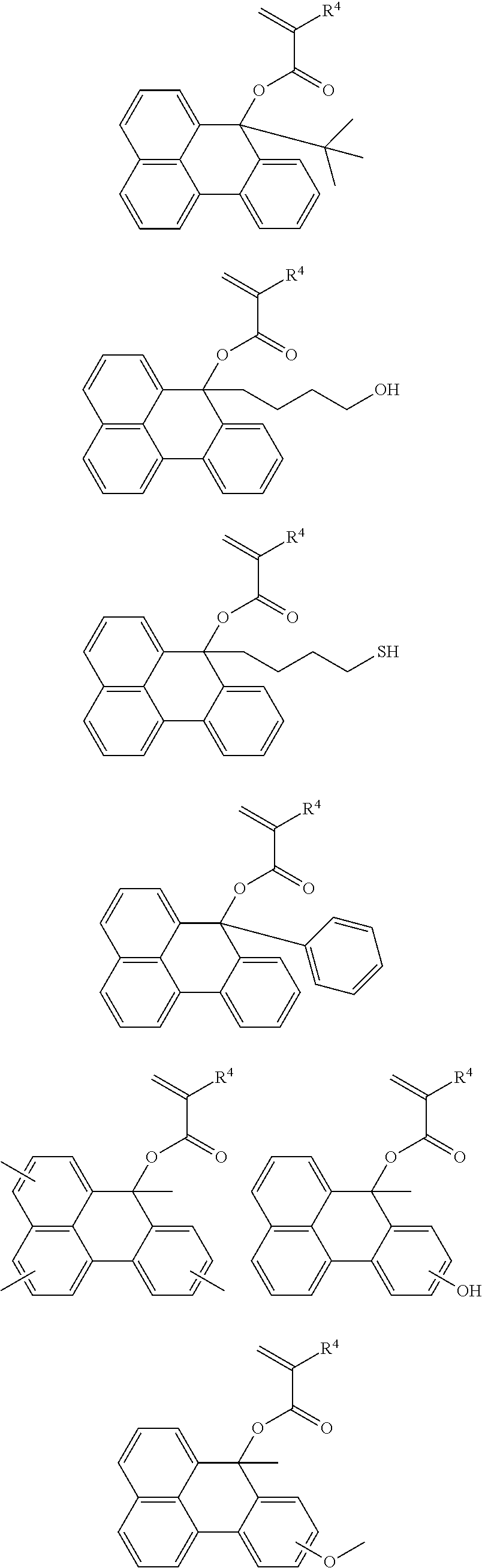


Herein R20, R24, and R28 eachare hydrogen or methyl, R21 is a single bond, phenylene, —O—RA—, or —C(═O)—Y0—RA— wherein Y) is —O— or —NH— and RA is a straight, branched or cyclic C1-C6 alkylene or alkenylene group which may contain a carbonyl (—CO—), ester (—COO—), ether (—O—) or hydroxyl moiety, or phenylene group. R22, R23, R25, R26, R27, R29, R30, and R31 are each independently a straight, branched or cyclic C1-C12 alkyl group which may contain a carbonyl, ester or ether moiety, a C6-C12 aryl group, C7-C20 aralkyl group, or mercaptophenyl group. Z1 is a single bond or a straight, branched or cyclic C1-C12 alkylene or C2-C12 alkenylene group which may contain an ether moiety, ester moiety or lactone ring, or C6-C10 arylene group. Z2 is a single bond, methylene, ethylene, phenylene, fluorinated phenylene, —O—R32—, or —C(═O)—Z3—R32— wherein Z3 is —O— or —NH— and R32 is a straight, branched or cyclic C1-C12 alkylene or C2-C12 alkenylene group which may contain a carbonyl, ester, ether or hydroxyl moiety, or phenvlene group. M− is a non-nucleophilic counter ion.

In formula (K-1), R41 is hydrogen, or a straight, branched or cyclic C1-C20 alkyl group, C2-C20 alkenyl group, or C6-C20 aryl group, which may have an ether, ester, carbonyl moiety, lactone ring or fluorine. In formula (K-2), R42 is hydrogen, or a straight, branched or cyclic C1-C30 alkyl or acyl group. C2-C20 alkenyl group, or C6-C20 aryl or aryloxy group, which may have an ether, ester, carbonyl moiety or lactone ring.

Herein R110 to R114 each are hydrogen C1-C30 alkyl, partially or entirely halo-substituted C1-C30 alkyl, hydroxyl, C1-C30 alkoxy, acyl, C2-C30 alkoxycarbonyl, C6-C10 aryl, halogen, or 1,1,1,3,3,3-hexafluoro-2-propanol group; and X9 is a methylene, ether or sulfide group.


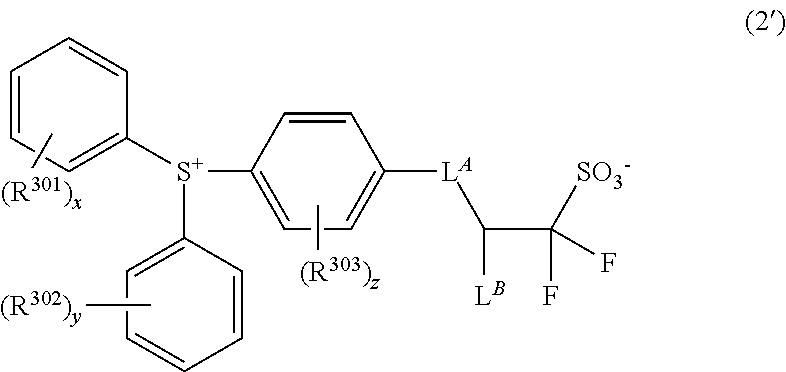


Herein R151, R152 and R153 are each independently hydrogen, halogen exclusive of fluorine, or a straight, branched or cyclic C1-C40 monovalent hydrocarbon group which may contain a heteroatom, any two or more of R151, R152 and R153 may bond together to form a ring with the carbon atom to which they are attached. R154 is a straight, branched or cyclic C1-C40 monovalent hydrocarbon group which may contain a heteroatom. M+ is an onium cation.


-
- 1-isopropyl-exo-tetracyclo[4.4.0.12,5.17,10]dedecanyl methacrylate:1-isopropylcyclopentyl methacrylate:Monomer 1:2-oxo-4,5-dimethyltetrahydrofuran-4-yl methacrylate=0.200.20:0.300.30
- Mw=7,500
- Mw/Mn=1.59

-
- 1-isopropyl-exo-tetracyclo[4.4.0.12,5.17,10]idodecanyl methacrylate:1-isopropylcyclopentyl methacrylate:Monomer 2:2-oxo-4,5-dimethyltetrahydrofuran-4-yl methacrylate=0.20:0.20:0.30:0.30
- Mw=8,900
- Mw/Mn=1.69

-
- 1-ethyl-exo-tetracyclo[4.4.0.12,5.17,10]dodecanyl methacrylate:1-t-butylcyclopentyl methacrylate:Monomer 3:2-oxo-4,5-dimethyltetrahydrofuran-4-yl methacrylate=0.20:0.20:0.30:0.30
- Mw=8,600
- Mw/Mn=1.81

-
- 1-ethyl-exo-tetracyclo[4.4.0.12,5.17,10]idodeoanyl methacrylate:1-t-butylcyclopentyl methacrylate:Monomer 4:2-oxo-4,5-dimethyltetrahydrofuran-4-yl methacrylate=0.20:0.20:0.30:0.30
- Mw=8,900
- Mw/Mn=1.71

-
- 1-(adamantan-1-yl)-1-methylethyl methacrylate:4-(1-methylcyclopentyloxy)styrene:Monomer 1:4-hydroxyphenyl methacrylate:PAG Monomer 1=0.20:0.15:0.30:0.20:0.15
- Mw=9,100
- Mw/Mn=1.73

-
- 4-(1-methylcyclohexyloxy)phenyl methacrylate:Monomer 2:4-hydroxyphenyl methacrylate:PAG Monomer 2=0.40:0.200.200.20
- MW=8,300
- Mw/Mn=1.83

-
- 1-isopropyl-exo-tetracyclo[4.4.0.12,5.17,10]dodecanyl methaorylate:1-isopropyloyclopentyl methacrylate:2-oxo-4,5-dimethyltetrahydrofuran-4-yl methacrylate=0.20:0.20:0.60
- Mw=8,900
- Mw/Mn=1.79

-
- 1-(adamantan-1-yl)-1-methylethyl methacrylate:4-(1-methylcyclopentyloxy)styrene:2-oxotetrahydrofuran-3-yl methacrylate:4-hydroxyphenyl methacrylate:PAG Monomer 1=0.20:0.15:0.30:0.20:0.15
- Mw=9,100
- Mw/Mn=1.78

- Acid generator: PAG1 of the following structural formula

- Quencher: Quencher 1 of the following structural formu

- Additive: Water repellent polymer 1 (Mw=12,100, Mw/Mn=1.78) of the following structural formula

| TABLE 1 | |||||
| Acid | Organic | ||||
| Resist | Polymer | generator | Quencher | Additive | solvent |
| composition | (pbw) | (pbw) | (pbw) | (pbw) | (pbw) |
| R-1 | Polymer 1 | PAG 1 | Quencher 1 | Water repellent | PGMEA (2,500) |
| (100) | (8.0) | (3.0) | polymer 1 | GBL (500) | |
| (3) | |||||
| R-2 | Polymer 2 | PAG 1 | Quencher 1 | Water repellent | PGMEA (2,500) |
| (100) | (8.0) | (3.0) | polymer 1 | GBL (500) | |
| (3) | |||||
| R-3 | Polymer 3 | PAG 1 | Quencher 1 | Water repellent | PGMEA (2,500) |
| (100) | (8.0) | (3.0) | polymer 1 | GBL (500) | |
| (3) | |||||
| R-4 | Polymer 4 | PAG 1 | Quencher 1 | Water repellent | PGMEA (2,500) |
| (100) | (8.0) | (3.0) | polymer 1 | GBL (500) | |
| (3) | |||||
| R-5 | Comparative | PAG 1 | Quencher 1 | Water repellent | PGMEA (2,500) |
| Polymer 1 | (8.0) | (3.0) | polymer 1 | GBL (500) | |
| (100) | (3) | ||||
3.2 ArF Lithography Patterning Test
| TABLE 2 | ||||||
| Hole size | ||||||
| Resist | PEB | variation | ||||
| com- | temp. | Dose | 3σ | |||
| position | (° C.) | (mJ/cm2) | Developer | (nm) | ||
| Example 1-1 | R-1 | 95 | 34 | n-butyl acetate | 2.1 |
| Example 1-2 | R-2 | 95 | 35 | n-butyl acetate | 2.3 |
| Example 1-3 | R-3 | 95 | 26 | n-butyl acetate | 2.2 |
| Example 1-4 | R-4 | 95 | 27 | n-butyl acetate | 2.2 |
| Example 1-5 | R-1 | 95 | 25 | 2-heptanone | 2.3 |
| Comparative | R-5 | 90 | 42 | n-butyl acetate | 4.0 |
| Example 1-1 | |||||
- Basic compound: Amine 1 of the following structural formula

| TABLE 3 | ||||
| Basic | ||||
| Resist | Polymer | compound | Organic solvent | |
| composition | (pbw) | (pbw) | (pbw) | |
| Example 2-1 | R-6 | Polymer 5 | Amine 1 | PGMEA (500) |
| (100) | (1.0) | CyH (1,200) | ||
| PGME (200) | ||||
| Example 2-2 | R-7 | Polymer 6 | Amine 1 | PGMEA (500) |
| (100) | (1.0) | CyH (1,200) | ||
| PGME (200) | ||||
| Comparative | R-8 | Comparative | Amine 1 | PGMEA (500) |
| Example 2-1 | Polymer 2 | (1.0) | CyH (1,200) | |
| (100) | PGME (200) | |||
4.2 EB Lithography Patterning Test
| TABLE 4 | ||||||
| Resist | PEB temp. | Sensitivity | Resolution | LWR | ||
| composition | (° C.) | (μC/cm2) | (nm) | (nm) | ||
| Example 2-1 | R-6 | 85 | 28.9 | 75 | 5.4 |
| Example 2-2 | R-7 | 85 | 30.3 | 75 | 5.2 |
| Comparative | R-8 | 85 | 30.5 | 80 | 6.1 |
| Example 2-1 | |||||
Claims (8)


Applications Claiming Priority (2)
| Application Number | Priority Date | Filing Date | Title |
|---|---|---|---|
| JP2015148563A JP6520524B2 (en) | 2015-07-28 | 2015-07-28 | Resist material and pattern formation method |
| JP2015-148563 | 2015-07-28 |
Publications (2)
| Publication Number | Publication Date |
|---|---|
| US20170031243A1 US20170031243A1 (en) | 2017-02-02 |
| US9720324B2 true US9720324B2 (en) | 2017-08-01 |
Family
ID=57882552
Family Applications (1)
| Application Number | Title | Priority Date | Filing Date |
|---|---|---|---|
| US15/210,025 Active US9720324B2 (en) | 2015-07-28 | 2016-07-14 | Resist composition and pattern forming process |
Country Status (4)
| Country | Link |
|---|---|
| US (1) | US9720324B2 (en) |
| JP (1) | JP6520524B2 (en) |
| KR (1) | KR101933762B1 (en) |
| TW (1) | TWI603147B (en) |
Families Citing this family (16)
| Publication number | Priority date | Publication date | Assignee | Title |
|---|---|---|---|---|
| BR112017024689B1 (en) | 2015-06-17 | 2022-04-12 | Clariant International Ltd | Water-soluble or water-swellable polymers, their production process, their use, process of cementing deep drilling using a cement slurry and polymeric mixture |
| JP7032402B2 (en) | 2016-12-12 | 2022-03-08 | クラリアント・インターナシヨナル・リミテツド | Polymers containing certain levels of biobase carbon |
| WO2018108611A1 (en) | 2016-12-12 | 2018-06-21 | Clariant International Ltd | Use of bio-based polymer in a cosmetic, dermatological or pharmaceutical composition |
| ES3017507T3 (en) | 2016-12-15 | 2025-05-13 | Clariant Int Ltd | Water-soluble and/or water-swellable hybrid polymer |
| US11306170B2 (en) | 2016-12-15 | 2022-04-19 | Clariant International Ltd. | Water-soluble and/or water-swellable hybrid polymer |
| WO2018108665A1 (en) | 2016-12-15 | 2018-06-21 | Clariant International Ltd | Water-soluble and/or water-swellable hybrid polymer |
| EP3554646B1 (en) | 2016-12-15 | 2025-03-19 | Clariant International Ltd | Water-soluble and/or water-swellable hybrid polymer |
| JP6939702B2 (en) * | 2017-06-21 | 2021-09-22 | 信越化学工業株式会社 | Resist material and pattern formation method |
| JP6722145B2 (en) * | 2017-07-04 | 2020-07-15 | 信越化学工業株式会社 | Resist composition and method for forming resist pattern |
| KR102128536B1 (en) | 2017-07-04 | 2020-06-30 | 주식회사 엘지화학 | POSITIVE-WORKING PHOTORESIST COMPOSITION, PATTERN USING THE SAME, and MANUFACTURING METHOD OF THE PATTERN |
| JP6999351B2 (en) * | 2017-10-05 | 2022-01-18 | 東京応化工業株式会社 | Resist composition, resist pattern forming method, polymer compound and compound |
| JP6655056B2 (en) * | 2017-11-28 | 2020-02-26 | 矢崎総業株式会社 | Ultrasonic bonding method of conductor of electric wire, method of manufacturing electric wire with terminal, and electric wire |
| JP7084995B2 (en) * | 2018-07-06 | 2022-06-15 | 富士フイルム株式会社 | Sensitive ray-sensitive or radiation-sensitive resin composition, resist film, pattern forming method, electronic device manufacturing method, resin |
| JP7284660B2 (en) * | 2018-08-02 | 2023-05-31 | 住友化学株式会社 | RESIN, RESIST COMPOSITION AND METHOD FOR MANUFACTURING RESIST PATTERN |
| US12013639B2 (en) | 2020-08-13 | 2024-06-18 | Shin-Etsu Chemical Co., Ltd. | Positive resist material and patterning process |
| JP2023169812A (en) | 2022-05-17 | 2023-11-30 | 信越化学工業株式会社 | Novel sulfonium salt, resist composition, and patterning process |
Citations (9)
| Publication number | Priority date | Publication date | Assignee | Title |
|---|---|---|---|---|
| JP2006045311A (en) | 2004-08-03 | 2006-02-16 | Tokyo Ohka Kogyo Co Ltd | Polymeric compound, acid generator, positive type resist composition and resist pattern-forming method |
| JP2006178317A (en) | 2004-12-24 | 2006-07-06 | Shin Etsu Chem Co Ltd | Resist material and pattern forming method using the same |
| US20080248331A1 (en) * | 2007-04-06 | 2008-10-09 | Rohm And Haas Electronic Materials Llc | Coating composition |
| WO2011024953A1 (en) | 2009-08-28 | 2011-03-03 | 株式会社クラレ | N-acyl-β-lactam derivative, macromolecular compound, and photoresist composition |
| JP2011203656A (en) | 2010-03-26 | 2011-10-13 | Jsr Corp | Radiation-sensitive resin composition and polymer |
| JP2012062371A (en) | 2010-09-14 | 2012-03-29 | Kuraray Co Ltd | Carbamoyloxyadamantane derivative, polymer compound, and photoresist composition |
| WO2012043102A1 (en) | 2010-09-29 | 2012-04-05 | 株式会社クラレ | Acrylamide derivative, polymer compound and photoresist composition |
| JP2012197382A (en) | 2011-03-22 | 2012-10-18 | Kuraray Co Ltd | Acrylic acid ester derivative, polymer compound and photoresist composition |
| WO2013129342A1 (en) | 2012-02-27 | 2013-09-06 | 株式会社クラレ | Acrylic acid ester derivative and method for producing same, intermediate and method for producing same, high-molecular-weight compound, and photoresist composition |
Family Cites Families (14)
| Publication number | Priority date | Publication date | Assignee | Title |
|---|---|---|---|---|
| JPH0212156A (en) * | 1988-06-29 | 1990-01-17 | Mita Ind Co Ltd | Photoconductive polymer, its production and electrophotographic sensitive body formed by using the same polymer |
| JP2616989B2 (en) * | 1989-04-03 | 1997-06-04 | 株式会社トクヤマ | 2,4-oxazolidinedione compound |
| JP2002023371A (en) * | 2000-07-05 | 2002-01-23 | Jsr Corp | Radiation-sensitive resin composition |
| KR100830868B1 (en) * | 2006-08-10 | 2008-05-21 | 주식회사 동진쎄미켐 | Photosensitive polymer for extreme ultraviolet and deep ultraviolet and photoresist composition comprising the same |
| JP5170456B2 (en) * | 2009-04-16 | 2013-03-27 | 信越化学工業株式会社 | Resist material and pattern forming method |
| JP2011024953A (en) | 2009-07-29 | 2011-02-10 | Olympus Corp | Stent, grafting material, and method for manufacturing the same |
| JP5851688B2 (en) * | 2009-12-31 | 2016-02-03 | ローム アンド ハース エレクトロニック マテリアルズ エルエルシーRohm and Haas Electronic Materials LLC | Photosensitive composition |
| JP2011186441A (en) * | 2010-02-10 | 2011-09-22 | Sumitomo Chemical Co Ltd | Resist composition and method for producing resist pattern |
| JP5416054B2 (en) | 2010-08-17 | 2014-02-12 | 株式会社Nttドコモ | Content setting device and content setting method |
| JP2013129342A (en) | 2011-12-22 | 2013-07-04 | Yamaha Motor Co Ltd | Saddle riding type electric vehicle |
| JP5772760B2 (en) * | 2012-08-13 | 2015-09-02 | 信越化学工業株式会社 | Positive resist material and pattern forming method using the same |
| JP6004869B2 (en) * | 2012-09-28 | 2016-10-12 | 東京応化工業株式会社 | Resist composition and resist pattern forming method |
| JP6237470B2 (en) * | 2013-06-12 | 2017-11-29 | 信越化学工業株式会社 | Developer for photosensitive resist material and pattern forming method using the same |
| JP5987802B2 (en) * | 2013-09-04 | 2016-09-07 | 信越化学工業株式会社 | Positive resist material and pattern forming method using the same |
-
2015
- 2015-07-28 JP JP2015148563A patent/JP6520524B2/en active Active
-
2016
- 2016-07-14 US US15/210,025 patent/US9720324B2/en active Active
- 2016-07-22 KR KR1020160093538A patent/KR101933762B1/en active Active
- 2016-07-26 TW TW105123506A patent/TWI603147B/en active
Patent Citations (11)
| Publication number | Priority date | Publication date | Assignee | Title |
|---|---|---|---|---|
| JP2006045311A (en) | 2004-08-03 | 2006-02-16 | Tokyo Ohka Kogyo Co Ltd | Polymeric compound, acid generator, positive type resist composition and resist pattern-forming method |
| US7482108B2 (en) | 2004-08-03 | 2009-01-27 | Tokyo Ohka Kogyo Co., Ltd. | Polymer compound, acid generator, positive resist composition, and method for formation of resist patterns |
| JP2006178317A (en) | 2004-12-24 | 2006-07-06 | Shin Etsu Chem Co Ltd | Resist material and pattern forming method using the same |
| US20080248331A1 (en) * | 2007-04-06 | 2008-10-09 | Rohm And Haas Electronic Materials Llc | Coating composition |
| WO2011024953A1 (en) | 2009-08-28 | 2011-03-03 | 株式会社クラレ | N-acyl-β-lactam derivative, macromolecular compound, and photoresist composition |
| JP2011203656A (en) | 2010-03-26 | 2011-10-13 | Jsr Corp | Radiation-sensitive resin composition and polymer |
| JP2012062371A (en) | 2010-09-14 | 2012-03-29 | Kuraray Co Ltd | Carbamoyloxyadamantane derivative, polymer compound, and photoresist composition |
| US20130164676A1 (en) | 2010-09-14 | 2013-06-27 | Kuraray Co., Ltd. | Carbamoyloxyadamantane derivative, polymer compound, and photoresist composition |
| WO2012043102A1 (en) | 2010-09-29 | 2012-04-05 | 株式会社クラレ | Acrylamide derivative, polymer compound and photoresist composition |
| JP2012197382A (en) | 2011-03-22 | 2012-10-18 | Kuraray Co Ltd | Acrylic acid ester derivative, polymer compound and photoresist composition |
| WO2013129342A1 (en) | 2012-02-27 | 2013-09-06 | 株式会社クラレ | Acrylic acid ester derivative and method for producing same, intermediate and method for producing same, high-molecular-weight compound, and photoresist composition |
Non-Patent Citations (2)
| Title |
|---|
| Kishikawa et al. "Assessment of trade-off between resist resolution and sensitivity for optimization of hyper-NA immersion lithography", (2007), Proc. of SPIE vol. 6520, 65203L-pp. 1. |
| Kishikawa et al. "Assessment of trade-off between resist resolution and sensitivity for optimization of hyper-NA immersion lithography", (2007), Proc. of SPIE vol. 6520, 65203L—pp. 1. |
Also Published As
| Publication number | Publication date |
|---|---|
| US20170031243A1 (en) | 2017-02-02 |
| TW201710784A (en) | 2017-03-16 |
| JP2017026980A (en) | 2017-02-02 |
| KR101933762B1 (en) | 2018-12-28 |
| KR20170013818A (en) | 2017-02-07 |
| JP6520524B2 (en) | 2019-05-29 |
| TWI603147B (en) | 2017-10-21 |
Similar Documents
| Publication | Publication Date | Title |
|---|---|---|
| US11953832B2 (en) | Positive resist composition and pattern forming process | |
| US11592745B2 (en) | Positive resist composition and patterning process | |
| US11720021B2 (en) | Positive resist composition and patterning process | |
| US9720324B2 (en) | Resist composition and pattern forming process | |
| US10303056B2 (en) | Resist composition and patterning process | |
| US11506977B2 (en) | Positive resist composition and patterning process | |
| US11567406B2 (en) | Positive resist composition and patterning process | |
| US11586110B2 (en) | Positive resist composition and patterning process | |
| US11709427B2 (en) | Positive resist composition and pattern forming process | |
| US11460772B2 (en) | Positive resist composition and patterning process | |
| US11500289B2 (en) | Positive resist composition and pattern forming process | |
| US12222649B2 (en) | Positive resist composition and pattern forming process | |
| US11635690B2 (en) | Positive resist composition and patterning process | |
| US11860540B2 (en) | Positive resist composition and patterning process | |
| US20220128904A1 (en) | Positive resist composition and patterning process | |
| US20230161255A1 (en) | Positive resist composition and pattern forming process | |
| US11914294B2 (en) | Positive resist composition and pattern forming process | |
| US12436462B2 (en) | Positive resist composition and pattern forming process | |
| US12276911B2 (en) | Positive resist composition and pattern forming process | |
| US20240361690A1 (en) | Resist Material, Resist Composition, Patterning Process, And Monomer | |
| US12422751B2 (en) | Positive resist composition and pattern forming process | |
| US20230314944A1 (en) | Positive resist composition and pattern forming process | |
| US10012903B2 (en) | Resist composition and pattern forming process | |
| US12498637B2 (en) | Positive resist composition and pattern forming process | |
| US20260003280A1 (en) | Resist composition and pattern forming process |
Legal Events
| Date | Code | Title | Description |
|---|---|---|---|
| AS | Assignment |
Owner name: SHIN-ETSU CHEMICAL CO., LTD., JAPAN Free format text: ASSIGNMENT OF ASSIGNORS INTEREST;ASSIGNORS:HATAKEYAMA, JUN;HASEGAWA, KOJI;REEL/FRAME:039158/0369 Effective date: 20160629 |
|
| STCF | Information on status: patent grant |
Free format text: PATENTED CASE |
|
| MAFP | Maintenance fee payment |
Free format text: PAYMENT OF MAINTENANCE FEE, 4TH YEAR, LARGE ENTITY (ORIGINAL EVENT CODE: M1551); ENTITY STATUS OF PATENT OWNER: LARGE ENTITY Year of fee payment: 4 |
|
| MAFP | Maintenance fee payment |
Free format text: PAYMENT OF MAINTENANCE FEE, 8TH YEAR, LARGE ENTITY (ORIGINAL EVENT CODE: M1552); ENTITY STATUS OF PATENT OWNER: LARGE ENTITY Year of fee payment: 8 |