US9709907B2 - Electrophotographic photosensitive member, process cartridge and electrophotographic apparatus - Google Patents
Electrophotographic photosensitive member, process cartridge and electrophotographic apparatus Download PDFInfo
- Publication number
- US9709907B2 US9709907B2 US14/736,824 US201514736824A US9709907B2 US 9709907 B2 US9709907 B2 US 9709907B2 US 201514736824 A US201514736824 A US 201514736824A US 9709907 B2 US9709907 B2 US 9709907B2
- Authority
- US
- United States
- Prior art keywords
- group
- substituted
- substituent
- phthalocyanine crystal
- unsubstituted
- Prior art date
- Legal status (The legal status is an assumption and is not a legal conclusion. Google has not performed a legal analysis and makes no representation as to the accuracy of the status listed.)
- Expired - Fee Related
Links
Images


Classifications
-
- G—PHYSICS
- G03—PHOTOGRAPHY; CINEMATOGRAPHY; ANALOGOUS TECHNIQUES USING WAVES OTHER THAN OPTICAL WAVES; ELECTROGRAPHY; HOLOGRAPHY
- G03G—ELECTROGRAPHY; ELECTROPHOTOGRAPHY; MAGNETOGRAPHY
- G03G5/00—Recording members for original recording by exposure, e.g. to light, to heat, to electrons; Manufacture thereof; Selection of materials therefor
- G03G5/02—Charge-receiving layers
- G03G5/04—Photoconductive layers; Charge-generation layers or charge-transporting layers; Additives therefor; Binders therefor
- G03G5/06—Photoconductive layers; Charge-generation layers or charge-transporting layers; Additives therefor; Binders therefor characterised by the photoconductive material being organic
- G03G5/0622—Heterocyclic compounds
- G03G5/0624—Heterocyclic compounds containing one hetero ring
- G03G5/0635—Heterocyclic compounds containing one hetero ring being six-membered
- G03G5/0638—Heterocyclic compounds containing one hetero ring being six-membered containing two hetero atoms
-
- G—PHYSICS
- G03—PHOTOGRAPHY; CINEMATOGRAPHY; ANALOGOUS TECHNIQUES USING WAVES OTHER THAN OPTICAL WAVES; ELECTROGRAPHY; HOLOGRAPHY
- G03G—ELECTROGRAPHY; ELECTROPHOTOGRAPHY; MAGNETOGRAPHY
- G03G5/00—Recording members for original recording by exposure, e.g. to light, to heat, to electrons; Manufacture thereof; Selection of materials therefor
- G03G5/02—Charge-receiving layers
- G03G5/04—Photoconductive layers; Charge-generation layers or charge-transporting layers; Additives therefor; Binders therefor
- G03G5/06—Photoconductive layers; Charge-generation layers or charge-transporting layers; Additives therefor; Binders therefor characterised by the photoconductive material being organic
- G03G5/0601—Acyclic or carbocyclic compounds
- G03G5/0612—Acyclic or carbocyclic compounds containing nitrogen
-
- G—PHYSICS
- G03—PHOTOGRAPHY; CINEMATOGRAPHY; ANALOGOUS TECHNIQUES USING WAVES OTHER THAN OPTICAL WAVES; ELECTROGRAPHY; HOLOGRAPHY
- G03G—ELECTROGRAPHY; ELECTROPHOTOGRAPHY; MAGNETOGRAPHY
- G03G5/00—Recording members for original recording by exposure, e.g. to light, to heat, to electrons; Manufacture thereof; Selection of materials therefor
- G03G5/02—Charge-receiving layers
- G03G5/04—Photoconductive layers; Charge-generation layers or charge-transporting layers; Additives therefor; Binders therefor
- G03G5/06—Photoconductive layers; Charge-generation layers or charge-transporting layers; Additives therefor; Binders therefor characterised by the photoconductive material being organic
- G03G5/0622—Heterocyclic compounds
- G03G5/0624—Heterocyclic compounds containing one hetero ring
- G03G5/0627—Heterocyclic compounds containing one hetero ring being five-membered
- G03G5/0629—Heterocyclic compounds containing one hetero ring being five-membered containing one hetero atom
-
- G—PHYSICS
- G03—PHOTOGRAPHY; CINEMATOGRAPHY; ANALOGOUS TECHNIQUES USING WAVES OTHER THAN OPTICAL WAVES; ELECTROGRAPHY; HOLOGRAPHY
- G03G—ELECTROGRAPHY; ELECTROPHOTOGRAPHY; MAGNETOGRAPHY
- G03G5/00—Recording members for original recording by exposure, e.g. to light, to heat, to electrons; Manufacture thereof; Selection of materials therefor
- G03G5/02—Charge-receiving layers
- G03G5/04—Photoconductive layers; Charge-generation layers or charge-transporting layers; Additives therefor; Binders therefor
- G03G5/06—Photoconductive layers; Charge-generation layers or charge-transporting layers; Additives therefor; Binders therefor characterised by the photoconductive material being organic
- G03G5/0622—Heterocyclic compounds
- G03G5/0624—Heterocyclic compounds containing one hetero ring
- G03G5/0627—Heterocyclic compounds containing one hetero ring being five-membered
- G03G5/0631—Heterocyclic compounds containing one hetero ring being five-membered containing two hetero atoms
-
- G—PHYSICS
- G03—PHOTOGRAPHY; CINEMATOGRAPHY; ANALOGOUS TECHNIQUES USING WAVES OTHER THAN OPTICAL WAVES; ELECTROGRAPHY; HOLOGRAPHY
- G03G—ELECTROGRAPHY; ELECTROPHOTOGRAPHY; MAGNETOGRAPHY
- G03G5/00—Recording members for original recording by exposure, e.g. to light, to heat, to electrons; Manufacture thereof; Selection of materials therefor
- G03G5/02—Charge-receiving layers
- G03G5/04—Photoconductive layers; Charge-generation layers or charge-transporting layers; Additives therefor; Binders therefor
- G03G5/06—Photoconductive layers; Charge-generation layers or charge-transporting layers; Additives therefor; Binders therefor characterised by the photoconductive material being organic
- G03G5/0622—Heterocyclic compounds
- G03G5/0624—Heterocyclic compounds containing one hetero ring
- G03G5/0635—Heterocyclic compounds containing one hetero ring being six-membered
- G03G5/0637—Heterocyclic compounds containing one hetero ring being six-membered containing one hetero atom
-
- G—PHYSICS
- G03—PHOTOGRAPHY; CINEMATOGRAPHY; ANALOGOUS TECHNIQUES USING WAVES OTHER THAN OPTICAL WAVES; ELECTROGRAPHY; HOLOGRAPHY
- G03G—ELECTROGRAPHY; ELECTROPHOTOGRAPHY; MAGNETOGRAPHY
- G03G5/00—Recording members for original recording by exposure, e.g. to light, to heat, to electrons; Manufacture thereof; Selection of materials therefor
- G03G5/02—Charge-receiving layers
- G03G5/04—Photoconductive layers; Charge-generation layers or charge-transporting layers; Additives therefor; Binders therefor
- G03G5/06—Photoconductive layers; Charge-generation layers or charge-transporting layers; Additives therefor; Binders therefor characterised by the photoconductive material being organic
- G03G5/0622—Heterocyclic compounds
- G03G5/0624—Heterocyclic compounds containing one hetero ring
- G03G5/0642—Heterocyclic compounds containing one hetero ring being more than six-membered
-
- G—PHYSICS
- G03—PHOTOGRAPHY; CINEMATOGRAPHY; ANALOGOUS TECHNIQUES USING WAVES OTHER THAN OPTICAL WAVES; ELECTROGRAPHY; HOLOGRAPHY
- G03G—ELECTROGRAPHY; ELECTROPHOTOGRAPHY; MAGNETOGRAPHY
- G03G5/00—Recording members for original recording by exposure, e.g. to light, to heat, to electrons; Manufacture thereof; Selection of materials therefor
- G03G5/02—Charge-receiving layers
- G03G5/04—Photoconductive layers; Charge-generation layers or charge-transporting layers; Additives therefor; Binders therefor
- G03G5/06—Photoconductive layers; Charge-generation layers or charge-transporting layers; Additives therefor; Binders therefor characterised by the photoconductive material being organic
- G03G5/0622—Heterocyclic compounds
- G03G5/0644—Heterocyclic compounds containing two or more hetero rings
-
- G—PHYSICS
- G03—PHOTOGRAPHY; CINEMATOGRAPHY; ANALOGOUS TECHNIQUES USING WAVES OTHER THAN OPTICAL WAVES; ELECTROGRAPHY; HOLOGRAPHY
- G03G—ELECTROGRAPHY; ELECTROPHOTOGRAPHY; MAGNETOGRAPHY
- G03G5/00—Recording members for original recording by exposure, e.g. to light, to heat, to electrons; Manufacture thereof; Selection of materials therefor
- G03G5/02—Charge-receiving layers
- G03G5/04—Photoconductive layers; Charge-generation layers or charge-transporting layers; Additives therefor; Binders therefor
- G03G5/06—Photoconductive layers; Charge-generation layers or charge-transporting layers; Additives therefor; Binders therefor characterised by the photoconductive material being organic
- G03G5/0664—Dyes
- G03G5/0696—Phthalocyanines
Definitions
- the present invention relates to an electrophotographic photosensitive member and a process cartridge and an electrophotographic apparatus that include an electrophotographic photosensitive member.
- the lasing wavelengths of semiconductor lasers commonly used as image exposure units in the electrophotographic field are long wavelengths of 650 to 820 nm. Accordingly, electrophotographic photosensitive members that have high sensitivity to light of the long wavelengths have been developed. In addition, in order to achieve a higher resolution, electrophotographic photosensitive members that have high sensitivity to light emitted by semiconductor lasers having short lasing wavelengths have been developed recently.
- Phthalocyanine pigments are known as charge generation substances that have high sensitivity to light of wavelengths across the long wavelength region to the short wavelength region.
- oxytitanium phthalocyanine and gallium phthalocyanine have high sensitivity characteristics and various crystal forms thereof have been reported.
- An electrophotographic photosensitive member including a gallium phthalocyanine pigment has high sensitivity characteristics; however, dispersibility of gallium phthalocyanine pigment particles is poor, which is problematic. For this reason, an improvement is necessary to obtain a charge generation layer-coating solution containing this pigment and having high coatability.
- a charge generation layer-coating solution does not have sufficient coatability, during coating, aggregation of pigment particles tends to result in generation of spots (blue spots) or occurrence of coating unevenness in the charge generation layer.
- Blue spots in a charge generation layer may cause black spots or fogging particularly in output images.
- coating unevenness in a charge generation layer causes image density unevenness particularly in halftone image formation areas, resulting in degradation of image quality.
- Patent Literature 1 states that gallium phthalocyanine and a polyvinylalcohol resin having a specific structure are used to thereby achieve enhancement of coatability and stability of the coating material.
- Patent Literature 2 states that a photosensitive layer contains a nitrogen-containing heterocyclic compound such as morpholine, piperazine, or piperidine to thereby enhance resistance to ozone and resistance to NOx.
- Patent Literature 2 does not describe anything about dispersibility or coatability.
- Patent Literature 3 describes a hydroxygallium phthalocyanine crystal obtained by milling treatment using N-methylformamide, N,N-dimethylformamide, N-methylacetamide, and N-methylpropionamide. However, Patent Literature 3 does not describe anything about dispersibility or coatability.
- An object of the present invention is to provide an electrophotographic photosensitive member that can provide images in which black spots and fogging are suppressed and density unevenness due to coating unevenness in the charge generation layer is suppressed.
- Another objects of the present invention are to provide an electrophotographic apparatus and a process cartridge that include the electrophotographic photosensitive member.
- an electrophotographic photosensitive member including a support, a charge generation layer formed on the support, and a charge transport layer formed on the charge generation layer.
- the charge generation layer contains
- R 11 represents a methyl group or a propyl group.
- a nitrogen atom in a heterocyclic ring of the nitrogen-containing heterocyclic compound has a substituent.
- the substituent of the nitrogen atom having a substituent is a substituted or unsubstituted acyl group, —(C ⁇ O)—O—R 1 , a substituted or unsubstituted alkyl group, a substituted or unsubstituted alkenyl group, a substituted or unsubstituted aryl group, or a substituted or unsubstituted heterocyclic group.
- a substituent of the substituted acyl group is a group described in (i), and R 1 represents a group described in (ii): (i) a substituted or unsubstituted alkyl group, a substituted or unsubstituted alkenyl group, a substituted or unsubstituted aryl group, or a substituted or unsubstituted heterocyclic group, where, in this (i), a substituent of the substituted alkyl group, a substituent of the substituted alkenyl group, a substituent of the substituted aryl group, and a substituent of the substituted heterocyclic group are each a halogen atom, a cyano group, a nitro group, a hydroxy group, a formyl group, an alkyl group, an alkenyl group, an alkoxy group, or an aryl group, (ii) a substituted or unsubstituted alkyl group, a substituted or unsubstit
- aspects of the present invention also provide a process cartridge supporting, as integrated units, the electrophotographic photosensitive member, and at least one unit selected from the group consisting of a charging unit, a development unit, and a cleaning unit, wherein the process cartridge is detachably mountable on a body of an electrophotographic apparatus.
- aspects of the present invention also provide an electrophotographic apparatus including the electrophotographic photosensitive member, a charging unit, an exposure unit, a development unit, and a transfer unit.
- FIG. 1 illustrates an example of the schematic configuration of an electrophotographic apparatus including a process cartridge including an electrophotographic photosensitive member.
- FIG. 2 is an X-ray powder diffraction pattern of a hydroxygallium phthalocyanine crystal obtained in Example 1-1.
- FIG. 3 is an X-ray powder diffraction pattern of a hydroxygallium phthalocyanine crystal obtained in Example 1-2.
- FIG. 4 is an X-ray powder diffraction pattern of a hydroxygallium phthalocyanine crystal obtained in Example 1-6.
- FIG. 5 is an X-ray powder diffraction pattern of a hydroxygallium phthalocyanine crystal obtained in Example 1-8.
- FIG. 6 is an X-ray powder diffraction pattern of a hydroxygallium phthalocyanine crystal obtained in Example 1-10.
- FIG. 7 is an X-ray powder diffraction pattern of a hydroxygallium phthalocyanine crystal obtained in Example 1-20.
- FIG. 8 is an X-ray powder diffraction pattern of a hydroxygallium phthalocyanine crystal obtained in Example 1-21.
- An electrophotographic photosensitive member includes a support, a charge generation layer formed on the support, and a charge transport layer formed on the charge generation layer.
- the charge generation layer contains a gallium phthalocyanine crystal, a nitrogen-containing heterocyclic compound, and an amide compound represented by a formula (1) below.
- R 11 represents a methyl group or a propyl group.
- a nitrogen atom in a heterocyclic ring of the nitrogen-containing heterocyclic compound has a substituent.
- the substituent of the nitrogen atom having a substituent is a substituted or unsubstituted acyl group, —(C ⁇ O)—O—R 1 , a substituted or unsubstituted alkyl group, a substituted or unsubstituted alkenyl group, a substituted or unsubstituted aryl group, or a substituted or unsubstituted heterocyclic group.
- a substituent of the substituted acyl group is a group described in (i) below.
- R 1 represents a group described in (ii) below.
- a substituted or unsubstituted alkyl group, a substituted or unsubstituted alkenyl group, a substituted or unsubstituted aryl group, or a substituted or unsubstituted heterocyclic group are each a halogen atom, a cyano group, a nitro group, a hydroxy group, a formyl group, an alkyl group, an alkenyl group, an alkoxy group, or an aryl group.
- a substituted or unsubstituted alkyl group, a substituted or unsubstituted alkenyl group, a substituted or unsubstituted aryl group, or a substituted or unsubstituted heterocyclic group are each a halogen atom, a cyano group, a nitro group, a hydroxy group, a formyl group, an alkyl group, an alkenyl group, an alkoxy group, or an aryl group.
- the compounds represented by the formula (1) have high polarity and the carbonyl group has an electron attracting effect. Thus, the compounds probably tend to withdraw electrons from a molecule of gallium phthalocyanine crystal. This probably facilitates the flow of electrons from gallium phthalocyanine crystal.
- a nitrogen atom of the nitrogen-containing heterocyclic compound has a substituent and hence has properties of a tertiary amine in which bondability to hydrogens is suppressed. This probably further facilitates the flow of electrons in the relationship between gallium phthalocyanine crystal and compound represented by the formula (1).
- dispersibility of gallium phthalocyanine crystal is enhanced and local charge injection and coating unevenness are suppressed, which probably results in suppression of black spots, fogging, and density unevenness.
- the nitrogen-containing heterocyclic compound is preferably pyrrole, pyrrolidine, morpholine, piperazine, piperidine, 4-piperidone, indole, imidazole, phenothiazine, phenoxazine, or carbazole. Of these, more preferred are morpholine, piperazine, piperidine, 4-piperidone, indole, and imidazole.
- a substituent of a non-nitrogen atom (for example, a carbon atom) of a ring in the nitrogen-containing heterocyclic compound is preferably as follows: a substituted or unsubstituted alkyl group, a substituted or unsubstituted aryl group, a substituted or unsubstituted heterocyclic group, a halogen atom, a hydroxy group, a formyl group, an alkenyl group, an alkoxy group, or an alkyloxycarbonyl group.
- a substituent of the substituted alkyl group, a substituent of the substituted aryl group, and a substituent of the substituted heterocyclic group are each a halogen atom, a hydroxy group, or a formyl group.
- nitrogen-containing heterocyclic compounds are compounds represented by formulae (2) to (7) below.
- R 21 represents a substituted or unsubstituted acyl group, —(C ⁇ O)—O—R 2 , a substituted or unsubstituted alkyl group, a substituted or unsubstituted alkenyl group, a substituted or unsubstituted aryl group, or a substituted or unsubstituted heterocyclic group.
- a substituent of the substituted alkyl group, a substituent of the substituted alkenyl group, a substituent of the substituted aryl group, and a substituent of the substituted heterocyclic group are each a halogen atom, a cyano group, a nitro group, a hydroxy group, a formyl group, an alkyl group, an alkenyl group, an alkoxy group, or an aryl group.
- a substituent of the substituted acyl group is a group described in (i) below.
- R 2 represents a group described in (ii) below.
- a substituted or unsubstituted alkyl group, a substituted or unsubstituted alkenyl group, a substituted or unsubstituted aryl group, or a substituted or unsubstituted heterocyclic group are each a halogen atom, a cyano group, a nitro group, a hydroxy group, a formyl group, an alkyl group, an alkenyl group, an alkoxy group, or an aryl group.
- a substituted or unsubstituted alkyl group, a substituted or unsubstituted alkenyl group, a substituted or unsubstituted aryl group, or a substituted or unsubstituted heterocyclic group are each a halogen atom, a cyano group, a nitro group, a hydroxy group, a formyl group, an alkyl group, an alkenyl group, an alkoxy group, or an aryl group.
- R 31 and R 32 each independently represent a substituted or unsubstituted acyl group, —(C ⁇ O)—O—R 3 , a substituted or unsubstituted alkyl group, a substituted or unsubstituted alkenyl group, a substituted or unsubstituted aryl group, or a substituted or unsubstituted heterocyclic group.
- a substituent of the substituted alkyl group, a substituent of the substituted alkenyl group, a substituent of the substituted aryl group, and a substituent of the substituted heterocyclic group are each a halogen atom, a cyano group, a nitro group, a hydroxy group, a formyl group, an alkyl group, an alkenyl group, an alkoxy group, or an aryl group.
- a substituent of the substituted acyl group is a group described in (i) below.
- R 3 represents a group described in (ii) below.
- a substituted or unsubstituted alkyl group, a substituted or unsubstituted alkenyl group, a substituted or unsubstituted aryl group, or a substituted or unsubstituted heterocyclic group are each a halogen atom, a cyano group, a nitro group, a hydroxy group, a formyl group, an alkyl group, an alkenyl group, an alkoxy group, or an aryl group.
- a substituted or unsubstituted alkyl group, a substituted or unsubstituted alkenyl group, a substituted or unsubstituted aryl group, or a substituted or unsubstituted heterocyclic group are each a halogen atom, a cyano group, a nitro group, a hydroxy group, a formyl group, an alkyl group, an alkenyl group, an alkoxy group, or an aryl group.
- R 41 represents a substituted or unsubstituted acyl group, —(C ⁇ O)—O—R 4 , a substituted or unsubstituted alkyl group, a substituted or unsubstituted alkenyl group, a substituted or unsubstituted aryl group, or a substituted or unsubstituted heterocyclic group.
- a substituent of the substituted alkyl group, a substituent of the substituted alkenyl group, a substituent of the substituted aryl group, and a substituent of the substituted heterocyclic group are each a halogen atom, a cyano group, a nitro group, a hydroxy group, a formyl group, an alkyl group, an alkenyl group, an alkoxy group, or an aryl group.
- a substituent of the substituted acyl group is a group described in (i) below.
- R 4 represents a group described in (ii) below.
- a substituted or unsubstituted alkyl group, a substituted or unsubstituted alkenyl group, a substituted or unsubstituted aryl group, or a substituted or unsubstituted heterocyclic group are each a halogen atom, a cyano group, a nitro group, a hydroxy group, a formyl group, an alkyl group, an alkenyl group, an alkoxy group, or an aryl group.
- a substituted or unsubstituted alkyl group, a substituted or unsubstituted alkenyl group, a substituted or unsubstituted aryl group, or a substituted or unsubstituted heterocyclic group are each a halogen atom, a cyano group, a nitro group, a hydroxy group, a formyl group, an alkyl group, an alkenyl group, an alkoxy group, or an aryl group.
- R 51 represents a substituted or unsubstituted acyl group, —(C ⁇ O)—O—R 5 , a substituted or unsubstituted alkyl group, a substituted or unsubstituted alkenyl group, a substituted or unsubstituted aryl group, or a substituted or unsubstituted heterocyclic group.
- a substituent of the substituted alkyl group, a substituent of the substituted alkenyl group, a substituent of the substituted aryl group, and a substituent of the substituted heterocyclic group are each a halogen atom, a cyano group, a nitro group, a hydroxy group, a formyl group, an alkyl group, an alkenyl group, an alkoxy group, or an aryl group.
- a substituent of the substituted acyl group is a group described in (i) below.
- R 5 represents a group described in (ii) below.
- a substituted or unsubstituted alkyl group, a substituted or unsubstituted alkenyl group, a substituted or unsubstituted aryl group, or a substituted or unsubstituted heterocyclic group are each a halogen atom, a cyano group, a nitro group, a hydroxy group, a formyl group, an alkyl group, an alkenyl group, an alkoxy group, or an aryl group.
- a substituted or unsubstituted alkyl group, a substituted or unsubstituted alkenyl group, a substituted or unsubstituted aryl group, or a substituted or unsubstituted heterocyclic group are each a halogen atom, a cyano group, a nitro group, a hydroxy group, a formyl group, an alkyl group, an alkenyl group, an alkoxy group, or an aryl group.
- R 61 represents a substituted or unsubstituted acyl group, —(C ⁇ O)—O—R 6 , a substituted or unsubstituted alkyl group, a substituted or unsubstituted alkenyl group, a substituted or unsubstituted aryl group, or a substituted or unsubstituted heterocyclic group.
- a substituent of the substituted alkyl group, a substituent of the substituted alkenyl group, a substituent of the substituted aryl group, and a substituent of the substituted heterocyclic group are each a halogen atom, a cyano group, a nitro group, a hydroxy group, a formyl group, an alkyl group, an alkenyl group, an alkoxy group, or an aryl group.
- a substituent of the substituted acyl group is a group described in (i) below.
- R 6 represents a group described in (ii) below.
- a substituted or unsubstituted alkyl group, a substituted or unsubstituted alkenyl group, a substituted or unsubstituted aryl group, or a substituted or unsubstituted heterocyclic group are each a halogen atom, a cyano group, a nitro group, a hydroxy group, a formyl group, an alkyl group, an alkenyl group, an alkoxy group, or an aryl group.
- a substituted or unsubstituted alkyl group, a substituted or unsubstituted alkenyl group, a substituted or unsubstituted aryl group, or a substituted or unsubstituted heterocyclic group are each a halogen atom, a cyano group, a nitro group, a hydroxy group, a formyl group, an alkyl group, an alkenyl group, an alkoxy group, or an aryl group.
- R 71 represents a substituted or unsubstituted acyl group, —(C ⁇ O)—O—R 7 , a substituted or unsubstituted alkyl group, a substituted or unsubstituted alkenyl group, a substituted or unsubstituted aryl group, or a substituted or unsubstituted heterocyclic group.
- a substituent of the substituted alkyl group, a substituent of the substituted alkenyl group, a substituent of the substituted aryl group, and a substituent of the substituted heterocyclic group are each a halogen atom, a cyano group, a nitro group, a hydroxy group, a formyl group, an alkyl group, an alkenyl group, an alkoxy group, or an aryl group.
- a substituent of the substituted acyl group is a group described in (i) below.
- R 7 represents a group described in (ii) below.
- a substituted or unsubstituted alkyl group, a substituted or unsubstituted alkenyl group, a substituted or unsubstituted aryl group, or a substituted or unsubstituted heterocyclic group are each a halogen atom, a cyano group, a nitro group, a hydroxy group, a formyl group, an alkyl group, an alkenyl group, an alkoxy group, or an aryl group.
- a substituted or unsubstituted alkyl group, a substituted or unsubstituted alkenyl group, a substituted or unsubstituted aryl group, or a substituted or unsubstituted heterocyclic group are each a halogen atom, a cyano group, a nitro group, a hydroxy group, a formyl group, an alkyl group, an alkenyl group, an alkoxy group, or an aryl group.
- R 21 , R 31 , R 32 , R 41 , R 51 , R 61 , and R 71 each independently preferably represent a methyl group, an ethyl group, or a phenyl group.
- the content of the nitrogen-containing heterocyclic compound in the charge generation layer relative to the gallium phthalocyanine crystal is preferably 0.01% by mass or more and 20% by mass or less, more preferably 0.1% by mass or more and 5% by mass or less.
- the nitrogen-containing heterocyclic compound may be an amorphous compound or a crystalline compound. Two or more nitrogen-containing heterocyclic compounds may be used in combination.
- the gallium phthalocyanine crystal is preferably a gallium phthalocyanine crystal in which the nitrogen-containing heterocyclic compound is contained.
- the content of the nitrogen-containing heterocyclic compound within the gallium phthalocyanine crystal relative to the gallium phthalocyanine crystal is preferably 0.01% by mass or more and 2% by mass or less.
- example compounds of the nitrogen-containing heterocyclic compound contained in an electrophotographic photosensitive member according to the present invention.
- present invention is not limited to these examples.
- the content of an amide compound represented by the formula (1) in the charge generation layer relative to the gallium phthalocyanine crystal is preferably 0.01% by mass or more and 5% by mass or less.
- the gallium phthalocyanine crystal is preferably a gallium phthalocyanine crystal in which an amide compound represented by the formula (1) is contained.
- the content of the amide compound represented by the formula (1) and contained within the gallium phthalocyanine crystal relative to the gallium phthalocyanine crystal is preferably 0.01% by mass or more and 3% by mass or less, more preferably 0.01% by mass or more and 1.7% by mass or less.
- the mass of the nitrogen-containing heterocyclic compound in the charge generation layer is defined as A.
- the mass of the amide compound represented by the formula (1) and contained within the gallium phthalocyanine crystal is defined as B.
- R 11 in the formula (1) preferably represents a methyl group.
- the gallium phthalocyanine crystal contained in an electrophotographic photosensitive member according to the present invention is, for example, gallium phthalocyanine crystal in which the gallium atom of a gallium phthalocyanine molecule has a halogen atom, a hydroxy group, or an alkoxy group as an axial ligand.
- the phthalocyanine ring may have a substituent such as a halogen atom.
- gallium phthalocyanine crystals preferred are hydroxygallium phthalocyanine crystal, bromogallium phthalocyanine crystal, and iodogallium phthalocyanine crystal, which exhibit high sensitivities and are effectively used in the present invention. Of these, more preferred is hydroxygallium phthalocyanine crystal.
- a hydroxygallium phthalocyanine crystal the gallium atom has a hydroxy group as an axial ligand.
- a bromogallium phthalocyanine crystal the gallium atom has a bromine atom as an axial ligand.
- an iodogallium phthalocyanine crystal the gallium atom has an iodine atom as an axial ligand.
- hydroxygallium phthalocyanine crystal in particular, preferred is a hydroxygallium phthalocyanine crystal that has a crystal form having a strong peak at 7.4° ⁇ 0.3° and a strong peak at 28.2° ⁇ 0.3° in Bragg angle 2 ⁇ measured by X-ray diffractometry using CuK ⁇ radiation, from the standpoint of high image quality.
- the gallium phthalocyanine crystal in which the nitrogen-containing heterocyclic compound is contained means crystal in which the nitrogen-containing heterocyclic compound is incorporated.
- the gallium phthalocyanine crystal in which an amide compound represented by the formula (1) is contained means crystal in which an amide compound represented by the formula (1) is incorporated.
- Gallium phthalocyanine crystal containing a nitrogen-containing heterocyclic compound within the crystal according to the present invention can be obtained by a step in which gallium phthalocyanine obtained by an acid pasting process and a nitrogen-containing heterocyclic compound are mixed with a solvent and subjected to a wet milling treatment to achieve crystal conversion.
- This milling treatment is carried out with a milling apparatus such as a sand mill or a ball mill with dispersion media such as glass beads, steel beads, or alumina balls.
- the amount of the dispersion media used in the milling treatment is preferably 10 to 50 times the amount of gallium phthalocyanine in terms of mass.
- the solvent used are as follows: amide solvents such as N,N-dimethylformamide, N,N-dimethylacetamide, compounds represented by the formula (1), N-methylacetamide, and N-methylpropionamide; halogen solvents such as chloroform; ether solvents such as tetrahydrofuran; and sulfoxide solvents such as dimethyl sulfoxide.
- Gallium phthalocyanine crystal containing an amide compound represented by the formula (1) within the crystal can be obtained by a step in which gallium phthalocyanine obtained by an acid pasting process and an amide compound represented by the formula (1) are subjected to a wet milling treatment to achieve crystal conversion.
- the amide compound represented by the formula (1) is N-methylformamide or N-propylformamide.
- the amount of the solvent used is preferably 5 to 30 times the amount of gallium phthalocyanine in terms of mass.
- the amount of the nitrogen-containing heterocyclic compound used is preferably 0.1 to 10 times the amount of gallium phthalocyanine in terms of mass.
- gallium phthalocyanine crystal according to the present invention contains a nitrogen-containing heterocyclic compound and an amide compound represented by the formula (1) within the crystal is determined by analyzing NMR measurement and thermogravimetric (TG) measurement data of obtained gallium phthalocyanine crystal.
- the resultant gallium phthalocyanine crystal is subjected to NMR measurement. Detection of the presence of the nitrogen-containing heterocyclic compound allows determination that the nitrogen-containing heterocyclic compound is contained within the crystal.
- the resultant gallium phthalocyanine crystal is subjected to NMR measurement; and when the nitrogen-containing heterocyclic compound is detected, the determination is made in the following manner.
- Gallium phthalocyanine crystal obtained with addition of a nitrogen-containing heterocyclic compound, gallium phthalocyanine crystal obtained without addition of the nitrogen-containing heterocyclic compound, and the nitrogen-containing heterocyclic compound alone are individually subjected to TG measurement.
- the TG measurement result of the gallium phthalocyanine crystal obtained with addition of a nitrogen-containing heterocyclic compound intended to be contained within the crystal may be recognized as a simple combination of, in a predetermined ratio, the measurement result of the gallium phthalocyanine crystal obtained without addition of the nitrogen-containing heterocyclic compound and the measurement result of the nitrogen-containing heterocyclic compound.
- what is obtained can be recognized as a mixture of gallium phthalocyanine crystal and the nitrogen-containing heterocyclic compound or gallium phthalocyanine crystal to the surfaces of which the nitrogen-containing heterocyclic compound simply adheres.
- the TG measurement result of the gallium phthalocyanine crystal obtained with addition of the nitrogen-containing heterocyclic compound may indicate a decrease in the weight at a higher temperature than in the TG measurement result of the nitrogen-containing heterocyclic compound alone, which is intended to be contained within crystal.
- the nitrogen-containing heterocyclic compound can be determined to be contained within the gallium phthalocyanine crystal.
- gallium phthalocyanine crystal Whether or not an amide compound represented by the formula (1) is contained within gallium phthalocyanine crystal can also be determined by a method similar to the above-described method.
- Gallium phthalocyanine crystal contained in an electrophotographic photosensitive member according to the present invention is subjected to TG measurement, X-ray diffractometry, and NMR measurement under the following conditions.
- TG/DTA simultaneous measurement instrument manufactured by Seiko Instruments & Electronics Ltd. (trade name: TG/DTA220U)
- Atmosphere under stream of nitrogen (300 ml/min)
- Measurement instrument used AVANCEIII 500, manufactured by BRUKER
- a charge generation layer contains a nitrogen-containing heterocyclic compound, an amide compound represented by the formula (1), and a gallium phthalocyanine crystal.
- a charge generation layer contains a gallium phthalocyanine crystal containing an amide compound represented by the formula (1) and a nitrogen-containing heterocyclic compound within the crystal.
- a support used in the present invention preferably has conductivity (conductive support).
- Examples of the material for the support include metals and alloys such as aluminum and stainless steel; and metals, alloys, plastics, and papers having conductive layers.
- the support may have a shape of a cylinder or a film, for example.
- a base coating layer (also referred to as an intermediate layer) that has a barrier function and an adhesion function may be formed between the support and a photosensitive layer.
- the material for the base coating layer is a resin such as polyvinyl alcohol, polyethylene oxide, ethylcellulose, methylcellulose, casein, or polyamide.
- the base coating layer is obtained in the following manner: the resin is dissolved in a solvent to prepare a base coating layer-coating solution; a coating film of the base coating layer-coating solution is formed on the support and the coating film is dried.
- the base coating layer preferably has a film thickness of 0.3 to 5 ⁇ m.
- a conductive layer may be formed between the support and the base coating layer for the purpose of covering unevenness and defects of the support and suppressing interference fringes.
- the conductive layer can be formed by dispersing conductive particles of carbon black, a metal, a metal oxide, or the like in a binder resin.
- the conductive layer preferably has a film thickness of 5 to 40 ⁇ m, in particular, preferably 10 to 30 ⁇ m.
- the charge generation layer can be formed by forming a coating film of a charge generation layer-coating solution in which a nitrogen-containing heterocyclic compound, an amide compound represented by the formula (1), a gallium phthalocyanine crystal, and a binder resin are dispersed in a solvent, and by drying the coating film.
- the gallium phthalocyanine may be a gallium phthalocyanine crystal containing an amide compound represented by the formula (1) and a nitrogen-containing heterocyclic compound within the crystal.
- a media-type dispersion apparatus such as a sand mill or a ball mill, or a dispersion apparatus such as a liquid-collision-type dispersion apparatus may be used.
- the charge generation layer preferably has a film thickness of 0.05 to 1 ⁇ m, more preferably 0.05 to 0.2 ⁇ m.
- the content of gallium phthalocyanine crystal relative to the total mass of the charge generation layer is preferably 30% by mass or more and 90% by mass or less, more preferably 50% by mass or more and 80% by mass or less.
- binder resin used for the charge generation layer examples include resins such as polyester resins, acrylic resins, phenoxy resins, polycarbonate resins, polyvinyl butyral resins, polystyrene resins, polyvinyl acetate resins, polysulfone resins, polyarylate resins, vinylidene chloride resins, acrylonitrile copolymers, and polyvinyl benzal resins.
- resins such as polyester resins, acrylic resins, phenoxy resins, polycarbonate resins, polyvinyl butyral resins, polystyrene resins, polyvinyl acetate resins, polysulfone resins, polyarylate resins, vinylidene chloride resins, acrylonitrile copolymers, and polyvinyl benzal resins.
- preferred resins in which nitrogen-containing heterocyclic compounds are dispersed are polyvinyl butyral resins and polyvinyl benzal resins.
- the charge transport layer can be formed by forming a coating film of a charge transport layer-coating solution containing a charge transport substance and a binder resin, and by drying the coating film.
- the charge transport layer preferably has a film thickness of 5 to 40 ⁇ m, in particular, preferably 10 to 25 ⁇ m.
- the content of the charge transport substance relative to the total mass of the charge transport layer is preferably 20% to 80% by mass, in particular, preferably 30% to 60% by mass.
- Examples of the charge transport substance include triarylamine compounds, hydrazone compounds, stilbene compounds, pyrazoline compounds, oxazole compounds, thiazole compounds, and triarylmethane compounds. Of these, preferred examples of the charge transport substance are triarylamine compounds.
- binder resin used for the charge transport layer examples include resins such as polyester resins, acrylic resins, phenoxy resins, polycarbonate resins, polystyrene resins, polyvinyl acetate resins, polysulfone resins, polyarylate resins, vinylidene chloride resins, and acrylonitrile copolymers. Of these, preferred are polycarbonate resins and polyarylate resins.
- Examples of coating methods for individual layers include an immersion coating method (dipping method), a spray coating method, a spinner coating method, a bead coating method, a blade coating method, and a beam coating method.
- a protective layer may be formed on the charge transport layer for the purpose of protecting the charge generation layer and the charge transport layer.
- the protective layer can be formed by forming a coating film of a protective layer-coating solution obtained by dissolving a resin in an organic solvent, on the charge transport layer, and by drying the coating film.
- the resin used for the protective layer include polyvinyl butyral resins, polyester resins, polycarbonate resins (such as polycarbonate Z resins and modified polycarbonate resins), nylon resins, polyimide resins, polyarylate resins, polyurethane resins, styrene-butadiene copolymers, styrene-acrylic acid copolymers, and styrene-acrylonitrile copolymers.
- the protective layer may be formed by forming a coating film of a protective layer-coating solution on the charge transport layer, and by curing the coating film by heating or with electron beams or ultraviolet rays, for example.
- the protective layer preferably has a film thickness of 0.05 to 20 ⁇ m.
- the protective layer may be formed so as to contain conductive particles, an ultraviolet absorber, or lubricant particles such as fluorine-atom-containing fine resin particles, for example.
- Preferred examples of the conductive particles include metal oxide particles such as tin oxide particles.
- FIG. 1 illustrates an example of the schematic configuration of an electrophotographic apparatus including a process cartridge including an electrophotographic photosensitive member.
- Reference Sign 1 denotes a cylindrical (drum-shaped) electrophotographic photosensitive member, which is driven so as to be rotated around a shaft 2 in a direction indicated by arrow at a predetermined circumferential speed (process speed).
- the surface of the electrophotographic photosensitive member 1 is charged by a charging unit 3 to a predetermined positive or negative potential during rotation. Subsequently, the charged surface of the electrophotographic photosensitive member 1 is irradiated with exposure light 4 emitted by an exposure unit (not shown) to form an electrostatic latent image corresponding to information of an image to be formed.
- the image exposure light 4 is light that is emitted by the unit for exposure such as slit exposure or laser beam scanning exposure and has been modulated in terms of intensity in accordance with the time series electric digital image signals of information of an image to be formed.
- the electrostatic latent image formed on the surface of the electrophotographic photosensitive member 1 is developed with toner contained within a development unit 5 (normal development or reverse development), so that a toner image is formed on the surface of the electrophotographic photosensitive member 1 .
- the toner image formed on the surface of the electrophotographic photosensitive member 1 is transferred by a transfer unit 6 onto a transfer material 7 .
- a bias power supply (not shown) applies a bias voltage of a polarity opposite to that of the charge of the toner, to the transfer unit 6 .
- the transfer material 7 is a paper sheet
- the transfer material 7 is picked up from a paper supply unit (not shown) and fed into the region between the electrophotographic photosensitive member 1 and the transfer unit 6 in synchronization with rotation of the electrophotographic photosensitive member 1 .
- the transfer material 7 onto which the toner image has been transferred from the electrophotographic photosensitive member 1 is released from the surface of the electrophotographic photosensitive member 1 , subsequently transported to a fixing unit 8 , and subjected to a treatment of fixing the toner image.
- the transfer material 7 is output as an image-formed material (printed matter or copy) from the electrophotographic apparatus.
- the surface of the electrophotographic photosensitive member 1 after transfer of the toner image onto the transfer material 7 , is cleaned with a cleaning unit 9 such that attached material such as toner (residual toner after transfer) is removed.
- a cleaning unit 9 such that attached material such as toner (residual toner after transfer) is removed.
- residual toner after transfer can be directly removed with a development unit, for example.
- the surface of the electrophotographic photosensitive member 1 is destaticized with a pre-exposure light 10 emitted from a pre-exposure unit (not shown) and then repeatedly used for image formation.
- the charging unit 3 is a contact charging unit such as a charging roller, the pre-exposure unit is not necessarily provided.
- a plurality of components among components including the electrophotographic photosensitive member 1 , the charging unit 3 , the development unit 5 , and the cleaning unit 9 are contained in a container and supported as integrated units to thereby form a process cartridge.
- This process cartridge can be provided as being detachably mountable on the body of an electrophotographic apparatus.
- at least one selected from the charging unit 3 , the development unit 5 , and the cleaning unit 9 and the electrophotographic photosensitive member 1 are supported as integrated units to constitute a cartridge.
- a guide unit 12 such as rails of the body of the electrophotographic apparatus can be used to provide a process cartridge 11 so as to be detachably mountable on the body of the electrophotographic apparatus.
- the exposure light 4 in a case where the electrophotographic apparatus is a copier or a printer, may be light reflected or transmitted by an original document.
- the exposure light 4 may be light emitted by a process carried out in accordance with the signals, such as scanning with a laser beam, driving of an LED array, or driving of a liquid crystal shutter array.
- the electrophotographic photosensitive member 1 according to the present invention can also be widely used in electrophotographic application fields encompassing laser beam printers, CRT printers, LED printers, FAXes, liquid crystal printers, and laser platemaking.
- the term “parts” below means “parts by mass”. Note that the present invention is not limited to these examples.
- the film thicknesses of layers of electrophotographic photosensitive members in Examples and Comparative examples were determined by a method of using an eddy current film thickness measuring instrument (Fischerscope, manufactured by Fischer Instruments K.K.) or by a method of converting mass per unit area with specific gravity.
- This substance obtained by filtration was washed by being dispersed in N,N-dimethylformamide at 140° C. for 2 hours and then filtered.
- the substance obtained by filtration was washed with methanol and then dried to provide 4.65 parts (yield: 71%) of a chlorogallium phthalocyanine pigment.
- This substance obtained by filtration was washed by being dispersed in N,N-dimethylformamide at 140° C. for 2 hours and then filtered.
- the substance obtained by filtration was washed with methanol and then dried to provide 4.65 parts (yield: 71%) of a chlorogallium phthalocyanine pigment.
- the hydroxygallium phthalocyanine pigment (6.6 kg) obtained in Synthesis example 1 was dried with a hyper dry dryer (trade name: HD-06R, frequency (output frequency): 2455 MHz ⁇ 15 MHz, manufactured by Biocon (Japan) ltd.) in the following manner.
- a hyper dry dryer trade name: HD-06R, frequency (output frequency): 2455 MHz ⁇ 15 MHz, manufactured by Biocon (Japan) ltd.
- the hydroxygallium phthalocyanine pigment obtained in Synthesis example 1 in the state of solid (wet cake having a thickness of 4 cm or less) being taken out of the filter press, was placed on a dedicated circular plastic tray; far-infrared rays were turned off and the inner wall temperature of the dryer was set to 50° C.
- a vacuum pump and a leak valve were adjusted such that the degree of vacuum was in the range of 4.0 to 10.0 kPa.
- a first step 4.8 kW microwaves were applied to the hydroxygallium phthalocyanine pigment for 50 minutes. Subsequently, the microwaves were temporarily turned off and the leak valve was temporarily closed to provide a high degree of vacuum of 2 kPa or less. At this time, the solid content of the hydroxygallium phthalocyanine pigment was 88%.
- the leak valve was adjusted such that the degree of vacuum (pressure within the dryer) was in the predetermined range (4.0 to 10.0 kPa). After that, 1.2 kW microwaves were applied to the hydroxygallium phthalocyanine pigment for 5 minutes. The microwaves were temporarily turned off and the leak valve was temporarily closed to provide a high degree of vacuum of 2 kPa or less. This second step was carried out once more (in total, twice). At this time, the solid content of the hydroxygallium phthalocyanine pigment was 98%.
- a third step microwaves were applied as in the second step except that the power of the microwaves was changed from 1.2 kW in the second step to 0.8 kW. This third step was carried out once more (in total, twice).
- a fourth step the leak valve was adjusted such that the degree of vacuum (pressure within the dryer) was changed to be again in the predetermined range (4.0 to 10.0 kPa). After that, 0.4 kW microwaves were applied to the hydroxygallium phthalocyanine pigment for 3 minutes. The microwaves were temporarily turned off and the leak valve was temporarily closed to provide a high degree of vacuum of 2 kPa or less. This fourth step was carried out seven times more (in total, eight times).
- Example 1-2 Hydroxygallium phthalocyanine crystal in Example 1-2 was obtained as in Example 1-1 except that 2.7 parts of Compound (A7) in Example 1-1 was not used and the milling treatment with the ball mill for 400 hours was changed to a milling treatment with the ball mill for 2000 hours.
- the X-ray powder diffraction pattern of the obtained crystal is illustrated in FIG. 3 .
- Example 1-1 NMR measurement as in Example 1-1 indicated that the hydroxygallium phthalocyanine crystal contained 0.55% by mass of N-methylformamide.
- Hydroxygallium phthalocyanine crystal in Example 1-3 was obtained as in Example 1-1 except that the amount of Compound (A7) was changed from 2.7 parts in Example 1-1 to 0.7 parts and the milling treatment with the ball mill for 400 hours was changed to a milling treatment with the ball mill for 350 hours.
- the X-ray powder diffraction pattern of the obtained crystal was similar to that in FIG. 2 .
- Example 1-1 NMR measurement as in Example 1-1 indicated that the hydroxygallium phthalocyanine crystal contained 0.14% by mass of Compound (A7) and 0.71% by mass of N-methylformamide.
- Example 1-4 Hydroxygallium phthalocyanine crystal in Example 1-4 was obtained as in Example 1-2 except that the milling treatment with the ball mill for 2000 hours in Example 1-2 was changed to a milling treatment with the ball mill for 100 hours.
- the X-ray powder diffraction pattern of the obtained crystal was similar to that in FIG. 3 .
- Example 1-1 NMR measurement as in Example 1-1 indicated that the hydroxygallium phthalocyanine crystal contained 2.1% by mass of N-methylformamide.
- Hydroxygallium phthalocyanine crystal in Example 1-5 was obtained as in Example 1-1 except that the amount of Compound (A7) was changed from 2.7 parts in Example 1-1 to 0.5 parts and the milling treatment with the ball mill for 400 hours was changed to a milling treatment with the ball mill for 51 hours.
- the X-ray powder diffraction pattern of the obtained crystal was similar to that in FIG. 2 .
- a hydroxygallium phthalocyanine pigment (crystal, 1.52 kg) having a water content of 1% or less was obtained as in Example 1-1.
- Compound (A7) (product code: P0196, manufactured by TOKYO CHEMICAL INDUSTRY CO., LTD.), and
- Example 1-1 NMR measurement as in Example 1-1 indicated that the hydroxygallium phthalocyanine crystal contained 0.25% by mass of Compound (A7) and 1.74% by mass of N,N-dimethylformamide.
- Example 1-7 Hydroxygallium phthalocyanine crystal in Example 1-7 was obtained as in Example 1-1 except that 2.7 parts of Compound (A7) used in Example 1-1 was changed to 2.7 parts of Compound (A16) and the milling treatment with the ball mill for 400 hours was changed to a milling treatment with a Paint Shaker (manufactured by Toyo Seiki Seisaku-sho, Ltd.) for 40 hours.
- the X-ray powder diffraction pattern of the obtained crystal was similar to that in FIG. 2 .
- Example 1-1 NMR measurement as in Example 1-1 indicated that the hydroxygallium phthalocyanine crystal contained 0.64% by mass of Compound (A16) and 0.63% by mass of N-methylformamide.
- Example 1-8 Hydroxygallium phthalocyanine crystal in Example 1-8 was obtained as in Example 1-1 except that 2.7 parts of Compound (A7) used in Example 1-1 was changed to 3.0 parts of Compound (A9) and the milling treatment with the ball mill for 400 hours was changed to a milling treatment with the ball mill for 100 hours.
- the X-ray powder diffraction pattern of the obtained crystal is illustrated in FIG. 5 .
- Example 1-1 NMR measurement as in Example 1-1 indicated that the hydroxygallium phthalocyanine crystal contained 1.59% by mass of Compound (A9) and 1.35% by mass of N-methylformamide.
- Example 1-9 Hydroxygallium phthalocyanine crystal in Example 1-9 was obtained as in Example 1-8 except that the amount of Compound (A9) was changed from 3.0 parts in Example 1-8 to 0.5 parts and the milling treatment with the ball mill for 100 hours was changed to a milling treatment with the ball mill for 51 hours.
- the X-ray powder diffraction pattern of the obtained crystal was similar to that in FIG. 5 .
- Example 1-1 NMR measurement as in Example 1-1 indicated that the hydroxygallium phthalocyanine crystal contained 0.35% by mass of Compound (A9) and 1.89% by mass of N-methylformamide.
- Example 1-10 Hydroxygallium phthalocyanine crystal in Example 1-10 was obtained as in Example 1-6 except that 0.5 parts of Compound (A7) used in Example 1-6 was changed to 0.5 parts of Compound (A9).
- the X-ray powder diffraction pattern of the obtained crystal is illustrated in FIG. 6 .
- Example 1-1 NMR measurement as in Example 1-1 indicated that the hydroxygallium phthalocyanine crystal contained 1.35% by mass of Compound (A9) and 1.43% by mass of N,N-dimethylformamide.
- a hydroxygallium phthalocyanine pigment (crystal, 1.52 kg) having a water content of 1% or less was obtained as in Example 1-1.
- the container used was a standardized bottle (product code: PS-6, manufactured by HAKUYO GLASS Co., Ltd.); and the container was rotated at 60 revolutions per minute.
- gallium phthalocyanine crystal was taken out with N,N-dimethylformamide and filtered, and the filter was sufficiently washed with tetrahydrofuran.
- the substance obtained by filtration was subjected to vacuum drying to provide 0.45 parts of hydroxygallium phthalocyanine crystal.
- the X-ray powder diffraction pattern of the obtained crystal was similar to that in FIG. 3 .
- Example 1-1 NMR measurement as in Example 1-1 indicated that the hydroxygallium phthalocyanine crystal contained 2.1% by mass of N,N-dimethylformamide.
- Example 1-12 Hydroxygallium phthalocyanine crystal in Example 1-12 was obtained as in Example 1-1 except that 2.7 parts of Compound (A7) used in Example 1-1 was changed to 4.0 parts of Compound (A38).
- the X-ray powder diffraction pattern of the obtained crystal was similar to that in FIG. 2 .
- Example 1-1 NMR measurement as in Example 1-1 indicated that the hydroxygallium phthalocyanine crystal contained 1.28% by mass of Compound (A38) and 0.72% by mass of N-methylformamide.
- Example 1-13 Hydroxygallium phthalocyanine crystal in Example 1-13 was obtained as in Example 1-1 except that 2.7 parts of Compound (A7) used in Example 1-1 was changed to 0.1 parts of Compound (A66).
- the X-ray powder diffraction pattern of the obtained crystal was similar to that in FIG. 2 .
- Example 1-1 NMR measurement as in Example 1-1 indicated that the hydroxygallium phthalocyanine crystal contained 0.06% by mass of Compound (A66) and 0.66% by mass of N-methylformamide.
- Example 1-14 Hydroxygallium phthalocyanine crystal in Example 1-14 was obtained as in Example 1-6 except that 0.5 parts of Compound (A7) used in Example 1-6 was changed to 1.0 part of Compound (A75).
- the X-ray powder diffraction pattern of the obtained crystal was similar to that in FIG. 4 .
- Example 1-1 NMR measurement as in Example 1-1 indicated that the hydroxygallium phthalocyanine crystal contained 0.83% by mass of Compound (A75) and 1.51% by mass of N,N-dimethylformamide.
- Example 1-15 Hydroxygallium phthalocyanine crystal in Example 1-15 was obtained as in Example 1-6 except that 0.5 parts of Compound (A7) used in Example 1-6 was changed to 3.0 parts of Compound (A4).
- the X-ray powder diffraction pattern of the obtained crystal was similar to that in FIG. 4 .
- Example 1-1 NMR measurement as in Example 1-1 indicated that the hydroxygallium phthalocyanine crystal contained 2.22% by mass of Compound (A4) and 1.57% by mass of N,N-dimethylformamide.
- Example 1-16 Hydroxygallium phthalocyanine crystal in Example 1-16 was obtained as in Example 1-6 except that 0.5 parts of Compound (A7) used in Example 1-6 was changed to 0.4 parts of Compound (A24).
- the X-ray powder diffraction pattern of the obtained crystal was similar to that in FIG. 5 .
- Example 1-1 NMR measurement as in Example 1-1 indicated that the hydroxygallium phthalocyanine crystal contained 0.32% by mass of Compound (A24) and 1.49% by mass of N,N-dimethylformamide.
- Example 1-17 Hydroxygallium phthalocyanine crystal in Example 1-17 was obtained as in Example 1-2 except that the milling treatment with the ball mill for 2000 hours in Example 1-2 was changed to a milling treatment with the ball mill for 1000 hours.
- the X-ray powder diffraction pattern of the obtained crystal was similar to that in FIG. 3 .
- Example 1-1 NMR measurement as in Example 1-1 indicated that the hydroxygallium phthalocyanine crystal contained 0.7% by mass of N-methylformamide.
- Example 1-18 Hydroxygallium phthalocyanine crystal in Example 1-18 was obtained as in Example 1-2 except that the milling treatment with the ball mill for 2000 hours in Example 1-2 was changed to a milling treatment with the ball mill for 30 hours.
- the X-ray powder diffraction pattern of the obtained crystal was similar to that in FIG. 3 .
- Example 1-1 NMR measurement as in Example 1-1 indicated that the hydroxygallium phthalocyanine crystal contained 3.3% by mass of N-methylformamide.
- Example 1-19 Hydroxygallium phthalocyanine crystal in Example 1-19 was obtained as in Example 1-1 except that 2.7 parts of Compound (A7) used in Example 1-1 was changed to 2.5 parts of Compound (A10).
- the X-ray powder diffraction pattern of the obtained crystal was similar to that in FIG. 2 .
- Example 1-1 NMR measurement as in Example 1-1 indicated that the hydroxygallium phthalocyanine crystal contained 0.24% by mass of Compound (A10) and 0.68% by mass of N-methylformamide.
- Example 1-20 Hydroxygallium phthalocyanine crystal in Example 1-20 was obtained as in Example 1-1 except that 2.7 parts of Compound (A7) used in Example 1-1 was changed to 0.5 parts of Compound (A1) and the milling treatment with the ball mill for 400 hours was changed to a milling treatment with the ball mill for 51 hours.
- the X-ray powder diffraction pattern of the obtained crystal is illustrated in FIG. 7 .
- Example 1-1 NMR measurement as in Example 1-1 indicated that the hydroxygallium phthalocyanine crystal contained 0.13% by mass of Compound (A1) and 1.72% by mass of N-methylformamide.
- Example 1-21 Hydroxygallium phthalocyanine crystal in Example 1-21 was obtained as in Example 1-6 except that 0.5 parts of Compound (A7) used in Example 1-6 was changed to 0.5 parts of Compound (A1).
- the X-ray powder diffraction pattern of the obtained crystal is illustrated in FIG. 8 .
- Example 1-1 NMR measurement as in Example 1-1 indicated that the hydroxygallium phthalocyanine crystal contained 0.36% by mass of Compound (A1) and 1.86% by mass of N,N-dimethylformamide.
- Hydroxygallium phthalocyanine crystal in Example 1-22 was obtained as in Example 1-21 except that the amount of Compound (A1) was changed from 0.5 parts in Example 1-21 to 5.0 parts.
- the X-ray powder diffraction pattern of the obtained crystal was similar to that in FIG. 8 .
- Example 1-1 NMR measurement as in Example 1-1 indicated that the hydroxygallium phthalocyanine crystal contained 1.29% by mass of Compound (A1) and 1.56% by mass of N,N-dimethylformamide.
- Example 1-23 Hydroxygallium phthalocyanine crystal in Example 1-23 was obtained as in Example 1-6 except that 0.5 parts of Compound (A7) used in Example 1-6 was changed to 2.0 parts of Compound (A2).
- the X-ray powder diffraction pattern of the obtained crystal was similar to that in FIG. 8 .
- Example 1-1 NMR measurement as in Example 1-1 indicated that the hydroxygallium phthalocyanine crystal contained 0.63% by mass of Compound (A1) and 1.77% by mass of N,N-dimethylformamide.
- a hydroxygallium phthalocyanine pigment (crystal, 1.52 kg) having a water content of 1% or less was obtained as in Example 1-1.
- 0.5 parts of the obtained hydroxygallium phthalocyanine crystal and 9.5 parts of N-propylformamide together with 15 parts of glass beads having a diameter of 0.8 mm were subjected to a milling treatment at room temperature (23° C.) for 300 hours with a ball mill.
- the container used was a standardized bottle (product code: PS-6, manufactured by HAKUYO GLASS Co., Ltd.); and the container was rotated at 60 revolutions per minute.
- gallium phthalocyanine crystal was taken out with N-propylformamide and filtered, and the filter was sufficiently washed with tetrahydrofuran.
- the substance obtained by filtration was subjected to vacuum drying to provide 0.46 parts of hydroxygallium phthalocyanine crystal.
- the X-ray powder diffraction pattern of the obtained crystal was similar to that in FIG. 3 .
- Example 1-1 NMR measurement as in Example 1-1 indicated that the hydroxygallium phthalocyanine crystal contained 1.4% by mass of N-propylformamide.
- Hydroxygallium phthalocyanine crystal in Example 1-25 was obtained as in Example 1-24 except that the milling treatment with the ball mill for 300 hours in Example 1-24 was changed to a milling treatment with the ball mill for 1100 hours.
- the X-ray powder diffraction pattern of the obtained crystal was similar to that in FIG. 3 .
- Example 1-1 NMR measurement as in Example 1-1 indicated that the hydroxygallium phthalocyanine crystal contained 0.69% by mass of N-propylformamide.
- Example 1-26 Hydroxygallium phthalocyanine crystal in Example 1-26 was obtained as in Example 1-1 except that 2.7 parts of Compound (A7) used in Example 1-1 was changed to 7.0 parts of Compound (A111) and the milling treatment with the ball mill for 400 hours was changed to a milling treatment with the ball mill for 200 hours.
- the X-ray powder diffraction pattern of the obtained crystal was similar to that in FIG. 7 .
- Example 1-1 NMR measurement as in Example 1-1 indicated that the hydroxygallium phthalocyanine crystal contained 3.16% by mass of Compound (A111) and 0.85% by mass of N-methylformamide.
- Example 1-27 Hydroxygallium phthalocyanine crystal in Example 1-27 was obtained as in Example 1-2 except that the milling treatment with the ball mill for 2000 hours in Example 1-2 was changed to a milling treatment with the ball mill for 35 hours.
- the X-ray powder diffraction pattern of the obtained crystal was similar to that in FIG. 3 .
- Example 1-1 NMR measurement as in Example 1-1 indicated that the hydroxygallium phthalocyanine crystal contained 3.1% by mass of N-methylformamide.
- Hydroxygallium phthalocyanine crystal in Comparative Example 1-1 was obtained as in Example 1-6 except that 0.5 parts of Compound (A7) used in Example 1-6 was changed to 1.0 part of a nitrogen-containing heterocyclic compound (product code: M0465, manufactured by TOKYO CHEMICAL INDUSTRY CO., LTD.) represented by the following formula (8).
- a nitrogen-containing heterocyclic compound product code: M0465, manufactured by TOKYO CHEMICAL INDUSTRY CO., LTD.
- the X-ray powder diffraction pattern of the obtained crystal was similar to that in FIG. 8 .
- Example 1-1 NMR measurement as in Example 1-1 indicated that the hydroxygallium phthalocyanine crystal contained 0.61% by mass of the compound represented by the formula (8) and 1.56% by mass of N,N-dimethylformamide.
- An aluminum cylinder having a diameter of 24 mm and a length of 257 mm was used as a support (cylindrical support).
- titanium oxide particles (trade name: TITANIX JR, manufactured by Tayca Corporation),
- silicone oil (trade name: SH28PA, manufactured by Toray Silicone Co., Ltd.),
- the solution was filtered through a membrane filter (trade name: FP-022, pore size: 0.22 ⁇ m, manufactured by Sumitomo Electric Industries, Ltd.) to thereby prepare a base coating layer-coating solution.
- the thus-prepared base coating layer-coating solution was applied to the above-described conductive layer by immersion coating to thereby form a coating film.
- the coating film was heat-dried in an oven at 100° C. for 10 minutes. As a result, a base coating layer having a film thickness of 0.45 ⁇ m was formed.
- the content ratio by mass of Compound (A7) in the charge generation layer to N-methylformamide contained within the hydroxygallium phthalocyanine crystal is 1.49/1.
- the heat treatments for the coating films of the conductive layer, the base coating layer, the charge generation layer, and the charge transport layer were carried out with an oven set at the individual temperatures. The same applies to other examples below.
- Example 2-1 a cylindrical (drum-shaped) electrophotographic photosensitive member in Example 2-1 was produced.
- An electrophotographic photosensitive member in Example 2-2 was produced as in Example 2-1 except that, during preparation of the charge generation layer-coating solution in Example 2-1, 20 parts of the hydroxygallium phthalocyanine crystal obtained in Example 1-1 was changed to 20 parts of the hydroxygallium phthalocyanine crystal obtained in Example 1-2, and the amount of Compound (A7) was changed from 0.10 parts to 0.001 parts.
- the content ratio by mass of Compound (A7) in the charge generation layer to N-methylformamide contained within the hydroxygallium phthalocyanine crystal is 0.01/1.
- An electrophotographic photosensitive member in Example 2-3 was produced as in Example 2-2 except that, during preparation of the charge generation layer-coating solution, the amount of Compound (A7) was changed from 0.001 parts in Example 2-2 to 0.004 parts.
- Example compound (A7) in the charge generation layer to N-methylformamide contained within the hydroxygallium phthalocyanine crystal is 0.04/1.
- An electrophotographic photosensitive member in Example 2-4 was produced as in Example 2-1 except that, during preparation of the charge generation layer-coating solution in Example 2-1, 20 parts of the hydroxygallium phthalocyanine crystal obtained in Example 1-1 was changed to 20 parts of the hydroxygallium phthalocyanine crystal obtained in Example 1-3, and 0.10 parts of Compound (A7) was not used.
- the content ratio by mass of Compound (A7) in the charge generation layer to N-methylformamide contained within the hydroxygallium phthalocyanine crystal is 0.20/1.
- An electrophotographic photosensitive member in Example 2-5 was produced as in Example 2-2 except that, during preparation of the charge generation layer-coating solution, the amount of Compound (A7) was changed from 0.001 parts in Example 2-2 to 0.042 parts.
- the content ratio by mass of Compound (A7) in the charge generation layer to N-methylformamide contained within the hydroxygallium phthalocyanine crystal is 0.38/1.
- An electrophotographic photosensitive member in Example 2-6 was produced as in Example 2-1 except that, during preparation of the charge generation layer-coating solution in Example 2-1, 20 parts of the hydroxygallium phthalocyanine crystal obtained in Example 1-1 was changed to 20 parts of the hydroxygallium phthalocyanine crystal obtained in Example 1-4, and the amount of Compound (A7) was changed from 0.10 parts to 1.0 part.
- the content ratio by mass of Compound (A7) in the charge generation layer to N-methylformamide contained within the hydroxygallium phthalocyanine crystal is 2.38/1.
- Example 2-7 An electrophotographic photosensitive member in Example 2-7 was produced as in Example 2-2 except that, during preparation of the charge generation layer-coating solution, the amount of Compound (A7) was changed from 0.001 parts in Example 2-2 to 2 parts.
- the content ratio by mass of Compound (A7) in the charge generation layer to N-methylformamide contained within the hydroxygallium phthalocyanine crystal is 18.2/1.
- An electrophotographic photosensitive member in Example 2-8 was produced as in Example 2-2 except that, during preparation of the charge generation layer-coating solution, the amount of Compound (A7) was changed from 0.001 parts in Example 2-2 to 6 parts.
- the content ratio by mass of Compound (A7) in the charge generation layer to N-methylformamide contained within the hydroxygallium phthalocyanine crystal is 54.6/1.
- An electrophotographic photosensitive member in Example 2-9 was produced as in Example 2-4 except that, during preparation of the charge generation layer-coating solution in Example 2-4, 20 parts of the hydroxygallium phthalocyanine crystal obtained in Example 1-3 was changed to 20 parts of the hydroxygallium phthalocyanine crystal obtained in Example 1-5.
- the content ratio by mass of Compound (A7) in the charge generation layer to N-methylformamide contained within the hydroxygallium phthalocyanine crystal is 0.21/1.
- Example 2-10 An electrophotographic photosensitive member in Example 2-10 was produced as in Example 2-1 except that preparation of the charge generation layer-coating solution in Example 2-1 was changed as described below.
- the content of N-methylformamide within the hydroxygallium phthalocyanine crystal is 0.
- An electrophotographic photosensitive member in Example 2-11 was produced as in Example 2-4 except that, during preparation of the charge generation layer-coating solution in Example 2-4, 20 parts of the hydroxygallium phthalocyanine crystal obtained in Example 1-3 was changed to 20 parts of the hydroxygallium phthalocyanine crystal obtained in Example 1-7.
- the content ratio by mass of Compound (A16) in the charge generation layer to N-methylformamide contained within the hydroxygallium phthalocyanine crystal is 1.02/1.
- An electrophotographic photosensitive member in Example 2-12 was produced as in Example 2-10 except that, during preparation of the charge generation layer-coating solution in Example 2-10, 20 parts of the hydroxygallium phthalocyanine crystal obtained in Example 1-6 was changed to 20 parts of the hydroxygallium phthalocyanine crystal obtained in Example 1-8, and the amount of N-methylformamide was changed from 0.1 parts to 0.13 parts.
- the content ratio by mass of Compound (A9) in the charge generation layer to N-methylformamide contained within the hydroxygallium phthalocyanine crystal is 1.18/1.
- An electrophotographic photosensitive member in Example 2-13 was produced as in Example 2-4 except that, during preparation of the charge generation layer-coating solution in Example 2-4, 20 parts of the hydroxygallium phthalocyanine crystal obtained in Example 1-3 was changed to 20 parts of the hydroxygallium phthalocyanine crystal obtained in Example 1-9.
- the content ratio by mass of Compound (A9) in the charge generation layer to N-methylformamide contained within the hydroxygallium phthalocyanine crystal is 0.19/1.
- An electrophotographic photosensitive member in Example 2-14 was produced as in Example 2-10 except that, during preparation of the charge generation layer-coating solution in Example 2-10, 20 parts of the hydroxygallium phthalocyanine crystal obtained in Example 1-6 was changed to 20 parts of the hydroxygallium phthalocyanine crystal obtained in Example 1-10.
- Example 2-15 An electrophotographic photosensitive member in Example 2-15 was produced as in Example 2-1 except that preparation of the charge generation layer-coating solution in Example 2-1 was changed as described below.
- the content of N-methylformamide within the hydroxygallium phthalocyanine crystal is 0.
- An electrophotographic photosensitive member in Example 2-16 was produced as in Example 2-15 except that, during preparation of the charge generation layer-coating solution, the amount of N-methylformamide was changed from 0.0006 parts in Example 2-15 to 0.006 parts.
- An electrophotographic photosensitive member in Example 2-17 was produced as in Example 2-15 except that, during preparation of the charge generation layer-coating solution, the amount of N-methylformamide was changed from 0.0006 parts in Example 2-15 to 0.06 parts.
- An electrophotographic photosensitive member in Example 2-18 was produced as in Example 2-15 except that, during preparation of the charge generation layer-coating solution, the amount of N-methylformamide was changed from 0.0006 parts in Example 2-15 to 0.6 parts.
- An electrophotographic photosensitive member in Example 2-19 was produced as in Example 2-15 except that, during preparation of the charge generation layer-coating solution, the amount of N-methylformamide was changed from 0.0006 parts in Example 2-15 to 2.0 parts.
- An electrophotographic photosensitive member in Example 2-20 was produced as in Example 2-10 except that, during preparation of the charge generation layer-coating solution in Example 2-10, 20 parts of the hydroxygallium phthalocyanine crystal obtained in Example 1-6 was changed to 20 parts of the hydroxygallium phthalocyanine crystal obtained in Example 1-12, and the amount of N-methylformamide was changed from 0.1 parts to 0.056 parts.
- the content ratio by mass of Compound (A38) in the charge generation layer to N-methylformamide contained within the hydroxygallium phthalocyanine crystal is 1.78/1.
- An electrophotographic photosensitive member in Example 2-21 was produced as in Example 2-4 except that, during preparation of the charge generation layer-coating solution in Example 2-4, 20 parts of the hydroxygallium phthalocyanine crystal obtained in Example 1-3 was changed to 20 parts of the hydroxygallium phthalocyanine crystal obtained in Example 1-13.
- the content ratio by mass of Compound (A66) in the charge generation layer to N-methylformamide contained within the hydroxygallium phthalocyanine crystal is 0.09/1.
- An electrophotographic photosensitive member in Example 2-22 was produced as in Example 2-10 except that, during preparation of the charge generation layer-coating solution in Example 2-10, 20 parts of hydroxygallium phthalocyanine crystal obtained in Example 1-6 was changed to 20 parts of the hydroxygallium phthalocyanine crystal obtained in Example 1-14, and the amount of N-methylformamide was changed from 0.1 parts to 0.2 parts.
- An electrophotographic photosensitive member in Example 2-23 was produced as in Example 2-22 except that, during preparation of the charge generation layer-coating solution in Example 2-22, 20 parts of the hydroxygallium phthalocyanine crystal obtained in Example 1-14 was changed to 20 parts of the hydroxygallium phthalocyanine crystal obtained in Example 1-15.
- An electrophotographic photosensitive member in Example 2-24 was produced as in Example 2-22 except that, during preparation of the charge generation layer-coating solution in Example 2-22, 20 parts of the hydroxygallium phthalocyanine crystal) obtained in Example 1-14 was changed to 20 parts of the hydroxygallium phthalocyanine crystal obtained in Example 1-16.
- An electrophotographic photosensitive member in Example 2-25 was produced as in Example 2-1 except that, during preparation of the charge generation layer-coating solution in Example 2-1, 20 parts of the hydroxygallium phthalocyanine crystal obtained in Example 1-1 was changed to 20 parts of the hydroxygallium phthalocyanine crystal obtained in Example 1-17, and 0.10 parts of Compound (A7) was changed to 0.2 parts of Compound (A51).
- the content ratio by mass of Compound (A51) in the charge generation layer to N-methylformamide contained within the hydroxygallium phthalocyanine crystal is 1.43/1.
- An electrophotographic photosensitive member in Example 2-26 was produced as in Example 2-25 except that, during preparation of the charge generation layer-coating solution in Example 2-25, 20 parts of the hydroxygallium phthalocyanine crystal obtained in Example 1-17 was changed to 20 parts of the hydroxygallium phthalocyanine crystal obtained in Example 1-18.
- the content ratio by mass of Compound (A69) in the charge generation layer to N-methylformamide contained within the hydroxygallium phthalocyanine crystal is 0.30/1.
- An electrophotographic photosensitive member in Example 2-27 was produced as in Example 2-15 except that, during preparation of the charge generation layer-coating solution in Example 2-15, 0.2 parts of Compound (A26) was changed to 0.2 parts of Compound (A76), and the amount of N-methylformamide was changed from 0.0006 parts to 0.2 parts.
- An electrophotographic photosensitive member in Example 2-28 was produced as in Example 2-4 except that, during preparation of the charge generation layer-coating solution in Example 2-4, 20 parts of the hydroxygallium phthalocyanine crystal obtained in Example 1-3 was changed to 20 parts of the hydroxygallium phthalocyanine crystal obtained in Example 1-19.
- the content ratio by mass of Compound (A10) in the charge generation layer to N-methylformamide contained within the hydroxygallium phthalocyanine crystal is 0.35/1.
- Example 2-29 An electrophotographic photosensitive member in Example 2-29 was produced as in Example 2-4 except that, during preparation of the charge generation layer-coating solution in Example 2-4, 20 parts of the hydroxygallium phthalocyanine crystal obtained in Example 1-3 was changed to 20 parts of the hydroxygallium phthalocyanine crystal obtained in Example 1-20.
- the content ratio by mass of Compound (A1) in the charge generation layer to N-methylformamide contained within the hydroxygallium phthalocyanine crystal is 0.08/1.
- Example 2-30 An electrophotographic photosensitive member in Example 2-30 was produced as in Example 2-1 except that preparation of the charge generation layer-coating solution in Example 2-1 was changed as described below.
- the content of N-propylformamide within the hydroxygallium phthalocyanine crystal is 0.
- An electrophotographic photosensitive member in Example 2-31 was produced as in Example 2-30 except that preparation of the charge generation layer-coating solution in Example 2-30 was changed as described below.
- the content of N-propylformamide within the hydroxygallium phthalocyanine crystal is 0.
- An electrophotographic photosensitive member in Example 2-32 was produced as in Example 2-30 except that, during preparation of the charge generation layer-coating solution in Example 2-30, 20 parts of the hydroxygallium phthalocyanine crystal obtained in Example 1-21 was changed to 20 parts of the hydroxygallium phthalocyanine crystal obtained in Example 1-23.
- An electrophotographic photosensitive member in Example 2-33 was produced as in Example 2-31 except that, during preparation of the charge generation layer-coating solution in Example 2-31, 20 parts of the hydroxygallium phthalocyanine crystal obtained in Example 1-22 was changed to 20 parts of the hydroxygallium phthalocyanine crystal obtained in Example 1-24, and 0.14 parts of Compound (A1) was changed to 0.6 parts of Compound (A54).
- the content ratio by mass of Compound (A54) in the charge generation layer to N-propylformamide contained within the hydroxygallium phthalocyanine crystal is 2.14/1.
- Example 2-34 An electrophotographic photosensitive member in Example 2-34 was produced as in Example 2-1 except that preparation of the charge generation layer-coating solution in Example 2-1 was changed as described below.
- the content of N-propylformamide within the chlorogallium phthalocyanine crystal is 0.
- An electrophotographic photosensitive member in Example 2-35 was produced as in Example 2-34 except that, during preparation of the charge generation layer-coating solution in Example 2-34, 1 part of Compound (A57) was changed to 0.15 parts of Compound (A7) and 0.2 parts of N-propylformamide was changed to 0.074 parts of N-methylformamide.
- An electrophotographic photosensitive member in Example 2-36 was produced as in Example 2-2 except that, during preparation of the charge generation layer-coating solution in Example 2-2, 0.001 parts of Compound (A7) was changed to 0.2 parts of Compound (A85).
- the content ratio by mass of Compound (A85) in the charge generation layer to N-methylformamide contained within the hydroxygallium phthalocyanine crystal is 1.82/1.
- An electrophotographic photosensitive member in Example 2-37 was produced as in Example 2-33 except that preparation of the charge generation layer-coating solution in Example 2-33 was changed as described below.
- the content ratio by mass of Compound (A163) in the charge generation layer to N-propylformamide contained within the hydroxygallium phthalocyanine crystal is 0.71/1.
- An electrophotographic photosensitive member in Example 2-38 was produced as in Example 2-37 except that, during preparation of the charge generation layer-coating solution in Example 2-37, 0.2 parts of Compound (A163) was changed to 0.2 parts of Compound (A100).
- the content ratio by mass of Compound (A100) in the charge generation layer to N-propylformamide contained within the hydroxygallium phthalocyanine crystal is 0.71/1.
- An electrophotographic photosensitive member in Example 2-39 was produced as in Example 2-33 except that, during preparation of the charge generation layer-coating solution in Example 2-33, 20 parts of the hydroxygallium phthalocyanine crystal obtained in Example 1-24 was changed to 20 parts of the hydroxygallium phthalocyanine crystal obtained in Example 1-25, and 0.6 parts of Compound (A54) was changed to 0.2 parts of Compound (A5).
- Example compound (5) in the charge generation layer is 1.45/1.
- An electrophotographic photosensitive member in Example 2-40 was produced as in Example 2-30 except that preparation of the charge generation layer-coating solution in Example 2-30 was changed as described below.
- the content of N-propylformamide within the hydroxygallium phthalocyanine crystal is 0.
- An electrophotographic photosensitive member in Example 2-41 was produced as in Example 2-4 except that, during preparation of the charge generation layer-coating solution in Example 2-4, 20 parts of the hydroxygallium phthalocyanine crystal obtained in Example 1-3 was changed to 20 parts of the hydroxygallium phthalocyanine crystal obtained in Example 1-26.
- the content ratio by mass of Compound (A111) in the charge generation layer to N-methylformamide contained within the hydroxygallium phthalocyanine crystal is 3.72/1.
- An electrophotographic photosensitive member in Example 2-42 was produced as in Example 2-40 except that, during preparation of the charge generation layer-coating solution in Example 2-40, 0.2 parts of Compound (A53) was changed to 0.2 parts of Compound (A131), and the amount of N-propylformamide was changed from 2.0 parts to 0.2 parts.
- An electrophotographic photosensitive member in Example 2-43 was produced as in Example 2-25 except that, during preparation of the charge generation layer-coating solution in Example 2-25, 20 parts of the hydroxygallium phthalocyanine crystal obtained in Example 1-17 was changed to 20 parts of the hydroxygallium phthalocyanine crystal obtained in Example 1-27.
- the content ratio by mass of Compound (A141) in the charge generation layer to N-methylformamide contained within the hydroxygallium phthalocyanine crystal is 0.32/1.
- An electrophotographic photosensitive member in Example 2-44 was produced as in Example 2-40 except that, during preparation of the charge generation layer-coating solution in Example 2-40, 0.2 parts of Compound (A53) was changed to 0.2 parts of Compound (A138), and the amount of N-propylformamide was changed from 2.0 parts to 0.2 parts.
- An electrophotographic photosensitive member in Comparative Example 2-1 was produced as in Example 2-1 except that preparation of the charge generation layer-coating solution in Example 2-1 was changed as described below.
- the hydroxygallium phthalocyanine crystal (20 parts) obtained in Example 1-11, 10 parts of polyvinyl butyral (trade name: S-LEC BX-1), and 519 parts of cyclohexanone were charged into a sand mill using glass beads having a diameter of 1 mm and subjected to a dispersion treatment for 4 hours. After that, 764 parts of ethyl acetate was added to thereby prepare a charge generation layer-coating solution. This charge generation layer-coating solution was applied to the base coating layer by immersion coating to thereby form a coating film. The coating film was dried at 100° C. for 10 minutes. As a result, a charge generation layer having a film thickness of 0.18 ⁇ m was formed.
- the content of the nitrogen-containing heterocyclic compound in the charge generation layer and the content of the amide compound represented by the formula (1) in the charge generation layer are both 0.
- An electrophotographic photosensitive member in Comparative Example 2-2 was produced as in Example 2-15 except that 0.0006 parts of N-methylformamide used for preparation of the charge generation layer-coating solution in Example 2-15 was not used. At this time, the content of the amide compound represented by the formula (1) in the charge generation layer is 0.
- An electrophotographic photosensitive member in Comparative Example 2-3 was produced as in Example 2-1 except that preparation of the charge generation layer-coating solution in Example 2-1 was changed as described below.
- the hydroxygallium phthalocyanine crystal (20 parts) obtained in Comparative example 1-1, 10 parts of polyvinyl butyral (trade name: S-LEC BX-1), and 519 parts of cyclohexanone were charged into a sand mill using glass beads having a diameter of 1 mm and subjected to a dispersion treatment for 4 hours. After that, 764 parts of ethyl acetate was added to thereby prepare a charge generation layer-coating solution. This charge generation layer-coating solution was applied to the base coating layer by immersion coating. The resultant coating film was dried at 100° C. for 10 minutes. As a result, a charge generation layer having a film thickness of 0.18 ⁇ m was formed.
- the content of the nitrogen-containing heterocyclic compound in the charge generation layer and the content of the amide compound represented by the formula (1) in the charge generation layer are both 0.
- An electrophotographic photosensitive member in Comparative Example 2-4 was produced as in Example 2-1 except that preparation of the charge generation layer-coating solution in Example 2-1 was changed as described below.
- the content of the nitrogen-containing heterocyclic compound in the charge generation layer and the content of N-methylformamide within the hydroxygallium phthalocyanine crystal are both 0.
- An electrophotographic photosensitive member in Comparative Example 2-5 was produced as in Example 2-1 except that preparation of the charge generation layer-coating solution in Example 2-1 was changed as described below.
- 380 parts of cyclohexanone were charged into a sand mill using glass beads having a diameter of 0.8 mm and subjected to a dispersion treatment for 20 hours. After that, 640 parts of ethyl acetate was added to thereby prepare a charge generation layer-coating solution.
- This charge generation layer-coating solution was applied to the base coating layer by immersion coating to thereby form a coating film. The coating film was dried at 80° C. for 10 minutes. As a result, a charge generation layer having a film thickness of 0.28 ⁇ m was formed.
- the electrophotographic photosensitive members produced in Examples 2-1 to 2-44 and Comparative examples 2-1 to 2-5 were subjected to image evaluations.
- the electrophotographic apparatus used for the evaluations was a laser beam printer LaserJet 4700 (manufactured by Hewlett-Packard Company) that was modified so as to allow evaluations in terms of black spots, fogging, and density unevenness. This printer was modified such that the dark area potential was set to ⁇ 700 V.
- Each of the produced electrophotographic photosensitive members was left for 24 hours in a high temperature and high humidity environment at a temperature of 32.5° C. and a humidity of 80% RH and subsequently attached to a cyan process cartridge for the laser printer.
- This cyan process cartridge was mounted on a cyan process cartridge station within the laser printer.
- the laser beam printer was set so as to operate without process cartridges for other colors being mounted on the body of the laser beam printer. In the same environment, images for evaluations were printed.
- Rank A corresponds to printed images in which no black spots are observed in the images.
- Rank B, Rank C, Rank D, and Rank E respectively correspond to images having 1 to 2, 3 to 4, 5 to 10, and 11 to 20 black spots having a diameter ( ⁇ ) of 0.3 mm or less in a region corresponding to one rotation of the electrophotographic photosensitive member.
- Rank F corresponds to images having 21 or more black spots having a diameter ( ⁇ ) of 0.3 mm or less.
- E and F are determined as levels corresponding to cases where advantages according to the present invention are not sufficiently provided.
- the evaluation in terms of density unevenness was performed by printing a halftone image having a dot density of one dot and one space and the printed images were subjected to a sensory test.
- Example 2-1 A Excellent Example 2-2 C Good Example 2-3 C Good Example 2-4 A Good Example 2-5 B Good Example 2-6 B Excellent Example 2-7 B Excellent Example 2-8 C Good Example 2-9 B Good Example 2-10 B Good Example 2-11 A Good Example 2-12 A Good Example 2-13 B Good Example 2-14 B Good Example 2-15 D Good Example 2-16 D Good Example 2-17 D Good Example 2-18 D Good Example 2-19 D Good Example 2-20 A Excellent Example 2-21 A Good Example 2-22 B Good Example 2-23 C Good Example 2-24 C Good Example 2-25 C Excellent Example 2-26 C Good Example 2-27 D Good Example 2-28 B Good Example 2-29 B Good Example 2-30 C Good Example 2-31 C Good Example 2-32 C Good Example 2-33 D Good Example 2-34 D Good Example 2-35 D Good Example 2-36 C Excellent Example 2-37 D Good Example 2-38 D Good Example 2-39 D Good Example 2-40 D Good Example 2-41 A Excellent Example 2-42 D Good Example 2-43 D Good Example 2-44 D Good Comparative F Unevenness in density example 2-1 Comparative E Unevenness
- the present invention can provide an electrophotographic photosensitive member that can provide images in which black spots and fogging are suppressed and density unevenness due to coating unevenness in the charge generation layer is suppressed.
- the present invention can also provide a process cartridge and an electrophotographic apparatus that include the electrophotographic photosensitive member.
Landscapes
- Physics & Mathematics (AREA)
- General Physics & Mathematics (AREA)
- Photoreceptors In Electrophotography (AREA)
Abstract
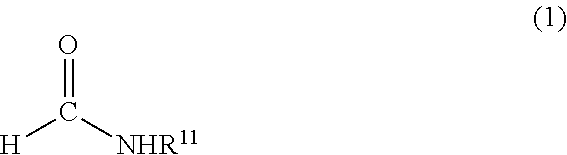
Description

in the formula (1), R11 represents a methyl group or a propyl group. A nitrogen atom in a heterocyclic ring of the nitrogen-containing heterocyclic compound has a substituent. The substituent of the nitrogen atom having a substituent is a substituted or unsubstituted acyl group, —(C═O)—O—R1, a substituted or unsubstituted alkyl group, a substituted or unsubstituted alkenyl group, a substituted or unsubstituted aryl group, or a substituted or unsubstituted heterocyclic group. A substituent of the substituted acyl group is a group described in (i), and R1 represents a group described in (ii):
(i) a substituted or unsubstituted alkyl group, a substituted or unsubstituted alkenyl group, a substituted or unsubstituted aryl group, or a substituted or unsubstituted heterocyclic group,
where, in this (i), a substituent of the substituted alkyl group, a substituent of the substituted alkenyl group, a substituent of the substituted aryl group, and a substituent of the substituted heterocyclic group are each a halogen atom, a cyano group, a nitro group, a hydroxy group, a formyl group, an alkyl group, an alkenyl group, an alkoxy group, or an aryl group,
(ii) a substituted or unsubstituted alkyl group, a substituted or unsubstituted alkenyl group, a substituted or unsubstituted aryl group, or a substituted or unsubstituted heterocyclic group where, in this (ii), a substituent of the substituted alkyl group, a substituent of the substituted alkenyl group, a substituent of the substituted aryl group, and a substituent of the substituted heterocyclic group are each a halogen atom, a cyano group, a nitro group, a hydroxy group, a formyl group, an alkyl group, an alkenyl group, an alkoxy group, or an aryl group.

(in the formula (1), R11 represents a methyl group or a propyl group.)
(ii) A substituted or unsubstituted alkyl group, a substituted or unsubstituted alkenyl group, a substituted or unsubstituted aryl group, or a substituted or unsubstituted heterocyclic group. In this (ii), a substituent of the substituted alkyl group, a substituent of the substituted alkenyl group, a substituent of the substituted aryl group, and a substituent of the substituted heterocyclic group are each a halogen atom, a cyano group, a nitro group, a hydroxy group, a formyl group, an alkyl group, an alkenyl group, an alkoxy group, or an aryl group.

(ii) A substituted or unsubstituted alkyl group, a substituted or unsubstituted alkenyl group, a substituted or unsubstituted aryl group, or a substituted or unsubstituted heterocyclic group. In this (ii), a substituent of the substituted alkyl group, a substituent of the substituted alkenyl group, a substituent of the substituted aryl group, and a substituent of the substituted heterocyclic group are each a halogen atom, a cyano group, a nitro group, a hydroxy group, a formyl group, an alkyl group, an alkenyl group, an alkoxy group, or an aryl group.

(ii) A substituted or unsubstituted alkyl group, a substituted or unsubstituted alkenyl group, a substituted or unsubstituted aryl group, or a substituted or unsubstituted heterocyclic group. In this (ii), a substituent of the substituted alkyl group, a substituent of the substituted alkenyl group, a substituent of the substituted aryl group, and a substituent of the substituted heterocyclic group are each a halogen atom, a cyano group, a nitro group, a hydroxy group, a formyl group, an alkyl group, an alkenyl group, an alkoxy group, or an aryl group.

(ii) A substituted or unsubstituted alkyl group, a substituted or unsubstituted alkenyl group, a substituted or unsubstituted aryl group, or a substituted or unsubstituted heterocyclic group. In this (ii), a substituent of the substituted alkyl group, a substituent of the substituted alkenyl group, a substituent of the substituted aryl group, and a substituent of the substituted heterocyclic group are each a halogen atom, a cyano group, a nitro group, a hydroxy group, a formyl group, an alkyl group, an alkenyl group, an alkoxy group, or an aryl group.

(ii) A substituted or unsubstituted alkyl group, a substituted or unsubstituted alkenyl group, a substituted or unsubstituted aryl group, or a substituted or unsubstituted heterocyclic group. In this (ii), a substituent of the substituted alkyl group, a substituent of the substituted alkenyl group, a substituent of the substituted aryl group, and a substituent of the substituted heterocyclic group are each a halogen atom, a cyano group, a nitro group, a hydroxy group, a formyl group, an alkyl group, an alkenyl group, an alkoxy group, or an aryl group.

(ii) A substituted or unsubstituted alkyl group, a substituted or unsubstituted alkenyl group, a substituted or unsubstituted aryl group, or a substituted or unsubstituted heterocyclic group. In this (ii), a substituent of the substituted alkyl group, a substituent of the substituted alkenyl group, a substituent of the substituted aryl group, and a substituent of the substituted heterocyclic group are each a halogen atom, a cyano group, a nitro group, a hydroxy group, a formyl group, an alkyl group, an alkenyl group, an alkoxy group, or an aryl group.

(ii) A substituted or unsubstituted alkyl group, a substituted or unsubstituted alkenyl group, a substituted or unsubstituted aryl group, or a substituted or unsubstituted heterocyclic group. In this (ii), a substituent of the substituted alkyl group, a substituent of the substituted alkenyl group, a substituent of the substituted aryl group, and a substituent of the substituted heterocyclic group are each a halogen atom, a cyano group, a nitro group, a hydroxy group, a formyl group, an alkyl group, an alkenyl group, an alkoxy group, or an aryl group.


| TABLE 1 | |||
| Evaluation in terms of | Evaluation in terms | ||
| black spots and fogging | of density unevenness | ||
| Example 2-1 | A | Excellent |
| Example 2-2 | C | Good |
| Example 2-3 | C | Good |
| Example 2-4 | A | Good |
| Example 2-5 | B | Good |
| Example 2-6 | B | Excellent |
| Example 2-7 | B | Excellent |
| Example 2-8 | C | Good |
| Example 2-9 | B | Good |
| Example 2-10 | B | Good |
| Example 2-11 | A | Good |
| Example 2-12 | A | Good |
| Example 2-13 | B | Good |
| Example 2-14 | B | Good |
| Example 2-15 | D | Good |
| Example 2-16 | D | Good |
| Example 2-17 | D | Good |
| Example 2-18 | D | Good |
| Example 2-19 | D | Good |
| Example 2-20 | A | Excellent |
| Example 2-21 | A | Good |
| Example 2-22 | B | Good |
| Example 2-23 | C | Good |
| Example 2-24 | C | Good |
| Example 2-25 | C | Excellent |
| Example 2-26 | C | Good |
| Example 2-27 | D | Good |
| Example 2-28 | B | Good |
| Example 2-29 | B | Good |
| Example 2-30 | C | Good |
| Example 2-31 | C | Good |
| Example 2-32 | C | Good |
| Example 2-33 | D | Good |
| Example 2-34 | D | Good |
| Example 2-35 | D | Good |
| Example 2-36 | C | Excellent |
| Example 2-37 | D | Good |
| Example 2-38 | D | Good |
| Example 2-39 | D | Good |
| Example 2-40 | D | Good |
| Example 2-41 | A | Excellent |
| Example 2-42 | D | Good |
| Example 2-43 | D | Good |
| Example 2-44 | D | Good |
| Comparative | F | Unevenness in density |
| example 2-1 | ||
| Comparative | E | Unevenness in density |
| example 2-2 | ||
| Comparative | E | Unevenness in density |
| example 2-3 | ||
| Comparative | E | Good |
| example 2-4 | ||
| Comparative | F | Unevenness in density |
| example 2-5 | ||
Claims (11)


Applications Claiming Priority (3)
| Application Number | Priority Date | Filing Date | Title |
|---|---|---|---|
| WOPCT/JP2014/065727 | 2014-06-13 | ||
| JPPCT/JP2014/065727 | 2014-06-13 | ||
| PCT/JP2014/065727 WO2015189980A1 (en) | 2014-06-13 | 2014-06-13 | Electrophotographic photosensitive body, process cartridge and electrophotographic apparatus |
Publications (2)
| Publication Number | Publication Date |
|---|---|
| US20150362848A1 US20150362848A1 (en) | 2015-12-17 |
| US9709907B2 true US9709907B2 (en) | 2017-07-18 |
Family
ID=54833108
Family Applications (1)
| Application Number | Title | Priority Date | Filing Date |
|---|---|---|---|
| US14/736,824 Expired - Fee Related US9709907B2 (en) | 2014-06-13 | 2015-06-11 | Electrophotographic photosensitive member, process cartridge and electrophotographic apparatus |
Country Status (5)
| Country | Link |
|---|---|
| US (1) | US9709907B2 (en) |
| JP (1) | JP6316419B2 (en) |
| CN (1) | CN106462090B (en) |
| DE (1) | DE112014006743B4 (en) |
| WO (1) | WO2015189980A1 (en) |
Cited By (2)
| Publication number | Priority date | Publication date | Assignee | Title |
|---|---|---|---|---|
| US20160252834A1 (en) * | 2015-02-27 | 2016-09-01 | Canon Kabushiki Kaisha | Electrophotographic photoconductor, process cartridge, and electrophotographic apparatus |
| US20210407068A1 (en) * | 2018-10-05 | 2021-12-30 | Konica Minolta, Inc. | Image inspection apparatus, image inspection method, and image inspection program |
Families Citing this family (3)
| Publication number | Priority date | Publication date | Assignee | Title |
|---|---|---|---|---|
| JP2015007761A (en) * | 2013-05-28 | 2015-01-15 | キヤノン株式会社 | Electrophotographic photosensitive member, process cartridge and electrophotographic apparatus, and phthalocyanine crystal |
| JP6949545B2 (en) * | 2017-04-28 | 2021-10-13 | キヤノン株式会社 | Electrophotographic photosensitive members, process cartridges and electrophotographic equipment |
| WO2024225218A1 (en) * | 2023-04-25 | 2024-10-31 | キヤノン株式会社 | Method for generating singlet oxygen, system for generating singlet oxygen, kit for generating singlet oxygen, and agent for generating singlet oxygen |
Citations (18)
| Publication number | Priority date | Publication date | Assignee | Title |
|---|---|---|---|---|
| US5194088A (en) * | 1991-07-08 | 1993-03-16 | Ciba-Geigy Corporation | Process for conditioning organic pigments |
| JPH05263007A (en) | 1991-04-26 | 1993-10-12 | Fuji Xerox Co Ltd | Novel crystal of hydroxygallium phthalocyanine, photoconductive material comprising the novel crystal, and electrophotographic photoreceptor containing the same |
| JPH05333572A (en) | 1992-06-02 | 1993-12-17 | Sharp Corp | Electrophotographic photoreceptor |
| US5310614A (en) * | 1991-11-21 | 1994-05-10 | Konica Corporation | Electrophotographic photoreceptor having an organic photoelectroconductive light sensitive layer |
| EP0617091A2 (en) * | 1993-03-25 | 1994-09-28 | Fuji Xerox Co., Ltd. | Hydroxygallium phthalocyanine crystal, process for preparing same, and electrophotographic photoreceptor comprising same |
| JPH06329943A (en) | 1993-05-17 | 1994-11-29 | Fuji Xerox Co Ltd | Metal phthalocyanine compound and electrophotographic photoreceptor containing the same |
| US5407766A (en) * | 1993-12-20 | 1995-04-18 | Xerox Corporation | Hydroxygallium phthalocyanine photoconductive imaging members |
| US5459004A (en) * | 1992-03-31 | 1995-10-17 | Fuji Xerox Co., Ltd. | Process for preparing hydroxygallium phthalocyanine crystals and electrophotographic photoreceptor using the crystals |
| JPH07331107A (en) | 1994-06-06 | 1995-12-19 | Fuji Xerox Co Ltd | Hydroxygallium phthalocyanine crystal and electrophotographic photoreceptor using the same |
| JPH1135842A (en) * | 1997-07-14 | 1999-02-09 | Fuji Xerox Co Ltd | Chlorogalliumphthalocyanine crystal, treatment thereof, and electrophotographic photoreceptor using the same |
| JP2001089481A (en) | 1999-09-22 | 2001-04-03 | Canon Inc | Method for producing phthalocyanine compound, electrophotographic photoreceptor using gallium phthalocyanine compound, process cartridge equipped with the electrophotographic photoreceptor, and electrophotographic apparatus |
| JP2002235014A (en) | 2001-02-08 | 2002-08-23 | Canon Inc | Novel crystal form of phthalocyanine, method for producing the compound crystal form, electrophotographic photosensitive member using the compound, process cartridge, and electrophotographic apparatus |
| JP2005084350A (en) | 2003-09-09 | 2005-03-31 | Canon Inc | Electrophotographic photoreceptor, method for producing the same, and electrophotographic apparatus using the photoreceptor |
| EP1731575A1 (en) * | 2004-03-04 | 2006-12-13 | Mitsubishi Chemical Corporation | Phthalocyanine composition, and photoconductive material, electrophotographic photoreceptor, electrophotographic photoreceptor cartridge, and image-forming apparatus each employing the composition |
| JP2007079493A (en) | 2005-09-16 | 2007-03-29 | Fuji Xerox Co Ltd | Hydroxygallium phthalocyanine mixture pigment, method for manufacturing the same, electrophotographic photoreceptor, electrophotographic device, and process cartridge |
| JP2007256791A (en) | 2006-03-24 | 2007-10-04 | Canon Inc | Electrophotographic photoreceptor |
| WO2013081178A1 (en) * | 2011-11-30 | 2013-06-06 | Canon Kabushiki Kaisha | Electrophotographic photosensitive member, process cartridge, electrophotographic apparatus, and gallium phthalocyanine crystal |
| JP2014063180A (en) | 2007-10-03 | 2014-04-10 | Mitsubishi Chemicals Corp | Image forming apparatus and cartridge |
Family Cites Families (3)
| Publication number | Priority date | Publication date | Assignee | Title |
|---|---|---|---|---|
| US5393629A (en) * | 1991-04-26 | 1995-02-28 | Fuji Xerox Co., Ltd. | Electrophotographic photoreceptor |
| WO2009038202A1 (en) * | 2007-09-20 | 2009-03-26 | Mitsubishi Chemical Corporation | Toner for electrostatic charge image development, cartridge and image forming apparatus using toner for electrostatic charge image |
| JP2015007761A (en) * | 2013-05-28 | 2015-01-15 | キヤノン株式会社 | Electrophotographic photosensitive member, process cartridge and electrophotographic apparatus, and phthalocyanine crystal |
-
2014
- 2014-06-13 JP JP2016527589A patent/JP6316419B2/en not_active Expired - Fee Related
- 2014-06-13 DE DE112014006743.1T patent/DE112014006743B4/en active Active
- 2014-06-13 WO PCT/JP2014/065727 patent/WO2015189980A1/en not_active Ceased
- 2014-06-13 CN CN201480079826.XA patent/CN106462090B/en active Active
-
2015
- 2015-06-11 US US14/736,824 patent/US9709907B2/en not_active Expired - Fee Related
Patent Citations (19)
| Publication number | Priority date | Publication date | Assignee | Title |
|---|---|---|---|---|
| JPH05263007A (en) | 1991-04-26 | 1993-10-12 | Fuji Xerox Co Ltd | Novel crystal of hydroxygallium phthalocyanine, photoconductive material comprising the novel crystal, and electrophotographic photoreceptor containing the same |
| US5194088A (en) * | 1991-07-08 | 1993-03-16 | Ciba-Geigy Corporation | Process for conditioning organic pigments |
| US5310614A (en) * | 1991-11-21 | 1994-05-10 | Konica Corporation | Electrophotographic photoreceptor having an organic photoelectroconductive light sensitive layer |
| US5459004A (en) * | 1992-03-31 | 1995-10-17 | Fuji Xerox Co., Ltd. | Process for preparing hydroxygallium phthalocyanine crystals and electrophotographic photoreceptor using the crystals |
| JPH05333572A (en) | 1992-06-02 | 1993-12-17 | Sharp Corp | Electrophotographic photoreceptor |
| EP0617091A2 (en) * | 1993-03-25 | 1994-09-28 | Fuji Xerox Co., Ltd. | Hydroxygallium phthalocyanine crystal, process for preparing same, and electrophotographic photoreceptor comprising same |
| JPH06329943A (en) | 1993-05-17 | 1994-11-29 | Fuji Xerox Co Ltd | Metal phthalocyanine compound and electrophotographic photoreceptor containing the same |
| US5407766A (en) * | 1993-12-20 | 1995-04-18 | Xerox Corporation | Hydroxygallium phthalocyanine photoconductive imaging members |
| JPH07331107A (en) | 1994-06-06 | 1995-12-19 | Fuji Xerox Co Ltd | Hydroxygallium phthalocyanine crystal and electrophotographic photoreceptor using the same |
| US5834149A (en) * | 1994-06-06 | 1998-11-10 | Fuji Xerox Co., Ltd. | Hydroxygallium phthalocyanine crystals and electrophotographic photoreceptors using same |
| JPH1135842A (en) * | 1997-07-14 | 1999-02-09 | Fuji Xerox Co Ltd | Chlorogalliumphthalocyanine crystal, treatment thereof, and electrophotographic photoreceptor using the same |
| JP2001089481A (en) | 1999-09-22 | 2001-04-03 | Canon Inc | Method for producing phthalocyanine compound, electrophotographic photoreceptor using gallium phthalocyanine compound, process cartridge equipped with the electrophotographic photoreceptor, and electrophotographic apparatus |
| JP2002235014A (en) | 2001-02-08 | 2002-08-23 | Canon Inc | Novel crystal form of phthalocyanine, method for producing the compound crystal form, electrophotographic photosensitive member using the compound, process cartridge, and electrophotographic apparatus |
| JP2005084350A (en) | 2003-09-09 | 2005-03-31 | Canon Inc | Electrophotographic photoreceptor, method for producing the same, and electrophotographic apparatus using the photoreceptor |
| EP1731575A1 (en) * | 2004-03-04 | 2006-12-13 | Mitsubishi Chemical Corporation | Phthalocyanine composition, and photoconductive material, electrophotographic photoreceptor, electrophotographic photoreceptor cartridge, and image-forming apparatus each employing the composition |
| JP2007079493A (en) | 2005-09-16 | 2007-03-29 | Fuji Xerox Co Ltd | Hydroxygallium phthalocyanine mixture pigment, method for manufacturing the same, electrophotographic photoreceptor, electrophotographic device, and process cartridge |
| JP2007256791A (en) | 2006-03-24 | 2007-10-04 | Canon Inc | Electrophotographic photoreceptor |
| JP2014063180A (en) | 2007-10-03 | 2014-04-10 | Mitsubishi Chemicals Corp | Image forming apparatus and cartridge |
| WO2013081178A1 (en) * | 2011-11-30 | 2013-06-06 | Canon Kabushiki Kaisha | Electrophotographic photosensitive member, process cartridge, electrophotographic apparatus, and gallium phthalocyanine crystal |
Non-Patent Citations (1)
| Title |
|---|
| Diamond, Arthur S (editor) Handbook of Imaging Materials. New York: Marcel-Dekker, Inc. (2002) pp. 145-164. * |
Cited By (3)
| Publication number | Priority date | Publication date | Assignee | Title |
|---|---|---|---|---|
| US20160252834A1 (en) * | 2015-02-27 | 2016-09-01 | Canon Kabushiki Kaisha | Electrophotographic photoconductor, process cartridge, and electrophotographic apparatus |
| US10429753B2 (en) * | 2015-02-27 | 2019-10-01 | Canon Kabushiki Kaisha | Electrophotographic photoconductor, process cartridge, and electrophotographic apparatus |
| US20210407068A1 (en) * | 2018-10-05 | 2021-12-30 | Konica Minolta, Inc. | Image inspection apparatus, image inspection method, and image inspection program |
Also Published As
| Publication number | Publication date |
|---|---|
| CN106462090B (en) | 2019-11-05 |
| DE112014006743T5 (en) | 2017-05-11 |
| DE112014006743B4 (en) | 2021-07-22 |
| JPWO2015189980A1 (en) | 2017-04-20 |
| CN106462090A (en) | 2017-02-22 |
| WO2015189980A1 (en) | 2015-12-17 |
| US20150362848A1 (en) | 2015-12-17 |
| JP6316419B2 (en) | 2018-04-25 |
Similar Documents
| Publication | Publication Date | Title |
|---|---|---|
| US9500966B2 (en) | Electrophotographic photosensitive member, process cartridge and electrophotographic apparatus | |
| US9645515B2 (en) | Electrophotographic photosensitive member and manufacturing method thereof, process cartridge and electrophotographic apparatus, and phthalocyanine crystal and manufacturing method thereof | |
| JP6150700B2 (en) | Electrophotographic photosensitive member, process cartridge, and electrophotographic apparatus | |
| US9535347B2 (en) | Electrophotographic photosensitive member, process cartridge and electrophotographic apparatus | |
| US9459545B2 (en) | Electrophotographic photosensitive member, manufacturing method of electrophotographic photosensitive member, process cartridge and electrophotographic apparatus, and a solid solution and manufacturing method of a solid solution | |
| JP6188535B2 (en) | Electrophotographic photosensitive member, process cartridge, and electrophotographic apparatus | |
| US20160131985A1 (en) | Electrophotographic photosensitive member, process cartridge, and electrophotographic apparatus | |
| US9436106B2 (en) | Electrophotographic photosensitive member and manufacturing method therefor, process cartridge and electrophotographic apparatus including the electrophotographic photosensitive member, and phthalocyanine crystal and method producing therefor | |
| US20160091807A1 (en) | Electrophotographic photosensitive member, process cartridge, electrophotographic apparatus and phthalocyanine crystal | |
| US9709907B2 (en) | Electrophotographic photosensitive member, process cartridge and electrophotographic apparatus | |
| US9223233B2 (en) | Electrophotographic photosensitive member, process cartridge and electrophotographic apparatus | |
| CN103026300A (en) | Electrophotographic photosensitive member, production method of electrophotographic photosensitive member, process cartridge, and electrophotographic apparatus | |
| US20140065530A1 (en) | Electrophotographic photosensitive member, process cartridge, and electrophotographic apparatus | |
| US20150362849A1 (en) | Electrophotographic photosensitive member, method for producing the same, electrophotographic apparatus and process cartridge, and chlorogallium phthalocyanine crystal | |
| JP2007212798A (en) | Electrophotographic photoreceptor, and image forming apparatus | |
| JP6465694B2 (en) | Electrophotographic photoreceptor and manufacturing method thereof, process cartridge and electrophotographic apparatus, and hydroxygallium phthalocyanine crystal and manufacturing method thereof | |
| US9104098B2 (en) | Electrophotographic photosensitive member, process cartridge, and electrophotographic apparatus | |
| JP5383843B2 (en) | Image forming apparatus | |
| JP6512866B2 (en) | Electrophotographic photosensitive member, process cartridge and electrophotographic apparatus | |
| US20160252832A1 (en) | Electrophotographic photosensitive member, process cartridge, and electrophotographic apparatus, and mixed crystal of hydroxygallium phthalocyanine and chlorogallium phthalocyanine and method of producing the crystalline complex | |
| US9298115B2 (en) | Electrophotographic photosensitive member, method for manufacturing electrophotographic photosensitive member, process cartridge, and electrophotographic apparatus | |
| JP2008003143A (en) | Multilayer electrophotographic photoreceptor and image forming apparatus |
Legal Events
| Date | Code | Title | Description |
|---|---|---|---|
| AS | Assignment |
Owner name: CANON KABUSHIKI KAISHA, JAPAN Free format text: ASSIGNMENT OF ASSIGNORS INTEREST;ASSIGNORS:WATARIGUCHI, KANAME;TANAKA, MASATO;KAWAHARA, MASATAKA;AND OTHERS;SIGNING DATES FROM 20150526 TO 20150527;REEL/FRAME:036444/0093 |
|
| STCF | Information on status: patent grant |
Free format text: PATENTED CASE |
|
| FEPP | Fee payment procedure |
Free format text: MAINTENANCE FEE REMINDER MAILED (ORIGINAL EVENT CODE: REM.); ENTITY STATUS OF PATENT OWNER: LARGE ENTITY |
|
| LAPS | Lapse for failure to pay maintenance fees |
Free format text: PATENT EXPIRED FOR FAILURE TO PAY MAINTENANCE FEES (ORIGINAL EVENT CODE: EXP.); ENTITY STATUS OF PATENT OWNER: LARGE ENTITY |
|
| STCH | Information on status: patent discontinuation |
Free format text: PATENT EXPIRED DUE TO NONPAYMENT OF MAINTENANCE FEES UNDER 37 CFR 1.362 |
|
| FP | Lapsed due to failure to pay maintenance fee |
Effective date: 20210718 |