US9682866B2 - Neutral complex of cyclic silane, manufacturing method therefor, and method for manufacturing cyclic hydrogenated silane or cyclic organic silane - Google Patents
Neutral complex of cyclic silane, manufacturing method therefor, and method for manufacturing cyclic hydrogenated silane or cyclic organic silane Download PDFInfo
- Publication number
- US9682866B2 US9682866B2 US15/105,190 US201415105190A US9682866B2 US 9682866 B2 US9682866 B2 US 9682866B2 US 201415105190 A US201415105190 A US 201415105190A US 9682866 B2 US9682866 B2 US 9682866B2
- Authority
- US
- United States
- Prior art keywords
- cyclic
- silane
- neutral complex
- group
- manufacturing
- Prior art date
- Legal status (The legal status is an assumption and is not a legal conclusion. Google has not performed a legal analysis and makes no representation as to the accuracy of the status listed.)
- Expired - Fee Related
Links
- BYMKETKWVMIJNW-UHFFFAOYSA-O C.C.C.C.C.C.C.C1=CC=C(P(C2=CC=CC=C2)C2=CC=CC=C2)C=C1.C1=CC=C(P(C2=CC=CC=C2)C2=CC=CC=C2)C=C1.CCN(C(C)C)C(C)C.Cl1Cl2[Si]34[SiH]5[Si]36[Si]37Cl8Cl[Si]152839%10%11%12%13%14(ClCl49)(ClCl7%10)ClCl%11[Si]6%12Cl%13Cl%14.[H][N+](CC)(C(C)C)C(C)[Cl-] Chemical compound C.C.C.C.C.C.C.C1=CC=C(P(C2=CC=CC=C2)C2=CC=CC=C2)C=C1.C1=CC=C(P(C2=CC=CC=C2)C2=CC=CC=C2)C=C1.CCN(C(C)C)C(C)C.Cl1Cl2[Si]34[SiH]5[Si]36[Si]37Cl8Cl[Si]152839%10%11%12%13%14(ClCl49)(ClCl7%10)ClCl%11[Si]6%12Cl%13Cl%14.[H][N+](CC)(C(C)C)C(C)[Cl-] BYMKETKWVMIJNW-UHFFFAOYSA-O 0.000 description 2
- OLMRUMHPSDYIFH-UHFFFAOYSA-N [HH].[HH].[HH].[HH].[H][SiH2][SiH2][H].[H][SiH3].[H][SiH3].[H][SiH]([H])[SiH]([H])[H] Chemical compound [HH].[HH].[HH].[HH].[H][SiH2][SiH2][H].[H][SiH3].[H][SiH3].[H][SiH]([H])[SiH]([H])[H] OLMRUMHPSDYIFH-UHFFFAOYSA-N 0.000 description 2
- IMIJWLFEQAHCRL-UHFFFAOYSA-N C[Si]1(C)CCC[Si](C)(C)[Si]1(C)C Chemical compound C[Si]1(C)CCC[Si](C)(C)[Si]1(C)C IMIJWLFEQAHCRL-UHFFFAOYSA-N 0.000 description 1
Images


Classifications
-
- C—CHEMISTRY; METALLURGY
- C01—INORGANIC CHEMISTRY
- C01B—NON-METALLIC ELEMENTS; COMPOUNDS THEREOF; METALLOIDS OR COMPOUNDS THEREOF NOT COVERED BY SUBCLASS C01C
- C01B33/00—Silicon; Compounds thereof
- C01B33/08—Compounds containing halogen
- C01B33/107—Halogenated silanes
- C01B33/10773—Halogenated silanes obtained by disproportionation and molecular rearrangement of halogenated silanes
-
- C—CHEMISTRY; METALLURGY
- C01—INORGANIC CHEMISTRY
- C01B—NON-METALLIC ELEMENTS; COMPOUNDS THEREOF; METALLOIDS OR COMPOUNDS THEREOF NOT COVERED BY SUBCLASS C01C
- C01B33/00—Silicon; Compounds thereof
- C01B33/04—Hydrides of silicon
-
- C—CHEMISTRY; METALLURGY
- C07—ORGANIC CHEMISTRY
- C07F—ACYCLIC, CARBOCYCLIC OR HETEROCYCLIC COMPOUNDS CONTAINING ELEMENTS OTHER THAN CARBON, HYDROGEN, HALOGEN, OXYGEN, NITROGEN, SULFUR, SELENIUM OR TELLURIUM
- C07F7/00—Compounds containing elements of Groups 4 or 14 of the Periodic Table
- C07F7/02—Silicon compounds
- C07F7/21—Cyclic compounds having at least one ring containing silicon, but no carbon in the ring
-
- C—CHEMISTRY; METALLURGY
- C07—ORGANIC CHEMISTRY
- C07F—ACYCLIC, CARBOCYCLIC OR HETEROCYCLIC COMPOUNDS CONTAINING ELEMENTS OTHER THAN CARBON, HYDROGEN, HALOGEN, OXYGEN, NITROGEN, SULFUR, SELENIUM OR TELLURIUM
- C07F9/00—Compounds containing elements of Groups 5 or 15 of the Periodic Table
- C07F9/02—Phosphorus compounds
- C07F9/28—Phosphorus compounds with one or more P—C bonds
- C07F9/50—Organo-phosphines
- C07F9/5022—Aromatic phosphines (P-C aromatic linkage)
-
- C—CHEMISTRY; METALLURGY
- C09—DYES; PAINTS; POLISHES; NATURAL RESINS; ADHESIVES; COMPOSITIONS NOT OTHERWISE PROVIDED FOR; APPLICATIONS OF MATERIALS NOT OTHERWISE PROVIDED FOR
- C09D—COATING COMPOSITIONS, e.g. PAINTS, VARNISHES OR LACQUERS; FILLING PASTES; CHEMICAL PAINT OR INK REMOVERS; INKS; CORRECTING FLUIDS; WOODSTAINS; PASTES OR SOLIDS FOR COLOURING OR PRINTING; USE OF MATERIALS THEREFOR
- C09D1/00—Coating compositions, e.g. paints, varnishes or lacquers, based on inorganic substances
Definitions
- the present invention relates to a neutral complex of a cyclic silane, a method for manufacturing the neutral complex of cyclic silane, and a method for efficiently manufacturing a cyclic hydrogenated silane such as cyclohexasilane or a cyclic organic silane from the neutral complex of cyclic silane, without generating silane gas or an organic monosilane, or with only a small amount of silane gas or an organic monosilane generated.
- a silicon thin film is used for applications such as solar cells and semiconductors, and this silicon thin film has been previously prepared by a vapor deposition film-forming method (CVD method) using monosilane as a raw material. Recently, in place of the CVD method, a new production method using cyclic hydrogenated silane has been focused.
- This production method is a coating film-forming method (liquid process) in which a hydrogenated polysilane solution is applied to a substrate, followed by calcination, and cyclopentasilane is used as a raw material for the preparation of the hydrogenated polysilane solution.
- Cyclopentasilane is commercially available, and has been reported to be hydrogenated polysilane by UV irradiation (Non-Patent Document 1).
- Non-Patent Document 1 Non-Patent Document 1
- cyclopentasilane requires multistep synthesis using an expensive water-reactive reagent and a purification step for its production, and thus is very expensive.
- Non-Patent Document 1 a cyclohexasilane can be synthesized using diphenyldichlorosilane as a starting material.
- Non-Patent Document 1 Edwin Hengge and Dieter Kovar, “Preparation of Cyclohexasilane”, Angew. Chem. Ed. Engl. 16(1977) No. 6, p. 403
- Non-Patent Document 1 In the method described in Non-Patent Document 1, however, the amount of a reducing agent used is very large relative to that of a complex (13 equivalents in Non-Patent Document 1). This not only causes the increase in cost of raw materials, but also generates many by-products derived from the reducing agent so that a great amount of costs are further required for a treatment of making the by-products deactivated after the reaction. In addition, the method described in Non-Patent Document 1 cannot be said to provide a high yield of a cyclohexasilane.
- the present invention was made by focusing on such circumstances, and an object thereof is to provide a neutral complex of a cyclic silane, which can be used as an intermediate that can give a cyclic hydrogenated silane or a cyclic organic silane by a homogeneous reaction in a solution state or a reaction in a suspension high in dispersibility, while suppressing the production of by-products such as silane gas and organic monosilane in a reduction step.
- Another object of the present invention is to provide a method for manufacturing a neutral complex of a cyclic silane and a method for manufacturing a cyclic hydrogenated silane or a cyclic organic silane from the neutral complex of a cyclic silane, and also to reduce costs of raw materials accounting for the manufacturing costs and costs of removing by-products after a reaction, without impairing the yield of the cyclic hydrogenated silane even when the amount of a reducing agent is decreased.
- the present inventors succeeded in manufacturing a neutral complex of a cyclic silane having excellent solubility in a solvent by cyclizing a halosilane compound in the presence of a special coordination compound.
- this cyclization reaction, or a subsequent reduction step or alkylation or arylation step can be conducted by a homogeneous reaction in a solution state or a reaction in a suspension high in dispersibility.
- This neutral complex of a cyclic silane can be converted to a cyclic hydrogenated silane when subjected to reduction, without generating silane gas, or with only a small amount of silane gas generated.
- the neutral complex of a cyclic silane can also be converted to a cyclic organic silane while suppressing the production of organic monosilane as a by-product.
- a neutral complex of a cyclic silane of the present invention represented by the general formula [Y] 1 [Si m Z 2m-a H a ],
- the neutral complex of a cyclic silane wherein Y in the general formula is preferably at least one compound selected from the group consisting of PR 3 and a substituted or unsubstituted N-containing heterocyclic compound having an unshared electron pair in the ring. It is preferred that the neutral complex of a cyclic silane contains [Y] 1 [Si 6 Cl12] (l is 1 or 2). It is preferred embodiment that the neutral complex of a cyclic silane is an intermediate for synthesizing a cyclic hydrogenated silane or a cyclic organic silane.
- the present invention encompasses a method for manufacturing a neutral complex of a cyclic silane, comprising a step of conducting a cyclization reaction of a halosilane compound in the presence of at least one coordination compound selected from the group consisting of the following (3) and (4):
- heterocyclic compound selected from the group consisting of substituted or unsubstituted N—, O—, S— or P— containing heterocyclic compounds that have an unshared electron pair in the ring (the number of amino groups in the heterocyclic compound is 0 or 1).
- the cyclization reaction is preferably conducted in the presence of a tertiary amine (except a tertiary polyamine) and the neutral complex of a cyclic silane contains a neutral complex of dodecachlorocyclohexasilane including the coordination compound(s) coordinated to dodecachlorocyclohexasilane.
- the present invention encompasses a method for manufacturing a cyclic hydrogenated silane, comprising a step of reducing the neutral complex of a cyclic silane obtained in the manufacturing method.
- at least one reducing agent selected from the group consisting of an aluminum-based reducing agent and a boron-based reducing agent is preferably used as a reducing agent.
- the hydride equivalent in the reducing agent relative to one silicon-halogen bond in the neutral complex of a cyclic silane being 0.9 to 2.0 in the reduction step and embodiment the reduction step being conducted at ⁇ 198° C. to ⁇ 10° C. are preferably embodiments of the present invention.
- the present invention encompasses a method for manufacturing a cyclic organic silane, comprising a step of alkylating or arylating the neutral complex of a cyclic silane obtained by the manufacturing method with at least one reagent selected from the group consisting of a Grignard reagent and an organolithium reagent.
- the neutral complex of a cyclic silane of the present invention allows, for its excellent solubility in a solvent or excellent affinity to a solvent, a reaction in a homogeneous solution system or in a suspension high in dispersibility in a cyclization reaction for obtaining the neutral complex of a cyclic silane and when the resultant neutral complex of a cyclic silane is subjected to reduction, alkylation or arylation. Therefore, the method for manufacturing a neutral complex of a cyclic silane of the present invention is industrially useful. Further, silane gas and organic monosilane are not generated, or only small amounts of silane gas and organic monosilane are generated.
- a combustion facility and an adsorption facility as countermeasures against silane gas and organic monosilane which have conventionally been used in the production of a cyclic hydrogenated silane or a cyclic organic silane, can be eliminated, and a countermeasure of dilution of the generated gas with inert gas or a simple device such as a scrubber is sufficient.
- a cyclic hydrogenated silane and a cyclic organic silane can be efficiently produced with a simple device.
- the amount of a reducing agent when the neutral complex of a cyclic silane can be reduced, resulting in a great decrease in raw material costs and costs for a treatment of making the by-products deactivated.
- production of a cyclic hydrogenated silane at a low temperature enables suppression of decomposition or polymerization of an intermediate product or an object product, resulting in improvement of a yield.
- FIG. 1 shows a mass spectrometry result of a neutral complex of a cyclic silane obtained in Example 1.
- FIG. 2 shows a result of mass spectrometry of the neutral complex of a cyclic silane obtained in Example 1 in a cation measurement mode.
- FIG. 3 shows a measurement result of 31 P-NMR of the neutral complex of a cyclic silane obtained in Example 1.
- FIG. 4 shows a measurement result of 29 Si-NMR of the neutral complex of a cyclic silane obtained in Example 1.
- the neutral complex of a cyclic silane of the present invention includes 2 patterns.
- the neutral complex of a cyclic silane of the pattern 1 is represented by the following general formula.
- This neutral complex of a cyclic silane is a complex containing a ring in which 3 to 8 (preferably 5 or 6, particularly 6) silicon atoms of a halosilane compound as a raw material are linked to one another. Therefore, m is 3 to 8, preferably 5 or 6, particularly preferably 6.
- m is 3 to 8, preferably 5 or 6, particularly preferably 6.
- H atom may be bonded to a part of or all the Si atoms.
- the number of H atoms is represented by a
- the number of Z atoms is represented by 2m-a.
- the number of H atoms is theoretically 0 to 2m-1, preferably 0 to m. That is, when a is not less than m, the compound may be a compound in which H atoms are bonded to all the Si atoms.
- each Z represents a halogen atom of any of Cl, Br, I and F and Zs are the same or different.
- a trihalogenated silane is preferred, and trichlorosilane is particularly preferred.
- the neutral complex of a cyclic silane of the present invention is, as described below, one obtained by cyclizing a halosilane compound in the presence of a specific coordination compound.
- a product containing this neutral complex of a cyclic silane is an intermediate that is converted to a cyclic hydrogenated silane by reduction, or an intermediate that is converted to a cyclic organic silane by a Grignard reagent or an organolithium reagent.
- the number of Y coordinated to a cyclic silane is l and l is 1 or
- X 1 is coordinated to a cyclic silane to form a neutral complex.
- X 1 is P and P ⁇ O
- X 1 is trivalent
- n representing the number of R 1 s is 3.
- Each R 1 represents a substituted or unsubstituted alkyl group or aryl group and R 1 s are the same or different.
- R 1 is more preferably a substituted or unsubstituted aryl group.
- R 1 as the alkyl group examples include linear, branched or cyclic alkyl groups, and preferable examples thereof include alkyl groups having 1 to 16 carbon atoms, such as a methyl group, an ethyl group, a propyl group, a butyl group, a pentyl group, a hexyl group, a heptyl group, an octyl group and a cyclohexyl group.
- Preferable examples of R 1 as the aryl group include aryl groups having about 6 to 18 carbon atoms, such as a phenyl group and a naphthyl group.
- R 1 represents a substituted or unsubstituted alkyl group or aryl group and R 1 s are the same or different. R 1 is more preferably an unsubstituted alkyl group.
- R 1 as the alkyl group examples include linear, branched or cyclic alkyl groups, and preferable examples thereof include alkyl groups having 1 to 16 carbon atoms, among that, preferable examples thereof include alkyl groups having 1 to 4 carbon atoms, such as a methyl group, an ethyl group, a propyl group and a butyl group, more preferable examples thereof include alkyl groups having 1 to 3 carbon atoms.
- Preferable examples of R 1 as the aryl group include aryl groups having about 6 to 18 carbon atoms, such as a phenyl group and a naphthyl group.
- the substituent that may be possessed by the alkyl group is, for example, an alkoxy group, an amino group, a cyano group, a carbonyl group and a sulfonyl group
- the substituent that may be possessed by the aryl group is, for example, an alkoxy group, an amino group, a cyano group, a carbonyl group and a sulfonyl group.
- the amino group include a dimethylamino group and a diethylamino group, and the number of the amino groups is not more than 1 in X 1 R 1 3 . This is intended to eliminate a tertiary polyamine, which inhibits the production of the neutral complex of a cyclic silane. In the meantime, 3 R 1 s may be the same or different.
- R 1 is as defined above, represents a substituted or unsubstituted alkyl group or aryl group. R 1 is more preferably a substituted or unsubstituted aryl group.
- X 1 R 1 n (1) include a compound in which X is P, P ⁇ O, or N, such as triphenylphosphine (PPh 3 ), triphenylphosphine oxide (Ph 3 P ⁇ O), tris(4-methoxyphenyOphosphine (P(MeOPh) 3 ) and triphenylamine; and a compound in which X is S ⁇ O, such as dimethyl sulfoxide.
- PPh 3 triphenylphosphine
- Ph 3 P ⁇ O triphenylphosphine oxide
- P(MeOPh) 3 tris(4-methoxyphenyOphosphine
- the heterocyclic compound (2) in the above general formula is required to have an unshared electron pair in the ring, and the unshared electron pair coordinates to a cyclic silane to form a neutral complex of the cyclic silane.
- a heterocyclic compound include at least one substituted or unsubstituted N—, O—, S— or P— containing heterocyclic compound that has an unshared electron pair in the ring.
- the substituents that may be possessed by the heterocyclic compound are the same as the substituents that may be possessed by R 1 as an alkyl group or an aryl group.
- the heterocyclic compound include pyridines, oxazoles, thiazoles, thiophenes and furans, and specific examples include pyridine, tetrahydrothiophene and tetrahydrofuran.
- a compound that is a liquid at a reaction temperature can also play a role of a solvent (a manufacturing method therefor is described below).
- the method for manufacturing a neutral complex of a cyclic silane of the present invention includes a step of cyclizing a halosilane compound in the presence of a coordination compound. This step gives a neutral complex of a cyclic halogenated silane (neutral complex of a cyclic silane) of the pattern 2 that has a wider variety than those of the pattern 1.
- a product containing a neutral complex of a cyclic silane of this pattern 2 can be said to be, similarly to the neutral complex of a cyclic silane of the pattern 1, ntermediate that can be converted to a cyclic hydrogenated silane by reduction, or an intermediate that can be converted to a cyclic organic silane by a Grignard reagent or an organolithium reagent.
- any of the compounds exemplified as the raw materials of the neutral complex of a cyclic silane of the pattern 1 can be used.
- the coordination compound that can be used in the manufacturing method of the present invention is at least one compound selected from the group consisting of the following (3) and (4).
- heterocyclic compound selected from the group consisting of substituted or unsubstituted N—, O—, S— or P— containing heterocyclic compounds that have an unshared electron pair in the ring (the number of amino groups in the heterocyclic compound is 0 or 1).
- X 2 R 2 q (3) includes compounds in which X 2 is CN, q is l and R 2 is a substituted or unsubstituted alkyl group or aryl group.
- the number of amino groups in X 2 R 2 q is 0 or 1.
- R 2 and R 1 have the same meaning.
- X 2 R 2 q (3) include a compound in which X is P, P ⁇ O, or N, such as triphenylphosphine (PPh 3 ), triphenylphosphine oxide (Ph 3 P ⁇ O), and tris(4-methoxyphenyOphosphine (P(MeOPh) 3 ); a compound in which X is S ⁇ O, such as dimethyl sulfoxide; and a compound in which X is CN, such as p-tolunitrile (it is said to be the p-metylbenzonitrile).
- PPh 3 triphenylphosphine
- Ph 3 P ⁇ O triphenylphosphine oxide
- P(MeOPh) 3 tris(4-methoxyphenyOphosphine
- the heterocyclic compound defined in (4) is the same as the heterocyclic compound described in (2).
- a compound that is a liquid at a reaction temperature can also play a role of a solvent.
- the cyclization reaction of the halosilane compound is preferably conducted by adding a tertiary amine (except a tertiary polyamine). Thereby, produced hydrochloric acid can be neutralized.
- a tertiary amine except a tertiary polyamine.
- a complex containing 6-membered ring dodecachlorocyclohexasilane (neutral complex including triphenylphosphine coordinated to dodecachlorocyclohexasilane ([PPh 3 ] 2 [Si 6 Cl 12 ])) is synthesized.
- This is a neutral complex of a cyclic silane of the pattern 1, and can also be said to be a neutral complex of a cyclic silane of the pattern 2.
- tertiary amine used in the cyclization reaction include triethylamine, tripropylamine, tributylamine, trioctylamine, triisobutylamine, triisopentylamine, diethylmethylamine, diisopropylethylamine (DIPEA), dimethylbutylamine, dimethyl-2-ethylhexylamine, dilsopropyl-2-ethylhexylamine, methyldioctylamine, and the like.
- DIPEA diisopropylethylamine
- the tertiary amines may be used alone or in combination of two or more thereof.
- the tertiary amine also includes one that is coordinated to a cyclic silane, and amines that are comparatively low in volume and are high in symmetry, such as diethylmethylamine and triethylamine, are considered to be comparatively efficiently coordinated.
- amines that are comparatively low in volume and are high in symmetry such as diethylmethylamine and triethylamine, are considered to be comparatively efficiently coordinated.
- any of the coordination compounds of (1) to (4) is preferably used in combination.
- the amounts of the coordination compound, the halosilane compound, and the tertiary amine to be used in the cyclization reaction may be appropriately determined.
- a coordination compound in an amount of 2 mol is used relative to 6 mol of trichlorosilane.
- a coordination compound in an amount of 0.022 mol may be used relative to 0.133 mol trichlorosilane.
- the coordination compound can be used in an amount of at least 2 mol and can be used in an amount of up to about 50 mol relative to 6 mol of trichlorosilane.
- the tertiary amine is preferably used in an amount of 0.5 to 4 mol relative to 1 mole of trichlorosilane, and is particularly preferably used in the same number of mol as that of trichlorosilane. The same applies to the cases where other halosilane compounds are used.
- the cyclization reaction can be conducted in an organic solvent as necessary.
- a solvent that does not prevent the cyclization reaction is preferred, and preferable examples thereof include halogenated hydrocarbon-based solvents (e.g. chloroform, dichloromethane and 1,2-dichloroethane), ether-based solvents (e.g. diethyl ether, tetrahydrofuran, cyclopentylmethyl ether, diisopropyl ether, and methyl tertiary-butyl ether) and aprotic polar solvents such as acetonitrile.
- halogenated hydrocarbon-based solvents e.g. chloroform, dichloromethane and 1,2-dichloroethane
- ether-based solvents e.g. diethyl ether, tetrahydrofuran, cyclopentylmethyl ether, diisopropyl ether, and methyl tertiary-butyl ether
- chlorinated hydrocarbon-based solvents such as chloroform, dichloromethane and 1,2-dichloroethane are preferred, and 1,2-dichloroethane is particularly preferred.
- These organic solvents may be used alone or in combination of two or more thereof.
- the amount of the organic solvent to be used is not particularly limited, but it is generally preferred to be adjusted so that the concentration of the halosilane compound is 0.5 to 10 mol/L, more preferably 0.8 to 8 mol/L, further preferably 1 to 5 mol/L.
- the reaction temperature in the cyclization reaction step can be appropriately set according to the reactivity and is, for example, about 0 to 120° C., preferably about 15 to 70° C. Further, the cyclization reaction is recommended to be conducted in an atmosphere of inert gas such as nitrogen.
- a solution of a neutral complex of a cyclic silane produced after the cyclization reaction may be condensed and washed with, for example, chloroform, dichloromethane, 1,2-dichloroethane, or acetonitrile to be purified.
- This neutral complex of a cyclic silane is a complex containing a ring in which 3 to 8 (preferably 5 or 6, particularly 6) silicon atoms of a halosilane compound as a raw material are linked to one another.
- a complex containing 6-membered ring dodecachlorocyclohexasilane (neutral complex including triphenylphosphine coordinated to dodecachlorocyclohexasilane ([PPh 3 [ 2 [Si 6 Cl 12 ])) is generally produced.
- This neutral complex of a cyclic silane does not contain any silicon atom other than the silicon atoms that form the ring structure, and therefore, in the reduction, alkylation or arylation, silane gas and organic monosilane are not generated, or only small amounts of silane gas and organic monosilane are generated.
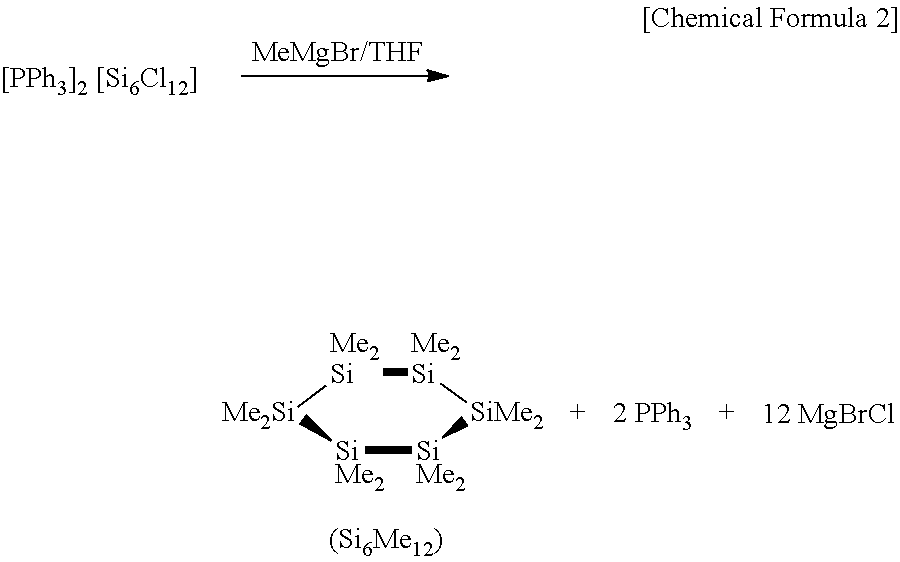
- the yield and yield constant of the neutral complex of a cyclic silane produced in the cyclization reaction can be calculated by a methylation reaction represented by the following scheme, in which the complex reacts quantitatively.
- the production of the neutral complex of a cyclic silane of the pattern 1 is different from the method for manufacturing a neutral complex of a cyclic silane of the pattern 2 only in whether the compound used as a coordination compound is a compound exemplified as X 1 R 1 n (1) (pattern 1) or a compound exemplified as X 2 R 2 q (3) (pattern 2).
- the neutral complex of a cyclic silane of the present invention can be produced as a solid of high purity by purification as described above. However, it can also be produced as a neutral complex composition of a cyclic silane containing impurities if desired.
- the neutral complex composition of a cyclic silane contains a neutral complex of a cyclic silane preferably in an amount of not less than 90% by mass, more preferably in an amount of not less than 95% by mass. The upper limit of the amount is, for example, 99.99% by mass, but may be 100% by mass.
- the impurities are, for example, a residue of a solvent or a coordination compound, or a decomposition product of a neutral complex of a cyclic silane.
- the content of the impurities in the neutral complex composition of a cyclic silane is preferably not more than 10% by mass, more preferably not more than 5% by mass, and the lower limit is, for example, 0.01% by mass, but may be 0% by mass.
- the method for manufacturing a cyclic hydrogenated silane of the present invention includes a reduction step of reducing the neutral complex of a cyclic silane of the pattern 2 obtained in the manufacturing method of the present invention.
- the neutral complex of a cyclic silane of the pattern 1 of the present invention is also useful as an intermediate for synthesizing the cyclic hydrogenated silane or the cyclic organic silane, and the cyclic hydrogenated silane or the cyclic organic silane may be produced by using the neutral complex of a cyclic silane of the pattern 1.
- the neutral complex of a cyclic silane of the present invention is neutral, and therefore is high in solubility in a solvent.
- a reduction, alkylation or arylation reaction can be conducted in a homogeneous solution state or in a suspension high in dispersibility.
- the by-product silane gas is not produced, or only a small amount of the silane gas is produced during these reactions.
- a combustion facility and an adsorption facility as countermeasures against silane gas and organic monosilane, which have conventionally been used in the production of a cyclic hydrogenated silane or a cyclic organic silane, can be eliminated or simplified, and a countermeasure of dilution of the generated gas with inert gas or a simple device such as a scrubber is sufficient.
- the reducing agent that can be used in the reduction step is not particularly limited, but one or more reducing agents selected from the group consisting of aluminum-based reducing agents and boron-based reducing agents are preferably used.
- the aluminum-based reducing agent include metal hydrides such as lithium aluminum hydride (LiAlH 4 ; LAH), diisobutyl aluminum hydride (DIBAL) and bis(2-methoxyethoxy) aluminum sodium hydride (”Red-Al” (registered trade mark of Sigma-Aldrich Corporation).
- the boron-based reducing agent include metal hydrides such as sodium borohydride and lithium triethylborohydride, and diborane.
- a metal hydride may be used as the reducing agent.
- the reducing agents may be used alone or in combination of two or more thereof.
- a Lewis acid catalyst may be used as a reduction auxiliary in combination with the above reducing agents.
- the Lewis acid catalyst may be metal halide compounds including chlorides such as aluminum chloride, titanium chloride, zinc chloride, tin chloride and iron chloride; bromides such as aluminum bromide, titanium bromide, zinc bromide, tin bromide and iron bromide; iodides such as aluminum iodide, titanium iodide, zinc iodide, tin iodide and iron iodide; and fluorides such as aluminum fluoride, titanium fluoride, zinc fluoride, tin fluoride and iron fluoride.
- These Lewis acid catalysts may be used alone or in combination of two or more thereof.
- the method for manufacturing a cyclic organic silane of the present invention includes a step of alkylating or arylating the neutral complex of a cyclic silane obtained in the manufacturing method of the present invention.
- a step of introducing an organic group onto a silicon atom for example, alkylation or arylation of a neutral complex of a cyclic silane can give cyclic organic silanes such as dodecamethylcyclohexasilane while the generation of organic monosilane is suppressed.
- the dodecamethylcyclohexasilane is produced by the same reaction as the above methylation reaction conducted when the yield and yield constant of the neutral complex of a cyclic silane are measured.
- the alkylating agent or the arylating agent that can be used in the step of alkylation or arylation is not particularly limited, but one or more agents selected from the group consisting of Grignard reagents and organolithium reagents are preferably used.
- the Grignard reagent include alkyl magnesium halides such as methyl magnesium bromide, and aryl magnesium halides such as phenyl magnesium bromide.
- the organic lithium reagent include alkyl lithium compounds such as methyl lithium, n-butyl lithium, sec-butyl lithium and tert-butyl lithium, and aryl lithium compounds such as phenyl lithium.
- the alkylating agent or the arylating agent may be used alone or in combination of two or more thereof.
- the method for manufacturing a cyclic hydrogenated silane of the present invention is mainly described.
- the terms “reducing agent” and “cyclic hydrogenated silane” in the description of the method for manufacturing a cyclic hydrogenated silane below are read as an “alkylating agent or arylating agent” and a “cyclic organic silane,” respectively, and thus the description of the method for manufacturing a cyclic hydrogenated silane is appropriately applied to the method for manufacturing a cyclic organic silane.
- a neutral complex of a cyclic silane e.g. [PPh 3 ] 2 [Si 6 Cl 12 ]
- a cyclic hydrogenated silane e.g. cyclohexasilane
- LiAlH4 LiAlH4
- the amount of the reducing agent to be used in the reduction step may be appropriately set.
- the hydride equivalent in the reducing agent relative to one silicon-halogen bond in the neutral complex of a cyclic silane is preferably set to at least 0.9.
- the equivalent is more preferably set to 0.9 to 50, further preferably 0.9 to 30, particularly preferably 0.9 to 15, most preferably 0.9 to 2.
- the amount of the reducing agent to be used is too large, the time required for a post-treatment tends to increase, resulting in reduction in productivity, whereas when the amount is too small, the yield tends to decrease.
- the reduction reaction can be carried out in the presence of an organic solvent as necessary.
- organic solvent examples include hydrocarbon-based solvents such as hexane and toluene; and ether-based solvents such as diethyl ether, tetrahydrofuran, cyclopentyl methyl ether, diisopropyl ether, and methyl tertiary butyl ether. These organic solvents may be used alone or in combination of two or more thereof.
- the organic solvent solution obtained in the production of the neutral complex of a cyclic silane may be directly used as an organic solvent solution in the reduction step, or an organic solvent may be distilled off from an organic solvent solution containing the neutral complex of a cyclic silane and a newly added organic solvent may be used in the reduction step.
- the organic solvent to be used in the reduction reaction is preferably subjected to purification such as distillation or dehydration before the reaction for removing water and dissolved oxygen contained therein.
- the concentration of the neutral complex of a cyclic silane is preferably adjusted to 0.01 to 1 mol/L, more preferably to 0.02 to 0.7 mol/L, and further preferably to 0.03 to 0.5 mol/L.
- concentration of the neutral complex of a cyclic silane is more than 1 mol/L, that is, when the amount of the organic solvent to be used is too small, the heat generated by the reduction reaction cannot be removed adequately and a reactant does not dissolve easily. This may possibly cause problems such as a decrease in reaction rate.
- the concentration of the neutral complex of a cyclic silane is less than 0.01 mol/L, that is, when the amount of the organic solvent to be used is too large, the amount of the solvent to be distilled off increases when the organic solvent and an object product are separated from each other after the reduction reaction so that the productivity tends to decrease.
- the reduction can be carried out by bringing the neutral complex of a cyclic silane into contact with the reducing agent.
- the contact is preferably carried out in the presence of a solvent.
- the reducing agent is directly added to a solution or a dispersion liquid of the neutral complex of a cyclic silane
- a solution or a dispersion liquid obtained by dissolving or dispersing the reducing agent in the solvent is added to a solution or a dispersion liquid of the neutral complex of a cyclic silane
- the neutral complex of a cyclic silane and the reducing agent are simultaneously or sequentially added to the solvent, and the like.
- the embodiment (2) is particularly preferable.
- the neutral complex of a cyclic silane when brought into contact with the reducing agent, it is preferred that at least one of the neutral complex of a cyclic silane and the reducing agent be added dropwise to the reaction system in which the reduction is carried out.
- One or both of the neutral complex of a cyclic silane and the reducing agent are added dropwise as described above, whereby exothermic generated in the reduction reaction can be controlled by the dropwise addition rate or the like, thus an effect of leading to improved productivity can be obtained such that it is possible to downsize a condenser or the like.
- the preferred embodiment when one or both of the neutral complex of a cyclic silane and the reducing agent are added dropwise includes the following three embodiments. That is, A) an embodiment in which a solution or dispersion of the neutral complex of a cyclic silane is charged in the reactor, and a solution or dispersion of the reducing agent is added dropwise thereto, B) an embodiment in which a solution or dispersion of the reducing agent is charged in the reactor, and a solution or dispersion of the neutral complex of a cyclic silane is added dropwise thereto, and C) an embodiment in which a solution or dispersion of the neutral complex of a cyclic silane and a solution or dispersion of the reducing agent are simultaneously or sequentially added dropwise to the reactor.
- the embodiment A) is preferable.
- the concentration in the solution or dispersion containing the neutral complex of a cyclic silane is preferably not less than 0.01 mol/L, more preferably not less than 0.02 mol/L, further preferably not less than 0.04 mol/L, and particularly preferably not less than 0.05 mol/L.
- concentration of the neutral complex of a cyclic silane is too low, the amount of the solvent that needs to be removed by distillation when isolating the objective product is increased, and thus the productivity tends to be lowered.
- the upper limit of the concentration in the solution or dispersion containing the neutral complex of a cyclic silane is preferably not more than 1 mol/L, more preferably not more than 0.8 mol/L, further preferably not more than 0.7 mol/L, and particularly preferably not more than 0.5 mol/L.
- the lower limit of the temperature during dropwise addition is preferably ⁇ 198° C., more preferably ⁇ 160° C., further preferably ⁇ 100° C.
- the upper limit of the temperature during dropwise addition is preferably +150° C., more preferably +80° C., further preferably ⁇ 10° C., particularly preferably ⁇ 60° C.
- the temperature of a reaction container (reaction solution) (reaction temperature) may be appropriately set according to the types of a neutral complex of a cyclic silane and a reducing agent, and generally, the lower limit is preferably set to ⁇ 198° C., more preferably ⁇ 160° C., further preferably ⁇ 100° C.
- the upper limit of the temperature of a reaction container is preferably +150° C., more preferably +80° C., further preferably ⁇ 10° C., particularly preferably ⁇ 60° C.
- reaction temperature is low, the decomposition or polymerization of an intermediate product or an object product can be suppressed, resulting in improvement of yield.
- the reaction time may be properly determined depending on the extent of reaction progress, and is usually not less than 10 minutes and not more than 72 hours, preferably not less than 1 hour and not more than 48 hours, and more preferably not less than 2 hours and not more than 24 hours.
- the reduction reaction be usually carried out under an atmosphere of an inert gas such as nitrogen gas or argon gas.
- an inert gas such as nitrogen gas or argon gas.
- the generation of silane gas is suppressed. Therefore, a combustion facility and an adsorption facility as countermeasures against silane gas are unnecessary or can be simplified in the step. Further, a countermeasure can be taken by dilution of the generated gas with inert gas or a simple facility such as a scrubber, and a cyclic hydrogenated silane can be produced efficiently with a simple device.
- the cyclic hydrogenated silane produced in the reduction reaction can be isolated by, for example, subjecting the reaction liquid obtained after the reduction to solid-liquid separation to separate a solid (impurities such as a salt as a by-product), and then distilling off the solvent under reduced pressure.
- a solid-liquid separation filtration is preferably employed for its simpleness, but the method is not limited thereto, and common solid-liquid separation methods such as centrifugation and decantation can be appropriately employed.
- the cyclization reaction proceeded according to the following scheme, and a neutral complex of dodecachlorocyclohexasilane to which triphenylphosphine was coordinated was produced.
- FIG. 1 A mass spectrometry (MS) result of the purified product, which was obtained by an electron ionization (EI) method, is shown in FIG. 1 .
- EI electron ionization
- FIG. 2 A result obtained by measuring this peak in a cation measurement mode is shown in FIG. 2 .
- a peak at 262.09 m/z is a peak of triphenylphosphine, and no peaks of diisopropylethylamine, diisopropylethylamine hydrochloride and a quaternary phosphonium salt were observed.
- the mass spectrometry was conducted with a gas chromatograph mass spectrometer (PolarisQ; manufactured by Thermoequst).
- a measurement result of 31 P-NMR is shown in FIG. 3 .
- the peak obtained is one for a triphenylphosphine ligand, and it was confirmed that a phosphorus compound other than triphenylphosphine was not present because no other peak was obtained.
- the measurement of 31 P-NMR was carried out at 600 MHz in deuterated dimethylformamide (DMF-d7) using a NMR manufactured by Varian, Inc.
- a measurement result of 29 Si-NMR is shown in FIG. 4 .
- a signal at-22.733 ppm is a signal of Si 6 Cl 12 , and it was confirmed that Si 6 HCl 11 was also mixed in the purified product due to the presence of the remaining 4 signals. The Si 6 HCl 11 will turn into Si 6 H 12 in the next reduction step, and therefore, separation is not particularly needed.
- the measurement result ; ⁇ 7.56, 7.46 ppm.
- Example 1 was a mixture containing a neutral complex including triphenylphosphine coordinated to dodecachlorocyclohexasilane ([PPh 3 ] 2 [Si 6 Cl 12 ]) and [PPh 3 ] 2 [Si 6 HCl 11 ].
- dodecachlorocyclohexasilane does not contain any silane atom other than the silane atoms that form the ring structure, and therefore, the generation of silane gas and the like is suppressed in the reduction.
- Example 2 In a 100-mL two-necked flask equipped with a dropping funnel and a stirrer was charged 2.44 g of the white solid obtained in Example 1 (dodecachlorocyclohexasilane-containing reaction product, 2.18 mmol), and the white solid was dried under reduced pressure. Then, the inside of the flask was replaced with argon gas, and 30 mL of cyclopentyl methyl ether (CPME) was added as a solvent.
- CPME cyclopentyl methyl ether
- the reaction liquid was filtered under a nitrogen atmosphere to remove a produced salt.
- the solvent was distilled off from the obtained filtrate under reduced pressure to give a colorless transparent liquid of crude cyclohexasilane at a yield of 62%.
- the reduction reaction is considered to have proceeded according to the following scheme.
- the purified cyclohexasilane obtained by subjecting this crude cyclohexasilane to distillation purification had a 99 area % of cyclohexasilane as a result of gas chromatography analysis.
- the purity of the purified cyclohexasilane was 99% when determined from the results of 1 H-NMR (400 MHz; C 6 D 6 ) and 29 Si-NMR (400 MHz; C 6 D 6 ).
- a reduction step was carried out using the purified product of the neutral complex of a cyclic silane obtained in Example 1.
- a flask was charged 204 mg of LiAlH 4 and 10 g of cyclopentyl methyl ether (CPME) under a nitrogen atmosphere, and the mixture was stirred at room temperature for 1 hour to prepare a slurry of LiAlH4.
- CPME cyclopentyl methyl ether
- Example 1 cyclopentyl methyl ether
- CPME cyclopentyl methyl ether
- the slurry of LiAlH4 was added dropwise thereto from a dropping funnel over 10 minutes. After the completion of the dropwise addition, the resultant mixture was stirred at ⁇ 60° C. for 6 hours.
- the reaction liquid was filtered using a glass filter with a micropore size of 20 to 30 ⁇ m under a nitrogen atmosphere, and the solvent was distilled off from the obtained filtrate under reduced pressure to give a colorless transparent liquid of crude cyclohexasilane (yield 80%).
- the purified cyclohexasilane obtained by subjecting this crude cyclohexasilane to distillation purification had a 99 area % of cyclohexasilane as a result of gas chromatography analysis.
- the purity of the purified cyclohexasilane was 99% when determined from the results of 1 H-NMR (400 MHz; C 6 D 6 ) and 29 Si-NMR (400 MHz; C 6 D 6 ).
- Synthesis of a neutral complex of a cyclic silane was carried out in the same manner as in Example 1 except that the coordination compound was changed as follows.
- the yield was 20% with triphenylphosphine oxide (PH 3 P ⁇ O), 42% with tris(4-methoxyphenyl)phosphine (P(MeOPh) 3 ), 15% with p-tolunitrile, 8% with diisopropylethylamine, and 20% with pyridine.
- Example 2 In a 500-mL separable flask equipped with a dropping funnel and a stirrer was charged 32.9 g of the white solid obtained in Example 1 (dodecachlorocyclohexasilane-containing reaction product, 29.8 mmol), and the white solid was dried under reduced pressure. Then, the inside of the flask was replaced with argon gas, and 235 mL of cyclopentyl methyl ether (CPME) was added as a solvent.
- CPME cyclopentyl methyl ether
- the reaction liquid was filtered under pressure under a nitrogen atmosphere to remove a produced salt.
- the yield of the crude cyclohexasilane was 70% as a result of gas chromatography analysis of the filtrate.
- Example 2 In a 100-mL two-necked flask equipped with a dropping funnel and a stirrer was charged 2.0 g of the white solid obtained in Example 1 (dodecachlorocyclohexasilane-containing reaction product, 1.8 mmol), and the white solid was dried under reduced pressure. Then, the inside of the flask was replaced with argon gas, and 94 mL of cyclopentyl methyl ether (CPME) was added as a solvent.
- CPME cyclopentyl methyl ether
- the reaction liquid was filtered using a glass filter with a micropore size of 20 to 30 ⁇ m under a nitrogen atmosphere, and the solvent was distilled off from the obtained filtrate under reduced pressure to give a colorless transparent liquid of crude cyclohexasilane (yield 65%).
- the neutral complex of a cyclic silane of the present invention is useful as an intermediate for synthesizing cyclic hydrogenated silanes such as cyclohexasilane, or cyclic organic silanes such as dodecamethylcyclohexasilane.
- the neutral complex of a cyclic silane is excellent in solubility, and therefore, a cyclization reaction for synthesizing a neutral complex of a cyclic halosilane and a synthesis reaction for a cyclic hydrogenated silane or a cyclic organic silane can be conducted in the state of a homogeneous solution or a suspension high in dispersibility.
- the cyclic hydrogenated silane is useful as a silicon material used for, for example, solar cells or semiconductors. Further, in the semiconductor field, the cyclic hydrogenated silane can also be used for production of SiGe compounds or SiGe films by mixing or reacting the cyclic hydrogenated silane with a Ge compound.
Landscapes
- Chemical & Material Sciences (AREA)
- Organic Chemistry (AREA)
- Inorganic Chemistry (AREA)
- Life Sciences & Earth Sciences (AREA)
- Molecular Biology (AREA)
- General Health & Medical Sciences (AREA)
- Biochemistry (AREA)
- Health & Medical Sciences (AREA)
- Engineering & Computer Science (AREA)
- Materials Engineering (AREA)
- Wood Science & Technology (AREA)
- Silicon Compounds (AREA)
- Organic Low-Molecular-Weight Compounds And Preparation Thereof (AREA)
Abstract
Description
[Y]1[SimZ2m-1Ha]
(wherein Y is at least one coordination compound selected from the group consisting of (1) a compound represented as X1R1 n (when X1 is P, P═O or N, n=3 and each R1 represents a substituted or unsubstituted alkyl group or aryl group and R1s are the same or different; when X1 is S, S═O or O, n=2 and each R1 represents the same group as described above and R1s are the same or different; and the number of amino groups in X1R1 n is 0 or 1), and (2) at least one heterocyclic compound selected from the group consisting of substituted or unsubstituted N—, O—, S— or P— containing heterocyclic compounds that have an unshared electron pair in the ring (the number of amino groups in the heterocyclic compound is 0 or 1), each Z represents a halogen atom of any of Cl, Br, I and F and Zs are the same or different, l is 1 or 2, m is 3 to 8, and a is 0 to m.)



- Si6Cl12; −22.73 ppm
- Si6HCl11: δ−18.89, −22.94, −24.05, −38.56 ppm

Claims (13)
[Y]1[SimZ2m−aHa],
Applications Claiming Priority (5)
| Application Number | Priority Date | Filing Date | Title |
|---|---|---|---|
| JP2013-264516 | 2013-12-20 | ||
| JP2013264516 | 2013-12-20 | ||
| JP2013-264515 | 2013-12-20 | ||
| JP2013264515 | 2013-12-20 | ||
| PCT/JP2014/083681 WO2015093592A1 (en) | 2013-12-20 | 2014-12-19 | Neutral complex of cyclic silane, manufacturing method therefor, and method for manufacturing cyclic hydrogenated silane or cyclic organic silane |
Publications (2)
| Publication Number | Publication Date |
|---|---|
| US20160311692A1 US20160311692A1 (en) | 2016-10-27 |
| US9682866B2 true US9682866B2 (en) | 2017-06-20 |
Family
ID=53402931
Family Applications (1)
| Application Number | Title | Priority Date | Filing Date |
|---|---|---|---|
| US15/105,190 Expired - Fee Related US9682866B2 (en) | 2013-12-20 | 2014-12-19 | Neutral complex of cyclic silane, manufacturing method therefor, and method for manufacturing cyclic hydrogenated silane or cyclic organic silane |
Country Status (4)
| Country | Link |
|---|---|
| US (1) | US9682866B2 (en) |
| DE (1) | DE112014005811B4 (en) |
| TW (1) | TWI637961B (en) |
| WO (1) | WO2015093592A1 (en) |
Families Citing this family (6)
| Publication number | Priority date | Publication date | Assignee | Title |
|---|---|---|---|---|
| JP6664917B2 (en) * | 2015-09-28 | 2020-03-13 | 株式会社日本触媒 | Cyclic halosilane compound, method for producing, handling method, and method for producing cyclic silane compound |
| JP6588320B2 (en) * | 2015-11-27 | 2019-10-09 | 株式会社日本触媒 | Cyclic halosilane compound and method for producing the same, and method for producing cyclic silane compound |
| TWI783027B (en) | 2017-08-28 | 2022-11-11 | 日商日本觸媒股份有限公司 | Hydrosilane composition |
| TWI775922B (en) | 2017-08-31 | 2022-09-01 | 日商日本觸媒股份有限公司 | Hydrosilane composition |
| US10544171B2 (en) * | 2018-03-13 | 2020-01-28 | Nippon Shokubai Co., Ltd | Process for producing cyclic hydrogenated silane compound |
| CN113677621A (en) * | 2019-03-29 | 2021-11-19 | 科瑞泰克集团股份有限公司 | Method for preparing cyclosilane |
Citations (8)
| Publication number | Priority date | Publication date | Assignee | Title |
|---|---|---|---|---|
| US5942637A (en) * | 1998-03-30 | 1999-08-24 | North Dakota State University Research Foundation | Compounds containing tetradecachlorocyclohexasilane dianion |
| US20020076378A1 (en) | 1997-01-29 | 2002-06-20 | Nycomed Imaging As | Polymers |
| JP4519955B2 (en) | 1997-08-27 | 2010-08-04 | エヌディーエスユー リサーチ ファンデイション | Tetradecachlorocyclohexasilane dianion-containing compound |
| JP2013203601A (en) | 2012-03-28 | 2013-10-07 | Nippon Shokubai Co Ltd | Method for producing cyclohexasilane |
| US20140012030A1 (en) | 2012-07-04 | 2014-01-09 | Nippon Shokubai Co., Ltd. | Method for producing cyclic silane compound or salt thereof, salt having cyclic silane dianion, and cyclic silane dianion salt-containing composition |
| US20140012029A1 (en) | 2012-07-04 | 2014-01-09 | Nippon Shokubai Co., Ltd. | Method for producing cyclohexasilane |
| US20140219893A1 (en) | 2012-12-25 | 2014-08-07 | Nippon Shokubai Co., Ltd. | Cyclohexasilane and method for producing the same |
| JP2014141398A (en) | 2012-12-25 | 2014-08-07 | Nippon Shokubai Co Ltd | Cyclohexasilane and method for producing the same |
-
2014
- 2014-12-19 US US15/105,190 patent/US9682866B2/en not_active Expired - Fee Related
- 2014-12-19 WO PCT/JP2014/083681 patent/WO2015093592A1/en not_active Ceased
- 2014-12-19 TW TW103144439A patent/TWI637961B/en not_active IP Right Cessation
- 2014-12-19 DE DE112014005811.4T patent/DE112014005811B4/en not_active Expired - Fee Related
Patent Citations (9)
| Publication number | Priority date | Publication date | Assignee | Title |
|---|---|---|---|---|
| US20020076378A1 (en) | 1997-01-29 | 2002-06-20 | Nycomed Imaging As | Polymers |
| JP4519955B2 (en) | 1997-08-27 | 2010-08-04 | エヌディーエスユー リサーチ ファンデイション | Tetradecachlorocyclohexasilane dianion-containing compound |
| US5942637A (en) * | 1998-03-30 | 1999-08-24 | North Dakota State University Research Foundation | Compounds containing tetradecachlorocyclohexasilane dianion |
| JP2013203601A (en) | 2012-03-28 | 2013-10-07 | Nippon Shokubai Co Ltd | Method for producing cyclohexasilane |
| US20140012030A1 (en) | 2012-07-04 | 2014-01-09 | Nippon Shokubai Co., Ltd. | Method for producing cyclic silane compound or salt thereof, salt having cyclic silane dianion, and cyclic silane dianion salt-containing composition |
| US20140012029A1 (en) | 2012-07-04 | 2014-01-09 | Nippon Shokubai Co., Ltd. | Method for producing cyclohexasilane |
| JP2014012648A (en) | 2012-07-04 | 2014-01-23 | Nippon Shokubai Co Ltd | Method of producing cyclic silane compound and salt thereof and salt containing cyclic silane dianion and composition containing cyclic silane dianion salt |
| US20140219893A1 (en) | 2012-12-25 | 2014-08-07 | Nippon Shokubai Co., Ltd. | Cyclohexasilane and method for producing the same |
| JP2014141398A (en) | 2012-12-25 | 2014-08-07 | Nippon Shokubai Co Ltd | Cyclohexasilane and method for producing the same |
Non-Patent Citations (4)
| Title |
|---|
| Dai et al., "Inverse Sandwich" Complexes of Perhalogenated Cyclohexasilane, Organometallics, vol. 29, No. 10, 2010, pp. 2203-2205. |
| Dai et at, Coordination chemistry of Si5Cl10 with organocyanides, Dalton Transactions, vol. 39, No. 46, 2010, pp. 11188-11192. |
| Hengge et al., Preparation of Cyclohexasilane, Si6H12, Angew. Chem. Int. Ed. Engl., vol. 16, No. 6, 1977, p. 403. |
| International Search Report issued Mar. 10, 2015 in corresponding (PCT) Application No. PCT/JP2014/083681. |
Also Published As
| Publication number | Publication date |
|---|---|
| DE112014005811B4 (en) | 2021-11-11 |
| TWI637961B (en) | 2018-10-11 |
| WO2015093592A1 (en) | 2015-06-25 |
| DE112014005811T5 (en) | 2016-09-15 |
| DE112014005811T8 (en) | 2016-11-10 |
| TW201536797A (en) | 2015-10-01 |
| US20160311692A1 (en) | 2016-10-27 |
Similar Documents
| Publication | Publication Date | Title |
|---|---|---|
| US20160311692A1 (en) | Neutral complex of cyclic silane, manufacturing method therefor, and method for manufacturing cyclic hydrogenated silane or cyclic organic silane | |
| JP6349246B2 (en) | Method for producing neutral complex of cyclic silane and method for producing cyclic hydrogenated silane or cyclic organosilane | |
| JP6346555B2 (en) | Cyclic halosilane neutral complex | |
| JP5808646B2 (en) | Method for producing cyclic silane intermediate and method for producing cyclic hydrogenated silane or cyclic organosilane | |
| JP6588315B2 (en) | Method for producing cyclic hydrogenated silane compound | |
| JP7055674B2 (en) | Method for Producing Polysilane Composition and Heteroatom-Introduced Polysilane Composition | |
| JP6014392B2 (en) | Method for producing cyclohexasilanes | |
| JP6954773B2 (en) | Method for deactivating silane hydride and aluminum-containing residue | |
| US20140012029A1 (en) | Method for producing cyclohexasilane | |
| JP2017160115A (en) | Cyclic silane composition | |
| US10858260B2 (en) | Method for producing perhalogenated hexasilane anion and method for producing a cyclic silane compound | |
| JP7022512B2 (en) | Cyclohexasilane with low halogen element content | |
| US10544171B2 (en) | Process for producing cyclic hydrogenated silane compound | |
| US10676366B2 (en) | Hydrogenated silane composition | |
| US10676365B2 (en) | Hydrogenated silane composition | |
| JP7229817B2 (en) | Method for producing cyclic hydrogenated silane compound | |
| JP7007934B2 (en) | Method for producing cyclic hydride | |
| JP7621162B2 (en) | Method for producing cyclic silane hydride compounds | |
| JP5942027B2 (en) | Method for producing cyclic silane intermediate and method for producing cyclic hydrogenated silane or cyclic organosilane | |
| JP2020147476A (en) | Method for producing cyclic halosilane compound |
Legal Events
| Date | Code | Title | Description |
|---|---|---|---|
| AS | Assignment |
Owner name: NIPPON SHOKUBAI CO., LTD., JAPAN Free format text: ASSIGNMENT OF ASSIGNORS INTEREST;ASSIGNORS:KITAMURA, MORIHIRO;IMOTO, SHIN-YA;SHINOKURA, TOMONORI;AND OTHERS;SIGNING DATES FROM 20160324 TO 20160328;REEL/FRAME:038931/0742 |
|
| STCF | Information on status: patent grant |
Free format text: PATENTED CASE |
|
| MAFP | Maintenance fee payment |
Free format text: PAYMENT OF MAINTENANCE FEE, 4TH YEAR, LARGE ENTITY (ORIGINAL EVENT CODE: M1551); ENTITY STATUS OF PATENT OWNER: LARGE ENTITY Year of fee payment: 4 |
|
| FEPP | Fee payment procedure |
Free format text: MAINTENANCE FEE REMINDER MAILED (ORIGINAL EVENT CODE: REM.); ENTITY STATUS OF PATENT OWNER: LARGE ENTITY |
|
| LAPS | Lapse for failure to pay maintenance fees |
Free format text: PATENT EXPIRED FOR FAILURE TO PAY MAINTENANCE FEES (ORIGINAL EVENT CODE: EXP.); ENTITY STATUS OF PATENT OWNER: LARGE ENTITY |
|
| STCH | Information on status: patent discontinuation |
Free format text: PATENT EXPIRED DUE TO NONPAYMENT OF MAINTENANCE FEES UNDER 37 CFR 1.362 |
|
| FP | Lapsed due to failure to pay maintenance fee |
Effective date: 20250620 |