US9649390B2 - Pyrrolobenzodiazepines and conjugates thereof - Google Patents
Pyrrolobenzodiazepines and conjugates thereof Download PDFInfo
- Publication number
- US9649390B2 US9649390B2 US14/774,535 US201414774535A US9649390B2 US 9649390 B2 US9649390 B2 US 9649390B2 US 201414774535 A US201414774535 A US 201414774535A US 9649390 B2 US9649390 B2 US 9649390B2
- Authority
- US
- United States
- Prior art keywords
- group
- antibody
- bis
- mmol
- independently selected
- Prior art date
- Legal status (The legal status is an assumption and is not a legal conclusion. Google has not performed a legal analysis and makes no representation as to the accuracy of the status listed.)
- Active
Links
- 0 [16*]C1=C2C(=O)N(C)[C@@]([H])(CC)C([21*])N([20*])C2=C([19*])C(CCC2=CC([Y])=CC(C)=C2)=C1[17*].[2HH].[6*]C1=C2C(=O)N(C)[C@@]([H])(CC)C([11*])N([10*])C2=C([9*])C(C[3H]C)=C1[7*] Chemical compound [16*]C1=C2C(=O)N(C)[C@@]([H])(CC)C([21*])N([20*])C2=C([19*])C(CCC2=CC([Y])=CC(C)=C2)=C1[17*].[2HH].[6*]C1=C2C(=O)N(C)[C@@]([H])(CC)C([11*])N([10*])C2=C([9*])C(C[3H]C)=C1[7*] 0.000 description 61
- IAQRGUVFOMOMEM-ONEGZZNKSA-N C/C=C/C Chemical compound C/C=C/C IAQRGUVFOMOMEM-ONEGZZNKSA-N 0.000 description 3
- JQRAULHILKMEPN-UHFFFAOYSA-N CC(C)C1=CC=C(N2CCN(C)CC2)C=C1 Chemical compound CC(C)C1=CC=C(N2CCN(C)CC2)C=C1 JQRAULHILKMEPN-UHFFFAOYSA-N 0.000 description 3
- JHUBNQSPUZXGKI-UHFFFAOYSA-N CC(C)C1=CC=C2OCOC2=C1 Chemical compound CC(C)C1=CC=C2OCOC2=C1 JHUBNQSPUZXGKI-UHFFFAOYSA-N 0.000 description 3
- VNXBKJFUJUWOCW-UHFFFAOYSA-N CC1CC1 Chemical compound CC1CC1 VNXBKJFUJUWOCW-UHFFFAOYSA-N 0.000 description 3
- MWWATHDPGQKSAR-UHFFFAOYSA-N C#CC Chemical compound C#CC MWWATHDPGQKSAR-UHFFFAOYSA-N 0.000 description 2
- KXIPLEOWHNFHDZ-UHFFFAOYSA-N C#CC(C)C.CC(=O)OC(C)C.CC(C)C(=O)ON1C(=O)CCC1=O.CC(C)CBr.CC(C)N=[N+]=[N-].CCC(=O)NC(C)C Chemical compound C#CC(C)C.CC(=O)OC(C)C.CC(C)C(=O)ON1C(=O)CCC1=O.CC(C)CBr.CC(C)N=[N+]=[N-].CCC(=O)NC(C)C KXIPLEOWHNFHDZ-UHFFFAOYSA-N 0.000 description 2
- QROGIFZRVHSFLM-QHHAFSJGSA-N C/C=C/C1=CC=CC=C1 Chemical compound C/C=C/C1=CC=CC=C1 QROGIFZRVHSFLM-QHHAFSJGSA-N 0.000 description 2
- OTMSDBZUPAUEDD-UHFFFAOYSA-N CC Chemical compound CC OTMSDBZUPAUEDD-UHFFFAOYSA-N 0.000 description 2
- SGLABYMUISUECS-UHFFFAOYSA-N CC#CC(C)C.CC(C)C.[H]C(=O)C(C)C Chemical compound CC#CC(C)C.CC(C)C.[H]C(=O)C(C)C SGLABYMUISUECS-UHFFFAOYSA-N 0.000 description 2
- HDRKQXKIPAYUNJ-UHFFFAOYSA-N CC(C)C(=O)ON1C(=O)C=CC1=O.CC(C)C(C)SSC1=CC=CC=C1.CC(C)C(C)SSC1=NC=CC=C1.CC(C)N1C(=O)C=CC1=O.CC(C)SSC1=CC=CC=C1.CC(C)SSC1=NC=CC=C1.CC(C)[Ar]N1C(=O)C=CC1=O.C[N+](=O)[O-].C[N+](=O)[O-].C[N+](=O)[O-].C[N+](=O)[O-] Chemical compound CC(C)C(=O)ON1C(=O)C=CC1=O.CC(C)C(C)SSC1=CC=CC=C1.CC(C)C(C)SSC1=NC=CC=C1.CC(C)N1C(=O)C=CC1=O.CC(C)SSC1=CC=CC=C1.CC(C)SSC1=NC=CC=C1.CC(C)[Ar]N1C(=O)C=CC1=O.C[N+](=O)[O-].C[N+](=O)[O-].C[N+](=O)[O-].C[N+](=O)[O-] HDRKQXKIPAYUNJ-UHFFFAOYSA-N 0.000 description 2
- OYTFJYUBRQLOCA-UHFFFAOYSA-N CC(C)CCC(=O)CCCC1=CC=C(COC(C)C)C=C1 Chemical compound CC(C)CCC(=O)CCCC1=CC=C(COC(C)C)C=C1 OYTFJYUBRQLOCA-UHFFFAOYSA-N 0.000 description 2
- URLKBWYHVLBVBO-UHFFFAOYSA-N CC1=CC=C(C)C=C1 Chemical compound CC1=CC=C(C)C=C1 URLKBWYHVLBVBO-UHFFFAOYSA-N 0.000 description 2
- XSSZDUPKWNOPKX-UHFFFAOYSA-N CCC(=O)CCCC1=CC=C(COC(C)C)C=C1 Chemical compound CCC(=O)CCCC1=CC=C(COC(C)C)C=C1 XSSZDUPKWNOPKX-UHFFFAOYSA-N 0.000 description 2
- COXWCIVGJYMBFF-UHFFFAOYSA-N C#CCCC(=O)CCOCCOCCOCCOCCCB(C)O.C#CCN.CB(O)CCCOCCOCCOCCOCCC(=O)O.I.II.I[IH]I Chemical compound C#CCCC(=O)CCOCCOCCOCCOCCCB(C)O.C#CCN.CB(O)CCCOCCOCCOCCOCCC(=O)O.I.II.I[IH]I COXWCIVGJYMBFF-UHFFFAOYSA-N 0.000 description 1
- AJYJBBNJYRGKKE-UHFFFAOYSA-N C.CI.CNCCOCCC(=O)O.ICI.[H]C#CCN.[H]C#CNC(=O)CCOCCNC Chemical compound C.CI.CNCCOCCC(=O)O.ICI.[H]C#CCN.[H]C#CNC(=O)CCOCCNC AJYJBBNJYRGKKE-UHFFFAOYSA-N 0.000 description 1
- LGAQJENWWYGFSN-SNAWJCMRSA-N C/C=C/C(C)C Chemical compound C/C=C/C(C)C LGAQJENWWYGFSN-SNAWJCMRSA-N 0.000 description 1
- RGMPSLQNSGBJOX-BCJZVMSMSA-N CB(O)NC1=CC(C)=C(C)C=C1C(=O)N1C=C(C)C[C@H]1CO.CB(O)NC1=CC(C)=C(C)C=C1C(=O)N1C=C(C)C[C@H]1CO[Si](C)(C)C(C)(C)C.CC1=CN(C(=O)C2=CC(C)=C(C)C=C2N)[C@H](CO[Si](C)(C)C(C)(C)C)C1.[H][C@@]12CC(C)=CN1C(=O)C1=CC(C)=C(C)C=C1N(BC=O)[C@H]2O.[H][C@@]12CC(C)=CN1C(=O)C1=CC(C)=C(C)C=C1N(BC=O)[C@H]2O[Si](C)(C)C(C)(C)C.[H][C@@]12CC(C)=CN1C(=O)C1=CC(C)=C(O)C=C1N(BC=O)[C@H]2O[Si](C)(C)C(C)(C)C Chemical compound CB(O)NC1=CC(C)=C(C)C=C1C(=O)N1C=C(C)C[C@H]1CO.CB(O)NC1=CC(C)=C(C)C=C1C(=O)N1C=C(C)C[C@H]1CO[Si](C)(C)C(C)(C)C.CC1=CN(C(=O)C2=CC(C)=C(C)C=C2N)[C@H](CO[Si](C)(C)C(C)(C)C)C1.[H][C@@]12CC(C)=CN1C(=O)C1=CC(C)=C(C)C=C1N(BC=O)[C@H]2O.[H][C@@]12CC(C)=CN1C(=O)C1=CC(C)=C(C)C=C1N(BC=O)[C@H]2O[Si](C)(C)C(C)(C)C.[H][C@@]12CC(C)=CN1C(=O)C1=CC(C)=C(O)C=C1N(BC=O)[C@H]2O[Si](C)(C)C(C)(C)C RGMPSLQNSGBJOX-BCJZVMSMSA-N 0.000 description 1
- MAKDVXHKXMOLLB-NTFQUZPDSA-N CC#CCCC(=O)CCOCCOCCOCCOCCCB(C)O.I[IH]I.[H][C@@]12CC(C)=CN1C(=O)C1=C(C=C(OCC3=CC(C#CCCC(=O)CCOCCOCCOCCOCCCB(C)O)=CC(COC4=C(OC)C=C5C(=O)N6C=C(C)C[C@@]6([H])[C@H](C)N(B(C)O)C5=C4)=C3)C(C)=C1)N(BC=O)[C@H]2O[Si](C)(C)C(C)(C)C.[H][C@@]12CC(C)=CN1C(=O)C1=C(C=C(OCC3=CC(C#CCCC(=O)CCOCCOCCOCCOCCN)=CC(COC4=C(OC)C=C5C(=O)N6C=C(C)C[C@@]6([H])[C@H](C)N(B(C)O)C5=C4)=C3)C(C)=C1)N(BC=O)[C@H]2O[Si](C)(C)C(C)(C)C.[H][C@@]12CC(C)=CN1C(=O)C1=C(C=C(OCC3=CC(I)=CC(COC4=C(OC)C=C5C(=O)N6C=C(C)C[C@@]6([H])[C@H](C)N(B(C)O)C5=C4)=C3)C(C)=C1)N(BC=O)[C@H]2O[Si](C)(C)C(C)(C)C.[H][C@@]12CC(C)=CN1C(=O)C1=CC(C)=C(O)C=C1N(BC=O)[C@H]2O[Si](C)(C)C(C)(C)C Chemical compound CC#CCCC(=O)CCOCCOCCOCCOCCCB(C)O.I[IH]I.[H][C@@]12CC(C)=CN1C(=O)C1=C(C=C(OCC3=CC(C#CCCC(=O)CCOCCOCCOCCOCCCB(C)O)=CC(COC4=C(OC)C=C5C(=O)N6C=C(C)C[C@@]6([H])[C@H](C)N(B(C)O)C5=C4)=C3)C(C)=C1)N(BC=O)[C@H]2O[Si](C)(C)C(C)(C)C.[H][C@@]12CC(C)=CN1C(=O)C1=C(C=C(OCC3=CC(C#CCCC(=O)CCOCCOCCOCCOCCN)=CC(COC4=C(OC)C=C5C(=O)N6C=C(C)C[C@@]6([H])[C@H](C)N(B(C)O)C5=C4)=C3)C(C)=C1)N(BC=O)[C@H]2O[Si](C)(C)C(C)(C)C.[H][C@@]12CC(C)=CN1C(=O)C1=C(C=C(OCC3=CC(I)=CC(COC4=C(OC)C=C5C(=O)N6C=C(C)C[C@@]6([H])[C@H](C)N(B(C)O)C5=C4)=C3)C(C)=C1)N(BC=O)[C@H]2O[Si](C)(C)C(C)(C)C.[H][C@@]12CC(C)=CN1C(=O)C1=CC(C)=C(O)C=C1N(BC=O)[C@H]2O[Si](C)(C)C(C)(C)C MAKDVXHKXMOLLB-NTFQUZPDSA-N 0.000 description 1
- PWNYOACLDPPUCZ-HRNDJLQDSA-N CC(=O)CCCOCCCC(=O)/C=C/C(C)C.[H]C(=NOCCOCCCC(C)=O)C(C)C Chemical compound CC(=O)CCCOCCCC(=O)/C=C/C(C)C.[H]C(=NOCCOCCCC(C)=O)C(C)C PWNYOACLDPPUCZ-HRNDJLQDSA-N 0.000 description 1
- MMWDPLSHMDSUBL-VOTSOKGWSA-N CC(=O)NCCOCCCC(=O)/C=C/C(C)C Chemical compound CC(=O)NCCOCCCC(=O)/C=C/C(C)C MMWDPLSHMDSUBL-VOTSOKGWSA-N 0.000 description 1
- LSLNKXREYMWQRY-AATRIKPKSA-N CC(C)/C=C/C(=O)CCCOCCN Chemical compound CC(C)/C=C/C(=O)CCCOCCN LSLNKXREYMWQRY-AATRIKPKSA-N 0.000 description 1
- PRCUDJXDCWUEDT-UHFFFAOYSA-O CC(C)=C(C)O.CC(C)=C(C)[O-].[H+].[H+].[H]C(C)(C)C(C)=O Chemical compound CC(C)=C(C)O.CC(C)=C(C)[O-].[H+].[H+].[H]C(C)(C)C(C)=O PRCUDJXDCWUEDT-UHFFFAOYSA-O 0.000 description 1
- HYUNJFZMWIZMRV-UHFFFAOYSA-N CC(C)C(=O)C(C)C.CC(C)C(=O)ON1C(=O)CC(C(C)C)C1=O.CC(C)C1=CN(C(C)C)N=N1.CC(C)C1=CN=NN1C(C)C.CC(C)C1CC(=O)N(C(C)C)C1=O.CC(C)CC(=O)CC(C)C.CC(C)CC(C)C.CC(C)OC(=O)C(C)C.CC(C)SC(C)C.CC(C)SC(C)C(C)C.CC(C)[Ar]N1C(=O)CC(C(C)C)C1=O Chemical compound CC(C)C(=O)C(C)C.CC(C)C(=O)ON1C(=O)CC(C(C)C)C1=O.CC(C)C1=CN(C(C)C)N=N1.CC(C)C1=CN=NN1C(C)C.CC(C)C1CC(=O)N(C(C)C)C1=O.CC(C)CC(=O)CC(C)C.CC(C)CC(C)C.CC(C)OC(=O)C(C)C.CC(C)SC(C)C.CC(C)SC(C)C(C)C.CC(C)[Ar]N1C(=O)CC(C(C)C)C1=O HYUNJFZMWIZMRV-UHFFFAOYSA-N 0.000 description 1
- SSVVPNYCWPOOOF-UHFFFAOYSA-N CC(C)C(=O)C(C)C.CC(C)C(=O)ON1C(=O)CC(C(C)C)C1=O.CC(C)C1CC(=O)N(C(C)C)C1=O.CC(C)CC(=O)CC(C)C.CC(C)OC(=O)C(C)C.CC(C)SC(C)C.CC(C)SC(C)C(C)C.CC(C)[Ar]N1C(=O)CC(C(C)C)C1=O Chemical compound CC(C)C(=O)C(C)C.CC(C)C(=O)ON1C(=O)CC(C(C)C)C1=O.CC(C)C1CC(=O)N(C(C)C)C1=O.CC(C)CC(=O)CC(C)C.CC(C)OC(=O)C(C)C.CC(C)SC(C)C.CC(C)SC(C)C(C)C.CC(C)[Ar]N1C(=O)CC(C(C)C)C1=O SSVVPNYCWPOOOF-UHFFFAOYSA-N 0.000 description 1
- FNNSXTZCRSZTNX-UHFFFAOYSA-N CC(C)C1=CN(C(C)C)N=N1.CC(C)C1=CN(C(C)C)N=N1.CC(C)C1=CN=NN1C(C)C.CC(C)C1=CN=NN1C(C)C.CC(C)CC(C)C Chemical compound CC(C)C1=CN(C(C)C)N=N1.CC(C)C1=CN(C(C)C)N=N1.CC(C)C1=CN=NN1C(C)C.CC(C)C1=CN=NN1C(C)C.CC(C)CC(C)C FNNSXTZCRSZTNX-UHFFFAOYSA-N 0.000 description 1
- QQJKBZBGIFLCOM-UHFFFAOYSA-N CC(C)C1=CN(C(C)C)N=N1.CC(C)C1=CN=NN1C(C)C Chemical compound CC(C)C1=CN(C(C)C)N=N1.CC(C)C1=CN=NN1C(C)C QQJKBZBGIFLCOM-UHFFFAOYSA-N 0.000 description 1
- GOIRZESFPUDDDA-UHFFFAOYSA-N CC(C)CBr.CC(C)CC(=O)ON1C(=O)C=CC1=O.CC(C)CN1C(=O)C=CC1=O.CC(C)CNC(=O)CBr.CC(C)CNC(=O)CCSSC1=CC=CC=N1.CC(C)CSSC1=CC=CC=C1 Chemical compound CC(C)CBr.CC(C)CC(=O)ON1C(=O)C=CC1=O.CC(C)CN1C(=O)C=CC1=O.CC(C)CNC(=O)CBr.CC(C)CNC(=O)CCSSC1=CC=CC=N1.CC(C)CSSC1=CC=CC=C1 GOIRZESFPUDDDA-UHFFFAOYSA-N 0.000 description 1
- ONQOJDTXLDAYDR-UHFFFAOYSA-N CC1=NN=NC1 Chemical compound CC1=NN=NC1 ONQOJDTXLDAYDR-UHFFFAOYSA-N 0.000 description 1
- IHMZQQVGQIKENS-UHFFFAOYSA-N CN1C(=O)C2=CC=CC=C2C1=O.CN1C(=O)C=CC1=O.CN1C(=O)CCC1=O Chemical compound CN1C(=O)C2=CC=CC=C2C1=O.CN1C(=O)C=CC1=O.CN1C(=O)CCC1=O IHMZQQVGQIKENS-UHFFFAOYSA-N 0.000 description 1
- BHIWKHZACMWKOJ-UHFFFAOYSA-N COC(=O)C(C)C Chemical compound COC(=O)C(C)C BHIWKHZACMWKOJ-UHFFFAOYSA-N 0.000 description 1
- PYNWWINVFRHUCY-PDKUEKNGSA-N COC1=C(C)C=C(N)C(C(=O)N2C=C(C)C[C@H]2CO[Si](C)(C)C(C)(C)C)=C1.COC1=C(C)C=C([N+](=O)[O-])C(C(=O)N2C=C(C)C[C@H]2CO[Si](C)(C)C(C)(C)C)=C1.COC1=C(C)C=C([N+](=O)[O-])C(C(=O)N2C=C(OS(=O)(=O)C(F)(F)F)C[C@H]2CO[Si](C)(C)C(C)(C)C)=C1.COC1=C(C)C=C([N+](=O)[O-])C(C(=O)N2CC(=O)C[C@H]2CO[Si](C)(C)C(C)(C)C)=C1 Chemical compound COC1=C(C)C=C(N)C(C(=O)N2C=C(C)C[C@H]2CO[Si](C)(C)C(C)(C)C)=C1.COC1=C(C)C=C([N+](=O)[O-])C(C(=O)N2C=C(C)C[C@H]2CO[Si](C)(C)C(C)(C)C)=C1.COC1=C(C)C=C([N+](=O)[O-])C(C(=O)N2C=C(OS(=O)(=O)C(F)(F)F)C[C@H]2CO[Si](C)(C)C(C)(C)C)=C1.COC1=C(C)C=C([N+](=O)[O-])C(C(=O)N2CC(=O)C[C@H]2CO[Si](C)(C)C(C)(C)C)=C1 PYNWWINVFRHUCY-PDKUEKNGSA-N 0.000 description 1
- PFIAIIURVFOPSL-CONSDPRKSA-N COc(cc1)ccc1C(C[C@H]1C=Nc(cc2OCCCOc(c(OC)c3)cc(N=C[C@H](C4)N5C=C4c(cc4)ccc4OC)c3C5=O)c3cc2OC)=CN1C3=O Chemical compound COc(cc1)ccc1C(C[C@H]1C=Nc(cc2OCCCOc(c(OC)c3)cc(N=C[C@H](C4)N5C=C4c(cc4)ccc4OC)c3C5=O)c3cc2OC)=CN1C3=O PFIAIIURVFOPSL-CONSDPRKSA-N 0.000 description 1
- YKQKLMCZJZBNCK-LZZIFIMESA-N [H]C#CC1=CC(COC2=C(OC)C=C3C(=O)N4C=C(C)C[C@@]4([H])[C@H](C)N(B(C)O)C3=C2)=CC(COC2=CC3=C(C=C2C)C(=O)N2C=C(C)C[C@@]2([H])[C@H](O[Si](C)(C)C(C)(C)C)N3BC=O)=C1.[H]C#C[Si](C)(C)C.[H][C@@]12CC(C)=CN1C(=O)C1=C(C=C(OCC3=CC(C#C[Si](C)(C)C)=CC(COC4=C(OC)C=C5C(=O)N6C=C(C)C[C@@]6([H])[C@H](C)N(B(C)O)C5=C4)=C3)C(C)=C1)N(BC=O)[C@H]2O[Si](C)(C)C(C)(C)C.[H][C@@]12CC(C)=CN1C(=O)C1=C(C=C(OCC3=CC(C4=CN(CCOCCOCCOCCOCCOCCOCCN)N=N4)=CC(COC4=C(OC)C=C5C(=O)N6C=C(C)C[C@@]6([H])[C@H](C)N(B(C)O)C5=C4)=C3)C(C)=C1)N(BC=O)[C@H]2O[Si](C)(C)C(C)(C)C.[H][C@@]12CC(C)=CN1C(=O)C1=C(C=C(OCC3=CC(I)=CC(COC4=C(OC)C=C5C(=O)N6C=C(C)C[C@@]6([H])[C@H](C)N(B(C)O)C5=C4)=C3)C(C)=C1)N(BC=O)[C@H]2O[Si](C)(C)C(C)(C)C Chemical compound [H]C#CC1=CC(COC2=C(OC)C=C3C(=O)N4C=C(C)C[C@@]4([H])[C@H](C)N(B(C)O)C3=C2)=CC(COC2=CC3=C(C=C2C)C(=O)N2C=C(C)C[C@@]2([H])[C@H](O[Si](C)(C)C(C)(C)C)N3BC=O)=C1.[H]C#C[Si](C)(C)C.[H][C@@]12CC(C)=CN1C(=O)C1=C(C=C(OCC3=CC(C#C[Si](C)(C)C)=CC(COC4=C(OC)C=C5C(=O)N6C=C(C)C[C@@]6([H])[C@H](C)N(B(C)O)C5=C4)=C3)C(C)=C1)N(BC=O)[C@H]2O[Si](C)(C)C(C)(C)C.[H][C@@]12CC(C)=CN1C(=O)C1=C(C=C(OCC3=CC(C4=CN(CCOCCOCCOCCOCCOCCOCCN)N=N4)=CC(COC4=C(OC)C=C5C(=O)N6C=C(C)C[C@@]6([H])[C@H](C)N(B(C)O)C5=C4)=C3)C(C)=C1)N(BC=O)[C@H]2O[Si](C)(C)C(C)(C)C.[H][C@@]12CC(C)=CN1C(=O)C1=C(C=C(OCC3=CC(I)=CC(COC4=C(OC)C=C5C(=O)N6C=C(C)C[C@@]6([H])[C@H](C)N(B(C)O)C5=C4)=C3)C(C)=C1)N(BC=O)[C@H]2O[Si](C)(C)C(C)(C)C YKQKLMCZJZBNCK-LZZIFIMESA-N 0.000 description 1
- ZEHGNVZVKWYGDU-KLRGWGOHSA-N [H]C(=O)C1=CC(CBr)=CC(CBr)=C1.[H]C(=O)C1=CC(COC2=C(OC)C=C3C(=O)N4C=C(C)C[C@@]4([H])[C@H](C)N(B(C)O)C3=C2)=CC(COC2=CC3=C(C=C2C)C(=O)N2C=C(C)C[C@@]2([H])[C@H](O[Si](C)(C)C(C)(C)C)N3BC=O)=C1.[H][C@@]12CC(C)=CN1C(=O)C1=C(C=C(OCC3=CC(/C=C/C(=O)CCCOCCOCCNB(C)O)=CC(COC4=C(OC)C=C5C(=O)N6C=C(C)C[C@@]6([H])[C@H](C)N(B(C)O)C5=C4)=C3)C(C)=C1)N(BC=O)[C@H]2O[Si](C)(C)C(C)(C)C.[H][C@@]12CC(C)=CN1C(=O)C1=C(C=C(OCC3=CC(/C=C/C(=O)O)=CC(COC4=C(OC)C=C5C(=O)N6C=C(C)C[C@@]6([H])[C@H](C)N(B(C)O)C5=C4)=C3)C(C)=C1)N(BC=O)[C@H]2O[Si](C)(C)C(C)(C)C.[H][C@@]12CC(C)=CN1C(=O)C1=CC(C)=C(O)C=C1N(BC=O)[C@H]2O[Si](C)(C)C(C)(C)C Chemical compound [H]C(=O)C1=CC(CBr)=CC(CBr)=C1.[H]C(=O)C1=CC(COC2=C(OC)C=C3C(=O)N4C=C(C)C[C@@]4([H])[C@H](C)N(B(C)O)C3=C2)=CC(COC2=CC3=C(C=C2C)C(=O)N2C=C(C)C[C@@]2([H])[C@H](O[Si](C)(C)C(C)(C)C)N3BC=O)=C1.[H][C@@]12CC(C)=CN1C(=O)C1=C(C=C(OCC3=CC(/C=C/C(=O)CCCOCCOCCNB(C)O)=CC(COC4=C(OC)C=C5C(=O)N6C=C(C)C[C@@]6([H])[C@H](C)N(B(C)O)C5=C4)=C3)C(C)=C1)N(BC=O)[C@H]2O[Si](C)(C)C(C)(C)C.[H][C@@]12CC(C)=CN1C(=O)C1=C(C=C(OCC3=CC(/C=C/C(=O)O)=CC(COC4=C(OC)C=C5C(=O)N6C=C(C)C[C@@]6([H])[C@H](C)N(B(C)O)C5=C4)=C3)C(C)=C1)N(BC=O)[C@H]2O[Si](C)(C)C(C)(C)C.[H][C@@]12CC(C)=CN1C(=O)C1=CC(C)=C(O)C=C1N(BC=O)[C@H]2O[Si](C)(C)C(C)(C)C ZEHGNVZVKWYGDU-KLRGWGOHSA-N 0.000 description 1
- LKZXHAAETZHUJF-CEMULWRWSA-N [H]N(CCOCCOCCOCCN1C=C(C2=CC(COC3=CC4=C(C=C3OC)C(=O)N3CCC[C@@]3([H])C=N4)=CC(COC3=C(C)C=C4C(=O)N5CCC[C@@]5([H])C=NC4=C3)=C2)N=N1)C(=O)CCCCCN1C(=O)C=CC1=O.[H]N(CCOCCOCCOCCN1C=C(C2=CC(COC3=CC4=C(C=C3OC)C(=O)N3CCC[C@@]3([H])[C@H](C)N4B(C)O)=CC(COC3=C(C)C=C4C(=O)N5CCC[C@@]5([H])[C@H](OC5CCCCO5)N(B(C)O)C4=C3)=C2)N=N1)C(=O)CCCCCN1C(=O)C=CC1=O Chemical compound [H]N(CCOCCOCCOCCN1C=C(C2=CC(COC3=CC4=C(C=C3OC)C(=O)N3CCC[C@@]3([H])C=N4)=CC(COC3=C(C)C=C4C(=O)N5CCC[C@@]5([H])C=NC4=C3)=C2)N=N1)C(=O)CCCCCN1C(=O)C=CC1=O.[H]N(CCOCCOCCOCCN1C=C(C2=CC(COC3=CC4=C(C=C3OC)C(=O)N3CCC[C@@]3([H])[C@H](C)N4B(C)O)=CC(COC3=C(C)C=C4C(=O)N5CCC[C@@]5([H])[C@H](OC5CCCCO5)N(B(C)O)C4=C3)=C2)N=N1)C(=O)CCCCCN1C(=O)C=CC1=O LKZXHAAETZHUJF-CEMULWRWSA-N 0.000 description 1
- QXWZPYLDJHHGSJ-QOZKCZGJSA-N [H]N(CCOCCOCCOCCN1C=C(C2=CC(COC3=CC4=C(C=C3OC)C(=O)N3CCC[C@@]3([H])[C@H](C)N4B(C)O)=CC(COC3=C(C)C=C4C(=O)N5CCC[C@@]5([H])[C@H](OC5CCCCO5)N(B(C)O)C4=C3)=C2)N=N1)C(=O)CCCCCN1C(=O)C=CC1=O.[H][C@@]12CCCN1C(=O)C1=C(C=C(OCC3=CC(COC4=C(C)C=C5C(=O)N6CCC[C@@]6([H])[C@H](OC6CCCCO6)N(B(C)O)C5=C4)=CC(C4=CN(CCOCCOCCOCCN)N=N4)=C3)C(OC)=C1)N(B(C)O)[C@H]2C Chemical compound [H]N(CCOCCOCCOCCN1C=C(C2=CC(COC3=CC4=C(C=C3OC)C(=O)N3CCC[C@@]3([H])[C@H](C)N4B(C)O)=CC(COC3=C(C)C=C4C(=O)N5CCC[C@@]5([H])[C@H](OC5CCCCO5)N(B(C)O)C4=C3)=C2)N=N1)C(=O)CCCCCN1C(=O)C=CC1=O.[H][C@@]12CCCN1C(=O)C1=C(C=C(OCC3=CC(COC4=C(C)C=C5C(=O)N6CCC[C@@]6([H])[C@H](OC6CCCCO6)N(B(C)O)C5=C4)=CC(C4=CN(CCOCCOCCOCCN)N=N4)=C3)C(OC)=C1)N(B(C)O)[C@H]2C QXWZPYLDJHHGSJ-QOZKCZGJSA-N 0.000 description 1
- HSRHKNJAPAGKFT-IOLJWEPCSA-N [H][C@@]12CC(C)=CN1C(=O)C1=C(C=C(OCC3=CC(/C=C/C(=O)CCCOCCOCCN)=CC(COC4=C(OC)C=C5C(=O)N6C=C(C)C[C@@]6([H])[C@H](C)N(B(C)O)C5=C4)=C3)C(C)=C1)N(BC=O)[C@H]2O[Si](C)(C)C(C)(C)C.[H][C@@]12CC(C)=CN1C(=O)C1=C(C=C(OCC3=CC(/C=C/C(=O)CCCOCCOCCNC(=O)CCN4C(=O)C=CC4=O)=CC(COC4=C(OC)C=C5C(=O)N6C=C(C)C[C@@]6([H])[C@H](C)N(B(C)O)C5=C4)=C3)C(C)=C1)N(BC=O)[C@H]2O[Si](C)(C)C(C)(C)C.[H][C@]12C=NC3=CC(OCC4=CC(COC5=CC6=C(C=C5C)C(=O)N5C=C(C)C[C@@]5([H])C=N6)=CC(/C=C/C(=O)CCCOCCOCCNC(=O)CCN5C(=O)C=CC5=O)=C4)=C(OC)C=C3C(=O)N1C=C(C)C2 Chemical compound [H][C@@]12CC(C)=CN1C(=O)C1=C(C=C(OCC3=CC(/C=C/C(=O)CCCOCCOCCN)=CC(COC4=C(OC)C=C5C(=O)N6C=C(C)C[C@@]6([H])[C@H](C)N(B(C)O)C5=C4)=C3)C(C)=C1)N(BC=O)[C@H]2O[Si](C)(C)C(C)(C)C.[H][C@@]12CC(C)=CN1C(=O)C1=C(C=C(OCC3=CC(/C=C/C(=O)CCCOCCOCCNC(=O)CCN4C(=O)C=CC4=O)=CC(COC4=C(OC)C=C5C(=O)N6C=C(C)C[C@@]6([H])[C@H](C)N(B(C)O)C5=C4)=C3)C(C)=C1)N(BC=O)[C@H]2O[Si](C)(C)C(C)(C)C.[H][C@]12C=NC3=CC(OCC4=CC(COC5=CC6=C(C=C5C)C(=O)N5C=C(C)C[C@@]5([H])C=N6)=CC(/C=C/C(=O)CCCOCCOCCNC(=O)CCN5C(=O)C=CC5=O)=C4)=C(OC)C=C3C(=O)N1C=C(C)C2 HSRHKNJAPAGKFT-IOLJWEPCSA-N 0.000 description 1
- BVODESMMIJENFA-OVRVLFSLSA-N [H][C@@]12CC(C)=CN1C(=O)C1=C(C=C(OCC3=CC(C#CCCC(=O)CCOCCOCCOCCOCCCC(=O)CCN4C(=O)C=CC4=O)=CC(COC4=C(OC)C=C5C(=O)N6C=C(C)C[C@@]6([H])[C@H](C)N(B(C)O)C5=C4)=C3)C(C)=C1)N(BC=O)[C@H]2O[Si](C)(C)C(C)(C)C.[H][C@@]12CC(C)=CN1C(=O)C1=C(C=C(OCC3=CC(C#CCCC(=O)CCOCCOCCOCCOCCN)=CC(COC4=C(OC)C=C5C(=O)N6C=C(C)C[C@@]6([H])[C@H](C)N(B(C)O)C5=C4)=C3)C(C)=C1)N(BC=O)[C@H]2O[Si](C)(C)C(C)(C)C.[H][C@]12C=NC3=CC(OCC4=CC(COC5=CC6=C(C=C5C)C(=O)N5C=C(C)C[C@@]5([H])C=N6)=CC(C#CCCC(=O)CCOCCOCCOCCOCCCC(=O)CCN5C(=O)C=CC5=O)=C4)=C(OC)C=C3C(=O)N1C=C(C)C2 Chemical compound [H][C@@]12CC(C)=CN1C(=O)C1=C(C=C(OCC3=CC(C#CCCC(=O)CCOCCOCCOCCOCCCC(=O)CCN4C(=O)C=CC4=O)=CC(COC4=C(OC)C=C5C(=O)N6C=C(C)C[C@@]6([H])[C@H](C)N(B(C)O)C5=C4)=C3)C(C)=C1)N(BC=O)[C@H]2O[Si](C)(C)C(C)(C)C.[H][C@@]12CC(C)=CN1C(=O)C1=C(C=C(OCC3=CC(C#CCCC(=O)CCOCCOCCOCCOCCN)=CC(COC4=C(OC)C=C5C(=O)N6C=C(C)C[C@@]6([H])[C@H](C)N(B(C)O)C5=C4)=C3)C(C)=C1)N(BC=O)[C@H]2O[Si](C)(C)C(C)(C)C.[H][C@]12C=NC3=CC(OCC4=CC(COC5=CC6=C(C=C5C)C(=O)N5C=C(C)C[C@@]5([H])C=N6)=CC(C#CCCC(=O)CCOCCOCCOCCOCCCC(=O)CCN5C(=O)C=CC5=O)=C4)=C(OC)C=C3C(=O)N1C=C(C)C2 BVODESMMIJENFA-OVRVLFSLSA-N 0.000 description 1
- WJSLXBJMZKKAJY-PIPQSQSISA-N [H][C@@]12CC(C)=CN1C(=O)C1=C(C=C(OCC3=CC(C#CCCC(=O)CCOCCOCCOCCOCCCC(=O)CI)=CC(COC4=C(OC)C=C5C(=O)N6C=C(C)C[C@@]6([H])[C@H](C)N(B(C)O)C5=C4)=C3)C(C)=C1)N(BC=O)[C@H]2O[Si](C)(C)C(C)(C)C.[H][C@@]12CC(C)=CN1C(=O)C1=C(C=C(OCC3=CC(C#CCCC(=O)CCOCCOCCOCCOCCN)=CC(COC4=C(OC)C=C5C(=O)N6C=C(C)C[C@@]6([H])[C@H](C)N(B(C)O)C5=C4)=C3)C(C)=C1)N(BC=O)[C@H]2O[Si](C)(C)C(C)(C)C.[H][C@]12C=NC3=CC(OCC4=CC(COC5=CC6=C(C=C5C)C(=O)N5C=C(C)C[C@@]5([H])C=N6)=CC(C#CCCC(=O)CCOCCOCCOCCOCCCC(=O)CI)=C4)=C(OC)C=C3C(=O)N1C=C(C)C2 Chemical compound [H][C@@]12CC(C)=CN1C(=O)C1=C(C=C(OCC3=CC(C#CCCC(=O)CCOCCOCCOCCOCCCC(=O)CI)=CC(COC4=C(OC)C=C5C(=O)N6C=C(C)C[C@@]6([H])[C@H](C)N(B(C)O)C5=C4)=C3)C(C)=C1)N(BC=O)[C@H]2O[Si](C)(C)C(C)(C)C.[H][C@@]12CC(C)=CN1C(=O)C1=C(C=C(OCC3=CC(C#CCCC(=O)CCOCCOCCOCCOCCN)=CC(COC4=C(OC)C=C5C(=O)N6C=C(C)C[C@@]6([H])[C@H](C)N(B(C)O)C5=C4)=C3)C(C)=C1)N(BC=O)[C@H]2O[Si](C)(C)C(C)(C)C.[H][C@]12C=NC3=CC(OCC4=CC(COC5=CC6=C(C=C5C)C(=O)N5C=C(C)C[C@@]5([H])C=N6)=CC(C#CCCC(=O)CCOCCOCCOCCOCCCC(=O)CI)=C4)=C(OC)C=C3C(=O)N1C=C(C)C2 WJSLXBJMZKKAJY-PIPQSQSISA-N 0.000 description 1
- QNODTLNKTGRMRE-MOODZKDRSA-N [H][C@@]12CC(C)=CN1C(=O)C1=C(C=C(OCC3=CC(C4=CN(CCOCCOCCOCCOCCOCCOCCCC(=O)CCC#C)N=N4)=CC(COC4=C(OC)C=C5C(=O)N6C=C(C)C[C@@]6([H])[C@H](C)N(B(C)O)C5=C4)=C3)C(C)=C1)N(BC=O)[C@H]2O[Si](C)(C)C(C)(C)C.[H][C@@]12CC(C)=CN1C(=O)C1=C(C=C(OCC3=CC(C4=CN(CCOCCOCCOCCOCCOCCOCCN)N=N4)=CC(COC4=C(OC)C=C5C(=O)N6C=C(C)C[C@@]6([H])[C@H](C)N(B(C)O)C5=C4)=C3)C(C)=C1)N(BC=O)[C@H]2O[Si](C)(C)C(C)(C)C.[H][C@]12C=NC3=CC(OCC4=CC(COC5=CC6=C(C=C5C)C(=O)N5C=C(C)C[C@@]5([H])C=N6)=CC(C5=CN(CCOCCOCCOCCOCCOCCOCCCC(=O)CCC#C)N=N5)=C4)=C(OC)C=C3C(=O)N1C=C(C)C2 Chemical compound [H][C@@]12CC(C)=CN1C(=O)C1=C(C=C(OCC3=CC(C4=CN(CCOCCOCCOCCOCCOCCOCCCC(=O)CCC#C)N=N4)=CC(COC4=C(OC)C=C5C(=O)N6C=C(C)C[C@@]6([H])[C@H](C)N(B(C)O)C5=C4)=C3)C(C)=C1)N(BC=O)[C@H]2O[Si](C)(C)C(C)(C)C.[H][C@@]12CC(C)=CN1C(=O)C1=C(C=C(OCC3=CC(C4=CN(CCOCCOCCOCCOCCOCCOCCN)N=N4)=CC(COC4=C(OC)C=C5C(=O)N6C=C(C)C[C@@]6([H])[C@H](C)N(B(C)O)C5=C4)=C3)C(C)=C1)N(BC=O)[C@H]2O[Si](C)(C)C(C)(C)C.[H][C@]12C=NC3=CC(OCC4=CC(COC5=CC6=C(C=C5C)C(=O)N5C=C(C)C[C@@]5([H])C=N6)=CC(C5=CN(CCOCCOCCOCCOCCOCCOCCCC(=O)CCC#C)N=N5)=C4)=C(OC)C=C3C(=O)N1C=C(C)C2 QNODTLNKTGRMRE-MOODZKDRSA-N 0.000 description 1
- YMUONCSVTUBYTF-JQFWOQGSSA-N [H][C@@]12CC(C)=CN1C(=O)C1=C(C=C(OCC3=CC(C4=CN(CCOCCOCCOCCOCCOCCOCCCC(=O)CCN5C(=O)C=CC5=O)N=N4)=CC(COC4=C(OC)C=C5C(=O)N6C=C(C)C[C@@]6([H])[C@H](C)N(B(C)O)C5=C4)=C3)C(C)=C1)N(BC=O)[C@H]2O[Si](C)(C)C(C)(C)C.[H][C@@]12CC(C)=CN1C(=O)C1=C(C=C(OCC3=CC(C4=CN(CCOCCOCCOCCOCCOCCOCCN)N=N4)=CC(COC4=C(OC)C=C5C(=O)N6C=C(C)C[C@@]6([H])[C@H](C)N(B(C)O)C5=C4)=C3)C(C)=C1)N(BC=O)[C@H]2O[Si](C)(C)C(C)(C)C.[H][C@]12C=NC3=CC(OCC4=CC(COC5=CC6=C(C=C5C)C(=O)N5C=C(C)C[C@@]5([H])C=N6)=CC(C5=CN(CCOCCOCCOCCOCCOCCOCCCC(=O)CCN6C(=O)C=CC6=O)N=N5)=C4)=C(OC)C=C3C(=O)N1C=C(C)C2 Chemical compound [H][C@@]12CC(C)=CN1C(=O)C1=C(C=C(OCC3=CC(C4=CN(CCOCCOCCOCCOCCOCCOCCCC(=O)CCN5C(=O)C=CC5=O)N=N4)=CC(COC4=C(OC)C=C5C(=O)N6C=C(C)C[C@@]6([H])[C@H](C)N(B(C)O)C5=C4)=C3)C(C)=C1)N(BC=O)[C@H]2O[Si](C)(C)C(C)(C)C.[H][C@@]12CC(C)=CN1C(=O)C1=C(C=C(OCC3=CC(C4=CN(CCOCCOCCOCCOCCOCCOCCN)N=N4)=CC(COC4=C(OC)C=C5C(=O)N6C=C(C)C[C@@]6([H])[C@H](C)N(B(C)O)C5=C4)=C3)C(C)=C1)N(BC=O)[C@H]2O[Si](C)(C)C(C)(C)C.[H][C@]12C=NC3=CC(OCC4=CC(COC5=CC6=C(C=C5C)C(=O)N5C=C(C)C[C@@]5([H])C=N6)=CC(C5=CN(CCOCCOCCOCCOCCOCCOCCCC(=O)CCN6C(=O)C=CC6=O)N=N5)=C4)=C(OC)C=C3C(=O)N1C=C(C)C2 YMUONCSVTUBYTF-JQFWOQGSSA-N 0.000 description 1
- QEUYROXYGKUVHA-LLBWNBEHSA-N [H][C@@]12CC(C)=CN1C(=O)C1=C(C=C(OCC3=CC(C4=CN(CCOCCOCCOCCOCCOCCOCCCC(=O)CI)N=N4)=CC(COC4=C(OC)C=C5C(=O)N6C=C(C)C[C@@]6([H])[C@H](C)N(B(C)O)C5=C4)=C3)C(C)=C1)N(BC=O)[C@H]2O[Si](C)(C)C(C)(C)C.[H][C@@]12CC(C)=CN1C(=O)C1=C(C=C(OCC3=CC(C4=CN(CCOCCOCCOCCOCCOCCOCCN)N=N4)=CC(COC4=C(OC)C=C5C(=O)N6C=C(C)C[C@@]6([H])[C@H](C)N(B(C)O)C5=C4)=C3)C(C)=C1)N(BC=O)[C@H]2O[Si](C)(C)C(C)(C)C.[H][C@]12C=NC3=CC(OCC4=CC(COC5=CC6=C(C=C5C)C(=O)N5C=C(C)C[C@@]5([H])C=N6)=CC(C5=CN(CCOCCOCCOCCOCCOCCOCCCC(=O)CI)N=N5)=C4)=C(OC)C=C3C(=O)N1C=C(C)C2 Chemical compound [H][C@@]12CC(C)=CN1C(=O)C1=C(C=C(OCC3=CC(C4=CN(CCOCCOCCOCCOCCOCCOCCCC(=O)CI)N=N4)=CC(COC4=C(OC)C=C5C(=O)N6C=C(C)C[C@@]6([H])[C@H](C)N(B(C)O)C5=C4)=C3)C(C)=C1)N(BC=O)[C@H]2O[Si](C)(C)C(C)(C)C.[H][C@@]12CC(C)=CN1C(=O)C1=C(C=C(OCC3=CC(C4=CN(CCOCCOCCOCCOCCOCCOCCN)N=N4)=CC(COC4=C(OC)C=C5C(=O)N6C=C(C)C[C@@]6([H])[C@H](C)N(B(C)O)C5=C4)=C3)C(C)=C1)N(BC=O)[C@H]2O[Si](C)(C)C(C)(C)C.[H][C@]12C=NC3=CC(OCC4=CC(COC5=CC6=C(C=C5C)C(=O)N5C=C(C)C[C@@]5([H])C=N6)=CC(C5=CN(CCOCCOCCOCCOCCOCCOCCCC(=O)CI)N=N5)=C4)=C(OC)C=C3C(=O)N1C=C(C)C2 QEUYROXYGKUVHA-LLBWNBEHSA-N 0.000 description 1
- UZVCQWRUZVROOU-IVIUSOPPSA-N [H][C@@]12CCCN1C(=O)C1=C(C=C(OCC3=CC(COC4=C(C)C=C5C(=O)N6CCC[C@@]6([H])[C@H](OC6CCCCO6)N(B(C)O)C5=C4)=CC(C#CCN)=C3)C(OC)=C1)N(B(C)O)[C@H]2C.[H][C@@]12CCCN1C(=O)C1=C(C=C(OCC3=CC(COC4=C(C)C=C5C(=O)N6CCC[C@@]6([H])[C@H](OC6CCCCO6)N(B(C)O)C5=C4)=CC(C#CCNC(=O)CCOCCOCCOCCOCCCC(=O)CCN4C(=O)C=CC4=O)=C3)C(OC)=C1)N(B(C)O)[C@H]2C.[H][C@@]12CCCN1C(=O)C1=C(C=C(OCC3=CC(COC4=C(C)C=C5C(=O)N6CCC[C@@]6([H])[C@H](OC6CCCCO6)N(B(C)O)C5=C4)=CC(I)=C3)C(OC)=C1)N(B(C)O)[C@H]2C.[H][C@]12C=NC3=CC(OCC4=CC(C#CCNC(=O)CCOCCOCCOCCOCCCC(=O)CCN5C(=O)C=CC5=O)=CC(COC5=CC6=C(C=C5OC)C(=O)N5CCC[C@@]5([H])C=N6)=C4)=C(C)C=C3C(=O)N1CCC2 Chemical compound [H][C@@]12CCCN1C(=O)C1=C(C=C(OCC3=CC(COC4=C(C)C=C5C(=O)N6CCC[C@@]6([H])[C@H](OC6CCCCO6)N(B(C)O)C5=C4)=CC(C#CCN)=C3)C(OC)=C1)N(B(C)O)[C@H]2C.[H][C@@]12CCCN1C(=O)C1=C(C=C(OCC3=CC(COC4=C(C)C=C5C(=O)N6CCC[C@@]6([H])[C@H](OC6CCCCO6)N(B(C)O)C5=C4)=CC(C#CCNC(=O)CCOCCOCCOCCOCCCC(=O)CCN4C(=O)C=CC4=O)=C3)C(OC)=C1)N(B(C)O)[C@H]2C.[H][C@@]12CCCN1C(=O)C1=C(C=C(OCC3=CC(COC4=C(C)C=C5C(=O)N6CCC[C@@]6([H])[C@H](OC6CCCCO6)N(B(C)O)C5=C4)=CC(I)=C3)C(OC)=C1)N(B(C)O)[C@H]2C.[H][C@]12C=NC3=CC(OCC4=CC(C#CCNC(=O)CCOCCOCCOCCOCCCC(=O)CCN5C(=O)C=CC5=O)=CC(COC5=CC6=C(C=C5OC)C(=O)N5CCC[C@@]5([H])C=N6)=C4)=C(C)C=C3C(=O)N1CCC2 UZVCQWRUZVROOU-IVIUSOPPSA-N 0.000 description 1
- LUTQAWFSGWOXHK-BRHDQEGCSA-N [H][C@@]12CCCN1C(=O)C1=C(C=C(OCC3=CC(COC4=C(C)C=C5C(=O)N6CCC[C@@]6([H])[C@H](OC6CCCCO6)N(B(C)O)C5=C4)=CC(C)=C3)C(OC)=C1)N(B(C)O)[C@H]2C.[H][C@@]12CCCN1C(=O)C1=CC(C)=C(O)C=C1N(B(C)O)[C@H]2OC1CCCCO1 Chemical compound [H][C@@]12CCCN1C(=O)C1=C(C=C(OCC3=CC(COC4=C(C)C=C5C(=O)N6CCC[C@@]6([H])[C@H](OC6CCCCO6)N(B(C)O)C5=C4)=CC(C)=C3)C(OC)=C1)N(B(C)O)[C@H]2C.[H][C@@]12CCCN1C(=O)C1=CC(C)=C(O)C=C1N(B(C)O)[C@H]2OC1CCCCO1 LUTQAWFSGWOXHK-BRHDQEGCSA-N 0.000 description 1
- YLADKXHPMAPXRY-MNMRELJKSA-N [H][C@@]12CCCN1C(=O)C1=C(C=C(OCC3=CC(COC4=C(C)C=C5C(=O)N6CCC[C@@]6([H])[C@H](OC6CCCCO6)N(B(C)O)C5=C4)=CC(Cl)=C3)C(OC)=C1)N(B(C)O)[C@H]2C.[H][C@@]12CCCN1C(=O)C1=C(C=C(OCC3=CC(COC4=C(C)C=C5C(=O)N6CCC[C@@]6([H])[C@H](OC6CCCCO6)N(B(C)O)C5=C4)=CC(N4CCN(B(C)O)CC4)=C3)C(OC)=C1)N(B(C)O)[C@H]2C.[H][C@]12C=NC3=CC(OCC4=CC(N5CCCCC5)=CC(COC5=CC6=C(C=C5OC)C(=O)N5CCC[C@@]5([H])C=N6)=C4)=C(C)C=C3C(=O)N1CCC2.[H][C@]12C=NC3=CC(OCC4=CC(N5CCN(C(=O)CCOCCOCCOCCOCCCC(=O)CCN6C(=O)C=CC6=O)CC5)=CC(COC5=CC6=C(C=C5OC)C(=O)N5CCC[C@@]5([H])C=N6)=C4)=C(C)C=C3C(=O)N1CCC2 Chemical compound [H][C@@]12CCCN1C(=O)C1=C(C=C(OCC3=CC(COC4=C(C)C=C5C(=O)N6CCC[C@@]6([H])[C@H](OC6CCCCO6)N(B(C)O)C5=C4)=CC(Cl)=C3)C(OC)=C1)N(B(C)O)[C@H]2C.[H][C@@]12CCCN1C(=O)C1=C(C=C(OCC3=CC(COC4=C(C)C=C5C(=O)N6CCC[C@@]6([H])[C@H](OC6CCCCO6)N(B(C)O)C5=C4)=CC(N4CCN(B(C)O)CC4)=C3)C(OC)=C1)N(B(C)O)[C@H]2C.[H][C@]12C=NC3=CC(OCC4=CC(N5CCCCC5)=CC(COC5=CC6=C(C=C5OC)C(=O)N5CCC[C@@]5([H])C=N6)=C4)=C(C)C=C3C(=O)N1CCC2.[H][C@]12C=NC3=CC(OCC4=CC(N5CCN(C(=O)CCOCCOCCOCCOCCCC(=O)CCN6C(=O)C=CC6=O)CC5)=CC(COC5=CC6=C(C=C5OC)C(=O)N5CCC[C@@]5([H])C=N6)=C4)=C(C)C=C3C(=O)N1CCC2 YLADKXHPMAPXRY-MNMRELJKSA-N 0.000 description 1
- WLQFQGMEWVRAPC-HEVIKAOCSA-N [H][C@]12C=NC3=C(C=C(C)C(OCCCOC4=CC5=C(C=C4OC)C(=O)N4C=C(C6=CC=C(C)C=C6)C[C@@]4([H])C=N5)=C3)C(=O)N1C=C(C1=CC=C(C)C=C1)C2 Chemical compound [H][C@]12C=NC3=C(C=C(C)C(OCCCOC4=CC5=C(C=C4OC)C(=O)N4C=C(C6=CC=C(C)C=C6)C[C@@]4([H])C=N5)=C3)C(=O)N1C=C(C1=CC=C(C)C=C1)C2 WLQFQGMEWVRAPC-HEVIKAOCSA-N 0.000 description 1
- DIYIJQZXBLFKSJ-VXKWHMMOSA-N [H][C@]12C=NC3=CC(OCCCOC4=CC5=C(C=C4OC)C(=O)N4CC(=C)C[C@@]4([H])C=N5)=C(C)C=C3C(=O)N1CC(=C)C2 Chemical compound [H][C@]12C=NC3=CC(OCCCOC4=CC5=C(C=C4OC)C(=O)N4CC(=C)C[C@@]4([H])C=N5)=C(C)C=C3C(=O)N1CC(=C)C2 DIYIJQZXBLFKSJ-VXKWHMMOSA-N 0.000 description 1
Classifications
-
- A61K47/48646—
-
- A—HUMAN NECESSITIES
- A61—MEDICAL OR VETERINARY SCIENCE; HYGIENE
- A61K—PREPARATIONS FOR MEDICAL, DENTAL OR TOILETRY PURPOSES
- A61K31/00—Medicinal preparations containing organic active ingredients
- A61K31/33—Heterocyclic compounds
- A61K31/395—Heterocyclic compounds having nitrogen as a ring hetero atom, e.g. guanethidine or rifamycins
- A61K31/55—Heterocyclic compounds having nitrogen as a ring hetero atom, e.g. guanethidine or rifamycins having seven-membered rings, e.g. azelastine, pentylenetetrazole
- A61K31/551—Heterocyclic compounds having nitrogen as a ring hetero atom, e.g. guanethidine or rifamycins having seven-membered rings, e.g. azelastine, pentylenetetrazole having two nitrogen atoms, e.g. dilazep
- A61K31/5513—1,4-Benzodiazepines, e.g. diazepam or clozapine
- A61K31/5517—1,4-Benzodiazepines, e.g. diazepam or clozapine condensed with five-membered rings having nitrogen as a ring hetero atom, e.g. imidazobenzodiazepines, triazolam
-
- A61K47/48384—
-
- A61K47/48584—
-
- A—HUMAN NECESSITIES
- A61—MEDICAL OR VETERINARY SCIENCE; HYGIENE
- A61K—PREPARATIONS FOR MEDICAL, DENTAL OR TOILETRY PURPOSES
- A61K47/00—Medicinal preparations characterised by the non-active ingredients used, e.g. carriers or inert additives; Targeting or modifying agents chemically bound to the active ingredient
- A61K47/50—Medicinal preparations characterised by the non-active ingredients used, e.g. carriers or inert additives; Targeting or modifying agents chemically bound to the active ingredient the non-active ingredient being chemically bound to the active ingredient, e.g. polymer-drug conjugates
- A61K47/51—Medicinal preparations characterised by the non-active ingredients used, e.g. carriers or inert additives; Targeting or modifying agents chemically bound to the active ingredient the non-active ingredient being chemically bound to the active ingredient, e.g. polymer-drug conjugates the non-active ingredient being a modifying agent
- A61K47/68—Medicinal preparations characterised by the non-active ingredients used, e.g. carriers or inert additives; Targeting or modifying agents chemically bound to the active ingredient the non-active ingredient being chemically bound to the active ingredient, e.g. polymer-drug conjugates the non-active ingredient being a modifying agent the modifying agent being an antibody, an immunoglobulin or a fragment thereof, e.g. an Fc-fragment
- A61K47/6801—Drug-antibody or immunoglobulin conjugates defined by the pharmacologically or therapeutically active agent
- A61K47/6803—Drugs conjugated to an antibody or immunoglobulin, e.g. cisplatin-antibody conjugates
- A61K47/68035—Drugs conjugated to an antibody or immunoglobulin, e.g. cisplatin-antibody conjugates the drug being a pyrrolobenzodiazepine
-
- A—HUMAN NECESSITIES
- A61—MEDICAL OR VETERINARY SCIENCE; HYGIENE
- A61K—PREPARATIONS FOR MEDICAL, DENTAL OR TOILETRY PURPOSES
- A61K47/00—Medicinal preparations characterised by the non-active ingredients used, e.g. carriers or inert additives; Targeting or modifying agents chemically bound to the active ingredient
- A61K47/50—Medicinal preparations characterised by the non-active ingredients used, e.g. carriers or inert additives; Targeting or modifying agents chemically bound to the active ingredient the non-active ingredient being chemically bound to the active ingredient, e.g. polymer-drug conjugates
- A61K47/51—Medicinal preparations characterised by the non-active ingredients used, e.g. carriers or inert additives; Targeting or modifying agents chemically bound to the active ingredient the non-active ingredient being chemically bound to the active ingredient, e.g. polymer-drug conjugates the non-active ingredient being a modifying agent
- A61K47/68—Medicinal preparations characterised by the non-active ingredients used, e.g. carriers or inert additives; Targeting or modifying agents chemically bound to the active ingredient the non-active ingredient being chemically bound to the active ingredient, e.g. polymer-drug conjugates the non-active ingredient being a modifying agent the modifying agent being an antibody, an immunoglobulin or a fragment thereof, e.g. an Fc-fragment
- A61K47/6835—Medicinal preparations characterised by the non-active ingredients used, e.g. carriers or inert additives; Targeting or modifying agents chemically bound to the active ingredient the non-active ingredient being chemically bound to the active ingredient, e.g. polymer-drug conjugates the non-active ingredient being a modifying agent the modifying agent being an antibody, an immunoglobulin or a fragment thereof, e.g. an Fc-fragment the modifying agent being an antibody or an immunoglobulin bearing at least one antigen-binding site
- A61K47/6851—Medicinal preparations characterised by the non-active ingredients used, e.g. carriers or inert additives; Targeting or modifying agents chemically bound to the active ingredient the non-active ingredient being chemically bound to the active ingredient, e.g. polymer-drug conjugates the non-active ingredient being a modifying agent the modifying agent being an antibody, an immunoglobulin or a fragment thereof, e.g. an Fc-fragment the modifying agent being an antibody or an immunoglobulin bearing at least one antigen-binding site the antibody targeting a determinant of a tumour cell
- A61K47/6855—Medicinal preparations characterised by the non-active ingredients used, e.g. carriers or inert additives; Targeting or modifying agents chemically bound to the active ingredient the non-active ingredient being chemically bound to the active ingredient, e.g. polymer-drug conjugates the non-active ingredient being a modifying agent the modifying agent being an antibody, an immunoglobulin or a fragment thereof, e.g. an Fc-fragment the modifying agent being an antibody or an immunoglobulin bearing at least one antigen-binding site the antibody targeting a determinant of a tumour cell the tumour determinant being from breast cancer cell
-
- A—HUMAN NECESSITIES
- A61—MEDICAL OR VETERINARY SCIENCE; HYGIENE
- A61P—SPECIFIC THERAPEUTIC ACTIVITY OF CHEMICAL COMPOUNDS OR MEDICINAL PREPARATIONS
- A61P35/00—Antineoplastic agents
-
- A—HUMAN NECESSITIES
- A61—MEDICAL OR VETERINARY SCIENCE; HYGIENE
- A61P—SPECIFIC THERAPEUTIC ACTIVITY OF CHEMICAL COMPOUNDS OR MEDICINAL PREPARATIONS
- A61P43/00—Drugs for specific purposes, not provided for in groups A61P1/00-A61P41/00
-
- C—CHEMISTRY; METALLURGY
- C07—ORGANIC CHEMISTRY
- C07D—HETEROCYCLIC COMPOUNDS
- C07D519/00—Heterocyclic compounds containing more than one system of two or more relevant hetero rings condensed among themselves or condensed with a common carbocyclic ring system not provided for in groups C07D453/00 or C07D455/00
-
- C—CHEMISTRY; METALLURGY
- C07—ORGANIC CHEMISTRY
- C07K—PEPTIDES
- C07K16/00—Immunoglobulins [IG], e.g. monoclonal or polyclonal antibodies
- C07K16/18—Immunoglobulins [IG], e.g. monoclonal or polyclonal antibodies against material from animals or humans
- C07K16/28—Immunoglobulins [IG], e.g. monoclonal or polyclonal antibodies against material from animals or humans against receptors, cell surface antigens or cell surface determinants
- C07K16/2863—Immunoglobulins [IG], e.g. monoclonal or polyclonal antibodies against material from animals or humans against receptors, cell surface antigens or cell surface determinants against receptors for growth factors, growth regulators
-
- C—CHEMISTRY; METALLURGY
- C07—ORGANIC CHEMISTRY
- C07K—PEPTIDES
- C07K16/00—Immunoglobulins [IG], e.g. monoclonal or polyclonal antibodies
- C07K16/40—Immunoglobulins [IG], e.g. monoclonal or polyclonal antibodies against enzymes
-
- C—CHEMISTRY; METALLURGY
- C07—ORGANIC CHEMISTRY
- C07K—PEPTIDES
- C07K2317/00—Immunoglobulins specific features
- C07K2317/90—Immunoglobulins specific features characterized by (pharmaco)kinetic aspects or by stability of the immunoglobulin
- C07K2317/92—Affinity (KD), association rate (Ka), dissociation rate (Kd) or EC50 value
Definitions
- the present invention relates to pyrrolobenzodiazepines (PBDs), in particular pyrrolobenzodiazepines having a linker group connected to a cell binding agent.
- PBDs pyrrolobenzodiazepines
- PBDs pyrrolobenzodiazepines
- Family members include abbeymycin (Hochlowski, et al., J. Antibiotics, 40, 145-148 (1987)), chicamycin (Konishi, et al., J. Antibiotics, 37, 200-206 (1984)), DC-81 (Japanese Patent 58-180 487; Thurston, et al., Chem. Brit., 26, 767-772 (1990); Bose, et al., Tetrahedron, 48, 751-758 (1992)), mazethramycin (Kuminoto, et al., J.
- PBDs are of the general structure:
- ADC antibody-drug conjugates
- cytotoxic or cytostatic agents i.e. drugs to kill or inhibit tumor cells in the treatment of cancer
- cytotoxic or cytostatic agents i.e. drugs to kill or inhibit tumor cells in the treatment of cancer
- systemic administration of these unconjugated drug agents may result in unacceptable levels of toxicity to normal cells as well as the tumor cells sought to be eliminated
- Efforts to design and refine ADC have focused on the selectivity of monoclonal antibodies (mAbs) as well as drug mechanism of action, drug-linking, drug/antibody ratio (loading), and drug-releasing properties (Junutula, et al., 2008b Nature Biotech., 26(8):925-932; Dornan et al (2009) Blood 114(13):2721-2729; U.S. Pat. No. 7,521,541; U.S. Pat. No. 7,723,485; WO2009/052249; McDonagh (2006) Protein Eng. Design & Sel. 19(7): 299-307; Doronina et al (2006) Bioconj. Chem.
- Drug moieties may impart their cytotoxic and cytostatic effects by mechanisms including tubulin binding, DNA binding, or topoisomerase inhibition. Some cytotoxic drugs tend to be inactive or less active when conjugated to large antibodies or protein receptor ligands.
- Dimeric PBDs have been disclosed as the drugs in drug conjugates.
- dimer PBD compounds having linker groups for connection to a cell binding agent, such as an antibody are disclosed where the linker group is attached to one of the available N10 positions, and are generally cleaved by action of an enzyme on the linker group.
- dimer PBD compounds having linker groups for connection to a cell binding agent such as an antibody
- a cell binding agent such as an antibody
- the linker group is attached via an aromatic group at one of the C2 positions, and are generally cleaved by action of an enzyme on the linker group.
- Such antibody drug conjugates are also described in Flygare, J., et al, Chem. Biol. Drug Des. 81: 113-121 (2013), which also describes other types of antibody drug conjugates.
- tomamycin-like dimers have a linker group for connection to a cell binding agent, such as an antibody, where the linker group is attached to the tether between the tomamycin units, and are generally cleaved by action of an enzyme on the linker group.
- the present inventors have developed a novel approach to forming PBD conjugates with cell binding agents, and in particular PBD antibody conjugates.
- the present invention provides novel conjugate compounds of formula (A):
- D represents either group D1 or D2:
- R 2 is selected from the group consisting of: (ia) C 5-10 aryl group, optionally substituted by one or more substituents selected from the group comprising: halo, nitro, cyano, ether, carboxy, ester, C 1-7 alkyl, C 3-7 heterocyclyl and bis-oxy-C 1-3 alkylene; (ib) C 1-5 saturated aliphatic alkyl; (ic) C 3-6 saturated cycloalkyl; (id)
- each of R 31 , R 32 and R 33 are independently selected from H, C 1-3 saturated alkyl, C 2-3 alkenyl, C 2-3 alkynyl and cyclopropyl, where the total number of carbon atoms in the R 2 group is no more than 5; (ie)
- R 35a and R 35b are H and the other is selected from:
- R 34 is selected from: H; C 1-3 saturated alkyl; C 2-3 alkenyl; C 2-3 alkynyl; cyclopropyl; phenyl, which phenyl is optionally substituted by a group selected from halo, methyl, methoxy; pyridyl; and thiophenyl; (ig) halo; when there is a single bond present between C2 and C3, R 2 is
- formula A is selected from the following formulae A-I, A-II, A-III, A-IV, A-V and A-VI depending on Y:
- a second aspect of the present invention provides novel drug-linker compounds of formula (B):
- G is a reactive group for connecting to a cell binding agent.
- a third aspect of the present invention provides compounds of formula (C) which may be used in the preparation of the compounds and conjugate compounds of the invention:
- Y C is selected from a group of formulae C1, C2, C3, C4, C5 and C6:
- a fourth aspect of the present invention provides compounds of formula (D) which may be used in the preparation of the compounds of the second and third aspects of the invention:
- Y D is selected from a group of formulae D2, D3, D4 and D6:
- a fifth aspect of the present invention provides compounds of formula (E) which may be used in the preparation of the compounds of the second, third and fourth aspects of the invention:
- Y E is selected from a group of formulae E1, E2 and E5:
- An eight aspect of the present invention provides a method of synthesis of a compound of the first aspect of the present invention, comprising the step of conjugating a drug-linker of the second aspect with a cell-binding agent.
- the present invention also provides the synthesis of compounds of the second aspect of the invention from compounds of the third, fourth or fifth aspect of the invention by reacting them with suitable reagents.
- the present invention provides a conjugate comprising a PBD dimer connected through the dimer bridging portion via a specified linker to a cell binding agent.
- the present invention is suitable for use in providing a PBD conjugate to a preferred site in a subject.
- R′ 30 is an optionally substituted alkyl (e.g. C 1-20 alkyl), aryl (e.g. C 5-20 aryl) or heteroaryl (e.g. C 3-20 heterocyclyl) group.
- alkyl e.g. C 1-20 alkyl
- aryl e.g. C 5-20 aryl
- heteroaryl e.g. C 3-20 heterocyclyl
- Particularly preferred protecting groups include Alloc, Troc, Teoc, BOC, TcBOC, Fmoc, 1-Adoc and 2-Adoc.
- Hydroxyl protecting groups are well known in the art. A large number of suitable groups are described on pages 24 to 298 of Greene's Protective Groups in Organic Synthesis, 4 th Edition, John Wiley & Sons, Inc., 2007 (ISBN 978-0-471-69754-1), which is incorporated herein by reference.
- Classes of particular interest include silyl ethers, methyl ethers, alkyl ethers, benzyl ethers, esters, benzoates, carbonates, and sulfonates.
- Particularly preferred hydroxyl protecting groups include THP.
- R 2 When R 2 is a C 5-10 aryl group, in some embodiments it may be a C 5-7 aryl group.
- a C 5-7 aryl group may be a phenyl group or a C 5-7 heteroaryl group, for example furanyl, thiophenyl and pyridyl.
- R 2 may be phenyl.
- R 2 may be thiophenyl, for example, thiophen-2-yl and thiophen-3-yl.
- R 2 is a C 5-10 aryl group, it some embodiments it may be a C 8-10 aryl, for example a quinolinyl or isoquinolinyl group.
- the quinolinyl or isoquinolinyl group may be bound to the PBD core through any available ring position.
- the quinolinyl may be quinolin-2-yl, quinolin-3-yl, quinolin-4yl, quinolin-5-yl, quinolin-6-yl, quinolin-7-yl and quinolin-8-yl. Of these quinolin-3-yl and quinolin-6-yl may be preferred.
- the isoquinolinyl may be isoquinolin-1-yl, isoquinolin-3-yl, isoquinolin-4yl, isoquinolin-5-yl, isoquinolin-6-yl, isoquinolin-7-yl and isoquinolin-8-yl. Of these isoquinolin-3-yl and isoquinolin-6-yl may be preferred.
- R 2 When R 2 is a C 5-10 aryl group, it may bear any number of substituent groups. In some embodiments, it may bear from 1 to 3 substituent groups. In some embodiments, it may bear 1 or 2 substituent groups. In some embodiments, it may bear a single substituent group. The substituents may be any position.
- R 2 is C 5-7 aryl group
- a single substituent may be on a ring atom that is not adjacent the bond to the remainder of the compound, i.e. it may be ⁇ or ⁇ to the bond to the remainder of the compound. Therefore, in embodiments where the C 5-7 aryl group is phenyl, the substituent may be in the meta- or para-positions, or may be in the para-position.
- R 2 is a C 8-10 aryl group, for example quinolinyl or isoquinolinyl, in some embodiments there may be any number of substituents at any position of the quinoline or isoquinoline rings. In some embodiments, it bears one, two or three substituents, and these may be on either the proximal and distal rings or both (if more than one substituent).
- R 2 when R 2 is a C 5-10 aryl group is halo, it may be F or Cl, and in some of these embodiments Cl.
- a substituent on R 2 when R 2 is a C 5-10 aryl group is ether, it may in some embodiments be an alkoxy group, for example, a C 1-7 alkoxy group (e.g. methoxy, ethoxy) or it may in some embodiments be a C 5-7 aryloxy group (e.g. phenoxy, pyridyloxy, furanyloxy).
- the alkoxy group may itself be further substituted, for example by an amino group (e.g. dimethylamino).
- R 2 when R 2 is a C 5-10 aryl group is C 1-7 alkyl, it may be a C 1-4 alkyl group (e.g. methyl, ethyl, propryl, butyl).
- a substituent on R 2 when R 2 is a C 5-10 aryl group is C 3-7 heterocyclyl, it may be C 6 nitrogen containing heterocyclyl group, e.g. morpholino, thiomorpholino, piperidinyl, piperazinyl. These groups may be bound to the rest of the PBD moiety via the nitrogen atom. These groups may be further substituted, for example, by C 1-4 alkyl groups. If the C 6 nitrogen containing heterocyclyl group is piperazinyl, the said further substituent may be on the second nitrogen ring atom.
- R 2 when R 2 is a C 5-10 aryl group is ester, this is preferably methyl ester or ethyl ester.
- substituents when R 2 is a C 5-10 aryl group may include methoxy, ethoxy, fluoro, chloro, cyano, bis-oxy-methylene, methyl-piperazinyl, morpholino, methyl-thiophenyl, dimethylaminopropyloxy and carboxy.
- R 2 may be selected from 4-methoxy-phenyl, 3-methoxyphenyl, 4-ethoxy-phenyl, 3-ethoxy-phenyl, 4-fluoro-phenyl, 4-chloro-phenyl, 3,4-bisoxymethylene-phenyl, 4-methylthiophenyl, 4-cyanophenyl, 4-phenoxyphenyl, quinolin-3-yl and quinolin-6-yl, isoquinolin-3-yl and isoquinolin-6-yl, 2-thienyl, 2-furanyl, methoxynaphthyl, naphthyl, 4-nitrophenyl, 4-(4-methylpiperazin-1-yl)phenyl and 3,4-bisoxymethylene-phenyl.
- R 2 is C 1-5 saturated aliphatic alkyl, it may be methyl, ethyl, propyl, butyl or pentyl. In some embodiments, it may be methyl, ethyl or propyl (n-pentyl or isopropyl). In some of these embodiments, it may be methyl. In other embodiments, it may be butyl or pentyl, which may be linear or branched.
- R 2 When R 2 is C 3-6 saturated cycloalkyl, it may be cyclopropyl, cyclobutyl, cyclopentyl or cyclohexyl. In some embodiments, it may be cyclopropyl.
- the total number of carbon atoms in the R 2 group is no more than 4 or no more than 3.
- one of R 31 , R 32 and R 33 is H, with the other two groups being selected from H, C 1-3 saturated alkyl, C 2-3 alkenyl, C 2-3 alkynyl and cyclopropyl.
- two of R 31 , R 32 and R 33 are H, with the other group being selected from H, C 1-3 saturated alkyl, C 2-3 alkenyl, C 2-3 alkynyl and cyclopropyl.
- the groups that are not H are selected from methyl and ethyl. In some of these embodiments, the groups that are not H are methyl.
- R 31 is H.
- R 32 is H.
- R 33 is H.
- R 31 and R 32 are H.
- R 31 and R 33 are H.
- R 32 and R 33 are H.
- a R 2 group of particular interest is:
- the group (R 35a or R 35b ) which is not H is optionally substituted phenyl. If the phenyl optional substituent is halo, it may be fluoro. In some embodiment, the phenyl group is unsubstituted.
- R 34 is phenyl
- it is unsubstituted.
- the phenyl group bears a single fluoro substituent.
- R 14 is selected from H, methyl, ethyl, ethenyl and ethynyl. In some of these embodiments, R 14 is selected from H and methyl.
- R 2 is halo, in some embodiments, it is fluoro.
- R 36a and R 36b are both methyl.
- one of R 36a and R 36b is H, and the other is selected from C 1-4 saturated alkyl, C 2-3 alkenyl, which alkyl and alkenyl groups are optionally substituted.
- the group which is not H may be selected from methyl and ethyl.
- R 6 is independently selected from H. R, OH, OR, SH, SR, NH 2 , NHR, NRR′, NO 2 , Me 3 Sn— and Halo.
- R 6 is independently selected from H, OH, OR, SH, NH 2 , NO 2 and Halo.
- R 6 is independently selected from H and Halo.
- R 6 and R 7 together form a group —O—(CH 2 ) p —O—, where p is 1 or 2.
- R 7 is independently selected from H, R, OH, OR, SH, SR, NH 2 , NHR, NRR′, NO 2 , Me 3 Sn and halo.
- R 7 is independently OR.
- R 7 is independently OR 7A , where R 7A is independently optionally substituted C 1-6 alkyl.
- R 7A is independently optionally substituted saturated C 1-6 alkyl.
- R 7A is independently optionally substituted C 2-4 alkenyl.
- R 7A is independently Me.
- R 7A is independently CH 2 Ph.
- R 7A is independently allyl.
- R 9 is independently selected from H, R, OH, OR, SH, SR, NH 2 , NHR, NRR′, NO 2 , Me 3 Sn— and Halo.
- R 9 is independently H.
- R 9 is independently R or OR.
- R 10 is H, and R 11 is OH, OR A , where R A is C 1-4 alkyl. In some of these embodiments, R 11 is OH. In others of these embodiments, R 11 is OR A , where R A is C 1-4 alkyl. In some of these embodiments, R A is methyl.
- R 10 and R 11 form a nitrogen-carbon double bond between the nitrogen and carbon atoms to which they are bound.
- R 10 is H and R 11 is OSO z M, where z is 2 or 3 and M is a monovalent pharmaceutically acceptable cation.
- M is a monovalent pharmaceutically acceptable cation, and may be Na + .
- z is 3.
- R 30 is H, and R 31 is OH, OR A , where R A is C 1-4 alkyl. In some of these embodiments, R 31 is OH. In others of these embodiments, R 31 is OR A , where R A is C 1-4 alkyl. In some of these embodiments, R A is methyl.
- R 30 and R 31 form a nitrogen-carbon double bond between the nitrogen and carbon atoms to which they are bound.
- R 30 is H and R 31 is OSO z M, where z is 2 or 3 and M is a monovalent pharmaceutically acceptable cation.
- M is a monovalent pharmaceutically acceptable cation, and may be Na + .
- z is 3.
- R 30 is a nitrogen protecting group and R 31 is OProt O , where Prot O is a hydroxy protecting group.
- the nitrogen protecting group may be selected from Alloc, Troc, Teoc, BOC, TcBOC, Fmoc, 1-Adoc and 2-Adoc, and more preferably be Boc.
- the nitrogen protecting group may be THP.
- R 30 and R 31 form a nitrogen-carbon double bond between the nitrogen and carbon atoms to which they are bound.
- R 30 is a nitrogen protecting group and R 31 is OProt O , where Prot O is a hydroxy protecting group.
- R 30 and R 31 form a nitrogen-carbon double bond between the nitrogen and carbon atoms to which they are bound.
- R 30 is a nitrogen protecting group and R 31 is OProt O , where Prot O is a hydroxy protecting group.
- Each of T and T′ is independently selected from a single bond or a C 1-9 alkylene group, which chain may be interrupted by one or more heteroatoms, e.g. O, S, N(H) and/or NMe, provided that the number of atoms in the shortest chain of atoms between X and X′ is 3 to 12 atoms.
- heteroatoms e.g. O, S, N(H) and/or NMe
- each alkylene group of T and T′ is optionally interrupted by one or more heteroatoms selected from O, S, and NMe.
- each of T and T′ is independently selected from a single bond and a C 1-9 alkylene group.
- T is selected from a single bond, C 1 , C 2 , C 3 and a C 4 alkylene group and T′ is selected from a single bond, C 1 , C 2 , C 3 and a C 4 alkylene group.
- T is selected from a single bond, C 1 , and a C 2 alkylene group and T′ is selected from a single bond, C 1 , and a C 2 alkylene group.
- T is selected from a single bond and a C, alkylene group and T′ is selected from a single bond and a C 1 alkylene group.
- T is a single bond and T′ is a single bond.
- T is a C 1 alkylene group and T′ is a C 1 alkylene group.
- T and T′ are the same.
- alkylene groups listed above may be optionally interrupted by one or more heteroatoms.
- alkylene groups listed above may be unsubstituted linear aliphatic alkylene groups.
- X is selected from O, S, or N(H).
- X is O.
- the groups R 22 , R 16 , R 17 , R 19 , R 20 and R 21 are the same as the groups R 2 , R 6 , R 9 , R 7 , R 10 and R 11 respectively.
- the PBD monomer units have the same substituents.
- Particularly preferred compounds of the first aspect of the present invention may be of formula Ia:
- R 10 , R 11 , R 12 , R 21 and Y are as defined above; t 1 and t 2 are an independently selected from 0, 1 and 2; R 7a and R 17a are independently selected from methyl and phenyl; R 2a and R 22a are independently selected from: (a)
- These compounds may preferably be symmetrical.
- Particularly preferred compounds of the second aspect of the present invention may be of formula IIa:
- R 10 , R 11 , R 20 , R 21 and Y L are as defined above; t 1 and t 2 are an independently selected from 0, 1 and 2; R 7a and R 17a are independently selected from methyl and phenyl; R 2a and R 22a are independently selected from: (a)
- These compounds may preferably be symmetrical.
- Particularly preferred compounds of the third aspect of the present invention may be of formula IIIa:
- R 10 , R 11 , R 20 , R 21 and Y C are as defined above; t 1 and t 2 are an independently selected from 0, 1 and 2; R 7a and R 17a are independently selected from methyl and phenyl; R 2a and R 22a are independently selected from: (a)
- These compounds may preferably be symmetrical.
- n (in Y or Y L ) is an integer between 0 and 24.
- n (in Y or Y L ) is an integer between 0 and 12.
- n (in Y or Y L ) is an integer between 0 and 8.
- n (in Y or Y L ) is an integer between 0 and 6.
- n (in Y or Y L ) is 0.
- n (in Y or Y L ) is 1.
- n (in Y or Y L ) is 2.
- n (in Y or Y L ) is 3.
- n (in Y or Y L ) is 4.
- n (in Y or Y L ) is 5.
- n (in Y or Y L ) is 6.
- n (in Y or Y L ) is 7.
- n (in Y or Y L ) is 8.
- n (in Y or Y L ) is 9.
- n (in Y or Y L ) is 10.
- n (in Y or Y L ) is 11.
- n (in Y or Y L ) is 12.
- n (in Y or Y L ) is 13.
- n (in Y or Y L ) is 14.
- n (in Y or Y L ) is 15.
- n when Y is A1, or Y L is B1, n may be selected from 3 and 6.
- n may be selected from 4 and 6.
- n when Y is A3, or Y L is B3, n may be 4.
- n when Y is A4, or Y L is B4, n may be 4.
- n when Y is A5, or Y L is B5, n may be 11.
- n when Y is A6, or Y L is B6, n may be 2.
- L is a linker connected to the cell binding agent in the conjugate compound.
- G is a reactive group for connecting the PBD dimer to the cell binding agent to form the conjugate compound.
- the linker/reactive group contains an electrophilic functional group for reaction with a nucleophilic functional group on the cell binding agent.
- Nucleophilic groups on antibodies include, but are not limited to: (i) N-terminal amine groups, (ii) side chain amine groups, e.g. lysine, (iii) side chain thiol groups, e.g. cysteine, and (iv) sugar hydroxyl or amino groups where the antibody is glycosylated.
- Amine, thiol, and hydroxyl groups are nucleophilic and capable of reacting to form covalent bonds with electrophilic groups on linker moieties and linker reagents including: (i) maleimide groups (ii) activated disulfides, (iii) active esters such as NHS (N-hydroxysuccinirmide) esters, HOBt (N-hydroxybenzotriazole) esters, haloformates, and acid halides; (iv) alkyl and benzyl halides such as haloacetamides; and (v) aldehydes, ketones, carboxyl, and, some of which are exemplified as follows:
- Certain antibodies have reducible interchain disulfides, i.e. cysteine bridges.
- Antibodies may be made reactive for conjugation with linker reagents by treatment with a reducing agent such as DTT (dithiothreitol).
- a reducing agent such as DTT (dithiothreitol).
- DTT dithiothreitol
- Each cysteine bridge will thus form, theoretically, two reactive thiol nucleophiles.
- Additional nucleophilic groups can be introduced into antibodies through the reaction of lysines with 2-iminothiolane (Traut's reagent) resulting in conversion of an amine into a thiol.
- Reactive thiol groups may be introduced into the antibody (or fragment thereof) by introducing one, two, three, four, or more cysteine residues (e.g., preparing mutant antibodies comprising one or more non-native cysteine amino acid residues).
- U.S. Pat. No. 7,521,541 teaches engineering antibodies by introduction of reactive cysteine amino acids.
- a Linker has a reactive nucleophilic group which is reactive with an electrophilic group present on an antibody.
- Useful electrophilic groups on an antibody include, but are not limited to, aldehyde and ketone carbonyl groups.
- the heteroatom of a nucleophilic group of a Linker can react with an electrophilic group on an antibody and form a covalent bond to an antibody unit.
- nucleophilic groups on a Linker include, but are not limited to, hydrazide, oxime, amino, hydroxyl, hydrazine, thiosemicarbazone, hydrazine carboxylate, and arylhydrazide.
- the electrophilic group on an antibody provides a convenient site for attachment to a Linker.
- the group L is:
- connection between the cell binding agent and L is through a thiol residue of the cell binding agent and a maleimide group of L.
- connection between the cell binding agent and L is:
- the maleimide-derived group is replaced with the group:
- the maleimide-derived group is replaced with a group, which optionally together with the cell binding agent, is selected from:
- the maleimide-derived group is replaced with a group, which optionally together with the cell binding agent, is selected from:
- the wavy line indicates either the point of attachment to the cell binding agent or the bond to the remaining portion of the L group or the remaining portion of the Y group
- the asterisk indicates the other of the point of attachment to the cell binding agent or the bond to the remaining portion of the L group or the remaining portion of the Y group.
- L is of formula: -L A -(CH 2 ) m —
- n is from 0 to 6;
- L A is selected from:
- Ar represents a C 5-6 arylene group, e.g. phenylene.
- m may be 2, 3 or 5.
- L A may be L A1-1 .
- L is of formula: -L A -(CH 2 ) m —O— (L2)
- n is from 0 to 6;
- L A is selected from the groups above.
- L A may be L A3-2 .
- m may be 1.
- L is of formula: -L A -(CH 2 ) q —O—C( ⁇ O)—NH—(CH 2 ) p — (L3)
- L A is selected from the groups above.
- L is L3
- q may be 1
- p may be 2.
- L A may be selected from L A7 , L A8-1 and L A8-2 .
- L is of formula:
- n is from 0 to 6;
- X 1 and X 2 are amino acid groups, selected from natural amino acids, which may be modified;
- L A is selected from the groups above.
- the natural amino acids may be selected such that the dipeptide group is cathpesin labile.
- the group —X 1 —X 2 — is selected from:
- the group —X 1 —X 2 — is selected from:
- the group —X 1 —X 2 — is -Phe-Lys- or -Val-Ala-.
- m may be 1.
- dipeptide combinations may be used, including those described by Dubowchik et al., Bioconjugate Chemistry, 2002, 13, 855-869, which is incorporated herein by reference.
- the amino acid side chain is derivatised, where appropriate.
- an amino group or carboxy group of an amino acid side chain may be derivatised.
- an amino group NH 2 of a side chain amino acid, such as lysine is a derivatised form selected from the group consisting of NHR and NRR′.
- a carboxy group COOH of a side chain amino acid is a derivatised form selected from the group consisting of COOR, CONH 2 , CONHR and CONRR′.
- the amino acid side chain is chemically protected, where appropriate.
- the side chain protecting group may be a group as discussed below in relation to the group R L .
- the present inventors have established that protected amino acid sequences are cleavable by enzymes. For example, it has been established that a dipeptide sequence comprising a Boc side chain-protected Lys residue is cleavable by cathepsin.
- G is of formula: G A -(CH 2 ) m —
- n is from 0 to 6;
- G A is selected from:
- Ar represents a C 5-6 arylene group, e.g. phenylene.
- m may be 2, 3 or 5.
- G A may be G A1 .
- G is of formula: G A -(CH 2 ) m —O— (G2)
- n is from 0 to 6;
- G A is selected from the groups above.
- G A may be G A3-2 .
- G is G2
- m may be 1.
- G is of formula: G A -(CH 2 ) q —O—C( ⁇ O)—NH—(CH 2 ) p — (L3)
- G A is selected from the groups above.
- G G3
- q may be 1
- p may be 2.
- G A may be selected from G A7 and G A8 .
- G is of formula:
- n is from 0 to 6;
- X 1 and X 2 are as defined above for L4;
- G A is selected from the groups above.
- R is independently selected from optionally substituted C 1-12 alkyl, C 3-20 heterocyclyl and C 5-20 aryl groups. These groups are each defined in the substituents section below.
- R is independently optionally substituted C 1-12 alkyl.
- R is independently optionally substituted C 3-20 heterocyclyl.
- R is independently optionally substituted C 5-20 aryl.
- R is independently optionally substituted C 1-12 alkyl.
- a compound having a substituent group —NRR′ having a substituent group —NRR′.
- R and R′ together with the nitrogen atom to which they are attached form an optionally substituted 4-, 5-, 6- or 7-membered heterocyclic ring.
- the ring may contain a further heteroatom, for example N, O or S.
- the heterocyclic ring is itself substituted with a group R. Where a further N heteroatom is present, the substituent may be on the N heteroatom.
- R A4 is a C 2-4 alkylene group.
- R A4 is a C 2 alkylene group.
- R A4 is a C 3 alkylene group.
- R A4 is an unsubstituted C 1-6 alkylene group.
- R A4 is a linear C 1-6 alkylene group.
- R A4 is selected from the group consisting of —CH 2 H 2 —, —CH 2 CH 2 CH 2 — and —CH 2 CH 2 CH 2 CH 2 —
- a cell binding agent may be of any kind, and include peptides and non-peptides. These can include antibodies or a fragment of an antibody that contains at least one binding site, lymphokines, hormones, growth factors, nutrient-transport molecules, or any other cell binding molecule or substance.
- antibody herein is used in the broadest sense and specifically covers monoclonal antibodies, polyclonal antibodies, dimers, multimers, multispecific antibodies (e.g., bispecific antibodies), and antibody fragments, so long as they exhibit the desired biological activity (Miller et al (2003) Jour. of Immunology 170:4854-4861). Antibodies may be murine, human, humanized, chimeric, or derived from other species. An antibody is a protein generated by the immune system that is capable of recognizing and binding to a specific antigen. (Janeway, C., Travers, P., Walport, M., Shlomchik (2001) Immuno Biology, 5 th Ed ., Garland Publishing, New York).
- a target antigen generally has numerous binding sites, also called epitopes, recognized by CDRs on multiple antibodies. Each antibody that specifically binds to a different epitope has a different structure. Thus, one antigen may have more than one corresponding antibody.
- An antibody includes a full-length immunoglobulin molecule or an immunologically active portion of a full-length immunoglobulin molecule, i.e., a molecule that contains an antigen binding site that immunospecifically binds an antigen of a target of interest or part thereof, such targets including but not limited to, cancer cell or cells that produce autoimmune antibodies associated with an autoimmune disease.
- the immunoglobulin can be of any type (e.g.
- immunoglobulins can be derived from any species, including human, murine, or rabbit origin.
- Antibody fragments comprise a portion of a full length antibody, generally the antigen binding or variable region thereof.
- Examples of antibody fragments include Fab, Fab′, F(ab′) 2 , and Fv fragments; diabodies; linear antibodies: fragments produced by a Fab expression library, anti-idiotypic (anti-Id) antibodies, CDR (complementary determining region), and epitope-binding fragments of any of the above which immunospecifically bind to cancer cell antigens, viral antigens or microbial antigens, single-chain antibody molecules; and multispecific antibodies formed from antibody fragments.
- the term “monoclonal antibody” as used herein refers to an antibody obtained from a population of substantially homogeneous antibodies, i.e. the individual antibodies comprising the population are identical except for possible naturally occurring mutations that may be present in minor amounts. Monoclonal antibodies are highly specific, being directed against a single antigenic site. Furthermore, in contrast to polyclonal antibody preparations which include different antibodies directed against different determinants (epitopes), each monoclonal antibody is directed against a single determinant on the antigen. In addition to their specificity, the monoclonal antibodies are advantageous in that they may be synthesized uncontaminated by other antibodies.
- the modifier “monoclonal” indicates the character of the antibody as being obtained from a substantially homogeneous population of antibodies, and is not to be construed as requiring production of the antibody by any particular method.
- the monoclonal antibodies to be used in accordance with the present invention may be made by the hybridoma method first described by Kohler et al (1975) Nature 256:495, or may be made by recombinant DNA methods (see, U.S. Pat. No. 4,816,567).
- the monoclonal antibodies may also be isolated from phage antibody libraries using the techniques described in Clackson et al (1991) Nature, 352:624-628; Marks et al (1991) J. Mol. Biol., 222:581-597.
- the monoclonal antibodies herein specifically include “chimeric” antibodies in which a portion of the heavy and/or light chain is identical with or homologous to corresponding sequences in antibodies derived from a particular species or belonging to a particular antibody class or subclass, while the remainder of the chain(s) is identical with or homologous to corresponding sequences in antibodies derived from another species or belonging to another antibody class or subclass, as well as fragments of such antibodies, so long as they exhibit the desired biological activity (U.S. Pat. No. 4,816,567; and Morrison et al (1984) Proc. Natl. Acad. Sci . USA, 81:6851-6855).
- Chimeric antibodies include “primatized” antibodies comprising variable domain antigen-binding sequences derived from a non-human primate (e.g. Old World Monkey or Ape) and human constant region sequences.
- an “intact antibody” herein is one comprising a VL and VH domains, as well as a light chain constant domain (CL) and heavy chain constant domains, CH 1 , CH 2 and CH 3 .
- the constant domains may be native sequence constant domains (e.g. human native sequence constant domains) or amino acid sequence variant thereof.
- the intact antibody may have one or more “effector functions” which refer to those biological activities attributable to the Fc region (a native sequence Fc region or amino acid sequence variant Fc region) of an antibody. Examples of antibody effector functions include C1q binding; complement dependent cytotoxicity; Fc receptor binding; antibody-dependent cell-mediated cytotoxicity (ADCC); phagocytosis; and down regulation of cell surface receptors such as B cell receptor and BCR.
- the cell binding agent may be, or comprise, a polypeptide.
- the polypeptide may be a cyclic polypeptide.
- the cell binding agent may be antibody.
- the present invention provides an antibody-drug conjugate (ADC).
- the drug loading is the average number of PBD drugs per antibody.
- Drug loading may range from 1 to 8 drugs (D) per antibody (Ab), i.e. where 1, 2, 3, 4, 5, 6, 7, and 8 drug moieties are covalently attached to the antibody.
- Compositions of ADC include collections of antibodies conjugated with a range of drugs, from 1 to 8.
- the average number of drugs per antibody in preparations of ADC from conjugation reactions may be characterized by conventional means such as mass spectroscopy, ELISA assay, electrophoresis, and HPLC.
- the quantitative distribution of ADC in terms of p may also be determined.
- ELISA the averaged value of p in a particular preparation of ADC may be determined (Hamblett et al (2004) Clin. Cancer Res.
- p may be limited by the number of attachment sites on the antibody.
- an antibody may have only one or several cysteine thiol groups, or may have only one or several sufficiently reactive thiol groups through which a linker may be attached.
- Higher drug loading e.g. p>5, may cause aggregation, insolubility, toxicity, or loss of cellular permeability of certain antibody-drug conjugates.
- an antibody may contain, for example, many lysine residues that do not react with the drug-linker intermediate (D-L) or linker reagent. Only the most reactive lysine groups may react with an amine-reactive linker reagent. Also, only the most reactive cysteine thiol groups may react with a thiol-reactive linker reagent. Generally, antibodies do not contain many, if any, free and reactive cysteine thiol groups which may be linked to a drug moiety.
- cysteine thiol residues in the antibodies of the compounds exist as disulfide bridges and must be reduced with a reducing agent such as dithiothreitol (DTT) or TCEP, under partial or total reducing conditions.
- DTT dithiothreitol
- TCEP TCEP
- the loading (drug/antibody ratio) of an ADC may be controlled in several different manners, including: (i) limiting the molar excess of drug-linker intermediate (D-L) or linker reagent relative to antibody, (ii) limiting the conjugation reaction time or temperature, and (iii) partial or limiting reductive conditions for cysteine thiol modification.
- Cysteine amino acids may be engineered at reactive sites in an antibody and which do not form intrachain or intermolecular disulfide linkages (Junutula, et al., 2008b Nature Biotech., 26(8):925-932; Dornan et al (2009) Blood 114(13):2721-2729; U.S. Pat. No. 7,521,541; U.S. Pat. No. 7,723,485; WO2009/052249, Shen et al (2012) Nature Biotech., 30(2):184-191; Junutula et al (2008) Jour of Immun. Methods 332:41-52).
- the engineered cysteine thiols may react with linker reagents or the drug-linker reagents of the present invention which have thiol-reactive, electrophilic groups such as maleimide or alpha-halo amides to form ADO with cysteine engineered antibodies (ThioMabs) and the PBD drug moieties.
- the location of the drug moiety can thus be designed, controlled, and known.
- the drug loading can be controlled since the engineered cysteine thiol groups typically react with thiol-reactive linker reagents or drug-linker reagents in high yield.
- Engineering an IgG antibody to introduce a cysteine amino acid by substitution at a single site on the heavy or light chain gives two new cysteines on the symmetrical antibody.
- a drug loading near 2 can be achieved and near homogeneity of the conjugation product ADC.
- the resulting product is a mixture of ADC compounds with a distribution of drug moieties attached to an antibody, e.g. 1, 2, 3, etc.
- Liquid chromatography methods such as polymeric reverse phase (PLRP) and hydrophobic interaction (HIC) may separate compounds in the mixture by drug loading value.
- Preparations of ADC with a single drug loading value (p) may be isolated, however, these single loading value ADCs may still be heterogeneous mixtures because the drug moieties may be attached, via the linker, at different sites on the antibody.
- antibody-drug conjugate compositions of the invention include mixtures of antibody-drug conjugate compounds where the antibody has one or more PBD drug moieties and where the drug moieties may be attached to the antibody at various amino acid residues.
- the cell binding agent is a linear or cyclic peptide comprising 4-20, preferably 6-20, contiguous amino acid residues. In this embodiment, it is preferred that one cell binding agent is linked to one monomer or dimer pyrrolobenzodiazepine compound.
- the cell binding agent comprises a peptide that binds integrin ⁇ v ⁇ 6 .
- the peptide may be selective for ⁇ v ⁇ 6 over XYS.
- the cell binding agent comprises the A20FMDV-Cys polypeptide.
- the A20FMDV-Cys has the sequence: NAVPNLRGDLQVLAQKVARTC, SEQ ID NO:7.
- a variant of the A20FMDV-Cys sequence may be used wherein one, two, three, four, five, six, seven, eight, nine or ten amino acid residues is substituted with another amino acid residue.
- the antibody is a monoclonal antibody; chimeric antibody; humanized antibody; fully human antibody; or a single chain antibody.
- the antibody is a fragment of one of these antibodies having biological activity. Examples of such fragments include Fab, Fab′, F(ab′) 2 and Fv fragments.
- the antibody is a monoclonal antibody.
- Antibodies for use in the present invention include those antibodies described in WO 2005/082023 which is incorporated herein. Particularly preferred are those antibodies for tumour-associated antigens. Examples of those antigens known in the art include, but are not limited to, those tumour-associated antigens set out in WO 2005/082023. See, for instance, pages 41-55.
- the conjugates of the invention are designed to target tumour cells via their cell surface antigens.
- the antigens are usually normal cell surface antigens which are either over-expressed or expressed at abnormal times. Ideally the target antigen is expressed only on proliferative cells (preferably tumour cells), however this is rarely observed in practice. As a result, target antigens are usually selected on the basis of differential expression between proliferative and healthy tissue.
- Tumor-associated antigens are known in the art, and can prepared for use in generating antibodies using methods and information which are well known in the art.
- TAA Tumor-associated antigens
- researchers have sought to identify transmembrane or otherwise tumor-associated polypeptides that are specifically expressed on the surface of one or more particular type(s) of cancer cell as compared to on one or more normal non-cancerous cell(s).
- tumor-associated polypeptides are more abundantly expressed on the surface of the cancer cells as compared to on the surface of the non-cancerous cells.
- the identification of such tumor-associated cell surface antigen polypeptides has given rise to the ability to specifically target cancer cells for destruction via antibody-based therapies.
- TAA examples include, but are not limited to, TAA (1)-(36) listed below.
- TAA (1)-(36) listed below.
- information relating to these antigens, all of which are known in the art, is listed below and includes names, alternative names, Genbank accession numbers and primary reference(s), following nucleic acid and protein sequence identification conventions of the National Center for Biotechnology Information (NCBI).
- NCBI National Center for Biotechnology Information
- Nucleic acid and protein sequences corresponding to TAA (1)-(36) are available in public databases such as GenBank.
- BMPR1B bone morphogenetic protein receptor-type IB, Genbank accession no. NM_001203
- BMPR1B bone morphogenetic protein receptor-type IB, Genbank accession no. NM_001203
- WO2004/063362 Claim 2
- WO2003/042661 Claim 12
- US2003/134790-A1 Page 38-39
- WO2002/102235 Claim 13; Page 296
- WO2003/055443 Page 91-92
- WO2002/99122 Example 2; Page 528-530
- WO2003/029421 (Claim 6); WO2003/024392 (Claim 2; FIG.
- NP_0.001194 bone morphogenetic protein receptor, type IB/pid NP_001194.1.
- Sema 5b (FLJ10372, KIAA1445, Mm.42015, SEMA5B, SEMAG, Semaphorin 5b Hlog, sema domain, seven thrombospondin repeats (type 1 and type 1-like), transmembrane domain (TM) and short cytoplasmic domain, (semaphorin) 5B, Genbank accession no. AB040878); Nagase T., et al (2000) DNA Res.
- NP 003203 or NM_003212 Ciccodicola, A., et al EMBO J. 8 (7):1987-1991 (1989), Am. J. Hum. Genet. 49 (3):555-565 (1991)); US2003/224411 (Claim 1); WO2003/083041 (Example 1); WO2003/034984 (Claim 12); WO2002/88170 (Claim 2; Page 52-53); WO2003/024392 (Claim 2; FIG. 58); WO02002/16413 (Claim 1; Page 94-95, 105); WO2002/22808 (Claim 2; FIG. 1); U.S. Pat. No.
- conjugate compounds of the invention comprise anti-HER2 antibodies.
- an anti-HER2 antibody of an ADC of the invention comprises a humanized anti-HER2 antibody, e.g., huMAb4D5-1, huMAb4D5-2, huMAb4D5-3, huMAb4D5-4, huMAb4D5-5, huMAb4D5-6, huMAb4D5-7 and huMAb4D5-8, as described in Table 3 of U.S. Pat. No. 5,821,337.
- Those antibodies contain human framework regions with the complementarity-determining regions of a murine antibody (4D5) that binds to HER2.
- an anti-HER2 antibody of an ADC of the invention comprises a humanized anti-HER2 antibody, e.g., humanized 2C4, as described in U.S. Pat. No. 7,862,817.
- An exemplary humanized 2C4 antibody is pertuzumab, commercially available under the tradename PERJETA. (18) NCA (CEACAM6, Genbank accession no. M18728); Barnett T., et al Genomics 3, 59-66, 1988; Tawaragi Y., et al Biochem. Biophys. Res. Commun.
- WO2003042661 (Claim 12); WO200053216 (Claim 1; Page 41); WO2004065576 (Claim 1); WO2004020583 (Claim 9); WO2003004529 (Page 128-132); WO200053216 (Claim 1; Page 42); Cross-references: MIM:600997; NP_004433.2; NM_004442_1 (23) ASLG659 (B7h, Genbank accession no. AX092328); US2004/0101899 (Claim 2); WO2003104399 (Claim 11); WO2004000221 (FIG.
- PSCA Prostate stem cell antigen precursor, Genbank accession no. AJ297436); Reiter R. E., et al Proc. Natl. Acad. Sci. U.S.A. 95, 1735-1740, 1998; Gu Z., et al Oncogene 19, 1288-1296, 2000 ; Biochem. Biophys. Res. Commun .
- CD79a (CD79A, CD79 ⁇ , immunoglobulin-associated alpha, a B cell-specific protein that covalently interacts with Ig beta (CD79B) and forms a complex on the surface with Ig M molecules, transduces a signal involved in B-cell differentiation), pl: 4.84, MW: 25028 TM: 2 [P] Gene Chromosome: 19q13.2, Genbank accession No. NP 001774.10); WO2003/088808, US2003/0228319; WO2003/062401 (claim 9); US2002/150573 (claim 4, pages 13-14); WO99/58658 (claim 13, FIG. 16); WO92/07574 (FIG. 1); U.S. Pat. No.
- CXCR5 Bokitt's lymphoma receptor 1, a CG protein-coupled receptor that is activated by the CXCL13 chemokine, functions in lymphocyte migration and humoral defense, plays a role in HIV-2 infection and perhaps development of AIDS, lymphoma, myeloma, and leukemia); 372 aa, pl: 8.54 MW: 41959 TM: 7 [P] Gene Chromosome: 11q23.3, Genbank accession No. NP 0.001707.1); WO2004/040000; WO2004/015426; US2003/105292 (Example 2); U.S. Pat. No.
- HLA-DOB Beta subunit of MHC class II molecule (Ia antigen) that binds peptides and presents them to CD4+T lymphocytes); 273 aa. pl: 6.56, MW: 30820.TM: 1 [P] Gene Chromosome: 6p21.3, Genbank accession No. NP_002111.1); Tonnelle et al (1985) EMBO J. 4(11):2839-2847; Jonsson et al (1989) Immunogenetics 29(6):411-413; Beck et al (1992) J. Mo. Biol. 228:433-441; Strausberg et al (2002) Proc. Natl. Acad.
- P2X5 Purinergic receptor P2X ligand-gated ion channel 5, an ion channel gated by extracellular ATP, may be involved in synaptic transmission and neurogenesis, deficiency may contribute to the pathophysiology of idiopathic detrusor instability
- 422 aa pl: 7.63, MW: 47206 TM: 1
- Gene Chromosome 17p13.3, Genbank accession No. NP_002552.2
- Le et al (1997) FEBS Lett. 418(1-2):195-199; WO2004/047749; WO2003/072035 (claim 10); Touchman et al (2000) Genome Res.
- LY64 Lymphocyte antigen 64 (RP105), type I membrane protein of the leucine rich repeat (LRR) family, regulates B-cell activation and apoptosis, loss of function is associated with increased disease activity in patients with systemic lupus erythematosis); 661 aa, pl: 6.20, MW: 74147 TM: 1 [P] Gene Chromosome: 5q12, Genbank accession No.
- FcRH1 Fc receptor-like protein 1, a putative receptor for the immunoglobulin Fc domain that contains C2 type Ig-like and ITAM domains, may have a role in B-lymphocyte differentiation); 429 aa, pl: 5.28, MW: 46925 TM: 1 [P] Gene Chromosome: 1q21-1q22, Genbank accession No.
- NP_443170.1 WO2003/077836; WO2001/38490 (claim 6, FIG. 18E-1-18-E-2); Davis et al (2001) Proc. Natl. Acad. Sci USA 98(17):9772-9777; WO02003/089624 (claim 8); EP1347046 (claim 1); WO2003/089624 (claim 7) (35)
- IRTA2 Immunoglobulin superfamily receptor translocation associated 2, a putative immunoreceptor with possible roles in B cell development and lymphomagenesis; deregulation of the gene by translocation occurs in some B cell malignancies); 977 aa, pl: 6.88, MW: 106468, TM: 1 [P] Gene Chromosome: 1q21, Genbank accession No.
- TENB2 tomoregulin, TPEF, HPP1, TR, putative transmembrane proteoglycan, related to the EGF/heregulin family of growth factors and follistatin
- TEFF2 tomoregulin, TPEF, HPP1, TR, putative transmembrane proteoglycan, related to the EGF/heregulin family of growth factors and follistatin
- 374 aa NCBI Accession: AAD55776, AAF91397, AAG49451, NCBI RefSeq: NP_057276; NCBI Gene: 23671; OMIM: 605734; SwissProt Q9UIK5; Genbank accession No.
- CD33 CD33 molecule, SIGLEC-3, SIGLEC3, p67; CD33 antigen (gp67); gp67; myeloid cell surface antigen CD33; sialic acid binding Ig-like lectin 3; sialic acid-binding Ig-like lectin); Nucleotide: Genbank accession no. M_23197; Genbank version no. NM_23197.1 GI:180097; Genbank record update date: Jun. 23, 2010 08:47 AM: Polypeptide: Genbank accession no. AAA51948; Genbank version no.
- the parent antibody may also be a fusion protein comprising an albumin-binding peptide (ABP) sequence (Dennis et al. (2002) “Albumin Binding As A General Strategy For Improving The Pharmacokinetics Of Proteins” J Biol Chem. 277:35035-35043; WO 01/45746).
- Antibodies of the invention include fusion proteins with ABP sequences taught by: (i) Dennis et al (2002) J Biol Chem. 277:35035-35043 at Tables III and IV, page 35038; (ii) US 2004/0001827 at [0076]; and (iii) WO 01/45746 at pages 12-13, and all of which are incorporated herein by reference.
- ABP albumin-binding peptide
- the antibody has been raised to target specific the tumour related antigen ⁇ v ⁇ 6 .
- the cell binding agent may be labelled, for example to aid detection or purification of the agent either prior to incorporation as a conjugate, or as part of the conjugate.
- the label may be a biotin label.
- the cell binding agent may be labelled with a radioisotope.
- substituted refers to a parent group which bears one or more substituents.
- substituted is used herein in the conventional sense and refers to a chemical moiety which is covalently attached to, or if appropriate, fused to, a parent group.
- substituents are well known, and methods for their formation and introduction into a variety of parent groups are also well known.
- the substituents described herein are limited to those groups that are not reactive to a cell binding agent.
- the link to the cell binding agent in the present case is formed from the bridge between the two PBD moieties through a linker group to the cell binding agent.
- Reactive functional groups located at other parts of the PBD structure may be capable of forming additional bonds to the cell binding agent (this may be referred to as crosslinking). These additional bonds may alter transport and biological activity of the conjugate. Therefore, in some embodiment, the additional substituents are limited to those lacking reactive functionality.
- the substituents are selected from the group consisting of R, OR, SR, NRR′, NO 2 , halo, CO 2 R, COR, CONH 2 , CONHR, and CONRR′.
- the substituents are selected from the group consisting of R, OR, SR, NRR′, NO 2 , CO 2 R, COR, CONH 2 , CONHR, and CONRR′.
- the substituents are selected from the group consisting of R, OR, SR, NRR′, NO 2 , and halo.
- the substituents are selected from the group consisting of R, OR, SR, NRR′, and NO 2 .
- any one of the embodiment mentioned above may be applied to any one of the substituents described herein.
- the substituents may be selected from one or more of the groups listed below.
- C 1-12 alkyl refers to a monovalent moiety obtained by removing a hydrogen atom from a carbon atom of a hydrocarbon compound having from 1 to 12 carbon atoms, which may be aliphatic or alicyclic, and which may be saturated or unsaturated (e.g. partially unsaturated, fully unsaturated).
- alkyl includes the sub-classes alkenyl, alkynyl, cycloalkyl, etc., discussed below.
- saturated alkyl groups include, but are not limited to, methyl (C 1 ), ethyl (C 2 ), propyl (C 3 ), butyl (C 4 ), pentyl (C 5 ), hexyl (C 6 ) and heptyl (C 7 ).
- saturated linear alkyl groups include, but are not limited to, methyl (C 1 ), ethyl (C 2 ), n-propyl (C 3 ), n-butyl (C 4 ), n-pentyl (amyl) (C 5 ), n-hexyl (C 6 ) and n-heptyl (C 7 ).
- saturated branched alkyl groups include iso-propyl (C 3 ), iso-butyl (C 4 ), sec-butyl (C 4 ), tert-butyl (C 4 ), iso-pentyl (C 5 ), and neo-pentyl (C 5 ).
- alkyl group may optionally be interrupted by one or more heteroatoms selected from O, N(H) and S. Such groups may be referred to as “heteroalkyl”.
- C 2-12 Heteroalkyl refers to a monovalent moiety obtained by removing a hydrogen atom from a carbon atom of a hydrocarbon compound having from 2 to 12 carbon atoms, and one or more heteroatoms selected from O, N(H) and S, preferably O and S.
- heteroalkyl groups include, but are not limited to those comprising one or more ethylene glycol units of the type —(OCH 2 CH 2 )—.
- the terminal of a heteroalkyl group may be the primary form of a heteroatom, e.g. —OH, —SH or —NH 2 . In a preferred embodiment, the terminal is —CH 3 .
- C 2-12 Alkenyl The term “C 2-12 alkenyl” as used herein, pertains to an alkyl group having one or more carbon-carbon double bonds.
- unsaturated alkenyl groups include, but are not limited to, ethenyl (vinyl, —CH ⁇ CH 2 ), 1-propenyl (—CH ⁇ CH—CH 3 ), 2-propenyl (allyl, —CH—CH ⁇ CH 2 ), isopropenyl (1-methylvinyl, —C(CH 3 ) ⁇ CH 2 ), butenyl (C 4 ), pentenyl (C 5 ), and hexenyl (C 6 ).
- C 2-12 alkynyl The term “C 2-12 alkynyl” as used herein, pertains to an alkyl group having one or more carbon-carbon triple bonds.
- unsaturated alkynyl groups include, but are not limited to, ethynyl (—C ⁇ CH) and 2-propynyl (propargyl, —CH 2 —C ⁇ CH).
- C 3-12 cycloalkyl refers to an alkyl group which is also a cyclyl group; that is, a monovalent moiety obtained by removing a hydrogen atom from an alicyclic ring atom of a cyclic hydrocarbon (carbocyclic) compound, which moiety has from 3 to 7 carbon atoms, including from 3 to 7 ring atoms.
- cycloalkyl groups include, but are not limited to, those derived from:
- C 3-20 heterocyclyl refers to a monovalent moiety obtained by removing a hydrogen atom from a ring atom of a heterocyclic compound, which moiety has from 3 to 20 ring atoms, of which from 1 to 10 are ring heteroatoms.
- each ring has from 3 to 7 ring atoms, of which from 1 to 4 are ring heteroatoms.
- the prefixes e.g. C 3-20 , C 3-7 , C 5-6 , etc.
- the term “C 5-6 heterocyclyl”, as used herein, pertains to a heterocyclyl group having 5 or 6 ring atoms.
- monocyclic heterocyclyl groups include, but are not limited to, those derived from:
- N 1 aziridine (C 3 ), azetidine (C 4 ), pyrrolidine (tetrahydropyrrole) (C 5 ), pyrroline (e.g., 3-pyrroline, 2,5-dihydropyrrole) (C 5 ), 2H-pyrrole or 3H-pyrrole (isopyrrole, isoazole) (C 5 ), piperidine (C 6 ), dihydropyridine (C 6 ), tetrahydropyridine (C 6 ), azepine (C 7 ); O 1 : oxirane (C 3 ), oxetane (C 4 ), oxolane (tetrahydrofuran) (C 5 ), oxole (dihydrofuran) (C 5 ), oxane (tetrahydropyran) (C 6 ), dihydropyran (C 6 ), pyran (C 6 ), oxepin (C 7 ); S 1 :
- substituted monocyclic heterocyclyl groups include those derived from saccharides, in cyclic form, for example, furanoses (C 5 ), such as arabinofuranose, lyxofuranose, ribofuranose, and xylofuranse, and pyranoses (C 6 ), such as allopyranose, altropyranose, glucopyranose, mannopyranose, gulopyranose, idopyranose, galactopyranose, and talopyranose.
- furanoses C 5
- arabinofuranose such as arabinofuranose, lyxofuranose, ribofuranose, and xylofuranse
- pyranoses C 6
- allopyranose altropyranose
- glucopyranose glucopyranose
- mannopyranose gulopyranose
- idopyranose galactopyranose
- C 5-20 aryl refers to a monovalent moiety obtained by removing a hydrogen atom from an aromatic ring atom of an aromatic compound, which moiety has from 3 to 20 ring atoms. Preferably, each ring has from 5 to 7 ring atoms.
- the prefixes e.g. C 3-20 , C 5-7 , C 5-6 , etc.
- the term “C 5-6 aryl” as used herein, pertains to an aryl group having 5 or 6 ring atoms.
- the ring atoms may be all carbon atoms, as in “carboaryl groups”.
- carboaryl groups include, but are not limited to, those derived from benzene (i.e. phenyl) (C 6 ), naphthalene (C 10 ), azulene (C 10 ), anthracene (C 14 ), phenanthrene (C 14 ), naphthacene (C 16 ), and pyrene (C 16 ).
- benzene i.e. phenyl
- C 10 naphthalene
- azulene C 10
- anthracene C 14
- phenanthrene C 14
- naphthacene C 16
- pyrene C 16
- aryl groups which comprise fused rings include, but are not limited to, groups derived from indane (e.g. 2,3-dihydro-1H-indene) (C 9 ), indene (C 9 ), isoindene (C 9 ), tetraline (1,2,3,4-tetrahydronaphthalene (C 10 ) acenaphthene (C 12 ), fluorene (C 13 ), phenalene (C 13 ), acephenanthrene (C 15 ), and aceanthrene (C 16 ).
- indane e.g. 2,3-dihydro-1H-indene
- indene C 9
- isoindene C 9
- tetraline (1,2,3,4-tetrahydronaphthalene C 10
- acenaphthene C 12
- fluorene C 13
- phenalene C 13
- acephenanthrene C 15
- aceanthrene
- the ring atoms may include one or more heteroatoms, as in “heteroaryl groups”.
- heteroaryl groups include, but are not limited to, those derived from:
- N 1 pyrrole (azole) (C 5 ), pyridine (azine) (C 6 );
- N 1 O 1 oxazole (C 5 ), isoxazole (C 5 ), isoxazine (C 6 );
- N 1 S 1 thiazole (C 5 ), isothiazole (C 5 );
- N 2 imidazole (1,3-diazole) (C 5 ), pyrazole (1,2-diazole) (C 5 ), pyridazine (1,2-diazine) (C 6 ), pyrimidine (1,3-diazine) (C 6 ) (e.g., cytosine, thymine, uracil), pyrazine (1,4-diazine) (C 6 );
- heteroaryl which comprise fused rings, include, but are not limited to:
- C 9 (with 2 fused rings) derived from benzofuran (O 1 ), isobenzofuran (O 1 ), indole (N 1 ), isoindole (N 1 ), indolizine (N 1 ), indoline (N 1 ), isoindoline (N 1 ), purine (N 4 ) (e.g., adenine, guanine), benzimidazole (N 2 ), indazole (N 2 ), benzoxazole (N 1 O 1 ), benzisoxazole (N 1 O 1 ), benzodioxole (O 2 ), benzofurazan (N 2 O 1 ), benzotriazole (N 3 ), benzothiofuran (S 1 ), benzothiazole (N 1 S 1 ), benzothiadiazole (N 2 S); C 10 (with 2 fused rings) derived from chromrene (O 1 ), isochromene (O 1 ), chro
- Halo —F, —Cl, —Br, and —I.
- Ether —OR, wherein R is an ether substituent, for example, a C 1-7 alkyl group (also referred to as a C 1-7 alkoxy group, discussed below), a C 3-20 heterocyclyl group (also referred to as a C 3-20 heterocyclyloxy group), or a C 5-20 aryl group (also referred to as a C 5-20 aryloxy group), preferably a C 1-7 alkyl group.
- R is an ether substituent, for example, a C 1-7 alkyl group (also referred to as a C 1-7 alkoxy group, discussed below), a C 3-20 heterocyclyl group (also referred to as a C 3-20 heterocyclyloxy group), or a C 5-20 aryl group (also referred to as a C 5-20 aryloxy group), preferably a C 1-7 alkyl group.
- Alkoxy —OR, wherein R is an alkyl group, for example, a C 1-7 alkyl group.
- C 1-7 alkoxy groups include, but are not limited to, —OMe (methoxy), —OEt (ethoxy), —O(nPr) (n-propoxy), —O(iPr) (isopropoxy), —O(nBu) (n-butoxy), —O(sBu) (sec-butoxy), —O(iBu) (isobutoxy), and —O(tBu) (tert-butoxy).
- Acetal —CH(OR 1 )(OR 2 ), wherein R 1 and R 2 are independently acetal substituents, for example, a C 1-7 alkyl group, a C 3-20 heterocyclyl group, or a C 5-20 aryl group, preferably a C 1-7 alkyl group, or, in the case of a “cyclic” acetal group, R 1 and R 2 , taken together with the two oxygen atoms to which they are attached, and the carbon atoms to which they are attached, form a heterocyclic ring having from 4 to 8 ring atoms.
- Examples of acetal groups include, but are not limited to, —CH(OMe) 2 , —CH(OEt) 2 , and —CH(OMe)(OEt).
- Hemiacetal —CH(OH)(OR 1 ), wherein R 1 is a hemiacetal substituent, for example, a C 1-7 alkyl group, a C 3-20 heterocyclyl group, or a C 5-20 aryl group, preferably a C 1-7 alkyl group.
- R 1 is a hemiacetal substituent, for example, a C 1-7 alkyl group, a C 3-20 heterocyclyl group, or a C 5-20 aryl group, preferably a C 1-7 alkyl group.
- hemiacetal groups include, but are not limited to, —CH(OH)(OMe) and —OH(OH)(OEt).
- Ketal —CR(OR 1 )(OR 2 ), where R 1 and R 2 are as defined for acetals, and R is a ketal substituent other than hydrogen, for example, a C 1-7 alkyl group, a C 3-20 heterocyclyl group, or a C 5-20 aryl group, preferably a C 1-7 alkyl group.
- Examples ketal groups include, but are not limited to, —C(Me)(OMe) 2 , —C(Me)(OEt) 2 , —C(Me)(OMe)(OEt), —C(Et)(OMe) 2 , —C(Et)(OEt) 2 , and —C(Et)(OMe)(OEt).
- Hemiketal —CR(OH)(OR 1 ), where R 1 is as defined for hemiacetals, and R is a hemiketal substituent other than hydrogen, for example, a C 1-7 alkyl group, a C 3-20 heterocyclyl group, or a C 5-20 aryl group, preferably a C 1-7 alkyl group.
- hemiacetal groups include, but are not limited to, —C(Me)(OH)(OMe), —C(Et)(OH)(OMe), —C(Me)(OH)(OEt), and —C(Et)(OH)(OEt).
- Imino (imine): ⁇ NR wherein R is an imino substituent, for example, hydrogen, C 1-7 alkyl group, a C 3-20 heterocyclyl group, or a C 5-20 aryl group, preferably hydrogen or a C 1-7 alkyl group.
- ester groups include, but are not limited to, ⁇ NH, ⁇ NMe, ⁇ NEt, and ⁇ NPh.
- R is an acyl substituent, for example, a C 1-7 alkyl group (also referred to as C 1-7 alkylacyl or C 1-7 alkanoyl), a C 3-20 heterocyclyl group (also referred to as C 3-20 heterocyclylacyl), or a C 5-20 aryl group (also referred to as C 5-20 arylacyl), preferably a C 1-7 alkyl group.
- R is an acyl substituent, for example, a C 1-7 alkyl group (also referred to as C 1-7 alkylacyl or C 1-7 alkanoyl), a C 3-20 heterocyclyl group (also referred to as C 3-20 heterocyclylacyl), or a C 5-20 aryl group (also referred to as C 5-20 arylacyl), preferably a C 1-7 alkyl group.
- acyl groups include, but are not limited to, —C( ⁇ O)CH 3 (acetyl), —C( ⁇ O)CH 2 CH 3 (propionyl), —C( ⁇ O)C(CH 3 ) 3 (t-butyryl), and —C( ⁇ O)Ph (benzoyl, phenone).
- Thiolocarboxy thiolocarboxylic acid: —C( ⁇ O)SH.
- Imidic acid —C( ⁇ NH)OH.
- Ester (carboxylate, carboxylic acid ester, oxycarbonyl): —C( ⁇ O)OR, wherein R is an ester substituent, for example, a C 1-7 alkyl group, a C 3-20 heterocyclyl group, or a C 5-20 aryl group, preferably a C 1-7 alkyl group.
- ester groups include, but are not limited to, —C( ⁇ O)OCH 3 , —C( ⁇ O)OCH 2 CH 3 , —C( ⁇ O)OC(CH 3 ) 3 , and —C( ⁇ O)OPh.
- R is an acyloxy substituent, for example, a C 1-7 alkyl group, a C 3-20 heterocyclyl group, or a C 5-20 aryl group, preferably a C 1-7 alkyl group.
- acyloxy groups include, but are not limited to, —OC( ⁇ O)CH 3 (acetoxy), —OC( ⁇ O)CH 2 CH 3 , —OC( ⁇ O)C(CH 3 ) 3 , —OC( ⁇ O)Ph, and —OC( ⁇ O)CH 2 Ph.
- Oxycarboyloxy —OC( ⁇ O)OR, wherein R is an ester substituent, for example, a C 1-7 alkyl group, a C 3-20 heterocyclyl group, or a C 5-20 aryl group, preferably a C 1-7 alkyl group.
- ester groups include, but are not limited to, —OC( ⁇ O)OCH 3 , —OC( ⁇ O)OCH 2 CH 3 , —OC( ⁇ O)OC(CH 3 ) 3 , and —OC( ⁇ O)OPh.
- R 1 and R 2 are independently amino substituents, for example, hydrogen, a C 1-7 alkyl group (also referred to as C 1-7 alkylamino or di-C 1-7 alkylamino), a C 3-20 heterocyclyl group, or a C 5-20 aryl group, preferably H or a C 1-7 alkyl group, or, in the case of a “cyclic” amino group, R 1 and R 2 , taken together with the nitrogen atom to which they are attached, form a heterocyclic ring having from 4 to 8 ring atoms.
- R 1 and R 2 are independently amino substituents, for example, hydrogen, a C 1-7 alkyl group (also referred to as C 1-7 alkylamino or di-C 1-7 alkylamino), a C 3-20 heterocyclyl group, or a C 5-20 aryl group, preferably H or a C 1-7 alkyl group, or, in the case of a “cyclic” amino group, R 1 and R 2 ,
- Amino groups may be primary (—NH 2 ), secondary (—NHR 1 ), or tertiary (—NHR 1 R 2 ), and in cationic form, may be quaternary (— + NR 1 R 2 R 3 ).
- Examples of amino groups include, but are not limited to, —NH 2 , —NHCH 3 , —NHC(CH 3 ) 2 , —N(CH 3 ) 2 , —N(CH 2 CH 3 ) 2 , and —NHPh.
- Examples of cyclic amino groups include, but are not limited to, aziridino, azetidino, pyrrolidino, piperidino, piperazino, morpholino, and thiomorpholino.
- amido groups include, but are not limited to, —C( ⁇ O)NH 2 , —C( ⁇ O)NHCH 3 , —C( ⁇ O)N(CH 3 ) 2 , —C( ⁇ O)NHCH 2 CH 3 , and —C( ⁇ O)N(CH 2 CH 3 ) 2 , as well as amido groups in which R 1 and R 2 , together with the nitrogen atom to which they are attached, form a heterocyclic structure as in, for example, piperidinocarbonyl, morpholinocarbonyl, thiomorpholinocarbonyl, and piperazinocarbonyl.
- Thioamido (thiocarbamyl) —C( ⁇ S)NR 1 R 2 , wherein R 1 and R 2 are independently amino substituents, as defined for amino groups.
- amido groups include, but are not limited to, —C( ⁇ S)NH 2 , —C( ⁇ S)NHCH 3 , —C( ⁇ S)N(CH 3 ) 2 , and —C( ⁇ S)NHCH 2 CH 3 .
- R 1 is an amide substituent, for example, hydrogen, a C 1-7 alkyl group, a C 3-20 heterocyclyl group, or a C 5-20 aryl group, preferably hydrogen or a C 1-7 alkyl group
- R 2 is an acyl substituent, for example, a C 1-7 alkyl group, a C 3-20 heterocyclyl group, or a C 5-2 aryl group,
- acylamide groups include, but are not limited to, —NHC( ⁇ O)CH 3 , —NHC( ⁇ O)CH 2 CH 3 , and —NHC( ⁇ O)Ph.
- R 1 and R 2 may together form a cyclic structure, as in, for example, succinimidyl, maleimidyl, and phthalimidyl:
- Aminocarbonyloxy —OC( ⁇ O)NR 1 R 2 , wherein R 1 and R 2 are independently amino substituents, as defined for amino groups.
- Examples of aminocarbonyloxy groups include, but are not limited to, —OC( ⁇ O)NH 2 , —OC( ⁇ O)NHMe, —OC( ⁇ O)NMe 2 , and —OC( ⁇ O)NEt 2 .
- R 2 and R 3 are independently amino substituents, as defined for amino groups, and R 1 is a ureido substituent, for example, hydrogen, a C 1-7 alkyl group, a C 3-20 heterocyclyl group, or a C 5-20 aryl group, preferably hydrogen or a C 1-7 alkyl group.
- ureido groups include, but are not limited to, —NHCONH 2 , —NHCONHMe, —NHCONHEt, —NHCONMe 2 , —NHCONEt 2 , —NMeCONH 2 , —NMeCONHMe, —NMeCONHEt, —NMeCONMe 2 , and —NMeCONEt 2 .
- Tetrazolyl a five membered aromatic ring having four nitrogen atoms and one carbon atom
- Imino ⁇ NR, wherein R is an imino substituent, for example, for example, hydrogen, a C 1-7 alkyl group, a C 3-20 heterocyclyl group, or a C 5-20 aryl group, preferably H or a C 1-7 alkyl group.
- imino groups include, but are not limited to, ⁇ NH, ⁇ NMe, and ⁇ NEt.
- amidine groups include, but are not limited to, —C( ⁇ NH)NH 2 , —C( ⁇ NH)NMe 2 , and —C( ⁇ NMe)NMe 2 .
- Nitroso —NO.
- C 1-7 alkylthio groups include, but are not limited to, —SCH 3 and —SCH 2 CH 3 .
- Disulfide —SS—R, wherein R is a disulfide substituent, for example, a C 1-7 alkyl group, a C 3-20 heterocyclyl group, or a C 5-20 aryl group, preferably a C 1-7 alkyl group (also referred to herein as C 1-7 alkyl disulfide).
- R is a disulfide substituent, for example, a C 1-7 alkyl group, a C 3-20 heterocyclyl group, or a C 5-20 aryl group, preferably a C 1-7 alkyl group (also referred to herein as C 1-7 alkyl disulfide).
- C 1-7 alkyl disulfide groups include, but are not limited to, —SSCH 3 and —SSCH 2 CH 3 .
- R is a sulfine substituent, for example, a C 1-7 alkyl group, a C 3-20 heterocyclyl group, or a C 5-20 aryl group, preferably a C 1-7 alkyl group.
- sulfine groups include, but are not limited to, —S( ⁇ O)CH 3 and —S( ⁇ O)CH 2 CH 3 .
- sulfone groups include, but are not limited to, —S( ⁇ O) 2 CH 3 (methanesulfonyl, mesyl), —S( ⁇ O) 2 CF 3 (triflyl), —S( ⁇ O) 2 CH 2 CH 3 (esyl), —S( ⁇ O) 2 C 4 F 9 (nonaflyl), —S( ⁇ O) 2 CH 2 CF 3 (tresyl), —S( ⁇ O) 2 CH 2 CH 2 NH 2 (tauryl), —S( ⁇ O) 2 Ph (phenylsulfonyl, besyl), 4-methylphenylsulfonyl (tosyl), 4-chlorophenylsulfonyl (closyl), 4-bromophenylsulfonyl (brosyl), 4-nitrophenyl (nosyl), 2-naphthalenesulfonate (napsyl), and 5-dimethylamino-naphthalen
- Sulfinate (sulfinic acid ester): —S( ⁇ O)OR; wherein R is a sulfinate substituent, for example, a C 1-7 alkyl group, a C 3-20 heterocyclyl group, or a C 5-20 aryl group, preferably a C 1-7 alkyl group.
- R is a sulfinate substituent, for example, a C 1-7 alkyl group, a C 3-20 heterocyclyl group, or a C 5-20 aryl group, preferably a C 1-7 alkyl group.
- sulfinate groups include, but are not limited to, —S( ⁇ O)OCH 3 (methoxysulfinyl; methyl sulfinate) and —S( ⁇ O)OCH 2 CH 3 (ethoxysulfinyl; ethyl sulfinate).
- Sulfonate (sulfonic acid ester): —S( ⁇ O) 2 OR, wherein R is a sulfonate substituent, for example, a C 1-7 alkyl group, a C 3-20 heterocyclyl group, or a C 5-20 aryl group, preferably a C 1-7 alkyl group.
- R is a sulfonate substituent, for example, a C 1-7 alkyl group, a C 3-20 heterocyclyl group, or a C 5-20 aryl group, preferably a C 1-7 alkyl group.
- sulfonate groups include, but are not limited to, —S( ⁇ O) 2 OCH 3 (methoxysulfonyl; methyl sulfonate) and —S( ⁇ O) 2 OCH 2 CH 3 (ethoxysulfonyl; ethyl sulfonate).
- Sulfinyloxy —OS( ⁇ O)R, wherein R is a sulfinyloxy substituent, for example, a C 1-7 alkyl group, a C 3-20 heterocyclyl group, or a C 5-20 aryl group, preferably a C 1-7 alkyl group.
- R is a sulfinyloxy substituent, for example, a C 1-7 alkyl group, a C 3-20 heterocyclyl group, or a C 5-20 aryl group, preferably a C 1-7 alkyl group.
- sulfinyloxy groups include, but are not limited to, —OS( ⁇ O)CH 3 and —OS( ⁇ O)CH 2 CH 3 CH.
- Sulfonyloxy —OS( ⁇ O) 2 R, wherein R is a sulfonyloxy substituent, for example, a C 1-7 alkyl group, a C 3-20 heterocyclyl group, or a C 5-20 aryl group, preferably a C 1-7 alkyl group.
- R is a sulfonyloxy substituent, for example, a C 1-7 alkyl group, a C 3-20 heterocyclyl group, or a C 5-20 aryl group, preferably a C 1-7 alkyl group.
- sulfonyloxy groups include, but are not limited to, —OS( ⁇ O) 2 CH 3 (mesylate) and —OS( ⁇ O) 2 CH 2 CH 3 (esylate).
- Sulfate —OS( ⁇ O) 2 OR; wherein R is a sulfate substituent, for example, a C 1-7 alkyl group, a C 3-20 heterocyclyl group, or a C 5-20 aryl group, preferably a C 1-7 alkyl group.
- R is a sulfate substituent, for example, a C 1-7 alkyl group, a C 3-20 heterocyclyl group, or a C 5-20 aryl group, preferably a C 1-7 alkyl group.
- sulfate groups include, but are not limited to, —OS( ⁇ O) 2 OCH 3 and —SO( ⁇ O) 2 OCH 2 CH 3 .
- Sulfamyl (sulfamoyl; sulfinic acid amide: sulfinamide): —S( ⁇ O)NR 1 R 2 , wherein R 1 and R 2 are independently amino substituents, as defined for amino groups.
- R 1 and R 2 are independently amino substituents, as defined for amino groups.
- sulfamyl groups include, but are not limited to, —S( ⁇ O)NH 2 , —S( ⁇ O)NH(CH 3 ), —S( ⁇ O)N(CH 3 ) 2 , —S( ⁇ O)NH(CH 2 CH 3 ), —S( ⁇ O)N(CH 2 CH 3 ) 2 , and —S( ⁇ O)NHPh.
- Sulfonamido (sulfinamoyl; sulfonic acid amide; sulfonamide): —S( ⁇ O) 2 NR 1 R 2 , wherein R 1 and R 2 are independently amino substituents, as defined for amino groups.
- sulfonamido groups include, but are not limited to, —S( ⁇ O) 2 NH 2 , —S( ⁇ O) 2 NH(CH 3 ), —S( ⁇ O) 2 N(CH 3 ) 2 , —S( ⁇ O) 2 NH(CH 2 CH 3 ), —S( ⁇ O) 2 N(CH 2 CH 3 ) 2 , and —S( ⁇ O) 2 NHPh.
- Sulfamino —NR 1 S( ⁇ O) 2 OH, wherein R 1 is an amino substituent, as defined for amino groups.
- R 1 is an amino substituent, as defined for amino groups.
- sulfamino groups include, but are not limited to, —NHS( ⁇ O) 2 OH and —N(CH 3 )S( ⁇ O) 2 OH.
- Sulfonamino —NR 1 S( ⁇ O) 2 R, wherein R 1 is an amino substituent, as defined for amino groups, and R is a sulfonamino substituent, for example, a C 1-7 alkyl group, a C 3-20 heterocyclyl group, or a C 5-20 aryl group, preferably a C 1-7 alkyl group.
- R 1 is an amino substituent, as defined for amino groups
- R is a sulfonamino substituent, for example, a C 1-7 alkyl group, a C 3-20 heterocyclyl group, or a C 5-20 aryl group, preferably a C 1-7 alkyl group.
- sulfonamino groups include, but are not limited to, —NHS( ⁇ O) 2 CH 3 and —N(CH 3 )S( ⁇ O) 2 C 6 H 5 .
- Sulfinamino —NR 1 S( ⁇ O)R, wherein R 1 is an amino substituent, as defined for amino groups, and R is a sulfinamino substituent, for example, a C 1-7 alkyl group, a C 3-20 heterocyclyl group, or a C 5-20 aryl group, preferably a C 1-7 alkyl group.
- R 1 is an amino substituent, as defined for amino groups
- R is a sulfinamino substituent, for example, a C 1-7 alkyl group, a C 3-20 heterocyclyl group, or a C 5-20 aryl group, preferably a C 1-7 alkyl group.
- sulfinamino groups include, but are not limited to, —NHS( ⁇ O)CH 3 and —N(CH 3 )S( ⁇ O)C 6 H 5 .
- R is a phosphino substituent, for example, —H, a C 1-7 alkyl group, a C 3-20 heterocyclyl group, or a C 5-20 aryl group, preferably —H, a C 1-7 alkyl group, or a C 5-20 aryl group.
- Examples of phosphino groups include, but are not limited to, —PH 2 , —P(CH 3 ) 2 , —P(CH 2 CH 3 ) 2 , —P(t-Bu) 2 , and —P(Ph) 2 .
- Phospho —P( ⁇ O) 2 .
- Phosphinyl phosphine oxide: —P( ⁇ O)R 2 , wherein R is a phosphinyl substituent, for example, a C 1-7 alkyl group, a C 3-20 heterocyclyl group, or a C 5-20 aryl group, preferably a C 1-7 alkyl group or a C 5-20 aryl group.
- R is a phosphinyl substituent, for example, a C 1-7 alkyl group, a C 3-20 heterocyclyl group, or a C 5-20 aryl group, preferably a C 1-7 alkyl group or a C 5-20 aryl group.
- Examples of phosphinyl groups include, but are not limited to, —P( ⁇ O)(CH 3 ) 2 , —P( ⁇ O)(CH 2 CH 3 ) 2 , —P( ⁇ O)(t-Bu) 2 , and —P( ⁇ O)(Ph) 2 .
- Phosphonic acid (phosphono) —P( ⁇ O)(OH) 2 .
- R is a phosphonate substituent, for example, —H, a C 1-7 alkyl group, a C 3-20 heterocyclyl group, or a C 5-20 aryl group, preferably —H, a C 1-7 alkyl group, or a C 5-20 aryl group.
- Examples of phosphonate groups include, but are not limited to, —P( ⁇ O)(OCH 3 ) 2 , —P( ⁇ O)(OCH 2 CH 3 ) 2 , —P( ⁇ O)(O-t-Bu) 2 , and —P(
- Phosphoric acid —OP( ⁇ O)(OH) 2 .
- Phosphate (phosphonooxy ester) —OP( ⁇ O)(OR) 2
- R is a phosphate substituent, for example, —H, a C 1-7 , alkyl group, a C 3-20 heterocyclyl group, or a C 5-20 aryl group, preferably —H, a C 1-7 alkyl group, or a C 5-20 aryl group.
- phosphate groups include, but are not limited to, —OP( ⁇ O)(OCH 3 ) 2 , —OP( ⁇ O)(O 2 C2CH 3 ) 2 , —OP( ⁇ O)(O-t-Bu) 2 , and —OP( ⁇ O)(OPh) 2 .
- Phosphorous acid —OP(OH) 2 .
- Phosphite —OP(OR) 2 , where R is a phosphite substituent, for example, —H, a C 1-7 alkyl group, a C 3-20 heterocyclyl group, or a C 5-20 aryl group, preferably —H, a C 1-7 alkyl group, or a C 5-20 aryl group.
- phosphite groups include, but are not limited to, —OP(OCH 3 ) 2 , —OP(OCH 2 CH 3 ) 2 , —OP(O-t-Bu) 2 , and —OP(OPh) 2 .
- Phosphoramidite —OP(OR 1 )—NR 2 2 , where R 1 and R 2 are phosphoramidite substituents, for example, —H, a (optionally substituted) C 1-7 alkyl group, a C 3-20 heterocyclyl group, or a C 5-20 aryl group, preferably —H, a C 1-7 ; alkyl group, or a C 5-20 aryl group.
- Examples of phosphoramidite groups include, but are not limited to, —OP(OCH 2 CH 3 )—N(CH 3 ) 2 , —OP(OCH 2 CH 3 )—N(i-Pr) 2 , and —OP(OCH 2 CH 2 CN)—N(i-Pr) 2 .
- Phosphoramidate —OP( ⁇ O)(OR 1 )—NR 22 , where R 1 and R 2 are phosphoramidate substituents, for example, —H, a (optionally substituted) C 1-7 alkyl group, a C 3-20 heterocyclyl group, or a C 5-20 aryl group, preferably —H, a CO 1-7 alkyl group, or a C 5-20 aryl group.
- Examples of phosphoramidate groups include, but are not limited to, —OP( ⁇ O)(OCH 2 CH 3 )—N(CH 3 ) 2 . —OP( ⁇ O)(OCH 2 CH 3 )—N(i-Pr) 2 , and —OP( ⁇ O)(OCH 2 CH 2 CN)—N(i-Pr) 2 .
- C 3-12 alkylene refers to a bidentate moiety obtained by removing two hydrogen atoms, either both from the same carbon atom, or one from each of two different carbon atoms, of a hydrocarbon compound having from 3 to 12 carbon atoms (unless otherwise specified), which may be aliphatic or alicyclic, and which may be saturated, partially unsaturated, or fully unsaturated.
- alkylene includes the sub-classes alkenylene, alkynylene, cycloalkylene, etc., discussed below.
- linear saturated C 3-12 alkylene groups include, but are not limited to, —(CH 2 ) n — where n is an integer from 3 to 12, for example, —CH 2 CH 2 CH 2 — (propylene), —CH 2 CH 2 CH 2 CH 2 — (butylene), —CH 2 CH 2 CH 2 CH 2 CH 2 — (pentylene) and —CH 2 CH 2 CH 2 CH— 2 CH 2 CH 2 CH 2 — (heptylene).
- Examples of branched saturated C 3-12 alkylene groups include, but are not limited to, —CH(CH 3 )CH 2 —, —CH(CH 3 )CH 2 CH 2 —, —CH(CH 3 )CH 2 CH 2 CH 2 —, —CH 2 CH(CH 3 )CH 2 —, —CH 2 CH(CH 3 )CH 2 CH 2 —, —CH(CH 2 CH 3 )—, —CH(CH 2 CH 3 )CH 2 —, and —CH 2 CH(CH 2 CH 3 )CH 2 —.
- linear partially unsaturated C 3-12 alkylene groups include, but are not limited to, —CH ⁇ CH—CH 2 —, —CH 2 —CH ⁇ CH 2 —, —CH ⁇ CH—CH 2 —CH 2 —, —CH ⁇ CH—CH 2 —CH—CH 2 —, —CH ⁇ CH—CH 2 —CH—CH 2 —, —CH ⁇ CH—CH ⁇ CH—, —CH ⁇ CH—CH ⁇ CH—CH 2 —, —CH ⁇ CH—CH ⁇ CH—CH 2 —CH 2 —, —CH ⁇ CH—CH 2 —CH ⁇ CH—, —CH ⁇ CH—CH 2 —CH 2 —CH ⁇ CH—, and —CH 2 —C ⁇ C—CH 2 —.
- Examples of branched partially unsaturated C 3-12 alkylene groups include, but are not limited to, —C(CH 3 ) ⁇ CH—, —C(CH 3 ) ⁇ CH—CH 2 —, —CH ⁇ CH—CH(CH 3 )— and —C ⁇ C—CH(CH 3 )—.
- C 3-12 cycloalkylenes examples include, but are not limited to, cyclopentylene (e.g. cyclopent-1,3-ylene), and cyclohexylene (e.g. cyclohex-1,4-ylene).
- C 3-12 cycloalkylenes examples include, but are not limited to, cyclopentenylene (e.g. 4-cyclopenten-1,3-ylene), cyclohexenylene (e.g. 2-cyclohexen-1,4-ylene; 3-cyclohexen-1,2-ylene; 2,5-cyclohexadien-1,4-ylene).
- cyclopentenylene e.g. 4-cyclopenten-1,3-ylene
- cyclohexenylene e.g. 2-cyclohexen-1,4-ylene; 3-cyclohexen-1,2-ylene; 2,5-cyclohexadien-1,4-ylene.
- a reference to carboxylic acid also includes the anionic (carboxylate) form (—COO ⁇ ), a salt or solvate thereof, as well as conventional protected forms.
- a reference to an amino group includes the protonated form (—N + HR 1 R 2 ), a salt or solvate of the amino group, for example, a hydrochloride salt, as well as conventional protected forms of an amino group.
- a reference to a hydroxyl group also includes the anionic form (—O ⁇ ), a salt or solvate thereof, as well as conventional protected forms.
- a corresponding salt of the active compound for example, a pharmaceutically-acceptable salt.
- a pharmaceutically-acceptable salt examples are discussed in Berge, et al., J. Pharm. Sci., 66, 1-19 (1977).
- a salt may be formed with a suitable cation.
- suitable inorganic cations include, but are not limited to, alkali metal ions such as Na + and K + ; alkaline earth cations such as Ca 2+ and Mg 2+ , and other cations such as Al +3 .
- suitable organic cations include, but are not limited to, ammonium ion (i.e. NH 4 + ) and substituted ammonium ions (e.g. NH 3 R + ; NH 2 R 2 + ; NHR 3 + ; NR 4 + ).
- Examples of some suitable substituted ammonium ions are those derived from: ethylamine, diethylamine, dicyclohexylamine, triethylamine, butylamine, ethylenediamine, ethanolamine, diethanolamine, piperazine, benzylamine, phenylbenzylamine, choline, meglumine, and tromethamine, as well as amino acids, such as lysine and arginine.
- An example of a common quaternary ammonium ion is N(CH 3 ) 4 + .
- a salt may be formed with a suitable anion.
- suitable inorganic anions include, but are not limited to, those derived from the following inorganic acids: hydrochloric, hydrobromic, hydroiodic, sulfuric, sulfurous, nitric, nitrous, phosphoric, and phosphorous.
- Suitable organic anions include, but are not limited to, those derived from the following organic acids: 2-acetyoxybenzoic, acetic, ascorbic, aspartic, benzoic, camphorsulfonic, cinnamic, citric, edetic, ethanedisulfonic, ethanesulfonic, fumaric, glucheptonic, gluconic, glutamic, glycolic, hydroxymaleic, hydroxynaphthalene carboxylic, isethionic, lactic, lactobionic, lauric, maleic, malic, methanesulfonic, mucic, oleic, oxalic, palmitic, pamoic, pantothenic, phenylacetic, phenylsulfonic, propionic, pyruvic, salicylic, stearic, succinic, sulfanilic, tartaric, toluenesulfonic, trifluoroacetic acid and valeric.
- solvate is used herein in the conventional sense to refer to a complex of solute (e.g. active compound, salt of active compound) and solvent. If the solvent is water, the solvate may be conveniently referred to as a hydrate, for example, a mono-hydrate, a di-hydrate, a tri-hydrate, etc.
- the invention includes compounds where a solvent adds across the imine bond of the PBD moiety, which is illustrated below where the solvent is water or an alcohol (R A OH, where R A is C 1-4 alkyl):
- carbinolamine and carbinolamine ether forms of the PBD can be called the carbinolamine and carbinolamine ether forms of the PBD (as described in the section relating to R 10 above).
- the balance of these equilibria depend on the conditions in which the compounds are found, as well as the nature of the moiety itself.
- Certain compounds of the invention may exist in one or more particular geometric, optical, enantiomeric, diasteriomeric, epimeric, atropic, stereoisomeric, tautomeric, conformational, or anomeric forms, including but not limited to, cis- and trans-forms; E- and Z-forms; c-, t-, and r-forms; endo- and exo-forms; R-, S-, and meso-forms; D- and L-forms; d- and I-forms; (+) and ( ⁇ ) forms; keto-, enol-, and enolate-forms; syn- and anti-forms; synclinal- and anticlinal-forms; ⁇ - and ⁇ -forms; axial and equatorial forms; boat-, chair-, twist-, envelope-, and halfchair-forms; and combinations thereof, hereinafter collectively referred to as “isomers” (or “isomeric forms”).
- chiral refers to molecules which have the property of non-superimposability of the mirror image partner, while the term “achiral” refers to molecules which are superimposable on their mirror image partner.
- stereoisomers refers to compounds which have identical chemical constitution, but differ with regard to the arrangement of the atoms or groups in space.
- Diastereomer refers to a stereoisomer with two or more centers of chirality and whose molecules are not mirror images of one another. Diastereomers have different physical properties, e.g. melting points, boiling points, spectral properties, and reactivities. Mixtures of diastereomers may separate under high resolution analytical procedures such as electrophoresis and chromatography.
- Enantiomers refer to two stereoisomers of a compound which are non-superimposable mirror images of one another.
- the compounds of the invention may contain asymmetric or chiral centers, and therefore exist in different stereoisomeric forms. It is intended that all stereoisomeric forms of the compounds of the invention, including but not limited to, diastereomers, enantiomers and atropisomers, as well as mixtures thereof such as racemic mixtures, form part of the present invention.
- a specific stereoisomer may also be referred to as an enantiomer, and a mixture of such isomers is often called an enantiomeric mixture.
- a 50:50 mixture of enantiomers is referred to as a racemic mixture or a racemate, which may occur where there has been no stereoselection or stereospecificity in a chemical reaction or process.
- the terms “racemic mixture” and “racemate” refer to an equimolar mixture of two enantiomeric species, devoid of optical activity.
- isomers are structural (or constitutional) isomers (i.e. isomers which differ in the connections between atoms rather than merely by the position of atoms in space).
- a reference to a methoxy group, —OCH 3 is not to be construed as a reference to its structural isomer, a hydroxymethyl group, —CH 2 OH.
- a reference to ortho-chlorophenyl is not to be construed as a reference to its structural isomer, meta-chlorophenyl.
- a reference to a class of structures may well include structurally isomeric forms falling within that class (e.g. C 1-7 alkyl includes n-propyl and iso-propyl; butyl includes n-, iso-, sec-, and tert-butyl; methoxyphenyl includes ortho-, meta-, and para-methoxyphenyl).
- C 1-7 alkyl includes n-propyl and iso-propyl
- butyl includes n-, iso-, sec-, and tert-butyl
- methoxyphenyl includes ortho-, meta-, and para-methoxyphenyl
- keto/enol (illustrated below), imine/enamine, amide/imino alcohol, amidine/amidine, nitroso/oxime, thioketone/enethiol, N-nitroso/hyroxyazo, and nitro/aci-nitro.
- tautomer or “tautomeric form” refers to structural isomers of different energies which are interconvertible via a low energy barrier.
- proton tautomers also known as prototropic tautomers
- Valence tautomers include interconversions by reorganization of some of the bonding electrons.
- isotopes examples include isotopes of hydrogen, carbon, nitrogen, oxygen, phosphorous, fluorine, and chlorine, such as, but not limited to 2 H (deuterium, D), 3 H (tritium), 11 C, 13 C, 14 C, 15 N, 18 F, 31 P, 32 P, 35 S, 36 Cl, and 125 I.
- isotopically labeled compounds of the present invention for example those into which radioactive isotopes such as 3H, 13C, and 14C are incorporated.
- Such isotopically labelled compounds may be useful in metabolic studies, reaction kinetic studies, detection or imaging techniques, such as positron emission tomography (PET) or single-photon emission computed tomography (SPECT) including drug or substrate tissue distribution assays, or in radioactive treatment of patients.
- Deuterium labelled or substituted therapeutic compounds of the invention may have improved DMPK (drug metabolism and pharmacokinetics) properties, relating to distribution, metabolism, and excretion (ADME). Substitution with heavier isotopes such as deuterium may afford certain therapeutic advantages resulting from greater metabolic stability, for example increased in vivo half-life or reduced dosage requirements.
- An 18F labeled compound may be useful for PET or SPECT studies.
- Isotopically labeled compounds of this invention and prodrugs thereof can generally be prepared by carrying out the procedures disclosed in the schemes or in the examples and preparations described below by substituting a readily available isotopically labeled reagent for a non-isotopically labeled reagent.
- substitution with heavier isotopes, particularly deuterium may afford certain therapeutic advantages resulting from greater metabolic stability, for example increased in vivo half-life or reduced dosage requirements or an improvement in therapeutic index.
- deuterium in this context is regarded as a substituent.
- the concentration of such a heavier isotope, specifically deuterium may be defined by an isotopic enrichment factor.
- any atom not specifically designated as a particular isotope is meant to represent any stable isotope of that atom.
- a reference to a particular compound includes all such isomeric forms, including (wholly or partially) racemic and other mixtures thereof.
- Methods for the preparation (e.g. asymmetric synthesis) and separation (e.g. fractional crystallisation and chromatographic means) of such isomeric forms are either known in the art or are readily obtained by adapting the methods taught herein, or known methods, in a known manner.
- the cytotoxic or cytostatic activity of an antibody-drug conjugate is measured by: exposing mammalian cells having receptor proteins, e.g. HER2, to the antibody of the ADC in a cell culture medium; culturing the cells for a period from about 6 hours to about 5 days; and measuring cell viability.
- Cell-based in vitro assays are used to measure viability (proliferation), cytotoxicity, and induction of apoptosis (caspase activation) of an ADC of the invention.
- the in vitro potency of antibody-drug conjugates can be measured by a cell proliferation assay.
- the CellTiter-Glo® Luminescent Cell Viability Assay is a commercially available (Promega Corp., Madison, Wis.), homogeneous assay method based on the recombinant expression of Coleoptera luciferase (U.S. Pat. Nos. 5,583,024; 5,674,713 and 5,700,670).
- This cell proliferation assay determines the number of viable cells in culture based on quantitation of the ATP present, an indicator of metabolically active cells (Crouch et al (1993) J. Immunol. Meth. 160:81-88; U.S. Pat. No. 6,602,677).
- the CellTiter-Glo® Assay is conducted in 96 well format, making it amenable to automated high-throughput screening (HTS) (Cree et al (1995) AntiCancer Drugs 6:398-404).
- the homogeneous assay procedure involves adding the single reagent (CellTiter-Glo® Reagent) directly to cells cultured in serum-supplemented medium. Cell washing, removal of medium and multiple pipetting steps are not required.
- the system detects as few as 15 cells/well in a 384-well format in 10 minutes after adding reagent and mixing.
- the cells may be treated continuously with ADC, or they may be treated and separated from ADC. Generally, cells treated briefly, i.e. 3 hours, showed the same potency effects as continuously treated cells.
- the homogeneous “add-mix-measure” format results in cell lysis and generation of a luminescent signal proportional to the amount of ATP present.
- the amount of ATP is directly proportional to the number of cells present in culture.
- the CellTiter-Glo® Assay generates a “glow-type” luminescent signal, produced by the luciferase reaction, which has a half-life generally greater than five hours, depending on cell type and medium used. Viable cells are reflected in relative luminescence units (RLU).
- the substrate, Beetle Luciferin is oxidatively decarboxylated by recombinant firefly luciferase with concomitant conversion of ATP to AMP and generation of photons.
- the in vitro potency of antibody-drug conjugates can also be measured by a cytotoxicity assay.
- Cultured adherent cells are washed with PBS, detached with trypsin, diluted in complete medium, containing 10% FCS, centrifuged, re-suspended in fresh medium and counted with a haemocytometer. Suspension cultures are counted directly. Monodisperse cell suspensions suitable for counting may require agitation of the suspension by repeated aspiration to break up cell clumps.
- the cell suspension is diluted to the desired seeding density and dispensed (100 ⁇ l per well) into black 96 well plates. Plates of adherent cell lines are incubated overnight to allow adherence. Suspension cell cultures can be used on the day of seeding.
- a stock solution (1 ml) of ADC (20 ⁇ g/ml) is made in the appropriate cell culture medium.
- Serial 10-fold dilutions of stock ADC are made in 15 ml centrifuge tubes by serially transferring 100 ⁇ l to 900 ⁇ l of cell culture medium.
- ADC incubation is for 5 days, otherwise a four day incubation is done.
- Alamar blue assay At the end of the incubation period, cell viability is assessed with the Alamar blue assay.
- AlamarBlue Invitrogen
- Alamar blue fluorescence is measured at excitation 570 nm, emission 585 nm on the Varioskan flash plate reader. Percentage cell survival is calculated from the mean fluorescence in the ADC treated wells compared to the mean fluorescence in the control wells.
- the in vivo efficacy of antibody-drug conjugates (ADC) of the invention can be measured by tumor xenograft studies in mice.
- ADC antibody-drug conjugates
- an anti-HER2 ADC of the invention can be measured by a high expressing HER2 transgenic explant mouse model.
- An allograft is propagated from the Fo5 mmtv transgenic mouse which does not respond to, or responds poorly to, HERCEPTIN® therapy.
- Subjects were treated once with ADC at certain dose levels (mg/kg) and PBD drug exposure ( ⁇ g/m 2 ); and placebo buffer control (Vehicle) and monitored over two weeks or more to measure the time to tumor doubling, log cell kill, and tumor shrinkage.
- the conjugates of the invention may be used to provide a PBD conjugate at a target location.
- the target location is preferably a proliferative cell population.
- the antibody is an antibody for an antigen present in a proliferative cell population.
- the antigen is absent or present at a reduced level in a non-proliferative cell population compared to the amount of antigen present in the proliferative cell population, for example a tumour cell population.
- the target location may be in vitro, in vivo or ex vivo.
- the antibody-drug conjugate (ADC) compounds of the invention include those with utility for anticancer activity.
- the compounds include an antibody conjugated, i.e. covalently attached by a linker, to a PBD moiety.
- the linker may not be cleaved.
- the antibody-drug conjugate (ADC compounds of the invention may have a cytotoxic effect without the cleavage of the linker to release a PBD drug moiety.
- the antibody-drug conjugates (ADC) of the invention selectively deliver cytotoxic agent to tumor tissue whereby greater selectivity, i.e. a lower efficacious dose, may be achieved.
- the present invention provides a conjugate compound as described herein for use in therapy.
- conjugate compound as described herein for use in the treatment of a proliferative disease.
- a second aspect of the present invention provides the use of a conjugate compound in the manufacture of a medicament for treating a proliferative disease.
- proliferative disease pertains to an unwanted or uncontrolled cellular proliferation of excessive or abnormal cells which is undesired, such as, neoplastic or hyperplastic growth, whether in vitro or in vivo.
- proliferative conditions include, but are not limited to, benign, pre-malignant, and malignant cellular proliferation, including but not limited to, neoplasms and tumours (e.g. histocytoma, glioma, astrocyoma, osteoma), cancers (e.g. lung cancer, small cell lung cancer, gastrointestinal cancer, bowel cancer, colon cancer, breast carinoma, ovarian carcinoma, prostate cancer, testicular cancer, liver cancer, kidney cancer, bladder cancer, pancreas cancer, brain cancer, sarcoma, osteosarcoma, Kaposi's sarcoma, melanoma), leukemias, psoriasis, bone diseases, fibroproliferative disorders (e.g. of connective tissues), and atherosclerosis.
- Cancers of particular interest include, but are not limited to, leukemias and ovarian cancers.
- Any type of cell may be treated, including but not limited to, lung, gastrointestinal (including, e.g. bowel, colon), breast (mammary), ovarian, prostate, liver (hepatic), kidney (renal), bladder, pancreas, brain, and skin.
- gastrointestinal including, e.g. bowel, colon
- breast mammary
- ovarian prostate
- liver hepatic
- kidney renal
- bladder pancreas
- brain and skin.
- the treatment is of a pancreatic cancer.
- the treatment is of a tumour having ⁇ v ⁇ 6 integrin on the surface of the cell.
- the antibody-drug conjugates (ADC) of the present invention may be used to treat various diseases or disorders, e.g. characterized by the overexpression of a tumor antigen.
- exemplary conditions or hyperproliferative disorders include benign or malignant tumors; leukemia, haematological, and lymphoid malignancies.
- Others include neuronal, glial, astrocytal, hypothalamic, glandular, macrophagal, epithelial, stromal, blastocoelic, inflammatory, angiogenic and immunologic, including autoimmune, disorders.
- the disease or disorder to be treated is a hyperproliferative disease such as cancer.
- cancer to be treated herein include, but are not limited to, carcinoma, lymphoma, blastoma, sarcoma, and leukemia or lymphoid malignancies. More particular examples of such cancers include squamous cell cancer (e.g.
- lung cancer including small-cell lung cancer, non-small cell lung cancer, adenocarcinoma of the lung and squamous carcinoma of the lung, cancer of the peritoneum, hepatocellular cancer, gastric or stomach cancer including gastrointestinal cancer, pancreatic cancer, glioblastoma, cervical cancer, ovarian cancer, liver cancer, bladder cancer, hepatoma, breast cancer, colon cancer, rectal cancer, colorectal cancer, endometrial or uterine carcinoma, salivary gland carcinoma, kidney or renal cancer, prostate cancer, vulval cancer, thyroid cancer, hepatic carcinoma, anal carcinoma, penile carcinoma, as well as head and neck cancer.
- lung cancer including small-cell lung cancer, non-small cell lung cancer, adenocarcinoma of the lung and squamous carcinoma of the lung, cancer of the peritoneum, hepatocellular cancer, gastric or stomach cancer including gastrointestinal cancer, pancreatic cancer, glioblastoma, cervical cancer, ovarian cancer, liver cancer,
- Autoimmune diseases for which the ADC compounds may be used in treatment include rheumatologic disorders (such as, for example, rheumatoid arthritis, Sjögren's syndrome, scleroderma, lupus such as SLE and lupus nephritis, polymyositis/dermatomyositis, cryoglobulinemia, anti-phospholipid antibody syndrome, and psoriatic arthritis), osteoarthritis, autoimmune gastrointestinal and liver disorders (such as, for example, inflammatory bowel diseases (e.g.
- autoimmune gastritis and pernicious anemia autoimmune hepatitis, primary biliary cirrhosis, primary sclerosing cholangitis, and celiac disease
- vasculitis such as, for example, ANCA-associated vasculitis, including Churg-Strauss vasculitis, Wegener's granulomatosis, and polyarteriitis
- autoimmune neurological disorders such as, for example, multiple sclerosis, opsoclonus myoclonus syndrome, myasthenia gravis, neuromyelitis optica, Parkinson's disease, Alzheimer's disease, and autoimmune polyneuropathies
- renal disorders such as, for example, glomerulonephritis, Goodpasture's syndrome, and Berger's disease
- autoimmune dermatologic disorders such as, for example, psoriasis, urticaria, hives, pemphigus vulgaris, bullous pemphigoid,
- Graves' disease and thyroiditis More preferred such diseases include, for example, rheumatoid arthritis, ulcerative colitis, ANCA-associated vasculitis, lupus, multiple sclerosis, Sjögren's syndrome, Graves' disease, IDDM, pernicious anemia, thyroiditis, and glomerulonephritis.
- the conjugates of the present invention may be used in a method of therapy. Also provided is a method of treatment, comprising administering to a subject in need of treatment a therapeutically-effective amount of a conjugate compound of the invention.
- a therapeutically-effective amount is an amount sufficient to show benefit to a patient. Such benefit may be at least amelioration of at least one symptom.
- the actual amount administered, and rate and time-course of administration, will depend on the nature and severity of what is being treated. Prescription of treatment, e.g. decisions on dosage, is within the responsibility of general practitioners and other medical doctors.
- a compound of the invention may be administered alone or in combination with other treatments, either simultaneously or sequentially dependent upon the condition to be treated.
- treatments and therapies include, but are not limited to, chemotherapy (the administration of active agents, including, e.g. drugs, such as chemotherapeutics); surgery; and radiation therapy.
- a “chemotherapeutic agent” is a chemical compound useful in the treatment of cancer, regardless of mechanism of action.
- Classes of chemotherapeutic agents include, but are not limited to: alkylating agents, antimetabolites, spindle poison plant alkaloids, cytotoxic/antitumor antibiotics, topoisomerase inhibitors, antibodies, photosensitizers, and kinase inhibitors.
- Chemotherapeutic agents include compounds used in “targeted therapy” and conventional chemotherapy.
- chemotherapeutic agents include: erlotinib (TARCEVA®, Genentech/OSI Pharm.), docetaxel (TAXOTERE®, Sanofi-Aventis), 5-FU (fluorouracil, 5-fluorouracil, CAS No. 51-21-8), gemcitabine (GEMZAR®, Lilly), PD-0325901 (CAS No. 391210-10-9, Pfizer), cisplatin (cis-diamine, dichloroplatinum(II), CAS No. 15663-27-1), carboplatin (CAS No.
- paclitaxel TAXOL®, Bristol-Myers Squibb Oncology, Princeton, N.J.
- trastuzumab HERCEPTIN®, Genentech
- temozolomide 4-methyl-5-oxo-2,3,4,6,8-pentazabicyclo[4.3.0]nona-2,7,9-triene-9-carboxamide, CAS No.
- tamoxifen (Z)-2-[4-(1,2-diphenylbut-1-enyl)phenoxy]-N,N-dimethylethanamine, NOLVADEX®, ISTUBAL®, VALODEX®), and doxorubicin (ADRIAMYCIN®), Akti-1/2, HPPD, and rapamycin.
- chemotherapeutic agents include: oxaliplatin (ELOXATIN®, Sanofi), bortezomib (VELCADE®, Millennium Pharm.), sutent (SUNITI NIB®, SU11248, Pfizer), letrozole (FEMARA®, Novartis), imatinib mesylate (GLEEVEC, Novartis), XL-518 (Mek inhibitor, Exelixis, WO 2007/044515), ARRY-886 (Mek inhibitor, AZD6244, Array BioPharma, Astra Zeneca).
- SF-1126 PI3K inhibitor, Semafore Pharmaceuticals
- BEZ-235 PI3K inhibitor, Novartis
- XL-147 PI3K inhibitor, Exelixis
- PTK7871ZK 222584 Novartis
- fulvestrant FASLODEX®, AstraZeneca
- leucovorin folinic acid
- rapamycin sirolimus, RAPAMUNE®, Wyeth
- lapatinib TYKERB®.
- calicheamicin calicheamicin gamma1I, calicheamicin omegaI1 ( Angew Chem. Intl. Ed. Engl. (1994) 33:183-186); dynemicin, dynemicin A; bisphosphonates, such as clodronate; an esperamicin; as well as neocarzinostatin chromophore and related chromoprotein enediyne antibiotic chromophores), aclacinomysins, actinomycin, authramycin, azaserine, bleomycins, cactinomycin, carabicin, carminomycin, carzinophilin, chromomycinis, dactinomycin, daunorubicin, detorubicin, 6-diazo-5-oxo-L-norleucine, morpholino-doxorubicin, cyanomorpholino-doxorubicin, 2-pyrrolino-doxor
- chemotherapeutic agent include: (i) anti-hormonal agents that act to regulate or inhibit hormone action on tumors such as anti-estrogens and selective estrogen receptor modulators (SERMs), including, for example, tamoxifen (including NOLVADEX®; tamoxifen citrate), raloxifene, droloxifene, 4-hydroxytamoxifen, trioxifene, keoxifene, LY117018, onapristone, and FARESTON® (toremifine citrate); (ii) aromatase inhibitors that inhibit the enzyme aromatase, which regulates estrogen production in the adrenal glands, such as, for example, 4(5)-imidazoles, aminoglutethimide, MEGASE® (megestrol acetate), AROMASIN® (exemestane; Pfizer), formestanie, fadrozole, RIVISOR® (vorozole), FEMARA® (letrozole),
- SERMs
- chemotherapeutic agent therapeutic antibodies such as alemtuzumab (Campath), bevacizumab (AVASTIN®, Genentech); cetuximab (ERBITUX®, Imclone); panitumumab (VECTIBIX®, Amgen), rituximab (RITUXAN®, Genentech/Biogen Idec), pertuzumab (OMNITARGTM, 2C4, Genentech), trastuzumab (HERCEPTIN®, Genentech), tositumomab (Bexxar, Corixia), and the antibody drug conjugate, gemtuzumab ozogamicin (MYLOTARG®, Wyeth).
- therapeutic antibodies such as alemtuzumab (Campath), bevacizumab (AVASTIN®, Genentech); cetuximab (ERBITUX®, Imclone); panitumumab (VECTIBIX®, Amgen), rituximab
- Humanized monoclonal antibodies with therapeutic potential as chemotherapeutic agents in combination with the conjugates of the invention include: alemtuzumab, apolizumab, aselizumab, atlizumab, bapineuzumab, bevacizumab, bivatuzumab mertansine, cantuzumab mertansine, cedelizumab, certolizumab pegol, cidfusituzumab, cidtuzumab, daclizumab, eculizumab, efalizumab, epratuzumab, erlizumab, felvizumab, fontolizumab, germtuzumab ozogamicin, inotuzumab ozogamicin, ipilimumab, labetuzumab, lintuzumab, matuzumab, mepolizumab, motavizumab, motovizumab,
- compositions according to the present invention may comprise, in addition to the active ingredient, i.e. a conjugate compound, a pharmaceutically acceptable excipient, carrier, buffer, stabiliser or other materials well known to those skilled in the art. Such materials should be non-toxic and should not interfere with the efficacy of the active ingredient.
- a pharmaceutically acceptable excipient e.g. a conjugate compound
- carrier e.g. a pharmaceutically acceptable excipient
- buffer e.g. cutaneous, subcutaneous, or intravenous.
- compositions for oral administration may be in tablet, capsule, powder or liquid form.
- a tablet may comprise a solid carrier or an adjuvant.
- Liquid pharmaceutical compositions generally comprise a liquid carrier such as water, petroleum, animal or vegetable oils, mineral oil or synthetic oil. Physiological saline solution, dextrose or other saccharide solution or glycols such as ethylene glycol, propylene glycol or polyethylene glycol may be included.
- a capsule may comprise a solid carrier such a gelatin.
- the active ingredient will be in the form of a parenterally acceptable aqueous solution which is pyrogen-free and has suitable pH, isotonicity and stability.
- a parenterally acceptable aqueous solution which is pyrogen-free and has suitable pH, isotonicity and stability.
- isotonic vehicles such as Sodium Chloride Injection, Ringer's Injection, Lactated Ringer's Injection.
- Preservatives, stabilisers, buffers, antioxidants and/or other additives may be included, as required.
- conjugate compound While it is possible for the conjugate compound to be used (e.g., administered) alone, it is often preferable to present it as a composition or formulation.
- the composition is a pharmaceutical composition (e.g., formulation, preparation, medicament) comprising a conjugate compound, as described herein, and a pharmaceutically acceptable carrier, diluent, or excipient.
- a pharmaceutical composition e.g., formulation, preparation, medicament
- a pharmaceutically acceptable carrier e.g., diluent, or excipient.
- the composition is a pharmaceutical composition comprising at least one conjugate compound, as described herein, together with one or more other pharmaceutically acceptable ingredients well known to those skilled in the art, including, but not limited to, pharmaceutically acceptable carriers, diluents, excipients, adjuvants, fillers, buffers, preservatives, anti-oxidants, lubricants, stabilisers, solubilisers, surfactants (e.g., wetting agents), masking agents, colouring agents, flavouring agents, and sweetening agents.
- pharmaceutically acceptable carriers diluents, excipients, adjuvants, fillers, buffers, preservatives, anti-oxidants, lubricants, stabilisers, solubilisers, surfactants (e.g., wetting agents), masking agents, colouring agents, flavouring agents, and sweetening agents.
- the composition further comprises other active agents, for example, other therapeutic or prophylactic agents.
- Suitable carriers, diluents, excipients, etc. can be found in standard pharmaceutical texts. See, for example, Handbook of Pharmaceutical Additives, 2nd Edition (eds. M. Ash and I. Ash), 2001 (Synapse Information Resources, Inc., Endicott, N.Y., USA), Remington's Pharmaceutical Sciences, 20th edition, pub. Lippincott, Williams & Wilkins, 2000; and Handbook of Pharmaceutical Excipients, 2nd edition, 1994.
- Another aspect of the present invention pertains to methods of making a pharmaceutical composition
- a pharmaceutical composition comprising admixing at least one [ 11 C]-radiolabelled conjugate or conjugate-like compound, as defined herein, together with one or more other pharmaceutically acceptable ingredients well known to those skilled in the art, e.g., carriers, diluents, excipients, etc. If formulated as discrete units (e.g., tablets, etc.), each unit contains a predetermined amount (dosage) of the active compound.
- pharmaceutically acceptable pertains to compounds, ingredients, materials, compositions, dosage forms, etc., which are, within the scope of sound medical judgment, suitable for use in contact with the tissues of the subject in question (e.g., human) without excessive toxicity, irritation, allergic response, or other problem or complication, commensurate with a reasonable benefit/risk ratio.
- Each carrier, diluent, excipient, etc. must also be “acceptable” in the sense of being compatible with the other ingredients of the formulation.
- the formulations may be prepared by any methods well known in the art of pharmacy. Such methods include the step of bringing into association the active compound with a carrier which constitutes one or more accessory ingredients. In general, the formulations are prepared by uniformly and intimately bringing into association the active compound with carriers (e.g., liquid carriers, finely divided solid carrier, etc.), and then shaping the product, if necessary.
- carriers e.g., liquid carriers, finely divided solid carrier, etc.
- the formulation may be prepared to provide for rapid or slow release; immediate, delayed, timed, or sustained release; or a combination thereof.
- Formulations suitable for parenteral administration include aqueous or non-aqueous, isotonic, pyrogen-free, sterile liquids (e.g., solutions, suspensions), in which the active ingredient is dissolved, suspended, or otherwise provided (e.g., in a liposome or other microparticulate).
- Such liquids may additional contain other pharmaceutically acceptable ingredients, such as anti-oxidants, buffers, preservatives, stabilisers, bacteriostats, suspending agents, thickening agents, and solutes which render the formulation isotonic with the blood (or other relevant bodily fluid) of the intended recipient.
- excipients include, for example, water, alcohols, polyols, glycerol, vegetable oils, and the like.
- suitable isotonic carriers for use in such formulations include Sodium Chloride Injection, Ringer's Solution, or Lactated Ringer's Injection.
- concentration of the active ingredient in the liquid is from about 1 ng/ml to about 10 ⁇ g/ml, for example from about 10 ng/ml to about 1 ⁇ g/ml.
- the formulations may be presented in unit-dose or multi-dose sealed containers, for example, ampoules and vials, and may be stored in a freeze-dried (lyophilised) condition requiring only the addition of the sterile liquid carrier, for example water for injections, immediately prior to use.
- sterile liquid carrier for example water for injections, immediately prior to use.
- Extemporaneous injection solutions and suspensions may be prepared from sterile powders, granules, and tablets.
- appropriate dosages of the conjugate compound, and compositions comprising the conjugate compound can vary from patient to patient. Determining the optimal dosage will generally involve the balancing of the level of therapeutic benefit against any risk or deleterious side effects.
- the selected dosage level will depend on a variety of factors including, but not limited to, the activity of the particular compound, the route of administration, the time of administration, the rate of excretion of the compound, the duration of the treatment, other drugs, compounds, and/or materials used in combination, the severity of the condition, and the species, sex, age, weight, condition, general health, and prior medical history of the patient.
- the amount of compound and route of administration will ultimately be at the discretion of the physician, veterinarian, or clinician, although generally the dosage will be selected to achieve local concentrations at the site of action which achieve the desired effect without causing substantial harmful or deleterious side-effects.
- Administration can be effected in one dose, continuously or intermittently (e.g., in divided doses at appropriate intervals) throughout the course of treatment. Methods of determining the most effective means and dosage of administration are well known to those of skill in the art and will vary with the formulation used for therapy, the purpose of the therapy, the target cell(s) being treated, and the subject being treated. Single or multiple administrations can be carried out with the dose level and pattern being selected by the treating physician, veterinarian, or clinician.
- a suitable dose of the active compound is in the range of about 100 ng to about 25 mg (more typically about 1 ⁇ g to about 10 mg) per kilogram body weight of the subject per day.
- the active compound is a salt, an ester, an amide, a prodrug, or the like
- the amount administered is calculated on the basis of the parent compound and so the actual weight to be used is increased proportionately.
- the active compound is administered to a human patient according to the following dosage regime: about 100 mg, 3 times daily.
- the active compound is administered to a human patient according to the following dosage regime: about 150 mg, 2 times daily.
- the active compound is administered to a human patient according to the following dosage regime: about 200 mg, 2 times daily.
- the conjugate compound is administered to a human patient according to the following dosage regime: about 50 or about 75 mg, 3 or 4 times daily.
- the conjugate compound is administered to a human patient according to the following dosage regime: about 100 or about 125 mg, 2 times daily.
- the dosage amounts described above may apply to the conjugate (including the PBD moiety and the linker to the antibody) or to the effective amount of PBD compound provided, for example the amount of compound that is releasable after cleavage of the linker.
- an ADC of the invention will depend on the type of disease to be treated, as defined above, the severity and course of the disease, whether the molecule is administered for preventive or therapeutic purposes, previous therapy, the patient's clinical history and response to the antibody, and the discretion of the attending physician.
- the molecule is suitably administered to the patient at one time or over a series of treatments.
- about 1 ⁇ g/kg to 15 mg/kg (e.g. 0.1-20 mg/kg) of molecule is an initial candidate dosage for administration to the patient, whether, for example, by one or more separate administrations, or by continuous infusion.
- a typical daily dosage might range from about 1 ⁇ g/kg to 100 mg/kg or more, depending on the factors mentioned above.
- An exemplary dosage of ADC to be administered to a patient is in the range of about 0.1 to about 10 mg/kg of patient weight.
- An exemplary dosing regimen comprises a course of administering an initial loading dose of about 4 mg/kg, followed by additional doses every week, two weeks, or three weeks of an ADC. Other dosage regimens may be useful. The progress of this therapy is easily monitored by conventional techniques and assays.
- treatment pertains generally to treatment and therapy, whether of a human or an animal (e.g., in veterinary applications), in which some desired therapeutic effect is achieved, for example, the inhibition of the progress of the condition, and includes a reduction in the rate of progress, a halt in the rate of progress, regression of the condition, amelioration of the condition, and cure of the condition.
- Treatment as a prophylactic measure i.e., prophylaxis, prevention is also included.
- terapéuticaally-effective amount pertains to that amount of an active compound, or a material, composition or dosage from comprising an active compound, which is effective for producing some desired therapeutic effect, commensurate with a reasonable benefit/risk ratio, when administered in accordance with a desired treatment regimen.
- prophylactically-effective amount refers to that amount of an active compound, or a material, composition or dosage from comprising an active compound, which is effective for producing some desired prophylactic effect, commensurate with a reasonable benefit/risk ratio, when administered in accordance with a desired treatment regimen.
- Antibody drug conjugates may be prepared by several routes, employing organic chemistry reactions, conditions, and reagents known to those skilled in the art, including: (1) reaction of a nucleophilic group of an antibody with a bivalent linker reagent, to form antibody-linker intermediate Ab-L, via a covalent bond, followed by reaction with an activated drug moiety reagent; and (2) reaction of a drug moiety reagent with a linker reagent, to form drug-linker reagent D-L, via a covalent bond, followed by reaction with the nucleophilic of an antibody. Conjugation methods (1) and (2) may be employed with a variety of antibodies, and linkers to prepare the antibody-drug conjugates of the invention.
- Nucleophilic groups on antibodies include, but are not limited to side chain thiol groups, e.g. cysteine.
- Thiol groups are nucleophilic and capable of reacting to form covalent bonds with electrophilic groups on linker moieties such as those of the present invention.
- Certain antibodies have reducible interchain disulfides, i.e. cysteine bridges.
- Antibodies may be made reactive for conjugation with linker reagents by treatment with a reducing agent such as DTT (Cleland's reagent, dithiothreitol) or TCEP (tris(2-carboxyethyl)phosphine hydrochloride; Getz et al (1999) Anal. Biochem.
- Each cysteine disulfide bridge will thus form, theoretically, two reactive thiol nucleophiles. Additional nucleophilic groups can be introduced into antibodies through the reaction of lysines with 2-iminothiolane (Traut's reagent) resulting in conversion of an amine into a thiol.
- the subject/patient may be an animal, mammal, a placental mammal, a marsupial (e.g., kangaroo, wombat), a monotreme (e.g., duckbilled platypus), a rodent (e.g., a guinea pig, a hamster, a rat, a mouse), murine (e.g., a mouse), a lagomorph (e.g., a rabbit), avian (e.g., a bird), canine (e.g., a dog), feline (e.g., a cat), equine (e.g., a horse), porcine (e.g., a pig), ovine (e.g., a sheep), bovine (e.g., a cow), a primate, simian (e.g., a monkey or ape), a monkey (e.g., marmoset, baboon), an
- the subject/patient may be any of its forms of development, for example, a fetus.
- the subject/patient is a human.
- the patient is a population where each patient has a tumour having ⁇ v ⁇ 6 integrin on the surface of the cell.
- intermediate IV can be coupled with intermediate X to make intermediate IX:
- R N , R N′ , and R N′′ each independently represent a nitrogen protecting group.
- R C and R C′ each independently represent OH or OProt O , where Prot O is a hydroxy protecting group.
- Protecting groups are well known in the art.
- R N , R N′ and R N′′ may be, for example, BOG.
- Prot O may be THP. It may be the protection of the N10-C11 imine bonds is removed at a different stage in the synthesis methods to that shown above, dependent on the chemistries employed.
- the compounds and conjugates can be prepared by first linking two PBD monomers with a phenylene or pyridylene dimer bridge to produce intermediate IV or XXI.
- the halogen group on the aryl ring in the dimer bridge of intermediate IV may then be used to form the tether (including linker group G or L) to connect the PBD dimer to the cell binding agent.
- two PBD monomers with —XH and —X′H groups at the C8 position of each PBD monomer may be rected with -T-Hal and -T′-Hal groups on intermediate II or intermediate XX.
- Such a method of synthesis allows for the PBD monomers to be different and so the resulting PBD dimer is asymmetrical. Equally, the PBD monomers may be the same.
- PBD dimer intermediate IV may be used to provide the compounds and conjugates of the present invention by reacting the aryl halogen group in the bridge in a number of ways.
- intermediate IV can be used in a Sonogishira cross-coupling reaction to provide an acetylene group on the aryl group of the dimer bridge.
- Sonogishira cross-coupling reactions are well known in the art for coupling a terminal alkyne with an aryl halide in the presence of a palladium catalyst, such as Pd(Ph 3 ) 4 , a copper catalyst, such as CuI, and a base, such as diethylamine.
- acetylene When acetylene is to be used as the terminal acetylene, one side of the acetylene molecule is typically protected with, for example, TMS in order to prevent cross-linking of the PBD dimers. Once the Sonogishira reaction is complete, the TMS group can be cleaved to provide alkyne intermediate V.
- Intermediate V can be reacted with an azido compound to form a triazole derivative in an azide-alkyne Huisgen cycloaddition. Such a reaction may be catalysed by a copper catalyst.
- the azide is bonded to an ethylene group and a variable number of PEG groups. The azide may be terminated with an amine group to react further. Reaction of intermediate V with an amino-azide compound will provide intermediate VI.
- the free amine group of intermediate VI can then be reacted with a carboxylic acid group of a linker group for connecting to a cell binding unit to form the amido group linking the PBD dimer to the linker group G or L to provide compound VII.
- linker group/reactive group, G, of intermediate VII can be conjugated to a cell binding agent to provide conjugates of the present invention.
- intermediate IV can be coupled to an acetylamine, such as propargylamine in the presence of palladium and copper catalysts and base.
- acetylamine such as propargylamine
- Such a reaction provides part of a tether attached to the PBD dimer bridge where the aclyne group is preserved and a free terminal amine is available for further reaction.
- the reaction of intermediate IV with propargylamine provides intermediate VIII.
- the terminal amine of intermediate VIII can be reacted with, for example, a carboxylic acid group attached to a linker/reactive group G (for connecting to a cell binding agent) to provide intermediate IX.
- intermediate IX the carboxylic acid group of intermediate XI can be reacted with propargylamine to form intermediate XII.
- Reaction of intermediate IV with intermediate XII in a Sonogoshira reaction yields intermediate XIII.
- variable PEG chain can be deprotected and reacted with the carboxylic acid group of intermediate XIV in order to couple the linker/reactive group G onto the PBD dimer and produce intermediate XIV.
- Intermediate IV may also used in a cross-coupling amination reaction, such as a Buchwald-Hartwig amination.
- a carbon-nitrogen bond is formed via a palladium-catalysed cross-coupling of an amine with an aryl halide.
- a number of palladium catalysts for use in such cross-coupling reactions are known, such as Pd(Ph 3 ) 4 or RuPhos/RuPhosPd.
- intermediate IV Reaction of intermediate IV with a piperizine functionalised with a protected propan-1-amine provides intermediate XV.
- the protected amine of intermediate XV can be further reacted with, for example, a carboxylic acid group attached to a linker/reactive group, G, for connecting to a cell binding agent to provide intermediate XVI.
- intermediate XVII The deprotected piperazine amine group of intermediate XVII can be reacted with a carboxylic acid group in intermediate XVIII to provide intermediate XIX.
- Intermediate XXI can be used to form the oxime intermediate XXIV.
- a partially protected PEG-diamine, intermediate XXII may be reacted with the carboxylic acid group of intermediate XIV. Deprotection yields intermediate XIII.
- Intermediate XXI can also be used to form the acrylamide intermediate XXVII.
- the aldehyde intermediate XXI can be reacted with malonic acid in a Knoevenagel condensation to yield the acrylic acid intermediate XXV. This can be reacted with a partially protected PEG-diamine to yield intermediate XXVI. Deprotectopm and coupling with intermediate XIV yield the acrylamide intermediate XXVII
- Optical rotations were measured on an ADP 220 polarimeter (Bellingham Stanley Ltd.) and concentrations (c) are given in g/100 mL. Melting points were measured using a digital melting point apparatus (Electrothermal). IR spectra were recorded on a Perkin-Elmer Spectrum 1000 FT IR Spectrometer. 1 H and 13 C NMR spectra were acquired at 300 K using a Bruker Avance NMR spectrometer at 400 and 100 MHz, respectively.
- Waters Micromass ZQ parameters used were: Capillary (kV), 3.38; Cone (V), 35; Extractor (V), 3.0; Source temperature (° C.), 100; Desolvation Temperature (° C.), 200; Cone flow rate (L/h), 50; De-solvation flow rate (L/h), 250.
- HRMS High-resolution mass spectroscopy
- HRMS High-resolution mass spectroscopy
- TLC Thin Layer Chromatography
- silica gel aluminium plates Merck 60, F 254
- flash chromatography utilised silica gel Merck 60, 230-400 mesh ASTM. All chemicals and solvents were purchased from Sigma-Aldrich and were used as supplied without further purification.
- LC/MS conditions Method A: The HPLC (Waters Alliance 2695) was run using a mobile phase of water (A) (formic acid 0.1%) and acetonitrile (B) (formic acid 0.1%). Gradient: initial composition 5% B over 1.0 min then 5% B to 95% B within 3 min. The composition was held for 0.5 min at 95% B, and then returned to 5% B in 0.3 minutes. Total gradient run time equals 5 min. Flow rate 3.0 mL/min, 400 ⁇ L was split via a zero dead volume tee piece which passes into the mass spectrometer. Wavelength detection range: 220 to 400 nm. Function type: diode array (535 scans). Column: Phenomenex® Onyx Monolithic C18 50 ⁇ 4.60 mm.
- Method B The HPLC (Waters Alliance 2695) was run using a mobile phase of water (A) (formic acid 0.1%) and acetonitrile (B) (formic acid 0.1%). Gradient: initial composition 5% B held over 1.0 min, then increase from 5% B to 95% B over a 2.5 min period. The composition was held for 0.5 min at 95% B, then returned to 5% B in 0.1 minutes and hold there for 0.9 min. Total gradient run time equals 5 min. Flow rate 3.0 mL/min, 400 ⁇ L was split via a zero dead volume tee piece which passes into the mass spectrometer. Wavelength detection range: 220 to 400 nm. Function type: diode array (535 scans). Column: Phenomenex Onyx Monolithic C18 50 ⁇ 4.60 mm.
- LC/MS conditions Positive mode electrospray mass spectrometry was performed using a Shimadzu Nexera®/Prominence® LCMS-2020. Mobile phases used were solvent A (H 2 O with 0.1% formic acid) and solvent B (CH 3 CN with 0.1% formic acid). Gradient: Initial composition 5% B held over 0.25 min, then increased from 5% B to 100% B over a 2 min period. The composition was held for 0.50 min at 100% B, then returned to 5% B in 0.05 min and held there for 0.05 min. The total duration of the gradient run was 3.0 min. Flow rate was 0.8 mL/min. Detection was at 214 and 254 nm. Column: Waters Acquity UPLC® BEH Shield RP18 1.7 ⁇ m 2.1 ⁇ 50 mm at 50° C.
- the preparative HPLC conditions for Examples 2 and 3 were as follows: Reverse-phase ultra-fast high-performance liquid chromatography (UFLC) was carried out on a Shimadzu Prominence® machine using Phenomenex® Gemini NX 5 ⁇ C18 columns (at 50° C.) of the following dimensions: 150 ⁇ 4.6 mm for analysis, and 150 ⁇ 21.2 mm for preparative work. Eluents used were solvent A (H 2 O with 0.1% formic acid) and solvent B (CH 3 CN with 0.1% formic acid). All UFLC experiments were performed with gradient conditions: From 0 to 30 min the composition of B was increased from 0 to 100% and held at 100% B for a further 2 min.
- UFLC Reverse-phase ultra-fast high-performance liquid chromatography
- composition of B was decreased from 100% to 0% from 32.0 min to 32.1 min and held at 0% B until 35.0 min.
- the total duration of the gradient run was 35.0 min.
- Flow rates used were 1.0 mL/min for analytical, and 20.0 mL/min for preparative HPLC. Detection was at 254 and 280 nm.
- LCMS conditions Method D: Shimazu LCMS-2020, using a mobile phase of water (A) (formic acid 0.1%) and acetonitrile (B) (formic acid 0.1%).
- Gradient initial composition 5% B held over 0.25 min, then increase from 5% B to 100% B over a 2 min period. The composition was held for 0.50 min at 100% B, then returned to 5% B in 0.05 minutes and hold there for 0.05 min. Total gradient run time equals 3 min. Flow rate 0.8 mL/min. Wavelength detection range: 190 to 800 nm.
- Oven temperature 50° C.
- LC/MS conditions Method E: Shimazu LCMS-2020, using a mobile phase of water (A) (formic acid 0.1%) and acetonitrile (B) (formic acid 0.1%).
- Gradient initial composition 5% B held over 1 min, then increase from 5% B to 100% B over a 9 min period. The composition was held for 2 min at 100% B, then returned to 5% B in 0.10 minutes and hold there for 3 min. Total gradient run time equals 15 min. Flow rate 0.6 mL/min. Wavelength detection range: 190 to 800 nm.
- Oven temperature 50° C.
- EDCI (263 mg, 1.37 mmol, 1 eq) was added to a solution of propargylamine (88 ⁇ L, 1.37 mmol, 1 eq) and t-boc-N-amido-dPEG® 4 -acid (365.42 mmol, 1.37 mmol, 1 eq) in dichloromethane (10 mL). The reaction was stirred at room temperature for 3 hours after which full conversion was observed by TLC. The reaction mixture was diluted in dichloromethane and washed with water and brine. The organic layer was dried over magnesium sulphate, filtered and excess dichloromethane was removed by rotary evaporation under reduced pressure.
- 1,3-bis(bromomethyl)-5-iodobenzene (906 mg. 2.34 mmol) was added to a stirred solution of Boc/THP-protected PBD capping unit 1 (2.1 g, 4.68 mmol), TBAI (86 mg, 0.234 mmol) and K 2 CO 3 (647 mg, 4.68 mmol) in dry DMF (30 mL).
- the reaction mixture was heated to 60° C. and stirred under an argon atmosphere for 3 hours at which point analysis by LC/MS revealed substantial product formation at retention time 4.00 min (ES+) m/z 1125 ([M+H] + ; ⁇ 50% relative intensity).
- the reaction mixture was allowed to cool to room temperature and the DMF was removed by evaporation in vacuo.
- the resulting residue was partitioned between water (25 mL) and DCM (25 mL) and the aqueous phase was extracted with DCM (3 ⁇ 10 mL).
- the combined organic layers were washed with water (20 mL), brine (30 mL), dried (MgSO 4 ), filtered and evaporated in vacuo to provide the crude product.
- 1,3-bis(bromomethyl)-5-chorobenzene (470 mg, 1.57 mmol) was added to a stirred solution of Boc/THP-protected PBD capping unit 1 (1.41 g, 3.15 mmol), TBAI (58 mg, 0.16 mmol) and K 2 CO 3 (435 mg, 3.15 mmol) in dry DMF (20 mL).
- the reaction mixture was heated to 60° C. and stirred under an argon atmosphere for 2 hours at which point analysis by LC/MS (Method A) revealed substantial product formation at retention time 1.94 min (ES+) m/z 1033 ([M+H] + ; ⁇ 50% relative intensity).
- a catalytic amount of Pd(PPh 3 ) 4 (14.9 mg, 12.9 ⁇ mol) was added to a mixture of the bis-ether 2a (721 mg, 0.64 mmol), TMS-acetylene (273 ⁇ L, 190 mg, 1.93 mmol), CuI (4.9 mg, 25.8 ⁇ mol), diethylamine (1.33 mL, 942 mg, 12.9 mmol) and oven-dried 4 ⁇ molecular sieve pellets in dry DMF (4.8 mL) in an oven-dried sealable vessel. The mixture was degased and flushed with argon 3 times then heated in a microwave at 100° C.
- a catalytic amount of Pd(PPh 3 ) 4 (2.05 mg, 1.75 ⁇ mol) was added to a mixture of the bis-ether 2a (100 mg, 0.089 mmol), propargylamine (17 ⁇ L, 15 mg, 0.26 mmol), CuI (0.65 mg, 3.5 ⁇ mol), diethylamine (18 ⁇ L, 13 mg, 1.75 mmol) and oven-dried 4 ⁇ molecular sieve pellets in dry DMF (1.5 mL) in an oven-dried sealable vessel.
- the mixture was degased and flushed with argon 3 times then heated at 100° C. for 2 hours in the sealed vessel.
- a catalytic amount of RuPhosPd (15.8 mg, 0.019 mmol) was added to a mixture of the bis-ether 2c (200 mg, 0.19 mmol), 1-Boc-piperazine (39.6 mg, 0.21 mmol), CsCO 3 (157 mg, 0.48 mmol) and RuPhos (9 mg, 0.019 mmol) in dry THF (4 mL) in an oven-dried sealable vessel.
- the mixture was degased and flushed with argon 3 times then heated in a preheated drysyn at 85° C. for 2h letting the pressure to build up in the vial.
- Triflic anhydride (26 mL, 155 mmol, 3 eq) was injected (temperature controlled) to a vigorously stirred suspension of ketone 14 (30 g, 52 mmol, 1 eq) in dry dichloromethane (500 mL) in the presence of 2,6-lutidine (24 mL, 207 mmol, 4 eq, dried over sieves) at ⁇ 50° C. (acetone/dry ice bath). The reaction mixture was allowed to stir for 1 hour. Water was added to the still cold reaction mixture and the organic layer was separated and washed with saturated sodium bicarbonate, brine and magnesium sulphate. The organic phase was filtered and excess solvent was removed by rotary evaporation under reduced pressure.
- Triphenylarsine (1.71 g, 5.60 mmol, 0.4 eq) was added to a mixture of triflate 15 (10.00 g, 14 mmol, 1 eq), methylboronic acid (2.94 g, 49.1 mmol, 3.5 eq), silver oxide (13 g, 56 mmol, 4 eq) and potassium phosphate tribasic (17.8 g, 84 mmol, 6 eq) in dry dioxane (80 mL) under an argon atmosphere. The reaction was flushed with argon 3 times and bis(benzonitrile)palladium(II) chloride (540 mg, 1.40 mmol, 0.1 eq) was added.
- reaction was flushed with argon 3 more times before being warmed instantaneously to 110° C. After 10 minutes the reaction was cooled to room temperature and filtered through a pad celite. The solvent was removed by rotary evaporation under reduced pressure. The resulting residue was subjected to column flash chromatography (silica gel; 10% ethyl acetate/hexane). Pure fractions were collected and combined, and excess eluent was removed by rotary evaporation under reduced pressure afforded the product 16 (4.5 g, 55%).
- Zinc powder (5.6 g, 86 mmol, 5 eq) was added to a solution of compound 3 (10 g, 17.3 mmol) in 5% formic acid in methanol v/v (100 mL) at around 15° C. After 30 minutes the reaction mixture was filtered through a pad of celite. The filtrate was diluted with ethyl acetate and the organic phase was washed with water, saturated aqueous sodium bicarbonate and brine. The organic phase was dried over magnesium sulphate, filtered and excess solvent removed by rotary evaporation under reduced pressure. The resulting residue was subjected to flash column chromatography (silica gel; 10% ethyl acetate in hexane).
- Lithium acetate 800 mg, 7.73 mmol was added to a solution of compound 21 (5 g, 7.73 mmol) in wet dimethylformamide (50 mL, 50:1 DMF/water). After 2 hours, the reaction was complete and the reaction mixture was diluted with ethyl acetate (250 mL) and washed with aqueous citric acid solution (pH ⁇ 3), water and brine. The organic layer was dried over magnesium sulphate, filtered and excess ethyl acetate was removed by rotary evaporation under reduced pressure. The resulting residue was subjected to flash column chromatography (silica gel; gradient. 25% to 50% ethyl acetate in hexane).
- 1,3-bis(bromomethyl)-5-iodobenzene 400 mg, 1.02 mmol was added to a stirred solution of 22 (1 g, 2.04 mmol, 2 eq), TBAI (38 mg, 0.102 mmol, 0.1 eq) and K 2 CO 3 (282 mg. 2.04 mmol, 2 eq) in dry DMF (10 mL).
- the reaction mixture was heated to 60° C. and stirred under an argon atmosphere for 2 hours at which point analysis by TLC showed full conversion.
- the reaction mixture was allowed to cool to room temperature and the DMF was removed by rotary evaporation under reduced pressure. The resulting residue was diluted in EtOAc and washed with water, brine.
- a catalytic amount of Pd(PPh 3 ) 4 (22.8 mg, 19.9 ⁇ mol, 0.02 eq) was added to a mixture of 23 (1.2 g, 0.995 mmol, 1 eq), 13 (400 mg, 0.995 mmol, 1 eq), CuI (7.6 mg, 39.6 ⁇ mol, 0.04 eq), diethylamine (0.20 mL, 1.99 mmol, 2 eq) and oven-dried 4 ⁇ molecular sieve pellets in dry DMF (1 mL).
- the mixture was degased and flushed with argon 3 times then heated in a microwave at 100° C. for 10 minutes. DMF was removed by rotary evaporation under reduced pressure.
- reaction mixture was diluted in ethyl acetate and washed with water and brine.
- the organic layer was dried over magnesium sulphate filtered and excess ethyl acetate was removed by rotary evaporation under reduced pressure.
- the resulting residue was subjected to flash column chromatography (silica gel; 5% methanol in dichloromethane). Pure fractions were collected and combined and excess eluent was removed by rotary evaporation under reduced pressure to give the product 24 (1.17 g. 79%).
- Trifluoroacetic acid (9.5 mL) was added to a mixture of crude 26 (0.337 mmol) in water (0.5 mL) at 0° C. The reaction was stirred 2 hours at 0° C. Then the reaction mixture was added dropwise in cold saturated aqueous sodium bicarbonate. The reaction mixture was extracted with dichloromethane. The organic layer was then washed with brine, dried over magnesium sulphate filtered and excess dichloromethane was removed by rotary evaporation under reduced pressure. The resulting residue was subjected to flash column chromatography (silica gel; gradient; 2 to 5% methanol in dichloromethane).
- Trifluoroacetic acid (0.45 mL) was added to a mixture of crude 28 (0.337 mmol) in water (0.05 mL) at 0° C. The reaction was stirred 30 minutes at 0° C. Then the reaction mixture was added dropwise in cold saturated aqueous sodium bicarbonate. The reaction mixture was extracted with dichloromethane. The organic layer was then washed with brine, dried over magnesium sulphate filtered and excess dichloromethane was removed by rotary evaporation under reduced pressure. The resulting residue was subjected to flash column chromatography (silica gel; gradient; 2 to 5% methanol in dichloromethane).
- a catalytic amount of Pd(PPh 3 ) 4 (11 mg, 0.01 mmol, 0.002 eq) was added to a mixture of 23 (600 mg, 0.496 mmol), TMS-acetylene (0.21 mL, 1.488 mmol, 3 eq), CuI (4.0 mg, 0.02 mmol, 0.04 eq), diethylamine (0.1 mL, 0.992 mmol, 2 eq) and oven-dried 4 ⁇ molecular sieve heated in a microwave at 100° C. for 10 minutes. DMF was removed by rotary evaporation under reduced pressure. The reaction mixture was diluted in ethyl acetate and washed with water and brine.
- reaction mixture was diluted in ethyl acetate and washed with water and brine.
- the organic layer was dried over magnesium sulphate filtered and excess ethyl acetate was removed by rotary evaporation under reduced pressure to give the product 32 (640 mg, quant).
- EDCI 40 mg, 0.21 mmol, 1 eq
- a solution of 32 300 mg, 0.206 mmol, 1 eq
- 3-maleimidopropionic acid 35 mg, 0.21 mmol, 1 eq
- the reaction mixture was diluted in dichloromethane and washed with water and brine.
- Trifluoroacetic acid (19 mL) was added to a mixture of crude 33 (0.186 mmol) in water (1 mL) at 0° C. The reaction was stirred 30 minutes at 0° C. Then the reaction mixture was added dropwise in cold saturated aqueous sodium bicarbonate ( ⁇ 2 L). The reaction mixture was extracted with dichloromethane ( ⁇ 1 L). The organic layer was then washed with brine, dried over magnesium sulphate, filtered and excess dichloromethane was removed by rotary evaporation under reduced pressure. The resulting residue was subjected to flash column chromatography (silica gel; gradient; 2 to 10% methanol in dichloromethane).
- Trifluoroacetic acid (4.95 mL) was added to a mixture of crude 35 (0.103 mmol) in water (0.05 mL) at 0° C. The reaction was stirred 30 minutes at 0° C. Then the reaction mixture was added dropwise in cold saturated aqueous sodium bicarbonate (200 mL). The reaction mixture was extracted with dichloromethane. The organic layer was then washed with brine, dried over magnesium sulphate, filtered and excess dichloromethane was removed by rotary evaporation under reduced pressure. The resulting residue was subjected to flash column chromatography (silica gel; gradient; 2 to 10% methanol in dichloromethane).
- Trifluoroacetic acid (4.95 mL) was added to a mixture of crude 37 (0.103 mmol) in water (0.05 mL) at 0° C. The reaction was stirred 30 minutes at 0° C. Then the reaction mixture was added dropwise in cold saturated aqueous sodium bicarbonate (200 mL). The reaction mixture was extracted with dichloromethane. The organic layer was then washed with brine, dried over magnesium sulphate, filtered and excess dichloromethane was removed by rotary evaporation under reduced pressure. The resulting residue was subjected to flash column chromatography (silica gel; gradient; 2 to 10% methanol in dichloromethane).
- 3,5-bis(bromomethyl)benzaldehyde 39 (30 mg, 0.102 mmol) was added to a stirred solution of 22 (100 mg, 0.204 mmol, 2 eq), TBAI (7 mg, 0.02 mmol, 0.1 eq) and K 2 CO 3 (28 mg, 0.204 mmol, 2 eq) in dry DMF (2 mL).
- the reaction mixture was heated to 60° C. and stirred under an argon atmosphere for 4 hours and 12 hours at ambient temperature.
- the mixture was diluted in EtOAc and washed with water, brine.
- the organic layer was dried over magnesium sulphate, filtered and excess ethyl acetate was removed by rotary evaporation under reduced pressure.
- EDCI (9 mg, 0.045 mmol, 1 eq) was added to a solution of 43 (0.043 mmol, 1 eq) and 3-maleimidopropionic acid (8 mg, 0.045 mmol, 1 eq) in dichloromethane (2 mL). The reaction was stirred at room temperature for 12 hours after which full conversion was observed by LCMS. The reaction mixture was diluted in dichloromethane and washed with water and brine.
- Trifluoroacetic acid (4.95 mL) was added to a mixture of crude 44 (0.043 mmol) in water (0.05 mL) at 0° C. The reaction was stirred 1 hour at 0° C. Then the reaction mixture was added dropwise in cold saturated aqueous sodium bicarbonate (100 mL). The reaction mixture was extracted with dichloromethane. The organic layer was then washed with brine, dried over magnesium sulphate, filtered and excess dichloromethane was removed by rotary evaporation under reduced pressure. The resulting residue was subjected to preparative HPLC. Pure fractions were collected and combined and excess eluent was removed by lyophilisation to give the product 45 (4.26 mg, 10%). LC/MS, method C, (1.35 min (ES+) r/z (relative intensity) 968.25 ([M+H] + ).
- Antibodies are diluted to 1-5 mg/mL in a reduction buffer (examples: phosphate buffered saline PBS, histidine buffer, sodium borate buffer, TRIS buffer).
- a reduction buffer examples: phosphate buffered saline PBS, histidine buffer, sodium borate buffer, TRIS buffer.
- a freshly prepared solution of TCEP tris(2-carboxyethyl)phosphine hydrochloride) is added to selectively reduce cysteine disulfide bridges.
- the amount of TCEP is proportional to the target level of reduction, within 1 to 4 molar equivalents per antibody, generating 2 to 8 reactive thiols.
- Antibody-drug conjugates are concentrated using centrifugal spin-filters with a molecular weight cut-off of 10 kDa or higher, then purified by tangential flow filtration (TFF) or Fast Protein Liquid Chromatography (FPLC).
- TFF tangential flow filtration
- FPLC Fast Protein Liquid Chromatography
- Corresponding antibody-drug conjugates can be determined by analysis by High-Performance Liquid Chromatography (HPLC) or Ultra-High-Performance Liquid Chromatography (UHPLC) to assess drug-per-antibody ratio (DAR) using reverse-phase chromatography (RP) or Hydrophobic-Interaction Chromatography (HIC), coupled with UV-Visible, Fluorescence or Mass-Spectrometer detection; aggregate level and monomer purity can be analysed by HPLC or UHPLC using size-exclusion chromatography coupled with UV-Visible, Fluorescence or Mass-Spectrometer detection.
- HPLC High-Performance Liquid Chromatography
- UHPLC Ultra-High-Performance Liquid Chromatography
- DAR drug-per-antibody ratio
- RP reverse-phase chromatography
- HIC Hydrophobic-Interaction Chromatography
- aggregate level and monomer purity can be analysed by HPLC or UHPLC using size-exclusion chromatography coupled with UV-Visible, Flu
- Final conjugate concentration is determined by a combination of spectroscopic (absorbance at 280, 214 and 330 nm) and biochemical assay (bicinchonic acid assay BCA; Smith, P. K., et al. (1985) Anal. Biochem. 150 (1): 76-85; using a known-concentration IgG antibody as reference).
- Antibody-drug conjugates are generally sterile filtered using 0.2 ⁇ m filters under aseptic conditions, and stored at +4° C., ⁇ 20° C. or ⁇ 80° C.
- Antibody (Ab) (2.0 mg, 13.3 nanomoles) was diluted into 1.8 mL of a reduction buffer containing 10 mM sodium borate pH 8.4, 2.5 mM EDTA and a final antibody concentration of 1.11 mg/mL.
- a 10 mM solution of TCEP was added (2 molar equivalent/antibody, 26.6 nanomoles, 2.66 ⁇ L) and the reduction mixture was heated at 37° C. for 2.3 hours in a heating block. After cooling down to room temperature, compound 7 was added as a DMSO solution (3.5 molar equivalent/antibody, 46.7 nanomoles, in 0.2 mL DMSO).
- Antibody (Ab) (2.0 mg, 13.3 nanomoles) was diluted into 1.8 mL of a reduction buffer containing 10 mM sodium borate pH 8.4, 2.5 mM EDTA and a final antibody concentration of 1.11 mg/mL.
- a 10 mM solution of TCEP was added (2 molar equivalent/antibody, 26.6 nanomoles. 2.66 ⁇ L) and the reduction mixture was heated at 37° C. for 1.5 hours in a heating block. After cooling down to room temperature, compound 10 was added as a DMSO solution (3.5 molar equivalent/antibody, 46.7 nanomoles, in 0.2 mL DMSO).
- the solution was mixed for 2 hour at room temperature, then the conjugation was quenched by addition of N-ethyl maleimide (1 micromole, 10 ⁇ L at 100 mM) followed 15 minutes later by N-acetyl cystein (1.5 micromoles, 15 ⁇ L at 100 mM), then injected into a AKTATMFPLC using a GE Healthcare XK16/70 column packed with Superdex 200 PG, eluting with 1.5 mL/min of sterile-filtered Phosphate-buffered saline (PBS).
- PBS sterile-filtered Phosphate-buffered saline
- Antibody (2.5 mg, 16.7 nanomoles) was diluted into 2.25 mL of a reduction buffer containing 10 mM sodium borate pH 8.4, 2.5 mM EDTA and a final antibody concentration of 1.11 mg/mL.
- a 10 mM solution of TCEP was added (1.65 molar equivalent/antibody, 27.5 nanomoles, 2.75 mL) and the reduction mixture was heated at +37° C. for 1.6 hours in an incubator. After cooling down to room temperature, compound 27 was added as a DMSO solution (7.5 molar equivalent/antibody, 125 nanomoles, in 0.25 mL DMSO).
- Antibody (3.5 mg, 23.3 nanomoles) was diluted into 3.15 mL of a reduction buffer containing 10 mM sodium borate pH 8.4, 2.5 mM EDTA and a final antibody concentration of 1.11 mg/mL.
- a 10 mM solution of TCEP was added (2.0 molar equivalent/antibody, 46.7 nanomoles, 4.67 mL) and the reduction mixture was heated at +37° C. for 1.6 hours in an incubator. After cooling down to room temperature, compound 29 was added as a DMSO solution (10 molar equivalent/antibody, 233 nanomoles, in 0.175 mL DMSO).
- Antibody (2.5 mg, 16.7 nanomoles) was diluted into 2.25 mL of a reduction buffer containing 10 mM sodium borate pH 8.4, 2.5 mM EDTA and a final antibody concentration of 1.11 mg/mL.
- a 10 mM solution of TCEP was added (1.65 molar equivalent/antibody, 27.5 nanomoles, 2.75 mL) and the reduction mixture was heated at +37° C. for 1.6 hours in an incubator. After cooling down to room temperature, compound 34 was added as a DMSO solution (7.5 molar equivalent/antibody, 125 nanomoles, in 0.25 mL DMSO).
- Antibody (3.5 mg, 23.3 nanomoles) was diluted into 3.15 mL of a reduction buffer containing 10 mM sodium borate pH 8.4, 2.5 mM EDTA and a final antibody concentration of 1.11 mg/mL.
- a 10 mM solution of TCEP was added (2.0 molar equivalent/antibody, 46.7 nanomoles, 4.67 mL) and the reduction mixture was heated at +37° C. for 1.6 hours in an incubator. After cooling down to room temperature, compound 36 was added as a DMSO solution (10 molar equivalent/antibody, 233 nanomoles, in 0.175 mL DMSO).
- Antibody (2.5 mg, 16.7 nanomoles) was diluted into 2.25 mL of a reduction buffer containing 10 mM sodium borate pH 8.4, 2.5 mM EDTA and a final antibody concentration of 1.11 mg/mL.
- a 10 mM solution of TCEP was added (1.65 molar equivalent/antibody, 27.5 nanomoles, 2.75 mL) and the reduction mixture was heated at +37° C. for 1.6 hours in an incubator. After cooling down to room temperature, compound 45 was added as a DMSO solution (7.5 molar equivalent/antibody, 125 nanomoles, in 0.25 mL DMSO).
- the Antibody used in the above conjugations was HERCEPTIN.
- CB.17 SCID mice may be injected with 1 mm 3 tumour fragments subcutaneously in the flank. When tumours reach an average size of 100-150 mg, treatment may be begun. Mice may be weighed twice a week. Tumour size may be measured twice a week. Animals may be monitored individually. The endpoint of the experiment is a tumour volume of 1000 mm 3 or 60 days, whichever comes first. Responders can be followed longer.
- mice Groups of 10 xenografted mice can be injected i.v. with 0.2 ml of antibody drug conjugate (ADC), or naked antibody, in phosphate buffered saline (vehicle) or with 0.2 ml of vehicle alone.
- ADC antibody drug conjugate
- the concentration of ADC can be adjusted to give, for example, 0.3 or 1.0 mg ADC/kg body weight in a single dose. Three identical doses may be given to each mouse at intervals of, for example, 1 week.
- the supernatant was aspirated and the pellet re-suspended in 10 ml culture medium. Repeated aspiration (up and down a 10 ml pipette) may be necessary to break up cell clumps and produce monodisperse cell suspensions suitable for counting.
- Cell suspension (10 ⁇ l) was mixed with Trypan blue (10 ⁇ l) and live/dead cells counted with a haemocytometer to determine cell concentration and viability.
- the cell suspension was diluted to 20 ⁇ 10 4 /ml and 50 ⁇ l was dispensed into clear 96 well flat bottomed plates. The cells were incubated overnight to allow recovery before use.
- a stock solution (1 ml) of antibody drug conjugate (ADC) (20 ⁇ g/ml) was made by dilution of filter-sterilised ADC into cell culture medium.
- a set of 8 ⁇ 10-fold dilutions of stock ADC was made in a 24 well plate by serial transfer of 100 ⁇ l onto 900 ⁇ l of cell culture medium.
- each ADC dilution is dispensed into 4 replicate wells of the 96 well plate, containing 50 ⁇ l cell suspension seeded the previous day. Control wells receive 50 ⁇ l cell culture medium.
- the 96-well plate containing cells and ADCs was incubated at 37° C. in a CO 2 -gassed incubator for 4 days. At the end of the incubation period, viable cells were measured by MTS assay. MTS (Promega) was dispensed (20 ⁇ l per well) into each well and incubated for 4 hours at 37° C. in the CO 2 -gassed incubator. Well absorbance was measured at 490 nm. Percentage cell survival is calculated from the mean absorbance in the 4 ADC-treated wells compared to the mean absorbance in the 4 control wells (100%).
Landscapes
- Health & Medical Sciences (AREA)
- Chemical & Material Sciences (AREA)
- Life Sciences & Earth Sciences (AREA)
- Organic Chemistry (AREA)
- Bioinformatics & Cheminformatics (AREA)
- Engineering & Computer Science (AREA)
- Medicinal Chemistry (AREA)
- General Health & Medical Sciences (AREA)
- Animal Behavior & Ethology (AREA)
- Pharmacology & Pharmacy (AREA)
- Public Health (AREA)
- Veterinary Medicine (AREA)
- Immunology (AREA)
- Epidemiology (AREA)
- Cell Biology (AREA)
- Biochemistry (AREA)
- Biophysics (AREA)
- Genetics & Genomics (AREA)
- Molecular Biology (AREA)
- Proteomics, Peptides & Aminoacids (AREA)
- Oncology (AREA)
- General Chemical & Material Sciences (AREA)
- Chemical Kinetics & Catalysis (AREA)
- Nuclear Medicine, Radiotherapy & Molecular Imaging (AREA)
- Pharmaceuticals Containing Other Organic And Inorganic Compounds (AREA)
- Medicinal Preparation (AREA)
- Peptides Or Proteins (AREA)
- Microbiology (AREA)
- Mycology (AREA)
- Medicines That Contain Protein Lipid Enzymes And Other Medicines (AREA)
- Medicines Containing Antibodies Or Antigens For Use As Internal Diagnostic Agents (AREA)
- Nitrogen And Oxygen Or Sulfur-Condensed Heterocyclic Ring Systems (AREA)
Abstract

Description


wherein:
D represents either group D1 or D2:

the dotted line indicates the optional presence of a double bond between C2 and C3; when there is a double bond present between C2 and C3, R2 is selected from the group consisting of:
(ia) C5-10 aryl group, optionally substituted by one or more substituents selected from the group comprising: halo, nitro, cyano, ether, carboxy, ester, C1-7 alkyl, C3-7 heterocyclyl and bis-oxy-C1-3 alkylene;
(ib) C1-5 saturated aliphatic alkyl;
(ic) C3-6 saturated cycloalkyl;
(id)

wherein each of R31, R32 and R33 are independently selected from H, C1-3 saturated alkyl, C2-3 alkenyl, C2-3 alkynyl and cyclopropyl, where the total number of carbon atoms in the R2 group is no more than 5;
(ie)

wherein one of R35a and R35b is H and the other is selected from:
-
- phenyl, which phenyl is optionally substituted by a group selected from halo, methyl, methoxy; pyridyl; and thiophenyl; and
(if)
- phenyl, which phenyl is optionally substituted by a group selected from halo, methyl, methoxy; pyridyl; and thiophenyl; and

where R34 is selected from: H; C1-3 saturated alkyl; C2-3 alkenyl; C2-3 alkynyl; cyclopropyl; phenyl, which phenyl is optionally substituted by a group selected from halo, methyl, methoxy; pyridyl; and thiophenyl;
(ig) halo;
when there is a single bond present between C2 and C3,
R2 is

where R36a and R36b are independently selected from H, F, C1-4 saturated alkyl, C2-3 alkenyl, which alkyl and alkenyl groups are optionally substituted by a group selected from C1-4 alkyl amido and C1-4 alkyl ester; or, when one of R16a and R16b is H, the other is selected from nitrile and a C1-4, alkyl ester;
D′ represents either group D′1 or D′2:

wherein the dotted line indicates the optional presence of a double bond between C2′ and C3′;
-
- R6 and R9 are independently selected from H, R, OH, OR, SH, SR, NH2, NHR, NRR′, NO2, Me3Sn and halo;
- R7 is independently selected from H, R, OH, OR, SH, SR, NH2, NHR, NRR′, NO2, Me3Sn and halo;
- Y is selected from formulae A1, A2, A3, A4, A5 and A6:


-
- L is a linker connected to a cell binding agent;
- CBA is the cell binding agent;
- n is an integer selected in the range of 6 to 48;
- RA4 a C1-6 alkylene group;
either - (a) R10 is H, and R11 is OH, ORA, where RA is C1-4 alkyl; or
- (b) R10 and R11 form a nitrogen-carbon double bond between the nitrogen and carbon atoms to which they are bound; or
- (c) R10 is H and R11 is OSOzM, where z is 2 or 3 and M is a monovalent pharmaceutically acceptable cation;
- R and R′ are each independently selected from optionally substituted C1-12 alkyl, C3-20 heterocyclyl and C5-20 aryl groups, and optionally in relation to the group NRR′, R and R′ together with the nitrogen atom to which they are attached form an optionally substituted 4-, 5-, 6- or 7-membered heterocyclic ring;
- wherein R16, R17, R19, R20, R21 and R22 are as defined for R6, R7, R9, R10, R11 and R2 respectively;
- wherein Z is CH or N;
- wherein T and T′ are independently selected from a single bond or a C1-9 alkylene, which chain may be interrupted by one or more heteroatoms e.g. O, S, N(H), NMe, provided that the number of atoms in the shortest chain of atoms between X and X′ is 3 to 12 atoms;
- X and X′ are independently selected from O, S and N(H);
- except that there cannot be double bonds between both C2 and C3 and C2′ and C3′.
| Y | A |
| A1 |
 |
(A-I) |
| A2 |
 |
(A-II) |
| A3 |
 |
(A-III) |
| A4 |
 |
(A-IV) |
| A5 |
 |
(A-V) |
| A6 |
 |
|

-
- YL is selected from a group of formulae B1, B2, B3, 84, B5 and B6:


where G is a reactive group for connecting to a cell binding agent.

where YC is selected from a group of formulae C1, C2, C3, C4, C5 and C6:


either
-
- (a) R30 is H, and R31 is OH, ORA, where RA is C1-4 alkyl; or
- (b) R30 and R31 form a nitrogen-carbon double bond between the nitrogen and carbon atoms to which they are bound; or
- (c) R30 is H and R31 is OSOzM, where z is 2 or 3 and M is a monovalent pharmaceutically acceptable cation; or
- (d) R30 is a nitrogen protecting group and R31 is OProtO, where ProtO is a hydroxy protecting group; and
R40 and R41 are as defined for R30 and R31 respectively; and - all the remaining groups are as defined in the first aspect of the invention.

YD is selected from a group of formulae D2, D3, D4 and D6:

and all the remaining groups are as defined in the third aspect of the invention.

YE is selected from a group of formulae E1, E2 and E5:

-
- where
RE1 is selected from H and TMS;
RE2 is selected from Br, Cl and I; and
all the remaining groups are as defined in the third aspect of the invention.
- where

wherein R′30 is an optionally substituted alkyl (e.g. C1-20 alkyl), aryl (e.g. C5-20 aryl) or heteroaryl (e.g. C3-20 heterocyclyl) group.

in some embodiments, the total number of carbon atoms in the R2 group is no more than 4 or no more than 3.


in some embodiments, the group (R35a or R35b) which is not H is optionally substituted phenyl. If the phenyl optional substituent is halo, it may be fluoro. In some embodiment, the phenyl group is unsubstituted.

in some embodiments where R34 is phenyl, it is unsubstituted. In other embodiments, the phenyl group bears a single fluoro substituent. In other embodiments, R14 is selected from H, methyl, ethyl, ethenyl and ethynyl. In some of these embodiments, R14 is selected from H and methyl.


where
R10, R11, R12, R21 and Y are as defined above;
t1 and t2 are an independently selected from 0, 1 and 2;
R7a and R17a are independently selected from methyl and phenyl;
R2a and R22a are independently selected from:
(a)

(b)

(c)

(d)

(e)

(f)

(g)

and
(h)


where
R10, R11, R20, R21 and YL are as defined above;
t1 and t2 are an independently selected from 0, 1 and 2;
R7a and R17a are independently selected from methyl and phenyl;
R2a and R22a are independently selected from:
(a)

(b)

(c)

(d)

(e)

(f)

(g)

and
(h)

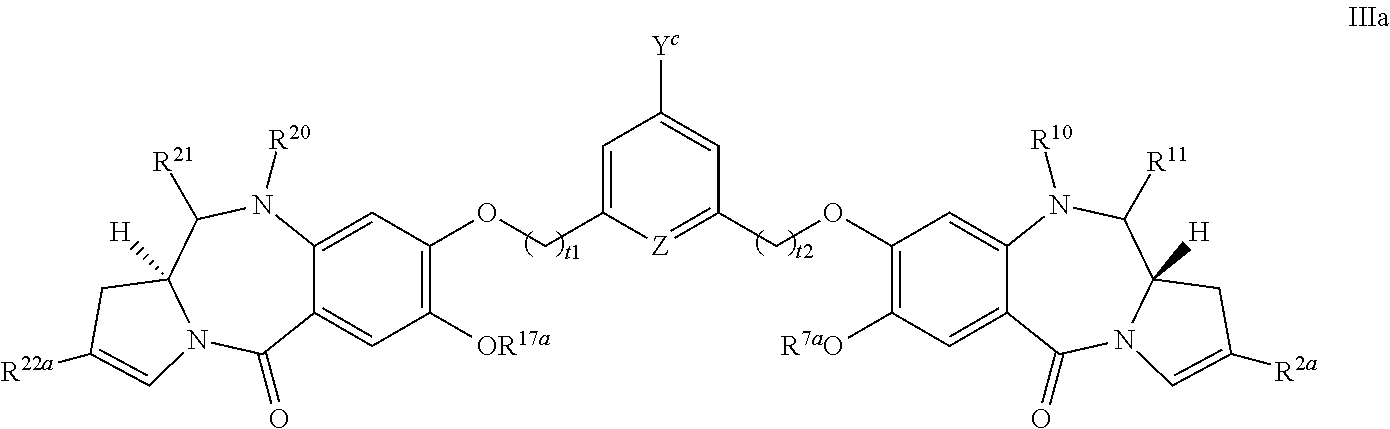
where
R10, R11, R20, R21 and YC are as defined above;
t1 and t2 are an independently selected from 0, 1 and 2;
R7a and R17a are independently selected from methyl and phenyl;
R2a and R22a are independently selected from:
(a)

(b)

(c)

(d)

(e)

(f)

(g)

and
(h)


-
- where the asterisk indicates the point of attachment to the rest of group Y, the wavy line indicates the point of attachment to the cell binding agent, and m is an integer selected from the range 0 to 6. In one embodiment, m is selected from 2, 3, 4 and 5.

-
- where the asterisk indicates the point of attachment to the remaining portion of the L group or the remaining portion of the Y group and the wavy line indicates the point of attachment to the remaining portion of the cell binding agent. In this embodiment, the S atom is typically derived from the cell binding agent.

-
- where the wavy line indicates the point of attachment to the cell binding agent as before, and the asterisk indicates the bond to the remaining portion of the L group or the remaining portion of the Y group.

-
- where the wavy line indicates point of attachment to the cell binding agent, and the asterisk indicates the bond to the remaining portion of the L group or the remaining portion of the Y group.
-
- —C(═O)NH—.
- —C(═O)O—,
- —NHC(═O)—,
- —OC(═O)—,
- —OC(═O)O—,
- —NHC(═O)O—,
- —OC(═O)NH—,
- —NHC(═O)NH—,
- —NHC(═O)NH,
- —C(═O)NHC(═O)—,
- —S—,
- —S—S—,
- —CH2C(═O)—
- —C(═O)CH2—,
- ═N—NH—, and
- ═NH—N═.

-LA-(CH2)m—


where Ar represents a C5-6 arylene group, e.g. phenylene.
-LA-(CH2)m—O— (L2)
-LA-(CH2)q—O—C(═O)—NH—(CH2)p— (L3)

-
- -Phe-Lys-,
- -Val-Ala-,
- -Val-Lys-,
- -Ala-Lys-,
- -Val-Cit-,
- -Phe-Cit-,
- -Leu-Cit-,
- -Ile-Cit-,
- -Phe-Arg-,
- -Trp-Cit-
where Cit is citrulline.
-
- -Phe-Lys-,
- -Val-Ala-,
- -Val-Lys-,
- -Ala-Lys-,
- -Val-Cit-.
-
- Arg: Z, Mtr, Tos;
- Asn: Trt, Xan;
- Asp: Bzl, t-Bu;
- Cys: Acm, Bzl, Bzl-OMe, Bzl-Me, Trt;
- Glu: Bzl, t-Bu;
- Gin: Trt, Xan;
- His: Boc, Dnp, Tos, Trt;
- Lys: Boc, Z—Cl, Fmoc, Z, Alloc;
- Ser: Bzl, TBDMS, TBDPS;
- Thr: Bz;
- Trp: Boc;
- Tyr: Bzl. Z, Z—Br.
GA-(CH2)m—


where Ar represents a C5-6 arylene group, e.g. phenylene.
GA-(CH2)m—O— (G2)
GA-(CH2)q—O—C(═O)—NH—(CH2)p— (L3)

(2) E16 (LAT1, SLC7A5, Genbank accession no. NM_003486) Biochem. Biophys. Res. Commun. 255 (2), 283-288 (1999), Nature 395 (6699):288-291 (1998), Gaugitsch, H. W., et al (1992) J. Biol. Chem. 267 (16):11267-11273); WO2004/048938 (Example 2); WO2004/032842 (Example IV); WO2003/042661 (Claim 12); WO2003/016475 (Claim 1); WO2002/78524 (Example 2); WO2002/99074 (Claim 19; Page 127-129); WO2002/86443 (Claim 27; Pages 222, 393); WO2003/003906 (Claim 10; Page 293); WO2002/64798 (Claim 33; Page 93-95); WO2000/14228 (Claim 5; Page 133-136); US2003/224454 (FIG. 3); WO2003/025138 (Claim 12; Page 150); NP_003477 solute carrier family 7 (cationic amino acid transporter, y+system), member 5/pid=NP_003477.3-Homo sapiens; Cross-references: MIM:600182; NP_003477.3; NM_015923; NM_003486_1
(3) STEAP1 (six transmembrane epithelial antigen of prostate, Genbank accession no. NM_012449); Cancer Res. 61 (15), 5857-5860 (2001), Hubert, R. S., et al (1999) Proc. Natl. Acad. Sci. U.S.A. 96 (25):14523-14528); WO20041065577 (Claim 6); WO2004/027049 (FIG. 1L); EP1394274 (Example 11); WO2004/016225 (Claim 2); WO2003/042661 (Claim 12); US2003/157089 (Example 5); US2003/185830 (Example 5); US2003/064397 (FIG. 2); WO2002/89747 (Example 5; Page 618-619); WO2003/022995 (Example 9; FIG. 13A, Example 53; Page 173, Example 2; FIG. 2A); NP_036581 six transmembrane epithelial antigen of the prostate; Cross-references: MIM:604415; NP_036581.1; NM_012449_1
(4) 0772P (CA125, MUC16, Genbank accession no. AF361486); J. Biol. Chem. 276 (29):27371-27375 (2001)); WO20041045553 (Claim 14); WO2002/92836 (Claim 6; FIG. 12); WO2002/83866 (Claim 15; Page 116-121); US2003/124140 (Example 16); Cross-references: GI:34501467; AAK74120.3; AF361486_1
(5) MPF (MPF, MSLN, SMR, megakaryocyte potentiating factor, mesothelin, Genbank accession no. NM_005823) Yamaguchi, N., et al Biol. Chem. 269 (2), 805-808 (1994), Proc. Natl. Acad. Sci. U.S.A. 96 (20):11531-11536 (1999), Proc. Natl. Acad. Sci. U.S.A. 93 (1):136-140 (1996), J. Biol. Chem. 270 (37):21984-21990 (1995)); WO2003/101283 (Claim 14); (WO02002/102235 (Claim 13; Page 287-288); WO2002/101075 (Claim 4; Page 308-309); WO2002/71928 (Page 320-321); WO094/10312 (Page 52-57); Cross-references: MIM:601051; NP_005814.2; NM_005823_1
(6) Napi3b (NAPI-3B, NaPi2B, NPTIIb. SLC34A2, solute carrier family 34 (sodium phosphate), member 2, type 11 sodium-dependent phosphate transporter 3b, Genbank accession no. NM_006424) J. Biol. Chem. 277 (22):19665-19672 (2002), Genomics 62 (2):281-284 (1999), Feild, J. A., et al (1999) Biochem. Biophys. Res. Commun. 258 (3):578-582): WO2004/022778 (Claim 2); EP1394274 (Example 11): WO2002/102235 (Claim 13; Page 326); EP0875569 (Claim 1; Page 17-19); WO02001/57188 (Claim 20; Page 329); WO2004/032842 (Example IV); WO2001/75177 (Claim 24; Page 139-140); Cross-references: MIM:604217; NP_006415.1; NM_006424_1.
(7) Sema 5b (FLJ10372, KIAA1445, Mm.42015, SEMA5B, SEMAG, Semaphorin 5b Hlog, sema domain, seven thrombospondin repeats (type 1 and type 1-like), transmembrane domain (TM) and short cytoplasmic domain, (semaphorin) 5B, Genbank accession no. AB040878); Nagase T., et al (2000) DNA Res. 7 (2):143-150); WO2004/000997 (Claim 1): WO2003/003984 (Claim 1); WO2002/06339 (Claim 1; Page 50); WO2001/88133 (Claim 1; Page 41-43, 48-58); WO2003/054152 (Claim 20); WO2003/101400 (Claim 11); Accession: Q9P283; EMBL; AB040878; BAA95969.1. Genew; HGNC:10737
(8) PSCA hlg (2700050C12Rik, C530008O16Rik, RIKEN cDNA 2700050C12, RIKEN cDNA 2700050C12 gene, Genbank accession no. AY358628); Ross et al (2002) Cancer Res. 62:2546-2553; US2003/129192 (Claim 2); US2004/044180 (Claim 12); US2004/044179 (Claim 11); US2003/096961 (Claim 11); US2003/232056 (Example 5); WO2003/105758 (Claim 12); US2003/206918 (Example 5); EP1347046 (Claim 1); WO20031025148 (Claim 20); Cross-references: GI:37182378; AAQ88991.1 AY358628_1
(9) ETBR (Endothelin type B receptor, Genbank accession no. AY275463); Nakamuta M., et at Biochem. Biophys. Res. Commun. 177, 34-39, 1991; Ogawa Y., et al Biochem. Biophys. Res. Commun. 178, 248-255, 1991; Arai H., et al Jpn. Circ. J. 56, 1303-1307, 1992; Arai H., et al J. Biol. Chem. 268, 3463-3470, 1993; Sakamoto A., Yanagisawa M., et al Biochem. Biophys. Res. Commun. 178, 656-663, 1991; Elshourbagy N. A., et al J. Biol. Chem. 268, 3873-3879, 1993; Haendler B., et al J. Cardiovasc. Pharmacol. 20, s1-S4, 1992; Tsutsumi M., et al Gene 228, 43-49, 1999; Strausberg R. L., et al Proc. Natl. Acad. Sci. U.S.A. 99, 16899-16903, 2002; Bourgeois C., et al J. Clin. Endocrinol. Metab. 82, 3116-3123, 1997; Okamoto Y., et al Biol. Chem. 272, 21589-21596, 1997; Verheij J. B., et al Am. J. Med. Genet. 108, 223-225, 2002; Hofstra R. M. W., et al Eur. J. Hum. Genet. 5, 180-185, 1997; Puffenberger E. G., et al Cell 79, 1257-1266, 1994; Attie T., et al, Hum. Mol. Genet. 4, 2407-2409, 1995; Auricchio A., et al Hum. Mol. Genet. 5:351-354, 1996; Amiel J., et al Hum. Mol. Genet. 5, 355-357, 1996: Hofstra R. M. W., et al Nat. Genet. 12, 445-447, 1996; Svensson P. J., et al Hum. Genet. 103, 145-148, 1998; Fuchs S., et al Mol. Med. 7, 115-124, 2001; Pingault V., et al (2002) Hum. Genet. 111, 198-206; WO2004/045516 (Claim 1); WO02004/048938 (Example 2); WO2041040000 (Claim 151); WO20031087768 (Claim 1); WO2003/016475 (Claim 1); WO2003/016475 (Claim 1); WO2002/61087 (FIG. 1); WO20031016494 (FIG. 6); WO2003/025138 (Claim 12; Page 144); WO2001/98351 (Claim 1; Page 124-125); EP0522868 (Claim 8; FIG. 2); WO2001/77172 (Claim 1; Page 297-299); US2003/109676; U.S. Pat. No. 6,518,404 (FIG. 3); U.S. Pat. No. 5,773,223 (Claim 1a; Col 31-34); WO2004/001004 (10) MSG783 (RNF124, hypothetical protein FLJ20315, Genbank accession no. NM_017763); WO2003/104275 (Claim 1); WO02004/046342 (Example 2); WO20031042661 (Claim 12); WO2003/083074 (Claim 14; Page 61); WO2003/018621 (Claim 1); WO2003/024392 (Claim 2; FIG. 93); WO2001/66689 (Example 6); Cross-references: LocusID:54894; NP_060233.2; NM_017763_1
(11) STEAP2 (HGNC_8639, IPCA-1, PCANAP1, STAMP1, STEAP2, STMP, prostate cancer associated gene 1, prostate cancer associated protein 1, six transmembrane epithelial antigen of prostate 2, six transmembrane prostate protein, Genbank accession no. AF455138); Lab. Invest. 82 (11):1573-1582 (2002)); WO20031087306; US2003/064397 (Claim 1; FIG. 1): WO2002/72596 (Claim 13; Page 54-55); WO2001172962 (Claim 1; FIG. 4B); WO2003/104270 (Claim 11); WO2003/104270 (Claim 16); US2004/005598 (Claim 22); WO2003/042661 (Claim 12); US2003/060612 (Claim 12; FIG. 10); WO2002/26822 (Claim 23; FIG. 2); WO2002/16429 (Claim 12; FIG. 10); Cross-references: GI:22655488; AAN04080.1; AF455138_1
(12) TrpM4 (BR22450, FLJ20041, TRPM4, TRPM4B, transient receptor potential cation channel, subfamily M, member 4, Genbank accession no. NM_017636); Xu, X. Z., et al Proc. Natl. Acad. Sci. U.S.A. 98 (19):10692-10697 (2001), Cell 109 (3):397-407 (2002), J. Biol. Chem. 278 (33):30813-30820 (2003)); US20031143557 (Claim 4); WO2000/40614 (Claim 14; Page 100-103); WO2002/10382 (Claim 1; FIG. 9A); WO20031042661 (Claim 12); WO02002/30268 (Claim 27; Page 391); US2003/219806 (Claim 4); WO2001/62794 (Claim 14; FIG. 1A-D); Cross-references: MIM:606936; NP_060106.2; NM_017636_1
(13) CRIPTO (CR, CR1, CRGF, CRIPTO, TDGF1, teratocarcinoma-derived growth factor, Genbank accession no. NP 003203 or NM_003212); Ciccodicola, A., et al EMBO J. 8 (7):1987-1991 (1989), Am. J. Hum. Genet. 49 (3):555-565 (1991)); US2003/224411 (Claim 1); WO2003/083041 (Example 1); WO2003/034984 (Claim 12); WO2002/88170 (Claim 2; Page 52-53); WO2003/024392 (Claim 2; FIG. 58); WO02002/16413 (Claim 1; Page 94-95, 105); WO2002/22808 (Claim 2; FIG. 1); U.S. Pat. No. 5,854,399 (Example 2; Col 17-18); U.S. Pat. No. 5,792,616 (FIG. 2); Cross-references: MIM:187395; NP_003203.1; NM_003212_1
(14) CD21 (CR2 (Complement receptor 2) or C3DR (C3d/Epstein Barr virus receptor) or Hs.73792 Genbank accession no. M26004); Fujisaku et al (1989) J. Biol. Chem. 264 (4):2118-2125); Weis J. J., et al J. Exp. Med. 167, 1047-1066, 1988; Moore M., et al Proc. Natl. Acad. Sci. U.S.A. 84, 9194-9198, 1987; Barel M., et al Mol. Immunol. 35, 1025-1031, 1998; Weis J. J., et al Proc. Natl. Acad. Sci. U.S.A. 83, 5639-5643, 1986; Sinha S. K., et al (1993) J. Immunol. 150, 5311-5320; WO2004/045520 (Example 4); US2004/005538 (Example 1); WO02003/062401 (Claim 9); WO02004/045520 (Example 4); WO91/02536 (FIGS. 9.1-9.9); WO2004/020595 (Claim 1); Accession: P20023; Q13866; Q14212; EMBL; M26004; AAA35786.1.
(15) CD79b (CD79B, CD79β, IGb (immunoglobulin-associated beta), B29, Genbank accession no. NM_000626 or 11038674); Proc. Natl. Acad. Sci. U.S.A. (2003) 100 (7):4126-4131, Blood (2002) 100 (9):3068-3076, Muller et al (1992) Eur. J. Immunol. 22 (6):1621-1625); WO2004/016225 (claim 2, FIG. 140); WO2003/087768, US2004/101874 (claim 1, page 102); WO2003062401 (claim 9); WO2002/78524 (Example 2); US2002/150573 (claim 5, page 15); U.S. Pat. No. 5,644,033; WO2003/048202 (claim 1, pages 306 and 309); WO 99/58658, U.S. Pat. No. 6,534,482 (claim 13, FIG. 17A/B); WO2000/55351 (claim 11, pages 1145-1146); Cross-references: MIM:147245; NP 000617.1; NM 000626_1
(16) FcRH2 (IFGP4, IRTA4, SPAP1A (SH2 domain containing phosphatase anchor protein 1a), SPAP1B, SPAP1C, Genbank accession no. NM_030764, AY358130); Genome Res. 13 (10):2265-2270 (2003), Immunogenetics 54 (2):87-95 (2002), Blood 99 (8):2662-2669 (2002), Proc. Natl. Acad. Sci. U.S.A. 98 (17):9772-9777 (2001), Xu, M. J., et al (2001) Biochem. Biophys. Res. Commun. 280 (3):768-775; WO2004/016225 (Claim 2); WO2003/077836; WO2001138490 (Claim 5; FIG. 18D-1-18D-2); WO2003/097803 (Claim 12); WO2003/089624 (Claim 25); Cross-references: MIM:606509; NP_110391.2; NM_030764_1
(17) HER2 (ErbB2, Genbank accession no. M11730); Coussens L., et al Science (1985) 230(4730):1132-1139); Yamamoto T., et al Nature 319, 230-234, 1986; Semba K., et al Proc. Natl. Acad. Sci. U.S.A. 82, 6497-6501, 1985; Swiercz J M., et al J. Cell Biol. 165, 869-880, 2004; Kuhns J. J., et al J. Biol. Chem. 274, 36422-36427, 1999; Cho H.-S., et al Nature 421, 756-760, 2003; Ehsani A., et al (1993) Genomics 15, 426-429; WO2004/048938 (Example 2); WO2004/027049 (FIG. 11); WO2004/009622; WO2003/081210; WO2003/089904 (Claim 9); WO2003/016475 (Claim 1); US2003/118592; WO2003/008537 (Claim 1); WO020031055439 (Claim 29; FIG. 1A-B); WO20031025228 (Claim 37; FIG. 5C); WO02002/22636 (Example 13; Page 95-107); WO2002/12341 (Claim 68; FIG. 7); WO2002/13847 (Page 71-74); WO2002/14503 (Page 114-117); WO02001/53463 (Claim 2; Page 41-46); WO2001/41787 (Page 15); WO2000/44899 (Claim 52; FIG. 7); WO2000/20579 (Claim 3; FIG. 2); U.S. Pat. No. 5,869,445 (Claim 3; Col 31-38); WO9630514 (Claim 2; Page 56-61); EP1439393 (Claim 7); WO2004/043361 (Claim 7); WO2004/022709; WO2001/00244 (Example 3: FIG. 4); Accession: P04626: EMBL; M11767; AAA35808.1. EMBL; M11761; AAA35808.1. In certain embodiments, conjugate compounds of the invention comprise anti-HER2 antibodies. In one embodiment of the invention, an anti-HER2 antibody of an ADC of the invention comprises a humanized anti-HER2 antibody, e.g., huMAb4D5-1, huMAb4D5-2, huMAb4D5-3, huMAb4D5-4, huMAb4D5-5, huMAb4D5-6, huMAb4D5-7 and huMAb4D5-8, as described in Table 3 of U.S. Pat. No. 5,821,337. Those antibodies contain human framework regions with the complementarity-determining regions of a murine antibody (4D5) that binds to HER2. The humanized antibody huMAb4D5-8 is also referred to as trastuzumab, commercially available under the tradename HERCEPTIN. In another embodiment of the invention, an anti-HER2 antibody of an ADC of the invention comprises a humanized anti-HER2 antibody, e.g., humanized 2C4, as described in U.S. Pat. No. 7,862,817. An exemplary humanized 2C4 antibody is pertuzumab, commercially available under the tradename PERJETA.
(18) NCA (CEACAM6, Genbank accession no. M18728); Barnett T., et al Genomics 3, 59-66, 1988; Tawaragi Y., et al Biochem. Biophys. Res. Commun. 150, 89-96, 1988; Strausberg R. L., et al Proc. Natl. Acad. Sci. U.S.A. 99:16899-16903, 2002; WO2004/063709; EP1439393 (Claim 7); WO2004/044178 (Example 4); WO2004/031238; WO2003/042661 (Claim 12); WO2002/78524 (Example 2); WO2002/86443 (Claim 27; Page 427); WO2002/60317 (Claim 2); Accession: P40199; Q14920; EMBL; M29541; AAA59915.1. EMBL; M18728
(19) MDP (DPEP1, Genbank accession no. BC017023); Proc. Natl. Acad. Sci. U.S.A. 99 (26):16899-16903 (2002)); WO2003/016475 (Claim 1); WO2002/64798 (Claim 33; Page 85-87); JP05003790 (FIG. 6-8); WO99/46284 (FIG. 9); Cross-references: MIM:179780; AAH17023.1; BC017023_1
(20) IL20Rα (IL20Rα, ZCYTOR7, Genbank accession no. AF184971); Clark H. F., et al Genome Res. 13, 2265-2270, 2003; Mungall A. J., et al Nature 425, 805-811, 2003; Blumberg H., et al Cell 104, 9-19, 2001; Dumoutier L., et al J. Immunol. 167, 3545-3549, 2001; Parrish-Novak J., et al J. Biol. Chem. 277, 47517-47523, 2002; Pletnev S., et al (2003) Biochemistry 42:12617-12624; Sheikh F., et al (2004) J. Immuno. 172, 2006-2010; EP1394274 (Example 11); US2004/005320 (Example 5); WO02003/029262 (Page 74-75); WO2003/002717 (Claim 2; Page 63); WO2002/22153 (Page 45-47); US2002/042366 (Page 20-21); WO2001146261 (Page 57-59); WO2001/46232 (Page 63-65); WO98/37193 (Claim 1; Page 55-59); Accession: Q9UHF4; Q6UWA9; Q96SH8; EMBL; AF184971; AAF01320.1.
(21) Brevican (BCAN, BEHAB, Genbank accession no. AF229053); Gary S. C., et al Gene 256, 139-147, 2000; Clark H. F., et al Genome Res. 13, 2265-2270, 2003; Strausberg R. L., et al Proc. Natl. Acad. Sci. U.S.A. 99, 16899-16903, 2002; US2003/186372 (Claim 11); US2003/186373 (Claim 11); US2003/119131 (Claim 1; FIG. 52); US2003/119122 (Claim 1; FIG. 52); US2003/119126 (Claim 1); US2003/119121 (Claim 1; FIG. 52); US2003/119129 (Claim 1); US2003/119130 (Claim 1); US2003/119128 (Claim 1; FIG. 52); US2003/119125 (Claim 1); WO2003/016475 (Claim 1); WO2002/02634 (Claim 1)
(22) EphB2R (DRT, ERK, Hek5, EPHT3, Tyro5, Genbank accession no. NM_004442); Chan, J. and Watt, V. M., Oncogene 6 (6), 1057-1061 (1991) Oncogene 10 (5):897-905 (1995), Annu. Rev. Neurosci. 21:309-345 (1998), Int. Rev. Cytol. 196:177-244 (2000)): WO2003042661 (Claim 12); WO200053216 (Claim 1; Page 41); WO2004065576 (Claim 1); WO2004020583 (Claim 9); WO2003004529 (Page 128-132); WO200053216 (Claim 1; Page 42); Cross-references: MIM:600997; NP_004433.2; NM_004442_1
(23) ASLG659 (B7h, Genbank accession no. AX092328); US2004/0101899 (Claim 2); WO2003104399 (Claim 11); WO2004000221 (FIG. 3); US2003/165504 (Claim 1); US2003/124140 (Example 2); US2003/065143 (FIG. 60); WO2002/102235 (Claim 13; Page 299); US2003/091580 (Example 2); WO2002110187 (Claim 6; FIG. 10); WO2001/94641 (Claim 12; FIG. 7b); WO2002/02624 (Claim 13; FIG. 1A-1B); US2002/034749 (Claim 54; Page 45-46); WO2002/06317 (Example 2; Page 320-321, Claim 34; Page 321-322); WO02002/71928 (Page 468-469); WO2002/02587 (Example 1; FIG. 1); WO2001/40269 (Example 3; Pages 190-192); WO2000136107 (Example 2; Page 205-207); WO2004/053079 (Claim 12); WO2003/004989 (Claim 1); WO2002/71928 (Page 233-234, 452-453); WO 01/16318
(24) PSCA (Prostate stem cell antigen precursor, Genbank accession no. AJ297436); Reiter R. E., et al Proc. Natl. Acad. Sci. U.S.A. 95, 1735-1740, 1998; Gu Z., et al Oncogene 19, 1288-1296, 2000; Biochem. Biophys. Res. Commun. (2000) 275(3):783-788; WO2004/022709; EP1394274 (Example 11); US2004/018553 (Claim 17); WO2003/008537 (Claim 1); WO02002181646 (Claim 1; Page 164); WO2003/003906 (Claim 10; Page 288); WO2001/40309 (Example 1; FIG. 17); US20011/055751 (Example 1; FIG. 1b); WO2000/32752 (Claim 18; FIG. 1); WO98/51805 (Claim 17; Page 97); WO98/51824 (Claim 10; Page 94); WO98/40403 (Claim 2; FIG. 1B); Accession: 043653; EMBL; AF043498; AAC39607.1
(25) GEDA (Genbank accession No. AY260763); AAP14954 lipoma HMGIC fusion-partner-like protein ipid=AAP14954.1-Homo sapiens (human); WO2003/054152 (Claim 20); WO2003/000842 (Claim 1); WO2003/023013 (Example 3, Claim 20); US20031194704 (Claim 45); Cross-references: GI:30102449; AAP14954.1; AY260763_1
(26) BAFF-R (B cell-activating factor receptor, BLyS receptor 3, BR3, Genbank accession No. AF116456); BAFF receptor/pid=NP_443177.1-Homo sapiens: Thompson, J. S., et al Science 293 (5537), 2108-2111 (2001); WO2004/058309; WO02004/011611; WO2003/045422 (Example: Page 32-33); WO2003/014294 (Claim 35; FIG. 6B); WO2003/035846 (Claim 70; Page 615-616); WO2002/94852 (Col 136-137); WO2002/38766 (Claim 3; Page 133); WO2002/24909 (Example 3; FIG. 3); Cross-references: MIM:606269; NP_443177.1; NM_052945_1; AF132600
(27) CD22 (B-cell receptor CD22-B isoform, BL-CAM, Lyb-8, Lyb8, SIGLEC-2, FLJ22814, Genbank accession No. AK026467); Wilson et al (1991) J. Exp. Med. 173:137-146; WO2003/072036 (Claim 1; FIG. 1); Cross-references: MIM:107266; NP_001762.1; NM_001771_1.
(28) CD79a (CD79A, CD79α, immunoglobulin-associated alpha, a B cell-specific protein that covalently interacts with Ig beta (CD79B) and forms a complex on the surface with Ig M molecules, transduces a signal involved in B-cell differentiation), pl: 4.84, MW: 25028 TM: 2 [P] Gene Chromosome: 19q13.2, Genbank accession No. NP 001774.10); WO2003/088808, US2003/0228319; WO2003/062401 (claim 9); US2002/150573 (claim 4, pages 13-14); WO99/58658 (claim 13, FIG. 16); WO92/07574 (FIG. 1); U.S. Pat. No. 5,644,033; Ha et al (1992) J. Immunol. 148(5):1526-1531; Müller et al (1992) Eur. J. Immunol. 22:1621-1625; Hashimoto et al (1994) Immunogenetics 40(4):287-295: Preud'homme eat al (1992) Clin. Exp. Immunol. 90(1):141-146; Yu et al (1992) J. Immunol. 148 (2) 633-637; Sakaguchi et al (1988) EMBO J. 7(11):3457-3464
(29) CXCR5 (Burkitt's lymphoma receptor 1, a CG protein-coupled receptor that is activated by the CXCL13 chemokine, functions in lymphocyte migration and humoral defense, plays a role in HIV-2 infection and perhaps development of AIDS, lymphoma, myeloma, and leukemia); 372 aa, pl: 8.54 MW: 41959 TM: 7 [P] Gene Chromosome: 11q23.3, Genbank accession No. NP 0.001707.1); WO2004/040000; WO2004/015426; US2003/105292 (Example 2); U.S. Pat. No. 6,555,339 (Example 2); WO200261087 (FIG. 1); WO2001157188 (Claim 20, page 269); WO2001/72830 (pages 12-13); WO2000/22129 (Example 1, pages 152-153, Example 2, pages 254-256); WO99/28468 (claim 1, page 38); U.S. Pat. No. 5,440,021 (Example 2, col 49-52): WO094/28931 (pages 56-58): WO92/17497 (claim 7, FIG. 5); Dobner et al (1992) Eur. J. Immunol. 22:2795-2799; Barella et al (1995) Biochem. J. 309:773-779
(30) HLA-DOB (Beta subunit of MHC class II molecule (Ia antigen) that binds peptides and presents them to CD4+T lymphocytes); 273 aa. pl: 6.56, MW: 30820.TM: 1 [P] Gene Chromosome: 6p21.3, Genbank accession No. NP_002111.1); Tonnelle et al (1985) EMBO J. 4(11):2839-2847; Jonsson et al (1989) Immunogenetics 29(6):411-413; Beck et al (1992) J. Mo. Biol. 228:433-441; Strausberg et al (2002) Proc. Natl. Acad. Sci USA 99:16899-16903; Servenius et al (1987) J. Biol. Chem. 262:8759-8766; Beck et al (1996) J. Mol. Biol. 255:1-13; Naruse et al (2002) Tissue Antigens 59:512-519; WO99/58658 (claim 13, FIG. 15); U.S. Pat. No. 6,153,408 (Col 35-38); U.S. Pat. No. 5,976,551 (col 168-170); U.S. Pat. No. 6,011,146 (col 145-146); Kasahara et al (1989) Immunogenetics 30(1):66-68; Larhammar et al (1985) J. Biol. Chem. 260(26):14111-14119
(31) P2X5 (Purinergic receptor P2X ligand-gated ion channel 5, an ion channel gated by extracellular ATP, may be involved in synaptic transmission and neurogenesis, deficiency may contribute to the pathophysiology of idiopathic detrusor instability); 422 aa), pl: 7.63, MW: 47206 TM: 1 [P] Gene Chromosome: 17p13.3, Genbank accession No. NP_002552.2); Le et al (1997) FEBS Lett. 418(1-2):195-199; WO2004/047749; WO2003/072035 (claim 10); Touchman et al (2000) Genome Res. 10:165-173; WO2002/22660 (claim 20); WO2003/093444 (claim 1); WO2003/087768 (claim 1); WO02003/029277 (page 82)
(32) CD72 (B-cell differentiation antigen CD72, Lyb-2); 359 aa, pl: 8.66, MW: 40225, TM: 1 [P] Gene Chromosome: 9p13.3, Genbank accession No. NP_001773.1); WO2004042346 (claim 65); WO2003/026493 (pages 51-52, 57-58); WO2000/75655 (pages 105-106); Von Hoegen et al (1990) J. Immunol. 144(12):4870-4877; Strausberg et al (2002) Proc. Natl. Acad. Sci USA 99:16899-16903.
(33) LY64 (Lymphocyte antigen 64 (RP105), type I membrane protein of the leucine rich repeat (LRR) family, regulates B-cell activation and apoptosis, loss of function is associated with increased disease activity in patients with systemic lupus erythematosis); 661 aa, pl: 6.20, MW: 74147 TM: 1 [P] Gene Chromosome: 5q12, Genbank accession No. NP_005573.1); US2002/193567; WO97/07198 (claim 11, pages 39-42); Miura at al (1996) Genomics 38(3):299-304; Miura et al (1998) Blood 92:2815-2822; WO2003/083047; WO97/44452 (claim 8, pages 57-61); WO2000112130 (pages 24-26)
(34) FcRH1 (Fc receptor-like protein 1, a putative receptor for the immunoglobulin Fc domain that contains C2 type Ig-like and ITAM domains, may have a role in B-lymphocyte differentiation); 429 aa, pl: 5.28, MW: 46925 TM: 1 [P] Gene Chromosome: 1q21-1q22, Genbank accession No. NP_443170.1); WO2003/077836; WO2001/38490 (claim 6, FIG. 18E-1-18-E-2); Davis et al (2001) Proc. Natl. Acad. Sci USA 98(17):9772-9777; WO02003/089624 (claim 8); EP1347046 (claim 1); WO2003/089624 (claim 7)
(35) IRTA2 (Immunoglobulin superfamily receptor translocation associated 2, a putative immunoreceptor with possible roles in B cell development and lymphomagenesis; deregulation of the gene by translocation occurs in some B cell malignancies); 977 aa, pl: 6.88, MW: 106468, TM: 1 [P] Gene Chromosome: 1q21, Genbank accession No. Human:AF343662, AF343663, AF343664, AF343665, AF369794, AF397453. AK090423, AK090475, AL834187, AY358085; Mouse:AK089756, AY158090, AY506558; NP_112571.1; WO2003/024392 (claim 2, FIG. 97); Nakayama et al (2000) Biochem. Biophys. Res. Commun. 277(1):124-127; WO2003/077836; WO2001/38490 (claim 3, FIG. 18B-1-18B-2)
(36) TENB2 (TMEFF2, tomoregulin, TPEF, HPP1, TR, putative transmembrane proteoglycan, related to the EGF/heregulin family of growth factors and follistatin); 374 aa, NCBI Accession: AAD55776, AAF91397, AAG49451, NCBI RefSeq: NP_057276; NCBI Gene: 23671; OMIM: 605734; SwissProt Q9UIK5; Genbank accession No. AF179274; AY358907, CAF85723, CQ782436; WO2004/074320; JP2004113151; WO2003/042661; WO2003/009814; EP1295944 (pages 69-70); WO2002130268 (page 329); WO2001190304: US2004/249130; US2004/022727; WO2004/063355; US2004/197325; US2003/232350; US2004/005563; US2003/124579; Horie et al (2000) Genomics 67:146-152; Uchida et al (1999) Biochem. Biophys. Res. Commun. 266:593-602; Liang et al (2000) Cancer Res. 60:4907-12; Glynne-Jones et al (2001) Int J Cancer. October 15; 94(2):178-84.
(37) CD33 (CD33 molecule, SIGLEC-3, SIGLEC3, p67; CD33 antigen (gp67); gp67; myeloid cell surface antigen CD33; sialic acid binding Ig-like lectin 3; sialic acid-binding Ig-like lectin); Nucleotide: Genbank accession no. M_23197; Genbank version no. NM_23197.1 GI:180097; Genbank record update date: Jun. 23, 2010 08:47 AM: Polypeptide: Genbank accession no. AAA51948; Genbank version no. AAA51948.1 GI:188098; Genbank record update date: Jun. 23, 2010 08:47 AM; Simmons D., et al J. Immunol. 141 (8), 2797-2800 (1988); Antibodies: H195 (Lintuzumab)-Raza A., et al Leuk Lymphoma. 2009 August; 50(8):1336-44; U.S. Pat. No. 6,759,045 (Seattle Genetics/Immunomedics): mAb OKT9: Sutherland, D. R. et al. Proc Natl. Acad Sci USA 78(7): 4515-4519 1981, Schneider, C., et al J Biol Chem 257, 8516-8522 (1982); mAb E6: Hoogenboom, H. R., et al J Immunol 144, 3211-3217 (1990); U.S. Pat. No. 6,590,088 (Human Genome Sciences)—for example, SEQ ID NOs: 1 and 2 and ATCC accession no. 97521; U.S. Pat. No. 7,557,189 (Immunogen)—for example, an antibody or fragment thereof comprising a heavy chain variable region which comprises three CDRs having the amino acid sequences of SEQ ID NOs:1-3 and a light chain variable region comprising three CDRs having the amino acid sequences of SEQ ID NOs:4-6.
(38) LGR5/GPR49; Nucleotide: Genbank accession no. NM_003667; Genbank version no. NM_003667.2 GI:24475886; Genbank record update date: Jul. 22, 2012 03:38 PM; Polypeptide: Genbank accession no. NP 003658; Genbank version no. NP_003658.1 GI:4504379; Genbank record update date: Jul. 22, 2012 03:38 PM.
-
- saturated monocyclic hydrocarbon compounds:
cyclopropane (C3), cyclobutane (C4), cyclopentane (C5), cyclohexane (C6), cycloheptane (C7), methylcyclopropane (C4), dimethylcyclopropane (C5), methylcyclobutane (C5), dimethylcyclobutane (C5), methylcyclopentane (C6), dimethylcyclopentane (C7) and methylcyclohexane (C7); - unsaturated monocyclic hydrocarbon compounds:
cyclopropene (C3), cyclobutene (C4), cyclopentene (C5), cyclohexene (C6), methylcyclopropene (C4), dimethylcyclopropene (C5), methylcyclobutene (C5), dimethylcyclobutene (C6), methylcyclopentene (C6), dimethylcyclopentene (C7) and methylcyclohexene (C7); and - saturated polycyclic hydrocarbon compounds:
norcarane (C7), norpinane (C7), norbornane (C7).
- saturated monocyclic hydrocarbon compounds:
O2: dioxolane (C5), dioxane (C6), and dioxepane (C7);
O3: trioxane (C6);
N2: imidazolidine (C5), pyrazolidine (diazolidine) (C5), imidazoline (C5), pyrazoline (dihydropyrazole) (C5), piperazine (C6);
N1O1: tetrahydrooxazole (C5), dihydrooxazole (C5), tetrahydroisoxazole (C5), dihydroisoxazole (C5), morpholine (C6), tetrahydrooxazine (C6), dihydrooxazine (C6), oxazine (C6);
N1S1: thiazoline (C5), thiazolidine (C5), thiomorpholine (C6);
N2O1: oxadiazine (C6);
O1S1: oxathiole (C5) and oxathiane (thioxane) (C6); and,
N1O1S1: oxathiazine (C6).
C10 (with 2 fused rings) derived from chromrene (O1), isochromene (O1), chroman (O1), isochroman (O1), benzodioxan (O2), quinoline (N1), isoquinoline (N1), quinolizine (N1), benzoxazine (N1O1), benzodiazine (N2), pyridopyridine (N2), quinoxaline (N2), quinazoline (N2), cinnoline (N2), phthalazine (N2), naphthyridine (N2), pteridine (N4);
C11 (with 2 fused rings) derived from benzodiazepine (N2);
C13 (with 3 fused rings) derived from carbazole (N1), dibenzofuran (O1), dibenzothiophene (S1), carboline (N2), perimidine (N2), pyridoindole (N2); and,
C14 (with 3 fused rings) derived from acridine (N1), xanthene (O1), thioxanthene (S1), oxanthrene (O2), phenoxathiin (O1S1), phenazine (N2), phenoxazine (N1O1), phenothiazine (N1S1), thianthrene (S2), phenanthridine (N1), phenanthroline (N2), phenazine (N2).


- a) WO 00/12508 (pages 14 to 30);
- b) WO 2005/023814 (pages 3 to 10);
- c) WO 2005/085259 (pages 31 to 39)
- d) WO 2011/128650 (pages 2 to 12 and 42 to 51);
- e) PCT/EP2012/070232, filed 12 Oct. 2012 (pages 2 to 15 and 49 to 58).


| ADC | EC50 (μg/ml) | ||
| ConjD | 0.001696 | ||
| ConjE | 0.002766 | ||
| ConjF | 0.003576 | ||
| ConjG | 0.006163 | ||
| ConjC | 0.0006929 | ||
| Abbreviations |
| Ac | acetyl |
| Acm | acetamidomethyl |
| Alloc | allyloxycarbonyl |
| Boc | di-tert-butyl dicarbonate |
| t-Bu | tert-butyl |
| Bzl | benzyl, where Bzl—OMe is methoxybenzyl and |
| Bzl—Me is methylbenzene | |
| Cbz or Z | benzyloxy-carbonyl, where Z—Cl and Z—Br are |
| chloro- and bromobenzyloxy carbonyl respectively | |
| DMF | N,N-dimethylformamide |
| Dnp | dinitrophenyl |
| DTT | dithiothreitol |
| Fmoc | 9H-fluoren-9-ylmethoxycarbonyl |
| imp | N-10 imine protecting group: |
| 3-(2-methoxyethoxy)propanoate-Val-Ala-PAB | |
| MC-OSu | maleimidocaproyl-O-N-succinimide |
| Moc | methoxycarbonyl |
| MP | maleimidopropanamide |
| Mtr | 4-methoxy-2,3,6-trimethtylbenzenesulfonyl |
| PAB | para-aminobenzyloxycarbonyl |
| PEG | ethyleneoxy |
| PNZ | p-nitrobenzyl carbamate |
| Psec | 2-(phenylsulfonyl)ethoxycarbonyl |
| TBDMS | tert-butyldimethylsilyl |
| TBDPS | tert-butyldiphenylsilyl |
| Teoc | 2-(trimethylsilyl)ethoxycarbonyl |
| Tos | tosyl |
| Troc | 2,2,2-trichlorethoxycarbanyl chloride |
| Trt | trityl |
| Xan | xanthyl |
- EP 0522868
- EP 0875569
- EP 1295944
- EP 1347046
- EP 1394274
- EP 1394274
- EP 1439393
- JP 05003790
- JP 2004113151
- JP 58180487
- US 2001/055751
- US 2002/034749
- US 2002/042366
- US 2002/150573
- US 2002/193567
- US 2003/0228319
- US 2003/060612
- US 2003/064397
- US 2003/065143
- US 2003/091580
- US 2003/096961
- US 2003/105292
- US 2003/109676
- US 2003/118592
- US 2003/119121
- US 2003/119122
- US 2003/119125
- US 2003/119126
- US 2003/119128
- US 2003/119129
- US 2003/119130
- US 20031119131
- US 2003/124140
- US 2003/124579
- US 20031129192
- US 2003/134790-A1
- US 20031143557
- US 2003/157089
- US 2003/165504
- US 2003/185830
- US 2003/186372
- US 2003/186373
- US 2003/194704
- US 2003/206918
- US 2003/219806
- US 2003/224411
- US 2003/224454
- US 2003/232056
- US 2003/232350
- US 20030096743
- US 20030130189
- US 2003096743
- US 2003130189
- US 2004/0001827
- US 2004/005320
- US 2004/005538
- US 2004/005563
- US 2004/005598
- US 2004/0101899
- US 2004/018553
- US 2004/022727
- US 2004/044179
- US 2004/044180
- US 2004/101874
- US 2004/197325
- US 2004/249130
- US 20040018194
- US 20040052793
- US 20040052793
- US 20040121940
- US 2005/271615
- US 2006/116422
- U.S. Pat. No. 4,816,567
- U.S. Pat. No. 5,362,852
- U.S. Pat. No. 5,440,021
- U.S. Pat. No. 5,583,024
- U.S. Pat. No. 5,621,002
- U.S. Pat. No. 5,644,033
- U.S. Pat. No. 5,674,713
- U.S. Pat. No. 5,700,670
- U.S. Pat. No. 5,773,223
- U.S. Pat. No. 5,792,616
- U.S. Pat. No. 5,854,399
- U.S. Pat. No. 5,869,445
- U.S. Pat. No. 5,976,551
- U.S. Pat. No. 6,011,146
- U.S. Pat. No. 6,153,408
- U.S. Pat. No. 6,214,345
- U.S. Pat. No. 6,218,519
- U.S. Pat. No. 6,268,488
- U.S. Pat. No. 6,518,404
- U.S. Pat. No. 6,534,482
- U.S. Pat. No. 6,555,339
- U.S. Pat. No. 6,602,677
- U.S. Pat. No. 6,677,435
- U.S. Pat. No. 6,759,509
- U.S. Pat. No. 6,835,807
- U.S. Pat. No. 7,223,837
- U.S. Pat. No. 7,375,078
- U.S. Pat. No. 7,521,541
- U.S. Pat. No. 7,723,485
- WO 00/012508
- WO 00/12507
- WO 00/12508
- WO 01/16318
- WO 01/45746
- WO 02/088172
- WO 03/026577
- WO 03/043583
- WO 04/032828
- WO 2000/12130
- WO 2000/14228
- WO 2000/20579
- WO 2000/22129
- WO 2000/32752
- WO 2000/36107
- WO 2000/40614
- WO 2000/44899
- WO 2000/55351
- WO 2000/75655
- WO 200053216
- WO 2001/00244
- WO 2001/38490
- WO 2001/40269
- WO 2001/40309
- WO 2001/41787
- WO 2001/46232
- WO 2001/46261
- WO 2001/48204
- WO 2001/53463
- WO 2001/57188
- WO 2001/62794
- WO 2001/66689
- WO 2001/72830
- WO 2001/72962
- WO 2001/75177
- WO 2001/77172
- WO 2001/88133
- WO 2001/90304
- WO 2001/94641
- WO 2001/98351
- WO 2002/02587
- WO 2002/02624
- WO 2002/06317
- WO 2002/06339
- WO 2002/101075
- WO 2002/10187
- WO 2002/102235
- WO 2002/10382
- WO 2002/12341
- WO 2002/13847
- WO 2002/14503
- WO 2002/16413
- WO 2002/16429
- WO 2002/22153
- WO 2002/22636
- WO 2002/22660
- WO 2002/22808
- WO 2002/24909
- WO 2002/26822
- WO 2002/30268
- WO 2002/38766
- WO 2002/54940
- WO 2002/59377
- WO 2002/60317
- WO 2002/61087:
- WO 2002/64798
- WO 2002/71928
- WO 2002/72596
- WO 2002/78524
- WO 2002/81646
- WO 2002/83866
- WO 2002/86443
- WO 2002/88170
- WO 2002/89747
- WO 2002/92836
- WO 2002/94852
- WO 2002/98358
- WO 2002/99074
- WO 2002/99122
- WO 2003/000842
- WO 2003/002717
- WO 2003/003906
- WO 2003/003984
- WO 2003/004989
- WO 2003/008537
- WO 2003/009814
- WO 2003/014294
- WO 2003/016475
- WO 2003/016494
- WO 2003/018621
- WO 2003/022995
- WO 2003/023013
- WO 2003/024392
- WO 2003/025138
- WO 2003/025148
- WO 2003/025228
- WO 2003/026493
- WO 2003/029262
- WO 2003/029277
- WO 2003/029421
- WO 2003/034984
- WO 2003/035846
- WO 2003/042661
- WO 2003/045422
- WO 2003/048202
- WO 2003/054152
- WO 2003/055439
- WO 2003/055443
- WO 2003/062401
- WO 2003/062401
- WO 2003/072035
- WO 2003/072036
- WO 2003/077836
- WO 2003/081210
- WO 2003/083041
- WO 2003/083047
- WO 2003/083074
- WO 2003/087306
- WO 2003/087768
- WO 2003/088808
- WO 2003/089624
- WO 2003/089904
- WO 2003/093444
- WO 2003/097803
- WO 2003/101283
- WO 2003/101400
- WO 2003/104270
- WO 2003/104275
- WO 2003/105758
- WO 2003004529
- WO 2003042661
- WO 2003104399
- WO 2004/000997
- WO 2004/001004
- WO 2004/009622
- WO 2004/011611
- WO 2004/015426
- WO 2004/016225
- WO 2004/020595
- WO 2004/022709
- WO 2004/022778
- WO 2004/027049
- WO 2004/031238
- WO 20041/032828
- WO 2004/032842
- WO 2004/040000
- WO 2004/043361
- WO 2004/043963
- WO 2004/044178
- WO 2004/045516
- WO 2004/045520
- WO 2004/045553
- WO 2004/046342
- WO 2004/047749
- WO 2004/048938
- WO 2004/053079
- WO 2004/063355
- WO 2004/063362
- WO 2004/063709
- WO 2004/065577
- WO 2004/074320
- WO 2004000221
- WO 2004020583
- WO 2004042346
- WO 2004065576
- WO 2005/023814
- WO 2005/082023
- WO 2005/085251
- WO 2006/111759
- WO 2007/044515
- WO 2007/085930
- WO 2009/052249
- WO 2010/091150
- WO 91/02536
- WO 92/07574
- WO 92/17497
- WO 94/10312
- WO 94/28931
- WO 9630514
- WO 97/07198
- WO 97/44452
- WO 98/13059
- WO 98/37193
- WO 98/40403
- WO 98/51805
- WO 98/51824
- WO 99/28468
- WO 99/46284
- WO 99/58658
- Am. J. Hum. Genet. 49 (3):555-565 (1991)
- Amiel J., et al Hum. Mol. Genet. 5, 355-357, 1996
- Amir et al (2003) Angew. Chem. Int. Ed. 42:4494-4499
- Amsberry, et al (1990) J. Org. Chem. 55:5867
- Angew Chem. Intl. Ed. Engl. (1994) 33:183-186
- Annu. Rev. Neurosci. 21:309-345 (1998)
- Arai H., et al J. Biol. Chem. 268, 3463-3470, 1993
- Arai H., et al Jpn. Circ. J. 56, 1303-1307, 1992
- Arima, et al., J. Antibiotics, 25, 437-444 (1972)
- Attie T., et al, Hum. Mol. Genet. 4, 2407-2409, 1995
- Auricchio A., et al Hum. Mol. Genet. 5:351-354, 1996
- Barel M., et al Mol. Immunol. 35, 1025-1031, 1998
- Barella et al (1995) Biochem. J. 309:773-779
- Barnett T., et al Genomics 3, 59-66, 1988
- Beck et al (1992) J. Mol. Biol. 228:433-441
- Beck et al (1996) J. Mol. Biol. 255:1-13
- Berge, et al., J. Pharm. Sci., 66, 1-19 (1977)
- Biochem. Biophys. Res. Commun. (2000) 275(3):783-788
- Biochem. Biophys. Res. Commun. 255 (2), 283-288 (1999)
- Blood (2002) 100 (9):3068-3076
- Blood 99 (8):2662-2669 (2002)
- Blumberg H., et al Cell 104, 9-19, 2001
- Bose, et al., Tetrahedron, 48, 751-758 (1992)
- Bourgeois C., et al J. Clin. Endocrinol. Metab. 82, 3116-3123, 1997
- Brinster et al (1988) Proc. Natl. Acad. Sci. USA 85:836
- Buchman and Berg (1988) Mol. Cell. Biol. 8:4395
- Cancer Res. 61 (15), 5857-5860 (2001)
- Carl et al (1981) J. Med. Chem. 24:479-480
- Carlsson et al (1978) Biochem. J. 173:723-737
- Carter, P. (2006) Nature Reviews immunology 6:343-357
- Cell 109 (3):397-407 (2002)
- CellTiter Glo Luminescent Cell Viability Assay, Promega Corp. Technical Bulletin TB288
- Chakravarty et al (1983) J. Med. Chem. 26:638-644
- Chan, J. and Watt, V. M., Oncogene 6 (6), 1057-1061 (1991)
- Child et al (1999) J. Biol. Chem. 274: 24335-24341
- Cho H.-S., et al Nature 421, 756-760, 2003
- Ciccodicola, A., et al EMBO J. 8(7):1987-1991 (1989)
- Clackson et al (1991) Nature, 352:624-628
- Clark H. F., et al Genome Res. 13, 2265-2270, 2003
- Corey E, Quinn J E, Buhler K R, et al. LuCap 35: a new model of prostate cancer progression to androgen independence. The Prostate 2003; 55:239-46
- Coussens L., et al Science (1985) 230(4730):1132-1139
- Cree et al (1995) AntiCancer Drugs 6:398-404
- Crouch et al (1993) J. Immunol. Meth. 160:81-88
- Davis et al (2001) Proc. Natl. Acad. Sci USA 98(17):9772-9777
- de Groot et al (2001) J. Org. Chem. 66:8815-8830
- de Groot et al (2003) Angew. Chem. Int. Ed. 42:4490-4494
- Dennis et al. (2002) “Albumin Binding As A General Strategy For improving The Pharmacokinetics Of Proteins” J Biol Chem. 277:35035-35043
- Dobner et al (1992) Eur. J. Immunol. 22:2795-2799
- Doman et al (2009) Blood 114(13):2721-2729
- Doronina et al (2006) Bioconj. Chem. 17:114-124
- Dubowchik et al. Bioconjugate Chemistry, 2002, 13, 855-869
- Dubowchik, et al. (1997) Tetrahedron Letters, 38:5257-60
- Dumoutier L., et al J. Immunol. 167, 3545-3549, 2001
- E. Schröder and K. Lübke, The Peptides, volume 1, pp 76-136 (1965) Academic Press
- Ehsani A., et al (1993) Genomics 15, 426-429
- Eliel, E. and Wilen, S., “Stereochemistry of Organic Compounds”, John Wiley & Sons, Inc., New York, 1994
- Elshourbagy N. A., et al J. Biol. Chem. 268, 3873-3879, 1993
- Erickson et al (2006) Cancer Res. 66(8):1-8
- Feild, J. A., et al (1999) Biochem. Biophys. Res. Commun. 258 (3):578-582
- Fields, G. and Noble, R. (1990) “Solid phase peptide synthesis utilizing 9-fluoroenylmethoxycarbonyl amino acids”, Int. J. Peptide Protein Res. 35:161-214
- Fuchs S., et al Mol. Med. 7, 115-124, 2001
- Fujisaku et al (1989) J. Biol. Chem. 264 (4):2118-2125)
- Gary S. C., et al Gene 256, 139-147, 2000
- Gaugitsch, H. W., et al (1992) J. Biol. Chem. 267 (16):11267-11273)
- Geiser et al “Automation of solid-phase peptide synthesis” in Macromolecular Sequencing and Synthesis, Alan R. Liss, Inc., 1988, pp. 199-218
- Genome Res. 13 (10):2265-2270 (2003)
- Genomics 62 (2):281-284 (1999)
- Geoghegan & Stroh, (1992) Bioconjugate Chem. 3:138-146
- Getz et al (1999) Anal. Biochem. Vol 273:73-80
- Glynne-Jones et al (2001) Int J Cancer. October 15; 94(2):178-84
- Gregson et al., Chem. Commun. 1999, 797-798
- Gregson et al., J. Med. Chem. 2001, 44, 1161-1174
- Gu Z., et al Oncogene 19, 1288-1296, 2000
- Ha et al (1992) J. Immunol. 148(5):1526-1531
- Haendler B., et al J. Cardiovasc. Pharmacol. 20, s1-S4, 1992
- Hamann P. (2005) Expert Opin. Ther. Patents 15(9):1087-1103
- Hamblett et al (2004) Clin. Cancer Res. 10:7063-7070
- Handbook of Pharmaceutical Additives, 2nd Edition (eds. M. Ash and I. Ash), 2001 (Synapse Information Resources, Inc., Endicott, N.Y., USA)
- Handbook of Pharmaceutical Excipients, 2nd edition, 1994
- Hara, et al., J. Antibiotics, 41, 702-704 (1988)
- Hashimoto et al (1994) Immunogenetics 40(4):287-295
- Hay et al. (1999) Bioorg. Med. Chem. Lett. 9:2237
- Herdwijn, P. et al., Canadian Journal of Chemistry. 1982, 60, 2903-7
- Hermanson, G. T. (1996) Bioconjugate Techniques; Academic Press: New York, p 234-242
- Hochlowski, et a., J. Antibiotics, 40, 145-148 (1987)
- Hofstra R. M. W., et al Eur. J. Hum. Genet. 5, 180-185, 1997
- Hofstra R. M. W., et al Nat. Genet. 12, 445-447, 1996
- Horie et al (2000) Genomnics 67:146-152
- Hubert, R. S., et al (1999) Proc. Natl. Acad. Sci. U.S.A. 96 (25):14523-14528)
- Hurley and Needham-VanDevanter, Acc. Chem. Res., 19, 230-237 (1986)
- Immunogenetics 54 (2):87-95 (2002)
- Int. Rev. Cytol. 196:177-244 (2000)
- Itoh, et al., J. Antibiotics, 41, 1281-1284 (1988)
- J. Biol. Chem. 270 (37):21984-21990 (1995)
- J. Biol. Chem. 276 (29):27371-27375 (2001)
- J. Biol. Chem. 277 (22):19665-19672 (2002)
- J. Biol. Chem. 278 (33):30813-30820 (2003)
- Janeway, C., Travers, P., Walport, M., Shlomchik (2001) Immuno Biology, 5th Ed., Garland Publishing, New York
- Jeffrey at al (2005) J. Med. Chem. 48:1344-1358
- Jonsson et al (1989) Immunogenetics 29(6):411-413
- Junutula, et al., 2008b Nature Biotech., 26(8):925-932
- Kang, G-D., et al., Chem. Commun., 2003, 1680-1689
- Kasahara et al (1989) Immunogenetics 30(1):66-68
- King eat al (2002) Tetrahedron Letters 43:1987-1990
- Kingsbury e al (1984) J. Med. Chem. 27:1447
- Kohler et al (1975) Nature 256:495
- Kohn, in Antibiotics III. Springer-Verlag, New York, pp. 3-11 (1975).
- Konishi, et al., J. Antibiotics, 37, 200-206 (1984)
- Kovtun et al (2006) Cancer Res. 66(6):3214-3121
- Kuhns J. J., et al J. Biol. Chem. 274, 36422-36427, 1999
- Kuminoto, et al., J. Antibiotics, 33, 665-667 (1980)
- Kurebayashi et al (1999) Brit. Jour. Cancer 79(5-6):707-717
- Lab. Invest. 82 (11):1573-1582 (2002)
- Lambert J. (2005) Current Opin. in Pharmacol. 5:543-549
- Langley and Thurston, J. Org. Chem., 52, 91-97 (1987)
- Larhammar et al (1985) J. Biol. Chem. 260(26):14111-14119
- Law et al (2006) Cancer Res. 66(4):2328-2337
- Le et al (1997) FEBS Lett. 418(1-2):195-199
- Leber, et al., J. Am. Chem. Soc., 110, 2992-2993 (1988)
- Leimgruber, et al., J. Am. Chem. Soc., 87, 5791-5793 (1965)
- Leimgruber, et al., J. Am. Chem. Soc., 87, 5793-5795 (1965)
- Levenson et al (1997) Cancer Res. 57(15):3071-3078
- Liang et al (2000) Cancer Res. 60:4907-12
- Manfré, F. et al., J. Org. Chem. 1992, 57, 2060-2065
- Marks et al (1991) J. Mol. Biol., 222:581-597
- McDonagh (2006) Protein Eng. Design & Sel., 19(7): 299-307
- Mendoza et al (2002) Cancer Res. 62:5485-5488
- Miller et al (2003) Jour. of Immunology 170:4854-4861
- Miura et al (1996) Genomics 38(3):299-304
- Miura et al (1998) Blood 92:2815-2822
- Moore M., et al Proc. Natl. Acad. Sci. U.S.A. 84, 9194-9198, 1987
- Morrison et al (1984) Proc. Natl. Acad. Sci. USA, 81:6851-6855
- Muller et al (1992) Eur. J. Immunol. 22 (6):1621-1625
- Mungall A. J., et al Nature 425, 805-811, 2003
- Nagase T., et al (2000) DNA Res. 7 (2):143-150)
- Nakamuta M., et al Biochem. Biophys. Res. Commun. 177, 34-39, 1991
- Nakayama et al (2000) Biochem. Biophys. Res. Commun. 277(1):124-127
- Naruse et al (2002) Tissue Antigens 59:512-519
- Nature 395 (6699):288-291 (1998)
- Neuberger and Williams (1988) Nucleic Acids Res. 16:6713
- Novabiochem Catalog 2006/2007
- Ogawa Y., et al Biochem. Biophys. Res. Commun. 178, 248-255, 1991
- Okamoto Y., et al Biol. Chem. 272, 21589-21596, 1997
- Oncogene 10 (5):897-905 (1995)
- Oncogene 14(11):1377-1382 (1997))
- Parrish-Novak J., et al J. Biol. Chem. 277, 47517-47523, 2002
- Payne, G. (2003) Cancer Cell 3:207-212
- Phillips et al (2008) Cancer Res. 68(22):9280-9290
- Pingault V., et al (2002) Hum. Genet. 111, 198-206
- Pletnev S., et al (2003) Biochemistry 42:12617-12624
- Preud'homme et al (1992) Clin. Exp. Immunol. 90(1):141-146
- Proc. Natl. Acad. Sci. U.S.A. (2003) 100 (7):4126-4131
- Proc. Natl. Acad. Sci. U.S.A. 93 (1):136-140 (1996)
- Proc. Natl. Acad. Sci. U.S.A. 98 (17):9772-9777 (2001)
- Proc. Natl. Acad. Sci. U.S.A. 99 (26):16899-16903 (2002)
- Proc. Natl. Acad. Sci. U.S.A. 96 (20):11531-11536 (1999)
- Protective Groups in Organic Synthesis, Greene and Wuts, 3rd Edition, 1999, John Wiley & Sons Inc.
- Puffenberger E. G., et al Cell 79, 1257-1266, 1994
- Rao et al (1997) Breast Cancer Res. and Treatment 45:149-158
- Reiter R. E., et al Proc. Natl. Acad. Sci. U.S.A. 95, 1735-1740, 1998
- Remington's Pharmaceutical Sciences, 20th edition, pub. Lippincott, Williams & Wilkins, 2000
- Rodrigues et al (1995) Chemistry Biology 2:223
- Ross et al (2002) Cancer Res. 62:2546-2553
- S. P. Parker, Ed., McGraw-Hill Dictionary of Chemical Terms (1984) McGraw-Hill Book Company, New York
- Sakaguchi et al (1988) EMBO J. 7(11):3457-3464
- Sakamoto A., Yanagisawa M., et al Biochem. Biophys. Res. Commun. 178, 656-663, 1991
- Sanderson et al (2005) Clin. Cancer Res. 11:843-852
- Semba K., et al Proc. Natl. Acad. Sci. U.S.A. 82, 6497-6501, 1985
- Servenius et al (1987) J. Biol. Chem. 262:8759-8766
- Shamis et al (2004) J. Am. Chem. Soc. 126:1726-1731
- Sheikh F., et al (2004) J. Immunol. 172, 2006-2010
- Shimizu, et al, J. Antibiotics, 29, 2492-2503 (1982)
- Sinha S. K., et al (1993) J. Immunol. 150, 5311-5320
- Storm et al (1972) J. Amer. Chem. Soc. 94:5815
- Strausberg et al (2002) Proc. Natl. Acad. Sci USA 99:16899-16903
- Sun et al (2002) Bioorganic & Medicinal Chemistry Letters 12:2213-2215
- Sun et al (2003) Bioorganic & Medicinal Chemistry 11:1761-1768
- Svensson P. J., et al Hum. Genet. 103, 145-148, 1998
- Swiercz J. M., et al J. Cell Biol. 165, 869-880, 2004
- Syrigos and Epenetos (1999) Anticancer Research 19:605-614
- Takeuchi, et al., J. Antibiotics, 29, 93-96 (1976)
- Tawaragi Y., et al Biochem. Biophys. Res. Commun. 150, 89-96, 1988
- ten Dijke, P., et al Science 264 (5155):101-104 (1994)
- Thompson, J. S., et al Science 293 (5537), 2108-2111 (2001) WO 2004/058309
- Thurston, et al., Chem. Brit., 26, 767-772 (1990)
- Thurston, et al., Chem. Rev. 1994, 433-465 (1994)
- Toki et al (2002) J. Org. Chem. 67:1866-1872
- Tonnelle et al (1985) EMBO J. 4(11):2839-2847
- Touchman et al (2000) Genome Res. 10:165-173
- Trail et al (2003) Cancer Immunol. Immunother. 52:328-337
- Tsunakawa, et al., J. Antibiotics, 41, 1366-1373 (1988)
- Tsutsumi M., et al Gene 228, 43-49, 1999
- Uchida et al (1999) Biochem. Biophys. Res. Commun. 266:593-602
- Verheij J. B., et al Am. J. Med. Genet. 108, 223-225, 2002
- Von Hoegen et al (1990) J. Immunol. 144(12):4870-4877
- Webster et al (1994) Semin. Cancer Biol. 5:69-76
- Weis J. J., eat al J. Exp. Med. 167, 1047-1066, 1988
- Weis J. J., et al Proc. Natl. Acad. Sci. U.S.A. 83, 5639-5643, 1986
- Wilson et al (1991) J. Exp. Med. 173:137-146
- Wu et al (2005) Nature Biotech. 23(9):1137-1145
- Xie et al (2006) Expert. Opin. Biol. Ther. 6(3):281-291
- Xu, M. J., et al (2001) Biochem. Biophys. Res. Commun. 280 (3):768-775 WO 2004/016225
- Xu, X. Z., at al Proc. Natl. Acad. Sci. U.S.A. 98 (19):10692-10697 (2001)
- Yamaguchi, N., et al Biol. Chem. 269 (2), 805-808 (1994)
- Yamamoto T., et al Nature 319, 230-234, 1986
- Yu et al (1992) J. Immunol. 148(2) 633-637
Claims (13)


(a) -LA-(CH2)m- (L1)


(b) -LA-(CH2)m—O— (L2)
(c) -LA-(CH2)q—O—C(═O)—NH—(CH2)p— (L3)


(a) GA—(CH2)m— (G1)


(b) GA—(CH2)n—O— (G2)
GA—(CH2)q—O—C(═O)—NH—(CH2)q— (G3)


Priority Applications (1)
| Application Number | Priority Date | Filing Date | Title |
|---|---|---|---|
| US14/774,535 US9649390B2 (en) | 2013-03-13 | 2014-03-13 | Pyrrolobenzodiazepines and conjugates thereof |
Applications Claiming Priority (4)
| Application Number | Priority Date | Filing Date | Title |
|---|---|---|---|
| US201361778777P | 2013-03-13 | 2013-03-13 | |
| US201361856351P | 2013-07-19 | 2013-07-19 | |
| US14/774,535 US9649390B2 (en) | 2013-03-13 | 2014-03-13 | Pyrrolobenzodiazepines and conjugates thereof |
| PCT/IB2014/001029 WO2014140862A2 (en) | 2013-03-13 | 2014-03-13 | Pyrrolobenzodiazepines and conjugates thereof |
Publications (2)
| Publication Number | Publication Date |
|---|---|
| US20160144052A1 US20160144052A1 (en) | 2016-05-26 |
| US9649390B2 true US9649390B2 (en) | 2017-05-16 |
Family
ID=51211268
Family Applications (1)
| Application Number | Title | Priority Date | Filing Date |
|---|---|---|---|
| US14/774,535 Active US9649390B2 (en) | 2013-03-13 | 2014-03-13 | Pyrrolobenzodiazepines and conjugates thereof |
Country Status (13)
| Country | Link |
|---|---|
| US (1) | US9649390B2 (en) |
| EP (1) | EP2968594B1 (en) |
| JP (1) | JP6340019B2 (en) |
| KR (1) | KR102066318B1 (en) |
| CN (1) | CN105142674B (en) |
| AU (1) | AU2014229529B2 (en) |
| BR (1) | BR112015021965B1 (en) |
| CA (1) | CA2904044C (en) |
| ES (1) | ES2731779T3 (en) |
| MX (1) | MX364330B (en) |
| NZ (1) | NZ710746A (en) |
| WO (1) | WO2014140862A2 (en) |
| ZA (1) | ZA201505753B (en) |
Cited By (14)
| Publication number | Priority date | Publication date | Assignee | Title |
|---|---|---|---|---|
| US10335497B2 (en) | 2012-10-12 | 2019-07-02 | Medimmune Limited | Pyrrolobenzodiazepines and conjugates thereof |
| US10392393B2 (en) | 2016-01-26 | 2019-08-27 | Medimmune Limited | Pyrrolobenzodiazepines |
| US10543279B2 (en) | 2016-04-29 | 2020-01-28 | Medimmune Limited | Pyrrolobenzodiazepine conjugates and their use for the treatment of cancer |
| US10561739B2 (en) | 2010-04-15 | 2020-02-18 | Seattle Genetics Inc. | Targeted pyrrolobenzodiazapine conjugates |
| US10695439B2 (en) | 2016-02-10 | 2020-06-30 | Medimmune Limited | Pyrrolobenzodiazepine conjugates |
| US10799595B2 (en) | 2016-10-14 | 2020-10-13 | Medimmune Limited | Pyrrolobenzodiazepine conjugates |
| US11160872B2 (en) | 2017-02-08 | 2021-11-02 | Adc Therapeutics Sa | Pyrrolobenzodiazepine-antibody conjugates |
| US11352324B2 (en) | 2018-03-01 | 2022-06-07 | Medimmune Limited | Methods |
| US11370801B2 (en) | 2017-04-18 | 2022-06-28 | Medimmune Limited | Pyrrolobenzodiazepine conjugates |
| US11517626B2 (en) | 2016-02-10 | 2022-12-06 | Medimmune Limited | Pyrrolobenzodiazepine antibody conjugates |
| US11524969B2 (en) | 2018-04-12 | 2022-12-13 | Medimmune Limited | Pyrrolobenzodiazepines and conjugates thereof as antitumour agents |
| US11612665B2 (en) | 2017-02-08 | 2023-03-28 | Medimmune Limited | Pyrrolobenzodiazepine-antibody conjugates |
| US11649250B2 (en) | 2017-08-18 | 2023-05-16 | Medimmune Limited | Pyrrolobenzodiazepine conjugates |
| US12209099B2 (en) | 2019-03-15 | 2025-01-28 | Medimmune Limited | Azetidobenzodiazepine dimers and conjugates comprising them for use in the treatment of cancer |
Families Citing this family (34)
| Publication number | Priority date | Publication date | Assignee | Title |
|---|---|---|---|---|
| GB0819095D0 (en) | 2008-10-17 | 2008-11-26 | Spirogen Ltd | Pyrrolobenzodiazepines |
| US8697688B2 (en) | 2010-04-15 | 2014-04-15 | Seattle Genetics Inc. | Pyrrolobenzodiazepines used to treat proliferative diseases |
| JP6170494B2 (en) | 2011-09-20 | 2017-07-26 | メドイミューン・リミテッドMedImmune Limited | Pyrrolobenzodiazepine |
| ES2945932T3 (en) | 2011-10-14 | 2023-07-10 | Seagen Inc | Pyrrolobenzodiazepines and targeted conjugates |
| CN103998449A (en) | 2011-10-14 | 2014-08-20 | 斯皮罗根有限公司 | Pyrrolobenzodiazepines |
| WO2013055993A1 (en) | 2011-10-14 | 2013-04-18 | Seattle Genetics, Inc. | Pyrrolobenzodiazepines and targeted conjugates |
| CA2850103C (en) | 2011-10-14 | 2019-09-10 | Spirogen Sarl | Pyrrolobenzodiazepines |
| EP2906249B1 (en) | 2012-10-12 | 2018-06-27 | MedImmune Limited | Synthesis and intermediates of pyrrolobenzodiazepine derivatives for conjugation |
| AU2013328674B2 (en) | 2012-10-12 | 2017-06-22 | Medimmune Limited | Pyrrolobenzodiazepines and conjugates thereof |
| CN105189507A (en) | 2012-12-21 | 2015-12-23 | 斯皮罗根有限公司 | Pyrrolobenzodiazepines and conjugates thereof |
| CN105246894A (en) | 2012-12-21 | 2016-01-13 | 斯皮罗根有限公司 | Asymmetric pyrrolobenzodiazepine dimers for the treatment of proliferative and autoimmune diseases |
| SG11201507214SA (en) | 2013-03-13 | 2015-10-29 | Medimmune Ltd | Pyrrolobenzodiazepines and conjugates thereof |
| NZ710746A (en) | 2013-03-13 | 2018-11-30 | Medimmune Ltd | Pyrrolobenzodiazepines and conjugates thereof |
| GB201317982D0 (en) | 2013-10-11 | 2013-11-27 | Spirogen Sarl | Pyrrolobenzodiazepines and conjugates thereof |
| GB201317981D0 (en) | 2013-10-11 | 2013-11-27 | Spirogen Sarl | Pyrrolobenzodiazepines and conjugates thereof |
| JP6531166B2 (en) | 2014-09-10 | 2019-06-12 | メドイミューン・リミテッドMedImmune Limited | Pyrrolobenzodiazepine and its conjugate |
| GB201416112D0 (en) | 2014-09-12 | 2014-10-29 | Medimmune Ltd | Pyrrolobenzodiazepines and conjugates thereof |
| HK1243629A1 (en) | 2014-09-17 | 2018-07-20 | 基因泰克公司 | Immunoconjugates comprising anti-her2 antibodies and pyrrolobenzodiazepines |
| AU2015352545B2 (en) | 2014-11-25 | 2020-10-15 | Adc Therapeutics Sa | Pyrrolobenzodiazepine-antibody conjugates |
| JP6676058B2 (en) | 2015-01-14 | 2020-04-08 | ブリストル−マイヤーズ スクイブ カンパニーBristol−Myers Squibb Company | Heteroarylene-bridged benzodiazepine dimers, conjugates thereof, and methods of making and using |
| TW201632531A (en) | 2015-01-14 | 2016-09-16 | 必治妥美雅史谷比公司 | Benzodiazepine dimers, conjugates thereof, and methods of making and using |
| US9504694B2 (en) * | 2015-03-19 | 2016-11-29 | Cellerant Therapeutics, Inc. | Isoquinolidinobenzodiazepines |
| BR112017027258A2 (en) * | 2015-06-23 | 2018-08-28 | Bristol-Myers Squibb Company | macrocyclic benzodiazepine dimers, conjugates thereof, preparation and uses |
| KR20180134351A (en) | 2016-03-25 | 2018-12-18 | 시애틀 지네틱스, 인크. | Process for the preparation of pegylated drug-linkers and intermediates thereof |
| AU2018237683A1 (en) * | 2017-03-24 | 2019-10-31 | Seagen Inc. | Process for the preparation of glucuronide drug-linkers and intermediates thereof |
| GB201714115D0 (en) | 2017-09-04 | 2017-10-18 | Femtogenix Ltd | Cytotoxic agents |
| IL301637B2 (en) | 2017-09-29 | 2024-10-01 | Daiichi Sankyo Co Ltd | Conjugation of an antibody with a pyrrolobenzodiazepine derivative |
| CA3094827A1 (en) | 2018-03-28 | 2019-10-03 | Mitsubishi Tanabe Pharma Corporation | Drug conjugates of cmet monoclonal binding agents, and uses thereof |
| GB201901197D0 (en) | 2019-01-29 | 2019-03-20 | Femtogenix Ltd | G-A Crosslinking cytotoxic agents |
| US20240123081A1 (en) | 2019-10-25 | 2024-04-18 | Medimmune, Llc | Branched moiety for use in conjugates |
| GB202015226D0 (en) * | 2020-09-25 | 2020-11-11 | Adc Therapeutics S A | Pyrrol obenzodiazepine-antibody conugates and uses thereof |
| GB202102396D0 (en) | 2021-02-19 | 2021-04-07 | Adc Therapeutics Sa | Molecular adjuvant |
| CA3243520A1 (en) * | 2022-03-11 | 2023-09-14 | Sigma-Aldrich Co. Llc | Pyrrolobenzodiazepine intermediates and uses thereof |
| KR20250031149A (en) | 2022-06-30 | 2025-03-06 | 도레이 카부시키가이샤 | Pharmaceutical composition for the treatment and/or prevention of cancer |
Citations (84)
| Publication number | Priority date | Publication date | Assignee | Title |
|---|---|---|---|---|
| WO2000012507A2 (en) | 1998-08-27 | 2000-03-09 | Spirogen Limited | Pyrrolobenzodiazepines |
| WO2000012509A2 (en) | 1998-08-27 | 2000-03-09 | Spirogen Limited | Collections of compounds |
| WO2000012506A2 (en) | 1998-08-27 | 2000-03-09 | Spirogen Limited | Collections of compounds |
| WO2000012508A2 (en) | 1998-08-27 | 2000-03-09 | Spirogen Limited | Pyrrolbenzodiazepines |
| WO2001016104A1 (en) | 1999-08-27 | 2001-03-08 | Spirogen Limited | Cyclopropylindole derivatives |
| US6660742B2 (en) | 2000-09-19 | 2003-12-09 | Taiho Pharmaceutical Co. Ltd. | Compositions and methods of the use thereof achiral analogues of CC-1065 and the duocarmycins |
| WO2004043963A1 (en) | 2002-11-14 | 2004-05-27 | Spirogen Limited | Pyrrolobenzodiazepines |
| WO2005023814A1 (en) | 2003-09-11 | 2005-03-17 | Spirogen Limited | Synthesis of protected pyrrolobenzodiazepines |
| WO2005042535A1 (en) | 2003-10-22 | 2005-05-12 | Spirogen Limited | Pyrrolobenzodiazepines |
| WO2005085177A2 (en) | 2004-03-01 | 2005-09-15 | Spirogen Limited | Biaryl amino acids and their use in dna binding oligomers |
| WO2005085259A2 (en) | 2004-03-01 | 2005-09-15 | Spirogen Limited | Pyrrolobenzodiazepines as key intermediates in the synthesis of dimeric cytotoxic pyrrolobenzodiazepines |
| WO2005085260A1 (en) | 2004-03-09 | 2005-09-15 | Spirogen Limited | Pyrrolobenzodiazepines |
| WO2005085251A1 (en) | 2004-03-01 | 2005-09-15 | Spirogen Limited | 11-hydroxy-5h-pyrrolo[2,1-c][1,4]benzodiazepin-5-one derivatives as key intermediates for the preparation of c2 substituted pyrrolobenzodiazepines |
| WO2005085250A1 (en) | 2004-03-01 | 2005-09-15 | Spirogen Limited | C8, c8' linked 5-oxo-1,2,3,11a-tetrahydro-5h-pyrrolo[2,1-c][1,4]benzodiazepine dimers with 1h-pyrrole-dicarboxylic acid amide linkers and oligomeric analogs therof as well as related compounds for the treatment of proliferative diseases |
| WO2005105113A2 (en) | 2004-04-27 | 2005-11-10 | Societe De Conseils De Recherches Et D'applications Scientifiques (S.C.R.A.S.) [S.A.S.] | Therapeutic compositions containing at least one pyrrolobenzodiazepine derivative and fludarabine |
| WO2005110423A2 (en) | 2004-05-13 | 2005-11-24 | Spirogen Limited | Pyrrolobenzodiazepine therapeutic agents useful in the treatment of leukaemias |
| WO2006111759A1 (en) | 2005-04-21 | 2006-10-26 | Spirogen Limited | Pyrrolobenzodiazepines |
| WO2007039752A1 (en) | 2005-10-05 | 2007-04-12 | Spirogen Limited | Alkyl 4- [4- (5-oxo-2, 3, 5, 11a-tetrahyd0-5h-pyrr0l0 [2, 1-c] [1, 4] benzodiazepine-8-yloxy) -butyrylamino]-1h-pyrrole-2-carboxylate derivatives and related compounds for the treatment of a proliferative disease |
| US20070154906A1 (en) | 2005-10-05 | 2007-07-05 | Spirogen Ltd. | Methods to identify therapeutic candidates |
| WO2007085930A1 (en) | 2006-01-25 | 2007-08-02 | Sanofi-Aventis | Cytotoxic agents comprising new tomaymycin derivatives and their therapeutic use |
| WO2008050140A2 (en) | 2006-10-27 | 2008-05-02 | Spirogen Limited | Compounds for treatment of parasitic infection |
| WO2009016516A2 (en) | 2007-07-19 | 2009-02-05 | Sanofi-Aventis | Cytotoxic agents comprising new tomaymycin derivatives and their therapeutic use |
| WO2009060215A1 (en) | 2007-11-09 | 2009-05-14 | Spirogen Limited | Polyamides |
| WO2009060208A1 (en) | 2007-11-09 | 2009-05-14 | Spirogen Limited | Pyrrolobenzodiazepines |
| US20090274713A1 (en) | 2008-04-30 | 2009-11-05 | Immunogen Inc. | Cross-linkers and their uses |
| US20090304710A1 (en) | 2006-10-19 | 2009-12-10 | Sanofi-Aventis | Novel anti-cd38 antibodies for the treatment of cancer |
| WO2010010347A1 (en) | 2008-07-22 | 2010-01-28 | Spirogen Limited | Pyrrolobenzodiazepines |
| US20100028346A1 (en) | 2008-06-16 | 2010-02-04 | Immunogen Inc. | Novel synergistic effects |
| US20100047257A1 (en) | 2006-07-18 | 2010-02-25 | Sanofi-Aventis | Antagonist antibody for the treatment of cancer |
| WO2010043880A1 (en) | 2008-10-17 | 2010-04-22 | Spirogen Limited | Unsymmetrical pyrrolobenzodiazepine-dimers for treatment of proliferative diseases |
| WO2010043877A1 (en) | 2008-10-17 | 2010-04-22 | Spirogen Limited | Pyrrolobenzodiazepines |
| US20100203007A1 (en) | 2009-02-05 | 2010-08-12 | Immunogen Inc. | Novel benzodiazepine derivatives |
| US20110039969A1 (en) | 2004-05-11 | 2011-02-17 | The General Hospital Corporation | Methods for making oxidation resistant polymeric material |
| WO2011023883A1 (en) | 2009-08-25 | 2011-03-03 | Sanofi-Aventis | Conjugates of pyrrolo[1,4]benzodiazepine dimers as anticancer agents |
| US20110195022A1 (en) | 2010-02-10 | 2011-08-11 | Immunogen Inc. | Cd20 antibodies and uses thereof |
| US20110195021A1 (en) | 2010-02-10 | 2011-08-11 | Immunogen Inc. | Cd20 antibodies and uses thereof |
| WO2011128650A1 (en) | 2010-04-15 | 2011-10-20 | Spirogen Limited | Intermediates useful for the synthesis of pyrrolobenzodiazepines |
| WO2011130616A1 (en) | 2010-04-15 | 2011-10-20 | Spirogen Limited | Pyrrolobenzodiazepines used to treat proliferative diseases |
| US20110256157A1 (en) | 2010-04-15 | 2011-10-20 | Spirogen Limited | Pyrrolobenzodiazepines and conjugates thereof |
| WO2011130613A1 (en) | 2010-04-15 | 2011-10-20 | Seattle Genetics, Inc. | Targeted pyrrolobenzodiazapine conjugates |
| WO2011133039A2 (en) | 2010-04-21 | 2011-10-27 | Syntarga B.V. | Novel conjugates of cc-1065 analogs and bifunctional linkers |
| WO2012014147A1 (en) | 2010-07-26 | 2012-02-02 | Sanofi | Anticancer derivatives, preparation thereof and therapeutic use thereof |
| WO2012112687A1 (en) | 2011-02-15 | 2012-08-23 | Immunogen, Inc. | Methods of preparation of conjugates |
| US20120233172A1 (en) | 2011-03-07 | 2012-09-13 | Aptare, Inc. | System to catalog and search point-in-time instances of a file system |
| WO2013041606A1 (en) | 2011-09-20 | 2013-03-28 | Spirogen Sàrl | Pyrrolobenzodiazepines as unsymmetrical dimeric pbd compounds for inclusion in targeted conjugates |
| WO2013053873A1 (en) | 2011-10-14 | 2013-04-18 | Spirogen Sàrl | Pyrrolobenzodiazepines |
| WO2013055993A1 (en) | 2011-10-14 | 2013-04-18 | Seattle Genetics, Inc. | Pyrrolobenzodiazepines and targeted conjugates |
| WO2013053871A1 (en) | 2011-10-14 | 2013-04-18 | Spirogen Sàrl | Pyrrolobenzodiazepines |
| WO2013055990A1 (en) | 2011-10-14 | 2013-04-18 | Seattle Genetics, Inc. | Pyrrolobenzodiazepines and targeted conjugates |
| WO2013053872A1 (en) | 2011-10-14 | 2013-04-18 | Spirogen Sàrl | Synthesis method and intermediates useful in the preparation of pyrrolobenzodiazepines |
| WO2013055987A1 (en) | 2011-10-14 | 2013-04-18 | Spirogen Sàrl | Pyrrolobenzodiazepines and conjugates thereof |
| US20130244171A1 (en) | 2012-03-19 | 2013-09-19 | Fuji Xerox Co., Ltd. | Polyester resin for toner, electrostatic charge image developing toner, electrostatic charge image developer, toner cartridge, process cartridge, image forming apparatus, and image forming method |
| WO2013164592A1 (en) | 2012-04-30 | 2013-11-07 | Ucl Business Plc | Pyrrolobenzodiazepines |
| WO2013164593A1 (en) | 2012-04-30 | 2013-11-07 | Spirogen Sàrl | Pyrrolobenzodiazepines |
| US20130304357A1 (en) | 2012-05-14 | 2013-11-14 | Southwest Research Institute | Diesel Engine Operation for Fast Transient Response and Low Emissions |
| WO2014011519A1 (en) | 2012-07-09 | 2014-01-16 | Genentech, Inc. | Immunoconjugates comprising anti-cd79b antibodies |
| WO2014011518A1 (en) | 2012-07-09 | 2014-01-16 | Genentech, Inc. | Immunoconjugates comprising anti-cd22 antibodies |
| WO2014022679A2 (en) | 2012-08-02 | 2014-02-06 | Genentech, Inc. | Anti-etbr antibodies and immunoconjugates |
| WO2014057120A1 (en) | 2012-10-12 | 2014-04-17 | Adc Therapeutics Sàrl | Pyrrolobenzodiazepine-antibody conjugates |
| WO2014057115A1 (en) | 2012-10-12 | 2014-04-17 | Adc Therapeutics Sàrl | Pyrrolobenzodiazepine-anti-her2 antibody conjugates |
| WO2014057117A1 (en) | 2012-10-12 | 2014-04-17 | Adc Therapeutics Sàrl | Pyrrolobenzodiazepine-antibody conjugates |
| WO2014057118A1 (en) | 2012-10-12 | 2014-04-17 | Adc Therapeutics Sarl | Pyrrolobenzodiazepine-anti-cd22 antibody conjugates |
| WO2014057113A1 (en) | 2012-10-12 | 2014-04-17 | Adc Therapeutics Sarl | Pyrrolobenzodiazepine - anti-psma antibody conjugates |
| WO2014057073A1 (en) | 2012-10-12 | 2014-04-17 | Spirogen Sàrl | Pyrrolobenzodiazepines and conjugates thereof |
| WO2014057119A1 (en) | 2012-10-12 | 2014-04-17 | Adc Therapeutics Sàrl | Pyrrolobenzodiazepine-antibody conjugates |
| WO2014057122A1 (en) | 2012-10-12 | 2014-04-17 | Adc Therapeutics Sàrl | Pyrrolobenzodiazepine-anti-cd22 antibody conjugates |
| WO2014057114A1 (en) | 2012-10-12 | 2014-04-17 | Adc Therapeutics Sàrl | Pyrrolobenzodiazepine-anti-psma antibody conjugates |
| WO2014057074A1 (en) | 2012-10-12 | 2014-04-17 | Spirogen Sàrl | Pyrrolobenzodiazepines and conjugates thereof |
| WO2014057072A1 (en) | 2012-10-12 | 2014-04-17 | Spirogen Sàrl | Synthesis and intermediates of pyrrolobenzodiazepine derivatives for conjugation |
| WO2014096368A1 (en) | 2012-12-21 | 2014-06-26 | Spirogen Sàrl | Pyrrolobenzodiazepines and conjugates thereof |
| WO2014096365A1 (en) | 2012-12-21 | 2014-06-26 | Spirogen Sàrl | Unsymmetrical pyrrolobenzodiazepines-dimers for use in the treatment of proliferative and autoimmune diseases |
| WO2014130879A2 (en) | 2013-02-22 | 2014-08-28 | Stem Centrx, Inc. | Novel antibody conjugates and uses thereof |
| WO2014140174A1 (en) | 2013-03-13 | 2014-09-18 | Spirogen Sàrl | Pyrrolobenzodiazepines and conjugates thereof |
| WO2014140862A2 (en) | 2013-03-13 | 2014-09-18 | Spirogen Sarl | Pyrrolobenzodiazepines and conjugates thereof |
| WO2014159981A2 (en) | 2013-03-13 | 2014-10-02 | Spirogen Sarl | Pyrrolobenzodiazepines and conjugates thereof |
| WO2014174111A1 (en) | 2013-04-26 | 2014-10-30 | Pierre Fabre Medicament | Axl antibody-drug conjugate and its use for the treatment of cancer |
| WO2015052534A1 (en) | 2013-10-11 | 2015-04-16 | Spirogen Sàrl | Pyrrolobenzodiazepine-antibody conjugates |
| WO2015052322A1 (en) | 2013-10-11 | 2015-04-16 | Spirogen Sàrl | Pyrrolobenzodiazepines and conjugates thereof |
| WO2015052535A1 (en) | 2013-10-11 | 2015-04-16 | Spirogen Sàrl | Pyrrolobenzodiazepine-antibody conjugates |
| WO2015052532A1 (en) | 2013-10-11 | 2015-04-16 | Spirogen Sàrl | Pyrrolobenzodiazepine-antibody conjugates |
| WO2015052533A1 (en) | 2013-10-11 | 2015-04-16 | Spirogen Sàrl | Pyrrolobenzodiazepine-antibody conjugates |
| WO2015052321A1 (en) | 2013-10-11 | 2015-04-16 | Spirogen Sàrl | Pyrrolobenzodiazepines and conjugates thereof |
| WO2015095124A1 (en) | 2013-12-16 | 2015-06-25 | Genentech Inc. | Peptidomimetic compounds and antibody-drug conjugates thereof |
| WO2015159076A1 (en) | 2014-04-15 | 2015-10-22 | Cancer Research Technology Limited | Humanized anti-tn-muc1 antibodies and their conjugates |
Family Cites Families (263)
| Publication number | Priority date | Publication date | Assignee | Title |
|---|---|---|---|---|
| JPS58180487A (en) | 1982-04-16 | 1983-10-21 | Kyowa Hakko Kogyo Co Ltd | Antibiotic dc-81 and its preparation |
| US4816567A (en) | 1983-04-08 | 1989-03-28 | Genentech, Inc. | Recombinant immunoglobin preparations |
| JPS6098584A (en) | 1983-11-02 | 1985-06-01 | Canon Inc | Camera - Body shape VTR |
| US5583024A (en) | 1985-12-02 | 1996-12-10 | The Regents Of The University Of California | Recombinant expression of Coleoptera luciferase |
| AU6355090A (en) | 1989-08-23 | 1991-04-03 | Scripps Clinic And Research Foundation | Compositions and methods for detection and treatment of epstein-barr virus infection and immune disorders |
| US5256643A (en) | 1990-05-29 | 1993-10-26 | The Government Of The United States | Human cripto protein |
| AU9016591A (en) | 1990-10-25 | 1992-05-26 | Tanox Biosystems, Inc. | Glycoproteins associated with membrane-bound immunoglobulins as antibody targets on B cells |
| US5440021A (en) | 1991-03-29 | 1995-08-08 | Chuntharapai; Anan | Antibodies to human IL-8 type B receptor |
| CA2105998C (en) | 1991-03-29 | 2003-05-13 | James Lee | Human pf4a receptors and their use |
| US5543503A (en) | 1991-03-29 | 1996-08-06 | Genentech Inc. | Antibodies to human IL-8 type A receptor |
| EP1400536A1 (en) | 1991-06-14 | 2004-03-24 | Genentech Inc. | Method for making humanized antibodies |
| JP3050424B2 (en) | 1991-07-12 | 2000-06-12 | 塩野義製薬株式会社 | Human endothelin receptor |
| US5264557A (en) | 1991-08-23 | 1993-11-23 | The United States Of America As Represented By The Department Of Health And Human Services | Polypeptide of a human cripto-related gene, CR-3 |
| US5362852A (en) | 1991-09-27 | 1994-11-08 | Pfizer Inc. | Modified peptide derivatives conjugated at 2-hydroxyethylamine moieties |
| US6153408A (en) | 1991-11-15 | 2000-11-28 | Institut Pasteur And Institut National De La Sante Et De La Recherche Medicale | Altered major histocompatibility complex (MHC) determinant and methods of using the determinant |
| US5976551A (en) | 1991-11-15 | 1999-11-02 | Institut Pasteur And Institut Nationale De La Sante Et De La Recherche Medicale | Altered major histocompatibility complex (MHC) determinant and method of using the determinant |
| IL107366A (en) | 1992-10-23 | 2003-03-12 | Chugai Pharmaceutical Co Ltd | Genes coding for megakaryocyte potentiator |
| US5644033A (en) | 1992-12-22 | 1997-07-01 | Health Research, Inc. | Monoclonal antibodies that define a unique antigen of human B cell antigen receptor complex and methods of using same for diagnosis and treatment |
| US5801005A (en) | 1993-03-17 | 1998-09-01 | University Of Washington | Immune reactivity to HER-2/neu protein for diagnosis of malignancies in which the HER-2/neu oncogene is associated |
| US5869445A (en) | 1993-03-17 | 1999-02-09 | University Of Washington | Methods for eliciting or enhancing reactivity to HER-2/neu protein |
| US6214345B1 (en) | 1993-05-14 | 2001-04-10 | Bristol-Myers Squibb Co. | Lysosomal enzyme-cleavable antitumor drug conjugates |
| US5773223A (en) | 1993-09-02 | 1998-06-30 | Chiron Corporation | Endothelin B1, (ETB1) receptor polypeptide and its encoding nucleic acid methods, and uses thereof |
| EP0647450A1 (en) | 1993-09-09 | 1995-04-12 | BEHRINGWERKE Aktiengesellschaft | Improved prodrugs for enzyme mediated activation |
| US5750370A (en) | 1995-06-06 | 1998-05-12 | Human Genome Sciences, Inc. | Nucleic acid encoding human endothlein-bombesin receptor and method of producing the receptor |
| JPH08336393A (en) | 1995-04-13 | 1996-12-24 | Mitsubishi Chem Corp | Process for producing optically active γ-substituted-β-hydroxybutyric acid ester |
| US5707829A (en) | 1995-08-11 | 1998-01-13 | Genetics Institute, Inc. | DNA sequences and secreted proteins encoded thereby |
| US20020193567A1 (en) | 1995-08-11 | 2002-12-19 | Genetics Institute, Inc. | Secreted proteins and polynucleotides encoding them |
| JP3646191B2 (en) | 1996-03-19 | 2005-05-11 | 大塚製薬株式会社 | Human gene |
| US6218519B1 (en) | 1996-04-12 | 2001-04-17 | Pro-Neuron, Inc. | Compounds and methods for the selective treatment of cancer and bacterial infections |
| KR20000011101A (en) | 1996-05-17 | 2000-02-25 | 둘락 노먼 씨. | Human b-cell antigens, related reagents |
| US6590088B1 (en) | 1996-07-19 | 2003-07-08 | Human Genome Sciences, Inc. | CD33-like protein |
| EP0961619A4 (en) | 1996-09-27 | 2001-09-26 | Bristol Myers Squibb Co | Hydrolyzable prodrugs for delivery of anticancer drugs to metastatic cells |
| US6759509B1 (en) | 1996-11-05 | 2004-07-06 | Bristol-Myers Squibb Company | Branched peptide linkers |
| US5945511A (en) | 1997-02-20 | 1999-08-31 | Zymogenetics, Inc. | Class II cytokine receptor |
| US20030185830A1 (en) | 1997-02-25 | 2003-10-02 | Corixa Corporation | Compositions and methods for the therapy and diagnosis of prostate cancer |
| US7033827B2 (en) | 1997-02-25 | 2006-04-25 | Corixa Corporation | Prostate-specific polynucleotide compositions |
| US6541212B2 (en) | 1997-03-10 | 2003-04-01 | The Regents Of The University Of California | Methods for detecting prostate stem cell antigen protein |
| US6261791B1 (en) | 1997-03-10 | 2001-07-17 | The Regents Of The University Of California | Method for diagnosing cancer using specific PSCA antibodies |
| EP1514876B1 (en) | 1997-03-10 | 2013-05-08 | The Regents of The University of California | Antibody against prostate stem cell antigen (PSCA) |
| US6555339B1 (en) | 1997-04-14 | 2003-04-29 | Arena Pharmaceuticals, Inc. | Non-endogenous, constitutively activated human protein-coupled receptors |
| US6319688B1 (en) | 1997-04-28 | 2001-11-20 | Smithkline Beecham Corporation | Polynucleotide encoding human sodium dependent phosphate transporter (IPT-1) |
| WO1998051824A1 (en) | 1997-05-15 | 1998-11-19 | Abbott Laboratories | Reagents and methods useful for detecting disease of the urinary tract |
| WO1998051805A1 (en) | 1997-05-15 | 1998-11-19 | Abbott Laboratories | Reagents and methods useful for detecting diseases of the prostate |
| US6602677B1 (en) | 1997-09-19 | 2003-08-05 | Promega Corporation | Thermostable luciferases and methods of production |
| US20030060612A1 (en) | 1997-10-28 | 2003-03-27 | Genentech, Inc. | Compositions and methods for the diagnosis and treatment of tumor |
| US20020034749A1 (en) | 1997-11-18 | 2002-03-21 | Billing-Medel Patricia A. | Reagents and methods useful for detecting diseases of the breast |
| US6110695A (en) | 1997-12-02 | 2000-08-29 | The Regents Of The University Of California | Modulating the interaction of the chemokine, B Lymphocyte Hemoattractant, and its Receptor, BLR1 |
| WO2004031238A2 (en) | 2002-10-03 | 2004-04-15 | Mcgill Univeristy | Antibodies and cyclic peptides which bind cea (carcinoembryonic antigen) and their use as cancer therapeutics |
| ES2313779T3 (en) | 1998-03-13 | 2009-03-01 | The Burnham Institute | MOLECULES THAT MIGRATE DIFFERENT ORGANS OR SELECTED FABRICS. |
| CA2685270C (en) | 1998-05-13 | 2014-07-29 | Pharmexa Inc. | Expression vectors for stimulating an immune response and methods of using the same |
| US20020187472A1 (en) | 2001-03-09 | 2002-12-12 | Preeti Lal | Steap-related protein |
| HK1040052B (en) | 1998-05-22 | 2006-09-15 | 第一制药株式会社 | Drug composites |
| US20030064397A1 (en) | 1998-05-22 | 2003-04-03 | Incyte Genomics, Inc. | Transmembrane protein differentially expressed in prostate and lung tumors |
| WO2000012130A1 (en) | 1998-08-27 | 2000-03-09 | Smithkline Beecham Corporation | Rp105 agonists and antagonists |
| JP4689781B2 (en) | 1998-09-03 | 2011-05-25 | 独立行政法人科学技術振興機構 | Amino acid transport protein and its gene |
| WO2000020579A1 (en) | 1998-10-02 | 2000-04-13 | Mcmaster University | Spliced form of erbb-2/neu oncogene |
| US6962980B2 (en) | 1999-09-24 | 2005-11-08 | Corixa Corporation | Compositions and methods for the therapy and diagnosis of ovarian cancer |
| US20030091580A1 (en) | 2001-06-18 | 2003-05-15 | Mitcham Jennifer L. | Compositions and methods for the therapy and diagnosis of ovarian cancer |
| US6468546B1 (en) | 1998-12-17 | 2002-10-22 | Corixa Corporation | Compositions and methods for therapy and diagnosis of ovarian cancer |
| US20020119158A1 (en) | 1998-12-17 | 2002-08-29 | Corixa Corporation | Compositions and methods for the therapy and diagnosis of ovarian cancer |
| US6858710B2 (en) | 1998-12-17 | 2005-02-22 | Corixa Corporation | Compositions and methods for the therapy and diagnosis of ovarian cancer |
| DE69939553D1 (en) | 1998-12-30 | 2008-10-23 | Beth Israel Hospital | CHARACTERIZATION OF THE PROTEIN FAMILY OF SOC / CRAC CALCIUM CHANNELS |
| HUP0105303A2 (en) | 1999-01-29 | 2002-05-29 | Corixa Corp | Her-2/neu fusion proteins |
| GB9905124D0 (en) | 1999-03-05 | 1999-04-28 | Smithkline Beecham Biolog | Novel compounds |
| US7109292B2 (en) | 1999-03-08 | 2006-09-19 | Genentech, Inc. | Secreted and transmembrane polypeptides and nucleic acids encoding the same |
| AU3395900A (en) | 1999-03-12 | 2000-10-04 | Human Genome Sciences, Inc. | Human lung cancer associated gene sequences and polypeptides |
| US7312303B2 (en) | 1999-05-11 | 2007-12-25 | Genentech, Inc. | Anti-PRO4980 antibodies |
| US6268488B1 (en) | 1999-05-25 | 2001-07-31 | Barbas, Iii Carlos F. | Prodrug activation using catalytic antibodies |
| WO2000075655A1 (en) | 1999-06-03 | 2000-12-14 | Takeda Chemical Industries, Ltd. | Screening method with the use of cd100 |
| US6949245B1 (en) | 1999-06-25 | 2005-09-27 | Genentech, Inc. | Humanized anti-ErbB2 antibodies and treatment with anti-ErbB2 antibodies |
| EP1191944A2 (en) | 1999-06-25 | 2002-04-03 | Genentech, Inc. | METHODS OF TREATMENT USING ANTI-ErbB ANTIBODY-MAYTANSINOID CONJUGATES |
| US20030119113A1 (en) | 1999-07-20 | 2003-06-26 | Genentech, Inc. | Secreted and transmembrane polypeptides and nucleic acids encoding the same |
| US7297770B2 (en) | 1999-08-10 | 2007-11-20 | Genentech, Inc. | PRO6496 polypeptides |
| US7294696B2 (en) | 1999-08-17 | 2007-11-13 | Genentech Inc. | PRO7168 polypeptides |
| AU7573000A (en) | 1999-09-01 | 2001-03-26 | Genentech Inc. | Secreted and transmembrane polypeptides and nucleic acids encoding the same |
| US20030206918A1 (en) | 1999-09-10 | 2003-11-06 | Corixa Corporation | Compositions and methods for the therapy and diagnosis of ovarian cancer |
| US20030129192A1 (en) | 1999-09-10 | 2003-07-10 | Corixa Corporation | Compositions and methods for the therapy and diagnosis of ovarian cancer |
| US20030232056A1 (en) | 1999-09-10 | 2003-12-18 | Corixa Corporation | Compositions and methods for the therapy and diagnosis of ovarian cancer |
| AU778199B2 (en) | 1999-10-29 | 2004-11-25 | Genentech Inc. | Anti-prostate stem cell antigen (PSCA) antibody compositions and methods of use |
| EP1235847B1 (en) | 1999-11-29 | 2016-01-20 | The Trustees of Columbia University in the City of New York | ISOLATION OF FIVE NOVEL GENES CODING FOR NEW Fc RECEPTORS-TYPE MELANOMA INVOLVED IN THE PATHOGENESIS OF LYMPHOMA/MELANOMA |
| WO2001040269A2 (en) | 1999-11-30 | 2001-06-07 | Corixa Corporation | Compositions and methods for therapy and diagnosis of breast cancer |
| AU2087401A (en) | 1999-12-10 | 2001-06-18 | Epimmune, Inc. | Inducing cellular immune responses to her2/neu using peptide and nucleic acid compositions |
| NZ502058A (en) | 1999-12-23 | 2003-11-28 | Ovita Ltd | Isolated mutated nucleic acid molecule for regulation of ovulation rate |
| US6610286B2 (en) | 1999-12-23 | 2003-08-26 | Zymogenetics, Inc. | Method for treating inflammation using soluble receptors to interleukin-20 |
| JP4741139B2 (en) | 1999-12-23 | 2011-08-03 | ザイモジェネティクス, インコーポレイテッド | Soluble interleukin-20 receptor |
| WO2001046261A1 (en) | 1999-12-23 | 2001-06-28 | Zymogenetics, Inc. | Method for treating inflammation |
| EP2180054A1 (en) | 1999-12-24 | 2010-04-28 | Genentech, Inc. | Methods and compositions for prolonging elimination half-times of bioactive compounds |
| US20040001827A1 (en) | 2002-06-28 | 2004-01-01 | Dennis Mark S. | Serum albumin binding peptides for tumor targeting |
| US7294695B2 (en) | 2000-01-20 | 2007-11-13 | Genentech, Inc. | PRO10268 polypeptides |
| US20030224379A1 (en) | 2000-01-21 | 2003-12-04 | Tang Y. Tom | Novel nucleic acids and polypeptides |
| EP1252294A2 (en) | 2000-01-21 | 2002-10-30 | Corixa Corporation | Compounds and methods for prevention and treatment of her-2/neu associated malignancies |
| AU2001243142A1 (en) | 2000-02-03 | 2001-08-14 | Hyseq, Inc. | Novel nucleic acids and polypeptides |
| US20030104562A1 (en) | 2000-02-11 | 2003-06-05 | Genentech, Inc. | Secreted and transmembrane polypeptides and nucleic acids encoding the same |
| US20030219806A1 (en) | 2000-02-22 | 2003-11-27 | Millennium Pharmaceuticals, Inc. | Novel 18607, 15603, 69318, 12303, 48000, 52920, 5433, 38554, 57301, 58324, 55063, 52991, 59914, 59921 and 33751 molecules and uses therefor |
| AU2001238596A1 (en) | 2000-02-22 | 2001-09-03 | Millennium Pharmaceuticals, Inc. | 18607, a novel human calcium channel |
| US20040052793A1 (en) | 2001-02-22 | 2004-03-18 | Carter Paul J. | Caspase activivated prodrugs therapy |
| US20040002068A1 (en) | 2000-03-01 | 2004-01-01 | Corixa Corporation | Compositions and methods for the detection, diagnosis and therapy of hematological malignancies |
| US20040005561A1 (en) | 2000-03-01 | 2004-01-08 | Corixa Corporation | Compositions and methods for the detection, diagnosis and therapy of hematological malignancies |
| EP1261743A2 (en) | 2000-03-07 | 2002-12-04 | Hyseq, Inc. | Novel nucleic acids and polypeptides |
| JP2004521602A (en) | 2000-03-24 | 2004-07-22 | ファハリ サッチオグリュ | Novel prostate-specific or testis-specific nucleic acid molecules, polypeptides, and diagnostic and therapeutic methods |
| EP1268554A2 (en) | 2000-03-31 | 2003-01-02 | IPF Pharmaceuticals GmbH | Diagnostic and medicament for analysing the cell surface proteome of tumour and inflammatory cells and for treating tumorous and inflammatory diseases, preferably using a specific chemokine receptor analysis and the chemokine receptor-ligand interaction |
| US7279294B2 (en) | 2000-04-03 | 2007-10-09 | The United States Of America As Represented By The Secretary, Dept. Of Health And Human Services, Nih | Tumor markers in ovarian cancer |
| CN1420929A (en) | 2000-04-07 | 2003-05-28 | 阿瑞那制药公司 | Non-endogenous, constitutively activated known G protein-coupled receptors |
| AU2001263105A1 (en) | 2000-05-18 | 2001-11-26 | Lexicon Genetics Incorporated | Human semaphorin homologs and polynucleotides encoding the same |
| AU2001274888A1 (en) | 2000-05-19 | 2001-12-03 | Human Genome Sciences, Inc. | Nucleic acids, proteins, and antibodies |
| WO2001094641A2 (en) | 2000-06-09 | 2001-12-13 | Idec Pharmaceuticals Corporation | Gene targets and ligands that bind thereto for treatment and diagnosis of ovarian carcinomas |
| WO2001098351A2 (en) | 2000-06-16 | 2001-12-27 | Incyte Genomics, Inc. | G-protein coupled receptors |
| CA2406649A1 (en) | 2000-06-30 | 2002-01-10 | Human Genome Sciences, Inc. | B7-like polynucleotides, polypeptides, and antibodies |
| EP1383892A2 (en) | 2000-06-30 | 2004-01-28 | Incyte Genomics, Inc. | Human extracellular matrix and cell adhesion polypeptides |
| AU2001273194A1 (en) | 2000-06-30 | 2002-01-14 | Amgen Inc. | B7-Like Molecules and Uses Thereof |
| WO2002006339A2 (en) | 2000-07-03 | 2002-01-24 | Curagen Corporation | Proteins and nucleic acids encoding same |
| US20040044179A1 (en) | 2000-07-25 | 2004-03-04 | Genentech, Inc. | Secreted and transmembrane polypeptides and nucleic acids encoding the same |
| US6891030B2 (en) | 2000-07-27 | 2005-05-10 | Mayo Foundation For Medical Education And Research | T-cell immunoregulatory molecule |
| US7205108B2 (en) | 2000-07-28 | 2007-04-17 | Ulrich Wissenbach | Trp8, Trp9 and Trp10, novel markers for cancer |
| US7229623B1 (en) | 2000-08-03 | 2007-06-12 | Corixa Corporation | Her-2/neu fusion proteins |
| EP1309627B1 (en) | 2000-08-08 | 2009-09-30 | Immunomedics, Inc. | Immunotherapy for chronic myelocytic leukemia with naked anti-nca-90 antibody |
| AU2001283360A1 (en) | 2000-08-14 | 2002-02-25 | Corixa Corporation | Methods for diagnosis and therapy of hematological and virus-associated malignancies |
| MXPA03001389A (en) | 2000-08-14 | 2004-05-04 | Corixa Corp | COMPOSITIONS AND METHODS FOR THE THERAPY AND DIAGNOSIS OF MALIGNITIES ASSOCIATED WITH HER-2 / NEU. |
| KR20030029847A (en) | 2000-08-24 | 2003-04-16 | 제넨테크, 인크. | Compositions and methods for the diagnosis and treatment of tumor |
| GB0020953D0 (en) | 2000-08-24 | 2000-10-11 | Smithkline Beecham Biolog | Vaccine |
| AU2001290548A1 (en) | 2000-09-11 | 2002-03-26 | Hyseq, Inc. | Novel nucleic acids and polypeptides |
| US20060073551A1 (en) | 2000-09-15 | 2006-04-06 | Genentech, Inc. | Pro4487 polypeptides |
| US6613567B1 (en) | 2000-09-15 | 2003-09-02 | Isis Pharmaceuticals, Inc. | Antisense inhibition of Her-2 expression |
| JP4908723B2 (en) | 2000-09-15 | 2012-04-04 | ザイモジェネティクス, インコーポレイテッド | Methods for treating inflammation |
| CA2422814A1 (en) | 2000-09-18 | 2002-03-21 | Biogen, Inc. | Cripto mutant and uses thereof |
| UA83458C2 (en) | 2000-09-18 | 2008-07-25 | Байоджен Айдек Ма Інк. | The isolated polypeptide baff-r (the receptor of the factor of activation of b-cells of the family tnf) |
| AU2002215345A1 (en) | 2000-10-13 | 2002-04-22 | Eos Biotechnology, Inc. | Methods of diagnosis of prostate cancer, compositions and methods of screening for modulators of prostate cancer |
| ES2329012T3 (en) | 2000-11-07 | 2009-11-20 | Zymogenetics, Inc. | RECEIVER OF THE HUMAN TUMOR NECROSIS FACTOR. |
| US20020150573A1 (en) | 2000-11-10 | 2002-10-17 | The Rockefeller University | Anti-Igalpha-Igbeta antibody for lymphoma therapy |
| US20040018194A1 (en) | 2000-11-28 | 2004-01-29 | Francisco Joseph A. | Recombinant anti-CD30 antibodies and uses thereof |
| WO2002061087A2 (en) | 2000-12-19 | 2002-08-08 | Lifespan Biosciences, Inc. | Antigenic peptides, such as for g protein-coupled receptors (gpcrs), antibodies thereto, and systems for identifying such antigenic peptides |
| AU2002243495A1 (en) | 2001-01-12 | 2002-07-24 | University Of Medicine And Dentistry Of New Jersey | Bone morphogenetic protein-2 in the treatment and diagnosis of cancer |
| US20030119126A1 (en) | 2001-01-16 | 2003-06-26 | Genentech, Inc. | Secreted and transmembrane polypeptides and nucleic acids encoding the same |
| US20030119119A1 (en) | 2001-01-16 | 2003-06-26 | Genentech, Inc. | Secreted and transmembrane polypeptides and nucleic acids encoding the same |
| US7754208B2 (en) | 2001-01-17 | 2010-07-13 | Trubion Pharmaceuticals, Inc. | Binding domain-immunoglobulin fusion proteins |
| JP2005503760A (en) | 2001-01-24 | 2005-02-10 | プロテイン デザイン ラブス, インコーポレイテッド | Breast cancer diagnosis method, composition and breast cancer modulator screening method |
| WO2002060317A2 (en) | 2001-01-30 | 2002-08-08 | Corixa Corporation | Compositions and methods for the therapy and diagnosis of pancreatic cancer |
| US20040170994A1 (en) | 2001-02-12 | 2004-09-02 | Callen David Frederick | DNA sequences for human tumour suppressor genes |
| AU2002258518A1 (en) | 2001-03-14 | 2002-09-24 | Millennium Pharmaceuticals, Inc. | Nucleic acid molecules and proteins for the identification, assessment, prevention, and therapy of ovarian cancer |
| EP1243276A1 (en) | 2001-03-23 | 2002-09-25 | Franciscus Marinus Hendrikus De Groot | Elongated and multiple spacers containing activatible prodrugs |
| US20040236091A1 (en) | 2001-03-28 | 2004-11-25 | Chicz Roman M. | Translational profiling |
| WO2003008537A2 (en) | 2001-04-06 | 2003-01-30 | Mannkind Corporation | Epitope sequences |
| US6820011B2 (en) | 2001-04-11 | 2004-11-16 | The Regents Of The University Of Colorado | Three-dimensional structure of complement receptor type 2 and uses thereof |
| MXPA03009510A (en) | 2001-04-17 | 2005-04-29 | Univ Arkansas | Repeat sequences of the ca125 gene and their use for diagnostic and therapeutic interventions. |
| CA2444691A1 (en) | 2001-04-18 | 2002-10-31 | Protein Design Labs, Inc. | Methods of diagnosis of lung cancer, compositions and methods of screening for modulators of lung cancer |
| PT1390389E (en) | 2001-04-26 | 2009-04-03 | Biogen Idec Inc | Cripto blocking antibodies and uses thereof |
| US6884869B2 (en) | 2001-04-30 | 2005-04-26 | Seattle Genetics, Inc. | Pentapeptide compounds and uses related thereto |
| WO2002089747A2 (en) | 2001-05-09 | 2002-11-14 | Corixa Corporation | Compositions and methods for the therapy and diagnosis of prostate cancer |
| US20030078399A1 (en) | 2001-05-11 | 2003-04-24 | Sloan-Kettering Institute For Cancer Research | Nucleic acid sequence encoding ovarian antigen, CA125, and uses thereof |
| BRPI0209933B8 (en) | 2001-05-24 | 2021-05-25 | Zymogenetics Inc | fusion protein, and, nucleic acid molecule |
| US7157558B2 (en) | 2001-06-01 | 2007-01-02 | Genentech, Inc. | Polypeptide encoded by a polynucleotide overexpresses in tumors |
| AU2002314901A1 (en) | 2001-06-04 | 2002-12-16 | Eos Biotechnology, Inc. | Methods of diagnosis and treatment of androgen-dependent prostate cancer, prostate cancer undergoing androgen-withdrawal, and androgen-independent prostate cancer |
| JP2005518185A (en) | 2001-06-04 | 2005-06-23 | キュラジェン コーポレイション | Novel protein and nucleic acid encoding it |
| WO2002099044A2 (en) | 2001-06-05 | 2002-12-12 | Exelixis, Inc. | B3galts as modifiers of the p53 pathway and methods of use |
| CA2449275A1 (en) | 2001-06-05 | 2002-12-12 | Exelixis, Inc. | Dgks as modifiers of the p53 pathway and methods of use |
| US7235358B2 (en) | 2001-06-08 | 2007-06-26 | Expression Diagnostics, Inc. | Methods and compositions for diagnosing and monitoring transplant rejection |
| US7125663B2 (en) | 2001-06-13 | 2006-10-24 | Millenium Pharmaceuticals, Inc. | Genes, compositions, kits and methods for identification, assessment, prevention, and therapy of cervical cancer |
| EP1517998A2 (en) | 2001-06-18 | 2005-03-30 | EOS Biotechnology, Inc. | Methods of diagnosis of ovarian cancer, compositions and methods of screening for modulators of ovarian cancer |
| US7189507B2 (en) | 2001-06-18 | 2007-03-13 | Pdl Biopharma, Inc. | Methods of diagnosis of ovarian cancer, compositions and methods of screening for modulators of ovarian cancer |
| WO2003004989A2 (en) | 2001-06-21 | 2003-01-16 | Millennium Pharmaceuticals, Inc. | Compositions, kits, and methods for identification, assessment, prevention, and therapy of breast cancer |
| WO2003002717A2 (en) | 2001-06-28 | 2003-01-09 | Schering Corporation | Biological activity of ak155 |
| AU2002314433A1 (en) | 2001-07-02 | 2003-01-21 | Licentia Ltd. | Ephrin-tie receptor materials and methods |
| US20040076955A1 (en) | 2001-07-03 | 2004-04-22 | Eos Biotechnology, Inc. | Methods of diagnosis of bladder cancer, compositions and methods of screening for modulators of bladder cancer |
| WO2003003984A2 (en) | 2001-07-05 | 2003-01-16 | Curagen Corporation | Novel proteins and nucleic acids encoding same |
| WO2003055439A2 (en) | 2001-07-18 | 2003-07-10 | The Regents Of The University Of California | Her2/neu target antigen and use of same to stimulate an immune response |
| WO2003009814A2 (en) | 2001-07-25 | 2003-02-06 | Millennium Pharmaceuticals, Inc. | Novel genes, compositions, kits, and methods for identification, assessment, prevention, and therapy of prostate cancer |
| BR0211614A (en) | 2001-08-03 | 2006-10-31 | Genentech Inc | tacis and br3 polypeptide and their uses |
| WO2003016475A2 (en) | 2001-08-14 | 2003-02-27 | The General Hospital Corporation | Nucleic acid and amino acid sequences involved in pain |
| US20030092013A1 (en) | 2001-08-16 | 2003-05-15 | Vitivity, Inc. | Diagnosis and treatment of vascular disease |
| AU2002313559A1 (en) | 2001-08-23 | 2003-03-10 | Oxford Biomedica (Uk) Limited | Genes |
| US6902930B2 (en) | 2001-08-29 | 2005-06-07 | Vanderbilt University | Human Mob-5 (IL-24) receptors and uses thereof |
| US20030124579A1 (en) | 2001-09-05 | 2003-07-03 | Eos Biotechnology, Inc. | Methods of diagnosis of ovarian cancer, compositions and methods of screening for modulators of ovarian cancer |
| ES2537074T3 (en) | 2001-09-06 | 2015-06-02 | Agensys, Inc. | Nucleic acid and corresponding protein called STEAP-1 useful in the treatment and detection of cancer |
| CA2459219A1 (en) | 2001-09-17 | 2003-03-27 | Protein Design Labs, Inc. | Methods of diagnosis of cancer compositions and methods of screening for modulators of cancer |
| EP1487877B1 (en) | 2001-09-18 | 2010-10-27 | Genentech, Inc. | Compositions and methods for the diagnosis of tumors |
| IL160933A0 (en) | 2001-09-18 | 2004-08-31 | Proteologics Inc | Methods and compositions for treating ?cap associated diseases |
| CA2460621A1 (en) | 2001-09-19 | 2003-03-27 | Nuvelo, Inc. | Novel nucleic acids and polypeptides |
| WO2003026577A2 (en) | 2001-09-24 | 2003-04-03 | Seattle Genetics, Inc. | P-amidobenzylethers in drug delivery agents |
| US7091186B2 (en) | 2001-09-24 | 2006-08-15 | Seattle Genetics, Inc. | p-Amidobenzylethers in drug delivery agents |
| WO2003026493A2 (en) | 2001-09-28 | 2003-04-03 | Bing Yang | Diagnosis and treatment of diseases caused by mutations in cd72 |
| AU2002362454A1 (en) | 2001-10-03 | 2003-04-14 | Origene Technologies, Inc. | Regulated breast cancer genes |
| WO2003029277A2 (en) | 2001-10-03 | 2003-04-10 | Rigel Pharmaceuticals, Inc. | Modulators of lymphocyte activation and migration |
| WO2003088808A2 (en) | 2002-04-16 | 2003-10-30 | Genentech, Inc. | Compositions and methods for the diagnosis and treatment of tumor |
| US20050123925A1 (en) | 2002-11-15 | 2005-06-09 | Genentech, Inc. | Compositions and methods for the diagnosis and treatment of tumor |
| WO2004016225A2 (en) | 2002-08-19 | 2004-02-26 | Genentech, Inc. | Compositions and methods for the diagnosis and treatment of tumor |
| US20050089957A1 (en) | 2001-10-19 | 2005-04-28 | Audrey Goddard | Compositions and methods for the diagnosis and treatment of inflammatory bowel disorders |
| CA2465268A1 (en) | 2001-10-24 | 2003-05-01 | National Jewish Medical And Research Center | Three-dimensional structures of tall-1 and its cognate receptors and modified proteins and methods related thereto |
| KR101072867B1 (en) | 2001-10-31 | 2011-10-17 | 유니버시티 오브 노스 텍사스 헬스 사이언스 센터 | Bone morphogenic proteins (bmp), bmp receptors and bmp binding proteins and their use in the diagnosis and treatment of glaucoma |
| WO2003042661A2 (en) | 2001-11-13 | 2003-05-22 | Protein Design Labs, Inc. | Methods of diagnosis of cancer, compositions and methods of screening for modulators of cancer |
| US20030232350A1 (en) | 2001-11-13 | 2003-12-18 | Eos Biotechnology, Inc. | Methods of diagnosis of cancer, compositions and methods of screening for modulators of cancer |
| CA2467242A1 (en) | 2001-11-20 | 2003-05-30 | Seattle Genetics, Inc. | Treatment of immunological disorders using anti-cd30 antibodies |
| US7344843B2 (en) | 2001-11-29 | 2008-03-18 | Serono Genetics Institute S.A. | Agonists and antagonists of prolixin for the treatment of metabolic disorders |
| AU2002349784A1 (en) | 2001-12-03 | 2003-06-17 | Asahi Kasei Pharma Corporation | Nf-kappab activating genes |
| EP1504099A4 (en) | 2001-12-10 | 2006-05-10 | Nuvelo Inc | NEW NUCLEIC ACIDS AND POLYPEPTIDES |
| US20030134790A1 (en) | 2002-01-11 | 2003-07-17 | University Of Medicine And Dentistry Of New Jersey | Bone Morphogenetic Protein-2 And Bone Morphogenetic Protein-4 In The Treatment And Diagnosis Of Cancer |
| US7452675B2 (en) | 2002-01-25 | 2008-11-18 | The Queen's Medical Center | Methods of screening for TRPM4b modulators |
| US20040001828A1 (en) | 2002-02-21 | 2004-01-01 | Joseph Tuscano | Treatment methods using anti-CD22 antibodies |
| EP2388265A1 (en) | 2002-02-22 | 2011-11-23 | Genentech, Inc. | Compositions and methods for the treatment of immune related diseases |
| US20030215849A1 (en) | 2002-03-01 | 2003-11-20 | Marcia Belvin | PDPK1s as modifiers of the p53 pathway and methods of use |
| US20050220798A1 (en) | 2002-06-04 | 2005-10-06 | Reinhard Ebner | Cancer-linked gene as target for chemotherapy |
| WO2003104399A2 (en) | 2002-06-07 | 2003-12-18 | Avalon Pharmaceuticals, Inc | Cancer-linked gene as target for chemotherapy |
| EP2258712A3 (en) | 2002-03-15 | 2011-05-04 | Multicell Immunotherapeutics, Inc. | Compositions and Methods to Initiate or Enhance Antibody and Major-histocompatibility Class I or Class II-restricted T Cell Responses by Using Immunomodulatory, Non-coding RNA Motifs |
| WO2004000997A2 (en) | 2002-03-19 | 2003-12-31 | Curagen Corporation | Therapeutic polypeptides, nucleic acids encoding same, and methods of use |
| WO2003081210A2 (en) | 2002-03-21 | 2003-10-02 | Sunesis Pharmaceuticals, Inc. | Identification of kinase inhibitors |
| JP2005520566A (en) | 2002-03-22 | 2005-07-14 | バイオジェン・アイデック・エムエイ・インコーポレイテッド | Cripto specific antibodies |
| US7193069B2 (en) | 2002-03-22 | 2007-03-20 | Research Association For Biotechnology | Full-length cDNA |
| WO2003089624A2 (en) | 2002-03-25 | 2003-10-30 | Uab Research Foundation | Fc receptor homolog, reagents, and uses thereof |
| WO2003083074A2 (en) | 2002-03-28 | 2003-10-09 | Idec Pharmaceuticals Corporation | Novel gene targets and ligands that bind thereto for treatment and diagnosis of colon carcinomas |
| US20030194704A1 (en) | 2002-04-03 | 2003-10-16 | Penn Sharron Gaynor | Human genome-derived single exon nucleic acid probes useful for gene expression analysis two |
| JP2005534287A (en) | 2002-04-05 | 2005-11-17 | アジェンシス, インコーポレイテッド | Nucleic acids named 98P4B6 and corresponding proteins useful in the treatment and detection of cancer |
| WO2003087768A2 (en) | 2002-04-12 | 2003-10-23 | Mitokor | Targets for therapeutic intervention identified in the mitochondrial proteome |
| WO2003089904A2 (en) | 2002-04-17 | 2003-10-30 | Baylor College Of Medicine | Aib1 as a prognostic marker and predictor of resistance to encocrine therapy |
| AU2003228869A1 (en) | 2002-05-03 | 2003-11-17 | Incyte Corporation | Transporters and ion channels |
| CA2485983A1 (en) | 2002-05-15 | 2003-11-27 | Avalon Pharmaceuticals | Cancer-linked gene as target for chemotherapy |
| WO2003101388A2 (en) | 2002-05-30 | 2003-12-11 | Bristol-Myers Squibb Company | Human solute carrier family 7 member 11 (hslc7a11) |
| AU2003240495A1 (en) | 2002-06-04 | 2003-12-19 | Incyte Corporation | Diagnostics markers for lung cancer |
| WO2003104270A2 (en) | 2002-06-06 | 2003-12-18 | Ingenium Pharmaceuticals Ag | Dudulin 2 genes, expression products, non-human animal model: uses in human hematological disease |
| KR101077177B1 (en) | 2002-06-06 | 2011-10-27 | 온코세라피 사이언스 가부시키가이샤 | Genes and polypeptides relating to human colon cancers |
| AU2003245441A1 (en) | 2002-06-12 | 2003-12-31 | Avalon Pharmaceuticals, Inc. | Cancer-linked gene as target for chemotherapy |
| JP2005533794A (en) | 2002-06-18 | 2005-11-10 | アーケミックス コーポレイション | Aptamer-toxin molecules and methods of using the same |
| US20040249130A1 (en) | 2002-06-18 | 2004-12-09 | Martin Stanton | Aptamer-toxin molecules and methods for using same |
| US7304149B2 (en) | 2002-06-20 | 2007-12-04 | Washington University In St. Louis | BTLA nucleic acids |
| WO2004001004A2 (en) | 2002-06-21 | 2003-12-31 | Johns Hopkins University School Of Medicine | Membrane associated tumor endothelium markers |
| AU2003281515A1 (en) | 2002-07-19 | 2004-02-09 | Cellzome Ag | Protein complexes of cellular networks underlying the development of cancer and other diseases |
| CN1692127A (en) | 2002-07-25 | 2005-11-02 | 健泰科生物技术公司 | TACI antibodies and uses thereof |
| AU2003294210A1 (en) | 2002-07-31 | 2004-05-04 | Seattle Genetics, Inc | Anti-cd20 antibody-drug conjugates for the treatment of cancer and immune disorders |
| JP2004121218A (en) | 2002-08-06 | 2004-04-22 | Jenokkusu Soyaku Kenkyusho:Kk | Method for testing bronchial asthma or chronic obstructive pulmonary disease |
| AU2003251471A1 (en) | 2002-08-06 | 2004-02-25 | Bayer Healthcare Ag | Diagnostics and therapeutics for diseases associated with human cxc chemokine receptor 5(cxcr5) |
| AU2003278725A1 (en) | 2002-08-27 | 2004-03-19 | Bristol-Myers Squibb Company | Polynucleotide predictor set for identifying protein tyrosine kinase modulators |
| WO2004020595A2 (en) | 2002-08-29 | 2004-03-11 | Five Prime Therapeutics, Inc. | Novel human polypeptides encoded by polynucleotides |
| AU2003256038A1 (en) | 2002-08-30 | 2004-03-19 | Ramot At Tel Aviv University Ltd. | Self-immolative dendrimers releasing many active moieties upon a single activating event |
| AU2002951346A0 (en) | 2002-09-05 | 2002-09-26 | Garvan Institute Of Medical Research | Diagnosis of ovarian cancer |
| WO2004022709A2 (en) | 2002-09-06 | 2004-03-18 | Mannkind Corporation | Epitope sequences |
| EP1581648A2 (en) | 2002-09-09 | 2005-10-05 | Nura, Inc. | G protein coupled receptors and uses thereof |
| JP2004113151A (en) | 2002-09-27 | 2004-04-15 | Sankyo Co Ltd | Oncogene and its application |
| AU2003288918A1 (en) | 2002-10-04 | 2004-05-04 | Van Andel Research Institute | Molecular sub-classification of kidney tumors and the discovery of new diagnostic markers |
| BR0316101A (en) | 2002-11-07 | 2005-09-27 | Immunogen Inc | Anticd33 antibodies and process for treating acute meloid leukemia using the same. |
| JP2006516094A (en) | 2002-11-08 | 2006-06-22 | ジェネンテック・インコーポレーテッド | Compositions and methods for treatment of natural killer cell related diseases |
| AU2003295511A1 (en) | 2002-11-13 | 2004-06-03 | Genentech, Inc. | Methods and compositions for diagnosing dysplasia |
| JP2006507322A (en) | 2002-11-14 | 2006-03-02 | シンタルガ・ビーブイ | Prodrugs constructed as multiple self-detaching release spacers |
| WO2004045553A2 (en) | 2002-11-15 | 2004-06-03 | The Board Of Trustees Of The University Of Arkansas | Ca125 gene and its use for diagnostic and therapeutic interventions |
| EP2292259A3 (en) | 2002-11-15 | 2011-03-23 | MUSC Foundation For Research Development | Complement receptor 2 targeted complement modulators |
| US20080213166A1 (en) | 2002-11-20 | 2008-09-04 | Biogen Idec Inc. | Novel Gene Targets and Ligands that Bind Thereto for Treatment and Diagnosis of Colon Carcinomas |
| US7557092B2 (en) | 2002-11-21 | 2009-07-07 | University Of Utah Research Foundation | Purinergic modulation of smell |
| US20040253606A1 (en) | 2002-11-26 | 2004-12-16 | Protein Design Labs, Inc. | Methods of detecting soft tissue sarcoma, compositions and methods of screening for soft tissue sarcoma modulators |
| US20070154886A1 (en) | 2002-12-06 | 2007-07-05 | Macina Roberto A | Composition, splice variants and methods relating to ovarian specific genes and proteins |
| US20040157278A1 (en) | 2002-12-13 | 2004-08-12 | Bayer Corporation | Detection methods using TIMP 1 |
| CA2510315C (en) | 2002-12-20 | 2014-01-28 | Abbvie Biotherapeutics Inc. | Antibodies against gpr64 and uses thereof |
| WO2004058309A1 (en) | 2002-12-23 | 2004-07-15 | Human Genome Sciences, Inc. | Neutrokine-alpha conjugate, neutrokine-alpha complex, and uses thereof |
| JP2007520995A (en) | 2003-01-08 | 2007-08-02 | ブリストル−マイヤーズ スクイブ カンパニー | Biomarkers and methods for determining susceptibility to epidermal growth factor receptor modulators |
| US20050227301A1 (en) | 2003-01-10 | 2005-10-13 | Polgen | Cell cycle progression proteins |
| WO2004063355A2 (en) | 2003-01-10 | 2004-07-29 | Protein Design Labs, Inc. | Novel methods of diagnosis of metastatic cancer, compositions and methods of screening for modulators of matastatic cancer |
| EP1583820A4 (en) | 2003-01-14 | 2007-07-18 | Bristol Myers Squibb Co | Polynucleotides and polypeptides associated with the nf-kb pathway |
| JP2007520996A (en) | 2003-01-15 | 2007-08-02 | ミレニアム・ファーマシューティカルズ・インコーポレイテッド | 44390, 54181, 211, 5687, 884, 1405, 636, 4421, 5410, 30905, 2045, 16405, 18560, 2047, 33751, 52721, 14063, 20739, 32544, 43239, 44373, 51164, 53010, 16852, 1587, 2207, 22245, 2387, 52908, 69112, 14990, 18547, 115, 579, 15985, 15625, 760, 18603, 2395, 2554, 8675, 32720, 4809, 14303, 16816, 17827, 32620, 577, 619, 1423, 2158, 8263, 15402, 16209, 16386, 21165, 30911, 41897, 1643, 2543, 9626, 13 31,32409,84260,2882,8203,32678 or methods and compositions for treating urological disorders using 55,053 |
| CA2516128A1 (en) | 2003-02-14 | 2004-09-02 | Sagres Discovery, Inc. | Therapeutic targets in cancer |
| US20030224411A1 (en) | 2003-03-13 | 2003-12-04 | Stanton Lawrence W. | Genes that are up- or down-regulated during differentiation of human embryonic stem cells |
| EP1718667B1 (en) | 2004-02-23 | 2013-01-09 | Genentech, Inc. | Heterocyclic self-immolative linkers and conjugates |
| KR101270829B1 (en) | 2004-09-23 | 2013-06-07 | 제넨테크, 인크. | Cystein engineered antibodies and conjugates |
| HRP20110498T1 (en) | 2005-10-07 | 2011-08-31 | Exelixis | AZETIDINS AS MAK INHIBITORS FOR THE TREATMENT OF PROLIFERATIVE DISEASES |
| EP2144628B1 (en) | 2007-05-08 | 2012-10-17 | Genentech, Inc. | Cysteine engineered anti-muc16 antibodies and antibody drug conjugates |
| AT505482B1 (en) | 2007-06-27 | 2011-01-15 | Blum Gmbh Julius | DRIVE FOR A MOVABLE FURNITURE PART |
| MX2010003718A (en) | 2007-10-19 | 2010-04-21 | Genentech Inc | ANTI-TENB2 ANTIBODIES PRODUCED BY CISTEINE ENGINEERING AND PHARMACO AND ANTIBODY CONJUGATES. |
| JP4913899B1 (en) | 2010-11-30 | 2012-04-11 | 株式会社エヌ・ティ・ティ・ドコモ | Mobile communication method, subscriber management server, and mobile management node |
-
2014
- 2014-03-13 NZ NZ710746A patent/NZ710746A/en unknown
- 2014-03-13 EP EP14741363.7A patent/EP2968594B1/en active Active
- 2014-03-13 MX MX2015012276A patent/MX364330B/en active IP Right Grant
- 2014-03-13 CA CA2904044A patent/CA2904044C/en active Active
- 2014-03-13 ES ES14741363T patent/ES2731779T3/en active Active
- 2014-03-13 AU AU2014229529A patent/AU2014229529B2/en active Active
- 2014-03-13 CN CN201480015490.0A patent/CN105142674B/en active Active
- 2014-03-13 BR BR112015021965-9A patent/BR112015021965B1/en active IP Right Grant
- 2014-03-13 US US14/774,535 patent/US9649390B2/en active Active
- 2014-03-13 WO PCT/IB2014/001029 patent/WO2014140862A2/en not_active Ceased
- 2014-03-13 JP JP2015562386A patent/JP6340019B2/en active Active
- 2014-03-13 KR KR1020157028592A patent/KR102066318B1/en active Active
-
2015
- 2015-08-11 ZA ZA2015/05753A patent/ZA201505753B/en unknown
Patent Citations (156)
| Publication number | Priority date | Publication date | Assignee | Title |
|---|---|---|---|---|
| US6747144B1 (en) | 1998-08-27 | 2004-06-08 | Spirogen Limited | Collections of compounds |
| US20040198722A1 (en) | 1998-08-27 | 2004-10-07 | Spirogen Limited | Collections of compounds |
| WO2000012506A2 (en) | 1998-08-27 | 2000-03-09 | Spirogen Limited | Collections of compounds |
| WO2000012508A2 (en) | 1998-08-27 | 2000-03-09 | Spirogen Limited | Pyrrolbenzodiazepines |
| US7067511B2 (en) | 1998-08-27 | 2006-06-27 | Spirogen Limited | Pyrrolobenzodiazepines |
| US6562806B1 (en) | 1998-08-27 | 2003-05-13 | Spirogen Limited | Pyrrolobenzodiazepines |
| US6608192B1 (en) | 1998-08-27 | 2003-08-19 | Spirogen Limited | Collections of compounds |
| US20030195196A1 (en) | 1998-08-27 | 2003-10-16 | Spirogen Limited | Pyrrolobenzodiazepines |
| US7265105B2 (en) | 1998-08-27 | 2007-09-04 | Spirogen Limited | Pyrrolobenzodiazepines |
| US7704924B2 (en) | 1998-08-27 | 2010-04-27 | Spirogen Limited | Library of compounds comprising pyrrolobenzodiazepine moieties |
| WO2000012509A2 (en) | 1998-08-27 | 2000-03-09 | Spirogen Limited | Collections of compounds |
| WO2000012507A2 (en) | 1998-08-27 | 2000-03-09 | Spirogen Limited | Pyrrolobenzodiazepines |
| US7049311B1 (en) | 1998-08-27 | 2006-05-23 | Spirogen Limited | Pyrrolbenzodiazepines |
| US6909006B1 (en) | 1999-08-27 | 2005-06-21 | Spirogen Limited | Cyclopropylindole derivatives |
| WO2001016104A1 (en) | 1999-08-27 | 2001-03-08 | Spirogen Limited | Cyclopropylindole derivatives |
| US6660742B2 (en) | 2000-09-19 | 2003-12-09 | Taiho Pharmaceutical Co. Ltd. | Compositions and methods of the use thereof achiral analogues of CC-1065 and the duocarmycins |
| US7407951B2 (en) | 2002-11-14 | 2008-08-05 | Spirogen Limited | Pyrrolobenzodiazepines |
| WO2004043963A1 (en) | 2002-11-14 | 2004-05-27 | Spirogen Limited | Pyrrolobenzodiazepines |
| WO2005023814A1 (en) | 2003-09-11 | 2005-03-17 | Spirogen Limited | Synthesis of protected pyrrolobenzodiazepines |
| US7429658B2 (en) | 2003-09-11 | 2008-09-30 | Spirogen Limited | Synthesis of protected pyrrolobenzodiazepines |
| WO2005042535A1 (en) | 2003-10-22 | 2005-05-12 | Spirogen Limited | Pyrrolobenzodiazepines |
| US20070249591A1 (en) | 2004-03-01 | 2007-10-25 | Spirogen Limited | Biaryl Amino Acids and Their Use in Dna Binding Oligomers |
| US7557099B2 (en) | 2004-03-01 | 2009-07-07 | Spirogen Limited | Pyrrolobenzodiazepines as key intermediates in the synthesis of dimeric cytotoxic pyrrolobenzodiazepines |
| WO2005085177A2 (en) | 2004-03-01 | 2005-09-15 | Spirogen Limited | Biaryl amino acids and their use in dna binding oligomers |
| WO2005085259A2 (en) | 2004-03-01 | 2005-09-15 | Spirogen Limited | Pyrrolobenzodiazepines as key intermediates in the synthesis of dimeric cytotoxic pyrrolobenzodiazepines |
| WO2005085251A1 (en) | 2004-03-01 | 2005-09-15 | Spirogen Limited | 11-hydroxy-5h-pyrrolo[2,1-c][1,4]benzodiazepin-5-one derivatives as key intermediates for the preparation of c2 substituted pyrrolobenzodiazepines |
| US20110160192A1 (en) | 2004-03-01 | 2011-06-30 | Spirogen Limited | Biaryl amino acids and their use in dna binding oligomers |
| US7741319B2 (en) | 2004-03-01 | 2010-06-22 | Spirogen Limited | 11-hydroxy-5h-pyrrolo[2,1-c][1,4] benzodiazepin-5-one derivatives as key intermediates for the preparation of c2 substituted pyrrolobenzodiazepines |
| US20070191349A1 (en) | 2004-03-01 | 2007-08-16 | Spirogen Limited | C8, c8' linked 5-oxo-1,2,3,11a-tetrahydro-5h-pyrrolo[2,1-c][1,4] benzodiazepine dimers with 1h-pyrrole-dicarboxylic acid amide linkers and oligomeric analogs therof as well as related compounds for the treatment of proliferative diseases |
| WO2005085250A1 (en) | 2004-03-01 | 2005-09-15 | Spirogen Limited | C8, c8' linked 5-oxo-1,2,3,11a-tetrahydro-5h-pyrrolo[2,1-c][1,4]benzodiazepine dimers with 1h-pyrrole-dicarboxylic acid amide linkers and oligomeric analogs therof as well as related compounds for the treatment of proliferative diseases |
| WO2005085260A1 (en) | 2004-03-09 | 2005-09-15 | Spirogen Limited | Pyrrolobenzodiazepines |
| US7528126B2 (en) | 2004-03-09 | 2009-05-05 | Spirogen Limited | Pyrrolobenzodiazepines |
| US8034808B2 (en) | 2004-04-27 | 2011-10-11 | Ipsen Pharma S.A.S. | Therapeutic compositions containing at least one pyrrolobenzodiazepine derivative and fludarabine |
| WO2005105113A2 (en) | 2004-04-27 | 2005-11-10 | Societe De Conseils De Recherches Et D'applications Scientifiques (S.C.R.A.S.) [S.A.S.] | Therapeutic compositions containing at least one pyrrolobenzodiazepine derivative and fludarabine |
| US20110039969A1 (en) | 2004-05-11 | 2011-02-17 | The General Hospital Corporation | Methods for making oxidation resistant polymeric material |
| WO2005110423A2 (en) | 2004-05-13 | 2005-11-24 | Spirogen Limited | Pyrrolobenzodiazepine therapeutic agents useful in the treatment of leukaemias |
| US20080090812A1 (en) | 2004-05-13 | 2008-04-17 | Spirogen Limited | Pyrrolobenzodiazepine Therapeutic Agents Useful in the Treatment of Leukemias |
| WO2006111759A1 (en) | 2005-04-21 | 2006-10-26 | Spirogen Limited | Pyrrolobenzodiazepines |
| US8633185B2 (en) | 2005-04-21 | 2014-01-21 | Spirogen Sarl | Pyrrolobenzodiazepines |
| US7612062B2 (en) | 2005-04-21 | 2009-11-03 | Spirogen Limited | Pyrrolobenzodiazepines |
| US20070154906A1 (en) | 2005-10-05 | 2007-07-05 | Spirogen Ltd. | Methods to identify therapeutic candidates |
| US8637664B2 (en) | 2005-10-05 | 2014-01-28 | Spirogen Sarl | Alkyl 4- [4- (5-oxo-2,3,5, 11a-tetrahydo-5H-pyrrolo [2, 1-c] [1,4] benzodiazepine-8-yloxy)-butyrylamino]-1H-pyrrole-2-carboxylate derivatives and related compounds for the treatment of a proliferative disease |
| WO2007039752A1 (en) | 2005-10-05 | 2007-04-12 | Spirogen Limited | Alkyl 4- [4- (5-oxo-2, 3, 5, 11a-tetrahyd0-5h-pyrr0l0 [2, 1-c] [1, 4] benzodiazepine-8-yloxy) -butyrylamino]-1h-pyrrole-2-carboxylate derivatives and related compounds for the treatment of a proliferative disease |
| US20090036431A1 (en) | 2006-01-25 | 2009-02-05 | Sanofi-Aventis | Cytotoxic Agents Comprising New Tomaymycin Derivatives |
| WO2007085930A1 (en) | 2006-01-25 | 2007-08-02 | Sanofi-Aventis | Cytotoxic agents comprising new tomaymycin derivatives and their therapeutic use |
| US20100047257A1 (en) | 2006-07-18 | 2010-02-25 | Sanofi-Aventis | Antagonist antibody for the treatment of cancer |
| US20090304710A1 (en) | 2006-10-19 | 2009-12-10 | Sanofi-Aventis | Novel anti-cd38 antibodies for the treatment of cancer |
| WO2008050140A2 (en) | 2006-10-27 | 2008-05-02 | Spirogen Limited | Compounds for treatment of parasitic infection |
| WO2009016516A2 (en) | 2007-07-19 | 2009-02-05 | Sanofi-Aventis | Cytotoxic agents comprising new tomaymycin derivatives and their therapeutic use |
| US20100316656A1 (en) | 2007-07-19 | 2010-12-16 | Sanofi-Aventis | Cytotoxic agents comprising new tomaymycin derivatives and their therapeutic use |
| WO2009060208A1 (en) | 2007-11-09 | 2009-05-14 | Spirogen Limited | Pyrrolobenzodiazepines |
| WO2009060215A1 (en) | 2007-11-09 | 2009-05-14 | Spirogen Limited | Polyamides |
| US20090274713A1 (en) | 2008-04-30 | 2009-11-05 | Immunogen Inc. | Cross-linkers and their uses |
| US20100028346A1 (en) | 2008-06-16 | 2010-02-04 | Immunogen Inc. | Novel synergistic effects |
| US8501934B2 (en) | 2008-07-22 | 2013-08-06 | Spirogen Sarl | Pyrrolobenzodiazepines |
| WO2010010347A1 (en) | 2008-07-22 | 2010-01-28 | Spirogen Limited | Pyrrolobenzodiazepines |
| US20150111880A1 (en) | 2008-10-17 | 2015-04-23 | Spirogen Sarl | Unsymmetrical pyrrolobenzodiazepine-dimers for treatment of proliferative diseases |
| US8940733B2 (en) | 2008-10-17 | 2015-01-27 | Spirogen Sarl | Unsymmetrical pyrrolobenzodiazepine-dimers for treatment of proliferative diseases |
| WO2010043880A1 (en) | 2008-10-17 | 2010-04-22 | Spirogen Limited | Unsymmetrical pyrrolobenzodiazepine-dimers for treatment of proliferative diseases |
| US8487092B2 (en) | 2008-10-17 | 2013-07-16 | Spirogen Developments Sarl | Pyrrolobenzodiazepines |
| WO2010043877A1 (en) | 2008-10-17 | 2010-04-22 | Spirogen Limited | Pyrrolobenzodiazepines |
| US8592576B2 (en) | 2008-10-17 | 2013-11-26 | Spirogen Sarl | Unsymmetrical pyrrolobenzodiazepine-dimers for treatment of proliferative diseases |
| WO2010091150A1 (en) | 2009-02-05 | 2010-08-12 | Immunogen, Inc. | Novel benzodiazepine derivatives |
| US20130266596A1 (en) | 2009-02-05 | 2013-10-10 | Wei Li | Novel benzodiazepine derivatives |
| US20100203007A1 (en) | 2009-02-05 | 2010-08-12 | Immunogen Inc. | Novel benzodiazepine derivatives |
| US20140155590A1 (en) | 2009-08-25 | 2014-06-05 | Sanofi | Conjugates of Pyrrolo[1,4]Benzodiazepine Dimers As Anticancer Agents |
| WO2011023883A1 (en) | 2009-08-25 | 2011-03-03 | Sanofi-Aventis | Conjugates of pyrrolo[1,4]benzodiazepine dimers as anticancer agents |
| US20110195021A1 (en) | 2010-02-10 | 2011-08-11 | Immunogen Inc. | Cd20 antibodies and uses thereof |
| US20110195022A1 (en) | 2010-02-10 | 2011-08-11 | Immunogen Inc. | Cd20 antibodies and uses thereof |
| WO2011130613A1 (en) | 2010-04-15 | 2011-10-20 | Seattle Genetics, Inc. | Targeted pyrrolobenzodiazapine conjugates |
| WO2011128650A1 (en) | 2010-04-15 | 2011-10-20 | Spirogen Limited | Intermediates useful for the synthesis of pyrrolobenzodiazepines |
| US20130028917A1 (en) | 2010-04-15 | 2013-01-31 | Spirogen Developments Sàrl | Pyrrolobenzodiazepines and conjugates thereof |
| WO2011130616A1 (en) | 2010-04-15 | 2011-10-20 | Spirogen Limited | Pyrrolobenzodiazepines used to treat proliferative diseases |
| US9242013B2 (en) | 2010-04-15 | 2016-01-26 | Seattle Genetics Inc. | Targeted pyrrolobenzodiazapine conjugates |
| US20140066435A1 (en) | 2010-04-15 | 2014-03-06 | Spirogen Sarl | Pyrrolobenzodiazepines used to treat proliferative diseases |
| US8697688B2 (en) | 2010-04-15 | 2014-04-15 | Seattle Genetics Inc. | Pyrrolobenzodiazepines used to treat proliferative diseases |
| US20110256157A1 (en) | 2010-04-15 | 2011-10-20 | Spirogen Limited | Pyrrolobenzodiazepines and conjugates thereof |
| WO2011130598A1 (en) | 2010-04-15 | 2011-10-20 | Spirogen Limited | Pyrrolobenzodiazepines and conjugates thereof |
| US8829184B2 (en) | 2010-04-15 | 2014-09-09 | Spirogen Sarl | Intermediates useful for the synthesis of pyrrolobenzodiazepines |
| WO2011133039A2 (en) | 2010-04-21 | 2011-10-27 | Syntarga B.V. | Novel conjugates of cc-1065 analogs and bifunctional linkers |
| US20130137659A1 (en) | 2010-07-26 | 2013-05-30 | Sanofi | Anticancer derivatives, preparation thereof and therapeutic use thereof |
| WO2012014147A1 (en) | 2010-07-26 | 2012-02-02 | Sanofi | Anticancer derivatives, preparation thereof and therapeutic use thereof |
| US20120238731A1 (en) | 2011-02-15 | 2012-09-20 | Immunogen, Inc. | Methods of preparation of conjugates |
| WO2012112687A1 (en) | 2011-02-15 | 2012-08-23 | Immunogen, Inc. | Methods of preparation of conjugates |
| WO2012112708A1 (en) | 2011-02-15 | 2012-08-23 | Immunogen, Inc. | Cytotoxic benzodiazepine derivatives and methods of preparation |
| US20140088089A1 (en) | 2011-02-15 | 2014-03-27 | Immunogen, Inc. | Cytotoxic benzodiazepine derivatives and methods of preparation |
| US20130302359A1 (en) | 2011-02-15 | 2013-11-14 | Wei Li | Cytotoxic benzodiazepine derivatives |
| WO2012128868A1 (en) | 2011-02-15 | 2012-09-27 | Immunogen, Inc. | Cytotoxic benzodiazepine derivatives |
| US20120233172A1 (en) | 2011-03-07 | 2012-09-13 | Aptare, Inc. | System to catalog and search point-in-time instances of a file system |
| US20150158869A1 (en) | 2011-09-20 | 2015-06-11 | Spirogen Sàrl | Pyrrolobenzodiazepines as unsymmetrical dimeric pbd compounds for inclusion in targeted conjugates |
| WO2013041606A1 (en) | 2011-09-20 | 2013-03-28 | Spirogen Sàrl | Pyrrolobenzodiazepines as unsymmetrical dimeric pbd compounds for inclusion in targeted conjugates |
| WO2013053872A1 (en) | 2011-10-14 | 2013-04-18 | Spirogen Sàrl | Synthesis method and intermediates useful in the preparation of pyrrolobenzodiazepines |
| WO2013053871A1 (en) | 2011-10-14 | 2013-04-18 | Spirogen Sàrl | Pyrrolobenzodiazepines |
| WO2013055987A1 (en) | 2011-10-14 | 2013-04-18 | Spirogen Sàrl | Pyrrolobenzodiazepines and conjugates thereof |
| US20140274907A1 (en) | 2011-10-14 | 2014-09-18 | Spirogen Sarl | Pyrrolobenzodiazepines |
| US20140286970A1 (en) | 2011-10-14 | 2014-09-25 | Seattle Genetics, Inc. | Pyrrolobenzodiazepines and targeted conjugates |
| US20140302066A1 (en) | 2011-10-14 | 2014-10-09 | Seattle Genetics, Inc. | Pyrrolobenzodiazepines and targeted conjugates |
| WO2013055990A1 (en) | 2011-10-14 | 2013-04-18 | Seattle Genetics, Inc. | Pyrrolobenzodiazepines and targeted conjugates |
| US20140234346A1 (en) | 2011-10-14 | 2014-08-21 | Spirogen Sàrl | Pyrrolobenzodiazepines |
| WO2013055993A1 (en) | 2011-10-14 | 2013-04-18 | Seattle Genetics, Inc. | Pyrrolobenzodiazepines and targeted conjugates |
| US20130266595A1 (en) | 2011-10-14 | 2013-10-10 | Genentech, Inc. | Pyrrolobenzodiazepines and conjugates thereof |
| WO2013053873A1 (en) | 2011-10-14 | 2013-04-18 | Spirogen Sàrl | Pyrrolobenzodiazepines |
| US9102704B2 (en) | 2011-10-14 | 2015-08-11 | Spirogen Sarl | Synthesis method and intermediates useful in the preparation of pyrrolobenzodiazepines |
| US20130244171A1 (en) | 2012-03-19 | 2013-09-19 | Fuji Xerox Co., Ltd. | Polyester resin for toner, electrostatic charge image developing toner, electrostatic charge image developer, toner cartridge, process cartridge, image forming apparatus, and image forming method |
| WO2013164592A1 (en) | 2012-04-30 | 2013-11-07 | Ucl Business Plc | Pyrrolobenzodiazepines |
| US20150133435A1 (en) | 2012-04-30 | 2015-05-14 | Spirogen Sàrl | Pyrrolobenzodiazepines |
| US20150126495A1 (en) | 2012-04-30 | 2015-05-07 | Ucl Business Plc | Pyrrolobenzodiazepines |
| WO2013164593A1 (en) | 2012-04-30 | 2013-11-07 | Spirogen Sàrl | Pyrrolobenzodiazepines |
| US20130304357A1 (en) | 2012-05-14 | 2013-11-14 | Southwest Research Institute | Diesel Engine Operation for Fast Transient Response and Low Emissions |
| WO2014011518A1 (en) | 2012-07-09 | 2014-01-16 | Genentech, Inc. | Immunoconjugates comprising anti-cd22 antibodies |
| US20140030280A1 (en) | 2012-07-09 | 2014-01-30 | Genentech, Inc. | Anti-cd79b antibodies and immunoconjugates |
| US20140030279A1 (en) | 2012-07-09 | 2014-01-30 | Spirogen Sarl | Anti-cd22 antibodies and immunoconjugates |
| WO2014011519A1 (en) | 2012-07-09 | 2014-01-16 | Genentech, Inc. | Immunoconjugates comprising anti-cd79b antibodies |
| US20150183883A1 (en) | 2012-08-02 | 2015-07-02 | Genentech, Inc. | Anti-etbr antibodies and immunoconjugates |
| WO2014022679A2 (en) | 2012-08-02 | 2014-02-06 | Genentech, Inc. | Anti-etbr antibodies and immunoconjugates |
| WO2014057122A1 (en) | 2012-10-12 | 2014-04-17 | Adc Therapeutics Sàrl | Pyrrolobenzodiazepine-anti-cd22 antibody conjugates |
| WO2014057073A1 (en) | 2012-10-12 | 2014-04-17 | Spirogen Sàrl | Pyrrolobenzodiazepines and conjugates thereof |
| WO2014057120A1 (en) | 2012-10-12 | 2014-04-17 | Adc Therapeutics Sàrl | Pyrrolobenzodiazepine-antibody conjugates |
| US20150297746A1 (en) | 2012-10-12 | 2015-10-22 | Adc Therapeutics Sàrl | Pyrrolobenzodiazepine-antibody conjugates |
| US20140127239A1 (en) | 2012-10-12 | 2014-05-08 | Spirogen Sarl | Pyrrolobenzodiazepines and conjugates thereof |
| US20140120118A1 (en) | 2012-10-12 | 2014-05-01 | Spirogen Sàrl | Pyrrolobenzodiazepines and conjugates thereof |
| US20150283263A1 (en) | 2012-10-12 | 2015-10-08 | Adc Therapeutics Sàrl | Pyrrolobenzodiazepine-antibody conjugates |
| US20150283258A1 (en) | 2012-10-12 | 2015-10-08 | Adc Therapeutics Sarl | Pyrrolobenzodiazepine - anti-psma antibody conjugates |
| WO2014057072A1 (en) | 2012-10-12 | 2014-04-17 | Spirogen Sàrl | Synthesis and intermediates of pyrrolobenzodiazepine derivatives for conjugation |
| US20150283262A1 (en) | 2012-10-12 | 2015-10-08 | Adc Therapeutics Sàrl | Pyrrolobenzodiazepine-antibody conjugates |
| US20150273078A1 (en) | 2012-10-12 | 2015-10-01 | Adc Therapeutics Sàrl | Pyrrolobenzodiazepine-anti-psma antibody conjugates |
| WO2014057074A1 (en) | 2012-10-12 | 2014-04-17 | Spirogen Sàrl | Pyrrolobenzodiazepines and conjugates thereof |
| US20150274737A1 (en) | 2012-10-12 | 2015-10-01 | Spirogen Sàrl | Synthesis and intermediates of pyrrolobenzodiazepine derivatives for conjugation |
| WO2014057114A1 (en) | 2012-10-12 | 2014-04-17 | Adc Therapeutics Sàrl | Pyrrolobenzodiazepine-anti-psma antibody conjugates |
| US20150273077A1 (en) | 2012-10-12 | 2015-10-01 | Adc Therapeutics Sàrl | Pyrrolobenzodiazepine-anti-her2 antibody conjugates |
| US20150265722A1 (en) | 2012-10-12 | 2015-09-24 | Adc Therapeutics Sàrl | Pyrrolobenzodiazepine-anti-cd22 antibody conjugates |
| WO2014057115A1 (en) | 2012-10-12 | 2014-04-17 | Adc Therapeutics Sàrl | Pyrrolobenzodiazepine-anti-her2 antibody conjugates |
| WO2014057117A1 (en) | 2012-10-12 | 2014-04-17 | Adc Therapeutics Sàrl | Pyrrolobenzodiazepine-antibody conjugates |
| WO2014057118A1 (en) | 2012-10-12 | 2014-04-17 | Adc Therapeutics Sarl | Pyrrolobenzodiazepine-anti-cd22 antibody conjugates |
| WO2014057113A1 (en) | 2012-10-12 | 2014-04-17 | Adc Therapeutics Sarl | Pyrrolobenzodiazepine - anti-psma antibody conjugates |
| WO2014057119A1 (en) | 2012-10-12 | 2014-04-17 | Adc Therapeutics Sàrl | Pyrrolobenzodiazepine-antibody conjugates |
| WO2014096365A1 (en) | 2012-12-21 | 2014-06-26 | Spirogen Sàrl | Unsymmetrical pyrrolobenzodiazepines-dimers for use in the treatment of proliferative and autoimmune diseases |
| WO2014096368A1 (en) | 2012-12-21 | 2014-06-26 | Spirogen Sàrl | Pyrrolobenzodiazepines and conjugates thereof |
| US20150344482A1 (en) | 2012-12-21 | 2015-12-03 | Spirogen Sàrl | Pyrrolobenzodiazepines and conjugates thereof |
| US20150315196A1 (en) | 2012-12-21 | 2015-11-05 | Spirogen Sàrl | Unsymmetrical pyrrolobenzodiazepines-dimers for use in the treatment of proliferative and autoimmune diseases |
| US20160015828A1 (en) | 2013-02-22 | 2016-01-21 | Spirogen Sàrl | Novel antibody conjugates and uses thereof |
| WO2014130879A2 (en) | 2013-02-22 | 2014-08-28 | Stem Centrx, Inc. | Novel antibody conjugates and uses thereof |
| WO2014159981A2 (en) | 2013-03-13 | 2014-10-02 | Spirogen Sarl | Pyrrolobenzodiazepines and conjugates thereof |
| US20140294868A1 (en) | 2013-03-13 | 2014-10-02 | Genentech, Inc. | Pyrrolobenzodiazepines and conjugates thereof |
| WO2014140862A2 (en) | 2013-03-13 | 2014-09-18 | Spirogen Sarl | Pyrrolobenzodiazepines and conjugates thereof |
| WO2014140174A1 (en) | 2013-03-13 | 2014-09-18 | Spirogen Sàrl | Pyrrolobenzodiazepines and conjugates thereof |
| US20160031887A1 (en) | 2013-03-13 | 2016-02-04 | Medimmune Limited | Pyrrolobenzodiazepines and conjugates thereof |
| WO2014174111A1 (en) | 2013-04-26 | 2014-10-30 | Pierre Fabre Medicament | Axl antibody-drug conjugate and its use for the treatment of cancer |
| WO2015052321A1 (en) | 2013-10-11 | 2015-04-16 | Spirogen Sàrl | Pyrrolobenzodiazepines and conjugates thereof |
| WO2015052322A1 (en) | 2013-10-11 | 2015-04-16 | Spirogen Sàrl | Pyrrolobenzodiazepines and conjugates thereof |
| WO2015052535A1 (en) | 2013-10-11 | 2015-04-16 | Spirogen Sàrl | Pyrrolobenzodiazepine-antibody conjugates |
| WO2015052532A1 (en) | 2013-10-11 | 2015-04-16 | Spirogen Sàrl | Pyrrolobenzodiazepine-antibody conjugates |
| WO2015052534A1 (en) | 2013-10-11 | 2015-04-16 | Spirogen Sàrl | Pyrrolobenzodiazepine-antibody conjugates |
| WO2015052533A1 (en) | 2013-10-11 | 2015-04-16 | Spirogen Sàrl | Pyrrolobenzodiazepine-antibody conjugates |
| WO2015095124A1 (en) | 2013-12-16 | 2015-06-25 | Genentech Inc. | Peptidomimetic compounds and antibody-drug conjugates thereof |
| WO2015159076A1 (en) | 2014-04-15 | 2015-10-22 | Cancer Research Technology Limited | Humanized anti-tn-muc1 antibodies and their conjugates |
Non-Patent Citations (3)
| Title |
|---|
| International Search Report and Written Opinion for Application No. PCT/IB2014/001029 dated Oct. 23, 2014 (8 pages). |
| Jeffrey SC, et al., "A potent anti-CD70 antibody-drug conjugate combining a dimeric pyrrolobenzodiazepine drug with site-specific conjugation technology." Bioconjug Chem. Jul. 17, 2013;24(7): 1256-1263. Jun. 28, 2013. |
| U.S. Appl. No. 14/995,944, filed Jan. 14, 2016, Howard et al. |
Cited By (19)
| Publication number | Priority date | Publication date | Assignee | Title |
|---|---|---|---|---|
| US10561739B2 (en) | 2010-04-15 | 2020-02-18 | Seattle Genetics Inc. | Targeted pyrrolobenzodiazapine conjugates |
| US10646584B2 (en) | 2012-10-12 | 2020-05-12 | Medimmune Limited | Pyrrolobenzodiazepines and conjugates thereof |
| US10994023B2 (en) | 2012-10-12 | 2021-05-04 | Medimmune Limited | Pyrrolobenzodiazepines and conjugates thereof |
| US10335497B2 (en) | 2012-10-12 | 2019-07-02 | Medimmune Limited | Pyrrolobenzodiazepines and conjugates thereof |
| US12121590B2 (en) | 2012-10-12 | 2024-10-22 | Medimmune Limited | Pyrrolobenzodiazepines and conjugates thereof |
| US11701430B2 (en) | 2012-10-12 | 2023-07-18 | Medimmune Limited | Pyrrolobenzodiazepines and conjugates thereof |
| US10392393B2 (en) | 2016-01-26 | 2019-08-27 | Medimmune Limited | Pyrrolobenzodiazepines |
| US11517626B2 (en) | 2016-02-10 | 2022-12-06 | Medimmune Limited | Pyrrolobenzodiazepine antibody conjugates |
| US10695439B2 (en) | 2016-02-10 | 2020-06-30 | Medimmune Limited | Pyrrolobenzodiazepine conjugates |
| US10543279B2 (en) | 2016-04-29 | 2020-01-28 | Medimmune Limited | Pyrrolobenzodiazepine conjugates and their use for the treatment of cancer |
| US10799595B2 (en) | 2016-10-14 | 2020-10-13 | Medimmune Limited | Pyrrolobenzodiazepine conjugates |
| US11160872B2 (en) | 2017-02-08 | 2021-11-02 | Adc Therapeutics Sa | Pyrrolobenzodiazepine-antibody conjugates |
| US11612665B2 (en) | 2017-02-08 | 2023-03-28 | Medimmune Limited | Pyrrolobenzodiazepine-antibody conjugates |
| US11813335B2 (en) | 2017-02-08 | 2023-11-14 | Medimmune Limited | Pyrrolobenzodiazepine-antibody conjugates |
| US11370801B2 (en) | 2017-04-18 | 2022-06-28 | Medimmune Limited | Pyrrolobenzodiazepine conjugates |
| US11649250B2 (en) | 2017-08-18 | 2023-05-16 | Medimmune Limited | Pyrrolobenzodiazepine conjugates |
| US11352324B2 (en) | 2018-03-01 | 2022-06-07 | Medimmune Limited | Methods |
| US11524969B2 (en) | 2018-04-12 | 2022-12-13 | Medimmune Limited | Pyrrolobenzodiazepines and conjugates thereof as antitumour agents |
| US12209099B2 (en) | 2019-03-15 | 2025-01-28 | Medimmune Limited | Azetidobenzodiazepine dimers and conjugates comprising them for use in the treatment of cancer |
Also Published As
| Publication number | Publication date |
|---|---|
| ZA201505753B (en) | 2022-03-30 |
| JP6340019B2 (en) | 2018-06-06 |
| US20160144052A1 (en) | 2016-05-26 |
| KR102066318B1 (en) | 2020-01-14 |
| WO2014140862A2 (en) | 2014-09-18 |
| EP2968594A2 (en) | 2016-01-20 |
| JP2016510806A (en) | 2016-04-11 |
| WO2014140862A3 (en) | 2015-01-08 |
| HK1214140A1 (en) | 2016-07-22 |
| NZ710746A (en) | 2018-11-30 |
| BR112015021965B1 (en) | 2022-05-03 |
| CN105142674A (en) | 2015-12-09 |
| MX364330B (en) | 2019-04-23 |
| EP2968594B1 (en) | 2019-04-24 |
| BR112015021965A2 (en) | 2017-07-18 |
| AU2014229529A1 (en) | 2015-10-08 |
| KR20150126686A (en) | 2015-11-12 |
| MX2015012276A (en) | 2017-03-06 |
| CN105142674B (en) | 2018-11-13 |
| CA2904044A1 (en) | 2014-09-18 |
| ES2731779T3 (en) | 2019-11-19 |
| CA2904044C (en) | 2020-03-31 |
| AU2014229529B2 (en) | 2018-02-15 |
Similar Documents
| Publication | Publication Date | Title |
|---|---|---|
| US20220298161A1 (en) | Pyrrolobenzodiazepines and conjugates thereof | |
| US9649390B2 (en) | Pyrrolobenzodiazepines and conjugates thereof | |
| US10576164B2 (en) | Pyrrolobenzodiazepines and conjugates thereof | |
| US11135303B2 (en) | Pyrrolobenzodiazepines and conjugates thereof | |
| US10420777B2 (en) | Pyrrolobenzodiazepines and conjugates thereof | |
| US10188746B2 (en) | Pyrrolobenzodiazepines and conjugates thereof | |
| EP2968585B1 (en) | Pyrrolobenzodiazepines and conjugates thereof | |
| US20180362644A1 (en) | Pyrrolobenzodiazepines and antibody disulfide conjugates thereof | |
| HK1214140B (en) | Pyrrolobenzodiazepines and conjugates thereof | |
| HK1195017B (en) | Pyrrolobenzodiazepines and conjugates thereof | |
| HK1219658B (en) | Pyrrolobenzodiazepines and conjugates thereof | |
| NZ623209B2 (en) | Pyrrolobenzodiazepines and conjugates thereof | |
| HK1219651B (en) | Pyrrolobenzodiazepines and conjugates thereof | |
| HK1174543B (en) | Pyrrolobenzodiazepines and conjugates thereof |
Legal Events
| Date | Code | Title | Description |
|---|---|---|---|
| AS | Assignment |
Owner name: SPIROGEN LIMITED, UNITED KINGDOM Free format text: ASSIGNMENT OF ASSIGNORS INTEREST;ASSIGNOR:HOWARD, PHILIP WILSON;REEL/FRAME:036695/0693 Effective date: 20130823 Owner name: GENENTECH, INC., CALIFORNIA Free format text: ASSIGNMENT OF ASSIGNORS INTEREST;ASSIGNORS:FLYGARE, JOHN A.;PILLOW, THOMAS;WEI, BINQING;SIGNING DATES FROM 20130826 TO 20130930;REEL/FRAME:036695/0868 Owner name: MEDIMMUNE LIMITED, ENGLAND Free format text: ASSIGNMENT OF ASSIGNORS INTEREST;ASSIGNOR:SPIROGEN SARL;REEL/FRAME:036696/0215 Effective date: 20150831 Owner name: SPIROGEN SARL, SWITZERLAND Free format text: ASSIGNMENT OF ASSIGNORS INTEREST;ASSIGNOR:GENENTECH, INC.;REEL/FRAME:036696/0107 Effective date: 20140226 Owner name: SPIROGEN SARL, SWITZERLAND Free format text: ASSIGNMENT OF ASSIGNORS INTEREST;ASSIGNOR:SPIROGEN LIMITED;REEL/FRAME:036696/0030 Effective date: 20130823 |
|
| STCF | Information on status: patent grant |
Free format text: PATENTED CASE |
|
| MAFP | Maintenance fee payment |
Free format text: PAYMENT OF MAINTENANCE FEE, 4TH YEAR, LARGE ENTITY (ORIGINAL EVENT CODE: M1551); ENTITY STATUS OF PATENT OWNER: LARGE ENTITY Year of fee payment: 4 |
|
| MAFP | Maintenance fee payment |
Free format text: PAYMENT OF MAINTENANCE FEE, 8TH YEAR, LARGE ENTITY (ORIGINAL EVENT CODE: M1552); ENTITY STATUS OF PATENT OWNER: LARGE ENTITY Year of fee payment: 8 |