US9621015B2 - Linear vibration actuator and mobile communication device or gaming device including the same - Google Patents

Linear vibration actuator and mobile communication device or gaming device including the same Download PDF

Info

Publication number
US9621015B2
US9621015B2 US14/180,575 US201414180575A US9621015B2 US 9621015 B2 US9621015 B2 US 9621015B2 US 201414180575 A US201414180575 A US 201414180575A US 9621015 B2 US9621015 B2 US 9621015B2
Authority
US
United States
Prior art keywords
magnet
shaft
weight
coil
casing
Prior art date
Legal status (The legal status is an assumption and is not a legal conclusion. Google has not performed a legal analysis and makes no representation as to the accuracy of the status listed.)
Expired - Fee Related, expires
Application number
US14/180,575
Other versions
US20140232211A1 (en
Inventor
Yoshinori Katada
Hirohiko Sonoki
Daisuke Higashi
Risa MATSUMURA
Sayaka Ueno
Honami NAKAZAWA
Yoshihide Tonogai
Current Assignee (The listed assignees may be inaccurate. Google has not performed a legal analysis and makes no representation or warranty as to the accuracy of the list.)
Nidec Precision Corp
Original Assignee
Nidec Copal Corp
Priority date (The priority date is an assumption and is not a legal conclusion. Google has not performed a legal analysis and makes no representation as to the accuracy of the date listed.)
Filing date
Publication date
Application filed by Nidec Copal Corp filed Critical Nidec Copal Corp
Assigned to NIDEC COPAL CORPORATION reassignment NIDEC COPAL CORPORATION ASSIGNMENT OF ASSIGNORS INTEREST (SEE DOCUMENT FOR DETAILS). Assignors: NAKAZAWA, HONAMI, UENO, SAYAKA, HIGASHI, DAISUKE, KATADA, YOSHINORI, MATSUMURA, RISA, SONOKI, HIROHIKO, TONOGAI, YOSHIHIDE
Publication of US20140232211A1 publication Critical patent/US20140232211A1/en
Application granted granted Critical
Publication of US9621015B2 publication Critical patent/US9621015B2/en
Expired - Fee Related legal-status Critical Current
Adjusted expiration legal-status Critical

Links

Images

Classifications

    • HELECTRICITY
    • H02GENERATION; CONVERSION OR DISTRIBUTION OF ELECTRIC POWER
    • H02KDYNAMO-ELECTRIC MACHINES
    • H02K33/00Motors with reciprocating, oscillating or vibrating magnet, armature or coil system
    • HELECTRICITY
    • H02GENERATION; CONVERSION OR DISTRIBUTION OF ELECTRIC POWER
    • H02KDYNAMO-ELECTRIC MACHINES
    • H02K33/00Motors with reciprocating, oscillating or vibrating magnet, armature or coil system
    • H02K33/16Motors with reciprocating, oscillating or vibrating magnet, armature or coil system with polarised armatures moving in alternate directions by reversal or energisation of a single coil system

Definitions

  • the present invention relates to a linear vibration actuator that causes vibration using reciprocating motion of a weight.
  • the linear vibration actuator described in this publication causes vertical straight-line vibration of a weight through the interaction of magnetic force from a magnet and an electromagnetic force of a predetermined frequency generated by a coil.
  • the ring-like coil is fixed on a circuit board, and the magnet is fixed at the bottom of a cup-like yoke.
  • An inner circumferential surface of a ring-like weight contacts an outer circumferential surface of the yoke, and the weight is fixed to the yoke by an adhesive agent.
  • a bottom portion of a truncated cone-like coil spring formed from a thin plate is fixed to a bottom surface of a cylindrical casing, and the external surface of the yoke is fixed to a top portion of the spring.
  • the tubular coil is fixed on the circuit board, and is also arranged to move in and out of a gap between the inner circumferential surface of the tubular part of the cup and the outer circumferential surface of the magnet. Consequently, the weight can be caused to vibrate vertically through the interaction of the magnet and the coil by inputting an electrical current of a predetermined frequency through the coil (energizing),
  • Patent Document 1 Japanese Unexamined Patent Application No, 2011-30403
  • the coil moves in and out of the gap between the inner circumferential surface of the tubular part of the cup-like yoke and the outer circumferential surface of the magnet.
  • the coil will lean toward either the inner circumferential surface side of the tubular part of the yoke or the outer circumferential surface side the magnet.
  • the coil is highly likely to collide with either the inner circumferential surface of the yoke or the outer circumferential surface of the magnet.
  • the coil must be fixed in the precise position on the circuit board in advance, prior to assembling the actuator.
  • a special configuration for setting the coil position is required either on the circuit board side or the coil side. If such measures are not implemented, a special tool will be required to accurately fix the coil on the circuit board. Consequently, there is a problem in that it is difficult to increase the positional accuracy of the coil in the casing.
  • the present invention is a linear vibration actuator in which a magnet and weight are fixed, and which causes reciprocating motion of the weight and magnet using a coil within a casing, the linear vibration actuator including:
  • a shaft provided standing within the casing, the shaft being made of a magnetic material and forming a magnetic circuit;
  • a ring-like magnet arranged to surround the coil and the shaft;
  • a biasing unit arranged within the casing and biasing the magnet and the weight in an axial line direction of the shaft.
  • the magnetic circuit is formed between the magnet and the shaft, and the coil is arranged so as to be supported by the shaft that forms one part of the magnetic circuit, and to be wound around and centered on the shaft.
  • the shaft can be usefully employed to position the coil.
  • the coil position can be determined based on the shaft standing within the casing, making it possible to easily improve the positioning accuracy of the coil within the casing.
  • the ring-like weight is fixed to the outer circumferential surface of the magnet, and the gap between the outer circumferential surface of the weight and the casing is narrower than the gap between the inner circumferential surface of the magnet and the outer circumferential surface of the coil.
  • a bobbin wound with the coil is provided around shaft, the bobbin being provided with a segment part protruding towards the inner circumferential surface of the magnet.
  • the segment part protrudes from the outer circumferential surface of a first coil part and a second coil part that are wound in opposing directions on the bobbin.
  • This construction enables the effective use of the segment part to divide the first coil part and the second coil part. Specifically, in an impact caused by dropping, the free end of the segment part will collide with the inner circumferential surface of the magnet. Hence the situation whereby the coil and the magnet collide never arises and it is less likely that wires in the coil will break when the arrangement is dropped. Note also that the segment part makes it easier to wind coil wire in different winding directions to the bobbin.
  • vibration problems caused by individual differences in the weights or biasing unit can be easily adjusted on the weight side, without adjusting the biasing force of the biasing unit, by inserting a filling liquid (such as a mixture of tungsten powder and adhesive agent) into the concave part provided in the weight.
  • a filling liquid such as a mixture of tungsten powder and adhesive agent
  • the magnet has a pair of opposing ring-like flat surface parts, the yoke not being fixed to either of the flat surface parts.
  • the positional accuracy of the coil within the casing can be easily increased.
  • FIG. 1 is an external appearance perspective view illustrating the first embodiment of the linear vibration actuator according to the present invention.
  • FIG. 3 is a cross-sectional view along line III-III in FIG. 1 .
  • FIG. 5A is a cross-sectional view illustrating a comparison between the type in which the yoke is not fixed to the magnet and
  • FIG. 5B is a cross-sectional view illustrating the type in which the yoke is fixed to the magnet.
  • FIG. 6 is a view illustrating a mobile communication device including the linear vibration actuator.
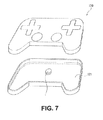
  • FIG. 7 is a view illustrating a gaming device including the linear vibration actuator.
  • a compact linear vibration actuator 1 is built into a communication device such as a mobile communication device (e.g. a cell phone), is used as a vibration generator for the calling function, and has a coin form with a diameter of approximately 10 mm and a thickness of approximately 3 mm.
  • a mobile communication device e.g. a cell phone
  • a casing 2 of the linear actuator 1 is formed from a cup-like upper casing part 11 formed from a non-magnetic material (such as stainless steel) and a lower casing part 12 with a disc-like shape in a non-magnetic material (such as stainless steel) for closing the open side of the upper casing part 11 .
  • the lower casing part 12 is fitted inside the circular-form open end of the upper casing part 11 , and the open end of the upper casing part 11 is then bent inwards.
  • the upper casing part 11 may be welded to the lower casing part 12 .
  • the casing 2 houses a ring-like magnet 13 magnetized along an axial line L direction of the shaft 20 to give an N pole and a S pole.
  • Yokes 14 and 16 formed from thin ring-like magnetic bodies are fixed using an adhesive agent to flat surface parts 13 a and 13 b of the magnet 13 so as to oppose each other vertically across the magnet 13 .
  • cross-like adhesive agent filling holes 14 a and 16 a are formed at four locations in a circumferential direction thereof. As a result, the adhesive effect of the adhesive agent can be increased.
  • the weight 15 is made, for example, from tungsten, and a needle is formed by the magnet 13 , yokes 14 and 16 and weight 15 .
  • a thin plate spring 17 is fixed by welding to the lower side flat surface part 15 a of the weight 15 .
  • the plate spring 17 is formed by a ring-like upper side seat part 17 a with a small diameter, a lower side seat part 17 b with a large diameter, and an arc-like elastic section 17 c linking the upper side seat part 17 a and the lower side seat part 17 b . Then, the upper side seat part 17 a is welded to the lower side flat surface part 15 a of the weight 15 and the lower side seat part 17 b is welded to the inner wall surface of the lower casing part 12 .
  • the lower casing part 12 includes a circular disc-like main body part 12 a of a form that matches the open end of the upper casing part 11 and a tongue piece 12 d that protrudes in a radial direction from the main body part 12 a .
  • a flexible circuit board 19 is fixed to the inner wall surface of the lower casing part 12 .
  • the flexible circuit board 19 includes a ring-like main body part 19 a mounted on the inner wall surface of the lower casing part 12 and an extending part 19 b mounted on a tongue piece 12 d of the lower casing part 12 .
  • an opening part 19 d for passing through a bobbin 21 and a shaft 20 is formed in the main body part 19 a , an electrical supply terminal 19 c is provided in the extending part 19 b , and the electrical terminal 19 c is exposed to the outside.
  • a press fitting hole 12 c for providing the shaft 20 in a standing arrangement is provided.
  • the shaft 20 is formed from a magnetic body and supports the bobbin 21 , which is made of resin.
  • the bobbin 21 includes a center hole 21 a for insertion of the shaft 20 , flange parts 21 b and 21 c positioned at the two ends in an axial line L direction, and a flange-like segment part 21 d positioned between the flange parts 21 b and 21 c .
  • a first bobbin part 21 A is configured by the flange part 21 b , the segment part 21 d and a support 21 e
  • a second bobbin part 21 B is configured by the flange part 21 c , the segment part 21 d and a support 21 f
  • the first bobbin part 21 A and the second bobbin part 21 B are arranged to be parallel with the axial line L direction.
  • the shaft 20 is press fitted or inserted with extremely low error into the center hole 21 a that pierces the support 21 e and the support 21 f.
  • a coil 24 is formed from a first coil part 22 configured by winding coil wire on the support 21 e of the first bobbin part 21 A, and a second coil part 23 configured by winding coil wire on the support 21 f of the second bobbin part 21 B in the opposite direction to the first coil part 22 .
  • the first coil part 22 and the second coil part 23 are arranged to be parallel with the axial line L direction. Further the coil wire of the first coil part 22 and the coil wire of the second coil part 23 are connected in series, and the coil 24 is connected to the flexible circuit board 19 .
  • the ring-like magnet 13 is arranged to surround the coil 24 supported by the shaft 20 , with the axial line L at the center thereof, and supported within the casing 2 by a plate spring 17 .
  • the plate spring 17 is a compression spring, biasing the magnet 13 and a weight 15 in the axial line L direction of the shaft 20 .
  • the magnet 13 is arranged to straddle the first coil part 22 and the second coil part 23 so that the inner circumferential surface 13 d of the magnet 13 and the segment part 21 d of the bobbin 21 oppose each other.
  • a magnetic circuit is formed by the magnet 13 and the shaft 20 , and the coil 24 wound on the bobbin 21 is supported by the shaft 20 that forms one part of the magnetic circuit, and is wound around and centered on the shaft 20 .
  • the shaft 20 can be effectively used to determine the position of the coil 24 .
  • the coil 24 position can be determined based on the shaft 20 standing within the casing 2 , making it possible to easily improve the positioning accuracy of the coil 24 within the casing 2 and making it easier to fit the bobbin 21 in the linear actuator 1 .
  • a gap P 1 between an outer circumferential surface 15 c of the weight 15 surface and a circumferential wall 11 b of the upper casing part 11 of the casing 2 is narrower than a gap P 2 between the inner circumferential surface 13 d of the magnet 13 and the outer circumferential surface 24 a of the coil 24 .
  • the outer circumferential surface 24 a of the coil 24 and the inner circumferential surface 13 d of the magnet 13 will not collide even if a collision occurs between the outer circumferential surface 15 c of the weight 15 and the circumferential wall 11 b of the casing 2 during a dropping impact. Hence, it becomes less likely that wires will break in coil 24 under a dropping impact.
  • the flange-like segment part 21 d of the bobbin 21 protrudes from the outer circumferential surfaces 22 a and 23 a of the first coil part 22 and the second coil part 23 .
  • This construction enables the effective use of the segment part 21 d to divide the first coil part 22 and the second coil part 23 .
  • the free end of the segment part 21 d will collide with the inner circumferential surface 13 d of the magnet 13 .
  • the segment part 21 d makes it easier to wind coil wire in different winding directions on the bobbin 21 .
  • the weight 15 has formed therein concave parts 15 e for mass adjustment of the weight 15 , in an upper side flat surface part 15 d perpendicular to the axial line L.
  • a filling liquid such as a mixture of tungsten powder and adhesive agent
  • the weight 15 vibrates along the axial line L direction via the plate spring 17 .
  • a voltage of a predetermined frequency such as 5 V, 200 Hz
  • the weight 15 may not vibrate within the casing 2 or may not provide the desired vibration.
  • the concave parts 15 e for mass adjustment is formed at equal intervals in the upper side flat surface part 15 d of the weight 15 .
  • the mass of the weight 15 can be increased to facilitate smooth vibration of the weight 15 at the frequency inputted to the coil 24 . Note that the correction measure in this case is not applicable to a case in which the weight 15 is too heavy and fails to vibrate.
  • the linear actuator 1 is inspected in a state with the upper casing part 11 removed, and linear actuators 1 that do not vibrate appropriately are corrected in the manner described above.
  • the two ends of the shaft 20 are press-fitted into the press fitting hole 11 c of the upper casing part 11 and the press fitting hole 12 c of the lower casing part 12 respectively, and the shaft 20 is thereby provided standing in the center of the casing 2 .
  • hemispherical convex parts 26 are provided at equally spaced intervals in the circumferential direction.
  • the convex parts 26 which are made from resin, allow the bobbin 21 to be securely fitted between the upper casing part 11 and the lower casing part 12 as result of contact with the inner wall surface of the upper casing part 11 during assembly. As a result of this arrangement, play in the bobbin 21 is suppressed and the anti-noise properties and resistance to dropping impacts can be improved.
  • the linear vibration actuator 100 according to the 2nd embodiment illustrated in FIG. 4 differs from the linear vibration actuator 1 of the 1st embodiment in that the yokes 14 and 16 used in the 1st embodiment are not fixed to the pair of opposing ring-like flat surface parts 13 a and 13 b of the magnet 13 .
  • Note that other elements of the linear vibration actuator 100 of the 2nd embodiment are identical to those of the linear vibration actuator 1 of the 1st embodiment, and so the same symbols are allocated to these elements in FIG. 4 and descriptions of them are omitted.
  • the effect of the distance R between a bottom end 22 b of the first coil part 22 and the flat surface part 13 b of the bottom side of the magnet 13 is important.
  • This effect is useful for increasing the efficiency of vibration using the weight 15 .
  • the same effect applies to the lowermost end of the magnet 13 .
  • the linear vibration actuator 1 can be mounted within a casing of a smartphone 110 to form a mobile communication device having a vibration notification function.
  • a circuit board 111 of the smartphone 110 By electrically connecting a circuit board 111 of the smartphone 110 with the electrical supply terminal 19 c of the flexible circuit board 19 of the linear vibration actuator 1 , it is possible to use the linear vibration actuator 1 as a vibration generator.
  • vibrations may be generated when an incoming call reaches the mobile communication device, or an operation is performed on the mobile communication device.
  • the linear vibration actuator 1 can be mounted within a casing of a controller 120 of a game machine to form a gaming device having a vibration notification function.
  • a circuit board 121 of the controller 120 By electrically connecting a circuit board 121 of the controller 120 with the electrical supply terminal 19 c of the flexible circuit board 19 of the linear vibration actuator 1 , it is possible to use the linear vibration actuator 1 as a vibration generator.
  • the gaming device may be a mobile gaming machine, a steering wheel or the like of a personal computer or the like. In this case, vibrations are generated according to the situation in the game to enhance a sense of reality for the user.

Landscapes

  • Engineering & Computer Science (AREA)
  • Power Engineering (AREA)
  • Apparatuses For Generation Of Mechanical Vibrations (AREA)
  • Reciprocating, Oscillating Or Vibrating Motors (AREA)

Abstract

A linear vibration actuator for which the positional accuracy of coils in the casing can be easily increased. A linear vibration actuator (1) in which a magnet (13) and a weight (15) are fixed. The magnet (13) and the shaft (20) form a magnetic circuit within a casing (2) causing reciprocating motion of the weight (15) and magnet (13), via a coil (24) within a casing (2). The linear actuator (1) includes a shaft (20) provided within the casing (2) and made from a magnetic material. A coil (24) is supported by the shaft (20) includes first and second coil parts (22, 23) arranged parallel to an axial line L and wound in opposing directions. A ring-like magnet (13) surrounds the coil (24) and the shaft (20). A weight is fixed to the magnet. A plate spring (17) biases the magnet (13) and the weight (15) along the shaft (20).

Description

This application claims priority from Japanese patent application serial no. 2013-028705 filed Feb. 18, 2013 and Japanese patent application serial no. 2013-194516 filed Sep. 19, 2013.
FIELD OF THE INVENTION
The present invention relates to a linear vibration actuator that causes vibration using reciprocating motion of a weight.
BACKGROUND OF THE INVENTION
In the past, as technology for this field, there is Japanese Unexamined Patent Application No. 2011-30403. The linear vibration actuator described in this publication causes vertical straight-line vibration of a weight through the interaction of magnetic force from a magnet and an electromagnetic force of a predetermined frequency generated by a coil. The ring-like coil is fixed on a circuit board, and the magnet is fixed at the bottom of a cup-like yoke. An inner circumferential surface of a ring-like weight contacts an outer circumferential surface of the yoke, and the weight is fixed to the yoke by an adhesive agent. Further, a bottom portion of a truncated cone-like coil spring formed from a thin plate is fixed to a bottom surface of a cylindrical casing, and the external surface of the yoke is fixed to a top portion of the spring. The tubular coil is fixed on the circuit board, and is also arranged to move in and out of a gap between the inner circumferential surface of the tubular part of the cup and the outer circumferential surface of the magnet. Consequently, the weight can be caused to vibrate vertically through the interaction of the magnet and the coil by inputting an electrical current of a predetermined frequency through the coil (energizing),
[Patent Document 1] Japanese Unexamined Patent Application No, 2011-30403
SUMMARY OF THE INVENTION Problem to be Solved by the Invention
However, in the above-described conventional linear vibration actuator, the coil moves in and out of the gap between the inner circumferential surface of the tubular part of the cup-like yoke and the outer circumferential surface of the magnet. Thus, if the coil is not accurately fixed on the circuit board, the coil will lean toward either the inner circumferential surface side of the tubular part of the yoke or the outer circumferential surface side the magnet. As a result, if the arrangement is subject to a dropping impact, the coil is highly likely to collide with either the inner circumferential surface of the yoke or the outer circumferential surface of the magnet. Hence, to ensure that the coil is fixed in a precise position in the casing, the coil must be fixed in the precise position on the circuit board in advance, prior to assembling the actuator. As a measure to implement this, a special configuration for setting the coil position is required either on the circuit board side or the coil side. If such measures are not implemented, a special tool will be required to accurately fix the coil on the circuit board. Consequently, there is a problem in that it is difficult to increase the positional accuracy of the coil in the casing.
It is the object of the present invention to provide a linear vibration actuator for which the positional accuracy of the coil in the casing can be easily increased.
The present invention is a linear vibration actuator in which a magnet and weight are fixed, and which causes reciprocating motion of the weight and magnet using a coil within a casing, the linear vibration actuator including:
a shaft provided standing within the casing, the shaft being made of a magnetic material and forming a magnetic circuit;
a coil supported by the shaft;
a ring-like magnet arranged to surround the coil and the shaft;
a weight fixed to the magnet; and
a biasing unit arranged within the casing and biasing the magnet and the weight in an axial line direction of the shaft.
In the linear vibration actuator, the magnetic circuit is formed between the magnet and the shaft, and the coil is arranged so as to be supported by the shaft that forms one part of the magnetic circuit, and to be wound around and centered on the shaft. As a result, the shaft can be usefully employed to position the coil. Specifically, in the present invention, the coil position can be determined based on the shaft standing within the casing, making it possible to easily improve the positioning accuracy of the coil within the casing.
Also, the ring-like weight is fixed to the outer circumferential surface of the magnet, and the gap between the outer circumferential surface of the weight and the casing is narrower than the gap between the inner circumferential surface of the magnet and the outer circumferential surface of the coil.
When such a construction is used, the outer surface of the coil and the inner circumferential surface of the magnet will not collide even if a collision occurs between the outer circumferential surface of the weight and the inner surface of the casing during a dropping impact. Hence, it becomes less likely that wires will break in the coil under a dropping impact.
Further, a bobbin wound with the coil is provided around shaft, the bobbin being provided with a segment part protruding towards the inner circumferential surface of the magnet. The segment part protrudes from the outer circumferential surface of a first coil part and a second coil part that are wound in opposing directions on the bobbin.
This construction enables the effective use of the segment part to divide the first coil part and the second coil part. Specifically, in an impact caused by dropping, the free end of the segment part will collide with the inner circumferential surface of the magnet. Hence the situation whereby the coil and the magnet collide never arises and it is less likely that wires in the coil will break when the arrangement is dropped. Note also that the segment part makes it easier to wind coil wire in different winding directions to the bobbin.
Further, the weight has formed therein a concave part for mass adjustment of the weight, in a flat surface perpendicular to an axial line.
When such a construction is used, vibration problems caused by individual differences in the weights or biasing unit can be easily adjusted on the weight side, without adjusting the biasing force of the biasing unit, by inserting a filling liquid (such as a mixture of tungsten powder and adhesive agent) into the concave part provided in the weight.
Further, the magnet has a pair of opposing ring-like flat surface parts, the yoke not being fixed to either of the flat surface parts.
When such a construction is used, the thrust of the weight fixed to the magnet can be increased over that in a linear vibration actuator of the type in which the yoke is fixed to the flat surface parts. As a result, efficient vibration can be obtained.
According to the present invention, the positional accuracy of the coil within the casing can be easily increased.
BRIEF DESCRIPTION OF THE DRAWINGS
FIG. 1 is an external appearance perspective view illustrating the first embodiment of the linear vibration actuator according to the present invention.
FIG. 2 is an exploded perspective view of the vibration actuator illustrated in FIG. 1.
FIG. 3 is a cross-sectional view along line III-III in FIG. 1.
FIG. 4 is a cross-sectional view illustrating a 2nd embodiment of the linear vibration actuator according to the present invention.
FIG. 5A is a cross-sectional view illustrating a comparison between the type in which the yoke is not fixed to the magnet and FIG. 5B is a cross-sectional view illustrating the type in which the yoke is fixed to the magnet.
FIG. 6 is a view illustrating a mobile communication device including the linear vibration actuator.
FIG. 7 is a view illustrating a gaming device including the linear vibration actuator.
DETAILED DESCRIPTION OF THE PREFERRED EMBODIMENTS
The following is a detailed description of preferred embodiments of the linear vibration actuator of the present invention with reference to the drawings.
First Embodiment
As illustrated in FIG. 1 to FIG. 3, a compact linear vibration actuator 1 is built into a communication device such as a mobile communication device (e.g. a cell phone), is used as a vibration generator for the calling function, and has a coin form with a diameter of approximately 10 mm and a thickness of approximately 3 mm.
A casing 2 of the linear actuator 1 is formed from a cup-like upper casing part 11 formed from a non-magnetic material (such as stainless steel) and a lower casing part 12 with a disc-like shape in a non-magnetic material (such as stainless steel) for closing the open side of the upper casing part 11. The lower casing part 12 is fitted inside the circular-form open end of the upper casing part 11, and the open end of the upper casing part 11 is then bent inwards. Note also that the upper casing part 11 may be welded to the lower casing part 12.
The casing 2 houses a ring-like magnet 13 magnetized along an axial line L direction of the shaft 20 to give an N pole and a S pole. Yokes 14 and 16 formed from thin ring-like magnetic bodies are fixed using an adhesive agent to flat surface parts 13 a and 13 b of the magnet 13 so as to oppose each other vertically across the magnet 13. Note also that in the yokes 14 and 16, cross-like adhesive agent filling holes 14 a and 16 a are formed at four locations in a circumferential direction thereof. As a result, the adhesive effect of the adhesive agent can be increased.
An inner circumferential surface 15 b of the donut-like weight 15 is adhered using an adhesive agent to the outer circumferential surface 13 c of the magnet 13. The weight 15 is made, for example, from tungsten, and a needle is formed by the magnet 13, yokes 14 and 16 and weight 15. A thin plate spring 17, an example of the biasing unit, is fixed by welding to the lower side flat surface part 15 a of the weight 15.
The plate spring 17 is formed by a ring-like upper side seat part 17 a with a small diameter, a lower side seat part 17 b with a large diameter, and an arc-like elastic section 17 c linking the upper side seat part 17 a and the lower side seat part 17 b. Then, the upper side seat part 17 a is welded to the lower side flat surface part 15 a of the weight 15 and the lower side seat part 17 b is welded to the inner wall surface of the lower casing part 12.
The lower casing part 12 includes a circular disc-like main body part 12 a of a form that matches the open end of the upper casing part 11 and a tongue piece 12 d that protrudes in a radial direction from the main body part 12 a. A flexible circuit board 19 is fixed to the inner wall surface of the lower casing part 12. The flexible circuit board 19 includes a ring-like main body part 19 a mounted on the inner wall surface of the lower casing part 12 and an extending part 19 b mounted on a tongue piece 12 d of the lower casing part 12. Further, an opening part 19 d for passing through a bobbin 21 and a shaft 20 is formed in the main body part 19 a, an electrical supply terminal 19 c is provided in the extending part 19 b, and the electrical terminal 19 c is exposed to the outside.
At the center of the main body part 12 a of the lower casing part 12, a press fitting hole 12 c for providing the shaft 20 in a standing arrangement is provided. The shaft 20 is formed from a magnetic body and supports the bobbin 21, which is made of resin. The bobbin 21 includes a center hole 21 a for insertion of the shaft 20, flange parts 21 b and 21 c positioned at the two ends in an axial line L direction, and a flange-like segment part 21 d positioned between the flange parts 21 b and 21 c. Further, a first bobbin part 21A is configured by the flange part 21 b, the segment part 21 d and a support 21 e, and a second bobbin part 21B is configured by the flange part 21 c, the segment part 21 d and a support 21 f, and the first bobbin part 21A and the second bobbin part 21B are arranged to be parallel with the axial line L direction. The shaft 20 is press fitted or inserted with extremely low error into the center hole 21 a that pierces the support 21 e and the support 21 f.
A coil 24 is formed from a first coil part 22 configured by winding coil wire on the support 21 e of the first bobbin part 21A, and a second coil part 23 configured by winding coil wire on the support 21 f of the second bobbin part 21B in the opposite direction to the first coil part 22. The first coil part 22 and the second coil part 23 are arranged to be parallel with the axial line L direction. Further the coil wire of the first coil part 22 and the coil wire of the second coil part 23 are connected in series, and the coil 24 is connected to the flexible circuit board 19.
The ring-like magnet 13 is arranged to surround the coil 24 supported by the shaft 20, with the axial line L at the center thereof, and supported within the casing 2 by a plate spring 17. The plate spring 17 is a compression spring, biasing the magnet 13 and a weight 15 in the axial line L direction of the shaft 20. When the power supply is off, the magnet 13 is arranged to straddle the first coil part 22 and the second coil part 23 so that the inner circumferential surface 13 d of the magnet 13 and the segment part 21 d of the bobbin 21 oppose each other.
In such a linear vibration actuator 1, a magnetic circuit is formed by the magnet 13 and the shaft 20, and the coil 24 wound on the bobbin 21 is supported by the shaft 20 that forms one part of the magnetic circuit, and is wound around and centered on the shaft 20. As a result, the shaft 20 can be effectively used to determine the position of the coil 24. Specifically, the coil 24 position can be determined based on the shaft 20 standing within the casing 2, making it possible to easily improve the positioning accuracy of the coil 24 within the casing 2 and making it easier to fit the bobbin 21 in the linear actuator 1.
A gap P1 between an outer circumferential surface 15 c of the weight 15 surface and a circumferential wall 11 b of the upper casing part 11 of the casing 2 is narrower than a gap P2 between the inner circumferential surface 13 d of the magnet 13 and the outer circumferential surface 24 a of the coil 24. When such a construction is used, the outer circumferential surface 24 a of the coil 24 and the inner circumferential surface 13 d of the magnet 13 will not collide even if a collision occurs between the outer circumferential surface 15 c of the weight 15 and the circumferential wall 11 b of the casing 2 during a dropping impact. Hence, it becomes less likely that wires will break in coil 24 under a dropping impact.
The flange-like segment part 21 d of the bobbin 21 protrudes from the outer circumferential surfaces 22 a and 23 a of the first coil part 22 and the second coil part 23. This construction enables the effective use of the segment part 21 d to divide the first coil part 22 and the second coil part 23. Specifically, in an impact caused by dropping, the free end of the segment part 21 d will collide with the inner circumferential surface 13 d of the magnet 13. Hence the situation whereby the coil 24 and the magnet 13 collide never arises and it is less likely that wires in the coil 24 will break when the arrangement is dropped. Note also that the segment part 21 d makes it easier to wind coil wire in different winding directions on the bobbin 21.
The weight 15 has formed therein concave parts 15 e for mass adjustment of the weight 15, in an upper side flat surface part 15 d perpendicular to the axial line L. When such a construction is used, vibration problems caused by individual differences in the weight 15 or plate spring 17 can be easily adjusted on the weight 15 side, without adjusting the spring force of the plate spring 17, by inserting a filling liquid (such as a mixture of tungsten powder and adhesive agent) into the concave parts 15 e provided in the weight 15.
When a voltage of a predetermined frequency (such as 5 V, 200 Hz) is input from the electrical supply terminal 19 c to the coil 24 (energized), the weight 15 vibrates along the axial line L direction via the plate spring 17. However, if the weight 15 is too light or too heavy, the weight 15 may not vibrate within the casing 2 or may not provide the desired vibration. As a correction measure in such cases, the concave parts 15 e for mass adjustment is formed at equal intervals in the upper side flat surface part 15 d of the weight 15. By inserting the filling liquid described above, the mass of the weight 15 can be increased to facilitate smooth vibration of the weight 15 at the frequency inputted to the coil 24. Note that the correction measure in this case is not applicable to a case in which the weight 15 is too heavy and fails to vibrate.
After manufacture, the linear actuator 1 is inspected in a state with the upper casing part 11 removed, and linear actuators 1 that do not vibrate appropriately are corrected in the manner described above.
The two ends of the shaft 20 are press-fitted into the press fitting hole 11 c of the upper casing part 11 and the press fitting hole 12 c of the lower casing part 12 respectively, and the shaft 20 is thereby provided standing in the center of the casing 2. At the flat end surfaces of the flange part 21 b of the bobbin 21 supported by the shaft 20, hemispherical convex parts 26 are provided at equally spaced intervals in the circumferential direction. The convex parts 26, which are made from resin, allow the bobbin 21 to be securely fitted between the upper casing part 11 and the lower casing part 12 as result of contact with the inner wall surface of the upper casing part 11 during assembly. As a result of this arrangement, play in the bobbin 21 is suppressed and the anti-noise properties and resistance to dropping impacts can be improved.
Second Embodiment
The linear vibration actuator 100 according to the 2nd embodiment illustrated in FIG. 4 differs from the linear vibration actuator 1 of the 1st embodiment in that the yokes 14 and 16 used in the 1st embodiment are not fixed to the pair of opposing ring-like flat surface parts 13 a and 13 b of the magnet 13. Note that other elements of the linear vibration actuator 100 of the 2nd embodiment are identical to those of the linear vibration actuator 1 of the 1st embodiment, and so the same symbols are allocated to these elements in FIG. 4 and descriptions of them are omitted.
As illustrated in FIG. 5B, when the magnet 13 is at the position of maximum movement in the linear vibration actuator 1, which is to say when the magnet 13 is furthest towards one end, such as the uppermost end, the use of the yokes 14 and 16 allows the magnetic flux from the magnet 13 to the shaft 20 to take the shortest path. As a result, a magnetic circuit of high efficiency is formed. However, for the magnetic flux from the flat surface part 13 b on the lower side of the magnet 13 to the shaft 20, a higher proportion of the magnetic flux passes through the first coil part 22 and, consequently, a thrust F2 opposing a thrust F1 becomes larger. As a result, the thrust F2 acts strongly as a brake on the thrust F1 and reduces the thrust of the magnet 13 in the direction of arrow A. This effect makes it more difficult to achieve high-efficiency vibration using the weight 15.
By contrast, as illustrated in FIG. 5A, when the magnet 13 is at the position of maximum movement in the linear vibration actuator 100, which is to say when the magnet 13 is furthest towards one end, such as the uppermost end, because the yokes 14 and 16 are not used, the magnetic flux from the magnet 13 to the shaft 20 does not try to take the shortest path in the same manner as when the yokes 14 and 16 were present. As a result, for the magnetic flux from the flat surface part 13 b on the lower side of the magnet 13 to the shaft 20, a lower proportion of the magnetic flux passes through the first coil part 22 and, consequently, the thrust F2 opposing the thrust F1 is less than with the vibration actuator 1 (see FIG. 5B). As a result, the thrust F2 acts less as a brake on the thrust F1 and the thrust of the magnet 13 in the direction of arrow A is increased. This in turn makes it easier to achieve high-efficiency vibration using the weight 15.
When looking to increase the vibration efficiency of the linear vibration actuator 100, the effect of the distance R between a bottom end 22 b of the first coil part 22 and the flat surface part 13 b of the bottom side of the magnet 13 is important. The larger distance R becomes, the smaller the proportion of the magnetic flux, of the magnetic flux going from the flat surface part 13 b of the bottom side of the magnet 13 towards the shaft 20, that passes through the first coil part 22. This effect is useful for increasing the efficiency of vibration using the weight 15. Note also that, although not shown in the drawings, the same effect applies to the lowermost end of the magnet 13. The larger the distance between a top end 23 b of the second coil part 23 and a flat surface part 13 a of the top side of the magnet 13 becomes, the greater the advantage in increasing the vibration efficiency using the weight 15.
Based on the above-described results, it can be stated that the thinner the magnet 13, the greater the disadvantage resulting from the yokes 14 and 16 becomes. Thus, when the magnet 13 is made thinner to increase the distance of reciprocating movement of the magnet 13, it is advantageous to use a linear vibration actuator of the type of linear vibration actuator 100 without the yokes 14 and 16.
Note that although the weight 15 has been omitted from the FIGS. 5A and 5B, the linear vibration actuators 1 and 100 do of course include the weight 15.
As illustrated in FIG. 6, the linear vibration actuator 1 can be mounted within a casing of a smartphone 110 to form a mobile communication device having a vibration notification function. By electrically connecting a circuit board 111 of the smartphone 110 with the electrical supply terminal 19 c of the flexible circuit board 19 of the linear vibration actuator 1, it is possible to use the linear vibration actuator 1 as a vibration generator. For example, vibrations may be generated when an incoming call reaches the mobile communication device, or an operation is performed on the mobile communication device.
Also, as illustrated in FIG. 7, the linear vibration actuator 1 can be mounted within a casing of a controller 120 of a game machine to form a gaming device having a vibration notification function. By electrically connecting a circuit board 121 of the controller 120 with the electrical supply terminal 19 c of the flexible circuit board 19 of the linear vibration actuator 1, it is possible to use the linear vibration actuator 1 as a vibration generator. The gaming device may be a mobile gaming machine, a steering wheel or the like of a personal computer or the like. In this case, vibrations are generated according to the situation in the game to enhance a sense of reality for the user.
The present invention is not limited to the above-described embodiments, and the following modifications are possible without departing from the spirit of the present invention.
For example, for the biasing unit, the plate spring 17 could be appropriately replaced with a compression coil spring.
DESCRIPTION OF THE SYMBOLS
1, 100 Linear vibration actuator, 2 casing, 13 magnet, 14 and 16 yoke, 15 weight, 15 e concave part, 17 plate spring (biasing unit), 20 shaft, 21 bobbin, 21 d segment part, 22 first coil part, 23 second coil part, 24 coil, L axial line, P1 and P2 gap.

Claims (8)

The invention claimed is:
1. A linear vibration actuator in which a magnet and a weight are fixed, and the magnet causes reciprocating motion of the weight and the magnet using a coil within a casing, the linear vibration actuator comprising:
a shaft provided standing within the casing, the shaft being made of a magnetic material and forming a magnetic circuit;
a coil supported by the shaft;
the magnet, magnetized in an axial direction parallel to an axial line direction of the shaft, being a ring-like magnet arranged to surround the coil and the shaft and comprising a pair of yokeless opposing ring-like flat surface parts;
wherein the weight being fixed to the magnet; and
a biasing unit arranged within the casing, and biasing the magnet and the weight in the axial line direction of the shaft.
2. The linear vibration actuator of claim 1 wherein
the weight is a the ring-like weight which is fixed to an outer circumferential surface of the magnet, and a gap between the outer circumferential surface of the weight and the casing is narrower than a gap between an inner circumferential surface of the magnet and an outer circumferential surface of the coil.
3. The linear vibration actuator of claim 1, wherein the weight has formed therein a concave part for mass adjustment of the weight, in a flat surface perpendicular to the axial line direction.
4. The linear vibration actuator of claim 1, wherein the linear vibration actuator is incorporated into a mobile communication device.
5. The linear vibration actuator of claim 1, wherein the linear vibration actuator is incorporated into a gaming device.
6. A linear vibration actuator in which a magnet and a weight are fixed, the magnet causes reciprocating motion of the weight and the magnet uses a coil within a casing, the linear vibration actuator comprising:
a shaft provided standing within the casing, the shaft being made of a magnetic material and forming a magnetic circuit;
a coil supported by the shaft;
the magnet being a ring-like magnet arranged to surround the coil and the shaft;
the weight being fixed to the magnet;
a biasing unit arranged within the casing, and biasing the magnet and the weight in an axial line direction of the shaft; and
a bobbin made of resin and wound with the coil is provided around the shaft, the bobbin comprising a segment part protruding towards the inner circumferential surface of the magnet, and the segment part protruding from the outer circumferential surface of a first coil part and a second coil part that are wound in opposing directions on the bobbin.
7. A mobile communication device comprising a linear vibration actuator in which a ring-like magnet and a weight are fixed, and the magnet causing reciprocating motion of the weight and the magnet using a coil within a casing, the linear vibration actuator comprising:
a shaft provided within the casing, and the shaft being made of a magnetic material and forming a magnetic circuit;
a coil supported by the shaft;
the magnet, magnetized in an axial direction parallel to an axial line direction of the shaft, being arranged to surround the coil and the shaft and comprising a pair of yokeless opposing ring-like flat surface parts;
wherein the weight being fixed to the magnet; and
a biasing unit arranged within the casing for biasing the magnet and the weight in the axial direction of the shaft.
8. A gaming device comprising the linear vibration actuator in which a ring-like magnet and a weight are fixed, and the magnet causing reciprocating motion of the weight and the magnet using a coil within a casing, the linear vibration actuator comprising:
a shaft provided within the casing, and the shaft being made of a magnetic material and forming a magnetic circuit;
a coil supported by the shaft;
the magnet, magnetized in an axial direction parallel to an axial line direction of the shaft, being arranged to surround the coil and the shaft and comprising a pair of yokeless opposing ring-like flat surface parts;
wherein the weight being fixed to the magnet; and
a biasing unit arranged within the casing for biasing the magnet and the weight in the axial direction of the shaft.
US14/180,575 2013-02-18 2014-02-14 Linear vibration actuator and mobile communication device or gaming device including the same Expired - Fee Related US9621015B2 (en)

Applications Claiming Priority (4)

Application Number Priority Date Filing Date Title
JP2013-028705 2013-02-18
JP2013028705 2013-02-18
JP2013194516A JP5889259B2 (en) 2013-02-18 2013-09-19 Linear vibration actuator
JP2013-194516 2013-09-19

Publications (2)

Publication Number Publication Date
US20140232211A1 US20140232211A1 (en) 2014-08-21
US9621015B2 true US9621015B2 (en) 2017-04-11

Family

ID=51311226

Family Applications (1)

Application Number Title Priority Date Filing Date
US14/180,575 Expired - Fee Related US9621015B2 (en) 2013-02-18 2014-02-14 Linear vibration actuator and mobile communication device or gaming device including the same

Country Status (5)

Country Link
US (1) US9621015B2 (en)
JP (1) JP5889259B2 (en)
KR (1) KR20140104353A (en)
CN (1) CN103997181A (en)
TW (1) TWI610519B (en)

Cited By (3)

* Cited by examiner, † Cited by third party
Publication number Priority date Publication date Assignee Title
US20180019651A1 (en) * 2016-07-15 2018-01-18 Mplus Co., Ltd. Linear vibration generator
US10559994B2 (en) * 2016-07-15 2020-02-11 Mplus Co., Ltd. Linear vibration motor
US20230143064A1 (en) * 2021-11-05 2023-05-11 Ming-Hung Lin Vibration unit, speaker and manufacturing method of the vibration unit

Families Citing this family (36)

* Cited by examiner, † Cited by third party
Publication number Priority date Publication date Assignee Title
JP2013233537A (en) * 2012-04-10 2013-11-21 Hosiden Corp Vibrator
JP6029854B2 (en) * 2012-05-22 2016-11-24 ミネベア株式会社 Vibrator and vibration generator
JP6309871B2 (en) * 2014-09-30 2018-04-11 日本電産セイミツ株式会社 Vibration motor
WO2016194762A1 (en) * 2015-05-29 2016-12-08 日本電産コパル株式会社 Linear vibration motor
JP6517591B2 (en) * 2015-06-01 2019-05-22 日本電産サンキョー株式会社 Method of manufacturing linear actuator and linear actuator
KR20170005686A (en) * 2015-07-06 2017-01-16 자화전자(주) Linear vibration generating device
CN205377621U (en) * 2015-11-03 2016-07-06 瑞声光电科技(常州)有限公司 Vibration motor
CN105720776B (en) * 2016-03-28 2019-04-12 歌尔股份有限公司 Vibrating motor and portable device
JP6692242B2 (en) * 2016-07-25 2020-05-13 日本電産コパル株式会社 Vibration motor
US10252155B2 (en) * 2016-08-22 2019-04-09 Sony Interactive Entertainment Inc. Brushless two dimensional haptic actuator
CN106329871A (en) * 2016-09-30 2017-01-11 歌尔股份有限公司 Linear vibration motor and electronic equipment
CN106357080A (en) * 2016-09-30 2017-01-25 歌尔股份有限公司 Linear vibration motor
KR20180059973A (en) * 2016-11-28 2018-06-07 (주)파트론 Linear vibration generating device
CN106849587B (en) * 2017-03-14 2022-04-05 歌尔股份有限公司 Linear vibration motor and electronic device
CN107257190B (en) * 2017-08-11 2020-06-02 歌尔股份有限公司 Linear vibration motor
CN207069865U (en) * 2017-08-11 2018-03-02 歌尔科技有限公司 Linear vibration motor
CN207069866U (en) * 2017-08-11 2018-03-02 歌尔科技有限公司 Linear vibration motor
CN107276361A (en) * 2017-08-11 2017-10-20 歌尔股份有限公司 A kind of linear vibration motor
CN107317454A (en) * 2017-08-11 2017-11-03 歌尔股份有限公司 Linear vibration motor
CN109428456A (en) * 2017-08-21 2019-03-05 日本电产三协电子(东莞)有限公司 Actuator
KR102026901B1 (en) 2017-08-25 2019-11-04 주식회사 엠플러스 A linear vibration generating device including a coil break preventing structure
IT201800003406A1 (en) * 2018-03-09 2019-09-09 Powersoft S P A Platform vibration control system
JP7157305B2 (en) * 2018-03-26 2022-10-20 ミツミ電機株式会社 Vibration actuators and electronics
CN208589899U (en) * 2018-08-03 2019-03-08 瑞声科技(南京)有限公司 Linear vibration electric motor
CN208589896U (en) * 2018-08-03 2019-03-08 瑞声科技(南京)有限公司 Linear vibration electric motor
CN208675084U (en) * 2018-08-03 2019-03-29 瑞声科技(南京)有限公司 Linear vibration electric motor
JP6750825B2 (en) * 2018-08-28 2020-09-02 ミネベアミツミ株式会社 Vibration actuator and electronic equipment
JP7222661B2 (en) * 2018-10-31 2023-02-15 ミネベアミツミ株式会社 Vibration actuator and vibration presentation device
CN109617355B (en) * 2018-12-27 2021-02-23 瑞声科技(南京)有限公司 Linear vibration motor
KR102635052B1 (en) * 2019-03-14 2024-02-07 포스터 일렉트릭 컴퍼니, 리미티드 Actuator and display equipped with same
KR102779008B1 (en) 2019-08-05 2025-03-11 삼성전자주식회사 Actuator for haptic and electronic device with the same
CN110429785A (en) * 2019-08-28 2019-11-08 领先科技(东台)有限公司 A kind of coil is nested with the linear motor of flange magnetic yoke
USD1049063S1 (en) * 2019-12-23 2024-10-29 Tdk Corporation Vibration element for an actuator
JP7393285B2 (en) * 2020-04-02 2023-12-06 ニデックインスツルメンツ株式会社 actuator
CN215772886U (en) * 2020-07-10 2022-02-08 日本电产株式会社 Vibration motor and haptic device
CN115347713A (en) * 2021-05-14 2022-11-15 台达电子工业股份有限公司 Vibration motor

Citations (9)

* Cited by examiner, † Cited by third party
Publication number Priority date Publication date Assignee Title
US6249198B1 (en) * 1998-06-16 2001-06-19 Huntleigh Technology Plc Magnetic actuator
US20100066182A1 (en) * 2008-09-16 2010-03-18 Sanyo Seimitsu Co., Ltd. Reciprocating vibrator
US20100102646A1 (en) * 2008-10-28 2010-04-29 Sanyo Electric Co., Ltd. Reciprocating vibration generator
US20110018366A1 (en) 2009-07-27 2011-01-27 Jun Kun Choi Linear vibrator
US20110068639A1 (en) * 2009-09-24 2011-03-24 Samsung Electro-Mechanics Co., Ltd. Horizontal linear vibrator
US20110198949A1 (en) * 2010-02-16 2011-08-18 Sanyo Electric Co., Ltd. Vibration generator
US20120146557A1 (en) * 2010-12-09 2012-06-14 Korea Advanced Institute Of Science And Technology Vibration generating module, actuator using the same, handheld device, method for generating vibration and recording medium thereof
US20120319506A1 (en) * 2011-06-16 2012-12-20 Jahwa Electronics Co., Ltd Linear vibration generating apparatus
US20130342034A1 (en) * 2012-06-26 2013-12-26 Samsung Electro-Mechanics Co., Ltd. Linear vibrator

Family Cites Families (5)

* Cited by examiner, † Cited by third party
Publication number Priority date Publication date Assignee Title
TW501329B (en) * 2001-01-31 2002-09-01 Sunonwealth Electr Mach Ind Co DC brushless vibrating motor
JP2003174759A (en) * 2001-05-08 2003-06-20 Staf Corp Magnetic driver
JP2009166016A (en) * 2008-01-21 2009-07-30 Sanyo Electric Co Ltd Reciprocating vibration generator
JP5537984B2 (en) * 2010-02-16 2014-07-02 日本電産セイミツ株式会社 Reciprocating vibration generator
KR101055508B1 (en) * 2010-12-31 2011-08-08 삼성전기주식회사 Linear vibration motor

Patent Citations (10)

* Cited by examiner, † Cited by third party
Publication number Priority date Publication date Assignee Title
US6249198B1 (en) * 1998-06-16 2001-06-19 Huntleigh Technology Plc Magnetic actuator
US20100066182A1 (en) * 2008-09-16 2010-03-18 Sanyo Seimitsu Co., Ltd. Reciprocating vibrator
US20100102646A1 (en) * 2008-10-28 2010-04-29 Sanyo Electric Co., Ltd. Reciprocating vibration generator
US20110018366A1 (en) 2009-07-27 2011-01-27 Jun Kun Choi Linear vibrator
JP2011030403A (en) 2009-07-27 2011-02-10 Samsung Electro-Mechanics Co Ltd Linear vibrator
US20110068639A1 (en) * 2009-09-24 2011-03-24 Samsung Electro-Mechanics Co., Ltd. Horizontal linear vibrator
US20110198949A1 (en) * 2010-02-16 2011-08-18 Sanyo Electric Co., Ltd. Vibration generator
US20120146557A1 (en) * 2010-12-09 2012-06-14 Korea Advanced Institute Of Science And Technology Vibration generating module, actuator using the same, handheld device, method for generating vibration and recording medium thereof
US20120319506A1 (en) * 2011-06-16 2012-12-20 Jahwa Electronics Co., Ltd Linear vibration generating apparatus
US20130342034A1 (en) * 2012-06-26 2013-12-26 Samsung Electro-Mechanics Co., Ltd. Linear vibrator

Cited By (5)

* Cited by examiner, † Cited by third party
Publication number Priority date Publication date Assignee Title
US20180019651A1 (en) * 2016-07-15 2018-01-18 Mplus Co., Ltd. Linear vibration generator
US10559994B2 (en) * 2016-07-15 2020-02-11 Mplus Co., Ltd. Linear vibration motor
US10622877B2 (en) * 2016-07-15 2020-04-14 Mplus Co., Ltd. Linear vibration generator
US20230143064A1 (en) * 2021-11-05 2023-05-11 Ming-Hung Lin Vibration unit, speaker and manufacturing method of the vibration unit
US12156009B2 (en) * 2021-11-05 2024-11-26 Ming-Hung Lin Vibration unit, speaker and manufacturing method of the vibration unit

Also Published As

Publication number Publication date
JP5889259B2 (en) 2016-03-22
JP2014176841A (en) 2014-09-25
TW201434245A (en) 2014-09-01
CN103997181A (en) 2014-08-20
US20140232211A1 (en) 2014-08-21
KR20140104353A (en) 2014-08-28
TWI610519B (en) 2018-01-01

Similar Documents

Publication Publication Date Title
US9621015B2 (en) Linear vibration actuator and mobile communication device or gaming device including the same
US9467035B2 (en) Vibration actuator
JP7234256B2 (en) Electromechanical generator for converting mechanical vibrational energy into electrical energy
US9692286B2 (en) Vibration actuator
CN102916555B (en) Linear vibration device
US20200381987A1 (en) Vibration actuator and electronic device
US10170965B2 (en) Linear vibration motor
JP2012016153A (en) Vibration actuator
JP2010069356A (en) Reciprocating vibrator
US20130272550A1 (en) Vibration generator
JP6262189B2 (en) Linear vibration actuator
CN103357566A (en) Vibrator
JP2016150285A (en) Vibration generator
US12285781B2 (en) Oscillatory actuator
US11025147B2 (en) Vibration motor
KR101914530B1 (en) Vibrator
KR102066662B1 (en) Vibration motor
KR20170048848A (en) Vibration actuator
KR102283551B1 (en) Spring and Linear vibration generating device containing the same
KR20100115655A (en) Linear vibrator
KR102306513B1 (en) Wide band linear motor
KR20180127857A (en) Vibration motor
WO2006109609A1 (en) Acceleration sensor and acceleration sensor device
JP2023176492A (en) Vibration actuators and electronic equipment
WO2025070581A1 (en) Vibration actuator and electric device

Legal Events

Date Code Title Description
AS Assignment

Owner name: NIDEC COPAL CORPORATION, JAPAN

Free format text: ASSIGNMENT OF ASSIGNORS INTEREST;ASSIGNORS:KATADA, YOSHINORI;SONOKI, HIROHIKO;HIGASHI, DAISUKE;AND OTHERS;SIGNING DATES FROM 20140120 TO 20140129;REEL/FRAME:032220/0842

STCF Information on status: patent grant

Free format text: PATENTED CASE

FEPP Fee payment procedure

Free format text: MAINTENANCE FEE REMINDER MAILED (ORIGINAL EVENT CODE: REM.); ENTITY STATUS OF PATENT OWNER: LARGE ENTITY

LAPS Lapse for failure to pay maintenance fees

Free format text: PATENT EXPIRED FOR FAILURE TO PAY MAINTENANCE FEES (ORIGINAL EVENT CODE: EXP.); ENTITY STATUS OF PATENT OWNER: LARGE ENTITY

STCH Information on status: patent discontinuation

Free format text: PATENT EXPIRED DUE TO NONPAYMENT OF MAINTENANCE FEES UNDER 37 CFR 1.362

FP Lapsed due to failure to pay maintenance fee

Effective date: 20210411