US9608044B2 - OLED display panel, method for manufacturing the same, display device and electronic product - Google Patents

OLED display panel, method for manufacturing the same, display device and electronic product Download PDF

Info

Publication number
US9608044B2
US9608044B2 US14/405,293 US201414405293A US9608044B2 US 9608044 B2 US9608044 B2 US 9608044B2 US 201414405293 A US201414405293 A US 201414405293A US 9608044 B2 US9608044 B2 US 9608044B2
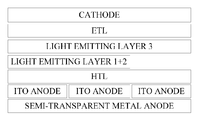
Authority
US
United States
Prior art keywords
light emitting
sub
pixel
emitting layer
layer
Prior art date
Legal status (The legal status is an assumption and is not a legal conclusion. Google has not performed a legal analysis and makes no representation as to the accuracy of the status listed.)
Active, expires
Application number
US14/405,293
Other versions
US20160268351A1 (en
Inventor
Changyen Wu
Current Assignee (The listed assignees may be inaccurate. Google has not performed a legal analysis and makes no representation or warranty as to the accuracy of the list.)
BOE Technology Group Co Ltd
Original Assignee
BOE Technology Group Co Ltd
Priority date (The priority date is an assumption and is not a legal conclusion. Google has not performed a legal analysis and makes no representation as to the accuracy of the date listed.)
Filing date
Publication date
Application filed by BOE Technology Group Co Ltd filed Critical BOE Technology Group Co Ltd
Assigned to BOE TECHNOLOGY GROUP CO., LTD. reassignment BOE TECHNOLOGY GROUP CO., LTD. ASSIGNMENT OF ASSIGNORS INTEREST (SEE DOCUMENT FOR DETAILS). Assignors: WU, Changyen
Publication of US20160268351A1 publication Critical patent/US20160268351A1/en
Application granted granted Critical
Publication of US9608044B2 publication Critical patent/US9608044B2/en
Active legal-status Critical Current
Adjusted expiration legal-status Critical

Links

Images

Classifications

    • H01L27/3211
    • HELECTRICITY
    • H10SEMICONDUCTOR DEVICES; ELECTRIC SOLID-STATE DEVICES NOT OTHERWISE PROVIDED FOR
    • H10KORGANIC ELECTRIC SOLID-STATE DEVICES
    • H10K59/00Integrated devices, or assemblies of multiple devices, comprising at least one organic light-emitting element covered by group H10K50/00
    • H10K59/30Devices specially adapted for multicolour light emission
    • H10K59/32Stacked devices having two or more layers, each emitting at different wavelengths
    • H01L27/3209
    • H01L51/5004
    • H01L51/504
    • H01L51/5044
    • H01L51/5206
    • H01L51/5221
    • H01L51/56
    • HELECTRICITY
    • H10SEMICONDUCTOR DEVICES; ELECTRIC SOLID-STATE DEVICES NOT OTHERWISE PROVIDED FOR
    • H10KORGANIC ELECTRIC SOLID-STATE DEVICES
    • H10K50/00Organic light-emitting devices
    • H10K50/10OLEDs or polymer light-emitting diodes [PLED]
    • H10K50/11OLEDs or polymer light-emitting diodes [PLED] characterised by the electroluminescent [EL] layers
    • HELECTRICITY
    • H10SEMICONDUCTOR DEVICES; ELECTRIC SOLID-STATE DEVICES NOT OTHERWISE PROVIDED FOR
    • H10KORGANIC ELECTRIC SOLID-STATE DEVICES
    • H10K50/00Organic light-emitting devices
    • H10K50/10OLEDs or polymer light-emitting diodes [PLED]
    • H10K50/11OLEDs or polymer light-emitting diodes [PLED] characterised by the electroluminescent [EL] layers
    • H10K50/125OLEDs or polymer light-emitting diodes [PLED] characterised by the electroluminescent [EL] layers specially adapted for multicolour light emission, e.g. for emitting white light
    • H10K50/13OLEDs or polymer light-emitting diodes [PLED] characterised by the electroluminescent [EL] layers specially adapted for multicolour light emission, e.g. for emitting white light comprising stacked EL layers within one EL unit
    • HELECTRICITY
    • H10SEMICONDUCTOR DEVICES; ELECTRIC SOLID-STATE DEVICES NOT OTHERWISE PROVIDED FOR
    • H10KORGANIC ELECTRIC SOLID-STATE DEVICES
    • H10K50/00Organic light-emitting devices
    • H10K50/10OLEDs or polymer light-emitting diodes [PLED]
    • H10K50/11OLEDs or polymer light-emitting diodes [PLED] characterised by the electroluminescent [EL] layers
    • H10K50/125OLEDs or polymer light-emitting diodes [PLED] characterised by the electroluminescent [EL] layers specially adapted for multicolour light emission, e.g. for emitting white light
    • H10K50/13OLEDs or polymer light-emitting diodes [PLED] characterised by the electroluminescent [EL] layers specially adapted for multicolour light emission, e.g. for emitting white light comprising stacked EL layers within one EL unit
    • H10K50/131OLEDs or polymer light-emitting diodes [PLED] characterised by the electroluminescent [EL] layers specially adapted for multicolour light emission, e.g. for emitting white light comprising stacked EL layers within one EL unit with spacer layers between the electroluminescent layers
    • HELECTRICITY
    • H10SEMICONDUCTOR DEVICES; ELECTRIC SOLID-STATE DEVICES NOT OTHERWISE PROVIDED FOR
    • H10KORGANIC ELECTRIC SOLID-STATE DEVICES
    • H10K50/00Organic light-emitting devices
    • H10K50/80Constructional details
    • H10K50/805Electrodes
    • H10K50/81Anodes
    • HELECTRICITY
    • H10SEMICONDUCTOR DEVICES; ELECTRIC SOLID-STATE DEVICES NOT OTHERWISE PROVIDED FOR
    • H10KORGANIC ELECTRIC SOLID-STATE DEVICES
    • H10K50/00Organic light-emitting devices
    • H10K50/80Constructional details
    • H10K50/805Electrodes
    • H10K50/82Cathodes
    • HELECTRICITY
    • H10SEMICONDUCTOR DEVICES; ELECTRIC SOLID-STATE DEVICES NOT OTHERWISE PROVIDED FOR
    • H10KORGANIC ELECTRIC SOLID-STATE DEVICES
    • H10K59/00Integrated devices, or assemblies of multiple devices, comprising at least one organic light-emitting element covered by group H10K50/00
    • H10K59/30Devices specially adapted for multicolour light emission
    • H10K59/35Devices specially adapted for multicolour light emission comprising red-green-blue [RGB] subpixels
    • HELECTRICITY
    • H10SEMICONDUCTOR DEVICES; ELECTRIC SOLID-STATE DEVICES NOT OTHERWISE PROVIDED FOR
    • H10KORGANIC ELECTRIC SOLID-STATE DEVICES
    • H10K71/00Manufacture or treatment specially adapted for the organic devices covered by this subclass
    • H01L2251/308
    • H01L2251/552
    • HELECTRICITY
    • H10SEMICONDUCTOR DEVICES; ELECTRIC SOLID-STATE DEVICES NOT OTHERWISE PROVIDED FOR
    • H10KORGANIC ELECTRIC SOLID-STATE DEVICES
    • H10K2101/00Properties of the organic materials covered by group H10K85/00
    • H10K2101/30Highest occupied molecular orbital [HOMO], lowest unoccupied molecular orbital [LUMO] or Fermi energy values
    • HELECTRICITY
    • H10SEMICONDUCTOR DEVICES; ELECTRIC SOLID-STATE DEVICES NOT OTHERWISE PROVIDED FOR
    • H10KORGANIC ELECTRIC SOLID-STATE DEVICES
    • H10K2101/00Properties of the organic materials covered by group H10K85/00
    • H10K2101/40Interrelation of parameters between multiple constituent active layers or sublayers, e.g. HOMO values in adjacent layers
    • HELECTRICITY
    • H10SEMICONDUCTOR DEVICES; ELECTRIC SOLID-STATE DEVICES NOT OTHERWISE PROVIDED FOR
    • H10KORGANIC ELECTRIC SOLID-STATE DEVICES
    • H10K2102/00Constructional details relating to the organic devices covered by this subclass
    • H10K2102/10Transparent electrodes, e.g. using graphene
    • H10K2102/101Transparent electrodes, e.g. using graphene comprising transparent conductive oxides [TCO]
    • H10K2102/103Transparent electrodes, e.g. using graphene comprising transparent conductive oxides [TCO] comprising indium oxides, e.g. ITO

Definitions

  • the present disclosure relates to the field of display technology, in particular to an OLED display panel, a method for manufacturing the same, a display device and an electronic product.
  • An organic light emitting device is a display device emitting light by use of an electroluminescent phosphor or an organic phosphor.
  • the OLED drives a plurality of organic light emitting diodes to display an image, the organic light emitting diode includes an anode, an organic thin layer and a cathode.
  • the organic thin layer usually has a multilayer structure including a light emitting layer (EML), an electron transport layer (ETL) and a hole transport layer (HTL), to improve the balance between electrons and holes, thereby improving luminescent efficiency.
  • the multilayer structure may further include an electron injection layer (EIL) and a hole injection layer (HIL).
  • red (R), green (G) and blue (B) light emitting layers may be patterned respectively.
  • a shadow mask may be used in a case of a small-molecule OLED, and an inkjet printing method or a laser induced thermal imaging (LITI) method may be used in a case of a polymer OLED.
  • LITI laser induced thermal imaging
  • an organic layer may be finely patterned.
  • the LITI method may be used for a large area, and an advantage of LITI method is a high resolution.
  • a display with high pixels per inch (PPI) is a major trend of the current display device.
  • FIG. 1 firstly, light emitting layers of sub-pixels of two colors, for example, R and G, are made simultaneously; then by using different optical thicknesses of the light emitting layers of the two sub-pixels, one of the colors, for example, R or G, is extracted by a micro-cavity effect; after that, when making a light emitting layer of a third color sub-pixel, the light emitting layer of the third color for example, B, may be formed in the entire pixel region.
  • the OLED made in this manner along with the perspective being changed, a color cast is very serious, and the luminescent efficiency of the light emitting layers of the two colors manufactured simultaneously may also be decreased.
  • One technical problem to be solved by the present disclosure is to provide an OLED display panel, a method for manufacturing the same, a display device and an electronic product, which can enhance a pixel density of an OLED display panel without changing the FMM accuracy.
  • one embodiment of the present disclosure provides technical solutions as follows.
  • an OLED display panel is provided.
  • One pixel of the OLED display panel includes a first sub-pixel, a second sub-pixel and a third sub-pixel displaying different colors.
  • the OLED display panel sequentially includes:
  • a first light emitting layer covering at least two adjacent sub-pixels including the first sub-pixel
  • a third light emitting layer covering at least two adjacent sub-pixels including the third sub-pixel
  • LUMO energy levels of a main material of the charge blocking layer, a main light emitting material of the third light emitting layer, a main light emitting material of the second light emitting layer and a main light emitting material of the first light emitting layer are sequentially decreased;
  • HOMO energy levels of the main light emitting material of the first light emitting layer, the main light emitting material of the second light emitting layer, the main light emitting material of the third light emitting layer and the main material of the charge blocking layer are sequentially decreased.
  • the OLED display panel sequentially includes:
  • the second light emitting layer covering the first sub-pixel and the second sub-pixel
  • the third light emitting layer covering the entire pixel.
  • the OLED display panel sequentially includes:
  • the second light emitting layer covering the first sub-pixel and the second sub-pixel
  • the third light emitting layer covering the second sub-pixel and the third sub-pixel.
  • the OLED display panel sequentially includes:
  • the first light emitting layer covering the first sub-pixel and the second sub-pixel
  • the second light emitting layer covering the first sub-pixel and the second sub-pixel
  • the third light emitting layer covering the second sub-pixel and the third sub-pixel.
  • the OLED display panel sequentially includes:
  • the first light emitting layer covering the first sub-pixel and the second sub-pixel
  • the second light emitting layer covering the first sub-pixel and the second sub-pixel
  • the third light emitting layer covering the entire pixel.
  • the OLED display panel includes:
  • the OLED display panel includes:
  • One embodiment of the present disclosure further provides a display device including the OLED display panel described above.
  • One embodiment of the present disclosure further provides a method for manufacturing an OLED display panel, one pixel of the OLED display panel including a first sub-pixel, a second sub-pixel and a third sub-pixel displaying different colors respectively, wherein the method includes:
  • first light emitting layer covering at least two adjacent sub-pixels including the first sub-pixel
  • LUMO energy levels of a main material of the charge blocking layer, a main light emitting material of the third light emitting layer, a main light emitting material of the second light emitting layer and a main light emitting material of the first light emitting layer are sequentially decreased;
  • HOMO energy levels of the main light emitting material of the first light emitting layer, the main light emitting material of the second light emitting layer, the main light emitting material of the third light emitting layer and the main material of the charge blocking layer are sequentially decreased.
  • the method includes:
  • the manufacturing method includes:
  • One embodiment of the present disclosure further provides an electronic product including the display device described above.
  • each of the first light emitting layer, the charge blocking layer, the second light emitting layer and the third light emitting layer covers at least two sub-pixels, so that when the light emitting layer is manufactured by using FMM, a minimum opening of the FMM may be at least as large as two sub-pixel regions, thereby enhancing the pixel density of the OLED display panel without changing the FMM.
  • the OLED display panel according to one embodiment of the present disclosure does not rely on an optical effect to extract light of a certain color, so that the luminescent efficiency is not lost, and a color cast problem is not occurred.
  • the OLED display panel according to one embodiment of the present disclosure does not need to change the arrangement sequence of sub-pixels, and thus the screen display is not affected.
  • FIG. 1 is a schematic diagram showing an OLED display panel in the related art
  • FIG. 2 is a schematic diagram showing manufacturing a light emitting layer by using FMM with a large opening in the related art
  • FIG. 3 is a schematic diagram showing LUMO energy levels of each of light emitting layers and a charge blocking layer according to a first embodiment of the present disclosure
  • FIG. 4 is a schematic diagram showing an OLED display panel according to the first embodiment of the present disclosure.
  • FIG. 5 is a schematic diagram showing HOMO energy levels of each of light emitting layers and a charge blocking layer according to a second embodiment of the present disclosure
  • FIG. 6 is a schematic diagram showing an OLED display panel according to the second embodiment of the present disclosure.
  • One embodiment of the present disclosure provides an OLED display panel, a method for manufacturing the same, a display device and an electronic product, which may enhance a pixel density of an OLED display panel without changing the FMM accuracy.
  • One embodiment of the present disclosure provides an OLED display panel.
  • One pixel of the OLED display panel includes a first sub-pixel, a second sub-pixel and a third sub-pixel displaying different colors.
  • the OLED display panel sequentially includes:
  • a first light emitting layer covering at least two adjacent sub-pixels including the first sub-pixel
  • a third light emitting layer covering at least two adjacent sub-pixels including the third sub-pixel.
  • the lowest unoccupied molecular orbital (LUMO) (note: an orbital unoccupied by an electron with the lowest energy level is referred as the lowest unoccupied orbital) energy levels of a main material of the charge blocking layer, a main light emitting material of the third light emitting layer, a main light emitting material of the second light emitting layer and a main light emitting material of the first light emitting layer are sequentially decreased; or, the highest occupied molecular orbital (HOMO) (note: an orbital occupied by an electron with the highest energy level is referred as the highest occupied orbital) energy levels of the main light emitting material of the first light emitting layer, the main light emitting material of the second light emitting layer, the main light emitting material of the third light emitting layer and the main material of the charge blocking layer are sequentially decreased.
  • HOMO the highest occupied molecular orbital
  • each of the first light emitting layer, the charge blocking layer, the second light emitting layer and the third light emitting layer covers at least two sub-pixels, so that when the light emitting layer is manufactured by using FMM, a minimum opening of the FMM may be at least as large as two sub-pixel regions, thereby enhancing the pixel density of the OLED display panel without changing the FMM.
  • the OLED display panel according to one embodiment of the present disclosure does not rely on an optical effect to extract light of a certain color, so that the luminescent efficiency is not lost, and a color cast problem is also not occurred.
  • the OLED display panel according to one embodiment of the present disclosure does not need to change the arrangement sequence of sub-pixels, and the screen display is not affected.
  • the OLED display panel may sequentially include:
  • the second light emitting layer covering the first sub-pixel and the second sub-pixel
  • the third light emitting layer covering the entire pixel.
  • the OLED display panel may sequentially include:
  • the second light emitting layer covering the first sub-pixel and the second sub-pixel
  • the third light emitting layer covering the second sub-pixel and the third sub-pixel.
  • the OLED display panel may sequentially include:
  • the first light emitting layer covering the first sub-pixel and the second sub-pixel
  • the second light emitting layer covering the first sub-pixel and the second sub-pixel
  • the OLED display panel may sequentially include:
  • the first light emitting layer covering the first sub-pixel and the second sub-pixel
  • the second light emitting layer covering the first sub-pixel and the second sub-pixel
  • the third light emitting layer covering the entire pixel.
  • the OLED display panel may specifically include:
  • the OLED display panel may specifically include:
  • the metal cathode layer on the electron transport layer is the metal cathode layer on the electron transport layer.
  • the anode layer is set to be made of a semi-transparent material (e.g., indium tin oxide (ITO)) while the cathode layer is made of a metal, however, the embodiment of the present disclosure is not limited thereto. It should also be understood by those skilled in the art that the anode layer may be made of a metal and the cathode layer may be made of an ITO. Further, the following embodiment takes an example in which three sub-pixels are provided with anodes separately and share one cathode for illustration. However, those skilled in the art should understand that as an alternative, the three sub-pixels may share one anode and use separate cathodes for their own.
  • a semi-transparent material e.g., indium tin oxide (ITO)
  • ITO indium tin oxide
  • One embodiment of the present disclosure further provides a display device, including the OLED display panel as described above.
  • the structure and the working principle of the OLED display panel are as same as that in the above-described embodiment which will be omitted here. Further, the structure of the rest of the display device may refer to the related art, which will not be described in detail herein.
  • the display device may be a product or component having any display function, such as an electronic paper, a TV, a monitor, a digital photo frame, a mobile phone, a tablet computer and the like.
  • One embodiment of the present disclosure also provides a method for manufacturing an OLED display panel.
  • One pixel of the OLED display panel includes a first sub-pixel, a second sub-pixel and a third sub-pixel displaying different colors.
  • the manufacturing method includes:
  • first light emitting layer covering at least two adjacent sub-pixels including the first sub-pixel
  • Energy levels of LUMOs of a main material of the charge blocking layer, a main light emitting material of the third light emitting layer, a main light emitting material of the second light emitting layer and a main light emitting material of the first light emitting layer are sequentially decreased; or, energy levels of HOMOs of the main light emitting material of the first light emitting layer, the main light emitting material of the second light emitting layer, the main light emitting material of the third light emitting layer and the main material of the charge blocking layer are sequentially decreased.
  • each of the first light emitting layer, the charge blocking layer, the second light emitting layer and the third light emitting layer covers at least two sub-pixels, so that when the light emitting layer is manufactured by using FMM, a minimum opening of the FMM may be at least as large as two sub-pixel regions, thereby enhancing the pixel density of the OLED display panel without changing the FMM.
  • the OLED display panel according to one embodiment of the present disclosure does not rely on an optical effect to extract light of a certain color, so that the luminescent efficiency is not lost, and a color cast problem is not occurred.
  • the OLED display panel according to one embodiment of the present disclosure does not need to change the arrangement sequence of sub-pixels, and thus the screen display is not affected.
  • the method may specifically include:
  • the method may specifically include:
  • one embodiment of the present disclosure also provides an electronic product, including the display device described above.
  • the structure and the working principle of the electronic product are as same as the above-described embodiment, which will be omitted here. Further, the structure of the rest of the electronic product may refer to the related art, which will not be described in detail herein.
  • the electronic product may be a product or a component having any display function, such as a home appliance, a communication equipment, an engineering equipment, an electronic entertainment product and the like.
  • OLED display panel and the method for manufacturing the same according to the present disclosure will be described in detail hereinafter in conjunction with the specific embodiments.
  • one pixel of the OLED display panel includes a first sub-pixel displaying red, a second sub-pixel displaying green and a third sub-pixel displaying blue.
  • the OLED display panel sequentially includes:
  • EML 1 a first light emitting layer covering at least two adjacent sub-pixels including the first sub-pixel and configured to emit red light
  • CBL charge blocking layer
  • EML 2 a second light emitting layer covering the first sub-pixel and the second sub-pixel and configured to emit green light
  • a third light emitting layer covering at least two adjacent sub-pixels including the third sub-pixel and configured to emit blue light.
  • FIG. 3 is a diagram showing the LUMO energy levels of each light emitting layer and the charge blocking layer according to the first embodiment of the present disclosure.
  • An arrow direction in FIG. 3 indicates an absolute value of the energy level.
  • the LUMO energy levels of the first light emitting layer, the second light emitting layer, the third light emitting layer and the charge blocking layer are all negative; the LUMO energy level of the first light emitting layer is lower than that of the second light emitting layer, the LUMO energy level of the second light emitting layer is lower than that of the third light emitting layer, the LUMO energy level of the third light emitting layer is lower than that of the charge blocking layer.
  • the OLED display panel may include:
  • a method for manufacturing an OLED display panel includes following steps of:
  • the light emitting layer is very thin, electrons are more likely to move in a direction from the cathode layer to the anode layer, and are not likely to move transversely in a direction perpendicular to an electric field. Electrons are readily to jump from one light emitting layer with a higher LUMO energy level to one light emitting layer with a lower LUMO energy level, and are difficult to jump from one light emitting layer with a lower LUMO energy level to one light emitting layer with a higher LUMO energy level. When an electron remains in one light emitting layer and encounters with a hole, an exciton is formed and light is emitted. According to the above principle, in the OLED display panel shown in FIG.
  • the electrons start from the cathode layer. Since the LUMO energy level of the EML 2 is higher than that of the EML 1 , thus the electrons may pass through the EML 2 to reach EML 1 , but cannot pass through HTL. The electrons stay in the EML 1 to excite the EML 1 to emit red light, so that the first sub-pixel displays red light.
  • the electrons may pass through the EML 3 to reach EML 2 , but cannot pass through the CBL, electrons stay in the EML 2 to excite the EML 2 to emit green light, so that the second sub-pixel displays green light.
  • the electrons since the LUMO energy level of the EML 3 is lower than that of the CBL, thus, the electrons cannot pass through the CBL, the electrons stay in the EML 3 to excite the EML 3 to emit blue light, so that the third sub-pixel displays blue light.
  • each of the first light emitting layer, the charge blocking layer, the second light emitting layer and the third light emitting layer covers at least two sub-pixels, so that when the light emitting layer is manufactured by using FMM, a minimum opening of the FMM may be at least as large as two sub-pixel regions, thereby enhancing the pixel density of the OLED display panel by twice without changing the FMM.
  • the OLED display panel according to one embodiment of the present disclosure does not rely on an optical effect to extract light of a certain color, so that the luminescent efficiency is not lost, and a color cast problem is not occurred.
  • the OLED display panel according to one embodiment of the present disclosure does not need to change the arrangement sequence of sub-pixels, and thus the screen display is not affected.
  • the OLED display panel is not limited to the structure shown in FIG. 4 , instead of covering the entire pixel, the first light emitting layer may also cover only the first sub-pixel and the second sub-pixel; instead of covering the second sub-pixel and the third sub-pixel, the third light emitting layer may also cover the entire pixel.
  • the second light emitting layer may only cover the first sub-pixel and the second sub-pixel, and the charge blocking layer may only cover the second sub-pixel and the third sub-pixel.
  • the first sub-pixel is not limited to display red
  • the second sub-pixel is not limited to display green
  • the third sub-pixel is not limited to display blue, as long as the first sub-pixel, the second sub-pixel and the third sub-pixel display different colors, and each displays one of the red, green and blue.
  • one pixel of the OLED display panel includes a first sub-pixel displaying red, a second sub-pixel displaying green and a third sub-pixel displaying blue.
  • the OLED display panel sequentially includes:
  • EML 1 a first light emitting layer covering at least two adjacent sub-pixels including the first sub-pixel and configured to emit red light
  • CBL charge blocking layer
  • EML 2 a second light emitting layer covering the first sub-pixel and the second sub-pixel and configured to emit green light
  • a third light emitting layer covering at least two adjacent sub-pixels including the third sub-pixel and configured to emit blue light.
  • FIG. 5 is a diagram showing HOMO energy levels of each light emitting layer and the charge blocking layer according to the second embodiment of the present disclosure.
  • An arrow direction in FIG. 5 indicates an absolute value of the energy level.
  • HOMO energy levels of the first light emitting layer, the second light emitting layer, the third light emitting layer and the charge blocking layer are all negative; the HOMO energy level of the first light emitting layer is higher than that of the second light emitting layer, the HOMO energy level of the second light emitting layer is higher than that of the third light emitting layer, the HOMO energy level of the third light emitting layer is higher than that of the charge blocking layer.
  • the OLED display panel may include:
  • a method for manufacturing an OLED display panel includes steps of:
  • the light emitting layer is very thin, holes are more likely to move in a direction from the anode layer to the cathode layer, and are not likely to move transversely in a direction perpendicular to the electric field.
  • the holes are readily to jump from one light emitting layer with a lower HOMO energy level to one light emitting layer with a higher HOMO energy level, and are difficult to jump from one light emitting layer with a higher HOMO energy level to one light emitting layer with a lower HOMO energy level.
  • the holes start from the anode layer. Since the HOMO energy level of the EML 2 is lower than that of the EML 1 , thus the holes may pass through the EML 2 to reach EML 1 , but cannot pass through the ETL, the holes stay in the EML 1 to excite the EML 1 to emit red light, so that the first sub-pixel displays red light.
  • the holes may pass through the EML 3 to reach EML 2 , but cannot pass through the CBL, holes stay in the EML 2 to excite the EML 2 to emit green light, so that the second sub-pixel displays green light.
  • the HOMO energy level of the EML 3 is higher than that of the CBL, thus the holes cannot pass through the CBL, holes stay in the EML 3 to excite the EML 3 to emit blue light, so that the third sub-pixel displays blue light.
  • each of the first light emitting layer, the charge blocking layer, the second light emitting layer and the third light emitting layer covers at least two sub-pixels, so that when the light emitting layer is manufactured by using FMM, a minimum opening of the FMM may be at least as large as two sub-pixel regions, thereby enhancing the pixel density of the OLED display panel by twice without changing the FMM.
  • the OLED display panel according to one embodiment of the present disclosure does not rely on an optical effect to extract light of a certain color, so that the luminescent efficiency is not lost, and a color cast problem is not occurred.
  • the OLED display panel according to one embodiment of the present disclosure does not need to change the arrangement sequence of sub-pixels, and thus the screen display is not affected.
  • the OLED display panel is not limited to the structure shown in FIG. 6 , instead of covering the entire pixel, the first light emitting layer may also cover only the first sub-pixel and the second sub-pixel; instead of covering the second sub-pixel and the third sub-pixel, the third light emitting layer may also cover the entire pixel.
  • the second light emitting layer may only cover the first sub-pixel and the second sub-pixel, and the charge blocking layer may only cover the second sub-pixel and the third sub-pixel.
  • the first sub-pixel is not limited to display red
  • the second sub-pixel is not limited to display green
  • the third sub-pixel is not limited to display blue, as long as the first sub-pixel, the second sub-pixel and the third sub-pixel display different colors, and each displays one of the red, green and blue.

Landscapes

  • Physics & Mathematics (AREA)
  • Optics & Photonics (AREA)
  • Engineering & Computer Science (AREA)
  • Manufacturing & Machinery (AREA)
  • Electroluminescent Light Sources (AREA)

Abstract

The present disclosure provides an OLED display panel, which sequentially includes: a first light emitting layer covering at least two adjacent sub-pixels including the first sub-pixel; a charge blocking layer covering the second sub-pixel and the third sub-pixel; a second light emitting layer covering the first sub-pixel and the second sub-pixel; a third light emitting layer covering at least two adjacent sub-pixels including the third sub-pixel. LUMO energy levels of a main material of the charge blocking layer, a main light emitting material of the third light emitting layer, a main light emitting material of the second light emitting layer and a main light emitting material of the first light emitting layer are sequentially decreased; or, HOMO energy levels of the main light emitting materials of the first light emitting layer, the second light emitting layer, the third light emitting layer and the charge blocking layer are sequentially decreased.

Description

CROSS-REFERENCE TO RELATED APPLICATION
This application is the U.S. national phase of PCT Application No. PCT/CN2014/074155 filed on Mar. 27, 2014, which claims priority to Chinese Patent Application No. 201310669698.1 filed on Dec. 10, 2013, the disclosures of each are incorporated in their entirety by reference herein.
TECHNICAL FIELD
The present disclosure relates to the field of display technology, in particular to an OLED display panel, a method for manufacturing the same, a display device and an electronic product.
BACKGROUND
An organic light emitting device (OLED) is a display device emitting light by use of an electroluminescent phosphor or an organic phosphor. The OLED drives a plurality of organic light emitting diodes to display an image, the organic light emitting diode includes an anode, an organic thin layer and a cathode. The organic thin layer usually has a multilayer structure including a light emitting layer (EML), an electron transport layer (ETL) and a hole transport layer (HTL), to improve the balance between electrons and holes, thereby improving luminescent efficiency. The multilayer structure may further include an electron injection layer (EIL) and a hole injection layer (HIL).
In an OLED, in order to display full-colors, red (R), green (G) and blue (B) light emitting layers may be patterned respectively. In order to pattern the light emitting layer, a shadow mask may be used in a case of a small-molecule OLED, and an inkjet printing method or a laser induced thermal imaging (LITI) method may be used in a case of a polymer OLED. By the LITI method, an organic layer may be finely patterned. The LITI method may be used for a large area, and an advantage of LITI method is a high resolution. A display with high pixels per inch (PPI) is a major trend of the current display device. In the existing OLED mass production technology, a fine metal mask (FMM) and a RGB side by side method is mainly used to achieve the full-color display of OLEDs. However, it is difficult to control the accuracy of FMM, so that it is difficult to achieve a high PPI OLED. In order to increase the density of pixels, in the related art there are mainly two solutions as follows.
1. As shown in FIG. 1, firstly, light emitting layers of sub-pixels of two colors, for example, R and G, are made simultaneously; then by using different optical thicknesses of the light emitting layers of the two sub-pixels, one of the colors, for example, R or G, is extracted by a micro-cavity effect; after that, when making a light emitting layer of a third color sub-pixel, the light emitting layer of the third color for example, B, may be formed in the entire pixel region. However, the OLED made in this manner, along with the perspective being changed, a color cast is very serious, and the luminescent efficiency of the light emitting layers of the two colors manufactured simultaneously may also be decreased.
2. As shown in FIG. 2, light emitting layers of same color sub-pixels in different pixels are deposited simultaneously by a FMM method with a larger opening. However, such manner may cause an arrangement sequence of sub-pixels inconsistent, resulting in jagged images in which lines are not continued when a screen is displayed.
SUMMARY
One technical problem to be solved by the present disclosure is to provide an OLED display panel, a method for manufacturing the same, a display device and an electronic product, which can enhance a pixel density of an OLED display panel without changing the FMM accuracy.
To solve the above technical problem, one embodiment of the present disclosure provides technical solutions as follows.
On one aspect, an OLED display panel is provided. One pixel of the OLED display panel includes a first sub-pixel, a second sub-pixel and a third sub-pixel displaying different colors. The OLED display panel sequentially includes:
a first light emitting layer covering at least two adjacent sub-pixels including the first sub-pixel;
a charge blocking layer covering the second sub-pixel and the third sub-pixel;
a second light emitting layer covering the first sub-pixel and the second sub-pixel;
a third light emitting layer covering at least two adjacent sub-pixels including the third sub-pixel;
wherein LUMO energy levels of a main material of the charge blocking layer, a main light emitting material of the third light emitting layer, a main light emitting material of the second light emitting layer and a main light emitting material of the first light emitting layer are sequentially decreased; HOMO energy levels of the main light emitting material of the first light emitting layer, the main light emitting material of the second light emitting layer, the main light emitting material of the third light emitting layer and the main material of the charge blocking layer are sequentially decreased.
Further, the OLED display panel sequentially includes:
the first light emitting layer covering the entire pixel;
the charge blocking layer covering the second sub-pixel and the third sub-pixel;
the second light emitting layer covering the first sub-pixel and the second sub-pixel;
the third light emitting layer covering the entire pixel.
Further, the OLED display panel sequentially includes:
the first light emitting layer covering the entire pixel;
the charge blocking layer covering the second sub-pixel and the third sub-pixel;
the second light emitting layer covering the first sub-pixel and the second sub-pixel;
the third light emitting layer covering the second sub-pixel and the third sub-pixel.
Further, the OLED display panel sequentially includes:
the first light emitting layer covering the first sub-pixel and the second sub-pixel;
the charge blocking layer covering the second sub-pixel and the third sub-pixel;
the second light emitting layer covering the first sub-pixel and the second sub-pixel;
the third light emitting layer covering the second sub-pixel and the third sub-pixel.
Further, the OLED display panel sequentially includes:
the first light emitting layer covering the first sub-pixel and the second sub-pixel;
the charge blocking layer covering the second sub-pixel and the third sub-pixel;
the second light emitting layer covering the first sub-pixel and the second sub-pixel;
the third light emitting layer covering the entire pixel.
Further, the OLED display panel includes:
a semi-transparent anode layer;
a hole transport layer on the semi-transparent anode layer;
the first light emitting layer on the hole transport layer;
the charge blocking layer on the first light emitting layer;
the second light emitting layer on the charge blocking layer;
the third light emitting layer on the second light emitting layer;
an electron transport layer on the third light emitting layer;
a metal cathode layer on the electron transport layer.
Further, the OLED display panel includes:
a semi-transparent anode layer;
a hole transport layer on the semi-transparent anode layer;
the third light emitting layer on the hole transport layer;
the second light emitting layer on the third light emitting layer;
the charge blocking layer on the second light emitting layer;
the first light emitting layer on the charge blocking layer;
an electron transport layer on the first light emitting layer;
a metal cathode layer on the electron transport layer.
One embodiment of the present disclosure further provides a display device including the OLED display panel described above.
One embodiment of the present disclosure further provides a method for manufacturing an OLED display panel, one pixel of the OLED display panel including a first sub-pixel, a second sub-pixel and a third sub-pixel displaying different colors respectively, wherein the method includes:
forming a first light emitting layer covering at least two adjacent sub-pixels including the first sub-pixel;
forming a charge blocking layer covering the second sub-pixel and the third sub-pixel;
forming a second light emitting layer covering the first sub-pixel and the second sub-pixel;
forming a third light emitting layer covering at least two adjacent sub-pixels including the third sub-pixel;
wherein LUMO energy levels of a main material of the charge blocking layer, a main light emitting material of the third light emitting layer, a main light emitting material of the second light emitting layer and a main light emitting material of the first light emitting layer are sequentially decreased; HOMO energy levels of the main light emitting material of the first light emitting layer, the main light emitting material of the second light emitting layer, the main light emitting material of the third light emitting layer and the main material of the charge blocking layer are sequentially decreased.
Further, the method includes:
forming a semi-transparent anode layer;
forming a hole transport layer on the semi-transparent anode layer;
forming the first light emitting layer on the hole transport layer;
forming the charge blocking layer on the first light emitting layer;
forming the second light emitting layer on the charge blocking layer;
forming the third light emitting layer on the second light emitting layer;
forming an electron transport layer on the third light emitting layer;
forming a metal cathode layer on the electron transport layer.
Further, the manufacturing method includes:
forming a semi-transparent anode layer;
forming a hole transport layer on the semi-transparent anode layer;
forming the third light emitting layer on the hole transport layer;
forming the second light emitting layer on the third light emitting layer;
forming the charge blocking layer on the second light emitting layer;
forming the first light emitting layer on the charge blocking layer;
forming an electron transport layer on the first light emitting layer;
forming a metal cathode layer on the electron transport layer.
One embodiment of the present disclosure further provides an electronic product including the display device described above.
One embodiment of the present disclosure has the following advantageous effects:
In the above solutions, each of the first light emitting layer, the charge blocking layer, the second light emitting layer and the third light emitting layer covers at least two sub-pixels, so that when the light emitting layer is manufactured by using FMM, a minimum opening of the FMM may be at least as large as two sub-pixel regions, thereby enhancing the pixel density of the OLED display panel without changing the FMM. Further, the OLED display panel according to one embodiment of the present disclosure does not rely on an optical effect to extract light of a certain color, so that the luminescent efficiency is not lost, and a color cast problem is not occurred. The OLED display panel according to one embodiment of the present disclosure does not need to change the arrangement sequence of sub-pixels, and thus the screen display is not affected.
BRIEF DESCRIPTION OF THE DRAWINGS
FIG. 1 is a schematic diagram showing an OLED display panel in the related art;
FIG. 2 is a schematic diagram showing manufacturing a light emitting layer by using FMM with a large opening in the related art;
FIG. 3 is a schematic diagram showing LUMO energy levels of each of light emitting layers and a charge blocking layer according to a first embodiment of the present disclosure;
FIG. 4 is a schematic diagram showing an OLED display panel according to the first embodiment of the present disclosure;
FIG. 5 is a schematic diagram showing HOMO energy levels of each of light emitting layers and a charge blocking layer according to a second embodiment of the present disclosure;
FIG. 6 is a schematic diagram showing an OLED display panel according to the second embodiment of the present disclosure.
DETAILED DESCRIPTION
In order to make the technical problem to be solved, the technical solutions and the advantages of embodiments of the present disclosure more clear, descriptions in detail will be given below in conjunction with the accompanying drawings and embodiments.
One embodiment of the present disclosure provides an OLED display panel, a method for manufacturing the same, a display device and an electronic product, which may enhance a pixel density of an OLED display panel without changing the FMM accuracy.
One embodiment of the present disclosure provides an OLED display panel. One pixel of the OLED display panel includes a first sub-pixel, a second sub-pixel and a third sub-pixel displaying different colors. The OLED display panel sequentially includes:
a first light emitting layer covering at least two adjacent sub-pixels including the first sub-pixel;
a charge blocking layer covering the second sub-pixel and the third sub-pixel;
a second light emitting layer covering the first sub-pixel and the second sub-pixel;
a third light emitting layer covering at least two adjacent sub-pixels including the third sub-pixel.
The lowest unoccupied molecular orbital (LUMO) (note: an orbital unoccupied by an electron with the lowest energy level is referred as the lowest unoccupied orbital) energy levels of a main material of the charge blocking layer, a main light emitting material of the third light emitting layer, a main light emitting material of the second light emitting layer and a main light emitting material of the first light emitting layer are sequentially decreased; or, the highest occupied molecular orbital (HOMO) (note: an orbital occupied by an electron with the highest energy level is referred as the highest occupied orbital) energy levels of the main light emitting material of the first light emitting layer, the main light emitting material of the second light emitting layer, the main light emitting material of the third light emitting layer and the main material of the charge blocking layer are sequentially decreased.
In the OLED display panel according to one embodiment of the present disclosure, each of the first light emitting layer, the charge blocking layer, the second light emitting layer and the third light emitting layer covers at least two sub-pixels, so that when the light emitting layer is manufactured by using FMM, a minimum opening of the FMM may be at least as large as two sub-pixel regions, thereby enhancing the pixel density of the OLED display panel without changing the FMM. Further, the OLED display panel according to one embodiment of the present disclosure does not rely on an optical effect to extract light of a certain color, so that the luminescent efficiency is not lost, and a color cast problem is also not occurred. The OLED display panel according to one embodiment of the present disclosure does not need to change the arrangement sequence of sub-pixels, and the screen display is not affected.
Specifically, in one embodiment of the present disclosure, the OLED display panel may sequentially include:
the first light emitting layer covering the entire pixel;
the charge blocking layer covering the second sub-pixel and the third sub-pixel;
the second light emitting layer covering the first sub-pixel and the second sub-pixel;
the third light emitting layer covering the entire pixel.
Specifically, in one embodiment of the present disclosure, the OLED display panel may sequentially include:
the first light emitting layer covering the entire pixel;
the charge blocking layer covering the second sub-pixel and the third sub-pixel;
the second light emitting layer covering the first sub-pixel and the second sub-pixel;
the third light emitting layer covering the second sub-pixel and the third sub-pixel.
Specifically, in one embodiment of the present disclosure, the OLED display panel may sequentially include:
the first light emitting layer covering the first sub-pixel and the second sub-pixel;
the charge blocking layer covering the second sub-pixel and the third sub-pixel;
the second light emitting layer covering the first sub-pixel and the second sub-pixel;
the third light emitting layer covering the second sub-pixel and the third sub-pixel
Specifically, in one embodiment of the present disclosure, the OLED display panel may sequentially include:
the first light emitting layer covering the first sub-pixel and the second sub-pixel;
the charge blocking layer covering the second sub-pixel and the third sub-pixel;
the second light emitting layer covering the first sub-pixel and the second sub-pixel;
the third light emitting layer covering the entire pixel.
Further, in one embodiment of the present disclosure, the OLED display panel may specifically include:
a semi-transparent anode layer;
a hole transport layer on the semi-transparent anode layer;
the first light emitting layer on the hole transport layer;
the charge blocking layer on the first light emitting layer;
the second light emitting layer on the charge blocking layer;
the third light emitting layer on the second light emitting layer;
an electron transport layer on the third light emitting layer;
a metal cathode layer on the electron transport layer.
Further, in one embodiment of the present disclosure, the OLED display panel may specifically include:
the semi-transparent anode layer;
the hole transport layer on the semi-transparent anode layer;
the third light emitting layer on the hole transport layer;
the second light emitting layer on the third light emitting layer;
the charge blocking layer on the second light emitting layer;
the first light emitting layer on the charge blocking layer;
the electron transport layer on the first light emitting layer;
the metal cathode layer on the electron transport layer.
It should be noted that, in the above-described optional embodiment, the anode layer is set to be made of a semi-transparent material (e.g., indium tin oxide (ITO)) while the cathode layer is made of a metal, however, the embodiment of the present disclosure is not limited thereto. It should also be understood by those skilled in the art that the anode layer may be made of a metal and the cathode layer may be made of an ITO. Further, the following embodiment takes an example in which three sub-pixels are provided with anodes separately and share one cathode for illustration. However, those skilled in the art should understand that as an alternative, the three sub-pixels may share one anode and use separate cathodes for their own.
One embodiment of the present disclosure further provides a display device, including the OLED display panel as described above. The structure and the working principle of the OLED display panel are as same as that in the above-described embodiment which will be omitted here. Further, the structure of the rest of the display device may refer to the related art, which will not be described in detail herein. The display device may be a product or component having any display function, such as an electronic paper, a TV, a monitor, a digital photo frame, a mobile phone, a tablet computer and the like.
One embodiment of the present disclosure also provides a method for manufacturing an OLED display panel. One pixel of the OLED display panel includes a first sub-pixel, a second sub-pixel and a third sub-pixel displaying different colors. The manufacturing method includes:
forming a first light emitting layer covering at least two adjacent sub-pixels including the first sub-pixel;
forming a charge blocking layer covering the second sub-pixel and the third sub-pixel;
forming a second light emitting layer covering the first sub-pixel and the second sub-pixel;
forming a third light emitting layer covering at least two adjacent sub-pixels including the third sub-pixel.
Energy levels of LUMOs of a main material of the charge blocking layer, a main light emitting material of the third light emitting layer, a main light emitting material of the second light emitting layer and a main light emitting material of the first light emitting layer are sequentially decreased; or, energy levels of HOMOs of the main light emitting material of the first light emitting layer, the main light emitting material of the second light emitting layer, the main light emitting material of the third light emitting layer and the main material of the charge blocking layer are sequentially decreased.
In the OLED display panel manufactured according to one embodiment of the present disclosure, each of the first light emitting layer, the charge blocking layer, the second light emitting layer and the third light emitting layer covers at least two sub-pixels, so that when the light emitting layer is manufactured by using FMM, a minimum opening of the FMM may be at least as large as two sub-pixel regions, thereby enhancing the pixel density of the OLED display panel without changing the FMM. Further, the OLED display panel according to one embodiment of the present disclosure does not rely on an optical effect to extract light of a certain color, so that the luminescent efficiency is not lost, and a color cast problem is not occurred. The OLED display panel according to one embodiment of the present disclosure does not need to change the arrangement sequence of sub-pixels, and thus the screen display is not affected.
Further, in one embodiment of the present disclosure, the method may specifically include:
forming a semi-transparent anode layer;
forming a hole transport layer on the semi-transparent anode layer;
forming the first light emitting layer on the hole transport layer;
forming the charge blocking layer on the first light emitting layer;
forming the second light emitting layer on the charge blocking layer;
forming the third light emitting layer on the second light emitting layer;
forming an electron transport layer on the third light emitting layer;
forming a metal cathode layer on the electron transport layer.
Further, in one embodiment of the present disclosure, the method may specifically include:
forming the semi-transparent anode layer;
forming the hole transport layer on the semi-transparent anode layer;
forming the third light emitting layer on the hole transport layer;
forming the second light emitting layer on the third light emitting layer;
forming the charge blocking layer on the second light emitting layer;
forming the first light emitting layer on the charge blocking layer;
forming the electron transport layer on the first light emitting layer;
forming the metal cathode layer on the electron transport layer.
On the other hand, one embodiment of the present disclosure also provides an electronic product, including the display device described above. The structure and the working principle of the electronic product are as same as the above-described embodiment, which will be omitted here. Further, the structure of the rest of the electronic product may refer to the related art, which will not be described in detail herein. The electronic product may be a product or a component having any display function, such as a home appliance, a communication equipment, an engineering equipment, an electronic entertainment product and the like.
The OLED display panel and the method for manufacturing the same according to the present disclosure will be described in detail hereinafter in conjunction with the specific embodiments.
Embodiment One
In an OLED display panel according to one embodiment of the present disclosure, one pixel of the OLED display panel includes a first sub-pixel displaying red, a second sub-pixel displaying green and a third sub-pixel displaying blue. The OLED display panel sequentially includes:
a first light emitting layer (EML1) covering at least two adjacent sub-pixels including the first sub-pixel and configured to emit red light;
a charge blocking layer (CBL) covering the second sub-pixel and the third sub-pixel;
a second light emitting layer (EML2) covering the first sub-pixel and the second sub-pixel and configured to emit green light;
a third light emitting layer (EML3) covering at least two adjacent sub-pixels including the third sub-pixel and configured to emit blue light.
FIG. 3 is a diagram showing the LUMO energy levels of each light emitting layer and the charge blocking layer according to the first embodiment of the present disclosure. An arrow direction in FIG. 3 indicates an absolute value of the energy level. Specifically, the LUMO energy levels of the first light emitting layer, the second light emitting layer, the third light emitting layer and the charge blocking layer are all negative; the LUMO energy level of the first light emitting layer is lower than that of the second light emitting layer, the LUMO energy level of the second light emitting layer is lower than that of the third light emitting layer, the LUMO energy level of the third light emitting layer is lower than that of the charge blocking layer.
Specifically, as shown in FIG. 4, the OLED display panel may include:
a semi-transparent anode layer;
a hole transport layer on the semi-transparent anode layer;
a light emitting layer covering the entire pixel;
a charge blocking layer covering the second sub-pixel and the third sub-pixel;
a second light emitting layer covering the first sub-pixel and the second sub-pixel;
a third light emitting layer covering the second sub-pixel and the third sub-pixel;
an electron transport layer on the third light emitting layer;
a metal cathode layer on the electron transport layer.
Specifically, a method for manufacturing an OLED display panel according to one embodiment of the present disclosure includes following steps of:
forming the semi-transparent anode layer;
forming the hole transport layer on the semi-transparent anode layer;
forming the first light emitting layer on the hole transport layer;
forming the charge blocking layer on the first light emitting layer;
forming the second light emitting layer on the charge blocking layer;
forming the third light emitting layer on the second light emitting layer;
forming the electron transport layer on the third light emitting layer;
forming the metal cathode layer on the electron transport layer.
In the OLED display panel, since the light emitting layer is very thin, electrons are more likely to move in a direction from the cathode layer to the anode layer, and are not likely to move transversely in a direction perpendicular to an electric field. Electrons are readily to jump from one light emitting layer with a higher LUMO energy level to one light emitting layer with a lower LUMO energy level, and are difficult to jump from one light emitting layer with a lower LUMO energy level to one light emitting layer with a higher LUMO energy level. When an electron remains in one light emitting layer and encounters with a hole, an exciton is formed and light is emitted. According to the above principle, in the OLED display panel shown in FIG. 4, for the first sub-pixel region, the electrons start from the cathode layer. Since the LUMO energy level of the EML2 is higher than that of the EML1, thus the electrons may pass through the EML2 to reach EML1, but cannot pass through HTL. The electrons stay in the EML1 to excite the EML1 to emit red light, so that the first sub-pixel displays red light. For the second sub-pixel region, since the LUMO energy level of the EML3 is higher than that of the EML2 and the LUMO energy level of the CBL is higher than that of the EML2, thus, the electrons may pass through the EML3 to reach EML2, but cannot pass through the CBL, electrons stay in the EML2 to excite the EML2 to emit green light, so that the second sub-pixel displays green light. For the third sub-pixel region, since the LUMO energy level of the EML3 is lower than that of the CBL, thus, the electrons cannot pass through the CBL, the electrons stay in the EML3 to excite the EML3 to emit blue light, so that the third sub-pixel displays blue light.
When an OLED display panel is manufactured by using FMM in the related art, generally, one FMM opening corresponds to one sub-pixel region, since the accuracy of FMM is limited, thus the pixel density of the OLED display panel is also limited. In the OLED display panel according to one embodiment of the present disclosure, each of the first light emitting layer, the charge blocking layer, the second light emitting layer and the third light emitting layer covers at least two sub-pixels, so that when the light emitting layer is manufactured by using FMM, a minimum opening of the FMM may be at least as large as two sub-pixel regions, thereby enhancing the pixel density of the OLED display panel by twice without changing the FMM. Further, the OLED display panel according to one embodiment of the present disclosure does not rely on an optical effect to extract light of a certain color, so that the luminescent efficiency is not lost, and a color cast problem is not occurred. The OLED display panel according to one embodiment of the present disclosure does not need to change the arrangement sequence of sub-pixels, and thus the screen display is not affected.
Further, the OLED display panel according to one embodiment of the present disclosure is not limited to the structure shown in FIG. 4, instead of covering the entire pixel, the first light emitting layer may also cover only the first sub-pixel and the second sub-pixel; instead of covering the second sub-pixel and the third sub-pixel, the third light emitting layer may also cover the entire pixel. However, the second light emitting layer may only cover the first sub-pixel and the second sub-pixel, and the charge blocking layer may only cover the second sub-pixel and the third sub-pixel. The first sub-pixel is not limited to display red, the second sub-pixel is not limited to display green and the third sub-pixel is not limited to display blue, as long as the first sub-pixel, the second sub-pixel and the third sub-pixel display different colors, and each displays one of the red, green and blue.
Embodiment Two
In an OLED display panel according to one embodiment of the present disclosure, one pixel of the OLED display panel includes a first sub-pixel displaying red, a second sub-pixel displaying green and a third sub-pixel displaying blue. The OLED display panel sequentially includes:
a first light emitting layer (EML1) covering at least two adjacent sub-pixels including the first sub-pixel and configured to emit red light;
a charge blocking layer (CBL) covering the second sub-pixel and the third sub-pixel;
a second light emitting layer (EML2) covering the first sub-pixel and the second sub-pixel and configured to emit green light;
a third light emitting layer (EML3) covering at least two adjacent sub-pixels including the third sub-pixel and configured to emit blue light.
FIG. 5 is a diagram showing HOMO energy levels of each light emitting layer and the charge blocking layer according to the second embodiment of the present disclosure. An arrow direction in FIG. 5 indicates an absolute value of the energy level. Specifically, HOMO energy levels of the first light emitting layer, the second light emitting layer, the third light emitting layer and the charge blocking layer are all negative; the HOMO energy level of the first light emitting layer is higher than that of the second light emitting layer, the HOMO energy level of the second light emitting layer is higher than that of the third light emitting layer, the HOMO energy level of the third light emitting layer is higher than that of the charge blocking layer.
Specifically, as shown in FIG. 6, the OLED display panel may include:
a semi-transparent anode layer;
a hole transport layer on the semi-transparent anode layer;
the third light emitting layer on the hole transport layer;
the second light emitting layer on the third light emitting layer;
the charge blocking layer on the second light emitting layer;
the first light emitting layer on the charge blocking layer;
an electron transport layer on the first light emitting layer;
a metal cathode layer on the electron transport layer.
Specifically, a method for manufacturing an OLED display panel according to one embodiment of the present disclosure includes steps of:
forming the semi-transparent anode layer;
forming the hole transport layer on the semi-transparent anode layer;
forming the third light emitting layer on the hole transport layer;
forming the second light emitting layer on the third light emitting layer;
forming the charge blocking layer on the second light emitting layer;
forming the first light emitting layer on the charge blocking layer;
forming the electron transport layer on the first light emitting layer;
forming the metal cathode layer on the electron transport layer.
In the OLED display panel, since the light emitting layer is very thin, holes are more likely to move in a direction from the anode layer to the cathode layer, and are not likely to move transversely in a direction perpendicular to the electric field. The holes are readily to jump from one light emitting layer with a lower HOMO energy level to one light emitting layer with a higher HOMO energy level, and are difficult to jump from one light emitting layer with a higher HOMO energy level to one light emitting layer with a lower HOMO energy level. When a hole remains in one light emitting layer and encounters with an electron, an exciton is formed and light is emitted. In the OLED display panel shown in FIG. 6, for the first sub-pixel region, the holes start from the anode layer. Since the HOMO energy level of the EML2 is lower than that of the EML1, thus the holes may pass through the EML2 to reach EML1, but cannot pass through the ETL, the holes stay in the EML1 to excite the EML1 to emit red light, so that the first sub-pixel displays red light. For the second sub-pixel region, since the HOMO energy level of the EML3 is lower than that of the EML2 and the HOMO energy level of the CBL is lower than that of the EML2, thus the holes may pass through the EML3 to reach EML2, but cannot pass through the CBL, holes stay in the EML2 to excite the EML2 to emit green light, so that the second sub-pixel displays green light. For the third sub-pixel region, since the HOMO energy level of the EML3 is higher than that of the CBL, thus the holes cannot pass through the CBL, holes stay in the EML3 to excite the EML3 to emit blue light, so that the third sub-pixel displays blue light.
When an OLED display panel is manufactured by using FMM in the related art, generally, one FMM opening corresponds to one sub-pixel region, since the accuracy of FMM is limited, thus the pixel density of the OLED display panel is also limited. In the OLED display panel according to one embodiment of the present disclosure, each of the first light emitting layer, the charge blocking layer, the second light emitting layer and the third light emitting layer covers at least two sub-pixels, so that when the light emitting layer is manufactured by using FMM, a minimum opening of the FMM may be at least as large as two sub-pixel regions, thereby enhancing the pixel density of the OLED display panel by twice without changing the FMM. Further, the OLED display panel according to one embodiment of the present disclosure does not rely on an optical effect to extract light of a certain color, so that the luminescent efficiency is not lost, and a color cast problem is not occurred. The OLED display panel according to one embodiment of the present disclosure does not need to change the arrangement sequence of sub-pixels, and thus the screen display is not affected.
Further, the OLED display panel according to one embodiment of the present disclosure is not limited to the structure shown in FIG. 6, instead of covering the entire pixel, the first light emitting layer may also cover only the first sub-pixel and the second sub-pixel; instead of covering the second sub-pixel and the third sub-pixel, the third light emitting layer may also cover the entire pixel. However, the second light emitting layer may only cover the first sub-pixel and the second sub-pixel, and the charge blocking layer may only cover the second sub-pixel and the third sub-pixel. The first sub-pixel is not limited to display red, the second sub-pixel is not limited to display green and the third sub-pixel is not limited to display blue, as long as the first sub-pixel, the second sub-pixel and the third sub-pixel display different colors, and each displays one of the red, green and blue.
The above are optional embodiments of the present disclosure, it should be noted that, several modifications and variations may be made for those of ordinary skill in the art without departing from the principles of the invention, and also should be considered in the scope of the present disclosure.
Claims (18)

What is claimed is:
1. An organic light emitting device (OLED) display panel, one pixel of which comprising a first sub-pixel, a second sub-pixel and a third sub-pixel displaying different colors, wherein the OLED display panel sequentially comprises:
a first light emitting layer covering at least two adjacent sub-pixels comprising the first sub-pixel;
a charge blocking layer covering the second sub-pixel and the third sub-pixel;
a second light emitting layer covering the first sub-pixel and the second sub-pixel;
a third light emitting layer covering at least two adjacent sub-pixels comprising the third sub-pixel;
wherein a lowest unoccupied molecular orbital (LUMO) energy level of a main material of the charge blocking layer, a LUMO energy level of a main light emitting material of the third light emitting layer, a LUMO energy level of a main light emitting material of the second light emitting layer and a LUMO energy level of a main light emitting material of the first light emitting layer are sequentially decreased; or, a highest occupied molecular orbital (HOMO) energy level of the main light emitting material of the first light emitting layer, a HOMO energy level of the main light emitting material of the second light emitting layer, a HOMO energy level of the main light emitting material of the third light emitting layer and a HOMO energy level of the main material of the charge blocking layer are sequentially decreased;
wherein the second light emitting layer covers only two sub-pixels including the first sub-pixel and the second sub-pixel; and
the charge blocking layer covers only two sub-pixels including the second sub-pixel and the third sub-pixel.
2. The OLED display panel according to claim 1, wherein the OLED display panel sequentially comprises:
the first light emitting layer covering the entire pixel;
the charge blocking layer covering the second sub-pixel and the third sub-pixel;
the second light emitting layer covering the first sub-pixel and the second sub-pixel;
the third light emitting layer covering the entire pixel.
3. The OLED display panel according to claim 1, wherein the OLED display panel sequentially comprises:
the first light emitting layer covering the entire pixel;
the charge blocking layer covering the second sub-pixel and the third sub-pixel;
the second light emitting layer covering the first sub-pixel and the second sub-pixel;
the third light emitting layer covering the second sub-pixel and the third sub-pixel.
4. The OLED display panel according to claim 1, wherein the OLED display panel sequentially comprises:
the first light emitting layer covering the first sub-pixel and the second sub-pixel;
the charge blocking layer covering the second sub-pixel and the third sub-pixel;
the second light emitting layer covering the first sub-pixel and the second sub-pixel;
the third light emitting layer covering the second sub-pixel and the third sub-pixel.
5. The OLED display panel according to claim 1, wherein the OLED display panel sequentially comprises:
the first light emitting layer covering the first sub-pixel and the second sub-pixel;
the charge blocking layer covering the second sub-pixel and the third sub-pixel;
the second light emitting layer covering the first sub-pixel and the second sub-pixel;
the third light emitting layer covering the entire pixel.
6. The OLED display panel according to claim 1, wherein the OLED display panel comprises:
a semi-transparent anode layer;
a hole transport layer on the semi-transparent anode layer;
the first light emitting layer on the hole transport layer;
the charge blocking layer on the first light emitting layer;
the second light emitting layer on the charge blocking layer;
the third light emitting layer on the second light emitting layer;
an electron transport layer on the third light emitting layer;
a metal cathode layer on the electron transport layer.
7. The OLED display panel according to claim 1, wherein the OLED display panel comprises:
a semi-transparent anode layer;
a hole transport layer on the semi-transparent anode layer;
the third light emitting layer on the hole transport layer;
the second light emitting layer on the third light emitting layer;
the charge blocking layer on the second light emitting layer;
the first light emitting layer on the charge blocking layer;
an electron transport layer on the first light emitting layer;
a metal cathode layer on the electron transport layer.
8. A display device, comprising the OLED display panel according to claim 1.
9. The OLED display panel according to claim 1, wherein the first light emitting layer is at a first side of the charge blocking layer and is in direct contact with a first surface at the first side of the charge blocking layer;
the second light emitting layer is at a second side of the charge blocking layer and is in direct contact with a second surface at the second side of the charge blocking layer;
the first side and the second side are opposite sides of the charge blocking layer;
the third light emitting layer is in direct contact with the second light emitting layer.
10. The OLED display panel according to claim 1, wherein among the first sub-pixel, the second sub-pixel and the third sub-pixel of the pixel, only the second sub-pixel is simultaneously covered by the first light emitting layer, the second light emitting layer and the third light emitting layer.
11. The OLED display panel according to claim 9, wherein the pixel comprises only three sub-pixels including the first sub-pixel, the second sub-pixel and the third sub-pixel.
12. The OLED display panel according to claim 1, wherein among the first sub-pixel, the second sub-pixel and the third sub-pixel of the pixel, only the second sub-pixel is simultaneously covered by the first light emitting layer, the second light emitting layer, the third light emitting layer and the charge blocking layer.
13. A method for manufacturing an organic light emitting device (OLED) display panel having one pixel comprising a first sub-pixel, a second sub-pixel and a third sub-pixel displaying different colors respectively, wherein the method comprises:
forming a first light emitting layer covering at least two adjacent sub-pixels comprising the first sub-pixel;
forming a charge blocking layer covering the second sub-pixel and the third sub-pixel;
forming a second light emitting layer covering the first sub-pixel and the second sub-pixel;
forming a third light emitting layer covering at least two adjacent sub-pixels comprising the third sub-pixel;
wherein a lowest unoccupied molecular orbital (LUMO) energy level of a main material of the charge blocking layer, a LUMO energy level of a main light emitting material of the third light emitting layer, a LUMO energy level of a main light emitting material of the second light emitting layer and a LUMO energy level of a main light emitting material of the first light emitting layer are sequentially decreased; or, a highest occupied molecular orbital (HOMO) energy level of the main light emitting material of the first light emitting layer, a HOMO energy level of the main light emitting material of the second light emitting layer, a HOMO energy level of the main light emitting material of the third light emitting layer and a HOMO energy level of the main material of the charge blocking layer are sequentially decreased;
wherein the forming the charge blocking layer covering the second sub-pixel and the third sub-pixel comprises:
forming the charge blocking layer covering only two sub-pixels including the second sub-pixel and the third sub-pixel.
14. The method according to claim 13, wherein the method comprises:
forming a semi-transparent anode layer;
forming a hole transport layer on the semi-transparent anode layer;
forming the first light emitting layer on the hole transport layer;
forming the charge blocking layer on the first light emitting layer;
forming the second light emitting layer on the charge blocking layer;
forming the third light emitting layer on the second light emitting layer;
forming an electron transport layer on the third light emitting layer;
forming a metal cathode layer on the electron transport layer.
15. The method according to claim 13, wherein the method comprises:
forming a semi-transparent anode layer;
forming a hole transport layer on the semi-transparent anode layer;
forming the third light emitting layer on the hole transport layer;
forming the second light emitting layer on the third light emitting layer;
forming the charge blocking layer on the second light emitting layer;
forming the first light emitting layer on the charge blocking layer;
forming an electron transport layer on the first light emitting layer;
forming a metal cathode layer on the electron transport layer.
16. The method according to claim 13, wherein the forming the second light emitting layer covering the first sub-pixel and the second sub-pixel comprises:
forming the second light emitting layer covering only two sub-pixels including the first sub-pixel and the second sub-pixel.
17. The method according to claim 16, wherein the pixel comprises only three sub-pixels including the first sub-pixel, the second sub-pixel and the third sub-pixel.
18. The method according to claim 13, wherein the forming the charge blocking layer covering the second sub-pixel and the third sub-pixel further comprises: forming the charge blocking layer directly on the first light emitting layer;
wherein the forming the second light emitting layer covering the first sub-pixel and the second sub-pixel comprises: forming the second light emitting layer directly on the charge blocking layer in such a manner that the first light emitting layer and the second light emitting layer are at opposite sides of the charge blocking layer;
wherein the forming the third light emitting layer covering at least two adjacent sub-pixels comprising the third sub-pixel comprises:
forming the third light emitting layer directly on the second light emitting layer.
US14/405,293 2013-12-10 2014-03-27 OLED display panel, method for manufacturing the same, display device and electronic product Active 2034-08-02 US9608044B2 (en)

Applications Claiming Priority (4)

Application Number Priority Date Filing Date Title
CN201310669698.1A CN103824875B (en) 2013-12-10 2013-12-10 OLED display panel, manufacturing method thereof and display device
CN201310669698 2013-12-10
CN201310669698.1 2013-12-10
PCT/CN2014/074155 WO2015085681A1 (en) 2013-12-10 2014-03-27 Oled display panel, manufacturing method therefor, display apparatus, and electronic product

Publications (2)

Publication Number Publication Date
US20160268351A1 US20160268351A1 (en) 2016-09-15
US9608044B2 true US9608044B2 (en) 2017-03-28

Family

ID=50759837

Family Applications (1)

Application Number Title Priority Date Filing Date
US14/405,293 Active 2034-08-02 US9608044B2 (en) 2013-12-10 2014-03-27 OLED display panel, method for manufacturing the same, display device and electronic product

Country Status (3)

Country Link
US (1) US9608044B2 (en)
CN (1) CN103824875B (en)
WO (1) WO2015085681A1 (en)

Cited By (1)

* Cited by examiner, † Cited by third party
Publication number Priority date Publication date Assignee Title
US20160163772A1 (en) * 2014-01-06 2016-06-09 Boe Technology Group Co., Ltd. Organic light-emitting diode (oled) display panel and display device

Families Citing this family (11)

* Cited by examiner, † Cited by third party
Publication number Priority date Publication date Assignee Title
CN104617130A (en) * 2015-02-06 2015-05-13 京东方科技集团股份有限公司 A kind of OLED pixel unit, OLED display panel and display device
CN104617231B (en) * 2015-02-06 2017-07-18 京东方科技集团股份有限公司 Array base palte and preparation method thereof, display device
CN104733506B (en) 2015-04-01 2017-10-24 京东方科技集团股份有限公司 A kind of electro-luminescence display device and display device
CN105226076B (en) 2015-09-07 2018-03-27 深圳市华星光电技术有限公司 Display panel
CN106229300B (en) * 2016-08-23 2019-03-22 武汉华星光电技术有限公司 Dot structure and production method
KR102662277B1 (en) * 2016-10-31 2024-05-02 엘지디스플레이 주식회사 Organic Light Emitting Device and Organic Light Emitting Display Device
US10181574B2 (en) 2016-12-29 2019-01-15 Lg Display Co., Ltd. Organic light emitting device
US10418583B2 (en) * 2017-02-27 2019-09-17 Lg Display Co., Ltd. Organic light emitting device
CN107170900B (en) * 2017-05-12 2019-11-22 京东方科技集团股份有限公司 OLED substrate and preparation method thereof, and display device
CN109768178B (en) * 2019-01-22 2021-03-30 京东方科技集团股份有限公司 Organic electroluminescent device, display substrate, display device
CN116261356A (en) * 2021-12-08 2023-06-13 纳晶科技股份有限公司 Light emitting device, method of manufacturing the same, and electronic apparatus including the same

Citations (10)

* Cited by examiner, † Cited by third party
Publication number Priority date Publication date Assignee Title
US20060238119A1 (en) 2005-04-25 2006-10-26 Eastman Kodak Company Multicolor OLED displays
US20070046185A1 (en) * 2005-08-26 2007-03-01 Kim Byung H Organic light emitting display and method for fabricating the same
US20070046195A1 (en) 2005-08-31 2007-03-01 Univision Technology Inc. Organic light-emitting display and fabricating method thereof
US20080238300A1 (en) * 2007-04-02 2008-10-02 Sang Tae Park Organic electroluminescence device and method for fabricating the same
US20100090241A1 (en) * 2008-10-14 2010-04-15 Universal Display Corporation Emissive layer patterning for oled
JP2011048962A (en) 2009-08-26 2011-03-10 Canon Inc Organic el display device
CN102856507A (en) 2011-06-29 2013-01-02 三星显示有限公司 Light emitting structure, display device including a light emitting structure and method of manufacturing a display device including a light emitting structure
US20130140533A1 (en) * 2011-12-05 2013-06-06 Au Optronics Corp. Pixel structure of electroluminescent display panel
US20130153881A1 (en) * 2010-09-24 2013-06-20 Hitachi, Ltd. Organic light-emitting devices and light source systems
CN103779387A (en) 2014-01-06 2014-05-07 京东方科技集团股份有限公司 Oled display panel and display device

Patent Citations (10)

* Cited by examiner, † Cited by third party
Publication number Priority date Publication date Assignee Title
US20060238119A1 (en) 2005-04-25 2006-10-26 Eastman Kodak Company Multicolor OLED displays
US20070046185A1 (en) * 2005-08-26 2007-03-01 Kim Byung H Organic light emitting display and method for fabricating the same
US20070046195A1 (en) 2005-08-31 2007-03-01 Univision Technology Inc. Organic light-emitting display and fabricating method thereof
US20080238300A1 (en) * 2007-04-02 2008-10-02 Sang Tae Park Organic electroluminescence device and method for fabricating the same
US20100090241A1 (en) * 2008-10-14 2010-04-15 Universal Display Corporation Emissive layer patterning for oled
JP2011048962A (en) 2009-08-26 2011-03-10 Canon Inc Organic el display device
US20130153881A1 (en) * 2010-09-24 2013-06-20 Hitachi, Ltd. Organic light-emitting devices and light source systems
CN102856507A (en) 2011-06-29 2013-01-02 三星显示有限公司 Light emitting structure, display device including a light emitting structure and method of manufacturing a display device including a light emitting structure
US20130140533A1 (en) * 2011-12-05 2013-06-06 Au Optronics Corp. Pixel structure of electroluminescent display panel
CN103779387A (en) 2014-01-06 2014-05-07 京东方科技集团股份有限公司 Oled display panel and display device

Non-Patent Citations (2)

* Cited by examiner, † Cited by third party
Title
Chinese Office Action dated Jan. 29, 2015 regarding Application No. 201310669698.1, filed Dec. 10, 2013. Translation provided by Dragon Intellectual Property Law Firm.
Written Opinion of the International Searching Authority for international application No. PCT/CN2014/074155.

Cited By (2)

* Cited by examiner, † Cited by third party
Publication number Priority date Publication date Assignee Title
US20160163772A1 (en) * 2014-01-06 2016-06-09 Boe Technology Group Co., Ltd. Organic light-emitting diode (oled) display panel and display device
US9881976B2 (en) * 2014-01-06 2018-01-30 Boe Technology Group Co., Ltd. Organic light-emitting diode (OLED) display panel and display device

Also Published As

Publication number Publication date
CN103824875A (en) 2014-05-28
US20160268351A1 (en) 2016-09-15
WO2015085681A1 (en) 2015-06-18
CN103824875B (en) 2015-07-08

Similar Documents

Publication Publication Date Title
US9608044B2 (en) OLED display panel, method for manufacturing the same, display device and electronic product
US8791454B2 (en) Organic light emitting diode device and method of manufacturing the same
JP4587852B2 (en) Organic electroluminescent device and manufacturing method thereof
US10002911B2 (en) Display back plate and fabricating method thereof and display device
US8227816B2 (en) Organic light emitting display device
US9881976B2 (en) Organic light-emitting diode (OLED) display panel and display device
KR102615126B1 (en) Organic light emitting display device having a micro cavity structure
KR102299838B1 (en) Organic light emitting device and method of fabricating the same
KR102146367B1 (en) Organic light emitting diode device
US9076978B2 (en) Organic light emitting diode device
CN108598134A (en) Display base plate and preparation method thereof, display device
KR20150006605A (en) Organic light emitting display device and method of manufacturing an organic light emitting display device
CN102456714A (en) Display device, method of manufacturing display device, and electronic apparatus
KR20150080334A (en) Organic Light Emitting Display Device
CN104617130A (en) A kind of OLED pixel unit, OLED display panel and display device
KR102813992B1 (en) Organic Light Emitting Display Device
US20240423009A1 (en) Light-emitting device, display panel, and display apparatus
CN115568251A (en) Display panel, preparation method thereof and terminal
CN104659068A (en) Top-emitting type OLED (organic electroluminescent display) device, manufacturing method thereof as well as display device
KR20160038480A (en) Organic light emitting device
KR20160037778A (en) Organic light emitting element
CN204361103U (en) A kind of OLED pixel unit, OLED display panel and display device
KR102473029B1 (en) Organic light emitting device
CN104409470A (en) Pixel unit and preparation method thereof, OLED array substrate and display device
KR20150036970A (en) Organic Light Emitting Device and Method of manufacturing the same

Legal Events

Date Code Title Description
AS Assignment

Owner name: BOE TECHNOLOGY GROUP CO., LTD., CHINA

Free format text: ASSIGNMENT OF ASSIGNORS INTEREST;ASSIGNOR:WU, CHANGYEN;REEL/FRAME:034523/0915

Effective date: 20141104

STCF Information on status: patent grant

Free format text: PATENTED CASE

MAFP Maintenance fee payment

Free format text: PAYMENT OF MAINTENANCE FEE, 4TH YEAR, LARGE ENTITY (ORIGINAL EVENT CODE: M1551); ENTITY STATUS OF PATENT OWNER: LARGE ENTITY

Year of fee payment: 4

MAFP Maintenance fee payment

Free format text: PAYMENT OF MAINTENANCE FEE, 8TH YEAR, LARGE ENTITY (ORIGINAL EVENT CODE: M1552); ENTITY STATUS OF PATENT OWNER: LARGE ENTITY

Year of fee payment: 8