US9606048B2 - Method for determining the weight and thickness of a passivation or conversion coating on a substrate - Google Patents
Method for determining the weight and thickness of a passivation or conversion coating on a substrate Download PDFInfo
- Publication number
- US9606048B2 US9606048B2 US14/319,626 US201414319626A US9606048B2 US 9606048 B2 US9606048 B2 US 9606048B2 US 201414319626 A US201414319626 A US 201414319626A US 9606048 B2 US9606048 B2 US 9606048B2
- Authority
- US
- United States
- Prior art keywords
- coating composition
- substrate
- passivation
- passivation coating
- silane
- Prior art date
- Legal status (The legal status is an assumption and is not a legal conclusion. Google has not performed a legal analysis and makes no representation as to the accuracy of the status listed.)
- Expired - Fee Related
Links
- 0 C[1*]CC Chemical compound C[1*]CC 0.000 description 10
- LVACOMKKELLCHJ-UHFFFAOYSA-N [H]N(CCC[Si](OC)(OC)OC)C(N)=O Chemical compound [H]N(CCC[Si](OC)(OC)OC)C(N)=O LVACOMKKELLCHJ-UHFFFAOYSA-N 0.000 description 1
Images


Classifications
-
- G—PHYSICS
- G01—MEASURING; TESTING
- G01N—INVESTIGATING OR ANALYSING MATERIALS BY DETERMINING THEIR CHEMICAL OR PHYSICAL PROPERTIES
- G01N21/00—Investigating or analysing materials by the use of optical means, i.e. using sub-millimetre waves, infrared, visible or ultraviolet light
- G01N21/17—Systems in which incident light is modified in accordance with the properties of the material investigated
-
- G—PHYSICS
- G01—MEASURING; TESTING
- G01B—MEASURING LENGTH, THICKNESS OR SIMILAR LINEAR DIMENSIONS; MEASURING ANGLES; MEASURING AREAS; MEASURING IRREGULARITIES OF SURFACES OR CONTOURS
- G01B11/00—Measuring arrangements characterised by the use of optical techniques
- G01B11/02—Measuring arrangements characterised by the use of optical techniques for measuring length, width or thickness
- G01B11/06—Measuring arrangements characterised by the use of optical techniques for measuring length, width or thickness for measuring thickness ; e.g. of sheet material
- G01B11/0616—Measuring arrangements characterised by the use of optical techniques for measuring length, width or thickness for measuring thickness ; e.g. of sheet material of coating
-
- G—PHYSICS
- G01—MEASURING; TESTING
- G01G—WEIGHING
- G01G7/00—Weighing apparatus wherein the balancing is effected by magnetic, electromagnetic, or electrostatic action, or by means not provided for in the preceding groups
-
- G—PHYSICS
- G01—MEASURING; TESTING
- G01G—WEIGHING
- G01G9/00—Methods of, or apparatus for, the determination of weight, not provided for in groups G01G1/00 - G01G7/00
- G01G9/005—Methods of, or apparatus for, the determination of weight, not provided for in groups G01G1/00 - G01G7/00 using radiations, e.g. radioactive
-
- G—PHYSICS
- G01—MEASURING; TESTING
- G01N—INVESTIGATING OR ANALYSING MATERIALS BY DETERMINING THEIR CHEMICAL OR PHYSICAL PROPERTIES
- G01N21/00—Investigating or analysing materials by the use of optical means, i.e. using sub-millimetre waves, infrared, visible or ultraviolet light
- G01N21/17—Systems in which incident light is modified in accordance with the properties of the material investigated
- G01N21/25—Colour; Spectral properties, i.e. comparison of effect of material on the light at two or more different wavelengths or wavelength bands
- G01N21/31—Investigating relative effect of material at wavelengths characteristic of specific elements or molecules, e.g. atomic absorption spectrometry
- G01N21/35—Investigating relative effect of material at wavelengths characteristic of specific elements or molecules, e.g. atomic absorption spectrometry using infrared light
- G01N21/3563—Investigating relative effect of material at wavelengths characteristic of specific elements or molecules, e.g. atomic absorption spectrometry using infrared light for analysing solids; Preparation of samples therefor
-
- G—PHYSICS
- G01—MEASURING; TESTING
- G01N—INVESTIGATING OR ANALYSING MATERIALS BY DETERMINING THEIR CHEMICAL OR PHYSICAL PROPERTIES
- G01N21/00—Investigating or analysing materials by the use of optical means, i.e. using sub-millimetre waves, infrared, visible or ultraviolet light
- G01N21/84—Systems specially adapted for particular applications
- G01N21/8422—Investigating thin films, e.g. matrix isolation method
Definitions
- the present invention relates to a method for determining the weight and thickness of a passivation coating composition on a substrate.
- the invention relates to a passivation coating composition on a metal substrate wherein the metal substrate is a moving coil line.
- silane pretreatment coatings are used in commercial applications to provide anticorrosion properties to metal surfaces and/or to prepare the metal surfaces prior to painting operations.
- silane pretreatments are extremely difficult to detect by human visual inspection because silane pretreatments are colorless when applied, and at very low coating weights.
- stilbene and coumarin in quantitative determinations of thickness of a coating is not preferred because it has been found that these compounds often do not display the required precision in their use in a calibrated system to determine coating thickness that is required in a commercially feasible coating thickness measurement system.
- the native fluorescence of the coating can interfere with measurement of fluorescent intensity of the coating.
- a method for measuring the weight of a passivation coating composition on a substrate comprising the steps of:
- the method of the present invention provides accurate measurements of the weight and thickness of a moving substrate with minimal interruption.
- the method of present invention is especially useful for effective quality control in an industrial setting.
- FIG. 1 shows FTIR signal correlation with one second of acquisition time of calibration standards #2-5.
- any compound, material or substance which is expressly or implicitly disclosed in the specification and/or recited in a claim as belonging to a group of structurally, compositionally and/or functionally related compounds, materials or substances includes individual representatives of the group and all combinations thereof.
- bare metal refers to metal surfaces that have not been treated with the conversion or passivation coating composition of the invention and have not been painted.
- passivation coating shall be understood to be synonymous with “conversion coating”.
- passivation coating compositions include silane-containing coatings, metal alkoxide coatings, such as titanium tetraethoxide and zirconium tetraethoxide, fluorozirconic acid coatings and fluorotitanic acid coatings.
- a silane-containing coating is a coating composition comprising at least one compound selected from the group consisting of organofunctional silane, hydrolyzate of the organofunctional silane and condensate of the organofunctional silane. It will be understood herein that the silane-containing coating composition can include a mixture of two or more compounds selected from the group consisting of organofunctional silanes, hydrolyzates and condensates.
- the silane-containing coating composition contains an organofunctional silane having the general Formula (I):
- X is an organofunctional group of valence, including mono-, di- or polyvalent groups
- each occurrence of R 1 is independently a linear, branched or cyclic divalent organic group of up to 12 carbon atoms, more specifically up to 10 carbon atoms, and most specifically from up to 8 carbon atoms and optionally containing one or more heteroatoms, such as the non-limiting examples of O, N, P, Cl, Br, I and S, with the proviso that X and the silicon atom of the silyl group are bonded to the R 1 group through a covalent bond to a carbon atom of R 1 , thereby forming a bridge between organofunctional group X and the silyl group;
- each occurrence of R 2 is independently an alkyl, alkoxy-substituted alkyl, aryl, or aralkyl, each containing up to 16 carbon atoms, more specifically from up to 12 carbon atoms and most specifically from up to 8 carbon atoms;
- each R 3
- a hydrolyzate of Formula (I) is where at least one R 3 is independently a hydrogen.
- a condensate is a polysiloxane formed from the reaction of at least two hydrolyzates of Formula (I), which are bonded together through a Si—O—Si bond.
- R 1 are methylene, ethylene, propylene, isopropylene, butylene, isobutylene, cyclohexylene and phenylene groups.
- X is a functional group, such as the non-limiting examples of amino, mercapto, glycidoxy, epoxycyclohexyl, epoxycyclohexylethyl, hydroxyl, episulfide, acrylate, methacrylate, ureido, thioureido, vinyl, allyl, thiocarbamate, dithiocarbamate, ether, thioether, disulfide, trisulfide, tetrasulfide, pentasulfide, hexasulfide, xanthate, trithiocarbonate, dithiocarbonate, cyanurato, isocyanurato, —NHC( ⁇ O)OR 5 or —NHC( ⁇ O)SR 5 where R 5 is a monovalent hydrocarbyl group containing from 1 to 12 carbon atoms, more specifically from 1 to 8 carbon atoms or a —R 1 Si(R 2 ) a (OR 3 ) 3-a
- the set of univalent organofunctional groups herein includes, but is not limited to, —NH 2 , —SH, —O—CH 2 —C 2 H 3 O, —CH 2 —CH 2 —CH 2 —C 6 H 9 O, —C 6 H 9 O, —NR(C ⁇ O)OR, —O(C ⁇ O)NRR, —NR(C ⁇ O)NR 2 , (—N)(NR)(NR)C 3 O 3 , where (—N)(NR)NR)C 3 O 3 represents a monovalent isocyanurate ring, C 2 H 3 O represents an oxirane, C 6 H 9 O represents 7-oxa-[4.1.0]cycloheptyl, each occurrence of R is independently selected from the group consisting of hydrogen, alkyl of from 1 to 6 carbon atoms, cycloalkyl of from 3 to 10 carbon atoms, alkenyl of from 2 to 6 carbon atoms, arylene of from 6 to 10 carbon
- the set of divalent organofunctional groups herein includes, but is not limited to, carbamate, —(—)N(C ⁇ O)OR, ureido —NR(C ⁇ O)NR—, and divalent isocyanurato, (—N) 2 (NR)C 3 O 3 where R is independently selected from the group of hydrogen, alkyl of from 1 to 6 carbon atoms, cycloalkyl of from 3 to 10 carbon atoms, alkenyl of from 2 to 6 carbon atoms, arylene of from 6 to 10 or alkarylene from 7 to 12 carbon atoms.
- the set of trivalent organofunctional groups herein includes, but is not limited to, carbamate, (—) 2 NC( ⁇ O)O—, ureido, (—) 2 NC( ⁇ O)NR—, and trivalent isocyanurato (—N) 3 C 3 O 3 , wherein each occurrence of R is independently selected from the group consisting of hydrogen, alkyl of from 1 to 6 carbon atoms, cycloalkyl of from 3 to 10 carbon atoms, alkenyl of from 2 to 6 carbon atoms, arylene of 6 to 10 carbon atoms, or alkarylene of 7 to 12 carbon atoms.
- the set of tetravalent organofunctional groups herein includes, but is not limited to ureido, (—) 2 N(C ⁇ O)N(—) 2 .
- the organofunctional silane is univalent ureido —NR(C ⁇ O)NR 2 , divalent ureido —NR(C ⁇ O)NR— and (—) 2 N(C ⁇ O)NR 2 , trivalent ureido (—) 2 NC( ⁇ O)NR—, tetravalent ureido (—) 2 N(C ⁇ O)N(—) 2 and trivalent isocyanurato (—N) 3 C 3 O 3 where R is independently selected from the group of hydrogen, alkyl of from 1 to 6 carbon atoms, cycloalkyl of from 3 to 10 carbon atoms, alkenyl of from 2 to 6 carbon atoms, arylene of from 6 to 10 or alkarylene from 7 to 12 carbon atoms.
- r is an integer of from 1 to 4 and specifically from 2 to 4, and more specifically 3 to 4.
- the silane-containing coating solution contains ureido silanes having the general Formula (II):
- each occurrence of R is independently selected from the group consisting of hydrogen, alkyl of from 1 to 6 carbon atoms, cycloalkyl of from 3 to 10 carbon atoms, alkenyl of from 2 to 6 carbon atoms, arylene of from 6 to 10 carbon atoms or alkarylene of from 7 to 12 carbon atoms, each occurrence of R 1 is independently a linear, branched or cyclic divalent organic group of up to 12 carbon atoms, more specifically up to 10 carbon atoms, and most specifically from up to 8 carbon atoms and optionally containing one or more heteroatoms, such as the non-limiting examples of O, N, P, Cl, Br, I and S; each occurrence of R 2 is independently an alkyl, alkoxy-substituted alkyl, aryl, or aralkyl, each containing up to 16 carbon atoms, more specifically from up to 12 carbon atoms and most specifically from up to 8 carbon atoms, each
- a condensate of Formula (II) has the general Formula (III):
- each occurrence of R is independently selected from the group consisting of hydrogen, alkyl of from 1 to 6 carbon atoms, cycloalkyl of from 3 to 10 carbon atoms, alkenyl of from 2 to 6 carbon atoms, arylene of from 6 to 10 carbon atoms or alkarylene of from 7 to 12 carbon atoms
- each occurrence of R 1 is independently a linear, branched or cyclic divalent organic group of up to 12 carbon atoms, more specifically up to 10 carbon atoms, and most specifically from up to 8 carbon atoms and optionally containing one or more heteroatoms, such as the non-limiting examples of O, N, P, Cl, Br, I and S
- each occurrence of R 2 is independently an alkyl, alkoxy-substituted alkyl, aryl, or aralkyl, each containing up to 16 carbon atoms, more specifically from up to 12 carbon atoms and most specifically from up to 8 carbon atoms
- each R 3 is independently a hydrogen
- R is hydrogen
- R 1 is methylene, ethylene or propylene
- R 3 is individually chosen from the group consisting of hydrogen, ethyl, methyl, propyl, iso-propyl, butyl, iso-butyl, sec-butyl, and acetyl.
- the particularly preferred ureido silane employed in the invention is ⁇ -ureidopropyltrimethoxysilane having the general Formula (IV):
- 3-Ureidopropyltriethoxysilane can also be used to prepare the hydrolyzates, in which at least one of the Si—OCH 3 group reacts with water to form a Si—OH group, or a condensate in which at least two hydrolyzates react with each other to form a polysiloxane.
- Pure 3-ureidopropyltriethyoxysilane is a waxy solid material.
- a solvent may be used to dissolve the waxy solid.
- 3-ureidopropyltriethoxysilane is dissolved in methanol, and as a result, it is not a pure compound but contains both methoxy and ethoxy groups attached to the same silicon atom. When fully hydrolyzed, the hydrolyzate is 3-ureidopropylsilanetriol.
- the organofunctional silane used to prepare the silane-containing coating composition or the hydrolyzate or the condensate is selected from the group consisting of vinylmethyldiethoxysilane, vinyltrimethoxysilane, vinyldimethylethoxysilane, vinyltriethoxysilane, vinyltripropoxysilane, vinyl-tris(2-methoxyethoxysilane), styrylethyltrimethoxysilane, gamma-acryloxypropyltrimethoxysilane, gamma-(acryloxypropyl)methyldimethoxysilane, gamma-methacryloxypropyltrimethoxysilane, gamma-methacryloxypropyltriethoxysilane, gamma-methacryloxypropylmethyldimethoxysilane, gamma-methacryloxypropylmethyldiethoxysilane, gamma-methacryloxypropyl-tris
- the organofunctional silane used to prepare the silane-containing coating composition, or the hydrolyzate or the condensate is selected from the group consisting of gamma-ureidopropyltrimethoxysilane, gamma-ureidopropyltriethoxysilane, gamma-ureidopropyldimethoxyethoxysilane, gamma-ureidopropylmethoxydiethoxysilane, gamma-ureidopropylmethyldimethoxysilane, gamma-ureidopropylmethyldiethoxysilane, gamma-ureidopropylmethylmethoxyethoxysilane, N,N′-bis-(3-triethoxysilylpropyl)urea, N,N′-bis-(3-trimethoxysilylpropyl)urea, N,N′-bis-(3-diethoxymethylsilyl
- the organofunctional silane used to prepare the silane-containing coating solution, or the hydrolyzate or the condensate is selected from the group consisting of gamma-ureidopropyltrimethoxysilane, gamma-ureidopropyltriethoxysilane, gamma-ureidopropyldimethoxyethoxysilane, gamma-ureidopropylmethoxydiethoxysilane, gamma-ureidopropylmethyldimethoxysilane, gamma-ureidopropylmethyldiethoxysilane, gamma-ureidopropylmethylmethoxyethoxysilane and combinations thereof.
- a silane-containing coating composition which contains at least one organofunctional silane, hydrolyzate or condensate, has hazardous air pollutants (HAPs) at a level of HAPs of specifically less than 1 weight percent, more specifically less than 0.2 weight percent, even more specifically less than 0.05 weight percent and most specifically less than 0.01 weight percent, said weight percents being based on the total weight of the composition.
- HAPs hazardous air pollutants
- the removal of HAP can be accomplished through sparging with an inert gas such as the non-limiting example of nitrogen.
- an inert gas such as the non-limiting example of nitrogen.
- such sparging can be conducted for a period of from 2 to 96 hours, more specifically of from 4 to 72 hours, even more specifically of from 6 to 48 hours and most specifically of from 8 to 24 hours.
- some other techniques that can be used herein for the removal of HAP are reduced pressure and/or distillation.
- HAPs are any compounds used in paints that have been identified as HAPs in the Clean Air Act Amendments of 1990 of the United States of America.
- HAPs can be byproducts formed from the hydrolysis of organofunctional silane (a) described above.
- HAPs includes acetamide, acrylamide, acrylic acid, acrylonitrile, allyl chloride, aniline, benzene, 1,3-butadiene, caprolactam, catechol, cumene, 1,2-dichloroethane, dichloroethyl ether, diethanolamine, dimethylamino-azobenzene, dimethylfomamide, dimethylphthalate, epichlorohydrin, ethyl acrylate, ethyl benzene, ethylene dibromide, ethylenimine, formaldehyde, hexachlorabenzene, n-hexane, hydroquinone, isophorone, maleic anhydride, methanol, methyl ethyl ketone, methyl isobutyl ketone, methylene chloride, naphthalene, nitrobenzene, 2-nitropropane, pentachlorophenol, phenol, propylene oxide, s
- the amount of HAPs in the composition is determined by a gas chromatographic method in which a weighed amount of an internal standard is added to a weighed amount of composition to quantify the amount of HAPs.
- the identity of the HAPs in the composition is determined from the retention times of the HAPs components, which were determined using pure HAPs standards.
- the response factor for each HAPs component was determined by gas chromatographic method using a weighed sample of the pure HAPs standard and a weighed sample of the internal standard.
- the internal standard is an organic compound which has a retention time different than the HAPs, organofunctional silane, hydrolyzate and/or condensate which are present in the composition and is soluble in the composition.
- a silane-containing coating composition which contains at least one organofunctional silane, hydrolyzate or condensate, has levels of HAPs of specifically less than 1 weight percent, more specifically less than 0.2 weight percent, even more specifically less than 0.05 weight percent and most specifically less than 0.01 weight percent, said weight percents being based on the total weight of the composition, and is low in volatile organic compound (VOC).
- VOC volatile organic compound
- VOC is any organic compound which participates in any atmospheric photochemical reactions; that is any organic compound other than those, which the Environmental Protection Agency of the United States of America (EPA) designates as having negligible photochemical reactivity.
- VOC can be selected from the group consisting of methanol, ethanol, n-propanol, 2-propanol, n-butanol, 2-butanol, tert-butanol and combinations thereof.
- low in VOC is a level of VOC of specifically less than 10 weight percent, more specifically less than 5 weight percent, even more specifically less than 2 weight percent and most specifically less than 1 weight percent, said weight percents being based on the total weight of the composition.
- VOC is calculated according EPA Method 24 from percent non-volatile, with corrections on exempt solvents and water.
- the non-volatile content is measured based on ASTM Standards D2369 and D3960.
- a weighed sample of material is placed in a dish and placed in a convection oven at 110° C. for 1 hour. The weight remaining in the dish is then determined.
- the VOC is determined by subtracting the weight remaining in the dish from the weighed sample and then dividing the difference by the weighed sample.
- the percent VOC is determined by multiplying the quotient by 100%.
- the silane-containing coating composition further contains a colloidal oxide-containing sol such as a metal oxide sol or a silica sol.
- the sols preferably include either silica and/or cerium oxide particles.
- stabilizing agents is/are added to the silane-containing coating composition to enhance product stability and shelf life.
- the silica sol material comprises aqueous colloidal silica preferably with acidic pH.
- exemplary silica sol materials may be purchased from Cabot Corporation and from other suppliers such as Wacker Chemie, Degussa, Nissan Chemical, and Nalco Chemical Company.
- An example of an effective silica sol, Cab-O-Sperse A205 is an aqueous dispersion of high purity fumed silica in a deionized water. This sol has a pH of about 5-7 and a solids content of about 12%. The viscosity is ⁇ 100 cPs and the specific gravity is about 1.07.
- Exemplary cerium oxide sols are also commercially available. Generally, these comprise cerium oxide particles in aqueous colloidal suspension.
- Commercially available cerium oxide sols that may be mentioned as exemplary include colloidal cerium oxide nitrate and cerium oxide acetate, both available from Rhodia and those available from Nyacol Nano Technologies Inc.
- the preferred cerium oxide acetate sol includes about 20% cerium oxide particles.
- Exemplary Cerium oxide sols include those having particle sizes of less than about 100 nm. Exemplary pHs are on the order of about 1-9.
- Other metal oxide sols such as ZnO, ZrO 2 , TiO 2 and Al 2 O 3 may also be mentioned.
- the silane-containing coating composition further comprises a stabilizing agent.
- a stabilizing agent may be mentioned as exemplary.
- alcohols, glycols, triols, polyols, glycol ethers, esters, ketones, pyrrolidones, and polyethersilanes are exemplary.
- Specific stabilizers include: ethanol, 1-propanol, 2-propanol (i-propanol), 2-methyl-1-propanol (i-butanol), 2-methyl-2-propanol (tert-butanol), 1-butanol, 2-butanol, 2-methyl-1-butanol, 2-methyl-2-butanol, 2,2-dimethyl-1-propanol, 1-pentanol, 2-pentanol, 4-methyl-2-pentanol; glycols including: propylene glycol, 1,3-butanediol, 1,4-butane diol, 2-methyl-1,3-propanediol, 2-methyl-2,4-pentanediol (hexylene glycol), diethylene glycol, triethylene glycol, tetraethylene glycol, poly(ethylene glycol), dipropylene glycol, tripropylene glycol, poly(propylene glycol), 1,5-pentanediol, ester
- C 1 -C 4 alkoxylated silane compounds may be included as an optional adjuvant to the silane-containing coating solution to provide additional Si—O bonds.
- These adjuvant compounds can be represented by the Formula (V)
- R 26 is a monovalent hydrocarbon group having from 1 to 10 carbon atoms or OR 27 and each R 27 is independently chosen from C 1 -C 4 alkyl. Specific examples include tetraethylorthosilicate (TEOS) and methyltriethoxysilane. These adjuvant compounds will hydrolyze in solution to provide a source of Si—O bonds.
- TEOS tetraethylorthosilicate
- methyltriethoxysilane methyltriethoxysilane
- the silane-containing coating composition comprises:
- weight percents are based on the total weight of the silane-containing coating composition.
- the weight of the composition is, in total, 100 weight percent.
- the pH of the sol compositions may preferably range from 1 to 7, more specifically, from 3 to 6.5.
- silane-containing coating compositions have the following range (in weight percent) of the components:
- the silane-containing coating solution further contains a water soluble organic dye (e) that will not interfere with the coating composition.
- water soluble organic dye (e) will not form precipitates or result in gelation of the suspension at 25° C. temperature for a period of at least 48 hours, more specifically, for a period of 48 hours to at least 18 months.
- water soluble organic dye (e) will not result in destabilization of the colloidal metal oxide aqueous colloidal suspension, especially cerium oxide aqueous colloidal suspension.
- water soluble organic dye (e) is such that it has an acetate counterion.
- water soluble organic dye (e) is stable, which means that the dye will not form precipitates or result in gelation of the suspension at 25° C. temperature for a period of at least 48 hours, more specifically, for a period of 48 hours to at least 18 months.
- water soluble organic dye (e) has a positive charge and counterion derived from a carboxylic acid containing from 1 to 6 carbon atoms, more specifically from 1 to 3 carbon atoms, such as the non-limiting examples of formic acid, acetic acid and the like.
- water soluble organic dye (e) has the general Formula (VI):
- G 1 is an organic group having from 1 to 20 carbon atoms and containing at least one oxygen or nitrogen heteroatom;
- A is a nitrogen atom or (—) 3 C—R*, where R* is a monovalent group chosen from alkyl, cycloalkyl, alkenyl, aralkyl or aryl group having up to 10 carbon atoms;
- R 6 is an alkyl, a hydroxylalkyl, an alkoxyalkyl, a cycloalkyl, an aralkyl optionally substituted with a halogen or alkoxy group, an aryl optionally substituted with a halogen or alkoxy group, a cyanoalkyl, a carbamatoalkyl or a carboalkoxyalkyl group containing up to 10 carbon atoms, or hydrogen;
- R 7 is an alkyl, alkoxy, aryl alkylsulfonyl, or arylsulfonyl group containing up to 10 carbon atoms or hydrogen;
- R 8 is an alkyl, alkoxy, aryl alkylsulfonyl, arylsulfonyl, or aminosulfonyl group containing up to 10 carbon atoms or hydrogen;
- R 9 is an alkyl, alkoxy, aryl alkylsulfonyl, or arylsulfonyl group containing up to 10 carbon atoms or hydrogen;
- R 10 is an alkyl, alkoxy, aryl alkylsulfonyl, or arylsulfonyl group containing up to 10 carbon atoms or hydrogen;
- R 11 is an alkyl, a hydroxylalkyl, an alkoxyalkyl, cycloalkyl, an aralkyl optionally substituted with a halogen or alkoxy group, an aryl optionally substituted with a halogen or alkoxy group, a cyanoalkyl, a carbamatoalkyl or an alkoxycarbonylalkyl group containing up to 10 carbon atoms or hydrogen;
- R 12 is an alkyl group containing from 1 to 6 carbon atoms or hydrogen
- n is an integer of from 1 to 3, more specifically 1 or 2, and most specifically 1.
- G 1 is a monovalent organic group of the general Formula (VII):
- R 13 is an alkyl or alkoxy group containing from 1 to 6 carbon atoms, halogen, hydrogen or together with R 14 forms a fused aryl group containing up to 16 carbon atoms, or a ring containing a —O—CH 2 —O— group or —O—CH 2 CH 2 —O— group bonded to the aromatic ring of the structure (VII) which contains up to 16 carbon atoms;
- R 14 is an alkyl or alkoxy group containing from 1 to 6 carbon atoms, hydrogen, halogen, carboxyl, carboalkoxy, aminocarbonyl, carbamato, sulfonyl, alkylsulfonyl, aminosulfonyl or together with R 13 or R 15 forms a fused aryl group containing up to about 16 carbon atoms, or a ring containing a —O—CH 2 —O— group or —O—CH 2 CH 2 —O— group bonded to the aromatic ring of the structure (V) which contains up to 16 carbon atoms;
- R 15 is an alkyl or alkoxy group of from 1 to about 6 carbon atoms, a halogen or a hydrogen or together with R 14 or R 16 forms a fused aryl group containing up to about 16 carbon atoms, or together with R 14 or R 16 forms a fused ring containing a —O—CH 2 —O— group or —O—CH 2 CH 2 —O— group bonded to the aromatic ring of the structure (V) which contains up to about 16 carbon atoms, or a monovalent group of from 2 to about 12 carbon atoms derived from 2H-[1,2,3]triazole;
- R 16 is an alkyl or alkoxy group of from 1 to about 6 carbon atoms, a halogen or hydrogen or together with R 15 forms a fused aryl group containing up to 16 carbon atoms, or a ring containing a —O—CH 2 —O— group or —O—CH 2 CH 2 —O— group bonded to the aromatic ring of the structure (V) which contains up to about 16 carbon atoms; and
- R 17 is an alkyl group of from 1 to about 6 carbon atoms, hydrogen, or a phenyl group which is optionally substituted with an alkyl or alkoxy group of up to about 8 carbon atoms.
- G 1 is a monovalent organic group of the general Formula (VIII):
- each R 18 , R 19 , R 20 , R 21 and R 22 is independently an alkyl group of from 1 to 6 carbon atoms or hydrogen.
- the water soluble organic dye (e) has the general Formula (IX):
- R 12 is an alkyl group containing from 1 to 6 carbon atoms or hydrogen
- R 23 is hydrogen, an alkyl group of from 1 to 6 carbon atoms, an aryl group of from 6 to 10 carbon atoms, an aralkyl group of from 7 to 12 carbon atoms or an aryl group of from 6 to 12 carbon atoms substituted with a hydroxycarbonyl group (—C( ⁇ O)OH) or an alkoxycarbonyl group (—C( ⁇ O)OR 26 ), where R 26 is an alkyl group of from 1 to 4 carbon atoms;
- R 24 is hydrogen, an alkyl group containing 1 to 6 carbon atoms, hydroxyl or amino having the structure —NR 27 R 28 , where R 27 and R 28 are each independently a hydrogen or alkyl group of from 1 to 6 carbon atoms;
- R 25 is hydrogen, an alkyl group containing 1 to 6 carbon atoms, hydroxyl or amino having the structure —NR 27 R 28 , where R 27 and R 28 are each independently a hydrogen or alkyl group of from 1 to 6 carbon atoms; and
- n is an integer from 1 to 3, more specially 1 or 2, and most specifically 1.
- the water soluble organic dye is derived from xanthenylium, 1H-benzoimidazole, 3H-indole, 2-allylidene-2,3-dihydro-1H-indole and/or benzofuran.
- the water soluble organic dye used herein can be selected from the group consisting of Amezine Rhodamine B Liquid, Amezine Brilliant R Red P Liquid, Amewhite BAC Liquid and combinations thereof.
- the water soluble organic dye used herein can be a fluorescing dye or merely a visible dye. It will be understood that a fluorescing dye may still be visible to the naked eye, but a visible dye will be such that it does not contain fluorescing components.
- the water soluble organic dye is a visible dye, it is such that it may have a characteristic color under visible light which is visibly detectable by eye in a coating of the desired thickness on a substrate. This would allow a qualitative determination of whether the coating is present on the substrate along with the ability to quantify the thickness of the coating according to the methods of the invention herein.
- the water soluble organic dye is a fluorescing dye, it will be such that it produces a detectable fluorescence even when small amounts of the dye are used in the stable suspension or where the stable suspension (the coating composition) is very thin.
- the wavelength of light which causes the dye to fluoresce should be different from the wavelength of light emitted from the dye when it fluoresces. This ensures that there is no undue interference with the measurement of the intensity of the fluorescence by the light used to cause the dye to fluoresce.
- the stable suspension can further comprise water, specifically deionized water.
- the substrate is selected from the group consisting of cold rolled steel, hot dip galvanized steel, electrogalvanized steel, aluminum, magnesium, zinc alloy, zinc coated steel and other metals.
- the method for determining the weight of the passivation coating composition on the surface of a metal substrate comprises:
- the passivation coating composition may be applied to the surface of the substrate by any known or conventional application technique such as spraying, immersion or roll coating in a batch or continuous operation.
- the temperature of the passivation coating composition at application is typically from 10° C. to 85° C., and preferably from 15° C. to 60° C.
- Continuous operations are typically used in the coil coating industry and also for mill application.
- the substrate is cleaned and rinsed and then usually contacted with the coating solution by roll coating with a chemical coater.
- the coated strip is then dried by heating and painted and baked by known or conventional coil coating processes.
- Mill application of the coating composition solution can be by immersion, spray or roll coating applied to one or both surface of the freshly manufactured metal substrate.
- Excess passivation coating composition is typically removed by wringer rolls. After the passivation coating composition has been applied to the metal surface, the metal is dried at room temperature or at elevated temperatures to remove the water and promote the condensation reactions of the components with themselves and with the surface to form the dried and cured passivation coating composition on the surface of the substrate.
- the coated metal substrate can be heated at from 65° C. to 125° C. for 2 to about 60 seconds to produce a coated substrate having a dried residue of the passivation coating composition. If the substrate is already heated from the hot melt production process, no post-application of heating to the coated substrate is required to facilitate drying.
- the temperature and time for drying the passivation coating composition will depend upon the characteristics of the passivation coating composition and type of substrate.
- the metal substrate Before depositing the passivation coating compositions upon a surface of the selected metal substrate, foreign matter is typically removed from the metal surface by thoroughly cleaning and degreasing the surface.
- the surface can be cleaned by physical means, such as by mechanical abrasion, or by chemical means, such as by cleaning or degreasing the surface with commercially available alkaline or acidic cleaning agents, such as sodium metasilicate and sodium hydroxide.
- a non-limiting example of a cleaning agent is CHEMKEEN 163, a phosphate cleaner, which is commercially available from PPG Industries, Inc. of Pittsburgh, Pa.
- the metal substrate is usually rinsed with water, specifically deionized water, in order to remove any residue.
- the metal substrate can be air dried using an air knife, by flashing off the water by brief exposure of the substrate to a high temperature, or by passing the substrate between squeegee rolls.
- the passivation coating composition described herein is applied to the metal surface to result in a weight of passivation coating composition of greater than or equal to 0.5 milligram per square foot (5 milligrams per square meter) of the coated surface, more specifically applied to the coated metal surface with a weight of passivation coating composition of from 0.5 to 500 milligrams per square foot (5.4 to 5,400 milligrams per square meter) being more specific weight of from 3 to 300 milligrams per square foot (32 to 3,200 milligrams per square meter).
- the coating can be dried and/or cured at room temperature or by exposure to heat, using methods known by those skilled in the art.
- the calibration standard is produced with one or more calibration samples having a predetermined weight of passivation coating composition on a substrate, representative of the range of the weights of passivation coating composition that are desirable. It is preferred that a more statistically significant calibration standard having eight calibration samples is utilized, including two calibration samples of blank substrate, two calibration samples representative of target weight of passivation coating composition, two calibration samples representative of low weight of passivation coating composition and two calibration samples representative of high weight of passivation coating composition. These calibration samples may be prepared using coating methods known to one skilled in the art.
- the FTIR energy spectrum can be measured by a grazing angle head or an attenuated total reflection head.
- the grazing angle is in the range of from 5 to 89 degrees, more specifically of from 60 to 89 degrees, and most specifically of from 75 to 89 degrees.
- the distance between the grazing angle head and the substrate is in the in the range of from 0 to 5 cm, more specifically of from 0 to 2.5 cm, and most specifically of from 0 to 1 cm.
- the FTIR energy spectrum can be measured by a hand-held spectrometer or a free standing spectrometer.
- Examples for the commercially available FTIR spectrometer include Agilent's 4100 ExoScan.
- the integral of the FTIR spectrum is obtained by integrating the IR peaks between 1220.3 to 818.5 cm ⁇ 1 , using a grazing angle head or an attenuated total reflection head, where the grazing angle is in the range of from 5 to 89 degrees, more specifically of from 60 to 89 degrees, and most specifically of from 75 to 89 degrees, the distance between the grazing angle head and the substrate is in the in the range of from 0 to 5 cm, more specifically of from 0 to 2.5 cm, and most specifically of from 0 to 1 cm.
- the method of the present invention is particularly useful when the substrate having the passivation coating composition is a moving coil line.
- the measurement of the amount of dried passivation coating composition on the surface of the metal substrate is made on either a moving coil line or a coil line that is stop for a predetermined amount of an acquisition time during the weight measurement.
- An acquisition time that is too long, which is longer than 30 seconds might give rise to loss in productivity in the coil line.
- the acquisition time of the present invention is less than 30 seconds, more specifically less than 5 seconds, and most specifically less than one second.
- the method of the present invention is particularly suitable for measuring the weight of the passivation coating composition in the range of from 0 to greater than 500 milligrams per square meter, more specifically of from 10 to greater than 500 milligrams per square meter, and most specifically of from 20 to greater than 500 milligrams per square meter (mg/m 2 ). It is noted that the substrate having the passivation coating composition should be substantially dried before the FTIR measurement.
- the substrates were cold rolled steel (CRS) and hot dip galvanized steel (HDG). CRS and HDG panels were obtained from ACT Laboratories.
- the metal substrates were cleaned by dipping in a pH 12, standard alkaline cleaning solution and rinsed with de-mineralized water until a water break free surface was obtained. The metal substrates were dried at room temperature.
- the metal substrates were weighed using an analytical balance, where the weight was recorded as w 1 , immersed in the silane bath solution for 5 seconds, dried at 100° C. for 10 minutes and then reweighed, where the weight was recorded as w 2 .
- the amount of dried silane-containing coating on the surface was calculated by subtracting w 1 from w 2 , and then dividing the difference by 2 times the surface area of the metal plates that were coated. The weights were divided by 2 to take into account that both sides of the metal substrate contained the dried silane film.
- the amount of dried silane-containing coating is then reported as milligrams per meter squared (mg/m 2 ). The amounts are recorded in Tables 1 and 2.
- XRF X-Ray Fluorescence
- a standard calibration curve using the XRF method for each metal substrate was constructed by plotting the the amount of dried silane-containing coating (mg/m 2 ) versus the integrals of the signal (cps) calculating the least squared linear regression.
- Peaks that appear in this region are related to Si—O bonds.
- the peaks in the 900 to 1000 cm ⁇ 1 region relate to absorbance of Si—OH and Si—O-metal
- the peaks in the 1150 cm ⁇ 1 region relate to absorbance of Si—O—Si
- the peaks in the 1200 cm ⁇ 1 region relate to Si—O—CH 3 .
- the absorbance areas (integrals) under these peaks were arrived at by using the software provided by Agilent for this instrument.
- a standard calibration curve using the FTIR method for each metal substrate was constructed by plotting the amount of dried silane-containing coating (mg/m 2 ) versus the integrals of the signal (cps) and calculating the least squared linear regression.
- the equations from the standard calibrations curves are used to determine the concentration of the dried silane-containing coating on coated CRS or HDG substrates. New calibration curves would need to be changed if different silanes, oxides and/or substrates are used.
- the measurement are made on-line by briefly stopping the line for a pre-determined period of time or carrying out the measurements as the line is moving.
- the advantages of the FTIR method is that the measurement are taken on-line either with short acquisition times or continuously, while the XRF method requires small samples to be cut from the substrate is inserted into the instrument in an off-line process.
- compositions Five coating compositions are prepared by mixing distilled water with 0.15% glacial acetic acid and titanium tetraethoxide. The mixture is stirred for 30 minutes. The resulting bath solution is clear and colorless and keeps at ambient temperature during the coating process.
- the substrates are CRS and HDG.
- CRS and HDG panels were obtained from ACT Laboratories.
- Aluminum alloy panels were obtained from Q-Lab Corporation.
- the metal substrates are cleaned by dipping in a pH 12, standard alkaline cleaning solution and rinsed with de-mineralized water until a water break free surface is obtained.
- the metal substrates are dried at room temperature.
- the metal substrates are weighed using an analytical balance, where the weight is recorded as w 1 , immersed in the titania bath solution for 5 seconds, dried at 100° C. for 10 minutes and then reweighed, where the weight is recorded as w 2 .
- the amount of dried titania-containing coating on the surface is calculated by subtracting w 1 from w 2 , and then dividing the difference by 2 times the surface area of the metal plates that are coated. The weights are divided by 2 to take into account that both sides of the metal substrate contained the dried titania film. The amount of dried titania-containing coating is then reported as milligrams per meter squared (mg/m 2 ).
- the dried titania-containing coatings are then analyzed using a 4100 ExoScan FTIR Grazing Angle Reflectance.
- the instrument is available from Agilent. The distance between the detector and the substrate is less than 2 cm and the acquisition time is 1 second. The peaks in the 400-1000 cm ⁇ 1 region relate to stretching mode of Ti—O—Ti. The absorbance areas (integrals) under these peaks are arrived at by using the software provided by Agilent for this instrument.
- compositions Five coating compositions are prepared by mixing distilled water with 0.15% glacial acetic acid with zirconium tetraethoxide. The mixture is stirred for 30 minutes. The resulting bath solution is clear and colorless and kept at ambient temperature during the coating process.
- the substrates are CRS and HDG.
- CRS and HDG panels are obtained from ACT Laboratories.
- Aluminum alloy panels are obtained from Q-Lab Corporation.
- the metal substrates are cleaned by dipping in a pH 12, standard alkaline cleaning solution and rinsed with de-mineralized water until a water break free surface is obtained.
- the metal substrates are dried at room temperature.
- the metal substrates are weighed using an analytical balance, where the weight is recorded as w 1 , immersed in the zirconium bath solution for 5 seconds, dried at 100° C. for 10 minutes and then reweighed, where the weight is recorded as w 2 .
- the amount of dried zirconium-containing coating on the surface is calculated by subtracting w 1 from w 2 , and then dividing the difference by 2 times the surface area of the metal plates that are coated. The weights are divided by 2 to take into account that both sides of the metal substrate contained the dried zirconium film. The amount of dried zirconium-containing coating is then reported as milligrams per meter squared (mg/m 2 ).
- the dried zirconia-containing coatings are then analyzed using a 4100 ExoScan FTIR Grazing Angle Reflectance.
- the instrument is available from Agilent.
- the distance between the detector and the substrate is less than 2 cm and the acquisition time is 1 second.
- the peaks in the 400-1000 cm ⁇ 1 region relate to stretching mode of Zr—O—Zr.
- the absorbance areas (integrals) under these peaks are arrived at by using the software provided by Agilent for this instrument.
- Three passivation coating compositions were prepared by mixing distilled water with 23 weight percent colloidal ceria acetate in water. The mixture was stirred for 2 minutes, and then 3-ureidopropyltrimethoxysilane was added with adequate stirring for at least 15 minutes at ambient temperature to ensure adequate hydrolysis of the silane. The resulting silane bath solution was clear and colorless and kept at ambient temperature during the coating process.
- the weight ratio of the ureidosilane to the 23 weight percent colloidal ceria acetate in water was 3.0 parts ureidosilane to 1 part of 23 weight percent colloidal ceria acetate in water.
- the concentration of the silane and cerium oxide were varied
- the metal substrates were cold rolled steel (CRS) panels, obtained from ACT Laboratories.
- the metal substrates were cleaned by dipping in a pH 12, standard alkaline cleaning solution and rinsed with de-mineralized water until a water break free surface was obtained.
- the metal substrates were dried at room temperature.
- the metal substrates were immersed in the aqueous coating (silane bath solution) for 5 seconds and then dried at 100° C. for 10 minutes.
- the amounts of the dried silane containing coatings were determined using the XRF method, and are reported in milligrams per meter squared.
- the dried silane-containing coatings were then analyzed using a 4100 ExoScan FTIR Grazing Angle Reflectance.
- the instrument is available from Agilent. IR spectra in the region of that was integrated was between 1220.3 to 818.5 cm ⁇ 1 .
- the distance between the detector and the substrate is less than 2 cm and the acquisition time is 1 second.
- the integral of the absorbance is reported in Table 5.
Landscapes
- Physics & Mathematics (AREA)
- General Physics & Mathematics (AREA)
- Health & Medical Sciences (AREA)
- General Health & Medical Sciences (AREA)
- Biochemistry (AREA)
- Pathology (AREA)
- Chemical & Material Sciences (AREA)
- Analytical Chemistry (AREA)
- Life Sciences & Earth Sciences (AREA)
- Immunology (AREA)
- Spectroscopy & Molecular Physics (AREA)
- Mathematical Physics (AREA)
- Electromagnetism (AREA)
- Toxicology (AREA)
- Paints Or Removers (AREA)
- Investigating Or Analysing Materials By Optical Means (AREA)
- Chemical Treatment Of Metals (AREA)
- Length Measuring Devices By Optical Means (AREA)
Abstract
Description

wherein X is an organofunctional group of valence, including mono-, di- or polyvalent groups; each occurrence of R1 is independently a linear, branched or cyclic divalent organic group of up to 12 carbon atoms, more specifically up to 10 carbon atoms, and most specifically from up to 8 carbon atoms and optionally containing one or more heteroatoms, such as the non-limiting examples of O, N, P, Cl, Br, I and S, with the proviso that X and the silicon atom of the silyl group are bonded to the R1 group through a covalent bond to a carbon atom of R1, thereby forming a bridge between organofunctional group X and the silyl group; each occurrence of R2 is independently an alkyl, alkoxy-substituted alkyl, aryl, or aralkyl, each containing up to 16 carbon atoms, more specifically from up to 12 carbon atoms and most specifically from up to 8 carbon atoms; each R3 is independently an acetyl, alkyl, or alkoxy-substituted alkyl, each containing up to 16 carbon atoms, more specifically up to 12 carbon atoms and most specifically up to 8 carbon atoms or hydrogen; r is an integer of from 1 to 4, more specifically 1 or 2 and most specifically 1; and a is 0, 1 or 2, more specifically 0 or 1 and most specifically 0.

or condensates of such silane wherein each occurrence of R is independently selected from the group consisting of hydrogen, alkyl of from 1 to 6 carbon atoms, cycloalkyl of from 3 to 10 carbon atoms, alkenyl of from 2 to 6 carbon atoms, arylene of from 6 to 10 carbon atoms or alkarylene of from 7 to 12 carbon atoms, each occurrence of R1 is independently a linear, branched or cyclic divalent organic group of up to 12 carbon atoms, more specifically up to 10 carbon atoms, and most specifically from up to 8 carbon atoms and optionally containing one or more heteroatoms, such as the non-limiting examples of O, N, P, Cl, Br, I and S; each occurrence of R2 is independently an alkyl, alkoxy-substituted alkyl, aryl, or aralkyl, each containing up to 16 carbon atoms, more specifically from up to 12 carbon atoms and most specifically from up to 8 carbon atoms, each R3 is independently a hydrogen, acetyl, alkyl, or alkoxy-substituted alkyl, each containing up to 16 carbon atoms, more specifically up to 12 carbon atoms and most specifically up to 8 carbon atoms or hydrogen; and a is 0, 1 or 2, more specifically 0 or 1 and most specifically 0.

wherein each occurrence of R is independently selected from the group consisting of hydrogen, alkyl of from 1 to 6 carbon atoms, cycloalkyl of from 3 to 10 carbon atoms, alkenyl of from 2 to 6 carbon atoms, arylene of from 6 to 10 carbon atoms or alkarylene of from 7 to 12 carbon atoms, each occurrence of R1 is independently a linear, branched or cyclic divalent organic group of up to 12 carbon atoms, more specifically up to 10 carbon atoms, and most specifically from up to 8 carbon atoms and optionally containing one or more heteroatoms, such as the non-limiting examples of O, N, P, Cl, Br, I and S; each occurrence of R2 is independently an alkyl, alkoxy-substituted alkyl, aryl, or aralkyl, each containing up to 16 carbon atoms, more specifically from up to 12 carbon atoms and most specifically from up to 8 carbon atoms, each R3 is independently a hydrogen, acetyl, alkyl, or alkoxy-substituted alkyl, each containing up to 16 carbon atoms, more specifically up to 12 carbon atoms and most specifically up to 8 carbon atoms or hydrogen; and each occurrence of a is independently 0, 1 or 2, more specifically 0 or 1 and most specifically 0; each occurrence of b is independently 1, 2 or 3, more specifically 2 or 3, with the proviso that a+b=3, and n is 2 to 25, more specifically 2 to 8 and most specifically 3 to 5.

This compound is commercially available under the designation “Silquest A-1524 silane” from Momentive Performance Materials. 3-Ureidopropyltriethoxysilane can also be used to prepare the hydrolyzates, in which at least one of the Si—OCH3 group reacts with water to form a Si—OH group, or a condensate in which at least two hydrolyzates react with each other to form a polysiloxane. Pure 3-ureidopropyltriethyoxysilane is a waxy solid material. A solvent may be used to dissolve the waxy solid. Commercially available 3-ureidopropyltriethoxysilane is dissolved in methanol, and as a result, it is not a pure compound but contains both methoxy and ethoxy groups attached to the same silicon atom. When fully hydrolyzed, the hydrolyzate is 3-ureidopropylsilanetriol.
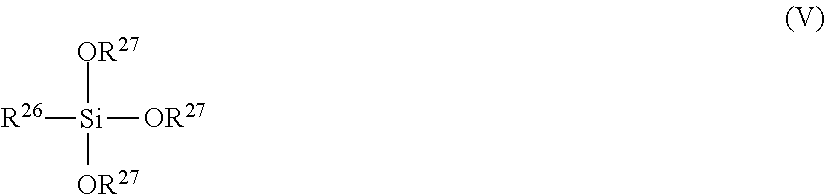
wherein R26 is a monovalent hydrocarbon group having from 1 to 10 carbon atoms or OR27 and each R27 is independently chosen from C1-C4 alkyl. Specific examples include tetraethylorthosilicate (TEOS) and methyltriethoxysilane. These adjuvant compounds will hydrolyze in solution to provide a source of Si—O bonds.
-
- (a′) 3 to 60 weight percent ureido silane and/or hydrolyzate form thereof;
- (b′) 0.001 to 10 wt %/o Si and/or Ce oxide particles;
- (c′) 1 to 15 weight percent stabilizing agent;
- (d′) 1-15 weight percent adjuvant;
- (e′) Up to 2 wt % pH regulating agents; and
- (f′) remainder being water, wherein the weight percents are based on the total weight of the silane-containing coating composition.

wherein:

wherein:

wherein:

wherein:
-
- (i) preparing a series of passivation coating compositions with different concentrations of at least one of component(s) (a)-(f) above;
- (ii) coating the same or different metal substrates with each of the foregoing passivation coating compositions,
- (iii) optionally, drying the passivation coating compositions as applied to each metal substrate under the same drying conditions that are used in any known or conventional on-line coating procedure;
- (iv) determining the amount of passivation coating composition on the surface of each coated metal substrate and the area that is coated by the composition, the amount of passivation coating composition being determined gravimetrically using the equation,
weight of passivation coating composition=(w 2 −w 1)/(area of coated surface) if only one side of the substrate is coated, or
weight of passivation coating composition=(w 2 −w 1)/(2)(area of coated surface) if two sides of the substrate are coated; - or the amount of passivation coating composition being determined by using the XRF method where the XRF standard calibration curve is used to develop a least squared linear regression equation;
- (v) acquiring an FTIR spectrum for each passivation-coated substrate of known passivation composition weight and integrating the peaks associated with a particular functional group to yield an integral of the absorbances;
- (vi) plotting the passivation coating composition weight versus the integral of the absorbances and calculating the least squares linear regression equation;
- (vii) measuring the passivation coating composition weight on-line by obtaining the FTIR spectrum and integrating the spectrum associated with the functional group to yield an integral of the absorbances;
- (viii) using the equation of step (vi) to calculate the weight of the passivation coating composition on the metal substrate.
Amount of dried silane-containing coating (mg/m2)=0.202×(integral, cps)+30.61 (for the CRS substrate); and
Amount of dried silane-containing coating (mg/m2)=0.211×(integral, cps)−204.9 (for the HDG substrate).
| TABLE 1 |
| Data Used to Calculate the Standard Calibration Curve |
| Using XRF Methodology on CRS Substrate. |
| Amount of | ||||
| 23 weight | ||||
| Amount | percent | |||
| of 3-ureido- | colloidal ceria | Water | Amount of | XRF |
| propyltrimethoxysilane, | acetate, weight | weight | film, mg | integral, |
| weight percent | percent | percent | per m2 | cps |
| 0.00 | 0.00 | 100.00 | 0 | 492.5 |
| 0.00 | 0.00 | 100.00 | 0 | 350.2 |
| 0.38 | 0.13 | 99.50 | 190 | 989.3 |
| 0.75 | 0.25 | 99.00 | 446 | 1482.8 |
| 0.75 | 0.25 | 99.00 | 356 | 1316.6 |
| 1.50 | 0.50 | 98.00 | 601 | 2600.5 |
| 1.50 | 0.50 | 98.00 | 606 | 2320.9 |
| 1.50 | 0.50 | 98.00 | 581 | 2533.9 |
| 4.50 | 1.50 | 94.00 | 1113 | 5856.5 |
| TABLE 2 |
| Data Used to Calculate the Standard Calibration Curve |
| Using XRF Methodology on HDG Substrate. |
| Amount of | ||||
| 23 weight | ||||
| Amount | percent | |||
| of 3-ureido- | colloidal ceria | Water | Amount of | XRF |
| proyltrimethoxysilane, | acetate, weight | weight | film, mg per | integral, |
| weight percent | percent | percent | m2 | cps |
| 0.00 | 0.00 | 100.00 | 0 | 1345.3 |
| 0.00 | 0.00 | 100.00 | 0 | 1394.1 |
| 0.38 | 0.13 | 99.50 | 232 | 1920.9 |
| 0.38 | 0.13 | 99.50 | 232 | 2212.8 |
| 0.75 | 0.25 | 99.00 | 394 | 2268.8 |
| 0.75 | 0.25 | 99.00 | 394 | 2449.8 |
| 0.75 | 0.25 | 99.00 | 394 | 2706.7 |
| 0.75 | 0.25 | 99.00 | 394 | 3166.8 |
| 1.50 | 0.50 | 98.00 | 579 | 3399.3 |
| 1.50 | 0.50 | 98.00 | 579 | 3410.2 |
| 1.50 | 0.50 | 98.00 | 579 | 4275.6 |
| 1.50 | 0.50 | 98.00 | 579 | 4374.9 |
| 3.00 | 1.00 | 96.00 | 732 | 4152.4 |
| 4.50 | 1.50 | 94.00 | 1598 | 7628.3 |
| 4.50 | 1.50 | 94.00 | 1598 | 9160.9 |
| TABLE 3 |
| Data Used to Calculate the Standard Calibration |
| Curve Using FTIR Methodology on CRS Substrate. |
| Coating Composition (in Weight Percent) | Amount | FTIR |
| Stan- | (a) 3-ureido- | of film, | inte- | |||
| dard | propyltri- | (b) colloidal | (a) + | mg per | gral, | |
| # | methoxysilane | ceria acetate | (b) | Water | m2 | |
| 1 | 0 | 0 | 0 | 100.000 | 0 | 0.482 |
| 2 | 0.038 | 0.012 | 0.05 | 99.950 | 7.66 | 0.972 |
| 3 | 0.075 | 0.025 | 0.1 | 99.900 | 15.1 | 1.179 |
| 4 | 0.300 | 0.100 | 0.4 | 99.600 | 53.47 | 1.625 |
| 5 | 0.750 | 0.250 | 1 | 99.000 | 182.2 | 3.913 |
| TABLE 4 |
| Data Used to Calculate the Standard Calibration |
| Curve Using FTIR Methodology on HDG Substrate. |
| Coating Composition (in Weight Percent) | Amount | FTIR |
| Stan- | (a) 3-ureido- | of film, | inte- | |||
| dard | propyltri- | (b) colloidal | (a) + | mg per | gral, | |
| # | methoxysilane | ceria acetate | (b) | Water | m2 | Abs |
| 6 | 0 | 0 | 0 | 100.000 | 0 | 0.396 |
| 7 | 0.038 | 0.012 | 0.05 | 99.950 | 3.86 | 1.035 |
| 8 | 0.075 | 0.025 | 0.1 | 99.900 | 16.67 | 1.253 |
| 9 | 0.300 | 0.100 | 0.4 | 99.600 | 52.12 | 2.355 |
| 10 | 0.750 | 0.250 | 1 | 99.000 | 262.8 | 5.528 |
Amount of dried silane-containing coating (mg/m2)=56.20×(integral, Abs)−40.16 (for the CRS substrate); and
Amount of dried silane-containing coating (mg/m2)=53.80×(integral, Abs)−46.60 (for the HDG substrate).
Amount of dried silane-containing coating (mg/m2)=56.20(integral, Abs)−40.16,
which was obtain from the standard calibration plot. The amounts of dried silane film that were determined by XRF method were also reported. The data indicate that the FTIR method can be used to determine the amounts of dried silane film on the surface of CRS substrate and are in good agreement with the amounts determined by the XRF method.
| TABLE 5 |
| Determination of the Amount of Dried Silane Film on the |
| Surface of CRS. |
| FTIR Coating Weight | |||
| XRF Measured | based on equation | ||
| Example | Coating Weight | FTIR Peak Area | from |
| 1 | 57.44 | 1.7796 | 60.1 |
| 2 | 35.04 | 0.9966 | 15.3 |
| 3 | 291.69 | 6.359 | 321.8 |
Claims (20)
Priority Applications (6)
| Application Number | Priority Date | Filing Date | Title |
|---|---|---|---|
| US14/319,626 US9606048B2 (en) | 2014-06-30 | 2014-06-30 | Method for determining the weight and thickness of a passivation or conversion coating on a substrate |
| PCT/US2015/037642 WO2016003761A1 (en) | 2014-06-30 | 2015-06-25 | Method for determining the weight and thickness of a passivation coating composition on a substrate |
| CN201580033723.4A CN106461374B (en) | 2014-06-30 | 2015-06-25 | The method for measuring the weight and thickness of the passivation coatings composition in substrate |
| JP2016570078A JP6595511B2 (en) | 2014-06-30 | 2015-06-25 | Method for measuring weight and thickness of passivation coating composition on substrate |
| BR112016028622-7A BR112016028622B1 (en) | 2014-06-30 | 2015-06-25 | METHOD FOR MEASURING THE WEIGHT OF A PASSIVE COATING COMPOSITION |
| EP15736128.8A EP3161453B1 (en) | 2014-06-30 | 2015-06-25 | Method for determining the weight of a passivation coating composition on a substrate |
Applications Claiming Priority (1)
| Application Number | Priority Date | Filing Date | Title |
|---|---|---|---|
| US14/319,626 US9606048B2 (en) | 2014-06-30 | 2014-06-30 | Method for determining the weight and thickness of a passivation or conversion coating on a substrate |
Publications (2)
| Publication Number | Publication Date |
|---|---|
| US20150377608A1 US20150377608A1 (en) | 2015-12-31 |
| US9606048B2 true US9606048B2 (en) | 2017-03-28 |
Family
ID=53539950
Family Applications (1)
| Application Number | Title | Priority Date | Filing Date |
|---|---|---|---|
| US14/319,626 Expired - Fee Related US9606048B2 (en) | 2014-06-30 | 2014-06-30 | Method for determining the weight and thickness of a passivation or conversion coating on a substrate |
Country Status (6)
| Country | Link |
|---|---|
| US (1) | US9606048B2 (en) |
| EP (1) | EP3161453B1 (en) |
| JP (1) | JP6595511B2 (en) |
| CN (1) | CN106461374B (en) |
| BR (1) | BR112016028622B1 (en) |
| WO (1) | WO2016003761A1 (en) |
Cited By (1)
| Publication number | Priority date | Publication date | Assignee | Title |
|---|---|---|---|---|
| WO2020154368A1 (en) * | 2019-01-25 | 2020-07-30 | Allied Bioscience, Inc. | Analysis of antimicrobial coatings using xrf |
Families Citing this family (5)
| Publication number | Priority date | Publication date | Assignee | Title |
|---|---|---|---|---|
| JP6752620B2 (en) * | 2016-05-19 | 2020-09-09 | 前田建設工業株式会社 | How to identify the material applied to the concrete surface |
| WO2018014938A1 (en) * | 2016-07-19 | 2018-01-25 | Hp Indigo B.V. | Assessment of primer content on a print substrate |
| CN109557084A (en) * | 2019-01-17 | 2019-04-02 | 南通市产品质量监督检验所 | Detection method in such a way that coating iron content identification rope making zinc-coated wire is zinc-plated |
| CN110484129B (en) * | 2019-07-02 | 2022-01-25 | 昆山联滔电子有限公司 | Product with protective coating and preparation method thereof |
| CN115585873A (en) * | 2022-09-27 | 2023-01-10 | 本钢板材股份有限公司 | Method for measuring chromium-free passivation film weight of hot-dip pure zinc steel plate |
Citations (21)
| Publication number | Priority date | Publication date | Assignee | Title |
|---|---|---|---|---|
| US4943721A (en) * | 1989-06-22 | 1990-07-24 | Measurex Corporation | Method of obtaining accurate compositional information of multi-layer compositions |
| US4946902A (en) * | 1988-05-27 | 1990-08-07 | E. I. Du Pont De Nemours And Company | Process for the setabilization of fluoropolymers |
| US5821001A (en) * | 1996-04-25 | 1998-10-13 | Ppg Industries, Inc. | Coated articles |
| US20020041967A1 (en) * | 2000-10-03 | 2002-04-11 | Masatoshi Nakamura | Composite and manufacturing method therefor |
| US20030024432A1 (en) | 2001-07-27 | 2003-02-06 | The Boeing Company | Corrosion inhibiting sol-gel coatings for metal alloys |
| US6573999B1 (en) * | 2000-07-14 | 2003-06-03 | Nanometrics Incorporated | Film thickness measurements using light absorption |
| US20030230720A1 (en) | 2002-06-13 | 2003-12-18 | Shelley Paul H. | Method of measuring chromated conversion coating amount using infrared absorbance |
| US20040117146A1 (en) * | 2002-12-17 | 2004-06-17 | Taiwan Semiconductor Manufacturing Co., Ltd. | Method to measure oxide thickness by FTIR to improve an in-line CMP endpoint determination |
| US20040155190A1 (en) | 2003-02-06 | 2004-08-12 | Shelley Paul H. | Portable coating weight reader |
| US20050229698A1 (en) * | 2004-04-12 | 2005-10-20 | Beecroft Michael T | Hand-held spectrometer |
| US7071174B1 (en) * | 1994-10-13 | 2006-07-04 | Cv Therapeutics, Inc. | Method and composition for inhibiting cholesterol esterase |
| US20060228470A1 (en) * | 2005-04-07 | 2006-10-12 | General Electric Company | No-rinse pretreatment methods and compositions |
| DE102006052114A1 (en) | 2006-11-06 | 2008-05-08 | Robert Bosch Gmbh | Method for determining the layer thickness |
| US20080210343A1 (en) * | 2006-10-31 | 2008-09-04 | Wolfgang Ebert | Process for treatment of metal surfaces |
| US20110059867A1 (en) * | 2009-02-27 | 2011-03-10 | Jinsang Kim | Functionalized polydiacetylene sensors |
| US20120107625A1 (en) * | 2010-11-03 | 2012-05-03 | Noel Smith | Composition and process for the generation of a clear or translucent emissive coating |
| US20130125961A1 (en) * | 2011-11-18 | 2013-05-23 | Industrial Technology Research Institute | Optical passivation film, method for manufacturing the same, and solar cell |
| US20140017409A1 (en) * | 2011-03-30 | 2014-01-16 | Mahindra & Mahindra Limited | Corrosion resistance passivation formulation and process of preparation thereof |
| US20140088876A1 (en) * | 2012-09-26 | 2014-03-27 | Panalytical Inc | Multi-sensor analysis of complex geologic materials |
| US20140202233A1 (en) * | 2011-09-08 | 2014-07-24 | Horiba, Ltd. | Gas analysis device and contamination detection method used in same |
| US20140342164A1 (en) * | 2013-03-26 | 2014-11-20 | Momentive Performance Materials Inc. | Coating composition and method for determining the uniformity and thickness of a no-rinse silane pretreatment |
Family Cites Families (9)
| Publication number | Priority date | Publication date | Assignee | Title |
|---|---|---|---|---|
| DE10205751B4 (en) * | 2002-02-12 | 2004-09-30 | Robert Bosch Gmbh | Ignition device, in particular spark plug for internal combustion engines |
| US20030199649A1 (en) * | 2002-03-26 | 2003-10-23 | Orbison David Robert | Method and apparatus for the controlled dilution of organometallic compounds |
| DE102006002224A1 (en) * | 2006-01-16 | 2007-07-19 | Schaeffler Kg | Arrangement for protecting a substrate against corrosion, method for its production and pulley |
| US7800069B2 (en) * | 2008-08-08 | 2010-09-21 | The Boeing Company | Method for performing IR spectroscopy measurements to determine coating weight/amount for metal conversion coatings |
| FR2981157B1 (en) * | 2011-10-05 | 2013-10-25 | Aircelle Sa | METHOD FOR NON-DESTRUCTIVE CONTROL OF ORGANIC MATRIX COMPOSITE MATERIAL |
| CN102507493B (en) * | 2011-10-24 | 2013-12-25 | 上海理工大学 | Method for measuring interaction between vitrinite and inertinite in coal during pyrolysis process |
| CA2887367A1 (en) * | 2012-05-09 | 2013-11-14 | Sio2 Medical Products, Inc. | Inspection methods for pecvd coatings |
| CN102981109B (en) * | 2012-11-28 | 2014-10-01 | 南方电网科学研究院有限责任公司 | A method for evaluating the aging degree of silicon rubber insulating sheaths for transformers |
| CN103439290B (en) * | 2013-09-17 | 2015-09-23 | 桂林理工大学 | The method of ATR-FTIR Spectrometry on-line determination volatilization organic water pollutant |
-
2014
- 2014-06-30 US US14/319,626 patent/US9606048B2/en not_active Expired - Fee Related
-
2015
- 2015-06-25 JP JP2016570078A patent/JP6595511B2/en not_active Expired - Fee Related
- 2015-06-25 EP EP15736128.8A patent/EP3161453B1/en active Active
- 2015-06-25 CN CN201580033723.4A patent/CN106461374B/en not_active Expired - Fee Related
- 2015-06-25 WO PCT/US2015/037642 patent/WO2016003761A1/en not_active Ceased
- 2015-06-25 BR BR112016028622-7A patent/BR112016028622B1/en not_active IP Right Cessation
Patent Citations (22)
| Publication number | Priority date | Publication date | Assignee | Title |
|---|---|---|---|---|
| US4946902A (en) * | 1988-05-27 | 1990-08-07 | E. I. Du Pont De Nemours And Company | Process for the setabilization of fluoropolymers |
| US4943721A (en) * | 1989-06-22 | 1990-07-24 | Measurex Corporation | Method of obtaining accurate compositional information of multi-layer compositions |
| US7071174B1 (en) * | 1994-10-13 | 2006-07-04 | Cv Therapeutics, Inc. | Method and composition for inhibiting cholesterol esterase |
| US5821001A (en) * | 1996-04-25 | 1998-10-13 | Ppg Industries, Inc. | Coated articles |
| US6573999B1 (en) * | 2000-07-14 | 2003-06-03 | Nanometrics Incorporated | Film thickness measurements using light absorption |
| US20020041967A1 (en) * | 2000-10-03 | 2002-04-11 | Masatoshi Nakamura | Composite and manufacturing method therefor |
| US20030024432A1 (en) | 2001-07-27 | 2003-02-06 | The Boeing Company | Corrosion inhibiting sol-gel coatings for metal alloys |
| US20030230720A1 (en) | 2002-06-13 | 2003-12-18 | Shelley Paul H. | Method of measuring chromated conversion coating amount using infrared absorbance |
| US20040117146A1 (en) * | 2002-12-17 | 2004-06-17 | Taiwan Semiconductor Manufacturing Co., Ltd. | Method to measure oxide thickness by FTIR to improve an in-line CMP endpoint determination |
| US6895360B2 (en) | 2002-12-17 | 2005-05-17 | Taiwan Semiconductor Manufacturing Co., Ltd. | Method to measure oxide thickness by FTIR to improve an in-line CMP endpoint determination |
| US20040155190A1 (en) | 2003-02-06 | 2004-08-12 | Shelley Paul H. | Portable coating weight reader |
| US20050229698A1 (en) * | 2004-04-12 | 2005-10-20 | Beecroft Michael T | Hand-held spectrometer |
| US20060228470A1 (en) * | 2005-04-07 | 2006-10-12 | General Electric Company | No-rinse pretreatment methods and compositions |
| US20080210343A1 (en) * | 2006-10-31 | 2008-09-04 | Wolfgang Ebert | Process for treatment of metal surfaces |
| DE102006052114A1 (en) | 2006-11-06 | 2008-05-08 | Robert Bosch Gmbh | Method for determining the layer thickness |
| US20110059867A1 (en) * | 2009-02-27 | 2011-03-10 | Jinsang Kim | Functionalized polydiacetylene sensors |
| US20120107625A1 (en) * | 2010-11-03 | 2012-05-03 | Noel Smith | Composition and process for the generation of a clear or translucent emissive coating |
| US20140017409A1 (en) * | 2011-03-30 | 2014-01-16 | Mahindra & Mahindra Limited | Corrosion resistance passivation formulation and process of preparation thereof |
| US20140202233A1 (en) * | 2011-09-08 | 2014-07-24 | Horiba, Ltd. | Gas analysis device and contamination detection method used in same |
| US20130125961A1 (en) * | 2011-11-18 | 2013-05-23 | Industrial Technology Research Institute | Optical passivation film, method for manufacturing the same, and solar cell |
| US20140088876A1 (en) * | 2012-09-26 | 2014-03-27 | Panalytical Inc | Multi-sensor analysis of complex geologic materials |
| US20140342164A1 (en) * | 2013-03-26 | 2014-11-20 | Momentive Performance Materials Inc. | Coating composition and method for determining the uniformity and thickness of a no-rinse silane pretreatment |
Non-Patent Citations (3)
| Title |
|---|
| Balachandran et al. (2010), "Synthesis of Nano TiO2-SiO2 Composite using Sol-Gel Method: Effect on Size, Surface Morphology and Thermal Stability", International Journal of Engineering Science and Technology 2(8): 3695-3700. |
| Balachandran et al. (2010), "Synthesis of Nano TiO2—SiO2 Composite using Sol-Gel Method: Effect on Size, Surface Morphology and Thermal Stability", International Journal of Engineering Science and Technology 2(8): 3695-3700. |
| International Search Report and Written Opinion from PCT/US2015/037642 dated Oct. 2, 2015. |
Cited By (4)
| Publication number | Priority date | Publication date | Assignee | Title |
|---|---|---|---|---|
| WO2020154368A1 (en) * | 2019-01-25 | 2020-07-30 | Allied Bioscience, Inc. | Analysis of antimicrobial coatings using xrf |
| AU2020210650B2 (en) * | 2019-01-25 | 2021-03-18 | Allied Bioscience, Inc. | Analysis of antimicrobial coatings using XRF |
| US11029266B2 (en) | 2019-01-25 | 2021-06-08 | Allied Bioscience, Inc. | Analysis of antimicrobial coatings using XRF |
| US11442032B2 (en) | 2019-01-25 | 2022-09-13 | Srfc Bio, Inc. | Analysis of antimicrobial coatings using XRF |
Also Published As
| Publication number | Publication date |
|---|---|
| WO2016003761A1 (en) | 2016-01-07 |
| BR112016028622A2 (en) | 2017-08-22 |
| EP3161453B1 (en) | 2019-11-13 |
| CN106461374A (en) | 2017-02-22 |
| CN106461374B (en) | 2019-07-09 |
| JP6595511B2 (en) | 2019-10-23 |
| US20150377608A1 (en) | 2015-12-31 |
| BR112016028622B1 (en) | 2021-08-03 |
| EP3161453A1 (en) | 2017-05-03 |
| JP2017522547A (en) | 2017-08-10 |
Similar Documents
| Publication | Publication Date | Title |
|---|---|---|
| US9676948B2 (en) | Coating composition and method for determining the uniformity and thickness of a no-rinse silane pretreatment | |
| EP3161453B1 (en) | Method for determining the weight of a passivation coating composition on a substrate | |
| US10570519B2 (en) | Conversion coating composition comprising a dye and a method for coating a metal surface with said conversion coating composition | |
| EP2382277B1 (en) | Silane coating compositions containing silicon-based polyether copolymers, methods for coating metal surfaces and articles made therefrom | |
| KR101461400B1 (en) | Storage stability compositions of part and / or complete condensates of hydrolysable organofunctional silanes | |
| JP5274262B2 (en) | Corrosion protection layer on metal surface | |
| JP4958895B2 (en) | Method for pretreatment of metal surface without rinsing step and composition therefor | |
| JP5860830B2 (en) | Composition stable for storage of hydrolyzable organofunctional silane moieties and / or complete condensates | |
| JP4846212B2 (en) | Hydrophilizing agent, method for producing the same, and method for hydrophilizing coating film |
Legal Events
| Date | Code | Title | Description |
|---|---|---|---|
| AS | Assignment |
Owner name: MOMENTIVE PERFORMANCE MATERIALS INC., NEW YORK Free format text: ASSIGNMENT OF ASSIGNORS INTEREST;ASSIGNORS:KUMAR, VIKRAM;HWANG, LESLEY;BIZATI, KUJTIM;REEL/FRAME:033213/0326 Effective date: 20140626 |
|
| AS | Assignment |
Owner name: THE BANK OF NEW YORK MELLON TRUST COMPANY, N.A., AS COLLATERAL AGENT, PENNSYLVANIA Free format text: SECURITY INTEREST;ASSIGNOR:MOMENTIVE PERFORMANCE MATERIALS INC.;REEL/FRAME:034066/0662 Effective date: 20141024 Owner name: THE BANK OF NEW YORK MELLON TRUST COMPANY, N.A., AS COLLATERAL AGENT, PENNSYLVANIA Free format text: SECURITY INTEREST;ASSIGNOR:MOMENTIVE PERFORMANCE MATERIALS INC.;REEL/FRAME:034066/0570 Effective date: 20141024 Owner name: THE BANK OF NEW YORK MELLON TRUST COMPANY, N.A., A Free format text: SECURITY INTEREST;ASSIGNOR:MOMENTIVE PERFORMANCE MATERIALS INC.;REEL/FRAME:034066/0570 Effective date: 20141024 Owner name: THE BANK OF NEW YORK MELLON TRUST COMPANY, N.A., A Free format text: SECURITY INTEREST;ASSIGNOR:MOMENTIVE PERFORMANCE MATERIALS INC.;REEL/FRAME:034066/0662 Effective date: 20141024 |
|
| AS | Assignment |
Owner name: JPMORGAN CHASE BANK, N.A., AS COLLATERAL AGENT, NE Free format text: SECURITY INTEREST;ASSIGNOR:MOMENTIVE PERFORMANCE MATERIALS INC.;REEL/FRAME:034759/0723 Effective date: 20150113 |
|
| AS | Assignment |
Owner name: BOKF, NA, AS SUCCESSOR COLLATERAL AGENT, OKLAHOMA Free format text: NOTICE OF CHANGE OF COLLATERAL AGENT - ASSIGNMENT OF SECURITY INTEREST IN INTELLECTUAL PROPERTY;ASSIGNOR:THE BANK OF NEW YORK MELLON TRUST COMPANY, N.A. AS COLLATERAL AGENT;REEL/FRAME:035136/0457 Effective date: 20150302 Owner name: BOKF, NA, AS SUCCESSOR COLLATERAL AGENT, OKLAHOMA Free format text: NOTICE OF CHANGE OF COLLATERAL AGENT - ASSIGNMENT OF SECURITY INTEREST IN INTELLECTUAL PROPERTY - SECOND LIEN;ASSIGNOR:THE BANK OF NEW YORK MELLON TRUST COMPANY, N.A. AS COLLATERAL AGENT;REEL/FRAME:035137/0263 Effective date: 20150302 |
|
| STCF | Information on status: patent grant |
Free format text: PATENTED CASE |
|
| AS | Assignment |
Owner name: MOMENTIVE PERFORMANCE MATERIALS INC., NEW YORK Free format text: RELEASE BY SECURED PARTY;ASSIGNOR:BOKF, NA;REEL/FRAME:049194/0085 Effective date: 20190515 Owner name: MOMENTIVE PERFORMANCE MATERIALS INC., NEW YORK Free format text: RELEASE BY SECURED PARTY;ASSIGNOR:BOKF, NA;REEL/FRAME:049249/0271 Effective date: 20190515 |
|
| AS | Assignment |
Owner name: BNP PARIBAS, AS ADMINISTRATIVE AGENT, NEW YORK Free format text: FIRST LIEN TERM LOAN PATENT AGREEMENT;ASSIGNOR:MOMENTIVE PERFORMANCE MATERIALS INC.;REEL/FRAME:049387/0782 Effective date: 20190515 Owner name: KOOKMIN BANK, NEW YORK BRANCH, AS ADMINISTRATIVE A Free format text: SECOND LIEN TERM LOAN PATENT AGREEMENT;ASSIGNOR:MOMENTIVE PERFORMANCE MATERIALS INC.;REEL/FRAME:049388/0220 Effective date: 20190515 Owner name: CITIBANK, N.A., AS ADMINISTRATIVE AGENT, NEW YORK Free format text: ABL PATENT AGREEMENT;ASSIGNORS:MOMENTIVE PERFORMANCE MATERIALS INC.;MOMENTIVE PERFORMANCE MATERIALS GMBH;REEL/FRAME:049388/0252 Effective date: 20190515 Owner name: KOOKMIN BANK, NEW YORK BRANCH, AS ADMINISTRATIVE AGENT, NEW YORK Free format text: SECOND LIEN TERM LOAN PATENT AGREEMENT;ASSIGNOR:MOMENTIVE PERFORMANCE MATERIALS INC.;REEL/FRAME:049388/0220 Effective date: 20190515 |
|
| MAFP | Maintenance fee payment |
Free format text: PAYMENT OF MAINTENANCE FEE, 4TH YEAR, LARGE ENTITY (ORIGINAL EVENT CODE: M1551); ENTITY STATUS OF PATENT OWNER: LARGE ENTITY Year of fee payment: 4 |
|
| AS | Assignment |
Owner name: MOMENTIVE PERFORMANCE MATERIALS INC., NEW YORK Free format text: RELEASE BY SECURED PARTY;ASSIGNOR:JPMORGAN CHASE BANK, N.A., AS COLLATERAL AGENT;REEL/FRAME:054336/0279 Effective date: 20201102 |
|
| AS | Assignment |
Owner name: KOOKMIN BANK NEW YORK BRANCH, NEW YORK Free format text: SECURITY INTEREST;ASSIGNOR:MOMENTIVE PERFORMANCE MATERIALS INC.;REEL/FRAME:063197/0475 Effective date: 20230329 Owner name: MOMENTIVE PERFORMANCE MATERIALS INC., NEW YORK Free format text: RELEASE BY SECURED PARTY;ASSIGNOR:KOOKMIN BANK NEW YORK;REEL/FRAME:063197/0373 Effective date: 20230329 Owner name: MOMENTIVE PERFORMANCE MATERIALS INC., NEW YORK Free format text: RELEASE OF SECURITY INTEREST;ASSIGNOR:KOOKMIN BANK NEW YORK;REEL/FRAME:063197/0373 Effective date: 20230329 |
|
| AS | Assignment |
Owner name: MOMENTIVE PERFORMANCE MATERIALS INC., NEW YORK Free format text: TERMINATION AND RELEASE OF SECURITY INTEREST IN PATENTS;ASSIGNOR:BNP PARIBAS;REEL/FRAME:063259/0133 Effective date: 20230329 Owner name: JPMORGAN CHASE BANK, N.A., NEW YORK Free format text: FIRST LIEN TERM LOAN PATENT SECURITY AGREEMENT;ASSIGNOR:MOMENTIVE PERFORMANCE MATERIALS INC.;REEL/FRAME:063213/0472 Effective date: 20230329 |
|
| FEPP | Fee payment procedure |
Free format text: MAINTENANCE FEE REMINDER MAILED (ORIGINAL EVENT CODE: REM.); ENTITY STATUS OF PATENT OWNER: LARGE ENTITY |
|
| LAPS | Lapse for failure to pay maintenance fees |
Free format text: PATENT EXPIRED FOR FAILURE TO PAY MAINTENANCE FEES (ORIGINAL EVENT CODE: EXP.); ENTITY STATUS OF PATENT OWNER: LARGE ENTITY |
|
| STCH | Information on status: patent discontinuation |
Free format text: PATENT EXPIRED DUE TO NONPAYMENT OF MAINTENANCE FEES UNDER 37 CFR 1.362 |
|
| FP | Lapsed due to failure to pay maintenance fee |
Effective date: 20250328 |
|
| AS | Assignment |
Owner name: MOMENTIVE PERFORMANCE MATERIALS INC., NEW YORK Free format text: RELEASE BY SECURED PARTY;ASSIGNOR:KOOKMIN BANK NEW YORK BRANCH;REEL/FRAME:072039/0906 Effective date: 20250717 Owner name: MOMENTIVE PERFORMANCE MATERIALS INC., NEW YORK Free format text: RELEASE OF SECURITY INTEREST;ASSIGNOR:KOOKMIN BANK NEW YORK BRANCH;REEL/FRAME:072039/0906 Effective date: 20250717 |
|
| AS | Assignment |
Owner name: MOMENTIVE PERFORMANCE MATERIALS INC., NEW YORK Free format text: RELEASE OF SECURITY INTEREST IN PATENTS PREVIOUSLY RECORDED AT REEL/FRAME (063213/0472);ASSIGNOR:JPMORGAN CHASE BANK, N.A., AS ADMINISTRATIVE AGENT;REEL/FRAME:073168/0715 Effective date: 20251022 |