US9574609B2 - Superfinishing machine, superfinishing method and outer ring of bearing having superfinished raceway surface - Google Patents

Superfinishing machine, superfinishing method and outer ring of bearing having superfinished raceway surface Download PDF

Info

Publication number
US9574609B2
US9574609B2 US14/356,690 US201214356690A US9574609B2 US 9574609 B2 US9574609 B2 US 9574609B2 US 201214356690 A US201214356690 A US 201214356690A US 9574609 B2 US9574609 B2 US 9574609B2
Authority
US
United States
Prior art keywords
outer ring
superfinishing
grinding stone
annular member
distal end
Prior art date
Legal status (The legal status is an assumption and is not a legal conclusion. Google has not performed a legal analysis and makes no representation as to the accuracy of the status listed.)
Active, expires
Application number
US14/356,690
Other versions
US20140301687A1 (en
Inventor
Eiji Utada
Natsuki Sensui
Takayuki Watanabe
Current Assignee (The listed assignees may be inaccurate. Google has not performed a legal analysis and makes no representation or warranty as to the accuracy of the list.)
NSK Ltd
Original Assignee
NSK Ltd
Priority date (The priority date is an assumption and is not a legal conclusion. Google has not performed a legal analysis and makes no representation as to the accuracy of the date listed.)
Filing date
Publication date
Application filed by NSK Ltd filed Critical NSK Ltd
Assigned to NSK LTD. reassignment NSK LTD. ASSIGNMENT OF ASSIGNORS INTEREST (SEE DOCUMENT FOR DETAILS). Assignors: SENSUI, NATSUKI, UTADA, EIJI, WATANABE, TAKAYUKI
Publication of US20140301687A1 publication Critical patent/US20140301687A1/en
Application granted granted Critical
Publication of US9574609B2 publication Critical patent/US9574609B2/en
Active legal-status Critical Current
Adjusted expiration legal-status Critical

Links

Images

Classifications

    • BPERFORMING OPERATIONS; TRANSPORTING
    • B24GRINDING; POLISHING
    • B24BMACHINES, DEVICES, OR PROCESSES FOR GRINDING OR POLISHING; DRESSING OR CONDITIONING OF ABRADING SURFACES; FEEDING OF GRINDING, POLISHING, OR LAPPING AGENTS
    • B24B19/00Single-purpose machines or devices for particular grinding operations not covered by any other main group
    • B24B19/02Single-purpose machines or devices for particular grinding operations not covered by any other main group for grinding grooves, e.g. on shafts, in casings, in tubes, homokinetic joint elements
    • B24B19/06Single-purpose machines or devices for particular grinding operations not covered by any other main group for grinding grooves, e.g. on shafts, in casings, in tubes, homokinetic joint elements for grinding races, e.g. roller races
    • BPERFORMING OPERATIONS; TRANSPORTING
    • B24GRINDING; POLISHING
    • B24BMACHINES, DEVICES, OR PROCESSES FOR GRINDING OR POLISHING; DRESSING OR CONDITIONING OF ABRADING SURFACES; FEEDING OF GRINDING, POLISHING, OR LAPPING AGENTS
    • B24B35/00Machines or devices designed for superfinishing surfaces on work, i.e. by means of abrading blocks reciprocating with high frequency
    • FMECHANICAL ENGINEERING; LIGHTING; HEATING; WEAPONS; BLASTING
    • F16ENGINEERING ELEMENTS AND UNITS; GENERAL MEASURES FOR PRODUCING AND MAINTAINING EFFECTIVE FUNCTIONING OF MACHINES OR INSTALLATIONS; THERMAL INSULATION IN GENERAL
    • F16CSHAFTS; FLEXIBLE SHAFTS; ELEMENTS OR CRANKSHAFT MECHANISMS; ROTARY BODIES OTHER THAN GEARING ELEMENTS; BEARINGS
    • F16C33/00Parts of bearings; Special methods for making bearings or parts thereof
    • F16C33/30Parts of ball or roller bearings
    • F16C33/58Raceways; Race rings
    • FMECHANICAL ENGINEERING; LIGHTING; HEATING; WEAPONS; BLASTING
    • F16ENGINEERING ELEMENTS AND UNITS; GENERAL MEASURES FOR PRODUCING AND MAINTAINING EFFECTIVE FUNCTIONING OF MACHINES OR INSTALLATIONS; THERMAL INSULATION IN GENERAL
    • F16CSHAFTS; FLEXIBLE SHAFTS; ELEMENTS OR CRANKSHAFT MECHANISMS; ROTARY BODIES OTHER THAN GEARING ELEMENTS; BEARINGS
    • F16C33/00Parts of bearings; Special methods for making bearings or parts thereof
    • F16C33/30Parts of ball or roller bearings
    • F16C33/58Raceways; Race rings
    • F16C33/64Special methods of manufacture
    • FMECHANICAL ENGINEERING; LIGHTING; HEATING; WEAPONS; BLASTING
    • F16ENGINEERING ELEMENTS AND UNITS; GENERAL MEASURES FOR PRODUCING AND MAINTAINING EFFECTIVE FUNCTIONING OF MACHINES OR INSTALLATIONS; THERMAL INSULATION IN GENERAL
    • F16CSHAFTS; FLEXIBLE SHAFTS; ELEMENTS OR CRANKSHAFT MECHANISMS; ROTARY BODIES OTHER THAN GEARING ELEMENTS; BEARINGS
    • F16C19/00Bearings with rolling contact, for exclusively rotary movement
    • F16C19/22Bearings with rolling contact, for exclusively rotary movement with bearing rollers essentially of the same size in one or more circular rows, e.g. needle bearings
    • F16C19/34Bearings with rolling contact, for exclusively rotary movement with bearing rollers essentially of the same size in one or more circular rows, e.g. needle bearings for both radial and axial load
    • F16C19/36Bearings with rolling contact, for exclusively rotary movement with bearing rollers essentially of the same size in one or more circular rows, e.g. needle bearings for both radial and axial load with a single row of rollers
    • F16C19/364Bearings with rolling contact, for exclusively rotary movement with bearing rollers essentially of the same size in one or more circular rows, e.g. needle bearings for both radial and axial load with a single row of rollers with tapered rollers, i.e. rollers having essentially the shape of a truncated cone

Definitions

  • the present invention relates to a superfinishing machine, a superfinishing method, and an outer ring of a bearing having a superfinished raceway surface.
  • Patent Document 1 as a superfinishing method, there is known a method of superfinishing an outer peripheral surface of an annular member, which is an object to be machined, by rotating the annular member around its center axis, in a state in which a grinding stone is brought into pressure contact with the outer peripheral surface of the annular member, and simultaneously oscillating the grinding stone in a direction parallel with the center axis of the annular member along a plane touching a generatrix of the outer peripheral surface of the annular member.
  • Such a superfinishing method is often used for superfinishing an element of a roller bearing, including rollers or a raceway surface of an inner ring or an outer ring.
  • the superfinishing is performed on the raceway surface of the outer ring of a tapered roller bearing by the same method as the above-described method. More specifically, as illustrated in FIG. 6A , the superfinishing is performed by rotating an outer ring 110 of the tapered roller bearing around a center axis O′, and simultaneously, vertically pressing a distal end surface of the grinding stone 103 against a tapered raceway surface 114 formed on an outer peripheral surface of the outer ring 110 and linearly reciprocating the grinding stone in a direction of the center axis O′.
  • FIG. 6 Conditions in which the distal end surface 104 of the grinding stone 103 and a logarithmically crowned surface of the raceway surface 114 of the outer ring 110 contact each other in machining according to the conventional superfinishing method are illustrated in FIG. 6 .
  • reference signs a, b, c indicate one end, an intermediate portion, and the other end in the linearly reciprocating movement of the grinding stone 103 , respectively.
  • Reference signs I, II, III indicate imaginary planes passing through one side portion, an intermediate portion and the other side portion of the grinding stone 103 in a circumferential direction, respectively. Further, in FIG.
  • the portion, indicated by a double wavy line, on the distal end surface 104 of the grinding stone 103 represents a portion brought into contact with the raceway surface 114 of the outer ring 110 .
  • the entire surface of the raceway surface 114 of the outer ring 110 always abuts against the distal end surface 104 of the grinding stone 103 at all positions a, b, c when the grinding stone 103 reciprocates linearly. Accordingly, the raceway surface 114 of the outer ring 110 can be superfinished uniformly in an axial direction.
  • edge load When the roller comes into contact with the raceway surface in the roller bearing, an excessive pressure (so-called edge load) is generally generated at the edge portion of a contact region.
  • edge load the roller or the raceway surface of the inner ring or the outer ring is formed with a slight bulge referred to as a crowning represented by a logarithmic function (hereinafter, the surface provided with the crowning is referred to as a logarithmically crowned surface).
  • a grinding amount of the logarithmically crowned surface is not uniform in the axial direction of a rolling contact surface, so that a finished surface having the uniform surface roughness may not be obtained. More specifically, as illustrated in FIG. 7 , if the raceway surface 114 of the outer ring 110 is made of the logarithmically crowned surface, when the grinding stone 103 is first displaced at the position a, a first crowning drop portion 116 at one side in the axial direction does not abut against the distal end surface 104 of the grinding stone 103 .
  • the first and second crowning drop portions 116 , 117 at both sides in the axial direction do not abut against the distal end surface 104 of the grinding stone 103 .
  • the distal end surface does not abut against the second crowning drop portion 117 . That is, when the grinding stone reciprocates linearly, the distal end surface 104 of the grinding stone 103 does not abut against all the crowning center portion 115 , the first crowning drop portion 116 and the second crowning drop portion 117 of the raceway surface 114 at any of the positions a, b, c. Therefore, as illustrated in FIG. 8 , since the surface roughness of the crowning center portion 115 and the first and second crowning drop portions 116 , 117 is varied, the surface roughness of the raceway surface 114 may not be uniform.
  • the finishing is performed by traversing the grinding stone in parallel with the crowned surface so that a swing center axis is always maintained in a normal direction of the crowned surface formed on an oscillation surface, thereby preventing a collapse of its shape.
  • Patent Document 1 JP 51-012157 B1
  • Patent Document 2 JP 2002-326153 A
  • Patent Document 3 JP 2007-260829 A
  • the present invention has been made in view of the above-described problem, and an object of the present invention is to provide a superfinishing machine and a superfinishing method which can perform axially uniform finishing on a logarithmically crowned surface formed on an inner peripheral surface of an annular member in a short time, and an outer ring of a bearing having a raceway surface superfinished by the superfinishing method.
  • a rotation jig configured to hold an annular member such that the annular member is rotatable around a center axis of the annular member, the annular member having a logarithmically crowned surface formed on an inner peripheral surface thereof;
  • a pressing section configured to hold a grinding stone and to bring a distal end surface of the grinding stone into pressure contact with the logarithmically crowned surface of the annular member rotating around the center axis;
  • a linearly reciprocating mechanism configured to linearly reciprocate the grinding stone held by the pressing section, along a plane touching a generatrix of the logarithmically crowned surface, and in a direction inclined by a given angle with respect to the center axis of the annular member, thereby superfinishing the logarithmically crowned surface.
  • each side portion of the distal end surface in a circumferential direction is formed with a portion configured to abut against all locations on the logarithmically crowned surface along the inclined direction.
  • the outer ring is rotated around the center axis, and the distal end surface of the grinding stone is brought into pressure contact with a raceway surface, being the logarithmically crowned surface, formed on an inner peripheral surface of the outer ring, thereby superfinishing the raceway surface.
  • the outer ring is rotated around the center axis, and the distal end surface of the grinding stone is brought into pressure contact with a raceway surface, being the logarithmically crowned surface, formed on an inner peripheral surface of the outer ring, thereby superfinishing the raceway surface.
  • the superfinishing machine includes the linearly reciprocating mechanism linearly reciprocating the grinding stone held by the pressing section, along a plane touching a generatrix of the logarithmically crowned surface, and in a direction inclined by a given angle with respect to the center axis of the annular member. Therefore, the grinding stone can be brought into contact with the logarithmically crowned surface at all locations along the axial direction thereof at any position in the linearly reciprocating movement, whereby the axially uniform finishing can be performed in a short time.
  • FIG. 1 is a schematic side view of a superfinishing machine according to an embodiment of the present invention
  • FIG. 2 is a schematic plan view of the superfinishing machine according to the embodiment of the present invention.
  • FIG. 3A is a side view illustrating an outer ring and a grinding stone, and FIG. 3B is a plan view thereof;
  • FIG. 4A is a diagram illustrating a manner in which the grinding stone linearly reciprocates on a raceway surface of the outer ring
  • FIG. 4B is a diagram illustrating conditions in which a distal end surface of the grinding stone and a logarithmically crowned surface of the outer ring contact each other;
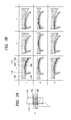
  • FIGS. 5A and 5B are graphs showing a profile and a surface roughness of the logarithmically crowned surface, respectively, before superfinishing
  • FIG. 5C is a graph showing the surface roughness of the logarithmically crowned surface after the superfinishing
  • FIG. 6 is a diagram illustrating a conventional superfinishing method, in which FIG. 6A is a diagram illustrating a manner in which a grinding stone linearly reciprocates on a raceway surface of an outer ring, and FIG. 6B is a diagram illustrating conditions in which a distal end surface of the grinding stone and a raceway surface of an outer ring contact each other;
  • FIG. 7 is a diagram illustrating another conventional superfinishing method, in which FIG. 7A is a diagram illustrating a manner in which a grinding stone linearly reciprocates on a raceway surface of an outer ring, and FIG. 7B is a diagram illustrating conditions in which a distal end surface of a grinding stone and a logarithmically crowned surface of an outer ring contact each other; and
  • FIG. 8 is a graph showing surface roughness of the logarithmically crowned surface superfinished by the superfinishing method of FIG. 7 .
  • FIGS. 1 and 2 illustrate a schematic side view and a schematic plan view of a superfinishing machine 1 according to an embodiment of the present invention, respectively.
  • the superfinishing machine 1 includes a rotatably holding section 20 holding an outer ring 10 (an annular member) of a tapered roller bearing such that the outer ring is rotatable around a center axis O, a pressing section 30 holding a grinding stone 3 and bringing a distal end surface 4 of the grinding stone 3 into pressure contact with a tapered raceway surface 14 formed on an inner peripheral surface 12 of the outer ring 10 , and a linearly reciprocating mechanism 40 linearly reciprocating the grinding stone 3 held by the pressing section 30 in a desired direction.
  • a rotatably holding section 20 holding an outer ring 10 (an annular member) of a tapered roller bearing such that the outer ring is rotatable around a center axis O
  • a pressing section 30 holding a grinding stone 3 and bringing a distal end surface 4 of the grinding stone 3 into
  • the outer ring 10 is an outer ring of a tapered roller bearing, and is provided with a tapered raceway surface 14 formed on the inner peripheral surface 12 thereof, as described above.
  • the raceway surface 14 is machined in advance to have a logarithmically crowned surface consisting of a crowning center portion 15 formed at a center thereof an axial direction, a first crowning drop portion 16 formed at one side of the crowning center portion 15 in the axial direction, and a second crowning drop portion 17 formed at the other side of the crowning center portion 15 in the axial direction.
  • the one side in the axial direction is a small-diameter opening 18 side (left side in FIGS.
  • FIGS. 1 and 3 a plane touching a generatrix of the logarithmically crowned surface of the raceway surface 14 is indicated by a reference sign B.
  • the grinding stone 3 to be pressed against the outer ring 10 is formed to have a quadrangular column shape, and the distal end surface 4 thereof has a parallelogram shape in a cross section, and is arranged such that a set of opposite sides 4 a , 4 a , which are opposite to each other in a circumferential direction, is parallel to a direction inclined by an angle ⁇ with respect to the center axis O. Further, a width of the distal end surface 4 in the axial direction is set to be larger than the width of the raceway surface 14 of the outer ring 10 in the axial direction. Further, as illustrated in FIG.
  • the distal end surface 4 has a center portion 5 formed to correspond to the logarithmically crowned surface of the outer ring 10 and formed at its center portion in the axial direction to abut against the crowning center portion 15 , a first convex portion 6 formed at the one side of the center portion 5 in the axial direction to abut against the first crowning drop portion 16 , and a second convex portion 7 formed at the other side of the center portion 5 in the axial direction to abut against the second crowning drop portion 17 .
  • the rotatably holding section 20 includes a shoe 22 placed on a base 21 and slidably supporting the outer ring 10 on an upper surface thereof, a back plate (rotation jig) 24 holding the one side 11 of the outer ring 10 in the axial direction and being able to rotate the outer ring around the center axis O, and a pair of pusher rolls 26 and 26 abutting against the other side 13 of the outer ring 10 in the axial direction and pressing the outer ring 10 against the back plate 24 to clamp the outer ring 10 .
  • the pair of the pusher rolls 26 and 26 are supported by a support member 27 , and transmit a clamping force of a clamp device 28 to the outer ring 10 via the support member 27 .
  • the pressing section 30 is formed in a substantially rectangular parallelepiped shape, and holds the grinding stone 3 at a front end thereof, the grinding stone 3 being fixed or released by clamp bolts (not illustrated). Further, the pressing section 30 and the grinding stone 3 are disposed to be tilted at an angle ⁇ toward the large-diameter opening 19 side (toward the other side in the axial direction) of the outer ring 10 with respect to a perpendicular line L of the raceway surface 14 by a rotation table 44 which will be described later, thereby preventing an interference between the pressing section 30 or the grinding stone 3 and the outer ring 10 . In addition, the pressing section 30 and the grinding stone 3 are disposed toward a direction inclined at a given angle ⁇ with respect to the center axis O of the outer ring 10 .
  • the linearly reciprocating mechanism 40 includes an oscillation table 42 holding a side of the pressing section 30 and being able to linearly reciprocate in a direction of a plane B (direction of an arrow A) touching the generatrix of the raceway surface 14 , and a pivotable rotation table 44 holding the oscillation table 42 and being pivotable around imaginary axes ⁇ and ⁇ perpendicular to the center axis O. Accordingly, the rotation table 44 is pivoted around the imaginary axis ⁇ to adjust the angle ⁇ , and is pivoted around the imaginary axis ⁇ to adjust the angle ⁇ . In this instance, the angle ⁇ is adjusted in the range of 0° ⁇ 40°, for example.
  • the back plate 24 is rotated, and thus the outer ring 10 supported by the shoe 22 and pressed against the pair of pusher rolls 26 is rotated around the center axis O.
  • the distal end surface 4 of the grinding stone 3 is pressed against the raceway surface 14 (logarithmically crowned surface) of the outer ring 10 by the pressing section 30 .
  • the angles ⁇ and ⁇ of the pressing section 30 and the grinding stone 3 are adjusted in advance by the rotation table 44 to have an appropriate value.
  • the oscillation table 42 is driven, and thus the grinding stone 3 is linearly reciprocated along the plane B touching the generatrix of the raceway surface 14 (logarithmically crowned surface) of the outer ring 10 , and in the direction C inclined by a given angle ⁇ with respect to the center axis O of the outer ring 10 , thereby superfinishing the raceway surface 14 .
  • FIG. 4 illustrates conditions in which the distal end surface 4 of the grinding stone 3 and the logarithmically crowned surface of the raceway surface 14 of the outer ring 10 contact each other, in the case of machining the workpiece using the superfinishing method of this embodiment.
  • reference signs a, b, c indicate one end, an intermediate portion, and the other end in the linearly reciprocating movement of the grinding stone 3 , respectively.
  • Reference signs I, II, III indicate imaginary planes passing through one side portion, an intermediate portion and the other side portion of the grinding stone 103 in a circumferential direction, respectively.
  • the portion, indicated by a double wavy line, on the distal end surface 4 of the grinding stone 3 represents a portion brought into contact with the raceway surface 14 of the outer ring 10 .
  • FIGS. 5A and 5B show graphs showing a profile (height) and surface roughness of the center portion 15 and the first and second crowning drop portions 16 and 17 of the logarithmically crowned surface, respectively, before the superfinishing.
  • FIG. 5C shows a graph showing the surface roughness of the logarithmically crowned surface after the superfinishing.
  • the second convex portion 7 of the distal end surface 4 always abuts against the second crowning drop portion 17 of the raceway surface 14 at all positions a, b, c in the linearly reciprocating movement of the grinding stone 3 .
  • the grinding stone 3 is configured to abut against the distal end surface 4 and to press it at all locations on the logarithmically crowned surface of the raceway surface 14 when being displaced to the position c.
  • the center portion 5 of the distal end surface 4 always abuts against the crowning center portion 15 of the raceway surface 14 at all positions a, b, c in the linearly reciprocating movement of the grinding stone 3 .
  • the second convex portion 7 abuts against the second crowning drop portion 17 at the position a
  • the first convex portion 6 abuts against the first crowning drop portion 16 at the position c.
  • the first convex portion 6 of the distal end surface 4 always abuts against the first crowning drop portion 16 of the raceway surface 14 at all positions a, b, c in the linearly reciprocating movement of the grinding stone 3 .
  • the grinding stone 3 is configured to abut against the distal end surface 4 and to press it at all locations on the logarithmically crowned surface of the raceway surface 14 when being displaced to the position a.
  • the distal end surface 4 of the grinding stone 3 abuts against all of the crowning center portion 15 , the first crowning drop portion 16 , and the second crowning drop portion 17 of the raceway surface 14 at any positions a, b, c in the linear reciprocating movement. Therefore, as illustrated in FIG. 5C , it is possible to perform the finishing on the logarithmically crowned surface uniformly in the axial direction in a short time.
  • the present invention is not limited to the embodiment described above, and changes and modifications can be made therein as appropriate.
  • the inner peripheral surface of the outer ring of the tapered roller as the annular member is provided with the logarithmically crowned surface, but the annular member is not specifically limited to the outer ring of the tapered roller. It may be a member of an annular shape, and may be an outer ring of a cylindrical roller bearing, or an outer ring of a needle roller bearing.
  • the superfinishing method of the present invention can be applied.

Landscapes

  • Engineering & Computer Science (AREA)
  • General Engineering & Computer Science (AREA)
  • Mechanical Engineering (AREA)
  • Manufacturing & Machinery (AREA)
  • Finish Polishing, Edge Sharpening, And Grinding By Specific Grinding Devices (AREA)
  • Rolling Contact Bearings (AREA)
  • Grinding And Polishing Of Tertiary Curved Surfaces And Surfaces With Complex Shapes (AREA)

Abstract

A superfinishing machine and a superfinishing method which can perform axially uniform finishing on a logarithmically crowned surface formed on an inner peripheral surface of an annular member in a short time, and an outer ring of a bearing having a raceway surface superfinished by the superfinishing method, are provided. A superfinishing machine 1 includes a linearly reciprocating mechanism 40 configured to linearly reciprocate a grinding stone 3 held by a pressing section 30, along a plane B touching a generatrix of the logarithmically crowned surface, and in a direction C inclined by a given angle φ with respect to a center axis O of an outer ring 10.

Description

TECHNICAL FIELD
The present invention relates to a superfinishing machine, a superfinishing method, and an outer ring of a bearing having a superfinished raceway surface.
BACKGROUND ART
Conventionally, as disclosed in Patent Document 1, as a superfinishing method, there is known a method of superfinishing an outer peripheral surface of an annular member, which is an object to be machined, by rotating the annular member around its center axis, in a state in which a grinding stone is brought into pressure contact with the outer peripheral surface of the annular member, and simultaneously oscillating the grinding stone in a direction parallel with the center axis of the annular member along a plane touching a generatrix of the outer peripheral surface of the annular member.
Such a superfinishing method is often used for superfinishing an element of a roller bearing, including rollers or a raceway surface of an inner ring or an outer ring. For example, in Patent Document 2, the superfinishing is performed on the raceway surface of the outer ring of a tapered roller bearing by the same method as the above-described method. More specifically, as illustrated in FIG. 6A, the superfinishing is performed by rotating an outer ring 110 of the tapered roller bearing around a center axis O′, and simultaneously, vertically pressing a distal end surface of the grinding stone 103 against a tapered raceway surface 114 formed on an outer peripheral surface of the outer ring 110 and linearly reciprocating the grinding stone in a direction of the center axis O′.
Conditions in which the distal end surface 104 of the grinding stone 103 and a logarithmically crowned surface of the raceway surface 114 of the outer ring 110 contact each other in machining according to the conventional superfinishing method are illustrated in FIG. 6. In FIG. 6A, reference signs a, b, c indicate one end, an intermediate portion, and the other end in the linearly reciprocating movement of the grinding stone 103, respectively. Reference signs I, II, III indicate imaginary planes passing through one side portion, an intermediate portion and the other side portion of the grinding stone 103 in a circumferential direction, respectively. Further, in FIG. 6B, the portion, indicated by a double wavy line, on the distal end surface 104 of the grinding stone 103 represents a portion brought into contact with the raceway surface 114 of the outer ring 110. In the intermediate portion II of the grinding stone 103 in the circumferential direction, the entire surface of the raceway surface 114 of the outer ring 110 always abuts against the distal end surface 104 of the grinding stone 103 at all positions a, b, c when the grinding stone 103 reciprocates linearly. Accordingly, the raceway surface 114 of the outer ring 110 can be superfinished uniformly in an axial direction.
When the roller comes into contact with the raceway surface in the roller bearing, an excessive pressure (so-called edge load) is generally generated at the edge portion of a contact region. To avoid the edge load, the roller or the raceway surface of the inner ring or the outer ring is formed with a slight bulge referred to as a crowning represented by a logarithmic function (hereinafter, the surface provided with the crowning is referred to as a logarithmically crowned surface).
When the raceway surface made of the logarithmically crowned surface is subjected to the superfinishing, the superfinishing method disclosed in Patent Document 1 or 2 is employed, a grinding amount of the logarithmically crowned surface is not uniform in the axial direction of a rolling contact surface, so that a finished surface having the uniform surface roughness may not be obtained. More specifically, as illustrated in FIG. 7, if the raceway surface 114 of the outer ring 110 is made of the logarithmically crowned surface, when the grinding stone 103 is first displaced at the position a, a first crowning drop portion 116 at one side in the axial direction does not abut against the distal end surface 104 of the grinding stone 103. Further, when the grinding stone 103 is displaced at the position b, the first and second crowning drop portions 116, 117 at both sides in the axial direction do not abut against the distal end surface 104 of the grinding stone 103. In addition, when the grinding stone 103 is displaced at the position c, the distal end surface does not abut against the second crowning drop portion 117. That is, when the grinding stone reciprocates linearly, the distal end surface 104 of the grinding stone 103 does not abut against all the crowning center portion 115, the first crowning drop portion 116 and the second crowning drop portion 117 of the raceway surface 114 at any of the positions a, b, c. Therefore, as illustrated in FIG. 8, since the surface roughness of the crowning center portion 115 and the first and second crowning drop portions 116, 117 is varied, the surface roughness of the raceway surface 114 may not be uniform.
Accordingly, according to the superfinishing method disclosed in Patent Document 3, the finishing is performed by traversing the grinding stone in parallel with the crowned surface so that a swing center axis is always maintained in a normal direction of the crowned surface formed on an oscillation surface, thereby preventing a collapse of its shape.
PRIOR ART DOCUMENT Patent Document
Patent Document 1: JP 51-012157 B1
Patent Document 2: JP 2002-326153 A
Patent Document 3: JP 2007-260829 A
SUMMARY OF INVENTION Problem to be Solved by Invention
However, according to the superfinishing method disclosed in Patent Document 3, since a grinding stone having a small acting area should be used, the machining efficiency thereof is low, and the superfinishing cannot be performed in a short time. In addition, the grinding stone needs be controlled to be always in parallel with the crowned surface, so that the configuration of the machining device may be complicated.
The present invention has been made in view of the above-described problem, and an object of the present invention is to provide a superfinishing machine and a superfinishing method which can perform axially uniform finishing on a logarithmically crowned surface formed on an inner peripheral surface of an annular member in a short time, and an outer ring of a bearing having a raceway surface superfinished by the superfinishing method.
Means for Solving the Problem
The above object of the present invention is achieved by the following configurations.
  • (1) A superfinishing machine including:
a rotation jig configured to hold an annular member such that the annular member is rotatable around a center axis of the annular member, the annular member having a logarithmically crowned surface formed on an inner peripheral surface thereof;
a pressing section configured to hold a grinding stone and to bring a distal end surface of the grinding stone into pressure contact with the logarithmically crowned surface of the annular member rotating around the center axis; and
a linearly reciprocating mechanism configured to linearly reciprocate the grinding stone held by the pressing section, along a plane touching a generatrix of the logarithmically crowned surface, and in a direction inclined by a given angle with respect to the center axis of the annular member, thereby superfinishing the logarithmically crowned surface.
  • (2) The superfinishing machine according to (1), wherein the distal end surface of the grinding stone has a quadrangular shape in a cross section when seen from a radial direction and is formed such that a set of opposite sides is parallel to the inclined direction, and
each side portion of the distal end surface in a circumferential direction is formed with a portion configured to abut against all locations on the logarithmically crowned surface along the inclined direction.
  • (3) The superfinishing machine according to (1) or (2), wherein the annular member is an outer ring of a tapered roller bearing, and
the outer ring is rotated around the center axis, and the distal end surface of the grinding stone is brought into pressure contact with a raceway surface, being the logarithmically crowned surface, formed on an inner peripheral surface of the outer ring, thereby superfinishing the raceway surface.
  • (4) The superfinishing machine according to (1) or (2), wherein the annular member is an outer ring of a cylindrical roller bearing, and
the outer ring is rotated around the center axis, and the distal end surface of the grinding stone is brought into pressure contact with a raceway surface, being the logarithmically crowned surface, formed on an inner peripheral surface of the outer ring, thereby superfinishing the raceway surface.
  • (5) A superfinishing method including:
bringing a distal end surface of a grinding stone into pressure contact with a logarithmically crowned surface formed on an inner peripheral surface of an annular member rotating around a center axis thereof to superfinish the logarithmically crowned surface; and
linearly reciprocating the grinding stone in a direction inclined by a given angle with respect to the center axis of the annular member along a plane touching a generatrix of the logarithmically crowned surface.
  • (6) An outer ring of a tapered roller bearing, the outer ring including a raceway surface superfinished by the superfinishing method set forth in (5).
  • (7) An outer ring of a cylindrical roller bearing, the outer ring including a raceway surface superfinished by the superfinishing method set forth in (5).
Advantages of Invention
According to the superfinishing machine of the present invention, the superfinishing machine includes the linearly reciprocating mechanism linearly reciprocating the grinding stone held by the pressing section, along a plane touching a generatrix of the logarithmically crowned surface, and in a direction inclined by a given angle with respect to the center axis of the annular member. Therefore, the grinding stone can be brought into contact with the logarithmically crowned surface at all locations along the axial direction thereof at any position in the linearly reciprocating movement, whereby the axially uniform finishing can be performed in a short time.
BRIEF DESCRIPTION OF DRAWINGS
FIG. 1 is a schematic side view of a superfinishing machine according to an embodiment of the present invention;
FIG. 2 is a schematic plan view of the superfinishing machine according to the embodiment of the present invention;
FIG. 3A is a side view illustrating an outer ring and a grinding stone, and FIG. 3B is a plan view thereof;
FIG. 4A is a diagram illustrating a manner in which the grinding stone linearly reciprocates on a raceway surface of the outer ring, and FIG. 4B is a diagram illustrating conditions in which a distal end surface of the grinding stone and a logarithmically crowned surface of the outer ring contact each other;
FIGS. 5A and 5B are graphs showing a profile and a surface roughness of the logarithmically crowned surface, respectively, before superfinishing, and FIG. 5C is a graph showing the surface roughness of the logarithmically crowned surface after the superfinishing;
FIG. 6 is a diagram illustrating a conventional superfinishing method, in which FIG. 6A is a diagram illustrating a manner in which a grinding stone linearly reciprocates on a raceway surface of an outer ring, and FIG. 6B is a diagram illustrating conditions in which a distal end surface of the grinding stone and a raceway surface of an outer ring contact each other;
FIG. 7 is a diagram illustrating another conventional superfinishing method, in which FIG. 7A is a diagram illustrating a manner in which a grinding stone linearly reciprocates on a raceway surface of an outer ring, and FIG. 7B is a diagram illustrating conditions in which a distal end surface of a grinding stone and a logarithmically crowned surface of an outer ring contact each other; and
FIG. 8 is a graph showing surface roughness of the logarithmically crowned surface superfinished by the superfinishing method of FIG. 7.
EMBODIMENTS OF INVENTION
Hereinafter, an embodiment of a superfinishing machine, a superfinishing method, and an outer ring of a bearing having a superfinished raceway surface, according to the present invention will be described in detail with reference to the drawings.
Embodiment 1
FIGS. 1 and 2 illustrate a schematic side view and a schematic plan view of a superfinishing machine 1 according to an embodiment of the present invention, respectively. The superfinishing machine 1 includes a rotatably holding section 20 holding an outer ring 10 (an annular member) of a tapered roller bearing such that the outer ring is rotatable around a center axis O, a pressing section 30 holding a grinding stone 3 and bringing a distal end surface 4 of the grinding stone 3 into pressure contact with a tapered raceway surface 14 formed on an inner peripheral surface 12 of the outer ring 10, and a linearly reciprocating mechanism 40 linearly reciprocating the grinding stone 3 held by the pressing section 30 in a desired direction.
Referring to FIGS. 3 and 4, the outer ring 10 is an outer ring of a tapered roller bearing, and is provided with a tapered raceway surface 14 formed on the inner peripheral surface 12 thereof, as described above. The raceway surface 14 is machined in advance to have a logarithmically crowned surface consisting of a crowning center portion 15 formed at a center thereof an axial direction, a first crowning drop portion 16 formed at one side of the crowning center portion 15 in the axial direction, and a second crowning drop portion 17 formed at the other side of the crowning center portion 15 in the axial direction. Herein, the one side in the axial direction is a small-diameter opening 18 side (left side in FIGS. 3A and 3B) of the outer ring 10 in the axial direction, and the other side in the axial direction is a large-diameter opening 19 side (right side in FIGS. 3A and 3B) of the outer ring 10 in the axial direction. Further, in FIGS. 1 and 3, a plane touching a generatrix of the logarithmically crowned surface of the raceway surface 14 is indicated by a reference sign B.
As illustrated in FIG. 3, the grinding stone 3 to be pressed against the outer ring 10 is formed to have a quadrangular column shape, and the distal end surface 4 thereof has a parallelogram shape in a cross section, and is arranged such that a set of opposite sides 4 a, 4 a, which are opposite to each other in a circumferential direction, is parallel to a direction inclined by an angle φ with respect to the center axis O. Further, a width of the distal end surface 4 in the axial direction is set to be larger than the width of the raceway surface 14 of the outer ring 10 in the axial direction. Further, as illustrated in FIG. 4B, the distal end surface 4 has a center portion 5 formed to correspond to the logarithmically crowned surface of the outer ring 10 and formed at its center portion in the axial direction to abut against the crowning center portion 15, a first convex portion 6 formed at the one side of the center portion 5 in the axial direction to abut against the first crowning drop portion 16, and a second convex portion 7 formed at the other side of the center portion 5 in the axial direction to abut against the second crowning drop portion 17.
Returning to FIGS. 1 and 2, the rotatably holding section 20 includes a shoe 22 placed on a base 21 and slidably supporting the outer ring 10 on an upper surface thereof, a back plate (rotation jig) 24 holding the one side 11 of the outer ring 10 in the axial direction and being able to rotate the outer ring around the center axis O, and a pair of pusher rolls 26 and 26 abutting against the other side 13 of the outer ring 10 in the axial direction and pressing the outer ring 10 against the back plate 24 to clamp the outer ring 10. The pair of the pusher rolls 26 and 26 are supported by a support member 27, and transmit a clamping force of a clamp device 28 to the outer ring 10 via the support member 27.
The pressing section 30 is formed in a substantially rectangular parallelepiped shape, and holds the grinding stone 3 at a front end thereof, the grinding stone 3 being fixed or released by clamp bolts (not illustrated). Further, the pressing section 30 and the grinding stone 3 are disposed to be tilted at an angle θ toward the large-diameter opening 19 side (toward the other side in the axial direction) of the outer ring 10 with respect to a perpendicular line L of the raceway surface 14 by a rotation table 44 which will be described later, thereby preventing an interference between the pressing section 30 or the grinding stone 3 and the outer ring 10. In addition, the pressing section 30 and the grinding stone 3 are disposed toward a direction inclined at a given angle φ with respect to the center axis O of the outer ring 10.
The linearly reciprocating mechanism 40 includes an oscillation table 42 holding a side of the pressing section 30 and being able to linearly reciprocate in a direction of a plane B (direction of an arrow A) touching the generatrix of the raceway surface 14, and a pivotable rotation table 44 holding the oscillation table 42 and being pivotable around imaginary axes α and β perpendicular to the center axis O. Accordingly, the rotation table 44 is pivoted around the imaginary axis α to adjust the angle θ, and is pivoted around the imaginary axis β to adjust the angle φ. In this instance, the angle φ is adjusted in the range of 0°<φ<40°, for example.
In the superfinishing method using the superfinishing machine 1 including the above configuration, first, the back plate 24 is rotated, and thus the outer ring 10 supported by the shoe 22 and pressed against the pair of pusher rolls 26 is rotated around the center axis O.
Subsequently, the distal end surface 4 of the grinding stone 3 is pressed against the raceway surface 14 (logarithmically crowned surface) of the outer ring 10 by the pressing section 30. In this instance, the angles θ and φ of the pressing section 30 and the grinding stone 3 are adjusted in advance by the rotation table 44 to have an appropriate value.
The oscillation table 42 is driven, and thus the grinding stone 3 is linearly reciprocated along the plane B touching the generatrix of the raceway surface 14 (logarithmically crowned surface) of the outer ring 10, and in the direction C inclined by a given angle φ with respect to the center axis O of the outer ring 10, thereby superfinishing the raceway surface 14.
EXAMPLE
FIG. 4 illustrates conditions in which the distal end surface 4 of the grinding stone 3 and the logarithmically crowned surface of the raceway surface 14 of the outer ring 10 contact each other, in the case of machining the workpiece using the superfinishing method of this embodiment. In FIG. 4A, reference signs a, b, c indicate one end, an intermediate portion, and the other end in the linearly reciprocating movement of the grinding stone 3, respectively. Reference signs I, II, III indicate imaginary planes passing through one side portion, an intermediate portion and the other side portion of the grinding stone 103 in a circumferential direction, respectively. Further, in FIG. 4B, the portion, indicated by a double wavy line, on the distal end surface 4 of the grinding stone 3 represents a portion brought into contact with the raceway surface 14 of the outer ring 10.
FIGS. 5A and 5B show graphs showing a profile (height) and surface roughness of the center portion 15 and the first and second crowning drop portions 16 and 17 of the logarithmically crowned surface, respectively, before the superfinishing. FIG. 5C shows a graph showing the surface roughness of the logarithmically crowned surface after the superfinishing.
First, as illustrated in FIG. 4B, at the one side portion I of the grinding stone 3 in the circumferential direction, the second convex portion 7 of the distal end surface 4 always abuts against the second crowning drop portion 17 of the raceway surface 14 at all positions a, b, c in the linearly reciprocating movement of the grinding stone 3. In particular, the grinding stone 3 is configured to abut against the distal end surface 4 and to press it at all locations on the logarithmically crowned surface of the raceway surface 14 when being displaced to the position c.
Further, at the intermediate portion II of the grinding stone 3 in the circumferential direction, the center portion 5 of the distal end surface 4 always abuts against the crowning center portion 15 of the raceway surface 14 at all positions a, b, c in the linearly reciprocating movement of the grinding stone 3. In addition, the second convex portion 7 abuts against the second crowning drop portion 17 at the position a, and the first convex portion 6 abuts against the first crowning drop portion 16 at the position c.
Furthermore, at the other side portion III of the grinding stone 3 in the circumferential direction, the first convex portion 6 of the distal end surface 4 always abuts against the first crowning drop portion 16 of the raceway surface 14 at all positions a, b, c in the linearly reciprocating movement of the grinding stone 3. In particular, the grinding stone 3 is configured to abut against the distal end surface 4 and to press it at all locations on the logarithmically crowned surface of the raceway surface 14 when being displaced to the position a.
Accordingly, the distal end surface 4 of the grinding stone 3 abuts against all of the crowning center portion 15, the first crowning drop portion 16, and the second crowning drop portion 17 of the raceway surface 14 at any positions a, b, c in the linear reciprocating movement. Therefore, as illustrated in FIG. 5C, it is possible to perform the finishing on the logarithmically crowned surface uniformly in the axial direction in a short time.
The present invention is not limited to the embodiment described above, and changes and modifications can be made therein as appropriate. For example, in the above-described embodiment, the inner peripheral surface of the outer ring of the tapered roller as the annular member is provided with the logarithmically crowned surface, but the annular member is not specifically limited to the outer ring of the tapered roller. It may be a member of an annular shape, and may be an outer ring of a cylindrical roller bearing, or an outer ring of a needle roller bearing. In addition, also in a case where the outer peripheral surface of the annular member is provided with a concave curved shape, the superfinishing method of the present invention can be applied.
This application is based on Japanese Patent Application No. 2011-244683 filed on Nov. 8, 2011, the entire content of which is incorporated herein by reference.
EXPLANATION OF REFERENCE SIGNS
3: grinding stone
4: distal end surface
5: center portion
6: first convex portion
7: second convex portion
10: outer ring
11: one side in axial direction
12: inner peripheral surface
13: the other side in axial direction
14: raceway surface
15: crowning center portion
16: first crowning drop portion
17: second crowning drop portion
18: small-diameter opening
19: large-diameter opening
20: rotatably holding section
21: base
22: shoe
24: back plate (rotation jig)
26: pusher roll
27: support member
28: clamp device
30: pressing section
40: linearly reciprocating mechanism
42: oscillation table
44: rotation table

Claims (6)

The invention claimed is:
1. A superfinishing machine comprising:
a rotation jig configured to hold an annular member such that the annular member is rotatable around a center axis of the annular member, the annular member having a logarithmically crowned surface formed on an inner peripheral surface thereof;
a pressing section configured to hold a grinding stone and to bring a distal end surface of the grinding stone into pressure contact with the logarithmically crowned surface of the annular member rotating around the center axis; and
a linearly reciprocating mechanism configured to linearly reciprocate the grinding stone held by the pressing section, along a plane touching a generatrix of the logarithmically crowned surface, and in a direction inclined by a given angle with respect to the center axis of the annular member, thereby superfinishing the logarithmically crowned surface,
wherein the distal end surface of the grinding stone has a quadrangular shape in a cross section when seen from a radial direction and is formed such that a set of opposite sides is parallel to the inclined direction, and
each side portion of the distal end surface in a circumferential direction is formed with a portion configured to abut against all locations on the logarithmically crowned surface along the inclined direction.
2. The superfinishing machine according to claim 1, wherein the annular member is an outer ring of a tapered roller bearing, and
the outer ring is rotated around the center axis, and the distal end surface of the grinding stone is brought into pressure contact with a raceway surface, being the logarithmically crowned surface, formed on an inner peripheral surface of the outer ring, thereby superfinishing the raceway surface.
3. The superfinishing machine according to claim 1, wherein the annular member is an outer ring of a cylindrical roller bearing, and
the outer ring is rotated around the center axis, and the distal end surface of the grinding stone is brought into pressure contact with a raceway surface, being the logarithmically crowned surface, formed on an inner peripheral surface of the outer ring, thereby superfinishing the raceway surface.
4. A superfinishing method comprising:
bringing a distal end surface of a grinding stone into pressure contact with a logarithmically crowned surface formed on an inner peripheral surface of an annular member rotating around a center axis thereof to superfinish the logarithmically crowned surface; and
linearly reciprocating the grinding stone in a direction inclined by a given angle with respect to the center axis of the annular member along a plane touching a generatrix of the logarithmically crowned surface,
wherein the distal end surface of the grinding stone has a quadrangular shape in a cross section when seen from a radial direction and is formed such that a set of opposite sides is parallel to the inclined direction, and
each side portion of the distal end surface in a circumferential direction is formed with a portion configured to abut against all locations on the logarithmically crowned surface along the inclined direction.
5. An outer ring of a tapered roller bearing, the outer ring comprising a raceway surface superfinished by the superfinishing method set forth in claim 4.
6. An outer ring of a cylindrical roller bearing, the outer ring comprising a raceway surface superfinished by the superfinishing method set forth in claim 4.
US14/356,690 2011-11-08 2012-06-22 Superfinishing machine, superfinishing method and outer ring of bearing having superfinished raceway surface Active 2033-06-10 US9574609B2 (en)

Applications Claiming Priority (3)

Application Number Priority Date Filing Date Title
JP2011-244683 2011-11-08
JP2011244683A JP5842550B2 (en) 2011-11-08 2011-11-08 Super-finishing device, super-finishing method, and outer ring manufacturing method
PCT/JP2012/066080 WO2013069331A1 (en) 2011-11-08 2012-06-22 Superfinishing device, superfinishing method, and outer race of bearing with superfinished raceway surface

Publications (2)

Publication Number Publication Date
US20140301687A1 US20140301687A1 (en) 2014-10-09
US9574609B2 true US9574609B2 (en) 2017-02-21

Family

ID=48289635

Family Applications (1)

Application Number Title Priority Date Filing Date
US14/356,690 Active 2033-06-10 US9574609B2 (en) 2011-11-08 2012-06-22 Superfinishing machine, superfinishing method and outer ring of bearing having superfinished raceway surface

Country Status (5)

Country Link
US (1) US9574609B2 (en)
JP (1) JP5842550B2 (en)
KR (1) KR101573992B1 (en)
CN (1) CN103201071B (en)
WO (1) WO2013069331A1 (en)

Families Citing this family (11)

* Cited by examiner, † Cited by third party
Publication number Priority date Publication date Assignee Title
ITTO20130461A1 (en) * 2013-06-04 2014-12-05 Skf Ab PROCEDURE AND EQUIPMENT FOR WORKING A BEARING RING
JP6409474B2 (en) * 2014-10-03 2018-10-24 株式会社ジェイテクト Grinding wheel, grinding wheel surface shape determination method, and grinding wheel manufacturing method
JP6798780B2 (en) * 2015-01-28 2020-12-09 Ntn株式会社 Tapered roller bearing
WO2016121419A1 (en) * 2015-01-28 2016-08-04 Ntn株式会社 Tapered roller bearing
JP6517105B2 (en) * 2015-07-21 2019-05-22 Ntn株式会社 Superfinishing method of roller bearing rolling surface
CN105538125B (en) * 2016-01-17 2017-11-03 浙江陀曼智造科技有限公司 A kind of Superfinishing machine supporting mechanism
CN108705402A (en) * 2018-07-18 2018-10-26 重庆炅达贸易有限公司 Auto parts machinery process equipment
CN109676514B (en) * 2018-10-19 2024-02-09 石家庄常德数控设备有限公司 Automatic ultra-precise double-row raceway equipment and method for hub bearing jacket one-time clamping
KR102146809B1 (en) 2019-04-17 2020-08-21 에스엠에스비 주식회사 hydraulic air supply device
CN112658875A (en) * 2020-12-22 2021-04-16 中国航发哈尔滨轴承有限公司 Spherical grinding method for centripetal thrust bearing ring with end surface orthodrome
CN117103015B (en) * 2023-06-14 2024-05-17 泰州汇品不锈钢有限公司 Pipeline chamfering machine

Citations (11)

* Cited by examiner, † Cited by third party
Publication number Priority date Publication date Assignee Title
US2244806A (en) * 1936-03-11 1941-06-10 Heald Machine Co Honing apparatus
US2595121A (en) 1947-01-02 1952-04-29 Frederick R Bonte Antifriction bearing
JPS5112157B1 (en) 1965-12-10 1976-04-16
US3964211A (en) * 1975-07-31 1976-06-22 Ex-Cell-O Corporation Stone wear indication on a honing machine
JPS5380896U (en) 1976-12-07 1978-07-05
JPS5546824B2 (en) 1976-12-27 1980-11-26
JPH0976151A (en) 1995-09-14 1997-03-25 Nissan Motor Co Ltd Super finishing whetstone holder
CN1371782A (en) 2001-02-27 2002-10-02 日本精工株式会社 Method for working ultrafine conical rolling bearing
CN1500027A (en) 2001-04-04 2004-05-26 埃尔温容克尔机械制造有限公司 Method and device for manufacturing a variable speed wheel of a continuously variable transmission
JP2007260829A (en) 2006-03-28 2007-10-11 Ntn Corp Super finishing method of roller bearing raceway
CN201006587Y (en) 2006-09-15 2008-01-16 上海联合滚动轴承有限公司 Bearing outer ring tapered double raceway inner surface finishing machine

Patent Citations (12)

* Cited by examiner, † Cited by third party
Publication number Priority date Publication date Assignee Title
US2244806A (en) * 1936-03-11 1941-06-10 Heald Machine Co Honing apparatus
US2595121A (en) 1947-01-02 1952-04-29 Frederick R Bonte Antifriction bearing
JPS5112157B1 (en) 1965-12-10 1976-04-16
US3964211A (en) * 1975-07-31 1976-06-22 Ex-Cell-O Corporation Stone wear indication on a honing machine
JPS5380896U (en) 1976-12-07 1978-07-05
JPS5546824B2 (en) 1976-12-27 1980-11-26
JPH0976151A (en) 1995-09-14 1997-03-25 Nissan Motor Co Ltd Super finishing whetstone holder
CN1371782A (en) 2001-02-27 2002-10-02 日本精工株式会社 Method for working ultrafine conical rolling bearing
JP2002326153A (en) 2001-02-27 2002-11-12 Nsk Ltd Super finishing method and apparatus for tapered roller bearings
CN1500027A (en) 2001-04-04 2004-05-26 埃尔温容克尔机械制造有限公司 Method and device for manufacturing a variable speed wheel of a continuously variable transmission
JP2007260829A (en) 2006-03-28 2007-10-11 Ntn Corp Super finishing method of roller bearing raceway
CN201006587Y (en) 2006-09-15 2008-01-16 上海联合滚动轴承有限公司 Bearing outer ring tapered double raceway inner surface finishing machine

Non-Patent Citations (2)

* Cited by examiner, † Cited by third party
Title
International Search Report for PCT/JP2012/066080 dated Sep. 25, 2012 [PCT/ISA/210].
Office Action dated Dec. 2, 2014 issued by the State Intellectual Property Office of the People's Republic of China in counterpart Chinese Patent Application No. 201280000586.0.

Also Published As

Publication number Publication date
US20140301687A1 (en) 2014-10-09
JP2013099818A (en) 2013-05-23
KR20130080839A (en) 2013-07-15
KR101573992B1 (en) 2015-12-02
JP5842550B2 (en) 2016-01-13
WO2013069331A1 (en) 2013-05-16
CN103201071A (en) 2013-07-10
CN103201071B (en) 2015-08-12

Similar Documents

Publication Publication Date Title
US9574609B2 (en) Superfinishing machine, superfinishing method and outer ring of bearing having superfinished raceway surface
CN102267042A (en) Pocket machining device and method for machining integral bearing retainer of wind power equipment
CN101198441B (en) Burnishing roller for crankshaft
KR101539003B1 (en) Roller hemming device
JP2015098071A (en) Rotating sphere support device
JP7698862B2 (en) Grindstone holding device and end surface processing device
EP3674034A1 (en) Workpiece support device, machining device, machining method, bearing manufacturing method, vehicle manufacturing method, and mechanical device manufacturing method
KR102341025B1 (en) Pressing device
CN106102995A (en) For grinding the equipment of outer shroud and the grinder of roller bearing
JP5239589B2 (en) Grinding apparatus and grinding method
WO2006135014A1 (en) Method and device for processing crankshaft and burnishing roller for crankshaft
US8444453B2 (en) Device and method for fine or finest processing of a rotationally symmetric work piece surface
JP4812488B2 (en) Super finishing method of roller bearing raceway
JP7021455B2 (en) Processing equipment
JP6517105B2 (en) Superfinishing method of roller bearing rolling surface
JP4812489B2 (en) Super finishing machine for roller bearing races
CN202162538U (en) Processing device for pockets of integral cages of bearings of wind power equipment
JP4753634B2 (en) Vanishing roller for crankshaft
JP5545254B2 (en) Burnishing tool
US10060478B2 (en) Roller bearing and hydrostatic axial piston machine of swashplate design with a roller bearing
JPS63162156A (en) Roller burnishing method and device thereof
KR100461892B1 (en) Do ball guide manufacture method of thrust ball bearing and the processing device
JP2024165996A (en) Grinding machine workpiece support device
JP2004167625A (en) Workpiece holding device and superfinishing device using the device
JP2015047670A (en) Manufacturing method of disk for toroidal type continuously variable transmission

Legal Events

Date Code Title Description
AS Assignment

Owner name: NSK LTD., JAPAN

Free format text: ASSIGNMENT OF ASSIGNORS INTEREST;ASSIGNORS:UTADA, EIJI;SENSUI, NATSUKI;WATANABE, TAKAYUKI;REEL/FRAME:032839/0882

Effective date: 20130308

STCF Information on status: patent grant

Free format text: PATENTED CASE

MAFP Maintenance fee payment

Free format text: PAYMENT OF MAINTENANCE FEE, 4TH YEAR, LARGE ENTITY (ORIGINAL EVENT CODE: M1551); ENTITY STATUS OF PATENT OWNER: LARGE ENTITY

Year of fee payment: 4

MAFP Maintenance fee payment

Free format text: PAYMENT OF MAINTENANCE FEE, 8TH YEAR, LARGE ENTITY (ORIGINAL EVENT CODE: M1552); ENTITY STATUS OF PATENT OWNER: LARGE ENTITY

Year of fee payment: 8