US9527770B2 - Composite material based on rice husk and binder, modified with carbon nanostructures - Google Patents
Composite material based on rice husk and binder, modified with carbon nanostructures Download PDFInfo
- Publication number
- US9527770B2 US9527770B2 US13/991,019 US201113991019A US9527770B2 US 9527770 B2 US9527770 B2 US 9527770B2 US 201113991019 A US201113991019 A US 201113991019A US 9527770 B2 US9527770 B2 US 9527770B2
- Authority
- US
- United States
- Prior art keywords
- carbon
- composition
- accordance
- group
- binder
- Prior art date
- Legal status (The legal status is an assumption and is not a legal conclusion. Google has not performed a legal analysis and makes no representation as to the accuracy of the status listed.)
- Expired - Fee Related, expires
Links
- 239000010903 husk Substances 0.000 title claims abstract description 48
- 235000007164 Oryza sativa Nutrition 0.000 title claims abstract description 42
- 235000009566 rice Nutrition 0.000 title claims abstract description 42
- 239000002717 carbon nanostructure Substances 0.000 title claims abstract description 26
- 239000011230 binding agent Substances 0.000 title claims description 26
- 239000002131 composite material Substances 0.000 title claims description 17
- 240000007594 Oryza sativa Species 0.000 title abstract 2
- 239000004568 cement Substances 0.000 claims abstract description 32
- 229920003002 synthetic resin Polymers 0.000 claims abstract description 15
- 239000002952 polymeric resin Substances 0.000 claims abstract description 14
- 238000004519 manufacturing process Methods 0.000 claims abstract description 13
- XLYOFNOQVPJJNP-UHFFFAOYSA-N water Substances O XLYOFNOQVPJJNP-UHFFFAOYSA-N 0.000 claims abstract description 10
- 239000003973 paint Substances 0.000 claims abstract description 7
- 239000011248 coating agent Substances 0.000 claims abstract description 5
- 238000000576 coating method Methods 0.000 claims abstract description 5
- 241000209094 Oryza Species 0.000 claims description 40
- 239000000203 mixture Substances 0.000 claims description 30
- OKTJSMMVPCPJKN-UHFFFAOYSA-N Carbon Chemical compound [C] OKTJSMMVPCPJKN-UHFFFAOYSA-N 0.000 claims description 29
- 239000002041 carbon nanotube Substances 0.000 claims description 16
- 229910021393 carbon nanotube Inorganic materials 0.000 claims description 16
- 238000000034 method Methods 0.000 claims description 13
- 229910052799 carbon Inorganic materials 0.000 claims description 12
- 125000000524 functional group Chemical group 0.000 claims description 9
- 238000010276 construction Methods 0.000 claims description 8
- 229910052760 oxygen Inorganic materials 0.000 claims description 7
- 229920002689 polyvinyl acetate Polymers 0.000 claims description 7
- 239000011118 polyvinyl acetate Substances 0.000 claims description 7
- 229910052710 silicon Inorganic materials 0.000 claims description 7
- 229910052796 boron Inorganic materials 0.000 claims description 6
- 125000004432 carbon atom Chemical group C* 0.000 claims description 6
- 229910052759 nickel Inorganic materials 0.000 claims description 6
- 229910052757 nitrogen Inorganic materials 0.000 claims description 6
- 229910052698 phosphorus Inorganic materials 0.000 claims description 6
- 229910052717 sulfur Inorganic materials 0.000 claims description 6
- 229910052737 gold Inorganic materials 0.000 claims description 5
- 229910052763 palladium Inorganic materials 0.000 claims description 5
- 229910052697 platinum Inorganic materials 0.000 claims description 5
- 229910052709 silver Inorganic materials 0.000 claims description 5
- 238000002156 mixing Methods 0.000 claims description 3
- 150000001721 carbon Chemical group 0.000 claims 1
- 239000000463 material Substances 0.000 abstract description 43
- 150000001875 compounds Chemical class 0.000 abstract description 6
- 229920005989 resin Polymers 0.000 description 16
- 239000011347 resin Substances 0.000 description 16
- VYPSYNLAJGMNEJ-UHFFFAOYSA-N Silicium dioxide Chemical compound O=[Si]=O VYPSYNLAJGMNEJ-UHFFFAOYSA-N 0.000 description 13
- 238000001000 micrograph Methods 0.000 description 12
- 239000006185 dispersion Substances 0.000 description 11
- 239000002086 nanomaterial Substances 0.000 description 9
- 239000002071 nanotube Substances 0.000 description 8
- 230000008569 process Effects 0.000 description 7
- 239000004793 Polystyrene Substances 0.000 description 6
- 239000011159 matrix material Substances 0.000 description 6
- 229920002223 polystyrene Polymers 0.000 description 6
- 239000000377 silicon dioxide Substances 0.000 description 6
- 239000002245 particle Substances 0.000 description 5
- 238000002604 ultrasonography Methods 0.000 description 5
- 238000000995 aerosol-assisted chemical vapour deposition Methods 0.000 description 4
- 238000004458 analytical method Methods 0.000 description 4
- 238000002360 preparation method Methods 0.000 description 4
- 238000012360 testing method Methods 0.000 description 4
- 239000002023 wood Substances 0.000 description 4
- 238000005452 bending Methods 0.000 description 3
- 238000009472 formulation Methods 0.000 description 3
- 230000003993 interaction Effects 0.000 description 3
- 238000001228 spectrum Methods 0.000 description 3
- 229910002794 Si K Inorganic materials 0.000 description 2
- 230000008901 benefit Effects 0.000 description 2
- 230000015572 biosynthetic process Effects 0.000 description 2
- 229910052729 chemical element Inorganic materials 0.000 description 2
- 239000000470 constituent Substances 0.000 description 2
- 238000010586 diagram Methods 0.000 description 2
- 239000000835 fiber Substances 0.000 description 2
- 238000007306 functionalization reaction Methods 0.000 description 2
- 229910002804 graphite Inorganic materials 0.000 description 2
- 239000010439 graphite Substances 0.000 description 2
- 230000002706 hydrostatic effect Effects 0.000 description 2
- 238000013507 mapping Methods 0.000 description 2
- 230000000737 periodic effect Effects 0.000 description 2
- 229920000642 polymer Polymers 0.000 description 2
- 238000012545 processing Methods 0.000 description 2
- 239000000047 product Substances 0.000 description 2
- 238000003786 synthesis reaction Methods 0.000 description 2
- 238000007669 thermal treatment Methods 0.000 description 2
- 238000002411 thermogravimetry Methods 0.000 description 2
- 239000004215 Carbon black (E152) Substances 0.000 description 1
- 241000256602 Isoptera Species 0.000 description 1
- 239000011398 Portland cement Substances 0.000 description 1
- 238000002441 X-ray diffraction Methods 0.000 description 1
- 238000003491 array Methods 0.000 description 1
- 125000004429 atom Chemical group 0.000 description 1
- 239000006227 byproduct Substances 0.000 description 1
- CREMABGTGYGIQB-UHFFFAOYSA-N carbon carbon Chemical compound C.C CREMABGTGYGIQB-UHFFFAOYSA-N 0.000 description 1
- 239000011203 carbon fibre reinforced carbon Substances 0.000 description 1
- 239000001913 cellulose Substances 0.000 description 1
- 229920002678 cellulose Polymers 0.000 description 1
- 238000012512 characterization method Methods 0.000 description 1
- 239000007795 chemical reaction product Substances 0.000 description 1
- 239000003795 chemical substances by application Substances 0.000 description 1
- 229910052681 coesite Inorganic materials 0.000 description 1
- 230000000052 comparative effect Effects 0.000 description 1
- 239000000306 component Substances 0.000 description 1
- 238000007906 compression Methods 0.000 description 1
- 230000006835 compression Effects 0.000 description 1
- 239000004567 concrete Substances 0.000 description 1
- 239000004035 construction material Substances 0.000 description 1
- 229910052906 cristobalite Inorganic materials 0.000 description 1
- 238000000354 decomposition reaction Methods 0.000 description 1
- 230000007547 defect Effects 0.000 description 1
- 238000001514 detection method Methods 0.000 description 1
- 238000009826 distribution Methods 0.000 description 1
- 238000001035 drying Methods 0.000 description 1
- 230000000694 effects Effects 0.000 description 1
- 238000000921 elemental analysis Methods 0.000 description 1
- 230000007613 environmental effect Effects 0.000 description 1
- 239000010910 field residue Substances 0.000 description 1
- 238000011049 filling Methods 0.000 description 1
- 239000003063 flame retardant Substances 0.000 description 1
- 235000013305 food Nutrition 0.000 description 1
- 239000004459 forage Substances 0.000 description 1
- 239000000446 fuel Substances 0.000 description 1
- 238000000227 grinding Methods 0.000 description 1
- 230000036541 health Effects 0.000 description 1
- 239000007970 homogeneous dispersion Substances 0.000 description 1
- 229930195733 hydrocarbon Natural products 0.000 description 1
- 150000002430 hydrocarbons Chemical class 0.000 description 1
- 239000011261 inert gas Substances 0.000 description 1
- 238000009413 insulation Methods 0.000 description 1
- 230000010354 integration Effects 0.000 description 1
- 229910052742 iron Inorganic materials 0.000 description 1
- JEIPFZHSYJVQDO-UHFFFAOYSA-N iron(III) oxide Inorganic materials O=[Fe]O[Fe]=O JEIPFZHSYJVQDO-UHFFFAOYSA-N 0.000 description 1
- 238000002955 isolation Methods 0.000 description 1
- 238000011068 loading method Methods 0.000 description 1
- 238000005259 measurement Methods 0.000 description 1
- 239000003863 metallic catalyst Substances 0.000 description 1
- 239000011325 microbead Substances 0.000 description 1
- 238000012986 modification Methods 0.000 description 1
- 230000004048 modification Effects 0.000 description 1
- 230000000877 morphologic effect Effects 0.000 description 1
- 230000035699 permeability Effects 0.000 description 1
- 238000006116 polymerization reaction Methods 0.000 description 1
- 238000003825 pressing Methods 0.000 description 1
- 239000010909 process residue Substances 0.000 description 1
- 230000001737 promoting effect Effects 0.000 description 1
- 238000011002 quantification Methods 0.000 description 1
- 239000010453 quartz Substances 0.000 description 1
- 230000009257 reactivity Effects 0.000 description 1
- 229910052711 selenium Inorganic materials 0.000 description 1
- 238000000926 separation method Methods 0.000 description 1
- 229910052682 stishovite Inorganic materials 0.000 description 1
- 239000000126 substance Substances 0.000 description 1
- 239000012209 synthetic fiber Substances 0.000 description 1
- 229920002994 synthetic fiber Polymers 0.000 description 1
- 239000000057 synthetic resin Substances 0.000 description 1
- 238000012546 transfer Methods 0.000 description 1
- 229910052723 transition metal Inorganic materials 0.000 description 1
- 150000003624 transition metals Chemical class 0.000 description 1
- 229910052905 tridymite Inorganic materials 0.000 description 1
- 239000002699 waste material Substances 0.000 description 1
- 239000002983 wood substitute Substances 0.000 description 1
Images




Classifications
-
- C—CHEMISTRY; METALLURGY
- C04—CEMENTS; CONCRETE; ARTIFICIAL STONE; CERAMICS; REFRACTORIES
- C04B—LIME, MAGNESIA; SLAG; CEMENTS; COMPOSITIONS THEREOF, e.g. MORTARS, CONCRETE OR LIKE BUILDING MATERIALS; ARTIFICIAL STONE; CERAMICS; REFRACTORIES; TREATMENT OF NATURAL STONE
- C04B26/00—Compositions of mortars, concrete or artificial stone, containing only organic binders, e.g. polymer or resin concrete
- C04B26/02—Macromolecular compounds
- C04B26/04—Macromolecular compounds obtained by reactions only involving carbon-to-carbon unsaturated bonds
-
- C—CHEMISTRY; METALLURGY
- C09—DYES; PAINTS; POLISHES; NATURAL RESINS; ADHESIVES; COMPOSITIONS NOT OTHERWISE PROVIDED FOR; APPLICATIONS OF MATERIALS NOT OTHERWISE PROVIDED FOR
- C09D—COATING COMPOSITIONS, e.g. PAINTS, VARNISHES OR LACQUERS; FILLING PASTES; CHEMICAL PAINT OR INK REMOVERS; INKS; CORRECTING FLUIDS; WOODSTAINS; PASTES OR SOLIDS FOR COLOURING OR PRINTING; USE OF MATERIALS THEREFOR
- C09D7/00—Features of coating compositions, not provided for in group C09D5/00; Processes for incorporating ingredients in coating compositions
- C09D7/40—Additives
- C09D7/60—Additives non-macromolecular
- C09D7/61—Additives non-macromolecular inorganic
-
- C—CHEMISTRY; METALLURGY
- C04—CEMENTS; CONCRETE; ARTIFICIAL STONE; CERAMICS; REFRACTORIES
- C04B—LIME, MAGNESIA; SLAG; CEMENTS; COMPOSITIONS THEREOF, e.g. MORTARS, CONCRETE OR LIKE BUILDING MATERIALS; ARTIFICIAL STONE; CERAMICS; REFRACTORIES; TREATMENT OF NATURAL STONE
- C04B14/00—Use of inorganic materials as fillers, e.g. pigments, for mortars, concrete or artificial stone; Treatment of inorganic materials specially adapted to enhance their filling properties in mortars, concrete or artificial stone
- C04B14/02—Granular materials, e.g. microballoons
- C04B14/022—Carbon
- C04B14/026—Carbon of particular shape, e.g. nanotubes
-
- C—CHEMISTRY; METALLURGY
- C04—CEMENTS; CONCRETE; ARTIFICIAL STONE; CERAMICS; REFRACTORIES
- C04B—LIME, MAGNESIA; SLAG; CEMENTS; COMPOSITIONS THEREOF, e.g. MORTARS, CONCRETE OR LIKE BUILDING MATERIALS; ARTIFICIAL STONE; CERAMICS; REFRACTORIES; TREATMENT OF NATURAL STONE
- C04B16/00—Use of organic materials as fillers, e.g. pigments, for mortars, concrete or artificial stone; Treatment of organic materials specially adapted to enhance their filling properties in mortars, concrete or artificial stone
-
- C—CHEMISTRY; METALLURGY
- C04—CEMENTS; CONCRETE; ARTIFICIAL STONE; CERAMICS; REFRACTORIES
- C04B—LIME, MAGNESIA; SLAG; CEMENTS; COMPOSITIONS THEREOF, e.g. MORTARS, CONCRETE OR LIKE BUILDING MATERIALS; ARTIFICIAL STONE; CERAMICS; REFRACTORIES; TREATMENT OF NATURAL STONE
- C04B18/00—Use of agglomerated or waste materials or refuse as fillers for mortars, concrete or artificial stone; Treatment of agglomerated or waste materials or refuse, specially adapted to enhance their filling properties in mortars, concrete or artificial stone
- C04B18/04—Waste materials; Refuse
- C04B18/18—Waste materials; Refuse organic
- C04B18/24—Vegetable refuse, e.g. rice husks, maize-ear refuse; Cellulosic materials, e.g. paper, cork
-
- C—CHEMISTRY; METALLURGY
- C04—CEMENTS; CONCRETE; ARTIFICIAL STONE; CERAMICS; REFRACTORIES
- C04B—LIME, MAGNESIA; SLAG; CEMENTS; COMPOSITIONS THEREOF, e.g. MORTARS, CONCRETE OR LIKE BUILDING MATERIALS; ARTIFICIAL STONE; CERAMICS; REFRACTORIES; TREATMENT OF NATURAL STONE
- C04B24/00—Use of organic materials as active ingredients for mortars, concrete or artificial stone, e.g. plasticisers
- C04B24/24—Macromolecular compounds
- C04B24/26—Macromolecular compounds obtained by reactions only involving carbon-to-carbon unsaturated bonds
- C04B24/2623—Polyvinylalcohols; Polyvinylacetates
-
- C—CHEMISTRY; METALLURGY
- C04—CEMENTS; CONCRETE; ARTIFICIAL STONE; CERAMICS; REFRACTORIES
- C04B—LIME, MAGNESIA; SLAG; CEMENTS; COMPOSITIONS THEREOF, e.g. MORTARS, CONCRETE OR LIKE BUILDING MATERIALS; ARTIFICIAL STONE; CERAMICS; REFRACTORIES; TREATMENT OF NATURAL STONE
- C04B28/00—Compositions of mortars, concrete or artificial stone, containing inorganic binders or the reaction product of an inorganic and an organic binder, e.g. polycarboxylate cements
- C04B28/02—Compositions of mortars, concrete or artificial stone, containing inorganic binders or the reaction product of an inorganic and an organic binder, e.g. polycarboxylate cements containing hydraulic cements other than calcium sulfates
-
- C—CHEMISTRY; METALLURGY
- C09—DYES; PAINTS; POLISHES; NATURAL RESINS; ADHESIVES; COMPOSITIONS NOT OTHERWISE PROVIDED FOR; APPLICATIONS OF MATERIALS NOT OTHERWISE PROVIDED FOR
- C09D—COATING COMPOSITIONS, e.g. PAINTS, VARNISHES OR LACQUERS; FILLING PASTES; CHEMICAL PAINT OR INK REMOVERS; INKS; CORRECTING FLUIDS; WOODSTAINS; PASTES OR SOLIDS FOR COLOURING OR PRINTING; USE OF MATERIALS THEREFOR
- C09D5/00—Coating compositions, e.g. paints, varnishes or lacquers, characterised by their physical nature or the effects produced; Filling pastes
- C09D5/16—Antifouling paints; Underwater paints
- C09D5/1681—Antifouling coatings characterised by surface structure, e.g. for roughness effect giving superhydrophobic coatings or Lotus effect
-
- C09D7/1266—
-
- C09D7/1291—
-
- C—CHEMISTRY; METALLURGY
- C09—DYES; PAINTS; POLISHES; NATURAL RESINS; ADHESIVES; COMPOSITIONS NOT OTHERWISE PROVIDED FOR; APPLICATIONS OF MATERIALS NOT OTHERWISE PROVIDED FOR
- C09D—COATING COMPOSITIONS, e.g. PAINTS, VARNISHES OR LACQUERS; FILLING PASTES; CHEMICAL PAINT OR INK REMOVERS; INKS; CORRECTING FLUIDS; WOODSTAINS; PASTES OR SOLIDS FOR COLOURING OR PRINTING; USE OF MATERIALS THEREFOR
- C09D7/00—Features of coating compositions, not provided for in group C09D5/00; Processes for incorporating ingredients in coating compositions
- C09D7/40—Additives
- C09D7/66—Additives characterised by particle size
- C09D7/67—Particle size smaller than 100 nm
-
- C—CHEMISTRY; METALLURGY
- C09—DYES; PAINTS; POLISHES; NATURAL RESINS; ADHESIVES; COMPOSITIONS NOT OTHERWISE PROVIDED FOR; APPLICATIONS OF MATERIALS NOT OTHERWISE PROVIDED FOR
- C09D—COATING COMPOSITIONS, e.g. PAINTS, VARNISHES OR LACQUERS; FILLING PASTES; CHEMICAL PAINT OR INK REMOVERS; INKS; CORRECTING FLUIDS; WOODSTAINS; PASTES OR SOLIDS FOR COLOURING OR PRINTING; USE OF MATERIALS THEREFOR
- C09D7/00—Features of coating compositions, not provided for in group C09D5/00; Processes for incorporating ingredients in coating compositions
- C09D7/40—Additives
- C09D7/70—Additives characterised by shape, e.g. fibres, flakes or microspheres
-
- C—CHEMISTRY; METALLURGY
- C04—CEMENTS; CONCRETE; ARTIFICIAL STONE; CERAMICS; REFRACTORIES
- C04B—LIME, MAGNESIA; SLAG; CEMENTS; COMPOSITIONS THEREOF, e.g. MORTARS, CONCRETE OR LIKE BUILDING MATERIALS; ARTIFICIAL STONE; CERAMICS; REFRACTORIES; TREATMENT OF NATURAL STONE
- C04B2111/00—Mortars, concrete or artificial stone or mixtures to prepare them, characterised by specific function, property or use
- C04B2111/00474—Uses not provided for elsewhere in C04B2111/00
- C04B2111/00482—Coating or impregnation materials
-
- Y—GENERAL TAGGING OF NEW TECHNOLOGICAL DEVELOPMENTS; GENERAL TAGGING OF CROSS-SECTIONAL TECHNOLOGIES SPANNING OVER SEVERAL SECTIONS OF THE IPC; TECHNICAL SUBJECTS COVERED BY FORMER USPC CROSS-REFERENCE ART COLLECTIONS [XRACs] AND DIGESTS
- Y02—TECHNOLOGIES OR APPLICATIONS FOR MITIGATION OR ADAPTATION AGAINST CLIMATE CHANGE
- Y02W—CLIMATE CHANGE MITIGATION TECHNOLOGIES RELATED TO WASTEWATER TREATMENT OR WASTE MANAGEMENT
- Y02W30/00—Technologies for solid waste management
- Y02W30/50—Reuse, recycling or recovery technologies
- Y02W30/91—Use of waste materials as fillers for mortars or concrete
-
- Y02W30/97—
Definitions
- the present disclosure refers to material made of rice husk and binder, and more particularly to a material composed of rice husk with binders modified with carbon nanostructures
- Rice is a food that is consumed in the entire earth and within its processing, it is necessary to remove the husk. Particularly, for each ton of uncollected rice a quarter of a ton of rice husks is produced, which is mostly treated as agricultural residue.
- the material of the present disclosure has advanced nanotechnology engineering, in addition to having as a base element an agricultural field residue produced in every region of the world, and its application as fodder is not possible. Thus, our solution is considered as having significant ecological contributions.
- Silica oxide is present in the husk, and this is part of the composed or composite material for construction. Same does not represent any health risk since the silica is confined in the rice husk structure and the latter one is in turn inside the material polymeric matrix, eliminating the risk of detachment from said particles that may cause harm to people who may come into contact with the same.
- the material of the present disclosure is considered an appropriate finish for places of massive concentration of people as fire-retardant, and this gives added value to housing where it is applied.
- the composed or composite material of the disclosure is made up of ecological materials and has the ability of being a wood substitute material for building houses and other buildings. Its contribution to the environment reaches an elevated impact since it stops using materials that indirectly generate high volumes of CO 2 during their manufacture.
- the rice husk material of the present disclosure can be used in the preparation of: paints, with fireproof properties, great mechanical resistance, and thermal and impermeable insulation properties; and pastes, to directly apply on walls as texturized finish, withy thermal isolating properties with thickness of 2 mm or more, fireproof properties and with mechanical resistance to stress and impermeable.
- the present rick husk based material can also be used in the preparation of panels in different thicknesses and densities, with high bending, tension and compression mechanical properties, fireproof and thermal isolating properties, in addition to being resistant to constant hydrostatic pressures (with no thickness increase) for a long time and for its silica content also resistant to termites, while also presenting thermo-modeling properties.
- FIG. 1 shows a diagram of the process for the synthesis of carbon nanostructures, employing aerosol-assisted chemical vapor deposition (AACVD);
- AACVD aerosol-assisted chemical vapor deposition
- FIG. 2 shows an electronic scanning microscope image of carbon nanotubes used in the present disclosure
- FIG. 3 illustrates a high-resolution transmitting electronic microscope image (with a graphic scale of 500 nm), revealing the carbon nanostructure internal structure used in the present disclosure
- FIG. 4 illustrates a high-resolution transmitting electronic microscope image, revealing the carbon nanotube internal structure and crystallinity to greater resolution (with a graphic scale of 5 nm) than the image of FIG. 3 ;
- FIG. 5 shows the X-ray pattern of the nanotubes used in the present disclosure
- FIG. 6 shows a mass revolution graph in relation to the temperature in the thermogravimetric analysis of the nanostructures used in the present disclosure
- FIG. 7 shows the diffractogram typical of white cement
- FIG. 8 shows a rice husk micrograph with a graphic scale of 3 mm
- FIG. 9 shows a rice husk micrograph with a graphic scale of 500 ⁇ m
- FIG. 10 shows a rice husk micrograph with a graphic scale of 200 ⁇ m
- FIG. 11 shows a rice husk micrograph with a graphic scale of 50 ⁇ m
- FIG. 12 shows a micrograph of the rice husk internal structure with a graphic scale of 200 ⁇ m
- FIG. 13 shows a micrograph of the rice husk internal structure with a graphic scale of 50 ⁇ m
- FIG. 14 is an image showing a spectrum with the signals associated with the chemical elements present in the rice husk surface
- FIG. 15 is an image showing an analysis region of the rice husk surface
- FIGS. 16, 17 and 18 are part of a mapping of more plentiful chemical elements in the rice husk
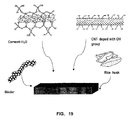
- FIG. 19 is a concept diagram showing the components of the composed material of the present disclosure.
- FIG. 20 is a scheme of the simultaneous ultrasound dispersion process
- FIG. 21 is a scheme result of the ultrasound dispersion of the means carbon nanostructures
- FIG. 22 is an image showing the carbon nanotubes after ultrasound dispersion with a graphic scale of 2 ⁇ m;
- FIG. 23 is an image of the raw binder
- FIG. 24 is an image of the binder reinforced with carbon nanotubes
- FIG. 25 shows an image of the compound including husk, cement, resin and a homogeneous dispersion of the carbon nanostructures
- FIG. 26 is a comparative graph of mean temperature in the devices coated with polystyrene of 2 inches thick, against another one coated with paste of 3 mm thick of our composition and with the outside temperature as reference.
- the loads employed for modifying the binder are carbon nanostructures known as multiple wall carbon nanotubes, which are almost cylindrical structures, composed of several graphite network concentric layers (hexagonal network of carbon atoms covalently linked to each other). It should be emphasized that the carbon-carbon link is one of the most resistant ones existing in nature. However, some of the carbon atoms of the hexagonal networks can be replaced with other functional elements or groups making these tubes be more reactive with molecules, polymers and external agents, and their interactions with different matrixes are higher. Within the groups or elements that can replace carbon atoms N, P, O, S, Si, B, Se, etc., can be mentioned, or rather the functionalization with —OH, —OOH or OH-type groups.
- the dimensions of the multiple layer carbon nanotubes, employed in this work have average lengths of 800 ⁇ m and diameters of 30-70 nm, and were synthesized with the AQACVD (Aerosol Assisted Chemical Vapor Deposition) method, which employs a solution containing the carbon source (for example, hydrocarbon) and a metallic catalyst used for promoting the growth of tubular nanostructures (for example, transition metals such as Ni, Fe and Co).
- This solution is stirred with ultrasound in order to generate microbeads of this mixture ( FIG. 1 ), and by means of the inert gas flow is transported through a quartz pipe to the high temperature reactors where its decomposition and subsequent growth of the nanotubes occurs.
- nanotubes produced in the present disclosure are: reactivity, caused by the controlled presence of atoms other than carbon (doping) or by functional groups, which allows a better interaction between the carbon nanotube and the matrix in question to manufacture the compound with nanotubes; the high crystallinity degree of the nanotubes; and the high purity of nanotubes (absence of non-tubular particles and amorphous carbons).
- FIGS. 2 and 3 which correspond to electronic scanning microscope images, the purity of the nanostructures and their morphology can be noticed.
- FIG. 4 corresponding to a high-resolution transmitting electronic microscope image, the internal structure and crystallinity of the nanostructures are revealed, as well as the diameters.
- FIG. 5 the crystallinity of the nanotubes can be confirmed.
- FIG. 6 the absence of amorphous material is confirmed, as well as purity, since this shows the mass evolution in relation to the temperature in thermal gravimetric analysis in the air.
- white cement such being a variant of the Portland cement, but with a lower percentage of Fe 2 O 3 . Its aspects regarding mechanical resistance are similar to the gray cement, but with a lower forge time. Same is more reactive and thus requires a greater moisture percentage.
- FIG. 7 a typical diffractogram of white cement is shown.
- the role of white cement is to interact along with the modified binder, as an additional binding element in the material, thus providing a better performance in highly humid environments, as well as a greater integration in surfaces relative to concrete and to speed up the drying process of the material.
- the present disclosure takes advantage of the mechanical properties of the doped and functionalized carbon nanotubes, in order to significantly increase the mechanical properties of one compound that is used in manufacturing rice husk conglomerates, paints, pastes or panels in the construction field.
- the key point of the present disclosure centers on the interaction of active sites in the surface of the carbon nanotubes (doping), and takes advantage of the aspect ratio (length/diameter) of these nanotubes (between 30,000 and 50,000).
- the base component for producing the composed or composite material is the rice husk, which is a by-product of agroindustrial activities, and which cannot be used as forage, in addition to being a substitute for base materials of cellulose and other natural fibers.
- FIGS. 8 to 18 For the characterization or morphological and chemical analysis of the materials used in this disclosure, electronic scanning microscope studies and elemental analysis were carried out using X-ray energy dispersion, as it is shown in FIGS. 8 to 18 .
- the surface of whole husks presented in a regular pattern of periodic “pyramidal” periodic arrays the base mean size is 40 ⁇ m 2 and with a regular separation between them of approximately 80 ⁇ m, which favor linking points or bonding sites with the modified resin.
- FIGS. 12 and 13 the internal structure of the rice husk is observed, constituted by parallel channels throughout the body.
- the channel diameter is closer to 10 ⁇ m.
- FIG. 14 the spectrum is shown by signals from the elements found in the surface of the rice husk.
- FIGS. 15 to 18 the elemental mapping analysis is shown of a random region in the rice husk surface.
- the analysis region is shown, while for each one of the images of FIGS. 16 to 18 it is generated from the punctual energy detection matrix for Si, O and C.
- each one of the blocks makes space for obtaining a material composed of special features translated into a better mechanical and driving performance as the conventional materials.
- FIG. 19 the concept about the nanostructured composed or composite material of the present disclosure is represented, whose properties offer a better performance than similar natural fiber-based materials and a lower environmental impact compared to that of similar synthetic fiber-based materials.
- Said composed or composite material is constituted by cement, water, doped carbon nanostructures with N, P, O, S, Si, B, Se, Fe, Co, Ni, Ag, Au, Pd, Pt, etc., or well functionalization with —OH, —OOH or OH-Type groups, thermally or acidly treated to cause defects in its graphite network, rice husk and the binder or polymeric resin.
- the elaboration process of the material of the present disclosure starts with mechanical grinding of the rice husk to achieve a particle size between 100 nm up to 2 mm.
- the process for modifying the binder was a follows: dispersion of the carbon nanostructures through an ultrasound dispersion process, with one end or one coat (see FIG. 20 ).
- FIG. 21 shows on the left side the binder and the carbon nanotubes before the dispersion, and on the right side the dispersion result is shown. The dispersion can also be seen in the image of FIG. 22 .
- the nanostructures are subsequently incorporated (previously dispersed) in the binding matrix at a controlled temperature, using the electro-mechanical blender to obtain a better distribution of the nanometric loads in the matrix.
- Load percentages of carbon nanostructures were used from 0.001% up to 10% by weight, in relation to the binder.
- the binding matrix is of polymeric type, for example, polyvinyl acetate or the like.
- polymeric type for example, polyvinyl acetate or the like.
- FIGS. 23 and 24 a difference can be noted between one pure resin and one resin modified with carbon nanostructures (see arrows indicating the carbon nanotube dispersion), respectively.
- FIG. 25 shows the X-ray energy dispersion spectrum wherein it is determined that the main constituents of the composed material are according to the following TABLE II:
- the material of the present disclosure has a better performance when comparing it to a 2 inch polymeric polystyrene plate or sheet, the graph showing that there is at least a 4° difference between the internal temperature from the measurement device exposed to the outside coating with 3 mm of paste from the material of this disclosure, and another 2 inch thick polystyrene coating, both well below the measured outside temperature right on the side of the used devices (“in the open” control).
- the main purpose of incorporating carbon nanostructures is to increase the resin or binder performance, through which they will transfer their mechanical, electrical and thermal properties during the polymerization, having as a result a support network in the binding polymer with better properties.
- the procedure for preparing the material of the present invention is as follows: (1) Mixing processed rice husk with modified resin; (2) Measuring out the white cement load; and (3) Homogenizing the previous mixture with electromechanical means.
- Conglomerate the proportions are processed husk (m); white cement (20% to 80% m); modified resin with nanostructure load (1% to 150% m); and water (0% to 10% m).
- the pressure is 1 to 40 kg/cm 2 , and the temperature is 18 to 25° C.
- the proportions are processed husk (m); white cement (20% to 80% m); resin modified with nanostructure load (100% to 300% m); and water (10% to 50% m).
- the pressure is 0 kg/cm 2 , and the temperature is 18 to 25° C.
- the proportions are processed husk (m); white cement (20% to 80% m); resin modified with nanostructure load (100% to 300% m); and water (10% TO 50% M).
- the pressure is 0 kg/cm 2 , and the temperature is 18 to 25° C.
- the main difference between the three presentations or formulations is the amount relative to each one of their components, water, resin modified with carbon nanostructures, rice husk, white cement, pressure and temperature. Otherwise, the manufacturing process is similar for all.
- the material composed in its distinct presentations was submitted to hydrostatic pressure tests during a period of time greater than 40 hours, without recording permeability.
- the material composed or compounded in its distinct presentations was submitted to direct flame fuel tests, showing fireproof properties of the compositions of the disclosure, properties that are not exhibited by conventional wood products (three-ply, boards, commercial binders, etc.).
- the paste-type composed or compounded material was used to coat a clear material cube, and it was placed outside next to a similar coating with 2 inch polystyrene sheets during more than 100 continuous hours.
- the respective interior temperatures of the respective devices were recorded, and they were compared to temperatures registered from the outside. An ability of thermal isolation was observed to be significantly higher than the one of the 2-inch polystyrene when the paste is painted white (see FIG. 26 ).
- the conglomerate-type composed or composite material was submitted to a bending mechanical test to 3 points, determining the increase percentage in the performance of the material test tubes of the disclosure in relation to those of the reference. It was concluded that the use of carbon nanostructures as support in the resin, as well as the use of white cement, is translated into a 54% increase in bending mechanical resistance.
Landscapes
- Chemical & Material Sciences (AREA)
- Engineering & Computer Science (AREA)
- Organic Chemistry (AREA)
- Materials Engineering (AREA)
- Ceramic Engineering (AREA)
- Life Sciences & Earth Sciences (AREA)
- Wood Science & Technology (AREA)
- Structural Engineering (AREA)
- Chemical Kinetics & Catalysis (AREA)
- Inorganic Chemistry (AREA)
- Nanotechnology (AREA)
- Civil Engineering (AREA)
- Crystallography & Structural Chemistry (AREA)
- Environmental & Geological Engineering (AREA)
- Compositions Of Macromolecular Compounds (AREA)
- Paints Or Removers (AREA)
- Building Environments (AREA)
- Carbon And Carbon Compounds (AREA)
Abstract
Description
| TABLE I | ||||
| Element | Wt % | At % | ||
| C K | 28.49 | 39.53 | ||
| O K | 40.21 | 41.89 | ||
| Si K | 31.31 | 18.58 | ||
| TABLE II | ||||
| Element | Wt % | At % | ||
| C K | 64.3 | 71.89 | ||
| O K | 30.55 | 25.65 | ||
| Si K | 5.15 | 2.46 | ||
Claims (20)
Applications Claiming Priority (3)
| Application Number | Priority Date | Filing Date | Title |
|---|---|---|---|
| MX2010013211A MX2010013211A (en) | 2010-12-01 | 2010-12-01 | Compound material based on rice husk and binder, modified with carbon nanostructures. |
| MXMX/A/2010/013211 | 2010-12-01 | ||
| PCT/MX2011/000147 WO2012074350A1 (en) | 2010-12-01 | 2011-12-01 | Compound material based on rice husk and binder, modified with carbon nanostructures |
Publications (2)
| Publication Number | Publication Date |
|---|---|
| US20150005415A1 US20150005415A1 (en) | 2015-01-01 |
| US9527770B2 true US9527770B2 (en) | 2016-12-27 |
Family
ID=46172111
Family Applications (1)
| Application Number | Title | Priority Date | Filing Date |
|---|---|---|---|
| US13/991,019 Expired - Fee Related US9527770B2 (en) | 2010-12-01 | 2011-12-01 | Composite material based on rice husk and binder, modified with carbon nanostructures |
Country Status (8)
| Country | Link |
|---|---|
| US (1) | US9527770B2 (en) |
| EP (1) | EP2647608B1 (en) |
| JP (1) | JP6126011B2 (en) |
| CN (1) | CN103429550A (en) |
| BR (1) | BR112013013618A2 (en) |
| CA (1) | CA2819578A1 (en) |
| MX (1) | MX2010013211A (en) |
| WO (1) | WO2012074350A1 (en) |
Families Citing this family (3)
| Publication number | Priority date | Publication date | Assignee | Title |
|---|---|---|---|---|
| CN103482895B (en) * | 2013-08-06 | 2015-11-18 | 常州市兴存化工有限公司 | The preparation method of modification rice husk |
| CN108610058B (en) * | 2018-06-01 | 2021-04-20 | 湖南省美程陶瓷科技有限公司 | Preparation method of electronic ceramic with large length-diameter ratio |
| CN116535124B (en) * | 2023-05-09 | 2024-04-12 | 青岛理工大学 | CNTs@microbead core-shell filler, cement-based composite material, preparation method and application |
Citations (6)
| Publication number | Priority date | Publication date | Assignee | Title |
|---|---|---|---|---|
| US20030188669A1 (en) * | 1997-05-26 | 2003-10-09 | Konstantin Sobolev | Complex admixture and method of cement based materials production |
| DE102007013467A1 (en) | 2007-03-21 | 2008-09-25 | Märtens, Lutz | Production of light concrete comprises swelling plant material, e.g. wheat, maize or rice, by heating under pressure to form hollow granules which are mixed with polymer-modified cement and water, mixture then being pressed into molds |
| US20090011207A1 (en) * | 2007-07-05 | 2009-01-08 | United States Gypsum Company | Lightweight cementitious compositions and building products and methods for making same |
| WO2009099640A1 (en) | 2008-02-08 | 2009-08-13 | Northwestern University | Highly-dispersed carbon nanotube-reinforced cement-based materials |
| CN101798466A (en) | 2010-03-16 | 2010-08-11 | 龙海市奈特化工有限责任公司 | Natural fiber composite material and preparation method thereof |
| EP2228343A1 (en) | 2009-03-13 | 2010-09-15 | Bayer MaterialScience AG | Water vapour assisted ozonolysis of carbon nanotubes |
Family Cites Families (12)
| Publication number | Priority date | Publication date | Assignee | Title |
|---|---|---|---|---|
| DE3517778A1 (en) * | 1985-05-17 | 1987-01-15 | 23 Szamu Allami Epitoeipari Va | METHOD FOR THE PRODUCTION OF BODIES, IN PARTICULAR OF COMPONENTS |
| JPH03193650A (en) * | 1989-12-22 | 1991-08-23 | Takashi Ataka | Cement molded material containing ground material of chaff |
| AUPQ879000A0 (en) * | 2000-07-14 | 2000-08-10 | Davco Construction Materials Pty Limited | Mortar composition and method |
| JP4797121B2 (en) * | 2003-04-24 | 2011-10-19 | 三星電子株式会社 | Conductive carbon nanotube / polymer composite |
| JP2006167710A (en) * | 2004-11-22 | 2006-06-29 | Nissin Kogyo Co Ltd | THIN FILM MANUFACTURING METHOD, SUBSTRATE WITH THIN FILM, ELECTRON EMITTING MATERIAL, ITS MANUFACTURING METHOD, AND ELECTRON EMITTING DEVICE |
| WO2008066123A1 (en) * | 2006-11-30 | 2008-06-05 | National Institute Of Advanced Industrial Science And Technology | Biosensor utilizing carbon nanotube |
| CN101265044B (en) * | 2007-03-13 | 2010-05-26 | 王武添 | Multi-effect powder composition and polymer structure thereof |
| JP3133314U (en) * | 2007-04-26 | 2007-07-05 | 大有建設株式会社 | Vibration compaction device |
| US7666327B1 (en) * | 2007-05-22 | 2010-02-23 | Oceanit Laboratories, Inc. | Multifunctional cementitious nanocomposite material and methods of making the same |
| CN101239801B (en) * | 2008-03-14 | 2010-04-07 | 哈尔滨工业大学 | Preparation of carbon nanotube/cement self-reinforced damping composite material and testing method of damping ratio |
| FR2939786B1 (en) * | 2008-12-11 | 2011-03-25 | Arkema France | PROCESS FOR MANUFACTURING COMPOSITE SNO2 MATERIAL AND CARBON NANOTUBES AND / OR CARBON NANOFIBERS, MATERIAL OBTAINED BY THE PROCESS, ELECTRODE FOR LITHIUM BATTERY COMPRISING SAID MATERIAL. |
| CN101805494B (en) * | 2010-03-16 | 2012-05-23 | 漳州市奈特新型建材有限责任公司 | Natural fiber resin composite material and preparation method thereof |
-
2010
- 2010-12-01 MX MX2010013211A patent/MX2010013211A/en active IP Right Grant
-
2011
- 2011-12-01 CN CN2011800666229A patent/CN103429550A/en active Pending
- 2011-12-01 BR BR112013013618-9A patent/BR112013013618A2/en not_active Application Discontinuation
- 2011-12-01 EP EP11844332.4A patent/EP2647608B1/en not_active Not-in-force
- 2011-12-01 CA CA2819578A patent/CA2819578A1/en not_active Abandoned
- 2011-12-01 WO PCT/MX2011/000147 patent/WO2012074350A1/en not_active Ceased
- 2011-12-01 US US13/991,019 patent/US9527770B2/en not_active Expired - Fee Related
- 2011-12-01 JP JP2013541940A patent/JP6126011B2/en active Active
Patent Citations (7)
| Publication number | Priority date | Publication date | Assignee | Title |
|---|---|---|---|---|
| US20030188669A1 (en) * | 1997-05-26 | 2003-10-09 | Konstantin Sobolev | Complex admixture and method of cement based materials production |
| DE102007013467A1 (en) | 2007-03-21 | 2008-09-25 | Märtens, Lutz | Production of light concrete comprises swelling plant material, e.g. wheat, maize or rice, by heating under pressure to form hollow granules which are mixed with polymer-modified cement and water, mixture then being pressed into molds |
| US20090011207A1 (en) * | 2007-07-05 | 2009-01-08 | United States Gypsum Company | Lightweight cementitious compositions and building products and methods for making same |
| WO2009099640A1 (en) | 2008-02-08 | 2009-08-13 | Northwestern University | Highly-dispersed carbon nanotube-reinforced cement-based materials |
| US20090229494A1 (en) | 2008-02-08 | 2009-09-17 | Northwestern University | Highly-dispersed carbon nanotube-reinforced cement-based materials |
| EP2228343A1 (en) | 2009-03-13 | 2010-09-15 | Bayer MaterialScience AG | Water vapour assisted ozonolysis of carbon nanotubes |
| CN101798466A (en) | 2010-03-16 | 2010-08-11 | 龙海市奈特化工有限责任公司 | Natural fiber composite material and preparation method thereof |
Non-Patent Citations (10)
| Title |
|---|
| Cwirzen et al., Surface decoration of carbon nanotubes and mechanical properties of cement/carbon nanotube composites, Advances in Cement Research, 2008, vol. 20, No. 2. |
| Derwent Abstract for CN 101274831, Oct. 1, 2008. * |
| Han et al., Effects of CNT Doping Level and Water/Cement Ratio on the Piezoresistivity of CNTS/Cement Composites, ASME 2010 Conference on Smart Materials, Sep. 28-Oct. 1, 2010. |
| International Search Report and English translation, PCT/MX2010/000153, dated Jun. 1, 2011. |
| Li et al., Mechanical behavior and microstructure of cement composites incorporating surface-treated multi-walled carbon nanotubes, Carbon, 2005. |
| Luo et al., Flexzural strengths and characteristics of cement-based composite reinforced with acid-treated multi-walled carbon nanotubes, Journal, 2008. |
| Musso et al., Influence of carbon nanotubes structure on the mechanical behavior of cement composites, Composites Science and Technology, May 2009. |
| Sanchez et al., Nanotechnology in Concrete-A Review, Construction and Building Materials, 2010. |
| Written Opinion and International Search Report (Translation), Apr. 26, 2012, PCT/MX2011/000147. |
| Yu et al., A carbon nanotube/cement comosite with piezoresistive properties, Smart Materials and Structures,Mar. 30, 2009. |
Also Published As
| Publication number | Publication date |
|---|---|
| JP2014501862A (en) | 2014-01-23 |
| EP2647608B1 (en) | 2018-08-08 |
| BR112013013618A2 (en) | 2018-05-29 |
| MX2010013211A (en) | 2012-06-08 |
| EP2647608A4 (en) | 2016-06-22 |
| CN103429550A (en) | 2013-12-04 |
| WO2012074350A1 (en) | 2012-06-07 |
| EP2647608A1 (en) | 2013-10-09 |
| US20150005415A1 (en) | 2015-01-01 |
| CA2819578A1 (en) | 2012-06-07 |
| JP6126011B2 (en) | 2017-05-10 |
Similar Documents
| Publication | Publication Date | Title |
|---|---|---|
| Alvee et al. | Experimental study of the mechanical properties and microstructure of geopolymer paste containing nano-silica from agricultural waste and crystalline admixtures | |
| JP6113505B2 (en) | Concrete reinforced with hybrid nanomaterials | |
| Kaur et al. | Studies on combined effect of superplasticizer modified graphene oxide and carbon nanotubes on the physico-mechanical strength and electrical resistivity of fly ash blended cement mortar | |
| Dong et al. | Physicochemical and Piezoresistive properties of smart cementitious composites with graphene nanoplates and graphite plates | |
| Candamano et al. | Graphene nanoplatelets in geopolymeric systems: A new dimension of nanocomposites | |
| Kaur et al. | Comparative effects of sterically stabilized functionalized carbon nanotubes and graphene oxide as reinforcing agent on physico-mechanical properties and electrical resistivity of cement nanocomposites | |
| Assaedi et al. | Influence of mixing methods of nano silica on the microstructural and mechanical properties of flax fabric reinforced geopolymer composites | |
| Bharj et al. | Experimental study on compressive strength of cement-CNT composite paste | |
| Assaedi et al. | Characterizations of flax fabric reinforced nanoclay-geopolymer composites | |
| Inayath Basha et al. | Cement composites with carbon‐based nanomaterials for 3D concrete printing applications–A review | |
| WO2011109421A1 (en) | Novel nanocomposite for sustainability of infrastructure | |
| US9527770B2 (en) | Composite material based on rice husk and binder, modified with carbon nanostructures | |
| El-Feky et al. | Optimization of hybrid cement composite with carbon nanotubes and nano silica using response surface design | |
| Xu et al. | Melt‐intercalated starch acetate nanocomposite foams as affected by type of organoclay | |
| El-Feky et al. | The effect of nano cellulose synthesized from rice straw on the performance of cement composite reinforced with carbon nano tubes | |
| CN102180461A (en) | Preparation method of superconductive, thermally-conductive, ultrahigh-strength graphene composite film | |
| Musale et al. | The Effect of Carbon Black, MWCNT and Carbon Fiber on Flexural behavior of cement nano composites | |
| US20200017415A1 (en) | High strength porous material | |
| Maurya et al. | Effect of highly dispersed hybrid carbon nanomaterials on the durability of high-volume fly ash based cementitious mortar | |
| Morjène et al. | Effect of organoclay and wood fiber inclusion on the mechanical properties and thermal conductivity of cement-based mortars | |
| Amri et al. | Physicomechanical properties of lightweight geopolymer mortar with integrated graphene nanosheets. | |
| Noorvand et al. | Characterization of Regular Concrete and Low-Cost Engineered Cementitious Composites with Incorporation of Cellulose Nanocrystals and Cost-Effective Ingredients | |
| Das et al. | Experimental Investigation for Strengthening the Nanocomposite Cementitious Materials with a Nanoscale Modification | |
| Basha et al. | Carbon‐Coated Sand in Cement Composites for Smart and Multifunctional Construction Materials: A Comprehensive Review | |
| Cacciatore | SMART CONCRETE FOR URBAN AREAS: IMPROVED PERFORMANCE AND SUSTAINABILITY OF FUNCTIONALIZED GRAPHENE RELATED MATERIALS IN CEMENTITIOUS PRODUCTS |
Legal Events
| Date | Code | Title | Description |
|---|---|---|---|
| AS | Assignment |
Owner name: URBANIZACIONES INMOBILIARIAS DEL CENTRO S.A. DE C. Free format text: ASSIGNMENT OF ASSIGNORS INTEREST;ASSIGNORS:SOTO MONTOYA, JOSE ANTONIO;ALANIS, MAURICIO MARTINEZ;GONZALEZ, DANIEL RAMIREZ;SIGNING DATES FROM 20101125 TO 20130820;REEL/FRAME:033799/0501 |
|
| STCF | Information on status: patent grant |
Free format text: PATENTED CASE |
|
| FEPP | Fee payment procedure |
Free format text: MAINTENANCE FEE REMINDER MAILED (ORIGINAL EVENT CODE: REM.); ENTITY STATUS OF PATENT OWNER: SMALL ENTITY |
|
| LAPS | Lapse for failure to pay maintenance fees |
Free format text: PATENT EXPIRED FOR FAILURE TO PAY MAINTENANCE FEES (ORIGINAL EVENT CODE: EXP.); ENTITY STATUS OF PATENT OWNER: SMALL ENTITY |
|
| STCH | Information on status: patent discontinuation |
Free format text: PATENT EXPIRED DUE TO NONPAYMENT OF MAINTENANCE FEES UNDER 37 CFR 1.362 |
|
| FP | Lapsed due to failure to pay maintenance fee |
Effective date: 20201227 |