US9521649B2 - In-vehicle apparatus and display control system for the same - Google Patents
In-vehicle apparatus and display control system for the same Download PDFInfo
- Publication number
- US9521649B2 US9521649B2 US13/744,754 US201313744754A US9521649B2 US 9521649 B2 US9521649 B2 US 9521649B2 US 201313744754 A US201313744754 A US 201313744754A US 9521649 B2 US9521649 B2 US 9521649B2
- Authority
- US
- United States
- Prior art keywords
- information processing
- application
- processing apparatus
- information
- display
- Prior art date
- Legal status (The legal status is an assumption and is not a legal conclusion. Google has not performed a legal analysis and makes no representation as to the accuracy of the status listed.)
- Expired - Fee Related, expires
Links
Images


Classifications
-
- H—ELECTRICITY
- H04—ELECTRIC COMMUNICATION TECHNIQUE
- H04W—WIRELESS COMMUNICATION NETWORKS
- H04W68/00—User notification, e.g. alerting and paging, for incoming communication, change of service or the like
-
- G—PHYSICS
- G06—COMPUTING OR CALCULATING; COUNTING
- G06F—ELECTRIC DIGITAL DATA PROCESSING
- G06F3/00—Input arrangements for transferring data to be processed into a form capable of being handled by the computer; Output arrangements for transferring data from processing unit to output unit, e.g. interface arrangements
- G06F3/14—Digital output to display device ; Cooperation and interconnection of the display device with other functional units
-
- G—PHYSICS
- G09—EDUCATION; CRYPTOGRAPHY; DISPLAY; ADVERTISING; SEALS
- G09G—ARRANGEMENTS OR CIRCUITS FOR CONTROL OF INDICATING DEVICES USING STATIC MEANS TO PRESENT VARIABLE INFORMATION
- G09G5/00—Control arrangements or circuits for visual indicators common to cathode-ray tube indicators and other visual indicators
- G09G5/003—Details of a display terminal, the details relating to the control arrangement of the display terminal and to the interfaces thereto
- G09G5/005—Adapting incoming signals to the display format of the display terminal
-
- H—ELECTRICITY
- H04—ELECTRIC COMMUNICATION TECHNIQUE
- H04L—TRANSMISSION OF DIGITAL INFORMATION, e.g. TELEGRAPHIC COMMUNICATION
- H04L67/00—Network arrangements or protocols for supporting network services or applications
- H04L67/01—Protocols
- H04L67/12—Protocols specially adapted for proprietary or special-purpose networking environments, e.g. medical networks, sensor networks, networks in vehicles or remote metering networks
-
- G—PHYSICS
- G06—COMPUTING OR CALCULATING; COUNTING
- G06F—ELECTRIC DIGITAL DATA PROCESSING
- G06F3/00—Input arrangements for transferring data to be processed into a form capable of being handled by the computer; Output arrangements for transferring data from processing unit to output unit, e.g. interface arrangements
- G06F3/14—Digital output to display device ; Cooperation and interconnection of the display device with other functional units
- G06F3/1423—Digital output to display device ; Cooperation and interconnection of the display device with other functional units controlling a plurality of local displays, e.g. CRT and flat panel display
-
- G—PHYSICS
- G09—EDUCATION; CRYPTOGRAPHY; DISPLAY; ADVERTISING; SEALS
- G09G—ARRANGEMENTS OR CIRCUITS FOR CONTROL OF INDICATING DEVICES USING STATIC MEANS TO PRESENT VARIABLE INFORMATION
- G09G2380/00—Specific applications
- G09G2380/10—Automotive applications
Definitions
- This invention relates to a technique for controlling mobile terminals such as a car navigation system and a mobile phone.
- In-vehicle apparatuses have been evolving in functionality.
- One example of the in-vehicle apparatuses is a navigation terminal that is not only furnished with the navigation function but has also been supplemented with such additional functions as television, DVD reproduction, hands-free telephone calls, rear view monitoring, and telematics.
- the in-vehicle apparatus is coupled with a highly functional mobile phone (called the smartphone hereunder) so that the in-vehicle apparatus may utilize the functions of the smartphone.
- Car navigation equipment (called the car navigation system hereunder) is required to be highly safe and convenient when presenting the driver with video and audio information.
- the car navigation system has the disadvantage of potentially distracting the driver's attention while being operated. For this reason, the car navigation system generally has the function of restricting TV viewing and inhibiting its navigation operation menu with hatching or the like while the vehicle is traveling.
- the car navigation system generally has the function of muting music reproduction upon receipt of a telephone call and enabling a hands-free call. That is, the car navigation system is required to control its functions in keeping with system and vehicle state at any point in time.
- Japanese Unexamined Patent Publication No. 2007-60489 discloses a method which, if emergency information is issued during a digital broadcast from a broadcast station, involves supplying a data broadcast about the emergency information received through the digital broadcast to the car navigation system that in turn outputs the supplied data broadcast to its monitor.
- This patent document also discloses a method for switching the output screen of the monitor from an in-vehicle apparatus screen to a data broadcast screen.
- Jorg Brakensiek “Terminal Mode Technical Architecture Release Version 1.0”, 2010, [searched online on Jul. 19, 2011 at ⁇ URL: http://www.terminalmode.org/files/Zipped_Release.zip> describes a method for coupling the in-vehicle apparatus with the smartphone in wired or wireless fashion so that the smartphone may be operated through a user interface of the in-vehicle apparatus, with the screen of the smartphone output to the display of the in-vehicle apparatus.
- the in-vehicle apparatus is required to provide screen output that is highly safe and convenient. Regardless of the user's intention, when the information output by a specific function of the in-vehicle apparatus is to be provided, the apparatus needs to offer the screen output corresponding to that function; when the information output by a particular function of the smartphone is to be provided, the in-vehicle apparatus needs to let its display screen present the smartphone screen output.
- This invention provides a display control system including a first terminal (e.g., in-vehicle apparatus system as car navigation equipment) and an apparatus (e.g., highly functional mobile phone) coupled with the first terminal offering higher safety and more convenience than before.
- the invention further provides the first terminal (e.g., in-vehicle apparatus system as car navigation equipment) for use with the inventive display control system.
- a display control system including a first terminal and a second terminal coupled with each other.
- Each of the first and the second terminals includes a processing block which implements a function provided by each of the terminals, and a function control block which outputs display information based on a result of processing by the processing block.
- the first terminal includes a display control block which displays as valid display information, on a screen of the first terminal, the display information output either by the first terminal or by the second terminal based on the result of the processing.
- Either the first terminal or the second terminal includes a management block which, upon receipt of a new event either by the first terminal or by the second terminal from the outside thereof, determines whether or not to switch to the display information output by one of the processing blocks in charge of processing the new event based on the result of the processing of the new event, as new valid display information.
- the management block further instructs the display control block possessed by the first terminal to perform the switching if the management block determines that the switching is to be performed.
- the first or the second terminal may notify management block of the receipt of the event.
- the management block may determine which of the processing blocks is to take charge of the processing of the event. The management block may then give notification of the receipt of the event to the function control block of either the first or the second terminal having the processing block in charge of the processing of the event.
- the function control block of each terminal may start the processing block in charge.
- the management block of the terminal may hold a list of the processing blocks possessed by the first and the second terminals, and also hold definitions for enabling the processing blocks corresponding to the list and for controlling screen switching corresponding thereto.
- the display control system may further include a server apparatus coupled with the first and the second terminals.
- the management block may detect the processing blocks incorporated in the first and the second terminals.
- the management block may prepare a list reflecting the incorporated processing blocks and transmit the list to the server apparatus.
- the management block may acquire from the server apparatus definitions for enabling the processing blocks corresponding to the list and for controlling screen switching corresponding thereto.
- the management block may update the list to reflect the added or deleted processing blocks and transmit the updated list to the server apparatus.
- the management block may acquire from the server apparatus the definitions for enabling the new processing blocks corresponding to the updated list and for controlling screen switching corresponding thereto.
- the event received by the terminal from the outside may be at least one of an operation performed by a user, vehicle information, and a message received via a communication link.
- the management block of the terminal may manage definitions for either enabling or disabling a group of the processing blocks in accordance with a state of coupling with another terminal and with a traveling state of the vehicle incorporating the display control system.
- the management block may select a group of the processing blocks that can be enabled based on the definitions for the enabling or the disabling, on the state of coupling with the other terminal, and on the traveling state of the vehicle incorporating the display control system.
- the management block may then display on the screen an interface for enabling the selected group of the processing blocks.
- FIG. 1 is a block diagram showing a typical configuration of a display control system and a terminal as a first embodiment
- FIG. 2 is a sequence diagram showing the sequence of the first embodiment
- FIG. 3 is another sequence diagram showing the sequence of the first embodiment
- FIG. 4 is a tabular view listing typical definitions for enabling application programs of various embodiments and for switching screens accordingly;
- FIG. 5 is a tabular view listing typical definitions of application attributes for various embodiments
- FIG. 6 is a block diagram showing a typical configuration of a display control system and a terminal as a second embodiment
- FIG. 7 is a schematic view showing a typical screen display on an in-vehicle apparatus of the second embodiment
- FIG. 8 is a sequence diagram showing the sequence of the second embodiment
- FIG. 9 is a schematic view showing a typical hardware configuration of the display control system and terminal embodying this invention.
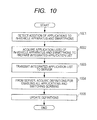
- FIG. 10 is a flowchart explaining a typical control flow of each embodiment.
- FIG. 1 is an overall configuration diagram of a display control system as the first embodiment.
- This system is configured to include an in-vehicle apparatus 1 , an information processing terminal 2 having a communication function, and a server 3 .
- the in-vehicle apparatus 1 may be a car navigation system, for example.
- the information processing terminal 2 having the communication function may be a highly functional mobile phone (called the smartphone hereunder), or an information processing apparatus with a communication function (e.g., a personal computer or a tablet terminal), for example.
- the smartphone 2 the information processing terminal 2 will be referred to as the smartphone 2 .
- the functions offered by the in-vehicle apparatus 1 and smartphone 2 are brought about by processing blocks implemented through execution of application programs carried by these apparatuses.
- the in-vehicle apparatus 1 and smartphone 2 each include, as shown in FIG. 9 , a CPU 101 , a main memory 102 , an input/output device 103 (display, speakers, touch panel, keyboard, etc.) for input/output of information from/to viewers and users, a wireless communication interface 1 ( 104 ) typically for 3G communication, a near-field wireless communication interface 2 ( 107 ) such as Bluetooth (registered trademark) for wirelessly communicating with an external apparatus via a network 1 , and a wired communication interface 105 such as USB for communicating in wired fashion with an external apparatus via the network 7 .
- These functions may be implemented on a computer coupled with the apparatuses via an internal communication line 108 such as a bus.
- the CPU 101 implements processing blocks for performing diverse processes with this embodiment by loading programs from a storage device 106 into the main memory 102 and by executing the loaded programs.
- the programs and the data for use therewith may be stored beforehand in the storage device 106 , input from a storage medium such as a CD-ROM, or downloaded from another apparatus via the network.
- the functions implemented by these programs may be realized by dedicated hardware.
- the in-vehicle apparatus 1 and smartphone 2 are linked to a server 3 via a network 6 such as the Internet.
- a network 6 such as the Internet.
- the in-vehicle apparatus 1 and smartphone 2 are coupled with each other via the wired or wireless network 7 such as USB or Bluetooth (registered trademark).
- the in-vehicle apparatus 1 includes a user interface (UI) 8 , a CAN (Controller Area Network) interface 9 , and a storage block 2000 .
- the user interface (UI) 8 includes a touch panel, hardware buttons, a microphone for audio input, a display for screen output, and speakers for audio output.
- the CAN interface 9 is linked to the CAN and exchanges CAN information therewith.
- the storage block 2000 implemented by use of the storage device 106 stores processing programs such as those for implementing an external input reception block A 21 , an application management block A 22 , an in-vehicle apparatus control block A 23 , a screen input switching block 10 , and an application list management block A 24 of the in-vehicle apparatus 1 . Also, the storage block 2000 stores data such as definitions A 25 for application program enabling and screen switching, and an in-vehicle apparatus application program list 11 (the application program will be simply referred to as the application hereunder).
- the external input reception block A 21 receives control information from the user interface (UI) 8 and CAN interface 9 .
- the external input reception block A 21 receives messages from an external server 3001 linked through the wireless communication interface 1 ( 104 ; for 3G communication, etc.) and the network 6 .
- the external input reception block A 21 receives control instructions from an external terminal such as the smartphone 2 by way of the wired communication interface 105 or wireless communication interface 2 ( 107 ) over the network 7 .
- the application management block A 22 Upon receipt of a message from the external input reception block A 21 , the application management block A 22 references the definitions A 25 for application enabling and screen switching to designate the corresponding application, transmits the designation along with the received message to be transferred to the application in question either to the in-vehicle apparatus control block A 23 or to a smartphone control block A 27 of the smartphone 2 , and transmits a screen input switching instruction to the screen input switching block 10 so as to enable the application to display its information.
- the screen input switching block 10 determines whether the screen of the in-vehicle apparatus 1 or the screen of the smartphone 2 is to be output onto the display and switches display input accordingly.
- the in-vehicle apparatus control block A 23 forwards the message transmitted from the application management block A 22 to the designated application of the in-vehicle apparatus 1 . If that application has yet to be started, the in-vehicle apparatus control block A 23 starts the application in question.
- the application list management block A 24 prepares an application list for both terminals by merging an in-vehicle apparatus application list 11 listing the application ID's of the applications carried by the in-vehicle apparatus 1 , with a smartphone application list 12 transmitted from an application list transmission block A 26 of the smartphone 2 .
- the application list management block A 24 transmits the prepared list to the server 3 to acquire definitions 5 for application enabling and screen switching and thereby updates the definitions A 25 for application program enabling and screen switching.
- the smartphone 2 includes a storage block 2001 .
- the storage block 2001 implemented by use of the storage device 106 , stores programs for implementing the processing blocks such as an external input transmission block A 28 , a smartphone control block A 27 , and an application list transmission block A 26 , as well as the smartphone application list 12 .
- the external input transmission block A 28 receives a message such as emergency information via the wireless communication interface 104 and transmits the received event to the external input reception block A 21 of the in-vehicle apparatus 1 .
- the application list transmission block A 26 transmits the smartphone application list 12 listing the ID's of the applications carried by the smartphone 2 , in response to a request from the application list management block A 24 of the in-vehicle apparatus 1 .
- the smartphone control block A 27 transmits the event (i.e., message) transmitted from the application management block A 22 of the in-vehicle apparatus 1 to the designated smartphone application. If the smartphone application in question has yet to be started, the smartphone control block A 27 starts that application.
- the server 3 includes a storage block (not shown) that stores processing programs such as an application enabling and screen switching definition distribution block 4 , and the definitions 5 for application enabling and screen display switching.
- the definitions 5 for application enabling and screen display switching held by the server 3 are distributed to one or a plurality of in-vehicle apparatuses 1 by the application enabling and screen switching definition distribution block 4 via the network 6 . If a new terminal (in-vehicle apparatus 1 or smartphone 2 ) is added or if any terminal associated with a given terminal is added or deleted, the server 3 likewise distributes the definitions 5 for application enabling application and screen display switching.
- FIG. 2 shows the typical sequence in effect when the in-vehicle apparatus screen currently output is switched to the output of the smartphone screen, in the configuration of FIG. 1 in which the application management block is located in the in-vehicle apparatus 1 .
- the in-vehicle apparatus control block A 23 of the in-vehicle apparatus 1 starts a vehicle state notification application and that the screen input switching block 10 outputs the result of the processing by that application to the screen.
- the vehicle state notification application implements the function of giving warning against a low battery level or a high water temperature.
- the external input transmission block A 28 of the smartphone 2 receives emergency information via a mobile phone communication network or the like ( 201 ).
- the emergency information in this case is weather information such as an earthquake early warning or a storm warning.
- the external input transmission block A 28 transmits the event of emergency information reception ( 202 ) to the application management block A 22 of the in-vehicle apparatus 1 through a communication channel established by near-field wireless communication as per IEEE 802 or by wired communication such as USB (Universal Serial Bus).
- the application management block A 22 Upon receipt of the incoming event, the application management block A 22 references the definitions A 25 for application enabling and screen switching, determines that the application whose screen display needs to be enabled is an emergency information application, and identifies the smartphone 2 as the apparatus carrying the application ( 203 ).
- the application management block A 22 transmits the event of emergency information reception to the smartphone control block A 27 of the smartphone 2 to the attention of the emergency information application ( 204 ), and transmits a smartphone screen output instruction to the screen input switching block 10 ( 205 ).
- the smartphone control block A 27 notifies the emergency information application (or starts it if it has yet to be activated) of the receipt of emergency information, and transmits the result of the processing performed by the application to the screen input switching block 10 .
- the screen input switching block 10 switches the smartphone screen information output from the emergency information application to display output.
- FIG. 3 shows the typical sequence in effect, when the smartphone screen currently output is switched to the output of the in-vehicle apparatus screen, in the configuration of FIG. 1 in which the application management block is located in the in-vehicle apparatus 1 .
- the application management block A 22 of the in-vehicle apparatus 1 transmits an application enabling instruction to the smartphone control block A 27 and that the smartphone control block A 27 starts the emergency information application and outputs the result of the processing by that application to the screen.
- the emergency information application is an application that implements the function of giving notification of weather information such as an earthquake early warning or a storm warning.
- the external input reception block A 21 receives a vehicle safety communication ( 301 ) and forwards it to the application management block A 22 ( 302 ).
- the communication received here is information for averting a rear-end collision or a collision with oncoming traffic out of nowhere.
- the application management block A 22 Upon receipt of the above-mentioned information, the application management block A 22 references the definitions A 25 for application enabling and screen switching, determines that the application whose screen display needs to be enabled is a vehicle safety communication application, and identifies the in-vehicle apparatus 1 as the apparatus carrying the application in question ( 303 ).
- the application management block A 22 transmits the event of vehicle safety communication reception to the in-vehicle apparatus control block A 23 of the in-vehicle apparatus 1 to the attention of the vehicle safety communication application ( 304 ), and transmits an in-vehicle apparatus screen output instruction to the screen input switching block 10 ( 305 ).
- the in-vehicle apparatus control block A 23 notifies the vehicle safety communication application (or starts it if it has yet to be activated) of the receipt of the vehicle safety communication, and transmits the result of the processing performed by the application to the screen input switching block 10 .
- the screen input switching block 10 switches the screen information coming from the vehicle safety communication application on the in-vehicle apparatus to display output.
- FIG. 4 shows the definitions A 25 for application enabling and screen switching.
- the definitions A 25 vary in detail depending on the combination of applications to be used.
- the definitions A 25 for application enabling and screen switching are referenced by the application management block A 22 .
- the items in the columns of the definitions A 25 describe the state of the terminal screen currently output on the display (in-vehicle apparatus screen or smartphone screen) and the state of the application screen display ( 41 and 42 ).
- the items in the rows of the definitions ( 43 and 44 ) describe the external input from the in-vehicle apparatus 1 or from the smartphone 2 (receipt of a wirelessly transmitted message, receipt of CAN information, or user's operation).
- the combination of the screen display state 41 or 42 with the external input 43 or 44 determines what is indicated by a number “1” or “2” in each of the cells making up the table of the definitions A 25 for application enabling and screen switching.
- the number “1” indicates the application to be enabled by the application management block A 22
- the number “2” indicates the screen to which display output is switched.
- the smartphone 2 may receive an emergency information message (e.g., earthquake early warning).
- an emergency information message e.g., earthquake early warning
- the applicable cell ( 45 ) indicates that (“1.”) the substance of the display is “emergency information” and that (“2.”) display output is switched to the smartphone screen.
- the in-vehicle apparatus of this embodiment if an application (A) carried by the in-vehicle apparatus of this embodiment is currently operating and outputting its screen, if the external input reception block A 21 detects an event requesting the enabling of an application (B) carried by the smartphone 2 and having a higher priority than the application (A), then the in-vehicle apparatus enables the application (B), displays the smartphone screen, and switches the display output screen to the smartphone output screen.
- the screen input switching block 10 has a picture composite function for displaying the screen of the in-vehicle apparatus 1 and that of the smartphone 2 in picture-in-picture form, then the higher-priority apparatus output screen may be displayed in the main screen and the lower-priority apparatus output screen in the sub-screen.
- the screen input switching block 10 has a multi-window display function for displaying the screens of one or more applications of the in-vehicle apparatus 1 and the screens of one or more applications of the smartphone 2 in multi-window form
- the screen of the highest-priority application may be controlled to be displayed as the active screen in the foreground.
- the screen input switching block 10 may not perform the above-described switching of screens and may display both the display output screen and the smartphone output screen.
- FIG. 5 shows typical application attribute definitions.
- FIG. 5 is a table that manages the terminals associated with the names of the applications to be enabled (indicated by “1.” in FIG. 4 ), as well as the conditions for allowing the applications to be enabled.
- the definitions include the name of each of the applications and the type 51 of the terminal (e.g., in-vehicle apparatus 1 , smartphone 2 ) carrying each application, and the conditions 52 for allowing the application of interest to be enabled.
- the conditions 52 for permitting the enabling of applications one ( 53 ) says “the in-vehicle apparatus is to remain coupled with the smartphone 2 ” and another ( 54 ) says “vehicle speed pulses are to be detected (while the vehicle is traveling).”
- a symbol (-) indicates it does not matter whether vehicle speed pulses have been detected, and a symbol (x) indicates the condition stipulating that vehicle speed pulses should not be detected.
- the application management block A 22 references the type 51 of the terminal carrying a given application, thereby giving a switching instruction to the screen input switching block 10 if the application in question is determined to be enabled.
- the application management block A 22 references the enabling permitting conditions 51 to extract the application that can be enabled under each of the conditions, and references the definitions A 25 for application enabling and screen switching corresponding to the state of each condition. That is, the names of the applications of which the attribute definitions are listed in FIG. 5 correspond to the enabled applications (indicated by “1.” in FIG. 4 ) on a one-to-one bases. Also, the application attribute definitions in FIG. 5 make up a table for referencing the definitions A 25 for application enabling and screen switching, and are stored in association with the definitions A 25 for application enabling and screen switching listed in FIG. 4 .
- this embodiment makes it possible to enable the application suitable for both the vehicle state acquired via the CAN interface and the state of coupling between the vehicle and the smartphone 2 , and to switch screen display and display output screen.
- FIG. 6 is a configuration diagram showing the second embodiment in which an application management block B 65 is located on the side of a terminal (smartphone 2 ) external to the in-vehicle apparatus 1 .
- the smartphone 2 includes an external input reception block B 64 , an application management block B 65 , an application list management block B 66 , definitions B 67 for application enabling and screen switching, a smartphone application list 12 , and a smartphone control block B 68 . These components are stored in a storage block 2001 .
- the in-vehicle apparatus 1 includes an external input transmission block B 61 , an in-vehicle apparatus control block B 62 , a screen input switching block 10 , an application list transmission block B 63 , and an in-vehicle apparatus application list 11 . These components are stored in a storage block 2000 .
- the in-vehicle apparatus 1 is also furnished with a user interface (UI) 8 and a CAN interface (I/F) 9 .
- UI user interface
- I/F CAN interface
- FIG. 7 shows an output screen 74 of the application management block B 65 .
- buttons 72 Shown on the left side of the screen are a button 72 for enabling an application of the smartphone 2 and a button 73 for enabling an application of the in-vehicle apparatus 1 .
- a screen 71 of the application currently executing on the smartphone 2 Shown on the left side of the screen are a button 72 for enabling an application of the smartphone 2 and a button 73 for enabling an application of the in-vehicle apparatus 1 .
- a screen 71 of the application currently executing on the smartphone 2 Shown the left side of the screen are a button 72 for enabling an application of the smartphone 2 and a button 73 for enabling an application of the in-vehicle apparatus 1 .
- the application enabling buttons 72 and 73 shown on the left side of the screen are each used to display a group of applications selected according to the above-described conditions for permitting application enabling.
- This output screen 74 is transmitted to the in-vehicle apparatus 1 via a wired communication channel such as USB or composite or via a near-field wireless communication channel.
- a wired communication channel such as USB or composite
- a near-field wireless communication channel When the user operates the touch panel or hardware buttons of the in-vehicle apparatus 1 , the in-vehicle apparatus 1 transmits corresponding control signals to the smartphone 2 for control of the smartphone screen.
- FIG. 8 shows the typical sequence in effect when the smartphone screen currently output is switched to the output of the in-vehicle apparatus screen, in the configuration of FIG. 6 in which the application management block B 65 is located in the smartphone 2 .
- the smartphone control block B 68 of the smartphone 2 starts a navigation application carried by the smartphone 2 and transmits the result of the processing by the activated application to the screen input switching block 10 of the in-vehicle apparatus 1 and that the screen input switching block 10 outputs smartphone screen information to the display.
- the external input reception block B 64 detects that the user has pressed the in-vehicle apparatus application enabling button ( 801 ) to request the enabling of a vehicle state verification application (e.g., to verify the remaining battery level).
- the external input reception block B 64 transmits the detected event to the application management block B 65 ( 802 ).
- the application management block B 65 Upon receipt of the detected event, the application management block B 65 references the definitions B 67 for application enabling and screen switching to determine that the application whose screen display needs to be enabled is the vehicle state verification application, and identifies the in-vehicle apparatus 1 as the apparatus carrying the application in question ( 803 ).
- the application management block B 65 transmits to the in-vehicle apparatus control block B 62 of the in-vehicle apparatus 1 an instruction to enable the vehicle state verification application ( 804 ), and transmits an in-vehicle apparatus screen output instruction to the screen input switching block 10 ( 805 ).
- the in-vehicle apparatus control block B 62 enables the vehicle state verification application (or starts it if it has yet to be activated).
- the screen input switching block 10 switches the in-vehicle apparatus screen information output from the vehicle state verification application to display output.
- FIG. 10 is a flowchart showing steps in which the application management block A 22 or B 65 updates or acquires the definitions ( 25 or 67 ) for application enabling and screen switching.
- the application lists ( 11 and 12 ) are updated whenever an application is added or deleted.
- the application management block A 22 or B 65 detects that an application is added or deleted to or from the in-vehicle apparatus 1 or smartphone 2 (step 1001 ). For example, upon startup, the application management block A 22 or B 65 detects the addition or deletion of an application by comparing the previous application lists with those in effect upon startup or by comparing their hash values between the two points in time. As another example, the application management block A 22 or B 65 may detect coupling of the smartphone 2 with the in-vehicle apparatus 1 .
- the application management block A 22 or B 65 acquires the application list of the in-vehicle apparatus 1 and the application list of the smartphone 2 and merges the two lists into an integrated application list that is updated (step 1002 ).
- the application management block A 22 or B 65 then transmits the updated integrated application list to the server 3 (step 1003 ).
- the server 3 transmits to the application management block A 22 or B 65 of the in-vehicle apparatus 1 or smartphone 2 new definitions 5 for application enabling and screen switching corresponding to the combinations of the application ID's listed in the received integrated application list (step 1004 ).
- the application management block A 22 or B 65 updates the definitions 25 or 67 for application enabling and screen switching accordingly (step 1005 ).
Landscapes
- Engineering & Computer Science (AREA)
- Theoretical Computer Science (AREA)
- Signal Processing (AREA)
- Computer Networks & Wireless Communication (AREA)
- Physics & Mathematics (AREA)
- General Physics & Mathematics (AREA)
- General Health & Medical Sciences (AREA)
- Computing Systems (AREA)
- Health & Medical Sciences (AREA)
- Medical Informatics (AREA)
- General Engineering & Computer Science (AREA)
- Human Computer Interaction (AREA)
- Computer Hardware Design (AREA)
- Telephone Function (AREA)
- User Interface Of Digital Computer (AREA)
- Navigation (AREA)
- Digital Computer Display Output (AREA)
- Traffic Control Systems (AREA)
Abstract
Description
Claims (10)
Applications Claiming Priority (2)
| Application Number | Priority Date | Filing Date | Title |
|---|---|---|---|
| JP2012036528A JP5944689B2 (en) | 2012-02-22 | 2012-02-22 | In-vehicle device and display control system for in-vehicle device |
| JP2012-036528 | 2012-02-22 |
Publications (2)
| Publication Number | Publication Date |
|---|---|
| US20140038669A1 US20140038669A1 (en) | 2014-02-06 |
| US9521649B2 true US9521649B2 (en) | 2016-12-13 |
Family
ID=47561396
Family Applications (1)
| Application Number | Title | Priority Date | Filing Date |
|---|---|---|---|
| US13/744,754 Expired - Fee Related US9521649B2 (en) | 2012-02-22 | 2013-01-18 | In-vehicle apparatus and display control system for the same |
Country Status (4)
| Country | Link |
|---|---|
| US (1) | US9521649B2 (en) |
| EP (1) | EP2631783B1 (en) |
| JP (1) | JP5944689B2 (en) |
| CN (1) | CN103297491B (en) |
Families Citing this family (25)
| Publication number | Priority date | Publication date | Assignee | Title |
|---|---|---|---|---|
| EP2637380B1 (en) * | 2012-03-07 | 2018-08-22 | Harman Becker Automotive Systems GmbH | Telematic system |
| US9049564B2 (en) * | 2013-02-04 | 2015-06-02 | Zf Friedrichshafen Ag | Vehicle broadcasting system |
| CN105519083B (en) | 2013-09-04 | 2018-03-20 | 本田技研工业株式会社 | Mobile terminal, car-mounted device, control method and control program |
| GB2517961B (en) * | 2013-09-06 | 2017-12-13 | Jaguar Land Rover Ltd | A vehicle |
| CN104683401A (en) * | 2013-11-29 | 2015-06-03 | 钛马车联网(上海)网络技术有限公司 | Vehicle-mounted equipment information display method and system |
| KR20150074345A (en) | 2013-12-24 | 2015-07-02 | 현대자동차주식회사 | Method for executing remote application in local apparatus |
| JP6390323B2 (en) * | 2014-02-24 | 2018-09-19 | 日本精機株式会社 | Vehicle information providing device |
| KR102107121B1 (en) * | 2014-02-28 | 2020-05-06 | 현대엠엔소프트 주식회사 | Navigation apparatus and the control method thereof |
| JP6678382B2 (en) * | 2014-03-28 | 2020-04-08 | 株式会社デンソー | Mobile terminal operation system for vehicles |
| US10182118B2 (en) | 2014-04-12 | 2019-01-15 | Gregor Z. Hanuschak | Method and apparatus for interacting with a personal computing device such as a smart phone using portable and self-contained hardware that is adapted for use in a motor vehicle |
| JP6391312B2 (en) * | 2014-06-13 | 2018-09-19 | クラリオン株式会社 | Terminal connection apparatus, processing information execution system, and processing information execution method |
| US9632748B2 (en) * | 2014-06-24 | 2017-04-25 | Google Inc. | Device designation for audio input monitoring |
| DE102014220535A1 (en) | 2014-10-09 | 2016-04-14 | Continental Automotive Gmbh | Vehicle multimedia device |
| KR101677645B1 (en) * | 2014-11-03 | 2016-11-18 | 엘지전자 주식회사 | Mobile communication system and control method thereof |
| DE102014018116A1 (en) * | 2014-12-09 | 2016-06-09 | Daimler Ag | Information entertainment system for a motor vehicle and method of operating such |
| US10229671B2 (en) * | 2015-12-02 | 2019-03-12 | GM Global Technology Operations LLC | Prioritized content loading for vehicle automatic speech recognition systems |
| DE102016118888A1 (en) | 2016-10-05 | 2018-04-05 | Dr. Ing. H.C. F. Porsche Aktiengesellschaft | Method and device for controlling a vehicle |
| DE102016219745B4 (en) * | 2016-10-11 | 2025-10-30 | Bayerische Motoren Werke Aktiengesellschaft | User interface, means of transport, app and method for controlling a wireless communication device by means of a means of transport |
| US10332523B2 (en) | 2016-11-18 | 2019-06-25 | Google Llc | Virtual assistant identification of nearby computing devices |
| JP2018099924A (en) * | 2016-12-19 | 2018-06-28 | 日本精機株式会社 | Information providing device for vehicle |
| CN107977263A (en) * | 2017-12-21 | 2018-05-01 | 深圳市沃特沃德股份有限公司 | The management method of application and the onboard system of management application |
| US20220177067A1 (en) * | 2019-03-27 | 2022-06-09 | Tvs Motor Company Limited | Smart connect instrument cluster |
| CN110686685A (en) * | 2019-10-15 | 2020-01-14 | 芜湖盟博科技有限公司 | Navigation system capable of seamlessly switching with original vehicle host |
| US12013957B2 (en) * | 2021-07-23 | 2024-06-18 | Blackberry Limited | Method and system for indirect sharing of sensor insights |
| CN118790042A (en) * | 2024-05-08 | 2024-10-18 | 瑞芯微电子股份有限公司 | Multi-screen control method and smart cockpit |
Citations (16)
| Publication number | Priority date | Publication date | Assignee | Title |
|---|---|---|---|---|
| US20030145283A1 (en) * | 2002-01-28 | 2003-07-31 | Hitachi, Ltd. | Customizable information processing apparatus |
| US20050266879A1 (en) * | 2004-04-29 | 2005-12-01 | Cellport Systems, Inc. | Method and apparatus for enabling discovery and use of a service by a client device |
| US20060161344A1 (en) * | 2004-12-02 | 2006-07-20 | Pioneer Corporation | Information updating device, information distributing device, information processing system, method thereof, program thereof, and storage medium storing the program |
| JP2007060489A (en) | 2005-08-26 | 2007-03-08 | Xanavi Informatics Corp | In-vehicle receiver |
| US20090044219A1 (en) * | 2005-09-28 | 2009-02-12 | Norifumi Katou | Device control method using an operation screen, and electronic device and system using the method |
| US20090040381A1 (en) * | 2007-08-06 | 2009-02-12 | Kabushiki Kaisha Toshiba | Information Processing Apparatus and Output Control Method |
| US20090109338A1 (en) * | 2007-03-09 | 2009-04-30 | Funai Electric Co., Ltd. | Television broadcast signal receiving apparatus |
| US20090240879A1 (en) * | 2004-10-04 | 2009-09-24 | Hitachi, Ltd. | Disk array system |
| US20090249099A1 (en) | 2008-03-26 | 2009-10-01 | Fujitsu Limited | Information apparatus and controlling method thereof |
| JP2009281991A (en) | 2008-05-26 | 2009-12-03 | Fujitsu Ten Ltd | On-board display control apparatus and on-board display control method |
| US20100262673A1 (en) * | 2009-04-14 | 2010-10-14 | Jae Young Chang | Terminal and controlling method thereof |
| US20110009107A1 (en) * | 2009-05-08 | 2011-01-13 | Obdedge, Llc | Systems, Methods, And Devices For Policy-Based Control and Monitoring of Use of Mobile Devices By Vehicle Operators |
| US20110093161A1 (en) * | 2008-10-09 | 2011-04-21 | University Of Utah Research Foundation | Integrated systems and method for preventing mobile computing device use while driving |
| US20110136435A1 (en) | 2009-02-10 | 2011-06-09 | Toyota Jidosha Kabushiki Kaisha | On-vehicle information processing apparatus and method |
| US20110187939A1 (en) * | 2010-01-29 | 2011-08-04 | Kabushiki Kaisha Toshiba | Information processing apparatus and audio output control method of an information processing apparatus |
| US20110316868A1 (en) | 2007-03-22 | 2011-12-29 | Manabu Katou | Service provision system and rendering execution method |
Family Cites Families (4)
| Publication number | Priority date | Publication date | Assignee | Title |
|---|---|---|---|---|
| JP4092829B2 (en) * | 1999-11-17 | 2008-05-28 | 株式会社デンソー | Car navigation system |
| JP2002107158A (en) * | 2000-09-29 | 2002-04-10 | Matsushita Electric Ind Co Ltd | In-vehicle video mail recording / reproducing device and navigation device |
| JP4797903B2 (en) * | 2006-09-19 | 2011-10-19 | ソニー株式会社 | Mobile phone and mobile phone control method |
| US8831823B2 (en) * | 2009-10-15 | 2014-09-09 | Airbiquity Inc. | Centralized management of motor vehicle software applications and services |
-
2012
- 2012-02-22 JP JP2012036528A patent/JP5944689B2/en not_active Expired - Fee Related
-
2013
- 2013-01-15 EP EP13151305.3A patent/EP2631783B1/en not_active Not-in-force
- 2013-01-18 US US13/744,754 patent/US9521649B2/en not_active Expired - Fee Related
- 2013-01-21 CN CN201310021893.3A patent/CN103297491B/en not_active Expired - Fee Related
Patent Citations (16)
| Publication number | Priority date | Publication date | Assignee | Title |
|---|---|---|---|---|
| US20030145283A1 (en) * | 2002-01-28 | 2003-07-31 | Hitachi, Ltd. | Customizable information processing apparatus |
| US20050266879A1 (en) * | 2004-04-29 | 2005-12-01 | Cellport Systems, Inc. | Method and apparatus for enabling discovery and use of a service by a client device |
| US20090240879A1 (en) * | 2004-10-04 | 2009-09-24 | Hitachi, Ltd. | Disk array system |
| US20060161344A1 (en) * | 2004-12-02 | 2006-07-20 | Pioneer Corporation | Information updating device, information distributing device, information processing system, method thereof, program thereof, and storage medium storing the program |
| JP2007060489A (en) | 2005-08-26 | 2007-03-08 | Xanavi Informatics Corp | In-vehicle receiver |
| US20090044219A1 (en) * | 2005-09-28 | 2009-02-12 | Norifumi Katou | Device control method using an operation screen, and electronic device and system using the method |
| US20090109338A1 (en) * | 2007-03-09 | 2009-04-30 | Funai Electric Co., Ltd. | Television broadcast signal receiving apparatus |
| US20110316868A1 (en) | 2007-03-22 | 2011-12-29 | Manabu Katou | Service provision system and rendering execution method |
| US20090040381A1 (en) * | 2007-08-06 | 2009-02-12 | Kabushiki Kaisha Toshiba | Information Processing Apparatus and Output Control Method |
| US20090249099A1 (en) | 2008-03-26 | 2009-10-01 | Fujitsu Limited | Information apparatus and controlling method thereof |
| JP2009281991A (en) | 2008-05-26 | 2009-12-03 | Fujitsu Ten Ltd | On-board display control apparatus and on-board display control method |
| US20110093161A1 (en) * | 2008-10-09 | 2011-04-21 | University Of Utah Research Foundation | Integrated systems and method for preventing mobile computing device use while driving |
| US20110136435A1 (en) | 2009-02-10 | 2011-06-09 | Toyota Jidosha Kabushiki Kaisha | On-vehicle information processing apparatus and method |
| US20100262673A1 (en) * | 2009-04-14 | 2010-10-14 | Jae Young Chang | Terminal and controlling method thereof |
| US20110009107A1 (en) * | 2009-05-08 | 2011-01-13 | Obdedge, Llc | Systems, Methods, And Devices For Policy-Based Control and Monitoring of Use of Mobile Devices By Vehicle Operators |
| US20110187939A1 (en) * | 2010-01-29 | 2011-08-04 | Kabushiki Kaisha Toshiba | Information processing apparatus and audio output control method of an information processing apparatus |
Non-Patent Citations (2)
| Title |
|---|
| Brakensiek, Jörg; Terminal Mode Technical Architecture, Release Version 1.0; 2010; pp. 1-94; Nokia Inc. Palo Alto, CA, USA. |
| European Patent Office extended search report on application 13151305.3 dated Jun. 18, 2013; 11 pages. |
Also Published As
| Publication number | Publication date |
|---|---|
| EP2631783A1 (en) | 2013-08-28 |
| CN103297491A (en) | 2013-09-11 |
| US20140038669A1 (en) | 2014-02-06 |
| JP2013171514A (en) | 2013-09-02 |
| JP5944689B2 (en) | 2016-07-05 |
| CN103297491B (en) | 2017-03-01 |
| EP2631783B1 (en) | 2016-12-21 |
Similar Documents
| Publication | Publication Date | Title |
|---|---|---|
| US20140038669A1 (en) | In-vehicle apparatus and display control system for the same | |
| US10237901B2 (en) | Method and apparatus for connecting with controlled smart device, and storage medium | |
| US8676270B2 (en) | Display apparatus, mobile communication terminal and display system | |
| EP2754263B1 (en) | Mobile terminal, image display device mounted on vehicle and data processing method using the same | |
| US8711285B2 (en) | Output device, source apparatus, television set, system, output method, program, and recording medium | |
| US9467543B2 (en) | Electronic apparatus and electronic system | |
| CN105100879B (en) | Vehicle-mounted device and device authentication method | |
| US10917687B2 (en) | Methods, systems, and media for presenting caption information based on volume setting adjustments | |
| KR20100120740A (en) | Apparatus and method for controlling an operation in a multi voice recognition system | |
| US20160286023A1 (en) | Method and device for loading user interface theme | |
| US20170084135A1 (en) | System for controlling notification event and method thereof | |
| US9483156B2 (en) | Selectively broadcasting audio and video content | |
| JP2016085710A (en) | Electronic device, system, and operation mode selection program | |
| JP5683412B2 (en) | Information processing system and e-mail notification method in information processing system | |
| US10142576B2 (en) | Control device, sound switching method of control device, and program | |
| WO2019005217A1 (en) | Methods, systems, and media for presenting notifications on associated devices | |
| US9756436B2 (en) | Terminal to control audio output path and method for controlling audio output path between terminals | |
| JP6282599B2 (en) | Information display control device and communication terminal | |
| JP5838369B2 (en) | Information display system, information display control device, and information display device | |
| US10075824B2 (en) | Electronic device, system, notification method, and notification program | |
| CN112425180A (en) | Information terminal, system, method and storage medium | |
| CN111984221B (en) | Audio output method, device, equipment and computer readable storage medium | |
| US20160127196A1 (en) | Device connection prompt | |
| CN118092708A (en) | Refresh method, device, terminal and storage medium | |
| CN121125903A (en) | Interactive methods for conversational information, methods for displaying interactive content, devices, electronic devices, storage media, and program products. |
Legal Events
| Date | Code | Title | Description |
|---|---|---|---|
| AS | Assignment |
Owner name: CLARION CO., LTD, JAPAN Free format text: ASSIGNMENT OF ASSIGNORS INTEREST;ASSIGNORS:SHIMIZU, ATSUSHI;NAGAI, YASUSHI;MATSUMOTO, TAKASHI;AND OTHERS;SIGNING DATES FROM 20130522 TO 20130528;REEL/FRAME:031424/0972 |
|
| ZAAA | Notice of allowance and fees due |
Free format text: ORIGINAL CODE: NOA |
|
| ZAAB | Notice of allowance mailed |
Free format text: ORIGINAL CODE: MN/=. |
|
| STCF | Information on status: patent grant |
Free format text: PATENTED CASE |
|
| MAFP | Maintenance fee payment |
Free format text: PAYMENT OF MAINTENANCE FEE, 4TH YEAR, LARGE ENTITY (ORIGINAL EVENT CODE: M1551); ENTITY STATUS OF PATENT OWNER: LARGE ENTITY Year of fee payment: 4 |
|
| FEPP | Fee payment procedure |
Free format text: MAINTENANCE FEE REMINDER MAILED (ORIGINAL EVENT CODE: REM.); ENTITY STATUS OF PATENT OWNER: LARGE ENTITY |
|
| LAPS | Lapse for failure to pay maintenance fees |
Free format text: PATENT EXPIRED FOR FAILURE TO PAY MAINTENANCE FEES (ORIGINAL EVENT CODE: EXP.); ENTITY STATUS OF PATENT OWNER: LARGE ENTITY |
|
| STCH | Information on status: patent discontinuation |
Free format text: PATENT EXPIRED DUE TO NONPAYMENT OF MAINTENANCE FEES UNDER 37 CFR 1.362 |
|
| FP | Lapsed due to failure to pay maintenance fee |
Effective date: 20241213 |
|
| AS | Assignment |
Owner name: FAURECIA CLARION ELECTRONICS CO., LTD., JAPAN Free format text: CHANGE OF NAME;ASSIGNOR:CLARION CO., LTD.;REEL/FRAME:072826/0221 Effective date: 20210101 |