US9518465B2 - Method and device for transporting overburden away during tunnelling - Google Patents

Method and device for transporting overburden away during tunnelling Download PDF

Info

Publication number
US9518465B2
US9518465B2 US14/434,304 US201314434304A US9518465B2 US 9518465 B2 US9518465 B2 US 9518465B2 US 201314434304 A US201314434304 A US 201314434304A US 9518465 B2 US9518465 B2 US 9518465B2
Authority
US
United States
Prior art keywords
opening
tunneling
screw conveyor
conveying
mode
Prior art date
Legal status (The legal status is an assumption and is not a legal conclusion. Google has not performed a legal analysis and makes no representation as to the accuracy of the status listed.)
Active
Application number
US14/434,304
Other versions
US20150233243A1 (en
Inventor
Werner Burger
Michael Sträßer
Current Assignee (The listed assignees may be inaccurate. Google has not performed a legal analysis and makes no representation or warranty as to the accuracy of the list.)
Herrenknecht AG
Original Assignee
Herrenknecht AG
Priority date (The priority date is an assumption and is not a legal conclusion. Google has not performed a legal analysis and makes no representation as to the accuracy of the date listed.)
Filing date
Publication date
Application filed by Herrenknecht AG filed Critical Herrenknecht AG
Assigned to HERRENKNECHT AKTIENGESELLSCHAFT reassignment HERRENKNECHT AKTIENGESELLSCHAFT ASSIGNMENT OF ASSIGNORS INTEREST (SEE DOCUMENT FOR DETAILS). Assignors: BURGER, WERNER, STRASSER, MICHAEL
Publication of US20150233243A1 publication Critical patent/US20150233243A1/en
Application granted granted Critical
Publication of US9518465B2 publication Critical patent/US9518465B2/en
Active legal-status Critical Current
Anticipated expiration legal-status Critical

Links

Images

Classifications

    • EFIXED CONSTRUCTIONS
    • E21EARTH OR ROCK DRILLING; MINING
    • E21DSHAFTS; TUNNELS; GALLERIES; LARGE UNDERGROUND CHAMBERS
    • E21D9/00Tunnels or galleries, with or without linings; Methods or apparatus for making thereof; Layout of tunnels or galleries
    • E21D9/12Devices for removing or hauling away excavated material or spoil; Working or loading platforms
    • E21D9/124Helical conveying means therefor
    • EFIXED CONSTRUCTIONS
    • E21EARTH OR ROCK DRILLING; MINING
    • E21DSHAFTS; TUNNELS; GALLERIES; LARGE UNDERGROUND CHAMBERS
    • E21D9/00Tunnels or galleries, with or without linings; Methods or apparatus for making thereof; Layout of tunnels or galleries
    • E21D9/06Making by using a driving shield, i.e. advanced by pushing means bearing against the already placed lining
    • E21D9/0642Making by using a driving shield, i.e. advanced by pushing means bearing against the already placed lining the shield having means for additional processing at the front end
    • E21D9/065Making by using a driving shield, i.e. advanced by pushing means bearing against the already placed lining the shield having means for additional processing at the front end with devices for provisionally supporting the front face
    • EFIXED CONSTRUCTIONS
    • E21EARTH OR ROCK DRILLING; MINING
    • E21DSHAFTS; TUNNELS; GALLERIES; LARGE UNDERGROUND CHAMBERS
    • E21D9/00Tunnels or galleries, with or without linings; Methods or apparatus for making thereof; Layout of tunnels or galleries
    • E21D9/12Devices for removing or hauling away excavated material or spoil; Working or loading platforms
    • EFIXED CONSTRUCTIONS
    • E21EARTH OR ROCK DRILLING; MINING
    • E21DSHAFTS; TUNNELS; GALLERIES; LARGE UNDERGROUND CHAMBERS
    • E21D9/00Tunnels or galleries, with or without linings; Methods or apparatus for making thereof; Layout of tunnels or galleries
    • E21D9/12Devices for removing or hauling away excavated material or spoil; Working or loading platforms
    • E21D9/13Devices for removing or hauling away excavated material or spoil; Working or loading platforms using hydraulic or pneumatic conveying means

Definitions

  • the present invention relates to a method for conveying excavated material away during tunneling.
  • the prior device and method for conveying excavated material away during tunneling involve a conveying system comprising a screw conveyor unit disposed in a jacket.
  • the jacket is provided with a first opening, at the working-chamber end, and a second opening, remote from the working chamber.
  • the openings are opened and closed by means of selectively operable seals.
  • a system for airlocking excavated material out is also present, and is adapted to maintain a counterpressure in the jacket.
  • the first opening, at the working chamber end is open, the second opening, remote from the working chamber, is closed and the airlock discharge system is not operating.
  • the first opening, at the working chamber end, and the second opening, remote from the working chamber are closed, whereas the airlock discharge system is operating.
  • open tunneling the first opening, at the working chamber end, is closed, the second opening, remote from the working chamber, is open and the airlock discharge system is not operating.
  • the present invention provides a method and a device for conveying excavated material away during tunneling that are distinguished by failure-resistant and low-wear operation.
  • the present invention provides method for conveying excavated material away during tunneling, wherein, in an open tunneling operation or in an earth pressure balance tunneling operation, a first opening, disposed first in the direction of conveyance, of a conveying system is open and a second opening, downstream of the first opening, is closed, and in a slurry tunneling operation the first opening is closed and the second opening is open.
  • FIG. 1 is a descriptive side view of an exemplary embodiment of a device according to the invention, comprising a tunnel boring machine engaged in earth pressure balance tunneling;
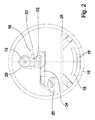
  • FIG. 2 shows the exemplary embodiment according to FIG. 1 in a sectional view along line II-II;
  • FIG. 3 is a descriptive side view of the exemplary embodiment according to FIG. 1 engaged in slurry tunneling
  • FIG. 4 shows the exemplary embodiment according to FIG. 3 in a sectional view along line IV-IV;
  • FIG. 5 is a descriptive side view of a variant of the exemplary embodiment according to FIG. 1 ;
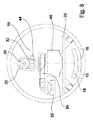
  • FIG. 6 shows the exemplary embodiment according to FIG. 5 in a sectional view along line VI-VI;
  • FIG. 7 is a descriptive side view of the exemplary embodiment according to FIG. 5 engaged in slurry tunneling
  • FIG. 8 is a descriptive side view of the exemplary embodiment according to FIG. 5 in a discontinuous airlock discharge mode in a first operating state
  • FIG. 9 is a descriptive side view of the exemplary embodiment according to FIG. 5 in the discontinuous airlock discharge mode in a second operating state.
  • FIG. 1 is a descriptive side view of a tunnel boring machine equipped with an exemplary embodiment of a device according to the invention for conveying excavated material away and operated according to the method of the invention.
  • the tunnel boring machine according to FIG. 1 comprises a cutting wheel 2 , which is fitted with excavation tools 1 and is drivable in rotation by means of a cutting wheel drive 3 .
  • a working chamber 4 located behind the cutting wheel 2 in a tunneling direction in the case of the earth pressure balance tunneling illustrated in FIG. 1 , also known as EPB mode, is filled with excavated material to be removed and is also filled with shield flushing liquid that is fed in as needed via a shield flushing liquid feed line 5 when a working chamber slide valve 6 is opened.
  • an overflow line 7 which is in communication with a buffer chamber 8 surrounded by the cutting wheel drive 3 .
  • the communication between the working chamber 4 and the buffer chamber 8 via the overflow line 7 is to be sealed or opened, as needed, by means of an overflow line slide valve 9 , to maintain pressure conditions in the working chamber 4 that are suitable for EPB mode.
  • annular gap 10 Located in back of the working chamber 4 in the tunneling direction is an annular gap 10 into which a branch 11 of the shield flushing liquid feed line 5 opens, said branch 11 being sealable by means of an annular gap slide valve 12 .
  • the tunnel boring machine according to FIG. 1 further comprises thrust cylinders 13 , which move the cutting wheel 2 and a shield 14 along in the tunneling direction by pushing against lining segments 15 .
  • the lining segments 15 can, in turn, be installed by means of a lining segment feed unit 16 and a lining segment positioning unit 17 in order to line a tunnel wall.
  • the tunnel boring machine according to FIG. 1 is equipped with a conveyor system 18 , as a device for conveying excavated material away, which in the exemplary embodiment depicted in FIG. 1 has a main screw conveyor 19 that is formed with a core and surrounded by a main screw conveyor cladding tube 20 and that extends away from the cutting wheel 2 , in the opposite direction from the tunneling direction, from an open end projecting into the working chamber 4 and encapsulatedly on through the annular gap 10 .
  • a conveyor system 18 as a device for conveying excavated material away, which in the exemplary embodiment depicted in FIG. 1 has a main screw conveyor 19 that is formed with a core and surrounded by a main screw conveyor cladding tube 20 and that extends away from the cutting wheel 2 , in the opposite direction from the tunneling direction, from an open end projecting into the working chamber 4 and encapsulatedly on through the annular gap 10 .
  • the main screw conveyor 19 is drivable in rotation in two rotational directions by means of a main screw conveyor drive 21 , in one of which directions of rotational conveyance, excavated material present in the working chamber 4 , together with, in particular, shield flushing liquid fed in through the shield flushing liquid feed line 5 and any desired further inputs from the working chamber 4 , can be conveyed away in the opposite direction from the tunneling direction.
  • main screw conveyor outlet 22 Located at the end of the main screw conveyor cladding tube 20 remote from the working chamber 4 is a main screw conveyor outlet 22 , which is provided as a first, working-chamber-end opening in the main screw conveyor cladding tube 20 and which can selectively be sealed by means of a main screw conveyor outlet sealing slide valve 23 as a first seal.
  • a transverse conveyor belt 24 Disposed in the ejection direction of the main screw conveyor outlet 22 is a transverse conveyor belt 24 , by means of which material containing extracted material emerging from the main screw conveyor outlet 22 and intended for removal can be transported away transversely to the tunneling direction and transferred to a backup conveyor belt 25 which conveys material oppositely to the tunneling direction, but which can also be moved, together with a backup system 26 , in the tunneling direction.
  • the main screw conveyor cladding tube 20 is sealed behind the main screw conveyor outlet 22 by means of a transitional-opening throughpass slide valve 27 , as a second seal, by means of which a transitional-opening throughpass 28 formed by the cross section of the main screw conveyor cladding tube 20 and provided as a second opening can be sealed, thereby fluid-mechanically deactivating a downstream screw conveyor cladding tube 29 adjoining the main screw conveyor cladding tube 20 in the conveying direction and containing a downstream screw conveyor 31 , which is also a component of the conveyor system 18 and which can be rotated by means of a downstream screw conveyor drive 30 .
  • the downstream screw conveyor cladding tube 29 opens, by its end remote from the main screw conveyor cladding tube 20 , via a downstream screw conveyor outlet 32 into a flushing chamber 34 that is enclosed by a flushing box 33 and is part of a removal unit into which flushing-box flushing-liquid feed lines 35 open that can be supplied with flushing liquid.
  • a jaw crusher 36 Disposed in the flushing box 33 is a jaw crusher 36 , by means of which, as will be described in more detail below, coarse components conveyed into the flushing box 33 can be made smaller.
  • Opening into a floor region of the flushing box 33 is a delivery line suction pipe 37 that is part of the removal unit and is connected to a feed pump 38 of the removal unit, and by means of which material conveyed into the flushing box 33 and containing components of relatively low viscosity and only relatively small particle size can be sucked out of the flushing box 33 .
  • the feed pump 38 which can be driven via a feed pump drive 39 , relatively low-viscosity material in the flushing chamber 34 can be transported to a discharge line arrangement 40 of the removal unit.
  • FIG. 2 shows the exemplary embodiment according to FIG. 1 in a sectional view along line II-II, looking in the tunneling direction. It can be seen from FIG. 2 that owing to the arrangement of the transverse conveyor belt 24 crosswise to the tunneling direction or removal direction, a clearance is created under the main screw conveyor cladding tube 20 .
  • FIG. 3 is a descriptive side view of the arrangement according to FIG. 1 engaged in slurry tunneling, in which, on the one hand, the working chamber slide valve 6 , the overflow line slide valve 9 and the annular gap slide valve 12 are open in order to maintain the slurry feed necessary for slurry tunneling and the corresponding pressure conditions in the working chamber 4 and the buffer chamber 8 .
  • FIG. 4 shows the arrangement according to FIG. 3 in a sectional view along line IV-IV. Particularly apparent in FIG. 4 is the configuration of the jaw crusher 36 , with crusher jaws 42 that are operable via pressure cylinders 41 and by means of which the material in the flushing chamber 34 , which can include relatively large-size components, can be reduced in size sufficiently to pass through a screen 43 disposed in front of the feed line suction pipe 37 .
  • FIG. 5 is a descriptive side view of a modification of the exemplary embodiment described with reference to FIGS. 1 to 4 , it being noted that like elements of the exemplary embodiment according to FIGS. 1 to 4 and the modification according to FIG. 5 have been given the same reference numerals and that, to avoid repetition, some of them will not be described again in greater detail.
  • the transverse conveyor belt 24 and the backup conveyor belt 25 are positioned in the region of a downstream screw conveyor outlet sealing slide valve 44 that is disposed at the downstream screw conveyor outlet 32 and is open in this mode of operation; in contrast to the exemplary embodiment according to FIGS. 1 to 4 , here the flushing box 33 and the feed pump 38 have been removed.
  • a drip pan 45 that rests on the backup system 26 .
  • FIG. 6 shows the modification according to FIG. 5 in a sectional view along line VI-VI, looking in the tunneling direction. It can be seen from FIG. 6 that, as in the exemplary embodiment according to FIG. 2 , material emerging from the downstream screw conveyor outlet 32 over the drip pan 45 is carried off via the transverse conveyor belt 24 and the backup conveyor belt 25 .
  • FIG. 7 is a descriptive side view of the modification described above with reference to FIGS. 5 and 6 , but in which, for the slurry tunneling operation depicted in FIG. 7 , a drum crusher 46 is disposed at the downstream screw conveyor outlet 32 to reduce the size of the material conveyed via the main screw conveyor 19 and the downstream screw conveyor 31 before it enters a removal line 47 and a feed pump 48 .
  • FIG. 8 shows the arrangement according to FIG. 5 in a discontinuous airlock discharge mode in a first operating state, wherein, starting with earth pressure balance tunneling or open tunneling to get through a relatively short region where, for example, there is a high afflux of water or high pressure during tunneling, the transitional-opening throughpass slide valve 27 is open and the downstream screw conveyor outlet 32 is closed, so the downstream screw conveyor cladding tube 29 is filled during tunneling.
  • FIG. 9 shows the arrangement according to FIG. 5 in the discontinuous airlock discharge mode in a second operating state, wherein, with no tunneling taking place, the transitional-opening throughpass slide valve 27 is closed and the downstream screw conveyor outlet 32 is open, so that the contents of the downstream screw conveyor cladding tube 29 can be removed via the transverse conveyor belt 24 and the backup conveyor belt 25 .
  • the system then returns to the first operating state of the discontinuous airlock discharge mode illustrated in FIG. 8 , and the alternation between operating states in discontinuous airlock discharge mode continues until the critical region has been discontinuously traversed.

Landscapes

  • Engineering & Computer Science (AREA)
  • Mining & Mineral Resources (AREA)
  • Environmental & Geological Engineering (AREA)
  • Life Sciences & Earth Sciences (AREA)
  • General Life Sciences & Earth Sciences (AREA)
  • Geochemistry & Mineralogy (AREA)
  • Geology (AREA)
  • Excavating Of Shafts Or Tunnels (AREA)
  • Investigation Of Foundation Soil And Reinforcement Of Foundation Soil By Compacting Or Drainage (AREA)

Abstract

A method and device for transporting overburden away during tunneling includes a seal that separates a first portion and a second portion of a transporting screw arrangement. As a result, in open tunneling or in earth-pressure-assisted tunneling, when the seal is closed, overburden can be transported out of a first opening, arranged ahead of the seal in the direction of removal and, in fluid-assisted tunneling, when the first opening is closed and the seal is open, the overburden can be transported into the second portion.

Description

CROSS-REFERENCE TO RELATED APPLICATION
This application is a U.S. National Phase Patent Application based on International Application Serial No. PCT/EP2013/070839 filed Oct. 7, 2013, the disclosure of which is hereby explicitly incorporated by reference herein.
BACKGROUND OF THE INVENTION
1. Field of the Invention
The present invention relates to a method for conveying excavated material away during tunneling.
2. Description of the Related Art
Such a method and device are known from DE 197 00 297 C2. The prior device and method for conveying excavated material away during tunneling involve a conveying system comprising a screw conveyor unit disposed in a jacket. The jacket is provided with a first opening, at the working-chamber end, and a second opening, remote from the working chamber. The openings are opened and closed by means of selectively operable seals. A system for airlocking excavated material out is also present, and is adapted to maintain a counterpressure in the jacket. In tunneling using slurry conveyance, the first opening, at the working chamber end, is open, the second opening, remote from the working chamber, is closed and the airlock discharge system is not operating. In earth pressure balance tunneling, the first opening, at the working chamber end, and the second opening, remote from the working chamber, are closed, whereas the airlock discharge system is operating. In open tunneling, the first opening, at the working chamber end, is closed, the second opening, remote from the working chamber, is open and the airlock discharge system is not operating.
SUMMARY OF THE INVENTION
The present invention provides a method and a device for conveying excavated material away during tunneling that are distinguished by failure-resistant and low-wear operation.
By virtue of the fact that according to the invention, in the case of the method, in unpressurized open tunneling or in earth pressure balance tunneling excavated material is discharged from a first opening, disposed first in the direction of conveyance, and in the case of the device, in order to deactivate the system fluid-mechanically a second opening located downstream of the first opening in the direction of conveyance is deactivated, a manner of operation is obtained that is relatively failure-resistant and low-wear, since this abrasive excavated material is discharged early.
In one form thereof, the present invention provides method for conveying excavated material away during tunneling, wherein, in an open tunneling operation or in an earth pressure balance tunneling operation, a first opening, disposed first in the direction of conveyance, of a conveying system is open and a second opening, downstream of the first opening, is closed, and in a slurry tunneling operation the first opening is closed and the second opening is open.
BRIEF DESCRIPTION OF THE DRAWINGS
The above mentioned and other features and objects of this invention, and the manner of attaining them, will become more apparent and the invention itself will be better understood by reference to the following description of embodiments of the invention taken in conjunction with the accompanying drawings, wherein:
Therein:
FIG. 1 is a descriptive side view of an exemplary embodiment of a device according to the invention, comprising a tunnel boring machine engaged in earth pressure balance tunneling;
FIG. 2 shows the exemplary embodiment according to FIG. 1 in a sectional view along line II-II;
FIG. 3 is a descriptive side view of the exemplary embodiment according to FIG. 1 engaged in slurry tunneling;
FIG. 4 shows the exemplary embodiment according to FIG. 3 in a sectional view along line IV-IV;
FIG. 5 is a descriptive side view of a variant of the exemplary embodiment according to FIG. 1;
FIG. 6 shows the exemplary embodiment according to FIG. 5 in a sectional view along line VI-VI;
FIG. 7 is a descriptive side view of the exemplary embodiment according to FIG. 5 engaged in slurry tunneling;
FIG. 8 is a descriptive side view of the exemplary embodiment according to FIG. 5 in a discontinuous airlock discharge mode in a first operating state; and
FIG. 9 is a descriptive side view of the exemplary embodiment according to FIG. 5 in the discontinuous airlock discharge mode in a second operating state.
DETAILED DESCRIPTION
FIG. 1 is a descriptive side view of a tunnel boring machine equipped with an exemplary embodiment of a device according to the invention for conveying excavated material away and operated according to the method of the invention. The tunnel boring machine according to FIG. 1 comprises a cutting wheel 2, which is fitted with excavation tools 1 and is drivable in rotation by means of a cutting wheel drive 3. A working chamber 4 located behind the cutting wheel 2 in a tunneling direction, in the case of the earth pressure balance tunneling illustrated in FIG. 1, also known as EPB mode, is filled with excavated material to be removed and is also filled with shield flushing liquid that is fed in as needed via a shield flushing liquid feed line 5 when a working chamber slide valve 6 is opened.
Also opening into the working chamber 4 is an overflow line 7, which is in communication with a buffer chamber 8 surrounded by the cutting wheel drive 3. The communication between the working chamber 4 and the buffer chamber 8 via the overflow line 7 is to be sealed or opened, as needed, by means of an overflow line slide valve 9, to maintain pressure conditions in the working chamber 4 that are suitable for EPB mode.
Located in back of the working chamber 4 in the tunneling direction is an annular gap 10 into which a branch 11 of the shield flushing liquid feed line 5 opens, said branch 11 being sealable by means of an annular gap slide valve 12.
The tunnel boring machine according to FIG. 1 further comprises thrust cylinders 13, which move the cutting wheel 2 and a shield 14 along in the tunneling direction by pushing against lining segments 15. The lining segments 15 can, in turn, be installed by means of a lining segment feed unit 16 and a lining segment positioning unit 17 in order to line a tunnel wall.
The tunnel boring machine according to FIG. 1 is equipped with a conveyor system 18, as a device for conveying excavated material away, which in the exemplary embodiment depicted in FIG. 1 has a main screw conveyor 19 that is formed with a core and surrounded by a main screw conveyor cladding tube 20 and that extends away from the cutting wheel 2, in the opposite direction from the tunneling direction, from an open end projecting into the working chamber 4 and encapsulatedly on through the annular gap 10. The main screw conveyor 19 is drivable in rotation in two rotational directions by means of a main screw conveyor drive 21, in one of which directions of rotational conveyance, excavated material present in the working chamber 4, together with, in particular, shield flushing liquid fed in through the shield flushing liquid feed line 5 and any desired further inputs from the working chamber 4, can be conveyed away in the opposite direction from the tunneling direction.
Located at the end of the main screw conveyor cladding tube 20 remote from the working chamber 4 is a main screw conveyor outlet 22, which is provided as a first, working-chamber-end opening in the main screw conveyor cladding tube 20 and which can selectively be sealed by means of a main screw conveyor outlet sealing slide valve 23 as a first seal. Disposed in the ejection direction of the main screw conveyor outlet 22 is a transverse conveyor belt 24, by means of which material containing extracted material emerging from the main screw conveyor outlet 22 and intended for removal can be transported away transversely to the tunneling direction and transferred to a backup conveyor belt 25 which conveys material oppositely to the tunneling direction, but which can also be moved, together with a backup system 26, in the tunneling direction.
It is also apparent from the representation according to FIG. 1 that the main screw conveyor cladding tube 20 is sealed behind the main screw conveyor outlet 22 by means of a transitional-opening throughpass slide valve 27, as a second seal, by means of which a transitional-opening throughpass 28 formed by the cross section of the main screw conveyor cladding tube 20 and provided as a second opening can be sealed, thereby fluid-mechanically deactivating a downstream screw conveyor cladding tube 29 adjoining the main screw conveyor cladding tube 20 in the conveying direction and containing a downstream screw conveyor 31, which is also a component of the conveyor system 18 and which can be rotated by means of a downstream screw conveyor drive 30.
The downstream screw conveyor cladding tube 29 opens, by its end remote from the main screw conveyor cladding tube 20, via a downstream screw conveyor outlet 32 into a flushing chamber 34 that is enclosed by a flushing box 33 and is part of a removal unit into which flushing-box flushing-liquid feed lines 35 open that can be supplied with flushing liquid. Disposed in the flushing box 33 is a jaw crusher 36, by means of which, as will be described in more detail below, coarse components conveyed into the flushing box 33 can be made smaller. Opening into a floor region of the flushing box 33 is a delivery line suction pipe 37 that is part of the removal unit and is connected to a feed pump 38 of the removal unit, and by means of which material conveyed into the flushing box 33 and containing components of relatively low viscosity and only relatively small particle size can be sucked out of the flushing box 33. By means of the feed pump 38, which can be driven via a feed pump drive 39, relatively low-viscosity material in the flushing chamber 34 can be transported to a discharge line arrangement 40 of the removal unit.
FIG. 2 shows the exemplary embodiment according to FIG. 1 in a sectional view along line II-II, looking in the tunneling direction. It can be seen from FIG. 2 that owing to the arrangement of the transverse conveyor belt 24 crosswise to the tunneling direction or removal direction, a clearance is created under the main screw conveyor cladding tube 20.
FIG. 3 is a descriptive side view of the arrangement according to FIG. 1 engaged in slurry tunneling, in which, on the one hand, the working chamber slide valve 6, the overflow line slide valve 9 and the annular gap slide valve 12 are open in order to maintain the slurry feed necessary for slurry tunneling and the corresponding pressure conditions in the working chamber 4 and the buffer chamber 8. On the other hand, in slurry tunneling the main screw conveyor outlet sealing slide valves 23 are closed and the transitional-opening throughpass slide valve 27 is open, and consequently the transitional-opening throughpass 28 located between the main screw conveyor cladding tube 20 and the downstream screw conveyor cladding tube 29 is now open and material containing excavated material destined for removal and conveyed by the main screw conveyor 19 can be conveyed into the downstream screw conveyor cladding tube 29 and, by means of the downstream screw conveyor 31 rotating in a conveying direction, can be carried on through the downstream screw conveyor outlet 32 into the flushing chamber 34 surrounded by the flushing box 33. In the flushing chamber 34, in slurry tunneling, as indicated schematically by the arrows in FIG. 3, flushing liquid can be introduced into the flushing chamber 34 through the flushing-chamber flushing-liquid feed lines 35 to lend the material for removal a suitable consistency for the operating parameters of the feed pump 38.
FIG. 4 shows the arrangement according to FIG. 3 in a sectional view along line IV-IV. Particularly apparent in FIG. 4 is the configuration of the jaw crusher 36, with crusher jaws 42 that are operable via pressure cylinders 41 and by means of which the material in the flushing chamber 34, which can include relatively large-size components, can be reduced in size sufficiently to pass through a screen 43 disposed in front of the feed line suction pipe 37.
FIG. 5 is a descriptive side view of a modification of the exemplary embodiment described with reference to FIGS. 1 to 4, it being noted that like elements of the exemplary embodiment according to FIGS. 1 to 4 and the modification according to FIG. 5 have been given the same reference numerals and that, to avoid repetition, some of them will not be described again in greater detail. In the modification according to FIG. 5, for EPB mode, the transverse conveyor belt 24 and the backup conveyor belt 25 are positioned in the region of a downstream screw conveyor outlet sealing slide valve 44 that is disposed at the downstream screw conveyor outlet 32 and is open in this mode of operation; in contrast to the exemplary embodiment according to FIGS. 1 to 4, here the flushing box 33 and the feed pump 38 have been removed. In addition, in the modification according to FIG. 5, provided in the region of the downstream screw conveyor cladding tube 29 and the downstream screw conveyor 31 is a drip pan 45 that rests on the backup system 26.
FIG. 6 shows the modification according to FIG. 5 in a sectional view along line VI-VI, looking in the tunneling direction. It can be seen from FIG. 6 that, as in the exemplary embodiment according to FIG. 2, material emerging from the downstream screw conveyor outlet 32 over the drip pan 45 is carried off via the transverse conveyor belt 24 and the backup conveyor belt 25.
FIG. 7 is a descriptive side view of the modification described above with reference to FIGS. 5 and 6, but in which, for the slurry tunneling operation depicted in FIG. 7, a drum crusher 46 is disposed at the downstream screw conveyor outlet 32 to reduce the size of the material conveyed via the main screw conveyor 19 and the downstream screw conveyor 31 before it enters a removal line 47 and a feed pump 48.
FIG. 8 shows the arrangement according to FIG. 5 in a discontinuous airlock discharge mode in a first operating state, wherein, starting with earth pressure balance tunneling or open tunneling to get through a relatively short region where, for example, there is a high afflux of water or high pressure during tunneling, the transitional-opening throughpass slide valve 27 is open and the downstream screw conveyor outlet 32 is closed, so the downstream screw conveyor cladding tube 29 is filled during tunneling.
FIG. 9 shows the arrangement according to FIG. 5 in the discontinuous airlock discharge mode in a second operating state, wherein, with no tunneling taking place, the transitional-opening throughpass slide valve 27 is closed and the downstream screw conveyor outlet 32 is open, so that the contents of the downstream screw conveyor cladding tube 29 can be removed via the transverse conveyor belt 24 and the backup conveyor belt 25. The system then returns to the first operating state of the discontinuous airlock discharge mode illustrated in FIG. 8, and the alternation between operating states in discontinuous airlock discharge mode continues until the critical region has been discontinuously traversed.
While this invention has been described as having a preferred design, the present invention can be further modified within the spirit and scope of this disclosure. This application is therefore intended to cover any variations, uses, or adaptations of the invention using its general principles. Further, this application is intended to cover such departures from the present disclosure as come within known or customary practice in the art to which this invention pertains and which fall within the limits of the appended claims.

Claims (3)

The invention claimed is:
1. A method for conveying excavated material away during tunneling, comprising the following steps:
providing a first conveying system and a second conveying system, the second conveying system disposed downstream of the first conveying system;
opening, in a first mode of operation, a first opening of the first conveying system together with closing a second opening located downstream of the first opening and between the first and second conveying systems to separate the first and second conveying systems;
operating the first conveying system in the first mode of operation with the second conveying system deactivated;
closing, in a second mode of operation, the first opening, together with opening the second opening;
operating both the first and second conveying systems in the second mode of operation;
wherein the first mode of operation is one of an open tunneling operation and an earth pressure balance operation and the second mode of operation is a slurry tunneling operation.
2. The method of claim 1, wherein said closing step further comprises removing material from a flushing chamber.
3. The method of claim 2, wherein said closing step further comprises introducing flushing liquid into the flushing chamber.
US14/434,304 2012-10-19 2013-10-07 Method and device for transporting overburden away during tunnelling Active US9518465B2 (en)

Applications Claiming Priority (4)

Application Number Priority Date Filing Date Title
DE102012219134A DE102012219134A1 (en) 2012-10-19 2012-10-19 Method for discharging excavated material during tunnel driving in tunnel boring machine, involves arranging aperture in discharging direction of another aperture, where former aperture is opened and latter aperture is closed in tunneling
DE102012219134.8 2012-10-19
DE102012219134 2012-10-19
PCT/EP2013/070839 WO2014060234A2 (en) 2012-10-19 2013-10-07 Method and device for transporting overburden away during tunnelling

Publications (2)

Publication Number Publication Date
US20150233243A1 US20150233243A1 (en) 2015-08-20
US9518465B2 true US9518465B2 (en) 2016-12-13

Family

ID=47321560

Family Applications (1)

Application Number Title Priority Date Filing Date
US14/434,304 Active US9518465B2 (en) 2012-10-19 2013-10-07 Method and device for transporting overburden away during tunnelling

Country Status (10)

Country Link
US (1) US9518465B2 (en)
EP (1) EP2909444B1 (en)
JP (1) JP6193380B2 (en)
CN (1) CN104870748B (en)
AU (1) AU2013331907B2 (en)
CA (1) CA2886767C (en)
DE (1) DE102012219134A1 (en)
ES (1) ES2851399T3 (en)
RU (1) RU2638681C2 (en)
WO (1) WO2014060234A2 (en)

Families Citing this family (10)

* Cited by examiner, † Cited by third party
Publication number Priority date Publication date Assignee Title
CN104373130A (en) * 2014-11-04 2015-02-25 中交第二航务工程局有限公司 Muck pressure maintaining pumping device of earth pressure balance shield machine
JP6432771B2 (en) * 2014-11-25 2018-12-05 清水建設株式会社 Excavated soil treatment system and shield excavator
CN104612703A (en) * 2014-12-29 2015-05-13 上海市基础工程集团有限公司 Anti-gushing device for sludge discharge of screw conveyor during earth pressure balancing type shield excavation
CN108603406B (en) 2016-02-01 2020-08-18 海瑞克股份公司 Tunnel boring device, system for hydraulically discharging drill cuttings and system for generating a constant hydraulic pressure of the drilling fluid in the region of a cutting wheel of a tunnel boring device
JP6548264B2 (en) * 2016-02-10 2019-07-24 Jimテクノロジー株式会社 Tunnel excavator
CN106194202B (en) * 2016-08-30 2018-11-30 中国铁建重工集团有限公司 Screw conveyor and shield machine and control method with it
CN106837369B (en) * 2017-01-10 2018-01-02 辽宁三三工业有限公司 A kind of screw machine soil outlet control system
CN107178376A (en) * 2017-06-06 2017-09-19 中铁十九局集团轨道交通工程有限公司 Compound stratum shield machine dregs transportation system
CN108571327B (en) * 2018-05-16 2023-11-17 华东交通大学 A rapid compensation device for soil in the soil cabin of a shield machine and its working method
CN110566221B (en) * 2019-09-26 2021-09-24 中铁工程装备集团有限公司 Tandem type double-screw conveyor conveying device and conveying method thereof

Citations (7)

* Cited by examiner, † Cited by third party
Publication number Priority date Publication date Assignee Title
US4456305A (en) * 1981-09-18 1984-06-26 Hitachi Shipbuilding & Engineering Co., Ltd. Shield tunneling machine
DE8530392U1 (en) 1985-10-26 1986-10-16 Hochtief Ag Vorm. Gebr. Helfmann, 4300 Essen Shield tunneling machine with device for a liquid support of the working face as well as with coarse rock extraction device
US5180252A (en) * 1989-04-28 1993-01-19 Kabushiki Kaisha Konoike Gumi Earth pressure system shield process
US5203614A (en) * 1991-06-17 1993-04-20 The Robbins Company Tunneling machine having liquid balance low flow slurry system
JPH1122387A (en) 1997-07-04 1999-01-26 Mitsubishi Heavy Ind Ltd Tunnel excavator and muddy water shield excavator
DE29914815U1 (en) 1999-08-09 2000-12-21 Wirth Maschinen- und Bohrgeräte-Fabrik GmbH, 41812 Erkelenz Conveyor for drilling material
DE19700297C2 (en) 1997-01-08 2001-05-17 Wirth Co Kg Masch Bohr Conveyor device for a shield tunneling machine

Family Cites Families (6)

* Cited by examiner, † Cited by third party
Publication number Priority date Publication date Assignee Title
JPH0743272Y2 (en) * 1988-09-27 1995-10-09 川崎重工業株式会社 Shield excavator screen transfer conveyor
RU2019703C1 (en) * 1991-11-22 1994-09-15 Научно-технический центр ассоциации предприятий и организаций строительного комплекса "Мосинжстрой" Tunneling complex and slime vessel
CN2685570Y (en) * 2004-03-08 2005-03-16 广东省基础工程公司 Pipe-jacking tunneller
CN201367906Y (en) * 2009-01-19 2009-12-23 中铁隧道集团有限公司 Screw conveyor
CN201554466U (en) * 2009-11-18 2010-08-18 中铁轨道系统集团有限公司 Screw conveyor for shield machine
CN101798933B (en) * 2010-04-13 2012-11-07 同济大学 Simulation test system for soil pressure balance shielding screw conveyer

Patent Citations (7)

* Cited by examiner, † Cited by third party
Publication number Priority date Publication date Assignee Title
US4456305A (en) * 1981-09-18 1984-06-26 Hitachi Shipbuilding & Engineering Co., Ltd. Shield tunneling machine
DE8530392U1 (en) 1985-10-26 1986-10-16 Hochtief Ag Vorm. Gebr. Helfmann, 4300 Essen Shield tunneling machine with device for a liquid support of the working face as well as with coarse rock extraction device
US5180252A (en) * 1989-04-28 1993-01-19 Kabushiki Kaisha Konoike Gumi Earth pressure system shield process
US5203614A (en) * 1991-06-17 1993-04-20 The Robbins Company Tunneling machine having liquid balance low flow slurry system
DE19700297C2 (en) 1997-01-08 2001-05-17 Wirth Co Kg Masch Bohr Conveyor device for a shield tunneling machine
JPH1122387A (en) 1997-07-04 1999-01-26 Mitsubishi Heavy Ind Ltd Tunnel excavator and muddy water shield excavator
DE29914815U1 (en) 1999-08-09 2000-12-21 Wirth Maschinen- und Bohrgeräte-Fabrik GmbH, 41812 Erkelenz Conveyor for drilling material

Non-Patent Citations (1)

* Cited by examiner, † Cited by third party
Title
International Search Report and Written Opinion mailed Feb. 5, 2015 from the ISA-EP.

Also Published As

Publication number Publication date
RU2015112169A (en) 2016-12-10
JP6193380B2 (en) 2017-09-06
WO2014060234A3 (en) 2015-04-02
RU2638681C2 (en) 2017-12-15
ES2851399T3 (en) 2021-09-06
AU2013331907B2 (en) 2018-02-01
US20150233243A1 (en) 2015-08-20
CN104870748B (en) 2017-10-13
AU2013331907A1 (en) 2015-04-23
CN104870748A (en) 2015-08-26
CA2886767C (en) 2020-10-06
JP2015532373A (en) 2015-11-09
CA2886767A1 (en) 2014-04-24
EP2909444B1 (en) 2020-12-09
WO2014060234A2 (en) 2014-04-24
DE102012219134A1 (en) 2012-12-27
EP2909444A2 (en) 2015-08-26

Similar Documents

Publication Publication Date Title
US9518465B2 (en) Method and device for transporting overburden away during tunnelling
US5203614A (en) Tunneling machine having liquid balance low flow slurry system
CN109281685A (en) A kind of decompression type shield machine step by step
CN110966010B (en) Dual-mode shield machine with adjustable density, mud, water and earth pressure
JP6207025B2 (en) In-flight disposal system for underground excavation machine
CN105422105A (en) Demolition waste recovering and using method of earth pressure balance shield machine
CN212716640U (en) Thick mud type rectangular pipe jacking machine
US20250188805A1 (en) Expanding drill device
CN104632276B (en) Continuous strength coal mining with gangue backfilling system
JPH1122387A (en) Tunnel excavator and muddy water shield excavator
JP5443961B2 (en) Excavator
JP2007092365A (en) Shield excavator
CN217481271U (en) Double-channel tunneling machine
JP2604398B2 (en) Discharge device of shield machine
CN217080477U (en) Earth pressure/open double-mode shield machine body and earth pressure/open double-mode shield machine
JP4119277B2 (en) Tunnel excavator having earth removal mechanism and method for earth excavation of tunnel excavator
JPH0953391A (en) Transport device of excavation, tunnel excavator, and method of excavating tunnel
JPH0441897A (en) Discharging process of excavated earth and sand and device thereof for earth pressure type shield tunneling method
JP2002285789A (en) Shield excavator
JPH0532494U (en) Shield machine
CN109113753A (en) A kind of device and method for abolishing cutterhead mud cake
CN121251346A (en) A conveying device, tunneling equipment, and control method
JP2509494B2 (en) Rock cutting powder removal device for rock semi-shielding machine
JP2024044772A (en) tunnel boring machine
JP2002213185A (en) Drainage apparatus, tunnel excavator and excavation method

Legal Events

Date Code Title Description
AS Assignment

Owner name: HERRENKNECHT AKTIENGESELLSCHAFT, GERMANY

Free format text: ASSIGNMENT OF ASSIGNORS INTEREST;ASSIGNORS:BURGER, WERNER;STRASSER, MICHAEL;REEL/FRAME:035361/0898

Effective date: 20150331

STCF Information on status: patent grant

Free format text: PATENTED CASE

MAFP Maintenance fee payment

Free format text: PAYMENT OF MAINTENANCE FEE, 4TH YEAR, LARGE ENTITY (ORIGINAL EVENT CODE: M1551); ENTITY STATUS OF PATENT OWNER: LARGE ENTITY

Year of fee payment: 4

MAFP Maintenance fee payment

Free format text: PAYMENT OF MAINTENANCE FEE, 8TH YEAR, LARGE ENTITY (ORIGINAL EVENT CODE: M1552); ENTITY STATUS OF PATENT OWNER: LARGE ENTITY

Year of fee payment: 8