US9511064B2 - Combination therapy for the treatment of cancer and immunosuppression - Google Patents
Combination therapy for the treatment of cancer and immunosuppression Download PDFInfo
- Publication number
- US9511064B2 US9511064B2 US14/413,122 US201314413122A US9511064B2 US 9511064 B2 US9511064 B2 US 9511064B2 US 201314413122 A US201314413122 A US 201314413122A US 9511064 B2 US9511064 B2 US 9511064B2
- Authority
- US
- United States
- Prior art keywords
- compound
- formula
- alkyl
- group selected
- hydrogen
- Prior art date
- Legal status (The legal status is an assumption and is not a legal conclusion. Google has not performed a legal analysis and makes no representation as to the accuracy of the status listed.)
- Expired - Fee Related
Links
- 0 [1*]C1=C2NC3=C(CCN4C[C@@]5([H])C[C@@H](OC(=O)C6=C([9*])C([8*])=C(C)C([7*])=C6[6*])[C@H](OC)[C@@H](C(=O)O[5*])[C@@]5([H])C[C@]34[H])C2=C([4*])C([3*])=C1[2*] Chemical compound [1*]C1=C2NC3=C(CCN4C[C@@]5([H])C[C@@H](OC(=O)C6=C([9*])C([8*])=C(C)C([7*])=C6[6*])[C@H](OC)[C@@H](C(=O)O[5*])[C@@]5([H])C[C@]34[H])C2=C([4*])C([3*])=C1[2*] 0.000 description 15
- XZWYZXLIPXDOLR-UHFFFAOYSA-N CN(C)C(=N)NC(=N)N Chemical compound CN(C)C(=N)NC(=N)N XZWYZXLIPXDOLR-UHFFFAOYSA-N 0.000 description 2
- CIRZEZGRTXFWQW-UHFFFAOYSA-N COC1=CC(C(=O)O)=CC(OC)=C1OC(=O)OCC1=CC=CC=C1 Chemical compound COC1=CC(C(=O)O)=CC(OC)=C1OC(=O)OCC1=CC=CC=C1 CIRZEZGRTXFWQW-UHFFFAOYSA-N 0.000 description 2
- PMMXLPPRPONWOL-IJIJDCLHSA-N [H][C@]12C[C@@H](OC(=O)C3=CC(OC)=C(OC(=O)CC4=CC=NC=C4)C(OC)=C3)[C@H](OC)[C@@H](C(=O)OC)[C@@]1([H])C[C@]1([H])C3=C(CCN1C2)C1=C(C=C(OC)C=C1)N3 Chemical compound [H][C@]12C[C@@H](OC(=O)C3=CC(OC)=C(OC(=O)CC4=CC=NC=C4)C(OC)=C3)[C@H](OC)[C@@H](C(=O)OC)[C@@]1([H])C[C@]1([H])C3=C(CCN1C2)C1=C(C=C(OC)C=C1)N3 PMMXLPPRPONWOL-IJIJDCLHSA-N 0.000 description 2
- QGEVLNNIHYNFSO-LAFLMMDJSA-N [H][C@]12C[C@@H](OC(=O)C3=CC(OC)=C(OC(=O)CCC)C(OC)=C3)[C@H](OC)[C@@H](C(=O)OC)[C@@]1([H])C[C@]1([H])C3=C(CCN1C2)C1=C(C=C(OC)C=C1)N3 Chemical compound [H][C@]12C[C@@H](OC(=O)C3=CC(OC)=C(OC(=O)CCC)C(OC)=C3)[C@H](OC)[C@@H](C(=O)OC)[C@@]1([H])C[C@]1([H])C3=C(CCN1C2)C1=C(C=C(OC)C=C1)N3 QGEVLNNIHYNFSO-LAFLMMDJSA-N 0.000 description 2
- KXXUAHBHBOIFRV-ZSLPTDPUSA-N [H][C@]12C[C@@H](OC(=O)C3=CC(OC)=C(OC(=O)OC4=CC(Cl)=CC(Cl)=C4)C(OC)=C3)[C@H](OC)[C@@H](C(=O)OC)[C@@]1([H])C[C@]1([H])C3=C(CCN1C2)C1=C(C=C(OC)C=C1)N3 Chemical compound [H][C@]12C[C@@H](OC(=O)C3=CC(OC)=C(OC(=O)OC4=CC(Cl)=CC(Cl)=C4)C(OC)=C3)[C@H](OC)[C@@H](C(=O)OC)[C@@]1([H])C[C@]1([H])C3=C(CCN1C2)C1=C(C=C(OC)C=C1)N3 KXXUAHBHBOIFRV-ZSLPTDPUSA-N 0.000 description 2
- XHYLGVHUMXADTA-ZNFOTRSXSA-N [H][C@]12C[C@@H](OC(=O)C3=CC(OC)=C(OC(=O)OCC)C(OC)=C3)[C@H](OC)[C@@H](C(=O)OC)[C@@]1([H])C[C@]1([H])C3=C(CCN1C2)C1=C(C=C(OC(=O)C2=CC=CC=C2)C=C1)N3 Chemical compound [H][C@]12C[C@@H](OC(=O)C3=CC(OC)=C(OC(=O)OCC)C(OC)=C3)[C@H](OC)[C@@H](C(=O)OC)[C@@]1([H])C[C@]1([H])C3=C(CCN1C2)C1=C(C=C(OC(=O)C2=CC=CC=C2)C=C1)N3 XHYLGVHUMXADTA-ZNFOTRSXSA-N 0.000 description 2
- HBUPFSYDDROBDB-NRDBUMKBSA-N [H][C@]12C[C@@H](OC(=O)C3=CC(OC)=C(OC(=O)OCC)C(OC)=C3)[C@H](OC)[C@@H](C(=O)OC)[C@@]1([H])C[C@]1([H])C3=C(CCN1C2)C1=C(C=C(OC(C)=O)C=C1)N3 Chemical compound [H][C@]12C[C@@H](OC(=O)C3=CC(OC)=C(OC(=O)OCC)C(OC)=C3)[C@H](OC)[C@@H](C(=O)OC)[C@@]1([H])C[C@]1([H])C3=C(CCN1C2)C1=C(C=C(OC(C)=O)C=C1)N3 HBUPFSYDDROBDB-NRDBUMKBSA-N 0.000 description 2
- KMKYOEBDTADSCZ-ULSJKCEZSA-N [H][C@]12C[C@@H](OC(=O)C3=CC(OC)=C(OC(=O)OCC4=CC(F)=CC(F)=C4)C(OC)=C3)[C@H](OC)[C@@H](C(=O)OC)[C@@]1([H])C[C@]1([H])C3=C(CCN1C2)C1=C(C=C(OC)C=C1)N3 Chemical compound [H][C@]12C[C@@H](OC(=O)C3=CC(OC)=C(OC(=O)OCC4=CC(F)=CC(F)=C4)C(OC)=C3)[C@H](OC)[C@@H](C(=O)OC)[C@@]1([H])C[C@]1([H])C3=C(CCN1C2)C1=C(C=C(OC)C=C1)N3 KMKYOEBDTADSCZ-ULSJKCEZSA-N 0.000 description 2
- NALKFWIHQILKCT-SULGKXIISA-N [H][C@]12C[C@@H](OC(=O)C3=CC(OC)=C(OC(=O)OCC4=CC(O)=CC=C4)C(OC)=C3)[C@H](OC)[C@@H](C(=O)OC)[C@@]1([H])C[C@]1([H])C3=C(CCN1C2)C1=C(C=C(OC)C=C1)N3 Chemical compound [H][C@]12C[C@@H](OC(=O)C3=CC(OC)=C(OC(=O)OCC4=CC(O)=CC=C4)C(OC)=C3)[C@H](OC)[C@@H](C(=O)OC)[C@@]1([H])C[C@]1([H])C3=C(CCN1C2)C1=C(C=C(OC)C=C1)N3 NALKFWIHQILKCT-SULGKXIISA-N 0.000 description 2
- SEYDIEQHBYZQQE-SULGKXIISA-N [H][C@]12C[C@@H](OC(=O)C3=CC(OC)=C(OC(=O)OCC4=CC=C(C(F)(F)F)C=C4)C(OC)=C3)[C@H](OC)[C@@H](C(=O)OC)[C@@]1([H])C[C@]1([H])C3=C(CCN1C2)C1=C(C=C(OC)C=C1)N3 Chemical compound [H][C@]12C[C@@H](OC(=O)C3=CC(OC)=C(OC(=O)OCC4=CC=C(C(F)(F)F)C=C4)C(OC)=C3)[C@H](OC)[C@@H](C(=O)OC)[C@@]1([H])C[C@]1([H])C3=C(CCN1C2)C1=C(C=C(OC)C=C1)N3 SEYDIEQHBYZQQE-SULGKXIISA-N 0.000 description 2
- WEXGWYOJRICSTL-UHFFFAOYSA-N COC1=CC(C(=O)O)=CC(OC)=C1OC(=O)OC1=CC=CC=C1 Chemical compound COC1=CC(C(=O)O)=CC(OC)=C1OC(=O)OC1=CC=CC=C1 WEXGWYOJRICSTL-UHFFFAOYSA-N 0.000 description 1
- OHLFHNOEMXEVLM-UHFFFAOYSA-N N=C(N)CC(=N)CCCC1=CC=CC=C1 Chemical compound N=C(N)CC(=N)CCCC1=CC=CC=C1 OHLFHNOEMXEVLM-UHFFFAOYSA-N 0.000 description 1
- MTESTVHTYAMDSB-UHFFFAOYSA-N O=C(OCC1=CC=NC=C1)OC1=CC=C([N+](=O)[O-])C=C1 Chemical compound O=C(OCC1=CC=NC=C1)OC1=CC=C([N+](=O)[O-])C=C1 MTESTVHTYAMDSB-UHFFFAOYSA-N 0.000 description 1
- PMYCWFZCTMQFQY-XELGFBSKSA-N [H][C@]12C[C@@H](O)[C@H](OC)[C@@H](C(=O)OC)[C@@]1([H])C[C@]1([H])C3=C(CCN1C2)C1=C(C=C(OC(=O)OC(C)(C)C)C=C1)N3 Chemical compound [H][C@]12C[C@@H](O)[C@H](OC)[C@@H](C(=O)OC)[C@@]1([H])C[C@]1([H])C3=C(CCN1C2)C1=C(C=C(OC(=O)OC(C)(C)C)C=C1)N3 PMYCWFZCTMQFQY-XELGFBSKSA-N 0.000 description 1
- PRGWDMIMVOCLBM-GXFRJNJESA-N [H][C@]12C[C@@H](OC(=O)C3=CC(OC)=C(OC(=O)CC4=CC(Cl)=CC(Cl)=C4)C(OC)=C3)[C@H](OC)[C@@H](C(=O)OC)[C@@]1([H])C[C@]1([H])C3=C(CCN1C2)C1=C(C=C(OC)C=C1)N3 Chemical compound [H][C@]12C[C@@H](OC(=O)C3=CC(OC)=C(OC(=O)CC4=CC(Cl)=CC(Cl)=C4)C(OC)=C3)[C@H](OC)[C@@H](C(=O)OC)[C@@]1([H])C[C@]1([H])C3=C(CCN1C2)C1=C(C=C(OC)C=C1)N3 PRGWDMIMVOCLBM-GXFRJNJESA-N 0.000 description 1
- GREXPQWFAASBGB-DQXAOILYSA-N [H][C@]12C[C@@H](OC(=O)C3=CC(OC)=C(OC(=O)CC4=CC(OC)=CC(OC)=C4)C(OC)=C3)[C@H](OC)[C@@H](C(=O)OC)[C@@]1([H])C[C@]1([H])C3=C(CCN1C2)C1=C(C=C(OC)C=C1)N3 Chemical compound [H][C@]12C[C@@H](OC(=O)C3=CC(OC)=C(OC(=O)CC4=CC(OC)=CC(OC)=C4)C(OC)=C3)[C@H](OC)[C@@H](C(=O)OC)[C@@]1([H])C[C@]1([H])C3=C(CCN1C2)C1=C(C=C(OC)C=C1)N3 GREXPQWFAASBGB-DQXAOILYSA-N 0.000 description 1
- IJVWMZVCZNQDFA-INPONKAUSA-N [H][C@]12C[C@@H](OC(=O)C3=CC(OC)=C(OC(=O)CC4=CC=C(Cl)C=C4)C(OC)=C3)[C@H](OC)[C@@H](C(=O)OC)[C@@]1([H])C[C@]1([H])C3=C(CCN1C2)C1=C(C=C(OC)C=C1)N3 Chemical compound [H][C@]12C[C@@H](OC(=O)C3=CC(OC)=C(OC(=O)CC4=CC=C(Cl)C=C4)C(OC)=C3)[C@H](OC)[C@@H](C(=O)OC)[C@@]1([H])C[C@]1([H])C3=C(CCN1C2)C1=C(C=C(OC)C=C1)N3 IJVWMZVCZNQDFA-INPONKAUSA-N 0.000 description 1
- KLPXRJMIEBUJIB-IDEFFIJLSA-N [H][C@]12C[C@@H](OC(=O)C3=CC(OC)=C(OC(=O)CC4=CC=CC=C4)C(OC)=C3)[C@H](OC)[C@@H](C(=O)OC)[C@@]1([H])C[C@]1([H])C3=C(CCN1C2)C1=C(C=C(OC)C=C1)N3 Chemical compound [H][C@]12C[C@@H](OC(=O)C3=CC(OC)=C(OC(=O)CC4=CC=CC=C4)C(OC)=C3)[C@H](OC)[C@@H](C(=O)OC)[C@@]1([H])C[C@]1([H])C3=C(CCN1C2)C1=C(C=C(OC)C=C1)N3 KLPXRJMIEBUJIB-IDEFFIJLSA-N 0.000 description 1
- ADAYOSPQGYDVOE-IJIJDCLHSA-N [H][C@]12C[C@@H](OC(=O)C3=CC(OC)=C(OC(=O)CC4=CN=CC=C4)C(OC)=C3)[C@H](OC)[C@@H](C(=O)OC)[C@@]1([H])C[C@]1([H])C3=C(CCN1C2)C1=C(C=C(OC)C=C1)N3 Chemical compound [H][C@]12C[C@@H](OC(=O)C3=CC(OC)=C(OC(=O)CC4=CN=CC=C4)C(OC)=C3)[C@H](OC)[C@@H](C(=O)OC)[C@@]1([H])C[C@]1([H])C3=C(CCN1C2)C1=C(C=C(OC)C=C1)N3 ADAYOSPQGYDVOE-IJIJDCLHSA-N 0.000 description 1
- HDWWTUVWYVFXTR-ZAEUPOFDSA-N [H][C@]12C[C@@H](OC(=O)C3=CC(OC)=C(OC(=O)CC4=NC=CC=C4)C(OC)=C3)[C@H](OC)[C@@H](C(=O)OC)[C@@]1([H])C[C@]1([H])C3=C(CCN1C2)C1=C(C=C(OC)C=C1)N3 Chemical compound [H][C@]12C[C@@H](OC(=O)C3=CC(OC)=C(OC(=O)CC4=NC=CC=C4)C(OC)=C3)[C@H](OC)[C@@H](C(=O)OC)[C@@]1([H])C[C@]1([H])C3=C(CCN1C2)C1=C(C=C(OC)C=C1)N3 HDWWTUVWYVFXTR-ZAEUPOFDSA-N 0.000 description 1
- UXCNDOMBANJJPG-LNIJSVIVSA-N [H][C@]12C[C@@H](OC(=O)C3=CC(OC)=C(OC(=O)CCC4=CC=CC=C4)C(OC)=C3)[C@H](OC)[C@@H](C(=O)OC)[C@@]1([H])C[C@]1([H])C3=C(CCN1C2)C1=C(C=C(OC)C=C1)N3 Chemical compound [H][C@]12C[C@@H](OC(=O)C3=CC(OC)=C(OC(=O)CCC4=CC=CC=C4)C(OC)=C3)[C@H](OC)[C@@H](C(=O)OC)[C@@]1([H])C[C@]1([H])C3=C(CCN1C2)C1=C(C=C(OC)C=C1)N3 UXCNDOMBANJJPG-LNIJSVIVSA-N 0.000 description 1
- VTLDVCCTRVSNEE-BLOIAIRMSA-N [H][C@]12C[C@@H](OC(=O)C3=CC(OC)=C(OC(=O)OC4=CC(OC)=CC(OC)=C4)C(OC)=C3)[C@H](OC)[C@@H](C(=O)OC)[C@@]1([H])C[C@]1([H])C3=C(CCN1C2)C1=C(C=C(OC)C=C1)N3 Chemical compound [H][C@]12C[C@@H](OC(=O)C3=CC(OC)=C(OC(=O)OC4=CC(OC)=CC(OC)=C4)C(OC)=C3)[C@H](OC)[C@@H](C(=O)OC)[C@@]1([H])C[C@]1([H])C3=C(CCN1C2)C1=C(C=C(OC)C=C1)N3 VTLDVCCTRVSNEE-BLOIAIRMSA-N 0.000 description 1
- LVDWCGRHCPTRJG-XTOWWGQPSA-N [H][C@]12C[C@@H](OC(=O)C3=CC(OC)=C(OC(=O)OC4=CC=C(N(C)C)C=C4)C(OC)=C3)[C@H](OC)[C@@H](C(=O)OC)[C@@]1([H])C[C@]1([H])C3=C(CCN1C2)C1=C(C=C(OC)C=C1)N3 Chemical compound [H][C@]12C[C@@H](OC(=O)C3=CC(OC)=C(OC(=O)OC4=CC=C(N(C)C)C=C4)C(OC)=C3)[C@H](OC)[C@@H](C(=O)OC)[C@@]1([H])C[C@]1([H])C3=C(CCN1C2)C1=C(C=C(OC)C=C1)N3 LVDWCGRHCPTRJG-XTOWWGQPSA-N 0.000 description 1
- XBMFZUCLBBHZGQ-XTOWWGQPSA-N [H][C@]12C[C@@H](OC(=O)C3=CC(OC)=C(OC(=O)OC4=CC=CC(N(C)C)=C4)C(OC)=C3)[C@H](OC)[C@@H](C(=O)OC)[C@@]1([H])C[C@]1([H])C3=C(CCN1C2)C1=C(C=C(OC)C=C1)N3 Chemical compound [H][C@]12C[C@@H](OC(=O)C3=CC(OC)=C(OC(=O)OC4=CC=CC(N(C)C)=C4)C(OC)=C3)[C@H](OC)[C@@H](C(=O)OC)[C@@]1([H])C[C@]1([H])C3=C(CCN1C2)C1=C(C=C(OC)C=C1)N3 XBMFZUCLBBHZGQ-XTOWWGQPSA-N 0.000 description 1
- NRLSQGZWYIQATR-BNDRCJOQSA-N [H][C@]12C[C@@H](OC(=O)C3=CC(OC)=C(OC(=O)OC4=CC=CC=C4)C(OC)=C3)[C@H](OC)[C@@H](C(=O)OC)[C@@]1([H])C[C@]1([H])C3=C(CCN1C2)C1=C(C=C(OC)C=C1)N3 Chemical compound [H][C@]12C[C@@H](OC(=O)C3=CC(OC)=C(OC(=O)OC4=CC=CC=C4)C(OC)=C3)[C@H](OC)[C@@H](C(=O)OC)[C@@]1([H])C[C@]1([H])C3=C(CCN1C2)C1=C(C=C(OC)C=C1)N3 NRLSQGZWYIQATR-BNDRCJOQSA-N 0.000 description 1
- QCVTYMVITWWACK-MDEJGZGSSA-N [H][C@]12C[C@@H](OC(=O)C3=CC(OC)=C(OC(=O)OCC)C(OC)=C3)[C@H](OC)[C@@H](C(=O)OC)[C@@]1([H])C[C@]1([H])C3=C(CCN1C2)C1=C(C=C(O)C=C1)N3 Chemical compound [H][C@]12C[C@@H](OC(=O)C3=CC(OC)=C(OC(=O)OCC)C(OC)=C3)[C@H](OC)[C@@H](C(=O)OC)[C@@]1([H])C[C@]1([H])C3=C(CCN1C2)C1=C(C=C(O)C=C1)N3 QCVTYMVITWWACK-MDEJGZGSSA-N 0.000 description 1
- UZUSAFLWPQBNFE-FCANZLHZSA-N [H][C@]12C[C@@H](OC(=O)C3=CC(OC)=C(OC(=O)OCC)C(OC)=C3)[C@H](OC)[C@@H](C(=O)OC)[C@@]1([H])C[C@]1([H])C3=C(CCN1C2)C1=C(C=C(OC(=O)CCC(=O)C2=CC=CC=C2)C=C1)N3 Chemical compound [H][C@]12C[C@@H](OC(=O)C3=CC(OC)=C(OC(=O)OCC)C(OC)=C3)[C@H](OC)[C@@H](C(=O)OC)[C@@]1([H])C[C@]1([H])C3=C(CCN1C2)C1=C(C=C(OC(=O)CCC(=O)C2=CC=CC=C2)C=C1)N3 UZUSAFLWPQBNFE-FCANZLHZSA-N 0.000 description 1
- QNDLWJRGZADCMN-TUBBSLFBSA-N [H][C@]12C[C@@H](OC(=O)C3=CC(OC)=C(OC(=O)OCC)C(OC)=C3)[C@H](OC)[C@@H](C(=O)OC)[C@@]1([H])C[C@]1([H])C3=C(CCN1C2)C1=C(C=C(OC(=O)CCC(=O)OC(C)(C)C)C=C1)N3 Chemical compound [H][C@]12C[C@@H](OC(=O)C3=CC(OC)=C(OC(=O)OCC)C(OC)=C3)[C@H](OC)[C@@H](C(=O)OC)[C@@]1([H])C[C@]1([H])C3=C(CCN1C2)C1=C(C=C(OC(=O)CCC(=O)OC(C)(C)C)C=C1)N3 QNDLWJRGZADCMN-TUBBSLFBSA-N 0.000 description 1
- ZUJCBISHAHPKEQ-QVUTXTDRSA-N [H][C@]12C[C@@H](OC(=O)C3=CC(OC)=C(OC(=O)OCC)C(OC)=C3)[C@H](OC)[C@@H](C(=O)OC)[C@@]1([H])C[C@]1([H])C3=C(CCN1C2)C1=C(C=C(OC(=O)CCC(C)=O)C=C1)N3 Chemical compound [H][C@]12C[C@@H](OC(=O)C3=CC(OC)=C(OC(=O)OCC)C(OC)=C3)[C@H](OC)[C@@H](C(=O)OC)[C@@]1([H])C[C@]1([H])C3=C(CCN1C2)C1=C(C=C(OC(=O)CCC(C)=O)C=C1)N3 ZUJCBISHAHPKEQ-QVUTXTDRSA-N 0.000 description 1
- PPSHNKWCQWZROG-HUMQZRKISA-N [H][C@]12C[C@@H](OC(=O)C3=CC(OC)=C(OC(=O)OCC)C(OC)=C3)[C@H](OC)[C@@H](C(=O)OC)[C@@]1([H])C[C@]1([H])C3=C(CCN1C2)C1=C(C=C(OC(=O)CN)C=C1)N3 Chemical compound [H][C@]12C[C@@H](OC(=O)C3=CC(OC)=C(OC(=O)OCC)C(OC)=C3)[C@H](OC)[C@@H](C(=O)OC)[C@@]1([H])C[C@]1([H])C3=C(CCN1C2)C1=C(C=C(OC(=O)CN)C=C1)N3 PPSHNKWCQWZROG-HUMQZRKISA-N 0.000 description 1
- ZHAVJFZQRCZVQD-WSFBGRJZSA-N [H][C@]12C[C@@H](OC(=O)C3=CC(OC)=C(OC(=O)OCC)C(OC)=C3)[C@H](OC)[C@@H](C(=O)OC)[C@@]1([H])C[C@]1([H])C3=C(CCN1C2)C1=C(C=C(OC(=O)OC(C)(C)C)C=C1)N3 Chemical compound [H][C@]12C[C@@H](OC(=O)C3=CC(OC)=C(OC(=O)OCC)C(OC)=C3)[C@H](OC)[C@@H](C(=O)OC)[C@@]1([H])C[C@]1([H])C3=C(CCN1C2)C1=C(C=C(OC(=O)OC(C)(C)C)C=C1)N3 ZHAVJFZQRCZVQD-WSFBGRJZSA-N 0.000 description 1
- BSIARNDECKNGQW-GANZIEARSA-N [H][C@]12C[C@@H](OC(=O)C3=CC(OC)=C(OC(=O)OCC4=C5C=CC=CC5=CC=C4)C(OC)=C3)[C@H](OC)[C@@H](C(=O)OC)[C@@]1([H])C[C@]1([H])C3=C(CCN1C2)C1=C(C=C(OC)C=C1)N3 Chemical compound [H][C@]12C[C@@H](OC(=O)C3=CC(OC)=C(OC(=O)OCC4=C5C=CC=CC5=CC=C4)C(OC)=C3)[C@H](OC)[C@@H](C(=O)OC)[C@@]1([H])C[C@]1([H])C3=C(CCN1C2)C1=C(C=C(OC)C=C1)N3 BSIARNDECKNGQW-GANZIEARSA-N 0.000 description 1
- RLYLGFSMIVIVMF-SULGKXIISA-N [H][C@]12C[C@@H](OC(=O)C3=CC(OC)=C(OC(=O)OCC4=CC(Br)=CC=C4)C(OC)=C3)[C@H](OC)[C@@H](C(=O)OC)[C@@]1([H])C[C@]1([H])C3=C(CCN1C2)C1=C(C=C(OC)C=C1)N3 Chemical compound [H][C@]12C[C@@H](OC(=O)C3=CC(OC)=C(OC(=O)OCC4=CC(Br)=CC=C4)C(OC)=C3)[C@H](OC)[C@@H](C(=O)OC)[C@@]1([H])C[C@]1([H])C3=C(CCN1C2)C1=C(C=C(OC)C=C1)N3 RLYLGFSMIVIVMF-SULGKXIISA-N 0.000 description 1
- DDMFYNIPLYOKPA-SULGKXIISA-N [H][C@]12C[C@@H](OC(=O)C3=CC(OC)=C(OC(=O)OCC4=CC(C(F)(F)F)=CC=C4)C(OC)=C3)[C@H](OC)[C@@H](C(=O)OC)[C@@]1([H])C[C@]1([H])C3=C(CCN1C2)C1=C(C=C(OC)C=C1)N3 Chemical compound [H][C@]12C[C@@H](OC(=O)C3=CC(OC)=C(OC(=O)OCC4=CC(C(F)(F)F)=CC=C4)C(OC)=C3)[C@H](OC)[C@@H](C(=O)OC)[C@@]1([H])C[C@]1([H])C3=C(CCN1C2)C1=C(C=C(OC)C=C1)N3 DDMFYNIPLYOKPA-SULGKXIISA-N 0.000 description 1
- AXBDAFPLRJATED-CSVHAXQGSA-N [H][C@]12C[C@@H](OC(=O)C3=CC(OC)=C(OC(=O)OCC4=CC(Cl)=CC(C)=C4)C(OC)=C3)[C@H](OC)[C@@H](C(=O)OC)[C@@]1([H])C[C@]1([H])C3=C(CCN1C2)C1=C(C=C(OC)C=C1)N3 Chemical compound [H][C@]12C[C@@H](OC(=O)C3=CC(OC)=C(OC(=O)OCC4=CC(Cl)=CC(C)=C4)C(OC)=C3)[C@H](OC)[C@@H](C(=O)OC)[C@@]1([H])C[C@]1([H])C3=C(CCN1C2)C1=C(C=C(OC)C=C1)N3 AXBDAFPLRJATED-CSVHAXQGSA-N 0.000 description 1
- FTQSIWCONRXCRX-ULSJKCEZSA-N [H][C@]12C[C@@H](OC(=O)C3=CC(OC)=C(OC(=O)OCC4=CC(Cl)=CC(Cl)=C4)C(OC)=C3)[C@H](OC)[C@@H](C(=O)OC)[C@@]1([H])C[C@]1([H])C3=C(CCN1C2)C1=C(C=C(OC)C=C1)N3 Chemical compound [H][C@]12C[C@@H](OC(=O)C3=CC(OC)=C(OC(=O)OCC4=CC(Cl)=CC(Cl)=C4)C(OC)=C3)[C@H](OC)[C@@H](C(=O)OC)[C@@]1([H])C[C@]1([H])C3=C(CCN1C2)C1=C(C=C(OC)C=C1)N3 FTQSIWCONRXCRX-ULSJKCEZSA-N 0.000 description 1
- ZQBAYVBRTSWLIB-SULGKXIISA-N [H][C@]12C[C@@H](OC(=O)C3=CC(OC)=C(OC(=O)OCC4=CC(Cl)=CC=C4)C(OC)=C3)[C@H](OC)[C@@H](C(=O)OC)[C@@]1([H])C[C@]1([H])C3=C(CCN1C2)C1=C(C=C(OC)C=C1)N3 Chemical compound [H][C@]12C[C@@H](OC(=O)C3=CC(OC)=C(OC(=O)OCC4=CC(Cl)=CC=C4)C(OC)=C3)[C@H](OC)[C@@H](C(=O)OC)[C@@]1([H])C[C@]1([H])C3=C(CCN1C2)C1=C(C=C(OC)C=C1)N3 ZQBAYVBRTSWLIB-SULGKXIISA-N 0.000 description 1
- PVYFUIMDARCSMO-GESZHGOLSA-N [H][C@]12C[C@@H](OC(=O)C3=CC(OC)=C(OC(=O)OCC4=CC(N(C)C)=CC=C4)C(OC)=C3)[C@H](OC)[C@@H](C(=O)OC)[C@@]1([H])C[C@]1([H])C3=C(CCN1C2)C1=C(C=C(OC)C=C1)N3 Chemical compound [H][C@]12C[C@@H](OC(=O)C3=CC(OC)=C(OC(=O)OCC4=CC(N(C)C)=CC=C4)C(OC)=C3)[C@H](OC)[C@@H](C(=O)OC)[C@@]1([H])C[C@]1([H])C3=C(CCN1C2)C1=C(C=C(OC)C=C1)N3 PVYFUIMDARCSMO-GESZHGOLSA-N 0.000 description 1
- IKDCCEQIJOFLJO-SULGKXIISA-N [H][C@]12C[C@@H](OC(=O)C3=CC(OC)=C(OC(=O)OCC4=CC(N)=CC=C4)C(OC)=C3)[C@H](OC)[C@@H](C(=O)OC)[C@@]1([H])C[C@]1([H])C3=C(CCN1C2)C1=C(C=C(OC)C=C1)N3 Chemical compound [H][C@]12C[C@@H](OC(=O)C3=CC(OC)=C(OC(=O)OCC4=CC(N)=CC=C4)C(OC)=C3)[C@H](OC)[C@@H](C(=O)OC)[C@@]1([H])C[C@]1([H])C3=C(CCN1C2)C1=C(C=C(OC)C=C1)N3 IKDCCEQIJOFLJO-SULGKXIISA-N 0.000 description 1
- IZKKQUQOKFLTIZ-FIEKCWQFSA-N [H][C@]12C[C@@H](OC(=O)C3=CC(OC)=C(OC(=O)OCC4=CC(OC)=CC(OC)=C4)C(OC)=C3)[C@H](OC)[C@@H](C(=O)OC)[C@@]1([H])C[C@]1([H])C3=C(CCN1C2)C1=C(C=C(OC)C=C1)N3 Chemical compound [H][C@]12C[C@@H](OC(=O)C3=CC(OC)=C(OC(=O)OCC4=CC(OC)=CC(OC)=C4)C(OC)=C3)[C@H](OC)[C@@H](C(=O)OC)[C@@]1([H])C[C@]1([H])C3=C(CCN1C2)C1=C(C=C(OC)C=C1)N3 IZKKQUQOKFLTIZ-FIEKCWQFSA-N 0.000 description 1
- GWAMLYBUHZNRQF-YQYPFXASSA-N [H][C@]12C[C@@H](OC(=O)C3=CC(OC)=C(OC(=O)OCC4=CC5=C(C=CC=C5)C=C4)C(OC)=C3)[C@H](OC)[C@@H](C(=O)OC)[C@@]1([H])C[C@]1([H])C3=C(CCN1C2)C1=C(C=C(OC)C=C1)N3 Chemical compound [H][C@]12C[C@@H](OC(=O)C3=CC(OC)=C(OC(=O)OCC4=CC5=C(C=CC=C5)C=C4)C(OC)=C3)[C@H](OC)[C@@H](C(=O)OC)[C@@]1([H])C[C@]1([H])C3=C(CCN1C2)C1=C(C=C(OC)C=C1)N3 GWAMLYBUHZNRQF-YQYPFXASSA-N 0.000 description 1
- JAQNRTLTWFHADX-SULGKXIISA-N [H][C@]12C[C@@H](OC(=O)C3=CC(OC)=C(OC(=O)OCC4=CC=C(Cl)C=C4)C(OC)=C3)[C@H](OC)[C@@H](C(=O)OC)[C@@]1([H])C[C@]1([H])C3=C(CCN1C2)C1=C(C=C(OC)C=C1)N3 Chemical compound [H][C@]12C[C@@H](OC(=O)C3=CC(OC)=C(OC(=O)OCC4=CC=C(Cl)C=C4)C(OC)=C3)[C@H](OC)[C@@H](C(=O)OC)[C@@]1([H])C[C@]1([H])C3=C(CCN1C2)C1=C(C=C(OC)C=C1)N3 JAQNRTLTWFHADX-SULGKXIISA-N 0.000 description 1
- WHAXCGIKRHSDTP-SULGKXIISA-N [H][C@]12C[C@@H](OC(=O)C3=CC(OC)=C(OC(=O)OCC4=CC=C(F)C=C4)C(OC)=C3)[C@H](OC)[C@@H](C(=O)OC)[C@@]1([H])C[C@]1([H])C3=C(CCN1C2)C1=C(C=C(OC)C=C1)N3 Chemical compound [H][C@]12C[C@@H](OC(=O)C3=CC(OC)=C(OC(=O)OCC4=CC=C(F)C=C4)C(OC)=C3)[C@H](OC)[C@@H](C(=O)OC)[C@@]1([H])C[C@]1([H])C3=C(CCN1C2)C1=C(C=C(OC)C=C1)N3 WHAXCGIKRHSDTP-SULGKXIISA-N 0.000 description 1
- SGGHMWLPEGQSPV-CSVHAXQGSA-N [H][C@]12C[C@@H](OC(=O)C3=CC(OC)=C(OC(=O)OCC4=CC=C(OC)C=C4)C(OC)=C3)[C@H](OC)[C@@H](C(=O)OC)[C@@]1([H])C[C@]1([H])C3=C(CCN1C2)C1=C(C=C(OC)C=C1)N3 Chemical compound [H][C@]12C[C@@H](OC(=O)C3=CC(OC)=C(OC(=O)OCC4=CC=C(OC)C=C4)C(OC)=C3)[C@H](OC)[C@@H](C(=O)OC)[C@@]1([H])C[C@]1([H])C3=C(CCN1C2)C1=C(C=C(OC)C=C1)N3 SGGHMWLPEGQSPV-CSVHAXQGSA-N 0.000 description 1
- ATNKCXOEBJKXGJ-ZNFOTRSXSA-N [H][C@]12C[C@@H](OC(=O)C3=CC(OC)=C(OC(=O)OCC4=CC=CC=C4)C(OC)=C3)[C@H](OC)[C@@H](C(=O)OC)[C@@]1([H])C[C@]1([H])C3=C(CCN1C2)C1=C(C=C(OC)C=C1)N3 Chemical compound [H][C@]12C[C@@H](OC(=O)C3=CC(OC)=C(OC(=O)OCC4=CC=CC=C4)C(OC)=C3)[C@H](OC)[C@@H](C(=O)OC)[C@@]1([H])C[C@]1([H])C3=C(CCN1C2)C1=C(C=C(OC)C=C1)N3 ATNKCXOEBJKXGJ-ZNFOTRSXSA-N 0.000 description 1
- OHQBELSNDQFNGO-VORFWNTRSA-N [H][C@]12C[C@@H](OC(=O)C3=CC(OC)=C(OC(=O)OCC4=CC=CN=C4)C(OC)=C3)[C@H](OC)[C@@H](C(=O)OC)[C@@]1([H])C[C@]1([H])C3=C(CCN1C2)C1=C(C=C(OC)C=C1)N3 Chemical compound [H][C@]12C[C@@H](OC(=O)C3=CC(OC)=C(OC(=O)OCC4=CC=CN=C4)C(OC)=C3)[C@H](OC)[C@@H](C(=O)OC)[C@@]1([H])C[C@]1([H])C3=C(CCN1C2)C1=C(C=C(OC)C=C1)N3 OHQBELSNDQFNGO-VORFWNTRSA-N 0.000 description 1
- QPAUSPCSDSALRI-VORFWNTRSA-N [H][C@]12C[C@@H](OC(=O)C3=CC(OC)=C(OC(=O)OCC4=CC=NC=C4)C(OC)=C3)[C@H](OC)[C@@H](C(=O)OC)[C@@]1([H])C[C@]1([H])C3=C(CCN1C2)C1=C(C=C(OC)C=C1)N3 Chemical compound [H][C@]12C[C@@H](OC(=O)C3=CC(OC)=C(OC(=O)OCC4=CC=NC=C4)C(OC)=C3)[C@H](OC)[C@@H](C(=O)OC)[C@@]1([H])C[C@]1([H])C3=C(CCN1C2)C1=C(C=C(OC)C=C1)N3 QPAUSPCSDSALRI-VORFWNTRSA-N 0.000 description 1
- UCIFFBAQNDZCBG-VWPGOSLLSA-N [H][C@]12C[C@@H](OC(=O)C3=CC=C(C=O)C=C3)[C@H](OC)[C@@H](C(=O)OC)[C@@]1([H])C[C@]1([H])C3=C(CCN1C2)C1=C(C=C(OC)C=C1)N3 Chemical compound [H][C@]12C[C@@H](OC(=O)C3=CC=C(C=O)C=C3)[C@H](OC)[C@@H](C(=O)OC)[C@@]1([H])C[C@]1([H])C3=C(CCN1C2)C1=C(C=C(OC)C=C1)N3 UCIFFBAQNDZCBG-VWPGOSLLSA-N 0.000 description 1
- YNJOJJMFWQNTMS-ZSQJCESPSA-N [H][C@]12C[C@@H](OC(=O)C3=CC=C(CC(=O)OCC)C=C3)[C@H](OC)[C@@H](C(=O)OC)[C@@]1([H])C[C@]1([H])C3=C(CCN1C2)C1=C(C=C(OC)C=C1)N3 Chemical compound [H][C@]12C[C@@H](OC(=O)C3=CC=C(CC(=O)OCC)C=C3)[C@H](OC)[C@@H](C(=O)OC)[C@@]1([H])C[C@]1([H])C3=C(CCN1C2)C1=C(C=C(OC)C=C1)N3 YNJOJJMFWQNTMS-ZSQJCESPSA-N 0.000 description 1
- CVSLCMQEKXYPOB-YXXHKSGRSA-N [H][C@]12C[C@@H](OC(=O)C3=CC=C(CCC(=O)OC(C)(C)C)C=C3)[C@H](OC)[C@@H](C(=O)OC)[C@@]1([H])C[C@]1([H])C3=C(CCN1C2)C1=C(C=C(OC)C=C1)N3 Chemical compound [H][C@]12C[C@@H](OC(=O)C3=CC=C(CCC(=O)OC(C)(C)C)C=C3)[C@H](OC)[C@@H](C(=O)OC)[C@@]1([H])C[C@]1([H])C3=C(CCN1C2)C1=C(C=C(OC)C=C1)N3 CVSLCMQEKXYPOB-YXXHKSGRSA-N 0.000 description 1
- PXMNBFYOCANSJI-ZKYRBTKXSA-N [H][C@]12C[C@@H](OC(=O)C3=CC=C(CCC(=O)OCC)C=C3)[C@H](OC)[C@@H](C(=O)OC)[C@@]1([H])C[C@]1([H])C3=C(CCN1C2)C1=C(C=C(OC)C=C1)N3 Chemical compound [H][C@]12C[C@@H](OC(=O)C3=CC=C(CCC(=O)OCC)C=C3)[C@H](OC)[C@@H](C(=O)OC)[C@@]1([H])C[C@]1([H])C3=C(CCN1C2)C1=C(C=C(OC)C=C1)N3 PXMNBFYOCANSJI-ZKYRBTKXSA-N 0.000 description 1
- KIFPUGQHXRKOIE-VWPGOSLLSA-N [H][C@]12C[C@@H](OC(=O)C3=CC=C(CN)C=C3)[C@H](OC)[C@@H](C(=O)OC)[C@@]1([H])C[C@]1([H])C3=C(CCN1C2)C1=C(C=C(OC)C=C1)N3 Chemical compound [H][C@]12C[C@@H](OC(=O)C3=CC=C(CN)C=C3)[C@H](OC)[C@@H](C(=O)OC)[C@@]1([H])C[C@]1([H])C3=C(CCN1C2)C1=C(C=C(OC)C=C1)N3 KIFPUGQHXRKOIE-VWPGOSLLSA-N 0.000 description 1
- OZONCUWKGHNTKN-VWPGOSLLSA-N [H][C@]12C[C@@H](OC(=O)C3=CC=C(CO)C=C3)[C@H](OC)[C@@H](C(=O)OC)[C@@]1([H])C[C@]1([H])C3=C(CCN1C2)C1=C(C=C(OC)C=C1)N3 Chemical compound [H][C@]12C[C@@H](OC(=O)C3=CC=C(CO)C=C3)[C@H](OC)[C@@H](C(=O)OC)[C@@]1([H])C[C@]1([H])C3=C(CCN1C2)C1=C(C=C(OC)C=C1)N3 OZONCUWKGHNTKN-VWPGOSLLSA-N 0.000 description 1
- ZYJAGURTEWKTQF-HECUTRIHSA-N [H][C@]12C[C@@H](OC(=O)C3=CC=C(COC(=O)OCC)C=C3)[C@H](OC)[C@@H](C(=O)OC)[C@@]1([H])C[C@]1([H])C3=C(CCN1C2)C1=C(C=C(OC)C=C1)N3 Chemical compound [H][C@]12C[C@@H](OC(=O)C3=CC=C(COC(=O)OCC)C=C3)[C@H](OC)[C@@H](C(=O)OC)[C@@]1([H])C[C@]1([H])C3=C(CCN1C2)C1=C(C=C(OC)C=C1)N3 ZYJAGURTEWKTQF-HECUTRIHSA-N 0.000 description 1
- OFTPBDSMKVWKCI-HECUTRIHSA-N [H][C@]12C[C@@H](OC(=O)C3=CC=C(COC(C)=O)C=C3)[C@H](OC)[C@@H](C(=O)OC)[C@@]1([H])C[C@]1([H])C3=C(CCN1C2)C1=C(C=C(OC)C=C1)N3 Chemical compound [H][C@]12C[C@@H](OC(=O)C3=CC=C(COC(C)=O)C=C3)[C@H](OC)[C@@H](C(=O)OC)[C@@]1([H])C[C@]1([H])C3=C(CCN1C2)C1=C(C=C(OC)C=C1)N3 OFTPBDSMKVWKCI-HECUTRIHSA-N 0.000 description 1
- PVFGKMNPQARXDB-YLEMTSRXSA-N [H][C@]12C[C@H]3OC(=O)[C@H]([C@H]3OC)[C@@]1([H])C[C@]1([H])C3=C(CCN1C2)C1=C(C=C(OC(=O)OC(C)(C)C)C=C1)N3 Chemical compound [H][C@]12C[C@H]3OC(=O)[C@H]([C@H]3OC)[C@@]1([H])C[C@]1([H])C3=C(CCN1C2)C1=C(C=C(OC(=O)OC(C)(C)C)C=C1)N3 PVFGKMNPQARXDB-YLEMTSRXSA-N 0.000 description 1
Classifications
-
- A—HUMAN NECESSITIES
- A61—MEDICAL OR VETERINARY SCIENCE; HYGIENE
- A61K—PREPARATIONS FOR MEDICAL, DENTAL OR TOILETRY PURPOSES
- A61K31/00—Medicinal preparations containing organic active ingredients
- A61K31/33—Heterocyclic compounds
- A61K31/395—Heterocyclic compounds having nitrogen as a ring hetero atom, e.g. guanethidine or rifamycins
- A61K31/435—Heterocyclic compounds having nitrogen as a ring hetero atom, e.g. guanethidine or rifamycins having six-membered rings with one nitrogen as the only ring hetero atom
- A61K31/47—Quinolines; Isoquinolines
- A61K31/475—Quinolines; Isoquinolines having an indole ring, e.g. yohimbine, reserpine, strychnine, vinblastine
-
- A—HUMAN NECESSITIES
- A61—MEDICAL OR VETERINARY SCIENCE; HYGIENE
- A61K—PREPARATIONS FOR MEDICAL, DENTAL OR TOILETRY PURPOSES
- A61K31/00—Medicinal preparations containing organic active ingredients
- A61K31/13—Amines
- A61K31/155—Amidines (), e.g. guanidine (H2N—C(=NH)—NH2), isourea (N=C(OH)—NH2), isothiourea (—N=C(SH)—NH2)
-
- A—HUMAN NECESSITIES
- A61—MEDICAL OR VETERINARY SCIENCE; HYGIENE
- A61K—PREPARATIONS FOR MEDICAL, DENTAL OR TOILETRY PURPOSES
- A61K31/00—Medicinal preparations containing organic active ingredients
- A61K31/33—Heterocyclic compounds
- A61K31/335—Heterocyclic compounds having oxygen as the only ring hetero atom, e.g. fungichromin
- A61K31/365—Lactones
-
- A—HUMAN NECESSITIES
- A61—MEDICAL OR VETERINARY SCIENCE; HYGIENE
- A61K—PREPARATIONS FOR MEDICAL, DENTAL OR TOILETRY PURPOSES
- A61K45/00—Medicinal preparations containing active ingredients not provided for in groups A61K31/00 - A61K41/00
- A61K45/06—Mixtures of active ingredients without chemical characterisation, e.g. antiphlogistics and cardiaca
-
- A—HUMAN NECESSITIES
- A61—MEDICAL OR VETERINARY SCIENCE; HYGIENE
- A61P—SPECIFIC THERAPEUTIC ACTIVITY OF CHEMICAL COMPOUNDS OR MEDICINAL PREPARATIONS
- A61P17/00—Drugs for dermatological disorders
- A61P17/06—Antipsoriatics
-
- A—HUMAN NECESSITIES
- A61—MEDICAL OR VETERINARY SCIENCE; HYGIENE
- A61P—SPECIFIC THERAPEUTIC ACTIVITY OF CHEMICAL COMPOUNDS OR MEDICINAL PREPARATIONS
- A61P25/00—Drugs for disorders of the nervous system
-
- A—HUMAN NECESSITIES
- A61—MEDICAL OR VETERINARY SCIENCE; HYGIENE
- A61P—SPECIFIC THERAPEUTIC ACTIVITY OF CHEMICAL COMPOUNDS OR MEDICINAL PREPARATIONS
- A61P35/00—Antineoplastic agents
-
- A—HUMAN NECESSITIES
- A61—MEDICAL OR VETERINARY SCIENCE; HYGIENE
- A61P—SPECIFIC THERAPEUTIC ACTIVITY OF CHEMICAL COMPOUNDS OR MEDICINAL PREPARATIONS
- A61P35/00—Antineoplastic agents
- A61P35/02—Antineoplastic agents specific for leukemia
-
- A—HUMAN NECESSITIES
- A61—MEDICAL OR VETERINARY SCIENCE; HYGIENE
- A61P—SPECIFIC THERAPEUTIC ACTIVITY OF CHEMICAL COMPOUNDS OR MEDICINAL PREPARATIONS
- A61P37/00—Drugs for immunological or allergic disorders
- A61P37/02—Immunomodulators
-
- A—HUMAN NECESSITIES
- A61—MEDICAL OR VETERINARY SCIENCE; HYGIENE
- A61P—SPECIFIC THERAPEUTIC ACTIVITY OF CHEMICAL COMPOUNDS OR MEDICINAL PREPARATIONS
- A61P37/00—Drugs for immunological or allergic disorders
- A61P37/02—Immunomodulators
- A61P37/06—Immunosuppressants, e.g. drugs for graft rejection
-
- A—HUMAN NECESSITIES
- A61—MEDICAL OR VETERINARY SCIENCE; HYGIENE
- A61P—SPECIFIC THERAPEUTIC ACTIVITY OF CHEMICAL COMPOUNDS OR MEDICINAL PREPARATIONS
- A61P43/00—Drugs for specific purposes, not provided for in groups A61P1/00-A61P41/00
-
- C—CHEMISTRY; METALLURGY
- C07—ORGANIC CHEMISTRY
- C07D—HETEROCYCLIC COMPOUNDS
- C07D459/00—Heterocyclic compounds containing benz [g] indolo [2, 3-a] quinolizine ring systems, e.g. yohimbine; 16, 18-lactones thereof, e.g. reserpic acid lactone
-
- C—CHEMISTRY; METALLURGY
- C07—ORGANIC CHEMISTRY
- C07D—HETEROCYCLIC COMPOUNDS
- C07D471/00—Heterocyclic compounds containing nitrogen atoms as the only ring hetero atoms in the condensed system, at least one ring being a six-membered ring with one nitrogen atom, not provided for by groups C07D451/00 - C07D463/00
- C07D471/12—Heterocyclic compounds containing nitrogen atoms as the only ring hetero atoms in the condensed system, at least one ring being a six-membered ring with one nitrogen atom, not provided for by groups C07D451/00 - C07D463/00 in which the condensed system contains three hetero rings
- C07D471/14—Ortho-condensed systems
-
- C—CHEMISTRY; METALLURGY
- C07—ORGANIC CHEMISTRY
- C07D—HETEROCYCLIC COMPOUNDS
- C07D487/00—Heterocyclic compounds containing nitrogen atoms as the only ring hetero atoms in the condensed system, not provided for by groups C07D451/00 - C07D477/00
- C07D487/12—Heterocyclic compounds containing nitrogen atoms as the only ring hetero atoms in the condensed system, not provided for by groups C07D451/00 - C07D477/00 in which the condensed system contains three hetero rings
- C07D487/14—Ortho-condensed systems
-
- G—PHYSICS
- G01—MEASURING; TESTING
- G01N—INVESTIGATING OR ANALYSING MATERIALS BY DETERMINING THEIR CHEMICAL OR PHYSICAL PROPERTIES
- G01N33/00—Investigating or analysing materials by specific methods not covered by groups G01N1/00 - G01N31/00
- G01N33/48—Biological material, e.g. blood, urine; Haemocytometers
- G01N33/50—Chemical analysis of biological material, e.g. blood, urine; Testing involving biospecific ligand binding methods; Immunological testing
- G01N33/5005—Chemical analysis of biological material, e.g. blood, urine; Testing involving biospecific ligand binding methods; Immunological testing involving human or animal cells
- G01N33/5008—Chemical analysis of biological material, e.g. blood, urine; Testing involving biospecific ligand binding methods; Immunological testing involving human or animal cells for testing or evaluating the effect of chemical or biological compounds, e.g. drugs, cosmetics
- G01N33/5011—Chemical analysis of biological material, e.g. blood, urine; Testing involving biospecific ligand binding methods; Immunological testing involving human or animal cells for testing or evaluating the effect of chemical or biological compounds, e.g. drugs, cosmetics for testing antineoplastic activity
-
- G—PHYSICS
- G01—MEASURING; TESTING
- G01N—INVESTIGATING OR ANALYSING MATERIALS BY DETERMINING THEIR CHEMICAL OR PHYSICAL PROPERTIES
- G01N2458/00—Labels used in chemical analysis of biological material
-
- G—PHYSICS
- G01—MEASURING; TESTING
- G01N—INVESTIGATING OR ANALYSING MATERIALS BY DETERMINING THEIR CHEMICAL OR PHYSICAL PROPERTIES
- G01N2500/00—Screening for compounds of potential therapeutic value
- G01N2500/10—Screening for compounds of potential therapeutic value involving cells
Definitions
- the invention relates to combinations of Rauwolfia alkaloid derivatives and a mitochondrial inhibitor, novel Rauwolfia alkaloid derivatives of formula (I) and the use of said combinations of Rauwolfia alkaloid derivatives and mitochondrial inhibitors for the treatment of cancer and for achieving clinical immunosuppression.
- Anti-cancer therapy utilizes a combination of therapeutic interventions such as surgery, radiation therapy and chemotherapy.
- Surgery and radiation therapy are generally confined locally to the main site of tumor growth, while chemotherapy is applied to prevent tumor re-growth or against distant tumor foci.
- Chemotherapeutic agents are also used to reduce tumor growth to manage disease progression when radiotherapy or surgery is not an option.
- Immunosuppressive agents are clinically used to suppress a pathological immune reaction which targets the own body (autoimmunity) or overshooting immune reactions as seen in allergy. They are also used to treat transplant rejection caused by the immune system.
- Basic to immune responses is activation and proliferation of T cells following antigenic stimulation, which act in turn as helper cells for B cells, regulatory cells or effector cells.
- Immunosuppressive agents such as rapamycin or cyclosporine A act by inhibiting early T cell activation/proliferation. As both cancer and immune responses involve cell proliferation, some agents, for example rapamycin or its analogs, were initially used for immunosuppression but found later application as anticancer agents (Recher et al., Blood 2005, 105:2527-34).
- Chemotherapeutic drugs are most effectively used in combination therapy.
- the rationale is to apply drugs that work via different mechanisms in order to decrease the probability of developing drug-resistant cancer cells.
- Combination therapy also allows, for certain drug combinations, an optimal combined dose to minimize side effects. This is crucial as standard chemotherapeutic agents target essential cellular process such as DNA replication, cell division or induce DNA damage and thus have a general cytotoxic effect.
- combination treatment of two compounds may uncover unanticipated synergisms and trigger effects not induced by a single compound.
- drugs are also used in a neoadjuvant setting, i.e. prior to surgery, to reduce the tumor mass or to improve long-term survival.
- the Rauwolfia alkaloid derivatives of formula (I) are synthetic derivatives of reserpine, an anti-hypertensive and anti-psychotic agent (J.A.M.A., Vol. 170, Nr. 17, Aug. 22, 1959, p. 2092). Reserpine and its derivatives like syrosingopine are rarely used today due to the development of better drugs with fewer side-effects. Reserpine acts by inhibition of the vesicular monoamine transporter leading to catecholamine depletion and this mode of action is believed to be shared by all the reserpine derivatives with an anti-hypertensive effect.
- Mitochondria contain the energy generating system of a cell, whereby electrons from metabolism pass through complexes I-IV of the electron transfer chain (ETC) leading to extrusion of protons from complex I, III and IV and to a reflux of protons through complex V with concomitant formation of chemical energy in the form of adenosine triphosphate (ATP).
- ETC electron transfer chain
- Oxygen serves as the ultimate electron acceptor and is reduced to H 2 O.
- Critical in this process is the inner mitochondrial membrane, as protons extruded from the complexes pass from the matrix through this membrane into the inter-membrane space, generating a positive membrane potential of 150-200 mV.
- Dyes such as TMRM (tetramethylrhodamine methyl ester) pass this membrane and accumulate in the mitochondrial matrix, whereby the intensity of the fluorescent signal depends on the strength of the membrane potential.
- TMRM tetramethylrhodamine methyl ester
- a number of well described agents inhibit mitochondrial function and may be regarded as mitochondriotoxic agents.
- So called uncoupling agents such as FCCP (carbonyl cyanide-p-trifluoromethoxyphenylhydrazone) uncouple the flow of protons from ATP synthesis, leading to a collapse of the membrane potential with resulting loss of ATP synthesis.
- Mitochondria are believed to be ancestrally engulfed bacteria. They contain a DNA genome encoding several components of the ETC, as well as components of the mitochondrial ribosome.
- Agents targeting the mitochondrial genome such as certain HIV-inhibitors of the class of nucleoside analogs, e.g. stavudine (D4T), are toxic for mitochondria as they ultimately destroy the ETC and the mitochondrial energy generating system.
- Metformin is a widely used biguanide drug for type 2 diabetes. It is related to buformin and phenformin, two biguanides not used anymore in diabetes therapy due to toxicity.
- the main clinical benefit of metformin in the treatment of type 2 diabetes is the suppression of hepatic gluconeogenesis to reduce hyperglycemia and improved insulin sensitivity; these effects are believed to be exerted by metformin-dependent stimulation of AMP-activated protein kinase (AMPK) activity.
- AMPK AMP-activated protein kinase
- Basic to this effect is the fact, that metformin and other biguanides inhibit complex I of the respiratory chain (electron transfer chain) of mitochondria (El-Mir et al., J Biol Chem 2000, 275:223-228).
- Rauwolfia alkaloid derivatives of formula (I) described hereinbelow are useful in the treatment of cancer or autoimmune diseases or in an immunosuppressive treatment when used in combination with mitochondrial inhibitors.
- R1, R3 and R4 independently of one another represent: hydrogen, C 1 -C 3 alkyl, halogen, C 1 -C 3 alkoxy, amino, C 1 -C 3 alkylamino, C 1 -C 3 dialkylamino, or hydroxyl;
- R2 represents hydrogen, C 1 -C 3 alkyl, halogen, amino, C 1 -C 3 alkylamino, C 1 -C 3 dialkylamino, or a group —OR2a;
- R2a represents hydrogen, C 1 -C 3 alkyl, formyl or an optionally substituted group selected from alkylcarbonyl, alkoxycarbonyl, arylcarbonyl and heteroarylcarbonyl;
- R5 represents C 1 -C 4 alkyl R6, R7, R8 and R9 independently of one another represent: hydrogen, C 1 -C 3 alkyl, halogen, C 1 -C 3 alkoxy, amino, C 1
- the invention therefore also relates to compounds of the above formula (I), wherein
- R1, R3 and R4 independently of one another represent:
- R2 represents hydrogen, C 1 -C 3 alkyl, halogen, amino, C 1 -C 3 alkylamino, C 1 -C 3 dialkylamino, or a group —OR2a;
- R2a represents hydrogen, C 1 -C 3 alkyl, formyl or an optionally substituted group selected from alkylcarbonyl, alkoxycarbonyl, arylcarbonyl and heteroarylcarbonyl;
- R5 represents C 1 -C 4 alkyl
- R6, R7, R8 and R9 independently of one another represent:
- G represents a group selected from:
- A1 represents an optionally substituted group selected from alkyl, aryl, heteroaryl, cycloalkyl and heterocyclyl,
- A2 represents an optionally substituted group selected from alkyl, cycloalkyl, heterocyclyl, —(CH 2 ) n -aryl and —(CH 2 ) n -heteroaryl and
- n 0, 1, 2 or 3
- R2 in formula (I) must not be hydrogen or methoxy when A1 is an alkyl group.
- alkyl as used in this application includes in particular optionally substituted branched or unbranched alkyl groups having e.g. 1 to 10 carbon atoms, preferably C 1 -C 6 alkyl, more preferably C 1 -C 4 alkyl, including e.g. methyl, ethyl, propyl (n-propyl or isopropyl), butyl (n-butyl, isobutyl or tertiary-butyl), pentyl (including n-pentyl and isopentyl) or branched and unbranched hexyl, heptyl or octyl residues.
- C 1 -C 3 alkyl is most preferred, in particular methyl and ethyl.
- cycloalkyl refers preferably to optionally substituted cycloalkyl groups having 3 to 12 ring atoms which may be arranged in one or more rings, more preferably to C 3 -C 10 cycloalkyl like e.g. C 3 -C 7 cycloalkyl.
- Preferred specific examples of cycloalkyl moieties include optionally substituted cyclopropyl, cyclobutyl, cyclopentyl, cyclohexyl or cycloheptyl groups.
- heterocyclyl refers to non-aromatic ring systems having 3 to 10 ring atoms which may be arranged in one or more rings, wherein one, two, three or four of the carbon ring atoms are replaced by a heteroatom selected from heteroatoms such as N, O or S.
- Monocyclic C 3 -C 7 heterocyclyl groups are particularly preferred, including, but not limited to morpholyl, thiomorpholyl, piperazyl, piperidyl, tetrahydrofuryl, pyrrolidyl, oxazolyl, 1H-pyrazolyl, 1H-tetrazolyl and the like.
- heterocycloalkyl groups are optionally substituted as described below. They can also include one or more unsaturated bond, in particular doublebond like e.g. 2H-pyrrol, 4H-imidazol, 4-H-pyrazol, 4H-oxazol or 4H-isooxazol or 2H- or 4H-pyran.
- aryl means a carbocyclic aromatic group having 6 to 14, preferably 6 to 10 ring atoms.
- aryl groups are phenyl, naphthyl and the like.
- a particularly preferred example of aryl is phenyl.
- the aryl group described above may be substituted independently with one, two, or three substituents, preferably one or two substituents as described below.
- heteroaryl means a monocyclic or bicyclic radical of 5 to 14, preferably 5 to 10, more preferably 5 or 6, ring atoms with at least one aromatic ring containing one, two, or three ring heteroatoms selected from N, O, and S, the remaining ring atoms being C.
- One or two ring carbon atoms of the heteroaryl group may optionally be replaced with a carbonyl group.
- heteroaryl are pyridyl, pyrazinyl, pyrimidyl, thiophenyl, oxadiazolyl, pyrazolyl, oxazolyl, triazolyl, tetrazolyl, 1,8-naphthyridinyl, quinoxalinyl, quinazolinyl, indolizinyl, phenantridinyl, phenothiazinyl or phenoxazinyl and the like.
- the heteroaryl group described above may optionally be substituted with one, two, or three substituents, preferably one or two substituents as described below.
- Preferred optional substituents of the aforementioned alkyl, cycloalkyl, heterocyclyl, aryl or heteroaryl groups include halogen, in particular fluoro, chloro, bromo and iodo, hydroxyl, alkoxy, in particular C 1 -C 3 alkoxy, amino, C 1 -C 3 alkylamino, C 1 -C 3 dialkylamino, cyano and carboxy and the like.
- Other preferred substituents include alkyl substituents, in particular C 1 -C 3 alkyl, and haloalkyl substituents, in particular halo C 1 -C 3 alkyl substituents, like e.g. trifluoromethyl.
- Particularly preferred compounds of formula (I) are on one hand the compounds wherein G represents a group selected from:
- A1 represents an optionally substituted group selected from aryl, heteroaryl, cycloalkyl and heterocyclyl,
- A2 represents an optionally substituted group selected from alkyl, cycloalkyl, heterocyclyl, —(CH 2 ) n -aryl and —(CH 2 ) n -heteroaryl and
- n 0, 1, 2 or 3.
- R1, R2, R3 and R4 in said compounds are preferably hydrogen, C 1 -C 3 alkyl, halogen, C 1 -C 3 alkoxy, amino, C 1 -C 3 alkylamino, C 1 -C 3 dialkylamino. More preferably R1, R3, R4 are hydrogen; and R2 is hydrogen or methoxy. Most preferred are the compounds of this embodiment wherein R1, R3 and R4 are hydrogen and R2 is methoxy.
- R5 in said compounds is preferably C 1 -C 4 alkyl, in particular methyl
- R6, R7, R8 and R9 are preferably selected from hydrogen, C 1 -C 3 alkyl, halogen, C 1 -C 3 alkoxy, amino, C 1 -C 3 alkylamino, C 1 -C 3 dialkylamino and hydroxyl, more preferably from hydrogen, halogen, C 1 -C 3 alkoxy and hydroxyl.
- R6, and R9 are hydrogen and R7 and R8 are independently hydrogen or methoxy.
- G in said compounds is preferably a group —OCO 2 (CH 2 ) n -A1, with n being 0 or 1 and A1 optionally substituted aryl, heteroaryl, in particular pyridyl or phenyl, optionally substituted with halogen or methoxy; or
- G is —OC( ⁇ O)CH 2 -A2, —CH 2 OC( ⁇ O)-A2, —CH 2 OCO 2 -A2, —CH 2 NHCO 2 -A2, —CH 2 CO 2 -A2, with
- A2 being optionally substituted alkyl, —(CH 2 ) n -aryl, —(CH 2 ) n -heteroaryl, in particular C 1 -C 4 alkyl, with n being 0 or 1.
- R2 represents a group —OR2a; and R2a represents hydrogen, formyl or an optionally substituted group selected from alkylcarbonyl, alkoxycarbonyl, arylcarbonyl and heteroarylcarbonyl, the optional substituents being e.g. selected from halogen, hydroxyl, C 1 -C 3 alkoxy, amino, C 1 -C 3 alkylamino, C 1 -C 3 dialkylamino, cyano and carboxy.
- R2a represents an optionally substituted group selected from C 1 -C 4 alkylcarbonyl, C 1 -C 4 alkoxycarbonyl and phenylcarbonyl in said group of compounds, more preferably a C 1 -C 4 alkylcarbonyl group which is unsubstituted or substituted with a group —NR11R10, wherein
- R11 represents C 1 -C 4 alkyl or, more preferably, hydrogen and
- R10 represents hydrogen, C 1 -C 4 alkyl, C 1 -C 4 alkylcarbonyl or phenylcarbonyl.
- R1, R3 and R4 are preferably hydrogen, C 1 -C 3 alkyl, halogen, C 1 -C 3 alkoxy, amino, C 1 -C 3 alkylamino, C 1 -C 3 dialkylamino or hydroxy in said group of compounds, most preferably hydrogen.
- R5 is C 1 -C 4 alkyl in said compounds, preferably methyl
- R6, R7, R8 and R9 are selected from hydrogen, C 1 -C 3 alkyl, halogen, C 1 -C 3 alkoxy, amino, C 1 -C 3 alkylamino, C 1 -C 3 dialkylamino and hydroxyl, preferably from hydrogen, halogen, C 1 -C 3 alkoxy, and hydroxyl.
- R6 and R9 are hydrogen and R7 and R8 are independently hydrogen or methoxy.
- R2 represents a group —OR2a
- R2a represents hydrogen, formyl or an optionally substituted group selected from alkylcarbonyl, alkoxycarbonyl, arylcarbonyl and heteroarylcarbonyl, in particular, when R2a is an optionally substituted group selected from C 1 -C 4 alkylcarbonyl, C 1 -C 4 alkoxycarbonyl and phenylcarbonyl.
- R2a is a C 1 -C 4 alkylcarbonyl group which is unsubstituted or substituted with a group —NR11R10, wherein R11 is hydrogen or C 1 -C 4 alkyl, in particular hydrogen, and R10 is hydrogen, C 1 -C 4 alkyl, C 1 -C 4 alkylcarbonyl or phenylcarbonyl.
- R2 represents a group —OR2a
- R2a represents hydrogen, formyl or an optionally substituted group selected from alkylcarbonyl, alkoxycarbonyl, arylcarbonyl and heteroarylcarbonyl n represents 0 or 1 and
- G is a group —OCO 2 (CH 2 ) n -A1, wherein
- A1 represents an optionally substituted group selected from C 1 -C 4 alkyl, C 6 -C 10 aryl, C 5 -C 10 heteroaryl, C 3 -C 7 cycloalkyl or C 5 -C 7 heterocyclyl, in particular
- n 0 and A1 is C 1 -C 4 alkyl.
- salts are especially the pharmaceutically acceptable salts of a compound of formula. I.
- Such salts are formed, for example, as acid addition salts, preferably with organic or inorganic acids.
- Suitable inorganic acids are, for example, halogen acids, such as hydrochloric acid, sulfuric acid, or phosphoric acid.
- Suitable organic acids are, for example, carboxylic, phosphonic, sulfonic or sulfamic acids, for example acetic acid, propionic acid, octanoic acid, decanoic acid, dodecanoic acid, glycolic acid, lactic acid, fumaric acid, succinic acid, adipic acid, pimelic acid, suberic acid, azelaic acid, malic acid, tartaric acid, citric acid, amino acids, such as glutamic acid or aspartic acid, maleic acid, hydroxymaleic acid, methylmaleic acid, cyclohexanecarboxylic acid, adamantane carboxylic acid, benzoic acid, salicylic acid, 4-aminosalicylic acid
- compound of formula (I) is also meant herein to refer to hydrates and solvates, preferably pharmaceutically acceptable solvates, of these compounds.
- the compounds of formula (I) according to the present invention and salts, solvates or hydrates thereof can be prepared according to known methods, as described herein or variations thereof that will be apparent to those skilled in the art, followed, if necessary, by removing any protecting groups, forming a pharmaceutically acceptable salt or forming a pharmaceutically acceptable solvate or hydrate.
- R5 is not methyl
- Compounds in which R5 is not methyl can be prepared by methods as described in R. A. Lucas et al., J. Am. Chem. Soc. 1960, 82, 493-495; M. F. Bartlett, W. I. Taylor, Tetrahedron Lett. 1959, 20, 20-22.
- the tert-butoxy carbonate can be cleaved by known methods like treatment with acid, giving compounds of formula (IX),
- the invention also relates to the use of a combination of a compound of formula (I)—with the exception of syrosingopine—and a mitochondrial inhibitor, e.g. metformin (and related biguanides, in particular phenformin and buformin), and to pharmaceutical products comprising a compound of formula (I)—with the exception of syrosingopine, in particular one of the preferred embodiments of compounds of formula (I) described above, and a mitochondrial inhibitor for use in the treatment of cancer, in particular for the treatment of carcinoma, leukemia, myeloma and lymphoma, and for achieving immunosuppression in autoimmunity, transplantation medicine and in other cases where immunosuppression is desirable, such as diseases of the skin, in particular psoriasis, nervous system, in particular multiple sclerosis, and of the haemopoietic system, in particular anemias; to the use of a combination of a compound of formula (I) and a mitochondrial
- metformin and related biguanides like phenformin and buformin
- a pharmaceutical composition for the treatment of cancer and achieving immunosuppression and to methods of treatment of cancer and of achieving immunosuppression using a combination of a compound of formula (I) and a mitochondrial inhibitor, e.g. metformin (and related biguanides like phenformin and buformin), or pharmaceutical compositions comprising a compound of formula (I) and a mitochondrial inhibitor.
- a mitochondrial inhibitor e.g. metformin (and related biguanides like phenformin and buformin
- the invention relates furthermore to the use of a combination of a compound of formula (I) and a mitochondrial inhibitor, and of pharmaceutical compositions comprising a compound of formula (I) and a mitochondrial inhibitor for the treatment of cancer, in particular for the treatment of carcinoma, leukemia, myeloma, and lymphoma, and for the treatment of immunological disorders such as autoimmunity.
- Mitochondrial inhibitors as understood in the present invention comprise compounds which reduce mitochondrial activity and demonstrate varying degrees of mitochondriotoxic properties. Mitochondrial inhibitors comprise so-called uncoupling agents, which uncouple the flow of protons from ATP synthesis in mitochondria, and inhibitors that target different complexes of the electron transfer chain (ETC) in mitochondria, e.g. complex I, complex II, complex III, complex IV, and complex V of the electron transfer chain. Further compounds considered to be mitochondrial inhibitors according to the invention are mitochondriotoxic compounds targeting the mitochondrial genome.
- Mitochondriotoxic drugs are also considered mitochondrial inhibitors according to the invention.
- Such mitochondriotoxic or mitochondrial inhibitory drugs synergize with a compound of formula (I) and represent anti-cancer agents when combined with a compound of formula (I).
- Mitochondriotoxic drugs have been used for treatment of very different clinical conditions (Cohen et al., Dev Disabil Res Rev 2010, 16:189-199).
- Mitochondrial inhibitors according to the invention comprise:
- drugs used in liver or gallbladder disease with mitochondrial side effects such as tetracycline, ibuprofen, amiodarone, pirprofen, tamoxifen, valproate, chloroquine, quinidine, chlorpromazine, ketoconazole, cyclosporine A, rifampicine, and glyburine;
- inhibitors of electron transport chain complex I such as amytal, capsaicin, haloperidol, risperidone, metformin, buformin, phenformin, bupivacaine, lidocaine, halothane, dantrolene, phenyloin, clofibrate, and fenofibrate;
- inhibitors of electron transport chain complex II such as cyclophosphamide and ketoconazole;
- inhibitors of electron transport chain complex III such as antimycin A, acetaminophen, isoflurane, and sevoflurane;
- inhibitors of electron transport chain complex IV such as cephaloridine, cefazolin, and cefalotin;
- inhibitors of electron transport chain complex V such as oligomycin
- inhibitors of mitochondrial DNA synthesis such as AZT (itovudidine), d4T (stavudine), ddI (didanosine), and ddC (zalcitabine);
- uncouplers of oxidative phosphorylation such as pentamidine, indomethacin, fluoxetine, propofol, aspirin, bubivacaine, tolcapone, and dinitrophenol;
- agents which reduce molecular oxygen to superoxide via a redox mechanism such as doxorubicin, isoniazid, gentamycin, and fluoroquinolone; and
- inhibitors of mitochondrial gene transcription such as interferon-alpha and interferon-gamma.
- Metformin is 3-(diaminomethylidene)-1,1-dimethylguanidine:
- biguanides considered are, for example, phenformin or buformin, preferably phenformin.
- Phenformin is 1-(diaminomethylidene)-2-(2-phenylethyl)guanidine:
- metformin, phenformin and other mitochondrial inhibitors having basic nitrogen atoms mean the free base or any acid addition salt thereof.
- Such salts are formed, for example, as acid addition salts, preferably with organic or inorganic acids.
- Suitable inorganic acids are, for example, halogen acids, such as hydrochloric acid, sulfuric acid, or phosphoric acid.
- Suitable organic acids are, for example, carboxylic, phosphonic, sulfonic or sulfamic acids, for example acetic acid, propionic acid, octanoic acid, decanoic acid, dodecanoic acid, glycolic acid, lactic acid, fumaric acid, succinic acid, adipic acid, pimelic acid, suberic acid, azelaic acid, malic acid, tartaric acid, citric acid, amino acids, such as glutamic acid or aspartic acid, maleic acid, hydroxymaleic acid, methylmaleic acid, cyclohexanecarboxylic acid, adamantane carboxylic acid, benzoic acid, salicylic acid, 4-aminosalicylic acid
- the invention also relates to a pharmaceutical product comprising a compound of formula (I) as described above—with the exception of syrosingopine- and a mitochondrial inhibitor.
- Said pharmaceutical products may comprise one or more than one dosage unit comprising a compound of formula (I) and one or more than one dosage unit comprising a mitochondrial inhibitor.
- a pharmaceutical product according to the present invention can also comprise one or more than one dosage unit, wherein each of said dosage units comprises both, a compound of formula (I) and a mitochondrial inhibitor.
- Another embodiment of the invention is a pharmaceutical product which is free of mitochondrial inhibitors and which comprises a compound of formula (I)—with the exception of syrosingopine—and means for providing instructions for use of said pharmaceutical product, wherein said instructions for use include an instruction to use the pharmaceutical product in combination with a medicament comprising a mitochondrial inhibitor.
- Yet another embodiment of the invention is a pharmaceutical product comprising a mitochondrial inhibitor and means for providing instructions for use of said pharmaceutical product, wherein said instructions for use include an instruction to use the pharmaceutical product in combination with a medicament comprising a compound of formula (I) with the exception of syrosingopine.
- a specific embodiment of this product is free of compounds of formula (I).
- Means for providing instructions for the use of said product include, in particular, a package of the product and/or a package insert, on which the instructions are printed.
- Preferred are pharmaceutical products according to the invention comprising one or more than one dosage unit, wherein each of said dosage units comprises both, a compound of formula (I) and a mitochondrial inhibitor, i.e. fixed combinations of said components.
- compositions comprising a compound of formula (I) and a mitochondrial inhibitor and are, for example, compositions for enteral administration, such as nasal, buccal, rectal or, especially, oral administration, and for parenteral administration, such as intravenous, intramuscular or subcutaneous administration.
- the compositions may comprise a compound of formula (I) and a mitochondrial inhibitor, e.g. metformin, alone or, preferably, together with a pharmaceutically acceptable carrier.
- the dosage of the combination of a compound of formula (I) and the mitochondrial inhibitor depends upon the disease to be treated and upon the species, its age, weight, and individual condition, the individual pharmacokinetic data, and the mode of administration.
- compositions comprise from approximately 1% to approximately 95% of the combination of a compound of formula (I) and a mitochondrial inhibitor, e.g. metformin, single-dose administration forms comprising in the preferred embodiment from approximately 20% to approximately 90% combination of a compound of formula (I) and a mitochondrial inhibitor, and forms that are not of single-dose type comprising in the preferred embodiment from approximately 5% to approximately 20% combination of a compound of formula (I) and mitochondrial inhibitor.
- Unit dose forms are, for example, coated and uncoated tablets, ampoules, vials, suppositories, or capsules. Further dosage forms are, for example, ointments, creams, pastes, foams, tinctures, drops, sprays, and dispersions. Examples are capsules containing from about 0.05 g to about 1.0 g combination of a compound of formula (I) and mitochondrial inhibitor.
- compositions of the present invention are prepared in a manner known per se, for example by means of conventional mixing, granulating, coating, dissolving or lyophilizing processes.
- a compound of formula (I) and a mitochondrial inhibitor e.g. metformin
- suspensions or dispersions especially isotonic aqueous solutions, dispersions or suspensions which, for example in the case of lyophilized compositions comprising the combination of a compound of formula (I) and a mitochondrial inhibitor, alone or together with a carrier, for example mannitol, can be made up before use.
- compositions may be sterilized and/or may comprise excipients, for example preservatives, stabilizers, wetting agents and/or emulsifiers, solubilizers, salts for regulating osmotic pressure and/or buffers and are prepared in a manner known per se, for example by means of conventional dissolving and lyophilizing processes.
- the said solutions or suspensions may comprise viscosity-increasing agents, typically sodium carboxymethylcellulose, carboxymethylcellulose, dextran, polyvinylpyrrolidone, or gelatins, or also solubilizers, e.g. Tween 80® (polyoxyethylene(20)sorbitan mono-oleate).
- Suspensions in oil comprise as the oil component the vegetable, synthetic, or semi-synthetic oils customary for injection purposes.
- liquid fatty acid esters that contain as the acid component a long-chained fatty acid having from 8 to 22, especially from 12 to 22, carbon atoms.
- the alcohol component of these fatty acid esters has a maximum of 6 carbon atoms and is a monovalent or polyvalent, for example a mono-, di- or trivalent, alcohol, especially glycol and glycerol.
- vegetable oils such as cottonseed oil, almond oil, olive oil, castor oil, sesame oil, soybean oil and groundnut oil are especially useful.
- injectable preparations are usually carried out under sterile conditions, as is the filling, for example, into ampoules or vials, and the sealing of the containers.
- Suitable carriers for preferred solid oral dosage forms are especially fillers, such as sugars, for example lactose, saccharose, mannitol or sorbitol, cellulose preparations, and/or calcium phosphates, for example tricalcium phosphate or calcium hydrogen phosphate, and also binders, such as starches, for example corn, wheat, rice or potato starch, methylcellulose, hydroxypropyl methylcellulose, sodium carboxymethylcellulose, and/or polyvinylpyrrolidone, and/or, if desired, disintegrators, such as the above-mentioned starches, also carboxymethyl starch, crosslinked polyvinylpyrrolidone, alginic acid or a salt thereof, such as sodium alginate.
- Additional excipients are especially flow conditioners and lubricants, for example silicic acid, talc, stearic acid or salts thereof, such as magnesium or calcium stearate, and/or polyethylene glycol, or derivatives thereof.
- Tablet cores can be provided with suitable, optionally enteric, coatings through the use of, inter alia, concentrated sugar solutions which may comprise gum arabic, talc, polyvinylpyrrolidone, polyethylene glycol and/or titanium dioxide, or coating solutions in suitable organic solvents or solvent mixtures, or, for the preparation of enteric coatings, solutions of suitable cellulose preparations, such as acetylcellulose phthalate or hydroxypropyl-methylcellulose phthalate. Dyes or pigments may be added to the tablets or tablet coatings, for example for identification purposes or to indicate different doses of the combination of a compound of formula (I) and mitochondrial inhibitor.
- concentrated sugar solutions which may comprise gum arabic, talc, polyvinylpyrrolidone, polyethylene glycol and/or titanium dioxide
- suitable organic solvents or solvent mixtures or, for the preparation of enteric coatings, solutions of suitable cellulose preparations, such as acetylcellulose phthalate or hydroxypropyl-methylcellulose phthalate.
- Dyes or pigments
- compositions for oral administration also include hard capsules consisting of gelatin, and also soft, sealed capsules consisting of gelatin and a plasticizer, such as glycerol or sorbitol.
- the hard capsules may contain the combination of a compound of formula (I) and mitochondrial inhibitor in the form of granules, for example in admixture with fillers, such as corn starch, binders, and/or glidants, such as talc or magnesium stearate, and optionally stabilizers.
- the combination of a compound of formula (I) and mitochondrial inhibitor is preferably dissolved or suspended in suitable liquid excipients, such as fatty oils, paraffin oil or liquid polyethylene glycols or fatty acid esters of ethylene or propylene glycol, to which stabilizers and detergents, for example of the polyoxyethylene sorbitan fatty acid ester type, may also be added.
- suitable liquid excipients such as fatty oils, paraffin oil or liquid polyethylene glycols or fatty acid esters of ethylene or propylene glycol, to which stabilizers and detergents, for example of the polyoxyethylene sorbitan fatty acid ester type, may also be added.
- compositions suitable for rectal administration are, for example, suppositories that consist of a combination of a compound of formula (I) and a mitochondrial inhibitor, e.g. metformin, and a suppository base.
- Suitable suppository bases are, for example, natural or synthetic triglycerides, paraffin hydrocarbons, polyethylene glycols or higher alkanols.
- aqueous solutions of a combination of a compound of formula (I) and a mitochondrial inhibitor, or aqueous injection suspensions that contain viscosity-increasing substances, for example sodium carboxymethylcellulose, sorbitol and/or dextran, and, if desired, stabilizers, are especially suitable.
- the combination of a compound of formula (I) and mitochondrial inhibitor, optionally together with excipients, can also be in the form of a lyophilizate and can be made into a solution before parenteral administration by the addition of suitable solvents. Solutions such as are used, for example, for parenteral administration can also be employed as infusion solutions.
- Preferred preservatives are, for example, antioxidants, such as ascorbic acid, or microbicides, such as sorbic acid or benzoic acid.
- a mitochondrial inhibitor e.g. metformin
- pharmaceutical compositions comprising a mitochondrial inhibitor and a compound of formula (I) according to the invention show therapeutic efficacy against different types of cancer including carcinomas, sarcomas, gliomas, leukemias, lymphomas, e.g.
- epithelial neoplasms squamous cell neoplasms, basal cell neoplasms, transitional cell papillomas and carcinomas, adenomas and adenocarcinomas, adnexal and skin appendage neoplasms, mucoepidermoid neoplasms, cystic neoplasms, mucinous and serous neoplasms, ductal-, lobular and medullary neoplasms, acinar cell neoplasms, complex epithelial neoplasms, specialized gonadal neoplasms, paragangliomas and glomus tumors, naevi and melanomas, soft tissue tumors including sarcomas, fibromatous neoplasms, myxomatous neoplasms, lipomatous neoplasms, myomatous neoplasms, complex mixed and stromal n
- a mitochondrial inhibitor e.g. metformin
- pharmaceutical compositions comprising a mitochondrial inhibitor and a compound of formula (I) according to the invention show also therapeutic efficacy against immunological diseases sensitive to blockade of T cell proliferation including connective tissue diseases such as lupus erythematodes, sclerodermia, polymyositis/dermatomyositis, mixed connective tissue disease, rheumatoid arthritis, Sjögren-syndrome, panarteriitis nodosa, Wegeners granulomatosis; systemic autoimmune diseases such as rheumatoid arthritis, Goodpasture's syndrome, Wegener's granulomatosis, polymyalgia rheumatica, Guillain-Barré syndrome, multiple sclerosis; localized autoimmune diseases such as type 1 diabetes mellitus, Hashimoto's thyroiditis, Graves' disease,
- the combination of the mitochondrial inhibitor and the compound of formula (I) according to the invention and a pharmaceutical compositions comprising a compound of formula (I) and a mitochondrial inhibitor, e.g. metformin, according to the invention may be applied in the form of fixed combinations.
- Such fixed combination may contain a compound of formula (I) and a mitochondrial inhibitor, e.g. metformin, in a relative amount (weight per weight) of between 1 to 10 and 1 to 1,000, preferably between 1 to 100 and 1 to 200, such as a combination of 1 to 130, with the maximum recommended daily dose of metformin being based on the experience with its use in diabetes type 2 therapy.
- a covalent linkage between a compound of formula (I) and some of the mitochondrial inhibitors, e.g. metformin may be envisaged.
- the combination of a compound of formula (I) and a mitochondrial inhibitor, e.g. metformin may be applied in two different, separate pharmaceutical compositions, optionally being provided together in a kit.
- the administration of the compound of formula (I) and the mitochondrial inhibitor, e.g. metformin can be administered simultaneously or a compound of formula (I) is administered separately before or after the mitochondrial inhibitor.
- the compounds may be given independently of one another within a reasonable time window.
- a treatment of cancer or autoimmune diseases or in an immunosuppressive treatment with a separate medicament containing a compound of formula (I) in combination with another approved medicament containing a mitochondrial inhibitor, like e.g. a commercially available metformin-containing medicament for the treatment type-2 diabetes, is another specific embodiment of the present invention.
- compositions comprising a compound of formula (I) and a mitochondrial inhibitor, e.g. metformin, may be further combined with other chemotherapeutic agents.
- Therapeutic agents for possible combination are especially one or more cytostatic or cytotoxic compounds, for example a chemotherapeutic agent or several selected from the group comprising indarubicin, cytarabine, interferon, hydroxyurea, bisulfan, or an inhibitor of polyamine biosynthesis, an inhibitor of the mTOR pathway, an inhibitor of mTOR-complex 1 or mTOR complex 2, an inhibitor of protein kinase, especially of serine/threonine protein kinase, such as protein kinase C, or of tyrosine protein kinase, such as epidermal growth factor receptor tyrosine kinase, a cytokine, a negative growth regulator, such as TGF- ⁇ or IFN- ⁇ , an aromatase inhibitor, a classical cytostatic, an inhibitor of the interaction
- a compound of formula (I) and mitochondrial inhibitors e.g. metformin
- pharmaceutical compositions comprising a compound of formula (I) and mitochondrial inhibitors may be administered especially for cancer therapy in combination with radiotherapy, immunotherapy, surgical intervention, or a combination of these.
- Long-term therapy is equally possible as is adjuvant therapy in the context of other treatment strategies or neo-adjuvant therapy in combination with surgery.
- Other possible treatments are therapy to maintain the patient's status after tumor regression, or chemopreventive therapy, for example in patients at risk.
- the present invention relates furthermore to a method for the treatment of cancer and of immunological disorders such as autoimmunity, which comprises administering a combination of a compound of formula (I) and a mitochondrial inhibitor, e.g. metformin, in a quantity effective against said disease, to a warm-blooded animal requiring such treatment.
- a compound of formula (I) and mitochondrial inhibitors e.g. metformin
- the combination of a compound of formula (I) and mitochondrial inhibitors, e.g. metformin can be administered as such or especially in the form of pharmaceutical compositions, prophylactically or therapeutically, preferably in an amount effective against the said diseases, to a warm-blooded animal, for example a human, requiring such treatment.
- the daily dose administered is from approximately 0.05 g to approximately 3 g, preferably from approximately 0.25 g to approximately 1.5 g, of a combination of the present invention.
- the invention also relates to the use of a combination of a compound of formula (I) and a mitochondrial inhibitor, e.g. metformin, and of pharmaceutical compositions comprising a compound of formula (I) and a mitochondrial inhibitor for the treatment of cancer, in particular for the treatment of the particular cancers mentioned above. More specifically, the invention relates to the use of a combination of a compound of formula (I) and a mitochondrial inhibitor and of pharmaceutical compositions comprising a compound of formula (I) and a mitochondrial inhibitor for the treatment of carcinomas, sarcomas, leukemias, myelomas, lymphomas, and cancers of the nervous system.
- a mitochondrial inhibitor e.g. metformin
- the invention relates to the use of a combination of a compound of formula (I) and a mitochondrial inhibitor and of pharmaceutical compositions comprising a compound of formula (I) and a mitochondrial inhibitor for achieving immunosuppression in autoimmunity, transplantation medicine and in other cases where immunosuppression is desirable, in particular in immunological diseases sensitive to blockade of T cell proliferation, systemic autoimmune diseases, and localized autoimmune diseases, as explained above. More specifically, the invention relates to the use of a combination of a compound of formula (I) and a mitochondrial inhibitor, e.g.
- metformin and of pharmaceutical compositions comprising a compound of formula (I) and a mitochondrial inhibitor for the treatment of autoimmune diseases, such as autoimmune diseases of the skin, nervous system, connective tissue, muscle, nervous system, blood forming system, bone and inner organs, in particular psoriasis, multiple sclerosis, and anemias.
- autoimmune diseases such as autoimmune diseases of the skin, nervous system, connective tissue, muscle, nervous system, blood forming system, bone and inner organs, in particular psoriasis, multiple sclerosis, and anemias.
- the preferred relative amount of a compound of formula (I) and mitochondrial inhibitor, e.g. metformin, dose quantity and kind of pharmaceutical composition, which are to be used in each case, depend on the type of cancer or autoimmune disease, the severity and progress of the disease, and the particular condition of the patient to be treated, and has to be determined accordingly by the physician responsible for the treatment.
- a further aspect of the present invention is a pharmaceutical product as described herein for use in the treatment of cancer or autoimmune diseases or in an immunosuppressive treatment.
- the invention further relates to the use of a combination of a compound of formula (I)—with the exception of syrosingopine- and a mitochondrial inhibitor, e.g. metformin, for the preparation of a pharmaceutical composition for the treatment of cancer or autoimmune disease, as explained above, as well as to the use of a—with the exception of syrosingopine—for the manufacture of a medicament for use in the treatment of cancer or autoimmune diseases or in an immunosuppressive treatment in combination with a mitochondrial inhibitor or to the use of a mitochondrial inhibitor, e.g. metformin, for the manufacture of a medicament for use in the treatment of cancer or autoimmune diseases or in an immunosuppressive treatment in combination with a—with the exception of syrosingopine.
- a mitochondrial inhibitor e.g. metformin
- the invention provides a method for treatment of cancer or autoimmune disease, which comprises administering a combination of a compound of formula (I) and a mitochondrial inhibitor, e.g. metformin, or of a pharmaceutical composition comprising a compound of formula (I) and a mitochondrial inhibitor, in a quantity effective against said disease, to a warm-blooded animal requiring such treatment.
- a mitochondrial inhibitor e.g. metformin
- a pharmaceutical composition comprising a compound of formula (I) and a mitochondrial inhibitor
- the invention further relates to a method for the determination whether a cancerous cell is responsive to a compound of formula (I) treatment comprising the steps of
- step (c) incubating the cancerous cell of step (b) with a positively charged fluorescent dye
- step (e) comparing the measured fluorescence intensity of step (d) with the measured fluorescence intensity of the cancerous cell incubated with the positively charged fluorescent dye alone,
- the cancerous cell is a cell isolated from a potential patient to be treated with a combination of a compound of formula (I) and a mitochondrial inhibitor.
- Suitable media for culturing such cancerous cells are well known in the art, and include, for example Iscoves modified Dulbecco medium (IMDM) or RPMI 1640 medium. Prior to testing, a single cell suspension from the ex vivo tumor material has to be prepared.
- TMRM tetramethylrhodamine methyl ester perchlorate
- rhodamines TMRE tetramethylrhodamine ethyl ester perchlorate
- Rhodamine 123 rhodamine methyl ester chloride
- Rhodamine B tetraethylrhodamine hydrochloride
- MitoTracker Red CMXRos® CAS designation 1H,5H,11H,15H-xantheno[2,3,4-ij:5,6,7-i′j′]diquinolizin-18-ium, 9-[4-(chloromethyl)phenyl]-2,3,6,7,12,13,16,17-octahydro-, chloride
- carbocyanines JC-1 5,5′,6,6′-tetrachloro-1,1′,3,3′-tetraethylbenzimidazolocarbocyanine iodide
- DiOC 6 3,3′-dihexylbenzox
- TMRM tetramethylrhodamine methyl ester
- the cancerous cell shows responsiveness to a compound of formula (I)
- the corresponding patient will probably be effectively treated by combinations of a compound of formula (I) and a mitochondrial inhibitor. If the cancerous cell is not responsive to a compound of formula (I) in the corresponding fluorescence test with TMRM, chances are low that the patient can be effectively treated with combinations of a compound of formula (I) and a mitochondrial inhibitor.
- evaporations are carried out by rotary evaporation under reduced pressure and work-up procedures are carried out after removal of residual solids by filtration;
- Mass spectra are generated using a q-T of Ultima (Waters AG) mass spectrometer or an Agilent 1100 Series MS spectrometer in the positive ESI mode; each intermediate is purified to the standard required for the subsequent stage and is characterized in sufficient detail to confirm that the assigned structure is correct; analytical and preparative HPLC on non-chiral phases are performed using RP-C18 based columns; the following abbreviations may be used: Acetone-d6: Deuterated acetone CDCl 3 : Deuterated chloroform CD 3 OD: Deuterated methanol DCC: N,N′-Dicyclohexylcarbodiimide DCM: Dichloromethane DMAP: 4-(Dimethylamino)pyridine DMF: N,N-Dimethylform
- reaction mixture is filtered and the filtrate is directly purified by preparative HPLC (eluent: water with 0.1% formic acid and acetonitrile; gradient) to give 380 mg of the desired product as white solid (formic acid salt).
- reaction mixture After agitation at this temperature for 30 min, the reaction mixture is diluted with 4 mL of methanol and concentrated under reduced pressure. The residue is purified by preparative HPLC (eluent: water with 0.1% formic acid and acetonitrile; gradient) to give 90 mg of the desired product as off-white solid (formic acid salt).
- reaction mixture is washed with 20 mL of water, dried over Na 2 SO 4 , filtered and evaporated under reduced pressure.
- residue is purified by preparative HPLC (eluent: water with 0.1% TFA and acetonitrile; gradient) to give 97 mg of the desired product as light yellow solid (TFA salt).
- reaction mixture After agitation at 20° C. for 20 hours, the reaction mixture is diluted with 50 mL of ethyl acetate, washed three times with 20 mL of water, dried over Na 2 SO 4 , filtered and concentrated under reduced pressure. The residue is purified by preparative HPLC (eluent: water with 0.02% ammonia and acetonitrile; gradient) to give 30 mg of the desired product as white solid.
- the product is obtained according to Example 6 from 4-nitrophenyl[pyridine-3-yl]methyl]carbonate (CAS 32939-32-5) and methyl (1R,15S,17R,18R,19S,20S)-17-[(4-hydroxy-3,5-dimethoxyphenyl)carbonyloxy]-6,18-dimethoxy-3,13-diazapentacyclo[11.8.0.0 2,10 .0 4,9 .0 15,20 ]henicosa-2(10),4,6,8-tetraene-19-carboxylate (CAS 21432-74-6).
- the product is obtained according to Example 6 from 4-nitrophenyl-(3,5-dimethoxybenzyl)carbonate (CAS 6453-62-9) and methyl (1R,15S,17R,18R,19S,20S)-17-[(4-hydroxy-3,5-dimethoxyphenyl)carbonyloxy]-6,18-dimethoxy-3,13-diazapentacyclo[11.8.0.0 2,10 .0 4,9 .0 15,20 ]henicosa-2(10),4,6,8-tetraene-19-carboxylate (CAS 21432-74-6).
- the product is obtained according to Example 6 from 4-nitrophenyl-(4-chlorobenzyl)carbonate (CAS 97534-88-8) and methyl (1R,15S,17R,18R,19S,20S)-17-[(4-hydroxy-3,5-dimethoxyphenyl)carbonyloxy]-6,18-dimethoxy-3,13-diazapentacyclo[11.8.0.0 2,10 .0 4,9 .0 15,20 ]henicosa-2(10),4,6,8-tetraene-19-carboxylate (CAS 21432-74-6).
- the product is obtained according to Example 6 from 4-nitrophenyl-(3,5-dichlorobenzyl)carbonate (prepared according to the preparation of 4-nitrophenyl[pyridine-4-yl]methyl]carbonate) and methyl (1R,15S,17R,18R,19S,20S)-17-[(4-hydroxy-3,5-dimethoxyphenyl)carbonyloxy]-6,18-dimethoxy-3,13-diazapentacyclo[11.8.0.0 2,10 .0 4,9 .0 15,20 ]henicosa-2(10),4,6,8-tetraene-19-carboxylate (CAS 21432-74-6).
- the product is obtained according to Example 6 from 4-nitrophenyl-(4-methoxybenzyl)carbonate (CAS 25506-37-0) and methyl (1R,15S,17R,18R,19S,20S)-17-[(4-hydroxy-3,5-dimethoxyphenyl)carbonyloxy]-6,18-dimethoxy-3,13-diazapentacyclo[11.8.0.0 2,10 .0 4,9 .0 15,20 ]henicosa-2(10),4,6,8-tetraene-19-carboxylate (CAS 21432-74-6).
- reaction mixture is concentrated under the reduced pressure.
- the obtained crude product is further purified by preparative HPLC (eluent: water with 0.02% ammonia and acetonitrile; gradient) to afford 180 mg of the desired product as white solid.
- the obtained product was further purified by preparative HPLC (eluent: water with 0.02% ammonia and acetonitrile; gradient) to give 45 mg of the desired product as white solid.
- the residue is purified by MCI gel chromatography (eluent: water/acetonitrile/TFA 4/1/0.1-1/2/0.1; v/v/v). After evaporation of the acetonitrile under reduced pressure, the aqueous phase is extracted with ethyl acetate, the organic phase is washed with brine, dried over magnesium sulfate, filtered and concentrated under reduced pressure to give 154 mg of the desired product as solid.
- the reaction mixture is stirred for 3 h at room temperature, diluted with DCM and washed subsequently with water, 5% aqueous citric acid solution, 5% aqueous sodium bicarbonate solution and brine.
- the organic phase is dried over magnesium sulfate, filtered and concentrated under reduced pressure.
- the crude product is treated with a mixture of DCM, ethyl acetate and diisopropylether, and the formed precipitate is further purified by preparative HPLC to give 108 mg of the desired product as light yellow solid.
- the residue is purified by MCI gel chromatography (eluent: water/acetonitrile/TFA 4/1/0.1-1/2/0.1; v/v/v). After evaporation of the acetonitrile under reduced pressure, the aqueous phase is extracted with ethyl acetate, the organic phase is washed with brine, dried over magnesium sulfate, filtered and concentrated under reduced pressure to give 133 mg of the desired product as solid.
- the reaction mixture is stirred for 3 h at room temperature, diluted with DCM and washed subsequently with water, 5% aqueous citric acid solution, 5% aqueous sodium bicarbonate solution and brine.
- the organic phase is dried over magnesium sulfate, filtered and concentrated under reduced pressure.
- the crude product is treated with a mixture of DCM and diisopropylether, and the formed precipitate is filtered and dried under vacuum to give 26 mg of the desired product as light brown solid.
- Example 42 is prepared by using 3-[[(1,1-dimethylethyl)dimethylsilyl]oxy]-benzenemethanol (CAS 96013-77-3) and final cleavage of the silylether using potassium carbonate in DMF.
- Example 44 is prepared by using 3-nitro-benzenemethanol (CAS 619-25-0) and final Fe/FeSO 4 mediated reduction of the nitro-group
- Plates are incubated for 3 days at 37°, 5% CO 2 and proliferation is determined by AlamarBlue staining (0.1 vol % added to cultures and incubated for further 4-5 hours).
- the conversion of AlamarBlue is proportional to live cell number and is read with a fluorescence plate reader (Ex/Em 535/595 nm). Growth is normalized to the untreated controls.
- the same assay conditions can be used for testing the anti-proliferative activity of compounds of formula (I) in combination with other inhibitors of mitochondrial function like rotenone, piericidin A, epiberberine, 2-thenoyltrifluoroacetone (TTFA), sodium malonate, antimycin A, KCN, sodium azide, oligomycin, carbonyl cyanide-p-trifluoromethoxyphenylhydrazone (FCCP) or stavudine, each used at its appropriate concentration.
- other inhibitors of mitochondrial function like rotenone, piericidin A, epiberberine, 2-thenoyltrifluoroacetone (TTFA), sodium malonate, antimycin A, KCN, sodium azide, oligomycin, carbonyl cyanide-p-trifluoromethoxyphenylhydrazone (FCCP) or stavudine, each used at its appropriate concentration.
- exemplified compounds of formula (I) at concentrations of 10 ⁇ M and lower are combined with 4 mM of metformin, a strong anti-proliferative activity is observed.
- the Compound of Example 6-10, 12-18, 20-21, 31-36, 38 of the present application e.g. exhibit an anti-proliferative activity in combination with 4 mM metformin at concentrations of 5 ⁇ M and lower.
Landscapes
- Health & Medical Sciences (AREA)
- Chemical & Material Sciences (AREA)
- Organic Chemistry (AREA)
- Life Sciences & Earth Sciences (AREA)
- General Health & Medical Sciences (AREA)
- Medicinal Chemistry (AREA)
- Pharmacology & Pharmacy (AREA)
- Animal Behavior & Ethology (AREA)
- Veterinary Medicine (AREA)
- Public Health (AREA)
- Engineering & Computer Science (AREA)
- Epidemiology (AREA)
- Immunology (AREA)
- Bioinformatics & Cheminformatics (AREA)
- Biomedical Technology (AREA)
- Nuclear Medicine, Radiotherapy & Molecular Imaging (AREA)
- General Chemical & Material Sciences (AREA)
- Chemical Kinetics & Catalysis (AREA)
- Hematology (AREA)
- Urology & Nephrology (AREA)
- Molecular Biology (AREA)
- Toxicology (AREA)
- General Physics & Mathematics (AREA)
- Biotechnology (AREA)
- Cell Biology (AREA)
- Microbiology (AREA)
- Tropical Medicine & Parasitology (AREA)
- Pathology (AREA)
- Food Science & Technology (AREA)
- Physics & Mathematics (AREA)
- Analytical Chemistry (AREA)
- Biochemistry (AREA)
- Transplantation (AREA)
- Oncology (AREA)
- Dermatology (AREA)
- Neurology (AREA)
- Neurosurgery (AREA)
- Pharmaceuticals Containing Other Organic And Inorganic Compounds (AREA)
- Acyclic And Carbocyclic Compounds In Medicinal Compositions (AREA)
- Nitrogen Condensed Heterocyclic Rings (AREA)
Abstract

Description

with the exception of syrosingopine,
wherein:
R1, R3 and R4 independently of one another represent:
hydrogen, C1-C3 alkyl, halogen, C1-C3 alkoxy, amino, C1-C3 alkylamino, C1-C3 dialkylamino, or hydroxyl;
R2 represents hydrogen, C1-C3 alkyl, halogen, amino, C1-C3 alkylamino, C1-C3 dialkylamino, or a group —OR2a;
R2a represents hydrogen, C1-C3 alkyl, formyl or an optionally substituted group selected from alkylcarbonyl, alkoxycarbonyl, arylcarbonyl and heteroarylcarbonyl;
R5 represents C1-C4 alkyl
R6, R7, R8 and R9 independently of one another represent:
hydrogen, C1-C3 alkyl, halogen, C1-C3 alkoxy, amino, C1-C3 alkylamino, C1-C3 dialkylamino or hydroxyl;
G represents a group selected from:
—OCO2(CH2)n-A1, —OC(═O)CH2-A2, —CH2OC(═O)-A2, —CH2OCO2-A2, —CH2NHCO2-A2 and —CH2CO2-A2, wherein
A1 represents an optionally substituted group selected from alkyl, aryl, heteroaryl, cycloalkyl and heterocyclyl,
A2 represents an optionally substituted group selected from alkyl, cycloalkyl, heterocyclyl, —(CH2)n-aryl and —(CH2)n-heteroaryl and
n represents 0, 1, 2 or 3,
for use in the treatment of cancer or autoimmune diseases or in an immunosuppressive treatment in combination with a mitochondrial inhibitor and furthermore to a mitochondrial inhibitor for use in the treatment of cancer or autoimmune diseases or in an immunosuppressive treatment in combination with a compound of said formula (I).
-
- the compounds of formula (I), wherein
A1 represents an optionally substituted group selected from aryl, heteroaryl, cycloalkyl and heterocyclyl; - the compounds of formula (I), wherein
R2 represents a group —OR2a; and
R2a represents hydrogen, formyl or an optionally substituted group selected from alkylcarbonyl, alkoxycarbonyl, arylcarbonyl and heteroarylcarbonyl; - the compounds of formula (I), wherein
R2a represents hydrogen, C1-C3alkyl, formyl or an optionally substituted group selected from C1-C4alkylcarbonyl, C1-C4alkoxycarbonyl, C6-C10arylcarbonyl and C5-C10heteroarylcarbonyl;
A1 represents an optionally substituted group selected from C1-C4alkyl, C6-C10aryl, C5-C10heteroaryl, C3-C7cycloalkyl or C5-C7heterocyclyl; and
A2 represents an optionally substituted group selected from C1-C4alkyl, C3-C7cycloalkyl, C5-C7heterocyclyl, —(CH2)n—C6-C10aryl and —(CH2)n—C5-C10heteroaryl; - the compounds of formula (I), wherein
R1, R3 and R4 represent hydrogen; - the compounds of formula (I), wherein
R5 represents methyl; - the compounds of formula (I), wherein
R6, R7, R8 and R9 independently of one another represent:
hydrogen, halogen, C1-C3 alkoxy or hydroxyl; - the compounds of formula (I), wherein
R6 and R9 both represent hydrogen and
R7 and R8 independently of one another represent hydrogen or methoxy; and - the compounds of formula (I), wherein optionally present substituents are selected from the group consisting of halogen, hydroxyl, C1-C3 alkoxy, amino, C1-C3 alkylamino, C1-C3 dialkylamino, cyano and carboxy.
- the compounds of formula (I), wherein optionally present substituents are selected from the group consisting of C1-C3 alkyl and haloC1-C3 alkyl, in particular trifluoromethyl.
Also preferred are: - the compounds of formula (I), wherein
- A1 represents an optionally substituted group selected from aryl, heteroaryl, cycloalkyl and heterocyclyl and
R2 represents hydrogen or, in particular, a group —OR2a; wherein R2a represents methyl; - the compounds of formula (I), wherein
A1 represents an optionally substituted group selected from aryl and heteroaryl;
A2 represents an optionally substituted group selected from alkyl, —(CH2)n-aryl and —(CH2)n-heteroaryl and
n represents 0 or 1, in particular, when
A1 is pyridyl or phenyl, optionally substituted with halogen or methoxy; and
A2 is C1-C4 alkyl.
- the compounds of formula (I), wherein


reacts with an acid of formula (III)

or its corresponding acid chloride, using standard esterification conditions, and in which X represents G or a functional group which is further modified by known methods.

reacts with acids, acid chlorides, carbonates, chloroformates and the like by known methods.

is converted to the tert-butoxy carbonate of formula (VI) by known methods,

which is then treated with an alkoxide to give compounds of formula (VII),

in which the free hydroxyl group can be modified as described above for compounds of formula (II), giving compounds of formula (VIII),


-
- a compound of formula (I) as described above—with the exception of syrosingopine—for a use in the treatment of cancer or autoimmune diseases or in an immunosuppressive treatment in combination with a mitochondrial inhibitor or a mitochondrial inhibitor for a use in said treatments in combination with a compound of formula (I) as described above—with the exception of syrosingopine, wherein the mitochondrial inhibitor comprises or is metformin, buformin or phenformin, in particular metformin;
- a compound of formula (I) as described above—with the exception of syrosingopine—for a use in the treatment of cancer or autoimmune diseases or in an immunosuppressive treatment in combination with a mitochondrial inhibitor or a mitochondrial inhibitor for a use in said treatments in combination with a compound of formula (I) as described above—with the exception of syrosingopine, wherein the mitochondrial inhibitor is selected from rotenone, piericidin A, epiberberine, 2-thenoyltrifluoroacetone (TTFA), antimycin A, oligomycin, carbonyl cyanide-p-trifluoromethoxyphenylhydrazone (FCCP), and stavudine;
- a compound of formula (I) as described above—with the exception of syrosingopine—for a use in the treatment of cancer or autoimmune diseases or in an immunosuppressive treatment in combination with a mitochondrial inhibitor or a mitochondrial inhibitor for a use in said treatments in combination with a compound of formula (I) as described above—with the exception of syrosingopine, wherein the mitochondrial inhibitor comprises or is oligomycin;
- a compound of formula (I) as described above—with the exception of syrosingopine—for a use in the treatment of cancer or autoimmune diseases or in an immunosuppressive treatment in combination with a mitochondrial inhibitor or a mitochondrial inhibitor for a use in said treatments in combination with a compound of formula (I) as described above—with the exception of syrosingopine, wherein the relative dosage (weight per weight) of the compound of formula (I) and the mitochondrial inhibitor is between 1 to 10 and 1 to 1,000, preferably between 1 to 10 and 1 to 500, e.g. between 1 to 10 and 1 to 200;
- a compound of formula (I) as described above—with the exception of syrosingopine—for a use in the treatment of cancer or autoimmune diseases or in an immunosuppressive treatment in combination with a mitochondrial inhibitor or a mitochondrial inhibitor for a use in said treatments in combination with a compound of formula (I) as described above—with the exception of syrosingopine, wherein the mitochondrial inhibitor is metformin and the relative dosage (weight per weight) of the compound of formula (I) and the metformin is between 1 to 10 and 1 to 200;
- a compound of formula (I) as described above—with the exception of syrosingopine—for a use in the treatment of cancer or autoimmune diseases or in an immunosuppressive treatment in combination with a mitochondrial inhibitor or a mitochondrial inhibitor for a use in said treatments in combination with a compound of formula (I) as described above—with the exception of syrosingopine, wherein the mitochondrial inhibitor is oligomycin and the relative dosage (weight per weight) of the compound of formula (I) and the oligomycin is between 1,000 to 1 and 10,000 to 1;
- a compound of formula (I) as described above—with the exception of syrosingopine—for a use in the treatment of cancer or autoimmune diseases or in an immunosuppressive treatment in combination with a mitochondrial inhibitor or a mitochondrial inhibitor for a use in said treatments in combination with a compound of formula (I) as described above—with the exception of syrosingopine, wherein the cancer is selected from carcinoma, sarcoma, leukemia, myeloma, lymphoma, and cancers of the nervous system;
- a compound of formula (I) as described above—with the exception of syrosingopine—for a use in an immunosuppressive treatment in combination with a mitochondrial inhibitor or a mitochondrial inhibitor for a use in said treatment in combination with a compound of formula (I) as described above—with the exception of syrosingopine;
- a compound of formula (I) as described above—with the exception of syrosingopine—for a use in the treatment of autoimmune diseases of the skin, nervous system, connective tissue, muscle, nervous system, blood forming system, bone and inner organs in combination with a mitochondrial inhibitor or a mitochondrial inhibitor for a use in said treatments in combination with a compound of formula (I) as described above—with the exception of syrosingopine;
- a compound of formula (I) as described above—with the exception of syrosingopine—for a use in the treatment of cancer or autoimmune diseases or in an immunosuppressive treatment in combination with a mitochondrial inhibitor or a mitochondrial inhibitor for a use in said treatments in combination with a compound of formula (I) as described above—with the exception of syrosingopine, wherein the compound of formula (I) is administered separately before or after administration of the mitochondrial inhibitor;
- a compound of formula (I) as described above—with the exception of syrosingopine—for a use in the treatment of cancer or autoimmune diseases or in an immunosuppressive treatment in combination with a mitochondrial inhibitor or a mitochondrial inhibitor for a use in said treatments in combination with a compound of formula (I) as described above—with the exception of syrosingopine, wherein the compound of formula (I) and the mitochondrial inhibitor are administered together or simultaneously; and
- a compound of formula (I) as described above, with the proviso that R2 in formula (I) must not be hydrogen or methoxy, when A1 is alkyl, for a use in the treatment of cancer or autoimmune diseases or in an immunosuppressive treatment in combination with a mitochondrial inhibitor or a mitochondrial inhibitor for a use in said treatments in combination with a compound of formula (I) as described above, with the proviso that R2 in formula (I) must not be hydrogen or methoxy, when A1 is alkyl.
-
- the mitochondrial inhibitor is selected from metformin, buformin, phenformin, rotenone, piericidin A, epiberberine, 2-thenoyltrifluoroacetone (TTFA), antimycin A, carbonyl cyanide-p-trifluoromethoxyphenylhydrazone (FCCP), and stavudine and the relative amount (weight per weight) of the compound of formula (I) and mitochondrial inhibitor is between 1 to 10 and 1 to 1000, preferably between 1 to 10 and 1 to 500, e.g. between 1 to 10 and 1 to 200;
- the mitochondrial inhibitor is metformin and the relative amount (weight per weight) of compound of formula (I) and metformin is between 1 to 10 and 1 to 200; and
- the mitochondrial inhibitor is oligomycin and the relative amount (weight per weight) of compound of formula (I) and oligomycin is between 1,000 to 1 and 10,000 to 1.
the structure of the final products of the invention is generally confirmed by NMR and mass spectral techniques. Proton NMR spectra are recorded on a Brucker 400 MHz spectrometer or a Varian Mercury Plus 400 MHz spectrometer. Chemical shifts (δ) are reported in ppm relative to Me4Si or solvent peaks as internal standard, and J values are in Hertz (Hz). Each peak is denoted as a broad singlet (br), singlet (s), doublet (d), triplet (t), doublet of doublets (dd), triplet of doublets (td) or multiplet (m). Mass spectra are generated using a q-T of Ultima (Waters AG) mass spectrometer or an Agilent 1100 Series MS spectrometer in the positive ESI mode;
each intermediate is purified to the standard required for the subsequent stage and is characterized in sufficient detail to confirm that the assigned structure is correct; analytical and preparative HPLC on non-chiral phases are performed using RP-C18 based columns;
the following abbreviations may be used:
Acetone-d6: Deuterated acetone
CDCl3: Deuterated chloroform
CD3OD: Deuterated methanol
DCC: N,N′-Dicyclohexylcarbodiimide
DCM: Dichloromethane
DMAP: 4-(Dimethylamino)pyridine
DMF: N,N-Dimethylformamide
DMSO-d6: Deuterated dimethyl sulphoxide
D2O: Deuterated water
ELSD: Evaporative light scattering detection
HPLC: High performance liquid chromatography
J: Coupling constant
LC/MS: Liquid chromatography coupled to mass spectoscopy
Me4Si: Tetramethylsilane
MS: Mass spectroscopy
NMR: Nuclear magnetic resonance
4-PPY: 4-Pyrrolidinopyridine
TFA: Trifluoroacetic acid
THF: Tetrahydrofuran
TLC: Thin layer chromatography


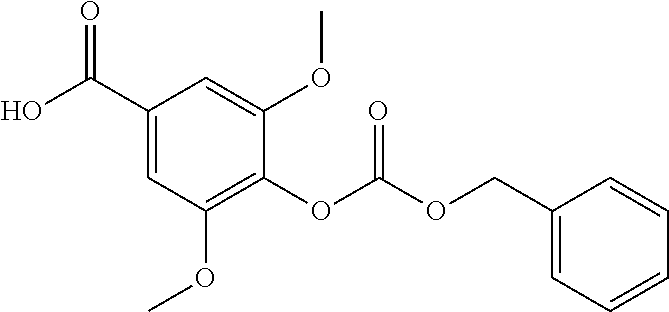


Analytical Data:
| LC-MS m/z | ||
| Example | 1H NMR (400 MHz, DMSO-d6) δ ppm | (+ESI) [M + H]+ |
| 23 | 8.69 (d, J = 1.6 Hz, 1H), 8.63 (dd, J = 1.2 Hz, J2 = 5.2 Hz, 1H), | 714.2 |
| 8.08 (m, 1H), 7.68 (m, 1H), 7.38-7.35 (m, 3H), 6.88 (d, | ||
| J = 2.4 Hz, 1H), 6.70 (dd, J = 2.4 Hz, J2 = 8.8 Hz, 1H), 5.08 (s, | ||
| 1H), 4.95-4.85 (m, 1H), 4.17 (s, 2H), 3.90 (dd, J1≈J2 = 10.0 | ||
| Hz, 1H), 3.81 (s, 6H), 3.79 (s, 3H), 3.75 (s, 3H), 3.60-1.91 | ||
| (m, 16H) | ||
| 24 | 7.45-7.36 (m, 6H), 7.23 (d, J = 8.4 Hz, 1H), 6.80 (d, J = 2.0 | 747.2 |
| Hz, 1H), 6.61 (dd, J1 = 2.0 Hz, J2 = 8.4 Hz, 1H), 4.93-4.92 (m, | ||
| 1H), 4.91 (m, 1H), 3.99 (s, 2H), 3.92 (dd, J1≈J2 = 10.8 Hz, | ||
| 1H), 3.81 (s, 6H), 3.77 (s, 3H), 3.73 (s, 3H), 3.39 (s, 3H), | ||
| 3.07-1.75 (m, 13H) | ||
| 25 | 10.53 (s, 1H), 7.39 (s, 2), 7.22 (d, J = 8.8 Hz, 1H), 6.80 (d, | 773.3 |
| J = 2.4 Hz, 1H), 6.61 (dd, J1 = 2.4 Hz, J2 = 8.8 Hz, 1H), 6.56 (d, | ||
| J = 2.0 Hz, 2H), 6.44 (dd, J1 = J2 = 2.0 Hz, 1H), 4.96-4.94 (m, | ||
| 1H), 4.35 (m, 1H), 3.98-3.91 (m, 3H), 3.84 (s, 6H), 3.79 (s, | ||
| 3H), 3.77-3.73 (m, 9H), 3.41 (s, 3H), 3.04-1.78 (m, 13H) | ||
| 26 | 10.99 (s, 1H), 7.38-7.21 (m, 8H), 6.89 (d, J = 2.4 Hz, 1H), | 727.3 |
| 6.70 (dd, J1 = 2.4 Hz, J2 = 8.8 Hz, 1H), 5.05 (m, 1H), 4.92 (m, | ||
| 1H), 3.90 (dd, J1≈J2 = 10.0 Hz, 1H), 3.79-3.74 (m, 9H), 3.57- | ||
| 1.94 (m, 20H) | ||
| 27 | 8.58 (dd, J1 = 0.8 Hz, J2 = 4.8 Hz, 1H), 7.90 (dd, J1≈J2 = 8.0 Hz, | 714.3 |
| 1H), 7.53 (d, J = 8.0 Hz, 1H), 7.44-7.40 (m, 1H), 7.38-7.35 | ||
| (m, 3H), 6.88 (d, J = 2.4 Hz, 1H), 6.70 (dd, J1 = 2.4 Hz, J2 = 8.4 | ||
| Hz, 1H), 5.07 (s, 1H), 4.95-4.85 (m, 1H), 3.92 (dd, | ||
| J1≈J2 = 9.6 Hz, 1H), 3.81 (s, 6H), 3.79 (s, 3H), 3.75 (s, 3H), | ||
| 3.57-1.93 (m, 16H) | 714.3 | |
| 28 | 8.72 (d, J = 6.4 Hz, 2H), 7.72 (d, J = 6.4 Hz, 2H), 7.37-7.35 | |
| (m, 3H), 6.88 (d, J = 2.0 Hz, 1H), 6.71 (dd, J1 = 2.0 Hz, J2 = 8.8 | ||
| Hz, 1H), 5.07 (s, 1H), 4.93 (m, 1H), 3.92 (dd, J1≈J2 = 10.0 | ||
| Hz, 1H), 3.82 (s, 6H), 3.79 (s, 3H), 3.75 (s, 3H), 3.65-1.91 | ||
| (m, 15H) | ||
| 29 | 11.00 (s, 1H), 7.55 (dd, J1 = J2 = 1.6 Hz, 1H), 7.45 (d, J = 1.6 | 781.1 |
| Hz, 2H), 7.38-7.35 (m, 3H), 6.88 (d, J = 2.0 Hz, 1H), 6.70 | ||
| (dd, J1 = 2.0 Hz, J2 = 8.4 Hz, 1H), 5.07 (s, 1H), 4.95-4.93 (m, | ||
| 1H), 4.06 (s, 2H), 3.92 (dd, J1≈J2 = 9.6 Hz, 1H), 3.83 (s, 6H), | ||
| 3.79 (s, 3H), 3.75 (s, 3H), 3.57-1.92 (m, 16H) | ||
| 30 | 10.53 (s, 1H), 7.95-8.01 (m, 4H), 7.54-7.58 (m, 3H), 7.42 (s, | 779.1 |
| 2H), 7.22 (d, J = 8.4 Hz, 1H), 6.80 (d, J = 2.0 Hz, 1H), 6.61 | ||
| (dd, J = 2.0, 8.4 Hz, 1H), 5.47 (s, 2H), 4.93 (m, 1H), 4.32 | ||
| (m, 1H), 3.96 (m, 1H), 3.87 (s, 6H), 3.75 + 3.80 (2s, 6H), | ||
| 3.32 (s, 3H), 1.80-3.05 (m, 13H) | ||
| 31 | 10.53 (s, 1H), 7.61 (m, 2H), 7.42 (m, 4H), 7.22 (d, J = 8.4 | 807.0 + 809.0 |
| Hz, 1H), 6.80 (d, J = 2.4 Hz, 1H), 6.61 (dd, J = 2.0, 8.4 Hz, | ||
| 1H), 5.30 (s, 2H), 4.95 (m, 1H), 4.35 (m, 1H), 3.96 (m, 1H), | ||
| 3.88 (s, 6H), 3.75 + 3.79 (2s, 6H), 3.41 (s, 3H), 1.70-3.15 | ||
| (m, 13H) | ||
| 32 | 10.53 (s, 1H), 7.68-7.80 (m, 4H), 7.43 (s, 2H), 7.22 (d, J = 8.4 | 797.2 |
| Hz, 1H), 6.80 (s, 1H), 6.61 (dd, J = 2.4 + 8.4 Hz, 1H), 5.30 (s, | ||
| 2H), 4.95 (m, 1H), 4.35 (m, 1H), 3.96 (m, 1H), 3.88 (s, 6H), | ||
| 3.75 + 3.79 (2s, 6H), 3.41 (s, 3H), 1.70-3.10 (m, 13H) | ||
| 33 | 10.54 (br, 1H), 7.42 (s, 2H), 7.12-7.32 (m, 4H), 6.80 (d, | 765.2 |
| J = 2.4 Hz, 1H), 6.61 (dd, J = 2.2, 8.6 Hz, 1H), 5.33 (s, 2H), | ||
| 4.96 (m, 1H), 4.35 (s, 1H), 3.96 (m, 1H), 3.89 (s, 6H), 3.79 + | ||
| 3.75 (2s, 6H), 3.41 (s, 3H), 1.74-3.05 (m, 13H) | ||
| 34 | 10.53 (br, 1H), 8.04 (m, 3H), 7.53-7.70 (m, 4H), 7.39 (s, | 779.2 |
| 2H), 7.22 (d, J = 8.4 Hz, 1H), 6.80 (s, 1H), 6.61 (d, J = 8.4 Hz, | ||
| 1H), 5.78 (s, 2H), 4.95 (m, 1H), 4.35 (s, 1H), 3.95 (m, 1H), | ||
| 3.84 (s, 6H), 3.79 + 3.75 (2s, 6H), 3.40 (s, 3H), 1.73-3.10 | ||
| (m, 13H) | ||
| 35 | 10.54 (br, 1H), 7.39-7.49 (m, 4H), 7.39 (s, 2H), 7.22 (d, | 763.1 |
| J = 8.4 Hz, 1H), 6.80 (d, J = 2.4 Hz, 1H), 6.61 (dd, J = 2.2 + | ||
| 8.2 Hz, 1H), 5.31 (s, 2H), 4.95 (m, 1H), 4.35 (s, 1H), 3.96 | ||
| (m, 1H, 3.88 (s, 6H), 3.79 + 3.75 (2s, 6H), 3.40 (s, 3H), | ||
| 1.73-3.07 (m, 13H) | ||
| 36 | 10.53 (br, 1H), 7.50 (m, 2H), 7.41 (s, 2H), 7.19-7.31 (m, | 747.1 |
| 4H), 6.80 (d, J = 2.0 Hz, 1H), 6.61 (dd, J = 2.2 + 8.8 Hz, 1H), | ||
| 5.28 (s, 2H), 4.91 (m, 1H), 4.35 (s, 1H), 3.96 (m, 1H), 3.87 | ||
| (s, 6H), 3.75 + 3.79 (2s, 6H), 3.40 (s, 3H), 1.74-3.06 (m, 13H) | ||
| 37 | 10.55 (br, 1H), 7.68 (s, 1H), 7.57 (d, J = 1.2 Hz, 2H), 7.46 (s, | 783.2 |
| 2H), 7.23 (d, J = 8.4 Hz, 1H), 6.80 (s, 1H), 6.62 (d, J = 8.4 Hz, | ||
| 1H), 4.95 (m, 1H), 4.35 (s, 1H), 3.97 (m, 1H), 3.96 (s, 6H), | ||
| 3.75 + 3.80 (2s, 6H), 3.41 (s, 3H), 1.77-3.10 (m, 13H) | ||
| 38 | 10.54 (br, 1H), 7.83 (d, J = 8.4 Hz, 2H), 7.65 (d, J = 8.0 Hz, | 797.1 |
| 2H), 7.42 (s, 2H), 7.22 (d, J = 8.4 Hz, 1H), 6.80 (d, J = 2.4 Hz, | ||
| 1H), 6.60 (dd, J = 2.4, 8.4 Hz, 1H), 5.41 (s, 2H), 4.96 (m, 1H), | ||
| 4.35 (m, 1H), 3.95 (m, 1H), 3.88 (s, 6H), 3.75 + 3.79 (2s, | ||
| 6H), 3.40 (s, 3H), 1.70-3.10 (m, 13H) | ||
| 39 | 10.54 (br, 1H), 7.45 (s, 2H), 7.22 (d, J = 8.4 Hz, 1H), 6.80 (d, | 775.1 |
| J = 2.0 Hz, 1H), 6.60 (dd, J = 2.0 + 8.4 Hz, 1H), 6.48 (m, 3H), | ||
| 4.97 (m, 1H), 4.35 (m, 1H), 3.95 (m, 7H), 3.75-3.85 (m, | ||
| 12H), 3.41 (s, 3H), 1.75-3.10 (m, 13H) | ||
| 40 | 10.54 (br, 1H), 7.45 (s, 2H), 7.18-7.30 (m, 2H), 6.80 (s, 1H), | 758.3 |
| 6.50-6.70 (m, 4H), 4.96 (m, 1H), 4.35 (m, 1H), 3.95 (m, | ||
| 7H), 3.75 + 3.79 (2s, 6H), 2.93 (s, 6H), 1.75-3.10 (m, 13H) | ||
| 41 | 10.55 (br, 1H), 7.44 (s, 2H), 7.22 (d, 1H, J = 8.4 Hz), 7.10 (d, | 758.3 |
| 2H, J = 2.0 + 7.2 Hz), 6.80 (d, 1H, J = 2.4 Hz), 6.75 (dd, 2H, | ||
| J = 2.0 + 7.2 Hz), 6.61 (d, 1H, J = 2.4 + 8.4 Hz), 4.95 (m, 1H), | ||
| 4.35 (m, 1H), 3.95 (m, 7H, CH-17), 3.75 + 3.80 (2s, 6H), | ||
| 3.41 (s, 3H), 2.90 (s, 6H), 1.70-3.10 (m, 13H) | ||
| 42 | 11.04 (br, 1H), 9.57 (br, 1H), 7.41 (s, 2H), 7.38 (m, 1H), | 745.5 |
| 7.22 (dd, J1 = J2 = 8.0 Hz, 1H), 6.70-6.90 (m, 5H), 5.21 (s, 2H), | ||
| 5.11 (m, 1H), 4.97 (m, 1H), 3.95 (m, 1H), 3.88 (s, 6H), 3.78 + | ||
| 3.82 (2s, 6H), 3.40 (s, 3H) 1.90-3.30 (m, 13H) | ||
| 43 | 10.53 (br, 1H), 7.41 (s, 2H), 7.22 (m, 2H), 6.60-6.80 (m, | 772.6 |
| 5H), 5.22 (s, 2H), 4.95 (m, 1H), 4.34 (m, 1H), 3.95 (m, 1H), | ||
| 3.87 (s, 6H), 3.75 + 3.79 (2s, 6H), 3.41 (s, 3H), 1.70-3.10 | ||
| (m, 19H) | ||
| 44 | 10.53 (br, 1H), 7.41 (s, 2H), 7.22 (d, J = 8.4 Hz, 1H), 7.05 (dd, | 744.6 |
| J1 = J2 = 8.0 Hz, 1H), 6.80 (d, J = 1.6 Hz, 1H), 6.50-6.65 (m, | ||
| 4H), 5.19 (br, 2H), 5.12 (s, 2H), 4.95 (m, 1H), 4.34 (m, 1H), | ||
| 3.95 (m, 1H), 3.88 (s, 6H), 3.75 + 3.80 (2s, 6H), 3.41 (s, | ||
| 3H), 1.70-3.10 (m, 13H) | ||
Biological Activity Assays
| Example | 6.5 cell line [μM] | HL60 cell line [μM] |
| 6 | 2.5 | 2.5 |
| 7 | 2.5 | 2 |
| 8 | 5 | 4 |
| 9 | 4 | 4 |
| 10 | 1 | 1 |
| 12 | 1.5 | 1.5 |
| 13 | 1 | 2 |
| 14 | 1.5 | 2 |
| 15 | 1.5 | 2 |
| 16 | 1 | 2 |
| 17 | 1 | 1.5 |
| 18 | 1 | 1.5 |
| 20 | 5 | 5 |
| 21 | 2 | 3.5 |
| 31 | 2 | 2 |
| 32 | 2 | 2 |
| 33 | 2 | 2 |
| 34 | 7.5 | 5 |
| 35 | 2 | 2 |
| 36 | 2.5 | 3 |
| 38 | 4 | 4 |
Claims (25)


Applications Claiming Priority (4)
| Application Number | Priority Date | Filing Date | Title |
|---|---|---|---|
| EP12175724.9 | 2012-07-10 | ||
| EP12175724 | 2012-07-10 | ||
| EP12175724 | 2012-07-10 | ||
| PCT/EP2013/064048 WO2014009222A1 (en) | 2012-07-10 | 2013-07-03 | Combination therapy for the treatment of cancer and immunosuppression |
Publications (2)
| Publication Number | Publication Date |
|---|---|
| US20150157622A1 US20150157622A1 (en) | 2015-06-11 |
| US9511064B2 true US9511064B2 (en) | 2016-12-06 |
Family
ID=48741177
Family Applications (1)
| Application Number | Title | Priority Date | Filing Date |
|---|---|---|---|
| US14/413,122 Expired - Fee Related US9511064B2 (en) | 2012-07-10 | 2013-07-03 | Combination therapy for the treatment of cancer and immunosuppression |
Country Status (12)
| Country | Link |
|---|---|
| US (1) | US9511064B2 (en) |
| EP (1) | EP2872505A1 (en) |
| JP (1) | JP2015522048A (en) |
| KR (1) | KR20150041786A (en) |
| CN (1) | CN104603133B (en) |
| AU (1) | AU2013289384B2 (en) |
| BR (1) | BR112015000179A2 (en) |
| CA (1) | CA2878605A1 (en) |
| IL (1) | IL236321A0 (en) |
| MX (1) | MX2015000309A (en) |
| RU (1) | RU2015104122A (en) |
| WO (1) | WO2014009222A1 (en) |
Cited By (1)
| Publication number | Priority date | Publication date | Assignee | Title |
|---|---|---|---|---|
| EP3830086A2 (en) | 2018-07-27 | 2021-06-09 | University of Sharjah | Discovery of novel first in class nature-inspired compounds targeting the mitochondrial function and pharmaceutical composition thereof |
Families Citing this family (5)
| Publication number | Priority date | Publication date | Assignee | Title |
|---|---|---|---|---|
| CN107205968B (en) * | 2014-08-14 | 2021-08-20 | 威斯康星州医药大学股份有限公司 | Modified mitochondrial-metformin compounds and methods for their synthesis and use |
| EP3388084A4 (en) * | 2015-12-07 | 2019-11-13 | Kyoto University | POLYTHERAPY BASED ON PD-1 SIGNAL INHIBITORS |
| EP3610866A4 (en) * | 2017-04-14 | 2020-12-23 | National Cancer Center | PHARMACEUTICAL COMPOSITION FOR THE PREVENTION AND TREATMENT OF CANCER WITH MALATE ASPARTATE SHUTTLE INHIBITORS AND ANTI-CANCER AGENTS AS ACTIVE INGREDIENTS |
| JP2022108114A (en) * | 2021-01-12 | 2022-07-25 | 株式会社スタイルアンドバリュージャパン | autophagy inducer |
| KR20250073852A (en) | 2023-11-20 | 2025-05-27 | 한국해양과학기술원 | The isolation of piericidin A produced by a new Streptomyces massiliensis strain and purification method |
Citations (3)
| Publication number | Priority date | Publication date | Assignee | Title |
|---|---|---|---|---|
| US2813871A (en) * | 1957-11-19 | O-syringoyl reserpic acid esters | ||
| US20100239522A1 (en) | 2007-08-24 | 2010-09-23 | Salsbury Jr Freddie R | Chemotherapeutic for inducing an msh2-dependent apoptotic pathway |
| WO2012095379A1 (en) | 2011-01-11 | 2012-07-19 | Universität Basel | Combination of syrosingopine and mitochondrial inhibitors for the treatment of cancer and immunosuppression |
Family Cites Families (4)
| Publication number | Priority date | Publication date | Assignee | Title |
|---|---|---|---|---|
| US3169967A (en) * | 1957-11-14 | 1965-02-16 | Ciba Geigy Corp | Methyl o-lower alkanoyl-reserpates |
| CH364511A (en) | 1957-09-11 | 1962-09-30 | Sandoz Ag | Process for the preparation of reserpine-like compounds |
| US2957878A (en) * | 1957-06-04 | 1960-10-25 | Ciba Pharm Prod Inc | 18-o-esters of methyl reserpate |
| CH361811A (en) | 1957-07-05 | 1962-05-15 | Sandoz Ag | Process for the production of iso-reserp acid lactones |
-
2013
- 2013-07-03 BR BR112015000179A patent/BR112015000179A2/en not_active IP Right Cessation
- 2013-07-03 CA CA2878605A patent/CA2878605A1/en not_active Abandoned
- 2013-07-03 US US14/413,122 patent/US9511064B2/en not_active Expired - Fee Related
- 2013-07-03 JP JP2015520908A patent/JP2015522048A/en active Pending
- 2013-07-03 CN CN201380036291.3A patent/CN104603133B/en not_active Expired - Fee Related
- 2013-07-03 MX MX2015000309A patent/MX2015000309A/en unknown
- 2013-07-03 RU RU2015104122A patent/RU2015104122A/en not_active Application Discontinuation
- 2013-07-03 EP EP13732982.7A patent/EP2872505A1/en not_active Withdrawn
- 2013-07-03 KR KR1020157003570A patent/KR20150041786A/en not_active Withdrawn
- 2013-07-03 AU AU2013289384A patent/AU2013289384B2/en not_active Ceased
- 2013-07-03 WO PCT/EP2013/064048 patent/WO2014009222A1/en not_active Ceased
-
2014
- 2014-12-17 IL IL236321A patent/IL236321A0/en unknown
Patent Citations (4)
| Publication number | Priority date | Publication date | Assignee | Title |
|---|---|---|---|---|
| US2813871A (en) * | 1957-11-19 | O-syringoyl reserpic acid esters | ||
| US20100239522A1 (en) | 2007-08-24 | 2010-09-23 | Salsbury Jr Freddie R | Chemotherapeutic for inducing an msh2-dependent apoptotic pathway |
| WO2012095379A1 (en) | 2011-01-11 | 2012-07-19 | Universität Basel | Combination of syrosingopine and mitochondrial inhibitors for the treatment of cancer and immunosuppression |
| US8993587B2 (en) * | 2011-01-11 | 2015-03-31 | Universitat Basel | Combination of syrosingopine and mitochondrial inhibitors for the treatment of cancer and immunosuppression |
Non-Patent Citations (4)
| Title |
|---|
| Hinke, SA et al., Brit. J. Pharmacol. 2007, vol. 150, pp. 1031-1043. * |
| R. A. Lucas, et al., "Rauwolfia Alkaloids. XXXI. The Synthesis and Activity of Some Reserpine Analogs," J. Am. Chem. Soc., 1959, 81 (8), pp. 1928-1932. |
| Silverman, R. The Organic Chemistry of Drug Design and Drug Action 2004, NY Elsevier, p. 26. * |
| The International Search Report and Written Opinion, mailed on Aug. 7, 2013, in the related PCT Appl. No. PCT/EP2013/064048. |
Cited By (2)
| Publication number | Priority date | Publication date | Assignee | Title |
|---|---|---|---|---|
| EP3830086A2 (en) | 2018-07-27 | 2021-06-09 | University of Sharjah | Discovery of novel first in class nature-inspired compounds targeting the mitochondrial function and pharmaceutical composition thereof |
| US12269821B2 (en) | 2018-07-27 | 2025-04-08 | Univeristy Of Sharjah | Discovery of novel first in class nature-inspired compounds targeting the mitochondrial function and pharmaceutical composition thereof |
Also Published As
| Publication number | Publication date |
|---|---|
| AU2013289384A1 (en) | 2015-01-22 |
| US20150157622A1 (en) | 2015-06-11 |
| MX2015000309A (en) | 2015-08-14 |
| RU2015104122A (en) | 2016-08-27 |
| IL236321A0 (en) | 2015-02-26 |
| CA2878605A1 (en) | 2014-01-16 |
| KR20150041786A (en) | 2015-04-17 |
| WO2014009222A1 (en) | 2014-01-16 |
| BR112015000179A2 (en) | 2017-06-27 |
| JP2015522048A (en) | 2015-08-03 |
| AU2013289384B2 (en) | 2016-04-14 |
| CN104603133A (en) | 2015-05-06 |
| EP2872505A1 (en) | 2015-05-20 |
| CN104603133B (en) | 2016-11-02 |
Similar Documents
| Publication | Publication Date | Title |
|---|---|---|
| US9676749B2 (en) | Compositions and methods for cancer detection and treatment | |
| JP2021176857A (en) | Carboxamide derivative useful as rsk inhibitor | |
| US20060189682A1 (en) | Water soluble prodrugs of COX-2 inhibitors | |
| AU2013289384B2 (en) | Combination therapy for the treatment of cancer and immunosuppression | |
| US9464093B2 (en) | Substituted imidazo[4',5':4,5]cyclopenta[1,2-e]pyrrolo[1,2-a]pyrazines and oxazolo[4',5':4,5]cyclopenta[1,2-e]pyrrolo[1,2-a]pyrazines for treating brain cancer | |
| US20090306201A1 (en) | Selective inhibitors for transferases | |
| EP3406598A1 (en) | Pyrazole derivatives as inhibitors of stat3 | |
| US12545681B2 (en) | Compound used as RET kinase inhibitor and application thereof | |
| CN103739616B (en) | Containing thiazolyl rapamycin type derivative and application thereof | |
| US20260062415A1 (en) | Purine derivatives as sik-3 inhibitors | |
| US11142533B2 (en) | Macrocycles for use in treating disease | |
| US9724331B2 (en) | Use of maleimide derivatives for preventing and treating leukemia | |
| WO2019189241A1 (en) | Therapeutic agent for hepatocellular carcinoma | |
| CN104829671B (en) | The gemcitabine of NO donator types/FTA/ furazans conjugate and preparation method and purposes | |
| US20250376455A1 (en) | 2-diarylmethyl-4-aminotetrahydropyran derivatives and related compounds as anticancer, antiinflammatory, antifibrotic and neuroprotective agents | |
| CN102627685B (en) | Nitric oxide-donating glutathione compound, preparation method and medical purpose thereof | |
| CN104327097B (en) | Triazole derivatives of rapamycin and application | |
| WO2023142518A1 (en) | Hydroxynaphthalenone-phenylboronic acid compound, preparation method, and use | |
| CN103304573A (en) | Application of Lycorine compound in preparation of anti-tumor drugs | |
| CN106995368B (en) | A kind of non-ATP competitive FGFR1 inhibitor and its application | |
| TW202400573A (en) | Polycyclic compounds and their uses | |
| CN115974890A (en) | Lycorine derivatives and their preparation methods and their application in the preparation of antitumor drugs | |
| EP1911451A1 (en) | Protein-kinase CK2 inhibitors and their therapeutic applications | |
| CN111217814B (en) | Bipiperidine derivative and application thereof as antitumor drug | |
| WO2021219100A1 (en) | Compound containing fused tricyclic structure |
Legal Events
| Date | Code | Title | Description |
|---|---|---|---|
| AS | Assignment |
Owner name: BASILEA PHARMACEUTICA AG, SWITZERLAND Free format text: ASSIGNMENT OF ASSIGNORS INTEREST;ASSIGNORS:POHLMANN, JENS;BENJAMIN, DON GARY;MORONI, CHRISTOPH;SIGNING DATES FROM 20150203 TO 20150310;REEL/FRAME:035697/0064 |
|
| STCF | Information on status: patent grant |
Free format text: PATENTED CASE |
|
| FEPP | Fee payment procedure |
Free format text: MAINTENANCE FEE REMINDER MAILED (ORIGINAL EVENT CODE: REM.); ENTITY STATUS OF PATENT OWNER: SMALL ENTITY |
|
| LAPS | Lapse for failure to pay maintenance fees |
Free format text: PATENT EXPIRED FOR FAILURE TO PAY MAINTENANCE FEES (ORIGINAL EVENT CODE: EXP.); ENTITY STATUS OF PATENT OWNER: SMALL ENTITY |
|
| STCH | Information on status: patent discontinuation |
Free format text: PATENT EXPIRED DUE TO NONPAYMENT OF MAINTENANCE FEES UNDER 37 CFR 1.362 |
|
| FP | Lapsed due to failure to pay maintenance fee |
Effective date: 20201206 |